 George Rock
History of the American Field Service
1920-1955
George Rock
History of the American Field Service
1920-1955
CHAPTER XVII
During the next phase of the battle, only the jeep was at work and it was everywhere at once and very busy. The campaign had not ceased since the end of June, allowing the enemy time neither to regroup nor to regain the initiative. The AFS volunteers with the jeep ambulances had to move far, fast, and frequently in order to keep up with the rapid advance of the Allied troops.
At the end of October there were considerable changes in the higher appointments of the theatre and the reorganization of the areas of command into the China and India-Burma theatres. This was followed on 12 November by a reorganization of 11 Army Group as Allied Land Forces, South East Asia (ALFSEA), under the command of Lt.-Gen. Sir Oliver Leese. The administrative levels of the vast area remained numerous, with the India command in New Delhi always to be reckoned with. The possible administrative snarls and tangles were no less dense, overgrown, and uncharted than the jungle through which the troops fought.
At the end of October, 4 Corps had returned to Imphal, with 19th Indian Division and 268 Indian Infantry Brigade under command. By the middle of November, 19th Division had a brigade across the Chindwin at Sittaung. The routes east from there to the Railway Corridor (leading southwest from Myitkyina through Wuntho and Shwebo to Mandalay) were found to be feasible, and by the end of the month the whole Division was operating to the east. During December, although moving over difficult and almost trackless country, its progress was steady. Pinlebu and Banmauk were taken on the 16th, Wuntho three days later, and Kawlin on the 20th. A patrol from Banmauk advanced east to link the so-called Central Front to General Stilwell's NCAC front, while the rest of the 19th Division continued south along the railroad toward Shwebo.
In the meantime, 33 Corps was pushing east from Kalemyo. On 2 December, 11th East African Division reached the Chindwin at Kalewa, and a bridgehead across the river was established the following night. Near Mawlaik, about half way between Tamu and Kalewa, one brigade of 20th Indian Division crossed the Chindwin at the same time. While this continued toward the east, the rest of the Division crossed at Kalewa, as did the 2nd British Division, which relieved the 11th East African Division in the expanding bridgehead in mid-December. The 2nd and 20th Divisions then pushed west and slightly south, taking Pyingaing on 24 December and then Kaduma and Kabo on the 30th and 31st. By the end of 1944, Fourteenth Army had a firm foothold on the Shwebo plain, where General Slim planned to engage the main strength of the enemy early in the new year.
In spite of the fact that there were 3 bridgeheads across the Chindwin, only the road from Tamu to Kalemyo (and then east to Kalewa and on to Ye-U on the Mu River) was to be put in order and maintained. Other roads, after the troops passed on, were to be let sink or to rot and vanish. Supplies were to go by water down the Chindwin from Kalewa. Until the single road was ready, only the AFS jeeps could be used to carry patients back from the front. There was little communication between the detachments or sections of jeeps with one brigade and another, and that little, after following whatever devious route was at the time possible, was likely to be out of date by the time it had reached its destination.
On 11 November, 24 of the jeep Section's 25 cars were posted---16 forward of Tiddim with 5th Division, 6 forward of MS 61 on the Kalewa road with 11th East African Division and 2 at Ukhrul. The last two came down shortly, but otherwise the jeeps' general dispersal remained the same through into December. The cars advanced with the troops they were serving, moving east toward Kalewa from Tiddim. On completion of their assignment with 5th Division, 10 jeeps were transferred to the newly returned 4 Corps: 6 to 9 LFA of 268 Brigade and 4 to 19th Division. The 15 remaining with 33 Corps were all over the lot: 9 with the 11th East African Division, 5 at Htoma Myauk (south of Kalemyo on the track to Taukkyan and Natchaung), and 1 at Section HQ, which early in December moved south from Imphal to a spot 10 miles west of Kalewa. By the middle of December, the 8 cars operating to the east of the Chindwin had to be listed as "exact commitments uncertain." As the advance continued, the same had to be said of most of the cars---even those supposedly just south of Kalemyo.
To the east toward Pinlebu and Wuntho, as well as south toward Falam and Gangaw, the roads were few and poor---snarling, when not halting, communications. Conditions on both sectors of the front were similar, though with 4 Corps they were more confused as its advance was faster. On 20 December, Gilliam wrote to Lt. Spavin: "Contrary to Ronny's ideas, we are not 40 miles from Tamu. We are at the moment 248 miles from Tamu and moving at the rate of 20 miles per day. Albert and I are with the ADS of 53 FA (64 Brigade), driving south down the railroad from Nankan. . . . I should imagine that we will continue speedily to Mandalay, which is only 110 miles away. Shepard and Mackay are with the light MDS of 52 FA (62 Brigade). When last I heard they were at Pinbon, 60 miles northwest of Nankan---but by the time you get this they will have moved, where I have no idea but it should be in the direction of Pinlebu and Wuntho. Of Dodds' group I have no idea. Without my eleventh jeep I cannot keep track of anything but myself and Albert."
On the same day, T. W. Shepard wrote from Pinbon that
"the Japs are retreating fast and there is a hell of a lot of work for us to do. . . . Life in the jeep Section is quite different than in the bigger ambulances. We have a rack fixed on the jeep over the right-hand side, over the passenger's seat. The canvas roof and the windshield have been removed and stretchers are placed in these racks. At night we sleep on the stretcher and it's not too bad---as the monsoons are over and the mosquitoes have sought a more balmy clime.
"Our runs are varied---we never know from one day to the next what the work will be like on the morrow. . . . We hear no more shelling now, as it's moved on up again. That's the way it always is: we move up, hear all the noise, then it moves on. People move in where we are, creating a boom-town-like bustle, and things are civilized. Then up we go again to the noise.
"There are bananas here which will be ripe by 1 January and grass 20 feet tall---elephant grass. In the daytime the temperature reaches 80° to 90°---while at night we suffer at 30°. There is snow at times on the mountain peaks." Even with the end of the monsoons, however, Burma did not turn out to be particularly dry. Five days later, Shepard continued: "It is a damp Christmas morning here, with the dew draining from the trees, and I'm uncomfortable, sitting on the edge of a stretcher and shivering with the wetness. In three hours the sun will burn through the mist, which makes the morning existence seem like sleepwalking, and will bring life and dryness to all us creatures down here."
On the last of the year, M. Cary reported from 4 Corps to Lt. Spavin: "I am with 53 FA, Lt.-Col. Sneddin, at Thityabin. Have fixed racks on this jeep and will go to work here. Gilliam and Albert with ADS of 57 FA. Will probably meet them at Kanbalu shortly. Mackay and Shepard will soon be here, probably; now at Pinbon with MDS this FA. Air strip opens here today. Potter flying out from Kawlin Dakota strip today or tomorrow. Sorry I got cut off here, but the ferries across the Chindwin are closed."
Communication back from the front was hardly more difficult than an attempt to go forward from the rear areas. In mid-December, Major Ives tried to make a tour of all the posts before handing over command to Major Marsh. His account fills out the picture of chaos in the wake of success:
"Dec. 18:
Left [Palel] in A.M. . . . Palel-Tamu road improving, but slowly. Lunch at 4 Corps and asked DADMS about jeeps. He phoned through and found that Dodds was at Pantha [on the Chindwin, north of Mawlaik]. So down Kabaw Valley a spell---they are tar-papering the new road---then to Hlezeik [on the Yu just south of Tamu], where was Sgt. Smith QMS), formerly of 126 IBGH, Poona, now with rear section of 9 LFA. He phoned through to see if I could get to Pantha and found I could. So over the Yu and by narrow track about 20 miles to Capt. Nagpat Singh's camp. There was Matthew, Joe Merriam having come down with malaria. . . .
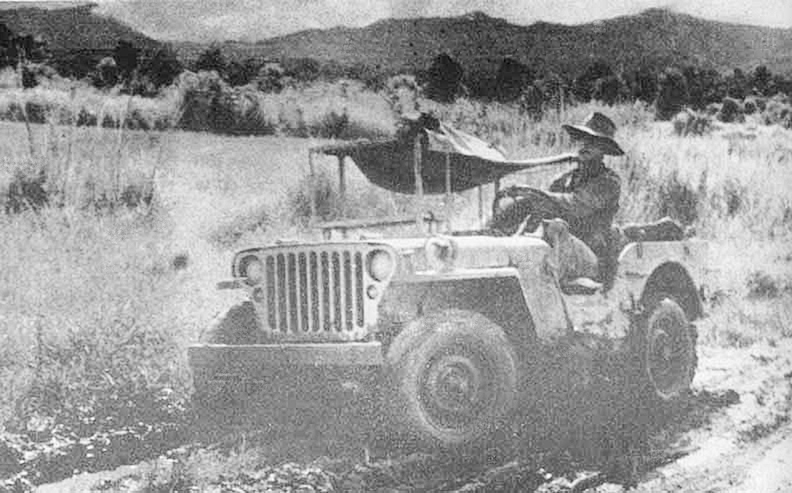
Jeep ambulance in the Kabaw Valley"Dec.19:
By narrow track some 4 miles and then stopped by lack of bridge, which 3 elephants built while I watched; marvelous intelligence. Then on for about 16 miles to Chindwin. Across by jeep ferry. Another 7 miles to 9 LFA, giving lift to Political Officer, who said the Burmese were 'glad to see us back' and generally co-operative but so busy with crops it was bard to get them for roads and landing strips. Dodds and O'Donnell there and happy, though not busy. Ostenso and Richley north a few miles over a bad track. Col. Stevens had got some stretcher brackets from us. We sat around the bonfire and . . . talked until 9 P.M."Dec. 20:
Changed roof and brackets on jeep I left with O'Donnell, taking his. I greased his jeep, then started back after 11 A.M. Got into middle of GPT jeep convoy on other side of Chindwin. They drove damn fast and damn well. . . ."Dec. 21:
Left at 9 A.M. Dusty road but fairly smooth to the north. Met Cloud at 20 Div HQ and stopped and saw Vince Lilly and had some crackers and tea from him. Then on over increasingly rough and dusty roads. In late P.M. picked up a guy named Morris who had been a staff sgt. at the OCTU where Wright, Gilmore, Lewis, Patullo, Nichols, Glen, and Muller had gone. . . . Stopped at CCS to see if anything known of our guys. Went to 13 CCS across the river and saw Captain Tata. The Sikhs are evacuating to here. No one knows where AFS is. . . ."Dec. 22:
I went on over bumps and dust until I saw the AFS sign. Jit Singh fixed my 'tambu' (shelter). I loafed all day, watched Ed Spavin build a foot bridge, and watched the boys put a jeep back on the road after a British Lt. had driven it off---no one hurt, though 2 Indians were in it too. . . ."Dec. 23:
Wanting to see the Kalewa bridge, etc., took Birkett's jeep because not an oil-burner and set out eastwards, but met a sign prohibiting sightseers, further on. This about 5 miles from Chindwin, so turned back and then went looking for other jeeps in the Kalemyo area. . . . Found them some 25 miles from Spavin. Sat about all P.M., finally deciding to spend the night. Jut Dempsey, Danny James, Parkhurst, Dewey Swensson, Dick Morrill there and Tony Bradley and George Riel had come in just before me, bringing Abdul Salaam, who said he had a good leave, everybody well except one sister who had died."Dec. 24:
More sitting around in A.M., then everyone over to Spavin for Christmas Eve. This celebrated with much rum ... many songs...."Dec. 25:
Back to 8 MT Regt. at MS 63V2- On the way saw Bailey. Left in P.M. and went to Belgian CCS at MS 58 and saw Joe Smith ...."Dec. 26:
After Joe had wangled 2 sandwiches for me, I left . . . .Road rough. Going through Tamu saw Scott Gilmore, who had been in Arakan show. He with 4/8 Gurkhas, 7th Div., which is up to something. Said Jupe Lewis, also with Gurkhas, had been wounded in Italy. Seemed very cheerful but said he was working hard."
Shortly after this tour, Major Ives returned to the United States. He had already turned Syria from a playground into a useful training center for AFS. In India he had created a new branch of the Service and had guided it through as much rough going as any other saw. "Major Ives has shown enthusiasm and devotion to duty of a high order," his citation from the British read. "For one year he has, with his team of volunteer workers, achieved notable success in their self-appointed task. It has been largely due to Major Ives' example and personal devotion to duty that this success has been achieved during this period."
At the end of 1944, Major Marsh appointed Capt. R. E. Paulson to be his second in command, P. Gilbert succeeding Paulson in charge of 3 MAS, assisted by K. K. Madsen. Lt. Gilbert led his Section into Burma on 29 December, followed at the beginning of 1945 by Lt. Fenn and 4 MAS.
These two MASs, burdened with Chevrolet ambulances, had been having a thin time of it. During a fairly long period in the Imphal area they had been able to give their cars a good overhaul, but there had not been much else to do. The 3rd Section, which had returned to Palel in mid-November, did not have time enough to come to mind the inactivity so much. A large group of new men arrived, was trained, and received its "initiation": "All experienced vols are shooting that well-known quantity regarding the close shaves and daring exploits of the past," F. Kern, Jr., reported. He added, concerning the new arrivals, that "several have paid considerable sums for old, forgotten, rusty, and dirty rifles---worthless Jap souvenirs . . . doing in short just exactly what I did or would have done when I arrived had Poona had more to offer." When the cars were put in order, it was found that the use of high-octane aviation gasoline had caused more trouble than expected; it had even affected the brake system.
Lt. Fenn's 4 MAS, having already had a long spell of semi-idleness, found November and December in Imphal almost more than it could endure. It, too, had new volunteers to initiate and its cars to overhaul. In addition there were transfers to and from the Jeep Section and a healthy leave program. But only one car was on assignment, V. Lilly with 20th Division HQ in the Kabaw Valley, and this was not enough. Lt. Fenn reported that "to relieve ennui we have resorted to burning down our bashas." Rebuilding the two bashas destroyed by fire on the morning of 14 December took some of the edge from the boredom. But only steady work could do the trick, and that finally came at the turn of the year for both sections. While the jeep Section continued to serve both Corps on the Central Front, 3 MAS was assigned exclusively to 33 Corps and 4 MAS to 4 Corps.
In the meantime, the plans for this phase of the campaign had undergone a change. General Slim had wanted to mount a major assault against the main Japanese forces in the Shwebo plain. However, it was discovered in December that the Japanese were retreating too far. Leaving only small groups to delay by rearguard actions the advance across the Shwebo plain, the main Japanese forces were retreating to the east bank of the Irrawaddy.
Fourteenth Army was not strong enough to make the planned direct attack after, or at the same time as, crossing a broad river strongly defended along much of its length. So the new plan was for the main Japanese forces to be engaged around Mandalay and Meiktila at the end of February. Rather than a single river-crossing in strength, there would have to be several masking efforts to divert attention from the chief crossing south of the enemy concentrations guarding the river below Mandalay. In view of the altered strategy, which relied heavily on deceiving the enemy as regards Allied intentions, the axis of the 4 Corps attack was shifted from the left to the right flank of the army, so that it approached Meiktila from the southwest---this shift to be kept secret by every means, even to the use of a dummy HQ. A feint attack on Mandalay from the north was to be made by 33 Corps, followed by a major attack from the southwest. The new plan was "as brilliant in conception," Lord Mountbatten said, "as in its subsequent successful execution."
A successful campaign in the Arakan had already opened in mid-December. Making use of a fleet of landing craft, troops of 15 Corps in January leap-frogged down the coast to gain airfields close enough to the fighting front to be used as bases for air operations---both supply and support---in conjunction with the land campaign of 4 and 33 Corps. These two had had additional formations assigned to them in view of the revised strategy. Besides 7th and 17th Indian Divisions, 4 Corps was given 255 Indian Tank Brigade, 28 East African Brigade, and the Lushai Brigade---the latter then engaged near Gangaw on the road south from Kalemyo to Pakokku. The 2nd British and 20th Indian Divisions were joined in 33 Corps by 19th Indian Division and 268 Indian Infantry Brigade (which had orders relayed through a dummy HQ pretending to be that of 4 Corps). Mandalay was the goal of 33 Corps, Meiktila that of 4 Corps.
At the beginning of January on the 33 Corps front, both the 2nd and 19th Divisions were approaching Shwebo, which the latter entered from the east on the 7th and the former (after taking Ye-U on the 3rd) fought its way into from the northwest on the 8th. Part of the 19th Division continued east, crossing the Irrawaddy and gaining a foothold at Thabeikkyin on the 14th and farther south at Kyaukmyaung the next day. While these bridgeheads were being strengthened, against considerable opposition, 20th Division was fighting down east of the Chindwin to Monywa, the last port the Japanese held on the Chindwin. Although heavily defended and bitterly fought over, Monywa was taken on the 22nd. On the same day, other units of the Division took Myinmu on the Irrawaddy. By the end of the month, 2nd Division had also reached the Irrawaddy, after fighting down the Shwebo-Sagaing road. Thus the area east from the Chindwin to the Irrawaddy was almost completely cleared of the enemy.
Meanwhile, 4 Corps had been fighting down the Gangaw Valley toward Pakokku. After the fall of Gangaw on 11 January, the road south was relatively clear. The Lushai Brigade was withdrawn and 7th Division took the lead in the chase to the Irrawaddy. Dust thick enough in places to stop jeeps made it a difficult journey to Pauk, which was taken on the 27th. The main 7th Division crossing of the Irrawaddy was scheduled for February at Nyaungu and was to be synchronized with feint crossings to the north at Pakokku by a brigade of the division and south at Chauk by 28 East African Brigade. By the end of January, the two corps had gained a 160-mile stretch along the Irrawaddy, and forces were gathering behind the lines to exploit the next step of the advance.
The enemy made the hoped-for misinterpretation and, believing that the 19th Division crossing was the spearhead for all of 4 Corps, for a month frittered away its strength in daily attempts to crush this northern bridgehead. This repetition of the Kohima mistake, which kept a large number of Japanese engaged and resulted in heavy enemy casualties to no avail, allowed the relatively unmolested massing of the main Fourteenth Army strength to the south. On 12 February, the 20th Indian Division crossed the Irrawaddy a few miles to the west of the mouth of the Mu on the 33 Corps front. On the next day, 7th Indian Division made the main 4 Corps crossing at Nyaungu, as well as feint crossings at Pakokku and Chauk. The enemy counterattacked fiercely on the 20th Division bridgehead, to his great cost. But all the crossings were successfully made and held. Pagan and Pakokku were taken on the 15th by 7th Division, meeting only half-hearted opposition.
Still under the impression that both 4 and 33 Corps were in the Mandalay area, the enemy brought there reinforcements from all parts of Burma. However, as soon as the 7th Indian Division bridgehead was secure, 17th Indian Division (which was brought down to back the 7th Division attack after being mechanized and having one brigade made air-transportable) passed through and by 22 February was established on the east bank of the Irrawaddy. It advanced northeast to take Taungtha on the 24th, then southeast down the main road toward Meiktila-which as the nodal point of road and rail communications in central Burma abounded in supply dumps, administration centers, and airfields. The assault on Meiktila began at dawn on 28 February, and after savage hand-to-hand and house-to-house fighting it was taken on the morning of 4 March. The air-transportable brigade was flown in and mobile columns spread out from Meiktila.
To meet the new and surprising situation, enemy troops were brought south from the Mandalay area. The Japanese recaptured Taungtha, which cut off Meiktila from the Irrawaddy and 17th Division from its administration. The 5th Indian Division, after receiving the same reorganization as the 17th, was brought down from Jorhat, while the Allied troops at Meiktila resisted frequent and heavy Japanese attacks. Again the enemy wore itself down, and finally at the end of March Taungtha was retaken and the enemy driven away from the Meiktila area.
North of Mandalay, in the meantime, 19th Indian Division had linked its two bridgeheads on the east of the Irrawaddy and in the last few days of February started its drive to the south. It entered the outskirts of Mandalay on 9 March. Mandalay Hill was taken on the 11th, and 3 days of street fighting cleared the city area. Fort Dufferin, which was strongly defended, was finally taken on 20 March, and the next day the whole city was declared clear. During this action, 2nd British and 20th Indian Divisions were busy clearing the area southwest and south of Mandalay---20th Division looping south to take Wundwin on the 21st. Thence it drove up the line of the railroad, taking Kume on the 23rd and Kyaukse on the 30th. With control of the railroad, Fourteenth Army completed the capture of the Mandalay plain and the disorganization of the remnants of the Japanese forces in central Burma.
In spite of the repeated Japanese miscalculation, it was a rough three months of campaigning, during which the Field Service got no more rest or respite than anyone else. The work was constant and hard, and at its end many were close to battle exhaustion. Disease continued to take its toll. AFS battle casualties for the period were 3 dead and 4 wounded. Opportunities for outstanding work continued to present themselves. But as the Japanese were pushed into their major defeat in Burma, optimism was transformed into exhilaration at being part of the spectacularly victorious Fourteenth Army.
The first AFS casualty, and the only one to be unlamented, involved the 10 armored ambulances belonging to the Jeep Section. They had remained unassigned until the end of November, sitting at Section HQ in Imphal. Then 4 of them were sent to the front: 1 broke down and 3 were assigned---2 on the Kalewa road below MS 75 and the other at MS 12 on the Kalemyo track. The 6 left in Imphal were given back to the Army toward the end of the year. The 4 in the field, after less than 3 weeks at work, again sat idle at Section HQ, by then moved to MS 10 west of Kalewa.
D. L. McCollester, assigned to one of these monsters on his arrival in the field, reported such consolations as he found in driving one:
"It is pretty easy once you get used to it. The limited field of vision is not such a great handicap as I once thought. And you don't have to worry about anything hitting you because they can't hurt you."
Seldom were all 4 in working order at one time. They had been coaxed so far, but it was unlikely, if they were cajoled any farther, that they could ever be got back. In early February they were given 6 days of line evacuations from Kalewa northwest to Inbaung. Then on 15 February the order came to return them to the Army---because they were "impractical."
"They tell us this after we have been bouncing our brains out on these milk runs," McCollester wrote. "Each run took 7 or 8 hours, and you had to be on your toes every minute. They weigh 9 tons, and that is a lot of weight to handle, especially over these bumpy roads. After one run I would be all in and hit the sack mighty early. With my particular ambulance I had an awful lot of trouble and spent several weeks tinkering around with it so as to make it operate efficiently. From it, however, I did learn a lot about mechanics and maintenance, besides polishing up on my driving."
The rest of the jeep Section was split between the two corps, the smaller number with 4 Corps in the drive on Meiktila. These 9 jeeps were carried on the assignment lists as "restricted" at the beginning of January, as were the 23 ambulances of 4 MAS when they went forward. At first, Lt. Fenn found few assignments for his Section. On 3 January one car was still with HQ of 20th Division, a post which lasted through the month. Other activity included a short assignment of 4 cars to the ISS at Kan; 4 to 255 tank Brigade (which lasted through March); while the rest of the Section, with its HQ, was attached to 14 CCS at Taukkyan, just south of Kalemyo on the road to Gangaw. Soon 4 jeeps were attached to 64 FA of 28 East African Brigade, leading the drive down the Gangaw Valley. Section HQ and the unposted ambulances were briefly attached to 19 CCS. The work was light but the Section's position made its prospects favorable. In the second half of the month the main body of the Section was returned to 14 CCS. This gave more work though no extra posts were forthcoming while the Corps continued down the Gangaw Valley to Pauk.
Toward the end of January it was time to send Joe Kuchh, the Section "mascot," to school. His story had been pieced together by L. B. Barretto the previous autumn:
"Joe is a little Gurkha boy whose age is about 7, although no one, least of all Joe, knows. His last name---Kuchh ---was given to him by the Field Service and in Urdu means 'anything' or 'nothing! Joe's past history is a little confused. We know that he lived in Kohima when it was under Jap attack. We think he placed himself under the protection of a harassed MP who could not direct traffic and take care of little boys at the same time. We know that Joe was given to an Indian family, who apparently accepted him with resignation as an act of God.
"Thereafter Joe's history becomes clear. He played with a discarded phosphorous bomb and burned his hand rather badly. An AFS man treated it and, when further treatment was indicated, brought him to the camp. Apparently military hospitals had no place for little boys who play with fire in the midst of a great attack. The hand healed and Joe was returned to his foster-parents, but he refused to stay. Presently he showed up at the Section again, and there he remained. His foster-parents accepted this, too, as an act of God. . . .
"Now he wears a little Field Service uniform, complete even to the flash on the left shoulder. He bathes with the men in the rivers and takes it for granted that he should use soap and towels even as they do. He eats at their mess, although God knows how many Indian taboos this violates, and he sleeps in his own tent.
"Because Joe is a very bright child, he is learning English rapidly, and he rarely has occasion to use his own language. The men have taught him the Manual of Arms, which he delights to perform. But life is not all play for Joe. A former schoolteacher . . . gives him daily lessons, and Joe can spell cat-rat-dog like any little boy at home. A Franciscan lay-brother . . . will presently instruct him in the rudiments of Christianity. Each day he accompanies the food truck on its 40-mile trip for supplies, crouching on the running board and warning of traffic jams ahead. He is never allowed to go to the front. All in all, Joe is a very happy little boy.
"Some Field Service men say that after the war Joe will return to America with them, but others are doubtful, believing that because of his dark skin he would be discriminated against or that he would be an alien always in a strange land. On the other hand, can he remain in India? He has lost caste. He has no background in a country where background is a part of life. His education will be completely American. And already he is becoming intolerant of his own kind."
Joe presented a problem. As its work carried the Section south, his problem became immediate. On 24 January, Lt. L. B. Bramkamp, Lt. Fenn's second in command, reported that "Fenn, Marshall, and Joe Kuchh left yesterday to place Joe in school. His present bankroll is Rupees 1,800, Annas 0"---provided by the members of the Section.
At the beginning of February, all of the jeep Section's work in 4 Corps was for 64 FA of 28 East African Brigade. This had been sent south from the Pauk-Pakokku road to capture Seikpyu, from which it was scheduled to make its feint crossing of the Irrawaddy on the 13th. After heavy fighting, Seikpyu was taken on the 10th. However, for some time the area was contested. While on this assignment, attached to the 7th Uganda Battalion, King's African Rifles, R. G. Dodds distinguished himself on two occasions by "superb coolness, devotion to duty, and contempt of danger." His citation records that "on 12 February a detached company had 13 wounded for evacuation. In spite of the fact that the enemy had already once cut the road and held up a relieving force, Dodds with two other jeep drivers, went forward 2 miles and succeeded in evacuating all the wounded to the RAP. [Later] while the same company was being attacked on all sides and the road was under constant small-arms fire, Dodds made two journeys, single handed, in his jeep and successfully evacuated all 7 of the company's wounded."
On the afternoon of the 14th, Bruce Gilette Henderson replaced Dodds with the same company so that the latter could return to Section HQ. That night, during a Japanese counterattack, Henderson was killed. Several versions of this tragic accident were current, some of them quite lurid in detail. The following is the report of the CSM, R. G. Berry: "At 0515 hours on 15 February we were attacked by a large force of Japs. [Henderson] was sleeping near his jeep, about 15 yards inside the perimeter. The section that was covering the jeeps had severe casualties, and several of the enemy entered the box. [Henderson] attempted to reach the Command Post. After moving about 10 yards from his jeep, he was hit in the chest by a burst from a machine gun on our left flank. In the excitement that followed he was bayonetted in his left side by one of the Japs; who were in the box."
The company of KARs was driven from its position at Seikpyu by this attack, in which its adjutant was also killed. The OC reported that he had confirmed Henderson's death before leaving, although he was unable to take the body along. Henderson's loss was keenly felt by all. Major Ives wrote that "having known such a man, one can never lose heart."
Although in early February 4 MAS still had "not a hell of a lot to do," at mid-month Lt. Fenn visited the ADMS of 7th Indian Division and got an assignment for 7 more ambulances (J. B. Chaffee in charge). Some others were already working for the Division---7 of the jeep Section were with 54 FA of 114 Brigade and 4 MAS already had 4 with 66 FA and 1 with 3 ISS. In addition, 2 cars were posted to an RAP installation at Sinthe (where Section HQ was stationed with 19 CCS) and 1 ambulance was with a civilian hospital at Kan. So on 15 February the Section at last considered itself "busy." Three days later, Lt. Fenn reported R. A. Hauserman and T. G. Wonson as supposedly across the Irrawaddy with part of 66 FA. A few days later Hauserman was recalled and sent with the first group of 4 to 90 to 17th Indian Division, then passing through 7th Division after its crossing of the Irrawaddy on the 18th.
Misfortune continued to attend the AFS with 28th East African Division on the southern flank of 4 Corps. The company of KARs to which B. L. Heisler was attached was "forced to leave its position," Lt. Fenn wrote on the 20th. "Just before their withdrawal, the Japs cut the road, and it became necessary to walk out. Heisler came out okay, but he lost his jeep . . . and entire kit. Unofficial reports state that the jeep was hit by a shell just before the company left, but Bruce was not there to see it."
On 23 February, Paul Michael McKenna was sent down to the East African Brigade to replace P. T. Abelmann at 64 FA. Major Marsh reported the sorry details of McKenna's disappearance: "He arrived at about 0830 hours, by light plane, and at 1030 was sent forward from the Field Ambulance to one of the forward companies on the perimeter of the box. On the way up he passed George Riel, who was in convoy with a battalion that was on its way up to relieve the troops to whom
McKenna was reporting. This was about 3/4 of a mile from his destination. McKenna waved at Riel but did not stop. . . .
"[The Company Commander made the following report:] 'Pvt. Nyanda of the Coy under my command states that at about 1030 hours, 23 February, whilst in his section position, he saw a vehicle pass through the battalion position and carry on towards Gwebin. He describes the vehicle as a jeep with the iron supports of a stretcher carrier. The driver was wearing a small sidecap and appeared to be an Indian, but the speed of the vehicle prevented him from being certain. The jeep then disappeared from sight. Other members of the platoon say they also saw this, and that there were shots heard as the jeep went out of sight. This is, however, not confirmed, as there were many shots in the area at that time.'
"The loss was not discovered until the 24th, as the MDS assumed [McKenna] was with the forward battalion. The morning of the 24th was spent by Dodds searching all units in the area, and the above report was elicited in the afternoon. McKenna was apparently last seen about 300 yards ahead of the most forward position and disappeared around the bend in the road. The local artillery officer then flew over the road for 3 miles forward of the position where the jeep was last seen and reported nothing abandoned along the road. Several patrols have been sent along the road but reported nothing."
At the end of February, Lt. R. C. Vivian succeeded as second in command of 4 MAS. The Section had been acquiring jeeps from various sources, and in the first half of March acquired more, so that by the 15th it had, in addition to its 25 Chevrolet ambulances and the regular domestic vehicles, 11 jeeps of its own and 10 from the jeep Section---a total of 52 vehicles (and all on the road). Its HQ and the usual unposted portion of 10 to 15 ambulances moved south to the forward CCS at Myitche on the Irrawaddy just opposite Naungu. There it had "a very nice site right on the river, with a wonderful swimming hole right at the front door."
In addition to its work with 7th Indian Division, from the end of February the Section had jeeps attached to 23 and 37 FAs of 17th Indian Division. This was accompanied in the struggle for Meiktila by 255 Tank Brigade, with which AFS had had 3 ambulances since the beginning of the year. During this period, E. L. Bigelow so distinguished himself that "British, Indian, and Gurkha troops sang high his praises." His citation tells that on 1 March, "when the 1/12 FFR attacked Meiktila, he brought casualties, under constant sniping, back along the causeway. On March the 1/7 GR attacked, and again his line of evacuation from the RAP was under sniping fire. On 3 March the West Yorkshire Regiment attacked Meiktila. This Company on the east flank of the battalion could not get the casualties back to the RAP. Bigelow ran the gauntlet of light-machine-gun and rifle fire all the afternoon, evacuating the wounded from Company HQ by a roundabout road to the ADS. On many other occasions . . . he acted in like fashion."
During the second half of March, 4 MAS and the attached members of the jeep Section served all three brigades of 7th Indian Division, two of the 17th Division, as well as 255 Tank and 28 East African Brigades. The struggle to clear the area was tough, to the extent that in the middle of the month the drivers with the Tank Brigade were relieved so that they could have a rest. At the end of the month, when the Japanese had been again put on the run, Section HQ and the unassigned ambulances and jeeps moved to Meiktila. In the last week, 10 ambulances were assigned to 75 FA of 5th Indian Division, which had reached the front a week before to assist the 7th in the relief of Taungtha. just at that time, a new reorganization of the Field Service units in the field was being arranged, so that at the beginning of April, when the Army began the chase to Rangoon, there were again 4 AFS units at work.
In the meanwhile, Lt. Gilbert's 3 MAS, along with the greater part of the jeep Section, had been attached to 33 Corps during its struggle for Mandalay. Although 19th Division met with the greatest enemy opposition of the period, conditions on both corps' fronts, as well as the work AFS was called on to perform, were in general the same. One pleasant element of 33 Corps work was the long and close association with 19th Indian Division---reminiscent of similar experiences in Italy.
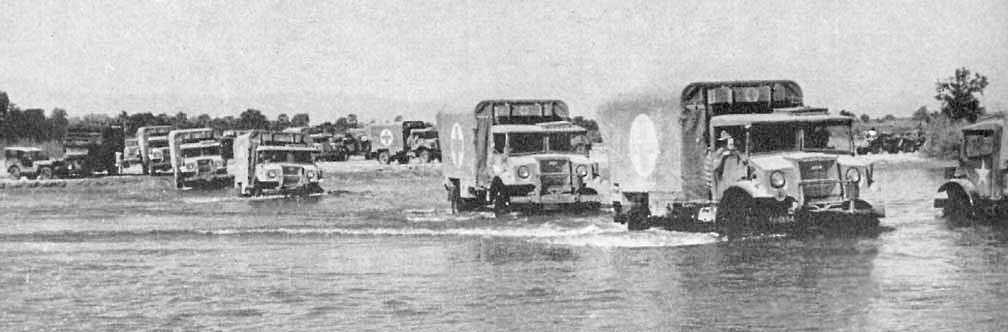
On 29 December, 3 MAS had left Palel to drive to Inbaung, halfway between Tamu and Kalewa, with 20 ambulances. The rest were to follow when their repairs were completed. "We were on the road most of two days and didn't travel very far either," one member of this group wrote. "And what a trip! We went over mountain roads that can't compare with those at home---worse than our poorest mountain-roads, one-way most of the way, and dusty and rough. . . . No bridges: we just drive through the rivers. One ambulance tipped over, but no one was hurt. We are still a long way from the Japs."
Two more ambulances soon rejoined the Section, but the final two, starting a little later, found that it took them a month to catch up. The Section kept moving to the south and east, down from the mountains onto the warmer plains, where the roads were better and it was sometimes possible to do 25 mph. Assignments were slow in coming, and the Section kept on moving, on 18 January settling in the outskirts of Shwebo. At first there was "little activity," beyond duties with near-by medical units, so that many of the cars stayed at HQ. Then the assignments came, and by the 25th all cars were out at posts. Ten went to 2nd British Division, then clearing the area south of Shwebo on the main road to Mandalay. By the 10th of February, the whole Section was working hard in this region.
"This part of the country is beautiful, with palm trees and open paddy fields," the same anonymous member of the Section wrote at this time. "There are many temples and pagodas around here, which are very interesting to look at but are supposedly taboo to us. There aren't many people in this part. The Japs chased them back into the hills, and they are still too bewildered to return. Those who have come back here are quite friendly and think Americans are okay. Some speak a little English, and they want to trade bully beef and biscuits for eggs and chickens. But they trade by quantity, not quality---one for one. . . .
"The Japs aren't far away, and last night we could hear their rifle fire ---and always the mortars. I saw some who had tried to take a position and didn't succeed. . . . The vultures were in the trees, just waiting. . . . We are quite safe and well protected. Our planes are always overhead."
In the meantime, for the Jeep Section things were "moving with terrific speed." At the beginning of the year its cars had been operating around Kalemyo and Kalewa, but in the following weeks the men moved so frequently that Lt. Spavin found it impossible to keep track of them. In December there were 9 jeeps with 19th Indian Division. By the second half of January, the Section had 4 with 19th and 12 and 20th Indian Divisions of 33 Corps. The balance soon shifted again, this time to the distribution that would be maintained through February: 12 with 19th Division (at the beginning of February across the Irrawaddy on the beachheads at Thabeikkyin and Kyaukmyaung) and 4 with 20th Division (then working south of Monywa in the vicinity of Chaung-U).
In mid-January, T. W. Shepard had written of being "busy now with interesting, ever-changing, exciting, at times slightly dangerous activities. . . . Rather isolated, things are moving so fast. . . . I'm working by myself with a British infantry regiment away from . . . civilized things of interest." They moved "plenty frequently." In February the work at first was slower, as 33 Corps mopped up in the area east of the Chindwin and prepared to cross the Irrawaddy.
In the second week of February, Shepard had time to write of "everyday, commonplace activities" with an RAP of 19th Division:
"As the sun rises we stand in the chow line with our mess tins, and, when the prosaic bacon, dehydrated potatoes, beans, and tea have been slung, we sit on the ground in the RAP area---which is bounded by slit trenches, first-aid boxes, stretchers, 4 jeep ambulances, and plasma outfits---talking over the prospects of the day's coming engagement with the Japs. Breakfast over and 10 o'clock arrived, the RAP people and the MO sit around waiting for business. We jeep jockeys lie on stretchers, reading, or sit in the shade, talking.
"All of a sudden the word comes through to pack everything and march---the enemy has retreated from his positions during the night. Everything is loaded on our jeeps and we fall in behind the marching column of men. Where we'll next meet the Jap fire no one knows. Perhaps a hundred yards more, maybe even a mile, or possibly 10. Everyone is silent---listening for the smart, weak crack and zing of the Jap sniper.
"At last it comes, after a good long advance, and we drive the jeeps off the road to a temporary spot for the RAP to await the development of the fighting up ahead a few hundred yards. If a call comes for an ambulance up forward, one of us goes (we go by rotation) and brings the casualty back to the RAP for treatment. When he has been treated and has recovered sufficiently from shock, one of us takes him back to the ADS, where he gets a good meal (if he can hold it), tea (by all means), and more treatment---and is then sent on further back, this time by air, to the CCS. This running around goes on all during the battle and ends in time for supper, which we eat heartily. We get no lunch except for a tin of sardines and a biscuit---oh, yes, and tea. Then all four of us collapse on our blankets, falling into immediate slumber."
At about the same time, A. T. Mackay (transferred from 3 MAS to the Jeep Section) summarized his work of the past several weeks with 19th Indian Division:
"We've been on the move practically every day, seeing Burma not as a tourist would but as it should be seen---from village to village, except for a stop of two days or maybe a week when the Japs decided to make a stand at some village or advantageous ridge. The individual days, of course, drag slowly---for keeping pace in a jeep with the marching troops is monotonous---stop, go, stop, go, the sun beating down on your covered head, creeping over good and mostly bad roads, cross-country sometimes, through picturesque but empty village after village, wondering each time if there will be any resistance in this one (and, if so, how much and how long the delay), forming a perimeter each night at a different spot (usually far from any water), eating and going to bed in the dark, arising at dawn, and so on.
"The 4 of us have been attached to an RAP, consisting of one medical officer and a few orderlies, which moves right with the troops. We work both forward and to the rear of the RAP. Instead of strangers, we now carry friends and acquaintances. Sharing their moments of suffering, complaints, and amusements, one feels a greater interest in the work.
"This advanced base, to which the battalion has returned for a few days of rest before setting out again, is the same place we passed through about 3 weeks ago. We were the first into this big town [Shwebo]. There was no 'battle of occupation' (except for a little village a few miles north) for this town. We just walked in, to find the streets deserted but for a few Burmese, always reticent and shy, wandering around, and a few Jap corpses sprawled along the main road. So when our battalion returned here less than a week ago, I went over and stayed at my old Section headquarters, which I learned had just come up. There has been a complete change of personnel---all eager and anxious to work. Good to see them again, good to sit down at a table and eat a decent meal, good to see so many lights and so much commotion, good to see movies every night and an occasional ENSA show with real, live, white girls with brown or blond hair, good just to sit around listening to the radio."
On 17 February the Jeep Section moved its HQ to Shwebo, taking a campsite only 100 yards away from 3 MAS (which had been entertaining hopes and rumors of moving farther south since the beginning of the month). Lt. Gilbert's section was spread out over a fairly large area at this time, evacuating along the lines for both 2nd British and 19th Indian Divisions. With the latter were 10 ambulances, all working out of the MDS of 52 FA at Onbauk; while 13 ambulances with 2nd Division were assigned to the ADSs and MDSs of 4, 5, and 6 FAs and 7 MFTU (later under 33 Corps) at Maungdaung, Legyi railroad station, and Maungdaung, Chaung-U, and Sadaung respectively. For all that it was pretty much rear work, it was not without moments of excitement. On the 17th, F. E. Payne recorded that "Pete Perella dug a slug out of one of the cabinets in the rear of his ambulance. It seems that someone took a pot shot at him as he was crossing a bridge the other night."
It was also hard work. A. R. Martin wrote that he was "working like the very devil in an MDS which handles just about all the evacuations back to the CCS. It is about two miles behind the advance, and we're working all day and up until 2 o'clock in the morning---driving about 12 miles back at 8 mph. It's tiring, but I'm happy. Red, myself, and Pete are trying to get up to the ADS, which is only 200 yards from the Japs and is supposed to be pretty tough. But that's what we want."
Later in February, the 10 ambulances with the 19th Indian Division shifted around to cover 51 and 53 FAs, in addition to 52 FA, moving out toward the end of the Onbauk road. With the 2nd British Division, the same formations continued to be served, the number of ambulances at each being changed, as usual, according to need. At the beginning of the last week of the month, just as Field HQ moved up to Monywa, the Section got some jeeps. There was a delay in getting them to work, as the workshops had difficulty finding the material needed to construct the stretcher-racks---a new design devised by N. M. Gilliam and K. C. Newton which put a 3rd stretcher over the driver's head.
Work had slowed down for a bit about the middle of the month, but in such a campaign it could not stay slow for long and there was always the possibility of some sort of incident. F. E. Payne reported on the 24th that "John Kaufmann ran over a land mine the other night with his ambulance. John wasn't injured---just shaken up good. One of the rear wheels of his ambulance ran over the thing, and it kinda messed up the rear of the vehicle."
Not everyone was so lucky. Closer to the front, with a 19th Division RAP, H. Swensson was killed on 28 February by a splinter from the mine that demolished his jeep. Swensson, with C. L. Albert, D. C. Morrill, and J. E. Ricca, was attached to 64 Brigade, which began its victorious push south from the bridgehead toward Mandalay on 26 February. On the 28th, the 4 jeeps were temporarily assigned to an RAP established about 7 1/2 miles south of Singu in support of the Worcester Regiment and a battalion of the 10 Baluchistan Regiment, which were engaged approximately a mile farther south.
"The road from the RAP north had been cleared of mines by the Royal Engineers, and heavy transport had used it," Lt. Gilliam reported. "The road south from the RAP was not cleared, but from 11 o'clock onwards transport, including two 5-ton artillery tractors towing guns, had used the road without incident. As a result, the road to the south was considered clear.
"At noon a report reached the RAP of several wounded a short distance south along the road, and, in accordance with normal procedure, Swensson went out to establish contact with them and to bring back any stretcher cases. He had proceeded only 300 yards toward the wounded when he struck a tank mine of considerable size. Swensson was killed instantly . . . his skull pierced by a splinter of the mine casing . . . and the jeep was completely destroyed."
The 19th Division attack was rough going, and the AFS involved, every one of whom went behind the Japanese lines at least once, had plenty of work and excitement. Sometimes the enemy was co-operative, as in the patrol action reported at the beginning of March by D. L. McCollester:
"a two-day operation, a little trek with a battalion to clean out a pocket of Japs. I drove right behind the column of infantry, which marched on all morning of the first day. The sun was hot and the air was full of dust. The jungle-consisting of scrub trees (it was flat) closed in on all sides of the trail (a Burmese cart path) so that you couldn't see more than 15 yards at the very most to either side. Every once in a while we had to stop while the trail was cleared. (This is a hell of a place to fight a war---where you can't see what to shoot at.)
"Finally we got to a village, our destination. It was deserted except for the Burmese. The Bren guns were set up and we had started to dig in when we were told to push on again. So all afternoon the infantry slogged on, 10 minutes break every hour, and toting 50 pounds of equipment. The next village was reached---but no Japs. One hundred had been there the day before but had pulled up. Again we set up camp. Patrols were sent out, but only saw two Japs without equipment fleeing a mile away. The job was finished. It was supposed to take three days, but thanks to the Japs the area was cleared in one day. The only casualty was one Tommy, gored by a water buffalo. This was just a job that had to be done---not very difficult, but necessary, in a way, like peeling potatoes."
All of 3 MAS was across the Irrawaddy by the end of the first week of March. Two days later the outskirts of Mandalay were entered. McCollester and R. Mathewson, sharing a jeep, wrote that they were the first Americans into the city---"if that fact holds any distinction." Theirs was also the first ambulance into Mandalay, which seems more to the point. There was plenty of work and excitement during the first half of March, indeed until Mandalay was finally cleared. HQ was almost always out of touch with the cars, which were in or near Mandalay by the second week. With complications of one-way traffic across the river in the 2nd Division area, and such narrow roads that they ripped the canvas sides of the Chevrolets on the 19th Division sector, it took 3 or more days just to visit one part of the Section. On the 17th, 3 MAS HQ moved south to Kynewa. Next day F. E. Payne reported some of the events of the past couple of weeks:
"Bill Rawdon got hit with a little shrapnel about a week ago, while with 19th Division. It wasn't serious, but they sent him back to HQ for a little rest. Several (about 4) of the volunteers, including Bill, were going down a road near Mandalay when they were warned by some Burmese that the village or temple they were passing had some Japs in it. About that time an Indian MO came up and took charge. He told Bill and the others to go around the wall one way while he went around the other way with some IORs. Bill spotted a Jap officer and took a shot at him, and then his rifle jammed. Then he saw the Jap pull out a grenade and throw it. He ran like hell, but the grenade went off just as he was headed for the ground. He got a piece of shrapnel in his arm, and it bled quite a little. Dozens of tiny pieces hit him in the back, buttocks, and back of his legs. He looked like he had been swiping watermelon from some farmer and got caught with a little buckshot. It was really a close call. Jim Smith was also with Bill. Jim dove into a haystack and didn't get a scratch. . . .
"Fred Ellis also reports a very close call. He was standing right behind an IOR cook who was squatting in front of a fire down 19th Division way. There was a 75-mm shell buried under the fire, and the detonator went off just as Fred turned and started to walk away. A small piece of something just touched his nose and cut it about as much as a razor cut. The IOR was pretty badly torn up, and I don't know whether he lived or not. It was very fortunate for Fred that he started to walk away when he did, also that the whole shell didn't explode.
"Jack Ries was driving down a road at night in the outskirts of Mandalay, also 19th Division way, when a 'pongyi' [another version says it was a punjabi] with a rifle ran across the road in front of him . . . motioning at him to turn back. Jack stopped and backed up for miles at full speed. He found out the next morning that if he had gone about 10 feet farther he would have come into range of several Jap machine guns.
"All the volunteers with 19th Division from this Section and from the jeep Section, and most of them with 2nd and 20th Divisions, have had tough going for the last few weeks. They have been subjected to shellfire almost every night . . . . They have been working long hours and getting very little sleep . . . . The going has been so rugged that the fellows on the 5 jeep ambulances are counting the days until their 8 weeks on the jeeps is up. We hear that Ken Newton with his jeep ambulance is with some Gurkha outfit in the 20th Div that is spearheading the drive south of Mandalay. It seems that Ken is the only volunteer with them and has had many close escapes.
"Ask Fred Kern to tell you about the roads he and Conger Neal [of the jeep Section] opened up for Fourteenth Army the other day. The British thought the road was still held by the Japs, but the AFS went through. The British sent troops out the next day to clean the Japs out of the villages along the road. Fred and Conger said they didn't see any of the Japs, but there were plenty of them there. . . .
"There seems to be some difference of opinion as to how good a site we have here at Kynewa. We are right on the edge of the jungle village of Kynewa in buildings belonging to the 'pongyi' (priest). We are about 300 yards from the Mu River and about 1/2 mile north of the bridge across the river (a few miles north of its confluence with the Irrawaddy). The buildings we occupy are the usual wooden kind up on stilts and with corrugated steel roof. The metal roof makes the buildings very hot during the day. We have 3 buildings, which are very close together. The 'pongyi' and about 10 of the boys in his school live in the upper story of the biggest building. . . . The Mu River hasn't much to offer in the way of a place to swim. It is very shallow, and where it is a little deeper it has a very muddy bottom. Of course, you have to compete with hundreds of Burmese and Indian bathers and also a few oxen."
Although Mandalay had been entered on the 9th, it was not announced clear of the enemy until 21 March. The city area had been cleared by the 14th, and on the same day 19th Division troops had invested Fort Dufferin, dominating the southwest sector of the city and held by a large force of Japanese. Planes dropped bombs on it for several days and finally breached the wall. But the first infantry attempt to cross the moat and scale the breach was driven back by furious enemy fire. And the second, on the 19th, was unsuccessful because of the tangle of weeds in the moat. On the 20th the Fort was taken. Then the enemy was discovered to have fled, except for a few stragglers who were rounded up in the next few days. Captain Gilbert reported that "Gerald Murphy and Jack Ries completed a great piece of work in evacuating the lepers from the Fort in Mandalay. Strange as it may seem, the Japs permitted the ambulances to pass but opened up on the very next vehicle that passed. The incident was mentioned over a BBC broadcast."
During the last stage of this attack, C. J. Bissler and R. L. Yancey were wounded, Bissler so seriously as to lose most of one leg. On 19 March they were working north of the Fort for the RAP of the Royal Berkshire Regiment (98 Brigade, 19th Division). That afternoon, Yancey wrote,
"a call came through that D Company, which at the time was under fire from the enemy, had many casualties which had to be evacuated. A jeep ambulance was needed at once. Bissler and I, however, had a Chev. The doctor didn't want to send the Indian driver who had the jeep ambulance, because he didn't know the way to D Company. However, we knew the way and so volunteered for the assignment.
"We reached the Berks and loaded the jeep with casualties. I remained there with D Company---to make room for one more patient---and Clifford took the load back. While he was returning to the RAP, the Japs began to shell us. Two Tommies, a Lieutenant, and I jumped into a bunker close by. The Japs had tossed about 4 shells over our heads when Clifford returned from the first load. The jeep had broken down along the road, and Clifford ran the rest of the way on foot, carrying a stretcher. We yelled for him to climb in with us, but just then the Japs put one almost on top of us. That first one killed one of the soldiers, wounded the other, and almost tore Clifford's left leg off. We jumped out to help him, the Lieutenant and I, but just then we were hit by the second shell. We hit the ground, but almost not in time. The officer was knocked unconscious, while I suffered a slight shrapnel wound in the right leg and a burn on the right wrist. Clifford was hit by the second shell in the chest.
"The Japs stopped shelling, and we radioed back for someone to bring our big Chev down. It was, however, about two hours before it arrived, for the road back to the RAP was cut by the Japs. We loaded the wounded in, and then they gave me 3 tanks for support and we started back for the RAP via the closed road. The tanks frightened the Japs, and we got through okay. My wound was not too serious, so I took two loads from the RAP back to the MDS on the edge of the city."
Bissler, who had joked about not forgetting to take his nearly severed leg with him to the hospital as he wanted it for a souvenir, lost the leg when gangrene was discovered to have set in. He cheerfully endured a long spell in hospital in India and was repatriated to finish his slow recovery in the States.
Throughout the operations immediately concerned with the capture and mopping-up of Mandalay proper, "the AFS drivers, particularly the jeep drivers, did extremely well," Lt. Gilliam reported. "Medical, infantry, and staff officers have all made comments on the sensible and dependable work our fellows did under the most adverse conditions. Albert, Mathewson, McCollester, Morrill, Murphy, J. Parkhurst, Peterson, and Ries have all been particularly commended to me by various officers. As a whole, the Platoon did very well."
In the middle of March, Albert and Morrill had been formally presented with Japanese swords by the Baluch battalion in recognition of their service to them. The members of the jeep Section and 3 MAS who served with 19th Indian Division in its drive on Mandalay were made honorary members of the Division and entitled, while on duty with it, to wear the Divisional flash. This distinction was conferred on them by order of the Division Commander, Major-General T. W. Rees, who wrote: "On the conclusion of the Mandalay Campaign, may I send you my own personal thanks and those of the whole of the 19th Indian Division for all the magnificent work you have put in for us. All of us, of all races and creeds, are more than appreciative of your courage, your patience, and the great care you take of our wounded and sick no matter what the physical difficulties or how heavy the enemy fire."
During March the jeep Section had gained additional vehicles and had increased the number on assignment with 19th and 20th Indian Divisions. Most of 3 MAS's assignments on a divisional level in 33 Corps were continued, though there was the usual shifting about within that framework. The 7 MFTU assignment had ended at the beginning of the month, the 3 MAS cars thus released going to a Corps artillery unit, 254 Tank Brigade, and 20th Indian Division. The 3 MAS jeeps, when ready, were split between 19th and 20th Divisions.
Again the administrative situation was becoming complicated, as one division could have jeeps from two sections on the same post. So, since the Sections were working almost entirely with divisions rather than as corps troops, another reorganization was needed to facilitate administration---both for Army and AFS---and to allow greater flexibility of assignment with the various divisions.
The new scheme went into effect on 1 April, after a couple of weeks of preliminary paper shuffling. Toward the end of March, the dispersal was as follows: with 33 Corps, 28 jeeps and 24 Chevrolets, 19th Indian Division having 13 jeeps and 10 ambulances, 20th Indian Division 7 jeeps, 2nd British Division 10 ambulances, the rest being on Corps assignment or at HQ; with 4 Corps, 15 jeeps and 25 Chevrolets, 7tll Indian Division having 6 jeeps and 7 ambulances, 17th Indian Division 4 jeeps, the rest being with independent brigades or at 14 CCS with MAS HQ. All this was reorganized into one company of 2 sections, each section with two platoons. Section 1 comprised the vehicles with 33 Corps , the jeep MAS becoming A Platoon and 3 MAS B Platoon; Section 2 included all vehicles with 4 Corps, 4 MAS being split to form C and D Platoons.
The plan was that Company HQ should deal with Army, the Sections with Corps, and Platoons with Divisions. It was hoped that the Platoons could be assigned to Divisions as units, as was sometimes done in Italy, although Major Marsh realized that this might not always be operationally feasible. The field reorganization also looked forward to the end of hostilities in Europe, when an AFS company could come from there to India. (At the beginning of 1945 Major W. H. Perry and Captain R. W. Humphrey had been sent by Mr. Galatti to investigate the problem of shipping to and from India, which had been suffering from a bottleneck for too long, and to determine whether the theatre would welcome, or even accept, an ACC from Europe at the end of hostilities there. Both matters successfully concluded, Major Perry returned to Naples, while Captain Humphrey remained in Calcutta.)
Unlike the arrangements in the Middle East and Italy, representatives of Company HQ tended to many general matters, so that the Calcutta GHQ remained extremely small. This office---which like all such was in a constant state of improvisation, new plans, and old chores---took care of what no one in the field would or could do. It's personnel at this time included: Capt. T. W. S. Craven as OC, Captain Humphrey in charge of Personnel, and Capt. P. S. Van der Vliet as Finance officer, assisted by R. P. Yankey as Quartermaster and --- H. P. Chandler, Jr., in charge of a most satisfactory Club.
The Company (Advanced or Field) HQ was run by Major Marsh, with Capt. R. E. Paulson as his Adjutant. Here, too, were Lt. W. K. Du Val as Finance officer and Lt. A. W. Olmsted as MTO, assisted by CQMS Byram and Conductor R. I'Anson in workshops. In the field, the two Sections were commanded by Captains Gilbert and Fenn. assisted in Section workshops by Conductors Harvey and Bradley respectively. A, B, C, and D Platoons were run by Lts. Gilliam, Madsen, Spavin, and Dodds, assisted by J. J. Angevin, K. C. Newton, R. C. Vivian, and J. B. Chaffee, respectively, as seconds in command. Field Cashiers Angevin, F. Kern, Jr., and J. K. Sinclair were attached to Platoon HQs. With this basic reorganization accomplished, the Field Service was ready for the next phase of the campaign.
After the fall of Mandalay and Meiktila, which brought about the complete breakdown of the Japanese communications and supply system in Burma, a general Japanese withdrawal was ordered. In early April both 4 and 33 Corps were regrouped for a final thrust---the race to reach Rangoon before the onset of the monsoon. The advance down the Mandalay-Rangoon railroad axis was allotted to 4 Corps, then concentrated in the Meiktila area: a swift advance that would cut off large numbers of Japanese troops and would prevent their escape into the hills to the east. At the same time, 33 Corps, then concentrated 50 miles to the north, was to cross the line of 4 Corps' advance, mop up enemy remnants in the plains and foothills to the south and southwest of Mandalay, then drive down the valley of the Irrawaddy. Thus, if all went well, a cordon would be placed around southwest Burma that could contain the Japanese during the monsoon in malarial areas without supplies, so that they would be forced either to surrender or to attempt to fight their way east across, the Irrawaddy Valley, the Pegu Yomas, and the Sittang Valley on their way to Siam. If the race was not successful, Fourteenth Army would be left in an untenable position at the end of a long and impossible line from which it would be necessary to withdraw.
During the course of the regrouping in early April, 7th Indian Division was transferred to 33 Corps, which already included 2nd British and 20th Indian Divisions and 268 Indian Infantry Brigade. This left 5th and 17th Indian Divisions and 255 Tank Brigade in 4 Corps. The 19th Indian Division was transferred to Fourteenth Army command and was assigned, with 36th British Division (which had earlier been with NCAC), to clear up the area behind 4 Corps and to safeguard the roads and railways. The armored brigade of 19th Division was in the van of the 4 Corps advance, the rest mopping up many pockets of Japanese by-passed by the Corps. Part of its job was a drive east from Thazi to Kalaw, through some of the densest jungle in Burma.
The 2nd British Division was withdrawn to India in the middle of April, after part of it, with 268 Indian Infantry Brigade, had driven southwest from Myingyan toward the Irrawaddy in a mopping operation. No serious opposition was met until it reached Mount Popa, where a strongly entrenched Japanese force held out until 20 April. The vehicles of 2nd Division were left behind in Burma to increase the mobility of 33 Corps, especially the 20th Indian Division.
The 33 Corps advance met with quite some resistance, not on the west bank of the Irrawaddy but at Kyaukpadaung, an important rail center opposite Seikpyu from which the Japanese had not been cleared during the Meiktila campaign. After considerable inconvenience, on 12 April the 7th Indian Division took Kyaukpadaung. Then, with flank and rear secure, it continued south to Yenangyuang, which it took on the 22nd. Meanwhile, 20th Indian Division had taken Taungdwingyi on 13 April then driving west to the Irrawaddy. By the capture of Magwe and Myingun on the 19th, it cut off a considerable number of Japanese troops to the north and west. Parts of the 20th Indian Division drove south from Magwe and Taungdwingyi, ambushing numerous parties of Japanese trying to cross from the west bank of the Irrawaddy, to take Allanmyo on the 28th. With the capture of Prome on 2 May, the last escape route for the Japanese forces in the Arakan was cut off.
During April, 4 Corps drove down the Mandalay-Rangoon railroad. On 30 March, 17th Indian Division moved south from Meiktila toward Pyawbwe, toward which 255 Indian Tank Brigade was advancing from the southwest. Both met fierce opposition, each small village being defended by suicide parties. Pyawbwe was finally reached on 10 April. The next day, 5th Indian Division took the lead in the advance and passed through Yamethin. A Japanese suicide force infiltrated this town and dug in, splitting the Division for several days. Shwemyo was reached on the 16th and Pyinmana on the 19th. Against all expectations, the Division arrived at Toungoo 3 days ahead of schedule on the 22nd, taking the enemy so much by surprise that as the armored column drove into the city an indignant Japanese policeman tried to stop it.
On the 25th, 5th Indian Division captured the first town on the south bank of the Pyu River, approximately 30 miles south of Toungoo. Then 17th Indian Division, preceded by 255 Indian Tank Brigade, again took over the lead. The forward troops were now put on reduced rations, to allow space in the limited supply planes for enough petrol to carry the drive through. As the successful advance continued, 19th Indian Division spread its jurisdiction from Meiktila as far south as Toungoo---a Japanese division within artillery range to the east causing a certain number of casualties and some damage in the town---and cleared the area to the east.
On 26 April, 17th Division was 85 miles from Rangoon. Three days later it was in the outskirts of Pegu. That afternoon the rains broke and continued all night. Pegu River rose in flood and barred forward movement. Nevertheless, on the 30th a foothold was gained on the east bank, after a crossing was made on the ruins of the railroad bridge. Pegu was cleared of the enemy in two days. Then, leaving one brigade to hold the town, 17th Division continued its advance.
On 2 May, amphibious elements of 15 Corps entered Rangoon. A few hours after the first landings, the whole battlefront was drenched by the first rains of an early monsoon. By evening, however, the 26th Indian Division had secured the city, having met only light and scattered opposition. Although at this time 17th Division was still 32 miles north on the Pegu road, the race for Rangoon had been won. Pushing south from Prome, 33 Corps patrols met those from 26th Division, driving north from Rangoon, near Tharawaddy on 15 May.
The weather had been good during the advance, and the spirit of the troops, exerting themselves to achieve the next to impossible, was high. Fourteenth Army maintained what were probably the longest and narrowest salients in war---nothing but the road and the railway and a few hundred yards on either side. As the Japanese were both on the east and on the west, the "front" was actually the whole length of both axes of advance down the center of Burma. The possibility of dramatic action---as in 19th Division's fight to the east from Toungoo---was ever present. The fall of Rangoon marked the unquestionable reconquest of Burma by the Allies, but it did not end the fighting. Mopping up continued into June east of Meiktila as well as along the roads to the south, as the Japanese struggled to escape to freedom.
The AFS groups attached to the two corps of Fourteenth Army during this advance to Rangoon had a busy time of it, although the increase of movement was accompanied by a decrease in the actual hauling of patients. A vivid picture of the early stages of the advance was written by R. C. Tripp, B Platoon, who was assigned with his jeep to 8o Infantry Brigade of 20th Indian Division (33 Corps).
"The ADS moves from one village to another. When we get there, the Burmese are just beginning to trickle back in. Very few of them talk English, so we don't get much out of them. The country we are now in has been Jap occupied since 1942, and since the Japs have apparently gotten along quite well with these Burmese the British are more or less getting a very cold reception. In some instances, Burmese have been openly helping the retreating Jap forces---ferrying them across rivers, aiding them behind our lines, giving away our artillery and tank positions, etc. I do think, though, that the majority of them are pro-British; yet all of them are suspected, and consequently the infantry are ordered to shoot all suspicious looking Burmese lurking in and around our front lines. . . . Wounded Burmese receive the best of treatment in our hospitals, the same treatment as that given to the Tommies. Some of them come to our hospitals on bullock carts, traveling maybe 30 miles. They bring their families and all possessions with them, including cows.
"From a little incident that happened the other day, you can judge for yourself how fast our advance has been. The OP of an advancing tank and infantry column spotted a bunch of Japs marching down a road ahead of them. The tanks went forward, then just sat there waiting for them. Down they came, marching 3 abreast in a regular route march, not suspecting a thing. Twenty Browning 50-caliber machine guns opened up on them, and when the smoke cleared away there were 50 dead Japs lying about. Not a one got away. Other parties of Japs have been similarly surprised. They actually don't know where the front here is. Small parties of them resist here and there in villages and pagodas. They burrow clear up into the tops of solid brick pagodas, and there they sit and wait until our infantry comes along. The only way you can get them out is to blow the whole pagoda down. It's flat country here, and the pagodas and villages are about the only shelter there is available to them. They don't stand a chance in open country. They know that as well as we do. Consequently they won't come out into the open and fight. . . .
"Have hardly had time to sit down these past few days. Everybody has been running---the Japs backward and the British forward. The ADS has moved no less than 4 times in the past 5 days. First we move, then dig in (a 4-foot slit trench and a 3-feet-deep place to sleep in). After we get dug in and everything set up just right, off we go again to another place. We have repeated this cycle 4 times already this week and probably will continue to do so every day from now until the Japs stop running. . . .
"Have had quite an exciting time here lately . . . picking up lots of souvenirs and Jap equipment. The other day I got bold of some brand new Jap tropical shirts; have been wearing them every night. Also got new Jap boots, a new canvas back-pack, and a Jap helmet. All this stuff when we found it hadn't even been unpacked yet. . . .
"For 5 days now our advancing troops have only run into small Jap suicide squads of about 10 or 15 men. They are fighting more or less of a rearguard action to delay our advance. These Japs squash, kill, or wound quite a few of our troops before they themselves are detected and killed. After they are spotted, they've had it. Artillery begins pounding them, usually a squadron of planes dive-bombs and strafes them, and the tanks are usually on hand within a few minutes to pound hell out of them. They always get the first burst of fire in, but it's usually their last. Up to 10 miles of open country has been taken in one day, and for the last 7 days the advance has never been less than 5 miles. So that gives you some idea of the rout that is taking place over here. We've been so busy moving the ADS, setting it up, and then tearing it down again, that we've hardly had time for any casualties. It's quite clear now that the Jap Army is finished in Burma. From now on our troops will just be mopping up."
Most of the AFS ambulances stayed on the assignments they had at the time of the reorganization, although there were some transfers of posts and personnel from platoon to platoon. By and large, Section 1 was with 33 Corps and Section 2 with 4 Corps, but even this was subject to the exigencies of the campaign. After the fall of Mandalay, most of the men who had been working with 19th Indian Division were given a rest in a "large and pleasant house" the Division procured for them at Maymyo, the hill station to the northwest of Mandalay. However, 6 men (F. E. Ellis, R. Mathewson, D. L. McCollester, B. H. Marshall, Jr., R. S. Ostenso, and R. P. Yancey) assisted in the mopping up operations to the south, and on 28 March the same group accompanied 64 Brigade on an emergency march to help another formation farther south. This Brigade was transferred to 4 Corps command as a result, and after all the attempts to make a tidy reorganization Lt. Gilliam had to write on 1 April that "instead of being a nice, small, well-ordered Platoon, I find that I am going to be spread out over two corps and three divisions . . . utter confusion."
The remainder of A Platoon was with 19th Indian Division in 33 Corps, and with 36th British Division. They had not been sitting still, either. On 23 March, A Platoon HQ and attached ambulances had left Shwebo to join B Platoon at the site in Kynewa (chosen for 3 MAS HQ), while awaiting orders to move across the Irrawaddy and to rejoin the 19th Division from the west. At the end of the month, those jeeps with the other two brigades of 19th Division were ordered to "concentrate in the area of Fort Dufferin at the AFS HQ there as early as possible on the morning of 1 April. Once having assembled there in their entirety, they will proceed with Dike Mackay in charge to AFS HQ in Monywa," to arrive on the same day "even if this entails some night driving."
On the same day, 3 Chevrolets were sent on a week's assignment to 72 Brigade of 36th British Division for local airstrip work. The rest of the Chevrolets stayed with 19th Division HQ. On 2 April the group of 9 jeeps went from Monywa to 19 CCS (7th Indian Division), Lt. Gilliam taking charge and leaving J. J. Angevin in command of the rest of the platoon. The latter moved his HQ to Meiktila on the 6th. It was at Wundwin on the 11th and moved a few days later to Pagan---"where there are over 1,000 pagodas and temples in an area of one square mile," Captain Gilbert wrote. "It is indeed quite a sight. You drive for 3 or 4 miles south of Pagan, and all you see on either side are pagodas. The oil wells at Chauk [to which the Platoon moved on the 23rd] is another interesting thing to see. Very little damage was done to the wells by the Japs. It reminds one of some of the oil-well districts back in the States. Some of the Burma-Shell boys had some classy homes-tennis courts and swimming pools." After two days, A Platoon HQ continued southwest from Chauk to Yenangyuan, the other important Burmese oil center, where it stayed well into May.
Eventually the Platoon's cherished 19th Indian Division posts had to be given up, and by mid-April most of A Platoon was tidily with 7th Indian Division---3 jeeps with 33 Brigade, 5 with 89, and 2 with 114, and 2 with King Column (Kingcol), while the remaining 2 jeeps and 10 Chevrolets, with Platoon HQ, were attached to Division HQ. A couple of the Chevs were soon attached to 66 FA (89 Brigade), but in general the Chevrolets did little during the rest of April, Captain Gilbert wrote, "because there is very little for big ambulances to do. We have the only MAS assignment with this Division, but the inescapable fact is that Chev 3-ton ambulances are white elephants."
Most of the ambulances were comparatively inactive while 7th Indian Division cleared the oil field, took the enemy by surprise at Kyaukpadaung, and then crossed the Irrawaddy to the west to deal with the Japanese troops escaping from the Arakan by way of An Pass.
Some individual experiences of this period bear a strong family resemblance to events during rapid advances in other campaigns.
"Bob Martin was making his way from a forward battalion where he was machine-gunned," Captain Gilbert reported. "His jeep was badly riddled, but he escaped without injury. . . . Gene Ricca [attached to the ADS of 66 FA (89 Brigade)] was on his way to an RAP. . . . The directions given him were just a little vague. He continued down the road toward where he thought the RAV was. The Sikhs in the back of his jeep ambulance were armed, just in case. Gene looked at his map and wondered what to do. He finally decided to keep going, still looking for the RAP. Soon he found he was in a village. He looked around and saw some jeep tracks swerving southwest. He didn't like the looks of this, so he continued on a track leading out of town to the southeast. He was going along, when he suddenly bumped into a fighting patrol of Gurkhas. The officer in Charge stopped him and asked him where he was going and where he had come from. Gene showed him on his map. The officer asked him if he was sure. 'Yes,' said Gene, and the Sikhs confirmed his statement. 'Well,' said the officer, 'I guess you captured the town we were just advancing on to attack and capture! The Japs had only been gone about an hour and a half."
Other experiences show how the Burma campaign differed from others, in regard to both the manner of fighting and the energetic defense against the enemy. "Johnny Parkhurst has been sniped at numerous times in the advance to mop up the remaining Japs on the other side of the river," Captain Gilbert wrote of the two men attached to the 4/5 Gurkha Rifles (114 Brigade), and "Ed Peterson was going back from a forward RAP with two stretcher patients and one sitting patient. He rounded a bend in the road, and there sat a Jap. The Gurkha on the top stretcher was the first to see the Jap. Ed gave the Gurkha a rifle and another patient his Jap carbine. He took his pistol out and proceeded on past the spot where the Jap was last seen. They passed all right, without mishap, but they were just a little afraid that there might have been a bunch of them around."
At the end of April, A. T. Mackay was attached to the 4/1 Gurkha Rifles (33 Brigade, 7th Indian Division). "This mopping up operation was short and sweet," he wrote. "The actual time to clear up this pocket of resistance was a little over two weeks. The terrain was hilly and plastered with small, dry 'nullahs,' which were transformed into roaring streams after a few minutes of torrential downpours. This region was definitely the thickest jungle I've seen so far in Burma. So you can get a vague picture of the part of the country out of which we had to shift the Japs. I wasn't kept too busy, just a steady stream, which meant one or two runs a day back to the ADS on a lonely but very lovely jeep track. In order to be shot one has to be in sight, and 'in sight' in this country is not more than 30 yards. So you can readily see how all my patients have been extremely serious cases."
Finally Lt. Gilliam had a problem unknown in any other theatre. It led him to ask Calcutta for his men's personnel records. "The medical records, for instance, would be of use, so that any man, e.g. with an allergy to mules (of which I have one at the moment), would come to my attention before he associates with mules and not afterwards (as actually happened)." And to round out the picture, F. E. Preston, never one to be laden with the ordinary, received the single jeep assignment to the Burma Police.
During the same period, the HQs of Section 1 and B Platoon were occasionally together and usually far behind the ambulances and the van of the advance. Lt. Madsen's B Platoon, with HQ at Tadau, at the beginning of April had its cars spread around to the south and west. its Chevrolet ambulances were with 2nd British Division at Pyinzi, Myingyan, Myinthe, and Dwela, while the jeeps were with 20th Indian Division at Kyaukse, Dwela, and Kume. P. W. Perella, with 2 Reece Regiment, for several weeks was out of touch with the Platoon, which was supposed shortly to move with Section 1 HQ southwest to Taungtha. Instead, B Platoon went south to Meiktila and only Section HQ went on as planned to Taungtha, where it was established for some time in two houses in the middle of the town. B Platoon members in the second week of April were "having all kinds of narrow escape, etc." the Chevs with Field Ambulance ADSs and the jeeps with RAPs of all three brigades of 20th Division.
After its successful action at Mount Popa, 2nd British Division was withdrawn on 23 April. Some AFS drivers with its 5 Brigade had had "quite a lot of excitement," Captain Gilbert reported. "Bob Hensley, Jerry Lovell, and Ray Atherly . . . working with an ADS in the vicinity of Mt. Popa for several weeks . . . have really had tough going: Mt. Popa is a volcano which last erupted in 1924. The Japs were dug in up on the mountain, and it was with much difficulty that they were finally driven out. The boys were constantly being shelled---no less than 600 shells were dropped in the area. Every evening, just as they got their food in their mess tins, the Japs would open up. Ray said it was very annoying. One shell dropped about two feet behind Jerry Lovell's ambulance. Luckily, Jerry wasn't in the ambulance at the time. The rear tires were blown off, the floor is full of holes, the canvas cover just isn't any more, and the water tank on the front of the body is full of shrapnel holes."
As the advance continued, the countryside gradually changed character---the jungle giving way to the sand, rocks, and scrub that reminded some of the Western Desert. On 25 April, B Platoon left Meiktila for Magwe on the Irrawaddy, to which Section 1 HQ moved early in May. On the first, it was out of touch with B Platoon, then south of Prome at Shwedaung, because after the heavy rains some of the 'chaungs' were not passable and the road had been closed. By mid-May there was not much work---just a few ambulances assigned to units mopping up the balance of the Japanese. The monsoon did not bring rain to the desert-like area around Magwe, but many dust-storms instead. "We hold onto our tents for all we're worth," Captain Gilbert wrote, "and afterwards dig our belongings out of the dirt."
The only casualty of the period, A. R. Martin, received no more than a slight creasing of the scalp. This incident, not unnaturally, looms large in his account of the last phase of the campaign, which might otherwise have been duplicated by many:
"After Mandalay had fallen, I was lucky enough to be attached to an armored-car outfit. It was Indian cavalry---the old 11th Cavalry. Since armored cars can't go cross-country as much as tanks, we were to lead the main column down the road to Rangoon. It was a good job. They had swell officers of the 'old regiment!' . . . We started off from Meiktila. We had a pretty rough trip all the way down. A lot happened. . . . just before Allanmyo, a small village on the banks of the Irrawaddy about 220 miles from Rangoon, we had a hell of a battle [Allanmyo was taken on 29 April]. The Japs were trying to hold a rear-guard action so that the Japs trapped on the other side of the river could get across and down to Rangoon. On the second day, our squadron was moving up the road with . . . a mortar regiment following close behind in trucks. The Japs on the ridge next to the road ambushed them, letting the armored cars go through and then opening up on the trucks with light machine guns. It wasn't too much of a success, but they knocked out a couple of trucks and killed a few. The leading car wired back through the radio set to send me up and get them out, the wounded.
"Well, it didn't sound too gay, but I went. It was only about half a mile, and I didn't lag along. I got there all right, and helped dress the guys, and put 'em on my jeep. I got them out all right, and went back again and got some more. It was slow getting back, 'cause one of them had a stomach wound. As I was going over a little wooden bridge, I noticed there was a dry creek bed running along with thick bushes along the sides. I didn't like the looks of it in the first place. I was about a hundred yards past it when he hit me. I didn't feel much and didn't realize I had been hit until I felt the blood run down my face. I naturally didn't retaliate but put her in high and got back. The doc bound me up and asked me if I wanted to go back down to the ADS. I said 'No,' and so he said 'Well, get back up there, they need you.' So off I went. That's all there was to it. Later on in the afternoon, while they were mopping up, they found the joker still hiding under that damn bridge. They blew him up with a grenade. . . .
"After we got to Prome, there wasn't much doing. They made an invasion landing on Rangoon, and we just had to clear the way down there. When we got to Rangoon I had to leave the regiment, since they were going back to India to get tanks."
The patrols of 15 and 33 Corps had met near Tharawaddy on 15 May. With the road to Rangoon cleared, the main fighting was at Zalon, 10 miles north of Prome, where the Japanese had established a bridgehead early in the month as a base for their escape to the east. Here 7th Indian Division was concentrated and in the latter half of the month beat back determined enemy efforts to escape. B Platoon continued south with 20th Division, at the end of May about 80 miles north of Rangoon. Section HQ joined A Platoon in Allanmyo on the 31st, and B Platoon reached Rangoon on 10 June, when it was relieved of its assignments.
Meanwhile, on 28 May, 33 Corps had been disbanded. Its units, spread then from Magwe to Prome, were transferred to the Twelfth Army, established on the same day under command of Lt.-Gen. Sir Montagu Stopford. Fourteenth Army HQ and some formations were withdrawn to India to refit for the next phase of the war against the Japanese. AFS HQ in Calcutta was instructed to keep any new arrivals there until plans for the sections in the next campaign should be determined.
Section 1 was sporadically busy during this last period. From time to time the Japanese made efforts to get through to the east, making many small local disturbances but leaving things in general pretty quiet. The general experience with 33 Corps during the end of May was similar to that of A. R. Martin, who was still attached to the 4/1 Gurkha Rifles:
"We moved down and took over a job as defense troops for some town until other troops arrived. . . . I hardly had any work to do. And, as the Doc treated most of his patients (malaria and dysentery) right at his RAP, I had few runs to make while I was down there. I spent the time fooling around the town, collecting old coins. . . . The fad now while in Burma is to buy stones. So I had to have a try. Bought a couple, probably both worthless, as I don't know the first thing about jewelry. But what the heck! I couldn't return without 'some stones.'"
During the same period, Captain Fenn and Section 2 had been descending the Meiktila-Rangoon railroad axis with 4 Corps. As the more highly mechanized Corps, it moved faster and made a more spectacular achievement than 33 Corps had done. This is possibly the reason that again the activities of the AFS ambulances with it are more scantily documented than those with 33 Corps. However, in general the life was pretty much the same with both corps, changing the distances covered and the names of the towns taken and passed through. The experiences of M. G. Hall, who was assigned with a jeep to 50 FA (17th Indian Division), seems representative of what was likely to happen in the way of work in April and early May 1945:
"Some days ago in the early afternoon we got a call for two jeeps. On arrival at the RAP, mine was loaded with extra stretchers and bearers, a Doc, and shell dressings. We went a few hundred yards farther up the road. The jeeps ahead with a small, heavily armed party pulled over to the roadside. just before us was a dry 'chaung'---or stream bed---of deep white sand. The Doc told me to pull over, while he and the bearers went to see what was up. Shortly I was waved on and proceeded almost to the edge of the 'chaung,' where the stretchers were unloaded and the second jeep caught up to us. The party from the first jeep moved down the 'chaung' a short way to reconnoitre, and its officer returned to say that 5 wounded were lying about 500 yards away. He thought they might have snipers covering their position.
"About this time a sergeant came back, in a jeep, with a shot in his knee. He confirmed the position of the other 5. The officer and stretcher-bearers started off down the chaung, while the Doc, the other driver, and I---looking over the low hedge of brambles that lined the road---could catch glimpses of them across the paddy fields. As the party came into clear view, a machine gun opened up. As strays were coming overhead, we flattened. The stretcher party came back, collected itself, and tried again on the far side. Mortar shrapnel and bullets came closer, so the Doc thought it advisable that our two jeeps should go back about a hundred yards to the protection of a slight dip---and so get the jeeps out of sight.
"Back in the little gully we tried to make some sense of the firing, which was coming from 3 directions. Only an occasional bullet or fragment came close enough to flatten us. After an hour or more, two casualties came back, and I took them to the RAP and returned as quickly as possible, for the intervening road was in plain view from the Jap position about 1,000 yards away. The others were brought in shortly after, and we took them all back to the RAP, and then relayed them back here, it being well past sundown but with a swell moon.
"Two nights before, I had spent 9 of the 12 blackout hours in a slit trench while everything the Japs had came over. That night a fragment took the top off a petrol tin on the back of my gharry, 20 feet away. As soon as the road was cleared, I started taking casualties to the rear. The day after, I was awakened just after dawn to collect a single casualty, and I got back as the sun was coming up. In the afternoon I spent several hours on the crest of a ridge, waiting until tanks moved out and we got the green light to pick up what was left. Actually, the tanks brought casualties back to the RAP, and we took them in from there.
"Thus it goes, sitting on a blazing plain and waiting, then lying in some fly-ridden ditch and waiting, finally creeping at a snail's pace over a moonlit road, with the fruits of war reaped and piled around you."
The Platoons of Section 2 at first were smaller than those of Section 1. At the end of March its cars were divided between 7th and 17th Indian Divisions, the East African Brigade, 255 Tank Brigade, 3 ISS, 2/10 Punjabi Regiment, and 14 CCS, the Section HQ accompanying the latter. During the great reorganization, this mish-mash was sorted out and C and D Platoons acquired more vehicles. In mid-April the record sheet showed C Platoon with 10 jeeps and 10 Chevrolets assigned to the Field Ambulances of 17th Indian Division and D Platoon with 11 jeeps and 13 Chevrolets with the East African Brigade. Section HQ was established in Meiktila, and the Platoon HQs were with the Division and the Brigade. At the beginning of May, there was a temporary assignment of Chevrolets from C Platoon to 5th Indian Division, to which by then D Platoon was largely committed (though both platoons had small contingents with 755 Tank Brigade). Company HQ soon moved down to Meiktila, at which time all 3 of Section 2's HQs were in or near Pegu.
Early in May Captain Fenn left the Section to work with Captain Pemberton on the apparently imminent China Unit. He was succeeded as OC by Captain E. M. Spavin. Lt. Dodds completed his contract and was repatriated at the same time. The new Platoon officers were Lts. Vivian and Chaffee for C and D, respectively.
At this time 19th Indian Division was covering the area from Meiktila South to Pyu, 17th Indian Division that from Pyu to Pyingbongyi, and the 7th Indian Division from Pyongbongyi south to Pegu and beyond. After the taking of Rangoon, the next phase of the campaign was to be a push to the southeast. This brought about a nice snarl for the AFS sections: "Due to the exigencies of the campaign," Colonel Marsh wrote from Section 2 HQ on 12 May, "the Platoon set-up has become snafu. Fifth Div, for the present, wants all the jeeps it can get, so all of the jeeps in the section except 3 have been assigned to it. Also 10 Chevs. The 3 jeeps and the remaining 13 Chevs; are being assigned or are already working with 17th Div. Consequently, Vivian is acting in charge of the jeeps and Chaffee in charge of all the Chevs. As a practical matter, it will mean that Dick will work with 5th Div and Jack with 17th. So far neither has selected a permanent no. 2 i/c. Heisler is acting no. 2 for Chaffee."
However, it was a time of rapid change. Two days later Captain Spavin wrote that "5th Div was to hook into Moulmein and it wanted every jeep we could lay our hands on. So we shot them all up there and changed our whole administration. And now it is called off, so everything is where it shouldn't be, and it will take a few days to get it all back in line. . . . The numbers and locations are all beyond me. In three days I will send you the new dope."
When everything had been straightened out, Section 2 had the following dispersal: 4 with different regiments of 255 Tank Brigade, 9 with 64 Brigade of 19th Indian Division, C Platoon HQ and 16 cars with 73, 37, and 50 FAs of 17th Division, and D Platoon HQ and 18 cars with 10, 45, and 75 FAs of 5th Division. No new posts were assigned during the rest of the month. Spread along the Mandalay-Rangoon road with the two divisions, they saw sporadic fighting as the Japanese tried to break through to safety in the east. The platoons were still busy enough at the end of May to be fairly contented.
The busiest were the 8 under the command of B. L. Heisler with 64 Brigade of 19th Indian Division, which was fighting east from Meiktila toward Kalaw. In mid-May they were at Thazi, about a quarter of the way toward their goal, which was not taken until 7 June.
"We call ourselves Marsh's Marauders," D. W. Moor wrote at the beginning of June. "The day before yesterday Bob Carter and I completed signs painted in bright yellow paint declaring Marsh's Marauders. We have placed the signs on the front stretcher rack of our jeep ambulances. . . .
"The first night out after we left Base HQ, I think the oceans of the world were gathered up and concentrated on our struggling convoy of jeep ambulances. Papa Rain must have had a grudge against us. But it was fun. . . . We laughed at the rain and sang all sorts of songs. . . . The rest of the days during convoy were bright with sun, and as we went north through Burma we sped by great stretches of open land---practically like desert in New Mexico or Arizona. I love the long, long stretches of dry earth and struggling green things. It's a country of bare essentials, a country that blazes with the heat of a demanding sun. And your arms get red with burn and your face smarts with the combination of hot sun and sand or dirt sprayed about. . . .
"We 'gazed up' at a good-sized town and were told to move on by the Colonel into the hills which were toward the east. A rush call had been made for jeep ambulances to support evacuation of patients on mountainous roads. So we all darted into the hills, and the approach to higher ground was tremendously exhilarating. I didn't realize I had missed hills so much. I had to wait at a workshop while the others went on ahead on the last lap of our journey. One of my shock-absorber support plates on the front axle was broken. . . .
"We are in the hills now, surrounded by great beauty. But men are still at work on war. Bridges are repaired in half a day, roads are rid of aerial bombs used as land mines by the retreating Japanese, tents are thrown up quickly, and life goes on."
The drive through the hills to the east continued, and the same AFS group remained with 19th Division.
"The rains have just begun," M. G. Hall wrote the first week of July, "the monsoons, both tempered and intensified by the mountains, bitterly cold, beaten into a fine, driving spray by the wind, forming ankle-deep mud where trucks or many men have passed, but still not the deluge of the plains, with immense drops obscuring vision as they come down in unbelievable quantities.
"I have been back on active duty for some days, but the going is slow, the terrain wretched. It is, of course, a minor show. The battle for Burma, as you know, ended. Yet even such a show has all the horrors of war. Men are still being killed, crippled, and wounded. At present I am sitting in an ADS combined with an RAP, first step to a base hospital.
"We are lucky in being the only unit here to possess four walls and a roof. It's like an immense hall, the roof supported by four Ionic columns, the walls plaster over brick, and the corners filled with buddhas. But it has a good cement floor instead of the mud of tents. If the roof does leak rather badly, at least we have headroom. One of us was hit twice in the back, when near-by guns fired and knocked down heavy blocks of plaster. An hour ago it was hot, the mud and grass drying. But now I can see only 200 yards and a penetrating spray is blowing in the windows, water is rippling down the inside walls and splashing on the floor. The place is full of men, wet clothes, and muddy boots. The conversation, orders, instructions, and arguments in three languages drown the noise of the rain. Combined with the stamp of hobnailed boots, it creates an atmosphere typically 'army.'"
At about the same time, the rest of the AFS was being withdrawn to India. The Allied troops in Burma had been reassigned to create the Twelfth Army, which was to mop up and hold Burma. The Fourteenth Army had been sent back to India to reform and train for the next phase of the war against the Japanese, which was expected to be an amphibious assault at the end of the monsoon. Fourteenth Army had asked that the AFS company also return to India, leaving only 25 jeep ambulances and attendant domestic vehicles with Twelfth Army, so as to be able to accompany it wherever the next assault might take it. By the middle of July, the AFS sections had been gathered into Rangoon and sent off to Secunderabad, in south central India, for regrouping.
However, the period between the end of May and their withdrawal to Secunderabad had not been the quiet and easy time that might have been expected. Work had gradually slacked off during June, while none of the many uncertainties of the command were resolved. For the AFS in all theatres, June 1945 was complicated by changing plans and rapid movements, but India-Burma had the most. A company of men was coming from Europe without its vehicles: where would they go and what would they do? The group signed up for the China Unit was perfecting its arrangements in Calcutta: when would it be able to put them into execution? The first AFS Air Ambulance Squadron was in the works in the United States and was scheduled to come to SEAC: what changes would that bring in its wake? And since the end of May all new arrivals had been held in Calcutta, waiting for Army and AFS plans to be sufficiently formulated to serve as the basis for sending anyone to another place. All was uncertainty, let-down at enforced idleness after months of hard work, and an uneasy hope that dared hardly express itself.
As if to underline the general depression, during this period occurred the deaths of John Wilder Parkhurst and Gerald Riley Murphy---both first-rate men whose tragic loss was deeply felt. Parkhurst entered a hospital in Calcutta with a bad case of malaria on 20 June, the day on which Murphy was killed in an automobile accident in Rangoon.
Murphy was in a jeep being driven by a British officer. Swerving to avoid a parked truck, he lost control of the jeep and hit a tree. Murphy was thrown out of the car, struck the tree with his head, and died in a few minutes. G. E. Collyer, also a passenger in the jeep, was thrown clear, suffering only injury to his cheek bone and elbow. It did not make it any the less sad that of the many auto accidents in the records this should have been the only one to have fatal consequences.
The loss of J. W. Parkhurst was equally distressing. Run-down after months of strenuous front-line work, he developed enteric fever after a few days in hospital, and then pneumonia set in. For some days, according to his MO, only his will-power kept him alive. Then, on 3 July, he died of the multiplicity of ailments that had beset him.
A great deal of planning and work went into both the China Unit and the Air Ambulance Squadron (AAS). Had the war lasted longer, or had events turned somewhat differently, both might have prospered.
They had both been long in the works and were finally ready to roll. Ultimately, neither venture actually reached the field.
The idea of air ambulances had been under consideration since the early days in the Middle East. Then AFS had tried to interest the British in large planes, which were rejected as too easy a mark and not very practical. When this attempt was firmly turned down, the matter had rested. But in the spring of 1944, Colonel Galatti raised the possibility in conversations with General Naylor in London. Though the General was enthusiastic and said the need for air ambulances was great, a request for them from a field commander was necessary before any such scheme could be started. Nothing further developed until Major Ives made a round of the high India-Burma headquarters later in the year to inquire about the transfer of an AFS company from Europe at the end of hostilities there as well as about the possibility of an air ambulance squadron. Both things moved slowly through rigid channels. Not until early February 1945 did Major Marsh receive a letter from the DMS ALFSEA requesting the transfer of a European company. In mid-April SEAC made the necessary request for an AFS air ambulance service.
Experience in Burma had proved that the smaller plane, like the AFS small ambulance, was ideally suited to the problems of front-line evacuation. On this basis, the AFS AAS was approved by the British and the formation of the first squadron was begun. Plans were already well formulated in New York. Both recruiting and training were immediately begun under the supervision of Col. John F. Brown (SSU 1) and Lt.Col. Stuart C. Welch (RAF). The first squadron was under the command of Major George G. Wilson, formerly of the Civil Air Patrol which in the early days of the war had been entrusted with coastal patrol, courier service, tow-target units, antisubmarine patrols, and other military missions. The AFS pilots were recruited from among veterans of the CAP, men with years of flying experience who could not qualify for active duty with the Army Air Force but who were highly skilled in flying light aircraft under the most difficult conditions.
The first section of 15 men completed its training at Laconia, N. H., at the beginning of August 1945 and was scheduled to embark for SEAC. Three members started overseas with Unit 60-IB, which got as far as England. Members of subsequent squadrons had begun their training but did not complete it before the cessation of hostilities on 14 August. The unit was disbanded on 20 August.
The China Unit had a shorter history, as it only entered the picture in August 1943. Its story, however, is more complicated, and it came closer to realization, though the net result was the same. Its members were in Calcutta and ready to go when the war ended. They waited around for a while, hopefully, as there was obviously work to be done in China. Some did go there under the aegis of the Red Cross, but the rest were repatriated by AFS.
The idea of a China Unit was considered by P. Gilbert, Jr., on his way from the Middle East back to the States and it was presented to Mr. Galatti in August 1943. A few months later the idea was widely diffused. Gilbert was working with J. W. Moore and C. N. Winship II on an organizational table for the unit, which they presented to Mr. Galatti the following February. Meanwhile, in early November Mr. Galatti had spoken to the Chinese Ambassador in Washington about the possibility. In the middle of the same month, Captain Pemberton had talked with members of the Friends Ambulance Unit (FAU) in Calcutta, while on his way to the front with 1 AFS MAS. The FAU was more enthusiastic than the Chinese Ambassador in Washington, and Pemberton returned to Calcutta from Imphal in March 1944 for further discussion of the possibilities. It was not until the end of April that he was again free to work on this project, but then, at the end of his re-enlistment contract, he stayed on to devote all his time to an AFS China Unit, of which, from June on, he was in charge.
Captain Pemberton voyaged to China for a look at the situation and talks with the Chinese Surgeon General and others. The result of this trip was that at the end of November Mr. Galatti received word from Washington of the talks Pemberton had held with Surgeon General Lim and of the General's acceptance of the proffered AFS unit. Plans were then made to send 8 men from India to work with the FAU in China to get background for the final organization of the unit. This fell through because of passport problems.
From the first it was clear that a China unit would be a vastly expensive proposition, a conservative estimate allotting $100,000 for 25 ambulances for one year. There was some question of the value of the effort, which probably would have been restricted by the cost of petrol to working in a very small area and one less in need than many others. Of amenities it was fairly certain that there would be none to offset the absolutely certain discomforts. And as early as July 1944 word had filtered through that General Stilwell personally disapproved of such a project. In the face of such discouragements, Captain Pemberton's stubborn enthusiasm and unceasing labor for an AFS China unit seem monumental. Indeed, only someone with such an attitude could have pushed the idea through to acceptance, as he had done.
In Italy the comment at the beginning of 1945 was: "Confucius say 'Four-wheel drive may drag dragon out of red tape yet!' "
Captain Pemberton came back to the United States early in 1945 for meetings in New York and Washington. By the end of January the State Department had signified its approval of an initial section of 25 ambulances and had asked the Chinese Embassy to arrange notification of the Japanese (under the terms of the Red Cross Convention---the stumbling block that the French unit had fallen over in the summer of 1943. Captain Pemberton then returned to India to select the members of the unit from among the many veteran ambulance drivers who had volunteered for this further service and to arrange for supplies.
During the summer, the financial aspect of the unit loomed larger and gloomier---as the cost of supplies and their transport was clarified. Japanese acknowledgment of the employment of AFS units by the Chinese Army was not received. The 42 members of the unit dragged out the summer in Calcutta, their plans all made but lacking the go-ahead from the State Department. In July they were all set to go without approval and so anxious that Mr. Galatti had to forbid any action without his specific permission. Gradually the high hopes died. In August and September the unit disintegrated, its disappointed members going on to other things. Captain R. E. Paddock, who was handling Personnel and Shipping for the AFS in Calcutta, took charge of the China Unit in its last days, finally advising the Chinese of its abandonment on 22 September.
For the last phase of the campaign in Burma, Twelfth Army had under command 4 Corps (including 5th, 17th, and 19th Indian Divisions) and 7th and 20th Indian Divisions, as well as various tank and infantry brigades. After the Rangoon Victory Parade of 14 June ("quite impressive despite the driving rain during the whole affair . . . a fitting ending for my 18 months service over here," according to A. T. Mackay), the Army's tasks were outlined as clearing the Japanese troops out of Burma and administering the liberated territory.
The specific jobs of 4 Corps were to harry the enemy in the Pegu Yomas and to prevent their escape to the east, to advance up the Meiktila-Taunggyi and Toungoo-Mawchi roads, and on the west bank of the Sittang to engage in offensive and defensive actions in the Pegu area. The bridgehead at Zalon on the Prome-Rangoon road was liquidated in June. At the end of the month, 4 Corps was redistributed along the Toungoo-Pegu road---19th Division from Pyinmana south to Pyu, with one brigade on the Mawchi road; 17th Division from Pyu south to Payagyi, in the centre of the line; and 7th Division, which had been in the lower Irrawaddy Valley south of Prome, replacing 5th Indian Division in the area of the Sitiang Old Channel, opposite Pegu.
The Japanese breakout from the Pegu Yomas across the Toungoo-Rangoon road through the area allotted to 17th Indian Division was scheduled for early July. At this time there was sporadic fighting all along the 4 Corps front. Most of the area was unpleasant terrain for fighting ---either wooded, hilly, and all but trackless, or else level, flooded, and guarded by enemy-held hills.
The 25 AFS jeep ambulances left in Burma with the Twelfth Army when the rest of the Company withdrew to Secunderabad---the jeeps from C and D Platoons, including the group known as Marsh's Marauders---were formed into the AFS Detached Platoon under the command of Lt. Vivian. Of these, 15 were attached to 50 FA of 17th Indian Division and the rest, under the command of E. D. Ripley, were at the disposal of the ADMS of 7th Indian Division, Colonel Leaning. Because of the military set-up, there was little communication between the two groups, which acted independently of each other.
In early July, the Japanese cut off the forward troops of 7th Division by taking the town of Nyaungkashe, on the Sittang east of Pyinbongyi. The position was not considered worth holding, and the Allied troops were withdrawn on the night of 7 July. During the struggle over this town, R. A. Von Glatz was wounded in the right ankle by shrapnel from a Japanese high-explosive shell at the RAP of the 4/8 Gurkhas on 6 July. Awaiting call when a heavy shelling began, Von Glatz took cover but was hit in the process, and it was considered amazing that he got out of the situation alive. Ripley reported a couple of days later that "Colonel Leaning told me today that the CO of the 4/8 Gurkhas couldn't speak highly enough of the work done in this recent action by Bliss and Von Glatz. They were the MO's entire strength the last 3 days. 'Magnificent types' was the phrase he used."
Ripley's report of 9 July continued: "Jeff Potter has been requested by Colonel Houseford, CO of the 4/1 Gurkhas, to stay at his RAP in some new and secret action planned for this battalion." A month later he continued: "The system of our working with the battalions, directly responsible to the Div ADMS, seems to be a very workable one and satisfactory to all concerned. The outstanding example of individual initiative proving useful is Jeffrey Potter. He is (I am told by officers who have seen him in action) practically running the whole evacuation from an extremely forward battalion (4/1 Gurkhas) besides doing and organizing forward stretcher-bearing and actual medical-officer work. Several of our other men in battalions attend 'morning prayers' (battalion conferences), and their suggestions are invited and have more than once been accepted."
After the withdrawal from Nyaungkashe, there was bitter fighting in the Myitkyo area, some 10 miles to the north, which was also abandoned. After that, the enemy counterattack in the 7th Division area let up. From the end of July, Japanese activity was limited to patrols.
Farther north, Lt. Vivian's group with 17th Indian Division had been having a busy time. The enemy breakout from the Pegu Yomas began on 20 July and continued for the next two weeks---bands of about 500 Japanese each attempting to cross the Rangoon-Mandalay road. As they all used the same few routes, the net result was unsuccessful. The few who got across the road were caught by river patrols on the Sittang. The battle of the breakout was virtually finished by 4 August. The Japanese Armies in Burma had disintegrated, and the campaign seemed finally to be at an end.
At the end of July, Lt. Vivian had his HQ at Kalaw, where 5 of the jeeps were held at rest. Things were fairly dull, then, but their bungalow in a pine woods was very pleasant and the prospect of moving east to Tounggyi was not too enticing.
"Brown has just returned from a 3-day patrol in which a proper bashing was delivered to the Jappie chappies," Lt. Vivian wrote, "but he burned out his jeep in the process due to the nonexistence of roads and to the fact that the whole terrain was six inches under water. . . .
"We are running a leave center here, now, and I am also sending two vols at a time to rubberneck in Mandalay. . . . Monk Fisher . . . and the Gurkhas are so far off in the azure as to be inaccessible. I tried to reach him but got sniped at and beat a most hasty retreat. Things here are most active in a desultory sort of way, but when the affair becomes personal that really makes little difference. As a matter of fact, we are really helplessly out-numbered here, but the Japs don't seem to realize the fact, so all is serene."
Two personnel shifts were planned in the first week of August---the Army planned to replace 7th with 17th Indian Division in the area around Pegu, and the Field Service planned to replace the members of the Detached Platoon with 60 men from the European Company. Lt. Vivian objected strenuously to the latter.
"None of the people here want to be relieved," he wrote. "Marsh's Marauders---the ones who came up with 64 Brigade---plan to change their name to Marsh's Morose Marauders. They all have done a very good job and don't want to go back to Secunderabad and rot. . . . We have about half the jeeps working and have a rotation leave program worked out. . . . Everyone is most happy about the arrangement. There is nothing going on here that would help the characters from Italy get used to South East Asia. As a matter of fact, this climate is much like Indian Summer in New England and would not get them acclimated at all."
The transfer of troops in part went through---17th Division moving south on 17 August as planned. As 7th Division stayed where it was, Ripley's group worked for both. By then the war had ended, so that Ripley was able to take a calmer view of the proposed shift of AFS personnel. "Our concern for the new AFS types knows no bounds," he wrote. "The attitude seems to be that they should suddenly be given their long-awaited chance to replace us in full."
The end of the war had changed the picture, and a transfer of AFS personnel was no longer contemplated. In Burma it brought such a slacking of work that at the end of August Lt. Vivian reported only 5 jeeps working and the rest "out on patrols, hunting dacoits with guerrillas, visiting local potentates, or sitting here at HQ. It is very dull and we are not needed." On 9 September the British released AFS from duty, both in India and Burma, and the Detached Platoon eventually made its way to Secunderabad.
At Secunderabad, the end of the war had brought relief to most, although, of course, there were a few who were not satisfied. A. Y. Davis (who had started out in Syria under Captain Ives and had gone on to Italy and then to the French unit) spoke for the majority when he recorded that "there are a number of men here who are bemoaning the fact that they haven't seen any action, and I can understand what they mean. But the fact remains that a person doesn't have to listen to shells dropping and to feel the prodding, icy finger of fear in his guts to live the full life. I am therefore doubly glad that the war is over. I've had enough."
In Secunderabad there were some 400 AFS---1 and 2 Companies, the First being those withdrawn from Burma with Fourteenth Army, the Second the 245 who had come on from Europe. The groups from Italy and England had arrived in Bombay within a day of each other at the very end of July, those from Italy arriving first on the 28th. They joined in the Transit Camp at Kalyan---"a charming little portion of Hell," according to Major Craven---30 miles northeast of Bombay.
On 9 August, No. 2 Company left Kalyan for Secunderabad, which they reached on the 11th. There they had to set up their own tents and camp in a cow pasture that was to be home for two months. It turned out to be less objectionable than most had suspected.
"We are sending as many as possible off on leave and are most fortunate in having an airfield near by so that most men are getting away by plane," Major Chamberlin wrote toward the end of August. "The Company is completely under canvas and prefers to remain that way. We had an opportunity to move into barracks, but everyone preferred to stay by ourselves the way we are.
"In general the morale is good---most of us so happy that the war is over that even the prospect of sitting here a good long time does not bother us too much. A soft-ball league has been organized with each Company entering 5 teams which play every afternoon. And the near-by town offers many other diversions. Most of the men are, therefore, able to keep occupied."
Most of the occupations, if sometimes rather wet, were thoroughly routine---or as routine as the AFS in India could be. All went sightseeing, some covering a really phenomenal amount of territory. Others discovered religion in a way that the West had not prepared them for.
Many took a long look at India and liked what they saw. As J. H. Brewster wrote: "In India there is an abundance of what the tourists call color---the sunsets, the dress of the people, the red jungle flowers running riot in the ruins of a Mogul fort, snake-charmers and itinerant magicians, mud and wattle villages, temples and tombs. There is filth and disease and poverty, too, but somehow these things don't seem so far out of place as they did in Italy. Here they seem to be merely neutral, neither right nor wrong, a normal part of human existence. Something you would really like are the faces you see, especially in the cities. They have a vitality and intelligence of expression not seen in such abundance even in America---a sensitivity of features and hands not seen in Europeans. The Indians I have met here, too, are just as friendly and eager to help as those we knew in Italy---a wonderful people with a great future before them."
About half a mile from No. 2 Company was the camp of No. 1 Company---the Burma veterans and those who had reached Calcutta too late to be sent up to the front. It was a better campsite than "Italy," as No. 2's site was called, and the way of life was less rugged. Major Craven sent to Mr. Galatti a detailed report on Secunderabad and the set-up there:
"To begin with, the altitude is about 2,000 feet, which makes for cool nights and hot days. But the days are a good type of heat that is almost as pleasant and, in comparison to the Bengal heat, it is perfect. Of course, at the moment the rains are in full swing, but they are not a continuous business, and so one still finds plenty of sunny days.
"No. 1 Company have a really grand group of buildings, and this is where the Advanced HQ is to be found. The buildings are single-storey affairs, arranged in the usual order as follows: first comes a row of 5 in which the officers have large double rooms, the various offices, and the orderly room. Behind this row one finds the cookhouse and the mess hall. To either side of these are the four buildings each of which has a sleeping capacity of 50 men. In the back of all this is the shower house and the rest of such facilities.
"There is a large open field in the rear of these 'lines,' and to one side of this unused polo ground is an unused grandstand. It did not take long for several members of No. 1 Company to see what unlimited possibilities this building offered if handled in the right manner. The result is terrific. At the moment one finds there one of the most attractive 'clubs' the AFS has ever had. With a few changes in the arrangement of this old grandstand, which is built on two levels, the Cobracabana was born. Bill Brown and Jack Ries, each clad in neat white uniforms, stand behind the bar dispensing all kinds of poison. Little bearers are continually trotting around from table to table getting and filling orders. The artistic ability of George Lyon is rather prominent on two of the back walls of this otherwise open pavilion. Frankly, it is one of the best spots I have seen in India. . . .
"All of this business is about one mile from the centre of the town and about 10 miles from the old city of Hyderabad. To say the least, we are fortunate in having this place and not some miserable spot in the middle of Bengal or the Sind Desert. . . . In spite of having nothing to do, everyone seems happy. It is too good to last."
One of the few activities of the last period was to assist the Red Cross in Calcutta in its work with released prisoners of war who were being repatriated through Calcutta. The local Commanding General asked for a group of 12 men, which was later increased. J. H. Chipman, F. N. Creed, O. E. Oleson, J. R. Tinal, and R. L. W. Whitehead, who were already in Calcutta, started right in on the project, others being sent up from Secunderabad. For a month they kept running files on all men arriving at the ex-POW camp and obtained information from them on others not yet returned. "They have proved that the gallantry they shared in the field was just a reflection of the character which is born into the hearts of these gentlemen," wrote Major W. G. L. A. Erskine, director of the program. "The work they were asked to do called for a human understanding far beyond the capacity of the average soldier. They discharged their duty wonderfully."
Elsewhere, except for those on leave, time passed slowly. AFS repatriation arrangements were complicated by Python, the British repatriations schedule, and by the American rush to get its soldiers home. Shipping had been tight during the entire war and was now, for civilians, tighter than ever. The wait turned out to be shorter than feared. At the beginning of October arrangements were concluded for flying the majority back to England, whence transport to the United States was much easier. The unit still in Burma was hastily recalled, arriving just in time to be part of the 410 flown out from Madras by the middle of October. This left only some 70 odd who had elected to go home by boat, no matter how long the wait, in addition to those dickering for jobs or winding up the affairs of the Field Service. Those going by sea left in several groups, all being gone by 20 November except for the rear party closing down Calcutta HQ.
There were many chores to be done, perhaps the least pleasant of which was dealing with the 40 tons of baggage left behind by the departed volunteers. In order to send this back to the States, lists had to be made in triplicate of the contents of each piece---which meant fishing through quantities of dirty clothing for weapons and other contraband. The hardy members of the rear party had moved into 36 Chowringee, closing down 93 Barrackpore Road in time to avoid the difficulties of the November rioting, of which Barrackpore was one of the chief centres.
"On 7 November the AFS gave a cocktail party at the Club," Major Craven reported, "in order to return our obligations to the various local types before we started selling off the furniture from the Club. Among the high and mighty who were there were Generals Stuart and Cantlie. Then the list dwindled in rank, including everyone who had done things to help the AFS to function. Bill Conner did a great job of arranging this 'do,' and the evening was really a good one. The town is still talking about it. (Any cocktail party that begins at 6:30 in the evening and lasts until 5 o'clock the next morning is bound to be talked about here!)"
The doors of the Club were sold, everything was finished up, and the rear party sailed at last for home on 15 December 1945.
Major Phillips stayed on in the Far East for several months longer, collecting (against the nearly insuperable odds of a truly monumental snarl of red tape) the historical records of the AFS service. So great were the difficulties that in order to do the job he was forced to "adjust" himself to the rank of Lieutenant-Colonel.
Phillips returned to the States in the spring of 1946, coming by way of Rome and London. Continually busy with the records of the Service, he reached London in time to act out the last military chapter himself by riding as AFS representative in the Imperial Victory Parade on 7 June.
"UNRRA loaned the cars," he wrote, "which were sent to an Ordnance Garage, where they were repaired by a REME unit and painted by a RASC workshops and will be decorated by an Indian Army war artist. Thus the valedictory appearance of the AFS is in the tradition of a 'combined operation'---or a scrounge de luxe."
The Victory Parade, London, 9 June 1946
In the Parade, the AFS ambulances were allotted the position where they belonged---"with RAMC-RASC contingents, between the gunners and the RAOC." Getting drivers proved a problem that was finally solved by importuning a stranger to drive the second car while Phillips drove the lead ambulance.
"Nothing untoward occurred from beginning to end," he reported the next day. "We had a good reception. Either there is a lot of good will for the USA or we had a better press than I think, for we certainly drew enough cheers.
"They were good to hear, but there was not the satisfaction in them as in those from individuals and small groups all along the way who applauded and shouted in great fashion. It was wonderful to see men whose faces would light up with recognition and start clapping their hands and yelling as the ambulances rolled past. There were not just two or three of these but quite so many I couldn't begin to count them. Once I heard someone shouting, most excitedly, 'There's the chicken! There's the chicken!' and another time a man broke through the cordon and jumped on the running board and shook hands with me, saying something about the desert.
"The other car saw one figure jumping up and down waving his arms and shouting 'That's my unit!' Two other instances I remember particularly: As we came into Whitehall, we passed a group of six or eight KRR and RB officers (I didn't see the badges, only the Rifles lanyard and black badges) sitting on some steps who stood up and began to cheer most enthusiastically when they saw our insignia. The other was when we passed the enclosure of wounded and disabled veterans of this war and a man in a wheel chair waved his flag and yelled 'Ray for the AFSV There were scores of such instances, and these I have related are but the ones that are most in my mind at the moment.
"I'm afraid I broke the rule of sitting rigidly erect and staring straight ahead. I didn't act a fool, but I kept my eyes on the crowd, and when anybody would cheer for the AFS I made no effort at all to conceal my delight and recognition of them. I know it sounds trite to say that I wish everybody in the AFS could have ridden in the cars, but I do. It would have taken an extraordinary volunteer not to have been thrilled with pride and sincerely touched---as was this one.
"We passed the saluting base in orderly fashion. I gave the King a grade-A salute, and that is all there was to it. I couldn't see very much except that the Army group applauded and one woman in it very energetically. The Navy, Air Force, and top hats just looked. The other car reports we received some startled looks, and if so it was probably because of our flashes, which were unique in that no other vehicles had them save those of the victorious commanders."
All the overseas AFS activity had been made possible by the New York Headquarters, different in some respects from all the others. With few of the compensating satisfactions, such as they were---neither the excitement of danger nor the thrill of the chase ----its work was demanding and essential and not very interesting. AFS overseas was the end product of the recruiting of men and money across the United States, which was co-ordinated by the New York HQ; the embarkation of men and materials for their various destinations, which was arranged by the New York HQ; and the continued watchfulness of New York over the activities, needs, and wants of the men already sent. It was a big job, and at the end of the war the staff could feel satisfied that it had been well done.
Always the dynamo that made the whole thing run, Stephen Galatti was at its center.
"In a single day," Joan Belmont wrote, "he has been seen conferring with a mysterious bigwig from the inner sanctum of the State Department, interviewing a shy prospective volunteer, taking messages over the telephone, carrying cold drinks up from the near-by lunch counter, and, being the last to leave the office for the day, turning out the lights and locking the windows. He refuses to have a separate office; instead he sits at one corner of the vast room that is AFS HQ NY. In front of him and all around him typewriters clack in his ear, phones ring in every direction. A steady stream of ambulance drivers, old and new, stagger in under loads of duffle, greeting each other with shouts worthy of any desert army. . . Mr. Galatti does not live in spite of these disturbances but with them. He says he likes to know what's going on. . . .
"Stephen Galatti heads the AFS, he runs the AFS, he is the AFS. It was his sincere belief in the ambulance service that revived it. . . . Records made overseas, victories in the red-tape battle of Washington, and the smooth functioning of the AFS offices at home are all due in some measure to Stephen Galatti's personality. He is a true altruist, giving his all and getting in return only the knowledge that an ideal can be put to practical use."
William H. Wallace, Jr., was the Assistant Director General. Mr. Galatti and Mr. Wallace were head and heart of the AFS, neither exclusively one or the other but the two collaborating brilliantly to produce the organization by their equally ceaseless activities in its behalf. Mr. Wallace fulfilled numberless functions---from keeping track of how many men were where at any given moment (and who they were) to the personal supervision of every East Coast embarkation. The personification of kindness, he offered necessary advice and moral support to those about to depart, he kept a watchful eye on those overseas, and he made a hero's welcome feel appropriate to each returning volunteer. Confessor and comforter, he was "Uncle Bill" to all, and with good reason.
Mr. Galatti and Mr. Wallace inspired an atmosphere of selflessness in their large and busy HQ, where many were overworked and underpaid and others came in to give what few extra hours they had to a cause they believed in. Notable was C. Mathews Dick (SSU 15), who interviewed the prospective volunteers. His boundless tact, insight, and discretion were only occasionally betrayed by a mistake in generosity, and it was the calibre of the men he chose that obviated the need for stronger disciplinary measures overseas (which need for a brief moment had loomed so startlingly large).
The HQ office was at 60 Beaver Street from December 1941 until, after hostilities had ceased, it moved into the house at 30 East 51st Street loaned by Mrs. John Hubbard and, from June 1944, used as a club for men in transit. Amidst all the hubbub of arrivals and departures continued the work for those still overseas and those yet to go. Helpful, busy, friendly, it was a place people were glad to visit and in no rush to leave---a remarkable difference from the overseas HQs, which, to be sure, lacked Shirley, Pat, Weasie, Claude, May, Lillian, Peaches, Rosette, Janet, and Jackie---all charming, devoted, and tireless.
In addition, Joan Belmont, as publicity director, saw to it that the name and works of the Field Service were known across the country. Publicity was the lifeblood of the organization, necessary to bring in both volunteers and money. She had to overcome the obstacles of dull campaigns, when there was no news to send; rapid successes, when there wasn't time to write back; and all the problems that censorship brought. But by the end of the war there were many scrapbooks bulging with clippings. And there were 40 issues of the AFS Letters, compiled by Dorothy Field from volunteers' letters sent in by their friends and parents, which told what life was like in the AFS. This monthly publication was sent to parents and members and schools and other interested parties, and it was of great use in arousing and maintaining interest in the organization.
Money was always important. Until the middle of 1944, AFS raised its own funds. Thanks to the generosity of those who gave, as well as to that of those who helped in the raising of it, the organization was able to provide much for the volunteers that was not at first thought possible. A $20 monthly allowance, at first granted only to mechanics, was given to all volunteers overseas, and later this was increased to $50 monthly for men who had served more than a year.
In mid-1944, AFS became a participating member in the National War Fund, an organization sponsored by the Federal Government to be a guide to and central collecting bureau for relief organizations both home-front and war. The money was given out on presentation of a monthly estimate of needs, and from this source AFS received almost a quarter of its total wartime income as well as a final lump sum to enable it to wind up its wartime business in 1946.
The last two issues of the AFS Letters were a roster and the "Roll of Honor---1939-1945." The latter included many of the letters of thanks or tribute sent to the organization during the war by statesmen and military officers., None of these was more gratifying than the closing letter from A. E. ("Jock") Jones, who had been with the AFS from May 1942. He wrote
"to thank . . . all the AFS men whom I met for the grand time I had and for a million memories of happy days, but most of all for all they did and are doing for other British Tommies. I was sorry I met Charlie Lefferts and Crawford Gordon just a wee bit too late; they were just on their way to London. . . . I just felt like taking both of them through the busiest part of Glasgow and shouting to everyone 'Here are two of the Field Service who have done so much to help us British Tommies.'"