 George Rock
History of the American Field Service
1920-1955
George Rock
History of the American Field Service
1920-1955
CHAPTER XV
Because of the outbreak of war with Japan, in December 1941 the first AFS unit en route to serve the British against the Germans and Italians in Libya was rerouted to Bombay. Two years later, on 7 December 1943, representatives of the first AFS unit to serve with the British against the Japanese drove from India to the front in Burma. Their work was to be under conditions unlike those of any other AFS venture---a different kind of war in a rougher country with a worse climate and an enemy notorious for his cunning.
This first AFS unit in India was the result of a year of planning, hoping, and hard work. By the end of 1942 the Field Service was established in the Middle East: it had learned its way and had proved its abilities. In December 1942, Mr. Galatti, wanting to expand the Service to ensure its continued existence, started talks in Washington about the possibility of additional units to serve wherever the British thought there was need for them. Field Marshal Wavell, as Commander in Chief in India, accepted an AFS ambulance company---writing to Mr. Galatti that the offer "is much appreciated, and I know that they will be of great value to my army. . . . Although I had left Egypt too soon to have your men under my command, the reports that I received fully justified the promises made that the AFS could do a good job in the Middle East, and I am confident that they will render equally valuable service in India."
Captain C. B. Ives was selected to command the new branch of the Service and promoted to Major. He codified his experience and beliefs in his ever-growing "Sermon" and chose a group of men who had worked with him either in the desert or in Syria to serve as nucleus of the new branch. Its basic organization was completed in Cairo in the spring of 1943. Then T. W. S. Craven, L. W. Harding, Jr., J. de J. Pemberton, P. S. Van der Vliet, and J. F. Willson sailed for Bombay while Colonel Richmond and Major Ives flew ahead for preliminary conferences with British officials on the organization and employment of the Field Service in India. On 18 May 1943 they attended a meeting of the General Staff Branch at GHQ in New Delhi with representatives of the 10 branches with which dealings were to be expected---some represented by officers who had known the AFS in the desert or in Cairo. The need for forward work was explained and accepted, although in this connection the DMS pointed out that conditions on the eastern front were rather different from those prevailing in the Middle East---"in that roads in forward areas were very bad and in some cases nonexistent" and that the wounded were carried out to the roads by hand and on animals.
The AFS men and ambulances in the new theatre were to be organized into Motor Ambulance Sections (MASs) of 25 cars and 50 to 55 men each ("much like the old French units," Colonel Richmond noted), self-contained sections attached to local workshops for repairs. It was expected that, with proper training, each man would be classifiable as a driver-mechanic, thus doing away with the need for the attached workshops platoons of the Middle East units.
Numerous other meetings with department heads followed in the next two weeks. "We thrashed around in 115-degree temperatures," Major Ives wrote, "trying to explain who we were and what we wanted. GHQ was friendly, but busy and overheated. . . . There was not a sufficient variety of movies to keep cool every afternoon without seeing the same movie twice. None, except Desert Victory, was worth it." Among other things the British suggested that each MAS be issued a 50%, emergency pool of rifles. After consideration of the lack of training, and the consequent possible danger, the British were pleased to recommend that the unit should not be armed.
On the 29th, Colonel Richmond and Major Ives left GHQ to go to the Eastern Army front, in Burma, to see the conditions under which the MASS would be expected to work.
"From Delhi we went to Calcutta and then to Imphal by two different gauges of railroad and by the tarmac road that the army built up into the hills," Major Ives wrote. "TIC Army supervised the building of it and used it. The actual building was done by families of Indians and Naga hill people. . . . They hoed the dirt out of the side of the mountain, piled it in bags (the size of potato bags) , and then carried the bags across the road and dumped the dirt down the 'khud' (the word sounds like what a cow chews, it means the side of the road that drops down as distinguished from the side that goes up).
"When we got there, the road to Imphal was tarmac all the way and good but very twisting. From Imphal there were two roads---one that went south to Tiddim and the other that went southeast across the valley around Imphal and then east across the mountains to Tamu. The Tiddim road had not long before been a mule track, had been largely changed into a jeep track, and was then in process of being changed into a road. It went up into the mountains after it had crossed the big valley around Imphal, much like the Tamu road. What had been built of the Tiddim road had very little gravel on it, and when we were there it was muddy and greasy. We were given a station wagon with a mad British driver, who seemed to have no fear of sliding over the khud. Both Colonel Richmond and I were very unhappy. We did not want to show this Tommy that we Americans were afraid to die, but we were actually very afraid to die. I felt particularly unwilling to die by sliding over a fool khud, for that way seemed trivial and lacking in significance. The Colonel said afterwards that he had felt more comfortable under mortar fire. We tried to get the driver to be more discreet. I remember that he smiled, but I don't remember that he took any more care. We sideswiped 3 other vehicles and bumped against the mountainside of the road twice. This trip made a great impression on me. (For the record, Colonel Richmond did not return to India after this inspection trip.)"
On their return, they met the rest of the advance party from the Middle East. This had reached India in early June and had established itself in spacious quarters at 126 Indian-British General Hospital (IBGH) in Poona---in the hills about 115 miles southeast of Bombay, a location considered by the British as more suitable than Delhi for the assembling, training, and equipping of the sections as they arrived. Here Captain Pemberton was Major Ives' second in command. Lts. Craven and Patrick were in charge of Finance and Personnel, respectively, with Lt. Willson the officer in command of the first MAS to be formed. Harding and Van der Vliet assisted with equipment and finance, respectively.
Four months were spent in Poona organizing the new command and getting acquainted with India, neither being any small accomplishment. The delay, for it was originally expected that they would devote no more than 3 weeks to training, was due to factors entirely beyond AFS control. The unit Raising Letter was issued on 19 June 1943, while Major Ives was still in New Delhi. This document, with its 3 annexures, was sent out to the 115 interested parties. (With things on such a grand scale, it is remarkable that the British Army in India could on occasion act quickly.) It provided for an establishment similar to that in the Middle East except for: the attachment to the MASs of Indian sepoys for sanitary duties and as batmen, as well as enrolled Indian personnel for cooks, water carriers, sweepers, and washermen; the assignment of British NCOs to the Headquarters and the MASs---a WO-1 (Subconductor) as chief clerk and quartermaster sergeant for the HQ and a WO-1 (Conductor) as motor-mechanic specialist for each MAS; and the specification of 50 to 55 AFS drivers for each section of 25 ambulances, an affluence that the sections seldom experienced after the days of their original organization.
The 69 men of Unit IB 1 arrived in Poona on 4 July, led by C. N. Jefferys, who had already served many months with the AFS French units in Syria and in the Western Desert. They did not have an unusually auspicious welcome: "Transport from the station," Major Ives reported, "was complicated by the fact that everyone at Area had gone to the races, it being Saturday afternoon---the normal time for arrivals---and our people in Poona having just received a message from Southern Army that the unit wouldn't be here for another 3 weeks."
The next arrivals were a further group from the Middle East---W. B. Brown, N. M. Gilliam, M. D. Johnson, J. Macgill, and L. C. Sanders (who had been released from POW camp in Italy just shortly before he embarked for India). Thus there were enough men in Poona to form the first MAS and the nucleus of the second.
Their training was begun immediately, three weeks being not overlong for the type of program thought necessary. It was taken for granted that the training would be well handled, as Major Ives and Captain Pemberton had devoted many months to the problem in Syria. Certain aspects of the daily routine were established from the beginning. But many eyes were opened to the unsuspected possibilities inherent in the AFS on reading in mid-July the first report on the program:
"The men are billeted in 3 separate buildings, which were originally planned for hospital wards. There is a room at the end of each building in which an officer sleeps. The AFS officer of the Day [OD] wakes the AFS orderly, who in turn wakes the men at 0645 hours. (The duties of OD are taken in rotation by AFS officers at HQ.) The orderly and OD then go to the Company office and take sick parade, sending those who report ill to the hospital Medical Inspection (MI) Room. At 0730 hours there is inspection of the barracks by the OD. Each volunteer is expected to have dressed, shaved, and cleared his kit away. He stands at attention at the foot of his bed until inspection is over. Co-operation and results are excellent. At 0745 hours breakfast is served. The mess hall is a separate building in juxtaposition with the billets.
"At 0800 hours, or a few minutes thereafter, the first group departs for its training course. For those who do not depart for courses until 10:30, there are morning lectures on security or maintenance or whatever is the order of the day. At 10 the men are served tea and sandwiches, as lunch is not until 2:30---a shift made necessary by the limited time in which we may use the borrowed ambulances. At 10:30 the men are taken to the training field, where they are given driving lessons in the hospital ambulances.
"The rest of the afternoon, after lunch, is taken up with lectures or training courses. Dinner is at 6:30. Mosquito nets must be down by 6:30. Lights are out in the barracks by 9:30. Those men who want to read or write go to the AFS canteen adjoining the mess. Canteen closes at 11. Those who have gone into town to the movies must be in by 12:30. The OD checks on each bed at that time, before turning in. A daily guard is detailed for each barracks and is excused from all other duty for that day."
The AFS changed its quarters the next week, but the new ones were almost identical and only a short distance away from the old. Two additions were improvements: a reading room was added to the canteen, and a row of single small rooms was gained for the officers. Waiters were then added to the mess and the canteen was taken from the hands of the Indian contractor who had been running it and managed by the AFS. It gradually became, through the efforts of J. R. Latham and others, the Café La Trine.
"It is one of the few places where a good Martini can be had---stem glass and olive," wrote Lt. J. K. S. Fearnley.
"The walls of La Trine have been painted by one of our manic young artists with a defiant attitude toward art---Eggleton. Along one wall, life-size angels float in flimsy streamers, angels whose symmetry does not quite correspond with what I have gleaned from morphology and personal experience. The upper---shall we say 'salient'---reminds me of the oncoming view of a Pierce Arrow, while the hips are Russian, ponderous and pear shaped. The expression is angelic. On the opposite wall is painted a life-size giraffe eating roses with a look of gleeful idiocy. Its playmate is a fat-bellied horse with a bloodshot eye painted on its side. This Dali touch might be intended to represent the watchfulness of God or a warning to be kind to your stomach---I don't know. Our British friends don't quite know what to make of it. Neither do we."
The La Trine, however, was the lighter side of an existence devoted mostly to the very serious training program. Later sections received some courses that the first did not get, such as the use of small arms. But for all the emphasis was on the understanding, care, and repair of vehicles. A select group---J. G. Birkett, T. A. Burton, N. D. Fenn, and H. Parker ---was sent to the British Driver-Mechanic school at Lebong, near Darjeeling, and did so well on the course that unofficial places were thereafter made available for Field Service members. The men who went through this course, until the school regretted that it could no longer find places for more, provided the core of LAD and transport personnel who later trained the new men and kept the vehicles on the road.
However, the training program had only the vehicles loaned by the hospital when it could spare them, and for all the ingenuity expended in its behalf it could not get very far under such a handicap. Many unavailing efforts were made to hurry the issue of the vehicles. Every training course was expanded to the limit, extended, drawn out, and reviewed. Then week-long leaves were granted. Lt. Patrick undertook the publication of the American Indian, to which AFS members were invited to contribute light-hearted writings and drawings. In spite of all this, inaction was the lot of most AFS men, and the pall of boredom settled ever more firmly over the unit as the weeks of delay turned into months. In early September the cars had still not come, and one member was reported as having become so bored that he cut all the buttons off his shirt in order to be able to sew them all back on again.
The long wait, for a group of more than normally active men, might well have produced an explosive situation had it not been for the challenge of getting acquainted with India, the other occupation of this early period. There was much for any Westerner to accustom himself to, from the caste system, with the problem of finding the right kind of sweeper at the right time, to the weather. Along with the unusual heat, there were the monsoons, the winds that during the summer months bring rain in quantities unknown in the west. They had begun in the third week of June---"with a vengeance," Lt. Patrick marveled.
"Yesterday railway lines were inundated, and traffic and business were suspended for the day. The high mountains were ribboned with waterfalls, and the dry riverbeds of the lowlands became brown torrents. Rain is the order of the day."
As for the country itself, it was so different from anything known by most that attempts to summarize even a first impression usually ended, as with A. R. Martin, in default or defeat:
"You can't get a true picture from all the books and movies in the world. You have to see it for yourself---and smell it and hear it. I knew what it was going to be like before I got here, but still when we first came into the Hindu section after getting off the boat, I sat in the little 'ghari' (horse carriage) with my mouth wide open and my eyes popping out.
"Camels, cows, beggars, veiled women, naked kids, dogs, goats, shopkeepers, people sleeping in the street and on the sidewalk (the people use their houses for the sacred cows to wander through, and use the sidewalks for homes, and walk in the street). Can you imagine this all crowded on a street the width of an automobile? Plus the smell of queer foods and incense and dirt, dirty people and dirtier camels, cows, goats, dogs---with a background of steady, queer, high, screeching music---not to mention the colors and architecture.
"The costumes of these people are amazing: dirty white, full, baggy pantaloons (or whatever you want to call them); a long nightshirt over them; and then a bright blue pin-stripe suitcoat over it, with a fez on top. The nightshirt is usually pink, lavender, green, or chartreuse. They go barefooted---even the Sikh policemen. You see all sorts of fancy turbans. . . . Also, the Indians can't talk without shouting, no matter how close together they are.
"You just can't describe it all."
For most, interest in India remained on a tourist level and the rewards of the many extraordinary visual experiences. Some went further. of particular interest were the political and religious aspects of the country. Indian nationalism had an appeal for Americans that was probably reinforced by the British efforts to prevent contacts between troops and natives. While Hinduism, with its varied manifestations, exerted its appeal on a whole range from the theatrically minded to the most ingrown mystic. The Field Service, here as elsewhere, had many different types.
Those most interested took lessons in Urdu, which every British officer was expected to know, and went on to make friendships with local students. However, this was a tricky path and led to complications. After a couple of months, Lt. Patrick felt it necessary to remark on "a small but earnest group who have what they fervently believe to be the good of India and the Indians at heart. This group goes about with its collective mind shut tight against any infiltration of the British point of view, for fear that it might alter their feeling about India and the British yoke of late . . . the complexity of this country is causing some of them to give the problem more thought. . . . All are shocked by the dirt, poverty, and disease; and quite a few are outraged. They feel a righteous sense of frustration in not being allowed to discuss this via the mails. One has asked his family to find out from the U.S. immigration authorities if a 'bearer' can be brought home."
No one did bring a bearer back. But some members did not themselves come back to the United States at the end of the war, while many found India to have been an experience that caused them to reorient their lives to greater or less degree.
The men on leaves performed some extraordinary feats of sight-seeing and general "getting around." Beyond these individual exploits, the most interesting of the "reportable" activities were the various training schemes. The first was no more than a rumor in mid-August that AFS with borrowed cars would participate in some local war games. This was later canceled. Nothing further happened until at the beginning of September about 50 went out on a practice manoeuvre in the near-by mountains:
"They have been sleeping out (and it's been raining), digging slit trenches, and making runs over some pretty roadless territory," Lt. Patrick reported. "A group of us from HQ staged a 'Commando' raid on them last night. The object was to destroy their petrol dump, drain their drinking water, or capture prisoners. At about 3:30 in the morning, after making our way slowly and carefully up the mountainside in the darkness, 4 men crawled past the guards while the rest of us waited to create a diversion should an alarm be sounded. Four men were captured (including a night guard) and taken down the mountainside to waiting trucks before the alarm was given. Chagrined and somewhat truculent, the enemy defies a second attempt. We are now trying to arrange with the RAF to 'shoot them up' with ripe tomatoes to test their slit trenches and protective shelters. Dirty weather has prevented mountain flying to date. And they've been living on bullybeef---cold."
Finally on 20 September the first ambulances for 1 MAS arrived and things at last began to look up. The cars had to be cleaned and put through inspection. Once this last hurdle was cleared, there was a possibility of getting off to the front. The ambulances were a disappointment ---the same make of Ford that 567 Company had found such a bugbear in Italy. The weakness of their half-shafts, which was later to keep many off the road for long stretches of time, did not show up in the first AFS week-long scheme with its own vehicles. This proved a great success, according to Major Ives, showing that "the vehicles were better than we thought (there were no major breakdowns) and the men were just as good as we thought."
Lt. Patrick had accepted the responsibility of Public Relations on top of his other chores. As a result, he had to participate in as well as report on all major AFS activities. of this first scheme he wrote:
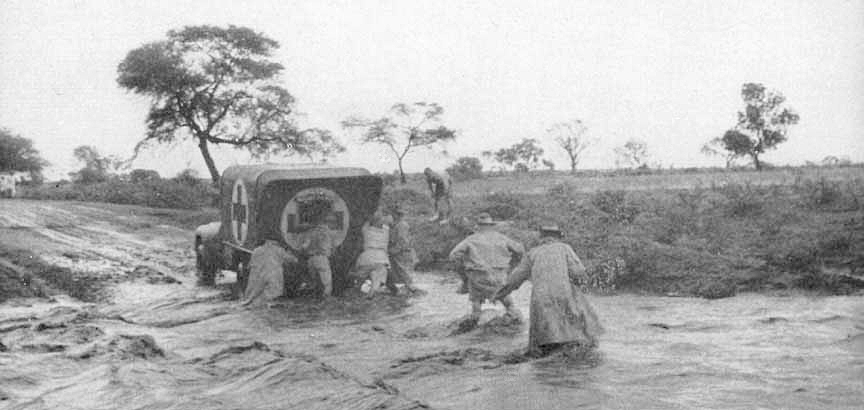
"The convoy was made up of 31 vehicles. Some of the cars had been stuck in river-crossing on the first day, but no one was on hand to get pictures of the men struggling in the mud with natives and cows trying to pull the ambulances out. Lt. Willson returned after the first day, leaving the convoy in the charge of Sgt. Parker, so that the men would have experience of taking care of themselves in the field.
"After traveling all day, the convoy pulls off the road at night onto a field the prescribed distance from a village or river. They drive in and quickly park beside each other, forming a closed square, covered-wagon fashion . The cook truck, under Spencer, promptly begins to prepare the night's meal---tea, bread, bullybeef, onions. In the meantime, the men get into overalls and take care of their cars, doing the tasks and checking the motors. If an ambulance has been having trouble, it is tested on the road by the sergeant and men from the LAD truck. The men are issued their daily allotment of one quart of water, which is all they get for the next day's washing and drinking. They clean up for the night's meal. After dinner they sit inside the circle, talk for a while, and turn in early. Most of the men sleep inside their ambulances on stretchers under mosquito nets---in about as much space as you would find in a good-sized coffin. Some sleep under the cars, with the mud of the undercarriage a few inches from their faces. It rained nearly every night. Night guards are posted. The cooking is done on a small sort of blowtorch cylinder, which never seems to work. Nothing tastes quite so good as that hot tea as we stand in the drizzle watching the sun descend on a part of the horizon where it isn't raining.
"In the morning, it is reassuring to wake up in the blackness and hear Spencer roaring at his native cooks (Indian soldiers) to get the fires started. Then the horn on one of the ambulances is sounded to wake the unit. They stumble out in the wet darkness and quickly shave and dress and get their gear packed before breakfast. They stand in line by the cook-truck as it is growing light and are served hot tea, steaming mush, and bread. When they have finished . . . they line up and draw their rations for lunch---a can of bullybeef (sometimes cheese), bread, and dried fruit or an orange. . . .
"The cook-wagon begins packing. The ambulances file past the petrol truck to fill up. Olmsted and Forman have this hard, thankless, dirty, greasy job. The perspiration rolls off them as they try to speed the line onto the road. . . . Checked and tanks filled, the ambulances drive onto the road and take their positions in the convoy line to await the signal to start. A motorbike is at the head, and one brings up the rear. The petrol and LAD trucks are usually the last to take their places. The station wagon leads the convoy---the rest follow 50 yards apart, stretching over a distance of 2 or 3 miles. The last vehicle in the convoy always has to go much faster than the leader, odd as it may seem at first . . . . The men did a hell of a good job according to any standards . . . . They drove through rivers and mud, heat and rain. At night they were tired, filthy, and cheerful. The first section is ready to move."
However, no movement order had come through. The men had arrived in June and July, the ambulances had been issued in September, and the men had proved they could handle them without mishap. But still they sat and trained some more.
"Our work has been that in which I've been as much occupied as anything else during the past 8 or 9 months, viz. training," Captain Pemberton wrote. "We have come a long way in that line from the time when we used just to look at a new guy, ask him if he'd ever driven before, and then turn over an ambulance to him. The people in the desert, to whom we used to send our trainees after their experience with us, have commented considerably on the value of the time put into training, and so, with their suggestions, we've broadened the type of instruction immensely. But after a long period of telling others how to pick up wounded, etc., I'm getting impatient with being so far away from it all myself. I hope I don't have to go on being a school teacher to the AFS much longer."
Finally the movement order did come. On 20 October 1943, 1 AFS MAS left Poona for the eastern front. Lt. Willson's enlistment had expired, so Captain Pemberton, with Sgt. Parker, led the convoy. Faithfully following the instructions on their orders, they took longer than later sections were to do, making the course to Calcutta in 17 days (as against 13 for sections 2 and 3). The route for all was a huge arch---northeast by way of Nasik City (next to Deolali, where Pemberton had been stationed with Unit ME 1), Dhulia, Mhow, Biaora, Shivpuri, Jhansi, Kalpi, and Cawnpore, then southeast through Allahabad, Benares, Aurangabad, Bagodar, and Asansol to Calcutta, which 1 MAS reached on 6 November. Unfortunately, between Asansol and Calcutta, conflicting orders caused the Section to miss connections with the prearranged transport to the front and it suffered another delay.
While in Poona 2 MAS got its cars (ahead of schedule, thanks to Army's request for its services), went on a scheme, and continued its other training, 1 MAS was stuck in Calcutta. All had been struck by the sight of near-famine in Bengal, and they tried to get work distributing rice or in some way alleviating the situation. However, there was no more rice to distribute, and nothing else turned up for them to do. Until 21 November there was nothing for them but to amuse themselves and periodically to tend to their cars. During the wait, Captain Pemberton talked with members of the Friends Ambulance Unit concerning their work in China, in which he took an immediate and lasting interest. H. A. Crumpler arranged the use of American Red Cross facilities for the Section, which in the overcrowded and expensive city was a great help.
Transport for 1 MAS from Calcutta to the front was finally arranged---a complicated route followed by the first two MASs. But while 2 MAS was able to move as a single unit, 1 MAS was sent up in 3 parts. From Calcutta they went by train north to Santobar, or Parbatipur, one ambulance to each flat car, and then transferred, ambulances and all, to a train which took them northeast to Bongaigaon. Thence they drove east to Jogighopa, where they took the ferry across the Bramaputra to Goalpara. By dusty roads, the convoy continued east through Gauhati, going north to Nowgong and Numaligarh and then south to Dimapur (Manipur Road) and Imphal. "The LAD lorry played a very important role," Lt. Craven wrote of the trip. "Sergeant Major I'Anson and Terry Harding were continually on the job doing minor and major repairs, not only for AFS but for various other units in need of mechanical aid along the way."
By the time the third part of 1 AFS MAS had reached Imphal, in the first week of December, it had been 5 months in India, almost 6 weeks of which had been spent crossing the 2,000 miles from Poona to Imphal ---the center of Fourteenth Army operations.
Although by early 1944 the Allies were about to take the offensive, in the two years since Pearl Harbor the Japanese had earned the reputation of being invincible and had taken a great deal of territory. Between December 1941 and May 1942 the enemy had overrun the Philippines, much of Oceania, all of the Netherlands East Indies, the Malay Peninsula, as well as most of Burma. Communications between the United States and Australasia were threatened. India was in danger. And the last supply route to China was cut.
In January 1942 Japanese forces advanced west from southern Thailand to take Moulmein in Burma and then turned north. Rangoon, the capital city and principal supply port for the Allied forces in Burma was taken on 8 March---overwhelmed by the enemy's superiority in numbers and equipment. The Japanese then advanced to the north and, by infiltration and outflanking tactics, completed the conquest of southern Burma in two months, surprising the British by their cunning and jungle craft. One Japanese column pushed on up the Sittang River valley, on the east, while another pursued the Allies retreating through the center of Burma up the Irrawaddy River. During April one column drove west to take the port of Akyab on the Bay of Bengal, while another column traversed the upper Salween valley to take Lashio. Outflanked by this move, Mandalay was occupied by the Japanese on 1 May.
From Lashio the enemy's eastern column continued up the Salween into China; it also sent patrols straight north through the hills toward Fort Hertz and the Assamese border. Japanese troops from Mandalay went on through Monywa toward Kalewa on the Chindwin, where the British forces put up their last resistance. During May, the Allied forces in Burma slogged their way on foot the last 200 miles to the Indian border, where they took up positions in the jungle, weary but prepared to repel any attempt at invasion. By June 1942 the enemy had taken all of Burma but a fringe of mountains in the north and bits of jungle swamp to the west. They might have brought off a successful invasion of India at that time, but with the coming of the monsoon they halted their attack.
In October 1942, at the end of the monsoon season, the Japanese renewed the offensive in western Burma, pushing north from Akyab toward the Indian border. A British counterattack pushed them back, but its gains could not be held and the Japanese pushed up to the frontier.
In the east, the enemy began in February 1943 a drive in force north from Myitkyina toward Sumprabum, Fort Hertz, and the Assamese border. At the same time, General O. C. Wingate with some 3,000 specially trained troops marched from Imphal into occupied Burma. Directed by radio and supplied from the air, his force covered 1,000 miles in its 4-month expedition---gathering topographical and other information while harassing the enemy by extensive demolition (including the lines of communications) to such an extent that it gave the impression of being a much larger force than it was. When the 1943 monsoon put an end to the second season's activities, General Wingate's force returned triumphantly to Imphal.
In August 1943, in the middle of the monsoon season, was held the Quebec Conference of the Allied Powers, which created the South East Asia Command (SEAC). Admiral Lord Louis Mountbatten was appointed to command this new formation. General Sir George Giffard was named Commander in Chief of land forces in the area, 11th Army Group. General W. J. Slim was given command of Fourteenth Army, formed in October from the fighting formations of his old Eastern Army.
At this time it was considered impossible to retake Burma by land from the north because of the difficulties of fighting and of supplying the fighting troops in a country of mountains and jungles cut by three great rivers flowing north to south and having almost no roads. When the Eastern Army had held Burma, it had been supplied by sea through Rangoon rather than overland the length of the country. But the success of General Wingate's expedition showed that the supply problem could be handled without an elaborate set of roads---which would have had to be built through extremely difficult country and then maintained through the vile weather of the monsoon---and set a new pattern for the fighting to come.
During the course of the 1943 monsoon season, there was only patrol activity at the front. Behind the lines there was considerable activity. Both sides were busy building up strength for the winter's campaigns. General Stilwell opened the new season's activities in November---driving south from Ledo in an attempt to clear a way through the mountains and jungles of north Burma and to convert the Hukawng valley trail from the railroad at Ledo to the airbase at Myitkyina into a road joining India to the old Burma Road into China. In December, 15 Corps of Fourteenth Army started a successful attack in the Arakan---the mountainous region of west-central Burma. In preparation were amphibious attacks down the Burmese coast and an airborne invasion of Burma ---based on Imphal.
When 1 AFS MAS arrived at Imphal, in December 1943, the Allies had grasped the initiative, and the campaigns, if small, were going well. It was a war unlike what had been known in the desert. Because of the terrain and the enemy's tactics it was far more of an infantryman's fight than the AFS was to know in any other theatre. No one was sure of the actual Japanese strength or of where it was. The enemy had developed a strategy for jungle fighting---infiltration and a tactic of slipping around through the jungle to reappear behind established British posts, upset communications for a few days, and then slip away into the jungle again to reappear no one could guess where. Patroling, therefore, was constant. Most often the patrols included only a few men, but sometimes as many as 60. Battles were infrequent and small.
At the beginning of January, Captain Pemberton was to visit Tiddim just after a battle in which the total Allied casualties were 200. He remarked to a British officer that this didn't seem very big and was indignantly told: "Well, it was a brigade show." A fight involving anything more than a battalion was considered big. Later in the month, a battle came off on the east side of the Yu River, between Tamu and the Chindwin. It lasted 10 days, though only scheduled for 2, and was given large coverage in the news. The total of Allied battle casualties was 12 killed and 60 wounded.
The fighting was as nasty as it was intimate in scale. Patrols were in almost as much danger from mines and booby traps set by either side as from enemy activity. These and the many jungle diseases provided a steady stream of casualties for evacuation. In December 1943 the greatest number was caused by dysentery, while at other times of the year malaria was the chief cause of sickness. In 1944 the sickness rate was 100%, though there was only one battle casualty for every 20 sick. Although this percentage was decreased steadily during the subsequent months of the war, there was plenty for the AFS ambulances to do. There was even the hazard of the Allied pilots dropping supplies. The inexperienced were apt to drop their loads at the wrong place, sometimes injuring or even killing the troops they were supplying.
When all 25 cars of 1 MAS had arrived in Imphal, reconnaissance trips were sent out to Tamu and Tiddim on the suggestion of Brigadier Dimond, DDMS 4 Corps. The group that set off for Tamu, led by H. Parker, did not have a successful trip. There was a small flap on, and the evacuation traffic back from Tamu was too heavy for them to buck. They got no farther than the ADS of 65 Field Ambulance at Khongkhang, 52 miles southeast of Imphal.
Captain Pemberton was in charge of the Tiddim trip. On 7 December L. W. Harding reported that he and R. Chadwick-Collins were the first AFS men into Burma---but only "because Pemberton, Ripley, Peters, and Dolan were in the back of the ambulance." It took about 24 hours on the road to make the 167-mile trip.
"Beyond Milestone (MS) 82, the road climbs some mighty high hills, descends into some mighty deep valleys, makes some mighty sharp bends, and has some mighty narrow spots," wrote Captain Pemberton. "The 'khud' (Urdu for precipice) is a much more intimate enemy than is the Jap. In some places going over the khud is the beginning of an unprecedentedly fast downward journey of 1,000 feet and more, and the mere contemplation of it (on the spot, that is) takes the breath away. Amazingly enough, very few people are killed over the khud, and most of them are passengers, not drivers. But the cost in vehicles is high.
"After our return from these trips, we were ordered to send 5 ambulances down the Tamu road---3 for 65 ADS and 2 for 42 MDS (at Moreh, near Tamu)---and 10 up the Tiddim road for 64 Field Ambulance, which has an MDS at MS 82, an ADS at MS 109, and another at MS 132 (Tuitum on the map). MacDonald took his subsection down the Tamu road, and I took Peters' and Chad-Collins' subsections up the Tiddim road. Lt.-Col. Martin, OC 64 FA, who has been on the Tiddim road almost ever since he came out of Burma in '42 and who is a hell of a swell guy, accompanied me up the road from MS 82 and assigned all but 3 of the cars to the ADS at log, taking those 3 up to MS 132, While we were at 132, a flap began at MS 52 (on the road south from Tiddim to Falam near Fort White), and the DDMS sent up our other 10 cars and ordered that those already up go on to Tiddim. (From Tiddim the road is only jeepable.) The flap lasted only a few hours, but for 3 days we were pretty busy with its 160-odd casualties (mostly Gurkhas)."
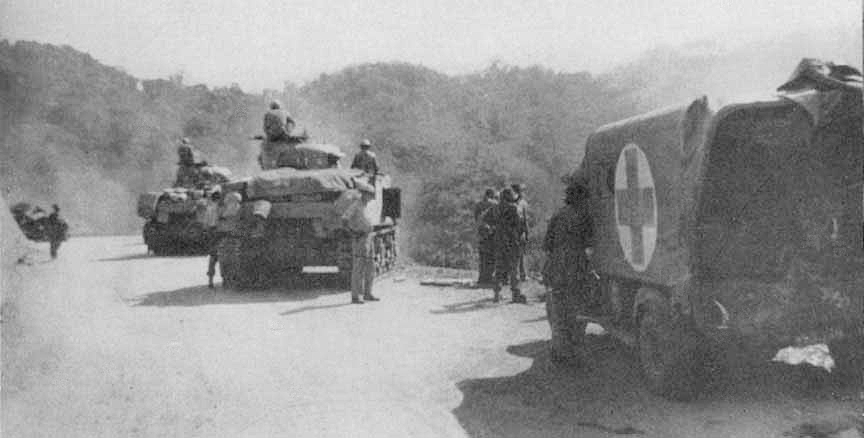
Ambulance and tanks advancing together along the Tiddim Road
The engagement was typical of this phase of the campaign. The description by D. Spencer shows the difficulties of evacuating casualties along the single road.
"The British and Gurkhas were trying to break up the strongly situated Jap emplacements, called bunkers. They sent Gurkha after Gurkha platoon up the slope in the face of withering fire to try to take these bunkers. No soap. Two whole companies wiped out. This was at Kennedy Peak. The wounded came by stretcher-bearer, mule, jeep, or on the backs of their friends to Tiddim (MS 167), whence by jeep to MS 132 (Tuitum), then by AFS Fords to MS 109, then to MS 82, then to MS 37 (which is the CCS). The positions of RAP to ADS to MDS to CCS to base Hospital vary considerably. In this case I think the RAP was a shelter behind which men were roughly bandaged and doped---doped thoroughly to withstand the shock of the mules or jeeps or stretchers. The ADS was probably in Tiddim. Here they did the most immediately necessary operations. The not-so-immediate cases went to MS 144 or MS 132, which were also ADSs. The next step was the MDS, where wounds were rebandaged and the men kept until fit for further travel."
After these few days of intense activity, not made easier by the state of the roads, which demanded 9 hours for a 58-mile run, Captain Pemberton returned to Imphal. He was soon followed by Chadwick-Collins' and Peters' sections, which were sent back as soon as the line had settled down to normal evacuations again, reaching Imphal just in time for Christmas. That night, they had a banquet in Imphal.
"The entree was roast shoat," Captain Pemberton reported, "purchased on the hoof, escaped twice, recaptured twice, killed dramatically by a single round from Parker's trusty six-shooter, and roasted by Abdul Salam till it would melt in your mouth. You know the rest of the menu, I believe; suffice it for me to say it all tasted damn good. Parker mixed a nice hot rum punch. A good time was had by all. Fowler, incidentally, arrived here about 8 P.M. on Christmas night. He landed right in the middle of the banquet and distributed a large bag of mail on the spot. . . .
"Since then we've busied ourselves around Imphal with building fireplaces in the mess hall and canteen (and Peters' Pukka Patrol even built themselves a nifty one in their basha), developing new car parks and living accommodations for 2 MAS, building a shower bath, and otherwise improving our camp. . . . Brigadier Dimond is happy as a lark to learn of the impending arrival of 2 MAS. He speaks of us as his 'shock troops,' which he plans to use here and there whenever a flap is on and additional ambulance cars are needed. At the moment we have (I believe) 22 mobile vehicles. Two of the immobile vehicles are for half-shafts (they are our 13th and 14th broken half-shafts respectively), and we intend to mobilize one within the next two days by cannibalizing the other."
In the first half of January there was steady work for the men on assignment. "We are settled down into a kind of routine," one member of the section wrote, "and drive patients about 2 days out of 4. The other 2 we work on the cars, get cleaned up, or just plain loaf. We're usually ready for the easy day we get about every fourth, because our driving is either done at outlandish hours or else we have to buck traffic, and that's no joke on these roads. . . . When the call comes to go out in the late afternoon, we spend the night at destination, pack the patients in the car before we go to bed, and start out very early the next morning---about 3 to 5."
About the 10th, 88 IGH moved to MS 37 on the Tiddim road and 16 CCS moved from that MS to MS 109. Although the road was being improved, Spencer wrote on the 14th that it was "terrible---a few good spots where you can actually go in 3rd gear---down the mountain into MS 109, sweeping around those smoothly banked curves, the road very nicely graded and amazingly smooth. Recent rains had laid the foot-thick dust which hid potholes and rocks. In place of dust in the shady spots, the road was shiny clay. The 'bulldozer boys' had scraped it and rolled it when it was just the right consistency. . . . The boys when driving never use any gear above low and very often stick to low-low (crawl) for hours on end. The average over the bad spots is no more than 1 mph. The usual run with 4 fairly badly off stretcher patients is 27 miles (MS 109 to 82) in 9 hours. If there are battle casualties in the top stretchers, and they're badly hurt, it will often take 12 hours."
On 9 January, 2 AFS MAS had reached Imphal, having left Poona on 19 December. Lt. C. N. Jefferys was in charge, assisted by N. D. Fenn as Section Sergeant. For the Section, Christmas day was just another stage on the long road to Calcutta. Only F. M. Smith had had the foresight to save out one gaily wrapped package to open on the festive morning. "After breakfast a bunch of the boys came around to watch me open your Christmas box," he wrote home. "So with a great deal of ceremony I untied it, while the boys all stood with their mouths watering. I reached in and pulled out my AFS coveralls [left behind in the hurry of departure]. It gave everyone a real laugh."
Major Ives and H. A. Crumpler (then Public Relations representative) left Poona on Christmas Eve, in order to join the Section in Calcutta and to accompany it to the front. On the arrival of 2 MAS in Imphal, administrative changes were made all around. Captain Pemberton established a Detachment HQ at Imphal to serve both Sections. Lt. H. Parker was given command of 1 MAS, assisted by G. F. McKay as Sergeant. Then toward the end of the month Lt. Jefferys; was succeeded by Lt. Fenn as OC 2 MAS, and J. Macgill was appointed Section Sergeant.
The first group of 2 MAS to be given work was sent on 19 January to a Post 75 miles out on the Tamu road. The Section soon got other posts on the Tiddim road, and before long the two Sections were so thoroughly mixed up that it was found necessary to unscramble them. By the end of the first week in February, 1 MAS was serving only posts on the Tiddim road and 2 MAS those on the Tamu road. Lt. Fenn's section had 2 cars stationed at 24 CCS (MS 42), 2 more at 65 ADS (Khongkhang), and the rest working out from 14 CCS (MS 69). of this larger group, 5 cars were sent to forward field ambulances (2 remaining with 42 FA at Moreh). On 18 February the 2 cars at 24 CCS were sent up to join the group at 14 CCS, where the Section HQ was established. It had its own mess and living quarters under canvas a short distance from the CCS on a small hill, below which the cars were parked. Each driver usually had runs two days in a row and then had the third day off. Because of road timings, they left at 2 P.M., drove to Palel (MS 29), and did not get back to camp until after midnight. Lt. Fenn showed considerable enterprise in getting new jobs for his Section, so that it was increasingly busy during February and on occasion rushed.
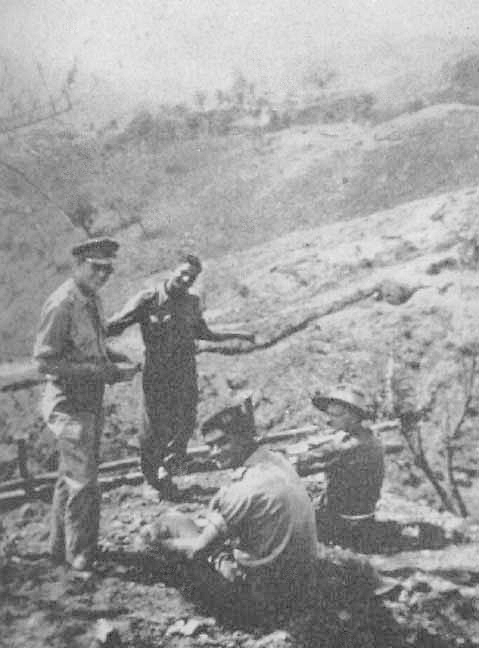
Lt. Parker's 1 MAS was kept steadily busy during the same period. It had 10 cars at Detachment HQ in Imphal and 15 cars under Sergeant McKay at the ADS site at MS 109---where 9 months before Colonel Richmond and Major Ives had spent the night and had gone swimming in the stream, the Kaphi Lui. From this group, 1 car was posted ahead with 36 ISS at the Manipur River (MS 126), and N.A. Peters ran a staging post on his own at the Convoy Stopping Post (CSP) at MS 144. Here from the beginning of February he took patients off down-coming convoys and gave them food, tea, cigarettes, and a place to rest under cover until they were loaded onto the next convoy, which took them as far as the ADS at Tuiturn (MS 132). (It was expected that this staging post would have to be closed in another month because of the seasonal increase of malaria.) The rest of Sergeant McKay's group rotated the runs from Tuitum to MS 109 and from MS 109 to MS 37
From MS 109 in mid-February, R. A. Burdick wrote that Lord Mountbatten had been through and had "stopped to address the troops at different spots. He shook hands with the officers commanding units---including G. F. McKay, the Sergeant in charge at the moment. He spoke very informally for about 20 minutes, very frankly and with what appeared to be a great deal of sincerity. He is a fine looking man with a commanding personality---reminds you of an eagle. Definitely the man who people would follow through Hell, if he asked it."
MS 109 was not far from the front. About a week later Burdick wrote:
"Had a day waiting for return patients, so I hitched a ride up to -----. Amazing to sit and watch the war going on, literally, and yet be perfectly safe. I got a very clear picture of the doings and was sorry when I had to get back. Of course you rarely hear about our show, but it's a hell of a tough job for the troops in this sector, even although not on a large scale compared with Russia or Italy. And you'd never convince one of the badly wounded that the action where he got it wasn't important. Pain is the same the world over. . . .
"Do we get immune to the suffering of the patients? Certainly I shall never get calloused to a man suffering in the back of the ambulance. I know a bump might hurt them, so if I hit one inadvertently it grates on me plenty. They get the slowest, smoothest ride I can possibly give them. One guy was in a hurry, and as he was alone we made it plenty fast. But that's exceptional. One of the hardest things to do after a long ride is to keep the pace down during the last mile or two. So from a certain point on the road I make it a point to see how slow I can go. One plays little games like that . . . but there's no danger of falling asleep!"
By 1 March the picture had begun to change on the central front, as this section was called. "Curiously enough, the box-seat to the war wasn't so safe a few days after I was there," Burdick wrote. "The enemy shelled it for the first time in months."
Stirring fighting had already occurred in the Arakan and on the North Burma front. In February 1944, the attack by 15 Corps in the Arakan had been met with a violent Japanese counterattack, which encircled 7th Division as well as some of the Corps administrative formations. Supplies were dropped by air until 26th Division could be brought from Chittagong to assist., After three weeks of hard fighting, the encirclement was broken and the Japanese withdrew from the sudden danger of being themselves encircled. This was the first real defeat for the "invincible" Japs and can be considered the turning point of the campaign. It gave heart both to the Allied troops and to many natives of wavering loyalty.
General Slim had been planning an attack on the central front, working from Imphal out the Tamil and Tiddim roads in support of the troops already engaged farther east in North Burma. These two groups were General Stilwell's force marching down the Hukawng Valley toward Myitkyina and a group fighting through the jungle toward Myitkyina from the south which was harassing the lines of the troops opposing General Stilwell's force. By the beginning of March, however, it was clear that the Japanese had scheduled an assault along the central front with the object of invading India through Imphal, Kohima, and Dimapur. The British quickly brought reinforcements from the Arakan to Dimapur---2nd British and 5th and 7th Indian Divisions. Then, to force the fight where it would be most to Allied advantage, General Slim drew in his troops to the Imphal area, evacuating administrative and other noncombatant personnel to Bengal. At the beginning of March, work was begun on the defenses of Imphal itself---the construction with wire, trenches, bunkers, and gun emplacements of a circuit or perimeter of strong defensive positions (known as boxes).
The AFS Detachment HQ in Imphal had the tasks of keeping track of the volunteers and of reporting on their activities. As the tension at the front began to mount, Captain Patrick went up to Imphal to be on the spot for his two departments of Personnel and PR. He immediately fell sick with an NYD fever (usually translated as "not yet diagnosed" but, with the passage of time, as "new Yankee disease"). Captain Pemberton left for Calcutta to hasten the repatriation of L. C. Sanders, who in January had been caught between two automobiles and had both legs broken. Lt. Parker went forward to supervise his cars at MS 109 on the Tiddim road, and Lt. Fenn was needed at his forward posts on the Tamil road. When Captain Patrick got out of hospital, he found himself by default in charge of Detachment HQ at Imphal. No one quite knew what was happening. Rumors were numerous, exciting, and for the most part not at all reassuring. There were some rather melodramatic outbursts of bad temper and ill-considered name-calling. Then the flap was on for fair, and the work at hand irresistibly took precedence over internal bickerings.
The Japanese attack began on 8 March, a week earlier and in greater force than expected. The enemy did not advance directly along the two main roads, consolidating their positions as they went along. But by marching through the jungle they cut the roads at different spots, rendering some positions untenable while leaving others, even those farther from Imphal, isolated but comparatively unmolested.
The attack began in the south.
"All ambulances that can be spared called to Tiddim," T. Dolan recorded for 9 March. "Fowler and Robinson happened in after being at Kennedy Peak and shelled at ADS by Jap 155S. . . . Jap commando force broken through. Attacked convoy. Hospitals being evacuated. Enforcements coming up, so road closed tonight except to ambulances. May cut road at MS 82 or 132."
On the 10th:
"One theory on the Jap push is that they're doing it to save face after Arakan. Rumor of Jap divs coming. Convoys going up and down all night at Kennedy Peak; surgical team and ADS blown to hell. Parker tried to get Imphal to tell Peters' section to stay down until the flap was over and we'd carry on. They were to start up tonight. Line was down, so we couldn't get them. . . .
"Packed up, over at 16 CCS by 9," his account continues for the next day. "Left with 4 patients at 10. Had 2:30 lunch in Captain's quarters at MS 82. Big fire there about 10 days ago which swept entire hospital. Dinner at MS 37, where we left the patients. Drove rest of way in most marvelous moonlight. Henry Romberger and I each drove half way, so it was not a hard day. Got in to Imphal at 11. Colonel at 16 CCS had said they were evacuating all but 100 beds, which were to be moved into perimeter and MS 109 was to be defended. Tiddim is supposed to be surrounded on 3 sides. We're still to work up there, but 19 CCS completely evacuated."
On the 12th, Detachment HQ could not get through on the telephone to Lt. Parker at MS 109. They kept trying for the next two days, but it was not until the 14th that the Army operator admitted that the lines were down. The same day came definite news that Japanese forces had outflanked 17th Division and cut the Tiddim road. No one knew for sure what had happened or what was being done. The tensions of the past week, when many had complained of inactivity in spite of the brewing trouble, came to a head in a particularly explosive display of nervous temper. Then on the morning of the 14th all ambulances had to pick up patients brought into the area from outlying posts, most of whom had been in transit, and without attention, for several days. The situation did not change during the day. That evening, D. Spencer, who had been trying to phone Lt. Parker about the disposition of some rubber boots he had acquired for 1 MAS, took the boots and in his 3-tonner went forward to see whether he could get through to the Section.
Spencer got through to MS 88 all right, employing a minimum of chicanery, but he could get no further. For the next few days he drove up and down the Tiddim road being generally useful. Reports of the battle were confused, and he could get no news of Section 1. On the 17th, the evacuation of the position at MS 109 was confirmed, and the next day Davis worked between MSs 82 and 93, carrying troops and .patients that had walked out from MS 109.
"They were really tired out," he wrote. "About 6 P.M., as I brought in the first load of patients to MS 82, I met Hugh Parker, Jim Reppert, Mike Cheney, G. L. Smith, and Bill Du Val---all of whom had brought up the rear guard of 16 CCS, right in front of the Japs. About MS 88, at 10 A.M., I had met Allan Block, who had left 109 with a party of Sikhs about 8 hours earlier than the rest."
The orders given to 17th Division in Tiddim had been for it to withdraw to Imphal as soon as its commander thought that the main Japanese assault had begun. The surprise attack on MS 109 routed the troops in that area and cut off the rest of the Division. The Field Service men with 16 CCS were thus the first to be driven back to Imphal by the Japanese offensive. The earliest entry in the diary Lt. Parker kept at MS 109 was for 13 March: "Went to 134 in morning; found Chad there. McKay posted to MS 126. A perimeter formed at 134 and 126. Japs shelling road above and below 134. Returned to 109 that night. Firing in hills southwest of 109.
"Up at 0330 [the next morning]-very heavy mortar fire and machine gunning on ridge across valley from camp. Again at 0530. Saw Lt.-Col. Hill for instructions during morning. He promised to call back with further orders but to sit still until then. Did not hear from him again. Dug slit trenches. Watched our 3-inch mortars shelling Jap positions on ridge opposite all day. At dusk, about 1900, tremendous volume of small-arms fire from all directions, from hills surrounding camp and within camp as well. Called Hill, who told us to move back to bridge, believing that a heavy attack was developing in our sector. Had previously drawn 3 rifles and ammo, Kingsley having arrived with same, saying that all drivers at 126 were being armed. Made for road with Rangabasbar, Narsnappa, Ripley, Reppert, Ladd, Kingsley, Kornbrodt, Block. In crossing a knoll on the way to road, got into crossfire and finally took temporary but adequate cover in a Bren-gun emplacement. The next half hour was very bad. Finally, during a lull in the firing dropped back down on the road and by a roundabout route made our way back to our own camp and trenches, where we should have stayed in the first place. Intermittent small-arms fire . . . for the rest of the night. Reppert and I did guard, others got some sleep. At 2200 Sheridan arrived from 126 with urgent patient, was heavily fired on for most of last two miles by our own men.
"Things quieted down by 0700 [15 March], but we were then suddenly taken under fire by Jap artillery, 3 shells landing in our camp area within about 50 yards. . . . Reppert slightly hurt on face and leg by shell burst while bringing in casualty in jeep. Nobody knows what is going on or what we are supposed to be doing. . . . Telephone from CCS still working. Reppert in hospital, Block working there as orderly [he had dressed Reppert's wound]. Ladd, Ripley, Kingsley left for 126; Du Val came down; situation apparently not bad at 126. At present (1500 hours) heavy mortar fire (ours) on ridge across river. . . . Have completed several good slit trenches and will stay in them unless called out to CCS. Returned 3 rifles this morning on ethical grounds, but may draw them out again if occasion arises (if the Japs should cross the river) . . . .
"March 16:
Last night passed very quietly: no enemy fire at all, sporadic fire from our own positions. Have three two-man log-and-earth dugouts. After breakfast Jap mountain gun opened up on us, placing about 10 shells in the neighboring rest camp, all within 100 yards of us, some damned close. Their target was apparently a group of officers directing our mortar fire in full view. . . . Several DC-3s overhead dropping supplies to us. . . . We may yet have to walk out of this valley in which we are at present trapped. Our positions at 126 and 134 seem to be much better.""The big attack came on the 17th," W. K. Du Val wrote. "As usual we retired to our slit trenches immediately after supper at about 1830 in preparation for the night, but at 0400 in the morning he started in. It was the worst pounding he had ever given. . . . You could hear the firing over on the opposite hill, a dull boom. Immediately following would be the weird whistle of the shell overhead, ending up in a terrific crash as it exploded. . . . You'd lie on the bottom of the trench with your tin hat on praying that you wouldn't get a direct hit and wishing the hell they would stop. As the shells exploded you would think they were practically on top of you, and it did not help matters any when the loose dirt on top of the trench would fall down on you, getting in your shoes and dropping down your neck. . . .
"About 0430 they stopped and I dozed off and woke up at 0600 hours with the sound of voices. All I could hear was 'Everyone is leaving,' 'Better get out,' and 'Japs at the river'---which gave me a hell of a start. I crawled out of my hole and encountered Hugh Parker, who said to grab what food I could, and water, as we were going to the top of the hill. . . .
"We started up the hill behind our camp. On the way we encountered Rangabasbar (our cook) and Sholapur (our sweeper) and started them up, too. There were hundreds of men, mostly IORs, streaming up the hill. We got to the top of the ridge and found some BORs there who told us we were all supposed to go to the top of the next ridge. After we were about half-way up, Hugh Parker thought we should go back and see just how bad things were and, if it was safe enough, go back to the CCS. Very soon after, a BOR, whom we had known at the rest camp, came up and told us that the Lieutenant had said to come back down.
"We couldn't figure out at the time why he wanted us to turn back then, and I felt rather uncomfortable going down while all those people were streaming up. We met a BOR with some Gurkhas who said that the Japs were coming up the ridge to the right of the hill we were on and that he was going to stave off the attack. That didn't help much either. I was carrying Parker's stuff and my own down the hill. We met him a little farther down and he relieved me of my pack (with my precious camera in it) and explained that he thought after all we should stick with the CCS, especially as we already had 3 men over there. just about that time, however, the Japs had different ideas and opened fire. Naturally we dropped to the ground, at which time my pack loosened itself from me and started rolling down the steep grade. As the shooting had quieted down, I started after the pack, as I was very anxious about my camera. I got about 100 yards down with no luck when Parker called down to come back in a hurry. . . . Parker had met an MP captain who said we couldn't get to the CCS as the Japs were on the road, so we started back up the hill with the MPs of MS 109. It was at this point that we realized that Kornbrodt and Sholapur were missing. We could not go back, and they did not answer our calls, so we kept on.
"We had reached the top of the ridge when more shots rang out, so we slid down the side to a ravine where we all crouched with bullets whizzing all around us. It was sliding down that made me lose what cloth I had left in the seat of my pants. Finally the shooting stopped, and we had time to take a breather and get organized and figure out our next move. Since the Japs were supposedly in the valley, we figured on keeping to the hills, heading north; and, since we thought the Japs were at MS 82, we headed for MS 50. We started up the opposite hill, and down it, and around it till we were 'hill happy.' Since we were walking on a slope, it strained our feet, and mine were sure sore.
"That afternoon it rained for about two hours, which made the walking even more uncomfortable and very slippery underfoot. . . . As we were starting up the next hill, some more shots rang out. We noticed another party coming into the valley and . . . not taking any chances we sent one of our IORs over to contact them. He came back and told us that they were friendly evacuees but were wary of us and would not join us. We did not want to take any chances with them either, so we crawled up a ravine in the valley which was overgrown with roots, trees, etc., for 200 yards, then skirted up the side of the hill under cover of the tall reeds on the hill. Arriving at the top of this hill about 1800, we decided to spend the night there. A path was at the top of the hill and it extended around the various other hills, so we decided to sleep about 20 feet from the path so as to be on guard for anything. . . . We slept in pairs, with one man sleeping an hour and the other guarding, then changing round. It was still damp and we were still wet from the rain. Also it was damned cold because of the wind on the top of the hill.
"We woke up frozen about 0530 and got ready to move. As we did so a party of BORs came along the path. We . . . carried on together. They wanted to stick to the path, which was certainly easier walking, but we had been avoiding it because of being ambushed. However, we let them go on and we followed. They were quite a relief ... because they knew that we could safely hit the road at MS 90. This would mean that we could reach the road that evening instead of the week's march we would have had to MS 50. They also said that MS 82 was okay, which was a great relief.
"That noon we came upon a Chin village. We couldn't tell whether it was friendly or not, or if it was occupied by the Japs. It proved to be okay, and we passed through it. About 1200, while we were resting, two more parties caught up with us. With one of them were Cheney and Lee Smith, who we were very glad to see. Later on, about 1400, while we were making our way down to the river, we saw hundreds of other men coming along the river. Most of them were from 16 CCS, and they were carrying many wounded and stretcher cases. We found that the CCS had evacuated 109 at 1700 the day before and had followed the river all the way. We had feared this because of snipers. They evacuated the whole CCS---including 23 stretcher cases, of which one died on the way.
"The last leg of the journey was up a very steep hill. As we neared the top we heard lots of cannon fire. This, too, gave us quite a start, but we found that they were our guns. At the top of the hill were many trucks and ambulances. We piled into a truck, but Parker and Reppert stayed on to help load the ambulances. I was detailed to stay with Rangabashar and see that he got to HQ. The ride down to 82 was quick and uneventful and most comforting."
At about 7 P.M. on the 19th, they reached Detachment HQ at Imphal ---
"after riding from MS 82 in the back of a 3-tonner, an experience almost as bad as the one they had just gone through," Captain Patrick reported the next day. "They were filthy, unshaven, red-eyed, and exhausted. Poor Bill Du Val's pants were so badly torn that his full pink behind faced the world with impudent bareness. Jack, MacDonald, Peters, and I took them in hand and made them as comfortable and welcome as possible. Peters and MacDonald fixed up beds for them, Kiesling got them sheets, and Jack fed them. Mother Patrick, always thinking of the pleasures of the flesh, got the tin wash tub left behind when the whores were evacuated next to us, heated water, and fixed a hot bath for each---clean towels and scented soap (Lux, anyhow). Then made a steaming cup of exceedingly sweet chocolate (Klim for milk) and brought it to the beds. After dishing out 'Amurrican' cigarettes, let them fall asleep. . . . Kornbrodt started out from MS 109 with Parker, but became separated under fire and was lost in the confusion. . . .
"We lost two ambulances, a jeep, a 15-cwt (questioned), and one water truck. We believe that the others had been driven out early in the attack to about MS 128, which is still holding out. If those boys have to make their way out through the jungle, they're going to have a much tougher time. Hauserman and Field were reported as seen at 128. We've no contact with them.
"Brent Null, when Parker was first cut off, volunteered to drive an empty ambulance through the Jap-controlled road at MS 98 and MS 100 to see if they would allow a Red Cross vehicle to pass unmolested and bring out casualties. He was refused the offer at Corps because of the heavy firing at that time from both sides of the road."
At MS 128, some 20 men of 1 MAS were cut off with 17th Division, which had burned and evacuated Tiddim and was slowly fighting its way back toward Imphal. At the same time, Tamu was being threatened by Japanese forces, putting Lt. Fenn's 2 MAS in danger of also being cut off. And at any time the enemy might have pressed down from the north to attack Imphal itself. The position of the Allied troops on the central front was extremely precarious. In Imphal water was rationed and defensive measures were instituted in the area of military concentration. A number of AFS men carried arms, some of them issued and some simply scrounged. There were motions toward arming the entire Field Service contingent, but these were contemplated with horror after it was discovered that one gun-toter had cocked his revolver while playing with it in the dark and did not know bow to uncock it.
On 23 March Captain Patrick reported from Imphal:
"Brannan came in from Fenn's section and reports Japs both sides of the road. Very little traffic. Of 5 vehicles in one section, 4 were AFS ambulances. The official report (which I go to Corps to get daily) is that Tamu is not being held. Tank battle south of Tamu day before yesterday in which 8 Jap tanks knocked out to 1 of ours. Trouble is expected in that direction. The main force of the Jap drive is concentrated in the Ukhrul district. There has been no Japanese air activity at this HQ for the past 4 or 5 nights. This may be because of the weather---thunder and rain. The only hardship at the moment, and not a great one, is being limited to one quart of water a day. I've suddenly developed the thirst of a castaway and the capacity of a camel. We sleep in our clothes with knapsack packed and are up daily at 5:30---even Latham. Better safe than etc. . . . Romberger is setting up a first-aid post in our block to help clear possible casualties in our perimeter. Slit trenches are being dug to accommodate stretchers. . . .
"Three different officers have gone out of their way to compliment the AFS on their work at MS 109. One, whose name I do not know, stopped me on the road. The other two were Colonel Holbrook, who said 'I heard damn fine reports of your men,' and Major Pattison, who said 'By God, Parker and his men were splendid---I was with them! When you consider the English gift for understatement, I think these are highly complimentary.
"Today is doughnut day. Our Indian cook (Abdul) has learned how to make delicious doughnuts. Charlie Horton got the recipe, had it translated into Urdu, and now we have this luxury once a week at tea time. Nothing less than witchcraft."
Two days later, "Adrian Whyte just in from Tamu road," he continued. "He reports seeing 5 IORs blown up while eating their lunch along the roadside. He stopped to help bury them (he says) and with his macabre sense of humor nicknamed each body: the one who was burned he called 'Brownie' and the one whose legs were blown off he called 'Shorty,' etc."
Life at Detachment HQ in Imphal at this period was recorded anonymously on the same day:
"We've been extremely busy, spending our time constructing a First Aid Post (FAP). This consists of a hole in the ground 15 by 12 ft. by 4 ft. deep---thoroughly sandbagged and covered with heavy timbers and a tarpaulin. The first day we made very little progress in the digging, as our hands had gone soft and were highly subject to blisters. However, with constant work morning and night a few of us hardened up in short order. While not busy on this, I was out in a truck hauling rations, mostly consisting of 'ghi' (cooking fat) and firewood. The ghi-hauling is 'bahut karab' (very bad), as the ghi is packed in boxes and when it is in a melted condition it drools all over the truck and smells like the very devil. . . .
" We really put in a day now, as we get up at 5:30 for stand-to. At first we went to the slit trenches, but now we merely dress and remain on our beds with such equipment as gas masks, helmet, and emergency rations at our side. . . .
"The Café El Malaria has now opened up. The Café, under the management of Latham, has turned out to be an excellent job. Without doubt it is the only bar within several hundred miles. It caters chiefly to the AFS, but outsiders are allowed to come in. It takes up the entire building that used to be the office---50 by 16 ft., constructed of . . . mud walls and thatch roof supported by poles. One of the inside walls and the floor are covered with bamboo matting. The three remaining walls are divided into three layers of panels. The top two rows are painted yellow, and on them are drawn the insignia of various New York night clubs: the Stork Club, the Panther Room, the Class Hat, and the Brown Derby are represented. The four windows and the door are covered with green curtains. Throughout the room are a number of small tables, each encircled by chairs. At one end stands the gramophone on a table covered with a large assortment of records. At the other end of the room stands the bar, a very pukka home-made job with foot-rail and all, constructed chiefly by Whiteside. Latham presides as bartender. . . .
"I often wonder how I sleep at all of nights. . . . I had a stretcher originally, but all stretchers were called in as there was a shortage. 'Charpoys'---4-legged bedframes with cord stretched across---are available, but they have such a tendency to sag in the middle that I've given up the idea of using them. There is one volunteer who has never tightened his. Now he reclines with head and feet on the same level and posterior on the floor."
By 27 March, 17th Division had fought its way back from Tiddim toward Imphal as far as MS 109. Lt. Parker and Captain Patrick tried to drive up to it in order to find out about the accompanying AFS men, of whom there had been no word in two weeks. However, they didn't get very far out of Imphal, as the Japanese were active at MSS 55, 62, and 72, as well as holding 17th Division from its next position at MS 107. On the same day, D. Spencer, who was periodically cut off depending on the activity of the enemy overnight, wired that Kornbrodt had been found, safe.
In general, the situation was growing increasingly serious. As 17th Division fought its way closer to Imphal, the Japanese in between were being pushed closer, too. By the end of March, positions only 30 miles from Imphal on the Tiddim road were abandoned. A large attack was confidently expected on the Tamu road. Extra AFS vehicles had been sent back from posts along the Tamu road, bringing all nonessential personal belongings. The LAD of 2 MAS, when it reached Imphal, had shrapnel holes in the top and its batteries were burned.
"Whyte came in from Tamu direction to report that the night before they thought they were being attacked," Captain Patrick recorded. "A band of baboons came out of the forest toward the barbed wire in the dark. A hand grenade did the trick. He insists it's hard to tell a Jap from a baboon."
Lt. Fenn and his group pulled back with the ADS to MS 19 on the Tamu road on 1 April, after an exciting 10 days. The Section on the 21st had moved back from 14 CCS at MS 69 with the ADS of 59 FA to a defended box at Moreh. As it happened, Noor Mohammed, the Section's Indian cook, was preparing a meal at the time scheduled for the withdrawal. He was put out about changing his plans at the last minute and asked why he had to go. More than a little incredulous at such a lack of awareness, Lt. Fenn insisted that the cook must prepare to leave, finally explaining to the still protesting man that the Japanese were coming for dinner. Then Noor Mohammed, imperturbable after even so short a time as he had been with the Field Service, asked "How many?"
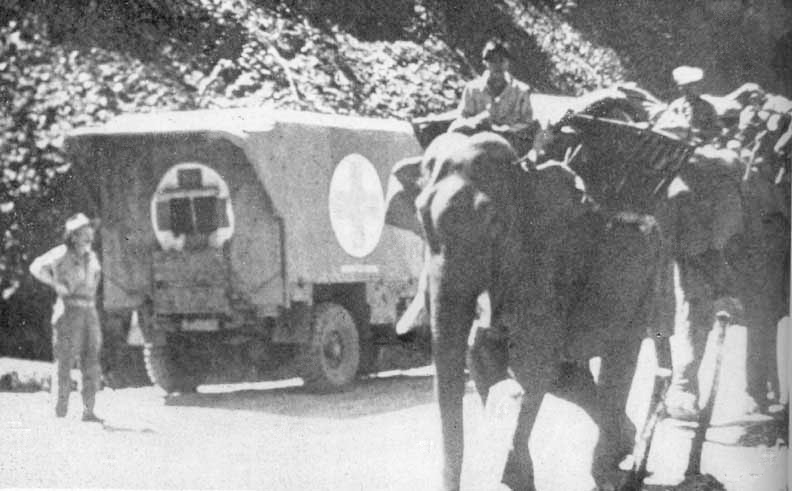
The airstrip at Palel on the Tamu road was vital to the defense of the Imphal area. Located at the foot of the hills on the edge of the plain, it received half the supplies brought in to support the large garrison. Control of the dominating hills beyond Palel was necessary to its continued operation, and to this area 20th Division had gradually withdrawn. R. B. Whiteside went up to take pictures of the AFS activity on the Tamu road and reported the Section's experiences during the last week in the Moreh box:
" March 24:
The Tamu road, except for a few trucks and one small, heavily armed convoy taking tank motors up, was deserted. It was like walking through a great empty house after having been to a party there the night before. . . . Stories from the road don't help the lonely drive. Jap patrols are in force along it at Sibong, Khongkhang, and God knows where else. They've been scrapping with the defenders, and taking time off to mortar an occasional convoy. . . . The MAS HQ is established with an ADS in a defended box overlooking Elephant Camp. Two subsections are providing medical transport for the ADS, while the balance of the men are dispersed along the road at various medical stations, shuttling casualties to the rear. . . ."March 25:
Last night was quiet, as was the night before, which seems to shake the personnel more than a good sound shelling, for the Japs are evidently consolidating for something big. . . ."March 26:
The Jap sent over a 75-mm. and mortar barrage this evening about dinner time, catching us unawares. Dignam and I heard the first shells range high over us and land well in the northeast corner of the box . . . . An antipersonnel shell landed in the corner of Elephant Camp . . . . The Royal Artillery (RA) sent over an answering barrage, which quieted the Jap for the night."March 27:
Orders came that the entire camp was henceforward to sleep below ground. Our dugouts are gradually being finished and roofed over with steel beams, logs, sandbags, and earth. A large Jap patrol attacked the Punjabi regiment in the northeast corner of the box this evening but was repulsed. . . . Our drivers are doing a nerve-wracking job: they drive, unarmed, a road constantly attacked by Jap patrols. Baars has been sniped at. Dignam rolled through a Traffic Control Point a short hour before its personnel was decimated by a large Jap patrol. They continue to drive at low speeds, for the policy continues to be that of patients first."March 28:
The Jap laid down another 75-mm. and mortar barrage commencing at 1810 hours and lasting about an hour and fifteen minutes. The first shells landed forward of us about 3/4 of a mile, presumably on our artillery positions. It lifted for a moment and then focused on Elephant Camp. A direct hit scored on the operating theatre. A great deal of mortar fell in the camp, most of it striking the trees and detonating, spraying the ground with shrapnel. Most of the MAS tentage was pierced in numerous places. Macgill's mosquito net was torn to shreds with Macgill under it, counting his moments. The greatest loss to the AFS occurred when a large hunk of hot shrapnel entered Brannan's ambulance through the wooden frame and pierced his duffle bag, wherein nestled an unopened bottle of gin, George's ration for the week. . . ."I was in the dugout Dignam and I had constructed when the show began. It was a good dugout. . . . It was dark and completely quiet when we crawled from the dugout. The fire that had started when the operating theatre took its hit had been extinguished by Gilliam and a few other hardies, who left their trenches in the middle of the shelling to get it under control. Flames might have attracted more- Jap shells. I started the rounds to see how our men had fared. The shell that had struck the operating theatre sounded as though it had landed directly among our dugouts. (It was 20 feet away.) Everyone was finally accounted for but Hill, and he was discovered in a dugout in back of the mess tent, a wounded Indian in his arms. When the shells had started to land, he said, he leaped for the nearest hole, and can't remember whether he reached it under his own power or was blown in. The Indian, on his heels, took a piece of shrapnel in the back. The casualties were counted and cared for. No dead. Colonel Jackson, the giant in command of the ADS, thundered around during the show without a helmet, caring for the wounded and restoring confidence to a good many minds.
"March 29:
The night was quiet, but the shelling recommenced at 0510 hours and lasted about 15 minutes. . . . After breakfast, just as the casualties of last night's show were loaded into the ambulances for evacuation, 3 Jap bombers passed over with a large fighter escort. There was a terrible scream, and a big one struck just across the road. . . . No more bombs were dropped. Fenn informed us that the Colonel and ADMS had advised that we be armed, and that any who wanted guns might have them. Sten guns were issued to most of the unit. The boys have been waiting for them for a long time. Plans were also made to send back to Imphal every ounce of unnecessary equipment. Our extra food stores were packed, our canteen supplies, most of the tents, and all but a minimum of personal kit, and were dispatched immediately."March 30:
Last night was quiet again. Fenn, after a meeting of area OCs, quietly informed us that we must be prepared to move on a moment's notice. Extra personnel has been sent back: the LAD and staff, most of the spare drivers, and all but a skeleton detachment of ambulances. The hospital is sending down all but a fraction of its medical supplies and its extra personnel. Other units in the area are quietly doing the same thing. It's a spooky proposition, staying on in this box, which was supposed to be defended to the last man. It's a matter of conjecture among us whether we're stripping for action or complete evacuation. The only redeeming feature is the food, which has improved in quantity and quality with the withdrawal of so many mess members. We're still, on this skeleton spearhead, eating fresh meat twice a day, eggs for breakfast, and green vegetables."The mortars began at 1530 this afternoon and continued intermittently until the middle of the evening. There was a crowd in the dugout, as usual: Sam White, Mitch Smith, Fenn, Gilliam, and Bob Robinson. Someone discovered, shouting back and forth over the firing, that it was Robbie's birthday, so we all drank to it and sang, with the shells hissing over and thumping around, 'Happy birthday to you, etc.' When the mortars stopped, except for an occasional one, Fenn returned to the officers' mess, which he reported deserted except for a bottle of Canadian Club, of which he had a drink, and a pot of boiled duck, which he brought us. The balance of the night was quiet except for occasional small-arms fire.
"March 31:
Only a handful of us left here now: Fenn, Gilliam, Dignam, Ruppert, Waterbury, Kunkel, Horton, Wilhelm, and myself. Mayfield loaded in the gray afternoon with the mortars whistling over and set off. All ambulances that leave today are not to return. The Royal Artillery below us, who defended our outer perimeter, rolled out at 1300 hours. The box is haunted now. We are among the last left, except for the fighting troops, and we aren't even sure there are any of those. The Colonel ordered us to establish our own listening post this evening but under absolutely no circumstances to fire a shot. We drew straws to determine the sequence of the guard and then went to bed fully clothed. Word finally came that we are to evacuate at 0600 hours tomorrow morning, with the exception of Waterbury and Wilhelm, who were assigned to the 38 Gurkhas, who would fight the rearguard."The night, without question and by mutual admission, was the worst of our lives. It was filled with the noises of the forest, which gradually became indistinguishable from those noises a Jap patrol might make. Toward the end of my guard, there was the noise of something trampling the bamboo just below us by the creek. It was a cloudy night and impossible to see more than a few feet, which may have been just as well. Silence for a few minutes, except for the woods noises, and then the sound again. More silence, and the sound again. A mortar shell passed over. I woke Kunkel, told him what was happening, and then went to get Gilliam and his Tommy gun up. Gilliam and I sat for 15 long minutes and heard nothing more. I crept to Kunkel's dugout to find that he had heard nothing either. When Gilliam woke the camp at about 0440 hours, he said that he finally had heard the sounds, as though someone were moving forward through the brush and then stopping to listen. A patrol was probably there. Whether it was our own or a Jap patrol we'll never know.
"April 1:
Horton brewed some tea, which sufficed for breakfast. We could hear mortars where the road led out of the box. 0600 hours finally came, and our vehicles moved off, joining the convoy that had already begun. We drove and halted while the traffic straightened itself out, listening for the first hiss of a mortar. About 3/4 of a mile out there was a long halt, and the mortars found us. The first landed a few feet over the khud and directly opposite Kunkel's ambulance. A piece of shrapnel bounced off my helmet. A few more landed among us, but they were small and the casualties were few. The convoy finally moved off again and we slouched in our vehicles trying to joke. Ruppert coolly loaded a bloody Tommy onto a stretcher and into his ambulance under fire. Horton took several more. A few yards past the shelling we picked up an officer who, in leading his marching infantry, had been struck by a car. We propped him in the jeep. . . ."The embussing point, where the marching troops were to meet the convoy for transport, was a few miles out of the box. Fenn was in charge of last guard casualties, so we had to wait there until the troops were loaded and clear. The mortars found us again, but were small and inaccurate. While we waited, Moreh behind us went up in a tremendous billow of smoke. It was raining. and the troops slogged up the long hill to the waiting trucks, glancing back over their shoulders at the smoking valley. Two RAF planes hung lazily over us, momentarily stopping the mortars, but they commenced again when the planes had gone and continued until we left.
"The convoy, once on the road, moved smoothly and rapidly, without congestion. Past Sibong, Khongkhang. The sun came out and soldiers in the trucks began to sing. We commenced to relax. We passed one of our tanks shelling a bunker position and finally were in the clear. Gilliam pulled the jeep into 42 FA. We cleaned up a little, had some food, and moved on. At MS 19 our ADS was already setting up. Colonel Jackson was there, bareheaded and as big as ever. Fenn stopped to see him a moment and then came back to the jeep, grinning. 'The Colonel wants us to set up our Section HQ with him,' he said. 'He likes our work.' "
Another group of ambulances from 2 MAS, attached to 55 Field Ambulance at Khongkhang with C. M. Wright in charge, was also being drawn in closer to Imphal. On the same day, 1 April, Wright recorded: "Early in the morning, took Mayfield and Cosgrove with Moor as spare to Bulldozer, about MS 67, with Captain McCullagh, to set up Car Post to cover withdrawal of the Frontier Force Rifles (FFRs). Soon after arrival, went with Mayfield and Captain McCullagh about a mile toward Moreh for shelling casualties. Started back to Car Post. . . .
Thereafter the day was quiet. Grey, with Macgill, came to the Car Post and soon after Cosgrove and Kunkel. At late afternoon, the ambulance convoy moved about 4 miles toward Khongkhang and waited until the tanks came up with the FFR troops. . . . As the withdrawal was without incident, the ambulances moved on to Lockchao for the night."
The next day was uneventful, except that Grey was reluctantly sent to 55 FA with a fever. On 3 April the move continued:
"In the afternoon, Kunkel and Moor, with Macgill, left with the FFR motor transport. Cosgrove and I came out slightly later with the withdrawing troops and tanks. No incident, except as personnel was safely across Lockchao River a Jap shell dropped near their former lines. Meantime, Khongkhang area had been shelled and one of the 55 FA trucks was destroyed. Mayfield, Elberfeld, and Private Boards removed another truck which had been hit from the area of the burning truck.
"April 4:
In the morning Devine, with Mayfield as spare, went to the swinging bridge on the lower road to Lockchao from Khongkhang to pick up the sick of the Gurkhas who were withdrawing toward Khongkhang. (Colonel Doherty, DSO, later said that was one time he felt he had sent AFS men into too dangerous a spot.) They brought out 9 patients without incident. On returning to the MDS, Devine was sent on toward 42 FA with the Gurkhas, and at the same time Beeber was sent to 42. . . . Soon after they left there was a report of a road block by the Japanese between Khongkhang and Dead Mule Gulch. Devine and Beeber had followed tanks up to the road block but were ordered back because, in the words of one of the tank men, 'It's too hot! Devine unloaded his sitting patients to bring back 3 wounded FFRs who were of the force attempting to break the road block, which included a deep ditch across the road and mines. Mayfield with Macgill and Elberfeld went to the road block to replace Devine. Kunkel soon came in with a wounded artilleryman, and I went back to the roadblock with him. Near noon they felt that the road was sufficiently clear to send traffic through. Three supply trucks, Mayfield, Beeber, and Devine (who had just come up with wounded who had been dressed at 55) went through. As they passed under the Japanese positions, 3 tanks laid down a barrage of 75-mm. and 50-calibre shells to discourage sniping. This move gave the volunteers something of a turn, as they had not been told the barrage was to be fired over them. . . ."Soon after they departed, 3 more casualties of the fighting were brought down and Kunkel and I started back with them to 55, only to find that 55 had been ordered to pull out. After making arrangements to have empty ambulances and morphine sent ahead of the convoy to the block, I returned with Kunkel. By the time we reached the block, traffic was moving through, even though fighting continued in the 'nulla' [valley] above the spot where the Japanese had dug the trench (refilled by the engineers). More wounded had been brought in from the fighting to the road and [Horton, Kunkel, and Moor took them] to 42 FA. One Sikh, victim of a sniper's bullet, rolled down the side of a cliff, dead, in front of Moor's ambulance. One sitting patient was placed in Robinson's ambulance, which was partly loaded with medical supplies. Cosgrove, Kersting, Miller, and Morrill (with ambulances), Macgill, Elberfeld, and I remained. Morrill's ambulance had been carrying Captain Milne and emergency surgical and first aid kit. Captain Milne and Morrill soon departed, leaving the remainder attached to the FFRs and Gurkhas. Kersting had developed a rather high fever, and when the FFR ambulance left Elberfeld took him to 42 in his (Kersting's) ambulance. The remainder and Mayfield, who had returned from his run to 42, started out with the withdrawing Gurkhas . . . and stopped at 42 FA for the night."
The members of 1 MAS cut off with 17th Division had on the day before finally reached Imphal. D. Spencer had joined the group consisting of L. G. Boyce, R. Chadwick-Collins, A. W. Clark, R. G. Dodds, C. B. Dunwoody, R. Field, I. F. Forman, D. R. Fruchey, R. A. Hauserman, T. M. Kingsley, G. A. Ladd, D. L. Lutman, D. N. Mayhall, G. F. McKay, R. A. Omer, E. D. Ripley, D. T. Sanders, P. S. Sheridan, and J. L. Turner. Their adventures during the three weeks from the beginning of the withdrawal were recorded by G. F. McKay:
"On 12 March our ambulances were waiting at a forward milestone on the Tiddim road. We heard that stretcher-bearers were needed about 8 miles forward, where the Japs were beginning their offensive to sweep down into the Imphal plain. Dunwoody, Mayhall, Hauserman, and I drove to MS 126 hoping to help out. On arrival we learned that Japs were dangerously close and that it had been decided to evacuate casualties to a small but strategic perimeter detailed to prevent any blocking of the road. Casualties were beginning to pour in, and we kept . . . ambulances in readiness. The Japs were cutting the road at our rear and beginning to infiltrate between us and forward positions. They had managed, by using elephants, to cut through the jungle and to isolate several boxes along the road, none of which was able to contact the other.
"Behind us, Lt. Parker and 6 of his men with British forces had been cut off from us in both directions. Phil Sheridan, in making his last run before we were separated, was twice sniped at by Japs. Those of us who were isolated at MS 126 were told we should be prepared to walk out, if we could, over the Burmese hills. After a 3-day period of anxiety, the road block was broken between us and the next position forward, so we moved up to bring back casualties---protected by armored escort. The British officer in charge was grateful to see us and said: 'I don't know what we would have done without you.
"We brought the patients to where we had started from, only to find that the Japs had come up closer behind us in our absence. We had no news of the men cut off at MS 109, but heard rumors that they had been forced to make their way out on foot as the Japs closed in. After waiting there for a week, still cut off from the outside world, we were told that the next blockage behind us had been cleared and that we were to take our patients back quickly to the next connecting mile stone, as the Japs were bringing up big guns. After we had loaded up early in the morning, the Japs began shelling us, and we had to sit and take it until two in the afternoon, at which time we started to move. After we had got out about 4 miles, the Japs started aiming at the road ahead of us. There was one curve high up on a hill at which they centered their fire, and we were hellishly nervous until we rounded that curve. Only the bad aim of the Japs prevented our ambulances from being hit.
"We arrived at the milestone where Parker and his men had been isolated and viewed what remained of their camp. We found their kit strewn all over the place by the Japs. There was blood all over our main tent and no one left to tell us what had happened. We were quite anxious about them. After a two-day stop, the road was again opened up behind us, and again we left under heavy Jap fire. As we moved back, clearing them from our rear, they always seemed to be one step behind us in following us up. . . . The next day the Japs gave us the most terrific bombardment we had yet had. Some of us couldn't find a vacant slit trench, so we lay prone on the ground, praying that each one didn't have our name on it. A basha in the hospital was hit, and . . . AFS men were among the first on the scene to help put out the fire. This was rather nerve-wracking work, with mortar shells flying all around. When the flames were put out, we ran back for a trench---but quick. The next two days were spent by British forces clearing the road to Imphal . . . where most of our patients were flown out. In abandoning untenable positions, the British lost some 600 men. The lowest count of Japanese bodies was over 3,000.
"There was a humorous side to this withdrawal, although it was not funny at the time. When we were completely isolated by the Japs, we were supplied with rations by air. We found that the pilots did not pick their food targets with care. We spent most of the days dodging these parcels from heaven. Dave Sanders was sitting in his ambulance when a package fell on top of it (bashing in its front end). This scared him more than the bombardments."
The lost 20 straggled into Imphal during the night of 2/3 April "exhausted, filthy, red-eyed, and delighted for once to see HQ. They brought out casualties and dropped them off at the CCS before coming in." The last of the sections had completed its withdrawal. All of Sections 1 and 2 were now close to Imphal, and not a man had been lost.
Captain Patrick's report continued to tell of some of the work being done around Imphal: "Latham . . . drives an ambulance all day---getting up some mornings at 4 A.M. He comes in at night, exhausted, and opens the canteen and works behind the bar until closing time---often without getting his supper. Kornbrodt came in last night looking like Dracula with a hangover. He had been lost for 7 days getting out of 109 (with a compass). While they were still cut off, he risked his life doing his work with the rest. . . . And there is Bragg. . . . As I am writing this he is, parading around the compound dripping---as a Hollywood star drips silver fox---with machine guns, Tommy guns, rifles, revolvers, and hand grenades---democracy's arsenal. But he's been bringing patients through continued mortar fire. And Sheridan . . . got through a Jap controlled part of the road with MPs firing from his running board. Dumped his patients and went back again."
The Imphal area had been divided into a number of defensive positions, in depth, and AFS was told it would be expected to defend its Detachment HQ on the northeast edge of town. As everyone was being gathered in, the men at Detachment HQ were finally issued rifles. There was great doubt of the propriety of such activity, and Major Ives wrote that "whatever we decide, we shall be wrong." Few of the men at HQ had been trained in the use of guns, and some serious accidents nearly occurred from lack of training or excess of play with the cherished weapons. As time passed, however, many who had been eager to have a chance to shoot at an enemy decided to turn in their guns: the enemy had not come close enough to be shot at, and for the defenders there was an early morning stand-to that made the days very long. Those who, for whatever reason, preferred not to carry guns were assigned medical chores in the area.
There continued to be plenty of ambulance work. Captain Patrick reported on 8 April:
"Raining hard. Up since 4. Ack-ack and heavy gunfire all night in surrounding hills. Damn cold. . . . The situation here grows tighter. . . . Tony Bradley and I'Anson have been attached to a British unit and are to lead a counterattack. The Japs, having cut this area off, have been sitting astride the Dimapur road waiting for Corps to come out. But Corps isn't coming out, so Joe Jap must come into the plains after us or go home. We expect him tomorrow or the next day. He is now about 5 miles away in one direction. But the rains have started and that will make his jeepable Lines of Communication unusable for supplies, so he must act quickly.
"Yesterday, for the first time, I found a few hours to go out with the ambulances evacuating casualties brought in the night before. Sweet Jesus but it's magnificent what the Tommy puts up with. Lying on the muddy ground in stretchers, waiting patiently for someone to give them attention. An overworked orderly, both hands bloody up to the wrists (with neither the time nor the water to wash them), trying to do as many things as possible to help. We loaded the lying patients and started for the air strip---the only way left to take them out. The ambulances park and they wait. And wait. All day. Our boys feed their patients with their own food, since there are no rations to be had at the field. And when the planes fail to come, they haul them back over the difficult roads to try again the next day. . . . Incidentally, we go on half rations---everyone."
At this tense time, silence was supposed to be maintained from dark to dawn within the Imphal area. Captain Pemberton gave afternoon situation reports (sitreps) in the canteen. For some days the vehicles were kept off the roads because of the growing petrol shortage. The enemy cut the Imphal-Kohima road, overran Ukhrul, and advanced on Kohima. This town was successfully defended by divisions of 33 Corps (some flown up from Bengal and the Arakan), which took charge of the Dimapur-Kohima area.
After repeated attacks on Kohima, the enemy launched a major assault on Imphal, which was also successfully resisted. The Japanese could have by-passed both of these to cut the important Bengal-Assam railroad, but instead they dissipated their strength in fruitless attempts to take the two heavily defended towns. Lord Mountbatten inspected the Imphal defenses on 9 April, Easter Sunday. By mid-April the dangerous Allied position at Imphal had become static. Life was kept interesting by continued air raids, patrols, and some shelling, and the continued airlift kept the ambulances on the road.
The work for the AFS at this time was "not very heavy," Captain Pemberton wrote, "and the result is a little bit of a let-down. We are required to stand-to every morning at 5 and every evening at 6:30, which is getting a little annoying to all of us as there has been no attack as yet. There will be, however, and I'm sure they'll take an awful beating when they do come. Fenn's section have suffered more from let-down, I think, than have Parker's---partly perhaps because the show seems nearer to us here than to them down near Palel. . . . This is one of their first bits of bad luck---a poor camp, nothing to eat, and nothing to do---and the natural let-down which follows the termination of heavy activity under fire."
During this lull in activity toward the end of April, the Detachment suffered a tragic casualty. Early in the month, patients had been evacuated from the airstrip at Sapam, a few miles west of Palel on the Tamu road, and a number of ambulance drivers struck up friendships with U.S. Air Force personnel at the field. On the 25th, G. E. Brannan, F. A. Dignam, and F. M. Smith went on a sightseeing ride from Sapam to Comilla in a plane sent for supplies and intended to return the same day. "They were attacked en route by three Zeros," Captain Pemberton reported.
"They dove from 7,000 feet to tree level and for 15 minutes hedgehopped along toward Lalaghat, while the Zeros kept popping off at them from 1,000 feet. Finally one Zero came in for an angle shot at the nose. The copilot saw him at about 600 feet and told the pilot to swing into it. This he did, cutting about 8 feet off the wing on a tree and causing the Zero, who apparently thought the DC-3 had a gun in the nose, to do a 180-degree turn and hightail it with the other two back to Tokyo.
"The first burst of cannon fire, which came without warning while they were at 7,000, caused several explosions within the plane, which wounded most of the occupants other than the crew. Smith has a few minor cuts on the face, Dignam was cut in a couple of places on the legs, and Brannan had a piece enter his throat at about the Adam's apple and another enter his chest through the right lung. He bled profusely. Smith told of attempting to apply pressure on the pressure points to reduce the bleeding---but of being frustrated by the motion of the plane throwing all passengers from the floor to the ceiling and back again."
George Edward Brannan died of his wounds on 5 May 1944.
At the end of their first year, the AFS was established in India. Major Ives was able to report that R. P. Yankey, on a trip from Poona to Imphal, had run into the DDMS of 4 Corps, who had said that "if you people don't do anything else, you'll be well remembered in this Corps for what you have done." However, the campaign was not yet over, and two additional sections were still in Poona---being trained.