 George Rock
History of the American Field Service
1920-1955
George Rock
History of the American Field Service
1920-1955
CHAPTER XIV
The American Field Service again had a unit with French Troops in 1944---assigned to the French First Army for its campaign in France---although a year earlier this had seemed an impossible achievement. At the conclusion of the campaign in Africa, in May 1943, all French troops were united into a single force under one command. The De Gaullist forces, which had been part of the British Eighth Army, were transferred along with other French units in North Africa to American responsibility. This threatened an administrative difficulty of formidable proportions---to supervise from British GHO MEF a unit attached to formations serving with the American Army at some undetermined time and place. In addition, the Axis had been showing an increasingly stiff attitude toward the French fighting forces (as evidenced in the final furious assault southwest of Enfidaville in the last days of the campaign). Thus the Germans did not immediately recognize the status of an independent French Army, and until they did this they could hardly acknowledge the AFS as serving with it (as was required by the terms of the Geneva Convention). The Field Service itself had a complicated problem: at a time when shipping was more than usually scarce, neither of the units with the British was up to commitment but there were a great number of men attached to the French with no ambulances.
None of these situations showed any sign of clearing up during the summer of 1943, so in September the unit with the French was reluctantly disbanded. Some members rejoined the AFS companies with the British, while others were repatriated. There were reports to Cairo and New York-and more reports. There was personal disappointment that sometimes turned to bitterness. But in spite of the AFS tradition of service with French troops---1914-1917, 1940, 1941, 1942-43-and the obvious French need for AFS at that time, there was nothing else to be done. The problems, if they could be solved, had to be solved in Washington and not in the field.
A number of "Vieux Oiseaux" would not let the matter rest. Mr. Galatti, Mr. Wallace, and Majors Coster and Hinrichs, among others, worked on the solution of the technical difficulties, making many trips to Washington and carrying on much correspondence. Finally, in the spring of 1944, thanks to the co-operation of the State Department, the French Military Mission, and Major R. A. F. Williams (the Assistant British Military Attaché), all the obstacles were overcome. The last of these was manpower; but recruiting was good at this period and, as soon as shipping allowed the necessary reinforcements to be sent to India and Italy, the new AFS French unit at last got under way.
From the beginning, the group was largely composed of men who had served with the Field Service in other theatres---10 of the 12 in the first unit to leave New York with Major C. H. Coster, who had made many of the arrangements for the terms of service and had agreed to head the unit overseas. This first unit accompanied a unit bound for Italy (Unit CM 86), transshipped in Naples, and reached Algiers on 19 June 1944.
The unit remained in Algiers 12 days, while Commandant Coster parleyed with the French authorities about such details of its formation and service as could not have been arranged in Washington. The Etat-Major Guerre stated that the French could use three American Field Service sections of 12 ambulances and that each section should consist of 30 men. Whether more were wanted would be determined by conditions at the time this initial commitment was fulfilled.
"A strength of 20 to 22 seemed to me more reasonable than 30," Commandant Coster reported, "but the French were very insistent on this point and even said that if sections of that strength could not be furnished they would think it necessary to supplement our drivers with native orderlies. It seemed better, therefore, not to dispute their figures in theory, but in practice to keep the sections as nearly as possible at whatever strength might be found most suitable. . . . The French never checked the matter, being satisfied so long as the work was well done, which it was. . . .
"The Etat-Major Guerre further stated that our present unit was to constitute the ambulance unit of the 1st Company of the 433rd Medical Battalion, that this battalion was in the process of formation, and that they wished our Section to be brought up to strength as soon as possible. . . . The 433rd Medical Battalion, the only one still in the process of formation, was one of the three of the reserve. This meant that it would be seldom used at the outset of a battle, but, on the other hand, that it would probably be engaged at the climax of every important engagement and would be attached to many units of different types. The divisionalized battalions, on the other hand, would stay with their divisions, be with them in action, when they were in action, but also be with them 'en repos' or on garrison duty, if they should receive assignments of that kind. It seemed to me that, at least for so long as we should have only one or two sections, an assignment with a reserve battalion was likely to be more satisfactory, the more so as I had as yet no information about the various divisions. In retrospect, this decision---if it was one; I was not offered a choice but I could have objected effectively---seems to me to have been justified. At the end of the war, there were three sections with the reserve battalions and one divisionalized. The divisionalized section was with one of the best divisions of the French Army, and yet, over the same period of time, it did not have more, indeed not quite as much, active and interesting work as the sections with the reserve battalions."
On 27 July Commandant Coster's group left for Oran, where the Battalion was forming, with Jeremy Addoms as Aspirant in charge of Section 1. In Oran the Section was issued Dodge ambulances, almost new but short on tools. While waiting for the arrival of other elements of the Battalion, the Section did work for local hospitals, the first run taking place on 2 August. On the next day, 10 men arrived from Italy; and 3 more from the United States on the 15th. By then the Battalion had completed its organization, and on the same day it moved into camp near Oran and the AFS Section was attached to it, preparatory to embarkation. Captain Demonet, commander of the 1st Company of the 433rd Medical Battalion, by a lucky chance was predisposed in AFS favor, as an AFS ambulance section had been attached to his father's command in World War I.
The Section's time at Oran was hot, dull, and disagreeable. Unsatisfactory food added to the general dissatisfaction over being so slow to get to the front. Although trips every third day to Oran, where good food was available, kept mutiny at bay, there was great rejoicing when the embarkation orders were finally received at the beginning of September. The food was no better on the ships than it had been in camp, but at least the Section was approaching the front. It landed on Red Beach at St. Raphael---B. M. Bowen and J. R. MacArthur driving the first ambulance ashore on 9 September, D plus 26.
The invasion of southern France had begun on 15 August, when the U.S. 1st Special Service Force and the French Commandos of U.S. 6th Corps had landed on the beaches between Cavalaire and Agay. The initial landings were a surprise to the enemy and achieved success. Toulon and Marseilles, the basic objectives, were taken by French troops on 28 August. In the meantime, U.S. troops advanced up the valley of the Rhône, reaching Lyons on 5 September, Besançon on the 8th, and Dijon on the 11th. On the same day the French 1st Armored Division linked up with the right flank of General Patton's Third Army. While the invasion forces made their way toward the Belfort Gap, meeting constantly stiffening resistance, further invasion troops were landed along the Riviera. By 20 September all 10 divisions were on French soil. These were formed into U.S. Seventh and French First Armies, commanded by Generals A.M. Patch and de Lattre de Tassigny respectively, and together were later known as the Southern or Sixth Army Group, under the command of General J. L. Devers.
Commandant Coster had preceded the AFS Section 1 to France. With the information that 30 more men would be ready to leave the States at the end of August and that their departure could be hastened by a cable from the French to confirm the need for them, he flew to the HQ of the French Army Medical Services (Direction du Service du Santé), then at Naples. The cable was sent and General Guirriec, Chief Medical officer of General de Lattre's army, gave his assurance that there would be both ambulances and ample work for the additional men. Commandant Coster followed this HQ to France, joining it at Aix-en-Provence on 3 September and then going with it north to Mâcon on the 7th. During this period he established basic contacts with the Seventh Army, arranging for APO service and the transmission of funds. Lt. Col. C. J. Mellies, Liaison officer between the Seventh Army and the French medical branch, at this time, and throughout the campaign, was particularly helpful, even managing in time to secure the benefits of the PX. Also very useful to the AFS French Section was E. H. DeNeveu (SSU 3) at 6 Army Group HQ.
When the Section landed in France, it spent a night just north of Frejus and then was sent to the staging area just west of Cogolin to await the arrival of the rest of the Battalion. Food scrounged from American discard dumps, the grassy fields, and the change in climate brought a lift to the general morale. But it was soon dashed by the information that part of the Battalion was lost ("In the Sahara, heading for Lake Chad," it was said), and that the 1st Company could not move until the whole Battalion was assembled. Many leaves to Cannes, 60 miles away, were granted. There a leave party ran across H. J. Sherman on 13 September; transferred from Italy, he was looking for either Commandant Coster or the Section. However, Cannes was the private preserve of the U.S. Air Force, and when it finally noticed the growing number of AFS visitors it began to enforce the regulations. The AFS spirit once more proved itself, as W. T. C. Hannah recorded: "Hardly daunted, we turned to Monte Carlo."
The situation was pleasant but demoralizing. There were accidents and serious illnesses. On 14 September, Aspirant Addoms and C. B. Alexander obtained permission to drive to Commandant Coster in Mâcon in an effort to do something about it. They brought the first information to HQ, from the General down, of the arrival of the Battalion in France. Commandant Coster, taking advantage of the impression this created, obtained an order directing that the 1st Company, as soon as completed, should move inland for forward assignment, without waiting for the rest of the Battalion. Then, C. B. Alexander was commissioned a Lieutenant and left in charge of the AFS HQ office. And Coster and Addoms drove to Cogolin.
However, en route, they carried the Section's first casualty. Word had already come in that an American soldier, who had been left in the Hôtel Dieu in Beaune, had recovered sufficiently to be moved. Colonel Mellies asked Coster and Addoms to take the wounded man to the U.S. Army hospital at Lons-le-Saunier en route to Cogolin. This initiated the practice of co-operation with the U.S. Army that resulted, among other things, in the award of the ETO campaign ribbon to the first sections of the French unit, a privilege awarded no other AFS group.
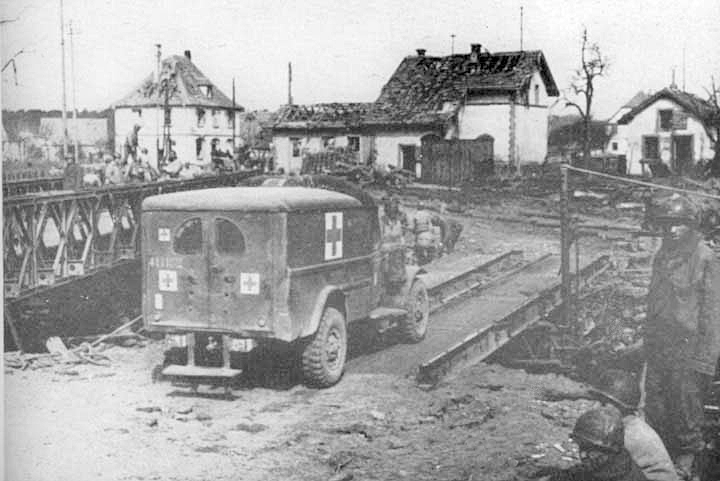
On 25 September, the 1st Company drove from Cogolin up the Rhône Valley, passing the first night in the park of a small château near Montélimar. The road through the Gorges du Rhône area, recently the scene of one of the great German defeats of the war, was for miles thickly strewn with the burnt remains of German vehicles, tanks, and guns. The next day the Company drove to Lons-le-Saunier, later continuing to Bletterans and Gray, small towns in the same neighborhood. At Gray there was another couple of weeks of waiting for assignment. In the meantime, Commandant Coster had gone from Lons-le-Saunier to Besançon, to which HQ had moved during his absence, and obtained an active assignment for the Section.
At this time, the French were trying to take Belfort. One of the chief defenses of this position was the fortress of Le Thillot, in the hills to its north. Previous assaults having been unsuccessful, it was decided to try to outflank it on the north through the narrow valleys of the Vosges. This attack, unsuccessful and very costly, was the first action in France for Section 1.
Commandant Coster brought the orders for the 1st Company of the 433rd Medical Battalion to be attached to the 15th Medical Battalion, 1st Armored Division, 2nd Army Corps. The section moved from Gray northeast to Luxeuil and then down to Lure on 10 October, continuing on the 12th to Rupt-sur-Moselle, 6 kilos from Le Thillot. Both were days of steady cold rain. Within 15 minutes of arrival in Rupt came the first call for an ambulance. T. O. Greenough and W. B. Eberhard took the run, the first to carry wounded in a forward area in France after the invasion. All afternoon and night there were runs back to Lure, and the next morning the first forward posts were assigned.
The Section remained at work in this neighborhood until 29 October, when the attack was abandoned. During these days they worked with the 3rd Algerian Infantry, 9th Chasseurs, and 1st Parachutists---4 cars with a Centre de Triage et Traitement (similar to a CCS), 4 with a Poste de Secours Avarice (ADS), and 4 with Postes de Secours du Regiment (RAPs)---evacuating to the Lure area from Ferdrup, Thiéfosse, Saulxures, Cornimont, Forêt de Langgoutte, and Forêt de Gehans. The whole area was frequently under heavy bombardment, even Saulxures, where the Battalion Poste de Secours was established. Q. M. Hope, as Section's second in command, stayed with the cars at the CCS in Rupt.
Commandant Coster accompanied the Section to the front and spent a few days with them to see how things went in this action---"the first real fighting the French have had since Marseilles and Toulon." On his return he reported that:
"We gave Tom Greenough our first load of patients, on a run back to a base hospital (long, slippery, hilly, wet, blackout), and then gave him, with Bulkeley Smith and Wight Cooke, our first RAP assignments, with the parachutists, used as mountain troops in the forests in the hills. How they got their ambulances up the tracks I don't know; it was no easy job the few times I went to see them in a jeep. When I got there it was like the gypsy scene in Carmen---great pines and rocks, mules, groups of men eating, spreading out clothing to dry, etc. They told me not to go around a certain corner of the trail, as if I did I should be potted by a sniper. I asked how far off the Germans were, and was told about a thousand feet. Thick woods in between, thank God! Or even more than Carmen, it reminded one of Fenimore Cooper---with the difference that there would be the occasional explosion of a shell echoing through the forest and among the hills.
"The boys in the valley are better off, though there, too, it is wet and chilly. Fortunately, the ambulances are comfortable places to live, and when the sun is out the country is beautiful. . . . Then, one can, on occasion, get a good meal and wine at an inn, or a bath in a town. And the people are cordial. . . .
"There is a section of girl ambulance drivers with us too, but the French already tell the Coy Commander, who repeats these things to me, that the boys are more 'débrouillard,' work twice as fast, and can be used in places where the girls cannot. . . . The competition is amiable, because the girls are doing a magnificent job considering that they just do have less endurance, and not at all a bad thing."
Just after Commandant Coster left, however, on the night of 17/18 October, the group at the Poste de Secours Avancé "received a terrific shelling of heavy enemy fire, which lasted off and on all that night and up until about 11 A.M. the following morning," Aspirant Addoms reported.
"The first shell landed at 1 A.M. about 2 1/2 feet in front of my ambulance, in which I was asleep. The French, here, and everyone else, agree that it was an absolute miracle that I am here and not dead. The car was ruined with shrapnel holes all through it on both sides above and below where I was sleeping. One piece cut the stretchers and blankets on, which I was lying---passing the small of my back. If Johnson hadn't gone to the hospital that morning, I would have been sleeping up and would have been killed. It was the motor that saved me. I was blown out the back of the ambulance, and, realizing instantly what was happening (I woke up while still in the air), I called to Fugitt and Shepard, who were sleeping in their car about 20 feet away from mine.
"Before I could get an answer from them, another shell landed about 25 feet to the right of my car, and the blast pushed me up against a tree ---not hurt and again very lucky. Then I got an answer from Fugitt and Shepard, and ordered them into a small ditch about 15 feet behind my ambulance where I also took cover. It was very wet and we were almost naked. We stayed there for about 20 minutes until the shelling slackened. I then found my flashlight and saw that both cars were damaged---mine of course completely---but I didn't stop to see to what extent then.
"Again the shells came over, landing within 30 or 40 yards of us all the time. I left Fugitt and Shepard in the ditch, crawled into my car, which was covered with gasoline, found my helmet, and started crawling toward the other two cars in the next yard to see if Fuller, Moore, and Eberhard were okay, as I hadn't beard from them at all. Shells kept coming over. I finally got to the ambulances and found that Moore and Fuller were okay but that Eberhard had gotten a small piece of shrapnel in his back when the first shell landed at my ambulance. . . .
"Ebby had gone across the street to the ADS place we had there. Shells were still falling, so I shouted to everyone to keep low and crawled across the street to find Ebby. After having to flatten myself several times, I found the back door to the ADS and in I went. Found Ebby with a small wound in his back, which was apparently not serious at all. We had him bound up there, and I borrowed a jeep in which to take him down to the larger hospital down the road where our other fellows were. They were apparently all okay, so I came back immediately. By now the shelling was over. . . .
"At 3 A.M. the shelling started again, and they fell very, very close, but no more damage. The same thing at 5 A.M., 7:30 A.M., and 10:30 A.M. Total damage: Eberhard very slightly wounded; 3 cars hit, but only two made immobile of these two, one may possibly be repaired---the other is finished. Ebby was the first casualty of the Battalion, although later in the night the Battalion at the place down the road had two slight casualties. Ours were the only ambulances hit---we are now working with just 10, and only 2 at the ADS.
"At 1 P.M. the Battalion down the road at Saulxures moved back to Remiremont, right next to the 10th American Hospital there, and we moved back into Thiéfosse with our 2 cars, almost the same place as before. There we had a lot of work: both our cars went forward to Cornimont, where many casualties came in, and with the female ambulances we also had to make the runs to Remiremont. In other words, running forward and back. We sent for two more ambulances---one of Hope's and one female from the same place---and Shepard and I relieved Fuller when he was tired, and Fugitt relieved Moore. Then C. B. [Alexander] and Mayer came up and Tom Greenough worked with us. So we have enough ambulances here at the moment, although I fear that Hope may be pinched a bit. Shep and I, while relieving Fuller, made a run to Remiremont yesterday and there ran into the two Commandants of the 15th Med. Battalion. They were on their way to the 93rd American Evacuation Hospital at Plombières, where Ebby had been taken, to give him the Croix de Guerre with star. They complimented the Section highly on its work. . . .
"It is the morning of the 19th October, and we are still here in Cornimont. We are waiting for the casualties to come in. They have slackened for the moment, which gives all of us a rest. While here last night we caught a packet, and some shrapnel came into our house here. However, no casualties in cars or men."
The report of this action brought Commandant Coster to the front again---to check on the condition of Eberhard ("cheerful and quite well") and the Section,:
"Their quarters were cramped, damp, uncomfortable; food was hot, abundant, and good; work was hard and steady. . . . I visited all posts, forward and rear. Compliments for our men everywhere, especially Shearman and Hodel. . . . Tom Greenough has been doing a magnificent job in a dangerous position and has steadily refused relief. With my usual luck, I found complete calm when I went to see him, although he assured me that only 5 minutes before he and his MO had been flattened against the wall by the violence of a shell burst. Same with Fugitt and Alexander at another rather exposed post. . . . The truth of course is simple: All these places are shelled from time to time, and the people who stay in them catch it; but I, who go on short visits, am pretty unlikely to be under fire during the short time I am there.
"Living conditions are hard---as is the work for the present---and seem likely to remain so. I notice that some of the boys are writing that they find this harder than the Italian campaign. Of course, cold, wet feet of yesterday never seem to have been quite so cold and wet as the cold, wet feet of today."
Illness as a result of these conditions took its toll among the men, as did accidents. Several who had been overseas a long time needed a rest, or went AWOL, and had to be repatriated. A few additional men were transferred from Italy during the autumn months, but still the Section became increasingly understaffed---until in late October it had only 19 members. As winter settled in, there was more sickness (at one point all the Section officers were down with pneumonia at the same time). Every theatre of AFS operations had followed the same pattern, so that Mr. Galatti was faced with one more command begging for men to fill the apparently endless need. Shipping that had been promised did not come through, however, and it was not until much later than originally planned that a large group arrived to complete the commitment to the French.
The HQ to run this shrinking unit was kept at a minimum. At first, Commandant Coster had only B. D. Chancy, who joined him in Mâcon after a long illness. C. B. Alexander acted as Adjutant until on 15 November he resigned his commission in order to drive an ambulance again. He was succeeded by Capt. H. T. Molloy, whose experience in the U.S. Army made him invaluable. Later in November, Lt. W. Simpson transferred from Italy in order to handle the financial matters of the unit, which were complicated by a combination of distances and lack of transport. In early December, some transport was obtained, and at that time H.J. Sherman was brought in to HQ, then in Besançon. The office was on the 3rd floor of the City University, the men living at the Hôtel Couronne. This was its status until the arrival of a large group of new members in the latter part of December necessitated a larger and different establishment.
In the field, meanwhile, Aspirant Addoms had suffered with a series of illnesses, after the shock of his experience at Saulxures. As he did not recover his health, the MOs felt that he had to be repatriated. He was succeeded by W. Dean Fuller, during the lull in activity that followed the French failure to take Belfort. Then the Battalion withdrew to Luxeuil, where it stayed "en repos" from 29 October to 21 November, the cars parked "in a dismal schoolhouse courtyard." Five-day leaves in Paris were granted to groups of 6 at a time, a pleasant change in view of the miserable weather and lack of entertainment in Luxeuil.
But the leaves were not enough to keep the men happy, particularly when the new attack on Belfort began on 14 November. Then it was learned that the girl drivers were at work while the AFS Section continued at rest, doing at best a little light rear work. After a week of this, this and the other dissatisfactions of the Section's life had grown into unbearable grievances---all the fault of HQ. The cars were in poor shape and there was no proper workshop attachment whereby they could be given the thorough overhaul they needed. Life was comfortless as well as uninteresting, so that talents were being wasted. Certain of the French officers lacked the enthusiasm that they should have for the personnel and work of the AFS. These and other less specific matters were intolerable---and yet reparable.
The situation came to a head in what Commandant Coster called "'The Thanksgiving Day Rebellion' . . . a friendly and reasonable discussion on both sides in the Section's billets after Thanksgiving dinner." At this time, the Section requested that, as all their troubles were Coster's fault, command should be given to C. B. Alexander. As the question was one for Mr. Galatti's decision, both sides wrote letters stating their view of the case. No change was in fact made, but later Coster wrote: "It is my personal belief that the substance of what I suppose to have been their complaint was justified: The Field Service is not likely to find a Napoleon or a Caesar to command its units, and so it should compromise by putting an older and experienced man at the head of it with, as his adjutant, a young and very energetic one. It would, of course, be desirable, whenever possible, to find people who had worked together and knew each other. I should add, which is quite a compliment to the men, that the whole discussion was on a perfectly friendly basis and never impaired personal relationships."
The situation had not been without irony, since Commandant Coster had then brought to the Section, in addition to turkeys for its dinner, orders for it to proceed to more interesting work. Two days later the Section moved to Thiéfosse to work- with the 3rd Medical Battalion of their old friends the 3rd Algerian Infantry. As usual, morale improved greatly with the increased activity, which this time lasted until the fall of Colmar and the end of the Alsatian campaign at the beginning of February.
On 14 November the French renewed the attack on Belfort. Resistance crumbled and the Germans withdrew along the whole Southern Group front. Sarrebourg was taken on the 21st; Belfort was cleared by the 22nd; the French 2nd Armored Division (Seventh Army) took Strasbourg on the 26th. And the French First Army advanced to the Rhine, between Mulhouse and the Swiss Border. However, Colmar and a large area between the prongs of these two advances, known as the Colmar Pocket, remained untaken. In early December, the Seventh Army penetrated into the German defenses northeast of Wissembourg. But the French were unsuccessful in their attempts to reduce the Colmar Pocket.
Activity on this sector of the front was reduced to a minimum at the start of the Ardennes counteroffensive on 20 December. Then the Southern Group had responsibility for the front from Saarbrücken south to Switzerland. As the Germans lost the initiative in the Ardennes area, on 7 January 1945 they launched an attack on Strasbourg. They retook some territory and threatened to link up with the Colmar Pocket. On 20 January the American and French Armies launched counterattacks, the U.S. troops aimed at Colmar and the French striking out from Mulhouse. Both were successful: the attacking forces were driven back and the Colmar Pocket was eliminated. Colmar was taken on 2 February, and by the 9th the Southern Group held a loose line along the west bank of the Rhine from Strasbourg south to Switzerland. Then activity was for some time reduced to a holding operation.
Work for AFS Section 1 had begun in a small way on 21 November: the equivalent of an ADS to CCS run from Thiéfosse to the Lures area. The men were kept busy, but the work was neither vital nor interesting and the men were considerably upset that the "chauffrettes" were evacuating back to them.
"There were times during this transitory period, however, when one's all was demanded," W. T. C. Hannah wrote. "La Bresse, a good-sized town deep in a Vosges valley, had been the victim of German antiterrorist reprisal. Each and every house and shack had been reduced to rubble and its inhabitants massacred. . . . Since the main road to La Bresse was heavily mined, it wasn't until a week after the German withdrawal that any substantial form of assistance could be rendered. As it was, the two ambulances detailed for the job were forced to use a 3-mile cowpath, which more or less followed the contours of the steep mountain slopes. The passage was made all the more treacherous by the torrents of rainwater, which had an alarming effect on the 5-inch margin between the outside tire and total destruction hundreds of feet below. The suspense was heightened somewhat by the fact that both cars were simply jampacked to gross overloading with either old women or their baggage. And altogether 4 round trips had to be made. Give me shellfire any day."
On the 27th, Hannah continued,
"Our work at Thiéfosse ended happily when a call came through for service with the FFI [Groupements Pommies and Morvan]. . . . The first to go were Mase and Mac, Quent Hope and France, Mayer, Fugitt, Shepard and C. B. Alexander. On the night after their assignment, they found themselves creeping over mined roads in the immediate wake of advancing foot-soldiers. Dawn found them in the newly liberated village of Bussang. The people emerged, and the inevitable festivities began, in spite of the occasional 88 that paid a visit. Shep and C.B. were the second car to enter Bussang, the first being the Colonel's jeep. . . .
"Bussang is near the frontier of Alsace Province, which the Germans had officially annexed to the Reich. Fugitt and Mayer were the first AFS ambulance to cross into what Hitler, at least, considered the fatherland. As Bussang was being taken, elements of the FFI further north were in the act of taking Le Petit Drumont, a snow-capped peak of 3,700 feet, over the crest of which ran the demarcation line. That battle alone had been a fierce struggle, in which many ill-equipped, strong spirited Frenchmen cried out in the biting wind and sank from view in the knee-deep snow. As Fugitt and Mayer wound their way up the tortuous, icy road to the top, they were not surprised to find themselves under machine-gun fire from an adjacent mountain, still held by Jerry. On reaching the summit, they witnessed a bayonet skirmish 200 yards away; and from what had just been an enemy OP, a French flag was flying, silhouetted against the magnificent winter sunset. During the following night and morning, the pair evacuated 64 stretcher cases to a point 7 kilos away. This amounted to at least 16 round trips up and down the mountain, without lights, a total of about 17 hours of constant driving. . . . [The next afternoon] Tom Greenough, Hannah, Wight Cooke, and Bulk Smith replaced them at the summit post, where there was still some local action. . . .
"After a fairly quiet night on the summit of Le Petit Drumont, the two cars, preceded by French medical officers in a jeep, left the Post and wound their way over the famous Col du Bussang, which had been freshly taken by a Moroccan division. Then down we floated through a broad valley, through Urbès, and on, ever on. Tom and I were beginning to worry a little bit, for Moroccans were crouching in the ditches and behind the walls bordering the road. All we could hear was the roar of our own motor, and we kept our eyes glued on the crazy Frenchmen in the jeep in front of us. The terrain became deserted. We were passing over a particularly exposed stretch of flat road when the jeep came to a screeching stop. We jammed on the brakes and perspired freely, for we sensed danger. A Frenchman came running back to us. 'Where is Smeeth?' 'He's a slow driver,' we gasped, 'he'll be along presently, but let's get the hell out of here.' 'Oh, they won't fire,' he rejoined cheerfully. 'They can see the red cross.' . . .
"We drew into the town of Felleringen and, I have no doubt, would have gone on right through if it hadn't been for the shrill blast of a whistle. We screeched to a stop, expecting anything. Past us flashed---on the double and with bayonets fixed---a wave of Moroccan soldiery. We had ended up in the middle of an infantry charge! . . .
"After a suitable amount of armor and infantry had passed by, the road was declared clear and we continued on to Krut, 5 kilos farther. Here we once again set up house with the FFI, who had arrived there on foot over the mountains behind us. Then followed 6 days of hard work, during which there were major skirmishes but minor gains. . . .
"A quarter of a mile beyond the medical dressing station was the forward Poste de Secours, where morphine and sulfa drugs were administered to the wounded. We worked in relays in daytime. But by about 8 o'clock in the evening some unfortunate soul would find himself stuck up there for the night. This usually turned out to be Smith and Cookie. They made themselves completely at home in the farmhouse---except for one time when the medic, mistaking Cookie for an Arab, told him to go attend his mules. . . .
"The following week we switched to Oderen, a mile to the south, where our work centered around the local Catholic hospital. We slept in hospital beds, ate the best food the nuns could dream up, but as the hospital was situated near the railroad station we lived under the constant strain of 88s falling in our back yard. . . . The Germans practiced this harassing fire at odd intervals all day---first a shot at the railroad station, and 20 minutes later 3 would suddenly land on the village square. Unsuspecting passers-by kept getting it right in the neck. It was never safe to go out, for there was no fixed target or timing. After a week here we had had it thoroughly, and we were more than glad when Aspirant Fuller recalled us to Le Thillot, where the Section was assembling for some new work."
Hannah overlooked in his account one moment of considerable satisfaction. The fortress of Le Thillot had been the key to Belfort on the north, and its obstinate resistance to either capture or outflanking had finally necessitated a daring but successful movement along the Swiss frontier. Aspirant Fuller recorded the following: "Let it be known that, on November 26, C. B. Alexander and Dick Shepard, together with a few jeeps, were the first ambulances and the first vehicles to enter Le Thillot. They were attached to FFI and say that the reception was memorable: One woman offered an omelette."
It had been an exciting period and in some respects gratifying, as the following anonymous letter reports: "I'm sitting in my ambulance on top of a mountain, waiting for the stretcher-bearers to bring down the wounded from the hills . . . . Today is the second of two (only two) beautiful days, cold but clear . . . . Far down the valley toward the rear our heavy guns boom lazily, but here it is quiet and peaceful . . . although the Jerry is less than a mile away. We've been advancing rapidly lately, pushing on 5 and 10 miles a day, the ambulances right behind the infantry. It's been thrilling being the first Americans into town after town. At first the mine fields gave us an additional thrill, but since we've passed Jerry's prepared defenses they've been no problem. In this sector Jerry has very little artillery left, so that our heroic advance amid the cheers, tears, and flowers of a liberated populace hasn't been too dangerous as yet---although the vague concept of where we are going, and under what conditions, which filters through the language barrier to my confused and apprehensive mind has often made it seem so."
Although more than half of the Section had been doing this extreme forward work, the whole group had been busy. On 13 December the Section moved north to Lapoutroie, with the Division, attached to the 1st Regiment of Tirailleurs Algérien. The largest group was with the regimental Poste de Secours at Lapoutroie (Fuller, Greenough, Hannah, Moore, Selz, and Shepard). Forward of Lapoutroie on the Orbey road, at the Poste de Secours of the 3rd Medical Battalion, were France and Hope (this post was worked in relays, so that when a car came down from it another went up in its place). Alexander and Mayer were 1 kilo northeast of Orbey at the Poste de Secours of the 1st Medical Battalion. Cooke and Smith were at the Poste de Secours of the 2nd Medical Battalion, which was at Orbey on the road toward Les Trois Epis. Temporary assignments were Bowen and MacArthur at Le Bonhomme with the Spahis and Eberhard and Fugitt with the FCM (2) of Mine Catroux at Fraize.
After a few days of this set-up, Aspirant Fuller reported:
"The last month has been the best month this Section has spent. We have been working almost continuously since the 21st of November with the 3rd Algerian Infantry Division and the Groupements Pommies and Morvan of the FFI. . . . Bowen and MacArthur were the first Americans in a score of towns, being attached to Morvan of the FFI. I received very favorable reports of their work with that group from the CO of the 1st Battalion. . . . Right now Alexander is at our most dangerous post with Philip Mayer, and Eberhard is doing the nasty job of evacuating the most serious cases from Fraize to Remiremont---a distance of about 60 miles over roads in deplorable condition. . . . Cooke and Smith ran into a bit of shellfire yesterday and managed to get the car doors full of holes and three tires blown out. They had previously suffered a blown tire due to shell fragments at Oderen. The mechanics got them back on the road last night; no one was touched; so the incident can fall to the category of a s-t story. . . .
"The 1st Section of the 3rd Medical Battalion was very pleased with our work in Thiéfosse, Le Thillot, and Gérardmer. Lt. Costelli, OC of the Section, promised to ask for us again as soon as he could get rid of his women drivers. We didn't have much time to do a real job at the 2nd Section of the same Medical Battalion in Urbès. We were only with them for about 3 days. However, they seemed to be pleased with what we did do---namely some 8 runs from Urbès to Lure. And for their liaison runs, both Sections always asked for our drivers simply because they didn't have the nerve to ride with the girls."
"It proved to be a very satisfactory set-up, with enough forward posts to accommodate those who wanted them," Hannah wrote of this same period. "For those who took the runs back to the clearing station in Bonhomme, 10 kilos to the rear, there were comfortable billets above the ADS in Lapoutroie. Here we found hospital beds, mess with the Company's officers, stacks of reading matter. . . . Our chief daily exercise consisted of winding the war-weary phonographs. . . . During the two weeks in the line, we personally suffered no casualties, although several cars bore marks of close calls. German resistance was unusually strong, for they were doing their all to keep Colmar from falling. Heavy artillery fire and numerous major patrol clashes caused some of us to evacuate 40 to 60 patients in one day. I believe Bulk Smith and Cookie achieved the highest score. The run from the forward posts to the ADS was about 3 miles, of which 2 miles were under intermittent shelling. One raced through fields literally churned up every other square yard. The scenery resembled 1918. . . .
"Whereas the Field Service lost nothing at Lapoutroie, the Company stretcher-bearer crews were heavily cut up. Attached as they were to battalions inching their way over mountaintops, they brought the cases down to where our cars and jeep-ambulances could reach them. As the year came to a close, Jerry counterattacked furiously and succeeded in encirling or annihilating considerable detachments here and there. . . . Every now and then there'd be an emergency call for us to drive into no-man's land itself. Since such work flagrantly exposed a valuable ambulance, only extreme urgency could warrant the risk. . . .
"Tom and I spent a good 10 days at a post in Tannach, a hamlet lying between two mountains, one of which was French, the other German. The valley was the scene of nightly patrol skirmishes. Tracers formed a woven triangle of white streaks, and it was fantastic to watch some wild ones come toward you---yet find time to duck them. . . . While returning to Tannach from a run, I made it a habit to stop about a mile outside of town to listen whether a bombardment was on. Once I was thus waiting for the shelling to subside when I saw Phil Mayer's ambulance emerge from the fracas and head down the road toward me. He was still about 200 yards away when I beard one coming, and it looked bad. It landed smack on front of him. A moment later the ambulance poked its nose through the smoke, continued at an easy 25 mph, and sidled to a stop beside me. 'Are you all right, Phil?' I gasped. A poker face looked down at me in mild astonishment. 'Oh, surely. What I wanted to know, is there any mail for me back there?'
"Christmas dinner in Lapoutroie came off beautifully, although the panes did rattle from time to time as shells dropped in the vicinity. One morning a medical orderly was wounded while standing in the ADS doorway, and even in our comfortable billets we felt apprehensive at each approaching whine. . . . New Year's Day was a gayer occasion than Christmas, for on New Year's Eve all French elements had been withdrawn from the line. Captain Demonet . . . proposed a toast to those who were not present. . . . During the next two weeks, cars were detached to duty with a Spahi (armored) regiment, where we found a lot of people with colds and ingrown toenails who had to be driven around. We very much wanted to go 'en repos' but preferred real work to the mediocrity we were having to put up with. So back to Cornimont we went, this time with the FFI.
"The Cornimont show lasted 3 weeks, during which time there was little or no enemy action. Nevertheless, we met with a disturbing amount of pathos and ill fortune. It started to snow soon after our arrival, and it continued to do so for more than 10 days. Though our mess was warm, it was small; we were vastly overcrowded at meal-times. The food took an atrocious turn. We were billeted in several houses along the road, but the bedrooms had no stoves in them. Temperatures dropped to zero. Fuller, MacArthur, Miller, Smith, and Greenough went to the hospital with various degrees of pneumonia. C. B. Alexander and Fugitt permanently left our circle to command new sections. Mase and Mac, while plowing through a snowdrift, wandered off the road and got the car hopelessly entrenched; it took a week before a wrecker got through to pull it out with a winch. Hope and France lost all their belongings when their car struck a mine and burned to the ground. And then the terrible road accident occurred which claimed the life of Al Miller. All misfortunes converged while wind-swept snow mounted on a bleak and despicable countryside. At Cornimont we were driven into a state of real depression.
"There were moments of escape: Moore and I took time out from the FFI (who were off skiing) to make the beautiful run over the Col du Bramont. It was a rare sunny day, and we wound our way down to Wildenstein, where we just sat and drank pernod in a lovely little café. From where we sat we could see the Germans on the opposite mountain lining up for chow. . . .
"Generally speaking, the fight for Alsace was over. Colmar, the main German supply depot, had fallen, and it was now a matter of time before the troops confronting us would throw in the sponge. Therefore, the FFI had decided merely to hold the line and to send occasional patrols out. Three ambulances had been alerted for one such patrol; there were two casualties. The Fifis, however, eager for combat, found wading in knee-deep snow so exhausting that, 'enfin,' fighting was out of the question. Besides, the German pillboxes would need to be blasted out by artillery, of which the FFI had none. . . .
"Before we were to leave Cornimont to go on a much-needed 'repos' Hooton, Bud Selz, Shep, and I were detached to a Parisian regiment of FFI operating at Willer. It was here that we found very good company in the form of 4 young orderlies, former students, whose esprit and self-ridicule kept us well entertained. Even Francophobe Hooton condescended to become bridesmaid at the wedding of 'Anti-Char' and 'The Bear.' Of course, it wasn't all fun. The house Bud and Hoot were sleeping in received 3 direct hits, and runs had to be made over a 2-mile stretch of railroad bed under enemy observation. There was also a sizable tunnel to go through, which offered protection and great relief. This all took place in early February just before Jerry withdrew from Alsace, and whatever he had left in ammunition he was spending freely.
Soon, however, all was quiet, and Jerry had gone. The pervading atmosphere reminded me of the last moments before Tunis and the sublime peace that followed. The mountains of a sudden became beautiful, and the wrecked gun positions became glorified witnesses of an unhappy, violent, but very definite past.
"We went 'en repos!' On 8 February the whole Medical Battalion moved into the trim little Alsatian village of Hüsseren, where we were to remain for a delightful 2 months. All vehicles were confined to a car park and left to the mercy of wog mechanics and maintenance crews, who eventually ran off with 75% of our baggage. However, we were through with war for an indefinite period, and we were grateful."
In the meantime, a unit of 46 men had arrived from the States in December and more men had been transferred from Italy. Formed into Sections 2 and 3, they received their assignments in early January and took part in the Colmar offensive. With their arrival, Commandant Coster had to increase the size of his HQ, which on 11 December had moved from Besançon to Belfort, where it found quarters in the Institute Ste Marie, Faubourg des Ancètres 40, with an additional 4-room flat at 5 rue Cambrai. Captain D. M. Hinrichs, in spite of ill health, had come with the large unit to assist his former adjutant to organize an office more specialized and systematic than had hitherto been possible or necessary.
During the next month a number of volunteers were brought to Belfort HQ: Lt. R. B. Winder IV in charge of personnel records; J. R. Latham, later succeeded by D. G. Briggs, in charge of publicity, assisted by L. B. Cuddy as photographer; Lt. A. D. Brixey, Jr., in charge of transport and maintenance (elsewhere S&T); and last but not least Lt. L. L. Biddle, Jr., who was made joint-adjutant with Captain Molloy (holding the rank of Captain after Molloy returned to the field, as he had long wished to do).
But it was Captain Hinrichs who set the course of the organization and who saw it accomplished with his "judgment, his untiring devotion, and his persistence," Commandant Coster wrote.
"It would never have been accomplished without him. . . . He was most valuable in giving advice on matters of policy and in helping the men in their difficulties. He came, if not at the lowest ebb of our material fortunes---poor food, little or no heating, squalid quarters, lack of means of transportation, inadequate clothing---at any rate only just after the tide had begun to turn; and I cannot speak too highly of the courage with which he endured these disagreeable conditions or of his activity in improving them. Or of his actual physical work in keeping things going: he personally carried rations through the snowy streets; many a time the lads in Belfort would have had no heat if he had not kept the smoky stove going (though coal smoke gave him asthma); and men dropping in late from the sections would often have gone to bed with nothing warm to eat or drink if he had not gotten up to prepare it."
Later in the winter, when the weather and the lack of elevators caused the aggravation of old complaints, Captain Hinrichs made a trip to Paris to get some sorely needed transport for HQ. The elevators didn't run in Paris either, but that was only one of the many complications to doing business in the city. However, as an exchange for a vehicle from the France '40 unit, he got from Maurice Barber a marvelous, if monstrous, Cunningham, which ran without breakdown or serious problem until the end of June.
In accordance with arrangements previously made, the men who had arrived on 13 December were moved to Besançon, where they arrived on the 21st. There they encountered unexpected difficulties and delays, which were the more unfortunate as the weather was cold and the men had been sent over for the most part without winter clothing. This misunderstanding was rectified, and the men, although with difficulty, were equipped. The root of this difficulty was that during the autumn the French had undertaken to equip the FFI as they incorporated them into the army, which enormously swelled its numbers, while being equipped by the Americans only to the scale of the troops which had been brought over from North Africa and Italy. This meant that all supplies---clothing and food as well as vehicles and spare parts---were chronically short with the French, who had occasionally to recommend that AFS apply direct to the Americans for things they needed.
Fortunately, Commandant Coster had been able to make arrangements for his men to be treated in U.S. Army hospitals. This was very important during the rest of the winter, when so many were to suffer with pneumonia and other ailments---not that the French facilities were inadequate but because of the comfort of being in English-speaking surroundings when ill and the certainty of being returned to the States should evacuation be necessary. Thanks for this were specially due to Colonel J. G. Strohm, Commander of the 46th General Hospital at Besançon, and his aides, who found places for AFS even when all their facilities were strained and their personnel overworked. Other army hospitals were no less kind, but the 46th was used whenever possible because of its closeness to AFS HQ.
In the first week of January 1945, the two new sections were assigned: on 4 January, Section 3, under W. G. Fuggitt as Aspirant, was attached to the 4th Company of the 8th Medical Battalion, which was divisionalized with the 4th Moroccan Mountaineers, one of the oldest and most distinguished divisions of the army, then "en repos" at St. Remy. The next day Section 2, commanded by Aspirant C. B. Alexander, was attached to the 431st Medical Battalion, a reserve formation like the 43rd, with the 3rd Algerian Infantry Division at Gérardmer. The ambulances assigned to the new sections were in poor condition, particularly those of Section 2, but as it turned out there were none available in any better shape. Both sections were busy for the next month, at first with rear evacuations to the Lure and Remiremont areas, respectively. Then in the second half of the month they, too, were given forward work and all three sections were in the line---Section 1 in the middle, Section 2 in the north, and Section 3 at the south end of the French sector of the front.
Aspirant Fugitt's Section 3 (W. G. Roberts as second in command) was the first of the two to go forward. On 17 January it went with the Battalion from St. Remy to Massevaux, where it established its HQ with the dressing station of the 4th Company. "Section 3 was allotted a big room on the second floor of the schoolhouse," W. A. Whitehead wrote. "There was one thing to be thankful for: there was plenty of heat, in fact too much of it. The room stank. The windows were never opened, and we depended for ventilation on someone's entrance to or exit from the room. Whenever the door was opened, an icy blast from the corridor outside swept in. But as long as no one knew how long the heat might last, there was no point in allowing it to escape through foolishly opening a window. Heat had to be hoarded, even if it was stale heat.
"The relations between our boys and the Moroccans were of the best. . . . Massevaux was a dreary place in winter---a mass of sloping red roofs, flapping shutters, tangled telephone wires, and, underfoot, an intolerable slush. The runs back to Belfort, Héricourt, and Montbéliard took hours, as the cars frequently broke down. . . . Jim McEwen and I with Bayly Winder usually spent our evenings at a café called Chez Kling. There was no wine for sale, but we could buy a cup of 'ersatz' coffee, and there were light and warmth. At least we found a place where we could sit comfortably."
On the morning of 21 January, in sub-zero weather, the Moroccan Division, at the southern end of the French line, began its drive toward Mulhouse and Colmar. AFS cars were forward at Bitschweiler, evacuating back over narrow, snow-covered mountain tracks, operating by night in total blackout and by day under enemy observation. Here the Divisional Commander, in the early days of the campaign, was wounded. Evacuated to Belfort from the front in AFS ambulances, a few days later he paid the Section the compliment of ordering that all battle casualties of "première urgence" be carried by the AFS.
From 20 to 26 January the fighting for Thann, the first objective of the Division's assault, was very heavy. Individual ambulance drivers alternated at the post in Bitschweiler, making runs forward to it from Massevaux and thence back to Belfort or yet farther to Héricourt and Montbéliard. When Thann had been taken, the Division continued toward Colmar, and the medical posts moved forward apace. By 1 February, on the eve of the final offensive against the Colmar Pocket, the forward posts were at L'Aue, Sentheim, and Guewenheim---south of Thann along the Doller. By the 6th, the Section had moved up the valley to Isenheim, almost half-way to Colmar. The next day, as the pocket collapsed, it moved east to Guebweiler on the edge of the mountains. "Blaylock, R. Foulds, G. Stillman, and Winder entered the town of Soultz with the advance troops," Latham reported. "Town of Ballon Guebweiler they entered before the troops. First---first Americans---etc."
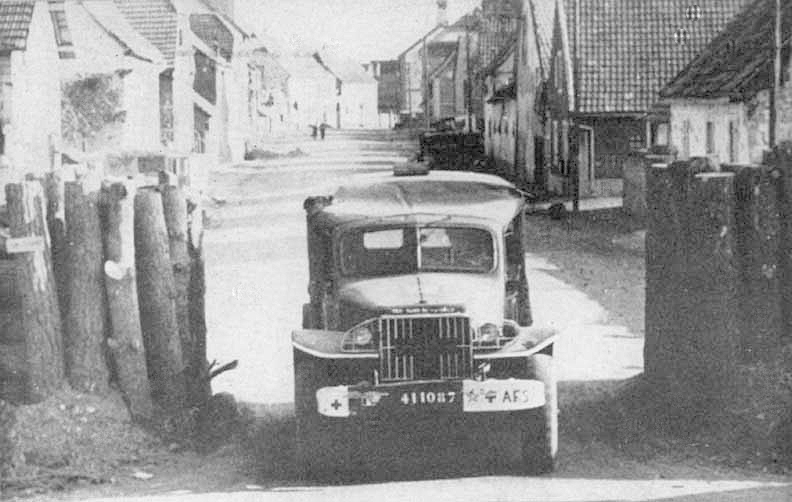
Less than a week later the Division moved down to Mulhouse, where Section 3 established its HQ. Here it was comparatively at rest for the next weeks, like the whole French Army. But ambulances were rotated every few days at a number of posts in small villages a mile or so from the Rhine---Balgau, Fessenheim, Rumoersheim, Bantzenheim, Niffer, Ottmarsheim, Sierents, Kembs, and Habsheim---and at Ferrette near the Swiss frontier. They lived in dugouts and were subject to some shelling. Elements of the Division were sending patrols across the Rhine during the next two months, while most of the army was regrouping, and the Section's ambulances were kept busy evacuating the men wounded in these patrols and the hit-and-run reconnaissance raids into Germany. The single road which served as an evacuation route lay parallel to the river in flat, open country, and was continually under the direct observation of the German forces on high ground on the opposite bank. Frequently the only vehicles to move along it in daytime were the AFS ambulances carrying wounded to the rear or medical supplies up to the front.
Aspirant Alexander's Section 2 up at the northern end of the French line had also been busy. Assigned to the 431st Medical Battalion of the 3rd Algerian Infantry Division, it joined the Battalion at Gérardmer on 5 January. Gérardmer had been almost completely destroyed by the retreating Germans, and the Section was quartered in an unheated hotel. "We were about as miserable then as we ever were to be," D. N. Elberfeld wrote, "because we had a roof and little else, in weather that was often 15 degrees below zero." During this initial assignment, there was one forward post at the Col du Bramont with the Franche-Compté group of the FFI, but the rest of the work was in the rear-evacuations up over the mountains and down again to the Remiremont area. There was a short period of rest, then the Division began its drive south down the Rhine Valley toward Colmar.
On 25 January the Section moved to Barr, attached to the 14th Medical Battalion of the 5th Armored Division. As the towns were taken, medical posts were established south of Barr at Sélestat, Ribeauville, and Ostheim. For the ambulanciers, the work was heavy and dangerous and had to be performed under exceptionally difficult conditions. The winter continued raw and wet. The lines of evacuation through the mountains were narrow and rough. The sector was infested with snipers, as the Germans had thrown into the battle a parachute battalion which had filtered singly and in groups throughout the French territory and had to be hunted out.
The campaign, if difficult, was short. Colmar was liberated at the end of the first week of February. F. M. Blow, E. F. Davis, V. S. Downing, and P. B. Warren entered the town with the advance troops, having been sent up to evacuate back to Sélestat victims of the sniping. "Pete and I were told that we drove the first ambulance to enter the city, which was quite a thrill," Davis wrote. "That night we slept on stretchers in a. third-floor corridor of a house being used as French Headquarters. More braid than I'd seen for a long time. There was mortar fire in the vicinity, but nothing appeared to land too close. The next day we walked around the city a bit. Every now and again someone would stop us and try to say how happy they all were that the Americans had come. Actually, I believe the French Army freed the city."
The campaign successfully concluded, Section 2 went with the 431st Medical Battalion back to Barr. It remained "en repos" until the middle of March, first at Barr and then for the last two weeks at Mutzig, some 10 miles southwest of Strasbourg. During this period, when Sections 1 and 2 were at rest with their battalions and Section 3 was having routine work, the cars were sent through workshops and as many leaves were granted as possible. Paris was the goal, and there were no complaints. The only surprise was that spring seemed to have reached the city earlier than usual.
"I remember how warm it was at night and how the lights from the Left Bank were reflected in the river," one wrote later in recollection. "I can see the trees just budding and smell their new life. Then I can look down the river and see one of the arched bridges beneath a full moon which was always successfully appearing through the sky mist moving in the wind. The cobblestones by the water, the splash of a fisherman's little boat, the oars breaking the quiet surface of the flowing current, all of this in the near darkness while we were talking quietly just a few short feet from the Seine. Then there were the cafés, just two or three, and the music of an upright piano, and wine for her and cognac for me in very thin wine glasses, quietly talking. Then a few minutes at a table on the sidewalk under an awning watching the people go by on the boulevard. And in spite of all the people everywhere, I felt that we were alone, talking or not talking. Paris is all around you whenever you want it, but so unintruding. It is charming. I left wishing that I could stay. I hope now that I may return."
In mid-March the last campaign began. For the Southern Group this was an advance to the banks of the Rhine in the northern part of its sector, which was primarily an American action. At the same time, in the last two weeks of March the French had the task of clearing Alsace north of Strasbourg. In the last days of the month, when all resistance along the west bank of the Rhine had been overcome, a number of crossings were made along the entire length of the river. The French First Army crossed at Philippsburg, just north of Germersheim, established contact with the U.S. Seventh Army south of Heidelberg, and by 1 April had advanced 18 miles.
Along this sector, within the following week, the opposing German forces were brought to complete disintegration. All enemy organization collapsed. The French took Karlsruhe on the 6th, Baden-Baden on the 12th, and then went on to reach Stuttgart on the 22nd. After that they swung south to reduce the German forces left in the Black Forest. By 1 May they had cleared the Swiss border west of Lake Constance and were driving into western Austria alongside the Seventh Army---which in its turn had advanced through Nürnberg on 17 April, Munich on the 29th, and then had split, one section heading for Salzburg and Berchtesgaden while the other was aimed at Innsbruck and the Brenner. This was to prevent the threatened regrouping of German forces in the Inner or Southern Redoubt in western Austria. Allied movement was so swift and the German disintegration so complete that no such regrouping was attempted or possible. German forces in Italy surrendered on 2 May, and the general collapse was quick to follow. They surrendered in Germany, Holland, and Denmark on the 5th and in Austria on the 6th. The unconditional surrender of all German forces in the formal ceremony at Reims came as an anticlimax on the following day.
For the advance troops this last campaign was a period of frequent movement over long distances, and great was the joy thereof. Before it was over, the Field Service had 4 sections simultaneously with forward elements of the French First Army.
In the second half of March 1945, while Section 1 remained "en repos" in Hilsseren and Section 3 continued to work out of Mulhouse in the posts along the Rhine, Section 2 was at work with the 3rd Medical Battalion, 3rd Algerian Infantry Division, in the campaign to clear the Germans out of Northern Alsace. The Section had received the assignment on the 16th and moved from Mutzig to Weyersheim, a little more than half way between Strasbourg and Bischwiller, where the advance cars were posted. The attack was along the Rhine to the Lauter, an area that had already been once liberated and then retaken in the preceding few months. Now, while the U.S. Seventh Army drove from the west toward the Rhine, the French 3rd Algerian Infantry and 5th Armored Divisions pushed from the south.
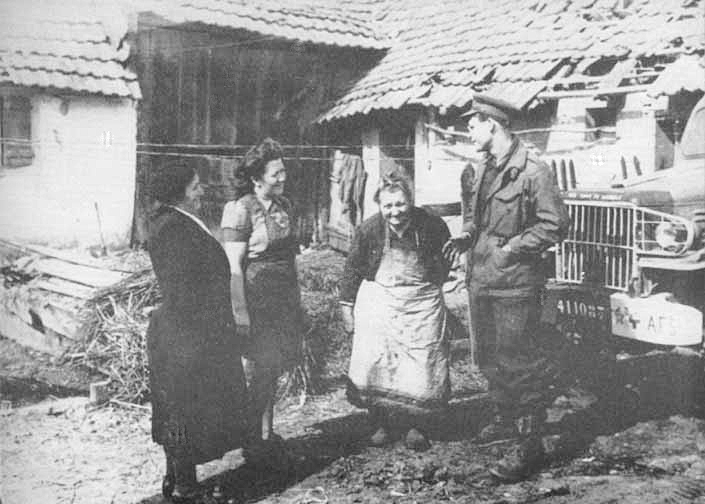
Just after dawn on the 17th, 3 cars (C. W. Harris, Eli Rock and B. C. Young, and W. A. Nodine) were sent north to a Poste de Secours in Bischwiller, which was still being shelled by the enemy, then only a mile north in Oberhoffen. Pushed from two sides at once, the enemy quickly gave up serious resistance, putting up only a strong rear-guard action in the Haguenau Forest to cover the withdrawal into Germany at Rastatt. The Battalion and the rest of the Section moved up to Bischwiller at the beginning of the German retreat, establishing a dressing station in a large, vacant orphanage. French casualties were heavy, mostly the result of the large number of mines the enemy was leaving behind. Evacuations, which had been from Bischwiller to Weyersheim, now were all the way back to Mutzig, a long and difficult run. But by the 19th, Bischwiller had quieted down and been left behind.
"On the evening of 19/20 March, the Medical Battalion prepared to move on in the wake of the advancing line," D. G. Briggs reported. "They packed their paraphernalia in trucks, but . . . at the last minute [the orders were to wait until the fluid front became somewhat more stable]. . . . Another medical group was moving into the orphanage, so the Battalion settled down in a field on the outskirts of Bischwiller to spend the night. Supper was cooked over an open fire and eaten, standing up, off high, single-board tables erected on the spot. The bonfire continued to be nursed along after the meal, and as darkness settled down the AFS men gathered around it, drank cognac with a touch of rum, and sang far into the night. Brinton Young wired his radio into his ambulance battery, and whenever the news came on the singing stopped momentarily while everyone gathered at the ambulance to listen. It was reported that the Seventh Army had captured Wissembourg and that the French had taken Lauterbourg.
"In the middle of the night, just after everyone had crawled into his beddingroll, a call came in for 5 ambulances needed forward. The Germans at the Lauter River were fighting hard and French casualties increased. The 5 cars (Fred Blow and Victor Downing, Brinton Young and Eli Rock, Mark Ethridge and Don Elberfeld, Jack Douthitt, and Carl Harris and Bill Wallace) moved off to Soufflenheim in the dark, following a speedy Frenchman in a jeep.
"In Soufflenheim, 2 of the cars left the others to be assigned to the medical post in Niederroedern on the northern edge of the Haguenau Forest. These cars, selected by lot, were Blow and Downing and Rock and Young. The others bedded down for the night. No casualties at all came in after they arrived, and there was no work.
"On the morning of the 20th, the cars remaining at Bischwiller moved up with the Medical Battalion and were joined by the cars at Soufflenheim. The Battalion was set up in Niederroedern in an inn called the 'Gasthaus zum Goldenen Löwen' (Inn of the Golden Lion). In the barroom here a surgical team continued to operate on the casualties. The AFS cars, evacuating from here to Mutzig, worked day and night.
"On the afternoon of the 20th , a car (Rock and Young) was assigned to a regimental medical post situated 3 miles south of the German border in Neewiller. The French renewed their attack north of Lauterbourg, and all afternoon this car brought casualties back to Niederroedern. About 8:30 that evening, Young was sent on a forward run to a Battalion medical post inside Germany in the village of Berg, thereby becoming the first AFS man to enter Germany on duty.(18) He crossed the border on the northern outskirts of Lauterbourg just 30 hours after the first French troops. . . . This car was assigned to the Battalion post on the morning of the 21st. Berg was then less than a mile from the front. The French were pushing up against the outer Siegfried Line defenses in the Bien Wald Forest and were suffering considerable casualties ---especially from mines.
First AFS ambulance into Germany,
crossing at Lauterbourg"An artillery officer took Young up on a rooftop in Berg, and they watched the German villages ahead being shelled and burning. The French artillery was opening up now that they were no longer shelling French towns. They also watched Allied planes overhead begin their dives to bomb and strafe the enemy positions just to the north.
"The French attack on those outer Siegfried defenses had begun on the evening of the 20th with a barrage. The shelling continued all night. The casualties were heavy, and the Field Service drivers worked hard on long and unexciting evacuations. From then on, the Germans were fighting fanatically to keep open this last escape gap across the Rhine, as the Seventh and First Armies threatened to cut them off from the north and west. The French advance stopped, and for some days positions were more or less static in the Bien Wald Forest. Rock and Young remained in Berg, and all the other cars of Section 2 continued in Niederroedern, whence they evacuated to Bischwiller, Strasbourg, and Mutzig. Their work slowed down considerably with the end of the Alsatian campaign."
On the 28th, Section 2 was transferred back to the 431st Battalion and, while still evacuating back as far as Mutzig, advanced with the Battalion early on the 31st to Herxheim in Germany. The convoy left Bischwiller at 12:20 A.M., just as the moon rose, driving west to Haguenau, then north through the forest to Surbourg, Soultz, and Wissembourg. just north of Wissembourg it crossed the border into Germany at 2 A.M., then heading northeast through Kandel to Herxheim, where it remained a few days until a bridge across the Rhine was erected.
Non-fraternization with the Germans was the general order, but this was seen to be impossible, in the strictest sense, when the men ate in restaurants and were billeted in German homes. Formal politeness was the usual attitude, but in the closer relationships the formality broke down. Conversations were frequently heated, and political discussions were often blunt, outspoken, and even angry. But the whole situation in the French zone was different from that encountered by 567 AFS ACC in the north. The Germans were less hostile, and the army regulations were more realistically interpreted.
"The AFS men of Section 2 who could speak a bit of German (among them William Wallace, Brinton Young, Richard Norton, and Robert Moore) became of great aid in interpreting orders, directions, and questions in the supervision of the mess and in the billeting arrangements," Briggs reported. "And many other AFS men threw themselves into an intense study of the language. One of them copied into a notebook for ready reference various phrases of an amorous conversational nature, in case any 'fraulein' particularly attracted him. At the mess one noon he was urged to try his memorized sentences on the German girl who was waiting on table. He hesitated, embarrassed, and then protested: 'But suppose she just giggles?' "
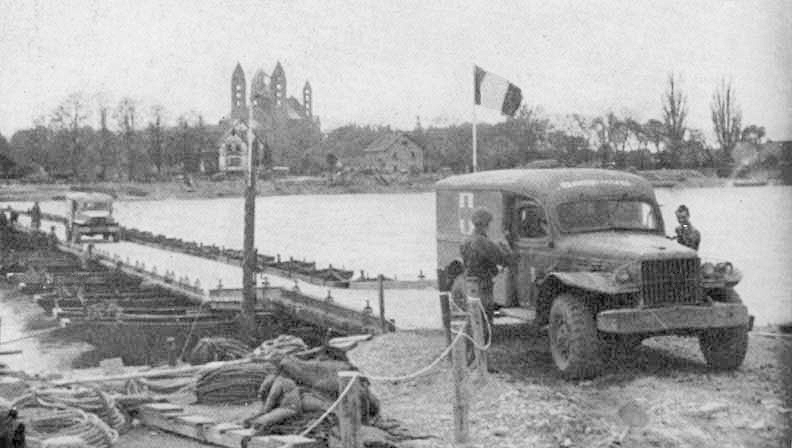
First AFS ambulance across the Rhine, at Speyer
On 2 April, Blow, Douthitt, Elberfeld, and Nodine were sent up to an advance post on the Rhine at Germersheim. The next day the Section crossed the Rhine "with the French in their bridgehead at Speyer," D. N. Elberfeld wrote.
"It was quite a thrill, because it wasn't until then that we really considered ourselves in Germany. We evacuated back across the Rhine for a while, at a place where there wasn't a bridge. They tied a couple of pontoons together and put some planking across, and you had a sort of ferry, which you drove onto by wooden timbers---not without uneasiness, I can tell you. We headed toward Stuttgart for a while, then changed our direction and headed due south (by this time I was with the Poste de Secours, away from the main body of the Section) as far south as Freudenstadt. Then we headed southeast [the Section doing a lot of work in the region of Schramberg, Villingen, and Schwenningen] until we got almost to Austria and there wasn't much point in moving farther.
"Until very near the end, most of our night work had to be in absolute blackout, because there were still a few stray Jerries in the air who would shoot up the roads if they could. The main problem of a rapid advance like that was the pockets of Germans behind the nonexistent front. It's now 115 May] pretty safe to drive through the forests at night, but it wasn't until fairly recently. . . . Although I myself was never in a very tight spot, I'm nevertheless relieved that there is no more shooting going on (except from over-exuberant Frenchmen). Most of us carried guns the last month or two. I never did, because I wouldn't have known what to do with it anyway, and for the night runs I almost always had an armed guard. So far there's been little or no trouble from the Werewolves, as the Germans wistfully call their mythical resistance movement."
During this short period the uncertainty of where the enemy was along the fluid and generally invisible front cost the Section two casualties and inspired some extraordinary courage: C. B. Alexander and J. W. Douthitt were killed by enemy action, and W. A. Nodine was several times mentioned for outstanding bravery.
On 9 April, Aspirant Alexander left Bretten early in the morning to visit his Section's advance posts at Maulbronn and Pforzheim. With him in his jeep was the French MO, Captain Berthelot. The chief MO of the Battalion was in another jeep. They took the road from Muhlacker toward Pforzheim, a more direct road being known to be still held by the enemy. However, when the 7 jeeps entered Niefern, a machine gun opened fire on them. As they turned around in an attempt to flee, a bullet passed through Captain Berthelot's sleeve, then entered Alexander's back and pierced his left lung. The two were taken prisoner, Alexander unconscious; but only Berthelot was released after his papers had been examined. He reported these events to the AFS group at Battalion HQ in Maulbronn, adding that he thought it suspicious that the Germans had refused to allow him to see or to treat Alexander.
On hearing this story, R. Norton, who had already driven into Niefern in an ambulance, and Commandant Coster, who happened to come up at just that time, set off for Niefem to try to find out what had happened to Alexander, hoping to find him and to straighten out the confusion about his papers. Together in an ambulance flying a large red-cross flag, they drove slowly into Niefern and to the bank of the Enz.
The bridge across was blown, and on the other side were the German positions. Standing beside the ambulance, they waved at the buildings held by the Germans, indicated their red-cross arm bands, and motioned that they would like to come over to talk. For several minutes there was no response to their repeated gestures.
Then one German soldier, with his gun slung on his shoulder, came forward. He hesitated while approaching the twisted girders of the bridge and frequently looked back at the buildings from which he was undoubtedly being covered with ready fire in case of a ruse. He motioned the Americans to come across the bridge. When they reached him, Commandant Coster said in German: "We have a comrade wounded and want to see an officer about it."
"Wait," the German said. He turned and called back for two more soldiers. While they were waiting, the German watched them quizzically, then said in a bitter tone: "You don't fight fairly."
The two soldiers arrived, blindfolded Coster and Norton, and started to guide them back to their command post. Men and women from the town had gathered round, and one woman called out disdainfully: "Shoot them both together!" One of the soldiers guiding them laughed and dropped back a few paces behind them. It was an uncomfortable walk.
About 200 yards beyond the river they were taken into the enemy command post, unblindfolded, and told by the German lieutenant in charge to sit down at a table. Commandant Coster explained the purpose of the meeting and asked for information about Alexander. The lieutenant said his lung wound was severe and that he had been evacuated 12 kilometers to a German hospital by stretcher-bearers. "Very gently," he assured them,adding that he would get the best of care. When asked if Alexander could be released, the German officer said that that was impossible but that he would be exchanged through regular channels. Norton then asked to see the German medical officer who had treated Alexander. The lieutenant said that the doctor had gone back the 12 kilometers to the hospital and was very busy. Coster asked if they would send Alexander back through Switzerland. Yes, the German replied, as soon as his condition would permit. He said that if Alexander died they would send that information on his Geneva identification card to Switzerland. He apologized for having shot at the jeeps, explaining that the small red crosses on the front of the jeeps had been invisible.
The Germans during this half-hour conference were always courteous. They did not search them nor ask military questions. They offered Coster and Norton red wine to drink, but the lieutenant did not have any. Coster asked "Why don't you drink with us?" and the German replied "I have to keep a clear head." Norton offered American cigarettes to the Germans, but a sergeant and a private were the only ones to accept---with much clicking of heels.
Another lieutenant came in during the discussion and asked Norton "Are you of German descent?" When Norton answered truthfully that he was, the officer marveled: "But you had a German mother." The lieutenant in charge added: "I have relatives in New York."
The conference finally broke up when shells from French artillery began to land close to the command post. As the first shots whined in and exploded, the German lieutenant said wearily: "There they go again. Well, we'd better get into the cellar." But as they left the house, the shelling stopped, so they turned back toward the bridge. The German lieutenant went with Coster and Norton back across the tangle of the blown bridge to the ambulance, where their blindfolds were removed.
"Take a look around," the German said. The sun was warm, the pastures were green, and fruit trees were in blossom on the bills beyond the town. "Germany is a beautiful country," he stated, looking off into the distance. Then he turned and said bitterly, "You can tell your comrades that we're going to fight for it house by house!" At last he turned and said to them, "Now go!" and they returned to Maulbronn.
However, C. B. Alexander had already died of his wound while being evacuated by the Germans, although this they would not have known in Niefern. From the doctor who had attended him, who was shortly thereafter taken prisoner, and from the civilians in the town, when it was taken a few days later, the location of his grave was learned. W. T. C. Hannah and Captain Berthelot identified the body, which was placed with proper ceremony in a military cemetery. "Energetic, courageous, persistent, direct, inspiring to his men," Commandant Coster wrote, "he was certainly and most deservedly one of the most-admired and best-liked men in the unit."
D. A. Gillis succeeded as Aspirant in charge of Section 2.
Less than two weeks later, Jack Wells Douthitt was killed in action, while with the 20th Alpine Chasseurs. Early on the morning of 21 April, he was asked to take a seriously wounded man from Boblingen to Herrenberg (about 15 miles southwest of Stuttgart), over a road thought but not known for sure to be open. Fully aware of the danger, Douthitt undertook the mission. As he drove around a curve in the road, he was fired on from ahead by a bazooka. Having no time to turn, he stepped on the gas. As he came opposite the foxhole from which the first shot had come he was fired on again. He was immediately killed. The ambulance left the road, overturned, and burned, the occupants being thrown clear. In this case, there was no question of the red crosses being clearly visible. Directly after the accident, and in the presence of Douthitt's French orderly (who was taken prisoner at the time but was later released and gave the details of the misfortune), a German officer went up to the soldier who had fired the shots and abused him and hit him with the butt of his rifle for having fired on an ambulance.
Their bravery brought other members of the Section recognition and honors. W. A. Moore, Jr., and P. B. Warren were made honorary members of the Alpine Chasseurs (of which the only other American to be an honorary member was General MacArthur) in a ceremony at Bühl, an honor also accorded to M. A. Braunstein. And in a ceremony on 4 May at Immenstadt, F. M. Blow and W. A. Nodine were given the Croix de Guerre for devotion to duty and scorn of danger. Both had worked with the 3rd Regiment of Spahis from Karlsruhe down. Two of Nodine's exploits are recorded as examples of the work the drivers were or might have been called upon to perform during this period.
"The 3rd Spahis . . . entered the town of Feldennoch at 1700 hours on 10 April. Nodine parked his ambulance about 50 yards from the edge of town and walked into the town. Later, when there were wounded to be evacuated, a Frenchman started to Nodine's car and was shot by a sniper. The commanding officer told Nodine he could wait until it was dark before retrieving the ambulance. Instead, Nodine crawled toward the ambulance on the side opposite the sniper and climbed into the car, lying on the floor. He tried to start the car from that position but was unable to push the starter with his hand. Finally he sat up, started the car, and drove it into the town under sniper fire. ["There are plenty of our boys doing brave things, but this has style," Commandant Coster wrote of this incident.]
"After the first episode, there was a call to evacuate 9 wounded up ahead of Langenoll. Nodine started up, along with Jack Douthitt, and was stopped. He was told that sniper fire was heavy and the casualties could be evacuated by stretcher, although it would take longer. Nodine decided against this, and he and Douthitt drove through what was described as a 'sniper's paradise' to pick up and evacuate wounded."
Meanwhile, the other sections had been as busy and were doing much the same sort of work. Section 3 had continued with the 8th Medical Battalion of the 4th Moroccan Mountaineers in Mulhouse. They were slow in getting into action, as was always the risk when divisionalized. But this gave them an opportunity to have their cars overhauled in late March. By the end of the month, they were back at their posts in the towns along the Rhine, doing what amounted to garrison duty but with occasional moments of excitement and danger. Even on the generally serene drive into Germany, infrequent enemy planes appeared in the sky and in brief attacks brought destruction and death.
At first the Section was billeted in a schoolhouse in Mulhouse, and "the set-up was much better than it had been in Massevaux," W. A. Whitehead recorded.
"Two rooms were allotted as sleeping quarters and a third had been turned into a mess presided over by Mohammed, who had become a permanent fixture. . . . The working schedule was light. There was plenty of time to explore the town and to note carefully the location of the most convenient bars. Mulhouse was a much bigger town than Massevaux, and, now that the bad weather was over, one felt that one could stretch one's legs again and breathe more comfortably. . . .
"At dawn of 17 April a motley collection of ambulances, jeeps, and trucks---the last part of the convoy of the 4th Company, 8th Medical Battalion---pulled out of Mulhouse bound for Germany. The route lay north along the west bank of the Rhine, via Colmar and Strasbourg. At noon we stopped for several hours at Ingersheim. At 6:35 precisely we crossed the German border above Lauterbourg, and at 7:35 we drove onto the pontoon bridge spanning the Rhine at Wörth. Though it was a perfectly uneventful trip, I think we all felt a tingle of excitement: we were in enemy country and no one knew what might lie ahead.
"Karlsruhe seemed fairly intact, but Rastatt had been badly battered by the Allied artillery. The countryside away from the towns was largely wooded. We saw few people, and the very emptiness of the landscape lent an eerie note to our journey. Occasionally we passed an overturned, rusty truck, and, at places, the woods had been cleared several hundred yards back from the road to provide the watchers in the German lookout towers at the edge of the forest an unimpeded view. . . .
"Baden-Baden looked like a resort town before the war. There were no signs of destruction anywhere. The streets were clean; flowers bloomed in window boxes and gardens; the inhabitants looked well fed and clothed. The banks of the river running through the town were lined with hotels that had been turned into military hospitals. And the grounds and porches of the hotels were filled with German sick and wounded sitting out in the sun. It all seemed so peaceful and orderly. . . .
"Every time the convoy halted, off the trucks jumped the Moroccans and French to chase any hapless chicken that might be lurking along the road. . . . It was a tedious drive, but the rolling countryside of Baden was lovely. The fruit trees were in full bloom, and often we drove along avenues of white or pink blossoms that met to form an arcade overhead. The Germans had withdrawn from Freudenstadt only two days before. When we entered it, the fires were still smoldering, and half the central part of the city lay in ruins. . . . When I returned to Freudenstadt after a 74-hour run to Baden-Baden, I discovered that the evening I had been away the Moroccans stationed in the town had really gone on a rampage. . . . They had set fire to the remainder of the town, and now the whole central section lay in ruins. It was awful, one of our boys told me . . . like a nightmare. . . .
"Blaylock, Schirmer, and I were sent with the 2nd Company, an advance hospital unit, on to Schwenningen, a town lying some distance south of Freudenstadt. The ride that day was a curious one. . . . In one town through which we passed, white flags hung from the windows of every house. And the entire population, which consisted solely of women and children and very old men, was gathered along the pavements waving desperately, as if we were conquering heroes being welcomed home after an arduous campaign. . . .
"As there were only 3 of us stationed at the hospital in Schwenningen, we were invited to share the mess with the doctors and the 'conductrices,' the French women drivers. We had run into the 'conductrices' ever since we had landed in France. . . . Most of them were trained nurses as well as drivers. No job was too difficult for them, and the nearer they could get to the front the better they liked it. They remained our friendly rivals throughout the French campaign. When we were attached to the same unit, we divided duties with them: they went on for a 24-hour stretch and then we took over for a similar length of time. Naturally, a wounded French soldier preferred a woman to tend him. But in the Black Forest region the French medical authorities preferred male drivers, much to the girls' disgust. The Black Forest region was unsafe. . . . After two of the 'conductrices' were found murdered beside their ambulance, no conveyance was allowed to travel back to Freudenstadt after dark without an armed escort. . . .
"Section HQ moved up to Schwenningen and the mess was set up in a big house in the nicer residential part of town. Sometimes when I was off duty at the hospital I stayed there. . . . The night of the 24th was a noisy one: the walls of the hospital shook from the concussion of artillery. News came in that a body of German troops hiding in the forest just outside was attempting to encircle the town, and we were alerted to make a quick getaway in case there was serious trouble. Equipment was packed and ambulances loaded. The following morning a lot of planes flew over. Then we heard it was all a mistake. A German wagon train had tried to slip out of the forest a few miles away, but their sole idea was to avoid the city, not to contact it. They were spotted by a French plane, which directed the artillery fire. And the wagon train was blown to bits. Everyone breathed, more easily after that brief flurry of excitement."
However, it was not over so quickly for everybody. The advance of the French 5th Armored Division from the Rhine across to Lake Constance had isolated a large part of a German Army. On 25 April these isolated troops made a final desperate assault, led by paratroops, to break through the French lines and to rejoin their forces farther east. In this last furious attack, the Germans succeeded in cutting off and surrounding the 2nd and 3rd Battalions of the 6th Regiment of Moroccan Tirailleurs, each of which was served by AFS ambulances. The cars remained at their posts with the isolated battalions, furnishing the only available medical transport, until the German resistance was broken 4 days later. They were among the first vehicles to come out of the embattled area in the Black Forest when communication was re-established. The Commandant of the 3rd Battalion expressed his personal gratitude and the admiration of his officers and men for the gallant service of all the AFS volunteers who had been with him throughout the ordeal, citing especially the work of W. B. Hoffman and E. R. T. Kelley.
Section 3 left Schwenningen on the last day of April.
"This last trek was to be in the nature of a holiday outing," Whitehead continued. "The French were determined to get as far as they could before the armistice was signed. Two days before, we had heard that the war was over in Italy, that Berlin had been captured, that Eisenhower had refused a surrender. One news flash overlapped the other. And when we reached Sauldorf we learned that Mussolini was dead. On 2 May we were in Weingarten. That day it snowed. . . .
"Our last stop in Württemberg was Wangen, a story-book town with saints and angels painted on the walls of the houses in gay colors. Then into Bavaria and the little town of Weiler. . . . Things had been moving so swiftly that we never contacted the enemy except the captured ones we passed on the road. And we had almost forgotten what the sound of a shell was like---not that we missed that omission from our daily schedule. Sunday was clear and lovely, and the Germans surrendered at noon. The French officers in Weiler invited all of us to drink a toast to the surrender at HQ. . . . Everybody was in high spirits, but unfortunately there were only 4 half-bottles of champagne for 25 men. And there weren't enough glasses, so that everyone had to drink from somebody else's glass---just a sip---but there were speeches and many expressions of good will, punctuated by much handclasping and backslapping. And at one we left for Austria. . . .
"We passed through Lindau on the Bodensee, and finally reached the little town of Egg. . . . From Egg we moved on to Bregenz, on the southeast tip of the Bodensee. . . . But in a few days we were off again, this time headed due south for Feldkirch, near the border of Liechtenstein. In Feldkirch, Section 3 was together again. We were at last detached from the 8th Medical Battalion. An HQ and 'popote' were set up downtown, and we were to service any of the military hospitals in Feldkirch that needed us."
The Section stayed there two weeks, billeted around the town, while completing the transport of wounded soldiers to the hospitals and carrying on the evacuation of sick and wounded from German prison camps. Then it was relieved of duty, and on 24 May Section 3 was called back to Zuflucht, near Freudenstadt, preparatory to repatriation.
Section 1, meanwhile, after its long and enjoyable rest in Hüsseren with the 433rd Medical Battalion, at the beginning of April was divisionalized. It was temporarily with the 5th Armored Division and after a while was permanently attached to the 3rd Algerian Infantry Division, which was then north of Strasbourg. Notice to move came suddenly.
At 11:30 P.M. on 3 April the men were told to be ready to go in 5 hours. Everyone was ready, but at 5 A.M. when the convoy started for Speyer no one had had any sleep. The next day they crossed the Rhine and reached Stettfeld, where HQ was established.
Things looked good, T. W. C. Hannah recorded:
"The long cold winter spent in a ravished, blighted France was over. . . . Spring was here; we found ourselves in a land of comparative plenty; and the front kept moving forward so rapidly that we hardly ever remained more than a few days in one locality. Most of the fighting resulted in but a moderate number of casualties, so that we usually slumped into 8 or 10 hours of sleep a day. The food situation was ideal. . . . Work itself was no longer a chore, because most evacuations took us over smooth country roads void of traffic---smooth country roads which dipped and wound gracefully through the lush Baden-Württemberg landscape---on through the constantly refreshing contrast of black-green virgin forest and green-gold, sun-drenched farmlands. The war was almost over, and the beer was good.
"The Indian head of Section 1, freshly painted on the sides of the cars by Master Eberhard, flashed brightly in the April sun as, one by one, the powerful ambulances roared up Stettfeld's main street. They filled the air with smoke and a din that marked the take-off for our first frontline work in Germany. Dean, who had just missed being crushed by a runaway Sherman tank a few days previously, now found himself with Shep in a position a few hundred yards ahead of the advancing French infantry, thanks to French misdirections. To this day, Shep shakes in wonder his wise head that nothing ever happened to them. By some twist of fate, fire-eater Greenough's first case was a pregnant 'fraulein.' And to Beaudet fell the hottest, most isolated post. Nothing was seen or heard of Roger during the ensuing 4 weeks; at the end of this time he reappeared with no less than 3 Croix de Guerre citations tucked in his hip pocket."
The Section moved through Kurnbach, Muhlacker, and Sindelfingen before, on 1 May, it was withdrawn from the lines and sent "en repos" to Krauchenweiss-Göggingen, half-way between Stuttgart and Lake Constance. Some cars had been sent out on assignments, so that the Section did not move as a whole. Perhaps typical were the activities recorded by Hannah:
"In about the middle of April, I left Dean and Hoot at HQ to work at a post in Niefern . . . where Tunisian Tirailleurs were in need of an ambulance. Actually, the need was not very great, and I often had time on my hands. Our cannon kept up a constant racket, but there was little enemy shellfire. The nights were quiet and restful except between 1 and 2 A.M. when an enemy recce plane would make its regular appearance and swoop the town. On night evacuations, full headlights were often used on tricky terrain, and only occasionally a cruising Jerry fighter might take us by surprise and dive and strafe. But that didn't warrant constant black-out. The terrain was tricky because we followed cross-country lanes and cow paths. The Germans had done an extremely thorough job of blowing up all bridges, and, until such time as our engineers had repaired the damage, we were deprived of the use of the excellent roads. . . .
"Meanwhile, at Kurnbach HQ, a valuable addition had been made to the Section in the persons of Barton and Browning, who had just arrived from the States. It was also reported that Mase and Mac had been subjected to the freak of daytime strafing, and that the French Army ambulance dead ahead had received the full impact of the attack. Peter Moore, Hope, France, and Bud Selz were in for a bit of excitement when their 4 ambulances were ambushed by a nest of snipers concealed in a wood. Since the ambulances were carrying out such extreme front-line work, the French had supplied each ambulance with an armed guard who'd sit next to the driver. At the first sign of the enemy, the 4 guards, Goums in this case, leaped from the cars and with amazing agility converged swiftly on the German pocket. A short burst of small arms and the fight was over, with no casualties on our side. The whole matter had taken but a minute, and then the convoy rolled on. . . .
"Presently the group to which I was attached evacuated to a newly set up CCS located in Pforzheim. Previously we had been forced to make a 5-hour run direct to the hospital in Karlsruhe, and a run like that 2 or 3 times a day becomes damn tiresome. Pforzheim cut the distance from the front to a mere 20 miles or so and thereby eased our lot. But not at first.
"For Pforzheim, a full-sized city, was once upon a time an essential target for RAF and American bombers. . . . So Pforzheim is rubble, a web of cleared thoroughfares carved through a hundred-odd city blocks of mortar and bed springs. You know that the CCS is near the one and only exit of the labyrinth you are about to enter, and as you wind and weave your way through the lifeless ruins you are guided by intuition and impulse alone (for the canny French have neither signs nor MPs posted to indicate the proper direction). So for the first few evacuations, Pforzheim was, for us, no joke to get through. . . .
"Beaudet claimed to have been the first American to enter Stuttgart, which was about the time I moved with Denny Weaver's group into Valhingen, a suburb 5 miles south of the city. Although we were sometimes ordered to evacuate as far back as Karlsruhe (which by now entailed 6 to 7 hours of driving on a single trip), work at Valhingen was moderate, and life at Valhingen was far from dull. To begin with, the war was coming to an end. . . . Someone had bumped into a typewriter factory, so we all had typewriters. We still had steaks and fresh eggs and peanut butter. And as ever the mattresses were soft and the sheets were clean. The weather was marvelous. . . .
"Of the 20 members of Section 1, at least 9 had private cars. Since we were 2 men to an ambulance, 9 cars were permissible. But Dean put his foot down on sundry attempts to increase the number, for, after all, who at this rate was going to be left to drive the ambulances? Actually, the cars were requisitioned with an eye to the future and were in operation only when their owners happened to be withdrawn from the lines. Some cars were placed in a pool and used by HQ. Whenever we moved, Jerry Mendleson was always faced with the problem of getting himself, his ambulance, and his 3 cars to the new location."
Section 1 remained in Krauchenweiss-Göggingen until 10 May, when it moved on to near-by Pfullendorf. For some of its time in both places it did daily air evacuations from a hospital in Tuttlingen to the airport in Sigmaringen, a 2-hour run starting at 6 A.M. that gave half the section something to do each day. Life was good in Pfullendorf: "Our French Red Cross chums and nurses had reappeared, and old matters were taken up where they left off," Hannah recorded. "In the summer weather we were enjoying, we arranged daily swimming parties, horseback rides, and long drives in our private cars. Bowen and Hope took their ambulance to Brenner Pass to effect a rendezvous with a car from 485 Coy. Others drove down to Lake Constance. Hannah, Hoot, and Selz covered every nook of Württemberg in a search for dachshunds; Barton, Selz, Beaudet, and everybody ended up with a dog, everyone except Hoot and Hannah. Nightly after dinner there'd usually be a song-fest with Dean at the keyboard and Barton starring otherwise." After a week there, the Section moved north to Rottweil, where they spent an idyllic month in Schloss Hohenstein, owned by the Count and Countess von Bissingen.
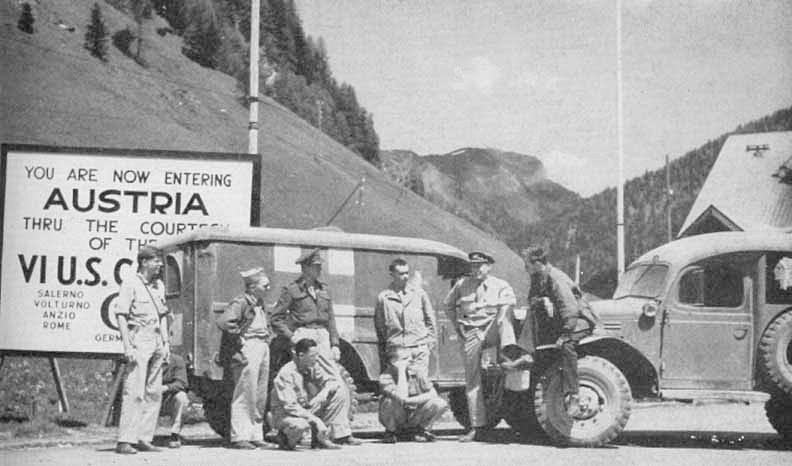
Trumbull Barton had brought to Europe Unit 8, which was delayed in London while everyone in sight disclaimed any responsibility for it. Finally Commandant Coster sent J. R. Latham from Paris to herd it in, and thanks to his efforts it then quickly reached the French HQ on 5 April. Although the ultimate disposition of the group could not have been happier, the original hopes for it had gone somewhat astray. Coster reported that:
"It had been planned to divide this unit between the Groupe Toulouse (an FFI unit that was being incorporated into the French Army as a medical battalion; they had an excellent record as an autonomous unit, and we had done some work with them before) and the surgical team of the Comtesse du Luart, an auxiliary, semi-autonomous group that had greatly distinguished itself and always secured excellent assignments. Both groups had asked for us. . . .
"When it came to the point, however, no ambulances were available for either unit. . . . We, therefore, were left with 29 men and no assignments for them. It would not have been illogical---and logic appeals to the French---for the French to have said that, since the American Army, with good reason, found itself unable to fulfill its undertaking to [provide ambulances for] the French, so they, though regretting it, found themselves unable to give assignments to our new men. Instead of that, the General assigned them to the 4th Company of the 431st Medical Battalion. This meant, at the very end of the war, taking ambulances away from men who had been driving them since North Africa and giving them to strangers who had newly arrived upon the scene. It was a hard thing for me to ask and must have been a hard thing for the General to grant. But it was done, and I think it another outstanding instance of French appreciation of our unit and good will towards it. The ambulances were, of course, not new or even in good condition, but they were serviceable; and the new Section, under the command of Tom Greenough as Aspirant, did good work with them in Germany in the short time that remained of the war."
Section 4 left HQ, then in Strasbourg, for the front on 23 April. Its work was similar to that performed by the others. Also in the Black Forest, it operated more to the south and west than the rest, centering on Freiburg-in-Breisgau and working south and east toward Lake Constance. It ended in the French officers' hotel in Baden-Baden, with Section 2, where the men lived in what was described as "rather ostentatious luxury---enjoying swimming, riding, tennis, and golf."
Now the war was over. It was finished and the sections had been released by the French. They amused themselves while arrangements for their repatriation were hurriedly made. In this as in the other theatres there was worry about what idle volunteers might think of to do. But the living arrangements in Rottweil, Zuflucht, and Baden-Baden were sufficiently comfortable so that many declared they would have been content to spend the whole summer right where they were. Some took leave to various parts of Europe. Rumors of fancy jobs attracted a few to Paris, where the jobs did not prove as available or as grand as was expected. Some transferred to other jobs; some to the group from 567 Coy bound from BLA to India; and some, for a variety of reasons, were repatriated early.
The early departures caused a number of changes of personnel. W. G. Roberts succeeded W. G. Fugitt as Aspirant in charge of Section 3. T. O. Greenough was appointed Captain in charge of the group at Baden-Baden. Lt. R. B. Winder IV was sent to Antwerp, where, assisted by D. A. Gillis, he arranged with the U.S. Consulate and War Shipping Administration for the repatriation of the whole unit in large groups between 19 and 29 June-far sooner than any other theatre managed as well as far more quickly than anyone at the French HQ had dared to hope.
The AFS unit with the French First Army had had a short history. But it would have had none without Commandant Coster's determination and sagacity. He had patiently unravelled a mass of official red tape in order to be allowed to form it. He had organized the unit and seen that it got into action. His personal contribution to its functioning was beyond computing, and he was the hero of its greatest drama---one of the highest moments in AFS history. On 1 July, Commandant Coster announced that, although a few members of his unit were imperfectly accounted for, the French unit had been dissolved.
This was the end in Europe. The AFS went home. Not to bands and oratory, not to the screaming sirens and messy ticker-tape of conquering heroes. just home---to New York and Brooklyn and Norfolk and Baltimore---to the homecoming that was something each man dreamed of differently.
"Baltimore was hot and muggy that first week in July," W. A. Whitehead concluded. "A rickety truck rolled up on the dock to take us across town to the railroad station. Our gear was piled aboard and then we climbed on top---a sweaty, motley-dressed crew. Some of us were wearing German field boots, and a chance observer would have been hard put to it to name our nationality. As we stopped at a traffic intersection in the heart of town, I noticed a well-dressed woman with a little boy standing on the curb gazing curiously at us. When we started off, I heard the little boy say disgustedly to his mother: 'Those damned Germans!' And that was our welcome home."