 George Rock
History of the American Field Service
1920-1955
George Rock
History of the American Field Service
1920-1955
CHAPTER XIII
|
I am delighted to have got you back again with me. I know well what good service you have rendered to us in the past and how useful you will be in our present party. ----FIELD MARSHAL MONTGOMERY, April 1945 |
General McCreery had reviewed 567 Company on 21 March at Forlimpopoli. The next day the platoons were gathered at Riccione for a griff talk from Lt.-Col. Hoeing, who was to accompany the group as officer Commanding, with a small HQ, in its new theatre. The strictest security had to be enforced: "When we land on the coast of Rumania," he said, "you will learn everything." The important point was that only those with 6 months to go on their contracts would be included. Sensing possible excitement, a gratifying number with expiring enlistments committed themselves for the further period. To bring his Company up to full strength, Major Payne requested 40 more men, who were transferred from 485 Company, some of this number replacing those with less than 6 months to serve who chose to transfer out of the Company.
A week's holiday before the move began had been expected, but the orders were changed and on Sunday the 25th the platoons left the Adriatic. Early on that morning, C. F. Zeigler wrote, the convoy
"crossed the Rubicon at Savignano, moved up to Cesena, skirted it over the bypass we used so many times, crossed the Savio without opposition, rushed into Forlimpopoli, saw a British unit bustling around the old castle, crossed the Ronco past the shelled-out church, moved into Forli through St. Giles Circus, veered right at the Municipal Buildings, bypassed Forli over the up route (where we once heard and saw snipers), crossed the Montone at the northwest end of town, turned left on the road to Florence through Rovere (with memories of 'nebelwerfer' mortars and river fordings), and headed into the Apennines. In a little over two hours, the entire convoy, the whole Company, passed through most of the battlefields its various platoons had fought over for the past 7 months. It was a sunny, bright morning, cool, Invigorating, and exciting as all hell.
"Shortly before noon, after crossing mountain gorges over high Bailey bridges, the convoy strained up toward the high pass, winding up the series of hairpin turns and terraced levels of roads that get you up over the hump into the Florence cove. This was a sight. There were several points on this upward climb when the entire Company, stretched out for miles, could be seen all at once like a great, triumphant, red-speckled dragon, lashing its way up the mountainside. The vehicles were clean and undusty, the crosses stood out startlingly red against the huge white squares on three sides and the tops of the ambulances. . . . At the pass we looked around briefly, saw snow-capped mountains to the south, felt the winter still in the mountains, then rushed off down the other side to Florence. . . .
"Early in the afternoon, the convoy pulled into a staging area at Pontassieve, a half-hour east of Florence. This was a treeless, dusty railway siding and a poor contrast to the mountain splendors of the morning's run. We leagured there in four long lines of ambulances and slung our stretcher-beds alongside. Some went bathing in the icy Sieve, others discovered a hand-power ferry across the river to a quaint little village where wineshops served fine goods at candle-lighted tables. This was a popular diversion until long after midnight, and the ferryman did a wonderful business.
"Some time during the night the advance wave of GHQ personnel arrived from Naples, for we woke to hear Lt. Atkins shouting and saw Capt. de la Plante soundly sleeping under the tailboard of the canteen truck and Captain Bridger blinking up out of a bedroll full of sheets and George Rock contriving his morning ablutions out of a GI helmet. With the GHQ attached, our movement was practically at full strength. it had rained during the night, but most of those who slept out in it never knew about it until morning. . . .
"At 7:30 this Monday morning we left Pontassieve, a half-hour later passed through Florence and out west through low hills along the Arno, threading the destruction of Fucecchio and Pontadera, where the American Fifth Army, whose gun flashes we had occasionally seen at night from our mountains, had fought last summer and fall. We arrived at our camp near the Ligurian coast shortly after noon, in a cold drizzle of rain."
At Harrods Camp the Company was spread across the sandy fields, the ambulances by platoon in neat rows, ready to move at any time. Men rushed from convalescent leave and sickbed to get back to the Company before it should leave. But no embarkation order came, and in a few days began the murmurs of "another Tripoli." These were not entirely without bitterness; this time the war was clearly rushing to its conclusion. The mountains to the north had suddenly come to life with the thunder of guns and the flash of great barrages as Fifth Army advanced toward La Spezia and Genova. The radio reported that Eighth Army had at last crossed the Senio. The battle in Germany, which had turned into a complete rout of the enemy's military establishment at the end of March, was making spectacular progress. Allied armies were advancing at the phenomenal rate of 20-30 miles a day and by the end of the first week in April had crossed the Weser north of Kassel. No one in 567 Company wanted the war to last one minute longer than was necessary, but neither did anyone consider that it should end whilst the Company sat fender to fender just outside Livorno.
There were diversions to distract minds from the dreadful possibility. The Company baseball tournament was won by D Platoon, after which the all-Company team beat an American unit by one point. Leave parties to Pisa were almost daily and, after the Leaning Tower had been scaled at least once, turned into restaurant and shopping sprees---bushels of salad greens and gallons of vermouth being brought back for consumption in camp. Colonel Hoeing was seen, and photographed, greasing his car. Finally, after a two-day track meet in which C and D Platoons tied, the announcement was received that embarkation would begin the next day-10 April.
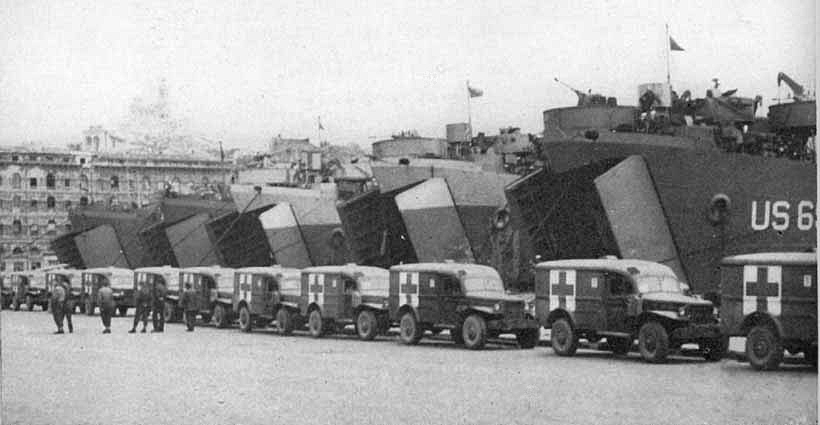
The first cars landed in Marseilles on the morning of the 12th, earlier than had been expected, after a smooth and uneventful crossing. They drove 18 miles north to Coldflake Staging Camp No. 3 at Touillon, a mammoth mud flat strongly reminiscent of El Tahag. Goldflake was the name of the general move from Italy to northwest Europe in operation since the preceding August, and all along its 700-mile route the Company was to follow the sign "GF" in black letters on white. The night of the 12th, the whole camp was shocked, saddened, and made apprehensive by the news of the death of President Roosevelt. On such an exciting day of fulfillment for the Company, it seemed a bad omen as well as a great tragedy. The next afternoon the rest of the Company arrived at the staging camp, and the following morning the whole convoy started north along Goldflake. The radio had also said that the Allied armies were within 52 miles of Berlin, but there was the hope that 567 Company would arrive in time to get some work before everything was finished.
The Company's trip north was in a way frustrating, as security kept the convoy all but locked into camp at each night's staging Point and there was no way of indulging in the usual AFS tourism. Otherwise the trip was a joy and a revelation---fields green with spring and many trees, whole towns and cities untouched by the destruction of war, and happy people standing in their doorways or along the roads waving and throwing lilacs into the cars' open windows.
Goldflake route led north up the valley of the Rhone. The first day's trip took the long convoy through Aix en Provence, Avignon, and Montélimar to a deserted airfield just off the road at St. Rambert. The next day it wound through Lyon, in its Sunday best, to Mâcon. The third day's drive went through Chalon sur Sâone to Dijon, and then west to Les Laumes, and the fourth night's leaguer was in a forest 30 miles southeast of Paris. Here all energetically resisted the temptation to run off to Paris. On the following day the convoy followed the route through Meaux, Château Thierry, Soissons and Noyon to a leaguer outside Cambrai. The Company crossed into Belgium on the sixth and final day of the trip and stopped at Waregem, between Courtrai and Ghent. From the afternoon of the 19th to the 22nd, the Company rested in Waregem. The security blackout was lifted and 567 Company went on the town. There were lots of cafés, several to each block, and with no curfew some of them stayed open all night. Restaurants offered dollar steaks and two kinds of sundae. In addition to attending to the delights of the palate, some visited Flanders Field Cemetery, although it was too early for the poppies. Others goggled at shops full of things considered unobtainable, even at home, and many just rested. Captain Bridger later computed that in the 2 1/2-day spree the 244 members of the Company parted with more than $7,000. The destination of 567 Company was 71 Army Group---the Northern Group of Armies---which included the British Second and the Canadian First Armies, under the command of Field Marshal Sir Bernard Law Montgomery. The Field Service found in this a number of old and good friends. Field Marshal Montgomery wrote: "I have just heard that the American Field Service (567 Ambulance Car Coy), whom I remember well from Alamein to Italy, has arrived in this country to join 21 Army Group. I am delighted to have got you back again with me." His joy reflected that of General Sir Edward Phillips, who had given the Company such a rousing welcome to Italy and who was now DMS 21 Army Group. In "A" Branch was Brigadier McCandlish, who liked to tell of receiving Peter Muir's original offer to GHQ MEF of "1,000 ambulances, equipped with drivers of course." Unfortunately, the American Ambassador was not acquainted with the Service, although, as Colonel Hoeing wrote with a fine note of hope, "he did know Crudgington's grandmother."
To have an AFS unit with the first invasion forces had been Mr. Galatti's earliest hope. "Tell General Phillips," he wrote to Colonel Hoeing, "I tried to have AFS in England for D Day, but they were afraid of having more Americans there waiting. They wouldn't let me. But we got there finally." Mr. Galatti had extracted a promise that if possible an AFS group would be used later---and he pushed the matter with all his extraordinary energy until he achieved his usual success. When the opportunity finally came, so rapidly did events move during the war, Mr. Galatti had to decide in the course of a telephone call whether to transfer a company from Italy. The correctness of the decision was proved by 567 Company's opportunity for unique service.
The headquarters of 21 Army Group was in Brussels. From Waregem, therefore, Colonel Hoeing left to establish his HQ in Brussels at 40 rue Juste Lipse, not far from the center of town. This was a rather large town house, somewhat less conveniently arranged than might have been hoped but quite adequate to all the needs of the small staff and few visitors. Captain de la Plante assisted Colonel Hoeing as Adjutant and tended to what few S&T matters the Company could not handle for itself. Captain Bridger and Lt. A. Motz handled the complications of finances in dollars, French and Belgian francs, pounds, guilders, and marks. Unfortunately, G. E. Massey, who was scheduled to tend to the vital details of a Personnel Department, fell sick. He was succeeded by Lt. R. B. Taylor. The important matters of a new APO and the ever-tricky canteen and PX issues were the province of Lt. Atkins, who managed both with the speed bred of long experience.
On Sunday, 22 April, the Company left the delights of Waregem to drive through a cold rain to Ghent, Brussels, Louvain, and into Holland. Once across the Dutch border, men saw along the road large signs reading "567 Ambulance Car Company Report Center," and at an MP post they were directed to Sterksel---a crossroads near Heeze. There the billets were in a large convent school with hot showers, electric light, and many times as much space as was needed. This luxury augured well for the new campaign.
The first to be assigned was Lt. Griffin's A Platoon, which left the next day for Breda. Here, under command of 5 L of C (Lines of Communication) Subarea, it established its HQ. The next morning, cars were sent to posts: 14 to RAPs with Marines, 4th Commandos, and various artillery units, and 5 others on FDS and miscellaneous assignments. Although a third of the Platoon stayed in Breda, the rest was spread over a 70-80 mile area from the islands on the coast along the Hollandsch Diep and the Maas to within a few miles of Nijmegen, with one car at a Corps club in Lier (Belgium). These were the only RAP assignments the Company was to get. The area was scattered with pockets of enemy still more or less resisting. Some mortar fire was heard, but there was comparatively little fighting.
On 20 April, B and C Platoons received their assignments and left Company headquarters. Lt. Perkins led B Platoon to Nijmegen to replace a platoon of a British ACC, under command of 21 L of C (which next day became 4 L of C) of the Canadian First Army. The cars were posted on the 26th---3 sections and Platoon HQ at 1 Canadian General Hospital, and one section each at 4 and 6 Canadian CCSs and 3 Canadian General Hospital, all in Nijmegen, and 2 cars at 4 L of C HQ in Apeldoorn. Sgt. H. A. Merris with 1 car and 5 men ran the Ambulance Control Post for the Nijmegen area at 3 Canadian GH. The cars were busy, carrying just under a thousand patients in the last few days of April. But the work soon slacked off. On 4 and 6 May the two CCSs shut down and the cars were withdrawn.
Lt. Keller's C Platoon was assigned to British Second Army. Early on the morning of the 24th it set out for Sulingen, 30 miles South of Bremen. At the 9th British General Hospital in Venray, Holland, the cars were loaded with 2,600 blankets and 800 stretchers. The first group from 567 Company into Germany, they crossed the border at 11:45 A.M., Sergeant Ecclestone leading on his motorbike, and later in the day the President Roosevelt Bridge over the Rhine at Wesel. Thence their route led east through Münster and Osnabrück and then northeast through Diepholz and finally to Sulingen, where the Platoon reported to 84 British General Hospital the following day.
On the 26th the Platoon returned to Diepholz, where it was scheduled to work for a while from 2 FDS and 24 CCS to the Diepholz Air Evacuation Center. For a few days the work was fairly heavy, with a number of long road evacuations thrown in---displaced persons to be taken to Rheine and lots of odd jobs for various near-by units that could not handle all the work thrust upon them by the extraordinary situation. The weather was not all that might have been expected of late spring, and on days when snow fell the air evacuations were light or had to be cancelled altogether. In Diepholz the Platoon's billets were in a beerhall and a movie theatre, both of which, if unusual, were comfortable.
The Platoon's opinion of the Germans changed rapidly and greatly after they entered the country. Reflecting the general reaction, on 27 April J. H. Brewster wrote that they had
"entered Germany feeling for the most part as the troops in our old theatre felt---that the Germans had some decency, that most atrocity stories were exaggerated or wholly false, that the army at least had a code of honor (even though it applied only to soldiers), that 'saturation bombing' of German cities was as wrong as was indiscriminate bombing of English cities. We have learned that we were wrong, and it has been a shock to us. . . .
"There were a number of large German concentration camps near here. We have seen many of the persons liberated by the British from these camps. You remember, I used to put quotes around the word 'liberated.' It was something of a joke before. We used to speak of 'liberating' a fat chicken or a dozen eggs. It is not a joke any more.
"We have seen truckload after truckload of freed Belgian, Dutch, and French prisoners go by on the road. The strongest of them wave weakly or smile at us. I am sure that some of them will die from the exertions they made to show their joy. We threw what cigarettes we could get to them, without regret, though we have no prospect of getting American cigarettes for a good while.
"One truck stopped by our leaguer [in Sulingen]; it was the sick truck, carrying men who had not even the reserve of nervous energy to stand or sit in a truck. The first food they had been given had caused diarrhea, and the men had to be carried to the roadside. They smelled, not from filth or diarrhea, but with the smell of death. Prisoners had died at such a rate that they could not be buried, and those who lived had to lie among the rotting bodies. . . .
"Those were all political prisoners. Yesterday [at Diepholz] we saw military prisoners in as bad shape. There were several Americans among them, one of whom after four months had shriveled to little but a skeleton and was incapable of moving or speaking. He had shriveled till he looked like a man of 90, or an exhumed corpse. Those who were capable of talking spoke of forced marches, nude, in the dead of winter, of being bayonetted by guards, of having vicious dogs loosed on them, of stragglers being beaten or shot. . . .
"It probably is not wise to believe everything these people say. They were prisoners and had no access to whatever records were kept. They were hardly dispassionate observers, and, just by talking with them, you could tell their minds had been dulled by starvation and hardship. They had time to turn over in their minds what they saw and went through and almost certainly exaggerate and magnify the truth. They had an incentive to make plays for sympathy in talking with us. Their words alone are of little value as evidence, but words are unnecessary; their scars, their prematurely whitened hair, their anemic faces, their pitiful attempts to think and speak, their bones almost bursting from the taut, semitransparent skin tell more vividly than words what they went through. . . .
"[Dick Whorral] was fired at twice yesterday. He was wearing no Red Cross arm band and was wandering on the outskirts of town on no particular business. He was sticking his neck out and should not have been surprised. No harm was done, and we have all learned a useful lesson. The telephone wire from Platoon HQ to the CCS to which we are attached was cut yesterday at noon with some hatchet-like instrument. We have heard that a water-truck attached to a hospital here was poisoned."
The story of the poisoned water-truck shows the highly emotional state of both victors and vanquished. That it should have been believed at that moment of deep disillusionment, and after the other hostile incidents, was not surprising. The truth of the matter quieted a number of alarmists clamoring for permission to carry guns. A German woman had reported seeing the poison put into the truck. Investigation proved that the culprit was the truck's driver, who had been adding the regulation chlorine.
After two days in Diepholz, two of the Platoon's sections went back up to the hospital in Sulingen. The fighting was progressing so satisfactorily that all plans, including medical, were being moved up by 48 hours, which caused something of a flap. On 1 May, the Platoon HQ and 3 sections (with part of K. Ruppert's reserve section) went north to Bassurn to work for a general hospital. Here Lts. Driver and Field joined them, with half the workshops, as a sort of advance headquarters to care for both C and D Platoons.
Lt. Murray's D Platoon was the last to receive its orders---but it drew the assignment that made the whole eleventh-hour excursion not only eminently worthwhile but, for every member of the Company, unforgettable. On 26 April, with T. O. Cole, E. E. Eisaman, D. R. Smith, and C. J. Smith of Ruppert's reserve section, D Platoon joined 9 British General Hospital in Venray and on the following day set off, with half the hospital's personnel, for the concentration camp at Belsen. The trip took two days, and the day after arrival all but two of the cars returned to Venray for the rest of the hospital's personnel. Due to the work expected of the cars, the Platoon established itself in tents. At Belsen, D Platoon was joined on 2 May by W. J. Bell's section of C Platoon, which included W. A. Chapin, E. M. Cole, R. B. Elberfeld, F. A. Feddeman, W. G. Fuller, S. MacLeod, and R. T. McMillen, who were attached to 11 Light Field Ambulance.
The statistics, as compiled by W. J. Bell, Jr., tell part of the appalling story.
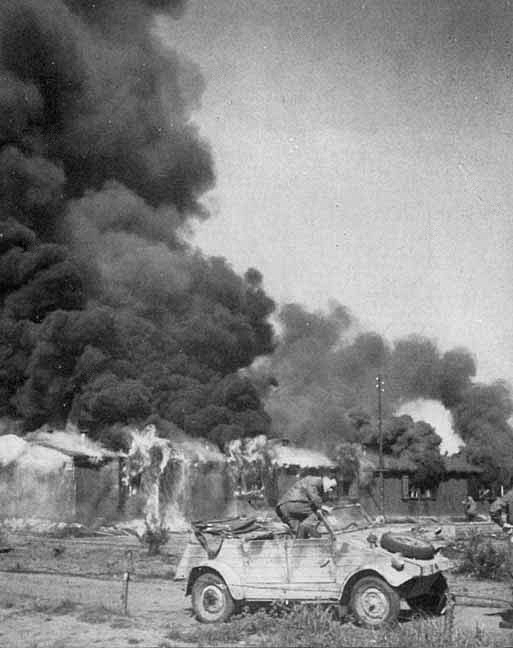
"The camp was liberated on 17 April by the 115th Scottish Regiment, British Second Army. It was located about two miles southeast of Belsen, which is a tiny German town about 75 miles southeast of Bremen. They found there between 40,000 and 50,000 internees---barely alive. There were also about 10,000 unburied corpses. The total area of the camp was less than 50 acres.
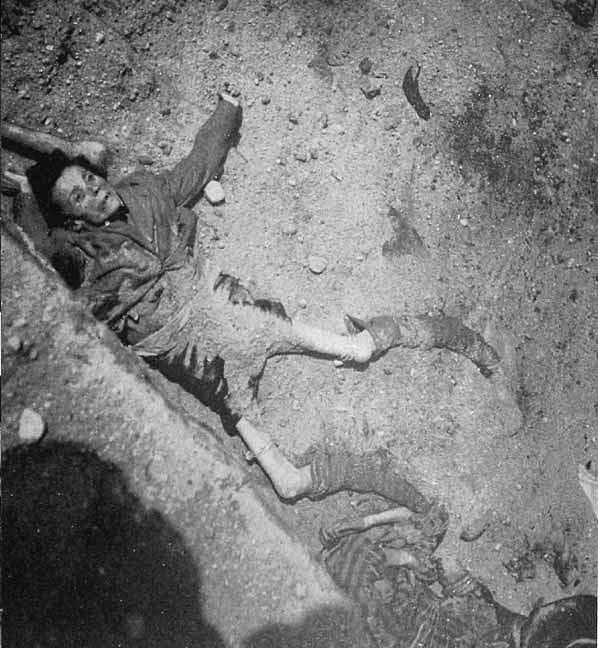
"In January 6,000 people died, February 10,000, March 17,000, and 1-16 April 17,000. During the last week of German control, deaths were approaching 2,000 daily. Between 17 April and 1 May (after liberation), and despite all the efforts of the British medical authorities, another 10,000 died and were buried. The average death rate during this period was about 600 daily. After the first, it began to drop, and after 12 May it was under 100 daily.
"During the last 10 days of German control, no food at all was available. Normal food ration was one litre of turnip soup daily, one loaf of black bread weekly. In the camp the sexes were segregated, largely in order to separate families. . . . The people lived packed in single-storey wooden huts about 100 by 30 feet. In most of the huts there were no beds at all, only straw pallets or plain wooden boards. In one women's hut by actual count there were 1,351 women. Everyone in the camp was diseased, and many had several diseases at the same time. . . . Toward the end of German control, cannibalism in its most horrible form---the eating of the hearts, livers, etc. of the still living as well as the already dead---was becoming prevalent."
Conditions in the camp staggered all who saw it.
"It is really too much to take in," L. M. Allen wrote. "The camp is set off in the middle of some woods . . . completely cut off from the outside world. It is surrounded by barbed wire, set out a mile or two from the actual borders of the camp, with signs warning that any trespassers would be shot without hesitation. The camp itself consists of many, many one-room, one-storey, wooden buildings, in which the inmates stayed. These were individually barbed-wired off, while large stockades were built all around the buildings for extra guard protection.
"When we took the place there were approximately 65,000 people in it of all nationalities---Poles, Russians, Czechs, French, Greeks, Belgians, etc., and all these people were practically dead as the result of systematic starvation. All looked like living skeletons and were generally suffering from tuberculosis and typhus plus any number of other diseases and complications. But worse than this were the dead lying around. Approximately 30,000 dead were lying around the camp, still unburied, if you can imagine that. No care whatsoever was taken of the inmates. As people died they were merely shoved out of the windows by the others, if they were strong enough. In many of the buildings, however, the people were too weak even to do that, and the bodies remained in the crowded rooms to rot. These rooms were in many cases so crowded that there was not even room for them to lie down without lying on top of one another. In these rooms many of the dead were stuck to, or had grown to, the bodies of those still alive, and they had to be pulled apart. Now I know this sounds absolutely incredible---I am not trying to impress you by all these things. . . .
"I went all through this camp, through many of the various buildings, and please bear in mind that what I saw was all almost two weeks after this camp had been liberated and that during those two weeks the entire camp had been cleaned out as much as possible. There is still a lot to do. People are still dying . . . but nothing can be done for them. These bodies are merely dragged outside the doors and left lying on the ground, nude or seminude, and are then collected by Germans, who drag them along the ground by hands or feet and toss them on a truck. They are then dumped in . . . mass graves. . . . I looked in one of those mass graves, and I must say it isn't a pretty sight. Hundreds of bodies, all skin and bones, lying bent and tangled in all kinds of weird and horrible positions, and all piled on top of one another. It is really impossible to describe a scene like that.
"But the personnel is still too short to do any more with the bodies. They can be bothered only with saving the living. Of the ones I saw, I would say that only about 20% had much chance of living. They look and act like animals---nothing more. Most have lost their minds completely or have sunk to animal level. Most of them just lie and stare, and it is difficult to tell when they are alive or dead. No latrines existed in the entire camp, and although many have been built now by the British most of the inmates are much too weak to move and consequently just evacuate in their beds or wherever they are lying. The Germans never cleaned up. Although we had been cleaning for almost two weeks when I first saw the camp, the barracks were still being shoveled out (by Germans), and the trash and rubbish pushed into piles by snowplows and burned. You can't image the horrible sight and smell of a pile of this rubbish coming out of a building, with several dead bodies mixed up in it. It is really impossible to believe all this-even for me it all seems like a nightmare.
"And in the center of the camp was the gas chamber. Hundreds of people at a time could be and were herded into here and gassed. There was also a crematorium, where bodies were burned, in some cases, I understand, before they had even died. I talked to one Pole, almost dead from starvation, who had seen both his mother and sister tossed into this while they were still living! The stench of dead bodies around the gas chamber was impossible to stand, and a certain amount of it, of course, covered the entire camp and clung to our clothes and nostrils after we left the camp. This smell of rotten bodies is without doubt the most sickening smell there is.
"We were in one ward full of women, one of whom was trying to tell the doctor something in German, which he couldn't understand. Someone pointed to me and said I could speak German, and I was immediately pounced on by this woman while all the others who could talk wailed at me and cried. This one woman kept asking why they didn't take them to hospitals, why they didn't get them out of the camp, why they didn't give them some food, etc. I told her there were very few of us here yet, that we had very few supplies, and that we had not beds enough or hospitals enough in which to put them, that it would take time to handle so many people. But she grabbed me and took me around to various girls, pointing them out---this one only fifteen years old with a face of seventy and a body of five, and so on, asking me why they didn't at least take out the young ones who had lives ahead to live. I could do nothing but repeat over and over that we were doing all we could---but still they couldn't understand. It was really pretty horrible. One of our fellows took a visiting English priest down to the camp the other day, and when they got in the camp the priest, just from the little he could see from the car, became so frightened that he simply would not get out of the car. . . .
"There is a terrific contrast between all these horrors and the other end of the camp, where the SS troops were billeted. They lived in clean and modern buildings, while the SS officers' club is one of the most luxurious and completely equipped places I have ever seen. Beautifully furnished rooms . . . a tremendous cellar filled with thousands and thousands of bottles of all kinds of imported French and Italian wines, liquor, etc. . . . a tremendous grand ballroom. . . . The bathrooms were even equipped with vomitoriums."
On 8 May the German surrender was official. Lt. Murray represented the forces of the United States at a march-past of the anti-aircraft regiment which had been guarding the camp, taking the salute with a British and a Russian colonel. But at Belsen there was still so much to do, and the urgency was still so great, that D Platoon drove to Lübeck on the Baltic (after a fruitless trip to another Lübeck) to fetch 130 German nurses to assist with the job. As work everywhere else had considerably slacked off, more members of C Platoon volunteered to assist with the stretcher-bearing details. Bell's section was recalled on the 14th, but the car that went with the message took B. D. Clarkson, P. H. B. du Pont, J. R. Meeker, and C. Wilson to act as stretcher-bearers. G. R. Collins and N. C. Kunkel joined them on the 17th, but all returned to Platoon on the 20th, bearing a note of appreciation from the Senior Medical officer of the camp which stated in part: "I cannot speak too highly of your men, for whom no job was too difficult or too risky." As a measure of the amount of work done, Bell recorded that in 14 days his 5 cars had carried 2,245 patients, of whom only 29 were sitting.
The nature of the camp was such, however, that everyone did whatever came along.
"Our work there," J. M. Evans wrote, "was almost entirely ambulance work, although we did some of the stretcher-bearing too. This consisted of going into the huts, removing the people's clothes, putting them on stretchers, and carrying them to our cars. There were crews who had special suits for the work, but sometimes we had to help out. Many of those fellows caught typhus, so toward the end they ran short of help. Our job was to evacuate the people from the camp and take them to the 'human laundry.' In the human laundry there were about 20 tables, two German nurses to a table. The people were offloaded from our ambulances by German orderlies---that is, captured German soldiers. The people were carried to the tables and given a complete bath, a haircut if necessary, and then dusted thoroughly with antilouse powder. They were then wrapped in clean blankets and taken in decontaminated ambulances to the former German barracks. . . . There they were cared for by the British nursing sisters whom we had transported to Belsen before we started to work there. The people had to be fed; special diets for each disease and condition were called for. There were special buildings allotted to special diseases. As you can imagine, caring for these people was a pretty grim job, and the sisters deserve a tremendous amount of credit. It was a thankless job, for once the people were well enough to walk many left the buildings and immediately hunted up the garbage pits. Their animal instincts still predominated, and they took that much longer to cure."
There was a compensation for the men working there in
"the feeling that we are useful, a feeling we have never felt so strongly before and probably never will again," T. O. Cole wrote on the evening of 8 May. "Sometimes these people, who have not had an ounce of kindness in years, do not understand it now. They get confused and often think that everyone in authority is out to beat them down. Others break out in sobs and weeping at the slightest kindness. Still others are too torn to react at all. . . .
"The strangest things turn out to be the tear-jerkers. Today I talked with a twelve-year-old French girl. She had been away from France for 4 years, she said. From the way her face twitched, I suppose she had been either beaten, tortured, or violated. As we talked, she found she had forgotten a good bit of her native tongue (having spoken German and Polish so long), and the discovery wrenched forth a burst of tears. I, also, wept a little. It was as if the Germans, not content with everything else, had taken her most prized possession---her Frenchness."
Finally on 21 May the job at Belsen was finished. The last of the emptied huts of Camp 1 was burned to the ground. It was a formal occasion with speeches and the erection of a commemorative tablet. Two days later a special order from the OC of 11 LFA thanked all who had worked in Belsen for their share in
"achieving the impossible. . . . To do this you have worked for a month amid the most unhygienic conditions inside buts where the majority of internees were suffering from the most virulent disease known to man. You have had to deal with mass hysteria and political complications requiring the tact of diplomats and the firmness of senior officers. . . By collecting medical equipment from all over Germany you produced a dispensary which has supplied drugs for 13,000 patients a day and has met the demands of excitable medical officers of all races requiring the most exotic drugs in half a dozen different languages. You have without hesitation acted as undertakers . . . a task which the RAMC can never have been asked to fulfill. Life can never be quite the same again for those who have worked in the concentration camp."
|
|
Through May, both C and D Platoons continued busy. D had a couple of assignments to evacuate German military hospitals and did other odd jobs around the area. C Platoon kept its headquarters in an 8th Century convent in Bassum, but it had sections scattered over a considerable radius. There were three sections in Bassum evacuating the 7th Canadian General Hospital to the airport at Ahlhorn or to the 33 RHU at Sulingen, as well as making odd runs to Bremen and other cities with civilians and displaced persons and evacuating near-by German military hospitals. When the 8th British General Hospital took over from the Canadians at the end of the month, the AFS work continued as before.
The sections with the 84th General moved with it from Sulingen to Hamburg, where they were shortly relieved by a British MAC. While in Hamburg, however, a number got permission from the Hospital officials to take a short trip.
"Being VE day," one of them recorded in the C Platoon diary, "and as we were so near Denmark, some of us decided we'd like to liberate one more country before midnight when the war would be officially over. So about 2 P.M., Ted Chapman, Jim Brewster, Lee Hillery, Fran Everett, and Henry Jones, in Jones's car, and Scully, Keller, and Murphy piled into another and headed north through Kiel 'toward the border, stopping at 3 just long enough to hear Churchill's speech. Passed a few DP camps, but most of the people were German refugees, and many convoys of German troops returning from the north. Near Kiel there were burned-out vehicles in the road, and we had to drive around. We were a curiosity, being the first Allied 'troops' seen in this region. Some German MPs were amazed when we stopped and asked directions. They said 'Alles Deutches hier (All is German here).' For miles approaching the frontier the roads were crowded with German vehicles and convoys. At the frontier we wondered what would happen and were surprised to see the striped pole quickly lifted before we'd even reached it. A hundred yards farther on, the second pole was raised by smiling Danes.
"On the way we stopped at Flensburg, HQ of the German government, though neither the BLA nor the AFS knew it at that date. The two cars beat the first British troops (11th Armored Division) into this town by 13 days---a record first for the AFS."
On their return to Platoon HQ, these sections were sent to Celle, and other cars assisted the TB hospital at Wildeshausen. These assignments were not of long duration, but there were miscellaneous jobs---evacuations of French hospitals to Quakenbrück, emptying of German military hospitals, and transporting of displaced persons in many directions---steadily until the second week of June. Then C and D Platoons, on the 11h and 12th respectively, rejoined Company HQ, which at the invitation of Baron Tuyl van Heese had moved to his castle in the village of Heeze. This lacked running water but was surrounded by a real moat.
After VE Day, the work had gradually dried up in Holland. A and B Platoons stayed with their original assignments, sections on post one by one being released and returning to the HQs. A Platoon loaned a few cars to civil-affairs units for the transportation of displaced persons , later adding to the number. B Platoon on 8 May had lost more posts when the two Canadian General Hospitals closed down. Toward the end of the month the Platoon moved north to a POW hospital at Zuidlaren, a few miles southeast of Groningen, the final clearing post for PsOW in northern Holland. Here their work consisted of bringing prisoners from Leeuwarden to Zuidlaren and evacuating prisoners to Aurich, in Germany. Both A and B Platoons were released from their assignments in early June and arrived at Company HQ in Heeze on the 10th. On the 18th Major Payne led his entire Company to the insane asylum in Louvain, which had a lot of extra space, where it stayed for the remainder of its time in Europe. Repatriations were begun as soon as possible, and on the 27th the Company was formally disbanded .
"I should like to thank you and all your unit for the fine work which you have done in this theatre," Field Marshal Montgomery wrote to Colonel Hoeing. "I have known the American Field Service since I took command of the Eighth Army in 1942. You were with me from El Alamein to Tunis, and again in Italy, and now you have served with me during this campaign in northwestern Europe. This fine volunteer Service has throughout done a first-class job of work, of which you can all be justly proud."
Victory in Europe had come on 8 May. Although it had been clearly imminent for some days, the actual signing of the surrender caught some unawares. C. F. Zeigler, PR representative, was probably the last to learn, having spent all day coaxing to Belsen an ambulance that had begun its journey in Syria. In Germany the peace was celebrated quietly by the units still at work. In Holland the celebrations had begun three days earlier, at the news of the surrender of the German armies in the north, although it was still possible to intensify the rejoicings with displays of fireworks and costumed parades. Victory brought wild celebrations in the streets of Brussels, as the lights went on again dramatically one by one.
In Brussels, however, Colonel Hoeing paced a lonely street while he pondered the future of some 250 variously eager volunteers. Some would go home, some would go to India-Burma, and some might stay in Europe with civilian relief agencies. The China Unit still looked like a possibility, though it was far from definite. It would be some time before New York had received word from Washington, London, and Tokyo and would be able to send instructions of the many possibilities for an indeterminate period of waiting, no one was certain and not a few were ghastly.
Much depended on the length of time before the world's capitals made their decisions on the Field Service with BLA. Work with the Canadians had begun to dry up before VE Day in Holland, where Dutch civilians took over speedily from the military. The work could not last anywhere in any great quantity for very long. And what havoc idleness wrought among the high-spirited members of the AFS had already been amply demonstrated. Work with a garrison or occupation force would be totally demoralizing, but such an assignment was not planned by the realistic British any more than by the AFS itself.
Events moved rapidly and with the greatest co-operation from both the War office and 21 Army Group. With the kind assistance of General Phillips, 7-day leaves to Paris were arranged in early May. This granted 15 places in officers' hotels, and the Company was able to send 5 men 3 times a week. Shortly after this program was begun, the alternative of taking the leave in England was granted. As the work in the field tapered off, the leaves were extended to 9 days, and the time was generally accounted well spent.
Brussels HQ was augmented to deal with the problems of peace. W. J. Bell, Jr., came in to assist Lt. Taylor with Personnel and eventually succeeded him as officer in charge of that department. C. O. Stewart, who had resigned a commission with S&T in Naples, was prevailed upon to give HQ another chance and took charge of the Brussels house as it was transformed into a transit camp for people going in various directions. Lt. R. Dickson, formerly D Platoon officer, attacked the complicated job of Movements. He managed a miracle of speed by getting the first group of repatriations out through Antwerp on 12 June, and he was able to get most of the rest off for home by mid-July.
For many, however, BLA came to be interpreted as "Burma Looms Ahead." Those going in that direction provided a different problem. All those from Unit 92 on had contracts providing for 18 months' service in any theatre or theatres of war. The uncertainty of the U.S. draft and point systems, as well as the habit of traveling, provoked a small number of old hands to join the party. But there were great indecisions and soul-searchings and many last-minute changes of plan before the lists were closed.
It was first thought that the Company going from Italy and Belgium with 567's new ambulances would be brought together to make the trip as a complete unit. This hope fell through, and it was arranged for men and ambulances to travel separately. Captain Webb handed over the cars to Captain Green, who with 130 RASC drivers took them to England, on the way to India. The volunteers followed the same pattern, led by Lts. Atkins and Broughman, the latter having succeeded Lt. Field as 567 Company Adjutant after helping for some time with the Company's paperwork. Although the ambulances never reached India, the volunteers did not wait long for embarkation.
On 9 July, the day before the 95 going to India-Burma (Unit IB 60-T) sailed from Liverpool, they were reviewed by General Sir Ronald Adam, Adjutant General and great friend to the Field Service. The ceremony took place on the parade ground of 44 RHU, an RASC camp between Woking and Chobham, with some of the Company's ambulances in the background. General Adam arrived at the parade ground at 11 A.m. and, dismissing the usual formalities (Lt. Broughman's initial salute was caught going up by the General, who grabbed his hand and said "Howdy do"), ordered the Company to stand at ease while he walked through the lines, talking personally with more than a quarter of the men.
"Now you are going on to still another theatre of war," General Adam said. "There is no word or sign that can adequately express the army's appreciation except to say we are proud you will march with us until the end of the war, wherever it will take us."
He added that his office had been making every effort to get the new British service ribbons to them before they left, but that very few had been issued thus far as they were still in the process of manufacture. Later that night, however, a special dispatch rider came in from the south of England with a bolt of one of the ribbons. At 2:30 the following morning another arrived from the Scottish border with the other two. "Up till this week," C. F. Zeigler wrote, "the only people sure to have these ribbons---which are gaudy as all hell and make you look like the corner of a Sunday School room on Christmas Eve---were military men invited to ceremonies at Buckingham Palace. It is very possible that our group was the first complete unit to get them. I wore a set back from Dover to Ostend last night and knocked the Tommies for a loop.
Then, almost suddenly, it was all over. In spite of all apprehensions, there had been no riots or agonizing delays. Not all loot had been given away, but the nearest approach to scandal was caused by a celebrant of victory who danced naked in the streets---not once, which as men of the world his Platoon could have understood, but twice.
Colonel Hoeing was at last able to go home. It had been a long time since the embarkation of Unit 1, and he had decided to retire from the war in March 1945, at the end of three and a half years of service. But he felt unable to refuse the BLA assignment and continued his patient guidance through this last adventure. of the other members of Unit 1 still with the Company, D. G. Atwood and Lt. C. M. Field were also repatriated, J. R. Meeker went on to India to round out his unique record of service, and H. P. Metcalf returned from POW camp to his Platoon, intending to go on to India until persuaded to go home first. Colonel Hoeing also expected to go to India after a rest at home. His long service was recognized as "outstanding" by the British, who, in conferring on him the unusual distinction of a second Order of the British Empire (of a higher rank), commended his "personal inspiration" and "able guidance."
In late July, Captain de la Plante sold the adding machine, released the HQ cook, and closed the Brussels office. The last small groups left for London to await shipping, most for the United States but a few for India. Homeward groups from Italy also appeared in London, as did a couple of units from the States bound for India. The India group was stationed in Southend-on-Sea for what turned into a fatal delay. Japan surrendered before they got off, and they began to wait for shipping in the other direction. It was a long time before Colonel King had seen the last volunteer from the European theatres of war out of hospital and out of England---and by then the first wave of repatriations from India-Burma had begun to arrive.