 George Rock
History of the American Field Service
1920-1955
George Rock
History of the American Field Service
1920-1955
CHAPTER XII
|
You will always be able to say you played a big part in the Italian campaign. And it has been a hard one. I hope you will remember that, after all the hard fighting from Salerno to the Alps, our 15th Army Group was the first to obtain the surrender of the German Army, and you may be sure that we did shorten the war by several months. ---LT.-GEN. SIR RICHARD L. McCREERY, 3 July 1945 |
On 1 April 1945, the HQ Newsletter listed as a "casualty" the "total disappearance" of 567 Company. At the same time, some changes in the Naples HQ organization were announced. One important event had already occurred at the end of February. Colonel Richmond had returned to the United States for consultation with Mr. Galatti on phases of future operations. When he left it was expected and fervently hoped that he would soon return. That he did not get back before the end of the war was a great disappointment to all---to those who took pleasure in his sudden appearance at forward posts, who were comforted by his understanding of their problems, who relied on his judgment in moments of stress, and who were proud to be represented by him in high places. Without Mr. Galatti, the Field Service would most probably not have existed. Without Colonel Richmond, its most ambitious venture almost certainly would not have survived to the days of its maturity, nor would the expansion of the Service to other theatres have proceeded so smoothly as, with his assistance, was possible.
At the beginning of March, Major Hoeing was ordered to assume the title of officer Commanding AFS CMF. On 1 April his promotion to Lieutenant-Colonel, in charge of the small GHQ attached to 567 Company for its new assignment, was announced. Major Perry then succeeded as OC AFS CMF, assisted by Major Nettleton as Adjutant. It was proof of the experience of the HQ group---which had seen few changes in the past year---that it could now be split into two separate units, each of which would be able to function efficiently. After Colonel Hoeing had selected the staff he wanted---this was known as the "Hoeing blitzkrieg"---only one new appointment to the Naples office was needed: Lt. E. R. Hammond to take charge of mail and the canteen. Lts. (later promoted to Captains) Barker and Ritter acted as heads of the Finance and Personnel Departments respectively; Lts. Beek, Brethauer, and Willand were in charge of Public Relations, Supply & Transport, and Movements respectively; assisted by Lts. Hobbs and Hodgdon in S&T and Lts. Bolte, Goff, and Myers in Finance.
At this time, J. F. Upson was appointed to assist Lt. Phillips with historical research, which became more complicated and more urgent as the war drew to its close. Later, on the departure of Lt. Beck, Lt. Phillips found PR added to his responsibilities. He then officially became responsible for making known the good name of the Service---as he had been doing successfully, if unofficially, for so long. As a first step, he undertook to forward in useful directions the work that came from J. P. Brinton III and I. Penn in the field.
The withdrawal of 567 Company in mid-March had left 485 Company with the opportunity for a great deal of forward work. Company HQ moved up to Faenza, where A and B Platoons already were established. A was then working with 2 Polish Corps (except for C. S. Satterthwait, who was detached to AMG in Faenza) and B with 10 Corps. C Platoon, with headquarters in Prada, was assigned to 5 Corps. While D, working with Italian troops in 13 Corps, kept its HQ in Castel del Rio. After B Platoon took over the Palestinian Brigade posts from C in the third week of March, the Company's posting remained for the next month essentially stable within this basic framework of the four corps.
There was not much activity along the front. Patrolling was on a minor scale. The artillery, however, on occasion made a mess of the peaceful Allied existence. Toward the end of March, an enemy shelling of Casola Valsenio---which, though under observation from heights two miles away, had suffered few casualties in the 5 preceding month---struck an Italian mess line and caused 27 casualties. While the German guns continued to pound the town, 8 members of D Platoon ran 200 yards across the open square to carry the dead and wounded on stretchers another 100 yards to the aid post. One third of the Italians had been killed. In the same square, no more than 24 hours earlier, the group had been reviewed by members of the Italian cabinet.
On 24 March, in his order of the day, General Morigi, commanding the Gruppo di Combattimento Folgore, paid tribute to P. J. Gallagher, P. C. Gault, C. C. Graves, F. T. Hess, J. W. Leonard, F. Simpson, and S. S. Voorhis: "During the heavy enemy shelling of Casola they distinguished themselves, shoulder to shoulder with the Italian soldiers, by courageously and regardless of danger attending to the wounded."
On 6 April, an enemy barrage on Faenza---which had also been fairly quiet since the beginning of the year---came close to the three 485 Company HQs then in Faenza. They had already been ordered for security reasons to move back to Ospedaletto (on the Ravenna road about two miles from Forli). After the shelling this suddenly seemed quite sensible, and the move took place, as ordered, on the 7th. It was said that the barrage had been occasioned by the German discovery that the New Zealand Division had re-entered the front line. Its move had been conducted with the greatest possible secrecy (security measures went beyond removal of all identifying marks to the extreme of referring to the New Zealanders as "hogs") to hide from the enemy what such a move so clearly signified. Although there had not been much excitement at the front for some time, recently there had been compensation in the excitement of preparing for the big battle that was soon to come.
Steadily through the winter the Germans had built up a great network of defense between the Senio and the Po rivers, taking advantage of a number of sizable rivers and countless streams, canals, and ditches. There was no single line but a succession of defensive constructions, the most important being those along the Senio (called the Irmgard Line), Santerno (Laura), Sillaro (Paula), Idice (Genghiz Khan), and Reno rivers as well as along the northern shore of Lake Commacchio. South of the lake, marshy ground was flooded almost to the Reno except for the area at its western end around Bastiana and Argenta. Even without prepared defenses, this would have been difficult country to fight through.
The Allied plan for breaking into the Po Valley was an attack in three parts. The first attack was to butt directly into the row of river defenses along the line of the Via Emilia, drawing enemy reserves from the flanks. This was to be followed by a thrust through the northern marshes through the Argenta Gap. It was hoped that this would draw enough enemy strength from the mountains to ease the Fifth Army break-out from the mountains to Bologna. The Fifth and Eighth Armies, converging in the plain south of the Po, would then be able to trap the enemy armies between them, preventing their retreat to garrison the fortress of southern Germany.
Four corps were brought into action on the Eighth Army front, which extended from Firenzuola east to the Adriatic. In the south, 13 Corps (10th Indian Division and the Italian Gruppo Fulgore), with 10 Corps (the Italian Gruppo Friuli and the Jewish Brigade) on its right flank, was to drive through the mountains down the valleys of the Sillaro and Santerno rivers. Astride the Via Emilia was the Polish Corps (3rd Carpathian and 5th Kresowa Divisions), aimed at Bologna. To the right, 5 Corps (New Zealand, 8th Indian, 56th and 78th Divisions and the Italian Gruppo Cremona) filled the area between the Poles and Lake Commacchio.
The attack on the Senio positions was to be made by 8th Indian and New Zealand Divisions, the latter with its right flank opposite Cotignola and the former just north of Lugo. The 78th Division was to come from behind and advance through them when the initial assault had passed the Santerno defenses, in a thrust toward the Po. While farther north the 56th Division and 2nd Commando Brigade were to undertake a flanking enterprise along the coast. There was a flurry of preparatory activity in the first days of April, notably by the Commandos in the Commacchio area, after which the front settled down to await the battle.
On 9 April, all was relatively quiet until early in the afternoon. Then great waves of bombers passed over. The softening of the enemy lines was continued by the artillery, which opened up in the late afternoon and continued through the evening. There was said to be more air power involved than at Cassino and more artillery than at El Alamein. But instead of the blockbusters dropped at Cassino, 20-pound fragmentation bombs were used so that impassable craters would not impede the advance as they had at Cassino. At sunset, the spring offensive began.
The New Zealand and 8th Indian Divisions in 5 Corps area attacked the Senio line. The initial assault was a success. Within 24 hours the Senio had been crossed and advance elements were within 100 yards of the Santerno. On the 11th, this second objective was crossed. The advance of 6 miles in the first 48 hours had passed through a formidable belt of enemy defenses against the bitterest opposition. In the next 48 hours the Sillaro was crossed, the third of the great river defenses. The next day, 14 April, 13 Corps with 10th Indian Division moved up to take a position between the Poles and 5 Corps, and the New Zealand Division was transferred to its command. While the Eighth Army continued its steady progress westward, on the 16th the Fifth Army opened its attack toward Bologna. After two days of hard fighting Eighth Army took Argenta on the 18th, and on the 22nd Bologna fell to elements of both armies.
The day before, the 21st, Eighth Army had forced the Idice, the last of the river lines before the Po. Enemy resistance crumbled fast after the fall of Argenta and Bologna. The Allied chase to the north was on. Ferrara was taken by the 8th Indian Division on the 23rd. The next day, both Fifth and Eighth Armies had troops across the Po. The situation seemed similar to the pursuit after Cassino, but in the next few days the retreat became a rout. The Allied forces were able to move almost as fast as the condition of the roads and their transport would allow. Padova was taken on the 29th. On the 30th, Milano and Genova were taken by American troops; Venezia was taken by 56th Division, and farther east the New Zealand Division established a bridgehead across the Piave. Torino was taken the next day. On 2 May the German Armies in Italy surrendered unconditionally. On the 3rd, the New Zealand Division entered Trieste. After waiting a long winter for it, the Allies had finished the last phase of the Italian campaign in less than a month.
The AFS was committed in this battle as it had seldom been before. With just one company spread thin over four corps, there was more forward work, and the cars held in platoon pools reversed the usual process by working ahead more than they did to the rear. Over 100 of its 132 cars were on specific assignment on 8 April, and of these upward of 35 were with RAPs. It was an exciting period, made more so by the almost immediate and continued success of the battle. In it, more than at any other time, the AFS now showed a considerable professionalism---so many members of the Company now being experienced veterans. Among these was M. V. Moran, back from home leave and an ambulance driver with A Platoon, who won praise for his part in this battle and was commended as "the finest type of AFS man." Another was A. T. Stumpf, already much praised for his actions in the advance from Rome to Tuscany and in the Gothic Line offensive, who won further laurels for his work with 56th Division in its flanking of the Argenta Gap.
This action had begun, before the main assault, with daring Commando activity on . the Commacchio spit, in which R. F. Skillings, among others, gained great distinction. The first part of the story was somewhat understated in the C Platoon diary kept by W. D. Brewer:
"April 4:
This evening Skillings dropped in for supper with the MO of his Commando Bn (40), which is resting near Ravenna after their 'do' on the Commacchio sand spit. The MO told of forward area. reports about 'a ghost ambulance piloted by that bloody American Field Ambulance bloke.' Captain Delap told how, during the attack on the night of Monday-Tuesday, Skillings went forward behind the tanks through very wet, treacherous terrain and evacuated casualties back to the RAP, which, owing to operational conditions, handled most of the wounded during the operation."April 5:
FEB saw Cooper [Lt. Balderston saw B. B. Cooper, NCO for the 56th Division postings]. It was decided to move the latter to 6th LFA at Mandriole. They then went to 137 FA CCP, across the Reno River on the sand spit between Commacchio and the Adriatic. Rehm, Gotshall, Ament, Rodd, Mohan all are there, the last four temporarily posted because of the exceedingly long and aqueous evacuation route anticipated. . . ."April 7:
FEB picked up Cooper and dropped Ernest off at Rehm's CCP. LeCouteur was left with Gotshall. Latter with Ament, Mohan, and Rodd have returned from the CCP to the 214 ADS below Mandriole. Cooper told of recent good work by several men. King and Ellinwood were posted on the night of 5 April to a forward CCP of 167 FA, dug in against the Reno dike west of S. Alberto. From this position these two evacuated over 60 casualties through scattered mortar fire for two hours during the early morning of 6 April. At noon yesterday they were relieved by Taylor and Lashmet and returned to the FA for a rest. FEB and Cooper went north along the sand spit between Commacchio and the sea, visiting Rehm at Bellocchio, Stumpf and Adams in observed, dug-in positions south of Porto Garibaldi. It was quiet."
During the opening stages of the assault, B and D Platoons were in the mountains. The B Platoon cars with Italian and Jewish units southwest of Faenza were all at posts under enemy observation. The Italians suffered heavy casualties, and the 8 cars assigned to them carried over 300 in two days' time. However, this sector did not figure so prominently as the others in the battle plans . D Platoon's assignments were with 13 Corps, still under Fifth Army, with 10th Indian and 6th South African Divisions, the Gruppo Fulgore, and 140 MAC. At the Italian ADS in Fonatanelice, which was under observation and occasionally heavy fire, P. B. Martin, C. L. Ritchie, and A. L. Wheeler had their cars hit by shrapnel and Wheeler was slightly wounded by a fragment. In the attack, the South Africans, deep in the American sector southwest of Bologna, were the most active. A and C Platoons were in the plains at the start of the offensive. A Platoon was with the 3rd Carpathian and 5th Kresowa Divisions to the right of Faenza, with posts in Faenza, Forli, and such small near-by towns as S. Barnaba, S. Andrea, and Merlaschio. L. D. Printup, with the 5th Battalion RAP at Palazzio del Bosco, had his ambulance riddled with shell fragments and narrowly escaped a similar fate himself on the 9th, when a bomber dropped its load too soon. The Polish divisions had a tough assignment, and the work with them was heavy. To the right of the Poles, C Platoon was scattered from Prada north to S. Alberto with the various elements of 5 Corps. The flexibility of postings under battle conditions is shown in the detailed and exciting picture of C Platoon's activities recorded by W. D. Brewer:
"April 9:
FEB and Garland to Coy HQ near Forli in A.M., while Wagner took mail to forward posts of 78th Div. At 2 P.M. the first wave of heavy bombers roared overhead to bomb positions north of the Senio. One stick of 5 fell short, landing astraddle road 1/2 mile from HQ. . . . Barrage commenced at 7 P.M. and was observed by FEB and Munger from forward Kiwi ADS. Previously, Brigadier Bailey, Corps DADMS, had stopped in to enquire about the stick of bombs which fell near by. Seemed upset on hearing that 20-pound fragmentations had not been used. FEB returned to HQ with report that advance elements of 2 New Zealand Div had crossed Senio. Few casualties as yet, due to absence of counter-battery fire. Mitchell came in at 9, and he and FEB went down to see Major Pierce, DADMS NZ Div. No definite news---so far few casualties."April 10:
After a few shaky minutes at the river last night, the offensive appears to be making generally good progress against middling opposition. This A.M. FEB and Brewer toured forward area 8th Indian Div, leaving newcomer Dave Uihlein at Howard's CCP. After being temporarily at an RAP last night, while Corps engineers were bridging the Senio, Howard returned to the CCP, but is crossing the river to join the 79th Field Ambulance ADS (Indian) late today. Farnham with the 1st Argylls was already north of the stream, having crossed early this A.M. It was considered too long a jaunt to hunt him up. Ament was found in Bagnocavallo, about to follow the Royal West Kents across at noon, while Mohan with the Royal Fusiliers was back, preparing to move across and into the line tonight. While at Howard's CCP, several sticks of American bombs fell with precision near by, causing consternation but no casualties. . . ."Wagner visited 78th Div posts, several of them beyond the Senio, and all our Kiwi-placed men but Lichtensteiger, who is at an RAP. . . . Pratt has returned to 8th Argylls (78th Div) RAP. . . . Cooper's sector currently quiet, Guards Brigade out of the line, other posts inactive at the moment. FEB to see DADMS NZ Div, Major Pierce, in P.M. Latter reports battle going well. Rumors have the Maoris already to next river, the Santerno. . . .
"April 11:
FEB, Wagner, and Garland took Munger to Pratt's 8th Argylls RAP, which went into action this P.M. Three continued with mail and saw all Kiwi, 8th Indian, and 78th Division posts. Things moving very well, with Dennis at 56th Recce RAP (78th Div) perhaps already across the Santerno above Lugo, where Div Main now is. Farnham at 8th Argylls RAP was probably first AFS car across the Senio, with Lichtensteiger at 142 SP Regt---supporting NZ Div---a close second."Jody Brinton and Brewer to see Jones at North Hamps RAP (detached) in P.M. and then along canal top to Reno and S. Alberto. All AFS cars now north of here along Commacchio. Ellinwood, Dorn, King, Lashmet, and Taylor at a combination RAP-ADS 5 miles north of S. Alberto on 56th Div up route. . . . Saw 166 LFA ADS in an abandoned rice factory, Gotshall and Rehm were there, with Ernest, Adams, and Stumpf out on runs. Skillings was a mile forward at the 40th Commando RAP, whose daring seizure of a bridge half-way up the Commacchio coastline last night resulted in many casualties. Adams went forward to assist in their evacuation and was still there at 4 P.M. . . .
"Returning to HQ, FEB found an order from Corps transferring 4 cars from 78th Div to 56th Div. Hurrying off to see about this, he just missed another DR with a chit countermanding the order. Wagner rushed off and just caught FEB at Rear Div in a Hollywood finish. Balderston went on to Corps anyway to get a shufti at the 'big picture.'
"April 12:
FEB and Brewer to Commacchio area early with 3 cars---Adams, Kociencki, and Grainger---for 56th Div's 214 Field Ambulance ADS. This location gives us 32 cars posted with 4 active divisions, plus one car at HQ as reserve. Visited rice factory ADS of 166 LFA, where are Gotshall, Rehm, and Clauser, and Car Post serving Commando Brigade, which is out in the midst of a flooded area to which the wounded are brought in crocodiles or fantails (amphibious tanks) from the Commando-held bridge 5 miles to the north. Skillings and Stumpf are there and doing fine work. The former evacuated 28 lying cases (7 runs) yesterday alone. Wagner secured new billets for HQ in Lugo, where we move tomorrow. . . ."April 13:
Moved in easy stages to Lugo, 'somewhere on the Via Roma.' Are in parts of two houses, and it is very comfortable; but we still have too much kit. FEB to see Colonel Gilroy before supper, when we had first news of our first casualty in some time: Charley Pratt, at the 8th Argylls RAP near Conselice, was wounded in the back and chest by flying shrapnel from an HE shell which struck the house near which he was standing. Wounds are relatively slight. . . . Same shell damaged ambulance."Returning to Lugo, met Ralph Meuse on the road and led him to HQ for mail. His ADS (5th Field), now southwest of Massa Lombarda, was shelled by 'nebelwerfers' this afternoon.... At HQ was word of Bill Rodd, who suffered a rather serious accident this P.M. at his 6th Field ADS in Massa. Apparently he was standing beside his car when a truck came too close, mashing his shoulder between the door and body. . .
"About midnight tonight, Sol Sanders found HQ after hunting all the P.M. and evacuating 3 Eyetie mine and grenade casualties in the process. He had Rodd's car, which, though mobile, will have to go to workshops tomorrow for repairs. To replace car, Butman was posted to 6th Field ADS with Sanders, and they left for Massa 'subito.' Rumor has it the Yanks are only 15 miles from Berlin. . . .
"April 14:
FEB and Wagner visited forward posts in Kiwi sector, while Garland made rounds of 8th Indian locations. Former are in Massa area and southwest, latter north of Lugo. All men fine. Lichtensteiger with SP regiment attached to Kiwis has worked hardest, carrying 18 casualties in one 24-hour period. Forli workshops worked on Pratt's car until 2 A.M. today, so that Munger brought it back here before lunch. Bernardi was then posted in it to 8th Argylls, with Munger as spare driver, in the vicinity of Conselice. John French took Rodd's car to workshops this morning. Returned after lunch. . . ."FEB to see Colonel Gilroy before supper. Learned 78th Div 11 Bde is transferring to command 56th Div and concentrating in Alfonsine area. Jones (N. Hamps), Henderson (Lancs), Mackenzie (Surreys), and Cole (152 ADS) are with them. Ray Mitchell, Bob Jenkins here from Company for supper. Plans for attaching workshops section to C Platoon were discussed, as well as idea of moving Company in here when we move on---like they did all last summer!
"April 15:
FEB, Wagner, and Brewer to 11th Bde (78th Div) posts, which have moved across the Reno into 56th Div area. . . . Attack on Argenta is expected to go in tonight. . . . FEB to see ADMS 8th Indian Div before supper. No news. Mohan, Ament, Howard have been temporarily posted to Field Regt RAPs, which will support 78th Div attack tonight, area Bastia."Recent excellent work has been done by Harry Lashmet and John Mohan, both acting as forward stretcher-bearers with the Bren carriers of their RAPs, Lashmet with the London Irish Rifles of 56th Div and Mohan with the Royal Fusiliers of 8th Indian Div.
"April 16:
Wagner and Garland visited 78th, 8th Indian Div posts respectively. Former also saw DADMS, Major Rutherford, and reserved possible HQ for us in Lavezzola, 2 miles south of Bastia, which fell today. PX arrived at noon. . . ."April 17:
Wagner took PX to our posts in Bastia area. . . . Henderson with Lancashire Fusiliers was farthest forward, just short of Argenta's outskirts. . . . FEB to see Mitchell and DDsMS 13 and 5 Corps. Brigadier Cheyne of former had just moved into Lugo area and reported tentatively that C Platoon cars would only be withdrawn from NZ Div as they could be relieved by D Platoon cars. Since Fifth Army is attempting to keep said cars in its area, this relief is still some days distant. . . ."April 18:
Moved today to Lavezzola, as Argenta fell, 5 miles up the road. Billets in fine 3-storey villa behind large garden. Cooper took PX to remaining 56th Div posts vicinity Argenta and along Commacchio."April 19:
Garland visited 8th Indian Div Field Regiment RAPs around Argenta, returned to report what looks like a breakthrough, with our armored columns losing contact with Jerry. We will move as soon as cars return from NZ Div postings, whenever that may be. . . ."April 20:
Wagner and Cooper took heavy mail to 78th and 56th Div posts. Medill and Captain Morley of workshops dropped in for a late lunch. Company hopes to move to Massa Lombarda area soon, and workshops may follow us in these 'diggins,' which are regal."April 21:
FEB . . . returned after supper via Ravenna and Company (now at Massa Lombarda), with news that our 8 cars with NZ Div had been relieved by D Platoon vehicles and that our cars would arrive this HQ tonight. Eight cars (Bates, Bottomley, Buck, Drane, Lichtensteiger, Meuse, Rutledge, Wheeler) operated with NZ Div from Senio crossing to the fall of Budrio, a period of 14 days, during which the Kiwis drove forward well in Eighth Army's van to flank Bologna. FEB and Mitchell returned to Corps late to see DDMS Bailey about possible posts for cars returning from Kiwis. Probably either 78th Div or 6th Armored Div, now setting sail for Ferrara."April 22:
FEB to Corps again today. . . . DDMS Bailey ordered 7 cars from the ambulance pool at Forli (B Platoon) to posts with 6th Armored Division. These cars will report here tonight and will be led up to join 8 B Platoon cars now serving with 6th Armored. Don't ask me why we have anything to do with it. Medill and Major Bill Perry here for lunch and a griff talk on India-China 'dos.' Former and Jenkins stopped again for supper, having attended flag-raising ceremony in Bologna."
The first AFS man into Bologna had been G. H. Pfau, working from the 26th ADS of the Gruppo Friuli, advancing through the foothills south of the Via Emilia. By mistake, he almost drove in ahead of the Italian infantry. He withdrew in time and returned a couple of hours after the infantry had entered. J. W. Hoffman and several others from A Platoon came in at about the same time from the other side of the Via Emilia with the Poles, who were then withdrawn from the line (as was all of A Platoon except R. Conrow and J. J. Desloge, Jr., who were with the Gurkhas).
The Polish advance had been hard going. During the first 12 days of the spring offensive, the Platoon had evacuated upward of 1,950 casualties. At the end of the period, Captain Kaszybski, CO 2 Polish Armored Brigade Medical Battalion, wrote: "I wish to express my gratitude for the great help done to us by Arthur Guyer, Sam Mason, Quentin Maule, Dan Printup, and Arthur Zimmer, who, on the sector of the Polish 2nd Corps on the Senio River, evacuated many of our wounded from the 2nd Armored Brigade under heavy shelling of guns and mortars with courage and gallantry, thus deserving high military awards." All 5 had worked at RAPs during the offensive. Guyer, for example, had spent some difficult nights under fire, on one occasion having to evacuate between two quarreling tanks. In a later letter, Captain Kaszybski praised "the great courage and devotion" of Mason and Maule in work around Solarolo and of Zimmer at the crossing of the Gaiana River.
Lt. Tener, OC A Platoon, won praise from the British for his "good judgment and cheerful exertions" during this period. "In the closest co-operation with the DDMS, ADMS 26 British Liaison Unit, and the ADsMS of both 3rd Carpathian and 5th Kresowa Divisions, he executed a complex posting and evacuation program so capably that ambulance requirements, dictated by frequently shifting medical arrangements in the course of the battle, were completely met and speedily fulfilled. In spite of the rapid advance, Lt. Tener kept in the closest contact with his widely scattered Platoon members, unmindful of fatigue and occasional danger from enemy fire."
The hazards of an evacuation were not all caused by the enemy's guns. A. P. Parsell, Jr., wrote on 20 April of one night's work that must have been duplicated to a large extent by many others during this period:
"I read for a short time after I hit the sack and had just turned the light out, stretched luxuriously, and turned over to go to sleep, when there came a sharp, hard knock on the back door. It bust open, a light glared in my face, and I was told to get over to the MDS at once. Apparently the casualties were unusually heavy this night. . . .
"As we waited for the loading to begin, we tried to find out the place to which we were evacuating---none of us had ever been on a run from here before. We groaned when we heard it was to be a city about 20 to 75 miles back, since about 10 of those miles would call for black-out driving and we had never been over the route.
"Bob [Coleman] got loaded and pulled out. A few minutes later Coggsy [R. T. Cogswell] left, and not very long after that I, too, left. The first part wasn't bad---down a little dusty lateral road about 5 miles to the main highway. There was a sliver of a moon, the dust on the road was a pale white against the darkness of the grass and shrubs, and I got along fairly well---even though I had to go slow because there were shell holes in the road. When I reached the main road, things went along fairly well for a short distance, and then they began to get complicated. I had to go through or around a small city very recently taken from the Germans. I had never been in the city, but . . . I had heard that the Germans had barricaded all the streets with ditches, piles of dirt, tank traps, obstacles, etc. It was necessary to take a diversion (detour) around the city. Now a detour in war is the same as a detour in peace---terrible. This was where my trouble began. I saw a big pile of dirt and stones, surmounted by barbed-wire loops, dead ahead so I stopped, got out, and looked around. Finally I found a sign, lit a match to read it, and got on the beginning of the diversion. From there on it was in and out of the car, false starts, dead-end barricaded streets, and narrow bumpy trails until I thought I'd never get back to the highway. As I hesitated at one place where there seemed to be three possible ways to go, Coggsy backed out of one of the streets. . . . We took the more likely of the remaining two roads, but soon we had to make another choice. This time we took the better-looking road---and it turned out to be the wrong one, of course. . . . A few blocks down we met Bob on his way back, he having been effectively stopped by another tank trap. . . .
"We finally got back on the highway at the other end of town and proceeded on our way. After a short distance we were able to use our lights, and as the road was fairly good we were able to make good time. We had patients for two CCSs, so we pulled into the first one, prepared to unload---but nothing doing. They were filled to overflowing and couldn't accept any more patients. We'd have to take them to a General Hospital about 5 miles off. . . . We groaned when he showed us the map, because it was in exactly the opposite direction from the other CCS. But we roared off, stopping at the other CCS first and getting rid of half our patients, and finally found the hospital. They had managed to hide it quite well, too, but we did get there. By this time another of our cars had joined us in our groping tour by night in Italy. . . . We headed back as fast as we could go and finally got back to the MDS about 5:45."
During the period of the advance, the Company underwent some administrative changes. Lt. F. Simpson was appointed Company Adjutant, Captain Medill was promoted to Second in Command, and Captain Chamberlin went home on leave. Somewhat earlier, Lt. G. S. Jenkins had succeeded Lt. Jacobson as Company Transport officer, and J. P. Mackey had been appointed B Platoon Sergeant.
Lt. Simpson revived the Company diary, devoting one of his earliest entries to an AFS classic:
"The following is Dave Becker's version of a story which he says was passed on to him by 'an alleged friend of the AFS.' The DDMS came up for a look-see the other day. A couple of hours before he was due, the OC of the 21 ADS was having a look around to make sure that everything and everyone was fit to be seen. He found a rather unkempt Indian in the cookhouse and said to him: 'Why haven't you cleaned your webbing and polished your boots?' The Indian drew himself up, tapped himself on the chest, leered, and said: 'Me Field Service, too.'"
On the 21st, Company HQ moved up to a field outside Massa Lombarda on the Imola-Conselice road. Here Lt. Simpson noted the next day that "Berney Curley returned in the evening [from Bologna] with the report that it looked a little dull in comparison with Florence." It was just as well, for the shift of the attack to the north, the sudden rapidity of the advance, and a number of changes of AFS postings kept anyone from having more than a quick look. A Platoon went to rest in Imola, to which its HQ had moved on the 16th. B Platoon was completely reassigned on the 21st and then again in part two days later, so that on the 23rd it had 17 cars with its old friends of the 6th Armored Division (then under command 5 Corps), the rest remaining as an Eighth Army reserve pool at Poggio Renatico, to which the Platoon HQ moved on the 24th. D took over C's posts with the New Zealanders on the 21st, the released C Platoon cars being then sent to 8th Indian and 78th Divisions. In addition to its 9 New Zealand posts, D Platoon had cars with the Gurkhas, also in 13 Corps, and 9 with Fifth Army (of which 6 were with the South African Division). On the 21st its HQ moved from Castel del Rio, up next to Company HQ at Massa Lombarda.
The advance after the 21st was rapid and included just about everybody except A Platoon. The following description of what it was like, might have been written by a member of any of the 3 active platoons:
"We finally got posted up forward," he wrote on 21 April. "Some were left to do rear work, but S. and I were lucky. We keep moving up every 24 hours or so and still haven't caught up with the forward units, though expect to on our next move. We make a run back to an MDS and on returning find the aid station has moved up again. It's easy to get lost that way. . . . It has just started to pour. If it will only stop in 15 minutes or so, it will settle the dust just right. These new roads through the fields are really dusty. . . . The push here is going well against tough resistance."
Two days later the same person added:
"We are keeping on the move these days, about two or three times a day, plus making runs, so they are keeping us fairly busy. Things are going very well, and resistance much lighter. Towns and villages are not nearly as wrecked as they were at the beginning of the drive. The casualties have been about 90% German the last few days, with a fair amount of Italian wounded. We are attached to the tanks at present. The night before last we slept on a stone floor, and last night between sheets on a spring bed. This was in an abandoned German hospital, which had been made up ready for us. Conditions change quickly and often."
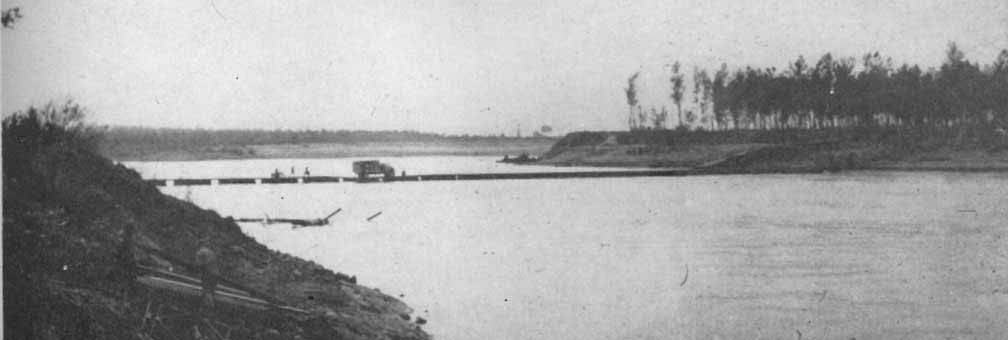
Crossing the Po
Four days later, 27 April, the same person reported that
"all yesterday and last night we spent in the same place, the reason for this was regrouping etc. This morning pulled out again and are now well beyond the Po River. The Germans didn't put up any kind of stand as was expected. There is very little fighting going on. We just drive along through the countryside as though on a pleasure ride. They are still taking a few prisoners, but not as many on this side of the river. The Italian civilians are not showing too much enthusiasm, although friendly. . . .
They seem to be awed by the vast amount of tanks, guns, and transports we have in comparison to Jerry. . . . Platoon HQ finally moved up to within driving distance."
The platoons' headquarters kept on advancing, though hard put to it to keep up with the progress of the troops. By 1 May, 485 Company HQ, with those of A, B, and D Platoons, was at Mogliano, between Mestre and Treviso, after brief stops on the way at Mirabello and Vigarano. C Platoon passed through Masi Torelli and on to Monfalcone on the Yugoslav border. The cars out on assignment were all over the lot, ready to drive off their maps again and again if need be, but doing very little work.
On 2 May came the news of the surrender of the German Armies in Italy.
"There was considerable cheering in the town," Lt. Simpson wrote, "and flares---red, green, and white--went up from every side. There was little feeling of elation or relief among us, out of general emotional dullness from too much war, and out of the feeling that we might have to move on up to the kill in Germany and Austria."
So soon as the news of the unconditional German surrender had been received, the 6th Armored Division continued into Austria. From there, H. L. Pierce, who after a year in the Middle East had served an enlistment in the India-Burma theatre and then transferred to Italy, wrote that on 8 May
"there was not a cheer or a smile amongst the soldiers over the news, and no one got drunk. The men have been at war for so long and have been through so much and seen so much tragedy that, though they are naturally terribly relieved, it just doesn't seem as if celebrating was in order. Their lives go on exactly the same as before, only now they have the extra work of endless cleaning, polishing, and being confined to their billets---as we must look just so, for we are moving through a conquered country and are not allowed to fraternize with the people in any way, except to say 'good morning' and so forth."
The 46th and 78th Divisions followed the 6th Armored Division into Austria. By 15 May, B and C Platoons of 485 Company were stationed at Radweg and Techendorf respectively. Movement was still chronic. A and D Platoons had moved by the 20th to Udine and Ioannis (just up the road from Strassoldo) respectively, and Company HQ had settled farther north at Tarcento. Meanwhile, evacuations of the sick and wounded continued---German military hospitals were transferred, in Venice the cars met hospital launches, and again there were MOs to be taken on their rounds. Some assignments were more interesting than others, but no platoon had any great burden.
The war that so long had seemed simply a matter of Allies vs. Axis in these first weeks of peace showed a much more complicated picture. In the Yugoslav border area, the New Zealand troops had faced hostility from both Titoist and Chetnik factions, which at the same time were making trouble between themselves and playing sinister games with groups of German soldiers. In Austria, Cossacks who had deserted to the German side, Tito partisans, Chetniks, Germans, Americans, and British maintained confused but independent existences. German prisoners ran their own camps, German soldiers went freely about their business, and in the B Platoon billets in Radweg there were German troops living in the basement.
Many found their emotional reactions to these complications, added to those brought on by the swift change from war to peace, most unsettled and uncertain. They were surprised to find the Austrians living in untouched villages as freely as though nothing had ever happened---in startling contrast to the rigidly constricted life permitted to the Allied troops. Most upsetting was B Platoon's job of returning the sick and wounded Cossacks to the Russians, deep in the Russian zone, where the Field Service men were told that the weeping Cossacks would be executed or, at best, sent to Siberia as punishment for their defection. The fighting war had been much simpler than this.
In Austria, horseback-riding, hiking, swimming, and boating were possible and gave relief from some of the tensions. In Italy, there were dances and parties of various sorts, a few of which ended in unpleasant accidents. There was also a good deal of traveling around---official business mixed with shameless sightseeing. The return trip after a run was likely to include any famous sites within a generous radius or even a visit to an acquaintance in a distant formation. Sometimes, indeed, business looked very much like pleasure, as in D. C. Jones's account of his trip to the Brenner Pass:
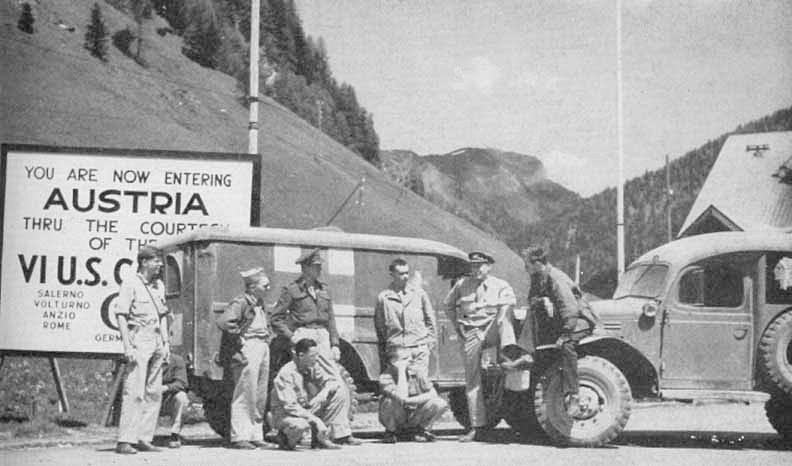
"On 15 May, 8 of us (Dick Alemang, Paul Clark, Walter Cope, Joe Desloge, Jack Mount, Drayton Smith, and Bill Washburn) in two ambulances set off for the Brenner Pass to have our pictures taken with some fellows from the French Unit. After a somewhat shaky start, in which we went miles and miles up a road only to find it blown out alongside a cliff, we finally got straightened out and reached the Brenner without incident. There was a good deal of traffic on the road---almost all of it German. It was so strange to see Jerries wandering around in the town, completely on their own; we even saw MPs. of course, actually there were plenty of Americans, but they were not conspicuous at all. . . .
"Before leaving, we had been told that we were to meet the boys from the French Unit up in the Brenner Pass and that was all: 'Oh, there'll be a town up there somewhere! Slightly vague, to say the least. Actually, the town of Brenner is on the border---Brenner on the Austrian side and Brennero on the Italian. As we came to the first houses, we were stopped by some GIs at a road block. They told us it was absolutely impossible to get across the border without a special pass from the Fifth Army, but they had a note for us from the guys who had come from the French Unit. The note said for us to go back to the next town, where some Engineer outfit would put us up for the night, and that they were going back to spend the night at Innsbruck and would meet us at the border between 10 and 12 the next morning.
"We were naturally anxious to get over into Austria and tried to talk our way through, but only generals were allowed through without a pass. Finally the GIs let us talk to the Provost Marshal over the telephone. The PM was a pretty good guy and said he couldn't let us through but that he would find some billets for us to spend the night right in town. And so we got through the Fifth Army barrier. But unfortunately the Seventh Army had a road block at the other end of town, so the situation didn't look too promising. just as we pulled up to the PM's office, a guy came out and told us that he had heard just a minute ago that our friends were waiting for us on the other side of the Seventh's block at A Coy HQ and that he would call up to have us let through. We started up again in a sort of a daze, approaching the road block cautiously, and waved to the guards as they raised it up. We missed A Coy and saw no signs of any AFS men and, asking no questions, on we went.
"Unfortunately, by the time we reached Innsbruck it was a little too dark to see much of anything, but it seemed to be a good-sized city and extremely clean. As we came to the outskirts, an MP stopped us and asked for our trip ticket. 'Trip ticket? We don't use trip tickets in the American Field Service. We're from Italy, Eighth Army.' That was a knockout blow, and he just stood gaping at our innocent expressions, shook his head, and waved us on.
"We decided that probably the fellows from the French Unit were somewhere in town and that we had gotten through the Brenner on a fluke. We asked everybody if they had seen any AFS men or ambulances in town, but it was like looking for a needle in a haystack. After looking around a bit, we pulled into the main square and broke out some C Rations. Everybody was famished, and we stood around in a circle eating out of the can, while a little pup one of the boys brought along stuck up his nose at the beans we put on a plate and set down in the middle of the circle. Numerous MPs came along, curious to know what we were doing, but we just told them we were looking for our pals. They couldn't help us any, but it wasn't for lack of trying. We had just about the whole city looking for our friends, but all to no avail.
"Finally we decided to go back to the Brenner, spend the night there, and hope the French Unit would show up in the morning. On the way out we were stopped three times by guards asking for the pass word. This whole area is heavily guarded to prevent Germans from slipping over the border. of course, the first time we didn't have the foggiest idea what the pass word could be. We explained to the guard who we were, and he told us that all we had to know was 'jazz.' He didn't know the other half, though. The next guard stopped us, and hardly before we came to a standstill one of us yelled out 'Jazz,' just to make darn sure he didn't beat us to the draw, leaving us to cope with the other half. We asked this guy what the countersign was, and, after scratching his head for a couple of minutes, he said he thought it was 'jive.' Thanking him, we drove on, all set for the next stop. A guard waved us down and came up to us, asking in a sort of pathetic voice 'Gee! Do you fellows know the pass word?' We told him, he thanked us, and we were off until we reached the Brenner. Someone found an officer and explained the situation. We were fixed up with a couple of rooms for the night and turned in.
"The next morning we cooked ourselves a darn good breakfast. . . . just as we finished, the French Unit drove up (L. B. Cuddy, B. M. Bowen, and Q. M. Hope, all former members of AFS CMF). After they had something to eat, we drove out to the stone marking the border and the pictures were taken. Our official business ended, two of the fellows took one of the cars and went back to Innsbruck, while the rest of us headed for the town of Riva on Lake Garda. . . . About noon the next day we started back to Platoon. . . . We stopped for two marvelous swims on the way, and at one place we rented a boat for a while and had a good deal of fun fooling around with that. We are still doing a certain amount of work."
To help the many travelers, whether on business or pleasure, Lt. Pearmain transferred his Liaison office from Perugia to 30 Via Morgagni, Padova, on 4 May. For a while it was thought that HQ might move from Naples into the northern area, but this became unnecessary when confirmation was received that at the end of June the Company would be relieved of its work and would then drive to Naples for disbandment. Major Perry toured the platoons to give the latest information on transfers to the India-Burma theatre and the China Unit (the latter no more definite in June than it had been in March). Priority lists were made up for men going in all possible directions, and the first batch of war's-end repatriations left the Company on 17 June.
In the meantime, Lt. R. F. Ashmun had succeeded as officer in charge of D Platoon on 20 May. In the last days of the Company's existence, Major Mitchell left for repatriation. It had largely been due to his "energy, enthusiasm, and devotion to duty," according to his commendation from the British, "that the very high reputation which his Company already held gained added glory in the final battle of the Eighth Army." He was succeeded by Major Chamberlin as officer Commanding 485 AFS ACC. Lt. W. W. Lamprell succeeded at this time as officer in charge of A Platoon. Then on 30 June the platoons came together at Company HQ in Tarcento.
On 3 July, General McCreery, Eighth Army Commander, gave the Company a farewell review.
"I was more than a bit apprehensive about the whole thing before it came off," Major Chamberlin wrote. "We are such an unmilitary outfit that a very pukka army officer does not appreciate us unless he knows us. However, the minute I met the General I knew all would be well. He is a most sincere man, who puts you at your case immediately. The ceremony took place at 11 A.M. I had the Company formed in a three-sided square (if you see what I mean). Brigadier Cameron, head medical man of the army, and Brigadier Davies, head transport man, arrived at 10:45, and we met the General on the road in front of the parade ground. As we walked to the ground, George called the Company to attention, and the General walked down each row and chatted with every eighth or tenth man. After that he came into the middle of the square and gave a very informal sort of farewell talk, reviewing the history of the Company, the battles in which we had played a part, and so on. He spoke for about 15 minutes, extemporaneously, and said some very nice things about us. When he was through, I gave 'Three cheers for the Army Commander!' Then the General talked with me and the Company officers for ten minutes or so, and it was over. . . . I only wish Ray had been there in my place, as he really deserved it."
The next day the Company left in convoy for the south, reaching Castellammare on the 7th. The men were billeted in two hotels, while the business of disbandment and turning over the ambulances was undertaken.
At this time there was rumor of another review of the Company, which some thought, considering the nervous strain of even a few hours of simulated military behavior, might be carrying a good thing too far. However, the review did not come to pass. Instead, on 13 July, Major Perry had the honor to be presented with a flag autographed by Field Marshal Sir Harold Alexander in a small and impressive ceremony arranged by Lt. Phillips at AFHQ. The Field Marshal and Generals Hartgill and Lamnitzer received Majors Chamberlin and Perry, Lt. Lamprell, and F. B. Cliffe, R. T. Coleman, R. S. B. Hopkins, C. Ives II, C. L. Ritchie, and D. M. Smith in the Field Marshal's office in the Royal Palace at Caserta. The Field Marshal shook hands with each man present, as introduced to him by Major Perry.
"It is particularly pleasing to me," Field Marshal Alexander said, "to have this opportunity of saying just a few words of thanks and appreciation for the splendid and gallant part you have played with the British Forces. And I consider it a great privilege that I should have this chance to thank you, because you and I have served together right through the whole of the Mediterranean campaigns and come a long way together from Alamein as far as Austria. You may well look back on the distinguished part you have played in this war with pride. We'll always remember you. As a small token of our regard for you, and as a memento of our friendship, which has been forged between your country and ours on the battlefield, I hope you will accept this small token---the Union Jack."
The flag had formerly flown from the Field Marshal's staff car.
The next day, the unit for the India-Burma theatre---IB 59-T---left in boxcars. After two uncomfortable days, they embarked in Taranto on the S.S. Sobieski in considerably better quarters. Major Chamberlin, assisted by several officers from 485 Company, led a group of 152, who were, with those of 567 Company who had already left from England, to form an amalgamation of the former Italian companies with the new Dodges of 567 Company. That Major Chamberlin was to head the amalgamation influenced many of the old hands---even some who had served overseas almost two years without home leave and who would thereby lose the opportunity---to sign on for a full year of further service. The only stipulation, which had been voiced by many and seemed to have been settled by the appointment of Major Chamberlin, had been that in the proposed amalgamation the members of 485 Company be considered the "equals" of the members of 567 Company. This was the curious fruit of the propaganda and rivalry begun years earlier on the sandy wastes of Tahag. Yet General McCreery had said: "No unit has a more distinguished record than yours."
The departure of the India-bound men left 3 different groups in Naples-those few still waiting their turn for repatriation, those waiting for releases to other jobs in Europe, and those finishing off the affairs of the AFS in the Mediterranean theatre. Repatriations had been continuing as fast as shipping would allow. However, the number of boats to the States fell off sharply in July, and as a trial a group was sent on the 16th to England. Major Perry followed shortly, to help with the transshipment of this group and to see whether some dependable system for the repatriation of the rest might not be worked out by way of either England or Belgium. As a result of his efforts, the last groups in Italy went home by crossing Europe and embarking in England. When the Liaison offices had all been closed, Captain Jeffress also went to England to assist with the problems of those passing through on their way back to the United States.
Major Nettleton, who had already been almost everything else, was at this time appointed OC AFS CMF. Having started as a particularly energetic mechanic, he had gone on to be OC S&T, OC AFS MEF, and OC 485 AFS ACC---a remarkable achievement made less awesome by the easy wit he brought to difficult situations. In view of his unequaled acquaintance with army Supply and Transport procedures, so often invaluable to the Service, he had long been scheduled for the unenviable task of winding up the complications of almost two years of the AFS in Italy.
Assisted by T. C. Young, and occasionally by other noble souls who were in no particular rush to get back to the States, Major Nettleton spent the next few months picking up the pieces and putting them where they belonged. The men who were to stay in Europe with various civilian jobs were released; office machines and furniture were sold; the vast real-estate holdings in Naples were one by one relinquished; and the vehicles were disposed of (some of them being donated to American Relief for Europe, Inc.).
At one point the war seemed to be on again. Major Nettleton found himself involved in gunplay in a Naples alleyway while trying to protect His Majesty's property from the depradations of a local thief. Finally, by 6 October, only Young and Major Nettleton were left, and the office was announced closed. They thought to leave in a day or two. But shipping played its final trick and it was two weeks longer before they boarded ship---with a battle-scarred ambulance for the Richmond Museum.