 George Rock
History of the American Field Service
1920-1955
George Rock
History of the American Field Service
1920-1955
CHAPTER XI
|
Cor blimey, mate, the plains, the bloody, lovely plains! ---BRITISH SOLDIER at Meldola on sighting the Po Valley |
The Gothic Line stretched from Massa on the Gulf of Genoa along the high Apennines to Pesaro on the Adriatic Sea. No frontal assault could be expected to succeed against a natural barrier of such proportions; and after it had been fortified in depth by the Germans it might well have been considered an impregnable position. The scores of rivers running down steep and narrow valleys on both sides of the mountains promised a difficult ascent under the eyes of the enemy and a wretched descent over difficult terrain on the opposite side. The best and lowest crossing through the mountains was the Futa Pass on the main Florence-Prato-Bologna highway. While 13 Corps was still engaged in clearing Florence, the Fifth Army directed an attack along this road.
At the Adriatic end of the Gothic Line, however, the mountains were lower, and, in spite of innumerable rivers and canals, this was considered the only other sector of the line susceptible of being broken. Before Florence had been taken, the Eighth Army was assigned the task of outflanking the Gothic Line by an attack through Pesaro to Bologna and on into the Po Valley. Secretly, in order to gain what advantages surprise might allow, the units under Eighth Army command were regrouped and transferred to the east. As the winter would begin earlier in the north, speed was essential. The attack was scheduled for 25 August.
On 21 August, the entire 567 AFS ACC left Castiglione del Lago for the west, called forth by Eighth Army to take part in the coming assault. After a hot and dusty drive, the Company leaguered in an open, treeless field in battered Foligno. The direction of the next stage of such a large convoy was to be kept as secret as possible, so the Company remained in Foligno until late on the afternoon of the 22nd. The drive over the Apennines to their destination was planned for the dark of a moonless night with a minimum of car lights. After a few hours, the orderly convoy was reduced to confusion by the pall of fine dust which rose from the road into the stygian dark. Cars lost sight of the tail lights of cars ahead, got lost, and led others astray. There were a number of minor accidents and breakdowns. And one of the lumbering Fords was bumped off the road and down a hundred-foot cliff---injuring both occupants so seriously that they required hospitalization and, ultimately, repatriation.
At Macerata the Company split---B and D Platoons carrying the personnel of 12 CCS to Osimo while A and C, loaded with the Eighth Army stretcher and blanket dump (44 stretchers and 22 blankets per car) went on to Iesi for the night. Their move continued the next day to the Falconara area, a few miles above Ancona---workshops setting up in Falconara and Company HQ a couple of miles away in Castelferretti. After a day and a half of orders, counterorders, and administrative confusion, the Company was posted: A and C Platoons with divisional assignments in 5 Corps, half forward and half at CCSs in the rear; and B and D Platoons under Eighth Army command for rear work. B Platoon was assigned to I Canadian General Hospital in Iesi. D cleared a General Hospital back to Perugia and then was posted next to Company HQ to evacuate the neighboring 15 CCS to the near-by airfield at Chiaravalle. By the 25th, 567 Company was spread across the Eighth Army front, ready for the assault on the Gothic Line.
The attack was scheduled for 2359 hours on 25 August. It started off well. On 26 August, 5 Corps took Urbino and advanced inland toward the Foglia River. The Polish Corps on the coast took Fano on the 27th and, overcoming fierce resistance, entered Pesaro on the 30th. In the line between 5 Corps and the Poles, the Canadian Corps consolidated its position at S. Marino on 27 August and advanced to the Pesaro lateral road beside the Poles. When Pesaro had finally been cleared of the enemy on 2 September, the Polish Corps was sent to rest.
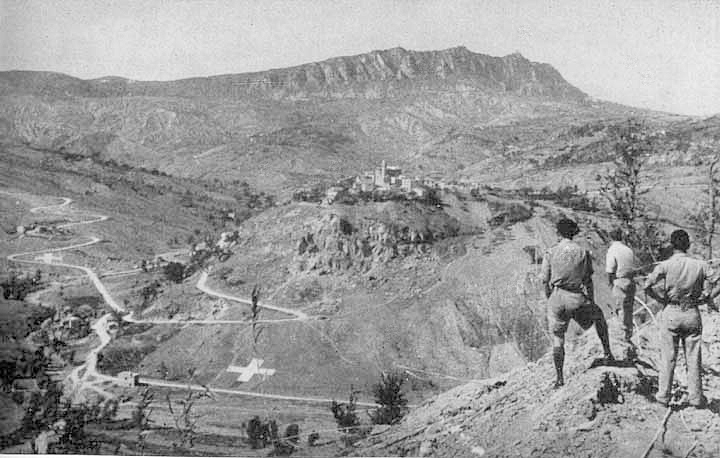
In the next 5 days the first of the fall rains turned the dusty roads into slimy tracks, washed out bridges, and isolated groups of forward troops. German resistance stiffened. The enemy artillery poured a rain of shellfire on forward positions, and counterattacks brought heavy casualties. The maze of waterways gave countless opportunities for small but effective holding operations. From 5 to 12 September the Canadians fought against bitter opposition for the few miles of the Coriano-Gemmano Ridge, just inland from Riccione. Defeated there, the Germans fell back to a line extending from Rimini along the many-branched Marcechia River. There was further heavy fighting before Rimini was taken on the 21st, but with its fall the Gothic Line had been flanked.
Then the Eighth Army attack turned west along Route 9, the Via Emilia, toward Bologna. The advance beyond Rimini was slow and heavily contested. In the next week, S. Arcangelo was taken and 5 Corps crossed the Rubicon. On the 26th the fall rains started in earnest their daily harassment. The attack did not move 10 miles in the following two weeks. On 1 October, General Leese was transferred to an important command in the India-Burma theatre. He was succeeded as Commander of Eighth Army by General Sir Richard L. Mccreery, formerly OC 10 Corps.
For 567 Company, the first 6 weeks of the autumn offensive brought strenuous work under rugged conditions and heavy casualties---2 killed, 4 wounded, and 1 taken prisoner. From those working in the forward areas came a fine crop of stories of close escapes and heroic deeds. The heavy casualties to the army called for as hard work as the Company had ever put forth.
All worked hard, but A and C Platoons had most of the excitement, serving with forward elements of 4th and 10th Indian, 1st Armored, 46th, and 56th Divisions. The original assignments of A and C to 4th Indian and 46th Divisions were shortly altered so that cars from both platoons were with every division in the 5 Corps line. Postings were frequently changed, as was necessitated by the many changes in the Corps set-up. For example: 1st Armored took over from 46th Division on 4th September, 4th Indian was relieved by 10th Indian, which it in turn relieved on 2 October, and 56th Division came out of the line on 11 October.
The forward half of A Platoon, under Lt. Atwood, worked through S. Lorenzo-Morciano-Serravalla-S. Arcangelo. The forward half of C Platoon, under Sgt. A. G. Ecclestone, Jr., went through the mountains by way of Cagli-Fossombrone-S. Marino-Verucchio. The September rains turned the steep and narrow roads, poor at any time, into slippery mud, deeply rutted, and bounded by ditches filled with torrential streams. Road evacuations were unusually difficult because of traffic congestion, one-way roads, numerous diversions, and increasing distances ---in addition to the hazards of war. The Fords would have been impossible under such conditions, and the Indian divisions refused to consider them for forward work. This led to reassignment of A Platoon's Fords at this time and to a complete reshuffle of the Company's cars for any major shift of postings.
The new advance started with a tragic double fatality. P. H. Cagle and J. B. Wilton were both mortally wounded on the morning of 4 September. They were attached to the RAP of 5 Hampshire Regiment (46th Division), which had pushed a salient into the enemy lines at S. Clemente, several miles north of Morciano. This was contested with a heavy artillery engagement. When the shelling came over the RAP area, Wilton, who was loading his ambulance, took shelter underneath it but was hit. Cagle and a British orderly went out from the shelter of the house to bring Wilton back into the RAP. Cagle was hit by the continuing shellfire as he bent over to assist Wilton. Both were evacuated to Morciano, where Paul Haynes Cagle died the next morning and James Bennett Wilton, Jr., survived until the 9th.
A week later, early on the morning of 11 September, H. P. Metcalf, Jr., with an officer and an orderly went on foot to answer a call for help from a 56th Division RAP. They were not seen again for many months. The RAP was only a few hundred yards from the enemy lines, and the little group just walked into a German post and were taken prisoner. When the area had been cleared, Lt. Perkins scoured the roads without finding a trace of Metcalf. No one could be sure of what had happened until, on 6 November, W. C. Wakefield found in Magliano a wall covered with inscriptions by prisoners of war. Among the rest were Metcalf's name and initials.(16)
During the fighting for the Coriano-Gemmano Ridge in the following two weeks, four members of A and C Platoons were wounded. On the 11th, a shell landed a yard from the rear of W. A. Chapin's ambulance as he was returning with a load of patients from the Indian Division's Recce RAP. The gasoline tank caught fire and the ambulance burned completely away. The two sitting patients opened the door and got out, and the stretcher patient managed also to climb out of the flaming car. Chapin received burns for which he had to be briefly hospitalized.
In Montefiore, both J. P. Morris and R. E. Kennedy were wounded, both so slightly that their accidents could be considered comparatively pleasant. On 10 September a shell landed near the 167 ADS (56th Division), and fragments nicked Kennedy on the shoulder and the back of the hand. He was eating lunch at the time, and his wounds were so slight that he did not even put down his tea while he was being treated. Four days later, Morris had his ear nicked and the top of his head scratched by fragments of a shell which landed only 5 yards from the front door of the ADS of 32 Indian Field Ambulance.
Then, on the 15th, G. A. Sears was wounded while driving from S. Clemente west to 1 LFA at Agello. A tank in the road ahead of him drew German fire. Sears got out of the ambulance and into a protective ditch. He failed to get all of his left leg under cover in time and it was hit, receiving a compound fracture. The advance was costly to the AFS, though as usual it was remarkable that it had not been more so.
The forward work was demanding and no less hazardous than usual. Colonel Richards, OC 214 Field Ambulance (56th Division), wrote of the activities of M. D. Wright during the advance from Croce to Ceriano Ridge, just south of the Marecchia, River:
"On 21 September [Wright] went out to collect some wounded who had been reported to be in the brickworks near Falciano. As soon as his vehicle came into view of the enemy, heavy mortar and shell fire descended upon the road. He drove through, and he and his orderly found two severely wounded men in the brickworks, which was being shelled at the time. They dressed the wounded and put them into the ambulance.
"On the way back, two shells bursting near the vehicle disabled it and rewounded both patients. They carried the latter to cover in a ditch. Vol. Wright sent the orderly to get help from the ADS and himself stayed with the patients and rendered them first aid. No help came from the ADS, and Wright made several other attempts by contacting local troops to get help. Finally, over an hour later, a driver of 75 Fd Regt RA drove an assault scout car up, and the wounded were loaded onto it. The scout car was then driven to the ADS, Vol. Wright standing up in it holding a red-cross flag in the hope that the fire would cease, which it eventually did. The slightest movement on this part of the road brought down shell and mortar fire, and throughout the expedition Vol. Wright was subjected to repeated spells of intense fire. By the time Wright had got the ambulance and the orderly back to the ADS, he was able to count shrapnel holes in the windshield above his head, through the radiator and gas tank, and in the engine and undercarriage to a total of over 30."
The end of September was also sticky going for the Indian troops, as it was all along the line. It was next to impossible to keep the roads and tracks open. Mud and landslides blocked diversions. The hastily repaired demolitions were undermined. River fordings were washed away by the torrents that rushed down the mountains after each rain. Traffic jams lasted for hours and held up all transport. Major Minford of 17 Indian Field Ambulance wrote that
"here as elsewhere the exploits of the American drivers soon became the talk of the Division.
"McKinley, so well known and beloved from Tunisian days, reappeared and was soon 'in the thick of it.' When attached to the 1st Royal Sussex RAP he drove every type of transport except a tank . . . in his efforts to get the wounded across the flooded Rubicon. When he could not get his ambulance car forward, he deserted it for a jeep or a 'duck' ---at one stage, when for a time evacuation was impossible, he formed a first-aid post under the nose of the enemy. On that day we all felt uneasy about poor old Mac, but he soon appeared with his 6 badly wounded men to inform us that next trip he could make it in his Dodge.
"Then there was Jack [Bathgate], with his rows of last war ribbons, leading my convoy and getting every vehicle through when it seemed impossible to do so. Weather conditions and roads were as bad as they could be, and I had gone forward to recce a new area. Darkness fell over the mountainous country and conditions became, if anything, worse. A very worried man, minus my ADS, I fell asleep with little hope of seeing my unit for 24 hours, and then not all of it. I was awakened at 1: 30 A.M. by a voice enquiring 'Where now, Doc? They are all outside! He confessed that he had to ditch a few Brigade vehicles to clear the road, but didn't appear worried about the consequences. That night I damn nearly kissed poor old Jack."
Many of the Divisions' enthusiastic MOs wrote for W. W. Phillips some reminiscence of the advance from Urbino through Tonaletto, Montefiore, Gemmano, S. Marino. "The half-inverted horseshoe of their C Platoon was always an eagerly sought emblem," wrote Captain Rees of 32 Indian Field Ambulance. Others commended the work of W. J. Bell, Jr., G. R. Collins, J. P. Morris, T. Schick, "young Bill," and frequently "the gallant Johnny Meeker."
The rear work was more gruelling than it had ever been before---roads no less bad than at the front, evacuations longer, and casualties heavier than they had been since May (an average of over 3,000 per week during September). The halves of A and C Platoons, under Sgt. Griffin and Lt. Blair respectively, were doing the CCS evacuations. At the beginning of September they were together with 1 CCS at Fossombrone, but they soon moved to Montegridolfo to work with 5 CCS as well, 1 CCS moving up on the 9th. Evacuations for the first half of the month were to Pergola and Fano, Urbino later taking the place of Pergola. "Work was very heavy during this period (9-15 Sept.)," Lt. Blair wrote, "reaching the peak of 300-400 patients evacuated in 24 hours, necessitating 3-4 trips per car per day on a 2 1/2-4 hour turn-around run, often in bad weather on greasy roads." On 13-14 September, part of a 5 Corps MAC was sent to 5 CCS to work for one day "so that AFS cars could have a 24-hour rest and get some sleep." For the next 4 weeks they made the same evacuation from 18 CCS in Morciano, the amount of work slacking off toward the end of September.
The rear evacuation of the many casualties of the Eighth Army advance was, also the assignment of B and D Platoons of 567 Company and A and B Platoons of 485 Company. D continued with 15 CCS, as first posted, through September. However, B (567) remained in Iesi with 1 Canadian General Hospital only until the beginning of the month, when the Platoon was divided into two sections to serve 4 and 5 Canadian CCSs. On 8 September it was assigned for the next 5 weeks entirely to 5 Canadian CCS in Cattólica, where its duties with 4 CCS were soon taken over by B Platoon (485). Evacuations were to Iesi, with occasional runs to Fano and Senigillia. In mid-September, Lt. Hobbs went to a job in Naples HQ, and C. E. Perkins, for some time the Sergeant of B Platoon (567) was appointed its officer. He was assisted by R. E. Wilson as Sergeant. Wilson during the following months was successively succeeded by H. A. Merris, B. Sleeth, and L. Kelly.
During September, the shifting around of the Company's ambulances was in full swing. The divisions refused to allow Fords on forward jobs, so the cumbrous vehicles had to be assigned to groups in the rear and reassigned as postings or roads demanded. The morale of B Platoon was said to have improved after .17 Dodges were allotted to its members. At more or less the same time, D Platoon received 3o Fords in two installments. The result was staggering:
"Today is the first day that we, having traded 13 of our oldest Dodges for .13 new Fords, tried them out on our patients," C. F. Zeigler wrote on 12 September. "At the end of this day one of them has been turned over with 4 stretcher cases, three have been pulled out of deep ditches, and another broke through the side-beams of a bridge and hung balanced at a 45-degree angle until it was righted by a derrick and brought home. Add to this the tragedy of a drunken Greek driving a big carrier over a one-way bridge smack into one of our Dodges, pushing its motor back into the driver's lap, and you have the day of all days. Beside which, one of our drivers on getting into a new Ford practically knocked off his knee cap and may have to be evacuated. . . .
"These Fords . . . are 6 times as heavy as our Dodges, as wide as a Philadelphia row house, as high as a box car, and have the pick-up of an ox team running through a rice paddy. They have two- instead of four-wheel drive and about enough power to run the lights. Their wheelbase is from here to early next month, and this requires a turning radius of something approximating a gridiron. They have right-hand drive, and the driver sits out over the engine. The gear-shift lever is at the left and way back, so you have to reach for it without looking or you are liable to turn over . . . like sneaking feels in a picture show."
By this time the mechanical defects of the particular model had become apparent, and these were neither few nor minor. "During the month of September this Company had its first real chance to try out the 66 new 3-ton Ford ambulances which it had received in July," the Company diary reported. "The Fords have so little power and traction that they are completely unable to operate on any but first-class, hard-surfaced roads. They have several serious inherent mechanical defects---including weak frames, faulty ignition systems, inadequate brakes, a body that is little more than tied to the frame, and gear-boxes that will not stay in gear."
There was no softening of this indictment for army eyes, not out of rudeness but because both the organization and the thinking of its members were conditioned to forcing a small ambulance to usurp so far as possible the place of stretcher-bearers. Neither AFS tradition nor AFS temperament made anyone inclined to be polite about the Fords, though in spite of their defects D Platoon, for example, carried 6,000 patients in September and traveled a distance of some 22,000 miles. It was clearly better to drive the Fords than nothing at all.
The work of D Platoon in September was much like what the whole Company had been doing all summer, though it was, like the current battle, more strenuous. Toward the end of the month, when the work all along the front had somewhat slacked, C. F. Zeigler wrote of the daily routine:
"At 7:30 our bike courier comes back from the CCS to report how many vehicles are needed for early morning air evac . . . usually 10 or 15 ambulances. We move up to the marquees of hospital tents where Indian, Mauritian, or Italian stretcher-bearers load us up. Sometimes we have priority loads: head, chest, or spinal fracture cases needing special driving care. Other loads include fractures and amputations, painful but not serious, still difficult to handle on account of the splints. Other types of case include shrapnel and bullet wounded, often in great pain, but usually unworried and more or less cheerful. The last type of patient is the sick---from jaundice which is now in season (and we have some high chrome yellow fellows), from malaria which will carry on here until the end of November at least, or ischio-rectal abscesses, boils, infections, and other diseases that make soldiering difficult.
"When loaded we check out of the CCS, pick up kit and pack at the pack store, get a check on the number of stretchers, blankets, splints, and pajamas on the load, and then take off for the airport. The port we are now using is just 6-5 miles away. The fastest time I have made it is in 45 minutes; the slowest 1 1/2 hours. The speed depends upon the condition of the road, traffic, and (chiefly) the patients. Since the roads are lousy with chuckholes , fast driving is impossible. With not-so-sick patients you can go as fast as it is safe to take the car over the bumps. With painfully or dangerously wounded, we go as slow as the car will take it and often stop to check their condition en route.
"At the airport we check in with medical cards, find out the destination of our patients, and wait until a plane arrives that can handle our men. This takes from 10 minutes to 2 1/2 hours. If there is a wait of more than 15 minutes, we drivers go to a Red Cross canteen and pick up tea or lemonade biscuits, and cigarettes for our patients and sometimes copies of the Eighth Army News, Stars & Stripes, Union Jack, or other current paper for the boys to read. I keep all the magazines you send me in my car as a sort of traveling library. If the lads are not too bad, they like to read and drink tea. If they are in pain, I talk to them, get them to tell me what happened to them and where, how the fighting is going, where they came from---and jokes and stories. . . . After we unload our men onto planes, up to which we back our great hulking vehicles, we load up on empty stretchers and blankets and bugger off smartly for home. Occasionally there is a second morning run for some, but usually one takes the whole morning. . . .
"In the afternoon we very possibly make an air evac run similar to that of the morning. It differs, however, in that the patients, worn from the day, are more pained and difficult to handle. Waiting drives them mad, and they become irritable and bitch a great deal. We all bugger back to camp from air evac or road evac at all hours in the evening. Road evac takes longer---may get you back long after dark. . . .
"One thing pleases us very much: the Tommies invariably say that the Yanks give them the smoothest rides of all the ambulances they ride in. A smooth ride---or as smooth as humanly possible---is one of the first notions you get in the AFS and it haunts you all the time. You go slower over a road the longer you use it. You study the ruts, you know them all, you are afraid you are going to jolt the hell out of the lads. It helps to have a change of scenery, a new road or track over which you have not become fanatically self-conscious. If you used the same track for more than a month, you would probably be afraid to use it. . . .
"As I write this in my ambulance, a big white ox has come up and is eating grass right at the rear end of the car. She is being barked at furiously by our Platoon pup, a midget Eyetie dog that we call Clem because we were first under the impression she was a boy dog. Beyond the ox is a freshly plowed field, beyond that the hills, and then the mountains. . . .
"I have been having adventures with . . . stalwart warriors so weakened with pain or so comatose they cannot withhold the foul putrescences that are ordinarily taken care of with prim and prudish care. Since most of our evacuees are removed by plane, they are generally so seriously wounded they are given injections of morphia or a strong whiff of chloroform before they are given over to our rough, albeit sympathetic, mobility. At first they settle well in our four-stretcher jobs, some sleepy, others dopey, some far gone in slumber, and others grinning foolishly. But as we proceed over these rutty tracks laughingly called roads in Italy, the balms and unguents wear off, and waiting for minutes and sometimes hours becomes annoying to the point of anguish. Those who can help it never complain, but ask again and again 'How soon will we get there, Yank?' But during these returns from the shades there is generally a freeing of the private parts and a great urge to do one thing or the other. . . .
"Yesterday while I was going over a pot-holed road in low, the engines grinding very loudly, I heard them talking behind me and, because I cannot completely understand English as it is spoken by the British, ignored it. But then one fellow yelled 'Stop it, Yank, we're being murdered'. . . . Fortunately I was at the end of the convoy, so I could take time off to throw open the rear doors and swing my arms around. . . . It was not difficult to isolate the case. The only fellow not complaining was a large, unblinking Scotsman. . . . As he looked down at me between his two broken legs, both in splints at different angles, he said---still solemn---'I couldna help it, lad. With one leg tied to me belly and the other to me back, I couldna hold it back, much less pinch it to squeak ye a warning!' . . . Rather coarse, but since the workings of the body and the preservation of same is part of our immediate duty, it must be recorded."
The rear evacuations on the Adriatic sector were so heavy that at the beginning of September, in answer to a rush call, 485 Company had sent its A and B Platoons, with half the workshops under MSM W. D. Parry, to assist. The first to go over was B, which worked around Falconara. After briefly replacing B with 2 CCS in Siena, A Platoon drove to Fano on the 5th. Both platoons evacuated 14 CCS to Ancona and Porto Recanati. It was a long run and there were many of them, but the work was a change from the comparatively idle days in Siena.
"We're in on the big push and there's lots of work to be done," wrote M. G. Hastings of B Platoon on 8 September. "I remember I mentioned how much it seemed to me the fellows drank and messed around when there wasn't much to do---but now every last one is chipping in willingly and driving themselves groggy. I guess the AFS is like that---fooling around until the chips are down and then they're there. One day I carried 4 stretcher cases for air evacuation, 40 miles round trip after breakfast-made lunch here-left on a 120-mile round trip with 9 sitters to a general hospital-got back for a bite around 8---and left again for the same place at 9 with 4 stretcher and 1 sitting patient. Got back at 4 in the morning and left again at 8:30 after breakfast. Some of the cases are dreadfully serious---loss of limbs from shellfire and mines, and terrible burns, and loss of eyesight from rockets. One has to drive 5 mph over rough diversions, and at night driving long runs with blacked-out lights in the rain against 60 Sherman tanks coming up is no fun. . . .
"While coming back from a run empty, I came across two Eyeties who'd stepped off the main road and were blown up by mines. I got help and loaded them into my car on stretchers, and a British Major who stopped sent a motorbike for morphine. After it arrived and the Major had administered it, I drove to the nearest medical post, which happened to be a Polish CCS. There, after unloading the patients, a very pleasant Polish nurse made me some cocoa in her tent. One sees Polish girls driving trucks and jeeps everywhere. . . .
"A Platoon is here helping us."
A Platoon stayed in Fano, later attached to 1 CCS until on 6 October it moved north to a dismal field outside Riccione, where it suffered a fair degree of idleness for several weeks of evacuating a combined general hospital and CCS. B Platoon had a shorter and more active stay on the east coast. It moved briefly in mid-September to 9 Indian CCS in Urbino and then to 4 Canadian CCS in Cattólica (next to B Platoon of 567 Company, then with 5 Canadian CCS).
Of this posting, established by the sea with the cars parked on the beach, Hastings wrote that
"the Commanding officer must have been after a VC when he set up the CCS practically on the front line. When we arrived the morning after the CCS was opened up, the road barrier was a mile and a half down the road and the lines about several miles farther. The CCS is really functioning as an MDS. Anyway, the set-up is far enough forward to be in front of our artillery and subjected to Jerry's return fire. The other evening I watched an infantry patrol pass by on foot on their way into the line, and later that night, when I made a run, I saw a whole brigade walking quietly through the night as they moved up into the line with loaded rifles.
"In fact, we're in position to see the whole show as the Eighth cracks the Gothic Line. We can sit on our cars and see our guns shell the ridges, or see our planes bomb a town up the coast (saw one get shot down into the sea), or watch a smoke screen being laid only 4 or 5 miles up the beach, or watch our ships out at sea maneuvering as they fire (and when Jerry sends up a geyser of water from a close one they lay a smoke screen and circle off). The first night here, while waiting for a run around 2 in the morning, I sat on the steps of the CCS, once a most modernistic institute of some sort for children. From where I sat I could get quite a view of the lighting effects of war---just in front of me the fields glared from the white flashes of our guns, inland flares drifted lazily over the ridges, to my right the sky burned with the gun barrage laid down nightly, while up the coast Jerry ack-ack and tracers laced the sky searching out our planes. Lads coming back from the front say this is worse than any of them---worse than Africa or any place in Italy. Jerry has easily as much artillery as we have and he's deadly with it from his high points on the steep rock ridges. . . . Although the resistance may be fierce in France, it has been deadly here. . . .
"Went up into [Rimini] after it had fallen. The fighting troops had moved to the other side, and the city was supposedly closed to troops. It was weird walking through the deathly still streets, climbing over unbelievable heaps of rubble. Other than the occasional roar of guns shelling Jerry over my head and the quiet crackle of flames slowly eating up the interior of wrecked buildings, it was so damn quiet that when a window pane broke from the heat or a fire-eaten wall collapsed---your heart stood still. I was in the city for several hours and saw only 3 civilians. There were no welcoming citizens strewing flowers. They'd all taken to the hills during the heavy bombing, continuous shelling, and destructive naval activity. Sometimes one would be up even with second or third-storey windows while climbing over the great piles of brick, stone, and timber. Destruction was terrific. Every other house had been hit severely. The stench of unburied bodies lay low in the hot, dusty alleyways. But it was the deathlike stillness that was most impressive."
By the end of September the rush of casualties was over. On 1 October D Platoon of 567 Company went to rest in billets on a hilltop outside of Pesaro, and two days later B Platoon of 485 Company left Cattólica and returned to 13 Corps in the west. The strain of the first 6 weeks of the difficult Eighth Army advance against continued resistance, with both terrain and once again the weather firmly in favor of the enemy, made a switch between the platoons of 567 Company advisable. Therefore, between 10 and 15 October, B and D Platoons replaced A and C in forward work with 5 Corps. The change-over took several days because all posts had to be kept covered at all times and there was the intricate problem of transferring the Dodges and Fords about. At the same time, the Eighth Army stretcher and blanket dump was handed over to a British MAC. A Platoon took over B's duties with 5 Canadian CCS in Cattólica, and C took over D's old billets in Pesaro, where it remained at rest until 21 December. For the next 11 weeks, B and D Platoons inched slowly along the Via Emilia as part of the advance on Faenza. At the height of the push in September, a number of Eighth Army formations had been withdrawn to take part in the fighting in north west Europe. This was part of a process that had been going on since 7th Armored Division had been withdrawn from 10 Corps in the fall of 1943- What this drain of seasoned troops may have done to the strategy or performance of the Allied campaign in Italy, the Forgotten Front, can only imperfectly be gauged by the progress made in these next 11 weeks: the front was with great effort pushed back a total of approximately 25 miles. The Eighth Army advanced along the Via Emilia, taking Cesena on 21 October, Forlimpopoli the following week, and Forli on 9 November. Troops trying to cross the level ground north of the Via Emilia found that the enemy's determined stands at each of the many rivers, streams, canals, and ditches made the going extremely slow. Ravenna was not taken until 4 December. However, from mid November the Germans had been trying to pull the fighting back into the mountains, where a bitter struggle of ambush and artillery power was waged from mid-November through December. Faenza was finally taken on 17 December. Then the enemy evacuated the short distance to the Senio River, where the armies settled into the second winter line. During the winter, more Eighth Army troops were sent from Italy to northwest Europe as well as to Greece, their places being taken by fresh troops from Brazil and additional Italian units.
When B and D Platoons of 567 Company took over the forward positions in 5 Corps, the split-command arrangement used by A and C was continued. Halves of both platoons were forward with RAPs and Field Ambulance ADSs and MDSs, while the rest, with part of the Reserve or HQ Group, stayed with the advance CCS. At the time of the changeover, D Platoon was assigned to 10th Indian Division in the mountains south of the Via Emilia. B was split between the 46th and 4th Divisions (until the 46th was withdrawn around the 16th). Following the shift of the fighting from the plains to the mountains, first B Platoon and then D had the major share of the excitement and its accompanying unpleasantness.
While D Platoon established its new HQ at Morciano with 18 CCS, to which 24 cars from both B and D Platoons were assigned, B settled in S. Arcangelo. Here on the 19th it was joined by the advance section of the CCS. On the same day, forward troops entered Cesena. The enemy had left the usual rearguards at the River Savio, running through the western part of the city. Cesena, though technically taken, continued for some time to be a noisy and not very healthy spot. On the 20th, Lt. Perkins chose a house there for his new Platoon HQ. He left Sgt. Wilson in charge of it until the town was taken and, as he wrote in the Platoon diary, the new billets "were sufficiently safe to occupy."
At 6:30 on the morning of the 21St, several ambulances helped move the HQ to its new location, arriving at about 8. The British were still trying to get across the Savio, and, as at any of these river crossings, an ambulance driver had no notion of what an assignment might entail. With variations one way or another, a number of men had experiences resembling those recorded by R. B. Taylor on this day.
"At 10: 30 Our Sergeant, Bob Wilson, came up to our group and said that the first man was to get out immediately and report to the ADS in the city as special driver for the Royal Fusiliers. I happened to be it.
"An orderly from the Royal Fusiliers conducted me to the ADS in the middle of the city. We reported to the MO, a Major Marks, who instructed me to report to the RAP in a public school on the bank of the river. It was then about 11 o'clock, and upon arrival I reported to Lt. Lanham, who was happily lying in a safe dugout with about 40 stretcher-bearers and medical personnel. There was also a wounded Major of the Royal Fusiliers who had just been carried over the river on the backs of two Tommies with shrapnel through his ankle. He was a grand fellow and kept up morale with witty remarks, as everybody was pretty seared. We were being heavily shelled and the noise was terrific..
"Shortly after 11:30, 5 Tommies came in with various degrees of wound, none of which was serious. I was instructed to take the Major and the 5 Tommies and evacuate them to the ADS in the town, about a mile away. We loaded the Major on the left-hand side of the ambulance, behind the driver's seat, and the 5 sitters on the right. We had to drive along the river, fully exposed to the Jerries. Two minutes had barely elapsed when a shell burst behind us and the car quivered like a torpedoed ship. I momentarily cut our speed, and the Major bellowed: 'The driver has been hit!' I weakly answered 'No' and put on full speed and arrived safely at the ADS. After unloading the wounded, I went back to look at the car. There was a hole as large as a turkey egg through the left rear door and a piece of shrapnel in the dashboard not more than 3 inches from my head. Other small pieces were on the floor and embedded in the car. It was a lucky break, as if the shell had landed on the other side of the car it would undoubtedly have killed the 5 sitting wounded, who would have been in direct line of fire.
"After filling the car with rations and getting an extra orderly, we returned to the RAP. Just as we passed the main bridge at Cesena, which had been completely demolished, we spied directly in front of us tracer machine-gun bullets coming from the opposite side of the river. We pulled hastily in behind a clump of trees until this Jerry pastime ceased. Upon arrival at the RAP, things were really hot, but we were safe in the nice cellar of the public school. I left the ambulance at the entrance and, while I was inside, it was hit by falling bricks, one of which broke the gear-shift handle.
"As no wounded were coming in, Lt. Lanham asked me to go with him on a recce to attempt to set up a safer RAP farther down the river where the Royal Fusiliers and West Kents; had advance posts. We went through devious routes and found a spot near an old bridge which he thought adequate. We then returned to Brigade headquarters and he went in to see the Commanding officer. After half an hour he came out and said that at 8 o'clock we were to lead a platoon of infantry, engineers, and sappers; to the spot by the river, where they hoped to be able to build a bridge.
"With Major Reese of the Royal Fusiliers and Lt. Lanham in my ambulance, we led an expedition of about 12 trucks and jeeps down through the town. When we got within 100 yards of the bridge, all hell broke loose, and we all hastily lit out for the nearest house beside the road. Jerry must have seen us coming, and for an hour he kept shelling the bridge and the houses along the road. We all crouched down on the floor and prayed that he wouldn't hit us. Finally Major Reese took about 40 engineers and sappers and made a dash for it. They arrived safely and began to build a small bridge across the river over the remains of the old.
"Lt. Lanham and I were about to go back to get some of our stretcherbearers and orderlies, when a sentry rushed up the road and said that a shell had hit the outpost where the men were working and that there were many casualties. We got into the ambulance and reached the point safely. Confusion was rampant when we arrived. Men were lying all over the place moaning, some screaming. Still under fire, we somehow got out the 4 stretchers and went to work. The first man I saw I grabbed and with one of the engineers tried to put him on a stretcher, but when we picked him up we found he was dead. Finally we piled 4 badly wounded boys in the ambulance, Plus 3 sitters on the back, and made for the ADS. It took almost half an hour to get there and back, and I made three trips, evacuating 16 wounded. Three were left dead.
"At about 5 in the morning, Lt. Lanham and I went back to the ADS and picked up Herb Merris and 15 members of the medical unit and returned to the new RAP. In the meantime, wounded were being brought on foot through the river, who we evacuated to the ADS. When dawn came, the firing ceased and the peace of a beautiful day seemed to reign. Lt. Lanham and I crossed the river, in a small ferry paddled by 6 men, to find a house on the far side for a new RAP. He then returned and sent over 8 men to establish the post. Wounded Tommies and Germans were then ferried across or brought on the backs of our stretcherbearers, though the water was icy cold.
"At 11 the shelling started anew, and Lt. Lanham sent word across the river to abandon the post and come back. This maneuver was successfully carried out without casualties, although it was done under incessant fire. At 12:30 the shelling got worse, and we all lay down on the floor of our shelter flat on our stomachs. Again the MO decided it would be suicide to stay and asked me to take 8 men and make a break for it. He and Herb Merris took 6 and followed. You can imagine we did not loiter on our way, and why there are any springs left on the ambulance after hitting all the shellholes I will never know. We stopped in the outskirts of town and got welcome shelter in an Italian house. Everyone there was in good spirits, and the head of the house passed around apples and cakes. Although I had not eaten since breakfast at 10 the day before, I was without appetite. . . . We returned to the ADS a little later and Major Marks told me to get relief, as I had been on the go for 27 hours without stopping. I returned to Platoon HQ and Chuck McLouth relieved me. After a good warm meal, I went to bed at 5:30 and slept for 14 hours."
C. D. McLouth, when he took Taylor's place the afternoon of the 22nd, found that, although the battalion of Royal Fusiliers was across the Savio, tanks were the only vehicles that could be taken over until a bridge had been constructed. Under constant enemy shelling, the engineers continued to run the ferry, which brought casualties over and took supplies back. When McLouth was sent up, an AFS post had been established at this ferry, with C. R. McGuire and R. C. Sinclair under H. A. Merris. That night, shortly after 12, a shell landed in the midst of the group of engineers working on the bridge. Lt. Perkins reported that the AFS group at the post attended to the killed and wounded with "great gallantry and spontaneous intelligence," assisting the stretcher bearers in the subsequent flap when many were reluctant to leave shelter.
It was several days longer before the Savio was crossed by troops in any force and the advance could be continued to the next stream, canal, or ditch. The enemy's strategy was to leave a small force to fortify and defend each waterway, impeding Allied progress as long as possible before leapfrogging back over another force at another stream, canal, or ditch, where the performance would be repeated. It was not a new technique, but in a region crossed by so many waterways it had great effectiveness, making the advance through Forlimpopoli to Forli and the Montone River both slow and costly.
Before the Montone was reached, on 20 November, N. O. Jenkins was slightly wounded while with the Surrey RAP 2 1/2 miles northwest of Forli. He was bowled over as he entered the medical station by the blast from a mortar shell, a fragment of which entered his leg. The wound dressed, he continued on duty for 12 hours before he found time to have the leg X-rayed to make sure there was no serious trouble. "It was only a very slight wound," he said.
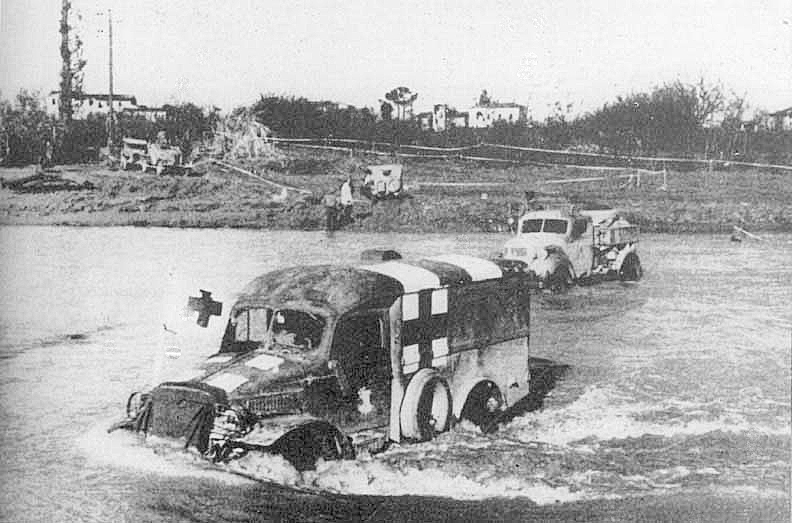
The first wheeled vehicle across the Montone was driven by T. N. Cook in quest of 6 badly wounded patients.
"I can't very well say he exceeded his duty," Lt. Perkins later wrote, "as in the AFS I believe the sense of duty in this respect exceeds that of many other units, and the men feel that any extreme is still in the line of duty." The story of Cook's activity was written by M. D. Wright, then PR representative for 567 Company:
"Cook was attached to a battalion of Somerset Light Infantry when the battalion was rushed up to positions on the south bank on the Montone River. Another regiment, attempting to cross the river, had been repulsed with heavy casualties. The Somerset's first assignment was to cross the river and a canal parallel to the river on the south bank. On the night of 21 November the Somersets succeeded in crossing the river, but heavy casualties were sustained between the canal and the river.
"It was thought impossible for a wheeled vehicle to cross the canal, so a Bren-gun carrier was being used to carry patients to the ambulance at the canal. Loaded with a stretcher case, however, the carrier became hopelessly stuck in the mud. Much to the surprise of everyone concerned, who hadn't seen a 4-wheel-drive Dodge in action, Cook drove his ambulance down and up the steep mud-coated banks of the canal and evacuated the patient. Two minutes after the ambulance was cleared at the RAP, a mortar shell landed next to the ambulance, perforating the radiator and sending shrapnel through the cab and body of the ambulance.
"The radiator was drained dry of water, but otherwise there was no fundamental damage. Cook drove the ambulance back to Platoon HQ in order to bring up another ambulance. Although his ambulance broke down and had to be towed the last mile, Cook and Steve White returned to the aid post in White's ambulance. The pair worked for the remainder of the night and the next day evacuating casualties, alternating the runs.
"Having crossed the flooded Montone, the Somerset companies were now working over toward the right to secure a road intersection on Highway 9 (the Via Emilia). At 5 in the afternoon, frantic wireless signals began to reach the RAP on the south bank that there were 6 seriously wounded patients at a certain map reference. A general SOS had been sent to all Eighth Army units in the area, but so far none had succeeded in getting across with aid. An ambulance had tried to get through, but there were no bridges over the river, and the flooded current was too swift for ferrying.
"Back at the aid post, Cook decided to reach the patients. He knew of another bridgehead several miles down the river to the left. If he could cross there, he might work , his way back on the north bank to the Somerset area. A British Sergeant volunteered to go along as his stretcher-bearer.
"The blackness of the night was intensified by the thick, drenching mist of the Italian monsoon season. The ambulance worked its way along little-used tracks through the flooded fields. At the bridgehead they found the Bailey bridge in the first stages of construction. The work was going forward in spite of enemy shell and mortar fire. Tanks, however, were fording the river on an improvised causeway. No wheeled vehicle had yet crossed. A long convoy of supply trucks and tracked Bren-gun carriers was waiting for construction of the bridge.
"Cook decided to make the attempt to cross in spite of warnings that the ambulance would surely slide off into the swirling-muddy waters. But Cook was willing to risk that in an effort to reach the patients. Switching into 4-wheel drive, Cook crossed the river without mishap but was immediately grounded in a fresh shell bole. He showed a Brengun carrier how to cross the river and, with the carrier, the ambulance was towed out of the hole.
"Facing the ambulance toward the east, Cook and the Sergeant set out toward the area indicated on the map reference. Now and then they stopped to study the map by the carefully shaded light of a match. They were soon following tracks made by tanks, which, in co-operation with the infantry, were still clearing the area between the bridgehead and the new Somerset positions. The sounds of battle were so near and coming from so many directions that it gradually became apparent that, if the area had indeed been taken, it had probably not yet been consolidated. . . .
"By midnight they had located their map reference and were not surprised to find it was a farmhouse. There were 6 casualties---the Commanding officer, a Major, who had been wounded by an Allied shell falling short, and 5 others wounded by shrapnel. Four were stretcher cases.
"Cook and the Sergeant loaded the ambulance and were back at the bridgehead well before morning light. As far as possible, for fear of mines, they followed the same route back which they had taken forward . Then Cook drove the patients directly to a rear medical dressing station. . . .
"Cook returned in the morning for other casualties. As he returned from this second trip to cross back to the south bank he encountered an RAP which was crossing the river and believed itself to be the first medical personnel across the river. They were surprised to see a Field Service ambulance driving toward them, emerging like an apparition from the morning fog."
At the end of October, B Platoon HQ had moved from Cesena into the Villa Fantini, west of Forlimpopoli, having chosen this modern villa in the shape of a miniature castle before it could be moved into. It continued to be shaken by shellfire until the fall of Forli on 9 November. Then D Platoon leapfrogged ahead, establishing its HQ in the east end of Forli on the 12th ---and before the fighting was over in the northwest of the town. The Germans continued to shell Forli "at least once and generally twice every night," according to the D Platoon diary, until Faenza was taken 5 weeks later. Such an advanced position was exciting, though greater caution was considered when a near-by house was demolished by the shelling.
Beyond Forli the slow advance became yet slower. The rivers, streams, canals, and ditches were flooded with the autumn rains, and the enemy put up stiff resistance in the hills south of the Via Emilia, particularly southwest of Forli around Castrocara and Villagrappa. Divisions were taken out for a rest of a couple of weeks and returned to a line that had barely moved from where they had left it. North of the Via Emilia, 4th Division was replaced by the New Zealand Division, while in the mountains to the south the 46th replaced the 10th Indian Division.
When the 10th Indian was put back in the center of the line, between the 46th and New Zealand Divisions, D Platoon assigned some cars to it, but kept most of its forward ambulances with the 46th Division. At the end of the month the Platoon diary recorded that "Zeigler with the Leicesters and Hazard with the Durham Light Infantry did particularly commendable work with 46th Division; while Zukowski, in his first forward assignment, did a fine job with the Indians under very bad driving conditions." They worked over some of the worst roads of the campaign-slippery tracks which had to be used alternately for one-way traffic to and from the front for ammunition, food, supplies, troops, and guns. Ambulance runs were sometimes 14 hours long. Forward positions, where the ambulances were posted, were continually under shell and mortar fire. Some sections, such as the road on which Hazard distinguished himself, were harassed by machine-gun fire.
The whole area was heavily mined, and during this period the Field Service had three casualties as a result. The most serious was the tragic accident of J. G. Wilson, who on 14 December lost a foot and an eye from stepping on a mine. Attached to the ADS of 5 New Zealand Field Ambulance, Wilson was sent to the outskirts of Faenza to pick up some Italian civilians. Faenza was still held by the Germans, and Lt. Murray, then in charge of the forward ambulances, said that Wilson went closer to Faenza than any vehicle before him had done. On the way back he passed a group of New Zealanders sweeping a minefield. Two of them had been blown up just across a ditch from the road, and Wilson stopped to pick them up. When he climbed out of his car onto the verge of the road, he stepped on what must have been a glass or plastic mine, as the area had already been swept.
The accident that befell R. B. Taylor and D. T. Mitchell was considerably less grave, resulting in no more than a long cut on the back of Taylor's head and blast injuries to Mitchell's eye. Both were able to return to duty after medical treatment. However, the official account tells much about the somewhat confused and difficult conditions of the period:
"On the afternoon of 29 November 1944, four cars driven by Daypon, Mitchell and Phil McGraw of D Platoon and John Claxon and Reginald Taylor of B Platoon . . . were ordered to report to the 77 Car Post of the 10th Indian Division. Taylor rode the lead car. The MO in charge of the ADS out of which they were going offered to send a guide along. The offer was refused by Taylor, who had been to the Car Post before and said he could guide the cars there.
"The River Montone, on the near bank of which the ADS was situated, runs vertically across Route 9 midway between Forli and Faenza. From Faenza the front line ran east so that it crossed the Montone about 4 miles down river from Route 9. The ADS was approximately 2 miles down river from Route 9. In order to cross the river, it was necessary for the cars to return to Forli and proceed up Route 9 across the Montone and then down the far side of the river to the Car Post, which was approximately opposite the ADS and on the far bank of the river.
"They missed their turn and found themselves in Faenza, where they were badly shelled. They got out of there and returned down Route 9, this time finding the correct road. It was along in here that Taylor's car broke down. He left it at a farmhouse and went on in Mitchell's car. By this time it had grown dark and the moon had not yet risen. They were on the right road, the 10th Indian Division up axis, but in the dark they missed the Car Post. A full two miles beyond, an explosion blew the car off the road and onto its side [in a ditch. Mitchell said 'For God's sake you'll drown' and] pulled Taylor out of the car. The others took them down the road to the Durham Light Infantry RAP."
At the time of the accident they were well beyond the most forward infantry positions in a minefield which had been sown to protect a flank position from the incursions of German patrols.
On the left flank of the front, 56th Division had joined the fray, and some of D Platoon's cars were assigned to it. The rest of the slow push to Faenza was "the same sort of work over the same country" according to the Platoon diary. "The men drove day and night, sometimes for periods of 36 hours without rest. Road conditions could not have been worse, and shelling and mortar fire were common. DeMone's car was damaged on a mine, but fortunately he was not hurt. Baylor's car was knocked out by a piece of shrapnel through the engine block. And most of the other vehicles sustained hits." S. J. Tankoos, Jr., won distinction for hard work with the RAP of the 1 King's Own (10th Indian Division), and his ambulance was twice hit by shell fragments on a single run ahead of the RAP to pick up casualties.
On the evening of 10 December, German planes dropped several bombs near D Platoon headquarters in Forli, causing considerable damage and casualties. Incendiaries were dropped in the vicinity on the evening of the 22nd, and Lt. Murray with Terrell and Campagnoli extinguished fires on the roofs of two of the D Platoon billets. At the time, most of the Platoon was living in private houses scattered through the town, as the CCS cars of both B and D Platoons had moved up from S. Arcangelo at the end of November to be attached to 5 CCS in Forli. Evacuations were to the cluster of medical units around Rimini. The work was very heavy in early December, becoming almost non-stop between the 10th and 16th, when part of the Reserve Group had to be sent up from 567 Company HQ to help deal with the situation. After Faenza fell, the enemy retreated to the River Senio and the work at the CCS slacked off to become by comparison "light."
During the last 3 weeks of the push, B Platoon had more and more work with the New Zealand Division. For the final week they used an evacuation route that was "extremely bad: one-way traffic over all-but-impassable roads, taking 6 hours up and 6 hours down. The terminal was at the New Zealand Car Post. Some evacuations took as much as 36 hours, round trip, part of it under enemy observation." On the 16th, all of B Platoon's forward cars were attached to a section of the 6 NZ ADS, which moved up to the brickworks bridge to act as a Car Post. The next day, "Newman's Ferry opened for 'up' traffic. It was not much better and was soon made useless by the tanks. The jeep track was too narrow. The New Zealand Car Post was over the Lamone River near Faenza and Hunter's Bridge. With the partial fall of Faenza on the 17th, the 6th Field ADS moved closer to Faenza, taking B Platoon cars with it. By the 19th, Faenza was half cleared. The first evacuation to the 4th NZ Field Ambulance in Faenza occurred at 1730. All but two cars were taken from 10th Division and sent to the New Zealand Div. The next day, 6 NZ ADS moved to Route 9, Faenza. And on the following day, the 21st, all B Platoon cars with the New Zealanders were relieved by A Platoon cars," which had already relieved D Platoon of its forward assignments with 46th, 56th, and 10th Indian Divisions between 18 and 20 December.
This second 567 Company change-over was sparked and simplified by what amounted to a miracle---the complete issue of new Dodges for all 4 platoons. Efforts to have them sent over had not ceased since the time of Mr. Galatti's visit in May. The situation had continued to appear hopeless---until suddenly notice was received that the ambulances were on the water. They were landed at both ends of Italy, the first batch arriving in late November at Bari. Lt. de la Plante came from Naples to collect them, leaving Captain Webb and Lt. Driver free to tend to getting them through workshops and assigned. He took 12 members of the idle C Platoon and 51 borrowed RASC drivers and brought the cars up to Company HQ, arriving on 1 December.
At this time, Company was in Cesena. From Pesaro it had moved on 23 October to Rimini, where it was saddled with bad billets and had considerable difficulty moving its transport through the encircling mud. On 2 November, it moved up to Cescria, still very close to the front lines and certainly the farthest forward an AFS Company headquarters had ever been established. There it had a "fine and modern billet that was very comfortable." However, a deal of roadwork was necessary during the first days of residence, involving the use of bulldozers and tons of gravel. At the end of November, 567 Company HQ tried to move into B Platoon's castle in Forlimpopoli as B moved ahead to the newly fallen Forli. B Platoon was delayed in getting its new site, and HQ, partly moved, had to go back again to Cesena, until it and B Platoon both completed their moves on 6 December.
The second batch of new ambulances, which arrived in Ancona on 4 December, was brought to Forlimpopoli in the next few days, while the third and final shipment was being brought up from Bari. All were collected and issue to the platoons had already begun by the 9th of the old Dodges, 17 were sent to 485 Company as replacements for its most exhausted vehicles. There were no recorded laments for the Fords or the old Dodges, most of which by then were spending hardly any more time on the road than they did in workshops.
The personnel of 567 Company HQ had become relatively stable by the end of 1944. What was more significant was that they had become sufficiently experienced in army ways so that, when Captain Pierce was repatriated in mid-September, Major Payne and Lts. Driver and Field could run the Company without too great a strain until Captain Harmon returned from leave and succeeded as second in command on 11 November. The flurry of home leaves had finally subsided, and from then until the end of December the only change was that "the headquarters bumph set-up was rearranged," Lt. Field wrote, "Harmon to do bumph, Field leg work, and Payne concentrates on operations."
During the autumn push, the HQ group suffered one casualty---R. S. Pierrepont, Jr., who had been appointed Company PR representative with M. D. Wright at the beginning of October. Pierrepont found time to run a "reliable, troublesome, and detailed personal service" in addition to his other duties, and it was while delivering mail and canteen supplies to B. M. Raphael at the Royal Fusiliers RAP on 12 November that he was hurt. The story quickly became a legend and was told in many versions, some as elaborately untrue as the very silliest PR reports:
"I had left where Raphael was, as they were being heavily shelled, and I wanted to get away from the cellar during a lull and before losing my jeep," Pierrepont wrote. "I had gone about half a mile when a shell landed too close to an Italian and his wife who were running, a two-year-old child in her arms. I stopped to pick them up and get them out faster. About 50 feet farther on we were trapped, the car in front of us being knocked out. Jumping out, I grabbed the baby in my arms and the woman by the wrist. We had gotten three paces when my jeep caught one, but luckily we weren't hurt. We dove for the only shelter we could see, a shallow ditch behind a house, I all over the Italians. A shell struck within 10 feet and all but the baby got hit---she in the hands, he and I in the leg. The house then got a bad pounding, but we were fairly safe. It stopped then, and there was groaning and commotion. . . . Four cars had been knocked out and a good many badly hurt and killed. . . . Herbert and Townsend arrived in one of our ambulances just as shelling was resumed. We hit the dirt again as the house got another pounding---no casualties. Then we safely got away to medical attention. While I hobbled around being busy, I thought I had only been bruised from the spray of rock and mud. It wasn't until my leg gave way carrying a stretcher that I knew it had been hit."
Nothing very exciting had happened to A and C Platoons since the earlier change-over in October. C had been at rest the entire time in Pesaro, in billets originally taken by D Platoon. It did no work more strenuous than to give several dances for the Italian students in the town and, in preparation for a secret assignment, to draw the first batch of the new Dodges in the first week of December.
In the meantime, A Platoon had stayed in Cattólica evacuating 5 Canadian CCS through October and November, detaching 6 cars to 3 Canadian General Hospital for the last week. Its billets were next to the CCS and evacuations were to Iesi, Fano, Pesaro, and Riccione. On 1 December it was relieved at the CCS and went to rest for a week in Riccione. Three cars were assigned to 12 CCS in Pesaro on the 8th, and on the 10th the Platoon received its new Dodges. As soon as Faenza fell, A Platoon was moved up to take over the forward posts of B and D Platoons, both of which by then were good and tired.
By the end of December all the platoons had received their new Dodges, and all but C Platoon had received new assignments. A Platoon, with headquarters in Faenza, had charge of forward work for 10th Indian, New Zealand, and 56th Divisions. B Platoon took over all the 5 CCS evacuations to Rimini, which it had been handling jointly with D Platoon, while D got its new cars and had a short rest. On the 26th D relieved B, which in turn drew its Dodges and then returned to Forli to rest.
At the end of November, C Platoon had been alerted to be ready for a glamorous assignment on 7 December. By the 2nd this was already doubtful. On the 21st, however, the Platoon moved into A's old billets in Riccione. While nothing definite was said about the projected assignment, the members of C Platoon could see as well as anyone that Riccione was on the coast. On the 29th, Lt. C. Y. Keller succeeded R. F. Blair, Jr., as Platoon officer, A. G. Ecclestone, Jr., continuing as Platoon Sergeant.
In the west, in the meantime, Fifth Army and 13 Corps had breached the Gothic Line and approached to within less than 10 miles of Bologna. It had been planned that, after Eighth Army launched its attack on the Adriatic sector in late August, Fifth Army would mount a massive assault across the Appenines toward Bologna. The main attack was to be made by U.S. 2 Corps through Futa Pass to Bologna, with 13 Corps protecting its right flank and conforming with its advance over the mountains. Starting from Pontassieve, the 13 Corps line of attack was directed north to the Gothic Line along the crest of the mountains, then northeast and down into the plains. The main routes followed the river valleys, but because of the contour of the land there were very few connecting lateral roads.
The enemy began to withdraw from the suburbs north of Florence on 23/24 August, bridges were put across in the next few days, and the battle for the Gothic Line was on. The 13 Corps front was composed of 1st Division on the left, 8th Indian Division in the center, and 6th Armored Division on the right. This force met with strong resistance in the area between Borgo S. Lorenzo and Vicchio and it was ordered to press its own attack without regard for the progress of 2 Corps. But the resistance at Monte Giovi turned out to be no more than a large delaying tactic, and on 8 September the enemy withdrew to the main Gothic Line positions---heavily mined, deeply fortified, and well camouflaged. The assault on this line began on 12 September for both 2 and 13 Corps. Within two days the line began to crumble on the 13 Corps sector and in a week it had been breached. S. Benedetto in Alpe and Marradi soon fell to 13 Corps and Firenzuola to the Americans.
A new advance began in the first days of October, the Americans heading toward Bologna while 13 Corps spread to the left to up in the gap. By the beginning of the third week, the Americans had reached Monte Grande, about 10 miles southeast of Bologna. Resistance was stiffer on the 13 Corps front, which was studded with obstructing demolitions in the narrow valleys and dotted by numerous peaks that were difficult to take or to by-pass. Not until 14 November was Modigliana taken. The Polish Corps came into the line between Eighth Army and 13 Corps, and gradually 13 Corps sideslipped further west, its axis of attack veering northwest. The weather, filthy from the beginning of October, was worse or simply more effective in the mountains on the west of the line. After the beginning of November, no significant change was made on the Fifth Army front. The Poles were able to clear some further ground in the hills west of the Senio before the whole line froze for the winter.
A salient pointing at Bologna had been pushed through the Gothic Line, of which the whole eastern half had given way. But the rest of the Line held, and by December the combination of mountainous terrain and wet, then freezing, weather stopped the Allied advance as surely as any defensive system.
Taking part in this advance, 485 Company had lots of hard work and discomfort, several casualties, and innumerable close calls. However, there was little of the exhilaration of the Eighth Army advance for compensation. Nearer to Florence, the Company was able to be more generous with leaves, but even these were sometimes curtailed by regulations from Florence or by temporary crises in the manpower situation that put men from Company HQ back behind steering wheels for short spells. In spite of wretched conditions of work and leisure, and the dispiriting reputation of being on a Forgotten Front, a great deal of excellent work was done.
The beginning of September found A Platoon in part around Florence and in part doing CCS work with B Platoon in Siena. All its cars were called in to Siena when B went to help with the extraordinary load of CCS work on the Adriatic. Then A followed B over to the east.(17) D Platoon continued serving 10th Indian Division in 10 Corps, the Platoon headquarters in Montecchio. The Division was at rest near Arezzo for most of the month, toward the end moving east to assist on the left flank of the 5 Corps advance. At that time, D Platoon moved its headquarters to S. Piero in Bagno. C Platoon was widely dispersed at forward Posts of 13 Corps.
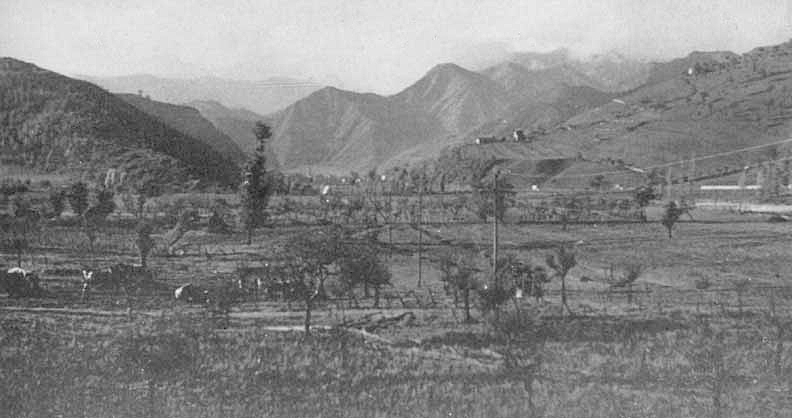
September was neither a very busy nor a very exciting month for C Platoon, its headquarters, at first in Settignano with a lovely view of Florence, moved northeast to Vicchio on the 15th to be nearer the cars, almost all posted and advancing through the mountains with 1st, 8th Indian, and 6th Armored Divisions. There was lots of noise but not much work. Some of the Indian RAPs offered a tricky situation by being inaccessible, even to the Dodge ambulances. Others, such as the Argyll and Sutherland Highlanders to which C. W. Farnham was attached, were exposed and under fire. By the 25th, cars were strung along the roads north from Borgo S. Lorenzo through Crespino to Marradi on the left of the Corps front, and from Dicomano through S. Benedetto in Alpe.
B Platoon returned to 13 Corps on 5 October, and the posts assigned the next day were with its old friends the 6th Armored Division. A few days later, it sent cars up to the 78th Division on the same axis. Later yet both B and C Platoons assigned cars to the 6th South African Division in the west. In general the work was not heavy, but conditions were becoming increasingly unpleasant. Heavy fogs and driving rains made the crowded roads treacherous. Swollen streams and rivers frequently washed away bridges, temporarily isolating many of the advance units. For early October the conditions were pretty depressing---and they augured worse to come.
"I honestly didn't expect to see October again in this darn country, but it definitely has arrived," A. Y. Davis wrote on the 7th. "The rain has turned roads into bumpy mires, and men are out all day filling in ruts, ditching edges, and trying to drain the muck off. The war is slow now---the incredible mountains aren't much to look at, but fighting up one side and down the other is as heartbreaking this year as it was last. Everyone has the faint hope that the Battle of Germany will save us from a whole winter of this stuff, and every-day queries about the news are just variations of 'How're they doing in Germany?' . . .
"The leave was a good refresher, but two weeks is fairly short. Four of us stayed in Rome most of our leave---seeing the Colosseum by moonlight, Keats's and Shelley's graves, the Catacombs, St. Peter's and the Vatican (got blessed by the Pope, by accident), and an amazing collection of masterpieces of European painting . . . gathered in Rome for safekeeping from all over Italy. . . . We stayed at a British officers' hotel at the amazing rate of $6 for 12 days, meals included. The meals were good; but when the last night came around we all went out to a very chi-chi restaurant and had a $10 lobster dinner-banquet I should say. . . .
"The Platoon is back in action now. We . . . are being posted to RAPs, ADSs, and probably MDSs. The Platoon is split into fairly new men and the old ones who are due [two-year home] leave in a month or so. The new men haven't seen enough action to be wary of what they volunteer for. An RAP is still pretty glamorous to them and they fight to get with certain posts. For the old men, it's sort of like a pilot's last mission: they hope it won't be bad, and only a couple have volunteered for really forward work. It's not only a self-protective impulse, but it's a knowledge that RAPs are a misery of greasy mess tins, poor food, mud, dark night evacuations, and the whole feeling that they are tired of war and blood and pain. . . .
"It's the going back in, seeing the same pale faces and the same dirty bandages, that not only negates civilization but forcibly combats it. I'm not surprised at myself for writing this. It looks depressed and morbid. Actually, it's only the feeling that the whole business has turned the circle and we're back to the muddy hill-fighting of last winter---and having turned the circle it all looks pretty futile. Your friends go down in the din and shooting, and your regret is dry-eyed and hard, and you only hope you can point to some event and say 'he helped make that attack a success.' You look at a little hill or a brook or a piece of road and wonder if there was any success to be had there in the first place. In the grand collected analysis, it all adds up and it was worth something, and the equation balances."
They were different mountains, and it was a more desperate enemy. Otherwise much was the same. One of the 6th Armored Division posts, the 14 Field Ambulance, toward the middle of October got itself into a position that sounded very much like several of the winter before. It was established near Bocconi, 25 miles northeast of Dicomano, "in a house on a road halfway up the side of a deep gorge. They are comparatively safe," Lt. Biddle wrote. "Jerry, however, persists in attempting to get shells over the bordering cliff and down onto the roadbed. They have quite an interesting time in their 'stonk valley.'"
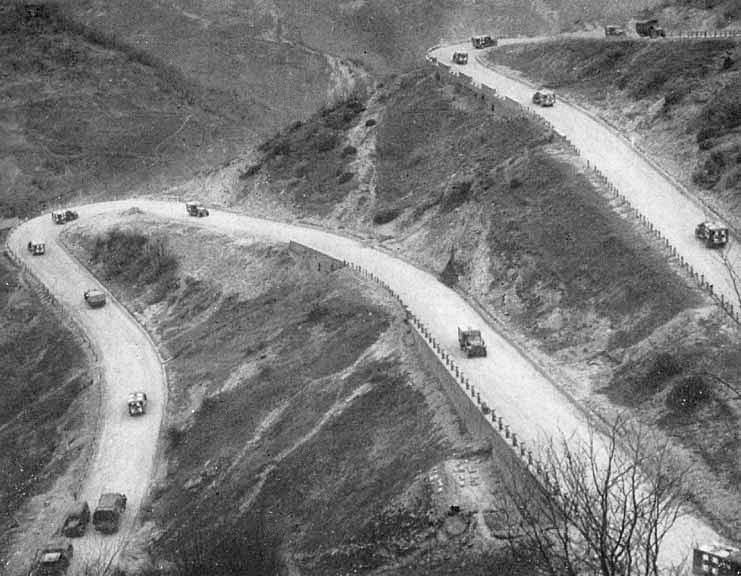
October brought a steady deterioration of road conditions. The attack inched forward, descending the river valleys toward the plains at a much slower rate than it had gone up. Marradi was the central point for ambulance evacuations in October. The 8th CCS was established there on the 10th and at the time was considered a very advanced position for such a unit. The evacuation route, to the southwest, was very rough. In the vicinity, field ambulances were at Firenzuola (78th Division), Popolano (8th Indian Division), and Pallazuolo (1st Division). The evacuation routes from the latter two towns were still under shellfire in mid-October, and several positions in the Marradi area received heavy shellings as late as the 20th.
During the advance to Pallazuolo and beyond, D. C. Viall of C Platoon was twice wounded. On 11 October, while on assignment to the 8th Indian Division in the Borgo S. Lorenzo area, he was shaken and temporarily deafened when a shell struck a few yards from his ambulance, which was much nicked by shrapnel. His second and more serious mishap occurred on the 74th..The RAP of the King's Shropshire Light Infantry had chosen such a remote spot on the difficult northern slope of the Appenines that Viall could not get to it in his ambulance. The afternoon of the 24th, therefore, he left his ambulance at the MDS and went on foot to search some way to get to the RAP in his ambulance. On the way, about 5 miles north of Pallazuolo, he received an unpleasant stomach wound from an explosive shell, which fortunately proved less serious than it might well have been.
The weather continued wet. Platoon records for the last few days of October contain entries like "little progress" and "sector inactive, bridges down." In the first week of November, 1st Division moved up to replace an American division, taking 15 of B and C Platoon's cars along. They went up Route 65 over the mountains, through Futa, and ended up a week later north of 78th and 6th Armored Divisions in the S. Clemente-Monte Grande area. Evacuations from this spot were through Castel del Rio. Then 8th Indian Division extended itself westward to cover, working down the road from Tredozio toward Modigliana. Castel del Rio, northwest of Marradi in the valley of the Santerno River and only 15 miles south of Imola, became the focal point for the evacuations of 78th and 6th Armored Divisions. A few entries from the B Platoon diary indicate the difficulties encountered during the end of October and early November. On 26 October: "The road between 152 MDS and the other cars north of there impassable. Four cars at American Aid Station, S. Clemente, waiting for bridge to be put in to get to 152 ADS north of there. Cars north of Castel del Rio cut off. No casualties came through today. The 14 UK ADS at Gaggio, unable to get through from Castel del Rio. . . . Have AFS Club there, a small room with a stove. Can get food and rest between runs." By the 29th the difficulties had become somewhat systematized: "Rain; roads up front practically impassable due to high water, bridges out, and landslides. Casualties being brought into Castel del Rio from the north [from Cuviolo, Sassaleone, and S. Clemente, where AFS cars were posted] use ambulances as far as the river, then are carried by stretcher-bearers across the river, and then taken to Castel del Rio by ambulances again. Work not too hard."
As a result of the "unbelievable" rains on 2 November the bridges were out between Vicchio and both Borgo S. Lorenzo and Dicomano. On the other side of the mountains, the results were just as bad. D. B. Cowles, B Platoon Sergeant, was in charge of the cars working through Castel del Rio:
"First and foremost," he reported on 3 November, "Murphy has suffered a broken leg trying to move his car but is now receiving medical aid. An evacuation by mule will be tough on him, but he should arrive here tomorrow. His car was stranded in a rapidly rising stream (near S. Clemente), and is now on its side in 6 feet of water. Nothing can be done at present. . . .
"We've received a note from J. Schull---he's broken down near the same spot in which Emmert had his trouble---3 1/2 miles above here on the left-hand fork. . . . Lampert's car was (and is) stranded in a stream near S. Clemente, but, as I understand it, in a not-too-precarious position. Hastings is cut off at the forward ADS but perfectly okay. The roads are quite impassable, but I hope to get cracking on recovery as soon as possible. Thanks to the impassable roads, our limited transport is not at all tragic with regard to evacuation. The picture is not quite as black as it could be thought."
Lt. Balderston visited 1st Division posts on 17 November, when the MDS was at Sassaleone: "Lewis reported to be doing exceptionally fine work at the most advanced Car Post on Monte Grande," he recorded. "Others alternate 7 cars at MDS, 2 at ADS above S. Clemente, and 2 at Car Posts on the mountains. Most work at night."
However, there was no further advance, and only small pieces of ground were exchanged during the rest of the winter. The cars stayed in the same positions through January, those serving 78th Division at Castel del Rio, Cuviolo, S. Clemente, and Rippiano; 1st Division at S. Apollinare, Villa di Sassonero, and S. Clemente; and 6th Armored Division at Fontanelice, Cásolo Valsenio, and Pallazuolo. The shooting continued throughout the winter, and B Platoon had two more casualties in the area.
On 12 November, R. T. Hamilton had an accident that came very close to being most unpleasant. While returning from the North Staffordshire RAP along Western Valley track (the Castel del Rio-Castel S. Pietro road) to the ADS of 2 Field Ambulance (1st Division), a shell landed near his car. Although it only cracked the windshield of the ambulance, the blast knocked him unconscious and left him paralyzed on the left side and without sight in his left eye. The effects of the blast slowly wore off, but it was some time before Hamilton was considered fit to return to duty.
The B Platoon diary recorded that on 14 December "Castel del Rio was heavily shelled. During this time, one shell hit the second floor of the house across the street from the cellar billets. Shrapnel fell into the cellar billets and riddled the officers' mess above the billets. Shicker was just getting out of bed when he was hit. He did not realize he had been hit until he got into another room which was considered safer. He went to the MDS. The wound was not serious-a small fragment in the arm and a scratch on his chest. . . . Rear Div. went up in flames. About 30 vehicles were completely burned, and general confusion reigned." D. B. Cowles was highly commended for getting many cars away from the raging blaze, in spite of the peril of the continued shelling.
Meanwhile, in the first week of November occurred the last of a series of administrative changes begun in September, most of which were caused by repatriations for two-year home leaves. The result was reminiscent of one of the Syrian upheavals, which left nothing the same but the sturdy little Dodges. At the end of September, Lt. Moran was succeeded by Lt. G. E. Tener as officer in charge of A Platoon. A few weeks later, Lt. Lester left D Platoon and was succeeded by Lt. D. Becker. At the beginning of November, Lt. Biddle was succeeded by Lt. J. W. Warrington, long a Field Cashier, as B Platoon officer. A few days later, Major Nettleton was called to Naples to succeed Major Edwards as Adjutant, and he was succeeded as Commanding officer of 485 Company by Major Mitchell. Captain Chamberlin was then appointed his second in command, Lt. E. Jacobson succeeded Lt. Waldner as Transport officer, and Lt. Medill imperturbably continued as Company Adjutant. At the same time, Lt. F. E. Balderston succeeded as officer in charge of C Platoon. To the hard-worked post of sergeant in the four platoons, F. C. Cliffe, D. B. Cowles, H. M. Wagner, and E. C. Heschke were appointed in A, B, C, and D Platoons respectively. For the greater mystification of friend and enemy alike, the climactic quadruple shift of Nettleton-Mitchell-Chamberlin-Balderston was written and signaled about under the code name of "Plan B."
At this time, sections of B and C Platoons were in the west with the South African Division. In mid-September, some C Platoon cars had been transferred from 6th Armored Division to the South Africans, then under command U.S. 4 Corps, advancing along the main Prato-Bologna road. At the end of September, some cars were transferred from 13 Corps artillery posts to the South African Division; and when B Platoon came back west, it too sent some cars to the Division. Its advance continued against less opposition than was expected, in mid-October reaching Castiglione dei Popoli (25 miles north of Prato), where a CCP was temporarily established. By the end of the month, the South Africans had passed Grizzana---which was shelled sporadically. There were few casualties, however, and little activity.
"Went with Balderston in driving rain to South Africans' sector," Lt. Chamberlin recorded on 25 October. "Spent the night in Grizzana at 20 Field Ambulance CCP. Three C Platoon and two B Platoon ambulances there. . . . They have done a fine job and have been under heavy shellfire for over a week. The track leading there is very poor, and only 4-wheel-drive ambulances can make it. . . . Saw Colonel Kenshole---OC 137 Field Ambulance, which is attached to the Guards Brigade of the South African Division. He said our men had been doing a magnificent job. Jack Forte with a 2-mile run under very difficult conditions was particularly commended. Farrelly was at a CCP at Casuelia. We could not reach it in an ambulance, and under a driving rain the fords were rising. Walked up. . . . Could not reach Dennis because bridges were down."
T. S. Snyder was repeatedly commended by Colonel Kenshole for his work at this period.
The advance inched on down the valley of the Setta, which flows into the Reno just south of Bologna. The work in this valley was accomplished in the face of more than the usual hazards and unpleasantness of weather and conditions. Colonel D. Matheson, later OC 137 Field Ambulance, recorded two specific instances of AFS work for his unit that he considered outstanding (the first by men from B and C Platoons and the second by members of A and B Platoons, A having relieved C at the end of November):
"In November 1944, when the forward ADS moved to Molinelli in the valley of the Sambro River, a small tributary of the Setta River, heavy rain had on several occasions washed away bridges on the road running south from Molinelli, and the ADS was cut off by road. AFS cars evacuated patients from the ADS up a narrow, winding, and very steep track from Molinelli to Montorio and from there down to the main Prato-Bologna road, and then south down the main road to 20 SA Field Ambulance at Ponte Locatello. Patients were carried by hand over a narrow, dilapidated foot bridge across the Sambro to the ambulance waiting for them on the far bank. This track subsequently became unusable owing to mud, but by then new bridges had been built and the road was open once more.
"From early December, there was an RAP in La Quercia. The road from La Quercia runs east along the north bank of the Setta River to a wooden bridge over the river about a quarter of a mile south of Gardaletta and from the bridge south to the main Prato-Bologna road. This last stretch, from the bridge to the main road, was under direct observation, and any movement there drew shellfire. Another route of evacuation was, therefore, essential. To provide this, one line of track was lifted along the railway from La Quercia to Stazione di Grizzana, where a bridge had been destroyed. A track was made down from the railway to join an existing track running south to Pian di Setta, joining the Grizzana-Ponte Locatello road. One AFS car was stationed at La Quercia from early December, parked in a tunnel immediately south of La Quercia, and could not actually get down to the RAP as the railway line ran over a high viaduct. Stretcher cases were carried by hand up a stairway to the ambulance. This railway route was also under observation in stretches and was occasionally shelled."
During the autumn there were also several special assignments, including a number with American troops (such as H. Kramer and S. L. McNabb of B Platoon with the 47th U.S. Medical Battalion on Route 64, the CCB of the U.S. 1st Division). In addition, B Platoon had a car assigned to 4 CCS for the use of Colonel Grant of the Traumatic Shock Research Team. From August through November, C Platoon assigned a car to Dr. Joan Ross, pathologist, who was gathering specimens to replace the bombed-out war collection of the Royal College of Surgeons. It did not sound like exciting work---"collecting spleens and things and pickling them," as W. D. Brewer put it. But E. W. Butman, when driving Dr. Ross later in the campaign, reported one occasion when she was arrested and whisked back from the shooting front by several British officers.
At the end of November, C Platoon was replaced by A Platoon and went to serve the Polish 3rd Carpathian Division in the mountains south of Faenza. D Platoon was already working for the Poles, who had replaced 10 Corps in the line on 10 October. With its HQ at S. Piero in Bagno from the end of September, D Platoon's locations had remained the same when 5th Kresowa Division took over part of the sector from 10th Indian Division, although the number of RAPs was reduced. From then through November the Platoon's posts with the Poles were in Galeata, Strada S. Zeno, S. Sofia, Predappio, and Fiumana. At the end of November, D Platoon headquarters and a number of cars moved with 6th Polish Field Ambulance to Collina, just south of Forli. After the fall of Faenza, the two Polish Divisions changed places, 5th Division moving up to the forward positions from Castrocaro to Brisighella, while 3rd Division retired southeast to Predappio, Galeata, S. Sofia, and Premilcuore for the winter.
The change-over between A,and C Platoons went slowly and was finished by 1 December. The members of A Platoon found the change with C an improvement over their recent inactivity. On 21 October they finally left Riccione, where they had been at rest, and drove over the hills to S. Piero in Bagno. There it rained every day and only a little work was available. "Mud, rain, bridge, food---our life these days in a (muddy) nutshell," R. Mann recorded. They were assigned to the Polish 3rd Carpathian Division in the region of S. Benedetto in Alpe on 4 November, at which time the A Platoon HQ moved to Boccone. But there were no posts until the middle of the month.
Then D. C. Jones wrote,
"We have at last been put to work. It sure is a relief after 6 weeks of sitting with practically nothing to do. . . . At the MDS [in Terra del Sole] we have pretty good billets and, best of all, a kerosene stove and a tilly lamp, also plenty of backsheesh food, coffee, etc. This makes for pretty good living, but that's about as far as it goes. . . . In a way I'm glad we had such a long period of inactivity, because otherwise I'm sure the evacuations would be enough to floor us. They range from 30 to 75 miles one way---over, always, a 'hellish mountain pass which is usually enveloped in clouds."
On 13 November, R. Mann was
"posted to a recce outfit with the 3rd Polish Div.," he recorded. "Bill Middleton, who'd come up from Company HQ to help out in our shortage of drivers, went with me to join Walt Bradley and Red Zimmer at the ADS. We promptly got lost above Rocca San Casciano and had to retrace our steps over the worst road I've seen in a long time. Finally got straightened out and, after being held up for an hour due to a stranded Bren carrier, we got up to the ADS. I found my outfit at Dovadola and arrived there at about 9:30 P.m. The RAP was in a room of the civilian hospital. I parked out in the courtyard and went to sleep.
"Sat around all day doing nothing," Mann wrote the next day. "None of the Poles could speak English, so I found myself in a world of my own. A few of them could speak Italian fairly well, so I could converse slightly in that language. . . . Polish food is terrible: breakfast---uncooked sausage, cold bully, bread, and cold tea; lunch---bully and duff (greasy fried thing) , rice and tomato soup (horrible stuff), bread, and coffee; dinner-bean soup and tea."
A Platoon kept these posts until the end of the month, when C Platoon took them over. The exchange was slow, each post taking a day---except for some that took longer, because of the condition of the countryside. The itinerary of R. Mann for the last 6 days of the month is instructive:
"November 25: Went up to Castrocaro, then on up the road to Bagnolo over a bulldozed road, and finally to Urbiano---to a fairly large farm where we were to set up the 'Ambulans' (RAP). It started to rain, making the road back to Castrocaro impassable.
"November 26: The ADS moved up to an adjoining farm, thus depriving me of that lovely run over the mountains---and that bulldozed road.
"November.27: It became quite obvious today that we're out and out trapped in this valley, not by the enemy but by the impassable roads. We were to go out for a rest (believe it or not), but a bulldozer couldn't even pull a car over that mountain road after the rains. We settled down to await better weather, or a break-through so that the engineers could get us out through the Faenza end of the valley. . . .
"November 28: Still trapped in this valley. The ADS disappeared today. They managed to get out, probably because they only brought a jeep and maybe one ambulance. Our outfit is still sitting, wondering what to do, and we're getting little to eat outside of what we buy from the natives.
"November 29: The Poles 'impressed' just about every Italian around here to go down and work on the river crossings toward Forli, where the bridges have been blown. . . .
"November 30: The Italians put a few finishing touches on the bridge this morning, and after lunch we went over on two diversions. The RAP and these other vehicles got over all right, but after that the cars began to get stuck and a bulldozer had to be used to pull them out. For the rest of the evening the Poles worked on the diversions for the rest of the cars to go over tomorrow morning."
A Platoon gathered in Borgo S. Lorenzo and then moved up into the mountains with B Platoon to serve 13 Corps units and the South Africans. It was in many respects an improvement:
"At an ADS with two guys from B Platoon," wrote D. C. Jones just after the change. "We have a short run over a very muddy but fairly smooth road. . . . I think that this is about the bleakest and most desolate country I have ever seen, not much more than rocky mountainsides with a little scrub growth. Combine this with seemingly eternal bad weather, which means perfectly horrible mud and slop. . . . There has been plenty of work to do. A run is apt to be a rather long-drawn-out process, with numerous stops on the way to let traffic go by, giving one plenty of time to relax. . . . This is about the noisiest post I've ever been at---the guns are at it continually day and night. Fortunately, they are mostly ours."
Later in December, A. P. Parsell, Jr., brought more enthusiasm to his description of life with the South Africans. The conditions on 22 December, again, sound very much like those of the preceding winter.
"The town I am now in . . . has the reputation among the troops in these parts of being the coldest spot in the vicinity---and of having the least sunshine. My experience leads me to agree. It is nestled in the mountains and is quite high compared to the rest of the country. . . . Upon the least suspicion of bad weather the clouds seem to gather and hover around the hills---right over the town---as though joining the barrier-like hills in a sombre conspiracy to keep all cheerful sunlight away. That is how it has been for several days now---thick clouds and fog, perspiring tiny drops of mist incessantly, completely obscuring the countryside and even the roads, so that driving is a slow, irritating, and messy affair.
"Speaking of driving, it should be borne in mind that these roads, and the streets in this and similar towns, were never intended to accommodate the huge numbers of heavy military vehicles. That they continue to be of service at all is, I am sure, a tribute to our engineers. Through the town the streets are very narrow---sidewalks either nonexistent or consisting of a ledge two feet wide between the buildings and the road. In many places it is necessary to route south-bound traffic along an entirely different way through town than that used by north-bound traffic.
"Everything---roads, streets, vehicles, and even the people---seem to fit into a sombre, monotonous color scheme whose prevailing motif is brown-mud brown. I cannot step out of my car without sinking into a turgid solution reaching to my ankles. Passing trucks send up a fine spray that coats the feet and legs of pedestrians. The fight against mud surpasses almost the fight against the Germans---and the horrible thing is that you just can't win."
On the day after Christmas, Parsell continued:
"For the last two days we have had 6 inches of snow on the ground. The air has been cold and clear, no fogs or mist, and the view of the mountains and countryside from here is truly grand. . . . So we did have a real White Christmas after all, and it has been interesting to get the reactions of the fellows from South Africa. For many of them this is the first snow they have ever seen. They are a little like kids with a new toy as they play around in it, discovering the many things that can be done with it. But . . . their fundamental attitude is . . . 'If this is snow, and if this is a White Christmas, you can have it. We'll take South Africa! . . .
"Christmas Eve . . . the Colonel in charge of all the medical units in this area dropped in, accompanied by a Major and a Captain. He remained about an hour, was exceedingly friendly, and the men were all very much at ease with him. He had a drink with the men, and we all toasted him a Merry Christmas and a Happy Birthday, for yesterday was his birthday. He said some of the nicest things about the AFS I have heard from anyone, even the AFS Public Relations. He said that he'd rather have us with him than any other unit. He said the reason we are with him now is because he asked for us and even fought to get us. He apologized for the dull days we have had recently with no work, and promised us work of some sort this week. He had been holding us for front-line duty that hasn't come off---mainly because of the weather retarding military operations . . . but he said this week they'd put us to work, even if it were only on the run from the ADS to the hospital."
In January 1945 more snow fell, the mud froze, and the winter settled into an endurance contest. Even the ambulances suffered from the cold. N. C. Eddy broke his wrist cranking his car on 10 January, and by the 17th the ambulances had to be towed before they would start. At this time, A Platoon lost its posts in Western Valley with 1st Division. Shortly before this, at a forward Car Post of 2 Field Ambulance south of Monte Grande, E. E. Eisaman had distinguished himself by rescuing several wounded from a burning truck in the midst of a heavy shelling.
Beyond occasional shelling, there was not much activity anywhere along the line, except at the far west. In the Fifth Army sector, the Germans thought they had spotted a weakness in the pressure against their line and were known to be preparing a counterattack of some strength. The 8th Indian Division was rushed over to Lucca, and with it went the cars that were assigned to it from A Platoon of 485 Company, under the direction of R. Mann. It was much warmer in this area. The posts in Lucca as well as Pisa were very pleasant after the violent snowstorms of the mountain heights. From this group two cars were appointed in mid-February to assist the Canadians at Harrods Staging Area outside Livorno (Leghorn) during their embarkation on Gold Flake move to northwest Europe. Later with 63 FDS, this group stayed in the west until the middle of March.
It was while they were in this area that two partially innocent volunteers landed themselves in a situation that resembled a classic of American humor. They didn't buy the Brooklyn Bridge, but they did give two bottles of liquor in exchange for a jeep. Jeeps were of great use to the Company, infinitely more convenient for platoon officers than the pick-ups that had sufficed in the desert. Many jeeps had already been "salvaged" by the Company---that is to say, removed from dangerous positions and kept. It did not seem unreasonable to have to pay for a jeep that was in no apparent danger. Later it was pointed out, perhaps a little huffily, that they should have known better than to buy one clearly labeled "Provost Marshal." The low price, if nothing else, should have put them on their guard.
A Platoon kept its posts with the South African Division until mid-March. HQ was established between the various groups of cars at Campiobbi, between Florence and Pontassieve, in the Villa Gallardi. This was for a long time called the Villa Galatti, as a result of faulty hearing or a proper sense of the omnipresence of the Director General. It was "only from a sense of fairness to the other platoons" that the Bully Tin exposed this most pleasant of myths.
At the end of January, B and D Platoons exchanged assignments---D taking over the scattered posts with 78th, 6th Armored, and 1st Divisions and B going to Faenza to work with 5th Kresowa Division. Work with the Poles continued to have its problems, not the least of which was language. Drivers at one-car posts sometimes found that they had no one with whom to talk English and, as they did with the Indian troops, fell back on Italian as a sort of lingua franca. Orders in English to platoon officers were not always more clear than the following, which sent Lt. Warrington hurrying off to Corps HQ for an explanation:
"I wish to inform you that 9 ambulances from your platoon will go with the 6th Polish Field Ambulance. According to the order of the DDMS 5 Corps, you will pass temporarily with your platoon to the Italian Gruppo Friuli, except the 9 ambulances mentioned above. In the next time 9 more ambulances will be send from your Company HQ to our disposition and then those 9 of your ambulances going now with the Polish Field Ambulance will be send back to you respect. We will settle it all up."
Shortly, however, the 5th Kresowa Division was replaced in the line by the Gruppo Friuli, under command of the Polish Corps. There weren't many posts, and their work was not particularly strenuous. However, on 9 March B Platoon was commended for its work by General Scattini, Commanding Gruppo Friuli, in some of the nicest phrases to come the way of the AFS: "I have greatly appreciated the brotherhood and precious collaboration of your platoon shown in the evacuation of the Group's wounded from the forward lines. With rare skill, by day and night, on roads frequently shelled and sown with mines your men have always carried out their delicate voluntary mission, giving constant proof of their serene contempt for danger and of their profound humanitarian sense. My living praise and my and my men's gratitude goes to you and the men under your command."
In the meantime, C Platoon had worked for the 3rd Polish Division from the beginning of December until the second week of January. At first it had its HQ at Castrocaro, but when the Division was inactivated in late December it moved to Predappio Nuovo with the MDS. In the second week of January, the Platoon went to rest in Pesaro, keeping only a few ambulances posted at the Polish MDS in that town. On 8 February 1945 the Platoon moved up to Villanova da Forli and took over the posts of both Polish divisions, then in the line south of Route 9 above Faenza and along the Senio River line. There were 9 cars sent to the medical units of 5th Kresowa Division at Galeata and S. Sophia on the upper Ronco, and 10 cars went to those of the 3rd Carpathian Division at or near Brisighella, Pergola, Celle, and Faenza. There was no great amount of work to do, the surroundings were by and large pleasant, and both food and billets were reported good. Extra cars were sent to the Polish MDS in Faenza in early March. Then on the 12th A Platoon took over the Polish posts and C moved across Route 9 into the 5 Corps area to replace C Platoon of 567 Company with 78th Division and the Jewish Brigade. In the following two days, ambulances were scattered to posts in Granarolo, Russi, Bagnacavallo, Boncellino, and Pieve di Cesato with 78th Division and in Camerlona with the Jewish Brigade. At the same time, the A Platoon posts with 13 Corps were taken over by D Platoon, which was already serving its 10th Indian Division and the Italian Gruppo Fulgore.
After the fall of Faenza on 17 December 1944, the enemy had retreated a short distance to prepared positions along the Senio River--and stayed there. The whole front was static throughout the winter. There was little action and almost as little excitement. The work was steady but never pressing. The big effort for both companies was to avoid boredom and discomfort. In spite of leaves for small groups to Florence or Rome, there was not enough entertainment to go around. The cold of December and January brought on the big scrounge---for wood or anything that could be converted into warmth.
Few if any billets had all their windows, and certainly none had a working heating system. The men found in Forli the type of tile stove named for the town. The so-called Rimini stove, said to be an invention of the engineers, was made of discarded oil drums and could burn wood or coal or diesel oil. When they exploded, which was not infrequently, soot spread with a roar over everything within range. No matter whether either of these stoves or the basic fireplace was used, the crucial problem was fuel. As the front had moved forward, wood could be gathered as fair booty from any bombed or shelled-out building. But the advance stopped and the problem became acute. A week after Faenza fell, it was reported that not a loose stick of wood was left in the town. The wrecked railroad between Forli and Faenza was stripped of broken ties, and boxcars were reduced to their steel skeletons. Shortly after the advance halted for the winter, the army had to issue an order putting all trees in rear areas out of bounds and making the felling of any tree subject to the same harsh penalties as for looting. After this, on days of heavy fog, shivering parties of AFS men went ahead into no-man's land to cut down trees and drag them back to warm their billets.
Leaves offered an almost equal amount of difficulty. The British had only limited accommodations in Rome and a similar situation prevailed in Florence because of its small size. Day leaves offered no problem, and they were granted as frequently as possible. But overnight accommodations were something else again. The Field Service was on neither the American nor British leave schedule, which at first didn't matter. As the cities filled up, however, some sort of regularization became imperative. A little wangling got AFS included in the British scheme for both cities---not as many spaces as could have been used in an inactive period but a very generous allotment by comparison with the treatment of other units.
Florence during the second winter was the AFS focal center, as Naples had been during the first. The HQ had to stay in Naples because of the port and other facilities, as well as its proximity to AFHQ in Caserta. But the closest thing to an advance headquarters the Service had yet developed was established in Florence. Anything going from Naples to either Company passed through the Florence Liaison office-mail, personnel, baggage, or spare parts. Both Finance and Supply and Transport Departments kept staffs there permanently, and a Convalescent Villa was found necessary. The Liaison office had also to supervise the numerous AFS personnel passing through town on whatever purpose.
The establishment included an office on the Viale Michelangelo, and billets for the office staff in the handsome flat belonging to Commandant C. H. Coster on the Costa Scarpuccia. At one time it was feared that the representatives of the Finance Department might try to claim this for their exclusive use, with the plausible excuse that the owner was their patron saint. However, these noble people proved to be as generous in all things as with their time and energy. There was also the Villa Gordon-Mann, run as a convalescent Depot by J. R. Orton, Jr., D. C. Richmond, and C. A. Willets at different times during the long period the AFS was in Florence. For quite some time the workshops of 485 Company were also attached to the Liaison office, as the location most central to the widely scattered platoons.
As convalescents, leave parties, drivers with moribund ambulances, and transients of all sorts descended on the office in increasing numbers, each individual usually leaving a small mountain of luggage to be stored, it became clear that the establishment did not have enough space at its command. All efforts to get either larger or additional quarters were doomed, however, when 15 Army Group moved up to Florence and the city was deluged by generals and their staffs in need of suitable palazzi. There was no more space to be had, and the extra that would have allowed more overnight leaves could not be found.
Except for the difficulty of accommodations Florence offered everything that could be expected of a leave center. In addition to all the sights that have so long made Florence famous, there were the expected number of restaurants and bars-of which Leland's, if not the favorite, was sufficiently well considered to have at most times an AFS table. The usual service clubs all graciously offered their hospitality to the members of the Field Service. Once again the New Zealand Club was more than generous, granting overnight accommodation and going out of its way to be of assistance when the Liaison office mess was overburdened.
A couple of days after the Florence office opened for business, Lt. Cole moved his office from Orvieto to the Palazzo Lilli in Perugia, for greater convenience in serving both companies. The interchange of liaison office personnel over the next few months was frequent and sometimes complicated, as they went in and out of hospital, from office to office, to greater glory in Naples, or back to the United States. After he closed the Algiers office, Captain Jeffress succeeded Lt. Merrill in Florence. W. R. Pearmain succeeded Lt. Cole as officer in charge at Perugia. E. M. Marler, who had assisted in the establishment of both Orvieto and Florence offices, went to Naples to succeed Lt. Paine as officer in charge of its Convalescent Villa.
The winter was no more exciting for 567 Company than it had proved for 485 Company. A Platoon in mid-December had taken over posts with the New Zealand, 10th Indian, and 56th Divisions from B and D Platoons. These had returned to S.Arcangelo to get their new Dodges and then came back to Forli---B to rest and D to evacuate 5 CCS to Rimini. At the beginning of 1945, C Platoon was still resting in Riccione, and 567 Company HQ shivered in the drafty castle in Forlimpopoli.
A Platoon, the only one working at the front , had 26 cars on post: 9 with 56th Division, 10 with the New Zealanders, and the rest with 10th Indian Division. The most outlying was only 5 miles from the Platoon HQ in Faenza, and most could be reached by a short walk. Poor road conditions required the use of AFS cars at forward positions, none of which was particularly active. Several cars were damaged by enemy shelling, but there were no casualties to Field Service members. At the end of January, 56th Division shifted its position in the line from the Faenza area north a few miles, taking the attached A Platoon cars to Boncellino and Pieve di Cesato, north of the New Zealand sector.
On 5 February, C Platoon relieved A of its forward assignments. A Platoon then retired to C's billets in Riccione. For the rest of February it evacuated 18 CCS in Cattólica as well as other near-by medical formations. Lt. Atwood, who had been in charge of the Platoon since the fall of 1942, resigned his commission on 11 February. "Constant and tireless in visiting his men," he was characterized in his citation, "his interest in their welfare has been untiring almost to the total disregard of considerations for himself." D. G. Atwood was succeeded by Lt. G. J. Griffin, and C. M. Rector was appointed Platoon Sergeant.
At the beginning of 1945, C Platoon had been in Riccione, still on the alert for its "big" assignment. The Platoon had been away from the rest of the Company so much that this second exile seemed not in the least strange.
"Various things---objective things---seem to mark this Platoon from others in the Company," W. J. Bell, Jr., wrote in its diary. "Last June---shortly before we moved to Viterbo, Terni, and Orvieto---at the suggestion of McKinley, Kinsolving, and Bell, horseshoes were obtained, painted white, and placed on all the Platoon's vehicles in the form of a C. The idea was that when we joined the rest of the Company all would be able to recognize a C Platoon car. There is also a certain inflection of speech which not a few of the members of the Platoon---especially the older ones---sometimes adopt. It is a rising inflection, and used often in explaining something with a loquacious humor. Jock Cobb had it naturally. Perhaps from him others adopted it."
Although it was certain that the "big" assignment would come the day after the Platoon accepted some other work, on 20 January C Platoon decided it would not wait forever and began evacuations from 3rd Canadian General Hospital, 3 miles south of Riccione. There were only 10-15 runs a day to Iesi or, on rare occasions, to Fano---all peculiarly timed in the late afternoon or at night. Light duties around 18 CCS in Cattólica were performed by 3 cars stationed there. This set-up lasted until, in the first few days of February, C relieved A Platoon of its forward posts with 10th Indian, 56th, and New Zealand Divisions. Platoon HQ took over A's billets in Faenza.
Later in February, 10th Indian Division in the mountains around Pergola and Pideura was replaced by the Polish 3rd Carpathian Division, temporarily under command 5 Corps. About the middle of the month, this Division was transferred to Polish Corps command and its posts taken over by C Platoon of 485 Company. The Gurkha 43 Lorried Infantry Brigade entered 5 Corps at about this time, giving C Platoon new posts in the Granarolo area north of the Via Emilia. On 4 March the New Zealand Division was replaced in the Faenza area by the Polish 5th Kresowa Division (Polish Corps), and the cars from the New Zealand assignments returned briefly to Platoon before going north to posts just south of Lake Commacchio with the Jewish Brigade. On the 9th-10th the sector held by 56th Division was taken over by the 78th. The next day C Platoon learned that it too was to come out of the line. Its remaining posts were taken over by C Platoon of 485 Company on the 13th-14th, and C Platoon of 567 Company went back once more to Riccione.
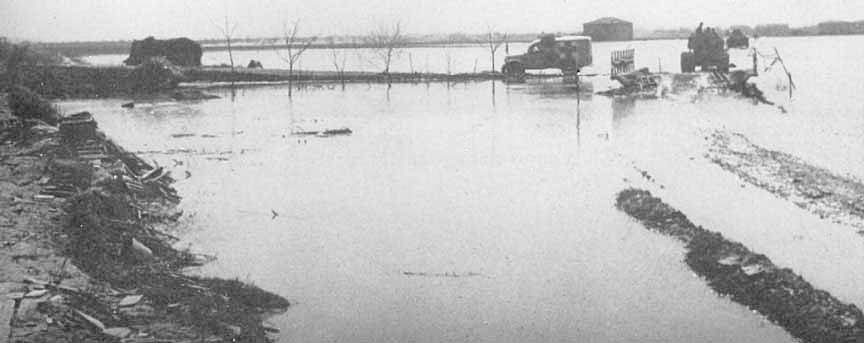
B and D Platoons in the first months of the new year had steady rear work. B Platoon moved from Forli to Cesena on 25-26 January. For almost two months it evacuated 83 General Hospital and 19 CCS back down the line. D Platoon continued to evacuate 5 CCS in Forli, with runs to Cesenatico, Cesena, and on back to the medical area south of Rimini.
The work during this period was not enough to keep everyone busy, and a number of side occupations filled in the time. Not all of them bear mention, but there were a few able to practice their professions. N. O. Jenkins conducted a series of concerts with the Romagna Philharmonic Orchestra in Forli and Ravenna. S. F. Martineau took over an abandoned church in Forli for a studio and created a monumental sculptural group representing the association of AFS drivers with the various racial elements represented in the Eighth Army.
Probably the most useful of the extracurricular jobs was that done by W. G. Congdon, who was assigned with his ambulance to AMG in Faenza at the beginning of January to assist with civilian welfare work. Although it was a front-line town, only 2 miles from the enemy positions, Faenza had a civilian refugee population of more than 8,000. The Army didn't want civilians that close to the front, but there was no other place for them to go. Congdon's work at first was to gather the sick civilians scattered through the area and bring them into Faenza, then either to unite them with their families or to evacuate them to rear areas. Later he assisted the Red Cross director of civilian welfare, taking over the position when the director went on leave. He interviewed scores of civilians each day and worked with civilian doctors to re-establish the local hospitals. Congdon also took steps to revive Faenza's famous ceramics industry, one phase of which was the organization of an impressive show of the best pieces he could find in the much bombed and shelled town.
At the end of the third week in March, B and D Platoons were relieved. B went to leaguer near C on the coast road outside Riccione, where A was already stationed, and D was sent to Rimini. There were rumors that the Company was going somewhere. Speculation as to where was unlimited. Once again anything seemed possible and the speedy end of the war seemed certain. On 7 March 1945 the Allies had crossed the Rhine at Remagen, and within 4 days they had gained control of the east bank of the river from Nijmegen south to Koblentz. Operations on the front in northwest Europe seemed, in Italy, to be making lightning progress. In Italy, however, the lines were still totally static---and it occurred to some that the war might well be pushed to its conclusion without any further action on the Forgotten Front.
Speculation on the future had always occupied a good part of any day---the course of the day's battle (when there was one), the possibilities along the whole front, the duration of the war, and activities at the war's end. Half the questions asked of Mr. Galatti at the time of his tour of inspection had concerned his plans for the AFS after the cessation of hostilities in Europe. Then he had mentioned transfers to the India-Burma unit, the possibility of new units in France and China and transfers to them, the desire of UNRRA to have AFS personnel work for it, and his hopes of a speedy demobilization. In mid-March, Major Hoeing made one of his frequent tours of the field, visiting all platoons of both companies. To each gathering he made bold to tell of the developments since the preceding April in each of the possible fields of future activity. An anonymous reporter wrote of one of these meetings as follows:
"They settled themselves haphazardly about the room and waited for the Poor Man's Fireside Chat. Major Hoeing stood up, took a long pull on his cigarette, cleared his throat, and began.
"'At the outset, fellows, I want to warn you that everything I say must necessarily be considered indefinite. First, about the so-called China Unit. We made a great mistake in putting what little we know about it in the Newsletter, because there really is nothing definite on it. Everything has to go through diplomatic channels first. The Japanese government has to accept and recognize the Field Service before we can work with the Chinese Army. of course, the Japanese may pounce on the idea in an effort to prolong the war. (Laughter.) Seriously though, anything might happen. It might come through in a matter of days. It might take years. Or it might never come through. None of these eventualities would surprise me in the least!
"Here Hoeing paused to light a fresh cigarette. 'Men,' he continued.
"'Now about India. The situation there is very indefinite. SEAC has asked for another Field Service Company, and this theatre is willing. But unfortunately the final authority must come from the War office. New York is working on this, and we are working on New York. You know just as much about it as I do. You see, the set-up in India is very different from the one here. This difference makes things difficult for us, so nothing is definite as yet. However, I think we can definitely say that all those from Unit 92 on have had it. They will be held to their contracts and shipped to India. Unless,' Hoeing raised a cautioning finger, 'unless something comes from New York changing all this. We have tried to make up some sort of a priority list for those who wish to go to India or to get into the China Unit. At present we don't know exactly what kind of priority list it will be. We may take all those who have been in a year, or even all those who don't drink.'
"Everyone smiled and glanced at Volunteer Blank. Fred was certainly in rare form.
"'UNRRA is another possibility. But here, too, the situation is still a trifle confused and indefinite. On our first inquiry we were told that they had no further need for men. Then information reached us that they were expanding and needed all they could get. At any rate, we have the application blanks, and you'd be surprised how many people feel they would like to serve with this organization.
"'In summing up, here is the thing in a nutshell.' Hoeing made a few vague gestures indicating the shape of a nutshell. 'At the end of hostilities in Europe you can go into UNRRA, go home, or go to India or China. I dread that day as probably no one else does. Everybody will be flying every which way. But if you will co-operate with us, things should go smoothly and everyone will be happy. All I can say about the future is this: Anything might happen, and probably will.'
"Fred then answered a few inane questions, made a few more predictions, and the meeting was over."
When asked about the rumored move of 567 Company, Major Hoeing was more definite: "I don't know anything, and besides I won't tell anything anyway." Rumors were thick and fast. Speculation continued to cover the map. And maintenance suddenly became fashionable. Then it was announced that the entire Company was to be reviewed by General Sir Richard L. McCreery, GOC Eighth Army. Pride and excitement were without limits. The Company's last week with Eighth Army was highly memorable.
It began with a visit to Company Headquarters at Forlimpopoli by Representative Clare Booth Luce on Sunday, 18 March. Word of her visit had got round on Saturday night.
"Sunday morning," C. F. Zeigler wrote, "found a representative number of ambulances from all platoons arriving at HQ on all kinds of excuse. It was well worth the trip. Mrs. Luce was pretty, charming, and she smelled so good (as lots of people remarked). She inspected the HQ Section ambulances, which had been spit-polished half-way through the paint job.... She said she admired the neo-Venetian castle we used as headquarters, which was most generous of her, and she said very nice complimentary things about the Field Service. She asked if there was anything we wanted, and we had to say 'no,' because we knew we were leaving Italy very soon. When Mrs. Luce waved good-bye, everyone agreed that world relations would be vastly improved if more statesmen were blondes dressed in blue slacks and jackets who floated gracefully in an aura of Chanel. . . .
"But probably one of the most amazing days in Company annals was Wednesday the 21st ---the day of the big review. The amazing thing was that everyone was dressed in regulation uniform-battle dress, gaiters, boots, and caps. Only two options were allowed---brown or black boots, and peaked caps or berets. For once the circus got together in parade without Indian moccasins, cowboy or Russian boots, blue overalls, corduroy breeches, Yank field jackets, turtle-neck sweaters, red fezzes, or green tennis hats. It looked like a military outfit and acted like one. . . .
"General McCreery arrived promptly at 4 and was led to the Company through a phalanx of shiny ambulances by Major Payne and the convoy of Brigadiers and aides, and was smartly saluted by Captain Harmon. The General---tall, graying, and a fine figure of a soldier in his black tankman's beret---walked through the lines, talked to many of our men wearing the Eighth Army Africa Star, and recalled stirring days on the desert. After reviewing, be pinned decorations on 7 men---Captain Webb of Workshops Platoon, Lts. Brethauer, Field, and Perkins, and Vols. Campbell, Satterthwait, and Stewart.
"In his address to the Company, General McCreery said that the Eighth Army had tried hard to keep 567 Company in its command but that higher powers had insisted that it be detached and removed to another theatre of war. This, he said, should be taken as a high compliment to our service during the past years of the war in Africa and Italy. He wished us the same success in the new venture. The General said that, although we must now remove our Eighth Army flashes for reasons of security, he strongly urged that we put them up again as soon as possible and gave us the privilege, in perpetuity, of wearing them. The Company gave the Commander of the Army three rousing cheers, which he answered with a smart salute.
"After the General had departed, Major Payne . . . ordered us to take down all our identifications---AFS flashes and Eighth Army---and to erase all identification from our ambulances and domestic vehicles. He said that we were alerted for 7 days but that we should be prepared for a more sudden departure."