 George Rock
History of the American Field Service
1920-1955
George Rock
History of the American Field Service
1920-1955
CHAPTER X
During the summer pursuit of the enemy to the north, one of the outstanding AFS assignments was that of B Platoon of 485 Company. It had begun its association with the 6th Armored Division with some two-week posts at Cassino in April. Then the Division was withdrawn to prepare itself for the pursuit when the break-through should have been accomplished. From 23 May it advanced north continuously, pushing the enemy back to the outskirts of Florence. B Platoon had its second assignment to the Division during this advance---from 12 May until they said farewell outside of Florence almost three months later.
"To say that this was the best assignment the AFS ever had would perhaps be an overstatement," Lt. Biddle wrote of the association, "but certainly it was the best job ever given to our Platoon: not only because of the opportunities of work afforded but because of the close association we gradually gained with men of all ranks and the lasting friendships involved. . . .
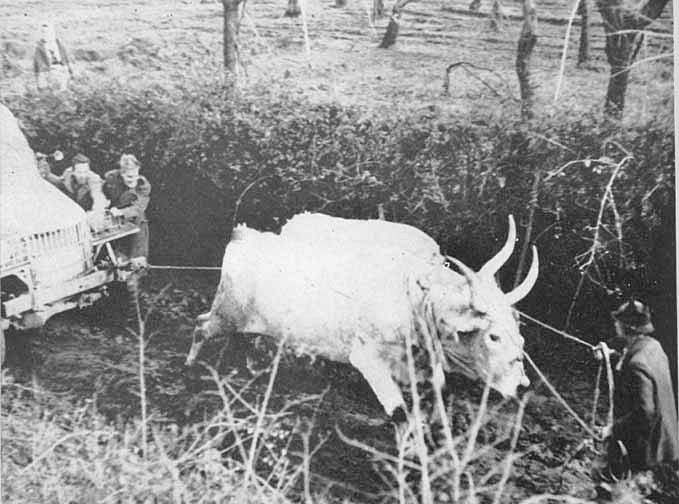
"Ours were the only 4-stretcher, 4-wheel-drive ambulances in the Division. Rain was our greatest selling point, for even half a day's rain, or a heavy thunderstorm, can turn Italy's summer dust into thick mud. The ground simply does not absorb water. Many times---with the countless gullied diversions past which the retreating Germans had systematically blown all bridges and with the make-shift tracks of the advance---ours were the only ambulances which could get through to the casualties. Little by little we were entrusted with all the Division's forward work.
Four-wheel drive was not always enough"From then on it was up to us. And the fellows who drove those 30 cars did a wonderful job. They won us honorary membership in the Division and the right to wear the famous Divisional insignia---on our shoulders and on our ambulances. This singular distinction for the AFS, was presented to me, as OC of the Platoon, at a victory party celebrating the fall of Perugia. The rooms of Perugia's best hotel were crowded with the men who had led the battle this far. Champagne flowed. Suddenly I became aware of high officialdom looming above me, chiefly by the way the conversation I was having came to a dead stop. I was wearing the Div flash at the time (not without some misgivings), and here was the General himself---a huge man decorated with the ribbons of many campaigns and highest gallantry in action. Before I could find my voice, which had mysteriously disappeared, the General smiled down at the flash and said: 'Bloody fine show! Tell all your lads to put it up. They deserve it! Then, as he turned, he added: 'Oh, yes, if you ever have any trouble staying with the Div . . . just come to me and I'll arrange it. We'd like to have you with us as long as possible!
"A little later our relations with the Div were cemented in a different manner in a small farmhouse where we had set up temporary headquarters. We had just finished the evening meal when the door banged open and there appeared the ADMS, Col. James Barnetson, in charge of all things medical in the Division. He was covered with dust. A pair of field glasses hung from his shoulders. His face was taut after a long day's work. We all stood up, awaiting momentous news. The ADMS spoke in my direction. 'Liv,' he said solemnly, 'I've just seen Tug Barton! He paused, a twinkle in his eyes. 'Tug wants his laundry---and two bottles of gin! Well, he couldn't have spoken more momentously, for when a full colonel in the British Army goes out of his way to get laundry for an American ambulance driver, that---as the poet says--is news. . . .
"Colonel Barnetson always insisted on having his medical units as far forward as possible, and he stretched that possibility to its utmost. He was indefatigable, and he had as his right-hand men. . . Colonels of two field ambulances who never needed any urging when it came to getting their units in the vanguard of the attack: Lt.-Col. Sangster, who spent all one night of the river crossing waist deep in water, and under continuous German Spandau fire, helping to bring back the wounded from the other side; and Lt.-Col. Phillipson, blond and Irish, who gained a lasting nick-name among the Platoon as 'Follow Me' Phillipson. Those three men deserve the highest praise. They had the admiration of us all, and we grew to know them closely.
"I think they were commandos at heart. Many times they went out on reconnaissance ahead of the forward infantry to find suitable locations for their various medical establishments, and in the fluid advance this was all important. It meant the saving of many lives.
"Colonel Phillipson outdid himself on one occasion some 60 miles north of Rome. He reccied a railroad station in midafternoon for an ADS. It looked fine and he brought some of our Platoon forward that evening to set up shop. At dusk the boys were more than somewhat surprised to see a contingent of troops creep out of the gloom and begin to surround the place. The troops, however, were 'not 'arf shaken' (in British idiom) to find that an ADS had captured their first objective of the night's battle. The 'follow me' was classically illustrated below Arezzo. Colonel Phillipson was leading a group of our cars into the city when an MP stopped him. 'Sorry, sir,' said the arm of the army law, 'you can't go any farther. The road's under heavy shellfire and so is the town.' 'These ambulances have to get through,' countered the Colonel, and from his jeep he shouted back to the AFS: 'Follow me!' They got through.
"Incidentally, Colonel Barnetson in his jeep was the first car into Arezzo. He went ahead of the leading tanks to requisition a hospital. When the tanks behind him drew enemy shelling, the Colonel whipped up a rubble-strewn alley and over a Teller mine without setting it off, calmly removed the fuse, and then found the hospital---had it ready before the first casualties arrived. . . .
"We moved our headquarters with . . . whichever [MDS] was open at the time. The two field ambulances, plus a third which from time to time was attached to the Div, leapfrogged each other during the advance. One would open ahead, the other close; and as the advance proceeded the one not working would reccy a new spot forward and receive casualties there in due course. And so we alternated some 10 of the cars always at the MDS in operation. The rest of the cars were permanently attached to the infantry and artillery RAPs. Two or three AFS cars from the MDS allotment would go forward to the Field Ambulance ADS just behind the RAPs. Platoon HQ, with which we kept the greatest concentration of our cars, consisted of a 3-ton truck, which carried our cookstoves and tentage; a Dodge pick-up truck for baggage and kit; a water truck; the jeep; and a semi-nebulous relief section of 3 ambulances (which was semi-nebulous because casualties to ambulances and road breakdowns kept the number of our cars on the road to the 30 required---and on unlucky days we sometimes dropped below 30) . . . .
"From Fiuggi we proceeded to Acuto, stopped there overnight, high above the plain where our tanks were in action. We left Acuto in the semi-darkness before sunrise, and that morning as we moved through wooded areas came the news. It was 6 June. A motorcyclist sped down the column shouting the tidings of the invasion of France. The convoy stopped. Men jumped from their vehicles, cheering, rallying round the sergeant on the motorcycle in spontaneous joy.
"The Division by-passed Rome the day of our greatest advance. All morning and afternoon we drove over the old Roman roads to the south and east of the city, and I may say that these roads may have been fine in Caesar's day---but that was some time ago. Now they are just an endless series of rutted cobblestones. We bumped along slowly with the dome of St. Peter's barely visible in the distant horizon haze.
"We set up our next MDS some 25 miles north of Rome in one of Italy's sprawling communal farms, and for the first time in many days we were stationary a short while. There were good rooms in the farm buildings. We cleaned them out and set up Platoon HQ in royal style. There were tables and chairs once used by the Germans. Just after the hill battle one of the boys had discovered what he called Kesselring's headquarters---a series of spacious rooms dug into the hillside. From this came lacey tablecloths and silverware, plates and pitchers and glass goblets. We now had two Italian mess servants. From the friendly farmers we bought geese, rabbits, corn on the cob, lettuce, and tomatoes. . . .
"So a banquet was laid on in candlelight, and a lot of the Divisional dignitaries were present. This was one of many similar occasions. . . . In our time with the Div we got to know regimental and tactical commanders, everyone in the field ambulances, and the medical headquarters ---from the privates on up the line. More important, we won their friendship.
"It was rumored that night that we were leaving the Div. In a change of the military set-up our Platoon was to be allocated elsewhere. At the height of the festivities, the ADMS volunteered to stencil the Divisional flash personally on each vehicle. The next morning he dispatched a special messenger to the high command. We stayed with the Div.
"The following night [10 June], I was sitting in the farm talking with the ADMS and Major 'Toffee' Field . . . OC of Colonel Sangster's ADS section, when the door opened and Ben Ford . . . appeared. 'Liv,' he said, with a wry smile, 'you'd better get a spare driver for my ambulance! He sat down and rested a bandaged arm on the table. Ben had been some 20 miles north with an RAP. At a road junction a scout car had hit a mine. Ben was sent forward to pick up the casualties. Arriving, he found the occupant already dead and he was returning to his ambulance, parked near by, when an armored vehicle exploded another mine almost at Ben's feet. He was knocked down by the blast---his shoulder badly bruised, his hand cut by pieces of flying metal. But Ben managed to get the more severely wounded armored-car driver into his ambulance and back [14 miles] through the pitch-black night to the MDS. Such actions as this won Ben the right to honorary membership in one of England's oldest and proudest regiments---the Coldstream Guards.
"This episode was the prelude to perhaps the worst day of the campaign---'Stonk Saturday! The British refer to heavy German shelling as a stonk, and this was the heaviest of them all. It lasted without intermission most of the day. Near the intersection of the mine explosions was the forward ADS. A mile or so distant was an RAP. The boys at these posts had a hectic time. Gene Vasilew had his car riddled with shrapnel holes and the radiator punctured as he left the ADS with a load of patients. But Gene kept the wreck going until he reached the next medical station. Later Gene was towed into HQ with his tinhatted face grinning through a smashed windshield and pointing to the hole, barely an inch above his head, where a shell fragment had gone out through the roof.
"Warner Love, with the regiment, had an even worse time. At one point a shell dropped directly behind his ambulance, wounding an orderly and bracketing Love with the hot, whizzing fragments. He made 5 trips to the ADS under shellfire, until all 4 tires were punctured by shrapnel, the gas tank holed, and the body sieved. Unable to drive further, he spent the rest of the day intermittently in a slit trench and wrestling with the tires, which he mended one by one. Of the rest of the cars up there, none returned without some scar of Stonk Saturday.
"The next stand the enemy made was at Perugia. We drove in convoy to our intended location, a hospital in the city. But somehow the road didn't look right. After a while you get so you can sense when you're in the danger zone. There is no traffic, no sign of movement; the farms are deserted; and you know you have passed that mythical demarcation known as the front line. That's the way it was now. The road was empty. Then suddenly far to the right we spied a group of our infantry deploying through a field. If you think it takes time to turn a convoy in reverse under these circumstances, you're wrong. The city had not yet fallen.
"When it did, it was a fabulous mixture of peace and war. Perugia was wide open. There were restaurants with sleek black-and-white-uniformed waitresses; bars and villas and gardens; a theatre and two movie houses going. But almost every hour for a week German shells were falling in the city. I'll never forget seeing a queue of British soldiers under shellfire on the main street. . . . This queue was waiting for the movie house to open. It stretched single file for two blocks, and when the shells landed in the adjoining square the men just ducked a little. No one gave an inch---and strangely enough no one was even touched.
"We had our best farmhouse below Perugia. It belonged to a wealthy middle-class family who were a bit reluctant at first when their uninvited guests arrived but who, little by little, gave us the run of the place---a tremendous oak-beamed dining room and several bedrooms replete with that almost unheard-of luxury known as a bed with a spring mattress. There were gardens of roses, lofty shade trees, a well with ice-cold fresh water, all the livestock we could desire for the cuisine, and best of all a magnificent chandelier which actually worked . . . illumination was an oddity, par excellence!
"Most of the posts were close to HQ then, and as was often the case the fellows at the RAPs could drop in for a sumptuous meal supplied by our mess president, Dave Burke, whose liaison work with the Eyetie farmers was nothing short of miraculous. And so the rafters of the Perugia manor rang into the small hours, and the flowing bowl kept flowing for the Platoon and its growing number of friends. There were poker games with all stops out, and British officialdom got its initiation to the American indoor sport played with two dice. Someone produced a roulette wheel, and one night we had the brilliant idea of making money for the mess with the red and black. The mess lost 70 bucks. The roulette wheel was conveniently lost in our next move.
"Southwest of Perugia, Pop Watson . . . had his closest call. . . . [Late the afternoon of 17 June] he was sent forward to pick up some casualties from a tank battle still raging in the plains below the city. Warned on the way up that the road was being shelled and mortared, Pop . . . proceeded at full speed. His car was hit twice by mortars before he reached the wounded, and on the return a German 88-mm. shell landed, to hear Pop tell it, 'practically in my nostrils.' The radiator was smashed, there were fist-sized holes through the front of the car---but the engine was still running and the wounded were brought safely to medical care at the ADS.
"These are adventures you laugh about later, spin yarns about, and remember with pleasure. But at the time there is no amusement---no pleasure. . . . Your feelings at the time are never fully recaptured in memory. You have the impression of something infinitely big and fast and deadly coming in, and the seconds after the explosion are disjointed, vivid things without relation to actuality.
"From Perugia we pushed north toward Arezzo, past Italy's famed Trasimene Lake, blue like the Mediterranean in sunshine. There was good swimming in the lake and a sandy beach, and many of us thought of summers at home. . . . Near Cortona, 20 miles south of Arezzo, Bob Glasser . . . drove over a double Teller mine [on 3 July]. His car hurtled 20 yards through the air (I paced them). Bob was blown clear and---though bruised from head to foot, his back wrenched, and muscles torn---he brought aid to his two seriously injured patients and another vehicle for their evacuation. There was nothing left of the car except one good tire, which we salvaged. . . .
"The fight for Arezzo was hard won. The Germans put up determined resistance. We had our third death in the Platoon [on 9 July] below Arezzo. Tom Marshall was killed by mortar fire while on duty with the forward infantry [the KRRs]. We had a service for Tom the morning after his death. In a small, close-knit organization of friends, tried and true over the months together, a death---sudden, unexpected---comes with deep impact. There is no need for words spoken one to the other. We carried Tom's body to its resting place on a stretcher, lowered it into the grave, and the Padre spoke the words with the hills rising blue in the distance across the valley. . . .
"That afternoon the Welsh Guards left their forward lines north of Monterotondo under heavy shellfire. Mort Strauss, who had been with them since their RAP was in the shadow of Cassino, waited till the last Guardsman was out. Then he, on his own, went back down the line with the shells falling all around---to see if there was anyone left. He brought a dead Guardsman out with him and was the last to leave the position.
"To take Arezzo, a heavy concentration of artillery of the entire Italian campaign was mustered. I spent the night of the barrage at Toffee Field's ADS, some 5 miles below the town. German mortars were dropping from the enemy-held bills just above us, but we knew we did not have long to wait for their silence. Then, in one vast semicircular ring behind us, our guns opened fire. It gave a feeling of tremendous, crushing power. The sky was alive overhead with singing steel beneath the stars. The horizon was as if ablaze with wave after wave of heat lightning---only the flashes were more savage, sharper, less sustained in themselves. For hours it lasted, ceaseless, relentless---and Arezzo fell.
"Our road to Florence led down the valley of the Arno. The Germans still held the high ground overlooking the road, and there was that unforgettable afternoon when the MDS itself was shelled. . . . Ten minutes after the shelling had stopped, the MDS produced more redcross flags than I had thought the whole British Army possessed to supplement the one they already had spread. We hung them from haystacks, from poles, draped them on tents. We weren't bothered again.
"At Montevarchi, about 30 miles below Florence, we requisitioned a veritable villa for the Platoon---and we tried something new in the field of entertainment, a 'thé dansant.' We invited 20 of Montevarchi's comeliest. They came, all right, at the appointed hour---but so did their entire families, down to the half-cousins once removed. The band we hired knew about 3 tunes, which were tops in your Italian hit parade in the late '90s. We tried to stem the invading hordes, but the ultimatum 'if we go so do the signorini' had us defeated. The young ladies' terpsichorean abilities were limited to a step such as I imagine a dance marathoner would attempt on the 40th day of the contest, and one young beauty kept skulking about picking up cigarette butts which she carefully dropped into a can-'for Papa.' The energies of the demoiselles were reserved for the food department, and when the doors were opened on our buffet spread the scene resembled nothing so much as a late subway rush for the last car. The groaning board was 'crumbed' in about two minutes flat, and with many 'grazies' the guests departed at once, while we settled down to the elaborate punch we'd prepared and with which the young things to a girl had refused to be plied. . . .
"We crossed the Arno a few miles above Montevarchi, and there we spent our last days with the Division. Complete reorganization of the forces to be used against the Gothic Line necessitated at least our being sent to another sector. This was sad news to us all. It meant leaving one of the finest groups anyone could hope to fight with.
"The night before our departure, we took over a hillside mansion and gave a party for all those we had come to know. Over 100 officers and men were present. We had ransacked the countryside for Italy's best food and drink. We found a piano and two British ex-pros on the accordion and clarinet. With one of our own number, a disciple of the hot trumpet, this was the band, and they made plenty of noise. There were speeches and cheers back and forth, and the ADMS surprised us by producing for each a beautifully embroidered shoulder insignia and a giant oak shield on which was emblazoned 'To B Platoon with all our thanks' above the engraved Divisional flash. The last guests departed at that time known to military strategists as 0400 hours.
"And so it ended. We will never have an assignment quite like it. . . . There had been times of real tragedy, times of great gayety. Our cars had traveled a total of over 75,000 miles. Our casualties had been 20 percent. We had carried a great percentage of the Division's wounded. But outside of figures and percentages is the honor of the long association and the friendships which spring up suddenly in wartime and are lasting. Our days with the Div are unforgettable. We will all remember them closely all our lives."
That this wealth of feeling could not have been one-sided might be taken for granted. A few excerpts from a letter written some time later by Colonel Barnetson, ADMS 6th Armored Division, show in what detail the memory of this association was held.
"Many scenes come to mind in thinking of B Platoon, in fact every day of those months produced incidents which vividly live in our memory. . . . At Fara Sabina an ambulance limped back full of holes and the radiator held in place by a shell-dressing. . . . A poker party in an ambulance to celebrate the fall of Rome, attended by Ben, Stokesy, Hugh Lamberton, and Rick Yarnall---that was a good night. Hugh sitting in a foxhole during very heavy enemy shelling, philosophically reading Time. Ben digging his deepest slit trench fully a foot deep after 3 hours' work. The gigantic Warren Fuller with his little dog Vino. The members of the Rotary Club (with that fine gentleman Tug Barton as chairman) lunching daily at Rossetti's Restaurant in Perugia under shellfire before we had cleared the town. Their uncanny skill at crap---are but a few memories of a very happy association.
"We gave Liv Biddle and his boys a job of work which no one could have done so well; their 4-wheel-drive ambulance cars followed and kept up with the tanks, they were with the gunners, the infantry, they were over rivers before the sappers had bridges across---they were everywhere. Such an all-out effort carries a high price. We remember those who fell, and we put our Divisional sign on the tiny white crosses that mark their last resting place."
The advance from Rome to Florence, after the 5 long winter months facing the Gustav Line, was thoroughly exhilarating. Up to the Trasimene Line, it averaged 7 miles a day, although it was not all plain sailing. The enemy left booby traps and mines in profusion and carried out as extensive demolition as there was opportunity for---even on occasion leaving time-bombs in private houses. While 13 Corps advanced up the Liri Valley and on up Route 3 on the west of the Tiber, 10 Corps drove from Atina west through Avezzano and Subiaco and then up Route 4 on the east of the Tiber, briefly joining 13 Corps at Todi. By 16 June 13 Corps was north of Orvieto and in the next week it advanced to the southern shore of Lake Trasimeno, while 10 Corps took Perugia. Then enemy resistance stiffened generally, both north of Perugia and on the Orvieto-Chiusi road. After several days of stiff fighting, Chiusi fell to 13 Corps on 28 June and Castiglione del Lago on the 29th.
The advance continued slowly, Arezzo requiring an unexpected concentration of troops to take it (12-16 July). While 10 Corps continued with difficulty from Arezzo up the valley of the Arno to the east, not reaching Bibbiena until 27 August, 13 Corps advanced northwest to Florence, entering the outskirts of the city in the first days of August. Forward elements cleared the portion of the city lying south of the Arno in a few days. Crossing the river, however, was held up by German troops stationed in the northern part of the city. The Allied advances in other sectors finally forced the enemy's withdrawal, and the first troops crossed the Arno on the 12th. German snipers and artillery in the suburbs caused further difficulty for several days, and not until 8 September did the enemy withdraw from the hills above Florence.
On the Adriatic, the 5 Corps advance did not start until after the fall of Rome. It went well, however, reaching Pescara on 10 June and Ancona (northeast of Arezzo) on 18 July. The Polish Corps, which had gone back into action on the east coast in June, by 10 August had passed through Senigallia and reached the River Cesano. Then, in the second half of August, there was a great regrouping of units along the whole front in order to push the advance so far as possible before the autumn rains brought the war once again to a mud-caked halt.
During this pursuit of the enemy from Rome to Florence, the Field Service worked hard, 485 Company doing the hazardous advance work with Divisional assignments and 567 Company assigned to Corps and Army for the strenuous rear evacuations. Even C Platoon of 567 Company and D of 485 were finally brought into the show. While B and D Platoons of 567 Company were assigned to Army and A Platoon to 13 Corps, all three did the same sort of work---moving forward according to the advance and the location of the medical areas. Later they were joined in this work by C Platoon of 485 Company.
On 7 and 8 June, 567 Company HQ with B and D Platoons moved to Frosinone and A moved ahead to Valmontone, the Company's line of evacuation extending south to Cassino. The general assignment, which lasted the whole of the pursuit, was to evacuate CCSs back down the line---a steady grind of driving long distances over poor roads jammed with the extraordinary traffic of vehicles of war. This called for skill and endurance and in its way was every bit as trying as forward work. Company HQ and the three platoons kept moving up the line in this same general dispersal (A Platoon for a long time with 8 South African CCS), stopping for different periods of time at medical establishments at Finocchio (12 kilometers south of Rome on Route 6), Rignano (33 kilometers north of Rome on Route 3), just southeast of Viterbo, and Orvieto. On 24 June, D Platoon moved up to help A at the South African CCS in Orvieto, and C rejoined HQ at its site near Viterbo.
The quality of the roads and the other traffic on them were the chief problems. "The road was not too bad in spots," R. E. Kennedy wrote, "but . . . we had constant diversions to the left or right of shell holes or destroyed bridges. . . . They had blown up every culvert or little bridge just to hinder the Allied advance. The procedure was to fill up the culvert until it was passable, generally to one side of the road, and while they worked on the bridges we would dive into one of these 45 degree ditches over the rocks and up the other side of the bank. [On one occasion] we covered about 20 miles the first hour and then ran up against a huge truck convoy that was just inching along. We inched along right behind them. For hours we kept moving up a few feet and stopping, over and over again. [Another time] it took us 5 hours to cover 15 miles---a foot at a time . . . a typical miserable road."
While the rest of the Company was in the line of the main Allied attack, C Platoon had long remained with 5 Corps on the Adriatic. With its headquarters in Lanciano, from mid-March the Platoon did all the forward work of 8th Indian Division. These posts were clustered in 3 regions---the Cásoli area (Cásoli, Civitella, Palombaro, Torricella, Roccascalegna), the Mad Mile area (S. Eusinio, Salarola, and the Guardiagrele road), and the Spaccarelli-Lanciano valley (Lanciano, Poggiofiorito, and various sites around Spaccarelli). When the 4th Indian Division took over at the end of the first week in April, the ambulances remained in the same positions, and there was no slacking of warlike experiences. Patrols and artillery duels were the only activity, but the patrols had been developed by both sides to a degree that occasionally included the exchange of real estate. In the second week of April, a German patrol blew a bridge and cut off T. Shick and E. D. Hilton for two days at Palambaro with the 6th Parachute Brigade. On 17 April, Lt. Blair reported, A. O. Mohrin "was summoned from ADS (of 17 Field Ambulance) to a forward infantry position to bring in 3 KRR patrol casualties. He arrived at the designated farmhouse to find only one casualty, whom he decided to evacuate. He returned an hour later to find a hand-grenade and small-arms party in full swing at the farmhouse. He disregarded the sentry's advice to go back and lay low until 5 Jerries had been chased from the house. Then he proceeded on foot with a stretcher party a mile or so out to bring in the two remaining casualties, which mission was completed successfully amid flares, more shooting, etc."
In addition, shelling and bombing were frequent. The Platoon diary reports for 19 April "considerable shelling of HQ---another example of Jerry atrocities"; and for the 22nd "Hitler's birthday, big celebration here: 12 Jerry planes bombed Lanciano. Many casualties but none here. Hale, Shick, Crothers, Reynolds first on the scene with ambulances." H. M. Jones gave further details: "It was precisely noon when the Focke-Wulfs blasted Lanciano. Direct hits were scored on the theatre, which was just letting out, on the two MDSs, and on the civilian hospital. Strafing followed. The local AA battery was enjoying 'chai' with no watch posted. . . . The casualties were considerable; all available ambulances were quite busy for the next 6 hours, caring for over 400 casualties collected in the square."
Some of C Platoon's most valuable work was with the local civilian population, G. R. Collins, C. P. Edwards, and S. J. Tankoos, Jr., being at different times assigned to the Allied Military Government in Cásoli, Lanciano, and Civitella respectively. The most spectacular was probably Edwards' long tenure as Public Health officer in Lanciano, which lasted from 1 April until the Platoon moved west. It was this experience that turned the Platoon's isolation from exile into an experience of great satisfaction and so firmly integrated it into the life of the town that it felt "uprooted" when the time came to move west.
"I feel I know this town better than its inhabitants," Edwards wrote. "I know where all the broken pipelines are, the historic buildings, the various institutions for which I oversee food and medicines and hygiene (hospital, isolation hospital, maternity ward, old-folks' home, orphanage, school, bake shops, ice-cream shop). I have been over a thousand miles the last three weeks, visiting all the neighboring townships and preaching the gospel of cleanliness next to godliness. People bitten by mad dogs, insane people, people who want unexploded shells and bombs removed from their front lawns, people needing to travel outside the commune area, soldiers' graves that need to be dug deeper, blankets to disinfect, and always doctors coming from outside communes to purchase medicines at our AMG warehouse, which is the center of all supply for the whole province"---all these activities made Edwards the busiest person in Lanciano.
Malaria control was one of his major projects in the late spring, and this also occupied the time of J. H. Riege and M. D. Wright. They distributed "anti-fly slogans and malaria propaganda" and toured the region to direct the spraying of any stagnant water that might be a breeding ground for mosquitoes. "The team was never shy of going to the most forward areas, such as Gun Valley and beyond, in their work," wrote Captain Ghaznavi of 15 Indian Field Hygiene Section. "Their cheerfulness was a pleasure to see and their willingness knew no bounds. Such a team was, and is, a great credit to the already invaluable AFS. And a happy spirit always prevailed between us and this team, even under the most trying conditions."
May was "a quiet month," Lt. Blair reported, "general and routine work in all sectors. Only an occasional heavy patrol and one counterattack called for more than the usual number of runs." But with the beginning of June, as on the other side of the peninsula, life took on a different aspect. The Germans on the east coast were highly excitable, both shelling and patrols became even more active, and there was considerable troop movement. On 1 June the Italian Nembo and Utile Divisions replaced 4th Indian Division, which sideslipped to the coast and relieved the 10th Indian Division. Some cars stayed at their old locations, and C Platoon expected shortly to have only Italian posts. However, the artillery of the 4th Indian Division stayed in place to cover the Italians, and at first there were few changes. When the Polish 3rd Carpathian Division replaced the Indians in the Chieti-Pescara area on 13 June, the attached AFS cars left their Indian units as they passed through Lanciano or returned to the Platoon after helping them move to Campobasso.
The posts with the Italians were the cause of as much astonishment to C Platoon as they had earlier been to B Platoon. Many similar things happened, though during the scramble of assignments at this time only a few cars were attached. "Cady, Moore, Wright, Riege, McKinley, Brewster, Orton, Combs, and Kinsolving, who were posted to Italian Army units during the period 1-20 June or parts thereof, deserve credit for good work done under difficult conditions," Lt. Blair reported. "Despite the disorganization of the Italian Army as a whole-particularly despite the chaos of the medical services---and ration and language difficulties, they worked with perseverance, showed initiative, and kept their stability through a number of trying experiences, especially during the advance through heavily mined areas just north of the winter line."
The German retreat on the Adriatic began on 6 June.
"The front went still," E. H. Cady wrote. "Our own guns fired away in diminishing volume, as no return at all was heard. After a day of that, news came at 1: 30 A.M. that we were to be ready to move at 4:30. And we were on the road in time to see the sun drive its first wedge of light across the Adriatic and into the mountains. The morning was all musical comedy war. Moving into a village which had stood for 6 months as a salient into the German line, a place of great danger, we parked in the piazza amid the rubble of the smashed church and watched the troops come down the road in the fresh sunlight. This was much more like the scenes we used to see in the movies of the last war. Nowadays most troop movement is motorized, and a great advance resembles nothing so much as a traffic jam of dinosaurs. But here were surging columns of walking men streaming down the road, the column having a particular and peculiar pulsating movement of its corporate mass. Being Italians, they added the final touch to the musical comedy effect by posing themselves picturesquely against the shattered buildings and singing their hearts and throats out for an hour or more, until the sun got too hot. . . .
"That afternoon we went lurching through a no-man's land where there is hardly a square yard of unscarred earth, and the skeletons of tanks lie in and around the roads and jammed into the broken farmhouses surrounded by dead trees. We wormed and fought along the cratered streets of an outpost town and then suddenly came out again on good, smooth road and went flying down through country never fought over before, comparatively untouched except where towns have been shelled at long range. The winter was not a picnic on our side of the line, but it was a cruel time for the German. . . .
"There was one very nice little town which the Germans had declared open and which was, as a result, quite untouched. Marching into town with the Italian columns was a real experience. The place was plastered with brilliantly colored Italian flags, some . . . off color and obviously improvised out of cloth and even paper. And the whole population of the town was lined up to clap and cheer and toss flowers. Every soldier had a bouquet somewhere, growing out of the barrel of his gun or in his hat, perhaps. Even your humble AFSer had his spray of pink roses neatly presented by a little girl, and lots of 'vivas' for America."
Chieti and Pescara were taken on 10 June by the 4th Indian Division, which was called out of the line in the next few days. On the 20th, the AFS ambulances with the Italian troops were recalled to Lanciano to prepare for the move to central Italy. Reluctantly, the Platoon left on the morning of the 23rd, stopped the night in Frosinone, and reached Company HQ outside Viterbo on the 24th. Its isolation was ended, but the spirit of independence that resulted from 3 months "beyond the reach of the fingers of our officialdom" (as one of its members put it) remained with them, and was variously made manifest until the end of the war.
There was no work for C Platoon when it reached Viterbo. Two days later, Company HQ and B Platoon moved north to join D Platoon in Orvieto, and C followed on the 27th, only to be sent southwest the next day to the 10 Corps medical area on the Narni-Todi road for evacuations to 15 CCS. On the same day, A Platoon went north to Monteleone. The 3 platoons in the 13 Corps line of evacuation and the one in 10 Corps finished the month with the greatest patient-mileage totals to date---17,316 patients carried by the Company and 197,316 miles traveled.
There were a lot of AFS ambulances in Orvieto for quite a while and most found life there quite pleasant. "Leaguer is best yet," Lt. Hobbs wrote in the B Platoon diary at the beginning of July, "around playing field of a girls' school. Good wine, service, and many beautiful girls that no one can get near as usual. The only bad feature is the long evacuation route (80 miles one way) for patients going by road. Flat tires are definitely the latest fad. . . . Swimming pool in girl's school. Many softball games in the evening."
June and July saw a good number of administrative changes in 567 Company, of which the most important occurred at the end of June. Major B. C. Payne succeeded as Commanding officer on the repatriation of C. S. Snead, who had guided its fortunes with the greatest solicitude almost since its arrival in Italy. At the same time, Lt. Driver was appointed Company Transport officer. For the rest, the changes sound more like chaos than the results of a humanitarian 2-year home-leave program. In early June Lt. Hobbs had returned from leave to take over B Platoon from Lt. Riotte. Then in July Lt. Murray took his home leave and Lt. R. Dickson took charge of D Platoon, J. G. Fogg succeeding to the sergeantcy. Lt. Field returned from leave and was appointed Company Adjutant in the absence of Lt. Harmon. C. E. Perkins, on returning from leave, was appointed sergeant of B Platoon.
By the end of June most of 567 Company was in the Orvieto area, most of 485 Company had already passed farther to the north, and Naples HQ felt as out of touch as though it were still in Cairo. Therefore, as a temporary measure, on 23 June Lt. W. S. de la Plante drove a 3-tonner of equipment and spare parts to Orvieto and established an office to handle the regular liaison functions. Lt. de la Plante went to the S & T Department of Naples HQ when, in the first week in July, Lt. Merrill came from Cairo to Italy and took over the Orvieto Liaison office---already a combination transit camp and supply dump. Five weeks later, after closing the Bari office, Lt. Cole took over in Orvieto, releasing Lt. Merrill to arrange for a similar establishment in Florence.
At the beginning of July, however, A Platoon was ordered from Monteleone south to 15 CCS---"for what we hoped were a few weeks rest and an easy job," R. E. Kennedy wrote. "Our easy job consisted of working like the dickens making two long evacuations in one day together with having a flat tire and a broken accelerator. Then into workshops . . . (for) a complete overhaul and paint job, and that has kept us busy. The cars are now a dark green color, all new insignia painted on, and they look pretty nice---from a hundred yards away. Unfortunately, speed was the essence, as usual in the army, and they had a squad of Italians working on the painting. I drove into the workshop, got out of the car, bent over to pick up the pack of cigarettes that fell out of my pocket, and when I turned around I had a new paint job on my ambulance-right over mud and all."
Half of A Platoon moved up to Castiglione del Lago, beside Lake Trasimeno, on 8 July, and by the 19th the whole of 567 Company had gathered there. When C Platoon left the medical area on the Narni-Terni road, it was replaced by a platoon of a British MAC. The differences between this and an average AFS platoon shocked one member into a realization of the "streamlined efficiency" of the AFS. "With no more cars than we had," wrote T. Barbour II, "they had 80 men to our 34; for our 3 tents they had 7 of the same size and one of virtually circus proportions, in addition to billet canvas for all personnel (who do not sleep in their ambulances); 9 motorcycles to our one; and a corrugated tin cookhouse."
At Castiglione del Lago, D Platoon took care of the air evacuations from the medical area established there. B and C Platoons took the road evacuations of minor sick to Orvieto. Later in July, A Platoon moved north to 2 CCS at Cortona, evacuating back to the airfield at Castiglione del Lago.
"We are now doing the hardest job we have ever done, so far as tedious and exhausting work is concerned," one man wrote on 16 July. "We are evacuating wounded from a CCS to another CCS further back over 40 miles of the worst road imaginable. We work day and night, because as you have undoubtedly read . . . the Germans have been putting up fierce resistance, which always means a lot of work for us. The cases have been very bad, and we have to drive at a torturous rate most of the time. Our run, which we do twice daily, takes from 4 to 6 hours. The dust is absolutely killing, and the traffic is comparable to circus day. Last night I set out at midnight and got back to camp at 5:30 this A.M. after a horrible trip."
As the fighting moved north after the fall of Arezzo, work at Castiglione del Lago became lighter and B and C Platoons were able to take alternate days on duty. This was fortunate for both drivers and patients, as Route 71 to Orvieto was bad and there was no alternative that was any better. On 7 August, half of A Platoon moved with 2 CCS to the Siena area and the rest returned to Castiglione del Lago to assist C while B Platoon drove to Lucera to turn in its Dodges for new Fords.
The Fords turned out to be less than anyone had dared expect. The great size and unwieldiness of these 3-ton ambulances immediately brought accidents to those forgetting they were no longer driving the half-ton Dodges. The Fords had only 2-wheel drive, which threatened to curtail the Company's winter assignments. And after a little experience with the new cars, it was suspected that they suffered some grave inherent mechanical defects. However, the old Dodges had been breaking down with such frequency that, until new ones could be got to Italy, the Fords would have to be put up with. Hasty conferences with Army officials forestalled the issue of Fords to the whole Company, as had first been scheduled. On 19 August A Platoon and half the reserve group drew an additional 36 Fords in Rome. The best Dodges were kept for the rest of the Company, and a few extra were kept to be cannibalized for spares. The situation put a heavy load on workshops, which had to deal with spares for both types of car as well as constant repair work on the remaining Dodges. Other complications were to arise in the next couple of months.
When B Platoon returned with its new Fords, half of it relieved the A Platoon cars in Siena. However, there was hardly time to settle down before they were called in to join the rest of the Company in a field near Castiglione. For a short while the Company was kept on the alert for a call from Eighth Army to go with it on a secret move. The call finally came on 21 August, and just after noon, for the first time in over a year, all of 567 Company set off in convoy to the west.
In the meantime, 3 platoons of 485 Company had been doing forward work with RAPs and Field Ambulances for the greater part of the pursuit to the north. At the time of the fall of Rome, B was entirely with 6th Armored Division, A with 8th Indian Division, and C with 6th South African and 78th Divisions as well as some artillery units. Most of D Platoon was working with the three CCSs at Anzio, although it had 8 cars at regimental posts. As the advance progressed, A, B, and C Platoons moved north steadily, many with artillery, infantry, or tank units, the work of one group---as seen from an RAP---being very much like that of another.
"We are chasing Jerry like a pack of hounds," W. D. Watson wrote in early June. "Figuring it out, we have had 8 hours' sleep in the last 72. It's most exciting. . . . The way we are operating now, we follow the tanks to within about a mile and a half of the front line and set up an RAP. The tanks go in, and, as they advance say 5 miles, we pack up and set up in business 5 miles farther up. We may be in one location for 15 minutes or 15 hours, you never know. Jerry has left snipers all over the place. . . .
"We have a Colonel who feels that ambulance cars should operate about three miles inside the enemy lines. So the other night he called for Frank Eshleman and myself and said to follow him. Well, I thought we were right at the front as it was, but anyhow we went about 4 more miles up the road and into a field. The Colonel then went somewhere in his jeep, and where do you think he left us---right in the middle of a tank battle. I thought I had been scared up until then, but I realize now that those other things were nice quiet tea parties by comparison. We finally wanted out, so during a slight lull in the shelling we started down the road. We had gone about 30 yards when it started up again. Well, we both left our feet and dove into a ditch, and I landed on my nose. It is now one complete scab, and why I didn't break it I'll never know. You can imagine how scared I was . . . I didn't even feel it when it happened. . . .
"Win Sears, Frank Eshleman, and I had a day in Rome, and it was marvelous. St. Peter's was far beyond anything I expected, and all the other places, such as the Colosseum, were certainly impressive. The city is untouched, and you can't imagine how it felt to see a place with all buildings intact, the streets clean, and people looking normal. . . .
"There are all kinds of souvenirs lying all over the place, but I've been a bit careful about barging into houses and so forth because everything is booby-trapped right up to the hilt. Somebody set off a trap a few days ago in the chimney of a house. I was about a hundred yards away and it set off some ammunition stacked around the house, so for a while things were flying around. During his retreat Jerry has managed to mine the place pretty thoroughly, so you have to be pretty careful. We came into a town a few days ago and took over a building for the ADS. Jerry had been there a couple of hours before and had left quite a few medical supplies. Among them were about a dozen thermometers, which later turned out to be booby traps---unscrew the cap and it blows your face off. Nice guy, what!"
In any chase, particularly one so rapid, there was the constant risk of losing the way. When MOs wanted to straddle the front line, the risk was increased. It was further increased by the unavoidable ignorance of the terrain or of other units in the neighborhood in troops who had just arrived in the area and expected to move on in a few hours. Often there was not time to put up signs until days later. The front was seldom a specific line, anyway. With the enemy in retreat, there was no telling how far he had gone and therefore how wide a gap there might be between Allied and German troops. Although most bridges were blown by the retreating Germans, many were not, so that what might have been an indication to the driver was lost. The period produced many stories of men asking how much farther it was to a unit and being told that another city block or hill or mile or bend in the road and they would be working for the other side.
It was a miracle that all the AFS drivers engaged in forward work did not end up working for the other side. That a few did was understandable if most unfortunate. R. C. Anderson disappeared on 21 June, returning from A Platoon workshops just north of Orvieto to the RAP of the Royal West Kents (78th Division). While he was at shops, the RAP had moved, but there was no reason for suspicion that anything had gone astray until 2 days later the relief car came in to Platoon headquarters and reported that Anderson had not reached the RAP. It was also reported that on the 21st a German ambulance had blundered into the Royal West Kents RAP and been kept. When the line moved forward on the 26th, Lt. Chamberlin searched the roads for traces of a more serious accident but found nothing.(15)
The half of C Platoon with the 6th South African Division worked from CCPs back to the Field Ambulance FDSs during the drive through Viterbo, Bagnoregio, Chiusi, Bettole, Aquaviva, and Lucignano. Particular praise was received from the medical officers for the period when "the Division was attacking the German defenses of Bagnoregio, the Army Brigade attacking on the left flank across country with no roads. It was here that the fine qualities exhibited by the drivers were so invaluable."
Somewhat behind the platoons, 485 Company HQ moved up along with 13 Corps, to which it was attached. By 1 July it was established between Monteleone and Citta della Pieve, where on the 4th it was finally joined by D Platoon.
At the time of the breakout from the beachhead, D Platoon had 8 cars on regimental assignments and the rest working for the CCSs in the medical area near the port. The 1st Division was taken out of the line before the chase had gone very far. Then all the D Platoon ambulances, with the exception of H. F. O'Meara with A Line of Communications transport column, way and gone back at Minturno, were gathered together at Anzio.
There was practically no work at 8 CCS at Anzio. Surrounded by the old dugouts of the medical area, D Platoon had moved above ground into the Nissen huts that had formerly been used as wards. Only Lt. Lester stayed underground in his Better 'Ole. Everything was rather dirty and very quiet. It was like staying too late at a party. The area which had been a small world in itself was now vacated. Where the day before thousands of men had worked, lived, fought, and died, with all the movement and the noise of war, there was silence---broken only by the rumble of an occasional vehicle and the sigh of the wind through the weeds. Besides the AFS and the CCS, only Graves Registration and salvage personnel remained.
When everyone had caught up on lost sleep, the Platoon was not happy with the little work offered by the isolated and almost idle CCSs. Two sections were sent to 21 CCS just outside Rome. Frequent trips to the big city for the whole Platoon were some consolation, as was the Lame Duck at Anzio. But these were not what was really wanted. Efforts to get an active assignment were constant and unavailing.
A month after the fall of Rome, the orders to move finally came through. D Platoon joined Company HQ on 4 July. It was soon assigned to 10 Corps, relieving B Platoon of 10 artillery RAPs it had been handling for the Corps since mid-June (later some other B Platoon cars were "loaned" to D for more Corps artillery posts). On 3 July, C Platoon was brought back to run evacuations to the airfield from the medical concentration in Orvieto. While C had its first rest from forward work since the beginning of March, the other platoons continued near the head of the advance. D Platoon, in addition to the artillery regiments, had assignments to 10th Indian Division, which was driving up the Tiber valley and the eastern end of the Arno valley as it swung to the north. B Platoon continued with 6th Armored Division, which was advancing up the Arno to the northwest.
During the hard fighting of early July, A Platoon had posts with the 6th South African and 4th British Divisions, as well as a number of artillery regiments. On the 3rd, D. J. Harty with the RAP of the Royal West Kents (4th Division) was captured by a patrol of German paratroopers in a situation similar to the one in which he had found himself at Cassino. Before he could be taken through the lines, however, he was "recaptured" by a British tank. Two days later, northwest of S. Savino, he answered a call to pick up casualties a short distance away. The road had been in use for 24 hours, but about a quarter of a mile from the RAP his ambulance ran over a mine. The explosion instantly killed both Harty and his British orderly and demolished the ambulance. As the crater caused by the explosion required the services of a bulldozer to make the road again serviceable, it was thought that a box mine had been used as detonator for at least 4 large-caliber shells which went off simultaneously. The death of Donald Joseph Harty was a sad loss. Coming at a time when the whole Platoon was tired, it made the survivors unusually nervous.
This was aggravated when a few days later W. Bradley received a slight wound. He was returning to his RAP with the East Surrey Regiment (4th Division) and stopped along the road when he saw a Bren gun carrier hit by shellfire. As he looked for casualties, another shell landed, killing a soldier standing a few feet from him and scratching Bradley's arm. After he had evacuated all the casualties from the scene, his own wound was dressed at his post and he continued with his duties.
Barring the accidents, forward work in July resembled that during the advance in June. Assigned to the Black Watch (4th Division) in the first week of July, R. B. Kohnstamm wrote: "For the first three days after I joined the Regiment, we moved in hot pursuit behind Jerry. Often we were no more than a half-mile behind. He would blow out the bridges, mine the roads, and try all types of demolition; but we still pressed him hard. Every farm we passed, the people would be standing by the road handing out bouquets, wine, bread, and water. The heat was unbearable and must have been hell on the marching men. The cold water, the people cheering, and the knowledge of our being a few jumps from Jerry kept us dashing on. Our marching orders each day are: 'Go as far as you can! Go until you meet him!' For the first three days we met his fire about 3 P.M. With his heavy shelling and mortaring he would be able to hold us up and make us dig in. As darkness came we would receive a good-bye barrage, and he would be off. All night long the dull boom of demolition told of his retreat.
"My big thrill was on the second day's march. We were on two ridges about half a mile apart. We set up an RAP to handle those people who were caught in the first mortar fire. We wanted to get our RAP a little closer if we could, so while they were busy I went to investigate. I had just rounded the house when I heard a Spandau open up. I hit the dirt and crawled back to the corner of the house while the small doses of lead poisoning whizzed over my head. It shook me. Needless to say, I was very careful where I stuck my head thereafter.
"The next day's march was a long one, and everything was going fine---we were entering the last rim of hills before the plains. We were moving along a main road between two demolitions when we really caught it. Shells burst everywhere. We found cover on a hillside and started taking care of the patients. We have been in the valley four days now. Jerry decided to make his stand. The place is a little Cassino."
After this pursuit up the Val di Chianti, 13 Corps turned left while 10 Corps battled for Arezzo from 12 to 16 July before the 10 Corps advance could continue. Continuing up the Val d'Arno with 13 Corps, Kohnstamm wrote, on the 18th he
"was pulled out for 48 hours' rest. When my 48 hours were up, I found that my unit (the Black Watch) was also resting. There followed several days of movies, soccer games, and our band piped retreat one night. The time finally came to go back into the line. It was one of the blackest nights ever, and over twisting mountain trails and being shelled to boot---quite a trip. However, it proved to be the enemy's final shot from those positions, as by first light he had pulled out. His flanks were getting a bit dangerous. His pulling out was welcome to us, as it now gave us advantage of terrain. We pushed him on for a few days and then fell back as a reserve brigade. We are now resting in a count's country home. It's quite nice. . . .
"Unfortunately, I have spent most of this rest on my back, as I have been suffering from this life's most common ailment---Gyppo tummy (consisting of numerous trips to the latrine and griping gas pains). Cure: not to eat. Preventative: don't eat. However, today I feel much better."
Kohnstamm continued his account on 27 July: "We have been back in the line three days now, and I must say I feel much more at home. When you're out or in reserve you feel too restless. The day after I went into the line, with the same outfit, I recovered from my stomach trouble. . . . Day after day we plod through this country with pretty much the same routine: Occupy a town, then have a bit of a row all the way to the next one. The people in the small towns are as dirty and impoverished as in the southern part. The big difference comes in the medium-sized towns. They are really quite pleasant."
A Platoon continued at the head of the advance into Florence, entirely assigned to the forward elements of 6th South African, 8th Indian, and 4th British Divisions as well as 5 artillery regiments. Many were the tales of heroism and unusual activity during the curious and exasperating German withdrawal. The first Americans to enter the southern part of the city on 4 August were, of course, members of the Field Service---W. H. Cope came from the east with a battalion of Grenadier Guards and G. P. Stacy II from the south with the Wits de la Ray, both with the 6th South African Division (which was the next day taken out of the line for a rest).
On the same day, 4 August, R. Mann recorded the beginning of one of the more extraordinary adventures: "Convoyed up to Ponte a Ema at about noon [with 12th Brigade of 4th Division] and was the first vehicle larger than a jeep across the small river two miles from Florence. We were welcomed warmly with fruit, flowers, and many smiles, and soon had the RAP set up in a butcher's shop. Our troops moved on to their position (starting point for 10 Brigade), moved on without opposition or casualties, and Brigade HQ followed.
"Mac Long showed up at 7, along with a terrific rainstorm and two spare drivers. He had a very weird plan about going into Florence on foot with the infantry, in order to plant the old AFS A Platoon flag on a nice villa---HQ to be. Wanted me to go with him. The idea sounded crazy---going a mile or two in front of our infantry so that when they did go in we'd be in a good position to know when ---we could get across the Ponte Vecchio---but I told him finally that I'd go but wouldn't stick my neck into an area I wasn't sure was cleared of Jerries. We talked to Partisans who had been wandering around and finally started out with a guide in the general direction of the Ponte Vecchio. Jerry almost always leaves a sniper behind, but the Italians assured us that there were no enemies this side of the Arno.
"After an hour's walking we passed our FDLS and walked on down the Via Benedetto to a point where we were assured that no English had yet appeared. The people crowded around us---a hundred invitations of all kinds were shouted at us---actually we wanted to be inconspicuous. So we finally went into one of the liberated houses to stay until it got a bit darker. . . . The woman who asked us in, a very attractive girl named Sylvia, and a nun, all spoke English very well. . . . Soon after, we left and went over to Sylvia's house, where we met her fiancé and the people she was staying with. . . . They gave us a map of Firenze.
"A Partisan came in with the news that the English had arrived. It was then dark. Our Partisan scouts had done well. We went out after hasty good-byes and went down toward the river with two Partisans. The 'English' turned out to be a Scots Guards patrol looking for a house overlooking the river, where they could observe the other side. Since Mac could speak Italian and none in the patrol could, the careful Lt. asked us to help with the interpretation work. He probably wondered who we were way out there in no-man's land, and I'm sure he didn't trust us at all. We made our way quietly through the dark streets until our Partisans signified that we were at a good house. We went in, the officer left his men behind, and sure enough found a fine room on the fifth floor overlooking the Spandau-filled banks only 50 yards away.
"The officer asked us if we'd like to stay there with him, and then he went off to get the rest of the patrol. We said we'd arrange for some rooms downstairs for his men to stay in. While he was away we were shelled very heavily. The neighborhood was plastered and one shell landed close enough in front of the door to send a hail of shrapnel down the apartment-house entry-way. We were standing in a small alcove. The officer never came back with his men. I went out during a lull to see if I could find them, but they'd disappeared.
"Mac was provided with a bed for the night, so I volunteered to sit up and wait for the patrol to return. The Italians gave me a blanket, and I curled up in the alcove to wait-for what? Shells crashed down in the street all night, Italians kept stumbling over me and asking me where they were safest. Finally went to bed about 3 A.M., resting my weary bones on a nice bed which was provided. We set a borrowed alarm-clock for 4:30 and were noisily wakened on time. Our plan was still to get to the Ponte Vecchio, so we started out before dawn in that direction.
"Soon we got lost, which was a tragedy, for we ended up around the corner of a building staring straight across the deserted banks of the Arno. We made an uneventful retreat toward high ground, entering through a house whose third storey opened up on higher ground away from the river, through a garden, where we received some advice and most importantly our location. And finally on our way. We started back east, toward the Via Benedetto (one place, in view, brought a burst from a Spandau across the river and scared the pants off us) and got to the Via Michelangelo. Going south along this very attractive and winding road we shuftied a few deserted villas and finally walked up to a very nice English-speaking woman [Mrs. Monselles] in front of her estate. Her husband was there too, and they were delighted to see us. They advised us to go no farther, and we soon found the reason. An Italian bicyclist, coming down the road, attracted a sniper's bullet. He wasn't hit, but the bullet whizzed close enough to make him uncomfortable. The river was only 300 yards away. We presumed, they assured us, that the shot had come from across the river.
"We went into their house for breakfast. . . . Got a good view of Florence from their second-storey window and learned that if we were looking for a large villa there was a good one (the Gordon-Mann estate) across the road. We thanked them, shuftied the villa, and found it just what we were looking for---and 20 minutes on foot from the center of town. An English family had owned it, but the mother and father were in a German concentration camp. A son and daughter with a landlord were holding down the place. They seemed more than anxious to have us, so we decided to stay. Mac remained there, and I made my way back to the RAP, on to Radda to Platoon HQ to tell someone of our discovery, to get rations for Mac, and to get my tire fixed.
"Frank Cliffe returned with me and the rations to the villa. Mac had installed himself well, and after a brief perusal of the villa for Frank's benefit we went to bed in real comfort.
"[On the next day] Frank and I returned to the RAP to wait for Mike Moran and Bill Merrill, who had said they'd come up to shufty the villa. They finally got to the RAP about 2 P.M., and we set out toward the villa to see if we could get there by car. After shuftying several roads, we finally left the jeep near Sylvia's house and proceeded on foot. We found Mac in high spirits but a little bored."
There was to be more waiting, as the Allied troops were not able to cross the Arno until the 12th.
"There I sat for 7 days," M. E. Long wrote, "Mike Moran staying with me one of the first nights, Sanderson one, Tener and Meleney visiting me (Bill was shot at as he came along in front of S. Miniato in the old bug). Frankly, I lived like a king, dining with Monselles or the estate keeper and some meals by myself, tea with the Giuffridas. One night was a bit scary, when we were sure, as were all the neighbors, that Jerry had recrossed the river.
"On Sunday, my third day, I went to church and wrote my name in the book, the day after Ralph Beck. Canadian troops moved in one day and out the next. We visited their shallow slit trenches on the hill in front of S. Miniato. Nothing landed near by that week but did the following, after I had gone, when the driveway was struck (Viale Michelangelo) and the Giuffrida's porch where we had watched the Jerry houses directly to the cast (still then in his hands, well before the monastery hill of l'Incontro on the same side).
"Finally after a week, Jerry drew back from the town. I never got wind of it till almost noon, then waited an hour for Monselles to return and to have some lunch, and then, armed with fags and two letters, I went down to the riverfront right in front of the old Caserna, where all the week before we had watched the Jerry helmets in the windows , apparently empty but he had left two snipers who ran from window to window to give the impression of many. Also to S. Maria, the watch tower just near the Ponte in Ferro, and other spots from which we had seen them fire. (Forgot to say that Monselles and a Canadian officer and myself went so much into his study that two slugs were lodged in his wall by snipers. And we actually saw Germans in khaki plus an occasional woman---they were allowed out of their houses an hour a day to get water---on the opposite side with M's binoculars, and from both his garden and study.) Here at the Pescaio there was already an English guard who told me that I could not go across, though the civvies had crossed all morning uninterruptedly. Now the guards were firing on the many hand-poled boats that were trying to ferry back and forth. When the officer came along, he told me he was taking the first company across and, after considerable begging and showing my Geneva card, that I could go as a stretcher-bearer. So I was about the third man over. And it seemed a very long way in a very open spot with possible snipers. A couple had been killed about noon by Jerry shells landing in the water near boats by the Ponte in Ferro.
"At the other side, I thanked the officer and turned sharply left, they went straight, to the Piazza Beccaria; I soon had 3 or 4 Partisans as a guard. First I stopped to greet Monselles' wife's sister, who gave me a drink and said I was the first Ally she had seen. Several cheered and clapped as I went down the street, but there weren't too many people about.
"Then I went to the convent of the Blue Sisters or English Sisters to get news of the younger Mrs. Giuffrida's family from Fiesole and to take news of the liberation of the city. I was led past the Duomo and made a great display of kissing the front of it. But as we got farther from the river, people were more sullen and no one cheered. Later I learned why. There were one or two rifle shots as we neared the place, so I was led around several blocks, tightly surrounded by the guard of now 6 or more. I was quickly led into the place, seated in the shaded parlor, and made at home. . . . The Mother Superior had tea for me, and then a Communist came searching for a woman of supposed Fascist tinge who was thought to be hiding in the place, so we told him she wasn't there and he joined my guard back. I asked why the people were so sullen, and they said I was probably mistaken for a German what with my sun tans, so to each group they said 'American' at which honest smiles broke out. (Forgot to say that, as I sat there having tea, I heard a large gun and asked what it was, and the Mother Superior said she didn't know. It was clearly large, and I knew the English had nothing across the river yet, so on coming out I ascertained from my guard that there were a couple of SP guns in the Piazza Cavour, merely two blocks away, but likely Republican Fascist and not Jerry mounted.)
"Back to the center of town, kissed the Duomo doors again and was heavily cheered, began to draw a crowd, was invited this way and that, consumed numerous glasses of champagne, white wine, vermouth, cognac, felt very gay, was invited to dinner, refused, got into two or three restaurants, three or more homes, stayed overnight in a small pensione overlooking the Duomo square. Next morning I visited S. Croce, Medici Chapel to find it locked. Evening before I had visited S. Lorenzo and seen in the streets a couple of South African correspondents and was told there had been a couple of others there that morning some time before I crossed. Still I was the first Ally that several hundred had seen, enough of a consolation prize. At noon I recrossed the river and found Bill Merrill waiting to relieve me and that the house had been duly requisitioned."
A Platoon expected to rest in Florence with the 4th Division and wanted to be sure of a good house for its stay. The Villa Gordon-Mann, which Long had obtained, was certainly that. But the 4th Division was replaced in the line by 1st Division on 10 August, and A Platoon merely changed divisions and stayed in the line. Only those with Florence assignments were able to use the villa in the weeks between the entry into Florence and the final German evacuation of the heights overlooking the city on the night of 7/8 September. In mid-August the Platoon moved its HQ from Radda to Strada.
Although the Eighth Army had reached the south bank of the Arno opposite Florence on the 4th, not until the 12th was the south bank to east and west completely cleared. During this period, one AFS section was assigned to evacuate the civilian patients from the southern suburbs back to Siena, and W. Bradley again distinguished himself when he volunteered for stretcher-bearing in the last fierce attack on l'Incontro hill and monastery on the 8th.
By noon of 13 August, the center of Florence had been occupied by the Royal West Kents. One account names Bradley, J. P. Brinton III, and R. A. Brooks as the first on duty with their units in the city. However, these duty cars were not sufficient to cope with the large numbers of civilian casualties from mines and snipers and shellings. The AMG asked for and was assigned a section from A Platoon---W. P. Meleney with W. H. Cope, E. Jacobson, J. S. Mount, A. K. Smith, an D. D. Whipple. All the bridges crossing the muddy Arno had been blown or rendered unserviceable. The Bailey bridge thrown across by the army was a hot spot. To get across, Meleney led the ambulances at dusk to the edge of the river and then at half-hour intervals watched each car cross over. Several evacuated the civilian hospitals to Siena, while others roamed the town picking up casualties and taking them to the medical posts in the center of town. The initial section was soon augmented by W. H. Browning II, W. C. Hackett, F. P. F. Lichtensteiger, J. A. Manley, G. P. Stacy II and later by yet others.
The work in town was not always easy, and sometimes it had its dramatic moments. E. Jacobson was one of those posted at the Misericordia, near the Duomo. For three weeks he waited there for Partisans to bring in reports of casualties---most of the wounded at this time being the result of the continued shelling of the town by the Germans, though not a few were mine casualties. "It was difficult, because no one spoke English," Jacobson said. "We didn't know where we were going. A Partisan would climb into the ambulance with us and off we would go with him pointing the way. After we arrived and got the patients loaded, they would direct us to a dressing station. Then back to the Misericordia for another call."
One of the most unnerving experiences occurred to D. D. Whipple at a forward post on the outskirts of town. Suddenly streams of people began pouring out of a sewer into the street. Ragged and dirty, they might have been the enemy or the ghosts of the damned. Investigation proved them to be Italians escaping from the still-occupied suburbs of Florence. Many were ill, underfed, or wounded, and these Whipple took to be given first aid.
In the meantime, on 18 August 13 Corps went under command Fifth Army again as part of the general shift of the main thrust of the Allied offensive. As any such move, this caused a number of changes in AFS postings. Divisions of the same Corps could replace each other in the same general locations without making much difference to the AFS; but when divisions shifted from corps to corps, or when a corps moved from one area or command to another, then for a while AFS assignments endured a period of flux. The 6th Armored Division, which had gone under command of 10 Corps again on 6 August, and therefore had to release B Platoon, came back into 13 Corps on the 12th. But by then B Platoon was under Eighth Army command doing CCS work with C Platoon.
While A and D Platoons were doing forward work for 13 and 10 Corps respectively, B and C. continued with CCS evacuations. C Platoon had a period of rest in Sinalunga at the end of July and then moved to a field by 2 CCS near Rapolano. B Platoon joined them there, and the two platoons alternated the short runs to the airfield less than 2 miles away and the long runs to Orvieto, 92 miles away. After a week's rest in the Hotel Salus in Chianciano, D Platoon assisted with this work for a short while. Then at the end of the month it was entirely committed to 10th Indian Division, 10 Corps, which had reached Bibbiena on the 27th, and had its headquarters in Montecebio in the house formerly used as 485 Company HQ.
Company headquarters, in Radda at the end of August, had undergone a momentous transformation during the summer months. On the repatriation of C. R. Richmond, Jr., at the end of June, Lt. H. E. Waldner left Naples HQ to become Company Transport officer. In mid-July, Major Edwards was called in to Naples to assist Major Hoeing as adjutant to Colonel Richmond (releasing Major Perry for overdue home leave). Major J. E. Nettleton then succeeded as officer Commanding 485 Coy RASC ([AFS] Amb Car) ---a reshuffling of the elements of the Company's name, according to Eighth Army order of unfathomable significance on 11 July. At the same time, Captain R. M. Mitchell was appointed second in command and Lt. G. C. Medill Company Adjutant. G. E. Tener, returning from home leave, went to A Platoon as sergeant.
Rank in the Field Service, it was often said, was bogus---a conspiracy of fiction piled on fancy in order to facilitate the necessary dealings with the British Army. AFS rank was indicated by cloth insignia embroidered in a fair approximation of British badges of rank, and much effort was expended in avoidance of the illegality of too close a copy. Occasionally it was rumored that rank had gone to the head of this or that officer (especially after the introduction of some specially designed metal pips), and indeed this sometimes appeared to happen upon the arrival of the single "pip" of the second lieutenant. However, the duties of rank increased with each additional pip until they were almost crushing by the time the grandeur of a major's crown had been achieved.
The clever volunteers of the Field Service discovered additional means to keep rank from going to the head of an officer, a technique that left the responsibility while effectively removing any glory. Some weeks after assuming command of 485 Company, Major Nettleton wrote of being driven back to headquarters by a new but unusually quick volunteer: "He asked if it was okay to go down the road a bit to see a friend of his in 567--- I said okay. After leaving he came out with his request for a transfer to 567. I told him I would talk to Bert about it. And in the follow-up conversation . . . he asked me off-handedly who was head of 485. That after I had spent several hours before him in a speech of welcome, etc. . . . When he returned to his platoon, he told of his 'faux pas,' explaining that he never dreamed that a 'one-pimper' could be OC of the Company."