 George Rock
History of the American Field Service
1920-1955
George Rock
History of the American Field Service
1920-1955
CHAPTER VIII
|
Well, lads, nearer Rome, nearer 'ome. ---A BRITISH SOLDIER AT ANZIO |
The Gustav Line, although turned at its eastern end, held for the rest of its length. Stretching from Ortona on the Adriatic to Minturno on the Tyrrhenian Sea, it was most favorable to the enemy. Its hills and mountains offered a series of natural obstacles across the width of Italy. There was no easy way to break this line. It could be out-flanked only by sea, and on land there was only one road along which an army could hope to advance north to Rome. This was the valley of the Liri River, a tributary of the Garigliano. The entrance to. this valley is guarded by Monte Cassino---a rocky spur jutting abruptly from the eastern mountains.
With the action on the east coast of Italy bogged down by mid-January, the Fifth Army prepared a two-fisted attack calculated to reach and to take Rome. As a direct frontal assault was considered impossibly costly, the general plan was to launch 10 Corps across the Garigliano near its mouth; then to attack the River Rapido south of Cassino with U.S. 2 Corps, its left flank protected by the British 46th Division and the French expeditionary force in the north; and, when both these attacks had begun, to outflank the Gustav Line by landing U.S. 6 Corps (which included the British 1st Division) at Anzio, about 30 miles southeast of Rome.
The 10 Corps crossing was to be on a 9-mile front between Monte Castelluccia and the sea. The Garigliano is a difficult obstacle. Roads through the region are few and poor, and the hills on the north bank dominate its valley. The south bank of the Garigliano had been cleared of the enemy a few days before the assaults were to begin, but the enemy was known to be well entrenched in the high ground above Minturno and Castelforte and to hold a few posts on the river itself.
A bridgehead was to be quickly secured by 10 Corps (consisting of 5th Division on the left and 56th Division on the right). The plan called for 5th Division to make a seaborne landing around the unfordable mouth of the Garigliano, and, as soon as its bridgehead was secure, to drive up the valley of the Ausente (which flows from the north into the Garigliano almost at its mouth), through the defile in the Aurunci Mountains, and into the Liri Valley. The 56th Division crossing farther up the river was to receive the support of all available artillery.
The last hills guarding the entrance to the Liri Valley---Porchia, Trocchio, and Cervaro---had all fallen to 2. Corps by 15 January 1944. On the night of 17/18 January, 10 Corps began its assault. In spite of strong opposition, by morning the leading brigades were established across the Garigliano. Progress on the next two days was slowed by increasing opposition and frequent counterattacks, but Minturno had been taken and most of the small bridgehead held firm. On the night of 19/20 January, 46th Division tried to cross the Garigliano just south of its juncture with the Liri, opposite S. Ambrogio, in support of the 2 Corps crossing of the Rapido further north. But natural obstacles, notably fog and the swiftness of the current, led to the abandonment of this attempt. Thereafter, most of 46th Division was available to assist 10 Corps. Determined enemy counterattacks on the 21st and 22nd recaptured some land and caused serious anxiety. But the bridgehead held. Meanwhile, on 22. January, 2 Corps had failed in its attempt to cross the Rapido and began a thrust into the hills north of Monte Cassino.
On the same day, 6 Corps landed almost unopposed at Anzio. Renewing the 10 Corps attack with the help of elements of 46th Division, the 56th Division cut off Monte Castelluccia by occupying the Valle di Suio on 28 January. By the next evening it had taken Monte Luga (or Iuga, Tuga, or Fuga according to your map), overlooking Castelforte from the northeast. The following day, 5th Division retook Monte Natale, north of Minturno. It was then decided to pause before resuming the offensive. On the eastern sector, the French and American forces had succeeded in taking the hills around Monte Cairo, north of Cassino.
On 15 January, A and B Platoons of 485 Company were entirely with 10 Corps, generally forward. For a few days there was considerable preparatory shifting of both men and units, and on the 19th the result was summarized by Lt. Cole in the Company diary:
"We are now in the thick of it, with 17 cars attached to the 46th Division, 20 to the 5th Division, 5 with 220 Field Ambulance (they are going across the Garigliano with a bridging outfit) and 1 each with 140 Medium Regiment, 23rd Field, 56 Light Antiaircraft, 74 Medium, 56 Heavy, 24 Field, 51 Medium, 52 Light Antiaircraft, 57 Heavy Antiaircraft, and 69 Medium Regiments---two platoons, with the exception of 12 cars, right up forward. They are doing ADS work and back to CCSs. They stretch all the way from Mondragone on the coast to Mignano over by the center section by the Americans. Some of the cars will have to cross under fire with bridging people in several sectors.
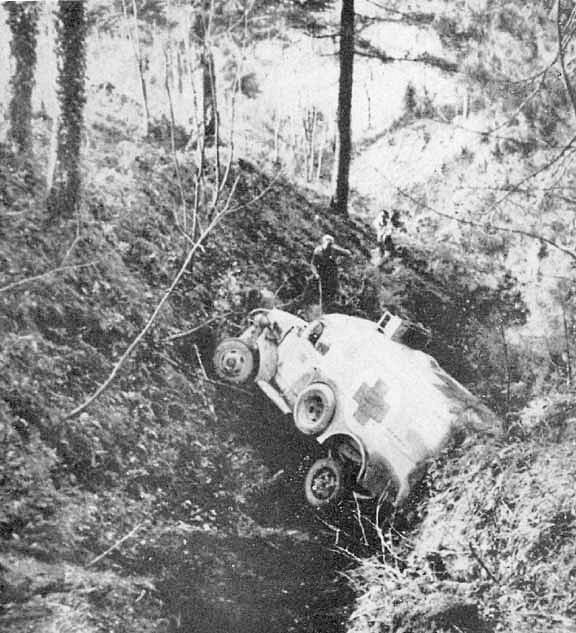
No casualties reported"On the 19th, S. Johansen drove in with the body of his vehicle in shreds. A 1,000-pound bomb landed 15 yards from his vehicle and did all kinds of damage to everything but the chassis and the engine. It came in under its own power. Ben Ford's ambulance is in a ravine and can't be touched because the road is under observation and occasional fire. Lt. Moran is up Mignano way, with Lt. Brainard in Carinola. George Medill, D. Shoup, N. Noyes, W. Stump, Boyles, Chamberlin ---all are running things extremely well in their own sectors. Major Perry came up, with M. Knee driving him, to go forward with Major Edwards and Cole. . . . We all saw some activity. It is a mean sector to attack. In one beach section there were mines that no one could detect. In another the Jerry had guns on this side of the river waiting for us. .
"On the 19th, Major Edwards went forward again with W. Conkling. They were the people to report the Ford incident: Ben Ford, distressed over his vehicle being off the road but knowing it would be all right again, proceeded to grease it."
By the 22nd there were 15 AFS ambulances across the Garigliano. The initial 5th Division drive had taken Minturno, Tufo, and S. Lorenzo (just down the hill from Castelforte). An ADS was set up in the outskirts of each town, each with 5 AFS ambulances. With 158 ADS at Minturno, on the coast, were A. Gorman, Jr., and a section including S. R. Bain, W. A. Barr, C. P. Henderson, D. C. Miller, and H. O. Selz. This ADS had had the temerity to advance beyond the RAPs at one point, later finding it expedient to move back a few miles. With 164 ADS at Tufo, in the hills northeast of Minturno, were N. Noyes, Jr., and a section including C. Ives II, M. E. Long, W. B. Lovelace, F. T. Sanderson, C. S. Satterthwait, and R. C. Wood. During the attack there was constant heavy shellfire. This was bad enough in itself, but at Minturno it was so heavy as to forbid the burial of two German soldiers killed at the exposed crossroads---so that the ambulances, dodging the shells, had to drive over the bodies on every trip.
Both Minturno and Tufo were held through the enemy counterattacks, but Castelforte could not be taken. The group with 167 ADS had approached Castelforte (W. Stump and a section including R. W. Balderston, B. G. Dickey, J. Gulick, H. S. Lamberton, and R. M. Mitchell), and they continued to evacuate the casualties during the enemy push until hope of taking the town was abandoned and the ADS was forced to move back almost to the river. Lamberton's mortar-scarred ambulance had to be hauled back down the hill.
The Commanding Officer of the 167 Field Ambulance, Col. F. V. Allen, had known the Field Service in the Western Desert and in Tunisia.
"The Battle of the Garigliano," he wrote, "was a far cry from El Alamein. Instead of the dust and heat, there was rain and cold. In place of evacuations over the long desert tracks, there were short, slow runs over treacherous tracks axle-deep in mud. . . . My pleasure at the prospect of working with the Field Service again was at first dimmed by the disappointment that there wasn't a single familiar face in the group attached to us. All were new. . . . However, my disappointment was short lived. New that they were, their 'esprit' was that of the Field Service I had known. And the job they turned out was on the same high level of excellence and 'éclat.'
"Our ADS was across the river in a very exposed position, not more than one half mile from S. Lorenzo, which was held by the enemy. I thought if these lads had been seething to get forward in the accepted AFS tradition, they should be satisfied now. . . . The Germans were very active sending greetings down our way, and we had to evacuate by night. For a few days we did evacuate by day, but it was so discouraged that we abandoned it---or were supposed to. The tracks were horrible---soft, slippery, and uncertain. . . .
"Other cars were working with the 25 MAC at a car post on the south side of the river. . . . When a call came for a car to go across the river, it fell to the AFS to supply it. The ferry . . . was under fire. Without the bang-bang it was a shaky affair---made of two small boats with platforms---and was pulled across with a hawser. In later days a small outboard motor did the job. The narrow road to the ADS was next to impassable because of the mud and was being covered by shell and mortar fire as well as by snipers. The ADS itself wasn't very inviting, It was under fire, and during one do received a direct hit. Nobody on the face of the earth would have been capable of casting dice so as to decide who would win the trip across except members of the AFS. That is exactly what they did. I'm glad to say that it turned out that the losers got to go, in course."
The forward work during this battle was as strenuous and exciting as could have been asked, and there was so much of it during the first 4 days of the assault that no driver managed to get more than 5 hours sleep. Spaghetti, cake, and coffee were on hand for them whenever they happened to get a chance to go by Company HQ, and they caught up on sleep during the lull in the fighting on the 23rd and 24th.
At the end of the first burst of action, Major Edwards was told "Your boys have done it again." No longer did he have to worry about assignments for 485 Company.
"In the past do," he wrote, "a great many members of this Company did a very good job. Two generals, three ADsMS, three Colonels, and various lesser lights went out of their way to pay them compliments.
"It is hard to pick out specific people for mention. Max Brainard ran the 5th Div show excellently . . . . The NCOs who handled the various ADSs all did a good job . . . . Rock Ferris ran the group at the advance 220 Field Ambulance, which later turned into the check post, in a manner to earn a commendation from the ADMS of 5th Division. Charlie Satterthwait volunteered to take his car to an RAP where only jeeps had been. After one trip, his car turned over in the face of a German counterattack. He and Fred Balderston managed to right the car with block and tackle, after trying two mornings before. This was done in close proximity to the German lines. [In the meantime, Satterthwait had filled the empty hours by acting as stretcher-bearer.] . . . Miller and Foley volunteered to drive jeeps to RAPs. This work was extremely hazardous, as a letter from the ADS Major goes to prove. . . . It was an outstanding job that they did."
Another letter from a British officer, Col. A. D. Newsholme, tells of the work with the 220 Field Ambulance: "The medical plan involved the construction of 3 bridges, under close observation from the hills north of the river; in addition to this, the provision of constant replacements of ambulance cars for the RAPs situated around Minturno on the cab-rank principle. To achieve this satisfactorily it was necessary to have as many as 15 AFS cars attached, and the curbing of their drivers' appetite for danger and excitement was extremely difficult. Not satisfied with the intermittent but accurate attentions of two 88-mm. guns in their leaguer area, they all but refused to adhere to the duty roster, so anxious were they to cross the river and experience the excitements of enemy mortar and small-arms fire. During this period 2 cars were seriously incapacitated by enemy action, luckily with no injury to drivers. These drivers showed at all times very real and devoted care for their injured passengers, and however unpleasant the conditions always drove with meticulous care when loaded."
A battle always acted like a magnet, drawing visitors toward the front. Some found excuses to leave their posts in the rear in order to go forward and find out what a battle looked like. Others went for a reminder or to see how this one differed from the last they had seen. As W. D. Watson wrote: "No matter how seared you are, you can't help but want the thrill of being up there." Colonel Richmond, who was in the field as often and for as long as possible, missed few exciting moments. Company officers found the routine rounds of their posts unusually glamorous during battles. It was not the safest of occupations, as Lt. Cole wrote on 27 January: "Major Edwards . . . the last 3 weeks has toured in one direction or another constantly . . . . Yesterday be, Colonel Richmond, and Captain Richmond were shelled fairly badly. Apparently the Colonel was extremely cool, as was everyone, but he just walked around seeming curious."
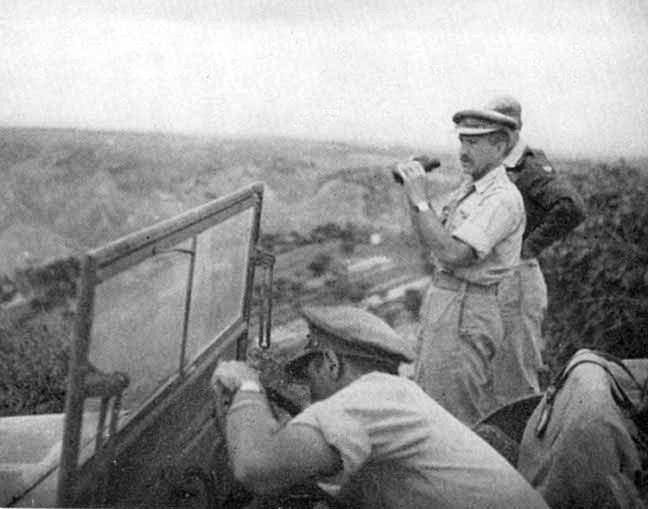
At the end of January there were many AFS cars across the Garigliano. The initial assaults had all been successful, and 485 Company was making plans to follow the expected advance to Rome. But any notion of rapid movement soon died away. Although Rome was a little closer, the push on the Fifth Army front came to a halt at the end of the month. Fighting continued in the 10 Corps sector for another fortnight, taking two of the hills commanding the entrance to the Ausenti defile while on the right flank troops moved into the Valle di Suio. The enemy continued to hold Castelforte. At the end of the push, 10 Corps had bent the western end of the Gustav Line with its small bridgehead in the Aurunci Mountains, but there had been no breakthrough to Rome.
In the meantime, the 12 cars of A and B Platoons not assigned to forward work during the January push had continued in Caserta, some with the 14 Canadian General Hospital and others as a Company car pool. C and D Platoons in the Naples and Salerno areas were kept busy with the heavy base evacuations that accompany any battle.
The two sections of D Platoon assigned on 7 January to 3 Field Ambulance of 1st Division at Pagani at first thought that the Division was resting. One section was soon sent on to 2 FA at Nocera, where it became clear that something new in Field Service experience was afoot. Both sections within a few days were preparing for an amphibious operation---practising at loading and unloading from LSTs and blackout driving and then finally waterproofing the ambulances. Speculation on their destination ranged round the Mediterranean, particularly favoring Greece, Yugoslavia, and southern France.
For such an undertaking the two sections were augmented to make them more nearly self-sufficient. To them were sent R. D. Moore as Public Relations representative; R. J. Winn, equipped with a motorcycle and light repair equipment, as LAD; and W. F. Wickes as additional spare driver. On 18 January they drove to their embarkation points. W. C. Hackett and a section including W. G. Fugitt, D. N. Hamilton, Moore, H. F. O'Meara, D. C. Titus, C. B. Tome, and Wickes went with 2 FA to Salerno; E. Baylies and a section including E. O. Bowles, A. B. Britton, H. O. Rea, Jr., E. J. Spencer, R. B. Winder IV, and Winn went with 3 FA to Castellammare. The vehicles were loaded onto 3 LSTs, Hackett's section being split. At dawn on 21 January the convoy formed and made its way 100 miles north up the Italian coast to Anzio.
The 2nd Infantry Brigade made the assault landing on the British section of the beach northwest of Anzio at 0200 hours of 22 January. Opposition was light both here and on the American sector to the right. Despite heavy mining along the beach, the British reached their immediate objective 3,000 yards inland by 1300 hours. While this position was being consolidated, the ambulances were landed on the beachhead, among the earliest vehicles to be put ashore. The first were driven by Titus and Hackett from the LST onto the landing pontoons on the British beach. "Just as they left the shelter of the LST," according to the D Platoon record of the whole operation, "a small group of enemy planes made a strafing attack on the landing operation, forcing one driver to jump into the sea, from which he was extricated with no undue damage. This air attack caused a number of casualties on the beach, but the AFS personnel and equipment escaped intact"---and went to work immediately they were ashore.
Because of the heavy shelling of the harbor and beaches, the LST carrying the rest of Hackett's section put back out to sea and was not landed until 11 the next morning. The vessels carrying the 3rd Infantry Brigade had also withdrawn because of the shelling, and Baylies' section was landed the next morning on the American beach southeast of Nettuno.
"No pontoon landing was available. The ambulances were driven from LSTs to LCTs and then into the shallow water on the beach. Unfortunately, when the first ambulance, driven by Baylies, drove off into the water, it proved to be less shallow than anticipated and with much consternation the other drivers, waiting to unload, saw the vehicle slowly disappearing under the water. The sea rose to about the level of the front seat before the engine stopped, leaving the vehicle stranded a hundred yards from shore. A recovery truck soon had the ambulance out. . . . The LCT moved a bit farther down the beach, and the other 4 ambulances landed without incident.
"The ambulances of both sections were idle through 23 and 24 January, the drivers being engaged in removing the waterproofing and preparing the vehicles for the coming attack. On 23 January an AFS ambulance of B Platoon, driven by L. L. Biddle, Jr., with H. S. Brod as spare driver, landed on the beachhead attached to the RAP of the 74 Field Regiment, Royal Artillery."
After the landings the British extended to the left along the coast from Anzio to the Fosso della Moletta and the Americans to the right from Nettuno to the Mussolini Canal. From Anzio the Via Anziate leads north to Albano, where it joins Route 7, the Appian Way. From Nettuno a road goes northeast to Cisterna. The beachhead was to spread out fanwise and then advance along these roads. Most action that the AFS was involved in centered on the Via Anziate, which, paralleled by a railroad, was toward the right in the British sector.
On either side of the Via Anziate, a few miles inland, stretches a dense mass of thickly tangled undergrowth. Gnarled trees grow in boggy groves, impassable except along occasional shady tracks which in the rainy season turn into rivers of mud. The rest of the area is drained marshland, which becomes impassable after a rain. To the right, the area between Cisterna and Littoria is crossed with countless canals and irrigation ditches, making that area unfavorable for tanks. The whole area is dead flat until, just north of the Rome-Cisterna railroad, it begins to rise to the Colli Laziali or Alban Hills. These hills dominate Routes 6 and 7 leading south from Rome---Route 6 which leads to Valmontone, Frosinone, and Cassino, and Route 7 to Terracina and Minturno.
"Patrol action along the main road north from Anzio to Albano on 24 January had cleared a way for a major attack by the British in the central sector, coinciding with an American attack toward Cisterna on the cast flank," the D Platoon record continues. "The 24 Guards Brigade were chosen for the attack. The immediate objective of the assault was the 'factory'---so-called by the beachhead troops but actually the model Fascist agricultural village of Aprilia [10 miles inland on the Via Anziatel, the dominant topographic position and compact structure of which rendered it the principal strategic point on the beachhead. The 137 Field Ambulance . . . served the Guards Brigade, and at 0100 hours on 25 January two ambulances, driven by Bowles and Britton (with Spencer as spare driver) were detached from 3 FA and sent to the 137. The attack went in at dawn and met very stiff resistance in the factory area, although the objective was taken in the late afternoon. . . . The two ambulances were kept busy through 25 January and through a stiff German counterattack on 26 January. After the position in the factory had been securely consolidated, the Guards Brigade pushed on again on the night of 27 January, and two AFS ambulances from 2 FA (driven by Tome and Wickes) were attached to the 137 FA to assist in the forward work. Stiffened German resistance stopped the Guards advance by the morning of the 28th about 1 1/2 miles north of the factory, and 1st Division reformed for further assault along the same axis."
The Guards' attack continued toward Campoleone on the Albano road on the night of 29 January, and the rest of the ambulances were attached to the 137 Field Ambulance.
"All ambulances were forced to work day and night because of the heavy casualties to be evacuated. Spencer, moving forward through the dark with the 1 Scots Guards RAP narrowly escaped when the battalion ran into heavily mined roads and suffered very heavy casualties.
"On the afternoon of 30 January, Winder and Rea accompanied the RAPs of their battalions in the advance to occupy the heights just south of the overpass of Campoleone. The last attack in the initial assault came on the next morning, crossing the Rome-Cisterna railroad; but it could not keep the gain and the Guards withdrew to positions some 300 yards south of the overpass. This was the farthest advance of the beachhead troops until the final break-through in May.
"While evacuating wounded from this forward position, Winder's ambulance was strafed on the road and put out of action, although the only casualty among the occupants was a minor wound [in the hand] suffered by Winder himself. After medical treatment, Winder resumed his duties with the 3 Field Ambulance."
The end of January marked the end of the first phase of the beachhead campaign. Large German reinforcements from Yugoslavia, northern Italy, and even the Adriatic sector of the front had strengthened the enemy to such an extent that further Allied advance without replacements was impossible. The 1st Division was seriously weakened by casualties, and the men were exhausted by 10 days of continuous and strenuous attack. Having brought 4 full divisions to the sector, the enemy was obviously about to mount a big counterattack. The first two days of February were spent consolidating Allied positions. "During this first period of Allied initiative," according to the Platoon record, "our AFS ambulances had been in constant front-line use, and at least 8 of them had been hit at one time or another. With the exception of Winder's minor wound, none of the drivers had suffered from anything worse than exhaustion."
The addition of R. Mann, who arrived on 3 February with the RAP of 78 Field Regiment (RA), brought to a dozen the number of Field Service cars on the beachhead at the time of the German counterattack. On the same day, 158 Brigade of 56th Division reached the beachhead.
On 3 February the enemy put in its expected counterattack against the long salient held by 1st Division along the Anzio-Albano road. The attack was made principally at the base of the salient, with the apparent intention of cutting off the troops at the far end near Campoleone. Extremely strong enemy thrusts were held until an orderly withdrawal was effected. During the period of greatest penetration of the base of the salient, casualties were evacuated by Winder and Rea down the main road for a distance of 3 miles under intense mortar, machine-gun, and even rifle fire---as at one place the Germans were within one-eighth of a mile of either side of the road. Winder's ambulance, which had been repaired, was again hit and rendered unserviceable.
A lull ensued during 5-7 February. The 1st Division established a new line about a mile and a half north of the factory, and the enemy regrouped for further attack. On the 7th, the 158 Brigade was moved up to the center of the line, and its 140 Field Ambulance took over the MDS and ADS operated by 137 FA, which then dropped back to the beach for a rest. The 6 AFS ambulances attached to 137 were transferred to 140, to continue their participation in the forward work. The MDS had been located in the same spot since the night of 14 January, and during the period 4-7 February it was shelled, strafed, and bombed with several casualties among both patients and medical personnel. On the 8th, the establishment was moved back to the British medical concentration area (3 miles inland on the right side of the Albano road), where it acted as the reception unit for 2 Mobile CCS.
"During the initial Allied attack," the Platoon record continues, "evacuations were made directly from the RAPs to the MDS because of the shortness of the haul and the availability of a good paved road. An ADS, staffed by 137 FA personnel, was set up about 3 miles north of the MDS midway between the flyover and the railroad bridge at Carroceto [the railroad station for Aprilia or the factory], but this medical station functioned only as an emergency post. When our farthest line had been established well past the factory (29 January to 3 February), the ADS moved up to a transformer station on the power line just short of the factory, where it began functioning as an integral link in the line of medical evacuation. Continuous shelling of the area made evacuations to and from this medical station extremely hazardous, and the exposed position of the ADS resulted in its receiving a number of serious hits. There was no protection for vehicles, and during the 5 days the ADS operated in this position 4 of our ambulances were hit and Rea's British medical orderly was killed. . . . When the defensive line was established a mile and half north of the factory, the ADS was moved back to the farmhouse where it was originally."
The enemy attack was renewed from the 7th to the 10th, retaking the area down to the Carroceto railroad station. "During the enemy advance in this sector, Fugitt, whose ambulance was attached to the RAP of the 2 North Staffs, received a scalp wound from small-arms fire---when his ambulance was intercepted by an armored patrol as he was making his way back to the RAP, unaware that it had been overrun and captured by the enemy while he was carrying casualties back to the ADS. Despite his wound and serious damage to his ambulance, Fugitt returned to the CCS with two casualties picked up in the road. He remained in the CCS under medical treatment for 48 hours and then resumed his duties. . . . During the same offensive our ambulance attached to the 1 Scots Guards, driven by Spencer, also narrowly escaped capture when the RAP was overrun and taken prisoner by the enemy while Spencer was on a run with casualties back to the ADS."
On 11 February a strong counterattack was put in by the U.S. 45th Division. This briefly retook the factory, but it could not hold it. For the next 4 days, both sides paused to reorganize and build up reinforcements. Another part of 56th Division, 167 Brigade, was brought to strengthen the British increment between the 12th and 14th (the third brigade arriving a week later). The British line was dug midway between the railroad bridge at Carroceto and the flyover. The all-out German push began on 16 February, aimed at the central sector down the Via Anziate. Their gains were rapid on the 16th and 17th, but when the attack reached the approximate lines of the original beachhead it was stopped. In the next two days, further attempts to break through were contained, after which the strength of the enemy attack seemed to have been broken. For another week, the Germans attacked on a lesser scale and took a little more ground. This fighting was at very close quarters, rather disorganized, and sometimes desperate. The situation was stabilized at the end of February.
At the time the enemy renewed its attack, according to the D Platoon report,
"the 15 Mobile CCS landed on the beachhead to enlarge the medical area, 2 CCS being unable to cope alone with the extremely large number of casualties. Six AFS ambulances of C Platoon accompanied the CCS . . . driven by G.R.Bunker, R.G.Decatur, W.L. Farrelly, D.M. Fish, R.H.Fowler, Jr. (NCO), and H.M.Wagner, with B. K. Curley [taking a convalescent leave] as section mechanic and spare driver. Their task was to assist in the evacuations from the two CCSs to the harbor area, where the wounded were loaded aboard LCTs and carried out to the hospital ships in the harbor. This was an extremely uncomfortable and dangerous run, as enemy aircraft were constantly bombing and strafing the road, the town, and the harbor installations. Heavy calibre guns in the Campoleone district, too, kept up intermittent fire on the whole Anzio-Nettuno base area.
"On the night of 14 February a single German plane flying low to escape a pursuing Spitfire jettisoned a 500-pound bomb, which landed in the ambulance car park of the 15 CCS, damaging 4 of the AFS ambulances and wounding 2 of the drivers. Decatur, the more seriously injured, suffered multiple bomb-fragment wounds in the back and legs and was evacuated to Naples [and subsequently by hospital ship to the United States]. . . . Bunker, who received minor wounds [in the leg], was given medical treatment and returned to duty.
"Throughout March, April, and the early part of May the beachhead continued a static front as far as advances or retreats were concerned, but never was it a quiet sector. Hostile air activity and long-range, heavy-calibre shelling made even the rearmost positions extremely dangerous; and the strain of being continually under fire with no respite wore terribly on all personnel."
There was no possibility of rest or respite. The noise and the danger were continuous, and even those with the strongest nerves found themselves affected.
"I never before knew what fear meant," E. O. Bowles wrote, "I mean really being physically afraid. It is quite an experience, and it makes most of the prewar worries and anxieties look pretty unimportant. It isn't a fear of death or of anything tangible---it is just fear. Almost everyone here is afraid, and it is no emotion to be ashamed of. Bravery, after all, doesn't consist of a lack of fear but of an ability to carry on and do your job even when you're so afraid you can hardly hold the wheel of your ambulance."
Toward the end of February it was arranged to relieve the original sections of D Platoon by those which had been doing General Hospital work south of Naples. C. R. de Rimsingeur, Platoon Sergeant, established an office of sorts in a dugout in the medical area and put into effect a system of rotation of beachhead personnel. He took over the administration of cars from other platoons and arranged, by complicated paper swaps of ambulances, that D Platoon, which at all times had the majority of AFS cars on the beachhead, at the beginning of March should take over the cars of the C Platoon section. Lt. Lester took over from De Rimsingeur on the beachhead after a period of 40 days, maintaining the complicated system of priorities for assignment or reassignment to the beachhead.
The A Platoon car brought up by R. Mann was later driven for a very long period by D. M. Smith and was not taken over by D Platoon until E. O. Bowles came up on a repeat engagement very near the end of the show. B Platoon later sent up P. Brannan, C. A. Rellinger, and N. Laden (in that order) to drive the car brought up by Biddle and Brod.
The work at the beachhead brought the Field Service many thanks and much praise. Biddle and Mann brought back letters of gratitude from their Regimental Commanders. General Penney, Commanding 1st Division, commended "Mr. Baylies and his ambulance drivers" for their "example of gallant and loyal service, which has earned the admiration and gratitude of all who have witnessed it."
What was meant was more fully expressed by a Medical Officer, Major W. J. Abel:
"At Anzio . . . our unit had a varying number of 5-6 cars attached. The greater number of these men had never been in action before, and no men earned our respect more deservedly. I think the most delightful feature was the warm friendship and comradeship which developed. We had a small MDS in a swamp, surrounded by guns and under constant shellfire. In the early stages, there was no time to dig in, and life was far from rosy. Our friends---for such I term them ---were always cheerful and did long spells of duty under most exacting and tiring conditions. I remember one who was a philosopher. I used to visit our forward CCP, which was under constant mortar fire, and used to find him sitting on the ground expounding to an interested audience, writing in the sand. His was the sort of coolness which won our greatest admiration."
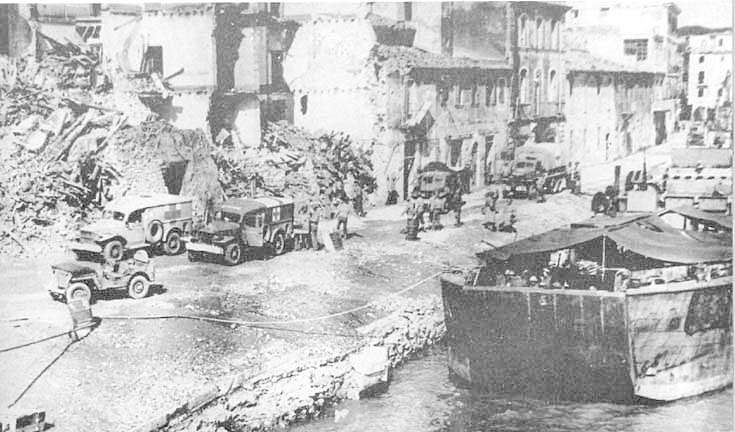
Ship evacuation, Anzio
Another AFS characteristic that received only unofficial thanks was its everlasting consideration of creature comfort whenever this was possible---and even when it was barely so. In this category belongs the bathtub salvaged by Lt. Lester and arranged to provide hot baths in the middle of a sand dune. Its gleaming splendor was enjoyed by at least one general, who may have changed his mind about it after being caught therein by an enemy shelling.
Of course, anything so spectacular as the beachhead operation attracted visitors. Captain Richmond made the first tour of inspection on 13-15 February. On 4 March Colonel Richmond and Major Edwards went up. In early April, Colonel Enos Curtin included the sections at Anzio in his tour of the companies. Major Perry was shipwrecked on his way back from Anzio and narrowly escaped a doom of water. At different times L. B. Cuddy, Jr., J. From, and G. E. Holton went up to collect material for publicity.
After Termoli, Holton devoted much time to the duties of an official AFS photographer. Of the life at Anzio he wrote:
"The beachhead always looks like a real war; everyone is either down in their dugouts or rushing around at their job. There is an almost constant smokescreen put up over the place, and that adds to the effect. It's not a pleasant feeling, being confined to such a small area, all of which can be covered by enemy shellfire. Jerry is on one side, and your back is to the sea. There's no way of getting away from it all .. . . .
"Everyone on the beachhead lives in a dugout, except for a few who were lucky enough to be accommodated in a cave or wine cellar. Most dugouts are made just big enough for one person to stretch out in, as the smaller they are the more protection there is against shelling and bombing; shutters off the wrecked houses of Anzio make excellent roofs and would hold up a good layer of dirt on top. One is quite safe in a dugout unless a shell or bomb makes about a direct hit. Near misses sometimes cause them to cave in. A few shells landed in the area around my dugout and at times the dirt on the roof would spray down on me and my bed. Several times it rained and made our lives in those holes in the ground quite miserable. I spent hours catching the water dripping through the roof in my helmet and mess tins in order to try to keep my bed and kit as dry as possible. Not only the dampness, but the almost continual racket of guns, made a good night's sleep impossible. . . .
"About half our cars were at forward posts; these would bring the casualties back to the medical area, where the patients would be treated and held for evacuation by sea. Each morning the rest of our cars would evacuate down to the battered harbor all the patients fit to make the boat trip back to base hospitals. Everybody working around the port had the jitters, and no one would hang around any longer than necessary. The Germans occasionally would shell the place with a special long-range gun; troops affectionately called this gun 'Anzio Archie.' [NOTE: The reports calling this gun "Anzio Annie" are equal in number to those calling it "Anzio Archie," which is certainly without any significance at all.] Never have I seen stretcher-bearers hop to unload an ambulance of its patients so quickly. Usually a driver has an annoying wait until the patients are unloaded, but here the cars are emptied and off in nothing flat. . . .
"[On the morning of 14 March] a bunch of Messerschmitts shot down from the sky, bombing the area. Rip Frazer, who was on the duty ambulance at the casualty reception tent [of the 15 CCS], got a machine-gun bullet in him from one of the planes. . . . At the time, I was in my dugout; but Rip had only time to leave his ambulance and make a run for the sunken floor of the reception tent, just 40 yards from me. After the raid I climbed out of my hole. The air was filled with dust and the smell of powder. Some butterfly (antipersonnel) bombs landed smack on the large red cross canvas flag that was supposed to identify the medical area from the air. Rip was the only casualty at the CCS, but some of the tents got shot up with holes.
"There were numerous calls for ambulances around the vicinity, and all the cars available drove into the surrounding fields to pick up some of the 90 casualties. Another driver and myself hopped into Rip's car; just as we were loading the stretchers in, some more Jerry planes came over. Everyone again made for the holes, but the ack-ack fire drove the planes off and kept them high. . . . Everyone seemed to take an extra-special interest in Rip. An American Major General even came round to pay him a visit. The General remarked that the AFS was doing as fine a job as any outfit on the beachhead. . . .
"The beachhead work is probably about the toughest work and life that any of us have ever had over a long and continuous period of time. Every car except one I saw there had a good spraying of holes from bomb and shell fragments; concussion of explosions knocked out the windows and windshields of several of the cars; and 4 cars have been wrecked completely. . . .
"[One of these cars belonged to J. M. Brindley, whose RAP Lt. Lester, From, Holton, and a relief driver visited.] Brindley, who was being replaced, had been captured by a German patrol and, after taking a load of German wounded back to their lines, was released. The next day he had his ambulance wrecked and his orderly wounded. Brindley was given another ambulance, which was hit twice in the following few days . . . We had just finished watching a plane come crashing to the ground when a shell whistled over us and we all dropped flat on the ground; the shell landed about 25 yards away . . . and covered us all with a thin layer of dirt. Then the 6 of us made a quick dash for underneath the nearest ambulance, as there were no dugouts close enough at hand and the ambulance would give some protection from flying bits of shrapnel. A few seconds later shells started dropping here and there on every side of the ambulance. One piece of shrapnel bounced off Joe From's helmet and put a good dent in it without piercing the thin metal. Without the protection the tin hat gave, Joe wouldn't have been here to tell any more stories. . . .
"We all were a most scared bunch, and I will never forget the frightened look of faces as we huddled together and thought that with each shrieking shell it would soon be the end. After a dozen close shells there was a sudden stop. We waited a minute and then made a quick dash for the dugouts. The pause continued, so we came out for air and breathed a sigh of relief. I got Brindley over for a quick picture by his ambulance. We found that his car had just had a few more holes added to the collection. Those of us who were leaving quickly got in a few last words and drove off as fast as the rough road through the swamp and woods would take us."
Although in March and April the lines remained stationary, the Germans did not give up their attempt to overrun the beachhead. Except for the coming of spring, nothing made life there either easier or pleasanter. Many of the medical units were replaced by fresh groups from the rear.
"The casualties, as you can imagine, are high," F. J. Hallowell wrote in March. "The people who are the real heroes of this war are the surgeons, who work night and day with never a complaint . . . one case after another, with the surgeon using all the skill at his command, with bombs crashing down intermittently which rock the whole tent and set instruments on trays rattling around like crazy things."
Acts of bravery were the rule on the beachhead, and the passage of time did nothing to lessen the need. The Field Service was amazingly lucky to have so few casualties to its personnel as it did. The ambulances, however, not only suffered heavily but in time were very difficult to replace. Lt. Lester's description of C. E. Johnson's efforts on behalf of his ambulance on the night of 18/19 April tells most vividly of the forward work on the beachhead:
"Last night, Charlie Johnson came into the hospital area at about 11:30 in the evening, saying they needed another ambulance at the Car Post of the 137 FA ADS, that his own car was bogged down and out of action on the lateral road in no-man's land. I got him a car to take off in the emergency and set to worrying how to salvage that vehicle bogged down. I went up to the Car Post this morning---and there was the bogged-down ambulance, big as life. This after having been advised by . . . authorities of 137 FA that any ambulance bogged down where Charlie's was would almost certainly be a write-off. . . .
"His night's work was something like this: He was stationed at an RAP in a quarry, at the end of a wadi which forms a part of our present lines. The MO and his batman were killed there a week or so ago; it is pretty constantly shelled and mortared, having mortar emplacements only 20 yards or so away from the RAP. (I had taken Charlie up there to relieve Titus some 4 days ago; I planned to take Brindley up in Brindley's car to relieve Charlie today. I make it a 4-day shift at that post, then 8 days back at the CCS.) The evacuation is tough. . . . You go out to the lateral road, some 100 yards in front of our lines, run about 1/4 of a mile along through no-man's land, then turn back to the right into the 137 ADS Car Post. OK during the daytime, because the Germans stop fire when an ambulance passes. But at night they fire hard and fast at the purr of any motor passing down that lateral road.
"Charlie's call came at about 8:30 P.M.---a very bad head case. He set out, turned up around the quarry hill and down into the battlefield. The machine guns and spandaus opened up. ('If you're careful, you know, you can dodge them,' Charlie claims.) He moved by fits and starts (having had the night run there two nights running, I suppose he'd developed something of a technique), running a short distance until fire was attracted then stopping short ('so's you'd let the fire pass across in front of you'), then starting again for another short stretch. So it went on until he reached the turn-off onto the lateral road. By this time there were shells mixed in with the opposition, too, and one burst loud and dazzling bright just in front of his car as he was making the turn. He was blinded by the flash and slid into a shell-crater and trench at the corner, bogging the right rear wheel deep down in the mud. From then on there was no dodging; the roar of the motor brought fire directly on him. . . .
"So Charlie and his orderly got the patient out of the car and down into the trench at the side, where Charlie left them both and set out across the field back to the RAP for help. The wind was up by that time. Flares were thrown into the sky, and one of them just over the field where Charlie was running for cover. Machine-gun fire opened up, and he dropped into the grass till it silenced and he could make another dash. And so on, by sprinting, crawling, swan-diving, back to the quarry and the RAP. The only solution seemed to be a stretcher-bearing jeep, so Charlie was off in that and back to the ambulance. And then, with the orderly and patient aboard, on to the Car Post-shifting, stalling, dodging through the tracer bullets and more shells.
"A Humber was sent up from the Car Post to take his place in the quarry. Charlie came back to the CCS here to get another car to take up that night to replace the Humber at the Car Post. I got him Brindley's, since that was to go up the next day anyway. Charlie set off from here in the pitch black-lighted by the Anzio Archies that were dropping in close to us last night. Two jackasses in the next field were screaming and bellowing at the flashes and whirring shrapnel as Charlie went off to his post again.
"He was just settling down from his past excitement, and safe back at the Car Post ('I thought I'd had it when the flare got me in the field there. That was the worst'), when a Signals man came in with a message that the bogged-down ambulance was blocking a crawl-trench essential to communications: Charlie would have to get it out somehow, that crawl-trench had to be cleared at all costs. Charlie objected that that was just a good way to lose a third ambulance . . . but the order was there. Charlie said he'd do it---under protest. Signals said Intelligence had assured them they would have a support party at the ambulance to help get it out.
"The guns opened up again as soon as Charlie left the woods by the Car Post. They followed him as he came down the wooden track to the lateral road and turned to the left down that no-man's-land stretch. Again there was that game of stopping and starting; getting them to shoot at you and then letting it spray across in front of you. He got back to the car, and there in the trench were two Tommies with shovels. His support party---and neither of them could drive a car. So they shoveled around and got things ready a little, and then Charlie got one of them to take him back over into the wadi to Intelligence Headquarters, to ask the officers there what did they think he was a damn wizard to drive two cars all by himself, and was that what they called support? . . . So he went off down the wadi to the RAP again and got a driver there, and went back through the field to the cars.
"There was much roaring of both motors then, of course, and the inevitable patter of machine guns and shells. The ambulances were scarred here and there, and the rear tire on the lead car slashed and seared to threads by machine-gun fire (apparently). Slowly they pulled forward and were off again, starting and dodging together this time, on down the lateral road and back, at about 4 in the morning, to the Car Post. . . . Charlie was brought back, grimy and tired as he was, to be dined and toasted in the officers' mess of the 137 at lunch."
The dispatch of 56th Division from 10 Corps on the Garigliano front to 6 Corps at Anzio in early February meant that no further offensive could be carried out by 10 Corps. At the time, it was felt that the Garigliano operations in January and early February had been inconclusive. But the bridgehead gained, and held during the following months, gave the Fifth Army the necessary springboard for the great May offensive.
In 10 Corps, AFS cars were posted with both 5th and 46th Divisions from RAPs back to the general hospitals in Caserta. There was a strenuous effort in mid-February to bring some kind of order to the postings of the cars of A and B Platoons. After numerous shifts, for the most part A was with 46th Division and B with 5th Division. This, of course, was too good to last any length of time. Late in February, 46th Division was relieved in the Garigliano bridgehead by 4th Indian Division. In the first week of March, 5th Division was replaced by 88th U.S. Division. B Platoon came out of the line with 5th Division and, after a short rest in Caserta, took over some 46th Division posts in the Garigliano valley and sent sections to the 15th Canadian and 16th Combined General Hospitals in Caserta. A Platoon kept most of its Field Ambulance and RAP assignments until the 4th Indian Division was in turn replaced by the French 4 DMM on 24 March. By the end of the month, 10 Corps was resting, with no AFS cars attached.
The American and French troops, after their unsuccessful attempt to take Cassino in January, gradually took over the whole coast sector of the front. When 10 Corps later went back into the line, it took up its position in the hills to the east of Cassino. Except for the British troops at Anzio, by 6 April the Fifth Army was on the west coast and the British held the line from the Liri east to the Adriatic. This rearrangement considerably simplified administration and such matters as reinforcements for the British. However, during February and March the AFS had seen some excitement and hard work with 10 Corps in the west, which from mid-February to the end of March was engaged primarily in a holding action, enlivened by frequent patrols and artillery duels, in the small Garigliano bridgehead.
In February, as the front settled into a static line, the ambulances were increasingly collected into pools serving such medical concentrations as the 141-158-164 MDSs at Céllole, the 25 MAC pool at Sessa, and a 485 Company pool in Caserta. From these they worked forward or back according to current need or the system of the particular pool. W. D. Watson described one of B Platoon's pools on 22 February as follows:
"There are 7 cars attached to a particular regiment. Two of these are posted at the forward ADS, 3 at the rear ADS about 3 miles back, and 2 at Platoon HQ, which is right near the MDS about 7 miles back. The 2 forward cars are supposed to do 48 hours, carrying wounded from the forward ADS to the ADS. The other cars work from the ADS to the MDS, and 2 are back at HQ resting. This is supposed to rotate every 48 hours, but it is almost impossible to stick to the schedule, because casualties have a habit of coming in bunches. So for a few days all the cars may be on the road, and then there will be nothing for maybe 24 hours."
From these pools, cars were also sent forward to RAPs. L. B. Cuddy, Jr., wrote of the adventures of F. W. Kreis during one such assignment:
"While [he was] crossing the pontoon bridge spanning the Garigliano River and providing a supply line for the troops fighting barely two miles above the river, shells began to hunt out the bridge. . . . The bridge was screened in smoke. Although German observation posts had full view, they could not determine its exact position. As Kreis got to the middle, 6 shells landed almost directly on the bridge. He jumped from the driver's seat and dashed over the side for protection. No shells hit the bridge, although great gushers of water shot up a few yards away. Kreis continued on his way without a mishap.
"In a little town called Trimonsuoli, a few miles northwest of Minturno, Kreis parked his ambulance under the archway of the building which held the headquarters of the regiment he was servicing. Also in the building was the RAP, where the wounded were brought by stretcher-bearers for first-aid treatment before being evacuated by ambulance. At this time, the post was approximately 300 yards from the enemy. When Kreis first arrived, he shouted to a friend whom he recognized. He was quickly stepped on for his loud voice. 'For God's sake, man, the Jerries won't like that. They can hear us, you know.'
"The town of Trimonsuoli is barricaded on the far side. It has a stream running along the outskirts. On the opposite bank is Jerry land. It is a typical Italian country village, with narrow cobblestone main street and narrow dirt side streets, dirty multicolored two-storey buildings that look as if they had been untouched for many years. At night, no one is allowed in the streets other than the evening patrol. The quiet is unbroken except for the sound of rifle and machine-gun fire. . . .
"Because the whole position is completely within sight of the enemy, roads leading into the town are useless during the day. Evacuations of the wounded are always done at night. The British orderlies go about the work of putting the wounded on stretchers and into the ambulance in perfect silence. No one moves at night without the pass word. No chance is taken. The pass-word phrases used are colorful. The challenge is the first word in a two-word phrase, the answer always completing the thought. Examples such as 'saddle soap,' 'King's Row,' 'Mrs. Miniver,' or 'Peanut vendor' have been used."
Both A and B Platoons had sections with 1 Field Ambulance at Céllole during February. The Guards' Field Ambulance, in March it moved across the Garigliano to the place they named Skipton, in the shelter of Monte Castelluccia. A Platoon kept 6 cars there during the whole of March---C. S. Satterthwait and a group at different times including B. M. Bowen, J. P. Brinton III, W. H. Browning II, F. B. Cliffe, W. E. Collins, R. Ferris, M. E. Long, R. Mann, W. P. Meleney, L. S. Peck, Jr., and D. M. Smith.
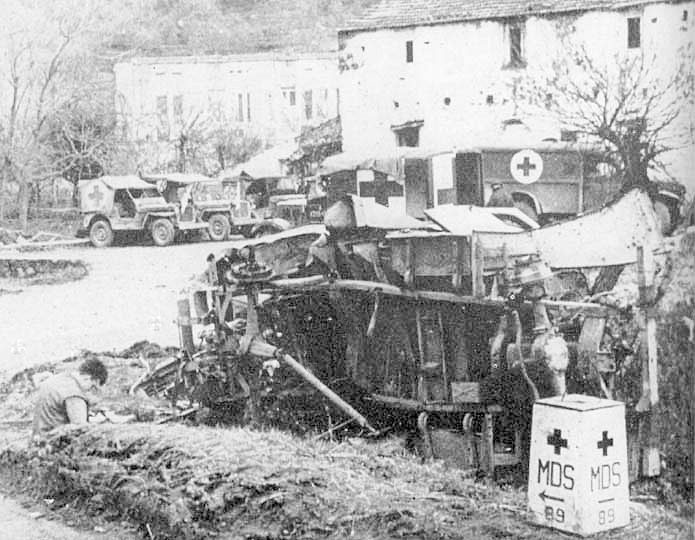
"My new post is much quieter than my last, but it's in a relatively similar position," Mann wrote after being transferred from Anzio to Skipton. "This is an ADS, and I'm attached here to a Field Ambulance working for the ADS and containing mostly AFS ambulances, which means that work is not quite so incessant. Other cars from RAPs and infantry posts bring casualties here, and we evacuate from here to the back areas. . . .
"Of course, every time I set foot into a forward area, I get the pants seared off me. As a welcome, when I was arriving at this lovely spot, Jerry took it into his head to let fly at the road I was driving along [an exposed stretch of 3 miles along the river]. They dropped (literally) all around us. One plumped down into the road 50 feet in front of me, and, as I was casually driving through the smoke wondering where the shell hole was, another whacked into the track 50 feet behind me. I call that perfect timing---the experts call it perfect timing.
"Most of the casualties who pass through here are 'mine' casualties. . . . Mines are all over this area (and booby traps), and every day brings in some fellow who's wandered over the white tapes (which mark the borders of the cleared areas) and lost his foot, at least, as the consequence. Then Jerry has ways of placing his mines so that they can't be detected. There was one spot on the other side of a taped area where cars and jeeps had been going for ages. This morning there was a terrific explosion. Dirt flew all over the place. Everyone was diving into slit trenches. A car had backed onto a teller mine. It went right up in the air, turned around, and crashed over on its side. We were busy with the casualties all morning. It wasn't one of our ambulances, thank the Lord, but it certainly had us wondering how many more mines were in our car park. . . .
"There's an orange orchard next to the ADS. Now you can imagine the temptation offered by a beautiful orange tree laden with juicy oranges, but we all know that the orange orchards are Jerry's favorite booby-trap sites. The other day a mule got loose from its owner and waltzed off into the grove. I guess he didn't realize the price he could very easily pay for going after the greener grass in that forbidden garden. We all stood around the tapes watching this mule wander around through the trees, and many were visualizing mule steaks for supper. Well, you might have known it. He didn't blow up. He finally just walked out of there. Weeks before a man was killed picking oranges. And there was that mule, after stepping all over the place, in one whole piece."
The ambulance that blew up at Skipton belonged to the French unit that, after 3 days' double banking, relieved the AFS section. At the end of its month in this not unexciting spot, the men were surprised to be replaced by women drivers.
The end of March found changes in the administration of A and B Platoons. The enlistment period of Unit 32 had come to an end in the first week of February, and Sergeants Gorman and Shoup had both been repatriated. Lt. Moran ran A Platoon without a sergeant until formally appointing G. C. Medill at the end of the month. At the beginning of February, Lt. Brainard had appointed as B Platoon Sergeant G. E. Tener, who relinquished the position in mid-March. He was succeeded by L. L. Biddle, Jr., who was named to succeed Brainard as Platoon Lieutenant on 28 March. H. S. Brod was then made Platoon Sergeant. At this time both platoons were almost completely out of the line. Except for a small handful of RAPs, A sat unassigned with Company HQ and B was doing rear work.
Company Headquarters stayed long in Caserta. On 8 February, Major Edwards had obtained a movement order permitting it to be moved up to Rome at his discretion. When the general advance stopped, this was recognized as excessive optimism. On 5 March, making the most of the worst, H. S. Brod opened the Mad Dog Room in the abattoir's old dog pound. This establishment catered to the men's thirst for a change from tea and kept hours more to be expected in New York. The urge to move 485 Company HQ rose again in mid-March, and on the 30th, with most of the cars of A and B Platoons, it moved to a site "near a quarry and in a grove near a mountain"---off Route 6 between Pietravairano and Marzanello. The site was usually known as Vairano. However, as Major Edwards had originally planned to move to Presenzano, which is near by, the new camp was called Vairano by some and Presenzano by others. The Mad Dog also opened here, and the Company at most future sites had at least a nook that was so named.
Meanwhile, during January and February 1944, C and D Platoons had continued much as they were first assigned---C in the Naples area and D half at Anzio and half to the south of Naples at Nocera, Salerno, Pontecagnano, and Potenza. Of their work, R. F. Skillings wrote on 21 January: "We're still in a base area, working with general hospitals, seeing only a few war casualties but unfortunately lots of venereal disease, diphtheria, jaundice, etc. Runs vary in length and frequency depending on the post you have at the moment. The last day or two I have been attached to a Medical Inspection (MI) Room, where I do 24-hour duty bringing the sick to the MI Room and taking the worst to the nearest general hospital. We have the establishment in the railroad station of the town---myself; the MO, a captain; and a Medical Corps orderly, a private. Lots of time on our hands, so we read and argue and really have a pretty good time, though the orderly and I have nowhere to go to get out of the immediate environment. Someone must be here all the time."
There should have been two men on such posts, as there had been in Syria whenever possible, but manpower in Italy continued short. After the initial high sickness rate slacked off, the repatriation of large numbers of men at the ends of their enlistment periods left both companies dangerously low again. In mid-January there was serious talk of having to curtail the AFS effort in Italy. On the 28th, Lt. Cole wrote: "Major Perry came in tonight with some fears about enough men to go round after 5 February. Anyway, something will turn up---it always has and always will."
A few small units did come through, but Mr. Galatti could not get shipping space for the large unit that was needed to remedy the situation. Frequent counts and recounts of the roster in both Naples and New York showed facts that were gloomy and a future that looked disastrous. At the end of February, Lt. Lester wrote of the shifts he was forced to adopt at the 103 General Hospital in Nocera:
"Not much happened today. . . . We sent in a note last night that only 8 ambulances are available here today, and they gave us 167 patients to evacuate: i.e., some fellows have one run to Salerno, one to Naples, and one to Sorrento before their day is over.
"In addition, no drivers seem to be forthcoming for a while. I ended up by scouring GHQ for someone to drive an ambulance for a while, with how much success you can imagine. Got onto the trail of one three-pipper who was rumored to have said the other day how he'd love to be driving again; but he was knocked out with a cold in the nose today. . . . By tomorrow I'll be able to get a driver or two, I think. I have a couple of old pals lined up and have borrowed a car from Pontecagnano. And I'll have the 15-cwt- and an ambulance of my own for tomorrow, too. So we'll handle the convoy all right."
February and March were the tightest months. All the platoons were strapped for men, some ambulances sat driverless, and spare drivers or even non-driving NCOs were very rare. Finally, during the spring and summer Mr. Galatti was able to send some large units, and the problem of manpower could be forgotten. Something had "turned up," as it always did. And after all there had not been the need to curtail the Service or to adopt the painful expedient of depopulating Naples GHQ.
"We are still doing base hospital work here---boring at that," Skillings wrote in early February. "Have changed hospitals, and now we do little else than run between the wards of the hospital with patients." But in late January the tide had begun to turn. C Platoon sent one section forward to 10 Corps in January. Another was sent in early February with 15 CCS to Anzio, and a week later a third went to 14 Canadian General Hospital in Caserta, D Platoon taking over the Naples posts that C released. Finally on 1 March all of C Platoon was assigned to replace B and C Platoons of 567 Company with the New Zealand and 4th Indian Divisions at the Cassino front(13), and D then moved its HQ from Nocera to Naples.
As of 4 March, D Platoon had 15 cars at the Anzio beachhead , a section each at the 14 Canadian and 2 General Hospitals in Caserta, and a few cars each at the Benevento and Cervinara MI Rooms as well as with the "typhus Majors" in Naples. This last was a 3-car assignment to the Majors of the Typhus Team, which had been working in Naples almost from the time of its fall, and was one of the Company's earliest. During the entire first year in Naples, there was a constant struggle to prevent a serious epidemic of typhus. The whole city was several times placed out of bounds to troops not stationed there. No one was given permission to enter the city from outside except on most important business, while the inhabitants both civilian and military were dusted with chemical powder and forbidden to go to films or use the funiculari. Some of the more densely populated regions of the city, for this and other reasons, remained out of bounds so long as there were troops in the city. Unglamorous and unexciting though the typhus post may have been, it was probably one of the most valuable of the AFS efforts. During the spring of 1944, D Platoon rotated its members between Anzio and these rear posts, maintaining the same distribution unchanged until the end of May.
General Leese had had plans for a major offensive on the Adriatic sector of the Italian front in mid-February. It did not materialize, and the line on the eastern sector was held substantially unchanged during the winter and spring months. Patrols were very active. And artillery continued to make life as unpleasant as possible for all concerned: "mad miles" and "windy corners" abound in accounts of forward work.
However, there was almost more activity behind the lines---as divisions and units shifted position, came out of the line for a rest and were replaced, were transferred to another sector, and were regrouped in various combinations. The trend of these moves gradually showed its significance toward the end of March: the stronger units were sent to make the assault on the Cassino position, and, as that continued to resist, additional troops were transferred to reinforce the mountainous central sector, increasing the width of the attacking front to include the ranges north and east of Cassino.
With the exception of its C Platoon, 567 AFS ACC followed the general pattern. Their work moved to the west and they were assigned to 13 Corps. At the end of March it was suggested that it would be more convenient to have the whole Company together in a single formation, but 5 Corps made determined resistance. The spring was as wet as the fall, and they refused to relinquish the last platoon of AFS cars, saying that "only motor ambulances with 4-wheel drive can compete with the country." Consequently, C Platoon stayed in the east.
In mid-January, however, all of the Company's cars were still working in the Adriatic sector, A Platoon in the Lanciano-Casoli area, B and C on the coast, and D at the mountain posts it had already been serving for several months. In order to get all of its cars with 13 Corps, on 15 January A Platoon relieved B of its New Zealand posts, just as the New Zealand Division was itself being replaced by 8th Indian Division. A Platoon HQ was still in Lanciano, and most of the cars were assigned to artillery and infantry RAPs, ADSs, and advanced ADSs in the hills and valleys between Lanciano, Cisoli, and the lateral road from Ortona to Orsogna. The cars stayed in essentially the same locations to serve the New Zealand, then the 4th Indian and (after 1 February) the 5th Canadian Armored and 8th Indian Divisions.
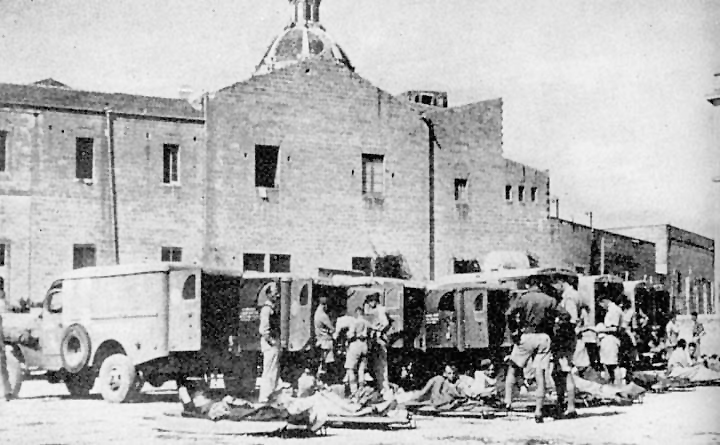
One section stayed in the mountains with 78th Division and was praised for serving as stretcher-bearers while attached to the Buffs. R. A. Burton, at a post where there was no Medical Officer, used his medical knowledge to maintain an MI Room. C. F. Messinger distinguished himself at an RAP near Guardiagrele:
Messinger was at this post from the middle of January until the third week in February, although divisional and regimental changeovers were frequent.
"The road and the road approaches to it were in clear view of the enemy," Major Snead wrote, "and traffic went in and out only at night. Vehicles were parked out of sight behind a building, and personnel moved in lanes marked by tapes to avoid exposure. The area was shelled and mortared almost daily, particularly at 1000 hours and again at 1400 hours, and at night when the Germans would seek to start fires so as to render the area visible for further shelling.
"In spite of the immobility of traffic during daylight, it was necessary to evacuate sick and wounded by daylight on an average of every second day. The route was down the east-west Guardiagrele road under enemy observation and then over the notorious 'mad mile' into Castelfrentano to the ADS. . . . On the night of 27 January, while a Gurkha regiment was in, it was decided to test German strength with a heavy patrol and 3 Canadian tanks. The action was directed at a road junction beyond Guardiagrele. An advanced RAP in the patrol area was set up, and Messinger and the MO . . . prepared for casualties. The tanks were met by intense mortar and shell fire, and the RAP came under very heavy fire with mortars landing 12 at a time with little warning of their approach. One tank became immobilized through engine trouble, and in the effort of the tank men to get out and take cover one was killed and another severely wounded in the back by shrapnel. Messinger evacuated this casualty to Castelfrentano in the pitch dark---taking 5 hours. On his return he made another such evacuation.
"On another occasion Messinger walked into no-man's land and supervised the burial of several Italian casualties. . . . On two occasions he was shelled en route, and on another his ambulance was hit by shrapnel while parked. The post was dangerous and constantly cold and uncomfortable and short on supply."
Although the big attack was not embarked upon, it was a rough sector. A post with the 66 Medium Regiment (RA), was established in the middle of January. The car was actually stationed with 227 Battery, some 6 miles away from the RAP by road though a shorter distance otherwise. Because of heavy shelling, it had moved on 2 February to a position near a brick factory on the Lanciano-Frisa road. A. Randall, Jr., went to this post on 4 February, and there he was killed when the new position was shelled on the morning of the 8th.
Lt. Metcalf reported that "the shelling began a little after 11 with two short and two over the position. The rest fell upon it. They had two casualties and sent for the ambulance. Randall was not there. A sergeant drove it to the guns, picked up the injured, and evacuated them to the MDS (74th Canadian in Lanciano). After the ambulance returned, they searched for Randall and found him dead. . . . He had been killed instantaneously, a shell having landed about 3 feet from him." Alexander Randall, Jr., was the fourth tragic fatality in less than 10 weeks of the Italian campaign.
The active patrolling brought some surprises. At one of these posts, R. M. Campbell was advised to sleep in the billets rather than in his ambulance. "He slept in the ambulance," according to the story told by J. From, "and shortly after midnight he heard a disturbance outside. When he inquired about it later, he learned that a German officer had secreted himself in the ambulance shortly after dark. The officer had leaped out of the back of the ambulance and tried to club a British officer with the butt of his revolver. Several Tommies arrived in the nick of time and subdued the German, whereupon [he], in perfect English, said 'May I call my friends?' He called out in German and two German privates came out of a hayloft and surrendered. The officer explained that the three of them had been out on patrol and had become lost. They had been hiding in the hayloft for three nights."
At one time, the Platoon had 23 cars at RAPs, but more illustrative of the sort of work the Platoon did during the first 10 weeks of the new year was the distribution at the end of February: 3 cars at 127 ADS; 3 with 29 Field Ambulance; 1 each with the RAPs of 63 Field Regiment and 48, 66, 75, and 111 Medium Regiments (RA); 4 with different posts of 31 FA in and around Poggiofiorito, and 7 with the 6th Lancers at Roccascalagna and Civitella Messer Raimondo south of Casoli. The remainder were at workshops (the exchange of Humbers for new Dodges was taking place) or were unassigned at Platoon HQ. The Canadian Division was withdrawn after 7 March, and on the 13th the Platoon was sent to Gissi, south of Casalbordino, for a rest.
After A Platoon relieved B of its New Zealand posts, B worked entirely with 5 Corps. Then some of its Canadian assignments were withdrawn, and 5 cars were sent to the Airborne Brigade, at that time in the line between the 4th and 8th Indian Divisions. Three of these cars were sent to an ADS 2 miles west of the Orsogna-Ortona lateral road off the Caldari junction. Two remained with an alternate ADS just south of Frisa until later dispatched to RAPs near Poggiofiorito on the lateral road. It was at the 4th RAP of this Brigade that on 20 January E. E. Tanner III and T. Bullock were slightly wounded by a shell which landed a few yards behind their ambulance as they backed onto the road with a load of patients. A soldier behind the ambulance was killed by the shell, but a temporary dressing for Tanner's nicked shoulder was all the medical attention required by the two AFS casualties.
For a while, B Platoon had only 9 ambulances working. Then on 26 January B Platoon came out to rest in Pollutri and C Platoon took over the 6 posts with the Airborne Brigade and the 5 with the Canadians. It was not a healthy sector at all, and almost immediately C Platoon suffered a number of casualties.
On the afternoon of 29 January, Lt. Hobbs and W. B. Warden, then Sergeant in charge of the Reserve or Headquarters sections, were wounded at a Canadian RAP north of Ortona ("one of our mortars," according to the Platoon record). Captain Payne, who was making a round of the posts with them, reported that "at 1500 hours, while at the 61st Seaforth Highlander RAP (5th Field Ambulance), a 4.2 mortar shell landed 6 feet from the rear of my jeep. At that time, Lt. Hobbs, Sgt. Warden, and I were sitting in the jeep . . . preparing to leave. Parked about 8 or 10 feet to the right of my jeep was the ambulance belonging to Jack Chaffee. As we heard the shell coming, I dove out of the left side of the jeep, while Lt. Hobbs and Sgt. Warden dove out of the right side of the jeep. The blast from the shell went in the direction of Chaffee's ambulance, and as Lt. Hobbs and Sgt. Warden dove for the ground they passed into the line of the blast. Lt. Hobbs received wounds up and down his back and legs and had two front teeth knocked out. Sgt. Warden received a very slight wound on the back of the head." None of Lt. Hobbs's wounds proved very serious, Warden did not need to be hospitalized, but Chaffee's ambulance was riddled and immobilized. "Plenty air-conditioned," C Platoon Sergeant R. F. Blair, Jr., wrote.
Early that evening, D. D. Hunt and H. W. Taylor, Jr., drove up to replace the immobilized ambulance at the Seaforth Highlanders RAP. In the darkness they missed the road on which they should have turned left and proceeded north, running into a minefield about 2 1/2 miles north of Ortona on the Pescara road. There they ran over a tank mine, which demolished the car and wounded both men. Both received serious wounds in the legs and minor wounds in the arms. Hunt's left leg had to be amputated just above the knee.
"A serious personnel loss to the Platoon," Sgt. Blair wrote of the events of this unfortunate day. Hunt, a most popular section leader, was promoted to Lieutenant before his repatriation by hospital ship in recognition of the value of his work. On 2 March, Lt. Hobbs was succeeded by Lt. Blair in charge of C Platoon. C. Y. Keller was named Platoon Sergeant.
On 5 February, both B and C Platoons were withdrawn from all their posts and were sent under Captain Pierce to work with the New Zealand Corps in the Cassino sector. After a little less than a month, on 1 March , they set out through the rain to return to the Adriatic, B stopping with 13 Corps at Gissi and C going on to join 5 Corps at S. Vito.
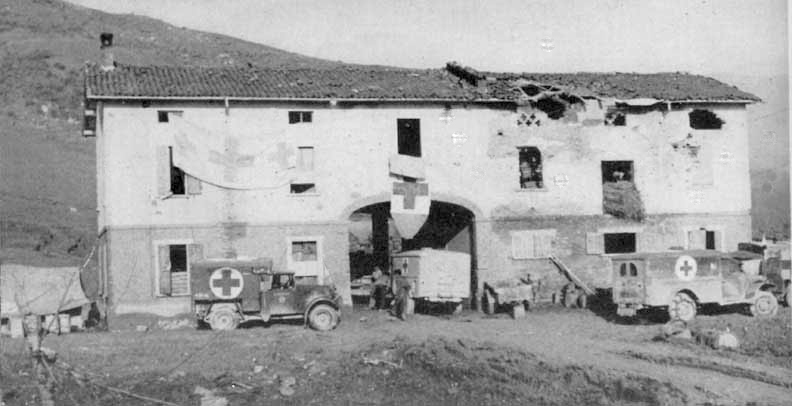
C Platoon was held in reserve at S. Vito until on 12 March it went to Lanciano to relieve A Platoon, which then joined D Platoon in Campobasso with the Poles. C Platoon cars were posted to the RAPs and ADSs of the 8th Indian Division and to various artillery regiments in or around Salarola, Poggiofiorito, Cisoli, S. Eusanio, Palombaro, Civitella, Gessopalena, and Spacarelli, as well as along the lateral road. In the following days one car was sent to the Airborne Brigade, another to the 1st Italian Reconnaissance Squadron, and a third (according to the Platoon diary) "to do civilian work for Gorillas at Lama." Other cars were assigned to AMG in Lanciano and Cisoli. The Platoon report summarized the rest of March in its sector: "Evacuations from two posts could be made only at night. Roads and tracks, however, were generally good, if roundabout. Shelling remained at a minimum. The front for the most part was quiet."
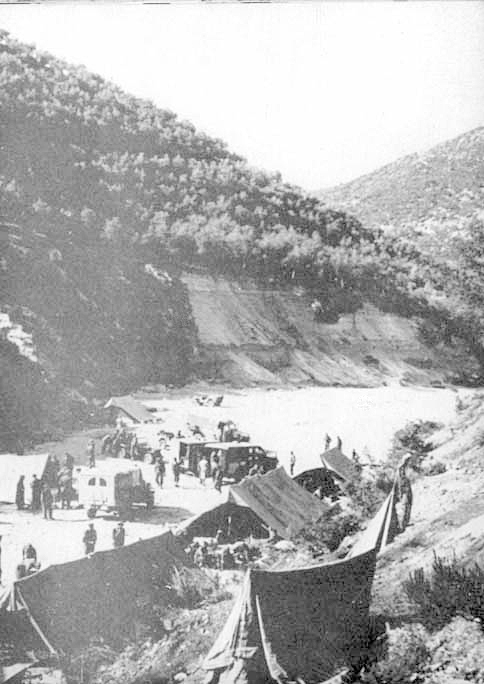
B Platoon did not stay long in the east. After 9 days at Gissi, it moved to Campobasso, where it was assigned to evacuate 3 Polish and 19 CCSs to Termoli. During the next week there was not much work, 3 or 4 cars a day being sufficient, although heavy snow blocked the road on two occasions. On 18 March, R. C. Riotte succeeded C. M. Field as Platoon Lieutenant while the latter took home leave. Lt. Riotte's place as Company Adjutant was filled by Lt. J. J. Harmon, who had worked for a long time in the Company LAD and later as Company clerk. The next day, 19 March, the Platoon was sent back west to Presenzano to await reassignment in the Cassino sector.
D Platoon, with its HQ in Campobasso, had been in more or less the same positions since late October. On 1 February the Polish 3rd Carpathian Division had replaced the 78th Division in the central mountains, and the D Platoon cars stayed at the familiar locations with the forward medical units. The only change, Lt. Murray wrote on 2 February, was that D Platoon was to "do all the work for the Polish Div. They have two Field Ambulances and only 11 ambulances. It looks like busy days ahead."
"February was probably the worst of the 6 months for all drivers," J. P. Horton reported. "Snow kept J. Briggs in Capracotta for 30 days; there and at Agnone food had to be dropped by plane. The roads were rarely pleasant to drive on: sometimes a coating of ice made chains worse than useless. The endless twisting of mountain roads, combined with sleet and snowfalls, made driving a discouraging strain. [After] the Polish 3rd Division took over the area from British forces, men on isolated posts lacked people who could speak their own language. Also, it took time to get used to the Polish cooking. The new Division had a great many vehicles on the roads, and not many experienced drivers. . . . A good deal of work was done in spite of the weather. . . .
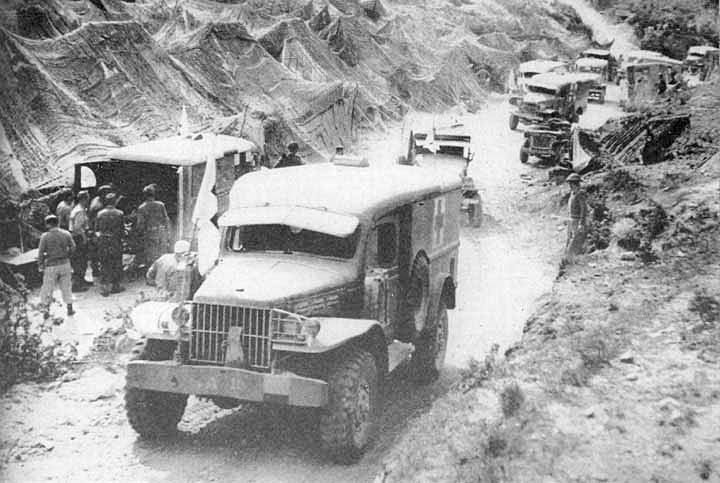
Camouflaged Polish dressing station, Chiferno Valley"The unspectacular work continued until 21 March, when 15 cars went with the Polish 5th Division's 6th Field Ambulance to the area west of Montenero. Soon these cars were dispersed among the artillery RAPs, an ADS in Scapoli, and an MDS in Filignano. For the first time, the BBC's announcement that 'activity was confined to artillery duels' became for some an unpleasant reality. Nevertheless, there was no intensification of work; the regular journeys continued. While in the region, a dominant peak was captured from the Germans and practically all posts ceased to be under enemy observation. . . .
"Since the day of landing in Italy, the Platoon has been handicapped by illness; but fortunately, although several times reduced to having no spare drivers at all, there have always been just enough men to keep all the cars running."
The experiences of both companies, in this respect, were similar.
Following the cars that had already gone northwest, the D Platoon HQ moved from Campobasso to Isernia on 26 March, continuing to work for the 3rd and 5th Polish Divisions. Its cars were then spread over a wide area, serving posts in or near Capracotta, Vastogirardi, S. Pietro, Agnone, Forli del Sannio, Carovilli, Rionero, and Castel di Sangro.
Company Headquarters and A Platoon had moved from Casalbordino and Gissi to Campobasso on 18 March. Just about this time, Lt. Atwood returned to take charge of A Platoon, releasing Lt. Metcalf to take his own home leave. For a while, the Platoon evacuated 3 CCS to Termoli. Then, in the last week of March, it too followed the general trend northwest and sent 12 cars to the Poles at Isernia.
The last week of March the war was quiet and a natural phenomenon was able to receive the attention it deserved. Beginning on 27 March, Vesuvius erupted. It was said to be the biggest upheaval in 50 or 75 years, the greatest since 1872, and so forth. Whatever it was bigger than, it was enormous and most spectacular. Ashes from the eruption were found as far away as Bari. During the day the sky in Naples was clouded, and at night it reflected red as though the whole region were ablaze.
"I took the opportunity to climb the mountain and have a close look," wrote one volunteer. "We approached to within 25 feet of one stream of molten lava flowing down the mountainside. The lava stream was about 15 feet deep and 200 yards wide and moved 10 feet per minute, pushing down trees, walls, houses, and everything in its path. The heat was so intense we couldn't stay long, so we went around to the other side of the mountain and climbed all the way up to the top---that is, to within 100 yards of the crater. On that side there was no lava flowing, but frequent explosions inside the volcano sent showers of hot rocks flying down, all sizes from pebbles to huge boulders. . . . Clouds of smoke and volcanic ash rose into the sky to a height estimated at 20,000 feet. The volcanic ash is so heavy that when 3 or 4 feet of it pile up on a house the house collapses, and for this reason several villages in the vicinity of Vesuvius have had to be evacuated. . . . Wish you could see it."
Unlike the sights of war, everyone wished they could share this awesome display of natural force. Lt. Lester wrote to Anzio of the big show: "Vesuvius is a hell of a sight these days. Bulldozers all along the autostrada, they say, trying to keep pace with the falling ashes. Woebegone natives spending day after day on their rooftops, sweeping and shoveling the stuff off before it stoves their homes in. People wearing masks in Sorrento to make life bearable. Priests in the little mountainside towns mumbling rites and placing chalices before the lava flow, only to have then snapped up in fire. Said one Padre, when the lava stopped finally half-way through his town: 'Well, at least I wore it down a little! "