 George Rock
History of the American Field Service
1920-1955
George Rock
History of the American Field Service
1920-1955
CHAPTER VII
Sunny Italy. . .
---OLD MYTH
As General Montgomery passed an ambulance on a road at the front today, he stuck his head out of the window of his staff car and, in his typically uninhibited manner, shouted "The American Field Service! Hooray!"
---AFS PR
The Anglo-American invasion of Sicily began on 10 July 1943, and on the 24th the capital city of Palermo fell. The next day, on the Italian mainland, King Victor Emmanuel announced the resignation of Benito Mussolini and his replacement by Marshal Badoglio, who outlawed the Fascist Party on the 28th and secretly opened negotiations with the Allies for an armistice. By 17 August the Allied campaign in Sicily was an accomplished victory. The next step was the invasion of the Italian mainland, which had been occupied by German troops in increasing numbers during the summer. The Allied plan was for 13 Corps of Eighth Army to cross the narrow strait from Sicily to Reggio Calabria on 3 September, followed on 9 September by simultaneous landings of the Fifth Army at Salerno and of the British 1st Airborne Division at Taranto.
On the 8th, General Eisenhower announced the armistice with Italy. The Italian fleet left Taranto to surrender at Malta, which eased the landing of the Airborne Division. But the Salerno landing met with major German resistance. In order to distract the enemy from the Fifth Army beachhead, 13 Corps drove rapidly north, making contact with patrols from the Fifth Army and the Taranto landing on the 16th.
By 20 September, the British 5th Division had taken Auletta and the Canadian 1st Division Potenza. The important airfields at Foggia were reached on the 27th, and on 1 October Naples was entered. Although surprised at the number of German troops, distressed by inadequate aircover, and delayed by heavy demolitions and extensive mining---the triple invasion had achieved success. In less than a month, the enemy had been pushed back to positions along the rivers Volturno in the west and Biferno in the east. Here he gave his first indication of making a firm stand. Sardinia had been evacuated by the Germans on 20 September, and on 4 October Corsica was also given up.
The Italian campaign, continuing the administrative structure of the Tunisian campaign, was under General Eisenhower as Supreme Allied Commander. General Sir Harold Alexander commanded the land forces of 15 Army Group---later Allied Armies in Italy (AAI) ---comprising the Fifth and Eighth Armies. Under General M. W. Clark, Fifth Army was predominantly American, although at most times during the campaign it had under command a substantial number of British and Commonwealth troops---notably, during the first phases of the attack, 10 Corps, the veteran troops of the desert advance. The Eighth Army, commanded by General Montgomery, was soon to become larger than it had ever been in the desert, and during the course of the Italian campaign it was to be further augmented with troops from many nations.
On 1 October, 13 Corps of Eighth Army began the attack on the enemy's Biferno positions---78th Division on the coast directed toward Termoli and the Canadian 1st Division, inland, aimed at Vinchiaturo along the Foggia-Isernia lateral road. The major assault began on the night of 2/3 October, when a Special Services (Commando) Brigade made a successful seaborne landing behind the enemy lines in the town of Termoli, while 78th Division attempted to bridge the Biferno south of the town. The British landing took the enemy by surprise. Termoli was quickly taken and connection was soon made between the Commandos and 78th Division across the river. At dawn on the 4th, the Germans began their counterattack with a bombing and strafing party, rushed a division over from the west, and exerted increasing pressure in the effort to drive the British from their newly gained positions. The daily autumnal rains, which had begun with a huge thunderstorm on 28 September, were turning all but the best roads into rivers of mud.
In the meantime, the first contingent of the American Field Service had arrived in Taranto to take its place with Eighth Army on 1 October. D Platoon of 567 Company disembarked intact the next morning (the first car was driven ashore by W. E. Oates at 8 A.M.) and was ordered to drive quickly to 13 Corps HQ north of Foggia for immediate posting to the Canadian Division. By the 3rd, most of the Platoon was assigned: 15 cars to the Canadian Division and 10 to 217 Field Ambulance of the ambulance-shy 78th Division. The sections for the 217 FA went north to its MDS, about 25 miles south of Termoli, and went right to work. That evening, however, H. S. Terrell's section (including P. H. Culley, W. B. Doyle, G. E. Holton, M. Smith, and H. W. Trainor) was sent on up to the ADS in Termoli, led by Platoon Sergeant R. Dickson on his motorbike.
"The British were entrenched on the coast," one of the group reported, "and Jerry was on the other side--close enough so that we could see him. And the road was in the middle, and so were we. Every time one of our cars started down the road it seemed as though both sides stopped firing, although there still was a lot of stuff flying over us. We just pushed down the accelerator and kept our eyes on the road."
Additional British brigades were landed at Termoli in the next couple of days to meet the German counterattack, and the fighting for the city seesawed fiercely. On the 4th, J. P. Horton recorded, "7 cars started out at 6:30 to make the 28-mile run back; there were at least 17 diversions along their route, made dangerous by the heavy rainfall. The British Austins of the Field Ambulance were unable to go through, so the whole work fell to our Dodges, which have 4-wheel drive. By 9 o'clock the MDS and ADS were clear of patients, but the schoolhouse adjoining was becoming jammed with casualties caused by concentrated shelling centering around the square where the medical units were stationed. The shelling had started at 8 o'clock and continued until noon. All the cars had gone out, and while they were gone the Germans occupied the station on the south side of Termoli. The ambulances began to return shortly before noon and found themselves doubly welcome---since they proved the road was still open and there was a desperate need to evacuate more patients. Some of the cars, on the way down for the second time, had to stop and pick up patients from units along the roadside, thus adding to already full loads. . . .
"It was expected that Termoli would [be retaken by the enemy] unless a bridge some miles to the south could be finished in time to get tanks across into the plain." At this time it was suggested that the ambulances, filled to capacity, evacuate the town and not return. But, although the patients were carried back to the comparative safety of the MDS, Terrell's ambulances returned to their post with the ADS in Termoli.
An additional section of ambulances was needed in Termoli on the night of the 4th, and W. A. Rich's (including L. G. Bigelow, J. C. Harkness, F. M. Marler, and L. Toms) was sent up. With two cars from the original section at Termoli, according to Horton's account, they
"started out with a message to pick up a battery at some place along the way. At that place they would be told whether the road was still open---such was the uncertainty. The battery was picked up, but there was no news of Termoli. They continued along the road, using only blacked out sidelights. Soon even these were ordered out and smoking was forbidden. It was so black that any attempt at a convoy was abandoned. As they wound down to the plain, a sudden bend brought them within sight of the whole battle: the area was a mass of flames and vivid flashes; burning tanks, hay-ricks, trucks, and ammunition dotted the entire scene; both sides were shelling at close range. No wonder that the journey across into Termoli was rapid. It was now 3 A.M. on 5 October, but there was to be no sleep yet, since evacuations had to be made immediately. A counterattack expected at 4:30 made the late work welcome.
"By dawn, all the cars had reached the 217 MDS, where they had a couple of hours to get some sleep and a meal. A third section appeared, released for this particular work by the 1st Canadian Division, and preceded the other 10 cars back to Termoli. Things were quieter, but still the situation was touchy. A new ADS had been set up near the Bailey bridge, thus making evacuations much shorter. The work, though better organized, was not any lighter. Runs were constant until 1 A.M. that night, when finally they got their first good sleep. But it lasted only four hours before they all had to be back at work."
Lt. F. J. Murray had led the third section of his Platoon into Termoli (including L. M. Allen, J. G. Fogg, J. E. Gerhardt, W. H. Lord, and W. E. Oates), bringing with them a cookhouse and a water truck. A mess for the three sections was set up in a restaurant across the street from their billets, so that during the following few days, while the group completed the evacuation of the ADS, their living arrangements---in spite of the constant shelling and occasional sniping in the town---were considered quite pleasant.
The battle for Termoli was short and nasty. The German resistance was fanatically stiff until, conceding defeat, it suddenly melted away in the night, leaving only a slight rear guard to perform harassing operations. The D Platoon cars worked steadily through an area under shellfire and sometimes worse. G. E. Holton distinguished himself by his level-headed conduct under some very accurate shellfire---arranging for casualties from an exploding ammunition truck, and a subsequent shelling of the illuminated area, to be taken on to medical aid while at the same time trying to repair his immobilized ambulance. On another occasion, Terrell and Toms went up between the lines of opposing infantry in an attempt to evacuate an Italian family to safety---only to discover when they had reached the farmhouse that the Italians preferred to stay where they were.
In the meantime, the Canadian 1st Division advanced toward Campobasso, the 3 D Platoon sections joining it at Mota. "As a result of the rapid distribution of the cars to the RAPs and ADSs," Horton's report continues, "Bolte, Meierstein, and Railsback soon had their first evacuation. In order to avoid a long run, the MO was persuaded to allow the cars to go through a road which had not yet been declared open. It ran parallel to the lines, was under shellfire, and had 3 treacherous diversions ---so bad that it required considerable persuasion to get the cars a chance to prove the way passable. One of the 3 cars was successful in both directions. But Railsback failed to get back, and Bolte's car hung over the edge of a ravine---saved from loss by a tree. He removed everything he could from the car and was found next morning sitting on his battery at the end of a neatly lined-up row of equipment."
The area Termoli-Guglionesi was firmly in the hands of 78th Division by 7 October. When their work for the Termoli ADS was finished, the 3 AFS sections there under Sgt. Dickson joined those already with the Canadians. They were assigned to the 4th, 5th, and 9th Field Ambulances. The Canadian Division had the Campobasso-Vinchiaturo area by the 13th, and, after a short rest, it continued the slow and difficult advance toward Isernia. At the end of October, D Platoon cars were covering all of the forward Canadian RAPs.
Of the AFS members involved in the action at Termoli, Bigelow, Dickson, Rich, and Terrell were at the very time suffering from the yellow jaundice. This scourge had hit the Company before it left Tripoli, and many had made the voyage while enduring the extreme lassitude and violent peevishness, combined with disinterest in all available foods, brought on by the disease. Of the personnel to land with the first 48 ambulances on 2 October, 6 men were immediately immobilized by the wretched disease and many others were close to collapse.
By 9 October the whole of 567 Company had finally landed in Italy, and A, B, and C Platoons leaguered with the Company HQ at Mare Piccolo, just outside Taranto. On the 12th they drove north, Company HQ establishing itself in an apartment on the outskirts of Foggia. Here a separate room was set aside as a private AFS jaundice ward. Malaria and dysentery were also troublesome, but when a count was taken on 2. November, 30 of the 37 sick had jaundice (infective hepatitis), a far more serious near-epidemic than had hit the Company in the desert in the previous November and December. By shifting men temporarily from one platoon to another, all cars were kept covered until the scourge had passed. But although the Company was unusually well staffed at this time, the severe sickness rate made the manpower situation extremely tense.
This shortage of personnel was particularly awkward at this time. Brigadier Phillips (DDMS Eighth Army) had given 567 Company a most flattering welcome to Italy. The Company had been-scheduled to work for the rearmost installation---Fort Base. But Brigadier Phillips had persuaded Fort Base to accept an Army MAC in exchange. By 14 October, all 4 platoons of 567 Company were out on Corps assignments ---A and D Platoons with 13 Corps, B and C with 5 Corps.
From the Sicilian campaign, 13 Corps had come to Italy with the 1st Canadian and 5th Divisions, to which was later added 78th Division. When the 8th Indian Division arrived, it was grouped with 1st Airborne and 5th Divisions as 5 Corps. This was used to back the 13 Corps advance up the east coast. During October, Eighth Army continued to build up its strength in Italy, and the AFS was frequently assigned to units it had already known in the desert.
More than half of B Platoon had landed with D Platoon at the beginning of the month. On 3 October it sent 12 cars to 141 LFA (5th Division) at Potenza, another 6 going to 131 FA (1st Airborne Division), then at Gioia. Several cars from 141 LFA were loaned to 158 LFA, some doing hard work with the ADS at S. Croce del Sannio and others having long but routine evacuations to Taranto. When the whole Platoon had arrived it was assigned to 8th Indian Division, and 10 cars went to 9 Indian CCS at Andria on the 12th. Two days later B was relieved of its 5th Division posts by A Platoon, and the cars went to a camp 10 miles south of Foggia to wait for the rest of the Indian Division to arrive. However, the Division had no need for the extra ambulances, and B Platoon was ordered to form a 5 Corps reserve pool at Serracapriola on 21 October.
When A Platoon took over the 5th Division posts on 14 October the bulk of its cars went to 141 MDS at Segezia and 6 to 158 ADS at S. Croce---both groups evacuating to Foggia, to either 164 MDS (from which 3 attached AFS cars evacuated to Barletta) or 7 CCS. On 21 and 22 October, 17 ambulances were attached to 15 CCS at Campobasso, to work back to 132 FA at Volturara, the rest moving northwest with the Divisional units to which they were already attached.
C Platoon, on its arrival, was split between 78th Division (replacing D Platoon's cars) and 4th Armored Brigade, to do MDS to CCS work until the last week of the month. At that time, all the initial postings of 567 Company as it again settled into the Eighth Army were changed about in preparation for the next major assault---the coming Trigno-Sangro attack---which called for regrouping along the entire front.
In the meantime, A and B Platoons of 485 Company had landed on the west coast of Italy. Their convoy reached Salerno on 6 October 1943. The first part was able to disembark that evening, but stormy weather and rough seas kept the other part bobbing about off shore until the 9th. Some postings were immediately made in the area, and a few cars were left with Area Headquarters in Salerno and the hospitals in Mercatello and Castellammare when, on the next day, the two platoons drove north through the wrecked towns along the coast to establish themselves in Naples.
Naples had suffered from heavy Allied air raids before it was liberated. Serious demolitions had been carried out by the Germans before their departure. They had also left time-bombs to effect further damage (as they were to do throughout the campaign) in such places as the Naples Post Office. After the British took the city, the German air force flew over frequently to bomb it. When 485 Company arrived on 10 October, rubble still lay where it had fallen, holes gaped in the streets, neither water supply nor electricity worked, and a serious outbreak of typhus threatened. The destruction was most severe along the waterfront, but large areas were battered and the whole city was disorganized.
After a considerable search, Captain Edward found a campsite on the grounds of a fairly new Italian hospital, into which the 92nd General Hospital was at the same time moving. As 10 Corps hospital, it had to be ready for operation by 12/13 October, when the Battle of the Volturno was scheduled to begin. The Field Service assisted by transporting the 55 nurses, their luggage, and the medical equipment from Salerno to Naples, later returning to Salerno to get the hospital's beds and helping to set them up. The cars were hardly set out in the new camp, on a hill overlooking the city, when it was learned that the site had been chosen for the Allied Battle Cemetery. For a while, Field Service men helped to dig graves and used unoccupied ones as emergency slit trenches. Later, the Company had to move around to the other side of the hospital buildings.
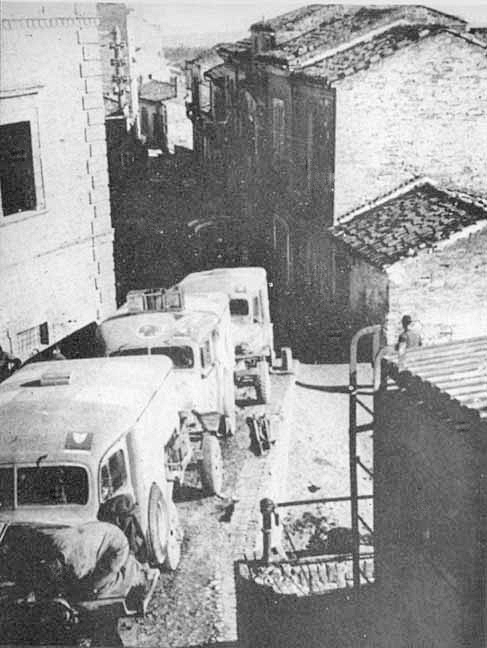
The reception offered to 485 Company lacked the eagerness of Brigadier Phillips' welcome to the other company. The early rumor that 485 would be given nothing but rear work---because, as was pointed out, they belonged to an ACC and ACCs did rear work---proved correct. They were attached to the ADMS of 57 Area, which included Naples and some of the region around the city. This was most unsatisfactory. Captain Edwards spent many hours driving from interview to interview in the attempt to have his half-company reassigned. But the cars of 25 MAC were already doing all the 10 Corps work and, in spite of the virtues of the AFS Dodges and drivers, no one but AFS saw reason to change. Toward the end of the month, however, a few cars were given forward posts, and in November the complete assignment of A and B Platoons to 10 Corps was promised for such a time as C and D Platoons should have arrived in Italy.
Because of the unusual conditions of the war on the west coast, the situation was less unsatisfactory than it was often made to sound. The front was barely 25 miles north of Naples when the platoons arrived, and there were frequent air raids on the city, particularly on its port and harbor installations. Thus there was frequent excitement for most and, after the opening of the battle for the Volturno, constant hard work for all.
The enemy air raids on Naples were frequently severe. The extra work they gave to those in the so-called rear area was recorded by S. E. Cole, Company Sergeant, in the headquarters diary:
"It was a dull day until after dinner, when at 6:45 somebody shouted 'Put out those lights!' At Captain Edwards' suggestion to put out the lights in the HQ truck, Cole wanted to know why. Captain Edwards was firm, stood his ground, and very soon afterwards Cole knew damn well why.
"The ack-ack started. We managed our tin hats and took shelter when the planes came close. Four flares were dropped on all sides of the hospital. Tommies decided to go to the shelter, but being so well lighted decided not to, turned around, ran in the opposite direction, and knocked down others headed for the shelter. American Army personnel shot at the planes with rifles (this is unheard of in a hospital area). The flak attracted the planes and the strafing. An air-raid shelter was hit on the premises; the people fled to an adjoining chamber, and it fell in. When the dust cleared away, they found a window and climbed out straight to duty.
"The OC, Trusty Tug Barton, and Cole, followed by S. Johansen and two other men, went on a wild-goose chase for a bombed building. They returned and found blood wanted, ambulances needed. They found an Italian in the hospital who came from a bombed area. He told a wild tale of bombs, cattle, and people. Cole in S. Carveth's ambulance with the Italian led 4 ambulances to the scene. W. W. Phillips allowed a vehicle to get in between himself and the lead car, ending up with the two cars behind him in a blind alley and never finding the scene of the crime. However, it was just as well. After digging for 4 hours with the RAF and having to force the Italians to help, they found nothing because of so much debris. The work was abandoned. The Italians thought that the British and Americans were foolish to dig at night, because 'they would find only death.' 'Why not wait until morning, when the cousins and neighbors would find them?' . . . Captain Edwards was all over Naples, helping to hunt demolishments and trapped people."
The bombing of Naples continued well into the spring of 1944. It finally became a routine matter, and entries in the 485 Company diary say no more than "another raid last night" or "last night our worst air raid yet." Whenever there was a shortage of blood at the 92nd General Hospital, which frequently happened as a result of these raids, AFS members donated theirs.
The Fifth Army attack of 12/13 October on the Volturno was planned to push the Germans back into the mountains running west from Isernia through Venafro to the sea. U.S. 6 Corps was on the right, from Capua east to Ponte Landolfo, while the British 10 Corps sector of the front ran west along the Volturno from Capua to the sea---46th Division in position near the coast, 7th Armored Division at Grazzanise, and 56th Division at Capua. The main attack was that of 46th Division, which successfully launched an amphibious-tank landing just north of the mouth of the Volturno. The 56th Division found that it could not bridge the river at Capua, because of the terrain and stiff enemy resistance. It then extended its sector to the right and crossed on the American bridges at Triflisco. Otherwise, the attack along the whole 40-mile front was a success, and by the night of the 14th the Fifth Army held bridgeheads of from one to three miles deep in 3 areas across the Volturno.
In the next 3 days, 7th Armored Division moved tanks across the river and, changing places with 46th Division, drove west toward Mondragone. The limited bridging facilities across the Volturno did not allow a rapid pursuit, and enemy resistance took full advantage of the terrain, using natural obstacles and every building on the coast plain to hinder the advance. However, by 31 October the 56th Division had taken Teano, 46th Division had reached S. Croce, and the 7th Armored Division had occupied Mondragone. At the north of the coast plain, 10 Corps was up against the so-called Barbara Line.
On 1 and 2 November this line was pierced on the right by attacks which took Roccamonfine and Giusti and on the left passed north of Monte Massico to enter the Garigliano plain. The 46th Division sent patrols to the river Garigliano and had gained a small bridgehead over the river by 6 November, when 56th Division began its assault on Monte Camino. This was a well-fortified natural strongpoint which could not be outflanked. After 6 days the attack on Monte Camino was called off. The whole Fifth Army paused to regroup. For the rest of the month the 10 Corps sector was quiet except for patrols and artillery duels.
At the beginning of the Battle of the Volturno, on 12 October, 485 Company sent 12 cars to 25 MAC for reposting to 10 Corps units. On the next day, 25 MAC asked for more cars, these to evacuate Corps casualties from 8, 14, and 21 CCSs (then between Naples and Aversa) back to the 92nd General. Of the cars with 10 Corps units, 8 were sent to artillery RAPs. Only a few of the Company had yet had any experience more gruelling than a leave in Beirut, and stories of life in the desert were not much of a guide to the new campaign. F. D. Burke and B. G. Dickey nearly drove into an enemy-occupied village while searching for their post with the 51st Medium Regiment.
"This may not be the way it was the first time you had an assignment at an RAP, but . . . it's probably a good deal like it," N. Noyes wrote of his experience with H. O. Baker at the 56th Heavy Regiment. "Bake and I found Regimental Headquarters and the MO at the end of a morning's search. Regimental HQ was in an old-time palace near the Volturno River, and the MO was in a 3-tonner eating lunch.
"'Sir, we are attached to you for permanent duty. It's an American Field Service ambulance!
"'Fine,' said the MO doubtfully. 'I've never heard of it!'
"Bake and I explained. . . . This was harder to do than it sounds, because the Regiment's heavies were being fired directly behind us, and the noise made your teeth ache. The MO, eating thoughtfully, did not seem to hear them. Each time a gun went off, we did our damnedest to keep talking, but somehow it was hard to remember what you were going to say. Once the MO looked up as I adjusted my cap, which had been knocked askew by the blasts.
"'You were with the Eighth Army? he asked.
"We told him where we had actually been---Syria.
"'Ah,' he said, 'the Normandy Bar. Have some lunch.'
"By nightfall we had learned that things were 'very quiet around here'. . . . We had also explored the palace. . . . There were ballrooms, drawing rooms, bedrooms, fireplaces, crystal chandeliers, and high, fantastic, frescoed ceilings; there was a chapel, complete with altar. The building had been stripped of all furniture except what was too large to move. All this, compared to the open camp to which we were accustomed, was unique.
"Bake and I took the corner bedroom on the second floor that night, and he slung his stretcher across the frame of an old four-poster bed. The light our lantern cast was swallowed up in the elegant vastness around it; we could just make out the naked cherubs on the ceiling. We put out the lantern and opened the shutter, just as all our guns on that section of the front started the evening's shoot.
"In point of fact, it was not much of a shoot that night---a month later we would probably have gone to sleep in the middle of it. But we had not realized that the blast from the guns would shake the building as though it were a bone in a dog's mouth; that the flashes would be almost continuous and brighter than the brightest lightning; and that the noise would be not merely something that you heard but also something that you felt---and it came as quite a surprise.
"So we lay in the palace and watched the cherubs dancing above us in the day-bright flashes and listened to the 200-pound shells going overhead and away from us, like a car speeding down a lonely stretch of wet macadam. . . . We felt that we had come a good deal farther since morning than the distance from Aversa.
"There was only one thing which bothered us. That night and the next morning, as the guns fired intermittently, we listened anxiously to all sorts of queer sounds in the air, because we did not yet know the sound for which we were listening. On the afternoon of the second day, there being nothing else to do, we lounged in our room in quiet session with a friendly bottle of Anis. We talked of this thing which bothered us.
"'I'd like to hear a shell come in,' I said. 'Then I'd know what not to pay attention to'. . . .
"Outside there was a short crescendo of rushing air and a thunderous concussion. . . . The sound was repeated, a little louder this time, and the explosion seemed to come from the other side of the building, where no guns were firing.
"'I believe,' said Bake, 'that's one of them now'.
"The shells kept coming in; the palace was alive. Engineers, sleeping in the great ballroom after working all night, rolled out of their bedding, grabbed their tin bats, and joined the exodus. . . . Everybody was in the downstairs hall, very jolly and very tense. People made jokes and laughed loudly with their fists doubled up in their pockets. I did not think I was scared, but I found that every time I relaxed I would tremble and my teeth would chatter. The shells kept coming in. . . .
"Not a shell touched the palace, but when the shooting stopped it looked a good deal like the girl target at the end of a knife-thrower's act. There were craters 30 feet from the south side of the 3-storey building. So Bake and I went back upstairs and finished the bottle. So what? So from that moment on we were veterans, and nobody can tell us any different."
As the battle progressed, the ambulances moved forward with their units. Several exploits of the period were publicized. D. N. Marmen and P. S. Willand, with 121 Field Regiment, while under fire did some stretcher-bearing. F. T. Sanderson and C. S. Satterthwait, with 74 Medium Regiment, walked into a minefield to pick up the remains of two British officers who had hit telermines while reconnoitering the area in their jeep. Sanderson and Satterthwait walked into the mined area with the chaplain and, after collecting what they could find in two blankets, buried the officers on the spot.
The most unusual experience fell to L. L. Biddle, Jr., and J. D. Cuningham, with 57 Antitank Regiment, which was out of the line at the start of battle. Later a single battery was sent up to pinch-hit for infantry and to hold a village while the Guards cleared the next ridge. Biddle and Cuningham accompanied the battery, while the MO remained with the RAP. On arrival they were told to establish an emergency first-aid station for the attack of the next day.
"Exciting and interesting work and the real thing at last," Biddle wrote. "We are now in a small village in mountainous terrain, really beautiful country, heavily wooded and dappled with shadow and sunshine---for the weather has been fine, the air cool and fresh and invigorating. . . . But this little village has been razed by the retreating Nazis. There is scarcely a house which has escaped meaningless ravage by dynamite and fire. The narrow, winding cobblestone streets are filled with rubble. The inhabitants still dazed and fearful. . . .
"Dale and I . . . managed to acquire a pretty adequate supply of stores en route---bandages, field dressings, and sulphanilimide powder and ointment, even some morphine. Those sulpha derivatives are certainly worth their weight in gold! We set up a sort of medical room in the village schoolhouse. In the mornings we attend to the troops of our assignment, in the afternoon to the civilians. Running sores and a few shrapnel wounds are now healing well---Drs. Biddle and Cuningham doing minor operations with a pair of sterile scissors to cut away decaying skin and make the sores clean. It's a great satisfaction to feel you are doing some good, and the people are immensely grateful---bring us apples and perhaps some vino in appreciation."
The day after the attack, Biddle wrote,
"they brought down a badly wounded German from the hills---his left leg broken by a bullet and another through his arm. We patched him up and gave him some hot tea to counteract the shock, and he stopped trembling and the vacant stare left his eyes. Then I evacuated him in our ambulance to the rear. Subsequently an ADS arrived, and for a while we helped them with evacuations from beyond our village, where the casualties were being brought down. . . .
"The roads in our particular sector are muddy, narrow, and tortuous. And one gets a good idea of what a communiqué means when it states 'Our progress has been slowed up by enemy demolition! Through craters and blown bridges you are certainly thankful for 4-wheel drive, but it is hell for the wounded. . . . You just do the best you can and drive as slowly and carefully as possible."
These RAPs normally would have evacuated to ADSs and MDSs near the front. But as the severe sickness rate continued throughout the army the ordinary evacuation routing was restricted to the heavy load of battle casualties and the sick were sent straight to CCSs or even to the General Hospitals. As the front moved forward, in early November the 10 Corps CCSs also moved---8 and 14 CCSS to Sparanise (later selected as ambulance-train head) and 21 CCS to Francolise.
The CCSs could hold patients only so long as was absolutely necessary before sending them on to the 92nd General Hospital in Naples, to the Pomigliano airport, to convalescent depots on the Sorrento Peninsula, or direct to the Naples docks for hospital-ship evacuation to Sicily, North Africa, or farther. Many of the CCS runs were long, and a delay along the line caused a hopeless situation. Often there were so many patients that cars from the pool stationed with 485 Company HQ had to be called in to assist. As the Field Service had charge of all 10 Corps evacuations from the CCSs rearward, to have the right number of cars at the right place at the right time was often a complicated problem.
Only a few cars were posted to the 92nd General Hospital itself. The HQ car pool, nearly 40 ambulances when it first arrived, shrank as more and more were sent forward during November to additional RAPS and other 10 Corps assignments. With the move of the 65th General Hospital to Naples in early November, its AFS cars came north, diminishing the burden on the 92nd, until then the only 10 Corps hospital. In the second week of December, the 2nd General Hospital opened in Caserta, further easing the situation in Naples. But during most of the long period from October to January, the 92nd General was forced to operate much as the CCSs, sending on as soon as possible all who could safely be moved.
The AFS cars attached to the 92nd General took patients from the reception tent to the various wards; and when the system jammed up, here or somewhere else along the line, there was likely to be a long wait for both patients and drivers. The worst were the delays at the docks, where no reception tent had been set up. Until the wreckage in the harbor had been removed and the docks were able to accommodate the hospital ships, patients were carried out in small tenders---8 or 10 stretchers strapped in one of the two available motor launches, covered with tarpaulins, and ferried to the hospital ship. The process was slow, and often the patients had to wait hours in the ambulances at the dock ---sometimes, if there had been a slip-up in the count of available places or a greater delay in loading than usual, having to return to the hospital until the arrival of another ship.
At the Pomigliano airport, although a reception tent had been constructed and patients could be left there, more often the ambulances drove out onto the airstrip and loaded patients directly into the waiting planes. It was here that the diesel bus used by W. K. Manning and G. E. Tener refused to move, almost for the last time; only the ignominy of a tow saved it from being rammed by an incoming plane. Operating this bus had at first seemed to Captain Edwards an impossible activity for the Field Service. He finally agreed to it only because its capacity eased the over-all situation. Although it was not easy to drive and required a great amount of time and effort to keep in running order, the Fiat bus could and did save a great number of ambulances the long, if beautiful, runs to Sorrento or Amalfi or even the shorter rides to Pomigliano.
Short of the airfield on Route 7 was the 4th U.S. Army Field Hospital---a reception and despatch center at Tavernanuova for patients to be evacuated by air---which offered one of the infrequent attachments of the AFS to an American Army unit. This proved a pleasant assignment, and its joys were in no way diminished by the accompaniment of U.S. Army rations. At all times the collection of extra food was an important activity---private larders being essential both for the volunteers on those occasions when work was so timed that meals with the proper unit were impossible and also for the patients during delays or on long trips. In any period of proximity to American troops, much ingenuity was exercised to procure stocks of their rations---either on an individual basis or for more widespread consumption. It was reported that morale rose when, for a while, these foods were enjoyed regularly by a whole platoon, even as it visibly fell when Fortune discontinued this particular favor. The allure of a change of diet was always irresistible to those long accustomed, but not adjusted, to the austere repetition of British rations.
In addition to the major postings with the artillery regiments, the CCSs, and the Company car pool at the 92nd General Hospital, during the latter part of 1943 there were many assignments of one or a few cars to a variety of units in the area from Naples south to Salerno---in such places as Castellammare, Nola, Pereti, and Portici. In mid-November the distribution of ambulances of the two thoroughly mixed platoons, often with members of both on a single post, was such that command reverted to the old Syrian system of allegiance according to location. Lt. Moran was given charge of the 24 cars in the north with 10 Corps, and Lt. Brainard of the 42 in Naples and the area to the south. The Platoon Sergeants, A. D. Shoup, Jr., and A. Gorman, Jr., respectively, took charge of the convoys from the 92nd General Hospital to the ships. On many days over 200 patients were moved, and on a few the number ranged up to 300 and a record 431
The big break in forward work came in the last week of November, when the rival 25 MAC was withdrawn from a number of its posts. In addition to the 13 cars then at RAPS, 485 Company sent 11 more to work under 10 Corps: 5 to the 184 (and later 183 and 185) LFA of 46th Division at Sessa and 6 to the 140 (N) FA of 56th Division at Roccamonfina. These postings were in time for the second attempt on Monte Camino.
From mid-November to mid-January, the only actions on the 10 Corps front were the capture of the Monte Camino massif by the 46th and 56th Divisions (in a battle that lasted from 1 to 9 December 1943) and the taking of Colle Cedro by 46th Division (9-10 January 1944). During this lengthy period, the other elements of Fifth Army advanced slowly to the strong natural position of the Gustav Line, which in the west followed the Garigliano River into the central mountains.
During the assault on Monte Camino, F. B. Cliffe and C. R. Collins were with the 23 Field Regiment RAP. On their arrival there, Cliffe wrote,
"our artillery was singing in bursts and we were slowly getting semi-accustomed to it. The Captain spoke up in a quiet, almost pleased voice. 'There he is, now.'
"A whistle and an explosion. Our first Jerry shell! It was followed by several others, all landing about one-quarter of a mile away. That night was a restless one. The thunder of the barrage kept waking us. The occasional whistle and explosion of Jerry's shells kept waking us. Next morning, asking Sandy what he thought of the barrage, we were unbelieving when he replied 'What barrage?' Yet after a few days we realized he had been quite sincere about sleeping through it. Amazing what you can get used to.
"That evening, four of us were brewing up when Jerry again began to sing. We were unlucky this time: 4 wounded, 2 dead. The best friend of one of the dead men refused to believe him really dead. He felt for the body's pulse, said very little. Offered a drink, he refused. He hung around the outside of the RAP for hours-standing in the moonlight lonely and lost. . . .
"This Field Artillery was a crack regiment. . . . I was glad to be with Englishmen like these in action. Their casualness helps to calm jumpy nerves. Typical was the comment, when Jerry was dropping a number of shells in the neighborhood, 'The cheeky bastard! I suppose he'll be drawing his rum ration from us tomorrow'. . . .
"Since the battle was static, we were situated in that little valley during the entire month. The main road to the front ran diagonally across the valley, crossing a small stream on a Bailey bridge which had quickly been put up to replace the muddy diversion. Behind us the road clung to the side of the mountain, winding its way back to the rear positions. Our valley---with its artillery, key Bailey bridge, and vital road---was a popular Jerry target, and we were in a good position to watch the occasional daytime shelling of the road. As shells whistled over our heads, we would grudgingly applaud a good shot, hoping none would drop short ---into our camp.
"One night an officer had to be brought back from the Regiment's observation post. This was always up forward with the infantry. With the road up under observation, we made the trip after dark. The OP was 300 yards from Jerry machine-gun nests. There was to be an attack that night, and a great number of guns were plastering the mountain ahead. If being on the sending end of a barrage is impressive, being that close to the receiving end is bewildering. The whole Camino mountain seemed to jump under the impact of the shells. . . .
"Our Regimental Headquarters centered around the yard of a thoroughly bombed farm. The house was a pile of rubble, but its stones were useful for road-building, its timbers kept fires going. The only building left was a stone structure whose last inhabitants had been pigs. Its 10 sties sheltered a great assortment of people. An ack-ack crew and a battery cooked there, the RAP was at one end, the medical staff slept in it, and on a rainy day it seemed that the whole regiment was using it as a drying room. The roof was patched tolerably well, letting in only driblets rather than torrents of rain. Upon arrival we cleaned the place thoroughly, but for a long time a certain aroma hung in the air, reminding us of the nature of the last inhabitants. But we spent many pleasant evenings in our pig sty, sitting around a fire, talking, writing letters, brewing up.
"The country surrounding our valley was beautiful. . . . However, a more intimate acquaintance with the country brought a rapid disillusionment. The ruined villages were pathetic piles of stone, bits of furniture, torn books, all tumbled together. The old peasant women living like animals. Begging and desperately needing, they would cry 'poco mangiare' to all the soldiers who wandered through the village. The kids with bare feet walking in the cold mud. And the mud itself: magnificent mud; rich, brown, sticky, clinging, bogging mud. You had to admire the stuff. It was the essence of that which good mud should be. Day and night, vehicles plowed into it, bucked through, got bogged, were dug, winched, and manhandled out. BBC described the country as 'unfit for man, beast, or mechanized vehicle.'
"On moonlight nights, though, one was actually transformed. Especially beautiful was that half-way waiting time of dusk. The little valley became a mystical, almost hallowed region. Haze settled slowly, softly, into the lowest spots. A farmhouse across the valley, its rough lines erased by darkness, became a story-book castle. The last glow of the sunset subsided and was soon supplemented by the rising moon. The valley waited quietly. The moon rose, bathed the valley in its own mystic light, leaving weird shadowed areas. Your mind wandered far away. This region was no longer a place where men participated in a crazy pattern of killing other men, and you were dreamily convinced that this halfworld was reality. You were lost, deluded, satisfied simultaneously.
"But a cloud darkened the sky. The flashes and reports began again. A new barrage had started. You came back to the world of men sharply. The crazy pattern of killing was still crazy, but it was real. You were shivering a little and hurried inside to help the others brew up."
The hub of 485 Company's activity, however, through December remained Naples. There also was an AFS Liaison Office, established by Captain Collins shortly after the arrival of 485 Company in the area. It was housed in a requisitioned villa at 616 Via Tasso, a weird building of pretensions to an age it did not in fact possess. The owner was a man of mistaken political affiliations, who gave much trouble by trying to sneak as much furniture out of the place as he could get away with and who would probably have started to lug the building itself away, stone by stone, had not permanent guards been placed in it.
First expectations were that this building would house the Club as well as the HQ offices and staff (when it was determined that these would move from Cairo to Naples). But the autumn sickness rate quickly showed that this villa, large though it was, would barely suffice to house the considerable number of convalescents. When the several installments of the Cairo HQ began to arrive in Naples, additional space was taken in near-by Vomero, northeast down the narrow Strada de Belvedere---offices on two floors of the Villa Doria and living quarters in a small white house down a lane from the offices. The HQ remained in Naples until the end of the Italian campaign, adding from time to time a few other bits of real estate. At one count the AFS had an additional 10 flats and houses around the city.
The mock-Medici villa was devoted to the AFS Club. In Naples as in Cairo, this was run by Lt. L. G. Paine, who again created a comfortable home in the midst of a foreign wilderness. The steadily large number of convalescents was the main reason for its existence, though it was also used by men on leave as well as those arriving from or departing to the United States. It was soon necessary to annex a near-by flat to accommodate the crowds moving through Naples, quite often in the course of duty.
"We got in yesterday afternoon," E. O. Bowles wrote on Christmas Day, "and have been revelling in our luxury ever since. The AFS Club is a huge villa, and the architecture is so completely hideous that it is fascinating. I'm writing now in the main parlor---the ceiling of which towers up 3 storeys above, all gilded and blue and fantastic. The place crawls with imitation marbles and carved woods and tiles and panelling and busts and doodads . . . and there is nothing conceivable that would be in bad taste that is not here. We are quartered (15 of us) on the fourth floor in a big room without beds, but I did draw a mattress and the floor is even---no sand or mud---so we're not complaining. There are about 30 fellows staying here, either recuperating from illness or waiting passage home. There are a number of servants, and the meals are excellent . . . . It's wonderful to be served by someone and to eat off a plate again . . . .
"There is a decorated Christmas tree and pine boughs and red ribbon around the room, which has a decidedly festive air. Even the busts have red neckties and paper crowns. The sun is bright, and everything seems peaceful. There is a magnificent view from the villa balcony, and war seems far away."
Letters from the Club often referred to Naples as "a near-by town," which was primarily for the censor. Considering the size of the city and the distances, however, this was only a slight exaggeration of the truth. The Club ran transport up and down the hill for those who would have been deterred, by the length of the walk and the steepness of the return climb, from investigating more closely the pleasures of the city. By this time, most of the rubble had been tidied up, some buildings had been repaired, and most of the essential services had been restored. The dazzling natural beauty of the site had already been enhanced by a considerable number of fascinating architectural monuments. Now it was enlivened by great numbers of soldiers and sailors of many nationalities and a picturesque diversity of uniforms. Its streets were so crowded that on the Via Roma in the holidays it took 5 minutes to walk a single block.
There were few restaurants but many bars, a number of service clubs and cinemas, and always the opera. The Teatro San Carlo offered frequent performances, not always of the highest caliber of orchestral or vocal excellence but at a very low price. Although it is one of the largest opera houses in the world, it was always full. A variety of visiting companies also played at the San Carlo, which was worth at least one visit just for its own good looks. In addition, there were shops-with windows to look in and goods, both new and old, to bargain for and buy. If Naples could not hold the familiar pleasures of everybody's home town, it still offered lots to see and to do.
"As beautiful as Naples was by day," J. L. Nierenberg wrote, "it was even more of a sight at night. The horseshoe-shaped harbor was all aglow with lights, and the busy air-raid wardens of New York and Boston would have been shocked to death. Here we were only 50 or 60 miles from the front, and yet the lights were on all around. . . . The most beautiful sight of all came on New Year's Eve. All the ack-ack gunners went hog wild, and a gorgeous pattern of tracer bullets climbed high into the sky. Ships in the harbor blew their whistles and throaty foghorns and shot off Verey lights and Roman candles. It looked as if a gigantic spotlight had suddenly been turned on. One lone British corvette, obviously anxious about tempting the fates and the Luftwaffe, cruised madly around, signalling to the ships and the shore batteries. But nobody seemed to take any notice. The war was too far away."
The war continued quiet in early January 1944, which was convenient for 485 Company. Its C and D Platoons had arrived from Egypt in the first weeks of January, freeing A and B Platoons for their promised 10 Corps postings. The end of 1943 and the beginning of 1944 saw a number of administrative changes. As Company Commander, Major Edwards was assisted by Captain C. R. Richmond, Jr., in charge of C and D Platoons, and Lt. S. E. Cole as Company Adjutant (from Thanksgiving Day) in name as well as fact. Captain L. C. Morley succeeded Captain Matthewson, who----after inspiring his workshop platoon to perform so many miracles for the Field Service during his year and a half in Syria, the desert, and Italy---was unfortunately posted to another unit.
The Company continued to operate as two units of two platoons each ---A and B still mixed, even on posts; C and D under a separate submanagement. This was largely brought on by a myth that the two-platoon unit was easiest to handle and to fit into the Army's arrangements. This had seemed to be so in the desert, where of necessity the two half-companies were fitted in as best they could be. However, the Italian experience came to show that a single platoon was even more convenient, the four separate platoons of an AFS company co-ordinated and assisted by the small group at the company headquarters.
Although A and B Platoons had been expecting to move forward since mid-December, it was not until 11 January that they, with 485 Company HQ left the 92nd General Hospital and established themselves in Caserta. The new site was an abattoir near both the 14th Canadian and 2nd British General Hospitals on the edge of town. It was a roomy place with cover for workshops, a white-tiled room for Company office, and a room with chopping blocks at a convenient height for tables.
The distribution of forward ambulances remained pretty much what it had been. In addition, 10 cars were sent to each of the two General Hospitals in Caserta and a group to the 25 MAC car pool with 183 Field Ambulance at Roccamonfina. In the latter place, B Platoon set up its HQ, leaving Sergeant Gorman in charge at Caserta. A Platoon kept its HQ in Caserta, and Sergeant Shoup went to take charge of the cars working through 141 LFA at Carinola.
Captain Richmond took over the old site on the grounds of the 92nd General Hospital in Naples for his HQ as well as that of Lt. Bryan's C Platoon, which was spread about the Naples area. Essentially it covered the earlier 57 Area postings with the addition of MI Rooms in Afragola and Benevento, extra cars to Area for antityphus work, and a section to the 59th General Hospital. D Platoon was assigned the Salerno region: 15 cars at 103 General Hospital in Noccra, 4 at the Combined General, and 3 at the 58th General in Pontecagnano and the Central MT Room in Salerno. Two sections were on detachment to 1st Division, then apparently resting at Pagani.
In the meantime, the Eighth Army had advanced across the Trigno and Sangro Rivers to its static winter position. At no point was its task easy. The countryside favored the enemy---inland there rose the complicated mountain system of the Apennines and toward the coast a wearying alternation of foothills and river valleys ran to the sea. The weather collaborated with the enemy---a month of daily rains had turned the earth to thick mud and had flooded the rivers. The enemy's resistance was stubborn---no ground was given up until it could be held no longer, and then demolitions and a maze of mines made progress through the vacated land both difficult and slow.
The attack across the Trigno was planned to continue past the heavy defenses the enemy was known to be building in the hills on the north bank of the River Sangro. The goal was the main lateral road west from Pescara to Rome, the taking of which, it was thought, would result in the immediate surrender of Rome. For the first phase of the attack, General Montgomery planned a diversion on the west flank by 13 Corps (an advance from Vinchiaturo aimed at Isernia-Forli del Sannio-Alfedena) while on the coast 5 Corps delivered a strong thrust across the River Trigno. The New Zealand Division, recently arrived in Italy from Egypt, was to be stationed in the Foggia area for defense in depth.
On the night of 22/23 October, the 78th Division sent one battalion across the Trigno and formed a bridgehead in the plain between the river and the enemy's defenses on the S. Salvo Ridge, which rose a couple of miles north of the river. The rains continued. The 8th Indian Division occupied Palata and Aquaviva Collecroce on the inland road. The main thrust was scheduled for 28 October.
At this time, 567 AFS ACC was spread across the Eighth Army front, A and D Platoons with 13 Corps and B and C Platoons with 5 Corps. Company HQ remained at Foggia, a central location containing many medical formations. On 24 October, the HQs of both B and C Platoons were at Serracapriola. Most of B Platoon was out of action, the rest doing only a little routine work for the 8th Indian Division with 9 CCS at Torremaggiore (northwest of S. Severo). C Platoon was active with the 78th Division ADSs and MDSs between Termoli and Torremaggiore. The two platoons with 13 Corps had their HQs in Campobasso. A Platoon, with 5th Division, was split between the 15 CCS in Campobasso and the 158 Field Ambulance at either its ADS in S. Croce del Sánnio or its MDS in Tróia (near Foggia). D Platoon was attached to RAPs of the Canadian Division.
A feature of forward work that was more frequently encountered in the Italian campaign than it had been in Africa was the Car Post. This was a point on the run from the various RAP's to the next medical aid post---either the ADS or, when this had not been set up, the MDS. Usually there was one ambulance to an RAP. When evacuating, the car from the RAP stopped to report at the Car Post, where there were reserve ambulances, one of which then went forward to cover the RAP until the return of the regular car.
An attempt to increase the 78th Division bridgehead across the Trigno on 27/28 October failed, and because of the weather the attack was postponed. A couple of clear days would have dried out the earth, but during the season such respite was infrequent and at best brief. In spite of the rain, 5th Division started to push ahead in the west on the 29th and 30th, taking Cantalupo on the 31st and Isernia. on 4 November. During this advance, A Platoon proceeded with the medical formations through Vinchiaturo and S. Giuliano del Sinnio to Boiano. Lt. Atwood had successfully presented to the Divisional ADMS the AFS desire for forward work, and it was established that 5 cars should be attached to each ADS, 10 to the operating MDS, and 5 to the secondary MDS. This scheme went into effect with the opening of 164 MDS in Boiano on 2 November.
One section was with 141 ADS at S. Elena Sannita, evacuating to 158 MDS in Vinchiaturo. "The experiences of this section," P. B. Warren wrote, "were typical of the platoon's work: driving 18 hours a day at the height of the attack over muddy trails barely wide enough to permit the passing of two vehicles, staying with the gun batteries until one suffered a hit and the medical officer decided 'the ambulances were too valuable to lose,' and then going up to the farthest Car Posts then established to collect the wounded brought down by stretcher-bearers. It was during this time, during an attack by an airborne company, that C. S. Stewart . . . was publicised by the Eighth Army News as 'the first car in Macchiagódena.' "
On the night of 2/3 November, according to Major Snead, Stewart was at a Car Post where he had orders to wait for 3 stretcher patients to be brought down from the hills. About 1900 hours, an airborne Captain came down from Macchiagódena, saying that he wanted Stewart's ambulance to collect some wounded in the town. Stewart, in the light of his previous orders, directed the Captain to S. Elena to see Major Waugh, OC of the ADS, with a view to securing more ambulances and if possible to take Stewart as well.
"About half an hour later the Captain returned with 5 other AFS ambulances and Sgt. Love from the 141. The 6 ambulances proceeded toward the town but were halted by a particularly deep diversion. The diversion was unchecked for mines, and a volunteer was needed to try to reach the town through it. Stewart volunteered for this job and managed to get through the diversion. On driving into the town, Stewart guided himself by running along a black line which he thought was a ditch but which, on the following morning, proved to be a part of the street dug up and with mines placed in it.
"In the town no one could be found except the wounded; the Germans had just left and all parts were heavily mined. Stewart . . . made 6 trips to the diversion, carrying [the wounded] across along with the Sergeant to the AFS ambulances waiting beyond the. diversion. After this he waited in the town for further casualties until 4:30, leaving after that on the instructions of the Captain, as the town was to be shelled at dawn."
The 5th Division advance continued northwest---but slowly, in spite of the enemy withdrawal, because of extensive demolitions. Forli del Sinnio was taken on 9 November, and the Division had reached Alfedena and Scontrone on the upper reaches of the Sangro by the 22nd. After this important advance, the sector for quite a few weeks remained static, engaged in a holding and patrolling operation.
During this second advance, A Platoon cars were with 141 ADS and MDS, 164 ADS and MDS and B Company of the ADS, 158 ADS, and various Casualty Aid Posts (CAPs). The ambulances advanced with these medical units from Vinchiaturo in a loop through Boiano, Castelpetroso, Isernia, Carpinone, Forli del Sinnio, Carovilli, Agnone (where one section was snow-bound in mid-December), Torrebruna, and Casoli. Evacuations were back down the line to Campobasso. Lt. Atwood and Platoon Sergeant G. J. Griffin took turns supervising at Platoon HQ and the largest of the advance posts.
The work was close to the enemy, as 5th Division faced up to the German positions across the narrow mountain valleys. In early November, P. B. Warren reported, the section with 158 ADS near Rionero Sannitico sent "a car a night forward to Castel di Sangro and Montenero, which were still under mortar fire and were unapproachable after dawn. . . . On the 23rd, one car was attached to the engineer company building the first bridge across the Sangro. This was built under cover of darkness without casualties."
In December they remained in much the same area. The section with B Company of 164 ADS, then at Forli, sent two cars "nightly to Castel di Sangro. Two went to Rionero, convoyed by armored vehicles and frequently shelled. Often they were the first and only vehicles to enter the little towns at the headwaters of the Sangro. Night passed in the tension of trying to distinguish the road in the darkness and trying to hear the sound of approaching patrols, friendly or enemy."
In this period, D Platoon of 567 Company worked with the Canadian Division, having similar experiences in the same sector of the front. "When the Canadians moved forward to the Sangro line," J. P. Horton reported, "the cars took over the posts at which they were to be for the next 5 months. At this time the forward towns were S. Pietro Avellana, Vastogirardi, Capracotta, Agnone, and Castiglione Messer Marino. The evacuations went through Carovilli and Civitanova del Sinnio to Campobasso. Late in November, while still with the Canadian 5th Field Ambulance, D. C. Gifford won praise for going through an area of intense shellfire to pick up some wounded ahead of the RAP in S. Pietro. He arrived safely, only to find that the wounded had already been carried back; but two corpses had been left. He picked these up and started back, once again passing the danger area. An indication of his good fortune lies in the fact that he was forced to stop in the shelled area to wipe off his windshield mud thrown up by a near miss."
The attack in the hills reached its immediate objective while the main thrust on the coast, having broken the back of the so-called winter line at the end of November, was preparing to push on to Pescara. For this drive, the 5th and Canadian Divisions were shifted to the coast and 78th Division took over the holding action on the western end of the line. Many A Platoon cars went east with their 5th Division units but the Canadian Division left D Platoon to work for 78th Division in the hills.
"The number of posts was increased," Horton wrote, "and also the evacuation route was altered. Isernia became the MDS location, instead of Civitanova; and the evacuations, now increased in length, still went to Campobasso.
"Montenero and Castel di Sangro, from which cars went to Rionero (from there to Forli and finally to Isernia), have been a source of many AFS stories due to the fact that the 7 miles from each town to Rionero were under direct observation. Several runs had to be made in daylight, and it soon became clear that the Germans did not intend to molest the ambulances. Nevertheless, the knowledge of past security proved small comfort to L. M. Allen when his car broke down as a result of petrol trouble. He was obliged to sit for 2 1/2 hours while the German OPs regretted the Red Cross courtesies. At the time he was making an evacuation from Montenero, where [W. R. Curtis at another time] had a narrow escape when he followed a vehicle out beyond the town to pick up some patients. Their route was a car track. Curtis preceded the other car back to Montenero, and by going first missed a ticker mine which caught the second car.
"Evidence of the proximity of the line is given by two incidents: first, Montenero had to be evacuated for a time; and, second, Gifford witnessed Germans slaughtering cattle, and others were able to see quite plainly the enemy's barbed-wire defenses.
"Night driving in the area proved to be of more danger than the war. The length of the road where no lights could be used was greater than in any of the other RAP routes. Numerous petrol racks were lost; but only one car while leaving Montenero was badly damaged. British personnel of the Company workshops took in a wrecker at night, brought the ambulance out, and after much work put it back on the road."
In the meantime the main Eighth Army push on the coast had involved much heavy fighting. Although delayed by the rains, the rest of 78th Division had finally joined the bridgehead across the Trigno on 7/3 November. Advance elements reached the village of S. Salvo, atop the ridge on the north side of the river, on the 3rd. The enemy began to pull back along the whole 5 Corps front. The 78th Division took S. Salvo Station on the coast on the 4th and Vasto the next day. The 8th Indian Division, forming the left flank of 5 Corps, was advancing inland and by the 6th had reached Fresagrandinaria, Dogliolo, and Palmoli. On the following day it cleared the lateral road from Vasto as far as Torrebruna. The advance continued through Pollutri and Casalbordino, through Gissi, Atessa, and Archi, and in the next 10 days 5 Corps cleared the high ground overlooking the valley of the Sangro River.
The AFS was represented in this advance by C Platoon of 567 Company. On 22 October, the ADMS had asked Lt. Hobbs to assign his cars to the forward Posts of 78th Division, specifying his interest in the cars' 4-wheel drive. Sections were attached to 14, 152, and 217 ADSs, which shortly moved to Petacciato and S. Giacomo degli Schiavone. On the 28th, when the battle began, the cars were all at advanced Car Posts and RAPs.
"At the beginning of November," according to the C Platoon record, "the ambulances attached to 152 ADS were the only ones really mobile, due to the mud. As a result, they were extremely busy, working day and night, often picking up the wounded at the infantry posts and making every evacuation back as far as Termoli. Their Car Post was twice bombed, and accurate Jerry shellfire added to the work in their sector. As the mud dried, the other Car Post ambulances were sent up nightly to support the RAPs, as well as making their daylight evacuations when the tracks were not under fire.
"On 4 November the Trigno attack pressed forward, during the night. All the ambulances were forward, but the Buffs RAP [to which V. W. Preble was attached] was apparently the first to cross. For the next few days, firsts into towns came thick and fast [J. R. Orton was said to have all but led the Princess Pats into the deserted city of Vastol, and there was considerable confusion. The ambulances were going steadily over strange roads. Those with 11 Brigade spent the night of the 5th in S. Salvo, the next night in Cupello. The group with the 217 ADS were in Vasto on the 6th, Casalbordino the next night, and Torino di Sangro the following evening. Evacuations were made to Petacciato, then S. Salvo. The distance was small enough, but the Trigno diversion was very bad and often complicated by the worst traffic imaginable (waits there often lasting an hour), and the road was narrow and in places badly shell-pocked. As a result, evacuations were practically continuous."
Preble had driven across to the north bank of the Trigno at night with the Buffs, under shellfire, while the battle for S. Salvo was in progress. He waited half a mile from town to carry casualties back across the river---exposed to bombings, shellfire, and even machine-gunning. In the 48-hour period he crossed the Trigno 3 times with casualties from the victorious assault on S. Salvo.
"By 7 November," the C Platoon account continues, "positions were taken on the Sangro line---the 217 ADS at Torino di Sangro, 11 ADS at Scerni, 14 LFA at Monteodorisio. The 152 FA had closed down temporarily. Rain brought a period of rest for the troops, but the ambulances continued to work. There were many sick patients. Mud made driving treacherous, and on the River Sinello diversions the AFS ambulances were at one time the only ones to get through. Also, Jerry had the roads under observation and fire, making the trips a trifle sticky. The men were becoming quite tired now, but because of the jaundice outbreak no relief could be sent up."
There had been no let up in the sickness rate of the Company. In the first week of November, Lt. Hobbs succumbed to the yellow jaundice, and Lt. Field, as B Platoon was then to a large extent idle, left Platoon Sergeant R. C. Riotte in charge while he temporarily took over C Platoon. A few days later, on 11 November, while investigating a building for a new campsite, Lt. Field hit against a tripwire and was wounded by the shrapnel of an exploding mine. The first AFS casualty in Italy, Lt. Field was not seriously injured and was back at work within a week. But meanwhile Lt. C. I. Pierce had to leave Company HQ to fill in for a few days for Field-Hobbs.
The Sangro positions formed the eastern end of what was called the Winter or Gustav Line---a broad defensive belt that followed the Sangro River west to Alfedena and the mountain peaks of central Italy and then bent somewhat toward the south and followed the Garigliano River to the west coast. For the next 5 1/2 months all activity would be concerned with some part of this line.
The terrain at the Sangro was an exaggeration of that at the Trigno: the bluffs on the south side of the river were higher, the river was broader, the hills on the far side steeper and higher, and the enemy positions---based on the hilltop towns of Mozzagrogna and Fossacésia---both naturally stronger and more heavily fortified. The Eighth Army had reached a natural barrier, which had been strengthened by machinegun nests and connecting tunnels, pillboxes, minefields, and strategic demolitions. Houses in key positions had been reinforced with concrete and turned into small fortresses. The Sangro itself, which normally ran through several channels 40-50 feet broad and no more than a couple of feet deep, after the heavy rain spread across the valley to form a single rushing torrent several hundred feet broad and up to 7 feet in depth. The position was ideal for defense, and the weather was still in favor of the defender.
The attack was planned as an exaggeration of the Trigno battle. This time the diversion on the left flank was mostly deceptive. The New Zealand Division was to operate between 13 Corps and 5 Corps. And the actual 5 Corps thrust was to be stronger. While 13 Corps on the left flank did ostentatious patrolling, worked feverishly on dummy guns and false dumps, and sent continuous fictitious messages from a mock wireless station, very limited objectives were assigned to its attacks on the main roads north and west from Alfedena. On the 15-mile coast sector, 5 Corps and the New Zealand Division were to advance in force. On the coast, 78th Division was to open the attack, followed by 8th Indian Division aimed at Mozzagrogna and S. Maria Imbaro, both divisions to work from this area of penetration in an advance along the coast road to Chieti and Pescara. The New Zealand Division was to drive from Atessa to Castelfrentano, Guardiagrele, Orsogna, and finally Chieti on the important Pescara-Rome lateral road. The assault was scheduled to begin on 20 November. The preparations as well as some details of the performance were slowed by a shortage of resources caused by the beginning of the build-up elsewhere for the coming campaign in northwest Europe.
Patrols of 78th Division had for some days dominated the north bank of the Sangro. In the early morning of the 20th, the Division attacked on the coast and established a bridgehead. The enemy retired to the fortresses along the hilltops. After a rainy day, a second battalion was able to join the bridgehead the night of the 21st. Bridges were constructed, and on the 22nd tanks and antitank guns were driven across the Sangro to support the infantry. But on the 23rd, a clear day on the coast, it rained in the hills to the west and the resulting torrent washed out the new bridges. Supplies were taken across to the bridgehead by dukws, but not, until the night of 24/25 November could more troops be sent across. Meanwhile, the Indians had crossed upstream on the morning of the 23rd and gained Calvario. New Zealand patrols crossed on the 24th. Finally on the night of 27/28 November the delayed thrust was possible and all 3 divisions attacked. After fierce fighting by the Indian troops, on the morning of the 29th Mozzagrogna was taken and the Winter Line had been breached.
Then the 5 Corps attack moved in two directions---78th Division to clear the town of Fossacésia and then northwest toward S. Vito, the 8th Indian Division west toward Castelfrentano. The enemy surrendered nothing uncontested, and the going was rough. However, once the line was broken there was nothing for the enemy but to fall back until another defensible position was reached. During the next six weeks the Eighth Army continued to advance, slowly and always against great opposition. By the night of 30 November, the 4th Armored Brigade had taken Fossacésia and the 8th Indian Division had reached the heights above Castelfrentano. With the whole of the Sangro Ridge taken, the New Zealand bridgehead was linked with 5 Corps. Lanciano fell on 7 December and S. Vito the next day. Between the 4th and 10th, 5 Corps was held up by the River Moro. The New Zealand Division, facing Guardiagrele and Orsogna, failed in its first attack on Orsogna. The rain fell. The enemy continued to offer stubborn resistance.
During this period, the exhausted 78th Division (said to have sustained over 7,000 casualties in less than 6 months of the campaign) was sent inland to hold the positions in the mountains, and 13 Corps was brought to the coast to bolster the attack. The new alignment brought together 1st Canadian and 8th Indian Divisions as 5 Corps on the coast and at their left 2nd New Zealand and 5th Divisions as 13 Corps.
On 10 December a bridgehead over the Moro was finally forced, and the Canadians advanced toward Ortona. They entered the city on 20 December and spent the next week driving the enemy out. The Canadians made some further advances on the main coast road toward Pescara, while on the small inland road leading through Tollo to Chieti the Indian Division took the village of Villa Grande. The New Zealanders, after two more unsuccessful attacks on Orsogna, on the 24th retired to the high ground northeast of that heavily defended city and settled into what was officially called "an offensive defense."
From the middle of November the weather had played an increasingly important part in operations, contributing as much as the enemy to slowing the advance. Snow fell in the mountains, and on the coast the cold increased. The muddy fields had no chance to dry, and by the end of December the tanks could not move except along the few surfaced roads. Everything came to a halt before the first blizzard swept in from the Adriatic. On the 31st, snow fell, followed the next day by a slashing gale with high winds, sleet, and more snow. Tents and communication wires sagged and collapsed, gun pits filled with icy slush, bridges were blocked and rendered unusable, and roads became impassable. After a strenuous 6-week push, the end of the Gustav Line had been turned. Under the conditions, no further advance could be made.
For these 6 weeks, C Platoon continued at the front of the advance, first with 78th and then the Canadian Division. At the beginning of December, B Platoon went up to Indian and New Zealand RAPs. It was a period of extremely bard work, both strenuous and difficult. The ambulances, though light and blessed with 4-wheel drive, were frequently immobilized. The forward work was always within shelling range and often under fire. It was also a period of bizarre adventures, many incredible near misses, and several casualties---some of them tragic.
The first casualty occurred on 24 November, during a bombing of 152 Field Ambulance, which had moved from S. Vito to an olive grove about a mile east of Casalbordino. There T. Barbour, surprised in an exposed position, received a "superficial wound in the heavy muscle at the back of the thigh" as a result of shrapnel from an antipersonnel bomb. At the same time, his ambulance got around 30 holes and most of the other ambulances in the leaguer also received shrapnel scars.
During the next few days the weather cleared, and on the 28th the big assault on the Sangro Ridge began. According to the C Platoon record, "at first the ambulances had to wait on the south side of the river, but later the diversions were opened. These were the world's worst. There was great danger of tipping over or breakdown. A few of our ambulances crossed at the start. One hit a box mine buried beside the first farmhouse beyond the main bridge. This was V. W. Preble's and he himself was mortally burned when the petrol tank exploded." At the time of this accident, Preble had just beaten out R. W. Beck in a race to be the first AFS ambulance over the Sangro. As he was lifted into an ambulance, Preble said: "I guess I won't drink any more beer for a while." Four days later Vernon William Preble died. His bravery had saved many lives, and he was much mourned.
The bulk of the driving during the following days was along "bomb alley," just north of the river. Several narrow escapes occurred, but the cars and men came through unhurt---except for Beck, serving with 8 Argyll and Sutherland Highlanders, who was wounded on 29 November by mortar shrapnel in the arm, thigh, and buttocks while leaning over to pick up a cup of tea. He was driven back to the ADS as a sitting patient in his own car, which he refused to leave until satisfied that a replacement had been arranged to take it back to the RAP.
"Now the Canadians were beginning to replace 78th Division," the C Platoon report continues. "The Platoon had expected to go along with the 78th, but such was not to be the case. Tired as they were, the men were to begin their busiest and most hectic two weeks. Evacuations from this time onward, too, were all to Vasto, the longest and hardest evacuation the Platoon had ever been called on to make. As the other ADSs closed down, all the cars worked with the 217 Car Post. Twice communications across the river were severed, due to bridge wash-outs. The few cars at the remaining formations of 78th Division were sniped at in Lanciano and S. Vito.
"On 4 December, J. R. Meeker dropped over a 30-foot embankment at night near S. Vito; he and the patients (Jerry snipers) were unhurt, but the car had to be written off. By 6 December, except for 3 vehicles at RAPs and those at the 11 ADS, the cars were all working for 5 Canadian MDS in Rocca S. Giovanni. Work was fairly constant. On 10 December, J, R. Orton's ambulance was knocked out by mortar fire, a 'screaming meemee' shell, which landed dead center on the roof's red cross. He was helping to carry stretchers at the time and so was unhurt. . . .
"Next day the 5 Canadian MDS closed, and 4 Canadian MDS opened up at S. Vito. This added 9 miles to the already taxing evacuation route. Furthermore, the road ran through most of the artillery concentration of the sector, and its anchor in S. Vito (known as 'Hellfire Alley') was the hottest spot in the country. Driving this stretch was extra-precarious, because the road was badly mud-coated following heavy rain. It was not unusual to take 7 or 8 hours to reach Vasto under the conditions, though most trips required less time. The majority of evacuations were at night, with the work becoming daily more steady and harrowing up to the 14th of the month. The night of the 14th, at least 5 cars were very nearly hit by Jerry shellfire while en route.
"But relief arrived on 15 December. A very tired Platoon went to rest in Pollutri. . . . In the last 4 weeks of work, every car had operated under shellfire at least part of the time, and 17 out of 31 cars had been scarred by shrapnel."
Although the Platoon record states that "individual instances of heroism and devotion to duty were the rule rather than the exception," Colonel Query (OC 217 Field Ambulance) recommended that R. W. Beck, T. R. Byrd, and L. E. Hillery receive awards for their work at Torino di Sangro. At the same time, Lt. Hobbs wrote commending Beck, C. Y. Keller, L. L. Kinsolving, J. L. Nierenberg, J. R. Orton, Jr., V. W. Preble, and B. H. Wood III for work "particularly striking in the line of duty under trying circumstances."
The following letter, dated 9 December, was received by the Company Commander: "This afternoon the town of S. Vito, where we were stationed, was subject to rather severe shelling. The ADS to which my section is attached (140 LFA with the British 4th Armored Brigade) is sharing a building with a Canadian unit who are running a Car Post. I was watching the effects of the shelling from the door of our part of the building when a messenger arrived at the Canadian Car Post requesting an ambulance at the market place. An AFS man got into his ambulance and started off. A direct hit on the next building filled the air with debris, and the aforementioned driver could have waited out the storm. When he returned with his patients, his petrol, oil, and water carriers were all punctured by shrapnel. He had made the run and done the work entirely by himself and in the face of the most difficult and most hazardous conditions, when he could well have waited for a few minutes, except that the casualties were in a very exposed position. I made inquiries as to the boy's name---Tom Hale."
This report was written by C. E. Perkins, then in charge of a section from B Platoon of 567 Company. On 14 November, this Platoon had moved from Guglionesi to a point 2 miles north of S. Salvo, where the cars got stuck in the mud of the leaguer. Even after a dry day, it took hours of pushing before the cars could be moved to a new site. There continued to be little work for them-on 21 November only 5 cars at B Company of 216 Field Ambulance (then in Cupello) and 3 at the 14 LFA ADS. Then a plan was instituted by 5 Corps under which B Platoon should form a car pool to evacuate 78th Division. On the 27th and 28th all ambulances except those with 14 LFA came in to Platoon HQ. But on the 28th, on the orders of Brigadier Phillips, 10 cars were sent to the New Zealand Division at Gissi. These cars were sent out to ADSs and RAPs the same day, but the rest of the Platoon seemed to be jobless again. Later on the same day, however, a section was sent to the Indian MDS at Scerni and was also sent out to advanced posts. Then on 2 December 3 more cars went to help 14 LFA move across the Sangro to Fossacésia. During the next two weeks, as the front advanced, there was much hard work. Those with 14 LFA ADS in S. Vito, for example, worked without rest under very trying conditions. Perkins received particular praise for his "courage, industry, and ability" while under regular shellfire here.
Outstanding activity at other locations was also recorded: "Ed Driver has been frequently mentioned . . . for going out and picking up wounded on the spot," Lt. Field wrote on 6 December. "Kirk Browning spent the night before last carrying patients across a swollen and washed-out Sangro by hand. [As their ambulances had not been able to get across, Browning, J. H. Scott, and L. G. Smith had arranged that several serious patients be carried across the swirling river on stretchers. Browning at one point lost his footing and was carried downstream by the force of the current. After getting all the patients across, "when I had just relaxed," Browning wrote, "I remembered I had forgot the damned medical cards (in these cases extremely important) which were supposed to be attached to the patients---so I had to run back through the damned stream, requisition another car, and pursue the ambulance."] Ed Driver was very slightly wounded with shrapnel and he lost two tires and an air filter the same way. Les White is a fire-eater extraordinary.
L. V. White was with the New Zealand 22 Battalion. "Everyone risks his life with the rest, and as a result the feeling of comradeship is of the most intense sort," he wrote. "The battalion to which I was attached was going into an attack, with their objective a town some few miles up the road. It was at night and very dark. It was a long column making up the force, and it was preceded by a few armored cars containing the officers. Immediately behind them, and in front of the tanks, I came in the ambulance with the doctor, in order to be right on the spot as the casualties came in. It was quite a wonderful experience to have the shells flying around and being in the center of things. But more wonderful still was something else: the infantry marched up the road in two single columns on either side---quietly but in a determined fashion. As I passed between these lines, the men would say in a quiet whisper 'Hiya Yank! They knew that the Field Service would never let them down. Wherever the going is tough, that is where we will be. I shall never forget that night. That experience of being part of one great whole---a group of men facing possible destruction---is bound to affect one. It did me."
The work C. J. Andrews' section did with the 29 Indian ADS included all the features of forward work of the period.
"The section [on 30 November] was sent to an MDS from which we worked a 74-hour shift with 5 ambulances of the British," wrote G. B. Schley III. "The hours we kept made the work pretty tiring, as you never knew exactly when you would be needed. It all depended on the number of casualties brought in from the front. For instance, I had a run at 6 in the morning, about 1.6 miles; then another one at 1; and then again at 10 at night. I got to bed at around 12 and was wakened by the orderly at the next morning for still another run. That night I got to bed at o'clock and didn't have to get up until 4 the next morning. And so it went.
"After 2 1/2 days working at the MDS, we were split up into two groups---3 cars to one ADS and 2 to another. We left the MDS at 3 in the afternoon---that is myself and the one other car---and proceeded to within 5 miles of the ADS, where we had to spend the night because the road had been heavily shelled and was not yet patched up. This morning [3 December] at 9 we drove up to [Mozzagrogna]. The road is strewn with knocked-out tanks, cars of every sort burnt or blown up, dead mules by the score, fresh graves, and any amount of equipment. The road is muddy and narrow, and its sides are apparently thick with mines---so that you don't dare go even a foot or so off it. The town was taken 4 days ago, retaken by Jerry, and only reoccupied by us the night before last. At this point, the enemy is but 4 miles away, and the ground shakes continually with the shellfire and bomb bursts of both sides . . . .
"Had to interrupt this letter because I was called away on a run . . . . The bridge I should have gone over had been hit by shellfire some time earlier today, so I had to wait quite a time before a pontoon bridge had been thrown over. . . .
"Again I had to interrupt this letter to go on a run---a rather unpleasant one over rough, narrow roads in the dark. Fortunately, the moon was out, so you could see the white road and the black outlines of cars coming the other way. As it was past 11 when I got to the MDS," I spent the night there and started out at 6:30, only to be stopped at the river for 2 hours, the bridge having again been damaged. Up here I found that 2 more cars were here, so that we arc now 4--- Jerry had been pushed back a good way during the night, so that we are now out of range of his artillery."
Later Schley wrote of the succeeding few days with the Indian ADS:,
"The Major in charge of the ADS . . . came up to me and said that he had received orders to move up the next day to [Frisa], a small town which had been taken the night before. The next day at two we started out in convoy at 100-yard intervals. The town was only about 6 miles from where we had previously been attached. Twice on the way up the ack-ack started up all around us, the cars ahead jerked to a stop, and everybody dove for the ditches and gullies. The Jerry planes came over but only the first time did they drop anything and machine-gun the road. As far as I know, they didn't hit anyone or damage much. When we got to [Frisa], we were told that Jerry had counterattacked the night before and only pushed out at 8 that morning. The house the ADS took over was a 2-storey, 4-room house. The first floor was turned into a ward and dressing station, while the top floor was to be used as sleeping quarters for the officers and ourselves. We were given the choice of either sleeping there or in slit trenches outside. . . .
"There was some shelling and a few planes over during the rest of the afternoon, but it really seemed pretty safe up there. The walls were thick and the roof seemed quite solid. No patients came in, so we had supper and sat around drinking wine until 9. Then we turned in. I was wakened at 10:30 by terrific explosions. The walls shook, and shrapnel and stones hammered at the walls and shutters. In a minute we were dressed and downstairs in the dubious shelter of the ward room---the former kitchen. . . . From then on at 20-minute intervals in batches of 6, Jerry sent over 6-pound mortar shells---a deadly contrivance which explodes into a million pieces, peppering everything for a hundred yards or so.
"At first things weren't so bad, as Jerry was sending them over some way down the street. But after a while the mortars started moving closer. Here we were . . . sitting on the floor waiting for the next batch to come over. We talked of this and that, but always with one ear cocked for the warning whine of the mortars. Then, when it came and the doors, windows, and walls shook and bits of plaster came down, we all crouched in utter silence---our tin helmets on our heads for better protection. Soon his range reached us, and a mortar hit the house next door, killing one and badly wounding another. When that shell hit, the outer door and the one window were blown open and the room filled with the smell of cordite and dust. When it was over, and the doors and window shut, a British Lieutenant came in with two men carrying a stretcher. While an ambulance, one of the British ones, was got ready, the patient was dressed by the light of two shielded kerosene lamps. . . .
"When he was patched up, the stretcher-bearers came in to take him out to the car, just then a shell landed on the roof. Everything came so fast that I don't recall much about it. The door and window were blasted open, people dove on top of each other for cover in corners, plaster and brick came down, bottles of medicine crashed and broke on the floor, another and still another shell crashed outside, shrapnel came crunching into the walls above us through the open door and window. Then deathly silence, and then a shaky voice: 'Is everyone okay? A few voices answered in the affirmative. I looked up from the corner by the fireplace, and through the smoke I could see people getting up slowly. Someone closed the door and window. The patient was still on his stretcher in the middle of the room. . . .
"The remainder of the night was relatively quiet, so we finally dozed off until morning. With the coming of daylight we all felt better for some reason, and after a cup of tea and some food I ventured up to the second floor. In the roof there was a gaping hole 3 or 4 feet in diameter. The floor and all our stuff was covered with bricks, plaster, tiles from the roof, and inches of dust. Somehow, my pride and joy, my air mattress, was spared. . . . The MO called up HQ and told them that we couldn't spend another night in that house, so we were assigned to another place on the other side of the village.
"These new quarters turned out to be equally bad, if not worse than the first. The house faced the main square of the town, from which two main roads branched out---an obvious target for any army. The first thing that happened the morning we moved in was that a mortar landed square in the middle of the square, smashing one side of my windshield and one of the side windows. At the time, I was luckily in the building, but had to run out into the square and drag in two soldiers who had been pretty badly hit.
"From then on for the next two days it was hell every single minute. If you wanted to step outside, you made a bee-line for wherever you were going and hoped for the best. It was the most nerve-wracking experience I've ever had, as you couldn't relax for one single minute. When the shells weren't falling, you sat in tense expectation, ready in a split second to throw yourself down on the ground. When the shells came whistling over, you sat cowering in a corner---helpless. Loading the cars for a run was sheer agony. It seemed to take hours to get those patients in and away, knowing that any second a shell might land and blow you to bits. . . . Driving wasn't so bad, as you had your mind occupied and felt somehow safer when the wheels were rolling. . . .
"The fifth day up there we got orders to return the next morning to HQ, so we celebrated with the officers at a gala supper, where we dragged out paté and caviar. Henry Larner, who had had malaria, had just come back from Tunis, where he had been in an American hospital, so we all had a gay time. The officers, both Indian and British, were really tops; and although we were sorry to leave them we were pretty pleased to get back and have a few days' rest. The nights had been the signal for even more intense shelling, so that we all needed to catch up on our sleep.
"Well, about 10 that night I was pretty tired, so I got up and went across the street to the room where we slept. Jim Andrews and Henry, along with the Colonel, walked past me to go down to the MI Room to see whether there were any patients to be evacuated. No sooner had I entered the house than crash down came a shell no more than 10 yards away. I don't want to go into any details of what happened after that. . . . Jim was struck by a piece of shrapnel in the back of the neck and died instantly. Henry was very severely wounded."
Although he made a hard fight for his life, Henry Larner died of his wounds on 27 January 1944.
The two other B Platoon casualties in this busy and difficult time were both slight. On 10 December, Lt. Field wrote that "Dean Fuller was slightly wounded in his left arm while with the New Zealand 23 Battalion; he is still driving, though he carries his arm in a sling to keep it from bleeding." Six days later, R. C. Coffey at a Canadian RAP received a nasty cut in the back of his neck from a piece of ceiling dislodged by a very close bomb.
Later, while at another New Zealand RAP, Fuller shortened the time used to evacuate casualties from the Division area south of Orsogna. Whereas patients had been taken by stretcher-bearers to a collection point and then carried down "bomb alley" on the road to Castelfrentano by jeep for 3 miles before being transferred to ambulances, on 14 December Fuller drove his ambulance to the jeep point. Although the area was regularly under shellfire, the new method saved an hour, and from then on ambulances were established regularly at the former jeep point.
Finally B Platoon was working flat out. Its HQ had moved to Casalbordino on 9 December and to Fossacésia on the 14th. On the latter date, 4 cars were posted to Canadian RAPs, followed by 4 more on the 16th. The distribution of ambulances on the 18th showed, in addition, 13 with the New Zealand Division, 7 with 14 LFA ADS and MDS, and 2 with the Canadian 9 ADS. An extra car was sent to the Seaforths RAP during the taking of Ortona, H. Amory, Jr., receiving special praise for his work there. At the end of December, 4 cars moved to a very forward Car Post north of Ortona. Then B Platoon settled down with the static front---the New Zealand troops facing the stubbornly defended city of Orsogna and the Canadians in positions between Ortona and the Arielli River.
The HQ of 567 Company had followed the Army's advance, moving from Foggia to Termoli on 2 November and to Casalbordino on 8 December. There also the end of the year was a busy period, as it superimposed on the normal duties several administrative changes, the holidays, and the full complications of the 2-year leave program.
The changes in administration were considerable. Major Howe had not been well since his arrival in Italy. He had continued to fulfill his duties, alternating several days of hard work with a few days of rest and care. Still his health had not improved, nor did it respond to the drastic treatment of several weeks' hospitalization. In mid-December he agreed to the necessity of returning to the United States for treatment. The loss to the Company was great. "Major Howe, by his untiring efforts and organizing ability, has been largely responsible for the outstanding contribution his Company has made to the success of the Medical Services," said the award for his work in Africa. "His personal service has been of unusual distinction." Although his return to Italy was expected and long hoped for, his health did not permit. Instead, Major Howe added his efforts to those of the representatives in the United States who ---by getting funds, publicity, and volunteers---made possible the continuation of the Service.
Major C. S. Snead succeeded as Officer Commanding 567 Company---assisted by Captain B. C. Payne as transport officer, Captain C. I. Pierce as operations officer, and Lt. R. C. Riotte as Company Adjutant.
The Christmas festivities lasted through Boxing Day in some fortunate localities and throughout the week for the few inactive groups. Colonel Richmond and Major Hoeing were at 567 Company for Christmas Day. Its HQ had the special honor of a visit from Brigadier Phillips, DDMS Eighth Army. His welcome to the Company on its arrival in Italy had been most heartwarming, and this holiday visit was another instance of his kind consideration. It was "his only visit of the day," the AFS Bulletin reported. "In his little chat, he thanked us for our good work and recalled his long association with the AFS. Of the latter he remarked that he had grown so used to us that he almost considered us British. Which got quite a laugh from the boys. Nevertheless, it's a compliment we all appreciate."
At this time the 2-year home-leave privilege began to loom as a real problem rather than a proud principle, and it became necessary to inquire who wanted to take advantage of it. The redoubtable J. C. Clarkin had told Major Howe: "Dat stuff is okay, Atee, for dem 21-year-old kids, but not for me. Tell Freddie I wanta stay." Of the other few remaining members of the earliest units, many in positions of responsibility, most wanted to take the leave. Major Hoeing himself planned to go as soon as he returned to Naples from visiting the companies at Christmas, which he did. And most of the platoon officers of 567 Company also wanted both the change and the rest of 30 days in the United States. To allow for their rotation, H. P. Metcalf (long an NCO and then sergeant for C Platoon) was appointed Lieutenant to take charge of platoons as necessary.
At the end of the year it was announced that General Montgomery was relinquishing command of Eighth Army in order to return to England and to work on the plans for the coming invasion of northwest Europe. Many who had written of seeing the small figure "in his beret and sloppy sweater" driving along the Italian roads now wrote of his departure with a sense of personal loss. On Thanksgiving Day, Colonel Richmond had had an interview with the General, of which nothing was ever reported beyond the bare fact. Shortly afterwards, A. O. Mohrin was flustered to have General Montgomery stop on the road and ask to be reminded of the Colonel's name. "A very nice person, very nice," the General said. As Commander of Eighth Army, he was succeeded by General Sir Oliver Leese, who had commanded 30 Corps in Africa.
One result of General Montgomery's successes on the battlefield was that Taranto ceased to be of importance except for occasional use as an extra debarkation or unloading point. Most of the shipping to the east coast was rerouted up to the larger and better equipped port of Bari. On 17 November, therefore, Lt. Jeffress had moved his Liaison Office north. After some difficulty ("it was finally necessary to threaten forcible entry, the mere threat acting like a charm"), Lt. Jeffress took a 5-room flat at 50 Via Cognetti, behind the Hotel Miramare and near the sea. From the beginning it was a very busy place, caring for convalescents as well as those in transit, and the inevitable mountain of baggage.
Bari had been a peacetime resort, and as Eighth Army leave center as well as hospital and convalescent area it still had a somewhat festive air. For the incurable sightseer, there were a number of old churches. There were also the usual bars, movie palaces (of which the largest was the Opera House, where both ENSA and USO also offered their entertainments), and service clubs. Of these last, as it had been in Alexandria, the New Zealand Club was the most popular. Its privileges were not offered to the Field Service for a while after it opened, because of an incident that had occurred not long before at the New Zealand Club in Cairo. However, the Club graciously accepted the apologies of the AFS, as expressed by Major Perry immediately he heard of the unpleasantness, and thereafter all were free to enjoy its many amenities.
This generous offer was particularly welcome in view of the necessarily limited facilities of the Liaison Office. Lt. Jeffress was both energetic and ingenious in providing for unexpected numbers at odd hours, but even after an additional flat had been taken in January 1944 the demand sometimes exceeded the available resources. For short periods, Lt. Jeffress was assisted by N. O. Jenkins and F. D. Everett, Jr. Later, G. B. Forbes and W. H. Lord gave longer periods of aid.
During this winter, Bari was to the east coast of Italy what Naples was to the west. And like Naples it was near enough to the front to have frequent alerts and air raids. The worst was the raid of 2 December, which sank 17 ships in the harbor, caused over a thousand casualties, and made a mess of much of the city.
"Last night's raid was really something," Lt. Jeffress wrote the next morning. "I had gone to Taranto with Snead and only got back for the last fireworks---an ammunition ship blowing up with a bang to wake the dead in all five continents---and to find this place under a sea of broken glass, the kitchen looking as though it had received a direct hit (had our slattern been in it, she would most certainly have been killed by the two large doors which crashed to the ground), and poor Newell with a distinctly wild look in his eye.
"The streets look quite remarkable today; and as for Sub-Area, not only has it lost all its windows, but most of its inner walls have gone too. It is housed in what was a very smart looking and obviously jerry-built Fascist mansion. I dare say they will have to move. Several of their dignitaries, including G-2, were injured; and poor Colonel Beddows, ADMS, was last seen hurtling through a courtyard, borne along on a door by the blast!"
On the Adriatic sector, 1944 began with a blizzard. The campaign had already come to a halt because of the wretched state of the roads. Until spring brought a break in the weather, nothing beyond patrols and artillery duels would be possible. In mid-January a major regrouping of Fifth and Eighth Army forces reduced Eighth Army in size and assigned it a holding role for the worst of the winter months.
The pressure of work for the Field Service slacked off in the first two weeks of the new year, even for the 3 platoons of 567 Company then in the line---A and B on the coast and D in the mountains. The weather conditions brought some new experiences, which, while awful on the coast , were even worse inland. C Platoon, which rested in Pollutri until the end of the month, was bothered by them least.
"The old houses lean and stagger along the sides of the steep, twisty streets, only a few of which are navigable to ambulances," T. Hale wrote of Pollutri. "Our 30-odd cars are parked some in the main town square and some---mine included---at the end of a very narrow dead-end street which skirts the edge of town along the south side and ends, where we are parked, at the brow of a particularly precipitous escarpment, which drops away a couple of hundred feet below us. . . . From where we are we can look across the next ridge a mile or two away and watch the tiny figures of the Italians leading their mules down that slope, across a stone bridge at the bottom, and then up this slope and on into town to sell their produce. . . .
"We have 4 large rooms, kitchen, and bathroom with running water. The house has electricity, and it makes a very luxurious HQ. This house is owned by a local Fascist, who does not like Americans living in her house, much less our taking over her best rooms and tracking in mud. She does not like us nor we her, nor do the people in the town trust her ---so we are all happy."
The Platoon drove over to Company HQ for the "staggering" Christmas spread, returning that night to amaze Pollutri by singing carols all over town. Beyond making the most of the holiday season, the Platoon had little to do. G. R. Collins discovered that the town's watermains were broken and their fixtures cracked. Drinking water was mingling with the sewage. Under Collins' guidance, some members of the Platoon fell to with pick and shovel, working with unemployed day laborers whom the Allied Military Government (AMG) put under his direction. Collins had difficulty getting the Italians to work for nothing, but he passed their labor bill on the Town Major. Whether the men were in fact ever paid for repairing their own village, he did get the job done. Some of the Platoon members used the period to study Italian, and many made friends in the town. The stay in Pollutri, C. P. Edwards wrote, "made home seem less far away."
In the meantime, A and B Platoons were busy at the front on the 5 Corps sector. B continued to work with the Canadian and New Zealand Divisions between Ortona and Orsogna. A Platoon during December had gradually moved east with 5th Division, which assisted the Canadians to push the enemy back from Ortona to the line of the Arielli River. One section was unable to make the move east until 10 January because it was stuck in the snow in Agnone for the month beginning on 10 December. Another section was left behind with 78th Division---to serve with RAPs of the Buffs, West Kents, and Argylls, evacuating to the 217 ADS at Cisoli and its MDS at Atessa. The rest of A Platoon was finally established in Lanciano and along the Lanciano-Frisa and Lanciano-Orsogna roads. Platoon HQ was set up in Lanciano. At the beginning of January, when the active front was limited to the short stretch between Guardiagrele and Ortona, its ambulances operated from RAPs and ADSs between Lanciano, Castelfrentano, and the lateral road.
"I have never in my life seen such slippery roads!" wrote A. Randall, Jr., on 25 December, while working with 158 ADS. "Over every inch of every road there is at least an inch of the slipperiest slime you can imagine. There is hardly a chance for the ambulance to go along in the highest gear for fear of running off the side. The roads themselves are terrible to begin with: steep inclines, hairpin turns overlooking deep valleys, ruts every 5 feet, one-way traffic (when another car comes from the other direction, one of the cars has to pull to the side so that passing is possible), and bumps galore! When you add the intense slipperiness to this, you really have something. I suppose it really isn't so bad as I make it out to be, but it took me 7 1/2 hours to do a trip of 74 miles. It gets dark about 5 to 5:15, and you can imagine how it is to drive over roads like these at night. Coming back, I must confess, I landed up in a ditch, the entire side of the car over in a gully. Fortunately a truck was near by, and the delay was but for a few minutes. . . .
"There is hardly a 10-second interval in any part of the day that we cannot bear, see, and feel the sending and receiving of shells. Two or three nights ago, for example, a 180-pound 'Christmas package' landed exactly 10 yards (measured by yours truly) from where I was sleeping. Had it been in an open field, I might have had some shrapnel land near me, but nothing that exciting happened. . . .
"I didn't have a chance to go to church last night or today (because of another run), and I don't think there are any more services, but I am going to look around. . . . There is a lot more to tell but no time."
The work of this section with the 158 ADS---E. R. Hammond with R. M. Campbell, S. W. Plimpton, A. Randall, Jr., P. C. Rodgers, C. B. Squire, and D. A. Weaver---came to an end on 6 January, when the 5th Division came out of the line. From 21 December they had been operating a Car Post near Poggiofiorito on the Orsogna-Ortona road "forward of all battalion HQs and RAPs . . . in very severe weather conditions and in face of continuous shellfire." The ADS Commanding Officer wrote to thank the men for their work and to pass on the thanks of the Brigade Commander, who wished the section to select a member to receive the award that all deserved for this work. They chose R. M. Campbell, who, his citation stated, "was conspicuous in his cheerfulness and courage . . . and was an inspiration to all."
The rest of the sections with 5th Division were relieved at the same time. New posts with 127 (Para.) Field Ambulance, 111 Field Regiment (RA), and the New Zealand Division followed immediately. The New Zealanders were replaced by Canadian divisions on 14 January, and both A and B Platoons then lost these posts.
The mountains of the Orsogna region made work with the New Zealand Division at this time particularly tricky. When N. O. Jenkins returned to B Platoon from the rigors of the Bari Liaison Office, he was assigned to a post with the New Zealanders "as interpreter, stretcher-bearer and orderly, and general nuisance," he wrote.
"There's just the MO, the Padre, an orderly, batman, and myself. I do all sorts of odd jobs from carting water and helping chop wood and lay fires to helping dress wounds, interpret from 3 languages into English, help translate German diaries and letters which fall into our hands, and do occasional stretcher-bearing . . . through the mud, slush, and snow.
"The patients come to us by hand or toboggan, and after being looked at and dressed they are put on wonderful stretcher-bearing jeeps which cart them over most tortuous tracks and paths to the nearest Car Post, where they are again looked at, transferred to our ambulances, and thence taken to a big dressing station. Unfortunately, ambulances can't get up this far for various reasons, one of the main ones being the condition of the tracks.
"At night I go up with the Padre occasionally on his rounds, and it is very eerie, fascinating, and not a little terrifying. One speaks in hushed tones, and there is an austerity more dramatic than anything I've experienced heretofore. We take up so-called medical comforts---such as cakes, coffee, cigarettes, writing paper, ink, playing cards, magazines, and cough medicine. Our food reaches us by mule team, but unfortunately by the time the food gets here it is only tepid, as it is cooked some distance away. We get one of these 'hot meals' a day, or rather at night. The rest of the day we brew up ourselves out of tins over a big open fire in the almost Norman fireplace of a romantic semi-intact farmhouse. . . .
"The least attractive job is that of gravedigger, and that isn't at all pleasant in this gooey slime. The countryside is beyond description beautiful. . . . The only drawback to it might be the noise. Thank God stuff doesn't land right around us too often, but . . . I get a lump in my throat when I see those whom we visit sometimes at night. They are the ones who deserve all the credits and compliments, the flowers and fuss. We are mere pikers compared to them."
On the western sector, D Platoon had continued in the mountains with 78th Division since early in December. By January, according to Lt. Murray, the work was "pretty much routine. . . . Mainly, our job consists of evacuating some 7 or 8 RAPs to an MDS and from the MDS to the CCS at Campobasso. We have used 26 of our 30 ambulances to cover all the posts, and in so doing we have actually done all the evacuation for this Division. . . .
"Our Platoon HQ is very well set up in Campobasso, with good billets and a very nice mess and plenty of attractions in the town-hotel, cinemas, ENSA shows. . . . The 11th Field Ambulance has been the outfit most in action, so nearly all our work has been in connection with them. However, we sent 3 ambulances to S. Buono with the 217 FA when they moved to that area. These cars---Massey in charge, Curtis, and Barres---returned after some 6 or 7 days. We have had one car stationed at a Camp Receiving Station in Campobasso, run by the 152 FA. These people also set up an ADS at Forli del Sannio, taking over from the 11th Field Ambulance; and of course we have always kept from 7 to 2 cars here."
But the first blizzard changed the picture to a certain extent. "New Year's Eve found us very nearly snow bound in the whole mountain area which we cover on our assignments," Lt. Murray continued. "During the blizzard, which lasted 3 days, there was some very fine work done by L. Bigelow and Zalk. . . . Four RAPs were snow bound for 5 to 11 days, vehicles unable to get in or out. R. Deker was in Castel di Sangro, which is under direct observation of Jerry, for 11 days---so he was unable to go outside the building during the day. When he finally rejoined us, he told us he was quite happy and would like to go back---a fine bit of courage. Lou Allen was also unable to get out, as were Bill Whitehead and, of course, L. Bigelow."
On 1 January 1944, L. G. Bigelow, at the RAP of the Inniskilling Fusiliers at Capracotta, was ordered to evacuate a Polish Captain and a British fever patient to the ADS at Carovilli. "On leaving Capracotta," Major Snead reported, "it was snowing heavily and it was doubted whether the ambulance could get through the drifts; but it was decided to try, as to remain would render the vehicle snow bound in any event. On the way down the mountain, the snow stopped him. Bigelow then took his patients out of the ambulance and got them through the snow to a farmhouse. Two other vehicles which tried to get through were subsequently found with the drivers frozen to death.
"The snow continued for 3 days and nights, during which time the emergency food ration from the ambulance was consumed. For this period Bigelow looked after the patients, sleeping only at odd moments. On the fourth day the snow stopped, and with the Italian from the house Bigelow set out on foot through the snow to another farmhouse at a road junction which had been serving as a Car Post. The distance was some 3 miles, but he reached it and procured food and medical supplies, making two of these trips on foot that day. . . .
"The following day he returned to the junction and arranged for an ambulance to wait there. He then organized a party of 13 British soldiers and 2 AFS drivers and from what materials were available constructed a sled. The party set off with the sled to the house where the patients were. Meanwhile, the fever patient had recovered, but the Polish Captain was in need of further care. He was put on the sled with blankets and bricks warmed by a fire. The party then, under the supervision of Bigelow, pulled and carried the patient the 3 miles through the snow to the ambulance waiting at the junction."
At the end of this period there was one more casualty no less tragic than the others. Charles Kendrick Adams, Jr., died on 14 January while being repatriated by hospital ship. He had been keen and eager to be of service, and he fulfilled this desire until his health broke. Unfortunately, before he could reach home he succumbed to the illness which had stricken him shortly after his arrival overseas.