 George
Rock
George
RockHistory of the American Field Service
1920-1955
George
Rock
History of the American Field Service
1920-1955
|
An AFS Guide to the Levant Aleppo boasts a citadel |
The American Field Service was in Syria longer than in the Western Desert, and both in the early days and at the end it seemed that this might be the more exciting front. When things had begun to go badly for Eighth Army in May 1942, Syria had a serious invasion scare, and N. C. Eddy (then "NCO" of the 5 cars in Aleppo), as OC AFS in the area had sat in on the urgent secret meeting of the area commanders. "The Germans were reported to be landing troops by air transport at night in the Dodecanese Islands," he later wrote, "and the Turkish-Bulgarian border was lined with German soldiers. The supposition was that the Germans were going to make airborne landings in Northern Syria (Latakia and Aleppo) for the purpose of intimidating Turkey. All commanders in the area were to be in readiness for an attack any time after 20 May. The men were to be given no inkling of the impending danger, but were to be prepared for any possible fighting as though in routine drill. That is all. Nothing happened, except that N. C. Eddy spent some tense hours until the deadline was long past, and the Field Service ambulances in Beirut, under the efficient control of [W. F.] Merrill, were put through all sorts of paces."
That wasn't quite all of it, for as late as July 1942 J. N. Hobbs was stationed with a squadron of the 1st Special Service Regiment (Commandos) north of Tripoli in the hills east of Banias, "prepared to attack enemy transport in case of an invasion." Hobbs reported that "they had sufficient food and ammunition to last a considerable period, [which] they cached at advantageous places in the hills. In the course of this they made a survey of the terrain and its resources and would have been able to secrete themselves, living off the land, indefinitely, following the experience of several in the unit who had operated in Norway." Still nothing happened, and after the tide of battle had turned in the desert the fear of invasion was transformed into expectation of attack. At the time of the cessation of hostilities in Tunisia, even after the invasions of Sicily and Italy, there were frequent rumors that troops would be sent north through Turkey into the Balkans. Ninth Army, of course, would spearhead such an effort, and AFS since February 1942 had been doing the bulk of Ninth Army's ambulance work.
First there had been 2 sections, then 3, and finally the 2 platoons of 11-485 Company. To speak of platoons, however, is misleading. Although in both Eighth and Ninth Army areas the personnel and cars shifted about a great deal, a platoon in the Western Desert was a specific group of volunteers and ambulances and there might be representatives from as many as three platoons working on a single assignment (as with the New Zealand MDSs at Mareth), in Syria a platoon was more nearly geographical, a definition applied to the area in which the posts were located, and a car and its driver might shift command on a single assignment (as on the move of 11 CCS from Zahle to Aleppo, or with those Cypriote or Indian mule trains). To make things somewhat easier on the memory, the headquarters of A Platoon was first in Aley and, after the numbered sections had become letter platoons, in Aleppo; and that of B, although from February 1942 it was in Damascus, had moved to Baalbek by 15 September 1942
With the exception of a few locations at which the Field Service was constantly represented, nothing in Syria remained settled for very long. If the location was continued, the AFS members or the unit served were changed. If, by miracle, the AFS men and the unit served remained constant, then the unit moved. Troops moved to towns in which the AFS already had a post, the AFS personnel was increased for the occasion, and then subsequently shrank to its original size; these were the infinity of units that came under Ninth Army command for training schemes or rest periods and that went away again; the total number, ranging from 68,000 to 108,000, was usually around 80,000. Bodies of Greek and Indian troops, and numerous antitank and similar regiments, marched up and down the length of Syria, so far as could be determined, only for the exercise of it. The units and locations served were far too many, and often brief, to be listed in entirety with any hope of accuracy.
The commanders of the Field Service in Syria, with a few notable exceptions, were also so often changed as to sound, in the telling, rather like a round of musical chairs. Captain De Bardeleben was in charge from the departure of Captain King and the first two platoons to the desert, in April 1942, until be left the Service for the U.S. Army on 15 July. He was assisted by Lts. Dun, De Pew, and Hoeing as adjutant and platoon officers respectively. In late July, Captain Ives came to Syria to succeed Captain De Bardeleben and to arrange the change-over in the first weeks of August between the desert-weary veterans and the 44 new "fire-eaters." Captain Ives was assisted by Lt. J. C. Wyllie as adjutant and by platoon lieutenants R. W. Johnston and A. C. Geer. When the latter went to Tabag to take over "W" Company in September, he was succeeded by Lt. J. G. Goodwin.
In August two other important events had occurred: on the 18th, the first group of British personnel and equipment was attached to the Field Service headquarters in Aley, and on the 20th the headquarters moved to the edge of the town of Baalbek, a more central location which offered larger accommodations.
Then there were changes of command again: the many autumn repatriations led to the elevations of J. de J. Pemberton and J. F. Willson as officers of platoons B and A respectively. In December, Lt. Pemberton was relieved of his platoon to become adjutant (and acting OC while Captain Ives took a long leave) and C. F. Jenkins was created B Platoon lieutenant. Later Lts. Jenkins and Willson switched platoons, and then in March the former went to the desert and was succeeded by Lt. C. P. Larrowe. This alignment lasted only until the triple cataclysm of the first trickle of departures for the new India command, the creation of the new 7th platoon, and the amalgamation of the four platoons in the desert as a single company---which kept a small turmoil merrily bubbling through April and May 1943. When the dust had settled, the fighting in North Africa was finished and everything looked very different: it was the new Syria.
Superficially there was a great resemblance between the old and the new Syrias: the same activity was being continued in the same places. But the Middle East was dead, and the invasion of Sicily on 10 July was merely the handful of dirt on top of the coffin. All minds, no matter what the daily round might be, had turned in other directions. Formerly Syria had offered training for the eventual assignment in the Western Desert, or a rest from it. Now, some hoped for and fully expected a Ninth Army advance to the north. Others thought it more likely that 485 Company would follow 567 Company after the Eighth Army (though 567's orders seemed slow in coming). Yet others thought of India, where the AFS had started a new unit that was sure to be part of a big campaign. The work in Syria, always a backwater, though still important for training, had lost what little savor it ever possessed, and all minds were occupied with dreams of a more active future in some other place.
The departure of Captain Ives. soon followed by Lts. Pemberton and Willson, after their many months of commanding the intricate show in Syria, simultaneously with the finish of the fighting in Tunisia, seemed to many, as indeed it was, the end of an era. After his nine months, it might have been "Goodbye Mr. Syria" that S. Diamond and J. F. Willson wrote. Instead it was "Goodbye Mr. Pips": somehow it is still pips to us. Although the rakish ends of the famous moustache now point to a crown on each shoulder, 'Major Chan Ives' will never sound quite right to us. Somehow, though Syria loudly cheers the promotion, to every man-Jack and man-Jill of us he will always be the guy we called Captain Ives as awed new boys, the guy we called Chan ever after, as soon as we heard his first talk. . . . The Field Service histories will say: 'After a little confusion, things in Syria got Organized.' But look, chaps, Chan did it. Chan organized it. He knew what the score was. . . .
"He knew that to run things well . . . you had to have spirit and fight and something we might as well call love. And guys found that in him. . . . If Chan smiled at them that was all that mattered, because he was a square shooter. If Chan smiled, the 16 tasks made sense. If Chan smiled, you could forgive India for taking him away and making him a major. If Chan smiled, you weren't a punk or a 4-F or a rebel. If Chan smiled, it was because you were humanity and he was humanity too, and everything was, all of a sudden, worth while."
For all this period, with its appearance of a backwater or a merry-go-round, Syria had functioned chiefly as a training ground---first the theory in lectures and demonstrations at headquarters; then the application, during the assignments to the many posts. Though everyone on duty was always on call, only occasionally was there a great deal of actual work. Some posts had regular schedules of runs, some had only to chauffeur the MDs on their rounds, and others offered no more than the opportunity of sitting in wait for the emergency that might or might not ever come. Even at the various headquarters, time tended to hang heavy; and as a result reports, analyses, surveys, orders, and more reports rolled off typewriters with desperate abandon. Lt. Pemberton might go to Jerusalem for a convention on tires and on his return keep the AFS acutely tire-conscious until it was time for a seminar on malaria, after which there might be endless indelicacies on the subjects of stagnant water and the comparative anatomy of mosquitoes. "Bumph" a lot of it was called, but it was also training.
The new arrival in Syria---and few missed it beyond the original members of "W" Company---was given a course of training that grew more elaborate as the months passed. It always began with a speech by the commanding officer on the facts of being in the Field Service. By the spring of 1943, Captain Ives had developed a very inclusive exposition called "The Sermon," which with infinite revisions was written down for others to read aloud when he himself should be absent or indisposed. This was followed (in mid-November 1942, for example) by "maintenance by Sgt. Waldner and his fitters---Phelps, G. Taylor, and Baldwin. Fred Waring does a knock-out job giving them the layout of Syria. Chan gives them the lowdown on desert warfare. Pemberton gives them a complete and full background on the British army system, the Geneva convention, tires. . . . Chan and Jack also arranged guest speakers: Wing Commander of 451 Squadron RAF to talk on dispersal and others to cover other subjects." Sometimes Mr. Baldwin, the British Vice-Consul, came from Beirut to talk on the history and political background of Syria and the Lebanon. From time to time there were lectures on Security, AFS Routine Orders, and censorship, and even practice alerts and gas drills. To a large extent the amount of training depended on the people available to give lectures and on the number of days that could be allotted to such training. Sometimes the new men had to be sent off to fill immobilized vehicles after very short training periods. Part of the training---on both the practical and the "bumph" level--- was the great effort toward better understanding of ambulances and their maintenance, to which the Waldner summary of the 16 tasks and such fantastic bits of paper work as W. G. Fuller's analysis of tire-consumption and the monthly platoon patient-mileage reports, tire records, and maintenance checks were notable contributions. N. C. Eddy was the first to go through the Middle East Training Course for mechanics at Deir Sunneid (near Sarafand), and on his return to Baalbek he took charge of the maintenance and mechanics program for new arrivals (which W. W. Phillips reported an RASC Brigadier as calling "a model of thoroughness and brevity"). Later more than a dozen volunteers went through METC, some staying on for advance courses, and on their return they assisted with putting the ambulances of A and B Platoons through the heavy repairs workout in June and July 1943. Some of these also operated the various Light Aid Detachments (LADs) with isolated platoons and generally were among the most useful AFS citizens.
The war in Syria offered no campaigns to follow. The new men were given training, sent to their posts, replaced by yet newer men, and transferred to the desert. The posts were the experiences and, in addition to the training program and a few days of leave, the whole experience of Syria. The work they offered was also training, but its meager quantity left much time for other occupations, so that posts were often rated according to the life they allowed rather than the work they demanded. There was considerable diversity.
In the early days and at the end, there was a string of posts with various units along the coast, including Beirut, Tripoli, and Latakia. At various times there were short or long, large or small, assignments to different units at Raqqa, Merjayoum, Majdaloun, Djedeide, Ras Baalbek, Turbol, Rayak, Zaboud, and a host of other towns between the Turkish and the Palestinian borders. One of the last posts was at Der'a, where the Field Service had first served in Syria in June 1941 with the Hadfield-Spears Mobile Hospital. However, the chief posts were Aleppo, Deir ez Zor (Dez), Palmyra, Damascus, and Zahle---in a sort of crescent around Baalbek, through which, during the longer period of AFS history in Syria, all men came and went.
Nobody liked Baalbek very much. Its weather was the worst in Syria; it was unavoidably associated with the necessary evils of workshops and headquarters; and the distractions it offered, while more numerous than those of Ras Baalbek, for example, were not sufficient to compensate for the visitor's accustomed clubs or messes. Gouraud Barracks was large and cheerless; its plumbing had attained a degree of semi-sophistication that was almost more dangerous than useful; and it offered neither an outstanding mess nor a single comfortable chair.
The magnificent ruins, of course, were extraordinary and an occupation, of sorts, for a visit or more. They had ever attracted many tourists to the town, and the war did not entirely put an end to this. However, their glories were sometimes overshadowed by the presence of AFS in the vicinity---as when Archbishop Spellman, on his world tour, met C. K. Moffly in their midst and neglected them to delightedly exclaim "Now we can talk American! Let's talk," which they did. In addition certain Field Service members managed parties, sometimes of a rather special nature, within their precincts. But always the night came and the gates were locked.
For the evenings there was one dismally uncomfortable film house, where like as not the reels would be run off in reverse order. Then there were only a couple of poisonous restaurants, such faded bistros as the Picadilly and Tuffig's corner bar, and the Hotel Palmyra---scene of gala dinners on every occasion that could be celebrated. Men often lived at the Palmyra when they were on duty in Baalbek for a short time, and those permanently in that town used to go there for short vacations from the cold of the barracks and the ingenious discomfort of its beds. The Palmyra's hot baths (at 50 piastres the tub), as the only ones known in town, were in frequent demand. And it was here that Lt. W. Simpson and W. B. Warden gave a Christmas Eve party so successful that the overflow from the tub is said to have run downstairs and out onto the street before it was noticed.
These meager pleasures did not make Baalbek an alluring spot, and few thought that W. W. Phillips exaggerated when he said that a posting there was "death." Although there were times when many were stationed there, usually in idleness, for long periods, it was chiefly a place of transit; and after business had been transacted, the general reaction was to remove from its gloom in the shortest order possible.
There was a post at Aleppo, 150 miles north, before it became the headquarters of A Platoon, and as the Field Service contingent increased extra rooms in the same apartment were added to the quarters first allotted. Except in details of work and personnel (including servants), the establishment in the northern metropolis remained as described by R. A. Schroth in November 1942:
"We live on the top floor of a typical Syrian house," Schroth wrote. "Our trucks are parked in a courtyard behind the house. Our billet consists of eight rooms, most of them large and airy. There is a tiled bathroom and a small, homey kitchen. . . . We all sleep on iron, springed beds with fairly comfortable mattresses (a luxury not often available). Much of our free time is spent in the sitting room, around the large table deep with books and magazines. A spacious veranda stretches the entire length of the front side of our quarters. We slept there until the rain and cold drove us indoors.
"When we first arrived, AFS drivers ate in the sergeants' mess at the military hospital. . . . Then we arranged, after a lot of conversation, to have our own mess where we live. We cleaned up the kitchen, hired a cook, obtained the necessary equipment, and at last served our first meal. . . . Our new mess has gained an admirable reputation; we are continually being visited by AFS men from other posts. Then, too, we often have guests for dinner, including Mr. and Mrs. Harry Dorman (Americans) and various American, English, and Lebanese officers.
"The army pays the wages of our cook, Bogus Annoyan. An Armenian, Bogus speaks Armenian, French, and Arabic---but practically no English. . . . Bogus is obliging, likable, and competent. He persists in expressing his desire to learn, not English, but 'American.' In the midst of frying an egg, he'll scamper for his pad and pencil and ask me to write down some American word or idiom I've just uttered. . . .
"We have a batman. He's a little fifteen-year-old Jewish boy named Raffoul Belilos. We call him 'Rifle.' He's highly intelligent and often indispensable. He speaks flawless Arabic, fluent French, and satisfying English (which he learned by himself through association with English-speaking soldiers). Rifle, like so many persons in the Middle East, lives for the day when he might go to America.
"Our work here is not exhausting, but at times it is most interesting. Usually there are three or four runs a day and, in addition, we are often called upon to drive new officers or doctors. We very seldom carry patients. Our work is similar to a taxi service. Our chief duty is to take medical personnel on inspection tours in the city. The 'Major Carter run' starts with our 8:45 telephone call to him (the ADMS); then almost invariably we have to drive straight away to the Sub Area to pick him up for his daily rounds in the city. The 'Greek doctor run' is more interesting. At 8:30 every morning we call at the Elian Hotel for Lt. Kyria Koss Surafimakiss. He speaks very little English but excellent French. A delightful person, he often invites his driver up to his room for a drink---and a banana, the Doctor's favorite fruit. After we drop him at the former Turkish barracks, the head nurse there---Lily Charackian, an Armenian---and five or six Greek women and children join us, and we make the rounds of the various military and civilian hospitals in the city.
"The former Turkish barracks is a huge haven for some 1,500 Greek refugees. Whenever I'm parked in the courtyard waiting, Greek children, heads shaved and clothes in tatters, climb all over the ambulance. They keep chattering incoherently. Their favorite expression is a strongly accented 'American very good!' Some of the children sing a song with extremely rude lyrics about Mussolini. Of course the scene at the barracks is almost completely pathetic. I don't feel sorry for the men, because they are given something to do; but the women must sit all day long and watch their thin-cheeked, ragged children. The future must seem dismal to them, as they sit there huddled against the walls, homeless and penniless.
"AFS men like the special runs. These usually entail driving a native doctor to outlying villages for vaccinations, investigations of epidemics, and other medical purposes. . . . There is an AFS outpost [at Jerablus] on the banks of the Euphrates, and each of our drivers takes his turn of a week at it. The trip itself (about 70 miles) is fascinating. The roads are mostly rough donkey-cart tracks, meandering in a northerly direction through some bright fields and mud-hut villages. Eventually one comes to the river valley and to the military camp which overlooks it. The camp for the most part is made up of about 15 long, tin huts. One of the huts is the AFS driver's home for the week, and he has it entirely to himself. His duties at this post correspond roughly to those of a medical officer: he has to administer as best he can to the medical needs of the military personnel. Any serious case, of course, must be evacuated to a hospital."
Nor did Aleppo lack for amusements. Schroth's account continued:
"We often play volley-ball in the courtyard. . . . The movies in the city are almost always American, even if many years old. Before it became too cold, we made daily trips to a downtown café for chocolate ice-cream. We call on the Dormans, who are connected with [the American University] here, and these visits are extremely pleasant. The Dormans keep open house for us; we can drop in for a talk or a cup of tea or to read a back issue of Life. The evening of pay day we inevitably spend at the French Officers' Club. We start off quietly, five or six of us at the bar, but we always end up singing every American song in our repertoire."
By the following July there had been some change, if not much, in the work. One additional section had moved north with the 11 CCS from Zahle in May, and there were still duties at the Turkish barracks. In addition, F. W. Wackernagel reported, there was work with "the National Syrian Hospital. And there's lots of co-operation with the French, British, and Transjordan MOs, in trips to Latakia, the Turkish border, and throughout the Aleppo vicinity, in malaria-control work. And a one-man post is maintained with the RAF." Between these two reports, there were postings with other units in the neighborhood, including one with the 104 RHA at Silver Fox Camp. Of the living arrangements, Wackernagel wrote they were of "college fraternity house proportions and style. The cook is among the best anywhere in Syria; four houseboys serve meals and clean up." The Field Service in Syria was never backward about its comfort.
From Aleppo drivers might be sent to the large and quite permanent posts at Raqqa or Deir ez Zor, or to any number of smaller establishments such as Latakia, Djisr ech Choghour, Afrine, Hassetche, or Meskene, where the post might be a Medical Inspection (MI) room or simply headquarters for an MO with a large amount of territory to cover in order to attend either to troops or to native population. Evacuations in the whole area were to hospitals in Aleppo, directly from those posts that were near enough or by stages from Deir ez Zor to Raqqa and from Raqqa to Aleppo.
One of the original Syrian assignments was Deir ez Zor, 200 miles southeast of Aleppo and headquarters of the 8th Indian Division. It was one of the great posts, "the country club," in the former nurses' home of an American Presbyterian mission hospital on an island in the Euphrates. There were occasionally complaints that their chief function seemed to be "Anglo-American relations," but the strenuous application to sociability seems to have resulted in no disregard of more necessary duties. Originally Dez evacuated across the desert to Palmyra, sometimes carrying patients on to Damascus, but from late in 1942 the regular run was to Raqqa.
Dez was "at the end of the line, far from the red-taped fingers of Baalbek," H. S. Brod wrote. "Physically surrounded by their own private house, socially by a notoriously convivial gang of Britishers, and gastronomically by a profusion of food and drink---theirs was the life abundant. . . . The house itself had three large bedrooms, a living room, two porches, two bathrooms, and a kitchen.
"Chief among the charms which made the idyll was the domestic staff. Ortand---slim and elegant, the chef de cuisine, the master of the crouton. Kregor---stocky, always smiling, batboy and spare driver. Parties were numerous at Deir ez Zor; dinner guests more the rule than the exception. Ortand did all his cooking (occasionally for as many as fifteen) on two primi; and even though an obliging RE colonel had once had us a stove installed, he always distrusted it. Buttressed by a stout-hearted mess fund, Ortand long held the title of first AFS chef de Syrie. It was not until the Indian Summer of the AFS in Ninth Army---with Shoup in Alep, Phillips in Palmyre, and a vastly improved mess at Raqqa---that Ortand may be considered to have lost his glorious pre-eminence. . . . Kregor, on the other hand, was less aesthetic but somewhat more versatile. He prepared, served, and cleaned up the parties. He drove and was, at least on one occasion, the salvation of, let us say, a very tired member. He knew where the wild mint grew, how to get the water turned on again (it was always going off), how to get the Freidingers' meat grinder or Doc Beazely's ice. In short, a multitude of details and a myriad of services lay within his domain. As Simon once said, 'It's a shame be steals.'
"Do not think that all was play and nought was work; far from it. The ordinary evacuation run was from Dez to Raqqa, a fast two-and-a-half hours over most antagonistic road. With patients groaning in the back, even the most pitiless consumed four and a half or five hours. The highway itself was alternately constructed of holes, large and irregular stones lunatically assembled, and washboard surfaces; it was highlighted by a deviation unfit for tank passage. It was on this last that Simon with three sick Indians, a gathering gloom, and an irregular rain, reached down for the four-wheel-drive lever and pulled it out by the roots. To show the character that Deir ez Zor developed, his only ejaculation was 'Great snakes!'
"Besides our regular Raqqa evacuation, there were various side trips. One was north to the Turkish border to Kamechlie, a dull little place. Another was to an Arab village somewhere east of kilometer 48. The purpose of these visits was medical, but in gazelling season they served as excellent pretext to pursue that bounding beast." There were also medical inspection tours of the village of Dez and its immediate surroundings.
"Under the long guidance of "NCO" L. L. Biddle, Jr., perhaps the longest on the record for any Syrian post, the Simon show and the 1943 Easter party (coincident with the annual Arab spring fair and festival), which included among its divertissements an AFS eggnog and a rifle shoot, became legends of the Service. So did the Rev. and Mrs. Freidinger, the neighboring American missionaries. "They always had us in to tea on Sundays," M. E. Long wrote, "as well as for assorted prayer meetings if they could spear us. Their influence can be seen from the fact that all songs sung on the side porch, including 'I've got sixpence' and the 'Great Wheel,' always ended in a resounding 'Amen!'"
Northwest of Deir ez Zor, Raqqa had been established as a Field Service post in the first week of June 1942, when the 12 Indian Staging Section (ISS) had moved there from Palmyra with some AFS cars. Later a regiment of the Household Cavalry was stationed across the river with a greater number of AFS ambulances. But with more or less men the post was one of the more permanent few, lasting until August 1943. While only the 12 ISS was there, it was often referred to as a punishment post, but in the later days it too suffered the AFS transformation and became not only friendly but comfortable. Some who knew it in mid-1943 referred to their stay there as their happiest in the Field Service, and their song-"Raqqa, spell it R A Q Q A"---later rang from many an alien rafter.
At first the section with 12 ISS lived in "a group of tents situated about 100 yards from the Euphrates river," according to T. M. Allen. "It is a very lonely, dreary, and desolate spot . . . situated on an absolutely flat, bare stretch of land." Later they moved into a double conical construction typical of the region, one of which was used for sleeping quarters and the other for living purposes. "It is objectionable," Lt. Pemberton wrote, "for a pronounced tendency on the part of the walls to sweat during the night. No clothes, therefore, can be hung on the walls, all beds and other furniture must be kept a discreet distance away from the walls, and the section is almost continually suffering from sniffles."
The staff included the cook, Walli, who was said to be dirty but was also an accomplished artist whose fame spread to make the AFS mess in Raqqa very popular, and Hassan, "who must have been eight or nine but could have been five or seventeen or almost any age." Those with the HCR, a mile or so away, lived in tents or sometimes their ambulances. Apparently they were so well looked after by their regiment that their post never developed the club atmosphere of the older location.
"The ISS is a stopover for troops on the move," Wackernagel wrote. "Evacuations of sick are brought there from Deir ez Zor and forwarded to Aleppo, as are the ailing soldiers of the Raqqa area. The post is a little bit of green in a wasteland---but bitterly cold in winter and scorchingly hot in summer. . . . Rain and cold still make the roads and summer-fair desert tracks virtually impassable in winter. And even in summer, speaking of roads, one blow-out per trip on the Raqqa road to Aleppo, even under the most careful driving conditions, is considered a good average; too many pot holes will spoil any tire."
The interior of the country held several other posts of varying duration. Jerablus was revived in the spring of 1943 as an independent post to serve troops along the Turkish border. Afrine, 40 miles northwest of Aleppo, was several times an AFS assignment. In 1943 it was headquarters for a medical officer who took care of Indian troops patrolling a section of the border, a post "essentially dull," M. E. Long wrote, "but enlivened by dashes to movies in Aleppo, parties with the English officers at their various God-forsaken outposts, or with local Kurdish mukhtars." And during the summer there was an assignment with Indian engineers bridging the Euphrates at Meskene.
On the coast, Latakia, which had been one of the original posts in the spring of 1942 and was thereafter granted only two ambulances attached to the Spears Clinics, was also revived in the late spring of 1943. "There's a handy beach," Wackernagel wrote, "and the AFS drivers come down to it almost daily from their tent in the hills with the Casualty Resting Station (CRS). Latakia itself is small and rather sparse of amusements, so the daily or every-other-day evacuations 100 miles down the coast to the big military hospitals at Tripoli [another large post of the early days] are also used in order to see a wider variety of cinemas and to visit more places than Latakia offers. The drivers also proceed 45 miles on to Beirut, when occasion permits. At the Latakia post, the AFS messes with the men. It's an eye-resting place."
The Spears Mobile Clinics---an unexpected outgrowth of the original Hadfield-Spears Mobile Hospital, staffed by Syrian doctors and Friends Ambulance Unit personnel---were something quite unusual for the Field Service and appealed to a very special group. Working entirely with the native population, they gave an opportunity for as much actual medical work as driving, which was not the case with more than a very few regular army posts. Early in the spring of 1943, the AFS had to withdraw the cars and then in July the men loaned since the spring of 1942 to this worthwhile project in order to fulfil its own commitments. And although some had found the Friends difficult to get along with, far more regretted that they had never had the opportunity to work with them.
The Field Service had first loaned 3 cars to work with a highly mobile clinic in the area around Palmyra. By October 1942 the clinics had been expanded and reorganized, and AFS had a total of 6 ambulances working at 4 Of the 5 permanent posts in regions where there were no physicians able to take care of the people and no government health service. These 4 Posts were Sednaya, north of Damascus, serving 9 villages; Latakia, serving a group of villages in the Turcoman area north of the city; Selemiye, east of Hama, helping 8 villages and various bedouin tribes; and Tell Tamer, caring for the Assyrian colonies on the Khabour river near Hassetche and various bedouin tribes and Circassian villages near by.
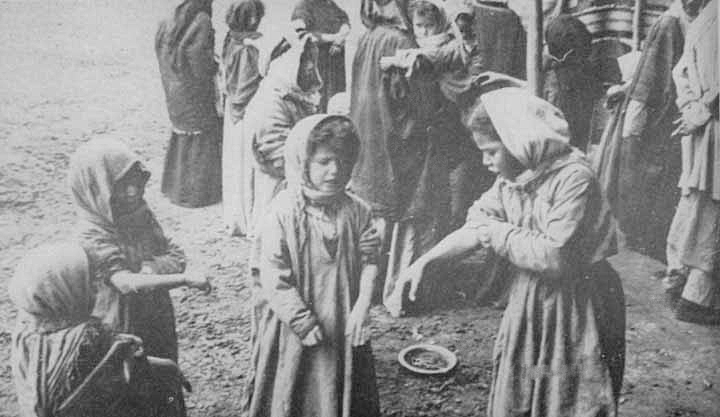
In reporting on the work as a whole, Bayard Dodge, President of the American University of Beirut and chairman of the committee in charge of the clinics, wrote that "over 200 persons are definitely aided in each of the 5 sections each week---often many more. Some are Christians, but most of them are Mohammedans. The 5 doctors are all graduates of the medical school of the American University of Beirut. In the Assyrian colony, which is two hours from any hospital, there is an infirmary, provided by the government, where a certain amount of surgery is carried out. Many are being given their sight. In the other districts, patients are taken to the nearest towns for hospital treatment. The English Quakers use ambulance cars for their clinics. These cars have been given to Lady Spears by the Free French. The American boys use their American Field Service ambulances for getting about with and help very much. . . . Not only do the clinics help many poor sick people, but they also break down prejudice in regions which have been very pro-German, so that in wartime they serve a double purpose."
The work itself was very interesting, and the life, though not very different from that at army posts, was very satisfying. "We live in a large village in a typically Syrian house," J. C. Hodel reported. "The house consists of a plot of ground with trees and flowers and vegetables surrounded by 4 rooms and the kitchen and a high wall of rock and mud. Two rooms are for sleeping, one is the pharmacy, and the fourth is the dining room. The mud walls and the tins, which hold our gas and oil supplies, give the place a somewhat desolate appearance, but it is our home and headquarters.
"What we do is take medicine in one of the ambulances out to a village and set up a clinic . . . on roads which are so miserable that they always give me the feeling of walking barefoot on broken glass or on a bed of nails. It is 50 kilos to our first village. If we're lucky we arrive in about 90 minutes. . . . We roll into Jeni al Bawi over huge rocks which would tear the bottom out of a normally low-slung car, and are greeted by the village mukhtar. Curious children swarm around the ambulance. We unload the medicines and equipment in a crowd of flies and humans. . . . Our materials moved into this temporary clinic, we close the doors to the crowds of people, curious or sick, who almost invariably gather. The primus is started sterilizing instruments, wash bowls are filled with disinfectant, medicines and instruments are laid out, and then we admit patients.
"'Wahad bi wahad' is the cry as we strive to keep the patients coming one at a time. We have varying success in this. One man is stationed at the door to take names, to collect 10 piastres from each patient, and to write down the diagnosis and treatment. The 10 piastres (about a nickel) is a kind of token payment. We handle bawling babies who resist the trachoma treatment, suspicious men and women who think they are being murdered when an abscess is opened. There are cases of malaria, malnutrition, and a host of others streaming through. They bring their bottles and the pharmacist fills the doctor's prescriptions. It is a madhouse. . . .
"Finally the babel of Arabic and English is over. There was the job of getting the Arabic names translated into English, and then the doctor had to talk with the patients in Arabic, and give his diagnosis in English. The doctor is a harried man in the clinics, trying to draw information for diagnosis from simple bedouins. He lights up a cigarette as we clear the clinic and pack the medicines. Invariably, just as we are packed, a few straggling patients arrive. They want us to unpack everything to treat them. . . . It is disappointing to have to refuse. Medicine is for the ill, and to refuse to treat may seem brutal, almost criminal. But these people have known in advance that we would arrive at a certain hour of the day, and to deprive patients in the next village of treatment is not sensible or fair.
"We go to the village mukhtar's for lunch. The mukhtar is the chief of the village. . . . A sheep is killed for us. We are brought the choice parts, including the head, which signifies that we are honored guests and are not being given left-overs. One of the honored guests is offered the eyes, regarded as a great delicacy. Almost invariably the lamb is served on top of a large platter of wheat. There are side dishes of savory vegetables. In season, fruits are served. The drink is water, or sometimes leban, the artificially soured milk of sheep. We relax as long as we dare after lunch, with the heat of the day upon us, and then push on to the next village. In 30 or 40 minutes we are setting up another clinic."
In the same category of special works were AFS relations with the American University of Beirut, marked by the constant generosity of President and Mrs. Dodge. They offered the Field Service the greatest hospitality, frequently inviting men to their extraordinarily American home, and in addition allowing the use of the soda fountain and canteen of the University. Circumstances never allowed the AFS to do all that it might have liked for the University. In early 1942 there had been the emergency food-distribution scheme, and for the better part of 1943 an ambulance was loaned to work with the University's malaria-control project. The latter had started as a week-end job in December 1942 but was soon transformed by A. Hartpence into a full-time assignment. During the winter and spring terms, R. E. Wilson and R. B. Winder IV were loaned to the University as teachers, returning to the AFS at the end of the school year. Regrettably, all detached personnel had to be recalled at the same time as those with the Spears Clinics, when AFS had to gather in all its own to fulfil its commitment to the British.
B Platoon covered the southern territory and had probably the greater number of separate posts. A few of them were quite unpleasant, such as the occasional assignment to Ras Baalbek, whenever some troops were so unfortunate as to be sent to its barren fields. Horns, also an intermittent post, or the larger establishments at Merjayoum, Majdaloun, Djedeide, Ablah, and Turbol seem to have belonged to an intermediate category, not the bored discomfort of Ras Baalbek nor the delights of the three major southern posts---Zahle, Damascus, and Palmyra.
Attached to the airfield at Rayak at different times were Australian, American, and French troops, though it was usually French and required a driver with fluent command of the language. The need for this was explained in part by the complaint of B. G. Dickey, recorded in the Company diary, that they "didn't give him time to take care of his car, what with an obligatory two hours over each meal and all the rest of the time inspecting the local brothels." Rayak was the only post with the French in Syria. If there had been more ambulances in Syria, there would have been the possibility of serving other French units; but as it was there were just enough to cover the British in Ninth Army, and not always to the extent they would have liked.
A few miles southwest of Rayak (and 24 miles from Baalbek) was Zahle, an AFS post from the beginning almost until the end (although intermittent in the last months). After the New Zealand CCS had left, the hospital was taken over by 11 CCS, with which the AFS section moved to Aleppo in May 1943. Later the buildings were occupied by detachments of 2 CCS and 9 Indian CCS, and the Field Service again had cars assigned there. Although in the early days the AFS contingent was quartered in tents which had electric lights and cots with mattresses, later they moved into the hospital itself---a fine building erected in peacetime by friends of Lebanon in America.
"The hospital is high on a cliff with the small town directly beneath," one member recorded, "and beyond the town is a whole range of snow-capped peaks, while off on the right there is a gradual slope down to a very fertile plain, beyond which, again, rise snowy peaks. The day we arrived here it was a sparkling clear day with the crispness of an October morning at home, and suddenly the weather broke and we had 4 days of hard snow. We were all but completely cut off and we had some terrific jobs getting patients through. The roads over the mountains are a mass of switchbacks and terrific up and down grades, and it is some driving when a skid will often mean a 500-foot drop. . . . On one occasion I was stuck for several hours way up on a pass, but fortunately there was a French guard house or sentry post very close by, and I was able to pass the time very pleasantly there. . . . One of the grandest things about this town is its people. They are almost all Christians, and they are without doubt as kindly and hospitable a group as I have met. We have been wined and dined regularly. . . . So many people from these parts have gone out to America that we are extra-well received. The greatest difficulty of all is getting away, because they fear, no matter how long you have stayed, that you are leaving because you are bored or don't like the food."
Evacuations from the Bekka Valley as far north as Homs were to the CCS in Zahle, and from Zahle to Beirut, where there were a considerable number of hospitals and rest centers and other medical installations. The other focal point for B Platoon was Damascus, to which Palmyra and the posts in the near-by hills evacuated and which in turn took patients south into Palestine, as well as evacuating certain cases to Zahle and Beirut. One of the pleasant features of the ride from Zahle to Damascus was the possibility of a stop, if the run was well timed, at the excellent hotel at Chtaura. It was quiet, offered very good food, and had a marvelous cellar of the local Ksara wines (which also found their way to AFS parties at more distant places). In the summer, tables were set out under the trees by a cool stream, and there was always time to stop for a bottle of cold beer.
There were usually two posts in Damascus, one with 2 CCS and the other at the Transit Camp, and sometimes there were others with mule trains or different transient units. In addition to infrequent long runs to Zahle, Beirut, Haifa, Der'a, and Jerusalem, the work consisted mainly of bringing patients to 2 CCS from various camps in and around the city. "There was one regular run every morning at 10 for the MO at the Transit Camp some 5 miles from the city," H. F. Nomer wrote of the summer of 1943, "and every Tuesday and Friday evening at 6:30 we evacuated an average of 30 patients from the hospital to the station, where they were loaded on an ambulance train for Beirut. . . . We had enough work to keep us busy, but not so much that we were overworked. . . . Our leisure was taken up largely by either of the 5 good movie houses, by the city's one nightclub (the Havana), or dinner and drinks at one of the hotels or the French Officers' Club. Then, too, there was the American Consul [Mr. Farrell], who had over 100 albums of classical music, a splendid RCA victrola-radio to play them on, and his own moving pictures and projector. . . . He was introduced to us on the Fourth of July at the American School for Girls in Damas by Dr. Essenburg, who is head of the school and also a very extraordinary woman. She always took an interest in AFS personnel stationed at Damas and had them down for . . . teas, suppers, entertainments, and so forth. . . . Her Fourth of July dinner was superb, and so were the Sunday-morning waffle breakfasts she invited us to. She treated us like kings."
There were also the lengthy mazes of the native markets to wander through---not so fantastic as those in Aleppo, it was said, but still "an excellent all around daytime activity." The swimming pool at Mezze, near the airport where there was also an occasional AFS posting, offered a seasonal diversion. And always there was a great deal of plain sightseeing to do in "the oldest city in the world."
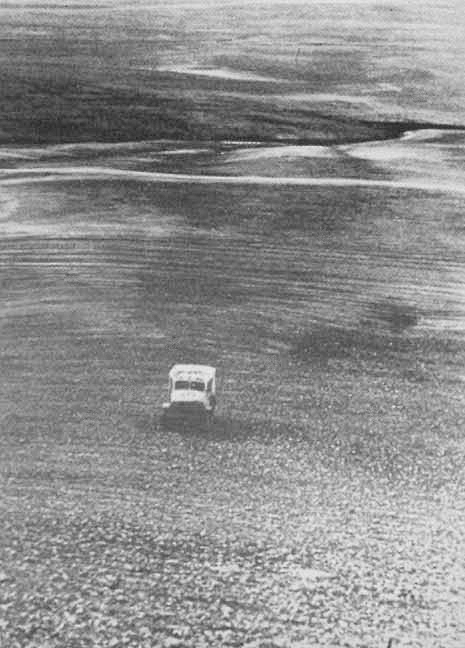
Some 170 miles northeast of Damascus, in the midst of the Syrian desert, is Palmyra. "To the north and east of the roofless temples and broken colonnades extends the flat, stony plain of the desert to an unbroken horizon," G. E. Tener wrote. "West and south rises a steep, rocky crescent of mountains, a fold in a long range running northwards and southwards. From this crescent issues a spring of potable sulphur water, which nourishes the small oasis and drains to a stagnant salt lake a couple of miles northeast of the town. The ancients apparently had access to fresh spring water, though now that is only obtainable at a well some 30 miles away. In the rainy season at the close of winter, green grass springs up on the slopes and on the desert, and small pale blue flowers cover the landscape. Patches of goldenrod and wild poppies brighten it further. This verdure draws gazelles from the mountains, which come in herds to graze while they can. The summer drought sets in in May, and by July all is once more sandy brown. . . .
"The first Field Service drivers posted at Palmyra found themselves quartered in Camp Mermoz, an airport of the French Foreign Legion loaned to the British. The latter used it as a staging post, as it was right on the convoy track between Damascus and Deir ez Zor on the Euphrates. Convoys on this route would break their journey by a stopover at Mermoz. The volunteers were billeted in rooms adjoining the hangar, which had become merely a refueling point for a weekly French passenger plane flying between Deir ez Zor and Beirut. They .ate in the sergeants' mess. Their job was relaying patients to Damascus who were brought them from Dez.
"For recreation these pioneers swam in the French swimming pool at the sulphur spring, examined the ruins and ancient tombs, and climbed to the Turkish castle. For dissipation they drank anis in the cloud of flies at Haddad's bar. But this was not enough. Field Service individuals, everywhere fountainheads of their own peculiar culture, soon sought and found a fuller life. They cultivated the French garrison of the Poste Astoin down the road and . . . they established their own mess. This step involved the hiring of Mahfoud Mohammed Gassim as cook, whose happiness in the employ of the Field Service was the foundation of the excellent relations between the villagers and the Americans. Mahfoud held his job, with one intermission, as long as the Field Service post stood. . . . The report of Mahfoud's life spread through the village and made an excellent impression on the natives . . . and an ambulance driving through town always passed waving and smiling Arabs. . . .
"The friendly connection with the villagers led to cordial relations with Ibrahim, sheikh of the village, and his brother Shoukri. Ibrahim often asked the Field Service in to tea. There, intercourse was largely of the nodding and smiling variety, for Ibrahim knew no English and precious little French. Brothers and nephews would pass through the room bringing tea, cookies, arak, and hubbly-bubbly pipes for the guests. . . .
"The parties of Shoukri, Ibrahim's brother, were the most successful social events at Palmyra. They made no concession to Western culture but reflected the unaffected hospitality and social spontaneity so natural to the Arabs. Shoukri lived in a large house on the edge of town which possessed a vegetable garden three or four acres in size. Through this garden flowed the main stream from the sulphur spring, which increased its fertility and added to its beauty, for this was no ordinary vegetable garden. It contained a small grove of olive trees, which lined the banks of the stream picturesquely, and several deep clear pools edged with bulrushes and overhung with date palms. . . . Shoukri sold his produce to the French and gave it to the Field Service. It was in this garden that he held his parties. . . .
"When occasion afforded, some Field Service members went out on trips into the desert, visiting various bedouin tribes at their encampments. . . . Others passed their time in the summer by shooting gazelles on the desert from their ambulances, thereby providing a variation for the mess. They clocked gazelles going over 50 mph. . . .
"As the winter of 1942 came on, it became impractical to evacuate patients over the desert from Dez to Palmyra, largely because of the rains. Dez evacuations went by road to Aleppo, and the 3 Field Service ambulances at Palmyra had only Palmyra patients to deal with. This meant almost no patients, for so small was the British garrison that it could have been moved in those 3 cars. Indeed in the spring of 1943 the only runs made in an entire month were the two 500-mile round trips to workshops for semi-monthly inspections of each car. During that peaceful month the living quarters were moved from the hangar to the officers' compound in Camp Mermoz. This was a pleasant open courtyard with one-story buildings on all four sides and a tree in the middle. . . . It was here that the Field Service board reached its pinnacle of distinction,"
and very elaborate it was. The mess, here as elsewhere, permitted the Field Service members to choose and entertain their own friends when and as they pleased, which assured the volunteers a life of their own, separate and different from the army---an achievement, many felt, worth any mess fee.
At extraordinary Palmyra, for a while A. J. Lavenhar conducted the town's only MI room, W. W. Phillips ran a small poultry farm for the benefit of his mess, and there were Ninth Army maneuvers noisier, according to the section diary, than Tobruk. In addition, the post offered the single battle experience in Syria---a brief engagement at Bredid in early May 1942, when the Free French put down an insurrection involving two tribes of bedouin. The post at Palmyra was closed on 18 August 1943, lacking 7 days of a year and a half of continuous operation.
In the meantime, the 7th AFS platoon had been formed at Tahag under Lt. Ullman at the end of March 1943, mostly from members of Units 33 and 37. During the first days of its training, the British asked whether its personnel might as an emergency measure be used to drive to Baghdad a convoy of 50 3-ton trucks loaded with miscellaneous stores. The propriety of holders of Geneva cards so doing was favorably determined, although some members refused to join the excursion for other scruples, and the men were immediately given extra training at least to the amount of one hour of driving a 3-tonner. Additional personnel were brought down from Syria to cover such possible emergencies as sickness, and others were sent along for special jobs---Lts. Bridger and Merrill, as field cashier and second in command respectively, and J. M. Carotenuto and L. W. Harding, Jr., as the indispensable mechanics (called by Lt. Ullman the "outstanding heroes" of the trip).
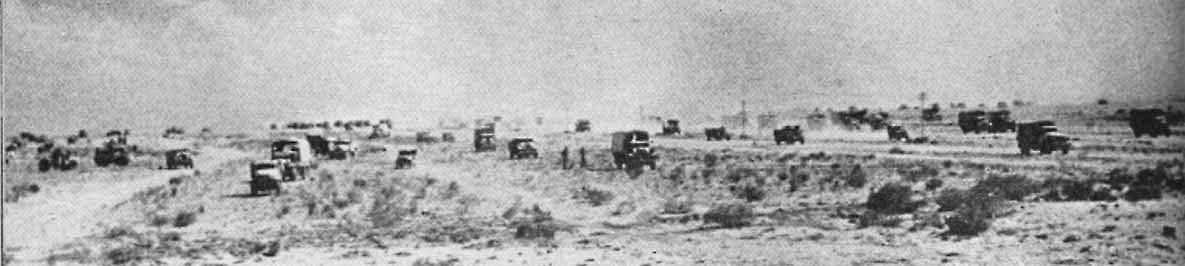
On 30 March the trucks were drawn at the Mena Transit Camp, which gave an opportunity for dinner at Mena House, opposite the pyramids, that few resisted. The next day the new lorries were loaded, mostly by the Field Service in order to avoid the 2-day delay that would otherwise have ensued because of the labor situation. And on 1. April, only a week after the trek had been proposed, the convoy left Mena for Paiforce headquarters in Baghdad, stopping the first night at the Road Staging Post (RSP) on the east bank of the Suez Canal. The next day they crossed the Sinai desert, reaching Ashij and its well-stocked NAAFI by late afternoon---ahead of schedule as was usual on the whole trip. On 3 April they drove north through Palestine---through Beersheba, Gaza, Burier, Julis, Qastina, Ramleh, Lydda, and Petah Taqvah---to a staging post between Kefar Yona and Tulkarm, where they stayed over a day for maintenance and to pick up the last truckload of stores, and had a swim at Nathanya in the afternoon.
The trucks had an odd cargo. Tea, 60 tons of it, filled 22 trucks. Miscellaneous stores, which may have included anything, filled 18 more. Of the remainder, 5 were devoted to carrying 15 tons of peanuts, 2 were filled with printed matter of an official nature, 1 had Expeditionary Forces Institute (EFI) canteen goods, 1 was cook truck, and 1 was empty. That peanuts and tea should have been urgent cargo is so preposterous that it might well be true, though the trucks themselves were the more urgent necessity and getting them to Paiforce was the most vital factor of the trip.
The convoy got under way again the next morning at 8, according to Lt. Ullman's report. "Pass through Jenin, Affula, and Beisan, where we take a wrong turn and get moderately balled up for a few minutes. Then cross the Jordan and climb up through green hills to the Transjordan plateau. Arrive Nafraq at 5:30 in wind, rain, and bitter cold. A few lorries have wheel and brake trouble during the day, and the rear party does not come in until 9, weary but triumphant. At 11 P.M., 26 British ORs report to us. They have come from Damascus by train and will continue with us to Baghdad, acting as convoy guards."
The next day they were off again at 8, "along the splendid military highway that follows the Iraq-Haifa oil pipeline. We make excellent time and have very few mechanical difficulties, arriving at H4, our RSP for the night, at 2:30. Most of the day's run (125 miles) was through a vast waste of black lava boulders, and our night's leaguer is on an empty plain of wind-scoured gravel. Car maintenance, supper, early to bed." The next morning at about 10 they "cross the Iraq frontier and, soon after, pass the pipeline pumping station H3. The country is a vast, featureless, brown table, broken only at rare intervals by shallow wadis and patches of wan grass. Maintain a 20-25 mph pace and reach the RSP at Rutbah at 2:30. Several lorries have been having trouble with faulty wheel lugs."
The next day, 8 April, was "an uneventful day's run across utterly flat, desolate country . . . . Reach RSP at Wadi Mohammadi at 3:30 P.m. Day's run 147 miles . . . . The weather has grown much warmer, and shorts are now the order of the day. A bonfire and sing-song fest make for a pleasant evening." The next day they did the final lap of 115 miles "over the first really bad roads we have encountered. Pass north of Lake Habbaniya and reach our destination, the Lancer Camp, on the western outskirts of Baghdad, at about 7: 30."
"It wasn't a dull trip," W. B. Lovelace wrote, "for Charlie Huber's truck slid over a weak shoulder onto its side; and Lou Murphy tightened his wheels on Sunday and lost them on Monday; and Joe Zarella maliciously sideswiped two convoy jeeps to demonstrate to the Tommy that a jeep can't dodge a Dodge that's trying to dodge a jeep (or that's the way Joe tells it); and there was the momentous football game upon the rock-pile called Transjordan for the pleasure of four Arabs who had come to camp to sell 'o-ran-ges'. . . . When we first saw the spires, minarets, and mosques of Baghdad, some of the men began to kid about expecting to see neon blinkers and 'Eat at Joe's' signs before we entered the city. To their surprise they discovered a tidy row of five very familiar little signs lined up a mile outside of Baghdad. They said 'Lonely sultan/Used to scare 'em/Now spends all/His time in Harem/Burma Shave' "
Baghdad turned out to be dirty and expensive, a great disappointment to most, though hours not spent unloading the trucks or on guard duty at camp were dutifully spent in sightseeing under the auspices of hospitable British (Indian Army) officers. Lancer Camp itself was a dreary waste of sun-baked clay and swirling dust, and no one seems to have regretted the departure three days later, early on the morning of the 12th, with an Indian Army transport company.
However, "the five days coming back were something to forget," wrote H. F. Nomer. "We'd sleep in tents and wake up in the cold dark morning, pack our kit, and climb into our respective lorries, 10 to each lorry. After arranging the mountains of bedding rolls, kit bags, and musette bags, we would wrap ourselves snugly in blankets, sweaters, greatcoats, and so forth, and settle down for the morning. After stops every hour on the hour . . . we would make a half-hour stop at 11:30 for lunch. . . After lunch we would settle down, this time with fewer blankets, as the sun would be quite hot by this time. Off we'd go and eventually reach our destination about 4 P.M. Most of us by the time we reached Tulkarm had acquired beautiful cases of sun and wind burn. Mine was so bad that burnt flakes of skin kept peeling off my face, and my face looked as though I hadn't washed it for weeks."
The return from Tulkarm was accomplished by a 20-hour troop-train ride, which started late and got increasingly later, "a night of little sleep and paralyzed buttocks" according to Lt. Ullman. The group was the first to record unfeigned joy on at last seeing the plains of Tahag.
Their ambulances seemed to be bound up in red tape, so after 36-hour leaves to Cairo the training at Tabag continued through such wondrous subjects as aircraft recognition and contagious diseases. On Easter Monday, 26 April, the platoon went by lorry to Mena again and returned to Tabag in 15 Austin and 18 Humber ambulances, with 5 miscellaneous domestic vehicles. All but the Humbers, which were new, needed serious mechanical attention. In the week it took to get all the cars through workshops, the training continued, reaching twin peaks of refinement with a lecture on insect-borne diseases and a demonstration of individual field cooking. Finally, by 5 May all was done, and the new platoon---now named C Platoon, 485 (AFS) ACC---set off to join the rest of its company in Syria.
Their route followed the course of the Baghdad convoy until they reached Affula, where they turned north. They stopped for a beer at Tiberias, overlooking the lake, drove on into Lebanon, and stopped the night at Merjayoum, arriving at Baalbek at noon on 9 May. On that day, Lt. Ullman handed over command to Lt. C. R. Richmond, Jr. (who had acted as his sergeant from the beginning of the platoon's formation), and returned to Cairo for repatriation. For the next few days the platoon filled the Baalbek barracks to absolute capacity, and between the 12th and 17th it scattered to take over the posts of B Platoon.
But this was the new Syria---still a training ground, although toward what specific end no one quite knew, except that it was no longer the Western Desert or North Africa. During the second half of May, as C Platoon went off to its first posts, M. D. Follansbee was elevated from sergeant to lieutenant of A Platoon, which gave up Lt. Larrowe and some of its sections to augment a reforming B Platoon. Lt. M. L. Brainard, Syrian sergeant-major before going to the desert, assisted Lt. Larro , while B Platoon assembled at Baalbek and on the 24th went off into the desert near Palmyra for a short training scheme. When they parked for the first night---leaguered, that is, with proper dispersal distances---slit trenches were immediately dug beside each car. "Some enthusiastic volunteers went so far as actually to jump into their trenches," W. W. Phillips loyally recorded, "though that was clearly a work of supererogation and its practitioners few. . . .
"The classes were in mechanics, map-reading, star-gazing, the theory and practice of gas attacks, stretcher-bearing, and perhaps other subjects. It is well to note here and now that we were spared first aid, and not even a brush-up course in Arabic came under discussion. The classes had been well planned and with remarkably few exceptions were taught with a vengeance. Morton Strauss was the dean of the faculty, while Leon Jaffe, John Wires, and Norman Eddy, if memory serves, played minor and infinitely shorter roles in the instruction. It was not for naught, as the next time there is warfare in the desert we will have a very good idea how to reach places by compass bearings, and, should the occasion arise to plot courses, we will probably be able to remember the rudiments. No casualties resulted from the practice stretcher-bearing. Too, we were indeed most thoroughly instructed in everything pertaining to gas. When the first spray comes, B Platoon will be saved---providing the execution of precautions can be accomplished in much less time than it took to tell us about it. We also have to our credit knowledge of living in the field, and in the future no scheme veteran will be without an ample larder, medical comforts, and a primus stove. . . . No attempt was made to spoil the nights for individual study, research, and recreation . . . and had the scheme endured a week longer many of the heroes would not have."
On recovering from its scheme, which had ended prematurely on 4 June, B Platoon expected to be sent off to win the war by itself, or at least to be utilized as spearhead of a new and exciting attack. This was early June, however, and the world's battlefronts remained static. B Platoon was assigned posts, instead---15 cars with "D" MAC at the 43rd General Hospital in Beirut, 7 on maneuvers in the north, and individual assignments to Jdeide, Latakia, and so forth. In mid-June Lt. Larrowe went to Cairo for repatriation, and Lt. Brainard succeeded to the command of the platoon, assisted by A. Gorman, Jr., as sergeant. The next month Lt. Follansbee resigned his command of A Platoon to join the French unit and was succeeded by Lt. M. V. Moran, who kept A. D. Shoup, Jr., as his sergeant. H. M. Curtiss was created lieutenant-adjutant to assist Captain C. W. Edwards with the 3-platoon company.
No reorganization seemed to last more than a little while, even in the new Syria. In the first week of July, Ninth Army informed Captain Edwards that workshops and two platoons should be ready for action in a short time. With 19 cars to the north and 14 in the south, C Platoon was spread thin over the areas of A and B Platoons, which came in to Baalbek in the third week of July. Then---nothing happened. On 23 July Captain Edwards wrote that "every day gets a little longer" and started daily swimming parties to the pool at Ablah.
At last on 2 August 1943, the two platoons and workshops drove off in convoy to Tahag, leaving C Platoon to service Ninth Army. As if it was to be sent posting after, C Platoon was recalled from its posts on 17 August and, with more disappointment than surprise, sat for over a month in Baalbek. Lt. Curtiss, who had stayed to take charge of the northern area when the platoon had been spread out over the whole of Syria, took this ingathering for the writing on the wall and returned to Cairo for repatriation. On 23 September the last hope of a further move gave way, and the cars were again sent off to the old posts in the Bekka Valley and Damascus areas. Then, at the end of the month the announcement of the formation of D Platoon, the eighth, started a new round of reorganization.
By mid-October, the C Platoon Austins and Humbers were being replaced by new Dodges arrived at last from the United States, and D Platoon was forming at Tahag. Lt. Richmond had become Captain in charge of C and D Platoons, which were commanded by Lts. R. C. Bryan and J. A. Lester, Jr., respectively (with sergeants E. R. Masback, Jr., and W. B. Chamberlin III). Later in the month, C Platoon had 8 ambulances on a Ninth Army scheme in Palestine, "Operation Virile," complete with mock battles and real ammunition.
A single platoon might have sat in Syria forever, on the theory that such a small unit could be as much use where it already was as anywhere it might with great effort and correspondence be sent. Half a company was a different matter, and the days of the American Field Service in Syria were fast drawing to a close. The few remaining posts, including a last-minute assignment of 10 cars to Aleppo, were closed down by 15 November and the cars again called in to Baalbek. This time the hoped-for orders did come through, and finally on 23 November 1943 the platoon set off in convoy for Tabag and D Platoon, stages on the way to Italy and the war.
During the summer's lull, the Field Service
had lost one battle in Cairo. A carefully selected corps of veterans had been entered in the lists, but their best efforts failed of the expected success. Though several may have been wounded in the engagement, no permanent damage was inflicted and little more than time was lost.
In late March, as the North African campaign clearly approached its finish, Major King suggested that AFS produce a concert party. This would keep some AFS members active during the period that was likely to intervene before the next campaign, and, if successful, it could be sent around to entertain not only AFS but idle British units as well. Mr. Galatti agreed that the idea was sound and that the attempt should be made. Accordingly, E. B. Fenton and A. T. Jeffress (who had previously collaborated on the Unit 16 shipboard show, the witty travesty called "Tuckerman Forbid") throughout May held auditions which disclosed the suspected sufficiency of talent.
B. G. Shevelove wrote the sketches and K. Browning composed the music. The performers were brought to Cairo, where Shevelove put them through rehearsals during the hot summer days. It was a varied presentation: R. N. Arnett, T. Barton, R. H. S. Craven, W. G . Fuller, F. E. Preston, and E. Simon performing sketches, ballads, songs, and dancing. Some were sad and sentimental, some were rude and funny. It was a good show.
ENSA, which was in charge of entertainment for the British forces, watched the development of the AFS concert party with approval. It had agreed to arrange for transportation and bookings at entertainment-hungry units all over the Middle East---dependent upon the reception of one audience in the field. The dress rehearsal in late July was well received, and a public performance was scheduled for Mena Transit Camp. AFS was put first on the bill with a selection of numbers from the show. The hall was full. The material was brilliant. The performances were perfect. But no one laughed, and the songs were only faintly applauded. By what might have been coincidence, the Transit Camp was filled by troops not one of whom spoke English. The wit of the Field Service withered in the desert air. There was no second public performance.
By the time we pulled back to Tripoli on the return from Tunis, the city had been in Allied hands long enough so that it was back to normal with "business as usual." The bombing damage, of which there had been comparatively little, had been cleared up, and all the shops, etc., were again opened. The American Air Force opened a coffee shop in the heart of the downtown area, which was the delight of all Americans in the area. The AFS went for it in such a big way that it was necessary for them to limit our attendance to 5 men per day. . . . All in all it was the nicest place in town. . . . The British had their usual NAAFI tea rooms and restaurants, one in the Union Club, another out beyond the American place at Jan Smuts Gate, where the South Africans' recreation area was located. There were several movies in town for the troops---all free, of course. These were terribly crowded during the day, and very warm. Generally, instead, we went out in the evening to either the Field Bakery unit, the American hospital, or the airdrome, where a mobile cinema unit showed outdoor movies in the early evenings. These were new releases from home, and much better all around than the downtown ones. The eating places in town, at first closed to any but local civilians, were later opened to us, and about once a week we'd get a bunch together and go in for dinner. In the entire time we were in Tripoli there was not a single enemy plane over to do any damage, and only once or twice did high-flying recce planes speed past. All in all, as I said, it was a most pleasant and lazy period.
E. R. HAMMOND
On 26 May 1943, when the convoy of 567 AFS ACC reached Tripoli, Lt. O'Neill wrote in the Company diary: "We will make camp here for probably one month." As it turned out, the whole summer was spent there. Many fretted about the inactivity, and some went home and returned while 567 Company still sat with 10 Corps at Tripoli. The AFS had not been included in the small medical plans for the Sicilian campaign, which went so much more "speedily" than anticipated that there was no possibility or need to reconsider its use. The only consolation was the knowledge that the Company was scheduled for inclusion in the invasion of Italy, whenever that might be. Ever optimistic, on 11 July, the day after the invasion of Sicily, 567 Company gave a rousing "Farewell to North Africa" party, which was referred to in September by the apparently Africa-bound Company as the "Victory brawl."
Members of the Company were included in the parades for King George VI's birthday celebration on 2 June and were present for His Majesty's inspection of the 48th General Hospital on 19 June. The whole Company took part in the 10 Corps parade before the King and General Montgomery on 21 June. After that, there were few duties for the volunteers during the entire period. In addition to very occasional work, chiefly evacuating a base hospital to a hospital ship or vice versa, there was not much to do except to get the vehicles in the best possible shape. In mid-July the exhausted Dodges of A Platoon were replaced by Humbers, and by the end of July all cars were in good mechanical shape. Next they were painted gray, and then came the awful moment of again deciding about the "chicken" insignia and the "heresy" of painting it on the heroic cars of 11-485-567 C and D Platoons. "As usual, there was a row as to whether it was a good design," wrote Lt. Field, who had been through this before. "It wasn't dignified enough, it was too dignified; it was corny; it lacked the proper spirit; the AFS should have an insignia, it shouldn't. Anyway, they painted some hundred odd of them---5 somewhat individualistic artists did. After the first 30 or 40, they got browned off at merely being copyists and so they began to get original. In no time we had scowling chickens, leering chickens, smiling chickens, panting chickens. Finally they came up with a drunk chicken. At about this point, Art got wind of the whole thing, and now all the chickens are sober again and wear none but the conventional AFS expression. But for a while there the outfit looked like a portrait gallery of Bloomingdale."
The amalgamation of the two half-companies and the passage of the summer brought about an organization that was to be the basic administrative pattern followed by 567 Company during the rest of the war. Major Howe, as Officer Commanding, was assisted by Captain B. C. Payne as second in command and Captain C. S. Snead as transport officer (later second in command as well, during the absence of Captain Payne), Lt. C. I. Pierce as adjutant, and Lts. D. G. Atwood, C. M. Field, J. N. Hobbs, and F. J. Murray as platoon officers.
In early April 1943 a Liaison Office had been opened in Tripoli as a sort of advance HQ at the point most nearly halfway between Cairo and the Tunisian battlefields. Under Lt. (from May, Captain) L. A. Collins and Lt. V. Y. Bowditch, it took care of transients as well as convalescents, baggage, mail, spares, and the like. At the beginning it had been intended to do chiefly personnel work and was extremely busy. During the long summer wait, it handled a multitude of functions. A baggage room was added, and a villa at 73 Via San Francesco d'Assisi was loaned for the use of convalescents. Bowditch was repatriated, and Lt. A. T. Jeffress came into the office in mid-July. A field cashier was in more or less permanent residence, and in August W. F. Merrill came from 567 Company to handle S&T problems. With the Company on its doorstep, new units and repatriation groups passing through in opposite directions, hospitalized personnel to keep track of and visit in the town's dozen or so major medical establishments, convalescents in and out, as well as groups on leave to and from Cairo as well as Tripoli itself---it was frequently said that life in the office presented "not a little chaos."
For the members of the Company, there was only the chore of arranging a pleasant life---and the emphasis was on comfort and entertainment. T. M. Allen described the general layout of the summer camp:
"A few miles outside the city limits of Tripoli, a bit beyond the spacious British 48th General Hospital on the Castel Benito road, is a large sign which reads: '567 Coy / AFS ACC.' A right turn here onto a bumpy, rocky road which leads through farmlands and finally converges onto a group of orchards. The first of these groups of trees harbors our workshops and headquarters section. A hundred yards beyond workshops, the headquarters trucks and transportation truck are located. Here is the center of AFS activity. Charlie Pierce and Beach Powell can always be found here, taking care of all types of paper work and doling out the precious mail. . . . Art Howe has a separate tent near this office where he carries out the job of running 567 Company in the field. Captain Snead and Hugh White in the transport office, which has tables and chairs built in a 3-tonner, keep track of all the ambulances. They work in conjunction with Webbie, who has charge of the British workshops attached to us. There are numerous records to be kept of all our spare parts and equipment and vehicle inspection. In addition to this work, Hugh makes arrangements for getting personnel into Tripoli for the movies or to the beaches. There is also a duty ambulance, which parks near the office. This necessary job is shared by each section just as the various watches around camp are. . . .
"The four platoons are spread out over a large area. Jack Hobbs's and Doug Atwood's are dispersed in two separate almond orchards fairly near headquarters and workshops. Manning Field's and Red Murray's platoons are farther off to the left from Doug's and situated on a slightly higher, more hilly ground. At first all the cars in these sections were parked in orderly fashion in even rows. However, as different pals teamed up and many had to find shady spots, the ambulances were spread out over a larger area. All types of bivvy sprang up: houses made out of stretchers and blankets with the back of the ambulance forming one side of the enclosure; or large square holes were dug and covered with pointed roofs of blankets, ground sheets, or canvas; other fellows backed two cars together and, using the rear doors as sides, put a few stretchers on top to shield themselves from the scalding sun. Jerry and Eyeteye flypaper was found to work quite well. However, there was no way to eliminate the bothersome flies completely.
"Ken Proctor and Charlie Stewart started the famous Belhartzia Club after clearing out all sorts of debris from a beautifully constructed Eyeteye air-raid shelter in the blue, beyond Manning Field's section. . . . The shelter itself is far underground and there are entrances at both ends. It has a high, rounded ceiling and is divided into two rooms. The first room has seats, a large table phonograph, and a good-sized bar. People would bring their own liquor and have it kept at the bar under their own names. Ken somehow always had ice, lemons, and sugar on hand; and as time went on be collected some wine and perfected a drink called Wineade. The other room was used as a kind of kitchen and sitting room and served what smelled and tasted like real hamburger but which mysteriously came to be called bumpburger or camelburger. When the noise, confusion, and milling AFSers became too great, it was nice to retire to the 'roof garden' and cool off and watch the stars. . . .
"There were two irrigation pools, which afforded running water for baths or doing laundry. One was situated near the Belhartzia Club in the open, the other was near Jack's platoon and when first approached through dense foliage and trees gave one the impression of a Hollywood scene: there were banana and orange trees surrounding the pool, but the best of all were the large clusters of grapes which hung down to within a foot of the cool spring water from an arbor over the pool. . . .
"For a while a cook-house was moved out to a large, lonely beach, and many fellows moved down there and let their hair down and merely swam and sunned all day. Some nice tans were acquired, although none to match Rock Ferris'."
Into this idyll drove the two platoons of 485 Company on 12 September. They had arrived at Tahag on 6 August; there the vehicles had been reconditioned, re-equipped, painted gray, and issued camouflage nets and personnel had been issued winter uniforms. At dawn on 30 August the 5-mile convoy of 103 cars had set off to the west. Their route was a recapitulation of the great names of the campaign begun almost a year before---El Alamein, Fuka, Daba, Mersa Matruh, Bug Bug, Sollum, Tobruk, Derna, Cirene, Benghazi, Agedabia, El Agheila, Marble Arch, Sirte, Misurata, and finally, after 1,600 miles of driving, Tripoli. The location of their first campsite was found unsatisfactory and the two platoons, just as everyone finished constructing some sort of dwelling, moved to a better location on a Cliff 40-50 feet above the sea. Cars were put through workshops and given what reconditioning they needed after the long haul from Cairo, and then, except for one day a fortnight of guard or cleaning or ambulance duty, there was only the search for amusement.
The Belhartzia Club came under their careful scrutiny. "It had decorations that are difficult to describe," W. W. Phillips noted. And the members of 485 Company flocked to it to meet and mingle with friends of the other Company. "Named after a famous Egyptian disease . . . it was an excellent place to escape from the terrible boredom of doing nothing," G. B. Forbes added.
But there was not to be much more sitting idle in Tripoli. Both the summer and the wait were coming to a close. Rumors had always flown thick and fast, and even those who had been around the longest were hard put to it to resist the hope that their departure really would be "next week." Everyone was on notice to be prepared to leave immediately and several definite orders were only at the last minute withdrawn. Then suddenly rumor was fact and the first vehicles were loaded on transport ships---the B Platoon cars of Lt. Field, according to a ten of diamonds he had drawn on 13 July.
After a number of alarms and counteralarms, on 28 September the workshops and 48 ambulances of Lts. Field's and Murray's platoons were loaded, their convoy sailing around 2. o'clock the following afternoon. The rest of the Company, constantly on call, was finally called out in the late afternoon of 4 October. They were all loaded by early morning of the 5th. At 9 A.M. the barges began to pull out of the harbor and they followed the others to rejoin Eighth Army at Taranto.
Orders for the two platoons of 485 Company had for a time threatened to come before those for 567 Company, and that major catastrophe had been narrowly escaped. On 3 October their orders did come and the cars were loaded by midnight. Many had planned to sleep in their ambulances on shipboard, rather than in the bunks provided, but at the last minute instead of sailing that night they were given shore leave until noon the following day. The barges did not leave the harbor until late on the afternoon of the 4th, just as the second half of 567 Company was beginning to embark. However, they were destined for a different port-having been assigned, with the British 10 Corps, to the largely U.S. Fifth Army, which had taken its first beachhead in the Salerno area on 9 September 1943
From the beginning of the invasion of Italy on 3 September, Tripoli had begun to lose its heavy concentration of troops and therewith its importance. When 567 Company sailed, Lt. Jeffress accompanied it to open a Liaison Office in Taranto. Captain Collins went with 485 Company to Salerno to investigate the possibilities of establishing a new HQ in that area. And Lt. Merrill was left in charge of an office of dwindling utility. There were convalescents in ever smaller numbers to be taken care of, and N. Pierce looked after a number of AFS ambulances in the region, always a most delicate and difficult job. For a while the incoming units and repatriation groups continued to pass through Tripoli and needed to have their transshipment arranged. But fewer and fewer ships stopped there, the ill and convalescent recovered, and the ambulances could be watched after from afar. In the last week of November, Lt. Merrill shut the Tripoli office and went to Naples on orders from Cairo HQ.
Many changes had occurred in the administrative Headquarters since Colonel Richmond had returned from India in June. Perhaps the greatest was the departure of Major King for consultation with Mr. Galatti in New York. In his twenty months of service, he had guided the innocent "Italian prisoners" into Deolali and brought forth a reasonably military unit, he had seen 1 AFS ACC through its first experience with real ambulances in Syria and established the seriousness of AFS with Ninth Army; he had led "X" AFS ACC in and out of Tobruk and through its first battles and established the willingness of the AFS with Eighth Army; then he had joined Colonel Richmond to do battle personally to establish the position of the AFS with the more suspicious GHQ MEF; and finally under Colonel Richmond he had acted as Officer Commanding the American Field Service in the Middle East. "No one in the AFS," wrote Colonel Richmond, "could have handled so well the difficult assignments he was given." Major King had managed the growing pains of the AFS in the field and had consolidated with GHQ MEF the fruit of its successful maturing. It had been a prodigious job, and the rumor that he might not return to the Middle East caused distress both in HQ and in the field. "He commands the respect of every man in the AFS," Captain Payne wrote; and Colonel Richmond added that "he is of vital importance to the organization." As it turned out, Major King did not return to an overseas command. During the rest of the war he was occupied with many important special missions, not the least of which was liaison with the War Office while serving as AFS London representative.
In August, Major Coster also returned to New York for consultation with Mr. Galatti and a short vacation before also going on to a new project and greater glory. Major Hoeing, at this time of major upheaval, went briefly to Syria as OC 485 Company, then was quickly brought back to Cairo to act as co-adjutant to Colonel Richmond with Major Coster and, on the latter's departure, with Major W. H. Perry. During this period, it had seemed that the companies might go off in different directions or at best would be widely separated for long periods of time, and there was much talk of advance and separate headquarters---one for each company at least. The Tripoli Liaison Office was part of the solution to the existing situation and showed the way to be followed in the future.
In order to prepare for the expected multiplicity of headquarters, which never became as confusing a snarl as was sometimes feared, extra personnel were called into Cairo to learn the necessary procedures at the very fount. Lt. E. M. Borger---leader of the large Unit 32---was assigned the task of reviewing the HQ organization as it had developed since March and instituting such reorganization as would increase its efficiency. It was a matter of considerable satisfaction to many that his experienced eye found little to change but in detail; and the GHQ Newsletter, which he founded in October, was said to be useful even in the most unexpected emergencies. Lt. W. A. Kraft---who had long been in charge of the HQ, or reserve, sections of 567 Company and had gained an admirable reputation for the quality of his cars' condition and maintenance---was called in to the S&T Department. Lts. D. N. Mannen and D. C. Richmond, briefly field cashiers at this period, chose to return to driving ambulances, and at the beginning of November 1943 Lts. H. Goff, C. H. Huber, R. E. Paddock, W. Simpson, and J. W. Warrington were engaged at this pleasant task under the direction of Finance Master Captain N. C. Bridger and his assistant Lt. G. S. Barker. In addition, R. Thomsen, who had left the Mail Office to found the Liaison Office in Algiers, had been succeeded in this important and exacting work by W. J. Atkins, a member of the torpedoed Unit 8 who had finally made it with Unit 16. In a class apart, in the early summer Russell Perkins came to Cairo---to assist with the Club and the Mail Office (as base censor) and to offer his calm wisdom to the many who had need of it.
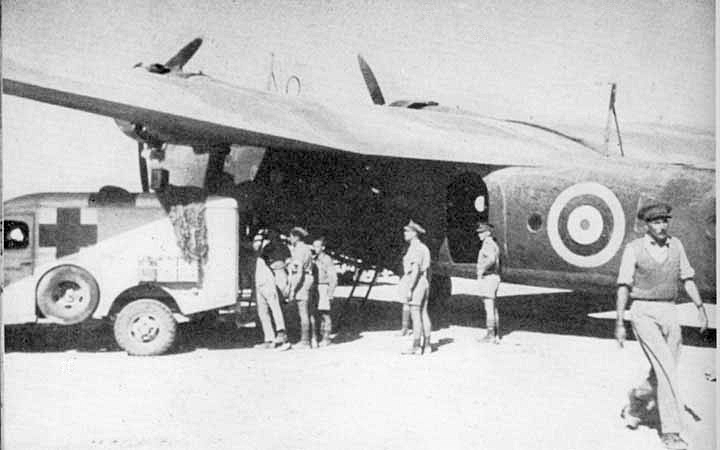
Captain L. A. Marx during the summer returned from New York to try again to push the air-ambulance scheme to a successful conclusion. The planes were available in the United States, and Mr. Galatti was prepared to establish a small unit of AFS air ambulances at any time that the Middle East, by a formal request for them, would establish the requisite priorities. The medical directorates both in London and Cairo very much wanted to have such a unit established, but the RAF had need for transport of just the type the Field Service was considering, and the negotiations got hopelessly bogged in a morass of projected loans from AFS to RAF and vice-versa according to conditions. At the end it seemed that an equally likely project was the Nettleton-Waldner suggestion of submarine ambulances. Captain Marx, then, although his hard work had been rewarded by moments of hope, left Cairo with AFS air ambulances still no more than a dream for the future.
Several administrative developments of this period were quite important. In June 3, 1943, as capstone to AFS efforts to get formal recognition of its status from the British, the Middle East Command issued General Order 762. This set down in black and white the details of AFS accommodation, equipment, and status, elaborating on the points of the original cabled agreement between Mr. Galatti and GHQ MEF of 1941--- with refinements as to matters of rail travel, telephone facilities, and other points not unnaturally overlooked at the beginning. With the promulgation of MEGO 762, the Field Service could feel sure it had proved itself, and an end was put to many administrative difficulties that had perennially arisen. It was repeated practically unchanged by AFHQ for the companies transferred from MEF to Central Mediterranean Forces (CMF) in Italy.
During the summer began the agitation over those repatriated at the end of their original enlistment periods who had changed their minds and wanted to return to the AFS overseas. It had not occurred to those who had stayed on in the Middle East that they might return to the United States and then rejoin the AFS; to them the suggestion would have seemed frivolous indeed. However, many who were tired at the end of a year, or who thought that they might find something for which their talents better fitted them, for a number of reasons later decided that the AFS was better than they had realized. The return of the first few of these individuals to units in the field raised such howls of rage from those who had stayed on doing a job---even during the devastating boredom of the summer in Tripoli---that a definite policy on the matter was clearly needed.
The correspondence is voluminous, not always calm, and sometimes only just civil. The ultimate decision was not reached for some months, as both the British authorities and the U.S. Selective Service had to be consulted. What came to be known as the two-year-leave program---adopted in consideration of the good name of the Field Service, the general shortness of shipping, and the work of the faithful who had not gone home---can be summarized as follows: men going home after their first term of enlistment were not to be re-enlisted; those going home after their second year of service would probably be allowed to re-enlist, but on the same terms as a new enlistee; and those going home on leave at the end of their second year (that is, after signing a contract for further service) would have their draft board's permission for such a leave arranged, would be given priority for return overseas, and would maintain their status in the organization (which is to say, would continue to receive the $50 monthly allowance given, from August 1943, after completion of the first year overseas---which was also a measure adopted to conserve trained personnel, to reward the faithful, and to lessen the need of constant replacements for units in the field).
With the departure of 6 platoons for Italy, and the remaining 2 about to join them, the problem of multiple headquarters was clarified, to a certain extent, by the obvious immediate need of an Italian HQ larger than the Liaison Offices established in Taranto and Naples. Investigation of the plans of AFHQ determined that the new Headquarters should be located in Naples. The piecemeal transfer of staff, files, spare parts, and vehicles began on 6 November, when the first contingent left Cairo. C and D Platoons Of 485 Company were urgently needed in Italy, and AFHQ's request for them gained the priority that cut through the tight transportation situation of that period. In the first week of December their cars, with a single driver apiece, got off, as did the main body of the HQ staff; and they were soon followed by the NCOs and spare drivers of the two platoons as well as the members of the two units that had arrived from the States during the transition period. At the last minute there was a fracas over one man who, having been told by his father not to leave Egypt without seeing Luxor, put filial duty ahead of army orders and came to regret it. Otherwise, the complicated moves went off with only a pencil-sharpener overlooked.
By mid-December, Cairo was the site of an AFS Liaison Office run by Lt. Merrill. A few HQ departments continued their main offices there for a while longer: Finance for the duration of a quarterly audit, which also gave time for arranging the transmission of funds to Italy; Supply and Transport to track down a shipment of new ambulances, part of which seemed to have been considered by the U.S. Army as its own; and Public Relations to stay near the cabling and printing facilities, which did not yet exist in Italy, where for quite some time everything was either "official" or nonexistent.
The hospitalized and convalescent in the area were looked after by Lt. Merrill, who also did innumerable jobs of essential shopping for those cut untimely off from Cairo's tailors, silversmiths, and so forth. As the various reasons which had kept them there ceased to exist, the HQ departments moved to Italy, the last by mid-April. Lt. Merrill attended to the final task of the S&T Department, assuring the dispatch to Italy of all AFS-owned ambulances. Finally, on 31 May 1944, he was able to close the Cairo Liaison Office, the last remnant of the AFS in the Middle East.
The last establishment in Africa was the Algiers office, opened by Lt. R. Thomsen early in July 1943 to facilitate the transshipment of new units and repatriation groups. This had become vastly more complicated within the larger command of Allied Forces Headquarters (AFHQ) and required the explanation of the AFS and its ways to the whole huge Anglo-American establishment. Thomsen conducted a number of important AFS jobs with AFHQ, and by August his office was so well established and already so well known that it received without delay a signal economically addressed: "Eisenhower for Bob Thomsen."
By virtue of its location, however, a great deal of the time of the office was spent dealing with what Captain Greenough called "the White Man's Burden"---the AFS French unit. After the cessation of hostilities in Tunisia, its fortunes, always precarious, had deteriorated rapidly. Due to a number of situations over which AFS had no control, the unit was finally disbanded.
All of the cars with the French unit were old or borrowed, or both, and needed major workshops repairs. The famous 19 new cars had been en route from the United States for a matter of years, now, and after countless false alarms were still awaiting shipment in May 1943. The confused political situation between Generals de Gaulle and Giraud (which found most of the AFS FFC group ranked passionately behind De Gaulle) made the status of the whole French Army uncertain and therefore the likelihood of their seeing battle remote. The AFS unit moved with French troops back toward Tripoli in June, when their proximity to 567 Company (with all its equipment and the promise of exciting activity) emphasized their own apparently hopeless situation. Most of the group's officers were eligible for repatriation and went, leaving Captain J. E. Boit (SSU 2) ---the leader of Unit 41---and Lt. W. L. Burton in July as commanders of the AFS sections with the French 1st and 2nd Divisions respectively. The clarification of the French political situation---Giraud to head the army and De Gaulle civil affairs---and the subsequent formation of an independent French Army held hope of better things for the AFS unit. Instead it resulted in a cable from the U.S. State Department forbidding AFS to serve with the French until the enemy should have acknowledged such service according to the stipulations of the Geneva, or Red Cross, Convention. From the latter part of August there were constant efforts to obtain this necessary notification somewhat fouled up by the error of the first cable as to the volunteers' sex.
While this was happening, the battered ambulances, which required such effort and ingenuity to keep on the road, did a lot of traveling. Those with the 2nd Division, after a long wait at Sabratha, at the end of August moved with the Division to Djidjelli, two going on to Casablanca. The Division needed more ambulances, as well as ones that were in shape for action, which these after 60,000 miles were not, and it released the AFS group from its contract. By mid-September, Lt. Burton had recalled his cars to Algiers, where some of the men worked for the Liaison Office and others for the American Red Cross.
The Field Service group with the 1st Division moved from Zavia to Hammamet at the end of August and then on to Nabeul. The food was scanty and often inedible, the sanitary conditions almost nonexistent, and half the volunteers came down with malaria, jaundice, dysentery, malnutrition, or a combination of diseases.
Just about then, the 19 new ambulances arrived in Egypt and there was a flurry of renewed activity toward the end of getting enemy recognition. These few moments of hope were soon acknowledged as optimism. The delay promised to be extensive, and Captain Boit on 26 September 1943 withdrew his group from the 1st Division and joined the others in Algiers. A number of solutions to the problem were then considered, but none was feasible and on the 30th the unit was disbanded. Most of its members were either sick or near the end of their enlistment periods, and in view of the extraordinary situation, all were given the opportunity of repatriation. More than a third stayed on--10 joining the companies in Italy, Captain Boit entering the Personnel Department of Headquarters, and D. S. King remaining attached to the Algiers Liaison Office.
Many had worked hard to save the French unit, among them Colonel Enos Curtin (then in Algiers with the U.S. Army) and Captain Lydig Hoyt (sent from New York by Mr. Galatti). Although time and patience might have seen the unit through intact, the health of the, volunteers at Nabeul could only, under the incredible conditions, have deteriorated further. After the unit's disbandment, however, events took a new turn. In December the enemy gave oral assurance that the necessary recognition of AFS service would be granted, and through the offices of the International Red Cross this was finally received in writing in the spring of 1944. Captain Hoyt arranged to lend the 25 new ambulances which had arrived during the winter to French volunteers in Algiers until AFS should need them. And by February 1944, Major C. H. Coster was organizing a new unit for service with the new French Army.
In the midst of such stirring events, the Liaison Office continued its function of transshipment and reflected the glory of association with the French efforts, whose correspondence pullulated with conversations and conferences with generals and heads of state. Captain Thomsen, assisted from August 1943 by W. G. Fuller, soon added a baggage room to its services, then found that the equipping of new units had best be done by their office, and finally they allowed themselves the heady experience of recruiting Unit 64-A---A. R. Zimmer. To them in February 1944 fell the task of tracking down the rumor of a female AFS driver in Algiers. They learned that the 25 ambulances loaned to the French were being driven by an organization of local ladies and then had the unpleasant duty of ordering that the name of the AFS be removed from the door panels before a natural confusion should lead to unseemly remarks.
At the time of Colonel Galatti's overseas tour in the spring of 1944, the Algiers office had moments of hectic business and saw transacted deeds of the highest importance. AFHQ was still there, and the conferences held during Colonel Galatti's brief stay had far-reaching consequences. A projected women's ambulance service for work in rear areas, although approved by the medical directorate, was later turned down by the U.S. War Department. This was probably just as well, for "if the Women's Rear Service had gone through," Mr. Galatti later wrote, "I would have received a terrible howl of concern from all AFS men. But you cannot stand pat when the world is moving."
Of more importance was the oral agreement reached between British and American medical services that Field Service sick and wounded could be transferred to U.S. hospitals and then shipped directly to the United States. The British were responsible for the hospitalization of AFS members, but to have a man sent for a long recuperation in England was hardly practical. In many cases in Italy, and to a greater extent in India, American hospitalization was therefore preferable. Much of the basic work involved in reaching this agreement, which as it could not be put in writing had to be at the very top level, was accomplished by Colonel P. H. Long (SSU 69), then in Algiers with the U.S. Army medical services.
On the repatriation of Captain Thomsen, Captain Jeffress took charge of the Algiers office on 21 May 1944, just in time to make preparations for the arrival of the new French unit in mid-July. This proved more complicated than it could seem on first look, as both the number arriving and the port of their arrival remained shrouded in secrecy until almost the last minute. To Captain Jeffress also fell the delicate job of negotiating with the generals of AFHQ for the priority needed to get to Italy the large unit to cover an unusually desperate personnel shortage. There were also complications about a supply of tires that the HQ S&T Department needed, or thought it wanted.
During the summer of 1944, AFHQ moved to Caserta, and shipping, following the army, increasingly ignored Algiers. After the local APO closed without warning on 29 June (the next day it simply was no longer there), Captain Jeffress began to make arrangements to move. For the last few months he was assisted by G. B. Forbes and A. C. Eschweiler III. In spite of their efforts, with shipping ever more scarce and uncertain, it was not until 24 August that the AFS Liaison Office in Algiers was closed and everything moved to Italy.
With some of its most impressive work yet to come in Italy and Burma, at the end of September 1943, as the platoons were leaving Africa, the American Field Service received many letters and wires in recognition of its four years of service in World War II. Messages of congratulation and appreciation were received from the director of French medical services as well as from Field Marshal Sir J. C. Dill, General B. C. Freyberg, General B. L. Montgomery, and General Sir H. M. Wilson. The letter from President Roosevelt concluded: "In serving our Allies, they serve America." But there were still two years and many battles to go.