 George Rock
History of the American Field Service
1920-1955
George Rock
History of the American Field Service
1920-1955
CHAPTER V
When, after the war is over, a man is asked what he did, it will be enough for him to say: "I marched with the Eighth Army.">
---WINSTON CHURCHILL, Tripoli, 4 February 1943
In the desert in September 1942, although the battlefront remained comparatively static, there was much activity. Units were regrouped, were transferred to the rear to rest or to receive special training, and were brought up to strength in supplies beyond anything they had long known except as theory. Camouflage was extensively used ---to disguise both the massing of units and the type of their equipment. In the big battle for which he was preparing his army, General Montgomery intended to achieve surprise by his strength, by his tactics, and by his timing.
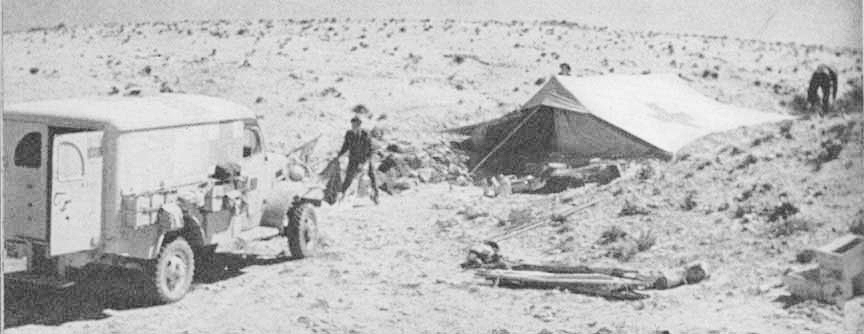
With all the shifting about of units, the Field Service's 11 Company did its share of packing and parking, of running and resting, only a few points remaining fixed for any length of time. Company headquarters on 10 September moved from Rear Headquarters of 10 Corps (at the end of the wire track, 7 miles southwest of kilo 134 on the Cairo-Alexandria road) with 12 LFA to J Track South of Burg el Arab. On the 13th it went back to the end of the wire track. Although 2 sections were then posted to 15 CCS (nearer to Cairo), on the same day 2 sections from 2 MAC, 2 of the 3 sections then with the New Zealand Divisions, and 1 of the 3 with 14 LFA at El Gharbaniyat were recalled. In the next week there were a few daily evacuations from 12 LFA to Alex, much serious preparation of ambulances for workshops inspections, and many short leaves. The 2 sections remaining at El Gharbaniyat continued to fill infrequent hospital trains and to evacuate from the 14 CCS into Alexandria until on 20 September they too rejoined the Company HQ, which on that date became attached to 15 CCS at kilo 51 on the Cairo-Alex road. Company HQ was established at Kilo 49, where "the vehicles dispersed on the northwest side of the road," according to Lt. Hoeing's platoon diary, in "good hard desert." Here there was very little for the assembled group to do, beyond a few runs to Cairo and an occasional short-term posting, and this general inactivity continued for a month, with only brief and mild excitement over the return with 15 CCS to the old location at kilo 134 on 8 October.
The only advanced work at that time was with 7th Armored Division in the southern sector, where R. V. Lewis' section had been posted since August. Give or take some gunfire, the life they led was typical of many postings in the Western Desert.
"We have to get up every morning at the very crack of dawn," W. I. Riegelman wrote, "be up and ready to move out to our regular day's position at first light. . . . As soon as it is light we start preparing breakfast. Food is issued to the vehicle, and we do all of our own cooking. Roughly the procedure is to take an empty 5-gallon petrol tin, carve holes in it according to one's own particular fancy or ideas of efficiency, put about two shovels of sand on the bottom, and soak it with petrol. If done correctly, this will give you a grand hot fire in roughly four seconds which will burn for about 40 minutes without being touched. The cooking utensils, with us at least, consist of a 'billy' (large covered pot) salvaged from an abandoned NAAFI during the June retreat, a metal fly swatter used for all stirring, and frying pans of varying sizes made by cutting off the tops of petrol tins and bending back the edges. I can make one of these in about 1 1/2 minutes, and it is all I can do to keep Buzzy [J. Frank] from throwing them out as soon as they have been used once, in order to avoid the necessity of cleaning them. Any of them are better after they have been used a bit, and, besides, one can't always find a petrol tin-although they are not scarce. Our menu for breakfast always includes porridge, tea, and toast (when we have the bread). Sometimes we can get bacon, sometimes sausage. . . . We supplement it from our 'store-bought' supplies, of which we keep as much as possible from the various canteens one finds around the desert. Breakfast finished, we argue about who will clean what-and . . . [when everything else is clean] we clean ourselves. This is a job of monumental proportions, because the stove, the 'billy,' and the sundry other utensils acquire a thick coating of carbon from the petrol fire which is impervious to anything but the force of the human hand, and, like a woman, then it melts and clings and is a general nuisance. My hands haven't been really clean in weeks.
"Then we sit and wait---sometimes for a whole day. Other days we're busy as hell. Sometimes Jerry comes around and bombs our camp---lately he has been coming over very regularly at 9:20, drops a few bombs, then comes back and strafes the place, and then he is off. On his last eight visits to our camp he has succeeded in hitting absolutely nothing, but he has come close a couple of times. Some of the other camps of our regiment haven't always been so lucky, and so we occasionally have casualties to deal with. A typical example happened yesterday just before I left. Jerry had bombed one of our patrols. We were called by wireless, because it was a fair way out and we proceeded as quickly as we could to the place and picked him up. The MO went with us and, finding him only slightly wounded, bandaged him on the spot, and we took him straight back to the ADS, some 25 miles from our camp. . . .
"We move wherever the regiment goes. We stay with the forward troops except when some of them leave us temporarily on a particular assignment.... Usually we have a run to the ADS about once a day, occasionally more often, but it is such a long, difficult journey that we're not sent in unless it's necessary.
"A light lunch . . . is about all you can take in the noontime heat, which is often intense. Then about 5:30 we start preparing supper. Bob Orton shot a gazelle one day. He skinned it; got another chap to help him trim, cut it up, and clean it; and we cooked part of it for dinner. It was absolutely marvellous. Other days we have sausages, beans, potatoes---God knows what---all out of cans and often very good to our now very famished palates. I wish you could see us sitting on the back step of the ambulance, often having to brush away about eight million flies, sometimes in a dust storm, eating out of mess tins."
Riegelman might have said more about the flies. It has been claimed that the swarms of them----walking over everything, flying so close and settling on anything, even the food about to go into your mouth-were the most notable feature of the period as well as the most unforgettable.
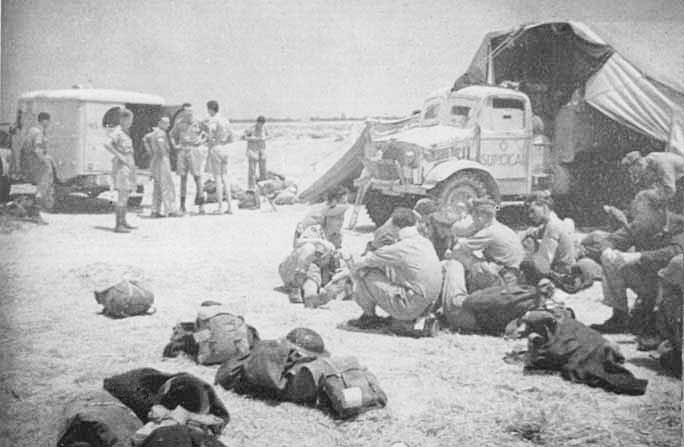
After a bright beginning-when, the days after its arrival in the desert, 2 sections of Lt. Thomas' platoon were posted to the New Zealand Division for LFA work---there was not much for 15 Company to do. On 28 September, the next day, 1 New Zealand CCS moved in next to Company HQ at kilo 121, and a section of the same platoon was given 24-hour duty with it. There followed daily evacuations in convoy from the CCS to 1 New Zealand General Hospital at Helwan for the remaining sections of the platoon.
Lt. Howe's platoon, which had lost the New Zealand assignment by the toss of a coin, sat at kilo 121 with nothing to do. To lighten the tedium, the platoon was sent in two sections, under Howe and Gosline, on 2/3 October to reconnoiter W Track in the desert "per certain instructions of a Brigadier. It turned out that our course ran through some of the most impassable country in the whole desert," Howe wrote of his half, "great dunes of soft sand rising so steeply that no car in the world could get through under its own power. We sweated and pushed for several hours getting all the cars over the first rise, only to find another one a short way on. And so it went, another and another, until we were all so fed up and exhausted that we just quit and rolled into bed for the night, miles away from the rendezvous at which our cook-truck awaited us, and hemmed in on every side by miles of soft sand. . . . Needless to say, we weren't passing very complimentary remarks around about the Brigadier next morning. I had the fellows open their emergency rations and decided it was ridiculous to try to go any farther; accordingly, we headed off toward some harder country and returned back to camp as quickly as possible. Later I found out that the Brigadier was quite a wise owl, and he may have done it as a bit of a joke---in any case it did take all our crowd into more difficult country than they will ever have to fight through again, and the experience was valuable."
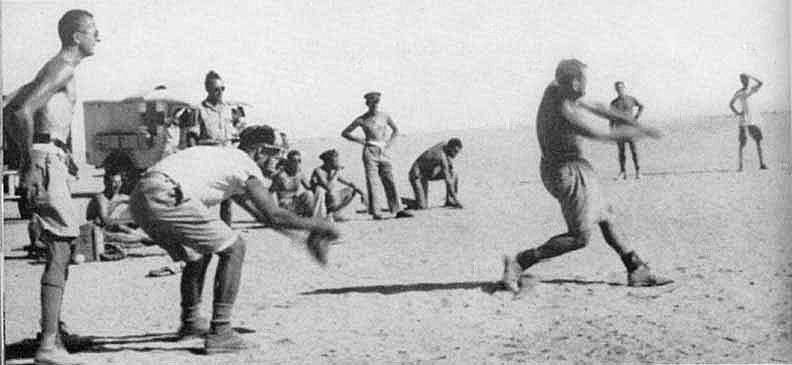
Gosline's section made the rendezvous by a different route, but nevertheless the joint official report said that W Track was "nonexistent." After that, for a while, the platoon was more content to sit in idleness---playing baseball, getting used to the desert, and watching the numerous huge convoys of tanks, guns, and troops rolling up toward the Alamein Line.
On 9 October 1942 began the first phase of the Battle of El Alamein ---an intensification of the RAF bombardment of the Axis positions, a softening process that was to last until, two weeks later, the actual fighting began. During this period the Field Service units gradually moved forward, and both companies underwent some administrative changes---mostly due to the ravages of repatriation: in 11 Company, Lt. DePew was succeeded as platoon officer by Lt. B. C. Payne, who had been platoon sergeant since early August; Lt. Dun relinquished his rank in order to drive an ambulance, and was replaced as adjutant by Lt. Wyllie; and J. E. Nettleton was dubbed Lieutenant as Company transport officer. With 15 Company, J. de J. Pemberton went to Syria and was replaced by D. G. Atwood as sergeant for Thomas' platoon, and W. A. Gosline was succeeded by C. S. Snead as sergeant for Howe's platoon.
During this period one inadequacy of the 15 Company training gave rise to a legend. F. B. Myers had not been told, or had not remembered, the difference between the red cap-band of a British general and the red cap-cover of a military policeman; the former being so rare, by comparison, that they did not much impinge on a volunteer's consciousness. However, General Freyberg, commander of the New Zealand forces, made it his practice to stop Field Service ambulances and to chat with the drivers, of whom he was a great fan. The actual phrasing was possibly more forceful, but W. W. Phillips tells the classic version of this story: "All was very jovial on this occasion until [the General] noticed that this engaging young man was disobeying his recent and personal order about equipment to be carried. Being a disciplinarian, and as unceremonious as any Kiwi, he let go and administered a dressing-down that would have made a sergeant-major scorch. Our volunteer, who had no clue as to the whole episode, took what in Boston is known as umbrage. No policeman, military or otherwise, was going to talk to him in such a fashion. He started his motor and shouted: 'See here, my good man! You stick to directing traffic and I will stick to driving this ambulance, and we'll get the war won,' and drove away in a cloud of dust."
On 19 October, 3 sections of 11 Company were attached to 1 New Zealand CCS, to share the "jaundice run" with the sections of 15 Company also attached there. During this brief period, a minor war developed between them, the representatives of 15 Company claiming that those of 11 Company were causing some "difficulty . . . due to a bit of disorganization among themselves and their individual ideas on how to exercise their function, somewhat in discord with our own." Harmony was restored by having the two groups operate separately, which enabled 15 Company to maintain something referred to as its "habits and general integrity."
Later this close association of groups from the two companies at one post was briefly renewed. However, this time, even separate convoys did not prove a satisfactory solution. The situation grew increasingly tense until there was need of a "big grievance meeting." At this it developed that 15 Company disapproved of 11 Company and that it was in return mistreated, with remarkable loyalty, by 11 Company's cooks and workshops. Further discussion brought agreement that "these petty complaints and faults of individuals are too common among any people and anywhere to be treated officially as something to be corrected." Responsibility for good relations was placed squarely on each individual, after which---although there was always a certain amount of rivalry between the companies and even between the platoons of either company---the matter was never heard of again.
When I assumed command of the Eighth Army, I said that the mandate was to destroy Rommel and his army and that it would be done as soon as we were ready.
We are ready now.
The battle which is now about to begin will be one of the decisive battles of history. It will be the turning point of the war: The eyes of the whole world will be on us, watching anxiously which way the battle will swing.
We can give them their answer at once: "It will swing our way."
We have first-class equipment; good tanks, good antitank guns; plenty of artillery; and plenty of ammunition; and we are backed up by the finest air-striking force in the world.
All that is necessary is that each one of us, every officer and man, should enter this battle with the determination to see it through---to fight and to kill---and finally to win.
If we all do this there can be only one result---together we will hit the enemy for "six," right out of North Africa. . . .
Let us all pray that the "Lord mighty in battle" will give us the victory.
This special message from General Montgomery was read to all troops of Eighth Army on 23 October 1942. That night at 21:40 (9:40 P.M.) a mammoth artillery barrage opened the Battle of El Alamein. Between 23 October and 4 November the fighting passed through three stages---called the Break-in, the Dog Fight, and the Break-out. The intention was to destroy the power of the enemy's infantry before attacking the armor, an unorthodox strategy on which General Montgomery relied as much as on his great striking strength. On the coast he had placed the 9th Australian Division; just south, the 51st (Highland) Division followed by the 2nd New Zealand, 1st South African, and 4th Indian divisions---all grouped under General Sir Oliver Leese as 30 Corps. To their rear were 1st and 10th Armored Divisions, comprising 10 Corps. The southern half of the line was covered by General Horrocks' 13 Corps, made up of the Greek Brigade, placed south of the Indian Division, followed by the 50th Division, the 44th Division, and at the southern end of the line the Fighting French; behind the 44th Division was poised the 7th Armored Division, the famed Desert Rats. During and according to the course of the battle, these positions were later changed.
The artillery barrage of 23 October was kept at full intensity for around 20 minutes, and, according to General Montgomery, its "effect was terrific." At 10 o'clock, under a full moon, the infantry advanced along a limited front in the northern sector, and by the next morning the initial objectives had been gained, the Break-in had been accomplished. The ensuing Dog Fight lasted for seven days, 24-30 October, during which time the Eighth Army pushed slowly through the enemy defences, widening and deepening the original salient until it had passed through to the far side. During this week of heavy fighting, pressure against the enemy was maintained along the entire line, and many fierce counterattacks were met and broken. Finally on the night of 1/2 November the Eighth Army pushed its salient through the last of the defenses and the Break-out was possible. On the morning of z November the armor advanced through the passage cleared by the infantry and sappers, engaging the Axis armor at El Aqqaqir. All day the battle raged, and by 3 November the Battle of El Alamein was an accomplished victory for General Montgomery. The enemy was in full flight and the Eighth Army had embarked on its pursuit.
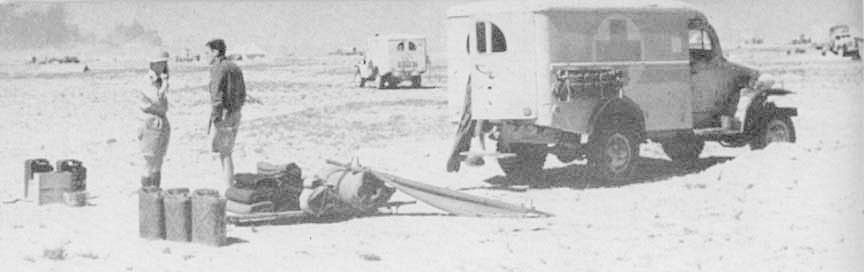
By the start of this decisive battle, the Field Service had also moved forward, most being near the El Alamein station of the coastal railroad. No one who was there will ever forget the network of roads and tracks, starting with Springbok Road, which went south from the main coast road through El Alamein station and on into the desert. A few miles farther east was Sydney Road, which passed south through the railway's Shammama Halt. Between these and parallel to the coast road ran, from north to south, the Sun, Moon, Star, Bottle, Boat, and Hat tracks---simply accumulations of tire marks running between the minefields and marked by tin cut-outs.
Headquarters of 11 Company, with workshops and 20 of the 30 ambulances with the New Zealand CCS had joined 15 CCS at a point south of El Hammam. In addition, 1 section was still with the 7th Armored Division, and Lt. Hoeing had led 4 sections to 1 and 15 LFAs of the 1st Armored Division-just equipped with the newly arrived Sherman tanks---west of Springbok Road on Star Track.
A third section of Lt. Thomas' platoon of 15 Company had been attached to the New Zealand Field Ambulance on 15 October, and later his other sections were attached to 8 South African CCS; Lt. Thomas accompanied the New Zealand cars to their station west of El Alamein on Moon Track, while Atwood took charge of the cars with the South Africans. Lt. Howe's ambulances were mostly with 3 Field Ambulance, attached to 10th Armored Division on Boat Track west of Springbok Road, the rest being with 10 Corps or the South African CCS, which moved on 24 October to Shammama Halt, just west of Sydney Road.
Until the Break-out, work for the Field Service was between the forward field ambulance posts and the South African CCS, with runs from there back to El Imayid Station (from which hospital trains ran to Alexandria) or to Hammam and El Gharbaniyat, again being used as a medical concentration area. The area available for operations was small, and all the AFS cars in Egypt were involved in the battle, those at what is usually called the rear still being sufficiently close to hear the gunfire and to feel a real part of the tremendous effort.
"The barrage started exactly on schedule," wrote Lt. Thomas, then with the New Zealand Division in the north. "I knew when it was coming---I even had some idea what it would be like, and yet I distinctly remember at first being surprised by the terrible and continuous force of explosion, the blinding flashes, and smell of gunpowder. There were so many guns firing, and the rate of fire was so rapid, that the sky was illuminated in a continuous line running from north to south as far as the eye could see. . . . The continuous barrage was sustained along the entire front until 10 o'clock and then seemed to become more sporadic and therefore somewhat less intense. Shortly after 10 there was sufficient lull in the firing so that we could bear the wail of the Scottish bagpipes as the Highland Infantry moved forward on the right flank of the New Zealanders. . . . Even from a distance the music is enough to make your skin creep. It can't have failed to have a demoralizing effect on the enemy.
"It wasn't until 1:30 that our Field Service cars were called on to start working, and then 5 cars were ordered to the 24th Battalion RAP. I decided to go along as a spare driver for a friend of mine named Brook Cuddy. We drove westward on a dusty track crowded with tanks and Bren carriers getting ready to move out and cover the infantry positions at dawn. It was touchy work by-passing the concentration of armor, since it was, of course, necessary to leave the proper path of the track at times and take a chance of running into a slit trench or perhaps a stray mine. However, we found the 24th RAP truck without a mishap and loaded 3 of our cars quickly. I was about to settle down and wait for more casualties to fill the 2 remaining cars, when a very excited padre came rushing up and told me that the 25th Battalion was a few hundred yards to the west and needed ambulances in the worst way. . . .
At home at an RAP"It took us two hours to find the 25th Battalion. . . . We had to work our way through and around the tanks, across the British minefields, across what had been no-man's land, and across the German minefields before we reached our destination---and when we did get there we found that neither the battalion doctor nor his RAP truck had put in an appearance. The battalion had just taken its second objective, but the wounded were still scattered all over. . . . [There we found] the infantry banging away on the far side of the minefield with rifles, mortars, and machine guns; long lines of tanks shifting about on the near side; the engineers nonchalantly going about their business of clearing a passage; shells and mines exploding at odd intervals; and a great white moon shining down through a haze of fine dust. . .
"I had expected the 25th Battalion to greet us with open arms when we finally did get through to them, but everyone seemed too tired and preoccupied to get enthusiastic about anything. I found a young captain and told him we'd be glad to evacuate as many casualties as our ambulances could carry.
"'Ambulances?' said he. 'Well, we haven't really had time to collect our wounded. Perhaps you'd see to that? I'll send over a guide. Better hurry up and get those ambulances away! He sounded like a man who has just finished running a hard race and is having trouble bringing himself back into his immediate surroundings.
"It took us a good half hour to find enough casualties to fill our ambulances. I know for a fact that we should have been able to fill the ambulances twice over, but it was like pulling teeth to try and persuade anyone---even the battalion stretcher-bearers---to take a real interest in what normally would have been a common task. This was the most marked exception to a general rule of behavior that one could possibly find. I've never known a time before or since when fighting soldiers were not willing to drop everything in an effort to get their wounded comrades started toward a dressing station. The only explanation I've ever been able to figure out is that we had arrived too soon after the battalion had taken its objective, and the men hadn't had time to bring themselves out of the strain and tension of the attack. . . .
British dressing station in the desert"We drove back to the ADS just as dawn was breaking. Once again we had to fight our way past the tanks and through the narrow minefield lanes. . . . The ground was rough; we kept scraping up against the sides of the oncoming tanks, and an occasional shell landed close . . . to the track. . . . It was full daylight when we arrived at the 6th ADS. There was a great rush of work, as the casualties were pouring in from the battalions, being quickly and efficiently treated, and loaded into ambulances to be evacuated to the MDS. Scotty Gilmore's boys . . . were busy shuttling back and forth between stations with good routine efficiency. I stopped long enough to find out that the night attack had been a complete success for the 6th Brigade, which had managed to take all objectives right on schedule. Then I drove over to the 5th ADS . . . [and] Bill Nichols' section. . . . Since there was a shortage of ambulances at both the ADSs, I went back to the MDS and split up Chuck Larrowe's section, assigning 2 cars to the 5th ADS and 3 to the 6th. . . .
"For the next three days, I spent most of my time distributing the mail, cigarettes, and tinned fruit, which came up from our Company HQ; urging people to take better care of their ambulances; discussing the merits of Paulette Goddard and Mary Martin; and acting as a spare driver for various people. I didn't get much sleep, since most of the hard work came at night, especially for the cars attached to the 6th Brigade, which were making quite a few RAP evacuations. . . . During these three days the New Zealanders kept on attacking, taking their objectives, and consolidating them with machine-like precision, and on the third day they were withdrawn into temporary reserve. . . . [Then] the Australians cut off a pocket of Germans northwest of the famous Hill of Jesus [Tell el Eisa], and the Highland Division pushed forward on their left, thus creating a salient on the northern end of the line. The 6th New Zealand Brigade was again brought up into the lines, and together with the Highlanders and the Home Counties Division they took up the job of exploiting the salient. Since the 5th Brigade was still in reserve, my cars were now divided between the 6th ADS and an English Field Ambulance serving the Durham Light Infantry. . . .
"Early in the morning [of 1 November], I left the New Zealand dressing station and went over to the British station where Bill Nichols and his boys were attached. . . . I found 4 of Bill's cars loaded up and heading for the MDS, while Bill was out in the 5th with a boy named Eccy Johnston at a Durham Light Infantry battalion. They'd all been going steadily all night. I had a talk with the harried commanding officer and then sent my driver back to the MDS to bring up Chuck Larrowe's section, which was waiting for the 5th New Zealanders to go back into action. Within forty minutes there were 10 Field Service ambulances and 4 English Austins all operating out of that one station---and all of them busy. I spent the day carrying stretchers between the ambulances and the reception tent and worrying about Bill Nichols and Eccy Johnston, who kept driving back and forth between one of the RAPs and the ADS, each time passing through a gap in the minefield under heavy shellfire.
"Three battalion doctors were killed that day, including the man that Bill and Eccy were working for, and by mid-day the going got so tough that it was necessary to move the brigade HQ and the battalion RAP trucks back to within a few hundred yards of the minefield gap. Unfortunately the Major commanding the ADS decided to go out and look for Brigade HQ, just after it had changed its location, and picked on Bill Nichols to give him a ride, since the HQ had originally been located near Bill's RAP. I had just relieved Eccy Johnston and was acting as a spare driver for Bill at the time and therefore managed to get in on one of the nastiest possible rides. I had to take my hat off to Eccy and Bill when I saw the kind of stuff they'd been driving through all day.
"We passed through the minefield gap and traveled along a track leading up to the infantry positions. There were plenty of shells plopping about, and it would have been an uncomfortable ride at best, but in this case we no sooner got out west of the minefield than we found ourselves in the middle of a tank battle of sorts. There were about twenty British tanks scattered along the southern side of the track taking pot shots at a pocket of Germans to the north. The Germans were returning the fire with antitank guns that sent out a lively white tracer with shells that seemed to go bouncing along the ground. The Major couldn't decide whether to go on or not, but anyhow we drove right in front of a number of tanks, probably spoiling their aim, and then pulled up right in the middle of things before the Major finally decided we'd gone far enough. . . .
"We finally found the headquarters situated on the western side of the minefield, amid a large concentration of trucks and guns . . . drawing a good deal of German shellfire. In fact, the shelling was so effective that while we were waiting for the Major to finish talking to the bigwigs, we gathered one load of casualties on the spot, evacuated them to the ADS, and filled up the ambulance again. . . . The Major finally returned from his pow-wow, and we made our way back to the dressing station in an ambulance so loaded with wounded that it was necessary for me to ride on the mudguard. The narrow track through the minefield had been so chewed up by heavy traffic that there was a layer of fine, powdery dust at least six inches thick covering the hard desert surface, dust which was so churned up by every passing vehicle that at times it was impossible to see three feet in front. Most of the overworked tracks in the limited area behind the Alamein Line were in the same condition in those days, and a large proportion of the Eighth Army went around looking as though they had been dipped in a barrel of tinted flour.
"By nightfall the pressure on the British ADS had let up considerably. . . . The Durham Light Infantry was withdrawn in the morning, and our brief attachment to the British Field Ambulance was ended. Chuck Larrowe's section rejoined the 5th New Zealand ADS, and I split Bill Nichols' cars between the two New Zealand stations. We had a couple more days of routine work . . . and then the break through came."
Meanwhile, at the southern end of the line, a strong diversion coincident with the main attack in the north was planned for 13 Corps, which included the 1st Brigade of the Fighting French Forces. The AFS unit with the French had moved on 13 October with the Brigade from their camp on the Suez Road, the next day reaching a point just north of the Qattara Depression and some 7 miles south of Gaballa. Later they had moved north and then, on 23 October, west to Deir el Risw.
In the coming engagement they expected to be operating in territory impassable to any cars but those with 4-wheel drive, and sometimes to them. Therefore they borrowed J. D. Dun, J. Frank, R. V. Lewis, R. P. Muller, Jr., A. M. Ogle, Jr., and W. I. Riegelman and 4 Dodges from the 11 Company section with 7th Armored Division. Dun was attached to the Foreign Legion, which attacked west of Himeimat on the night of 23/24 October. It did not obtain its objective, and during the confused withdrawal Dun's Dodge and two other ambulances became stuck while returning through the enemy minefield, amid considerable enemy gunfire. Some armored cars going the same way tried to pull them out but could not get enough traction to make the grade. When they had to go on, Dun asked them to send back a tank and continued attempting to get his car out. While he was in the driver's seat, an explosive bullet ripped through the seat beside him and tore a gaping hole in the right-hand door. Alone with the three ambulances and their patients, he immediately started to evacuate the wounded to a sheltered spot behind the ambulance; but as he lifted the first patient in his arms an explosive bullet hit the man in the stomach and killed him instantly. His other patients were safely placed behind a barricade of duffle bags, bedding roll, and sand. An Italian, left there in the mix-up, crawled over to where the men lay and, refusing to return to his own lines, acted as Dun's orderly.
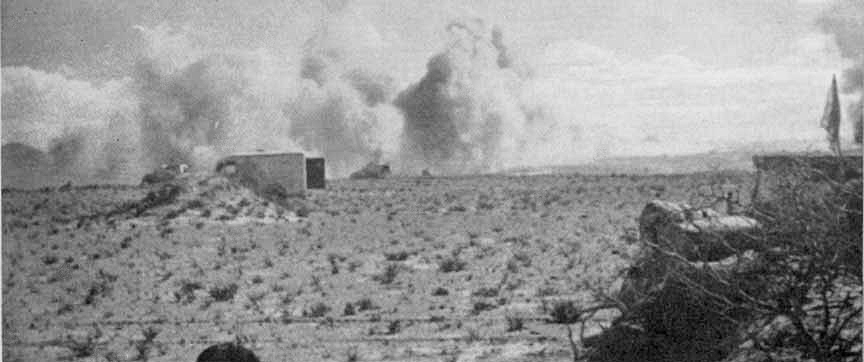
The other two ambulances were in full view of the enemy and were not fired upon. Dun's, which was partially screened and may have been taken for another kind of vehicle, was riddled by bullets during the hours they stayed there. Around 10 o'clock in the morning a French tank arrived and pulled the three cars onto firm ground, Dun steering each ambulance in turn. He then found drivers for the other two cars, having to take time to teach one of them how to drive, and brought in the patients.
During this same engagement, Captain Greenough himself, when asked to send cars to search for wounded between the lines, drove into the area---still racked by enemy artillery---to bring 16 wounded back to the GSD. He also reported that Ogle, "having lost contact with his MO in the general confusion and seeing that the other Dodges had become stuck . . . by great ingenuity and clear thinking" made a prodigious drive south and east to take his patients to a British MDS well behind the lines. On the 27th, this southern attack was called off and the borrowed drivers and cars were sent back to their own units. However, Dun returned before the end of the month to be permanently attached to the French unit.
On 27/28 October the French unit moved northwest to a point 6 miles southwest of Tarfa. There they marked the route to the minefield for the BIMP (Battalion d'Infanterie du Marine et du Pacifique) attack of 30 October. During this, Captain Greenough reported, "under intense sporadic mortar fire, the men maintained an unending relay from the front line to the GSD. Only one ambulance at a time was allowed in the advance position, so heavy was the fire; the second ambulance was stationed just out of range, and the third a mile back at the entrance to the minefields. As the first passed, loaded to capacity, the second, his motor already warmed, started forward, then the third in his turn. When the laden ambulance reached the GSD after 15 miles through marked and unmarked minefields, in utter darkness, another ambulance left to take his station. No one faltered; no one missed his cue; and, what is most remarkable, no one lost his way when an error of literally 6 feet meant being blown up on a mine."
During the pursuit, the French 1st Brigade was out of battle, and the AFS unit, while not idle, had little to do other than collect supplies, deal with mine casualties, and work on their tired cars. Not until 22 November did they move again, to Daba and then on 13/14 December to Gambut, where they sat for a very long time indeed before going into action again.
The rest of the section with the 7th Armored Division had also seen exciting work during the first days of the battle. G. B. Lester, with the Scots Greys from 23 to 25 October, "was in the very center of the German firing," W. I. Riegelman wrote. "At one point he, together with his orderly---under the heaviest kind of shelling from long-range artillery, short-range auxiliary tanks, and mortars-dug slit trenches for forty-odd patients who could not be evacuated. Then he made six successful runs through the worst kind of barrage to the ADS---and succeeded in getting the whole lot back out of danger. His ambulance was hit once by a tremendous shell, which by a miracle failed to explode. But when late that afternoon I bumped into him, George was sporting the most magnificent hole through his back door you ever saw. The entire rear of the body was caved in on one side."
But the 13 Corps attack had been called off on the 27th, and "nothing of any real interest happened," Riegelman continued. "Much of our time, in fact the bulk of it, is spent simply waiting, waiting, waiting. Some days we get bombed, sometimes strafed; others are completely serene, and, but for an occasional sound of gunfire in the distance, one would never guess one was in the midst of a great war." And this was so of most of the units in the line. After the rush of work in the earliest days of the battle, when many drivers had worked round the clock, ii. Company reported having to cope with complaints of "when are we going to move up and start doing some work?"
It was early discovered that the opportunities for bravery were not restricted to the veriest forefront of the battle. They could, and did, arise anywhere and at any time. At the 1 LFA on 26 October, C. C. Rodgers reported, "a petrol fire from a small double set of bombs ignited an ammo truck not 150 yards away. Nice mess! The driver lit out immediately, but several others not too well in awe of the cargo tried half-heartedly to extinguish the blaze. One was killed, two wounded. Especial heroism by two of our drivers, Ed Jones and Hamilton Goff, in rescuing the wounded by recklessly maneuvering their ambulances and loading them, well within range of floating, jagged metal. . . . You can imagine the most of us scuttling for safety."
With the Break-out on 3 November, there was excitement for some and hard work for most, as the various Field Service groups advanced with the units to which they were attached. That with the 7th Armored Division, after their dull time during the Dog Fight, was in the very van of the "first real advance since our arrival in these ungodly parts," Riegelman wrote.
"At about 5 o'clock we were up and ready to move---whither we knew not. Then the MO came around and told us the plan. . . . just at first light we started. My place was just behind a light tank; at times I would be driving next to a gun of one sort or another, sometimes tanks would hem us in on both sides, sometimes it would be an ack-ack gun---but always I stayed behind the same tank, the MO's 3-tonner behind me and his own little jeep in front, abreast of the tank, with George [Lester's] ambulance a little behind the former. As light came we could get a little better idea of how the formation was organized, and it was very reassuring to see the General himself popping here and there; obviously what looked like the worst kind of confusion was a magnificently organized column. We headed south for a bit and then west. At one point we ran into a bit of Jerry shellfire; it was coming from the west. We were in range for the next three-quarters of an hour, but, toward the end, the shells were coming from the east, and from the same guns . . . . We continued on our way, swinging south again and then west . . . .
"Good old George Lester again succeeded in sticking his neck out and having a couple of whacks taken at it---and emerged none the worse for it. At one point, the MO decided that we would have to evacuate some patients. George was picked, I to stay with the advancing unit. George had to go back quite a distance and then, in his attempts to rejoin us, he apparently drove by us (we were a long but narrow column, and this is a wide desert). Anyway, he saw some vehicles after a while, it was dark by this time, and decided to investigate. It was a bit shocking when he beard the men in the first truck he approached talking German. There was nothing to do but get the hell out of that spot, which he proceeded to do.---Well, to make a long story short, he spent the night with another Jerry outfit, left before it was light enough for them to spot him, and then later still a third party took him prisoner. In some way he talked them out of it, and finally, realizing I suppose that we were more or less on their tails, his captors went off and left him. . . .
"Just before dark we ran into some Jerry tanks. In a second the artillery was stopped, assembled, and firing. The incredible efficiency of those gun crews is one of the real revelations to me. I saw one large tank with a tremendous gun on it get a direct hit, but the remainder of our targets were over a slight escarpment and out of my range of vision. Then it got dark and we stopped for a spell. Orders were that no beds were to be made, that we would be moving again on short notice. We munched a few biscuits (two tea brews had been in vain because, just as the water was coming to a boil, the blue flag appeared on the lead tank and we were off) and settled down to wait. Jupe [R. V. Lewis] and I were sitting in the front of the car when all of a sudden from out of the darkness all hell seemed suddenly to have descended on us. Machine-gun bullets sang their way past us, several hit the lorry next to us (doing no damage of any consequence), and the next half-hour was distinctly uncomfortable. The Jerry patrol which had stumbled on us in the dark obviously had no idea of the force which they were attacking, or they would never have given away their own position. But they didn't use tracer bullets; result, our own boys could only fire at their gun flashes, and the sound effects were almost amusing: there would be a short burst from the higher-pitched Jerry gun immediately answered by our lower, growling-sounding guns, then silence, then another Jerry burst, and so on. . . . No one was hurt and eventually the patrol was driven off, but now our position had been revealed and so we were off again.
"We continued on until dawn and then, as we approached our first actual objective, we ran into a very heavily defended position. Jerry opened up on us with some heavy guns, and a tank battle seemed in the offing. But again our artillery dealt handily with the opposition. . . . Then for one reason or another (I never actually found out the true explanation) we again changed our course. But this required passage through a minefield, and as might have been expected Jerry had several heavy guns trained on the gap. It was a ticklish business getting that entire column through, and I think the worst few minutes I've had were those spent waiting our turn, the gap in plain view and the enemy shells landing uncomfortably close to it. Jupe was wonderful---he kept up a steady line of chatter about every inconsequential thing imaginable. And then our turn came and it wasn't so bad. We had the bad luck to have an ME-109 come over just while we were in the gap itself, but he, like most of the others, was driven off. When we got through and were out of range of the enemy fire, we waited while those behind followed through. . . . Then we were off again, and just before dark we ran into another heavy concentration of German artillery, and this time a couple of shells landed sufficiently close to us that the shrapnel landed between us and our lead tank. But it didn't last long and somehow I had gotten over any tendency toward nervousness. I really minded that less than almost any other part of the excursion, despite the fact that we were probably in greater danger of being hit. That night we stopped to sleep and replenish: we hadn't been able even to lie down for almost two whole days, and a decent meal was something we had almost forgotten existed.
"The next morning found us once more on the move; but around noontime we stopped again, and this time was our last, because we got an order to report back to the general area from which we had come forthwith. It was a general mistake (we found out later), but it deprived us of the chance of carrying through for the balance of the run. We had seen the best of it, though (as it later developed), and that at least they can't take away from us. Besides, we had full loads by this time, and several of them needed more or less immediate hospitalization. So after much shenanigans, etc., we started east-without having the faintest notion of how we were to find the unit to which we were supposed to report.
"We joined up with a returning unit in charge of a major who was in more or less constant wireless touch with the rear, and we stayed with him until it got dark. Then, by a chain of circumstances as uninteresting as they were unintelligent, we got separated; and finally we decided we had to give up for that night. The desert was so impossibly rough, quagmire and rocky at the same time, that to attempt to drive at night would certainly have been murder on our patients. We fixed them up as well as we could for the night, and . . . the dawn revealed our major's position, and it seemed that somehow things had gotten a bit more confused: the MDS we were making for was on the move, had our bearings, etc., but we didn't know where they were. Hence we just sat and waited, thus establishing a new record: never before to my knowledge had a hospital come to an ambulance.
"While we sat there, prisoners began coming in from all over the place. . . all very meek and mild. Most of them invented reasons for requiring first aid treatment so as to be allowed to stay around, and at one point there must have been nearly a thousand prisoners around our two cars. It was the most absurd performance you ever imagined. An Eyeteye officer appeared who could speak English, and we got him to line the whole bunch up so we could separate out those genuinely in need of medical care (those we kept); and the rest we told to walk, and the direction was given them. Eventually transport in the form of returning supply lorries arrived, and so most of them finally got a ride. . . .
"Finally the hospital arrived and we unloaded our patients and took ourselves off . . . to the area in which we had been since August. . . . There followed a week of the most awful inactivity and useless chasing around. . . . Finally we got orders to rejoin the main AFS group, and that we finally succeeded in doing," meeting them on the coast road outside of Tobruk on 15 November.
That part of the Break-out that might reasonably have been expected to be exciting, however, did not turn out that way.
"In keeping with tradition," Lt. Thomas' account continues, "the New Zealand Division was picked to lead the infantry break-through-the general idea being that we were supposed to make a mad dash some 30 miles west and then northwest to an escarpment commanding the coast road along which the Axis forces were retreating. Also in keeping with tradition, we made a good try but never got there. . . . We didn't get through the Axis defenses until well after dark, and when we did get through we spent most of the night getting unstuck from a series of unusually bad patches of soft sand . . . jogging along at a rate of 2 mph.
"At dawn we were still a good 15 miles away from our original destination and getting nowhere fast. Apparently the brains of the army had figured we were too late to go through with the encircling movement, at that point, so we didn't make for the coast road at all that day but kept on moving slowly to the west. By this time everyone was impatient to catch up to the Germans before they could make a complete get-away, and there was a good deal of comment about our poky progress, but on the whole the daylight served to lift our spirits considerably. It was a wonderful feeling to be out from behind the Axis wall that had confined us through the summer months, and to be out in the open spaces again-even if the open spaces didn't amount to much more than endless stretches of sand and rocks. The British and Imperial soldiers had always referred to the Western Desert as the "blue," and once again it struck me as a strikingly appropriate name: miles and miles of nothingness with seemingly no limits---no beginning and no ending.
"We didn't travel very far that day [5 November] but . . . kept on crawling along until the middle of the night, when the column halted. . . . We made very poor progress during the next two days, running into some unusually rainy weather, which not only bogged down the vehicles but also made it impossible for the Service Corps to bring up sufficient supplies of gasoline to expedite our progress. On the seventh of November we were thrilled to hear of the American landings in northwest Africa. The news was just too good to be true, and at first we either discredited it completely or figured it must be only a large-scale raid; but when the truth was known there was great rejoicing, and all the fighting troops were anxious to press on toward the west to wreak a personal vengeance on the Africa Corps and get to Tripoli ahead of the newcomers."
On 10 November,
"the 6th Brigade stopped to occupy Mersa Matruh. . Half of our ambulances followed them in with the 6th ADS, and I went on toward Bardia with the ambulances attached to the 5th ADS. We traveled mainly by the coast road, after by-passing Matruh---noting with special satisfaction the great quantities of burned-out enemy equipment strewn along for mile after mile. . . . When we arrived at Sollum, there was a tremendous jam-up of traffic waiting to get through Halfaya Pass and continue the chase into Libya. Rommel's engineers or our own air force had blasted the winding portion of the coast road that led over Sollum hill, rendering it temporarily impassable, and we were obliged to cool our heels at the foot of Halfaya (the only alternate route into Libya), while the infantry cleaned up a delaying force that was holding the pass and until our proper turn should come to join the Brigade column. . . .
"Our turn to go through the pass came the afternoon [of 12 November] . . . and by evening we had set up camp a few miles outside Bardia . . . . The 5th New Zealand Brigade established a reserve area outside Bardia and took a long rest, together with the 6th Brigade, which, shortly came up from Matruh. . . . It wasn't long before the entire Eighth Army, including the rest of the American Field Service, had passed us and gone on toward the west."
The pursuit of the enemy began well enough, but on 6 and 7 November the first of the heavy autumn rains fell. Some units managed to keep in contact with the enemy, though for the most part the army was bogged down in deep mud and Rommel was able to organize his retreat along the coast road pretty much unmolested. In the words of Brigadier Q. V. B. Wallace, "rain interfered with play." However, the desert quickly dried out again, and Eighth Army entered Mersa Matruh on the 8th,' Sidi Barrani on the 9th, and crossed into Libya on 11 November.
When the New Zealand Division was withdrawn for reorganization and rest, the pursuit was given to the 1st and 7th Armored Divisions , which entered Tobruk on the 13th, Gazala the next day, and by the 20th had reached Benghazi. The enemy was then seen to be digging in at Agedabia and El Agheila, where twice before the Allies had been brought to a halt in their westward advance. After a quick flanking movement by the 7th Armored Division, the enemy abandoned Agedabia on 23 November. But he showed no intention of abandoning so easily the strong natural position at El Agheila.
During this chase to the west, the medical units leap-frogged forward ---seldom able to stay in one place for any length of time, inactive as often as not, dependent on the activity of the troops they served. The ambulances with the LFAs of a division were not on fixed assignments and the number of cars with each was shifted as the pressure of work, demanded. Evacuations were unusually difficult because of the possible length of the runs and the concentration of traffic along the single road. To find a place that was open and could accept patients was not always simple, and to return to the original unit often required considerable time as well as ingenuity. In addition, air attacks made extra work possible at all times, even while on a routine move.
By 5 November, Lt. Howe and his 4 sections with the 3 Field Ambulance had got as far as 20 Miles west of Daba, far forward but with little to do. On the 6th, the 15 CCS moved to a spot near the sea some 2 miles east of Daba, with 11 Company HQ and 20 cars attached. These were joined the next day by Atwood and 15 cars from 15 Company, one section of which had just spent two days fruitlessly searching for the 6th New Zealand MDS. From Daba, the medical concentration including the 15 CCS moved on 8 November to Garawla, a 70-mile trip that took 11 hours to accomplish, and then on the 9th and 10th continued to kilo 134 on the Mersa Matruh-Sidi Barrani road. Of this trip, the 11 Company diary recorded on the 9th: "heavy traffic but moving steadily. Arrived at kilo 86-road at kilo 119 being shelled by German pocket of resistance to north of road at that point. Convoy pulled off road and dispersed approximately 1 mile north of road at kilo 86. As ambulances were pulling off road, column of vehicles just behind us was strafed by two Messerschmitt-109s. Eight wounded (one died) were brought to us for transportation back to MDS at Matruh."
From kilo 134, evacuations were 98 miles back to Garawla, and the water truck was sent to Zawyet Shammas to supplement the strict ration of a single bottle per day. On the 16th they moved to Tobruk, where a large medical area was established, with evacuations to the Gambut and El Adem airports and loading of hospital ships. On the same day, those with 1 and 15 LFAs were at El Adem, evacuating to 15 CCS in Tobruk. From here a group including H. Goff was sent to evacuate the hospital in by-passed Derna. They found the pass blown up and, after driving the ambulances as close to town as they could get, had to carry equipment in and patients out on stretchers. Using a 125-mile detour, by the 19th Field Service cars got into Derna and evacuated those too sick to have survived the earlier method of evacuation.
From Daba the HQ of 15 Company made a steady slow advance of several days to Tmimi, where on 15 November the 8 South African CCS opened on a larger scale than it could have done while on the move. As their convoy reached the top of Halfaya (Hellfire) pass, Captain Geer reported, they "came upon one of our wrecked ambulances. Its number (087) told me that it was the one driven by Sandy Sanders into the New Zealand box at Minqar Qaim. It had been used by the enemy; there were a rifle-bullet hole through the right side of the windshield and an explosive-shell hole (probably from a small antitank gun) in the left side. The wheels and tires were gone. Captain Webb and his crew stripped it of all remaining usable parts." Lt. Howe and his sections had advanced to Mersa Matruh, where they still sat in idleness. While there, he sent three cars into the desert around Minqar Qaim to look for further traces of Belshaw, Mitchell, and Sanders (not yet reported as taken prisoners by the enemy), but nothing was found.
During this pursuit, several unexpected delights relieved the difficulties and added to the general exhilaration of the chase. The enemy had moved back with such speed that he had had to abandon much equipment, so that advancing troops could fill idle hours or empty knapsacks in the honorable occupation of scrounging---in its broadest definition, the appropriation of anything portable not obviously being used by somebody else. Much was available, from fragments of Axis planes to complete uniforms and varieties of folding furniture, from binoculars to cameras and even armaments. So much was collected that one observing British officer feared there would be room in no ambulance for more than a single patient, and that one neither lying nor sitting but, among the mountains of equipment, "crouching." The worst never came to pass, and extra vehicles (abandoned for lack of petrol or a minor defect) were added to the companies' transport, from elegant staff cars to useful---and by then necessary---carry-alls.
The more macabre sort of scrounger, the individual who went in for costumes and letters and intimate personal items, had a field day, unless stopped by the sort of incident described by C. J. Milne. "With these skeleton, fire-ravaged wrecks, there is really very little to see. The motor had been thrown about 30 feet away, the wings ripped off, and the inch-thick windshield was riddled with machine-gun fire. I kicked among the charred metal for a few minutes and was about to walk away, when a bit gleaming in the sun caught my eye. I stooped down to pick it up and saw three shining molars hanging on a burned strip of jawbone. Somehow I wasn't horrified until I saw a silver filling in one tooth, and it all became so real."
Scrounging was hardly confined to the Field Service. Although the soldiers did not have ambulances in which to carry their loot, and therefore were limited in what they could grab for themselves, Eighth Army troops could always take a spectacular haul in the name of their unit. One day the 11 Company diary recorded that scrounging had finally gone "too far, as soldiers from an adjacent camp took down and carried off the canteen tent and some supplies and personal belongings of Bill Conner, while he was out getting supplies."
Another pleasure was swimming from the magnificent beaches along the coast, as the weather remained quite warm until well into November. However, because of the rapidity of the advance, each cove or bay had not been examined by the troops, and this allowed even the most peaceable types, bent solely on relieving themselves of the accumulated desert dust, to have the heady experience of capturing prisoners---although this, as other forms of heroism, was largely a question of being in the right place at the right time.
"Dick Ragle wanted to show me a lovely spot where he had been camped before," H. L. Pierce wrote, "where there were some palm trees, grass, and a lovely beach. We had parked the ambulance under the first grove of palms, locked it, and started for the beach, when we heard a noise in the other group of palms. There were 7 Germans, with one waving a white towel. We went over and they surrendered to us. . . . Dick [said] 'Pile your guns here at our feet' (when we had no arms at all), and they piled them in front of us. We asked them if they had eaten, and the answer was no; so we took out our special macaroni tins that we were saving for a treat and cooked them lunch. They had been living on the berries that grow on the palms, boiled in water. Lunch was a very pleasant affair, with them hauling water to wash and cook with. Then we ordered them to pack up and get in the ambulance. At this point---you know me---I had lost the keys to the car, and there I was with 7 prisoners; so there was nothing to do but make them help me look for them. I soon found the keys: what I had done was to hide them so that if there was any trouble they couldn't make us drive them off, but in the excitement I forgot what I had done with them. Just as we were putting the Germans into the car, a New Zealand Lieutenant came along and we hailed him and his men. They advanced with drawn rifles, and we stood in more danger from them than from the Germans.
"But we soon explained and turned over our prisoners to them. They wanted to know if we had 'frisked' the Germans for arms, and we said no but that we had cooked them luncheon and had been with them for an hour and a half. You should have seen the New Zealanders' expressions. Well, finally we had our swim."
As the chase slowed down, work did also,
and there were administrative changes all around. A few who had
extended their enlistments in order to partake in the joys of
the pursuit, including Geer, McMeekan, and Thomas, chose the end
of November as the time for their repatriation, and by Thanksgiving
15 Company had a new command: Captain Howe as Company Commander
was assisted by Lt. C. S. Snead as Adjutant and Lts. D. G. Atwood
and J. R. Ullman as officers of Platoons 1 and 2 respectively.
C. P. Larrowe and C. M. Field were appointed their platoon sergeants,
respectively, and E. A. Fiero became Company sergeant-major.
Company HQ, with most of both platoons attached, moved from
Tmimi to Barce on 23-25 November with 8 CCS, which opened for
business within a few hours of arrival. Convoys were sent forward
to bring patients from the Colonial Hospital in Benghazi, taking
them on back from Barce to 15 LFA at the airport at Martuba, where
Lt. Hoeing was sitting with 20 cars of 11 Company.
Then the higher administration changed over. As spearhead of
the advancing Eighth Army, 10 Corps was replaced by 30 Corps,
and some of the units comprising these formations were interchanged.
The New Zealand and 1st Armored Divisions were left in 10 Corps,
which was ordered to take up positions in the Tmimi area, but
the 7th Armored Division was transferred to 30 Corps command.
Both AFS companies had been 10 Corps troops, but by 30th November,
along with 8 CCS, 15 Company had been transferred to 30 Corps.
As for 11 Company, on 30 November it left 15 CCS at Tobruk and
advanced 65 miles northwest to Tmimi, to be attached to 12 LFA,
with which some cars remained for the rest of the campaign.
At Tmimi there was a slow but steady ingathering of 11 Company
cars. For the preliminary investigation of enemy positions around
Agedabia, 2 extra sections had been sent from Garawla to the 7th
Armored Division, but these were withdrawn, replaced by cars from
15 Company, and were back at Tmimi by 21 November. On 5 December,
Company HQ and 35 cars were attached to 12 LFA. Lt. Hoeing and
the 20 with 1 and 15 LFAs of 1st Armored Division were at Martuba
still, where they remained until on the 14th they moved with the
Division to Ras Chechiban, 10 miles west of Tmimi. In the first
week of December, from Benghazi the section with the New Zealand
CCS and that with 151 LFA, and the second week the section briefly
loaned to 14 LFA, were withdrawn. There were new postings with
10 Corps Main and Rear, as chauffeurs to the medical directorate,
with 86 Sub Area, and 149 LFA (for a week). From Tmimi the few
evacuations were to Tobruk, but there were never more than three
or four a day. Thus began what came to be known
as the Long Wait, of which Brigadier Wallace, 10 Corps DDMS, not
without a note of bitterness wrote in December: "there is
little else to do but rest, reorganize, and maintenance. . . .
Situation reports will cease until there is something of interest
to report." The only 10 Corps medical units were 12 LFA and
11 AFS ACC, and many weeks passed before situation reports were
resumed.
At about this time was received the sad news
of the death of a member of Unit 33 en route to the Middle East.
John Fletcher Watson had died of pneumonia at sea on 4 December
1942 and was buried with full military honors. He had left his
wife and family with his heart set on the work he was to have
done. Though it was not his lot to accomplish it, he nevertheless
gave his life for his ideals. The American Field Service is built
on examples of such devotion.
At Barce, 15 Company moved into the large Italian hospital
on the edge of town. The evacuation line was long---Benghazi to
Tobruk, with medical inspection centers at De Martino and Tmimi---and
took two days to complete. On 28 November the Company was assigned
to 30 Corps, the cars which had begun to come in from posts were
sent out again, and at the end of the first week in December there
was only one ambulance attached to the 8 South African CCS. The
Company was roughly divided between the two advance striking units
of the Eighth Army, Lt. Atwood and 25 cars being with the New
Zealand Division and Lt. Ullman and 36 cars with 7th Armored Division.
Company HQ and the workshops stayed with the 8 CCS, adjacent to
1 New Zealand CCS (which moved into Agedabia on 8-11 December),
to which evacuations from the Division were ultimately to come.
The divisional ADsMS sent the cars on more specific attachments
to the 5 and 6 NZ Field Ambulances and the 14, 15l, and 68 LFAs,
from which assignments to RAPs were made. Once again platoon distinctions
were from necessity ignored. There was constant reassignment,
the cars with 151 and 168 LFAs in particular being frequently
shifted about according to the progress of the battle and the
need of the moment.
The New Zealand Division had been reorganized to be completely
self-contained and trained to be capable of operating for considerable
periods without either roads or supply lines. British artillery
and armored formations were attached to give this extremely mobile
division greater striking power, thus combining into one formation
the capabilities of both an armored and an infantry division.
When complete, it comprised two New Zealand infantry brigades,
one British armored brigade, a unit of British artillery in addition
to the three New Zealand regiments of artillery, antitank and
antiaircraft regiments, the divisional cavalry in light tanks,
and a machine-gun battalion---the most powerful division in the
Western Desert. For the left hook at El Agheila, the New Zealand
Division was joined by the British 4th Light Armored Brigade and
the Royal Scots Greys, armed for the first time with Sherman tanks.
The enemy position at El Agheila was naturally strong. As at
El Alamein, there was a line from the sea south to a large area
of very soft sand. In addition, a series of salt marshes gave
frontal cover. The plan of battle was for the 7th Armored and
51st Highland Divisions to make direct frontal attacks on the
El Agheila defenses while simultaneously the New Zealand Division
hooked around south and behind the enemy, coming back to the coast
road between the Merduma airfield and Marble Arch in an attempt
to trap the Axis forces. In the event that the enemy should counterattack
successfully, 10 Corps was to remain in position at Tmimi, ready
to move forward, if need be, to keep the enemy advance to a minimum.
At the end of the first week of December, the New Zealand Division
moved through the desert from Bardia to El Haseiat, southeast
of Agedabia. It gathered its units into battle formation some
30 miles south in the desert, from which point the official records
say that early on the morning of 13 December it began to move
southwest through the desert. However, the move was well underway
by the 11th, for the 4th Light Armored Brigade (LAB), which led
the advance, after moves of 25 miles on the 11th and 48 miles
on the 12th, by the night of the 13th was already 130 miles west-southwest
of El Haseiat. Of the 14th, V. Y. Bowditch, in charge of the 10
Field Service cars with 14 LFA (the medical unit of the 4th LAB),
wrote: "Covered 42 miles northwest by lunch and then halted
until 3:30, when we pushed off again, this time on a forced march
until the moon fell, about 11:30--- Close leaguered for the night,
while armor passed us to engage the enemy. So far we have not
been troubled by enemy air activity."
On 15 December, he continued, they were "acutely aware
of the proximity of the enemy, as we move in fits and starts,
halting for long periods at a time. Food and petrol are extremely
short, had to fall back on emergency rations. By night we had
covered 62 miles. Retreating enemy column rumored to be only 7
miles east of us and running parallel along the coast. Food and
petrol arrived at 10 P.M., thus relieving a very acute situation.
No water."
They did not advance during the 16th: "An artillery duel
has been going on all morning and there is quite a bit of air
activity. Since leaving El Haseiat we have swung around the Agheila
line in a 250-mile arc through what had been thought impassable
terrain. We are now 12 miles southwest of Marble Arch, the most
forward unit of the Eighth Army. What evacuations there are, are
made to the 5th and 6th New Zealand MDSs. Tonight we are on 5-minute
notice to move, and guards have been doubled in the leaguer, as
it is expected that Jerry will try a break-through."
The rest had got off at first light on the 13th and traveled
slowly all day and most of the night. C. P. Larrowe, who kept
the record of the group with the New Zealand MDSs, wrote that
on 16 December they "began to move at 7 A.M. At about 2:
30 P.M., after we had traveled the 40 miles we had planned, we
came upon our artillery firing in a northerly direction. About
a mile away, to the north, shells began to land which we assumed
were the enemy's. We turned westward and continued on our way,
passing a handful of German POWs as we went through the artillery.
Set up our ADS just behind the :25-pounders and prepared to receive
casualties, which began to come in just after 6 P.M. About 9 P.M.
it was decided to send 3 ambulances to the 6th MDS, which convoy
I led. Daugherty and Grinde were sent to the 23rd Battalion RAP,
and Madeira and Quale to the 21st RAP. From these operations,
all our ambulances returned safely."
Not all the evacuations of that day, however, were accomplished
safely. With the 6th New Zealand ADS had been traveling 10 AFS
cars, some of which on the morning of the 16th were to evacuate
12 miles south to the 6th MDS. According to Lt. Atwood's report,
C. E. Perkins, Jr., left the ADS for the MDS at 8:15, directed
to the Division's track down which he proceeded. "Just before
Perkins finally left the ADS, [J. H.] Peabody and McCandlish were
dispatched on the same mission. Both arrived at the MDS without
encountering any difficulty. Perkins would probably have been
about half an hour behind them. Hobson was dispatched to the MDS
shortly after Perkins. He was turned back about half-way by the
appearance of a German column crossing his path perpendicularly
and going west. At about the same hour and same time, McCandlish
bound north to the ADS was likewise turned back. Because of Perkins'
having arrived at this spot shortly before this column was sighted
by our men, there is a strong possibility that his car was taken
by the enemy column."
Writing later of his own experiences, Perkins said that the
car that had left with him soon pulled ahead because he, "owing
to the rough terrain and the seriousness of the casualties,"
was driving "at an extremely slow rate, using low-low and
low gears only, along the track to Div HQ and the MDS. . . . I
had been informed that a 7-mile gap lay between the rear of 6th
Brigade and Div HQ. Later . . . I learned that this gap was really
16 miles, the error being due to the Italian maps which were being
used by us at this time.
"When I had gone about 5 miles, I topped a ridge and about
2 to 3 miles distant I could see some MT being shelled. I, of
course, believed this to be Div HQ. I dropped into a very wide
valley, with a V-shaped .ridge running through the center, and
the MT was lost from view. I had nearly reached the above-mentioned
ridge [when] I noticed a German scout car pulling in behind me,
about half a mile distant. I decided to attempt escape by rounding
the ridge, thus placing myself under cover of the forces which
I had seen, but to my dismay I found a German column rounding
the ridge from the other side. The German scout car opened fire
with machine guns, and I decided to surrender to the scout car
rather than chance being shot at, in the confusion, by the large
column. It was all I could do, as one was behind and the other
in front of me."(12)
The enemy had avoided capture by the encircling move of the
New Zealand Division, indeed had taken captives as it fled from
the trap on the 16th. However, it was the same day reported by
advance patrols that a rear guard was holding Nofilia, a little
farther west on the coast. Plans were immediately made for a hasty
outflanking of this point by the New Zealand Division on the next
day, and early on the 17th the Division advanced. The 4th Light
Armored Brigade, according to Bowditch's report, was "halted
at noon by a Jerry gun holding a high spot just ahead of us. As
soon as this obstruction was removed, we proceeded farther, until
3:30, when we had again surrounded part of the retreating enemy,
37 miles beyond our position of last night. Artillery fire was
very close and hot on both sides. Armor-piercing shells landed
quite near by. For about two hours we were in a very uncomfortable
position just south of our artillery and in the line of fire."
The hope of the night, however, was dissipated in the morning.
For on 18 December Bowditch reported that "again the enemy
broke out of our trap, and again we moved on another 25 miles
westward, without a sign of the enemy this time. Did not leaguer
for the first time." Truly, the enemy was well away, and
the 19th was "a very quiet day."
Meanwhile, on the coast, the Field Service had 31 cars with
the 131, 151, and 168 LFAs, the majority on detachment from 168
LFA, which was usually in the lead by a few miles. The RAPs served
included the 11th Hussars, the 4th Field Regiment (later replaced
by the 146th), King's Dragoon Guards, and the Nottingham Sherwood
Rangers (D. A. Emery received praise for his work between Agheila
and Tripoli with this unit). They had been moving steadily for
several days, and on 13 December they continued 21 miles west
in their first move toward the Agheila positions, continuing early
the next morning. That noon, the Colonel in command of the convoy
of the 168 LFA went ahead to "find a location to set up our
dressing station," according to K. P. Stephens. "We
continued on the desert track all afternoon, still going westward
somewhere near Agheila.
"The Major of our LFA decided that something was amiss
around 4:30 P.M. and made inquiries at an armored-car camp. He
was told that if we turned north and into the desert we would
find our spot. So we turned north and continued. The leading
car finally stopped on a ridge and to our surprise we found we
had reached the coast, and the bright blue of the Mediterranean
was a tonic to our eyes after weeks of drab and dusty desert.
Lt. Jim Ullman of our group brought us the cheering news that
we were lost and that after a light meal we would continue on.
I parked my car next to Jim's platoon truck, and Sgt. Chuck O'Neill
and I piled out to look the situation over. Peter Brooks and
Lee Ault dispersed their ambulances on the ridge and 'Babe' Lund,
Pieter van der Vliet, Bill Schorger, Tom Smith, Charlie Bachman,
Howie Weisberg, Gene McVey, and the others dispersed south of
the ridge around the platoon truck.
"Chuck, Jim, Merrill Johnson, Carleton Richmond, and
myself stood around the platoon truck smoking and discussing
the predicament we were in. It was a very peaceful day, and there
wasn't a soul in sight nor a plane in the sky. We could make
out the outlines of a town on the coast approximately 5 miles
west of us.
"Suddenly the quiet of the afternoon was disturbed by
an explosion a few miles to the west. O'Neill stopped in the
middle of a sentence and for a moment it was a shrill whistle
and we dropped like tall grass under a scythe. The shell burst
a mile or more south of us, near the heavily traveled road we
had recently turned from. We all felt rather foolish but decided
slit trenches were in order. Carleton took our only shovel and
commenced, while the remaining three kidded him about being nervous.
The hole was almost finished when we heard another explosion,
then that eerie whistle. I dove for the ground. Jim dove for
the ground. Chuck dove for Carleton's slit trench, and Carleton
under an ambulance. That one was closer but not near enough to
give us the impression that we were the target. We all laughed
over O'Neill diving into Carleton's slit trench right under Carleton's
nose. Then we went to supper at the cook-truck.
"We noticed that some of the Tommies from the LFA were
wearing tin hats, and we were all a little jumpy but not seriously
worried. After supper we dug slit trenches near our cars and
sat down to await moving orders from our Major. I remarked to
Chuck that his slit trench didn't look long enough, at which
he scoffed. Two seconds later we were all in our little holes
in the ground---that is, all but Chuck's feet.
"The fun really began at this point. In patterns of three,
88-mm. shells came over us with a whistle that caused you to
feel as if an icy hand had been placed on your back. They put
one about 100 yards north of us toward the sea, then one about
100 yards south. As we waited for the third, I sang the first
line of 'Give my regards to Broadway,' and Jim Ullman added 'and
say hello to Herald Square!' Then we heard the whistle. I ducked
and it went over my head. After it had exploded, I found that
my face was flat in the sand with a cigarette in my mouth. As
I was lighting another cigarette, Jim got out of his trench,
dusted himself off, and started for the Major's staff car. I
heard another one coming and yelled to Jim, then ducked. That
one had been the closest yet. Shell fragments whistled past our
heads, and the concussion of the shell hitting caused the sides
of my trench to crumble somewhat. . . .
"In this pattern, the second shell landed 15 yards from
Lee Ault's car, but he had dug his trench some distance away
and was all right. The third landed on the other side of us.
By that time we were beginning to realize that we were the target.
Jim said 'I've had enough of this,' dusted himself off for the
second time, and started for the Major's car. Several seconds
later he made another swan-dive into his trench as a salvo whined
over our heads. We then received orders to start our cars, and
Jim walked on ahead of us. . . .
"All of the British trucks had started to move at that
moment, so Chuck jumped on my running board and we started a
hasty retreat. Jim jumped on the other side and started throwing
the various pieces of my mess tin through the window as we bumped
over the desert at 30 mph. It had been on the fender of the ambulance;
I had a hell of a time driving, ducking plates, and trying to
keep my head below the dashboard all at the same time. We must
have looked vaguely like a wildwest show: trucks, staff cars,
radio car, ambulances---all tearing eastward across the 'blue,'
spread out over half a mile or more.
"We stopped after a mile and a half to count noses and
found we were missing one ambulance. As all of us were trying
to screw up enough courage to volunteer to go back to look for
it, it showed up. It was Jack Lund. He had turned around half-way
through our mad flight to take the Major back. One of the staff
cars had broken down. Jack and the Major went back into the shellfire,
chained the car to Jack's ambulance, and towed it out. The Major
spoke very highly of Jack that night.
"At this moment the Colonel in command arrived, and we
reformed our convoy, with the AFS bringing up the rear. We then
moved 1.2 miles back to the spot where we should have been in
the first place. There was not one casualty out of the entire
affair, and the only vehicle damaged was the radio truck, which
had been hit by a few shell fragments. We found out the next
day that the town we had seen was Agheila and that the Eighth
Army had by-passed an enemy artillery pocket in its hurry to
get at the main body of Germans. Two days later one of our ambulances
carried an officer with a bad arm received in wiping out that
pocket. He received special attention." Next day they moved 10 miles west, on 16 December the units
continued until they were only a few miles southwest of El Agheila,
and by the 17th they were 10 miles east of Marble Arch. The 168
LFA evacuated to 151, and 151 back across the desert to 8 CCS,
prompting Lt. Ullman to write---what was always the case during
a rapid advance---that both LFAs were "chronically short
of ambulances, because it takes the cars a day or two to catch
up again after they have gone back with patients." After
the coast road opened on the 18th, there were evacuations to the
175 LFA of the Highland Division at Mersa el Brega, just east
of El Agheila.
The enemy, after escaping from Nofilia, retreated in all haste
some 150 miles to Buerat, the next remotely defensible position
along the coast, and on 19 December Lt. Ullman complained that
"the front has once again moved far west of us." At
that time the 168 LFA was 7 miles southwest of Marble Arch, evacuating
to the Marble Arch airfield. On the 20th, the continuous wonder
of the last weeks at the lack of enemy air activity ceased. "In
the middle of the night," Lt. Ullman reported, "Jerry
planes bomb the near-by Marble Arch airdrome, and the sky blazes
with ack-ack fire. Some of the bombs drop uncomfortably near 168,
and we spend a chilly 15 minutes on the ground beside our ambulances."
The next day, Company HQ moved from Agedabia, where it had been
from the 7th, to Marble Arch with 8 CCS.
The group with the New Zealanders, just west of Nofilia, had
been having a quiet time. "Little work to do," C. P.
Larrowe reported of the 5th ADS, "and for the most part we
have been content with maintaining our vehicles and bantering
with the Kiwis." Beyond El Agheila, how ever, all units ran
into heavier mining than they had yet encountered. For the 21st,
Larrowe reported that "Grinde and Captain McCormick were
called out to treat an engineer who had been blown up on a mine
while investigating the rubble in the bottom of a crater caused
by the dynamiting of a culvert on the road. Captain McCormick
complimented Grinde on his coolness while working and moving about
in an area which was strewn with mines to such an extent that
the engineers had to tell them just where to step." And a
little later, E. B. Fenton hit two land-mines in one day---the
first in his ambulance, which was wrecked, and the second in the
wrecking car that had come to tow it off---with out injury to
himself. Most of the casualties carried during this period were
victims of the great crop of mines strewn by the retreating enemy
in every conceivable place. Sirte, which was entered on 25 December,
was so heavily mined that the whole town was placed out of bounds
to troops.
The 25th December 1942 found only elements of the 4th Light
Armored Brigade (which had been reassigned on the day before to
the 7th Armored Division) advancing after the enemy. The rest
of the troops were having a much needed period of rest and reorganization,
the 7th Armored Division at Marble Arch and the New Zealanders
at Nofilia. The El Agheila position had fallen at very slight
cost to the Eighth Army, and, although the success was not what
had been hoped in terms of enemy troops and equipment captured,
there was great elation that the impregnable had been taken.
Christmas found the American Field Service spread from the
most advanced positions to the dead wastes of Tmimi. H. R. Davis
and P. J. Kimball entered Sirte with the Royal Dragoons, the second
Eighth Army vehicle into the city. But for most, Lt. Ullman at
Marble Arch summed it up as "a very fine Christmas indeed:
no fighting, no work, and plenty of good food and drinks."
"It was one of those Christmases you will talk about
when the war is over," C. C. Rodgers wrote, "and you
have filled yourself to bursting at home. How Friday afternoon
brought from HQ the white boxes containing nuts, fruit cake,
Benson & Hedges cigarettes in a tin, candies, and a petite
pie tart. This was unexpected and welcome. Then, at the same
time, a gift from the whole force in the New York office, together
with a card about its origin, signed by all of them---a fine
new leather wallet, stamped 'American Field Service' in gold.
Everyone has one of these, and very useful, too. . . . On Thursday
it had got around that Fred Hoeing . . . was going to talk an
hour in the canteen penthouse to the British officers and men
on 'America,' so a few of us crept in the rear to listen. . .
. It was good. That night, Christmas eve, it was clear and chill.
HQ issued every man a bottle of Black Horse Canadian ale, and
these Fred carted over to us with the AFS 'goody boxes! We could
procure another bottle at the Tommy canteen. We did. . . .
"Next day the long saving of margarine, chocolate, sugar,
etc. (for a few days we had lived pretty thin) flowered into
luxury. . . . The cars were covered with green and flowers from
the desert. It started out with blankets over the stretchers
as tables, then Tom Dibble made place cards for everybody-including
the Tommy cooks-and a tin hat was pressed into service for a
bowl to hold Player's cigarettes donated by the Red Cross of
Great Britain and Order of St. John. . . . In the punch was gin,
Italian wine, rum issue, lemon concentrate flavor, pineapple,
and apricot; it made everyone's head swell like a balloon and
ascend into the stratosphere. We drank our punch. The Colonel
and four of his aides arrived in a jeep, well and cheerily celebrating,
wishing us all a Merry Christmas and insisting on helping Fred
dish out the food (the cooks were in the line for a change)---fresh
pork, fresh chicken, tomato soup, oven-browned potatoes, cabbage,
and tea for those who wanted it (though the tea had been depleted
doing trades for materials necessary to the cookery). We sang
the officers a carol, Walt Olden led in a toast. . . . It was
a very merry and delightful Christmas, 'with no strange relatives
popping in to make it awkward,' as one boy remarked, and the
whole desert for a dining hall." This was with the 10th Armored Division's LFAs, however, back
where the charm of having no work had worn very thin. Organized
sports and quiz programs had helped lessen the tedium of a month
of inactivity, as had a wide variety of card games, serious-reading
lists, and cooking parties according to individual tastes. In
this enforced demi-idleness, the organized orgy of Christmas had
filled many hours with plotting and planning, mainly for extra
food and drink but also made manifest as decorated Christmas trees
and, at 11 Company HQ, a show in the evening by members of 12
LFA. After that there continued to be no work for the majority
to do, other than a few daily runs from Tmimi to Tobruk---a tough
drive but not frequent enough to be more than an added exasperation.
Only the 15 cars with 50th Division (from 19 December) even had
hope of excitement. In addition to these, and the 20 with 10th
Armored Division, there were 15 with 83 Sub Area at Tobruk and
the rest sat at Company HQ.
On 27 December, Captain Marsh left the Company and Lt. Hoeing
succeeded as its commander. The cars from 83 Sub Area drove some
medical personnel to Benghazi, after which all but two returned
to headquarters. Lt. Hoeing continued to dispel his personal boredom
by giving his talk on "America" at most of the camps
within driving distance. On 30 December he went off to see the
DDMS about forward work for his charges and was "sharply
rejected." New Year's Day brought consolation in the form
of a Mobile Shower Unit, "for many the first real bath since
early in October" according to the Company diary.
Later in the day, "Lt. Hoeing was summoned by the DDMS
10 Corps to a meeting with the ADsMS 1st Armored, 50th, and 4th
Indian Divisions---where plans for a possible move were discussed."
Hope was riding high by 4 January when again "the DDMS summoned
Lt. Hoeing and told him AFS Headquarters could move to Agedabia
on 8 January, moving independently the day after Rear 10 Corps."
But on the morning of 6 January 1943 all the moves planned for
10 Corps were called off, and the only unusual activity was that
4 of 11 Company's trucks "were sent off to carry petrol forward."
This upset had been caused by the rainstorm and high wind that
had wrecked many ships in the Benghazi harbor on 4-6 January.
As a result of the havoc created in the harbor by this storm,
with its consequent disruption of his supply schedule, General
Montgomery had to change all his plans for the drive on the enemy's
position at Buerat, which was intended to culminate in the taking
of Tripoli. For this operation, 10 Corps was to have been placed
around Nofilia and Marble Arch, to balance the attacking forces
in depth and to halt any possibility of an enemy advance, as it
had done for the El Agheila push. Instead, with the supply program
upset by the storm, 50th Division, which was to have been part
of the 30 Corps attack, was placed as custodian of the Agheila
area and 10 Corps, stripped of its transport to bring supplies
from Tobruk overland, was left where it was.
So the Long Wait continued at Tmimi. On 7 January 1943, Captain
Hoeing drove forward with Major King to explain the special need
of AFS for forward work to Brigadier Walker and Eighth Army, but
there was not much that anybody could do. On 11 January, 8 cars
were assigned to 86 Area in Benghazi and 2 to the 4th General
Hospital in Barce---advances of a sort. Then on 15 January, the
day on which the push for Buerat and Tripoli began, the log-jam
for 11 Company seemed to break. Orders came for the 20 cars with
the 10th Armored Division LADs to be sent to 1 MAC at Marble Arch,
and the 4 trucks ferrying petrol were returned. The ambulances
left at 9 A.M. on the 16th, as did cars for petrol convoy check-posts
at Tmimi, Derna, Lamlula, Razza, and Tocra.
The hopeful picture clouded over on the 17th, however, when
it was ordered that the 20 cars heading for Marble Arch be intercepted,
half of them to be sent to Derna and half to Barce, as well as
that HQ and the remaining ambulances should move on the following
day to Marble Arch. Headquarters and 5 ambulances got as far as
Benghazi by the 20th, where they were told to return to Derna,
stopping at Barce overnight, which they did, settling into the
old German hospital overlooking the sea on 21 January. From Derna
the Company HQ did at last make the big move, reaching Barce on
the 74th, Agedabia on the 26th, and Marble Arch on the 27th, where
it was attached to 1 MAC with 3 CCS. A. large number of cars were
attached to 1 MAC, evacuating 3 CCS for the next month, anything
up to 40 cars at a time. But the 50th Division cars came back
(after little more than a nice trip), the number attached to 12
LFA was reduced to 2, and an assignment to B Section of 200 LFA
lasted barely a week. The Long Wait recommenced in a new spot,
with the war still almost as far away as it had been before.
During this confusing hurly-burly, a number of promotions were
made. W. D. Brown became Company sergeant-major, and W. Olden
was promoted from his long tenure as platoon sergeant to succeed
Hoeing in charge of C Platoon. After a while, however, Olden decided
that he did not want the job, which on 23 January was taken over
by Lt. T.N.White, Olden reverting to the sergeantcy until his
repatriation in February. Its command thus prepared for any activity,
the Company then continued to sit in the shade, "perennial
and deep," of Marble Arch---"a gigantic, modern triumphal
arch, with a pagoda top, a center inset of a huge bronze figure
looking down the road, two Eiffel Tower bases, and much Mussolini
bravura written all over."
Early in January there was a changeover in the medical directorate
of both 10 and 30 Corps. Brigadier Q.V.B.Wallace was succeeded
by Brigadier W. P. Croker as DDMS 10 Corps, and in 30 Corps Brigadier
Austin by Brigadier Sir Edward Phillips (who later succeeded Brigadier
R. Walker as DDMS Eighth Army). Their friendliness toward the
unorthodox AFS, and their frequent kindnesses to it, were constant
sources of pride and pleasure to the Field Service; without them
the experience of the AFS would have been far different, and in
all likelihood rather sorrier. It goes without saying that none
of these gentlemen had been born with faith in the Field Service,
and Brigadier Wallace's letter to both companies on his departure
from the desert may explain what had happened: "I would like
you to know how much I appreciated all you . . . did when in Corps
to make my job an easy one. I could always rely that when you
were asked to carry out an order, no matter how difficult it was,
it would be done---and that means everything."
From Sirte, advance elements of the Eighth Army had pressed
on after the retreating enemy, crossing Wadi Tamet on 27 December
1942 and reaching Wadi el Chebir on the 28th. The next day, patrols
reported Buerat and Bu Ngem clear of the enemy, who had retired
to the "Buerat defensive position"---a line running
more or less from the coast at Maaten Giaber southwest toward
Geddahia. and then south toward Bu Ngem along the Wadi Umin er
Raml. Although the wadis were steeper than any yet encountered,
the position was not particularly good for defense and had been
chosen by Field Marshal Rommel only in default of being allowed
to retreat as far as he thought truly necessary. In planning the
Buerat action, General Montgomery feared that the enemy might
try to erect other defenses east of the port of Tripoli, which
he needed as a supply base, so he conceived his attack on the
Buerat position with Tripoli as the goal. Starting on 15 January,
the 51st Division was to press along the coast, the New Zealand
and 7th Armored Divisions were again to advance through the desert
in a large flanking movement (directed toward Beni Ulid and Tarhuna),
and 22nd Armored Brigade, with General Montgomery in personal
command, was to follow a middle course---ready if necessary to
assist either of the main attacking forces. Because of the supply
situation, 10 days were to be allowed for this operation.
During the last few days of the year, the units attached to
the 7th Armored Division continued on the move, and by the 31st
the group with 14 LFA had reached the Wadi el Chebir (after several
bombings and strafings on the way), and 151 and 168 LFAs were
about 20 miles south of Sirte. The New Zealand Division stayed
on at Nofilia, and 15 Company HQ moved into its midst on the 30th.
"We happened to spend New Year's Eve," Captain Howe
wrote, "right in the middle of a certain very exuberant division,
which had its transport scattered for miles around us. It was
a lovely bit of rolling country, with green grass and little white
and yellow flowers blowing in the breeze on every side of us.
We sat in our wicker chairs outside the HQ office lorry, with
a big meal inside us, blowing smoke up into the warm (most unusually
so) evening air, rather intoxicated by the freshness of the countryside
and the glow of the setting sun in the clear sky. As if by signal,
rockets, flares, and every sort of evening fireworks started up
all around, and the colors were really very lovely. Tracers were
shooting off at a thousand different angles, crisscrossing all
over the sky. One fellow would shoot a big yellow flare high up
in the air, and then Bren guns with tracer bullets would start
shooting at it from all around. This went on for hours, and then
at midnight there was a terrific load of stuff thrown up all together,
and under the glowing light of flares and rockets we could see
everything round about perfectly clearly."
During the next fortnight, Eighth Army took up battle positions.
In the first week of January 1943, the New Zealand Division gathered
in the desert south of Nofilia , where the gales that smashed
the Benghazi harbor were felt as a blinding sand- and windstorm.
The 7th Armored Division was stretched along the 200 miles between
Wadi el Chebir and Nofilia. Field Service cars had a chain of
evacuation on 6 January when Company HQ moved to a point just
east of Sirte---from 14 LFA at Wadi el Chebir to 151 LFA at Wadi
Tamet to 168 LFA some 20 miles south of Sirte to the New Zealand
CCS just east of Sirte. Although mileage records for this period
are large, few patients were carried.
Enemy air activity was heavy during the whole week, the groups
with 14 and 131 LFAs having recorded particularly rough times.
In addition, the car driven by K. L. Billings and L. B. Cuddy,
Jr., was raked with cannon fire while at 151 LFA. And an attack
was made on C. S. Satterthwait while on the way from 131 LFA to
1 NZ CCS. "The ambulance was carrying one slung stretcher
case with a hip wound and 5 sick sitting patients," Satterthwait
reported, "as I made the run from the ADS. Sixteen kilos
from Sirte, 10 or 12 low-flying planes came over the hill. One
hopped the telegraph poles and headed straight down the road at
us. When within 200 yards it opened fire, putting the first burst
through the windshield and killing the patient directly behind
the front seat. As I pulled off the road to expose the red crosses
on the sides of the ambulance, a second burst of fire crashed
into the radiator. I jumped out of the cab and ran to the back
of the ambulance to let the patients out, as the second plane
began to spray. All were out, even the stretcher case, and on
the ground, except one, as the bullets tore up the ground. I climbed
in and pulled the remaining patient out to the ground, to find
him dead, returned for my fire extinguisher, and was on the ground
as the last of 4, 1 think, planes shot at the ambulance. I covered
the dead one with a blanket and ran to the other 5, who had disappeared
in the desert. None was hit. I asked the 4 sick to get busy and
carry back the stretcher case on a stretcher and to start a grave
for Pfc. Ibbetson---to keep them busy and forget shock. A 13-cwt-
came by, on which I put all the patients to go back to the ADS.
I then buried the soldier after they left and awaited a tow back
to 131 ADS."
The last week of preparations for the Buerat-Tripoli push brought
shiftings of AFS assignments---fewer cars to 151 LFA to allow
new or augmented postings at RAPs (Queens, Notts, KDGs, KRRs,
and 11th Hussars)---while everyone was again moving forward into
battle positions. On 15 January, Lt. Ullman reported the disposition
as follows: "On the north is the Highland Division; then
the 22nd Armored Brigade (9 AFS cars); then the 131 Brigade (4
cars); then the 8th Armored Brigade (11 cars); the 4th Armored
Brigade (10 cars); and farthest south the New Zealand Division
(30 cars)."
The lure of Tripoli temporarily competed with the charms of
Cairo. In addition to T. E. Munce, who had been in the field since
early December, Lt. Bridger was with the RAP of the Royal Scots
Greys. In early January, Munce was assigned to one of the two
cars with the 11th Hussars, which on the 9th had replaced the
Dragoon Guards as the most forward element of 7th Armored Division.
For his report of his activity in this push, Munce blandly chose
the pen-name "An AFS Driver."
"We moved into Wadi el Chebir 2 January," Munce
wrote. "The other ambulance went out with a squadron on
patrol, while we took our turn being attached to the MO and the
HQ squadron. . . . There was some activity when we went out now
and then to visit the patrolling squadrons. But, for the most
part, we felt secure amidst our dunes and spent the first fortnight
of the new year . . . speculating as to when the push would begin.
"The evening of the 13th we were addressed by the Colonel,
who had just returned from Div HQ. We sat before him in the darkness,
smoking, while he told us what forces the enemy had in our way,
what forces we had, and the plan of battle. We learned that 'Monty'
confidently proposed to fill the enemy with 'alarm and despondency'
and hurl him back. 'We advance to the zero line tomorrow.'
"The next day the other ambulance rejoined us, and in
the evening we moved out of Wadi el Chebir. We came to Wadi Zem
Zem on the evening of the 15th. We waited for about an hour before
moving into it. The sun set before us, and as the western sky
darkened we could see the shells of a tank duel float above the
hill which separated us from the wadi. Now and then an armor-piercing
shell would land about 300 yards to our right, but no one else
seemed interested in them. By dark, those of the enemy who were
able to had withdrawn.
"It was a ding-dong journey up Wadi Zem Zem. We came
across herds of camels, and bedouin tents, and shell holes. .
. . Schorger reckoned that the Stukas visited us 8 times before
we left it, and I must accept his count. I was either too terrified
to take up a pen or so relieved that I had no desire to enter
the day's happenings in my diary. . . .
"By the evening of the 21st we had reached kilo 75 on
the Castel Benito-Tarhuna highway. It was in the green belt and
brought grins to all our faces. Ahead of us for a dozen kilos,
the road stretched along the bottom of a deep ravine and emerged
at last on the plain which swept into Tripoli. The enemy had
several heavy guns in the hills, and the road was taped, barring
our path. We were invisible to his gunners, but when we turned
down an unpaved road they saw our dust and let loose, inflicting
a few casualties. When night fell and the moon was bright, Schorger
and I fortified ourselves with several mugs of tea and nervously
started back along the same route with the wounded. It had been
quiet for a little more than an hour. Our guns had moved up to
deal with the pieces which delayed us. Just as we reached the
spot where the casualties had occurred a few hours before, two
enemy shells screamed over and exploded not too far away. Simultaneously,
at exactly 21 hours, our batteries all about us opened up with
a hellish din. We made almost illicit speed departing from that
tactically interesting area. Later we learned that our guns fired
for exactly 15 minutes, and then the infantry went in. The PBI
reached the emplacements to find that the survivors had fled.
"When we returned it was quiet once again, so we fell
into bed. We could not have remained for more than two or three
hours when we were awakened. In a few minutes the Regiment moved
forward. The almost full moon lighted the road and covered the
steep walls of the ravine with silver. Soon we reached the plain.
The advance cars prowled ahead of us, suspiciously, as we moved
by fits and starts.
"Although it was chilly---hoarfrost was forming---whenever
we halted I turned off the engine and the heater, so that I could
listen for unusual noises. This meant nearly freezing Schorger,
who by now was fast asleep in his seat. When we dismounted and
formed small groups, swinging our arms for warmth, we spoke in
low voices. Now and then a glow would rise high in the northwesterly
horizon, perhaps from the RAF's bombs on the docks of Tripoli.
"Soon after sunrise we drew off the road and dispersed
our vehicles amongst large hillocks rising from the vegetation.
Our relief was great and we were very merry at breakfast, for
we had feared that the enemy might send over bombers while we
were in the ravine.
"Later in the afternoon some forward cars of the Regiment
investigating the road into Castel Benito were cut up by an ambush.
Before it was liquidated, there were some casualties. These were
evacuated by Fay and Doubleday.
"After supper we leaguered about a quarter of a mile
up the road. The other ambulance had not returned, but we were
dead tired and did not wait for them before making up our beds.
As so often happens, I had just prepared a most excellent grave-like
bunk when word came that we were moving forward. By 9:30 we were
on the road. We had been moving forward for about half an hour
when Fay's ambulance suddenly drew in between the MO's jeep and
us, with some one, we could not see who, standing on the running
board. When the column halted for a moment, the figure jumped
from Fay's running board to mine---it was Van Cleef!
"Van Cleef had brought mail for us, the first we had
received for weeks. A bottle of Angostura bitters in his musette
bag had broken over it en route, but in that strange evening
it seemed just as it should be, as appropriate to the days we
were living in as any sights we had seen or odors Nye had smelled.
The aroma lent an air of gaiety which matched our mood. We brewed
up shai and read letters, secretly hoping that nothing in the
next half-dozen hours would occur which might put quietus upon
future correspondence---and bitters. At 0300 hours the Regiment
proposed to push on and breakfast in Tripoli. . . .
"It was not possible for us to believe that we should
enter Tripoli unopposed. . . . While we had been resting, tanks
and infantry dispersed the enemy of Castel Benito. The reveille
was sounded and we mounted. The exhausted spare driver of one
of the two jeeps ahead of us got into the rear of 'Maxine' to
doze in warmth, while Schorger took his place. Van Cleef resumed
his driver's seat, and I reverted to the seat beside him. The
Regiment returned to the road and headed north. As we passed
through Castel Winstano (surely it should be so renamed), the
smell of beer from the brewery tantalized us: the enemy, wretched
fellow, had opened the taps before he withdrew. The kilo post
read 'Tripoli 23.'
"The shadows like the women one sees in Shepheard's were
numerous and dangerous looking. Each villa, shining in the moonlight,
hid, for all we knew, an antitank gun. Ahead of our ambulances
were only half a dozen armored cars, at most, and two jeeps.
Every now and then Van or I would fidget and with almost feigned
eagerness say 'Yes, sir, we wuz lucky!' We were used to making
wry allusions to the Ace of Hearts, with which we had won our
assignment to the Cherry Pickers, when the going was not all
that it should be. No matter how well-favored we seemed to be,
we could not help remembering the belief of many of the wisest
of the sages that Fortune is a bad woman.
"We overtook about 20 nomads mounted on camels. I still
can't imagine why, at that hour, they were riding hell-bent toward
Tripoli , unless they were hoping for spoils or for an opportunity
to harass the Italians, left behind, whom they hated. The Regiment
did not stay to inquire. First into Tobruk, first into Benghazi,
they resolved not to be second into Tripoli.
"Now and then a dog would bark or run across the road,
cats were intent upon their feline occupations, but we saw no
people. Fruit trees were in blossom. The rustic scenes bore no
visible marks of war until we came to what appeared to have been
a huge barracks. It was illuminated not only by the moon but
by the flickering, ruddy light of the flames which still consumed
it. Acrid smoke mingled with the perfume of the orchards.
"And at last we reached the outskirts of the Imperial
City of Tripoli, having crossed the deep tank ditch uncontested.
Through the Porto Benito: the Lancia motor works on the right,
the Cavalry Barracks on the left; the Colonial Hospital; down
Via Roma and Via Lombardi. The whole Regiment was encompassed
by the city, whose doors and windows were shuttered. Having come
so far, should we now see the flash of the enemy's guns? Would
a signal be given, when our rear had passed a predetermined spot,
which would cause the shutters to be thrown open? Would grenades
be hurled down upon it? Would the streets be swept by shrapnel?
. . .
"It was 0430 hours, the morning of 23 January, when we
entered the Piazza Italia and turned full into Piazza Castello.
We parked our vehicles at the base of the old Moorish castle,
facing the flagpole-lined, cluttered harbor, and dismounted as
in a dream.
"As we brewed tea, we could not believe that we were
there, that our footsteps were at last echoing in the streets
where Il Duce's babblement of Empire had sounded. It might have
been moon madness, lunacy, and only the coming of the sun could
convince us.
"The city seemed to be uninhabited as we breakfasted
under the moon. About 0530 hours I noticed that a previously
shuttered window overlooking the Piazza was now open. It was
the first sign of other than quadruped life, but no one was visible
to us. There were, we knew, eyes watching us; and we did not
stray far from our vehicles. We were vividly conscious of our
isolation.
"About 6 o'clock we heard tanks coming toward us. As
they drew near us, we heard, over the clatter of their tracks,
the stirring squeal of the pipes, and we knew that the Highland
Division, which had bludgeoned its way along the coast road,
was come to join us. There was but a flush of dawn in the gray
morning sky when they entered the Piazza Castello. The Jocks
jumped down from their perches outside the I-tanks, marched with
the piper's short steps, which, had he been wearing kilts, would
have made them swing rhythmically. Another piper joined him,
and another, until at last five of them were marching when the
sun rose and shone on the Union Jack, which now flew above the
Castle. We were persuaded that Tripoli was ours."
Everything, including the enemy, had gone according to plan.
General Montgomery's fear that the Eighth Army might not get to
Tripoli soon enough compelled him to push the advance so that
Tripoli was taken two days early. The advance had been steady,
if not unopposed, for all of the columns. Faschia was taken by
the night of 15 January and Wadi Zem Zem was crossed on the 16th.
By the next night the southern column had reached Beni Ulid and
the northern was within 10 miles of Misurata. Owing to the difficulty
of the terrain and extensive demolitions, rather than to any fighting
resistance on the part of the Axis troops, the going was sticky
on the 18th. Night attacks in the moonlight were ordered, and
the advance continued, on the 19th reaching Homs in the north
and menacing Tarhuna in the south. The 22nd Armored Brigade had
gone to the coast at Zliten and now was pushed ahead on the north,
passing west of Homs on the 21st. Rearguard action during the
next afternoon held up the Brigade west of Castelverde, and a
battalion of the 51st Division was sent forward in tanks to assist.
The southern column was then only 17 miles from Tripoli, which
was entered from both the south and the east in the morning of
23 January 1943.
The advance for the two New Zealand brigades had been sticky.
D. G. Briggs, with the 5th Brigade, reported that on the morning
of 15 January they had "moved about 3 miles and stopped for
the day. . . . That evening, off to the west of us, we could hear
the rumble of the fighting. The 6th Brigade of the New Zealanders,
leading the Kiwi's southward punch at the German lines, had reached
Wadi Zem Zem and was making contact with the enemy. The Germans
put up a bitter struggle to defend their southern flank and protect
their line of resistance the length of the wadi northward. The
fighting continued all that night and through the next day. The
RAF put over a continually effective fighter screen, more intensive
than had been seen in the desert for many a day. The threat from
the south became too intense, and the German line crumbled into
a retreat again. We with the 5th Brigade pushed on into the desert
of shallow wadis and more flourishing scrubbrush on the heels
of the forward brigade. . . .
"The next night the moonlight was brilliant, and we drove
steadily from moonrise in the early evening until 11: 30 in the
morning. We had not been driving long when we entered Wadi Nfed.
The valley had high, rounded sides and the floor was comparatively
green. Many fine leaved trees like willows were growing there,
but we could not identify them for certain in the mellow light
of the moon. We heard that we were to pass the town of Sedada
in that wadi, but I saw only one tumble down stone hut. We may
have passed fairly close to the settlement, but the faint light
of the moon and the dust from the vehicles churning through the
powdery valley sand made visibility poor. . . .
"We continued up out of the wadi onto the flat desert
again. The hundreds of vehicles of all descriptions plowed their
way through the dusty desert in three long columns tightly closed
up as was the custom in night driving. I was in the northernmost
column. The trucks and Bren carriers and jeeps and ambulances
were hurrying and lurching forward, the pace increased steadily,
and clouds of dust floated up around us. Suddenly a light flamed
through the dust, a brilliant, wavering light just to the right
of the cars ahead of me.
"It was not a flame-thrower. It was not a burning truck.
The light was stationary and lit up with an eerie whiteness the
low forms of an Arab tent village. Unmindful of blackouts, the
Arabs had a large fire blazing before the central tent. In the
dust the light stabbed weakly toward the surrounding tents and
illuminated the heads and forequarters of several hobbled camels,
who stood stock still staring timidly at the thundering herd
of vehicles of war roaring through the swirling maelstrom of
dust. . . .
"During the following days we drove forward more in relation
to military expediency than the hour of the day or night. Our
halts were uncertain, some lasting for hours, some only for a
few minutes. Whenever the stop appeared to be a long one, Lt.
Doug Atwood, Dick Christian, Alex Parker, and I would gather
in the back of an ambulance and play bridge. One night while
we were at cards in the back of a blacked-out ambulance, we heard
the characteristic drone of a single enemy bomber flying back
and forth over the long convoy. He circled for what seemed like
hours, dropping a single bomb every once in a while. Some landed
near enough to shake the ambulance. I know of no other form of
enemy air action that is so harrowing on the nerves as this single-bomber
night flight that the diminishing Luftwaffe adopted at this stage
in the battle. You could hear the plane all the time. Sometimes
he was close and sometimes he was farther away. He stayed up
there for hours, ominously circling, looking at you, picking
out attractive targets. . . . We openly joked about that single
bomber overhead, but joking didn't make the droning plane any
less present nor the continued tension we actually felt any less
severe.
"The night of 19 January we spent driving through the
desert. The moon was full and the cars were not moving fast enough
to raise much dust. Shortly after midnight we drove onto something
more than the usual desert track made by the ambulances ahead
of us. It was a dirt surface road. It led us into the beautiful
town of Beni Ulid. . . . We drove through the main street. The
westernmost houses were backed up by a high, white wall, below
which was a sheer cliff of about 70-yards drop. The road ran
diagonally down this cliff into the green and verdant valley
of an oasis. Grass grew dark along the roadsides, and trees towered
dim in the distance. Across the valley on the opposite cliff
we could see the brown mud huts of the old native village. Other
than the army there was no sign of human life.
"We passed through the village and, suddenly and luxuriously,
we came upon a paved road leading upwards into low but rugged
hills. The shadows of these sharp, high crags fell across the
road, blotting out the dim moonlight and making driving difficult
even though we were for the first time since the coast road at
Sirte on a smoothly paved highway.
"We continued driving upward through the hills. The moon
set and as we came to the top of the plateau the sun came up.
We had been driving all night. At 8:30 we stopped for breakfast.
. . . We were only 60 miles from Tripoli and 30 miles from the
little agricultural town of Tarhuna. The 5th Brigade was scheduled
to take over the lead of the New Zealand spearhead at this point,
and after breakfast we were to move on again through the 6th
Brigade and into the attack. . . . Our ADS continued moving forward,
even passing a good part of our own Brigade, until we were close
enough to the front of the column to go into action. At sundown
the Brigade stopped for the night. . . .
"We moved on again the next day. We were moving slowly
but continuously. We didn't stop as night fell, and, as the first
light of the moon came out of the east, we left the and plateau
we had been on all day and descended into a slight but far-sweeping
valley. The landscape changed markedly. The valley was fairly
fertile, and grass and occasional orchards grew along our route.
As the moon reached its peak of brightness we entered the town
of Tarhuna. It was composed of small, white stucco farmhouses,
nearly all made from the same blueprint. The only attractive
part of the town was the orchards, which stood in rigid military
formations throwing blobs of moonshadow . . . across the white
ground. As the night and the shadows lengthened, we came up out
of the Tarhuna valley and entered a pass in the mountains that
overlooked the long coastal plain sweeping down to Tripoli and
the sea. . . .
"We continued to advance through the mountainous country
slowly all day. The Scots Greys just ahead of us, who were the
armored spearhead of the Brigade, were running into some German
tank resistance, and we carried some casualties back along the
Brigade column to the MDS. Night fell as we came down out of
the mountains onto the coastal plain, and by moonrise we had
hit the paved road running from Garian to Azizia and thence to
Tripoli. The road was bordered by flat stretches of hard sand
on both sides. As we neared Azizia, the ADS pulled off the road
to set up, and the Maori battalion went into the town to test
the enemy defenses. They promptly ran into tanks and a strong
armored defense.
"The Maoris were withdrawn, and the brigade pulled back
slightly to reshuffle its strength so it could fight German fire
with fire. Trucks came streaming back along the road past us,
and we were suddenly ordered to move back quickly. This was the
first time we had pulled back in all our long trek across the
desert. We had heard many tales of the previous 'flaps,' as retreats
were called, and the sudden unexpectedness of this move made
us almost believe that 'a flap was on.' It was exciting, in a
perverse sense; but we moved only a few miles to the foot of
the mountain and set up again. The stronger attack was made,
and Azizia fell as its defenders pulled out to make a last-minute
stand at the gates of Tripoli while the last of the enemy rearguard
moved through the city and out to the west on the coast road.
"On the morning of 23 January we moved onto the road
again and pushed northward. Word reached us that the city had
fallen, and we were anxious to get there. The convoy moved with
painful slowness through Azizia, through the little village of
Suani, and finally into Tripoli itself. We camped in the outskirts
of the city and were soon given a chance to inspect it and the
surrounding countryside more closely. . . .
"The town itself slowly opened up. Military law and a
business curfew reigned for the first two days. After that, quasi-civil
authorities took over, and the empty stores began to open for
what business they could think up. Mobile cinemas of the NAAFI
moved into two of the theatres, and the Highland Division put
on a concert party in the third. Arab children in the streets
sold dates and very bitter oranges for outrageous prices. The
lowest denomination of currency issued to the troops was the
British Military Authority shilling (20¢), and the local
vendors and shopkeepers quickly caught on to a good thing and
even the most insignificant item sold for a shilling." Headquarters of 15 Company had also started out for Tripoli
on 15 January, arriving along with the 8th South African CCS on
the 24th. A few days later, Lt. Atwood's platoon headquarters,
with most of the ambulances from the New Zealanders, was established
just 6 miles down the road from Company. The 168 LFA settled in
at Zarzus, 7 miles west of Tripoli on the coast road, from which
there were occasional evacuations to 8 CCS. The cars attached
to other elements of the 7th Armored Division assembled with Company
HQ. Considerable shifting of units and personnel now began, leavened
by much serious workshop activity and frequent leaves into Tripoli.
It was a confused period for all, so much so that the ADMS of
7th Armored Division told Lt. Ullman that "everything is
in a state of flux." The only cars engaged in active operations
were 4 with 131 LFA, which, with the 7th Armored Division, was
pursuing the enemy into Tunisia while the remainder of 30 Corps
halted in the Tripoli area to rest and reorganize.
"As soon as the army settled down," E. A. Fiero
reported, "official announcement was made of a church parade
to be held Sunday morning, 31 January. Each of all the participating
units---and they were all represented---was allotted a proportionate
number of men from their respective groups. The AFS---only Americans
there---was allowed 6 men. These were Carleton R. Richmond, Jr.,
Arthur T. Jeffress, Charles P. Larrowe (from Platoon 1), Charles
T. O'Neill, Edward H. Sieber (from Platoon 2), and myself (from
15 Company HQ).
"Up at dawn, we shined our shoes---some were black and
some were tan---shaved, and got out canvas anklets, which were
new to some of us. We also were to wear our web belts (issue)
and we borrowed enough of our own overseas service caps to be
at least uniformly distinctive from the rest. We reported at
8:30 to a captain who was to take charge of the detachment in
which we were included with several British Field Ambulance units.
By 9 o'clock transportation was provided to drive us to Tripoli.
It wasn't a long trip, but, although the day was clear, the air
was very sharp and we were cold. In a broad thoroughfare before
the Governor's Palace, we formed up after considerable waiting.
"We (AFS) knew nothing of British marching maneuvers,
but a sympathetic and understanding sergeant-major did what he
could to explain what we would be required to do. It seemed quite
intricate in spite of his assurance that it was very simple.
We 'fell in' and marched off, trying to follow as best we could.
Down a street, past the cathedral, and on into the huge square
opposite the old castle by the sea. Our position was on the right
of block U, which comprised Corps troops. The various divisions
and brigades were lined up on the other two sides. At precisely
11 o'clock General Montgomery stepped into position in the middle.
A chaplain conducted the service and General Montgomery read
a short message of thanksgiving. After the service, the entire
throng passed him in review on the broad avenue along the sea
front." Another participant added the not entirely unexpected
detail "that, during the preliminary lining up and maneuvering
for positions in the March Past, there was one never-to-be-forgotten
moment when the Eighth Army was marching in one direction and
the AFS in another."
Shortly after, Winston Churchill came to Tripoli from Casablanca,
where he had been holding conferences with President Roosevelt.
For him on 4 February 1943 was held a ceremonial March Past. "The
amount of nonsense that had been going on in town recently would
warm the cockles of Metro-Goldwyn-Mayer," S. K. Jacobs wrote.
"Everyone has been parading around putting on a great show,
and generally patting themselves on the back. It's getting so
that one hardly looks up when a general or a prime minister goes
by. The Highland Division puts on an elegant performance every
night with the changing of the guard all done up brown with bagpipes
and kilts. Like all armies, everyone knew about 3 days in advance
that Churchill was going to pay us a surprise visit. How the griff
gets around I don't know, but we are always well posted on any
movement orders or unusual events. They put on a display of armored
power for Churchill that even impressed me; and I think that though
the show lacked subtlety the natives whose loyalty might be questioned
got the point. We were supposed to line the road in military fashion,
which some of the boys attempted to do, though I think the Salvation
Army could put us to shame. (I didn't get in the line because
I was playing nurse to Backsheesh, the hound.) Churchill drifted
by in convoy and gave us the old high sign which he uses as a
victory token and which we use as an impudent gesture. He looked
tired and worn and determined."
While the rest of 30 Corps stayed in the Tripoli area, the
7th Armored Division pursued the enemy into Tunisia. By the evening
of 23 January, the enemy was already 30 miles west of Tripoli.
The 7th Armored Division reached Zavia on the 25th and on the
27th had taken El Uotia inland and was just short of Zuara on
the coast, where the enemy put up stiff rearguard action. On the
31st, Zuara was taken, as well as Nalut, some 90 miles south in
the desert. The last few miles of Libya were taken by 4 February
1943, and against stiffening resistance the chase continued into
Tunisia.
The advance into Tunisia had one significant
difference from anything that had gone before. As a result of
the Anglo-American conferences at Casablanca, the Eighth Army
on 20 February came under the operational command of the Allied
Forces in North Africa, of which General Dwight D. Eisenhower
was the Supreme Commander. General Alexander was appointed Deputy
in command of 18th Army Group, comprising all land forces in Tunisia.
The Eighth Army continued under command of GHQ MEF for administration
and maintenance, but operational headquarters was transferred
to Algiers.
After a delay due to heavy rains between 10 and 15 February,
the 7th Armored Division entered Ben Gardane on 16 February. Then
the 51st Division came up and with the 7th Armored took Medenine
on the 17th and Foum Tatahouine the next day. Ahead was the Mareth
Line, the next obstacle to the Eighth Army, which General Montgomery
thought he would be prepared to attack on 20 March.
The preparations for the Battle of the Mareth Line were upset,
as early as 20 February, by the successful enemy activity against
the U.S. II Corps in the west. General Montgomery was asked to
apply pressure in the east in order to relieve the attack, which
threatened to become an encirclement and could have destroyed
the other Allied army. The 7th Armored and the 51st Divisions
continued to press along the coast and on the main Gabes roads,
then, and by the 25th the situation was considerably improved.
Enemy troops had been withdrawn from the west to deal with the
Eighth Army, relieving II Corps but bringing with them the possibility
of attack before adequate defensive positions could be developed.
In a rush between 1 and 3 March the entire New Zealand Division
moved up the 180 miles from Tripoli to Medenine over the single
road; part of 10 Corps HQ moved to Ben Gardane to organize a sort
of defensive rearguard; and by evening of the 4th the Eighth Army
was in battle position: 51st Division on the coast, followed by
7th Armored Division and the New Zealand Division on the far left,
with the mobile 4th Light Armored Brigade to cover the south.
The enemy attack, obviously impending from the beginning of the
month, did not come until dawn of 6 March, chiefly directed against
the sector held by the 7th Armored Division. The New Zealand sector
also received tank assaults, but by 10 A.M. they had all been
held. The attack was renewed in the early afternoon, but after
launching a total of 4 major assaults the enemy withdrew after
dark, having lost 52 tanks and many lives. According to reports,
there were only some 300 Allied casualties during the whole engagement.
In the meantime, a French force under General Le Clerc, after
a remarkable march all the way from Lake Chad to join Eighth Army,
had reached Nalut on 19 February and was sent on to Ksar Rhilane
to harass the enemy's western flank. As this force continued north,
acting as a screen for the western end of the Eighth Army line,
on 10 March it was the object of a special attack, which was also
driven off with considerable loss to the enemy. All this time,
however, the preparations for the Battle of the Mareth Line were
continued.
At the beginning of February, the AFS companies
had been mostly just sitting, 15 Company at Tripoli, where they
were having a needed rest after the push, and 11 Company at Marble
Arch, where the Long Wait was continuing to grow. Although morale
in 11 Company was still fair, the edges of impatience were beginning
to scratch. "Ninety-nine percent of war is a yawn, one percent
a nervous twitch," R. F. Babcock wrote. "Most of those
I am with experienced that small fraction of excitement and duty
under fire back at Alamein. Just now we are waging a war, albeit
an unconscious, half-amused one, with ourselves and the conditions
in which we live. Our home is our ambulance. For days we push
them, beat them within a bolt of their mechanical lives . . .
and then we stop them at supposedly proper distances from each
other and live the hell out of them. We sleep in them. Swing our
stretchers and throw a bedroll of 5 blankets. Throw off your battle
dress, but keep those stiff, smelly socks on; tuck your shirt
into your long underwear and shove your way in---then curse and
eel out again, rummaging around looking for a stocking cap. And
sleep. Sleep 'til the wet cold of 4 A.M. slithers in and banks
itself against your legs. Then toss and get your blankets twisted.
But sleep because just sitting around is fatiguing. . . . Eat.
. . . Read, sleep. just jaw about home, about the Eighth Army,
about the AFS, about women, about William Faulkner, about yourself,
about the jeez-are-they-dumb Tommies, about yourself, food, food,
home. . . . Talk a bit, laugh, be coarse. Why not? But grin and
guffaw. That's important. Laughs and good bowel movements are
vital. A new rumor? That's not the way I heard it. . . ."
The platoons of 15 Company sat resting at Tripoli for quite
a while. Not until 15 February did Lt. Atwood lead three of his
sections of Platoon 1 off on assignment with 51st Division, where
they worked between 174, 175, and 176 LFAs. Slowly they moved
along the coast, on the 21st at Zelten, then into Tunisia and
on the 24th at Bou Grara, where they stayed until the middle of
March. After moving from Bou Grara to Star Track, the sections
on 17 March were transferred to the 50th Division, in preparation
for the Battle of the Mareth Line.
Meanwhile the sections of this platoon remaining at Tripoli
with the New Zealanders had moved off on 22 February to a point
15 miles east of Medenine, where they worked with the light section
of the New Zealand CCS. There was not much for them to do until,
on 3 March, 2 sections were sent off to the 5 and 6 ADSs. By 10
March the last of the platoon's cars had been sent to 6 MDS outside
Medenine. On 14 March this unit moved close to Ben Gardane, on
the 17th to a staging area near Foum Tatahouine, and then on south
into the desert.
Platoon 2 had had 4 ambulances working with 131 Brigade at
the end of January, the only AFS cars then involved in active
operations, while in Tripoli there were for the rest mostly such
settled assignments as translators, hospital assistants, and chauffeurs
to various hospital personnel. The cars with 168 LFA were mostly
idle, and frequent leaves to Tripoli were granted to this group.
As the advance continued, how ever, the medical units moved forward,
platoon headquarters remaining with 168 LFA. By 9 February the
10 cars with 14 LFA were far southeast and across the Tunisian
border, and, on the 10th, 168 moved to El Assa, just 7 miles short
of the border. The gradual advance continued, and by 14 February
168 was in Tunisia, 14 LFA was near Saniet Lebbada, and 131 was
near Ben Gardane. On 20 February, 168 was withdrawn for refitting
and its AFS cars were transferred to 151 LFA, then half-way between
Ben Gardane and Medenine. There was little work with either 14
or 151 LFA, and at the end of February Captain Howe complained
that "25 cars have had no work for about 6 weeks." Nor
was there much for the 2 additional sections sent to join those
already with 5 and 6 New Zealand MDSs in mid-March in what Lt.
Snead described as a "long, arduous, but well-ordered march"
of 120 miles to the south and west to the Division's staging area.
What few evacuations there were, were no more than routine runs,
and in general it was dull while waiting for the battle to begin
on 20 March.
Colonel F. V. Allen, then in command of the 150 (Northumbrian)
LFA with the 23rd Armored Brigade, recorded that at this time
C. O. Saber was "a fable in the desert. He had a large wicker
basket attached to the front wing of his car in which was one
(some say two) hens, which dutifully laid an egg each day for
his breakfast. He was quite nonchalant about it, as though it
were the most natural thing in the world"---which, to the
nomads the AFS had by then become, it no doubt was.
By the end of February all groups were on the move, 15 Company
HQ having moved on the 21st from Tripoli to Ben Gardane. During
the last week of the month, when Lt. Ullman and C. P. Larrowe
were recalled to Cairo to take over new jobs, there were further
administrative changes. Lt. Snead was given command of Platoon
2, and C. T. O'Neill was promoted to lieutenant as Company adjutant---the
two alternating at these two jobs so that at any given moment
there was uncertainty as to who was being which. At the same time,
J. H. E. Johnston became sergeant for Lt. Atwood's Platoon 1.
And later in the week the Company HQ moved again, this time to
a point 23 miles cast of Medenine.
Of this move Captain Howe wrote: "This has been one of
those days out here which leave me thoroughly browned off, or
fed up, or whatever you like to call it. We moved HQ, workshops,
and a fair number of ambulances at the crack of dawn and arrived
at our new site just in time for a cup of tea and some bully for
lunch. Everything was unpacked and settled when some brass-hat
rolled up and informed us that we would have to move, as he needed
that spot for something or other. Accordingly we filled our slit
trenches, packed up the lorries, and moved to a second site, to
which we were directed by an authority. There again the process
was repeated, and finally we arrived in the place in which we
now are and intend to stay for a bit, brass-hat or no brass-hat.
It is all so infuriating when you are ordered to do twenty different
things at once; and besides it's no fun packing, unpacking, digging,
etc. on a hot afternoon such as it was today. I get so mad out
here at times that I can hardly see straight. . . . Fortunately
it all wears off once things are straightened out."
The Long Wait had finally discouraged 11
Company. In December there had been hope; in January there was
the determination to be brave and, when possible, grimly cheerful;
by mid-February, time and idleness had achieved their act of ruination,
even on those who had been to a certain degree occupied.
"We've been doing something far more difficult than anything
the Chickens have done," O. Chatfield-Taylor wrote, "for
we have done nothing at all. For three months, three sections
of 11 Company, to which I have been attached, have just been
kicking around the Western Desert. . . . Now that, I maintain,
is something to try the soul. At the front, I fancy, those shells
which do not kill or maim make things nothing if not interesting.
For us, the greatest excitement has been the discovery of VD
cases among the men who supposedly had not seen a woman for weeks.
"True, we did make that trek across the rain-sodden desert
with RAPs of the 50th Division down to Agedabia and back again
to behind Benghazi, during which the monotony was somewhat relieved
by having to use ambulances to pull vehicles out of the mud.
They were driven by Pongos who refused to believe that water
generally flows down hill and tends to settle in the lowest points---making
it inadvisable to try to drive through them. But even such jolly
sport palls after a spell, and it was almost a pleasure to get
into communication again with Company HQ and become part of the
great 1 MAC, even though our merry little rivulet of patients
soon dwindled to the merest trickle.
"Day after day, week after week, month after month, there
has been just enough to do of a loose routine nature to keep
those of us inclined that way from any regular literary endeavor
or hobbies of a constructive nature. Whatever of that sort of
thing there was to do could always be postponed until tomorrow.
For it must be admitted that in the desert there is always something
to do---but it is so overwhelmingly trivial. We have all
of us spent hours deciding whether to wash out some clothes today
or tomorrow. Or should we do a spot of maintenance on the ambulance?
If not, what about sweeping out the bus some day soon and making
the bedroll up properly so your feet won't stick out into the
frigid night air? No, to hell with it; let's play gin rummy.
"But most of the time is spent in aimless rumination---and
that isn't good for anybody for long. It is quite liable to lead
to crimes of violence. After weeks of monotony broken only by
taking an occasional jaundice patient to the neighboring CCS,
what would normally be a harmless peccadillo in your ambulance-mate
becomes a major defect of character, and times come along when
you know you can't stand his company a minute longer. Not if
he's going to crack his knuckles just once more." Of course, there had been other activities. Bathing parties
began at Marble Arch on 2 February, though some reported that
the water was much too cold for any but the desperate to swim
in. There were quiz programs and baseball and maintenance. There
were occasional runs to the airport and to Mersa Brega. And there
were a few trips with the oldest and weariest of the ambulances
back to Cairo for replacement cars, not new but reconditioned
ambulances, which through a slip up often turned out to be no
better than those they were to replace. In addition, there were
always rumors, to be discussed whether or not they were given
the slightest credence. Captain Hoeing reported 4 February as
"a day of ghastly rumors---the two worst being Headley's
that the 4th Unit will be the last that will have a chance to
return to the USA and some British soldier's that Turkey has declared
war on Germany and begun an invasion of the Continent with the
help of the Ninth and Tenth Armies, leaving 11 AFS behind the
8-ball. Of course, no confirmation of either-as yet." Probable
or impossible, dire or desirable, the rumors flew, were equally
believed, and were soon forgot in "the usual routine of workshops,
swimming, etc."
In mid-February, 1 MAC left Marble Arch and 11 Company took
over all evacuations for 3 CCS. There were replacements from Syria,
the departure of some members of the 4th Unit, transfers to the
French group, and after some reorganization C. W. Edwards and
C. R. de Rimsingeur were elevated to positions as platoon sergeants.
Then the cars began to come in to headquarters from assignment
again---those from 2 MAC in Benghazi on 12 February, those from
83 Area on the 13th, and from the petrol convoy check posts between
the 23rd and 27th. On this latter date there were 61 of the possible
66 cars at Marble Arch, the British renamed the Company 485 (AFS)
ACC, and, of all things, D Platoon was sent on a practice convoy.
Then things began to happen. It had been planned that 10 Corps
should be in the coming Mareth show, and 485 Company was reassigned
from Eighth Army to 10 Corps at the end of February; some new
posts opened with the 50th Division; and the DDMS Eighth Army
requested 25 ambulances. On this three-week assignment, Lt. Payne
led 10 C and 15 D Platoon cars off to the west on the morning
of 1 March. They were at Zuara on the 9th, but on the 16th they
returned to Tripoli, where one section worked at the airport and
the remainder with the hospital ships. On their return to the
east they passed the Company HQ, which, with the rest of the ambulances,
was at last on the move. The new site, 21 kilos short of Medenine
on the Ben Gardane road, was reached on 17 March after a 6-day
trip. Here, at last, 485 was ahead of 15 Company---by a gratifying
2 kilometers. The next day, Lt. Nettleton was recalled to Cairo
for a job in the S&T Department of AFS HQ and C. W. Edwards
was promoted to lieutenant as Company adjutant, C. I. Pierce succeeding
him as sergeant of C Platoon.
The Battle of the Mareth Line was scheduled to start on 20
March. General Montgomery's plan was for his army to turn the
Line, enter the coastal plain beyond Gabes, and continue the action
until Sfax had been taken. The defenses known as the Mareth Line,
constructed years earlier by the French, extended 22 miles west
along Wadi Zigzaou from Zarat on the coast to the Matmata Hills.
The eastern sector of the wadi had been converted into a tank
obstacle by enlarging and sprinkling it with pillboxes. At the
northwest end of the Matmata Hills, an additional line had been
constructed by the Axis along Wadi Mertcha, although the French
had considered a western outflanking movement impossible because
of the length of the necessary drive through very difficult desert.
The coastal sector of the Mareth Line was to be attacked by 30
Corps (50th and 51st Divisions and the 23rd Armored Brigade).
The New Zealand Division (reinforced to corps strength by the
assignment of 8th Armored Brigade, the Le Clerc force, and armor
and artillery regiments) was to go around the western flank through
Wilder's Gap, Ksar Rhilane, Bir Soltane, and Plum Defile (between
Djebel Tebaga and Djebel Melab). In reserve were to be held 10
Corps and two additional armored Divisions and the 4th Light Armored
Brigade; this force was to guard the sector between the attacking
thrusts and, after the Mareth Line had been cracked, was to attack
the bottleneck beyond Gabes (known as the Gabes Gap). Preliminary
attacks on the last covering positions were made between 16 and
18 March, and then the front, except for patrol activity, was
quiet until the 20th.
On the 18th, 485 Company found itself in a quandary: as the
only ACC of 10 Corps, it was asked to provide 105 ambulances when
it had only 35 not already on assignment. The postings first made
to 131 and 151 LFAs were, in the march of events, short lived.
The ambulance situation proved to be so tight that it was suggested,
at a conference with the DDMS of 10 Corps on the 20th, that all
AFS cars be held as a pool at Company HQ. Captain Hoeing objected
to being stuck with rear work at such a time, and he was "supported
by Major James [10 Corps DADMS] and Col. McVickers, ADMS 1st Armored
Division, and very strongly by Col. Eccles, ADMS 7th Armored Division,
who pointed out that these ambulances were in every way superior
for forward work." The support of these good friends of the
Field Service won the day for the Company, and postings to 1st
and 7th Armored Divisions followed, leaving but one car at headquarters
by that night. However, there was difficulty in taking over from
15 Company the RAPs of 7th Armored Division, and some were not
relieved until considerably later.
The initial postings for 485 Company had been all the men could
ask for, and sometimes rather more. One of the first assigned
an RAP, G. R. Marsh wrote that, the night of the 19th, he reached
his post "in a wadi just under the guns of the Mareth Line,
and proceeded to bed down. The following night the offensive started
to crack the line. We were under heavy artillery fire, mortar
fire, strafing, and bombing for the next 52 hours, during which
period I stayed underground, scared to death, in a trench, only
coming out when I had to evacuate a patient. The strafing took
place at night, and I had the lovely misfortune to be in a wadi
the German planes came down going to and coming back from their
bombing raids. Anyhow, I didn't get hit. It was there I was carrying
on a conversation with the British doctor about Wally Simpson
in my ambulance, when it was interrupted 6 different times by
planes swooping down and machine-gunning us. The doctor didn't
say a thing until the last time, and I was trying to keep him
from seeing how scared I was. The sixth time, after diving in
the dust, he got up, brushed himself off, and said 'I really take
an extremely dim view of this strafing of ambulances, and don't
you really think Wally Simpson was a bit of a tramp?' After 52
hours of that hole I got a signal to report back to our Company
HQ at once, which I did."
The Battle of the Mareth Line was rough and from the first
did not go well for Eighth Army. Elements of 50th Division crossed
the Wadi Zigzaou on the 20th, but their advance met stiff resistance.
Enemy air activity was at its greatest intensity since the first
days after El Alamein. All of 15 Company, except the 25 cars with
the New Zealand Corps, were on the coast with 30 Corps: 25 with
186 FA at Bou Grara and the other 15 in a CCS car pool. After
the battle started, it was found best to change this to two car
pools, and as the battle progressed there were additional postings
to smaller units.
C. O. Saber, Captain Howe reported, "was returning to
the 149 LFA of the 50th Division when, at 0200 hours (approximately)
of 23 March 1943 his ambulance was strafed from the air by a low-flying
enemy aircraft on the Star Track about 8 miles north of Medenine.
One bullet came through the roof of the car and hit Saber in the
back of the head. His spare driver, William Schorger, took over
the car, which had not been damaged, and drove Saber to the 149
LFA, about 2 miles up the track. The MO there cleaned the wound,
and at 0700 hours Saber was delivered to 3 CCS, 12 miles southeast
of Medenine. Immediately after examination there by an MO, he
was transferred to a neurosurgical unit attached to 1 CCS directly
across the road. This unit X-rayed Saber's head, found a bullet
lodged in his head, and operated on him that afternoon. . . .
On the afternoon of the 24th he was flown to Tripoli, and from
there will be taken by hospital ship to Alexandria, thence to
the 15 Scottish Hospital" in Cairo, for the slow recovery
from such a near miss.
The enemy's coastal defenses turned out to be close to impregnable
and forced the withdrawal of the 50th Division salients on the
far side of Wadi Zigzaou after dark on 23 March. The New Zealand
Corps, which had reached Plum Defile on schedule at dusk on 20
March, also found itself halted by a determined enemy in a strong
defensive position. Planes came over at frequent intervals all
day and all night, and the AFS cars in the sector felt their share
of the bombing and strafing as they waited to advance through
the defile. Pfc. Eric Barnes, RASC attached to AFS, died of wounds
received in a bombing late on the afternoon of the 21st. On the
23rd, the forward medical units moved back some 2 1/2 miles in
order to make room for more artillery, and the next two days were
very busy.
On 25 March, Lt. Snead reported in the Platoon
diary the first AFS death by enemy action in the advance from
El Alamein: "Randy Eaton was at the 6th ADS yesterday evening.
He was planning on coming in [to the 5th MDS] this morning. Prior
to leaving, he wanted to pick up some supplies from a YMCA car.
While walking from a NZ car to the YMCA vehicle, he was hit by
a bomb burst, suffering severe injuries to his back and head.
He died instantly, without pain. The whole crew are severely shocked.
He was a good lad and a good driver."
The Eighth Army attack, while not positively repulsed by the
enemy, was being firmly held on both sectors. On the night of
23 March, General Montgomery ordered 10 Corps to follow the New
Zealand track around the Matmata Hills and to add its weight to
their attack on the 26th while 30 Corps was to make feints along
the coastal sector. At the same time, 4th Indian Division was
ordered to push through the hills and to open the road leading
through Halluf to Bir Soltane. Cars from 15 Company were attached
to the Indian Division and detached from the New Zealand Division
to the French "L" Force on the west, so that AFS had
its ambulances working on every section of the front.
D. W. Graves, E. C. Koenig, H. Pannes, and G. S. Smith were
on loan to the light section of the French GSD from the 6th New
Zealand MDS for the second half of March. A few days before the
fall of El Hamma, Pannes, Koenig, and Graves were at Postes de
Secours and Smith was at the GSD. They were often under fire and
Pannes' ambulance was hit, but they successfully evacuated the
wounded under most difficult circumstances. All were cited by
General Le Clerc for their "bravery and extraordinary devotion
to duty."
The outstanding Field Service achievement in this battle was
the dramatic chase with 10 Corps by both platoons of 485 Company,
for which many of the cars were called in by signal from their
posts. Late on the afternoon of 23 March, Captain Hoeing brought
orders to the Company "for HQ to move 10 miles-out along
A Track," Lt. Edwards recorded in the Company diary.
"Not only HQ but all ambulances attached to 7th Armored
Division were included in this deal. Also Bert Payne's 25 cars
in Tripoli were to join en route. There was at first much secrecy
attached to our eventual destination, and theories were many.
A hurried supper and a more-so packing, and at 6:30 Captain Hoeing,
most of the domestic vehicles, and 4 ambulances left. At 11:30
the second section of 9 ambulances, HQ, and workshops followed---with
3 ambulances still out. Camp was made opposite the 12 LFA, to
which we were to be attached en route. By 1 A.M. all were bedded
down.
"Reveille at 5:15 and a cold breakfast. Ready to roll
at 6 A.M. A track jammed with vehicles of the 7th Armored Division.
We sat---waiting---till 8 P.M., when all retired, completely
bewildered and browned off. During the day, spent mostly in napping
and sunbathing, there were some developments, however. The Company
was told by Captain Hoeing that we were to proceed through Wilder's
Gap and follow the route of the New Zealanders a few days previous.
The 1st Armored Division was also to make this move---thus all
of 485 (AFS) ACC would be going along. Because of the delay,
we were able to send out an ambulance for 9 days' rations and
a water truck to replenish its supply. The scrounged South African
truck of Cowboy [R. B.] Allen was abandoned this day---no one
feeling equal to coaxing it through desert tracks. Thus passed
our most colorful vehicle---made up of odd parts of vehicles
belonging to eight different nations. Lt. Payne's ambulances
arrived in the afternoon and leaguered next door, bringing with
them 2 of the 3 missing ambulances of the night before. . . .
"At 10:30 we were told the 12 LFA was moving. In 20 minutes
we were on the road under a brilliant moon. We followed Boat
Track until we hit the Foum Tatahouine road. Here we were held
up for over an hour while an ammo convoy passed. Then we proceeded,
more or less intermixed with this convoy, till we were nearly
at Foum Tatahouine and the Gap. Here there was a long wait of
a couple of hours, with vehicles solidly packed bumper to bumper
for miles. This pause was not dull, for a lone German plane proceeded
to bomb the Gap, ahead and to our right. Then he circled us,
dropping flares uncomfortably near, evidently trying to find
the road. Finally he dropped one stick of bombs about 300 yards
ahead and left, much to our relief.
"Going through Foum Tatahouine about dawn we picked up
our water truck and proceeded on until 8 A.M. (up to this point
we had covered approximately 50 miles in 9 hours), when we made
a stop for breakfast. The country now was rugged and hilly---with
mesas and buttes much like our own southwest. Shortly after breakfast
we turned north off the road and headed toward Bir Soltane. Here
we ran into dust---sometimes brown, sometimes white---that obliterated
the cars ahead. Also it was the first real heat of the year.
At noon we stopped for lunch---hot, dusty, and tired---and were
told we would wait till the roads cleared before proceeding.
Lt. Payne's cars, having left our first camp at dawn, joined
us again here.
"Our stop was not long. Soon after 1 P.M. we were off
again-on a very trying, tiring, hectic dash. In dust that made
the morning seem completely clear, we moved up in a jumble of
vehicles and armor of all types---at times 5 and 6 abreast. Through
the dust we caught glimpses of each other, some of the 15th AFS
who were evacuating to the CCS where we lunched, and the 12 LFA.
Every convoy on the road was mixed together, and ours was no
exception. Congdon and Willets were picked up along the way (having
been posted at an RAP) and brought in on tow, having a smashed
radiator. It seemed miraculous, but by 5:30 all cars and trucks
were in camp, Lt. Payne's cars still leaguered separately from
the HQ detail. All were dead beat and looked forward to a good
night's sleep, having done about 70 miles. Then came word that
we were needed at Bir Soltane immediately.
"After supper, Captain Hoeing and Rieser, Brennan, and
Ecclestone left for Bir Soltane. After moonrise, about 10:30,
both groups left to follow. The traffic and the dust were less,
but the track was indescribably bad. All trucks bogged down in
sand in the first 12 miles. The HQ ambulances joined Lt. Payne's
group. Lt. Edwards and [W. D.1 Brown continued [in order] to
contact Captain Hoeing. They gave up at 4:30 A.M. and stopped
in a spot which was less than 300 yards from him. Lt. Payne did
an unbelievably competent job bringing through all of the ambulances
and his water truck---digging it out time after time, the last
while a German plane circled overhead. Meanwhile, MSM Roberts,
RASC, had done an equally fine job in bringing through the water,
petrol, and cook trucks of the HQ detail.
"Captain Hoeing at 8 A.M. left to contact the Brigadier,
having 1 ambulance. The liaison jeep met the rest of the ambulances
shortly thereafter. Ten miles up the road Captain Hoeing met
the DDMS, who had already seen Lt. Payne and knew what Captain
Hoeing did not know---that all the ambulances of the convoy were
not far behind. Soon they arrived---a relief to both Captain
Hoeing and the DDMS---for while 485 AFS was the last ACC to leave
it was the first and only one to arrive ready for duty that morning,
with the battle to begin at 4 P.M.
"There was lunch---breakfast for most---maintenance,
and the detaching of 7 ambulances with the 15 LFA and 5 with
1 LFA. The breather was not long. At 3 P.M. the Company was off
again to Bordi Zoumit, a total of 31 miles from Bir Soltane.
Here we leaguered next to 12 LFA, which still had our 10 cars
attached. A supper, and then to bed for the first night's sleep
in four days, having covered 190 miles, mostly over unbelievably
bad tracks. One ambulance and the HQ truck were the only vehicles
missing. During the night, dust blew and a German plane dropped
bombs within 300 yards---but most of the Company were oblivious
and slept peacefully." The next morning, 27 March, "MSM Roberts brought in the
missing truck and ambulance and the Company was complete. There
were 10 ambulances with 12 LFA, 8 with 1 LFA, 13 with 15 LFA,
1 with 69 Med. Reg., 3 with Main 10 Corps, 1 with Rear 10 Corps,
and 29 ambulances in camp. The day was hot and dry---but the water
ration was 1/2 canteen per man per day. A brew-up for all at 10
and 3 helped somewhat, however. In the afternoon, Motz, with the
canteen truck, came in from Tripoli---another real accomplishment,
coming through the impossible tracks in his 2-wheel-drive truck."
The next few days say excitement for all. R. E. Paddock was
in the first group sent to 1 LFA, attached to 22nd Armored Brigade
of B Echelon of the 1st Armored Division. They rested for a while
on the 26th while waiting for the battle to begin, he recorded
at the time. Then they were off again. "Our section consists
of Jack Lane, Hodie Metcalf, Paul Lenzi, Jim Briggs, Red [F.J.]
Murray, Howard Terrell, Fred Pillsbury, Luke Kinsolving, Jack
Attwood, Ducky [H. R.] Drake, and myself. The battle started at
4 o'clock with a great barrage, and we started to move forward
through a minefield through which the REs had cleared and taped
several paths. All was complete confusion---what with our own
guns firing over us from the rear, the Germans dropping shells
in the minefield on all sides, and Stukas making occasional dive-bombing
sorties over us. . . . Everything is complete confusion---tanks,
Bren gun carriers, lorries, and everything else on wheels surrounds
us as far as we can see, all moving in fits and starts, but always
forward, so I guess the attack is a success. It's strange how
we can be in the midst of a great battle and not have the faintest
idea of how or where it is going.
"We are riding second in our section, the ambulances
farther back are being filled first with casualties picked up
along the way and sooner or later will have to turn back and
buck this surge of vehicles in pitch blackness in an attempt
to find an MDS at which to dispose of their patients. This will
be a major problem in itself, for no one knows where the evacuation
units will be located.
"Jack and I are falling asleep every time there is a
stop. It's 48 hours since we have had sleep, and driving in a
complete blackout doesn't help at all. All around us fellows
are having the same trouble, and every time there is a sudden
stop you hear crashes as dozing drivers hit the vehicles in front
of them. We have a guardian angel, however; every time we stop,
some Padre comes running up and says 'Mustn't sleep, chaps, there's
a job to be done.' Frankly, I'm getting damn sick of him." At 3 A.M. on the 27th he wrote:
"We are still moving forward as I write this. No one
seems to know when we'll stop." At 8 A.M. he continued:
"At five this morning we pulled off the track and dispersed,
as did every other vehicle in the sector. It appears the attack
has temporarily halted. Just before getting two hours sleep,
our first in over two days, there was a rap on our ambulance
door. We let in Attwood and Drake and, after lighting up, found
them ashen faced. It seems that they turned back some time during
the night and evacuated their patients at an MDS. They drove
like fools to catch up with us again, and, when they saw all
traffic off the road and dispersed, they started to ask at each
unit for the 22nd Armored Brigade HQ. The last person they asked
said 'Damned if I know where they are, mate, but if you go 100
yards farther you'd better ask in German.' Attwood turned around
in a hell of a hurry and they found us coming back; it was growing
light. Lane and I roared, for they were really shaken.
"As a matter of fact, I am shaken myself. We were wakened
a while ago and told we were cut off! They say there is nothing
to worry about but suggested we dig ourselves slit trenches.
No sooner said than done." An hour later,
"We have been told we will move in 15 minutes. I have
a hunch we are retreating, because there is a hell of a lot of
gunfire in front and in back of us. In addition, some
guns over the hill, which flanks us on the El Hamma side, have
begun to get the range of our leaguer and shells are dropping
with regularity not too far away. We have been strafed several
times by 107's in the last hour. They come across so low, with
their wings wobbling, that you don't see them until they are
past. There is ample warning, however, for Bren guns, ack-ack,
and machine guns start going like mad, men start shouting and
swearing, and everyone fires rifles, pistols, and even throws
rocks at the planes. So far we haven't been in the direct strafing
line of fire. . . . Funny thing is that with all the firing not
a single plane has been brought down." At noon,
"We still haven't moved, so it looks like we are really
cut off. At Brigade HQ beard BBC on the command vehicle's radio.
Quote: 'General Montgomery has announced that the attack is proceeding
according to plan. . . . A small unit is reported surrounded
near the desert town of El Hamma. However, the General is not
concerned, for attacks in progress are expected to break through
the enemy defences in this sector.' That's the laugh of the day.
He may not be 'concerned,' but we damn well are.
"The MO has set up his RAP, no tent, just litters spread
on the ground for light casualties and sitters. The stretcher
patients are being put in our ambulances after treatment. Lane
and I have 3." By 5 o'clock that afternoon,
"We've been moved back and forth across the track 4 times.
Each time Jerry gets the range with his guns, we move; when he
finds the new range, we go back to the old spot. It's much like
Hide and Seek. Terrific tank battles have been going on all afternoon,
both in front and in back of us. The desert is so flat here that
we could actually observe them at a great distance, and, more
interesting still, stand by the Brigade Commander's vehicle and
hear orders and reports given. Casualties are pouring in, some
of them brutally hurt." At 11 P.M.,
"We're still sitting here. No change in condition. It's
a damn good thing we brought water and rations for 5 days, for
we are now feeding our patients beside ourselves, as are all
the fellows in the section. Our nice stock of food from home
is really helping now, although it is rapidly becoming depleted.
Water is getting to be a problem, though." The next morning,
"No change as yet. Got a great laugh last night when
Jerry came over and dropped parachute flares preparing to bomb.
Howard Terrell ran all over the desert chasing one which was
near; he wanted the silk. He had to weave around like a drunken
man as the wind blew it first here then there. Eventually it
fell, but a Tommy got it.
"Our patients held out during the night, although their
groaning didn't help our sleeping. Lane and I were set up underneath
the ambulance, because tanks were running all around the leaguer
and didn't care who they ran over. Two of Kinsolving's patients
died." Finally, at 1 P.M.,
"Wonderful news! The cut-off at our rear has been broken,
and we are to evacuate our patients to the 15 LFA MDS about 20
miles back." On the same day, 28 March, Lt. Payne and 13 cars were sent
to the New Zealanders for a couple of days. The New Zealand Corps,
leading the attack, on the 26th had broken the German defenses.
The attack had continued throughout the moonlit night and at dawn
of the 27th advance elements of the 1st Armored Division were
just a few miles short of El Hamma and the Indian Division had
reached Bir Soltane. The mop-up work was heavy, but by the 29th
the New Zealanders had taken El Hamma, the enemy had evacuated
the Mareth Line, and the battle was won. The Eighth Army moved
up, taking and passing through Gabes, and by that night it faced
the Gabes Gap---otherwise known as the Wadi Akarit position. Probing
disclosed that this natural line of defense was heavily fortified
and was going to be heavily defended by the enemy. The Eighth
Army was regrouped in preparation for the battle on 6 April.
Between battles, the New Zealand Division rested. Lt. Snead,
referred to in their records for this period as "most co-operative
at all times and quite tireless," now had little to do, his
group split between the 4th, 5th, and 6th MDSs. There were a few
evacuations down the road to the NZ and 14 CCSs, and for the rest
there was maintenance and swimming.
On 1 April 15 Company headquarters moved into Gabes. The rest
of its cars were scattered between 2, 131, and 186 LFAs, 26 Indian
FA, and the Company HQ, which usually had two so-called reserve
sections attached. Most of the cars were pretty busy, though the
group with the Indian Division probably had the most demanding
time. In the Mareth attack, the Division split at Halluf, part
crossing the Matmata Hills to Bir Soltane and the rest going north
along the eastern foothills, rejoining just north of Gabes, where
they stayed until they took up their positions facing the Akarit
Line on 2 April. During the last two months of the campaign, the
Indian sector of the front endured some of the roughest of the
fighting.
Even for that sector, however, the experiences reported anonymously
of D. C. Richmond and R. C. Hobson were outstanding. Sent to an
RAP in the mountains of the Akarit Line above Gabes, they discovered
it to be "all but surrounded by Jerry, mortar and shellfire
blocking the one remaining passage up into the hollow in the hills
where the RAP was operating. Having been stationed there, things
got worse as shelling became almost too heavy to make it possible
for the RAP to operate. The stretcher-bearers ran off into the
mountains, leaving the MO and Hobson and Richmond to do the work.
Finally, it became impossible to move the RAP. Wounded were dying
everywhere. The three did all the moving, carried stretchers,
giving morphine and dressing wounds, and evacuating patients amid
bad shelling. Hobson almost immortalized himself by going down
the one remaining open route, which was even then being shelled,
several times for supplies. Richmond and the MO carried patients
to the RAP and doctored them, Richmond . . . along with the doctor.
Evacuating several loads back the first time, bullets hit the
radiator and water system. Jerry was extremely close, and machine-gun
fire was whizzing past. On the next evacuation, shrapnel blew
out two tires, but Richmond continued on to the ADS on the flats,
coming back again. The shelling finally disabled the car, and
it was left where it was, Richmond hitch-hiking his way back."
There was again much air activity during this period between
battles, and the men of 485 Company reported many bombings on
their runs. The group that had made the trek with Company HQ had
been quickly dispersed, so that by 3 April it had only 5 cars
attached. On 29 March, C. M. Rieser had taken 20 to 15 LFA, from
which they evacuated to El Hamma until 7 April. This brought the
number with 1 and 15 LFAs to 31, if only for a brief period. Others
were posted to 14 CCS, also not for long. On 1 April, 3 cars had
been loaned to General Le Clerc's French unit, and 2 more went
on the 5th for a combined French-Greek jeep patrol lasting 10
days. There was a lot of activity within 10 Corps, recovering
from the last push and preparing for the break-through when 30
Corps should have forced a way through the enemy's position at
Wadi Akarit.
The area known both as the Gabes Gap and Wadi Akarit was an
excellent defensive position, less than 15 miles long. From the
sea the deep Wadi Akarit, backed by the hills of the Djebel Fatnassa,
ran southwest to the impassable salt marshes of the Shott el Fedjadj.
The initial attack was begun by 30 Corps at 4 A.M. on 6 April,
the surprise of an attack in the moonless dark aiding the Eighth
Army. On the left and right flanks, the 4th Indian and 51 divisions
achieved their goals quickly. In the center, however, 50th Division
was held up in the wadi until noon by determined counterattacks.
Around noon, 10 Corps, now comprising the New Zealand as well
as the 1st and 7th Armored Divisions, was ordered to smash through
the line, which it did not succeed in doing until night had fallen.
The Axis forces withdrew from their positions, during the night,
and on 7 April the Eighth Army was again in pursuit of a retreating
enemy---30 Corps along the coast and 10 Corps inland. On the same
day patrols of 10 Corps and the U.S. 11 Corps met on the Gabes-Gafsa
road. Then, on the 9th, 30 Corps was held up by stubborn rearguard
action and elements of 10 Corps, after taking Triaga and Fauconnerie,
were ordered to the coast. The general advance continued, and
on the morning of 10 April the 22nd Armored Brigade (part of 7th
Armored Division) entered Sfax.
"Competitive spirit and satisfaction
at being the first to reach a captured town persevere to a surprising
degree in the Eighth Army. And the 'opening night' complex animates
members of the Field Service as much as anyone else," H.
Larner wrote of his participation in this victorious action.
"My car-mate at the time, Joe Jarrell, and I received the
privilege of being the first Americans to enter fallen Sfax.
Like many of our AFS predecessors in this game, we had the honor
bestowed on us ex officio, simply by being the ambulance attached
to the 11th Hussars. . . .
"In response to a hurried call for a second ambulance---Van
Cleef and Ault were already there---we left our MDS for the Hussars
on the afternoon of 6 April and got under way early the next
morning. The first day we spent in a series of short moves and
longer waits, inching up to the . . . so-called Gabes Gap. .
. . Here the infantry had broken the taut enemy line. The engineers
cleared narrow lanes through the minefields and marked the fatal
limits with fluttering strips of white tape. The weary, dirtied
soldiers who had done the initial job were trudging to the rear
as we moved past them to the front. Among them were German and
Italian prisoners, unkempt, dejected, docile, needing neither
guards nor orders to direct them toward the POW cages farther
back.
"The mass of the 7th Armored Division crawled on through
the gap, a caravan of every type of military vehicle---tanks,
armored cars, Bren carriers, Bofors and Long Toms, stubby 25-pounders,
low-slung antitank guns, canvas-topped lorries, engineer units
with utility trucks, troop carriers, signal cars with Main and
Rear divs, radio trucks from the echelons. On each piece of transport
rode the unit men. On each vehicle was stenciled the red silhouette
of a desert rat.
"Forward the incredible tide rolled, but not for long.
The pass at one point funneled to a dangerously cramped corridor.
Here, on a flat of mud, the hastily cleared track gave way; several
heavy vehicles were mired up to their axles. For miles back the
traffic gurgled and stopped, like a fluid mass trying to go down
a clogged drain.
"While men got to work with shovels and officers sought
other routes along which to direct traffic , an almost inevitable
catastrophe occurred. A German Messerschmitt, probing through
the skies for prey, found its target. With the deadly familiar
roar, it raked the trapped transport with bullets, dropping bombs
in specially inviting areas---of which there were too many. .
. . The enemy picked a bad time for his sweep. The General of
the Corps was on the spot, engaged with many others in helping
untangle the traffic knot. Looking up at the attackers, he quickly
said 'This calls for a fighter screen, all right.' He walked
over to his radio truck. Fifteen minutes later the Warhawks were
over in force, winging above the congestion and giving evidence
once again of the superb cooperation between land and air units
of the Eighth Army.
"Following days were spent moving through the areas just
recently evacuated by the Germans and their worn-out Italian
allies. There was the ever-recurring belief that here, or here,
or here they would make their big stand. They never did. We followed
so soon after their withdrawal that it gave one the feeling of
occupying the yet-warm seat someone has just relinquished. We
passed the bodies of victims of both sides still lying grotesquely
in the sand. No one had time for burials. When we came upon the
abandoned enemy equipment, it was usually still smoking from
the torch set to it by its former owners . In early afternoon
we came upon an Italian cookhouse with the noon meal still on
the stove. Some unwarlike Roman Alfred had left the cakes to
burn.
"Of the few remaining days until our entry into Sfax,
one was pretty much like another. We did the major part of our
moving in the dawn hours or just after sunset. After the break-through
at Gabes, the Hussars regiment was usually the farthest forward
unit, and we bedded down at night in the knowledge that nothing
lay between us and the Germans but lots of fresh air. Our part
was the simple one of forward patrol, occasionally moving aside
in deference to a tank battle in the neighborhood or when the
bursting of enemy shells close by suggested that we were too
near our artillery, the target.
"Sfax was the goal of the Regiment. On the evening of
the 9th of April we made our leaguer a few miles from the edge
of the city. While some of the patrol cars nosed about the countryside
for a sign of the ever-retreating Germans and Italians, streaks
of light burst out over the buildings. Filling the skies with
flame and shaking the ground with explosion were the burning
ammunition dumps of Sfax. The enemy was destroying them, the
military equivalent of packing a suitcase. The next morning Joe
and I got our invitation to the grand 'opening.' The first of
our armored cars entered and took the city at 7:30 A.M. A few
miles beyond, one car hit a mine, injuring the driver. An urgent
call for an ambulance came through on the radio. Van Cleef and
Ault being out on a run at the moment, it was our turn.
"A smooth, straight, and empty road led into the city.
Down it we raced at a speed I had not attempted since my civilian
days. Sfax was lying on its back, dazed by two conquests in one
season, deflated by the sudden withdrawal of its bosses, a city
in a faint. When we first saw it, there was no one on the streets
but an occasional soldier standing guarding a vital intersection
or a local inhabitant suspiciously sniffing the new atmosphere.
The attacks of British and American planes had make a junk heap
of such objectives as the docks and railway station and left
scarcely a single building unmarred. We had time only for a passing
glance at Sfax as we rolled through on our errand, but an hour
later we returned to see a new Sfax.
"The people . . . were beginning to throng the streets
as for a carnival. The tricolor, surely in mothballs these past
two years, was flying everywhere, accompanied by the few Union
jacks that could be procured locally. As the British military
transport, now a thick stream, flowed through the streets, the
people pressed forward, examined, reacted, and heard. But the
loudest reception of the day was saved for us---or rather for
America, as inadequately represented by our lonely AFS ambulance.
As we stopped for a moment, tied up in the mass of traffic, someone
edged close and read aloud the identification on our door. The
big word 'America' swept through the crowd like a wind, and the
'vives' for everything Yankee they could think of gave us our
official welcome to Sfax. On our next trip through, later in
the day, the Stars and Stripes accompanied the Tricolor and the
Union Jack in the main street decorating scheme. No other American
unit had yet reached the vicinity."
There was considerable sporadic activity on all sectors in
the month between the taking of Sfax and the final Axis surrender.
The 4th Indian and 50th Divisions stayed at Wadi Akarit until
11 April, when they moved forward to join 10 Corps, which took
Sousse on the 12th and reached the tank ditch facing Enfidaville
on the 13th. A brief probing action made it evident that the Axis
forces intended to stand and fight in the strong natural position
of the line Enfidaville-Pont du Fahs-Medjez el Bab-Sedjennane.
The 1st Armored Division, which had halted at Fauconnerie, with
the King's Dragoon Guards was sent to join IX Corps of First Army.
The 7th Armored and 51st Divisions halted near Sfax, the 7th after
a short rest going north to the line.
General Montgomery briefly entertained hopes that the enemy
might be "bounced" out of his position at the Enfidaville
end of the line and ordered an attack for 19-20 April. For this
he had 50th Division on the coast (the only place fit for tank
battle), 4th Indian and New Zealand Divisions aimed at Takrouna,
and 7th Armored Division on the west flank, linked on their left
with French forces. The attack took Enfidaville and went 6 miles
beyond on the coast, and this ground was held despite fierce enemy
counterattacks. After heavy and expensive fighting the New Zealanders
took Takrouna and some ground farther north, making and keeping
a considerable dent in the enemy line. However, because of the
nature of the terrain, it was impossible to push the determinedly
resisting enemy any farther, and for the rest of the campaign
the function of the Eighth Army was to exert all possible pressure,
to pin down the maximum amount of enemy force, without engaging
in battle. The 56th Division was brought up to replace the 50th;
and the 7th Armored and 4th Indian Divisions, with some smaller
formations, were transferred to First Army, which was to deliver
the final blow against the Axis on the plain of Tunis. On 6 May
the enemy line was smashed at Medjez el Bab, on the 7th Tunis
and Bizerte fell, and the last resistance ceased on 13 May.
The Field Service group with the New Zealand Division---10
with 5 MDS and 15 with 6 MDS---spent 6 April waiting northwest
of Gabes, moving up on the 7th and 8th. With their usual leapfrogging,
they continued north---making camp at Sebkret Sidi en Noual, La
Hencha, and El Djem. They were not very busy in these days, and
on the 14th all but one of the cars with 6 MDS transferred to
4 MDS, then at Sidi bou Ali, just north of Sousse. Lt. Atwood
took charge of the group on the 15th, replacing Lt. Snead. The
enemy retreat ended, and the Division rested from 14 to 19 April,
when both 5 and 6 MDSs advanced to positions facing Takrouna.
The noise and mosquitoes were terrible, and the first casualties
from battle were brought in through fierce shelling a little after
midnight. Both MDSs were very busy from then until the 22nd, evacuating
back to the 4 MDS and thence to 1 NZ CCS, north of El Djem. After
several more days of intermittent activity, 5 and 6 MDSs were
relieved, going into reserve on 27 April with the Division at
Sidi bou Ali. There, on the same day, Lt. Atwood and his group
were sent back to rest and replaced by Lt. O'Neill and 5 rested
sections of his platoon, divided so that there were 21 cars at
4 MDS, 3 at 5 MDS, and 1 at 6 MDS. The next few days were again
active, each car having several evacuations to Sousse. When 4
MDS closed on 5 May, its AFS cars went to 5 MDS, which had accompanied
part of the Division supporting the French attack on Pont du Fahs.
On 8 May the entire Division was withdrawn, but 5 MDS stayed near
Djebibina until it could move the last of its patients on the
10th, when it returned to the medical area north of Sidi bou Ali.
There was so little to do there that J. E. Gerhardt felt free
to come down with chicken pox. The rest did maintenance and enjoyed
swimming parties until the group was recalled to Company HQ on
the 14th.
The remainder of 15 Company had been scattered among units
of 30 Corps coming through the Gabes Gap---many with 131 LFA and
10 briefly with 175 MDS of the 4th Indian Division. When the enemy
retreat began, many were called in to Company HQ, which then moved
north to Sfax. Some sections were used during the advance to carry
the Sisters of 14 CCS and of the New Zealand CCS, and others were
for a time attached to the New Zealand CCS. On 18 April, 30 Corps
came out of the line, tired now after months of steady action,
and all its AFS ambulances returned to Company.
The last assignment, on 17 April, had been 5 cars to go with
the 1st Armored Division "to aid in transporting some of
its medical equipment on its secret move around behind the lines
to a more northerly location," D. G. Briggs wrote. "We
drove out to the Division dispersal area through the miles of
green olive orchards extending back from the coast around Sfax.
All the next day, in exhausting convoy driving, we moved with
the Division. Although the driving was exhausting, the countryside
made the trip interesting. We wound through the hills and over
high plateaus. One of the most interesting towns was Le Kef, perched
high on the edge of a hill top. Its ancient buildings overlooked
a wide and sweeping valley that was greener than anything we had
seen in the desert. The medical supplies we were carrying were
deposited 17 miles north of Le Kef, and our transport duties were
over. Our 5 cars were sent back to Sfax. We traveled our own speed
and route, picking another than the one we had come north on.
The return trip took us through the towns of Siliana and Kairouan."
At Sfax on 21 April the Company was inspected by the commanding
officer of 30 Corps, General Leese, accompanied by Colonel Ardagh,
now DDMS. "He stopped and spoke with each one of us,"
E. H. Sieber wrote, "and afterwards gave a little thank-you
speech for all the fine work and this and that. It was interesting
to see the same cars we had at Tahag, 7 months later. Several
still had their battle scars, and others patch marks where they
had been. All of them looked well worn." One of the General's
remarks was of a particularly sweet sound to those who remembered
the early fears and struggles. Lt. Snead reported General Leese
as having called the Company "an integral part of the Eighth
Army set-up."
On 26 April, 5 Company moved to Msaken, 11 kilometers southwest
of Sousse, where during the following days its cars were gradually
gathered together.
Headquarters of 485 Company on the day of the Battle of Wadi
Akarit moved with 12 LFA, which had 10 cars attached, to a point
4 miles southeast of Gabes--- 15 miles in advance of 1 and 15
LFAs of 1st Armored Division---and on the 8th moved through the
wadi, taking 5 hours to go 24 miles. The move through the awful
traffic along the Sfax road continued for the next two days, stopped
a day, and then continued. on the 13th to a point 10 kilometers
south of El Djem. Here Lt. White was reported "trying to
capture, in his best German, two menacing looking 'Italians.'
They refused to throw down their arms and continued to advance
on him in a menacing manner. He was somewhat abashed then to find
they were an American Captain and sergeant---an advance guard
of the U.S. First Army."
The 15 LFA stopped for a week's rest at Triaga on 11 April,
and when the 1st Armored Division was then loaned to First Army
there was a question whether the 31 attached AFS ambulances would
go with it. All were recalled but G. R. Collins, H. F. Hopper,
and C. M. Rieser, who stayed until the end of the month. Lt. White
brought the group of 12 from 1 LFA to headquarters on the 14th
and took them to replace 15 Company cars at 131 LFA with 7th Armored
Division outside Kairouan the next day. On the 16th, Lt. Payne
brought in 17 cars from 15 LFA, and the 5 returned from the Franco-Greek
jeep patrol. The next day, Company HQ made its 18th move in 36
days, a short one taking it to the Sidi bou Ali region, across
the road from the New Zealand MDS. Theoretically there were no
cars with headquarters by the 19th, but they had by now been on
the move long enough so that several had to come in from postings
in order to tend to mechanical matters. Recent new postings included
10 to 50th Division, 7 more to 7th Armored Division, and 7 more
to the 4th Indian Division. Throughout April there were also a
lot of small postings, a few cars for a short time being sent
to 69 Med. Reg. (RA), an air observation post, 2nd and 7th Rifle
Brigades, 9th Lancers, 1st Kings Royal Rifles, and 73 Antitank
Regiment.
Then came the incredible merger of the four desert platoons.
It had been in the air for a long time, and on 21 April the DS&T
Eighth Army informed Captain Hoeing that in order to facilitate
army paperwork it would take place shortly. The new full company
was to have the name 567 (AFS) ACC. With all of the 485 Company
cars scampering around the countryside, all on post, this was
an awkward bit of timing. But for the older company to have to
lose its identity and to take the name of the newcomers seemed
wanton cruelty. Had everyone not been so busy, there would probably
have been, if not mutiny, certainly far louder angry mutterings
than have reached the immortality of the records. Except for the
big changes involved in putting the four platoons under a single
headquarters and bringing up to strength the 567 Company workshops
with men from that of 485 Company, there was small change but
in the essential of name. It seemed part of the new order of things
that 485 Company HQ should have to go back south to Msaken for
this distressing experience.
Under the new dispensation, 567 Company was to be commanded
by Major Howe, assisted by Captain Snead as transport officer
and Lt. C. M. Field as adjutant, R. B. Elwood taking over from
the latter as sergeant of B platoon. The old platoons of 485 Company,
already lettered C and D, retained these designations. Captain
Hoeing and Lt. Edwards, in stately progress with Captain Mathewson
and what was left of his depleted workshops, went to Syria, where
the two remaining platoons of 485 (AFS) ACC were shortly to be
joined by a newly formed C Platoon, then awaiting its ambulances
at Tahag.
At the time of the amalgamation, C and D platoons had cars
with 7th Armored, 4th Indian, 51st, and 56th Divisions, as well
as a section split between 10 Corps main and rear. Their postings
continued with slight shiftings within this general framework
until the end of the campaign. The original platoons of the Company
were mostly resting after months of arduous forward work: B was
with the New Zealand Division and A was idle at headquarters.
This latter, A Platoon, on 29 April was attached to 25 MAC north
of El Djem, forming a pool for evacuations to Sfax from Kairouan
or Sidi bou Ali, with one section detached to form a pool at 14
CCS at Kairouan. On 5 May the Platoon HQ moved west to Sheitla.
Work at the front with the 4th Indian Division continued, as
it had begun in the Matmata Hills, both difficult and dangerous.
Among the many fascinating, and gratifying, records collected
by W. W. Phillips are several reports on the Field Service by
divisional medical officers. "Our unit was functioning as
the Divisional Battle MDS," wrote Colonel H. J. R. Thorne.
"Fighting was severe and casualties heavy; the position was
almost a stalemate, with the enemy in well-prepared defenses on
dominating heights, and it was just before one of the famous 'left
hooks' when part of the Eighth Army made a wide (and secret) march
away to the left flank to join the First Army in preparation for
the final assault on Tunis. The MDS was very busy, routes of evacuation
were long, and shell and mortar fire persistent and accurate---so
that much of the evacuation of casualties had to be done at night.
On a pitch-black night, with complete black-out, finding your
way back to the ADS and MDS was not an easy task; but with cats'
eyes the AFS drivers always made it and . . . were almost worked
to death in this sector because we knew they were so dependable."
On a more personal level, Major Ved Parkash, also of 17 Field
Ambulance, added that "Mr. Waring and Bob Taylor, along with
several others, did grand work during that week of incessant shelling
in the woods near Enfidaville." And the RMO of the 1st Battalion
of the Royal Sussex Regiment, Major Reilly (later DADMS 4th Indian
Division), wrote: "Our first two AFS drivers were Duncan
Murphy and Houghton Metcalf, arriving at the Battalion RAP at
a time when their services were urgently needed, as the enemy
was raking our position with a concentration of 88-mm. artillery
fire. Murphy and Metcalf had their hands full with evacuation
of casualties all that day and the next and had to run the gauntlet
of this sporadic enemy artillery crossfire when traversing an
exposed stretch of roadway which was under direct observation
from the Germans in the mountainous features overlooking the 7th
Indian Infantry Brigade's position. However, these two youngsters
never faltered or flagged in their efforts to quickly get our
wounded out of that hell-spot."
The circumstances along the whole fighting front were demanding,
and, although every spectacular effort was probably not recorded,
there are no reports of any shortcomings. The postings gave opportunity
for several different kinds of "good show." There exist
reports of the "heedless devotion to duty" of R. Ferris,
who, while with a battalion of the Royal Sussex, drove not once
but repeatedly through constant and heavy shellfire to evacuate
patients and return to the RAP to pick up more. ("This was
not the only time in the campaign Ferris was called upon to work
under shellfire," Lt. White added.) There is a report on
the strenuous activity of J. C. Pulliam's section with the 77
MDS of 214 LFA, during which E. T. Boger, A. H. Bolte, A. L. Colfelt,
W. S. de la Plante, G. E. Holton, G. E. Massey, C. V. Munschauer,
C. M. Nichol, and D. M. Somers evacuated 653 patients in slightly
more than 62 hours of constant work. And there are reports of
such posts as C. P. Edwards describes:
"We set up the MDS along the coast road, several miles
north of Sousse," Edwards wrote. "This was April 18,
one of the happiest days we had known during the campaign. We
were parked in a beautiful farm with clustering groves of olive
trees. There was vin rouge to drink. It was even a pleasure to
drive on paved roads again. Optimistic feeling ran high. . .
. The Jerries were evacuating by air as fast as they could. It
would be another Dunkirk, only a matter of days now, and thus
the rumors flew about. . . .
"After several days of anxious waiting, hoping perhaps
for the impossible, the bright tone of rumors became tarnished.
German planes that, a day past, were evacuating the shattered
troops of the enemy abruptly changed their role and instead were
said to be flying scores of fresh troops to the battle area.
And those same shattered troops of the week before underwent
a similar metamorphosis. It seemed that our invincible army was
held in check by many fresh enemy divisions dug in at prepared
positions along the steep mountains north of Enfidaville. Our
spirits went down. . . . 'Rumor had it' that so-and-so had said
there were 'bloody battles ahead."' On 22 April, "word had come through that Enfidaville had
fallen and that the 50th Regiment, serving in that area, needed
an ambulance for RAP duty. And my ambulance was to be it. My good
friend Howard Brooke was to come along as fellow driver. . . .
The road took us through several 'wog' villages set in the gently
rolling hills, and then stretched out straight and black and simmering
across a flat plain. It wasn't very far to Enfidaville. We could
see it like a hot, white mirage at the end of the straight part
of the road, hazy like the reflection in a disturbed pool. Behind
the little, white town, set in a cluster of trees, there were
row on row of bluish mountains, steep and lined, culminating in
a tall, steeple-like mountain lording it over all the rest. The
Germans and Italians held the hills, the British held the plain.
The plain extended bare in the brilliant sun, held in thrall by
the guns concealed in the hills. Here and there a puff of smoke
drifted lazy across the road, preceded by a sharp flash showing
where a gun emplacement lay hidden beside a hay-mow. And along
the rows of olive trees beside the town, there were intermittent
series of flashes. An occasional enemy shell, exploding, kicked
up dirt and smoke.
"The noise of the ambulance driving drowned out the sounds
of artillery fire and exploding shells. We drove on blissfully
into the deserted town. There were shattered trees and buildings
in rubble, a blownup bridge, and light-wires trailing in the
dust. We cruised up and down the road leading north from the
town, trying to find our regiment among the olive groves and
cactus hedges that edged the road. We finally discovered the
RAP dug in next to a row of trees beside a farmyard. We parked
the car beside a tall, white stone fence underneath a large tree.
It made us feel safer beneath the tree. There were some soldiers
squatting in a row next to the wall wearing tin hats. They weren't
saying much. When we stopped the engine we could bear quite close
the sharp crack of a 25-pounder and the hum of the shell going
overhead.
"The Doc was there to welcome us. . . . As we stood in
the dusty, ruined courtyard of the farm, chatting together, there
was a hum as of a fast-approaching freight-train, followed by
a large, tired-sounding explosion. The Doc didn't seem to notice.
Soon after this there were several sharp explosions of guns that
must have been firing at less than two-mile range. The air was
alive with the hum of shells that seemed to reach their destination
almost simultaneously with the crack of the explosion at the
gun. The Doc was noticeably alarmed at this and explained that
the gun was the famous German 88, which has a terrific muzzle
velocity. The news that we were under shellfire, in fact had
been so through all that blissful half-hour of driving about
trying to find the regiment, came to us as an abrupt shock. Without
waiting for formal introductions to the rest of the RAP staff,
we jumped into a near-by Eyeteye slit trench skillfully dug in
behind a sturdy pile of farm straw. It was our first time under
shellfire. . . . There were flies and mosquitoes all about, and
even fleas in the dirty straw. As soon as possible, we put fresh
straw in our trenches. Here we slept, between four narrow dirt
walls, under a roof of straw. . . .
"Jerry had this place pretty well tagged. A few yards
behind us ran a railroad track, and behind that were the batteries
of the regiment, which turned out to be a field artillery regiment
of the famous 25-pounder gun. . . . In front of us was the road
for Tunis. And Jerry had had plenty of time to work out bearings
and crossbearings with the help of these ample landmarks. He
pounded Enfidaville until the war in Africa was ended on 13 May.
. . .
"The RAP was a large squarish hole about 5 feet deep
and with an old canvas and some tree branches over the top of
it. An old rusty spring bed filled up most of the space inside,
and a couple of first-aid kits and the Doctor's medical outfit
contained in an Eyeteye Red Cross box. There were some books
scattered about. A kind of inclined plane led down to this earth
room. . . . Jerry, with characteristic precision, shelled our
sector every night at seven.
"Next morning we sat at breakfast with our legs dangling
in the trenches surrounding the cook house. . . . There were.
about 50 Tommies, sprung up as if by magic from the various parts
of HQ, squatting in small groups with their dixies on the ground
and treasuring the accustomed cup of tea. Sometimes while we
ate, the blast from the batteries behind the cookhouse would
make a wind that drew the hair back from our foreheads. This
morning was quiet, and I noticed for the first time how fresh
and green the country was. . . .
"Our role during these days was the unromantic one of
what the newspapers call 'holding.' The general idea was to bluff
Jerry, to keep him guessing, to keep as many of his troops as
possible immobilized in the mountains near Enfidaville as a necessary
check to a threatened attack which would never really materialize.
. . . And so on 24 April our infantry moved past us in single
files of 9 along the dusty streets of Enfidaville, in broad daylight
and right under the nose of Jerry's OPs. And toward late afternoon
a tank brigade, churning up clouds of dust and making a clatter,
clanked into the olive grove beside our farmyard. The tankmen
in their black berets and with characteristic bravado started
to brew up. Jerry sent over a few air-bursts to make sure of
the range, which he already had pat, and we settled down for
the war's worst stonking, feeling like doomed men. . . .
"Doc and I were seated on the old bed in the RAP trench,
carrying on a heated discussion about labor unions. . . . At
7 o'clock, on the hour, the deep-throated boom of the 210s started
reverberating among the hills, and in a few seconds the air about
us, all of space it seemed, was filled with the high-toned song
of a score of shells marching in close procession. . . . There
was a slight lull about half-way through the barrage, and it
seemed like a flash of lightning during a thunderstorm on a dark
night. We three were bundled as tightly as we could get against
the far corner of the trench. Howard was squeezed against my
right arm, the Doc was half in my lap and half on the floor.
He was saying 'Lewis is a damned scoundrel,' and I was for the
most part agreeing. We'd been carrying on our labor-union discussion
and were shouting at each other to make ourselves heard. We must
have been a comic sight, although none of us was impressed that
way right then. In all, we counted 160 rounds. There was a shell-bole
10 yards from the mouth of our wide and not too safe trench.
I refused to start thinking about the law of averages. Already
our not-welcome guests, the tanks, were clearing out. They'd
had enough for one evening. . . .
"On Easter Sunday, the day after this shelling, we left
our farmyard and moved to new positions in the olive groves a
few hundred yards to the north of Enfidaville. . . . Both the
RAP trucks had been badly damaged by shrapnel. There were a score
of shrapnel holes in the roof of our ambulance and one place
where shrapnel had gone completely through the body. . . . There
was tall grass at the new location, in many places almost waist
high. It was clean and fresh and new, free from the dust of the
farmyard and the depressing sight of uncared-for destruction.
. . . We took extra-careful pains to camouflage the ambulance
until it seemed a part of the olive tree against which it was
parked. We were to spend 7 days in 'the wood,' as we called our
new location, and they were to be among the happiest of our month's
stay. . . . Already we had begun to feel a part of this regiment,
as if we had been there always, and so we set to work with a
will with shovel and pick. Soon we had the RAP moved into a trench
at the base of an olive tree, and then each of us picked separate
trees to build his 'home! Somehow a tree made it feel safer.
. . .
"All during this week at 'the wood' Jerry kept pasting
the spot where we had been at Enfidaville. The farmyard looked
even more desolate as we passed it (with no little apprehension)
during evacuations back to the ADS after daily sick parade. .
. . At night Jerry kept a searchlight playing back and forth
across the English lines. There was always machine-gun fire,
the German rapid-fire gun sounding more vicious than the comparative
slow fire of the Bren guns. Often there would be the thump-thump
and crack of mortar and grenade. Infantry flares looked like
Roman candles. . . . The terrific barrages that the 2 5-pounders
put over to support the infantry helped somewhat to allay our
anguish.
"Mornings was sick parade at the RAP. Most of the men
Doc treated had desert sores or boils. Darky and Nudge were skillful
at sprinkling on sulphanilamide power (the desert cure-all) and
bandaging. Usually there would be an evacuation back to the ADS,
to take in a fellow who needed more specialized treatment or
to pick up supplies. This meant passing through Enfidaville and
driving back for several miles along the straight, black road
by which we had originally come. There was usually a mirage across
the wide, flat plain, and the few trees seemed to simmer in the
hot sun. Always the mountains stood up bold, overlooking the
plain. The evacuation route was under shellfire. It wasn't much
fun driving. . . .
"On 2 May, in the early evening, we left our secure trenches
in the olive grove and drove all night, skirting the foothills
to the west. Our regiment in convoy was led by the armored scout
or 'reccy' cars; then the 'quads,' each hauling a gun bouncing
along on its two-wheeled carriage; finally regimental HQ. We
were going to support an attack put in by the French to straighten
the line and keep Jerry guessing. In the morning the tall peak
which had frowned down on us at Enfidaville seemed closer. We
waited around all day, a good way back of the position planned
for us. We moved up at night, with only the dim starlight to
guide us over the dirt roads that wound in among the foothills.
Next day we found ourselves tucked in a wadi running from the
face of one of a row of hills. We had penetrated fairly deep
into the foothills skirting the mountains where Jerry had hidden
his guns. In fact, the German lines were on the other side of
the hill under whose flank we had crept with cover of darkness.
Our guns were firing at 2,000-yard range, and for a good part
of two nights kept up an intense barrage. . . . We left the wadi
on 8 May, the day after Tunis fell, and headed back toward Enfidaville." In Tunis, AFS scored again as the first Americans to enter
the fallen city, a deed that was recorded in the pages of Yank
magazine. The two AFS sections with the 4th Indian Division
had moved with it from the Eighth to the First Army sector On
3 May. In the next two days they were ordered to return to Company
HQ at Msaken and thence back to the Division. No patients were
reported during this runaround, not even a wounded chicken or
a bomb-happy wine keg.
On the 6th, the thick mass of vehicles of the advancing Division
moved slowly toward Tunis, the forward elements of the column
reporting some snipers taking wild shots at them, although with
no results to speak of. They continued that night through the
very clear moonlight, those toward the rear advancing unopposed,
even by air attack, and getting some sleep in the fields beside
the road somewhat south of Bizerte and west of Tunis. They were
in the city by 5 A.M. on 7 May, the AFS sections establishing
themselves in a former German field hospital in the suburbs.
After the fall of Tunis, Gurkhas cleared up a pocket of resistance
on Cap Bon, and after some fairly nasty fighting there the Division
drew back to regroup at Carthage. The AFS attached---F. J. Murray
with J. R. Attwood, F. C. Bloodgood, J. A. Briggs, H. R. Drake,
D. H. Gannon, J. J. Guenther, J. W. Lane, D. W. Mason, R. E. Paddock,
H. S. Terrell, and A. P. West, plus Major Coster and Lt. White,
who were up on a bit of fortuitously coincidental business---then
returned to Company HQ at Msaken.
They took back with them the memory of the most joyous liberation
yet. "I never saw such a madhouse in all my life," one
of them wrote. "The civilians were so glad to see the Jerry
gone that they went mad. They certainly gave the troops a wonderful
welcome," which was far from dry.
But the fighting in North Africa was not over yet. There was
a final pocket of extremely bitter fighting on the French sector
of the front. After the arrival of General Le Clerc and his troops
from Lake Chad, the French were given, it would seem almost as
a matter of course, the most difficult sector---and as their participation
in the fighting was more personal, the attention given them by
the enemy was more fierce. Their action at Bir Hakim had been
epic. In Tunisia the opportunity was different, but their fighting
showed the same determination.
Here the AFS French section was again in
action, after experiences for the preceding few months that had
been something apart. It had sat with the 1st Brigade at Gambut
after El Alamein, and the séance made the Long Wait of
11 Company look like a brief brush with a hot seat. In mid-January
the unit was still small, serving only the GSD of the 1st Brigade
with 19 men and 15 ambulances. During the spring, the size of
the Fighting French Forces was increased, and the hope that the
AFS could supply units for each of their contemplated three brigades
was officially expressed. Major Hinrichs, a strong backer of the
French, got permission to agree to supply the three sections,
and the men were assigned as it became possible to spare them
from the previous British commitments. However, the ambulance
situation proved this time to be the stumbling block. New York
had promised 19 new ambulances but simply could not get them sent
overseas---due to lack of proper shipping priority, which in turn
was caused by circumstances so complicated that blame could never
be assigned. With only 2 of their old Chevrolets roadworthy, they
received the last sections of reserve ambulances from the Cairo
Headquarters (the same "reconditioned" wrecks that 485
Company was getting at the same time) and the Chevrolets were
sent to heavy workshops.
On 21 March 1943, John Hopkins Denison, Jr.,
just arrived at Gambut with a reconditioned ambulance to join
the unit, fell ill of pneumonia. Weakened by earlier illness,
which had left him unable to receive sulpha drugs, on the 27th
he died. Denison---"liked by all, sympathetic, calm, and
undemonstrative . . . a man of good heart and good sportsmanship,"
W. T. C. Hannah wrote---was buried at the Gambut Military Cemetery
on the 28th, with a squad of French troops as guard and an AFS
guard of honor.
By the end of March, the unit had reached its greatest point
of expansion---62 men and 25 cars. Captain Greenough was assisted
by Lt. W. J. Moore as transport officer, Lt. C. C. Curtis as liaison
officer with AFS HQ, and by Lts. J. K. Hammond, C. F. Jenkins,
and R. S. Stockton in charge of sections with the brigades. Soon
more of the old Chevrolets that had worked through the whole preceding
year were retired, leaving only 20 ambulances. With so few cars,
the unit was temporarily overstaffed, but the French had 10 Austins
which they thought could be manned by AFS drivers until the 19
new cars arrived. Then three things happened to knock the whole
program haywire. The French changed their minds about the Austins,
as the French medical unit did not want to lose the drivers already
with them, and a group of Field Service drivers suddenly found
themselves living in pup-tents in the sand with no transport.
Then the French did not advance as they had expected to, but continued
in exasperating inactivity. Finally, as the likelihood of the
19 new ambulances waned, the French decided to have three smaller
groups of AFS serving each of the brigades and then changed their
minds again and decided to keep the cars as a pool with divisional
headquarters, to be sent where they were needed: a full section
of 14 ambulances with the 1st Brigade "with whom we have
served so long and which is the fighting brigade," Captain
Greenough wrote, and the rest "according to need or circumstances."
In mid-April, need and circumstances conspired, with a generous
nudge from Captain Greenough, to get the unassigned 6 cars with
33 men to General Le Clerc's brigade. On the 10th, a telegram
requesting 6 cars was received, and at 4:30 the next morning they
were on the way. The authorities at Gambut had not given permission,
though Captain Greenough had left word that he would take the
cars unless he received orders to the contrary. The French sent
a message that. they wanted to see him, but this he never received.
There were howls of fury, and it was asked just who was running
the French Division. Finally General Larminat managed to be amused
at this eagerness, although the same could not be said of his
staff. The rest of the Division was scheduled to advance to the
front in three convoys not leaving Gambut until 18, 19, and 20
April.
Captain Greenough and the 6 ambulances made the 1,500-mile
trip in 4 days of constant driving. They drove so far and so fast,
indeed, that they were only stopped some 10 to 15 miles north
of Sousse at the edge of no-man's land by a burning truck across
the road. By 6:30 P.M. on 15 April they had reached General Le
Clerc's headquarters at El Alem, 20 miles north of Kairouan, and
the next day the cars were at their posts. Later, others from
the group at Sfax with the BIMPs (Battalion d'Infanterie du Marine
et du Pacifique) were sent to join those with General Le Clerc's
"L" Force, and Lt. Stockton took the initiative to bring
up 4 extra Chevrolets he had rushed through heavy workshops in
Benghazi-bringing the total with "L" Force to 8 and
with the BIMP to 3 cars. Lt. Stockton took charge, and D. M. Johnson
was made field commander. By the time the last group had arrived,
the BIMP were also in the battle area and all 11 cars worked as
a unit.
The group had a few days to rest and then from 19 to 25 April
'V' Force attacked and came under heavy fire.
"We dug slit trenches for ourselves mighty quickly,"
wrote J. Addoms of the original group to reach "L"
Force. "We were all of us under plenty of enemy fire---some
only from fire from the German 88-guns and others of us were
well within machine-gun range. The French field hospital was
about 3 miles farther back at a little place called Sidi Omar,
which was only a crossroads with two white Arabic mosques near
by. We traveled back and forth with our wounded at all hours
of the day and night, and we saw some sights that none of us
will ever want to mention again. We grew older very fast, I think.
That road was not a very good road to carry casualties over,
because it was under observation from Jerry's higher positions
in the mountains and he kept shelling it constantly. We had no
rest: we were in the foremost lines . . . constantly under fire,
and I think it began to show on us after a while."
"On the night of 17/18 April,"
Captain Greenough wrote, "the BIMP took over a position
from Force 'L.' Grima Johnson, Rubel, and the MO of the BIMPs
went forward in daylight to visit the position, and Rubel returned
to base to bring back the medical supplies and the orderlies
after dark. They were to start at 8 P.M. At the last moment,
Lt. Stockton decided to accompany them. They set out---Lt. Stockton,
Rubel, and the three orderlies---and were never seen again alive.
They had taken a wrong turn, gone behind the enemy's lines, and
were blown up on a mine. . . . Rubel and Stockton were at least
4 miles off their course when the car was blown up. How this
occurred is still a mystery, but from my own experience I know
that it is entirely possible." There was hope for a while that they had only got lost and
been captured, as enemy patrols were known to be operating in
the area, and the full story was not pieced together until the
end of the campaign. August Alexander Rubel, who had enlisted
in SSU 631 in World War I, was killed by the explosion and was
buried by the Germans beside the wrecked ambulance. The sole survivor
of the accident, one of the BIMP orderlies, later reported that
Lt. Richard Sterling Stockton had been taken to a German dressing
station near by, where he died on the operating table.
During this French attack some ground was taken, and then the
southern sector quieted as First Army and the American troops
pushed east. The French action became one of holding, though under
considerable shelling.
"About 5 May," A. Y. Davis wrote, "we had been
shelled in one rendezvous of reserve ambulances so badly that
we moved back a quarter of a mile. And on 5 May the Germans spotted
a gun position very near us, and I was caught in the barrage
they laid over. I had to go down to the guns during it and had
no chance to get out, because the sergeant died just as we were
about to pick him up. I drove back just as the second barrage
came over, and was so apprehensive after some shells burst under
50 feet from me that I stopped and waited until it was over me,
I was flat on the ground. My tin hat stopped some junk that day,
but the ambulance only got dents in it. That afternoon I was
strafed by the last enemy planes I saw." Although on 7 May Tunis fell to the Allies
and the general Axis surrender began, the Germans continued the
fighting on the French sector of the front, "firing all they
had left" as Davis described it. By this time the rest of
the Division had moved forward, and the GSB 1 was at El Alem.
"On the night of 7/8 May the 1st FFC Division moved toward
battle positions," Captain Greenough reported. "At this
time the FFC needed 20 stretcher-bearers, and I was asked if any
AFS drivers would like to volunteer. We had at this time 10 cars
from 567 Company attached to us; later 11 more were added. That
night, 7 May, 20 men volunteered---15 from AFS FFC and 5 [all
the NCOs and spare drivers from 567 Company. They were split into
two groups, one under Mead Johnson to go to the 1st Battalion
of the Foreign Legion, the other under Lt. Jenkins to go to the
BIMP. . . . They gathered at the GSB 1 on 8 May. . . . Due to
shelling it was only after dark that I was able to lead these
men up and turn them over to their MO."
Lt. Jenkins and his group could only get as far as the RAP
on the night of 8 May; early the next morning, he reported, "we
split into two parties: Oates, McDonald, Schwartz, and Fogg went
to the 2nd Company; while Jenkins, Hannah, Madsen, and D. Lewis
went up to the 3rd Company." That afternoon a Lieutenant
"at the RAP was wounded by fragments from a mortar bomb.
The stretcher team working with 2nd Company picked him up and
brought him round the mountain, where they were met by the team
from the 3rd Company and a medical orderly. The latter team then
evacuated the casualty to the waiting ambulance car."
In another letter, Lt. Jenkins wrote that "although we
were under observation the whole time we were carrying this man,
we were so busy trying to keep from spilling him off the stretcher
that we never even thought about the Jerry. We had to lug this
joker two miles over the most amazing rocky mountain I have ever
seen. It took us about two hours. . . . The rest of the time we
sat in our holes and hoped like hell none of the mortars would
land in with us."
W. T. C. Hannah was able to write in his diary during the shelling.
"After each shell-burst we find ourselves completely entwined,
sitting on each other's legs, kicking each other's stomachs. After
each burst there is a short silence and then peals of laughter.
For some damn reason, it's terribly funny to find yourself and
your pals diving for the ground, ignoring snakes, beetles, rocks,
and crags. It must be a riot to watch us. . .We nearly died laughing."
On the 10th, half the AFS stretcher-bearers left the BIMPs
to help out those with the Foreign Legion, which was planning
an attack. Of the 12 stretcher-bearers with the Legion, C. T.
Glenn, R. P. Fowler, A. C. Russell, and D. M. Johnson had been
attached to the 2nd Company but had been replaced that noon by
the fresh team of W. L. Burton, P. C. Jarrell, R. J. F. Lindsay,
and W. G. Martin, Jr. With the Legion's 1st Company were H. S.
Bonner, J. A. Doubleday, R. Edwards, and C. J. Milne IV.
That evening, Jarrell wrote,
"the French made plans to attack a hill farther to the
left of their position, which had for some reason been left unfortified
by the Germans although they were using it as an observation
post. It seemed to the French that occupation of these new positions
would threaten the German entrenchments and restrict their range
of view for shelling the valley and the road. At 11 P.M. of the
10th, both the battalions of the Legion withdrew from their positions
to be replaced by the BIMPs and proceeded down into a deep wadi
at the foot of the mountains to await the time of the attack.
Milne, Bonner, Doubleday, and Edwards accompanied the 1st Company,
Lindsay and I the 2nd, Burton and Martin remaining at their post
that night. At 2 A.M. the 2nd Battalion (Company) moved out cautiously
to reach the peaks of the mountain objective. . . . The 1st Company
followed shortly thereafter, taking positions at the flank of
the 2nd Company, several hundred yards away at the end of the
farthest peak. Both battalions then attempted to dig in on the
rocky mountain sides.
"By 5 A.M. it was growing light and it became evident
that the Germans had suddenly decided to occupy similar positions,
having advanced up this mountain, and had secured favorable footholds.
Having mortars that far outranged the French, the Germans were
at a definite advantage. There was considerable machine-gun fire,
resulting in the death of one sergeant, and then began a continuous
mortar barrage. For the first half hour the mortars were falling
in the valley, but by 6:30 they were on the range. From then
on there were continual mortar bursts in the ravine held by the
1st. It was merely a question of time before casualties must
result. Several light shrapnel wounds occurred, and the Captain
of the Battalion sent these men down the hill by themselves.
Burton and Martin appeared at about this point, and at 7:15 there
was a casualty of a not very serious nature who had to be accompanied
by Burton and Martin in case of faintness during the descent.
By 7:30 the enemy was dropping mortars. in volleys of five, with
every fifth one a shrapnel-mortar bursting in the air. At 7:45
there was what appeared to be a direct hit on the wireless post,
and Lindsay and I ran up to be of aid, but were told that the
casualties were only minor ones and to go over to the 1st Battalion
as they had several severe casualties. Lindsay and I crossed
around the peaks to the ravine held by the 1st Company and found
Edwards trying to administer aid to Milne and another casualty,
while Bonner was just going down the hill with another wounded
Legionnaire.
"The 1st Battalion had been suffering
from the same mortar barrage as we had, but the effect was more
costly. Doubleday had accompanied two walking-wounded down the
hill. Edwards and Bonner had been eating when a small piece of
shrapnel lodged itself in Bonner's back. Shortly thereafter there
were cries of help for a wounded man up above them, and Bonner
and Edwards were going up to this point when another mortar burst
and small shrapnel fragments peppered Bonner's body, breaking
two of his fingers. At the same time, Milne was sitting with
a Legionnaire who had a slight shrapnel hit in his foot and was
going to accompany him down the hill. Then a mortar burst beside
the two of them, and the call went over for Lindsay and myself.
"I took a brief look at the Legionnaire and saw that
there was very little chance for him, since he had severe head
and abdominal wounds. Milne seemed in good condition, considering
that his left leg was badly cut by shrapnel and the foot broken
at the ankle. I asked him if there were any other wounds, and
he said only a small piece in his back. I applied a tourniquet,
although bleeding was not too severe, gave him a grain of morphine
by hypodermic, and tried to fashion a splint of newspaper and
twigs for his ankle. In the meantime Lindsay and Edwards had
gotten the other casualty onto a stretcher. Mortar shells were
bursting all down the ravine, and the Captain of the Battalion
told us to get the hell out of there. I quickly bandaged the
most severe leg wound and decided to abandon cutting his clothes
to determine the exact extent of his wounds. A corporal of the
Legion helped me load Milne onto the stretcher, and we started
off down the ravine. . . .
"The terrain was very difficult for stretcher-bearing,
and in spite of our desire to be out of range we had to stop
several times. Finally we reached the bottom of the ravine, where
it opened into a deep wadi. In the meantime the Battalion was
suffering further casualties and had withdrawn from their positions
under a barrage which would have demolished them if they had
remained. Having advanced to the top of the peaks, the Germans
could spot the withdrawal as they went into the wadi, so that
their path was followed with a pattern of mortars and shells.
Our progress was much too slow, and I asked two of the Legionnaires
to help us and some others to help Lindsay and Edwards ahead.
It was impossible to go directly to the Poste de Secours because
of the shelling and the terrain. Milne had been injured at about
7:45, we had started down the ravine at 8:10, but the Poste de
Secours was not reached until some time after ii. . . .
"Bonner had reached the PDS safely and was already evacuated
to the GSB 1. I went back with several others to help Edwards
and Lindsay, who had fallen behind. At first they would not allow
us through the pass, and there were rumors of their being cut
off and wounded. We picked up other patients, and at last Lindsay
and Edwards appeared." By 12: 30, Milne had been driven back to the GSB 1 and was
under a doctor's care. His injuries proved much more severe than
they had at first appeared, and, although two surgeons worked
over him for three and a half hours, by mid-afternoon Caleb Jones
Milne IV was dead. "Milne did the work of many men,"
Captain Greenough wrote, "and was ever on hand where the
shell-bursts were the thickest. Perhaps the best tribute was given
him by Lt. Martineau [MO of the Foreign Legion 1st Battalion]
when he said 'Milne was so evidently a gentleman. He did his work
better than any other probably because he was a better man than
any other."'
That evening the attack was over. At 6:30 P.M. on the 12th,
the AFS stretcher-bearers were withdrawn from the Foreign Legion
and the BIMP. The cars had in the meantime been working between
the forward Postes de Secours and the GSBs of 1st and 2nd Brigades,
and between the GSBs and the Spears Mobile Hospital a few miles
behind, Captain Greenough in charge at GSB 1 and Lt. Curtis at
GSB 2. The cars were alternated between the advance and the rear
posts, almost all of which were under intermittent shellfire from
the 11th to the final capitulation at 11 A.M. on 13 May. During
the next two days, the borrowed sections returned to 567 Company.
"To the stretcher-bearers should go the highest praise,"
Captain Greenough wrote. "They faced without flinching what
a Captain of the Legion called 'the most terrific fire with the
deadliest weapon' (mortar) that he had ever seen. The hard-bitten
Legionnaires themselves saluted them when they left."
On 1 May 1943, Curtis Charles Rodgers died
in Cairo. After serving in Syria and the Western Desert for a
year, he had joined the faculty of the Cairo University. The many
excerpts from his pen printed in AFS Letters showed him---as his
many friends knew---to be someone who, while hating war, was determined
not to stand aside. Resolved to serve as fully as he could, Rodgers
had just decided to rejoin the AFS. He, too, gave his life to
a cause in which he believed.
"The North African war is over," Major Howe wrote,
"and we find ourselves enjoying the unique experience of
being able to all sit down for a while with the knowledge that
our time is our own. We can work on the vehicles. We can send
people off on short leaves. And we can generally pursue our own
happiness. Every day I let a few sections go for the day to Tunis.
They come back late at night after fairly riotous parties. .
. . Our HQ is alive with cars, and there is a mass of activity
in every department. The canteen particularly is doing a rushing
business, disposing of a 600-litre barrel of fine red wine we
got bold of. . . . The radio is blasting away in the canteen
tent, and I can hear singing from 5 different directions---we
are surely celebrating a great victory!
"At the same time there is not one of us who does not
have other thoughts in his mind as well---thoughts of the men
who were killed in the last days of the campaign and those who
were wounded as well. However, we know that such things are at
an end for a while at least, and even with such tragedies fresh
in our memories we are experiencing a sensation of gaiety and
rejoicing. People who have not seen each other for weeks and
even months are now back together, having been relieved from
their assignments. As well, there is not a one of us who has
not seen the thousands of prisoners in the cages and who has
not been forced to think twice of them by their youthful, healthy,
clean-cut appearance. We have all seen the tremendous accumulation
of captured vehicles and equipment, and we have all had the same
thoughts on the waste which this war demands." After the cessation of hostilities there was some work, if
not much. A Platoon relieved 18 MAC at Sfax and sent 5 cars to
a 12-LFA post half-way between Sheitla and Sfax. B Platoon already
had 14 cars with 12 LFA---7 at Sheitla and 7 at Kairouan. But
postings were few and brief and leaves in Tunis, as well as farther
afield, were frequent. Then on 23 May the Company started the
4-day convoy back to Tripoli. On 31 May the last cars on post
with the 12 LFA returned to Tripoli, where the Company was to
rest and refit for the next phase of the war.
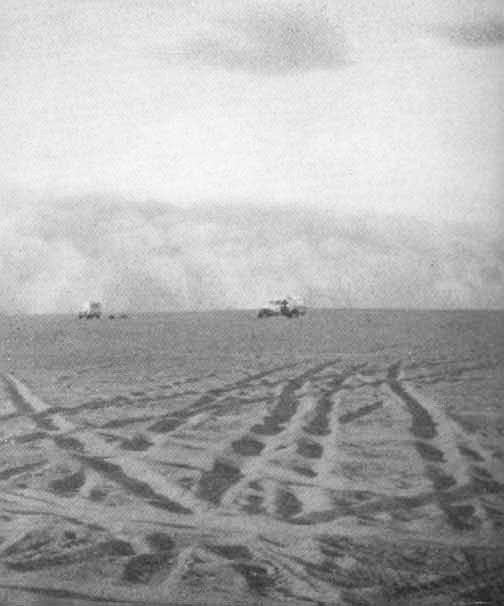
Approaching sandstorm
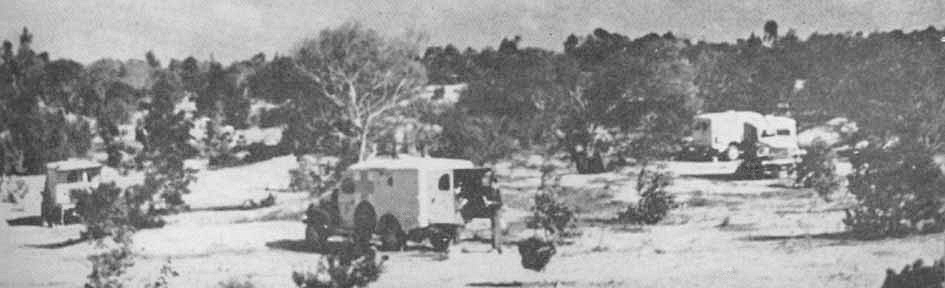
Tripoli leaguer
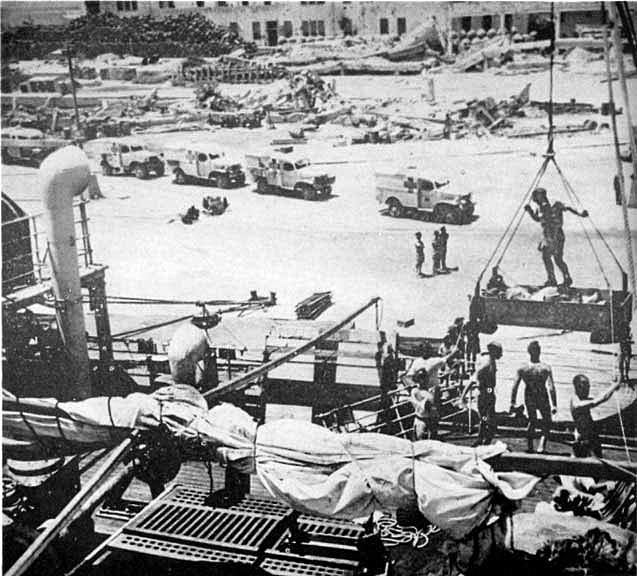
Evacuation to ships, Tripoli
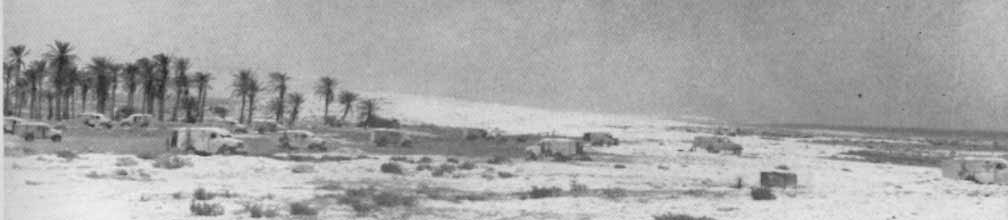
Camp outside Gabes
Table of Contents