 George
Rock
George
RockHistory of the American Field Service
1920-1955
George
Rock
History of the American Field Service
1920-1955
CHAPTER II
Had the war in France continued, the new American Field Service would shortly have developed into a much larger organization. Each week several. hundred letters of application came in, each day some thirty or forty applicants came to the New York office (moved to 120 Broadway at the beginning of 1940), and in June some 60 volunteers were signed up and awaiting passage. Funds were coming in at an ever-increasing rate. The Yale Club in New York had formed a committee to cover Yale clubs and alumni throughout the United States, and 50 ambulances were expected from them alone. The Princeton Club had done the same thing. All over the country, clubs, localities, and individuals were raising money for the AFS and meeting with wholehearted response. It was planned to have ten sections in the field by autumn. D. M. Hinrichs (TMU 526) spent some hectic weeks in the New York Headquarters interviewing applicants---until the cancellation of sailings and the cessation of hostilities made it impossible to send more men to France.
The termination of the war in France left the AFS in the position of having a great deal of money, collected rather than solicited during the German advance, and of having no project for using it. In June, however, the Field Service was asked to act as U.S. agent to solicit contributions for cars---ambulances, surgical cars, and mobile first-aid posts-for the American Ambulance, Great Britain (AA, GB), headed by Wallace B. Phillips. This had been organized in London earlier in the same month with the assistance of the British Ministry of Health. Joseph E. Kennedy, American Ambassador to Great Britain, had accepted the position of Honorary Chairman, and it was sponsored by prominent American organizations in Great Britain.(3) The first cars were sent on 3 July, and ultimately 149 of the total of 260 vehicles in this special civilian relief service were donated by the AFS. For a while the AFS also supplied maintenance, but later this was taken care of entirely by the British War Relief Society.
Their American chassis were given bodies in England, and the first completed cars were on active service by mid-July, driven by English women of the Mechanized Transport Corps (for Women) and the Women's Transport Services (Fanys). The American Ambulance, Great Britain, operated from 17 stations---five in London and one each in Birmingham, Tunbridge Wells, Leeds, Manchester, Newcastle, Bristol, Cambridge, Nottingham, Reading, Cardiff, Edinburgh, and Glasgow. By the time the Manhattan had reached New York with the 28 AFS volunteers returning from France, 46 cars were in service in England, including 10 ambulances that had been on the way to France and had been diverted.
Various types of vehicle were contributed to serve different purposes. The ambulances served as clearing vehicles, carrying patients from hospitals in the large cities to ones in less dangerous areas, as well as moving air-raid casualties. They also carried children and the sick and infirm, and they made special journeys, sometimes of great length, to transport patients needing specialized treatment. The mobile first-aid units were small trucks on half-ton chassis, designed by the Ford Motor Company in England especially to be able to travel over rough ground and on streets encumbered with the debris of air raids. They carried equipment capable of treating up to 500 casualties on the spot and were always accompanied by a personnel wagon with an operating crew of 7, including doctors, nurses, and stretcher-bearers. The surgical units were limousines of high horsepower and were used by officials of the Ministry of Health or by the head surgeon of the local hospital. These too went to air raids, as well as carrying the officials and transferring sitting patients.
The work of the women drivers was varied, performed under all conditions of weather and hazard, and often heroic. A few quotations from their occasional reports to the donors of their cars will show their extraordinary spirit:
On the night of Sunday the 24th of November, [Bristol] was inferno let loose. . . . When the explosion came, Bridget was in the hall and shot under the staircase; Patricia was in the pantry and china fell around her; Barbara was in the drawing room and the falling chimney covered her with smoke. Joan was in the dining room, and that room is still intact.
Barbara, blackened by soot, went to see what damage was done in the road: all the houses were stove in. Between them all, they dealt with children and helped the mothers. . . . Vera arrived back, having driven through the blitz from her job at Hortbam, 10 miles out of Bristol. Bridget started the cars, kept at a garage near by. They all went out to our main Depot Garage. Bridget rang up the Ministry of Health and was told to report to the A.R.P. headquarters. They arrived there about 8:45. They did a lot of useful work picking up casualties and driving through raging fires and intense bombardment. The blitz ceased at 12:00 A.M., but not the work of the A.A., G.B. They continued through the night, snatched some breakfast, and then worked for the hospitals all Monday.
Dorothy was in Bath on leave, and Helen was dining with her there, when they heard the Bristol blitz. They hired a taxi, which took them to the outskirts of the city; the driver would go no farther, as he had all the other taximen's wages on him. Dorothy and Helen held up a private car and managed to get as far as Bristol Bridge. They walked through the bombardment up streets where buildings were falling and fires raging, for two miles to the billets, which they found in shambles. They walked on to the Depot Garage, pulled out their cars, and drove throughout the night. . . . We are now getting used to blitzes in Bristol.
On the Monday following their terrible ordeal, I went to Bristol. The fires were still burning, men were still digging in the debris for the buried, and whole streets were still blacked by mounds of bricks and rubble. Yet this beautiful old city had lost her looks: stricken, yes, but not destroyed. In the streets I saw a woman crouching over a small oil stove making cups of tea. Behind her a row of small cottages were mere shells, blackened and crumbling. Yet there she was, making tea for the neighbors, cheerful and uncomplaining, without water, light, or gas. But as she said to me: "I've got a lot to be thankful for, Miss. I'm not even scratched, and I've managed to save the old brown teapot. 'Ave a cup, luv."
We have delivered our patients to their safe home in the country and are now returning to London. It is pitch dark, without even stars to break the black-out, and as we come ncarer to London the sirens wail out and almost immediately the blitz starts. In the distance many guns flash and roar---a reassuring noise when you get used to it. It will not be long now before we are home, as the light thrown up from the barrage helps us to see the way. Crash! Something has hit the ambulance! Feeling very far from brave, we crawl out to invcstigate, only to find to our relief that a large lump of shrapnel is lying in the road, having skimmed across the roof. It won't be so bad next time, now we know it bounces!
Glasgow's first blitz started on Thursday, March 13th (censored). All the drivers went out to the garage, opened up their vehicles, and started up engines. Our first call came at 1:30 A.M., when Seward went out to take a surgeon to Cannisburn.
Tulloch and Tankard were called out a few minutes afterwards to fetch surgeons and take them to (censored). At 3:30, four ambulances were called out to go to (censored) to help out the A.R.P. services. There was a lull when they left the garage, and by the time they arrived at Clydeside the raid was at its worst. They were ordered to go on to another first aid post. Temple-Phillips and Gilmour went first and crossed a bridge, and by the time the other three ambulances got to the bridge they could not get through. These vehicles returned home. Gandon was slightly hurt. . . . Gilmour returned at 7:30 A.M., having carried 30 patients. . . . The All Clear went (censored) Friday morning. At 8 A.M. all six ambulances started out for the Western Infirmary and evacuated patients all day to Kilearne; two cars were called from the Western Infirmary to (censored) to carry 20 patients to Kilearne. Some of these ambulances had not returned before the second blitz started (censored). The Surgical Unit cars were out all day, manned by Goddard, Tankard, and Tulloch. All drivers slept in the ambulances during the Friday night blitz. They were all extremely tired, as some of them had been driving for 17 or 18 hours. Seward was called out to (censored) at 12:30 A.M. to fetch some nurses to the Royal Infirmary. They had a narrow escape when two bombs fell about 30 yards away from them on the Maryhill road. Seward had the presence of mind to back her car quickly and avoid disaster. Two tramcars were blown up just in front of her. The S.U. car was flung in the air but received no damage. The ambulances were called out at 9 A.M. on Saturday to go to (censored) to pick up casualties. . . . This they did and returned at lunch time to be taken over by another shift of drivers . . . who took them to the Western Infirmary to evacuate 20 patients to Kilearne. The S.U. cars have been out all day. On Friday we carried 161 passengers and drove 838 miles. Our total for the week is: journeys, 98; mileage, 2,621; and passengers carried, 308.
During the course of the war, the gray vehicles with their red stripe and their emblem combining the Union Jack and the Stars and Stripes became known throughout England, Wales, and Scotland. Mr. Phillips was succeeded as Director General of the American Ambulance, Great Britain, by Charles Glidden Osborne, who was later followed by Gilbert H. Carr. The units worked with the Emergency Hospital Service and later with the Blood Transfusion Service, as well as coping with the results of local air raids and the flying bombs. Several sections were reviewed by His Majesty the King and members of the Royal Family, as well as by various noble personages. Its early average of 50,000 miles a week was later raised to 77,000 miles a week. On 23 June 1944, at the end of its fourth year of service, the Right Honourable H. U. Willink, the Minister of Health, estimated that the American Ambulance, Great Britain, had carried 550,000 hospital patients, had made nearly 200,000 journeys, and had covered a total mileage of "no less than 10,500,000 miles."
Other ambulances destined for France were diverted to serve the British in Kenya Colony, British East Africa. In August 1940, William B. Leeds offered to furnish bodies for 14 chassis on the docks in Jersey City and to finance a small self-contained unit for the campaign against the Italian colonies in East Africa. The Governor of Kenya expressed a desire for such a unit. Transport was arranged for three mechanics, the chassis, a portable X-ray machine, and large quantities of medical supplies and spare parts. Their journeys were full of adventures and delays, but all had arrived by November. Mr. Leeds, accompanied by B. F. Finney, Jr., went out to supervise the unit.
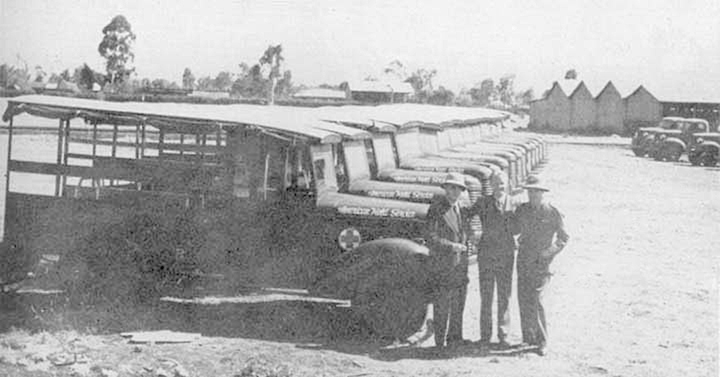
The ambulance bodies were designed for the climate with the advice of Brigadier Orenstein, Director of Medical Services in the East African theatre, and were built by the General Motors plant in Nairobi. With native drivers, the Leeds Unit of the American Field Service was on active service by January 1941. However, the East African campaign did not develop as expected. The Italians put up only slight resistance, and it soon became apparent that the major Allied effort in Africa would have to be in the north or west. In view of this, Mr. Leeds requested and received Mr. Galatti's permission to give the unit to the government of Kenya, which used it for the East African medical services.
While in Nairobi, Mr. Leeds was asked to contribute to a canteen for the enlisted men stationed there. On the acceptance of his condition that it contain a plaque reading: "This canteen made possible through the kindness of the American Field Service," he built and furnished the whole establishment. The attractive building was opened on Christmas day 1940 and proved most useful throughout the war.
Another activity of this period, when the American Field Service had no men driving ambulances overseas, was to enlist the support of its friends in behalf of the American Eagle Club of London. Robert H. Hutchinson, AFS representative in London, was, with Mrs. Hutchinson, active in its organization and initial operation. Planned for the use of Americans in service in England, of which there were some six to eight thousand at the time, the Club opened on 17 December 1940 at 28 Charing Cross Road. It offered reading and lounging rooms, an information bureau, showers, and a canteen, and it supplied newspapers and magazines from home.
The Field Service conducted a fund-raising drive which brought in more than $66,000 for the maintenance of the Eagle Club. In April 1942, the Club became the American Red Cross Eagle Club, continuing to offer the same services under the same direction. The American Red Cross delegate to Great Britain wrote to Mr. Galatti to express "recognition of the active co-operation and the financial assistance which you, your associates, and the local. committees of the AFS so generously gave and without which the Club's financial needs could not have been met. I am therefore writing to express our very great appreciation of your efforts, which enabled us to take over the American Eagle Club, Ltd., as a going concern and to incorporate it into our programme of Service Clubs."
In early 1941, the chief AFS endeavors were more within its tradition: drivers were sent to the Free French in Africa and ambulances were sent to Greece. The AFS had been appointed by the Greek War Relief Association, Inc., of which Mr. Galatti was a director, to solicit funds for ambulances and medical equipment. There were, as Mr. Galatti pointed out, sentimental as well as humanitarian reasons for wanting to carry the AFS name to Greece, and the AFS ambulances were the only materiel from the United States actually to reach that country before its conquest. Although the Service had had experience in Salonica and Koritza during World War I, drivers' applications were not accepted at first. It was hoped AFS would be able to do so later, if a front materialized in Greece. Of the 50 ambulances asked for in February, 25 were shortly sent by General Motors in Bombay, use of this nearer port saving some 8 weeks of shipping time.
However, Athens was entered by German troops on 27 April 1941. Of the 60,000 in the British Expeditionary Force, some 48,000 were evacuated to Crete, as well as the first shipment of AFS ambulances, which had reached Piraeus on 23 April and were immediately ordered transshipped. (Word was later received that the ship bearing these ambulances was lost off Milos, although the precise date was not given.) After the German conquest of Crete on 27 May, trouble was fomented by the Axis in the Middle East, not only in Lebanon and Syria, governed from December 1940 by military officials of the Vichy French, but also in Iraq and Iran.
Large numbers of civilian and military refugees from Greece and Crete were able to get to the Middle East, where the Greek army was reformed and attached to the British forces. During the rest of the war, work with Greek troops and refugees was given special consideration by the AFS. During the greater part of their period with Ninth Army in Syria in 1942 and 1943, Field Service ambulances were attached to the Field Ambulance of the 1st Greek Brigade, stationed at different times at Baalbeck, Merdjayoun, and Jdeide. On one occasion they acted as hearses for the funeral of 7 Greek soldiers killed by an exploding mortar, and they regularly took Greek doctors and ecclesiastics on their rounds of visits to the sick and wounded. AFS ambulances were assigned to transport Greek refugees in Damascus, and in Aleppo two ambulances were constantly attached to the refugee camp near the Armenian quarter. Of this service, M. D. Wright reported that "many of the drivers went beyond the line of strict duty in their assistance, and all were liberal in giving of their rations, cigarettes, and novelties from home to the refugees."
The other major endeavor of late 1940, work with the French, proved difficult to arrange. In June General de Gaulle had escaped from France to London with the assistance of Major-General Edward Louis Spears. In England he organized the Forces Françaises Libres, or Free French, to fight with the Allies. In August 1940, Mr. Galatti offered the services of the AFS to this force, but the French were then still too little organized to be able to do more than accept in principle. Nothing further materialized until the American novelist Mary Borden, wife of General Spears and later Lady Spears, started to reorganize the mobile hospital unit she had operated in France in 1939 and 1940. Her new unit was to be attached to the Free French force, which was scheduled to be sent from England to Africa. Funds for the hospital's equipment had been raised by the British War Relief Society, and for drivers she appealed in September 1940 to the American Field Service. Such an attachment was an experiment for the AFS, one that was only just within its tradition; but as the only ambulance work available at the time it was better than nothing and might be used as a stepping stone in the direction of the work the AFS was accustomed to do.
The AFS contingent of this unit was to be attached to a British group serving a French unit attached to a British Army. For a time there was uncertainty whether this would be in Equatorial or North Africa. The doctor who was asked to recommend the necessary inoculations added typhus to the list in the event that the volunteers might be going to a region "where the inhabitants wear clothes."
A unit of 17 men was organized, including 5 veterans of France 1940 (L. R. Ball, F. A. Foster, P. U. Muir, A. H. Ransom, and L. Smith), and 2 near-veterans (A. R. and L. R. Stuyvesant), and one gentleman rumored to carry among his effects a Confederate flag that was scheduled for use, if necessary, as his shroud. On 1 January 1941 under the leadership of Captain Muir, this group left Miami by plane for Rio de Janeiro, whence they went by sea to Capetown and Suez, arriving in early February. Unfortunately, Mrs. Spears and most of the equipment had not yet arrived, and for three months there was little to do but unload a few hospital trains, help out with washing floors, bottles and the like for the hospital near Suez at which they were housed, and later work with a blood-transfusion unit. Finally, in the first week of May the equipment and the doctors, nurses, and orderlies arrived from England, and the AFS group went north to join the hospital in the desert near Port Said. At this time, Captain Muir, who had been doing a most important job for Mr. Galatti, returned to the United States, and O. C. Sewall took command of the Field Service unit, with A. H. Ransom as his assistant.
After reconditioning, the cars were driven to Sarafand, just west of Lydda in Palestine, where the Hadfield-Spears Mobile Hospital set up its tents, cared for a few patients, and took shape as a working group. The Free French had been unable to offer any men except doctors to the hospital, so members of the Friends Ambulance Unit had been brought along as orderlies. Mrs. Spears was taken sick on her arrival in the Middle East, and in her absence the hospital was beset by vexing personnel problems. The two groups of men---what she called the "wild young millionaires from New York" and the "mild British conscientious objectors"---did not develop the friendship she would have liked. In addition, the French medical personnel tried to assume full control of the hospital. Mrs. Spears soon recovered, but permanent rifts had developed.
Other units were then organizing in Palestine, staging ground for General Sir H. Maitland Wilson's Ninth Army. Probably there would have been no question of attacking the 38,000-45,000 Vichy troops in the French mandates of Syria and Lebanon had not the Vichy military commander, General Henri Dentz, allowed the airfields at Rayak and Palmyra, among others, to be used as bases for the Axis planes aiding rebellious factions in Iraq and Iran. Strategically, Syria was the gateway both to Egypt and to the open road leading through Iraq and Iran to the Caucasus and the riches lying beyond. In spite of the unpleasantness of setting French troops against French, such a dangerous situation in Syria was not to be tolerated; and it was hoped, against all indications of probability, that brief and easy fighting would be followed by mass desertions from the Vichy Armée du Levant to the Forces Françaises Libres (FFL).
The Allied attack was planned to move north from Palestine in three prongs: Australian troops were to go up the coast, assisted by British naval units offshore; the rest of the Army was to drive toward the holy city of Damascus, one section fighting north of Galilee on the west of the Jordan and the other, to which the Hadfield-Spears Mobile Hospital was attached, farther inland, going more directly through Der'a. The British forces that had subdued the pro-Axis dissidents in Iraq during May were to drive west to take Palmyra and Aleppo. In the first week of June 1941, the Spears hospital left Sarafand at the rear of a long convoy moving north for the attack that was to begin on 8 June.
At the end of the first day the hospital camped at Beisan, in the northern Jordan Valley in Palestine, and the second day it moved 20 miles northeast to Irbid on the Transjordan plateau, near which, in a raging "khamseen," the men set up the tents for the hospital, receiving their first casualties that evening. The initial Allied attacks were hopefully mild, but they met with unexpectedly firm resistance. Large numbers of casualties were sent back to Irbid from Der'a, 25 miles northeast and just across the Syrian border, thence being sent farther back to the safety of base hospitals at Nazareth and Jerusalem in Palestine. As soon as Der'a had fallen, the hospital moved into quarters provided by a convent in this desert town. For the next three weeks it was very busy. The Field Service members of the group manned the hospital's ambulances, evacuating the casualties brought in by the regular Army ambulances, after a brief period of treatment and rest, to the near-by railhead, from which they were carried back to base hospitals by special trains. The men also acted as stretcher-bearers, when necessary, and went forward to collect the wounded. They were mostly used as hospital personnel, however, and they did not operate independently of nor far from the Spears hospital.
As the troops moved farther north from Der'a, the hospital was for a while unusually isolated, its only source of information being rumor, according to which Damascus was forever falling and the Australians had taken Beirut many times over. Der'a continued to receive its three or four air raids daily during the period of bitter fighting around Kissoué, south of Damascus, and on 16 June the hospital heard that Vichy tanks had broken through as far south as Sheik Meskine, only 20 miles to the north. That day the town received its most severe air attack. The Royal Army Service Corps barracks was bombed out. Bombs fell on the railroad station, hitting the hospital train just as it was leaving. And the munitions dump was set on fire and exploded all night long. By dawn, reinforcements had come in from Iraq, and later in the day large numbers of those wounded in the night's intense fighting on the road to Damascus poured in. Not until the 21st did Damascus surrender, and then the Spears hospital again moved north.
After 33 days of fighting, the campaign was successfully ended on 10 July, the formal treaties being signed on 12 July 1941. A smaller proportion of the Armée du Levant joined the Free French than had been hoped, and the rest were returned to France in one of the war's most Quixotic gestures. The British secured rights to occupy Syria and Lebanon until the end of the war, and General Georges Catroux, Commander in Chief of French forces in the Levant, was made civil administrator on 14 July. The Field Service group, with a few exceptions, returned to Egypt and in early August was repatriated.
In late May, however, four of the AFS members of the Hadfield-Spears Mobile Hospital had asked to be released in order to work directly with the French. Mrs. Spears had agreed to permit this so soon as she should have received replacements from the Friends Ambulance Unit, which eventually supplied all the male personnel for the Hospital. On 1 July, A. R. and L. R. Stuyvesant, C. N. Jefferys, and L. Smith joined the Groupe Sanitaire Divisionnaire (GSD) of 1st Division in Damascus and were given individual assignments. L. R. Stuyvesant drove and interpreted for the Chirurgien-Chef of the GSD on a trip to all the hospitals in the area with French patients. Jefferys and Smith were stationed at the GSD Headquarters at Douma, a few miles northeast of Damascus on the Homs road, from which they were sent on several dangerous missions to that section of the front then on the Damascus-Beirut road. A. R. Stuyvesant replaced for some time an exhausted driver at the 2nd Infantry Battalion at the front on the Damascus-Homs road, advancing with it as far as Deir Atiyab, near Nebeck and about half way to Horns. Even before the armistice, however, the campaign petered out and there was little more for them to do after these assignments. When the Field Service group with the Hadfield-Spears Mobile Hospital had left, A. R. Stuyvesant was put in charge of this small group attached to the Free French. M. P. Knowlton was to have joined the other four, but several broken bones kept him a long time in hospital. Instead, he was joined in hospital by L. R. Stuyvesant, with a badly infected elbow, and the two were invalided home in November.
After the armistice, the GSD was returned to Damascus to reorganize. Jefferys and A. R. Stuyvesant were sent down to Egypt to look for some of the AFS ambulances earlier sent to Greece, 12 of which had been reported in June to have been landed at Suez. For a while the cars were elusive, thought by some to be in use with the British in the desert of western Egypt. They were ultimately found, idle and dirty, in the sandy wastes of a vehicle reserve depot far from Cairo. Another 6 ambulances arrived in Suez from Bombay, earmarked for the AFS, French unit, and suddenly the Service found that it needed drivers for the ambulances it had acquired. The officers of the GSD wanted the Field Service to take over the administration of its ambulance department. But in October Stuyvesant was informed that drivers for the AFS ambulances were about to be sent to the Middle East with the new AFS unit for the British forces.
In Egypt during the long wait for the arrival of the Hadfield-Spears unit, Peter Muir had been occupied with an important mission for the American Field Service. The huge interest and backing that Stephen Galatti had built up in the United States, the nation-wide organization, and (not least) Mr. Galatti's own vast energies could not be allowed to go unused at such a time simply for want of an outlet. Muir was under instructions to arrange for AFS units to be attached to an active Army---the Forces Françaises Libres by choice, or, failing that, the British.
Selling the Field Service to the French should have been easy, as they knew the Service and their need was great. In Cairo Muir talked with General de Gaulle, who had already in February cabled New York from London that he would welcome AFS volunteers and ambulances. This earlier request was now augmented by the eagerness of the French commander in Cairo. However, there were still complications over the place of service---which was first announced as North Africa, later switched to East Africa, and finally mentioned as being French Equatorial Africa. Moreover, it was at no point clear what anyone, French or American, was expected to do once they reached wherever they were going.
Mr. Galatti continued to raise money as a matter of principle, hoping the French would make some specific request of the AFS, as he was reluctant, and probably would have found that the government would not allow him, to send men or equipment for anything so uncertain as the French had thus far suggested. Although the Field Service then had no commitments, and because of its past would have preferred to work exclusively with the French, no clear-cut arrangement could be achieved.
When A. R. Stuyvesant and his small group later attached themselves to the FFL in Damascus, and promised the French a full section, or if possible two, it was a local engagement, encouraged by New York but unrelated to the larger arrangements frequently attempted with the high command of the FFL through London and Washington. And not until May 1943 was anything arranged with the FFL beyond this type of local agreement with appreciative officers in the field.
Therefore Muir next offered an AFS unit to the British, who were also short of transport and manpower. The battle of Anglophiles vs. Francophiles began at this moment and took many forms in the following years, not all of them edifying, though none of them was capable of obscuring Mr. Galatti's great purpose. It was always understood that the American Field Service had been founded to help France and that it ever wanted to work for France---and usually it was so doing, if on a smaller scale than either would have liked. When the political situation was such that the French could not be so specific as they might have liked, it was fortunate that the Field Service could work for the British.
After suitable enquiries to determine that Muir was authentic and the Field Service reputable, on 27 March 1941 the British got down to business and held a conference for Muir and the branches of the Middle East General Headquarters (GHQ MEF) that would be concerned. A memorandum of the AFS proposal was then presented to General Wavell, at that time Middle East Commander-in-Chief, who accepted in principle the offer "to supply an unlimited number of ambulances to the Middle East theatre of war and to man these with volunteer American personnel." A résumé of this offer was sent to the War Office in London, with General Wavell's endorsement, and Muir was sent to the desert to see for himself the conditions under which the AFS would be expected to work. At Tobruk he conferred with Brigadier R. Walker on the type of vehicle needed. In May, Muir returned to New York, bearing a letter for Mr. Galatti from General Wavell, dated 24 April, 1941: "I am sure that any offer that you feel able to make will be most gratefully received by us as a further example of our common war effort."
The higher levels through which final acceptance had to come were slower to act. The State Department would not give its permission until given formal assurance of the British desire for the Service, and in spite of many letters and cables and the enquiries by friends of the Service this assurance was not procured until 3 September. By 3 October most of the groundwork had been accomplished, and Mr. Galatti was invited to a conference at the British Embassy in Washington, attended by the British Military Attaché, Col. Rex Benson (a staunch and invaluable friend to the AFS throughout the war), and by representatives of the necessary branches of the British Military Mission. A cable was sent to GHQ MEF stating that it had been agreed that the British War Establishment for an Ambulance Car Company would for the AFS be diminished by one-fifth to 100 ambulances, of which three would be provided, with an extra 100 ambulances to be held in reserve---bringing the AFS commitment to a total of 400 ambulances. At the time of the meeting, 260 ambulances with 15% spare parts (known to the British as "American scale" replacements) had already been sent to the Middle East, which left only 140 and their spare parts and some domestic vehicles still to be sent. The British were to supply gasoline, oil, and tires for the vehicles, a few British personnel as cooks and clerks, and for the American volunteers food, lodging, hospitalization, and transport both to and from the Middle East. The British declared that they could not be held liable for injury or sickness, and it was agreed that members of the Field Service would not be expected to carry firearms.
Two further points of the basic agreement required special attention. That "the ranks and grades will be entirely within the province of the AFS" was interpreted by Mr. Galatti as "the British have asked that AFS internal administration should be according to our own regulations, and that ranks shall not be English. However, in order to carry out the Service properly, the AFS will have corresponding ranks" to be held on a temporary basis.
The other point, that the Field Service should do front-line work, proved no simple matter of expressing private preference but one involving much correspondence through diplomatic channels of the highest level. In the beginning, GHQ MEF had asked whether AFS volunteers would work at the front as well as along lines of communication. Mr. Galatti had agreed that they could, and this was cabled to the War Office. However, the State Department and the Foreign Office opened a correspondence on the subject and not until mid-November did they decide to leave the matter to the "discretion and direction" of the Commander in Chief in the Middle East. The matter was to remain unsettled until so late as March 1943.
As this ambitious program got under way, the AFS New York office and the national organization became necessarily larger. Members who had served overseas in World War I were enlisted to serve as local representatives, ultimately covering one or more cities in 40 states and 35 colleges across the United States. They labored mightily and with the help of lecture tours and various benefits raised the volunteers and the money to make the organization, both at home and abroad, what D. M. Hinrichs was soon to declare "big business." However, without the early assistance of three notably large donations, this expansion would perforce have been a great deal slower. The Commonwealth Fund gave $25,000 before Unit I sailed for the Middle East, a second $25,000 in April 1942, and guaranteed a similar amount annually should it be needed. On 1 March 1942, William B. Leeds, who had financed the Field Service in Kenya, gave $50,000 for the new Field Service activity. And in April and August 1942 two gifts of $10,000 each from Thomas A. Yawkey firmly established the possibility of the new growth. Backed by these spectacular gifts, and by considerable generosity from people in all parts of the nation, the American Field Service was able to embark upon and finally to fulfill its ambitious program with the British forces in the Middle East.