 George Rock
History of the American Field Service
1920-1955
George Rock
History of the American Field Service
1920-1955
CHAPTER III
Please convey my congratulations and best wishes to the volunteers who are about to leave the United States as members of the American Field Service to the Near East. The unselfish devotion that prompted them to join in relieving the sufferings of those who are defending democracy is an inspiration to all of us. I hope that their services will bring them that personal satisfaction that always comes with the performance of an important and difficult assignment. I join with millions of their fellow countrymen in wishing them Godspeed.
HENRY L. STIMSON, 6 November 1941
The departure of the first American Field Service unit for service with British troops in the Middle East augured little for the future. A large group left New York by train on 6 November 1941, the first defection occurring in New Haven. In Boston the group was joined by members from the New England area, the whole unit reaching Halifax at midnight on the 7th. Late on the following day their baggage was driven alongside the troop-carrier West Point (formerly the America), and the 100 members of Unit ME 1 embarked that evening. The experience was new and its execution was sufficiently confused to call forth from one of the embarkation officers the comment: "You see them gypsies there? There's only a hundred of them. Can you believe it? And don't you know they're more bleeding trouble than all the twenty thousand others."
William H. Wallace, Jr., who with William de Ford Bigelow had gone to Halifax to represent Mr. Galatti, recorded that "on Monday, 10 November 1941, at 8:25 A.M., the West Point slipped out from her dock and headed down the harbor."
The war began aboard the West Point. Captain King wrote that the officers' quarters were crowded at 6 to the cabin. However, for the majority of the unit, 20 men and all their 60 to 100 pieces of luggage were assigned to what had once been a cabin for two (12 by 15 ft.) with bunks in tiers three high. The ship carried so many troops that there was not one room left over large enough for the whole of the Field Service unit to be gathered together, and its lectures had to be given to one-quarter of the group at a time. Although there was plenty of salt water for bathing, fresh water was strictly rationed. Meals were eaten in shifts, standing at high tables. And sleeping on deck, when the ship reached the tropics, had also to be done by turns. Orders were passed on by means of typed bulletins posted in each cabin.
Capt. G. F. J. King was in charge of the unit, assisted by J. T. Ogden, A. T. Ogden, and A. McElwain. The volunteers were grouped in 10 sections of 9 or 10 men apiece, with A. C. Geer as "sergeant major" in charge of the "section leaders." With the unit traveled Col. R. S. Richmond, overseas commander of the Service, and Major S. Benson, who was to assist Colonel Richmond and give special attention to the publicity so necessary to an organization dependent upon voluntary contributions for its funds. The statistics of the unit showed that its members ranged in age from 18 to 64 and represented 22 states, 44 American and European universities and colleges, and 36 occupations. Later units were to be just as diverse in their make-up, allowing for differences in size, and all were to find that not only the war but also war's tedium began on the voyage out.
A typical day was recorded by C. B. Ives, on 5 December:
"We have wonderful weather. . . . Every day is like the one before---desultory reading, chess, looking at the sea, looking at the sky, talk (mostly foolish). We have had lectures on the organization of the British Army and are having lectures on first aid. It takes a certain amount of time to walk up two flights of stairs to the embarkation deck and a certain amount of time to walk down the two flights to the cabin, where one may find a poker game, an argument about the merits of the latest impossible rumor, or nothing at all but a few sleepers, readers, or both. An hour before sunset, portholes are closed and smoking on deck is a major offense. At 9 P.M. lights go out all over the ship, except for a few very faint blue ones, and portholes are opened. Then people stumble around until they get tired of stumbling around and go to bed, bumping into doors and each other and trying to fix in their minds the places where they leave their clothes so that they can be found in the morning. At 5:30 A.M. or earlier the bell rings in a persistent manner and everybody gets up, dresses, and puts on life jackets and stands around in the cabin for about an hour. . . . Breakfast starts at 7 A.M."
To relieve this monotony, and to gain a few extra privileges, a group of 28 signed on to work in different capacities with the ship's crew.
However, a few days before the ship was to reach Capetown, the monotony was radically broken by the news of 7 December 1941. The entry of the United States into the war, although greeted with relief, seemed abruptly to have changed the position of the American Field Service. A number of volunteers immediately clamored for release from their Field Service contracts in order to become "real soldiers." In the bulletin for that day, Colonel Richmond reviewed the situation and wrote: "There is every reason to believe that the recent political developments will not cause any change in the status or policy of the AFS for some time to come. . . . If we of the AFS can train ourselves and engage actively in the war, we would seem to be doing our share in the general war effort. In fact, we are a jump ahead of the rest. . . . Until we receive further notice, therefore, this unit will carry on exactly as arranged."
Nevertheless, there were still volunteers eager to escape from AFS to other fields, qualified by either virtue of previous experience or romantic temperament, and their natural inclination was given impetus in Capetown by the frivolous, if perfectly valid, quibble that the Volunteer's Undertaking, as it involved no money exchange, was a meaningless piece of paper. Although a few then felt free to behave as they liked, the majority agreed to honor their contracts and to continue to Cairo before attempting any drastically patriotic steps. By then the State Department had notified the AFS that it had "assumed" the Service would continue as planned---at least until further notice.
From Capetown, Colonel Richmond and Major Benson flew to Cairo to prepare for the arrival of Unit I in the Middle East, while the unit, after four days of the special delights and fabulous hospitality of Capetown, re-embarked on the West Point and headed north for Suez. A few days out to sea it was learned, first as gossip and finally as visible certainty, that the ship was beaded for India. As a result of the entry of Japan into the war, the whole convoy---transporting in some of America's biggest ships an entire British division, which had been brought to Halifax in British bottoms and then transshipped as part of President Roosevelt's policy of aid to England---had had its destination changed from Suez to Singapore. There the division was captured almost as it stepped ashore, but on the way the West Point dropped the Field Service contingent at Bombay, which it reached two days after Christmas 1941. Leave ashore was granted for the 29th, and on the next day the unit disembarked. After being issued sun helmets, water bottles, and mess tins, it boarded a troop train for Deolali, the British Army center in the hills northeast of Bombay.
The luggage, so enormous in Boston that special arrangements had had to be made to transfer it from one station to the other, had reached mountainous proportions after additional purchases in Capetown and Bombay. At Deolali a special detail was laid on to transport it the two miles from the station to the barracks, but each man felt called on to carry as much of his own kit as he could clutch in his own two hands and festoon about his person. One result of this embellishment, when added to the unit's strictly nonmilitary bearing, according to A. C. Geer was that a little girl on first sight of the straggling and sweating ranks ran off screaming "Mummy---look Mummy! More Italian prisoners!"
Unit 1 stayed at Deolali nearly a month, of which a volunteer wrote "our only duties are ten minutes' calisthenics at sunrise, two hours' drill after breakfast, and to turn up for meals on time." From another point of view, Geer wrote: "A fairly stiff regime of military drill was instituted under the leadership of Dave Hume (he had been a drill sergeant in the American Army) . . . . There was a vogue for tattooing, bush jackets, and swagger sticks-and buying monkeys. . . . But through it all drill continued on the square; route marches of 11 and 14 miles were taken; uniformity of dress was arrived at; and sun helmets slung at the correct angle no longer had the look of misplaced bedpans."
There were also lessons in mechanics and map-reading and a five-day leave for everyone (during which the more enterprising few managed to cover an amazing amount of Indian territory). Captain King changed the organization from the group arrangement of the boat trip to what he called "an infantry set-up" of three platoons---under D. B. Hume, R. L. Tevis, and C. Wood. When they left Deolali, Captain King was able to write that "we were sufficiently trained to look like a unit and to move like one; nothing fancy, mind you, but a very different matter from the rabble we were when we arrived."
The HMS Talma took Unit 1 from India to Egypt, sailing from Bombay on 29 January. Lots were drawn for the 28 bunks in staterooms, and the losers slept in hammocks. For this trip a new set of leaders was in charge, and Geer was replaced as "sergeant major" by F. W. Hoeing. The time was regarded as "a period of leave between training periods," and the new regime was described as "a college dormitory principle of relationship with a proctor, rather than the strictly military conception . . . that . . . over-emphasized punctuality."
One hundred and ten days out from Halifax, on 10 February 1942, Unit 1 reached Tewfik, the port southeast of Suez on the opposite side of the canal, where they were met by Colonel Richmond and representatives of GHQ MEF. They were driven, standing, in six three-ton trucks, with two extra for their luggage, the 60 miles northwest to the British Mobilization Center for the Middle East at El Tahag.
The Mobilization (Mob) Center, which they reached that evening, covered an area that varied in the telling from 30 to 70 square miles---a great, flat, treeless waste of stone and sand, loosely sprinkled with tents. Upon every slight breeze the sand rose and entered tents, clothes, and food, and months later it would be found to have penetrated even sealed packets. Tahag was not particularly different from the deserts to the west and east, but after weeks at sea it came as a revelation both of the desert and of uncomfortable living. "It was constructed to be so uncomfortable in order to make the newly arrived glad to go on out to any place for any purpose," W. W. Phillips said, "and to remind veterans that, however bad their stations were, there was one place even worse."
On arrival at Tahag, the unit was shown its own patch of sand, indistinguishable from others except on a map, where it erected the tents that for a brief while were to make that particular square its home. Straw mattresses were issued, and other facilities, however far away they might be, were considered to be within walking distance. In other tents, near and far there were quite a number of amenities to be found, and for the evening there was the haven of the NAAFI (Navy, Army, and Air Forces Institute) canteen, a circus tent with dim blue lights. Here most of the unit made their first acquaintance with veterans of the desert fighting, and any notions of continuous heroics were lost amid the soldiers' jokes of war's discomfort, boredom, and bloody anguish.
"Every canteen in the Middle East," D. Hyatt wrote, "every front line is made up of men like these: they talk shop almost entirely, because the war now occupies their existence completely. Even when they get leave, there is little to do but meet their old comrades and joke about old times. They are hardy, weather-beaten, and tougher than the conditions to which they have been subjected. They've been through two years of fighting, and they still grin when they talk about what they've been through. They make up in courage for lack of equipment. Sometimes we feel like children talking to them; and yet they are no older than we."
The week the unit spent at Tahag was so busy that several have claimed it was two weeks. First they had to be issued battle dress, tin hats, gas masks, and so forth. Then came further training supervised by Lt. Eric Waller, RASC, who acted in this capacity for all Field Service units to go through Tahag (and ultimately became Major in charge of training at the camp). His opening lecture stressed the importance of knowing the desert and how to deal with it: "There is no magic to overcoming the insurmountable obstacles in the desert. The question is largely one of adjustment. You must live with the desert---don't fight it. If you do fight it, it will whip you. . . . Desert navigation is of the utmost importance to every unit in the desert, but doubly so to you. . . . To get lost is not a misfortune but a delinquency."
Ambulances, motorcycles, and trucks were then issued, and the unit was given lectures and demonstrations of vehicle maintenance; map-reading; sun and prismatic compasses and their use; and convoy, night, and desert driving. Finally there were lectures on British Army organization---and on the Army forms, "the dullest part," E. W. Thomas wrote. "There are a lot of 'em."
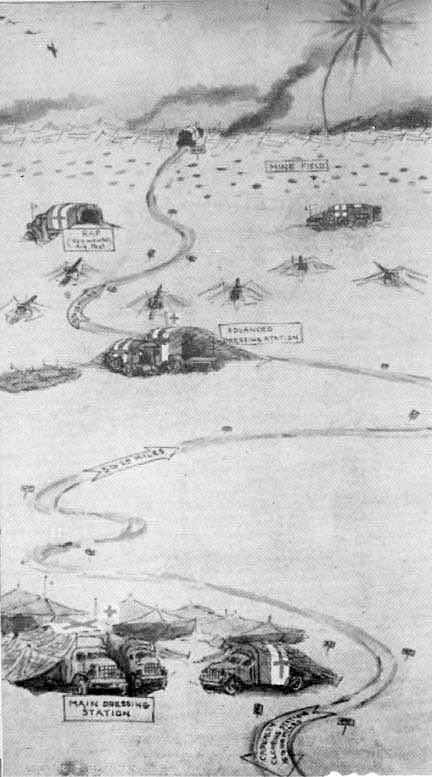
An army, the men were told at Tahag, consists of several corps, each consisting of several divisions, which are subdivided into 3 brigades of 3 battalions or regiments. A division includes approximately 15,000 men, a brigade 5,000, and a battalion 1,500, the figures varying in armored and infantry divisions. Under the supervision of the Director of Medical Services (DMS) at General Headquarters (GHQ), which may as in the Middle East have several armies under command, the medical arrangements are carried out by a Deputy Director of Medical Services (DDMS) with each army and corps and by an Assistant Director of Medical Services (ADMS) at division level. In addition to the Regimental Aid Post (RAP) and Medical Officer (MO) permanently attached to each regiment or battalion, several Casualty Clearing Stations (CCSs), Light Field Ambulances (LFAs), and Motor Ambulance Convoys (MACs) and Ambulance Car Companies (ACCs) are attached to each corps by army and assigned to divisions for each battle according to the number of casualties expected. A corps will also have attached a miscellany of such specific units as Field Hygiene Sections, Mobile V.D. Units, and Field Surgical and Transfusion sections.
A CCS is a self-sufficient medical unit of some 150 personnel, including approximately 10 MOs (some specialists in surgery, anaesthetics, and dental work), trained nursing orderlies, cooks, and so forth. The unit lives and works under tents, although the more settled conditions of Syria and Italy often allowed the use of existing buildings, and it has transport enabling it to pack up and move on a few hours' notice. In emergencies it can hold several hundred casualties at a lime and offers remarkably extensive medical care. A CCS does not move so often as the smaller and more advanced medical units.
In front of the CCS are Main Dressing Stations (MDSs) and, yet farther forward, Advanced Dressing Stations (ADSs), which are set up by the LFAs as near as possible to the expected scene of action. Light Field Ambulance is a misleading name, however, as they are essentially medical units with only 10 to 20 ambulances attached. Each LFA has about 100 personnel and its own tents and transport. It is quite self-sufficient as well as very mobile. Approximately 8 to 12 MOs and numerous orderlies are the backbone of each LFA. In battle the five sections of each LFA are detached to form one MDS and one, two, or three ADSs. A single section forms an ADS, and several sections together form an MDS.
 British evacuation system
In battle the evacuation of casualties is handled, at least in theory, in the following manner: they are brought by stretcher-bearers to the RAP, usually a truck or a dugout near the battalion headquarters, and given what assistance a single rushed MO and his orderlies can supply. They are then taken by ambulance to an ADS, where somewhat fuller treatment can be supplied, and then as quickly as possible sent on to an MDS, which is usually some 12 to 15 miles behind the battle, where surgical treatment and more extensive work can be done and there is room to handle a larger number of cases. From the MDS the patients are taken by an MAC to the CCS, a still larger and better equipped unit, at which they can be given the best medical attention that science and skill can supply. From the CCS the patients go by ACC, plane, or ship to a hospital in the rear, where they are transferred from corps to army responsibility. In practice, the work of MACs and ACCs is not so exclusive, and to a certain extent they are used interchangeably, even as in the press of battle the casualties may skip one or several stages in the progression from battlefield to hospital.
At Tahag the Field Service unit was organized as an ACC. This did not sound the best way to get the desired work at the front, but of the three possibilities this was the least impractical. Small AFS units could have been attached to Field Ambulances or LFAs, but this would have removed men and vehicles from AFS control, destroying it as a service and turning it into neither more nor less than a recruiting agency for the British Army. The other possibility was to organize as an MAC. However, this called for trained medical personnel, who would have been impossible to recruit in America and, if British, would not have formed a self-contained unit and would therefore have caused an impossible administrative situation. Thus the only existing British establishment under which the Field Service could operate and maintain its identity was that of the ACC.
At Tahag Unit 1 became 1 AFS ACC, which Captain King divided into Sections 1 and 2 under Lts. C. B. Ives and A. C. Geer, respectively. Each section was composed of 5 subsections of 5 cars and 8 men--5 drivers, a spare driver, a driver-mechanic, and a subsection leader (usually called an "NCO"---attempts: to be more specific having proved unsatisfactory to all concerned). In the headquarters of 1 AFS ACC, Captain King was assisted by Lt. J. T. Ogden as adjutant, Sergeant-Major Hoeing, A. R. Lovejoy as clerical sergeant, and A. T. Ogden as sergeant in charge of financial matters. However, instead of driving off to the Western Desert at the end of this first week of training, Sections 1 and 2 drove northeast to Syria.
While Unit I was making its detour to India Colonel Richmond and Major Benson had reached Cairo at the end of December and had made themselves and the AFS known to the various British Army officials and directorates concerned. They then found that the British were naturally reluctant to send unknown and untrained men to join Eighth Army in the desert. The AFS was offered work with Ninth Army in Syria and the Lebanon, with vague mention of more exciting work at some later date---when they should seem sufficiently experienced to be anything more than a liability to Eighth Army. The posts for the sections were assigned, and it was arranged that their 50 ambulances should be driven to Syria by Australians, who would man them until the unit arrived and would stay on to show AFS the ropes. Another 25 ambulances already on loan to the Australians were to be repainted and held in Beirut for the arrival of Section 3. In mid-January, Colonel Richmond and Major Benson went north to tour Syria and to meet the people with whom the sections were to work. On their return to Cairo, Colonel Richmond was able to write to Mr. Galatti that "everything is arranged and understood, and there should be no delay in getting the men to work."
To the same letter, Major Benson added further news of their accomplishments in a note that was, for such a Francophile as he had always been, a capitulation to the exigencies of war and the larger interests of the Field Service. "The British are co-operative," he wrote, "especially if one is firm and insistent. They have agreed to give the men the status of warrant officers so far as the first lot is concerned, and I feel confident that this policy will hold throughout the Service. It is not particularly important where the AFS has its own mess, but it is vital where small groups are attached to other units." The privilege of this status was continued for later units and proved, if not vital, a great comfort.
On 17 February 1942, 1 AFS ACC left Tahag at 6 A.M. They formed a two-mile convoy and drove northeast across the Sinai desert, halting the first night at Asluj---"on the desert, under the stars. It was very cold, and even colder at daybreak, when we were off again." The second day led them through Palestine by way of Beersheba and Gaza to Beit Lid (northwest of Nablus). Another night in the open, and the next day on to Haifa. The ambulances were left there for later use as spares, and the men were transferred into trucks for the last stage. They reached 165 Transit Camp in Beirut on the afternoon of 19 February in a rainstorm that enhanced its natural gloom.
On the toss of a coin, it was determined that Lt. Geer's Section 1 would go to the interior sector of the country and that Lt. Ives's Section 2 would take the coastal posts. Snow on the mountains delayed those going inland, but on the 21st and 22nd the subsections were sent off. On the 22nd the headquarters group moved to Aley, in the mountains east of Beirut, where it occupied the Joseph Abu Hatal chateau, "a medium-sized villa with a garden and a lovely view." Captain King here gathered a large headquarters staff to take care of many functions that later both experience and the development of an AFS Headquarters in Cairo were to render unnecessary. H. G. Wait was put in charge of the house, helped by G. W. Russ and E. E. Robinson; A. McElwain and A. R. Lovejoy were in charge of supplies, mail, and contacts with Army ordnance; and N. W. Thompson and R. Woodworth took care of office work and quarter-mastering. Although the local guidebook called it the "Lebanese Monte Carlo," Capt. J. T. Ogden later reported that "living conditions at Aley left much to be desired. . . . It is quite inaccessible to Beirut; there is not even a movie; and the building itself is most uninviting---cold and bare. Plumbing is bad, in spite of frequent visits by the plumber." However, with the coming of the warmer weather, some of these drawbacks developed into positive charms by comparison with "hot Beirut."
Lt. Ives settled his Section's headquarters near the 2nd Australian CCS (to which two subsections were posted), in a former Italian Boys' School in Beirut. One subsection was with the 2/3 Australian LFA at Tripoli, one with another Australian LFA in Latakia, and the fifth was with the 2/3 Australian Field Ambulance in Aleppo. The work was steady but light. The evacuation route was south, Latakia-Tripoli-Beirut-Haifa, the Aleppo cars having two or three runs a week direct to Beirut.
Lt. Geer established his headquarters at the Damascus Transit Camp. The subsection at Deir ez Zor, on the Euphrates, evacuated the area from Ras el Ain, on the Turkish border, through Hassetche to Palmyra. The Palmyra group cleared to Damascus. Another subsection, split between Zahle and Baalbek, evacuated either to Beirut or Damascus. And those in Damascus itself had runs to Jerusalem or Sarafand.
Unit 2, led by Captain D. DeBardeleben, arrived at Suez on 3 March. After 10 days of training and equipping at Tahag, its members went to Syria to form the third section of the Company, giving the AFS three full sections of 25 ambulances each in the field and 16 in reserve. Section 3 was put under the command of Lt. W. L. Marsh, who had assisted Captain DeBardeleben with Unit 2, and it established its headquarters at Aley, its subsections relieving the earlier ones in the Baalbek and Beirut areas and in Aleppo. The older sections took short leaves and were then reassigned, giving the Company the following theoretical disposition: Section 1, with headquarters at Damascus, had the evacuation route Hassetche-Deir ez Zor-Palmyra-Damascus-Palestine; Section 2, with headquarters in Aley, had the run Tripoli-Beirut-Haifa; and Section 3, with headquarters also at Aley, had the route Aleppo-Hama-Homs-Baalbek-Damascus or Beirut. There were also minor posts in such places as Brumana, Faadous, Khalde, Mezze, Metoulle, Saida (Sidon), Talia, and Zabound.
All posts were not equally popular, and one man's glamour could be another's squalor. D. B. Hume, on reaching Hassetche with his group, in spite of the fact that they were quartered in an old Turkish castle, wired "Sorry to state we arrived." From this post, cars went in rotation to Ras el Ain and Kametchlie on the Turkish border with units of the Trans-Jordan Frontier Force (TJFF).
This was a different Syria from that of the preceding summer. The Vichy troops had gone home, and the Allied forces (mostly 1 Australian Corps) were in Syria and the Lebanon both to keep order in the former French mandates and to defend them should the Germans be victorious in their struggle with the Soviet Army, then fighting not so very far to the north. In late February, however, the New Zealand Division was brought up from Egypt, where it had been resting at Maadi after a long period of bitter fighting in the desert, and it took over the interior region from the Australians, who were to defend the coastal positions.
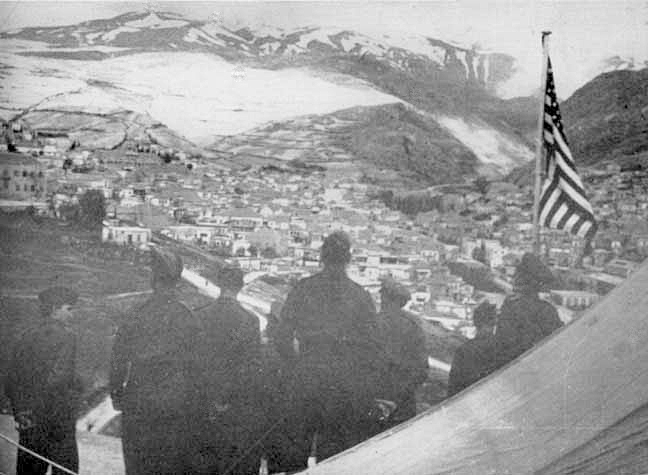
In early March, Subsection 1 of Section 3 was posted to the advance section of 1 New Zealand CCS at Zahle, and it stayed on to work with the CCS itself, which arrived later in the month. By the middle of March the Division was well established in its new positions from the Turkish border south to Palestine, and was inspected by Gen. Sir Bernard Freyberg, its commanding officer. With his consent and co-operation, an American flag was raised over the Field Service quarters at the CCS in a solemn ceremony on 8 April, 1942. This flag was believed the first to be raised in the Middle East by an American unit after the entry of the United States into the war. There were several friendly and inspirational speeches, and after the ceremony Lt.-Col. P. A. Ardagh, Officer Commanding the CCS, presented the flag to Lt. Marsh on behalf of General Freyberg. It was later autographed by the General, the staff of the hospital, and the members of the AFS subsection. Then, with an explanatory letter, it was sent to Cairo to be transmitted to President Roosevelt. This acquaintance with the New Zealanders, so graciously begun, was to be continued in the desert, where it grew into a fervent friendship that lasted throughout the war.
In general, the number of men or cars at any given post, the minor posts, and the personnel of any post changed frequently during the nearly two years that the Field Service had members in Syria and the Lebanon. There was always work to be done, if never enough for anyone to feel overworked for more than a very short period. Special assignments flourished, some as steady postings (as with the Spears Mobile Clinics and the American University of Beirut) and others to fill a momentary need (as D. M. Crile, W. O. Randall, and W. R. Vance with 2 Malaria Field Laboratory). In March and April the subsections at Deir ez Zor, Hassetche, and Palmyra spent off-duty hours on road and track reconnaissance and marking, and from the post at Deir ez Zor G. Russ and J. Watson worked in co-operation with Intelligence to correct the maps of the mountains and desert to the south. In March and April, on the coast, J. M. Foster, W. R. Hoffman, A. R. Lovejoy, A. McElwain, J. W. R. Peabody, and T. Stix distributed free flour for the American Red Cross to needy Arabs in Haffe, Safita, Slennfe, Tartous, and villages in the hills north of Latakia---a project sponsored by the American University of Beirut.
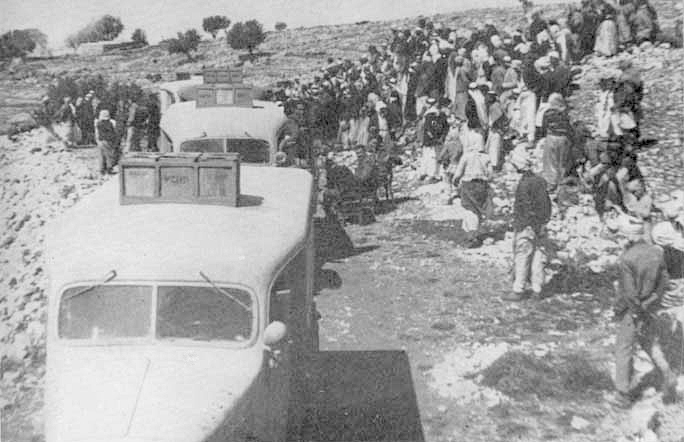
In addition, there were generous leaves, sightseeing while on runs from one historic spot to another, and such sports as gazelle hunting around Palmyra and skiing in the Lebanon Mountains.(4)
By April, in spite of such varied activity, Sections 1 and 2 were getting restless. Disciplinary problems, rather than decreasing, grew in frequency and violence. One brave soul, who had already spent some days in the brig on the voyage out for having struck a ship's officer, got hold of a gun and took to shooting out street lights. Later he was shot in the knee by a policeman's gun, it was reported, "while resisting arrest when intoxicated." Another was arrested by the MP to whom he tried to sell parts of an army car. Several ran up large liquor and hotel bills, ran out on them, and then stole; of these the most unlucky was caught with his band smack in the till of a sergeants' mess. Two failures may (or may not) be the reported "attempt to seduce a missionary's maid" and the "attempt during a drinking bout to purchase an officer's sidearms." Some simply got drunk and were publicly objectionable. An adventurous few went off on trips that were pleasant if unauthorized, and two, finding themselves in the Holy Land, thought it would be nice to keep on driving until they reached Cairo, which they did.
There was too much pleasure on the fringes of the work and not enough excitement. The war was too far from the Orontes and the Euphrates, too far from the Normandie and the Barron. And as additional units were promised, sailed, and came closer to the Middle East, a major crisis loomed. By March the largest unit to date was on the water, and still the efforts to have the Field Service attached to Eighth Army remained unsuccessful. GHQ MEF in Cairo had said that it would do what Eighth Army wanted, and Eighth Army had indicated that it would accept what GHQ decreed, and there the matter had come to rest. Accordingly, Colonel Richmond went to the desert to interview the medical directorate of Eighth Army, which he persuaded to employ the experienced contingent from Syria. The work was not specified, but Brigadier Walker, DDMS, said he would do what he could to obtain front-line work; and, although the question had already been settled in the original discussions with the British, Colonel Richmond had to forward a letter saying once more that the Director General had no objection to AFS being employed as far forward as Eighth Army might desire to use it. In view of coming operations, Brigadier Walker thought that the middle or end of May would be the best time for the men to arrive.
The long-awaited move to the desert was sparked by the arrival in the Middle East on 10 April 1942 of the 111 men of Unit 4, led by Lts. L. M. Dudley and J. D. Dun. These new men became 2 AFS ACC, commanded by Captain DeBardeleben (assisted by Lt. Dun as adjutant, Lt. Dudley as transport officer, and platoon Lts. T. N. DePew and F. W. Hoeing), which was sent to Syria to take over from the three veteran sections. "The AFS group whom we are replacing were colorful and irresponsible," N. C. Eddy wrote. "The clean-tip job and repair work we are having to do is correspondingly great. We only brushed in passing, as they left the day after we arrived."
The veteran sections were brought to Tahag by lorry and train, arriving on 2 May, for a two-week period of reorganization, training, and equipping. They became "X" (AFS) ACC(5) (to avoid confusion with 1 UK ACC) and were reorganized into two platoons of 33 cars each, distributed into 6 sections of 5 ambulances each (with 3 cars held in reserve for replacements), plus sundry domestic vehicles. Lts. Ives and Marsh were in charge of the platoons, and Lt. Geer was made adjutant to Captain King.
At Tahag, the platoons were issued 66 new Dodge ambulances, and trucks, tools, and summer uniforms---the durable khaki drill (k.d.), which included shorts that had to be rolled up to the knee. By way of precaution, "we covered all the glass, including the windshields, with a mixture of oil and sand so that the sun would not be reflected in the glass and thereby attract planes and artillery fire. We also made camouflage nets to throw over our sand-colored vehicles, to make it even more difficult to be spotted; and we made such personal preparation as storing our kit and taking only the absolutely necessary clothing." The period was enlivened by leaves in Cairo, from which not a few were slow to return, and by afternoon swimming parties at Ismailia.
As it was desirable that the unit be self-sufficient, half a workshop platoon, about 40 Royal Army Service Corps (RASC) personnel, was attached to "X" Company to give assistance, instruction, and repairs beyond the regular cleaning, tightening and general maintenance of the ambulance done more or less regularly by the volunteers. With this contingent of attached personnel came additional vehicles for quartermaster stores, spare parts, and so forth.
Finally the Field Service was ready for the Western Desert, and, at 6 A.M. on 17 May, "X" (AFS) ACC left Tahag in a 10-mile convoy of 89 vehicles. It went through Cairo with a special escort, stopped for food and vehicle maintenance at Mena, and went on to El Amiriya for the first night. On the second day it drove through El Daba and Fuka to Matruh, through Sidi Barrani and Sollum on the third day, and it reached Tobruk in the middle of the fourth afternoon, having covered a total of 614 miles. On the first evening out they had run into a dust storm that lasted intermittently until the day after their arrival. As the windshields had to be kept open while driving, "the sand and dust comes at you with a penetrating force which quite surpasses any blizzard."
In spite of this unpleasantness, "the convoy was an enormous success," Captain King wrote.
"On the way a full Colonel(6) came up to me at a refuelling station and complimented us on our convoy discipline. Since I have been here two others, including the ADS&T (Assistant Director of Supply and Transport), have made the same statements, going so far as to say that it was noticeably better than British convoys and saying how they wished they could persuade their fellows to do as well. The main things they liked were that the cars kept their right distances, that they kept their right side of the road and pulled in for passing vehicles, and that at refuelling points and other stops they were well ordered and well dispersed. Incidentally, we also came through on the dot at all specified times and had no accidents.
"The news of all this reached Brigadier Clover, DS&T Eighth Army, although the impression was slightly spoiled by an individual ambulance here which pulled out as he was passing and caused him to draw his pistol for the purpose of putting a couple of shots through the windshield, an eccentric practice which he is jovially proud of. . . . He asked whether we had any complaints, and I told him that some of the boys complained there wasn't enough action. He said that they need not worry about that, as a Jerry push was expected at any minute, and that, in any case, our side was going to push too."
Although there was hurried preparation for fresh offensives on both sides, the desert in May 1942 was enjoying a period of comparative quiet after a year and a half of fighting. In mid-September 1940, Marshal Rodolfo Graziani, attacking from Bardia, had driven the British in Egypt back to Sidi Barrani, from which point the British had later retired to Mersa Matruh. Then General Wavell and the Army of the Nile between early December 1940 and February 1941 had cleared the Axis forces from the area extending to El Agheila in Cirenaica. Field Marshal Erwin Rommel arrived with the Afrika Korps, specially trained for desert warfare, and in March-April 1941 he had pushed the British (weakened by having sent reinforcements to Greece and the Far East) back to Sollum at the Egyptian border, isolating and besieging the Allied forces in Tobruk. In September 1941 the Army of the Nile was reformed as the Eighth Army, commanded first by General Sir Alan Cunningham and, after November, by General Neil McHugh Ritchie. The Allied drive in December 1941 relieved the siege of Tobruk and pushed the Axis forces back to El Agheila once more. Then in February-March 1942 the Axis forces again drove the Allied troops back until they stabilized their position in a line running from Gazala, on the coast just west of Tobruk, for forty to fifty miles south to Bir Hakim.
As it was impossible to construct and fortify a line across the open desert, a continuous minefield had been laid, with troops stationed at intervals in boxes, or defended areas, of one or two square miles. These boxes were heavily mined enclosures, ringed by wire, prepared for all-round defense and thoroughly prepared to withstand siege. Forming refuges that could resist attack until relieved, they depended for their value upon the maintenance of mobile forces. Tobruk was their supply base, receiving reinforcements by land and sea, and was itself a box surrounded by a heavy belt of mines. In addition to the port, the four main boxes were those of the South African 1st Division at Gazala, the British 50th Division just south of this, the Guards Brigade at Acroma (Knightsbridge), and the Free French 1 Brigade at Bir Hakim in the extreme south. To the rear of these, and protecting them with their overlapping artillery, were other lesser boxes.
Rommel's plan was to take Tobruk in a three-day campaign---starting with simultaneous attacks on Bir Hakim and on the El Adem-Sidi Rezegh area, followed by a mop-up of the troops to the rear at Gazala and then by the attack on Tobruk itself. After this he intended to drive the British out of Libya, to continue across Egypt and north through Syria, and eventually to join other German forces, after Stalingrad, somewhere in Russia. It was a grand plan, which on several occasions during the next few months was very close to success. The first step was taken on 26 May, when Rommel's forces started east from Rotonda Segnali. By the next morning a large force had flanked the southern end of the line and, while two columns advanced on Acroma and El Adem, a light force started the attack calculated to reduce Bir Hakim.
Bir Hakim was no more than a slight elevation in the vast desert. Once a small fort used for patrols against desert marauders, it was now an area of 2 to 4 square miles, heavily mined along its perimeter, containing gun and antiaircraft emplacements, an operating theatre and tents, Bren carriers, and trenches and dugouts for the 3,000 French troops plus legionnaires, British gunners, and Senegalese soldiers. With the French were 12 Field Service ambulances, widely dispersed, each with its slit trench. The AFS headquarters was in a Red Cross tent on the south side, just inside the minefield, a short distance from the operating theatre of the Hadfield-Spears Mobile Hospital.
The American Field Service unit with the Free French Forces had had 18 cars and 3 men (A.R. Stuyvesant, C. N. Jefferys, and LeClair Smith) since it had joined the French forces in July 1941. At the beginning of 1942 they had moved from their Syrian post to the Western Desert, where they worked 3 or 4 miles behind the lines, using members of the Foreign Legion to drive some of the cars, other cars being kept back as a reserve. Lt. Stuyvesant, in command of the unit, wrote that these legionnaires included "two Red Spaniards, two Red Mexicans, two Arabs, one Persian, one American, one Frenchman . . . and one Abyssinian. They are on the whole better than they might be. One of two is reliable, and all can handle a car, although few hardly know how to grease one."
The additional men that had been expected to arrive in the Middle East with the first unit for the British were not available after all, because of the unexpected shrinkage of Unit 1 both before and after it sailed, and the understandable bitterness over this almost brought about the cessation of the unit. Later, news of the arrival in Cairo of three more ambulances from Bombay perversely eased the tension of the situation, and these cars were set aside for the use of an eventual second section. Finally, with the increase of personnel for service with the British, toward the end of March 10 volunteers for the French unit were brought down from their posts in Syria: T. S. Esten, T. O. Greenough, J. K. Hammond, W. R. Hirschberg, L. H. Krusi, S. B. Kulak, L. Semple III, A. M. P. Stratton, G. Tichenor, and C. Wood. On their arrival, Jefferys was promoted to Sous-Chef of the section.
In Mena, Tichenor was left in hospital to recover from bronchitis. Esten, although having a bad cold, kept on with the group until three days later, when they reached Tobruk, he was admitted to the 62nd General Hospital with pneumonia and pleurisy. Tichenor later rejoined the unit in the desert, but Esten never recovered. Evacuated to Alexandria, he died on the operating table on 29 April, one lung collapsing as the other was being worked on. Esten was buried on the afternoon of 30 April at the Military Cemetery in Alexandria, with full military honors. He was the first member of the American Field Service to die in action in World War II.
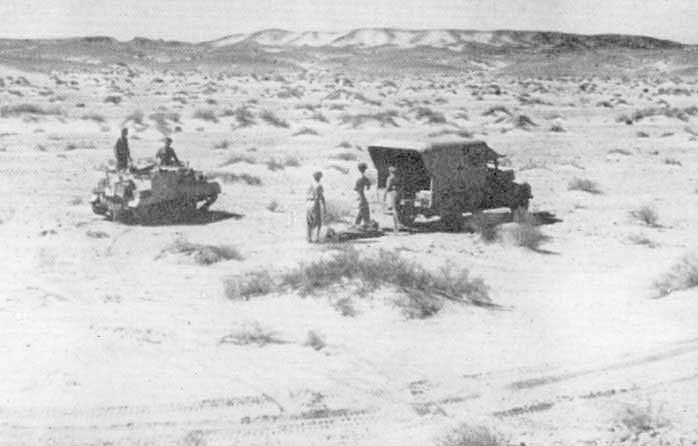
In the desert the work of the section with the French consisted chiefly of evacuating the sick and wounded of the area around Bir Hakim 25 miles northeast to B Echelon at Bir Bu Maafes, and sometimes a further 25 miles to Tobruk. As Bir Hakim was the center of operations, 7 cars were usually kept there. Maafes ("which sounds in French," Stratton wrote, "like Bir Bu My Buttocks, and that is the way we remembered it at first") was used as a reserve and repair point. A few men, usually not more than 3 cars at one time, went out on patrols lasting from a couple of days to a couple of weeks with advanced columns as far as 50 miles west of Bir Hakim.
In early April, returning across the desert alone from their first evacuation, Krusi and Kulak were machine-gunned by two German planes, which had come up from behind. "Krusi was hit twice in the back, Kulak was unscratched, and the car was pretty badly riddled," Lt. Stuyvesant wrote.
"Kulak laid Tim out on a stretcher several yards away from the ambulance (in case the planes returned), bandaged him up . . . and, the car being out of use, ran and walked back for help some 10 miles. Luckily Chuck Wood and I ran into him . . . and we were able to get Tim attended to pretty soon. . . . In view of the angle of the holes, the general condition of the car, and particularly the pains he had in his stomach, the doctor opened him up and luckily found his intestines undamaged. When later X-rayed at the base, they found one fragment of a bullet lodged in his lung just behind the heart."
Krusi was evacuated to Alexandria and in June was flown back to the United States to finish a long recuperation.
Wood received a commission from the United States Navy on 22 April and was driven back as far as the railhead. After his departure, and after Hirschberg had injured his band in an accident, the Field Service with the Free French found it had been reduced from 13 to 9 men. The long-continued pleas for more men were temporarily lulled by a promise of more in mid-April. Lt. Stuyvesant greeted this news with a cryptic "for reasons I cannot mention, they will come in very handy, particularly in a month." He planned to have the men drive up the 3 "new" cars, so that be would have a full section of 10 cars with the GSD of each of the two French brigades at the front (all the Free French forces in action at that time), retaining only the best of the Foreign Legion drivers he had been using. However, the "promise" turned out to have been a misinterpretation, or more wishful thinking, which caused some embarrassment with the French and inspired more bitter words in the already crammed files in Cairo and New York.
In the next weeks, it became increasingly evident that there was about to be action at the front, and about the middle of May Jefferys went to Cairo for the additional men the unit needed. At the time, the best that could be done for him was to send the 3 new cars out with McElwain, who reached Tobruk on 23 May and went on to Bir Hakim.
For the section at Bir Bu Maafes, where Greenough was in charge in Jefferys' absence, the flap started unexpectedly on 27 May. A doctor arrived with some wounded and, while they were working in the AFS tent, they were shelled. German tanks soon appeared on the horizon, and the AFS was still loading the wounded into their ambulances as the tanks came over the rim of the nearest wadi, only 500 yards distant. They managed to get away in time, and just a couple of hours later Jefferys arrived at Maafes to find the place deserted except for a lone Frenchman, who said B Echelon had gone to El Gubi. An English Major appeared with a truck full of wounded and reported that German mop-up squads were approaching. He and Jefferys set off southeast toward El Gubi. Soon sighting an enemy column moving north, they changed their course to north-northwest, moving with such caution that it took them 36 hours to reach the safety of the coast.
When Jefferys found Greenough and the rest of the unit two days later, he heard of an armed column being sent to Bir Hakim on the night of 31 May, which he joined. At Bir Hakim it was decided that he should leave with the returning column, in order to bring back the rest of the AFS ambulances and drivers to replace those of the Foreign Legion still driving AFS cars. Smith went along, too, and he and Jefferys planned to return and evacuate any wounded so soon as they could.
In Tobruk, Jefferys was finally given 10 more men from "X" Company, and with these men, he wrote, he "made repeated attempts to get into Bir Hakim, but the route was always cut. A convoy of trucks with desperately needed supplies left unknown to us; but only 15 out of 50 entered the camp, as the rest were forced to turn back. Except for the booming of the guns and other sounds, we were unaware of the tremendous assault which was in progress against Bir Hakim."
At Bir Hakim the Field Service had 12 cars with Kulak, McElwain, Semple, Stratton, Lt. Stuyvesant, and Tichenor as the only Americans. The motorized column from Rotonda. Segnali had reached Bir Hakim early on the morning of 27 May. Stratton and Tichenor, scheduled for the routine evacuation to B Echelon at Bir Bu Maafes, made two attempts to get out and finally were turned back by a salvo of light shells. By mid-morning the attack was in full swing. "We saw a line of enemy tanks approaching our edge of the perimeter, perhaps two miles off," Semple later wrote. "The battle that followed was short and decisive, though very severe while it lasted; particularly so for us, as our tent and holes were way down on the edge of camp, so that not only the incoming but the outgoing shells all whistled over our heads. . . . At the end of half an hour, 40 out of the 70 attacking tanks had been destroyed by our artillery and antitank guns, and the remainder had very wisely turned and fled. At one point, however, a group of 6 tanks had actually gotten within the camp before they were destroyed. Then our work really began. . . . By lunch time things were finished and quiet; except that we were still surrounded and there was no prospect of any evacuation for several days."
The enemy continued to attack the northern boxes at El Adem and Acroma, as well as Bir Hakim, but with no success. Its large attack had not actually taken a single stronghold by 30 May, so all the enemy strength was concentrated on cutting a path through the minefield on a line between El Adem and Rotonda Segnali. Aided by a heavy dust storm, which hid their activity from the air, in this they were successful.
On 1 June the French sent from Bir Hakim an offensive column of about 1,500 men and a number of batteries of artillery toward Rotonda Segnali to cut the enemy supply line to the south. Kulak and Semple, on a draw of cards, won the assignment to go along with their ambulances. From the start, the expedition was ill-starred. Kulak turned back early in the first day with casualties from a strafing, and bombing and strafing attacks in the afternoon produced such heavy casualties that a relief column of ambulances was radioed for during the night. All the ambulances left at Bir Hakim answered the call, reaching the column at 7 the next morning. They picked up the wounded and immediately started back. About 15 miles from Bir Hakim, Lt. Stuyvesant got a flat tire, Jefferys reported,
"but he insisted that the others go on ahead with their wounded, all except a legionnaire who stayed on to help him with the difficult job of changing a tire in soft sand. While they were doing this, heavy German forces moved up to attack Bir Hakim, unknown to them, and he was picked up as he was in sight of the camp's east gate. Nothing more was heard of him until I discovered an English boy named Bryce, who had also been captured but sent back later to Bir Hakim with a note from Rommel demanding that General Koenig surrender. . . . Alan had left no message and only said that he was quite safe, though damn annoyed at being caught."(7)
The French column returned the next day, through a terrific sand storm, when it received news by radio that Bir Hakim had been surrounded in force. On their return, Semple wrote, he and Kulak discovered that their tent had been transformed into
"a very safe little dugout. . . . And in the days to come we were certainly to need such a shelter. For despite the continuous and unabated confidence of the French that they could hold Bir Hakim against any attack, the force of the German assault began to make itself felt.
"Our daily routine during the siege was simplicity itself. We'd get up just before dawn, while there was still a heavy mist over everything, and draw our daily water rations and possibly get a cup of coffee if we were lucky. As soon as the fog had burnt off, we'd go to our dugouts, and then, as regular as clockwork, the guns would open up on both sides. From then until dark, well over 12 hours, it was absolutely impossible to step out of the dugouts, the shelling and machine-gunning were so continuous. During the greater part of the attack, the Germans were throwing in at least 12,000 to 15,000 shells a day, as well as the tremendous weight of bombs which were rained down in the daily raids. We had the misfortune to be situated pretty close to the artillery, so the major part of the Axis bombardment fell all around us; it wasn't long before we got into the habit of always keeping our mouths open against the concussion of the near-by shells. . . .
"We were unfortunate . . . in a number of little details. On the first day, for example, a bomb struck our cook dugout and not only killed the cooks and destroyed the cooking equipment, but blew up most of our stores as well. The same thing was repeated on a much more serious scale a few days later, when a shell landed on our water dump, destroying almost all our stock. So for the last three days we didn't get a bite to eat---not, to tell you the truth, that there was a person in the AFS at Hakim who would have wanted to eat a bite. That was just one of the more pleasant and minor effects which the bombing and shelling had on our nerves. just to further harass us, there was a sniper who was gunning for us the whole last week, which made it very foolish to go out even during those rare lulls in which we'd try to get a breath of fresh air.
"Although we were astoundingly lucky in not having one of us so much as scratched during the actual bombardment, our cars didn't have such good luck. Kulak's went in the most spectacular fashion when it was struck directly by a 105-mm. shell.; there was hardly anything left but the four wheels and a bit of the chassis, while the ground was strewn with pieces of wood, canvas, and steel for a distance of 50 yards on every side. Even though most of the cars were protected (as far as the motor went) by being nosed down into shallow holes, that did a lot of good when the whole body would be blown to splinters, as often happened in actual fact. Between the bombs and the shells, 8 out of our 12 cars at Hakim were rendered totally unusable; and all of the remaining 4 were hit in a greater or less measure. Tichenor's, for example, was hit on at least 5 separate occasions: the dash was ripped out, there was no windshield, and most of the back was more like a sieve than a car; but somehow the motor ran and there was still room for four stretchers."
By 10 June the situation had become critical. The relief column promised by the British was not able to get through. Air support was weakening, rations were critically low, and the ammunition shortage had become desperate. The German infantry was entrenched almost in one corner of the camp, and for several days they had engaged in continuous small-arms fire. At 5 o'clock in the afternoon it was announced that it had been decided to evacuate the camp's garrison and equipment that night, and everyone took great care to continue to behave as usual, in order that the evacuation might come as a surprise to the enemy. The destruction had been such that over 2,000 of the men would have to leave on foot, and 10 munitions trucks were to be used for the wounded.
At 11 P.M. the 4 AFS ambulances slowly drove to the southwest corner of the camp, where the engineers had been cutting a passage through the minefields, and took their places in the line waiting to drive through the opening, a zig-zag passage about 500 yards long and up to 15 yards wide at its broadest point, flanked with loose coils of barbed wire. Tichenor was followed by Semple, then by Kulak and McElwain in one car, and finally by Stratton, all cars carrying as many wounded as they would hold. There was an agonizing delay before the column, led by General Koenig, started its flight for freedom. Then, just as they began to drive forward, a star shell burst directly over the concentration of men and vehicles, and the Germans opened fire with machine guns, rifles, and the light Breda antitank cannons. Miraculously, for the first 10 or 15 minutes the Germans' aim was universally high, but finally they got the range and slammed burst after burst of machine-gun fire into the ranks of men on foot as well as into the vehicles, until the whole scene was luridly illuminated by burning trucks.
Semple was the first to run into misfortune.
"Burst after burst and Breda shell after Breda shell whistled overhead as we moved 20 feet, then stopped for 2 minutes and crouched down behind the wheel, then moved again, and so forth. . . . Suddenly I felt the car drag and realized I'd run into a coil of barbed wire, and my frantic efforts to get loose only got us in deeper. . . . Our private little convoy moved on again, leaving me behind. Tichenor disappeared . . . while a moment later Kulak and McElwain went ahead and also disappeared. . . . By a stroke of luck there was an armed Bren carrier abandoned very near to me; and, although all the trucks that passed me were full up, I got some help from an English RASC fellow in unloading the four wounded from my car. . . . During this operation we all got quite a scare when a burst passed through the back wheels as we were standing at the back unloading stretchers. We dragged the stretchers across to the Bren carrier and placed them against it, which provided a certain amount of rather effective cover. Finally . . . a truck stopped which had some room for the wounded on the ground, but all was not to be easily settled. For while I was standing on the running board talking to the driver, a Breda shell struck the hood of the car and knocked us all to the ground. Fortunately, I was only slightly struck on the leg . . . [but] the car was destroyed. Finally, however, a French truck and a battalion ambulance halted and we loaded on the wounded. . . . I walked a short distance before getting a ride on a truck belonging to the Foreign Legion, with which I was carried through the barrage. . . . When we got through the fire, there was such a pall of smoke from our burning trucks and cars that we were unable to see the stars."
Stratton's radiator was pierced and, though he thought it would last out, he finally had to be towed. Passing through the spray of bullets, his brakes and steering gear were shot out, and he heard his tires explode. At the next stop he crashed into the truck that was towing him and jammed the radiator against the fan so that the engine would not turn over. Then, as he wrote,
"it happened very quickly. We were making time. I had seen one car that looked like an ambulance burning; we avoided that light. One ambulance seemed to go to the left and stop; one to the right and disappear. We went straight ahead and then stopped suddenly. A blast of incendiary and explosive bullets bit the engine of my ambulance, and the gasoline flamed up. I had my foot fast to the floor, but the brake was gone. I reached for the emergency, but that was gone, too; and that was when we crashed the truck and the bullets hit us. One thing, as I have said, about tracer bullets is that you can see where they come from. These came from my right.
"Je suis blessé!' I said in a most surprised voice. 'I'm wounded,' I repeated in English for my own benefit. 'I am, too,' the nurse remarked. We threw ourselves out on either side. I found I could not walk, and fell down. It was a fearful discovery. And my left arm and hand ran blood. I sat on the ground and hollered. 'Empty the car,' I said. 'Separate them.' Or rather, I yelled 'Dégagez les voitures!' I am not sure if it is the correct phrase, but I kept saying it. The flames had taken hold. Wounded crawled out of the truck and dragged themselves away out of the firelight. . . . I think that my wounded had all been killed by the same Breda that shot out my brakes and tires and hit the steering gear. I hope so, for I could do nothing for them. You do not know time when things happen fast and horribly. I cannot say how long I lay and shouted. By that time the tank and reserves were burning. I got up and ran a few yards and then fell down among the camel thorn, fainting.
"I counted 35 holes in me, and that doesn't include the pinheads. . . . Bits and pieces went through my shoes and into my toes, and sprayed both legs and my hand, wrist, and forearms. But no bones and no joints were broken. . . . Later someone came limping out of the blackness, and he took hold of me and we got to the truck. . . . I landed on a pile of wounded men, who could not help but groan. I crawled over onto a pile of blankets, but thought the blankets too solid. I edged onto a toolbox, which was cold and very wet. Tichenor was lying under those blankets, but I didn't know it then. He was dead."
"Tichenor had been killed immediately. His ambulance took fire, and while he worked with the wounded he had been hit in the head and had fallen across the wounded men. His body lying across them had saved their lives. One man, blinded, told me that . . . he had been in Tich's ambulance."
Later that morning, shortly before dawn, the English buried Tichenor about 8 miles southwest of Bir Hakim, near the rendez-vous point where the French were finally met by a British column from the north.
McElwain drove his car through the minefield and then relinquished the driver's seat to Kulak.
"We drove further on, seeking to get away from the light of blazing trucks. Suddenly I felt intense pain in the bone of my right leg, but kept looking straight ahead in order not to divert Kulak's attention from the pandemonium through which he was driving. My whole leg then began to ache and throb with pain. On glancing toward Kulak at my side, I noticed that he had slumped in his seat and that the unguided car was slowing to a stop. A shell exploded over the radiator of our car and fragments ripped through the hood of the engine. An immediate examination of Kulak revealed that he had been badly shot up from the waist down by machine-gun fire. Kulak was sinking fast and asked to be put on the desert to apply a tourniquet. I tried to lift him into my seat. He was dead weight. It was almost impossible to get his wounded legs over the shifting levers in the center of the floorboard. I finally managed it, but my leg was giving me excruciating pain. I reasoned that it would be impossible to get him back in the car, even if I were able to get him out on the desert. It seemed better to drive till a surgeon was found. He agreed and lapsed into unconsciousness.
"A star shell then broke over the car, completely lighting up our position. The Germans had spotted the car and there was no time to lose. I staggered from the car, scarcely knowing that I had a broken leg, and hobbled to the rear to stow away two duffel bags that we had placed to the right of the open driver's seat as protection. Suddenly everything went black before my eyes. I leaned against the rear of the car until my mind slowly began to work again. With great effort I was finally able to heave the duffel bags through the open window of the rear curtain and to make sure that a wounded Senegalese had handled them inside the ambulance. With considerable difficulty I was finally able to get back to the driver's seat and get the car started. The car moved off slowly. Soon another star shell burst ahead of the car. In the instant of its flash, I caught the outlines of three men with fixed bayonets."
The German officer who captured them, with the aid of three Italian soldiers, promised to send medical assistance. But it was not until next day, when they had been driven to a German dressing station, that either received a doctor's attention. By that time, late in the morning, Kulak was dead.(8)
In the action at Bir Hakim, the American Field Service suffered 100% casualties to men and materials. Of 12 cars, 12 were lost. Of the 6 men, 2 were captured (one of them wounded), 2 were killed, and the 2 who managed to get away were both wounded. General Charles de Gaulle wrote of this record as
"témoignant de l'actif dévouement avec lequel l'American Field Service s'est dépensé pour la France Combattante. . . . La France n'oubliera pas ses amis d'Amérique qui ont fait volontairement pour elle le sacrifice de leur vie."
In the meantime, when it was clear that Lt. Stuyvesant had been captured, Lt. Jefferys took charge of the rest of the unit, assisted by Lt. Smith as adjutant. At 4:30 on the morning of 11 June, they were ordered south to a point 35 miles southeast of Bir Hakim, where at a little after 9 in the morning they met the armed convoy coming from the box and set to work for the next 36 hours taking the wounded from the trucks and carriers and in their 6 ambulances evacuating them to the Hadfield-Spears hospital at Sollum, the French base hospital and the nearest to have any room for patients. After this, they rejoined the GSD of 1 Brigade at Sidi Barrani, which was soon ordered east to Daba, where it continued to rest and reorganize.
The next week the AFS unit wangled a temporary transfer to 2 Brigade, which had been guarding an airport at Gambut. Four AFS cars with Legion drivers had been loaned to it just before the Bir Hakim activity, and by transferring these to American drivers the unit would have 10 cars and 13 drivers. At Mersa Matruh the unit Met 2 Brigade driving east, joined the convoy, and, by way of Daba, went to guard the RAF installation at Fuka, halfway between Daba and Mersa Matruh. For two days they watched the units around them pull back, and late on 3 July they were ordered back to El Alamein.
"The French 2nd Brigade," Lt. Jefferys wrote, "then turned south into the desert, where we remained for two days with wholly inadequate supplies and only mudwater to drink. By this time the German drive was gaining momentum, and we were forced to retreat across the desert. It was at this point that Hennessey and Momsen became detached from the main body and accompanied a small French convoy heading towards Cairo. Momsen was driving a borrowed British ambulance, which became stuck and was burned. . . .
"The main body of French forces finally arrived in Amiriya, some 20 miles south of Alexandria, whereupon all available ambulances were called upon to rush to Alexandria for immediate evacuation of the French hospital there. The evacuation took place at midnight, and, after a very bard all-night drive, the convoy of ambulances and busses arrived in Ismailia the following morning about 11.
"The French in the meantime retired to Helwan, 27 kilos south of Cairo, for refitting, where we rejoined them; and have since moved to Tahag, where we are now hoping to put our cars into the long-overdue workshops for badly needed repairs.
"Throughout our period of action, Thomas Greenough played a very active part when he was called upon to take charge of the group during my absence, and in two particular instances he avoided possible capture of the remaining group by his prompt and level-headed decisions."
On 13 July, the French National Committee renamed Free France as Fighting France. Later in the year, when Lts. Jefferys and Smith returned to the States, Lt. T. O. Greenough was given command of the American Field Service unit with the Fighting French Forces.
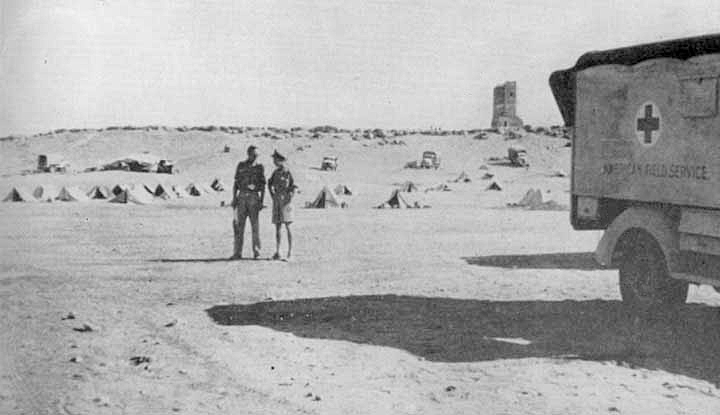
Meanwhile, on 20 May 1942, "X" AFS ACC had settled into "permanent" base beside 1 (UK) MAC, which it was to relieve after 7-10 days double-banking-digging slit trenches, constructing dugouts, and camouflaging and conditioning its ambulances. The campsite was at Pilistrino, on a hill 5 miles southwest of Tobruk and just within the defense perimeter. A battlefield of the previous campaign, it was
"littered with the silent reminders of that terrific struggle-spent shrapnel, burned trucks, deserted machine-gun nests, Italian artillery, guns silenced forever, piles and piles of new mortar bombs, etc., [and] a German mauser and an Italian rifle here and there."
However, all was not silent at Pilistrino. Movement of planes overhead was heavy, and
"over the hill from our camp we bear the continual rumble of the guns---though to find out how the whole battle is going we ironically enough have to turn on the London news broadcast," the anonymous record continues. "Sometimes we get a rumor that Jerry has broken through here and there, and sometimes the guns are close and sometimes far, but we hardly have time to worry too much how things are going."
Later another wrote:
"There is a big battle going on and has been for some time, and there are fleas. . . . Oddly enough the fleas bother me more than the battle; they certainly have done me more damage than the other." The situation was worse when, after 31 May, the old dugouts down the hill were taken over. Captain King wrote to Cairo: "Flea powder and rat poison . . . flit and flysol . . . unless we get some soon the dugouts will become uninhabitable."
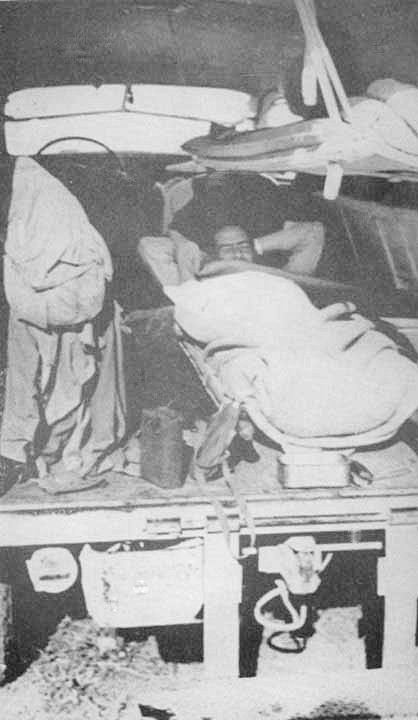
Many had already found living in their ambulances not unpleasant and continued in them in preference to the usually infested domiciles left behind by the enemy. During most of the desert campaign the men would write that "my place of residence is my ambulance-which serves as bedroom, library, dining room, and guest room, also kitchen. The exhaust pipe makes an excellent stove. . . . My clothes and other belongings I keep in a steel box, much like a steamer trunk, which I have screwed onto one of the front fenders. The 'steamer trunk' was Originally intended by the British Army to carry shell charges. If by chance a bridge game develops, a stretcher slung in the middle of the ambulance makes an admirable table. The folding benches on either side of the ambulance are the chairs. And blankets placed over the windows permit me to use my interior lights and still observe the black-out regulations. That about takes care of my domestic arrangements."
Work began before the settling in was very far advanced. On 21 May, 10 of Lt. Ives's ambulances made the first of the daily runs from the 62 General Hospital in Tobruk to Bardia. Gradually the work increased, and by the end of the month they were "doing ambulance work for a large portion of the casualties. Daily runs of every ambulance are the rule, and fellows are going from 6 in the morning until 9 or 10 at night, often on long exhausting hauls or else on painfully repetitious short ones." At this time arose the problem, new to many, of their patients' comfort. Those who had only driven over the paved roads of Syria, where the only necessary consideration were the amenities, found in the desert few roads, and those poor and not always usable. The desert was seldom smooth sand, but was often composed of large stones, so that a steady ride across its surface was completely impossible. Every driver had to reach his own compromise between slow and careful driving, which prolonged the patients' discomfort, and the uncomfortable but fast and short ride.
On 23 May, C. W. Schwarzmuller's section was' detached to serve with the 20 Indian Field Ambulance with the 5th Indian Division in the El Adem sector, some 20 miles southeast of Tobruk. On the 26th, Hume's section was attached to the 62nd General Hospital for general duties, mostly running from ward to ward with patients but also, as did the rest of the Company, taking patients to the hospital ships at the docks (J. B. Watson and W. B. Brown were reported to have done this run several times under heavy bombardment) and more serious cases to the airports. R. K. Murphy and D. G. Atwood were assigned posts with surgical teams in the operating theater, where they were so useful that there was talk of making these postings permanent.
The rest of the Company remained intact, working from its HQ at Pilistrino.
"Our life is about as follows," one of them wrote: "We get up at 6; breakfast at 6:30; the first section pulls out at a bit after 7 some mornings but usually at 7:30 promptly. Section after section follows along down to the hospital in Tobruk, where we get loaded with wounded to be evacuated to Bardia, or rather a staging station a few miles east of Bardia. It's a drive of about go miles each way and takes about four hours down and three to three and a half back. I've never seen anything like that road. Loaded with vehicles . . . [it] is too narrow in many spots for two ordinary cars to pass-and yet we all go breezing by, wondering why we don't hit. . . . Often we have to go completely off the road and drive through the desert---but you don't mind that because it's not much worse insofar as the surface is concerned. . . . We are constantly getting mixed up in convoys . . . [which] we try very hard to get by as quickly as possible, because it is when we are all interwoven with combat vehicles (of which we pass literally thousands every day of every description) that we are in the greatest danger from strafing planes and bombing attacks. . . . All in all it's about as tiring a bit of driving as I can conceive, and when we get back just in time to grab a bite and a flea for supper we are all pretty well whipped. After supper we gas up, check the tires, oil, battery, and water and do our task. . . . Once it is dark, there is little one can do except go to bed and wait for Jerry to come over, which he usually does at 10:30 and intermittently thereafter until dawn. Occasionally we black out an ambulance and play bridge, but as often as not we're too bushed to do much more than sit around and eat . . . whatever . . . we have managed to pick up at the various canteens . . . . The sea is fairly near by, and there is a swimming parade every afternoon for those who are not engaged on the run to Bardia."
An ambulance could be comfortable
On 26 May praise of the unit's work was received from the ADMS. However, at the same time it was requested "that the men look more to their personal appearance." The Company diary was so distressed to record this almost unbelievable happening that it did not mention whether they had erred in flamboyance or grubbiness, the two ever-present temptations. As water was rationed for personal ablution, as well as consumption, and as laundering was usually combined with a swim in the Mediterranean, there was probably a quite unmilitary combination of outlandish costumes in a state of something less than perfect freshness.
With the beginning of the German offensive, air activity increased, and Lt. Geer wrote that the AFS base at Pilistrino on 27 May received its first air attack.
"In the desert there is a welcome pause before sunset. The evening meal is over; those machines which have been out on duty have returned. The heat of the day has given way to the cool evening breeze, and the flies are growing less active. Small groups and individuals are scattered about the leaguer talking over the day's run or writing letters. There are a few men at the basketball court, awaiting more recruits to begin a game. An ambulance on the outer edge of the camp is tilted awry as a tire is being changed. . . . Around the perimeter there are sudden clatters of machine guns as sentries are changed and guns cleared by the new men taking over.
"I was seated on the observation seat of my staff car enjoying the night wind---it was from the north and off the sea. . . . Gregory Wait and Ellis Locke were a short distance away, deepening a slit trench. Bill Hoffman was seated on a petrol tin reading the garrison paper, Tobruk Truth. John Peabody was puttering around his ambulance a few yards to the north. . . . I was swung around by a call from Greg Wait.
"'Hey, Andy, what are those above us?'
"I turned my glasses skyward and froze as they brought into view the leader of a Stuka squadron poised for his dive. . . .
"'They're Stukas. Scramble!'
"The first bomb bit about 400 yards to the south. Others exploded, kicking up clouds of smoke, dust, and dirt. Angry spurts of sand kicked up a few yards from where I was sprawled. 'The bastards are machine-gunning us,' I remember yelling to no one in particular. At the moment, that seemed more important than the fact that the bombs were falling. Then it was over. The last Stuka pulled from its dive and swung westward through the black puffs of ack-ack fire. . . .
"I remember my surprise at Peabody. He was standing in exactly the same position as before the attack-hands on hips, face to the sky. I don't believe he had moved a single muscle during the whole show. . . . I met [one of our British cooks] lurching over the sand toward me. The fellow's face was green, his face wet with perspiration.
"'You hurt?' I asked.
"'They tried to bomb me; the sons of bitches tried to bomb me. The sons of bitches tried to bomb me.' He kept repeating this over and over again. I don't believe he saw me. . . . The fellow was completely bomb happy (army slang for shock and in no way derogatory) . . . . The blacksmith from the British workshop section had been bit in the legs with bomb fragments. He was not badly hurt. An ambulance wheeled him into the hospital in Tobruk. One ambulance and several three-tonners in the workshop section had been perforated with bomb fragments. . . .
"At most two or three heavies had been dropped. The majority had been antipersonnel stuff. The weather was clear, and there was no doubt the enemy could see our red crosses, for the ambulances were new and the markings were fresh. The bombers had spotted our workshop lorries, though well camouflaged, and had gone for them. They also tried for the light air-defense guns on the escarpment. Their area of concentration was well away from the ambulances (the ambulance bit was in the workshop area for repairs). What I thought had been machine-gun fire came from our defenses on the escarpment, which in following the dive-bombers had got a bit low on sights and had sprayed the camp grounds. . . After a bombing there will be as many different reports as there are men. In the telling, the number of Stukas varied from ten to fifty, and in the minds of some the attack lasted twenty minutes. I got my number of fourteen from the near-by ack-ack battery, and the attack was over in three minutes at most."
Rommel's plans for the speedy taking of Tobruk were delayed by the heroic stand of the French at Bir Hakim. On 30 May the enemy was held at every point of attack---in the north as well as the south. However, the Germans made and held a passage through the line of minefields running south from Gazala, securing their lines of communication and cutting off Bir Hakim from the possibility of relief from the north. By 2 June the German forces had regrouped and resumed the attack on Bir Hakim.
During this time the AFS continued its daily runs from Tobruk to Bardia, and the section at El Adem had an intermittently exciting time of it, with much bombing and strafing. On 7 June they evacuated hurriedly to the junction of the Axis and Bardia roads, getting safely away but losing a great deal of their equipment. E. W. Thomas and his section relieved Schwarzmuller on 9 June, posting P. C. T. Glenn separately with the 29th Brigade at El Adem. After Bir Hakim fell, the full force of the German attack fell on the Knightsbridge-Acroma sector, where the British suffered crippling losses in a tank battle on 13 June.
On the same day, Thomas and his section moved with their unit to a point 50 miles southeast of El Adem. Glenn, evacuating to Tobruk that afternoon, had to enter it from the west, as the other road had been cut by two victorious German tank columns which had continued from Knightsbridge toward Ed Duda. Captain King wrote that he then told Glenn that "the ADMS was about to issue orders for his return to our unit; but [Glenn] said that he was desperately needed at the RAP, as they were being intermittently shelled; and we agreed he should stay until the order was actually received."
The battle continued to go badly for Eighth Army, and on the evening of 14 June Captain King received orders for the AFS to evacuate the next morning. The general reaction was that the AFS would be running out when the going was tough, but there was no choice; all noncombattant units had to leave. "We had to keep on with our job for the hospital," C. Morley, Jr., wrote of this section. "We had to make our ambulances fit for the next day's journey and lay our hands on as much petrol and water as we could. We had to pack. . . . The warning racket of the ack-ack barrage told us that Jerry was overhead, so that part of the time we had to pack in the dark. We had to say goodbyes. This included, toward 2 A.M., a little party given for us by the RSM. . . . In the morning other AFS ambulances pulled into the hospital: 6 of them to help our 6 carry the nurses, who traveled three to an ambulance; the others to evacuate the patients to Sidi Barrani. There was the usual scurry and confusion which the combination of women and luggage and farewells produces. It took about an hour to get loaded, lined up into convoy, and away."
The 12 ambulances with the nurses, led by Lt. Marsh, remained a unit for their whole trip to Mersa Matruh. The larger convoy rapidly fell apart and, according to Lt. Geer, narrowly avoided disaster before it was fairly out of Tobruk.
"With each yard we progressed, with each turn we made, we' saw more and more traffic winding its way to the bottleneck that led from the basin of the harbor. . . . I saw our ambulances creeping along the road from Tobruk, but they were slowly being stopped and swung into line by military police, who were cruising about on motorbikes.
"The MP directing traffic at the junction was sending one lane into a wadi leading toward Mersa Umm; the second lane he was directing up the road to the crest of the escarpment. The track through the wadi was a bad stretch of going that finally came out on the main road some six miles farther along. I thought we, should have the right of way up the main road until I saw the fellow turn our first two ambulances into the wadi. I ran to him.
"'You can't send my ambulances down that track---you'll kill half our patients!
"'I'm sorry sir. Thirteenth Corps has priority. Until they are out, all other vehicles must use the lower track.'
"'Good God, man! We're cleaning out the hospital. Some of these men shouldn't be moving'
""Those are my orders, sir. If you go to area headquarters and get an order. . . .'
"I was turning away when an armored car with a Brigadier sitting on top rolled by bound for the, city. Running alongside, I saluted the figure above me. The car stopped.
"'Sir, I've about 60 ambulances clearing out the hospital. The MP is sending them along the wadi; he says Thirteenth Corps has priority.
"'I'm sorry, Lieutenant. I can't countermand the order; it is not in my province . . . . I
"Jerking another salute in the direction of the departing armored vehicle, I turned on my heel to where the MP was standing.
" 'The Brigadier says we are to use the main road.'
"'Very well, sir."'
Stretcher patients were off-loaded at a South African hospital near Sidi Barrani, about 200 miles from Tobruk. The others were taken another 80 miles to Mersa Matruh. Much of the group spent the night either in an open field a few miles west of Sidi Barrani or at kilo 13, cast of Sidi Barrani. During 16 and 17 June the stragglers came slowly together at a new campsite at Zawyet Shammas, about half way between Sidi Barrani and Mersa Matruh at kilo 90. On the 17th, 12 ambulances had the pleasant detail of taking the nurses on from Mersa Matruh to Alexandria.
At this time Thomas and his section were 'till 50 miles east of El Adem, in the desert with their RAP. It had again been ordered to the east , this time across the border into Egypt, and the section didn't want to accompany it, particularly as they thought the rest of the Company was in Tobruk. With their Colonel's permission, on the 17th they started to return to Tobruk. When they reached the coast road they saw a lot of traffic going in the "wrong" direction, toward the east, and as they neared Tobruk the traffic thinned out until there was none at all.
Their appearance at the hospital in Tobruk surprised the Colonel in charge, who had thought that the city was cut off In spite of Thomas' plea that they be allowed to remain in the city, 'the Colonel ordered the section to take a surgical team and its equipment to Sollum, and they left Tobruk after a meager lunch of "one boiled egg, two pieces of bread, and a dash of jam." Without incident they reached Sollum that evening and on the 18th rejoined the Company.
Glenn, however, was captured. After he had returned to the El Adem box on the 13th, he was not able to get out again. On the 15th he later wrote, "the 15th Panzer Division put in an attack which overpowered the small force which we had there. It was a position completely surrounded by wire and quite impossible for me to evacuate any wounded during the battle. Inasmuch as I was caught in a gun position, I was not near the Regimental Aid Post at the time. . . . Three or four shells hit the ambulance, damaging one wheel and knocking the roof off."(9)
While the Field Service sat basking on the sandy beach at Zawyet Shammas and swimming in the sea, on 20 June Tobruk fell to Field Marshal Rommel---and the retreat was on again. For Eighth Army the first object was to delay the Germans so long as possible, while withdrawing the main body of troops to Mersa Matruh, where a defensive line was to be established and the retreat halted. The New Zealand Division was brought from Syria in a 900-mile forced march (or its motorized equivalent) in 5 days, arriving at Matruh on the 20th. Here the defensive line, consisting of a fortified box at Matruh and a minefield stretching a considerable distance southwest, was hurriedly being constructed. By the 24th, when the Germans reached Sollum and crossed the border into Egypt, this line had not yet been properly organized and a new scheme was hastily devised. The New Zealand Division would delay the German advance as long as possible at Mersa Matruh while the rest of the army retreated to form a line at El Alamein. The longer the delay, the more secure the new line could be made.
The night of 24 June, the New Zealand Division asked the Field Service for 20 ambulances to accompany it on its delaying tactic. The choice of cars was not difficult, as at the time of the request Only 24 were in the camp, now at Gerawla, and of these some were not in adequate shape for a trip into the desert. The sections of Belshaw, Hume, Tevis, and Thomas, with Thomas in charge, left the morning of the 25th and reported to the New Zealand DADMS at Matruh before noon. Thomas and his section were assigned to the 5th Brigade Field Ambulance, Hume to the 4th, and the other two sections to the supply depot, with Rear Headquarters, as reserves.
That night the 5th Infantry Brigade struck south into the desert, digging in for the night about 10 miles south-southeast of Matruh. The next morning, J. W. Crudgington and R. J. B. Sullivan took patients back to Matruh,. rejoining the whole Division that night at Minqar Qaim, where it was dug in for battle. En route to Minqar Qaim, the 4th and 5th Brigades had been heavily shelled and bombed, and there was intermittent firing at their positions during the night. Hume's section with the 4th Brigade joined the 5th at 1 A.M. on the 27th, and stayed the rest of the night. In the morning they loaded their cars with patients and returned to 4th Brigade, where they spent the day working back from RAPs. They were "almost constantly on the move," according to D. G. Atwood, "and frequently needed guides."
With the 5th Brigade, starting at 4 A.M., J. Macgill and C. M. Field operated between RAPs and the Brigade ADS, where the rest of Thomas' section was stationed. German forces could be seen a few miles to the west of the ADS, and from early morning until dusk they shelled the New Zealand positions, meeting with vigorous counterfire. Sullivan was sent to look for the 15 New Zealand CCS, which had earlier moved from Minqar Qaim and was, according to the official record, "lost temporarily." W. L. Nichols (with E. L. Pattullo for spare driver) and Crudgington were sent east with the MDS and were joined by Tevis and his section at the new position of 5th Brigade Field Ambulance Headquarters. This whole group then began to search for the Brigade ADS, where Thomas was, but were unable to get through.
Shortly after noon, Belshaw brought four of his section's cars (C. R. Hurd, W. W. Mitchell, J. W. R. Peabody, and L. C. Sanders) to the 5th Brigade ADS in order to evacuate patients back to the MDS, and Macgill went to the 21st Battalion RAP, where he was cut off from returning to the ADS. At 2 P.M., Belshaw's cars and a number of trucks were loaded with wounded for evacuation cast, but a few minutes after they had set out they returned to announce that the Division was completely surrounded by the enemy. On hearing this the ADS struck its tents, loaded up, and got ready to move whenever this should be possible. During the afternoon the attack grew heavier, and strong enemy forces gathered to the south and east of the box to crush the New Zealand Division as quickly as possible.
"There was nothing for us to do during the afternoon," Thomas wrote, "but sit and wait. . . . Most of the ambulance drivers were determined to sit in the seat of their cars and keep company with the seriously wounded who could not be unloaded. . . . I'll never forget Manning Field, Bill Mitchell, John Peabody, and old man Sanders sitting in their cars calmly chatting with the wounded and never even ducking their beads as the shells landed. Mort Belshaw . . . actually managed to take pictures of the bursts."
At 5 P.M., General Freyberg was wounded by a shell burst while observing the German attack from a forward position. By great good fortune, the shell fragment which went through his neck did not injure any vital blood vessel; but he handed over the command of the Division to Brigadier Inglis of the 4th Brigade and lay on a stretcher in a slit trench, because his position was too exposed for him to be evacuated. Sanders offered to drive him back to his caravan, but it was not until dark that Hurd (with Belshaw) was allowed to carry the General back to Division Headquarters.
Thomas' account of the action continues:
"At 11 o'clock the order to move immediately was given. It was believed that the infantry had managed to clear a gap through the Germans to the east, and we quickly formed up with the main body of our Brigade to make a dash for it. The trucks and ambulances were placed well forward in the convoy and flanked on either side by two columns of troop transports, guns, and Bren carriers (box-shaped tractors armed with Bren machine guns). The order was given to travel at 50-yard intervals.
"Having formed, we stopped and waited for about an hour. When we did move off, in what I estimated to be a northeasterly direction, the convoy immediately became jumbled. There was a moon of sorts, but the visibility did not permit any 50-yard interval: the various columns got completely mixed up, and we soon discovered that the only possible means of maintaining any sort of place was to crowd up to the vehicle ahead. After we had traveled a short distance, the sky was suddenly lit with flares, and tracers began to criss-cross up ahead. The convoy swung sharply to the right, and the firing ceased temporarily. . . . We proceeded a short distance on our new course, and then all hell broke loose. The sky was quickly lighted by a quantity of flares; heavy firing broke out ahead and about 50 yards to the right; trucks started going up in flames; and the convoy stopped -dead. There never was such a conglomeration of sights and noises. Overhead we could hear the sharp crack of antipersonnel fire; from the right a mixed stream of machinegun and antitank tracers sizzled into the convoy; and at odd intervals mortar bombs would explode among the mass of transport."
When the convoy had started up again, a few minutes later, "there was an awful lot of traffic that hadn't been immobilized by enemy fire, and it all started to move very fast. . . . We hadn't traveled more than a hundred yards when we came to what seemed an impassable obstacle: a group of tanks or antitank guns was pouring lead and tracer directly across our path. Miraculously enough, the vehicles ahead were rushing through this fire and mostly escaping into the darkness beyond, but I was sure that we could never get through. The large box-like Austin ambulance in front of us met the line of tracer and received a direct bit on the right-hand side (I afterward learned that the single shell had killed two patients), and I saw a large jagged hole appear as the shell tore its explosive way through the left. I ducked my head and drove as fast as the car would go. To my amazement, we came through without a scratch and found that we were racing along with a mass of other vehicles in the blessed peace of comparative darkness . . . . For the next half hour every truck was driven at top speed . . . . When we did stop . . . there was no sign of Mitchell or Sanders," and Belshaw had been riding with one of the two. One of these cars was thought to have been seen suffer a direct hit.
While this convoy was racing to freedom, "the ambulance in front of Mitchell got hit with an incendiary. He ran into it, backed away, but couldn't move further. . . . Our ambulance," Belshaw later wrote, "was running behind a big truck, which turned out to be a good place, because the truck was hit. We were unable to get away from that spot---first because we were boxed tightly in traffic, and after that because the guns opened up on anything that showed itself moving in the light of the burning vehicles. This gun position, as I said, was dead ahead. The last thing I tried to do was to back up, in a straight line, behind the cover of the truck, hoping to find a drop in the terrain that would give enough cover so that we could run for it. I backed up a long way, and those guns kept a stream of bullets coming along either side (this was almost all tracer), so that I couldn't move sideways. And I found no drop in the ground. There we were---trapped. And there we stayed. It was soon dawn and the Jerrys rounded us up."(10)
The general retreat continued on Sunday, 28 June. All but Sullivan reached the 14 CCS on Sunday night or Monday morning, and he had shown up at the 5th Brigade Field Ambulance HQ (50 miles southeast of Daba) when Thomas and his section rejoined it early Monday afternoon. By Tuesday, the New Zealand Division had reassembled in the center section of the Alamein line. The action at Minqar Qairn had disorganized the enemy and caused him such serious losses that another attack was not possible until 1 July, by which time the Alamein Line had been organized and manned.
While the New Zealand Division delayed the enemy advance south of Matruh, the retreat continued. The ambulances were kept going steadily, evacuating hospitals to safer places in the rear or just removing themselves farther back. Between 15 June and 10 July, the main body moved 15 times, while the cars that were working covered many miles back and forth along the crowded coast road. For a week they stayed at Zawyet Shamas, half-way between Sidi Barrani and Mersa Matruh, sending sections to the South African CCS at Matruh and into the desert to evacuate a CCS and a Field Ambulance. But the enemy advance continued, reaching Sollum on the 24th. Matruhwas evacuated on the 25th and 26th, AFS cars taking the patients from the 58th General Hospital back to Alexandria.
AFS always tried to find attractive spots on the beach to set up the HQs, but it was not always successful. It had to leave a good one just west of Daba late in the evening because Eighth Army wanted it, and the next place to look adequate, which was found on 27 June, was found 20 miles west of Daba. The new campsite was a broad, inviting beach, which turned out to be a salt flat, with wet mud under a shallow, dry crust.
"Result," wrote T. Barton, who was driving Lt. Marsh, "11 ambulances hub deep, including our pick-up and Captain King's staff car. Afterwards a gang of us must go down and pull a couple of the bloody things out. We stayed there four hours, and along about 11 P.M. the Jerry flies over, and wham! the road alongside our camp was blasted to hell. The bastard then circled around and machine-gunned a group of RAF vehicles about 500 yards away from where we were lying prostrate in the middle of this marsh area trying to pull out this last ambulance. From then until about 1: 30 A.M. the Jerry would zoom overhead at half-hour intervals bombing the vicinity. . . . We stayed, trying to move this bloody ambulance, until 2 o'clock, using the tow truck, shoveling like mad, and generally cursing everything."
"One bomb fell within two yards of Ogle's car, one within 8 yards of Heidewald's, one oil or incendiary right in the middle of the camp, and 6 bombs on the outskirts. Miraculously, no one was hurt. For the rest of the night they flew around, machine-gunning us now and then, and nobody got any sleep. The reason that no one got hurt," wrote Captain King, who had chosen the site thereafter known as King's Folly, "was that the ground was very soft."
On 28 June the Company HQ moved to El Gharbaniyat, Captain King's report continued, while "all our ambulances were waiting at Daba for casualties [expected from the New Zealand action]. The casualties were sent back direct through the desert, so our cars and those of the 1 MAC just waited until the last minute before the Jerries arrived and came back empty. I was on my way up to get them, in case the order had not got through, and the only other car going in that direction was the C-in-C," General Auchinleck, who had taken personal command of the Eighth Army on the 25th.
They stayed three days at El Gharbaniyat, 20 miles west of Amiriya, working with 14 CCS. By 1 July, however, the strain of the flap had begun to show. "An official request has just come to me from Nettleton and Waldner (both good boys) through their platoon commander," Captain King's report concluded. "'May we go into Alex this afternoon on our motorbykes to have an ice-cream soda?' An ice-cream soda! Can you beat that?"
The position of the Eighth Army was critical, the future precarious. So many defensive positions having already proved untenable, there was no certainty that the enemy advance could be stopped at the El Alamein line---which was no more than a loosely connected system of defended localities covering the 35-mile stretch between the coastal village of El Alamein and the impassable Qattara Depression.
From 1 to 4 July the enemy was held, and in that time the El Alamein positions became a firm defensive line. The 1st South African Division, later augmented by Australian troops, was assembled on the coast; the New Zealand Division in the area of the Kaponga fortress at Bab el Qattara, the strongpoint in the center of the line; and the 5th Indian Division at the south. The enemy attacks on 1 and 2 July were repulsed, and another on 3 July was met by a New Zealand counterattack which routed the enemy, destroyed many of his vehicles, and captured 300 troops. On the 4th, the enemy lost about 20 tanks and another 600 troops. And on the night of 4/5 July, the New Zealand Division advanced in a salient to the El Mreir Depression. By 11 July the Tel el Eisa mounds overlooking Alamein had been retaken, but due to enemy pressure the central salient was withdrawn and the lower half of the line was finally stabilized somewhat east of its original position. Repeated enemy assaults during the rest of the summer proved unable to pierce this line.
At the height of the flap, the Field Service evacuated 14 CCS and moved back to a point 25 miles south of Alexandria on the Alex-Cairo road. Prepared for the worst eventuality, 6 sections were in Alexandria on the 4th, starting back to Company HQ the next day, when the worst tension was over. They looked first in Damanhur, in the Delta, where 2 sections were posted with Australian troops, and finally found HQ at Tanta, a good bit to the southeast, at a spot still bearing the sign "For water buffalo only." Tanta was a large enough city to have a Sporting Club with a swimming pool, which was used by all, and a hotel where the quickest were able to engage rooms. From here most of the cars worked as a single unit, with only brief postings to Australian units and 75 Indian LFA and, in mid-month, to 10 Corps.
The large group with the New Zealand Division, however, found their work hazardous and, intermittently, strenuous, half the group usually being with the RAPs. Lt. Ives, hospitalized at the time of the original posting, went out on 3 July to look after these sections.
"John Moore and I made a morning start," he wrote, "and were at the MDS before sunset. Dave Hume and his subsection were there, and soon John Meeker came in with a load from the ADS. Hume had orders to move up to Main Div in the morning, and Meeker was going back to his ADS. We followed them over the lip of the flat stretch of stones and along a track that was marked by a couple of strands of wire laid on the desert. Where Meeker's ADS had been the day before, there was nothing but a truck or two in transit. Hume's crowd went ahead, but Meeker turned north to look for the ADS, and Moore and I followed. There were some guns going our way and the sound of guns ahead. Presently we came on a few armored cars and asked the way and were directed west again. In a while a cloud of black smoke rose up ahead of us, some miles or so off. Then we saw two or three other pillars of smoke and guessed that ammunition or petrol trucks had been hit. We stopped and asked an officer what it was all about. He said there had been a Stuka raid on Main Div.
"We were there in a few minutes and could see lorries scattered throughout. . . . Seven trucks were burning. We went down into the wadi and came to where some of the ambulances of Dave Hume's crowd were waiting. Near by, men were sitting and lying on the ground and on stretchers, and medical orderlies and an MO were working on them. After a while, the ambulances took the casualties to another part of the wadi, where a roof of canvas was put up on poles to give some shade and where they dug a few graves. It had been a 20-minute raid.
"We were told that Thomas' subsection had been sent to the MDS, so we humped back and found, instead, that Tevis' crowd had been sent for and that Thomas was still up forward at the ADS. Back we went, through the Main Div wadi again and, losing our way, through a narrow track between minefields into what they called the 'fortress.' On the other side of the fortress we were blocked by more strings of barbed wire, indicating minefields, but we found a lieutenant who was going up forward and we followed him. In a few miles there was another scattering of MT and another red cross flag. Thomas, Pattullo, Sullivan, and Nichols were there with two ambulances, and Tevis and Morris came up in an ambulance just before dark. The Stukas had been over the MT here, too, and there were casualties in men and lorries. Late in the evening there was another raid. . . .
"Before dark, the OC of the ADS came up and told us that we must be ready to move at midnight, that there was to be an attack at 9:30. Evan Thomas and Sully went out to spend the night with an RAP. It looked like a very rough prospect for them, and, in fact, they had a busy night of it. The rest of us lay down in our clothes to get some sleep before the time to move. Sharp on the dot Of 9:30 came the noise of guns. We went to sleep in the hope that things would go all right. But we slept on through and were awakened only by the dawn. The attack had run into a strong point. The ADS tents were crowded that morning. We went back to the MDS with our ambulances loaded with all they could carry.
"At the MDS they asked if we could bring up more ambulances. Furthermore, we needed tires and tubes. So John Moore and I decided to go back to our HQ to see what could be done. We rattled and bumped again across the 30 miles of desert and then down the unsurfaced road to our ACC post, only to find that our ambulances had disappeared. Near by, however, was Captain McCarthy and Felix Jenkins,(11) who told us that the Army high command had ordered our crowd to the Delta. At Alexandria we got directions to Damanhur, and at Damanhur we were told that the AFS was still farther south. We found them, about sunset, crowded into a little square of black delta land, beating at flies by day and mosquitoes by night. They did not like the place, which was in Tanta; nor, after three minutes of it, did we.
"Two days later, McMeekan's subsection went out to replace Hume's, and Goodwin and Muller went with them, taking spare tires and tubes and miscellaneous parts. Joe Bradley and I followed them by a few hours with three more tires that Mr. Mathewson had managed to collect. At the Division we had to shuffle men about, to sort ourselves out so that the members of each subsection would work together as far as possible. Mars was evacuated back to base with dysentery. Childhouse showed up at the MDS with stomach cramps. Leister was holding his hand over a bad wisdom tooth. Sully laughed about his 'capture' of an Italian pilot who had crashed and hurt his leg. Gaynor said he had been Stukaed 8 times in 3 days. Gilmore complained that a hot bomb splinter had trickled into his slit trench while he was minding his own business. Thomas and Crudgington had come back from a night with an Indian column screaming Stukas.
"In the evening of the 9th, Meeker brought a load back from the ADS and a note from Johnny Goodwin asking for more ambulances and drivers; so, after dark, Duncan Murphy, Tevis, Morris, Bradley, and Metcalf went back with Meeker. Something was up that night, for we could hear the guns pounding steadily and could see their distant flashes of light.
"Art Howe showed up the next day with his subsection plus two additional ambulances and Miller, Barrett, Lynch, and Brooke; so Evan Thomas returned with the balance of his subsection to HQ. We were operating on a rough schedule of getting a fresh subsection forward about every 4 days and sending back the one that had been out longest. The idea was to give everyone a chance at field ambulance work (a privilege, it was thought by those of us who had done only ACC jobs). The program would give each man about two weeks in the forward area and a chance thereafter to take a bath in something larger than a mess tin and to do something substantial about the maintenance of his car. It was a bit difficult, sometimes, to sell the fact that greasing, changing oil, and tightening bolts and nuts were just as important near the lines as far behind them.
" Keyser and Gilmore came back with loads from an ADS in the evening and told nice stories about how antitank shells look when they bounce along the ground. There was something wrong with Keyser's car, and Gilmore was due to go back to HQ; so, at the crack of dawn, I showed Barrett, Lynch, and Brooke how to get up to the wadi where the two ADSs had been located the day before. We found the wadi, all right, but whereas I had known it as a great valley of sand thickly sprinkled with MT, guns, pup tents, and men, it was now empty of everything except a few used petrol tins. We drove around and got directions from occasional soldiers until we reached the edge of another big wadi as full of stuff as the other had been. No one here could give us any help on the new locations. As usual, though, it was just a matter of asking enough questions. We spent the morning at it. In the course of our wanderings we met Colonel Richmond, Captain King, and Glen Russ, who had come out to have a look at what was going on.
"In the afternoon, I showed the way forward to Howe's subsection, which took over from Dick Tevis'. One of the ADSs had moved since morning; so John Nettleton, who had come from our ACC crowd to solve our mechanical troubles, and I had to do some more driving around and asking questions. We learned that an attack was scheduled for the night and that more ambulances were needed up front. After supper we bumped back to the MDS and lined up ambulances from Bill Gosline's subsection." At the ADS the next morning, "John got to work on a flat tire. Ralph Muller came in from an RAP with a medical orderly, the latter celebrating his twentieth birthday. . . . Kahlo drove in with bad brakes, a bad oil system, a missing bolt, and a loose steering wheel; and John Nettleton went to work again. He was at it the next day, too, with the following items: Grieb's speedometer, Duncan Murphy's brakes, Gibson's springs, Barrett's springs, Hyatt's tires. We couldn't have done without him. . . .
"Later the ADS moved out of the box. . . . We took Headley, Savage, and Griffiths away from the reserve MDS, where they had been very bored, and sent them up to an ADS and made a few other shifts in the effort to keep subsections together. That night a Stuka landed hard near the MDS, leaving a piston as the biggest piece of salvage. Next morning the guns were quiet for the first time in several days. . . .
"At about 4 o'clock we saw a Stuka raid that had left a string of bombs across the wadi at about the location, we thought, of McLarty and Grieb. . . . We went over to the ADS for supper and learned that McLarty had been hit. A fragment had scraped the end of his spine and broken part of his pelvis, but there was a tingling sensation in his legs, so the MO said he would probably be all right.
"His ambulance had been hit, too, though he was not in it at the time. John Nettleton bustled me through supper so that we could get to the car and salvage as much as possible before miscellaneous other Dodge drivers should strip it of everything useful. We found it with its rear tires still burning and the interior of the body gutted by flames from the gas tank. But the front tires, engine, chassis, and body had been saved by throwing sand on the fire. John piled into it and had it fit to tow by 7 o'clock. We hitched it to the back of my truck and dragged it to the MDS before dark. There, McLarty had just gone under the anaesthetic, and at 8:30 we were told by the doctor who performed the operation that he expected a full recovery. I saw and talked with Mac the next morning. He was uncomfortable, but his voice and spirits were strong and he had no worry about his legs. Later in the day, I saw him again, when he felt much better and seemed to be getting some rest. As far as I could tell, he was never worried about his wound. Shortly thereafter he was evacuated to base . . . "
The next day
"Wick Johnston showed up with Lewis' subsection, plus Sam Rogers, for relief purposes. John Nettleton and Jim Moore set off for HQ, towing McLarty's ambulance. I showed them the way and met Libber and [R.N.] Kneupfer on the northern edge of the wadi, their ambulance immobilized by shell splinters in the tires. A couple of hundred yards beyond we found Dave Hyatt getting a tow. His instrument panel had an unpleasant hole in it and the driving wheel and seat were chopped up, but Dave was still in one piece. . . ."
At 4:30 the next morning,
"we were wakened and moved off. Soon Libber had another flat, but got his spare on in time to catch up with the rest of the cars. In a while there was a wait, and I had time for a shave, and a YMCA man who was following us came up and gave us a can of peaches and a can of condensed milk. The ADS finally settled down in our old wadi, but in a part a couple of miles from where Hyatt's car had been left. We were worried about it, for it didn't take long for the parts to disappear from an abandoned car; so as soon as the ADS started digging their new set of slit trenches, Wick took me to the lonely ambulance and left me to stand watch over it while he went back to scrounge an extra spare tire. The spare-driver's seat had vanished during the night or in the early morning, but otherwise it seemed to be all there. Wick and Hyatt were back after a while, and we put on some tires and towed the car to the MDS.
"We arrived just in time to see the MDS pulling stakes and to get a map reference for its new location. A Tommy field ambulance had arrived to take over this location. John Goodwin's crowd was also there, having been relieved by the Lewis subsection, and we drank some beer with them before they set out for HQ. They were relaxing fast after some strenuous days. Wick went with them. . . .
"I set out by myself to find the new location of the MDS and, after getting to what I thought was the spot, found an ADS. Now thoroughly lost, I went east and talked to a signals man, then north and talked to a Tommy ambulance driver, then west and talked to a Tommy officer, then southwest and found the reserve MDS. From there it was an easy run by a track to the active one. Some of Lewis' bunch were there, and they said that Lee Kyle's car had blown up in a minefield, but without damage to Lee or his patients.
"I was putting some air in my tires and chewing the fat with the transportation officer when John Nettleton drove up with Sully beside him. It seemed that Sully had begun to pine and waste away at the ACC job, so they had sent him back to the fireworks for his health's sake. I asked John if he had found Dave Hyatt's wreck at the Tommy field ambulance, where we'd left it, and he answered that he had not only found it but fixed it so that it would run and Dave had driven it here. just a matter of a few wires, he said, but I , thought him a miracle worker. The transportation officer looked at us dubiously for a minute and then said that since the car was running we could have the spare-driver's seat.
"There was a noisy battle in the west when the sun went down, and there was a new moon in the sky.
"Next morning, I went out to the new locations of the ADSs and found that McMeekan had acquired a big German truck---just saw it abandoned, he said, and drove it back. It came in handy, for the ADS had lost a truck . . . . I made a tour of the RAPs to learn the locations of our cars . . . . Our side threw a lot of shells over during the day, but things were quiet in the evening, when Nettleton went the rounds, swapping good tires for flats. There was a raid near the MDS in the morning, which gave an extra job to Buzz Frank and Tom Stix, who were operating a shuttle service between the tents there. . . .
"The guns were busy next day getting ready for a late afternoon attack. John and Tommy Breivogel and I made the rounds of the RAPs looking for mechanical troubles, of which we found none, and handing out the remaining bottles of beer that Wick had brought out. . . .
"Andy Geer was up the next day and went out to see what could be done about Kyle's car in the minefield. When he got there, he and Buck Kahlo were working on the ambulance. He had talked with some REs [Royal Engineers] who told him that they had just finished cleaning out the mines and we noticed some MT parked around the field. The left front wheel of Kyle's car had been badly bent and twisted by the explosion and the steering joints broken. John Nettleton, with his usual passion for total salvage, thought that the car could be towed and he set to work jacking up the front end and hitching it to the rear of my pick-up. Then he saw some REs planting barbed wire stakes on a line that ran past the wrecked ambulance within a distance of some 10 yards. We asked what they were up to and were told that the area on the ambulance side of the stakes might still have a few mines left in it but that the area on the other side was guaranteed, I quote .'guaranteed.' Well, we figured we would take a chance on the 10 yards.
"It turned out that the body of the pickup was too low to do a successful towing job. Andy's car was higher; so we unhitched from mine and hitched to his. . . . Buck Kahlo got onto the 'glory seat' of Andy's truck (a chair above and back of his cab, set there for purposes of observation) while Andy drove. We started out of the minefield, I making a sharp turn after we passed the line of the stakes, but Andy being forced to make a wider circle because the ambulance was hitched so closely to the rear of his truck. We were both in the 'guaranteed' area when there was an explosion. A cloud of smoke drifted past the cab of my pick-up. . . .
"We got out of our truck in a hurry. I ran around to the driver's side of Andy's car. The door opened and Andy slid out. He seemed to be all in one piece, though his eyes were glassy and there was a little blood on one cheek. I wondered what, if anything, had happened to his insides. He stared at me in a solemn daze and said "Well, I got rid of the damn car.' Buck Kahlo was hopping around on one leg. Andy told him to lie down, but Buck lifted up one side of his shorts, looked at his leg, and found that he had something of a bruise. Everyone felt a lot better quite soon. . . .
"Since we couldn't leave a guard on the cars, Andy determined to salvage everything possible and we worked fast taking off as many parts as we could before nightfall. Andy and McMeekan and Charley de Rimsingeur loaded the parts onto a stretcher and carried them through the minefield to another of our ambulances, reflecting, all the while, that the additional weight of the parts might be just enough to make their footsteps heavy enough for another explosion. But there was none. We returned to the MDS for the night, Andy with a sore shoulder, headache, scratched check, and charley horse.
"When we had made the usual rounds the next day, the guns were making a row because an attack was scheduled for the afternoon [21 July]. All our crews seemed happy; so John and I went back to the MDS to take a siesta in the hot sun and wait for Larry Marsh and Wick Johnston, who were to come out to relieve me. They showed up around 3 P.M. with Pemberton's subsection."
At the Company HQ on 23 July,
"Dave Hyatt's crowd came back, bringing Dan Beatty with them and leaving him at the CCS, for he had come a cropper the day before. I went over to the CCS tent and talked with him. He and Jack Brooke had been going back to an RAP when they got lost and quite suddenly found a lot of machine-gun bullets falling around them. They got out to look for shelter just in time to see their ambulance catch fire. Under the screen of the smoke they crawled a hundred yards or so to a slit trench and waited there 7 hours until darkness. Then they started to walk back to the ADS. On the way Beatty had to stop and take off a shoe, for, he said, a blister was bothering him. They reached the ADS without more trouble and had a good sleep; but in the morning, when Beatty examined his blister, it looked rather peculiar and he noticed that there was a small hole in his shoe at the place where his foot was sore. An MO told him he had a little piece of steel under the skin, bandaged him up, and sent him back.
"That day, the AFS made 54 trips from the CCS to the base hospitals in Alexandria."
William Keith McLarty had died of his wounds on 21 July at the 8th General Hospital in Alexandria. He was buried in the Military Cemetery the next afternoon with full military honors. Wreathes were sent by the units McLarty had served with in Syria and the desert, and all members of the AFS who were able to do so attended the service.
Company HQ had settled on 10 July at Ikingi, near El Amiriya, which remained the base for the desert platoons until 27 August. Here there were such luxuries as stucco houses for the offices, canteen, and workshops, as well as an outbuilding in the rear for the cookhouse. In the yard, a windmill provided water for bathing. The Company was busy: 20 ambulances were on front-line duty with the New Zealanders; 35 were at El Gharbaniyat (from 15 July), evacuating from the 14 CCS to Alexandria; and 10 were left at Ikingi for workshop overhauls. A system of rotation every 16 days called for these 10, when repaired, to be sent to Gharbaniyat, 10 to move from there to the front, and two sections to return to Ikingi from the front; these machines would go through the workshops, and the men would go on leave to Alexandria.
Leaves in Alexandria were wondrous. Many have paid tribute to the city's beauty, but to the man coming in from the midsummer beat of the desert the main interests were as elementary as food and baths. "Yes, it is a 3-day leave," H. L. Pierce wrote, "and you can imagine how we are enjoying it. A room with a bath (in which I spend most of my time when in the hotel and would like to leave the water running in the shower, just to hear it, the rest of the time) ---every meal in a different restaurant, and cocktails before every one but breakfast, which is served in bed." The concerts, beaches, and other entertainments of Alexandria were also welcomed, while one veteran of the New Zealand box admitted to having been "scared half to death" by a mystery film starring Paulette Goddard and Bob Hope.
The privilege of using the New Zealand YMCA in Alexandria had been graciously extended to the Field Service, and it was visited as often as possible during leaves or for a few minutes before returning from a run. "This is a beautiful place and a wonderful thing to have," one volunteer wrote. "They have been very cordial to all our boys who have been fortunate enough to get to Alexandria on leave or otherwise. The word has passed round, so that almost all our lads are apt to think of this first when they think of the city. We get a bed (with sheets, mind you) . . . a hot shower, and breakfast, all for about 620. There is a nice green (yes, with green lawn) garden where you can sit and where the boy will bring you ice cream if you order it. I gloat, hear me, gloat."
In mid-July, Lt. Ives had written from the New Zealand assignment: "I shall return to HQ when ordered to do so and not before. Barring the scrap iron, it's a lovely, healthy life." But in all things turns were taken, and on 23 July Lt. Marsh succeeded to supervision of that group. There was a heavy load of work at the front just then. All leaves were temporarily canceled, and the number of ambulances with the New Zealand Division was briefly increased to 27. Attempts to push the enemy from his forward positions on 14-16 July, 21-22 July (the heroic New Zealand attempt to take Ruweisat Ridge, when AFS had cars with the 6th Brigade Field Ambulance, referred to by W. S. Thomas as "that terrible night"), and again on 26-27 July proved that neither side was strong enough to strike a decisive blow, and from the end of the month the front was relatively quiet.
It was a different front that R. W. Johnston recorded after a visit at the end of July than Lt. Ives had seen 6 weeks earlier. The stabilizing of positions and the increased summer beat had brought considerable changes.
"The closer we got to the front lines," Johnston wrote, "the less activity there was---the men wearing their tin hats and staying underground in their trenches and most of the trucks dug in. There was shelling going on from both sides, and while none of them landed particularly close to us they seemed to be just dropping in and exploding from no place and at random over a fairly big area that we were driving through. It makes you slightly nervous . . . if you think about it; but by a process of rationalization you can kid yourself into feeling reasonably safe: (1) there is a lot of desert and you and your vehicle occupy a relatively small spot; (2) if you can hear the shell whistle then you're safe as you don't hear the one that gets you (just who has confirmed this I don't know); etc.
"Every time as we would stop the flies would descend in hordes, and I was convinced, while I was there, that there are more up there than here at the ADS; but now that I'm back here I don't see how it is possible, as they are driving me wild as I try to write. I guess they are worse because the so-called no-man's land is covered with rotting corpses that neither side can get to to bury. At the most forward position we have two ambulances posted, and at that point I was only 700-800 yards from the German lines. We were in front of our first line of guns, and beyond us was only the poor infantry. They are dug in and don't dare show themselves during the day and only get food when it's dark. With the heat, the flies, and the lack of everything, I really do not see how they stand it and retain their sanity."
During this lull, on 13 August, General B. L. Montgomery became commander of Eighth Army, and on 15 August General H. R. Alexander took charge as Middle East Commander in Chief.
As a result of changes in the AFS Syrian command, a general shuffle of AFS officers took place in late July. Captain King, as commander of ii Company both in Syria and the Western Desert, was most needed in Cairo and left the field. Captain Ives went to Aley to take charge of Syrian activities and to arrange for a big transfer of personnel between Syria and the desert. Lt. Geer went to Syria and was succeeded as Captain Marsh's adjutant by Lt. J. D. Dun. Then on 1 August Lt. F. W. Hoeing and the first installment of his platoon reached Ikingi, and two days later the same trucks drove back to Syria with Lt. R. W. Johnston and a group of desert veterans. Later, Lt. T. N. DePew and his men were brought down, and by the end of August the transfer of Unit 4 from Syria to the desert had been completed.
The most active and most desired posts at this time were those with the New Zealand Division. Enthusiasm for the New Zealanders was high, ranging from "most charming" to the accolade of "so like Americans." On 5 August Lt. Hoeing took his turn with the sections in the box, shortly thereafter going with Captain King to arrange with Colonel Ardagh, ADMS of the Division, that from then on their RAP work should be evenly divided between their own and AFS ambulances. A few days later, acting on a report that the AFS cars were to be withdrawn from his command, Colonel Ardagh formally requested that so far as possible they be left, as they were "doing an extremely useful job."
Although the New Zealand and the El Gbarbaniyat posts occupied most of the ambulances, other postings did occur and some of them were very fluid. As early as 30 July the report of two ambulances with 10 Corps in the Delta had caused some consternation in Headquarters. J.T. Kneupfer and H. Scott, Jr., had been posted to the Corps in Syria and had driven down to Egypt with it on maneuvers. Nobody at field HQ could decide whether to treat the two cars as Syrian or desert detachments in any of the many returns that, even in battle, had to be made to the British. The problem solved itself when 10 Corps was reported to have returned to Syria, but the same sort of thing happened again; and in early August Lt. J. C. Wyllie noted in the Company diary that "somebody had better find out about Bob Palmer. Is he still with the Australians in Egypt with a Syrian ambulance?"
Some of the El Gharbaniyat cars were released for other postings when an ambulance train began the run from 14 CCS to Alexandria on 12 August. On the 18th, Captain Marsh and Lt. Dun led two sections to the 7th Armored Division in the southern sector, and on the 26th 10 ambulances were posted to the 10th Armored Division. Thus when headquarters moved from Ikingi to El Hammam on the railroad above Burg el Arab, where it became attached to 10 Corps Rear Headquarters on 27 August, the disposition of the desert ambulances was: New Zealand Division, 22; 7th Armored Division, 10; 10th Armored Division, 10; Headquarters, 15; 14 CCS, 7; and Brigadier Wallace, DDMS 10 Corps, 2.
At the end of August the battle began again. On the 31st, after General H. Lumsden, Commander of 10 Corps, had inspected the platoons, Captain Marsh read General Montgomery's order of the day: "The enemy is now attempting to break through our positions in order to reach Cairo, Suez, and Alexandria, and to drive us from Egypt. The Eighth Army bars the way. It carries a great responsibility, and the whole future of the war will depend on bow we carry out our task. We will fight the enemy where we now stand; there will be no withdrawal and no surrender. . . . The opportunity will then occur to take the offensive ourselves and to destroy once and for all the enemy forces now in Egypt. Into battle, then, with stout hearts and with the determination to do our duty. And may God give us the victory."
The enemy had started an attack in the southern sector on the night of 30 August. Advancing through two gaps in the minefields, by 1 September the attacking column had advanced north to the ridge called Alam el Halfa, where it was stopped by the artillery. This day and the next the RAF took a heavy toll of the enemy equipment massed west of the minefield in anticipation of a major breakthrough. Finding the position poor and farther advance impossible, the enemy started to withdraw on 2 September.
In the southern sector of the main defenses, the New Zealand Division, with the British 132nd Infantry Brigade attached, counterattacked on the night of 3/4 September, pushing south from their box, which had been almost surrounded by the enemy. The attack went least well in the center, where the 132nd Brigade was subjected to intense crossfire from heavy machine guns and mortars.
The Field Service ambulances with the New Zealand 5th Brigade and the 132nd Infantry Brigade worked back to the 4th ADS. A. P. Foster (a member of SSU 17 in World War I, whose two sons joined him in the AFS in World War II) was with the advancing column of 132nd Brigade. Although fairly deaf, he had insisted on being assigned to an RAP. What happened to him the night of 3/4 September is still uncertain. During a halt in the advance, he and his orderly got out from either side of his ambulance. The orderly never saw Foster again, and shortly thereafter the ambulance was blown up. Later the MO's batman reported that he had seen Foster lying on the ground beside the ambulance, presumably taking cover from the intense gunfire, and then during a let-up running toward the enemy line, presumably in response to a cry for help from a wounded soldier. When he did not reappear, it was hoped that he might have been captured. Some days later, however, it was reported at his platoon headquarters that his silver identification bracelet had been picked up on the battlefield. His body was never found, and he was never reported a prisoner. Regretfully, Arthur Paisley Foster was listed as "missing, presumed dead."
The counterattack continued throughout 4 September, and for the night of the 4th/5th an extra section of AFS ambulances was sent out. Lt. DePew, who had taken over these sections on 20 August, went forward with L. W. Harding, Jr., to act as checkpost for the ambulances with the 5th Brigade RAPs. Through the night of 3/4 September they took catnaps as the advance inched forward under considerable gunfire.
"After dawn," DePew wrote, "Jerry opened up with more shells. They came fast and furious and there was no mistaking the target. They were aiming at the gap in the [box's] minefield [through which the counterattacking force had advanced]. We moved about 200 yards southwest, close to the track. Wounded came in fast. We ceased to function as a car post and became what might be called an all-unit RAP. There was so much gunfire ahead of us that it was hard to distinguish any one kind. Two New Zealand ambulances reported back. One was filled immediately and sent in. More wounded appeared. Everyone helped with stretchers and blankets. The wounded were supporting each other; those with head and shoulder injuries supported those with leg wounds. One soldier with a bad shoulder wound collapsed while he was trying to help a 'cobber' bobble over to the doctor. Then again shells started dropping close by. Once, all of us---doctor, orderlies, and wounded---had to drop flat where we were and stay there for several minutes. It was sickening, these poor guys having to dodge more bursts before their initial agony could be relieved.
"At last we packed them all into the remaining ambulances and moved off again. We went across the track, now, and farther west. We found more wounded. Three who had been brought in by a Bren carrier. We loaded the three into the ambulances and sent the whole crowd in to the ADS. . . . One soldier walked over to tell us that there had been some bad casualties in his unit, across the track. We had no ambulance left, so Terry and I went in the bug to find them. Several hundred yards to the east, we could see a head poking up from a slit trench. When this chap recognized the red cross on the bug, he motioned us farther south and east, to approximately where we had been before. There was an antitank gun there. A shell had landed right beside it. The only casualty was the gunner, and he was dead. . . . We searched, found no more casualties, and went back to where the MO was. . . .
"Soon I spotted one of our ambulances going past on the track. It must have been John Meeker going to his RAP. Another of our ambulances was coming through the minefield when shells landed around it and its path. The driver turned it around and went back. There was no good trying to get through then. Jerry was still aiming at the gap, but his shells were going wide---or falling short---around where we were."
During a lull they made a dash back to the ADS, "jammed with wounded waiting to be treated. They were thick as flies; they lay five and six deep around the reception tent. . . . All that day our ambulances worked back and forth. As quickly as they returned from the MDS after a run, they were loaded up and sent down again. Trip after trip. We even took three back in the bug---two stretcher cases in the back and one who could sit up front. We did this twice. I don't know how many trips each man with an ambulance made. By nightfall one ADS had been cleared. Everyone pitched in and helped; those who were spare drivers helped the medical orderlies and stretcher-bearers. I was eager that our men should do all they could, and they did---from driving ambulances when the going was 'sticky' to lending a band in the reception tent. Anywhere help was needed, one of our men was there doing something. By 9 o'clock the next morning the other ADS had been cleared."
By 7 September it was clear that the enemy attack had failed, and the remnants of the enemy column were withdrawn. The battle of Alam el Halfa has been called "the turning point of the campaign," for such a victory gave renewed confidence and, by virtue of the great enemy losses, restored the initiative to Eighth Army.
On 10 September the New Zealand Division was withdrawn from the front line to train for its role as spearhead of the coming Allied offensive, and the AFS was relieved of its prized posts. Colonel Ardagh then wrote to Colonel Richmond "to express a genuinely warm and sincere appreciation of everything done by the officers and men of [the AFS], whom we consider it an honor to have had with us. The two and a half months of this happy association were difficult and strenuous for all, but they served to establish a firm bond between your men and our own. Casualties amongst AFS men inevitably occurred, but considering the eager way in which the AFS drivers persistently volunteered to 'get in amongst it,' I think we may consider it fortunate that losses were not heavier. The truest judges of worth are the soldiers themselves, and in this respect I can assure you that our own drivers with whom your men worked, all officers and men of the New Zealand Medical Services, and, most important of all, the wounded expressed nothing but admiration and praise for the AFS."
During the next 6 week---although patrols were sent out and artillery duels were frequent---there were no major engagements. The most intense activity was behind the lines, as Eighth Army reorganized and built up a force to drive the enemy from North Africa. During this period, the AFS also reorganized and increased its strength.