 George
Rock
George
RockHistory of the American Field Service
1920-1955
George
Rock
History of the American Field Service
1920-1955
CHAPTER I
The most interesting passengers on this ship are some twenty-odd young Americans who are going to the war. They are not enlisting to fight, because that would mean the loss of their American citizenship. But they are enlisting to free other people to fight. They are entering an ambulance corps. I can remember the young men who went to the last war. There is not the slightest similarity between their attitude and the viewpoint of these young Americans. . . They are reticent about giving their reasons, slightly embarrassed when pressed, and rather on the defensive. Their attitude seems to be: "Here is somebody else who is going to ask us why we stick our necks out." . . . They are afraid of being accused of idealism. They have a very realistic, straightforward, candid, and unillusioned view of things.
One of them, trying to explain his viewpoint, said "Simpler." Then he burst out. 'The British and French have got to win because they are not extremist. I can't bear a world in which the extremist will win."
The fair boy said, "I wouldn't ask anybody else to enlist, but I have been thinking it over for months; it is simply idiotic to say that it won't matter to America what happens in Europe. I just know that is not true. I know it will be simply horrible for us if the totalitarians win the war. As for being neutral, nobody I know is neutral. So why pretend? Nobody with a free mind can be neutral on any subject," he concluded.
---DOROTHY THOMPSON, April 1, 1940
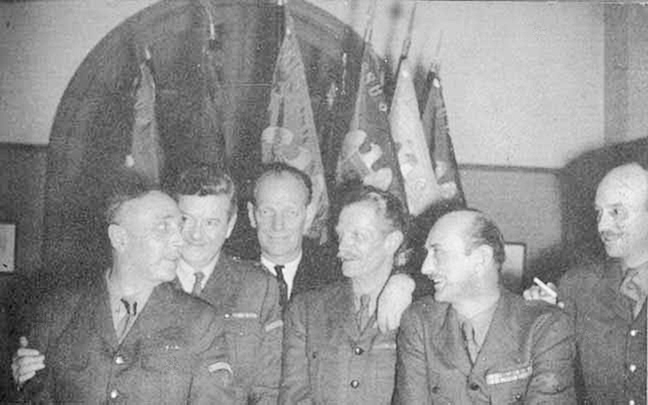
The 17 members of Section 1, who had sailed on 23 March from New York on the Manhattan, reached Paris by way of Genoa on 3 April and joined the 18 who had already volunteered in Europe or who, for a variety of personal reasons, had already come from the United States. The Paris office by 1 November 1939 had already received the serious applications of 35 volunteers, though not all of the men were still around in April. Peter Upton Muir, then living in Europe, had first volunteered in early October, later joined the Iroquois group in order to get into action sooner, and finally (on the disbandment of the Iroquois) again offered his services to the AFS. William H. Wallace, Jr., had come to Paris in January to supervise the building of the ambulance bodies. J. W. Brant, after working on the same problem at the General Motors plant, had sailed in mid-February to assist Mr. Wallace and to help C. A. Weekes with the spare-parts pool. Stuart Benson, sculptor and painter, had come from New York in February and worked with P. U. Muir on publicity during the formation of the first section. Early in February, G. F. J. King had come from London to Paris in order to volunteer, recommended by the AFS representative in England, Robert H. Hutchinson, whose son Bertrand also joined the Section. The others had come from their jobs or their schools in different parts of Europe and had already been installed on 1 April in a wing of the United States House of the Cité Universitaire, 15 Boulevard Jourdan, which had been granted rent-free to the AFS through the kindness of Mrs. Homer Gage.
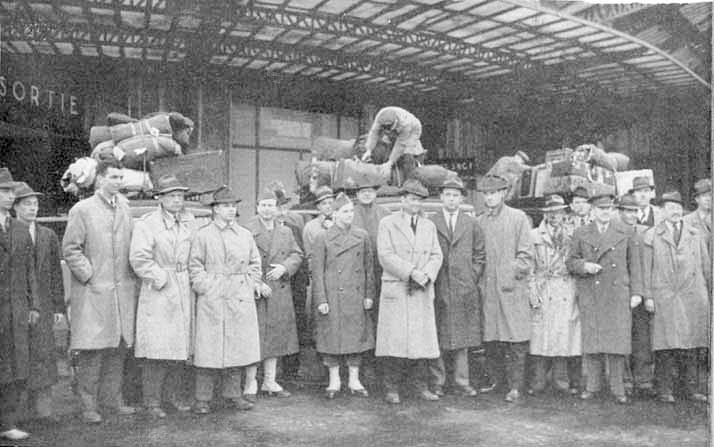
The men fresh from America were met at the station at 9 A.M. on 3 April by French and American dignitaries, somewhat outnumbered by industrious representatives of the press and the newsreels. After breakfast at the Cité Universitaire, there was more posturing for the public eye, as harassed Mr. Hill found time to write the next day:
"Dreadful scene after breakfast yesterday at 10:30 A.M.: Fox Movietones taken of the men with myself giving them two sentences of welcome in French and in English, long distance, close up, upside down, etc. The photography ended last night at the Cité at about 10 P.M. More of it scheduled for today, all perfectly dreadful, but I suppose unavoidable."
Dreadful it may have been, but the result was a bumper crop of verbal bouquets from many papers of France and its colonies: Paris-Soir, Le Temps, Le Figaro, Le Matin, and Le Journal among others. L'Intransigeant, for example, headed a front-page story "L'Histoire se répète" and carried as a subheading "Aucun Français n'a oublié le dévouement de l'admirable équipe de la Grande Guerre." And all this enthusiasm provoked letters from private individuals.
"Si vous êtes celui qui commandait la Section Sanitaire Américaine chargée du service de la 129 Division pendant les affaires du 23 juin 1916 à Verdun," wrote M. Guibal, former Médecin-Chef of the 129 to Mr. Hill, "dîtes-le-moi, dîtes-moi où je pourrais vous rencontrer pour vous remercier encore de tout ce que vous avez fait pour nous pendant la guerre précédante. Vous ne pouvez vous figurer quel souvenir ému j'ai conservé de vous."
And the Vicomte de Montozon-Bachet, who had traveled much in the United States and apparently had liked what he saw, wrote to the section in general: "je désire beaucoup vous connaître, vous être agréable et utile, et vous prouver toute ma bien vive sympathie française."
But the ambulances were still far from ready and there was not very much for the Section to do while they waited. Uniforms had to be ordered from Lloyds, the tailor who had costumed General Pershing as well as the AFS in the earlier war and who was almost as slow as the "carrossiers." Paris quarreled with New York over their respective notions of the equipment it was necessary for the volunteers to bring. Paris held out for a bare minimum. "The pyjamas," Mr. Hill had already written, "made me think that a dressing gown had, perhaps, been overlooked." And now he wrote that "two pairs of pyjamas are, of course, utterly superfluous for the front, at least so I believe."
More important, the steel casques, the gas masks, and other necessary items had to be requisitioned from the army supply depots. There was orderly duty around the Cité (directed by LeClair Smith), help when possible with the ambulance construction, and trips to the American Hospital for inoculations.
"This situation presents a dreadful transportation problem," Mr. Hill wrote, "with the men at the antipodes at the Cité, the offices here, one 'carrossier' at Boulogne, another at St. Ouen, General Motors at Gennevilliers, marketing at the 'halles centrales,' and the American Hospital at Neuilly."
Even with all this traveling around, there was relief and a sense of the beginning of accomplishment when the promulgation of the "instruction" had finally constituted the Section as a formal unit with administrative standing, attached to 19 Train of the French Tenth Army. On 20 April, Peter Muir was designated "Chef de Section," with rank equivalent to lieutenant, and Donald Q. Coster became "Sous-Chef," more or less a second-lieutenant. On 23 April the French assigned Lt. Couture to command the unit, although in point of fact his duties were more in the nature of liaison---the transmittal of instructions from the French to the Section's American leaders, who in turn passed them on to the volunteers. The sleek ambulances, as they were finished a couple at a time, were parked behind United States House at the Cité. A light drill was instituted by Lt. Couture, and there was practice at driving and loading and unloading the ambulances. As the preparation of the Section neared completion, a very formal ceremony was planned for 21 May in the Court of Honor of the Invalides, to be attended by the highest French and American dignitaries, following which Section I was scheduled to go into action.
After the invasion of Poland in September 1939, Germany had drawn its forces to the Westwall, the Allies had mounted the Maginot Line, and there they had sat, engaged in a static war that seemed more like an endurance contest---the so-called "phony war." The Belgians had reinforced their line, which paralleled the Meuse as far as Liege and then followed the Albert Canal; and the Netherlands had planned its defenses on the waterways that could flood entire sections of the country to stop the advance of an enemy. Unfortunately there was no link joining them.
Then on 9 April 1940 the German machine had moved again, occupying Denmark in the morning and starting its invasion of Norway. Still the French had continued in the fond hope that they were safe behind their Maginot Line. The writing on the wall became clear, however, when on 10 May it was announced that Belgium and the Netherlands would be taken into "protective custody." Although the French Ninth Army rushed north from Sedan to head off the German army, by 14 May most of the Dutch troops in the north had surrendered, the Germans had penetrated and turned the Meuse-Albert line, the French Ninth Army had been defeated, and German troops had entered France through the Ardennes, crossing the Maginot Line extension just west of Sedan. The British Expeditionary Force soon found the secondary Louvain-Malines line untenable and fell back, and the Germans entered Brussels and Antwerp in quick succession on 17 and 18 May. This allowed the Germans next to extend a thin salient down the Somme Valley, where the French hoped to hold them with more reinforcements hastily brought up from the south.
On 11 May the Field Service requested that the ceremony at the Invalides be called off, and orders were issued to get the Section to the front as soon as possible. The last cars were hurriedly painted at the Cité by members of the Section, and by the night of the 17th all was ready. Section I was given a farewell party, at which Colonel Richard Mallet, who in 1917 had headed the Franco-American Transport-Matériel Service (also known as the Reserve Mallet), thanked the unit on behalf of the French nation. "After that," Peter Muir wrote, "we relaxed and enjoyed ourselves until much too late into the night."
The next morning the 20 ambulances, a staff car, two repair trucks, and a huge kitchen trailer were lined up ready to go. The section drove from the Cité along the empty streets to the Porte d'Orléans, across the Seine, and up the Champs Elysées to the Place de l'Etoile, where at 7:30 the cars parked around the circular curb. Representatives of the French army and government and the AFS headquarters staff stood at attention with the American Field Service Section I for a moment of silence by the Tomb of the Unknown Soldier. After this simple ceremony the drivers returned to their cars, circled the Etoile, and drove down the Avenue Wagram, the Boulevard Berthier, and were off on the road to Beauvais, 60 kilometers north.
The cool morning air was refreshing to many feverish heads, half-regretful of the night before.
"We traveled the long winding road from St. Denis through Pontoise and Méru," wrote Alexander McElwain. "A few loitering people in the streets of small towns gazed with astonishment at our long column of American ambulances, each flying a Red Cross flag at its driver's seat; each trim, gray, and smartly turned out. Anxious faces of passers-by slowly smiled. In towns where evidence of the German planes was clear, they waved to us."
"Just at the outskirts of Beauvais, we stopped for lunch," A. G. Johnson recorded. "It seemed rather curious that, if we were beading for Mons in Belgium, we certainly were not trying to make any time. Usually the run Paris-Beauvais is pretty short, and here we were, having left Paris early in the morning, settling down to lunch without even being in Beauvais yet. It was then that we first got the feeling that followed us without leaving us a single day that every second of the day or night we never knew what the next step would be. We had to be on the 'qui vive' all the time and must expect anything at any time. There was never really any time when we were told that we could have an hour to go into the town, for instance. It was always: Well, I suppose there'll be nothing doing, but come right back if things look as if there's something doing. Never was there a feeling of certainty about anything. That would have been all right if it had simply been an individual thing, but it went further than that. I felt all along that the bosses never knew exactly what their next move would be, and we very seldom obtained any concise orders from the French. It is not a very reassuring feeling. . . .
"However, none of this bothered us very much then. Our main thought was food and what the French army food was going to be like. . . . We were issued some vile pinard, and also a whole loaf of bread, one can of sardines and one can of pâté de foie gras. Sat on the grass. The sun came out. The radio was going. A perfect picnic."
Car No. 2, driven by P. V. C. Moore and G. R. Folds, had carburetor trouble and, after being repaired by C. A. Weekes, started to return to its place in convoy.
"A fearful moment passed," Muir later wrote, "as the ambulance swung from one side of the road to the other, turned completely around and over on its side. . . . As I ran back, the driver and his aid climbed out through the door, badly shaken but apparently not seriously injured. Folds was moaning slightly, and I asked him where he was hurt. 'It isn't me,' he said. 'I'm just thinking what's happened to the four bottles of fine old brandy I stored in the back of the car.' A hasty examination reassured him that they were intact, and he smiled again. . . . Moore's hand was bleeding quite a lot, and I sent him along to Beauvais in the staff car to have it bandaged at a military hospital."
In Beauvais the Section was attached to the Hôpital d'Observation et d'Evacuation (HOE) 2, and it was given for headquarters an empty château at 13 rue du Bois. Odd jobs filled the rest of the day. The house had to be arranged for living, which meant finding or building benches and tables for the mess as well as setting up sleeping facilities such as cots or mattresses. In order to get the kitchen trailer off the street, the arch joining the gateposts had to be removed. Then some helped load French ambulances at the Hôpital Jean Hachette next door, their first contact with wounded, and worked until dusk. Others went to watch the refugees streaming through Beauvais. Using every means of locomotion, their faces grimly set, the refugees from the north were a factor of the war as yet hardly suspected in Paris, a pitiful sight to be met with on all of the major roads until the end of hostilities. The weary Section retired early, only to be kept awake by a series of "alertes" through most of the night.
On Sunday, 19 May, the Section replaced the exhausted French stretcher-bearers at the hospital next door, working all afternoon until at 6 the hospital was empty. In the evening orders were received for 4 cars (J. Thoresen and W. G. Nickerson, McElwain and J. Winslow, J. Clement, and C. Stehlin, with Lt. Couture) to go to Montdidier. All the rest were to go 26 kilometers north to Cempuis at 8 P.M., except for the 2 cars run by Coster, King, and H. G. Wait, who were to wait in Beauvais for later calls. Near midnight the larger group arrived in the village of Cempuis, just cast of Grandvilliers, where an orderly led them up a hill into a field next to woods by which the cars could be hidden. The men were scarcely settled for the night before Muir blew three short, sharp blasts on his whistle, the signal for them to assemble, and relayed the order for all cars to pick up wounded in Amiens immediately and to take as many as possible back to No. 3 Hospital in Beauvais. The 2 cars left in Beauvais had also been ordered to Amiens. No more than 15 minutes later, the cars were under way.
Meanwhile the 4 cars had arrived in a deserted and barricaded Montdidier. Told that the French troops had already left and that the Germans were just outside the city, they loaded quickly and returned to Beauvais. There at a little past 11, they discharged their patients at the station, for transshipment by hospital train to a region of greater safety. Then Lt. Couture brought orders for them to leave for Amiens, which had been set ablaze by a terrific bombing and was even then being entered by German troops.
"We drove by night without lights," McElwain wrote of this trip. "The blackness was so intense on thickly wooded roads that the flash of a lighted match ruined our vision into the night. We drove by the contrast in the shades of darkness in the shadows ahead. . . . An ever rising pillar of darkness indicated to our left the endless line of refugees in wagons and afoot who traveled by night as well as by day. We had faith in them. They kept their column so straight and narrow that we could pass at night without lights and injure no one. They were silent as the night. . . . We had seen so many miles of refugees by day that we knew exactly how they traveled and how much space to allow in passing them in the night."
"A light appeared along the horizon ahead of us. It wasn't sunrise, because the east was not there. And besides, the morning was still some hours off. The night grew brighter as we approached," Stuart Benson later wrote. "Enormous flames pierced the billowing black clouds of smoke. . . . Our street turned into a gantlet of flame after a few blocks. 'Each corner we passed showed new chasms of fire to right and left. No trouble driving without lights now. Buildings were blazing on either side. One of them, probably a factory, some hundred feet wide and six stories high, was nothing but a roaring core of white flames behind steel shutters that the outer shell somehow or other kept intact.
"A musical tinkle sounded under my tires. My heart skipped a beat. I thought something had gone wrong with the car. But it was only the tangle of fallen electric wires on the pavement. Thank God! This was no time for a breakdown. We expected every moment to see the walls topple on us, and we were going like hell. But not too fast, for one gutted building crashed into the road about 20 seconds after our dear white elephant, the kitchen trailer, had passed the spot.
"We arrived at a sort of square. There was no one to ask directions. There was no movement but the dancing shadows of our ambulances. Only empty streets guarded by crumbling facades, gaping doorways, and shattered windows. We were lost. . . . Muir was about to continue straight ahead. But before he gave the signal a French ambulance dashed up and a French nurse descended, blue cape and white coif, calm and efficient in all that chaos. She had been looking for us. She led us down a street that ran back at an acute angle, luckily for us, though we didn't know it at the time. (We found out later that the German advance tanks had already arrived in the other end of the city and were then but a few hundred yards away, in the direction in which we had been headed.) "
The main convoy loaded its cars to capacity, even the kitchen trailer (attached to Weekes' truck) taking 30 women and children, and left Amiens as the German planes returned to bomb that part of the city they had not already captured. just as the bombardment began, the 4 ambulances that had already been to Montdidier reached Amiens. One wing of the Nouvel Hôpital was hit, rocking the whole building until it seemed about to collapse. And again as the 4 drove off, leaving many patients they had not room to carry, another wave of bombers came into view.
On their way south, they passed the two cars from Beauvais, driven by Coster and King, going back to Amiens for a second load of patients. H. G. Wait (who had been left in Beauvais but had gone to Amiens with the French Lieutenant) and J. Clement joined them, to lend a hand with the loading. No one in Section I saw the four again for many weeks, nor did they learn what had happened to them. Unable to reach the Nouvel Hôpital because of the condition of the streets, they returned to the Châteaudun hospital, from which they had evacuated their earlier loads. The air bombardment that began as they arrived was so intense that they went with the hospital staff into the shelter. During the bombardment, Clement beard that a woman had been wounded down the road and went to get her. After waiting some time for his return, King went to look for him. He returned when he heard machine-gun fire down the road, and a few minutes later the Germans had taken the hospital. Clement had driven his car right into their oncoming column.
When the main group had returned to Beauvais, the Colonel in charge ordered them to return to Amiens. As Peter Muir later wrote to Mr. Hill: "We were ready to go, and, had he not changed his mind at the last moment, Section I of the American Field Service would probably have gone down in history as the Lost Section."
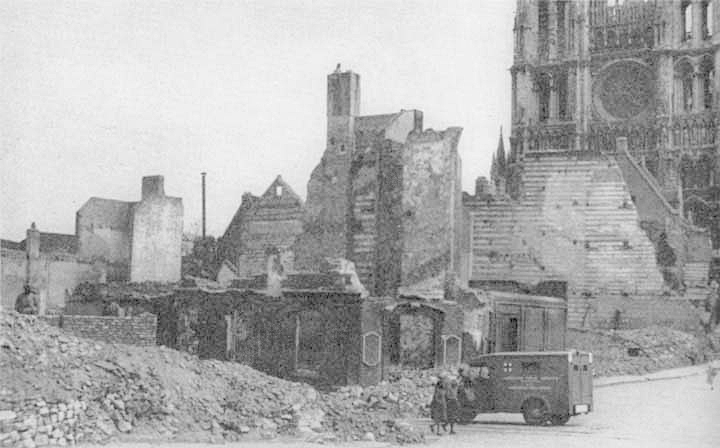
As the morning passed, it became apparent that Clement, Coster, King, and Wait could no longer be considered "slow" in returning. Muir drove north in an attempt to find some trace of them, but on each of his trips the French turned him back from the smoldering ruins of Amiens, where only the cathedral seemed to have escaped either bombs or flames.
After a few hours of rest, a convoy went northwest to Crèvecoeur. It was being bombed as they approached, and they watched as they stood under the apple trees beside the road. No sooner had they arrived at the hospital than they saw the German planes come back, and, as their cars were not yet loaded, they drove at full speed out of town on the road to the west, just ahead of the bombers. When the sky was clear again, Muir counted noses and radiator caps, discovered that Erwin Watts was missing, and went to look for him. Watts had stopped in a shop on a side street in the town. When Muir found him, he later wrote, "he was covered with dust and dirt . . . but outwardly was unhurt. A wall had fallen on his back as he was trying to protect a woman and her two children. It had partially buried them. By luck it was a flimsy wall and he had been able to get them out safe. He himself had a strained back, which forced him, against his will, to have a couple of days of medical treatment."
That evening the Section settled itself in a field opposite the Caserne Agel, a barracks which had been transformed into a hospital. Agel, a suburb of Beauvais, was on a hill overlooking the town and about 10 minutes' walk from it. On the 21st, they carried wounded from Agel and the Jeanne Hachette hospital and evacuated the old and infirm from the Hotel Dieu to the railroad station in Beauvais until after midnight, some men working as late as 5 in the morning. Shortly after the Red Cross train had left, later that morning, the city received a bombing which narrowly missed the station.
Muir appointed H. B. Willis as Sous-Chef, to replace the missing Coster. During the day several cars drove to Crèvecoeur, which was again bombarded. That night it rained and the cars had to be moved early the next morning from the field of soggy mud into the shelter of some open sheds on a near-by farm, which also had a hay-shed large enough to be used as office and sleeping quarters for the section. During the move, Stuart Benson wrote, "the kitchen trailer was pretty badly stuck and a lot of us got out and pushed. Hamlin was knocked over into a ditch and broke 6 bones in his foot. . . . McElwain took him to the American Hospital in Paris. He also took along Folds and Moore. The only silver lining to the rain cloud was that there were no Boche planes in the air for the following 24 hours."
On 19 May 1940, Premier Paul Reynaud had replaced General Maurice Gustave Gamelin as Chief of Staff by General Maxime Weygand, who had been called back from his post in Syria. Weygand initiated a more aggressive war policy, moving troops north from their Maginot positions to form an offensive force along the Somme. On the 20th and 21st he made a tour of inspection by plane, conferring with all field commanders.
After the 22nd, French tanks and troops were more frequently seen moving forward. The AFS section remained at Agel, taking wounded from hospitals to the railroad station for evacuation by hospital train and making trips forward to bring wounded to Beauvais. There were runs to Crèvecoeur, Conti, and Breteuil, as well as to Méru, Pont St. Maxence, Senlis, Compiègne, and Paris. In addition, there were details to front-line Postes de Secours at Rumigny and Sains-en-Amienois, among others, evacuating via Essertaux.
"Fairly messy work and very smelly," wrote J. S. R. James. "In the last week I have had only two nights' sleep and some odd cat-naps. . . . All the driving is done at night with no lights."
Between runs the most important activity was the foraging for whatever items could be found that might improve the Section's standard of living. Nerves tense from lack of sleep and the horror of what was happening were steadied by games of baseball, by contests in the growing of beards, and by a general tomfoolery limited only by the ingenuity of the members.
"Night after night, and all through the night, during this period we carried wounded-mostly soldiers from the Agel hospital to the Beauvais station. At first we left them in the freight shed, but later we loaded directly on the trains. We were a continuous stream of ambulances going back and forth, dark shadows passing and repassing other dark shadows, until daylight. It wasn't cheery work at its best, but the heartbreaking climax was to get down to the station, wait an hour or so, only to find that the train was full and then have to carry the poor suffering devils back to the hospital again. It seemed to us a needless cruelty, which might have been obviated by a little more foresight on the part of the hospital authorities; but I suppose it couldn't be helped, as by that time all organization had pretty well gone by the boards. . . . The intensity of the work at this period may be gauged by the fact that the Section evacuated over ten thousand cases in the first 20 days of action."
So wrote Stuart Benson of those weeks.
Peter Muir reported that Benson wanted to tell him something between runs one day.
"Very important, a sort of confession which he had to make to ease his conscience. . . . I knew he had been a major in the American army during the last war, and that for his service he wore on his chest ribbons of the Legion of Honor, the Croix de l'Etoile Noire, and the Croix de Guerre. And I had always thought him very young-looking and active for a man of fifty-three, which was the age noted on his application paper. Arm in arm we walked into a vacant field, and he began his confession. 'Pete, I've lied! This rather brutal statement startled me, and I waited for him to go on. 'I lied about my age to get into this damned thing. Luckily I didn't have to show my passport or birth certificate, but I've been scared to death somebody would find out. I pulled ten years off my age! This dumbfounded me and I stuttered. 'You-you mean-you're-' 'Yes,' he cut in, 'I'm sixty-three years old.' When I finally grasped the fact that he was telling the truth, I laughed and laughed. He had looked so sheepish, almost like a school child about to face punishment for a misdemeanor, when he told me this; and I thought it was one of the swellest things I had heard in my whole life. . . . I think he was surprised that I was not angry."
Toward the end of May, the French ordered that the red crosses on the ambulances be painted over, because the Germans appeared to find them especially fine targets. Already some had been unofficially covered with manure, but in the early summer heat the paint was an improvement. Then, as a result of the deaths of several patients when the leather straps upholding the stretchers had broken, the cars thus equipped in the French manner were sent back to Paris one at a time to have the AFS metal stretcher-support installed. At the same time, men intended for Section II were arriving in Paris, and some of them were sent out to make up the First Section's serious depletion from sickness, accident, and capture.
On the evening of 6 June, Stuart Benson returned from Paris to Beauvais with a French cinema unit, planning to do a documentary film of the Section's work. In addition he brought as a replacement Robert Montgomery, the actor, driving a new ambulance. Quentin Reynolds and Kenneth Downs, reporters looking for stories, came with them. Because of army regulations, the camera crew and the writers had to leave the next morning.(1) Montgomery stayed on until later in the month, when prior commitments forced him to return to the States.
"Some of the boys wondered if a movie actor could 'take it,'" H. B. Willis wrote. "We sent him on some mean jobs, and for his coolness and good work during bombings and machine-gunnings we came to consider him one of our most dependable men."
The Allied armies, massed south of the Somme between Amiens and Péronne, were scheduled to attack in the last week of May. However, the British in Flanders, unable to push through the tightening German net to join the French, had started to evacuate from Dunkirk on 26 May. King Leopold of Belgium had capitulated on 27 May. The Dunkirk operation, which rescued three-quarters of the Allied armies in Flanders, was completed on 4 June. The Allied forces in France, thus depleted and demoralized, were unable to launch the counterattack, and on 5 June the German army began a big push to the west, which General Weygand named the Battle of France. Attacking the weak points of the French line, the Germans soon crossed the Aisne, passing Roye on the Avre and Noyon on the Oise, their goal apparently being not the classic capture of Paris but rather the destruction of the armies in the field. On 8 June there was a general withdrawal by the French forces, from the sea as far east as the Chemin-des-Dames.
Early in June, the Stuttgart radio had announced the complete destruction of Beauvais as part of the German plan, and between the 5th and 8th the city was the target of increasingly intense air bombardment.
Systematically the planes flew over in groups of 80 and more, dropping their silvery bombs on the ancient city.
"As the screams of the bombs started," H. B. Willis wrote in his impression of these days, "we all threw ourselves face down. Even so, the concussion of some of the closer ones shook us to the vitals. After what seemed an age, the explosions stopped and the bombing squadrons disappeared.
"We leaped into our cars and started into town. Around the first bend, we found a house that had received a direct hit. The entire structure had crumbled into the cellar, a mass of bricks and beams. Faint cries could be heard from under the pile. With bare fingers we tore at the broken mass of masonry. Suddenly a hand appeared, clutching wildly. We increased our efforts and a face appeared, cut and covered with blood but with the mouth shouting. Then it disappeared again under a landslide of bricks and mortar. Finally we uncovered the shoulders; we tugged and pulled and out came a French soldier, very lucky to be uninjured except for face cuts. A second soldier we unburied, upside down and very dead. One more man we found alive, cut but apparently not badly hurt. He was a big strong fellow, and as we worked to extricate him he helped to lift the debris away from his own body to uncover the drooping grimy forms of his wife and two daughters, all dead. . . .
"We continued around town. Fifteen women and children had taken shelter in one of the great vaulted cellars under Beauvais, all to be crushed together when the masonry collapsed under a direct hit. . . . We looked through ruins for wounded, leaving the dead where they lay. A man, paralyzed from the waist down, sat screaming on his kitchen floor. The side of his house had been blown away without scratching him. . . . At last every street had been run, every call answered , and bloody, tired, and dirty we motored up the bill again to our camp. . .
"Some incidents of those terrible last days of Beauvais were less grim, even if they also had their tragic side. One afternoon two of our men went to a village in the forward danger zone; there they were given a well-dressed woman to take to the rear. She did not seem to have much the matter with her. The French said 'piquée.' What did that mean? Halfway to Beauvais there was a great pounding inside the car. The boys opened the slide behind the driver's seat to discover that their passenger had stripped. Red-faced, they slammed the slide shut. On arrival, she stepped out completely dressed again but as loony as when she had entered."
During the raids of these few last days in Beauvais, the hospitals and the station all received direct hits, and the château where the Section had first stayed was razed. Civilians were officially evacuated on the 6th, and by the 8th Beauvais was little more than a smoldering ruin.
On 7 June, the Section was attached to the Groupe d'Ambulances de Corps d'Armée (GACA) of 10 Army Corps, and at 4:30 on the morning of the 8th it received orders to fall back to Corbeil-Cerf, some 20 kilometers south on the road to Méru, leaving 6 cars behind to take care of any wounded who might be brought into the city later. Ambulances were to be packed up with as many of the patients and staff of Agel as was possible.
The morning was cloudy and the work progressed slowly. However, around eleven the clouds lifted, Muir wrote,
"and almost at the same time the sound of airplane motors, quantities of them, came to our ears. Then there was a terrifying scream of sirens, followed by machine-gun bursts and bomb explosions. They were the Stukas-the dreaded dive bombers! Down they came, full speed ahead, sirens shrieking, machine-guns rattling, one after another, and dropped their bombs. Then down again and again, with only the machine-guns and sirens, until we were so covered with dust and smoke that they could see us no longer. . . . As soon as the dust and smoke were blown off by the fresh breeze, two observation planes passed back and forth to see what damage had been done. . . . A lone machine-gunner was potting at them from down the road, and his aim was good. One of them crashed over a near-by hill, sending up a column of black smoke.
"Yet the dive-bombing of the Stukas was far less terrifying, in my opinion, than the rain of death and destruction let loose by the giant bombers flying along so calmly . . . above and beyond the range of antiaircraft guns. . . . The scream, prolonged and agonizing, of hundreds of bombs coming down from such a height is the most horrible sensation I know."
After the dive-bombing, the loading of the ambulances went more quickly, and the Section arrived in Corbeil-Cerf in the early afternoon. On 9 June the Section was ordered to withdraw across the Oise to Bouffémont, 14 miles north of Paris. The big chase was on. Several cars had left earlier in the morning on runs, and the new orders raised a problem of liaison that would last as long as the retreat. Muir stayed at Corbeil-Cerf in order to direct the drivers, as they returned, to the new base. However, when he finally reached Bouffémont himself he learned that the Section had been ordered to go on to a point between Enghien-les-Bains and Montmorency, only 7 miles outside of Paris, where it stayed 3 days "en repos."
Even to speak of the Section is misleading, as during the retreat it was hardly ever able to operate as a unit. During the day a number of cars would go off on different details in different directions, sometimes passing the morning's base on the way to the night's resting place. The repair and petrol truck stuck close to the headquarters of 10 Corps d'Armée (except at Houdan, when it was temporarily lost), and formed the focal point of the group of constantly moving ambulances, leaving Chef de Section Muir to do his best to keep such Section-members as he could find informed of the many complicated plans and changes of plan. The shouts of the drivers as they passed each other on the road did the rest.
On 10 June, Italy, after declaring war on France and England, invaded southern France. The Germans launched a full-scale attack on the French positions along the Oise, and the fighting was heavy. On the 11th, the ambulances of the AFS Section were divided into two groups, which joined their formations early the next morning to do front-line work with regimental Postes de Secours: 10 under Muir to the Groupe Sanitaire Divisionnaire (GSD) of 14 Division at Presles; the others under Willis, with Lt. Couture, to join the GSD of 13 Division at Isle Adam. Pairs of cars were then sent farther forward to battalion Postes de Secours at such places as Beaumont, St. Martin du Tertre, and Monsoult.
C. C. Curtis wrote of this:
"Jimmy [Worden] and I were sent up to the one at St. Martin, and getting there were told that there were some wounded up in a wood and given a guide to take us there. We drove several kilometers beyond the Poste de Secours with our guide, who was a "tirailleur tunisien," turned off down a lane leading through a wood for a mile or so, and came to a place where the lane dwindled off into a mere track. . . . Our guide told us we were to wait here and the wounded would be brought up. He stayed with us. The French artillery were firing over our beads, and German artillery fire could be heard in the distance. But occasionally we heard the peculiar whine of a shell falling near by, which our guide explained was caused by French shells that were faultily constructed and had not power enough to carry their full distance. . . . We waited a full hour, and then our guide set out to where the wounded were supposed to be brought on stretchers from, to find out what was the matter. He came back after a while to say there must have been some mistake---they had already been taken by another ambulance.
"So we returned to the Poste de Secours at St. Martin and found there were indeed some wounded there now, whom we took to Ecouen. In the afternoon we were sent to the other first-aid post, at Presles, picked up some 'blessés,' took them back to Ecouen, and returned to Presles again. Presles was getting pretty intensive bombardment at this time."
Around midnight the order came to fall back. The whole line was moving again, and the roads were so blocked that it took Curtis and Worden until well after dawn to reach the Caserne Coloniale in St. Denis, where they found the rest of the Section.
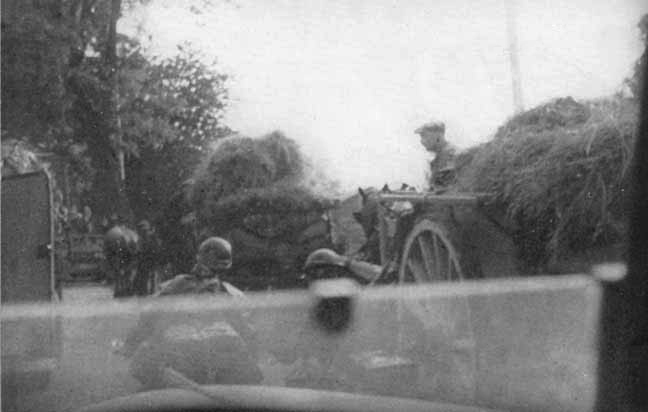
Working constantly, snatching a few hours of sleep whenever possible, the Section followed the southwestward march of the French army, never more than a little ahead of the German troops. Evacuations of 200 kilometers were not unusual, as overcrowded hospitals often had to refuse to admit any more patients. Most driving was done at night, along roads crowded with refugees as well as troops, and probably no two cars made the whole trip over exactly the same roads. Briefly reunited west of Versailles at Houdan on 13 June, the Section reassembled on the 15th for a couple of days south of Pontlevoy at a farm near the forest of Choussy. W.G. Nickerson, however, was missing both times and did not find the Section again until 3 July. On a run on 13 June to the Hôpital Militaire Dominique Larrey at Versailles, he had been asked by the Médecin-Chef to help evacuate the hospital's wounded to the Versailles-Chantiers station. After that he had agreed to accompany the hospital unit on a route that led it to Vichy, Clermont-Ferrand, Le Puy, and finally to Cauterets (Hautes Pyrénées), whence he set out to find the Section.
Early on the morning of Monday, 17 June, four cars with McElwain, F. N. Rich, Stehlin, and Thoresen were sent from Choussy on detail to a division north of the Loire. Later in the morning the rest of the Section gathered around A. G. Johnson's portable radio to listen to Marshal Henri Philippe Pétain, who had replaced Reynaud as premier the day before, ask the Germans for an armistice. At lunch it was rumored that the Germans had reached the Loire, and in midafternoon Muir and H. de Belle went off to look for the four ambulances that were still missing, and might have been captured, north of the Loire. Driving fast in the staff car, they rounded a corner and found themselves facing 5 machine-guns and an antitank gun manned by German storm-troopers. A few shots were fired in their direction, and they got out and surrendered, exchanging their staff car for seats in motorcycle sidecars. After being twice interrogated on the way, they spent the night in a prisoner compound on the airfield 12 kilometers south of Etampes.
The next morning they were marched north with a column of prisoners, stopping for food and rest on the north side of Etampes. Then, Muir later wrote,
"bolstered by food and drink and the kind words of the refugees, I felt better. . . . The old guard was leaving. I watched carefully and noted that no particular instructions were given about us to the new guard. Here was our chance. . . . We moved across the road from the column, climbed onto the sill of an open window, lit fresh cigarettes, and sat there swinging our legs as unconcernedly as though we were watching a circus parade. . . .
"We watched the old guard march solemnly down the road and disappear around a bend in the direction of the prison camp where we had spent such an uncomfortable night. The sergeant of the new guard ordered the column to fall in, preparatory to continuing the route. He saw us sitting on the sill and yelled 'Hey, you two, fall in. Who do you think you are?" I took a long drag on my cigarette and eyed him from bead to foot. . . . Then I blew out the smoke slowly, flicked my cigarette across the road, cleared my throat, and answered the sergeant. 'If you will show more respect for an officer and come over here, I shall be glad to tell you who we are! My tone surprised him. It surprised me, too. I had sounded almost as arrogant as a Prussian captain. He came over, not knowing whether to be angry or to keep his place as my inferior in rank. I returned his salute in a leisurely manner. 'We are,' I began, and felt De Belle stiffen at my side. He did not understand German, but his training had been in the theatre and by instinct he knew that we were reaching a climax. 'We are not in your prison column, and have never been prisoners. It just happens that we are here waiting for a car to take us to Paris. One of your officers promised it to us some time ago. He seems to have disappeared. We are American doctors and have received an urgent call from our ambassador, saying that we are needed in Paris. Can you find the officer who promised us the car? He was a tall, well-built, blond fellow, with saber scars from duelling across his left cheek! The description was a facile invention and might have fitted half the officers in the German army.
" 'May I see your passports?' The sergeant was definitely softening. But I lived through a very nasty moment while he examined mine from cover to cover. In it was clearly written: 'Occupation-journalist avid photographer.' The two words are uncomfortably similar in English and German. Luck, as usual, was with me, and he did not notice this. 'I have not time,' he said, returning the passports, 'to find the officer you speak of, Herr Oberleutnant; but if you two gentlemen will walk along with me I shall stop the first car going toward Paris in which there is room! "Even before the column moved off, a French ambulance, driven by a German, came along the road heading for Paris. The sergeant hailed it and ordered the driver to take us in. . . . My cock-and-bull story had been so outrageously simple that it worked."
In Paris they found civilian clothes and were able to work for the American Hospital until the Armistice on the 27nd, after which, with a pass from the Germans, they were able to rejoin the Section.
In the meantime, it had become obvious to the Section that Muir must have been captured. H. B. Willis took command, naming D.C. Burton his Sous-Chef. On 18 June the Section moved to Mantbelan, south of Tours, where the kitchen trailer had finally to be abandoned. On the 20th, the Section moved southwest to Leigne, and in the following days it continued generally southwest-although, as usual, there were many sidetrips---through Usseau, Montoiron, Bonneuil-Matour (21 June), St. Georges, Charmant, and finally on 25 June Ségalas (not far from Castillones, southeast of Bergerac).
During this hectic period, the Section came to have less work with the wounded and more transporting stranded French medical personnel, whose old cars had gone to pieces or had stopped for lack of gasoline. The rapid German advance continued, and frequently the enemy were too close for comfort. Willis and H.W. Fuller, when they drove to Sainte to cable news of the Section to Mr. Galatti, drove away from the town square just as the Germans entered it. After sneaking out of town by the back streets, they had to cross the Charente in full view of an enemy column.
On 22 June 1940, however, the Franco-German armistice had been signed at Compiègne, and hostilities ceased on the 25th, after a separate negotiation between France and Italy had been concluded. By the terms of the armistice, German troops were to occupy about three-fifths of France---everything north of a line running approximately from Geneva to Tours and west of a line drawn more or less from Tours south to St. Jean Pied de Port in the Pyrenees. The French government, which had been at Bordeaux, now moved to Vichy.
In the face of the German advance, Paris had been evacuated on 13 June. The AFS Headquarters had already begun its move to the south. Mr. Barber had spent the first week of June looking for quarters near Tours and finally was granted the use of an unoccupied house in Vouvray by Mme de Grailly. To it moved in installments between 11 and 13 June the Paris Headquarters staff and about 20 men, including replacements for Section I and a number of volunteers for the unrealized Section II.
The men destined for Section II had sailed from the United States in three groups during May and early June, this Section having been scheduled to leave for the front in the last week of June. The first contingent had reached Paris before its fall and had been assigned various jobs. Of this group, L. R. Ball (a member of SSU 9 at the age of 16) was made a member of Section I; and F. N. Rich (brother of D. W. and V. L. Rich of SSU 15) worked on special detail with the American Hospital in Paris, joining the Section when it passed through Paris on 13 June. Other members were sent out on special missions for the American Hospital, performing a variety of services---such as the trip of P. H. Jackson and A. H. Ransom to evacuate the hospital at Etretat, an excursion which would have resulted in their capture had they not been halted by the destruction of the bridge at Pont de l'Arche.
The second smaller group was led by R. S. Richmond (Cdt. Adjt. SSU 15-30), who with R. Perkins was destined for the Paris Headquarters. It included F. A. Foster, son of A. P. Foster (SSU 17), the first son of a veteran to join the revived organization. They had disembarked at Lisbon and made their way to Bordeaux and then Tours, with no sure idea of the whereabouts of AFS in the maelstrom of collapsing France. By chance in Tours they met Paul F. Ullman, who took them on to Vouvray. There on the 14th it was announced that, for reasons of health, Mr. Hill had asked Maurice Barber to relieve him of his duties as head of the American Field Service in France. That same day the last recruit to join the AFS in France (2) ---W. A. Rothermel---arrived by plane from England. In the confusion caused by the state of the war and compounded by shortages of food, accommodation, and transport, their presence was a mixed blessing. Yet, in the thought that they might be useful later on, they stayed to perform various missions around Vouvray where F. H. Blum reported they were first told they would "settle down . . . for a month."
The expected French defense of the Loire did not materialize, and as the, German troops continued to advance the Headquarters was ordered on the 16th to move to Gémozac (Charente Inférieure), southwest of Saintes. On the 21st it was sent on to Belin-Beliet, south of Bordeaux, where it was told not to stop but to continue southwest to St. Vincent de Paul, just east of Dax (Landes). On the 26th, Dax was occupied, and the AFS Headquarters moved southeast to Pau (Basses Pyrénées), where F. H. Prince III arranged for the Field Service the use of his grandfather's estate.
In spite of messages left with all civic and military officials as the Headquarters had moved, and in spite of frequent questioning of the proper military authorities, Headquarters was out of touch with the Section from the time it left Vouvray. While at Dax, Mr. Barber sent J. W. Brant and P. H. Jackson north to look for it in the area around Bordeaux. Near Poitiers they were noisily chased by a German staff car and tried to escape from it. When they had finally been overtaken and had stopped, the car disgorged Muir and De Belle. Given a permit to rejoin the Section, they had had their "salvaged" car collapse under them and were being given a lift by a German officer. Brant and Jackson took them back to Pau, and on the 28th set off for the Bayonne-Biarritz region to continue the search for the Section.
However, the Section found Headquarters first. Restless at the lack of work and nervous about being able to return to America, Watts on the 28th drove to Bordeaux, in occupied territory, where he was told by the United States Embassy that the frontier between France and Spain would be closed after 1 July. When this was repeated to Willis, he phoned General Liegeois, who gave permission for the Section to be released from its contract with 10 Corps d'Armée. As about half the men thought they should return to America, the Section set out for the frontier on the 29th and spent the night in a field between Biarritz and St. Jean de Luz. Next morning Burton drove to Pau, returning to the Section with Mr. Barber about noon.
McElwain, Rich, Stehlin, and Thoresen also arrived there that morning, having been missing since the 17th. What had at first seemed to them a simple and routine evacuation, as McElwain wrote of it, had developed into something else.
"At the large château at Herbault [between Blois and Chateau-Renault], we began loading children into our ambulances and were about to depart, when suddenly our orders were countermanded. We were then given orders to go to a point above Vendôme. But on arriving at Vendôme found that it had been badly bombed and we were warned to go no farther. We turned to go back to Tours to find the medical unit from which we had received orders. At Tours the bridge was closed. We continued to Langeais and crossed the Loire, continuing along the riverbank to Bléré, where we met the Corps Sanitaire of 1 Division. Amboise [less than 15 kilometers north across the Cher] had been taken by the Germans.
"The next day we joined the Corps Sanitaire of 2 Division of the retreating French army, which had its headquarters at Chateau la Tortinière, 9 kilometers out on the road to Montbazon from Tours. . . . On the 19th we were given orders to take wounded from the first-aid station on the château grounds to Poitiers, a round trip of about 700 kilometers. On the 20th . . . we moved camp to La Grande Maison, farther south, to continue the evacuation of wounded to Poitiers. Further moves of headquarters were soon made to Leugny, and then Le Pas des Champs and Gizay, from which wounded were transported to Ruffec. On the 25th we discovered that the Germans were trying to surround 2 Corps d'Armée. We constantly shifted, therefore, to Romagné, Nanteuil, Marthon, Nontron, Lanouaille, and on the 27th arrived at Cantillac, near Brantôme, where we evacuated wounded to Périgueux. We could not locate Section I in the confusion of the general retreat south."
The next afternoon, each of the four received from Colonel Bougrain of 2 Division Légère Mécanique of 2 Corps d'Armée, the citations and medals of the Croix de Guerre with the following text:
"détaché à la division au cours de la campagne de France, a fait preuve d'un dévouement absolu, d'un calme magnifique, a largement contribué à assurer le transport des blessés dans des conditions de rapidité remarquables, n'hésitant pas à se porter en avant du Poste de Secours Divisionnaire à la recherche des blessés. Avait auparavant participé aux Batailles d'Amiens, de Beauvais, de L'Oise et collaboré avec sa section à l'évacuation de dix milles blessés, donnant ainsi une preuve émouvante de son affection pour la France."
"On the 29th," McElwain continued, "we left the Corps Sanitaire at Cantillac and followed the road to Périgueux, Bergerac, Eymet, Lauzun, and finally Ségelas, where we found the abandoned ambulances of Section I in a field. The Section had left for Biarritz 5 hours before. We were stopped outside Biarritz by the Germans, but owing to Thoresen's knowledge of German we passed the lines without a permit. At Biarritz the next morning we ran on to Willis and Muir at the American Consulate."
That afternoon, the 30th, Mr. Barber led some of the Section's ambulances back to Pau, driven by those of Section I who were planning to stay on in France. The next day a car with drivers for the rest of the Section's ambulances took those of Section I returning to America to the International Bridge at Hendaye. All day was occupied with the red tape and formalities necessary before entering Spain, but the men spent the night of 1 July at Fuenterrabia. The next day they went by bus to Bilbao, where they had to stay until the last possible minute because of Portuguese regulations. Smaller groups from Headquarters and Section II joined them in Bilbao, until there was a unit of 28 men awaiting repatriation. Finally on the 9th they took the train to Lisbon, a 4-hour trip, boarded the Manhattan on arrival, and sailed for New York on the 11th.
The ambulances at Ségelas were brought to Pau on the 3rd; and on the 5th Mr. Barber, with Russell Perkins and some others, drove to Paris to see what disposition could be made of the AFS materiel. Mr. Richmond and Augustus van der Poel were left in charge at Pau. After passes and authorization to draw gasoline had been obtained from the Germans, they arranged to have the Headquarters and Section I vehicles driven to Paris---in two convoys because so few drivers had remained in France. By 2 August all the vehicles had been gathered together and were parked at the American Hospital in Neuilly.
Shortly after his return to Paris, Mr. Barber learned that D. Q. Coster was working for the American Hospital---the first news of any of the four lost at Amiens on 20 May beyond the French award to them of the Croix de Guerre-"posthumously." Coster reported that he had been in Paris since 1 July, having been released by the Germans on 14 June. He, with Clement, King, and Wait, had continued working with the sick and wounded at the Hôpital Nouvel in Amiens. As Americans and nonmilitary personnel, they had been accorded special treatment, and they had been able to obtain the release of the hospital's French medical staff that they might care for its French civilian and military patients. Summarizing their weeks of work, King wrote that "our activities included those of 'infirmier' and surgeon's assistant, anaesthetist, stretcherbearer, interpreter, midwife, grave-digger, and water-carrier."
Then, on 14 June M. and Mme Alfred Chambon had come to the hospital to check on the number and condition of the Belgian prisoners for the Belgian Red Cross. After a bit of discussion with the Kommandant of the hospital, the four Americans had been allowed to return to Brussels with the Chambons. There, Mr. Hallam Tuck most kindly offered the four the hospitality of his home, where they stayed for a much-needed rest. As soon as the opportunity presented itself, Coster had taken the chance of driving to Paris in an American diplomatic car, although the roads were still in poor shape and heavily patrolled. All four finally reached Lisbon on 30 July.
When Coster had arrived at the American Hospital, he had found F. P. Hamlin working there already, his crushed foot still in a cast.
"The second day after the occupation," Hamlin wrote, "I persuaded the Hospital to bring one of their ambulances up to the door and I got in and drove it around Paris. . . . I had the doctor put an iron strap on the bottom of the cast so that I could drive more easily. Then came the terrific appeals from the prison camps and the refugees on the roads. The Hospital had only two drivers, so I got up each day . . . and took food and water along the highways and distributed them among the refugees. Those who could not walk, like myself, I brought back to Paris. I used to cover about 200 kilometers a day. . . . Other days I went to the prison camps and helped the doctors and nurses with operations and changing dressings and running errands. I evidently did a bit too much, as blisters appeared inside my cast and back to bed I was sent. I emerged for a second time last week and started working in the usual way, when my arch started to fall, and I am up now again after a short Test period. . . . The Field Service is winding up and I am helping with it. They have given all of their equipment to the Red Cross, and I am at present [29 July] working for the Field Service, the Hospital, and the Red Cross."
The original purpose of the American Field Service had now ceased to exist. The disposition of the organization's materiel was arranged by Mr. Barber, with Mr. Galatti's approval. Everything was put at the disposal of the American Red Cross, to be used, directly or indirectly, for relief work, with the understanding that the AFS both could withdraw it at will and should be kept informed of its use. An oral agreement was reached to the effect that whenever possible the ambulances be used in conjunction with the program established by the American Hospital for the relief of the French in prisoner-of-war camps. The French military had readily permitted the cancellation of their contracts for the cars, as they had more sanitary equipment than they could man and thought that the American Red Cross would have a freer hand and could do more for their people in the ravaged north than they, the conquered, would be allowed to do. In the late autumn, when the work of the American Red Cross was terminated, the cars were given to the Secours National and were used to transport refugees and provisions. The AFS funds which could not be returned to the United States were turned over to the American Hospital of Paris, in September, for expenses in connection with French wounded being taken care of by that hospital.