|
Chapter 1 |
 |
|
The enemy is now attempting to break through... and drive
us from Egypt. GENERAL MONTGOMERY'S dispatch to the troops, |

AT PORT TEWFIK we were met aboard ship by Colonel Ralph Richmond of Boston, officer in charge of the entire American Field Service in the Middle East, accompanied by Major Stuart Benson, second in command, and Captain Dunbar Hinricks. The latter two had accompanied our 16th Volunteer Unit as far as Capetown, South Africa, and then had flown up ahead to Cairo. With them were desert veterans of Auchinleck's Push, Captain Andrew Geer, AFS, in charge of a company in the field, Lieutenant Art Howe, AFS, and Lieutenant Daniel Goodman of the British forces.
In the early afternoon, we were packed into open lorries at the pier, our baggage into others, and the officers into a vacant Dodge ambulance. We sped through the edge of the city and the desert wastes of Egypt bordering the Suez Canal, the man-made artery connecting the Mediterranean with the Red Sea. As we rode along we could see this much-coveted short-cut strip of blue water in the Middle East, key to the vast oil deposits hidden beneath its surrounding sands, which was so vital to the British Imperial lifeline, the Allied Lend-Lease line to Russia, and the goal of the Afrika Korps which came so close to taking it.
While we drove --- all afternoon --- I stood up, along with others, fascinated and hypnotized by this burning country --- its aroma, its sights, and the thought that this was Egypt, site of many conquests and the birth of civilization. And of personal interest to me was a town called Tanta where one of my grandmothers was born, and Alexandria where my grandfather had owned a tobacco factory before the turn of the century.
The afternoon was broiling hot with the air rising in hazy wavy lines off the sand and the light glaring down through the luminous dust with an unearthly quality. As we moved northward past Ismalia and then west, the air grew hotter and even the tearing breeze burned as it cooled.
Occasionally palm and eucalyptus trees lined the tarred highway which shimmered with mirages; donkeys trotted by with beany-capped riders straddling them, camels loaded with bales of straw loped along guided or ridden by their nightshirted drivers, and women in loose black dust-collecting gowns followed or filed by, their eyes mascara'd with kohl like those of their Pharaonic ancestors.
As the road stretched onward, lorries and battle equipment lumbered by in convoys, indicating camps ahead. We passed several troop punishment camps and heavily barbed-wired Italian and German prison yards where, at each corner, wooden towers housed armed guards.
Women with baskets or jugs on their heads, men with bundles on their backs passed by, as we drove along the Sweetwater Canal, built years before Christ between the Red Sea and the Nile. Dhows, huge canvas-sail flat wooden barges, plied up and down the brown water, pulled by ropes from its banks by the fellaheen (natives), who occasionally stood nude, bathing and evacuating.
Every sun-hammered inch along the waterway was made to produce wheat, corn, cotton, and other crops. These were irrigated by pumping wheels turned by human feet or blind oxen. The fellaheen tilled the soil with rough tree crotches pulled by animals or men or women. This was the Nile delta unfolding strangely before our American eyes, a narrow strip of fertile land, primitively cultivated and inadequate for the overpopulated, diseased, starving people under Farouk's regime.
Before we arrived at our destination, we came to an intersection with signs boldly lettered in Arabic and English. One read, "To Tanta." I never did get to that city or town --- I don't know which --- but I would have liked to have paid a visit there.
We finally arrived at our training camp, El Tahag, in the desert about sixty miles from Cairo. Mile upon mile of this transit camp, where the 8th Army was reorganizing, training units, and supplying its war machine, was covered with endless rows of tents, trucks, water tanks; there were tent roofs roped to the sand as far as the eye could see. We were met by our training officers, veterans of Tobruck, Benghazi, and the rest of the Western Desert. Among them was an old high-school buddy, Scotty Gilmore from Greenwich, Connecticut.
After some enthusiastic greetings, talk of home, and war rumors, we were shown our barracks: Each man was handed a set of mimeographed sheets which combined information about the AFS in the Middle East and the 11th AFS Ambulance Car Company active in the field in Syria and the Western Desert. As we read this information, an AFS cashier arrived in camp to supervise the first of the monthly payments to the new men and to handle other monetary matters. We were told by our officers to buddy-up and grab an EPIP (English patent Indian product), a tent which would house eight men including a desert-veteran NCO. My gang (the "Dead-End Kids") from aboard ship was split up temporarily but soon reunited after the housing problem was solved.
The tent barracks were scattered unevenly upon the desert, not too close and not too far from each other. Each EPIP tent was twenty-five feet long and fifteen feet wide. Inside, two thick bamboo poles supported the top-line burden of the roof, the sides of which swooped down to meet the five-foot-high canvas walls. Some of the walls were removed or rolled up, leaving a huge umbrella. On the sandy floor were strewn British-issue straw mattresses and our own ambulance stretchers and sleeping bags. Outside, the bamboo poles and roof ends were roped to pegs in the sand, giving the appearance of a land-locked octopus.
The ground was soft as velvet and fine as talcum. The slightest breeze sifted this golden dust bowl into your very privacy, and nothing and nobody escaped its penetration.
Being Major Benson's aide-de-camp, I picked a tent at random to store my home-bought gear before reporting to him for leave in order to put the finishing touches on my painted, captioned convoy sketches, to arrange their shipment to the States, and to get on with my proposed meeting with Collier's war correspondent Frank Gervasi in Cairo. Major Benson was in a conference with Captain Geer, Captain Hinricks, Grafton Fay, and James Ramsay Ullman. The last three were convoy unit leaders who relinquished their command upon arrival in Egypt.
When the meeting was over, Major Benson informed me that a new ambulance car company of over a hundred ambulances was being formed while 11th Company still operated in the battle area. Although I had had eight months of infantry soldiering at Fort Benning, Georgia, there was an important difference between that and driver training in the desert under combat conditions; the latter was something to be learned not by verbal instruction or lectures but by experience. My leave was postponed till after this training was completed.
I went back to check my gear, which consisted of a feather-down sleeping bag, a duffle bag containing the basic needs of desert life, a musette bag containing things for immediate use, and a specially designed large zippered-top leather portfolio.
This last was my walking studio; it stored two years' supply of art materials. It had a leather handle for carrying and a detachable strap hooked to two metal rings fastened with leather to the top sides which allowed the weight to be carried from the shoulder. Inside the case a leather partition separated unused paper and sketch books from my finished work of the Atlantic crossing. These, to date, had exhausted half my supply of materials. Sewn to the outside center of the case was a rectangular zippered pocket which held miniature water-color boxes, ink, pencils, and brushes.
I kept a watchful eye on the whereabouts of my portfolio; so did the rest of the gang. Despite all the scrounging that soldiers do, not one painting was rifled en route or throughout the desert chase that ensued --- although somebody did swipe two egg-laying hens that "Wee Wee" Schorger and I owned jointly.
Wendel "Bill" Nichols was in the tent when I entered. He was tall, blond, wiry built and sun-toasted well over to a healthy brown that melted into the color of his heavy crepe-soled boots (those desert trodders which were to become the height of men's fashions after the war). He wore a porous sandy-green shirt opened at the chest and tucked into his khaki Bermuda shorts which were cut so high at the sides he reminded me of a track athlete. With a cordial infectious smile, he introduced himself as the NCO of the tent.
During a session of crossfire questions and answers about home and desert life, Scotty Gilmore dropped in with Jupe Lewis. Both were NCO's. I had known Scotty had come over with the first contingent; he had heard I had inquired about him, and it was a happy reunion. He hadn't changed much since our high-school days except that he appeared much taller, his head redder, his freckles more populous, and his wit sharpened more keenly by the desert winds. We started a gab-fest about the old gang at home. Jupe --- tall, dark brown-headed, and silent --and Bill just listened to our small talk about gals, guys, dances, dice games at his house, parties at mine, and the whereabouts of old friends. Our joyous reminiscing, typical of thousand of meetings during the war, probably bored the other two mightily.
This monopolizing of the conversation was cut short when one of the others suggested skipping mess and going to the NAAFI (British soldiers' canteen) for food and the garrison cinema attached to it.
It had got dark by the time we sauntered into the crowded, dust-covered social MOB (mobilization center) tent of the 8th Army. The air was stale and heavy with smoke. An artist's storehouse is his memory. My mind was stocking up pictorial material as fast as a calculating machine. I severed myself from the personal conversation and just looked.
Here were the vari--tongued and many-hued fighting men from all over the world, sand dusted, scrambling and pushing to purchase relaxation at the long counters; excited players and their cheering fans competing boisterously at several dart games; and a group clustered around a wireless listening to a broadcast from home. This was the only time I was to see such a congregation in one spot throughout my whole desert experience. Cockneys, Welchmen, Cornish, Scots, and even Irish from the United Kingdom; Kiwis from New Zealand; Aussies or Diggers from Australia; Dutch and English South Africans; Free French; native troops like Maoris from New Zealand, the Kaffir from South Africa, the Gurkhas, Hindus, Moslems, Sikhs from India, the Basutos from Egypt; volunteer groups of Poles, Yugoslavs, Greeks, Palestinians; and a few Americans, technicians and ourselves.
These were the men who had been in the public eye from the beginning of the desert fighting in 1940 when the 8th Army was formed as a Franco-British expeditionary force under the joint command of Generals Wegand and Wavell. When France capitulated, Wavell was left with a small force outnumbered five to one by the Italians who made their "Grand Attack" in contemplation of an easy passage through Egypt; but the "desert force," as it was then known, stood fast for three months. It was reinforced by the 7th Armoured Division, the original "Desert Rats," the force which was renamed the "Army of the Nile." The odds against them were cut down to two to one. Wavell attacked, embarrassing the Italians by making so many captures. He was halfway to Tripoli when he had to split his army and go to the assistance of Greece. Rommel entered the picture with his panzer divisions and drove the Army of the Nile back to its starting point. Auchinleck took over the newly named 8th Army, and held Rommel at bay till he was relieved by its new commander, General Bernard Montgomery.
The acorns of gruff (gossip) that floated through the air to my eavesdropping ears concerned Montgomery and Rommel. Some said their new field commander was a puritan, a stickler for regimentation, a religious fanatic, a showman but a good military man. Others said he was a man who, prewar, had known Rommel personally in Germany during some maneuvers in which they had jointly participated. He undoubtedly knew the Fox's tricks backwards and forwards. As for Rommel, they all wished he was on their side; they respected him. They claimed he owed his desert victories to the fact that he had known the desert before the campaigns; he had supposedly been on an Egyptian archeological expedition in the thirties. King Farouk was the lowest of the low and pro-Axis. The Egyptian army was stagnant --- did nothing except theoretically protect its country.
In this absorbing melee, one thought kept running through my mind. How in hell am I going to record all this? Where do I start --- limited as I am in the scope of my meanderings among the troops?
A bottle of South African beer was shoved into my hands by Scotty and we convoyed ourselves by foot through the maze of Allies to the movie.
The movie screen was out-of-doors behind a large wooden stage, and dialogue appeared in three or four languages. An American musical was showing --- vintage eight years --- with a tinny sound track. French subtitles were on the actual film while to the side of the main screen was another, smaller screen on which was projected a running translation of the American slang in Arabic and Greek. The American double talk was both comical and intricate in the translations. Several times the interpreters just gave up and made no attempt at translation.
When the projector broke down, beer bottles flew and crashed against the wood of the stage and a good-natured riot nearly started. A newsreel on life in the Western Desert began lauding the soldiers for "their indomitable courage, their perseverance in the face of tremendous odds." The extravagant praise was greeted with cat calls. These desert men didn't feel very heroic; they just wanted to get it over with and get home.
As I lay sleepless on my bag that night contemplating the training I was to undergo prior to entering the checkerboard fighting west of there, remembering the live-ammo maneuvers I had participated in at the Fort Benning Infantry School, thinking about the spasms of war and the emotional sensations I was to experience now directly in combat, I solved my painting-recording dilemma. Any accurate written recollection was nigh impossible and subject to nostalgic fictionalizing. Consequently my plan was to complete a picture a day regardless of how heavy my Field Service duties were. What I couldn't paint, I would write about at night before retiring.
I would use one sketch book to portray the monotonous daily existence of our lives, a soldier's point of view, familiar to all; this would embody the army's medical and transportation system and when it was pieced together would give the graphic whole. As for portraying the blood and guts of warfare in paint, this was impossible; it would be ably photographed by assigned and capable cameramen. My pictures would have to suggest the personal hell of it to each man, as well as the day-to-day things he would rather remember.

A second sketch book would contain portraits of every desert fighting man I saw --- if and when I could get to them.
Early the next morning training for our Bedouin existence began with a greeting and lecture by Captain "Andy" Geer, who had been second in field command of 11th AFS Car Company and now was forming and organizing his own company, the 15th AFS Car Company. He was a mahogany-red weather-beaten desert veteran, a dead ringer in looks for Dick Tracy. Before volunteering in the first unit over, he had been a magazine writer, bronco buster, and San Francisco Bridge construction worker; he had played football for the University of Minnesota and was its boxing champion for two years. He had picked his own NCO's from the desert group to form two platoons of 15th
Company. We greenhorns took to him like ducks to water. He was later to leave us, and wound up as a Marine Corps major in the South Pacific, author of many books on his experiences and a scenario writer of note for several hit movies based on his exploits.
He told us about the location of the camp, meal hours, sick call, daily routines, camp cleanliness, dress, natives, washing and bathing, security, gas masks, photography, vehicle discipline, and church services. He ran through the whole gamut of his desert knowledge and then issued his standing orders.
When I saw him later at his headquarters tent, we discussed the possibilities of an insignia for the company. We decided to run an art contest and posted notice of it for those who had the appropriate talents.
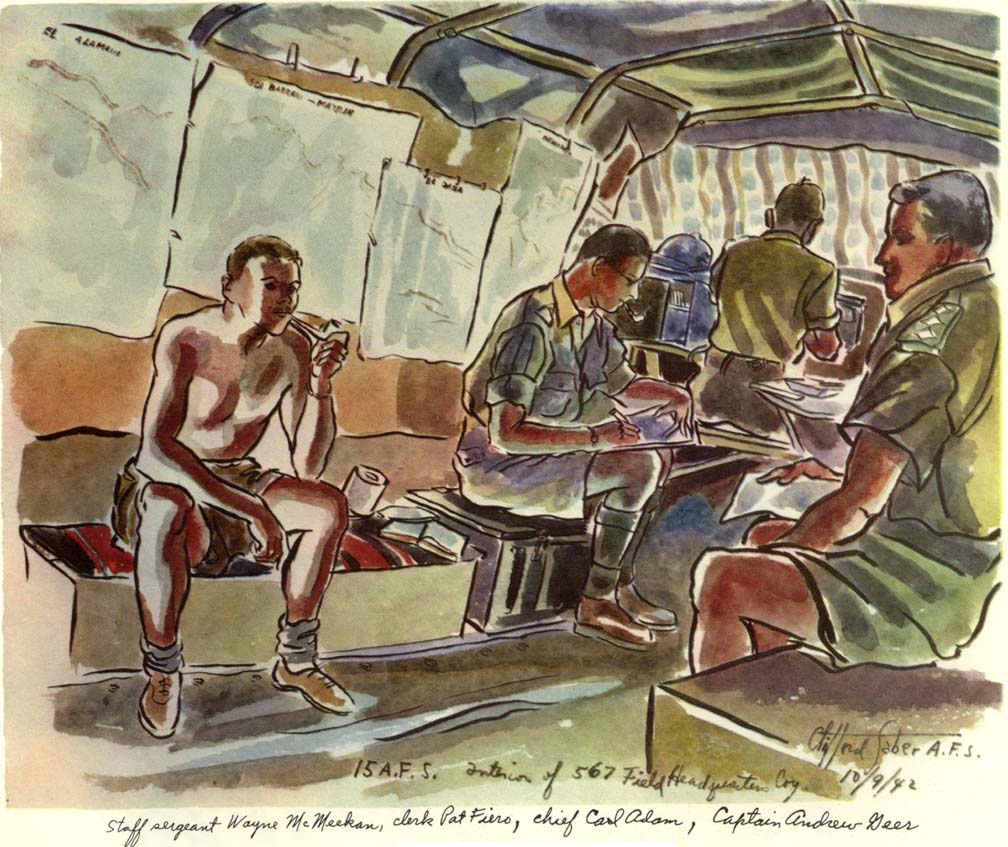
Our conversation was interrupted by the noise of an approaching motorcycle whose engine continued to race after it stopped. Through the open flap of the tent sauntered a veteran of Tobruck, blond mustached Company Sergeant Wayne McMeekan, pulling his goggles up high on his head. Wayne too was to return to the States after his enlistment. At home and universally, he was to become better known as David Wayne, an accomplished stage and motion-picture star. I left them to go draw my British-issue clothing and equipment.
During the formative fourteen days of intensive desert training, the RASC (Royal Army Service Corps) assigned to our two platoon companies a workshop unit headed by Captain Webb, a small courteous Yorkshireman better known as "Webby," through whose untiring efforts our units were supplied and enabled to do an unfaltering job. We were given field kitchens with cooks, sanitation men, and a passive air-defense unit (anti-aircraft machine guns were used only if ambulances or hospitals were attacked).
The condensed training program ended with an inspection of cars and men by the well-liked British Brigadier Walker, DDMS (Deputy Director of Medical Services), accompanied by AFS headquarters officers. We were royally dubbed --- 15th AFS, 567th ACC --- with Andy Geer as captain, Evan Thomas, son of Norman Thomas, and Art Howe, college professor, first and second platoon lieutenants respectively.
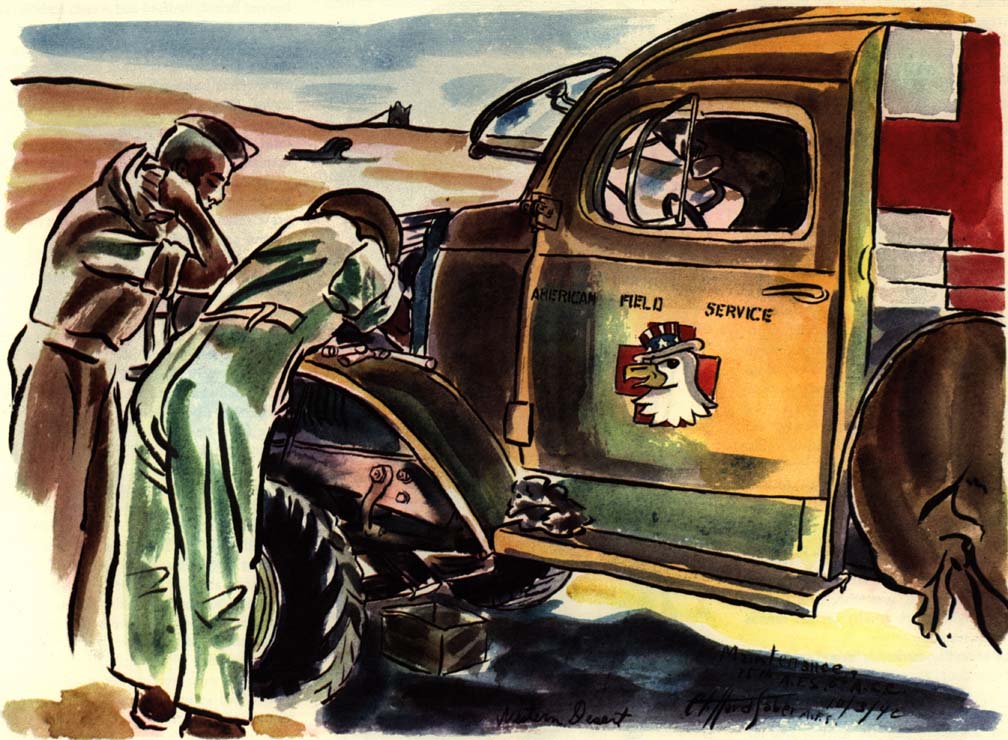
The ambulance platoon had six subsections. In each, eight men, five drivers, a spare driver, a driver mechanic, and an NCO in charge, had the responsibility for five ambulances. This basic pattern enabled subsections to be attached separately as a unit or individually to many forward units of the 8th Army and finally to service an entire corps in the field.
Training each day on the old battlefield of Tel el Kebir where the British defeated Arabi Pasha's forces in 1882, we gathered for lectures on navigation and convoy driving, ambulance maintenance, the British army medical system, army Bedouin life, and land mines. And each day with college-type cramming, trial method and practice, we mastered the contents of these lectures which were given by English and American veterans. This all-important know-how involved not only the safety of our lives but, most important, the lives of the transported wounded.
To double-clutch drive in the Western Desert was an art in itself. The terrain was a fiat, treeless, desolate panorama that kept repeating itself. It wasn't the exciting sand dunes and oases portrayed by Hollywood. Upon intrusion, it revealed a treacherous mixture of soft sand spots, hard stretches of lava-gravel surfaces, escarpments formed by miles of stretched-out wadis (dried-up water beds), and the added plus of the hidden explosive mines in its folds.
Our sandy-white ambulances were Dodges, designed for the United States Army. They carried a maximum of four stretcher cases or nine or ten sitting cases which were the requirements of all ambulances in the field. Their four-wheel drives eliminated the need for sand channels. These were two perforated strips of steel five feet long by fourteen inches wide. When a vehicle bogged down in the sand, channels were placed beneath the rear wheels for a pullout runway. Staff and lighter cars usually carried canvas that produced the same results.
The ambulance was boldly marked with red crosses on the roof, sides, and rear doors for aerial and ground identification. Six gallons each of gasoline and water were kept in racks attached to the sides and bedding rolls were usually strapped to the front fenders to keep the interior free for patients. Both side doors displayed the recognizable company badge --- a cocky red-cross eagle with an Uncle Sam hat.
Although smaller and more compact than the roomier heavier British Bedford and Austin ambulances, the Dodges took to the long tedious duty runs and convoys like a steadfast camel caravan --- and like lone racing camels returned at high speeds over bombed roads and tracks and often across unknown country naturally dangerous for vehicles. They were as tough and rough as this wind-swept terrain, and ideal for the work they did with armored units. Their mechanical endurance contest started before Alamein and lasted through the final runs in Berlin.
As many of us were to transport wounded alone, to get lost in this sea of sand was not just a misfortune but a grave mistake. Subsequently all desert navigation was done by sun and prismatic compass. After being adjusted for longitude, time of year, and time of day, the sun compass was the most accurate for getting to and from destinations. The 24-hour prismatic compass, which was carried inside the car on the dashboard, varied and was affected by the inherent magnetism of the motor and the jarring of the vehicle; consequently corrections had to be applied at intervals to every change of position of the ambulance.
The daily navigation routine used by every man in this mechanized army included the all-important map, the distance from starting point to destination, the speedometer reading, the landmark-star compass bearings, and the magnetic deviation of the prismatic compass.
Simply, you picked a star low on the horizon for a bearing two degrees less than your compass course; you got into the vehicle and from the selected position you aligned the car and chalk marked on the windshield a fixed landmark in front of you in relation to the picked star. Keeping the landmark and star in line --- you moved. As the stars changed their positions in relation to the earth, it was necessary to repeat your compass-bearing identification.
For convoy driving the British supplies covered every emergency that would arise on a trip; three days' battle rations per man were carried in each vehicle, fresh water was carried in every available container, sufficient petrol was issued with eighteen gallons carried in reserve, as it was rarely drawn en route at petrol points (storage depots).
The density of the convoy was twenty vehicles to the mile or a good eighty yards between vehicles; the speed was a slow twenty-five miles an hour or less. For security, personnel were not allowed to discuss their journey with anyone outside their unit and written destination orders were destroyed by fire upon completion of a mission.
With the exception of the lead car, each driver in convoy was guided by the car ahead. At night driving was extremely tricky. Your range of vision was about thirty yards although you could distinguish the horizon which was miles away. Because of this, the car ahead seemed habitually to drop completely out of sight even on a fairly level stretch. Traveling in a straight line meant that you went through desert obstacles without being prepared for them. Slowing down, speeding up, or shifting gears, you kept the car ahead in sight, which was no easy task, especially when it ran into loose sand and slowed down. After it pulled through, it would speed through the night to catch up to the convoy, while you were left in the sand. In order to overtake it, it was your turn to step on the gas, leaving somebody else cussing behind you to shift for himself. However, nobody was ever really lost for he usually had a low star sighted to drive by when outdistanced by the car ahead.
The British devised a most practical method for the maintenance of vehicles; it was fondly referred to as the "sixteen tasks." This did not mean sixteen things had to be checked every month but that one of these tasks had to be done daily --- for instance, all oil levels had to be kept up, filters cleaned, body bolts tightened, and spring shackles oiled and greased so that they would not freeze. All this was dated and recorded in the so-called "412" diary of the vehicle. This neatly ruled itemized sheet book told all --- from the tools carried to the machine feedings of gas and oil. Twice a month all cars were given a "412" inspection by British workshops. With oil as the god of war, it was this method of care that enabled all vehicles to stand up to a successful victory. On the same principle that the infantry prized their Garands and Springfields ---so we prized our Dodges which were procured by donations at home.

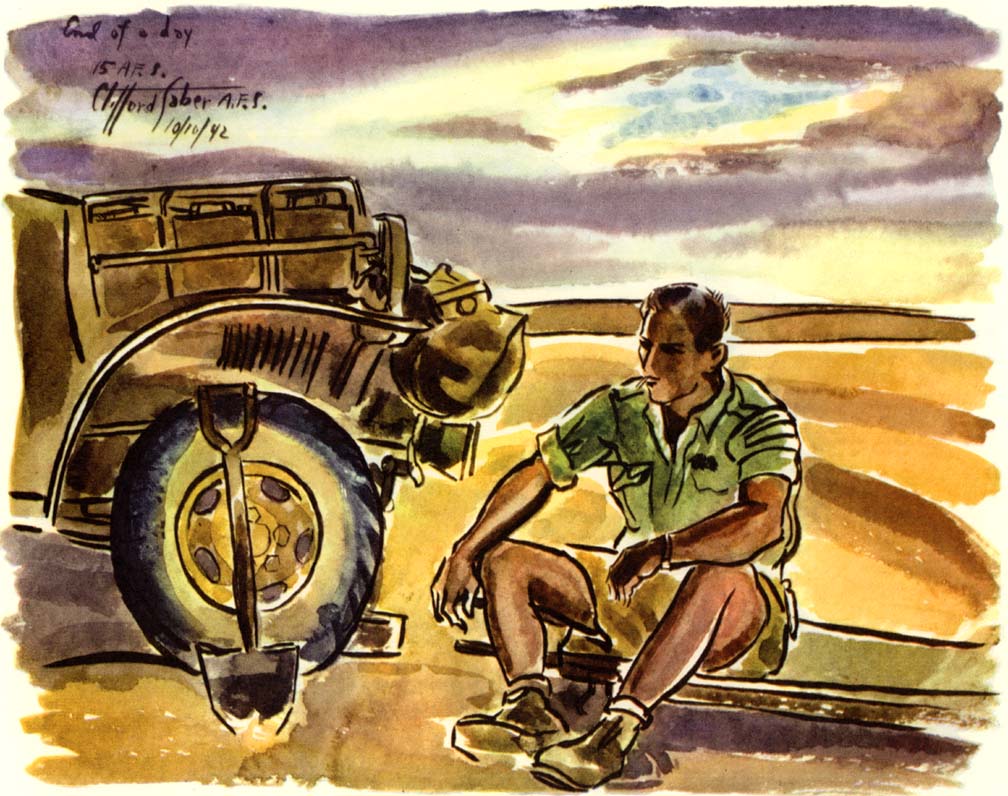
You measured time in the sands of Allah by the heat of the sun, the number of hours you worked in this heat, and the things which happened or did not happen or were to happen. You lived fast for a moment and then everything and everybody suddenly changed tempo and nothing moved and nothing happened. You got the feeling that life wanted to move but time, Father Time, wouldn't let it. Boredom set in!
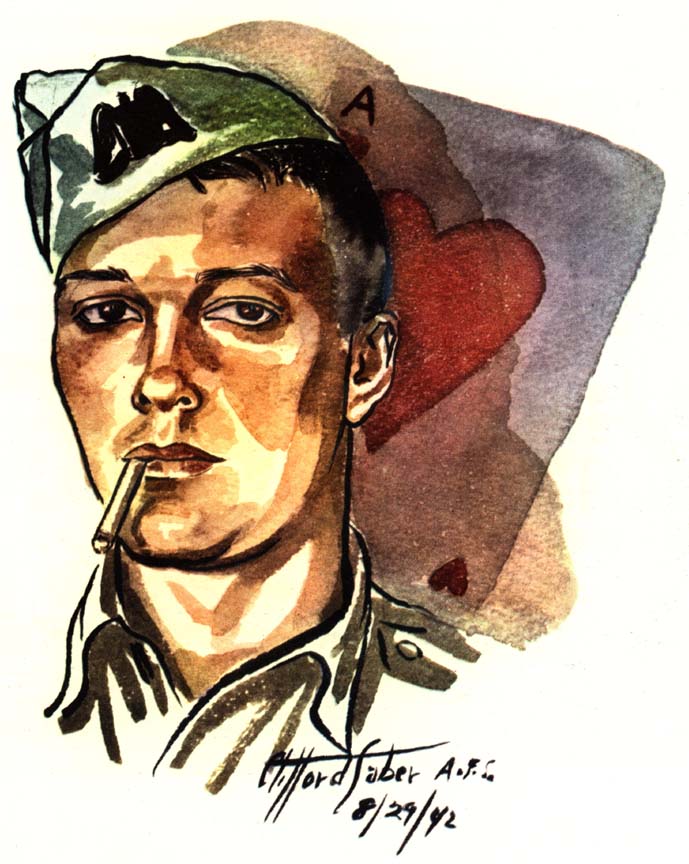
One diversion was the card game. Every conceivable game and its variations according to the book was played and some suspect on-the-spot variations so confusing that the originators turned out to be the only winners. The favorite of the Tommy was pontoon, a version of the universal game of twenty-one, known in France as vingt-et-un and in America as blackjack. However, the game we played at the drop of a hat was our own old American standard---poker.

There is a popular misconception that poker, since it is a gambling game, is a matter of pure luck. Actually nothing could be further from the truth. It is a game of management ability --- which reveals the conduct and character of a player.
Poker has more interesting angles than a beautiful model and the right to any advantage you can gain short of actual cheating. By its very nature it is a game of wile and artifice. Psychologically it was a binding influence and responsible for friendships which formed Subsection 10 of 567th ACC, referred to by the rest of the Field Service as the "Dead-End Kids," the gamblers.
As poker players, the "Kids" fell into the three classes: the ingenuous player who acted the way he felt, the coffee-houser who acted the way he did not feel, and the unreadable player who had no consistency, a hard opponent who invariably knew all the rules of correct play but departed from them on occasion.

Together from one end of North Africa to the other, we came to know each other's way of playing. There was:
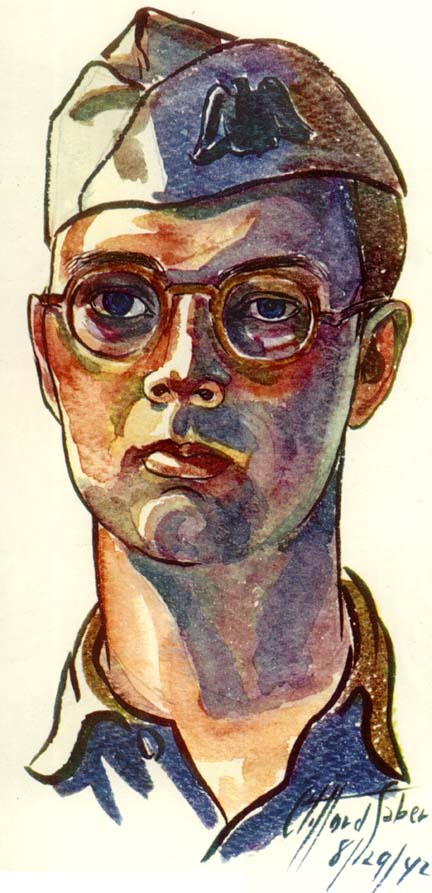
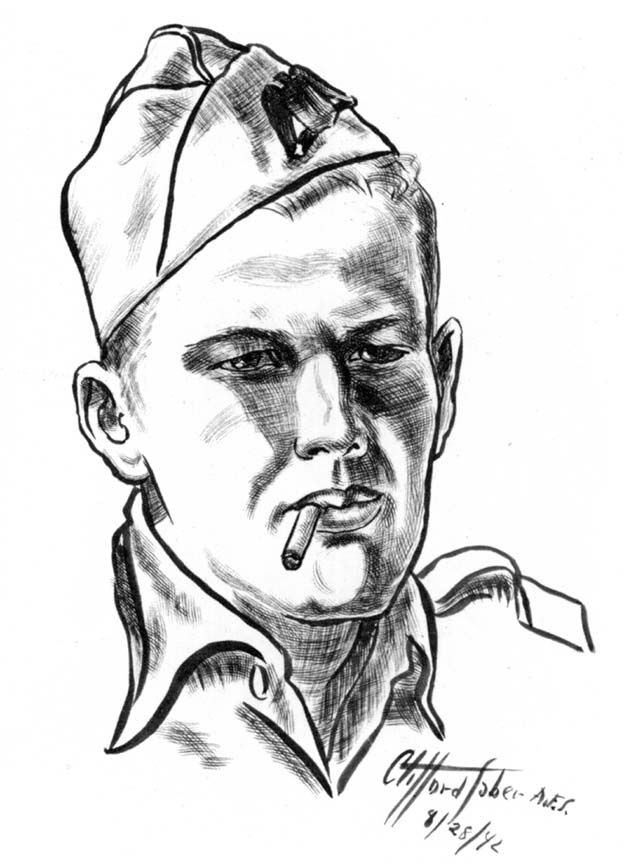
"Bull" --- Al Bowron, from New England, a home development builder, who earned his college education working and playing bridge and poker. He was a suave, loquacious, unreadable player --- so loquacious he talked me out of my spare tire when we chanced to meet coming from opposite directions in a tire-killing wadi; luckily I had no patients and was heading for workshops.
"Spike" --- Jack Himmel, from Buffalo, New York, now in department store management, a phlegmatic unreadable player with a mathematical mind. He had a charmed life. During the breakthrough at Alamein, he and Bull were working forward with an armored brigade. Leaguered for the night, he forsook his cold damp slit trench for the comfortable needed sleep in the ambulance. At daylight, a few minutes after he crawled out of his sleeping bag, an enemy air attack struck the unit. Spike hit the slit trench like a hammer, a few seconds before an anti-personnel bomb landed a few feet away from him. His ambulance was jagged-holed and his sleeping bag was riddled like a sieve.

"Hazy" --- Hazen Hinman, from Rome, New York, and in the steel business, the taciturn unreadable player who dispersed his vehicle according to regulations and then some; to contact him required navigation. He saw more action than he cared to discuss which was typical of the men under fire.
"Wee Wee" --- Bill Schorger, from Madison, Wisconsin, a Doctor of Anthropology at the University of Michigan, the loquacious, coffee-house player. When Jerry was just a step ahead of the 8th Army, it wasn't unusual for AFS drivers to go into towns with the first advancing troops. Wee Wee managed to get in with the 11th Hussars, the Cherry Pickers, and was the first American in the fifth vehicle into Tripoli. His recounting of this tale became more and more elaborate and exciting until he almost had himself driving the lead car into that key port city.
"Junior" --- Charles Bachman, from Chicago, now an executive with an international wheat cartel in Europe, the erudite ingenuous player. At Agheila, junior had the misfortune of being trapped for forty-eight hours by shelling 88's from an enemy artillery pocket overlooked by the 8th Army in its rapid advance to get at the main body of the Afrika-Korps. He had been forgotten by his LFA (light field ambulance) unit when they fled the area to get out of range of the guns. He overcame the "bomb-happy" shock after hospital treatment and carried on to the end of the campaign. The suffix "happy" is slang for "crazy."
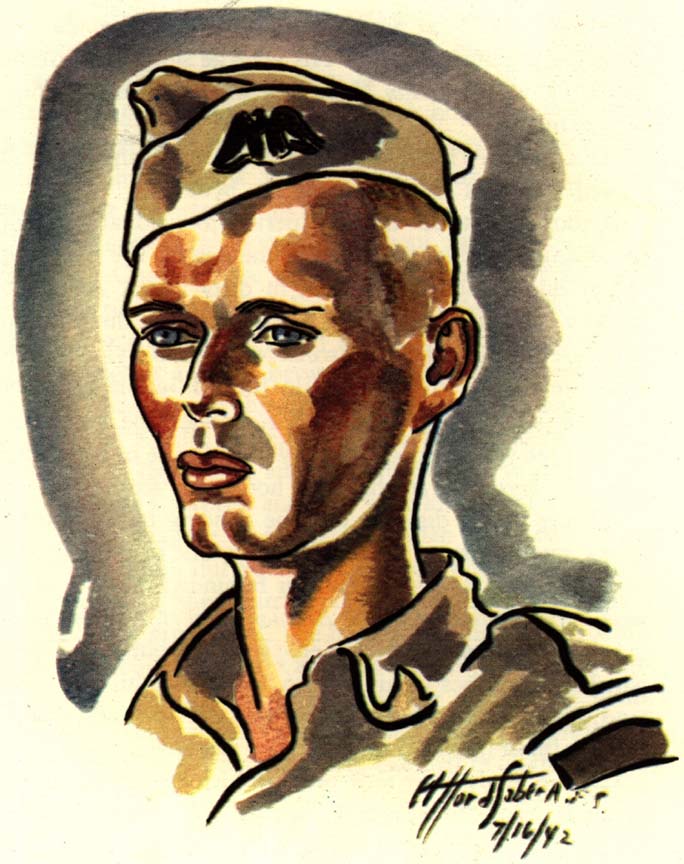
"Babe" --- John Lund, another New Englander, now president of an envelope company, an esthetic coffee-house player. Halfway through the mad LFA flight at Agheila, he turned back into the shell fire with the major of the unit, recovered a broken-down staff car, chained it to his ambulance, and towed it to safety.
"Boo Boo" --- Henry Reynolds, who hailed from Hartford, Connecticut; he had a sense of humor as precise and whizzy as his shorthand writing. His nickname was derived from an attempt to scare somebody out of a pot with five aces. Today he is a building contractor. He was a gullible coffee-houser.
"Annie" --- Tom Smith, also from Hartford, the enthusiastic ingenuous player. His favorite song was "Annie Doesn't Live Here Any More" --- when he lost his chips in a game.
"Cue Ball" --- me. I got the name after shaving my head aboard. The less said about me the better.
It took our whole training period to gradually accept the strange standard of living in the desert. We lived out of our duffle bags and dressed in dirty khaki. An Arab laundry took in our washing but returned it dirtier than when we gave it out. The latrines were Arab style --- seatless. Every other day we would file off to the relief of rationed showers. It was satisfying under the spray but by the time you wended your way back a mile or so to your tent you were back in the same hot, sultry stew.
Always in the distance was the dancing of the smoky, spiral, small twisters. Every time I saw one of these or felt its hot, stifling, sucking breath, it reminded me of a Maxwell Parrish painting in the Arabian Nights, Aladdin finding the magic lamp and the Genie spiraling out of it. These whirling dervishes of air suction were something to contend with for they played havoc with the tents and equipment, almost taking one over the rainbow.
Captain Andy Geer took pride in his new company and to set it apart from 11th Company, my esprit de corps badge, the wild, cocky, bald-headed eagle wearing an Uncle Sam hat against a red-cross background was selected in the competition.
The execution of this design on over a hundred ambulances followed the pattern of a Detroit assembly line. First I made a perforated-cardboard stencil of the design. With the help of others, I pounced the perforated-cardboard design onto the ambulance doors with a bag of charcoal powder. Then everybody chipped in; one applied the white fill, another the yellow, and still another the red and blue. When they tired, others replaced them. With the help of George Lyon and Bill Eberhard, both graduates of the Yale Art School, I did the finished outline in black. In eight hours we put an eagle on every vehicle, much to the amazement of the Tommies.
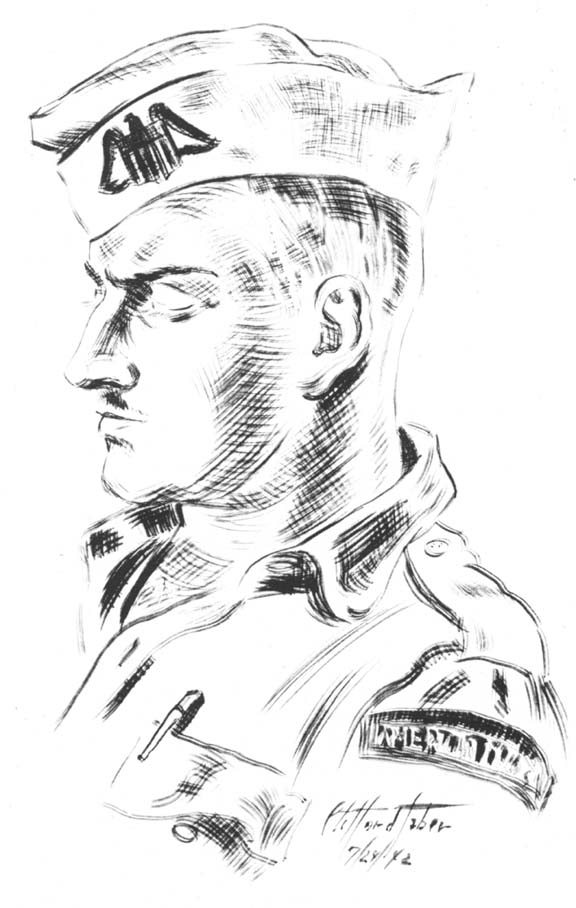
11th Company was so envious of our 15th Company badge, they dubbed us "Geer's Chicken Brigade" and the name stuck. With new Dodge ambulances added to the company and weather-beaten insignias having to be repainted without a stencil, the eagles took on many different expressions --- some laughed, some scowled, some sneered, and some just looked bewildered. Ours was the first unit to originate an AFS flash (insignia), with others following suit in Italy and Burma.
From Alamein to Tunis, in one month alone, 567th ACC carried ten thousand casualties. In that month they drove close to 106,000 miles. Upon their record the "Chickens" could well afford to strut --- they never laid an egg.
Charles "Snazz" Snead, a Texan and former Yale football player, joined our midst with twenty new volunteers. He and his overseas unit were to join Captain Marsh, commanding officer of 11th Company in the Western Desert. Snazz transferred to our unit, while the rest joined our rival company. Johnny Eyed was among them. I had met him in Capetown. He was an Abadab (a pet name used by second-generation Lebanese-Americans for each other). Johnny could have played the title role in Eugene O'Neill's Hairy Ape and at the same time explained Einstein's Theory of Relativity. He started out to be an anthropologist but wound up at the head of his own advertising agency. Another one of the group was Chuck O'Neill, a law student and orchestra leader. His enthusiastic sense of humor livened many an evening under a canvased truck. Canvas became so much a part of him that today he manufactures the stuff with his own special process.
The night before our only Cairo leave prior to entering the fighting zone --- the leave was so brief that a bikini bathing suit would cover more territory --- we had several poker games going in an EPIP tent. I got into a game with some of the "Kids," Snazz, Johnny Eyed and Scotty Gilmore. A few games were always started up before we went into a town, for the usual reason --- extra cash for a spree. I did all right in the game and came out ahead of Scotty after not having played with him for ten years.
Cairo stretches out on both sides of the Nile just north of where the river splits into the many nourishing streams which feed the delta. Wealthy Cairenes who spoke more French than Arabic bragged about their modernistic German-designed apartments and homes which were situated along the river banks, on the thin island of Geizireh, on houseboats, and in the suburbs of Heliopolis, Maadi and Heiwan. The fellaheen, who comprise 12 of Egypt's 16 million people, live around and among them in dirty tenements and mud huts, sharing these quarters with their beasts of burden. Strangely, except for their antagonism to the soldiers, they were a polite, courteous, and contented people. I had never seen such a gap between great wealth and indescribable poverty. It was a city of intrigue, sufficiently eastern for the curiosity of a westerner, and western enough to make him at home.
When I arrived, the capital was taking the war lightly with a "plague on both your houses" attitude. Its only concession to the war was the moonlight blue of street lamps that would have horrified an air-raid warden.
Spending was a form of escapism with the multi-uniformed troops who made the streets colorful; they filled the pockets of shopowners, nightclub waiters, dragomen, and beggars of every description. Persistent glabayah hawkers sidled up to you trying to sell everything from bicycles to "bints" (girls). The natives were called 'nightshirts," "laundry bags," "wogs" (for wily old gentleman), or "Gippies" (Egyptians).
Added to the hubbub of the fellaheen was the Arabic music screaming from Turkish coffee houses, the honking of taxi drivers who were helpless without a hand on the horn, and the nerve-racking bells of bicycle drivers. To top it all were fellaheen bagpipers swinging the "St. Louis Blues."
The project uppermost in my mind in this tempting, distracting Paris of the Middle East was to put the finishing touches on the convoy series, mail them home, and see Frank Gervasi who was staying at Shepheard's Hotel.
As rooms were hard to get in town I used my Arabic at the Continental Savoy Hotel with Abdullah, the assistant manager, to procure a double room for John Harmon and myself. I got it all right but only after giving Abdullah sufficient baksheesh. This substantial tip brought the baksheesh plague of his family upon me. I don't know how many kids he had or acquired for the occasion but I do know I should have kept quiet.
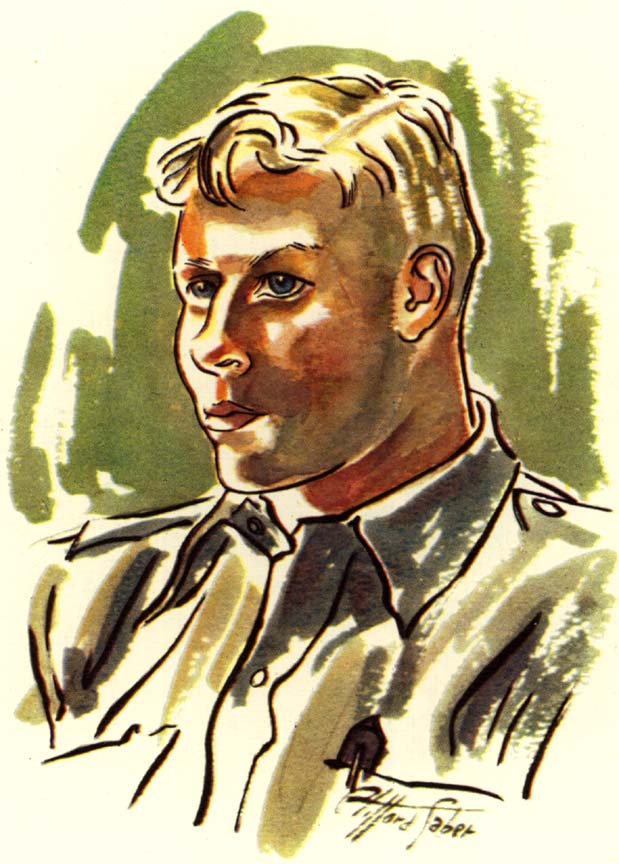
John Harmon, now a minister, had been the model for one of my large AFS posters that hung in the New York headquarters. He sat up with me both nights of the brief two-day leave and typed the synopsis and copy for the volume of paintings I sent back to the States where they were exhibited at the Society of Illustrators. Practically the only sight we saw of this halfway house between Asia and Europe was the Victorian wallpaper of our high-ceilinged hotel room. I was and still am most grateful to him for his time-saving help.
The Continental, noted for its roof dancing, faced the Egyptian Opera House square. It was the sister hotel to the late riot-burned Shepheards on the same side of the street, Sharia Abrahim. Oddly enough Arounai's Importing House was in a block between the two much-publicized hotels. I had known the Arounais, Lebanese Cairenes, Abdullah and Khalil, during their participation at the Texas Centennial Exposition and the New York World's Fair. My visit was a surprise and they were kind enough to store my excess baggage. I shuttled between these two large-veranda'd hotels during breathers from work. I saw Major Stu Benson at Shepheards and Frank Gervasi who had a room on the same floor. The huge rooms had rococo walls and high double doors. One was latticed for both ventilation and privacy, the other solid for safety. The floors and halls were carpeted with oriental rugs. The plushness of the hotel's splendor had faded, like that of a typical New Orleans bordello.
Major Benson had contracted a severe case of "Gypotummy" and was in bed. His two-week attack had finally got the better of him. Instead of going to a military hospital, he fought this weakening disease by himself. Spry for his seventy-two years, he managed to wobble out of bed and cuss his way home, where he regained his health and lectured on the AFS.
War correspondents from all countries have a camaraderie that's almost as close as that of soldiers in the field. I met Quentin Reynolds when I went over to see Gervasi. During a couple of Scotches, I learned more about what was going on in all theaters of war than I could have by reading their articles in Collier's.
The retreat rumors that we had heard en route and on arrival were true. Several days prior to Auchinleck's stand at Alamein, there had been the smell of burning secret papers in the British and American legations and everybody had made arrangements by truck and train for another exodus from Egypt. Even Pan American Airways had planes ready for top-priority evacuees. While desert refugees poured into the pro-Axis city, Rommel had been knocking on its door and had been expected to enter. However, this panic had subsided and the danger had passed. The people who had had cause to panic again wined, dined, and danced while men were dying less than a three-hour drive away. This was unbelievable at first but understandable on second thought --- there was nothing else they could do.
A belly dancer, the star of the Continental Roof floor show, had been uncovered as a member of a spy ring. It was a great scandal at the time, although, on the whole, security was good in Cairo.
I was to contact Life and Time correspondent Harry Zinder, who was stationed in Tel Aviv, for a possible freelance assignment. As he was in town for Wendell Wilkie's Middle East visit, conveniently for me, he dropped in to see his colleagues.
Punctuating their banter about the war, there were outbursts of their own particular gripe, the censorship at Middle East GHQ. Reynolds, who had flown in from London, and Gervasi, likewise from South Africa, had a carte blanche assignment itinerary which enabled them to travel wherever they deemed the real news would break. Of all places it seemed that here their crisp, factual, objective style of writing was butchered by the censor and the urgency of relaying it home was delayed. Yet with all this, they had respect for the object of their many tirades --- "old Steve," Lieutenant Colonel Stephens.
Although briefed directly from headquarters and more comfortably situated at times when not at the front line reporting, they too suffered from a soldier's major malady, the long wait for something to happen, in their case something to fill the press columns for their home readers.
General Montgomery had informed all members of the press of his plans and predictions. He also did this with his men in the field. The battle of El Alamein was a good six weeks off. Upon seeing my completed convoy paintings, the project which we had discussed back in New York with Bill Chessman, art director, and William Ludlow Chenery, editor of Collier's magazine, Gervasi and Reynolds proposed an assignment which would include my services during the long wait ahead. The object was a six weeks' flying tour retracing the steps of Lawrence of Arabia in World War I. I was to record in paint the Arab leaders who worked with Colonel Lawrence or their heirs and act as an interpreter. This would all be integrated with the writings of either one of them.
It was an unusual opportunity and idea and would have been a modern-day Seven Pillars of Wisdom. But unfortunately for me it was impossible --- for I had a year's contract with the Field Service and no accredited correspondent's rating from Washington.
The quota of correspondents in the Middle East was full. A suggestion was made that I go AWOL and come along as a truck driver. The temptation to go was strong but against my better judgment. The idea still remains.
At the Office of War Information, I saw Nick Parrino again and met Elmer Lower, a newspaperman from the Midwest, who was to be instrumental in my joining the OWI as an art director at the end of my Field Service enlistment. Their co-operation in helping me to rush my paintings through censors and to ship them home by diplomatic pouch was gratefully appreciated.
Since I still had free time before joining my outfit which was on its way to the Western Desert, I sketched the American tank-maintenance depot at Heliopolis for the army and OWI. The latter lacked an American art director at the time and was expecting one en route from the States momentarily. I retained two of the paintings and the rest were used for promotional purposes.
John Harmon and I hitched an early-morning ride in our canteen supply truck for parts unknown in the Western Desert. Searching for 15th Company, we drove along the Mena Road to the Pyramids behind a convoy that stretched for miles with dispatch riders darting alongside the humming cars. With American speed we passed it and turned onto the desert highway, the main supply line from Alexandria and Cairo. Both sides of this gray road, as we passed, were filled with to-be-fitted mosaic pieces of war; munition dumps, petrol depots, water stations, supply dumps, airfields and workshops for the visibly dispersed units of tanks, armored cars, vehicles, and planes. It was hard to believe that we had just left the hustle and bustle of a normal city. The contrast was bewildering.
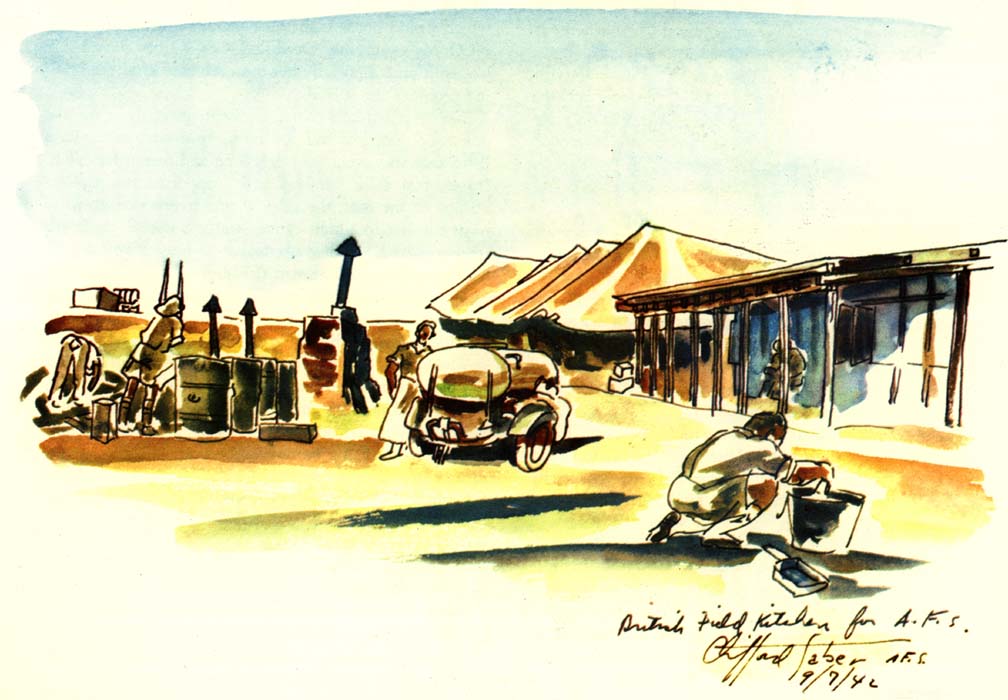
Late in the afternoon we found the company leaguered off the road at a point known as Kilo 121 which became our camp site for the next three weeks. The area was clean and of soft sand. The cooks had set up their kitchen. Swill pits and latrines had been dug and desert roses (two four-gallon tins planted in a sand hole for a urinal) were marked. Workshop trucks had been set up and camouflaged. As the ambulances were dispersed, I found myself as Hazy's spare driver, living in his ambulance in the suburbs away from the center of camp, a good half-mile walk to mess and a longer walk for subject matter to paint.
At the time of our arrival, 11th AFS Company had been leaguered at Kilo 50 for over a month, bored with inactivity and with no interruption by any major event. Both 11th and 15th Companies were now attached to the forming 10th Corps juggernaut.
Before the battle, huge canvas shelters, constructed to look like trucks, were parked and dispersed at intervals along the supply road to the front. Tanks moved forward at night and spent their days inside them well camouflaged from aerial reconnaissance. Soldiers used them for cover and brew-ups, when they were not occupied by Shermans, Crusaders, or Churchills. I avoided painting this device to fool the enemy in case I was ever caught in a bag (captured) with my paintings.

One of Montgomery's major devices in building up power and surprise was the deception of disguising tanks as three-ton trucks and three-ton trucks as tanks. Many a bomb hit a hide-and-seek target which wasn't there. This deception was so accurate that we ourselves, in the midst of it, were bamboozled. Caught behind a slow-moving truck, returning from an evacuation, we would discover, upon overtaking it, the petticoat clattering treads of a tank showing beneath its deceptive dress.
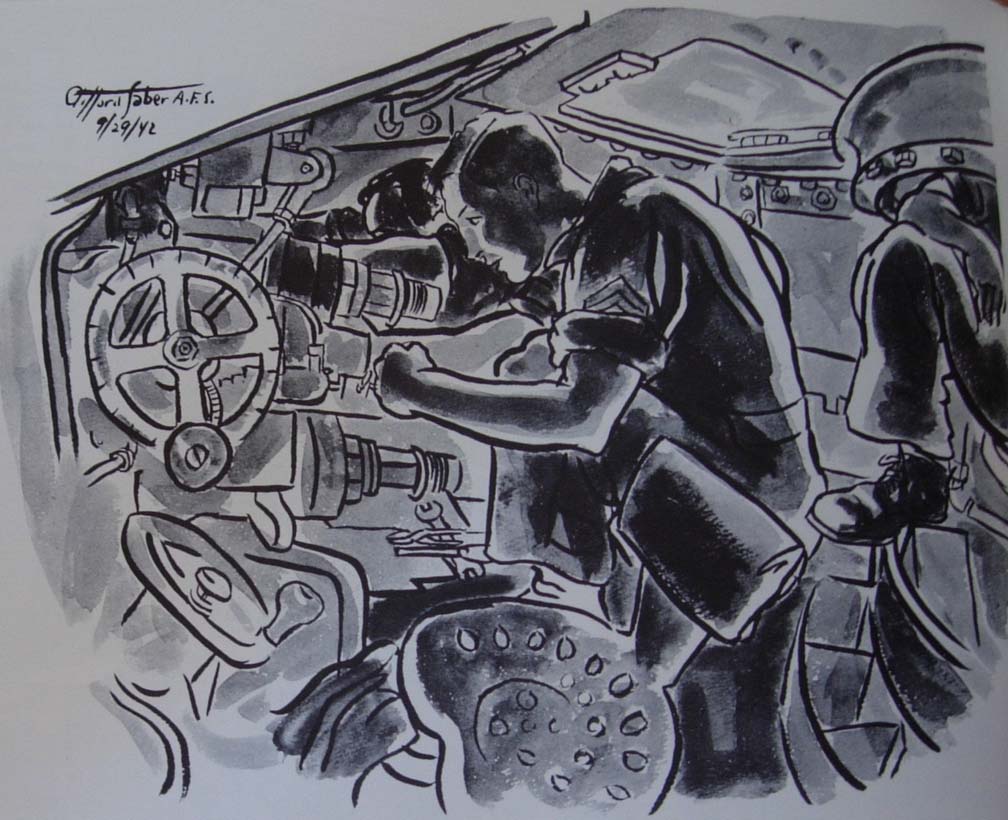
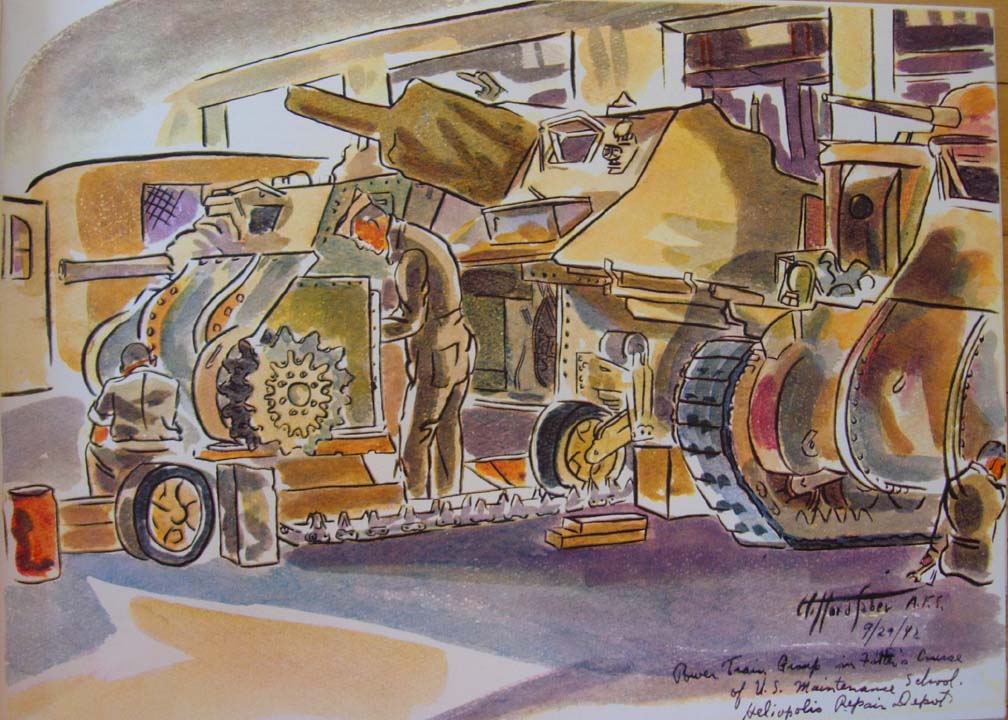
The vertebrae of the 8th Army in its rejuvenation were the desert war guns. From the offensive antitank gun to the heavy artillery, which included the new 105-millimeter self-propelled gun, to the defensive Ack-Ack and Bofore, they moved forward daily and dominated the area. They were dug in, harbored in tents, and hid under camouflage netting. The formidable guns were eventually the decisive killers and became more important than tanks, for they could ward off an armored thrust and fire over a mine field.
Daily enemy aerial and photo reconnaissance showed moving trucks or static car parks and nothing more. Rommel never knew how many tanks opposed him until the unmasking night of this camouflage battle mardi gras.
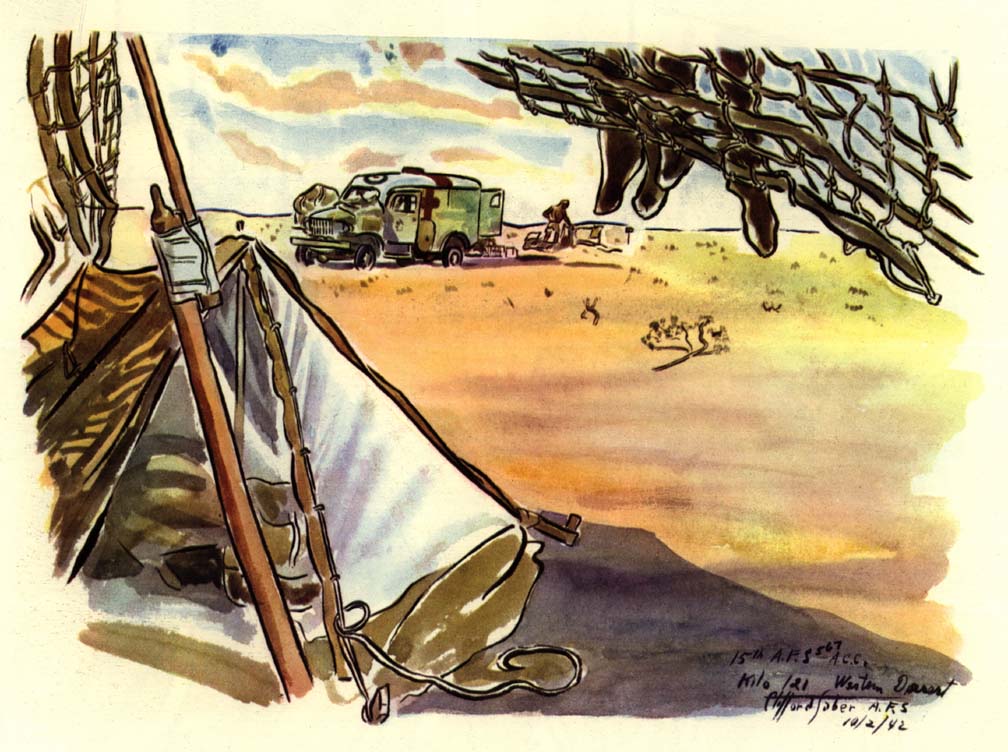
Life with an army in the desert was a cycle of advancing or flapping (retreating) or nomadic wandering. With the exception of the excitement of war, it was a Bedouin-like existence, a contented severance from the outside world; what you didn't see, you didn't crave. It was as sterile as the sexless desert. It either bored you to death, drove you nuts, or made a philosopher out of you.
I was completely happy in the desert. I came to know that even more certainly when I left it on sick leave; like many another man, I was glad to return to it and to the comradeship and affection that existed there. Out on the desert, men were brought closer together by the consciousness of the shared dangers and by the human longing to express themselves and be understood. A soldier's lot on leave in town was a lonely one. He wanted someone to help him forget the war he had just left, preferably someone female to wine and dine after the constant association with men. But white girls were hard to find in Cairo and Alexandria, and the native women were taboo. And although the soldier was loaded, his pockets bulging with Egyptian pounds, he was a sad sack compared to the base wallah who didn't have a piaster in his pocket but was as good as a millionaire for he had a girl on his arm. I had personal experience of this many times, especially when Slim Aarons and Burgess Scott, a photographer-correspondent team for Yank, flaunted the most devastating blondes in front of us.
The time and order of movement, a point indicated on a map, were delivered by a dispatch rider or received by wireless. The move was made to the order point. Camp was set up. Slit trenches and latrines were dug. In smaller or single units, the latrine was a newspaper, a shovel, and the wild blue yonder. Invariably, as soon as the workshops were unloaded and the cooks set up, a whistle blew, new orders had come in and the unit was off on the move again --- but not before slit trenches, swill pits, and latrines were filled so that the spot was left as it had been found for the protection of vehicles that would pass that way in the night. Drivers complained for usually the move was only a few miles one way or the other. Breaking camp was leaving the known for the unknown with the possibility of excitement waiting ahead over the next hill. It was a complete act of area abandonment. All that remained were a few petrol tins, which were scrounged by the Arabs or were left to rust. The Western Desert was littered with such rusted mementos.
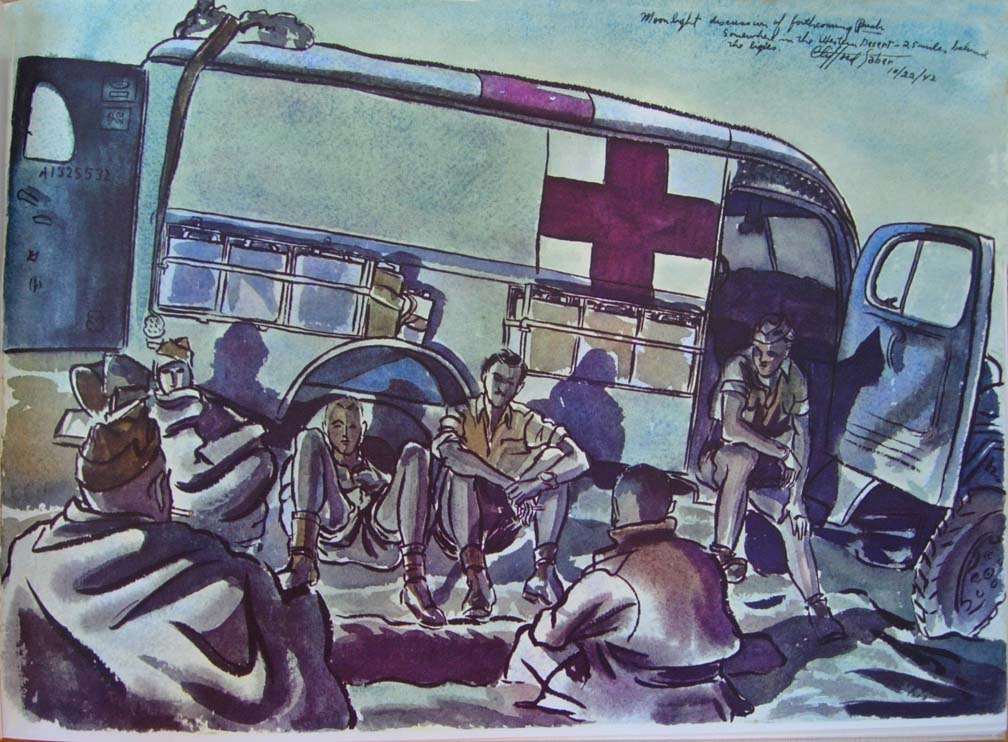
Whereas the Bedouins could roam at will and closely camp their caravans, it was not so with the 8th Army. All vehicles and personnel were dispersed two hundred yards away from each other when leaguered night or day, a precaution against attack. And close by was the mother, wife, and best friend of the Desert Rat, the slit trench, a prone-position, shallow grave allowing a man to be sufficiently below the surface of the ground to escape the strafing and the fragmentation bombs of the Luftwaffe. Its only vulnerability was a direct hit.
When repetitious stories about women, home, and would-be generals were exhausted, there was one subject that could start a good argument --- slit trenches. To dig or not to dig was only part of the desert bedroom question.
There was the fatalist, usually the lazy type, who said "The hell with it!" and quietly slept in his vehicle with no qualms about bombs, shells, or bullets. There is no discussion here.
However, there was never any agreement among the dyed-in-the-wool slit-trench diggers. Some liked them long; some liked them square; some liked them shallow; some liked them deep; some liked them straight; some liked them V-shaped --- and all parties felt very strongly about their preferences and had sound reasons to back up their particular theories. The deep-trench digger, for instance, maintained the deeper they go the greater their protection from bomb or shell blast. The shallow-trench men agreed but pointed out the fact that a close hit would bury them alive in a deep trench, thus saving their buddies a lot of trouble. The long-trench spader insisted his maintained protection, but the square-trench shovelers said, yes, but from only two directions. The V-shape excavators stressed the point that if a plane strafed when they were in a vulnerable position, they could scurry around the corner of their trench to safety. Once the type was decided upon, it was dug with pick, shovel, and tears --- tears when immediately upon completion one was told to move. Sometimes slit trenches were left uncovered for known units to follow, but convoy commanders would invariably drive right by hundreds of perfectly dug trenches of all sizes and shapes to pull up in the middle of a rocky terrain.
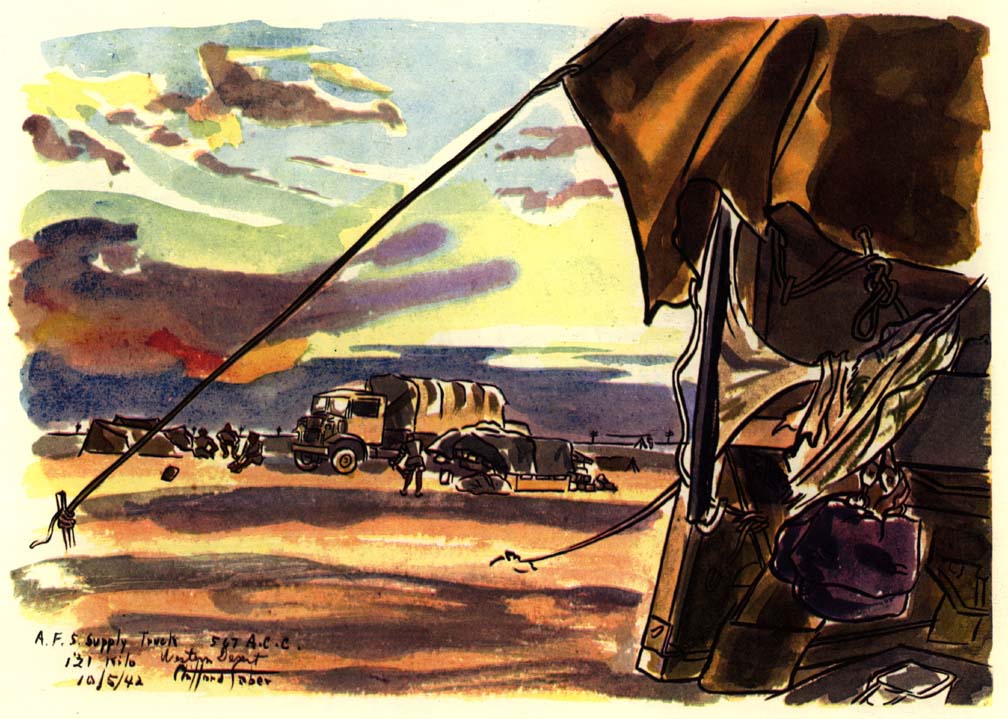
My daily life in the desert started at daybreak or as soon as the sun emerged, bringing with it the flies. I had to wash and shave in a canteen cupful of water. Sometimes I had a sponge bath without the use of my water ration. A sponge kept out overnight gathered sufficient moisture for a comfortable watery rubdown.
With the toilet over, I occasionally sketched before breakfast, which consisted of American bacon, marmalade, margarine, thick army biscuits, and the inevitable tea, the basic drink of the 8th Army. It was a strong yellow even if milk was added to it. Always full of the taste of petrol, oversweet, insipid, but with no flavor of tea, it was the old stand-by --- "When in doubt, brew up!"
We ate around and about the open kitchen of the cooks. Someone said that in England the food came from God and the cooks from the devil. The British army claimed that their cooks were taught a course in cookery by the famous chefs of English hotels but that the men just went back to their own method of cooking. One hasn't tasted bacon until he has been served by a Tommy in the field. They let the bacon look at the hot pan and then serve it. They claimed it gave you more energy and fattened you up. Although the 8th Army food was badly cooked, it was adequate, and the rations were nutritious and varied. Bully beef and hardtack biscuits were usually the order of the day, and varied only, in cooking presentation. To overcome this monotonous diet, an occasional tin of M & V (meat and vegetables) was substituted. To compare Crimean War vintage ration to American chow was like comparing an unseasoned hamburger to a charcoal-broiled steak. The wholesome outdoor eating was fine until you had a wind blow, then the sand became your meal.

The only complaint to this war picnicking was that the available seating room near the cooks accommodated about one fifth of the company. Consequently balancing two mess tins, one on top of the other, a cup of tea mounted precariously on the handle of one, a slice of bread on the other, you bolted your food between flea bites and flies. As you ate, the flies ate, and you ate the flies that ate what you ate. You were constantly on the eating-fly alert for squadrons of these trachoma-carrying insects which dive-bombed like Stukas at you and yours. Fighting these pests was a war in itself, many a man fanned his way through the desert chase. They were always with you. The natives seemed to be acclimated to them and walked about blinded by them. Their eyes oozed with clusters of them. Truly it was one of the seven plagues of Egypt.
During the day when I wasn't on evacuation duty with a lone ambulance or with the section or when there was action attached to one of the units engaged, I painted catch-as-catch-can. Returning to our camp site before sunset, the gang got together for a Nescafé brew-up or dinner. Cigarettes around a fire, a drink from the section-shared bottle of whiskey, some idle talk and the day was over. You slept out in the open underneath the stars or in the ambulance for more comfort.
At three-thirty our second day at Kilo 121, we were enveloped in a khamseen --- our first sand-baptism wave of weather. When the khamseen blows, says the Arab, even murder is permissible. When this scorching wind blew from the south, it covered the sky, hid the sun and stopped a battle. Khamseen is the numeral "fifty" in Arabic and fifty days of this wind is expected during the year. If the khamseen blows three days in succession, a man has the right to kill his wife, five days --- his best friend, seven days --- himself.
The first uncharterable signs were the deadly silence of its approach; then the sun became hidden by an orange red veil which deepened in intensity. In the south, the azure horizon fast turned into a dirty indigo. In a few minutes the horizons had condensed to a roaring nothing and a red choking wave of sand pounded over us. The fine dust seeped into everything, your food, your eyes, nose, and ears and between your teeth. Ghostly front-bound convoys passed by, their noise stilled by the sand-blasting wind. The khamseen lasted through the night and died out with the next morning's sun and the return of the sticky tickling feet of flies. Reminders of it stayed with us for days.
A New Zealand CCS moved alongside of us. Orders came through for us to evacuate their patients to Heiwan, a suburb of Cairo. It was a long round trip of over two hundred miles. The men brought into our area were not battle casualties but those subject to desert ailments, jaundice, sandfly fever, desert sores, malaria and occasionally a few bomb-happy cases, some of whom had been peppered by jumping-jack mines.

Land mines and booby traps were cleverly secreted in every strategic spot on the front, from mine fields to shoulders of roads or tracks, to enticing scroungeable objects and diabolical ones deposited on or attached to the wounded or dead. There were antitank mines which looked like large deep bowls, telamines buried in cases, plunger mines, square mines, soup-plate mines attached to mines. There were magnetic mines which clung to metal until they exploded. And so dreaded by the infantry, the "jumping-jack" or 'S" mine, which was filled with ball bearings and metal scrap, and when subjected to five pounds of pressure or more, leapt from the ground to breast height and burst like a shotgun. A man had five seconds to hit the ground beneath its leaded spray.
There was still a lull and a long wait for we were not working at full capacity. Every day more units and supplies moved up past our camp. Two freckle-faced Highlanders of the Black Watch pulled their Bren carrier off the road for a minor repair. A few friendly words were exchanged during a brew-up, and I did a fast sketch of them before they moved on. For everyone, the battle to come was uppermost in thought and conversation.
As far as security allowed, all men were told of preparations and battle plans. Company commanders were briefed with the over-all happenings of the corps and army. For the first time, all medical units were in constant touch with corps headquarters by wireless. Evacuation and medical supply routes were worked out to reduce time for the benefit of the wounded. Map locations of every medical unit in the field were given and each MO of a unit knew the whereabouts of all other units. Blood plasma banks were set at key positions. Self-sustaining operating teams carrying a nine-day supply of food and water were held in reserve and rushed to units that required their operating team aid without being a burden on their supplies.
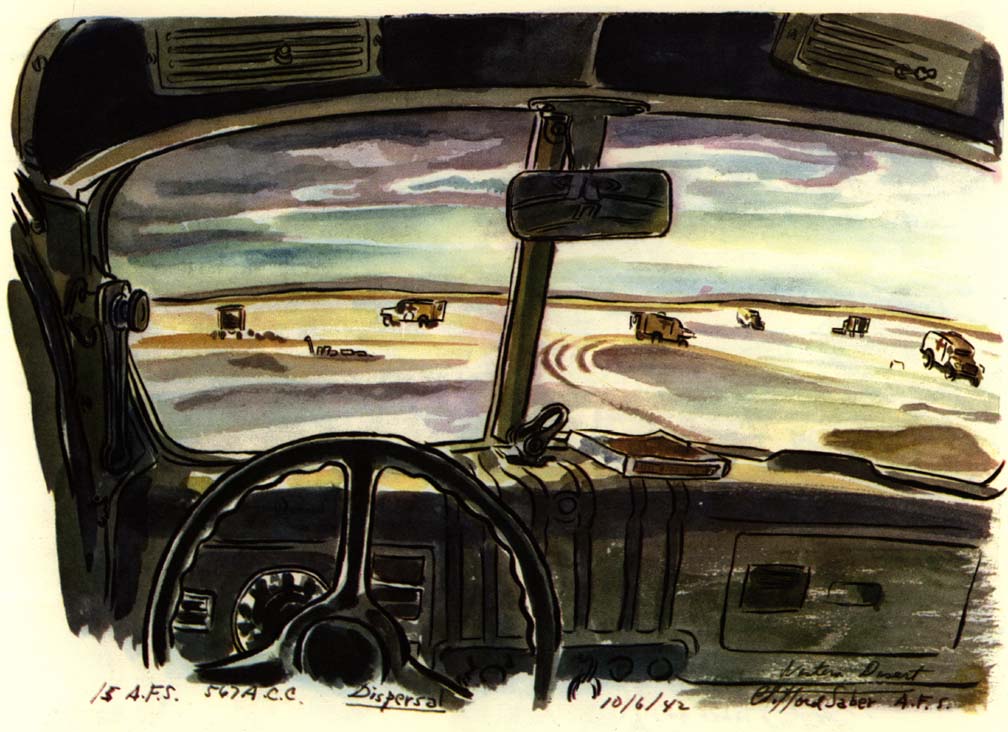
The British medical evacuation system was determined by the particular difficulties of the terrain, the various types of fighting going on, and was mobile, subject to constant change. The guiding principle was to send the wounded as far back as possible and to keep the advance stations clear.
The operational setup was based on four mobile positioned units, a stationary base hospital, and an ambulance relay team from the front line back to base: the RAP (regimental aid post), the ADS (advanced dressing station), the MDS (main dressing station), the CCS (casualty clearing station), BH (base hospital), and the relay teamwork of the LFA (light field ambulance) and MAC (motor ambulance convoy).
The RAP, a canvased truck with one assigned ambulance, was attached close to the heels of a regimental battalion, and followed it through thick and thin. Its personnel was one commanding medical officer, a small group of stretcher bearers, and orderlies. It went the farthest forward in the front line that the Red Cross could go, with the exception of the arm-banded infantry stretcher bearers. It usually screened itself from machine-gun fire by nestling in the ridges of the terrain. This was its only protection, for it was subject to air attack and artillery fire. Casualties were brought into the RAP by tanks, trucks, or any sort of conveyance, or carried in by its own stretcher bearers. After first-aid treatment, they were transported back by its ambulance to the ADS.
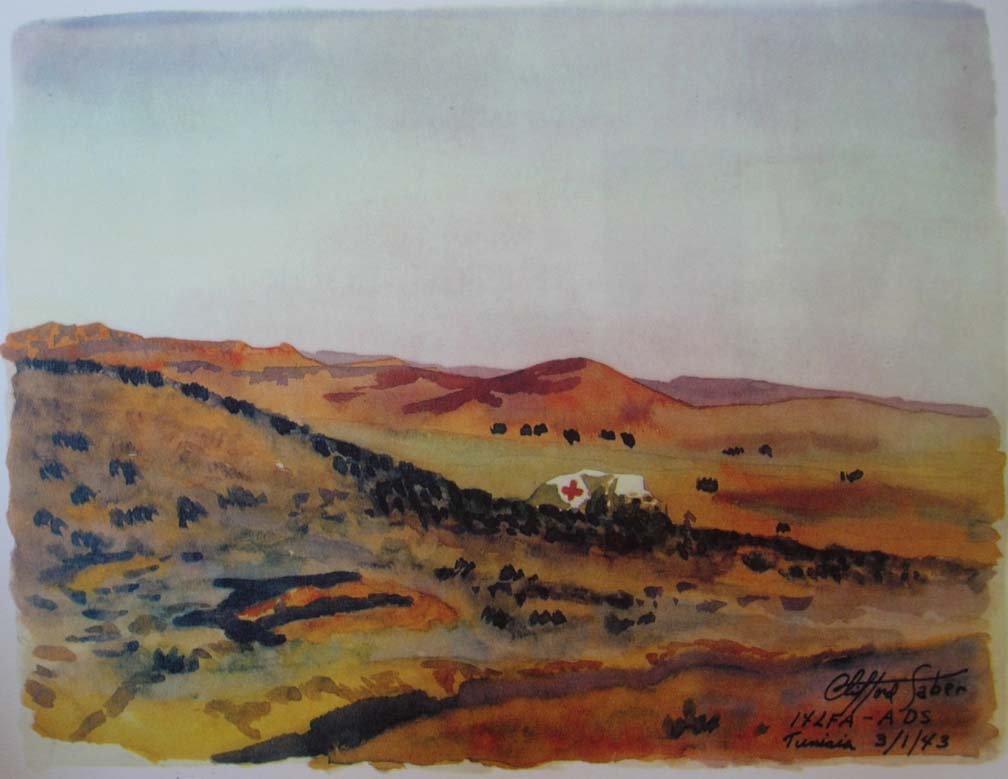
The ADS, usually one to six miles behind the front in a slightly less dangerous position, was, situated in the vicinity of artillery and was susceptible to the inevitable Stuka parade. Serving all the fanned-out battalion RAP's in the Brigade, it had a larger staff which re-dressed wounds and performed minor operations and, if necessary, amputations. It had its own six assigned ambulances which relayed the patients back to the MDS where the surgical wonders were performed.
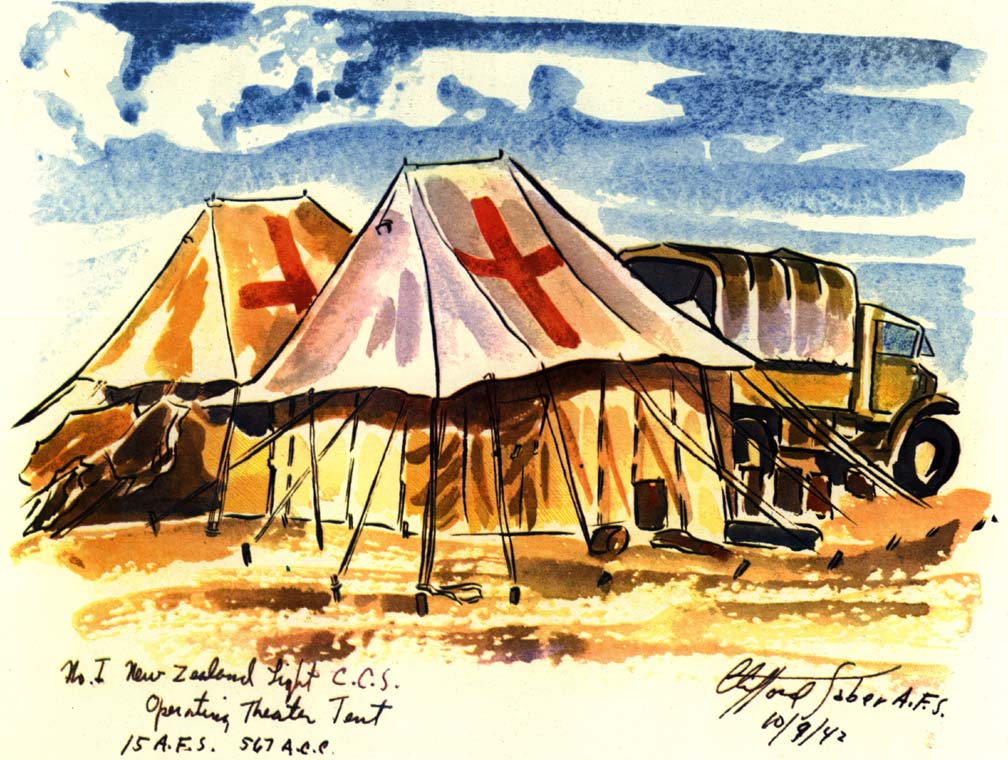
The MDS, about twelve miles still further back, was larger and better equipped than the several ADS's it served. It had at its disposal an operating team of three doctors, a mobile operating theater, a group of small tents containing equipment and motor-powered electricity. Its assigned ambulances shuttled patients within its confines and then down the line to the CCS where the most severe cases were treated.
The CCS was a mobile tent hospital approximately forty miles from the front. It had its own mobile power unit which fed electricity to the various cleverly blacked-out tents, seven or eight wards, an operating theater, a reception center, an X-ray lab, three mess rooms, a laboratory, and a sick bay. It was well adapted hygienically for medical service as a base hospital but it never held patients more than a few days. Like a circus the whole thing could be knocked down in several hours and could move its staff equipment in twenty-four hours. It was usually situated in a fairly large town, a seaport, or a railroad center. From here a casualty could be put on a plane, a hospital ship, train, or be sent by ambulance to a base hospital.
The LFA was a light field ambulance medical unit composed of an MDS and two ADS's. All its ambulances served these forward stations, including the RAP's. There were three light field ambulance units in a division.
The MAC ambulance operated primarily from CCS's to a base hospital, also between MDS's and CCS's.
At times the chase of the Fox was so swift that ambulances were in front of stretcher bearers or an MDS was temporarily fifty miles distant from an ADS and right next door to a CCS. To be a patient in this regular medical channel was to lose contact with the outside world for months. They made sure you got well.
The following evacuation story happened to Lee Ault and Bill Van Cleef who were in my contingent coming overseas and who joined the Marines after their AFS hitch.
During a tedious evacuation run with a wounded sergeant of the famous Highland Division, Ault and Van Cleef engaged their patient in conversation. His wounds were in his legs --- where he had been wounded before at Alamein. Advancing with his company under cover of a barrage, the sergeant related, he was crawling to the crest of a hill when he saw a Jerry gun crew still there and fiercely firing an 88 mm.
"They looked scared when they saw me, and after I used my Tommy gun on them they were squealing like pigs," the Scotty was saying.
"Did you kill them all?" asked Ault, incredulous.
"Mon, I hope so!" was the answer. "It was me or them."
"I suppose you'll get a decoration for this," interposed Van Cleef.
"No," was the prompt response, "but the bloke who came out and carried me back will."
The whole desert was alive with dust and movement. More tanks, guns, and lorries swept past and we were still leaguered. One could never tell from the face of the Tommy whether he was advancing or retreating. His army had been beaten back six hundred miles from Benghazi, but his object was to get there again. Little did he realize the unbelievable battle for conquest that lay ahead. He had recovered from the mental and physical shock of retreat and now there was a camaraderie between officers and men unsurpassed in their determination to win except by their commander-in-chief in the field.
The only thing that puzzled me was the continuing caste system of the military, batman serving officers even in the face of death. In the midst of all this build-up fever, the British brass managed to capture a semblance of home with unconscious pictorial humor --- tea served in style --- wicker chairs and tables. There were many things I wanted to paint but never had the opportunity. This was one of them, "The old art of war."
With the exception of parade and inspection, we had nothing like this in the American army, of course. In the field and off duty American officers didn't work at their ranks at all.
Living uncertainly amid khamseens, dust and the ever-present worry of "Are they ours?" when planes came over, one couldn't help admiring the Tommies' unflinching courage in the face of death, their simple dignity and decency and the comradeship that united them, and their adaptability to us and other new troops. Their spirit was not only high --- it was contagious!

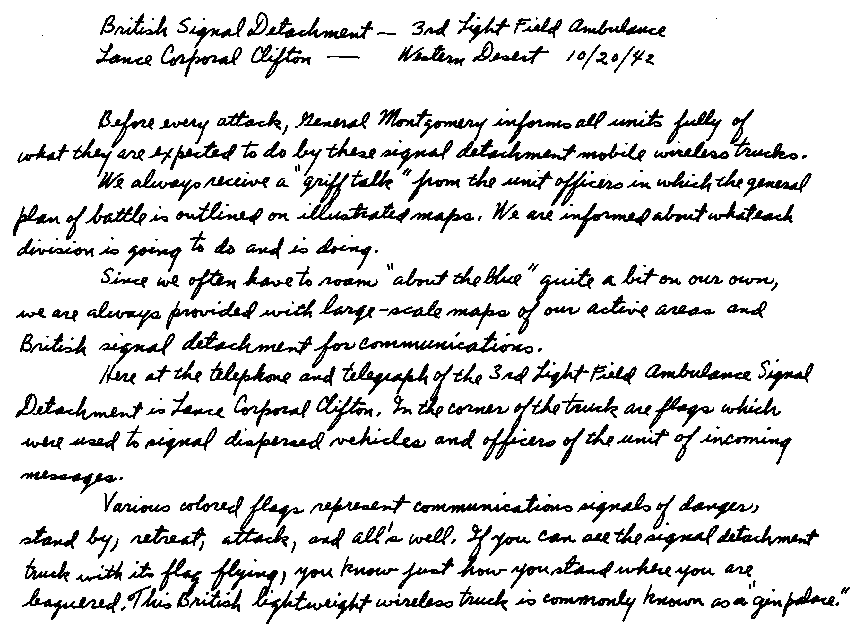
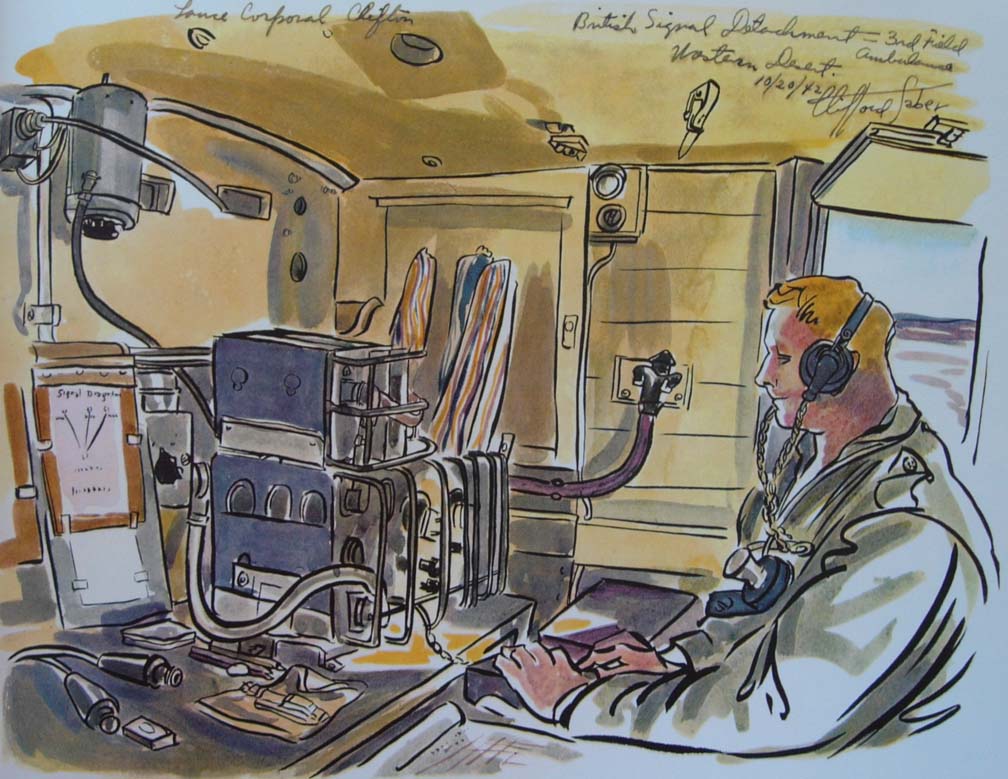
Typical were Quartermaster Sergeant Lionel White and Staff Sergeant Reginald Jenson of the 3rd Light Field Ambulance Unit while we were attached to their outfit. To us, they were Whitey and Baron and they became part of the coffee-drinking Kids, participating in our poker-game cutups and being initiated into baseball. To pinpoint their personalities would be to say Whitey resembled Clark Gable and Baron, James Cagney. I painted both of them.
Another chum was Tony Reese from Birmingham, England, where he and his mother ran a hotel. Somewhere around Mersa Matruh, after the breakthrough, Tony, as he put it, had the honor of the undivided attention of three strafing Messerschmidts which had mistaken his armored car with an open top for a general's command car.
The Me 109's killed the other men who had fired back with feeble bursts from the Vickers, and Tony was shot through the nose, the bullet coming out the side of his head. Blinded by his wound, and not knowing his buddies were dead, he himself was left for dead by the onrushing advancing troops. He was found by the medical units four days later.
He spent the next nine months in army base hospitals, where I met him as a fellow patient and where we both vied for the attentions of the same Scottish nurse, a trait common to the beleaguered convalescents. We were jilted for a surgeon, a major by rank. We compensated for this by driving the hospital personnel crazy. In our hospital suits of bright robin's-egg blue with white bandages for turbans and red identification ties, we impersonated the war reporting of the BBC; he acting the parts of various announcers and I being the sound-effects man. For a man who had been so close to death, his outlook on life and his sense of humor were great morale boosters for the rest of the patients. As a matter of fact, despite the complaining about flies, the dust, the food, and the lack of mail from home through the long unbroken months of desert life without leave, their morale was good.

With the exception of tank technicians and the 9th Air Force ground crews who worked as separate units, we were among the few Americans closely associated with the Tommies in the field, and got their ribbing of our army system first-hand. Their remarks were not directed at us, but their pet beefs about the Yanks were the publicity, the medal and ribbon system, the rate of pay and standard of food, and the concern about their girls at home where American troops were stationed.
In the Middle East, the opportunity was there but no real attempt was ever made by the Anglo-American brass to get these two English-speaking Allies together for understanding and comradeship, although a club for such purposes was suggested by Allied correspondents. The only personal contact between British and American soldiers was purely accidental; they might run across one another in city bars and these meetings were not always congenial. Someone would always have one drink too many; and instead of the shot of liquor sparking amiability, it would do just the opposite.
We of the Field Service, being almost a part of the British family, tried to explain and clean up antagonisms. Besides ourselves, English and American correspondents tried in lectures to the troops to bring about greater unity.
The NAFFI canteen or the individual unit canteen or campfire were the gathering centers in the field. The further we advanced, the more the soldiers complained because it meant they outdistanced their canteen and cigarette supply.
Inside a canteen tent, a hooded light threw a dim glow over a scramble of pushing men dusty from head to foot. The place was crowded and the air was stale and heavy with smoke. Static distorted a broadcast of music from home, coming from a radio you couldn't see. You squeezed in and edged your way toward your own group which was chatting noisily. If you were lucky, you grabbed yourself an upended box or petrol tin for a seat; otherwise you stood, drank beer, and watched a dart game. The canteen meant relaxation, news from home, and luxury, for you could purchase unusual supplies of canned food, liquor, and the most precious of all --- cigarettes of every breed, shape, and description. With a few beers under my belt, I painted such a scene by chance. The light was so dim I couldn't see my paints. Someone produced a flashlight and held it over my shoulder long enough for its limited light to allow me to complete the fast sketch.
The art of making a fire in the desert was to take an empty petrol tin and cut it in two with a can opener. The bottom half you filled with sand, on which was poured petrol. A lighted match thrown into it did the trick, and the blaze lasted long enough to enable you to boil water or to cook. The other half of the empty tin was put over the fire; and while it was still hot, water was poured in. This scalding was supposed to take out the taste of petrol, allowing it to be used as a cooking pot --- provided you washed it out before adding fresh water.
No open fires were allowed after dark. A light in the desert was as dangerous as one at sea for it could be seen for miles and was a dead giveaway for enemy patrols and night-fighter aircraft.
Any fires made after sundown were fashioned in blacked-out vehicles and tents with primus stoves. These were single petrol or kerosene burners imported from Sweden and used by Mediterranean natives who could cook a nine-course dinner on them as efficiently as a housewife with a modern range. Today, if I were to drive through a desert, my basic equipment would be a primus and two can openers, one for puncturing and ripping a can in half and the other to cut a clean edge on a can.

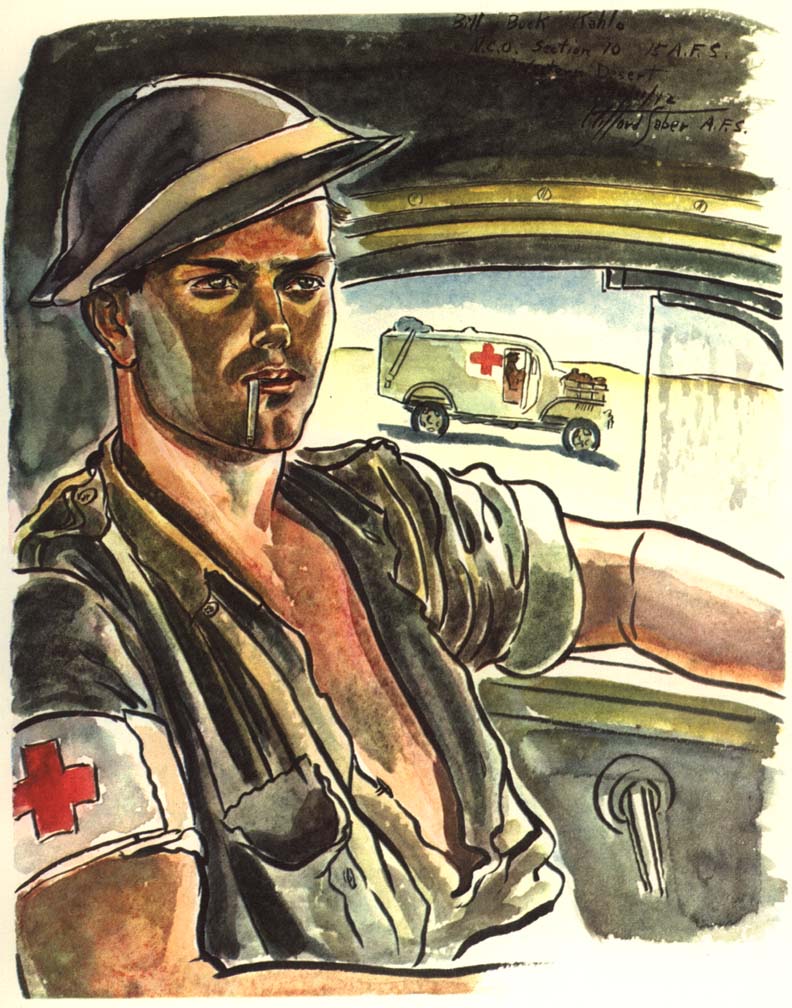
Although we became acclimated to the mass-made British tea, we did also have the American Nescafé, an instant coffee. Whenever we had a supply, the Kids chipped in for it at two dollars a small jar. At coffee time, which was usually in the late afternoon, each cup was prepared individually with evaporated milk and sugar. Buck Kahlo, our NCO at Alamein, usually did the fire-building honors. Buck had been with the Australians of the 9th Division during the bombing of Tobruck. Prior to the war, he had been a film cutter for Twentieth Century Fox Studios in Hollywood and today he is back at his old job. Our coffee brew-up bull sessions became a daily routine and we were joined by Andy Geer, Wayne McMeekan, Whitey, and Baron. Occasionally the gruff (gossip) and sipping were interrupted for a taste of slit trenches.
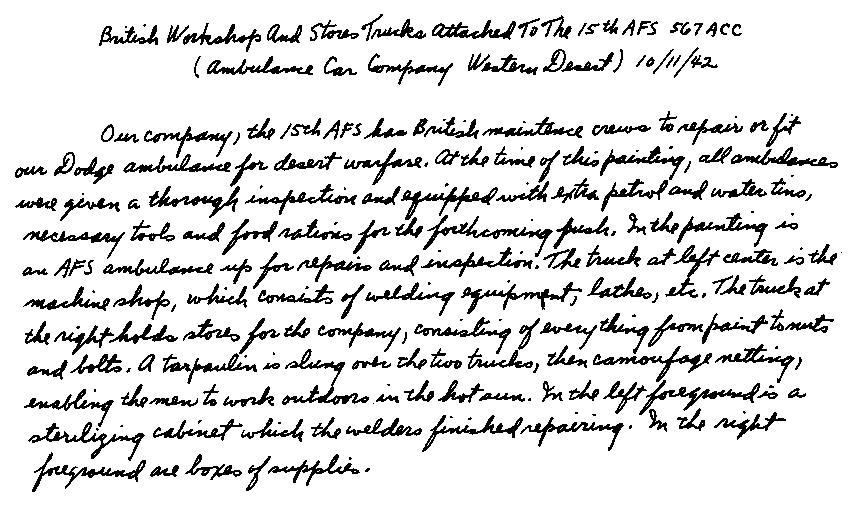

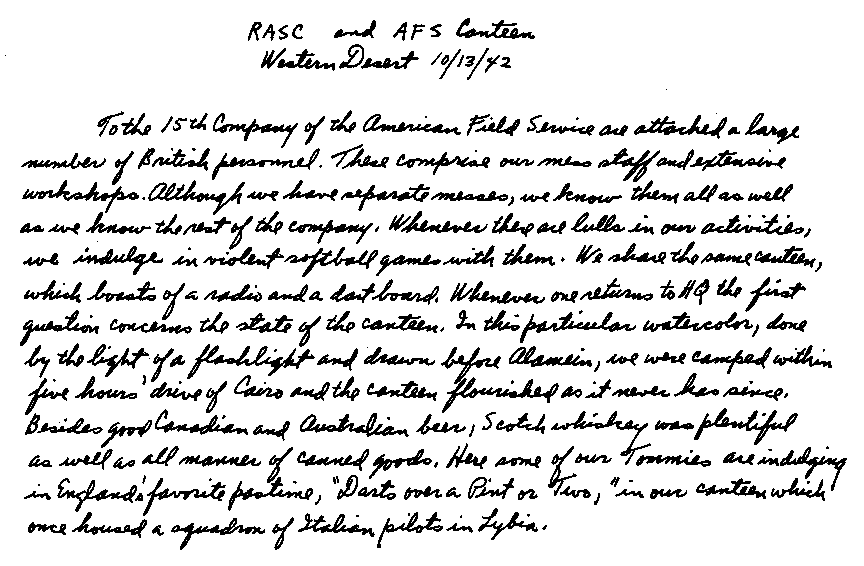
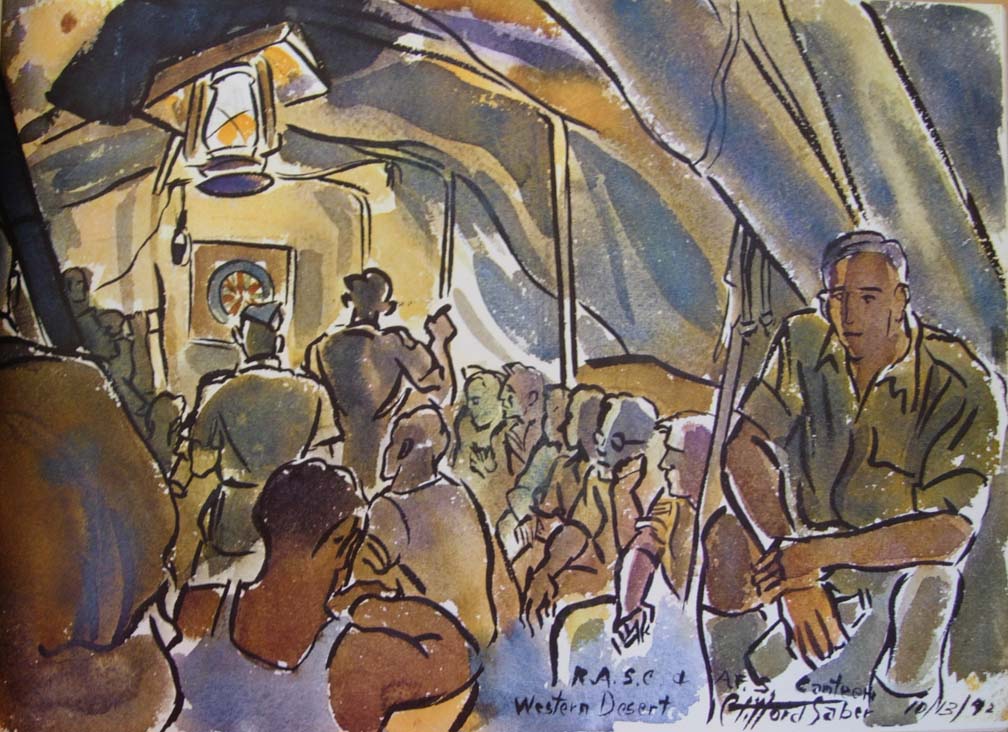
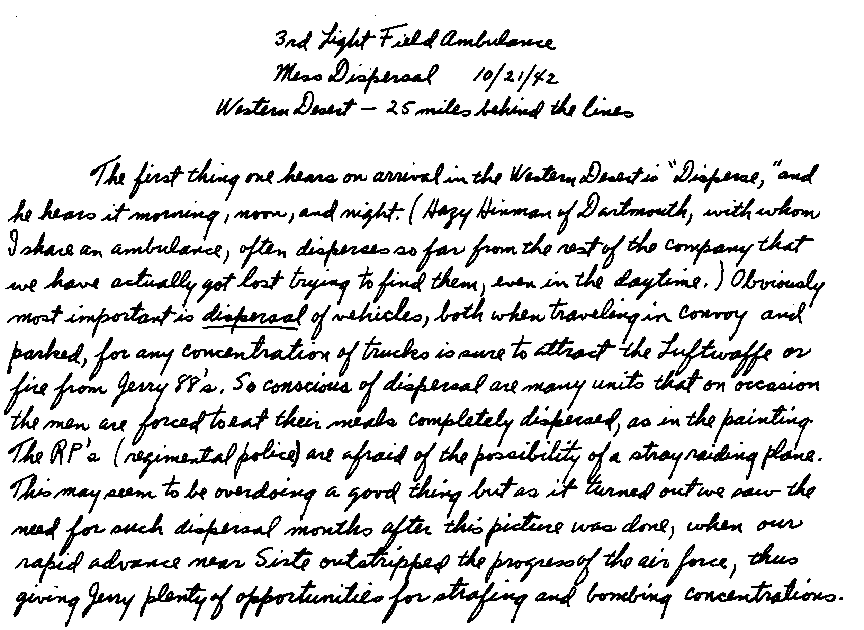
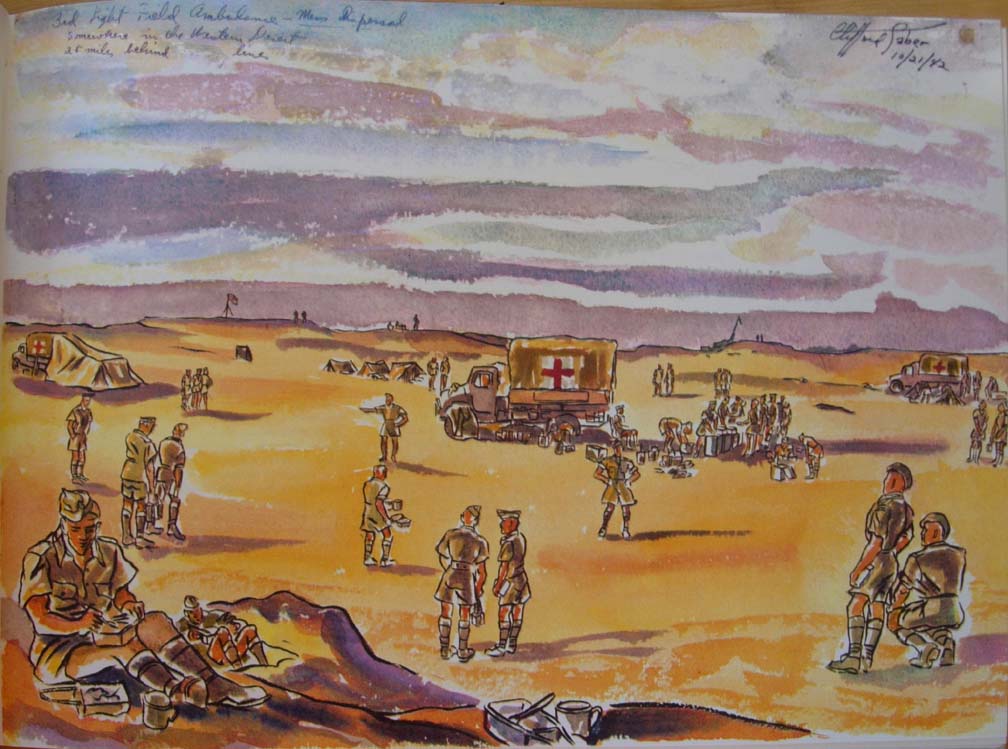
In no-man's land there was sporadic fighting by both sides in an attempt to find vulnerable spots, but on the whole the desert was comparatively quiet, except for the excitement and interest in the air. RAF fighter squadrons with the support of American fighter groups engaged the enemy overhead, and all along the line indulged in spectacular dogfights. Heavy bombers of the RAF and USAAF flew over with ever-increasing activity. In formations of eighteen, they inaugurated the theory and practice of strategic bombing.
Very few people realize the part played by some 15,000 troops with the American Middle East Air Force, the heavy bombers of the 98th and 376th Groups, the medium bombers of the 12th Group, and the fighters of the 57th Group attached to the RAF. They were invaluable and regarded with the highest esteem by the British field commanders. Generals Alexander and Montgomery were the first ground force generals to recognize the decisive role which air power could play in the war. When Montgomery reorganized the 8th Army, he moved his air headquarters into his own and he lived in daily contact with his resourceful air commanders, the British Generals Tedder and Cunningham and the American Generals Bereton and Strickland. It was the strongest combined team as yet thrown into the war by the Allied Chiefs of Staff.
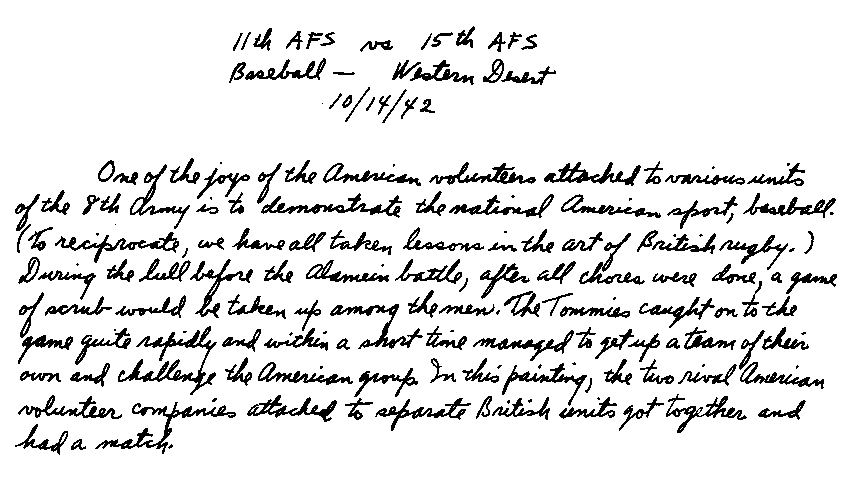
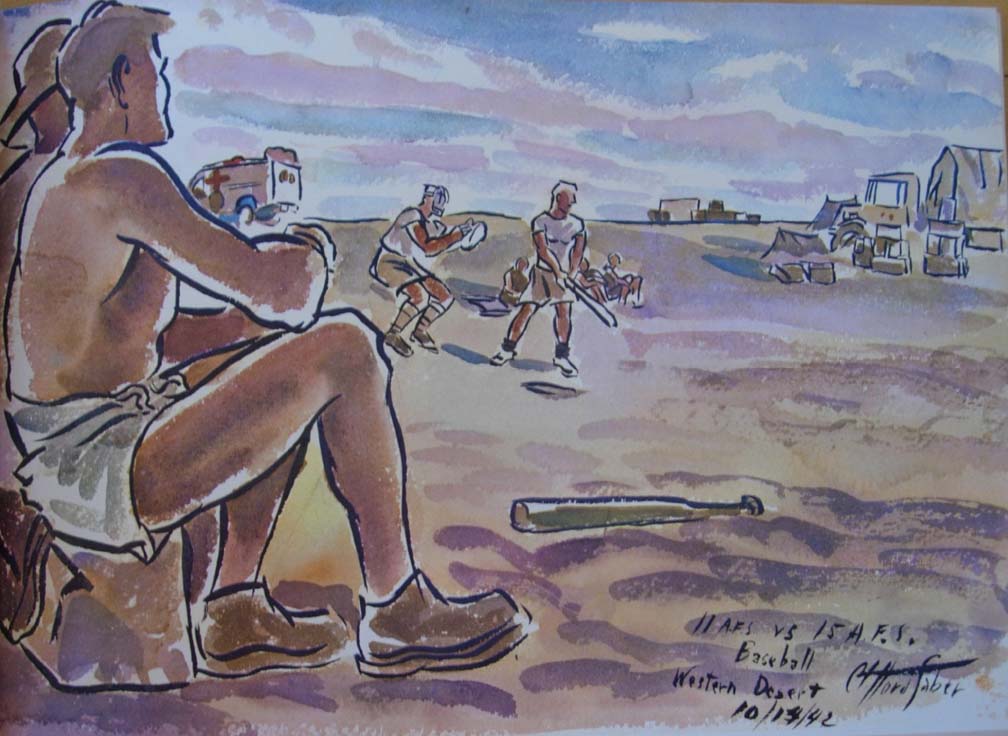
11th Company challenged the "Chickens" to a series of baseball games. The competition included British personnel of both companies. With Whitey, Baron, and a couple of cooks, we won six games out of ten. We won four straight games, coming from behind in the last two. In the last game, in the last inning we scored four runs to win. While we were at bat, I did a quick color sketch of the game and then went out to left field to catch fly balls.
En route to the field of tournament, we were directed by military police. There were some two thousand of them all over this concentrated area during the build-up and battle. The traffic on the dusty road was still heavy. Between transports, as they lumbered by, you spotted warning signs, boldly lettered, "Hey, do you know where you are?" Signs leading up to the front progressed in wit and comment. "Stop, another five hundred feet and a Jerry will give you this command." At the breakthrough line one read, "If going much farther, please take one," and an arrow pointed to a white cross.
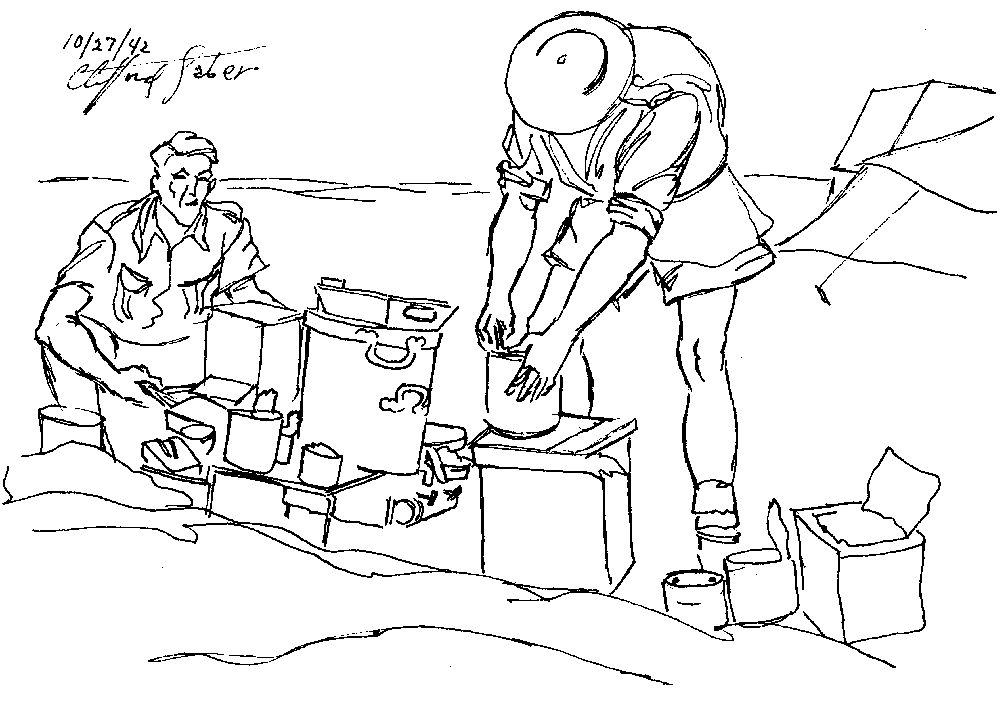
A flip of a coin between Lieutenants Evan Thomas and Art Howe decided which of their platoons was to take over the first major assignment. Thomas won the toss and took his ambulances and men to the New Zealand Division in the northern sector of the line, leaving us to sweat out the long evacuations to the rear.
Their battle experience started with the raging eleven-day battle at Alamein and the plunge through the hole in the line after the armor defeated the panzers at Tel el Aqqaqir (Hill of the Wicked Men). They wintered with and evacuated the Kiwis on their repeated encircling moves westward in the chase.
The New Zealand Division, brought down from Syria, where it had been resting, was thrown into quickly prepared positions at the narrow front of Alamein Junction. In July, they held Rommel at a standstill for 110 days while the 8th Army was reformed and strengthened.
Of all the United Kingdom soldiers, the Aussies came closest to the Americans in manners and temperament; they were somewhat reminiscent of our gun-slinging frontiersmen. They had utter contempt for the dangers of war. With their native tribesmen, the fun-loving and strong-hearted Maoris who remembered the heroism of their South Seas ancestors, they charged into battle undaunted with bayonets and the blood-curdling yell of the Haka, the ancient Polynesian war chant.
Our final assignments to stations at various desert tracks (military roads) at the front came through. Art Howe was ordered to take our twenty ambulances to the 10th Armoured Division and the rest stayed with company headquarters to service the 8th South African Casualty Clearing Station.
The day before the battle and before we moved to a designated point leading north to El Alamein Station, Wee Wee and I took the last run to a civilized community ---Helwan, where we made good use of an overnight stay at the hospital.
With everything moving up, our road was fairly clear of traffic and we were fortunate that our eight sitting cases were desert maladies. We made it in four hours, better time than the average run with severely wounded. Several of our patients had been in the army since the beginning of the war and their wives, children and homes in England had been bombed. They were the ones you expected to feel violent about the war, in a justifiable spirit of revenge which might prompt them to all sorts of brutalities. But amazingly to the contrary, they were the ones with perspective --- they treated the prisoners decently, praised a German pilot's bravery, and discussed at length the problems of postwar. And they had no illusions as to their prospects of a job, a home, or real peace when they returned to civilian life.
To relieve the monotony of the long grinding trip, I played the harmonica while Wee Wee strummed his guitar which he had recently learned to chord. As a team we entertained the wounded, keeping their minds off their pain and the jouncing of the vehicle. It invariably wound up with a song fest of "Roll Out the Barrel." Our endeavors were well appreciated but I doubt if we would ever have been tolerated in more normal surroundings.
As it was inadvisable to return to Kilo 121 after dark, we took a train for Cairo, an hour's ride away, for a last night out. We left the ambulance in the hospital car park, and decided to make our return jaunt to Kilo 121 at the crack of dawn.
When the train halted in Helwan station, the fellaheen clamored onto the cars. Men, women, and children, endeavoring to get in, pushed and jumped over each other, violently worming their way through doors and windows. A subway rush was kitten's play compared to this.
Already seated across from us in the compartment was a pencil-wax-mustached Effendi, an upper-class Cairene wearing the traditional firmly blocked short tarboosh (fez). In the Middle East you could always tell from his tarboosh what Arab country a man came from: in Syria and Lebanon it was tall and firmly blocked; west of Egypt it was unblocked, worn on the back of the head.
A young Egyptian police sergeant in khaki and fez joined us. Although both Egyptians spoke good English, Wee Wee, my former pupil, and I enjoyed their reactions when we first spoke in their native tongue. After the war Wee Wee continued his studies at Harvard, majoring in Arabic. Later he used it for two years on an anthropological expedition to French Morocco and as professor at the American University in Beirut.
We spoke, of course, with an American point of view and the Effendi with an oriental; the twain never met but there was the possibility of a meeting of minds and the company was congenial.
We got into the city rather late, 9 P.M. The police sergeant insisted on treating us to our first glass of mango juice, which was tasty and enjoyable. He amazed us with his knowledge of languages. Only twenty-three years old, he spoke seventeen tongues. And more amazing was the fact that he had never gone to school but learned them all from reading dictionaries --- undoubtedly he had a photographic mind. We wanted to tarry longer with him but the thought of a bath at the Continental Hotel and some entertainment was more urgent. He procured a gharri (horse and buggy) for us as no taxis seemed to roam near the station.
Abdullah greeted us with outstretched palm; he had a room for us. In no time we were spruced up and up on the roof watching the swaying movements of a heavily bejeweled dark-eyed dancer in the floor show and the animated twirling of couples dancing. We wanted company and it was all around us but we were hesitant and felt alone. We waited, hoping someone would come along, but no one did, for girls were few and men plentiful.
At 2 AM,, we had toasted cheese and chicken sandwiches sent up to our room, where we ate them while one of us took an air bath and the other soaked in a deep tub of water. The bathtubs in Egypt were wonderful; they were so deep you could swim or drown in them. Sadly, at 6 A.M., we left this brief moment of civilian bliss and were back with our outfit at 2 P. M.
With the last aroma of Cairo left behind, we were dispersed by the MP's after receiving our bully-beef stew from the cooks. While mess tins were cleaned in already cooled-off soapy water, the sun sank below the horizon, washing the sands with soft pastel hues as it descended. The desert night was cool and chilly.
Like Bedouins, some draped blankets over their summer khaki and we sat around a slit trench on its mounds and leaned back against the ambulance which protected us from the wind. An almost full moon came up with a brightness clear enough to read by. Everyone cupped their cigarettes, shielding the glowing tip from any enemy patrol or plane. Montgomery's last words, "Good hunting," were passed along the line for tomorrow's "do," and it became a departing trade-mark. According to the stories circulated, some of our men had already been captured and we wondered if we would be caught in the bag. Talk of Benghazi four hundred miles away was the main topic. Twice the 8th Army had gone there and twice it had been hurled back. The first time was in 1940 and the second at the end of 1941. The Benghazi Arabs almost came to expect them yearly, and their children chanted, "Mungara, quoice quittir--- El Englesi come but once a year."