|
Chapter 2 |
 |
|
We are ready NOW... The battle will be one of the decisive battles of history. The eyes of the world will be on us, watching anxiously which way the battle will swing. We can give them one answer at once, "It will swing our way."... AND LET NO MAN SURRENDER SO LONG AS HE IS UNWOUNDED AND CAN FIGHT GENERAL MONTGOMERY'S dispatch to the troops, |

THERE WERE two battles of El Alamein. The first was Rommel's attack at Alam El Haifa in August-September, 1942. That time he crept through the mine field and was pinned down by Montgomery's prepared positions, armor, and a three-day bombardment by the RAF. Rommel withdrew, losing more tanks than he could afford. It was the first blow to his chances of future victory and he failed to acquire the fuel and food he had set out to capture.
If he had succeeded, his Afrika Korps could have prolonged the war, run rampant through the Middle East, possibly outflanking the Russians from the southeast through the Caucasus or joining forces with the Japanese. So far the 8th Army had been susceptible to the wiles and strength of the Desert Fox.
In the second Alamein battle in October of the same year, the 8th Army was conscious of its chances of victory because of material superiority and the leadership of Montgomery and Alexander. In this first Allied offensive, there was action at both the northern and southern ends of our forty-mile line.
The attack to the south was of secondary importance but the idea was to delude Rommel into thinking that it was the main thrust. It was a confused shifting of brigades and divisions in line maneuvers to outfox the Desert Fox. An added deception was the placing far to the south of wooden dummy tanks with loud-speaker attachments which played recordings of the sound of tanks at night to entice German antitank equipment.
Rommel counterattacked these deceptive feints four times, shifting his panzers to meet the threats. Wasting his reserves of food and gasoline in these maneuvers, he abandoned many vehicles and thousands of Italians for want of supplies.
In the middle of the eleven-day offensive, there was the calculated risk of a standstill which would have given Rommel a chance to regroup his forces and to take the initiative. The strategy of Montgomery turned to concentrated tactics in the northern push, where the infantry had succeeded in penetrating the enemy's defenses.
His new plan for desert warfare, which made the infantry path clearers for tanks instead of tanks for infantry, did the trick; because between us and the open desert were barriers of mine fields and guns which had to be cleared before tanks could get through to where they could operate with ease. If he had sent them into battle in the first attack, they would have been slaughtered by the enemy guns. Montgomery held his armored force until the infantry had nudged its way mile by mile to the last line of the enemy's prepared defenses and secured them so that the tanks could battle and defeat the panzers around the hill of Tel el Aqqaqir. What was left of the panzers turned and fled. The battle was over and the chase was on.
The over-all report of the outer-crust struggle of El Alamein --- eleven days and nights under fire, smoke, and the dust of battle, which rolled one way, then the other --- was conveyed to us as vividly as the blood that dripped into pools on the floor of the ambulance from the badly wounded men and prisoners whose pain was numbed by morphine. Ambulance drivers not only got the first-hand information of a battle but witnessed the labor and aftermath of war.
Our units were scattered close to the various desert tracks along the front --- in the north with the Australians, Highlanders, and New Zealanders; to their left with the South Africans and Indians; in the south with the Greek Brigade and the 22nd Armoured Brigade, the spearhead of the 50th and 44th Divisions; and further south on the edge of the Qattara Depression with the Free French.
All six tracks, called Sun, Moon, Star, Bottle, Boat, and Hat, ran laterally east and west to the coast road along the Mediterranean and the railroad tracks to El Alamein Station. They intersected the roads that ran north from Hat Track in the south, the Qattara Road close to the front, the Springbok Road which led to Alamein Station and Sydney Road at the rear.
Along these tracks and roads which became ankle deep in dust and gutted with ruts from the churning of heavy rolling equipment, all casualties were moved back to the 8th South African CCS at Shammam Halt on Sydney Road between the junction of Bottle and Boat Tracks.
Under the pressure of battle, its three long wards cared for six hundred or more wounded. Each ward consisted of eight or more EPIP tents set in a row, at the end of which was an operating theater and team. After treatment the wounded were carried further back. The worst cases were evacuated to a hospital train at Imayid five miles away.
Stand-by ambulances were in a wadi close by. They were waved in by orderlies to move patients back or to transport them from ward to ward. When they were off on runs, they were replaced by 15th Company headquarters car pool which was a mile away down the track.
When ambulances were loaded, the driver started his run; a mile and a half east to Sydney Road, then north to the coast road, east again for eighteen to twenty miles, south to El Hammam, and then through a rough stretch of four miles to Gharbaniyat. Unloaded, he returned on a shorter and rougher route.
The twenty-five ambulances used in the operation alone traveled a total of 2,640 miles and transported 342 wounded on one of the busiest days. During the offensive there were many such days, for the lot of the ambulance drivers was twenty-four-hour duty. The first ambulance left camp at daylight and the last returned before midnight.
We Kids were on runs from an ADS of the 3rd Light Field Ambulance to the CCS. Al and Spike were off with an armored reconnaissance unit.
At about six o'clock in the evening of "D" day, Buck Kahlo, Hazy, and myself hectically dug our slit trenches within talking distance of each other. Our shoveling was interrupted briefly by low-strafing Messerschmidts coming from the north along the line of 25-pounder batteries, one of which was a hundred yards away from our slit trenches. These enemy air attacks became a daily habit at this hour of the evening. They came in so low we waved at the pilot and he waved back. The danger was not so much the strafing but the small-arms fire that burst all around us from troops trying to down the plane. The ten-day blitz by the RAF and American air force preceding the battle had reduced the air strength of the enemy, thus he resorted to night-fighter harassing, with punctual afternoon bombing and strafing every morning and evening.
Knowing that October 24 would be a busy day for us, we lay in our slit trenches hoping to get some sleep. We smoked incessantly and talked about the Aussies and Scots who were carrying the main attack that night. The night was still and clear. Tension was high and we waited. The nearly full moon lit up the stage of battle. At 9:40 P.M. the curtain went up on our war debut. An artillery orchestra of a thousand varied pieces opened fire as if obeying the baton of an invisible conductor. The bass of terrific explosions came from the sea where the navy had rushed out under cover of night and was hurling shells against enemy shore positions. The air shivered and hummed with the piercing of thousands of shells, and along the moonlit horizon ran the staccato flame from the mouths of the massed 25-pounders. The sky was lit for miles by the constant flashes of the guns.
At regular intervals the guns in one sector would stop firing long enough to let their hot barrels cool in the fresh night air. The barrage was co-ordinated to drop a shell on the enemy at seven-yard intervals. The core of their thunder burst all around us a hundred yards on either side as a battery let loose. Our faces were lit up by the brilliance of each explosion. Our emotions were numbed by the weight of the barrage. Behind us the 60-pounders opened up and tore the sky apart. The sound of their shells whistling over us was weird. Everything was close and the ground shook violently. It was a frightening thing but we were secure in the knowledge that it was not directed toward us.
Now and then Hazy and I, hypnotized by our thoughts and feelings, would grope for conversation. We'd end up with questions to each other as to how we were feeling mid this breath-taking skull-crushing noise and what its effects on Jerry were.
As I lay on my back looking up at the star-studded sky and moon, a million thoughts ran through my mind; how small man is in the universe, how his intelligence has made him the most stupid and vicious of all the animals. Even in this mad mêlée, the desert got into you and made you a philosopher. Strangely Roosevelt's words, "You have nothing to fear but fear itself," ran through my head like a repeated radio commercial and I also remembered the reactions to the baptism of fire of the Civil War private in Stephen Crane's book The Red Badge of Courage.
I turned over in my slit trench and tried to go to sleep. The vibration of the guns was transmitted through the earth. At each fired explosion I felt as if someone had clubbed me over the head and the sand and rocks slid down on me from the sides of the trench. Though the night was chilly, I was perspiring.
Around 2 A.M. the barrage lessened and gradually quieted down. These roaring barrages were to continue nightly, building up to a crescendo till November 3, the date of the breakthrough. This first night was a sleepless one; but with the others that followed, we managed to acclimate ourselves to snooze between runs.
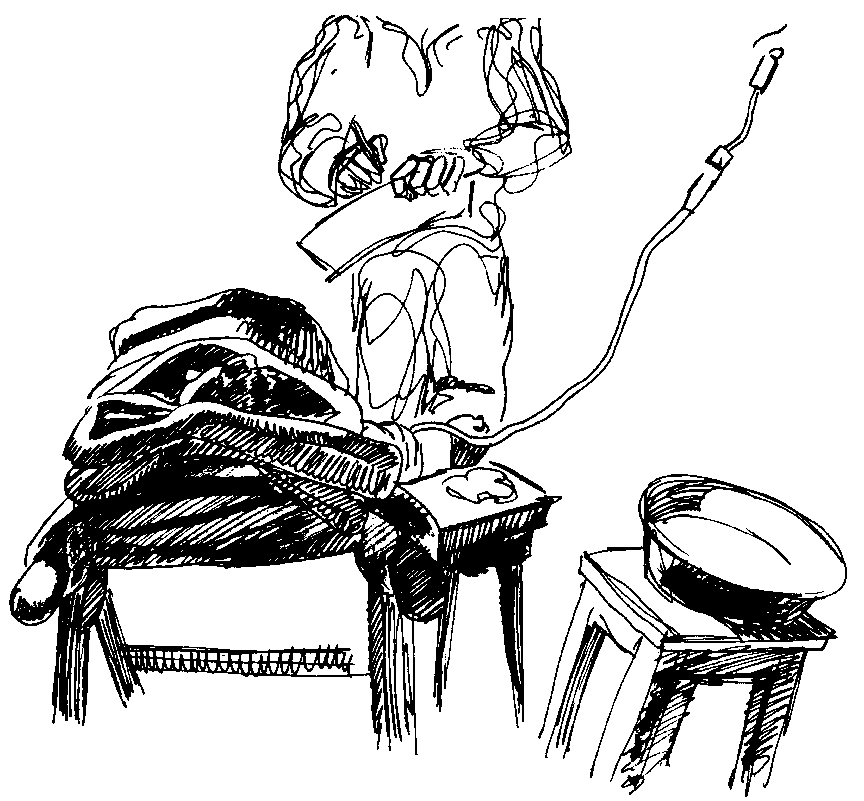
By first light the casualties came in and Buck came over and started us off on our first runs back to the MDS. Though we carried severely wounded men, the gore of blood was well hidden by the bandaging and treatment they had had before coming to us. Very few moaned and groaned. They were quite calm from the morphine. Some were talkative, others quiet; some glad to get out of it, others sorry they could not still be with their buddies up front; none bemoaned their fate out of pain. They all were good-natured and above all patient. Some were amputees neatly bandaged. It was amazing what doctors could do up forward in a tent with a stretcher across sawhorses for an operating table.
Our job was nerve-racking. Our prime concern was to get these men back for further treatment without causing them additional pain or damage. The tracks were hub deep in dust which covered the holes and ruts; we drove slowly, sometimes at a crawl. Water trucks ran up and down dampening the tracks against the fogging dust. When we had unloaded, we raced back. Our work was to be steady for the next week or so but not as rushed as it was the first two days and nights.
With the wounded came the gruff. The 8th Army had hit the Afrika Korps where it was strongest and had begun to nudge Jerry from his strongholds along the coast. The Kiwis and Highlanders gained their objectives. The right and left jabbing of the South African Division connected with a left hook. The Aussies were partly successful. The enemy counterattacked against the South Africans and Australians but all objectives reached were held with heavy casualties on both sides. The Indians carried on raids in the south center of the line, holding dug-in positions for their companies to move in. In the south the 22nd Armoured Brigade established a bridgehead and the Fighting French were in position behind Himeimet.
Heavy fighting continued all night with stiff resistance, but by dawn all final objectives had been reached. Two tape-marked corridor tracks had been pushed through the mine-field belts and the infantry moved forward for a penetration of nearly six miles. In the southern sector, the attack had served its purpose as a main diversion.
Night and day the reports came from the front. The Kiwis took Miteriya Ridge and held it. The King's Royal Rifles took Woodcock. The Queen's Bays and the 9th Lancers were well forward and sought revenge for the tank battle defeat at Knightsbridge in June. A counteroffensive was beaten off by the 2nd Rifles and Aussies. Units which were badly cut up were replaced by fresh troops.
During the eleven days of battle before the breakout the sky was filled with a hodgepodge of planes --- fighters, heavy and light bombers of the Luftwaffe, and American fighting units attached to the RAF.
Many times anti-aircraft batteries let go unexpectedly from all sides. You looked up into the bright blue cloudless sky and saw silver streaks darting about. They were high Messerschmidts and Spitfires in a dogfight. The rattle of machine guns drifted down to you. White puffs sprinkled the blue. The Messerschmidts dived and circled and then turned and fled to the north. The Spits circled us protectingly, masters of the air. The batteries ceased firing.
Further up the line, coming and going across the pale blue sky, would fly the Boston Havocs, eighteen of them in close arrowhead formation, flown by South Africans. Beside and above them flew their fighter escort. Then a flight of eighteen Mitchells (B-25's) of the American 12th Medium Bomber Group escorted by their American 57th Fighter Group. Shortly afterward, the Stukas attacked Hurricanes and got in among them. Three were shot down. Spitfires got into a dogfight with 109's (Messerschmidts), diving, twisting and turning to get each other in their gun sights. This time two Messerschmidts came down streaming long wakes of smoke. One parachute opened and floated slowly to earth. The Ju-88's came over in force. Several were shot down. The Stukas came again and again high above a solid curtain of ack-ack. They peeled and dived straight through it. Your spine tingled with their daring. Many were caught in the umbrella of puffing steel. More spiraled down in wakes of falling smoke. Eighteen Baltimores went over with fighter escort and were attacked. The sky was one hell of a bust-up. Suddenly the men along the line cheered, a fighter swooped by with the American insignia on the fuselage. He dipped his wings to the right and left and disappeared over the next dune. The bombers were coming home, this time much lower and losing altitude.
We counted eighteen. Many a time we prayed when one or two were missing or were stragglers whom we tried mentally to push home.
At night our Wellingtons and night fighters pounded the enemy and we were lit up for bombing by Jerry flares dropped from Ju-88's and night fighters. They hung on parachutes and were remarkably stationary and glaring. They flooded the ground beneath with a phosphorescent yellow or white light. You lay there exposed in the glare and followed the noise of the invisible plane motor. Sprays of luminous red tracer ack-ack floated up, criss-crossing searchingly for their target. You hoped the hailstone metal would not land on you, though you heard some of it clanking against other objects. The crunch of a string of bombs far away came to your ears and you were thankful.
Our air force continued its all-out efforts against the enemy. Fighter bombers were flying far beyond the front, strafing and bombing his supply columns and smashing his airdromes to prevent his planes from getting into the air, and when they did, intercepting them. Our planes left over a hundred vehicles wrecked and burning at Fuka. At the El Daba airport, bogged down by rain, they struck and accounted for eighty aircraft. Every countermove by Rommel was reported. Transport planes flew supplies forward and wounded back.
On the night of the breakout, every gun along the front went mad with a creeping barrage. Sweeping right and left, they poured steel at an unbelievable rate. The sky was afire. The noise struck men dumb. Behind this wall of steel the Indians moved with the Highlanders. Over the din of battle, the wail of the bagpipes sparked the clans, the Black Watch, the Camerons, and the Highland Light Infantry. Beyond the range of the guns, the air force took over. Wellingtons bombed ahead of infantry. Hurricanes equipped for tank busting and wireless jamming attacked enemy tanks. The Indians took Kidney Ridge. The wedge was driven. The enemy, dazed and shell-happy, fled madly from the wail of the pipes and the flashing steel of the Ladies from Hell. The South Africans in armored cars raced through to the enemy's rear, shooting up transport. The 11th Hussars charged in. The Shermans, Grants, Crusaders, Valentines, and Honeys poured through to the west. With the armor, the Kiwis went into motion, bypassing enemy rear guards in the south. Everyone turned north to the coast road for the kill and the cities of men built up at El Alamein disappeared.
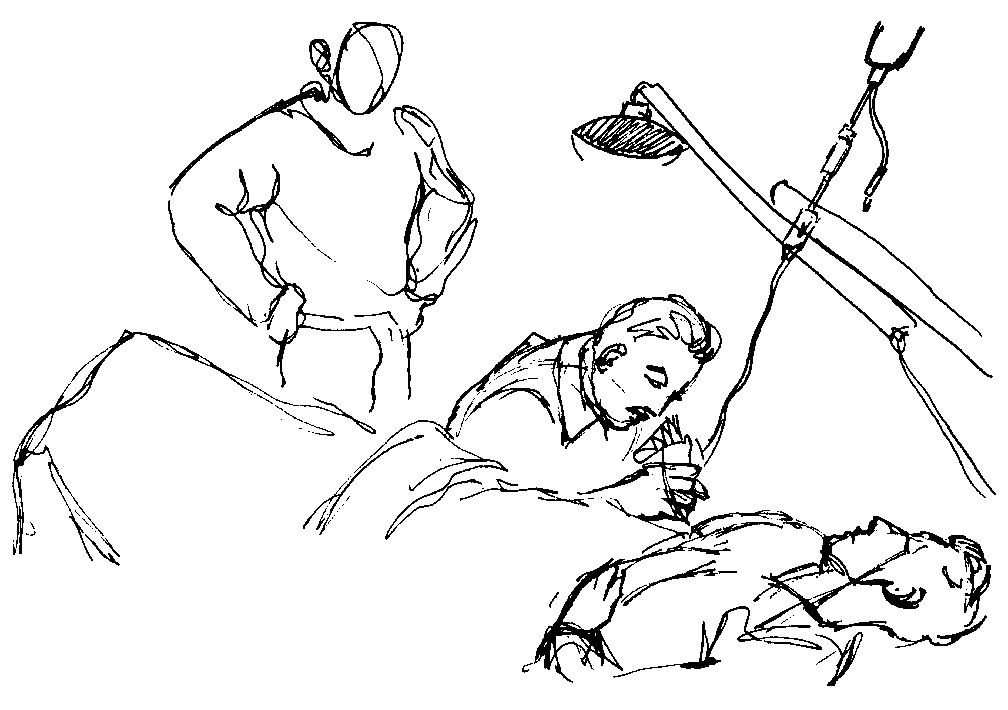
Our activity increased with the battle. Everything moved fast; wounded came in with only preliminary first aid. The dead and wounded were carried until our backs seemed broken. Some of us worked forty-eight hours without rest or food, right in the middle of hell. Surgeons worked tirelessly on wrecks of humanity. Jewish medical teams from the Palestinian army worked impartially on Germans shot up and hopelessly shattered. Now and then, stretcher bearers carried away a tightly rolled blanket containing what was once a man; and shortly a padre blessed a new grave. There was a steady stream of patients in and out of the operating theaters and from one ambulance to another. Blood transfusions and intravenous feedings were administered among the ever-present smells of ether and formaldehyde. Then came the prisoners, an overwhelming stream of numbed men stretching out as far as the eye could see. They walked across the sands to give themselves up; starving men who were unable to make their wants known, but obviously glad it was over. The tracks of El Alamein were left behind in the sands. And crosses --white crosses --- marked the "Unknown British Soldier."
In the middle of the breakout, I found myself among the casualties, horizontal on a stretcher. I was cold one minute and hot the next. My jaws clicked like a Flamenco dancer's castanets. I shook, rattled, and rolled.
In the MDS tent an MO came over with a nurse; my temperature was taken and there was talk of the possibility of my having malaria, so I was given a blood test immediately. I was helpless in my shakes and passed a fitful, jarring night and awoke from a spasmodic sleep still with fever.
I was sent back against my will, finding myself on the top stretcher tier of one of our ambulances, my head right behind the driver who turned out to be Boo Boo. In placing the wounded, he had put me in this position which enabled us to chat. I learned that I had sandfly fever, and not the dreaded malaria. Not only had sand and rocks tumbled into my slit trench during the many nights of the barrage but the sandflies were aroused and had staged a barrage of their own on me and others. Because of the fatigue of battle and our lowered resistance they succeeded in downing many. The other casualties in the ambulance included badly shot-up but well-doped Highlanders, and a Tommy in my predicament. Boo Boo jounced us over the ruts as smoothly as possible to the hospital train at Imayid.
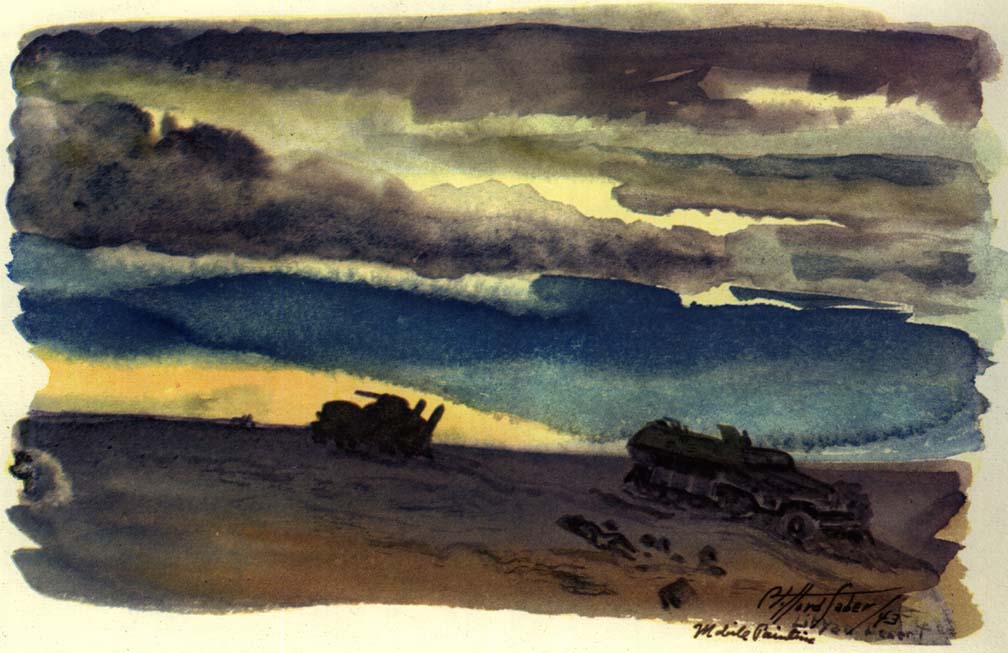
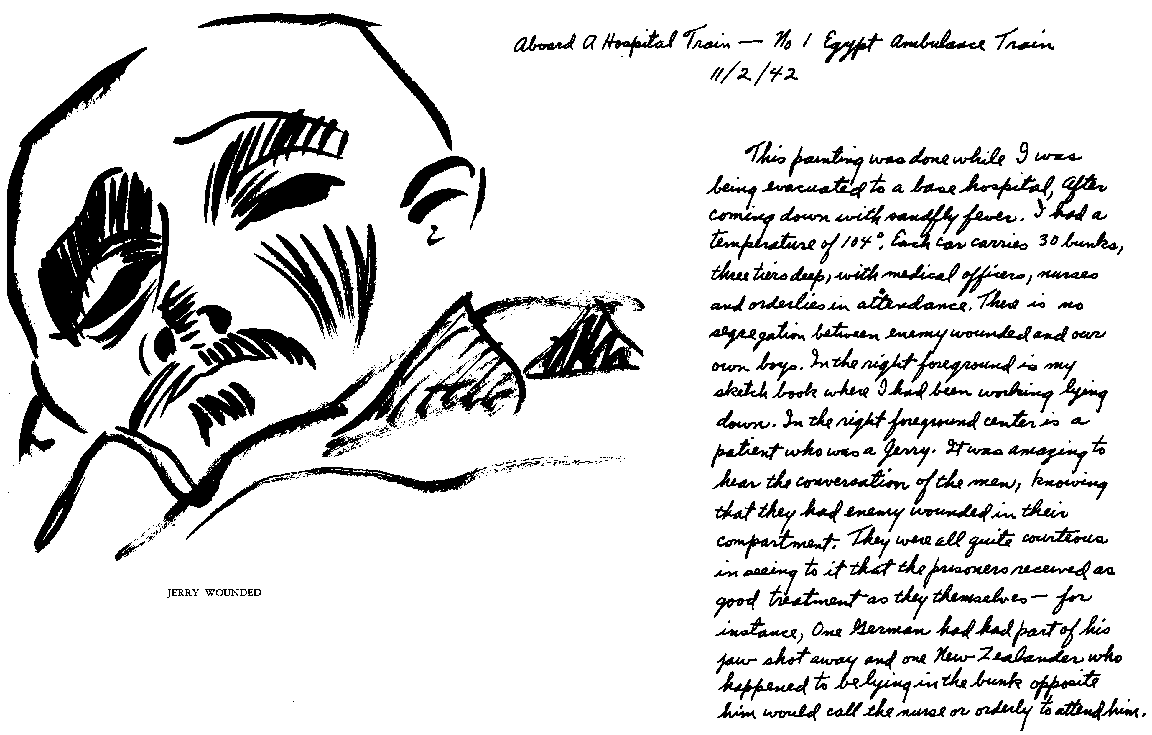
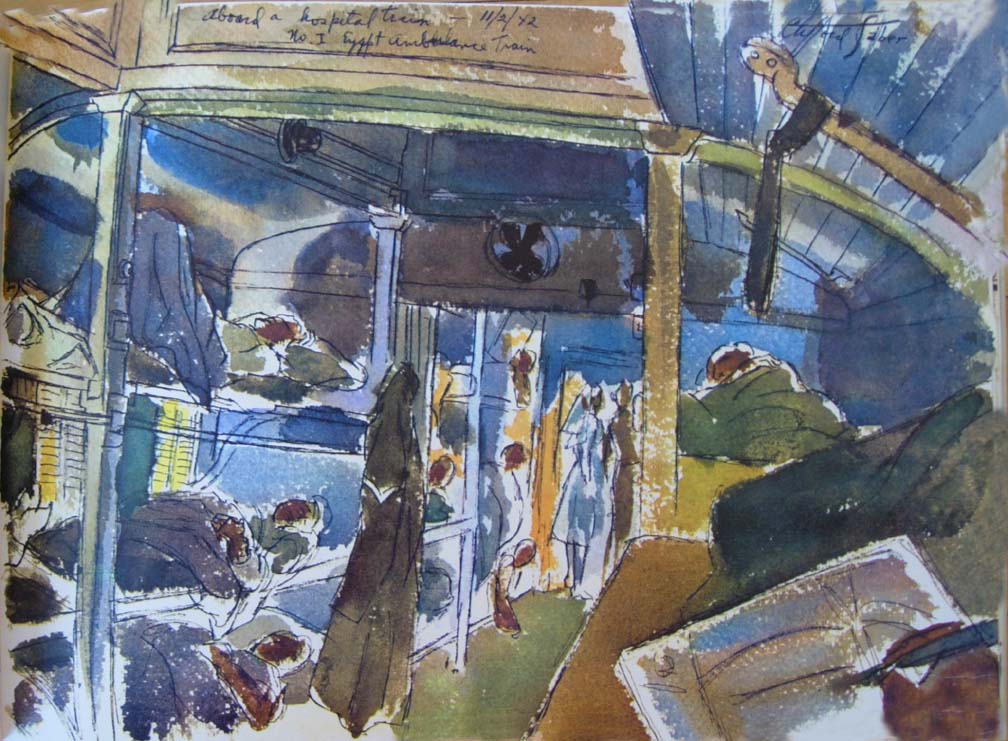
When he and an orderly carried me out and aboard the train a fear came over me of being lost and swallowed up in the evacuation shuffle. I didn't know when I would see the gang again, and above all I had lost the opportunity for recording the initial breakout into open country. Inwardly I cursed the fact that I was being evacuated, for I felt I would be on my pins again in a day or so. Many a man did not mind coming down in battle, but not being able to keep in touch hurt me more than a wound. The mind is a wonderful thing, but sometimes it overrates our strength and doctors know this well. I found it to be so later when, after I was wounded, I tried to paint brain operations and found I could not stand up and concentrate on painting. Now, not wanting to miss any more opportunities, and regardless of my fever, I managed to do a sketch of the interior of the No. 1 Egypt ambulance train with our wounded and many of the enemy, most of whom came out of their fright long enough to realize that they were being treated the same as we were.
In Cairo I was dumped into the long reception tent lined with rows of occupied stretchers. Just as I was dozing off for a much needed sleep after the hectic rush back, I was impatiently prodded by a couple of MO twins accompanied by a nurse, referred to as "preliminary observers." After their examination came the wait for an assignment to a ward. The nurses couldn't cope fast enough with the needs of the men, so those casualties who could get around helped their buddies, although it was like the halt leading the blind.
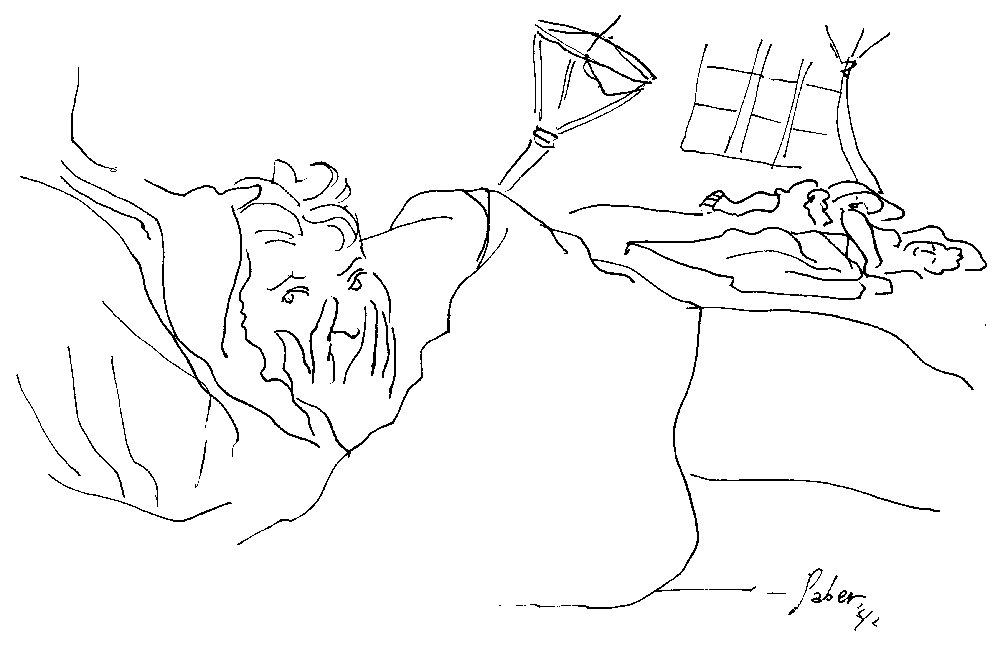
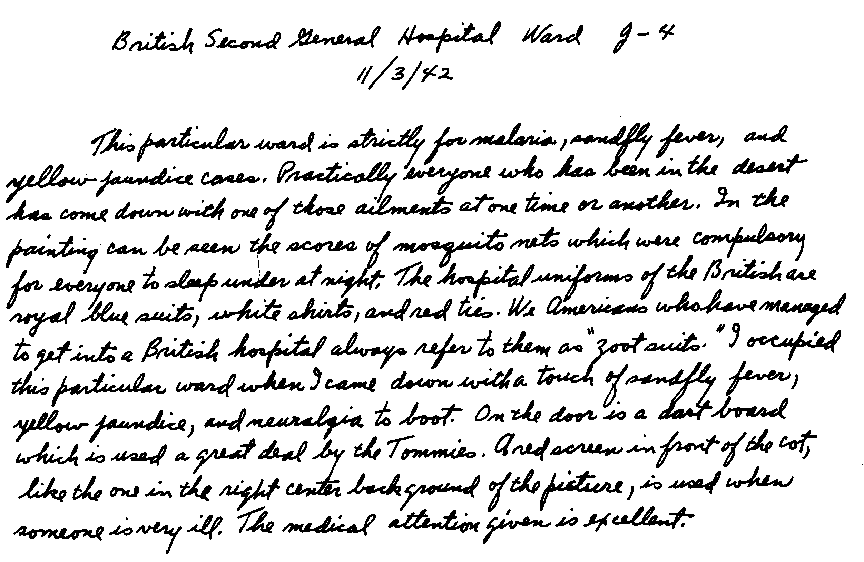
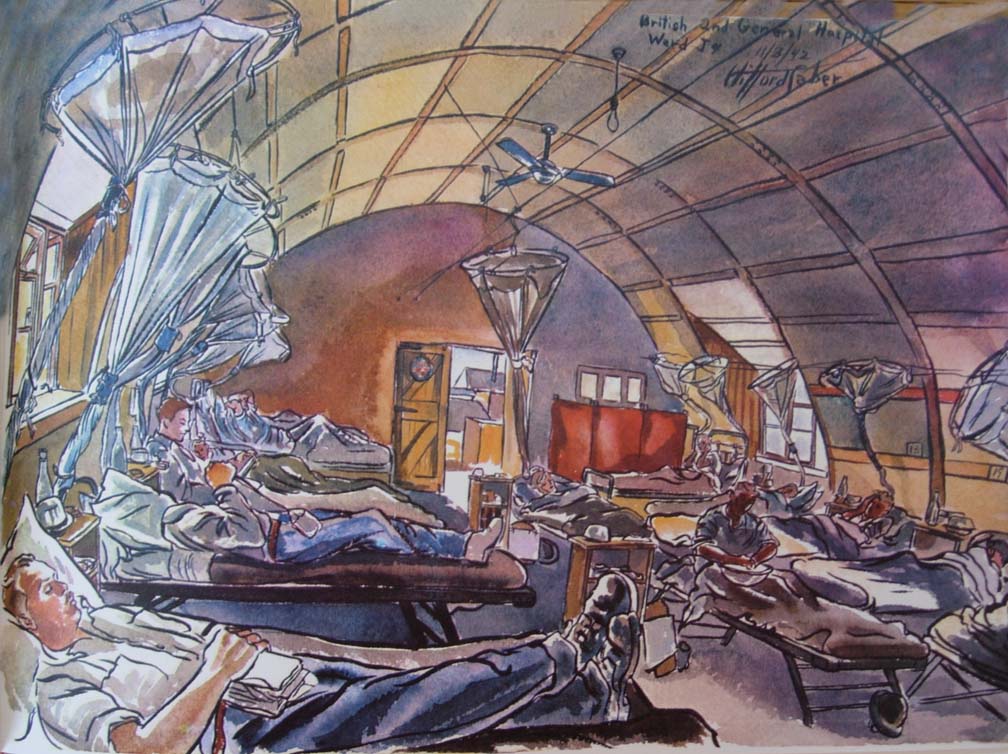
During the night in the tent I became violently nauseous and developed infectious hepatitis; I was moved to a Quonset hut, Ward J-4. I didn't know what was wrong until I woke up the next morning thinking I was surrounded by Japs. Everybody had yellow jaundice, a very common disease out there, especially at that time of year. It was generally thought to be caused by a virus, but this was debated, and some attributed it to the British army rations. The treatment was complete rest on a fat-free diet, and ours consisted of boiled fish and cabbage morning, noon, and night. Intermixed with this, we were stuffed with pills and a succession of fruit juices.
We slept under mosquito netting and blankets. Temperature taking and bedpans were heaped on us, sometimes to the point of embarrassment during visits by Cairo debutantes who passed out books and ice cream in the afternoon. I often wondered what they thought of us, for it took a strong stomach to look at a jaundiced face, glassy bloodshot eyes, and skin like an old parchment lampshade without shuddering. We lounged in bed, happy that we didn't have a thing to do for days but gaze at these visions of femininity and listen to their trifles of local gossip such as the wonderful shish-kebab dinner with salad and arak they had the night before. When they mentioned food our mouths watered.
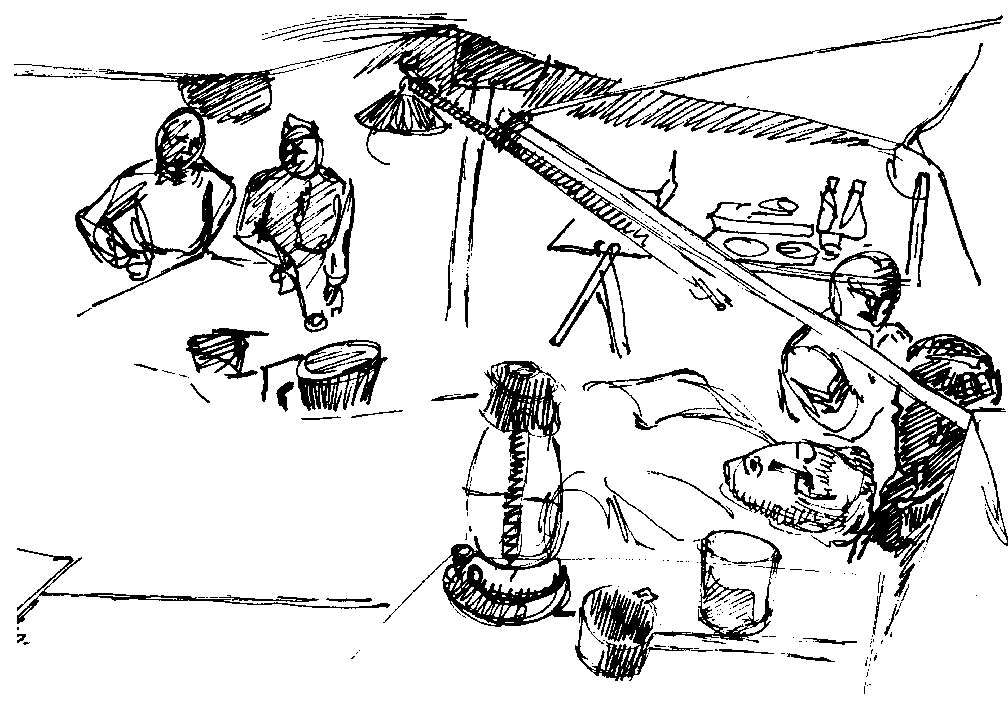
Gradually we returned to our natural ash-gray color and the time came when we could get up and visit the canteen. With this momentous occasion came the wearing of hospital "blues" and I started painting again doing a sketch of the ward.
We listened to the B.B.C. over the ward radio and heard about the tremendous advance of the 8th Army in the desert and I felt sick at the thought that I wasn't with the gang. We heard many big-time entertainment programs sponsored by the American USO and British NAAFI. They were the closest thing to home and worth a thousand letters. Many a man wiped away a tear at hearing one of his favorite entertainers and songs. One day, right in the midst of a transcribed Bob Hope program, came a silent interruption and we waited tensely for some sort of news communiqué and the familiar calm voice of the announcer, but instead he spoke excitedly and electrified the ward. The Americans had landed in French North Africa, General Eisenhower with an Allied Force of Americans and British.
 |
 |
The news report gave no idea of the size of the force involved but it obviously was an invasion of major importance. I swelled inside when one Tommy called me "Yank" and I wondered whether my old Company C of the 29th Infantry with the 4th Division was in on it. This was a moving experience for us Americans, for word spread like wildfire through wards and hospital grounds. Many chaps in my ward had served in all the campaigns out there ---in Crete, in Greece, in Syria, in Egypt and Libya. Some had been at Dunkirk. They reacted with tremendous admiration and enthusiasm; they shouted, laughed, and speculated; "It won't be long now, chum --- this time we'll make it!"
I was discharged from the hospital and given a fourteen-day convalescent leave to be spent at a well-known British rest camp, notoriously renowned for boot-training its men back to shape. But I finagled my rest cure in Cairo, which seemed like the melting pot of the world after my desert and hospital sojourn. The weather was soft and warm. This was the warmth that European tourists bought in winter. I reported to AFS headquarters with my medical orders and was given permission to rest at the Continental where I made plans for a trip to Lebanon.
The first thing I did was to walk to Groppi's tea garden where I had two chocolate ice cream sodas. Groppi's was a colorful spot with garden lights strung through the trees. Everybody congregated there, especially overripe pretty young girls. I hailed a gharri and drove leisurely around the city; it was nice to just stare dreamily and observe the sights without having to rush anywhere. I felt I had earned the right to a real holiday, my first since I had left the States. As it got dark, the lighted windows of shops --jewelers', furriers', photographers' --- gleamed like a Christmas tree. I bought a horsetail fly whisk with an ivory handle for the desert pests and a swagger stick. The customary friendly bartering ritual took place before I made my purchases. The stick contained a concealed blade for protection. In the hospital I had found that a lot of our boys were casualties not from battle but from traveling alone in the by-streets and being rolled by the native thugs. I wasn't taking any chances.
Confronted with the jaundiced vendors and beggars in the streets and the highway robbers in stores, the soldier surmises that Egypt is a nation of thieves and beggars. I had a galli-galli boy of ten fleece me of some loose money while he fascinated me producing baby chicks from solid eggs. The average conversation a soldier had with Egyptians was an abrupt, "Imshi Yallah!" ("Scram --- on your way!"). But whenever the soldier had an opportunity to learn more about the lowliest native, he found a primitive philosopher of gentleness and courtesy.
Politeness is the first requirement of personal contact with Egyptians. One doesn't demand but rather requests. The servant in the hotel, the man in the little shop, and the fellah in the field valued a smiling face, or a simple Arabic phrase from a phonetic dictionary as a sign of good will and you were treated like a king.
I had dinner at the El Hati, a harem-like native restaurant. Red-tarbooshed Sudanese waiters, nightgowned and with red waistbands, served shish-kebab right from an open charcoal-fire trough tended by chefs similarly dressed. They all bore scars on their faces reminiscent of those of Heidelberg dueling students.
The aroma and smog from the skewered chunks of lamb and onions permeated the main high-ceilinged dining room.
The service was excellent and strange. To call a waiter you merely clapped your hands and your waiter came. Now and then you heard the lead-off phrase to an order: "Isma, ya Sidi" ("Listen to me, sir"). The place echoed with the beat of this clapping and if you closed your eyes, you would think a dancer was about to appear. I was so taken by the oriental atmosphere and service of this restaurant that I designed a modern American air-conditioned counterpart for my own amusement during a rainy day in the desert.
As you came out into the night, the dust-laden air and unwashed streets were filled with city noise and the songs of soldiers who had consumed too much beer. Cairo was not in the front line but you thought it was just around the next corner because of the presence of so many desert-stained men on leave. They relished this lazy spree after the ordeals of combat. They were all over town, sometimes accompanied by women in uniform and usually followed by basheesh urchins. The Egyptians who didn't like the war but were out for a fast buck enticed them into bars dubbed after pet army names, the Anzac, the Spitfire, the Tomahawk Bar, and Churchill's Bar. Large "V" signs were painted all over the places to attract trade.
When they weren't desert-happy, the troops were leave-happy and they openly expressed their criticism of the 'base-wallahs," the staff men of GHQ, Middle East, whose duties kept them permanently at base. They fared worse at this jibing than probably any other staff people in the war. Because of their gabardine uniforms, they were called "the gabardine swine" or "the chairborne division" or the "Short Range Shepheard's Group" in comparison to the "Long Range Desert Group."
Added to the din of the troops was the wild revelry of the natives. It was the month of Ramadan, a Mohammedan month of fasting which terminated each day with nightfall. During the thirty days of solemn observance of Mohammed's divine revelation, the true believer abstains from dawn to sunset from all eating, drinking, smoking, bathing, and delights of the body but each night he makes like New Year's Eve on Times Square.
Standing on the stairway in the foyer of the Continental Hotel, I watched the crowd below. Intermingled with the uniformed men, young male Cairenes in dinner jackets escorted women in low-cut evening gowns whose enticing perfume rose to the ceiling. Older men sat around eyeing them calculatingly. It was a breath-taking sight after so much khaki.
Life for me at the hotel during my convalescent period involved neither a long rest on its terrace nor the daily afternoon siesta of Cairo routine. Business hours were from nine o'clock in the morning till one in the afternoon with a prolonged lunch or siesta till four and then back to work till eight in the evening. Dinner and night life commenced at nine. An artist at work has no time schedule except a deadline, which often makes it necessary to work around the clock. I paid a social visit to the staff of the OWl on Sharia el Walda where Russell Barnes was the new director, and found myself a free-lance artist again. They were still without an art director and the urgency of getting some public propaganda posters was conveyed to me by Elmer Lower, who shared an apartment near the office with George Renz, a former professor at the American University of Cairo (now with Aramco in Saudi Arabia). I volunteered my services until my trip to Beirut.
Working in the hotel and shuttling by taxi to the OWl, I executed anti-Axis and pro-American Middle East Air Force posters which were used for newspaper reproduction and window displays.
Several times I shared a cab with Nick Parrino who lived in a pension in the center of town. As a photographer-reporter on a lend-lease Russian assignment, he had got as far as Kazvin, Iran, and no further, and while returning from an assignment in the Mediterranean, had narrowly escaped an enemy night fighter when the American transport he was on got lost after dark.
He took delight in directing the taxicab driver in Arabic, nudging me and looking proudly every time he spoke a phrase. The supposition that he was impressing me with his knowledge of Arabic dwindled after the taxi driver pulled some run-around shenanigans. Nick was really directing the driver, for if you were not on the alert he would take you all over town when your destination was a mere block away.
If you didn't ask about the running condition of a car, the driver would entice you into his cab which wouldn't start and would then expect you to tip him as you left in a huff.
Sometimes these shenanigans bordered on the comical. Often a nightshirted urchin would ride up front with the driver. He would dash off to ask the way when the cab stopped, he would then get lost, and the driver would get out to look for him and would have to ask the way himself. They would return together conversing with gestures and then the driver would drive around the wrong block.
As soon as I ascended the stairs to the sanctuary of the wide terrace of the late Shepheard's Hotel away from vendors on its noisy street, I recalled the saying that if you waited long enough here you would meet everybody you knew. The chairs were filled with anticipants. The saying may have been exaggerated but I did come across "Ole" Oleson, whom I had sketched in Capetown, Commander Steele of the Royal Air Force, and Major Ben Stern, our old poker colleague. Stern was en route to the States from India and was kind enough to take a batch of thirty of my censored water colors home, which speeded their return for an exhibition.
The strangest meeting I had, halfway around the world, was not at Shepheard's but at the Grand Hotel which had been taken over by the United States Army. It took place in the narrow corridor of the fifth floor as I was about to knock on a friend's door. I was back to back with an occupant fidgeting with keys and a keyhole. The jingling made me turn. I asked whether I could be of any assistance, the soldier turned, and we were both surprised enough to utter the hackneyed, "It's a small world!" The soldier was Walter Bernstein, whom I had last seen at Benning and who was now passing through Cairo on an assignment for Yank. Today he is a gifted writer for the New Yorker magazine.
The Continental Hotel and its roof garden seemed like a second home to me after my desert and hospital sojourn. I met many hospitable and friendly people there, the Simon brothers, importers, from Bagdad and their cousin from Cairo, Maurice Zilka, of the Zilka Bank in Cairo; Tarek Yaffi, an importer from Bombay, India; and Hage Boutros, an international lawyer from Alexandria. I made new friends and later got to know them well.
Abdullah and Maurice Simon were Iraquian Jews; both were in the States when I returned. Abdullah served an army hitch upon entering the States; and Maurice, the younger of the two brothers, an Egyptian bey, resumed his importing business since he was not able to enter the services.
These three young Cairenes showed me the heart of the Moslem city and the favorite eating haunts of its colorful people which were rarely mentioned in guidebooks and maps. They took me from the Pyramids and Sphinx, at the Mena House, to the mosques, to the antiquities of the museum, to All Saints Cathedral, the American church off the Midan Soliman Pasha, to horse races at Gezira, to the Bab-el-Louk, the fellaheen fruit market, to a houseboat on the Nile, and past the Opera House to the narrow alleys of the Musky which was crossing the dividing line of Cairo between East and West, Europe and Islam. Here you found the artisans of the East working on copper and silver in the open alleys among the perfumes of Araby. If you wished, Musky boys guided you and served you Turkish coffee at the beckoning of a shop owner.
Tarek Yaffi, who made yearly visits to Cairo from India, was one of those Lebanese traders who migrated all over the world --- the Gold Coast, South Africa, South America, Mexico, and the United States. Surprised to hear me conversing in his Arabic dialect with Abdullah at the lobby desk, he introduced himself. He was a mustached young man who wore a tall tarboosh. We dined one evening and again later at the Bardia Club, where he initiated me to my first glimpse of a belly dancer. The incident was quite amusing.
Bardia's was a native version of an English music hail or a glorified American burlesque house with one difference --- food and liquor were served. Its private cubicles extended around the orchestra floor to the stage. The smoke was so thick from cigars, cigarettes, and Turkish water pipes that a London fog seemed mild by comparison.
The native orchestra, consisting of an oud (fourteenth-century lute), a violin, a zither, a shepherd's bamboo flute, a tambourine, and a thirrbackey (an open-end bongo drum held under the arm and thumped with the fingers), played weird and exotic music which elicited praise and shouts from the fezzed audience. While the musicians played, they munched food and drank zibib, an alcoholic grape drink flavored with aniseed. This drink, whose effect is strong but slow in coming, is clear as gin but when mixed with water or ice turns milky. Its mellowness is best enhanced if you eat while sipping. Egyptian zibib was inferior in quality to the Lebanese arak of Zahle. Cairenes paid unbelievable prices to get a bottle of the latter stuff.
The Egyptian nautch dancers were enticingly and excitingly bejeweled from head to toe. They had kohled eyes, wore chandelier earrings, and left their tummies exposed. The costumes of some were covered with gold coins which supposedly represented the men in their life. Tiaras were worn tilted above one eye, crowning the long black hair which hung sensuously about and over their oriental garments down to their waists and which with movement flared like their venus-girdle skirts of silk.
A spotlight announced and followed each dancer who whirled subtly onto the darkened stage. Without peeling a single stitch of clothing, she put the male audience into frenzy. As the gyrating dance progressed, they clapped rhythmically and expressed their emotions uninhibitedly, shouting and stamping.
I sat in one of the center boxes drinking Scotches cut with water while Tarek eyed my reactions to the scene.
One girl caught my fancy and I thought it would be pleasant to paint a female for a change after the months of soldier reporting --- especially one of these rarely seen "little Egypts." Using my host as an interpreter and playing the strict role of an American G.I., I had the dancer join us between her two performances.
She was as glamorous close up as Ava Gardner but blunt of manner. Eighteen years old, she had been married at fourteen, had a child, and knew Farouk. Consuming splits of champagne like water (she undoubtedly received a percentage on each bottle), she consented to pose in costume at the hotel and quoted a fantastic modeling fee. The price astounded me and I forgot my English and astounded her with Arabic. Surprised, she left silently through the loge's velvet curtains as if stung by an asp.
Hage Boutros, a Lebanese who practiced law in Egypt, was most congenial and informative. As a child, he had known my grandfather and he introduced me to a man who had worked for him. He also knew my aunt and her family in Lebanon, where he spent his summer vacations. It was his briefing about some of the places of my ancestry that persuaded me to take advantage of my leave and journey up to the mountains at this time.
At the Allied airport of Heliopolis, I spent hours trying to hitch a ride to Beirut, Lebanon, the Land of the Golden Journey. The OWl was expecting me in Beirut that day and I was most anxious to meet my mother's oldest sister, Malvina, and her family. They did not know that I was in the Middle East and I had never met them. They lived somewhere in the mountains in a village called Bikfaya.
Shifting my portfolio from one shoulder to the other when one became numb with the weight of crammed paper and clothing, I wobbled to the RAF and then to the USAAF hangars in search of an ATS (Allied or American Transport Supply) flight. There were none in that direction that day.
Since my sick leave was half over, I was prepared to give up the idea until the end of the war; then a dispatcher suggested I try the French Air Transport at the other end of the field. One of their planes, which was warming up, usually headed for the Levant.
I reached it breathlessly before it taxied off but I was disappointed again. It was a special private plane for General Catroux and his braided staff whom I watched file into the aircraft.
Turning to head back for Cairo, I met Colonel Dassonville, whom I had interviewed and painted aboard ship. He was the Free French War Minister to De Gaulle who frequently made incognito trips to Cairo from his African capital in Brazzaville. After hearing about my difficulty, he entered the plane and shortly peeked from its open side door, motioning me to come aboard. He introduced me to the general and his bearded aides and I was given a comfortable reclining seat. The tri-motor took off and I felt most lucky and grateful to Dassonville. I did no sketching and conversed very little but stared out the plane window. This was one time I could have painted but regrettably didn't.
Below spread the delta; large quilt-like patches of varied green cultivation and blue lakes sewn with threads of winding muddy streams and ditches on a suède blanket of desert. Another look and we were over Ismalia, crossing the draftsman's straight line of the Suez Canal, and then nothing below but desert, the Sinai Desert, lumpy miles and miles of it in all directions, with no slit trenches but camel tracks and now and then signs of life. Looking down at it from the other end of the battle stick, I thought what well-defined targets we were at the mercy of an expert marksman. This thought rambled off as we flew over the green cultivation and settlements of Palestine, now Israel, and the white abstract forms of Tel-Aviv. A thunderstorm tilted us in an air pocket over Haifa. Clearly ahead were the blue mountains of Lebanon and somewhere in them I knew somebody. Then Beirut, beautifully situated on a promontory which extends three miles into the Mediterranean --- white houses, beaches, blue sea as lovely as and quite like the California coast.
On arrival at the Beirut airport which was serviced by a Lebanese staff, I felt at home for no one questioned my native dialect. Members of the American legation met the Catroux group and I got a ride with an American colonel to the OWl, where I met the staff headed by George Britt, George Bookman, John Snedaker, and Nadim Makdasi, a young Lebanese who later came to the States, became a citizen, and worked for the Voice of America.
I was the first American of Lebanese extraction to visit the capital since the war started. My OWl friends immediately postponed my visit to Bikfaya, a short commuting drive up into the surrounding mountains, proposed a tour of the country which my military traveling orders would not allow, and in the space of a few hours held a cocktail party and interview for the press. The reporters took no notes, which I thought unusual --- their articles verified this; different interpretations appeared in the French, English, and Arabic dailies and even my name was spelled differently in each.
That night George Bookman and I did Beirut well on mixed drinks. Starting with martinis at the party, we dropped in at the Normandy, then moved to the French Club for arak and a bite of food; later, glowing steadily in stages, to the Nuits Blanches, Bar Russe, and George's Bar. All over town the cozy French "j'attendrai" was played by accordian and violin combos. We wound up at 1 A.M. in the "salle de réception" of Pension Mimosa, an officers' brothel. It was appropriately decorated with one Stars and Stripes, a couple of Union Jacks, and a portrait of Queen Victoria. It had the best bacon and eggs and iced beer in Beirut. The establishment did almost as much business downstairs as in the upstairs rooms. The madam frowned upon noise, and inebriation meant instant expulsion. Despite the bloodshot eyes, we had bacon and eggs. I spent the night at the Hotel Saint George, which juts out into the Mediterranean. The sound of its waves beating below and against the pillars of my room lulled me to sleep. The hotel's name and site signified that St. George killed the marine dragon somewhere along this coast.

Lebanon has a cosmopolitan outlook. Three languages are spoken, French, Arabic, and English. Its two universities, the American University and the French Université at Beirut, stand today where the famous Academy of Law for the Roman Empire once reigned for three centuries. Their scholarships have graduated professional and administrative men. They have promoted more good will and produced more constructive results than any other program fostering unity. I visited the American University and met its president at the time, Bayard Dodge. Its campus is comparable to Cornell's.
The interest of its emigrants added to Lebanon's cosmopolitan face. Like the ancient Phoenicians the Lebanese are traders whose business takes them far and wide around the world. They generally send money home and often in old age retire here.
Lebanon is unique among the Middle Eastern countries in having a Christian majority, of which the Maronites are the strongest church, with some Roman Catholics and a number of Orthodox churches --- the Greek, Syrian, and Armenian. The Moslems include the strange cult of the Druses, most of whom live in the mountains. Strangely these many religious sects have survived in the Middle East.
Beirut is the largest port on this coast, and the rambling city with its many American cars seems to be nothing but a huge garage. There are garages for taxis and buses to all outlying districts.
The history of Beirut is long and interesting. It was a Phoenician city of great antiquity, mentioned in existing tablets of the fifteenth century B.C. and called Berytus by the Greeks and Romans.
When the Saracens overran Syria, Beirut fell into their power, and during the many wars of the Crusades, it often changed hands.
In the second half of the nineteenth century it was under the dominance of the Turks. After World War I it became a French Mandate, and today is the capital of a democracy.
Famous for its missionary and philanthropic institutions, it has a literacy rate as high as most western countries.
In the morning I grabbed a fast bite and a delicious cup of café au lait at a sidewalk café, and then found the Garage Bikfaya in the bourse. The taxi driver refused to budge until he had a full load of four passengers at two Lebanese pounds apiece. I offered to pay the difference if he would take me up the mountain immediately, but he spread his hands and gestured to me to take my time. A young French officer got into the cab and we waited for more arrivals. I finally forced the driver to accept three fares from me and we moved. Whereas the Egyptian taxi drivers were out to get your money by wasting time, these chaps were out to save time and scared the wits out of you doing it. I always thought New York cab drivers were tops in maneuvering in congested traffic, but the Beirut drivers go them one better --- they can make a turn on two wheels and still remain upright. They are known as the hot-rod goats of the S-turn mountain roads.
As we passed through the city streets, the driver was most courteous. He stopped innumerable times to chat and pass the time of day with friends he met along the road, inquiring, "Keef halack, Ya?" ("How are you, there?") The "Ya" was his absent-minded substitute for a person's name. Now and then we were stopped by flocks of sheep and goats; not content with talking to his friends the driver also gabbed away amiably with the herders. When we pulled out of the city and started to climb we picked up speed along the mountain turns that had no guide railings.
We were on the road to one of the snow-covered summits of Lebanon, Mt. Sannin, which has an altitude of 9,000 feet. The road winds around a mountain range about 6,000 feet high. Each winding rises higher through the villages of Dahr Essouan, Ain-Aar, Beit-Chabab to Bikfaya and to the next village above it, Dhour-Choueir, with its summer resort hotel surrounded by umbrella pines.
Suddenly the trees appeared along the western (seaward) slopes, evergreen oaks and pines clothing the mountainsides, and, as we climbed to the terraced heights, fig trees, grapevines, mulberry and olive trees abounded on the terraces and in the picturesque glens. Corn and wheat were cultivated in every possible nook, while up ahead atop almost perpendicular rocks, convents and monasteries crowned the summits. And as we drove upward, water poured out of rocks and fountains of ains. The howah, the mountain air, changed, and my whole body and spirit sensed the coolness.
In the distance I heard a Lebanese yodeler. His voice rebounded between the mountains and was picked up by another yodeler answering him. Lebanon is known for both its scenic beauty and customs as the Switzerland of the Middle East.
The taxi driver knew the occupants of every village house along the route. The buildings were typically Mediterranean with walls made of thick hand-hewn limestone blocks, red tiled roofs and terrazzo floors, surrounded by stone terraces and gardens. After dispatching the French officer at a house before we entered Bikfaya, the driver let me off in front of my aunt's house which faced the Greek Orthodox church and school, in front of which a priest gowned in black wearing a stovepipe hat was talking to some playing children. I noticed briefly their inquisitive eyes and smiles at the sight of a man in uniform as I turned toward my aunt's house. None of us had ever met and I had a strange feeling when the door opened. I didn't know who I would meet.
It was a great shock, because the first to greet me, my cousin Fuad Khoury, was the image of my brother. Then came my cousins Yvonne, Eue, and Nouhad, and finally my Uncle George. Between tears of joy and hugs and kisses in the French manner, I was taken inside. But I was in for a great disappointment, for Aunt Malvina was in Jerusalem with another cousin Odette, seeing the new grandchild. With the restrictions on communications, there was no way of notifying her that I was there.
Inside their cozy house, I absorbed them as though I were painting their portraits. They were light of skin, rosy cheeked, and looked Nordic. They were clean, vigorous, and attractive, and their house was immaculate. I was delighted with the luxury of modern plumbing again, and as I bathed in the privacy of a tub I kept up a running conversation with them in three languages through the slightly opened bathroom door.
Although my aunt wasn't at home, her family outdid themselves entertaining me. It must have been quite a hardship on them for food was rationed but they seemed to love doing it. I had never realized that I had so many relatives. I was invited to all their homes where what was to have been a fifteen-minute visit invariably ended as two or three hours over coffee and their wonderful food, plus some of the best arak I have ever tasted.
In the evening there was singing and dancing. To accompany this there was the music of a khood or lute, a violin, and a thirrbackey. The village poet came to these soirees and sang extemporaneous yids or songs about me and my widely scattered family. I wished for a recording apparatus, for never again will I be credited with such great exploits.
Added to all the cousins in Bikfaya who descended upon me en masse for information concerning relatives overseas was a siege of people from other villages who had seen the Beirut papers carrying the OWl release of my presence in the mountains and came seeking word of a loved one in America.
It was an extra burden on my aunt's family, not only because of rationing but because it was a social sin not to be hospitable. It was wonderful but eventually became too much and I beat a hasty retreat to the mountain studio fortress of Isa Jamiel. I was accompanied by two cousins who acted as bodyguards, Alex Akl and Michel Thouma, the latter of whom was Minister of Telegraphs of Lebanon at the time, and today is Minister of the Bureau of Tourist Information.
Jamiel, who fortunately for me had foreseen this dilemma coming, had extended an invitation. He had studied in Paris and had returned to Lebanon to paint, and now suggested that we start an art school there. He was a most gifted artist and an excellent technician. The villagers disregarded this for he shocked their strict morals by painting from his nude model out in the open on his terrace among the surrounding rocks. They talked more about this than the works he sold in Europe.
The four of us sat relaxed on the terrace taking in the mountain air, sipping Turkish coffee and eating fruit. Their faces grinned with pride as they saw my American reactions to the grandeur of the surrounding land. As I gazed around at the ever-present snow cap of Jebel Sannin, one of them and then another proudly volunteered information about the country. Lebanon or Liban means white and the term is used either because of the white limestone or because snow covers the peaks most of the year. Arabs call it Jebel Libnan.
The Bible locates Lebanon north of the Promised Land. Two ranges run in parallel lines from southwest to northeast with a long valley between them called El-Bikaah. In Latin the eastern range was called Anti-Libanus (over against Lebanon), whereas the natives called it Jebel-esh-Shurky or East Mountain, while Lebanon proper where we were was called Jebel-el-Ghurby, the West Mountain. The southern mountain of this range was known to sacred writers as Hermon.
Northeast, using Sannin as a focal point, Jamiel pointed toward the famous cedars and talked of Becharre close by where Khalil Gibran, author and illustrator of The Prophet, was born and laid to rest after living and working in America for about thirty years.

Due north beyond the lofty peak of Sannin lay the Temple of Jupiter at Baalbeck, the showplace of Lebanon and once the Heliopolis of the Greeks and Romans renowned as a place of sun worship. As I visualized the grandeur of its ruins so often described and photographed, the thought of war came to mind, for Syria was just beyond and the AFS was still working there.
Strategically Syria, if it had been captured by the Germans, would have isolated Turkey from the British, left Iraq and its oil fields at the mercy of the Nazis, and put Hitler in a position to stage a double-pronged drive through Palestine and Trans-Jordan to the Suez Canal and across Iraq and Iran to the borders of India.
The British had fought and defeated the Vichy French in Lebanon and Syria a year earlier and prevented a German infiltration. Somewhere in the mountains along the route to Damascus the AFS had a rest camp and was still carrying out its duties with the survivors and the natives who hated the French for exploiting them.
As I looked west between the great mountains on this narrow strip of land along the Mediterranean my thoughts turned to the sea of the ancient Phoenicians who extended their trading empire as far as Cornwall, England, and the Ivory Coast. Here in Lebanon they had developed port cities of industry and trade such as Tyre, Sidon, Byblos, Arward, Beirut and Ras Shamara, the last three being subsidiary centers.
Looking down between the great limestone mountains, I saw little villages with houses nestling along the sides. Once these mountains were densely covered with trees, not only the famous cedars of Lebanon but forests of pines. Today all that is left are a few groves of umbrella pines and about two hundred cedars that have been growing down through the centuries.
The denuding of the mountain timber, the only source of wood in the area, began over five thousand years ago with the building of temples and ships in ancient Egypt, then Palestine, then Rome. Today reforestation has been started by this young democracy, but it will be a long time before it recaptures its ancient look.
Two centuries' evidence of the Crusades, that most dramatic encounter between Christianity and Islam, still remains in the ruins of castles in Lebanon.
I spent my last evening with my aunt's children over an excellent Arabic dinner cooked by Yvonne. While Eli clowned a bit, Fuad was seriously telling me about his duties as flour rationer for the mountain district, and Nouhad, whom the soldiers called "Aussie," professed his eagerness to come to the States. Uncle George flooded the room with his music, playing a fourteenth-century lute of which he was a master. It was by this playing, reminiscent of Segovia's, and his troubadouring that he had wooed and won my aunt when as a girl of sixteen she had visited Lebanon many years before, leaving her family in the States. And it was the seeking of her whereabouts that had led me to this wonderful land of my heritage.
By prearrangement the racing taxi from Sannin picked me up on the morning of the fifth day. As we descended the treacherous curves I contemplated the wonderful reception I had been given, and became more grateful to the AFS for giving me such a memorable opportunity. I wondered whether I would ever see my aunt. As it turned out, I was to return eight months later, after being wounded, to convalesce.
Upon my return from the mountains, I spent a day with Hage Boutros in Alexandria, called Alex by the troops. This city was much cleaner than Cairo, and had wide boulevards lined with green bushy trees. Facing the Mediterranean shore line, with its fine swimming beaches lined with cabanas, was a solid flank of modern German architecture. Everywhere you found gharris, which furnished a pleasant means of transportation at cheaper rates than taxis. The only semblance of war was the harbor, which was full of ships and where units of the British fleet and Liberty ships were riding at anchor.
Today as I look back and remember my return to Egypt to rejoin my AFS outfit, I know that being an American, and traveling over this Land of Antiquity, enlarged one's personality, corralled new perspectives, awakened new insights, and created a broader sense of tolerance and sympathy. My "small world" meeting with Walter Bernstein I saw as a symbol of new tolerance, so badly needed, between Arab and Jew in the Middle East. It is here that the task of the United Nations is so great, yet seemingly impossible: to free one part of the world from a system of oppressive, feudal tradition, prejudice, and intolerance; so that masses of blameless people are not forced to sell themselves for the simplest needs to avoid starvation.
I longed to get back to the peace and quiet of friends in the desert; but was it the answer as a human being to turn one's back --- or am I my brother's keeper?
It was a cloudy, rainy day when I began to ask my way in search of the gang somewhere out in the blue. No one in AFS Cairo headquarters knew where they were located; the only direction I got was, 'Go West, young man."
Hitching a ride in a jeep with a British captain who was in a similar predicament, I threw my bedding roll and portfolio case in the back of his military hot rod alongside his batman and jumped into the front seat. We set out to catch up with the 8th Army during the cool month of December, the best time of the year to travel across the Libyan Desert.
We swung into the desert along the familiar tracks. The battlefield was empty of men and vehicles. Only the slit trenches and mounds of shell cases beside empty gun pits and the surplus of usable but empty petrol tins remained. All food tins and refuse had been buried. As we approached Tel el Aqqaqir, we saw that the battle housework hadn't been done. As far as you could see the ground was strewn with the wrecked remains of the enemy. Tank after tank, gun after gun, and the crossed pieces of wood from ration boxes marked "Unknown German Soldier," hastily buried by the Tommies. Occasionally you came across personal belongings of the dead, a letter from home, a photograph of a family, the prized German cameras and knapsacks containing Egyptian flags. We turned north along the coast road where Jerry had made his final stand against the Aussies, passing the riddled white mosque of Sidi Abd el Rahman where there was a large cemetery of the enemy dead by the roadway. Over a few graves was the swastika, and others bore the black cross of the Kaiser. The crosses above the Italian graves bore rosaries, medals, and the waving black cock feathers of the Bersaglieri helmets.
As our mechanical bronco moved west we became enmeshed in a nose-to-tail convoy, an ideal target for an air attack, but our fighters hedgehopping alongside and skimming the tops of the trucks made a sweet reassuring sound. Sometimes to the north and south the sounds of mopping-up gunfire could be heard where isolated bands of the enemy lingered in the wadis.
The convoy came to a standstill for hours, first because of the breakdown of a couple of vehicles, then because of the clogging of the road by a procession of Nazi prisoners moving back by foot or jammed in trucks. Columns of wrecked enemy guns and tanks were being carried back, which complicated the other road blocks.
From El Alamein to Daba, which German directional signs designated as being a distance of thirty miles, there had been an orderly retreat, but from Daba on to Fuka, a distance of forty miles, it was a rout; the dead still lay beside the road unburied. The unsung heroes of the campaign, the Royal Engineer sappers, were walking among the dead sounding with detectors and poking the ground with bayonets for mines. We saw one get hit by a jumping-jack mine, and we went over to help. He had gotten it in the groin. His buddies rushed to the scene ahead of us. With sad faces they handled him carefully as though he were a precious child. We knew he was in good hands.
At Fuka we stopped and ate some bully beef right from the can with biscuits. After seeing the wholesale destruction, and not knowing what lay ahead, I again felt the war intensely personally. Rommel was fast on the draw for an attack, but still faster in concealing his guns in retreat. He had raced along this surfaced highway without stopping to fight at any point, controlling the retreat situation with a rear-guard action with surprisingly few losses.
At Halfaya Pass --- the soldiers called it Hell Fire Pass--- we stopped again bumper to bumper. Sensing something by --- call it intuition --- the captain who was the driver of the jeep I was in pulled out of the convoy and raced by, squeezing, hugging, and stopping alongside it to allow vehicles to pass. The cause of the stoppage was again a broken-down truck which could have pulled out of the convoy regardless of the mined shoulders. We struggled out of Egypt up the tortuous pass. Looking back and down from the curving pass, we saw the convoy stretching for miles to the east, double parked --- and then it happened: a Messerschmidt and Stuka attack on the sitting ducks of the convoy. It was murder and we stood there spellbound, horrified, and helpless. At this crucial moment our planes were nowhere in sight.
We followed the chase, outdistanced by our own units, through an area strip recently cleared of mines. In Tobruck, the town and port were a heap of shattered walls, rubble and booby traps. The bombing that took place here during the whole war was so great that some said it exceeded that of Malta and Stalingrad. The masts of sunken ships stood out like sore thumbs in the harbor.
As we traveled through hundreds of miles of desert, the spotlight of war shifted from the motorized infantry and fell on the men of the supply corps, the RASC. It was easy to move an army across miles of unobstructed desert waste, but to keep that army well supplied as it moved farther from its base took a miracle of planning. The desert war was a fluid one depending on supplies and the condition of the terrain. There was no static front. The armies of both sides retreated to the nearest supply point and advanced only as rapidly as their supplies could move with them. As soon as the chase started, supply ships left the ports of Alexandria and Port Said and kept pace with the advancing troops; and after a port was taken and occupied, water, gasoline, and food supplies were sent ashore in barges which had been towed along the coast. Some understanding of the supply problem can best be conveyed by the fact that the line of communication increased in ninety days from 720 miles to over 3,000 miles.
Even our own small AFS unit in carrying out its duties rolled 37,000 miles in a sixty-day period. The RASC equipped 196 new men, transported 325 men, purchased and dispatched NAFFI supplies, acquired and forwarded to the operating areas 17 tons of spares and rubber and 23 replacement vehicles, and reconditioned 21 vehicles evacuated from companies. It acquired transport for men repatriated because of ill health or completion of service. Add to this the fact that the RASC had no union, set hours or shifts, but only one aim, to get the stuff there and back, and you have a faint idea of the way approximately 80,000 vehicles were employed.
Water was a vital problem and was as precious as ammunition, for Rommel salted wells as he retreated. We were on minimum rations, a quart every three days, delivered by "Gunga Din," the water man, with his truck. Strange as it seems, you could leave your canteen ration lying around a slit trench all day and no soldier, no matter how thirsty, would touch it. But other items, personal or army issue, were borrowed or scrounged.
Night after night we found shelter, sometimes with a leaguered unit, or in a bedroom of one of the deserted white Italian houses, or in a U. S. fighter squadron tent, breakfasting with the Yanks before moving on. The Tommy batman had his first taste of American chow with digestible biscuits and almost deserted his captain. I enjoyed my stay with my countrymen. Their curious ideas about the British didn't surprise me, since I had had similar thoughts before I knew them better. I wanted to help them understand the Tommy, but there wasn't enough time.
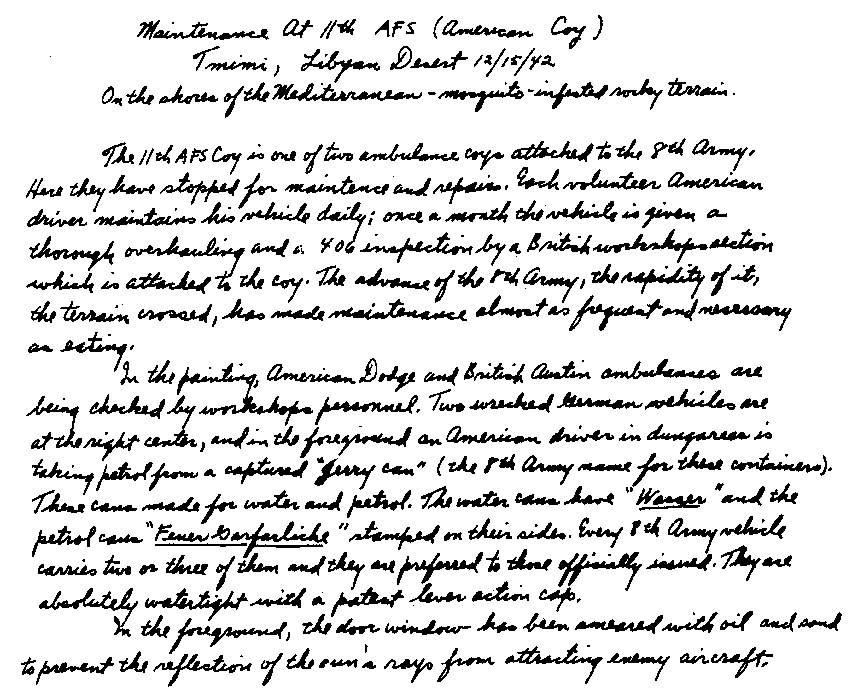
We hurriedly passed through Benghazi, which seemed sort of deserted except for the hospital and a handful of inhabitants. I was dropped off when I spotted our Dodges along the Mediterranean coast at Tmimi. It had taken me two weeks to find Subsection 10. My hospitalization and convalescence had robbed me of a month's time.
As soon as I saw the 'Kids," their gruff started to flow like a rippling brook, bringing me up to date on all I had missed. It was really like old times when we sat down to a poker game in the evening in a blacked-out ambulance.
Art Howe had taken command of 15th Company with Snazz Snead as second in command. Geer and the men of the first contingent had either returned, gone to India, or stayed on working with Pan American.
According to their bragging, I had missed a lot of the show, especially the scrounging of the deserted equipment of a fast retreating enemy. They had picked over the stuff which littered the roadside and tracks despite the warning about booby traps. As I looked around in the ambulances, I discovered German Lugers and Mausers and Italian Berettas --- although according to our Geneva cards we were definitely noncombatants, and by the Geneva Convention could not transport arms or munitions in our ambulances. All the logic in the world couldn't convince the fellows of the seriousness of the penalty if they were captured with the stuff.
Jake Vollrath, whom I sketched on board ship in our contingent, clothes-happy scrounger that he was, was almost thrown into a POW cage with a group of Italians. The only thing that saved him from imprisonment was that he managed to get out his identification papers in time and do a lot of fast talking. Even Headquarters Company turned up with a Mercedes Benz scrounged by Wayne McMeekan.
The pay-off to this scrounging mania involved the Dead-End Kids, particularly Buck Kahlo. During a lull in activities, they all went down to a nearby beach for a swim. Testing out their scrounged equipment, they took pot shots at bushes along the dunes bordering the Mediterranean ---and were flabbergasted when nine frightened, bedraggled Italians with arms raised in surrender came over the dunes. Needless to say, they didn't get their swim in the much sought-after water, because they had to escort their prisoners to the POW cage.
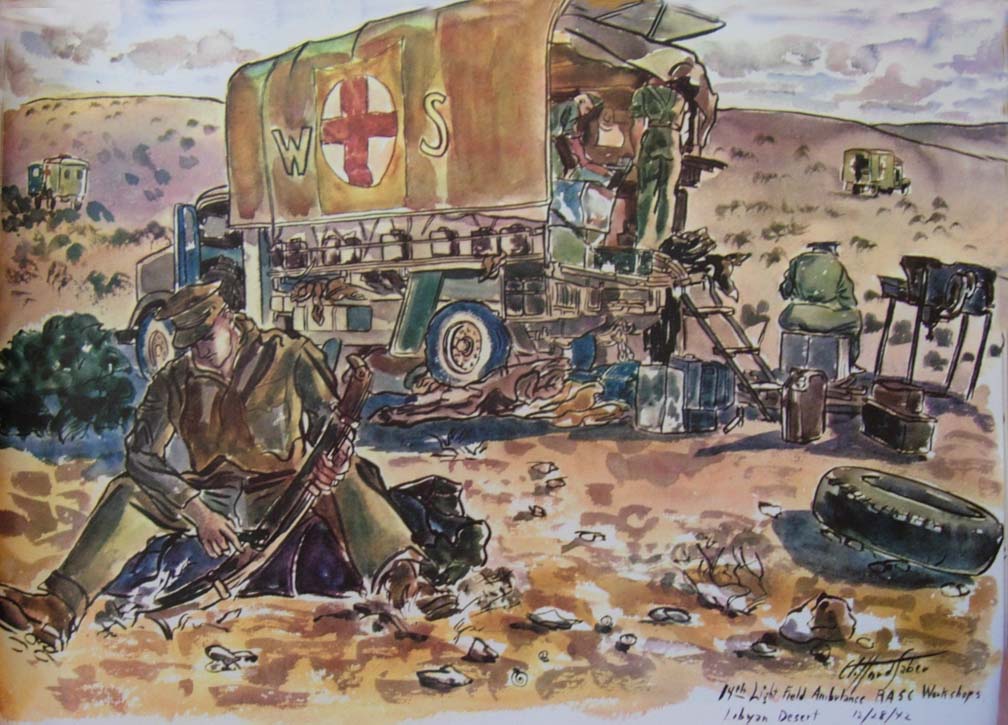
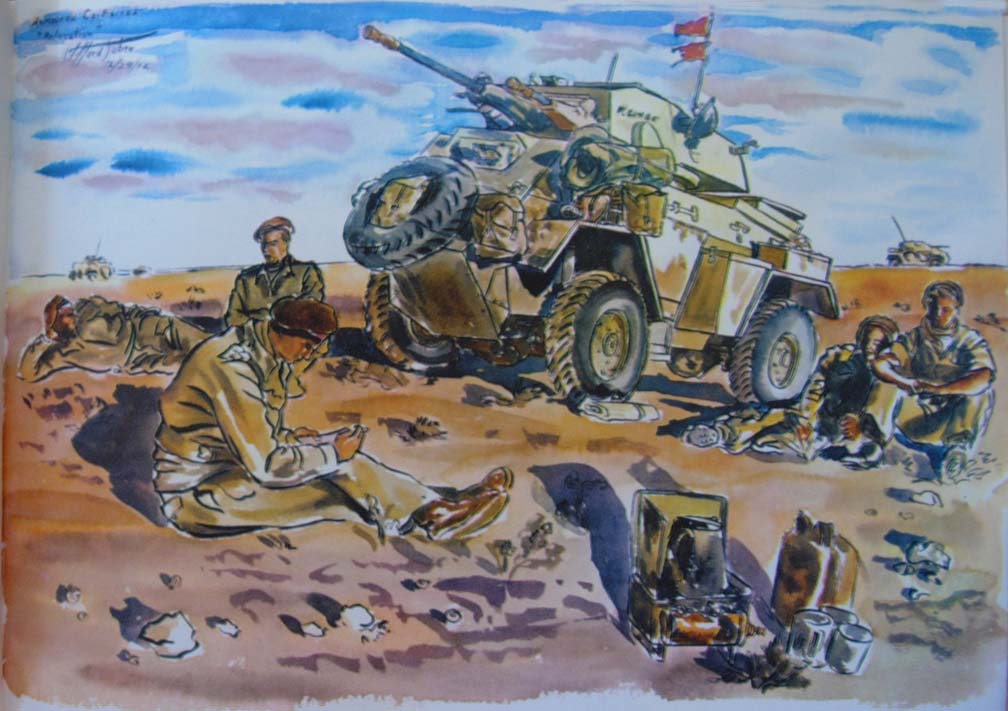
I found we were now attached to the 14th Light Field Ambulance of the 4th Light Armoured Brigade attached to the 7th Armoured Division which was in the midst of advancing toward the Agheila Line.
The 14th Light Field Ambulance was formed in September 1939, and after a few weeks went to France. Up to the start of the war, they ran two hospitals, and then, when active warfare started, they went to Brussels. Then, throughout the retreat, they went from town to town, from village to village, finally landing up in Dunkirk, from which they were evacuated.
They re-formed in England as a light field ambulance unit, and after a period of training left for the Middle East.
Landing in June 1941, they went through the Syrian campaign with the Australians and then ran a hospital in Tripoli for seven months. The unit was sent up to the Western Desert in March 1942, where it had served ever since except for two weeks of refitting in June 1942.

During the Knightsbridge battle, the unit was singled out for a Stuka attack, and 32 men were either killed or wounded.
On October 23, 1942, when the battle of El Alamein began, the unit was in the southern sector treating casualties which occurred during the first night of battle; one of the medical officers became a casualty. After a few days the Field Ambulance moved to the northern sector and on through the Alamein Line with the brigade; one day over a hundred tire punctures were caused by metal "crow's feet" (metal-prong nails) left in a gap in the mine field by the retreating enemy. From now on the unit advanced rapidly with the brigade, sometimes on the roads and sometimes in the desert; most of the casualties were caused by mines on the roads, and these were treated mostly at night when the unit stopped. Benghazi Hospital was taken over and in it were 25 of our own troops who had been POW's; they were glad to see us. A YMCA van arrived a day or so later. We were soon on the move again toward the Agheila Line. In the Agedabia area there were a number of Stuka attacks and strafing; one M.D. lost an arm and a leg and sustained a compound fracture of the other leg and a wireless operator was killed. The unit then took part in the big flanking movement, missing the Agheila battle positions and going to Nofilia where the Field Ambulance found itself unpleasantly near a tank battle as spent solid shells bounced through the leaguer! Christmas Day was spent out in the desert; there was little enemy activity and the cooks managed to produce an excellent dinner of turkey and English pudding. Then they moved on steadily to the concentration area preparatory to the attack on Tripoli; during one move one man was wounded by strafing and on a subsequent move two men were killed, eight wounded, and one lorry burned and then another damaged --- all this during the wait before the advance on Tripoli. There was regular strafing and Stuka attacks in the area, mostly on the brigade. One ADS, however, was strafed twice in one day and once the next. During the advance on Tripoli the Field Ambulance moved with the brigade on another flanking movement and had to remain all the time within the armored car protection and could work only at night when the brigade stopped. As soon as we halted the canvas shelters were erected and the operating theater got ready; the patients were treated during the night, given food and evacuated at first light before the unit moved off again with the brigade. One night move of 25 miles was made over unbelievably bad country. We left the 14th LFA temporarily to join the 22nd Armoured Brigade and rejoined it at Garian after Tripoli fell.
After a period of painting inactivity, I lost no time getting back to my desert reporting routine and the companionship of poker. These activities not only kept me busy during a lull but were an outlet for otherwise "browned off" energies, and prevented me from becoming "desert happy." The continual sight of nothing but sky, sand and far horizons did things to the men. It drew them into themselves, brainwashing them to a point of primitiveness. Day after day the monotonous land built up exaggerations in the minds and mannerisms of the desert veterans. Conversations were broken off suddenly and vacant stares substituted. The same repetitious stories were told, many times by the same men on the same day. These symptoms were not permanent, for a few days' leave was the cure which the MO's prescribed.
As desert dwellers, the AFS men found themselves too far for much communication with headquarters. Life revolved in a reduced orbit: keeping your skin in one piece, trying to get some sleep, cleanliness of daily toilet which was a Montgomery must, and shooting enough oil and grease into the ambulance so that it was always evacuation-worthy. Now and then you came across your canteen for beer and cigarettes or a chance meeting with a fellow worker attached to another outfit. The griff of such meetings always brought forth a humorous bit about AFS men, such as the following encounter of one of our volunteers with a British brigadier.
An unidentified driver returning to his post from an evacuation was stopped by a brigadier after --- according to the brigadier --- a 60-mile-an-hour chase. The brigadier proceeded to take the driver to task for going at such a speed. When the brigadier had finished, the AFS man replied in a friendly fashion, "Okay, Brig," and started on.
The flabbergasted brigadier continued ahead, where he had a traffic accident necessitating an ambulance. Soon the bawled-out AFS man appeared on the scene. "Hiya, Brig, we meet again ---" he greeted the brigadier. What the brigadier replied is unprintable, of course.
Everything had been in readiness for a large-scale offensive when I rejoined the outfit, but infantry patrol reports came back that Rommel had pulled out and was still in flight. Instead of our lot being the contemplated duty from a stable position we were on the move again into the desert. We soon received word that one of our men, Charles Perkins from California who was with the New Zealanders, had been caught in a bag. Ironically, Charlie was captured in the ambulance that was first issued to me at Tahag. I relinquished it to him when I went to Cairo to compile and ship my paintings.
His capture took place when the Kiwis on an encircling movement out of the desert severed the coast road near Marble Arch. The main body of the Afrika Korps fled on to Sirte, leaving a small rear-guard force that was surrounded. This enemy column sneaked out of the trap at night, taking Charlie, his patients, and his ambulance along with them. We had hope of retaking him and others in Tripoli but he had disappeared by then.
When Charlie was repatriated, his tale was one of the high spots of AFS humor. He had been taken to Italy in a submarine to a POW camp. One night nature called him from his bunk and he innocently walked out of his tent, only to be accosted by a sentry. The latter, convinced Charlie was trying to escape, prodded him in the leg with his bayonet and his rifle got stuck in it. Charlie had a wooden leg.
Evacuating a few whose wounds had been caused by mines and rear-action fighting, we pushed into the desert to a captured German airfield near Marble Arch where a steady stream of transport planes landed with supplies for the 8th Army and took back its wounded. Most of the planes bore the American star insignia. It was here, as a spare driver with Hazy, that I saw General Montgomery in person ---and what I would have given to do his portrait!
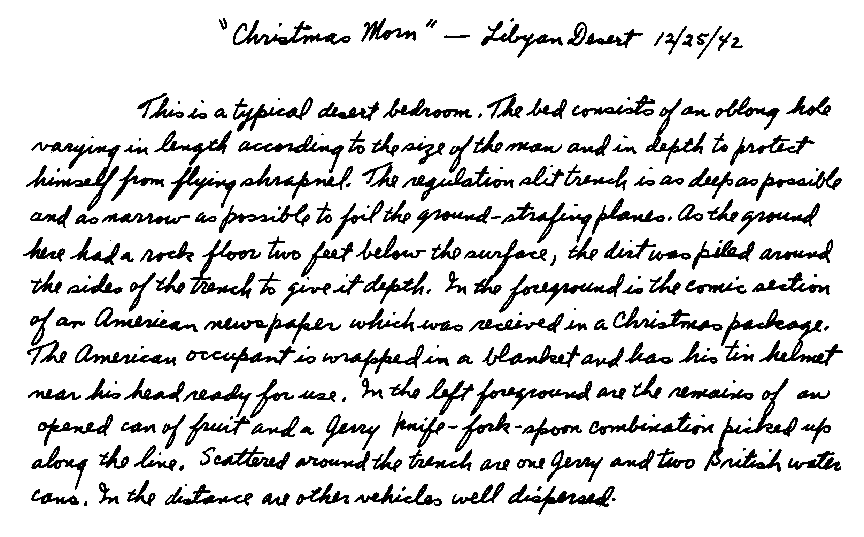
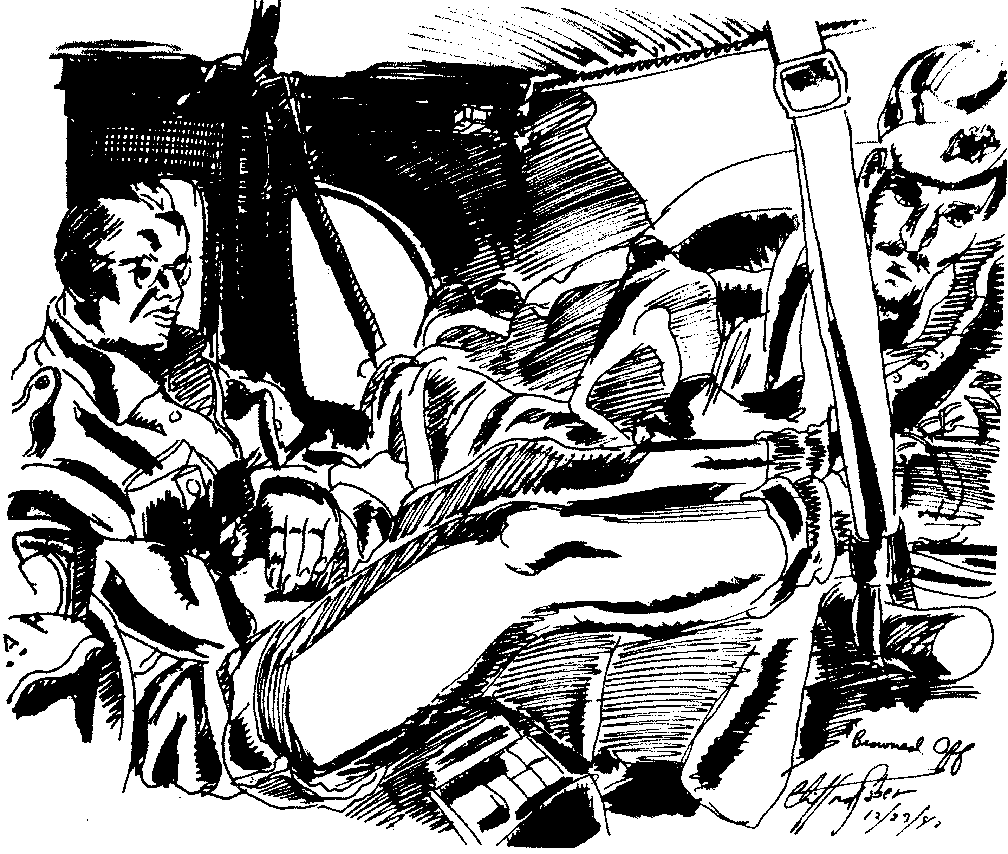
Our course from Marble Arch was almost due west, taking us deeper into the part of the North African desert which had not been fought over and which showed no wreckage scars of previous battles. We moved night and day but we carried few patients. Christmas came in the midst of all this and we remained in one spot while our canteen caught up with us. For Christmas presents we all received leather wallets. We looked at each other with expressions which conveyed, "Where the hell are we going to use these?"
German reconnaissance planes spotted us in the chase and when we got beyond our own fighter patrols they became aggressive and let us have it. Night after night we would hear the BBC's statement that we had air superiority. Right in the midst of the broadcast we would scramble out of the tent to the drone of an overhead enemy fighter, the area lighted by his dropped flares and the crunching of bombs near by. Someone would remark loudly, "Superiority, hell!"
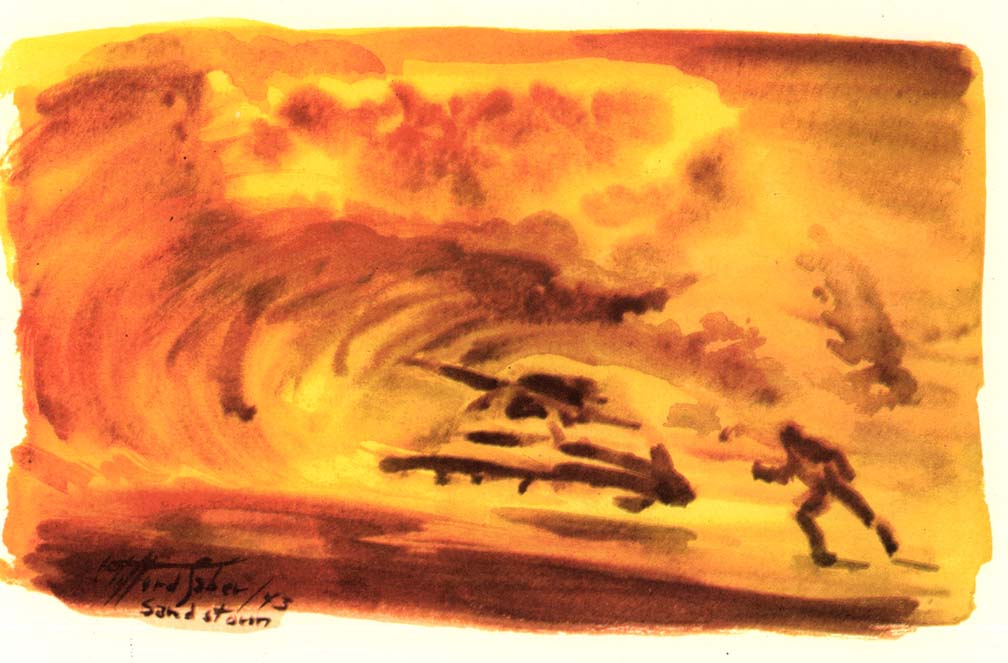
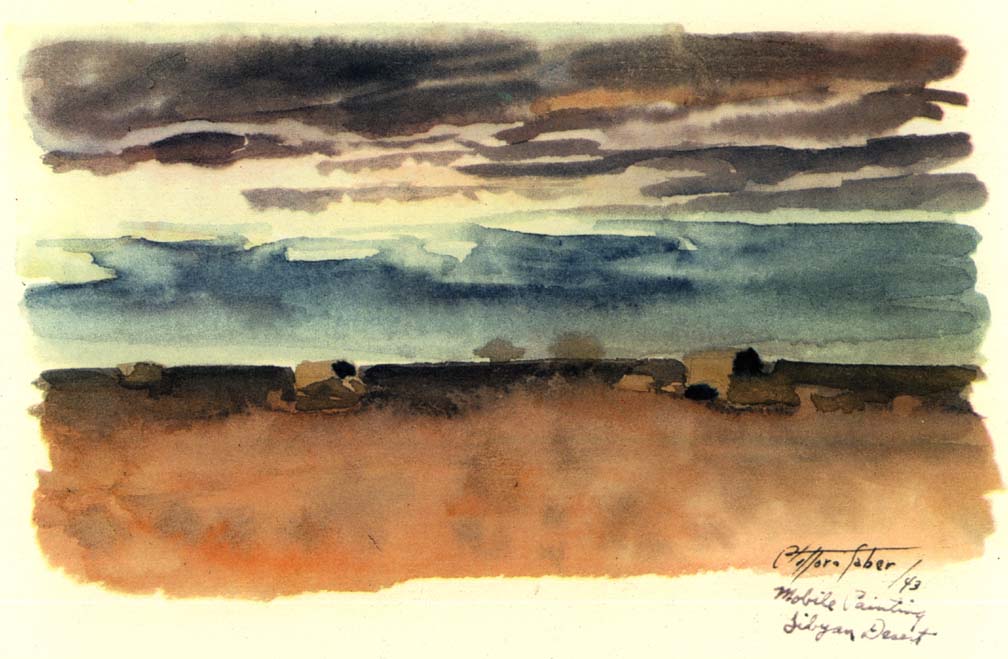
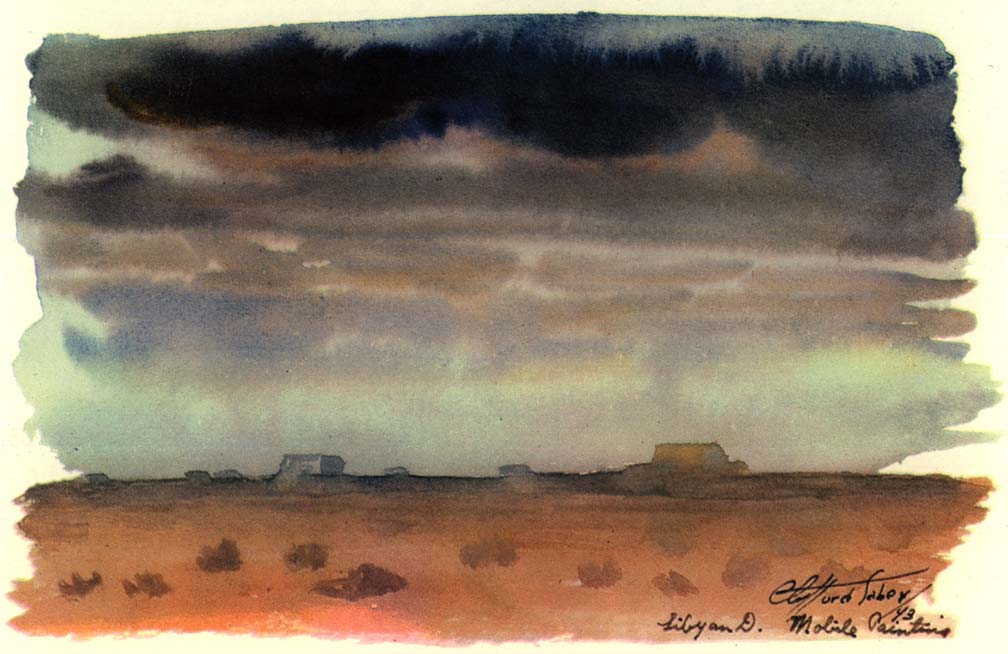
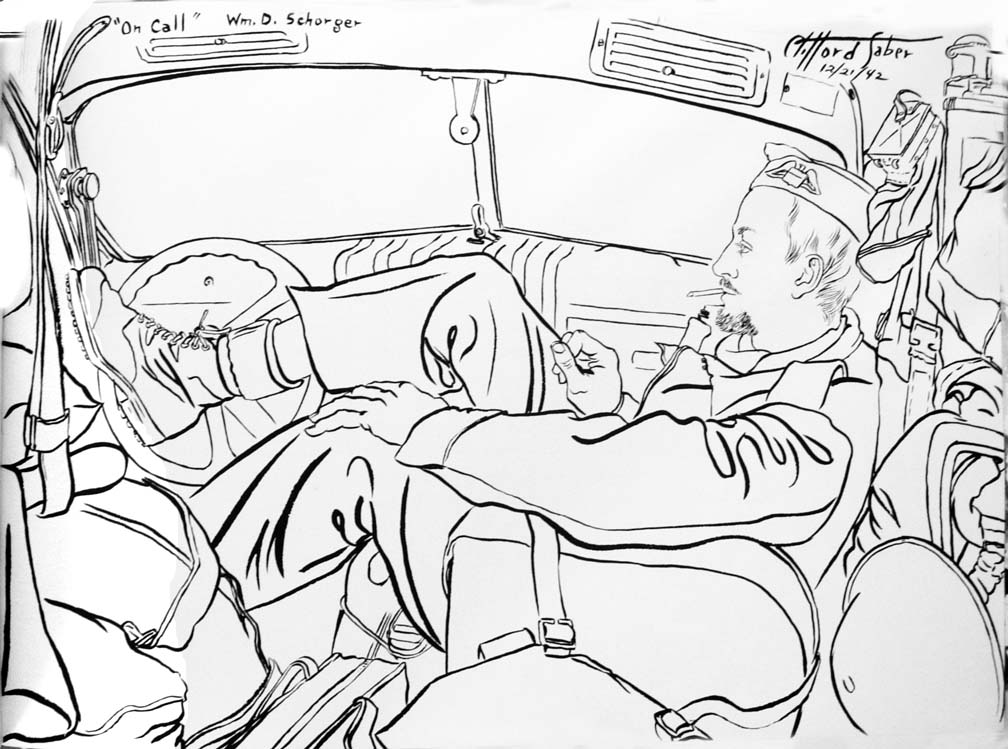
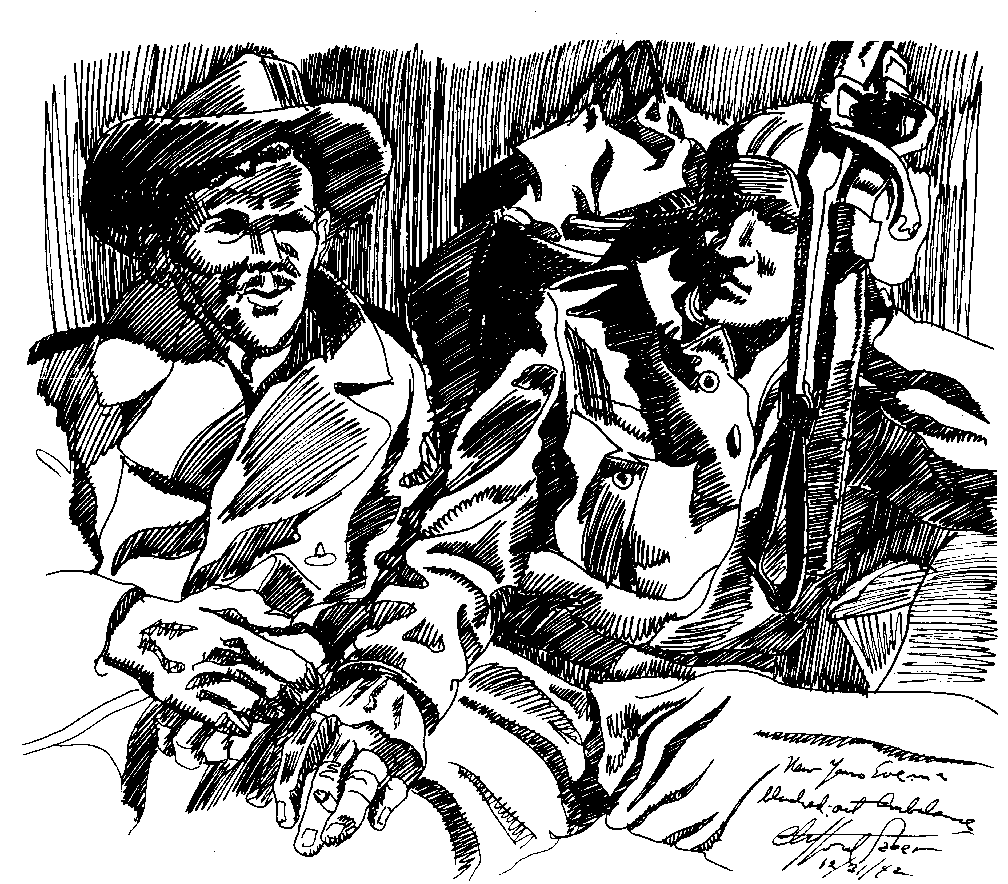
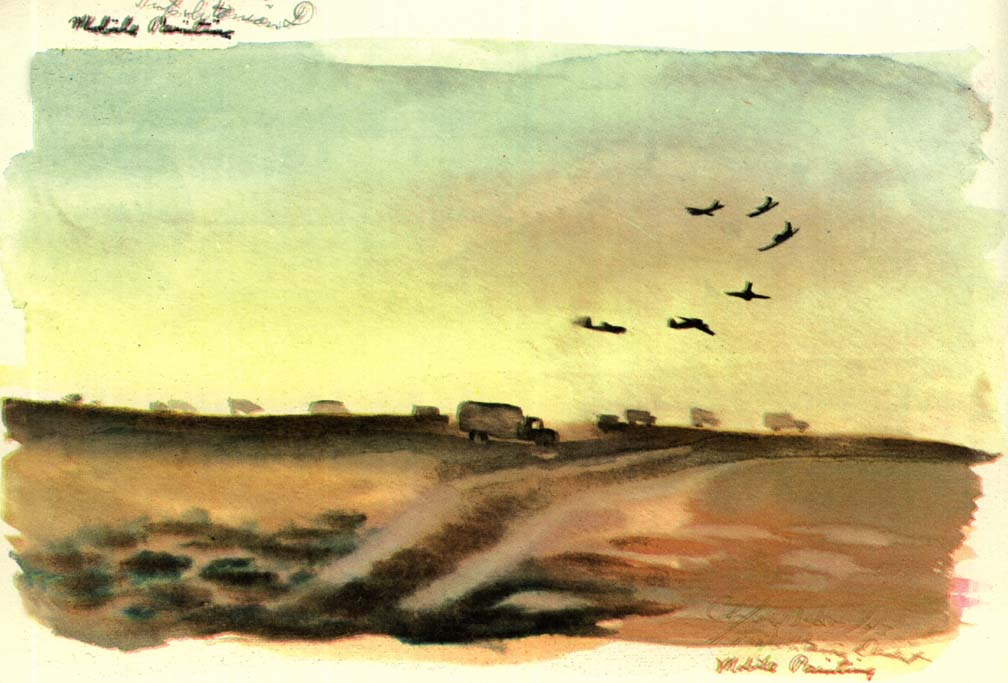
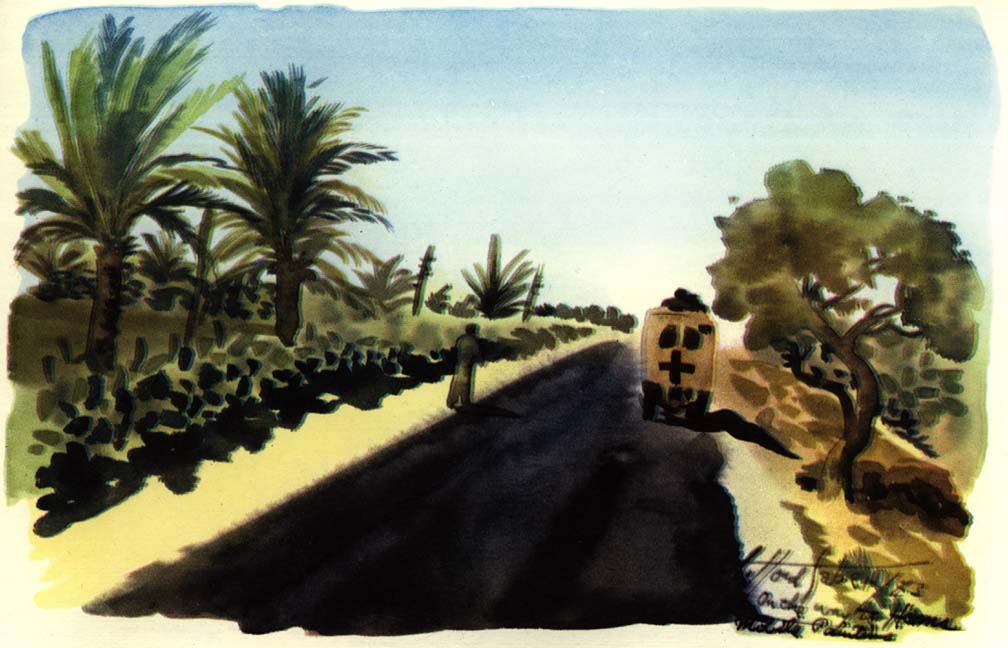
The chase through the maze of booby traps, mines, and the enemy's countershelling with 88 mm's was so swift that I had no opportunity to sit and paint, so I resorted to painting on the move. My idea was to do color notes from which I could later do more detailed paintings in oils and water colors. With Hazy at the wheel, I held the sketch book in my lap, its pages held down by a rubber band, and worked Chinese fashion, painting and drawing at the same time with a brush. My U. S. canteen cup, holding an inch of rationed water, was in front of me, attached by its handle to the closed glove compartment door. It was a screwy setup in Hazy's eyes but it worked for me. I did try later to execute larger paintings from the sketches but gave up the attempt; I had captured the scenes in my sketches in the space of a few minutes, whereas I would labor hours to duplicate a sketch and only managed to produce a detailed but static result.
As we traveled, the desert was smooth and gravelly with occasional sagebrush. We crossed a mine field without incident and then came across a wadi wherein the gravel turned to pebbles, then to rocks, and then to boulders. Zigzagging over this boulder-strewn plain, we turned north over one low hill after another and vegetation began to thicken with miles of greenery including millions of flowers of every description. The air blowing into our car windows was heavy with their sweet aroma.

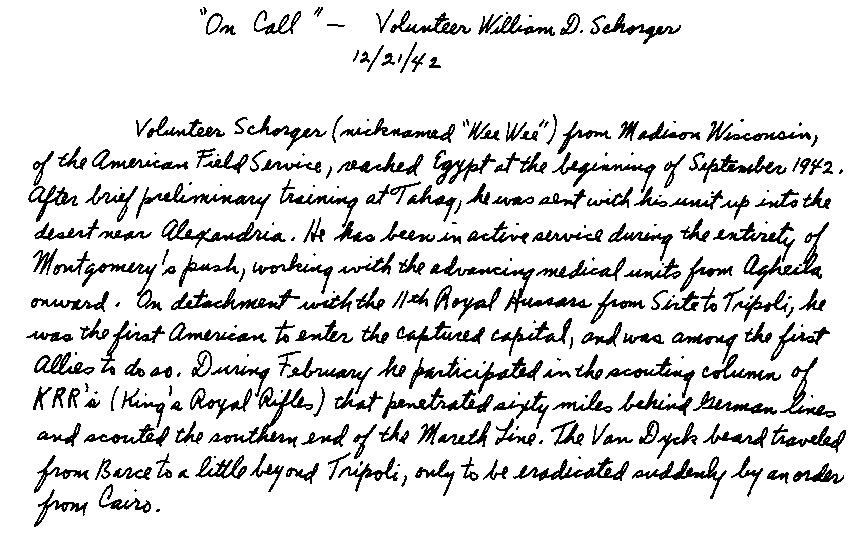
Wee Wee turned his ambulance over to me so that he could join the 11th Hussars. A competitive race to Tripoli among our own group began. Junior moved in with me as spare driver; he had recently been pinned down in a pocket by German artillery, an ordeal which had wounded him without leaving a physical mark. The thought of an artillery shell whining overhead and the worry as to where it would land was far worse than undergoing an aerial bombing. The impression of the experience and one's reactions to it could become so intense and deeply imbedded that they could be almost as damaging in effect as a direct hit. In the first war they called the victim "shell shocked," in this one "bomb happy." However, today the problem is solved by catching these cases in time and sending them back for a rest. Junior's fear of bombs was so intense that he slept in a slit trench even when it wasn't necessary, and the slightest noise of a motor put the fear of God into him. He was shortly sent to Syria for a rest cure which was completely successful. After that he returned to the desert and finished the campaign.
Rommel steadily retreated to Tripoli, giving the Highland Division bitter resistance at Homs.




 |
 |
 |
 |
 |
 |
 |