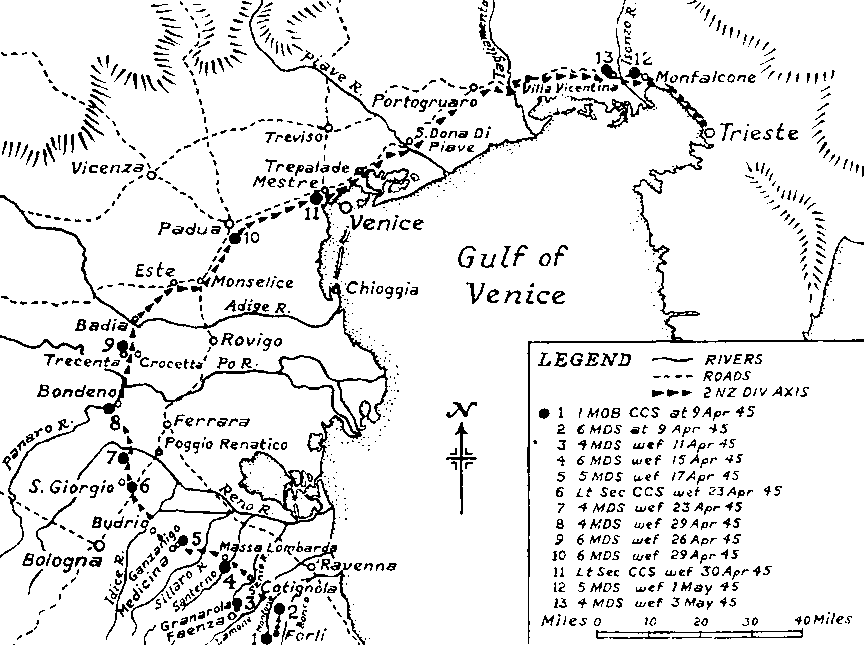
AT the beginning of March 2 NZ Division was still in a holding role on the line facing the Senio River, north-west of Faenza. However, by the end of the first week, 2 Kresowa Division of the Polish Corps had taken over the sector, and the New Zealanders had moved to a rest and training area in the Fabriano, San Severino, Camerino region, except for 4 Armoured Brigade which went to Cesenatico, on the Adriatic coast north of Rimini, to save moving the tanks so far to the rear. With 4 Armoured Brigade was 4 MDS, while the CCS stayed at Forli.
Fabriano had changed little since the Division's earlier sojourn there. The bomb wreckage had been stacked up a little more neatly and a length of drainage dug up for repair. The broken bridge was still broken, and the pile of tins at its foot had grown bigger. Small gangs of civilians were pecking patiently and all but ineffectually at the heaps of rubble. Where the YMCA had been there stood a well-run Naafi, and English names had been bestowed on all the theatres.
The easy leisure first enjoyed by the medical units came to an abrupt halt on 12 March, when they swung into a schedule of strenuous training. The mornings slipped past in a routine of parades, squad drill, and saluting practice, with an occasional route march to break the monotony. The afternoons were devoted to lectures and training in the pitching of tents and tarpaulin shelters, all very necessary in view of the number of reinforcements now in the units.
New tarpaulins arrived for some of the centres and new side and top ropes had to be fitted. Finally the last hank of thread was snipped, and all the tentage was erected for the commanding officer's inspection. Then HQ 6 Field Ambulance packed and loaded and moved out for practice in setting up a battle MDS.
It was a pleasant afternoon. The recently formed 9 Brigade was out on manoeuvres, and files of infantry passed the MDS. The reports of 25-pounders reverberated through the hills above, and the distant rattle of rifle fire recalled dim impressions of Trentham, of lectures in the sun-warmed grandstands, and the hypnotic effect of the sporadic rattling from the rifle range up the valley. In a nearby field two farmers followed their ploughs and slow teams of oxen, their families strung out behind them planting potatoes. There was a disturbance when two girls and a man came running down from a hillside farm uttering distressing cries. Someone had been wounded while tampering with a grenade. A medical officer went up with an ambulance car, and the casualty was sent off to the civilian hospital at Fabriano.
Italy was passing from winter into spring. After a period of warm, sunny days, fruit trees were unexpectedly in bloom by mid-March; and, with the improved conditions, such straws in the wind as the visit of a British field transfusion unit to draw supplies of blood from New Zealand units turned the men's thoughts once again to the resumption of active operations.
On 26 March the commanding officer received preliminary orders regarding the expected move. Dates were given at a conference of medical officers on the 28th. The Division was moving forward to take over a sector on the Senio River from 78 British Infantry Division, preparatory to taking part in what was expected to be the decisive battle.
Allied and German troops watched each other across the lines of the Italian front, which had now ceded its place in world interest to the battles in Northern Europe. In the long winter months 25 divisions of Germans and five of Fascist Italians had been tied down. Preparations for a spring offensive had been proceeding, and this was timed to start when the flooding rivers had subsided. and the wet ground would bear the weight of armour.
On the east of the front in the Po Valley the enemy was entrenched behind the Senio, with prepared lines on the Santerno, Sillaro, Gaiana, Quaderna, and Idice rivers, all comparatively wide and steeply banked. In General Mark Clark's plans for 15 Army Group the main effort was to be launched by Fifth Army in the Bologna area, after a thrust north-west across the Senio River on the Eighth Army front to draw off enemy reserves.
At the beginning of April 2 NZ Division moved from its rest area towards the Senio River, where on 2 April, under command of 5 Corps, it took over a sector of the line north of Faenza, with 8 Indian Division on its right and 3 Carpathian Division and 5 Kresowa Division of 2 Polish Corps on its left. The first eight days of the month were used to clear the enemy from the near, or eastern, stopbank and in active patrolling. These operations produced 120 battle casualties. The assault on the Senio was fixed for 9 April.
At ten minutes to two on the afternoon of 9 April a terrific bombardment was begun by Allied air forces and artillery on the Eighth Army front. Hundreds of heavy bombers, Fortresses and Liberators, followed by mediums and fighter-bombers, swung down with small bombs designed to kill men, shatter vehicles, and cut communications without blowing the impassable craters that had upset calculations at Cassino. Here the air power was greater than that which blitzed Cassino just over a year before. Then came the guns---more than were at Alamein. Twelve regiments laid the barrage while, in the safety of houses and ditches to which they had been withdrawn, the New Zealand infantry waited for H-hour. In brief breaks in the gunfire, Spitfires slashed in again and again, catching the bewildered defenders as they bobbed up to engage non-appearing assault troops. Enemy positions were battered for over five hours, and then at 7.20 p.m. the assault forces attacked across the Senio, moving in through the drifting smoke of battle preceded by the vicious jets of flame-throwing tanks and carriers. By nightfall the Division had four battalions across the river, and the engineers toiled ceaselessly to erect Bailey bridging in the darkness. In a night of solid gains the bridgeheads of the New Zealanders, Indians, and Poles linked up. The following morning, again preceded by a heavy air assault and closely supported by tanks, the infantry pushed forward to the line of the Lugo Canal, which they had reached in strength by midday. New Zealand troops attacked again in the afternoon, and although their advance to the Santerno River was fiercely contested, reached their objective that evening. There were 120 casualties in the first 24 hours.
Under Maj G. F. Hall, 6 ADS had moved up on the night of 9-10 April to near Granarola on the Canale Naviglio, where it admitted 49 casualties in the course of the night. Keeping pace with the infantry, who were pushing on to the Santerno River against scattered but stubborn resistance, the company moved forward again on the following day and opened the ADS just north of the village of Barbiano. A further 86 casualties were treated and evacuated, and the company found itself faced with increasing difficulty in transferring them back to HQ at Villafranca. With the steady advance of the infantry, necessitating the continuous movement of the ADS, the route of evacuation grew longer and longer, and in many places lay over poor roads that often permitted one-way traffic only. The experiences of 4 ADS, under Maj N. H. Wilson,(1) and 5 ADS, under Maj N. C. Begg, were similar.
The wounded soon began to pour in to the 6 MDS at Villafranca di Forli, 50 arriving before midnight and 157 on the 10th, the busiest day. The majority of operations being on light cases, the casualties passed through the two theatres in a steady flow. By the 11th the battle had receded, and the 4 Field Ambulance team went forward to rejoin its unit at Granarola, 1000 yards from the stopbank of the Senio, as 4 Field Ambulance had assumed the role of battle MDS.
The battle for the Santerno crossings was at high pitch throughout the afternoon and evening of 11 April. The caked ground shook from the recoil and impact of artillery and mortar fire; the rattle of spandau and machine gun scarcely ceased; infantrymen toiled on while Spitfires and Mustangs weaved in strafing sorties over the enemy's positions. Heavy fighting against infantry and tanks continued through a starlit night. Counter-attacks pressed home by Tiger tanks were repulsed, and by the morning of 12 April the 2 New Zealand, 8 Indian, and 3 Carpathian Divisions all had battalions across the river.
Steady progress was made towards the Sillaro River, and as 9 Infantry Brigade and 6 Infantry Brigade advanced, the ADSs and then 4 MDS were kept busy with the casualties, the MDS admitting about a hundred patients a day before it closed on the afternoon of 15 April. Its functions were taken over by 6 MDS, which opened at Santa Agate, two miles to the rear of Massa Lombarda.
About 250 yards from the road, in fields of lucerne and barley. 6 MDS was set up again under canvas. There was the usual scene of destruction and desolation. Ammunition cases and debris were scattered around, and farm buildings in the vicinity were either smashed or burned to blackened shells. A battery of medium guns was firing from among nearby trees. The battle was still a long way ahead, but casualties, many of them prisoners of war and civilians, streamed back from the ADSs as the New Zealand bridgehead across the Sillaro River was extended. They began to pile up, but once again the team from 4 Field Ambulance was on the scene to take some of the strain from the unit operating teams. On the 17th 6 MDS closed for battle casualties and opened for sick only, 5 Field Ambulance having moved forward to receive casualties at Ganzanigo, in a building used by a German medical unit up to the previous night.
It was necessary for the advanced dressing stations to move daily to keep up with the advance, and 4 ADS crossed the Sillaro late on 16 April, after a busy night and day, and staged the night at Sesto Imolese, before moving next day near to Medicina.
The Poles on the left and the Indians on the right were not far in rear of the New Zealanders, who on 17 April made a sweeping advance along the Medicina-Budrio railway and reached the Gaiana River, where they found the enemy to be in strength on the far bank. On the night of 18-19 April 2 NZ Division (9 Infantry Brigade and 43 Gurkha Brigade) stormed the Gaiana in the face of vicious fire from dug-in positions on the floodbanks, and swept on across the Quaderna against heavy resistance from German paratroops, many of whom died at their posts rather than surrender or retreat. Our casualties for the operation totalled 65.
By 20 April forward troops of the Division (5 and 6 Brigades) had cleared Budrio and reached the banks of the Idice River. That night infantry smashed spandau nests and struggled over mines and wire on both floodbanks to force a crossing. Engineers had three bridges open by morning, and 5 and 6 ADSs moved across the river in the afternoon.
The opposition was now staggering before repeated hammer blows. Polish troops had entered Bologna just as Fifth Army troops came in from the south. The Division moved across Route 64, the main Bologna-Ferrara highway, and swung north through San Giorgio, making contact with Fifth Army troops, overrunning enemy rearguards and plunging ahead. It crossed the River Reno and reached the Po just south of Bondeno by 23 April. On this date 4 MDS moved up to San Venanzio, just south of the Reno River.
As it followed the path of the Division on its move to San Venanzio, 4 Field Ambulance saw something of the battlefields. The approach to the Senio was thickly studded with camouflaged dugouts and stiff with wire. The real damage began on the opposite stopbank. It was blackened and scorched and pitted, and the small villages near the bridge had been pounded to so many rubble heaps. The road curved through the rubble mounds, very rutted, dusty, and bumpy. Groups of civilians were already poking hopelessly among the ruins. Beyond this there was an area thoroughly patterned with shell holes and trees slashed and torn by splinters. Here began, too, the carefully marked sets of enemy slit trenches that lined the road on both sides almost to the Po. They were indicated by tufts of straw on a long stick, so that any driver pressed for time during road strafing could tumble in without any frantic searching. Houses on both sides of the Santerno had been demolished into rounded heaps of rubble, and the makeshift road provided a bouncing way through them. On the formed road again the traffic clotted into a solid mass. The roads were good and tar-sealed, but the edges were crumbling and trucks had to weave from one side to another to pick a smooth passage. The country was still fairly flat and still plentifully besprinkled with trees. Everything within wind-borne range of the roads became whitened by drifted dust. Dead animals coated with dust lay beside smashed, horse-drawn equipment.
The route then lay through grain-growing country. The dusty, deep-rutted roads made one think of the hold-up there would have been had it rained heavily.
At the Idice there were the same conditions as at previous river crossings. The approaches to the Bailey bridge were very rough and dusty. On the roads were groups of cycling partisans, equipped with weapons and flags, decorated with whiskers and full of song. Sometimes lorry loads of them passed by.
In the villages crowds thronged the pavements to wave to the trucks. The people had not yet pulled down the German notices though all were overjoyed that the Germans had gone. Partisan headquarters were seething with enthusiasm.
By now the Division had advanced so far that the line of evacuation to the CCS at Forli had become particularly long. On 22 April instructions were given that the Light Section was to move fifty miles ahead next morning. Excitement ran high round the unit for a few hours as the necessary equipment was hastily packed and loaded on the trucks. After this the men to travel with the section had to pack their own gear, discarding some of the extras they had accumulated after five months in one place.
Breakfast was at five o'clock next morning, and an hour later the section, under command of Maj Alexander(2) moved off. The journey up through Faenza was full of interest, particularly around the Senio. There was little traffic on the road, and the convoy made good progress through Castel Bolognese, Imola, Castel San Pietro, and on to the university town of Bologna. This city had fallen to the Fifth Army only two days previously, and the bewildered people cheered wildly as the vehicles passed through---not for many months had they seen so much petrol-driven traffic. Near a small country village named San Marino, the section set up in the beautifully planned grounds of a château, and within a few hours the first patients were received.
During the next few days the rest of the unit, with the exception of a small rear party, also moved to the new location and set up in tents. Only a few casualties were received here. These were sent back to the school in Forli where a 100-bed detachment from 2 NZ General Hospital, under Lt-Col Caughey, had taken over as a temporary staging unit. For the first time in its history 2 General Hospital was operating an independent detachment. The hospital at Caserta was now commanded by Col. I. S. Wilson.(3
During 24 April forward infantry of 2 NZ Division crossed the formidable barrier of the River Po in assault boats. Opposition on the far bank was slight and a start was made to bridge the river, a distance of some 500 feet. The bridge, the Eighth Army's first over the Po, was completed on 25 April (Anzac Day), and that evening 6 ADS crossed this notable river, being the first medical unit to do so. The main body of the Division crossed on 26 April. Because of the difficulty of getting vehicles back across the river against the ceaseless stream of essential fighting transport, it was decided that 6 MDS would cross the Po and establish itself in Trecenta.
Sixth MDS was at Mirabello when, at 1 p.m. on the 26th, there came instructions to despatch a skeleton section across the Po and establish the MDS for battle casualties at Trecenta. The theatre and resuscitation section double-banked their loads on one truck to reduce the size of the convoy, and together with reception, evacuation, dispensary, orderly room, water cart and cookhouse, moved out behind the commanding officer's jeep a few minutes before two o'clock. In spite of the traffic they made good time, passing along a good road through areas where white flags still hung from houses. Across the Panaro the roadsides were stacked with German dumps; and there were many grim examples of the accuracy of the Desert Air Force. Ammunition and gun and mortar positions had been blasted out of existence by direct hits. At one dump Italian women were hard at work opening the charges and taking the silk containers from around the cordite, which was spilled in an untidy heap like so much spaghetti. A dropped match would have created a tremendous amount of work for any medical unit that happened to be in the vicinity.
Ever-increasing quantities of smashed and burned enemy equipment was strewn around. Across the Panaro the speed improved for a while, then the sections turned off along an elevated side road from which they suddenly emerged on the stopbank of the Po, and headed toward the overworked pontoon bridge on which streams of transport were converging. Bofors guns lined the riverbanks, and in a plantation on the other side a battery of 25-pounders was blazing away steadily. The area outside the stopbanks had been blasted and torn. Trees had been ripped down to the stoutest of branches, and the houses among them were now rounded heaps. The ground itself was scorched and bare, while the space inside the stopbanks was churned and torn by overlapping bomb craters, with heaps of equipment and coils of wire and cables half buried under the erupted earth and piles of railway sleepers and bridging panels.
The broken end of a German pontoon bridge, still covered with camouflage netting, dragged in the water. Amphibious lorries and the pontoon ferry carrying tanks crossed and recrossed the river as the convoy made its way down the path carved in the stopbank. Detachments of 9 Brigade were marching up to the bridge, and squads of men galloped across the track between lorries. Crossing the bridge was like driving on an unending upward incline as the heavy load over the rear wheels of the lorry forced down the pontoons.
Over the river the countryside was heavily wooded, and between towns the convoy ran along dusty roads through luxuriant plantations. Groups of people gathered at every street corner and in every square to stare and wave at the stream of vehicles. After three hours of varied going the HQ detachment reached Trecenta, where a section of the ADS, packed up and ready to move, was awaiting its arrival. Patients were already waiting for treatment, and the MDS was opened immediately.
It was fortunate that the MDS building, the home of one of the wealthier citizens, was one of the most suitable that the unit had yet occupied, as the sections were soon flooded with patients and working day and night. All types of sick were handled and all needed surgery was performed. In addition, evacuation across the crowded pontoon bridge was still almost impossible. Several ambulance cars were taken across in returning tank ferries; but frequently the MDS was compelled to hold patients long after everything possible had been done for them. Fortunately, on the 27th, 3 FSU, under Maj Cawkwell(4) and 2 FTU, under Maj Howden,(5) reached Trecenta and took some of the pressure from the unit teams. The situation was eased on the 28th, when 4 MDS set up as a staging post just south of the Po.
The difficult obstacle formed by the fast-flowing Adige River, between 100 and 200 yards wide, was forced on the night of 26-27 April, and one of the last water barriers before the Alps was crossed. Next day New Zealand engineers were the first to bridge this second great water hazard. On 27 April 9 Infantry Brigade and 43 Gurkha Lorried Infantry Brigade passed though 5 and 6 Infantry Brigades, who went temporarily into reserve. In the late afternoon 9 Brigade, accompanied by 4 ADS, moved across the Adige, north of Badia. The Division advanced rapidly against slight opposition with few casualties, and on 28 April 4 ADS moved forward through San Margherita, continuing through Este and Monselice to Padua, where it opened at night in a large house. Casualties received on the road were treated by the reception section by the roadside and evacuated back to 6 MDS at Trecenta.
The night of 28-29 April was memorable---the Division burst through the Venetian Line unopposed and, after an all-night move, was firmly established in Padua on the morning of the 29th. That day the Division entered Mestre, on the mainland opposite Venice, and a few hours later a special detachment swept along the broad causeway over the deep blue waters of the Venetian lagoon to the city, which it found in the hands of the partisans. The detachment was soon joined by 56 Division and by Popski's Private Army, which had come by jeep and Army-manned landing craft up the coast, capturing Chioggia on the way.
In heavy rain on the 29th, 6 MDS and attached FSU and FTU moved on another 43 miles to Padua, leaving behind a skeleton staff to act as a car post to treat any wounded and sick between Trecenta and Padua. The rain continued in a steady downpour, while patients, arriving in large numbers, kept the post in a state of frenzied activity. An anæsthetist had to he borrowed from one neighbouring unit and a water cart from another. Finally, after the surgeon had worked continuously for 22 hours and the operating team for 16 hours, the detachment sent back six carloads of casualties, accompanied by a medical officer to secure priority in crossing the river, and set off at 9 p.m. on the 29th to join the MDS at Padua. Here the MDS was handling another flood of wounded, many of them Germans, who were transferred to a German hospital unit.
The town of Este was quiet as the little convoy passed through, though heavy explosions were heard occasionally and a few streams of anti-aircraft tracer climbed into the air over on the flank. However, the detachment reached Padua to find rifles and tommy guns spluttering and the town lit by flares as partisans cleaned up Fascists and settled private feuds. The men were too tired to inquire about the situation. Tossing out their bedrolls, they ducked between trees to an empty house and bedded down.
At 1.30 p.m. on 29 April the Light Section of the CCS was instructed to move forward again, and less than three hours later it was on its way north. Just after passing Ferrara, there was a long delay because of the volume of traffic waiting to cross the Po. From here on the landscape became more beautiful, with acres of red poppies adding a lovely touch of colour to the rich, fertile scene. Here there was little sign of war, for the enemy had broken and fled with no time for demolition work. The roads were excellent in most parts, but Eighth Army had had no time to signpost the route so the journey was more or less a matter of following the stream of traffic. The convoy eventually arrived at Padua, and from here took a road leading towards Venice. The new location at Porto Marghera, about six miles from Venice, was reached in the evening.
Here again the section went indoors, this time into the modern executive offices of an aluminium factory. The factory was an extensive one covering many acres, but work had been paralysed for months as a result of devastating Allied bombing attacks. During the next few days the rest of the unit moved up to this location from San Marino, and the 2 General Hospital detachment came up from Forli. Patients were to be held until air evacuation was established.
The rapid advance kept 4 Field Hygiene Company, under Maj Kennedy, very busy. Along the line of the Division's advance, the buildings occupied by troops were sprayed by the unit's antimalaria sections. Posters dealing with flies and venereal disease were pasted up in every village en route. Many hundreds of dead Germans and animals littered the countryside and had to be removed and buried. On 29 and 30 April two groups of 130 and 12 German prisoners came into custody of the unit temporarily.
Crossing the Piave River on the evening of 30 April, and then the Tagliamento and Isonzo, the Division pushed ahead and, advancing 75 miles, linked up at Monfalcone with forces of Marshal Tito advancing from the east. Keeping up with the forward elements of the Division, 4 ADS reached Monfalcone in the afternoon of 1 May and set up an ADS in a factory on the outskirts of the town.
Both 5 and 6 ADSs also kept up with the Division. 5 ADS was known as the 'Light Horse' as it set up successively at Massa Lombarda, La Balla, San Pietro, Poggio Renatico., Bondeno, Palazzo, Cura, Crocetta, Badia and Padua, to reach Trepalade by the end of April.
With the rapidity of the advance, the distinction between reception and evacuation sections in the ADSs became purely nominal, as they had frequently to open individually as complete sections and then leapfrog each other.
The role of the ADSs was exacting, necessitating frequent sudden moves, often over bad roads, demolitions and improvised bridges, but except on a few occasions the ADSs were always less than an hour's run from the battalion RAPs, and usually much closer. The number of casualties was relatively small, but the line of evacuation to the MDS was seldom easy, because of the speed of the advance and the difficulties of narrow roads with many one-way stretches. A round trip for ambulance cars of six hours to the MDS, sometimes 40 miles away, was not uncommon. This time factor made it essential for resuscitation and immobilisation to be more thorough than was usually required at an ADS.
In spite of Marshal Tito's claim to have taken the city a few days before, Trieste was still in enemy hands. On the 27-mile strip of coast road between Monfalcone and Trieste, and particularly at Duino, Sistiana, and Miramare, there were strong German formations. The Yugoslav forces had worked their way through the mountains to the east, and the main road to Trieste had still to be cleared. As garrison after garrison surrendered, the gleaming city came into view beyond the rugged headlands. At last 22 Battalion entered Trieste on the afternoon of 2 May, while 26 Battalion entered Gorizia on the route to Austria. The long trek of the Division had ended. In the 23 days after the first Senio barrage, the New Zealanders had virtually destroyed three German divisions (98, 278, and 4 Parachute Division), captured over 40,000 prisoners, and advanced for 225 miles over difficult country. It was most fitting that the New Zealand Division, then the division with longest service in the Mediterranean theatre, should have been in at the kill.
By 2 May 15 Army Group forces had conquered Italy. The country was entirely in our hands from Messina to the Brenner, from the French border to Trieste. The Germans, cut to pieces, dazed and despairing, laid down their arms, adding 230,000 prisoners of war to those already taken, and raising the total bag to between 600,000 and 900,000.
In the early morning of 3 May, 6 Field Ambulance reached Monfalcone after a long and tiring run of 114 miles from Padua. April had been a hectic month. The MDS had admitted 1268 patients, 723 of whom had been battle casualties and 545 sick. From Forli the unit had travelled at every speed, from the slowest of crawls to flat out, over roads no more than three days old and others built many centuries before, roads in the last stage of disintegration, and solid roads that carried their traffic with hardly a jar.
Monfalcone was not friendly, and the situation was irksome after Padua's welcome to the New Zealanders. Large numbers of Yugoslav troops were billeted in the town and neighbourhood, and the town hall in the main square was adorned with an immense red star, outlined in electric bulbs, with a large portrait of Tito at the topmost point. Already the walls of buildings were splashed with red pro-Tito slogans, and bi-lingual proclamations in Yugoslav and Italian were everywhere. One forbade any manifestation of national sentiment in the streets. Yugoslav and Italian partisans wandered around, literally bristling with weapons, and all Allied troops were warned against becoming involved with Yugoslav forces or taking part in any political meetings or demonstrations. Similarly in Trieste there was tension, too, and the Division was temporarily committed to a defensive role.
There was little spirit of celebration noticeable when, at noon on 2 May, the Germans in Italy officially surrendered, nor when Winston Churchill announced Victory-in-Europe Day on the 8th. The chances of being involved in more hostilities at any moment seemed by no means slight. The civilians were wildly excited, but amongst the staffs of the medical units there was not the excitement one would have expected. Demonstrations of joy were far more marked when Tripoli had been occupied and when the fall of Tunis had been announced. But that was two years previously. Those two years had been hard and long. Now that they had passed and the end had come, thoughts did not dwell so much on the victory that had been anticipated for so long but rather on going home.
The succession of battles fought by the Division brought 584 battle casualties to 1 General Hospital at Senigallia during April, but the proportion of seriously wounded was notably low. The accommodation prepared in advance proved adequate and there was no overcrowding. From 1 General Hospital the patients went by hospital ship from Ancona to Bari, where they were admitted to 3 General Hospital.
In fact, 3 General Hospital had a busier time than the advanced hospital, as it also received 400 battle casualties by air from 1 Mobile CCS. These patients were often received within 24 hours of being wounded in battles 400 miles away, and in some cases were still affected by the anaesthetic given them prior to operation at the CCS.
Preparations at 3 General Hospital for the admission of these casualties were complicated by the explosion of an ammunition ship in Bari harbour at midday on 9 April. The terrific blast shattered glass in the hospital windows facing the sea, while locks were torn off doors as they were violently thrown open, and equipment hurled about the wards. There were no casualties among staff or patients, though there were several narrow escapes from flying glass. But in the docks area the casualties, military and civilian, were 348 killed or missing and 1853 injured. Help was sent from the Polyclinic area, and 3 General Hospital admitted some Royal Navy personnel, Yugoslavs, and Italians. Contrary to first expectations, the number of these local casualties admitted was not large enough to make it difficult to find accommodation for the battle casualties from Northern Italy. A number of New Zealanders and Australians who had been prisoners of war, and who had been released by the Russians, became patients of the hospital for a while, and a larger number were medically examined as outpatients.
In dealing with the final battle casualties, 2 General Hospital's efforts were confined to the work of its detachment at Forli and Mestre with the CCS, and at Caserta early in May the hospital. began its packing prior to moving back across the Mediterranean to take over at Helwan hospital again after three and a half years. The merger of 5 General Hospital with 2 General Hospital took place in the second week of July. Col H. D. Robertson(6) of 5 General Hospital became CO in place of Col I. S. Wilson. The Matron was still Miss V. M. Hodges.
Back in Egypt the little unit of 5 General Hospital had carried on. Its career was short, unspectacular, but very useful. Taking over a long-established hospital meant that there was no excitement of new beginnings, and after the departure of 1 General Hospital to Italy in April 1944, life became very quiet indeed. New Zealand prisoner-of-war patients repatriated from Germany brightened things up for a time. But towards the end of the year sisters and nurses from Italy, homeward bound on furlough, and others returning from New Zealand, passed through or spent many weeks in the sisters' mess while in transit.
In the hour of victory the hospital staffs set about making the occasion one of pleasant memory for the patients who had contributed so much to the long-awaited day. A programme was organised in each of the hospitals according to the facilities available. A special service of thanksgiving, held on the morning following the announcement of victory, was attended by all members of the staffs and walking patients and broadcast to the wards. For festivities 1 General Hospital made use of its natural playground on the beach to stage mule racing and an aquatic carnival. Bed-patients were carried down to the beach to see the 'Signorinas' Scurry' and other races. At 2 General Hospital, which was packed prior to moving to Egypt, there were no patients to entertain, so the staff joined in with the patients and staff of 2 British General Hospital who shared the same compound. At 3 General Hospital there was a general migration south of Bari to Polignano beach, where over 500 patients and staff enjoyed a picnic in a sunny cove and then a victory ball, while at 5 General Hospital in Helwan there was a dinner and a dance for the patients.
To get ready to receive New Zealand prisoners of war as they were liberated, the nucleus of a small hospital unit was sent to England from Italy in September 1944. It was some time before a suitable site for a hospital could be obtained, and in the meantime the nursing sisters, under Charge Sister Scott,(7) assisted for two months at Connaught Military Hospital at Aldershot. Christmas was spent by the staff at Old Park Barracks in Dover. By this time the advance of the Allied armies in Western Europe had reduced the danger from enemy V1 and V2 rockets.
Then, in March 1945, Brigadier Twhigg arranged for the isolation hospital at Haine to be allotted to the New Zealanders for a New Zealand military hospital. The main body of the hospital unit, under Lt-Col Lovell, moved into the buildings at Haine on 14 March to throw themselves into the work of establishing a 60-bed hospital by 9 April. Working against time, the staff had 76 beds ready by 8 April. Next day the first patients arrived, but the day after that all the beds were occupied, and it was necessary to open further wards. Assistance was given by local civilians, most of whom gave time which could ill be spared, volunteering to work in the evenings to assist in the plumbing, carpentering, cleaning, and ward work. There were soon 200 patients.
As a result of recent privations and hardships, the general condition of the released prisoners of war admitted was poor and many were found to be suffering from varying degrees of malnutrition and avitaminosis. The early drafts had also undergone long marches (500 to 800 miles) in the snow before being released, and the men bore evidence of severe undernourishment and exposure.
As they were admitted to the wards they were silent, exhausted, unshaven and dirty, still clothed in camp-stained battle dress, and very emaciated looking. Their faces expressed bewilderment. A meal, a bath, and the removal of at least a week's growth of beard, a comfortable bed, complete with sheets, and last but not least a cigarette, proved to them that they really were at last freed from captivity and, as many of them said, in a 'home away from home'.
For the first two or three days they did little else but eat and sleep, but as they became more rested a more normal buzz of conversation was heard in the wards. Their morale was excellent and most of them recovered fairly quickly.
On arrival in hospital each patient was presented with a Red Cross ditty-bag, containing a note of welcome from the New Zealand Red Cross, and all the things he needed in the way of toilet articles, cigarettes, etc. The men were extremely independent and hard to keep in bed unless very ill. They had learned to look after themselves in the stalags and found it difficult to relax whilst someone else attended to them.
Malnutrition brought many digestive upsets in its train, and the patients had to be very carefully dieted and were put on high protein and low carbohydrate meals. This presented difficulties, as whilst in prison camp they had dreamed of lots of cake, chocolate, biscuits, and all the sweet things that had been deprived them for so long. All their food parcels were held for them until they recovered their powers of digestion.
Some of the staff were in London for VE Day. Six weeks after the hospital was opened, reinforcements to the staff arrived from Italy, and by June a reduced number of patients and the larger staff enabled the hospital to settle to a smoother and less strained routine. Some of the patients were sent to New Zealand by hospital ship, while others were discharged to return home with the normal repatriation drafts after they had had leave. On 9 October the hospital at Haine was closed, though a small hospital was run at Folkestone for three months to care for men who had become ill while on leave in the United Kingdom.
IT was hard to believe that it was all over. But as the days passed and no more battle casualties arrived at the medical units, the staffs began to realise that their work was nearing an end. The cease fire did not mean cease duties for the medical units: there were still the sick and accidentally injured to be treated. But never again would ambulance cars from forward units line up at the reception tent. No more would the pre-operative ward be full of wounded soldiers waiting for operation and the freedom from pain that only anaesthetic could bring. No longer would the surgeons spend tiring days and nights in the theatres removing splinters and bullets, setting fractures, or amputating limbs. When the full significance of all this was realised, it was accompanied by a sense of relief and a deep feeling of satisfaction in services unfailingly rendered to comrades in need. Thanksgiving services in the units added a final spiritual touch.
Relaxation was a natural consequence, and the consistently fine weather in May and June helped to promote it. There were cricket matches, swimming parties, and sports meetings. At a divisional regatta the men of A Company, 5 Field Ambulance, distinguished themselves by winning two races in a German reconnaissance boat they had salvaged. At a trotting meeting in Trieste crowds of troops watched some keen finishes as New Zealanders drove Italian horses in the Sangro Stakes, Cassino and Florence Handicaps, Rimini, Faenza and Senio Stakes, and Trieste and New Zealand Handicaps. There were frequent picture shows and opera performances.
Men went on leave to Venice, on organised tours of Northern Italy to Milan and the Lakes, and on unofficial trips into Austria. Venice was second only to Rome in the interest it held. Both cities had been spared the ravages of war and all civilian amenities were intact, while both had a wealth of historical interest. As in Rome, the New Zealanders had a club in a lavish hotel-Hotel Danieli---which was luxuriously furnished. Only a proportion of the men was able to stay here, but leave camps, including that run at Alberoni on the Lido island by 5 Field Ambulance, catered for all the Division.
New Zealanders cruised along the canals or lagoons in gondolas. They saw the San Marco church with its gold mosaics, the Palace of the Doges, the Bridge of Sighs, the pigeons in Saint Mark's Square, surveyed the city from the top of the Campanile, crossed to the Lido, the famous millionaires' playground, which had lost much of its magnificence.
After the novelty of riding in gondolas had worn off, the men discovered that Venice, as in its heyday of the fourteenth century, was a centre of commercial activity. The universal currency in Italy, cigarettes, was here to a certain extent supplanted by chocolate. This commodity, replacing the golden ducats of bygone ages. became the 'open sesame' to many transactions. Silk, lace, glass mosaics, and other fancied goods, cheap after the liberation of the city, rose sharply in price within a few weeks. These souvenirs for their folks at home, the men hoped soon to be able to present in person.
In the summer months the staffs of the hospitals found conditions easier as the number of patients decreased, especially after battle casualties had been discharged or invalided to New Zealand. They, too, could have more leave and recreation. In Italy swimming at the beaches was popular, but most of the members of the units were keen to see Rome, Florence, and Venice before they set their faces towards home, and many had the opportunity to do so. Back in Egypt the staff of 2 General Hospital found the heat very trying at first, but it was comforting to think that the next winter would not be spent in Italy, and that all might arrive home in time for New Zealand's summer.
As the 6th and 7th Reinforcements were farewelled by their units, there were many staff changes and promotions. Important promotions after the end of the war in Europe were those of Brig Gower to succeed Brig Kenrick as DMS 2 NZEF, Miss Chisholm as Principal Matron after Miss Mackay, and Miss Robertson(1) as Commander of WAAC after Miss King. Col Caughey became CO 3 General Hospital, and Miss MacKinnon(2) Matron of 1 General Hospital. Later, Col Edmundson became DDMS 2 NZEF and Miss MacKinnon Principal Matron.
In the third week of July the Division moved in ten flights from the Trieste area to the shores of Lake Trasimene in central Italy. The convoys passed through Trieste for the last time and wound on around the coast road, high above the lovely blue waters of the gulf. Some of the trucks made ominously hard work of the pull up the hill near Miramare. The medical units' transport was now very old and unreliable. The two-wheel-drive ambulance cars were still in fair order; but the trucks that had carried such heavy loads over thousands of miles, and the four-wheel-drive ambulance cars that had received such a thrashing in the forward areas during every battle had almost finished their useful life.
Crowds of Italians gathered at the Monfalcone factory road fork to watch the columns pass. Day after day the line of vehicles unwound from the areas around Trieste and streamed southward across the Isonzo, the Tagliamento, the Piave, and numerous smaller streams to the staging area at Mestre. Most of the men availed themselves of the showers at the old rest camp in the aluminium factory, and made for Venice without waiting for the evening meal.
The Division was extended over 450 miles as the convoys moved out from the staging areas each morning. From Mestre the route was the main highway through Padua, Rovigo, and Ferrara to Bologna. The Po was crossed with considerably less trouble than on the upward trip. Bologna was flooded and the streets awash. For many it was the first view of the battered city, and the wrecked buildings and streets deep in water made it a depressing sight. The staging area was in a sodden field some distance out of the town.. Natural depressions and the ruts made by earlier convoys were full of water, and the first few unwary trucks became hopelessly bogged. Others sought firmer spots and made themselves fairly safe for the night.
Route 9 was now carrying a staggering volume of both military and civilian traffic. The old winter line at battered Castel Bolognese was passed, and the convoys circled around the outskirts of Forli and settled down on the very familiar road to Rimini. Italian workmen were rebuilding the many destroyed bridges; the bridge over the Montone River was already restored. After a halt for lunch in a seaside area at Fano the journey was continued, units making their sixth trip along Route 76 through Iesi and the Red Pass, where the Howe bridge was still standing, and on over the dusty, up-and-down road of the Esino Gorge to Fabriano and the Santa Maria staging area below the town.
The next stage was the formidable Fabriano Pass over the Apennines. The convulsed tangle of a road was dusty, and the long, merciless slog soon began to take its toll of vehicles. Trucks halted with radiators boiling long before the summit was reached. On the other side Umbria was looking fresh and green, and the convoys held to a comfortable speed that allowed the men to enjoy the countryside. From the high country approaching Perugia the scene was beautiful. The farming country was so rich in the bursting green of trees and crops that it resembled thick emerald velvet. Somewhere in the midst of it the upper reaches of the Tiber and its tributaries flowed, hidden by the trees. Thin wreaths of smoke appeared as silver threads against the green and merged into a faint haze in the farther distance.
Then the Division swung south near Magione, on Route 75, to run down to the concentration area on the southern shores of Lake Trasimene. The concentration area was a stretch of light, sandy soil in a district suffering from an intense drought that made living conditions far from pleasant. No rain had fallen for five months, and every puff of wind drove clouds of dust through the scattering of stunted oaks under which the bivouac tents were clustered. It was quite unnecessary to warn troops against swimming in the vicinity of the towns and villages, whose sewage effluents were discharged into the lake. The lake level was low and the water thick and repulsive.
The high wind and the dust and oppressive heat were reminiscent of Amiriya at its worst. High winds seemed to be a climatic feature of the region. Each day the sultry heat haze of the morning would suddenly let go in a screaming gale of almost cyclonic proportions. On 8 August, after an evening lull, the storm raged on throughout the night, culminating in a terrific electrical storm at dawn.
The disbandment of 4 Field Ambulance was announced on the 9th, and the unit held a wind-up dinner five days later. The 8th Reinforcements had already left and the remnant of 4 Field Ambulance was absorbed by other units.
Rumours regarding the future of the Division were shaken and curiosity intensified by news that reached the units during the afternoon of the 10th. Japan had indicated a willingness to surrender. All ranks eagerly awaited a definite statement, and on the morning of the 15th it came: the Japanese had surrendered unconditionally. There were mild celebrations.
That day 6 Field Ambulance moved to Mondolfo, on the Adriatic coast just north of Senigallia, where rest camps provided some relief from the trying conditions at Lake Trasimene. To 6 Field Ambulance's rest camp came parties from 5 Field Ambulance, which was running an MDS for sick in the Lake area, and sending patients to 1 Mobile CCS at Assisi. Then there was a period of .stagnation. The weeks went by, and most of the men, whatever their reinforcement, wistfully concentrated their thoughts on the chances of being home before Christmas.
In the last week of September the 9th Reinforcements left for Southern Italy on their way home. Winter was approaching, and at Mondolfo the month faded out in miserable weather. The battalion leave camps had all vanished from the inland slopes, but the 6 MDS canvas flapped in the high wind as the men sloshed through the mud and suffered the rain that drove in from the Adriatic.
Disquieting rumours about a move to winter quarters in the north seeped down---first the Division was going to the Siena area, and later this was changed to Florence. On the last day of September A Company, 6 Field Ambulance, moved to Florence with 9 Brigade. Then the company handed in its equipment and ceased to exist, its men being dispersed to other units, including a new unit, 4 Rest Home, for which two villas on the Via Torre del Gallo were taken over. The CCS moved to Florence too, and there in October the unit became 6 General Hospital under Lt-Col Bridge. The 4 Field Hygiene Section had many duties in Florence until December, when it merged into the Hygiene Section for the force going to Japan.
As they were in the process of winding up, 5 and 6 Field Ambulances did not go to Florence. For them there was a brief, busy period of greasing, wrapping, ticketing, and packing medical equipment. Break-up functions brightened things up temporarily. At 6 Field Ambulance's farewell evening on 6 October, Lt-Col Edmundson briefly traced the history of the unit over its life of five years, and thanked members for the unsparing service they had given. Two days later Col Edmundson was appointed DDMS 2 NZEF, and the day after the medical equipment was despatched to the Medical Stores Depot, Bari, and the few remaining men posted to other medical units. Six men were detailed to man medical posts at staging camps along the route through France for those fortunate enough to be given a chance to see the United Kingdom before they returned to New Zealand. The final Letter of Disbandment was sent to the Senior Medical Officer 2 NZ Division, Lt-Col Pearse,(3) and 6 Field Ambulance's long life with the Division was brought to a close.
In the final operational report of 5 Field Ambulance, the commanding officer (Lt-Col D. P. Kennedy) placed on record an appreciation of the work of officers and men, both NZMC and NZASC, whose work and, in some instances, whose lives had built the unit. Tribute was paid to the pleasant co-operation with units of the Division and other Allied forces. One of the basic functions of the medical services was the collection, treatment, and evacuation of sick and wounded. For this 5 Field Ambulance was mobilised, and it was felt that, at the conclusion of its duty, the unit had sincerely endeavoured to do this. The success which was achieved was a tribute to the officers and men who had served with 5 Field Ambulance.
All this was equally true of the other field medical units. In a farewell message to all ranks of 2 NZEF, the Eighth Army Commander, Lt-Gen R. L. McCreery, had said:
'Now that the time has come for the Eighth Army to disperse. I want to thank and congratulate all ranks of the 2nd New Zealand Expeditionary Force on the splendid contribution you have made to victory.... Your Division has played its part with the greatest distinction, and your splendid fighting qualities have achieved successes that have often been decisive to the operations of the Army as a whole.... You leave the Eighth Army with the affection and the good wishes of all who have fought with you through the long and arduous campaigns of the past four years. We shall miss you much. Good luck to you all.'
At Senigallia 1 General Hospital was the first of the three hospitals to close down-on 3 November. At Helwan 2 General Hospital (with Lt-Col Owen-Johnston as CO and Miss C. M. Lucas(4) as Matron) closely followed when its operations ended on 22 November, but at Bari 3 General Hospital continued until 9 January 1946. Miss M. J. Jackson(5) had succeeded her twin sister as Matron, and Lt-Col C. R. Burns(6) became CO after Col Caughey. At San Spirito the Convalescent Depot functioned until January.
By that time the hospitals had a proud record of service---they could all count their patients in tens of thousands. Between April 1941 and January 1946 3 General Hospital admitted 46,000 patients, while 1 General Hospital between September 1941. and October 1945 (that is excluding the periods in England, Helmieh, and Greece) admitted 40,516. The 2 General Hospital total of 32,481 was equally, if not more, impressive, as that hospital was equipped and staffed for only 600 beds as against the 900 beds of the other two hospitals.
There were very few members of 2 NZEF who were not patients in at least one of the hospitals at some time or other, and many made the acquaintance of all the hospitals. They could all testify to the efficient service always given, and those who made up the staffs of the hospital units have good reason to he proud of their records.
The floating hospitals played their part, too, in the taking of invalids, both wounded and sick, back to New Zealand and caring for them on the journey. The Maunganui in her 17 voyages, mostly on the New Zealand run, carried 5677 patients. The Netherlands Hospital Ship Oranje, which was partly staffed by New Zealanders, under Lt-Col G. F. V. Anson,(7) being a much larger and faster ship, carried home over 2500 New Zealanders in a few trips, besides taking many thousand British patients to South Africa and the United Kingdom.
To England, Egypt, Greece, Crete, Western Desert, Palestine, Syria, Tripolitania, and Italy went the hospitals. On their different sites, by careful planning coupled sometimes with rapid improvisation, they were able to meet all the problems of caring for the sick and wounded. Whatever New Zealand hospital they were in, whatever the location, whatever the accommodation and whatever the season, patients always felt that they were receiving the best of attention possible in the circumstances, and for their part, by their cheery co-operation, they gave every encouragement to the staffs of the hospitals in their service for the sick and wounded.
What of the future? Men may ask,
What of the future? What of the task
For you who served in these dark years?
Fear not---let faith o'ercome your fears.
But rest not! There's a task to do,
A mighty task for all of you,
For when you've ended strife for gain,
The world is yours---to build again.(8)