 |
 |
 |
 |
THE demand for extreme mobility was not an idle one. The Adriatic sector was again to be the destination of the Division in a secret move across Italy.
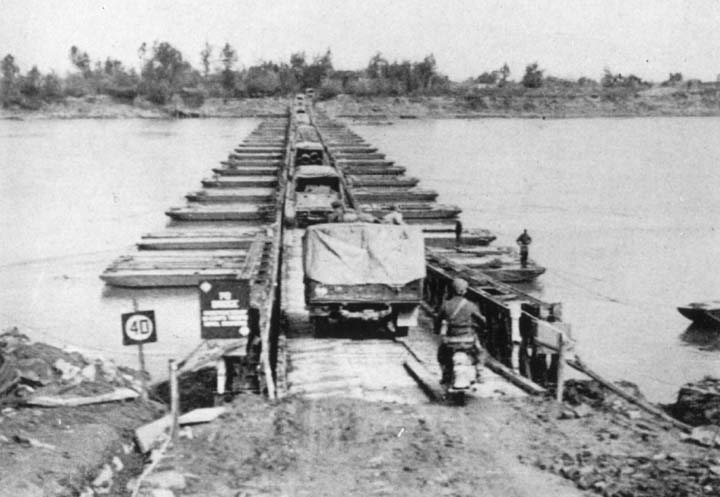
Preparations for the journey were completed by 26 August. On the morning of the 27th 6 Brigade left, and at ten o'clock A Company, 6 Field Ambulance, proceeded to the main road and joined the 680 vehicles of the brigade convoy. It was Sunday morning and scorching hot, and the pealing of church bells hung in the air. Civilians gazed curiously as the troops stood around the trucks in the inches-deep dust that covered the road and whitened the hedgerows.
The head of the column was already on the way, spreading along the roads at approximately twenty vehicles to the mile. Half an hour later A Company moved off and headed southwards through Siena. By the following morning, when HQ started the journey with the 2 NZ Division Troops Group, the whole Division was strung across the width of Italy.
The convoys swung eastwards at San Quirico and followed a roundabout route towards Lake Trasimene, then wound eastwards over tortuous secondary roads to strike Route 71 at Castiglione del Lago. The lake was shimmering under the moon as the stream of vehicles travelled on through the night, around the northern shores and down Route 75 past Perugia and Assisi. Gazing up the hillsides at the walls of Assisi, many would have liked to explore the historic town; but there were no halts and, moreover, because of the need for secrecy, all towns en route were out of bounds.
Passing the town signs of appropriately named Spello, A Company, 6 Field Ambulance, came to the staging area, some two miles south of Foligno, at 7 p.m. The transport ahead was pulling into the fields. Unit cooks assembled burners, and colonies of bivouac tents were appearing among the trees as the company came to a halt and made camp. After tea the commanding officer nipped in the bud many private schemes concerning nearby Foligno by announcing that, for security reasons, all ranks were confined to the area.
The convoy had covered 130 miles during the day, halting only for lunch, and the troops bedded down early. Shortly after nightfall the quietness of an empty countryside lay over the encampment.
The morning was warm and moist, with a dense mist clinging to the ground and trees. Voices floated across from the road, where the vague figures of peasants, women carrying loads on their heads and men with donkeys and carts, were walking into Foligno. An old tower, with a stunted tree clinging to its ruined battlements, stood high above a nearby grove of oaks. The mist thinned out to a mere haze over the distant hills and villages, and the troops began to stir as engines started and the roar of petrol cookers arose. The leading units moved out on the second stage of the journey. A Company pulled back onto the road at 9 a.m. and followed the convoys ahead north-westward along Route 77.
Thenceforward the going was much more difficult. The column encountered steep hills and dangerously zigzagging roads as it passed along the route through Tolentino and past Macerata, to swing northwards through a region of broken country and roads deep in dust to Iesi. A Company's drivers were fortunate in covering the whole distance in daylight, the company arriving in the 6 Brigade assembly area, about a mile and a half to the north-west of the town, in the afternoon.
Headquarters 6 Field Ambulance and other units covered the last 104 arduous miles in darkness. People were awake in the villages, thrusting their heads out of windows or standing in groups in doorways, watching the darkened trucks roaring through. Dawn found 6 Field Ambulance north of Macerata. The drivers had been on the alert all night, easing their vehicles around hairpin bends above deep valleys, and now they were faced with roads deep in dust that, whirled up by the earlier convoys, had settled thickly over a wide area on either side. In the deceptive, early-morning light, the road verges were difficult to see. To fresh men the conditions would have been extremely difficult; to tired drivers they were almost impossible. Consequently, it was not surprising that two vehicles drove off the road. The orderly-room truck came to a halt straddling the edge of a steep bank, but was towed back without much delay with the aid of a Sherman tank.
The unit passed through Iesi and followed Route 76 to the coast to join B Company, which had moved up from Civita Castellana to make preparations for a divisional rest camp near Casa Bruciate, north of Ancona.
During the early days of September the Division remained near Iesi, awaiting its new role. Operating as ADS in the 6 Brigade area, A Company, 6 Field Ambulance, occupied a pleasant field, half grass-covered and half planted in well-grown tobacco, and bounded by fruit-laden grape vines. The weather was fine and extremely hot, and as the only work was the treatment of a trickle of sickness cases, parties of men were transported to the beach each day. The rest of the company sprawled in the bivvies or around the radio, scattered through the vineyards and houses, or strolled along the winding lanes and up the hill through the massive gateway of Iesi. It was an attractive town and the people were friendly enough, though some claimed that, having been liberated by the Italian Arditi, they owed the Allies nothing.
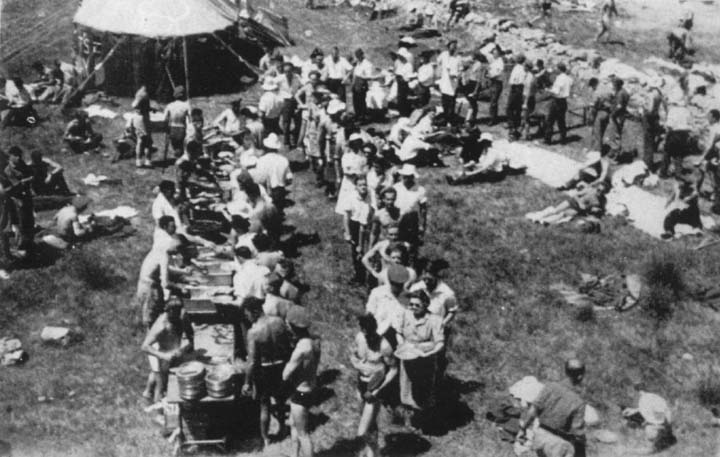
The 6 Field Ambulance rest camp was east on the coast and only a hundred yards or so from the sea. A double-line railway and the coast road, Route 16, ran between the camp and the beach. Every joint in the rails had been expertly blown apart by the Germans and the power-line pylons had been neatly toppled. The difference between the rest camp atmosphere and that of a normal MDS was most noticeable. There were no ambulance cars driving up to reception during the night, and no loaded stretchers being hoisted out by waiting stretcher-bearers. There were no soldiers wandering about with bandaged arms, faces and legs, or spotted with applications of gentian violet or brilliant green. Also, there was no smoking rubbish hole, evil-smelling with burning blood-soaked dressings and fragments of clothing. Instead there was a gathering of casual, healthy-looking men, and the neat row of 180-pound tents in which they were housed, with bivouac tents hugging the boundary hedges or backed up against trees for shade.
Many times each day flights of fighters began their sorties by roaring low over the camp and beach; and occasionally a. medium bomber jettisoned a stray bomb far out to sea, the splash and smoke vanishing before the report reached the shore. In the mornings the destroyers Loyal and Urchin steamed serenely past to throw the weight of their gunnery into the battle raging around Rimini. In the evenings the men, though themselves veterans of many thousands of miles of truck travel, sat along the banks at the roadside, smoking and lazily watching the stream of traffic passing up, and down, or yarning with a party of South African engineers who, were repairing the railway. With the assistance of the South Africans and their bulldozer, a football ground was levelled off nearby. It was smooth enough; but the freshly disturbed earth dried out in the sun and each game was played in a miniature dust-storm.
At this time the Germans were defending the Gothic Line, a formidable defensive system in considerable depth, embracing the entire breadth of the belt of interlocking ranges of the Apennines across Italy. The eastern sector ran along the Foglia River and was anchored at the Adriatic town of Pesaro. While the main mountain ranges stopped short of the coast, high foothills running almost to the sea provided excellent defence positions. Once an attacking army won past Rimini, 20 miles up the coast from Pesaro, it was thought that the Gothic Line defence system would he turned. It was expected that once the Eighth Army entered the Po Valley it would be able to exploit rapidly across the plain. Optimism at the ability to force the pace was to be sadly disappointed. Rivers and extensive canalisation north of Rimini continually hampered progress. Instead of making the expected rapid advance, Eighth Army entered upon a long and discouraging period of nearly four months' fighting, crossing numerous river obstacles in winter weather in operations that can best be described as the 'battles of the rivers'. The operations did, however, tie down German forces that might otherwise have been used to help oppose the Allied advance in Western Europe.
Eighth Array began its attack towards the Gothic Line on the night of 25 August, and by the end of the month it was breaking into the defence system along the Foglia River. Pesaro fell to the Poles on 2 September. Canadian and British troops continued the advance on the narrow coastal strip and farther inland. On 10 September 2 NZ Division came under command of 1 Canadian Corps for an operation which it was hoped to make a mobile one of break-through and exploitation.
Eighth Army pushed on until it was held up at the San Fortunato Ridge, which dominated Rimini and commanded the eastern entrance to the Po Valley. After heavy fighting, the ridge fell to the Canadian Corps on 20 September, and the next day Greek and supporting New Zealand troops entered Rimini and the Canadians crossed the Marecchia River to enter the Po Valley. At this stage 5 Brigade came up to pass through the Canadian bridgehead and continue the advance towards Ravenna, while 4 Armoured Brigade was also committed on the narrow coastal strip between Route 16 and the sea. As ADS to 5 Brigade, A Company, 5 Field Ambulance, set up in a small stable just south of Rimini on the 20th and admitted a large number of wounded on the 22nd, during which day its area was shelled and a jeep driver wounded.
On the 23rd 6 Brigade took up the attack, and A Company, 6 Field Ambulance, had reached a field just south of Rimini in the afternoon. A few shells landed among nearby olive trees at nightfall. Another screeched past into a hedge. Then one burst with a sizzle and a shattering explosion in a ploughed strip at the edge of the field, and the unpleasant humming of splinters started a rush to transfer bedrolls to the irrigation ditches. The shelling continued for about an hour, and inevitably, with the concentration of units in the vicinity, men were wounded. The ADS reception section set up and admitted and treated 25 casualties.
The night that followed was bitterly cold, and the blankets were drenched with dew when, at 5.30 a.m., one of the men went rushing along the ditches, prodding and shaking the men and imparting the dismal news that they had to be up and mounted and ready for an immediate move. Soon lethargic figures were groping around in the dim grey light of approaching dawn, packing gear and clambering on to the trucks, where they waited, with occasional descents to stamp up and down to warm their feet, until a welcome 'Come and get it' rang out from the cooks' truck. After breakfast there was more waiting around, the company finally moving off at midday.
Meanwhile, 6 Brigade was advancing. A Company, 6 Field Ambulance, passed through the outskirts of Rimini and set up the full ADS in the local cemetery, a mile or so north of the town. A typical Italian cemetery, it was completely walled in and crammed with graves, each bearing a porcelain photograph of the occupant. Some of the graves and the coffin receptacles that lined the walls had been blown open by direct hits, and the smell of old corpses hung in the air. However, it was sheltered and warm, and the men contentedly erected their bivouac tents among the tombstones.
Casualties were coming back from the battalions, and during the afternoon and evening of the 23rd the ADS admitted 55. Most of them were frankly startled on being hauled from an ambulance car into a moonlit cemetery.
At 7.45 p.m. on the 24th, 6 Brigade delivered a heavy attack that carried it on to the crossroads at Bordonchio, seven miles to the north. Men lined the tops of the cemetery walls to watch the guns, a long, flashing line in the darkness to the rear, as they poured out the barrage. The infantry advanced against formidable difficulties. The enemy laid down heavy shellfire along the whole front, and his troops occupied and fortified every house. Nearly 200 wounded were carried back to the ADS during the 24th and 25th.
During the 26th troops of 6 Brigade reached and crossed the Uso (Cæsar's Rubicon); the Germans had withdrawn from Bellaria, a small seaside town beyond. Part of A Company moved forward up Route 16 to establish the ADS a mile south of Bordonchio. The bleak, muddy patch of ground was by no means a pleasant change from the grassy, sheltered, albeit somewhat odorous cemetery. The only house was badly damaged and polluted by cattle, which the Germans had taken into the lower rooms and slaughtered. Later in the day the carcases were towed away by a jeep, and after being thoroughly cleaned some of the upper rooms made fairly good billets. Most of the men, however, erected bivouac tents in the open or burrowed into a couple of nearby haystacks.
The ADS was now in the vicinity of the RAPs, and casualties were frequently carried in direct from the field, without any preliminary treatment. Civilian casualties were often accompanied by tearful relatives, desperately pleading for information about their destination from busy orderlies, who had not the faintest idea what it would be.
A continuous stream of refugees passed along the road. Some were astonishingly cheerful; but the majority, naturally enough, looked wretched and hopeless. Young mothers carried babies and helped aged parents. Older mothers urged on their reluctant children. All were burdened by such belongings as they could carry. One family of albinos passed, completely fed up and squinting helplessly.
The 27th brought wind and rain, which continued throughout the following two days. The refugees, looking up uneasily as shells from the heavy and medium guns to the rear roared over into the German positions, still plodded southward through driving squalls that frequently blotted out the flat, desolate landscape.
Occasionally the road came under fire, the bursting shells sending up fountains of earth and mud, while the ground, soaked by the heavy rain, became a sea of ooze wherever transport moved off the hard road surface. Large areas were flooded completely.
During the evening and night of the 28th, a series of particularly strong gusts of wind flattened many of the bivouac tents and half-flooded the slit trenches beneath. The evacuation section struggled with the thrashing tarpaulin, and tried to anchor the ropes with slabs of masonry where the pegs persistently dragged out of the soggy ground. Fortunately, the situation was under control when a party of wounded Tommies was carried in. One, with a penetrating shrapnel wound in the head, heaved himself aimlessly about like a stranded fish until quietened by an injection of morphia.
At Riccione 5 MDS took over the local municipal buildings. Cleared of debris, these buildings were very commodious, and it was possible to prepare some excellent 18- and 30-bed wards. The operating theatre was large enough to accommodate two surgical teams working at the same time, and had two adjoining rooms which were used as preparation rooms. The staff of the unit were quartered on the top floor, and the hospital kitchen and patients' dining hall were established in the basement. The holding capacity was slightly more than 150 patients, but as the unit began to receive, both battle casualties and sick from the Division, this capacity was soon tested to the utmost.
From 20 to 25 September the theatre was in use continuously, 144 operations being performed. The rush of work had eased when 4 MDS took over farther forward at Viserba, two miles north of Rimini, on the 26th. Then the MDS was reorganised to hold more sick, and as the sickness rate in the Division proved to be much higher than usual, the unit was kept busy. Cases held varied from 130 to 150 and large numbers, including many jaundice patients, were evacuated to 1 General Hospital, less than 40 miles away at Senigallia.
|
|
|
|
|
|
At the end of August 1 General Hospital moved 310 miles up the Adriatic coast from Molfetta to Senigallia, north of Ancona. An advanced party had earlier begun the necessary reconstruction to suit the hospital's needs there. When this party arrived, the enemy was only two towns away up the coast, and towns are not far apart in Italy. The switching of the Division back to the Adriatic coast had created a need for the rapid move forward of 1 General Hospital, which had now become the advanced hospital.
The new hospital site at Senigallia was on the beach, in what had been a health resort for children and, latterly, a German military hospital. On the pale blue walls of one ward were bright paintings of Pinocchio, Donald Duck, and Mickey Mouse. They gave Fascist salutes and shouted Avare il Duce at appropriate intervals. The patients later came to like the rejuvenating atmosphere they created, even if they did not agree with the sentiments expressed. In any case, Mussolini had been well pushed off his pedestal by this time.
The central building lent itself to conversion to the needs of the administrative, laboratory, X-ray, and other departments. A walk beneath a vine-covered pergola brought one to a two-storied building used as a surgical block. It showed on all sides more window than wall. The smaller, detached buildings were to become a sisters' and nurses' mess. Tents had to provide all other accommodation. New Zealand engineers built access roads and other conveniences, while Italian labourers worked on inside alterations. Divisional medical units helped to erect tents.
Lt-Gen Freyberg, following an aeroplane accident, was admitted to the hospital on 3 September. While alterations were still being made to the surgical block, he was the first patient operated on in the new hospital.
The hospital was soon busy coping with an inrush of patients. The bed state had reached the high figure of 839 by 26 September, the total admissions for the month being 1667. Of these, 632 were evacuated to 3 General Hospital by hospital ship from Ancona and 189 by hospital train to 2 General Hospital.
The main highway passed the entrance to the hospital at Senigallia, and there was a continual noise from the endless chain of transport moving up to the front line and from planes droning overhead. During the last few weeks of summer and in the early autumn, it was enjoyable for the staff living in tents by the sea. but when the rains came and the sea breezes turned to boisterous gales and the ground underfoot became waterlogged, it was another story. Every effort was made to erect huts as early as possible, and soon Nissen huts were dotted over the hospital area.
Battle casualties and infective hepatitis cases kept the unit busy in October. The average bed state was 587, but with the Division out of the line for most of November there was a consequent easing of pressure on the surgeons. Large numbers of patients continued. to be evacuated to 3 General Hospital at Bari and 2 General Hospital at Caserta.
To the sisters of 1 General Hospital, who had long been in a base hospital, the task of setting up in a forward area, living under tented conditions, was new and interesting. Planning their tented homes and improvising ways and means for more convenient living had its humorous moments. One sister wanting a clothes-line found a long length of suitable wire attached to the fence, so cheerfully cut off a length sufficient for her requirements, quite unaware that telephonic communications would be abruptly interrupted.
In the heavy rain from 28 September onwards, the 4 MDS site in a factory at Viserba, with its hard roads and good drainage, proved very satisfactory, but the whole divisional area became bogged. Operations were held up, which meant in turn fewer casualties. During the morning of 4 October the MDS moved to a new building, formerly an Italian children's hospital and sanatorium, on the coast road at Igiea Marina, just south of Bellaria. This building consisted of three large stories with a central block of small rooms, each wing forming large dormitories very suitable for holding patients.
The general disposition of units allowed the MDS to receive patients direct from the RAPs. On 5 October the unit was joined by a surgical team from 1 Mobile CCS with equipment for a 50-bed ward, an X-ray truck, and six nursing orderlies.
With the help of the engineers, windows were replaced with windolite, the water supply on the ground floor was put into working order, and a portable lighting set installed. In these comfortable surroundings a social function was held on 6 October to farewell those of the 4th Reinforcements who were leaving for Advanced Base on their return to New Zealand.
The MDS had three completely equipped operating theatres, but fortunately these arrangements proved over-adequate as there were not many casualties in the divisional sector. The total admissions for the first week at Igiea Marina were 238 sick and 84 battle casualties. The latter were mainly victims of sporadic shelling.
Persistent wet weather forced the crossing of the Fiumicino to be postponed. On 10 October it was decided to regroup the troops under Canadian Corps command. The 2 NZ Division sector was taken over by Canadian troops, and the Division moved to the adjacent western sector which had previously been held by Canadians. No great increase in distances of evacuation resulted, and the MDS remained at the same site receiving cases from 5 ADS, some three to four miles due west.
The weather began to improve on 11 October. An increase in the number of guns in the vicinity incited some retaliation by enemy artillery. During the afternoon several air bursts were observed over the building, and later accurate counter-battery fire on neighbouring gun sites caused a sudden influx of battle casualties. No MDS property was damaged.
The rain which made the crossing of the Fiumicino impossible had failed entirely to pin down the infantry or to silence the artillery. Night after night, over the soft sound of drizzle and the howl of the wind in the trees, the roll of gunfire echoed from the Apennines to the sea. On 11 October 5 Brigade found the Fiumicino almost undefended and moved across to take the town of Gatteo, badly battered by shelling and bombing. San Angelo, a heavily defended enemy strongpoint, caused a hold up and led to many casualties before it was cleared by Maoris on the night of 14-15 October, when searchlights were used to create 'artificial moonlight'. This eerie light was a feature of the campaign from then on.
For the attack on San Angelo A Company, 5 Field Ambulance, moved forward to set up in two farmhouses. Extra jeeps and four-wheel-drive ambulance cars were called up to ensure that there would be no delay in evacuation on the narrow, slippery roads. Then, on the 15th, the ADS crossed the Uso River to open again in another farmhouse on the down route from San Mauro, and there admitted 100 battle casualties in 30 hours before crossing the Fiumicino and setting up in an orphanage building in Gatteo. Here the company found an old manual printing press and supplies of paper and ink. Soon the men were busy in their spare time filling orders for Christmas cards from some of the neighbouring battalions.
The Pisciatello River was crossed by 6 Brigade on the night of 18-19 October. Tanks were got across the river, and this changed the aspect of the advance as the country for some thousands of yards provided better going. Discounting the risks involved because of the soft ground, it was decided to thrust with the tanks right through to the Savio, a broad river running almost north. Such a manoeuvre, involving as it did a right hook of well over five miles would cut all the coastal roads leading from Cesena to the coast up to a point well above Cervia, and in conjunction with a Canadian attack up Route 9, would almost certainly bring about the fall of Cesena itself. The manoeuvre was successful.
By 21 October the Division was right up to the Savio and Cesena had fallen to the Canadians. The all-important Route 9 was cleared to a point only 46 miles from Bologna.
This concluded a month of hard but unspectacular fighting by 2 NZ Division---a slogging match in the mud against an enemy who could be forced back but not overwhelmed. But the optimism of a month previously had not been fulfilled, and a break-through in the Po Valley had not been achieved.
In the afternoon of 20 October, A Company, 6 Field Ambulance, moved forward across the Pisciatello to a church between Gattolino and Osteriaccia. A building forming an annex to the church was occupied by an RAP and a platoon of infantry. Consequently. the only space available for the ADS was in the church itself. The company cleared out the pews, while the priest, a sinister-looking man. grew increasingly unhappy and restive. When the men clambered up the walls to black out some high windows, and began spreading their bedrolls and gear around the altar, he was moved to active protest; but, although all realised that it was a regrettable situation, it availed him nothing.
A large, inaccessible shell hole in the dome of the church caused some concern when the first casualties arrived at night and the lamps had to be lit. Sure enough, complaints began to pour in from nearby units. The light was visible miles inside German territory and a hail of shells was expected at any moment. Fortunately, the infantry moved out and the ADS was transferred to the annex.
The Savio River drive necessitated the opening of 6 MDS at San Mauro, as the lateral road to the coast had become very congested. On 18 October 4 MDS vacated the building at Igiea Marina in favour of 1 Mobile CCS, which held the site while the Division enjoyed an interlude at Fabriano.
Arrangements had been completed for 2 NZ Division to be relieved by 5 Canadian Armoured Division and withdrawn to a rest area, extending over 25 miles between Fabriano and Camerino, two towns lying to the east of Macerata. During the evening of 22 October Canadians relieved 6 Brigade, which began the journey southwards. A Company, 6 Field Ambulance, left its church site at. 5.15 p.m.
To the tune of a few unenthusiastic farewells from the annex windows, the trucks drove off into the fog that lay over the flat, dismal landscape. A short distance back the men looked up in pleased surprise as the convoy passed under a banner erected by the Canadians and bearing the message 'Thanks a lot, Kiwis'. The roads were muddy, and as night fell hedgerows, trees, and vehicles were fitfully illuminated by the fog-dimmed flashes of the guns firing on either side.
The route to Fabriano was to become familiar to New Zealanders---Rimini, Pesaro, Fano, Senigallia, and then inland at Falconara, through Iesi to the mountains, where the Esino River, the road, and the railway twined through the narrow gorge between tall, bare, rock walls. The river was crossed at the Howe Bridge, usually after a good deal of delay.
In the last days of autumn, the Division found itself dispersed among quite unscathed villages in the heart of the Apennines. No one had heard of Matelica, Fabriano, Castel Raimondo or San Severino. There had been no pitched battle there, for the main highways through which the fighting had flowed many months before ore gave them a wide berth. They were backwater sleepy hollows, unspoiled by the continued presence of sightseeing and souvenir-hunting troops. Yet these places will be remembered with undiluted affection by the men of the Division. Attachment for the quiet beauty and for the people drew many a New Zealander back on a passing visit as long as the Division was in Northern Italy.
Fabriano was in a peaceful, fertile valley. Rounded hills bounded the wide valley and then steeper crests rose to the sky. The railway station and yard were heavily cratered and torn---they had been a supply depot for the retreating Germans. The streets and squares, all paved with cobbles, were clean and well maintained. The people seemed to belong to a prosperous community, although there were many refugees from other parts of Italy among them. The town was the trading centre for a large farming district.
Fabriano did not appear to have any large or enthusiastic Fascist party, and the usually inescapable Casa del Fascismo was missing among the mass of buildings. No building was aggressively new or glaringly modern. The town contained a number of pottery factories operating hand-wheels, quite a large printing works, a foundry, flour mills, many little one-man shops of tinkers, tailors, carpenters, mechanics, all pottering away with surprising competence.
In the Scuola Teenica Agraria in Fabriano, 4 Field Ambulance opened an MDS for the Division's sickness cases. This was a commodious, red-brick building, overlooking the valley in which the town spread itself over mild slopes. On the other side of the valley rose a rocky ridge, soon to be covered with snow. As it was necessary to hold only up to 150 patients in this agricultural college, the school authorities were allowed to continue functioning in a wing of the building. The structure itself, so unlike most buildings in the path of the war in Italy, was virtually undamaged and was a hallmark in the unit's history as being the first it had occupied in Italy with its electric light and water services still intact. The town's electricity system had escaped major damage.
For the remainder of the month and until 27 November, the MDS looked after the sick, the more serious cases being evacuated to 1 General Hospital at Senigallia.
The widespread dispersal of the Division and the congestion of traffic on the narrow roads necessitated the opening of 6 MDS, under Lt-Col W. Hawksworth,(1) in the castle on Rocca Lanciano, near Castel Raimondo, in the 6 Brigade area, ten miles to the south. Previously it had taken as long as three hours for patients to reach 4 MDS from 5 ADS, farther south at Camerino, in 5 Brigade's area. The weather at this time continued to be bad, but all units were accommodated in houses, factories, or castles and were able to keep dry.
Much of the life of Fabriano appeared to centre round the main square, the Piazza del Podesta, bounded by public buildings and containing a chain-encircled fountain in a moss-covered basin. On warmer evenings the pillared terraces of the post office, public library, and art gallery were lined with troops peacefully enjoying the spectacle of crowds of citizens taking their after-dinner stroll.
The NZ YMCA opened a cafeteria in the post office building. Because of the shortage of cups, the tea was served in adapted milk tins, wrapped around with several layers of gauze as a protection for the hands. Even so, the counter radiated darting figures as men snatched up the tins and leaped to deposit them on the nearest table or ledge before they dropped from their scorched hands.
Three cinemas were operating in the town, but all suffered the effects of a shortage of power. It was impossible to run the projectors at anything like the normal speed, and the resultant drawling speech was almost unintelligible. The most popular entertainment was presented by a party of local Italians in the town's main theatre. It is probable that many soldiers still remember the lyric soprano voice of 14-year-old Sylvana Tisi and the exuberant personality of her sister, Anna Maria. They were followed by the Kiwi Concert Party. Then came an excellent ENSA show. Unfortunately, the New Zealand allocation of admission tickets for the latter were mere typewritten slips of paper, and widespread forgery caused a crowd of genuine ticket-holders to be left outside when the doors closed. However, the problem was solved in the usual manner: the doors gave way and most gained admission.
The long-projected reorganisation of the three field ambulances was completed in November, the aim being to scale down medical units in a general reorganisation of the Division, which included the absorption of troops from the disbanded 3 NZ Division. By the end of the month all three field ambulances were operating under a new establishment, with an enlarged Headquarters available as MDS when required and one company permanently attached to its brigade as ADS. The second company in each field ambulance (B Company) was eliminated.
On the 14th 6 Field Ambulance held it last ceremonial parade and march past in three companies, the ADMS, Colonel R. D. King, taking the salute. Colonel King commended the unit for its smartness and the general excellence of the parade; but he was unaware that watching him from where they were sprawled among the trees were men who should have been taking part in the parade.
By a coincidence the reorganisation of 6 Field Ambulance and the fourth anniversary of its arrival in the Middle East fell on the same day, and in the evening a combined anniversary and farewell dinner was held in the castle hall. For days one of the officers, with the administrator of the Rocca Lanciano estate to do the haggling, had toured the countryside buying turkeys, and the cooks equalled any of their Christmas-dinner feasts of the past.
The impressive hall and long tables lined with bottles of beer, menus, and toast lists made a sight calculated to boost any man's feelings, even if he regretted the passing of his unit's B Company (as many naturally did). In the first comparatively silent period 250 pairs of capable jaws were steadily exercised, and then the hall buzzed with genial conversation through which floated the violin notes and the rich tenor voices of the Italian entertainers. The 6 Brigade Band was expected; but unfortunately it spent most of the evening on the wrong side of a washed-out bridge and, after completing the journey on foot, arrived to find a gabble and uproar that would have discouraged even massed bands.
Toasts were drunk to the King, the Medical Corps, and the unit, and then with no further reason for remaining at the tables, the crowd merged and formed into groups that shifted, dissolved, and reformed, while the hall boomed and echoed to laughter and song.
Before the return to the line, leave to Rome and Florence was allotted as liberally as possible, and 5 Field Ambulance operated a leave camp at Civita Castellana. Since the clearance of the enemy from Florence a New Zealand Forces Club had been established in a former hotel, and members of the units were soon to be heard recounting their experiences in that city and comparing it with Rome. Partly because of its mauling by the passing conflict, Florence suffered by comparison. In many of the churches priceless paintings and sculpture of the Renaissance era had been either bricked up, sandbagged, or removed, and the famous picture galleries were not open for inspection, so many of their exhibits having been deposited elsewhere for safer keeping. Nevertheless, Florence had many attractions and was notable for the number of people able to speak good English.
IT was determined during November that the Fifth and Eighth Armies should exert continuous pressure in an effort to defeat the enemy before the spring, or at least to ensure that no German units would be able to leave the Italian front to assist in the defence of Germany. Accordingly, the rested and reorganised 2 NZ Division moved northwards during the period 22-29 November and relieved 4 British Division in the 5 Corps sector.
Although there had been some advance during November, the general situation at the front was very similar to that prevailing previously. Forli, ten miles above Cesena on Route 9, had been cleared, and Eighth Army had established itself nearly nine miles beyond it facing Faenza on the Lamone River. The Lamone was a perfect example of the type of stream across which the bitterest fighting of 1945 was to take place. It was only 60 to 70 feet wide, but on either side were massive terraced stopbanks of soft earth reaching a height of more than 20 feet. With steeply pitched slopes into which it was easy to tunnel, and about seven feet wide at the top, these stopbanks formed a splendid defensive line. Bologna was now only 30 miles away but seemed as unapproachable as ever.
At the beginning of December the Division faced up to the Lamone River astride Route 9 with 6 Infantry Brigade on the right and 5 Infantry Brigade on the left, each with its respective ADS open near the main road.
In Forli, 5 MDS was open for battle casualties in a former working men's club and 6 MDS for sickness cases in a maternity hospital. Both the MDS and ADS of 4 Field Ambulance were closed and in reserve. 1 Mobile CCS succeeded 5 Field Ambulance as the occupants of a large school building in Forli, to treat battle casualties and evacuate direct to 1 NZ General Hospital by NZ Section MAC as necessary.
On the night of 10-11 December 5 Brigade passed through 46 Division, which had established a bridgehead across the Lamone River to the south-west of Faenza, and was poised to attack towards Faenza. It was planned that 5 Brigade, with 6 Brigade protecting the right flank, should attack from the bridgehead simultaneously with 10 Indian Division, advance to the Senio River, and isolate Faenza.
The country over which the action took place presented considerable difficulties in the evacuation of casualties. 5 ADS, under Maj R. H. Dawson,(1) was in a building on the west side of the Lamone River and south of Faenza. The route of evacuation was along six miles of one-way road, which was extremely rough and deep in mud, and suitable only for vehicles with four-wheel drive. A car post from 4 Field Ambulance, under Capt N. C. Begg,(2) was established in a house at the farthest point that could be reached by two-wheel-drive ambulance cars, and the ADS was strengthened by extra jeeps and American Field Service cars.
The building which the ADS had occupied was in direct view of the enemy in Faenza and came in for some shelling before 5 Brigade's attack was launched at 11 p.m. on 14 December. A 40ft by 40ft Red Cross sign was then hung on the north side of the building. Further shelling damaged some of the AFS cars.
When the casualties from the attack began to come in to the ADS at 1 a.m. on 15 December, it was necessary to give them more treatment than was usual at an ADS because of the inevitable delay in getting them back to 5 MDS and 1 Mobile CCS, both of which were in Forli.
When the evacuation route was open for down traffic the patients were sent on to the car post, where they were checked over, resuscitated where necessary, and transferred to two-wheel-drive ambulance cars and taken to Forli when the road was open. Activities at the car post, which handled 116 wounded on 16 December, are described by Capt Begg:
'The first convoy of wounded came in. They were carried in the Dodges of the American Field Service drivers, who had come over dreadful roads through torrential rain. They were mostly Indians from the sector in the hills on our left. They had had terrible casualties, and a fair, good-looking English major with both feet mangled by a Schu mine told me he was carried from the field by the last remaining four sepoys of his company. We all worked on these stoical Indians, who were so silent and yet so grateful for any attention. After they had gone we rested a little. As usual in the Eighth Army, it was an international affair. The Indian doctor stood by the fire talking to "Butch", who was an unmistakable Kiwi. A tall, smooth-faced Texan was helping to reset our table, and chatting to an English orderly. To complete the picture, a Pole, wounded slightly in his seat, was noisily gesticulating as he was carried in, and ineffectually telling people in Italian that he was a Pole and not a German. . . .
'Each American ambulance carried four stretcher cases and perhaps a couple of sitters. They were often with us, these Yanks, and were old friends of the desert. The first two cases we unloaded from the next convoy were both traumatic amputations of feet. An infantryman, while moving up, had stepped on a Schu mine and blown a foot off. Unhesitatingly, a Yank driver had gone to his assistance. He also lost a foot on a Schu mine. Stretcher-bearers had got them both out of the minefield and they had travelled down together. Both were shocked and wan. The Boss transfused them both, and as they looked at each other across the table, the Yank said, " Blood brothers, huh? " They went on together to Forli....
'Now rows of Indians and New Zealanders on stretchers lay side by side in the hall, and the sitting wounded had spread into every room. They were methodically examined. Field cards were attached to the clothing of each man, with entries on them telling of wounds and treatments. morphine given and tourniquets applied. Bill and Butch were lighting cigarettes for some; giving hot cocoa, steaming from the cookhouse, to others.
'So we went on, hour after hour. The fortitude of the patients was enough to make our job worth while. As often as not they smiled and joked with one another, a little relieved that they were not worse off. A jubilant Yank driver pushed back the blackout blanket at the doorway and told us that the Maoris had cut the Via Emilia with a bayonet charge. His eyes were sparkling and he was throwing his arms about excitedly. A quiet Maori voice said, "We're pinned down by the heaviest mortar fire I've ever seen. Lot of wounded waiting for the Doc, and he's been hit, too. We're a long way from the road." "That'll be the day, when the Ninetieth hold the Maoris up, Hori," someone said, and the Maori smiled, his perfect white teeth showing up in the dim light.'
After heavy and confused night fighting, 5 Brigade took Celle and then swept north behind Faenza and cut the Via Emilia.
On 16 December 5 ADS moved into a building nearer to Faenza and there experienced two busy days. On the evening of the 16th the enemy was cleared from Faenza and the evacuation route was shortened. Notable work was performed at the ADS during this difficult period by jeep and ambulance car drivers and the medical orderlies, especially in collecting wounded from the RAPs.
After the capture of Faenza by the Division on the evening of 16 December, the commanding officer of 4 Field Ambulance (Lt-Col Owen-Johnston[3]) and RSM (WO I G. C. Smith [4]) scrambled over a rubble footbridge in the Lamone River, still under occasional bursts of spandau fire, at nine o'clock next morning to choose a site in the town for an MDS. The ADMS 2 NZ Division, Col Pt. A. Elliott, joined the party, and after inspecting many buildings. they finally selected a bank building near the main square.
Leaving Forli at midday on 17 December, 4 MDS opened that afternoon in Faenza at three o'clock. From the time of opening there was a steady stream of patients, and as for the first few days this MDS was the only one in Faenza, it handled not only New Zealand but also British, Indian, and Italian troops and some Italian civilians. Evacuation channels were to 1 Mobile CCS for New Zealand troops, while British cases went to 5 British CCS and Indian cases to 9 Indian CCS in Forli. Priority was given to ambulance cars on the road, so that patients arrived at the CCS usually within half an hour of leaving the MDS. A Bailey bridge was a big help in this sector.
The building used by the MDS was solidly constructed and offered fair protection from the heavy shelling of the town by the enemy, who during the night of 17-18 December had reached the outskirts of Faenza in a counter-attack. The reception and evacuation departments were both set up in one large room divided by a low partition, and both were within easy access of a large theatre., beside which was a combined resuscitation and pre-operative ward.
During busy periods two tables were conveniently accommodated in the theatre. Separated from these departments by a small courtyard was the hospital cookhouse, near enough to serve meals still hot. The members of the unit were billeted either in the bank building or in nearby houses, which they managed to heat by one means or another.
On 19 December A Company joined HQ Company at the MDS ready for the forthcoming attack. That night at nine o'clock, 6 NZ Infantry Brigade and 43 Gurkha Infantry Brigade launched an attack under a heavy barrage and threw the enemy back to the line of the Senio River. Much ground was taken after heavy fighting and over 200 prisoners captured.
Casualties poured in to 6 ADS, under Maj G. F. Hall,(5) thoroughly testing the newly organised company. The next 24 hours were a rush period for the MDS. Between midnight and 8 a.m. 102 battle casualties were admitted. These were all cleared by midday and took from thirty to forty-five minutes to reach the CCS. The total admissions for the day were 142 battle casualties and 26 sickness cases.
On succeeding days there was a steady flow of admissions, the highest totals being reached on Christmas Eve, with 40 battle casualties and 30 sick. A shell hit one of the MDS buildings on 24 December, causing twelve casualties in the street but none to MDS personnel.
Back in Forli all the rooms and corridors of the 6 MDS building were crammed with a continuously changing crowd of sick. More and more arrived each day to fill the stretchers vacated by those returned to their units or transferred to the CCS or 1 General Hospital.
Dismal and hazy in the rain and fog by day, occasionally bombed and shelled, and completely blacked out at night, Forli seemed a town devoid of hope. The MDS yard was flooded, a Psychological Warfare Branch truck broadcast stentorian bulletins that echoed hollowly across the Piazza Saffi, and the winged figures of the local war memorial were vague and unrecognisable on top of their lofty column. However, by the time a few repairs had been effected and a selection of stoves had been scrounged from the factory of one Signor Becchi, the maternity hospital building was snug enough. The HQ trucks were parked under the cloisters of the adjacent church of San Mercuriale, a bulldozer having been employed to scoop debris up over the steps of the church to make a negotiable ramp.
The first bombing raid, carried out by a single German fighter-bomber, occurred on the day after the unit's arrival. The bombs fell in the Lamone, near the Bailey bridge, which was probably the target. The aircraft then disappeared into the fog, apparently untouched by the anti-aircraft fire. At the evening meal hour on succeeding days a Spitfire patrolled the sky. Then, on the evening of the 10th, with no Spitfires in sight, three enemy fighter-bombers roared in low over the town. Inside the MDS there was sudden consternation as the building shook to jarring crashes, and shutters smashed in and plaster fell from ceilings. The bombs had fallen nearby, one demolishing a large section of buildings, burying an army truck, and killing many soldiers and civilians. Another struck the church of San Giagio, engulfing families who had moved into the vaults at the previous raid. One women, dug out alive and carried unconscious to the MDS, was holding in her arms a dead two-months'-old baby.
Most of the shelling was confined to the aerodrome end of the town, though a salvo of shells landed around the MDS one night, bringing down showers of glass and more plaster. A building across the square went up in flames and burned well into the morning, section after section of the roof crashing in, scattering burning fragments and sparks, while the steeple of San Mercuriale stood limned in red against the black sky.
In the school building in Forli, too, the CCS, under Lt-Col A. G. Clark, was set up in more comfortable conditions than it had ever enjoyed before. In fact, with the wards neatly arranged and all the departments functioning in a routine manner, the unit had all the aspects of a base hospital rather than a forward one. By good fortune the central-heating system was intact, though some adjustments were necessary at first. The large boilers in the basement were kept stoked continuously and, besides keeping the whole interior of the building warm, provided an ample supply of hot water to the modern shower-room. Another great feature of the school was that it was connected to the town water supply.
The staff was well quartered, too. A villa across the road was reserved for the nursing sisters, under Charge Sister Gilfillan,(6) and another large one nearby accommodated the officers. All other personnel lived in a five-story block of modern flats farther along the road. Most of the former inhabitants of these flats had either evacuated or been forcibly ejected by the Germans, but a few families remained. In many ways, such as doing washing and mending, these Italian people helped many of the staff, and strong friendships developed as the weeks went by.
On 14 and 19 December the casualties from the Division's two main attacks resulted in peak periods of work at the CCS. Because of the muddy country roads, the wounded from the first attack were many hours reaching Forli. Later, however, when Faenza was occupied, ambulances were able to come direct down the main highway. There were two surgical teams attached to the unit at this time, but as so many of the casualties were serious ones requiring urgent attention, a number of them were sent on to less busy British medical units. Evacuation from Forli presented no problems since the 75-mile journey to 1 NZ General Hospital at Senigallia was over good roads.
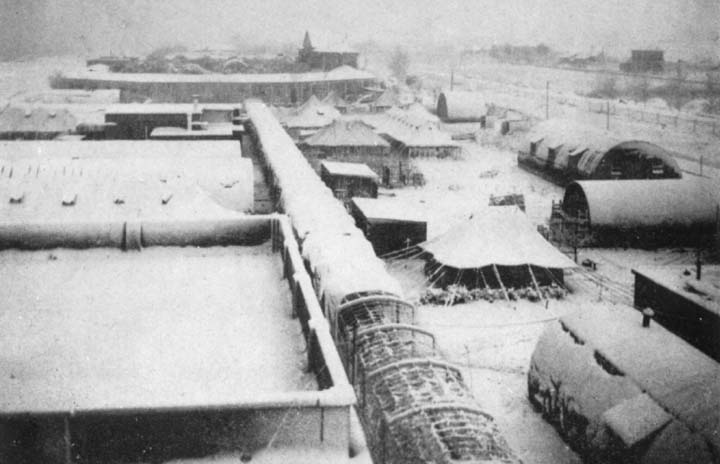
At the CCS, as in other units, Christmas was spent in a merry manner. Again the cooks went to a great deal of trouble. The patients were not forgotten; all received Patriotic and Red Cross parcels, and there was plenty of beer for those who were well enough. The staff, too, had a Christmas beer ration, but if this was not of the desired quantity it was well supplemented by other more potent beverages. At Forli it was really a white Christmas, for three inches of snow fell on 23 December. It was not unexpected as the weather during the month had become more severe, and conditions in the open were most unpleasant.
 |
 |
 |
 |
At Senigallia snow had also fallen, but by Christmas Day it had melted and there was only an aftermath of mud and slush. A choir of mixed voices was formed from the staff of 1 General Hospital and HQ 2 NZEF in Senigallia, to provide Christmas music at church services and in the gaily decorated wards of the hospital. On Boxing Night the Kiwi Concert Party was back again to provide entertainment, and the following day a double wedding took place in the unit chapel.
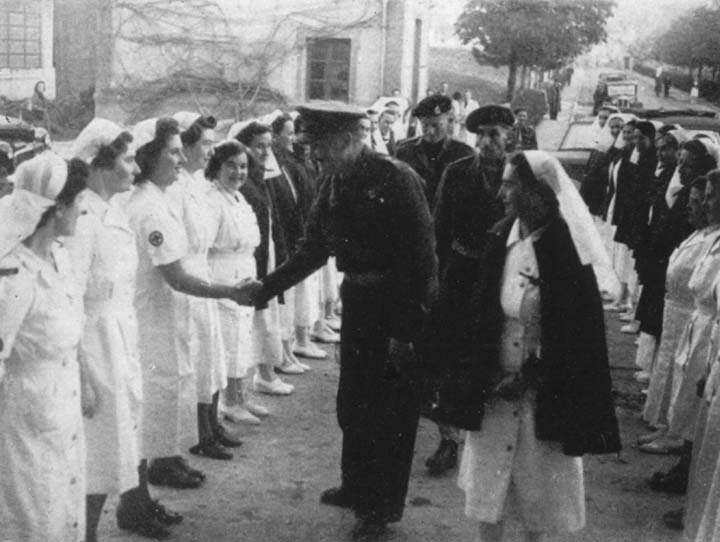
Scarcely a month passed but there were one or more weddings among the sisters and nurses of the unit. Many of the bridegrooms were New Zealanders, and sometimes came from within the unit, but a number were from other Allied forces. These occasions were pleasurable and exciting, especially for the female staff. Short notice was often the order of things. On one occasion at this time it was announced at 7 p.m. one day that a charge sister was to be married at 11 a.m. next day. Yet a turkey, a great variety of savouries, and a lovely wedding cake graced the wedding luncheon. The behind-the-scene story revealed that cooking and fudge-making (from Army biscuits) had gone on far into the night; that the contents of parcels from home had been pooled and the best cake donated for the wedding cake. A walk in the country had produced red berries and great boughs of autumn-tinted foliage for decorations. The one thing lacking was the icing for the cake. This lack, however, was ingeniously overcome by adorning the cake with a thick coat of pale-pink chrysanthemum petals and girding it with fancy paper.
The New Year was ushered in with the ringing of bells. Across the Senio the enemy, too. fired off flares and rang church bells, and then settled down to a solid strafing of our forward defences.
January brought few changes. The Division was operating in a purely defensive role while the enemy consolidated along the Senio River. The month was cold, with rain and several heavy falls of snow. As no attacks were made, casualties were light, coming from patrol clashes, harassing fire, and mines.
For the most part the front was quiet under the fog that lay heavily over the plains. At times, however, the enemy lashed out at occupied houses and other buildings with self-propelled guns from the area of Felisio to the north. Then the muzzle-flashes of the New Zealand artillery flickered through the fields and vineyards as the infantry called for concentrations on the enemy guns.
In spite of the intense cold and the falls of snow, the central heating of the 6 MDS building ensured continuous warmth. Unfortunately the fuel supply grew short, and though two of the unit's 3-ton trucks made trips along the Canale Naviglio to collect wood from trees felled across the roads by the Germans, a diesel oil-drip system had to be installed; from then on the heat was enjoyed at the price of an atmosphere thick with flakes of soot and the unenjoyable task of cleaning out the flues every four hours.
Ample entertainment, provided by concert parties and cinemas, was available for the troops in Forli. An ambitious soldiers' club, the Dorchester, occupying a complete wing of the imposing building of the Regia Academica Aeronautica, was open all day with its billiard room, writing rooms, and two restaurants, each with its own orchestras and singers and well staffed with waiters and waitresses, and, more important, each serving beer with meals.
Additional leave was made available by the opening of the New Zealand Forces Club in Rome to other ranks for six-day leave periods. Parties also visited Rocca del Camminate, Mussolini's summer residence high in the bills, overlooking Predappio, the village in which he was born. The villa, with its plaques and colonnades, had been fashioned into something of a shrine for good Fascists. It had once possessed a coveted visitors' book but, inevitably, this had been souvenired long before. Predappio was occupied by Poles, and any atmosphere of reverence had completely vanished. Rocca del Camminate was quite a modern building, and a plaque explained that it was a gift from the Italian people to Mussolini. There was plenty of evidence that Allied gunners had also bestowed their gifts. The main room was deep in photographs of Mussolini's prize fertile families, of throngs gathered to meet him at various cities, of detachments of Fascist movements, of early Fascist brigades, of brigades burning books, and, mostly, of Mussolini himself, reviewing, opening, orating, posing, writing, working, playing, in uniform and out of uniform, in yachting clothes, working clothes and overalls.
A great yellow fasces decorated one wing of the villa, and a lighthouse and tower crowned it all. The tower head was strewn with the heavy, broken glass of the lantern which had once announced the presence of the family by throwing a revolving red, white, and green light across the valleys and bills of Romagna. It was claimed to have been visible at a distance of 25 miles.
On 19 January 1945 the hospital ship Maunganui, with Lt-Col F. O. Bennett(7) in charge, and Matron G. L. Thwaites,(8) reached Taranto on her fourteenth voyage, and in the afternoon disembarked over 200 Yugoslav patients who had been brought from Port Tewfik. Then, in five hours, the medical staff prepared the wards for the reception next day of 318 New Zealand and five Australian patients from 3 General Hospital at Bari and the Convalescent Depot at San Spirito. This work involved the stripping of all beds, washing down walls and bed frames with disinfectant, remaking beds, and restocking all ward supplies.
Cpl Kilroy(9) has pictured for us the scene at 3 General Hospital next morning.
'It is not yet dawn. No gleam of approaching day brightens the eastern sky, but from the hospital itself fingers of light stretch out into the mist of a winter's morning. At this hour all should be quiet and still, but today white-clad figures are hurrying to and fro, and an air of scarcely suppressed excitement prevails. This is a day of days---for men are going home.
'Already in a nearby port, a trim white ship, bearing the Red Cross emblem, is tied up at a wharf in readiness to receive its complement of patients.
'For weeks there has been speculation among staff and patients as to the name of the ship, the probable date of departure, who will go and who will stay, and now the great day has come. Nurses and orderlies are busily preparing for the evacuation. Men must be washed, fed, dressed. Stretcher-bearers in organised teams are allotted their duties in the various wards. Already a long line of ambulances is on its way to the hospital; the moment of departure is very near.
'Behind these last-minutes scenes of concentrated effort are many hours of toil on the part of the whole staff (and of the office of the Director of Medical Services, too). Apart from the care of the sick and wounded, much routine work has been necessary. Medical boards have considered each case, typists have prepared the numerous forms required, clerks have worked long hours in checking documents and preparing rolls, the dental staff have given each man any dental attention needed, while the Quartermaster's department has completely re-equipped each soldier.
'And now they are on the move. Last goodbyes are said, and though not many words are spoken, hand meets hand as men who, have forged ties of friendship amid the heat of battle are now separated for a time. Already the medical officers, sisters, nurses, orderlies, and others who have ministered to the needs of the departing patients will have bidden them a quiet farewell.
'The patients make a grim procession---some on stretchers, some on crutches, some minus a limb or an eye, others showing the ravages of diseases not known in their native country. Yet their bearing reveals no fear for the future. Rapidly the waiting ambulances are filled, the Padre is busy giving out cigarettes, sweets, and Red Cross comforts for the journey to the ship. Those who go and those who stay wave cheerily as the convoy moves slowly on its way. For the staff another evacuation to hospital ship is completed, and they turn back to their normal duties again.'
For some months two members of the NZ WAAC had been attached to 1 Mobile CCS for duty. This the nurses considered a compliment to their ability and usefulness as they had previously discounted their chances of being posted to that unit. One was a stenographer, who proved her worth battling with case histories and medical records during the busy periods, and the other was employed in the sisters' mess to make the life of the sisters easier and to relieve them during peak hours of work. The nurses moved with the CCS from Presenzano to Frosinone, Siena, Viserba., and Forli, arriving in the latter town when the enemy was not many miles up the road.
In Italy the status of the members of the WAAC was changed so that within 2 NZEF they had all the privileges of an officer as regards travelling, accommodation, and the use of clubs. The change was made purely to avoid embarrassment to the women, and they were gratified.
Feminine influence in hospital life became prominent at 3 General Hospital when Tripoli Lounge was run by a sister and two nurses. Although the Polyclinic buildings at Bari, with their pale-blue cool interiors, were ideally suited for the bed-patients, there was little else than the monotony of the wards to fill the days of the up-patients. There was no handy beach as at Senigallia, or green countryside as at Caserta, only the grey dust and the dry heat of the compound, with no patch of green grass or even a shady tree. At the beginning of 1945 a ward was converted into a lounge and suitably furnished, provided with games equipment, and decorated with palms and flowers. Here morning and afternoon teas and suppers were served in glass cups and saucers to as many as 250 patients at a sitting.
Several nurses also worked in the hospital and welfare centres of the Convalescent Depot at San Spirito.
In Italy the locations of the Convalescent Depot, under Lt-Col Noakes, were Casamassima, near Advanced Base, San Spirito, on the coast near Bari, and then Senigallia, on the coast in Northern Italy near 1 General Hospital. The San Spirito site was the best of them, and a detachment, under Majors G. B. Palmer and A. L. Bryant,(10) remained here till the end receiving patients from 3 General Hospital.
The location at San Spirito was within a few hundred yards of the Adriatic, and the camp spread over nearly 30 acres of fairly level ground covered with olive and almond trees. It was orchard country typical of Southern Italy. The convalescents had the use of a dinghy and a 20-ton cutter.
The administrative section, including reception hospital, massage and dental departments, was housed in a large building which was formerly an Italian's summer residence. Tents, each containing eight hospital beds, provided most of the accommodation, while mess rooms and recreation centres were in huts.
In January and February there were many farewells in the hospitals as further staff left for New Zealand. On the Tongariro roll were many officers, sisters, nurses and men, including the CO and Matron of 1 General Hospital, Col Fisher and Miss Worn, whose commands were taken over by Col Radcliffe and Miss Chisholm, a previous Matron returned from furlough. This was but the start of a succession of staff changes during 1945 as early reinforcements left in turn. In the field medical units, too, the departure of the remainder of the Tongariro draft in February meant the loss of senior NCOs and the men with the greatest experience. But there were many men with long service in their units, and they proved their capabilities on promotion. Reinforcements received later in the month brought the units up to strength again.
Regularly every few months, except during 1942 when Japan's threat to the South Pacific caused troops to be held in New Zealand, a new group of NZMC personnel had arrived in Egypt. The sisters and nurses went direct to the hospitals, while the medical officers, NCOs, and men went to Maadi Camp. At Maadi they usually remained long enough to get acclimatised, with spells in the 'bull-ring' and on route marches. They were then sent across the Mediterranean to Advanced Base in Italy, and from there were posted to medical units. Despite a certain amount of scepticism by the older hands, they proved themselves capable and ready to learn. Some of the reinforcements from 1944 onwards had had service with 3 Division medical units in the Pacific.