 |
 |
 |
 |
WITH all New Zealand insignia removed, a procession of vehicles carried the New Zealanders south from the Sangro area. The convoys began the journey in the third week of January 1944. They travelled along the Adriatic coast towards Vasto. Progress was painfully slow and some of the trucks were too crowded for comfort. For one convoy which had left Atessa at midnight, a halt on the roadside north of Vasto at half past three in the morning was welcome relief. The men slept till daylight, some inside the trucks, some under them, some in ditches; and the peculiar position of many bedrolls showed that a minimum of comfort was necessary for repose.
In daylight the convoy proceeded through Vasto, Termoli, Serracapriola, and San Severo to stage the night near Lucera. During the day's travel, Italian civilians, including an incredible number of unwashed children, begged vociferously for biscuits, chocolate, and cigarettes. Most of the villages passed through were small and filthy, each having its distinctive odour and all united in poverty.
In fine but cold weather the following day, the trucks headed inland and climbed into the central Apennine mountains, along the bitumen road that led up and down and twisted from village to village perched on the hilltops. Down on the western foothills the countryside was more attractive, especially in the vicinity of Avellino, and in the distance smoke and flame could be seen rising from Vesuvius. The next bivouac area was at Cancello, twelve miles north-cast of Naples. That night was very cold, and a heavy frost lay on the ground next morning. Italian people striding tightly clad along the road seemed indifferent to the cold, but thickly wrapped soldiers huddled over mess tins to eat their hot soya links.
The final stage of the journey was in a northerly direction through Caserta and Caiazzo to Piedimonte d'Alife in the Volturno Valley. Here all the field ambulances and the CCS were congregated in the one area.
The Volturno was an easy river making its way in gentle, unhurried bends. It was pleasant to see again a river that lay like an inlay between flat green banks, and not one cramped between high walls as if kept in a press, like the rivers on the Adriatic coast. There was an appreciable sweep of river valley before the hills burst upwards. The dotted houses of scattered villages could be distinguished by their red and buff colours in the sunshine.
The whole divisional concentration area consisted of mildly sloping sections of olive plantations, well divided by roads and reaching back to the hills, which were heavily covered with scrub. Deep ditches divided the area into sections. The ground between the rows of olive trees was worn to a smooth, bare brown by turning wheels and tramping feet. In places grape vines were festooned between harshly pruned trees resembling willows.
An MDS was opened by 6 Field Ambulance on 19 January, entirely under canvas, on an area handy to the road, free of trees and under a heavy crop of lucerne. While the reception and evacuation teams remained on duty to deal with about 30 admissions a day, the rest of the unit route-marched, constructed roads, or played football and other games.
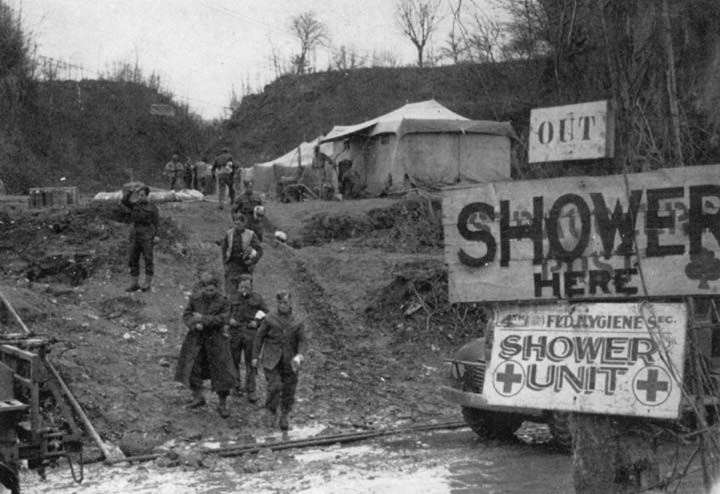
Alife was about three miles away and was found to be a dirty, uninteresting village. It was surrounded by an ancient, crumbling wall, little of which was visible beneath a luxuriant growth of ivy. Outside the village an American shower unit operated with elaborate equipment. The showers run by 4 Field Hygiene Section were installed some six miles up the river bank, near the Raviscanina turn-off.
From the ADSs the serious cases were evacuated to the MDS, and the rest held and treated until fit to return to their units. The patients at that time were a particularly good crowd. None of them was very sick, and coming from various units, each had a fund of jokes and reminiscences that were new to the others. In fact, far from having the atmosphere of a field hospital, the evacuation shelter resembled a social club.
The nearby houses sent representatives to the mess queues at meal-times. The house across the road from 6 ADS sent a minute boy, known to the company as Tony, who used to approach slowly, accompanied by an incalculably old woman. Occasionally a bottle of wine appeared as a token of the family's appreciation and to encourage a continued supply of spare food. From a house nearby came an exceedingly pretty little girl named Noelina and several of her many young brothers. Her family had no wine; so she would shyly invite some of the men, usually the cooks, to spend an evening with them. A visit to their house was quite an experience. The food consisted chiefly of unflavoured macaroni, animals' feet cooked more or less whole, and chestnuts, baked to a rock-like hardness, that were a source of anguish to a New Zealander, who hesitated to admit to the powerfully-fanged Italians that his mouth was crammed with false teeth. The whole family talked simultaneously while loudly crunching the adamantine chestnuts, and the resultant uproar was only too frequently augmented by the howls of the youngest infant.
The news of the Allied landing at Anzio, behind the German lines, was announced on 23 January. It infused new life into the rumour-mongers. The most favoured story was that the Division was about to exploit an expected break-through and hurtle on to Anzio and Rome. Two days later the brigade major of 5 Brigade visited the units and gave a talk on the Division's probable role. Operations would depend entirely on events. While a breakthrough role was envisaged, it was possible that a sufficiently large bridgehead would not be established.
The main body of 2 General Hospital, under Col Christie, embarked at Port Said in the Highland Brigade and sailed across the Mediterranean from 3 to 8 January, when it landed at Taranto. There was some difficulty in obtaining a site for the hospital. Eventually it was arranged that a New Zealand hospital wing of 250 beds be established on part of the site of 2 British General Hospital in an Italian barracks at Caserta, north of Naples, sharing the services of the British hospital. Then the Division's move to the Fifth Army front led to the decision to establish the complete hospital of 600 beds at Caserta with the utmost expedition. Arrangements were made for the New Zealanders, who crossed Italy from Advanced Base and Bari, to take over the 123 New Zealand patients in the British hospital. As equipment arrived, 2 General Hospital became partly a tented hospital and was called upon to work to capacity.
Because of the limited number of buildings available (five wards of a total of 24 in the barracks), it was decided to place all administrative offices in tents, and to use the indoor space entirely for patients. All the staff were accommodated in tents. The inclement weather brought many hardships. It was cold, with heavy rain and wind, and snow lay on the nearby hills. Many of the tents were flooded out, but the staff cheerfully accepted their conditions and discounted their discomforts. Sisters and nurses showed a particularly admirable spirit.
In January Maadi Camp Hospital sent an 'off-shoot' over to Italy to form Advanced Base Camp Hospital of 50 beds at San Basilio, between Taranto and Bari. Capt A. E. Erenstrom(1) was the first OC of the new unit.
February brought a sudden deterioration in the weather. January had been a month of dry frosts and gloriously sunny days. and the troops had been lulled into a belief that the climate of the west coast was milder, drier, sunnier, and in every way better than that of the east. Then came heavy rain and strong, cold winds. The water poured down the slopes through the 6 MDS area, and the deep ditch became a swirling, muddy stream. Unfortunately the ditch was not clear, being blocked at intervals by accumulated limbs of trees, tins, and cardboard cartons, which damned up the water and flooded the bivvies that lined the banks. The overflow spread about the area, flowing ankle-deep through bivvies and tents. When the stream subsided it left deltas of tins and rubbish.
Other units, though spared the troubles of flooding, had their share of mud, and the bitterly cold wind tore at bivvies and tentage, while the dead leaves took off from the oak trees and went streaming away like swarms of frenzied bats.
The spell of broken weather culminated in an appalling thunderstorm during the night of the 5th. The first peal was thought by some to be heavy bombing close at hand, but it went on and on, rolling and crashing, and the hills, trees, and fields leaped from pitch darkness into brilliant light at each flash of lightning.
On the western side of the Apennines, American, British, and French troops had won forward to the immensely strong enemy Gustav Line based on Cassino. This line crossed the peninsula at its narrowest point, where rugged hills formed a series of natural obstacles most favourable to the defenders. Despite the winter weather, the Allies were intent on achieving the capture of Rome, and concentrated on the route through the Liri Valley, the entrance to which was dominated by Cassino and the heights beyond the town.
Fifth Army troops were ashore at Anzio, just south of Rome, on 22 January, but the Germans had found it possible to contain them within the beachhead perimeter, and their effort was halted.
Monte Cassino, or Monastery Hill, was the keystone of the enemy's defences. It was a rocky spur which rose steeply from the plain to a height of about 1700 feet. On the top was the Abbey. To the north of it there was a deep chasm, and to the north-west the mountain ridge along which the Americans had advanced, almost reaching the fortified hilltop Point 593 and Mount Castellone. Beyond Monte Cassino again was the majestic, snow-capped Monte Cairo.
Eastward from the monastery the steep slopes were guarded by extensive field works. A little to the north-east, and actually a part of the main spur, there was a prominent crest upon which stood an ancient castle. This was Castle Hill; at the foot and partly up the slopes of it was built the town of Cassino. Other outcrops of rocks which became of particular significance as the battle progressed were Hangman's Hill, so called because of a scaffolding with a marked resemblance to a gibbet, Point 165, and Point 202. These latter two were knolls between bends in a corkscrew road from the town to the Abbey, which edifice dominated the entire battle area.
On 3 February NZ Corps was formed, with 4 Indian Division and British artillery under command. The ADMS 2 NZ Division, Col King, became DDMS Corps, with the rank of Brigadier. Maj Lomas was appointed DADMS Corps, while Maj Kennedy became DADH Corps. The Corps' initial task was to support the continuing American assault on Cassino and exploit success. By 7 February 5 Brigade, with B Company, 5 Field Ambulance, providing the ADS. had relieved American units along the line of the Rapido and Gari rivers, south of the main road to Rome.
|
|
|
|
|
|
The ADS to 6 Brigade when it moved up was A Company, 6 Field Ambulance. At 1 a.m. on 6 February, when the men began to crawl forth and pull down the bivvies, the piercing coldness of the wind defied description. Finally, the gear was stowed aboard the trucks and the men, wrapped up in greatcoats, leather jerkins, and balaclavas, clambered on the vehicles. The line of vehicles crossed the Volturno River and got onto the main highway. Route 6. Eleven miles farther on, the convoy turned off along the railway embankment at Mignano to a lying-up area between Monte Lungo and Monte Porchia.
It was still dark when, at 5.40 a.m., the vehicles of A Company careered down the steeply-sloping sides of the embankment into a field. Beyond a few tents belonging to an American anti-aircraft battery, a double haystack and a damaged farmhouse, there was nothing in sight. The muddy ground was frozen hard, and the rippling of unseen water and the occasional report of a gun were the only sounds to be heard.
The sky gradually lightened, and a penetratingly cold wind sprang up. Surroundings assumed form in the grey light---poplar trees, chopped and mutilated by shellfire. The ground was pitted with shell holes, and two villages over on the hillside beyond Route 6, San Pietro Infine and San Vittore del Lazio, were practically razed to the ground.
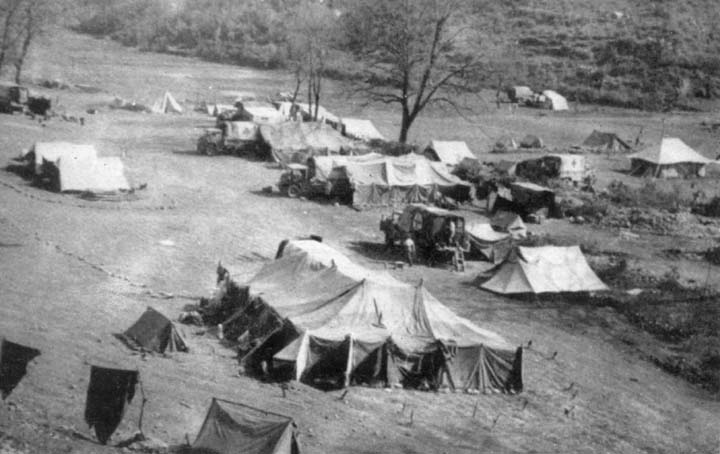
The same day 4 Field Ambulance, under Lt-Col J. K. Elliott, moved forward to a cultivated field near San Pietro, and erected a main dressing station. Five canvasses were pitched in suitable relation to the semi-circular roadway, which was constructed through the area with the help of the Engineers. Dispersal was not attempted, but large Red Cross ground signs were laid out. On the canvas floors of the tents hay was spread. To heat the tents an excellent type of down-draught, wood-burning stove, made by 4 Field Hygiene Section, had largely superseded the oil stoves and charcoal burners. The men of the unit were in bivouacs, no buildings being available in the area.
Facing in the direction of Cassino, one had Trocchio Hill on one's left, partly obscuring distant Monastery Hill; snow-capped Monte Cairo was in the distance straight ahead; just across the road was an army cemetery.
The ADSs and the MDS, as well as the large concentration of troops in the forward area ready to attack when the weather improved, were within enemy shelling range. At 6 ADS about five o'clock one afternoon, fifty-odd faces were lifted from fifty-odd mess tins at a sudden, uncomfortably close, screeching of shells and a series of explosions and clouds of dust along the embankment and beyond. Most of the shells landed in the 25 Battalion lines, wounding a number of men. A few minutes later the casualties were arriving at the ADS reception tarpaulin. They were evacuated to 4 MDS and later taken by the NZ Section MAC to 1 Mobile CCS which, under Lt-Col Button, had opened at Presenzano. Sickness cases were sent to 5 MDS, set up by Lt-Col R. A. Elliott on Route 6, near the Venafro turn-off.
At its new Presenzano location, the CCS lost no time in setting up the hospital when it arrived there on 7 February. The site was a large, flat, partly ploughed paddock near a secondary country road. Through this paddock a loop road had been graded and metalled by New Zealand engineers. Along this the various departments were erected in sequence---reception, orderly room, preoperative ward, the theatres, and then the seven wards. Other departments were sited in convenient relationship to these. The unit had four theatres its own two and the attached 8 British Field Surgical Unit and 1 NZ General Hospital surgical team. All theatres consisted of two EPIP tents joined together, and were grouped close round the pre-operative ward. Since the Allies had overwhelming air superiority, there was not the need for wide dispersal of the unit at this location. Red Crosses were conspicuously displayed, however.
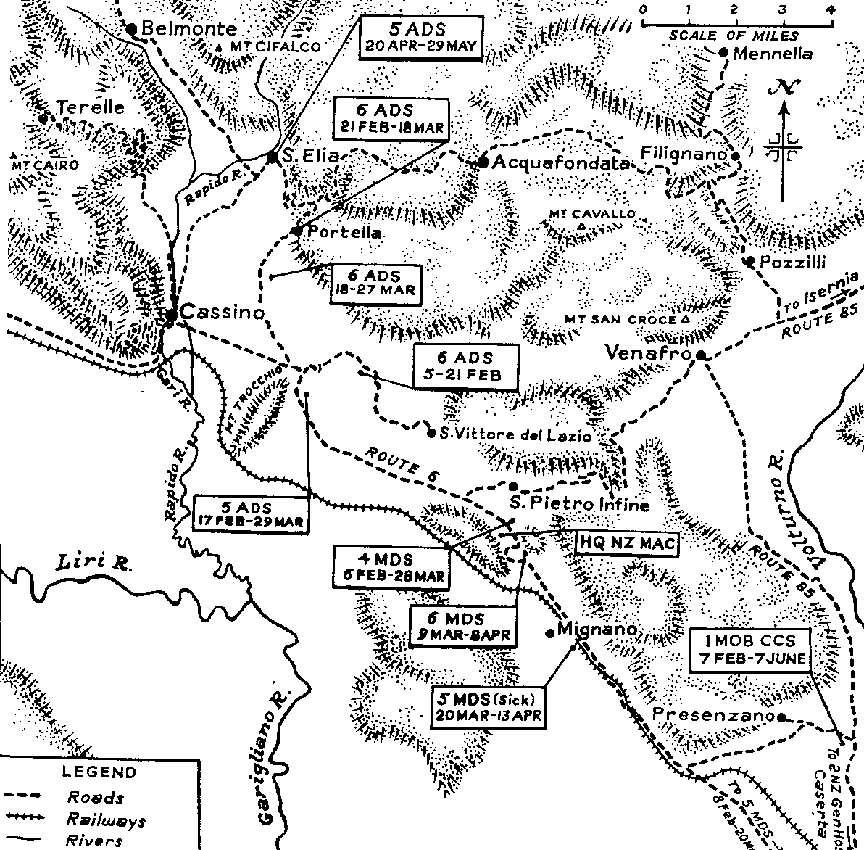
From the first day the unit was established there was a steady flow of casualties. One of the first patients admitted was an Australian pilot. Wounded in an attack on enemy positions and with his plane damaged, he had had to bale out while returning to his base. The plane crashed not far from the CCS, but the pilot landed safely and was brought in for attention. The front at Cassino was only fifteen miles away over a good highway, so that casualties were admitted usually within two hours of being wounded. Hence, except for urgent cases, all surgery was performed at the CCS rather than at the MDS. The four theatres, working on an eight-hour roster system, handled this work without any undue strain. Patients were sent twice daily to 2 NZ General Hospital at Caserta, the trip by road taking one and a half to two hours. Head cases were evacuated to a neurosurgical unit attached to 16 American Evacuation Hospital, five miles farther south.
Preparations had been made by NZ Corps for an attack on the enemy positions around Cassino which had resisted the Americans.
On 15 February and on the following two days, the staff of the MDS were able to get a good view of the air attack on the Abbey by Liberators, Fortresses, and medium bombers of USAAF, which dropped nearly 500 tons of bombs. The ground preparations for the attack met with increased shelling by the enemy and. on 16 February, 45 battle casualties were admitted to 4 MDS. By 17 February, after three fine, cold days, the ground had dried considerably, and at half past nine that night 28 (Maori) Battalion, as part of 5 Brigade, launched an attack across the swollen Rapido River and adjoining flooded areas with Cassino railway station as its objective, while 4 Indian Division attacked Monastery Hill.
B Company, 5 Field Ambulance, under Maj MacCormac, had moved its ADS on the 17th to a house on Route 6 in a fairly good position sheltered from enemy observation by rising ground. The men cleaned up the house and cleared away enemy mines, and then during the night attended to the wounded, mainly Maoris and engineers.
The first casualties from this attack by the Maoris arrived at 4 MDS by two o'clock next morning. By 8 a.m. about seventy wounded had passed through the MDS, after having been promptly cleared from 5 ADS. As had happened at the Sangro crossing, most of the wounded were wet below the waist from wading the river.
Although the two companies of the Maori Battalion had attained their objective at Cassino railway station on the night of 17-19 February, the operation was unsuccessful as considerable enemy demolitions had prevented the engineers making a track in time for the armour to pass through to support the infantry. On the afternoon of 18 February the enemy counter-attacked with infantry and tanks, forcing our troops to withdraw, and thus recapturing the railway station as well as the bridges built across the Rapido. The Division's bridgehead across the river was lost, and the extensive operations depending on it were suspended.
On the night of 21-22 February 6 Brigade moved into the line in the northern part of Cassino town without incident, and 6 ADS. under Maj H. S. Douglas, moved to the vicinity of Portella to evacuate casualties from the brigade. The ADS was reached by a complicated system of tracks off the main road. A daylight trip by ambulance car from the ADS to 4 MDS took about one and a half hours, and although part of the route lay in an exposed position it was considered safe for individual ambulances.
With the ADS ready to operate, the men of A Company, 6 Field Ambulance, dug themselves below ground, spurred on by desultory shelling of the nearby crossroads and the surrounding fields. As night fell the shelling increased. The Germans seemed to be ranging along all the roads in the vicinity. Scattered fires started, blazing and flickering through the olive trees, and casualties began to arrive at the ADS. Though a dark, misty night, the grove was vaguely illumined by the reddish glow cast on the mist by the fires. On the hillsides to the rear guns were flashing, their reports rolling and reverberating, while mortars fired and their bombs whiffled over and away into the mist. Up on the slopes ahead there were other flashes that could have been German guns or our own shells landing, and an occasional rocket appeared to shoot out from the monastery.
The 22nd was fine and the men finished off their digging, lining the holes with groundsheets and, in some cases, with straw from a neighbouring stack. Twenty sick and wounded were admitted during the day; soon the old familiar smell of the smoke from fires burning discarded dressings and dirty, blood-soaked clothing was drifting across the area.
There were many complaints about the company mess queue, complaints that were fated to continue throughout the company's occupation of the site. Everyone lined up at the cooks' truck for food and gathered in a tight crowd to eat, relying for their safety on the Red Crosses prominently displayed on tarpaulins and vehicles. As it turned out, the Red Crosses afforded adequate protection, though the Germans on the snow-clad peak of Monte Cairo, which seemed to tower directly above the ADS, must have been hard put to restrain themselves, especially as the vehicles of combatant units were continually moving in and out of the area. In addition to Monte Cairo and Monte Cassino, the Germans held the crest of Colle Belvedere, a shoulder feature to the right, and Monte Cifalco, a high, rugged peak to the north.
Casualties and sick trickled back from the infantry lying low in the houses of the town, though at this time most of the wounded received came from the roads round about the ADS itself. On the 23rd a passing truckload of British troops received a direct hit, and three of them were carried in dead. They were buried in the. ADS cemetery, a little plot set aside near the road. A few Indians passed through, quiet men who seemed grateful for the little that could be done for them.
The fine weather had faded out in mist and heavy rain, and once again everything was mud. Casualties arrived with sodden and plastered boots and clothing; and many men were evacuated sick and exhausted from days of lurking in the chilled and flooded cellars of the town below. The narrow road along the evacuation route became treacherously slippery, and two ambulance cars, loaded with wounded, left the road and partly overturned while on the way to the MDS.
Occasionally the mist dispersed for a while, then closed in again to obscure everything and delay the plans for an attack which, depending on heavy air support, required good flying weather. The jagged outlines of the Abbey loomed through the mist, and at times Monte Cairo was completely obliterated.
On the 25th one solitary splinter from a nearby shellburst hummed through the evacuation section's tarpaulin, and a search was made for the hole. When found it was encircled by a chalk line and labelled 'The Shrapnel Hole'. Two days later there was no need to search for holes; the tarpaulin was riddled with them. A shell landed at the corner of the shelter early in the evening of the 27th, fortunately just after a number of casualties had been evacuated. Immediately there was chaos inside. The lamp was out, petrol from the punctured tins of the reserve supply could be heard trickling out in the darkness, and the truck, with tires perforated. subsided onto its rims. Cries were coming from Reception a few yards away. The evacuation section crawled out by ones and twos and were astonished to see the other shelter a mass of gleaming lights. It, too, had received a hit, and Padre Kingan and one of the men were both seriously wounded. Then, with a deafening crash, another shell burst in the fork of an olive tree a few yards to the right, shattering all the branches and sending a fresh hail of splinters through the shelters and trucks. A moment later a sergeant discovered that he was wounded in the arm and grew very concerned about deciding from which shell he had received the wound.
All three casualties were evacuated, and the dressing station settled down again.
The evacuation section temporarily ceased to function, the men abandoning the wrecked shelter and going to bed. Next day the section took over a house at the edge of the area that had just been vacated by a party of Newfoundlanders. It turned out to be a good move. The house, solid, comfortable, and possessing a fireplace, provided accommodation much superior to that of the shelters. The Red Cross ground sign was draped down the wall facing the German positions, and the rooms inside furnished with stretchers and blankets.
Each night sick men and walking wounded slept in the house, though it was noticeable that the wounding of Padre Kingan, the news of which seemed to have spread right through the brigade, had robbed the casualties of some of their faith in the protection of the Red Cross.
The reception shelter was not badly damaged, and the staff busied themselves sewing patches over the holes. The evacuation shelter and truck canopy had to be replaced.
Near 5 ADS the enemy had been shelling the roads consistently. The Red Cross was out of sight of the Germans, and on the 22nd 14 shells landed in the ADS area, with two more shells nearly hitting the cookhouse next morning. Fortunately there were no casualties, though three members of the unit received minor wounds while manning ambulance cars with units of 5 Brigade.
February seeped away with units stationary amid dismal scenes of rain-blurred landscapes, dripping trees, and trampled mud. Gunfire reverberated through the hills. The enemy gunners scored many casualties amongst the troops crowded into the sector awaiting a break in the weather, which seemed to share the Germans' determination to prevent the penetration of the Gustav Line.
After many delays through the unfavourable weather and the flooded, impassable ground, midday on 15 March was fixed for the attack on the town and monastery of Cassino. In the early hours of the morning the infantry were withdrawn to points a safe distance from the town in preparation for the air bombardment that was to precede the attack.
Evacuation from 6 ADS was by road for a short distance, and then by ambulance track to Route 6. As a result of a warning that tanks might have to use the track in the advance to Cassino, thus blocking the evacuation route, two surgical teams, the HQ team and 8 British Field Surgical Unit, were attached to the ADS. As things turned out, they were not needed, the track remaining open throughout the whole operation. The orderlies going off duty at 6 a.m. crossed the road and gazed down the slope at the town. Spreading to the foot of the hills and up the lower slopes, it looked so peaceful in the still air of the early morning that they found it difficult to believe that in a matter of some two hours it would be in the process of being blown to rubble.
The first wave of bombers appeared at half past eight. A Company was out, as were all the troops in the area, watching with interest the approach of the aircraft. The interest changed to slight apprehension when a load of bombs was dropped to the rear, exploding in huge clouds on the hillsides, while the planes still came on. Their apprehension, however, was nothing compared with that of the HQ surgical team. Moving up to the ADS, they were halted by the bombs bursting across their path.
The heavy, throbbing roar of aircraft engines added to the pandemonium as wave after wave of bombers came up from the south and wheeled over, while the town was going up, rent and shattered, in great masses of rubble and sheets of flame that seemed from the ADS to dwarf even the hill of Monte Cassino. Dirty yellow, opaque smoke overspread and blotted out the countryside as more and more loads of bombs whistled shrilly down to burst with long, sickening, rolling crashes. In the midst of it all a number of Indian Red Cross vehicles halted outside the ADS area. The British officer in charge peered uneasily into the pea-soup air. 'I've a field ambulance somewhere down there,' he said. and he drove on. His Indian drivers impassively followed, and the little convoy vanished into the smoke and dust.
The bombing of the town ceased and the artillery barrage began at noon, though fighter-bombers still wheeled over in lines to peel off and batter the monastery throughout the afternoon. Half an hour later the infantry and tanks advanced to the attack. Held up by the heaps of masonry and huge bomb craters, the tanks were unable to penetrate far; but the infantry carried on and the Castle Hill feature, a rock surmounted by ruins immediately above the town, fell to troops of 25 Battalion. The enemy, who had withdrawn after the first wave of bombers and returned when the artillery barrage began, showed bitter resistance in the town itself and hampered the New Zealanders by sniping.
The casualties began to arrive. By nightfall 37 had been treated at 6 ADS and evacuated. and another 20 were held in the evacuation tarpaulin until first light. There was some shelling round about during the night, and several of the walking wounded, their nerves on edge, had to be transferred to the basement of the house.
Throughout the night could be heard the sound of the enemy mortars and machine guns down among the houses of Cassino. In the darkness the craters and heaps of smashed masonry made progress slow, until finally the infantry were pinned down. The ADS was kept steadily going through the night. Some of the wounded died in the station and some were carried in dead. The morning of the 16th was a typical morning after a battle. There was an indefinable hush, in spite of the fact that the Germans were shelling, if anything, more heavily than usual. During the day 57 patients were admitted.
About 5 p.m. the company was under fire. A number of tanks parked in the next field began to move about, emitting puffs of smoke that obviously were visible to the Germans in the observation post on Monte Cairo. Also, they were testing their wireless equipment, in spite of the warning of a military policeman posted on the corner below the ADS. The Germans opened fire, evidently using very heavy guns sited well back, for the first shell seemed an age in coming. The roar of its approach was like that of an express train in a tunnel. It landed on the corner, practically annihilating a tank crew. Strangely enough, the military policeman conversing with the crew was not only unhurt but felt nothing. He simply became aware of men falling dead around him.
The members of A Company were just emerging from the shelter of trenches and rising from the ground, when the air began to throb again and the roar of the approaching shell grew in their ears. They rushed back to shelter. A driver, who was standing alone in front of the house across the road, made a dash over to the ADS. No sooner had he reached it than the shell landed, sending up a fountain of earth and leaving where the driver had been standing a hole in which a three-ton truck could have been buried. Another roar was already filling the air, and two more shells burst along the road. Debris showered everywhere. The trunk of an olive tree descended end over end into the area, and a large fragment of stone crashed through the new canopy of the evacuation truck.
Still the battle went on amongst the smoke and houses below, with the infantry attempting to clear the town in spite of the hidden snipers and machine-gunners. With the support of tanks, the 26 Battalion attacked and occupied the railway station. The enemy shelled and mortared the town, and the Allied artillery responded with heavy concentrations that appeared to be gradually putting the enemy guns out of action. At the ADS, ambulance cars moved out and down the road to the town as they were needed. In view of the exposed nature of the RAP positions, the ambulances remained at the dressing station until ordered by telephone. Normally they reached the battalions unmolested; but often the roads were under heavy fire, and the drivers and orderlies were compelled, time and again, to leave the vehicles and dive into the nearest ditch.
By the 17th operations were confined to a triangular area south of Route 6, and 6 ADS was well off the most direct line of evacuation. The company moved to a new area on the morning of the 18th. It was planned to get the ADS established and the Red Crosses up before dawn; but there was unavoidable delay while the evacuation section cleared casualties and dismantled the shelter, and the company arrived in broad daylight. The trees round about were chopped and mutilated and the ground pitted. Behind a row of trees that lined the area to the rear, a gun was firing. To the front Monte Cassino loomed up through the mist, and occasionally strange rockets that seemed to explode and scatter in mid-air shot out from the heights of the crag. Tarpaulins were re-erected and gear unpacked and arranged, and at 6 a.m. the dressing station was once again open.
For the attack, A Company (Capt R. A. Wilson[2] relieved B Company, 5 Field Ambulance, in the ADS In the battered farmhouse on Route 6. The men bedded down on the upper floor. The lower rooms were equipped for treatment, resuscitation, and blood transfusions. A tarpaulin was tied over a ramshackle lean-to, forming a shelter for cases awaiting evacuation. Casualties came back steadily from the RAP in Cassino itself, as well as others caught by shells on Route 6.
During the attack on 15 March there was heavy shelling in 5 ADS area, and in the next few days the ADS itself was frequently plastered. Three of the staff were wounded, one fatally. On the 22nd it was decided that men not actually on duty at the ADS should move back for sleep and rest at 5 MDS at Mignano.
From 18 March, in fine weather, fierce street fighting took place in Cassino to clear out pockets of enemy resistance, but progress was limited. Enemy shelling of rear areas increased. A steady stream of casualties, about a hundred a day, continued to arrive at 4 MDS. As cases were banking up at the CCS, it was necessary for more surgery to be done at the MDS. Casualties from Cassino could not be evacuated in daylight, so the stall were kept busy at night; the operating theatre was in use almost all the night of 19-20 March and again the following night.
At this stage the RMO 28 (Maori) Battalion (Capt C. N. D'Arcy[3]) was situated in the crypt of a church in Cassino. Here all casualties were collected and held during daylight, and appropriate resuscitation (e.g., blood transfusions) administered as required. After dark the casualties were evacuated by stretcher-bearers and jeeps to 5 and 6 ADSs, whose staffs helped with the stretcher-bearing.
Casualties used to arrive at the MDS about 11 p.m. after being held in Cassino, and this was often 12 to 16 hours after they were wounded. The few abdominal cases which occurred were affected by this delay. Walking wounded were sometimes so exhausted that they could not speak coherently, and they dozed off while holding cups of cocoa in their hands. Towards the end of the month, infantry from Cassino showed signs of prolonged strain and lack of sleep, and cases of true physical exhaustion made their appearance. The cemetery at the MDS was used as a Corps cemetery, and many dead were brought from forward areas for interment.
After eight days of almost continual offensive action by the New Zealanders and Indians, it became clear that a decisive breakthrough could not be achieved. The troops in the line had nearly reached the limits of their endurance, as never for a moment had the strain of battle eased nor had enemy fire ceased by day or by night. Finally, on 23 March, orders were given for the attack to be temporarily abandoned.
It then became necessary to withdraw the isolated garrisons. Under cover of artillery fire, at 1 a.m. on the night 24-25 March, C Company, 24 Battalion, moved back successfully and without casualties from a cave on Point 202, and troops of 4 Indian Division repeated the operation from Point 435.
In the withdrawal five wounded men had to be left lying in one of the many caves on Point 202. The unit's medical orderly and stretcher-bearers had given medical treatment to the men at the time they were wounded, and subsequently while they sheltered in the cave. On the afternoon of 25 March the RMO 24 Battalion (Capt A. W. H. Borrie), with a stretcher-bearer party under protection of Red Cross flags, successfully evacuated these wounded men in an operation which carried more than its share of excitement. The incident is best described in Capt Borrie's own words and serves to illustrate the link-up between regimental medical officers and stretcher-bearers and the field ambulances.
'In the afternoon I was asked if I would accompany a second search party to Monastery Hill. I took with me 19 men. Armed with three Red Cross flags, Red Cross armlets, and stretchers, we left the Indian aid post and ascended to Castle Hill, which was in our possession. At Castle Hill I split the party into two, taking with me Sgt Thompson,(4) Pte Worth,(5) and nine others. . . .
'As we were making our way across, we noticed some figures near old C Company HQ waving a flag. When we reached them we found they were the four Kiwis and one man of Essex Regiment who had been left behind. They had given up hope of being collected, so an hour previously the fittest of the party had handed round a large bottle of rum, dropped by parachute the day before. Fortified in spirit, these five lying cases had dragged themselves down to the road, a rough journey of 20 yards, and had managed to move a few yards along the road, each one helping the other.
'As we had two stretchers for all five, I decided on the handcarry of three wounded, leaving six men to carry the other two, three per stretcher. As we were setting out, a German soldier came out of the ruins on Point 165, waving a Red Cross flag and advancing along the road towards us....
'In broken French we argued, and then Thompson and Worth were taken into the ruins on Point 165 to see the Commandant.. The Commandant asked for a cigarette---Worth immediately gave him a full packet. The German explained that, as the English had shot at a stretcher-bearer at Cassino, the Cassino commandant had ordered that there was to be no further evacuation of British from Monastery Hill. He gave his approval, however, for our evacuations, coming down with Thompson and Worth to inspect us.
'We heard them coming but dared not look round until they were beside us. A nod of the head from Sgt Thompson, was the sign for action, so we picked up our wounded and set off for the Castle, making double-quick time before the Germans changed their minds. After a steep, difficult descent from the Castle, we reached the Indian aid post, then took the wounded by jeep to 6 NZ ADS.. An examination of the wounds showed that all were in excellent condition, a tribute to the care the stretcher-bearers had taken in their seven days' isolation.'
When this attack on Cassino ended, the road to Rome through the Liri Valley was still barred. Nevertheless, there had been substantial gains. A firm bridgehead had been established over the Rapido River, nine-tenths of the town of Cassino captured, and a foothold obtained on Monastery Hill, where Castle Hill was firmly held. Enemy casualties must have been severe. Then, too, pressure on the Anzio beach-head had been relieved.
The NZ Corps was disbanded on 26 March, and a general reshuffle of New Zealand troops in the Cassino sector followed.
There were weeks of unremitting industry at 2 and 3 General Hospitals in February and March as the battle casualties from Cassino were admitted in large numbers.
At Caserta, 2 General Hospital was soon working to its limit. On 18 February wounded from the attack on the railway station at Cassino were admitted. They reached the hospital quickly by road transport, either from the CCS or MDS, as the hospital was very favourably situated. Evacuations to 3 General Hospital at Bari were carried out by ambulance train from Caserta at the rate of 240 a week. From 5 to 29 February there were 1286 admissions to the hospital at Caserta, the highest number for one month since June 1941. Tented wards were erected for crisis expansion. Lt-Col Clarke(6) and his surgeons did notable work.
The DMS AFHQ, Maj-Gen Sir E. Cowell, inspected 2 General Hospital on 21 February and later thanked all ranks in the unit for their 'loyal co-operation, whole-hearted effort, and unselfish devotion.'
February's record of admissions was eclipsed by those of March, when 1608 patients were admitted, including 713 battle casualties. Preparations were made to receive heavy casualties, and by 18 March there were 831 equipped beds, with emergency crisis expansion to 1050. Actually, because of the efficient working of the evacuation train system three times a week, the highest number of occupied beds was 580 (on 24 March). The thought of the struggle at Cassino dwarfed the physical troubles prevailing at the hospital and inspired all to do their best. The weather throughout March continued to be wet and cold and boisterous. It lived up to the reputation of 'Mad March' given it by local inhabitants.
By 14 March Nissen huts had been erected for kitchens and mess rooms for patients and staff. It was no longer necessary to dine in the mess rooms of British neighbours. The experience had been a novel one for both parties. New Zealanders found it difficult to get used to a very early tea, starting at 4 p.m., and a cooked supper at 8 p.m. A printed menu which described the inevitable slices of bully beef as ' cold potted meat' intrigued the Kiwis. On the other hand, the Tommies looked in amazement when visiting New Zealand officers dropped in and had a meal in the men's mess.
On 12 March Maj-Gen F. T. Bowerhank, DGMS, from New Zealand, accompanied by DMS 2 NZEF, Brig Kenrick, inspected the hospital, and another distinguished visitor was General Sir Harold Alexander on 28 March. General Alexander expressed a wish to see the new anæsthetic, pentothal sodium, in use. He was appropriately gowned and masked and led into the operating theatre, where three patients were receiving attention. Pentothal having been duly given, the plaster and dressings were removed from a shattered elbow, which had received 'closed plaster' treatment during evacuation. The General indicated that he had seen enough, and appeared to be just able to make an orderly retirement under his own steam.
From the hospital Mount Vesuvius was clearly visible when, on 22 March, it burst into more activity than it had achieved for nearly 200 years. A cloud of ashes and mud covered southern Italy, some of it descending as far away as 3 General Hospital at Bari.
As the battle casualties were evacuated steadily to Bari, 3 General Hospital provided for a crisis expansion and actually equipped 1130 beds.
The ending of the main New Zealand attacks on Cassino brought some relief, and by 10 April the staff of 1 General Hospital reached Taranto on HS Dorsetshire, after leaving a third of its members at Helwan to run 5 General Hospital for the New Zealand troops still in Egypt. 1 General Hospital set about establishing a hospital at Molfetta, 20 miles up the coast from Bari, to ease the burden on the other hospitals. At this time, too, the Convalescent Depot, which had been open at Casamassima, near Advanced Base, moved to a site near Bari at San Spirito, where was also the office of the DMS 2 NZEF.
The modern building occupied by 1 General Hospital was a seminary, permission to use it as a hospital having been received from the Vatican after protracted negotiations. Built on rising ground on the outskirts of Molfetta, one of the meaner little Italian towns, the main building occupied three sides of a square and commanded a fine view of the Adriatic, which lapped on the shore only a few hundred yards away. It was a red-tiled, three-storied stone building, with many spacious rooms making ideal wards. The corridors were wide and all the floors tiled. One of the drawbacks was that the many windows were just too high from the floor for a good field of vision to be obtained by bed-patients. Among the sights they missed as a result was that of the small fishing boats putting out to sea in the morning and returning again in the evening. Although there were no lifts, the stairways were particularly wide.
The ground floor was occupied by mess rooms, kitchens, the laundry, and storerooms. Here also were stored the books and furnishings belonging to the seminary. On the first floor were the administrative offices, the surgical block, and the massage and X-ray departments. The medical block occupied most of the second floor. The sisters, VADs, and medical officers lived in the hospital building, while the other members of the staff occupied tents in the rear of the hospital. The unit opened to receive patients on 2 May 1944, exactly four years after its departure from Wellington with the Second Echelon.
During the first two weeks of April, the sorely tried infantry brigades of 2 NZ Division were withdrawn from Cassino, the holding of which had been no easy task, to take over from 2 Polish Corps the less arduous task of defending a part of the line across the Apennine Mountains. 6 Infantry Brigade took over the Monte Croce sector, while 5 Infantry Brigade rested at Isernia; but 4 Armoured Brigade remained in the Cassino sector, and 4 Field Ambulance stayed with it to hold the sick and evacuate its casualties. The 6 Brigade positions were dominated by Monte Mare to the north, Monte Cavallo to the north-west, and Monte San Croce to the west, features which afforded the enemy observation not only of the positions themselves but also of various points on the tracks leading up to them, and denied close observation of the enemy approach along the Atina road.
This group of mountains was a key position in the Allied defence system. San Pietro formed a pivot where the front line turned from east-west to north-south through Cassino, and its loss would have taken the Germans through to the rear of the Allied infantry and artillery to the south.
The terrain in 6 Brigade's mountain sector presented new problems to 6 ADS at Mennella in the collection of casualties, as two of the RAPs were rather inaccessible. Mules were used in places, but fortunately the sector was quiet and casualties, light.
After travelling on 20 April with the 5 Brigade convoy down Route 85, and along the divisional axis through Pozzilli and Filignano and over the mountains to the Rapido Valley, B Company, 5 Field Ambulance, under Maj J. W. Bartrum,(7) moved under the cover of darkness into the devastated town of Sant' Elia, to find the ruins populated by many dead mules and one very bomb-happy cat. The ADS was established in a building previously occupied by 185 British Field Ambulance. Of solid construction and possessing a spacious basement, it was ideally suited for the purpose.
 |
 |
 |
 |
Evacuation of casualties from the RAPs on the rugged Terelle sector, in which 5 Brigade replaced a British brigade, presented great difficulties, and it was found necessary for B Company to establish a forward ambulance car post. A party moved across the valley during the night of the 20th and set up on the opposite slope. All accommodation was in sangars, shelters made by laying tree trunks and branches across depressions and from banks and covering them with turf, ammunition boxes full of earth, or anything else available. Shortly after the work was completed, the area was mortared and one of the staff was wounded. During the following evening another party of eight stretcher-bearers went forward from Sant' Elia, and under cover of darkness made their way up to the 21 Battalion RAP. Their job was to carry casualties from the RAP to a dugout some 400 yards along the track, where a team of bearers from the car post was stationed. Casualties from 23 Battalion were carried by regimental stretcher-bearers for some 300 yards to a point marked by a fallen tree. From there, car post bearers carried them over the remaining 800 yards. All carrying was done at night, and often the Germans were mortaring around the steep, narrow tracks used by the stretcher squads.
The post was subjected to intermittent mortar fire day and night, and treatment had to be confined to ensuring the patients' comfort and dressing the wounds of casualties who had not passed through the 1 RAPs. Things were little better at the ADS. The town swarmed with flies; yet nothing could be done about the refuse and dead animals as any movement brought shellfire. In fact, on the 22nd 30 shells crashed into the area immediately surrounding the ADS, just as a convoy of American Field Service ambulance cars was arriving. Four ambulance cars were hit and many tires riddled. One driver was wounded and evacuated to the CCS.
The shelling and mortaring in the vicinity of the 21 Battalion RAP and the car post became so intense during the next few days that a more frequent changeover of men was found necessary. There were not enough stretcher-bearers to provide the required relief every four or five days, and men from all sections were sent. The ASC arranged a change of drivers every two days. All reliefs were carried out in daylight. The Germans did not molest vehicles carrying the Red Cross, and its use was not abused.
During April the weather remained fine except for occasional heavy showers. With the onset of spring, budding trees and abundant blossom relieved the grimness of the war-ravaged countryside. It was possible to arrange for day leave to Naples. With the approach of the malarial season full anti-malarial precautions were adopted. The nasty-tasting little mepacrine tablets made their appearance after the evening meals. The principles and methods of mosquito control were expounded to groups from divisional units at a malaria school run by 4 Field Hygiene Section under Maj Knights. Summer clothing was issued to the men in the Volturno Valley in the middle of the month, though in the mountainous area the change was postponed until the end of the month because of the cooler weather there. In many cases the summer issue was outrageously ill-fitting, and parties of men with khaki drill under their arms and their jackets bulging with tins of bully beef, ambled down the roads to the villages, where women with sewing machines did a roaring trade.
Shortly before midnight on 11 May a large-scale attack was launched by British and Polish troops. When the enemy began to withdraw, the Division was to follow up, but on the night of 13-14 May there was an unexpected call for armour to support 4 British Division in the Liri Valley.
After a hurried move from the rest area, 19 Armoured Regiment got its tanks across the Gari River, and the following night supported a British infantry attack across the Piopello stream. During the next few days New Zealand armour led the infantry in a 'lefthook' thrust which cut Route 6, the main route of withdrawal from Cassino.
The enemy fought with foolhardy daring, losing as many as 150 dead to one squadron in a night battle, but fortunately our casualties were light and the evacuation of wounded to 4 MDS, and subsequently to 1 Mobile CCS, proceeded smoothly.
Cassino itself was attacked on the morning of 18 May, but it was found that the enemy had withdrawn, and this scene of so much bitter fighting finally fell with scarcely a shot fired. The same day a Polish attack on Monastery Hill was successful. On the night of 24-25 May the Germans withdrew from their positions in the Apennines, and by the 25th the barrier that had stood across the road to Rome since October 1943 had been completely smashed and the pursuit of the enemy up the peninsula of Italy had begun.
Many members of medical units who were near Cassino after its capture visited the ruined town and monastery, and those passing it at a later date on the way to Rome leaned out of their vehicles to gaze at the destruction. When leaving the main road to clamber over the masonry of shattered buildings, one had to walk carefully as the place was infested with mines. Bodies, too, still lay about. Few, if any, paid the town more than one visit: a repulsive atmosphere of desolation hung over the ruins, the shell-blasted hillside, and the huge bomb craters, half-filled with slimy, evil-looking water. Even back at the unit areas, beautiful as was the countryside, clothed with fresh spring foliage and ablaze with scarlet poppies, some of the men felt an eerie quality about the peaceful stillness.
The enemy still held positions in the Terelle sector on 25 May and New Zealand troops were still unable to move in daylight without drawing fire. Just before dark on the 24th, three men of A Company, 5 Field Ambulance, were wounded, one fatally, while adjusting the blackout covers over openings in the battered cookhouse building, the only part of the ADS above ground.
An attack was delivered toward Terelle in the early hours of the 25th, and in anticipation of heavy casualties extra stretcher-bearers were sent up to the car post. However, the enemy had practically evacuated Terelle and the surrounding territory overnight, and casualties were so light that the stretcher-bearers were not needed.
Later in the morning the Rt. Hon. Peter Fraser, with General Freyberg, called at the car post and talked with the men.
Some of the stretcher-bearers of 5 ADS were attached to the battalion RAPs and moved forward with the infantry through Terelle and on toward Atina.. Most of the vehicles were held up by demolitions on the roads; but one of the MAC jeeps, carrying a party of the ADS stretcher-bearers, made a few bumpy detours, one taking it over the remains of a demolished house, and was probably the first New Zealand vehicle to reach Atina. The stretcher parties camped with the battalions on the outskirts of the town.
On the 28th Maj R. A. Wilson went forward to Atina to select a site for the ADS. Meeting some of the stretcher-bearers returning to Sant' Elia for further orders, he took some of them with him and sent the remainder to the car post to act as a first-aid post for casualties on the long trip up. The only building that seemed at all suitable for an ADS was a schoolhouse, and it was in a filthy condition. Leaving one of the men there to hold the building and to look after a wounded German whom the local Italians were intent on killing, the rest of the party carried on in an unsuccessful search for more suitable quarters. Next day 4 MDS, under Lt-Col F. B. Edmundson, arrived at Sant' Elia, and the remainder of A Company moved along the road through Belmonte to Atina, and the full ADS set up in the schoolhouse.
After treating battle casualties and sick, and incidentally, feeding the few half-starved civilians who had returned to the town, A Company moved forward again, an advanced party leaving on the 31st and the remainder of the company following on 1 June, to establish the ADS in a two-storied house on the Atina-Sora road. There were casualties immediately---a party of Maoris who, in their advance, had run into an ambush.
At 6.30 a.m. on the 30th, HQ and B Companies, 5 Field Ambulance, pulled out from the Volturno Valley to travel through Acquafondata, Sant' Elia, and Belmonte to Atina and take over the school building which A Company was preparing to leave. There were casualties immediately, and through that day and the following day the MDS was busy. It did not help when the Germans started shelling the town.
More and more of the civilian population were returning to Atina. Most of them were elderly people and women and girls who had been hiding in caves and gullies during the winter months, short of food and clothing, and their condition was absolutely wretched. At every meal they thronged around the mess queues. gazing longingly at the steaming dixies and mess tins. It was too much for some of the men; they drew their food and handed it straight to some old man or woman.
As A Company, 5 Field Ambulance, moved into the house on the Sora road, the advanced party moved out again and went ahead to occupy a palatial house about half a mile from Sora itself. The company followed next day and continued to admit and treat battle casualties and sick. It was found that the civilians in the liberated towns regarded medical establishments as the 'cornucopia' of all the amenities of civilisation. They expected medical treatment, food, and a safe passage to their homes. This attitude of mind called for constant dissuasion and taxed the ingenuity of the linguists of the units. When 5 ADS arrived at Sora, the Padre wanted to ring the bell of the chapel for the inhabitants, but was dissuaded on the grounds that their physical hunger would probably be greater than their spiritual needs, and that a repetition of the miracle of the loaves and fishes would be the only adequate answer. The chapel bell was not tolled. Many Italians, however, were given medical treatment, the wounded among them being sent on to the MDS with soldier patients.
On 3 June the rest of 5 Field Ambulance arrived to run an MDS, and A Company moved out and bivouacked in the fields to the rear. The house was ideally suited for a hospital. There were 40 or more rooms, and all sections except the post-operative centre were accommodated on the ground floor. Two rooms for nursing were fitted up on the first floor, and three men from the CCS were attached for the nursing of abdominal and chest wound cases. Casualties were heavy, and the attached 1 General Hospital surgical team and 2 NZ FTU were kept busy. On the 4th one of the tarpaulin shelters was erected outside the house to facilitate reception and evacuation. There were no difficulties with holding patients as the large ballroom made an excellent ward. Several batteries of heavy guns nearby made conditions unpleasant both for casualties and the orderlies trying to get some sleep. Moreover, the Germans responded vigorously, some of their shells landing too close to the MDS for comfort.
On the coastal sector Allied forces cleared the approaches to Rome, and then on 4 June the capital city, so rich in history, fell. All the forces in Italy could claim a considerable share in this achievement and join in the feeling of triumph. Nor was this all the cheering news to troops who for so long had fought on doggedly, for on 6 June came the invasion of France---the long-awaited Second Front had become a reality. Its success was to make certain the final fate of Germany.
In the upper Liri Valley the enemy accelerated the withdrawal he was accomplishing behind his defences at Balsorano, which town he deserted. 6 Brigade moved in on 6 June. Extensive demolitions and mines prevented the brigade from maintaining contact with the fleeing forces. After the fall on 9 June of Avezzano, a town on the main lateral road between Pescara, on the east coast, and Rome, it became increasingly obvious that the line of advance on which the Division was operating had become a cul-de-sac, and by the middle of the month it had been decided to abandon operations in this sector. Bailey bridging was urgently required elsewhere, and the divisional concentration area had to be altered to avoid isolation by unbridged demolitions. The Division, therefore, gathered at Arce, in the Liri Valley, some 20 miles north-west of Cassino.
From the hills in the neighbourhood of Avezzano hundreds of escaped prisoners of war filtered back through the New Zealand lines. They included men from the United Kingdom, New Zealand, Australia, South Africa, United States, India, and Russia. Some brought with them their Italian wives, with whom there would sometimes be a bambino. Most of them had become prisoners in North Africa and were overjoyed to be in Allied hands again.
For the adequate cleansing, clothing, and feeding of these men, many of whom had undergone great privation and overcome many obstacles to regain their freedom, it was decided to employ one of the closed MDSs. 4 Field Ambulance was chosen, and the unit opened for the reception of prisoners of war on 17 June.
An increasingly familiar sight to members of 2 NZ Division in Italy was the yellow armband worn by personnel of 4 Field Hygiene Section. These men were engaged on the work of safeguarding the health of the troops, in the field or on the move. They were concerned, too, with the prevention of malaria and of the intestinal diseases, especially dysentery, diarrhoea, and the typhoid group. Where troops were in contact with a civilian population, which was likely to increase the incidence of these diseases, steps were taken by the Field Hygiene Section to ensure that civilians, too, observed the elementary rules of hygiene. This formed a major portion of their work in the mountain sectors near Cassino.
Difficulties were often encountered. Foremost among them was the language problem; much patience and ingenuity were devoted to overcoming this, so that the section could make its ideas understood and get them carried out. Another difficulty was to find someone in authority in a village to undertake responsibility for the supply of labour and materials, and for the execution and continuation of the works which the section planned. The podesta, or mayor, was usually found to be co-operative, while the local doctor, when there was one, also assisted. Help was furnished by the carabinieri (police), whose office in the villages was often an hereditary one.
After four months at Presenzano, the CCS moved in sections between 7 and 12 June to a new site 50 miles north, just past the hilltop town of Frosinone on the main road to Rome. At this location the CCS, working alternately with 19 British CCS, received large numbers of casualties, admitting British, Canadian, and South African wounded and sick as well as Indians and Americans. Gradually, however, work eased off as the fighting advanced beyond Rome, most of the patients then coming from the New Zealand Division resting at Arce. Minor cases of sickness were held until they recovered and were returned to their units. Since evacuation to Naples necessitated a long and tiring journey by road, most of the severe cases suffering from abdominal and head wounds were sent by air ambulance from a landing ground a few miles distant. This arrangement was very satisfactory, the air trip to Naples taking only 35 minutes.
While the unit was at Frosinone quite a number of Italian civilians were admitted as casualties. Their wounds were caused by mines and booby-traps left in their homes by the retreating Germans. Disposal of these people was often difficult, since it was sometimes hard to find a civilian hospital that would admit them. Usually these civilian patients were accompanied by a number of relatives. It was almost impossible to explain in Italian to them just why it was that the patient could not remain in the hospital. A scene quickly developed when the poor peasant people learned that their Carlo or Maria or 'pauvre vecchio Papa' had to be evacuated to a distant hospital. The unit was also approached by dozens of local inhabitants seeking medical attention for all manner of ailments. Seemingly they had no medical service of their own, or if there was a doctor in the village he either charged exorbitant prices or was considered to be no good. In the end, however, it was necessary to stop these people entering the camp, since the unit's medical supplies were primarily for the wounded.
At Frosinone hitch-hiking was not as easy as it had been at Presenzano. Rome was the main attraction at this time. Leave trucks made trips there on one or two occasions, but most of the staff who visited the capital did so under their own arrangements while off duty. In the absence of regular traffic past the camp, it was necessary to walk four miles to Highway 6. Here there was a continuous flow of vehicles to Rome, and the 50-mile trip could he done in a very short time.
For the first time since they began fighting in Italy, all units of 2 NZ Division were able to enjoy a complete rest while they remained assembled in the vicinity of Arce, far from the sound of gunfire and amid the quiet, peaceful beauty of the lower Liri Valley. Much valuable training was done, and refitting and maintenance of vehicles undertaken in preparation for the Division's return into action. Advantage was also taken of the opportunity to check and overhaul equipment and make good any deficiencies.
For all units there were gymkhanas and sporting activities of every kind. There was a Medical Corps sports meeting, and unit picnics were held at Lake Albano.
The setting of the blazing sun did not spell boredom by any means, for regular entertainment was provided by the Kiwi Concert Party and similar British stage shows, while almost every evening mobile cinemas of NZ YMCA operated in the open air. Audiences could sometimes be critical, but always for the Kiwi Concert Party there would be general favourable comment as the men made their way in groups to their bivouac areas after the performances.
Nor was this all on the holiday programme, for in Rome one of the finest hotels, the Quirinale, had been transformed into another very popular New Zealand Forces Club. Here conditions were really on luxury lines, and the city had boundless sources of interest. Tours of the City of the Seven Hills were among the many amenities provided free of cost in divisional transport with experienced guides. Leave to Rome was arranged as liberally as possible, and the field ambulances were able to release large quotas of men for day leave. 'Three-day leave to the lovely island of Ischia was also reinstituted. This wooded island off the Bay of Naples, with its ancient castles and pleasant beaches, provided a place of relaxation from the strain of war conditions.
Mount Vesuvius was climbed on numerous occasions by the members of the staff of 2 General Hospital. From the rim of the crater one looked down into a huge cavity of forbidding appearance, but all around was a panorama of marvellous variety and beauty: to the north-west the city of Naples, and beyond, the Isle of Ischia; then the majestic Bay of Naples, bordered to the southwest by the Sorrento Peninsula and the Isle of Capri. Close to the foot of Vesuvius in the south was both old and new Pompeii, while away to the north and cast, across wide plains checkered with cultivated fields and vineyards, extended the rugged Apennines.
The Sorrento Peninsula was a popular place for leave for a while, but it was not long before restrictions were placed on going there. Sorrento was an attractive, straggling village of one main street, meandering happily along craggy cliffs high above the sea. It commanded a superb view of the shimmering Bay of Naples. From there an hour's trip in a launch took one to the Isle of Capri, with its famous blue grotto and the heights of Anacapri. Farther round the rugged coastline were Amalfi, Ravello, Maiori, and Positano. This last village was built on an inlet, with a tiny, sandy bay cluttered with half-painted fishing smacks. Houses perched precariously on the cliffs were outwardly unprepossessing but within were spotless and wonderfully cool. Positano had a magical charm as a 'honeymoon haunt' for some of the staff of 2 General Hospital, for in this as in other hospitals hardly a month passed but some of its female staff were married.
THE WAR in Italy had not stood still since the fall of Rome. The Germans had made a long withdrawal towards their next important barricade across the peninsula. This was known as the Gothic Line, and ran from Massa on the Gulf of Genoa, through north of Florence, to Pesaro on the Adriatic coast. It was the Allied intention to hasten the enemy's withdrawal as much as possible and to attack the Gothic Line before he had opportunity to complete its defences. But to do this a series of strongly defended intermediate positions south of Florence had to be overcome.
To assist in attaining this objective, 2 NZ Division was needed by 13 Corps, and this brought to an end the pleasant respite from active operations. Moving secretly at night, the Division travelled 250 miles northwards through the outskirts of Rome and on to an area just south of Lake Trasimene. On the night of 9-10 July the first convoys left Arce, and three nights later 6 Brigade was once more in the line, 15 miles north of the lake, ready to attack the mountain heights overlooking the approaches to Arezzo.
In daylight on 13 July 6 Brigade made the first advance against this heavily wooded arc of peaks and captured Mount Castiglion Maggio and Mount Cavadenti, and on the nights of 14-15 July and 15-16 July overcame stronger opposition to take Mount Lignano, and Mount Camurcino.
For the action A Company, 6 Field Ambulance, moved up and occupied three houses on the fringe of the village of Castiglion Fiorentino as an ADS. Batteries of 25-pounders were sited immediately to the rear of the ADS buildings, which jarred and shook to persistent counter-battery fire during the afternoon and evening of the 14th. At midnight the uproar rose to a crescendo as heavy concentrations were fired in support of the infantry attacking Mount Lignano. That night brought 30 casualties to the ADS and. the following day 61.
With the capture of Mount Lignano and Mount Camurcino by the New Zealanders, Eighth Army troops pushed on through Arezzo to the Arno, and by the 17th practically the whole of 2 NZ Division was withdrawn from the line.
Fourth Field Ambulance, moving with 4 Brigade, had reached Civita Castellana, about 30 miles north of Rome, on 13 July. At this point orders were received for HQ and A Companies to remain in the vicinity and establish a rest camp for parties from the Division going on day leave to Rome.
For the camp an excellent site was found---an expanse of grassy parklands with magnificent oak trees for shade. A further asset was a large well from which a windmill delivered clear, icy-cold water sufficient for complete ablution arrangements, including showers which were heated at suitable periods. These facilities were greatly appreciated by the leave parties after their long, dusty ride in the back of three-ton lorries.
To accommodate 200 visitors on their way to and from Rome, seven tarpaulins were erected. Parties of 100 other ranks and four officers would arrive from the Division in the early evening and be provided with dinner and lodging for the night. Early in the morning they would depart for Rome to see the sights on organised tours and would receive their meals at the New Zealand Forces Club. They would return to the camp late at night (by which time another party would have arrived from the Division), stay the night and he given breakfast before returning to the forward area. Unit cooking arrangements were fully extended at this time, but the cooks were equal to the task.
When the Division was recommitted to the line, it was to be employed with 6 South African Armoured Division in driving a narrow wedge along the general line of Route 2 through to the River Arno, south-west of Florence. The Division relieved French Moroccan troops in the San Donato area north of Siena, between the Indians and South Africans, on the night of 21-22 July, with 5 Brigade in the line, and B Company, 5 Field Ambulance, as its ADS.
The approaches to Florence from the south and south-west were through a ring of hills, with the roads and valleys dominated by high ground on either side. Stubborn resistance was offered by the enemy, who retired only under heavy pressure from one to another of a series of excellent defensive positions. His best troops, including 4 Paratroop Division and 29 Panzer Grenadier Division, faced the New Zealanders. They were all supported by artillery, mortars, and the Germans' best armour---60-ton Tiger tanks.
From the time of its entry into the line, 5 Brigade made steady progress despite counter-attacks. Support was given by 4 Armoured Brigade, with which B Company, 4 Field Ambulance, moved forward as ADS. Pushing forward ten miles across difficult country, 5 Brigade broke the Olga Line and captured San Casciano on 27 July.
Fifth ADS moved forward from Castellina on the 22nd and set up near San Donato. Some of the shells that whistled over landed uncomfortably close to the dressing station. Once the canvas was up the men lost no time in digging in. The ADS again advanced on the 24th, pushing through San Donato to a point to the north of the town, where it remained for only one day before moving on to Tavarnelle. The staff car entered the selected field without mishap, but the following vehicle, an ambulance car, ran over a Teller mine and the driver was severely wounded. The orderly, though blown clean out of the ambulance, escaped injury. Transfusion and first-aid gear were unloaded immediately, and the driver received prompt attention before being evacuated to 5 MDS. The ambulance car had been completely wrecked. The staff car was towed carefully out of the field, and the ADS convoy moved on to another field a few hundred yards down the road.
Meanwhile 5 MDS, under Lt-Col J. M. Coutts, near Castellina, carried on admitting battle casualties, with A Company open for sick, until the 25th, when the MDS switched to sick only. With roads all around the area, the dust blew in clouds through the tents, and the area soon became known as 'the dustbowl'. A rocky slope above was the only place suitable for burying the dead, and engineers had to be called in with explosives to blast out the graves.
Great clouds of choking white dust attended all vehicle movement, while the enemy kept up a steady harassing shellfire. By its very presence a numerous civilian population, helplessly caught in the turmoil which destroyed its homes and scarred its lands, made the fighting seem more bitter.
This fighting was in progress when His Majesty the King arrived in the divisional area on 26 July, in the course of his tour of Italy in which he visited troops from all parts of the British Commonwealth. A parade of 140 NZMC personnel assembled at Montecino to see the King. His Majesty stopped and spoke for a few minutes to members of the group. It was impossible for the King to see more than a small proportion of the Division.
At San Donato 6 MDS had begun admitting battle casualties on 25 July. During the morning of the 26th, shells whistled overhead to crash into San Donato, and a party of officers and men, representatives of HQ and both companies who were returning from the. parade reviewed by the King, was held up outside the village. The German fire grew erratic. The shells began to fall short, and for two and a half hours in the afternoon they were landing in the MDS area. As everyone was recovering from his astonishment at the first black cloud of smoke and dust among the parked ambulance cars and trucks, another shell hit an adjacent farmhouse. By this time three men were wounded, one seriously. The next shell landed squarely in the area, luckily clear of the casualty-filled tarpaulins, wounding one of the HQ cooks.
Almost immediately another shell burst on the roadway outside. Traffic skidded to a halt in a cloud of dust that rose to the treetops, and then was away again, flat out. In the MDS area a scurrying crowd suddenly appeared. It was a rush to spread the 40-foot Red Cross sign at the forward end of the spur. Steel helmets began to appear, resurrected from long-forgotten corners in the trucks; and in all directions shovel-brandishing men were rapidly disappearing below ground.
The centres of the MDS carried on as best they could in between shells until late in the afternoon, when the shelling ceased and was not resumed. Later the MDS had a ring from our artillery, assuring the unit that that particular gun would not bother them again. But that, welcome as it was, did not put the skin back on the men who had tried to take cover by forcing themselves deep into the stack of sharp-stalked wheat stocks.
On its arrival there on 25 July, 6 ADS found the village of Tavarnelle badly smashed, as much by German demolitions designed to block the road as by shellfire. However, the inhabitants, unlike those of many other places, were busily at work cleaning up the streets. The ADS remained for two days, handling some 40 casualties, a few Italians who had trodden on mines, and a number of ailing babies brought in by anxious mothers.
The Division was within ten miles of Florence and in contact with the Paula Line, which the enemy prepared to defend to the north of the Pesa River. The Paula Line was based upon the semicircle of hills surrounding Florence. In the New Zealand sector, the line of summits curved north-west from the valley of the Greve River to the Arno and lay across the path of the advance. The Division now set out to clear the enemy from the dominating summits. 6 Brigade, supported by 19 Armoured Regiment, established a bridgehead across the Pesa River at Cerbaia on 27 July. From Faltignano Ridge, La Romola Ridge, and the hilltop of San Michele the Germans made the most determined efforts to drive the New Zealanders back across the Pesa. With the support of a mass of artillery, a series of enemy counter-attacks was beaten off during the day of 28 July. Though communications were cut and the situation at times seemed precarious, 6 Brigade held on.
San Michele was a vital objective. On the night of 28-29 July, D Company, 24 Battalion, with strong support, managed to establish three strong-points in the village despite fierce opposition. The Germans made desperate counter assaults with lorried infantry, self-propelled artillery, and Tiger tanks, but with the help of fighter-bombers of the Desert Air Force, who made over a hundred sorties, and concentrations of New Zealand artillery fire, the company held on in an epic battle. On the night of 29-30 July a crushing weight of shells compelled the enemy to withdraw.
After very heavy fighting on the following night, 22 Battalion of 4 Brigade captured La Romola and Faltignano ridges. Farther to the north, on the Pian dei Cerri and La Poggiona ridges, the summits that formed the spine of the barrier, the enemy continued to offer fierce resistance.
Sixth ADS moved up from Tavarnelle to Lucignano on 27 July, the eve of an attack by 6 Brigade on San Michele. The company occupied a building, half luxurious villa, half vintnery. Surrounded by well-planted gardens and comfortably furnished, it was a pleasant place, though the wine casks had been thoroughly drained.
Apart from the fact that guns in the valley to the rear fired continuously over the building, it was quiet at the ADS; but orderlies and drivers on the ambulance cars and jeeps had more excitement than they wanted bringing casualties through the enemy mortar fire in the forward areas.
Instructions were received at 6 MDS on the 27th to close and move forward. There were a number of casualties in the dressing station, and half of the unit went to work treating and evacuating them, while the remainder packed up. The trucks moved out at 11.30 a.m. along dusty, narrow roads to Route 2, and turned north. The MDS was reopened for battle casualties alongside the road north of Tavarnelle at a quarter past twelve. The area, which incidentally had to be shared with a colony of large, lean black ants that swarmed everywhere, was on the shoulder of a low hill and gave ample room for all tentage.
For miles around stretched beautiful, rolling country carrying crops of maize and fruit, all ripening or fully ripe. Tanks had rolled out some of the standing crops; but, in general, little damage had been done and farmers were busy threshing beans or scutching linen flax. Nearby, a communal machine was at work threshing wheat.
At Tavarnelle, where the number of casualties admitted steadily mounted, 1 NZ Field Surgical Unit (Maj A. W. Douglas) and 2 NZ Field Transfusion Unit (Capt E. E. Willoughby[1]) were attached to assist.
(The surgical team that, since September 1942, had been a detachment of 1 General Hospital operating with the Division was formed into an official unit of 2 NZEF on 10 June 1944 and called 1 FSU, a title which was changed to 3 FSU in October 1944, by which time Maj O'Brien[2] had succeeded Maj Douglas. It was always a valuable addition to the surgical strength.)
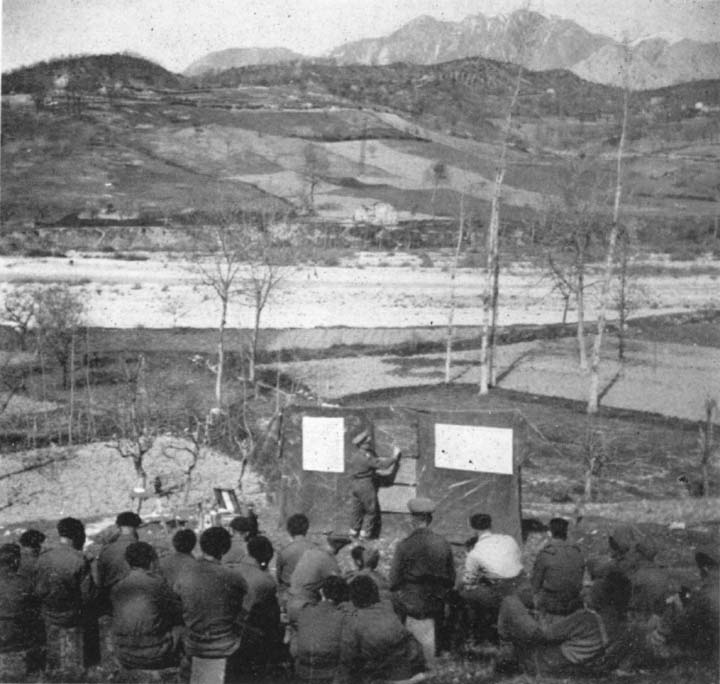 |
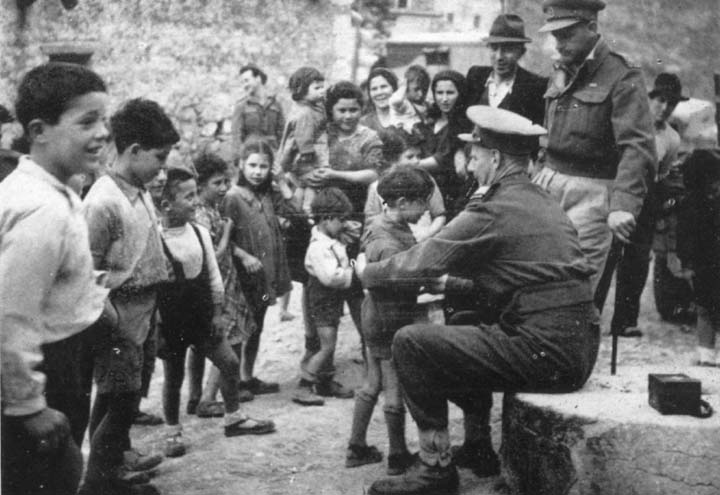 |
 |
 |
There was a lull on 1 August; but the 2nd brought 150 casualties, and the following day only a few less. All centres and two theatres were working continuously. At one stage blood supplies ran short and twelve donors were drawn from the ASC drivers. Pressure eased a little on the 3rd, with 92 admissions, after which the days' totals fell gradually to an average of 40.
As Sgt H. Brennan says:
'The men who had been responsible for the splendid defence of San Michele passed through the MDS at Tavarnelle, including the very gallant soldier who had staggered from his stretcher in the collecting post to engage with a Piat gun the Tiger tank that had lumbered up to make the crypt of the church untenable for the defenders. When one ambulance brought in a head injury case with both feet lashed together, the ambulance orderly was almost exhausted and calling for help to retain the patient on the stretcher. An ex-All Black passed through with an abdominal wound. A British officer had been caught by a signal wires and had both hands blown off at the wrists. A young New Zealand signaller, of the last reinforcement, was brought in on a hard-driven jeep, his wound raw and undressed---he had stepped on a box mine while attending lines and one leg was hopelessly shattered. A flood of men came from an English battery---one of them had stepped on a Schu mine, and attempts at rescue had trapped, progressively, seven men altogether. From this group five feet were removed.
'There were pitiful civilian casualties. A father brought in his five sons, all badly burnt through lighting a pile of cordite charges and then not standing far enough away. A mother brought in four children caught by a mine, one of them with both legs shattered.
'The blackened, swollen dead recovered from under the booby-trapped buildings at San Casciano were received. The burial gang worked over them in respirators. The engineers helped to cut the graves in the hard-packed, shingly soil beside the road, breaking it up with compressor drills. In the cemetery were buried the 14 patients who died in the MDS---the burnt and wounded trooper who died in the reception tent, the Armoured captain who fought with wonderful courage to live, and the Taranaki boy who went prowling and had been shot up by a jumpy-fingered American picket.
'There were 50 graves in the cemetery before it was closed. A volunteer party worked on it, bringing in loads of tiles. They used these to make warm red paths among the graves and to enclose the mounds of each. The curves of the rows of crosses followed faithfully the same curve taken by the road. Two large, stone flower pots of irises stood on each side of the entrance, and a great stone pot with the same flowers stood in the very centre of the cemetery at the foot of a large cross. It was an exceedingly simple but very effective arrangement. Drivers of passing trucks used to crane out of their vehicles to watch it as they passed.
'At Castelfrentano the unit had treated a large number of wounded, but in such a malevolent, sour season, and in such grudging daylight, there seemed nothing strange or discordant in the procession of wounded and dying; it had seemed a natural reflection of the weather. But in the lovely, diamond-bright autumn displaying the charm of Italy, the heavy sustained toll of the mangled rang with the discordant note of a cracked bell.'
After staging for ten days at Panicale, near Lake Trasimene, the CCS, under Lt-Col A. G. Clark,(3) moved. on 23 July to Siena. Upon the arrival of the advanced section, the equipment was unloaded and the vehicles left to collect the remaining section at Panicale. Some of the departments were erected that afternoon.
Everyone was delighted with the new location, which was separated from the town by a ridge and a gully. The unit had never before set up as a tented hospital so close to a town. From the ridge Siena could be seen spread out over its hills; silhouetted against the sky was the graceful tower of its famous cathedral and the looming bulk of its many churches. The site where the CCS was set up was a very narrow one bounded on one side by a road (' Eighth Army express route') and on the other by a creek at the foot of wooded hills. Originally it had been an agricultural stadium, but it was a clean area and well drained, with a good system of roads and concrete channels. Thickly foliaged trees provided plenty of welcome shelter and gave an attractive appearance to the camp.
Since space was so limited only six wards were erected, as well as pre-operative theatres, cookhouses, and other smaller departments; the QM was well established in modern office buildings facing the road. Officers' and nursing sisters' tents were in a grassy paddock to the east of the area, while the men's bivouacs, pitched necessarily close together, were in a plot at the westward end. Here, too, were camped the Italian Army personnel who, since Presenzano. had been employed in the cookhouses and mess tents.
On the day after the CCS arrived at Siena, casualties were admitted from the Division, which was now in action 15 miles south of Florence. For the following three weeks, as the fighting advanced towards the city and the Arno River, admissions remained at a high level, the average number admitted daily being 110. Although these casualties came in the main from the New Zealand Division, others were received from Canadian and British units, while South Africans, Americans, and South African native troops were also handled.
The line of evacuation at this time was a particularly long one. at least for New Zealand troops. From Siena patients were sent to 4 British CCS, 15 miles south, and from there they went to 58 British General Hospital at Lake Trasimene. This was a very hot and dusty 50-mile journey and particularly tiring for seriously ill cases. From Lake Trasimene New Zealand patients went 200 miles by air to Naples, and were soon transported to 2 NZ General Hospital at Caserta. Later, air evacuation was instituted from Siena.
On the night of 1-2 August the decisive battle for Florence began, when 5 Brigade, 6 Brigade, and 4 Armoured Brigade all joined in the attack on the Pian dei Cerri and La Poggiona ridges. The opposition was tenacious. Throughout the days of 2-3 August the combined efforts eventually forced the enemy to withdraw. This ended the battle for the Paula Line and decided the fate of Florence. New Zealand troops were firmly on top of the final line of hills and on the point of breaking through down the slopes to the Arno. Up to this time the South Africans had been unable to make more than slight headway along the valley of the Greve, through which ran Route 2, the main road to Florence, but with the Paula Line pierced by 2 NZ Division, the enemy had to abandon his positions south of the Arno.
Along the greater part of the front the Germans withdrew precipitately, and South African armour began to forge swiftly ahead along the main road to the city. The South Africans entered Florence early on the morning of 4 August. While 5 Brigade pressed on down the hill slopes towards the Arno, a New Zealand column entered the south-west outskirts. Florence lies on both sides of the Arno, the greater part being on the north bank. All but one of the many bridges across the Arno had been destroyed, and this, the historic Ponte Vecchio, had been closed by great masses of rubble from buildings which had been demolished at its approaches. The enemy maintained many strong-points on the north bank.
B Company, 5 Field Ambulance, closed down on 3 August and moved forward about four miles to set up at the roadside in the village of Massanera. The building was littered with books and school furniture, but it was soon cleared out for the ADS. Almost immediately casualties arrived, and they continued to arrive throughout the night. The ADS was busy until about half past four the following morning. B Company packed up and moved again in the afternoon of the 4th, and after travelling for about three miles the men caught their first glimpse of Florence, spread out on a plain with high hills to the rear. The company moved on in convoy with thousands of other vehicles, passing many burnt-out German tanks, some of them still burning, and made its way down into the suburbs of Florence, right under the nose of the Germans. Its destination was reached without event, save for one shell that landed about 200 yards away.
The ADS was set up in a large Fascist school building at Scandicci, about three miles south-west of the city, and battle casualties began to arrive immediately. Evacuation to 4 MDS, which was occupying a mansion on the southern slopes overlooking Florence, became so difficult that a car post had to be established and the casualties carried over the first stage of the journey by jeep. The Germans opened fire on the suburb during the night, but no shells fell near the ADS. From upstream came crashing explosions as heavy concentrations fell around a bridge across the Arno.
The difficult advance on Florence had traversed one of the most historic regions of the world in the post-Renaissance period. There was beauty in the hills covered with woods of oak and pine on the road from Chianti, and in Siena, whose brick walls glowed 'Siena red' in the morning sun. 5 Brigade fought in vineyards famous for some of the finest wine in the world---Chianti. Some troops had to guard masterpieces of painting which had been hidden in houses outside the city. The magnificent villas of the Florentine merchant princes had their suits of armour and their art galleries, their terraced gardens and their noble avenues of trees. Advancing units lived in one famous villa after another.
The turn came for 4 Field Ambulance to make a temporary home in one of these historic villas.
To establish an MDS nearer to the forward elements of the Division than 6 MDS, which was still functioning on Route 2 near Tavarnelle, HQ and A Companies of 4 Field Ambulance on 4 August occupied at Casa Vecchia a fine, old-world mansion on the hills overlooking Florence, seven miles from the Arno. The dome of Florence cathedral could be seen, but members of the unit had to be content with that glimpse of the city until, with all other divisional units, they were given leave there some months later. The elaborate and baroque furnishings of the villa were removed upstairs, and the spacious ground-floor rooms laid out in reception, resuscitation, operating, and evacuation centres. The upper floors were placed out of bounds, and the aged padrone remained in residence. Though bemoaning his cruel fate, he proved fairly cooperative, and opportunity was taken to point out that his position, though trying, could have been much worse. Accommodation for all ranks continued to be under canvas. The unit was joined by 1 FSU, 2 FTU, and NZ Section MAC. Only a few battle casualties were admitted.
As it became apparent that the enemy intended to fight in and about Florence, arrangements were made for a regrouping. The enemy had withdrawn across the river, and a co-ordinated attack by the Fifth and Eighth Armies was planned, 13 British Corps crossing in the vicinity of Florence and 2 US Corps passing through the New Zealand positions, with the object of forcing the Germans back on the Gothic Line defences.
As usual each brigade had an ADS set up. 6 ADS was situated near Montelupo, overlooking a tangle of valleys and spurs to the river and the heights beyond. Above stood a cluster of rather dilapidated buildings, crammed with refugees from Empoli. The nearest village, a scattering of houses along the road about half a mile to the rear, was rather inappropriately named Il Paradiso.
With a small shift only required on duty to treat and evacuate the few patients admitted each day, most of the men were once again free to do more or less as they wished; and being by this time experts in the art of getting their feet under the table, they were soon distributed through the homes in the vicinity.
After tea on the first evening, two men took a guitar up to the roadway by the houses and started chanting such lively tunes as 'South American Joe'. The company and the Empoli people converged on the spot, and before long a full-scale sing-song was in progress, the Italians, with their vast repertoire and their life-long familiarity with mass singing, easily outdoing the New Zealanders. The sound must have carried for at least half a mile, for parties of the extremely earthy-looking denizens of 'Paradise' came hurrying along to add their voices.
Thenceforward the gatherings were a nightly feature, usually beginning after the radio news. On arrival the company radio was set up on the bonnet of the evacuation section truck, and the refugees and inhabitants used to pack around to hear the news in Italian. One of the men invariably stood guard over the set, stoically enduring the smell of infrequently washed bodies.
The weather was for the most part fine and warm, though there was rain on the 10th and 11th, when several of the bivouacs were flooded. The days passed all too quickly. More and more United States troops were appearing in the area, and between 14 and 16 August they relieved the Division, which withdrew to Castellina, near Siena.
By the end of July as the New Zealanders battled for the last heights commanding Florence, the influx of patients at 2 General Hospital had raised the bed state to 747, and leave was temporarily cancelled. The news of steady progress on the Normandy and Russian fronts, where the battle for Warsaw had begun, led to a wave of optimism throughout the unit regarding the possible early ending of the war in the European theatre. At Caserta the weather was hot and muggy, with occasional thunder showers.
On 1 August 83 casualties arrived by air, and the following day a new high level in the occupied bed state was reached when, for a brief period during the overlap of admissions and discharges, there were 817 patients in the wards. The congestion was relieved by evacuation by ambulance train and passenger train to 3 General Hospital at Bari, 1 General Hospital, Molfetta, and 1 Convalescent Depot, San Spirito, of 50 and 130 patients on successive days, and then, after one day of no discharges, 103, 212, and 60 on successive days. On 14 August the largest evacuation ever made by the hospital took place when 214 patients were transferred to the east coast medical units. From that date evacuation facilities were satisfactory, and the bed state of the hospital remained below crisis conditions, although infective hepatitis cases began to come through in growing numbers from the Division.
Taking it all round, the difficulties of evacuation, crowded wards, heat and humidity threw a considerable strain on all hands, and made August 1944 a month to be remembered by 2 General Hospital. The staff all rose to the occasion, took their troubles with good humour, and maintained the standard of work at high level. As events were to prove, this month was the climax of their activities at Caserta.
Leave arrangements were made by the hospitals in July so that members of their staffs could go on leave to the Isle of Ischia, and the sisters and WAACs could spend two days in Rome. A chance to see Rome became the ambition of all, as the first sightseers brought back such glowing accounts of the New Zealand Forces Club, St. Peter's Cathedral, Vatican City, the Forum, Colosseum, Catacombs and the opera, among other highlights.
In August there were further staff changes in the hospitals as the 4th Reinforcements and some of the original officers and sisters left for New Zealand. Among these were both the commanding officer of 1 General Hospital, Colonel Pottinger, and the Matron, Miss M. Chisholm. They were succeeded by Col W. B. Fisher and Miss E. Worn(4) respectively.
At Castellina the various units of the Division were scattered along the line of the road to Siena, many on sloping sites with a magnificent view of the surrounding country. The open MDS, the 4th, stood at the head of a knoll across a gully from 6 MDS. The view took in the rolling Tuscany plain. Lines of dust along its roads rose like smoke from bushfires. The red, cream, and buff of the villages set in the thick velvet green of the trees looked like distant, garden flower pots.
The staff of the CCS learned that a complete change from camp life could be found in the nearby town of Siena. To walk up through the woods at the back of their area, across the hill, down through the valley and then up the steep, narrow streets, was just a matter of a few minutes. The people of Siena were particularly friendly---in fact, the most friendly that had been met in Italy. They seemed to like New Zealanders and were surprised to learn that they were not black natives from some cannibal isle, as they had recently been led to believe by enemy propaganda. Some members of the unit spent all their free time in the people's homes.
An hour or so in someone s home, poor though it might be, was a pleasant change from the monotony of camp life.
For the Division leave to Siena was controlled, but most of the men of the field units were able to visit the town. They found it a pleasant, mellow town, walled and quiet. It had been damaged but little, and the celebrated cathedral was untouched. The South Africans made the New Zealanders welcome at their club. Most will probably remember Siena best for the excellent pipes that could be bought at the local factory and for the ceremonial pageantry of 'Il Palio', enacted for their benefit by banner-bearers and drummers---horses were not available for the traditional race itself. The costumes were rich and fantastic in colour and design, making an impressive sight as the banner-bearers skilfully twirled the banners around them so that they floated and flowed parallel with the ground, or danced easily between the staffs and banners as they twirled them, tossing them high in the air and catching them behind their backs.
On the 24th all units were paraded along the main road to cheer at the passing of some distinguished personage whose identity was kept a secret. It was a blazing, sunny day, there was no shade, and the sides of the road were covered in dust. The troops were soon fed up with waiting, and when at last a car bearing Mr. Churchill came slowly past they were in no mood to cheer. Moreover, not expecting him, they were slightly startled. However, when he had passed some of them made up for their remissness by roundly cheering a carload of Redcaps, who did not appear to appreciate the honour overmuch.
Instructions were received to lighten loads on trucks to the greatest possible degree to achieve a high standard of mobility. Units combed through medical and personal gear for this purpose, A rather more than ordinarily serious kit inspection was held. Much surplus equipment was found; but at least as much was not found, as it was planted out among the bushes. Some voluntary contributions were made to the salvage heap, but almost as many items were filched from it during the contributing process.