BACK in Maadi at the beginning of June 1943, the field ambulances concentrated in an area near Maadi Camp Hospital. The camp was seriously overcrowded: 4 Field Ambulance had a limited but clean area near HQ 4 Armoured Brigade, 6 Field Ambulance was squeezed into an area that was totally inadequate for the organised sports that were to occupy an important place in the training envisaged, and 5 Field Ambulance had a most unsuitable stretch of sand and dust immediately behind the Naafi bulk stores. In this area was also 4 Field Hygiene Section. On 8 July, however, 5 Field Ambulance moved to a new area to the east of Lowry Hut. where there was much more space. When 6 Field Ambulance took over the huts vacated by 5 Field Ambulance, it expanded until the unit lines provided both adequate accommodation and a spacious parade and sports ground.
For many, however, the stay in unit lines was short. Those due to return to New Zealand on furlough under the Ruapehu scheme, the married men and some of the single men of the first three echelons, were marched out to another section of the camp where the furlough draft was concentrating. Though it was unknown to them at the time, for many it was a final goodbye to the units in which they had served for so long. Col Furkert was senior medical officer to the furlough draft, and Col R. D. King became ADMS 2 NZ Division, while Lt-Col J. K. Elliott was appointed CO 4 Field Ambulance.
After eight months of alternating action and boredom in empty deserts, all men turned their thoughts to leave, which was rapidly organised. Almost immediately parties left their units for a fortnight's change at leave camps by the sea at Sidi Bishr and Nathanya, or to hostels in Cairo, Alexandria, Jerusalem, Tel Aviv, and other places. All had such large credits in their paybooks that they were able to live lavishly, and all enjoyed the respite from a regimented existence.
The days of June were hot and dry and hardly conducive to the work of unloading and checking equipment. However, it had to be done. But there was no lack of energy for sport---cricket, tennis, baseball, rowing, swimming, athletics and yachting. Teams were entered in divisional competitions and inter-company games were arranged. In the baths at Maadi swimming carnivals and water polo games were held.
In July a training programme was instituted. Officers and men did special courses at hospitals. Most of the men soon lost any illusions they might have had about training in Maadi Camp. They fell in for hard work, plenty of it, and found it elementary compared with their accustomed duties in the field. Still, there were reinforcements to be broken in. The staff of 4 Field Hygiene Section was busy with its normal duties in the crowded camp. Medical officers attended a series of weekly discussions at Maadi Camp Hospital, designed to stimulate interchange of views on medical work and to standardise procedures in the field.
Some officers visited 4 Field Ambulance to view a demonstration of the erection of a 'penthouse', a lean-to type of tent designed for attachment to 3-ton cooks' and QM trucks, and destined to be the retreat of poker players, tipplers, and the well-known types, present in all units, who were always too tired to erect bivvies.
Companies of the field ambulances journeyed in turn to Ain Sukhna, on the shores of the Red Sea, for exercises. The tents were pitched along both sides of the road, where it skirted a series of bluffs that ran down to the shore. The heat was almost tangible. At the first free moment there was a concerted rush for the water, and the translucent shallows were soon whitened by splashing limbs. Throughout the stay at Ain Sukhna the men spent most of their time in the sea, the majority never tiring of floating face down and gazing through the clear, lukewarm water at the shoals of fantastically coloured fish that swam amongst the coral on the sea bed.
Between long spells of rest and recreation, the company carried out various types of training. After dark, tarpaulin shelters were erected against the clock. The beach was a scene of dim activity, with the shadowy figures of men rapidly tossing out and unrolling the tarpaulins, and standing in pairs on the top of each truck, waiting to catch the thrown ropes and haul the edges of the shelters up on to the canopies. Shouted directions and the blows of sledge hammers on steel stakes rang through the night. In about 20 minutes the sections were ready to operate.
It was a good camp at Ain Sukhna, away from the irksome restrictions of Base. The training was pleasant and leisurely, and at night the men gathered for informal sing-songs and supper on the beach. Refreshed, they packed up and started out along the desert track to Maadi.
After that the units were once more together at Maadi, with the men spending their spare time quaffing beer in the Naafi, eating Groppi's ice cream in the Lowry Hut, or sitting on the hard, sandbag seats of the El Djem amphitheatre.
The number of original members of the units was further depleted on 2 September when men were marched out to join the second furlough draft. During the first days of September an unaccountable decree for route marching was issued---the reason was learnt later. Daylight or darkness, it made no difference: the men would find themselves tramping in column of route through the sand. However, a route march is more pleasant than many other forms of training; at least one can just tramp on, empty-minded and at peace. On 10 September the Medical Corps paraded on the Maadi Club sports ground, and awards were presented by the GOC. Next day was polling day for the General Election in New Zealand.
In the hospitals life seemed uneventful after the excitement of the previous months, but work went on. At 1 General Hospital accidental injuries took the place of battle casualties, some of whom were invalided back to New Zealand on the hospital ships. Seasonal sickness, with the onset of another summer, brought an influx of patients from the concentration of troops in Maadi Camp. The 1762 admissions for July were the highest recorded since 1 General Hospital had been at Helwan, and helped to build up the total of 12,642 patients which it received during 1943. Patients were transferred periodically to 2 General Hospital to case the burden. The summer was very trying indeed, and its effect was shown on the staff. At Tripoli 3 General Hospital was kept busy; it found the summer the hottest of all.
Changes came about, too. With the furlough drafts, many of the sisters and men from all hospitals returned to New Zealand for well-earned rest, including most of the sisters who had arrived in the Middle East in the beginning and had paved the way in the hospital work that was now so well established. Farewell parties, large and small, were the order of the day; but the regrets of those leaving the units and breaking old associations were, generally speaking, overshadowed by the prospect of the reunions at home with families and friends after three and a half years of separation. The arrival of fresh staff with the 9th and 10th Reinforcements brought new blood into all the units. At the end of 1943 the staff changes at 1 General Hospital during the year were totalled up and found to comprise 35 medical officers, 82 sisters, 64 VADs., and 68 men.
On 12 June the staff of 2 General Hospital were shocked by the news of the death of their popular and most capable commanding officer, Col Spencer, while on leave in Tripoli. He was a sad loss to the Medical Corps. Col H. K. Christie was appointed CO of the unit, and Miss V. M. Hodges became Matron on Miss Brown's return to New Zealand. The matron of 1 General Hospital, Miss E. C. Mackay, was promoted to the position of Principal Matron in succession to Miss Nutsey on 22 November and was succeeded at 1 General Hospital by Miss M. Chisholm, while Miss M. E. Jackson became matron of 3 General Hospital.
Leave over, the field medical units began to reorganise and reequip in preparation for the next campaign. Equipment was repaired and brought up to scale, while the transport was completely overhauled. Reinforcements were received, inoculations brought up to date, and winter clothing issued.
Rumours about the future were very strong---in fact it had become fairly obvious that the Division was destined for operations in Italy. During the summer months the Allies had pressed steadily on. Mussolini had resigned, and the close of the Sicilian campaign with the fall of Messina on 17 August marked another great step forward. The Allied invasion of the Italian mainland began early in September with landings by Fifth Army at Salerno and Eighth Army across the Strait of Messina. On 1 October Allied forces occupied Naples.
In mid-September the Division moved to Burg el Arab, west of Alexandria. As part of a hardening process, the troops marched from Mena to the Amiriya crossroads, a distance of 99 miles. Some of the medical units did not have to march, as they were called upon to provide dressing stations on the route and at Burg el Arab.
Apart from morning route marches, no training was done at Burg el Arab during the next few days, and the medical personnel not running dressing stations camped on the flat ground between the coastal ridge and the glistening white sand dunes of the beaches, checked over equipment at leisure, availed themselves of day leave to Alexandria, or wandered down to the sea to swim, plucking ripe figs en route from the stunted trees that dotted the dunes. The drivers were kept busy checking over their vehicles and removing the canopies and supporting frameworks in preparation for loading them on the vehicle transports.
There was still no hint of the future role of the Division, and the troops as usual were groping in a maze of conflicting rumours. A lecture on malaria, coinciding with the first issue of the little yellow mepacrine tablets, was considered to be of major significance until someone announced that malaria was prevalent in many parts of Europe. Finally, commanding officers delivered addresses, informing their units that the Division was about to go overseas. Beyond that they knew nothing, except that the future field of operations was a region infested with typhus and malaria.
The time for embarkation was obviously near when, on 25 September, orders were received to prepare staff tables and loading returns for vehicles. The units packed all equipment, removed shoulder titles and cap badges, and obliterated all divisional signs on the vehicles. Early in October the units moved to the embarkation transit camp which had been established in the stony, dusty waste of the Ikingi Maryut staging area. The troops, quartered in tents, were continually smothered in the fine dust. that rose in swirling clouds on every breath of wind. It caked around the eyes and lips, and could be tasted in the mouth and gritted between the teeth. Conveniences were poor, and meals were of a nature requiring the minimum of preparation. A large tented Naafi served morning and afternoon tea and beer to an endless queue.
The men spent many hours rearranging packs, seeking to devise a load that included everything yet could be carried without making the bearer wider than the average door, and which would sit more or less comfortably on the back without giving a tortoise-like forward thrust to the head.
Embarkation rolls were prepared, and the minimum of equipment that would be required at the destination loaded and. despatched to the personnel ships. The units assembled and marched to embussing points, the men tottering under a hundred-pound load that included, besides the normal packs, a bivouac tent, a bush-net with supporting poles, summer and winter clothing, a leather jerkin, spare boots, and a two-gallon water can. The gear was no sooner gladly dropped from already numbed shoulders than there came the inevitable order to pick it up again and change position. A fleet of 10-ton trucks arrived, and the troops clambered aboard, about twelve men to a truck, and set off for the docks at Alexandria.
There was usually a long wait at the wharf, and scratch meals and hot tea were prepared while barges and lighters, each craft packed with khaki-clad, sun-tanned men, came and went between the shore and the troopships anchored out in the stream. Various units stood about in groups, clustered around their dumped piles of gear. No one seemed anxious to swing up his load until the last moment. One man who had sat down with his packs attached had to be assisted to an upright position. At last the men were told that they were moving off on the next lighter. They helped each other on with their packs and filed up a narrow, one-man gangway to the deck of their lighter, the bush-net bags and water cans, carried in either hand, bumping and clanking against the stanchions. Again the gear was thankfully dropped; and again and again it had to be picked up and moved as men. were packed more and more closely on the deck. By the time the lighters pulled away from the wharf the men were completely immobilised in a tangle of equipment and legs.
The voyage of 6 Field Ambulance can be taken as typical of those of all the New Zealand medical units. The lighters carrying the unit drew alongside a towering, 17,000-ton transport and the troops were instructed to go aboard through one of the luggage ports in her side. What with the steeply-sloping gangway, the low entrance, and the tall packs, they had to be manhandled through like so many sheep. It was impossible to stoop low enough to get the packs under the top of the door without losing balance, so main packs were left on the lighter to be heaved aboard later. Carrying only hand luggage and side-packs or 'iggri bags', the men were guided along the shaft-like ship's corridors to their quarters on the lowest deck of the forepeak cargo hold.
With no natural light, poor ventilation, and permeated with the typical troopship's lower-deck atmosphere of perspiration and sour staleness, added to which was the hold's own native smells of cheese, garlic, and dried fish, the quarters were not regarded with any great enthusiasm. To make matters worse, most of the hold was taken up by mess tables and rifle racks. Hammocks were slung close together over the tables, with the ends of one row inserted between the ends of the next. After a brief inspection the older hands left to seek open-deck hammock sites. At tea-time the food proved unexpectedly good; but the messes were difficult to organise and there were long periods of waiting, both for the men at the tables and for the winding queue of mess orderlies.
The convoy of three transports, with an escort of five destroyers, moved from its moorings in the early morning of 6 October, and passing the smashed hulls and protruding masts of wrecked and sunken ships in the harbour, steamed slowly out through the boom. The troops lined the rails, gazing back at the domes and minarets of the mosques and the magnificent buildings along the corniche, gleaming white and distinct in the sunlight and clear air of the warm Egyptian morning. There was a rapid flicker of morse from a destroyer as it surged past the Reina del Pacifico, and the three transports swung into line abreast and picked up speed. The first contingent of the New Zealand Division was on its way. A few hours later a message from the GOC was read over the loud-speaker system, telling the troops that they were bound for Italy and the prospect of battles under conditions very different from those of the campaign just ended.
Alexandria slowly faded from sight, and the coastal dunes of the Western Desert, the scene of so many memories, appeared for a few hours to the south and then sank below the skyline. The voyage was a succession of still, warm days, the convoy continuing in line abreast inside its cordon of destroyers, each ship towing its hauled-in barrage balloon and slipping through a sea disturbed only by the hissing bow waves. Land was sighted on the 7th, and after a certain amount of discussion was identified as Ras et Tin, the western promontory of the Gulf of Bomba. Just before dusk on the same day, a convoy of some thirty merchant ships with escorting destroyers steamed past. In spite of orders forbidding the carriage of pets, Lulu, 6 Field Ambulance's pet hen, suddenly put in an appearance. She had been carried aboard in a box as a bivvy.
Mount Etna and Sicily were sighted to port at dusk on the 8th, and soon the hills of Italy's toe rose into sight. Daylight on the 9th showed the convoy sailing close to and parallel with the coastline, and the ship's rails trebly lined with men examining and commenting on the countryside, its gently sloping hills and clusters of houses whose red roofs glowed like dull embers as they caught the morning sun. Trees appeared plentiful, both in ordered rows and blocks and straggling natural woodland; and the differing depths of colour in the patterned plots of green and brown told of intense cultivation. There was a promise of moist, cool winds and green fields after the and dunes and escarpments of the desert.
At 9 a.m. on 9 October the transports steamed slowly through, the boom between the two stone moles that encircle Taranto harbour. A British monitor, several cruisers, surrounded by their antitorpedo nets, and three or four American landing craft were moored in the stream, while an assortment of small merchant ships unloaded at the wharves. The Reina del Pacifico came to anchor off a mile-long stretch of impressive waterfront buildings, fronted by a busy, tree-lined promenade and a beach with wooden bathing sheds and small-craft wharves. A swing-bridge over a canal or the neck of a lagoon, and connecting what was evidently the old and newer towns, carried a constant stream of pedestrians. On the old town side, right on the water's edge and evidently designed to guard the entrance, was a heavily-turreted, wide-bastioned castle, obviously of great age. Behind the quay on the new town side stood a low hill, up which stretched the town, a tightly-packed mass of three-storied houses. The streets visible from the ships were busy with pedestrians and army wheeled traffic.
Grape sellers put out from the shore, in dinghies. Standing in the boats, facing their course and pushing against the oars with short rapid strokes, they headed for the ship at a surprising speed. The AMGOT paper shilling was the lowest denomination in the possession of the troops; and both they and the boatmen seemed hazy about its value in grapes.
Lighters arrived promptly, and by midday two loads had left the Reina del Pacifico. By that time the 6 Field Ambulance personnel were hoping to get a meal before going ashore. However, a long, unhandsome craft named the Messina, evidently an adapted train-ferry and resembling several tiers of wharfing, was brought along. side by two tugs. In answer to a hail, the captain announced that he could take 7000 men, and the burdened crowd poured down the jigging gangway onto the sun-warmed decks of the Messina and left for the shore, where the troops were marching through the old town to the divisional bivouac area, five miles to the north.
On the quay there was the usual confusion with its attendant delays; but finally, at half past one, the unit set off on its march to the bivouac area. The district through which the route lay presented a dismal scene. Many buildings were badly battered, and roads were torn up where the drainage system had been disrupted by bombs. The inhabitants looked poor and bedraggled, underclothed and underfed.
Breakfast had been early, it was a hot day, and the road ran uphill. Hungry and fed up, the troops were exhausted by the time they had tramped two and a half miles up the Taranto-Martina road and a mile and a half along an undulating cart track that ran over lightly wooded hillsides to the Santa Teresa track junction, where, adjacent to a large house occupied by HQ 2 NZ Division, a dressing station and evacuation point was to he established.
Meanwhile, the Messina had returned to the Reina del Pacifico with unloading parties, including a 6 Field Ambulance party detailed to look after the medical equipment. The crates were slung up out of the holds and over the rails by the ship's derricks, many showing the result of the handling received from inefficient Egyptian stevedores. Suspended cases streamed yellow and white tablets and assorted items of medical stores from between broken boards. Others touched down with a rattle of broken glass. The party collected the gear and stacked it in a space allotted to the unit, and moved to the rail to chaffer with the grape vendors.
Another ship was occupying the berth allotted to the Messina, which was compelled to back in between a merchant steamer and an unloading barge. The only gangways available, found after an exhaustive search, were two twelve-inch scaffolding planks. Over these every item of equipment from the Reina del Pacifico was manhandled ashore. One of the tarpaulin shelters, a difficult six-to-eight-man lift at any time, almost found a destination in the Gulf of Taranto.
The unloading was finished by electric light, and the 6 Field Ambulance gear stacked ready for loading on trucks. The men had a meal of bully beef, tinned fruit, jam and bread from the many broken cases that strewed the wharf, and then, on being told that there was no transport to take them or the gear to the camp, they settled down to sleep among bales and cases, with the bustle of unloading still going on about them.
It was a quarter to three when the unit reached the divisional area. All thoughts and conversation were on the subject of food; unfortunately there was none. The unit rations and equipment, assumed to have been sent forward promptly, were still on the wharf awaiting transport. The cooks were helpless. Finally, some oddments of dry rations were distributed, and the cooks of Divisional HQ provided tea. With a certain amount of bitter comment the men settled down under the olive trees for the night. Fortunately the weather was warm and bedrolls were not missed.
Trucks arrived at the wharf early on the 10th, and the baggage party loaded on the gear, scrambled on themselves, and set off for the camp, passing through the drab streets with their endless three-story buildings. All windows and shopfronts were shuttered. The trucks ploughed through deep pools of water where the mains and drains had burst, sending muddy waves washing against the walls and among the piles of rubble and fallen bricks.
At Santa Teresa conditions were good and the area pleasant. Although noticeably low-lying, the ground was firm and clean. Across a gully, evidently an old quarry but now overgrown with rough shrubs and wild flowers, stood a barracks building, housing many Italian soldiers who were still in uniform and who seemed to have plenty of time on their hands. The house on the other side of the track, occupied by Divisional HQ, was the home of the landowner, reputed to be a count, who had fled with the retreating Germans and Fascists.
As all British hospitals were evacuating patients to Sicily and North Africa, a large detachment of HQ 6 Field Ambulance returned to Taranto on the 10th and established an MDS in the Archæological Museum building to hold New Zealand patients.
The detachment took over the second-story wing of the Archæological Museum, with windows overlooking two courtyards. The wing consisted of two wide galleries, clean and with large windows giving plenty of light. The floor was covered with good cork linoleum. One gallery was used as four wards, stretchers being laid in rows, with ample passageway between. W-hat was intended to be a 50-bed MDS became a hospital holding more than twice that number of patients. The staff slept in the other gallery, and a small, self-contained block was used for officers' mess and sleeping quarters.
Wires for patients' mosquito nets were strung from home-made brackets, and at the end of the ward gallery a treatment room, dental theatre, and later a small blanket-curtained operating theatre were partitioned off. Both cookhouse and hospital suffered from shortage of equipment. The cooks, who often catered for as many as 200 men, had only one burner, and in addition were short of petrol. The medical sections worked with two thermometers for four, later five, wards and had to conserve medical supplies drastically. Wornout primuses were a constant source of annoyance and delay. In spite of the fact that any amount of rubbish could have been dumped in most parts of the town without its presence being noticed, all refuse had to be carted outside the city area.
Fortunately, the museum was in one of the cleaner areas, and was comparatively removed from those quarters where strident. voiced mothers screamed for missing Marias and Ninas. The quiet was disturbed only by the uproar of the departure each evening of the Bari bus from the street outside, and the nightly passing of a crowd of garrulous Italian sailors returning to their ships.
Sixth Brigade was bivouacked along both sides of the Santa Teresa-Statte track, on rolling, rocky country that was lightly wooded with olive trees. A Company, 6 Field Ambulance, operated the ADS in an area adjoining that of the brigade band, on a narrow strip between the track and a dry riverbed to the east, where the ground fell away in precipitous scrub-covered cliffs. At the time the band was practising 'The Bohemian Girl', and the familiar airs often floated over the company lines.
The evacuation section operated the only working centre, holding patients in a shelter borrowed from HQ. The rest of the company covered the surrounding countryside in daily, two-hour route marches, and constructed a metalled road to and from the shelter. Like HQ, A Company was handicapped by lack of equipment, though limited supplies were drawn from 70 British General Hospital and 7 Advanced Depot Medical Stores.
Excellent rations and a plentiful supply of grapes and almonds no doubt contributed to the good health of the whole company at this time. Wine, too, was plentiful, which gladdened the hearts of those who were not teetotallers, though it may not have improved their health. An innovation that caused almost unanimous satisfaction was the weekly issue of reputable brands of cigarettes in airtight tins of fifty in place of the lung-searing 'Vs'. The sole dissenter was a somewhat individualistic combination of orderly, company clerk, and stretcher-bearer, who stoutly asserted that he had always enjoyed smoking 'Vs' and wished that he could still get them.
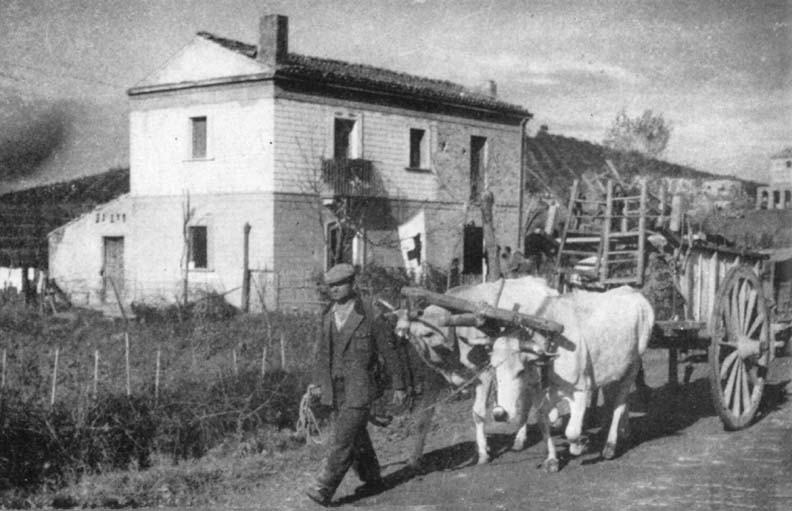
The medical units at Santa Teresa found it a pleasant farming district. The olive trees were laden with fruit, and all around the peasants were manuring the ground, carrying the manure to the fields in carts drawn by powerful but docile white oxen with enormous, spreading horns. The oxen and the peasant families were housed in a low, whitewashed stone building adjoining the count's residence. Grape, nut, pomegranate and wine vendors stood about the fringes of the company area. The wine was dark and rather sour, and a little of it went a long way. It was not intended to be drunk in large quantities; and those who quaffed it as they were in the habit of quaffing beer found themselves miserably raiding the bismuth- and-soda bottle next day.
Some of the men used to cross the gully to where the Italian soldiers sat around a bonfire and passed the evenings singing songs and arias from grand opera. It was good entertainment for the New Zealanders, whose experience of spontaneous mass singing had been confined to carousals and the wailing of Egyptian labour gangs.
The days were spent on duty in the medical centres and cookhouse, in metalling the more important areas, or on route marches. In the splendid autumn weather the route marches were a source of pleasure, being more in the nature of leisurely rambles; and the company tramped for miles over the undulating countryside, passing through olive groves, vineyards, and fields of crops, and scrambling over the ancient stone walls that the Italians use as fences.
A wall newspaper was started in one unit on 17 October, the contributions being hung on a board nailed to a tree. In the unit were men of all manner of views, beliefs, and opinions, many adhering to them to an extreme degree; but a sound editorial committee managed to keep things under control.
Leave to visit Taranto was liberally granted, and although unit transport was limited there were many vehicles on the roads and hitch-hiking was a simple matter. The town itself had little to offer to the motley crowds of Allied troops who thronged its dingy streets. What had appeared from the troopships to be a canal proved to be the entrance to a large inner harbour, called the Mare Piccolo, in which many cruisers, submarines, and motor torpedo-boats of the Italian Fleet still lay at anchor. The exaggerated magnificence of the Italian naval officer's uniform was well in evidence in the vicinity. It was hard to believe that men could take themselves seriously while wearing such a rigout.
Taranto and its rival port of Bari were the chief markets of a fertile, intensively farmed hinterland. Nevertheless, Taranto was short of food, and long queues in the market each morning, with civil police present to keep order, soon bought up all the available vegetables, fish, and fruit. The fish were minute, smaller even than sardines, and there seemed to be no root crops among the vegetables.
There was little evidence of bombing in the areas away from the waterfront, though the station was badly smashed. The more important streets were well paved and maintained. Beyond lay a maze of smaller streets and alleys that were broken, neglected, and dirty. There were two large, pleasant squares near the MDS. In one was a small, tree-planted enclosure, and in the other stood a massive,. muscular, emotionally posed group of statuary, a memorial of the First World War. Opposite the statuary, in what had once been a fine café, the NZ YMCA opened reading and writing rooms and provided tea. Facilities were limited, and troops were instructed to take their own pannikins. Some did so. Others relied on borrowing and fared just as well, as no one can reasonably refuse to lend a drinking mug for a few moments. Later, a Naafi opened in the other square. ENSA took over a concert theatre near the waterfront and screened a series of good films. The seating accommodation was excellent, but the ventilation system left much to be desired. When the house was full the crowd literally stewed.
And, as Pte A. T. Green,(1 ) of 6 Field Ambulance relates:
'Some of the coffee shops served a satisfying beverage. Though the coffee was ersatz, it was boosted with a liberal dash of rum. Inevitably, however, the favourite resorts of troops were the wineshops. Usually operating in back rooms, and filled with soldiers and sailors of a variety of nations singing or fighting with alcohol-inspired camaraderie or rage, they were guaranteed to provide an interesting afternoon. The source of half of the pleasure of such occasions is the constant awareness that a single word out of place can change a friendly carousal into a brawl.
'The New Zealanders were still incognito, which was to their advantage in their dealings with the local populace, who, filled with Axis propaganda, imagined them to be some particularly savage breed of barbarians. However, to anyone familiar with them they were unmistakable. For example, could a band of hard-visaged, rather more than ordinarily brawny soldiers, cavorting jovially along with dainty brassieres strapped on over their battle-dress jackets, be anything but New Zealanders?'
The long spell of warm autumn weather was finally broken. Showers of rain on 11 October freshened both town and countryside, filling the air with a moist, earthy fragrance. The first rain seen since the storm at Djebibina in Tunisia, it stirred memories of distant occasions amid New Zealand scenes. However, five nights later a heavy downpour startled the bivouacked units in the divisional area, and set them to deepening drainage ditches and raising bedding clear of the ground. On 28 October there was a violent thunderstorm. During the afternoon clouds banked up, and about five o'clock the storm burst upon the Taranto region. With the thunder came torrential rain that lasted for about four hours. The thunder and lightning were almost continuous, and the barrage balloons over Taranto came down in flames, one by one, the coils of their cables causing trouble where they fell.
In the early hours of the morning the storm began again, continuing steadily for about three hours, and then on and off for the whole day. Out at the flooded A and B Company areas the men sloshed through the chewed-up mud between the wide pools of water, again attempting to improve the drainage system. The night of the 30th brought another storm, with thunder and lightning and drenching rain; but by that time the unit areas were in such a mess that it was regarded almost with indifference.
In the wake of the field ambulances, the CCS arrived at Taranto on 22 October on the Egra and Oronda and marched to the divisional area north of Taranto. The unit was in time for the heavy rains.
Upon arrival the bivouacs were set up under the olive trees and upon whatever high ground was available. Already in this task were met the first of the difficulties that Italy was to bring to soldiers accustomed to desert conditions. In sandy surroundings it had always been possible to dig down below the surface, but here it was different. Southern Italy has a heavy rainfall in winter, and as it was obvious that dugouts would soon become mud-holes, it was necessary to raise bivouacs above mud level. This was achieved by making a building platform---a square of heavy stones packed with earth-and on these the small tents were erected.
Accustomed in the past to the many comforts of the hospital---stretchers, plenty of blankets, shelter in the wards, etc.--all the staff now keenly felt the absence of these. A bed now consisted of two blankets and a groundsheet. Later, however, extra blankets were issued and some salvage came to hand. With boxes and tins from the latter, many improvements were effected. The cookhouse was established in a small shed, but the cook's never-ending task of feeding the multitude was hindered by the lack of sufficient utensils and dixies. Petrol tins were sterilised and used as food containers. while, with clever improvisation, a desert-type oven of mud, stones, and tins was built. This allowed greater variety in the menu. Rations and water were delivered daily, the latter being stored in the two-gallon tins carried from Egypt.
When all the bivouacs had been erected, everyone was put to work making roads and paths. Since the unit was to be there for some weeks, it seemed obvious that mud would become the main problem when it rained. For days everybody carried stones and rubble to form paths, principal attention being paid to the cookhouse area. Stone fences are the only kind seen in Southern Italy. One of these bordered the road past the camp, and as the paths and roads grew longer so did it become lower.
At this time the nursing sisters were not with the unit but were staging and working at 70 British General Hospital just outside Taranto. Some of the CCS nursing orderlies and medical officers were also lent to the hospital, which was experiencing an extremely busy time dealing with casualties from the Eighth Army's advance beyond Foggia.
The days now were much shorter and dark descended at 5 p.m. Winter was rapidly drawing on. Summer clothing had been handed in and battle dress and gaiters became the dress. Extra blankets were issued; anti-malaria precautions ceased. Lighting on these long nights was a problem, since lanterns were scarce and the candle ration lasted only a few hours. Many and varied were the means by which bivouacs were lit. A ration of kerosene was available and, although smoky, was burnt in a cigarette tin with a rope wick. Olive oil was also used in home-made lamps. In entertainment, too, the unit had to rely upon itself and devise its own means of spending the long nights. A mess tent had been erected by now and furnished with boxes and planks. Here card tournaments were played by the light of flickering lanterns. Quiz sessions were also held, and sometimes a lecture or informal talk was arranged by the entertainment committee.
This new country offered much of interest and in so many ways was different from other lands that the unit had visited. It was surprising to see how the old feudal system still existed, as did many other customs handed down from ancient times.
In September 3 General Hospital had packed again, and its third anniversary on 29 October was celebrated on the hospital ship Dorsetshire in the Mediterranean. Arriving at Bari on the 31st, the unit was allotted two blocks of buildings in the Polyclinic to develop into a hospital. Construction of the Polyclinic had been begun by the Italians in 1932. The plan provided for the erection of 22 separate blocks of buildings, most of them to form separate clinics for the treatment of different diseases (hence the name Polyclinic). In 1940, when the Italian army took over the buildings, all constructional work was suspended. Only three blocks had been finished and the remainder were simply concrete and stone shells. One of 3 General Hospital's blocks was finished and one unfinished. They were given the names of Tripoli block and Beirut block respectively. The former block had been used by the Italians as a hospital, and they were still moving out. Members of the Italian medical corps carted equipment away and padres hovered about, distinguishable from the numerous civilian clergy only by the gold braid badge of rank worn on the sleeves of their flowing black gowns. Beirut block became the scene of much activity. Again the tradesmen of the unit proved their worth, and civilian labourers, painters, carpenters, and bricklayers were brought in to assist. Doors and windows were fitted, partitions built, floors finished, and water supply and drainage systems installed. Until this block was made serviceable all patients were cared for in Tripoli block. Sisters and nurses had temporary quarters in Tripoli block, but after three weeks they occupied a small building given the name of Helmieh House. Thus the three previous sites of the hospital---Helmieh, Beirut, and Tripoli---were commemorated.
Tripoli block was occupied by the surgical division, and Beirut by the medical division, plus the laboratory, massage, occupational therapy and administrative departments, and the patients' recreation room. In the basements were the stewards, ordnance, linen, pack and medical stores, and the workshops for the carpenters, plumbers, and electricians on the staff.
Situated a convenient distance from the docks area and only a few minutes' walk from the railway station, the hospital was in a good position for receiving evacuees by either ambulance train or hospital ship. For the staff it was five minutes' walk to the city, while in the opposite direction not far from the hospital were fields planted with walnut and olive trees.
For the first two weeks of November. 64 sisters and nurses were attached for duty to 98 British General Hospital, one of the other hospitals in the Polyclinic, which was without its sisters. This assistance immediately helped to establish amicable relations between the two hospitals, a co-operation that continued after the British sisters had arrived and NZANS and WAAC returned to their own unit.
As 3 General Hospital was the first New Zealand hospital to operate in Italy, it was not long before an urgent demand was made for the accommodation of patients. The first patient was admitted on 5 November, to be followed by 32 from 6 MDS at Taranto next day. The familiar story of the opening stages of a hospital then followed, the number of occupied beds often becoming very near to the number equipped. The position was alleviated to some extent by the opening of 1 NZ Convalescent Depot at. Casamassima, 15 miles inland from Bari.
Alerts and anti-aircraft fire became common as enemy aircraft sought to destroy Eighth Army supplies in Bari harbour. On the night of 2 December there was a disastrous raid. In the words of S-Sgt Taylor(2):
'The hour is 7.30. The hospital is functioning in the routine manner for the evening. We have a good number of patients in, and a stretcher party has left for the railway station to unload a convoy of casualties due to arrive from the front. Up-patients and staff off duty are at the pictures in the patients' recreation room. The performance is interrupted by the coughing bark of Bofors guns, and we can see through the window spaces the red and yellow tracer shells angrily streaking skyward. The performance stops and the crowd disperses to handy shelter, for we have had barrages over the city before, but the alerts have never lasted more than half an hour, and we expect to be able to resume our enjoyment of the pictures in a short time. . . .
'There are clouds in the night sky, and somewhere in those clouds lurk the enemy raiders. A dense fog, man-made, uncoils itself skywards, seeking to conceal from the Germans the object of their mission of destruction. A succession of equally spaced, parallel flashes, followed seconds later by a series of dull explosions, tells of a stick of bombs dropped from the planes above. There is a terrible beauty about the whole scene, reminiscent of a vivid fireworks. display, only never did a child's fireworks have the evil significance of these instruments of destruction.
'Without warning, a vast fountain of flame, with multi-coloured jets streaming from the top. arises in the air about a mile away. Those who pause to gape at the scene are, a few seconds later, flung flat by the mighty blast that follows the terrific explosion which the flame implied. There is a rattling of glass fragments as many of the windows shatter under the pressure of the blast. We take stock of the damage. Temporary bricked-up window spaces have been flattened, and one of these has fallen inwards in a room which only this afternoon had housed patients. Doors have been wrenched from their frames or split completely in two. There are no reports of any of the staff or patients injured.
'But the raid goes on. Leaping flames and billowing clouds of smoke show where bombs have found their mark. There is another enormous explosion and a leaping column of yellow flame. By now some of the casualties from the raid are beginning to reach the hospital. Many of these are covered in oil and suffering from one or all of the effects of blast, immersion, and burns. There are Americans, Poles, Indians, Norwegians, and Italians. Far into the night the staff works to treat them and put them to bed.'
Fires on ships in the harbour continued for two days. All units were warned to expect an even bigger explosion from one of the ships on fire stated to be loaded with TNT, but this fortunately did not eventuate, thanks to cold-blooded efficiency on the part of the Royal Navy. In all, 17 ships were lost and over a thousand casualties sustained, 77 of the injured being admitted to 3 General Hospital, while a further 80 were treated and discharged. The work of construction was set back considerably. Much work for the next week was devoted to filling up window frames with calico. Then casualties from the Sangro demanded attention.
WHEN the Division's vehicles began to arrive in Italy at the end of October, the medical units used their three-ton lorries for carting stones. In any low-lying areas the winter rainstorms, the churning of thousands of Army boots, and the revolving wheels of trucks produced morasses of mud. While the Division waited to move forward, and indeed during the whole of the winter as the units moved to successive areas, road-making became a standard activity. Many an ancient stone wall contributed to the paving around the cookhouses and the entrances to medical units and wards.
When the third flight of vehicles arrived in the middle of November, the medical and other units were able to complete preliminary arrangements for the first of many moves eventually covering the whole length of Italy. The drivers who accompanied the vehicles had a few stories to tell. Some of them were at sea for 23 days, and after zigzagging all over the eastern end of the Mediterranean had sailed through the Strait of Otranto, in full sight of the German-held Albanian coast, to berth in Bari harbour for the night of the town's first air raid. At the first air-raid warning a smoke-screen was put up from the wharves. Half an hour later, when the smoke had completely dispersed, the raiders arrived. The troops were kept below decks, where they sat in the holds listening to the clamour of the anti-aircraft batteries on shore, the ships' machine guns and six-pounders, and the clatter of shrapnel on the steel plating above their heads. Apparently no damage was done, beyond the destruction of the balloon barrage by the antiaircraft fire.
Fourth Field Ambulance, under Lt-Col J. K. Elliott, was the first to receive its transport---or, rather, part of it---and the beginning of the month found the unit redistributing loads and giving the vehicles a general cleaning up in readiness for the move with 4 NZ Armoured Brigade to the divisional assembly area at San Severo. The arrival of the vehicles was extremely haphazard; in fact, the priority vehicles---orderly room, dispensary, and 'Q' trucks and others---did not come to hand until the unit had been in San Severo for a week. Damage was considerable, few vehicles reaching the unit intact. The dental truck was dropped from a sling on the wharf at Bari, killing an Italian, and became a total loss. The HQ cookhouse was also extensively damaged.
The Division, coming again under command of Eighth Army, had been given the role of crossing the Sangro River and attacking a line, along the heights to the north on which the enemy was now falling back.
Repacking of the 4 Field Ambulance vehicles for the move to the concentration area around San Severo was completed on 2 November. Skies were a dreary grey next morning when the convoy pulled out from the Taranto area. In a journey marked by many halts, the trucks passed olive plantations, vineyards, a countryside made picturesque with conical trulli huts, and hill villages with balconied houses huddled round the cobbled village square. Passing through Altamura, the unit reached the first staging area on high moorland country late in the afternoon. It was an empty, wet landscape, swept by bitterly cold winds.
The southern part of Italy was virtually untouched by the war, and it was not until Foggia was reached next day that the first physical signs of the war were visible in the ruined buildings of a bombed section of the town. Even then, it was not until the old familiar mine notices were met on the roads and byroads between Foggia and Lucera---VERGES SWEPT, SAFE LANE---and the convoy passed the burnt, crashed fighter plane lying in a field, that the New Zealanders knew that they were back again in the same war which led them through Greece and Crete, Libya, and through the desert to Tunisia.
San Severo was reached on the afternoon of the 4th. It was bleak and cold. The work of establishing an MDS in a derelict roadhouse, a two-storied building, began immediately on arrival. Companies pitched their tents on the western side of the building, concealing them as far as possible with camouflage nets. By evening the MDS was holding five patients.
Fourth Field Ambulance left San Severo on 13 November for Furci, via Serracapriola, Termoli, and Vasto. With the exception of demolitions and an occasional derelict tank, few signs of battle were seen en route. The convoy had a painfully slow trip because all main bridges had been blown and rivers had to be crossed by means of one-way Bailey bridges. The country from the Trigno River northwards lay between the mountains and the sea and was broken and hilly, with devious, winding roads and hilltop villages. The soil was heavy and formed thick mud, and the siting of units depended entirely upon the possibility of getting vehicles off the road. In wet weather this became almost impossible. Units soon learned to observe the fundamental rules of fitting chains to vehicles before leaving the roads, parking above road level, and pointing the vehicles downhill towards the road.
The ancient hill villages in this part of Italy have narrow, one-way streets easily blocked by transport. In the cold, wet weather general at this time, buildings were a necessity both for nursing patients and billeting troops. The rather poor villages in the divisional area offered little in the way of suitable buildings for ADSs and still less for MDSs.
At Furci no suitable building existed. A Company therefore set up a small dressing station under canvas, while HQ remained on wheels. The tents proved moderately satisfactory as they were pitched when the ground was dry and the floors covered with straw. The ambulance was camped at an altitude of 1500 feet in attractive, extensively cultivated hill country to which numerous, quaint hilltop towns and villages added a touch of the picturesque. Sparsely wooded, the slopes offered broad vistas of hill and dale.
Fifth Field Ambulance, under Lt-Col McQuilkin, had moved up to Lucera on 9 November, when it opened an MDS, and then on the 15th advanced twelve miles further to San Severo, where its role was to hold a large Fascist Youth Centre building for the CCS. Again it was partially occupied, and this time disgustingly filthy. The previous occupants had apparently dumped their rubbish out of the windows, for the yards and passage-ways were piled high with an accumulation of rotting debris. Infuriated fatigue parties were immediately detailed to clean up the building and surroundings. On the 17th the cleaning up, scraping, and scrubbing were still going on. Heaps of rubbish were burned and the work of disinfecting the place was begun.
Meanwhile, flights of transport had been arriving in Italy, and at San Severo the last of the unit vehicles caught up. The precious lighting-plant trailer had been badly smashed, but the engine was useful in augmenting the very poor lighting in the building. The MDS had become an unofficial transit camp, accommodating odd medical parties and vehicles passing through to their units.
Much to the annoyance of everyone, when the CCS arrived on 20 November there were complaints about the dirty condition of the building. The 5 Field Ambulance comment was that it was a pity the CCS had not arrived first. The CCS took over, and the field ambulance moved forward on the 20th. Turning inland south of Vasto, the unit reached San Buono, where the MDS was opened on the 21st. It was a Sunday and the day of a saint. The celebrations became thanks for liberation. Bells in a belfry right above the MDS rang all day.
With the departure of the units of 6 Brigade Group from the Taranto area on 13 November, A Company, 6 Field Ambulance, was left isolated. The men wandered through the vacated areas, investigating the salvage heaps and unearthing a quantity of useful equipment. The local Italians also availed themselves of the opportunity, and peasant women trudged through the olive trees in the direction of Statte with great burdens of firewood and discarded home-made utensils. There was an occasion when one group thoroughly earned their booty. Two members of A Company discovered a number of gas containers about twenty yards up wind from the band of industrious peasants, and with the childlike, irresponsible curiosity that comes of long years in the ranks, they immediately set about igniting them. In a matter of seconds the tear gas had enveloped the Italians and their donkey cart, and they staggered bewilderedly in all directions, doubled up, hands pressed to eyes, uttering shrill, plaintive cries. The unfortunate donkey seemed to lose interest in life completely; standing limp, with his head hanging to the ground, he looked the very embodiment of utter misery.
The soldiers might have been expected to feel at least a shade of regret; but such was not the case. Deciding that they had been granted the chance of a lifetime, they carried the remaining generators back to the company lines, where they ignited them and threw them into bivvies in which their comrades dozed, and scattered and infuriated inoffensive groups of card players and nattlerers. One NCO, more thoughtful than the rest, protested and pointed out that the Italians might spread a rumour that the New Zealanders were preparing to use chemical warfare.
The 6 Field Ambulance MDS, under Lt-Col Fisher, remained in Taranto until 19 November, when it vacated the museum building. It had performed an important task, having admitted 493 patients, and had been directly responsible for the retention in Italy of many men who would otherwise have been evacuated.
The port and warship anti-aircraft guns at Taranto had opened up during the evening of 17 November and hammered away for about 20 minutes. The reason was not known, and there was no sign of aircraft or bombing. In fact, the only explosion heard at the MDS occurred when one of the officers took a drink from the wrong bottle and hurriedly spat out a mouthful of benzine over a burning pressure lamp. The resultant Whooff! ' rattled every window in the building.
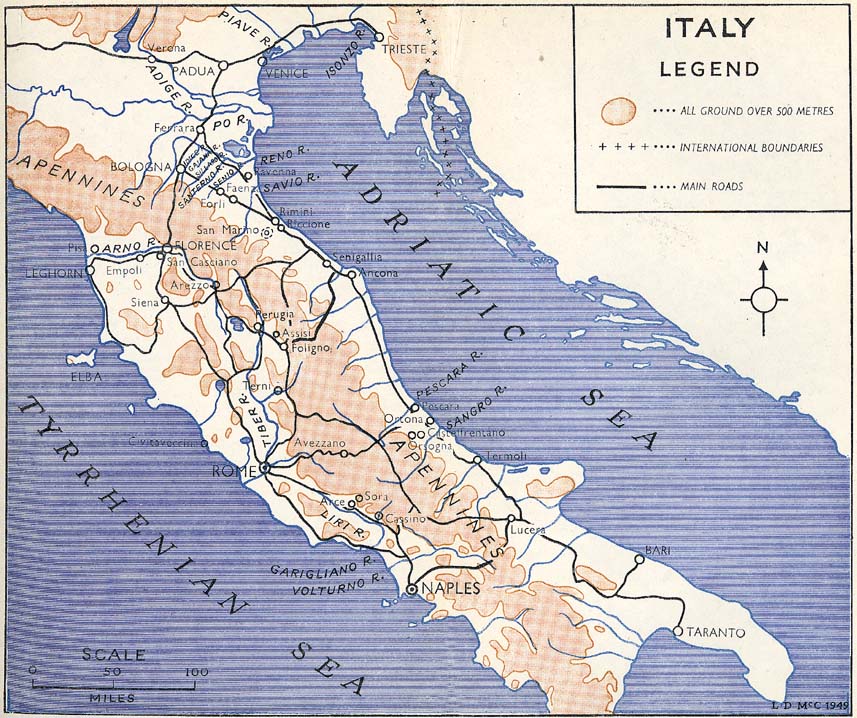
The Allies were nearing the strongest belt of prepared defences yet encountered in Italy, the German 'Winter Line', made the more formidable by swift-flowing rivers, steep and muddy ridges, and the precipitous crags of the Apennines. Varying in depth up to 20 miles, it spanned the waist of Italy from the Sangro to the mouth of the Garigliano River in the Gulf of Gaeta. In order to break through this barricade across the roads to Rome, Eighth Army was concentrating its main effort between the confluence of the Sangro and Aventino rivers and the Adriatic, simultaneously attempting to deceive the enemy into believing that an attack was about to be made on the mountain front. It was hoped that when bridgeheads across the Sangro had been established a swift breakthrough would follow, ending with the cutting of the important lateral road between Rome and Pescara, and perhaps with the fall of Rome itself. The New Zealand Division, having taken up positions secretly, was to cross the Sangro and press on with all speed, cutting the enemy's prepared Winter Line positions, capturing Castelfrentano, Guardiagrele and Orsogna, and finally Chieti. Approaches to the Sangro were overlooked by the high ridgetop towns of Tornareccio, Archi, and Perano, which were still in enemy hands, when, on 14 November, the New Zealand Division assumed responsibility for the left flank sector of the Eighth Army line formerly held by 8 Indian Division. In order to keep the arrival of the New Zealanders a secret until the last possible moment, 19 Indian Infantry Brigade was placed under New Zealand command and given the task of driving the enemy off the ridges south of the river.
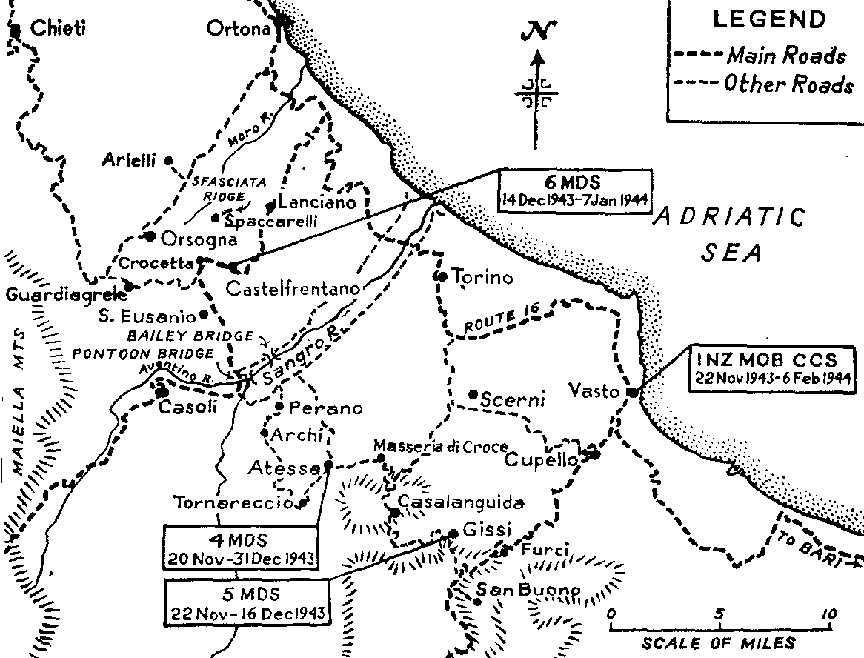
Tornareccio was captured by the Indians on the night of 14-15 November. Heavy rain during the night drenched the countryside, so that vehicles found the soaked ground impassable on the morning of the 15th. Under leaden skies, with heavy rain falling at intervals, the Divisional Cavalry, the artillery, and part of 4 Armoured Brigade prepared for action. With great difficulty in seas of sticky, clinging mud, artillery regiments moved forward to support the attack beyond Atessa. A Company of 4 Field Ambulance, under Maj W. M. Platts,(1) moved up from Furci to Casalanguida next morning and established an ADS in the local tavern. The route through Furci, Gissi, and Atessa was over a country road with all bridges and culverts destroyed and unsuitable for dense traffic. The distance, as the crow flies, was four miles; by road it was about twelve miles, and this represented a day's journey. On the day before A Company occupied the tavern the landlord had been arrested as a Fascist and obstructionist. The New Zealanders, however, were able to negotiate successfully with the landlord's representative regarding the use of the rooms.
More rain and even deeper mud handicapped operations on the 18th, when New Zealand armour went into action for the first time. After stubbornly resisting the Punjabis and the New Zealand tanks, the enemy withdrew from Perano, then demolished the only remaining bridge across the Sangro.
During the early hours of 19 November, 6 Brigade moved up to occupy front-line positions overlooking the road and the river flats between two tributary streams of the Sangro, the Pianello and the Apello. The trucks of 4 Field Ambulance had to struggle painfully over crowded mountain roads, rapidly breaking up under heavy traffic and constant rain, to reach Gissi, where it was intended the MDS should operate in the coming battle. Although the distance to the forward dressing stations was not great, it soon became apparent that the time taken to traverse the winding hill roads with their many demolitions was far too long to suit the needs of an efficient medical service. Consequently, on the 20th the reception, evacuation, and operating sections, together with the transfusion unit, cooks' and orderly-room trucks and signal van, moved ten miles in the pouring rain to Atessa. At Gissi 5 Field Ambulance, moving up from San Buono, took over the building to run an MDS for sick, and 6 Field Ambulance reached the town on 23 November.
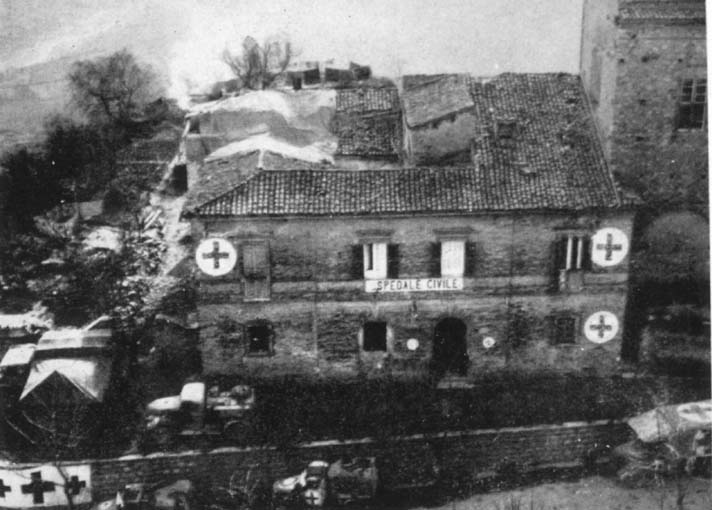
Faced with the task of taking all New Zealand cases and doing all the operative work in the coming action, 4 Field Ambulance established an MDS in the civil hospital in Atessa, which it took over from 6 ADS. The building, which had been knocked about by shelling and the roof repaired with canvas, was still occupied in parts by nuns engaged in nursing civilian sick and wounded in wards on the ground floor. It was decided that the civil hospital was too cramped for use other than as an operating centre. Part of the unit, therefore, moved into the school and established a dressing station, sending the cases requiring operation to the surgical centre in the hospital building which was equipped with two theatres. Capt A. W. Douglas, with his surgical team, and Capt J. M. Staveley, with the transfusion unit, had joined the MDS for the coming battle.
By the morning of 21 November New Zealand troops were securely established on the southern edge of the Sangro river flats. Orders were issued that 2 NZ Division would cross the Sangro and establish a bridgehead from which to continue the advance. However, weather interfered and the attack, which was to have been launched on the night of 21-22 November, was postponed from day to day. On the 26th the river was high and running 1-5 knots; patrols seeking crossing places were at times swept from their feet. Finally, zero hour was fixed at 2.45 a.m. on the 28th.
The operation was of a type completely new to 2 NZ Division medical units. In earlier campaigns the field ambulances had almost invariably been able to collect patients from the RAPs by ambulance car. In the Sangro crossing, however, the regimental medical officers with their staffs and equipment were to move forward on foot; and between the RAPs and the ADS there would he a swiftly-flowing, ice-cold river, fordable only with difficulty even in the most favourable places.
It was certain that there would be casualties before bridges could be erected and ambulance cars could get through. The collection of casualties forward of the RAPs would have to be done by stretcher-bearers as usual, augmented when possible by jeeps, and evacuation from RAP to ADS would have to be by the same slow and laborious means.
The Strada Sangritada, the lateral road on the south bank of the Sangro, was the point nearest to the river to which it would be practicable to run ADS ambulance cars during the infantry crossing. Along this road, opposite the assault area, were the battalions of 5 and 6 Infantry Brigades, and on the evening of the operation car posts, with two four-wheel -drive ambulance cars and one jeep fitted with a two-stretcher frame, would be established. Two ADS stretcher squads and four battalion bearer squads were detailed to cross the river with each medical officer to carry back the wounded.
The ADS bearers were also to be prepared to carry back across the river to the car posts any casualty whose chances of survival would be endangered by an enforced wait at the RAP for the completion of the bridges and the arrival of the ambulance cars. At the ADSs, preparations were made for the treatment of the inevitably large number of cases who would be suffering from shock as a result of the delay in evacuation and the cold, wet conditions.
After handing over to 4 MDS at Atessa, B Company, 6 Field Ambulance, under Maj Edmundson, as ADS for 6 Brigade, had moved forward five miles to set up in a farmhouse about half a mile from the Via Sangritada. Most of the men installed themselves in a thatched hut, bedding down beneath racks of drying tobacco leaves. Others dug in and erected bivvies. As, from day to day, the attack was postponed, the company had little to do beyond treating and evacuating an occasional casualty and attending to a trickle of sickness cases. The area was in sight of the German positions; but no Red Cross signs were displayed as it was thought that they would give away positions of troops and indicate the point selected for the river-crossing. Consequently, the house came in for its share of shellfire.
On 23 November several shells landed in the area, hitting three parked Engineers' trucks, wounding several men, and blowing up a compressor. It was growing too hot a spot for a dressing station, and the company packed up the equipment and moved into the bed of a nearby stream, a tributary of the Sangro, and set up among thickets of bamboo, the men digging themselves into the muddy banks. It was a desolate place. The nights were cold and the days dismal, and rainstorms were heavy and frequent. With the movement of troops and transport, the countryside slowly disappeared under the mud.
B Company, 5 Field Ambulance, under Maj MacCormac, as ADS for 5 Brigade, had accompanied the brigade to the south of the Sangro on its five-day journey from Taranto, beginning on 18 November. When the ADS arrived at its destination, the Germans arranged a stirring welcome by dropping several shells in its area. The shelling continued on and off, two duds finally damaging the latrine. After that the vehicles were taken farther round the hill, out of sight of the German observation posts, and things quietened down. On the 26th the ADS moved two miles farther up, to a valley one mile behind the start line, and awaited the coming attack.
Although the skies remained heavy and low with cloud, and the wind bleak and cold, the rain ceased at last and the river began to fall. Throughout the 26th and 27th medium and fighter-bombers of the RAF flew over to batter the German defences. At 7.30 p.m. on the 27th the stretcher-bearers from 5 and 6 ADSs went to the battalion positions. Two and a half hours later they moved forward in pitch darkness with the files of infantrymen, squelching through the mud and wading across the icy streams of the Sangro riverbed. The main stream was waist-deep, with a swift, powerful current. Struggling with the stretchers, and almost paralysed by the cold, it was only with difficulty that they managed to keep their feet.
The battalions reached the northern bank and waited in silence until 2.45 a.m., when the artillery barrage opened and the infantry advanced to the attack. The medical officers and stretcher-bearers followed up and established the RAPs in suitable farm buildings. The teams attached to the 25 Battalion RAP found themselves approaching the crest of the low hills that rise from the bank of the river. Coming under shell and machine-gun fire, they were compelled to move back down the slope. The 26 Battalion RAP, with two stretcher-bearer teams attached, occupied a farmhouse at the foot of the heights, where they were sheltered from machine-gun fire but came in for a considerable amount of shelling. One ADS team only was attached to each of the 21, 23, and 24 Battalion RAPs.
The men from the ADSs worked with the RAP personnel, treating casualties brought in by the regimental stretcher-bearers, until about 2.30 p.m. They then assisted in the search for casualties left lying in the wake of the advance. Two teams went out to collect a number of wounded reported lying in minefields to the rear of 26 Battalion RAP. It was nerve-wracking work, each man treading with involuntary but futile caution in the darkness. Only one man was unfortunate enough to tread on a mine. Evacuated with ankles shattered and extensive body wounds, he died in the CCS a week later.
Throughout the night engineers had worked on the construction of two bridges, a Bailey bridge for 5 Brigade and a pontoon bridge on the 6 Brigade sector. At 8.10 a.m. the pontoon bridge received a direct hit which destroyed one span, killed nine men, and wounded several more. It was then subjected to continuous, accurate shellfire that made further progress impossible. The Bailey bridge was completed and had to suffice for both brigades, constituting a disheartening bottleneck. For the casualties accumulating at the RAPs the delay was serious. As the morning wore on it seemed that some of the more urgent cases would have to be carried back across the river, an operation that might have ended in disaster.
However, at half past ten the first ambulance car appeared at the 26 Battalion RAP, and at the sight of one load of casualties leaving for 6 ADS the situation seemed less desperate. After another long wait, ambulance cars and jeeps began to arrive at all RAPs. The stretcher-bearers carried on searching for wounded. Finally, their work finished, they made their way back to the ADS by twos and threes, helping walking wounded across the river en route.
Inside the shelters, with sterile instruments laid out ready and stretchers mounted over stoves for the treatment of shock, the orderlies on duty at the ADSs awaited the first casualties. A few, wounded by mines in the riverbed, arrived at 8.30 a.m., but the rush did not start until the evacuation from the RAPs across the river began. Many were in poor shape, urgently needing warmth and blood transfusions.
The stream of wounded continued throughout the day. There was no further shelling in the vicinity of 6 ADS. The German gunners seemed to be concentrating on the destruction of the Bailey bridge; but, in spite of heavy fire, it escaped damage. Admissions eased off during the night, and the orderlies were able to catch up on a little sleep. By ones and twos the stretcher-bearers arrived exhausted, and turned in. On the 29th, casualties merely trickled through. Among them were Italian civilians, Germans, and conscripted Poles in German uniform.
Having failed to destroy the bridge by shellfire, the enemy began bombing and strafing it. but again was unsuccessful. The RAF took a hand in this activity, and soon dogfights were in progress over the river.
The first patients, mainly mine casualties, reached 4 MDS about 10 a.m. Heavy shelling and mortaring of the bridges and deep mud on the north bank of the river, negotiable only by jeeps fitted with chains, was delaying the evacuation of casualties. Most of the battalions were equipped with jeeps fitted with stretcher gear made in the divisional workshops. A constant stream of wounded all day until past midnight gave the attached surgical teams and the unit operating teams no let-up. Altogether 131 casualties were admitted and 110 evacuated during the day. With each ambulance car able to make only one trip back to Vasto, it looked at one stage as though the medical units would be short of transport, but the situation was relieved in the afternoon by the arrival of ten American Field Service ambulance cars.
On 29 November 42 wounded were admitted, 14 of them being Germans. Evacuation to the CCS proceeded smoothly, the MDS being emptied of all the previous day's admissions, with the exception of abdominal cases and a few men so seriously wounded in chest and limbs that they were unable to travel.
Just before the battle, 1 Mobile CCS, under Lt-Col Button, had moved up. The Heavy Section, under Maj Brown, stopped at San Severo to provide a staging post near the railhead there, but the Light Section went 70 miles farther up the coast to Vasto, where a large three-storied building held by 5 Field Ambulance was occupied on 22 November. The first casualties were received next day. On the 28th came the wounded from the Sangro crossing, 100 being admitted during the afternoon and evening.
The journey by ambulance car from 4 MDS at Atessa was over treacherous, rough roads. Though only a distance of 30 miles, the ambulances often took four to five hours on the journey, which was via 8 Indian Division's supply route through Scerni and Cupello to Vasto. At night, in blackout conditions, the going was much slower and not without hazard, there being ever the danger of the ambulance slipping off the road in the mud. Frequently there were delays when heavy army trucks skidded across the road and blocked it. Patients, not to mention the drivers, were very fatigued when they eventually arrived at Vasto, and greatly appreciated a wash and the comfort of new dressings, pyjamas, and, above all, a hot meal.
Since abdominal cases would hardly have survived the trip by this route, they were retained at the MDS at Atessa. Several of these serious cases were being held, and on 1 December the CCS sent forward two nursing sisters, Sisters Simpson(2) and Cannell,(3) to provide the special post-operative nursing that these patients required. This was the first time that sisters had worked in an active MDS. The sisters (Sister Ussher[4] replacing Sister Simpson) remained at the MDS for three weeks.
By last light on 30 November the infantry were about four miles north of the river and approaching Castelfrentano. The ADSs received orders to follow up, and at half past five next morning B Company, 6 Field Ambulance, moved forward, crossed the river, and set up again outside another farmhouse on the ridge above the north bank. It was a bleak, exposed position. The men dug in, working in a high, cold wind and driving rain. Throughout the day a few casualties were carried in, and were treated and sent on to 4 MDS.
During the day B Company, 5 Field Ambulance, moved across the Sangro and set up again on a cart track on the northern bank, about three miles east of the main road to Castelfrentano. There were dogfights overhead as the company was crossing the Bailey bridge, and one German aircraft came crashing down.
Batteries of artillery, sited a short distance to the rear of 6 ADS, were firing over the dressing station, and every report seemed to slam against the canvas of the shelters. At times enemy aircraft bombed the gun Positions, but it was apparent that the pilots made every effort to avoid the Red Cross.
At 7 a.m. on 2 December, 24 Battalion entered Castelfrentano, and by twenty minutes past eight the town was cleared of enemy troops. At midday 6 ADS packed up equipment preparatory to moving forward. While the company waited, about 20 German fighters passed overhead and again bombed the bridge. Again they failed to hit it. An hour later the company moved up the winding road to Castelfrentano and established the ADS in the school, a strong, three-storied building of modern construction. 5 ADS was now about a mile and a half south-east of the town.
Clustered on the highest point of a range of hills, Castelfrentano was in full view of enemy-held Orsogna, which lay to the northwest, sprawled along the top of the next ridge. Consequently, blackout precautions had to be rigidly observed. The largest building in the town, the school, towered above the surrounding houses, and on arrival 6 ADS set to work nailing blankets over its rows of blown-in windows.
The infantry were advancing across the valley beyond, and throughout the afternoon and night casualty-laden, mud-plastered jeeps and ambulance cars moved in and out of the school yard. The artillery had moved up into the valleys on either side of the town, which rocked to the gunfire when, at first light on 3 December, 6 Brigade made an unsuccessful attempt to advance through Orsogna. The enemy appeared to be determined to hold the village and ridge at all costs.
Castelfrentano was frequently shelled during the days that followed, and many civilians were injured. The ADS invariably admitted and treated them, though orderlies and medical officers had their hands full with the stream of casualties from the forward units. Familiar as they were with shocking injuries and death, the men were moved to pity at the sight of wounded and bewildered children who could not understand the disaster that had overtaken them.
Patients were evacuated down the main road to the Bailey bridge. It was a good route, given good conditions; but the Sangro was rising again, and ambulance cars were often delayed by traffic jams and mud. Despite the fact that patients were transferred at the A Company, 6 Field Ambulance car post, under Capt H. S. Douglas,(5) on the south bank, ambulance cars were away for three and four hours at a time on each trip. By nightfall on the 3rd the approach to the Bailey bridge had so deteriorated that it was practically impossible to cross in darkness. One driver took through a load of abdominal cases urgently needing surgical attention, but the remainder of the casualties were kept at the ADS until morning. With further rain on the 4th, the Bailey bridge was out of reach by midday.
HQ 6 Field Ambulance was ordered to move to the north bank of the Sangro on the 5th. In the morning, however, though the weather was fine, the river was still in flood. The pontoon bridge, which had finally been completed on the 6 Brigade axis, had been washed away during the night.
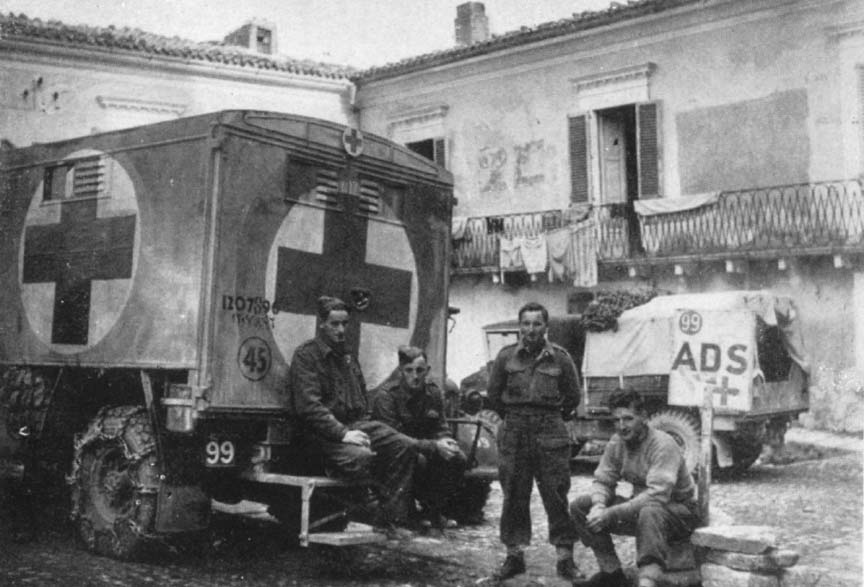
The unit left Masseria di Croce after lunch, by-passed Atessa, and became enmeshed in miles of banked-up transport at the one-way Bailey bridge. Trucks were bogged and in the process of being hauled out, and wheels spun in the morass of the recently flooded approaches. Finally reaching the other side, HQ moved up a rough, deeply-rutted track to a sodden, ploughed field that had been planted in wheat. The field contained a few red farm buildings; but they were too dirty and evil-smelling to be of any use. Fortunately there were two large straw stacks near the buildings, and the straw served to keep bedrolls from the muddy earth.
Immediately on arrival, the CO (Lt-Col Fisher) visited the ADMS (Col King), who instructed him to transfer the unit operating, resuscitation and post-operative nursing teams to 4 ADS, under Capt J. S. McVeigh,(6) situated in farm buildings near the junction of the Sangro and Aventino rivers, on the main road south from Castelfrentano, where they would be in a position to perform immediately any necessary surgery should the river again become impassable.
 |
 |
 |
 |
The enemy continued to shell Castelfrentano and the surrounding roads. Airbursts exploded around the church tower, where a flash. spotter was operating, and often at night shells sizzled over the roof of the school where 6 ADS was, causing the occupants of the top floor to think uneasily of the flimsy covering of tiles above their heads. Many Italian civilians were killed and wounded. Though dwelling in a town of some 13,000 inhabitants, they were largely peasantry, part of the region in which they had been reared, and they seemed incapable of tearing themselves away. One afternoon a pale, thin, unhappy-looking Italian wandered into the ADS building and played for hours on the school piano. He played beautiful music exquisitely, while outside was the clamour of gunfire, and farther down the street shells crashed among the buildings.
The flow of casualties gradually slackened until the 7th, when 6 Brigade made a daylight attack on Orsogna. The ADSs sent stretcher teams forward to a Bailey bridge, where the secondary road from Castelfrentano to Orsogna crossed the Moro River at the village of Spaccarelli. Their job was to carry casualties across in the event of the bridge being destroyed.
The barrage opened at 1 p.m. From the northern windows of the school building, to which 5 ADS had also moved, the shells could be seen creeping up the opposite ridge and exploding among the buildings. The 25-pounders began firing 300 yards ahead of the advanced positions and worked forward, while the mediums bombarded Orsogna itself. Gradually the 25-pounders lifted, until the whole concentration was pouring into the yellow-brown pall of smoke that covered the village. Medium and fighter-bombers flew over continuously until the smoke made accurate bombing impossible.
The infantry advanced up the slopes through shell, machine-gun, and nebelwerfer fire, and fought their way into Orsogna. The tanks were held up by a road demolition at the entrance to the village, and on finally passing it were unable to advance further in the face of fire from enemy tanks concealed in houses and alleyways. The infantry, still fighting in the village, were compelled to retire to their original positions on the withdrawal of the armour at 4 a.m. on the 8th.
The bridge across the Moro remained undamaged, and casualties were taken back to the ADSs steadily and without delay. There were fewer than had been expected, and the rush was over by nightfall.
The first wounded from the attack reached 4 MDS at Atessa at 5 p.m., and 71 had been admitted by midnight. Through the night and the next day and night, the MDS worked continuously to full operative capacity. On the 8th, when 166 casualties were admitted and 159 transferred, the road to Vasto was clearer, and it was possible for ambulance cars to make the return trip to the CCS in five hours instead of a whole day. Two more surgical teams were attached during the day, one from 5 Field Ambulance, under Capt Cowie,(7) and another from 127 British Paratroop Field Ambulance. By the 9th the rush was over, though there were over sixty admissions on that and the succeeding day.
Fighter-bombers again attacked Orsogna during the morning of the 8th. Then seven Me109s dived on Castelfrentano and bombed it. The guns fired continuously, day and night, and the dust of shellbursts hung over Orsogna, which was beginning to acquire among the Italians the name of Piccola Stalingrada!
By this time the troops were making friends among the civilians. To many of the ADS staff. 'off duty' meant sitting in some amiable family circle, feet up to the charcoal brazier, or, with infinite gentleness, treating burns, boils, and pimples on the anatomies of signorine.
The weather grew colder and the winds more bleak and piercing. At times the hills and the mountains to the west, the Montagna della Maiella, disappeared in thick fog, and dull reports and dim, watery flashes were the only signs of the guns down in the valley.
For two days the countryside remained blanketed in fog. The situation was comparatively quiet, and as many sick as wounded were passing through the ADSs.
On 14 December 6 MDS moved west to the main road and proceeded to Castelfrentano to establish an MDS in the school. Lt-Col Fisher left at 8 a.m., and the remainder of the vehicles moved individually throughout the day. This precaution was considered necessary as a long stretch of the road, lying below and in full view of Orsogna, was subjected to spasmodic shelling.
The road was muddy and churned up by tires and wheel chains. The trucks wound up the steep valley from the river, passing dumps of stacked ammunition, batteries of medium guns and 25-pounders, and roadside notices forbidding the use of headlights. Some of the guns were silent; others were firing in the direction of Orsogna, a line of buildings along the ridge ahead, overlooking the valley. Crossing the railway at Crocetta, they emerged on to a stretch of road running past the smashed brickworks and up the final slope to Castelfrentano, where down-coming traffic was flying past at a reckless, speedway pace, and the trucks going up were pushed unmercifully in the drivers' anxiety to reach cover. This was the 'Mad Mile' of the Orsogna battles. In full view of the German positions, it was frequently and accurately plastered with shells. To the apprehension of the orderly room staff, their truck suddenly developed transmission trouble and barely managed to limp round a bend into shelter before coming to a stop. It was towed the last 400 yards into Castelfrentano, and the unit squeezed its vehicles into the tight mass of trucks and houses and set up immediately. Attached to the unit were 1 General Hospital surgical unit, a British surgical team, and 102 Mobile VD Treatment Centre, one of the two Base treatment centres having been made mobile to treat venereal disease within the Division.
After days of rain and mud, which postponed all projected operations, it was decided that 5 Brigade, with 18 and 20 Armoured Regiments under command, would attack to cut the Orsogna-Ortona road. Zero hour was set at 1 a.m. on 15 December. On the 14th a section of B Company, 5 Field Ambulance, left Castelfrentano by jeeps and ambulance cars and travelled to the foot of the Sfasciata Ridge, where an ambulance car post was established. From there equipment was carried by jeep westward along the ridge. The forward resuscitation post was set up on the ridge and ready to operate by 12.30 a.m. Half an hour later the attack started, and at 1.30 a.m. the first casualties were arriving. On the 15th, 115 casualties were treated and seven blood transfusions given.
On the muddy slopes it often took six men to carry one of the wounded, and additional stretcher-bearers were required. More of B Company and the men from the brigade band shared in the toil. During rush periods assistance was given by the medical officers of 18 and 20 Armoured Regiments, Capts S. B. Thompson(8) and E. O. Dawson.(9)
The stretcher-bearer reinforcements were roused from their beds in their snug Castelfrentano houses at 2.45 a.m. on the 15th. They set off on foot, down the hill and across several valleys and streams, arriving at the 23 Battalion RAP at half past four, where they spent the rest of the night bedded down in a ditch. Heavy gunfire continued until daybreak, making sleep impossible. At 6 a.m. the men were placed in relay stretcher squads between the 21 Battalion RAP and the resuscitation post. Shortly afterwards casualties, mostly Maoris, began trickling back from the RAP. About seven o'clock biscuits and bully beef were sent along. German aircraft bombed points here and there, and the region was lightly shelled more or less continuously. The situation was distinctly unpleasant, and did not improve when American aircraft came over and bombed the region, killing one New Zealander. By 3.30 p.m. the RAPs were clear and the stretcher-bearers returned, some to the ADS and others to remain at the resuscitation post.
The first casualties reached 6 MDS at 2 a.m. and kept it moderately busy; three operating teams were at work by 9 a.m.
Night after night these men of B Company, 5 Field Ambulance, went forward, carrying back from the RAPs, until by the 22nd, the whole company was up on the Sfasciata Ridge and a full ADS was established. Engineers had been at work improving the track up to the location, and it was now accessible to ambulance cars. S-Sgt H. W. Burley(10) worked ahead of the skeleton ADS assisting and directing the stretcher-bearing, and was awarded the Military Medal.
Castelfrentano settled down to another spell of comparative quietness. Women plodded up the tracks from the fields with loads of laboriously gathered firewood. The old men stood and talked in front of the AMGOT office. Soldiers in their leather jerkins and rolled-up balaclavas, and girls with New Zealand badges pinned to their coats and jumpers, strolled in the street. Casualties were few, though the Germans methodically shelled gun positions and road junctions each night and occasionally bombarded the town. When not being bombed Orsogna looked quiet and peaceful, and many civilians asserted that the enemy had withdrawn. Members of 5 ADS doubted this when they turned out to play a game of soccer in a field below the town and were immediately scattered by airbursts.
By this time 4 Field Hygiene Section, under Maj H. T. Knights,(11) had installed its hot-shower plant in a house about a mile to the south of the town, and in spite of the miserable, bitterly cold weather the showers were always crowded. Privacy was unnecessary. Italian women filled cans and buckets from a canvas water tank at the front of the house, without so much as a casual glance at the naked men darting in and out of the doorway. In another house on the Orsogna side, the NZ YMCA opened a canteen where soldiers could buy tea and biscuits and read ancient copies of New Zealand illustrated papers. The Mobile Cinema Unit had arrived and was screening films to crowded houses of New Zealanders and Tommies in the local theatre, a hall at the southern end of the school building.
Completely blocking the advance, Orsogna was turning out to be a tough nut to crack. Actually, it was too tough a nut; but that was not realised yet.
Throughout the afternoon of the 23rd bombers had roared over Castelfrentano, and great fountains of smoke and debris sprang up from the buildings of Orsogna. In the early hours of the 24th an attempt was made to split the enemy forces and turn the Orsogna defences from the north. Following a heavy barrage, 5 Brigade advanced behind Orsogna from the east to capture Fontegrande, a hill feature to the north.
Casualties were carried from the RAPs by tottering stretcherbearers to the resuscitation post, whence the jeep drivers would, after reassuring the patients of the strength and security of the flimsy-looking stretcher frames, take them to the car posts over the track running along the crest of Sfasciata Ridge. At the car posts the wounded were transferred to four-wheel-drive ambulance cars for the journey to the ADS. There was heavy shelling during the day, some bursts landing on the ridge above the ADS.
The ambulance drivers and orderlies going from the ADS to the MDS had an unenviable time, traversing the Mad Mile as rapidly as possible, yet compelled to keep down the speed to avoid endangering the lives of the wounded. Often the ambulances were trailed by other vehicles whose drivers, naturally enough, wished to share the protection of the Red Cross.
The MDS at Castelfrentano worked steadily. The casualties were carried from the ambulance cars by stretcher-bearers drawn from A Company and the attached ASC, and deposited in the reception section room. The section took them in the order of their urgency, treated their wounds, and sent them to the evacuation section for nursing care until they could be despatched back to the CCS, or else sent them on to the operating theatre. There was seldom a let-up.
'Always there were casualties lying awaiting attention,' wrote Pte H. Brennan.(12) 'No sooner was one load dealt with than the stretcher-bearers were staggering in with another load. A man would be carried in moaning with every breath. Another, wounded in the head, squirmed continuously, like an impaled insect, until he died. A Maori, with a hole brimming with blood in his thigh, seemed ashamed because the flesh quivered away from the scalpel, and tried to hold it still by gripping firmly around the limb above the wound. Always, at about midnight, came the day's casualties from the Parachute Regiment, from whose position away on the flank it was possible to evacuate only at night.
'All the theatres were operating continuously. There the torn, mangled, often filthy flesh was removed, to be replaced by so many clean, sharp cuts, with locked artery forceps hanging to each lip. The teams were quiet, the work going steadily forward. Under !he circle of light from the cluster of bulbs overhead, all attention centred on the incision in which the surgeon was working at the time. Simultaneously, a tray of freshly sterilised instruments was being prepared for the next patient, still in reception awaiting his turn or perhaps in the heated atmosphere of the resuscitation room, where men lay on stretchers propped over kerosene heaters, and the bottles of blood on the frames attached to the recipients' stretchers looked like thick, red jellies.
'In the room set aside for abdominal post-operative care, men were constantly and carefully being restored to positions from which they involuntarily moved or slid down. There was a continual moaning and gasping, and a continual demand for attention. A patient would be vomiting half-digested blood over his blankets and the floor, while the orderlies would be too busy with others to attend to him. From time to time, in the middle of such scenes, there would be the arrival of a new case from the theatre.
'With blankets and twine the sanitary squad sewed bodies into surprisingly shapely bundles, to be buried in the graveyard near the crossroads below the town. On one occasion the Germans opened fire on the cemetery area during a burial service, sending the gravediggers diving headlong into spare graves.'
On Christmas Day 6 Brigade relieved 5 Brigade on the sector east of Orsogna. B Company, 6 Field Ambulance, left Castelfrentano on the 25th and 26th, and moved down the muddy, shell-cratered road into the valley, then north through the hills to the Moro River to relieve 5 ADS. Though the ADS area was on a slope, the ground was so muddy that the vehicles had to be manoeuvred into position by bulldozers. The tarpaulin shelters were erected with difficulty and the men dug themselves into the hillside.
The rain continued through the night of the 27th, and the stretcher-carrying jeeps and Humber ambulance cars had difficulty in reaching the RAPs. However, the weather gradually improved, the rain disappearing before a bitterly cold wind that dried and hardened the ground. There were few casualties, which was fortunate, perhaps, for the ambulance drivers and orderlies, as the Germans were shelling and mortaring the roads fairly consistently.
In spite of the miserable conditions, Christmas was made to be a success in all of the field medical units. At 5 ADS the men had been sleeping under haystacks, in barns and implement sheds, or under any cover that was handy, but a tarpaulin shelter was erected for the celebrations. The men came back from the resuscitation post in time for Christmas dinner, after being relieved by B Company, 6 Field Ambulance. The latter company had to postpone its dinner until the 27th, when the weather was still cold and wet
Each man was issued with two bottles of beer; there were so many non-drinkers in the company that the others had enough to lift them beyond the influence of such clogging details as rain and mud.
At 6 MDS celebrations did not take place until the 26th. The men sat in the long school corridor at tables laid with beer, cigarettes, fruit and nuts. The officers and sergeants served the meal of turkey and plum pudding. The guns were still firing outside, and ambulance cars whined up the narrow lane into the courtyard. Little time was wasted over the meal. The Colonel made a short speech, comparing the occasion with the previous Christmas spent on the Gulf of Sirte, and everyone washed up and returned to duty. In the school at Atessa, 4 MDS likewise enjoyed their dinner, distinguished by turkey, pork, and vino; and so did the other units, 4 ADS, 4 Field Hygiene Section, and 5 MDS. The latter was in reserve near the village of Perano, where there was a Methodist church. The minister held a special Christmas service for the staff ---the first Italian service for those Protestants who attended. Two or three days before Christmas, one of the sergeants formed a carol party. He borrowed the church organ and at evening the party sallied forth on a tour of the neighbouring farmhouses, serenading the occupants with carols sung in close harmony. The local inhabitants did not know quite what to make of this fresh evidence of Kiwi peculiarity; but on the whole they were very friendly. They brought out the children and the vino and soon caught on to the idea.
Just before leaving San Buono, a 5 Field Ambulance corporal had acquired a pig and had carried it forward with a view to augmenting the Christmas rations. It may have just been a coincidence that the corporal was walking around barefoot for the next few days. The pig was named Bernie, after its master, and kept in a pen, where it devoured all the unit's scraps. Unfortunately, a fortnight before Christmas he decided to supplement his diet by sampling a large tin of red paint. It was thought advisable to close his colourful career with the unit, and he was sold to one of the local inhabitants, who appreciated the point of the deal and duly handed over a dud 500-lire note.
The month of December was particularly busy for 3 General Hospital. The work of establishing the hospital, the devastating air raid, and the flow of casualties from the Division all combined to produce a desperate contest between the provision of equipped beds and the rising bed-state. At times, stretchers had to be placed in corridors and unfinished parts of Beirut block, but amazing efforts by the Royal Engineers and unit staff had 1020 beds available by the end of the month. During this month 1611 patients were admitted; the average daily number of seriously ill cases was 38, and at the end of the month 54.
In spite of the bleak weather, a sad change from that only recently experienced in previous sites, both patients and staff managed to capture something of the spirit of Christmas. On Christmas Eve a party of carol singers toured the wards, the sisters being dressed in their red cloaks and carrying lanterns. All wards, messes, and also the patients' dining hall were colourfully decorated. An Italian orchestra was engaged, playing in the wards first, and later during the up-patients' dinner on Christmas Day. Each patient received a menu, printed on an airgraph and incorporating Christmas designs with a scene typical of the location of the hospital. During the afternoon the 6 Brigade band played selections in the hospital compound, while the day ended with an impromptu concert by patients, mainly Maoris.
So passed 1943, a year during which the hospital had operated in three different continents, at places totalling 2500 miles apart. Preconceived ideas of 'blue Italian skies' had been rudely shattered by the reality of a bitter European winter.
On New Year's Eve the cold on the Sangro front grew more intense. The wind stung the skin like needles of ice. At 6 MDS many rooms had been fitted with home-made, oil-drum stoves, with lengths of galvanised iron piping through the windows for chimneys. The stoves did not draw very well, and the men moved dimly through acrid smoke and thickly-floating flakes of carbon from the oil used to boost the fires. Snow began to fall about 8 p.m. When the church bells rang in the new year, the night was all flurrying whiteness. The blankets nailed over the empty window frames were. no protection whatever, and the snow whirled in to form drifts in rooms and corridors.
Later in the morning the snow began to melt and flow over the floors in streams of slushy water. A working party was detailed to clear the second-floor corridor, where it lay six inches deep. They shovelled snow rapidly through the windows until brought to a halt by the disgusted drivers of vehicles parked beneath. They then adopted the slower but more reasonable method of carrying it out.
With the interior more or less in order, the unit turned out to clear the street. Pickaxes were needed as the snow had already been packed to an ice-like hardness by the passing traffic. After two hours of solid work, with only an occasional snow battle, it was finally cleared. The men leaned on their shovels and viewed the scene of their labour with a satisfaction that suddenly evaporated when a bulldozer appeared, sent for the specific purpose of clearing the street.
There was little activity at 6 ADS. The cold was numbing and the men remained in their bivvies, crouched around potato-tin braziers. They emerged only at meal-times to slosh through the deep mud to the cooks' truck. Early on New Year's Day the weight of snow became too much for the bivvies. One after another they collapsed; many of the occupants, startled out of sleep, had some difficulty in getting clear. A 180-pound tent followed almost immediately; it crashed and lay thrashing on the snow as the men it had sheltered fought their way out to join other refugees in the tarpaulin shelter. Two hours or so later, when everyone had settled down again, one of the supporting poles snapped, the canvas split across, and the whole shelter subsided in a heap of snow, canvas, and struggling men. Someone mournfully, if tunefully, informed the unappreciative company that he was 'dreaming of a white Christmas'.
Bundling up what gear they could salvage, the unhappy company set off into the snowstorm and located a small bamboo-cane hut into which they all squeezed together. They shared the blankets and remained there until morning, when heavy rain turned the foot of snow and the mud beneath to a knee-deep slush.
The ADS was out of action. Walking to the cookhouse for meals presented some difficulty, and it was impossible for vehicles to enter the area. For two days casualties were taken direct from the car post to the MDS. They were few, as the snow made any big attacks impossible.
The new year brought a succession of fine days. The wind remained cold, but the skies were clear and the snow-covered hills and valleys sparkled in the sunshine. The Italian women and girls searched the fields for fuel, and plodded up the road through the snow in their pitifully inadequate makeshift footwear, carrying bundles of twigs and branches on their heads. At meal-times they gathered around the cookhouses, waiting patiently for scraps. The contribution of the Italian men to the support of homes and families was wrapped in mystery.
On 3 January 5 ADS took over from 6 ADS, 5 Brigade having relieved 6 Brigade during the night. Fortunately a heavy frost had left the ground hard enough for the vehicles to move out under their own power. On 12 January a warning order was received stating that 2 NZ Division was to be withdrawn at short notice, ostensibly to a training area south of San Severo. The medical units prepared to leave after an exacting two months' work under wintry conditions.
At Atessa, from 20 November to 31 December, 4 MDS admitted 751 battle casualties and performed 198 major operations, while at Castelfrentano from 14 December to 7 January 6 MDS received 657 wounded and performed 178 major operations. After taking over from 6 MDS at Castelfrentano on 7 January, 5 MDS under Lt-Col R. A. Elliott admitted 152 battle casualties. During its two months at Vasto the CCS handled approximately 3500 patients, including the sickness cases admitted from 5 Field Ambulance.
The withdrawal of the division took place in mid-January. As a red herring the 'training area south of San Severo' was a complete success. Even the Italian civilians had no idea where the Division was going. Once the convoys were under way, however, rumours containing a grain of truth began to circulate among the troops. Before long belief changed to conviction; the destination was the Fifth Army front.