 |  |
 |  |
WHERE to? This was the query on the lips of all. With the notification in February that all leave was to finish at the end of the month, anticipation reached a feverish pitch. A landing a at Tripoli, finishing off the North African campaign? That wouldn't be bad, but why had so many been brought back from the desert ? To Italy? But that would he too big a proposition, even though a march on Rome sounded well. To reinforce the British troops in Eritrea, Abyssinia, and Somaliland? But they seemed to be getting on well enough without help. The German threat from Bulgaria and British aid to Greece figured largely in the news and in the minds of all. Besides, had there not been lectures on malaria, and was not Salonika a malaria-ridden place, but why the issue of the much-despised topee? So did argument and counter, suggestion, rumour, and hearsay wax and wane amongst all. First in favour, and also a likely possibility, was Greece.
In such an atmosphere the men had their last leave, said good-bye to friends around Cairo (majeesh leave for a while), and in letters home hinted discreetly at irregular mails in future. With the issue of final articles of equipment, anticipation rose still higher.
As the medical units completed arrangements for their impending moves, thunderstorms, followed by dust-storms and then heavy rain, made working conditions anything but pleasant. Built up to full strength, 4 Field Ambulance, under the command of Lt-Col P. V. Graves, and 4 Field Hygiene Section, commanded by Maj B. T. Wyn Irwin, left Helwan with 4 Infantry Brigade Group on the morning of 3 March, travelling in their own transport and attached ASC trucks. The convoy followed the usual pattern---a tearing hurry at the start, then progress as if following a hearse, a succession of heartbreaking stops; but Amiriya transit camp was reached at last.
That same evening the ships bringing 5 Field Ambulance, with 5 Infantry Brigade, from England arrived at Port Tewfik. At Helwan 6 Field Ambulance, under the command of Lt-Col W. H. B. Bull, was in the throes of preparation for its move to Amiriya. As was the case in other units, rumour was running wild, and not one point of the compass was excluded as a possible destination. When, however, the unit, with 6 Infantry Brigade and HQ 2 NZ Division, joined 4 Field Ambulance and 4 Field Hygiene Section at Amiriya in the evening of 6 March, after staging the previous night at Wadi Natrun, little doubt existed in the minds of all that their destination was to be Greece.
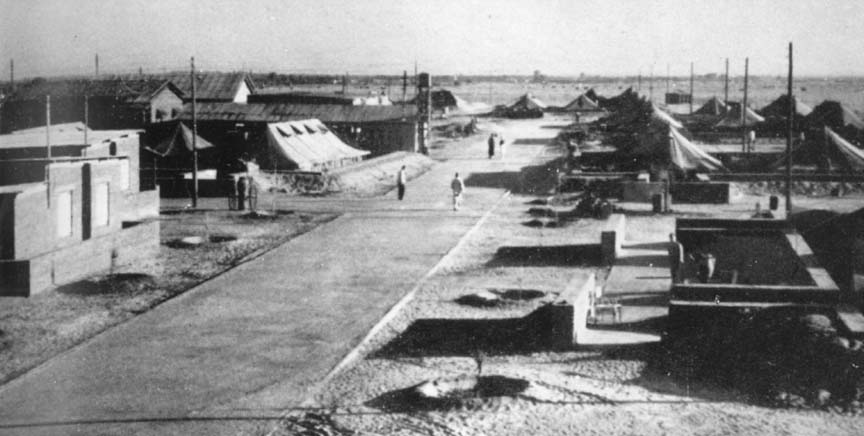
The transit camp at Amiriya was used as a concentration area for the troops prior to their embarkation from Alexandria. A great deal of work was carried out by the medical units, especially the Hygiene Section, to improve the sanitation of the camp. The lines were dirty when taken over, and the poor hygiene and sanitation arrangements had immediately to be overhauled. The camp was a bleak and comfortless stretch of sand, notorious for the strong winds, with accompanying sandstorms, so frequently encountered there. It was also within the coastal rain belt, and rain fell at times during the week or more the units spent there before moving to the ships.
The first medical unit to go to Greece was 1 General Hospital. It had been spared the trials of Amiriya, going direct from Helmieh to Alexandria by train and embarking on the Ulster Prince on 6 March. The sisters were left behind to follow three weeks later. An uneventful journey across the Mediterranean brought the unit, under Col McKillop, to Piraeus on 8 March. Two days later 4 Field Hygiene Section reached Greece on the heavy cruiser HMS York. Also on board the York was Col Kenrick, ADMS 2 NZ Division.
On several mornings during their stay at Amiriya the men of 4 Field Ambulance had heard in the early hours the regular thump of marching feet, accompanied by snatches of song or whistled tunes. Then, on 11 March, it was their turn to leave. At the ungodly hour of 3 a.m. they fell in silently in embarkation order. They rejoiced that they did not have to carry rifles as did the ASC drivers. An order or two and they marched along a pitchblack road. 'How about a cup of "chai" ? ' was a call to the cooks of a neighbouring unit busy about their fires.
Silently, for the most part, they laboured under their loads as far as a railway siding,. Then followed a shoving and a striving to get through the doorways into ancient carriages of the Egyptian State Railways. There were seats for all. From this vantage point they watched dark-skinned Empire troops plodding along the tracks with gear strung on and around them in very unorthodox fashion.
| | |
| | |
Once they started on their way, familiar scenes passed in review ---desert camps, cheery Aussies grinning and calling, orchards, unkempt villages, desolate wastes of sand and barren salt flat, marshlands in which natives poled flat-bottomed fishing boats. Myriads of mosquitoes clouded doorways and windows; fortunately either humble males or, if females, not thirsty for blood, for they left the men in peace. Against a background of distant sea, gulls wheeled and dived about a drainage outlet.
A halt speedily brought vendors of newspapers and inferior chocolate biscuits. One member of the unit bartered an Army blanket for a bottle of Dewar's whisky, and received the punishment he deserved. The label might have been Dewar's, but not the contents. Too deadly even for hardened throats, most of it went overboard.
Slowly the train passed through dingy warehouse areas while curious native workers stood at vantage points. Masts of shipping rose above the shed tops, and presently all were tumbling out on the quay at Alexandria. For days all had heard of the great liners waiting for them in the harbour. They looked around and found that by no means did the nearby vessels measure up to the rumour's standard. Shepherded along the quay past abstracted officers clutching sheaves of papers, they went up the gangway in single file to board the Greek steamer Ionia, a vessel of under 2000 tons.
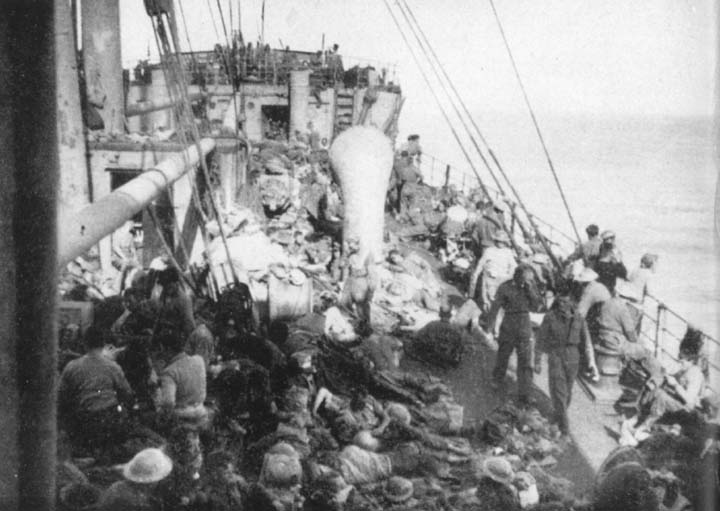
With 22 officers and 777 men accommodated in the holds and on the decks, the ship was uncomfortably cramped. There was only one galley and, with such limited cooking facilities, practically no heated food, apart from tea, was available to supplement the dry rations., of which four days' supply had been brought aboard. Deck dwellers peered down the hatch at men, mess gear, and packs pressed together in the holds, where past passengers---sheep---had left their trademark, and where the smelly air was hot and stifling.
The voyage, lasting from dawn on 12 March until the arrival at Piraeus in the early afternoon of the 15th, was uneventful, at least as far as enemy action was concerned. Rough weather, varying in severity but reaching full storm force and scattering the convoy when rounding the western end of Crete, caused much discomfort amongst the troops, many of whom had to be brought down from the upper decks and crowded below. Others were put into the after hold, which, with the vessel being constantly swept by high seas and barely maintaining steerage way, had to be battened down. The first glimpse of Greece, its snow-clad mountain ranges and steep green hills reminiscent of the New Zealand coastline, was a welcome sight after an unpleasant trip. Ashore, members of 4 Field Ambulance found their own vehicles and others waiting to take them to the pleasantly situated camp at Hymettus.
Egypt's singularly appropriate send-off to 6 Field Ambulance was a sandstorm so severe that visibility was reduced to a foot or two. The desert blizzard continued with unabated fury for several days. The men remained in their tents, since to venture outside might mean groping about for hours in a blinding vortex of dust and sand.
With HQ 2 NZ Division and the ADMS office and staff, 6 Field Ambulance boarded the SS Barpeta at Alexandria on 18 March, while 5 Field Ambulance was settling into camp at Amiriya, and arrived at Piraeus four days later. The voyage was an eventful one. Two days out the convoy was attacked by dive-bombing aircraft, which swooped down from low clouds and dropped bombs dangerously near a transport. Ships were raked with machine-gun fire and a tanker alongside the Barpeta was hit and set ablaze, but the fire was got under control, and the vessel reached port safely with the other ships of the convoy. Luckily, there were no casualties.
For more than a week the men of 5 Field Ambulance, under Lt-Col Twhigg, were employed in route marches and other training at Amiriya. Similar training had been done at Helwan while the unit collected its stores and equipment after its sea voyage from England.
Repacked and with canopies dropped to the level of cabs, unit vehicles, with as much of the equipment as possible, were sent to Alexandria on 19 March. The loading of the vehicles on the ships was most unsatisfactory. Many trucks had to dump their loads on the wharf, then vehicle and load were shipped separately. Previous experience of loss of equipment gave rise to concern as to what would happen at the port of disembarkation.
On 25 March 5 Field Ambulance learned that it would embark with other troops on the Hellenic Steamship Company's Korinthia, a passenger ship of approximately 2600 tons. The move began on the morning of the 26th. Embarkation was completed, and the transport pulled away from the docks in the afternoon to join the convoy and naval escort. One of the four escorting destroyers was a 'flak' ship, specially equipped to deal with attacks from the air.
With 54 officers and 987 other ranks crowded into holds, on decks, and in every available corner, the Korinthia was a very full ship. Facilities for washing were completely inadequate, as also were other sanitation arrangements. There were no messing facilities, and the ship's galley provided only hot water for tea. Rations consisted of bully beef and Army biscuits.
Early in the evening of 28 March an enemy bomber sneaked in out of the sun and launched a torpedo at the leading destroyer, the ship evading it by a quick turn. All escort ships opened fire on the aircraft and drove it off. It was learned later that the convoy had turned back from its original course so as to leave the seas clear for the Mediterranean Fleet, under Admiral Cunningham, to engage the Italian fleet in a very successful action known as the Battle of Cape Matapan. In the absence of the British Fleet the convoy might have been destroyed.
The ships reached Piraeus on the evening of 29 March without further incident, and disembarkation began immediately. Because of the troops' apparently unheralded arrival, no trucks were there to meet them, and they had to cover the ten and a half miles to the assembly camp at Hymettus on foot.
For all, the first sight of Greece was memorable---verdant hills, with high mountain ranges in the distance and the sun glinting on the snow. The town of Piraeus was humble and unprepossessing but Athens had a noble air---long avenues of trees, plantations, parks and gardens, grey stone houses with red tiled roofs, and cheerful smiling Greeks. The Acropolis, crowned by the Parthenon, dominated the city.
The welcome was warm. There were smiling faces everywhere. Crowds cheered and waved, some threw flowers into the trucks, others shouted greetings. On all sides the cry was 'English! Welcome!'
Through Athens, and into a quiet country atmosphere of rolling olive groves carpeted with wild flowers and shrubs, went 1 General Hospital until it reached Kephissia, a pleasant modern suburb, where it stayed in the 26 British General Hospital's area.
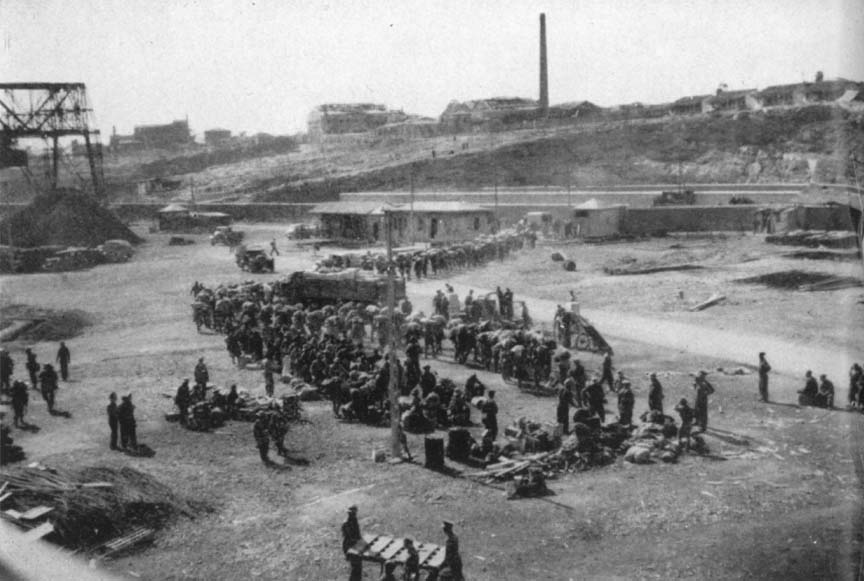
As each unit arrived in Greece it was given a brief rest in Hymettus camp before going forward to positions in the line. The camp was pleasantly situated in a spreading plantation of small pines and cypresses. Some of the men played marbles with the youngsters who crowded around, as do curious children the world over. Here commanding officers warned their men that the German Legation was still in Athens and that they were to keep their mouths shut.
For a few days the New Zealanders had an opportunity to explore Athens, to master a new currency, to get to know a most hospitable people, and to enjoy an atmosphere which was much more like home than that of Egypt. Leave in Athens was an experience to be remembered. Besides exploring its shopping areas, its tiny wine cafés and its modern restaurants, many New Zealanders made pilgrimages to the hill of the Acropolis and the Parthenon, and climbed the slopes of Mount Lykabettos. Wherever they went they were welcomed, and the hospitality of the Greeks was at once warm, spontaneous, and sincere. Although the city still preserved some air of gaiety, it was the capital of a country at war. Meat was already rationed to one day a week, there was a shortage of sugar, and Greek households had little fuel.
While there was an opportunity to see a little more of the city the New Zealanders made the most of it, finding their way by car and on foot to every farthest corner of the capital. They strolled in the parks and along miles of tree-lined streets. Some visited the King's Palace gardens, there to make friends with the famous kilted Evzones, remembering (some of them) that men worthy of the legendary heroes of Homer were even at that moment in Albania creating fresh material for legend.
Their admiration for the Greek people became the greater the more they saw of them. They were splendid folk, and at times, particularly in the smaller villages, it seemed that from the youngest child to the oldest greybeard, every living soul was doing his or her utmost for the war effort. Even the poorest had nothing but friendship and generosity with which to meet all. They were honest in the highest degree, hard workers, touchingly sincere in their hatred of Mussolini and in their welcome.
From Hymettus camp the New Zealanders went forward in a steady stream to prepare and occupy battle positions 300 miles away to the north in the Katerine area. With them went the field ambulances to make preparations for the treatment of wounded in the field and their evacuation to casualty clearing stations and general hospitals. After resting at Hymettus for a day and a half only, 4 Field Ambulance on 17 March moved with 4 Brigade by road and rail to Katerine. The majority travelled by train, which left Athens on the afternoon of 17 March and reached Katerine next day.
Passing along the streets of Athens to the station, the New Zealanders were again greeted by cheering and waving Greeks. Smiling people, young and old, lined the sidewalks giving the 'thumbs-up' sign. While the unit boarded the train, Padre Bicknell went to a nearby road siding where fruit vendors sat sleepily alongside their barrows. Soon they were transformed into the usual bustling, gesticulating, smiling Greek traders. The Padre bought the entire stock of three barrow merchants, much to their surprise and that of the idle curious who had quickly gathered. There was no lack of Greek lads to carry the goods to the train for a few drachmae, and the soldiers were quick to appreciate the oranges and mandarines.
The carriages were old-fashioned and high up. With full kit the men had to struggle to board them. Soldiering had taught them not to expect other than third-class travel, unless the authorities could find a fourth class. The train started off at 4 p.m., passed through green or marshy meadows and fertile vineyards, across bridges and viaducts, and struggled and strained up steep mountain slopes.
To the sand-weary men of the First Echelon the countryside seemed a glimpse of paradise: long stretches of land under the plough, acre upon acre of vineyards, mile upon mile of olive trees, great stretches of rolling green plains reaching to green hills with snow-capped mountains beyond. Nestling among the hills, hiding in the green of the plains, or perched in the very bosoms of the mountains were many small, picturesque villages of grey stone and mud, with tiled roofs and winding, stone-paved streets.
There was a bright moon in a clear sky when the road convoy passed through a range of snow-covered mountains. At times the way lay between soaring pinnacles of glistening white and great ravines whose bottoms were lost in the mists of unfathomable depth. There were bleak, sheer rock faces and dizzy precipices, past which the road wound its tortuous way.
Katerine lay below the northern slopes of Mount Olympus. Behind the town towered snowy peaks. To the east the coastline curved north to Salonika, with the plains of Western Thrace beyond. Mountain ranges bordering Albania, Yugoslavia, and Bulgaria broke the northern horizon, while inland, to the west, wooded hills rose up from the low-lying coastal plain.
A steady rain was falling by the time 4 Field Ambulance reached Katerine, a moderate sized town, and marched to billets along muddy streets. Here, again, the sincere friendship of the Greeks was apparent, and the townspeople could not have made the soldiers more welcome. Their needs were simple and the town's shops stocked only the barest necessities---apart from food and drink, there was little the soldier could buy with his drachmae, 540 to the pound.
A member of the unit, Pte F. Fleming,(1) wrote at the time:
'Many of the shopkeepers could speak a little English, and boasted of the happy days they had spent in America "many years ago." To deal with the heavy demands made by the soldiers on the town's resources, some enterprising former-American Greeks opened restaurants, which after all supplied the main need, for there were none when first the troops arrived.
'It was a busy place, transformed overnight from placid normality to bustling excitement by the arrival of the New Zealanders. Scores of tiny wineshops, where once the locals used to sit for hours chatting, singing, laughing, or sleepily musing over a single glass of "crassi ", became in an instant crowded with noisy throngs of soldiers.
'Greeks and New Zealanders formed countless little international groups, the members of which vied with each other in extending expressions of friendship. Mutual salutations were exchanged. Many a soldier called to his aid all the scanty knowledge of schoolboy French at his command, combined with a smattering of Greek learnt from booklets sold in the streets of Athens and generously helped out by smile, shrug, and gesture in order to explain the beauties of his home country to admiring groups of listeners.
'Others made the acquaintance of strange little places where rich, sweet cakes and pastries soaked in honey were sold, to be eaten with a glass of hot goat's milk; or else ambled leisurely among the countless little stalls of the town markets, where they would critically examine the stock put up for sale, commenting with the air of experts on the qualities or otherwise of anything from sheep and pigs to watercress and pickling onions. . . .
'Somehow, in spite of wounded Greeks back on sick leave from Albania, whom they sometimes met surrounded by their fellow-countrymen in the village streets, there was an atmosphere of peace. There was no threat of death, but in the bursting buds, the birds, and the myriad joyous signs of spring was a promise of life.
'The stay near Katerine was pleasant, for as spring came round the soldiers realised all the more the beauty of Greece. Trees burst forth into leaf and red poppies grew in profusion among the green grass and crops.... Old shepherds, crook in hand and often wearing the fustanella or kilt, led their sheep. Graceful girls in quaint and colourful dresses worked in the fields where oxen teams drew primitive ploughs. Lads minding sheep played sweet music on reed pipes. Moving mountains of brushwood resolved themselves into laden donkeys on track and lane. . . .'
There were scores of small rural villages in Greece, many of which the troops visited. In these, often together with their animals, lived the workers who cared for the surrounding fields. They were very poor, extracting a bare subsistence from the soil, but none the less they were touchingly generous. In these districts exchange in kind was much preferred to money. An empty benzine tin was regarded as a good price for a man's washing, while a tin of 'bully' was wealth indeed and would buy almost everything.
When the New Zealanders first arrived there was a temporary shortage of bread, but soon they found it easy to barter hard rations for psomi, a brown bread of good quality which the village housewives baked.
Perhaps because of the smallness of the flocks and herds, domestic animals in Greece were remarkably tame. Most of them wore bells hung around their throats, and even sheep would respond when called by name. Each morning and evening there would be a colourful procession as the peasants---men, women, and children---in national dress, went out to work in the fields or returned to their homes. They moved to the accompaniment of the sweet-toned tintinnabulation of many bells, for their flocks travelled with them.
Though there were no men of military age among them, the peasant folk seemed to be carrying on with their work regardless of the war. It was spring, and everywhere work on the land was in full swing.
Sixth Field Ambulance moved north from Athens on 26 and 27 March, after spending a few days in Hymettus camp. Some went by road, others by rail in goods waggons and cattle trucks---some saw the inside of the same trucks again later as prisoners of war. At the time of the field ambulance's arrival in Katerine, the New Zealand Division was preparing to hold a line south of the Aliakmon River and also constructing defensive positions in the Olympus Pass. For a few days the men of 6 Field Ambulance were billetted in the cinema and school, and made the acquaintance of Katerine's narrow, cobbled streets and tiny café bars.
In the defence of Greece the New Zealand Division was first given a sector north of Katerine and south of the Aliakmon River, as well as the passes on either side of Mount Olympus. The 4 and 6 Infantry Brigades took over from the Greeks south of the Aliakmon River and set about preparing a defence line, while 5 Brigade manned new positions at Olympus. The Division was spread over an enormous front, no continuous defence line being possible.
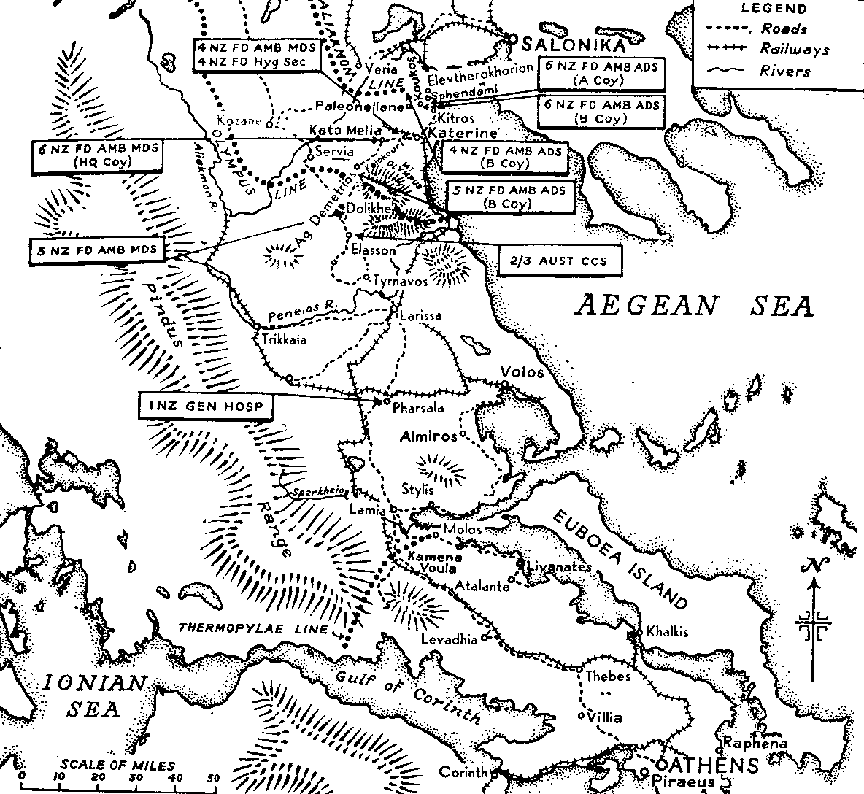
With each brigade was a field ambulance. Each ambulance set up an advanced and a main dressing station to provide medical treatment for the sick and wounded. The usual procedure was for either A or B Company, each of three officers and 60 men, to set up the ADS, while the MDS was established by HQ Company of six officers and 100 men, sometimes assisted by the company not staffing the ADS. 4 and 6 Field Ambulances were north of Olympus, and 5 Field Ambulance was at first sited south of the mountain. Patients were at first sent back from Katerine by ambulance train to 1 General Hospital at Pharsala or to 26 British General Hospital at Athens.
In the hilly country in which 4 Brigade had taken up defensive positions, a site for an advanced dressing station was chosen on the road a few miles north of the village of Paleonellene, and B Company, 4 Field Ambulance, with its three officers and 60 men, was sent there on 23 March. About six miles forward of the village were the small hamlets of Mikre Melia, Paleostane, Radani, and Ryakia along the front occupied by 18 and 20 Battalions, with 19 Battalion in reserve. It was realised that, in the event of a German attack, the evacuation of casualties from this area would prove most difficult. The country was ruggedly mountainous, and there was also a danger of the rapidly drying undergrowth being fired by incendiaries. More rough country lay on the left flank, but on the right, from Paleostane eastwards to the sea, the terrain dropped down to a narrow coastal plain.
The ADS was set up on the reverse slope of a ridge. Its several departments were housed in dugouts burrowed into the hillside and concealed under canvas and cut scrub. Access was by a lateral road on each side of the ridge. Vehicles were parked under cover some distance away. A bearer collecting post was sited about a mile from the dressing station, at a fork of the road leading to the positions of 18 and 20 Battalions, since from this point it was impossible for ambulance cars to go forward to either flank of the brigade area. It required little imagination to gauge the future usefulness of the Neil Robertson (Curtis cane) stretchers with which each company was equipped. The Neil Robertson stretcher could be raised or lowered with its burden either horizontally or vertically, with no danger of the patient becoming dislodged from his mummy-like strappings.
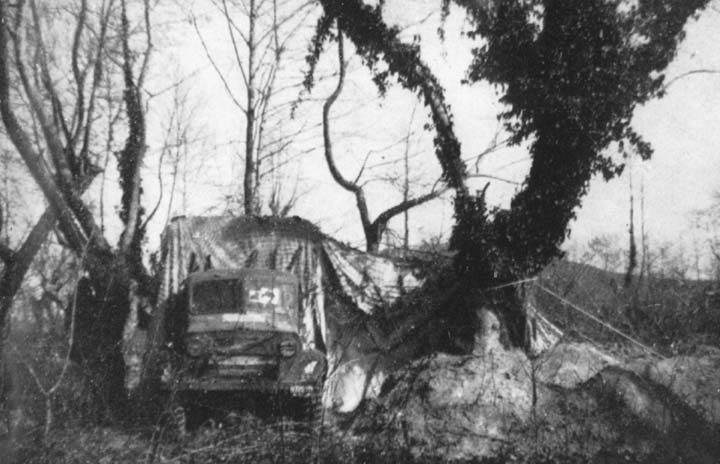
Thirteen miles of rough road, falling from an altitude of about 1000 feet to almost sea level, separated the ADS from the MDS which HQ Company, 4 Field Ambulance, established about a mile and a half north of the village of Kalokouri, on the road back through the Olympus Pass, some two and a half miles west of Katerine. The ambulance men's first task was to dig in. The MDS was pleasantly situated in a dense wood, a natural screen which, supplemented by camouflage nets and canvas, gave the dressing station most effective cover. It is interesting to note that at this stage no one considered it other than the correct thing to camouflage a medical unit, which normally relies on the conspicuous display of the Red Cross for its protection. German respect for the Red Cross was not properly appreciated until the campaign developed.
HQ 2 NZ Division and the office of the ADMS (Col Kenrick) were set up in Kalokouri, and 4 Field Hygiene Section, which had travelled north at the same time as 4 Field Ambulance, occupied an area near 4 MDS. From the moment of opening, the MDS admitted cases from 4 and 6 Infantry Brigades and other divisional units. Patients were sent back by rail from Katerine to Athens.
By 28 March 4 MDS was able to accommodate 120 patients if necessary. Already the experience gained in the Western Desert was proving of inestimable value. The departments co-operated efficiently in the admission, treatment, accommodation, and evacuation of the sick and injured. Each section was able to establish itself and begin working with the least possible delay, as a self-contained unit if necessary. Not only was rapid setting up possible, but the layout ensured that in the event of a hurried move, the whole dressing station could be dismantled and under way in four hours. To accommodate patients, canvas tarpaulins were adapted for screening around each of the 30-cwt trucks, and the areas under canvas were dug in so that the patients could lie below the level of the ground, thus ensuring a degree of safety from bombing and shelling.
Coming under the command of 6 Infantry Brigade on 30 March, A and B Companies, 6 Field Ambulance, went forward to set up advanced dressing stations in the low, undulating country overlooking the Gulf of Salonika. While A Company formed a dressing station in a valley about six miles east of Sphendami in the lower. lying country, B Company set itself up in an old shed on the outskirts of the village of Koukos, with light tentage for additional accommodation. At the same time, HQ Company opened a main dressing station some ten miles west of Katerine, on the main road near Kato Melia.
On rising ground about a mile and a half from the sea and on 6 Brigade's right flank, A Company's dressing station site had the disadvantage of offering no cover whatever. In the absence of trees or other protection, the various departments were dug in deeply and screened with nets. The dressing station served an area of Open, undulating country where the roads, although exposed, permitted ambulance cars to be taken right forward to the regimental aid posts. In contrast, evacuation of casualties to the Koukos dressing station presented many difficulties. This was especially so with the 25 Battalion RAP on the slopes of Mount Elias. The only being in approach to it was over rugged terrain. The road, besides being an extremely bad state of repair, cut across the front of the artillery positions. Apart from its proximity to the 25-pounders of 4 Field Regiment, the dressing station itself, judged by position and appointments, was a typical text-book one.
The 6 Field Ambulance MDS was in a pleasant spot among spreading oaks below the northern slopes of Mount Olympus. Tents were pitched on the banks of a small stream. Wards for receiving, operating upon, and holding patients were dug in, and an attempt was made to protect them further with sandbags. The whole dressing station, including the men's living quarters, was heavily camouflaged with coloured nets and natural foliage. Apart from the small amount of medical work, the chief activities were some roadmaking and sandbagging of the operating theatre, and the men were able to enjoy some days of comparative ease and quiet.
At the advanced dressing stations things were equally quiet. Each held a few sick patients. B Company took the opportunity to practise stretcher-bearing over hill and gorge.
To estimate the incidence of malaria, Capt Lovell(2) collected a dozen or so children from the nearby village and proceeded to examine their bodies for swollen spleens, an almost invariable symptom of the disease. Not knowing what next to expect, the children were terrified. Their anguished screams brought a wave of frantic mothers, from whom Lovell was forced to seek immediate cover, allowing the children to return to the bosom of their families. To avoid another similar misunderstanding, the priest in a white stone church on a hilltop was approached and persuaded with some difficulty that it was not desired to harm the children, but merely to examine them in the interests of science. Convinced, the priest gave the project his blessing and, rounding up some fifty children, led the procession to the dressing station, where the youngsters were examined, given army biscuits, and a picnic made of the afternoon. The matter did not end there, however, for everybody in the village suddenly showed great interest in his or her spleen (not to mention the army biscuits!) and the ranks of the morning sick parades swelled alarmingly. Candidates for examination flooded the dressing station and all but overwhelmed it.
Fifth Field Ambulance spent a few days at Hymettus getting ready for its move northwards with 5 Brigade, which was to take up battle positions astride the Olympus Pass. The move to the forward areas began on 1 April, three days after the unit's arrival in Greece.
On arrival at Dolikhe on 3 April, it was found that the tactical situation dictated the selection of a site for the MDS on an exposed slope alongside the road leading down from the Olympus Pass. An ADS was set up by B Company at Ag Demetrios, in the Pass itself.
From the beginning of April patients were sent back by the field ambulances to 1 General Hospital at Pharsala. The choice of a site for 1 General Hospital was difficult and involved some delay, but When a decision was made in favour of Pharsala, the members of the unit, arriving there on 22 March, set about establishing a hospital.
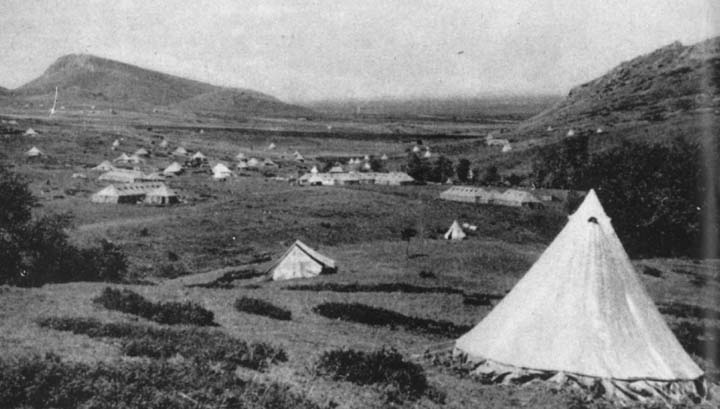
The site at Pharsala, where Julius Cæsar defeated Pompey, was 130 miles north-west of Athens, in a long valley with a small river flowing briskly over a gravel bed. In the north, parallel with the river, the ground rose sharply to end in a broken granite ridge about 900 feet high. The first few hundred yards from the water was well grassed and drained. This was the area selected for the men's tents. To the south the land rolled back in steadily rising hillocks, interspersed with ridges at right angles to the stream, to a rocky formation some 1200 feet high. The distance from the river to the place where the country became too steep for use was about 700 yards. In the east was a fair-sized creek running into the river, and beyond it the ground rose sharply in hills of about 500 feet. The distance from this creek to the main road to Athens was one and a half miles. A standard gauge railway ran south six miles away. This was crossed by a metre-gauge line, the nearest station of which was three miles from the hospital. A loop siding gave access to both lines and provided accommodation for Greek ambulance trains which were already in commission on both gauges. The village of Pharsala was two miles away.
The whole area, though not wooded, afforded good cover from aerial observation, and the digging-in of tents made them moderately safe from air attack. Nearly all the wards were sited in places where they could not be seen from the road. All ward and staff tents were dispersed at intervals of 100 yards or more.
In tents on a farm, the unit, in spite of difficulties and inadequacies, set about establishing hospital arrangements which compared not unfavourably with those of a permanent institution. Shepherds led their sheep and goats nearby to the sweet tones of many little bells. Elderly washerwomen and boys with baskets of oranges visited the hospital. Occasionally, storks flapped around in pairs, and in the evening the croak of frogs disturbed the peace.
Pharsala could be reached by a donkey track over a big hill behind the hospital. It had a little town square surrounded by small shops and coffee houses; a radio roared its bulletins about an uneasy Europe.
On 1 April orders were received that 24 British CCS and 189 British Field Ambulance, both stationed outside Larissa, would evacuate cases to 1 General Hospital the following day by motor ambulance convoy. Accommodation was then available for 180 patients. Seventy-two patients were admitted the next day, and by 6 April the hospital was able to take 490 patients. The first serious case was an Italian airman who was shot down in the vicinity that day. On 4 April the sisters rejoined the unit. They had reached Athens on 27 March after an uneventful journey and had been quartered in billets at Kephissia for a few days.
By 3 April all combatant units of the Division were in the forward areas. In the short time at their disposal, the New Zealanders had made their preparations for battle quickly and efficiently. While the medical units had set up dressing stations and a general hospital, fire positions and tank ditches had been dug, barbed wire erected, guns sited, road and bridge demolitions prepared, country lanes converted to military roads, and thousands of tons of supplies brought forward from the ports by the NZASC and distributed. The Australians were arriving and moving forward to fight once more alongside the New Zealanders. The 2 NZ Division and 6 Australian Division at first constituted 1 Australian Corps. A few days later, on 12 April, the name was changed to Anzac Corps, under the command of Lt-Gen Sir Thomas Blamey.
Their preparations for battle complete, most of the New Zealand units were enjoying a life of comparative ease in the beautiful surroundings of the Greek countryside. Then, quite suddenly, the scene changed. In grave silence, men grouped round wireless sets heard the news of Germany's attack on Greece and Yugoslavia. The German drive began on 6 April. Events moved swiftly. The collapse of Yugoslavia brought a German threat to the rear of the Anzac forces on the Aliakmon line. On 8 April 4 and 6 Brigades were ordered to withdraw over the Olympus Pass. By the evening of the 10th all the forward units had been withdrawn, leaving engineers to prepare demolitions and the Divisional Cavalry as a covering force for the last elements of the Anzac force to leave the original line.
All troops except the rearguard had withdrawn over the Olympus Pass when 6 Field Ambulance moved out in the dark shortly before 8 p.m. on 10 April. The rain had ceased, but the road was wet and treacherous. Leading up steep approaches to a gorge that cut across the shoulders of Mount Olympus, the road climbed almost 4000 feet in a distance of ten miles. There were sharp corners and hairpin bends to be negotiated, and in places the road dwindled to a mere rock ledge along the face of the mountain, with cliff walls towering on one side and a precipitous drop yawning on the other. In the murk, careful manoeuvring of the unlighted trucks was needed to avoid disaster. One three-tonner slid over the bank, but fortunately came to rest in a hollow on the roadside with little harm done either to the vehicle or its occupants. In the early hours of the morning the vehicles pulled safely into flat cornfields on the southern side of the mountains. Snow was falling in the pass where 5 Brigade Group was preparing to meet advancing German columns, and sleety rain was sweeping across the plain where 6 Field Ambulance was erecting a few camouflaged tents for accommodation and possible emergency operations. Most of the unit remained packed, for it was in reserve. Near the little town of Elevtherokhorion, and about half a mile above the bridge at the junction of the roads leading from the Olympus and Servia Passes, 6 Brigade waited in its reserve positions.
Fourth Field Ambulance and 4 Field Hygiene Section had retired 24 hours ahead of 6 Field Ambulance and likewise found the journey over the mountain a nightmare experience. The field ambulance was short of transport, and men and equipment had to be crammed into every corner of the available trucks. Heavy rain and biting cold increased the men's discomforts as the convoy joined the mass of slow-moving transport grinding its way through the tortuous, rain-drenched pass.
After a trying eight hours on the road in the main convoy, HQ and B Companies, 4 Field Ambulance, reached and took over the site of 5 MDS near Dolikhe, at the foot of Mount Olympus. At the summit, A Company had left the main convoy and had gone to a point near Ag Demetrios to take over the ADS there from 5 Field Ambulance. Morning found the men of A Company in the. new position, erecting tents in pitch blackness and drizzling rain, shivering with the cold. Daylight revealed a valley surrounded by high, snow-topped hills in the shadow of Mount Olympus. The men were about 4000 feet above sea level, and at times the cold was bitter, while in the morning and evening all-enveloping clouds of mist rolled down from the heights above the snow line. Rain and mud made it necessary to build a road, and the men came to regard themselves as 'navvying nurses'.
After being relieved at Ag Demetrios, B Company, 5 Field Ambulance rejoined its unit which, during 10 April, moved to a new site selected by Lt-Col Twhigg, seven and a half miles north of Elevtherokhorion and under a high hill at the entrance to the Servia Pass. Here it was to provide a main dressing station for 4 Brigade, as it set about defending an area at Servia, west of its previous line, but still along the Aliakmon River.
Fifth Field Ambulance sent A Company, under Maj Fisher,(3) forward about three miles beyond the MDS to form an advanced dressing station on the winding Servia Pass road. Though heavy rain hampered the work, the ADS was established by nightfall, and the men, who had had to find time to treat and evacuate a number of patients during the day, managed to get under cover for a night's rest. There was a heavy fall of snow during the night.
Throughout the 12th A Company toiled hard to improve the ADS by excavating farther into the hillside. A few patients were treated; some thirty passed through the MDS. That night was marked by the withdrawal of many troops through the pass, accompanied by a steady stream of battle casualties. None of these was held in the MDS beyond the time required for treatment. Evacuation to 2/3 Australian CCS at Elasson worked smoothly. Next day the MDS was enlarged to take 150 patients. In this work the company was assisted by 2/1 Australian Field Ambulance with men and equipment. The extra equipment was particularly welcome. Stores for the New Zealand medical units had been slow in arriving, and the position had become even worse as a result of the destruction of the Advanced Depot of Medical Stores during an intense bombing attack on Piraeus on the night of 7 April, when the port had been rendered almost useless by the explosion of an ammunition ship. Medical units were thus finding it necessary to exercise the greatest economy in prescribing drugs.
Fourth Brigade had moved up from the Katerine area to defend Servia Pass. From Servia to the sea on the east, the New Zealand and Australian positions on the Olympus-Aliakmon River line now barred enemy progress. Fighting flared up as the German armour thrust forward. On 13 April, Easter Sunday, enemy dive-bombers and fighters opened an offensive with attacks on 4 Brigade's dug-in Positions on the slopes overlooking Servia. With nothing to oppose them, the aircraft droned in like a swarm of angry bees. Ambulance cars were called forward from 5 MDS to bring in men wounded in the air attack.
Next day the bombers came again, this time to blast the tiny unprotected township of Servia. On the same day New Zealand engineers destroyed the bridge over the Aliakmon, just north of the village. Lt-Col Twhigg visited 5 ADS during the day and learned from Lt Lusk(4) that he and the bearer NCOs had made a thorough survey of the forward areas, finding in particular that evacuation of wounded from 18 Battalion would be most difficult. It was arranged, therefore, that mules, then being used to take ammunition into the line should bring out what casualties they could carry.
In the afternoon artillery duels began. Round Kozane the roads were dense with traffic---enemy tanks and troop-carriers---closing in towards the river in readiness to attack. Air activity became more intense. A continuous stream of casualties passed through the 5 Field Ambulance MDS. By then the dressing station had handled 150 patients. British, Australians, New Zealanders, Greeks, Yugoslavs, and some German prisoners were among the wounded who received treatment. Again and again the bombers came, fleets of as many as forty at a time, diving with a high-pitched scream of sirens to bomb roads and gun positions and attack any sign of movement with searing bursts of machine-gun fire. Although not directly attacked, the men employed at the MDS twice heard the valleys resound to a crescendo of crashing noise as the German pilots bombed targets dangerously close to the dressing station.
At 5 ADS A Company was dive-bombed and machine-gunned four times during the day. Luckily there were no casualties among the staff, but a large bomb, which opened a gaping crater only 25 paces from the dressing station, caused considerable damage to tents and other equipment.
The cold, clear dawn of 15 April brought the first infantry attack at Servia. In bitter fighting the Germans, who had crossed the river during the night, paid heavily in killed, wounded, and prisoners. More air attacks on 5 ADS forced Maj Fisher, who was doing great work under trying conditions, to move the dressing station to some caves high up on the hillside. The raids further hampered the already difficult work of the ambulance men, whose task was made more hazardous through the necessity of treating many of the wounded in the open. On one occasion while wounded, including some forty Austrian prisoners, were being treated in the open, enemy aircraft dived in low to drop bombs and rake the area with machine-gun fire. By early afternoon the dressing station had treated and evacuated 53 patients. In the evening, when artillery took over the battle to fill the night with the flickering flash and flame of gunfire, Lt Lusk and the bearers again went into the front line to bring out more wounded.
Next day (16 April) the enemy intensified his artillery and bomber attacks; but he made no more infantry attacks at Servia. At 5 MDS the steady flow of casualties continued. From the hills came a bearer section of 2/1 Australian Field Ambulance, weary and footsore after a long, tiring journey, leading donkeys on which wounded were supported. The 2/3 Australian CCS withdrew from Elasson. Thus all forward medical units had to send patients right back to 24 British CCS at Larissa, a journey of over seventy miles.
While the action at Servia was in progress, 5 Brigade was fighting at Olympus. Wounded in this sector were cared for by 4 Field Ambulance, with its advanced dressing station near Ag Demetrios, at the summit of the pass, and its main dressing station near Dolikhe. Along with 5 Field Ambulance, the unit evacuated patients to 2/3 Australian CCS at Elasson until that unit withdrew.
Pte Fleming, who was at 4 Field Ambulance ADS, describes life in those eventful days:
'One day, a beautifully fine one, at a time when the guns were silent, I was resting outside our tent. There was a grassy flat patch below a tree-covered slope. Bees were droning lazily among the many wild flowers, while the tinkling music of a mountain stream in a rocky bed sounded a pleasant symphony. On the slopes of the opposite hill a bearded ancient was ploughing. Everywhere was peace.
'Awakening was rude. A distant hum grew swiftly to a droning scream, a sound like the vicious voices of countless angry bees multiplied until it filled the air with menace. An air armada---there must have been over a hundred planes---was passing above and beyond us. They were mere black shapes to us, but soon after they had vanished behind the hills came the crash of bombs.
'When the first wounded began to arrive they brought with them many a story of high courage and work well done. Jerry was getting hell, they said. The artillery was giving him the Devil's own of a hammering. The Maoris put the fear of Hades into 'em with the bayonet. . . Before long it became plain that the Medicals, too, were doing their work splendidly.
'Several times shelling came pretty close. Once an MO was shaving, with his usual carefree stroke of razor and brush, when the morning barrage began. There was a roar and a crash. Something whizzed close to his head, leaving a gaping hole in the roof above him. He dropped the razor and swore violently, eyed the hole in the roof, eyed the smoke of the burst shell outside, then slowly and deliberately walked to the doorway and directed a stream of invective in the general direction of the enemy.'
On 16 April the enemy's furious assaults on the tiny force at Platamon reached a climax. A heavy tank and infantry attack drove 21 Battalion back to the historic Vale of Tempe, in the narrow Peneios Gorge, ten miles to the rear.
When Col Kenrick received word that 21 Battalion had been thrown back, he arranged for four ambulance cars to go immediately to the Peneios Gorge and for medical officers and orderlies to be sent from 6 Field Ambulance at dawn to the western end of the gorge to treat and bring back casualties. For this task Lt Sutherland(5) was put in charge of an advanced dressing station detachment of 25 men from B Company and two ambulance cars. When they reached the neighbourhood of Rapsane they were unable to set up a dressing station, so the detachment remained on wheels and treated wounded in the ambulances. That night was spent under the artillery hill positions with shells from the opposing forces whining overhead. In the early hours of the morning the men packed up ready to move back, but there was a delay as it was necessary to await the return of Lt Sutherland, who had gone forward for information.
Then, into the little valley where the party waited, came enemy aircraft in force. With a deafening roar of engines and a piercing scream of sirens, the dive-bombers swept into the attack, their machine guns spattering the ground with a deadly hail. In those terrifying moments of fear bordering on panic it seemed that no one could escape, yet no one was hurt. Meanwhile, by sheer weight of men and metal, the enemy was scattering the New Zealanders and their Australian reinforcements in the Peneios Gorge. Lt Sutherland returned to his detachment with the startling news that the Germans were almost on top of them. The men piled into their vehicles and were away in a few minutes, but they had gone only a few hundred yards when enemy aircraft again attacked them. Scattering to the roadsides, the ambulance men found themselves amongst grim-faced infantry with fixed bayonets. Returning to the vehicles with a number of wounded, they lost no time in getting under way again, and, with only one unit casualty, they ran the gauntlet of further bombing, strafing, and shelling to rejoin their unit.
During the afternoon of 16 April 4 MDS closed, and in heavy rain it withdrew at eleven o'clock that night, leaving a car post at HQ 5 Infantry Brigade and another at Kokkinoplos to evacuate casualties from 23 Battalion. To relieve the men already maintaining the car post at Kokkinoplos, a stretcher party went forward, arriving at the post--in the village school---just as darkness began to fall.
'When my own party moved forward,' said Pte Fleming, 'it was to a village (Kokkinoplos) half-way up the slopes of Mount Olympus. We began the climb, by ambulance, in pouring rain. As the road became even steeper so it became muddier and more nearly impassable. There were bends so sharp that they seemed impossible to negotiate. More than once we had to "put our shoulders to it", scrambling, cursing, in the mud. The cold was biting, and we were glad indeed to reach our base, which we did just as darkness began to fall. The village school was our stretcher-bearer post. Joy of joys, fires were alight, and the classrooms in which we camped were cheerily warm, though the wind whistled through the cracks in the floorboards. We found our mates, whom we were to relieve, busily drying their clothing before the stoves. They had had an exceedingly hard carry, it seemed, working in rough mountain country, and with a long distance to march. "I'd never honestly seen mud knee-deep before," said one, "but I waded through oceans of, it today!" And it seemed he had, for he was using a pocket knife to clean his trousers from the knee down.
'We settled down on the hard boards to sleep, ringed about the fires, while outside the rain fell steadily. Some thirsty soul found the caretaker and whispered longingly of cognac in his ear. " Yes, yes, said the worthy, " Cognac. Good, give me a hundred drachmae." There was a hasty consultation in the darkness, from somewhere came the money, and very shortly there was cognac.
'Little sleep was permitted us that night. Towards midnight there began a resounding series of crashes in the rest of the building. Our men were falling back, seeking shelter in the school. Morning found us so nearly in the front line that it did not much matter. The school was packed with weary, mud- and 'rain-soaked men---men who had been in action day and night without sleep, without rest, for over 48 hours.
'Water was put on to boil, and hot drinks were quickly prepared for as many as possible. The enemy was pressing on, they said, creeping unseen, and often unheard, through the mist and rain. Our men were holding him just beyond the village. Outside on the muddied slopes men were preparing to fight again. The mountain, the village, the advancing foe, all were hidden in the thick rolling mist.
'Soon a runner appeared. There were shouted orders, and out into the fog again went the weary men, tired almost beyond endurance, but still keen to give the enemy all and more than he could take. "You medical orderlies had better clear out," said the MO. "The enemy's entering the village." The ambulance moved out, while seemingly only a few yards away, but unseen, tommy-guns and rifles began a deadly chorus.'
The decision had been made on 14 April, when the battle for the Olympus-Aliakmon River line had only just begun, that the force was to move back to Thermopylae, as it was realised that the line could not be held for long. Under strong enemy pressure, 5 Brigade disengaged and withdrew according to plan during the night of 16-17 April, its action being repeated by 4 Brigade the following night. The moves were covered by 6 Brigade, which had been held in reserve and which fought a rearguard action at Elasson. In the withdrawal the medical units retired with the brigades they were serving.
Over the next few days and nights vehicles of the field ambulances were part of the long line of traffic heading south. Ambulance cars which had taken wounded to a CCS found it very difficult to return against the stream of traffic on roads extensively damaged by bombing, and the field ambulances had to make the best arrangements possible to bring back with them the men who were wounded in the withdrawal.
Fourth Field Ambulance went through Larissa to Pharsala, and then turned east to the coast at Almiros, later going to an area a few miles south of Lamia and there setting up an ADS to take in wounded from convoys. Under cover of rain and mist on 17 April, 5 Field Ambulance followed on the long journey to the vicinity of Molos, south-east of Lamia. The ADS, under Capt Palmer,(6) withdrew with 4 Brigade Group early on the morning of 18 April, an ambulance car being attached to each RAP. The car post, under Capt Moody,(7) travelled with the rearguard of 4 Brigade and diligently collected wounded. After a trying journey through Volos, 4 Field Hygiene Section reached Atalante, where it camped on a sheltered site near the sea.
Disabled vehicles and streets strewn with debris caused many halts as the convoys crawled south. Rain and mud made the going especially difficult in the darkness. The drivers were weary from the strain and lack of sleep, and repeated air attacks had made the men apprehensive. As Col Kenrick and his staff moved with HQ 2 NZ Division south of Larissa, the transport on the road was heavily dive-bombed and machine-gunned. The ADMS office staff attended to the casualties, Maj J. K. Elliott and his batman, Pte Keucke,(8) earning praise for their coolness and courage in attending to wounded while under fire from enemy aircraft.
The excitement of the withdrawal is well described by Pte Fleming, who was with an ambulance car post:
'As we went on, our own artillery began to fire, with a sound that nearly split our eardrums. About a mile down the road a series of caves in the mountainside offered shelter from the still steadily falling rain, and in one of these we prepared to receive wounded. In the cave next to us flocks of sheep had been shut in for protection against the cold, and two small shepherd boys guarding them set to work, unasked, to find dry sticks with which they lit a fire for us.
'Across the road another small boy and his sister were minding goats. I could not help wondering how they would fare when the Germans came. The sheep, the goats, and those tiny Greek children seemed very much out of place in an area soon to be under fire.
'We had hardly established ourselves before out of the mists came a messenger with a laconic "On your way, boys! Jerry's coming!" Down the mountainside we drove, and out of the mists into comparative clearness, though we thanked our lucky stars for the low-lying cloud which made strafing from the air an impossibility.
'A short way along the road we came across a large ration dump which was being prepared for destruction so that it should not fall into enemy hands. There were literally mountains of cases containing foodstuffs, rations of every conceivable type, food for an army, including many items of which we had been short. Someone shouted, "Want any rations? Be in, boys!" Before long all our spare space was piled with goods, not forgetting many a luxury item. There were cases of tinned fruit, cases of this, cases of that. We dined more luxuriously than ever before---or since---that day. Peaches and cream---in greater quantities than we could ever hope to deal with. As we left, they were breaking into the piled cases with picks, pouring on petrol. At least the enemy would never benefit from the stores we could not take away. Greek peasants, though, were not denied, and many a mule cart groaned under a load it could barely carry.
'At the ration dump we waited to rejoin the rifle unit (23 Battalion) with which we had been serving on Mount Olympus, and towards evening our ambulance took its place in a seemingly endless convoy moving swiftly rearwards. Though we did not know it at the time, the withdrawal had begun in earnest, a tremendous game of hide and seek with death for the loser.
'A scene which must have inspired and cheered thousands of weary men met us at a crossroads where two great rivers of traffic joined. A staff car, on the bonnet of which proudly fluttered the emblem of New Zealand, was parked in the centre of the crossing. Beside it stood a party of officers, one of whom was directing traffic. There was an incredulous gasp as we neared him. "It's 'Tiny' himself!"
'Someone said, "Gee! It's the boss. What on earth is he doing here?" It was a highly dangerous place, a spot which might at any moment become the target for heavy attacks of Nazi dive-bombers, but it was by just such acts that the GOC won and held, as no other man could do, the respect, admiration, and genuine affection of every single individual soldier in the Division. It is safe to say that there is not one man who is not proud of his leader.
'All night the convoy pressed on, and all next day. Here and there we had brief halts to rest for a few minutes and to prepare hot drinks. Twice we stopped to attend to injuries, but always it was " Keep going! " the moment the task was done. The road became dotted with wrecked vehicles, and we entered Larissa, which was still smoking from a recent heavy bombardment from the air.
'The way was littered with wreckage of all kinds. Our vehicle jolted crazily over rubble-filled craters or lurched to avoid masses of debris. Everywhere was desolation, destruction, ruin. Shops, dwellings, churches, and hospitals---the raiders in their indiscriminate savagery had spared nothing. And yet, we were told, the city had been empty of military objectives at the time of this latest exhibition of Nazi brutality.
'Night merged into day, and day into night, as we travelled, until engine trouble held us up for a while and we lost our convoy. There were plenty more, though, and we carried on independently, a single unit in an endless chain. Once we stopped to "consider our position," being in doubt as to which route to take. The delay may well have saved us, for as we argued the toss a distant hum grew rapidly into a roar.
'A cloud of black, bird-like specks in the distance became unmistakably German bombers. From our cover amid the barley crops on the roadside we watched them form into line, very high, but almost directly above us. Plainly a town towards which we had been travelling was the target. With high-pitched scream of sirens they went, one after the other, into an almost perpendicular power dive. Down they went, the sound of their screamers rising to a crescendo of banshee-like wails, punctuated by the rattle of machine-gun fire.
'One by one we saw the planes seem to vanish among the buildings of the town. One by one they rose again to form up in the clouds and roar away out of sight beyond the hills, while behind them a great cloud of smoke mushroomed out . . . .
'Apparently only two targets had been hit, but we wondered what possible benefit the enemy would reap from bombing an open town. As we moved on again there was a sound like thunder rolling among the distant bills. It was no thunder, though, for here and there, from points we could not see, columns of dun smoke rose lazily.
'At last we came to what was plainly a line of defence and were greatly cheered by the hope that possibly the enemy would be held there. Soon after dark, a short distance behind the line, an officer "pulled us out" of the convoy to join our own unit, from which we had been separated since first going into action.'
Under the command of 6 Brigade, 6 Field Ambulance pulled out from Elevtherokhorion on 15 April and, travelling at night to avoid the constant air attacks, passed through the shambles of bombed Elasson and established itself next morning at Tyrnavos amid barley fields and orchards on the roadside. As the field ambulance was to provide medical services for 6 Brigade during the covering action, a main dressing station was set up and advanced dressing stations were placed in each of the valleys between Tyrnavos and Elasson.
Anti-aircraft batteries sited their gun positions around the MDS as soon as it was established. These guns attracted so much attention from enemy bombers that the field ambulance was forced to shift some distance down the road, to what was considered would be a more comfortable position in the shelter of an olive grove. But the deadly Messerschmitts sought them out, and for several hours the men lay flat on their faces in ditches, while at frequent intervals the whole area was raked from end to end and from side to side with machine-gun fire. Miraculously, the men came unscathed through a nerve-wracking experience. With grim satisfaction, they saw a cleverly camouflaged anti-aircraft gun nearby blow a Dornier bomber to bits as it flew low overhead. Larissa, some ten miles to the south, was heavily bombed.
By the evening of 18 April the panzers that had battered their way through the Peneios Gorge had a clear road to Larissa. The 6 Brigade Group was in danger of having its withdrawal cut off had the enemy taken this route; but he did not. Action was expected when the German offensive reached the brigade's covering positions south of Elasson. There, where the road forked to the east and to the west, the brigade, screened by the Divisional Cavalry, stood ready to hold the enemy at bay.
On the 16th and 17th, while the infantry deployed with artillery and anti-tank guns in support, the dressing stations of 6 Field Ambulance at Tyrnavos and in the valleys between Tyrnavos and Elasson attended to men wounded in the enemy's incessant strafing of the roads. The field ambulance was joined by extra ambulance cars from an Australian MAC,(9) and a large marquee was erected to cope with casualties from the expected attack. By the morning of 18 April the last of the convoys bound for the new line at Thermopylae had passed through. The Divisional Cavalry withdrew, leaving the 6 Brigade rearguard to face the enemy alone. Before noon the artillery was in action against the first German tanks advancing towards Elasson.
With the withdrawal route so seriously threatened by the thrust through the Peneios Gorge, orders were given soon after midday for the brigade to withdraw through Larissa by midnight. It was decided, therefore, that the MDS should move back under Maj Plimmer,(10) and that A Company under Lt Ballantyne(11) should take over and remain open in the MDS area.
Thus, when the withdrawal began in the early afternoon, A Company, some Australian ambulance cars, Maj Christie, and the commanding officer, Lt-Col Bull, who refused to leave until assured that the last members of his unit were free to withdraw, were left behind to look after the wounded. The rest of the unit---HQ Company and those members of B Company who had not been sent to the Peneios Gorge---moved out with 25 Battalion on an unpleasantly memorable day and night journey. Throughout the afternoon the convoy was obliged to run the gauntlet of raiding Stukas and Messerschmitts as it joined the continuous stream of south-bound traffic, jammed nose to tail and moving slowly and with frequent halts along the congested highway. The convoys were constantly harassed from the air, the attacks culminating towards dusk, as the field ambulance transport neared Larissa, with a vicious strafing raid by more than twenty aircraft. Men dived from hastily halted vehicles to the shelter of roadside cornfields. There they huddled for fully half an hour, stomachs pressed to the trembling earth, while aircraft raked them mercilessly with machine-gun fire. Yet there were remarkably few casualties.
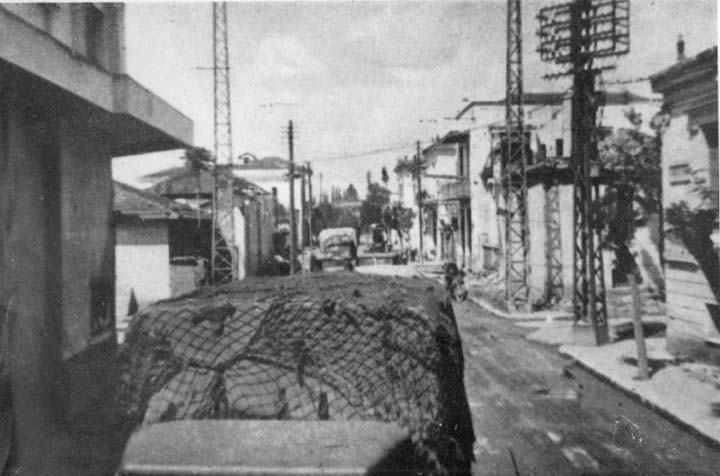
The road, the lifeline of Anzac Corps, was receiving special attention from the German air force, and in many places engineers worked constantly, filling in bomb craters and clearing away debris in order to keep the highway open. When 6 Field Ambulance reached the outskirts of Larissa, enemy aircraft were zooming in for further attacks on the already heavily bombed town. Part of the convoy scattered and waited for the raid to end. Stukas circled high over the town in mass formation, then peeled off one by one in almost vertical power dives, checked, and roared into steep ascents. After each screaming dive, flame, debris and heavy black smoke mushroomed up among the buildings, and earth and air shuddered to the blast of the exploding bombs. Unmoved by bombs or falling debris, a military policeman stood at the entrance to the town directing traffic.
The raid over at last, the field ambulance vehicles crawled over debris-littered streets through a burning, deserted town, smouldering ruins and piles of fallen masonry often all that remained of what had once been homes.
Travelling by night, the convoy at least had freedom from air attack, but for the drivers it was still a difficult and trying journey. There were narrow streets in bombed towns and villages to be negotiated, blazing trucks on the road leaving little room for the convoy to pass, and treacherous deviations round gaping bomb craters to be traversed. Early the following morning HQ and B Companies arrived at Molos, south of the Thermopylae Pass. A few tents for accommodation were erected among trees alongside the sea coast. The unit was now in reserve, so that the men were able to snatch a brief respite.
Considerable anxiety was felt for the safety of A Company and Lt-Col Bull, who had remained at Tyrnavos, as it was known that the Germans had closed sharply on Larissa. No news of the party had been received. The following morning, however, the detachment returned safely to the unit. From the tired men it was learned that, as enemy pressure on the 6 Brigade rearguard became increasingly heavy, casualties began to arrive at the small dressing station. Medical work at the dressing station had continued until the early hours of 19 April. Withdrawal of the rearguard was to have begun at nightfall on the 18th, but a heavy enemy attack was made as the New Zealanders were about to move. By midnight the attack had been beaten off and the rearguard had begun to move back. Shadowed by the enemy, Lt-Col Bull and his party moved to make contact with the brigade that morning south of Volos. Wounded were picked up from the infantry battalions, given treatment and, as the withdrawal continued, carried on in trucks and ambulances. The party next day passed through bombed Stylis and Lamia, and over the Thermopylae Pass, to join up with the unit again in the Molos area.
Orders received by 1 General Hospital at Pharsala late on the night of 14 April from ADMS 81 Base Sub-Area, Larissa, led to. patients being loaded on a train at Dermele in the early hours of the 15th, and then unloaded again when the arrangements of RTO Dermele were countermanded by superior officers at Larissa and Athens. Further instructions were received early on 15 April from the CO and ADMS, 81 Base Sub-Area, that sisters, staff, and patients were to be evacuated immediately. Everything was to be left standing, though valuable instruments and drugs were to be taken, if possible. Enemy planes had been active over the hospital area during the night. A bomb was dropped not far from the sisters' quarters, and in the early morning a plane came over and machine-gunned the camp without doing any damage.
The sisters were sent off by road in transport provided by NZ Mobile Dental Unit, under Maj MacKenzie,(12) which had been attached to the hospital. They took light luggage only, and eight Australian sisters who had been sent back for safety two days before accompanied them. This convoy arrived in Athens about half past seven that evening, and the sisters were accommodated in hotels. Later they were transferred to houses at Kephissia.
The work of clearing the 428 patients began again at 6.55 a.m. on 15 April. Transport was limited to three 3-ton trucks and three ambulances, and as the weather was fine, it was decided that the 112 convalescent patients and the men of the unit. should march to the station at Dermele, six miles away. All patients were at the station by 11.10 a.m., but the promised hospital train from Lamia did not turn up. A train from Larissa, full of refugees, arrived an hour late, but box waggons had not been reserved on it for the hospital as promised. Arrangements were then made to use waggons on the siding for the patients, and mattresses were brought from the hospital for the lying cases. Ultimately, some of the staff and convalescent patients marshalled the waggons, and a train was made up. Notwithstanding lack of support by the Greek railway authorities, and, in fact, in face of strong opposition from them, the train was joined up to the Larissa train. All valuable drugs and instruments, the sisters' heavy baggage, and a waggon load of rations were placed on the train. Great difficulty was experienced in arranging for the hospital personnel to travel on the train to tend the sick and wounded. Ultimately the train left for Athens at 7 p.m.
During the day a rear party at the hospital packed some valuable equipment from laboratory, X-ray department and operating theatre, and medical stores on a truck, finding also that men dressed in Greek Air Force uniform and local inhabitants had made extensive thefts from the unoccupied tents. The rear party left at 3.45 p.m. by road. Col McKillop, Maj Hunter, and Capt King left by road at 7.30 p.m. after the train had departed.
On the train Lt-Col Boyd was in charge. At one stage, when the Greek driver took shelter during an air raid and refused to carry on, he found it necessary to get a New Zealander and an Australian to drive the train. Later, a guard was placed over the Greek on the footplate of the engine to keep the train moving. At 4 p.m. on 16 April the train arrived at Rouf siding, Athens, and the patients and staff were taken to 26 General Hospital, 2/5 Australian General Hospital, and NZ Base Depot at Voulas.
A convalescent hospital was established at Voulas Camp on 17 April. Instructions received on the morning of 19 April directed that 30 nursing orderlies be sent to 26 General Hospital, that four officers (Captains Slater(13) and Kirk,(14) Lieutenants Foreman(15) and J. Borrie[16]) and 50 men be kept at the convalescent hospital, that two officers (Captains Sayers and King) be detached to go with the New Zealand sisters on a hospital ship which was expected to leave in a few hours, and that all others of the male staff embark at Coal Quay, Piraeus, at 3 p.m. that day.
Col McKillop, 13 officers, and 69 men embarked on MV Rawnsley at the coal wharf at Piraeus by half past three on the afternoon of 19 April. The vessel left her moorings at 7.30 and proceeded down the bay. After the ship had cruised around all night it was realised that its convoy had departed. At 7 a.m. next day, while waiting for instructions, the ship was bombed and machine-gunned, two officers and six men of British units being wounded. One officer died before the casualties were transferred to the hospital ship Aba, the ship on which the New Zealand sisters had expected to travel. Further air raids were experienced after the Rawnsley sailed at 11 a.m. for Alexandria.
By 20 April the withdrawal across Thessaly was completed, and the entire Anzac Corps was disposed in the Thermopylae and Brailos Passes, ready once more to do battle from a strong position. A fighting withdrawal of nearly 200 miles had been successfully completed under the most trying conditions.
No time was lost in preparing the new defence line. Although the daylight sky was seldom clear of raiding aircraft, positions were dug, barbed wire erected, demolitions arranged, and medical facilities provided. The battle line was based on a spur of the Pindus Mountains, running east and west, and cut by two main routes to the south---one carrying the central road and railway through the Brailos Pass, and the other winding through the famed Thermopylae Pass itself. The Australians held the Brailos Pass, the New Zealanders Thermopylae. 6 Infantry Brigade was on the right near Molos, with 5 Infantry Brigade on its left, both supported by all the NZ Artillery, plus some British guns. 4 Infantry Brigade and the Divisional Cavalry kept watch on the coast in case the enemy should attempt a landing from Euboea Island.
On 20 April, while 5 Brigade was completing its positions, 4 Field Ambulance moved from the bivouac area just south of Lamia along the coastal road to a site about 18 miles south of Molos, where B Company was detached to form an advanced dressing station two miles inland from the road bridge at that point. Cover was lacking, however, and it was not long before enemy aircraft began a ceaseless bombing and strafing of everyone and everything that moved. The area became untenable, and the company was compelled to shift to a riverbed, flanked by hills, inland from the village of Molos. Contact was made immediately with regimental aid posts of 5 Brigade.
While the occupation of the Thermopylae positions was being completed, 5 Field Ambulance maintained a well-protected main dressing station about two miles west of Kamena Voula. Throughout 18 April casualties were sent back to 2/3 Australian CCS, situated south of Levadhia. Ambulances carrying the wounded had to take the longer route through Molos, for the more direct route through Lamia was under constant air attack.
A wing of a Greek hospital at Kamena Voula containing hot mineral baths became the location of the MDS on 19 April, when 5 Field Ambulance moved in. The hospital was well equipped with beds, linen, and medical stores and equipment. When the field ambulance arrived, the Greek staff still had civilian patients under treatment. The hot baths were a boon to troops who had not been out of their clothing for many days.
Air raids on the convoys, reaching a peak on the 19th, continued to take toll of the retiring troops. Members of 5 Field Ambulance had a heavy day tending the wounded. By evening. when the field ambulance came under divisional control, 83 casualties had been admitted to the MDS. From the ADS, established about three miles up the road by 4 Field Ambulance, wounded came back to the 5 Field Ambulance MDS in a steady stream all next day. Assisted by the New Zealand ambulance men, the Greeks evacuated civilian patients and nursing staff from the hospital in the late afternoon. With their departure, 5 Field Ambulance took over the medical stores left behind and arranged for their distribution to nearby field ambulances and regimental aid posts. Throughout the next day enemy aircraft continually raided roads and dumps, but the Red Cross on 5 MDS was respected. In the late afternoon the unit was instructed to vacate the hospital buildings and set up a tented dressing station nearby.
 |  |
 |  |
By 21 April German domination of the air was such that men and vehicles of all units remained in concealment as much as possible during daylight, but at night the activity was intense as men hastened to perform tasks they had been unable to attend to during the day. On the evening of the 21st 6 Field Ambulance moved out from the Molos area with orders to open a small mobile dressing station at Livanates, some 30 miles from the field ambulance's location behind 6 Brigade. At midnight the unit pulled into the shelter of gnarled and ancient olive trees, and at dawn HQ Company began to erect shelters. It was a pleasant spot on a wide coastal promontory some little distance from the sea. As the dressing station was to be mobile, yet capable of expansion if necessary, the men dug pits over which tent flies could be thrown. Nothing was camouflaged, and for the first time Red Crosses were displayed by the unit. It is significant that three Messerschmitts flew over but made no attempt to attack. While HQ Company prepared the dressing station, the other companies remained packed and 'on wheels' close by. 4 Field Hygiene Section was camped just to the north of the dressing station. Few wounded were treated in the dressing station, for that afternoon orders were received to destroy all equipment and join in a night withdrawal.
Enemy tanks had advanced across the plains towards the Sperkheios River, but the Germans seemed to be in no hurry to attack, spending several days building up their forces just beyond range of the Anzacs' guns. Meanwhile, west of the Pindus Mountains, the Greek Army had been caught in a hopeless position, and on 21 April it capitulated. The left flank of the Anzac Corps was now exposed, and the enemy could outflank the Thermopylae line. The evacuation of Greece, originally planned to start on 28 April, was advanced to the 24th. The units were told on the 22nd.
To cover the withdrawal of the other groups to the various embarkation beaches, 6 Brigade on 22 April took over from 5 Brigade in the Thermopylae line, and the ADS being run by B Company, 4 Field Ambulance, was placed under its command. The rest of the field ambulance made preparations to withdraw with 4 Brigade to Thebes, where a line was to be formed to protect the rearward move of the remainder of Anzac Corps. 5 Field Ambulance came under the command of 5 Brigade and made ready to withdraw with that group to beaches east and west of Athens. Later, 6 Field Ambulance also came under the command of 5 Brigade for the withdrawal.
To ensure that there would be sufficient room in the trucks for the wounded and all members of the unit, 4 Field Ambulance jettisoned large quantities of medical equipment and personal kit, retaining only a minimum of medical essentials, before withdrawing that night. Massed convoys moving south made the 80-mile journey to Thebes a most difficult one, but by six o'clock next morning the unit got into concealment alongside 2/1 Australian Field Ambulance, some 15 miles south of Thebes.
'When we left the Thermopylae line at 10 p.m. on 22 April,' said Capt J. R. J. Moore,(17) 'we knew that our time for evacuation was growing shorter and shorter. Our mess became more and more exiguous. An exhausted quartermaster was at one stage heard to declare, "----- the rations," which was a mighty serious statement for a "Q" to make!
'The trip was fairly satisfactory, but we saw two signs of fifth-column activity. One was the flashing of lights continually signalling from village to village and from hilltop to hilltop. The other was an early morning incident when Maj McQuilkin produced a miraculous cure of an apparently disabled truck blocking our road by smashing the windscreen with his revolver butt. Both the driver and the engine sprang to life, and the road was clear again.
'We next fell in with the headquarters of an Aussie field ambulance beyond Thebes and the pass near Villia. Here we lay up in a valley of low scrub and trees for two days, officers and men alike unseeable and unavailable during the daytime, except when tea was brewing or when the sky had been free from aeroplanes for a long stretch. Many were the timid who stood revealed in those days, when German aeroplanes harried the countryside without opposition and almost completely prevented daylight movement by road of any sort. We needed air support, and we did not get it. At this time we heard of a general Greek surrender to Germany.'
Anticipating a night withdrawal on the 22nd, 6 Field Ambulance buried equipment and medical supplies and an assortment of personal gear. 4 Field Hygiene Section, members of which were to travel in 6 Field Ambulance transport, destroyed its trucks, disinfestor, and other equipment. As ordered, the field ambulance transport moved on to the road that evening, but a few minutes later the convoy was stopped, the DADMS having brought orders from Col Kenrick postponing the move for 24 hours. The field ambulance and the hygiene section were to come under the command of 5 Brigade and retire with that group.
In the morning the buried equipment was dug up and resorted; surgical haversacks were distributed around the trucks and a few instruments retrieved. The men took what they stood up in and, in addition, a greatcoat and a blanket. Similar scenes were being enacted in the 5 Field Ambulance area, for that unit also was to move with 5 Brigade. As only a limited amount of equipment and stores could be carried during the withdrawal, a quantity was placed in a building and a Red Cross flag fastened to the door with a note 'thanking German airmen for respecting the Geneva Convention'. Material not in this category, including many personal belongings, was made unserviceable in accordance with Corps orders.
The 2/3 Australian CCS at Levadhia having closed, arrangements were made for the 40-odd patients in the 5 Field Ambulance MDS at Kamena Voula to be evacuated to 26 General Hospital at Kephissia. The problem of transporting the wounded was eased considerably by the appearance of four Australian ambulance cars, one of which was sent forward immediately to clear the 4 Field Ambulance ADS. This and the other ambulance cars were to travel in the 5 Field Ambulance convoy as far as Athens, and then break off and take the patients to 26 General Hospital. Two unit ambulance cars were to remain and work under the orders of Capt Macfarlane,(18) who was to act as medical officer to a rear demolition party of New Zealand engineers.
Although delayed in getting under way that evening by an air raid near HQ 5 Infantry Brigade, the convoy made good progress along the crowded highway through Atalante, Levadhia, and Thebes to Athens. The medical section of the convoy included eight ambulance cars for the collection of wounded en route.
Meanwhile 6 Brigade, supported by the whole of the Divisional Artillery and two regiments of British artillery, continued to hold the Thermopylae line. An advanced dressing station manned by B Company, 4 Field Ambulance, was under its command. As the enemy continued at a leisurely pace to build up a strong assault force, aerial activity became intense, reaching a peak during 24 April, when furious and repeated enemy dive-bombing and machine-gunning attacks were directed against artillery positions. Despite the violence of these efforts to wipe out our guns and observation posts, casualties were few, and the New Zealand dressing station was not overtaxed.
During the day several thrusts by enemy tanks and infantry were repulsed, but others broke through in 25 Battalion's sector. The battalion's two forward platoons were forced to withdraw, suffering heavy casualties from tank gunfire and mortaring as they did so.
The artillery and infantry battle continued until about half past nine that night. Then contact with the enemy was broken, guns and heavy equipment were destroyed, and the planned withdrawal began. By dawn of Anzac Day men and vehicles were scattered and hidden over a hundred miles away behind 4 Brigade's covering position at Thebes. B Company rejoined 4 Field Ambulance in the area adjacent to 2/1 Australian Field Ambulance, south of Thebes. .Unfortunately, Capt Neale(19) and 16 men who retired with the 6 Brigade rearguard did not succeed in rejoining their own company and were later taken prisoner near Corinth.
In its withdrawal from the Thermopylae line, 5 Infantry Brigade Group, with 5 and 6 Field Ambulances and 4 Field Hygiene Section under its command, reached Athens at daylight on 24 April after a hectic night journey over congested roads. On the outskirts of the city, the men of 5 Field Ambulance heard the wail of air raid sirens for the first time since leaving England. However, the unit cleared Athens without undue delay and dispersed among olive trees along the road to Raphena, there to spend the daylight hours under cover with the rest of the brigade group.
Sixth Field Ambulance was less fortunate. Confusion reigned when the field ambulance convoy reached the central square in Athens, a traffic jam resulting in trucks being scattered in all directions. Soon the sky was filled with circling enemy aircraft. Most members of the unit spent the day hiding in olive groves and barley fields at various points on the roadside beyond the city; others, in the general confusion, reached Hymettus.
An extraordinary game of hide-and-seek was in progress. To give the enemy no inkling that localities near the beaches at Porto Rafti, Raphena, and Marathon were dispersal areas, the strictest measures of concealment from air observation were maintained. While in hiding the men busied themselves with a further paring down of equipment. Men were limited to a pack or haversack; officers were allowed an extra valise or small case. This meant the dumping of much personal gear. A small quantity of light medical equipment was retained by 5 Field Ambulance, the rest being despatched to 26 General Hospital at Kephissia. Three motor ambulance convoy cars, which had done excellent service during their association with the New Zealand medical unit, were also sent to the British hospital.
The same dark, moonless night that covered the withdrawal of 6 Brigade from Thermopylae also covered the final march of 5 Brigade, and a number of non-combatant units, to the beaches for evacuation. 6 Field Ambulance had first to assemble its scattered parties from their various hideouts. Members of both 5 and 6 Field Ambulances then travelled in unit vehicles to within a mile or two of the beaches at Porto Rafti. There the men debussed and, after wrecking the vehicles, marched in silent groups to the beach. The embarkation, facilitated by a perfectly calm sea, was carried out with quiet efficiency. Motor landing craft ferried the men to waiting naval vessels. The Royal Navy that night took into its care nearly 5000 New Zealanders, in addition to many British, Australian, Cypriot, and Palestinian troops. Once the troops were on board they were given food and hot cocoa, and everything possible was done for their comfort.
Fifth Field Ambulance embarked on the Glengyle with the main body of 6 Field Ambulance. The remainder of the latter unit went with its commanding officer on board the destroyer HMS Calcutta, which, with another destroyer, HMS Perth, formed a naval escort.
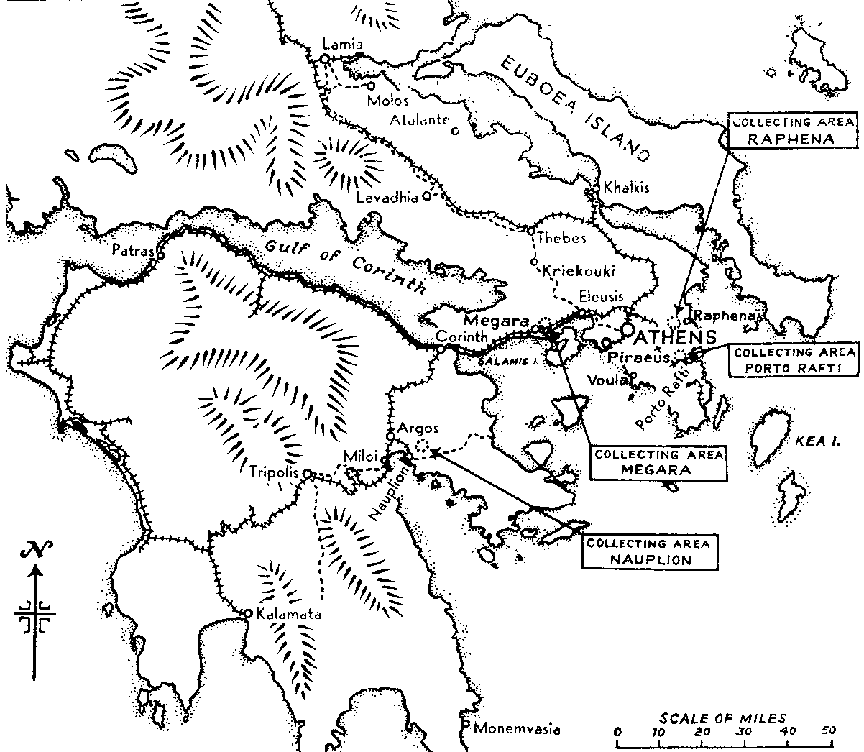
Men of 4 Field Hygiene Section, HQ 2 NZ Division, and Col Kenrick and his staff were also included in the Calcutta's load of 35 officers and 700 men. By 3 a.m. on 25 April as many men as possible had been embarked, and the convoy put to sea. Later, the convoy was joined by ships pulling out from other beaches. Among them was HMAS Voyager with the New Zealand sisters on board.
The sisters had remained at Kephissia after the hospital ship Aba had been compelled to leave hurriedly without them, until they moved off with 100 British and Australian nurses in eight trucks at 10.45 p.m. on 23 April, with instructions to move to Argos, 120 miles to the south. They travelled all night and halted for breakfast at 7 a.m., some ten miles south of Corinth. Shortly after resuming, one of the trucks containing 19 nurses of 1 General Hospital overturned at the foot of a steep hill. Fortunately none was seriously hurt although all were injured. After receiving medical attention, they were loaded into two Australian ambulances, which luckily had pulled up just along the road for their occupants to have a meal. It was daylight and there was sharp enemy air activity overhead; the party continued on until 11 a.m., when cover was obtained under the trees in a cemetery. They remained hidden during the day, before setting out at 8.45 p.m. on the last stage of their journey to Nauplion.
The trucks could not get within about a mile of the wharf, but the ambulances managed to drive almost to the jetty. By now the injured nurses were feeling the delayed effects of the accident. None could have walked very far; heads were aching and arms, legs, and necks were stiff. They stepped on to an old caique, a Greek fishing boat. Not able to see anything in the darkness, they sat about with their bags on their knees and moved silently out to sea.
After a short time the sides of a big black vessel appeared and then the outline of guns. The Royal Navy had arrived, and the 160 women, including QAIMNS and Australian sisters, were glad and thankful. Getting aboard the destroyer, HMAS Voyager, was no easy matter. The sisters had to jump while the small boat was on the crest of a wave and climb over a network of wires, but with the aid of sailors they managed fairly well. One sister (QAIMNS) missed her footing and fell into the water but was quickly rescued.
There is little room on a destroyer at any time, but the Navy found places for the sisters without any fuss and bother as if it were the usual thing to have 160 women on a warship. Most found somewhere to sleep, and sleep they did until dawn. During the morning the destroyer dashed in and out of the convoy. There were two alarms and one short raid, when the destroyer's guns went into action. The noise was tremendous, but the Navy's precision was impressive. By 3 p.m. snowy peaks rose from the sea in the distance he highlands of Crete, seeming to rise straight out of the blue waters of the Mediterranean. The destroyer steamed ahead with its sleek, low bow cutting the water. A threatened air raid just before she entered Suda Bay caused a diversion, but shortly afterwards she proceeded direct to the wharf. It is said that the Commander was sorry to lose his female passengers---he had not been aware of so many clean caps, trousers, and shorts as had appeared on his men in the last few hours.
In the rush to get the ships far enough away from land by daylight to escape concentrated dive-bombing attacks, some troops, were left behind. Among these were many men of 5 Field Ambulance. These men drifted in to rejoin the unit from time to time during the days following the arrival of the field ambulance in Crete. One party, comprising Maj Fisher, Maj Christie, Capt S. G. de Clive Lowe,(20) Lieutenants Lusk, Gray,(21) and Moody and 57 men, had embarked on a tank landing craft at Porto Rafti too late to reach the ships of the convoy, which had already put to sea. The naval authorities sent the party in the landing craft to the small island of Kea offshore. After remaining hidden on the island for a day and a night, the men marched eight miles across to the eastern side of the island, where they were picked up by a tank landing craft and taken to Porto Rafti. That night they were taken on board HMS Carlisle, which put them ashore at Suda Bay on the evening of 27 April. They rejoined their unit next morning.
Anzac Day, for the troops still remaining in Greece, was another day of most intense aerial activity. 6 Brigade had withdrawn the previous night from Thermopylae. To the enemy it must have appeared that the New Zealanders had vanished completely from the face of the earth. Throughout the day low-flying aircraft searched the valleys, diving to the attack with sirens wailing at the least sign of movement. Under cover of darkness, men and trucks emerged from their places of concealment, and the brigade moved back across the Corinth Canal to Miloi, some 30 miles to the south.
At the same time, 4 Field Ambulance also moved back across the Corinth Canal. Previously, on completing its move with 4 Brigade to the covering position at Thebes on 23 April, the New Zealand medical unit had occupied an area alongside 2/1 Australian Field Ambulance, 15 miles south of Thebes, taking elaborate precautions for concealment from the air so as not to give away the presence of a considerable concentration of troops in the area. As the Australian field ambulance was operating there, 4 Field Ambulance remained closed. An NCO and 16 men were detached to assist the Australian stretcher-bearers before 4 Field Ambulance withdrew on the night of 25-26 April. After crossing the Corinth Canal, the unit dispersed off the main road in an irrigation area.
On reaching the new area, 4 Field Ambulance learned that luck had been in its favour, as a large force of airborne troops had been dropped under bomber and fighter cover on the banks of the Corinth Canal soon after the unit had passed over. It was apparent that the enemy wished to secure the bridge across the canal, so cutting off the retreat of the British forces.
It was part of the general withdrawal plan that 4 Brigade should move across the Corinth Canal that night. When, therefore, 6 Brigade received a report stating merely that paratroops had landed, the policy of concealment was abandoned, and two companies were sent back to help Isthmus Force in the hope of saving the bridge, and another two companies took up covering positions near Argos. With the companies speeding to help hold the bridge went an ambulance car from 4 Field Ambulance to assist the RAP in handling wounded. As the troops neared their objective, they came under especially heavy attacks from the air. While evacuating casualties, the ambulance car from 4 Field Ambulance was machine-gunned by enemy aircraft, the driver being killed and the medical orderly suffering serious wounds, from which he later died. An attack was made on the paratroops, and the bridge, already prepared for demolition, was blown.
The seizure of the Corinth Canal was the last of a series of misfortunes leading to the capture of the detachment of 1 General Hospital staffing the convalescent hospital at Voulas Camp. The patients under the care of the detachment had rapidly increased to 450 by 19 April. These were sorted out and evacuated until the total was reduced to 200 next day. The order for total evacuation and abandonment of all equipment and personal gear was received at 11.30 p.m. on 21 April. Less than three hours later all patients and staff, comprising about 250 in all, moved out in trucks, accompanied by the New Zealand Mobile Dental Unit and Base Reception staff, heading to the west beyond Eleusis. They were stopped by Movement Control Post at Megara, west of Athens, and lay up there under olive trees one mile east of Megara village for two days, living on bully beef and biscuits. On 24 April the hospital was told to remain where it was, and that it would be evacuated at Megara if possible. All very sick patients unable to walk were returned to 26 General Hospital at Kephissia. That day the remainder marched two miles down the road to an area near Megara beach, where they were joined by walking cases from 26 General Hospital and other units. All the serious cases were sorted for early evacuation, with the fittest remaining to the last. There was much air activity on 25 April and the patients became difficult to manage, but the camp was quiet. All vehicles were destroyed at 5 p.m. and embarkation began from the beach at Megara at 9 p.m.
The medical group had the last allocation. An accident to one ship and a delay with lighters held up proceedings, and at 4 a.m. next day there were still 400 men on the beach when the ships moved out. Some of the patients had had several trying days from air activity and were in a very nervous and hysterical state. It was stated then that there would be no more evacuations from Megara and that the next embarkation would be from Corinth, 20 miles away. It was necessary to get everyone there somehow. Most of the vehicles had been destroyed, but twelve ambulances and trucks were found to convey over 200 of the worst cases.
In an endeavour to get over the eight-mile Megara Pass before daylight, the remaining 200 of the group set out at 4.30 a.m. to walk. This pass had been bombed all the previous day. By dawn the men were strung out along the road; the leading men were over the pass, waiting at a rendezvous for the rest. At daylight enemy planes appeared and patrolled the road continually at about 40 feet, machine-gunning everything. After waiting for two hours the 100 men at the rendezvous decided to go in small groups over the foothills away from the road and gather in Corinth in the later afternoon. Some of those near the road then heard that parachutists had come down about two miles ahead, and that the bombing in Corinth was intense. Capt Kirk and others decided to return along the road to the starting point, gathering in those within reach of the road; several trips were made in a truck in spite of the danger from the air. Some men were undecided what to do and did not turn back. By midday about eighty had returned to the starting point at Megara. Lt Borrie and Lt McDonald,(22) with patients and staff, were captured on the Corinth side of the pass in the early afternoon.
At half past three Captains Slater and Neale and Lt Foreman, seeing that no boats appeared to be available, decided to go with the patients by road towards Athens in some trucks and ambulances and try to contact 4 Brigade as it withdrew. With them went about forty convalescents and some orderlies from 1 General Hospital. They were captured by German parachutists three miles east of Megara village.
The remaining small party, including Capt Kirk, were in favour of escaping by sea. They took cover in a barn. where a Greek informed them that parachutists had landed near Megara about a quarter of a mile away. The situation was then very tense with death or capture seeming imminent. Hearing from a Greek that a boat was about to leave the beach, Capt Kirk decided to dash for the beach through the mile of barley crops, without any trees for .cover, while the others preferred to wait till dark. Capt Kirk narrowly escaped being machine-gunned in his dash to the boat, which reached Crete after three days' sailing and two days lying up in the islands. The rest of the New Zealand officers and orderlies who had staffed the convalescent hospital were captured.
After the departure of the main party of their unit from Greece, the 30 orderlies from 1 General Hospital attached to 26 British General Hospital at Kephissia continued with their duties. On 24 April they loaded patients on ambulances for embarkation. They were to report at Force Headquarters at 3 p.m. for embarkation instructions, but were delayed by carrying casualties from Piraeus to Kephissia. They reported at Force Headquarters at 10.30 p.m. and were instructed to join a convoy going to a beach west of Corinth. On the way they found themselves near a large group of 21 NZ Battalion, and to this unit they attached themselves. The Ulster Prince ran aground that night (25-26 April) and this reduced the numbers who could be embarked. It was then agreed that any embarkation would most likely be made from one of the beaches farther south. The men lay hidden in an orange grove all day and moved off at 11 p.m. on a seven-mile march to a rendezvous decided upon. During the next day no sea transport appeared off the beach where the men lay hidden. Four of the party formed a stretcher squad and cared for an injured soldier all day, and finally the five were embarked on a boat and transferred to a warship that night (26 April), reaching Egypt safely.
Of the remainder, a party of 21 with S-Sgt Ashworth(23) in charge, reached Argos to the south, and from the port of Nauplion were evacuated to Crete. Here they were attached to 7 British General Hospital.
After the German airborne assault on the Corinth Canal zone, events in the Peloponnese moved towards a swift conclusion. Corinth had fallen and Tripolis was threatened by advancing German columns. At the foot of the pass leading over the ranges to Tripolis, A Company, 4 Field Ambulance, at the request of HQ 6 Infantry Brigade, had established a dressing station.
On the evening of 26 April, HQ and B Companies withdrew over the pass and sought cover in a forest reserve about three miles south-east of Tripolis. The area previously had been reconnoitred by Capt Tremewan(24) and Capt Loeber, NZDC,(25) in a hazardous daylight trip.
By dawn of the next day, wounded from various units were reaching the area in considerable numbers, and in order to accommodate them and give them all possible attention, 4 Field Ambulance opened a dressing station in a Greek church alongside the reserve. Much assistance was given the medical men and orderlies by civilian helpers and a Greek priest.
The benign old priest, his eyes flooded with tears, supported a dying soldier while Padre Bicknell held a cup of cold water to his lips. As the villagers heard of the presence of wounded men they came endlessly with their gifts---eggs, bread, and even a plucked fowl. A Greek soldier held a mirror for a wounded man while he tried to shave himself, a second Greek soldier supporting him. This was typical of the unselfish service seen that day. In a little cemetery, about 500 yards along the road leading from the church, two New Zealand soldiers were buried that afternoon.
At this time 25 Battalion was holding a road-block in the pass between Miloi and Tripolis, while 24 Battalion guarded the remaining approaches to this key town. The brigade's orders were to hold these positions until dark and then move as quickly as possible to a dispersal area near the beach at Moneinvasia. 26 Battalion journeyed south during the afternoon, and the other battalions began their withdrawal under cover of darkness. 4 Field Ambulance joined in this last stage of the withdrawal, its three remaining 3-ton trucks and three ambulance cars lifting members of the unit and 37 wounded in circumstances as comfortable as possible, and covering the 90-mile journey over difficult and unknown roads to the dispersal area during the night.
All through the next day, men and vehicles sheltered under every form of available cover a few miles from the beach at Monemvasia. Enemy aircraft kept up a relentless search but failed to find our troops. New Zealanders and some Australians were disposed in readiness to meet a possible attack. Plans were made for the final evacuation. In an effort to get everyone aboard the destroyers that night, it was decided to use a number of small boats and a Greek caique which had been found on the beach.
That evening (28 April) the vehicles were used to transport the men to the beach; then they were destroyed. Some were drained of oil and the engines run until they seized, holes were punched in petrol tanks, vital parts were removed and smashed or hidden, tires were slashed, and many vehicles were driven over a cliff into the sea. Then followed a long, anxious wait until, at last, destroyers came into the bay and embarkation began.
About midnight one landing craft was loaded with some of the stretcher cases and moved off into the darkness of the bay, while those on shore awaited her return with some anxiety. At last she pulled in again, but to the consternation of all, the wounded were still on board. The destroyer to which she had gone was unable to load stretcher cases as she had no suitable gear. An appeal to the officer in charge of the embarkation brought the reply that the Ajax would be coming in at half past one in the morning and the wounded would be able to go on her. An anxious hour followed. The troops were being rapidly embarked into other suitable ships, and the medical group in charge of the wounded began to wonder whether daylight would find them sitting forlornly on the beach. However, shortly after half past one there slid into the bay a dark shape larger than any that had preceded it. This was the Ajax, and in a remarkably short time all the wounded were loaded and accommodated in the captain's day cabin, each with a large mug of steaming cocoa.
With the delays, it looked as though many men would have to be left behind, but fortunately more ships arrived. To escape enemy air action the ships were to have sailed at 3 a.m., but it was decided to risk another hour. Eventually, by pressing into service every type of craft that would float, everyone was got aboard before four o'clock, and the ships moved off at full speed for Crete. As Capt Moore said:
'RSM Bunckenburg(26) had organised the field ambulance orderlies and the wounded on the beach. Prominent figures were coming and going, and the grey shape beside you on the promontory and twin jetties of Monemvasia might turn out to be a general, an admiral, or a humble, exhausted private.
'Pathetic heaps of packs lay abandoned on the sand. What a grand haul of loot for the first Greeks or Germans when dawn came! RSM Bunckenburg was grimly guarding the last of the unit records. We had a long wait till the landing craft took out the stretcher cases, seven at a time, and the last of the wounded and medical personnel went aboard. Meanwhile, a great grey column of men filed past, were forced to discard excess baggage, and were embarked in a great variety of small craft. The Ajax risked that extra half-hour or so which might have exposed her to the bombers, and the last of the wounded were hauled aboard on her platform---a more expeditious loading than some hospital ships could have achieved. We were not quite the last on board, for General Freyberg's great figure appeared in the wardroom while we were busy on bowls of soup, fresh bread and butter, and boiled eggs. The Navy not only took us off---it transported us in luxury.'
The men of 4 Field Ambulance and their patients reached Suda Bay in a few hours, and a transfer of troops to other ships was begun immediately. The field ambulance men went aboard the Thurland Castle, which was crammed with 3000 troops, and left for Egypt at midday in a convoy escorted by about a dozen mixed naval vessels. Enemy aircraft made several attempts to scatter the convoy, and between Crete and the Dodecanese Islands a German E-boat made an abortive hit-and-run attack. More vessels joined the convoy, and by next morning there were in all 27 ships, the naval escort including the aircraft carrier Formidable and two battleships, Warspite and Barham. The day passed without serious interference by the enemy, and at dusk the Thurland Castle set her course for Port Said, while the rest of the convoy went to Alexandria.
Sgt Price(27) and the 16 stretcher-bearers from A Company, 4 Field Ambulance, who were attached to 2/1 Australian Field Ambulance, had an exciting time with 4 Brigade before getting away from Greece. While 5 Brigade moved to beaches near Porto Rafti, Raphena and Marathon, east of Athens, and embarked, and 6 Brigade moved across the Corinth canal to the Peloponnese, 4 Brigade remained hidden in its rearguard defensive positions near Kriekouki. Not until the morning of 26 April did the enemy know the New Zealanders were there; not until an enemy column of 100 vehicles driving confidently down the main road towards the pass they covered was rudely halted by artillery fire. During the afternoon news was received of the paratroop landing near Corinth Bridge, across which 4 Brigade was to withdraw that night. For a time the brigade was in an exceedingly awkward position, with enemy movements threatening it from both the east and the rear. Fortunately the Royal Navy was able to arrange to embark the brigade group at Porto Rafti beach, south-east of Athens.
The group withdrew that night in readiness. The next day, as the New Zealanders and Australians moved into positions from which to defend their route to the beaches, coming under aerial attack as they did so, was one of the most trying the Anzacs had ever known. German tanks, guns, and troops were pouring into and beyond Athens, and at any moment a tank attack in force was expected. But no attack came, and that night the troops were able to embark and get safely away to Crete.
During the evacuation of Greece twelve medical officers and 24 orderlies were made available for duty on the troop-carriers going from Egypt to Greece and back. All the transports on which these New Zealanders served went unscathed, except for the Dutch ship Slamat, which on its return journey from Greece on 27 April was attacked from the air. While Capt L. Douglas(28) and Lt J. W. Newlands(29) were going towards the bridge to render medical service, an incendiary bomb struck the ship. The troops launched the lifeboats, which were machine-gunned by the plane. Some of the men were taken on board a destroyer, but this was torpedoed later in the day. Only one of the men in the medical duty party on the Slamat survived. Capt Douglas and Lt Newlands were the first of the small number of medical officers to be killed in action.
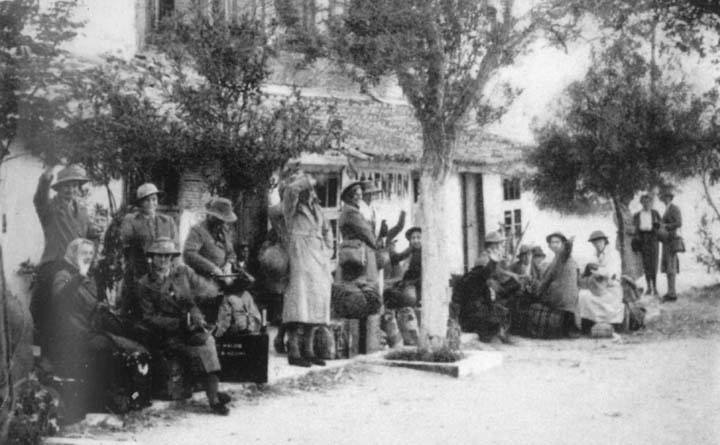 | 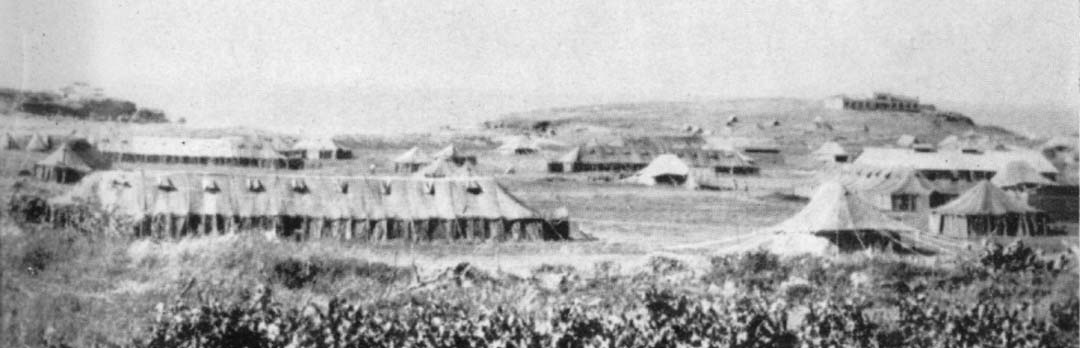 |
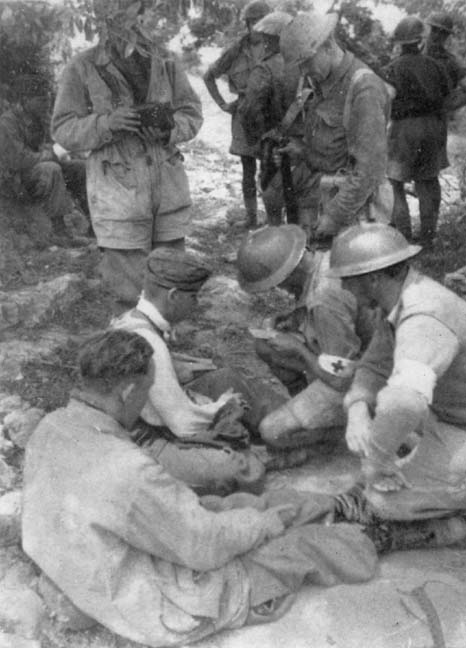 | 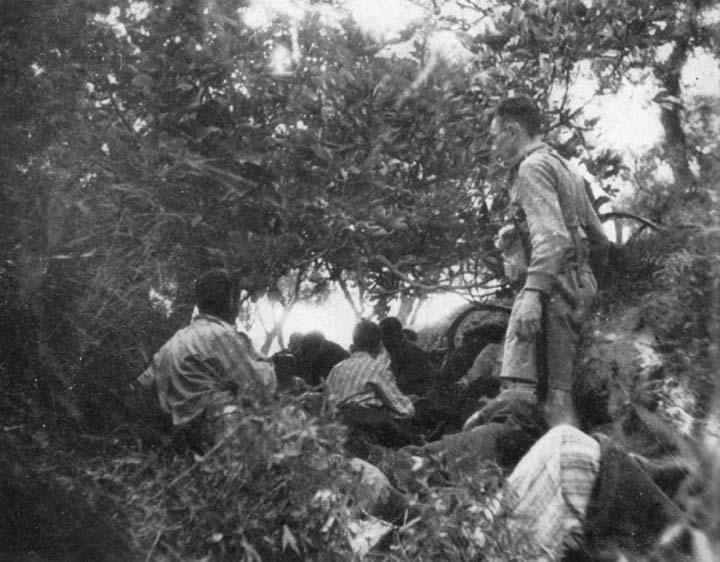 |