 |  |
 |  |
WHEN 4 Field Ambulance and 4 Field Hygiene Section disembarked on 13 February 1940, the train journey from Port Tewfik through Geneifa, Fayid, Ismailia, El Qassasin, and Tel el Kebir to Maadi, a distance of about 90 miles, took about six hours. The New Zealand troops were not impressed by Egyptian troop trains and they were to find by bitter experience that the standard did not improve. The dusty carriages had wooden seats and bare floors, and these the engine drew in frenzied dashes, with the whistle shrieking incessantly, and then halted at isolated stations as if exhausted. At their destination, Wadi Digla siding the men were glad to leave the train, and then they marched with light kits to quarters under canvas in Maadi Camp.
Maadi Camp, stretching out in the desert about eight miles from Cairo, was built on a plateau overlooking the Nile Valley. It was something of a disillusionment. No one had quite expected a base camp (to all intents and purposes) out in the unfriendly desert, or had realised that the desert was such a colourless and depressing waste of sand. Romantic pictures of golden, rolling sandhills were soon dispelled by hard reality, and although, later, men were to come to look on Maadi Camp as representing comfort and civilisation, at first encounter the prospect of living under what then seemed such cheerless conditions was far from encouraging. The only feature to break the monotony of the surroundings was a lined and eroded escarpment beyond the camp boundaries to the south and east, while westwards in the hazy distance were the age-old Pyramids. There was not a tree, a bush, or any splash of living green in the camp to relieve the drab monotony of desert.
The camp was a haphazard assembly of large square tents (EPIP [1] they were called), smaller reddish-brown tents, and huts of wood or stone. More huts were being built, 'Wogs' working at them slowly to a monotonous chant by one of their number, while camel trains carrying building materials strode leisurely through the camp. The huts were used mainly for offices, cookhouses, messrooms or stores, and the men's sleeping quarters were all in tents. Erecting the tents was a major task as the rocky plateau was covered with only a few inches of sand. Camouflaged to blend with the sand, the tents spread over the desert for a considerable area, later to grow to several square miles. Later on, the building of NAAFIs, YMCA, and Lowry Hut added comfortable amenities.
The First Echelon arrived in Egypt at the end of the northern winter. New Zealanders in Maadi Camp found the days not unduly hot, but the nights were extremely cold. Men were early advised to keep an overcoat handy on going to bed for use as an extra blanket in the early hours of the morning, and this precaution was found to be almost a necessity. Shaving in cold water at reveille, often before sunrise, was a painful business for many who had been used to the luxury of hot water on the voyage to Egypt.
The unseasoned troops found living conditions somewhat unpleasant during the frequent ' khamseens'---hot winds laden with the dust of the desert.
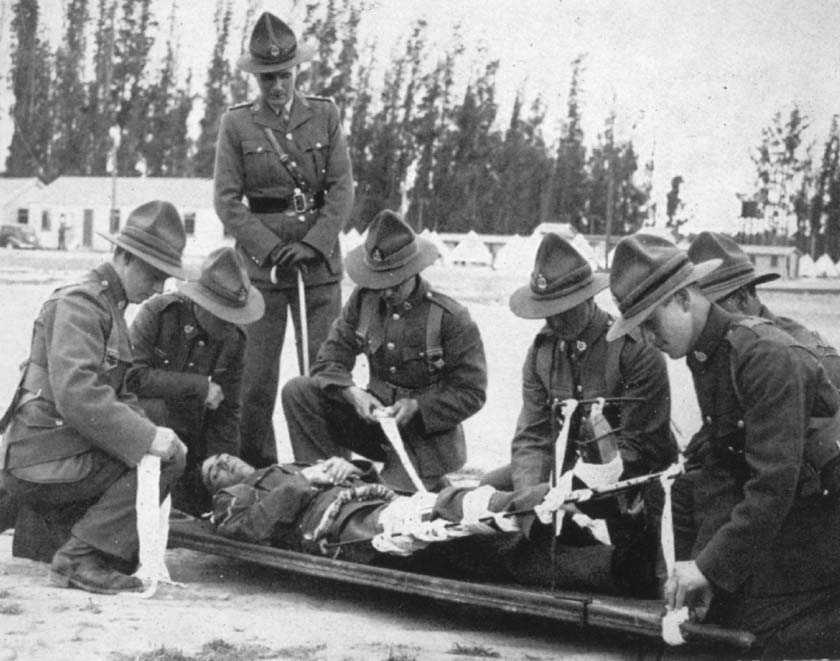
Much pioneering work had still to be done in the camp and in unit areas, and here 4 Field Ambulance and 4 Field Hygiene Section demonstrated an efficiency and keenness which was later to characterise the work of the medical units of the force in all their undertakings. A Camp Hospital of 100 beds was early established by 4 Field Ambulance, in which patients with infectious and venereal diseases were treated.
The hospital began with five large marquees for general sickness, four large marquees for infectious and venereal diseases, and four small tents for administrative purposes. Ambulance members staffed it and built up their knowledge of the care and treatment of the sick. Minor digestive and respiratory system infections were the most common disabilities requiring treatment, while other cases included skin infections and minor injuries. Medical officers were attached as Regimental Medical Officers to the various battalions, field artillery, and other units then in training.
This Camp Hospital continued to function throughout the life of Maadi Camp and was recognised as a separate unit and given a definite establishment later in the year. Its staff, most of whom were eventually posted to other medical units, fulfilled a very useful purpose in caring for the less serious sick patients from the camp.
Flies were one of the chief nuisances of life in Maadi. Tougher cousins of the domestic New Zealand breed, the Egyptian flies were bigger, sandy in colour, and born fighters. Many a soldier on parade, driven almost desperate by their bites, preferred to draw the wrath of the sergeant-major by brushing them off rather than suffer their constant attacks. Both from a medical and a soldier's point of view, flies were the troops' worst enemy. Local methods of cultivation and irrigation, together with the flies, made it necessary for uncooked fruit or vegetables to be washed in disinfectant before being eaten. The consequences of neglect were liable to be 'Gippo tummy' or even dysentery. Throughout the first few months in Egypt, 4 Field Hygiene Section worked steadily to improve sanitation and safeguard health.
The spring flooding of the Nile added humidity to the desert heat and brought with it the first of the mosquitoes. Nets issued to the men were rigged over their beds from a ring hung in the tent roof, and anti-mosquito cream was also issued as a protection against bites. Another pest introduced into the camp at this time was the bed-bug, brought in by troops returning from duty at the Kasr-el-Nil Barracks in Cairo, by Egyptian labourers, or else in furniture from Abbassia. Measures taken against these bugs included steam disinfestation, the sprinkling of tents with pyrethrum powder, and dipping bedboards in kerosene. The bites from these bugs and their descendants were to be a torment for many thousands in Maadi in the years to come.
Strangers in a strange land, many of the 18 First Echelon sisters of the NZANS were meeting one another for the first time as they disembarked from different ships on 14 February. Introductions were made as they journeyed to Cairo. A cold wind was blowing, seasoned well with smells, dust, and insects. Ever-willing natives with an insatiable desire to carry anything from heavy bags to a handbag, mingled with the beggars crying for baksheesh. These, with the sordid appearance of Port Tewfik, did nothing to make the sisters' first impressions favourable. Indeed, it was somewhat in trepidation that they said farewell to their ships, for these seemed the last tangible piece of home. Still, with a ticket in hand and hearts full of hope, they boarded the diesel train to Cairo, waited, and wondered vaguely about everything.
There were Egyptians in the carriage, too, and the perfume of the Mystic East, so often read about, seemed to have a decidedly garlic odour, and all were glad of a bottle of lavender water one sister had thoughtfully provided. Those who have crossed the dreary waste of desert between Suez and Cairo can appreciate that this journey did not alter the impressions first received, but passing camel trains, seen for the first time, and the fellahin in his natural habitat, filled the journey with interest for these new arrivals.
Cairo main station, with its seething masses of humanity, would have been bewildering to a degree, but for the presence on the platform of the Principal Matron of the QAIMNS,(2) and the Matron and several of the senior sisters of the 2/10 British Hospital at Helmieh, a suburb of Cairo, to which the sisters of the NZANS were to be attached.
A truck took them to the hospital, along with their luggage. This method of transport, through what appeared a modern city, was rather a surprise to these sisters who, a few short weeks previously, would have considered riding through the streets of Wellington on the back of a truck, clad in one's 'Sunday best', not quite done in the best circles. However, with hardly veiled amusement, they clambered in as best they could. Before long they were to become adept at such negotiation, learned to appreciate trucks as truly grand means of transport, and were to travel many hundreds of miles in them. So they arrived at the British hospital that was to be their home for the next five months.
This, a regular Army hospital, was still being run on a peacetime basis, and to these New Zealanders who had come to 'the war' this lovely hospital, with its rather palatial mess, was another surprise. Perhaps, too, somewhat of a disappointment to the sense of the fitness of things. They were quite pleased when the Matron said, 'Your tents are ready'. It sounded right and proper to be living in a tent in Wartime.
But what tents these were! EPIP, two sisters to a tent, an Axminster rug beside each bed. The floor, as level as a billiards table, was covered with a tightly stretched tarpaulin. There were white quilts on the beds, oil heaters, a washstand with all accessories, as well as a wardrobe, dressing table, and chest of drawers for each sister. Well-trained suffragis wakened them at 6.30 a.m. with a cup of tea, cleaned their tents, filled their hot-water bottles, turned back their beds, and tucked in their mosquito nets in the evening; cleaned their shoes, collected their laundry, and did all the things that help to make life in the Army easy. Though rather surprised at all this luxury, these New Zealanders lapped it up while it was available.
On 15 February three medical officers and 50 orderlies from 4 Field Ambulance, under Maj Tennent, were also detached for duty at 2/10 British General Hospital, to which it had been arranged that all serious cases of illness among the New Zealanders would be sent for hospital treatment. The detachment, with the sisters, was responsible for the treatment of these patients. This arrangement ensured that ambulance orderlies would receive training in actual care of the sick, hospital duties and routine, and would profit by association with members of the RAMC, experienced in hospital conditions in Egypt. Their training covered nursing, operating-theatre practice, radiology, massage, dispensing, laboratory, medical stores, administrative and general duties. Successive detachments underwent tours of duty at this hospital and the training and experience thus received later provided skilled and efficient staffs for the expanding activities of the New Zealand Medical Services.
Many invaluable lessons for the days ahead were learned by the New Zealand sisters in this hospital, and the experience was one they were to appreciate more with the passing of time. Interest was twofold: firstly, in the work of an Army hospital, secondly, in contact with tropical diseases and conditions. For the New Zealanders, all comparative strangers to Army methods and organisation as well as to tropical diseases, there seemed much to be learned, for the work and manner of working were very different from that with which they were familiar.
Unaccustomed to regimental ways and such clicking of heels, the very strict ward discipline at Helmieh was at times somewhat overpowering, and also amusing, for the sisters. War establishments provide limited means and equipment for nursing the sick soldier. The sisters were accustomed in civilian hospitals to every convenience, plenty of china, linen, and enamel ware. They found here that a patient on admission received his requisite kit, which included his 'blues' for convalescence, sheets, pillow-slip, towel, knife, fork, spoon, tin plate, and two bowls, for all of which he was responsible during his illness.
By 9 a.m. each day the ward was ready for the medical officer's round, and this was quite a ceremony. The tidiness was extreme, and even the bed-patients looked as if they were on parade. One could have heard a pin drop during that round, and even if it took two hours, the up-patients stood at attention at the foot of their beds until the medical officer and charge sister had left the ward.
But a medical officer's round was as nothing to the Matron's daily round. Our sisters had always regarded a matron's visit to a ward somewhat in the light of a friend coming to make kindly inquiries regarding her patients' well-being, and to offer advice or assistance in problems that daily arise in any hospital. Now the procedure of preparation was rather staggering. Boots were polished till one could almost see one's face in them, then, with brushes on top, were placed beneath the locker, a sandshoe on either side. Even the lockers looked as if they, too, were on parade. On the lower shelf the blue suit and underwear were folded in correct Army style, making two piles about four inches apart. The top shelf held the towel correctly folded with 'three folds, not two, sister', on top of which the toilet gear was arranged like a window display. On the top of the locker, correctly arranged, was the mess gear, polished by the patients till it shone like mirrors.
But the CO's weekly inspection left our sisters speechless at first, though in time they got used to it all and thought nothing of it. Such a flutter all the morning! Everything was turned out and scoured; then all work was suspended after 10.30 a.m. The CO arrived. With him came the Matron, the OC Medical or Surgical Division, Medical Officer in charge of the ward, the Registrar, company officer, Quartermaster, RSM, and a number of corporals (who, never seemed to know quite to whom they belonged). At the ward this retinue was joined by the sister in charge of the ward, and all the other sisters who had not discreetly disappeared, and with them the senior ward orderly. Then followed a searching round the ward, peeping under curtains, into cupboards, and down drains; and if anything was not up to standard, it was the poor senior ward orderly---right at the end of the line---who took all the knocks. After such an inspection it was no wonder the sisters retired to the 'Bunk '---pronounced Boonk---as the Duty Room was known, for a reviving cup of tea.
'Equipment' was another word whose meaning these New Zealand sisters learned to know---and how they hated it ever afterwards! The poor charge sister signed on the dotted line for everything, almost to the last pin. Rations, and how to make them 'spin out' was another lesson learnt.
In the Regular Army a soldier lived strictly on his rations---a quantity which, although adequate, seemed a meagre portion to the healthy New Zealanders. It took them a long time to get used to the odd meal hours too. Instead of a substantial evening meal at 5 p.m. such as the New Zealanders were accustomed to, in a British hospital tea is served at 4 p.m. and supper at 6.30 p.m., both small, light meals. Such meals did not satisfy the New Zealand patients when they arrived, and, unlike the subdued Tommy, our men soon let it be known that though they did enjoy their dinner---always an excellent meal---they wanted bigger and better teas. One sister tells how, seeing in the kitchen a pile of bread and butter with jam alongside, she blithely took it out to her grateful patients at 4 p.m. Returning to the kitchen with the empty tray, she found a distracted orderly wondering what had happened to the supper he had left on the table. Consternation was acute when it was found she had given out all 'the supper' at 'tea time'. Over the patients' reactions at 6.30 p.m. when they found that, as far as supper was concerned, they had 'had it', one can only draw a veil. Red Cross supplies were an invaluable supplementary diet when rations were so limited.
At first their English colleagues were apt to shake their heads over the discipline, or rather lack of it, in these rowdy Kiwi patients who so quickly made their presence felt. However, a friendly tolerance and a mutual understanding quickly developed.
Our sisters learned to prepare food and drinks and to protect them from contamination from dust and flies---a very important procedure in Egypt. Fruit and vegetables had to be soaked in a weak solution of Potassium Permanganate for at least half an hour, and nothing was left uncovered.
Diseases, on the whole, were mild but typical. Malaria, dysentery, sandfly fever, and, of course, the 'flu'. The special points of nursing each of them were carried out in simple but practical ways, and in a short time the New Zealand sisters were able to deal with anything that came along.
PAD(3) exercises and parades were the next schooling. Respirators and tin hats were worn during the alerts and alarms. Sisters looked through goggles and hoped that the all clear signal would soon go so that they could get a breath of fresh air. At night there were strict blackout restrictions---strict with a capital S in those days.
Hours of duty varied considerably from New Zealand working hours, but the sisters found there was often time for sightseeing, and every spare moment was spent in exploring Cairo and the surrounding districts.
So the days passed quickly enough, and the weeks became months, marked by high excitement when mails from home arrived. Perhaps 25 February 1940 will ever be remembered by these sisters of the First Echelon as the red-letter day when their first mail arrived.
All ranks in Maadi Camp eagerly looked forward to their first leave in Cairo. The stories of members of the advanced party, and the attractions of that city as outlined by old soldiers of the First World War, had made the new army of New Zealanders anxious to see things for themselves. Most were given the opportunity on their first weekend at Maadi. Troops had already been lectured on the out-of-bounds areas, the dangers of venereal disease, the sanctity of the Egyptian tarbush, the need to watch for spurious money, and had also been issued with maps of Cairo.
The first leave parties were faced with a march of up to two miles to Maadi station, though unit transport was later provided.
A quick journey in a fast diesel railcar took troops from Maadi to Bab-el-Louk station in Cairo for one piastre (twopence half penny). Outside Bab-el-Louk station they were besieged by bootblack boys trying to earn a few piastres by applying doubtful boot-polish, by unprepossessing pedlars in nightgown-like galabiehs, by gharry drivers seeking a fare in their cabs drawn by feeble-looking horses. Guides would offer their services to show troops the sights of the city---the Pyramids, the Sphinx, the zoo, the innumerable mosques, the Citadel, the native bazaars in the Mousky, and the Birket area.
To most, the many wide streets and open midans of Cairo became familiar, streets thronged with a cosmopolitan crowd of colourful types and costumes, Eastern and Western or an incongruous mixture of both: the almost invariable red tarbush, the skull cap or cloth band headdress of the poor; the long full robes in white, dark colours, or stripes; the ragged, persistent, little bootblack boys vieing with one another for custom; the shrewd street-vendors of cheap junk and second-rate curios, exuding an odour of garlic and stale sweat. In open café bars around the city, at tables fronting on the pavement, sat portly Moslems sipping black coffee and reading the Arabic daily news-sheet or playing backgammon.
In spite of fine buildings, theatres, restaurants and shops on a lavish scale, and many evidences of wealth, there was an air of shoddiness about even the city area of Cairo. Spreading outwards in all directions were its many crowded slum areas. The native bazaars of closely packed little open stalls in a maze of narrow lanes and alleys, selling every imaginable type of curio, cheap jewellery, cloth and leatherwork, were a profitable source of souvenirs to send home, and the licensed Birket area, a novelty to the uninitiated, proved an unpleasant surprise even to the forewarned. Harsh music emanated into the semi-blackout of the night from tawdry café bars, where dancing partners of dubious attractions lured soldiers into paying high prices for their liquors.
Late at night an asthmatic and broken-down old bus would splutter up to the camp and empty out its overload of tired soldiers returning after a day in Cairo.
A few soldiers' clubs already existed in Cairo when the First Echelon arrived in Egypt. Subsequently others were opened, notably the Tipperary Club and Empire Services Club. To provide a place of recreation for the troops, the Maadi Tent was opened on 24 February in the pleasant environs of that tree-girt suburb. The Tent provided games facilities such as draughts and table tennis, and supplied ice cream, soft drinks, and light meals; concerts for the troops were also held there. It was conducted by volunteers from the residents of Maadi and proved extremely popular with the New Zealanders.
Near Maadi Tent a swimming bath was constructed for the New Zealand troops. It was built in five weeks and was officially opened by General Freyberg on 7 April, when a swimming carnival was held.
In February a camp cinema was opened in a makeshift building in the centre of the camp. 'Shafto's', as it was called by the New Zealanders from the name of its proprietor, showed two sessions nightly and changed its programme each day from its well-worn film library. Admission charges were three, five, and eight piastres, the comfort of the chairs varying with the price. Regular features were the stoppages through breaks in the film, greeted inevitably by howls of derision from the audience.
Tennis and golf players were able to use the courts, course, and equipment of the Maadi Club. Rowing facilities on the Nile were provided by local clubs in Cairo and, later on, the Cairo Yacht Club placed its boats and amenities at the service of all those interested. Rugby football and hockey were played by the various units in the first weeks at Maadi and an inter-unit Rugby competition was completed during March.
Every man was expected to take part in some recreation. Committees were formed in each unit to control these sports, arrange matches and competitions, and select unit teams. The sports catered for during the year included cricket, football, athletics, boxing, rowing, tennis, deck tennis, swimming, and baseball. When the hot. summer weather became most trying the troops were taken on excursions to such places as the Barrage, the Gezira Sporting Club's grounds, and the Cairo Zoo, where green grass and trees provided welcome relief from the dust and sand of Maadi Camp. On Gezira and Maadi Club grounds troops played and watched many a pleasant game of cricket.
The threat of war with Italy brought the prospect of action nearer to the troops of the First Echelon. After almost three months of routine work in their desert camp, the men showed a live interest in the news of tension between Italy and the Allies, of the German invasion of Holland and Belgium and the capitulation of these two countries, and of the blitzkreig against France. There were rumours that 2 NZEF would shortly sail for France. Later in May, the news of the diversion of the Second Echelon also brought with it the inevitable speculations concerning its fate and destination, and rumours of moves to other war theatres.
Believing that Britain and France could not offer serious resistance, Mussolini declared war against them on 10 June 1940. At Maadi Camp the passive air defence scheme was at once put into effect. Each night at 9 p.m. there was a complete dispersal of troops and transport, the vehicles moving out to prearranged positions in the surrounding desert without confusion or incident, under a rigid blackout. The tents occupied by 4 Field Ambulance were dispersed and dug in, while collective slit trenches were dug and sandbagged. The Camp Hospital's tents were not dispersed, although shelters were dug for the patients and the tent walls were sandbagged. In a dugout on a hill adjacent to the field ambulance area, an operating theatre was provided. This was completely sandbagged and made light-proof.
Arrangements were made for the NZEF to have its own general hospital at Helwan, a village some 18 miles up the Nile from Cairo. Here civilisation seems to perish on the edge of the desert, where numerous wadis cut their way into the hills. A railway line runs out to Helwan from Bab-el-Louk, and over its double tracks thunders what must be one of the most profitable trains in the Middle East-the Bab-el-Louk Express. Surely in no part of the world do they pack so many into a train, for the steps, sides, and even the roof of each carriage have their quota of shouting, gesticulating natives.
Helwan was a health resort where the idle rich formerly came to take the sulphur baths. Towards the middle of July 1940, the first New Zealand hospital in the Middle East was established in the Grand Hotel. The Grand Hotel was a notable old place. Its crumbling grandeur had housed many distinguished visitors. Kaiser Wilhelm was reputed to have spent his honeymoon there.
The hotel was a rambling, stone structure of three stories, with the inevitable flat roof, from which was obtained a fine view of the Nile as it wound its way over the desert. It looked more like a streak of bitumen than a river, and the feluccas with their white sails appeared in places to be sailing over a sea of sand. The Pyramids of Sakkara seemed only a few hundred yards away but actually were over ten miles off. Back toward Maadi was an escarpment from which the Tura caves frowned down upon the Nile. It was from these caves that the stones for the Pyramids of Giza were quarried.
When, on 24 July 1940, the Matron (Miss D. I. Brown [4]) and four sisters arrived at the Grand Hotel, tradesmen were busy building, altering, and hanging about generally in an endeavour to transform an hotel into a hospital. Midsummer, with its heat, flies, mosquitoes, and ants, combined with the dust and dirt, made the task of restoring order out of such chaos seem insurmountable. Delay in the arrival of equipment did not make matters easier. On the 26th five more sisters were transferred to Helwan from 2/10 British General Hospital, and the work of scrubbing walls and floors, benches and beds continued, and gradually order reigned.
The three floors of the hotel were divided into wards, the administration offices occupying the entrance lobby and part of the lounge. The dining salon, a large ornate room, became the up-patients' dining hall. On Sunday church services were held there, .and patients and staff sat in the morning heat with their minds back in New Zealand as the Padre asked a blessing on loved ones far away at home.
Underneath the buildings rambled a group of cellars, admirably suited for housing the many departments that make up a hospital. A visit to the steward's store in those days could he intriguing, for it occupied the hotel's wine and spirits department, and the old labels had not been removed from the shelves. Bully beef tried hard to look important behind such labels as Contrexevine, while Heinz tomato sauce reposed behind Kersshuassar and kindred labels.
The remaining sisters, with the patients from 2/10 British General Hospital and from Maadi Camp hospital, were transferred to Helwan hospital on 31 July, and from that day the unit began to function as 4 NZ General Hospital, with 300 beds, under command of Maj E. L. Button.(5)
The 4 Field Ambulance members on detachment at the British hospital were transferred to Helwan as a nucleus of experienced staff, so that the hospital might function efficiently pending the expected arrival from New Zealand of a complete hospital unit---2 General Hospital, under command of Col F. M. Spencer. Helwan hospital remained in the possession of 2 NZEF until the force was disbanded and it became well known to all New Zealand soldiers.
Australian patients, suffering from heat exhaustion, were among the first direct admissions early in August, and Australian medical officers and orderlies helped to augment the staff. The work was hard, because of shortage of staff, and difficulties were many. Lack of equipment, bad drainage, unsuitable cooks, all added to the work, while the number of patients mounted rapidly.
The heat of this first summer in Egypt was trying. The sisters missed the luxury of the British hospital they had left, but were very happy and content, for they felt that at last they were building a hospital that really belonged to New Zealanders. In the heat of August further wards were prepared and opened. The operating theatre block was begun and a start made with installing a lift. When, months later, the lift was finally in working order, it greatly facilitated the moving of patients.
Twelve members of the QAIMNS were attached to the staff during August and September and their assistance was greatly appreciated. After the arrival of twelve members of the NZANS from 1 NZ General Hospital in England on 17 September things became less strenuous. Day by day life settled into a more normal routine.
The sisters lived in a villa, a short distance from the hospital, Villa Mafous by name, a big, single-storied old home, with a delightful garden at the back. Gubalieh, a rather charming little villa with a curious old grotto in the garden, was also used as accommodation for sisters until, in later months, it was pressed into use as a ward. Then, as the hospital grew in dimensions and more staff arrived, Villa Levi and Villa Schlom---more commonly known as Corner House and White House---were also used as living quarters by the sisters.
With the development of the hospital in Helwan, there sprang up many clubs where the up-patients and staff could while away leisure hours. To New Zealanders the best known was the Kiwi Club, situated less than half a mile from the hospital on the edge of Helwan township. Established by the Red Cross and run by ladies of Helwan and Maadi, the Kiwi Club, from the day of its inauguration (10 August 1940), proved most popular with the patients and staff and, indeed, with all who were privileged to visit there. A replica of a Kiwi adorned its gates, and in its grounds some brave little garden plots did their best to get the better of that yellow dryness that is Egypt. From the shady, cool seclusion of the long, low-lying club room, made the more restful by the large lounge couches, cane easy chairs, and bowls of fresh flowers, one could drink tea and watch the sun-worshippers playing miniature golf outside. For the patients, especially, it was a pleasant place to pass away hours of inactivity. For the staff, too, it became a popular rendezvous for evening social or dance functions.
The 'Homestead', in the opposite direction from the hospital, was also a popular rendezvous. Here again were much-appreciated comforts to bring relief from hospital life. After some opposition and seemingly endless setbacks, Mrs. Spence, wife of the Rev. G. A. D. Spence,(6) one of the New Zealand chaplains, and her willing helpers, had cause to feel proud of their achievement. Their efforts were appreciated by many a soldier and hospital patient at Helwan.
But the life of 4 NZ General Hospital as a hospital unit was a short one. By September 2 NZ General Hospital was on the way to the Middle East from New Zealand, and with 1 NZ General Hospital about to leave England for the Middle East also, the days of the small unit were numbered. So much hard work that beginnings always entail, with so little result to be seen, had been put in by these pioneers at Helwan hospital. Now, with difficulties almost overcome, they were rather sorry to hand on to others the work they had begun. That their efforts were appreciated is shown in a special tribute to 4 NZ General Hospital by General Freyberg. In a letter to Col MacCormick, DMS 2 NZEF, he wrote:
' . . . I wish to say that I am particularly pleased with the work done in establishing No. 4 NZ General Hospital. I realise that owing to the shortage of staff this work was effected under difficult conditions, and I feel that the present efficient running of the Hospital is a tribute to the high standard of the NZANS, NZMC, and attached personnel. . . .'
At the end of August and beginning of September, 4 Field Ambulance, now under Lt-Col P. V. Graves, moved with other New Zealand units to the Western Desert, leaving a detachment to run the Maadi Camp hospital. One company took over an ADS(7) from 19 Indian Field Ambulance at Ikingi Maryut. At Maaten Burbeita, on the coast of the Mediterranean, about 30 miles east of Mersa Matruh, HQ Company prepared an MDS(8) to receive patients from surrounding units (4 NZ Infantry Brigade and British units). Much hard work was done by all ranks in setting up the MDS---a totally different layout from what was visualised in previous Territorial training and the RAMC manual. The terrain was desert sand---a barren waste separated from the coast by white sandhills with much solid rock underground---and arduous work with pick and shovel was necessary to provide protection from air attack for patients and staff. Accommodation was provided for 58 patients in three marquees, well dug in. Strict economy was necessary in the use of water, which was drawn from Maaten Baggush oasis.
After five months in Egypt, New Zealanders in forward positions in the Western Desert felt that the term 'on active service', with which their letters home had been headed since leaving New Zealand, at last had some meaning. The enemy air force made frequent day and night attacks on troops, camps, and supply dumps in the Western Desert and on the railway line from Alexandria to Mersa Matruh. Bombing raids were almost part of the daily and nightly routine for the men stationed at Mersa Matruh, but these air attacks did little damage. The planes glided in from the sea with engines cut off, released their bombs at 10,000 feet, and then started their engines and 'hared back' over the border.
The thousands of square miles of desert between the Nile Delta and the Egyptian frontier held a community that was unique. Moreover, in some respects the country seemed designed for warfare. There were neither villages nor farms to be destroyed. Long ago nature had scorched the earth. Nomadic Bedouin groups were the sole inhabitants. Later, as preparations were made for battle, they folded their tents and, driving their camels, donkeys. and goats before them, moved away over the horizon.
On 13 September the Italians pressed their advance beyond the frontier to the village of Sidi Barrani, 80 miles west of Matruh. Before their much larger force the British gradually withdrew to prepared defences at Mersa Matruh. On 15 September, in consequence of an air raid the previous night, a number of casualties, all British, were admitted to 4 MDS for treatment.
The role of 4 NZ Infantry Brigade, together with various British and Indian units under command of 4 Indian Division, was to defend a perimeter around Maaten Baggush and Maaten Burbeita, with HQ Company of 4 Field Ambulance establishing an MDS for the area. A route of evacuation for casualties was established by unit ambulances to the ambulance train at Sidi Haneish station, and thence back along the lines of communication to 2/5 CCS at El Daba, 2/5 General Hospital at Alexandria, and, for New Zealand cases, 4 General Hospital at Helwan. By 18 September the ambulance held 31 patients, and by the end of the month there were 64. The possibility of evacuating casualties by air was explored by the ADMS, and it was reported that although all senior medical officers were in favour of air evacuation of certain special cases from forward areas, the RAF considered that the scheme was impracticable because of maintenance difficulties, the need for protection of ambulance planes, and the problem of preparing suitable landing grounds near the front.
The training of A Company, which had rejoined the unit from Ikingi Maryut, was pushed ahead with all speed, since there was ample evidence that events were rapidly moving towards full-scale operations against the Italian forces well within the frontier of Egypt. Most was made of the opportunities for giving sections some training under mobile conditions with battalions of the brigade group.
At the beginning of October several additional medical officers were posted to 4 Field Ambulance, while 37 members of B Company rejoined the unit when 2 General Hospital took over the hospital at Helwan.
Developments in the Western Desert made it apparent by 13 October that the British offensive might begin at any time, and the opportunity was taken to send all the officers and many NCOs and men of the unit to forward areas for reconnaissance.
As a result of an enemy bombing raid on the oasis of Maaten Burbeita during the evening of 19 October, the unit suffered its first casualties. One driver was killed and three other drivers severely wounded, one of whom later died.
During October 634 patients, British and New Zealand, were received and evacuated by 4 Field Ambulance. On 7 November all the British patients were transferred to a British field ambulance which had opened in the neighbourhood. The hospital work of the unit was thus cut by half. More intensive field training was immediately begun, the three companies of the unit performing hospital duties in rotation.
On 9 December 1940, British and Indian troops and elements of 6 Australian Division began an offensive against the Italian forward positions in Egypt with very marked success. The Italian forces were driven into general retreat leaving thousands of prisoners, including casualties. When the offensive began, adjacent British ambulance units moved forward to establish advanced dressing stations to deal with the wounded, leaving 4 Field Ambulance MDS at Maaten Burbeita as no New Zealand combatant units were actively engaged.
It was a bitter disappointment to the New Zealanders when, in late December, they handed over their transport to the Australians who were on their way forward to open the second phase of the first Libyan campaign. During 1940 the New Zealanders had trained hard, looking forward to the day when they would take their part in the drive westward against the Italians. The diversion of the Second Echelon to the United Kingdom had delayed the plan for forming a complete New Zealand division in the Middle East, and until that was done the New Zealanders were not permitted to take a combatant part in the campaign.
During their stay in the Western Desert the troops had ample opportunity for sea bathing on a pleasant beach only a short distance from the 4 Field Ambulance lines. The climate was more invigorating than near Cairo and the men felt much fitter. Unit funds, whose use had previously been restricted, were made available to buy extra rations from the Naafi at El Daba, from the Australians, and from Alexandria. This was due largely to Padre Bicknell's(9) efforts; before New Zealand Red Cross comforts began to arrive, he was also able to obtain supplies from the British Red Cross for patients in hospital at Baggush. Recreation facilities in the desert were limited, but games of football were played and community singing and band programmes enjoyed; there were also concerts by neighbouring units, some of the artists later becoming members of the Kiwi Concert Party. The highlights of life were the days when air mail and parcels arrived from New Zealand.
Christmas Day was celebrated in a happy spirit by all ranks of 4 Field Ambulance. Extra rations had been provided, gift parcels from the New Zealand Patriotic Fund Board had been distributed, and unit cooks excelled all their past efforts. Then, early in the New Year, the unit prepared to move back from Maaten Burbeita to Helwan Camp.
Maadi had now become Base Camp only, and all divisional units were concentrating in the desert camp at Helwan, recently vacated by 6 Australian Division, which had moved to the Western Desert. While units of 4 Infantry Brigade had been in the Western Desert, the Third Echelon had arrived in Egypt from New Zealand, bringing 6 Field Ambulance and 2 General Hospital, and 1 General Hospital had also arrived from England. New units had grown up. A Base Hygiene Section was formed under Capt M. Williams,(10) the office staff of the DMS (Col MacCormick) grew as HQ 2 NZEF developed, and a Medical Stores Depot was established under Capt G. Peek,(11) who remained in charge of it throughout the war.
The Convalescent Depot, which had left England in August 1940 and reached Egypt in September, took over on 12 October a convalescent depot at Moascar which had been run for British troops. The depot was pleasantly situated near the Suez Canal and accommodation was in Army barracks and huts. There were ample mess rooms and recreation rooms, several tennis courts, and bathing in Lake Timsah, as well as boating and launch trips. It was a very suitable place in which patients from hospital could build up their health and strength before being posted back to their units. The unit had 500 beds at Moascar, and the 379 British patients there when the New Zealand unit took over were gradually replaced by New Zealanders. Lt-Col Tennent took over the command shortly after the unit became established.
On the morning of 1 October 1940, the members of 2 General Hospital on the Ormonde at Port Tewfik picked their way cautiously down the gangway with their equipment. A train took them on a four-hour journey to Maadi siding, which they reached as darkness fell. A route march in the darkness brought them into Maadi Camp. The nursing sisters continued on in the train to Helwan, where they took up residence with the sisters of 4 General Hospital, to which unit they became attached for duty.
Immediately on their arrival it was arranged that the staff of 2 General Hospital should take over the Helwan hospital and release those members of 4 Field Ambulance and 1 General Hospital who were running the hospital. The transfer began on 4 October and was completed by the 8th. From that date 2 General Hospital functioned as the Base hospital at Helwan, with Col F. M. Spencer as CO, Miss D. 1. Brown as Matron, and Miss M. Chisholm,(12) Assistant Matron.
At the change-over certain key men of the staff of 4 General Hospital stayed on for three weeks while the new arrivals became accustomed to the strangeness of the country and its ways. Theory had to be put into practice, and the conditions of work differed considerably from those which had been visualised. However, the members of the unit rapidly adapted themselves to the new conditions. Life was certainly busy, for there was much scrubbing and cleaning to be done. Workmen were still everywhere, spreading brick dust and cement over freshly scrubbed surfaces. A cheerful courage was needed, for the midsummer heat was enervating to a degree, and nature's small pests were trying to the most equable tempers.
The hospital filled rapidly with many medical cases---mostly very ill dysentery patients, for these were the days before sulphaguanidine drugs---consequently nursing duties were heavy. The number of patients in hospital on 8 October was 428, including 85 Australians, and the equipped beds 477. During the month new wards were opened over the dining hall and in the north wing to raise the number of equipped beds to 559. The unit thus settled in to steady work immediately on its arrival in Egypt.
Specialist advice at the outpatient department was freely sought by other forces in the area. During October 367 outpatients were seen, including 144 from a brigade of 6 Australian Division at Helwan.
With the increased nursing staff, it was possible for the sisters of the First Echelon to take leave. They appreciated the opportunity for a rest, for they had worked hard under trying conditions.
The Moslem season of Ramadan was celebrated during October. During this period the native population fast during the day and eat only after the firing of guns at sundown. On the first night this gunfire was most disturbing to the sisters of 2 General Hospital, who wondered if the enemy was not nearer than they had imagined. They were relieved to find that, though they were prepared to be brave, there was no cause for alarm. Oft-repeated calls to prayer from the mosque (aided at times by sturdy echoes from the men's quarters nearby) became very wearying, too, after the novelty had worn off a little. The season of Bairam followed, and the village was gaily decked with streamers and bunting.
Air-raid warnings were nightly occurrences, and on occasions the bombing was not far away from the hospital area. PAD exercises became a regular routine. The sisters quickly adapted themselves to this new life in a military hospital and by the end of the month were well established. November passed rapidly, and with the cooler weather work seemed lighter and easier.
Gradually the constructional work at the hospital was completed. The new operating-theatre block---a spacious, well-lit block, built on the existing sun roof of one of the wings of the hotel---was opened in December. It was modern in design and well equipped. Other departments such as Dental, Laboratory, X-ray, etc., were established also, and the unit became a self-contained, well-organised Base hospital by the end of the year.
The easing of work in November was fortunate as the hospital was thoroughly prepared for the influx of wounded and sick from the first British offensive in the Western Desert. Three convoys brought in over 300 patients between 14 and 18 December---British and Australian troops and Italian prisoners. The admissions went smoothly. Within two and a half hours of the arrival of a convoy of 180 men in ambulances from the hospital train at Cairo main station, all patients were in bed between clean sheets after their long journey from the ' Blue'. Later the patients would be heard chatting about some of their experiences, saying with a grin to the orderly, 'Hell, you should have seen them running'. Of the battles which went on into the New Year and which brought many Australian patients, the hospital staff had but a dim picture, but all were busily employed looking after the sick and wounded from the battlefield entrusted to their care.
Splendid co-operation between the surgeons and the other medical officers, and excellent work on the part of the staff, enabled the two operating theatres and plaster-room to function simultaneously and smoothly. It was fortunate that the new theatre block had been completed and equipped. With the experience thus gained, the surgical staff felt able to cope with any subsequent influx of wounded without worry. During the campaign 215 Italian prisoners were admitted---they were mostly exhaustion cases.
Christmas in all the New Zealand hospitals in their years overseas was always a notable and happy occasion. The hospitality of the people of Cairo and Maadi, both Egyptian and European, was a great help in making Christmas Day as bright and cheerful for the patients as it could possibly be under war conditions in a foreign land. Entertainment at Maadi on Christmas Eve, at the Gezira Club on Christmas afternoon, and at the Kiwi Club, Helwan, on Boxing Day afternoon, were three big events for the up-patients. A band and orchestra helped to bring cheer to those not well enough to leave their beds.
By good fortune parcels from New Zealand arrived a day or so before Christmas and were ready for distribution to patients and staff on Christmas morning. In addition, Lady Lampson's British Red Cross Committee provided a parcel for every patient in hospital. There were also gifts of food, fruit, and flowers from many other local people. One present deserves some reference---that of the Helwan Mamur (Chief of Police) and his officers. About midday on Christmas Eve, three turkeys bedecked with ribands were paraded on the hospital terrace, as if acting guard over a crate of oranges and armfuls of greenery. They had been brought as a gesture of goodwill from the local police force. Christmas dinner provided the final festive touch, the fare and its cooking being most favourably commented upon by all.
While 2 General Hospital was becoming established at Helwan, 1 General Hospital arrived in the Middle East from England. The six weeks' journey on the liner Georgic had been without untoward .incident, and on their arrival the staff were stationed at Helmieh garrison to establish their unit on part of the old camp site of 1 NZEF in 1915. To the green wooded land of their previous hospital, this was a direct antithesis.
A long, narrow corridor of desert sand, adjoining the Helmieh garrison, was the hospital site; it was near the British hospital that had been the home of the First Echelon sisters. A flat, drab piece of desert, with a few wooden buildings and some rush huts, it was cut off from the desert proper by barbed-wire entanglements. Beyond was vast desert with a few clusters of nomads' huts, made from rusty petrol tins and looking more like homes for fowls than for humans. Black-robed women and ragged children tended their herds of goats or fowls, watching them scratch a living off the barren ground. At night the jackals roamed in packs and rent the air with their dismal howls, and wild desert dogs barked and fought.
In the desert, where for nine months of the year a burning sun beat down from a sky unrelieved by clouds, the wind, at times like a blast of air from an oven, blew swirls of sand into the air, filling eyes and mouth with fine grit. The desert was yellow as far as the eye could see and full of insanitary smells and flies. Flies, as persistent as the glare, attacked the eyes, nose, and mouth. But with the setting of the sun the muddy yellow took on magical lights and shades, from a soft purplish haze to rose pinks and warm yellow ochre. The sand threw out a welcome chill; energy flowed back into sluggish veins; optimism and joie de vivre again appeared, until sandflies and mosquitoes came to disturb the peace.
It was here that the unit established a tented and hutted hospital, quite attractive except in the heat. The hospital began to function on 15 December.
Tents were all dug down about four feet, and two mud-brick walls were built round them---a lower inner wall to hold back the sand, and an outer wall four feet high to protect patients during air raids. The bricks were built of Nile mud and straw, just as in Biblical times, and were made on the spot and dried in the sun. The narrow, sloping passage-way leading down into the tents was a good place for practising sliding, but it all depended on what one might be carrying whether the slide was appreciated. The huts, built on the frail framework of old rush stables, were enclosed in a mud-brick wall up to four feet, with rush and plaster walls above. A duty room and kitchen was bricked in inside each hut, in which were housed more serious cases.
The tented wards for the lighter casualties were made up of two large marquees, holding up to thirty or forty patients each. They were joined together in the centre by a small square tent, used as a duty room, the whole forming an H. In the centre was a large concrete slab, which served as a bench and a place to keep primus stoves, the only means of boiling water for sterilising or for tea.
This little tent was the centre of the work of the ward. Here sisters read and wrote reports; here were kept all the patients' reports and papers, stacked in order. Orderlies struggled with primus stoves. All military primus stoves seemed old and worn, even on the day of issue, and it was a work of art to get a primus to burn properly. It was not uncommon to see a perspiring, cursing orderly tinkering away at a primus with a bent pin---the pricker always being missing---scraping away great chunks of soot, then pumping madly; all the while being offered advice---not always helpful---by an equally perspiring and inwardly cursing sister, who no doubt was anxiously waiting to get on with her treatments or longing for her morning cup of tea. Sometimes the whole concern burst into flames and, as tents are most inflammable, the primus would be flung out into the sand for safety.
In this little tent the sisters set their dressing trays and sterilised their instruments. Here the meals were served when the trucks brought them from the main kitchen with the cry of 'come and get it'. At the tapless sinks the dishes were washed, then stacked away in a cupboard in the corner. It was certainly a utility tent, everyone working in together at different tasks.
There was no electric light, no paths, no water laid on, kerosene being the only means of lighting and heating. All water had to be carried; hot water was supplied by soya stoves outside the wards. These stoves were stoked with wood or cotton-seed blocks and had to be filled and emptied by bucket. All was carrying, carting, and lifting in those pioneer days.
To be a good orderly a man needed to be a jack-of-all-trades. For ten hours a day he swept and cleaned wards, sponge-bathed patients, and attended to their wants; he acted as transport mule and carted all day across the pathless compound in the glaring sun; he carried large bundles of soiled linen to the linen store. brought back from Ordnance the weekly ration of soap, kerosene, and spirit; went to the main kitchen for morning and afternoon tea for the patients; carried stretcher patients to theatre or X-ray; and was at the sisters' and patients' beck and call always. In between times he managed to do quite a lot of scrounging on the sly, and the ward benefited by the many needful extras thus obtained.
From the time the first patients were admitted the sisters did the work that sisters usually do. They washed and tended their patients, made their beds, dressed their wounds, gave out medicines and injections, filled in papers and kept records. They tried their hand at amateurish carpentry, and made shelves and other necessary bits and pieces. They found the patients a grand crowd, those hardy men sweltering in the dry heat that beat down upon the canvas. Used to working and fighting in the midday sun, they took the heat for granted and ate, slept, or played cards, talked or sang, and were quite happy.
Sisters lived in tents, too, quite spacious, with three sharing each. They made handsome tallboys of boxes, wardrobes of rope and poles, deriving much pleasure and satisfaction out of their improvisations. During the Christmas season everything was done to make the time a happy one. The tented wards were decorated with balloons and streamers, with plants and flowers procured from the old native vendor who was allowed to enter the domain with his donkey and cart. 'Old George' was quite a personality about the place, with the characteristic native ability to remember everyone. Carols were sung on Christmas Eve; under the cold and starry sky one could not but feel inspired, and the Old Story seemed very real, true, and near.
January 1941 proved an exceptionally busy month for 2 General Hospital at Helwan. From the sieges of Bardia and Tobruk large convoys of Australian patients were received. 1 General Hospital, then establishing itself at Helmieh, had not yet been able to open its operating theatre and surgical block, with the result that all serious lying cases went to 2 General Hospital. This meant heavy work for the nursing staff, but they coped with it well, and valuable surgical experience was also gained. More Australians than New Zealanders were admitted during the month---426 against 416. As cases reached the convalescent stage they were transferred to 1 General Hospital or to 1 Convalescent Depot. By 31 January the patients in 2 General Hospital had reached a total of 656.
| | |
| | |
One result of operations in Libya was a reduction in the number of air-raid alarms at Helwan. There was only one alarm in six weeks and that was short and of little consequence.
The Australians were admitted until 25 February, when 90 were transferred to Australian general hospitals. This left 38 Australians at Helwan who were not fit for the journey. On 13 February Mr. R. C. Menzies, Prime Minister of Australia, inspected the hospital and spoke to Australian officers and men, later mixing with convalescent patients at the Kiwi Club.
On 31 January Miss E. M. Nutsey(13) arrived in the Middle East as Matron-in-Chief 2 NZEF. She was made very welcome, for all were genuinely pleased to have a Matron-in-Chief for our overseas force. For a time she was temporarily attached to 2 General Hospital, but later moved to her own flat at Maadi.
After its return by road from Maaten Burbeita to Helwan Camp in January, 4 Field Ambulance found 6 Field Ambulance running the Camp Hospital.
Helwan Camp was mainly tented. The few huts in the hospital area were used as orderly room, quartermaster's store, and for cooking and messing, and both hospital wards and appointments and the unit's sleeping quarters were in dug-in EPIP tents. Men could get beer or soft drinks from the Naafi canteen, tea and cakes from the New Zealand YMCA or the large hut run by. the Salvation Army, or see a nightly screening of resurrections from Hollywood at a camp cinema. The Salvation Army hut also provided a reading and writing room, a small library, and occasional entertainments. It was neither a particularly active nor a particularly entertaining life for most, but there were at least a few amenities about the camp, the hospital work was new, and Cairo was less than an hour's run away.
The opening of the New Zealand Club in Cairo on 5 February 1941 provided a much-appreciated centre for those on leave. This club, which was to prove such a boon to all New Zealanders, was particularly appreciated by the sisters. Comfortable lounges where one could relax and drink tea in comparative coolness, or eat ice cream and fruit salad, were havens indeed. The club was open to all nursing sisters of the Allied forces and was much used by sisters from other countries. At times one could feel quite a stranger in one's own home; but many interesting people were met and lasting friendships made there. The New Zealand Club was .a recognised meeting place for all ranks when in Cairo.
Early in 1941, for the first time since its arrival in Egypt, Field Ambulance was released from the responsibility of maintaining a camp hospital. Previous arrangements had been made for leave for members of 2 NZEF in Palestine and Alexandria. Members of the unit were now able to take advantage of these .arrangements, and at this and later stages enjoyed a pleasant -change from life in the desert. At Alexandria one could appreciate ,civilian surroundings as contrasted with Army life. There were cinemas and service clubs and good bathing from the beaches towards Sidi Bishr. In Palestine interest lay in the Biblical and historical associations of Jerusalem, Bethlehem, Nazareth, the Sea of Galilee, Tiberias, Haifa, Mount Carmel, and in the modern Jewish city of Tel Aviv, peopled by many a refugee from Europe. The contrast in life and outlook of the Arab and the Jew was marked, and the men took much interest in the communal farm settlements of the Jews.
By March the rush of work at the hospitals had slackened to a marked extent. The offensive in Cyrenaica had come to a halt. the Division had left for Greece, and the hospitals were serving troops from 2 NZEF Base only. The easing of work in the wards enabled the staff to relax to some extent, and advantage was taken of the quieter spell to get some of the members of the units away on leave. They, too, made their way to Cairo, Alexandria, and Palestine.
On 20 February 1. General Hospital received word that the whole establishment was to be prepared to move at 48 hours' notice. Immediately, patients were transferred or discharged, and packing began. An amendment to the movement order, instructing that members of the NZANS should not go with the unit, was a blow to the sisters, and they were not a little envious and disappointed when the rest of the unit left Helmieh on 6 March for an unknown destination. However, they were left at Helmieh only a short time, and on 25 March they embarked at Alexandria en route to rejoin their unit---on the way to adventure and experience none were ever to forget. The day the sisters left Helmieh for 'destination unknown', 3 General Hospital arrived in the Middle East with the 3rd Section, 4th Reinforcements.
Members of 1 General Hospital had felt a little sorry to have to leave the scene of so much formation work without an opportunity to function as a fully equipped hospital. The tented hospital was completed and the hutted section nearly finished. Electricity had been connected to the tents, and the operating theatre was nearly ready for use, after a prolonged period of construction due to the 'go slow' policy of native labour. Towards the end of March the hospital was taken over by 3 General Hospital, the tents having been left in position.
Miss M. Chisholm, Assistant Matron at 2 General Hospital, was appointed Matron of 3 General Hospital and took up her new appointment on 14 April.
Through weeks of stifling heat, 3 General Hospital worked to repair damage done by a khamseen and to develop the hospital area further. A comprehensive drainage system was completed and water was laid on to all wards. Roads and paths were extended and improved, making it possible to move patients on trolleys from one part of the hospital to another over a smooth surface. This meant increased comfort for the patients and easier work for the staff.
The theatre block, built of brick and comprising three theatres, a plaster-room, X-ray department, massage department, work rooms and sterilising rooms, had now been completed. With the equipping and staffing of the theatre finished, it was possible for all types of surgical work to be undertaken. The hospital had already been functioning on the medical side for some weeks and, when the time came to receive patients from Greece and Crete, was ready to meet all demands placed upon it.
In the hospital grounds just as much was accomplished. Along the roads and pathways between the wards scores of trees, chiefly flamboyants and gums, were planted. Where once was desert there now flourished a hospital which compared very favourably with any of its type in the Middle East, and one of which New Zealand might well be proud. Trees, flowers, and lawns now softened the dazzling glare of the sand. A rustic summer-house, centrally situated, looked cool and offered rest to the weary. The New Zealand flag, kindly given to the hospital by the ladies of Waikato, flew bravely over what had become a garden hospital, but which was soon to receive some of New Zealand's sons as battle casualties.
IN Britain in the hour of greatest danger was the Second Echelon. It arrived in June 1940, shortly after Dunkirk, and stayed until the end of the year.
When the troops disembarked on 17-19 June and the troop trains passed slowly through Clydeside, the spontaneous and exuberant welcome from the sturdy Scots of all ages warmed the hearts of the New Zealanders. The same welcome was extended all along the line as they made their way south to Aldershot. Edinburgh provided hospitality at the station, as also did Banbury Cross.
Scotland as the men saw it in the middle of a smiling June was a country somewhat akin to their own, but with an air of solidarity and permanence. England in the soft sun of a late afternoon presented a panorama of field, wood, castle, and town. The industrial areas were a hive of activity, surrounded by smoke and grime. The rural countryside was well cropped.
The medical units, 5 Field Ambulance, 1 General Hospital, and 1 Convalescent Depot, settled into quarters at Ewshott, a welcome change from shipboard life. Ewshott will always be remembered by many members of the medical units. In the first few days the ration supply was very erratic and cabbage became the mainstay of their diet, being served up in many forms till full rations were available. Otherwise, all memories of the district are pleasant.
From Aldershot the Matron, Miss E. C. Mackay,(1) and the sisters travelled by bus to the quaint old village of Warnborough in Hampshire, about twelve miles to the south. Seven of the sisters were billeted at 'The Lodge' with Mrs Alberta McLean, a former resident of New Zealand, and the rest with kindly village folk.
After a few days in camp the New Zealanders were given their first leave, travelling to London in a fast electric train. Going to London was an experience not to be forgotten: from one side of the carriage could be seen miles of chimney pots and small, closely packed houses placed back to back in certain areas; from the other side one got occasional glimpses of world-famous buildings---St. Paul's, the Houses of Parliament, and many others. Waterloo Station was impressive for its size and network of railway lines, with a constant bustle of trains arriving and departing beneath the huge glass roof. A short journey on the underground to Charing Cross brought the sightseers to the heart of London. At first it was hard to realise that there was a war on until one noticed the sandbagged windows and the notices pointing to air-raid shelters. Talking with the people, then and later on when bombs began to fall, one realised what sacrifices many were making and what little chance Hitler had of breaking their morale. Members of the units took trips up the Thames, saw the Tower of London, Westminster, Big Ben, Piccadilly Circus, Oxford Street, Hampton Court and the Zoo, and marvelled at the Tube trains.
Near the camp at Ewshott were plantations of the Scots pine and larches, and mixed forests where ashes, birches, rowans, and elms abounded. It was an easy matter in the long summer evenings to gather blackberries, and the public-spirited labours of a few volunteers provided an occasional blackberry pie. The country inns were popular rendezvous. The social aspect of drinking impressed our men. Inns looked more like private houses than business premises; outside were hung names less prosaic than in New Zealand---The Jolly Farmer, The Shepherd and Flock, The Barley Mow. Inside, the inns were more like a club where darts, 'shove a'penny', and other games of skill were played, and a glass of beer drunk unhurriedly.
The New Zealanders found that England was not dying on its feet, as had been rumoured, but that it was a country of courageous civilian communities, who met the blatant self-assurance of some of the Anzacs with a kindly display of courtesy, interest, and hospitality. Great men and cottagers alike opened their hearts to the wearers of those strange hats, and the London Press lauded these distant kinsmen.
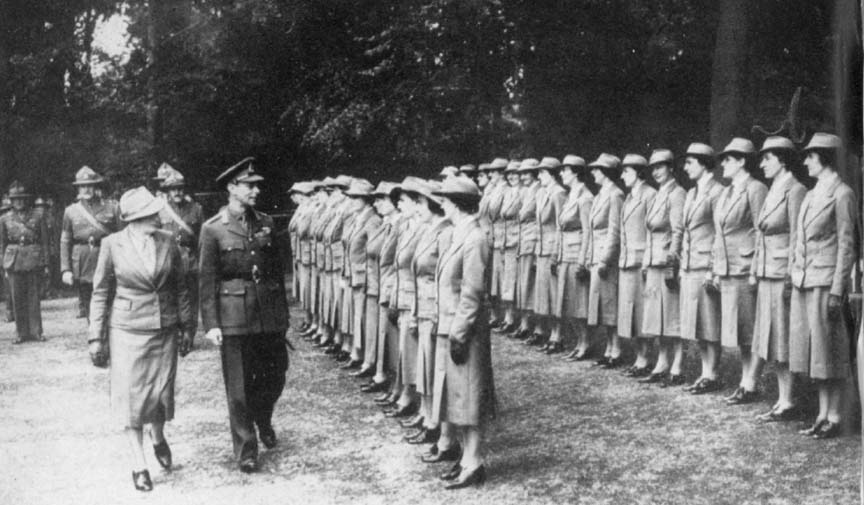
The threat of invasion hung over England; to fit themselves for the active role they had been allotted should it come, the troops of the Second Echelon worked day and night. Their morale was high even if they were short of equipment. The New Zealand troops were inspected on 6 July by the King, who showed the greatest interest in the training of the various units. At the conclusion of the inspection he requested that an order be issued telling the men that he had enjoyed being among New Zealanders again and had been impressed by their fine physique, keenness, and determined demeanour. Six of the sisters had the honour of lunching with him in a marquee---a simple wartime meal, but capped with luscious raspberries and cream. All were impressed by His Majesty's amiability, and he particularly complimented the sisters on their grey uniforms.
As soon as the location of the New Zealand force was definitely fixed as the Aldershot area, the ADMS 2 NZEF, Col K. MacCormick, approached the head of the Emergency Medical Service in the United Kingdom for hospital accommodation. This he was given in a new hutted hospital at Pinewood Sanatorium, near Wokingham, some ten miles from the main New Zealand camp. In the hutments 100 beds were set aside for sick New Zealanders, and, in addition, 70 beds in the sanatorium buildings were to be available for New Zealand casualties. New Zealand medical officers were to be available for work in the Sanatorium if required by the Medical Superintendent. All other arrangements for the running of the hospital were suitably completed with the indispensable co-operation of the EMS authorities, whose established services were largely used. Final administrative questions were settled with the London County Council, owners of the Sanatorium, who supplied all food, drugs, And dressings, while the Ministry of Health was responsible for all other equipment. As the possibility of enemy attack became imminent, 1 NZ General Hospital made immediate preparations to take over the allotted buildings and receive patients.
A first step in the setting-up of the hospital was taken on 26 June 1940, when the CO, Col McKillop, and an advanced party, moved to Pinewood. A further party comprising the Registrar and 20 other ranks moved over from Ewshott on the last day of June to assist in staffing the hospital. By then 72 beds had been made ready and two patients had, been admitted. The remainder of the unit arrived at Pinewood on 2 July.
The hospital was pleasantly situated in a plantation with trees right up to the hospital entrance. The huts each accommodated 36 beds normally and 112 in an emergency. Each had a kitchen, storeroom, baths, lavatories, and heating. There were also a well-appointed theatre and X-ray block, cubicles for 36 nurses, dining and sitting rooms for nurses, and a kitchen block. Administrative quarters were improvised in a cottage, as normally the hospital would have been administered from the Sanatorium. The men were accommodated in billets at Edgecumbe Manor, a mile and a half away, and the officers and sisters occupied unfurnished wards. This was not very convenient, but the unit was fortunate in securing any accommodation at all. The housing of British, Canadian, Australian, and New Zealand forces gathered for the defence of the United Kingdom placed a premium on all available buildings. Some of the staff were accommodated in tents. The officers moved into East Hampstead Cottage on 30 July.
It was not long before the wards were working at pressure coping with an epidemic of. measles and mumps, to which some of the unit succumbed. As each new ward was completed, the hospital expanded to cope with an increasing number of patients. The operating-theatre block was one of the earliest buildings completed and all surgical work was then undertaken by the unit, which also provided a consultant service to neighbouring British regimental medical officers. A mobile surgical unit assisted hospitals in nearby districts where enemy air raids had caused heavy casualties.
There were many visitors to the hospital, the most notable being Her Majesty Queen Elizabeth, who called on 21 September, visiting all wards and departments of the hospital, speaking and shaking hands with every patient and member of the staff on duty. Her Majesty was touched when informed that two soldiers operated on that morning had refused sedative in case they would be asleep during her visit, and she returned to the wards to thank the soldiers concerned. The Queen's gracious and charming manner endeared her to everybody.
During July and August 5 Field Ambulance underwent a series of field exercises with 5 Infantry Brigade in preparation for an operational role in the event of invasion. Particular emphasis was laid on the importance of maintaining contact between ADS and MDS. The unit also handled sickness and accident cases in the New Zealand force. After two months in England the first vehicles were obtained.
The unit marched (remember the Hog's Back!), manœuvred, and bivouacked in the counties of Surrey, Sussex, and Kent. It was then that they appreciated the beauty of the English landscape, a beauty largely due to the trees, which also provided shelter and protection. A convoy on the move is a target for hostile aircraft, but for many miles the unit was able to travel along narrow country roads under the green canopy of trees arching the road from both sides. The beeches of Arundel, with their clean buttressed trunks, are associated with a misty wet morning in the early stages of a six-days' march. The men arrived there at dark, more than a little weary after a final uphill stretch, and had a long tramp through the park in search of their allotted bivouac, only to find that the cooks, who should have reached there by motor transport ahead of them, had lost their way; the meal was not ready until after 10 p.m. As they rolled into their blankets (some of them on a mattress of leaves), there was an air-raid warning and the sound of aircraft overhead.
Another halt on that same march was at East Grinstead, near the Castle and within sight of St. Hugh's Charterhouse, the largest monastery in Britain. Here the men of the unit saw a herd of deer not far from the ancient oaks under which the vehicles were parked. Many beautiful gardens were also seen; for example, that at Sheffield Park, where after a hot day on the march the men were able to bathe in a large pond set in a picturesque landscape of trees and shrubs.
The troops continued their training in the countryside. With the coming of autumn they saw a marked change in the landscape, as many of the English trees are leafless in winter. Before the fall, brilliant autumn colours appeared, beautiful in the lengthening rays of the afternoon sun.
Towards the end of August the unit drove down in convoy to Kent. HQ Company took over a stables in the Sittingbourne Road, outside Maidstone, A Company were at Broughton Monchelsea, and B Company at Sittingbourne. While they were here the area was heavily bombed, and the ambulances worked for the first time carrying casualties, mostly civilians, to the Maidstone Hospital.
5 Field Ambulance continued to function through the various enemy air attacks during its stay in that area.
September was the month of the Luftwaffe's mass raids on London, planned to smash the way for an attempt at airborne and seaborne invasion. During the first week the New Zealand troops in reserve, by now a well trained and mobile force although not yet fully equipped, were moved nearer the coast to occupy what were virtually battle positions covering the Folkestone-Dover area. Early in the month the Prime Minister himself found time to inspect a parade of New Zealand units at Mytchett. Mr. Churchill made one of his inspiring speeches and gave evidence of his energy and insight.
On 4 September the surgical team at 1 General Hospital was suddenly called to Weybridge to help deal with bombing casualties. The Vickers aeroplane factory had received a direct hit, causing many casualties, although fortunately it was lunch-time and many of the 10,000 employees were away. Surgical and resuscitation teams had also been brought from London, and all worked through the afternoon and evening until midnight. It was early morning before a weary New Zealand surgical team returned to Pinewood.
From these large air raids, casualties were also admitted to Pinewood from London---men, women, and children, old and young; some in the clothes in which they had been extricated from the rubble; all with the dust and dirt seemingly ingrained into their skins; some severely injured, all badly shocked. Bomb casualties were then a new experience to New Zealanders, and they were impressed by the courage of the sufferers.
Later in the month the threat of invasion lessened as the weather over the English Channel became worse. To avoid the strain of stand-to at dawn and dusk each day, a relaxation of the manning of defences was ordered; troops were granted leave, sports were organised, parties travelled by bus, sightseeing, or visited hot baths in nearby towns. Life in billets in Kent was enjoyed by the men---the quaint villages, hotels, old houses and churches, the hopfields, orchards, and coast-houses provided a setting far removed from the usual military camp. Many had cause to remember the hospitality of English homes and people.
It had originally been intended that the Echelon should have been relieved of its operational role on 13 September, pending its embarkation for the Middle East, but these orders were cancelled three days before, and the New Zealanders stayed in bivouacs covering Dover. The postponement had been ordered personally by Mr. Churchill after a visit to the Dover sector. At first it was intended that the departure of the Second Echelon would be delayed only a few weeks and that it would leave for the Middle East towards the end of October. However, because of the urgent need in the Middle East for reinforcements of armour, artillery, and antiaircraft units, its departure was again delayed. The New Zealand force retained its operational role under command of 12 Corps and was largely concentrated in the Maidstone-Ashford area of Kent. The happiest relations existed between the soldiers and the civilians, many of whom established canteens and organised entertainments.
Instructions to 1 General Hospital on 7 September to prepare for departure were not cancelled when the departure of the rest of the Echelon was postponed. The staff were sorry to be leaving the hospital, which was then nearing completion. Nissen huts had been erected to allow the pack and ordnance stores to be cleared from the two wards they had been occupying. A move had been made into the administration block, and the painting of the hospital was almost completed. The summer had changed to autumn, the fruit was ripening on the trees, and the beech trees were a picture in their autumn tints. Pinewood, too, had been spared the attention of enemy aircraft. Few were looking forward to a sea trip again, feeling that they had already spent so much time travelling. All hoped until the last that the arrangements might be altered, but they were not changed although a little delayed.
On 26 September DDMS, Aldershot Command, visited the hospital to make final arrangements for 18 British General Hospital to take over. He expressed his pleasure at having had the unit in his district and his appreciation of the good conduct of the staff and of their reputation with the people of the district; he also congratulated Col McKillop on the excellent work of the unit.
The staff all had seven days' leave before embarking for Egypt, and this took them to all parts of England and Scotland. Some tried to find their way to quieter areas, as the noise of planes overhead became trying at times, especially at night. On 4 October the main body embarked at Gourock on HMT Georgic. The ship sailed on the evening of the 7th and reached Port Tewfik on 16 November, after calling at Freetown and Cape Town.
Fifth Brigade's manoeuvres were continued from time to time throughout October. A surprise order to be ready to move early on 25 October caused most units to believe the operation to be a real one, although it was only a practice. During the month several aircraft, both German and British, crashed in the brigade area and several delayed action bombs were located.
Lt-Col Twhigg assumed the appointment of ADMS, NZ Division (UK), but retained command of 5 Field Ambulance. Under arrangements with DDMS 12 Corps, all New Zealand patients were held in special hospitals so that they would not be too scattered. 5 Field Ambulance alone was responsible for the evacuation of casualties from the force's area and for the care of all but serious cases. Two ADSs and an MDS were established. Besides taking patients back to the CCS or to hospital, the unit returned patients from hospital or, when required, transferred them to the Convalescent Home. In addition to the Warbrook Convalescent Home, a camp reception hospital at Farnborough (formerly operated by 1 NZ Convalescent Depot before it went to Egypt, and later by 1 NZ General Hospital) was reopened on 14 October for convalescent patients and was staffed by a detachment from 5 Field Ambulance.
During September and October 186 patients suffering from various injuries, many of them football ones, were admitted to 5 Field Ambulance. A common cause of admission was respiratory disorders, for which during the two months 104 patients were treated, this total including 79 with minor influenzal infections. The total number of cases evacuated by the ambulance beyond unit RAPs(2) was 617.
Months passed and winter came. There was still no invasion. The New Zealanders saw a civilian population laugh at bombing, saw a small but courageous Air Force chase the Germans out of the daylight sky, and marked the heroism and self-sacrifice of the ARP services. And they profited by what they saw. When they came to leave England they breathed something of the same spirit, and they left an excellent impression.
When the New Zealand force returned to the Aldershot Command during the first week of November, the MDS was set up at Runfold and the ADS at Heathcote, and both acted as reception hospitals.
After six months in England a week's leave was granted, with free travelling warrant. Most of the men went to Scotland, though some took the opportunity to visit relatives in other parts of England. One-third of the unit went on leave at a time so that it could still function over the leave period.
Early in December there were rumours of embarkation as equipment was sorted out and general preparations made. Over the Christmas period the English people went to no end of trouble to entertain the New Zealanders, and many were invited to civilian homes for Christmas dinner.
On the night of 1-2 January 1941, units of the Second Echelon began to leave Aldershot Command for ports of embarkation to join the rest of the Division in the Middle East, their original destination. It was the middle of winter and influenza was prevalent. Snow fell in the afternoon of 2 January, when B Company, 5 Field Ambulance, left Heathcote by train for Liverpool, where they embarked on the Athlone Castle the next day. There was further frost and snow on the 3rd, when HQ and A Companies cleared the houses and grounds of 'Inglewood' and 'The Spinney' at Runfold, marched to Farnham station, and left by train for Newport, Wales, where they embarked on the Duchess of Bedford on the 4th. The next day this ship moved out into the Bristol Channel and then up the Irish Channel to reach Belfast on 7 ,January, where the Athlone Castle and other ships joined the convoy on the 11th.
On 12 January the convoy sailed from Belfast Loch in the early morning, heading west in a zigzag course and then south. All ranks at first slept in their clothes in the danger zone and wore steel helmets and lifebelts while on deck. The ships' hospital accommodation was taxed by the number of influenza patients, and nursing orderlies from the field ambulance companies were attached to their respective ship's hospitals for duty. When the influenza abated there was a mild epidemic of measles on board the Duchess of, Bedford.
After crossing the Equator on the way south, enjoying leave at Cape Town, and crossing the Equator on the way north again, the convoy reached Port Tewfik on 3 March. As the troops prepared to disembark, they were informed that they would not be long in the country and were advised to take full advantage of any leave granted to them. Units of the New Zealand Division in the Middle East were then leaving Egypt for another theatre of war.