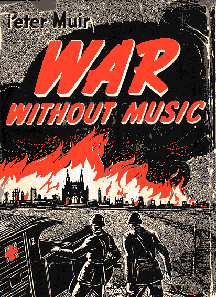
THE long column of khaki-clad soldiers moved slowly in the direction of Étampes. First came the Belgians. Their attempt to sing and whistle was a miserable failure. Then came the French infantry. Their attempt to show indifference was equally a failure. On the faces of the troops from Morocco and Tunis one saw only a complete lack of emotion. But the German guards attempted to show great efficiency---and succeeded.
This was in the early morning of June 18, 1940. Herbert de Belle and I walked along with the officers at the head of the French infantry. We did not say much. Probably we were thinking the same things: Why the hell did we have to run square into that advanced column the day before on the north bank of the Loire, near Blois? What in hell can you do when you are driving at full speed and come around a curve and find yourself looking into the barrels of five machine-guns and one anti-tank gun manned by Boche storm troops?
Well, we had run square into the enemy, and after they popped a few bullets past our cars we had done the only logical thing---surrendered. And that was that. Last week has never interested me very much, I am always too busy thinking of next. We were prisoners, and now how to get out of it?
For the moment escape was impossible. On either side of us, as far as the eye could see, stretched broad wheat fields through which, if one passed, one left an easy trail to follow. There was not a hiding place in sight, and to break and run would be suicide. A railroad line stretched parallel to the road on our left, and we could see army bread in one of the freight cars that stood there without an engine. A French soldier started to run across the field to fetch some bread, but was quickly stopped by a guard who clipped off heads of wheat on either side of him with an automatic pistol.
No, the time had definitely not yet come to get away. It would, I knew, and until then we must be patient. A false move now and our chances would be hurt, if not entirely ruined. So I walked along, automatically placing one rather heavy, booted foot before the other, and let my thoughts wander back over the past twenty-four hours.
Twenty-four hours that seemed like weeks. A month to the day since I had led Section One of the American Field Service to the front, a month that seemed like years. I wondered what the Section was thinking of our disappearance the day before. Probably that we had been killed. Or perhaps they had guessed the right answer. Harold Willis would automatically take over my command. I wasn't worried about that. I was worried about the four ambulances and their drivers (Stehlin, Rich, McElwain, and Thoresen) whom I had left on the north bank of the Loire in the morning. Had they also fallen into German hands? Or worse?
On the disastrous retreat from Amiens and Beauvais, the Section had followed its French command step by step until now it found itself on the southern side of the Loire. That morning, after taking the four cars to their post I had returned to camp. There was bad news. Pétain had made his famous speech asking Germany's terms for peace. Up to that time we had hoped against hope that the French would hold somewhere, perhaps here. Now it could be only a matter of days before the end came. But until then there would be fighting. As if to remind us that it was not over, Nazi planes flew up and down the river dropping bombs and machine-gunning. We could see them from our camp, but they left us alone.
At lunch a French officer told us that the Germans were on the north bank of the Loire. More rumors. I didn't believe him and laughed at the idea. I had just been well on the other side only a few hours before. Nothing more than wild rumors, of which there were plenty in circulation. Nevertheless, the idea worried me. What about my four men?
By three o'clock I had thought so much about their safety that I could not stand it any longer. I must go and see for myself. Herbert de Belle offered to accompany me, and I accepted. He was a driver, but he was also my friend. There was no question of rank amongst us, and I never gave orders. It wasn't necessary. There were too many volunteers for every job, and the more dangerous the job the more numerous the volunteers.
Soldiers from the French aviation, machine-guns mounted, guarded both ends of the bridge at Chaumont when we passed over it. "You see," I said to de Belle. "No Heinies here. I knew they couldn't have penetrated this far." "No," he answered, "not yet."
On the far side of the bridge we turned to the right. The powerful staff car, which I was driving, ran particularly well, thanks to the airplane gas we had found that morning at a deserted Royal Air Force dump, and I let it out. We passed a sentry who tried to stop us and yelled something about les Boches as we raced by. Off to the east several German planes circled high, and we thought he was warning us that they were there. Bah! I cursed them as I saw great columns of smoke rising where their bombs had fallen and set fire to a village.
"Heads up! " de Belle shouted as we swung around a corner. But it was too late. They had us. They could have blown us off the road if they had wished to. It was the red cross I had had painted on my left mudguard a few days before that saved us, I think. I do not believe that the Germans fire purposely on the red cross, although in their bombings they hit a great many.
The crossroads must have been taken only a few moments before. Blood was still running freely from the many corpses all around us in grotesque positions, and it is easy for an experienced eye to tell the difference between a fresh corpse and one that has been lying about some time. These were fresh, and were evenly divided between civilians and French soldiers. I saw no German dead. From a wood beside us light artillery barked incessantly at our friends across the Loire.
Herbert and I slowly and mechanically obeyed the German officer's curt command to get down from the car. Our capture had been so sudden that we did not yet understand just what had happened. Only when they were searching us for arms did I begin to realize that we were in a nasty spot.
"Who are you?" the officer barked. I explained that I was in command of an American ambulance section, and that de Belle was my second in command. This was not true, but I understood that officers received better treatment when they were captured, and I wanted my friend to stay with me and get the best of what was coming to us. As it happened there was no difference made on account of rank as long as we remained prisoners.
"Let me see your papers." While he carefully thumbed through our passports I looked around at the German soldiers who were mounting the guns. It was impossible not to admire their perfect equipment and the efficiency with which they handled it. Their movements were mechanical, and they worked with the precision of a Swiss watch. One had the impression that they had been trained mentally, morally, and physically from childhood for this moment when their leader would give the order to overrun Europe---perhaps the world. I studied every face, from the officer's down, and saw cold blue eyes, cruel and determined, and felt then that no army existed capable of stopping this field-gray horde on land, once it got a foothold. Their faces were hard, their expressions far from kind as they examined us, and I knew that a word from the officer would spell our end. I also knew that these fast-moving attack columns rarely took prisoners. They hadn't the time.
If de Belle was nervous he did not show any signs of it. He gazed calmly about, taking in our surroundings, seemingly without emotion, good soldier that he was. Inwardly what he was going through I could not guess. My own heart was thumping so hard that I felt sure it could be heard over the shelling.
"What are you doing here?" The officer had finished studying our passports and returned them. Once again I explained that we headed an ambulance section. "But you are on the French side. Why are you not on our side?" I pointed out, as well as my limited German would allow, that in the first place the Nazis did not want foreigners serving with their army, and in the second place we handled wounded regardless of nationality. "At Beauvais and Amiens," I said, "we carried a good many Germans, and they received the same treatment as any one else." Either this explanation satisfied him, or he was too busy to bother with us further and did not wish to have us shot. He gave orders to a younger officer and a convoy was quickly formed.
To me he said, "You are prisoners of war." "How dull you are," I thought. "I suspected that some time ago." But I said nothing, and walked over to a motorcycle side-car which was designated to transport me. On it were seated two armed soldiers. My friend was in a similar machine behind me, followed by two mounted machine-guns and my staff car, driven by a German. Leading this impressive convoy was the young officer in a car filled with armed guards. Never in my life had I felt so important and dangerous as when we moved, engines roaring, up the road towards the north.
We passed the kilometer posts along the road so fast that it was impossible to see where the convoy was going. The general direction was Paris, although it seemed doubtful that they would take us that far. Dust and dirt and wind cut our faces and brought a stream of tears from my eyes. I looked back and saw that de Belle was also weeping, but he managed to give me a wink. Our captors wore goggles and were protected.
In a small town---I did not see the name, we had come in so fast---the convoy stopped. Immediately we were surrounded by Nazi soldiers, most of them carrying cameras, and they photographed us from every angle. American prisoners. Perhaps the first they had ever seen, and we created a great stir. The clicking of cameras made me feel more like a Hollywood star than a captive, just as our six-car convoy, roaring along the roads, through towns and villages, klaxons; blowing, had made me think of Jimmy Walker going up Fifth Avenue in the days when he was Mayor.
The young officer was polite and cold. Would we follow him? His superior officers would like to ask some questions. He led us into a house where there was a great deal of, heel-clicking and saluting, both in the Nazi and military fashion, and before an officer whom he addressed as Herr something-or-other-colonel, if I remember correctly. The colonel refused my request for an interpreter, saying that my German was good enough. It flattered me to hear that he thought so, and at the same time annoyed me, because I knew that my German was very rusty, to say the least, and that I might slip up and make a mistake that would cause us trouble. A ja that should be a nein, or vice versa could and probably would place us in a very nasty jam.
However, the questions asked were similar to those put to me back at the crossroads, and I had little trouble answering them. One thing seemed to interest the colonel particularly. "Did you come from America especially to serve France, or were you already living here?" Both de Belle and I had long been residents in that lovely country, and said so. We did not mention that over half of Section one had made the trip expressly to serve. This seemed to be the answer he wanted, and we were dismissed.
During the next lap of our journey I studied the possibility of throwing our motorcycle into the ditch and running for the woods. At the speed we were travelling the slightest touch on the handlebars would have done the trick. The side-car was on the right, and if I gave a kick on the nearest handlebar it would throw the machine on top of me. The other alternative was to give it a quick jerk, which would throw me on top of the guard and driver. Perhaps in the excitement and melee that would undoubtedly follow, I might escape. What about de Belle? Could he make it? For some miles I toyed with the idea, even lifting my feet up under the hood so that I could get them out quickly. The guard on the rumble-seat to my left was watching closely. He had loosened the pistol in its holster and had his hand on the butt. He would shoot if I made the slightest movement. His eyes told me that, and I dropped my feet back into their proper place. Chances of escape that way were thousands to one against, and although I am fond of gambling the odds were too strong; so I refused the bet.
Once again the convoy halted and we were led into a house which a sign designated as Army Headquarters. Here de Belle and I were questioned separately and in much greater detail. I was again refused an interpreter on the grounds that my German was good enough, and while I began to think pretty highly of my linguistic abilities I was frankly worried about making slips. When asked what I thought of the war I replied that I didn't know much except what I had seen, and judging from that the Germans seemed to be doing pretty well. What about England? I knew nothing about England, had not been there since I passed on my way to Russia as a member of the American Relief Administration in 1922. I noticed that when my captors spoke of France they appeared quite indifferent, but when they mentioned England their faces grew stern and their eyes filled with an intense hatred. England, then, was their great enemy, and they were determined to destroy it.
All my papers, including personal letters and photographs, were taken from my pockets and examined minutely. When they had finished, my money and passport were returned. The rest I must give up. Also, the uniform intrigued them. It was cut like that of a British officer, yet I wore French decorations and on my lapels were the green felt backgrounds mounted with silver bombs of the French transport. "The decorations," I explained, "are from the last war, a Croix de Guerre with two citations, and a service medal." "What were you doing in the last war?" I told them the same thing as in this, only instead of being in command of a section I was a driver. The lapel bombs were the insignia of the 19th Train, as they probably knew, and as we were attached to it during our service we wore the insignia as a compliment. We were, however, not French soldiers in any sense of the word. Joining any army would mean loss of citizenship, in which case the American Government would have withdrawn my passport. "Are you a volunteer?" "Yes." "Were you a volunteer in the other war)" "Yes." "Why is your uniform cut like that of a British officer?" I had to admit that I did not know the answer to this one. "They are the same uniforms that the American Field Service wore in the last war," was all that I could tell them. "Why has your friend a French name?" I supposed that he was of French origin, as Americans are a mixture of many names and races. "I know that," the questioning officer said, rather scornfully. "Then why the hell did you ask me? " I retorted.
This was a bad break and cost me my Sam Browne belt, which he ordered taken off me before I was sent from the room. And when I said I was thirsty and asked that I be allowed to fetch my water canteen from the staff car this was refused on the grounds that I had been impertinent to a German officer. Well, that was some satisfaction, although it did not slake my thirst.
When we left this point I noticed that the staff car was missing from the convoy. This was a blow, though not unexpected, as some one had remarked on the fact that it bore a French Army license plate, and was therefore enemy war material subject to confiscation. Nevertheless my heart sank. As long as the familiar car trailed along behind I held to a faint hope that we might be freed. Now with our only means of transportation gone that hope dwindled. And the loss of my Sam Browne belt angered me. There was no need for this added insult. I felt undressed without it. As soon as I
could get to Paris I would have Hermes cut me another, even a better one, war or no war. I mulled this over in my mind so much that it became a sort of point of honor with me, and took on a great importance in my imagination. I must get back to Paris and order another belt to spite this damned fellow, and it must come from the same shop where the one he had stolen came from, perhaps the finest leather shop in the world. I'd show him that he couldn't take my belt off and get away with it. I'd show him. The fact that he would never know didn't occur to me. I guess my brain was getting very tired. And little wonder. The Section had been working under constant shellfire and aerial bombardments, with neither rest nor sleep, since leaving Paris for the Somme front exactly one month ago to the day.
I continued to mutter and curse inwardly, paying no attention to the country we were passing and ignoring the painful dust and dirt that was cutting my face and filling my eyes, until we turned off the road to the left and stopped. Another questioning, I thought, and looked up. Instinctively I stiffened and drew in a quick breath. Before us stretched a broad aviation field entirely surrounded with barbed-wire fences. Many of the hangars were in shambles from direct hits by bombs. Along the barbed wire at regular intervals stood guards, their rifles over their shoulders. Another guard was smartly opening the gate to admit us. About the grounds unhappy-looking prisoners wandered aimlessly. French, Belgians, dark-skinned colonials; herded together like flocks of cattle. And now they were adding another nationality to this polyglot, heterogeneous gathering. Of course, I had expected that we would be thrown into a concentration camp, but the things one expects, when they really happen, are often the most shocking. Herbert caught my eye and made a wry face, at which I was forced to laugh, although I was feeling far from gay. I have a mild dose of claustrophobia, and cannot stand the idea of being shut into any place against my will.
Here, on the inside looking out, we were released. Our convoy drove off at full speed in the direction from which we had come, and the gates were closed. On the far side of the road I could see a sign on which was written ETAMPES 12 KILOMETRES. The arrow pointed towards the north. We could not be more than forty or fifty miles from Paris. I thought of my belt. If I could not return to the Section, I would get to Paris by some means or other. Damn that officer!
For the first time since our capture, de Belle and I were able to be alone together and talk. We compared notes. On the whole the Germans had not treated him too badly. Once they had knocked his hands out of his pockets when he was talking to a major. How could he know about things like that? He wasn't a military man, he was an actor. "You're a damned good soldier, though," I told him. I had known this before, but the way he took his capture without a word of complaint proved the point.
As darkness fell we were locked in one of the hangars that had not been destroyed by the bombings. It was a cold, dreary place with a few sad and deserted-looking airplanes scattered about haphazardly. There were no floor-boards, no straw, only the damp ground to sleep on, and the night was bitter cold despite the season. We had neither blankets nor overcoats, and de Belle suffered much more than I did. Perhaps his uniform was lighter. He tried once to crawl under the blanket with a Moroccan, but the fellow woke up and pushed him away, muttering curses in his native tongue. After that we put our backs together and were a little warmer, though still there was no question of sleep. The sounds about us, coming from human lips of hundreds, perhaps thousands of souls in torment, our fellow prisoners, were as varied and eerie as night sounds in a tropical forest. Men, some sleeping and others in a semi-delirious state from privations and mental anguish, called out to their special gods and saints, to their mothers and sisters and sweethearts. Some cursed and blasphemed. French, Flemish, and Arabic could be heard from every corner of the hangar. It was worse than Babel. Only English was missing, for de Belle and I remained silent, listening with a sort of fascination.
At five-thirty the doors were thrown open and we were allowed to go outside. This was a relief. The odors of the hangar had been as varied and disagreeable as the sounds.
At the gate stood the same little guard with whom I had exchanged a few words the night before. He was a Bavarian and quite pleasant. "Good morning, Mr. American," he greeted me. "Good morning, Mr. German."..."How did you sleep?" I did not care much for his humor, and answered abruptly, "I didn't." The sleepless night on the cold, damp ground had not improved my outlook on life, and I saw no signs of even a cup of hot coffee. However, when he gave me a cigarette, the half of which went to de Belle, I softened. "I don't care much about your hotel," I said, half serious and half in banter, wishing to see his reaction. "I think I shall take my leave very shortly." His eyes hardened. "That would be foolish, Mr. American. It would be a pity to be shot now that the war with France is practically over. Besides, every one here is leaving at seven-thirty in column." "Where are we going?" He said that he did not know, and changed the subject.
We spoke of Bavaria, and I told him of my many visits there. The hardness went out of his eyes and he smiled again. Ah yes, he would like to be there again. He had been through the Polish campaign, now the French, and then for the English. The English would be easy. Adolf Hitler had said so, and Adolf Hitler was always right. This use of the double name, I found, was much more common amongst the soldiers than the term Fuehrer, and they pronounced it with much the same reverence a Catholic priest would use when speaking of Jesus Christ. For them this man who had begun life so modestly, even as the Saviour, had become a sort of god, a super-being to be followed blindly. The guard broke my train of thought with a question. "What do you think of our army?" "Too good," I answered without hesitation. "Too damned good." This pleased him, and he laughed and gave me another cigarette. "Time to fall in," he said. "We are leaving in five minutes."
And so de Belle and I came to be in this long khaki-clad column, moving like a huge snake, slowly and as one body, through the countryside of France towards Étampes.
Herb's nudge brought me back from my mental wanderings. "Look," he said, indicating a signpost. "Paris fifty-two kilometres, Étampes two kilometres. God! If we could only get to Paris." "We will," I answered, without giving the matter much thought.
From time to time the French officers, with whom we found ourselves, walked too fast and caught up with the rear of the Belgian column. Then soldiers from behind would shout for us to drop back. "Don't mix clean napkins with dirty dishrags," they would call out. "Don't walk with those traitors." Feeling was still strong against the Belgian king for what the French considered treachery and the main reason for their defeat. "Keep away from the swine." The Belgians said nothing, as though they too were ashamed and felt they had been betrayed.
We passed through Étampes and the column was brought to a halt on the far side for a short rest. French refugees shared their bread with us, and gave us bars of chocolate and water. One even gave me a bottle of wine and a whole package of cigarettes. What a people! Surely they did not know where they would be eating on the morrow, and yet they seemed glad to give most of what they had to their defeated army. Even the Belgians were looked after. I knew then that France's greatness would never die, that her true spirit would never be conquered. They had not been able to combat machine power with man power, but France would always be France the Indomitable. The refugees, homeless and often without hope, found kind and encouraging words. This was too much, and I saw bearded, war-bitten soldiers break down and cry.
The little Bavarian guard came up to me, saluted, and said, "Good-by, Mr. American. I am returning to camp now to wait for another batch of prisoners."
Bolstered by food and drink and the kind words of the refugees I felt better, and my tired mind began to work furiously. The old guard was leaving. I watched carefully and noted that no particular instructions were given about us to the new guard. Here was our chance. A plan came to me, so simple that I thought it might work. I grabbed de Belle's arm and whispered in his ear, "Follow me, do as I do, and ask no questions."
A look of understanding came into his intelligent brown eyes, and that was his only answer. We moved across the road from the column, climbed onto the sill of an open window, lit fresh cigarettes, and sat there swinging our legs as unconcernedly as though we were watching a circus parade.
AT THE end of August, 1939, tension ran high in Vichy, where I happened to be. War had not been declared, but even the most optimistic admitted that now it was only a question of days. People fought in the streets for the latest editions of Paris newspapers, radios blared news and political speeches from every house. Groups of men and women gathered in the public gardens, at the drinking fountains and at the bathing establishments to discuss the situation, even momentarily forgetting their cure and their livers.
The season was in full swing and my hotel on the park was filled with clients from many lands. Some were there for their health, others for the spectacles and amusements offered at that time of year, and still others because Vichy was the place where fashionable people should be seen during August.
Every day at the front doors there was a heavy movement of baggage as guests departed and others arrived. I noticed that French became more and more the spoken language about me. The foreigners were getting back to their various countries before frontiers were closed, and the new arrivals were the first refugees from the north of France and Paris.
Towards the end of the month young men became particularly scarce. The French had called a large portion of the army to the colors, and the order for general mobilization was expected hourly. A head waiter, of whom I was particularly fond, excused the slowness with which my luncheon arrived, and told me that three of the chefs and many of the kitchen help had received their orders that morning. At dinner he himself was missing. I asked the assistant head waiter for an explanation. "Telegram, sir. He's an Italian and had to hurry before it was too late to cross over. And I'm off tomorrow, Monsieur, to fight on the Italian border against my friend. Is it not tragic? Here we are working together happily one day, and soon I may have to kill him in self-defense. Ah, mon Dieu! Quelle vie!"
Whenever a bellboy came into the dining room I noticed that all the waiters turned towards him with a nervous, enquiring expression on their faces. Had he the small, unimposing slip of paper that meant so much to them, that would change their lives in an instant from the peaceful pursuit of serving out food to the dangerous and hard life of a soldier in war? They tried to take it calmly, winked at one another, and joked amongst themselves. Several received their papers during meal hours and immediately left the room, followed by an embarrassed silence on the part of the guests, and a momentary lack of service from fellow waiters. Then slowly conversation and service would be resumed. Hour by hour the hotel staff was being depleted, and old men had to be brought in to replace the young.
My cure was only half finished. I was taking the thing more out of curiosity than necessity, anyway, and decided to go back to Paris. Perhaps I could be of some use there, having served for almost two years in the last war, and feeling still young enough to do my part in this one. The road up was crowded with cars going in both directions, all bulging with baggage. Those going north were returning to the capital to their homes and to learn what was happening there. Those going south were filled with people who felt that it was safer to be away from Paris.
Once there I found Paris calmer than I had expected. You had the feeling, more or less false, that you were at the source of information and knew what was going on. Restaurants, cafes and night clubs were unusually animated. Under such circumstances people like to be out, away from loneliness and surrounded by other people. Each day more and more uniforms were in evidence, and at the smart gathering-places officers' caps were in the majority where the cloak-room girls held sway. This did not last long, however, as all military men, with the exception of a few who were stationed in Paris, were dispatched to the front. Many shops closed, and those owners who decided to remain open plastered streamers of paper over their show windows to prevent them from breaking when the bombs began to fall. Few doubted that Paris would be bombed once the hostilities began. Housewives purchased rolls of blue paper and black materials to cover their windows and keep lights from showing at night. There was a shortage of candles and flashlights. Automobiles were ordered to run on their dimmers, causing many accidents, and street lamps were partly covered or put out altogether. The City of Light became a City of Darkness, and it was difficult to find one's way around after sunset. Police appeared wearing steel helmets, with gas masks swung over their shoulders. Those on night traffic duty were supplied with white capes and helmets, but not before a good number had been run down in the darkness. All islands were removed from the streets to avoid accidents. Laborers worked feverishly piling bags of sand around the most interesting and beautiful monuments for protection, and all the great museums were emptied of their treasures, which were either buried or carried to safer places. The stained-glass windows of Notre Dame, priceless and irreplaceable, were carefully removed. In a few short hours the face of glorious Paris was changed, and over it spread an expression of sadness to replace the one of beauty and gaiety.
One could not help noticing the difference. Never had I realized how great was my love for this city until it was menaced and in danger of being destroyed.
The order for general mobilization was received calmly. So was the declaration of war. Too calmly for my taste. I had expected to see more enthusiasm, more of the old French martial spirit, with soldiers marching, bands playing and women cheering and waving flags and throwing flowers or at least kisses to the departing heroes. There was none of this. Even at the stations, from which troop trains were departing one after the other, there were only sad, tearful farewells. There were no military bands playing the "Marseillaise," no groups of soldiers gaily singing the "Madelon," so popular in the first World War, nothing to stir one's enthusiasm. It was an unpopular war, utterly lacking in glamor---a war without music. This seemed a very bad omen. I had always believed that a singing army is a winning army.
The problem of what I could do best to serve a cause which I felt was my own as well as France's was not so easy to solve. At the American Hospital in Neuilly there was nothing I could do. Perhaps later. Would I fill in an application? Yes. The American Legion, Paris Post, had called for volunteers, but when I went there they did not seem to know what they would do with the men when they got them. There was great confusion, and I filled out another long application blank. Finally the Embassy accepted the use of my car, with me as chauffeur, for odd jobs. This was better than nothing. At least I did not feel so completely useless. I had tried to enlist in the French Army and found it closed to Americans on account of the Neutrality Act. The French were particularly anxious not to displease the United States Government at this point, and had even barred the Foreign Legion to us.
My job at the Embassy was that of a glorified errand boy, minus his salary. Sometimes it was interesting, sometimes dull. But I could feel the pulse of things, was closer to the heartbeats than if I had not been there, and I was doing something, though very little, to help. I drove deep into the country to fetch and bring to Paris aged American ladies who were stuck for lack of funds or transportation; I went to the Prefecture of Police to obtain passes, carried mail and people to Dinard, where the women and children of the Embassy had been sent in a special train. The trips to Dinard were not annoying, as some of the Embassy ladies were amusing. I am afraid we shocked the French by laughing too much.
The first American organization that seemed likely to accomplish anything was the Iroquois Ambulance Unit, and I joined that. It was headed by John de la Chesney, a man with charm and ten years' experience in the Foreign Legion, by Steele Powers, who later took out a section of ambulances for the American Legion organization, and Jack Hasey, whose feet were subsequently frozen while he was serving as ambulance driver in Finland. I was to be an honorary member of the committee and go out in command of the second section. A château at Ville d'Avray, near Paris, was lent us by Powers' mother and served as living quarters, while another friend placed his office in town at our disposal.
Volunteer drivers came to the office, were examined and in most cases enrolled. There was no paucity of men anxious to do their humble bit. But money was tight. We couldn't seem to get any. There was a war, yes, but no fighting, therefore no wounded. So why ambulances? The answer to that was hard to find. We continued undiscouraged, taking in men, practising night and day driving through the woods of the château, in and out of "shell" holes that we had dug ourselves, and looking for money. The question of how to feed and warm the boys became more and more acute as winter approached. A few of us had a little money, though not nearly enough to heat the château and keep some thirty-odd appetites satisfied. Eddie, the Negro cook, did his best to make a little go a long way.
About this time both the American Field Service and the American Volunteer Ambulance outfit seemed actually to be making progress. We, on the other hand, were rich in men and still poor in money. While the Iroquois Unit, of which I am proud to have been one of the early members, supplied the core of the personnel for all American sections which saw service on the fronts in France and Finland, we did not have the price of two ambulances deposited with our treasurer. Therefore, with many regrets, we decided to break up and join forces with the more prosperous organizations. For personal reasons a few went to the Field Service, and the remainder to the A. V. A., which was connected with Paris Post of the American Legion.
These were calm months from the war angle. Communiqués from the front had "nothing to report" day after day. A few times the air raid sirens were sounded, but one had the impression that these alertes were more for practice than because of any real danger. I was dragged by friends into a cellar that was supposed to be bomb-proof when the first alarm went off, and decided that it was better to be killed outright than be caught and buried alive in one of these rat traps. After that I stayed in bed, or went to the window and smoked, and listened for the sound of motors in the sky, which I rarely heard. When I was living at the Hôtel Crillon I would sometimes walk downstairs after the "all clear" signal was given and watch the people returning from the shelters, or admire the beauty of the Place de la Concorde, lighted by the moon or the rising sun. The sheer loveliness of Paris fascinated me.
Our work at the Field Service progressed slowly. The design for the ambulance bodies had been completed and we were delighted with the results we had obtained. The stretcher-carriers were particularly advantageous as they were simple and a man could work fast loading, even under shellfire and in the dark. French Army regulations called for another system, which we did not like at all. It was slow, cumbersome and almost impossible to manipulate at night without lights. There was some difficulty "selling them" our idea, and it was only after considerable discussion that we were permitted to adopt it. The bodies were to be built in Paris, the chassis to come from America. When would they be shipped? was the question we were constantly asking ourselves. Also, French bodybuilders refused to go ahead with their work until they had the chassis, explaining that the bodies might not fit if made on blueprint specifications. No amount of arguing would change their minds, which meant another heartbreaking delay. However, there did not appear to be any great hurry as there were still practically no wounded.
Having nothing to do but wait I decided to go on an expedition to take color photographs in Corsica. I had been planning this before the war intervened. The necessary permission was not easy to obtain, Corsica being in the war zone, but I finally got it and set out.
Corsica was armed to the proverbial teeth. Every second male on the island was in uniform, and on all sides, I saw signs of preparation for defense. Most of the soldiers were natives who had been mobilized on the spot. The French had wisely figured that they would best defend their own homeland in case of attack from the Italians, their hereditary enemies. Many of them assured me, without my even asking, that they would die rather than be separated from France, which they looked on as mother country. At Ajaccio the Prefect drew a line on my map from Solenzara across Zonza and Sartene to Propriano, and asked me not to photograph below this line. It was, he explained, being very heavily fortified and I might get into trouble. Otherwise, I could do pretty much as I pleased as long as I kept my lenses on unmilitary subjects.
I finished my series of pictures and returned to Paris, where I found that very little advance had been made in our work. Chassis for the first section were on Staten Island docks, but space on ships was scarce and given over mostly to weapons of destruction. However, here was some progress, and not long after a cable arrived announcing that the chassis were on the water.
This meant another two or three weeks of waiting before the body-builders could go to work; so I took a night train for Cannes. I wanted to see what life was like on the Riviera during a major war. To and from Corsica I had passed by way of Marseilles. Tension between France and Italy had definitely lessened, and in Nice the lights along the Promenade des Anglais were lighted. These were the first I had seen for months. In place of foreigners on the coast there were a great many French people seeking refuge from the storm every one expected to break over the north, and life went on very much as before. Regulations and food restrictions were ignored. The war seemed too far away to be taken seriously, and there existed a surprising amount of indifference. The Maginot Line was the ruin of France. People sat back and grew soft and fat, believing foolishly that it was impregnable, that the Germans would never pass. In the south they hardly even discussed the war, so secure did they feel behind their famous fortifications. They were tired of the war, and now with the Italians quiet why worry? This attitude of the people, plus the lack of enthusiasm that I had noted in the army, made me distinctly uneasy. What could the French be thinking? Did they imagine for a moment that the Germans would hesitate to go around the Maginot Line, which did not reach to the English Channel, whenever they felt that the time was ripe? Did they think that the Germans would hesitate to go over this famous line with their thousands of bombing planes? Some of us were fully aware that Pierre Cot had completely wrecked French aviation, and that since his removal as head of the Air Ministry there had not been time to build up a force that would come anywhere near matching the strength of the Germans. I tried to discuss these facts with people whom I considered intelligent, but they would have none of it. "The Maginot Line, the Maginot Line." They all had the same idea, and repeated it like parrots.
A telegram advised me that the chassis had arrived and I hastened back to Paris.
LIFE in Paris continued to become more and more normal, except for two things: a great many uniforms, as soldiers and officers came back on their first leaves, and midnight closing hours. One had become used to the black-out, and air raid signals were less and less frequent. Civilians no longer carried gas masks, and a great number of refugees returned to the capital daily. News from the front was of the "All Quiet" variety, and we began to wonder if the Germans really would dare to attack. Some said that the warring nations had created such terrific machines of destruction that they were afraid to use them.
About this time my old friend Ross Sanders came up from his home in the south. The wounds he had received at Verdun in 1916 were too severe to allow him to serve at the front, so he would work in the Paris office. He was a sculptor and a Bohemian, and as I wanted to be with him I followed when he moved into the Hôtel Odessa over on the Left Bank in the heart of Montparnasse. Stehlin and Weeks also came along, as did Jack Brant when he arrived from New York. It was a ribald little place, and we enjoyed it thoroughly. The old girl who ran it put us on the fourth floor, walk-up. The fourth and fifth floors, she explained, were reserved for steady guests. The other three floors, and this she did not explain, were reserved for the pleasure of unmarried couples who joyously came, spent from one to twenty-four hours, and left---no questions asked, cleanliness and discretion guaranteed.
The fourth floor was particularly intriguing, and often on the noisy side after midnight, the hour when military law closed the doors of cabarets and hospitality houses. Several of the "steady guests" on our floor worked in these. There was a pretty artists' model, whose meager earnings were supplemented from time to time by gentlemen visitors. And there was the cabaret singer, who also did not earn quite enough with her voice. The only one of this trio who seemed to have plenty of money and always slept alone was Lucille, a vivacious blonde from the Sphinx across the way. She was our most interesting study and most intimate companion, and I think we were all extremely fond of her. I know I was. And we respected her absolutely. Often she came home at night a little the worse for drink. This was part of her business. She had to drink with the clients, just as she had to go upstairs with them if they wanted her. But outside of "business hours," which were from 2 P.M. until midnight, she conducted herself most properly. She refused to mix business with pleasure. When she was with us, having a final nightcap, it was pleasure, which meant talking of the war, of her travels in Italy, of politics, and keeping the skirt of her well-cut suit below her knees. She was so well behaved with us that it was easy to tell she was not a lady. At the Sphinx she would come and chat with us, frank and unabashed in her nudity. That was business, and she made a good living at it. She was one of the best girls and had been there for six years. The people who ran the place were kind to her. Men were easy to handle if you knew how, she told us, and one really had very little trouble. I am sure that Lucille was happy. She cried when we left.
On the first of April we moved out to United States House at the Cité Universitaire. This was to be our new headquarters, and while it was less amusing than the Odessa, it was a more dignified address. Two days later twenty-three of our volunteer drivers arrived, via Genoa, from America, and my work began in earnest. I was placed in charge of personnel, and later made leader of Section One. Donald Coster was named as second in command.
Our quarters were very comfortable. Each man had a room to himself, and there were showers with hot and cold running water. Also there was a library with an open fire. Here were installed banners of the old sections which served in World War Number One. They were stained with age and covered with decorations. Downstairs was the large refectory where we ate excellent food at a T-shaped table, the head of which was reserved for officers and guests. The building was new, and had been constructed for the use of American students in Paris. Now peace had given way to war, and students were replaced by ambulance drivers.
Despite these bodily comforts the men were nervous and impatient. They had not enlisted to see Paris, but to go to the front and do their part. They wanted action. When would the cars be ready? When would they go to the front? Those were the questions most often asked. Soon now, we said. The ambulances were fast taking shape, and a ceremony had been planned for the twenty-first of May. It was to be an impressive affair, befitting the importance of dedicating the first section of an organization that had done so much for France in the last war. The Court of Honor in the Invalides had been designated as the holding place, and many high authorities, both from civil and military life, would be there. After that we would go out.
This news encouraged the men, and they went about their more prosaic jobs in higher spirits. First, there were uniforms to be made. This was done by the same tailors who had outfitted the American Field Service between 1914 and 1917, and who also claimed the distinction of having made General Pershing's uniforms when he was in France. Then there were three trips for each man to the American Hospital at Neuilly, where inoculations were given against typhoid, paratyphoid, diphtheria and tetanus, and vaccination against smallpox. There were steel helmets, gas masks, and other regulation equipment to be requisitioned at the army supply depots. There was orderly duty, both in the dining-hall and at the front desk. Le Clair Smith, wounded in action while serving with the 5th Marines in the last war, ably took charge of this. And there were a hundred other things to do. For recreation there was always Paris, or card games in the library. Still, there was a strong undercurrent of restlessness.
At last we were assigned a French lieutenant, who was to act as liaison officer, a sergeant-major, a corporal, a mechanic, and a cook. This was a cheering sign, and a mild form of drill was added to our other activities. The men were good at this, showing a willingness to serve and a desire to learn.
The cars began to be completed two or three at a time, and all signs of restlessness disappeared. The Section was getting nearer and nearer the front. The personnel was complete, and now the ambulances were coming in. As they were turned out by the body-builders we brought them to the Cité and parked them behind United States House. They were long, gray, sleek-looking cars, with AMERICAN FIELD SERVICE painted across their sides, and we were proud of them. The stretcher arrangements inside were most satisfactory, and we had won our point over the regulation French Army ambulance equipment by demonstrating that we could load and unload exactly three times faster than they could.
Every morning we practised loading and unloading "wounded," using drivers on the stretchers, and others to do the work. A car would dash up to a point designated as a first aid station where the "wounded" lay on stretchers, load up, swing down the road and back, to unload at the same spot, which had now become the field hospital. It was interesting work, and proved most useful when, not long after, we were thrown without preliminaries into the midst of war's flaming hell.
Then Germany attacked Holland and Belgium, and things moved fast. Section One was ready, the last man in uniform and equipped, the last of the twenty ambulances out behind United States House, stretchers and blankets for the wounded in their place. My staff car, gray and waiting to go, was there, and the two repair trucks, as well as the kitchen trailer. Everything had been checked and double-checked down to the minutest detail. It was, as far as humanly possible, a perfect outfit.
The ceremony at the Invalides was called off. There was no time now for that sort of thing, and our departure was set for seven-thirty on the morning of May 18. We would stop for a moment of silence at the tomb of France's unknown soldier, and that was all. From there we would proceed to the front.
These were feverish days, and the air of Paris was charged with electricity. The war had started at last. No more of this lingering on, this eternal waiting for something to happen. It was happening, and in a big way. The general feeling was one of relief. The boil that had festered so long and so painfully had at last burst. Hourly, uniforms became less and less frequent in the streets as soldiers and officers were called back to their regiments. All leaves were cancelled. There was real fighting, French, English, and Belgians side by side against the Hun.
Nearly every night now the air-raid sirens shrieked their dismal warning that German planes were coming over the city. They did not bomb at that time, but came for observation, or to break the nerves of the population. However, one could never be sure, and as a precaution I had the men dress at each alarm and deploy the cars, so that one bomb would not destroy several at a time. Also, this was good exercise and taught them to drive without lights. We would stand by until the "all clear" signal just in case something really happened, when we would be needed to help pick up wounded in the streets. Often we went on the roof and watched the magnificent display of searchlights and anti-aircraft fire. It was better and far more impressive than any fireworks. But none of the enemy planes was seen falling in flames. There was, however, danger from the heavy pieces of steel which dropped back to earth, whistling viciously, from the bursting shells, and I asked the men to give up their vantage point on the roof. It would have been a shame to have one or more casualties from French guns even before leaving Paris.
A large party was planned for the night preceding our departure. The idea was more pleasant than practical, for when we arose at five the next morning there were aching heads and many a dusty tasting tongue. Nevertheless, the evening was definitely a success, and a demonstration of Franco-American friendship that none of those present will ever forget. Lovering Hill, the hard-working head of our Paris office, made a beautiful speech, full of eloquence and deep with feeling. Amusing Maurice Barber went serious on us and vivaed everybody except the Germans, and even Jack Brant's speech was on the serious side. Colonel Mallet, who had been closely connected with the Field Service in the first World War, wept as he thanked us in behalf of the French nation, and I had, to me most embarrassing, the job of answering him. After that we relaxed and enjoyed ourselves--- until much too late into the night.
There was then no thought of defeat in the minds of Parisians. The only question was, how long will it take to break the Hitler organization? But there was always that lack of music that weighed on my mind and shocked me profoundly. Why was there no glamor to this war, no playing of martial music, no singing columns of soldiers marching off to glorious battle and victory? The great "Madelon" had been forgotten, and no song written to replace it. At some cabarets song plugging artists tried to put across the French version of---"We'll hang out our washing on the Siegfried Line, if the Siegfried Line's still there"---but the public response when it was supposed to be sung in unison was distinctly half-hearted. The enthusiasm simply was not there. The French people did not wish to "Die for Danzig," and they were even now convinced that their country was safe behind its Maginot fortifications. I cursed these fortifications, and yet I believe that I was as hypnotized by their strength as any Frenchman, in spite of the fact that I wished to be skeptical. It was impossible for me to vision the German Army spreading over my beautiful France as conquerors, impossible and revolting. Some miracle would happen. God would not allow it. He must not.
Headaches or no headaches, every man of Section One had his car lined up in numerical order in front of our quarters, and stood by ready to start, promptly at seven-fifteen on the morning of May 18. Alex Weeks had tuned up the motors and they purred silently, ready like the men to take the highroad to adventure, the difficult and uncertain road to war, where danger and hardships and even death lurked at every corner, at every turning. I have never been able to understand why men will voluntarily leave peace and quiet for the maelstrom of battle. I am always wondering why men do this, and I include myself. I fear that I shall never understand.
We rolled silently along the deserted streets of Paris, a long gray column in the dull gray light of morning. The few people who were abroad at that hour gave us a second glance, and stopped to watch us pass. Here was something new to these people who had seen so much---Americans going towards the front. Several waved tired hands at us by way of encouragement, and shouted, "Vive l'Amérique! " We in turn waved back, happy to be recognized, and answered, "Vive la France!" We felt very happy to think that at last it was going to be our privilege to serve what many of us considered the mother of civilized living and liberty---La France.
The convoy moved rapidly from the Cité to the Porte d'Orléans, across the Seine, unforgettably beautiful in the translucent half-light and mist, and up the Champs-Élysées to the Arc de Triomphe. We were punctual to the second, but our Paris staff, a few French officers and our friends were there waiting. Josette was there. We saw each other and waved. I swallowed hard and blinked to keep my emotion to myself. This was no time to show one's true feelings.
Brief commands under the huge arch where the eternal flame flickered, a moment's silence, men at attention and officers saluting, in honor of France's glorious dead, hurried farewells, and we were off.
Around the Étoile, down Avenue Wagram, to the right on Boulevard Berthier, and to the left on a road where the signpost read BEAUVAIS ---60 KILOMETRES.