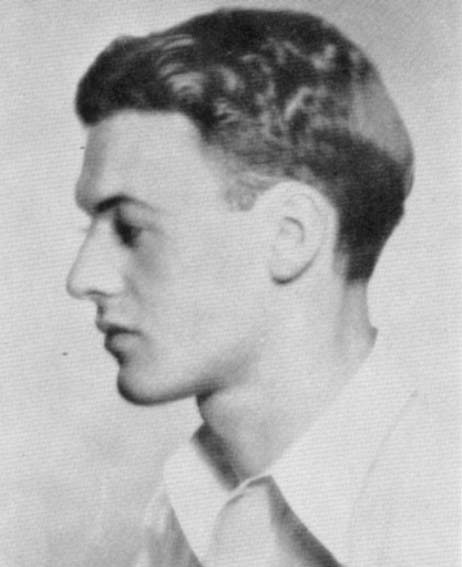
The essence of a man is never physically visible. Because of his few letters to me, and these to his mother, I can say that I knew Caleb Milne, and knew the best of him. That best is something choice and beautiful.
This collection of his letters seems to me of permanent value, far beyond their satisfying of our avidity for news of the working of the minds of men who are fighting, for us, our battle. They reveal a rare soul, who passes on to us his own sensitive perceptions of the beauty and glory of living; and they are written in the style of true Belles-Lettres.
One feels humble and a little frightened that such a man has died for us, untimely. So much of the writing of men actively in the war has that impact. They love life, they see so clearly what is good and what is bad, and seeing intimately the base in man, they are hopeful of the good. The responsibility on us who survive is overwhelming. We have been through this too often, always with the trust "that these our dead shall not have died in vain." What does it take to teach us? How and when shall we learn? Shall we continue to kill off our Rupert Brooke's, our Joyce Kilmer's, our Caleb Milne's, and be as stupid as before?
Young Milne wrote of the death of one of his comrades, "I have always felt the pain exists only for the bystanders. I don't understand life, so naturally death seems very simple to me." None can understand life. It is given to the wisest only to appreciate the gift of life. This he did, and the stirring record is here.
MARJORIE KINNAN RAWLINGS
ONE OF THE FELLOWS just came in to say goodby. It is strange how embarrassing it is to make farewells; he blushed and I stammered and we each said "Good Luck" several times but somehow there is a blank feeling in saying goodby sometimes. I suppose it is because with many people we are only equipped for the usual. And when you part for such a definite and undeterminate number of years, an element of drama enters silently and we are embarrassed at having to be on a stage before each other. It would really be much easier if one could scream his farewells to a full orchestra like they do in opera. The noise and tension would cover up any shortcomings.
Knowing you so well, I wish that I could send you some jolly reassurance that everything will be all right. But, to be frank, I would not be so excited at going if I knew it would be all cream and sugar. You are familiar with my general outline of ideas, so let's just say that what will happen, will. Experience and human adventure have as much importance if they are disastrous or crippling, as when they are purely pleasant or optimistic. My curiosity and zest for living will be richly rewarded no matter what happens---and there are many chances that the trip and the work will be merely prosaic and routine. But being in Africa at last! What a wonderful thing that there are still places for me to go, new things to happen. I believe death would be that moment when there was no boundary beyond one's tired self to run on to. No fresh fields to explore, no new ideas to stimulate and awaken one.
I have noticed that on radio broadcasts and in warbooks, a great deal of space is given to a sort of announcement of "Why I want to go." I am not sure of my reasons. I am not foaming to bayonet anyone, nor am I embittered enough to throw precious life away for this momentary calamity that has spread like a disease over the world. I believe our side is somewhat "righter" in all truth, but it is hard for an open mind to clog with hate. If I am touched with certain ignorances or innocences then I should be forgiven for feeling this way. Perhaps had I seen these far-off horrors that enrage our friends so violently, then I too would cry for blood. But, after so many small injustices and daily callousnesses and cruelties, I am dulled to the circus atmosphere that prevails. If it is "eat or be eaten," well and good; but if I must be convinced that wild beasts are roaming the world, my intelligence revolts and another slogan, more grown-up and well-thought over, must be found.
In other words, the ultimate agonies of war are, to me, not unconnected Calvarys over the world; they are the ultimate, sickening florescence of a thousand indifferences, hates and greeds that my own country and people have also been guilty of, as well as those who kill and are killed.
I dream of the day when one may say, "I am a citizen of the world!" I have never had a provincial sense to much degree, and it seems stupider and blinder than ever now to shout the old nationalistic battle-hymns when they have brought the world into such artificial and complicated chaos. Are people so strange to one another as that? Are the human soul, the mind of men, so alien one to another, that there is no place where the gods may meet? No, I cannot believe that. Perhaps the pure in heart are also lazy in heart and do not see where their tin gods have led them until this maelstrom is in the sky, overhead.
And so, what reason can I give you for going? I who love the world and all its follies and unexpected sadnesses so well. If evil seems to me as interesting as good, I cannot charge off on the white banner of "The Cause," at least not with any right. If I am almost as guilty as the guilty ones, how can I set up a howl of righteous indignation? It is my personal misfortune to see things with an appallingly long range, (and in another sense it is my good fortune). If this far-embracing view is manifest in feelings that the unthinking deem "unpatriotic" I am sorry with all my heart. For that is just one more misunderstanding on the record. I believe that this type of outlook, in a necessarily too general sense at the moment, is the beginning of the brave new world we dream of. When our countries and our seas are so near and so interthreaded with a million cross-currents of mutual contact, how can we be an American or a German or an Indian?
I was thinking the other night: how can people go into war over and over again when they have only to stop and look to see that nothing was ever won, or lost, or held? It must be that the sum of human experience lasts only through one lifetime, our children must find it out for themselves. What a pity that the vast total of a lifetime can only influence one man's span of years!
So, I am going off to help the tired, carry the wounded, see the world, live my life. It isn't in the heroic mold at all; and yet I believe, with Euclid, that man is only a reed in the wind, and yet he is a thinking reed. And the thinking reed needs a strong wind to cut him loose from the familiar marsh. If leaving my marsh to venture into deep waters of our world means anything, then it means the wind is strong and I have been thinking.
WE LEFT from a pier in Brooklyn. After reporting to the American Field Service at 9 A.M. we counted baggage, stencilled names on bags and listened to speeches until noon. We were then excused until 5 P.M. by the anti-climax dept! Tony Stewart invited me to have a gala last meal with him which we had at the Plaza. We started with Old Fashioneds and proceeded right through their heaviest menu. It was a very hot day and the city was sizzling as we went back to the office. When we arrived, some of the lower number units were getting into various cars, driven by very snappy volunteer ladies in blue tailored jobs. About 8:30 P.M. we got into a sleek Packard convertible chauffeured by a much mascaraed Jewish beauty and in an hour were deposited on a huge wharf-warehouse out on Brooklyn Bay. We went through very elaborate customs inspection, censoring, etc. and at 10 P.M. finally mounted the long gang plank onto a strange ship. It was an oil-burning Danish cruise-boat that was only four years old and was well equipped for tropical conditions. Somehow they managed a full course dinner for us and then we attacked the great pile of belongings piled high in the main salon. By midnight we were more or less settled. I was bunked in a 6x10 stateroom with the only civilian aboard, a Canadian speech specialist who was on his way to lecture on a three year contract. The ship accommodated fifty-seven passengers comfortably---there were one hundred of us, this civilian, four plug-uglies who rumor had it were famous guerrilla fighters, five marine technicians and a couple of volunteer workers. Consequently, the living, eating and lounging arrangements were quite strained.
About five the next morning there was a clang of bells, anchors heaved, hawsers whipped and tugs whistled. I jumped up and stood in the bow with the others. As dawn came up we pulled out into the Lower Harbor and the ocean. At noon we had formed our grouping and steamed off at the maximum speed of the slowest freighter. For a full week we were in sight of land. In the distance the white resorts would gleam across the water. Our escort circled about us continually while relays of planes accompanied us. The specters of sunken ships jutting out of the water gave a gloomy, uneasy atmosphere to this part of the trip. At night we'd heave to, till dawn. At one time we waited out in the straits off Key West for two days while fuel and water were ferried out to us. This spot was the hottest on the whole trip. We left there, doubled back a bit, and took very much the same route as I once took on a freighter (to South America). Three weeks later we pulled into a beautiful island harbor. It was almost a closed ring of wooded mountains, peaks and waterfalls. Smoke rose in the distance from native cottages and here and there a dirt road wound up the hills.
We were there for three days and were allowed ashore one day from 5 A.M. to 4 P.M. Here the convoy was reassembled, some of the boats heading in different directions.
Two large boats joined us.
Early one morning, after a heavy rainstorm, we received sealed orders to start and we set off. About two days later there was a startling, sudden clanging of bells on our ship and, waving farewell to the convoy, we slipped into full speed ahead. We left the others far behind by dusk, and from that evening with three weeks fast sailing, we did not even see another ship. Heretofore, having a doctor and small hospital on board we had always brought up the rear of the convoy so that in the event of emergency we could pick up and treat the survivors. Naturally this position at the rear was the most dangerous so we were not sorry to leave it, and it was a relief to go skimming ahead.
Our boat boasted a small, tile pool aft which was a great joy. But the Danish, British and French crew also used it and were none too fastidious. The decks normally assigned to lounge-chairs and open to the sky, were loaded with plane-crates and enormous packing boxes of tools and parts. Others of the boats carried teetering stacks of lumber, oil and food.
We were told that several times the King of Siam had chartered our boat for Court cruises. The original crew had had a wild time. The boat was in Marseilles when Denmark was invaded. The French took it over and sailed it southwards. It went all over the Far East and returned to Capetown. It was here when France . . . . . . . . .(censored) . . . . . . . they returned it to the care of the Danish men who now sail it for South Africa. This accounted for the motley crew. They had not even heard from their families for over two years.
Every day we assembled on deck at 9.30 A.M. First Aid for an hour in groups of eight, then drill an hour and calisthenics, with the ship sometimes plunging madly while we tried to keep in line. At 1 P.M. we lunched, then had French lessons followed by Arabic. At 4 P.M. I rehearsed the chorus for a show we're giving soon. It is very wittily written by Le Boutillier. There is an amazing orchestra composed of half-caste greasers, costumes of sheets and pillow-cases, a male chorus, three scenes and endless hilarity.
Each Sunday at eleven, we have an open service in the lounge for any who wish to come. The meeting is run and read by a Jew, a Quaker, a Baptist, a Moslem, a Scientist and an Episcopalian. It is very touching somehow, and to me an impressive hour. Next Sunday I am reading some of your Marcus Aurelius, which is a source of much pleasure to me for many reasons, later leading into practical application of some of Marcus' philosophy.
The Group is an interesting mixture of people, thank God. Wonderful books on board and fellows who have been abroad at school most of their lives. I'd say twenty-eight is the average age although we have one who must be sixty. We all do our own laundry, and washing in salt water is a real job.
I will be glad to be on terra firma again, not only for security, but to see trees and be still at last from vibrations. I almost forgot to tell you we have the captain's wife on board, her canary, the purser's Dachshund and a Boston Bull who wears a life-preserver collar! It is amazing to hear the canary accompanying the victrola records on a hot afternoon with the dogs barking in the distance. The lady never appears but through every known kind of binoculars her back is studied by everyone.
At this writing we are about halfway on the big jump and life is a bit boring after five weeks. We round up our First Aid with a three-day examination next week. We are approaching the cool season now that we are traveling downward. It is pitch dark at 7 P.M. after a quick sunset of about fifteen minutes. Always a cool breeze and no humidity such as we experienced in such stupefying doses nearer home. We lose twenty minutes every other day which is a bit confusing.
Our last, and only, shore excursion was beautiful and enormous fun. We landed in launches at 7 A.M. and spent the whole day exploring the town, the magnificent mountains rolling above and the lushest, most vivid tropical flowers growing everywhere. Fuchsias as large as your fist, orchids on trees, heavy-scented hedges, bougainvillea, lemon trees dropping with fruit and over everything that curious acrid wood-smoke of the hot countries.
Here I am with the ship riding anchor in Capetown Harbor. There are so many boats here that we may not go ashore for two or three days, since docking space is very important. Our Captain, however, has been in town to see what we do next, from the British Commanding Officer, and is supposed to wire the office that we have arrived.
After so long a time upon the water, it is heartwarming to see land again, and to realize that these mountains looming across a mile of pale green water are the very farthest outpost of civilization down here. They sheer up abruptly almost out of the sea, ruddy brown, and seamed with fissures and age, allowing only a mile or so at their feet for the rambling city to stretch itself along the curving shore. At places the mountain, or rather the 3000 ft. plateau of high land, crumbles away and a triangular peak rears itself against the cold pale blue sky. One monumental pyramid of rust-colored hill looks very Egyptian and almost man-made, very ancient and massive. The white sanded shore curls far below peppered with yellow and white brick houses, three and four stories high. In the other direction, native quarters melt into the distance. From the ship's rail the city looks austere, clean, and somehow devoid of any history, being in just two colors.
Since the sun is focusing on your end of the world now, it is winter here. By 6:30 it is black night, with everything in complete blackout. The sun goes down with a quick businesslike sunset. The air is quite damp and mist is apparent in the mornings. The Equator is not necessarily the hottest spot, as I had thought, but merely the center line between the tropics of Cancer and Capricorn. When the sun is revolving above the Equator you have summer. So it is hottest in Capetown when you are coldest in New York for the sun is then revolving below the Equator. It is midnight here when you are at 5 P.M.
It is three days later and I am sitting in the Canteen Club in Capetown looking out an enormous, many-paned window upon a little Dutch square. A statue of Queen Victoria and another of General van der Bosch are almost hidden by great, thick, green trees with shiny fat leaves that glisten in the rain. The wet, windy air has soaked Victoria until she looks quite mulatto, so stained and dull looking.
We have been at an outlying camp since landing, but the little narrow-gauge railway, with doors opening out from every compartment is convenient, and there is a military bus to and from camp to station.
I love the city. Last night we went to a symphony concert which sounded like music from heaven. It probably was mediocre but I've never been so grateful for music before. There are flower stalls all around the town and one square is devoted to fresh cut flowers. Violets larger than our violas and twice as sweet, great bunches of eight-pronged narcissus, calla lilies which grow wild in every open field, bird of paradise five feet long, heather in stiff branches, enormous daisies, calendulas and freesias. There is a charming, long, graveled walk called "the avenue" which reminds one of Baden or Munich; the art gallery, museum, and bird-houses, Governor's palace and city schools facing it with thick gardens, winding ferny walks, and very rococco walls and gates bordering it for about three-quarters of a mile. Nearly everyone, men and women, are in uniforms, and from all over in every outfit you've ever dreamed of. The combination of Dutch and English in the civil life is rather charming. But, oh, the snobbery, and all the caste-system!
We expect to board a fast through boat soon which will be a relief as I hear the rest of the trip gets hotter and hotter.
Orders came through and we were marched onto the quay in a drizzle of rain to a huge wall of gray paint towering overhead which proved to be our ship. The confusion and crowding on board was indescribable. We were all on one corridor so kept a certain unity but there were just six cabins for our group of one hundred. Water was turned on three times each day for an hour, and those times coincided exactly with our meals; seven, eleven-thirty and five-thirty. The showers were permanently shut, the drainage being out of order. There were alleys eighteen inches wide in the staterooms in which to stand, pass, dress and put luggage for sixteen men. Besides this the overpowering, wet, heat of the Red Sea and locked port-holes. Dear God, what a trip!
Three days out all of us in the Officers' Mess got serious ptomaine poisoning from bad tongue. If we were wretched, the troops were worse. As I wrote you we are extended officer's courtesy which, under our present patron, is vastly different from the common herd. Even though on the greener side of the field, I often questioned "democracy" especially as it is practiced around here.
After nearly three weeks of this we reached the end of our sea-odyssey. Ten weeks! I think so often of the mountains and Woodstock. Being able to remember so vividly every stone and flower and tree on both places, I am able, when things get rough, to walk through the house, then out on the porch, through the garden and into the woods, with no mental effort at all. Sometimes in the blackout and the claustrophobia that overtakes the sanest of us, it is wonderfully soothing to be walking through the garden with you, in imagination. For life here has not been a bed of roses!
I KNOW IT IS SILLY, but I feel so very low to have arrived and no news from you. As you can imagine letters from you, and the little things you say, are the difference between feeling on the other side of the world and seeming not so irrevocably far away from all the secure, pleasant beflowered world of iced tea, fresh food and baths. Forgive this outburst. I am tired. I only hope the letters are not at the bottom of the sea.
Well, here is the next day and, having slept like a log, I feel refreshed and quite cheerful again. I've just been over to our Field HQ. tent and found I had been cabled fifty dollars. How wonderful! I don't know who sent it but I daresay it was you. I have come through such a welter of shillings, florins, piastres, ha'pennies, and ducats that my usual precise financial abilities are quite confused. The ability to buy various articles is very strange here; many simple things are unheard of, many stocks are long sold out and the enormous influx of people in these parts has resulted in a locust-like scourge on supplies.
When we landed we were packed into open lorries at the pier, our baggage in others and the officers In a vacant ambulance. The Brigadier had said in his speech at the pier that we were officially volunteers attached to the Eighth British Army. "We welcome you to the Eighth Army, we welcome you to the Middle East, we welcome you to Egypt." He said it so impeccably, the Old Yorkshire Pudding with his pink cheeks. He might have added welcome to the Western Desert, to the green flies and the brackish water, to the blood and to the sand, to the noise and the waiting. Yes, and to be fair, welcome to the friendships and the urgencies, to cigarettes and strangers, to laughter and camaraderie.
All afternoon we drove and drove and drove. The sun was blazing, the country turning to shimmering sand wastes, undulating towards distant blurred horizons. Along the tarred highway solitary donkeys trotted along with triple rows of gilt bangles jingling over their muzzles, their hooded riders lolling back on red saddles. Women swathed in black filed past, their eyes enormous with kohl circles. As we traveled the air grew hotter and hotter and even the tearing breeze of our transit burnt as it cooled. Occasionally, the road would dip gently into a hollow, filled with palms; dates hanging in great castanets of reddish black beneath the fronds. Then on up the oily ribbon of road stretching ahead into a curved infinity. Now and then lorries and equipment lumbered by; then the increased traffic indicated a camp ahead. We passed several punishment camps, for British offenders, and a barbed wire enclosure for Italian and German prisoners. At each corner a dizzy wooden "fire-tower" housed an armed guard.
We stopped once for a quick you-know-what and then started off again. Some fellows were lobster-color by this time and lying on the floor of the truck. By six o'clock we had been traveling along a little canal for an hour or so. This Sweetwater Canal was dug 2000 years ago. Following the road to Cairo it links the Suez Canal to the capital. Like a toy river it flows placidly along, nourishing a strip of caledon green fertility along both banks. Here corn and squash grow rampant in the rich, wet earth, the golden tassels topping the fragrant yellow squash blossoms in the sun. Waving clumps of pampas grass send their mauve standards from out the muck, while convoys of small white herons feast in the by-pools. Like a miniature Nile, the canal brings life-giving strength to the sandy waste of the province. By the road eucalyptus trees looking like our silver willows swayed in the heat. The native farmers use a rough tree-crotch for a plow, using a camel, a donkey, a horse or their relatives for pulling power. The slowness and uneven methods result in waving lines in the rich, watered earth, but each inch along the waterways is made to produce.
Every mile or so there is a village on the far side of the canal aloof from the traffic that tears along the tarred highway. Before each village wall stretches a distance of bisque-colored earth. Beyond the main gate in the wall can be seen glimpses of fluted balconies and spiraled minarets. The village alleys twist tortuously into the secret heart of the town. Closed louvres and shuttered doors stare unknowing at the outer world.
The dhows are boats, very flat and proved abruptly like a cobra-hood, painted in fantastic designs, with a high rough mast and tilted bar to which is lashed the whitened sails. They lie low in the water, very much like an inverted flat scoop, the bow being an abrupt upturn. This gives the dhows a pouter-pigeon appearance, the painted breast puffing out to defy the harmless little wavelets that the placid canal throws up. Parallel to our highway and fringed with grey-green trees, these minute waterways wend their smooth way. The natives stand nude along the grassy hillocks soaping themselves with dark rags. Occasionally, someone calmly evacuating along the roadside waves gaily to passersby.
We are now camped on a vast sand-and-pebble plain. As far as the eye can see, the tent roofs lie, roped to the earth. They are not set up in any formation which causes the tracks and faint roadways to curve and slink about the plain. The tents are loosely grouped and not very near each other. Ours is about 25 x 15 with thick bamboo poles, capped with globes of beautifully tied rope, to support the ridge-line of the roof. The sides sweep down in a long octagon to meet the walls which are 5 ft. high. Outside, the bamboo wall-poles are roped to pegs in the sand, giving the tent a tentacled appearance. We have ample water for drinking and of course for tea at all three meals. These take place at eight, one and six. Today we had a raw cucumber, an onion, a slab of corned beef, a slice of whole wheat bread, jam, butter and tea. All fruits and vegetables are first washed in potassium permanganate solution. It has never rained here. The ground is like a mushroom-colored talcum, six inches deep in places and soft as velvet. The breezes sift whole clouds of golden dust across the land giving the vistas a soft, luminous aspect that has its own beauty. The very austerity and bareness are lovely at times, especially at dawn and dusk.
Our training officers are desert veterans and very congenial men. We will move on by the time you are reading this to relieve others ahead. It is strange to see life being lived so near the holocaust. When air raids come rockets are sent into the sky, the color indicating the type of raid. Overhead in the daytime great hawks whirl in the sky and float low over our heads. My ambulance which carries the American manufacturer's number, the British Army license, and an Arabic statement, has four-wheel action which is necessary for sand and soft earth. The gear shift is very different from my Mercury being four speeds plus reverse (way over to the right). There are two brown leather seats forward that pitch up if wanted. Behind them a space of nine feet, two padded benches hinged on either side and four stretchers folded up, a tool box, fire extinguisher, opening-out doors and a let-down step on the rear. The ceiling has two lights, a wire ventilator and fan, and four straps of khaki webbing that hold the outer stretcher handles when all aboard are flat cases (two on the floor, two on the straps). We have had to reduce our equipment to the very minimum on active service which means many items are in storage in Cairo. Can you imagine living, eating, sleeping, washing, writing, thinking and existing in the back of your stationwagon? It is fantastic, but such is the resiliency of human nature that one adjusts oneself. There are certain times though, when the combination of heat, discomforts, thirst and general confusion of orders is almost too much. I stop then and close my eyes a minute and think of the Sawkill, or one of Maugham's good, concise short stories, or some well-executed Brahms, and soon I feel superior and well again. We joke and talk bad French and pretend the next fork in the dust-track is Voisin's Café and invite each other to the most elaborate suppers. And somehow the bad spots fade off and evening falls at last. We are officers (bastard version) but seem to be thrown with the Tommies mostly out here. It is very much like a mechanized gypsy caravan full of Harvard grads, glamour boys and career men. But nearly all of them easy to get along with, and congenial. A few have the outlook of Peck's bad boy, but the majority are mature and quite dependable. It takes all kinds! The main fault, perhaps the only one, is that few of the fellows have ever known responsibility or adversity, or faint heart.
A canteen tent has opened with a joint committee of A.F.S. and British soldiers to supervise it. Here from eleven to one every day, and after supper, we can buy beer, English and South African cigarettes, and Heinz's soups at forty cents a can. We can also draw on our small but excellent library that is an enormous cheerer-upper to all of us. It is heartening to be able to choose "The Flowering of New England" in a desert that never flowers; to re-read "The Story of San Michele" with all its Neapolitan and Parisian horrors, to meet Proust again and the civilized infidelities of Odette de Crecy. I am quite happy. I miss hot baths and showers, true; but all this sun and dry air with the magnificent spangled stars and soft Eastern sunsets is very lovely. Our food is bare and rough, though it tastes good in the open. If I had to eat it within four walls I guess I'd throw it out the window.
CAIRO is a most glamorous spot in peacetime and with the excitement and tension of the war it has a strange thrill that is very interesting. The prancing little Arabian pairs on all the fiacres, the clipped trees lining the boulevards, strange uniformed Eastern men, Arabs in white, women in khaki, officers and street vendors; it is exactly like a movie. Shepherd's Hotel looks like the Saratoga ones, all red plush and very wide corridors. Outside, a woman's orchestra plays waltzes, everyone is gay or weary, the four bars in the hotel are crowded and the clerks are busy being rude to the overflow. It is inconceivable that a few miles away--oh, well, we're told not to discuss things very deeply. The tailoring is certainly impressive, anyhow!
The Bazaar of Cairo. How can a page covered with small black marks, decipherable but flat, ever hope to convey all of the crawling commerce, the high color, the seething strange cauldron of secrets that spill riotously from these twisting little streets? There is a spell that seeps into one's mind, the deeper into the quarter one goes. It has no name, it has no end nor beginning, it is pure feeling.
Taking a fiacre I left behind the cosmopolitan boulevards, the gin-slings of Shepherd's, the pomposities of Farouk's royal taste to enter the heart of Cairo. The narrow streets, the excuses for pavements are both jammed with Moslems. Street-hawkers scream harshly at passersby, the horses press ahead into an increasing melee of donkeys and people, carts jolting over obscene gutters, women pausing at a scarf-seller's booth, and hawk-nosed Arabs magnificently swaggering. Now and then the street bellies out into an ancient lime-stone square filled with fiacres and peddlers, pausing in the loud sunshine. Then back to the narrow confine goes the street heading like a serpent for the bazaar. The houses on either side, sandwiched with tiny shops, begin to close in, only a strip of Egyptian blue is visible overhead. No foreigners saunter by. The crowded pavement flows over into the busy-street. From all sides press in the strange odors of the halveh-rooms and the bitter roastings of black coffee-beans. Strings of prayer-beads hang swaying, cheek-by-jowl with glittering bangles catching the sun's rays. There is an intolerable, growing excitement. The little fiacre moves on slowly, a few feet further on it stops. It is the end of the drive, the beginning of the Bazaar. I stepped into the crushing street between two acrid-smelling wine shops, past a slumbering dog. An alley twisted ahead, I turned abruptly through an old painted gate into the Bazaar. The past was before me.
Around me the richness of the East, and the tawdry Western merchandise lay helter-skelter. Piles of oriental rugs flaunted their deep reds and blues at my elbow. Above, long necklaces of soft gazelle-skin slippers hung across the path, motionless in the noisy air. A donkey pushed me aside gently as she minced by carrying a flimsy crate of squawking fowl. Beside me the open shelves of glowing ruby glass, gobleted and bowled, feasting the eye, already numb with color. Curio-sellers rub shanks with the passing merchants. A Greek from Sparta deals in great batches of tiger and leopard skins and the ecclesiastical fragments of frankincense. The curing of the slaughtered skins blends with the benedictions. Little carved balconies hang overhead. Nearby an old case full of scarabs, cold and stony, is in charge of a young Kurd.
He stares dully at the passersby, almost as dead as his mummy tokens.
The alley turns and doubles back a bit straggling down three steps onto another main thoroughfare. Huge baskets of scarlet mangoes, blackening figs and green pistachios, roasted in rock sugar, buzzing with glistening flies. Inside the next door-way, dark and pungent, a suave merchant dangles necklaces and strings of amber knobs, clouded and dull. From all through the East by camel, donkey and train, these strewn heaps of luxury have found their way into this tortuous labyrinth of the Bazaar. From overhead the screech of caged birds joins the cries of the sandaled merchants. "Look up here," the cockatoos scream. "Look down here," implore the shopkeepers. I looked up. In the jagged slit of sky, against the noon-time air I saw the airy elegance of a white minaret with lacey balconies looking insecure and toy-like against the bright blue.
I had made but three or four turnings since quitting the carriage and already was lost. My thoughts were interrupted by a girl, slight of figure bearing an emaciated baby, naked but for a tin ring on one tiny ankle. She plucked my sleeve and then pulled her veil away from her long-lidded eyes of kohl to bare her face. A gasp of horror and revulsion escaped me. Most of her mouth and all of her nose was eaten away. She pulled the crepe into place deftly and once again her lovely eyes looked out, alluring. She gave the baby a pinch to make him cry and then extended a henna-palmed hand, mumbling some words through her decayed lips. I pulled out a piastre, unable to look away but terrified by her closeness. In a moment she had moved on and I stood there stupidly staring at a row of exquisite rose and gold flacons. Such is the pattern of a day. For every intriguing vista a horror, for every rose a sore. Schopenhauer says it is only the blind who believe in the beautiful. Perhaps it is only the beautiful who are blind.
WE WERE up in the cold morning air by half past six. We ate a hasty breakfast beside the campfire and soon, in slightly wrinkled but clean clothes we climbed in the lorries for our first day in Alexandria. The trip covered about sixty kilometers and is said to take two hours. Since the usual traffic whizzed by our camp at forty miles this seemed a long time to allow for so short a journey. But after a few minutes mad hurtling in the springless lorry the traffic on the road increased. The line would advance at a reasonable speed, then pull to a sudden stop throwing us in unpremeditated embrace upon the floor! Cursing the driver, who no doubt did not relish these surprise crashes himself, we would struggle to our feet, and readjust our headgear at the proper military angle.
At Amarya there is a split in the black road. A military policeman in a red hat and white muslin sleeve-covers, looks inquiringly at each approaching chauffeur to ascertain which branch of the road is desired. Behind him two white sign posts point in opposite directions. On the right reads "Alexandria---7 kilos." On the other sign is written "To the Western Desert." On one side the white balustraded city, filled with green gardens, French restaurants, Chinese curios, high-heeled women and swaying curtains. On the other the desert, destruction, the glare of the sun and the darkness of death, swallows of precious water, and the din and dust. What a decision to make! How often must the young heart beating within the greasy khaki cover-alls stop, hesitate, rebel. What moments of momentary struggle must battle at that spot on the dark, tarmac road. On one side, lovely life and Alexandria dormant---on the other the screaming wastes of the Western Desert. Nobody wants to die.
If you could only see Alexandria! I dare say I see it through an accumulative haze of history and legend which colors it, especially for me. As many of the fellows see only dirty, un-American qualities, but even they fascinate. Of course, Alexandria, right on the blue, blue Mediterranean is a rich seaport. Parts of it seem like Havana, the large marble palazzos of the wealthy Greeks, Italians and Syrians; the high-walled gardens, clipped trees, wrought iron, new imposing squares and statues and the French shops. Sailors everywhere in white, musical-comedy costumes, Arabs in fezzes, Greeks in kilts, Tommies in khaki and women in black shrouds. Cafés and tea shops on the sidewalks, tubs of trees and trays of pastry. Through it all the nervous tension and the tired faces, the hurried sexuality, and the indifference of the natives, the swagger of the troops and the old Eastern culture raffiné and weary. It is maddening to have so little time to prowl around; but on returning to camp, I always seem to have seen a thousand sights that the others, sitting all day in the Hotel Cecil bar, have missed! Aren't Americans funny? So many people have been appalled that I like it out here.
Alexander Dumas said there was more drama in a closed door than in any play---and with my fertile, curious imagination and all the lowered closed windows about these cities, I am going rampant!
AT 9 A.M. the eight of us climbed into Spook Wallace's ambulance. The cook-wagon had made up a tin canister of food for us and we were not expected back until after suppertime. We drove back along the Alexandria road for approximately twenty miles then at a marker on the desert side, we pulled off the highway and set out into the desert.
Six months previously this area had been a horrible testing ground for the Indian and New Zealand troops. Retreating from the German advance toward El Alamein, they were ordered to take up a line at this point to hold the Nazi tide back while troops were evacuated behind them. About a dozen American Field Service ambulances were working with these men. They formed a long line, the Indians up toward the Mediterranean, the New Zealanders further south, below them more Allied Troops stretching down to the Quatarra Depression. The thin line held out for hours but finally the Germans drove a wedge above and below the New Zealanders. In effect this push-through, connecting behind them, isolated the New Zealanders completely. To add to the ghastly situation, the terrain in this area is very Colorada, very flat, limitless plains with a great escarpment running north-south, a veritable cliff sixty or seventy feet high which juts out here and there over the westerly plains, forming deep gullies and rocky notches. Once on the top of this unique ridge, the conqueror dominated the sprawling desert area below.
Manning Field, our N.C.O., was one of the AFS men assigned to these New Zealanders at that time. Consequently, as we drove along he recognized many landmarks and situations which made map-reading en route unnecessary.
When the troops were encircled, their plight was indescribable. Overhead, the German planes bombed and shelled them. From the high spots the Nazi machine guns and nests showered fire upon their encampments, and the roving tank patrol played havoc with their outer defenses. Within the area, a decision had to be made. They were cut off on both sides from their Allies by the Nazi push-through, pouring in upon them were the advancing enemy, already behind them the German pincers had closed. As on an island, the New Zealand troops and the AFS men were marooned. Petrol, water, food, in the order of their importance, were growing scarce, their numbers were being cut down hourly by the Axis raiding. Then the commanding General decided to stake everything on a break-through. It was just possible that under cover of darkness, enough could get through to make the dash worthwhile. At ten o'clock that evening, the harried troops were ordered into eight long, streaming, lines. Tanks, water wagons, Bren-gun carriers, men, staff cars, ammunition lorries---all were spread out and formed into the least vulnerable arteries of traffic. At eleven o'clock in the pitch black Egyptian night, the huge column, eight abreast, began to move off slowly to one side.
The command had chosen the weakest spot in the encirclement by the Germans. Here the New Zealanders concentrated their fire, which did not attract special notice for a time, inasmuch as gun shots were, and had been, continuously going off for days. By the time the Germans realized that, in the dark, their captives were making a getaway, half of the New Zealand forces had pulled out of the circle, thanks to the heroic action of their advance gunners who cleared a path for them.
All night they traveled and throughout the next day. Twenty-six hours after leaving Bir el Serena they pulled into the C.C.S. But soon after leaving their deadly spot, the man in charge of the ambulance pulled them up hurriedly in the dark and while seven columns rumbled past in the ominous, choking invisible dust, he went from door to door, checking the American drivers. Everyone present and accounted for except one car and its driver. He was never heard from again, nor did the enemy in later communications ever admit that he was a prisoner-of-war.
One day in November, Captain Marsh received a letter from two AFS fellows who were prisoners in Italy. Toward the end of the ragged page one of them had written: "We hear Sandy is in a prison not far from here?" This curious remark, half statement, half question started rumor going again. Where was Sandy?
Under wartime conditions, communications between two armies is very difficult: but even so, there had been ample time, and no reason against our having received word that, if he was still alive, he was a prisoner somewhere in Europe.
Today's reconnaissance, then, was to comb over this battleground, only three weeks back in the possession of the Allies after a whole summer under German control, to see if we could find any trace of the man.
We drove straight in along a decrepit line of telephone poles, occasionally a car would pass us. Finally we saw a camel or two in the great distance and no sign of human life. Towards noon we saw a dozen vehicles ahead more or less grouped in a large flat area. We drove up to them and discovered each one had been hit by a land-mine. On looking about us, we saw a wire fence battered but still recognizable stretching around us on three sides.
Along the front where we had made our entrance a row of empty beer bottles had marked the fourth side of the square. We had driven directly into the mine-field!
Notations
I found a truck in the distance full of black wool. The dead man with broken legs---the group-graves of New Zealanders---slit trenches.
Wonderful lunch, Italian peas and string beans and Nescafé. We separate. On the cliffs looking down---the Italian car that had crashed the New Zealand gun-carrier ---an arm---another body---debris on the gravel.
We wind our way back to the others. Decide to bury the soldier. 4 P.M. sunset. Siwa Road---home.
WHAT A DELIGHT to receive your three letters.
The news of Woodstock and the annual meteor-watch was hungrily absorbed, believe me. Though there is so much for me to assimilate here, such a profusion of new sights and sensations and philosophies that being lonely is out of the question---still, it warms the heart to know how my fond world is faring, and what is happening at home. "Partir c'est de mourir un peu," as Mrs. Miniver reminisced. I am fascinated by this burning country. It is so absolutely dry that one sweats very little and there is even a sort of intoxication in the golden heat. The vistas are so long that they attain an unearthly, hazy quality which is accentuated by the luminous filter of powdered dust, as if a gauze was pulled across a skeleton. The stars are splendid and dusk is cool and highly colored. We sauntered home after supper at six, mess plates dangling and a welcome cigarette soothing the rough food.
Every Wednesday we are allotted Victory cigarettes, of unrecognizable tobacco. It is generally agreed that a proportion of tobacco and a soupçon of camel dung enter their preparation. This may be fickle rumor. They are made by Godfrey Phillips, Ltd. of India and I hope this firm sold them to the government at an excessively fair price. If they did not they should have donated them to the Cause. The curses that spill forth daily upon lighting these cigarettes will be sufficient to damn him and his heirs and assignees forever.
The trucks and motorcycles are resting and only an occasional plane glints across the radiant sky. The sun, an impossible huge orange ball, rests on mauve, pink and lavender clouds just above the distance and the whole sky is delicately deepening, bathed in blues that blend into the sunset. How often I've looked overhead to think that the same stars and moon were lightening your sky, only seven hours later!
Like Bedouins, our tents are standing about, the doorflap swaying in the breeze. We usually keep one section of the wall open, but stretched with netting to allow plenty of air to come through. Now I know why part of my equipment was mosquito netting! Most of the men sleep on canvas stretchers, with blankets and bed-rolls, and canopied quite royally with crowns of mosquito nets. Some of it is black, some yellow, some white, so there is a difference of color as well as of draping. When available we have covered the sand with cheap matting, while overhead undulates a kerosene lamp. The tent is also lit with candles stuck in empty peach tins or Australian beer bottles. We have appropriated little split bamboo crates that they send cucumbers in. They are delicate and spindly and we call them "bed-side tables." Across from where I loll writing one of the fellows is deliriously emptying a small can of peaches. We get so little that is sweet that we get ravenous for desserts or candy. In exactly two weeks it will be my birthday (September 23rd) and I hope you will eat your heads off in my honor! Lots of rare meat and green salads!
I forgot to mention that always in the distance is the smoky spiral of twisters. These spouts are like inverted whirlpools and are amazing in their sharp outline, often being absolutely straight, tan, lines extending up into the clouds a mile or two. Yesterday our tent was engulfed in one. For a few minutes the ropes flapped madly, the air thickened violently, we could not see ten feet away and, choking with dust, we clung to the bamboo poles to prevent our tent rising any more from the ground than it already was. At the end the spout skidded off impishly leaving every single thing heavy with dust. Our faces looked heavily powdered, our beds like crumbling tombs.
There is so much I would like to write you: the organization and the effort is vast, so inexplicably impressive out here in this nothingness. If you hear anyone complaining at home tell them the tires and gas and oil and food are out here working, and the things they are doing without mean life and refreshment here. I have seen many curious sights already and talked to dozens of varied strangers. I feel now that there is more sense to this conflict, not because of the old clichés and speeches, but simply because of listening to the thoughts of men. There will certainly be more of a change in everything afterwards than most people realize. The conflict is more than can be seen on the surface, believe me. I agree with Secretary Wallace, that "the coming century will belong to the common man."
LATE ONE NIGHT in the third week of October the order came through to start moving up. There was much excitement among us and many guesses as to how far into the blue we would be sent. We had become more or less used to the sound of bombs in the distance, interspersed with the crackling of anti-aircraft fire, the novelty had worn off but as yet we had seen no flashes nor been near enough to dodge the ping-ping of machine gunnery. Midst a babble of voices from the various ambulances I turned in having decided to pack my things in the early morning.
I woke in the pre-dawn flush of night. The water in my canvas bucket was icy cold and felt like melted snow to my sleep-ridden face. I emptied the bucket over my head (a calisthenic I would only submit to on some important occasion). I have always admired people who do not mind cold water down their necks and seem impervious to soap in their eyes. Feeling alarmingly awake I busied myself packing away my myriad small paraphernalia. We were doubly loaded with equipment. Beside the usual array of toilet kit, clothing, medicine and passportalia, was added the grisly but neat haversack of the gas-mask, the clanking mess kit and several shoulder bags of items rarely needed. These are charged against one's account with the British Empire and it is necessary to lose them gradually "on the field of action"; so that after a few weeks of campaigning the wise ones step ahead unburdened by much of the claptrap issued to them.
The main flaw in the perfection of my packing was an enormous camouflage net. This spread itself like an enormous seine crocheted with vary-colored burlap strips. It went over the entire ambulance, and dragged on either side though short in the front, like one of Gaby Deslys' entrance costumes. Contrary to popular opinion, the nets were not to hide the vehicles, they were designed to kill the shadow that it made. From the air their camouflage was well nigh perfect. The motors being sand-colored were almost invisible anyway, and the soft clinging nets nullified the sharp shadow until it melted into the Desert. I tried to stuff it into the back of the ambulance but its bulky sides would not give sufficiently. I pushed in vain like a cartoon of a guard trying to jam the fat lady through the subway door. I kicked it, I pushed it, I shouldered it and heaved it. The reward of my labor was a shower of sand and several scorpions scuttling away to safety. Finally I had to untie the rope around its middle and, like the above plump lady's curves released from her corset, the net obligingly gave way and we landed in a heap on the floor of the ambulance. I was lying there laughing when the breakfast bugle blew slightly off key and being of that select group that is convulsed by a sour note, I departed for the vats of scalding tea in paroxysms of mirth, all most disturbing to my tousled companions.
By eight o'clock I was pulled up in line ready to drive off. The ambulances traveled at intervals of a hundred yards, a distance I found it easy to compute by counting telephone poles. It was a fine cool morning. The puffy white clouds were rare for Egypt where low, still banks of pastel are more the custom. My ambulance had been oiled, greased, tanked up and every nut and bolt tightened before departure. The car hummed along at the satisfying, well-geared purr that is so soothing to the driver's ears. Presently I began to sing, there is so little responsibility in driving in convoy; the pace is set, the distance figured, the time-table predetermined, the direction mapped out. All you have to do is throw in the various gears and keep a foot on the gas pedal. Perfect conditions for arias: I sang "un bel di' at concert pitch and with all the feeling and pathos that I had become accustomed to on my recording by Madame Bori. Not having the slightest idea of what the Italian meant, my burst of emotion was purely imitative. I sang "Celeste Aïda" completely ignoring M. Verdi. I sang it as if Aïda were telling people how wonderful she was and not Rhadames praising her. I should have thought on this special morning, driving on the road from Cairo, almost within gunshot of the Pyramids, the setting for Aïda, the aria would have had an extra grandeur, but it sounded just the same as usual to me. Perhaps counting the telephone poles took away the Egyptian "schmaltz." At any rate, I was well into the next song, Brunhilda's Death Music, when the convoy suddenly left the road and headed into the Western Desert.
The road we took was known as the "T" track. It went out into the sand for eight miles. Because of the deep, treacherous sand the entire track was laid with metal nets. This resembled very much the strong wire mesh that is used to surround a city playground. It was approximately ten feet wide, lashed down with wires at each side, these cables being wound around heavy wedges driven deep into the sand. The sections of mesh were also lashed together, to form a continuous track. It was a two way road, one strip leading to the desert, a parallel one from it. In the center, and on both sides, grew the scraggly shrubs, gray-trunked and gnarled like Japanese etchings. Every half mile or so a few sections of wire were placed in the center panel, making one broad track for a space, in which disabled vehicles could pull off the road, or a mistaken lorry turn about. And it was amazing the number of vehicles, under methodical, military instructions that managed to take the wrong road.
The wire had warped and curled somewhat due to the daily usage of the center of each track. This gave transit over it an unworldly sensation as the edges were continually bending in a trifle to greet you in passing. It was very like the newsreels of that Seattle bridge that buckled in the storm, except that the desert did not sway from side to side.
There were painted signs along the way giving notice "T" track was for staff cars and ambulances only. We passed several autos crashing along, piled high with officers' luggage and driven by haughty military chauffeurs. It was obviously impossible to stop along this road for any but the direst emergencies. We passed over it at a merry clip, ending our meshed ride at an encampment that marked the beginning of the desert path. The great circle of vehicles assembled here formed around a Casualty Clearing Station which functioned as a liaison establishment between the great military hospitals in Alexandria and Cairo, and the convoys of wounded brought in from the desert camps. Ambulances attached to the forward units drove loads of casualties back to this point. Here, under more ample facilities for dressing, diagnosing and treating wounds, the stretchers were unloaded and the ambulances sent back into the desert. Other convoys would then carry the men into the cities, as the Medical Officer in charge directed. Thus it was in reality a clearing station for casualties. We pulled up here for a few minutes' rest.
THIS LETTER will be in various sections, since the element of time becomes increasingly haphazard, and how I can post this is up to the gods. For we are now way out in the desert, in fabulously magnificent, bare country. We left the Road Monday and threaded our way into the sands. After about ten miles of driving we slipped down into a great basin of land stretching for miles in every direction. It was striped with long, low ridges of sand-ripple, bristling with gnarled shrubs, very gray-green. The sand itself became rose colored, dotted with bleached shells of thousands of snails, dazzling white in the sun. By noon we'd come upon a vacated camp-site and realized the unit we were to rendezvous had already moved further in. So, after a half hour for lunch of corned beef, biscuit and marmalade, on a pebbly slope, we headed into deeper desert. Crossing the great basin we saw in the distance a high plateau, turreted and crenellated with wind-worn mounds and peaks, all red and toast-color in the afternoon sun. The perspectives out here are so exaggerated due to the heat-shimmer and absolutely clear air that it seemed like an ancient citadel, crowning the rise in the plain. However, it took us three hours to reach it, so you can imagine the trickiness of vision here. We opened another tin of beef, I made a precious cup of Nescafé cooked over a sand and petrol fire, and munched on a few figs and by 7:30 was asleep. We rose at 6:30 the next morning and lurched off, still trailing our fugitive friends. By 10 A.M. we had circled around, doubled our tracks, been over crags and gullies, taken compass bearings and stopped innumerable times. Finally, just before noon, we sighted our outfit and rolled into their bivouac. The Colonel in charge is very sticky about ample dispersal so we are thrown out over a vast area, no vehicle nearer than one hundred and fifty yards to a neighbor. We cook our own breakfasts and "tea" but have a hot meal at noon prepared at the cookwagon. Personally, I prefer my own meals.
The land is very lovely; not so much for itself (it resembles Arizona I am told), but in the wonderful play of light and color over the landscape. Some places the ground is pavemented with slabs of translucent rock like moonstone. Then you pass over large fields of broken apricot chips, softened into beautiful old-rose dust. The low hills are coated with lava formation and when the wind has eaten away the sand on a crest, the heavy pendulous frozen flow hangs in great rusty folds on the ridges. The hour before dawn is unbelievable, the whole East gently tinting in peach color, the night sky becoming bluer gradually and the big stars fade. Then the top of an enormous flame-colored sun touches the horizon and the endless miles of dust, with forked shadows, takes on an unearthly dull pink aspect. There are no streaks or sudden splashes as in our Northern sunrise, but intense, gauzy floods of color, with liquid golden clouds, absolutely still and soft and very oriental.
So. here we are today, three days moving inland and still under five minute notice to push onward. I am still with the American Field Service of course, but we are becoming so absorbed in various Allied units that you never know where you'll be by nightfall. There are fourteen of us together at the moment. The noise increases every day, but the whole sensation is so unreal and exotic that it seems more like Wagnerian thunder-music. During the night a long caravan of lorries arrived but were on their way again before sun-up. It is after eight now, and still they lumber past in the distance. It is nothing short of a miracle to get water and petrol out here in this ancient wilderness.
I do not know where we are going or for how long. Warfare is liquid in the desert, coming and going like water curling along a beach.
I am sitting up in the front of my ambulance looking out. As far as I can see the landscape is dotted with little black specks, some moving, others stationary. It seems odd to think they are huge tanks and trucks and men. I am continually feeling like some busy ant going laboriously forward to some ant baffle. Battles should be fought in the nervous, artificial centers of civilization; out here they seem puny and man-made. In another fifty years who will care? Napoleon shot off the nose of the Sphinx on his Egyptian campaign, and that is all one remembers.
How amazing it is to think how far these thin sheets of paper will travel. I put them in a mail pouch here, a motorcycle or lorry drives them back a bit, another takes them to the city, then a train to a port, several boats or a plane I hope, then by train to New York City, another to Kingston, bus to Woodstock, then you walking down the drive with the autumn leaves swirling about your feet, and the dogs jumping about, except Hannah Poke who will be sedately at your heels, then you reach the mailbox!
The weather is like the middle of September at home.
Last week, however, there was a pounding sandstorm and for twenty-four hours we lived in a cloudy driving miasma with the whole desert blowing and shifting about us. The Road was half covered.
Everyone thinks this time we will do it! Don't worry. I am so interested that I do not have time to be gloomy.
WE ARE NOW in our sixth week here in the actual desert. Things seem to be going well but, as I said before, you are probably more up on the news than I am. Being in the fire, it is hard to see who's being burned. I am parked in a field that ten days ago was strictly German so I know there is some advance! There is an enemy camp to our right and behind us. It is situated on a small bulge into the sea and, in our advance was marooned as on an island. Consequently it sends little spits now and then not very effectively, but still a reminder to be careful. Last night, about 2 A.M., I was awakened by a pitter-patter of sharp noise and, opening my eyes, thought it was daytime. Overhead were bright magnesium flares, dropped from planes. These hang on little parachutes and are remarkably stationary and glaring. I don't know why they don't float down more quickly. They illuminate the ground beneath with a garish white light and enable the enemy to find their target. It is horrible to lie there exposed in the glare and wonder what next? But almost at once a beautiful spray of red tracer bullets arced across the sky followed by countless others, all criss-crossing and circling my ambulance. I lay on my stretcher up on one elbow to look out, wondering where the bullets were supposed to land, but none dropped on me, though I could hear the metallic ring on surrounding objects. I yelled out to ask my neighbor if he was alright in his slit-trench and he yelled back "Yes, pretty, isn't it?" So I went back to sleep. Later they came back and dumped a string of bombs in the distance, but I did not waken.
This morning is cool. We are waiting to move ahead. Our section is split up again and I am to drive "Westward Ho" (name of ambulance) with a Medical Dressing Station we were working for a few days back. These stations leap-frog each other forward so every week we move up a notch we are likely to see some British fellows we had known before.
The moon came up last evening in layers of gray clouds and was continually sliding in and out, which added to the hazards of working. Can you imagine driving on a two-way track, completely without lights of any kind, in sand a foot deep? And with three stretcher cases groaning pitifully at every jolt. I knew they were morphined considerably, so tried to make the trip quick, rather than slow and easy. Somehow in the dark, with the earth trembling and the enormous sky continually flashing orange and white streaks, the battle is very near. It is ironic that you with your "Times" know a great deal more of what is happening than I do, only a few miles away. News is so garbled and second-hand that it is usually worthless to us. I understand things are going well and I hope so. Certainly there should be no excuse for failure this time with the great quantity of equipment moving up all the time. How beautiful a flock of gray planes are in the blue sunlight. They seem like determined moths zooming among the still clouds.
I am working at the moment from a Main Dressing Station where the wounded are patched up temporarily and eased as much as possible. What good sports most of them are! I feel a very real sense of brotherhood in this work. If only one would learn to be sympatico in the daily life. It is sad that this relationship comes as the result of catastrophe rather than the remedy for it. I have been interested in the ideas of the Tommies. I have talked to hundreds that feel that a universal monies and a common tongue would help make a lasting peace.
We are stationed on a slight rise in the desert, quite flat, uninteresting country. It has been criss-crossed and used so much that it has a left-over quality. Indeed when we moved in two mornings ago, the land was peppered so closely with vehicles and men, that as they move up in the night, each dawn presents a different aspect. A road that was a congested highway last evening is little more than a powdered track today. And the way our destinations shift in a few hours is terrifying; you never know if the place you set out for is still there.
We are drawing rations in two day quantities now and doing all our own cooking. I try and shave every other day, and even wash occasionally. It is a real triumph to keep clean. They have just finished a lonely little burial service fifty feet from where I sit, and now are moving to another spot.
The sand is quite soft in this area which is a great help in digging one's slit-trench. We are ordered to do this and although I never use mine, it is ready outside. There is something dejecting to the human spirit, mine at least, to see a flock of men streaking across the land into a hole in the ground. Being a fatalist, perhaps I am too Olympian; but I seem to sleep through most attacks which will not surprise you!
Praise Allah, I have not mailed these pages yet! For a whole batch of mail arrived for me. What a gala moment it is! The first thing that fell from your letter was that maple leaf. It looked so lovely and scarlet in this gritty, beige world. I smelled it deeply and have been home for a minute.