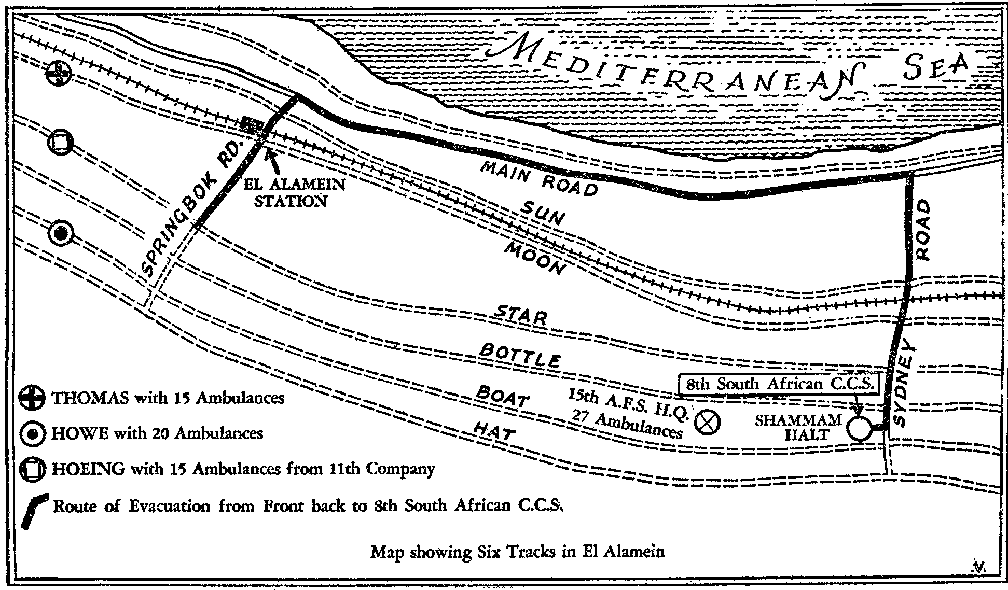
Map showing Six Tracks in El Alamein
On August 14 Pat Patullo and I reported for duty in Damascus. We made the drive from the El Alamein line to the world's oldest city in thirty-six hours. The bulk of the unit in the desert was being relieved by fresh men from Syria. Lieutenant Marsh was promoted to captain and placed in command of the desert platoons; Chan Ives was placed in command of the Syrian platoons with rank of captain. The foremost problem at that time in Syria was the ambulances we were to drive. They were the same vehicles we had first used when coming to the area and were fast becoming road weary. Another workshop section (British) was formed and sent to us from Egypt, and they began the job of overhauling the machines.
We had substantially the same posts to operate from as when we were in Syria in April. Hassetche was off the list, but Dave Hume drew another beauty---Raqqa. Dick Tevis was to return to his old command at Deir Ez Zor, and Wayne MacMeekan was to run the Baalbeck-Zahle area. With these men in the field, about all I had to do was to see that spare parts and tires were sent out when needed.
A week after I reached Damascus I was offered the command of a new company to be formed on the arrival of another large group of AFS men from the United States. There is no denying I was eager to have a command of my own, but there were several serious objections. My volunteer term of service was nearly over; most of the first-unit men were going back, and the air was filled with talk of home---home for Christmas. If I accepted the job, it meant that I should have to stay longer than anticipated. It also meant a tremendous amount of work. The new company was to be formed and sent directly to the front. We should have three weeks to do the job. I was tired, having recently recovered from my second siege of sand-fly fever, and my back was giving me trouble from the mine-field jolting, though another X-ray examination in Damascus showed no injury. But my eagerness to have my own command overcame all these objections.
When Major King and Captain Ives came to Damascus with the proposal, however, I was careful to conceal my eagerness. I said, "I'm happy here in Damascus. I'd rather finish my term of service here, but I'll take the job on one condition."
"What is it?" King asked.
"That I be allowed to choose my platoon officers and noncommissioned officers from the desert rats."
Chan winced. He knew what that meant---he would lose many men he could ill afford to be without. I felt guilty as all hell. It seemed that I was always selfishly taking men away from unselfish Chan.
"I thought you'd ask that," King said. "I've a list of men with me. Let's go over it."
This meant that eighteen men would come from the rolls of the platoons of Marsh and Ives---eighteen men who had been tested in battle. All these men, in one way or another, had proved themselves under trying conditions in the desert.
Only once did Chan yelp in anguish: "For God's sake, leave me Dave Hyatt and Charlie De Rimsingeur. I'll need them here!"
"OK, Chan." Feeling anything but magnanimous I struck their names from my list.
Four men declined the invitation to join the new company. Dave Hume was about to receive a commission in the United States Army, and Jupe Lewis and George Lester were deep in the desert with an armored division and too interested in the jobs they were doing to give up that assignment. Dick Tevis was ill.
Platoon officers of the new company were to be Evan Thomas and Art Howe. Evan was to have Jack Pemberton as platoon sergeant and Art would work with Bill "Goose" Gosline. Wayne MacMeekan was to come into company headquarters as sergeant; later he would be promoted to lieutenant and become company adjutant. Art and Evan drew lots for the men they would have as section leaders in their respective platoons. The framework of the unit was drawn up, and we assembled once again at El Tahag a few days before the arrival of the new men.
There was a pleasant surprise in store for us. The First Ambulance Car Company (our old friends of Tobruk, Sidi Barrani, and Tanta) were in camp and refitting. We were to double-bank with them once again. Major Drysdale invited Howe, Thomas, and me to be guests in his mess. For the next four days we worked out our company lines and assigned tents. Major Monty Soloman picked out a top-flight group from the Royal Army Service Corps base depot to form our workshop section; he also gave us eleven first-rate cooks and sanitary men. To top it off, Captain Webb was posted to our company to command the workshop section.
Captain Webb, "Webby" as he came to be known, was a small, mild-mannered Yorkshireman. He was indefatigable, and he knew his job. Under his direction we were to have a workshop section second to none in the Eighth Army.
My one worry about all this was how the new men would accept our moving in on them. There were well over a hundred men arriving; they had started from New York in three units and were commanded by men appointed in New York. How would they accept the idea of going into the ranks?
The day before their arrival, Art Howe, "Hellfire Dan'l Goodman, and I took off from camp early and went to Ismalia (where we had a swim in the canal). From there we went to Suez and put on a bit of a party, just the three of us. We talked desert till our throats ran dry; then we wet them down and started over again.
The next morning early we went aboard ship to meet the new men, but not until we had gone to the ship's bar and introduced Dan to Coca-Cola. He appeared to enjoy it but was slightly bewildered at Art's and my delight and the amount we consumed. It was our first "pause that refreshes" in more than a year.
Trucks were waiting at the dock after the tedious job of unloading, and the trip to El Tahag was made in good time. Thomas and his NCO's had remained in camp to do the last-minute work. The evening meal was waiting when the men off-loaded; they ate and were shown their tents. The company was on the ground, and now it was our task to form it into an efficient unit. I realized too well that if this wasn't done, with experienced men to help, the fault would rest solely with me.
The object of training the new men was to turn them into good ambulance drivers capable of working in the desert under battle conditions. The question I asked myself most often was "How can I ensure that these men will give their best?" Nearly all were college graduates. My first responsibility was to get to know them, but the time was short; we were to train in twenty days. Perforce, I would have to make snap judgments. I would insist on a closer discipline than had been administered in the first unit, realizing that discipline which depends for its maintenance on punishment is not true discipline but will crack sooner or later. My idea was to build a team as one would build a football team. I would encourage competition between the two platoons, as I had told Thomas and Howe, but beyond all this would be a spirit of competition between this company and the one in the field. Ruthlessly I would do this. I began with the first lecture the morning after arrival.
"You men are lucky---you are perhaps the luckiest AFS unit to arrive in the Middle East. You are being formed here in Tahag to report in a few weeks to the desert; you are being equipped with absolutely new ambulances. You have everything in your favor but experience. That is why it has been necessary to ask you who were in command to step down. If this wasn't done, you would have to do several months in Syria.
"If you went forward without experienced section and platoon leaders, you would stand -no chance with 11 Company already in the field. They have been up there for some time; they know the jobs and how to do them. Unless you learn your jobs well and quickly when you do report up there, you'll find yourselves working around base hospitals while 11 Company grab off all the good assignments. If you want the jobs, you'll have to win them by your work. I'll promise you one thing. When we do go forward, I'll get you good jobs with forward units; it'll be up to you to hold those jobs."
Purposely I exaggerated the lot of a spare driver.
"A spare driver is no one's friend. He has no machine to drive or live in. He is always begging rides from someone in his section; he has no definite place to carry his kit. But there must be spare drivers in case a man gets sick or runs into trouble. Each section will have one. When these first ambulances are issued, it will be by lot. The unlucky will be spare drivers. But the first time a man shows he is not capable of maintaining his vehicle properly, it will be taken from him and given to the spare driver.
"We shall have over a hundred vehicles in this company as presently formed. That means over three hundred thousand dollars of equipment we are responsible for. I have signed for every one of those vehicles; I am responsible for them; I must know where they are and what is being done to them at all times. I will crack down on any man who uses a vehicle without authority.
"And that goes for men who are given leave and stay AWOL. For every day a man is away he will get five days' field punishment upon his return to camp."
At the conclusion of the first meeting I asked Bayard Tuckerman, Grafton Fay, and James Ullman to my tent. These men had been in charge of units on the way over.
"I hope you gentlemen will understand the need for asking you to step down from command of your units?"
"We do," Tuckerman replied heartily. "We should be foolish, indeed, if we didn't." Ullman and Fay nodded agreement. It was as simple as that. From that day on they gave me the fullest cooperation. Tuckerman, an older man and a former Massachusetts state assemblyman, was well known in society and business circles of Boston. In the following days he earned my admiration; he played baseball with his platoon team, and no task was ever too difficult for him. He left the desert on my insistence only after he had been suffering from dysentery for many days.
Within a few days Charlie Sneed (former Yale football player) arrived with twenty new members. Fifteen of these were sent on to 11 Company, who were in need of reinforcements. Charlie ("Snazzy," as he was called by everyone) elected to stay with the new outfit. About this time we received our official name from the Army---15 AFS 567 Company.
The NCO's, platoon officers, and I were soon convinced we had a sound, solid group of men. They were energetic, eager to learn, and open to suggestions; they were athletic-minded, and any call to sports received a hearty response.
Doug Atwood was appointed athletic director, and a series of baseball games was promoted between the first and second platoons. Thomas and Howe and I favored any move that would promote esprit de corps in the company; and when suggestions were made to have insignia painted on our vehicles to set us apart from 11 Company, we immediately held a competition. There were many men in the unit who were good artists, and many sketches were made. On a vote it was determined to adopt that submitted by Cliff Saber. It was a wild, cocky caricature of an eagle wearing a stars-and-stripes hat with a redcross background. An assembly line was formed; one man did the outline and another applied the white, another the yellow, and still another the red and blue. In eight hours this gang put an eagle on every vehicle in the company.
When 11 Company saw the emblem, they promptly dubbed us Geer's Chicken Brigade. This secretly pleased me for it added fuel to the spirit of competition.
While 15 Company was forming, 11 Company continued to operate in the desert. On the night of September 3-4, Arthur Foster was lost. He and his son Jim formed the only father-and-son team in the AFS. Jim was a member of the attachment working with the Fighting French. Jim's father, after serving a time in Syria, came to the desert while the company was re-forming at Tanta. In September he went to the front with his section and was attached to a brigade that was being heavily engaged by the enemy. The regimental aid post to which Mr. Foster was assigned was hit by a shell, and the medical officer and orderlies were killed. It is also believed---this was a night action---that Foster's ambulance was hit by the same or subsequent shells. Neither he nor his vehicle has been seen since that hour.
At El Tahag, 15 Company continued the work of organizing. When the vehicles for the company had been drawn and issued and the camp had shaken down into a routine, Brigadier Robert Walker, DDMS (Deputy Director of Medical Services), was invited to El Tahag for an inspection of the company.
Brigadier Walker was the AFS's friend at court. From the first day of our arrival in the Middle East he sensed the work such a volunteer group could do. With a less understanding officer to direct our activities from British general headquarters we might well have been given monotonous base jobs. He knew his job from the ground up, as is evidenced by the Military Cross he won as a regimental medical officer with the 2d Battalion of the Coldstream Guards at the battle of Passchendaele in November, 1917. Since then the OBE (Order of the British Empire) had come his way. His province was not only Egypt but Palestine, Syria, Irak, and Iran as well.
I wanted this man to see the men of 15 Company. An old soldier would sense in a minute the solidness of the group; the care they gave the vehicles and their smartness of appearance could not help making an impression. I was sure that one hour would convince the Brigadier that here was a group that was different. In my plan for advertising 15 Company I wanted to begin at the top, but it was not because of its vehicles and equipment that it deserved distinction, but because of its discipline and esprit de corps.
I told the company, "Brigadier Walker has been invited to inspect us on Sunday. In preparing for this inspection I want you to remember that he is our boss; he will decide what we do and where we go. If you sell him, we are set."
Another problem had arisen---minor, yes, but to us it meant a great deal. Cairo AFS headquarters had voiced disapproval of our insignia. Why? No one was able to explain. Many units in the Eighth Army had emblems on their machines. Ours were cleverly done and had been applied by the men themselves. We expected orders daily to remove the eagle, and I was prepared to fight bitterly such an order.
To the rear of our camp was a large level field of sand. On this site we arranged our ambulances, water trucks, three-ton lorries, and motorcycles in platoon fronts. It was imposing; there were more than a hundred vehicles, all new, all freshly painted, and so clean inside and out that even the Egyptian fly was discouraged. The men worked like beavers in preparation, and when Sunday morning arrived we were ready.
I was waiting at company headquarters when Brigadier Walker and Colonel Richmond arrived by machine from Cairo.
"Good morning, Geer," the Brigadier (a big man, handsome, with a bit of Irish brogue in his speech) greeted me.
"Good morning, sir."
I saw his eyes crinkle with pleasure; he smothered a smile.
"What have you there?" He pointed to the disputed emblem on the door of my staff car.
"Our emblem, sir---an American eagle."
At that he laughed outright. "Damned clever, eh, Richmond?"
"Ye---es, sir." Colonel Richmond stumbled a bit on his agreement.
Immediately I plunged into the story of the contest and the remarkable job done by the men all pitching in.
The Brigadier laughed again. "My only suggestion is this---"
I caught my breath.
"Have it on both doors, and make the red-cross background larger. That way it can serve a useful as well as a decorative purpose. I like to see units adopt emblems---it shows they have pride in their outfits.'
With that remark all arguments over our eagle vanished. The inspection went off without a hitch; and when it was over and I had saluted the Brigadier on his way back to Cairo, I knew we were set. I also knew we were moving out within a few days.
Company headquarters was being efficiently run by Wayne MacMeekan with the help of our company clerk, Carl Adam, and Pat Fiero. Fiero was a veteran of the last war; he had left a family on the Philadelphia "Main Line" to do this job. From the first day he did it well. Within a few days he became indispensable.
Early in training George Barker fell from a moving ambulance in the field beyond camp and suffered a compound fracture of the leg---our first casualty.
All the men were granted leave to Cairo; all but one returned when their time was up. This one fellow stayed away three days. When he did report, I sent for him.
"Will you accept my award of punishment, or do you wish to stand a court-martial?"
"I'll take yours."
"Fourteen days' field punishment. Gather your mess tin and shaving stuff, and report back here in half an hour."
"Yes, sir."
The man was sent to the Depot Company. Disciplinary training was in the hands of a young officer from the Commandos. That night in the mess I drew this officer aside.
"One of my men reported to your unit today."
"Yes, I know."
"Just because he's a volunteer and an American I don't want you to ease off on him. Give him everything you give your British troops."
"Do you mean that?"
"Certainly."
"Don't worry; he'll come back a wiser man."
Nine days later this same officer sought me out in my tent. We passed the time of day, and then he said, "That bloke you sent over
"Yes?"
"I'd suggest an early release, say at the end of ten days."
"Why?"
"Attitude. This joker is all right. He gets up at four-thirty with the rest; he cleans out the cookhouse and then has a bite to eat. From six-thirty until ten he digs slit trenches and puts up tents; from ten to twelve he drills in the sun with full pack. After thirty minutes off for lunch he works through the day until guard mount at five; then until seven he helps about the cookhouse."
"Yes . . . "
"He does his work well and volunteers for any mucky job that comes along. He rates a few days off."
"OK, release him and send him back on the tenth day. Thanks."
The fellow came back and plunged into the routine he had missed; he bore no grudges and did his work well.
With Howe and Thomas taking their platoons on overnight trips into the desert, all the while working out navigational problems and getting the men desert-wise, the task of obtaining spare parts, supplies, and equipment was carefully planned by Captain Webb, Quartermaster Nichols, and myself. We had the spare parts and tires for six months to assemble, covering over a hundred vehicles, and there is always much red tape to cut through in any army. Major Harry Mathews helped, especially with the controlled stores---the sun and prismatic compasses and binoculars. Quartermaster Nichols was industrious, and daily more and more stores piled up in his tent. Captain Webb, through one means or another, secured spare parts and equipment we in the AFS had never had before. His workshop section were proving themselves wizards. The amount of work these men could turn out in a day was fantastic.
But it was not all work. We had friends down the road, and the door of the mess at "The Running Pump" was always open to us. Major Geoffrey Ward, former amateur golf champion of New Zealand, was in command of the 3d Water Tank Company. It was the job of such a company to transport water to the fighting outfits in the desert. Such units do unbelievable feats of hauling, and not without casualties.
Over all were the rumor and talk of the Big Push. We knew it was coming---it was merely a question of when. Since Rommel's abortive attack late in September the front had been quiet. But daily, along the roads, we saw big stuff moving toward the front. Such talk brings a feeling that cannot be described, like the feeling just before the kickoff in a football game magnified a thousandfold. When the battle began, we should be bathed in blood and enveloped in misery---and when I looked about me at some of the youngsters in the company, young lads of eighteen and nineteen who had never seen a man badly hurt, I wondered how they would stand the shock of driving men mangled beyond recognition.
We were warned to stand by. Twenty-four hours later we received movement orders. We were desert bound before daylight the next morning. Despite our work and warnings, it seemed that the order caught us out of breath and not ready. It was two o'clock in the morning before Carl Adam and I finished working out copies of the order for the other officers and NCO's.
In a foggy, dim, predawn light the convoy whistle blew and 15 Company took the road with the dispatch riders darting along the line. The fog continued heavy (we should have called it a "tule" fog at home) until ten o'clock, but we kept to schedule and met our guides at Treaty Bridge in the nick of time. The convoy, nearly ten miles long, was split in passing through Cairo. Once outside the city we joined and headed west toward the desert.
We went into harbor that evening, a laager that was to prove our home for the next three weeks. There we set up camp. Swill pits and latrines were dug and "desert roses" planted. A desert rose is a urinal made of two four-gallon tins and planted in a hole in the sand. The workshops were set up under camouflage, and the ambulances were dispersed over a wide area. Some of the drivers had a half mile to walk to the cooking area and the center of camp.
The area to which we had been assigned was not bad, as desert goes. It was clean and there was enough soft sand to bog down an ambulance if the driver were not alert. There is only one way to learn to drive in the desert, and that is by driving many miles in it---this was one trick the platoon officers and NCO's could not teach their men. After a man has become stuck in the sand a dozen times, either he learns how to drive in it or breaks his back shoveling his way out.
I came to marvel at the adaptability of these green men and the way they could so habituate themselves to the ways of the desert; the most civilized became primitive in a few days. Those who could not make the change found their way, on one pretext or another, into the Cairo office or to Syria, but there were few of these.
For men in the desert the sand is a thing to be dreaded; it is either too soft or too hard, with sharp outcroppings that cut tires to ribbons in a few hundred miles. It drifts into your clothes, your food, and the carburetor and feed line. It finds its way into watches guaranteed to be water- and dustproof; it covers tracks a few hours old; it blinds you and brings on desert throat and dust pneumonia. It finds its way into your personal parts.
The sand is a danger against which you must guard always. Living in the desert is an art not to be taught by lectures. All Captain Waller is able to do is to prepare you for it; it can be learned only by experiencing it. You must eat your share of sand and burrow in it and curse it before thinking yourself a desert rat.
Life with an army in the desert becomes a cycle of apparently aimless peregrinations. A company is ordered to move to a point on a map. The move is made, camp is set up, slit trenches and latrines are dug and desert roses planted while the cooks set up and workshops off-load.
A dispatch rider comes in covered with dust and hands a slip of paper to the officer in command. The convoy whistle blows, and off you move again, but not before slit trenches are filled as well as swill pits and latrines. The drivers grumble, perhaps the move is only four or five miles. The convoy leader can feel the talk at his back.
"What the bell's the matter with Geer? Can't he make up his mind?"
"Probably didn't go to the right place."
"Move again?"
"Christ!"
Breaking camp in the desert is a final, complete act of severance. Slit trenches and swill pits so laboriously dug in the shale must be filled with sand and sweat for the protection of vehicles that may pass that way in the night. When the convoy moves off, all that remains are a few empty gasoline tins, which in a few days become rusting tombs or are whisked away by the Arab. The Western Desert is littered with such rusted markers. Breaking camp means leaving the unknown for the unknown, the vague for the more vague. Topographical differences seldom vary, and laagering places are only numbers on a map. Taking the desert track to a new site is ever an event---excitement may be waiting over the next escarpment.
When the war is stagnant, the silence of this land is lethal. There is no sound of wind in trees or brush, nor the sound of running water, for in the desert only the voiceless wind exists. The approach of a sandstorm is as silent as death; the only sign is visual as fever streaks of dust cut across the sun. The weather is as cruel and undomesticated as it was on the Sixth Day. It has no form; there is no way to chart it. If a khamsin dies with the sun, this does not mean that it is gone for days or weeks; it may return with the moon. Weather in the desert is a free lance. It lurks over an escarpment; it roves where it will.
On the third day in this laager the new men received their baptism from the weather---a khamsin enveloped us. It was a hell shifter while it lasted. The first signs appeared in the western sky about three-thirty in the afternoon. The sun became hidden by a red veil, ever deepening. In the south above the horizon lip was a tender blue that fast turned to a cruel indigo. The veil over the sun became a deeper, ominous red blanket. It flopped over us with a roar. In two minutes horizons had shrunk to ten or fifteen feet. After the first blast the choke of sand thinned. A front-bound convoy (in the roar of the wind no sound came to us) passed our camp. It appeared as the shadow of a convoy moving by.
The khamsin lasted through the night but weakened and died with the next morning's sun. Blankets and camouflage nets were shaken free of the dust and slit trenches emptied of the sifting sand. Reminders of it were in our food for several days.
Having promised the unit that I would get them good assignments in the field upon reaching the desert, I bent every effort in that direction. I had many good friends in the Eighth Army and used them shamelessly. And they took this in good part---it was so un-British that they saw much humor in my high-pressure selling. They did help me. Wherever I went, I boasted of 15 Company. I extolled our new equipment, for really that was my best selling point.
In this personal contest, I viewed Captain Marsh, commanding officer of 11 Company, as an opponent, another salesman whom I had to outsell. I had studied Marsh and was ready for him. He was competent and sound, but he was easily bored by inactivity, and at the time of our arrival he had been laagered at Kilo 50 for over a month with little to do. I knew he was choking with boredom and counted on this lassitude as Howe, Thomas, and I went roaming about warming up old friendships and making new ones. For the exceptional work done with the New Zealand Division at Matruh, Thomas had many well-wishers among the Kiwis. With a Rugby background, Howe got on well with the British.
11 and 15 Companies had been attached to the mighty 10th Corps (called the Corps du Chasse), which at that time was in the process of being formed into the juggernaut it was to become. Thus if we got in our work before the formation "jelled," we should have a better chance than after the corps was set.
Brigadier Q. Wallace was the Deputy Director of Medical Service of 10th Corps. He was our boss. I had met him at Tanta and before that when he was with the 7th Armored Division. He was a bull of a man who trod heavily, strewing about him small things and small men, but he cut across lots to his objective and always got where he wanted to go. He had a truly great knowledge of medical service in the desert. His one objective was to clear the wounded and injured from the field of battle as quickly and painlessly as possible. Every man wounded in the 10th Corps can thank his God that he did this well and insisted that the units under him do it well.
Vivid in my memory is a discussion with a medical officer of the 10th Corps.
I said, "The Brig is upset at the slow loading of the hospital train this morning---we took eighteen minutes too long."
"Brig Wallace," the officer groaned, "would be dissatisfied if we had a stretcher under every wounded man as he fell; he would want to know why we didn't have a field surgical unit ready to operate on the bloke; if we did have a surgeon there, why wasn't the blood bank handy?"
Brigadier Wallace was directing medical services for the Desert Rats (7th Armored Division) on the first Wavell. push. Near Sidi Barrani an Italian general was captured. With the general was his wife and a woman companion---it was not uncommon in the early days for Italian officers to have their wives or mistresses in the field with them. The general's wife was pregnant and heavily so. Soon after their arrival in the British camp the enemy staged a bombing attack, and in the resultant excitement the woman went into labor. The Brigadier safely delivered the baby, and the mother and child were later evacuated to Alexandria. An enterprising newspaperman made a story of it. When the Brigadier's wife in England heard the story, she sent a cable, "Since when have you taken up the practice of midwifery?"
Here was the man who was to be our boss, who disposed of the assignments that would make our work a vivid part of the Army or the drudgery of working around base areas. In one way or another we did get the choice assignments; but from that time on, the men in the field, the drivers themselves, earned the jobs that were given them.
During our period of waiting we received a challenge from 11 Company for a series of baseball games. I told the team on the day they left for the first game, I don't care if you win or lose, but don't come back if you lose."
Thomas and I were unable to attend the game. We were off into the desert on a reccy. When we drove into camp in the late afternoon, Pat Fiero greeted us with a shout.
"It's OK, Andy, it's OK---we won six to four."
Later the boys won four straight games, coming from behind in the last two. In the last game they scored four runs in the last inning to win. This pleased me tremendously. Silly? Yes, granted---but it proved what I had been preaching, that the men were good competitors.
When Evan Thomas and I drove into camp that night, we had a small victory buttoned in my shirt pocket. It was an order for fifteen ambulances to report to the New Zealand Division. To our minds, this was the prize of all assignments. The next day Evan left with three subsections for duty in the desert; it proved to be an assignment that carried through from El Alamein to Tripoli and on to Hamma and Tunis.
The toss of a coin decided whether Thomas or Howe should move his platoon into the first job, and Thomas won. That meant some days of inaction for Howe. His platoon became restless. Posting a thirty-minute move warning on the bulletin, I planned a reccy. I called Art to the headquarters truck one morning at seven o'clock and gave him the following movement order.
At 0800 hours you will dispatch fifteen ambulances to Kilo 12, where you will join W Track and proceed to MR [map reference] 580855.
At 0900 hours you will dispatch fifteen ambulances to Kilo 140 and turn right on S Track to the junction with W Track, from where you will proceed eastward on W Track to MR 580855. The two units will meet. the cook and water truck at MR 580855.
You will laager at MR 580855 for the night. At 0800 hours you will break laager and proceed to -----. After rest and refueling at this point you will return to company headquarters.
Complete road reports will be kept by both units.
Howe took one section, Gosline the other. Thirty-six hours later the two units came in. One look at them and I knew W Track had been a shocker. Gosline and his group finally forced a path (digging their way most of the time) to where the cook trucks were located. Buck Kahlo and six cars made it from the other direction the following morning after digging eight long hours and spending the night in the desert on emergency rations. Howe, driving a staff car that was not a four-wheel drive, was forced to break off the engagement. His group, too, spent the night in the desert and returned next day over an easier route. "Get stuck?" I inquired.
"Stuck?" they yowled in unison. "We were never unstuck!"
"For hours we've been digging."
"How long've we been gone?" Buck Kahlo asked. "About thirty-six hours."
"That's how long we've been digging," he said grimly. "Sand channels, shovels, tow ropes-tow ropes, shovels, sand channels---God damn me if they don't haunt me!" junior Bachman moaned.
Reccy reports were duly filed by Howe and Gosline, and the final conclusion reached was "W Track, between Kilo 140 and Kilo 12, is either mythical or prehistoric. Unfit for camels."
But the trip served its purpose. It gave the platoon something to do and added to their experience. Nowhere in the desert would they find worse going.
The New Zealand Casualty Clearing Station under Major Stan Wilson moved into the desert plain alongside us and opened. Orders came through for us to evacuate their patients to the rear hospitals. For the most part, the men brought into our area were not battle casualties but men who had succumbed to one of the desert ailments. It was another fortunate break for the green men of 15 Company; it gave them experience in handling stretcher cases, but not the badly wounded men they would later handle. It also brought us under the jurisdiction of one of the finest field surgeons in the Eighth Army, Major Stanley Wilson. On Wilson's staff were Captain William Coswell, MC, and Captain Ken McCormack.
One day before the El Alamein battle we were visited by Lieutenant General Lumsden, our corps commander. After he had looked about our setup and was preparing to take off again, we were standing in a circle and passing small talk. The General flicked his eyes over the white and blue ribbon on Coswell's bush jacket.
"Where did you get that, Captain?"
Coswell. blinked, shifted his feet in embarrassment, and for a moment appeared tongue-tied. Finally he mumbled, "Crete."
After the General left and Wilson, Coswell, and I were walking toward the mess tent, Coswell said, "Why in hell did I say Crete?"
Major Wilson laughed softly. I was wondering why when you said it."
"He---he caught me with my vocal pants down. I was at Crete, but this didn't come from there. Why in hell did I say Crete?" he asked himself,
From then I hung the name of "Crete" onto him, and every time I called him by that name he squirmed, but he did not hold it against me. Weeks later when we were in the Tmimi area I received a note from him saying "I've come by a bottle of Canadian Club whisky. Drop over tonight and we'll do for it.---Bill. P.S. If you want water in your whisky, bring your own water."
At that time we were rationed to one quart of water every three days.
In the Wavell push Major Wilson had been captured and his entire medical unit surrounded. They continued to work as before---the Germans came into the camp, looked it over, made a cursory count of the wounded, and after posting sentries at the outskirts of the laager left Stan and his staff to do their own work. In no way was there interference. Their trucks were not taken from them; water and food were sent in. Momentarily Wilson expected a counterattack to release them. It did not come.
After waiting two days, during which all the wounded were operated on and made comfortable, lots were drawn; one doctor and three orderlies planned to stay and care for the wounded, and the rest would make a run for it. Stan's lot was to try to get out. German officers were in the habit of inspecting the camp at eleven in the morning. On this day, as soon as the inspection was over, Stan and those who were to go piled into a three-ton truck and drove east---deeper into enemy territory. They joined an enemy convoy and rolled along with that for a time, then they pulled out of the convoy line and turned south, heading deeper into the desert. These moves were made without a challenge. Proceeding south thirty to forty miles they swung southwest. All was going along merrily when a shell exploded in the sand alongside them. Armored cars ranged on the escarpment close by---it was a "Jock" column, so named after General Jock Campbell, VC. That evening Stan was with his own division.
As time would permit, the men were given leaves in Alexandria, for once the attack began there would be no rest for any of us. Our present evacuation line was long---over two hundred miles---but we were not working to capacity. Over all hung the thought of the battle that was to come. Every day we saw the supplies of the Army moving past our camp to the front. The attack was coming---it was near. One day soon we should know the day and the hour.
With the advent of General Montgomery to the command of the Eighth Army every man who had served prior to his taking over was struck with the changes. The line of supplies moved quickly and easily to designated places; confusion was gone. No more did units suffer from "order, counterorder, disorder." The Eighth Army was becoming a machine. As far as was consistent with security, the men were told of battle plans. Company commanders were made conversant with the over-all picture of the corps and Army. Half-won victories were not proclaimed won before the action was concluded. When Rommel's attack in September was repulsed with serious loss to the enemy, the communiqués from Army headquarters were masterpieces of understatement. Morale was looking up.
Brigadier Wallace held frequent joint conferences with officers in command of medical service units under him, routes of evacuation were worked over, and medical supply problems thrashed out. For the first time, all major medical units were to be in constant touch with corps headquarters by radio. The time lag would be greatly reduced, to the benefit of the wounded men and the operating surgeon. Blood banks with plasma and whole blood were set at strategic positions. Field surgical units with a nine-day supply of food and water so that they would not be a drain on the units they rushed to aid were held in reserve to be sent into sectors where casualties had been greater than anticipated. Brigadier Wallace worked out the number of anticipated casualties for the corps---he proved within one per cent of being correct. Map-reference locations were given for every unit in the medical services; each commander of such a unit knew where every other one was.
Our final assignments came through. Art Howe was ordered to take twenty vehicles to the 10th Armored Division, and the balance of the machines would remain with company headquarters. This unit was to service the 8th South African Casualty Clearing Station. Disposed thus, we would have over half our complement doing front-line duty and the remainder at one of the most forward clearing stations. It was a happy situation for 15 Company. We were with first-class units and none would be LOB (left out of battle). We were with forces we could only have dreamed of being assigned to 4 few weeks previous. The ambulances we sent to a division were not the only medical vehicles in use by such a fighting group-we augmented the ambulances such a force would normally have.
.
Preparations were completed. The Eighth Army were ready for the attack . "D" (The Day) was set for October 23. The hour was twenty-two hundred, or ten o'clock at night.
The moon was coming full. Orders came through from corps headquarters. We were to move on D plus one, that is, on the morning of October 24. Thomas and Howe were already on the front and working. Last-minute packing was done and spare gasoline stored on the gasoline lorry. The cooks broke up their sand-built oven, and the workshop section loaded spare parts and equipment.
The 8th Casualty Clearing Station had closed in preparation for the move. The wounded were being taken care of at a medical concentration point near Gharbaniyat. When Captain Webb and I went to the mess that night (Webby smoking a pipe as foul as it was hot), we found a long table set on the sand (the mess tent was down) and the staff settled at the table in overcoats and mufflers. It was cold as we sat about the table waiting for the moon, waiting for the artillery to open up. The talk ran up and down the table.
"God's truth, men, I hope we do it this time," Lieutenant Colonel Verster, commanding officer of the 8th, said with a touch of anxiety in his voice.
"We'll do it this time," Major Wooldridge said confidently.
"We had him at Sidi Razegh."
"But we lost him . . ."
"Just like last June."
"It's this time or never.
"That's what we said in 1940.
"And '41."
"These English are unbelievable people, Captain," Colonel Verster addressed me. "They may not do it this time, but do you think that will stop them? Oh, no---they'll go on preparing for another stab at jerry. One day they'll do it, don't you ever doubt that."
I made a small wager today," I answered.
"What was it?"
"That we'd be in Tobruk within thirty days."
"It's a long way," someone objected.
"It didn't take that long for us to come back in June," Captain Wigston smiled. I think it's a good bet."
The moon came up white-faced and cold. "Montgomery's searchlight," someone said. It sounded confident. For too long we had known it as Rommel's. The moonlight painted the sands white and the parked lorries cast long shadows. The voice of the camp was muted, expectant. Faces were turned to the west. Overhead, flight on flight of bombers passed.
"The Tobruk milk run," someone offered.
"What time is it?"
"Twenty-two minutes yet."
Orange and red signal lights appeared in the sky and hung over the horizon lip to the west.
"Traffic signs through the mine fields," Captain Resnekov labeled the lights.
"This is it."
"Ten o'clock," the Polish Adjutant Dick Vesotzky said with bitterness. "It's ten o'clock and time for some of those murderers to die over there."
On the instant the horizon became lighted with wavering, ever-growing bursts of flame. Soon a deep-throated rumble reached us, only to be drowned as more bombers passed overhead.
"More Mitchells."
The aircraft passed, and the voice of the artillery came to us again.
"The Bengasi handicap is open, gentlemen. I give you Bengasi by Christmas," Colonel Verster toasted.
Captain Resnekov, the mess secretary, dug into the mess locker and pulled out a hoarded bottle of gin---he handled it as though it were a hot potato. We stood with glasses raised.
"Bengasi by Christmas!"
"Hear, hear!"
"When we take it this time. . ."
". . . let's hold it."
"It's on the mess, gentlemen," Captain Resnekov said with a grin of dismay as he saw the fiery white liquid vanish. As mess secretary (a thankless job) Resnekov kept the accounts of mess charges and rendered bills, each month. With the books packed it would be impossible to charge for the drinks we were having---he would charge them off to profit and loss.
Shortly after, we departed for our various sleeping quarters on the sandy plain. At the headquarters truck I found MacMeekan and Adam and Fiero watching the fireworks. For a long time we discussed the prospects of the coming battle and listened to the roar of the artillery. Reluctantly we went to our sleeping bags.
Early the next morning we were on the road. A veil of dust and smoke brooded over the western horizon. Overhead, flight on flight of light bombers with fighter escort twinkling above them swept toward the front. We passed through Amuriya and made an easy run of it to El Hammam, where we dug in and awaited orders for another move. The following morning we were on the dust-choked tracks again; a full-blown khamsin lashed at us throughout the trip. Late that afternoon we formed a laager at Shammam Halt. Here, we were informed, we would go to work. The 8th Casualty Clearing Station was to open and we were to evacuate the casualties back to Gharbaniyat.
Our present camp site was six or seven miles to the rear of El Alamein near the junction of Sydney Road and the six tracks-Sun, Moon, Star, Boat, Bottle, and Hat. Casualties would be moved back along these tracks to the 8th Casualty Clearing Station, where, after treatment, we would carry them farther back. A hospital train was loaded with eighty of the worst casualties. After the train job was done at Imayid (five miles from camp), the drivers hurried back to load with patients they were taking out over the road.
The 8th Casualty Clearing Station, under pressure, could care for over six hundred wounded. It had three long wards; seven or eight EPIP tents set in a row formed a ward. At the end of each was an operating theater. Three surgical teams (Major Wooldridge, Captain Sieff, Captain Wigston, Captain Stein, Major Young, Major Stewart) did the surgery for the station. Captain Resnekov handled the medical reception center, assisted by Lieutenant Schmid. Captain Hunt was in charge of the blood bank and oversaw most of the transfusions.
As casualties arrived from the front, they passed through the reception tent and were assigned to the various wards. On twenty-four-hour service we had two "duty" ambulances to transport the wounded from the reception tent to the wards.
Across Bottle Track in a small wadi we kept five ambulances on call; as patients were made ready to move farther back, these ambulances were waved in to be loaded. The ambulances moving out were replaced from company headquarters pool, which was down the track about a mile.
When loaded the driver proceeded a mile and a half east to Sydney Road, thence north to the coast road, east again for eighteen to twenty miles, south to El Hammam, and then over a frightful strip of four miles to Gharbaniyat. Coming back (empty) the driver could return across the desert---a shorter, rougher trip.
Only when absolutely necessary were the ambulances allowed to go on this run at night; I argued it was better to allow the wounded to stay forward one more night than risk a traffic accident.
One day we moved three hundred and forty-two wounded (many of them enemy). The first ambulance left camp at daylight; the last returned from Gharbaniyat at ten-thirty that night. The twenty-five vehicles used traveled a total of twenty-six hundred and forty miles. There were to be many such days. For men only three weeks in the field (six in training), the unit was doing splendid work.
The staff of the station messed in an EPIP tent. There were two crude tables with benches, and in the corner of the tent was another smaller table with a radio and a stack of magazines six months old or older. At night the tent was blacked out, and the staff (with the exception of the surgical team on duty) hashed over the news. The Sit-Rep (situation report) for corps headquarters was discussed; stray bits of information gathered from the wounded were thrown in, and a fairly accurate picture of the battle on a wide front was assembled. There were bridge games, and letters to be written. At nine o'clock the news from London came through. At the close of the program the light was put out, the tent flaps were let down, and the party turned in.
One night we were sitting about in this fashion---Major Young and I teamed against Captain Sieff and Lieutenant Schmid with the rest kibitzing---when all talk suddenly ceased. Overhead a plane circled, went east, turned, and came back.
"Jerry!" someone said.
Wh-rr-rr!
As one man we threw ourselves onto the sand floor of the tent.
Whooomp!
"That's close."
Wh-rr-rr!
"Closer."
Whoomp! The blast shook dust from the tent walls.
Wh-rr-rr-whoomp!
The plane passed over and we rose slowly, brushing ourselves off and grinning sheepishly at one another.
"I wish we weren't so damned close to that railroad track. . . ."
"Or that Jerry was more accurate."
"Better get out and see if any of the men were hit."
The enemy bombing along the rail line continued sporadically until four-thirty (they never did hit the line), and casualties were reported at first light of morning. Doug Atwood and Young Hobson went over to pick them up. Two men had been hit but were not found until the morning checkup, when they were brought in to the Casualty Clearing Station. Both were severely wounded, and they had been three or four hours without help. One man died almost immediately. The second fellow lived for some time---too long for the condition he was in, but he wanted to live. Never have I seen a man who so evidently wanted to live, and it was not because of any fear of death---it was something above and beyond all that.
God knows I was not compelled by morbid curiosity to remain with this man---if I had ever been prompted by such a feeling, it had died long since. But I stayed after he had been unloaded to give Captain Dean (the transfusion expert) a hand while he set up his apparatus, and I remained. For in spite of shock and an injection of morphine he was conscious, and he was trying to tell me something, something more important to him than his life at that moment. But he was unable to talk---his face had been blown away, and only a thin, bloody membrane remained where his lips had been. When he tried to talk, the expulsion of air from his lungs tossed up a thin fountain of spray. I knew he could hear me for his head moved when I spoke to him.
Major Wooldridge and Captain Stein came into the tent and made a thorough examination. Only too well could I read from their faces what they thought. when they straightened up and stood silently over the stretcher, I asked, "Are you going to operate?'
They moved out of hearing. "It's no use, Geer. His left arm is gone. His left leg below the knee is a torn mess. His stomach is shot full of holes. From his breathing his lungs are damaged. You can see his face, or what was his face. Poor devil, he should never have lived---how he has this long I'll never know. Is he one of your men?"
"No. He was hit in this morning's raid---we just brought him in."
"If there was one chance in ten million I'd operate, but he would never come out of the anesthesia. There are other men waiting who have a chance." Wooldridge's mild, friendly blue eyes rebuked me for making his decision more difficult.
I turned to my unknown soldier as Wooldridge and Stein walked into the operating tent.
"What is it? Try hard . . . "
I put my ear down close to the gaping hole in his head. His right band came up to clutch my jacket and pull me closer. All I could hear was the sad, desperate gulping of air---but it did make sense.
I repeated what I thought I had heard. "Tell Mary . . . ...
His hand told me I was right. I pressed closer, but the sounds had ceased coming from his throat, the hand fell away from my jacket. He was dead. He was buried that afternoon on the small ridge to the south of the hospital grounds.
At nine o'clock the following morning MacMeekan roared up to the reception tent. "The Yanks have landed in North Africa!" he shouted.
"How do you know?"
"Just heard it on the radio---thousands of them.."
"I'm glad, but I'm sorry," a wounded New Zealand sergeant spoke from a stretcher.
"What d'you mean?"
"We've been trying for Tripoli for three years---I'd hate to have the Yanks beat us there."
That was the feeling throughout the Eighth Army---"Beat the Yanks to Tripoli." We of the AFS were Americans but we were of the same mind, and every day's advance on the new front was jealously measured against ours. There were none of us who did not have a fierce pride in being a part of The Army.
That same afternoon a wounded German parachute officer was brought into camp. I got to talking to the fellow as he lay in the ward waiting for Major Young to operate on him. He had lived seven years in the United States and was quite willing to talk. He had been on the Russian front, and his company had been hurriedly withdrawn to Italy, where they had flown across the Mediterranean. Three days at Derna and they had taken off on their mission. They were dropped at a crosstrack in the desert (he either did not know the name of the place or did not want to give the location) and fell right in the middle of a strong pocket of British troops and were gobbled up after a short fight. He was confused on the whole action.
As we talked, the radio in the ward began broadcasting from Cairo, emphasizing the American landing. I asked, "What do you think of that?"
Without hesitation he answered, I knew we'd lose the war the day the United States came into it---all of us who have lived in America knew that."
Two stretcher-bearers came to take the paratrooper to the operating theater; he waved them back and turned to me.
"You've been kind to me---will you do me a favor?"
"What is it?"
"Will you ask the surgeon to give me an anesthetic?"
"Good God, man! Everyone operated on, prisoner or our own, is given an anesthetic."
"That isn't what we've been told. Thanks." He sank back and was carried away.
"There has been a break-through in the enemy defenses, and our armored divisions are exploiting the opening." This was the official Sit-Rep given to the men of the Eighth Army on the morning of November 5.
The battle of El Alamein was thirteen days old. The fighting had been fearfully bitter, but Rommel had made three vital mistakes---two in strategy and one in tactics. These errors were to seal the fate of his desert army; in the next twelve days he lost in killed, wounded, and captured over eighty thousand men. In August and September the Afrika Korps commander misjudged the supply problem. He relied on German reports of sinkings and calculated he would win the race of supply and reinforcement. He underestimated the striking power of the Eighth Army. These two mistakes in strategy led to his greatest blunder in tactics.
When Rommel was defeated in the first week in September, he regrouped his army for the attack he knew would come within a few weeks. Nightly Lord Haw-Haw told us not to "Place too much confidence in the mighty 10th Corps the Eighth Army was forming." Rommel expected and wanted the main attack to be directed at his center; he left his center weak. When the Eighth Army rolled through his center he would throw his powerful forces on the coast and in the south into an overwhelming counteroffensive from the flanks---an enveloping slamming-door tactic taken from the tactics of Hannibal at Cannae. The trap was set. It was baited with eighty-eights, and Rommel had every advantage. He had prepared positions, the prevailing winds were at his back to carry smoke screens and dust clouds over his attackers, and he was shooting to the east---any artilleryman will tell you (all conditions being equal) that a gun shooting east will outrange the same gun shooting west.
But on our side through September and October reinforcements and supplies moved over the six desert tracks to El Alamein. Corps and divisions were assigned to certain tracks for movement of supplies and men. There was little confusion, few delays. Medical units (a giveaway in battle plans) moved up and remained closed ready to move on an hour's notice to prearranged positions when the battle began. It takes no military genius to sense an impending attack when advanced dressing, main dressing, and casualty clearing stations are grouped behind a certain sector. Hundreds of canvas-covered huts were placed in the desert---from the air they looked like three-ton trucks. For days they remained empty. Little attempt was made to prevent German reconnaissance planes taking pictures of these phonies. What a shock these empty huts were to give Rommel and his staff!
On each day approaching D, the tempo was increased. Night and day the six tracks and coast road were heavy with traffic. General transport companies did unbelievable jobs of transporting---our friends "The Running Pump" brought up over three hundred thousand gallons of water in ten days. The air force increased their raids until on The Day over one thousand sorties by bombers and fighters were made on Rommel's positions and lines of communication. The Navy reported that not one enemy tanker was allowed to run the submarine gantlet for a period extending over six weeks. Rommel was feeling the pinch---Rommel was desperate for gasoline.
Then it was that the Eighth Army staff set into action a plan that would make the Afrika Korps use its reserve. British armored brigades and divisions were shifted about the desert in a seemingly helter-skelter line of maneuvers. With each movement Rommel was forced to a countermove with his armor. His reserve of gasoline dwindled with each fruitless shift. Then one night, just before D, the tanks of the Eighth Army moved into position to strike---they moved and vanished. The innocent-appearing canvas huts, long empty, now covered tanks. Still the staff were not through with outfoxing the desert fox. Wooden dummy tanks with loud-speaker attachments created a "diversion" far to the south on the edge of the Qattara Depression. Rommel moved a Panzer division to offset this threat and literally burned his bridges behind him; for his bridge of escape was gasoline, and many of his vehicles (and some forty thousand Italians) were left behind because of the waste entailed by this useless move.
At ten o'clock on the night of October 23 strategy gave way to tactics when the artillery of the Eighth Army opened with a blistering barrage---nothing, however, in comparison with what was to come on the night of November 3---and the attack began on the north. General Montgomery had smelled out the trap in the center, had sensed the cheval de frise of guns Rommel had waiting there. The Eighth Army was hitting the Afrika Korps where it was strongest; it began nudging the Germans from their strong points along the coast. The New Zealanders and Highlanders advanced quickly and gained their objectives. The right of the South African Division was checked in bitter fighting, but the left was well in the line of the other formations. The Australians were partly successful. The enemy (fighting fiercely to maintain its hold on the coast) launched a counterattack against the South Africans and Australians, with heavy casualties on both sides. Objectives taken were held. In the south the 22d Armored Brigade (the Sharpshooters and the 44th and 50th Divisions) had established a bridgehead, and the Fighting French were in position behind Himeimet. At the close of the first day the attack had been about eighty per cent successful.
Nightly the nudging continued, and on the map a giant thumb (eight miles wide) began to grow on the hand of the Eighth Army (the forefinger extended from El Alamein to Qattara), a thumb that grew large and menacing to Rommel's rear. As this thumb grew in the north, the Indian troops in the south center of the line were muscling in along the forefinger of the Eighth Army hand. A scouting party of Indians would move forward at night and take a position. They would dig until dawn, when a company moved in, and a strong point formed. Pressure, constant pressure up and down the forefinger of the army---and all the while the thumb was growing, and the soft spot in the center was ignored.
The entire front was stiff with mines and booby traps. There were the square French mines and soup-plate and plunger mines. There were the long N-mines and the telamines (cases of these were often found buried). There were the magnetic limpets, which cling to metal surfaces until they burst. There were anti tank mines, which look like large finger bowls. Then there were the fearful S-mines, which are filled with ball bearings and odd pieces of scrap and which when touched are thrown from the ground to breast height before exploding. There were the box mines, which appear to be wooden boxes eight and a half inches wide by fifteen inches long and which are set off by a push igniter mechanism. And there were booby traps of every diabolical size and shape. It was against such a front that the Eighth Army had to move.
In the most vicious attack during the battle the Kiwis took Miteriya Ridge and held it, earning the unstinted praise of General Montgomery and Winston Churchill. Day after day as Sit-Reps came through the repetitious phrase was used, "New Zealand Division neatly on objectives. Awaiting orders." Not once were they held up.
With each day, with each hour, the reports came from the front. Tabulations were made on tanks and guns as is done at home on national elections. For example:
| Mark II's | 19 |
| Mark III's (special) | 1 |
| Mark IV's | 2 |
| Mark IV's (special) | 1 |
| Mark XIII's | 12 (Italian) |
| 14 unidentified |
The King's Royal Rifles took Woodcock and the Rifle Brigade took over Snipe (staff names for German strong points). The 6th New Zealand Brigade strengthened its hold at the knuckle of the thumb and dug in under heavy machine-gun fire. The Queen's Bays and 9th Lancers were well forward and thirsting for revenge for the Knightsbridge show in June.
The 2d Armored Brigade reported as follows:
| Mark XIII's | 1 (Italian) |
| Mark III's and IV's | 14 |
| 88-mm guns | 3 |
| 105-mm. guns | 4 |
| 50-mm guns | 12 |
A fellow by the name of Corporal Nicholls of the 9th Lancers was waging a small war of his own. His score in the first four days of battle was eight enemy tanks. Nice shooting on any duckpond---and this wasn't a duckpond.
Montgomery's frontal attack was building up to the "battle of annihilation" at Tel el Aqqaqir. The thumb had grown too large, too menacing, and Rommel moved a Panzer division from the south to the north. When he did that, he left the Italians in the south without armor and stripped of most of their transport. The 15th and 21st Panzer Divisions were grouped against the thumb, and the Eighth Army intercepted a message "Stop enemy at all costs." The old iggery (panic) had Rommel.
The RAF and American Air Corps continued their all-out efforts against the enemy. They caught a large supply convoy near Fuka and left over a hundred vehicles wrecked and burning. A heavy rain bogged the El Daba airport---they struck there, getting over eighty enemy aircraft. Every countermove by Rommel was reported.
Transport planes flew supplies forward and wounded back. The battle of El Alamein was building up to an OGPU.
On the night of November 3 the artillery put on a show---anything previous to that had been dress rehearsals. On a four-thousand-yard front there was a gun every eleven and one-tenth yards; on two thousand yards of front, directly behind the Indian Brigades, there was a gun every four yards. From ten o'clock on batteries warmed up, getting into the swing of things. All along the front there was a steady, deafening roar. At two-thirty in the morning the tempo lifted a pace---the gunners were laying them in a bit faster. At three o'clock every gun along the front went mad. The sky was afire. The noise struck men dumb, and slowly, surely, in front of the Indians a wall of fire was built. Four hundred guns were building this wall of dust and smoke, four hundred guns were pouring over steel at an unbelievable rate. This wall, this wedge, began to move. The gunners were lifting, sweeping right and left, lifting again. Behind this wall the Indians moved, with the Highland Division adding a shoulder on the right at the rate of thirty-five feet every minute. And over the roar of cannon, over the explosion of shells, over the thunder of the tanks pouring through the lanes cleared by the infantry came the wail of the Highland Division bagpipes. The Laddies from Hell (the Black Watch, the Camerons, the Highland Light Infantry) were on the loose.
A piper of the Black Watch was shot through the stomach. But as the regiment streamed past, they saw their piper propped on the edge of a slit trench, and the "Highland Laddie" played them on. He was dead when the medical services came forward.
When the range passed beyond the field guns, the mediums and heavies took up the roar without pause, without change, until they too slackened to silence. Then the job was taken over from the air. Bombers came in packs. Hurricanes equipped for tank busting and with wireless-jamming sets attacked the Jerry tank units.
The Indians had been told, "When you have advanced to Kidney Ridge, your job is done." The kidney contour was shown them on the map. There was not much fighting for the infantry. Little figures in green scuttled over the desert fleeing madly from the wail of the pipes and the dark fighting men from India. Carriers and light stuff went out to round up these shell-slappy members of the Afrika Korps. The stream of POW's (prisoners of war) swelled to full flood. The wedge was driven when the Indians touched the kidney. The South Africans in armored cars raced through and began shooting up enemy transport twenty to thirty miles in his rear. The 11th Hussars (Cherry Pickers) charged by with their armor (their horses long since stabled in the pages of history) on their way to do the "hat trick" (British slang for a series of three exceptional feats)---first in Tobruk, first in Bengasi, first in Tripoli, and first in Tunis. The Shermans and Grants and Crusaders and Valentines and Honeys poured through to the west and then turned north for the kill---turned north to touch the tip of the thumb.
El Alamein had seen its last fight. The six tracks through El Alamein would once again become camel trails, and El Alamein could fall back into its thousand-year-old slumber.
Our units in the field became widely scattered. Days went by in the fast moving of fighting groups without contact being made between company headquarters and the men in the field. Thomas and his men with the New Zealanders again and again distinguished themselves. At two-thirty on the morning of November 4, Thomas was asked to take five ambulances through the mine field and contact the 21st Regimental Aid Post, which was following the advance of the infantry. Thomas selected Bill Nichols and his section for the job. Slowly they headed westward from the advanced dressing station. They were under continuous fire from enemy heavies and mediums. The night was alive with tracers, signal and flare lights, and the red and white glow of tank shells. Past the light fieldpieces they worked their way and into the lane (marked with white tape) through the enemy mines. Through a wadi they plunged and up the western slope. They gathered at the assigned location, but there was no sign of the regimental aid post.
It was beginning to lighten in the east, and they found a few wounded. They loaded these and continued to the west, entering an area where enemy fire was heavy. Thomas went forward on a reccy with Nichols and came upon a squadron of tanks.
"Seen the regimental aid post around here?" Thomas shouted to an officer in a Grant tank.
"Sorry, old man, they're not likely to be up here." The officer grinned and waved his arm. "We're about to attack." He jerked his head at the blue peter pennant fluttering from the steel staff at the stem of the tank. "We've some wounded back about four hundred yards---will you pick them up?"
The tanks moved off, Thomas and Nichols picked up the wounded, and gathering the rest of the section searched the area for more. Seven shell-slappy Germans scrambled across the sand and shale and with unseemly haste jumped into an ambulance.
Thomas and "Ecky" Johnson inspected these men. None were wounded.
"If you're not wounded, you'll have to walk. Get out," Thomas ordered the Germans from the machine. Reluctantly they came out and walked to the rear.
The regimental aid post truck (held up by heavy fire in the lane through the mine field) arrived. Thomas and his men had eighteen wounded for the medical officer.
Chuck Larrowe and Dick Christian with the Kiwis early displayed courage and leadership under pressure, as did Brook Cuddy, Dave Emery, and John Day. The green men were no longer green---a few hours under fire catapults a man into the experienced class.
Sections of Howe's unit with the 10th Armored Division were ranging far afield. For the first time in a week we heard from Manny Field and his section. The message came back in the form of a new German three-ton Ford truck---booty of the chase. Quickly Corporal Oxley, our British workshop inspector, look the machine over and painted it the desert tan of the Eighth Army and affixed the 15 Company eagle on the door. Within a day the Corporal had added a three-ton trailer to the rear of the truck---more booty!
Far to the south the AFS men with the Fighting French again saw bitter action. John Dun, a man over fifty, displayed heroism over and above the call of duty. Dun was a retired newspaperman living on his ranch in Tucson, Arizona, when the desire to do a war job sent him to join the AFS. He could have had a job in Washington, but he turned it down and volunteered for duty in the Middle East. Promoted to lieutenant, he served in Syria as second in command to Captain Debardeleben. Dun replaced me in the desert as adjutant to 11 Company in the transfer that took place in August.
John Dun is a mild-mannered small man, with nearly white hair and kindly, sincere blue eyes. Desiring to see more action he asked to be transferred to the Fighting French as an ambulance driver under the command of Tom Greenough. From that day Greenough and Dun began work in the field that placed their names beside those of George Tichenor, Stan Kulak, and the others at Bir Hacheim.
Shortly after the attack began on El Alamein, John was out with his ambulance and two others of the Service. They were operating on the edge of the Qattara depression. Loaded with casualties the three ambulances came under heavy fire. Two of our drivers sought safety---they left their ambulances. John Dun stayed. He stuck it out in an untenable position---he stayed with three ambulances and fifteen wounded. He moved some of the wounded into positions of comparative safety before driving one load out. He not only extracted his own ambulance from the exposed position, but brought out the other two. All fifteen wounded were safely turned over to the doctors in the rear.
General de Gaulle awarded John the Médaille Militaire and the Croix de guerre with palm---the highest award the French Army can bestow.
Speaking of his experience, John said, "Those two kids shouldn't be criticized for running off. Things looked pretty bad. If I could have talked with them, I'm sure they would have stuck with me. I don't doubt their courage---they just made a mistake in judgment."
That same night Tom Greenough took four ambulances on a night run through the mine fields to bring wounded from an exposed position under artillery fire. Only after fearless navigation was the run made and sixteen wounded brought out to safety. Greenough was awarded the Croix de guerre by General Catroux.