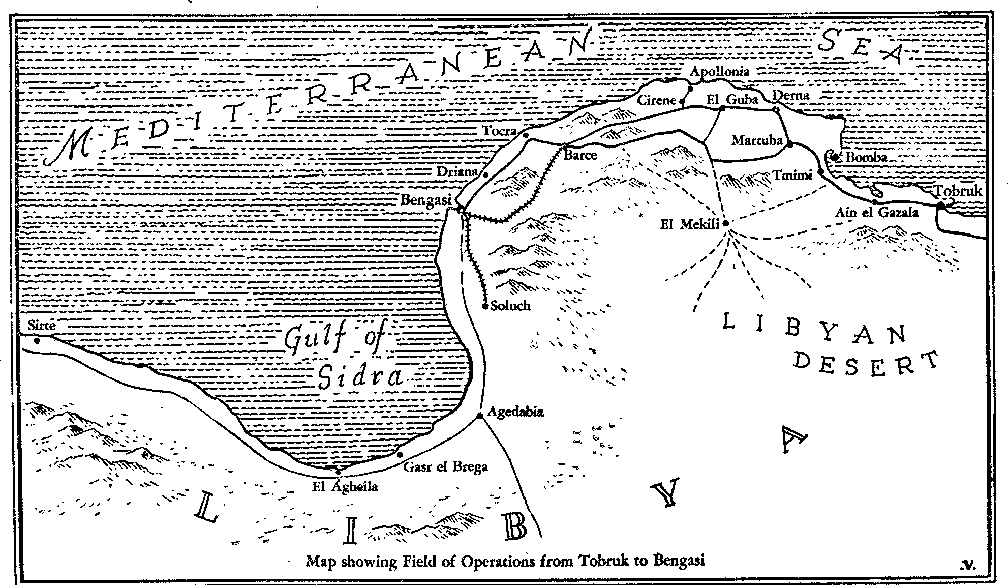
Map showing Field of Operations from Tobruk to Bengasi
A few days after the break-through, John "Spike" Himmel, one of the men in Howe's section, proved he bore a charmed life. Attached to a medical unit working well forward with the armored stuff, Spike went into laager with his unit for the night. He dug his slit trench alongside his ambulance, but his desire for a good night's rest out of the dew and cold convinced him it was better to sleep inside his ambulance than in the slit trench. He had a good sleep and with daylight was up and about. Three minutes after he crawled from his ambulance an enemy air attack struck the camp. Spike threw himself into his slit trench. A fragmentation bomb landed within a few feet of him and his vehicle. The ambulance was riddled, and Spike's sleeping bag inside the ambulance was perforated with more than a dozen sizable holes.
The equipment of a fast-retreating army was everywhere along the roadside and in the desert. Many of the prisoners were wearing English-issue clothing and boots, captured from us in June, no doubt. Rifles and ammunition, clothing, food, and vehicles (many of them in running order) littered the roadside and tracks. Though the Army had often been warned about booby traps, it was impossible to keep men from scrounging equipment. Some of our men showed up with binoculars, cameras, and map cases. Not a few had Lugers and Berettas (German and Italian pistols), and others hid Mausers in their baggage. All the logic of Kant could not convince the men they should not carry these arms with them. It would have gone hard with them had they been captured with weapons in their vehicles. A partial solution was reached. Any man who wished to save such equipment as war souvenirs was told to turn it in to the British quartermaster serving with the company. He would label and keep it until the man left the war front. Many took advantage of this offer. Others outfitted themselves with enemy clothing. German and Italian boots were common, and so was the green jacket of the Wehrmacht.
Jake Vollrath adopted so much enemy clothing he was almost thrown into a prisoner-of-war cage with a batch of Italian prisoners---only fast talking and the displaying of his papers saved him from temporary imprisonment. Buck Kahlo and his section (called the Dead End Kids) during a period of quiet went to a near-by beach for a swim and target practice with recently acquired Mausers. On the way they were taking pot shots at brush on the sand dunes bordering the sea. They were startled when nine frightened Italians came over the dunes with arms upraised in surrender. The boys didn't get their swim because they had to escort their prisoners to a POW cage.
After a terrific struggle, I made a capture. I was driving along a desert track near Salum when I came upon a tiny mite of a man trudging toward our POW cage. He was an Italian medical orderly, as was shown by the red-cross band on his arm. I drew alongside, stopped, and opened the door of my machine.
"Want a ride, Butch?" I called.
He gave a weak smile and crawled in beside me. Almost immediately I regretted the impulse. He stank. I opened the windows and started off. The fellow was continually scratching himself. I huddled over to my side of the car.
"Speak Inglesi?" I asked.
He shook his head.
"Hungry." I made motions to my mouth.
He grinned, dug into his pack, and brought forth a can of Swift's bully beef and a carton of hardtack. Next he shook a filled bottle of water and offered me a drink. I declined with profuse thanks. He dug a bit deeper and showed me his identification. His name was Francisco Penna.
"I'm from San Francisco," I told him.
He grinned ecstatically, beside himself with joy at not understanding one word. When I told the story to Major Young, who spoke Italian, he laughed. "The joker thought you were calling him Saint Francisco."
All the while we were passing trucks tail to bumper moving up Hellfire and Salum passes. He watched them for a time.
"Americano," he said and pointed. His voice was as small and squeaky as his body. Never have I seen such a small man in uniform---he would have been hard put to it to lift one end of an empty stretcher. But he would have made a fine watch charm---with a bath and change of clothing. I kept putting my head out of the window to clear my nostrils.
When I picked up the fellow I was headed for the 8th South African Camp. Two or three hundred yards from the camp there was a redcap directing traffic. I stopped the machine, dumped my prisoner, and waved him in the direction of the redcap. He grinned his thanks and went over to the MP. I saw the South Africans watching me.
I joined the South African staff, who were in the shade of the cook truck drinking tea.
"What a fight I had!" I announced, feigning weariness.
"What happened?"
"German grenadier guardsman---tommy gun-belt full of grenades. We've been fighting for hours. I finally broke the tommy gun over his head and brought him in."
"Yes," Major Young answered. "We saw you unload him. Did you bring him in your pocket? Look at that poor little joker!"
Francisco Penna was standing stiff and forlorn near the MP, his head reaching about to the MP's belt buckle. The redcap ignored the little prisoner. Finally Francisco sank down on a near-by rock, chin on hands, and watched the traffic roar by. Tiring of this, he dug into his bag and munched on bully beef and crackers, washing this down with water. He rose and walked into the desert and digging a hole with his toe did his excrementary exercises, then resumed his dejected pose on the rock.
A truck headed for the rear came along. The MP halted the vehicle.
"Hey, Tony," he yelled, pointing to the lorry, "get in. Get cracking!"
The little Italian jumped from his stone seat and ran to the rear of the truck. He was kited into the lorry by the down-reaching hands of British tommies. He leaned from the truck and waved his cap to me. Francisco Penna, my grenadier guardsman, seemed happy the war was over for him.
From the time 15 Company moved from Shammam Halt we were hard put to it to keep up with the army. We moved through El Daba in a choke of traffic and on toward Matruh. We were to spend the night at Garawla. After leaving El Daba I turned the convoy over to Captain Webb and worked my way toward Garawla to get orders and prepare a laager for the unit. For more than forty miles there was no break in the tail-to-bumper traffic. The tarmac was safe enough, but it was risky to run along the shoulders of the road or skirt into the desert. Land mines were everywhere, and everywhere along the route were evidences of an army in hasty retreat. Burned-out and abandoned equipment cluttered the roadside and desert, and streams of prisoners continued to pass to the rear.
Pat Fiero and I made it into the camp grounds of the 1st New Zealand Casualty Clearing Station in the late afternoon. From Colonel Guy, commanding officer of the 151st Light Field Ambulance, we learned that we were to move the next day to Sidi Barrani. Securing a site behind the earthen wall at Garawla we put the staff car near the road to await the arrival of the company. Major Stan Wilson and Bill "Crete" Coswell were on the same grounds with their units---all were moving the next day. Crete offered to share his bivvy with me, and after depositing my bedroll with him I joined Pat at the road. The camp was about a mile from the road on an open stretch of sand. The enemy had used it for a hospital center, and a large amount of medical stores had been captured.
Fiero and I sat watching the never-ending line of traffic until ten-thirty at night. At that time we decided Captain Webb had pulled the convoy off the road to laager. Pat volunteered to stay the night in the staff car in case the unit did come by later. I made my way back to the camp. It was blindingly dark, and as I stumbled into slit trenches and over debris I gave myself a stern lecture for not having taken a compass bearing from the car to Crete's tent. In the whole black expanse about me there was one pin point of light. That would be the reception tent, I told myself. The light grew stronger. Damned foolish showing a light that size. Have to give the orderly a lecture on blackout.
I worked my way closer and was about to yell, "Put out that Goddamned light!" I squinted. I rubbed my eyes. My God! It couldn't be-my eyes were failing. I edged closer. By my bloody oath it was a woman---a woman in pajamas, sitting on a camp bed and combing her hair. It was long hair, nearly to her waist. Another woman walked past the open tent fly. What the hell? I thought the Italians had long ceased taking women into the field with them. I crept silently away. Christ, what if a sentry halted me and charged me with playing Peeping Tom?
Turning to my right I found Coswell's bivvy some four hundred yards away. Taking off my boots I crawled into the tent and my sleeping bag.
"That you, Andy?" Crete asked sleepily.
"Yes, you dirty rotter."
"Rotter?" Coswell woke up. "What do you mean?"
"Why didn't you tell me there were women in camp? I nearly walked into their tent."
"Women in camp?" Coswell stirred and sat up. "You've been drinking that South African Stuka juice again. There're no women in this camp."
"I saw two---one was combing her hair."
"In time that Stuka juice will get any man. Go to sleep. You'll be all right in the morning---if you're not, I'll have you evacuated. You've been in the desert too long, old man."
In the morning we learned the truth. Sixteen nurses had arrived in camp before dark. Through their courageous insistence they had been sent into a forward area.
There are arguments for and against having nurses in forward areas. The arguments against are these: With women up forward it is necessary to establish a separate mess, which means extra cooks and orderlies. Their camp must be set off and heavily guarded at night, which means extra work. Their latrines must be canvas sheltered, as must the latrines for the men. In the fast-shifting scenes of desert warfare there is always the possibility of a camp being overrun by a sudden reverse thrust of the enemy. This is a thought commanding officers with women in their charge do not like to dwell on.
The psychological advantages are great. There is no disputing that trained nurses can give better care to the wounded than can the best trained orderlies. These are a few pertinent facts learned in the handling of many thousand wounded: When a man is hit on the field of battle, he is no longer an integral part of his army. He is, to put it brutally, a liability. He must be got off the field as quickly as possible for two reasons---his own welfare and the morale of his mates. In the majority of cases the wounded man loses his surge, his drive, his desire to fight; he wants to get medical aid as quickly as possible. For the moment, the war has left him behind. The worse his injury and shock, the keener this desire.
If a man is badly hit, he should first be given all the rudimentary help possible in the field. He should be moved to a place of safety---if there is no such spot, he should be moved, if only a few feet. The place where he was struck down becomes to him very unlucky---therefore, move the man. If he is loaded in an ambulance and it is not possible to take him out of the area at once, drive the vehicle a few feet, even if it has to be in a circle. This move means to the wounded fellow that he is getting away from further danger, and he will relax.
Troops in the front line deride, and half earnestly, those in their immediate rear, perhaps only a quarter to half mile, as being base wallahs. Thus, merely being in an ambulance will erase much of a wounded man's trepidation. Each turn of the wheel will help. God and the doctor know that an advanced or main dressing station is not a safe place, but to a wounded man it is. If he is off-loaded and sees nurses, his immediate reaction is "This must be a safe spot, or they wouldn't have women here." Mentally he begins to recover.
As for other women in forward areas---women correspondents---there is no place for them. While with the Eighth Army we had two noted visitors, Clare Boothe and Eve Curie. Courageously they went far forward; unknowingly they disrupted the fighting routine of the units they visited. Men and vehicles had to be assigned to guide them. When they reached the laager of a regiment or battalion, there was a scurrying about to erect places in which the visitors might sleep and canvas-shrouded latrines to which they might retire. There is never enough tarpaulin to cover the many wooden boxes used by the men. For the duration of the visit the troops must surreptitiously slip behind trucks or hold on until dark. And this is a real hardship when you consider that usually one man in fifteen is suffering from "gyppo stomach" (army slang for a vicious form of diarrhea). With this illness, when a man is seized with the urge he must immediately take squatter's rights to the sand between his heels.
The colonel of one of the finest fighting regiments gave me his views on the subject.
"Very charming woman, old man [Miss Boothe]. See where she's been elected to your parliament---hope they pass a law making her stay in Washington. No place for a woman in the desert; she visited us---no end of trouble. Took us days to get back to routine. Insisted I show her front-line action. What sort of a rotter would I have been to take her forward? We had to do a lot of faking and no little lying. Bad show, old boy, bad show."
Captain Webb arrived with the convoy the following morning. It had been impossible for him to get through in the press of road traffic. We went into laager and the workshop section started work on two 11 Company ambulances that had arrived in bad shape. During the morning Bill Nichols and Scotty Gilmore arrived with their sections, carrying casualties from the Fuka region. Though they were tired, dirty, and hungry they were keen to get on with the job. Shortly after noon we were on the road again. The traffic continued to be appalling as we inched our way over the Matruh by-pass (thus avoiding going through the town), and it was late after noon when we came to Charing Cross junction. Realizing that we should never make Sidi Barrani on this day, we searched out a laager near Kfr (village) Abu Tirhi and made camp before dark.
The workshop section had scrounged a Volkswagon en route. The machine is one of those light four-passenger cars that Hitler early in his career promised every German. The two-cylinder engine is set over the rear axle and looks no larger than a heavy motorcycle motor. Though it was cold and blustery and a light could not be shown, two of the fitters (mechanics) worked on the machine until after midnight. The next morning when we hit the road the Volkswagon was running under its own power.
We got on the road early and had a fairly good run to our destination a few miles west of Sidi Barrani. There we expected to make camp and go to work. We settled down by the sea---MacMeekan was a terrier on his motorcycle and invariably searched out good camp sites. The men streamed to the beach and in a small cove had a good swim; many were washing clothes in salt water when the order came through to move on. In an hour we were hot and sticky with salt from the swim and dust from the road.
The road was less jammed with traffic and the desert tracks to the north and south of the road were supposedly free of mines, and so we were able to move right along. We made camp that night at Buq Buq and had clear radio reception from the United States. Ordinarily such reception is not good. Broadcasts from England, Germany, and Italy come in well, but not from the United States. The broadcast was by one of our armchair strategists and went something like this.
"General Montgomery's Eighth Army has advanced east as far as Buq Buq. Right now there is a bitter battle raging in this city. Evidently Rommel has decided to make a stand at this point. The terrain is all in his favor. The outcome of this battle will largely determine whether the Eighth Army will be able to move against Hellfire Pass without having its strength dissipated. The city of Buq Buq is being fought for street by street and house by house."
While this was going on, we sat in the sand and grinned at one another.
"Christ! What drivel!" a voice in the dark observed.
"The city of Buq Buq?"
"House by house . . . . "
"If there are more than ten houses, the rest are backhouses."
"Don't forget those streets they're fightin' in."
"Streets? The second street in this bloody place is a sand highway running from here to Capetown.. . ."
". . . and about four hundred miles wide."
"While this battle rages, I'm going to bed."
The commentator in America closed his account with an observation that has long irked me---"The losses of the Eighth Army have been negligible." Negligible to whom---the armchair strategist? Certainly not to the company, the regiment, or the Army. No loss, however small, is negligible. We carried those poor fellows back---we know. If an army fought a bitter battle and had only one man killed, the loss would not be negligible. It would hurt someone at home, and his loss would be mourned by his friends in the unit. The losses to an army may be small, but never negligible. The word should be erased from the newspaperman's wartime vocabulary.
The next day we were on the road again shortly after daylight and soon were caught in the pinch of the bottleneck of Hellfire and Salum passes. Both passes had been blown in by the RAF, and many hundreds of Germans had been caught below the steep escarpments. Hellfire was partly open, but it would be some hours before Salum Pass was clear. Five or six miles from the foot of the passes we pulled to the south of the road and made camp. The British workshop lads made a dive for an old German workshop that had been abandoned. After a survey for booby traps they went to work scrounging spare parts we could use.
We were not settled for long when MacMeekan came to me. Mac is small, keen, and tireless, and he has that quick, tense reaction scientists have noted in hunchbacks and dwarfs---not that I am implying he is either, but he was always on the go, always ready for more.
"There are some Jerry vehicles halfway up the escarpment over that way," pointing southeast. "Can the Staff Sergeant and McLeod and I take a breakdown truck over that way and scrounge a bit?"
"OK, but for God's sake don't lose a vehicle on a mine."
"You should tell me to keep away from mines."
I went to Brigadier Wallace's headquarters down the track a piece and reported. We were to move up Salum Pass the next day and set up shop alongside the 8th South African Casualty Clearing Station near Fort Capuzzo. There we would go to work. We had advanced at near maximum speed from El Alamein to Salum. without once carrying patients. The Eighth Army was moving fast, and casualties were light.
MacMeekan came back with a Mercedes Benz staff car in tow. They had come upon what had evidently been a quantity of division or corps headquarters equipment the enemy had tried desperately to get over the escarpment after the passes were blown in. But halfway up they had been forced to abandon the effort and run for it. There was a tank transporter in the group, with several tank engines still in their original factory boxes; there was a headquarters caravan with built-in leather seats and chromium tables; there were the Mercedes Benz staff car and several other vehicles. The staff car was the only vehicle they could move with our light equipment. We reported the tank engines to salvage.
The Mercedes Benz was a splendid piece of equipment. It was a twin six with dual ignition and carburetion systems and individual suspension on all four wheels. It was four-wheel drive as well. The machine was in fine condition but needed a new fuel pump. Sergeant McLeod (a Scotsman who owned a garage in civilian life) promised a pump in the near future. The next day he came into camp with two. I have seen tireless scroungers but none to equal Sergeant McLeod---though Corporal Oxley ran him a close second.
The air screen was so complete that there was but one bombing of the mass of vehicles jammed at the foot of the two passes. On the afternoon of November 13 six enemy bombers slipped through (there was a heavy, low overcast) and bombed the foot of the passes. Several trucks were hit, and eighty-six casualties were suffered. It was tight working in the area for a few minutes; two of the trucks were gasoline transporters, and one was loaded with one-hundred-and-five-millimeter ammunition. The wounded were taken back to Major Wilson's unit for treatment, and the RAF screen was tightened. The balance of the. army moved up the passes without interruption.
The Royal Navy was also at Salum with flat-bottomed landing barges. They off-loaded over eight hundred thousand gallons of water for the desert army's use. At every port we saw the Navy---Tobruk, Derna, Bengasi, Tripoli. As soon as the cities were taken, the mine sweepers entered the harbors, followed by transports with supplies.
Along the coast road, westward from Alexandria, there are few villages or towns worth noting. In order along the route they are Sidi Kuir, Burg el Arab, El Daba, Fuka, Maaten Bagush (the troops call it "Martin Bagwash"), Maaten Garawla, Mersa Matruh, Sidi Barrani, Buq Buq, Salum, Bardia, and Tobruk.
For the most part the hundreds of names one sees on the map refer to marshes, tombs of dead sheiks, recognizable by the rags waving on sticks, cisterns, wells, and dried-up river beds. Buq Buq is eight or ten mud hovels; Sidi Hanish, a sheik's tomb; Sofafi and Bir Hacheim, old forts.
Sidi Barrani is a horribly mutilated town. In 1940 the Royal Navy bombarded the Italian garrison. The buildings remaining are roofless, with shattered, stumpy walls. In 1941 twelve of the Coldstream Guards were ambushed there---and there are twelve guardsmen's graves in the small graveyard on the south side of the road. Across the road is an Italian graveyard, a result of the same engagement; it numbers one hundred and forty-two Italian graves. The Coldstreams sold their lives dearly.
Salum. is a mass of rubble, as are Bardia and Fort Capuzzo. Each succeeding wave of battle left these towns a bit more pounded to dust.
The next night we made Fort Capuzzo---eight hours to do twenty-one miles. We arrived after ten o'clock, and it was tricky work leaving the main road and turning off into the desert to search a laager. Pat Fiero stayed at the road with a shielded light to turn the rest in while Carl Adam and I went in search of a camp site. We passed through the lines of an Indian company and carried on about a half mile. It is sweaty business driving over unknown terrain. We drew up beside a burned-out German Mark IV and made camp. Not until the last vehicle was in the laager and the last motor turned off could I breathe freely.
The cooks had prepared food before leaving Salum. and put it into hay boxes; they now broke out the meal (our first in twelve hours), and we all ate standing around in the dark. Daylight showed us to be camped on a flat plain of sand not more than two hundred yards from the South African Casualty Clearing Station. We were to evacuate wounded from this site to the foot of the passes. It was a short haul, but it would be a daylong job with the roads so clogged.
At the top of Hellfire Pass we came upon one of our wrecked ambulances. Its number (087) told me that it was the one driven by Sandy Sanders into the New Zealand box at Minqar Qaim. It had been used by the enemy; there were a rifle-bullet hole through the right side of the windshield and an explosive-shell hole (probably from a small antitank gun) in the left side. The wheels and tires were gone. Captain Webb and his crew stripped it of all remaining usable parts.
Tobruk fell to the 11th Hussars, and Brigadier Wallace asked Major Wooldridge and me to make a fast trip into the city and check on the hospitals and hospital supplies. We took off in two machines (in case one should be blown up by a mine) with my car in the lead. It was not the position one would take by choice, but Major Wooldridge and his driver had not been in the city before and I thought there were a few short cuts I could lead them to that might save time.
The traffic continued heavy moving to the east, and in order to get ahead we had to pull over and run along the sand shoulders on the left of the road. This was sweaty work indeed. Near Bardia three bridges over wadis had been blown in and it was necessary to detour; German dead lay to view at several points. At intervals along the road, signs were posted warning of the mined edges. Everywhere were German and Italian unit signs. A few miles beyond Bardia is a large hut that the YMCA once used to serve tea and food.. The enemy had used it for a headquarters building. A few hundred yards ahead of us two vehicles---a Bren gun carrier and a light truck---in an effort to pass the heavy traffic as we were doing had struck mines on the sand shoulder. No one was injured by the explosion, but the machines were temporarily out of action.
There is a large cemetery at the rear of this hut. In it rest the dead from both armies, and in the ebb and tide of this desert battle it had grown. For three months this sad spot had been in enemy hands and bore evidence of careful care. At the base of each marker, German or British, was a small wreath. The Germans are meticulous in the care of their graveyards, and each grave, whether theirs or ours, bears a hardwood cross with the name and unit carved on its face. It is difficult to believe that an army which will show such feeling will stoop to putting mines and booby traps under the dead they leave behind.
We were forced to make these plunges off the tarmac if we were to make the trip back from Tobruk on the same day. I followed in the lane of traffic for a time and then kicked down on the accelerator and sped along the shoulder until a break in the traffic allowed passage to the right of the road again. Taking two or three deep breaths, as a diver will after being under water, I darted out again onto the shoulder. I felt the sweat run from my armpits and down my sides; my hands were clammy.
We entered the perimeter, passed the old Italian siege guns, and went down the escarpment skirting the Derna by-pass and cemetery. The Tobruk airfield was a shambles of ruined enemy aircraft and troop gliders. There were many planes that looked as though they could be flown off. The harbor was as I had remembered it. Royal Navy boats were busy clearing the water of mines, and gangs of shore crews were repairing the docks and piers. We drove at once to the site of the 62d General Hospital. The buildings were bashed in, and the grounds were in poor condition. We soon found that the enemy had used the place as a barracks; the large operating room had been turned into a combination church and motion-picture theater. Sanitary conditions were in a frightful state. Every side room not used for sleeping quarters or mess halls had deep piles of putrefied feces. All about were empty wine bottles. The flies were giant, loathsome things and swarmed about the stinking place.
It had not been a comfortable spot for the enemy troops to live in, as was evidenced by the blown-in buildings and huge craters. The RAF had taken care of it on what they called the "Tobruk milk run." What medical supplies were left had been smashed. Four of the wards were bombed beyond repair. It would take weeks of cleaning to make the place fit to house wounded. From the hospital we went to the water front to see the underground medical inspection room. Again we found the same unclean conditions, though there were some medical supplies. The water front showed signs of having taken a terrific beating. Throughout the town were many South African Negroes, happy and dazed with their sudden freedom. They had been with the garrison captured in June; the Germans had kept them in Tobruk and forced them to work.
I talked with a Negro sergeant. "How did they treat you, Sergeant?"
"Very bad, sir."
"What did they do to you?"
"They made us work night and day unloading ships. When the bombers came over, they stood in the shelters with tommy guns and made us work right through the raid. Many of my men were killed, sir. It was very bad." He pointed to the shore. In the wash of tide I could see swollen, bloated bodies.
"This last week has been bad, very bad, but all those men out there are not mine-many of them were killed too."
"Did you lose many?"
"I don't know the number, sir. When we went sick from poor food and little water, they just marched the sick men away. Always when they did that we heard machine guns over the hill. I think they killed the sick---none ever came back, I know. Some of my men have had dysentery for months, but they won't report sick. They were afraid of the machine guns over the hill."
"You're free now, Sergeant." I tried to cheer up the fellow. "You've got three months' pay coming. You can have a good leave in Alex or Cairo."
"Yes, sir." He smiled briefly. As I turned to go, he detained me with a knowing jerk of his head. "There's meat here, plenty of meat."
"Yes?"
"About five hundred sides of Denmark beef."
"Where?"
"In the cold room over here." He led the way to a concrete building. A British sergeant and crew were working about the place.
"I. understand there's plenty of beef here, Sergeant."
"Yes, sir, plenty. The Jerries turned off the machine before they left. It's still good, but I'm afraid it'll spoil before we get the dynamo repaired."
"If I send in a truck, will you turn some over to us?"
"Yes, sir. We have to get rid of it before it turns bad." He smiled. "My crew and I are doing the best we can to see that doesn't happen." He sobered and grew confidential. "Do you remember where we had our food dump before we got out in June?"
"Yes. . . ."
"I think it would pay you to stop by there."
"Thank you, Sergeant."
Major Wooldridge and I went to the Italian Field Hospital near the wrecked airport to check conditions. Nothing was left but the tents and scattered and smashed equipment. Two not very cleverly concealed booby traps came to our view, and we trod more carefully. Adjoining this camp, behind barbed wire, were shallow slit trenches covered with ragged bivouac and pieces of tarpaulin. This was where the captured wounded had been kept. Throughout this tour we were struck with the appalling lack of a sanitary system. Over the entire area hung a curtain of flies and pestilential stench. We wondered how human beings could live in such surroundings. Intelligence had told us that one man in five of the Italian Army was suffering from dysentery, and we could well believe it.
Our survey over, we went to the escarpment top and into the barbed-wire enclosure of the food dump. Huge piles of tarpaulin-covered food greeted our entrance---bags of dehydrated potatoes, three or four different kinds of beans, and hogshead on hogshead of wine. A number of the South African Negro troops had made their way into the dump and were sitting about drinking wine. They were not noisy or unruly but sat in tight little circles around a hogshead with the end smashed in, drinking from old tin cups. One or two were gulping from brimming steel helmets.
Loading my staff car with potatoes, beans, and wine until the springs gave warning, I took the road back toward camp. The trip was uneventful, and Capuzzo was reached before dark. I entered the headquarters truck in time to see MacMeekan throw down a book in disgust.
"What's the trouble, Mac?" I asked.
"That book . . ."
"What's wrong with it?"
"It's written by an American war correspondent. God, the horrors he went through!"
"Meaning?"
"He boasts of going five days without a bath---five whole days. Imagine that!"
"Well?"
"What's the date?"
"November 14---lacking one day of being three months since we ran out of Tobruk."
"November 14. When did we leave Tahag?"
"September 26."
"That's how long I've been without a bath, excepting what I can do out of a canvas bucket with a quart of water."
"You don't have to tell me that, Mac."
"Meaning I stink, eh?"
"Exactly. We all do. The other day an officer returning from the hospital in Alexandria dropped by to say hello. He had on clean clothes, and perhaps he was only twenty hours from his last bath. He actually smelled to me---God knows what I did to him. And it's going to be worse."
"Meaning what?"
"Quartermaster Nichols told me he was unable to get water today. From now on each man will get a quart every three days."
"When I get home, I'm going to get into a bathtub and just let the water run and run. Wouldn't it be wonderful to hear water running from a tap again---good, clean, fresh water?"
"I've got something in my car that might cool you off."
"What?"
"About fifty gallons of Italian wine."
"Christ! Really?"
"Yes---distribute it among the men, but don't give them so much it will cause a morning-after thirst. We'll lay in a Christmas stock when we pass through Tobruk. We're going to get some fresh meat, too."
"What's that?"
"You remember---beefsteak."
"You mean meat with blood in it, red stuff not done up in a tin can?"
"Yes."
"This war's growing soft."
.
The following morning just after daylight a truck bearing three wounded Poles was driven into our camp. They had hit a telamine on the other side of the road. The Lieutenant, who had been driving the vehicle, was badly hurt. We made them easy, put them on stretchers, and called Captain Resnekov from the 8th Casualty Clearing Station. The Captain dressed the wounds and injected morphine. He decided it was best to get them to the hospital at the foot of Salum Pass at once.
There was the atmosphere of death about the Lieutenant. I believe even in his shock and pain he realized he was going to die. He was blind and gave every indication of having internal injuries. As we went to load him into the ambulance, he called his sergeant to him and in a tense, pain-throbbing voice spoke rapidly in Polish as if racing time. The only word I could distinguish was the oft-repeated "Roosevelt." There was no mistaking the name. He stopped only when exhausted---his last word was "Roosevelt."
Carleton Richmond drove the men down the pass. The fellow died soon after reaching the hospital. I never learned the import of his last message.
Doug Atwood and three sections of ambulances took one hundred and six wounded back to the foot of Salum Pass. They were asked to continue on to Sidi Barrani. They made the long trip of over a hundred miles and offloaded. The next morning they were on the return trip at daylight and arrived in camp as the convoy was forming to move on to Tobruk.
In Tobruk we went into laager alongside the 15th Casualty Clearing Station and 11 Company AFS under Marsh. Captain Vesotzky, adjutant of the 8th Casualty Clearing Station, went into Tobruk for the beef. We had steak every meal for a day and a half; there was no way of keeping the meat.
MacMeekan and Charlie Sneed took a detachment of twenty ambulances to the El Adem airport to handle casualties arriving by air, and the next day we were on the road bound for Tmimi. Derna fell to our troops, and the 11th Hussars were working toward Bengasi. We did not move from Tmimi until Barce was taken and the 8th Casualty Clearing Station took over the large Italian hospital on the outskirts of the city.
Our second evening at Tmimi brought an order for twenty ambulances to return to Tobruk to assist 11 Company in loading a hospital ship. The order came at quarter to seven in the evening. At seven Charlie Sneed led the twenty from the laager, and at nine-fifteen he reported to the 15th Casualty Clearing Station. Two hours and fifteen minutes to move seventy miles in a total blackout over a narrow road, with two blown-out bridges to by-pass. Smart moves such as this were building the reputation of 15 Company. From every unit commander we served, only the highest praise was offered the men and the work they were doing.
On the return trip from Tobruk, Sneed and the men with him saw a tragic sight. A small herd of camels driven by two Arabs walking and one riding came along the desert paralleling the road. The camels walked into a mine field. Violent explosions killed two of the animals. The others swung about in a frenzied melee and trampled on more of the buried explosives. A hindquarter of a camel hurtled through the air, striking the hood of one of the ambulances. The field was littered with the torn and bleeding remains of the herd. The Arab who was riding the camel was never found. It was thought that with the first explosion the rider bounded from his camel only to land on top of a mine and immediately disintegrated in a blinding explosion.
These tragedies will occur for years after the war, until time and weather corrode the buried explosives, for it will be impossible for sappers to find and lift the thousands that have been planted in the sands.
Major Stan Wilson bumped into our laager, and we passed news back and forth. At last he said, "It might be dull for you from here on in." His voice implied something more than his words told me.
"Meaning what?" I asked bluntly.
"Some of the medical units are to be shuffled about."
"Mine is going forward. I heard that only one company of AFS ambulances will be needed forward; the other will be left behind for garrison duty."
"Thanks, Stan." I knew he meant I should get busy and see that the assignment came to 15 Company.
When Stan left, I hopped in my car and called on a friend at corps headquarters. Two days later, orders came through and in company with the 8th Casualty Clearing Station we moved along the road to Barce and Bengasi.
Tmimi is on the edge of the green belt. With each succeeding mile to the west we went deeper and deeper into the green farm lands of Mussolini's settlement. The sight of trees and green grass eased our senses hardened by the harshness of the monotonous sands. The road was good, and there were few signs of war as we passed through the gentle roll of farm lands. Bordering the road were gangs of sappers prodding the sand shoulders for land mines. Late in the afternoon it began to rain, and the tarmac became treacherous. Just before dark we went into harbor at DeMartino.
This wayside place is no more than two dozen buildings in a steep ravine. We made our billets in six of these houses perched on the eastern slope. The buildings were good, with large rooms and giant fireplaces. It was not long before we had fires going and a comfortable camp set up. The Italian farmers who had run into the hills to escape being taken from the country with their armies when they retreated came from their hiding places with eggs and chickens to sell and barter. A brisk trade was carried out; I closed my eyes to the fact that some of the bartered food was from our emergency rations, for one good meal of fried chicken and eggs would overcome any possible argument of future needs. Throughout the laager, small fires were built as the men cooked their own food and then went to the cookhouse for their regular meal. And there was some wine left.
Perched high on the hill opposite our camp was an old fortress to which two of the South Africans went on a reccy. While scrounging about one trod on an Italian "red devil," and both were wounded slightly. The Italian red devils are vicious hand grenades. They are left lying about with the pins out, and the slightest movement will set them off.
Coming into camp one of the workshop's three-tonners slid from the road into the ditch. A large drum of water broke its lashings and crashed against the far wall of the truck, neatly filling the space between two of the British boys riding in the back!
The next morning I turned the convoy over to Art Howe and Charlie Sneed (a jeep had been issued the company at Tmimi, and they were using it). Carl Adam, Pat Fiero, and I went ahead to scout out a location at Barce.
Barce is the farm center of this valley and is not unlike the small towns in Sonoma Valley in California. The hospital on the outskirts is a tremendous establishment. It is built on the same plan as the Tobruk Hospital but is much larger. In its storeroom we found over ten tons of medical supplies. None of the buildings had been bombed or damaged and all the wards were filled with beds, but the natives had been in the place and had torn off the mattress covers. The floors were littered with ankle-deep straw ticking. Behind barbed wire was a group of small houses used for prisoners of war. A survey of these hovels turned me sick with the thought of the poor devils held in such squalor and filth.
The 8th Casualty Clearing Station moved into the administration buildings and in a few hours had two of the wards and one of the operating theaters ready for use. The company made camp on a long grassy strip bordering the entrance to the grounds. Our line of evacuation from this post was long and grueling---Bengasi to Tobruk, with medical inspection centers at DeMartino and Tmimi. On the long route back to Tobruk the drivers checked in at DeMartino and Tmimi; if their wounded were able to continue, they proceeded to the next check post. At best, it took two full days for the run. This route was maintained until it was safe to bring a hospital ship into Bengasi harbor.
Captain Webb moved his section into a hurriedly abandoned workshop the enemy had left behind. It was a tremendous layout, with over ten tons of spare parts neatly disposed in racks on the walls. For the first time in months the mechanics worked under cover and with cement floors beneath them. These fellows purred with delight at the prospect of working without fighting the wind and rain and sand.
Upon reporting our arrival and camp site to the Barce town major, I learned there was a wounded British soldier in the civilian hospital. Majors Young and Stewart and I went there immediately. The place was being run by ten Italian nuns, The Mother Superior was a gnomelike little woman. She did her best to conceal her anxiety, and with other sisters fluttering about we were conducted to the ward holding the wounded Eighth Army man.
While we talked with him, the women gathered at the foot of the bed watching our faces. The man was not badly injured but complained of severe pains in his back and bead. We learned his story. He had been driving an officer along a desert track south of Bengasi. They were trying to make it back to the officer's unit headquarters. They missed the track and after proceeding for some time decided to return the way they had come and take a track they had passed up a few miles back.
The fellow covered his face with his hand for a moment. His voice was lower when he continued.
"The Lieutenant offered to drive---I had been at it for some time and was fashed. He took the wheel and turned back. We went on the same track we had just come over---right on the same track." Desperately he wanted us to understand this.
"We hadn't gone more than a half mile before we hit a mine. When I came to, it was nearly dark---the explosion had come right after noon. I was lying in the sand alongside the truck and crawled around to the other side. The right side of the car was blown to pieces. The Lieutenant was still in the cab lying over the wheel. His legs were blown off at the hips---he was sitting on nothing." He choked up and paused, looking out of the window while he mastered his emotion. "The next morning some Arabs found me and brought me here."
"How've they treated you here?"
"Fine, sir. They've done all they could for me; they've given me food I know they can't spare. Will you see they're repaid?"
"Yes."
Major Young spoke some Italian, and he voiced his thanks to the nuns. They brightened visibly and smiled and bowed. The Mother Superior invited us to her quarters for what sounded like "caffee." The little woman's office recalled a page from medieval history. The floor was dark, polished, and bare of rugs. The furniture was heavy, plain mahogany that shone from years of daily rubbing and polishing. The three long windows opened on a garden lush with flowers. The walls were hung with rich oils, scenes from the Bible. In one corner was a shrine.
The nun invited us to the table with a wave of her hand and a smile. A younger sister poured from a glazed earthen bottle the "caffee," which turned out to be a rich, heavy crème de cacao. Major Young did the honors in his halting Italian, while Stewart and I sipped the delicious liqueur. Young sounded more halting than usual. I had heard him speaking with Italian prisoners and he seemed adept. Later he explained that much of his Italian vocabulary was of camp origin, and many of the words would not fit into his conversation with this little old lady.
When we were through, Major Young had a look at the civilian patients. One ten-year-old had picked up a booby trap; his hands were blown off and his face badly mutilated. The Canadian surgeon recommended treatment and promised to return the next morning to operate. Upon returning to camp I had Quartermaster Nichols pack a box of supplies for the hospital; we also sent an ambulance to pick up the injured tommy.
In the square of the town we came upon three hundred Gurkhas, the fierce fighting hillmen from India. They were in a shocking state of physical weakness. Few had shoes. Their uniforms were sweat-stained rags. And there we heard a story of fortitude and courage that only the Gurkhas could pull off.
These men had been captured with the fall of Tobruk and imprisoned in Bengasi, where they were forced with premeditated malice to do slave labor. When the enemy became preoccupied with the Eighth Army's rapid advance, this body of men bolted for the desert and hills. For two weeks they lived on little water and no food. All they had eaten was grass roots and herbs after they gained the wooded hills to the east of the city. Finally they were picked up by an advance British column of Hussars and sent into Barce. There we saw them lying in the grass under the shade trees bolting down bully beef and hardtack. One man in the three hundred reported for sick call, and he was so ill with dysentery he could not stand.
The Gurkhas are without peer as fighters. Each man is armed with a knife called the kukri. It is their badge of honor. They revel in close-in fighting and rival the Maoris at night work. I could not stop thinking of these men and their return to the battle. God help Rommel and his Afrika Korps. It would be a less painful death if the Germans and Italians did not surrender to these kukri wielders.
The next day I met two officers who had been captured when Tobruk fell and were released with our capture of Bengasi. These men, Captain Reverend Father J. C. O'Donnell and Captain H. C. Allan, RAMC, told me of Mort Belshaw, Bill Mitchell, and Sandy Sanders. They had been in prison camp in Bengasi for some time together.
Several times Sandy's name had come up to be sent to Italy but each time he had been able to get a man to trade places with him. When Captain Allan remonstrated, explaining that conditions in Italy were bound to be better than in battered Bengasi, Sanders had only one answer. "I heard General Freyberg at Minqar Qaim say that the Kiwis would live to march into Tripoli one day. I'll wait here. One day soon the boys will be here to, get us out."
They finally evacuated Sandy a month before his deliverance would have been possible. Belshaw and Mitchell had been suffering from mild cases of dysentery but were reasonably well when shipped to Italy. Of Peter Glenn, Alex McElwain, and Alan Stuyvesant there was no direct word, but the International Red Cross had already reported on them.
.
There were eight of us riding in a five-passenger staff car along the Bengasi-Barce road. It was not pleasant. We had started out that morning in two machines---the staff car and the Mercedes Benz we were delivering to Major Stan Wilson. But the Mercedes went bad and seized a piston a few miles from Bengasi. After tinkering with it we found the job hopeless, pushed it into a ditch, and all piled into the Fordson. Just like that we shoved a six-thousand-dollar automobile to one side and went on, though I should like to have given the car to Stan.
Behind us were the ruins of Bengasi harbor and a pillar of smoke from a recently bombed Axis ship. Natives (Sinussi Arabs) were sprinkled along the road, an egg held between each thumb and forefinger.
"Eks, eks-quies, quies [eggs, eggs-good, good]!" they called after us plaintively, patiently.
The road was good but narrow; off the tarmac in the sand shoulders were pockmarks where mines had been lifted. Gangs of sappers (most of them South Africans) were sweeping the roadside edge with mine detectors.
These detectors are ingenious devices. A flat surface of approximately eighteen inches by two feet is attached to a pole. The flat surface is an electrical magnetic field, obtaining its impulse from a battery slung from the back of the operator. From the flat surface, along the handle, a wire is strung to the earphones worn by the operator. In contact the tone through the earphones is high-pitched and steady. The operator sweeps the surface over the ground. Over a mine, the tone changes. Then all that has to be done is to remove the mine and immobilize it.
Other sappers (engineers) were walking the road's edge, prodding bayonets into each suspicious bubble of sand. Occasionally we came upon vehicles of our army transport columns with front ends blown in. They had come over the road a few hours earlier and had swung off at an unfortunate spot. The traffic was heavy (El Agheila bound), and there were times when it was necessary to slip off the hard surface and scoot along the sand shoulder, half on, half off the tarmac. Then it was that the driver accelerated and lifted the speed over thirty-five. If one hits a land mine at thirty-five or forty, the mine will explode to the rear of the rear tire, with no great damage to the vehicle. Three occupants of the car had hit mines at five or six, and the explosions came just under the front seat. That any were alive to tell the tale was due to the fact that all had hit Italian mines. Ineffectual in all things warlike, the eyties could not build even a good land mine. I say this in a spirit of thankfulness for their ineptitude.
When these side excursions became necessary, conversation died until all four wheels were on the road proper again.
We hit a long, smooth stretch bordering the flat salt marshes. Bomb craters just off the road were filled with a reddish-brown water. Someone said, "Color of dried blood on a stretcher."
There were occasional palm groves on the sea side, to our left. On the right were the quickly rising foothills we should have to climb shortly. We were in the interval between convoys, and the road was open-in an interval between farm land and desert. To the north and east were Bengasi's fertile farm lands; south and west was Bengasi's desert.
"It'll take two months to move up enough stuff to break through Agheila."
"It won't take two months."
"How do you know?"
"I know, that's all." A poor rebuttal, but I did know. There was a time limit set, there was a dead line to meet, but I could not say more.
"It'll take . . ."
The car speeded up, and the two right wheels swung off the tarmac in order to pass a convoy of tank transporters El Agheila bound. Rocking, jolting, a bit tense, we sped along. The speedometer needle showed forty-five. A half mile later all four wheels were back on the hard surface.
". . . plenty of time," Taylor finished his sentence.
"I wish I could get a bath."
"With plenty of suds."
"Clean underwear."
"Socks."
"I smell like a goat."
"Don't brag. If a goat heard you say that, he'd bring suit for libel."
I knew the time was at hand to make a decision I had avoided for weeks. I closed my ears to the chatter about me and mulled over my problem.
We made fair time---meeting convoys, an open stretch between, then another convoy. The third-line pack was moving up---gasoline rations, ammunition, guns, and tanks. The movement forward was unhurried, orderly, mile eating. There was no enemy threat from the skies, only the occasional disabling explosion of a roadside land mine---a. vehicle temporarily lost, the load transferred and carried on. Pinpricks in the line of supplies.
Through Driana and into Tocra we followed the coast road. Turning right at Tocra we began the long climb to the plateau where Mussolini had planted his empire dream, where withered his farm-colonization scheme. Engineers with heavy bulldozers were rebuilding the blown-in S turns in the steep rise. Two lines of traffic, up and down, were moving smoothly. Once on top, the road became wider, safe, and we sped by the fertile red-soiled farms.
In geometric procession stood the white mud homes of the transplanted Italian farmers. On the face of each house were big black letters---Il Duce or Vinceremo. The very sameness of the inscriptions told the story of a mass order, not the spontaneous outbursts of loyalty. There was something pathetic about the ruled pattern of the farms and houses. The plateau was marked off in squares, each square a farm, and in exactly the same location on each square was a white mud house identical with its brothers. The monotony robbed the area of its natural beauty and charm. The farms were deserted and forlorn without their Italian occupants, but many were being worked by Sinussis reclaiming their own. Camels and donkeys hooked to Biblical wooden plows mulched the soil for the sowing of winter wheat.
We arrived at our company headquarters (Barce) in late afternoon, and I announced my intention to depart with the moon. Three vehicles were to make the trip to the rear---two ambulances and the canteen lorry, the ambulances for personnel and kit, the canteen truck for a Christmas stock. The machines were made ready, and last-minute kit was assembled and loaded.
I went to the mess of the 8th (a palatial place in the administration building) for a drink and farewells. As always, Kauffman served a good meal---the man was a wizard with bully beef or canned meat and vegetables. He could camouflage bully until it was scarcely recognizable and almost edible. Lieutenant Colonel Verster and the officers made kindly little farewell speeches. Major Young brought out seventeen tins of canned American beer. He had hoarded this stock for three months. It was perhaps the only beer west of Amuriya, six hundred miles to the rear. As guest of honor, I got the odd tin.
After dinner I returned to the three-ton truck that had been my headquarters office for three months. The night was cold and damp, with a heavy overhead. The moon (when it did come) would help little. Tatters of clouds sped across the cold face of the sky and formed fuliginous battalions in the east. The wind, as scuddy as the clouds, jostled the trees and set the dagger-shaped eucalyptus leaves to tuneful dancing. It would not be an easy trip up the pass. A lone enemy plane had sneaked through the screen and had machine-gunned and bombed the pass that afternoon. But there would be little traffic. We should have a good run.
In a black huddle in the lee of the truck I found many of the company waiting, seated on gasoline tins, boxes, bedrolls, and scrounged eytie wicker chairs. Twenty ambulances were on the run to Tobruk, and nineteen were on attachments, leaving few in camp. Art Howe broke out a bottle of Scotch, also hoarded for months. No water or mugs were handy, and so we drank it neat, passing the bottle from hand to hand. It served to drive away the chill. At first the conversation was monosyllabic and forced---restrained by the thoughts of the past weeks and the good-bys to come---but the liquor loosened tongues and we babbled. When the whisky was gone, MacMeekan dug deep in his duffle and brought out a bottle of gin. With slightly strangling noises in the night this followed the whisky without benefit of water.
The moon was lightening the hills in the east when Captain Webb settled on the bedroll beside me. I had come to know Webb well in the months we had been together. I admired him tremendously and had studied him---he was so silent, retiring, and soft-spoken it was a job at times to get him to register a protest. He would rather work his own staff a bit harder than report a driver of mine for poor maintenance. I knew he was disturbed when he sat down beside me.
"You're leaving shortly?" he asked.
"Yes, when the moon gets stronger." I thought I knew what was bothering him. "I didn't intend to leave until morning; I wanted to talk to your men and thank them for the cooperation they've given me. Will you pass them the word?"
"I'd rather you did."
" But it's nearly ten o'clock. They'll be in bed."
"It would be worth it, Andy." Webby wouldn't urge anything unless certain that it was the thing to do. His judgment was good---I had leaned on it heavily many times.
"Let's go down."
"I hate to have to go, Webby, but I've got to. I haven't earned a cent for fifteen months. My expenses out here have been three times what I thought they would be. I can't ask Jane to carry the ball alone any longer."
"Are you fellows protected by insurance---a pension?"
"No---there's no provision if we get killed or a leg's blown off."
"What will you do when you get home?"
"I don't know yet. I'd like to try the Marine Corps." We walked along in silence for a time. "You have no need to worry about the company---Art Howe will make a fine company commander. The rest of the men are desertwise now. The outfit will carry on; they'll get better with each day in the field. The Service will grow. One day soon 15 Company will have its full complement of men and vehicles."
We walked down the eucalyptus-bordered road to where Webb's gang had taken billets in what had been an Italian base workshop. Inside the brick wall surrounding the yard were enemy tanks, trucks, and staff cars awaiting repair. Our spare-parts problem was solved for many, many months to come. One of the British lads had stuck a sign on the gate, "Open under New Management."
The sentry stopped us at the entrance. We made ourselves known, and he was instructed to have the men gather in the large recreation hall the enemy had built. We stood waiting for them to assemble, listening to the guard get them out. Grumbling, chaffing, they straggled across the court, sleep dazed, wrapped in blankets and greatcoats, unlaced boots clop-clopping on the cobbles.
"What's up, 'Arry?" one asked.
"The OC wants to talk."
"At this time a night?"
"Gor blimey!"
"Flap on?"
"'E must be boozy."
"'E's probably doin' a moonlight flit to beat his rent bill."
"You can never tell what a konky Yank'll do."
"Ssshh! He's right over there," the guard warned.
A titter of laughter swept them. Webb shifted his feet in embarrassment. He cleared his throat. "They're just having fun."
"I know, Webby. If I tried to get my gang out at this time of night to talk to them, they'd most likely tell me to pipe down."
"They're ready, sir," the guard reported. We followed him into the dimly lighted room.
"Captain Geer is leaving tonight. He wants to say good-by." Webb turned to me.
I had a tremendous admiration for this group of men; I knew most of them by name. I knew little, intimate things about many, for I had censored their letters. Most of them had lost their units in the June retreat. They had been posted to an American outfit, and many had come with misgivings. I was confident they were happy and satisfied with the posting now they had come to know us.
My boastings of their ability had reached the official ear of 10 Corps until it was a daily occurrence to see the staff cars of ranking officers in the corps in for a hurry-up job. My vocal pride in them brought extra work, but I don't think they minded. They were past masters at the art of scrounging. They swarmed over a wrecked vehicle like flies; in thirty minutes there was nothing left but the chassis. What pleased me most was the fact that they scrounged equipment not for themselves, but always with the thought of the needs of the shop. At one stage Sergeant MacLeod was gone thirty-six hours with nothing but emergency rations to eat. When he came into camp he had rear ends, front ends, axles, and drive shafts sprouting from the sides of his lorry like celery from an overloaded serving dish.
One afternoon, at Fort Capuzzo, Brigadier Wallace drove his limping staff car to my headquarters truck.
"Geer, something's konked on my car. Can your workshop set it right?"
"Yes, sir. They can fix anything."
"Good! Take it over right away."
As I drove it off, he called, "Oh, say, Geer, I must have
that machine by eight-thirty in the morning. Have to go forward, you know."
I turned the machine over to Mechanical Sergeant Major Pilley. "The Brigadier has to have it by eight-thirty in the morning."
He got under the machine and came out three minutes later. "It's a two-day job."
Sergeant MacLeod rolled up on a captured motorcycle---a new one. He was wearing that pleased smile of his.
"The Brigadier has to have this car at eight-thirty in the morning, Sergeant ," Pilley said briskly. Pilley was always brisk, correct, unbending. He was not well liked by the men, but he knew his job as few know it.
Sergeant Mac rolled under the machine. He came out from under. "We'll get on with it."
"Can I tell the Brigadier it will be ready?"
"Yes, sir."
It was miserable weather. We were in harbor in an open, uninviting stretch of desert. The sand was soggy with water. There was no cover to run the car under-it sat in the open on wet sand. It rained most of that night. After dark it was against orders to show a light, and the men worked by "feel." The machine was ready by eight-twenty the next morning though Sergeant MacLeod and his crew were chattering with cold and wet to the skin.
Delivering the machine, I said, "It's done, sir. The men worked all night on it."
"Good job. Thank you." The Brigadier got into the car and was about to drive away. "Oh, I say, Geer---any Nelsons blood in your stores."
"No, sir. We used our last rum two days ago. I haven't been able to catch up with a detail issue depot since."
"Thought as much. It's laid on with Colonel Verster. He's got a bottle of medical brandy waiting for those lads. See you, tomorrow in Tobruk. God bless."
These things and many others were in my mind as I stood there trying to tell those men what they had meant to me and to 15 Company. I hope they understood my halting speech.
On the way back to camp I thought of the days and months since November, 1941. We had sailed from Halifax a green, selfish little band of one hundred. We had paved the way for the other units that came later. On the self-abnegation of men like Tichenor, Kulak, Esten, and McLarty our reputation was built in the Eighth Army. We had sailed a hundred strong. We had suffered seventeen per cent casualties counting the members who served in the field.
The American Field Service had grown in number and stature in the Middle East. From the Turkish border to the farthest forward regimental aid post on the battlefield we were in operation with over two hundred and forty ambulances. We were moving forward with the most advanced units of the Eighth Army. We had served with Englishmen and Scotsmen, Australians and New Zealanders, Fighting Frenchmen and Indians. We knew the Gurkha fighters from Nepal and the Kiwis from New Zealand as well as we did the Household Cavalry and Hussars and Royal Dragoon Guards. All of us were justly proud of being a small part of the greatest fighting army the world has ever known. We were proud to serve this army which has come back from defeat to the greatest military advance in the annals of history. We had suffered in that defeat; we had exulted in the victory. We had lived with the Eighth---some of us had died with it---we were a part of it.
We had many fine friends. In the torment of battle we had carried the battered remains of these friends from the field. We had made friends only to stand by open holes in the sand and see them buried.
With a cross for a shield we had gone to war. Men are alive today who would not be living had we not been there, and the work will go on and on.
We were part of the future military plans of the British Middle East forces. One day soon the rugged, box-shaped ambulances of the AFS would be on duty in the swamps and jungles of Burma. One day soon we should be serving an invasion army. Perhaps, sooner than any of us knew, Belshaw, Glenn, Mitchell, and Sanders with McElwain and Stuyvesant would see the convoy winding down an Italian road.
One day peace would come to this bitter desert and to the world. I prayed that the graves of such men as Private Wakenshaw, McLarty and Tichenor, and Captain McKay would not become stepping stones for other wars. They deserved the peace they died for.