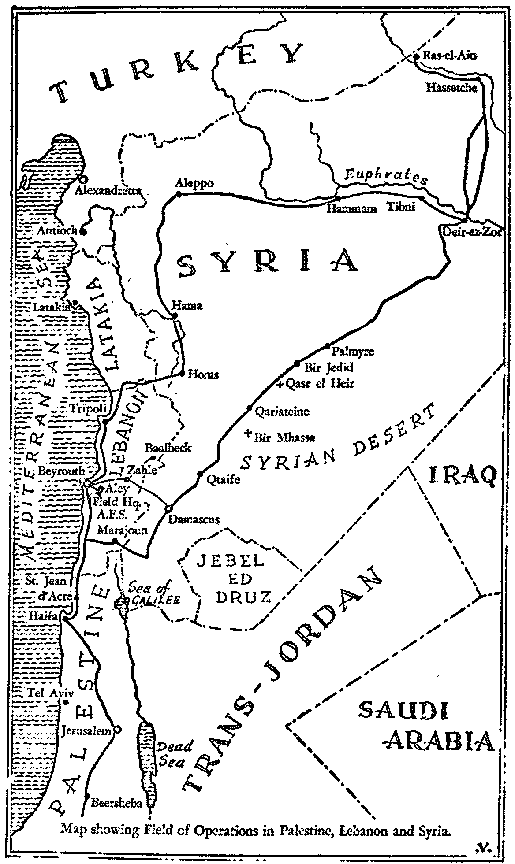
Map showing Field of Operations in Palestine, Lebanon and Syria.
The story of my journey to Egypt and the war in the Western Desert is a long one; much of it would prove barren and of little interest to the reader. Even at the front there were weeks of enforced idleness about which no one would wish to hear.
Between the time I left San Francisco and arrived in Suez there was a lapse of one hundred and ten days---and some sixteen thousand miles, by the route taken. Whole blocks of that journey will not appear. The first chapter, in which few of my fellow workers are named, is made up of selected bits, scraps from my notes, served up in a peculiar style for the sole purpose of letting the reader learn as quickly as possible something of the temper, tastes, and problems of the men who will, for the larger part, fill this book.
The desire to serve in this war was planted in me long before Germany marched into Poland; it was sown in 1914 when I saw my older brothers go to war with the Canadians. It became full-blown, ripe, on that early morning when I heard a tired, defeated old man declare war on Germany. From that hour I was possessed by a conscious and urgent need to serve. But I could not ask Jane to release me. One cannot put tongue to such thoughts; one cannot say to a wife, "Darling, there's a war going on in Europe---I want to go. Let's shelve our marriage for two or three years while I run off and join a foreign army."
But the desire was there. It brooded within me. The growth of it made me restless and fidgety. My writing seemed stuffy, meaningless. Through the months the tentacles of my desire sent out longer, stronger arms; it grew slowly and surely until it engulfed me.
Finally there came a day when I saw an announcement in the daily newspaper that the American Field Service was seeking volunteers to drive ambulances in the Middle East. Upon reading it I knew that this was it. I went to the Field Service Headquarters in San Francisco to learn something of its organization.
Its history went back to France in 1914. At that time funds were raised through public subscription, and when America entered the First World War the American Field Service had several thousand ambulances and thirty-five hundred men in the field. During the years of peace the Service had continued as an organization, granting scholarships to students who wished to study in France. It also aided in the reconstruction of war-torn cities.
Again in 1940 the Field Service was on duty in France. With the fall of France a number of its men were captured and all its ambulances lost. Now it was again organizing to send men and ambulances to the British Middle East forces. Ambulances are purchased with funds received through public subscription. The drivers are volunteers, serving without pay and furnishing their own uniforms.
Jane agreed that I should go. Forty-eight hours later I signed up for one year.
My concern in this book is not my doings, experiences, or states of mind. Those few times I figured in violent episodes of war, my emotions and sensations reached such a pitch as to choke the mind. Accurate recollection is impossible, and therefore my writing about them would be distorted. I will post a double sentry against the intrusion of fiction. My concern is with the parade of men with whom I worked---Americans, New Zealanders, Australians, British, and Indians---their reactions and emotions under the hard physical conditions of war in the desert.
The desert was the problem. Only those who have lived in the desert can realize the daily riddle of obtaining water, rations, gasoline, and spare parts. There were times when we had to go over forty miles for water, twenty-five for rations and gasoline, over a hundred miles for spare parts. There were times when none of the above were available. There were few in the American Field Service who did not know the mental torture of driving sorely wounded men over shockingly bad desert tracks. Of the one hundred who sailed for Egypt that gray, cold November day, four are dead, three were wounded, and five are prisoners of war.
Primarily we were seekers of adventure. Would any of us have volunteered to work a year without pay in an English coal mine or factory? And we made mistakes, but to sugar-coat or gloss over our failures would take the truth and much of the interest from the story. Adventuring is ribald, rugged, rarely chaste, and seldom honest. The honest adventurer usually dies of starvation or becomes a missionary. Many neophytes were to be disillusioned with "adventure" altogether. Blood and death and danger do not necessarily spell adventure.
This, then, is the story of a hundred men and those who came later (the American Field Service has nearly five hundred volunteers now in the field)---a story whose trail leads from New York to Bombay and Suez; to Beyrouth, Damascus, Aleppo, and Deir Ez Zor; from the Syrian Desert to the Western Desert and Tobruk. It is the story of the chaotic retreat from there to El Alamein and westward again to El Daba, Matruh, Hellfire Pass, and Bardia. Then into Tobruk again, and on and on to Bengasi, El Agheila, and Tripoli.
And the heroes will be the men and boys who took their ambulances on night runs over the desert and through mine fields. When the battle was joined, they were bathed in blood, enveloped in misery. They carried the piteous remains of men from the field over desert tracks that became torture racks. It was difficult to remember there is more to war than blood and death.
We can feel, all of us who did our jobs, that there are several hundred men alive today who would not be among the living had we not been there---not that we were better ambulanciers than the British drivers, but our coming put more ambulances in the field than the normal war establishment would call for. Because of that the service was better and quicker. We relieved pain, we shortened the period of unattended suffering, we saved lives. It is a thought we all can cherish.
In a small way this will be a history of the British Eighth Army and its bitter retreat in June and its stand at El Alamein in a line formed by accident---the story of an army that would not let its heart be broken, an army that, after a smashing defeat, in three months was transformed into an army that went forward to whip Rommel. Let no man misprize the defeat of the Afrika Korps. From El Alamein to El Agheila are ten times a thousand wrecks that mark the remains of Rommel's army.
And to do the job the Eighth Army moved upon six desert tracks through El Alamein. In a masterpiece of staff work the desert army advanced calmly to position. No man who served with that army will ever forget the Sun, Moon, and Star tracks, the Boat, Bottle, and Hat tracks. They were the arteries of the army. Along these dusty, sand-choked tracks the ambulances of 15 Company and 11 Company American Field Service moved in day and night convoy.
The curtain went up and the show started on October 23. Twelve days later the break-through came. The race was on, and a flood tide of equipment and men roared night and day over the six tracks through El Alamein, through the mine fields, and on and on to the west. As this is being written, 15 Company American Field Service is in Tripoli, past Tripoli, working toward Tunis and the Waterloo of Rommel.
ANDREW GEER.
.
It was a willful, whimsical, hung-over hundred who gathered in Grand Central Station, New York City, early in November, 1941. There were as many types as there were numbers. There could be no leadership, for not one in twenty knew who the leaders were. The organization was too hurried, too amateurish, to have prepared this group for embarkation and service in a foreign land. Odds and sods of all descriptions milled about the platform that day---escapists, pseudo adventurers, writers, photographers, students, failures, and draft dodgers. Ages ranged from eighteen to sixty-two.
Amid a welter of confusion and tons of baggage we embarked for Halifax. The train ride was long and slow and uncomfortable. Little cliques formed over bridge and poker games; brown bottles came to hand and passed from mouth to mouth. Expectant eyes were directed to the forward end of the day coach, where the men in command had gathered. There were so many questions that needed answering, so much to be done. The expectancy was met by a grave silence. But the day coach was not silent; it became over-noisy to cover the doubts and the strangeness. Small talk, probing, sifting, passed from seat to seat. The air became blue with smoke; the aisle grew wet and sticky with water from the tank. The paper cups ran out, and drinks were taken from the bottle straight.
"Two hearts. . . ."
"Have a drink. . . ."
"Is there a sleeper on this train?"
"I think we sit up all night."
"Christ! That's asking quite a bit, isn't it?"
"What's that ribbon you're wearing?"
"Croix de guerre---with the Field Service in France last May---here's a clipping from the News . . .".
"Who's running this show?"
"God damned if I know. One of those goons up there, I guess."
"I think it's that guy with the silk handkerchief dangling from his pocket."
"No, that's Bill Wallace. He's just going as far as Halifax with us. He told me this morning---at great length."
"The Field Service folder said Ralph Richmond is in command."
"Which one is he?"
"The one sitting next to the guy with the silk handkerchief."
"You mean the skinny old guy?"
"Yes."
"What's he call himself?"
"Colonel, I think . . . "
"Colonel? I didn't know we were to have officers."
"What's he do?"
"The Daily News said he was a gentleman farmer."
That's a polite way of saying he doesn't make a living at it."
"You from Princeton?"
"No. Hell, no! Harvard."
". . . double four spades!"
"Let's get another bottle at the next stop."
"I wish to hell they'd tell us who's who. I'd like to know who to be nice to."
"That red-faced guy is getting a burn on fast. Did you see him at the party last night?"
"I saw two of him."
"What kind of ambulances do we drive?"
"Damned if I know."
"Are they over there now?"
"I guess so."
"Know that bunch at the end of the car? They hang together like flies."
"That's the California unit."
"They're a snotty bunch of bastards."
"They're trying to run the show already."
"How many are there?"
"Too damned many."
"I don't like Westerners.
"Why?"
"They stink on ice, most of them."
"Who's the ape with the big chin?"
"California, too."
"He's muscling in . . ."
"What do you think Congress will do about arming merchant vessels?"
"They vote tomorrow."
"They'll arm 'em all right, in spite of Wheeler and Lindbergh."
"If the United States goes to war, it'll knock the noise out of our thunder. There isn't a newspaper in America that'd give us space."
"What a jam I got into! I had a cat in my room. My mother and fiancée came down to see me off and got the room right next to mine. Jesus! I had to hide her in the clothes closet when they came in. She stood in there nearly an hour without a thing on. She damned near froze."
"Who's that guy with the double row of ribbons?"
"Don't know."
"Must've won a couple of wars by himself to get that many."
"What group did they stick you in?"
"Six---I guess that's the number."
"Who's your leader?"
"The tall, skinny guy with the giggles."
"Here's a notice on my exhibition---well received, had about forty paintings up."
At Boston there were dinner, and more drinks, but the bulk of the time was spent in transferring the baggage. All were at fault in bringing too much kit. It was lost, broken, trampled on as each member tore at the mountains of stuff in search of his own. The devil take the rest! Somehow, in utter confusion, we got onto another train and settled down for the night. On crossing the Canadian border the windows were closed and curtains lowered. AM This was more like it. War! We were riding on a blacked-out train. At one stop several coaches loaded with Canadian infantrymen in battle dress were hooked to the rear of our car. Battle dress! Soon we would be swanking around in battle dress. That would look good in the home-town papers---"Intrepid Volunteer in Battle Dress."
Seats were literally torn up by the roots as beds were made from the cushions. Card games broke up, and the group settled down to a cold, uncomfortable night. It was a sorry-looking band---the bright metal of adventure already beginning to tarnish for some---that breakfasted at a wayside stop the next morning. It was nearly midnight when we arrived in Halifax. We were greeted by a Canadian major in the kilt of one of the Scottish regiments. He was kindly, helpful, and not a little confused at the horde that nearly ran him down. He did not understand our status as volunteers---some thought he did not appreciate the sacrifice we were making to save the Empire.
"How many are there?" he asked with his back to the door.
"A hundred . . . "
"A hundred!" He looked at the mountains of baggage on the platform. "Only a hundred?" he gulped. "If you'll form up, I'll show you your billets."
"Billets?"
"Where're the hotels?"
"Hotels? You're to stay in the immigration receiving building a short march from here. Ahem! Best we could do---war, you know."
"I want a bath. Got a bath there?"
"Sorry, old man. Now if you'll form up, we'll march over. Sergeant!" He turned to one of his men, "Lead the way."
The California unit got into some semblance of marching order, and the rest filed in behind.
"What about the baggage?" the Major asked. "Hadn't you better leave a guard on it?"
"Stand guard on a night like this?"
"T' hell with the baggage!"
"Sergeant." The Major called one of his NCO's.
"Yes, sir."
"Put a guard on the baggage."
"Yes, sir."
The large double doors swung open, and our group stumbled along---three, four, five abreast, laden with hand baggage, cameras, easels, and bottles. The Sergeant led the way through more gates.
"What's this?" a sentry called in half alarm.
"Damned if I know," disgustedly.
"Looks like the blinkin' Home Guard from Saskatchewan."
The Sergeant went ahead. He called to another sentry, "Open the corral gates and stand aside, man---here they come!"
Breaking what ranks we held on entering, we milled about a large, crude, cement-floored reception hall. The Major lifted his voice above the turmoil.
"Your attention, men. Please, your attention. The area commander has asked me to welcome you to this port. We are very grateful to you. He wishes to thank you on behalf of His Majesty's Government for joining up, for volunteering to aid, to help us in this grave hour. Your billets will not be as comfortable as we wished to make them---the hotels are full. We heard of your arrival only a few hours ago. If you'll grin and bear it for tonight, you'll perhaps have more comfortable space on your ship. There's food waiting down there." He pointed to a long, dim corridor. "Your beds are up that ramp. Latrines up there too. Any questions?"
"Any bars open?"
"Bars? The pubs close at ten o'clock."
"Christ! What a town!"
"What about mail?"
"You can hand your letters in at that desk in the morning. They will be held until you've sailed---for some time after you've sailed. Of course, they'll be censored."
A sotto voce grumble arose.
"Censor our mail, eh?"
"Treating us like we were in the army."
"Now, when we were with the French, they gave us officers' privileges. No shoving us into pens like this. As soon as I get to Cairo, I'm going to transfer to the Free French. I have a letter to General Catroux."
"I was supposed to get an article in for the Journal. It won't be worth a damn if it's censored and late. . . ."
"What about my pictures to Collier's? A documentation of our trip. I'm going to call Galatti [Director General of the AFS] on this---he never told me anything like this would happen."
"Dismissed," the Major bawled with relief. Hurriedly he beat a retreat to his office, where he closed the door firmly and shot the bolt.
The next day one of the members was dropped and sent home for getting a bit more drunk than some of the rest. Set an example---teach the wayward a lesson. . . . But the lesson was lost in the turmoil. Very few knew the fellow had been dropped, and the injustice of the action merely embittered his friends. Several threatened to walk out on the show. Nearly everyone was drinking. Why couldn't a quiet warning have been issued? Who in hell did the officers think they were? Wasn't this a democratic organization? As volunteers weren't they to have an equal voice in the running of the show? Officers! Nothing had been said in New York about officers. Now, in France there had been no officers. Section leaders were appointed for liaison purposes. All had officers' privileges, all wore Sam Browne belts, they could go anywhere---even to the officers' whore houses. By God, I bet we'll have to eat with British privates. Shocking!
That baboon from California is shouting again. Who in hell does he think he is? Baggage---move baggage to the dock? I'll move mine over---to hell with the rest. I tell you, that California gang is going to run this whole shebang before we know it. Those California mugs rate with the snobs from Harvard in my book. What's the matter with Harvard? I'm from Harvard. . . . I still don't like Harvard.
The next afternoon the baggage was moved to a dock---the wrong dock. At nine-thirty that night we left our billets to board ship. It took two hours to carry the kit to the right point. At eleven-thirty we were alongside the ship that was to take us to war. We gazed at it in awe; we looked her over from stern to bow.
"Good God! Lookit that ship,"
"It's one of ours. . . ."
"It's one of the biggest passenger ships we own."
"All right, you birds," a petty officer at the foot of the gangplank yelled. "Get piling into this ship. With that duffle you've got, it'll take longer to load you than it did the four regiments of limeys."
The petty officer was nearly right. Looking like the remains of Coxey's Army, we staggered up the gangplank and along corridors, bumping, being bumped, until we came to the cabins reserved for us. We were herded inside, and the passageway was cleared for more British troops to come aboard. Yells of anguish began to issue from the cabins.
"Christ Almighty! These bunks are triple-decked."
"Twenty men can't live in here, it's impossible . . . ...
"It's unhealthy. . . ."
". . . it's dangerous. What if we got torpedoed?"
"Last time I went to Europe I had a bigger cabin than this to myself."
"Five cabins to a hundred men!"
"Where are our so-called officers?"
"Saw them going forward, space marked 'Officers Only.'"
"Well, by God, that's the pay-off."
"Get your baggage off my bed."
"Where 'n hell can I put it?"
"I don't give a damn, just get it off my bed."
"Where 'n hell am I going to set up my typewriter?"
"I'm going to see Major Benson. He promised he'd get me a room where I could work."
"There isn't even room to set up a bridge table."
"Oh, this isn't too bad. I looked in on the tommies next door. They're as crowded, but they don't seem to mind."
"They're soldiers, we're volunteers. . . ."
"You can bet your bottom dollar that the French wouldn't treat us this way. When I was in France . . ."
"Christ! I'm sick of hearing you talk about when you were in France. Now look! We all know you won the Croix de guerre in France. We've all read your clippings. You're no doubt one helluva brave fellow. But if you mention the French again, I'll puke---and that would be bad, because I'm in the bunk above yours."
"Hey! Listen, you guys. I went up to see Benson about a workroom. Know where they are?"
"Tell me if it kills me."
"They're in U-9, in a room larger than this one. just five in a whopper of a cabin. They've got beds and chairs and writing desks. They've got a servant stowing their baggage. They've even got carpets on the floor---deck, I mean.
"Jesus! That beats me."
"Five in a large U-9, twenty in a small U-59, that's democracy for you. God help me, if my old man donates another dollar to the Field Service, I'll kill him."
In the first few days, there had been a desire for a concrete organization. Discipline was requested even by the undisciplined. When the rosy flush of newness was on the group, when it was white-hot with the zeal to live up to home-town newspaper notices, then was the time to forge the links of authority by which a man could be bound if he overstepped the generous limits allowed us. It was looked for daily. By many it was prayed for. The core of this unit was sound and solid in the desire to do the job we had come to do. The questions most often asked were: How many ambulances in an Ambulance Car Company? How are the platoons broken up? How many officers and noncommissioned officers will be needed? What type of ambulance will we drive?
Those in command chose to remain aloof and silent. They were wrong, but this should in no wise be taken as a criticism. The right course could have been chosen only by trained or instinctive leaders, and there were none of these in command. Leadership was in the hands of a gentleman farmer, a sculptor, a young man about town, and a publisher. We were an amateur organization run by amateurs.
Our group, held together only by the glue of newness, began to fall apart before we were at sea a week. The pseudo adventurers began to grumble (they had to learn that adventure and sweat and dirt are first cousins) and to build up factions opposing the noncommissioned officers who had been appointed. This was not the life of a gentleman volunteer, they said. They dreamed and talked of Sam Browne belts and pretty blondes exclaiming over their decorations (which some had awarded themselves). It was this group which argued they deserved officers' privileges merely for volunteering to drive ambulances.
Then it was that an iron hand was needed, even a brutal hand. But U-9 continued its aloofness, and the NCO's worked at cross-purposes.
About this time, seven or eight men went on a rip-roaring drunk. It was an unholy scorcher while it lasted. When the fog of alcohol lifted, two were in the ship's brig, and the liquor of all was confiscated and dumped overboard. All were tarred with the same stick. The crew and officers of the ship became openly hostile; the British pretended to laugh it off. But the Field Service had got itself a name that would not be erased until it went into action in the Western Desert.
"Pearl Harbor's being bombed.
"The Japs have landed in San Francisco!"
"You're crazy!"
"It's the truth. Just heard it over the crew radio."
"Honolulu's burning!"
"What'll become of us?"
"I'm going back and join the Navy."
"The newspapers'll forget we're over here. The Journal would laugh at anything I sent in."
"My pictures won't be worth a plugged nickel---me taking pictures of ambulance drivers, with Honolulu burning!"
"I signed a contract to drive an ambulance for the British for one year---I'll fulfill that contract."
"Me too."
"I couldn't get in the Army anyway at my age. I'll ride this job out."
"This is a good excuse to get out of this fish fry . . . "
"What about your agreement?"
"To hell with that!"
"Perhaps we'd have a pretty good outfit, if they'd let you birds get out."
"Clear out about fifteen of you bastards, and the rest of us could walk around like men and not have to apologize for belonging to the Field Service."
"You talk like a company man. . . ."
On arrival at Capetown, the port authorities granted shore leave until midnight of each day. Fourteen men went AWOL, remaining away four days. Several were carried aboard ship stupidly, blindly drunk. One went to a seaside hotel and ran up a bill of eighty dollars in two days, then ran out on the bill. It can be rightly stated that fourteen men of the Service caused the authorities on the Cape more trouble than the twenty thousand troops they were traveling with. There were so many who thoughtlessly mistook a yahoo life for an adventurous one; there were so many who were bent on finding a Messalina and in their search were content with the leftovers of an army.
No punishment was meted out, once we were at sea again. Those who had lived by the rules began to ponder on the worth of this restraint. No one was allowed to return home to the armed forces, though many threatened, cajoled, pleaded to be granted a reprieve. Perhaps this was the low point in morale.
Then a rumor was whispered. It grew, it flew from lip to lip-it no longer was scuttle-butt gossip.
"We're not going to Cairo."
"What?"
"Bombay....
"Bombay?"
"Why?"
"The British division were with had their orders changed because of the threat to Singapore---they go to India, we go to India."
"What in hell will we do in India?"
"Wait for a ship to Suez."
"Jesus! What a Cook's Tour!"
"I can't stand this bloody ship that long."
"Not with Geer as Sergeant Major. When I was slow in getting up this morning, the bastard threw a bucket of water on me."
Conditions aboard ship were none too comfortable with eighteen to twenty men to a small cabin. Water (both fresh and salt) was rationed. About one-third of the daylight hours were spent in mess lines, and once the food was obtained, we ate it standing up at long, troughlike tables. No one had the desire or the privilege to loiter over a meal. There was always another waiting to move into the space you occupied. The messroom itself was chokingly hot. Perspiration ran down your face and arms into the food as you ate.
From dark to daylight the ports were kept closed, and the crowded cabins became dank, smelly holes. The shoddy mattresses stank with the nightly soaking of perspiration they received. Sleeping space on the open deck was reserved, and rightly so, for troops who were living in quarters much worse than ours. At five-thirty each morning there was "stand-to": warning bells rang, and everyone clambered from his bunk and donned a life jacket and stood awaiting the "all clear." Wearing a life jacket under those conditions was like clothing yourself in a steam-heated corset.
But on the whole all this was good for the unit. It hardened the strong and showed up the weak. It brought to light those selfish individuals who would sneak to the upper decks and take the space reserved for some poor devil who lived next the boiler room below the water line. It brought to light those men who would live by the rules. Never again would these men, whether in the Syrian Desert or the Western Desert, have to live under conditions so harsh, so severe.
The administrative setup on leaving New York was this: Ralph Richmond, a member of the American Field Service in France in 1914-1918, was in command of the AFS, with title of Colonel. Major Stuart Benson, a sculptor and artist of note, was second in command and in charge of publicity. Captain George James King was to command the unit in the field. Lieutenant John Ogden was to assist King. The unit itself was divided into groups of nine to ten men. In charge of each group was an appointed group leader. The group leaders were never delegated authority, and as a result none felt he would be backed up if he tried to assume disciplinary powers. Unfortunately, the officers, living in quite another section of the ship, had decided upon a policy of aloofness, and a schism arose between the men and officers
Three days out of Halifax I was appointed sergeant major by colonel Richmond. I had the help of Chan Ives and Fred Hoeing and Tommy DePew and Evan Thomas and other solid members in the unit, and we attempted to inaugurate a system of policing and self-discipline. Upon us fell the complaints, moans, and criticisms of the rest of the group. It was not an easy task; in fact, that this first unit ever reached the field is due entirely to these few men I have mentioned.
On disembarking in Bombay the unit moved onto a troop train that took us to Deolali, an old reinforcement center for the British Army. We continued to travel with a portion of the British contingent who had come over with us. The division itself went to another camp. It was as weird-looking a herd as ever assembled that attempted to line up alongside the train in Deolali. Unfortunately, we had to march some two or three miles to the camp. A baggage detail was assigned to care for the mountains of luggage while the rest moved off down the road. Sun helmets of job-lot sizes, hastily issued in Bombay, sat on sweaty brows at all angles. Most, not trusting the baggage party, carried 'as much personal luggage as they could stagger under. Dogs barked at us; horses long used to the military precision of the area kicked up their heels in fright and ran away. British tommies---old Indian campaigners---watched from the roadside in dumfounded disbelief and hurried off to the nearest pub. Unfortunately for the American Army, we were mistaken for a part of it. At the sight of us one little lass ran screaming into a garden bordering the road--- "Mummy---look, Mummy! More Italian prisoners."
It was a thoroughly chastened group that found their barracks along the eastern end of a large quad. Cooks were assigned and bearers (servants) were supplied, and we were left to our own devices. A fairly stiff regime of military drill was instituted under the leadership of Dave Hume (he had been a drill sergeant in the American Army). There were protests over the hours spent under the, hot sun on the square, but no serious objection was raised---the memory of the march from Deolali station went too deep. The Le Muir Hotel (British officers only) was opened to us. For the next thirty days the place took a serious beating and soon was staggering under the nightly assaults. Despite the large profits, the manager was one of the most thankful men in India (next to the camp staff) when we finally moved off.
Leaves were granted. Leaves were overstayed. Two men got into serious financial difficulties in Bombay and were dropped. There was a vogue for tattooing, bush jackets, and swagger sticks---and buying monkeys. Of course, there was the ever-present desire for Sam Browne belts. Our avid photographers went about shooting the place; sacred temples of the dead were violated. But through it all drill continued on the square; route marches of eleven and fourteen miles were taken; uniformity of dress was arrived at, and sun helmets slung at the correct angle no longer had the look of misplaced bedpans. The company could form and do the rudiments of foot drill with precision and a swing born of the long marches across the hills and plains neighboring on Deolali. The solid eighty or eighty-five were becoming more solid; the others were identifying themselves as being not long for the Service. But on the whole the unit that marched from Deolali thirty days later would not have been recognized as the group of individuals who had been mistaken for Italian prisoners.
On our departure from Bombay a member refused to continue. It was as well---no great effort was made to induce him to live up to his agreement. The weeding out, which should have been done in New York, was gradually culling the misfits and recalcitrants. The faltering envied those sullen ones who forced a way out, even at the cost of openly disgracing themselves. For at times the chance of doing good, seeing action, appeared remote, and collapse of the whole Service seemed inevitable. It was natural that at one moment we should feel exhilarated at the prospect of doing fine work, at the next in the slough of despond caused by the acts of a reckless few.
.
One hundred and ten days from Halifax the unit arrived in Egypt. In six three-ton trucks (with two three-tonners for the baggage) we were taken to El Tahag Camp ("MOB," Mobilization Center for British Forces in the Middle East).
El Tahag, sprawling, khamsin-swept, desolate, is situated on the old battlefield of Tel el Kebir, where the British fought and defeated Arabi Pasha's forces in 1882. Here we were to experience our first khamsin, Arabic for a hot, scorching wind. The word "khamsin" is derived from khamsa, meaning five fold. Thus fifty days of this wind can be expected during the year. There is an Arabic saying, "If the khamsin blows for three days in succession a man has the right to kill his wife; five days, his best friend; seven days, himself."
El Tahag was to become our Egyptian base camp where we would refit and re-form old and new units.
Among the permanent staff of MOB Center (as it was known throughout the Middle East) were men of vast experience in forming and informing new men in the ways of the desert. Unstintingly these men gave us their knowledge and time. Major Harry Mathews, second in command at El Tahag, went to bat for us time and again when vehicles or equipment were slow in being issued. Captain Eric Waller (then Lieutenant) has guided the instruction of every Field Service unit to arrive in the Middle East. The sun compass, desert navigation, and life in the desert hold few secrets for him. Patiently, fluently, graphically he passed on to us the tricks that one must know in order to live and operate in the Western Desert. The American Field Service is indebted to many officers and men in the British Army, but none has a higher claim on our gratitude than Waller. Captain Parmeter (Staff Captain A) was always at our service.
We reached El Tahag about one o'clock in the morning. The staff was patiently awaiting our arrival, and we were greeted with a fine hot meal (the first since early the previous morning) and then shown to the tents set aside for us. The next morning we plunged in and were engulfed in alphabet soup and "bumph"---the British term for hundreds of forms, at least in triplicate, that must be handed in on every detail, every movement, every piece of equipment drawn. We thought we had been fed agency and department abbreviations by the New Deal at home, but they are amateurs compared with the British Army. But for the Mobilization Center staff we should have drowned under the VRD's (Vehicle Reserve Depot forms) and BOD's (Base Ordinance Depot forms) thrown at us.
War-establishment figures on an Ambulance Car Company called for four platoons with about fifty men to a platoon. With the present personnel we should be able to form but two platoons at this time. The platoon was broken down into six subsections with five ambulances to a subsection. The man power in the subsection consisted of an NCO in charge, a spare driver, a driver-mechanic, and five drivers. Thus eight men were responsible for the care and maintenance of five ambulances. On this basic pattern we went to work.
Chan Ives (of Groton and Yale) was promoted to Lieutenant in command of one platoon, and I was to command the other. Ives was without doubt the most popular man in the Service. He was kindly, hard-working, and sincere. He handled his platoon well, his authority stemming from the desire of his men to do a job for him. Very few men let him down.
Between Chan and myself there was much good-natured bickering and banter as we drew up the lists of our platoons. Having been sergeant major on the trip across I had, perhaps, a better knowledge of the capabilities of the men than Chan had. We had our favorites whom we wished to have in our respective platoons. In the shifting and swapping it must be confessed I was not above chicanery as I wheedled and coaxed Chan into trades. Unselfishly he gave up men he could ill afford to lose and in return received several individuals who would cause him severe headaches. A toss of a coin decided matters between us.
The day we drew our first ambulances was thrilling to the most blasé. Two days after arrival at El Tahag the sluice gates of the Vehicle Reserve Depot opened, and ambulances, staff cars, three-ton lorries, and motorcycles swept into our lines. Thirteen motorcycles---good God! Did we have thirteen men who could ride the damned things? Immediately every member claimed a close and intimate knowledge with the two-wheeled threats to life and limb. Dispatch riding---just the job! More exciting than driving an ambulance. Suddenly we had approximately sixty volunteers for dispatch riding---only the comparatively old and very mild wanted the task of driving ambulances. It became unsafe to step from a tent as our company lines became a racecourse. One cycle bucked its rider, fell, caught fire, and burned. Finally all were rounded up and impounded until assigned.
In the British Army the signing over of a vehicle to a driver is a major operation. A platoon officer does not call a man to him and say, "Hey, Bill, see that ambulance over there, the one numbered WD 1330337? Well, it's yours. Take it over." No. There is a definite form. The machine (in fact, every vehicle in the British Army) is equipped with a "412" book. This is the record, the bible, the diary of that vehicle. It tells all. What tools equipped the machine when taken over and every gallon of gas and drop of oil fed to it must be entered. Every grease job and repair job has a neatly ruled sheet awaiting entries. It takes about an hour properly to assign a vehicle to a driver.
Fortunately for us, we were not drawing our full complement of ambulances. They were in Syria being operated by the Australian Medical Corps, and we would take over from them. Otherwise, we should never have got out of El Tahag.
Slowly the formation of the company took place. Four EPIP (Egyptian patent, Indian patent) tents served as a mess and lecture room. Twice a day we gathered for lectures from Captain Waller. The first served as an introduction. Without prelude he plunged into the job ahead of him.
"Western Desert service differs considerably from that of England and America in both operational and administrative aspect, and the course of instruction I have outlined for you is designed to give the benefit of desert-warfare experience to you Americans who have newly arrived. Every member of this unit from the commanding officer down to every spare driver must realize that he knows little of the new conditions to which he has come; every man must be prepared to accept the benefit of the experience of those who have met and settled the recurring problems of the desert. . . ."
Waller was a good speaker, clear and colorful.
"There is no magic overcoming the insurmountable obstacles in the desert. The question is largely one of adjustment. You must live with the desert---don't fight it. If you do fight it, it will whip you. Newly arrived units which accept the help of officers and NCO's with considerable desert experience will find their period of adjustment shorter and easier than that of a unit which through lack of enthusiasm does not wish to learn anything new or makes an ill-founded presumption based on training and experience elsewhere. Units which adopt these attitudes will fail from the start.
"Desert navigation is of the utmost importance to every unit in the desert, but doubly so to you members of the American Field Service. There will be many times when you will be sent out singly to distant points. You must be able to get there and back. Your life and the lives of the wounded you are transporting will depend on this ability. Attainment of this art requires method, practice, and concentration and a thorough knowledge of the use of the compass---both sun and prismatic.
"Before starting out you must know these four things: the distance from the starting point to destination; the bearing; the magnetic deviation if using a prismatic compass; your speedometer reading. Study night driving. I promise you, you'll have many occasions to do it. Select a star on a bearing two degrees less than the compass course you require---the lowest convenient star to the horizon is the most suitable---get into your car or truck and align your car so that from your selected position you can align a fixed object on your car in front of you and the star you have selected. A chalk mark on the windscreen, a point on the windscreen wiper, etc., can be selected.
"Keeping the object and the star in line you may proceed for half an hour. It will then be necessary to repeat your action as the stars change their position in relation to the earth. Trust your map and compass. To get lost is not a misfortune but a delinquency."
When Waller saw he was throwing too much too fast, he stopped abruptly. "Any questions?"
The first offered was one that has been asked many times and academically never satisfactorily answered. "Under attack from the air should a driver stay with his patients? Or should he get out and get into a ditch or slit trench and try to save himself?"
"Are we to assume you have, say, four stretcher cases? You are alone with these men---you cannot move them from the ambulance?"
"Yes."
"My advice is this. Leave your patients. You cannot help them by sitting there and taking it with them. If you save yourself, you can be of assistance to them after the attack is over. If you are killed or wounded, the wounded living through the attack will be helpless."
Several times in later months this question faced our drivers---and how it was answered has placed several among the heroes.
Spurred by the energy of Captain Waller, the unit went to lectures on the sun compass, desert navigation, convoy discipline, and the use of sand channels. The NCO's were taken in convoy into the desert and deliberately bogged down by the sadists working for Waller; the better part of four hours was spent digging out the vehicles. When the NCO's came back from that lesson, there was none who did not have an intimate knowledge of the shovel and sand channels. A sand channel is a metal strip five feet long by fourteen inches wide. When a vehicle bogs in the sand the channels are placed beneath the rear wheels to form a short runway. Staff and lighter cars usually carry canvas strips that perform the same service as the steel.
On the fifth day after arrival in El Tahag we received orders to move on the seventh day. Under the guidance of Captain Waller the first movement order of the Field Service in the Middle East was drawn and in a midnight conference read to the NCO's. Copies were handed out. A properly drawn movement order should cover completely every emergency that may arise on the trip. Every man driving a vehicle should be acquainted with it; every officer should have a copy. A sample is given below:
| MOST SECRET In the Field 1. INTENTION: 15 AFS will move from present location (give location) to ----- (give map reference and map to be used). 2. STARTING POINT: Entrance to present camp. 3. STARTING TIME: Head of convoy will pass SP at 0700 hours.(1) 4. ROUTE: FERN LEAF Track to junction with S Track. S Track to trig point (give map reference). Trig point (repeat) along S Track to junction with STAR. South along STAR to destination. 5. DISTANCES: FERN LEAF to S Track: Fourteen miles. S Track to trig point: Seven miles. S Track to junction with STAR: Eleven miles. South on STAR: Seven miles. 6. SPEED: 17 miles in the hour. 7. DENSITY: 20 vehicles to the mile. 8. HALTS: Ten minutes on the even hours. Thirty minutes at 1230 hours. 9. RATIONS: Three days' battle rations will be carried by all ranks. 10. WATER: Containers of every type will be filled with fresh water. 11. GASOLINE: Each vehicle will carry sixteen gallons in reserve. No gasoline will be drawn en route. 12. PERSONNEL: Will not discuss their journey with any one outside the unit. 13. ORDER OF CONVOY: Staff car---officer commanding. Company Headquarters
lorry, Quartermaster lorry, Number 1 water tanker, Cook lorry, Stores lorry.
14. SECURITY: This order will be destroyed by fire when the move is completed. 15. E.T.A. (estimated time of arrival): 1600 hours. Signed: - - - - - - - - - - |
Under such an order we moved from El Tahag. We were not a long convoy---some two miles from the lead car to the tail-end breakdown truck---but it was quite enough of a test for the first run. Two slight accidents ---Jack Pemberton hit soft sand on his motorbike and took a header, and Lee Kyle rammed a vehicle in front of him---marred the first day's run. We laagered (camped) in the Sinai Desert that night. The next day saw us through Beersheba and onto the coast road. Of Haifa, modern, clean, we had a brief glimpse, and on we went northward, through St. Jean d'Acre besieged by the crusaders in 1191 and by Napoleon about six hundred years later.
The third day brought a cold rain; dispatch riding quickly lost its appeal. We arrived on schedule at Beyrouth Transit Camp with all vehicles running. The unit had done its first convoy of over five hundred miles and had performed well. This gave promise of what it could do when there was work to be done.
The Beyrouth Transit Camp is as cold and uninviting a place as you will find in a good many years of army life. The mere mention of it to an old British soldier is enough to make him shudder. It is situated in a heavy growth of umbrella-topped pines, and the heavy sand never completely dries beneath these, for the sun, except in occasional patches, cannot penetrate them. We arrived in a cold and driving rainstorm. The vehicles were dispersed under the trees and subsections assigned to tents. The cry immediately arose, "How long, O God! do we have to stay here?"
Lieutenant Jaka of the Australian Army sought us out. He had the answer---we were to take over from his unit, and he was as anxious to get his men in from their stations as we were to get to them. Immediately men were assigned and sent to posts in the Beyrouth area. Late into the night we worked over the assignments. Subsections would leave for Tripoli and Aleppo at first light in the morning. The sections going to Baalbeck and Damascus and into the Syrian Desert would have to wait three or four days until the mountain passes were free of snow.
Anxious to be gone, to get our platoons out of the transit camp and to work, Chan and I both favored the trip next day. We tossed a coin---he won and chose the trip next morning. There was no fighting in this area. The casualties we would transport were those due to the normal sicknesses and injuries to troops stationed in Syria and Palestine. This was our breaking-in period.
Before Chan was on his way, news came that the southern pass was open to Damascus. A flip of a coin and the wrong guess (neither of us had an inkling of the vast differences between the coastal area and the desert) put Chan on the coast. It gave me the Syrian Desert, it gave my command more freedom of movement, and it placed my headquarters in Damascus. The line of evacuation for my section was to be this: The Deir Ez Zor unit would service from Ras el Ain (on the Turkish border) and Hassetche back to Palmyre. The Palmyre unit would carry on to Damascus. The Damascus unit would cover that area and on down to Jerusalem and Sarafan. The Baalbeck and Zahle men would evacuate either into Beyrouth or into Damascus as directed. Thus we had an area over six hundred and fifty miles (four hundred and fifty of desert) to cover.
Tommy DePew was to take his subsection to Damascus. Dave Hume would have his located in and about Baalbeck and Zahle. John Wyllie was to settle in Palmyre, and Evan Thomas and Dick Tevis were to share command at Deir Ez Zor. Thus the first platoon were to service an interesting area stretching from the Turkish border to Jerusalem. With one or two exceptions I was happy with the men in my platoon, and I was more than satisfied with my section leaders. DePew, Wyllie, and Thomas were all to become officers in the Service before many months. Dave Hume is now an officer in the United States Army.
The mechanics of getting the men to their posts was not so simple as the above sounds. We were new to the territory. Save for Damascus the posts were absolutely foreign to us even by name. Over mountain roads treacherous with S turns and slippery with ice and snow we crossed the Lebanon Mountains. We crept by the flank of towering snow-covered Mt. Hermon. Through the rhythmic sweep of windshield wipers we gazed on crusader castles and forts; from one high point we caught a glimpse of Galilee.
Along the route we stopped at Marj Ayoun for gas. As the one wheezy, complaining pump piddled gasoline into our tanks, a forlorn-looking individual approached us from the crowd of natives who had surrounded us the minute we stopped. We were to learn that no matter where we stopped---any time of day or night---we would always collect a number of natives. They would stand at a distance and stare, impassive but insatiable in their curiosity. If you looked directly at them, they would grin fatuously and hold out clawlike hands. "Baksheesh(2), boolly beef, baksheesh!" This cry was as automatic as breathing, with old and young alike. The pride of the whole Middle East is buried under a hundred million "baksheeshes."
This fellow, short, fat, and not too clean, was dressed in what was once, long ago, Foreman & Clark's finest. He pointed a grubby finger at the name American Field Service on our vehicles and said, "Are you Americans?"
"Yes."
"I am too," this proudly. "Brooklyn. Say, how'd the Bums do last fall?"
"The Yanks beat them. Owen dropped a third strike."
"What are you doing in this Godforsaken spot?" Bill Miller asked.
"Came back in '38 to see my people. I was born here. The war came, and I got stuck. Can't get out." This last was nearly a wail. "I'd be making fifteen dollars a day now if I was home. Say," he said, pulling a bit desperately at his frayed cuff, "do any of you know a consul, a senator, Jim Farley, somebody to help me get outa here?"
"No, 'fraid not."
The last tank was filled, and we clambered into the ambulances. The fellow backed up a pace. He threw us a wan smile.
"Well, so long. It's too bad Owen dropped that ball."
The weather turned colder. The wind increased, whipping the big-dropped rain into bullets. It was growing dark when the minarets of Damascus (reputed to be the oldest city in the world) rose to view across the plain from Mezze. We all felt a thrill on entering Damascus, which had been the scene of rioting armies through the centuries, where a mad young general, Alexander, had loitered and feasted after defeating Darius at Issus before turning toward Egypt---Damascus, which had heard the voice, twenty-three centuries later, of another military genius, Lawrence.
We entered the city, backing and turning in search of the transit camp. The traffic policemen were voted an unintelligent lot---none of them spoke English. Now why wouldn't a traffic cop in Damascus speak English? Lazy, shiftless lot, eh?
Finally we found the transit camp. It was on a flat stretch of ground between Damascus and the hill where Cain is supposed to have killed Abel. A rock on this hill is said to drip water continuously--superstition has it that the rock is weeping for mankind and the oldest primal curse. All this was lost on us---all we saw was the oozing terrain. The mud was ankle-deep, the rain was half snow, and the long barracks were cold and cheerless and wet. The wind, as chill and cutting as a knife, roared down from Cain's Hill upon us. It was breathtaking; it defied one to walk into it.
After reporting to the orderly room (names, numbers, rank) I struggled across to the mess to report to the camp commandant. It was my first entry into the "Sign of the Birds of Passage." Here I formed many fine friendships; here would be my headquarters for two months.
The messroom was a long, low-roofed affair with lanterns hanging from the overhead rafters. In the middle of the room and on the left side a potbellied stove greedily sucked in wood, shavings, and paraffin but gave out little in return. At the far end from the doorway was a bar. Over it hung a green and white sign, "Birds of Passage." Around the stove in a tight huddle were three officers. One came from the circle as I got out of my coat and was trying to clean the mud, off my boots.
"Good evening. What will you have to drink?"
"Whisky and water, thank you."
"Come to the fire. Reed, bring a whisky and water."
"My name is Geer. I'm looking for Major Grigg, the camp commandant."
"That's me." He put out a big hand and grasped mine heartily. "American, aren't you?"
"Yes, sir."
"Got a signal you'd be along today sometime. Here's your whisky. Cheers!" He took a sip. "I want you to meet two other birds of passage like yourself. Captain McKay, Captain Noble---Lieutenant Geer. Reed, bring another round of drinks. Mac, joggle up that fire, will you, please?"
McKay (a Canadian serving in the British Army) was a big-shouldered, lean-waisted man. His face was ruggedly handsome though his nose had the look of having been poleaxed on alternate days over a period of several years. He had a ready booming laugh and a way of standing with feet widespread as though waiting for someone to launch another swing at his flattened nose---as though he wished someone would.
With the hands of a lumberjack he fussed with the stove. "This damned stove"---noisy intake of air through his nose---"is US." Another pause, and he broke into a roar of laughter. "Pardon me, America, in the British Army 'US' means 'un-serviceable.'" He poured a pint of paraffin into the stove and watched unconcerned as it nearly exploded in his face.
Noble was small, not more than five feet five, and redheaded. There was the same quality of recklessness about him as about McKay. He was wearing knee-length rubber boots, and when he walked it appeared that the boots moved along jerkily, carrying him with them.
McKay and Noble---the mastiff and terrier---enjoyed one another tremendously. Noble liked to tell stories, the bawdy barrack-room type, and he was good at it, his wit outweighing the indecencies. McKay roared at every story, though he must have heard some of them before.
Major Grigg (there was a Scots Guards' flash on his left shoulder) presided over his mess with the genial good nature of a perfect host. As other officers came in, the circle about the stove widened until McKay said, "I can't even smell the damned fire from here."
There was a brave attempt to let whisky do for us what the fire wouldn't. In this we were partly successful. After dinner the circle shrank to the four of us again, and we sat into the early morning hours---laying a gas barrage," as Noble put it.
These three men knew the district well; they knew the Syrian Desert, the natives, and customs. I constantly swung the conversation to the problems I was laboring under---what route to take to Palmyre, was the desert passable with the rain that had fallen, where were the gasoline dumps, were there any stations or outposts between Damascus and Palmyre? As I probed, McKay brooded over his glass. I caught him staring intently at me several times. He stopped drinking suddenly and sat tilted on his chair with his chin on his chest, breathing stentorously through his flattened nose.
Finally I rose, with the excuse of an early morning move.
"What hut you bunking in, America?" McKay asked.
"Number one."
"I'll show you to it."
"Never mind, thanks, I know the way."
"I'll show you to it." He threw on his greatcoat and taking a lantern from the rack by the door led the way into the storm. Once in the hut, he hung up the lantern and turned to me. "Yank, show me your papers," bluntly.
'Tapers?"
"Yes. Your identification papers."
"Oh!" I dug my papers out of my wallet and handed them over. He took them to the lantern and studied them for a long time. He handed them back, smiling.
"Can't be too careful, you know. Wasn't sure. You asked too damned many questions, America. Wouldn't sleep well thinking we might've given so much info to the wrong man. Sorry. Good night." He kicked off his boots, slid into his sleeping bag, and was asleep before I was undressed. I turned the lantern low on the arrival of Noble and crawled shivering into my bag. I was dozing off when the rubber boots carried Noble to my bedside.
"Awake, Yank?"
"Yes. . . ."
"Sorry, old man; mind if I look at your papers?"
He handed them back. "Good night, old boy."
I dozed but was awakened by the slamming of the front door of the hut. I looked up into the face of Major Grigg. Without a word I reached under my pillow and handed over the papers. He took them to the lantern. He brought them back.
"Good night, Geer."
"Good night, sir."
.
Two thousand years before Christ, Palmyre was known as the city of Tadmor, the name in use by the Arabs today. Halfway between the Euphrates and Damascus, it was the terminal oasis along the old caravan trails. At one time, it is estimated, over thirty thousand persons lived there. In the Bible (I Kings 9:18) there is mention of Solomon building Tadmor. Again Tadmor is mentioned in II Chronicles 8:4: "And he [Solomon] built Tadmor in the wilderness . . . ... There is little doubt, however, that Tadmor existed before Solomon, as Detroit did before Ford. Tadmor, a pre-Semitic name of unknown origin and meaning, was likened to Tamar, from the Semitic word for date tree. Through the years Tamar was changed to Palmyre, probably from the word palmula (palm tree). Caravans from Arabia, Persia, and India followed the old caravan route across the desert to Palmyre.
Along these old trails we were to travel with our five-ambulance convoy. The morning after our dismal entrance into Damascus the weather was clear but sharp and chill. At daybreak there had been a coating of ice on the smaller pools. We were on the Damascus-Homs road early, and after following the tarmac, past the turnoff to Bagdad, to Qtaife we approached the desert. For fifteen or twenty miles we threaded our way through farm lands before we entered the desert proper. On the right and left, camels, donkeys, and horses were walking the grind of an endless circle turning the water wheel that irrigated the crops. With Bill Miller driving the lead machine and John Wyllie and Al Ogle in charge of navigation (the course was sixty-four degrees true), I lolled on a stretcher in the rear. I had the feeling that I should have depended more on the stove and not so much on the whisky to keep me warm the night before.
The desert in this area is smooth sand where one may run forty-five or fifty-five miles an hour. Then will come a boggy stretch or a patch where the shale crops out; the speed is cut down until this is passed, and then on again. But the driver must be alert. The even lay of sand hypnotizes and is tricky, for ruts cut by rain water from the range of hills to the northwest are a threat to spring and axle. Wadis can be seen and prepared for, but the ruts claim their daily toll from the careless. A wadi (sometimes called deir) is a gully or ravine; in most seasons it is dry.
Spread out over the desert, each driver choosing his own track (there were times when one machine would be four or five miles to the right or left of the lead car), we were making fine time (nearly opposite Bir Mhassa) when the machine to our left and rear was flagged down by excited Bedouins in a lorry. We circled and turned back to find Tom Eston and Bill Hoffman working over a wounded British soldier, whose right arm showed a shocking wound. The fellow, a small man with guts, had powder burns on his face and though suffering from shock was conscious.
As we worked over him, we learned the story. He was one of a road gang in charge of natives working in the district. He carried a shotgun for sand grouse and game. As he started to drive off on an errand, a native had slammed the door of the cab shut, and the door had hit the stock of the gun and set it off. At such close range it had nearly torn off his arm. I took off my convoy whistle and made a tourniquet of its stout cord. We wrapped him in blankets, and one ambulance turned back to the hospital in Damascus. The Field Service had carried its first casualty in the Middle East. Later we learned that our man lived, though his arm had to be amputated.
The desert at this season does not look like desert. With the rains comes a growth of camel moss that covers the sand with a fine coat of green. The area from Bir Mhassa to the Turkish border is alive with game---sand grouse, gazelles, and the greater and lesser bustard. We were to see herds of hundreds of gazelles and flocks of thousands of grouse---and not even a peashooter among us. The route is marked with birs (wells) and the ruins of old archer outposts that guarded the caravans, and it is not difficult to find the way. Later in the season, when the sun has burned off the camel moss and the sirocco raises sandstorms, it is often necessary to navigate by compass.
We ate our lunch of Swift's bully beef and Kraft's cheese and midshipman's buttons (hardtack) just beyond Qariateine. After lunch we crossed a water-filled wadi (the most extensive on the route) and sped on toward Qasr el Heir and Bir Jedid and Palmyre.
Twenty miles from Palmyre the many tracks come together under the telegraph wires that link the various pumping stations along the pipe line. At this distance, the first of the ruins can be seen. The Turkish castle leers from its high perch; at the foot of the escarpment (3), stone tombs (we took them to be sentry boxes or strong points) rise above the horizon lip. The track is rutty, and we wound our way slowly. We crossed a wadi and went up a slight rise, and without preparation or warning we were in the midst of a ruined city of a magnitude to leave us speechless. I recalled Lieutenant Jaka (the Australian), as he outlined the route to me, saying, "At Palmyre you'll find some old ruins---interesting if you like that sort of thing."
We passed through the Vale of Tombs---on our left the Hill of the Queen of Sheba and Jamlicho's Tomb---under the main colonnade, and into what had been the city proper. The Senate and Theater and the Temple of Bel arrayed themselves before our startled eyes. And still leering at us from above was the old Turkish castle. Old as it is, we learned that it is two thousand years younger than the ruins which make up the city.
Without pause we continued to the native village (a De Mille-like place that could have come straight from a Beau Geste production), along the Street of Souqs, past Weygand Barracks, to the airport on the far side of the village where the men were to be quartered. The Camel Corps were at drill as we passed their barracks and parade ground.
"God!" said Bill Miller, "I could sell this place to Hollywood for a million dollars---if I could just get it over there."
At the airport we contacted the Australians we were to relieve. A shock was in store for Wyllie and his section. They would have to do their own cooking; water must be hauled three miles; fresh meat and bread would come in once or twice a week, depending on convoys, and mail when they were lucky. Sanitary conditions were bad; living quarters dreary. Bill Gosline and Thane Riney reckoned they could cook. I promised to see about getting a cook. A few weeks later they got a young Arab (paid by the British), who adopted them and is still serving the Field Service unit at Palmyre. The men took the prospect of living here stoutly, the consensus being, "Bad as it is, we'd sooner live here than on that bloody troopship we came over on."
The airport buildings were badly knocked about from the battle that had swept over them when the Vichy French and Germans teamed against the Fighting French and British for the control of Syria. Two Messerschmitt 109's and several bombers were wrecked in the field outside the wire enclosure.
Two ambulances of the Australian Deir Ez Zor section were in Palmyre, having arrived with patients that afternoon. They would lead us across the desert next day.
The hospital was handled by an Indian staging section in command of a Captain Benarji, a doctor. On getting settled I went back to the village to report to him and met one of the most courtly gentlemen in the British Army. The Captain (king's commission officer, not viceroy's) was a huge man and handsome by any standard. His voice was deep, melodious, hypnotizing, and his mind was the most searching and curious I have ever known. His intent was plain, after one came to know him. He was seeking a remedy for the troubles arising in his homeland. He was a Brahman (first of the four castes of India), but he knew the Bible and Koran as well as the precepts of his sacerdotal class. Any man who could tell him of things he did not know was of value to him, and he sifted information to the last kernel.
He made me feel instantly at home. His voice and manner eased one over the first roughness of a new acquaintance.
"Come to my room, Lieutenant Geer, and we will have a drink." He waved me into the dark hallway facing on his office. "I hope you will forgive my poor quarters. It is the best the village has to offer. Here we are." He stood aside for me to enter his small bedroom and study. "Take this chair. What will you have to drink---whisky or beer?"
"Whisky, please."
"I am most fortunate to have gotten, a fresh bottle this morning." He poured out two drinks. "I am having my men move your things into a room near by. I hope you will be comfortable." He studied me for a moment. "Today is Tuesday. I do not eat on Tuesdays, but you are here. We will dine together. . . ."
"That's not necessary to disrupt your schedule. Next time I'm through this way . . ."
"When my men told me the Americans drove through the village, I ordered our dinner. It is a great thing for my men that you arrived. When I first heard that you were coming, three or four weeks ago, I told my men the Americans were coming. They were very happy. We have been long away from India. Now that America is in the war we can---all of us---see the day when we will return to our homes. The day America entered the war I told my men the war was won. They are content to stay in this lonesome post now that they know."
He poured me another drink. He merely sipped his own in company with me. I relaxed in the peace and softness that pervaded this harsh, mud-walled room.
"Tell me of America. Who do you think are the great writers? Do you know Upton Sinclair? Do you know Norman Thomas? Robert Hutchins? The Mayos?"
It was after midnight when I went to bed. I did not realize until then how exhausted I was, mentally and physically, how well-nigh ruthless Captain Benarji was in his search for information. To him each man he met was a well to be pumped. But this was not a one-sided process. He refilled as he drained and his companion came off the better, for his wisdom was the greater.
The ambulance that had turned back with the wounded soldier got in after eleven o'clock. It made the run across the desert at night. A laudable effort, but we had broken an area ruling. Single vehicles were not to cross the desert; travel must always be in pairs.
Three ambulances (two were being left at Palmyre) followed the Australians through the gate next morning at eight forty-five. It was to have been an eight o'clock start; but as we soon learned, time meant little to the boys from "down under." The Aussies in two ambulances led the way merrily across the desert, past the Bagdad cutoff, and on into the wilderness to the north of Palmyre. We went east for a time, then west. The lead machines spurted up, rocking dangerously over ruts, bumps, and wadis. Then they turned back and roared by us going due south, with windscreens up and doors open, rifles sprouting from every aperture. Spurts of sand began to kick up on the horizon lip.
"Well, by God!"
"What's up?"
"They're chasing gazelles---see, over there where they just went over the rise."
Following as best we could the crazy pattern set by the leaders (the average speed was over fifty), the chase went on and on. Across wadis, up escarpments, and over shale we roared in a cloud of dust and gunfire. When the animals outdistanced the cars, the line re-formed, and perhaps for a mile or so we made some headway on our journey. Then with a whoop and a holler off sped the leaders at a tangent after another herd. This continued for nearly four hours. The chase got into the blood of Spurlock and Sullivan in the rear machine. Sullivan unlimbered his revolver (which he was not supposed to have) and with the third shot brought down a gazelle. The Australians stopped, a bit crestfallen---their bag was none. Jack Pemberton bugled Spurlock and Sullivan back to the fold as I got out of the machine and went to the Sergeant in charge of the Australians.
"Now look, Sergeant, I have no authority over you or your men, but I do have over these vehicles. They happen to belong to us. Let's get on with our trip to Deir Ez Zor."
"Sure, Lieutenant, sure," the fellow agreed genially. "We're about out of ammunition anyway."
Off we went again. After backing and filling for an hour or more we found the track---fourteen miles to the northwest---and got into Deir Ez Zor in the late afternoon. A five-hour trip had taken us eight and a half hours.
Deir Ez Zor on the Euphrates is as Turkish as the coffee served in its restaurants. It is the hub of that part of the desert; its streets are clogged with camel and donkey trains. It boasts two old Turkish forts, two officers' clubs, a tennis court, a cinema (the current picture was The Covered Wagon), two whore houses (one for natives, one for whites), and a hodgepodge of buildings. Our Australian guides led us through the narrow winding streets to the river's edge and a bridge. We crossed the bridge to an island and entered the yard of the American Mission Hospital. A surprise was in store for the unit to serve here, also. Their billet was a large stone house, consisting of four bedrooms (with two fireplaces), two baths (with repairs needed on the plumbing), a large kitchen and fair-sized dining room, and two large screened porches. One drawback---they would have to cook for themselves.
After seeing the men off-loaded and moving into their new quarters, I returned to the city and called on the area commander, Colonel Jago. Here I learned in detail the duties to be carried out by the Tevis-Thomas Unit, the procedure for drawing rations, and the standing orders of the area. Colonel Jago (an officer with the 22d Armored Brigade until age forced him from the tanks) kindly offered to secure a cook for the men. This he did within a few days. The unit settled into their quarters and soon had the big house as comfortable as a fraternity dwelling at home and for the remainder of the time in the area were the envy of every subsection in the Service.
With their own funds they hired a houseboy, Krakor, who quickly took upon himself the duties of house mother. In addition, he cleaned ambulances, kept them filled with gasoline, changed and patched tires, and made the beds and served meals and shined shoes. At a moment's notice he would produce a cousin who was a barber, another cousin who was a tailor, and still another relative who was a cobbler. He secured eggs and chickens at fair prices; he worked tirelessly for the Field Service men ill the area. He was honest. He was disconsolate for days when he heard the unit was to leave for the Western Desert; on the day of its departure he wept unashamedly. The cook, Artin, was good-his crêpes suzette excellent.
The line of evacuation from Deir Ez Zor to Palmyre was approximately one hundred and fifty miles over a miserable desert track. Some twenty miles of the road were as bad as will be seen anywhere. There were not many cases to be transported, but if there was only one casualty to be moved two ambulances had to be used. The ambulances we were taking over from the Australians, while not old, had been driven hard and were in poor condition. Wheels and springs and body had a gazelle-hunting look. The boys at Deir Ez Zor had their work cut out for them. Fortunately, Jack Pemberton and Johnny Nettleton were in this unit---both were better than average mechanics, both were hard workers. They kept the machines running, and when spare parts were not available they improvised.
Three weeks after their arrival in Deir Ez Zor, severe spring rains bogged down a British supply convoy some twenty-five miles from the town. Nettleton and Pemberton heard of this. They put eight wheels on one ambulance (there are lugs on the outside of each wheel so that this can be done), and shifting the machine into four-wheel drive they swept out into the bog of desert and proceeded to pull the three-ton lorries out of their trouble. This put the unit in solid with area headquarters.
One invaluable piece of work done by this group was road reconnaissance. Whenever a pair of ambulances went into little-known territory on an evacuation, they kept a record of the tracks, marking down wadis, escarpments, good stretches, bad stretches, time of trip, observation points, landmarks, possible landing grounds, defiles, and suggestions for detours and new routes. The military maps of this area are better now because of the pioneering done by the Deir Ez Zor unit.
The day after arrival in Deir Ez Zor I proceeded toward Aleppo with Bill Hoffman acting as co-driver and co-navigator. The road bordered the Euphrates for most of the way, and good time could be made once we were past Tibni. Beyond Tibni the desert opens into a wide smooth stretch of sand with a fantastic number of tracks to right or left. They all lead in the same general direction, and one has a choice of twenty to twenty-five such trails. With machines "flat out" we made good time, arrived in Aleppo in midafternoon, and hunted up the unit stationed there by Chan Ives a few days before.
At that time an Australian force (long since changed) were stationed in Aleppo, and the American Field Service unit under the command of Chuck Woods were billeted with the Aussies. In the few days the men had been there they had been made to feel at home by the friendly "diggers," as the Australians are called. The line of evacuation for this group was long and tough. The roads were good, but the haul southward through Hama, Homs, and Tripoli to Beyrouth was tiring.
The following day Hoffman and I went southward and spent a few hours with the unit working from the hospital in Tripoli under command of Wick Johnson. We found Chan Ives hospitalized. I went to see him.
"How are you, Chan?"
"Not good." His voice was hoarse.
"What's the trouble?"
"That damned transit camp in Beyrouth---caught a helluva, cold."
I understand it was arrack poisoning."
"Who said that?" he challenged.
"The doctor . . . ...
"Jesus, you're a swell joker to have around!"
We all knew the horrible tale of a soldier who had drunk too much of the stuff and while unconscious had regurgitated so copiously he drowned in his own puke. Arrack is a grape drink flavored with aniseed. It is as clear as gin, but when mixed with water (a tip---you'd better mix it) it turns milky. Arrack has the appearance of a lance corporal, the authority of a brigadier.
That night we were in Aley, where the field headquarters of the American Field Service were established. Aley is in the hills a few miles above Beyrouth. It is the summer refuge for wealthy Syrians from the valley below. The British had turned over an old villa to the Service for its headquarters. For the next year the Field Service in Syria was administered from here---general headquarters were in Cairo.