Shortly after daybreak each day our ambulances---no more than ten at a time so as not to clog the roads into the town or the yard after arrival---reported to the hospital. Then the loading from the various wards began. When five ambulances were ready to move off, they were waved out the gate and their long trip begun to the east. The trip from our camp to the hospital and on to our offloading point was about one hundred miles. With bad stretcher cases that meant six hours of careful driving. The return trip, empty, took three hours. Some of the speed merchants cut down that time considerably, though it meant dented fenders and crushed gasoline tins. And until they learned, some of the boys insisted on arguing right of way with tank transporters. It was impossible to win such an argument. Daily four or five ambulances were used to haul bad cases to Gambut Airport for evacuation by air.
The convoy began rolling back into camp at Pilistrino about four-thirty. Usually all were in before dark. Our first day's convoy was only ten ambulances---we were being helped by the First. All were back in camp for evening mess, and so---no one missed the visit from the Stukas.
In the desert there is a welcome pause before sunset. The evening meal is over; those machines which have been out on duty have returned. The heat of the day has given way to the cool evening breeze, and the flies are growing less active. Small groups and individuals are scattered about the laager talking over the day's run or writing letters. There are a few men at the basketball court, awaiting more recruits to begin a game. An ambulance on the outer edge of the camp is tilted awry as a tire is being changed. Men are coming from the canteen with their weekly can of beer. The cooks have fed the last late arrival and are cleaning up. Nothing much to do until nine o'clock when it is time to listen to the radio news from London, and then another hour to wait for the nightly show. Around the perimeter there are sudden clatters of machine guns as sentries are changed and guns cleared by the new men taking over.
I was seated on the observation seat of my staff car enjoying the night wind---it was from the north and off the sea---and studying the surrounding area through binoculars. Gregory Wait (a veteran of the AFS in France) and Ellis Locke were a short distance away, deepening a slit trench. Bill Hoffman was seated on a petrol tin reading the garrison paper Tobruk Truth. John Peabody was puttering around his ambulance a few yards to the north. Then three Hurricanes came in from the south. They came in low, escarpment hopping, wing dipping, over the uneven roll of sand. They passed directly over the cookhouse and canteen. I fastened my glasses on them. One was shot up and seemed to be in difficulty. Before they had passed out of sight, I was swung around by a call from Greg Wait. "Hey, Andy, what are those above us?"
I turned my glasses skyward and froze as they brought into view the leader of a Stuka squadron poised for his dive. It was the first time I had seen a Stuka, but there was no doubt---Waller's recognition class had made certain of that.
"They're Stukas. Scramble!"
In one bound I was off my perch, on the ground, and running toward a slit trench about thirty yards away. In college football I had been known as a halfback of considerable speed. In two strides I was running at top speed, but I had forgotten two things: I was thirteen years further on from the football field, and there had been no time to warm up. Halfway to my goal, a muscle, injured in the 1927 game with Notre Dame, let go in my right leg. Down I went. The first bomb hit about four hundred yards to the south. Others exploded, kicking up clouds of smoke, dust, and dirt. Angry spits of sand kicked up a few yards from where I was sprawled.
"The bastards are machine-gunning us," I remember yelling to no one in particular. At the moment, that seemed more important than the fact that the bombs were falling. Then it was over. The last Stuka pulled from its dive and swung westward through the black puffs of ack-ack fire. Pulling my bad leg up under me, I got up with my eyes on the cloud of dust hanging in an arc where our workshop section was parked.
"Hey, John," I yelled, "you'd better get your tub over there. I think someone's been hit." I remember my surprise at Peabody. He was standing in exactly the same position as before the attack---hands on hips, face to the sky. I don't believe he moved a muscle during the whole show.
"OK!" The machine was off the next second, followed by the one driven by Ellis Locke with Greg Wait hanging to the running board. Hobbling along in the direction they took, I met one of our members lurching over the sand toward me. The fellow's face was green, his face wet with perspiration.
"You hurt?" I asked.
"They tried to bomb me---the sons of bitches tried to bomb me. The sons of bitches tried to bomb me." He kept repeating this over and over again. I don't believe he saw me. It was my first experience with bomb neurosis.
This form of shock should not be confused in any way with cowardice. It is a recognized type of casualty, and no dishonor should be attached to those who suffer such injuries to their nervous systems.
When the attack began, this man had taken refuge in a dugout directly beneath the point that received the brunt of the bombing attack. It had been rough going for the personnel in this area---a five-hundred-pounder had come down within a few feet of their sandbagged hole. With nerves completely shattered, this man was ordered evacuated by the doctors a few days later.
The blacksmith from the British workshop section had been hit in the legs with bomb fragments. He was not badly hurt. An ambulance wheeled him into the hospital in Tobruk. One ambulance and several three-tonners in the workshop section had been perforated with bomb fragments. Upon returning to my car I saw another ambulance moving from the camp, with one of our British cooks in the rear. The fellow was completely bomb-happy (army slang for shock, and in no way derogatory). He was crying hysterically; his limbs jerked and twitched; he was soaked in perspiration. His history showed a previous cracking up, and he was evacuated.
In summarizing this attack these facts can be stated: At the most, two or three heavies had been dropped. The majority had been light antipersonnel stuff. The weather was clear, and there was no doubt the enemy could see our red crosses, for the ambulances were new and the markings were fresh. The bombers had spotted our workshop lorries though well camouflaged and had gone for them. They also tried for the light air-defense guns on the escarpment. Their area of concentration was well away from the ambulances (the ambulance hit was in the workshop area for repair). What I thought had been machinegun fire came from our defense on the escarpment, which in following the dive bombers had got a bit low on sights and had sprayed the camp grounds. Though the attack was light, our casualties were three. After a bombing there will be as many different reports as there are men. In the telling the number of Stukas varied from ten to fifty, and in the minds of some the attack lasted twenty minutes. I got my number of fourteen from the near-by ack-ack battery, and the attack was over in three minutes at most.
Our experience was not without benefits. From the time the Stukas withdrew until dark the sky was black with flying sand as our lads who were allergic to applying the shovel to sand dug in.
From the first day we worked at full capacity. The First Ambulance Car Company said good-by and moved out, and we took over their diggings. Gleefully we moved into dugouts already dug. We came out hurriedly and rushed the canteen for flea powder and rattraps. From then on the question was, "Which takes more courage---braving the flak above ground or the fleas below?" For myself, I stayed on top, sleeping on a stretcher alongside my staff car. When the ack-ack opened at night, all that I had to do was roll under the machine to avoid the flak. Evan Thomas and Bill Nichols shared a dugout with me. Evan could sleep the night through without being bitten. Bill usually started the night below ground but was invariably alongside me when daylight came.
Dave Hume and his Hassetche crowd were stationed at the hospital in Tobruk. This group did one of the neatest jobs ever performed by a subsection in the AFS. Their tasks were as varied as their hours were interminable. They transported postoperative cases to the wards; they made flying trips to the water front to pick up those wounded during the nightly raids; they drove doctors on their rounds to the Beach Hospital and local medical inspection rooms. Every afternoon one or more ambulances transported the chaplains and dead on the grim trail to the field cemetery. The men called this the Furled Flag and Muted Drum Detail. They spoke lightly of burial parties to mask their real feelings, as men will when deeply affected.
Bob Murphy and Doug Atwood proved so adept in the operating theater that they were attached to surgical teams. Night after night, over and above their regular duties, these two assisted the surgeons. Never did two men elect to volunteer for a grimmer task, for there is no more awful place on this earth than the operating room of a front-line hospital. From four in the afternoon until four or after in the morning they lived with suffering and death.
Outside in the pitch-black courtyard the others, in relays, waited with ambulances backed to the outlet from the theater. As men were taken from the theater, still unconscious and reeking with the fumes of ether, they were gently loaded into the ambulance and transported to the ward assigned by the ward master.
Shock patients were cared for in the tunnel ward, which was dug into a hillside near the hospital. Heavily cemented and beamed, it was under forty feet of sand and rock. Inside the heaviest bombing could not be heard.
One night, the sixth night after being assigned to this post, an unusually heavy air raid hit along the harbor front. Over the telephone, wounded were reported awaiting removal. The Germans were overhead, and bomb explosions were lifting their lurid flame to the sky. Jim Watson, a California lad of nineteen, was on the duty ambulance that night, and it was his job to cover such calls. in complete blackout Watson drove from the east gate, down the road from the hill, and up the sharp-turning tarmac that leads through the town proper. The completeness of the area blackout can be made evident by quoting the sentries' orders: "If you see a light, shoot it out."
Through the debris of the streets of Tobruk, Watson wove his way, then down the sharp incline to the water front, while the anti-aircraft guns were blistering the sky with their fire. Enemy flares lighted portions of the road. Bomb flashes revealed distinguishing marks by which he could judge the proper turns. He picked up a load and returned to the hospital. One man died en route. Another call awaited Jim as he backed into the reception-room entrance to off-load. Again he made the run into the cauldron to return with a second load of wounded.
That same night a thousand-pound bomb fell in the narrow space directly between the officers' ward and the administration building. It did not explode. The next day the engineers removed it.
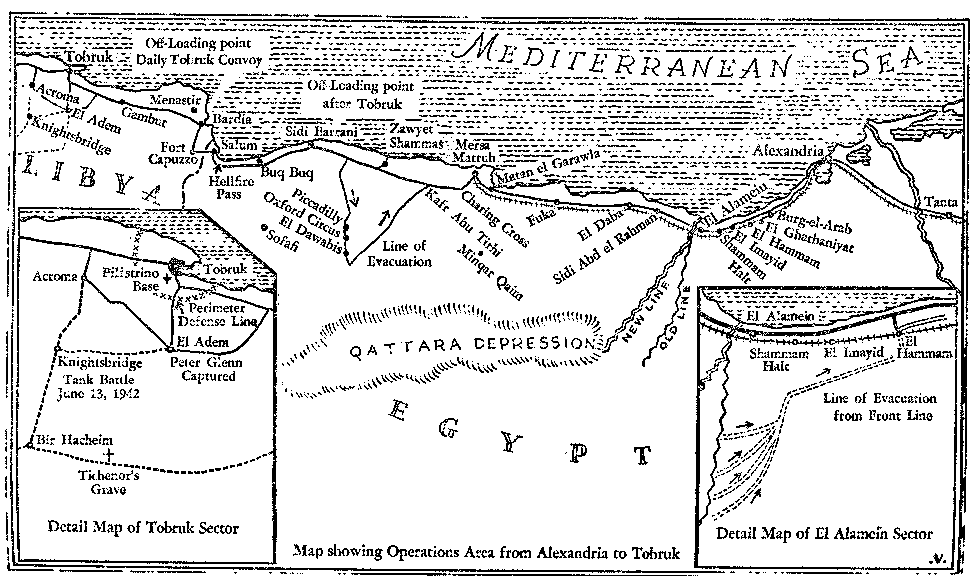
Map showing Operation Area from Alexandria to Tobruk
The routine of the hospital was efficient. Ambulances from the field---Acroma, Knightsbridge, El Adem, Bir Hacheim---began to arrive in the courtyard in late afternoon and off-loaded at the reception room. There doctors examined each case. Men in need of plasma or blood transfusions were moved into a room for that purpose; men severely shocked were moved into the "resuscitating room." Those not in need of immediate attention were made comfortable and moved into a long room at the back of the main building where they awaited their turn to enter the operating theater. Englishmen, Germans, Fighting French, Scotsmen, Italians, and Indians together with Australians and New Zealanders lined the walls of this large room. Men entered the waiting room when cleared from the reception room. In turn, without discrimination, they entered the operating theater. Enemy wounded received exactly the same care given to the British troopers.
Having had pre-medic training at college and five years in charge of hospitals on various passenger ships of the Matson Navigation Company, I spent many nights in the operating theater helping out as orderly, scrub man, surgical assistant, and stretcher-bearer. I came to marvel at the tireless pace set by the surgeons in this blood-soaked room. My admiration grew as I saw these weary men expend all the resources of their skill for wounded Germans and Italians as well as for their own men. One night Colonel Simpson-Smith, chief surgeon of the hospital and now a prisoner of war, was about to operate on a wounded British Lieutenant when a sergeant orderly approached.
"Sir, there's a Jerry in the waiting room. 'E's bad off; 'e's over the hill if 'e ain't worked on soon."
"Bring him in." Simpson-Smith turned to the Lieutenant on the table, who was smoking his last cigarette before the ether mask was slipped over his face. "Mind waiting, old man, while I look this fellow over?"
"Right, sir. I told our RMO [regimental medical officer] the Mauser [German rifle] I had in my leg wasn't worth evacuating. Get me off here, and give me another cigarette."
The German was brought in, and Simpson-Smith examined him. "How many men in the waiting room, Sergeant?"
"Not many, sir---five or six. The other tables will clear them out in short order."
"Good! Get this fellow ready."
He motioned to me to follow, and we found stools against the far wall. We lighted cigarettes. It was three o'clock in the morning. He had been at his table steadily since five-thirty the previous evening. I had been attached to his team---this would be his fifteenth operation.
He smoked in short, hurried puffs. I think I can save this fellow's leg, but the job will be the face. You see, a rifle bullet hit him inside the right jawbone and went into his sinus, where it broke up. I'll work there first. If I do that job properly, he will live; then I'll try to save the leg."
"About amputations, sir---don't you become hardened to them?"
"No, Geer, none of us will amputate a limb without a second opinion."
"He's ready, sir," the anesthetist called.
"I believe you Americans would say, 'Let's go.'"
One hour and forty minutes later the German (Panzer Division) was carried from the room. Simpson-Smith straightened, arching his back against his hands. His face was lined and gray with fatigue.
"I think he will live---if he lives he'll have two legs to walk on." He lighted a cigarette, smiling wanly. "I won't guarantee, though, that he won't have a bit of sinus trouble in later life." He turned to the Lieutenant, who was on a stretcher near the foot of the table. "Sorry to be so long, old man."
"Save that joker, sir?"
"Yes, I think he will live."
"Good!" The Lieutenant handed his cigarette to the orderly and lifted his chin to the ether mask. "I don't like ether."
Sulfanilamide is truly the miracle drug. It is used constantly and copiously, in both powder and crystal form. Gangrene is now almost unheard of. Wounds may have to go for hours, sometimes days, before the patient can be taken back to a base hospital where proper surgery can be done. But if they are treated with this drug at a regimental aid post, when the bandages are finally taken off they are found to be clean and unsuppurated.
At this time in Tobruk we were carrying nearly as many enemy wounded as we were our own. In the operating theater I remarked the vast differences in attitude among men going under ether. The Indian troopers loathed and feared the stuff and accepted the mask with taut muscles and dilated eyes. The Italians seemed to welcome, almost to grasp for the mask that would give them an interlude from pain. The British went to the "pictures" jokingly, asking the surgeon, "What do you do on Civvy Street, Doc?" The Germans, almost without exception, accepted the mask stoically but when going under muttered, growled, shouted, squirmed. Even when they were completely out, their muscles were taut and their nerves on edge. Why this difference? Because they were prisoners and believed they would be murdered while unconscious? But the Italians were being fed from the same propaganda spoon, and they did not fear maltreatment.
Many young Germans, seventeen to twenty years old, were captured. These youths were exhorters. While in the waiting room they expressed themselves at length. One individual, perhaps seventeen, kept up a continuous harangue until he went under ether---even then he carried on in a disjointed, garrulous way. Conscious again, he picked up his lecture until Bob Murphy said, "If this joker could stand, I'd get him a soap box." The older German soldiers shrank from these young fanatics.
In the POW (prisoner of war) cages there are also marked differences. Such cages are temporary affairs, perhaps a quarter of a mile square bounded by barbed wire, and are used to hold captives until they can be transported to the rear. As Italian and German prisoners are marched into these squares, they instinctively separate, the Germans on one side, the Italians on another. Within the German ranks there is often a further division; the older Germans group together, shunning the company of the fanatical Hitler youths.
.
Perhaps it would simplify the picture if the system of boxes as used by the Eighth Army at that time is explained. A box is a strong point two to four miles square. This square is surrounded with mine fields and barbed wire. From the rear of the box is a lane or lanes left open for the free flow of supplies and reinforcements. Inside this square is placed a fighting force with a full complement of guns---artillery, antitank, and anti-aircraft. Various boxes are linked with mine fields and are so placed that the artillery within will overlap the neighboring box. Thus, at the beginning of the battle, the British boxes and mine fields extended from the coast on the north to the southern flank at Bir Hacheim approximately forty-five miles. Casualties occurring in any of these boxes were evacuated to Tobruk. From there we transported them eastward. "Let me work in a box" was the cry of every man in the Field Service.
A section of five ambulances and eight men was detached and sent to El Adem, where it was attached to the 5th Indian Division. The line of evacuation was from the El Adem box down the Axis by-pass to Tobruk---a distance of twenty-five to thirty miles. Rommel was putting pressure on this area, and for the next ten days this section had a rough time of it. The men were subjected to shelling night and day, with heavy night bombings. After ten days the section leader asked that they be relieved. This he did against the wishes of such men as Sam Hobbs, Fred Taylor, and John Cooper, who wanted to stick it out.
When the call came through to our headquarters at Pilistrino, we consulted our lists of subsections as to which to send. The spot was tight---the section already there might have to stick until the battle was decided. It was finally determined to send the "Fighting Sixth." This section, so named by the members themselves, were known to be fire-eaters and craved excitement. It was this group, more than the others, who were always clamoring for work up forward.
The next day, with Evan Thomas (the section leader) seated beside me in my staff car, we took the road east to the junction with the Axis by-pass and turned toward El Adem. Upon reporting at the main dressing station I found that one ambulance would go forward and work in the box beyond El Adem while the other four would remain temporarily at the main dressing station. Upon making this announcement I was nearly mobbed---Manning Field, Bob Sullivan, Bill Nichols, Jim MacGill, Peter Glenn, and "Crudge" Crudgington all demanded to be the chosen one. The toss of a coin decided the job, and Peter Glenn won. Upon such small things does liberty hinge. The others got out in the retreat; Peter was captured and is now a prisoner in Italy.
Rommel's attack began on the day and hour Major Bert assured me it would---May 27 at ten o'clock in the evening. From then until we were ordered out of Tobruk the roar of battle was in our ears. We charted the fluctuations from the ever-changing voice of battle. Our work multiplied. The men working from the Pilistrino base came to dream of the road to Bardia. Hume's section at the hospital worked day and night. Several times they asked for volunteers to help them out; the response was overwhelming. Men who had already done a two-hundred-mile run over shockingly crowded roads went into Tobruk to work the night through, with another two hundred-mile run facing them in the morning. Felix Jenkins was sent on a single detachment to Captain McCarthy at a check post where a pool of ambulances is kept for dispatch to areas of greater need. When the retreat began and communications broke down, we were unable to get in touch with Jenkins for many days. One day he showed up on the El Alamein line still on the job with his captain.
The news from the front was good. We talked with wounded from all sectors; the attack was being held and in many places thrown back. Our light and heavy bombers were passing over in hourly raids. Our fighter protection was good. Few columns along the roads and tracks were being shot up. Each morning as we drove to Tobruk we saw the prisoner-of-war cages bulging with German and Italian prisoners. Supplies were coming along the coast road in three- and five-ton trucks, with the vehicles bumper to taillight for miles on end. Against this traffic our drivers had to fight their way with sorely wounded men.
To their everlasting credit, AFS drivers came to be known as men who gave their patients good rides. There is no higher praise to be given an ambulance driver. True, these same men drove too fast on the return trip, but when loaded they exerted every care. They pulled to one side and rested when patients could stand no more of the jolting; they assisted with urinals and improvised bedpans; they passed out their own cigarettes and paused to brew tea over a gasoline fire when it meant they would return along the road after dark; they opened cans of tinned fruit that were hard to get and costly.
And all they asked and cried for was more work. All were resentful that they could not be assigned to the various boxes where the going was tough. At night many continued to work at the hospital. It is small wonder they were shocked into anger when they read in home-town newspapers of men lobbying against a forty-eight-hour week. They were doing forty-eight hours in three days, sometimes in less than that, on indifferent food and a quart of water a day, their sleeping hours being spent in flea-ridden dugouts.
We were all conscious of how little we as individuals counted when the lives of the men being transported were at stake. In one such day the company moved three hundred and eight casualties; the total vehicle miles were ten thousand three hundred and forty.
On June 6 occurred the mystery of the red-headed Sergeant. Late that afternoon our convoy was returning from Bardia, weaving in and out of the clogged traffic, when the whole line was halted and turned back by a red-headed fellow with the stripes of an English sergeant. He was riding a motorcycle.
"The road is cut," he shouted. "You're to turn back. Jerry has cut the road; you can't get into Tobruk---the road is cut." He dashed up and down the line, turning the long lines about. Traffic piled up, turned into the desert, and swung back to the east.
Carl Keyser (a hard man to convince anyway) came along with his ambulance. The redheaded Sergeant waved him back. Carl swung to the right into the desert and headed for the seacoast, where he saw a group of tents some two or three miles off. He went to the tents (brigade headquarters) and made inquiries. Was the road cut?
"Road cut? No, of course not. Proceed as you were."
Brigade sent men out to investigate the Sergeant; the redhead was nowhere to be found. But the line of supplies had been broken temporarily. The ambulances arrived in Pilistrino late, but they arrived and it was good they did. We were working to full capacity and to have missed one convoy would have swamped us. We know now that the redheaded Sergeant was a fifth columnist.
Our day of rest came on the arrival of a hospital ship from Alexandria. Working swiftly---the ship could not dock and the wounded were transferred from shore by lighters---we loaded and transported to the water front three to four hundred wounded in less than two hours. The rest of the day was ours for bathing at the beach, washing clothes (in salt water), and writing letters. There were three hospital ships working on the evacuation of Tobruk. Two were sunk fully loaded with wounded, one not far from Tobruk and one near Alexandria. Both were sunk in daylight in clear weather by enemy aircraft. After that many more men died because they could not stand the grueling overland trip back to base.
The battle turned against us. Bir Hacheim fell. Our thoughts turned to the small band of friends we had down there. What had become of them? Meager reports came in-meager and tragic---Tom Esten dead of pneumonia, LeRoy Krusi wounded seriously, George Tichenor killed, Alan Stuyvesant captured, Stan Kulak missing. And that was not the complete story of the ill-fated, heroic little group.
Under the leadership of Alan Stuyvesant (a veteran of the AFS in France until the fall of that country) this group had gathered in Cairo in April for duty with the Fighting French in the box at Bir Hacheim. Ill fortune struck this small group early. Tom Esten left for the desert in poor health. He insisted that he make the trip and assured one and all that he would be quite all right. The trip to Tobruk was strenuous, with long hours on a crowded jolting train to railhead, and from there in a three-ton truck. Upon arrival at the harbor city Tom was very ill. He was forced into the hospital and within a few days evacuated to Alexandria by hospital ship. He died of pneumonia (aggravated by desert dust) while on the operating table. Tom was a sincere, hard-working young man. He had seen service in France, where he won the Croix de guerre. His desire to do a job cost him his life.
On April 13, 1942, Stanislas Kulak and Tim Krusi were making the run from Tobruk to Bir Bu Maafes. They were alone in a wide expanse of desert when machine-gunned by an Italian fighter. The plane came upon them from the rear. The first knowledge they had of the attack was when bullets burned holes through the windshield and instrument panel. They jerked to a stop and dived for cover, but too late. Several fragments had pierced Krusi's back, paralyzing the diaphragm. Later the lower lobe of one lung collapsed. He was rushed to Tobruk, where he was operated on by Colonel Simpson-Smith. This surgeon's skill saved Tim's life.
Kulak emerged from the attack unscathed, but Kulak and Krusi both would have been killed except for one lucky break. They had piled their kit against the seats in which they were riding. Armor-piercing. bullets tore their kit apart but spent themselves. One bullet plowed through a book, "The Skies of Europe," and ended up halfway through Krusi's diary.
When the offensive began on Bir Hacheim in May, Alan Stuyvesant as officer in command with Norman Jefferys second in command had the following men with them in the box: Stanislas Kulak, Alex McElwain, Arthur Stratton, Jim Worden, George Tichenor, and Lorenzo Semple. For the next fourteen days this group lived through the ordeal of constant artillery and bombing attack.
On June 1 an expedition was sent out by the Fighting French from Bir Hacheim to Rotunda Segnali to cut Rommel's line of communications some thirty miles in his rear. Kulak and Semple went on this strong patrol. Early on their march the enemy was encountered and casualties were incurred. Kulak went back with the wounded. Semple continued with the force. His ambulance was shot up but continued to run. More ambulances were needed, and so Stuyvesant brought out the rest from Bir Hacheim. A dust storm shielded them from the enemy, but only miraculous navigation saw them safely to the rendezvous. They collected the wounded and started back to the box. Stuyvesant's staff car suffered a flat tire, and he ordered the loaded ambulances to continue without him. He fixed his flat and was within sight of camp when an enemy armored car dashed in and picked him off. He is a prisoner of war in Italy.
The patrol was forced to fight its way back into the box, as the Germans and Italians surrounded it. From then until the evacuation there were only temporary passages through to the rear. "Jeff" Jefferys got out once for supplies and spare parts and got back in successfully. He went out a second time and tried desperately, recklessly, to get back to his group, but Bir Hacheim was cut off even to armored columns.
Flights of one and two hundred Stukas bombed the box; heavy guns poured a constant stream of shells into the area. German sappers were working an opening through the mine fields under heavy fire, and several were wounded. Kulak and Worden went out to pick up these men. The German medical orderly surrendered his gun to Kulak, helped load the wounded, and returned to the box with the ambulance. Save for one burst of machine-gun fire this sortie was not molested or threatened.
With food and ammunition rapidly being expended and with little hope of supplies getting through, it was decided to evacuate the garrison. This decision was reached on the morning of June 10. Through the day, to the prying eyes of the enemy, the defense of the box was carried on as before. The break-through was to be made at the southwest corner of the mine fields. As soon as darkness came, the engineers commenced clearing a pathway. The garrison gathered at the selected point. Naturally there was some confusion; four thousand men and hundreds of vehicles cannot be formed into columns in the darkness without raising a racket that will warn the enemy.
Shortly after midnight the columns began to move. Enemy flares dropped over them, and instantly the line was swept with machine-gun and Breda cannon fire. Trucks burst into flames, further aiding the enemy and blocking the lane. Barbed wire loosely coiled along the sides of the track tangled in truck wheels and impeded further progress. In a nightmare of flares, tracer bullets, burning trucks, and the cries of dying men the column ran the fiery gauntlet.
Semple's ambulance got entangled in the wire. He offloaded his wounded in the shelter of a shot-up Bren gun carrier, under severe machine-gun fire. Once he had his wounded in comparative safety, he went in search of another conveyance in which to load his patients. Arthur Stratton went on with his ambulance and was hit by machine-gun and Breda cannon fire. Sorely wounded he crawled from his burning vehicle. He lay on the ground helpless while his wounded burned to death in the ambulance.
George Tichenor pushed his way through the tangle until his machine was hit and put out of working order. Though slightly wounded, he got out and with the help of a passing infantryman off-loaded his patients. He was working over them when a burst of machine-gun fire hit him. Instinctively, as he fell he placed his body over his wounded and caught the full force of further fire.
Stan Kulak and Alex McElwain passed Semple's stalled machine and went down the shell-swept lane to vanish for months. McElwain is a prisoner of war and was wounded when found by the enemy. Stan was listed as missing for many weeks. Seven months later, after Bir Hacheim had been retaken by the Eighth Army, it was established that Stan had been killed in the cauldron of fire.
Semple stopped a truck and got his wounded into it only to have a Breda cannon hit the truck and ruin it. He was wounded but nevertheless found another truck and again shifted his patients. It was too loaded for him to get into, and he went on afoot. Finally he was picked up. Through the pall of smoke and stench of burning vehicles and men he got to safety.
Stratton was picked up with other wounded and through long hours lay on the floor of a jolting truck. in the daylight he found he was lying alongside Tichenor. They buried George that morning.
There had been twelve AFS ambulances in Bir Hacheim. All twelve were destroyed. Alan Stuyvesant and Alex McElwain are prisoners of war; George Tichenor and Stanislas Kulak were killed; Lorenzo Semple and Arthur Stratton were wounded. Jim Worden came through unscathed though he lost his ambulance.
.
Our life in Tobruk was not without a lighter side. Nearly every day invitations came to have a "sun downer" and dinner at some neighboring mess. The South African Field Artillery Battalion, our immediate neighbors, were established in a tremendous Italian-built dugout. It was some forty feet long by ten wide, with a twelve-foot ceiling. It was well lighted, airy, and comfortable, and within its confines it held a lounging room, spacious dining room, and kitchen. Another South African unit had their mess in a cave, reputedly the underground baths dug for Cleopatra.
The supply and transportation staff were set up in the White House, a stucco building on the Derna side of Tobruk and the only building left standing in this area. It was here that I was first introduced to Stuka juice, the name given South African brandy. The ration of liquid refreshments was slim---one can of beer per man per week. Whisky and gin were something to cherish and sip slowly as one does rare wines. At one time there was only Stuka juice, a cross between molten lead and chained lightning.
Under the guidance of Major Fieldhouse a betting book on the English Derby was drawn. Section 3 of the rules should be read with care; all members of the "firm" were placed "in der bag."
MALEESH, HASHEESH, AND BAKSHEESH(4)
TURF ACCOUNTANTS AND COMMISSION AGENTSThe White House
Tobruk
2 June 42Telegraphic address: JERRYCAN
Telephone: PILISTRINO EXCHANGE (3 lines)Dear Sir:
The English Derby, 1942 Although the odds are greatly against any of us in the Western Desert being able to attend the Newmarket Meeting on the 13th and see the greatest of all races, there is no reason why we should be prevented from having a "flutter."
The call-over at the Victoria Club is given on the bulletin board, but it must be appreciated that the odds may fluctuate from day to day.
We shall be happy to accept commissions from clients up to the "off," and settlement will be made in accordance with the result published in the Egyptian Mail. No argument can be entered into as to whether this is the correct result or not.
Our rules, which may be varied by us at will, are as follows:
1. Owing to the, present active operations and the possibility of clients being put "in der bag," no credit will be given under any circumstances.
2. Settlement will be made as soon as the result is known to the firm.
3. Should all the members of the firm be placed "in der bag," settlement will be deferred for the duration.
4. Clients are requested to use their proper names and not noms de plumes.
5. Bets over one pound on any one horse must be received in sufficient time for these to be "laid off" through the proper channels with Middle East.
6. We will not be bound in any way by starting prices or later call-over prices. If you don't like the odds we give, you are quite at liberty to see what you can get out of the military police.
In conclusion, we would draw our clients' attention to the custom of the firm of accepting commissions on any of the more unlikely events to occur, and such speculations as:
1. Bengasi Harriers Race, naming FIRST IN and LAST OUT.
2. The date or duration of the next dust storm.
3. The number of Stukas in the next raid on Tobruk.
4. The greatest distance covered in any one period of twenty-four hours by a party of twenty or more Italians in retreat.
5. Estimating the number of prisoners in the Tobruk prisoner-of-war cage two days in advance.
Owing to the exigencies of the service it has become necessary to ask clients not to place their commissions by way of "most immediate" signals and "clear the line" telephone calls. The Area Commanding Officer may have matters of greater importance.
We are, Dear Sir, yours faithfully,
MALEESH, HASHEESH, AND BAKSHEESH
We witnessed an air fight over Tobruk---four of our light bombers against one Messerschmitt. One by one the bombers went down; in spite of the anti-aircraft, the German coolly and ruthlessly went about his task. The fight did not last more than two or three minutes. When it was over, the German ducked and dodged through a curtain of ack-ack fire to safety.
Two of the bombers crash-landed, and some of the crew got out. The bombers had been on a mission and had run into a squadron of enemy fighters. They dropped their bombs on the target and fought their way back. Out of ammunition they had bumped into a lone Messerschmitt, and with no chance to fight back they were knocked down. That night the British Broadcasting Company news closed with "Four of our aircraft failed to return."
During our early days in Tobruk, knowing the AFS would one day get assignments in the field, I made many excursions into the desert to gather firsthand information and experience on how evacuations are handled from the regimental aid posts (farthest forward point of medical services) back to casualty clearing stations. Daily---after the ambulance convoy left Pilistrino for the hospital and after working out the war diary with Bob Dean and signing the indents for rations, water, and gasoline---I went off on my own. I visited the RAP's in the 50th Division box in the Acroma district; next I did the Guards' Brigade box in the Knightsbridge area and the strong points around El Adem. Everywhere I was treated with the greatest courtesy; my questions were patiently answered and all points fully explained.
One truth I learned and reaffirmed many times. The most powerful man in a regiment is the regimental medical officer---a statement backed by military men. The RMO, if a good one (and there are few who are not good), knows every man in the battalion. He knows what his men are thinking; he knows the condition of morale. In many instances, especially in colonial units, the medical officer knew his men and attended them and their families back home. In the study of medical science there must be something that erases fear and builds courage. The casualties are appallingly high among RMO's, for they continually go too far forward in search of men to help.
Two of my excursions bear mentioning. One did not materialize because it was vetoed by Lieutenant Colonel Matheson, ADMS (Assistant Director of Medical Services) of the Tobruk area. But for that veto I might well have been "in der bag." On the second I saw history made, a battle lost, and the course of the campaign changed.
One afternoon Lieutenant Dan Goodman came into our laager with thirteen ambulances from the 50th Division box. Goodman was commanding a section of the First Ambulance Car Company, the men we had relieved, and was looking for a place to rest his men, who had had a rough time of it. I took him to the west of our camp, and we found a spot where his men made camp. He had the look of a man who has been in the desert for days without proper food or rest. I fixed him up with a drink and a dugout.
"Hellfire Dan'l," as I later came to call him, had been in the desert for the better part of three years and knew its every trick and vagary. Within an hour of our meeting I decided to ask permission to accompany him when he went back with another convoy. Three days later when he left I watched him disappear in a column of dust. Lieutenant Colonel Matheson had put thumbs down, and rightly so, on sending any more vehicles than necessary into the area of Acroma. It was as well. Dan got out after a time (he was reported captured), but he left a good number of his men and machines along the way. One of his drivers who was captured was reported (by men who escaped) to have been forced to drive his ambulance into forward areas to bring out enemy wounded.
On June 13 I went to El Adem with supplies for Evan Thomas and the Fighting Sixth, most of whom were continuing to operate behind the box. All were jealous of Peter Glenn, who had won the toss of a coin that put him up forward. They had little of interest to report outside the story that Evan had driven into a mine field and was halfway through before he noticed the markers up ahead. He slept there that night and worked his way out in daylight. I continued to the El Adem box with a spare tire for Peter, but he was on a run to Tobruk. The attention of everyone in the box was fixed to the southwest in the direction of the Devils Cauldron and Knightsbridge.
"They're building up to one helluva do, down that way," an Indian officer told me. "Rommel's trying to come around the Guards' box."
"What've we got there to stop him?"
"Enough! The 1st Armored Division."
Knightsbridge is about twenty miles due west of El Adem at the junction of Trigh Capuzzo and Trigh Bir Hacheim. On leaving the box I swung my machine onto the Trigh Capuzzo and headed southwest to return to Tobruk by the Acroma road. Fifteen miles along the track I was stopped by a redcap (military policeman).
"Going far, sir?"
"The Acroma. road to Tobruk."
"They're building up to a bloody tank battle with that bleeding Rommel. We're not certain the bloody road's open. Two, three miles on your left you'll see an armor control vehicle. Check with them before going too far."
At the ACV lorry I met a major who had been at the Sign of the Birds of Passage my first night in Damascus. He advised against going farther along the track and invited me to the roof of the huge lorry. Through binoculars we saw the shifting of tanks---not clear because of the dust clouds they kicked up, but the Major with earphones clamped on tight gave me a running account of the battle.
"Two groups of enemy tanks are coming around from the west of the Guards' box---the Queen's Bays and 9th Lancers are going out to meet them."
As he talked, he jabbed with his china-glass pencil at the map case held on his legs.
"About eighty in each enemy group." His pencil circled the approximate position held by the enemy.
"Tenth Hussars: are moving north. A hundred enemy tanks reported coming south from Acroma. The CLY's [County of London Yeomanry] are moving up to support the Lancers---"
"The Hussars want to be careful---two escarpments with a wadi between to cross before they get into the open." I leaned over his shoulder and scanned the map.
"Forward squadrons of the Bays are in contact. Can you hear them?"
I nodded, turning my binoculars to follow the movements he was describing. The roar of cannon increased. There was a deeper, stronger note of battle now. Heavy artillery from the Guards' box?
"The Hussars are at it---cavalry charge. Wish them luck, Yank, when they go over that second escarpment. The Lancers have knocked out four. Two burning---see them?"
I nodded---pillars of smoke were rising above the dust. The minutes passed slowly. The smoke and dust rose in clouds and drifted toward us; the roar of guns of all sizes heightened. Two dispatch riders whirled by toward the Cauldron; three ambulances came from the melee headed for Tobruk.
"Oh, God! They've been ambushed . . . the Hussars are trapped. Eighty-eights were waiting for them." The Major stood up in his anxiety. I caught his map case and pencil. For a long time he said nothing. He paced the roof of the giant truck. The roar of battle reached a thunderous pitch and stayed there brutally, tirelessly. I tried vainly to pierce the storm of battle. Slowly he spoke, and his voice trembled. "The 10th Hussars have been wiped out, almost to a tank."
When I returned to Tobruk that evening, I knew the battle of the Devil's Cauldron had gone against us. We had lost over two hundred tanks. With Bir Hacheim gone and our tank superiority vanished, it was a question of how much the Eighth Army could get out with, where to make their stand. Twice that night I made the trip from Pilistrino (via the Derna by-pass) to the road that leads onto the escarpment and east. I was satisfied that if we were ordered out at night I could lead the convoy the tortuous six miles through to the main road without mishap.
The decision had been made to defend Tobruk, as had been done once before, if the battle went against us and the army was forced to retreat. South Africans were to form the large bulk of the garrison. I wondered whether we should be ordered out or should stay and serve the troops within the perimeter. Later that same evening I called on our neighbors, the South Africans. Colonel White was in command of the defense of that area, and I sought his council. He did not think we should stay. There would be no need for as many ambulances as we had, to carry on the duties once the road was cut. I was invited to stay through a conference as the final plans were laid for the defense of the area. Though it was not stated at the time, everyone expected the perimeter and town to be laid siege to once again. More guns were ordered dug in on the escarpment to the south of our camp. All that night and the next day field guns and heavies rolled through our camp to new defensive positions.
The next day (Saturday) I took turns with Bob Dean staying near the phone. The convoy went to Bardia as usual and got back without incident, though there were reports of fighting along the Trigh Capuzzo track not many miles from the eastern outlet. It was on the afternoon of that day that I looked up to see my old friend Captain McKay of Damascus standing in the doorway of our hut.
"Hi, America. Didn't know you were here. Looking for a bit of information. . . ."
I held up my hand and in mock seriousness said, "Please show me your identification papers. . . ."
For a moment his face showed disbelief; then the remembrance of his early morning demand for my papers came to him. He gulped air through his flattened nose and his laughter shook dust from the walls of the office.
He became serious in a moment. "One of my lads, Dawson, was blown up by a shell a few minutes ago, one of those eytie shells lying around on the ground. He was using it to prop up a corner of his bivvy. One of your lads picked him up and took him off. Where would he take him?"
"Most likely the 62d General in town. Let's find out." We went into camp to find the driver who had picked up the man. During the short walk I found that McKay was second in command of an antitank unit and had arrived a short time before in Tobruk. Noble was somewhere in Persia. Major Grigg was still in Damascus.
Jim MacGill was the driver he sought. He had come in from a run El Adem way and was opposite the bivouac when the explosion occurred. He rushed over, loaded the man into his ambulance, and hurried with him to the hospital.
The fellow had been taken directly to the operating theater.
I drove McKay to Tobruk, and we entered the hospital. Colonel Simpson-Smith and a specialist on head injuries were operating. There was little hope for the man, who was terribly mangled. We waited over an hour. Dawson died on the table.
Driving back we talked of the battle. Bad news continued to trickle in from the front. McKay, brooding over the death of his man, was certain Tobruk would be surrounded again. He was ready for anything Jerry could throw his way. As he got out of the car near his camp, he pointed to the old stone road that bisected the area---the inside route to El Adem.
"If Rommel comes, America, he'll put a lot of stuff down this track." McKay beat his big hands together. "We're ready for him."
From reports on the battle of Tobruk received later, Rommel did hit the Pilistrino area hard. The first twenty tanks he sent that way were mauled and repulsed. Another and heavier attack of over fifty tanks was mounted and sent in, and the positions were finally overrun. Months later I talked with an army chaplain who had been captured in Tobruk and released when we retook Bengasi. He told me of McKay, of how the Canadian had fought his unit till the last man and gun were gone. When there was nothing else to fight with, McKay had walked out to meet the advancing German tanks, hurling Mills hand grenades.
Peter Glenn came to the headquarters hut a few minutes after I returned from talking with McKay. Bob Dean got him tea, and he shaved and washed while he made his report. The box he was in had been under severe attack for hours. He had slid out the back door and over the inside road into Tobruk in order to deliver his patients to the hospital. He drove off in a swirl of dust; there was another load of wounded to get in that night.
That was the last contact anyone in the AFS had with Peter. The box he was in was overrun a short time later. The troops he was attached to were presumed to have returned to Tobruk. From various sources we heard of an AFS ambulance on duty within the perimeter until the surrender. That was Peter's. Three months later we heard that he was a prisoner of war in Italy.
On all sides there was now the roar of cannon. The battle seemed closer---or was it that the wind was from the south? Again on Sunday the run to Bardia was made and the work increased for the unit at the hospital. Sunday evening we were to have church services in the canteen. In the mounting excitement the chaplain, Major Lowden (Church of Scotland), arrived calm and unperturbed. On his heels came a distraught, battle-shocked Jeff Jefferys.
The chaplain asked me to read the lesson. Leaving Bob Dean at the telephone I went to the canteen to find the place packed solid with men of the unit and our British attachment. Those who could not get inside stood in a huddle near the doorway.
Taking the Bible from the chaplain I read:
"Fear thou not; for I am with thee: be not dismayed; for I am thy God: I will strengthen thee; yea, I will help thee; yea, I will uphold thee with the right hand of my righteousness."
There was a slight movement at the doorway. I looked up. Bob Dean was looking at me. He nodded and lifted his hands in an expressive gesture. So this was it---we were getting out.
I continued.
"Behold, all they that were incensed against thee. . ."
My eyes read and my lips formed the words, but my thoughts jumped. When do we move? Where? Do we follow the Freeborn Plan (the secret scheme of evacuation given us days before)? How can we get in touch with Evan Thomas and his unit? With Felix Jenkins and Johnny Fisher on lone assignments in the desert?
". . . shall be ashamed and confounded: they shall be as nothing; and they that strive with thee shall perish."
It is nearly dark, I thought. We shall have to pack at night. The workshop and quartermaster will be hard put to it---they should be at it now. What about Peter Glenn?
"Thou shalt seek them, and shalt not find them, even them that contended with thee: they that war against thee shall be as nothing, and as a thing of nought."(5)
I closed the Bible, handed it to the chaplain, and left the service. Bob Dean was waiting for me outside.
"We're getting out," he said when we were out of earshot.
"When?"
"Tomorrow morning at first light."
"Where do we rendezvous?"
"Kilo 132 (6)---Sidi
Barrani."
"Freeborn Plan?"
"Yes."
"Road still open?"
"They think so."
"Do we clear the hospital?"
"Yes. There'll be over a hundred and fifty casualties to take, the nurses, and several surgical teams."
"Get Dick Ragle and Bill Hoffman to help you pack the headquarters equipment. Burn any papers you think should be destroyed. When the service is over, tell Lieutenant Matheson. Call a meeting of section leaders and platoon officers for nine o'clock. Where is Captain King?"
"In Tobruk."