 |
 |
 |
 |
THE UNIT HAD SPREAD its work to three continents. Sections overseas became self-contained groups, each pursuing its own line of work and developing its own traditions, each with its own character as clearly defined as that of any individual. Thus only has it been possible to describe the work of each section as a separate story.
But unity of purpose was never lost. A member in China or Sicily or Ethiopia or any other country, however strong his loyalty to his own group or attachment to his own bit of work, felt that he belonged first and foremost to the Friends Ambulance Unit. Devotion to a common ideal of pacifist service in a non-pacifist world fostered the sense of unity; but that was not the only bond. For there were others, not members of the Unit, equally devoted to the same ideal. What held the Unit together most of all was the common experience of work and training at home.
Most members served for many months, some as long as two or three years, in a variety of sections at home before being sent abroad. And work at home meant North field and training hospitals, the Students' Hostel and the Middlesex, all the other hospital and relief and training sections. In half a dozen different countries would be found men who had once lived together in the same bunkhouse, worked in the same hospital, the same kitchen, the same shelter. There were few in any section who did not know someone in every other section at home and overseas. Friendships had been developed which far transcended the limits of the group in which a member finally found himself.
In 1943 and 1944, while the activities already described were in progress overseas, the Unit was bracing itself for its final effort---civilian relief in the wake of the armies that were to invade Europe from south and north. But before the last story is told, we must complete the picture of the Unit at home.
EARLIER CHAPTERS HAVE shown in outline how members of the Unit, after the return from Norway, came gradually to reconcile themselves to work at home; how, in consequence, hospital work, so far limited to training in East London, was extended to the Ministry of Health's Emergency Medical Service Hospitals in the provinces; how the blitz brought an unexpected and urgent challenge; how for the life of the Unit the longer period of preparation at home, at first regarded as an unwelcome necessity, brought unity and cohesion which would otherwise have been lost.
So work in Britain came to have a two-fold purpose; to provide a pool of trained personnel for service overseas, and to meet a present need. It assumed many and varied forms. A full list of jobs undertaken from time to time by regular sections or by individual members and small groups would show many that had little connection with the purpose of an "ambulance" unit in any limited definition. The Unit's aim became increasingly to make itself useful in whatever sphere its services might be required. Sections went at harvest time to work on the land or to organize camps for temporary harvesters from the cities ; others helped for a time with forestry and the clearing of bombed sites. But all such pieces of work were sidelines and occupied few members. Activities at home fell into three main categories---work in hospitals; emergency relief and social work ; and full-time training. Work on emergency relief has already been described ; there remain hospital work and training.
HOSPITALS WERE THE great standby. Numbers could rise or fall according to requirements elsewhere. But only when other work arose of overriding importance did hospitals take second place. Throughout most of the Unit's existence they were a major field of activity. They provided for over five years constant and steady occupation of unquestionable usefulness. In August 1940 there were 230 members in hospitals in England; by December of that year transfers to emergency. relief work had brought the number down to 150. During 1941 it crept up again; from the second half of that year until the first half of 1944 it remained above the 200 mark. By June it was again down to 150, by December to 100, by June 1945 to 60 and by December to 40. For by that time service overseas, especially in Europe, had to come first. But to the end some members who, for one reason or another, could not go overseas, found their sphere of service in hospitals at home.
The Unit served in eighty-three hospitals in all, but in never more than twenty-eight at one time. Sections such as those in Gloucester or Bethnal Green or Arlesey lasted for five years or more; others for shorter periods, some for a few months or weeks to help in special emergencies. There was an eighty-fourth hospital in which a section worked for one day. The matron had for some time urged that a section be sent, but when she discovered on the first day that not all members of the Unit were Friends---the only respectable form of conscientious objector---she found that she could do without them after all.
The usual size of group sent to a hospital would be anything from six to fifteen members. Sometimes smaller groups or even individuals were lent to hospitals for a time; at the other end of the scale the Gloucester section consisted of more than thirty members. Most of these hospitals can be no more than named. A full list appears at the end of this chapter.
The Unit, for its own purposes, classified the hospitals into "Training" and "Working" hospitals. In the former the hospital authorities accepted men as supernumeraries specifically for medical training on the wards, in the operating theatre, X-ray, dispensary, out-patients, pathological laboratory and other departments, while in the latter the Unit put men at the hospital's disposal for work which the hospital most needed to have done---normally work of a portering or manual type. For most hospitals were better off for nurses to help with the medical work than for men to do the heavier tasks.
Hospitals like those of the L.C.C., in which staffs were well established and the routine of duties consecrated by tradition, proved the more suitable for training purposes. When the blitz forced the London hospitals to evacuate their patients and made of them little more than Casualty Clearing Stations, provincial hospitals helped to meet the Unit's need---Selly Oak Hospital in Birmingham, and later, in 1941, the Birmingham Accident Hospital ; Orpington E.M.S. Hospital, a sector hospital for Guy's; Epping, Chatham, Dover and many others. By the summer of 1941 it was possible to return to some of the L.C.C. hospitals.
Doctors and matrons and sisters and nurses, in spite of considerable inconvenience caused by frequent changes of personnel, were very willing to co-operate with groups of amateurs who had no obvious place in the hierarchy, and to give as much training as possible within the time available. It was no small thing for the sister of a ward to be faced every few weeks with a new man whose knowledge of nursing did not extend beyond what he had learnt in camp from the St. John First Aid and Home Nursing textbooks.
The Emergency Medical Service hospitals, on the other hand, were new. In the course of 1940 and 1941 they were still assembling staff. Indeed, in some cases the actual buildings were not complete; the hospital would already be installed in certain wards while the builders were finishing the rest. There was an acute shortage of male labour, and the main need was for porters. Thus a Unit section going in with the rest of the staff at the beginning would soon come to be accepted as an essential part of the hospital. And a group that did not fit into any of the normal categories within the well defined scheme of a hospital organized on traditional lines would find in the more informal atmosphere of an E.M.S. hospital more scope for initiative in organizing its work, even though it was on the level of portering.
That was the pattern in theory, but the distinction between training and working hospitals was never a hard and fast one. A member in a training hospital who proved himself good at his job inevitably had more responsibility thrown on to him; County Hall might regard him as supernumerary for training only, but sisters and nurses would often look upon him as a heaven-sent addition to their staff. In working hospitals, too, a man anxious to learn could often find his way into a department in which he would acquire a great deal of technical training. In fact, the most successful hospital sections came to be those in which there was an assortment of work ranging from skilled technical accomplishments to emptying pig-bins, trolley-pushing, stoking, collecting and delivering dispensary baskets, organizing stores, manning the entrance lodge, and all the other occupations associated with the normal working section. For then members could feel that they were not a mere luxury, but valuable to the hospital while at the same time preparing themselves for service overseas.
And indeed it would be a mistake to think of training only in technical terms. For many members the training in routine and self-discipline and keeping to a timetable which was involved in the humblest forms of hospital work was as valuable as being allowed to "scrub up" in the theatre or operating the X-ray plant.
Hospital work had developed inevitably, but somewhat haphazardly. In September 1941, to ensure that it he organized in a way that would benefit most effectively both the hospitals and the Unit, a separate Hospitals Office was instituted at Gordon Square; its first Executive Officer was Michael Cadbury, who was succeeded in December 1942 by Ian Nicolson ; he held the office for three years.
At first the normal period of training in hospitals had been two or three months. It was now extended to six months or more for everyone, with very few exceptions; most members would then be transferred to a working hospital until required for other forms of training. A printed "training card" was introduced on which appeared a list of accomplishments which sisters in the training hospitals were encouraged to tick off when reasonable proficiency had been attained. The list contained such items of a nurse's stock-in-trade as bed-making, catheterization, enemata, cleaning of wounds and dressings, giving of injections, laying out the dead, removal of stitches, laying of trolleys, urine-testing, knowledge of anæsthetics and instruments. If further training were required, hospitals and institutions were always ready to help. The special instruction given to the Ethiopia section in the treatment of eyes and venereal disease has already been mentioned. The London School of Tropical Medicine, the North-West Group Laboratory in Hampstead, the Seamen's Dispensary in Liverpool, among other institutions, gave particularly valuable assistance.
Unit teams in hospitals worked under a Section Leader, who was responsible to the authorities for all the work undertaken and to the Hospitals Office at Gordon Square for Unit affairs, contact with Unit Headquarters being maintained through weekly reports and regular visits by the Hospitals Officer and the Personnel Officers. Some authorities in working hospitals preferred, and tried, to have individual men directly responsible to them, rather than work through the Unit Leader; but by far the most successful sections were those in which the authorities readily allowed the Section Leader to organize his men as a team, and to take over and administer a whole piece of work as a Unit responsibility. Whether in the Western Desert or in hospitals in Britain, any attempt to treat the group as a collection of individual employees was stubbornly resisted. The Unit wanted a job entrusted to it which it could organize in its own way.
The Unit owed a great debt to the London County Council, the Ministry of Health and the Scottish Department of Health and to the staffs of the hospitals in which it worked. Rarely did members meet with lack of co-operation or prejudice. In most of the training hospitals in London, board and accommodation were provided by the authorities; in the working hospitals, in addition, a grant was made from the Ministry of Health from 1942 onwards to cover Unit overheads---an average of 15s. 6d. per man per week.
Life in hospitals was not all work. Hospitals have their social activities, and in most cases Unit members were readily and fully accepted. Sometimes matrons of the old school would not be sure how far they ought to go in allowing groups of strange young men to mingle with their nurses; at one hospital the matron grudgingly agreed to a member of the Unit taking part in the Christmas concert so long as he did not have more than one rehearsal with the nurses beforehand. But normally the Unit was given full opportunities to help in the development of a healthy social life within a hospital. Plays and concerts were produced, discussion groups organized, services conducted in the wards or for the staff, and from time to time there were the inevitable dances and parties. In the best of the hospital sections a member was likely to lead as full and contented a life as anywhere in the Unit.
Those officers of the Unit whose job it was to visit hospital sections at regular intervals would find in moving from section to section an underlying sameness and yet infinite variety. They would recall evenings with sections fresh from camp at L.C.C. hospitals, where members would relate excitedly to each other the fresh responsibilities which they had been allowed to undertake that day; visits to E.M.S. hospitals where convoys had to be unloaded, trolleys pushed from theatre to ward and ward to theatre, corridors swept and post delivered ; an occasional trip over the border to the Scottish sections of Bangour and Killearn, or to the American hospitals at Salisbury and Oxford; Lichfield, the only hospital outside London to take women members of the Unit; All Saints at Bromsgrove, with its occupational therapy ; Chatham on its hillside where steep corridors mounted from tier to tier; and many others. And there were some which merit more attention.
NO ONE WHO KNEW the Unit would deny to Gloucester the place of honour among its hospital sections. More members of the Unit served there than in any other hospital. Born in an atmosphere of raging controversy in the city, it remained a subject of controversy for the Unit from 25th May 1940 until 29th September 1945, the dates on which the section was opened and closed. For some Gloucester was the Unit's Siberia; others found nowhere where they felt that they were giving more useful service. Indeed, Gloucester typified the difference of view within the Unit as to the value of "humble service" for its own sake. There was a school of thought, particularly in the early days, which held that there was for a pacifist special value in emptying pig buckets and stoking boilers, even though by intellect and education he were capable of service which required far more technical skill and administrative ability. The willingness to perform the humblest tasks was part of the pacifist's witness for his faith in time of war. But others, particularly in the Relief Section, pointed to Gloucester as a waste of men who were capable of far more responsible work ; the Unit, they maintained, should seek work which gave the widest scope for the exercise of intelligence and initiative. The majority of members fell somewhere in between the extremes; they were perfectly prepared to manhandle pig-bins in Gloucester so long as Gloucester pig-bins constituted the greatest need. But many secretly hoped that a greater need would soon appear elsewhere.
The Unit first arrived in Gloucester in response to an appeal from the Rev. Walter Bone, a local Minister, who had served in the Unit of 1914-18. He had made arrangements for a group of conscientious objectors to work at the City General Hospital, where E.M.S. hutments had been added to the older buildings. In the spring of 1940 there was growing opposition to their employment.
An advance party of six Unit members led by Bert James arrived to help them, and took up billets about the town. They found themselves doing chiefly general portering work, emptying pig-swills, dustbins, coal buckets, cleaning down corridors and acting as general scavengers. The work was hard and long and the hospital was hostile. If the work was to be done properly more men were needed.
More men were sent and the Friends Meeting House used as a temporary sleeping place, until at last William Nicholls, a Gloucester Friend, offered the Unit three houses in the slums of the city in Sherborne Street. Thirty-two members of the Unit settled down to live in houses which should never have been allowed to take half that number.
In the hospital hostility was being broken down, but on the City Council a fierce battle was raging. Twice the motion for the Unit's removal was debated, and twice defeated, the second time by two votes after Walter Bone had spoken ardently on the Unit's behalf.
There was more trouble to come before the Unit was finally accepted, and much serious illness due to overcrowding and insanitary conditions. But in that atmosphere in the three slum cottages in Sherborne Street the Unit developed a vigorous intellectual and cultural life, fostered partly by opposition from outside, partly by the need to compensate for the dull and uninspiring work which the hospital had to offer, partly by the remarkable collection of Unit personalities who formed the Gloucester section in the earlier days. Music and the arts flourished ; concerts and parties were organized at which the Unit's humblest friends and neighbours from Sherborne Street rubbed shoulders with the Cathedral Close. Throughout most of its history there was vigour and liveliness such as few, if any other hospital section, could rival.
Early in 1941 the section, for reasons of health and convenience, moved to a more elegant and spacious habitation in 30 Denmark Road. A few members continued in Sherborne Street. Living conditions were improved immeasurably and that justified the move, though many felt that something had been lost. Activities outside the hospital were continued, including a lively boys' club, the Buffalo Club, in Sherborne Street.
As demands for workers overseas increased, the Executive Committee would find itself at regular intervals discussing the question of Gloucester and wondering whether numbers in the section could not be drastically curtailed. But the attempt to cut down was always resisted, for the section had made itself completely indispensable. There were no other porters available. But at last, in September 1945, after the war had ended, a process of gradual curtailment to meet commitments elsewhere brought the section to an end.
Among the first batch of reinforcements sent to Gloucester in June 1940 was Ross Hogg. The strain of the autumn and winter affected his health ; he contracted nephritis and was laid up for some months. Treatment effected no improvement, and on 16th August 1941, he died at Teignmouth, at the age of 27, less than seven months after his marriage to Frances Hunt, who was a sister at the hospital. Son of a dock electrician, he had left school to become a chemist's assistant, spent some months out of work and joined the Second Camp in November 1939. All who knew him will remember a keen and critical and searching mind, a voracious reader, the most stimulating of companions.
The Dover section was another which caught the Unit's imagination in the early days. It was small and worked in a small hospitals at the time a Casualty Clearing Station in the front line of the Battle of Britain. But for two years the section had a considerable influence on the mind of the Unit. Largely under the influence of its first Section Leader, Brian Platt, who, after a few months in Dover, left the Unit to try to find what he was looking for in work on the land, the Dover section became the champion of the conception of the Unit as a community. It was a popular subject of talk and experiment at the time in pacifist circles---a community in which the democratic management of the section's affairs and the absence of rotas and set duties should reflect the urge for spiritual unity through a completely egalitarian group in which the individual's sense of responsibility and self-discipline would in themselves ensure that the work was done. With a group of friends in a small hospital the system worked well and nowhere did a visiting Personnel Officer find a more stimulating atmosphere, but it was never applied to the wider community of the Unit, which as a whole was never prepared for it. It was largely the Gloucester and Dover sections that rallied the hospital sections at successive Staff Meetings in defence of a more consciously spiritual approach to the Unit's problems, against what rightly or wrongly they felt to be the growing preoccupation in the Relief Section with disciplined efficiency. It was they, too, that largely inspired a conference of the Unit held in March 1941 at the Students' Hostel to discuss the Unit's wider purpose and significance. Like most such conferences, it reached no clear conclusions, but it had its place in the Unit's development. The contrast between its vigorous and spirited debates, and the more polite if more mature deliberations of a similar conference called in 1945 to consider the implications of Christian Pacifism brought into relief the change which four years had wrought in the temper of the Unit.
Arlesey, Barnsley Hall and Epping were further Unit strongholds outside London. There was a section at Arlesey from June 1940 onwards, engaged mainly on portering work, although the dispensary, theatre and pathological laboratory added variety. And further variety came through the hospital's dramatic club, in which the section took particular interest, providing a succession of male leads and most of the supporting cast and stage hands. Barnsley Hall, near Bromsgrove, provided the ideal assortment of medical and portering work; nowhere did friendly co-operation from the medical superintendent make easier the work of the Section Leader in organizing the section as a team responsible for certain sections of the hospital's work, notably stores. And in the social life of the hospital the section always played a leading part. Epping was primarily a "medical" section. Under Robert Cook (who went on to organize the Hammanuel Hospital in Addis Ababa), it was built up from its original quota of six men to over twenty, almost all of whom were at work in wards or departments of the hospital, some of the more experienced being given considerable responsibility and helping to train the new men who came on from successive camps.
Bethnal Green came next to Gloucester among hospital sections in housing the largest number of members over the period of its existence. A feature of the work there was the Blood Transfusion Service. To ensure a steady supply of blood, the section took on the responsibility of forming in the borough, through factories and other centres, local units to deal with the administrative side of blood transfusion. One member who worked on the pathological laboratory helped with the actual taking of blood, and other members were brought in to assist. The training received at Bethnal Green was one of the most valuable preparations for Unit work in blood transfusion overseas.
At Exhall Lodge, near Coventry, the Unit undertook a piece of work which lasted no more than six months but was among the most important experiments which it ever carried out at home. The Public Assistance Officer of Coventry, after trying in vain to find enough staff to look after chronic patients in a newly-built hutted ward at Exhall Lodge, appealed to the Unit for help. A section of eight was sent in January 1943. Here the section was allowed to do what it did in no other hospital----under the general supervision of the doctor and the matron, to take complete charge of the male chronic ward, the Unit Section Leader acting as the ward " sister".
When the section arrived the hospital huts were only half finished.
"There were no cupboards for medicines, no bed-pans or bottles, and a drastic shortage of those things most necessary to a chronic ward. The ward had to be cleaned, the floors washed and polished, beds moved in and erected. Next day the patients arrived. The night staff, who worked until past five in the afternoon and went on again at eight, had a most unhappy time."
Later it was possible to write
"Gradually the ward had been built up to something approaching the ideal we have in mind. There is an air of bonhomie between staff and patients, and we are certainly eradicating the Public Assistance atmosphere. We hope that our report to the Public Assistance Officer, containing suggestions such as occupational therapy, games, wireless, recreation rooms for the patients, changes in diet and such like may have far-reaching effects, as it seems to have been favourably received."
When further staff became available the section was withdrawn for other work.
Perhaps the most acute shortage of all in hospitals, particularly towards the end of the war, was that of tuberculosis nurses. Wards and even hospitals had to be closed through shortage of staff, and many thousands of patients were denied treatment. The Unit's contribution in this field was small but noteworthy, if only because some members were prepared to forego the more spectacular attractions of other work in order to undertake a dull but invaluable service. In June 1945 a small team was added for T.B. work to the section already established at Bangour Hospital. Apart from a sister in charge, they provided for a time the whole staff of a ward.
On two occasions the Unit helped on ambulance trains, one of the main forms of activity for the F.A.U. of 1914-18. For six months in the winter of 1940-41 a section of eight men was stationed at Newmarket. It was expected that the train would be in constant use for the evacuation of casualties from London, but apart from one move to Bradford, it never left the station. In the absence of activity on the train, the section busied itself with discovering premises around Newmarket for evacuation out of the shelters in which Unit members were working in London. In fact, the work of the Newmarket section led to the establishment of successful Friends Relief Service evacuation hostels in the neighbourhood.
In 1944, shortly after the invasion of north-west Europe, a section was sent to Godalming for similar service on a train. This time there was work, and the train did several trips with casualties from across the Channel. Bursts of activity alternated with slack periods; then the train was withdrawn from service.
One further indirect activity of the Unit in hospitals must be mentioned. In the summer of 1940 it was becoming obvious that there were many conscientious objectors who could not afford to serve on the voluntary basis which the Unit required. It was unhappily a necessity that Unit membership should be so restricted; in the early days the choice lay between recruiting a few men with higher allowances or as many men as possible with nothing more than maintenance and pocket-money from the Members' Assistance Fund. To help in finding occupation for those pacifists who had dependants or did not want foreign service with the Unit, a new service was organized called the Civilian Service Corps. Its original purpose was to find work on the land and provide training for it. Later, hospitals superseded work on the land. The Unit was constantly receiving from hospitals requests for help which it could not provide from among its own members. Men on the books of the C.S.C. were offered instead, and in this way a considerable number of pacifists secured paid employment, for often hospitals which would not normally employ pacifists would accept men who were sponsored by an organization. On a limited scale the C.S.C. performed a useful service.
Such was the Unit's work in hospitals in Britain. The space devoted to it here is no indication of its importance in the Unit's life. Not that the Unit's contribution was a lasting one. Hardly ever could it say that a hospital in which it had worked would, after its departure, be a different and better place because of its service there. Hospital conventions are strong, and as impermanent a body as the Unit could hardly expect to leave a lasting impression. Nor was that the purpose, as it was in certain branches of work overseas. The Unit was looking for training, and a job which was worth doing and needed to be done; in hospitals it found both.
|
|
|
|
|
|
AN INTERESTING DEVELOPMENT in the Unit's association with hospitals and medical work in Britain was the assistance given by it to medical research. Over a hundred members of hospital and relief sections and the Headquarters staff took part voluntarily, and mostly in their free time.
Experiments carried out under the direction of Dr. Kenneth Mellanby, of the Medical Research Council and the R.A.M.C.; related to malaria and were intended to test the value of mepacrine or atebrin as a prophylactic. Members of the Unit became human "guinea-pigs" for the purpose.
For the first experiment, in the autumn of 1943, there were twenty-five volunteers who took a specified amount of the drug daily for three weeks before being bitten. They were then introduced to mosquitoes which had fed on patients who had malignant tertian malaria, each volunteer being bitten four times, by seven or eight mosquitoes. There were various checks and counterchecks, and the volunteers, who continued to take the drug daily and gradually assumed a yellow hue, kept diaries recording temperatures and general health ; blood samples were examined regularly for malaria parasites. There were several headaches and curiously high temperatures, but only one volunteer took malaria and he soon recovered.
For a further experiment twenty-two volunteers were divided into three groups---controls who took mepacrine and had regular tests but were not bitten; those bitten by non-infected mosquitoes; and those bitten by infected mosquitoes. The prophylactic qualities of mepacrine were undoubted, but it had been observed in the tropics that the drugs sometimes had a toxic effect which might be connected with desiccation. Six volunteers were placed on a diet for fourteen days with a very restricted fluid intake while they took the drug, and a London hospital had the satisfaction of treating its first case of mepacrine poisoning.
Further members assisted a doctor in the same London hospital who was researching into the causes of oligæmic shock due to the fall in blood pressure after hæmorrhage. By means of a special catheter, samples of blood returning to the heart were taken and checked while up to three pints of blood were withdrawn from the patient's arm until a shocked condition was induced, usually indicated by fainting.
At the National Hospital in London successive groups of four or five men over a period of ten months in 1943 worked under Dr. E. A. Carmichael to study the physiology of acclimatization to tropical conditions, involving the phenomena of heat exhaustion, heat cramps and heat stroke. The Unit's primary purpose was to provide subjects for the experiments, but as they were available the whole time they soon came to be regarded by the research workers as an integral part of their team.
"We. were not satisfied with being the perfect subjects. There is no doubt that we have taken a larger part in the experimental work than was expected. We were able to do most of the chemical estimations on the blood samples and some on the urine; we analysed our own expired air and thence worked out our basal metabolisms; we acquired a knowledge of Dr. Carmichael's optical bench and camera and operated them in his absence; we undertook the exacting and fatiguing task of analysing the daily records of experiments and preparing graphs of pulse rates, respiration rates, increases of leg volume by vaso-dilation and blood pressure changes; we cleaned and sterilized the syringes for the venepunctures, sharpened the needles and took some of the blood samples. So I think we were justified in considering ourselves, at least in part, observers as well as observed."
What the experiments, too technical to be here described in detail, involved in practice, can be judged from the following accounts.
"THUMP, thump, THUMP, thump, THUMP, thump, THUMP, thump. Peering through the small square window into the hot and steaming room to see what is the cause of all the commotion one sees a figure bathed in perspiration, stepping rhythmically on and off a stool, to the accompaniment of humming fans and belching steam. At length there is a pause, and the figure, with obvious relief and with rectal thermometer in position, sinks into the weighing-machine chair, where he enjoys a few moments' peace. . .
"We were tilted to an angle of 70 degrees and ordered to keep perfectly still while the blood pooled in our legs and abdomen, our pulse and respiration rates soared, our blood pressure dropped and we nearly passed out. For the study of muscle metabolism we estimated the quantities in the blood of lactic and pyruric acids---the breakdown products of metabolism---and we exercised a limb, from which the blood supply had been totally cut off, until no further work was possible. These experiments had to be repeated frequently, first to make sure that apparatus and technique were satisfactory and then to obtain a constant level of results at normal conditions of temperature and humidity. When these constant results---or controls---had been obtained, the whole business had to be repeated again under conditions approximating to those in the tropics."
There were further experiments undertaken here and elsewhere in which Unit members assisted. Some produced results, others not, but in them all members had the feeling that they were assisting in something that was breaking new ground and might indirectly help to save thousands of lives in many parts of the world. At the end of one series a doctor wrote: "All these experiments gave us a whole series of valuable results for which we could not have sufficient accurate scientific data to interpret field work in the tropics and we are well on the way to be able to recommend with certainty a dosage which we know will give complete protection against this dangerous disease."
Out of the Unit's work in medical research arose two pieces of overseas service. The work of a team sent under the Medical Research Council for typhus research in Naples will be described in a later chapter. The other service, undertaken by one man, can be referred to here.
During the malaria experiments Kenneth Cockings had assisted Dr. Mellanby with the oversight of volunteers and with laboratory work. In the autumn of 1944 he was invited to join a Medical Research Council team that was to investigate scrub typhus in Asia. In November he left to join the team in Ceylon; thence they moved up into Assam and remained until early 1946, studying the ways of the mite that is the carrier of scrub typhus. In January 1946 the Colonel in charge of the team wrote:
"Kenneth Cockings has been one of my two main supporters for a year now. Apart from his support in general and non-technical matters---for example, as Transport Officer he has saved us many headaches---he has done remarkably well in a difficult technical field, the breeding and systematics of mites. He has also invented the 'light-trap', some modification of which will from now on be used for typhus research. He has discovered a new species of mite, very closely resembling the known carrier of scrub typhus, and probably also a carrier. He has become a master at the art of mounting the cast-off skins of larvæ after moulting . . . the skins are as big as a speck of dust. I feel particularly pleased because it vindicates an argument of mine that, given the right amount of intelligence, enthusiasm and hard work and application and interest, fine research work can be done by those without special training for the job."
Medical research, whether one be observer or observed, has not the direct personal contact gained in nursing the sick and wounded. But indirectly its results may have far more permanent effect.
MEDICAL WORK IN hospitals was only one field of training. There were other fields in which for a Unit which intended to work overseas proficiency was essential. Of these the most important was driving and mechanics.
All training in the early days was haphazard. For drivers and mechanics the Unit relied on men who already had some experience before joining, and the earlier parties to be sent abroad were composed largely of such members. But that could not last for long. As early as 1941 it was becoming obvious that the Unit could not send more large teams abroad for any work that involved transport unless they were trained. What drivers remained in England were not necessarily competent, and as the war progressed a growing number of recruits came in who could not drive at all ; before 1939, when petrol was still available, many of them were too young to learn on the family car. Besides, vehicles abroad were more than family cars ; they were normally large ambulances or trucks of three tons or more. Nor was driving enough; a driver whose vehicle broke down in the desert or on the roads of China had to be able to effect running repairs, and at certain points there had to be Unit members who could undertake major jobs.
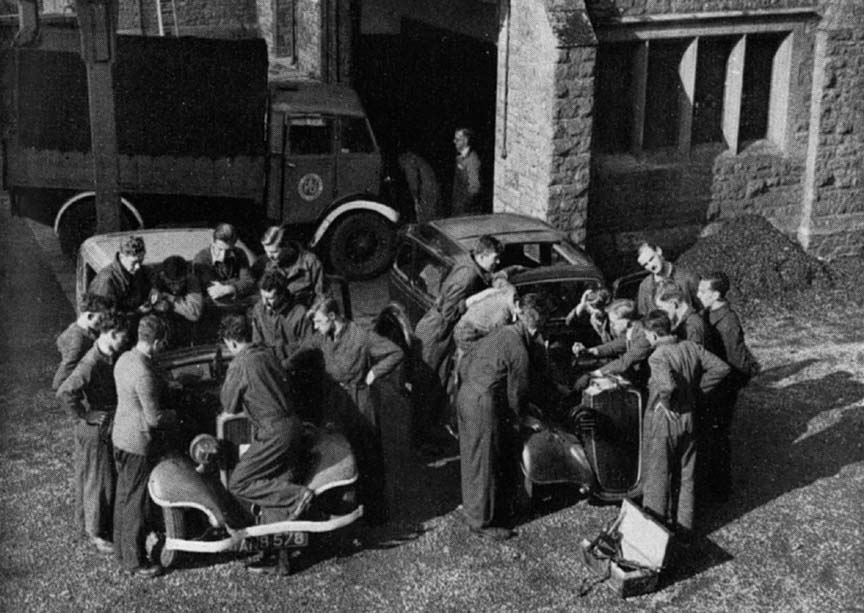
So, during 1941, the cry was for more training. Parties already selected for China or the Middle East undertook courses of repair and maintenance in large commercial garages or motor works in Luton, Dagenham, Peterborough and elsewhere. But the chief need was for a larger pool of personnel who would be already trained by the time selections of overseas parties came to be made. Training courses were inaugurated in London, and Unit vehicles prominently displaying L signs became a common phenomenon in the streets of Stepney. Driving tests were instituted by which all members who professed to be able to drive were graded according to the size of vehicle which could be entrusted to them. For training in mechanics, both theoretical and practical, members were sent in groups to Hackney Polytechnic College for eight or sixteen week courses followed up by practical work in the Unit's own garage.
Meanwhile, in May 1941, a month's course in mechanics was organized for twenty-nine members at Northfield, with Ralph Barlow as Commandant. Members of the staff of Birmingham University gave lectures on the various aspects of motor mechanics, and old engines were procured for stripping and reassembling.
In such ways the situation was saved in 1941 and the first half of 1942. Many members were taught to drive, and learnt the rudiments of motor mechanics. But it was not enough. There was little method in it, and it became increasingly obvious that part-time driving instruction in London and mechanics' courses for which the trainees lived among the distractions of an ordinary Unit hostel in London were not satisfactory. A new institution was needed away from London to which members who showed any aptitude could be sent, after their period in a training hospital, for concentrated full-time instruction. It became the aim to make the driving and maintenance of vehicles as much part of routine Unit training as the Northfield Camp and hospital work. In retrospect it was clear that the Unit had been slow off the mark in this direction; its training had savoured too much of improvisation.
The ideal centre for the purpose was found in the autumn of 1942 through the kindness of Mr. and Mrs. Herbert Tanner, who offered to the Unit part of their house at Failand, seven miles from Bristol, as a training school. Here there was excellent accommodation, together with all facilities; a garden and fields for P.T. to restore fitness after the enclosed life of hospitals or hostels in London ; country roads for beginners and easy access to Bristol for traffic driving; an outhouse for mounting the engines for practical work. On 26th September 1942 the first party of twenty reported to Failand. Between that date and March 1946 231 Unit members went through the twelve-week course, usually twenty at a time. The staff normally consisted of a Warden, three instructors in driving and three in mechanics, and a cook, all members of the Unit.
To ease the pressure on Failand in the first half of 1944 when, with the prospects of openings for relief work in Europe, as many drivers as possible were required, three shorter courses of a similar nature were held at Moor Hall Farm, Clent, near Bromsgrove, lent to the Unit by the Chairman of its Council. Here too there were excellent facilities, and thirty-five members were given training.
Failand and Clent laid the foundations. But in twelve weeks they could not produce experts. Those who showed special aptitude for mechanics were given further training, largely in commercial garages in London, Orpington, Birmingham, and later at Messrs. Appleyard in Leeds. For driving, nothing could take the place of a period of actual experience of managing heavy vehicles under a variety of conditions. Here again a solution was found. At Leominster Sand Eccleshall, a village in Staffordshire, Messrs. Challenor had depots for collecting milk from outlying farms. They were short of drivers for the lorries, and the Unit wanted work that would provide training without expending petrol on empty vehicles. An arrangement was made whereby the Unit provided the drivers and the firm paid the equivalent of wages as a contribution to Unit funds. So, in December 1942, six men started work at Leominster and four at Eccleshall. Numbers at Leominster crept up to fifteen, and a Unit hostel was opened over a bank in the main street, as accommodation for so many in lodgings was becoming impossible. After a few weeks of driving three-ton lorries on long journeys along narrow country roads in winter to collect ten-gallon milk churns from outlying farms, members who before their Failand course had never held a steering wheel could claim to be ready for service overseas.
In September 1944 the Leominster section was withdrawn, to be followed in January 1945 by that at Eccleshall. By that time the firm had regular employees available, and the Unit, with more demands for workers overseas, was finding increasing difficulty in maintaining sufficient continuity to abide by its part of the bargain. Thenceforth smaller schemes were adequate. For the summer of 1945 there was a small scheme at the village of Okeford Fitzpaine in Somerset, and further training was secured on Army vehicles at Sutton-in-Ashfield by arrangement with the R.A.S.C.
It was due to Failand and the Heavy Driving schemes that in the latter half of the war the member who could not drive and claim some knowledge, however elementary, of mechanics, was the exception.
THERE WERE OTHER forms of training undertaken by a minority of members who showed particular aptitude or interest.
The Unit at home always remained responsible for the cooking and catering in its own hostels. At first, as in every other sphere, training was haphazard. There was a certain amount of instruction given at the preliminary camp at Manor Farm, where most members took their turn when their section had its one-day-in-six of orderly duty. The better cooks were encouraged to proceed and to work with more experienced men in hostel kitchens, with occasional excursions into the kitchens of the London Hospital or Alton E.M.S. Hospital. And the Unit never produced better cooks than some of the men who learnt their job by experience in the Students' Hostel or Middlesex or Gordon Square or Gloucester kitchens.
But, in due course, in this department too more method was introduced. From each camp a few men were selected to join the corps of cooks and to receive over a period of nine months progressive training on the "Hacking ladder ". A month under an experienced instructor in a Unit kitchen would be followed by cooking alone for a small section, experience in a large hospital kitchen at Bangour or Killearn, and finally a "finishing school" at the Army School of Catering at Aldershot. A knowledge of the mysteries of vitamins and calories came to be regarded as an essential qualification of the accomplished cook, and a few choice spirits were sent on for further training in dietetics at Hammersmith Hospital.
For training was no longer directed at the limited objective of feeding Unit members. During 1943 and early 1944 preparations were intensified for European relief work, and it was felt that any relief team sent out should contain at least one member who had the requisite knowledge for dealing with feeding on a large scale. Practical cooking never figured as prominently in European relief work as some might have expected, for once given the supplies the countries in which the Unit worked were rarely short of those who could cook the food to the native taste. But on many occasions members who had been trained by the Unit found their training invaluable when the feeding of large numbers had to be supervised or food supplies distributed on an equitable basis, when diets had to be improved or surveys conducted into malnutrition.
For joinery, carpentry and building work, the best training came through practical experience in the Unit's own Work Squad, and later, after the formation of Friends Relief Service, in that organization's Work Parties. On two or three occasions special courses were organized in carpentry or bricklaying.
On three occasions sections were sent to receive training in the field with the R.A.M.C. There were further courses at the Army Blood Transfusion Depot in Bristol. The technical instruction received in hygiene and sanitation, blood transfusion, map-reading, camouflage, vehicle maintenance, assault courses, exercises, and living under field conditions proved extremely valuable. But perhaps more valuable still was the opportunity given to men who might before long be going abroad for work with the Army to acquire some experience of rubbing shoulders with Army men while still at home. Such experience brought confidence; the tendency of Unit men with the completely civilian background of their life and training at home was to fight shy of the Army at their first acquaintance with it, lest they should betray ignorance of its methods and routine that would make them feel ridiculous.
The Unit had become training-conscious; and its growing preoccupation had been indicated by the appointment in September 1941 of John Gough as Training Officer. In the summer of 1942 it became Len Darling's job to co-ordinate the various schemes of training and to ensure that as far as possible Unit members were prepared in the best way for the work that lay ahead. As the war advanced there was ever less room for the untrained enthusiast. Unit members hardly ever attained professional qualifications, but their enthusiasm was grounded increasingly in technical competence. In the latter half of the war a new recruit could look forward as a matter of routine to the preliminary camp at Northfield ; to a few months in a training hospital, to be followed by three months at Failand. Thereafter he might specialize as a driver or mechanic or return to a working hospital for further medical work. Or he might aspire to become a cook or join one of the Work Parties.
AS THE END OF the war approached, still further preparation was necessary. The Unit shared like all their fellow countrymen in the speculation, based partly on the shreds of information that came through, partly on mere guesswork, concerning the conditions which might be found among the civilian populations of the occupied countries of Europe when the allied armies entered them. On one point all were agreed: that the first relief workers to go in---and the Unit always hoped that it would be among the first---would need a depth of understanding and appreciation of the problems and strains and stresses of Europe such as they had rarely been called upon to show before.
So in June 1943 the Unit combined with Friends War Relief Service and the Friends Service Council---the official temporary and permanent committees of the Society interested in the same field---to run at a large house in Hampstead-Mount Waltham a succession of three-month courses in the technique and background of civilian relief work, with particular reference to Europe. At this Emergency Relief Training Centre thirty men and women at a time, of which a proportion came from the Unit, listened to lectures on medical subjects, on nutrition and child welfare ; on the political and social background of various European countries on the experience of Friends in Europe between the two wars. Lectures were followed by practical exercises. But most important of all was the time allotted each day for the study of French and German, and for some Italian and modern Greek.
When, in the latter half of 1943, the first Unit relief workers entered southern Europe, their insistence on the paramount importance of being able to speak the language of the country in which they worked led to a growing emphasis at home on language instruction. Language courses were introduced into the curriculum at Failand and the Northfield Camp; language study groups were started in hospital sections and for the various hostels in London. Douglas Scott was appointed Language Training Officer to co-ordinate and examine and advise. By the end of 1943 the Unit, requiring relief workers at a greater rate than was possible through Mount Waltham, opened its own training centre at Selly Wood in Birmingham, the house in Bournville which Christopher Taylor had lent for the Headquarters of the Midland Relief Section. Here, at the "Midland Assembly Depot ", for a few months parties of up to sixty members who had already been through routine Unit courses were given final training. The courses at Selly Wood, begun in faith that men would be needed, provided a pool of members who were keyed up to face any work that they might be asked to do. The centre was not intended to last for long. Its purpose was to provide in those months of keen expectancy and speculation in 1944, before the allied landings in Normandy, a corps of members ready to move off at a moment's notice, without the last minute delays and dislocations caused by hasty withdrawals from hospital and other sections in various parts of Britain.
This story of Unit training schemes, already developing into a bald catalogue, is not complete. There were further special courses for special needs; tropical medicine, Chinese, work on Diesel trucks in London; the German language school in Chelsea; and many others. But it should also be remembered that as important in preparation for service overseas as any manual skill were the lessons learnt over months and years of actual work at home; the training in routine and self-discipline, in organizing a piece of work systematically, in living and working as loyal members of a group.
THE COMMON BACKGROUND of work and training at home, loyalty to a Unit ideal and faith in Unit methods, all served to foster the inter-dependence and cohesion which were perhaps the Unit's most cherished qualities. That sense of unity was fostered in many ways. There was constant and detailed correspondence, both official and personal, between the leaders of overseas sections and the home administration. Unit officers abroad paid regular visits, often over long distances, to the sections in their charge. There were occasional visits, too, on behalf of the home administration---by Ralph Barlow and Brandon Cadbury to China, by Tegla Davies to the Mediterranean sections and Ethiopia, by Tari Nicolson and Robin Whitworth, and later by Paul Cadbury and Tegla Davies together, to north-west Europe.
There were newsletters which were produced and circulated for their members by the larger sections abroad ; Weekly Information, which went out from the Information Office at Gordon Square to bring to the Unit news of itself in other parts of the world; and the Unit magazine, the Chronicle, the purpose of which was "the free expression of news and thought in the Unit ".
It was the Chronicle most of all that became the mirror of the Unit. For six years it reflected the moods and thoughts and activities of members, never perhaps fully representative of Unit opinion---for those who most often felt the urge to write did not always reflect what their fellows thought. But in its pages it is easy to detect the slow but sure change of emphasis in the Unit's attitude to itself---starting with the heart-searching of the earlier numbers shown in long articles about the Unit's aims and purpose, how far it was to be an activist organization concerned merely with the job in hand, how far it was to be conscious of its basis of Christian pacifism and its message. And although the answer might be a synthesis, it was fruitful ground for both serious and flippant controversy. In those days the Unit was rather excited about itself.
The years passed, and the Chronicle became more concerned with news than thought. .Descriptive articles about the Unit's work overseas came to preponderate. Occasionally a voice would be raised in the wilderness ; an article or letter would take up a challenging position on some point of theology or pacifism, but the challenge was never taken up so readily or vigorously as formerly. The Unit was becoming more preoccupied with its job, its training, its urge to make itself efficient. The pressing needs of service overseas made controversy to most members irrelevant. Intellectually the Unit was undoubtedly more dull and uninspired. There was less weight and less humour.
The first magazine called the Chronicle appeared modestly in typescript in December 1939, the fourth and last issue in that form coming in May 1940. In September of that year the new and main series began. The first issue opened with an editorial,
"It is not the intention of the present editorial committee that this new Chronicle should be a purely Government organ. . . Still less are we setting out to be an opposition paper. We shall try in fact to avoid the querulous irresponsibility of opposition. But we shall not hesitate to publish criticisms."
Before the second issue appeared a fortnight later, Stanley Mackintosh had been appointed editor. Thenceforth the form was set for the eighty-three issues that followed-published every fortnight until November 1941, and thereafter every month. During that period it had seven editors: Stanley Mackintosh, Walter Ewbank, Richard Wainwright, Michael Edwards, Sydney Carter, Donald Horwood; Sydney Bailey. Once only, during the regime of Walter Ewbank, was there a clash of view between the Executive Committee and the editor about what could be rightly included in the Chronicle. The battle that was then fought for the Chronicle's independence was one of the immediate reasons for setting-up the Advisory Committee.
Hospitals, training courses, headquarters administration, the constant interchange of personnel from section to section, newsletters and the Chronicle---they all had their place in the intricate pattern of the Unit's work at home. And that work was the foundation of its service overseas, the soil from which grew its consciousness of unity.
| Alton | Emergency Hospital | Sept. 1940-Jan. 1942 |
| Arlesey | Three Counties Hospital | June 1940-June 1945 |
| Ashford | Hothfield Institution | Aug. 1940-Nov. 1940 |
| Bangour | Emergency Hospital | April 1942-June 1946 |
| Basingstoke | Park Prewett Hospital | Sept. 1940 |
| Billericay | St. Andrew's Hospital | July 1940-May 1941 |
| Birmingham | Accident Hospital Eye Hospital Maternity Hospital Queen Elizabeth Selly Oak |
May 1941-May 1943 Aug. 1944-Sept. 1944 June 1940 June 1944-Aug. 1944 June 1940-Feb. 1942 |
| Bromsgrove | All Saints' Hospital Barnsley Hall |
July 1941-March 1943 Feb. 1941-May 1946 |
| Chatham | County Hospital | Oct. 1940-Oct. 1943 |
| Coventry | Exhall Lodge | Jan. 1943-June 1943 |
| Dartford | Joyce Green Long Reach (Isolation) Southern |
June 1940-Aug. 1940 March 1944-April 1944 June 1940-Sept. 1940 |
| Dover | Dover Institution | Aug. 1940-June 1942 |
| Edinburgh | Royal Infirmary | Jan. 1943-Oct. 1943 |
| Epping | St. Margaret's Hospital | July 1940-Dec. 1945 |
| Gloucester | City General Royal Infirmary |
May 1940-Sept. 1945 |
| Gosport | Alverstoke Emergency Hos. | Aug. 1940-Aug. 1941 |
| Killearn | Emergency Hospital | Jan. 1943-April 1946 |
| Leicester | Royal Infirmary | June 1944-July 1944 |
| Lichfield | Burntwood Emergency Hos. | Jan. 1943-Dec. 1944 |
| Lingfield | Epileptic Colony | Late 1940 |
| Liverpool | Belmont Road Broadgreen Seamen's Clinic Walton Hospital |
Jan. 1943 Jan. 1944-Aug. 1944 Odd periods 1942-45 Sept. 1942-May 1943 |
| London (L.C.C.) | Bethnal Green Claybury Hackney Hammersmith Lewisham Mile End St. Alfege's St. Charles's St. James's St. Leonard's St. Mary (Islington) St. Olave's St. Peter's St. Stephen's Surrey Isolation |
Nov. 1939-May 1945 March 1940 Nov. 1939-Nov. 1944 July 1943-Jan. 1946 Sept. 1941-March 1945 Nov. 1939-Jan. 1944 Aug. 1942-April 1945 July 1943-Jan. 1946 Aug. 1942-Jan. 1944 Nov. 1939-Oct. 1940 Sept. 1943-March 1945 Oct. 1943-Dec. 1944 Nov. 1939-Oct. 1940 May 1945-Dec. 1945 March 1944 and Nov. 1945 |
| London (Voluntary) | Grove Park Guy's London Middlesex Miller General Moorfields National Hospital Queen Charlotte's Queen Elizabeth (Children) Poplar Royal Northern St. Bartholomew's St. John's (Lewisham) St. Mark's St. Mary's (Paddington) St. Thomas's Seamen's (Dreadnought) Hos. University College Hospital |
July 1945-Sept. 1945 Training in V.D. 1941 From 1941-45 Various times temporary Ethiopia Party 1941 Odd periods 1941-45 March 1943-Jan. 1944 Training early 1940 Dec. 1944-March 1945 Sept. 1940-Jan. 1944 Ethiopia Party 1941 June 1940-Sept. 1940 Aug. 1944-Sept. 1944 Feb. 1944 Ethiopia Party 1941 Training in V.D. odd times June 1940-Sept. 1940 Ethiopia Party 1941 |
| Newmarket | White Lodge Hospital | March 1941-May 1941 |
| Orpington | Emergency Hospital | Oct. 1940-May 1945 |
| Orsett | Lodge Hospital | July 1940-Oct. 1940 |
| Oxford | Churchill Radcliffe Infirmary Wingfield Morris |
Jan. 1942-June 1942 Sept. 1940-Feb. 1941 Oct. 1942-Sept. 1943 |
| Peel (Galashiels) | Peel Hospital | May 1943 |
| Ramsgate | General Hospital | Aug. 1940-Feb. 1941 |
| Saffron Walden | Hospital | July 1940-Aug. 1940 |
| Salisbury | American Red Cross Hospital | Sept. 1941-Sept. 1942 |
| Sheppey | County Hospital | Aug. 1940-July 1941 |
| Slough | Emergency Hospital | Sept. 1942-Sept. 1943 |
| Weymouth | Portwey Hospital | July 1940-July 1941 |
| Winchester | Royal Hants Co. Hospital | Aug. 1940-Feb. 1941 |
| Winford | Orthopædic Hospital | Jan. 1943-March 1943 |
| Woolwich | War Memorial Hospital | Aug. 1944-Sept. 1944 |
| Worcester | Ronkswood Hospital | Dec. 1942-Aug. 1944 |
| York | Retreat | Jan.1940-Dec. 1940 and Oct. 1943-Jan. 1944 |
CIVILIAN RELIEF on the continent of Europe was the last chapter in the Unit's story. Started in September 194 in Sicily, it gathered momentum and assimilated a growing number of members as other work---particularly work with military medical units---closed down in the course of 1944 and 1945.
Not all other work was superseded. The China Convoy, with its own programme for relief and reconstruction, remained at full strength until the Unit on its wartime basis came to an end in June 1946, when the work was transferred to the A.F.S.C. In India too some Unit members remained. But in the spring of 1945 the Ethiopian section was withdrawn ; later in the year the Syria clinics were handed over; work with the British and French Armies finally ceased soon after the end of the European war.
Thus, for its last year, the Unit's attention was concentrated almost entirely on the Far East and on relief work in Europe.
The story of the Far East has been already told: there remains the work in Europe.
AT THE END of April 1941 members of the F.A.U. had been among the last to leave the shores of Greece. As they left, the gates of continental Europe closed behind them. The Unit was determined that when the gates were re-opened it should be among the first to go back.
It was clear that the first members to return would be the men attached to the military medical units of the invasion forces. And so it proved to be. But close on their heels would follow others whose primary concern should be the civilian peoples. The military medical workers, attached by agreement to the Armies, would have to carry out the work for which they were intended; they could do no more than observe the shattered towns and villages, the ruined crops, the refugees with their pathetic bundles trailing along the roads away from the fighting line.
The years 1914-1918 had demonstrated all too clearly the effects of modern war on its civilian victims. Whatever the aftermath of the new war might be, it was universally assumed that it would be worse.
Stories of starvation in some of the occupied countries were already seeping through. It was thought that Nazi and Fascist ruthlessness would stop at nothing to avoid defeat. The systematic persecutions of racial and political groups had been in progress for many years; the enforced, and sometimes voluntary, movement of civilians to work in the war factories of Germany and German-controlled countries, and the huge numbers of prisoners taken in the earlier days of the war meant that sooner or later some millions of displaced persons would have to be fed, clothed, sheltered and, if possible,, repatriated. And even more intractable than the physical problem of relief would be the moral problem of rehabilitation and gradual reconstruction for the millions who had become driftwood in the surge of war.
Official plans were made for relief on a national and international basis. For it was clear that only by international agreement for the allocation of supplies could the problem be tackled on a large enough scale. Already by the end of 1941 there had been set up in London the Inter-Allied Committee and the Allied Post-War Requirements Bureau to investigate likely needs. By the end of 1942 the United States, now in the war, had established an Office of Foreign Relief Operations, which functioned in North Africa behind the advancing armies in the spring of 1943. At last months of negotiation culminated at Atlantic City in October 1943 in the establishment of the United Nations Relief and Rehabilitation Administration. The Inter-Governmental Committee on Refugees, founded at Evian in 1938, had been reconstituted at the Bermuda Conference in 1943. Technical Committees and Combined Boards added to the array. Potentially there was no lack of official machinery. But official organizations, however comprehensive their plans, could never render superfluous the efforts of voluntary societies which, operating on a much smaller scale, could move more rapidly and be at work while official machinery was still being ponderously geared for action.
Moreover, there were always pockets of distress which for one reason or another did not fit into the official pattern. Voluntary societies had a contribution of personal service to render even though their impact was on a small front and the material supplies which their funds could provide would not bear comparison with those provided by inter-governmental action.
British voluntary societies interested in overseas relief work had therefore already begun their own planning. The result of meetings held in the summer and autumn of 1942 between nine societies, including the F.A.U., was the establishment of a Consultative Council of Voluntary Societies to ensure co-ordination of effort, and to act as a channel through which societies could negotiate with the Government for advancing their relief activities. The number of societies grew to over twenty; and the Council, which early in 1943 changed its name to the Council of British Societies for Relief Abroad (C.B.S.R.A.) became, through its monthly meetings and through its smaller General Purposes Committee, an essential link in the planning of overseas relief work by any voluntary body. Members of the Unit sat on its General Purposes Committee for over two years, and on various sub-committees and "working parties".
The Allied Armies, through their Civil Affairs Branch, had the initial responsibility for the government of liberated areas, including relief. So long as any territory remained under military control, the Army had the last word in deciding which civilian organizations, if any, should be allowed in.
Civil Affairs was not a specifically philanthropic branch of the Army, whatever the attitude of individual officers in it. Its primary purpose as a military organization was to relieve Army Commanders of anxiety about the civilian population in battle zones and along the lines of communication, by keeping refugees safely off the roads (the Army did not forget the chaos refugees had caused in France in 1940), by restricting epidemics which might infect the troops, and by dealing with all matters concerning relationships between the Army and the local civilian authorities. For these purposes, Civil Affairs officers covered the whole theatre of operations.
In fact, much of the C.B.S.R.A.'s work came to consist of negotiating suitable agreements with the Army's Civil Affairs Branch, and later with U.N.R.R.A., for the employment of voluntary teams and for the granting of the necessary facilities. For in a war zone everything was rigidly controlled.
In its simplest terms---for in practice there were usually complications---the plan was that, as soon as an area had been liberated, the Army, through its Civil Affairs Branch, would take charge of relief, admitting voluntary societies to help if it saw fit. In due course it would hand over relief responsibilities to a recognized native government or to U.N.R.R.A., if such responsibilities fell within the scope of the latter's Charter. In either case, voluntary societies might be employed on agreed conditions.
In practice there were to be many difficulties. One was the American attitude. The American element in any joint military government was usually opposed to admitting any societies at the first stage except the Red Cross. Presumably the argument was that if any other societies were admitted it would be difficult to discriminate against the obviously unsuitable and to ensure proper co-ordination and control.
Working with the same background in Washington, U.N.R.R.A. ensured that members of American societies should be made over individually as members of its staff. When an attempt was made to apply the same pattern to British societies it was stubbornly, and successfully, resisted by the C.B.S.R.A. The negotiations for an agreement went on for months; in the event it was agreed that, where U.N.R.R.A. was in charge of relief operations, British societies should operate their own teams under their own control subject to the ultimate direction of U.N.R.R.A.
In short, a disproportionate amount of time and effort had to be expended on working out the "proper channels" before the work of relief could begin.
The Unit, with its members immediately available, was well suited to act as the spearhead of the voluntary societies. Impatient of official machinery if the latter showed signs, as it not infrequently did, of slowing up operations, it was prepared, and indeed obliged, to accept it if in the long run it ensured fuller co-ordination. But members often regretted the passing of the earlier days when they could get on to the job quickly by direct negotiation with the authority concerned. And the Unit still found it possible, as in Italy, to infiltrate by arrangement with friendly local officers into an area in which an urgent job obviously needed to be done, although officially it had no right to be there.
For the rapid development of the Unit's relief work in Europe the value of having an administration already well established at home and in the Mediterranean area cannot be over-estimated. The problems of building up a regional administration from Cairo and of establishing the Unit's position in the eyes of the authorities had been overcome with much effort in the pioneering days of work with military casualties. When relief work became a possibility, the framework within which it could be developed was already in existence. "I believe ", wrote a member, "that one of the achievements of the Unit was its organization, and the way in which large sections of work were kept in some semblance of order by their own H.Q. The Unit H.Q. was unique among voluntary societies in the field, and did a great deal to ensure the effective working of the personnel. The close contact between the regional H.Q. and Gordon Square; the flow of accurate information; the ordering of members' conduct and work by standing instructions; the organization of finance and equipment; the correspondence which enabled each man to feel that he could rely on having his ideas and complaints heard ; regular visits of inspection by Unit officers; these things build up into an impressive achievement and are brought out most forcibly by resigned members who return to say that it was not until they left the Unit that they appreciated how good the Unit administration was."
The Unit's position was in many ways different from that of other societies. Most of them were permanent bodies with long-term programmes of relief. The Unit's business was "first-aid" relief, following as closely as possible on the heels of the occupying troops. While other societies would be getting into their stride later, and remain longer, the Unit expected to make its main effort quickly and decisively and then withdraw or hand over anything of lasting value in its work.
For the work there was great enthusiasm, and steady pressure on the administration to ensure that no chance was missed. Relief work where the war had caused most devastation seemed a fitting climax to the varied activities of a pacifist Unit in wartime.
In due course the Unit's relief teams entered Europe from three directions---through Sicily and Italy, through Northern France, and through the Balkan countries. Something must be said of the many months of work and training, of the period of impatient standing-by. before the work itself could begin, of the way in which the teams eventually came to set foot in Europe.
SINCE THE SUMMER of 1943 Unit officers in Cairo had been investigating opportunities of work with Greek and Polish refugees. By the spring of 1943 there were growing indications that the first entry into Europe would be from the south. It was decided that the time had come to have a full-time Relief Officer attached to Headquarters in Cairo to follow up the investigations which were already being made. Michael Barratt Brown was sent out for the purpose. In London Robin Whitworth had meanwhile been appointed Executive Officer for Overseas Relief. Between them they were able to play a considerable part in the development of official plans. It was the moment to act. The Cairo Ministry of State's refugee department had grown into the Middle East Relief and Refugee Administration (M.E.R.R.A.), under the control of Mr. W. T. (later Sir William) Matthews. On a visit to England in April he had expressed the wish to see voluntary workers in the Middle East refugee camps; not only would their assistance be welcomed but work in such camps among refugees from Europe would be the finest possible training for work in Europe itself later on.
So began the season of complicated negotiations between the voluntary societies, M.E.R.R.A. and the Civil Affairs Branch of the Army, the complication being reflected in London by similar negotiations between the C.B.S.R.A., the Relief Department of the Foreign Office, and the War Office. The ultimate goal was the Balkan countries; meanwhile there were opportunities for work and training in Egypt and Palestine.
In Cairo, British, American, Greek and Jugoslav voluntary societies had combined to form the Cairo Council of Voluntary Societies with Sir William Matthews as Chairman. The full Council proved too unwieldy; of the two sub-committees which were at once appointed, the Personnel Sub-committee, with Michael Barratt Brown as Chairman, became very largely the operative body in planning with the military and civilian authorities the size, nature, equipment and functions of relief teams. It was pioneer work, for there was little past experience to build on and if the volumes of paper which reached London contained a vast array of plans most of which never got farther than the filing cabinets, the result at last was a workable piece of machinery.
Detailed discussions on the likely needs in the Balkan countries led to agreement on the types of teams required, teams that could combine practical skills with versatility. First of all there were to be Mobile Hygiene and First Aid Units (M.H.F.A.U.), consisting normally of thirteen, among whom should be a doctor, a state registered nurse, and an assistant nurse; the rest of the team would consist of a quartermaster, sanitary inspectors, a laboratory technician, and men who could between them combine with driving some skill in mechanics, cooking, medical work, disinfestation and interpreting. The function of such teams would be, as the name implied, the emergency organization of medical facilities in areas newly liberated. Secondly, Relief and Refugee Units of ten would take responsibility for the administration of refugee camps or general relief for the indigenous peoples; their composition would be roughly similar to that of the M.H.F.A.U.s, with welfare and information, officers substituted for those with professional medical qualifications. There would be Field Bacteriological Units to provide laboratory facilities for emergency public health work, including the testing of water supplies---an important requirement in the Balkan countries. Others would serve as Stores Officers and Stores Drivers and as individual Health Welfare workers.
Such was the pattern, and to provide the teams some 450 workers of British voluntary societies were sent out over the year following October 1943 in response to requests from Cairo. The first party to sail was an F.A.U. one; 32 men and women left England in January 1944 under Keith Linney and Arnold Curtis, to be followed in March by 37 more under Lewis Waddilove. That was to be the Unit's main contribution to relief work in the Balkans.
But meanwhile, before any of them could arrive, the Unit had made a beginning with the personnel which it had already available. In July 1943 three members had gone down for training at a Camp for Greek Refugees at Moses Wells in the Sinai peninsula. After moves for further training they became the nucleus of No. 1 M.H.F.A.U., the first team asked for by the Civil Affairs Branch through M.E.R.R.A. Most of its members were men detached on loan from No. 1 Blood Transfusion Unit. It assembled in Cairo on 7th September, with Pit Corder, a veteran of Finland, in charge; stores and equipment were drawn from Army Ordnance, and it was ready to move off.
Its destination was Rhodes, to follow up the intended attack in the Dodecanese, which proved abortive; it was the brief campaign in which Stephen Peet and Dennis Westbrook, with No. 12 Field Surgical Unit, were taken prisoners. The M.H.F.A.U. never reached its destination.; instead, it moved off at the end of September to the Army School of Hygiene at Sarafand. Thereafter its members, collectively or apart, proceeded to other, forms of training. Meanwhile M.E.R.R.A. was faced with the responsibility for large numbers of refugees from the Greek islands and the Dodecanese, following the misjudged invasion, and existing camps were inadequate. A large new camp was established at Nuseirat, on the coast of Palestine seven miles south of Gaza: Staff had to be assembled quickly, and No. 1 M.H.F.A.U. was offered for assistance on the Medical and Hygiene side. At Nuseirat it found its first real job.
PLANNING STARTED in the Middle East, but it was not in the Balkans that the Unit first re-entered Europe.
In the summer and autumn of 1943, in the Central Mediterranean area, members attached to military medical units and Red Cross stores had crossed into Sicily. In September Norman Barns and Leo Davies, working with the Red Cross store in Catania, found time to visit the civilian hospitals in the city. Conditions were pitiful; gross overcrowding was complicated by shortages of blankets and linen, drugs and medical supplies and even food. They begged and scavenged what they could from the Army and any other available source, and at the beginning of October were officially attached to the Public Health Office of Catania province. They thus became the first F..A.U., and probably the first British, relief workers of any kind apart from the Army, to serve on the continent of Europe. In December two members who were on their way from Morocco, where they had left S.I. 84155 on its arrival at Rabat, were diverted to Sicily to assist, and in January a fifth was added.
It was another instance of Unit members in the field finding their job and getting on with it instead of waiting on lengthy and inconclusive negotiations in London and Washington. Their presence in Sicily broke all the rules laid down on the higher levels of relief planning. For the willingness shown by the Army in the Middle East to recruit the help of voluntary societies for civilian relief did not extend to the Central Mediterranean, where American influence was stronger. Only the American and British Red Cross were to work among civilians; their personnel were just beginning to arrive. John Rose came across from Cairo in November to try to regularize the Unit's position and offer more men.
On the spot in Italy and Sicily, where the needs could be clearly seen, Military Government officers showed considerable enthusiasm for as many men as were available. Senior officers cabled to London for more F.A.U. men, only to find that an American general in Algiers upheld the Red Cross monopoly. The Unit had to carry on in its anomalous position with its handful of men.
And then, through another side door, more Unit men arrived, this time from England.
The Unit's contact with the Medical Research Council at home led to an invitation in the autumn of 1943 for a section to join a typhus research team intended for Algeria. With Dennis Mann in charge of the Unit group of twelve, the team found itself unexpectedly diverted to Naples, where there had been a sudden outbreak of the disease. For the first three months of 1944 the section was hard at work in a hospital on the outskirts of the town. Two members assisted in the laboratory, the others undertook a variety of jobs, mainly routine nursing.
Towards the end of March the epidemic had subsided. By local arrangement, the members of the team were transferred to other forms of civilian relief, some in camps for Jugoslavs in the heel of Italy, others as welfare officers in camps for Italian refugees set up behind the Gustav line.
By this time Peter Gibson had arrived in Italy and opened a Unit office in Naples. The Blood Transfusion sections and the Hadfield Spears Hospital were at work in the country. There was no difficulty about them; it was only when work for civilians was involved that questions of principle arose. But at last the civilian work was officially recognized, including the local arrangements made in Catania. A directive was issued attaching members of the F.A.U. to Allied Military Government and the Allied Control Commission The Unit became entitled to rations and accommodation. On paper as well as in fact it was at work in Italy.
AFTER THE ARRIVAL of Lewis Waddilove's party in Cairo in mid-April there were over eighty members of the Unit destined for Relief in the Balkans. But 1944 wore on, and still the Balkans seemed as far off as ever. In fact, almost the whole year was spent in Egypt or Palestine.
On 1st May 1944 U.N.R.R.A., which had been for some time hovering on the horizon, entered the field and officially absorbed M.E.R.R.A. to form the U.N.R.R.A. Balkans Mission. For a time there was considerable confusion, since many of the different divisions of U.N.R.R.A. arrived in instalments, and business would be held up until the responsible administrative head reached Cairo.
Furthermore, most of the U.N.R.R.A. officials, briefed in Washington, came with a totally different conception of the use of voluntary societies. At this point Michael Barratt Brown felt that he could best serve the cause of the voluntary societies from within U.N.R.R.A. and resigned from the F.A.U. His place was taken by Lewis Waddilove, who remained the Unit's Relief Officer until he came home in January 1946 to be Chairman of the Executive Committee.
For all the officers concerned the summer and autumn became an almost continuous progress from conference to conference and crisis to crisis, as one proposal after another came forward from Allied Military Liaison (the title assumed for the Balkans by the Civil Affairs Branch) or from U.N.R.R.A., which would undermine the whole structure of their work as conceived by British voluntary societies.
There was danger---in fact the present chapter's preoccupation with the intricacies of administration inevitably emphasizes the danger---that relief work, essentially a human relationship between helper and helped, would become overlaid with a mass of bureaucratic planning. Fortunately most of the workers did not have to spend the summer in the Maadi Training Camp, a dreary collection of huts in the hot and sandy waste outside Cairo. There was work to be done among refugees, and the months spent in the Middle East refugee camps brought the main body of the section face to face with human needs, and undoubtedly restored its sense of perspective. So it would be well at this point to interrupt the tale of preliminary negotiations with some account of actual relief work done during that period of waiting in the Middle East.
The refugees, Greeks and Jugoslavs, were accommodated in vast camps that had mostly been military encampments when Egypt and the Canal Zone and southern Palestine were filled with troops before the time of Alamein.
Greek refugees, mainly from the islands, were housed at Nuseirat in Palestine and Moses Wells in the Sinai peninsula. The Jugoslavs began to arrive in the early spring of 1944. In the middle of January, No. 1 M.H.F.A.U., then at Nuseirat, had been called down to El Shatt, near Suez on the eastern bank of the canal, where a large new camp was to be established. News had been received that somewhere between 20,000 and 70,000 Jugoslavs were being evacuated from the Dalmatian coast to Italy, that the Allied authorities in Italy could not cope with them and that they would be moved to Egypt as a M.E.R.R.A. responsibility. M.E.R.R.A. planned to send over representatives to Italy to meet the refugees, to assist on the voyage across and to register the entire shipment so that the camp authorities would have proper records from the start. Philip Sanford flew to Bari with a M.E.R.R.A. officer and was followed by three more Unit men and Howard Wriggins of the American Friends Service Committee, who had worked on American relief in North Africa and was now investigating needs in the Middle East on behalf of the A.F.S.C. He lived for a time with the Unit at Bab el Louk, and so began in the Mediterranean area the close association with the A.F.S.C. which had already been achieved in China and India. Soon afterwards Ted Randall of the F.A.U. went over to Algiers to work there with the A.F.S.C. and complete the interchange.
Between January and April three convoys of refugees were accompanied by Unit members. The camp at El Shatt, large though it was, was not large enough; a new camp was opened at Khatatba, and a smaller one, mainly for Jugoslav Royalists, at Tolumbat. And in the camps the Unit worked throughout the summer. A disposition list in June showed thirty members with the Greeks at Nuseirat, twenty-seven with the Jugoslavs at El Shatt, and ten at Khatatba. They worked alongside members of many other voluntary societies; and all were subordinate to the camp administration provided by the Army. At El Shatt alone the total British military and civilian staff numbered about 150; the number of refugees was about 25,000, housed, under a Headquarters section, in three sub-camps extending for miles across the desert---a small town in itself.
The primary purpose of relief and refugee administration is to provide the basic necessities of life, food, clothing and shelter. But the secondary aim is no less important; to restore to the refugee, suddenly torn up by the roots from his home, a sense of normality; to provide constructive interests and occupations and, by the fostering of democratic methods, to build up a sense of community. In a vast encampment of tents and army huts extending for miles across the sand of the desert under the blazing sun of Egypt, it was not easy to foster a vigorous community life. Let us look as the camps.
"It is early morning, and as the long train slowly comes to a halt on the siding, hundreds of refugees gaze at the sandy scene opening before them. In the foreground is the desert, with a white mass of tents visible in the distance, and in the background the dark mountains of the Sinai peninsula. .
"The sound of a multitude of voices can be faintly heard in the distance. Soon moving, specks are visible, and a vast crowd of people begins to arrive in eager groups. They are earlier arrivals in the refugee camp, who have trouped down to the siding before breakfast to look for relatives and friends. They mingle with the little parties huddled together round their scanty luggage. . .
"A few of the new arrivals have suitcases, but more carry only sacks and parcels. Some of them bring nothing but the clothes they wear. . .
"They flock in, the back clangs up, someone chalks a number on the side, and the lorry moves off, bumps over the sand, on to a road, past huts and rows of' tents, and then along a rough improvised track of wire netting laid over the desert, towards a metropolis of tents which, for an unknown period, is to be their home.
"The next day the new batch has to go through the triple ordeal of being disinfested, vaccinated and inoculated. On leaving the shower-baths they pass down a rope passageway through a long, noisy tent. The doctors and assistants stand on either side at trestle-tables. As there is a high proportion of children, the scene is soon reduced to chaos, with youngsters screaming and kicking and helpers struggling to keep order.
"In a few days the refugees have sorted themselves into family groups in the tents and begun to feel at home. Men, women and children live together, with no division walls and with almost the whole floor space occupied by low beds two or three feet apart. The complete absence of privacy must be one of the most irksome conditions of this new life.
"Almost every tent has its portrait of Tito, often home-made, as well as its Churchill-Roosevelt-Stalin trio.
"Each tent has also its items of home-made furniture improvised out of wooden boxes and pieces of timber. Sofas are made of beds draped with rugs. Little bits of coloured ribbon sometimes hang on the walls. Often a design is traced with pebbles in the hard sand outside the door. In such ways as these the refugees have made their tents surprisingly habitable . . . . For the most part they are kept spotlessly clean, although the same care is not always extended to anything outside their living quarters. Constant effort is required to impress upon them the need for keeping the dining tents and lavatories clean, and to take the necessary precautions against flies.
"All meals are cooked communally and eaten in a large dining tent. The food, both in quantity and quality, is generally approved; though one does not eat a great deal owing to the heat.
"Each section of the camp elects its own executive committee, which is responsible for the details of administration. The camp as a whole likewise elects a committee, responsible both to the U.N.R.R.A. camp staff and to the Jugoslav central committee for refugees, created by Tito's government.
"In these novel, and in many ways trying, surroundings, life goes on from day to day in a fairly even and normal way. The men work, mostly in constructional and hygiene gangs; the children go to school, though only for a few hours a day; the women clean the tents, wash the clothes, cook in the communal kitchens, and so on. But superimposed on this. adapted village life, and probably giving it a valuable cohesion in face of the abnormal conditions, is the keen patriotism and sense of social revolution which is uppermost in the minds of nearly all the younger people, for they are ardent followers of Tito, and members, body and soul, of the Jugoslav Partisan movement."
That was El Shatt. With a few modifications to suit altered terrain and conditions, it would fit Khatatba. It would do even for Nuseirat if allowance is made for the many differences between Greeks and Jugoslavs and for the fact that life on the Palestinian coast is more palatable than in the deserts of Egypt or of Sinai.
What did the Unit, among other voluntary workers, do in the camps ? There were almost as many varieties of work as there were workers, but activities fell mainly under the twin heads of health and welfare. Camp administration was usually in the hands of Army officers, although in one of the El Shatt sub-camps Arnold Curtis acted as Administrative Officer and Keith Linney as Adjutant. Other members worked as doctors, nurses, and orderlies in the camp hospitals; as quartermasters, as store keepers and kitchen supervisors; as hygiene and sanitation officers, which involved being responsible for the supervision of latrines, fly traps, grease traps and garbage disposal---all potential sources of infection in large temporary communities in the heat of summer. They distributed clothes, kept registration records, organized information services---for hordes of refugees are always hotbeds of rumour--and instituted occupations and trades, workshops, shoeshops, sewing rooms. Women members ran baby milk and bathing centres. In Nuseirat, .Michael Asquith edited a camp newspaper in Greek, while David Tit became organizer of labour. In any camp the latter was a key job, for the aim was always to bring the refugees to do their own work under whatever technical supervision was necessary. At Nuseirat alone there was in July a total pay-roll of 1,200 in a camp of 10,000, which included a high proportion of housewives, young children and aged persons.
"In the camp you would find Agamemnon Cleopas (clerk); Cleopatra Sevastou (clerk) ; Akilles Jouannou (driver) ; Hippocrates Englezoe (builder) ; Melpomene Faga (who cleaned my office); and the ten-year-old Sokrates who was having measles. . .
"One felt a little nervous when suggesting to a row of shy Euphrosynes, Andromaches and Irinis that the hospital was very short of ward maids. Some might conceivably have been persuaded to join a sewing room (all women), but no mother could be moved to permit her sixteen-year-old daughter to go so far away as the hospital (one mile). So they sat all day in groups of four or six under the watchful eye of a mother. The tight family pattern of the Greeks persists even into refugee life. . .
"One question troubled me that I had not anticipated. From the Labour Exchange I built up a squad of builders and to solve one of the problems of materials founded a brickyard. Tools were short, of course, but brick production was held down in the first week because the men would insist on working in a gang. All the men, twelve to fourteen, dug clay; moved on to mixing clay, straw and water; and then began to mould bricks. It was extremely difficult to persuade them to adopt a distribution of man-power that would keep the four brick patterns in constant use. The men, all from the Dodecanese, had had no experience at all of division of labour. Our brick production actually progressed as follows: Tuesday to Saturday; , 6, 46, 361, 480---total for the week, 897. This increase was in part due to splitting up the men into groups. As soon as more patterns were made the employees in the yard would be increased to about thirty and production would be about 1,000 bricks a day."
The summer in the camps was a time of waiting, but the job was one worth doing. For work in Greece and Jugoslavia there was no better preparation than camps of Greeks and Jugoslavs. And Greeks and Jugoslavs were no less worth helping because the Mediterranean separated them from their homes.
Late in. July began the process of withdrawal of voluntary workers from the camps. By September the Maadi camp was full of voluntary society groups, being arranged into teams on the pattern already agreed upon, drawing equipment, and wondering as one hot and dusty day succeeded another when they would be able to move off. At a meeting held between Allied Military Liaison, U.N.R.R.A. and voluntary society groups, each team was assigned to a particular country mission, and where possible to a district within that country. The Allied entry into the Balkan countries was awaited hourly. The fully mobilized teams stood by.
The F.A.U. had one M.H.F.A.U. and one Relief and Refugee Unit destined for Jugoslavia, one M.H.F.A.U. for Albania and one R.R.U. for Greece. In addition, there were groups of stores officers and drivers and the nucleus of a Field Bacteriological Unit for each country. A third M.H.F.A.U. assigned to the Dodecanese was expected to be called forward immediately. But its hopes of being the first on the job were not realized. It was in fact the last team to leave Egypt.
Early in October British troops landed in Greece. A few days later, on 13th October, four representatives of the voluntary societies, not themselves members of teams, sailed for the Piraeus; of the four, two were members of the Unit, Lewis Waddilove and Jack Eglon, the latter travelling as British Red Cross stores officer.
A fortnight later Brigadier Armitage of the British Red Cross and Lewis Waddilove returned. They reported that help was urgently needed. Greek voluntary societies were anxious to welcome them.
But the political situation in Greece deteriorated rapidly; fighting broke out again and it was doubtful whether the main teams could be called forward for some months. One F.A.U. party only had gone in-five members of the Medical Stores and Transport Unit under Harold Dromard.
The A.M.L. and U.N.R.R.A. Missions for Jugoslavia and Albania had transferred their Headquarters from Cairo to the Italian coast near Bari ; in mid-November the teams destined for those countries followed them to Italy. They left Cairo with high hopes that their period of waiting was at last over. But it was not to be. Political complications over the entry of any foreign relief workers into Jugoslavia and Albania held them up further. The team for Albania never entered that country at all but was diverted to Western Greece. Only a few reached Jugoslavia, and that not in the team formation originally envisaged. Meanwhile, most of the teams turned their attention to Italian relief alongside the existing Unit section.
Rarely had so many hurdles to be surmounted before a job could start. One of the qualities most necessary for a relief worker is patience. It was with feelings of envy that the teams had heard that early in September two Unit civilian relief sections had crossed from England to France.
BACK IN ENGLAND, the Unit, though watching every move made by its members in the Middle East and Central Mediterranean, had more than enough to occupy its thoughts. A possible "Second Front" in north-west Europe had from the beginning of 1943 onwards become a never-failing topic of conversation. Sooner or later the assault would be launched ; if it succeeded, it would open a vast new arena of suffering and distress.
Early in 1943 discussions had been initiated with the War Office concerning the use of Unit sections, attached to the Civil Affairs Branch, in the treatment of civilians who would inevitably fall victims to the assault. In July 1943 the Unit was warned that men might be needed at short notice. Training was expanded. But as the months passed and Anglo-American plans became more detailed, the scheme grew more uncertain.
D-Day came ; Unit sections for military casualty work with the British and French Armies crossed to Normandy. But seventy civilian relief workers, standing by at the Midland Assembly Depot in Birmingham, remained where they, were. The flying bomb attacks started; members were moved from Birmingham mainly for emergency work in the bombed areas. Then suddenly the prospect cleared. The Civil Affairs Staff of S.H.A.E.F. agreed to accept the American and British Red Cross organizations for civilian relief. The Italian pattern was being repeated. The British Red Cross eased the situation by offering its sponsorship to other societies that wished to work with it; they would retain their identity but become part of the Red Cross Relief Commission for operational purposes. Such an arrangement would satisfy S.H.A.E.F. The Unit gave a lead in urging that the compromise should be accepted; the important thing was to get the job done. The consequent Agreement was quickly followed by a specific request from 21st Army Group for a mobile hospital and three ambulance teams for Normandy. The British Red Cross and Order of St. John provided the hospital staff; the Scouts' International Relief Service staffed one ambulance team and the Unit, with twenty-three men, provided the other two.
On 3rd September 1944 the teams embarked for Normandy.
BY THE END OF 1944 the Unit had entered Europe at the three points intended---through Sicily and Italy, through France, and through Greece. In the course of 1945 a section was sent forward from Italy to Austria, and as the teams attached to the Red Cross Commission in Normandy moved forward through Belgium and Holland into Germany, another Unit section, under other auspices, followed it into France and stayed there.
Thus did the pattern develop, so that Unit relief teams, comprising over three hundred members in all, found themselves at work in Sicily, Italy, Austria, Greece, Jugoslavia, the Dodecanese, France, Belgium, Holland, Germany, and continued well into 1946.
Throughout, the Unit's main contribution was one of personnel. Small consignments of equipment from Unit sources were sent out to facilitate the work of Unit teams, and the food situation in Germany in 1945-46 was such that some thousands of pounds were spent on supplementary food supplies for special schemes. But as a general rule the supplies were sent in bulk by the Army or by U.N.R.R.A. or other purchasing organizations; the Unit provided workers to help where help might be needed.
And it was needed. In the welter of suffering amid the displaced and distressed millions of Europe, the efforts of a few voluntary workers over a year or two appeared puny and insignificant, to themselves most of all. But that made assistance, even as a gesture of goodwill all the more important.
So far, the story has been told from the point of view of the administration. It is time to tell it country by country from the point of view of the worker in the field.