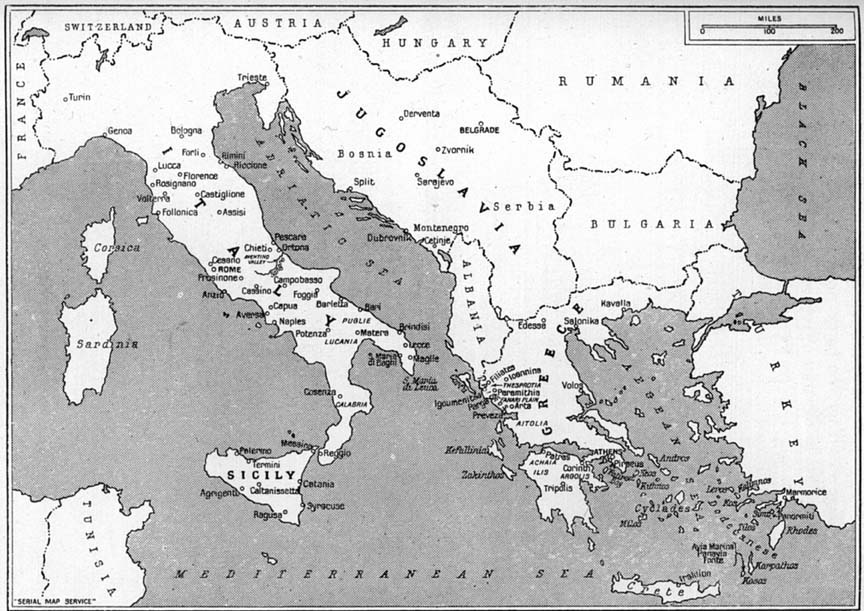
ON 10TH JULY 1943, Allied troops landed in Sicily. In thirty-eight days the conquest of the island was completed. But success was not achieved without hard and stubborn fighting, particularly around Catania, where the British Eighth Army was checked for three weeks before advancing against obstinate rearguard actions towards Messina and the Straits.
Before the island was fully won, the Fascist régime had already fallen; on 24th July Mussolini had been overthrown. Early in September, on the day on which the Allies landed troops on the toe of Italy, the new government under Marshal Badoglio signed an armistice.
But the war was far from being over for the ill-fated people of Italy. The Germans, before the end of the year, had established a firm line from sea to sea, well to the south of Rome. Naples and the south had fallen, but two-thirds of the Italian nation was still under German control.
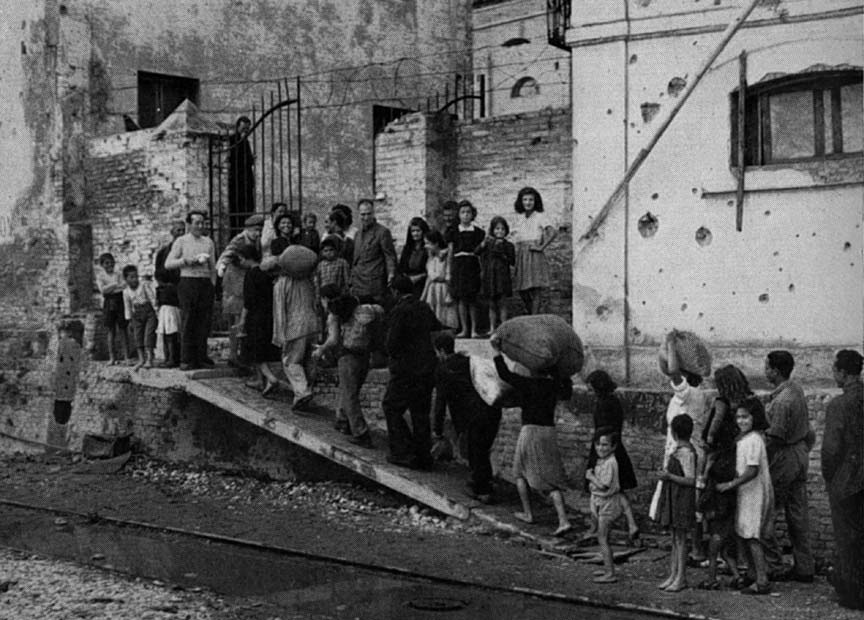
The next sixteen months which ended on 29th April 1945, when all German troops in Italy surrendered unconditionally, brought bitter and relentless warfare. First came the Anzio beach-head and the winter's snow and rain and mud, then the Allied push in May 1944, the shattering of Cassino, the breaking of the Gustav Line, and, early in June, the fall of Rome. From town to town and village to village the battle proceeded, and every mile of the advance added to the trail of refugees, who, with their bundles on handcarts or on their backs, trekked away of their own accord from the fighting line in search of food and shelter, or else were systematically removed by the authorities to refugee camps. Cassino and the small towns behind the Anzio beach-head were only the worst of hundreds of broken towns and villages. Economic distress added to material destruction produced a bewildered and disillusioned people.
The conduct of Civil Affairs in the peninsula was originally in the hands of Allied Military Government of Occupied Territories (A.M.G.O.T.) which soon became simply A.M.G. As areas to the rear of the fighting were pacified they became the responsibility of the Allied Control Commission, while in the forward battle zones A.M.G. continued to operate.
THE ENTRY OF THE F.A.U. into Sicily and Italy for civilian relief work has already been described---first the transfer in September 1943 in Sicily of two members engaged on Red Cross stores and their attachment to the Public Health Office of A.C.C., Catania province; and later the arrival of the Typhus Research team in Naples.
When Norman Barns and Leo Davies, while still on Red Cross stores work, explored in their spare time the state of the Ospedale Vittorio Emmanuele and the Ospedale Garibaldi and other medical institutions in Catania city itself, they were dismayed by what they saw.
"I have never seen a greater need for Unit work than here. Let me say that, although I am not looking with sentimentality on the question, yet it wouldn't be hard for a man to weep at what he sees. I ask, nay beg, to be allowed to remain here, to work in one of the civilian hospitals . . . . If it is at all possible, I would like to receive parcels of dressings, clean linen, and anything which could be used as dressings. . ."
The war had recently passed over Sicily and had aggravated the poverty and scarcity and squalor. Catania, a province of some 800,000 inhabitants, was specially affected. Hospital building were destroyed and damaged; linen, dressings and drugs were often in such short supply as to be virtually non-existent, and food of any variety or nutritive value was unobtainable except on the Black Market.
The two original workers did what little they could.
"We have been asked to take on the job of medical care and health. This entails regular visits to all institutions for health and medical care, seeing that they have sufficient food, clothing, essential requirements . . . . Most stuff has to be scrounged. Up to the present I have collected about two tons of bandages, dressings and medical equipment, begged from various sources."
The arrival of three more workers made it possible to attack the problem more systematically, and a detailed survey was instituted of all hospitals in the province-seventeen hospitals with a total capacity of 2,500 beds. Early in March a report was written. It merely served to strengthen the original impression, but provided a basis of knowledge by which conditions might be improved.
"General lack of window glass . . . serious financial difficulties hardly a patient properly fed . . . some patients suffering severely from the cold and lack of clean linen . . . acute shortage of medical supplies . . . soap and coal in very short supply all shortages accentuated by lack of money, lack of transport, requisitionings, illegal sales and robberies. . ."
The report went on,
"It was apparent that a comprehensive scheme of reform was required to enable these institutions to resume their proper function in the community. Any scheme would be valueless unless it had public support, therefore the interest of leading citizens had to be aroused and the reforms so devised that they would continue to operate after Allied Government and advice had ceased. The reforms would have to be carried out by the Italians themselves and the work of administration of the hospitals of the province would have to be co-ordinated."
So a meeting had been held, under the joint auspices of Allied Military Government and the Italian Prefect, of all the leading interests, and as a result a Commission was established, with appropriate sub-committees to deal with special problems such as Finance, Administration, Sanitary measures, Supply and Transport. The committees were soon allowed to die a natural death and appointments made of paid technical experts, but under the Commission's guidance a great deal was achieved. Loans were made to hospitals; their affairs were investigated by. qualified auditors, a minimum hospital diet scale was drawn up and supplies of soap and coal reserved for them.
 |
 |
Some of the Unit's energy was devoted to fostering or reviving the local manufacture of certain supplies---plaster of Paris, cotton wool, synthetic vitamins, vaccines, terracotta bedpans and urinals. For the rest, each member, in conjunction with the sub-committees of the Commission, concentrated on a particular aspect of rehabilitation work. There was always a certain amount of individual case-work into the bargain.
In February, A.M.G. had come to an end in Sicily and given way to the Allied Control Commission. The hospital rehabilitation work was henceforth to be more and more handed over to the Italians themselves, but for a time the section, at A.C.C.'s request, carried on with the attempt to secure milk and special foods for the hospitals, to work out a system of distribution, to re-establish local medical industries, and, through visits to Naples, to obtain hospital supplies and window glass not available in Sicily. A malarial survey and clothes distribution added to the variety of work, which most of all required improvisation and versatility.
At the end of April, Peter Gibson, now in charge of work in Italy, paid his second visit to Sicily. He had recently discussed the position of the section with Brigadier Lush, Executive Commissioner of A.M.G./A.C.C., and it had been decided that three of the five should be transferred to what was becoming an urgent need---work among refugees. For Sicily was filling up with refugees from the mainland of Italy.
A.M.G./A.C.C. operated through a number of sub-commissions, of which two dealt with those whom the war had uprooted---the Internees and Displaced Persons Sub-Commission (I.D.P.S.C.), which was concerned with non-Italian refugees in Italy, and the Italian Refugee Branch (I.R.B.), which was responsible for native Italians temporarily displaced by the fighting.
So long as they remained in refugee camps, such Italians were the responsibility of I.R.B. But with the constant influx of fresh refugees the earlier ones were moved south to Sicily and Calabria and there billeted on the local communes (the units of local government), where they became the responsibility of the Italian Government under the general supervision of the A.C.C. Regional Commissioner.
Under this arrangement it was estimated that 12,000 Italians from Cassino and other sections of the Gustav Line had been drafted into Sicily, where they were distributed from the transit camps at Syracuse and Termini. Five of the nine provinces received a quota, the refugees being sent out to the communes in groups of varying sizes. The commune, through its sindaco (mayor), was legally responsible for billeting refugees in empty buildings or requisitioned houses, for making food available and providing medical attention.
Some of the communes were efficient, but the majority failed to do their duty by the refugees, who were unpopular guests. The war was far away to the north and Military Government officers had followed it. Sicily was already a backwater and A.C.C. had not the personnel to provide adequate supervision. So it came about that the Unit was asked to provide members for work among the refugees---Tony Gibson for Ragusa and Syracuse province, Colin Giffard in Agrigento, and Peter Bamford, who later came over from Italy, in Palermo. Leo Davies and Norman Barns continued in Catania with their work for the Public Health Department.
After three months of the new work one member wrote:
"At present my line of work is to go to each group of refugees, anything from 20 to 200 in number and billeted in requisitioned cottages, orphanages, schools and barracks, and spend an hour or two listening to everyone's views and troubles, explain to them why they can't have some things, how they might improvise others, and try to bring the local officials up to scratch if I think the refugees aren't getting their rights according to the local orders and availabilities. I reckon that I hear queries in this order: clothes, shoes (some are barefoot and others are wearing bits of skin or linoleum), food---especially for children---news of relations or friends lost in the evacuation, news of P.O.W.s, desire of men to return to reap their harvests, possibilities of local work. The smallest and poorest communes appear to treat refugees more generously and understandingly than the larger and richer. I'm trying to get the latter to make their refugee committees more representative of non-officials, including women, and in one or two cases to include refugee representatives . . . . The principal subject of my harangues to the refugees (I have now a sort of stock stump speech in Italian that I rehearse in reply to each meeting) is telling them how to help themselves, and I'm trying to get every commune to donate raw cotton to the women and a little wood and tools to the men so that they can make spinning wheels and start knitting and sewing clothes for themselves. I'm hoping to get some salvage cloth to distribute. Also allotments for the men who are mostly peasants. In some communes there is work for the harvest."
Beginning with the re-distribution of refugees to eliminate over-crowding, the improvement of sanitary conditions and the supply of bedding (if only improvised from tents or flour sacks), the work went on to deal with supplies of soap, disinfectants and medical stores, the standardizing of food rations and the exploration of local employment. The workers found themselves very much involved with Italian local authorities, sindaci, prefects, commissioners for refugees, commandants of refugee camps, representatives of charitable organizations and the Italian Red Cross. Visits of inspection to camps and billets gave opportunities for a great deal of miscellaneous welfare case-work, and representations were constantly made to the Italian authorities or to A.C.C. with a view to altering the existing regulations.
Sicily is a backward island, and the lot of refugees herded together in some gloomy school building in an upland village was not a happy one. They were mainly peasants, and as the year 1944 wore on they became increasingly restive and anxious to return home to reap their harvest, if harvest remained, or at least to prepare for the next year's harvest. There were constant rumours of repatriation and conflicting orders emanating from different sources in Italy. In July a member wrote:
"The general refugee position is becoming increasingly chaotic. We compared notes at our last meeting and found that the crop of rumours about repatriation is having the same effect all round : refugees are reluctant to think about Quakerly occupational therapy like spinning and cobbling, and where they had been cajoled into beginning they have now stopped ; there is a ban on unauthorized travel, but refugees are taking French leave in increasing numbers in order to get back to their harvests; communal and provincial officials are inclined to fall back on all their good resolutions on the excuse that it isn't worth bothering about as they will be gone soon anyway."
The refugees had to be retained in Sicily since for most there were no homes to return to, and no transport to take them. When they hopefully arrived in Messina to cross the straits to Italy, they were turned back. Norman Barns and Leo Davies, in addition to their work in Catania, became more and more involved in helping to sort out the confusion in Messina, caused partly by those trying to make their way home illicitly, partly by fresh groups of unheralded refugees still arriving from Reggio. It was not until the winter of 1944-45 that repatriation to the mainland took place on any scale, but the alarms and rumours continued throughout the year. With these and similar problems the Unit continued to wrestle to the best of its ability. Two more members arrived from Italy in November, but by the beginning of February the main job was over and the last members were withdrawn.
Work in Sicily was not spectacular. Indeed, it was rapidly becoming forgotten territory as the progress of the war shifted interest farther to the north. Twelve thousand peasants, however great their misery, could easily be overlooked when more exciting tasks were afoot, but that made it all the more important that someone should stay behind. It was an obvious instance of a voluntary society helping to fill a gap in the official plans.
MEANWHILE ON THE MAINLAND also civilian relief had been begun. In February 1944 the Typhus Research Unit, the work of which has already been described, arrived in Naples ; when that work came to an end, eleven of its twelve members were re-assigned to other work. Of the eleven, seven were attached to the Internees and Displaced Persons Sub-Commission for work in the heel of Italy ; the other four acted as Welfare Officers and Administrative Assistants, each in an Italian refugee camp.
Let us first look at the work in the heel. The transport of Jugoslav refugees from the heel to Egypt has already been described in connection with the M.E.R.R.A. (later U.N.R.R.A.) refugee camps in the Middle East. Refugees, mainly old folk and women and children, were shipped across, particularly from the islands off the Dalmatian coast. By the autumn of 1944 over 30,000 had passed through the heel to the Middle East ; there were about 12,000 still left.
On arrival in Italy, the refugees usually passed through No. 1 Transit Camp outside Bari, staying there a few days for disinfestation, screening by Military Security, and allocation to holding camps, of which the two main ones were at Santa Maria di Leuca and Santa Maria di Bagni, both small and delightfully situated seaside resorts where the expensive villas of wealthy Italians were given over almost entirely to them.
They arrived in Italy under-nourished and in rags, and their medical needs were very great. At Leuca a small, newly-built Italian sanatorium was used as a hospital with accommodation for just over a hundred patients. It received T.B., maternity and chronic cases from all the camps. Inland, at Maglie, a hospital twice the size also catered for all the camps in the heel. It was to these two hospitals that the seven men attached to the I.D.P.S.C. were assigned.
Their arrival coincided with the withdrawal of Army personnel who had been helping out with the nursing throughout the winter; there remained an R.AM.C. doctor in charge of both hospitals, two or three British Red Cross sisters, and two or three Italian doctors---the numbers varied from time to time. Apart from them, the hospitals were dependent on untrained, but very willing, Jugoslav girls who had to be constantly supervised.
The result was hard work. The Unit men acted as wardmasters and quartermasters; they helped with the nursing and clerical work, supervised the Jugoslav girls, and did everything they could to relieve a situation that was becoming critical. According to the R.A.M.C. major in charge, the position had become such that the arrival of seven men with some experience and initiative though no professional qualifications, to assist the hard pressed doctors and sisters, made all the difference between the collapse of the work and its continuance.
For the undernourishment and strain of the preceding months bad taken their toll of the refugees, particularly the children. Some of them, with the drawn and haggard faces of old people and bodies that looked no more than skin and bone, were textbook cases of child starvation, and they quickly succumbed to epidemics.
"The slack time we expected a week or so ago has not come about yet. The local epidemics amongst the children are still going strong---especially measles. If anything, the number of cases being admitted is decreasing, but the number of children having to be detained because of complications following measles is becoming greater. The chief complications found are otitis media, enteritis and broncho-pneumonia. The first and second of these secondary infections require constant attention, sometimes for many weeks. The third, broncho-pneumonia, is very deadly, especially to the younger children. Consequently our death-rate has soared in the last fortnight---naturally these desperately ill children need skilled nursing attention by day and by night.
"Another major problem which we are combating at the moment is that of cross infection. Of our present nine children's wards each one is isolated or has suspected infection. The problem is serious, as a patient admitted with one comparatively mild infectious disease often catches other diseases in hospital. We have several cases of children who have at one and the same time three infectious diseases.
"Last week, after quite a deal of battling, we did get one ward free from infection. However, the first two cases put into it eventually turned out to be diphtheria and scarlet fever, which of course left us in a worse state than before."
On the health of the workers themselves the strain was considerable and there was a great deal of illness during the summer, relieved to some extent by changes of personnel between the dull and depressing Maglie and Leuca, which had the compensations of sea air and bathing and a lovely situation.
By the autumn of 1944 the Jugoslav nurses had so improved that it was possible to report that the duties of the British staff were mainly supervisory. But there was still work for a section throughout the winter. Fresh Unit members arrived in October from a party of reinforcements from home, and remained at work in both hospitals until March 1945. Then their presence was no longer necessary. U.N.R.R.A. had taken the field and assumed responsibility for the Jugoslav camps.
But for a year seven men had helped, as in Sicily, to fill an obvious gap.
SICILY AND THE JUGOSLAV camps in the heel provided comparatively self-contained work which could be separately described. But most of the work which developed in Italy in 1944 and 1945 assumed an increasingly complex and varied pattern. The Unit's unofficial entry into the relief field meant that wherever need showed itself the chance had to be seized, and one or two members, if available, transferred to it. Furthermore, the Unit was prepared to co-operate with whatever organization happened to be in control of relief work in the area in which it wished to work. The result was that to a casual observer in 1945 the Italy relief section would appear to consist of a large number of small groups or sometimes individual members working in isolation, and engaged on a variety of exceedingly disconnected tasks for one of four organizations.
For there were four organizations with which the Unit in Italy came to be associated. In the first place there was the Allied military interest, represented by the Allied Control Commission, in due course to be called simply the Allied Commission. At the end of 1944 the two sub-commissions already described, the I.R.B. and I.D.P.S.C., coalesced into the Displaced Persons and Repatriation Sub-Commission (D.P.R.S.C.). Secondly, there was the Italian government's own agency, the Alto Commissariato per i Profughi di Guerra---the High Commission for War Refugees. Thirdly, U.N.R.R.A. entered the field in the autumn of 1944, having been given leave by its Montreal Conference to carry out a limited programme of relief for Italian nationals, a programme that was extended in scope in the course of 1945. And finally there was the Inter-Governmental Committee on Refugees (I.G.C.R.) which came to have a particular responsibility for stateless persons.
So much for the bodies which sponsored the work. What of the work itself ? It would be impossible within the limits of one chapter to follow the fortunes of each member of the Unit in every detached job. And even if that were done, the result would be a disjointed narrative with none of the sense of unity which came from the realization that practically all the work, whether it meant welfare activities in camps or working out statistics in an office or visiting billeted refugees in the provinces of the south, was concerned with some aspect of the life of the refugee from the time when the war shattered his home and spoiled his crops, through the weary progress from camp to camp, through the period of forced billeting, generally as an unwanted guest in some commune hundreds of miles from home, down to the final stage of returning to a ruined village to be re-established and begin life anew. With each of these stages members of the Unit had something to do.
Displaced foreign nationals never presented in Italy a problem numerically comparable with that in some of the Central European countries. However, there were many thousands of Jews and others for whom provision had to be made, and here too the Unit provided some personnel.
Finally, in work not directly connected with refugees, the Unit on its own initiative turned its attention to a scheme of re-building and rehabilitation in the small valley of the Aventino that had been part of the Sangro River battlefield. Here the task was to bring some inspiration and enthusiasm and to provide facilities to help the destitute and apathetic villagers to rebuild their homes and restore their economy.
Starting with the original workers in Sicily and the Typhus Team, the Italy relief section grew in the course of 1945 to over sixty, by the transfer of men from military work, by the arrival of reinforcements from England, and by the temporary allocation to Italian refugee work of teams that had been moved from the Middle East to Italy to await their destined field of service in the Balkans. The administration of such a section, attached in small groups to various authorities, was a complicated business, and without a headquarters office of its own the Unit would have found it impossible. The establishment of Peter Gibson in Naples in March 1944, to be followed in November 1944 by the transfer of the Unit's Mediterranean Headquarters from Cairo to Rome, ensured co-ordination of effort, close contact with the authorities for which the work was done, regular visits by Unit officers to workers in the field, and, perhaps as important as any, the provision of a base which could provide those personal services and facilities which make all the difference to isolated workers, in addition to taking up their problems and concerns with the central authorities by whom decisions on policy were made.
THE FOUR MEMBERS of the Typhus Team who were allotted to Italian refugee work were each attached to a camp or group of camps. Of these, the work in Naples and Foggia soon came to an end, and the two members were re-assigned to other work; but the other two, Ken Lambert and Jack Miles, starting in Capua and Aversa respectively, had embarked on a job that took them forward to the north from camp to camp, as each advance of the front produced a fresh wave of refugees for whom new reception camps had to be hastily prepared.
Work in Aversa, largely among refugees from Cassino and the villages behind the Anzio beach-head, led on to Follonica, thence to Rosignano and to Forli, between Rimini and Bologna. Capua led to Cesano, north of Rome, thence to Castiglione Fiorentino near Arezzo, to Assisi and Riccione, Lucca, Rimini and Palombina. Further workers had meanwhile become available, and at Forli and Riccione, two of the many A.C.C. camps, it was possible to establish Unit teams with seven members in each, the Unit section leader acting as Camp Commandant. Sometimes the migration was all one way; at other times a camp would be a meeting place of two streams. Rosignano, for instance, in the autumn and winter of 1944 was filled with refugees coming up from the south trying to make their way to Leghorn and with others from the north on their way to Rome and the south.
Camps had to be housed in any buildings that might be available.
"Aversa Camp was accommodated in a large lunatic asylum; it. had an institutional appearance, though the buildings were less gaunt than similar ones often are in England. A thousand refugees had passed through in a few days . . . ."
Cesano Camp was not so fortunate.
"We have been out here, north of Rome, for just over a fortnight now. The camp, with its 7,000 refugees, was inherited from the Germans. It is a barn of a place, an industrial chemical factory that had been converted to the pleasant occupation of making poison gas.
"When we arrived, the refugees were receiving one indifferent meal a day, there was no proper water supply, not even the remotest vestige of sanitation, and the death roll was something like twenty a day from malnutrition and debility. An incredible amount of work has been accomplished in this fortnight---hygiene and sanitation improved out of all knowledge; the food ration has been substantially increased; blankets and paillasses issued, and---the prize piece of the camp---a hospital and ambulance started, which work at full pressure all hours of the day and night. This truly phenomenal achievement was due mainly to an American Red Cross man, backed up by the Italian medical staff.
"My responsibility has been---besides dabbling about with odd things like registration---issuing of blankets, chlorination of water, the important question of rehabilitation. Nearly all these people come from around the provinces of Littoria and Frosinone and they are to be returned commune by commune. This has necessitated dashing about the countryside in a jeep, contacting sindaci and Civil Affairs officers, and several approaches to the venerable Jesuit hierarchy in the Vatican, who have a concern for assistenza. The Jesuit-Quaker association, under the invigilation of the Major, has succeeded in producing Vatican transport for rehabilitation of refugees."
The work of individuals in the camps did not conform to any pattern for their business was to make themselves as useful as possible to the administration, with an emphasis on welfare work. A random selection of jobs mentioned in reports would include general administration, preparing new accommodation, improving (or, in many cases, introducing) sanitary arrangements, supervising medical stores, taking an interest in ration scales and food supplies making provision for educating the children, for recreations and entertainments, anti-malarial work, organizing camp labour, travelling round the neighbouring villages with inquiries putting refugees in touch with relatives, accompanying trainloads of refugees from camp to camp. And always in the forward areas the aim was to clear the camps as quickly as possible to provide accommodation for the next batch that came along.
Of particular interest was the work at Riccione and Forli, where the two teams of Unit members were given for a time responsibility for running the camps. The Riccione Camp consisted of four scattered hotels and a few adjoining buildings, with a capacity of 1,500 ; when the Unit arrived, it was almost full.
"Hygiene and sanitation were practically non-existent, cesspits were overflowing, W.C.s blocked and bucket latrines very seldom emptied. Rations were inadequate, arrangements for paying refugee workers chaotic, and the staff situation in confusion as the military withdrew. There was no camp transport, and the hospital had lost almost all its trained medical staff."
Until June 1945 Riccione functioned as a transit camp, but its nature was changed in June when 500 Jugoslavs and 1,000 Poles arrived, the former mostly from Venezia Giulia, with a minority of dissident Serbs who had no desire to return to Tito's Jugoslavia. The administrative difficulties caused by the presence of Polish Corps officers and the constant threat of political intimidation taxed the section's diplomacy and firmness to the full. No less diplomacy and firmness of a different order were required before much needed repairs were put in hand to make the camp habitable for the winter. On 1st January 1946 the camp was taken over by U.N.R.R.A., three members of the Unit remaining as U.N.R.R.A. employees.
The Unit's stay at Forli was only for six weeks, but in that time it had the satisfaction of bringing a barracks-like building, which contained about 6,000 refugees, filthy, with no equipment and no food, into a state of tolerable cleanliness, with a proper supply of refugee rations. During the period of six weeks 40,000 refugees passed through the camp.
So much for work carried out under the Allied Commission. Other camps were the responsibility of U.N.R.R.A., which operated in conjunction with the Alto Commissariato. The Unit's first work with the Italy Mission of U.N.R.R.A. came through the three teams, formed in the Middle East, that had moved to Italy with the Jugoslav and Albanian Missions of U.N.R.R.A.-a Relief and Refugee Unit, a Mobile First Aid and Hygiene Unit, and a Transport Section. It was decided that to fill in time they should be employed on the preparation of a refugee camp at Forte Aurelia just outside Rome. They became known as the U.N.R.R.A. Detached Units. In addition to F.A.U. personnel, they contained a few members of other voluntary societies.
"The teams moved from Bari to Rome just before Christmas 1944, and found the place in process of being converted into a refugee camp: up to that time it had been simply a settlement of miscellaneous squatters in a disused fort. Conditions were deplorable among the fifty families in residence, some of whom seemed to be merely using the fort as a rent-free residence. It was clear, however, that with hard work the place could be transformed into a well-equipped camp for about 5,000 refugees. The teams set up their own living quarters in the fort: the Relief Unit became responsible for camp administration in co-operation with the Italian staff, the Hygiene Unit set to work on cleaning the camp and improving the sanitary facilities, and the Transport Section worked separately for the Alto Commissariato and the U.N.R.R.A. Italy Mission, both of which organizations were almost entirely without transport.
"When the first refugees arrived, at the end of January, all the main necessities of the camp were in tolerable working order. The kitchens were functioning properly under the advice of the R.R.U.'s catering man; the chief hygienic needs were covered as far as possible ; the welfare staff were sorting out the new arrivals and a baby clinic was open: the medical staff of the M.H.F.A.U. had set up a proper M.I. room and sick bay and had plans for a larger hospital building to be constructed later."
Increasingly the camp had been made the responsibility of the Italian staff, and by mid-May, when the Unit left, it was regarded as the Italian Government's model camp in Rome.
Outside the camp itself the Transport Section was able to help with the transport of refugees and supplies between other camps, while part of the Hygiene section formed a "dusting team" to disinfest other camps and to train hygiene teams and work squads from among the refugees.
"In the middle of January two men were detached from the teams for a survey of camps in the Rome area, both from the point of view of general administration and also in order to investigate the work of the Alto Commissariato's Central Registry of Refugees. This developed into a survey of all the Alto Commissariato camps south of Rome, and out of it grew the scheme for a complete reorganization of the Central Registry which occupied two or three members until the autumn. They toured all the camps, including those in Sicily, to explain the system for a complete refugee census, and worked in the actual organization of the census when it took place in June. Later work was largely within the Central Registration Office in Rome."
Further U.N.R.R.A. camps in which the Unit assisted were at Ortona, on the Adriatic coast, at Assisi, Lucca, Piombino, and in Frosinone province, between Rome and Naples. Some of this work is referred to later, for already, as the war approached its end, the work with U.N.R.R.A. was changing from the emergency provision of the necessities of life for refugees in transit to attempts to resettle them in their homes and to help them over the first hurdles. Before that final stage is described, one or two other camps must be noticed.
As already suggested, Displaced Persons were never such a problem in Italy as they became in Central Europe. But in addition to the Jugoslavs and Poles there were several thousands of Jews and people of many nationalities, of mixed nationality or of no nationality at all, who had been released from internment or had been caught by the war in Italy. At Aversa and Cine Citta, the Italian Hollywood south of Rome, the Unit assisted in camps set up for them.
The Unit had already worked at Aversa when it housed Italian refugees. When Leo Davies arrived there from Sicily in October 1944, it had been taken over to accommodate some 700 non-Italians. At Cine Citta, the pretentious but battered studio buildings had room for two camps, Italian and non-Italian; the population of the latter during the six months over the winter of 1944-45, when the Unit worked in it, fluctuated between 300 and 1,400. In Aversa and Cine Citta the Unit's efforts were largely concerned with welfare-workshops and other occupations, education for the children---for everywhere there were children---and above all the kind of case-work which consists of sitting down to listen sympathetically to tales of hardship and distress. At Cine Citta the routine job was the supply and testing of 40,000 to 70,000 gallons of drinkable water daily, but
"by far the most important part of the work has been that which is so hard to write about in reports, that of talking with individuals and helping to solve their problems and showing them that there is still someone who is willing to listen to them and give them time and assistance if possible. In most cases now the real necessities of life are forthcoming, but it is in little things---little to us---that mental sufferings often occur. When there is physical danger, or when people are on the move, then there is not the same sort of worry. It is when they feel a little safe, physically, and have time to brood that their worst time comes, and it is in camps such as this that it is seen to the maximum. It is sometimes by our friendliness and sympathy in these cases that our best work is done . . . . A refugee is a 'class'---the lowest social stratum."
Whether among Italians or non-Italians, the Unit had no lack of opportunity in the camps to show friendliness and sympathy.
Although it was not primarily concerned with camps, the work of four Unit members with the Inter-Governmental Committee on Refugees might be noted here, since it involved non-Italians. The work was started in June 1944 in Bari by Sam Marriage and Dennis Mann, and was at this stage concerned chiefly with case-work on the transfer of a group to the U.S.A. and emigration to Palestine, together with a scheme for obtaining Italian nationality for stateless refugees. It also involved financial aid schemes, a searcher service to find missing relatives, and a certain amount of rehabilitation work, of which the most important was in the workshops set up for Jewish ex-internees at the camp of Santa Maria di Bagni.
Later in the year two members worked in the I.G.C.R. office in Rome; they were engaged for a time on compiling statistics covering the majority of stateless persons in central and southern Italy. Work with I.G.C.R. came to an end in June 1945.
THE SECOND F.A.U. SECTION formed for work with the U.N.R.R.A. Italy Mission---the first being at Forte Aurelia---was built round a nucleus of members who had been working in Sicily, and was led by Tony Gibson, who in December 1944 had drafted a programme to provide on a larger and more ambitious scale for the provinces of southern Italy the kind of service which the Unit had supplied in Sicily. Initially, personnel was to be provided by the Unit, and in January 1945 four men assembled in Ban ; there two were to remain, while the other two started work in Matera and Potenza respectively. They were to start by inspecting the communes of Puglie and Lucania provinces with a view to raising the standards of treatment of the refugees billeted there. During the spring they were joined by seven more Unit members and help came from teams of the International Voluntary Service for Peace, the Catholic Committee for Relief Abroad, and the Save the Children Fund, all destined for the Balkans. With minor changes the strength of the section remained for the summer at about twenty-five.
In the first five months the section registered and distributed clothes from U.N.R.R.A. supplies to about 30,000 refugees scattered in 400 communes in nine different provinces, besides completing a survey of conditions in six more provinces. In contrast to Sicily, where the refugees were mostly collected together in the communes and were easily classified into two or three main groups, the refugees in southern Italy were widely scattered and subdivided into a bewildering variety of differently-named groups, some of which were very imperfectly distinguished from the general population. A typical example was the Campobasso province which, in July 1945, had 5,700 refugees drawn from sixty-one provinces ranging from Turin and Genoa and Trieste in the north to Enfla and Palermo in Sicily. In the communes accommodation would vary from small camps to private billets, and the task of registration and classification was no simple one.
On entering his own province each member had to spend the first few days interviewing all provincial authorities directly and indirectly concerned with refugee conditions. As far as possible inspection and registration were accompanied by the distribution of supplies. Several tons of clothing sent by the American Friends Service Committee, whose workers had all along co-operated closely with the Unit, proved invaluable in filling the gap until U.N.R.R.A. supplies began to come through. Local workshops were set up in Bari and later in Calabria for the production of clothing and shoes, and by the summer had produced goods to the value of 8 1/2 million lire (£21,000) at a cost of less than a million.
Conditions in the communes, as was to be expected, varied enormously, and one of the most important aspects of the work was the drawing up of a comprehensive list of refugee rights and privileges which was signed by the High Commissioner for Refugees and distributed to all the communes visited, for the benefit both of the authorities and of the refugees.
As the war came to an end the section became increasingly concerned with repatriation---helping to supervise the arrangements for despatching refugees from the southern provinces back to their homes in the north, and later for the reception of those returning to the south from newly liberated northern territory.
Throughout the autumn group after group was sent by train to central and northern Italy; in every case it was necessary to ascertain that the Italian Government clearly supported the policy of repatriation and was prepared to follow up with assistance to those returning, as so many were, to extremely rigorous conditions. In the one month of September 1945 the section was directly involved in the repatriation of over five thousand refugees.
There were the inevitable delays and breakdown of arrangements ; there might be conflicting orders from the different authorities concerned, there might be no provision at the reception end, or transport might fail at the last moment. For the last months of 1945 the work continued, partly to hasten on repatriation, partly to make arrangements for those who remained behind to face the winter. But by the end of the year most of the refugees had gone and the Unit withdrew officially from responsibility, though several members carried on as U.N.R.R.A. employees.
 |
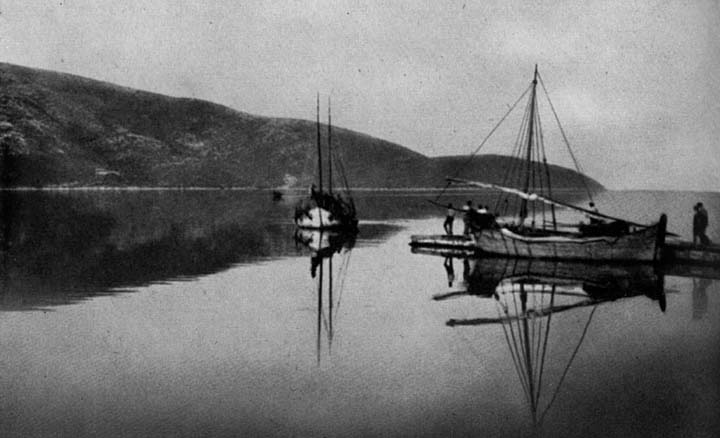
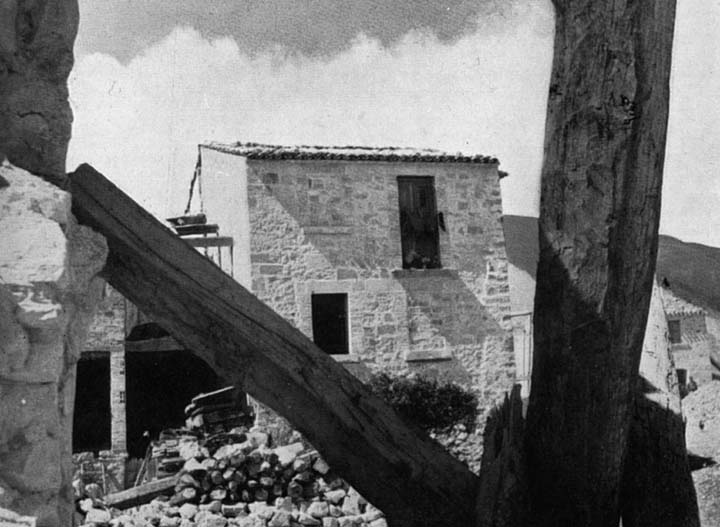 the Aventino valley |
 |
 |
What happened to the refugees when they reached home? Unit groups placed at strategic points in the most devastated areas, and working in close co-operation with those in the southern communes, could observe what happened not only to those returning from the south, but also to those who were making their way down from the recently liberated areas of the north and had to be marshalled into orderly groups, or sometimes fed and clothed, at the road and rail junctions. In Frosinone province, between Rome and Naples, the Unit supervised at this time four U.N.R.R.A. camps, helped to repatriate the refugees, and, in addition, assisted in U.N.R.R.A.'s plans for reconstruction. Frosinone had been devastated by the heavy fighting around Cassino and on the road to Rome, and was in no state to receive back its homeless people from the communes of the south. But home they came.
"Refugees from southern Italy are still returning to Frosinone and the congestion of overcrowded camps can only be relieved by rebuilding more houses and arranging for the transfer of refugees from camps to repaired homes. Members of the F.A.U. are responsible for organizing the transport of timber, bricks, tiles and other essential building material to the distressed communes in some forty U.N.R.R.A. vehicles. Up to the beginning of March 1946 over 700 houses had been repaired, which in human terms means that 3,800 persons formerly obliged to live in camps, now have homes.
"The condition of those who have returned to their homes in the communes has been far from comfortable. Many have found the struggle too great and have requested re-admission into the camps where their standard of living was better. Scarcity of food was the greatest problem. The F.A.U. has tried to help these people and has recommended to the Ministry of Post-War Assistance (the new name of the Alto Commissariato) that refugees living in the communes should receive an equivalent ration to those in the camps. This has been accepted and is an important factor in ameliorating the lot of these unfortunate people. In addition, some 16,000 parcels of clothing have been delivered for distribution to the eighty-nine communes in the province as part of U.N.R.R.A.'s Provincial Clothing Distribution Scheme."
At Ortona too the Unit could see what was happening. A survey of the position in Chieti and adjoining provinces had been undertaken early in 1945, and during the spring a transit camp set up outside Ortona. Here the Unit was engaged until the end of the year on the management of the camp and the distribution of the refugees to their homes. Refugees, returning prisoners and forced labourers, stayed a day or two before being moved on.
"From this last station of a journey that began in many cases north of the Alps, they returned to the devastated villages and minefields of the Sangro Valley, which the town dominates. Ortona, still littered with the broken hulls of tanks, was the railhead and lay down the road . . . . The condition of the returning refugees at the end of their long trek through the, transit centres was often surprisingly good. Arriving as they did with loads of luggage which might include pigs, tortoises, dogs, hens and grain, they showed annoyance when they found that they could not proceed immediately to their homes. However, the situation was fully explained to them on arrival, when the head of each family was interviewed. An opportunity was given to everyone to go first to the place he wanted to go back to. No one seemed to be deterred by what he found.; whole families would set up house in one room and even one standing wall could still be regarded as home by those who had been exiled for years."
In Umbria and Tuscany, which had also suffered heavy damage, F.A.U. members were engaged on similar work. From Piombino on the coast refugees were shipped to Sicily at the rate of 2,000 a week. A great deal was done in clothing distribution, and unwearable clothes and shoes were repaired in special workshops in Florence. The Unit gave assistance in several large refugee centres and became increasingly occupied in helping to initiate U.N.R.R.A.'s wide-scale reconstruction programme. One member, based on Carrara, organized the office of the U.N.R.R.A.-Italian organization which was responsible for the new housing programme in the provinces of Apuania and La Spezia.
"There is great unemployment and poverty. Factories have been wrecked and unexploded mines restrict cultivation. We have taken on drivers who have had no food for two days. Food is scarce and prices high and one has to patronize the Black Market. I am trying to use our trucks on rubble-clearance on Sundays and so give some of them a day's pay."
Meanwhile, a Mobile Hygiene Unit staffed by three members of the F.A.U. carried out hygiene inspection and assistance to the camps of the Ministry of Post-War Assistance, and helped to effect improvements in refugee camps and centres from Tuscany down to Calabria in the foot of Italy. Hygiene and medical supplies and equipment were delivered to camps and a D.D.T.-spraying programme carried out in camp hospitals, medical inspection rooms and kitchens.
Transit camps on the routes, supervision of reception camps and billets in the communes of the south, arrangements for repatriation, reception in their former homes---thus did the F.A.U. have some interest in every stage of the refugee's progress.
NO PIECE OF WORK made more appeal to the imagination of the Unit than the Aventino Valley Project.
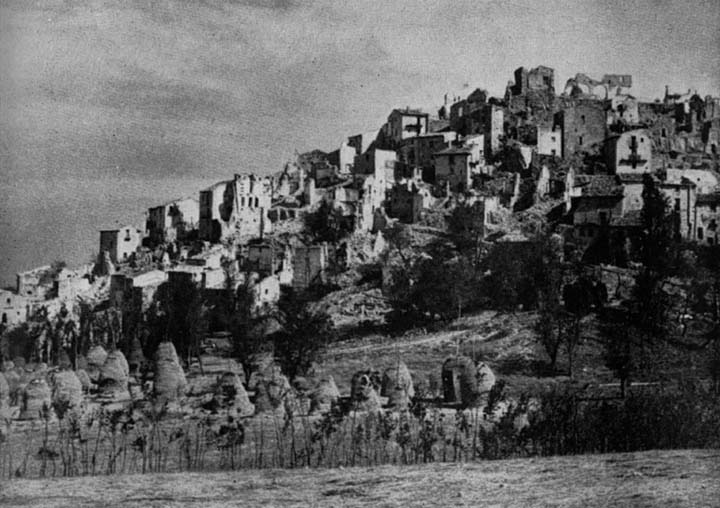
The small Aventino Valley, inland from Ortona, was the scene of furious fighting in the battle for the Sangro River in 1944.
"The valley itself is one of the most picturesque localities in Italy. It is flanked on one side by the Great Maielle Mountain, of over 9,000 feet, and by very high mountains on the other side. There is a group of five or six villages on both sides of the valley, and a tolerable road forms an ellipse, running up one side and down the other. There used to be communications to the south by a state road but although it is over twelve months since the war passed by, the three or four bridges are badly blown, and the road is mined so that the valley is a dead end in every sense of the word. Each of the villages has a population of two or three thousand and is of course mainly agricultural. The destruction is as heavy as I have seen anywhere in Italy, apart from Cassino. It seems that, for reasons of their own, the Germans systematically mined the villages and blew them up."
Here four members of the F.A.U., led by a representative of the American Friends Service Committee, arrived in April 1945.
Dave Hartley, the A.F.S.C. representative, had been the driving force behind the scheme from the beginning, and its development became yet another example of the high degree of co-operation which the F.A.U. and A.F.S.C. achieved. By September the team had grown to twelve, nine F.A.U. and three A.F.S.C., with five three-ton trucks, one small truck, a personnel carrier and a motor cycle. The aim was to help the peasants to help themselves. The apathy and disillusionment prevalent in Italy has already been mentioned. In a year the inhabitants of the valley had done little.
"The most obvious thing we see is the destruction, heaps of rubble cluttering the streets ; we stand in the middle of one of these villages and let our eyes sweep all around and see nothing but great piles of debris with a few parts of buildings still standing. This view is made more tragic by the very nature of the terrain itself which allows no two houses on the same level and causes the debris of some of the houses to go sliding several hundred feet down to the fields below."
Spiritually there was an atmosphere of depression and defeatism ; materially extreme poverty and an almost complete lack of transport, together with a shortage of roofing materials and plaster. Following an initial survey, work began in two villages, Colledimacine and Montenerodomo. During the summer three more villages were added---Fallascoso, Palena and Lettopalena.
"In the main section of Lettopalena there are only three families living. The remainder of the thousand or so inhabitants are living in stables, pigsties and scattered farmhouses. Last week an American sergeant on leave from France came to our group for assistance in finding his home and family in the village. His father was dead, his mother, when last heard of, was a refugee in Milan, and his sister was at Lettopalena living in a pigsty with another family."
The plan of work was simple---to encourage a system of barter with the help of the section's transport and so procure building materials for reconstruction. One commodity the villages had in plenty, and that was timber. Trees were cut down in the woods on the hillsides, taken down to the coast in the section's transport and exchanged for tiles and building materials.
It was not to be expected that success would be immediate nor that the villagers would easily accept strangers into their midst. And yet the response was from the start encouraging, and provided the incentive to go on in spite of the many difficulties which arose. Rubble was cleared away, new houses built, damaged houses repaired. The work developed into a race against the winter and its snows, which were creeping down the mountain sides to make building and the transport of materials impossible.
"A rough census shows that of the hundred-odd houses in Montenerodomo for which materials have been transported at least thirty-seven have been finished. Many of these, of course, received major repairs rather than being completely rebuilt, but assuming that at least twenty are new houses---and this is a conservative estimate---it means the provision of roughly 80-100 new rooms housing 250-300 people. It is quite certain that the remaining houses now under construction will also be finished before winter, thus easing tremendously the spring 1945 housing situation.
"In the old village, after some months of anti-fly propaganda, it has been agreed by a number of prominent citizens that some sort of public latrine is essential. The scheme has been made possible by the community spirit of a number of volunteers who have undertaken to cut sufficient communal wood for barter purposes and also to work on the construction. Already most of the wood, nearly 100 quintals, has been brought in and 1,700 bricks obtained."
Then there was Colledimacine.
"With the harvest season at an end, August was expected to be a peak period for reconstruction. The demand for material has indeed been great and since only one truck has been available, owing to the extension of our programme to other villages, supply has tended to lag behind demand. On the other hand, another bottleneck, beyond our control, has been the shortage of stone masons ; this has been met to an increasing extent by the import of masons from undamaged villages. It is a highly encouraging sign of the will to rebuild that of about eighty masons at work only fifteen to twenty were natives of Colledimacine. It is doubtful whether half this number could be employed at this time without the material carried by our transport."
At last winter came, and as the snows beleaguered the villages the section moved down to Ortona to carry on the same kind of work throughout the winter in fifteen other villages.
Meanwhile the scheme had attracted attention. In itself it helped the villagers concerned, but the villages in the Aventino Valley were only five of thousands of broken villages throughout Italy. It is the function of a voluntary society to help where it can, but also to provide the pioneering effort which might become the pattern for action by official bodies on a much larger scale.
So it proved to be in this case. U.N.R.R.A. planned to operate a large scheme of reconstruction in Italy with a thousand vehicles.
The F.A.U./A.F.S.C. section had to decide whether to maintain the identity of its own small scheme or to place its vehicles in the pool and allow its scheme to be incorporated in the nation-wide programme. The latter course was adopted, and in January 1946 the work came under the control of U.N.R.R.A., though some of its special features were retained. By that time nearly 4,000 rooms had been rebuilt. Italians drove the vehicles, while some members of the F.A.U./A.F.S.C., to be joined later by the I.V.S.P., carried on in the area in an administrative capacity.
BY THE LATE SPRING of 1946 the F.A.U. had withdrawn officially from Italy, though some of its members carried on under other auspices. For two and a half years it had made relief work in Italy one of its main concerns. For the needs of Italy always tended to be overlooked. More popular, and perhaps more spectacular, were the claims of Greece and Holland and others of the Allied countries. But the needs of Italy were very great, her plight, both spiritually and materially, desperate. And those members of the Unit who worked in Italy, small though their total contribution might seem to be, had the satisfaction of knowing that very often, if they had not done the work, there would have been no one else there to do it.