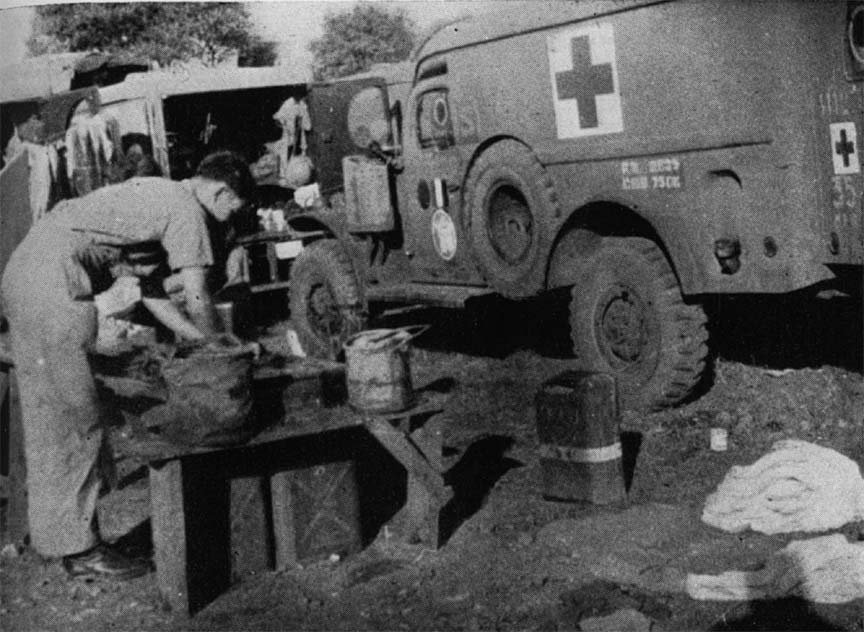
 17. It all helped to break them in" : with S.I. 4155 |
 |
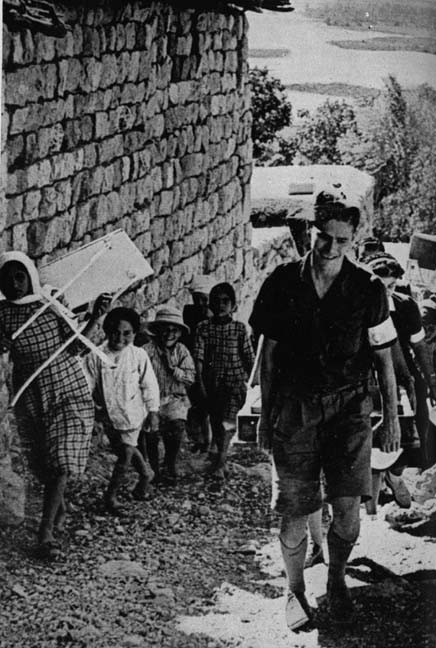 |
|
THE LAST OF ALL the Unit's undertakings on the field of battle came nearest to fulfilling the terms of that wistful refrain familiar through constant repetition in the earlier days, "dangerous and arduous work ". If ever pacifists lived and worked in the front line, not ten or two miles behind the front but at the front, they were the group of thirty who worked with the Medical Battalion of the 2nd French Armoured Division. Attached to a French Division that was incorporated in an American Army, they were hailed by an underground newspaper as the first Englishmen (not forgetting their three Welshmen) to enter Paris on the day of its liberation ; they were already at work in Strasbourg as they listened to the B.B.C. announcement of the city's capture. Two of their number gave their lives, two were taken prisoner but soon released, and one was seriously wounded. In any discussion on pacifism in the midst of total war, they, if anyone, established their right to be heard.
In the spring of 1943, when there was a growing number of Frenchmen under arms, not the least distinguished among the new units was "Leclerc's Column," which had made the difficult and spectacular dash from the Chad territory to take the Italian armies in Tripoli on the flank. When the Hadfield Spears Hospital was near Tripoli, the Column was across the road, being augmented into a Division Blindée---the 2nd Armoured Division of the Fighting French. Its medical services were rudimentary; it was imagined that some service similar to that of the Hadfield Spears Hospital itself might be provided, and eight members of the Hadfield Spears section and of the main Middle East section, with Hamilton Mills, until then Quartermaster of the Hadfield Spears Hospital, in charge, were attached to the Division to await the arrival of further men from England.
There were delays, mainly because of the reorganization going on in the French Army itself. The new Army was to be provided with American uniforms and equipment and organized on American lines, and in this new organization it soon became evident that there would be no place for a volunteer unit like the Hadfield Spears Hospital; the F.A.U. would have to fit into a medical service of American Army pattern.
Eventually, after the usual protracted negotiations in Algiers and Rabat, a request for thirty men came through to London, where, through faith that sooner or later the request would come, a team had already been selected, with Bill Spray in charge. Northfield for training, volunteer harvest camps to fill in the time, and at long last, on 26th October, the embarkation at Greenock---eleven days later they were in Algiers. There, after marching and counter-marching through pouring rain behind a young French officer who was doing his best to conceal the fact that he was completely lost, they spent six days in barracks designed for Arab and Senegalese troops. But even the Caserne d'Orleans could not hide the obvious, if slightly puzzled, good-will of the French; their tour de force was a creditable imitation of an English breakfast.
With Peter Gibson, who had arrived from Cairo to meet them, they moved west into Morocco, and on the racecourse at Rabat, north of Casablanca, they reached the 2nd Armoured Division which was just being grouped and trained. With it was the 13th Medical Battalion to which the eight Unit members were already attached. They started off as S.I. 4155 and later, for reasons unknown and immaterial, changed their number to 84155; to the Unit they were just S.I.
When the final composition of the party was decided it contained twenty-four new men from England and six who had already served in other sections with the Army ; the remainder left with Peter Gibson to fill gaps in other sections. Hamilton Mills remained in charge, with Bill Spray as Second-in-Command.
Here they made their first acquaintance with a Medical Battalion. There were in it three Companies, each serving a Brigade or "Groupement"; each Company had an Ambulance or "Collecting" Section (Ramassage), a Casualty Clearing Section (Triage et Traitement, shortened to T. et T.) responsible for the reception and urgent surgical treatment of casualties before sending. them back to the larger medical formations in the rear, and a Service Section comprising workshops, kitchens and administration. The F.A.U. was to work together in the third Company, and to be responsible for that Company's ambulances, twelve in all. As each ambulance had a driver and an orderly, twenty-four men were thus attached to Ramassage. Five were to work on medical duties in T. et T., while Ham Mills was left free for F.A.U. administration.
Derryck Hill, whose knees had long been brown from the Western Desert, began to initiate the drivers into the routine of the daily task; the ambulance orderlies were employed on ferrying vehicles from Casablanca, and the five men destined for T. et T. went to work in the Divisional Hospital in Rabat, later being., reinforced by the ambulance orderlies. Rabat was a pleasant enough town, with ambitious French colonial streets and buildings round a picturesque old Arab core. Vehicle maintenance, French lessons, manoeuvres, and mine courses; football against the "All Blacks" team of Senegalese, and against the R.A.F. from a neighbouring airfield; a gay Christmas party given by the section to Frenchmen of all ranks; visits to French families in Rabat; constant work in the Divisional Hospital housed in the Conservatoire de Musique, in the grounds of which the Unit occupied two old British Army tents the wards, the laboratory, theatre, the sterilizing tent, the dressing-room and the duty ambulance---it all helped to break them in to the months that lay before them.
"We were rather inexperienced people in a totally alien atmosphere, speaking halting pedestrian French, and the speed with which we became part of the organization was due very largely to the friendliness with which we were received. At the Infirmerie Divisionnaire we built up the confidence that enabled us to do jobs of considerable responsibility when we reached France."
April came, and with it rumours of a move---Corsica perhaps or Elba or the south of France or England. When the move came, it was to a transit camp five hundred miles away on a bleak and open hillside at Sidi ben Okbar, where flies and heat and sandstorms made life a torment only relieved by bathing parties and the responsibility for the medical work of the camp, with occasional drives with patients to Oran.
Of the speculated destinations, it was England that proved correct. In May they set off from Oran in several parties and, after voyages of varying degrees of pleasantness---or perhaps one should say unpleasantness---they found themselves at Cottingham, near Hull, the Divisional Infirmary housed in a students' hostel of Hull University. There followed more hospital work, more manoeuvres, jobs of interpretation and liaison for the French, the painting of Red Crosses on the ambulances, tents, lorries and sacks. D-Day came and went and at last, on 20th July, they moved off to Dorchester and Southampton. On the last day of the month they sailed on the Liberty Ship, Oliver Wolcott.
ON THE EVENING OF 25th August 1944 the underground papers of Paris had more to talk about than ever, but prominently in one of them appeared the headline "Premier Anglais à pénétrer dans Paris." There followed in large type, "The Quaker Duke Mann takes off his hat," and then, "General Leclerc's troops which reached the Châtillon Gate this morning were accompanied by a section of British ambulance drivers. These orderlies and doctors [sic] all belonged to the Quaker sect. One of the peculiarities: of this sect is that they do not remove their hats before anyone, for they regard it as a flattering and servile habit. However, this morning the Quakers took off their hats for very joy in response to the cheers of the people of Paris. The first to enter Paris was Duke Mann. He spoke perfect French."
No matter that neither Marcus Dukes nor Raymond Mann, so inexplicably compounded, will accept any responsibility for the interview which was then reported, no matter that in fact neither of them was the first of the Unit party to enter Paris; on the day of the liberation they were there, three weeks after their landing at Ste. Mère Eglise on the coast of Normandy.
Those three weeks had meant hard work. Their first day had plunged them into a setting typical of the war in France. The farmhouse walls pocked with machine-gun and rifle bullets; unwashed dishes in the sink; the bomb-happy cat lurking in a corner; the unwanted contents of ransacked drawers scattered on the floor---cotton-reels and a broken musical box and battered postcards and empty German cartridge cases; the inevitable wedding group still hanging at a crazy angle on the wall. Most of the livestock had disappeared, the chickens in particular, for chickens, like truth, are among the first casualties of war. But there were still a few cows in the byre, lowing painfully, and the section's first job to relieve suffering in France was to milk them. In the fields other cows lying on their backs, legs in the air, were a grim reminder that the ground was strewn with mines.
Through Perriers, Coutances, Avranches they passed. "The Germans were here seven days, six days, five days ago," the days getting ever fewer as they approached the German positions. Avranches, Ducey, St. James---the American advance had speeded up. There had been less fighting in the villages, and their welcome was all the more enthusiastic.
They had little idea at the time of what was going on. Later they learnt that the 15th Army Corps, to which their Division was attached, was being held ready, either to make a wide sweeping movement to the Seine to cope with the Germans if they retreated, or else, if the German decision was to fight in Normandy, to drive north from le Mans to Alençon and Argentan and link up with the British pushing down to close the gap at Falaise.
On 10th August the French Division went into action. The Unit had already adopted the formation which was to see it through the campaign. The ambulance section, Ramassage, was split up. Five ambulances led by Ham Mills were attached to an infantry column which had tank support; five more, under Bill Spray, to a column with a preponderance of tanks. One ambulance was permanently attached to the artillery and one to the command post.
T. et T., to which five men, under Ernest Rahardt, were attached, was similarly divided into two teams---Section Rouge and Section Blanche---each having a surgeon, assistant surgeon, anæsthetist, theatre orderly; sterilizer, resuscitation officer and assistant, a clerk, and four or five Arab stretcher bearers under an N.C.O. The Unit provided the "theatre sister" for both teams, with the anæsthetist for Section Blanche and the sterilizer and resuscitation assistant for Section Rouge. In practice, with personnel cut to the bare minimum, no one was able to confine himself strictly to his own job. Where possible, the two teams would work together, one doing all the operating and dealing with the more serious cases, the other with reception and the rapid treatment and evacuation of the less serious patients. But in an advance they acted independently, one pushing forward while the other cleared up behind and then leapfrogged over it.
|
17. It all helped to break them in" : with S.I. 4155 |
|
|
|
|
The next few days brought feverish activity. They started in a heatwave, and drove through long winding lanes which were churned up in clouds of dust by convoys of troops and tanks, often reducing visibility to three or four yards. They constantly got lost; there was an insufficiency of road signs ; at night there would be frantic hunting for their position on a map by the light of matches. T. et T. often had little idea where Ramassage would be; Ramassage found it difficult, with an ambulance full of patients, to find T. et T. The battle was moving fast, and the liaison work of the French was not as good as later it became.
The result was that it was the easiest thing in the world to pass through the front. Tom Newby entered a village to which he had been directed, and, stopping at the first sentry he saw, was much surprised to find that he was a German. Undaunted, he asked whether there were any wounded as he had an empty ambulance. The sentry passed him on to his Commanding Officer, who was sorry that he had no work for him. So Tom stayed for an exchange of courtesies and then drove home again.
There was an occasion too when Ham Mills was quietly and dutifully reading his Unit Chronicle behind a hedge when, suddenly, exactly two yards away, appeared "a German half-track full of toughs trying to mow down everyone within sight ". He was underneath his ambulance in less than no time. And there was the time when three ambulances spent a night in a village near Argentan, from which the Germans had been driven out that evening. During the night they heard men moving about outside and talking in undertones. The next morning they awoke to find that the village had changed hands in the night and the whispering was in German. When morning came there was an intense machine-gun battle and soon the ambulances were called for to load the wounded and the dying.
So much for Ramassage. T. et T. began in a field south of Alençon. Casualties arrived almost at once. The next day Section Blanche went on ahead to be caught at midnight by Section Rouge. Very soon they became battle-hardened to the horror of wounds and to mauled and mangled human bodies; they dressed wounds, applied splints, gave anti-tetanus and morphine injections, transfusions of plasma, as little at first as was consistent with safe removal to a larger unit. They moved to a convent hospital in Alençon, then up again towards Argentan, until they found when they were unloading their equipment that they had gone too far; they spent the night in a ditch with a counter-attack in progress. In the morning casualties poured in again. It was unsafe to evacuate lest the road be cut, and they undertook major surgical treatment. Until 2 a.m. they worked, then from seven o'clock that same morning until 5.30 a.m. of the following day, their last case of all requiring four separate operations. Then the evacuation route was declared clear and the crisis was over. On 19th August the Falaise Gap was closed and on the 21st they received their first British casualty. Meanwhile prisoners were pouring in.
They were now hotfoot for Paris; it had already been agreed; that the 2nd French Armoured Division should be the first Allied troops to enter the city. They moved quickly to Rambouillet, only thirty miles from the capital, and on the morning of Thursday, 24th August, the advanced guard moved up for the final attack. There were short and sharp engagements. T. et T. set up in a schoolhouse. Ambulance after ambulance came in with seriously wounded men, new cases of over-riding urgency constantly upsetting the system of priorities which had been worked out. For the French, in their anxiety to reach the capital before nightfall, were fighting like fanatics.
Meanwhile Ramassage was up with the advance. The story of the entry into Paris can best be told by one who was there. For whatever disappointments and frustrations liberation was later to bring in its train, the day itself was one that will never be forgotten by anyone who was present. Some months later Brian Evans wrote:
"We had been sitting about in the fields around Argentan while the battle of the Falaise Gap was coming to a close. It was then that Radio Trottoir had begun to broadcast that the Division was going to Paris and the rumour quickly grew from a poor joke to a faint possibility, from that to a reasonable likelihood, from likelihood to heady fact. La route est libre, tout droit pour Paris! I doubt if there has ever been a prouder, more fiercely intent band of men than those French exiles returning to liberate their own capital city. I shall always remember the heat and the haste of those days, the long columns snaking along over those dreadful roads in the ever-present cloud of dust, the cheering villages which merged in time into an open mouth, a waving arm, and the bright flags of France blossoming from every window.
"The excitement grew as the scattered villages began to coalesce into one long street, and the throng lined the route as if for some procession. As they pressed upon us our smooth convoy became a clumsy thing of jerks and stops, and with each halt the ambulance was lost under a cloud of people. We were kissed, hugged, praised and prayed over; we got glasses of wine, handfuls of apples, and a flag to tie on the bonnet of the car. In return we gave away the cigarettes, biscuits and sweets we had been saving for this very occasion, and their delight at these little things was something one doesn't easily forget. And always as we moved away we heard that most heart-warming of all send-offs---'Bon courage, mes enfants!' As we came round a bend, down in the valley below we saw Paris glowing in the last red rays of the setting sun and the Eiffel Tower pointing its lean finger upwards into the mist. I am not able to describe the happenings of the next day; as I am one of those sober writers who look with suspicion on polysyllabic words and flowing periods I must pass it by. Yet one or two pictures stand out from the whirl of impressions which make up for me Liberation Day in Paris.
"There is a great square. Through it roar the tanks, the high growl of their engines drowning the cheers of the crowd that surges along the pavements and overflows everywhere into the road; the tankmen, in their Martian headgear, ignore the swarming dust, stand waving and calling out indistinguishable remarks. Suddenly above the noise is heard the cold chatter of a Spandau, and immediately the square is empty, as if some great wave had swept across, taking with it every living thing. Only a single tank remains, a squat black beetle that crawls cautiously about to seek its prey, its mounted machine-gun probing the air.
"We have collected two German casualties, but the hospitals are full to overflowing and the green-grey uniforms do not help. At last we find the Luftwaffe hospital and deliver our charges to the German medical orderlies there ; one has a club foot, the other only one arm. The long corridors, the great wards are full of groaning wounded. It is good to get away. This is the Rue de la Pompe, and now we are turning into the Avenue Victor Hugo. Marie-Thérèse, who has been hanging on to the side of the ambulance for the last half-mile, has now squeezed in with us, and it is very difficult to change gear. I know her name because it is embroidered on her jumper. She tells us all that has happened since Paris rose, but she spoke too quickly for us, who learned our French in North Africa. This is the Etoile, and now we are stopping. Marie-Thérèse says we are in the Avenue de la Grande Armée.
"So we stand still at last and watch the world go by. The F.F.I., brandishing an amazing variety of weapons, are everywhere. The people crowd to admire our American vehicles and equipment; the jeeps interest them most of all. The girls are very beautiful, and even if they do laugh at my French they do it in a very nice way. They say De Gaulle will be here tomorrow.
"That evening, as soon as I could get away, I went up the Arc de Triomphe. The flame was not burning, but there was a little group around the tomb---tired, dusty soldiers who had gone a long journey in order to come back to this place. Now they were very silent and thoughtful. They made room for me, and I joined them in their silence, and in their thinking. After a while I saw at my feet a fragment of stone that must have been chipped off the Arc by a stray bullet. I picked it up and put it in my pocket. I hope no one will mind."
It was indeed a memorable day. One member only held the proud record of going through Paris that day without embrassing or being embrassed. And he was growing a moustache.
THEY STAYED TEN DAYS in Paris, where twenty of the section were housed together in the camp for British internees at St. Denis. Excitement was intense, and for some days everywhere they went their welcome was the same: "Les Anglais, les Anglais; je vais embrasser le premier Anglais."
It was particularly refreshing to them to meet Paris Friends and to make contact with people whose outlook was similar to their own and who did not confuse liberation with the end of all their troubles. For the liberation had its uglier aspect; the fate of many of the Germans who remained, and many collaborators, was not a pleasant one, and with the delirious joy was mingled frenzied hatred. During the occupation Friends had won a great reputation for their work among political prisoners, and Unit members were now able to hold the first talks with Henri Van Etten and others about the relief needs and possibilities in France.
Meanwhile they were daily reading of fresh Allied triumphs gained by the American Armies around Nancy and Metz. It looked as if it would be Germany next stop. "The Division had proved itself as a good fighting unit, and, pacifists though we were, we were proud to be attached to it. If we were going to work with an Army unit, it might as well be a good one." But the section was becoming increasingly exercised by the bitterness and the depth of hatred shown towards the Germans. Not that it was difficult to understand; most Frenchmen had lost a parent or brother or sister who was known to have been killed or had just disappeared, while the shame of the occupation still rankled deep. Like the Hadfield Spears section later, they began to ask them selves whether, now that they were in France, there were not enough French medical personnel available who would be glad of work. But the officers of the Battalion assured them that they were needed and urged, in reply to their misgivings, that, if they came across any cases of contravention of the Geneva Convention, they should report them at once.
Here too the question of medals arose, as it had arisen with other sections. Unit policy was that while mass awards like the Africa Star, offered for participation in a particular campaign, should be refused, awards offered to individuals should be accepted or refused according to the individual's own views. But there were some in the section who felt strongly that they should present a united front one way or the other. On the one hand it was argued that military decorations should not be accepted by a pacifist Unit, on the other that they were offered as a sincere token of gratitude by the French and that it would be difficult not to offend them by refusing. The general feeling came to be that individuals should accept ; they placed it on record in the following January "that S.I. 84155 had exhausted the stock of Croix de Guerre medals from the local shop at Fontainebleau ". To many it was one of the issues on which the Unit failed, for it was never able to achieve a consistent policy.
And now they moved again. The Division's next task was to guard the southern flank of the American 3rd Army in its drive east to Nancy and Metz. It quickly ran into very stiff Panzer opposition which culminated in the Battle of Dompaire and at last in the almost complete destruction of the German armour used in their attack. The autumn rains and mud; the breaking of the German line on the Vosges mountains; the drive straight through to Strasbourg-those were the events that covered the next three months of the section's life.
They left Paris on 8th September, bearing east and slightly south, by way of Provins and Nogent to Abbé de St. Clairvaux. Vittel wars captured, and then the drive on Epinal began against a stiffening defence. A Panzer Division came out to counter-attack, and it was here that Humphrey Waterfield and Ray Birkett were captured.
"It had been a typical day of our campaign---the long wait in the morning in the village ; the slow advance over side roads with occasional check for fighting and, as always, the serious battle as evening fell. This was rather worse than usual, shelling on all sides, and our entry seemed to depend rather on the fall of night than on the overcoming of resistance. Then, as usual, our job began. There were five in this little lot---four Germans and one Frenchman. We bandaged them as best we could in the back of the ambulance . . . . Our Captain did not tell us so, but we were surrounded; he gave us the road he thought best. We had barely left the village when a patrol spotted us and told us that we continued at our own risk. One case was a chest, one a belly, both might be dangerous. I had lost a case in Normandy through the time lag . . . . We decided to take a chance.
"Another mile or two and we came across the usual group of civilians. What did they recommend ? They said there was fighting ahead---we could hear the guns---and anyway the bridge was blown up. Back we had to go. The night was no younger, and the road seemed no more attractive. There was another but better road to the south, but the Germans were known to be to the south. On the whole the best plan seemed to be to move cautiously, asking from village to village. There were side roads back on our original route if reports were unfavourable. They were not; someone had come from a village some way ahead and the road was clear so far. We had not realized that the Germans moved at night. Suddenly there was a clamour of raucous German voices and we were forced out one on each side. We were bundled into the back with the already crowded wounded. There was a charming moment----French, English and German, we all melted into one common humanity. The Frenchman who was on a stretcher because we were a French ambulance gave up his stretcher to the more seriously wounded German, the German needing our pressure to take it."
Finally, after several moves, they found themselves prisoners in Strasbourg, in two vaults full of French and Americans in the mound of the 1870 fortifications.
"And so we missed yet another autumn, the little maple tree one could just see from one lavatory daring to do duty for all the autumn colour of the world, and there were the snowberries in a corner of the courtyard, and the sky. These, with the carts straight out of Rubens, were all the visual interests of our little world. We were still a great deal better off than many people. Prison, after all, is but a reductio ad absurdum of the military life, just one degree more intolerable to the free man. As a pacifist I was glad of the experience."
Meanwhile the battle was raging around Dompaire and Damas; the artillery, the French tank-destroyers and American Thunderbolts all concentrated on knocking out the German tanks, and the section could not fail to be filled with admiration for the team-work and the efficiency, mingled with horror at the thought of the mangled and bleeding victims that would soon be coming in. T. et T. had one or two moves through Lorraine, through the spa town of Contrexeville, and thence to Vittel, where there was a flood of casualties---French, Maquis, Germans and civilians. In a large hotel Section Rouge operated through the night until seven o'clock the next morning, had three hours' sleep, and then at ten began again. The corridors were blocked with wounded, and operations went on into the small hours of the following morning. Section Blanche similarly, advancing to within a mile or two of the storm centre at Dompaire, were inundated with casualties and were for a time cut off from everybody, including Ramassage. Then the German counter-attack was broken up and the stream of casualties slackened off.
Through Dompaire and Damas the sections moved The weather was showing signs of breaking, the autumn was coming on, and Germany was still very far away. For the first time suspicion grew that the winter would find them still in France.
In a world of rain and mud and dungheaps there were occasional interludes.
"We moved up into the deserted village street, leaving the ambulances in empty barns. Then we started a search for lodging. We peered into house after house, the windows broken, the doors agape, the clock off its hook and on the floor, the kitchens a dirty clutter, over all the dust and rubble blown in from shellbursts in the street outside. At last we chose one small but gay, with light green shutters; an hour's work with twig brooms, a salvage hunt for unbroken chairs and the two rooms already look habitable. The pictures are set straight on the walls, the clock picked up, wound and set going. We light the kitchen range and the little enamel stove in the living-room. The little house starts to come back to life ; the cat creeps cautiously in under the door, and soon sits in her old place by the fire, blinking in the warmth. Apples and pears are picked in the shell-scarred orchard, potatoes are peeled, tins opened, some unbroken plates are found and washed, someone finds a clean cloth behind a door, which will serve as a tablecloth, and the legend is tacked to the door 'Friends House.' Nearly everybody sits down round the table for lunch, and a very good lunch it is too. We sit down for an afternoon round the stove. There are washings-all-over in the kitchen, and launderings, but soon we shall be on the move away and leave 'Friends House' to the cat and the damp again"
Rain and mud and dungheaps---and little work. Food deteriorated, there was little privacy, and inevitably morale began to drop. They slept and ate and read and played cards and talked and carried patients in their ambulances: The rains lasted six weeks.
The end of October brought the first of the frosts, making the ground more suitable for armoured divisions. In the north the American 3rd Army was advancing near Metz; the job of the 7th Army was now to get astride the Luneville-Baccarat road to protect the flank. The column took its objective in a short and sharp engagement. And so they were set for the final objective which was known to be Strasbourg itself. No one, however, thought that a five-day attack across fifty miles of the Vosges mountains, and through the defences of the Maginot Line, would get them there. On Sunday, 19th November, the advance on the Saverne gap began.
By the end of the first day the Division had driven past its first objective, and the next day the pace increased. Early in the morning the infantry stormed a bridge at heavy cost and opened up the way for the armour. It was in the battle for the bridge that first Denis Frazer and Richard Rutter, followed by Paul Mount and Arthur Cheston, went up beyond the front line to pick up wounded. Clambering over barbed wire, they gave first-aid treatment before taking the most serious cases back for further treatment. The battle was moving fast; Mount and Cheston with the avant garde could see the Germans leaving villages as the French were entering the other end. Soon along the road lay scores of Germans who had been killed as they withdrew. The distance between Ramassage and T. et T. was lengthening. Often it took five hours to evacuate a wounded man and return to Ramassage, at night even longer. The majority of the wounded were Germans who lay in the ditches, numb with cold.
Trois Fontaines, up the slopes of the Vosges to Dagsburg, where the Germans had intended a big stand; then on to Saverne itself. For the first time since they had arrived in France many of them slept in beds, but not for long; after four or five hours of sleep they were off again before daylight across the plain of Alsace to Strasbourg.
"We quickly reached the outer defences of Strasbourg---the forts of the Maginot Line. Here the Germans were very strongly entrenched. The road was cut through the earth, and there was an embankment on either side. Before the column could advance any farther, there were a number of machine-gun nests in the fields alongside, which had to be cleared. But as soon as a French soldier showed himself above the embankment he was shot at, and there was soon a number of wounded. In one place, however, four Frenchmen had been able to use the scanty cover of some vines to crawl out about ten yards. Three of them were killed almost immediately, and the fourth was seriously wounded by an explosive bullet which severed the femoral artery. Rutter and Frazer were then up with the avant garde, and as soon as the call came for stretcher bearers, they crawled out to him."
Richard Rutter's report takes up the story:
"An ambulance dashed past signalling Denis and me to go forward to a position farther up the advancing column. It was no joke overtaking a quarter of a mile of armoured column in close convoy up that narrow muddy pot-holed road, often skidding along with two wheels in the ditch and the other two a hairsbreadth away from the gnashing tracks of a 'Sherman'. Barely had we reached the gap in the column which the other ambulance had quitted than shells started to arrive, blowing up cartloads of mud as they landed. Soon a despatch rider called us forward to pick up casualties. On the way we administered first aid to some men wounded by shrapnel whom I picked up on the return journey. Farther up the road there was fierce fighting. We came upon stationary tanks with infantry men crouching under them. Here at the head of the column Germans were holding the recessed road, with machine-gun nests on top of the high bank on either side. We pulled up four vehicles from no-man's land to patch up facially wounded infantry men who had rolled back into the road after having tried to assault the enemy positions. One man had been badly wounded a few yards across the field beyond the bank., We scrambled over the brink, and keeping close to the ground we: succeeded in dragging a stretcher to the casualty without mishap. We lay on our bellies in the soft mud with the rain pouring down whilst we put first-aid dressings and a tourniquet on the man's smashed thigh. After heaving him on to the stretcher Denis and I lay side by side near the stretcher summoning up courage to make a dash for the road, knowing full well that our lives hung on the balance. Shells were bursting uncomfortably close and machinegun bullets kept on zipping through the air and plopping ominously into the mud around us. Suddenly Denis fell limp with blood gushing from his head. My first thought was that of thankfulness that my friend and ambulance companion with whom I had worked ever since we first left England should have given his life so heroically whilst trying to save his fellow men, and that his death was instantaneous. It being useless to stay where I was I crawled back to the road and asked for three volunteers to help get the casualty back. At the first lull we squirmed across to the stretcher and took up position one man to each handle. Then we made a successful dash for the road. Having loaded the ambulance to capacity I drove back to the forward dressing station at Saverne."
Denis was buried later in the military cemetery in Strasbourg. A short Quaker meeting was held, and then the burial service at the cemetery was read by the French Protestant pastor of the Division, who was, like Denis himself, a Methodist. Denis was killed at the age of twenty-two. He had joined the Unit at the age of nineteen in July 1941. Quiet and rather deliberate in his ways, with his pacifism firmly grounded in a religion that was very real to him, he was sadly missed by men who had come to rely on his friendliness and loyalty and unquestioning willingness to roll up his sleeves and get down to the job.
That night at the police headquarters in Strasbourg members of the section listened to the B.B.C. nine o'clock news announcing the capture of the city, and next morning the message came through that Waterfield and Birkett had been found in a prisoner-of-war camp nearby. In fact Humphrey, with his knowledge of French and German, found himself the intermediary for the surrender of the camp.
FOUR DAYS THEY SPENT in Strasbourg, four busy days, during which Ramassage transferred patients from the smaller hospitals around to the main civilian hospital in which T. et T. were reinstalled And they had houses to live in.
Another objective had been gained and now the Division was to move to the south to link up with the 1st French Division, to which the Hadfield Spears Hospital was attached, as it drove north from Belfort and Mulhouse. Bill Spray's group was in the line most of December, with a short interval for Christmas when the other group on Ramassage, constantly on the move, was able to entertain the rest of the section for Christmas dinner at a château at Stotzheim. Christmas trees were brought down in an ambulance from the hills, and there was much feeding and much jollity, with two parcels for everyone, one from the people of Alsace and the other from the Protestant pastor of the Division.
But already to the north Von Runstedt had begun his offensive, and there was increasing pressure on the Americans in the Saar Union area. The Division was switched to block the breakthrough. One day they were woken at three o'clock in the morning, drove from 5.30 a.m. to 8.30 p.m. and got near to Sarreguemines. There was another burst of work, bringing difficult evacuations on a pitch-black night along cart tracks covered in three or four inches of snow. As the French were here setting fire to a damaged tank, a shell exploded inside and a bit of shrapnel hit Dennis Woodcock in the leg, causing a serious injury which led to his repatriation and several months in hospital.
After further fighting five miles north of Strasbourg, causing serious anxiety in Strasbourg itself, the position was finally stabilized, and the Division returned to its original objective of linking up with the 1st French Division. Between them there was only a small pocket left at Neuf Brisach, but there was bitter fighting and the column came under heavy, shelling and machine-gunning. It was here that the section suffered its second fatal casualty.
"An ambulance had just come back from the front line with a load of wounded, and the driver just called in at Ramassage to see if there were any more. It was John Bough's turn to go up to the front, and he immediately went out. The road was, as usual, being heavily shelled and one must have landed very near to him. He was found the next morning still grimly holding the steering wheel. The ambulance had run into a field, and it was not noticed until it was light."
When it was all over, John was buried in the cemetery at Ohnenheim. There were about thirty-five English and French present, and the burial service was read by an American chaplain. John, who was two years older than Denis Frazer, joined the Unit in the 16th Camp in November 1942, and was moved into S.I. as a replacement when it had returned from Morocco to Hull.
"Bough was one of those rare people who never seem to be afraid. Everyone who saw him in action always remarked how cool and imperturbable he was, even after a very narrow escape. For long periods he was up with the avant garde, always doing his fair share of the work without any fuss or ostentation."
Every man in the section had his quota of narrow escapes.
"The day went on; we passed backwards and forward over this much shelled piece of road, loading and unloading ambulances, crouching and ducking, counting stretchers and blankets, stopping bleeding, putting on bandages, and then driving back with the groans of the wounded to remind us that a mistake might cost a life."
But the next night the pocket was cleared ; the 1st and 2nd French Divisions joined hands and the whole of France was free except for a few pockets of Germans who were still holding out in the ports.
It was one of these pockets of resistance that was to provide the Division's next and last job. But first it was pulled out of the line for a rest and the Unit was able to start home leave. Lorraine brought them back to the usual dirty, muddy villages and the obtrusive dungheaps, but now spring was in the air and in early March they moved to a village near Chateauroux, two hundred miles due south of Paris.
After a month, on 9th April, they left for their next action. Four months before, the Hadfield Spears Hospital had found themselves outside Royan, north of Bordeaux, at the mouth of the Gironde, before being hurriedly switched back across France for the battle of the Ardennes. This time the French were determined that Royan should be taken, and some sections of the 2nd Division were moved across. There was a terrific air bombardment. T. et T. was installed in a field outside; Bill Spray's group was attached to the column of tanks. The work and various demonstrations put on specially for their benefit greatly impressed the F.F.I., whose own medical services were almost non-existent. Bitter fighting continued and little quarter was shown. For thirty-six hours both sections of T. et T. had intensive work, and then the pocket was cleared.
Their last few weeks as a section they spent in Germany. Switched back across France, they found themselves not far from Augsburg, occupying half the village of Utting, a holiday resort on the edge of the Ammersee. The Division was spoiling for a fight now that it was in the heart of Germany, but the fight was denied it and it was the civilian population that suffered. French vindictiveness after the monstrous crimes of the Germans against their people and against the rest of Europe Unit members did not find difficult to understand. It was not unnatural or unexpected, but it was difficult to be associated with it. However, their presence made some difference. They slept at night each in a different house in the village, and where there was an Englishman the French avoided their worst excesses. An approach was made to the General himself, who agreed with the Unit attitude but urged them to remember what the French had gone through. Fortunately the first week was the worst; it was the first flush of vengeance for all the suffering of the war. They spent three more weeks in Germany and finally returned close to Fontainebleau. On 15th June they were withdrawn.
S.I. WAS IN MANY WAYS the epitome of Unit work with armies in the field. It was perhaps easier for that reason. Not that on would deny the strain and difficulty of screwing up courage to a nasty job. Nor would one deny that they too had their periods of inactivity and boredom, but they were weeks and not months as they were with some sections that weathered the earlier grinding months and years of the war. They had their full share of hard work, and hard work is always satisfying.
Their reaction as pacifists to the work was shared in larger or smaller measure by all those sections that served with the British or French armies. Soon after the section's withdrawal a letter arrived over the signature of General Leclerc. It said of them,
"Attached to the 3rd Medical Company, wherein they constituted the entire group of ambulance and nursing personnel, they have contrived in their thankless and obscure work to show themselves. worthy of-their pacifist ideal in the very centre of the vast machine of war. On every type of road or terrain, in all weathers, by night as by day, and very often in forward posts under a fire deadly enough to unsettle the composure of the fighting man, they have displayed the finest qualities of selflessness and charity in order to fulfil this service to their friends."
French citations never err on the side of understatement. Courage they had shown, but so had hundreds of thousands of fighting men, some in far greater measure. What was important was ils ont su se montrer dignes de leur idéal pacifique au milieu de tout l'appareil de la guerre, and then the last phrase, pour servir leurs amis. If that were true, then it certainly made worth while all the work that they had tried to do.
And indeed there was no question about their pacifism. "Before, we all knew about the horrors of war, but it was a knowledge gained at second hand. Now we had seen what war could do, and, although we quickly got over any physical revulsion, it sickened us mentally and spiritually. The more involved we were in the war the greater was our opposition to it, because our knowledge was founded on personal experience." It was perhaps noteworthy that the proportion of men throughout the Unit's history who resigned from sections working with the Army to join the Forces was about half the proportion from the Unit as a whole.
What effect their pacifism had on those among whom they worked it is difficult to tell. Both the Hadfield Spears section and S.l. found the French somewhat mystified by their behaviour. It was often the first time that they had met the pacifist point of view, and it was extremely difficult for them, with their tradition of conscription, to appreciate that of their own volition Unit members could refuse to fight. When it was emphasized that it was a decision made on religious grounds, faces would sometimes light up and they would murmur, "Ah, yes, now I understand---your religion forbids you." Obedience to an authoritarian Church they would appreciate; an individual decision on grounds of conscience took more understanding. But then they were English and the English were odd anyway. The fact that, certainly in the Hadfield Spears Hospital, they were in a position of privilege compared with the French Other Ranks, did not help matters. With the British Army the position was at least clear; there they were conchies, with or without an introductory adjective, and if opposition there was, it proved more difficult to break down. But there, too, hostility was surprisingly infrequent, and there was much less contempt than sometimes appeared nearer home.
There is no doubt that in some ways all sections caught something of the Army mentality. That was inevitable. There was the feeling of superiority towards those in easy and safe jobs; the close and personal interest taken in the course of the battle of which they were a part; the sense of pride in their Division's achievements when they made a brilliant break-through, the mental cheer when the Thunderbolts came screaming down on the guns, or when the British Navy appeared, to rescue them from Norway or from Greece.
All that is inevitable, and it would be hypocrisy to deny it. Indeed, only an automaton without emotions could avoid catching the mood of those around him. But they were rarely thrown off their balance. In Paris or in Germany, though never blind to what the Germans had done, they felt as ever the futility of cruelty on one side breeding blind vindictiveness on the other---a way which holds no hope for the future of mankind.
What of the summing up ? It was Hamilton Mills who wrote:
"We know that we left a certain part of ourselves with the group, and we shall always hanker after that surge of comradeship and pride which one could sometimes feel glowing out like a stove in a cold room. We think we did a good job, and others would agree, but any other Unit group would have done much about the same, some a little better, some a little worse. We were lucky, for although the doing was sometimes sad, we know we would not have missed it, now that it's done.
"But don't let's expect that to say we marched with S.I. will open all the doors. Or even make converts. We have worked it so that we can meet accusations of cowardice with confidence; so much the better for us. But others have not been so fortunate, and if we feel superior to them we betray them. The truth or otherwise of our ideas is not affected by our own past histories. Perhaps we see straighter now, but the Croix de Guerre will convince nobody of anything.
"I like to think that we are better pacifists now than we were in 1939 or even in 1943, even if only that we have a greater respect for the soldier. What we intend to do about it now is a personal question, but whether we go to an Insurance Office or a Rectory or a Factory, the important thing is not to forget what once we knew and felt, not to forget what we have seen or, more dangerous, not to transmute a real and complete experience into a hazy Adventure Story."
IN TWO COUNTRIES the F.A.U. helped to establish a system of medical services among backward peoples. They were Syria and Ethiopia. Elsewhere, in India, China and on the Continent of Europe, civilian medical work was undertaken as one of many activities; in Syria and Ethiopia it was the main concern. In the two countries there were obvious similarities and equally obvious differences.
In both, the same obstacles were met of superstition and fear and prejudice; confidence was built up slowly, very slowly. Constant work in lonely outposts among illiterate peoples was a strain which demanded resources not only of technical skill but of character, much more than in sections where members were working in large groups among folk of similar ways and similar interests. In both countries, too, the Unit eventually came face to face with an inevitable problem which arose from its very nature as an emergency wartime organization. Clinical medicine, itself a palliative, led on to Public Health, and Public Health to Education as the only ultimate solution to disease and suffering. Sooner or later the time was bound to come when the Unit itself would have to leave, and then the question would arise, what was to follow? Perhaps the Unit rushed in too readily into work which involved the chronic health problems of the Middle East and Africa; perhaps with the impatience of youth it expected results in two or three years which twenty or a hundred years would barely achieve. But in both countries a great deal of work was done that was valuable; many lives were saved, many men and women and children rescued from crippling illnesses. It is doubtful whether a temporary body had the right to expect more. In both countries some legacy was left, more in Syria than in Ethiopia, in neither as much as the Unit would have wished. But no one who served with the Unit in those countries would say that the work should never have been begun.
The work in Syria started through the initiative of members in the field, of one man in particular; in Ethiopia it began through negotiation in London. In Syria the Unit was part of a private venture to supplement medical services which were already in existence but which hardly touched at all the rural areas; in Ethiopia it became part of the official machinery and at one time constituted over half of the whole medical service of the country, with responsibility for several hospitals. So that in the latter country there was ultimately more at stake.
Many members of the Unit chose service in Syria or Ethiopia in preference to work with the armies in the field, not because the life of a Syrian or Ethiopian peasant is more valuable than that of a British or French soldier, but because they felt that among civilians, particularly those whose needs were forgotten when a war had broken out, there would be opportunities for pioneering work, for service of more abiding value. Sometimes members had not much choice between "Army" and "Civilian" work; where there was choice, the work chosen depended largely on temperament, on the one motive out of many which the individual stressed most in his own case. The Unit's corporate service required both to make it whole.
DOWN NEAR THE SEA in Beirut, between the American University and the Pigeon Rocks, stands a tall house on the slope of a hill running down to the water. The slope is so steep that on the lower side there is an extra storey half tunnelled into the ground. In front stands a balcony in full view of the sea; behind, to the east, rises the mass of Lebanon. The tunnelled flat was the Headquarters of the F.A.U. in Syria and the Lebanon. Elsewhere in Beirut, beyond the University, an office and two or three storerooms full of drugs and medical supplies completed the Unit's quarters.
There were never more than some twenty Unit members at work in Syria at any one time, but they were widely scattered. Sometimes a member of the Headquarters staff had occasion to visit them. Let us accompany him on such a visit in the summer of 1944, when the work had been in progress for three years. From Beirut he takes the Damascus road, climbing steadily up the slopes of Lebanon; soon he crosses the top of the pass and descends steeply the eastern slopes, down towards the flat and very fertile Bekaa Valley. Facing him now beyond the valley is Anti-Lebanon, with Hermon, still retaining in its crevices traces of last winter's snow, towering away to the right.
But before the floor of the valley is reached, he stops at the large village of Chtaura. It is the first clinic centre.
Chtaura is a popular resort for summer holidays, a favourite meeting place for the politicians of Beirut and Damascus; but despite the civilized appearance of the town itself, there are within a few miles of it many villages as primitive as any to be found in the most inaccessible regions of Syria. In the small village of Jditta outside the town he finds the house in which reside three Unit men and the Druse Dr. Hamdan, who with them runs the clinics in this area.
From Chtaura he carries on to Anti-Lebanon, then over the mountain pass into the oasis of Damascus. Skirting the town itself, he turns north into the eastern foot-hills of Anti-Lebanon, and at last pulls up in the village of Sednaya, built tier on tier up the side of a hill which is crowned by a Greek Orthodox convent, a favourite place of pilgrimage, dating back to the time of Justinian. It is mainly a Christian town, Greek Orthodox and Catholic, with a Moslem minority. In the cramped quarters of a native house, flat-roofed like the rest and approached up steep and narrow steps, he finds another section, three Unit men and the Druse Dr. Najjar. The nurse, Marie, lives in the convent on the hilltop with the nuns.
There at Sednaya he stays the night, a guest of the convent if there is no room in the Unit's quarters. Then he makes for the north through Homs and Hama, the Hamath of the Old Testament, with its vast water-wheels that churn the waters of the Orontes. Turning eastwards he soon enters the country of the Ismailiye, a sect which broke away from Islam and regards the Aga Khan as its spiritual head. Those of this area are of Arab stock and lived until the last century in the Alouite mountains of the north and in other parts of Syria. In country rescued by irrigation from the desert they have built some fifteen villages, with the town of Selemieh as a meeting place. There are some fourteen thousand inhabitants of the town, with perhaps another fifteen thousand in the villages. It. is these villages that are served by the Selemieh section, again three Unit men with a young Lebanese doctor, Fuad Mu'akessah. They live in a comfortable and spacious house on the Hama road out of the town.
Then comes the longest drive of all, on towards the north until, after some hours of hard driving under a cruel sun, Aleppo is reached---Aleppo, the very name of which conjures up pictures of caravans and wealthy merchandise, Oriental spices and filigree silver and exquisite brocade.
But that is only the first stage. From Aleppo he follows the road east to the Euphrates, striking the river where it bends round from running south to running south-east. Somewhere on this stretch of the Euphrates, Abraham's servant must have crossed on his way to Haran when he found Rebecca, or Jacob to find Rachel. The road deteriorates as it continues along the south bank, through Raqqa to Deir-ez-Zor, where a suspension bridge carries it across the river. Now the way is over open desert, nothing more than one of many tracks, of which the driver may take his choice. He travels miles without seeing a soul ; then comes an occasional Bedouin on his horse, or a herd of goats or flock of sheep following their shepherd or grazing on the withered desert scrub, which looks as if it could not keep any creature alive; sometimes a small caravan of camels will come in sight, sometimes some rich Bedouin's herd of several hundreds of camels grazing on the scrub.
After about four hours of driving, he finds that the track leads him to the river Khabbur at Hassetche. He has reached that part of Syria called the Jezireh.
In this remote land along the Khabbur from Hassetche to Ras-el-Ain on the Turkish frontier now stand a string of villages built at intervals of a mile or two, the houses of mud bricks constructed in beehive fashion, each room with its own rounded cupole.
Here dwell the Assyrians, a race of Christians, who, after repeated persecutions, moved from their mountain homes in Turkey, migrated to Iraq, and were finally settled here by the League of Nations. Now, like the other inhabitants of the Jezireh, they depend on agriculture for their living. But they have not taken kindly to the life of the plain, and many still regard the villages on the Khabbur as only a temporary home. The Jezireh is sparsely populated perhaps by about two hundred thousand people in all; among them are Bedouin, Syrians, Kurds, Armenians, Circassians and Assyrians. In the largest of the Assyrian villages, Tel Tamer, there was before the war a hospital of fifteen beds opened by the League of Nations. There a section has been established; it has grown to five Unit men, with the Armenian Dr. Shirajian and an assistant, together with a Syrian nurse. The small Syrian Government hospital at Hassetche and the larger Missionary Hospital in Deir-ez-Zor are largely inaccessible to the inhabitants of the upper Jezireh as travel is difficult and expensive, and the clinics based on Tel Tamer provide virtually the only medical service for the Khabbur Valley.
After a stay of two nights in the Unit's cupoled mud-brick house at Tel Tamer, the car takes to the road again, back across the desert to Aleppo. Now, instead of turning south from the bend of the Euphrates towards Hama, it keeps straight on across the Orontes, traverses the mountain passes, and strikes the sea north of Beirut, at Latakia. There, in a flat on the roof of the American Presbyterian Girls' School, another section lives, running, with the help of the large and genial Dr. Mina, clinics for the villagers who live in the Alouite mountains, north and north-east from Latakia towards the Turkish border.
Finally, from Latakia the road bears along the coast, back to Beirut. It has required a round trip of 1,500 miles to visit five centres from which the clinics are operated. To the casual visitor it would be a trip full of glamour and excitement, but one had to work in a clinic centre only for a week or two to get down below the colourfulness to the hard and wretched conditions of poverty and ignorance and disease which harass any attempt to improve the health standards of the Middle and Near East. Work on the clinics required as much stamina and inner resources of the spirit as any pieces of work which the Unit undertook. It still held a fascination, but it was the fascination of a hard job that obviously needed to be done, under the inspiration of an all too clear need, rather than the facile appeal of the gorgeous and mysterious East.
IN THE CHAPTER of the Hadfield Spears Hospital it was stated that in the summer of 1941, when the pressure of work in the Hospital slackened after the Syrian armistice, Nik Alderson began to look round for other work. With the warm support of Lady Spears, Nik began his investigations. This is his own account:
"The establishment of clinics has been a gradual process, as we have had to go carefully, not only with the Arabs, whose confidence is hard to win, but very easy to lose, but also with the authorities. To start with, we made all the orthodox visits, the Area Commanders and Generals, and then the Syrian Minister of Health who stumped up a full-time doctor and drugs. The next step was to find where the need was great, and which villages would prove accessible for other villages, so as to cover as wide an area as possible ; and to find villages where they were well disposed to us.
"For ten days Robin Fedden and I went round with a Damascene lawyer and interviewed the headmen, for Robin speaks good Arabic. The roads to most of these villages were nonexistent, dusty tracks through the rocks, or to the oases. We chose five villages, and the days on which we were coming were called from the minaret on Fridays. We started our rounds.
"Although we are going to have with us local nurses, who will be a great help, we are doing all the work ourselves at the moment. Two F.A.U. men with the Syrian doctor go out each day with a 15 cwt. Bedford, and Paul is starting to convert two for clinic use. The equipment we take is small but adequate; a basin and stand, a table for examination, and an instrument stand; a chest of drugs and an instrument case. Then a certain amount of clean linen, gowns, towels, sheets to put on the examination table, and sterile dressings, etc. The principal medicines we take are argyrol for eyes, and silver nitrate ; quinine ; aspirin ; metholine blue or gentian violet ; acrifiavine and zinc ointment for sores; antidysentery tablets. All these we take up in large quantities, and a number of other medicines which are not needed for mass treatments as those are. The conditions in which these people live by reason of their poverty is really appalling."
Thus the work started. For a month the Syrian Government provided a doctor free of charge. The American Red Cross helped with medical supplies. There was close collaboration from the start with the Victoria Hospital in Damascus. So, on the 29th July 1941, two F.A.U. drivers were detached from the Hadfield Spears Hospital and went out with the doctor to villages in the Damascus region. From the 13th August they crossed Anti-Lebanon and visited villages in the Bekaa Valley. Then the Hospital itself moved to Beirut, leaving behind the office of the clinics in the Military Transit Camp in Damascus, where it remained until the autumn of 1942.
In Beirut there were consultations with President Bayard Dodge of the American University, and it was decided that a permanent Clinic Centre should be established in the Bekaa Valley itself to avoid regular journeys from Damascus. The village of Chtaura was chosen. And now a Committee was formed to establish the work on a proper footing, consisting of President Dodge as Chairman and Lady Spears, together with representatives of the medical side of the University, the Spears Mission, the Hospital, and the F.A.U. It was this Committee, originally known as the Hadfield Spears Relief Committee and, from September 1942 onwards, the Spears Mobile Clinics Committee, which was throughout responsible for the conduct of the clinics, and for the administration of their funds.
In a history of the F.A.U. concentration is inevitable, in this chapter as in others, on the Unit's own contribution to the work. It is true that with one or two temporary exceptions the whole European staff in the field came from the F.A.U., and the Organizing Secretary of the clinics was a Unit member. Furthermore, the F.A.U. provided the initial inspiration and much of the enthusiasm and the drive which carried the clinics through. But it should be remembered always that Unit members were the, servants of the Committee in Beirut. And on the technical side. they were very largely dependent on the doctors and the nurses employed by the Committee, without whom the scheme would have been impossible. There was a qualified doctor in each clinic centre, generally trained at the American University; these doctors were English-speaking in addition to speaking the language of whatever area they served. It was the Unit's main contribution to plan the work, to see in the field that clinics were run regularly, reliably, punctually, to ensure honesty and complete non-discrimination. Much of the actual work done by Unit members was comparatively menial---driving and servicing ambulances, registering patients, carrying out the simpler treatments laid down by the doctor. But without the Unit the work could have been neither started nor developed.
At the end of 1941 the Hadfield Spears Hospital moved to Egypt. It left behind in Syria two members to carry on the work, with one vehicle loaned by the Free French and one hired in Damascus. Two extra F.A.U. men and two vehicles were sent up from Egypt in February 1942; later in the same month four further men arrived. More vehicles were obtained on loan from the Army and the Free French Forces, and additional members of the Unit sent up with further vehicles still. In June the American Field Service seconded some of their members with vehicles, and for a time they provided most valuable assistance.
In 1942 came the main extension of the work. The Damascus clinic had shown its worth. Between the 20th February and the 9th June it had visited nineteen villages regularly, but the distances travelled were too great. The staff had to drive an average of sixty miles a day on bad roads, in addition to doing a full day's work, and so in August the clinic centre moved north from Damascus to Sednaya to cover a similar number of villages in a more compact area.
From the earliest days one Unit member in Damascus had gone over for two days of the week to the Danish Hospital at Nebek, fifty miles from Damascus, and visited villages in that region with Dr. Schmidt and his assistants from the Hospital. As a result of this, a new clinic based itself on Palmyra in May 1942. From this desert oasis the clinic went off for long trips to visit Bedouin tribes; normally the only accommodation would be two ambulances parked back-to-back to form a dispensary.
But here again it was found that they had bitten off rather more than they could chew, and this clinic finally moved westwards to Selemieh, where there was a higher concentration of people, to devote itself to the villagers and Bedouin who were particularly afflicted with malaria because of the extensive swamps which surrounded their villages.
During May there was further expansion, this time to the Jezireh. At first the section was based on Hassetche, but soon afterwards, in order to be closer to the villages that were served, it moved up to Tel Tamer, which was a central point not only for the Assyrian villages but for the Kurds, Armenians and Circassians, as well as the Bedouin who roamed between the Euphrates and the Turkish frontier.
Finally, in September, there was an urgent request from the Army to start a further centre among the Alouites north of Latakia. A team moved up and settled in the town.
So, by the end of 1942, there were five, clinics centres open, four in Syria and one in the Lebanon. The Unit, in January of that year, had two members on the job. By December they had grown to ten. For the first few months the clinic workers were regarded as the protegés of the Hadfield Spears Hospital even after it had moved down to Egypt. But when Ralph Barlow was appointed to the post of O.C.M.E. and was able to visit Syria, the Unit's clinic workers became responsible to him on the same basis as all the other sections in the Middle East. It became possible to work out a policy, and from the Unit's point of view it made administration and the interchange of personnel much easier. In the course of 1943 numbers crept up to twenty-four, and remained at this level, or rather fewer, until the autumn of 1944, when the handing over of the clinics brought gradual reductions of personnel. Early in 1946 the last Unit man left clinics work.
In writing about the Spears Mobile Clinics it is essential to it is essential to give the right impression of their extent in proportion to the total need. Syria and the Lebanon had their doctors, but they were concentrated with few exceptions in the large towns, particularly on the coast, where conditions were more civilized and practices more lucrative. In attempting to go out to the villages the Spears Clinics tried an interesting and valuable experiment in rural health and hygiene, and in the areas which they covered they provided a good service, especially if there was a hospital within reach for the more serious cases. But they only touched a fraction of the country. Syria and the Lebanon have between them over five thousand villages. The clinics covered in all about a hundred. As a contribution to the problem of public health in the Near East, the clinics' achievement was small ; but it was an indication of what might be done on a far larger scale, given the will and the resources.
SOME FEATURES WERE common to all the clinics. Health conditions in most of the villages were indescribably primitive. There were exceptions ; in certain villages an enlightened Mukhtar might see to it that at least the drinking-water was safe. But the usual picture in the outlying areas was a frightening one. Rubbish and excrement was strewn about the streets and among the houses, attracting flies and vermin of all kinds ; the springs which provided water for the village would be tainted with all the filth that lay around. It was a mark of hospitality to pass round cups from mouth to mouth, unwashed. There were houses with no windows into which cattle were brought at night. There were stagnant pools in the streets, and extensive marshes around the villages in which mosquitoes by the million bred.
Primitive conditions were aggravated by ignorance and poverty. Schools were pitifully few, and good schools fewer. In many of the villages it was generally unknown that malaria was carried by mosquitoes; it was thought to come from the vapours that rose from the marshes at night. Once the disease was contracted it was the Will of Allah that it should run its course, in too many cases fatal one. It took hard work in building up confidence to persuade the inhabitants that there was any virtue in medicaments other than the dramatic native treatments to which they were accustomed. In the village of Jditta, for instance, on the very outskirts of Chtaura, there were two rival methods of treating dysentery. Either horse-urine was boiled, strained and drunk, or else dogdung was boiled in water and the infusion filtered and drunk. Among the Bedouin a popular remedy for stomach-pains was the passing of a piece of string through the flesh of the abdomen, while branding with red-hot irons was extremely common. Wounds would be bound up with mixtures of burnt corn, olive oil and cobwebs. In the village of Hermel, in the north of the Bekaa Valley, the local treatment for measles seemed to be to keep the patient warm in bed in a closed and darkened room; as soon as the rash appeared it was imagined that badness had come out and, whatever the weather, the bedclothes would be thrown off and the windows thrown open; naturally there was a high incidence of pneumonia and other complications.
Political and religious rivalries, difficulties of communication, the lack of a sense of social responsibility among the wealthier classes, even the fear of improvement since improvement might lead to indirect reforms all these and many other causes contributed to the stagnation.
Of all the diseases which afflicted the villagers of Syria and the Lebanon, malaria, with its peak period in the three months from September onwards, came easily first. In its worst forms it can kill suddenly ; and repeated attacks make the body more susceptible to other diseases. During the two years ending in December 1944, over twenty-two per cent, of all the cases examined at all five of the Spears Clinic centres proved to be malaria. In some areas, for instance in the Bekaa Valley, the figures were considerably higher. Next came eye diseases, causing widespread suffering and unnecessary blindness. Conjunctivitis, trachoma and their complications, corneal ulcers and other troubles were everywhere to be found. In a school survey in seven widely varying villages in the Bekaa Valley, covering rich and poor, Moslem and Christian, mountain and plain dwellers, it was found that out of 805 pupils examined 502 were suffering from eye diseases of some kind, the majority of them trachoma.
Dysentery in various forms dehydrates and kills, particularly young children. In the Jezireh this disease was particularly rife. Then there were internal parasites, skin infections of all kinds, and deficiency diseases arising partly from poverty, partly from ignorance even where there was no lack of nourishing foods. From time to time there would be outbreaks of typhoid and of smallpox, and-occasionally typhus would be met. In the work of the clinics perhaps the one most important feature of all was regularity. At first the villagers had no reason to think that the clinic staffs were different from the travelling quacks who turned up, made a pile of money and disappeared; but gradually, as the same ambulance was seen grinding up the same track on the same day of each week, its Red Cross smothered in mud, their confidence would grow. They would flock round to see the staff begin their work. They would help with carrying in the boxes and the tables. They began to learn that, however unreliable the weather, someone would turn up and provide attention week by week, and that without discrimination. Generally the work would be routine treatment, with the ambulance available to take more serious cases to hospitals in adjoining towns. Occasionally other jobs were undertaken to meet particular emergencies. Vaccination against smallpox or inoculations against typhoid would he carried out when there was a threat of epidemic. In January 1943 the Latakia Clinic staff vaccinated over 2,600 people in four days during an outbreak of typhus. In the Deir-ez-Zor area clinics men helped Government officials to inoculate 4,000 people. The biggest anti-typhoid inoculation of all was carried out by the Selemieh staff, who inoculated 6,800 people in the first two months of 1944.
The work was always doubly valuable if it was based upon a good hospital. At Tel Tamer the clinic team ran its own hospital. Chtaura and Sednaya were near to Beirut and Damascus respectively. Where local doctors existed it was necessary to come to some arrangement with them, usually by agreeing not to work in a town or large village from which they drew their patients, but to confine the clinics' work to villages outside.
It was found from the beginning, as relief workers have always found, that gratuitous treatment pauperizes, and that a charge, however small, must be made. If nothing else, it makes the patient take the treatment much more seriously. The scale of charges was low and gifts in kind would be accepted instead of money. Only the very poor were treated free. Otherwise the usual scale was 50 piastres (about 1.od.) for examination and treatment; 25 piastres for eye cases, to cover a course of treatment lasting a month ; home visits were charged the sum of from one to five Syrian. pounds, i.e. 2.3d. to 11.3d., according to the patient's ability to pay. Patients brought their own bottles for medicine, and cups and tins for ointment. For each patient a card was made out, with his name, age, sex, village or tribe, the diagnosis, the treatment and the fee paid. It was not easy to keep the cards, for names had to be spelt phonetically, and no two workers would hear every name exactly alike.
There was never any discrimination between religious or racial groups. In many areas the room in which the clinic was held was the one place in which rival groups or races would meet. In Tel Tamer the Assyrians and the surrounding Bedouin were always in a tacit state of strife; the Bedouin would raid the Assyrian villages at night and carry off their stock. When the first Bedouin patient walked into the hospital one day, he was stoned by the Assyrian children. But gradually hostility was broken down and, after a few months, the Assyrians and, Bedouin would be seen sitting side by side in the queue waiting for the clinic to open. In the year ended June 1945 there were 438 patients warded in the Tel Tamer Hospital. Of these 238 were Assyrians, 84 Syrians, 36 Armenians, 35 Bedouin, 34 Kurds, Circassians and unclassified.
The work, of course, had its lighter side. The doctor had to adapt his bedside manner to fit the particular brand of humour which the natives favoured. The following are incidents described by clinic workers:
"Among all the suffering many showed great courage and a highly developed sense of humour. It was no uncommon thing to hear a man joking with the doctor on his death bed. It was this sense of humour which a doctor who knew and understood the people could so often use successfully. For most patients, however ill, enjoyed a joke. In a village new to the clinic, an old man climbed slowly on to the examination table. 'What is the matter with you?' said the doctor. 'That is for you to find out,' said the patient, 'you are the doctor.' The others crowded round; this was an important test. 'You have malaria,' said the doctor. The crowd breathed heavily; this doctor really was a skilled man. The doctor straightened himself. A prescription was handed to the dispenser. The man took his bottle of medicine and tablets. 'How many times do I take them, doctor?' 'I don't know. I am only the doctor. You should know that. You are the patient.' The crowd laughed. Here was a really wise doctor."
"The doctors evolved a bedside-manner of their own, which would perhaps surprise some of their English colleagues. It is not the best of form to laugh at the illness of a patient, and yet often in the villages that was the best approach. 'Come, come, old man, you are too old to live any longer, it would be much better if you died.' 'I agree, doctor, but I want to marry again, so please - --cure me once more.' 'All right,' said the doctor, 'but I don't' think you're really worth it.'
"This type of bedside-manner was often reinforced by appeals, to the onlookers. In fact a kind of play was staged in which the doctor, nurse and orderlies and the patients and their immediate relatives played the chief parts. The audience consisted of other patients awaiting treatment and their relations. The chief characters appealed to the audience strenuously and frequently."
SOMETHING SHOULD NOW be said about each of the clinic centres in turn.
The Chtaura centre, the first to be opened outside Damascus, tried to serve the malaria-ridden villages in the Bekaa Valley south of the Beirut-Damascus road. In the summer private doctors would come out from Beirut and attend to the wealthy visitors; some of the wealthy villagers would take advantage of their treatment, but it hardly touched the poorer people. During the war the Army and the Air Force also did some work in the area, partly to safeguard the health of the troops. In general, the people of the district, consisting of Christians, Druse and Moslems, were not as anxious to co-operate as elsewhere. Perhaps the clinic was too close to the large towns of the coast and found that in the backwash of politics attempts were made to discredit it ; there often seemed to be an underlying tension. Any preventive work on malaria control would involve not so much the peasants themselves but the big landlords who were themselves not short of medical attention, and so were not concerned.
Surveys were made of the major sources of malaria in various parts of the plain, and findings passed on to the local authorities. one case the clinic staff itself instituted work upon the breeding grounds of anopheline mosquitoes. Various suggestions were made, but unfortunately none of them took root.
A certain amount, however, was achieved. After a great deal of pressure on Government officials, repairs were carried out to the water system of Talabaya village, resulting in great improvement in the drinking-water for that region. In another village, the two halves of which used to be separated in winter by running water, concrete pipes were obtained from the local authorities to carry the water away. In small ways such as these the health of particular villages would be improved.
Finally, in their last winter, the clinics undertook a survey of the majority of the small village schools in their area. It started in the Government school at Mejdel Anjar; thirty pupils had been found to have trachoma and used to parade outside the clinic once a week for treatment. A co-operative teacher brought them in regularly. In December 1943 the school was visited and complete physical examinations done on every pupil, while the teacher was instructed how to treat trachoma and given the necessary equipment. Treatments were to be recorded for each pupil on a card.
Then an intensive health programme was carried out on the school for two months. Two visits were paid every week, one especially for the school itself ; there were regular inspections, health talks, trachoma treatments, typhoid and typhus inoculations, and home visiting.
Inoculations meant hard work, as shown by the following account written on another occasion by a worker in the Chtaura clinic:
"I acted as scribe with the assistance of an American-speaking Arab. Dennis and the nurse helped the doctor to keep two syringes and some fifty needles on the go. We set up forms as traffic barriers and went into production on Henry Ford lines. Mothers brought their ten children, fathers came in from the fields, hands husky with handling the harvest, dark girls, fair girls, dirty girls, clean girls, squawling babies, old men---all came together..
"Came a family of thirteen in through the door. 'Who are you?' say I; 'Emiline Aina,' she says. 'And this girl---what is her name ? ' 'Mario Aina,' says her mother. And so on with the other eleven, Samir, George, Eva, Banadette, Joseph, Assiyi, Georgette, Renée, Rimon, Nebil, and John. Dennis paints with iodine. The doctor talks to them, distracts them, and in goes the needle before they know it. Some scream, some giggle, some take it with a stoic calm, and afterwards outside proudly show their patch of iodine. Spectators peer through the windows; people come and go; we get very hot inside this tiny schoolroom."
Soon other schools in the clinic villages were brought in with the general aim of clearing them as far as possible of dirt, trachoma, scabies and skin disease, and of carrying on health propaganda. Gradually the number of schools increased. By 30th March there were 830 schoolchildren being visited weekly.
The clinic closed in July 1944, partly through difficulties of staff and transport, partly because the Near East Foundation, already with interests in that area, looked like expanding its activities and taking over at least some of the work. The original Spears Clinics doctor stayed on in the area and continued visiting a number of the villages which he used to visit previously.
The area treated by the Sednaya clinic was one of great contrasts. There were a dozen or so villages, of which three were Christian, the rest Moslem. The largest were Tel and Mnine on the Damascus road ; the rest were tucked away in the foothills of Anti-Lebanon. Each village had its own traditions and characteristics. In three of the villages Syriac, the ancient language of Syria, was still spoken. This variety reflected itself in the cases seen. Malaria was practically unknown in the high hill villages, but was prevalent in the valleys. The high villages in winter suffered from diseases caused by the intense cold, while the sheltered valley villages were unaffected. But some diseases common to the whole of Syria were common everywhere here, particularly the ubiquitous eye diseases.
In two villages typhus was endemic, and from time to time threatened to assume epidemic proportions. On this disease, as on smallpox, the clinic did some preventive work. In the most ignorant and primitive of the villages visited, a mass vaccination was carried out in April 1943 against considerable resistance, the Mukhtar remarking to the doctor that human efforts were unavailing against what was evidently the Will of God.
Stab wounds were common, for the hill people were naturally quarrelsome, and there was no lack of cause for quarrels in their racial and political and religious differences.
In Sednaya considerable help was given by the Sednaya Sick Benefit Society, which drew funds from natives of Sednaya resident in the United States. Their gift of an operating table to the clinic made it possible for the doctor himself to carry out certain operations, mainly on the eyes. At first patients needed much persuasion before they would undergo an operation, but fear died when success was seen.
More patients were seen by the Sednaya clinic than at any other centre. From October 1942 to October 1944, 31,498 cases passed through the doctor's hands, the average monthly figure during peak months being about 1,850.
When the war came to an end, arrangements here, as in the other centres, had to be made for handing over, in view of the withdrawal of the F.A.U. An agreement was concluded in June 1945 between the Department of Health and the Spears clinic for the work to be carried on by a Government-paid doctor under the auspices of the Government. A vehicle was sold by the clinics for the purpose, and a certain amount of medical equipment and drugs handed over. In addition, a clinic house was obtained at the village of Tel and furnished in memory of Nik Alderson. The new doctor continued to visit the clinic house at Tel twice a week and to hold clinics at two other villages.
It was while on a visit to Beirut from the Sednaya clinic in May 1945 that Allan Wyon died. Allan had joined the Unit in July 1941 at the age of twenty, and had passed through the Training Camp and the Birmingham Accident Hospital, taking in addition the Unit cooking course before he went out to the Middle East in the spring of 1943. Through his premature death in Syria, he was as much a victim of the war as anyone who died on the field of battle.
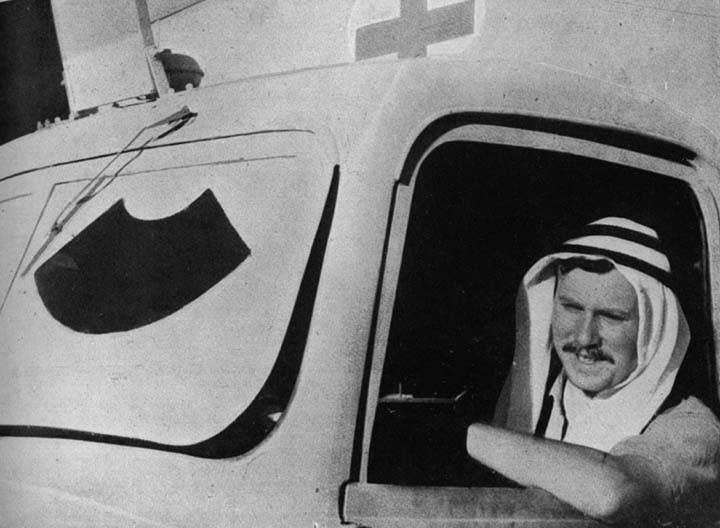 |
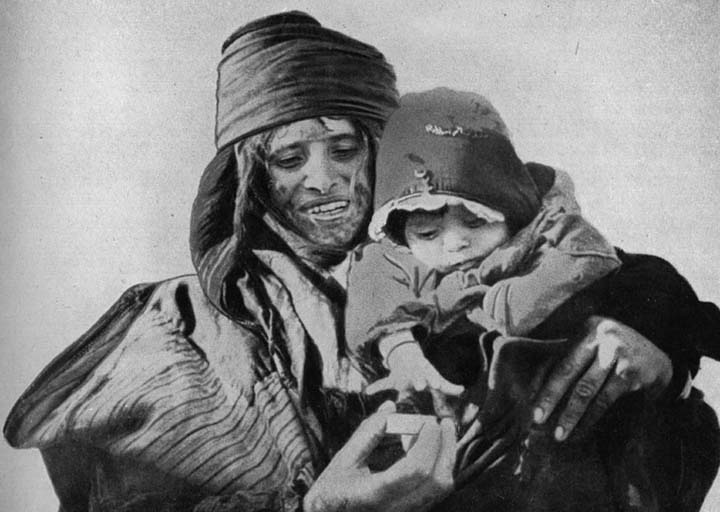 |
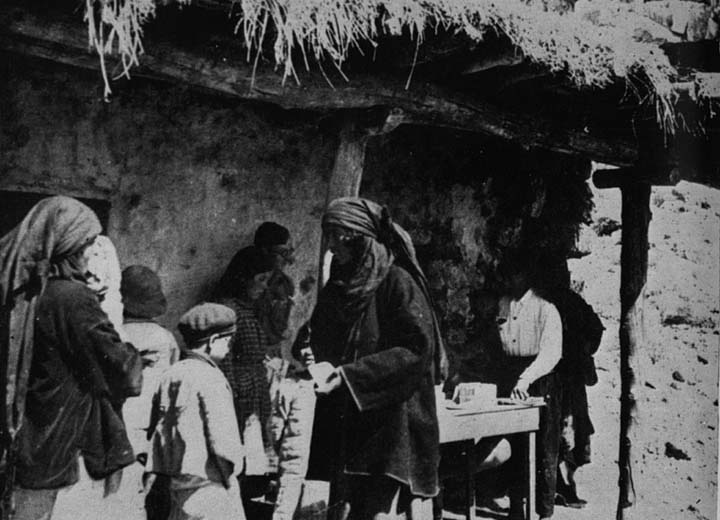 |
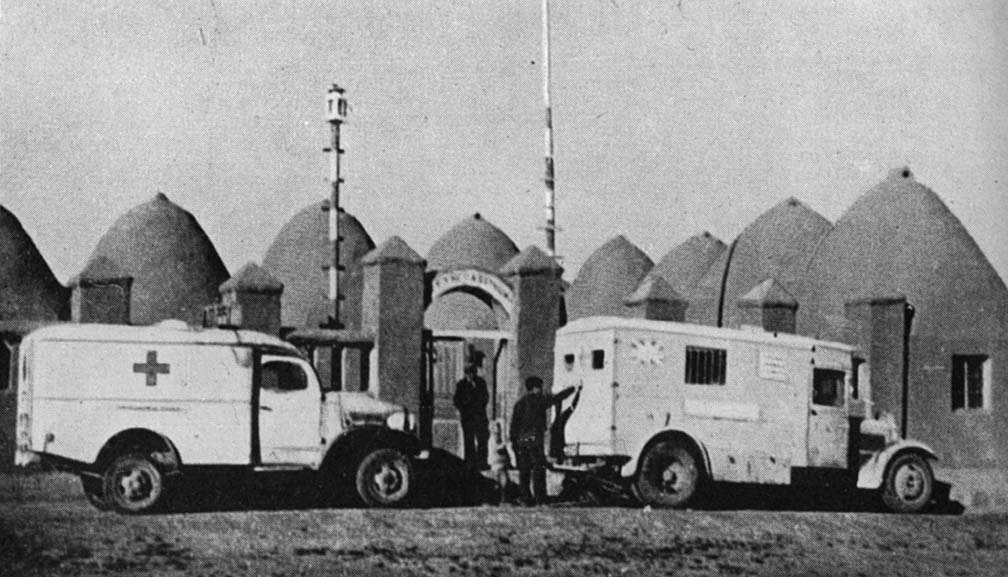 |
The third of the southern clinics was at Selemieh, on the frontier between the desert of Palmyra and the valley of the Orontes, where the Ismailiye farm their land by irrigation around the villages and grow wheat and barley on the rolling plains beyond. Great herds of sheep are kept in summer near the villages, in the winter on the desert pastures, and the people delight in raising fine Arab horses. Though the clinic was based on the town of Selemieh, little work was done in the town itself, by agreement with the local doctors ; and the need was greater in the villages to the east. Clinics would be held in open Bedouin tents or in the manzool, the public room and guest room of the village. When the clinic party arrived in the morning, there would he no hurry among the villagers to see them starting work, for they were by nature hospitable and only to stupid Westerners did time matter. On a typical day an ambulance would drive up, perhaps to Mufagger, a mud-brick village twelve miles away, picking its way between men and women and children, Arab horses and donkeys and goats and fowls, until it came to the manzool where the men of the village, the Mukhtar among them, would be sitting around and gossiping. Courtesies would be exchanged and the clinic team would sit down on the cushions that lined the walls. Then coffee would be brought, and spasmodic conversation carried on partly through the doctors, partly by a Unit man perhaps more fluent in Arabic than the others. At long last the clinic would start, first with the women of the village, the men being cleared out; then came the children, and finally the men. Privacy did not matter. As each new patient got on to the stretcher to be examined, the rest would sit around and gaze intently or speculate what could be wrong. In fact, the clinic was a social occasion.
Against this background between five hundred and a thousand patients were treated every month. Eight villages were visited regularly, another dozen less frequently. Patients came from a hundred different tribes and villages, and if a special request came in a visit would be made to a place not on the regular programme.
The work varied with the seasons. In winter the number of cases of pneumonia and other diseases of the chest would reach epidemic proportions, and during late summer, when the roads and plains were at their most dusty, eye infections would be at their worst. And during the peak months in some villages, practically 100 per cent of the people were infected with malaria.
By October 1943 the members of the section had come to see that the treatment of malaria was useless unless preventive work was done upon the breeding grounds of the mosquitoes. A concentrated campaign was inaugurated. Breeding grounds were examined, mapped and reported in twenty villages, and here, unlike Chtaura, the workers were able to take advantage of happy relations between themselves and the local officials and landowners. A member of the section himself tells the story
"Meanwhile we were explaining to the villagers the causes of malaria. Some knew something of them, but nobody thought really that much could be done about it. One or two had vague ideas about collecting money and making a communal effort, but general apathy and inertia overwhelmed them. Or else we were told that 'The Emirs should do it'---the government, the army, the gendarme, anyone but themselves. The government was doing something, but it was a job for the people themselves, and we sat and thought how we could help them.
"We found that there were a number of things, such as clearing canals, filling depressions, planting trees, and the cultivation of a general interest in health matters which could be started at once by the villagers. There were also the long-term aspects of the problem, such as the network of Roman Canals which had become blocked in places and were responsible for many of our swamps, the need for concrete canals, bridges and sluice-gates. But what is the good of a concrete canal if it runs through a carelessly irrigated field, or if it is not kept in good repair ? Or if the instructions not to take earth from low-lying depressions, to keep the canals clear, to keep the wells in good order, to kill the mosquitoes, are not obeyed ? So in explaining to each village the causes and the cure we encouraged them to action.
"Results were disappointing. Most of the work needed continual interest and upkeep-and always will---and often the interest was not even enough to get the work started. In one village the squabble between the factions was more important than their health so they all became ill and left the swamps untouched.
"In other villages however there was much less trouble. We had only to tell the Mukhtar and the job would be started. With the real desire it is amazing what can be done. One village we visited had less than 100 inhabitants; it was surrounded by enormous swamps and most of the villagers were ill. We discovered big juicy mosquitoes in the manzool, in the houses, red and translucent, hiding behind curtains, in dark corners. The villagers ignored them. 'Yes, we do kill them, sometimes.' But just now the villagers were sitting and sadly deploring their fate, and the mosquitoes were still there ready to make it worse. We outlined a drainage system for them, coaxed and cajoled them. It was an unusual success. They did the job thoroughly, beyond our expectations, and when we visited them a week ago there was no malaria, there were no mosquitoes and no swamps and we were almost as pleased as they."
Some of the swamp work done was paid for by a grant made by-the Syrian Government. At the end of 1945 further work was done, under Norman Lewis's supervision, on a lake known as the Blue Lagoon outside Selemieh itself; the water was drained away so that the mud might be removed, and twenty tons of stone brought from the hills to take its place and bank up the sides. In other villages, too, Aguareb and Barri for instance, stagnant pools were cleared and stone and concrete used to prevent accumulations of soft mud. In one place a bridge was built of stone, cement and iron. Unfortunately it was not easy to maintain enthusiasm among the villagers for the draining of their swamps. It meant hard and constant work, for, after a few months, channels which had been opened would be blocked again. Even, so, many of the swamps in the Selemieh area were effectively cleared up.
Perhaps no clinic was so much regaled by the hospitality of the villages in which they worked as were the men of Selemieh by the hospitable Ismailiye. But gaiety and feasting were no more than occasional relief to hard and grinding work in which broken springs on muddy roads were more typical of what life was like than pleasant lunches with the jolly Sheikh Hassan at Tel et Tout.
When, at the end of 1945, the Unit team was withdrawn, Dr. Faud Mu'akessah stayed on as a servant of the Syrian Government, which undertook to provide him with the assistants and the drugs which he required. An attempt to form a local committee of the Ismailiye broke down for political reasons, but so long as the doctor remained there would be some guarantee that the work would continue in the disinterested spirit which the Unit section hoped that it had demonstrated.
THERE REMAIN LATAKIA and Tel Tamer.
Latakia is the largest coastal town in Northern Syria and the last of any importance before the Turkish frontier is reached. North of it the, people fall into two main groups. First there are the Turkoman, the remains of colonists settled there by the Turks in earlier times, retaining the language and customs of a much more backward Turkey than exists to-day. The Alouites are the second group and easily the larger, Arabic-speaking and particularly backward.
When the clinic started, preliminary visits were made into the countryside to find the most convenient centres. The villages were small and numerous and widely scattered, often high up in the hills, off the roads to Antioch and Aleppo, so that a clinic could most easily be held from the ambulance at the roadside with the villagers coming down to visit it. Often people came great distances along the principal roads, sometimes bringing a sick patient on a litter. In the summer there was no difficulty. The ambulance would arrive to find them sitting at the roadside or under the trees on an adjoining hillock, but in the winter it did them no good to stand around in the rain and cold. It was decided that a small hut should be built at one of the regular stopping-places, and, through the generosity of a citizen of Damascus and the help of the Ninth Army, a standard army corrugated-iron hut was erected and adapted for the work. This hut, known locally as "The Zinc," came into use in July 1944.
In addition to the regular rounds, villages were visited from time to time to meet particular needs. It might be noticed at a particular clinic that most of the malaria cases came from the same village, which would then be visited to see what steps could be taken to tackle the disease at the source. The result would be a quick survey; usually the drinking-water would be found tainted, and in small swamps and marshy pools mosquitoes would find excellent breeding-places. Dr. Mina would be at his best on these occasions. He would threaten and cajole and finally persuade the villagers to clear the sources of infection, and he would not leave until the work had been done.
By the end of 1944 the clinic was firmly established and created amongst the peasants the greatest confidence in good medicine. Fortunately this was fully recognized by a progressive Director of Health at Latakia, who was himself keen that the work should continue and be expanded. So, in April 1945, the clinic was taken over by the Latakia Department of Health, and Dr. Mina joined it with two assistants. "The Zinc" was handed over to the Department and the Clinics Committee sold with it one of its vehicles.
Lastly, there was Tel Tamer. Here again the scourges of the people were the same as elsewhere, malaria and dysentery and trachoma being particularly prominent. Fortunately the clinic was able here to run its own small hospital. When a hospital is mentioned, it should not be imagined that it was an up-to-date building of concrete walls and polished floors. It was made of mud-bricks like the houses which surrounded it, each room crowned by its own cupole, so that the effect was of a collection of twenty-four beehives set close together. The outside was plastered with a coating of mud which had to be renewed annually. There were wards for sixteen beds, a laboratory, dispensary, waiting-room, consultation room, operating-theatre, bathroom and kitchen. The theatre had a flat roof of corrugated-iron, was hot in summer and cold in winter, and not proof against dust-storms.
At first when Stephen Verney, Leslie Butler and Dr. Shirajian penetrated this region in April 1942, they had carried on mobile clinics as in other areas, but the need for a hospital had grown steadily more obvious.
"We are asking a lot," wrote the Section Leader in a letter to Beirut, "but it is to meet an equal need. The sickness is on a very terrible scale, and both of us have felt awed and almost overcome by the greatness of our responsibility to so many lives. But the hospital is ready, the doctor has mastered every side of the work, and all three of us are ready to work with everything we have got if the money is forthcoming. If you feel our request is extravagant, will you come and see for yourself ? It just needs the magic touch of a cheque to turn that little group of mud huts at Tel Tamer from a white elephant into a hospital."
Gradually the hospital was re-opened, and in July the Section Leader wrote again:
"The doctor has borrowed a microscope from Beirut, and confidence in him grows every day. The hospital is besieged every afternoon by women demanding operations. Reviewing the work as a whole, we find much that is rewarding in it and much that is disappointing. Every morning, as we turn away a crowd from the door and they walk home empty-handed through the noon-day sun, we have the impression of far less done than undone---it is better to remember the few against the background of poverty, dirt, and insecurity, who bring melons and eggs to the clinics and pour out torrents of thanks and kiss our hands and call down the blessing of God upon our work."
Difficulties were immense, but the work grew. The Section Leader, writing earlier in June, said,
"We are carrying the clinic medicines in cardboard boxes which are rapidly collapsing, and a suitcase borrowed from a local doctor who has written to ask for it back. The need for Flit is so urgent that I wish I could send a telegram . . . . It is impossible to preserve sterility because of the flies in the theatre. We want plaster bandages, for there is a fractured spine for whom we can do nothing adequate."
Despite these difficulties, he was writing again,
"When news of us got abroad, the crowds became unmanageable. One day at Tel Tamer there must have been 250 waiting in the, hospital courtyard, and at Tel Rouman, when we had selected the most serious cases and turned the others out of the schoolroom where we were working, the crowd charged the doors and broke in three times. Many of them were seriously ill. Child mortality in particular must be terribly high. We have had sometimes to turn away mothers with children dying in their arms."
Communications with the outside world were almost nonexistent except when a clinic vehicle came down to Deir-ez-Zor or on to Aleppo and Beirut. Medicines had to come from Beirut, 550 miles away; even Deir-ez-Zor, from which petrol, oil, fuel and rations were fetched, was 120 miles away. When the hospital was opened, there was no nurse and only a partly-trained Assyrian orderly. The clinic doctor had to put into the theatre his own instruments, sutures and gowns. But then there was a continuous process of development and growth, made possible by gifts and loans from a number of bodies, including the Clinics Committee itself, the Friends Service Council in London, the Assyrian Fund, the Friends Hospital at Brummana, and the F.A.U. The doctor had an assistant and a nurse and the Unit section grew to five. The two sides of the work went on hand in hand, the hospital nursing its patients while the doctor and two F.A.U. men went off to the day's clinic centre, usually a house rented or loaned for the purpose, or perhaps the local school. During a typical year some 8,500 examinations and treatments were carried out in these clinics.
In the hospital itself one Unit man was occupied all day in the dispensary and the laboratory. Another acted as anæsthetist and was responsible for the theatre and. the sterilizing; he also acted as hospital manager, which entailed buying supplies of food and fuel and the supervision of the kitchen. In two years 1,000 patients were warded in the hospital.
One of the difficulties was that patients would not stay in the hospital unless attended by a relative, and there was a special room outside in which relations from the desert who had come long distances could stretch themselves under their rugs for a night's sleep. Part of the trouble had been that at first every patient coming to the hospital had to bring his own food and a relative or friend to cook it for him, but during the later period a kitchen was started, a cook installed and a suitable diet provided for each patient. It was one way of dissuading relatives from crowding out the hospital.
Down the road from the Unit's house was the school, which was rebuilt while the Unit was in Tel Tamer, that also of mudbricks and mud-plastered walls. It was the responsibility of the Jerusalem and the East Mission, with which the Unit was able to co-operate closely. In the spring of 1943 an ambitious programme had been propounded for a "three-fold mission to the Assyrians", involving the co-ordinated development of the school, the health services and a scheme of agricultural reform. There were visits and talks, but the death of this scheme, as of many other promising ideas in Syria, was geographical remoteness, political instability, and the ever-present problem of finance.
From Tel Tamer too, at the end of 1945, the Unit section was withdrawn. There had been months of negotiation to ensure continuation of the work. Many were interested, but the very remoteness of the place made practical arrangements difficult. Eventually the Syrian Government agreed to pay a salary to Dr. Shirajian and a nurse and to meet other expenses. The grant from the Friends Service Council in London was continued to provide for an assistant doctor, and the Assyrians themselves raised over £400 sterling to cover for a period Assyrian employees for the non-technical work. The loan of the Brummana instruments was to continue, and three vehicles were left by the Clinics Committee, now formed into a Trustees Committee, to ensure the fair use of any foreign funds and property put at the Government's disposal.
UNDER THE GUIDANCE of the Committee in Beirut the F.A.U. provided a Headquarters staff. Originally it had been small, with Michael Shewell in charge, but later John Gough was sent up from Egypt to take over, and gradually the staff was enlarged to deal with growing responsibilities. There were constant details which needed attention, and if the clinics were to do their work effectively, they had to rely on Beirut for most essential services. Every month a meeting was held in the Unit flat of representatives who had come down from the four nearer clinics to collect their ration of drugs, and to discuss clinics and Unit affairs. Tel Tamer alone was not usually represented.
Members working with the Hadfield Spears Hospital had tasted the joys of constant hospitality from a group of friends in Beirut and Brummana. The hospitality continued and grew for clinic workers, and there were many homes in which they were accepted as members of the family.
Financially, for the first two and a half years the clinics lived from hand to mouth. There had been a small grant from G.H.Q. in the Middle East in the early days, followed by a monthly allocation of £200 through the Ministry of Information. But in those early days the clinics could only function because the F.A.U. members were all volunteers and lived at the Hospital in Damascus. Lady Spears raised further sums by organizing various functions and there were private gifts of money and of drugs, but as the work expanded more and more money was required; salaries had to be paid to the doctors and the nurses, drugs had to be purchased. Fortunately, rations for the staff, petrol and oil, maintenance and the repair of vehicles and other supplies and services came from the Army. Had this not been possible, the work would quickly have come to an end. There were constant crises because it was difficult for the Army to make up its mind whether work done purely for civilians did in fact come within the scope of its services. Orders were promulgated and their application in response to further appeals postponed.
Meanwhile the Ministry of State in Cairo took a hand. Demands were now coming in from the Army for payment for past services and supplies. There was delay while the matter was referred to the Foreign Office. In May 1944 the Committee wrote to the Ministry of State to say that they did not feel that the work could be continued unless there was some financial settlement; debts to the Army were mounting every day. Eventually, in August, a supplementary estimate of £12,000 as a grant-in-aid was made to be administered from the Red Cross and St. John in Cairo. The grant-in-aid was repeated for the following year on the understanding that this would be the final payment. The clinics were to try to hand over all their work by the end of the period.
Transport was a constant problem. Rough roads running over ground crossed by wadis, cut by ploughs and churned by carts, meant that ambulances and trucks had to be very tough to stand the strain. In September 1942 the clinics had six Dodge ambulances, nine Free French Renault and De La Haye ambulances, and some old Chevrolet ambulances provided, by the F.A.U. The Dodges, much the most suitable vehicles for the terrain, were loaned while the American Field Service worked with the clinics, but were later withdrawn to be replaced by a Morris and five Austin ambulances sent up from Cairo. Most unreliable of all, so much so that they became a joke, were the Renaults, the "Vichy Willies". Later the F.A.U. sent up another four Chevrolets and an old Ford staff car, but in September four of the French vehicles had to be sent back as unroadworthy. It meant that in November 1943 there were seventeen vehicles nominally attached to the clinics; there were never anything like that number on the road. In June 1944 one further truck was obtained through the Army, but that was the last. There was much negotiation from then to the end of 1945 to try to obtain replacements for some of the ambulances which had seen good service. Had the clinics been continuing, replacement would have proved essential, but, as it was, a thorough overhauling and in some cases rebuilding of the engines in Army workshops was enough to carry on the work until the end of the year.
In the early days drugs were provided by the Hadfield Spears Hospital, by the Victoria Hospital in Damascus, and the American Red Cross Committee. The supplies included considerable amounts of quinine, which was in constant demand and for which later mepacrine had to be largely substituted. The pharmacy of the Victoria Hospital was invaluable in dispensing the Committee's requirements. Later, after consultation with the Dean of the Medical Faculty of the American University in Beirut, formulae or a wide range of mixtures, ointments, and solutions were prepared, most of the mixtures and solutions being made up in multiple strengths which could be diluted in the village by the district dispenser. But in 1942 the needs of the clinics began to exceed the drugs available on the spot. Further help was received from the American University dispensary and other departments, which ensured that every month the clinics received their medicines at the right time. Vaccines and sera were provided by the University, and pathological examinations regularly made. The Friends Mission Hospital at Brummana too, which had been closed at the beginning of the war, placed its hospital equipment at the disposal of the clinics, and this loan enabled the Tel Tamer hospital to be furnished with instruments and apparatus.
Relief organizations in America also came to the rescue. The American Friends Service Committee, the Quaker Emergency Service, the Medical and Surgical Relief Committee of America, and the Fighting French Relief Committee, all sent consignments of much-needed drugs until the end of 1945. Meanwhile the main supply came by bulk orders through the Middle East Supply Centre.
THE CLINICS COMMITTEE had set before itself two aims:
"(a) With the funds and personnel at the Committee's disposal to reduce the suffering of the peoples of Syria and Lebanon from disease, by curative and preventive medicine and by the encouragement of existing services ; realizing that much of the work is palliative now but aiming at the introduction of better health services for the future.
"(b) To play a part in increasing the mutual respect and understanding between the peoples of Syria and the Lebanon by living and working among them; the close contacts thus formed helping to ensure appreciation of each other's point of view."
Their aims had in some measure been achieved. However small the scale of operations in comparison with the need, for four years there had been medical services, there had been interchange of knowledge and good-will between the peoples of East and West. And when the time came for the Unit to leave, better arrangements were made for handing over to local bodies than at one time seemed possible. How long the arrangements would last would depend on many factors, of which unfortunately the chief in the Levantine States are tension and uncertainty in politics, and general apathy in social progress.
The clinics had been an experiment, perhaps more expensive in men and money than would have been possible for a nation-wide scheme, even allowing for the fact that most of the workers had been unpaid. In areas in which governments and privileged classes are fully alive to their responsibility for their own depressed peoples, a pioneering scheme can give a lead for imaginative statesmanship and public spirit to follow up on a national scale. Members of the Unit often dreamed of a network of clinics covering all the rural areas of Syria; it remained, to some extent, a dream, although by the time they left more clinics had been started on their pattern. The immediate future seemed encouraging; the most distant future was involved in the uncertainties of Levantine politics.
However much the Unit at large was reminded that the clinics were not its own private concern but of a Committee in Beirut; however much it came to realize that success or failure depended at least as much on the doctors and nurses as on anything its own members could do : still it continued to take a proprietary interest in them, for it could not but regard them as in some ways it own. It was a job the Unit had made for itself, and it was a job with character.