 |
 |
 |
"AFTER LONG AND AND SINCERE discussion, we as members and as representatives (if the various sections of the Unit feel that the time has come when the members of the Unit themselves should assume control of their own affairs, both spiritual and executive. . . We feel that the Unit is lacking in spiritual life, both in the Training Camps and in the Hospitals, and that the spiritual drive which in the Unit's inception came from the Chairman must now come from the members themselves."
It was the voice of Staff Meeting. It was the mood in which the Unit found itself three months after the return from Finland. The mood was bound to come, and it was a sign of life and health, a necessary stage in the body's growth.
Back in England, the twenty-five who had escaped found that things had changed. The Unit no longer had an adventurous enterprise ahead, needing all the men and resources that it could muster. John Bailey was nursing forty-one dispirited members from the first two camps at Buckhurst Hill. The wistful change of name from Finland reserves to French reserves did little to encourage them. There were fifty-six in East End hospitals, and the Fourth Camp had begun at Northfield. A report to the Council in the week of the return from Finland says: "There is a very natural spirit of frustration and dissatisfaction amongst those members who are trained and for whom no opportunities of work have opened up." The spirit of May 1940 was one of uncertainty and dismay.
Frantically, for no other word can describe it, the search for overseas work went on. Motor ambulance convoys in France, R.A.M.C. ambulance trains in France, work in Belgium, work with the Australian forces, work with the South African forces, even some mysterious enterprise in Kenya, all jostle each other in the minutes of the Council. But in vain. For every scheme that later came to birth, ten were conceived and then miscarried ; they were expounded, explored, and reluctantly put on the shelf. No one was to blame. The work was just not there. In early June France fell and Britain stood alone on the defensive.
The Unit was still growing fast. But the list of applicants grew faster. New men were knocking at the door, many hundreds every week. They were taken in through faith that there would be work for them. In the summer the pressure was so great that the Fifth and Sixth Training Camps were run simultaneously at Manor Farm and Buckhurst Hill; this was repeated with the Seventh and Eighth Camps in the autumn. It meant two hundred more men. Even so, most applicants were kept waiting many months before there was room for them.
Slowly, reluctantly but inevitably the Unit reconciled itself to work at home. So far work at home had been regarded as the apprenticeship for work abroad. And so for most members it still proved to be; but the apprenticeship was much longer than anyone had contemplated. In the long run it was the Unit's gain that its men were tested and tried for work abroad by long and unexpected months of dull routine at home, but at the time it was a trial hard to bear.
So the scene shifts to hospitals in England. Already the Unit had some experience of hospitals in London. Now casualties were expected from Dunkirk and civilian casualties from air-raids. Throughout the country new hutment hospitals were being built, equipped and staffed through the Emergency Medical Service of the Ministry of Health. There were many in the Home Counties, grouped into sectors each of which was based on one of the larger London hospitals; others along the South Coast, many others in various parts of Britain. The nursing service was hastily expanded to meet new needs, but the hospitals were short of male staff to serve as porters for heavy outside work and as orderlies on the wards. The full story of the Unit's hospital work will be told in a later chapter. Its grand inauguration outside London came when, on 25th May 1940, a group of six, soon increased to thirty, started work and much controversy among the citizens of Gloucester. It was soon followed by the "Brierley Scheme" (so called because first suggested by Captain Brierley, House Governor of the London Hospital), whereby men were despatched to hospitals in Essex, Kent, Hampshire, Bedfordshire and, as air activity was intensified along the South Coast, to Ramsgate, Dover, Gosport and Weymouth. By August there were over two hundred members whose daily lives were lived in an atmosphere of trolleys, pig-buckets, bed-pans and stretchers, switch-boards and operating theatres. From being a stop-gap service to await openings overseas, hospital work had come to stay.
There was even some talk of setting up a Unit hospital entirely organized by the Unit with its own doctors and lay staff, on the pattern of the earlier Unit. It never came to anything: conditions were different from the war of 1914-18. Now it was clear that the E.M.S. system was quite adequate and that a new hospital would be superfluous. Moreover, the difficulties of organizing a static hospital with men who always had one eye on service overseas would be immense.
The work in hospitals was dull but useful, though it entailed much standing by, since at first the expected casualties did not come in any numbers. Sections settled down to their own life; each developed its own character, a group mind that gathered up but transcended the minds of all its members. Gosport was as different from Arlesey as Gloucester from Weymouth. A Dover man was branded unmistakably.
It was against this background that the Unit settled down to making the best of it. The tempo was slower; there was more time to think, and more to think about. Inevitably the Unit turned its attention to itself. It was its time for introspection.
Two topics occupied its mind, two among many others; the right administration for a body which had now grown to over three hundred members, and the ever-recurring question of its own aims and purposes.
This book set out to tell the story of pacifism in action, and it may seem strange that constitutional history should be brought into it. But without it the Unit cannot be understood, for action springs from the ferment of the mind and spirit. And there was ferment. It was one of the Unit's main achievements that in those months of 1940 it hammered out for itself a system of democracy that worked; a system which combined an effective voice for all its members in determining its policy, under the ultimate supervision of the Council, with a continuing and right insistence on the need for speed of action and efficiency. There must be time for argument and discussion, but only before or after the job. While on the job itself instructions must be accepted. What was important was that the Unit had some say in who should give the instructions, and the policy on which they rested.
So the summer and autumn of 1940 became a time of lengthy meetings, vigorous arguments, and constant deputations. Tempers became frayed, and there was much righteous and solemn indignation. No one becomes so agitated as young people who are taking themselves seriously, sometimes perhaps too seriously. The Unit was at least alive.
The Unit had been constituted as a Charity, with four trustees and a Council of twenty-four members, none of whom were at first working members of the Unit. It had been, the Council's achievement that the Unit had been started at all, and steered through its early months. It still took close responsibility for the management of Unit policy and finance, and at first appointed Unit officers. Its Chairman conducted business between meetings; these were held in full Council every quarter, its smaller Executive Committee meeting every month.
|
|
|
|
As the Unit became scattered, it was impossible to assemble all its members to air its problems; there was no safety valve. Officers in London had come to hold unofficial meetings of their own, and were invited to attend the Council and Executive. As time went on, the unofficial meetings received official blessing, and to the more politically minded members who passed through that period in the Unit, the following dullest of dull Council minutes will be charged with exciting memories:
"STAFF MEETINGS. The Council approved the suggestion that the officers, of the Unit should meet together at regular intervals and make recommendations to the Executive Committee."
So Staff Meeting began. Eleven members were present at its ,first meeting on 4th July. Brandon Cadbury was appointed Clerk, and it was agreed to keep minutes after the manner of Friends, a tradition which persisted to the end. The meeting was concerned with starting a magazine, and with what became the threadbare subjects of Unit cooks and clothing allowance. It gave no sign of big events to come.
On 24th August fifteen men sat round in the office in the Ophthalmic Wards; it was the fourth Staff Meeting. They were all Unit officers---leaders of hospital sections or headquarters staff---all except Stanley Mackintosh, who invariably gatecrashed the meetings. By nature a free-lance and a rebel, he combined shrewd intellect and deep conviction with unhappy restlessness of spirit. He gave much to the Unit, but was never at ease in it; he was not a man to be anywhere at ease. He went out to China with the Unit, resigned and joined the Army, and lost his life in Burma
It was this fourth Staff Meeting that passed the Minute with which this chapter opened. It went on to ask that an Executive Committee should be appointed from among the Unit's members to decide its policy and give effect to it. Three members were appointed to draft proposals for a written Constitution. Their recommendations were submitted to the Executive Committee of the Council, which "welcomed this development ", but could not agree to many of the suggested clauses. The ball was tossed to and fro; Section representatives hurried up to London for further consultations, then back to their hospitals with new proposals. There was much argument at bed time and over meals. At last, on 2nd October, a final form was ratified by the Council. It was the Unit's Magna Charta; from time to time modifications were introduced to meet new circumstances, but it established the form of government for six years to come.
The Council would continue to meet every three months. What had been its Executive Committee, now to be known as the General Purposes Committee to avoid confusion, would still meet every month. It would receive reports and exercise general supervision of finance and major policy.
The new Executive Committee would consist of seven members of the Unit itself, heads of Unit departments, with one member appointed from the body of the Unit by Staff Meeting. Appointments to this Committee would be made by the Chairman of the Council, but only on the recommendation of Staff Meeting, which would henceforward consist of the leaders of sections in the held, all executive members of the London Office, and an editor of a Unit Chronicle. It would meet quarterly and receive reports on the Unit's work from the Executive Committee.
It was this new Executive, meeting every week, that was to become the mainspring of the Unit's administration, responsible as it was for the routine management of its affairs. Every three months, later every four months, Staff Meeting came together to wind up the machine for a further period. Representatives would come well primed with the views, concerns, and grievances of their sections on matters of policy and on nominations for the Executive Committee to which they would entrust their affairs.
The Council had ratified the Constitution on 2nd October; on the 3rd John Bailey, Brandon Cadbury, Peter Hume, Richey Mounsey, Christopher Sharman, Freddy Temple and Peter Tennant held the Executive's first meeting.
There were early thorns in the side of the new Committee. The Eighth Camp at Buckhurst Hill, with as vigorous, some would say truculent, a collection of personalities as the Unit ever assembled in any one place, were making their presence felt. They had many grievances, including what they thought was the gross lack of imagination shown by the new Committee in facing up to new responsibilities; for new responsibilities were upon the Unit in no uncertain fashion. The blitz had broken on London.
Not even internal problems were over. Under the first Constitution it was the Executive's business to appoint its own Chairman (it later became Staff Meeting's function to recommend the Chairman). At its first meeting it had postponed a decision; it satisfied itself with appointing a Clerk. For a Chairman would mean more than someone to occupy the chair once a week; he would be the Unit's senior officer. Soon the Council had to remind the Committee of its duty to nominate someone who should be responsible for all the Unit's work, "to act as Chairman of the weekly meetings, as liaison officer with the Council and its Chairman, and to co-ordinate all the departments of the Unit's administration ". There were further lengthy meetings, more journeys, between London and Birmingham, more delays. When the appointment wag made, it was an inevitable one.
Tom Tanner had joined the Unit in July. Rather older than most members, he was without doubt its greatest man. What he had brought in weight of body into the pack as an Oxford Rugger Blue, he now brought in weight of mind, in energy and vision to the Unit's work. He had the over-powering personality which, while it dominates, does not dwarf; he drew out the best from those around him. He had the business executive's impatience of inefficiency (for he had spent his years before the war in business), and the true Friend's impatience of all injustice and insincerity. He combined a shrewd idealism with a passion for action which, once it had got going, no one could stop. And he worked on a large canvas.
He came from camp to be leader of an East End hospital section. Then the blitz broke. He took the Unit in hand. He organized the work. He demanded personnel, more personnel, personnel from the hospitals to provide his shelter patrols and his Rest Centre teams. The Unit was not sure at first what of him. Perhaps some thought that he did not represent the true ethos of the Unit at the time; perhaps he was too vigorous a personality to allow the new plant of Unit democracy to grow as it should. Others felt that he was so interested in the new Relief work that he would do less than justice to other branches of Unit activity.
Be that as it may, a Staff Meeting held in Whitechapel on ,14th December, with the Chairman of the Council present, settled the matter. It was brief. It main minute was, "We support the nomination of Tom Tanner to be Chairman of the Executive Committee." The reign of T.L.T. had been inaugurated. It lasted almost exactly two years.
WHILE THE UNIT was deciding how it should govern itself, an Office administration was being built up. It had started in January 1940, when Peter Hume, who had stood down from the Finland party for the purpose, became full-time Secretary and Finland agent. He had set up his office in the operating theatre of the Ophthalmic Wards, and from there the Finland expedition was largely organized. Edna Bailey, who had started secretarial work for the Unit in Birmingham in its earliest days, came down to help. At first there was no telephone, and a constant problem of administration was the finding of enough pennies for the telephonebox in Stepney Way. Some days, when exciting or disturbing cables arrived from Finland, there were so many calls that the Post Office had to be rung up to empty the box so that further pennies could be inserted. There were two main folders in the files, one labelled "Letters" and the other labelled "Work". Office and dormitory were all one; early workers wanting to reach their desks would pick up a sleeping figure by the four corners of his mattress and park him round the corner.
When May brought the return from Finland, more help was needed; Brandon Cadbury was brought in as Joint Secretary, and gradually an office system was built up. Richey Mounsey became Finance Officer. Soon the Unit office outgrew the operating theatre, where papers would be lost in overcrowded confusion and life was all crisis and improvisation. The Unit became respectable, as respectable as Bloomsbury could make it. Premises were found at 4 Gordon Square to accommodate the growing administration. On 27th September 1940 the office staff moved in, and the house with the green door, facing north towards the Euston Road, became the centre of the Unit's work.
BUT IT WAS NOT ALL Government and Administration. The Unit, having got used to itself, began to wonder what it was all about. This was not so much the formal topic of Committees as the subject of coffee parties and Chronicle articles. There were two main schools of thought, with endless variations between them: there the "good straightforward Unit chaps" who felt with honest simplicity that the Unit should get on with the job and be done with it, and those who longed that the Unit should have a deeper purpose, a message as well as a job. The word "community" appeared in the vocabulary of some of the hospital sections, Dover in particular. Gloucester made up for dullness in its work with the flourishing of art and music. There were passionate exhortations that the Unit should regard itself as an Order which would show by the quality of its life as well as what it did the pacifist faith which its members professed.
We argued as if the one excluded the other, as if the man who worries about his motives and his purpose cannot be efficient, or the practical handyman who does a job never gives a passing thought to why he does it. Some wrote to the Unit Chronicle with deadly earnestness; others would reply with infuriating flippancy. It was the achievement of the Unit that all its different types came to contribute what they had to give to the Unit's message of practical idealism. The Unit meant so much to us that our common membership of it transcended such differences, however strongly we might feel about them.
And there were other topics. Pacifism, duty, food and women were discussed, for---worst enormity of all---it was being suggested that women should be admitted to Unit membership.
There were at this time two members of the Executive Committee known as Group Leaders, John Bailey and Freddy Temple, whose duty it was to travel from section to section to foster the corporate life of the Unit, to keep the administration in touch with the sections in the field, to be purveyors and messengers of thought and ideas.
By the end of the year the Unit was a different body; much of the old shuffling and despondency had gone. The blitz was on, and in hospitals, shelters and Rest Centres it had found a job to do in England which tightened every nerve. There was too some further prospect of work abroad. Moreover, the Unit had found Tom Tanner.
MUCH OF THE UNIT'S best work at home and overseas began through opportunism. It was through no merit of its own that so often its members happened to be already on the spot when some great emergency arose. There were members already in Bengal when flood and famine came; already in Egypt when Greek and Jugoslav refugees came pouring in ; in Sicily for the beginnings of civilian relief in Europe. The test was whether, when the crisis came, the Unit could with imaginative insight grasp the opportunity and justify its claim to be at its best in emergency conditions.
On Saturday, 7th September 1940, the sixty-five members of the Fifth and Sixth Camps, working in East End hospitals, went to their work as usual. That day, as terrible as unexpected, came the blitz. East-Enders took refuge from the terror by the tens and hundreds of thousands in cavernous basements, railway arches, church crypts, large warehouses that looked more adequate, or at least less inadequate, than their own flimsy dwellings. Night after night the terror was repeated; with every new dawn families emerged from their packed and fetid shelters to find their homes no longer there. Constantly there poured into the Rest Centres bewildered men and women and children with nowhere else to go; each day aggravated the problems of destruction and homelessness.
The Unit was in the thick of it.
Tom Tanner was at the time leading a small section in the Mile End Hospital, but a hospital ward was not his métier. The blitz meant that after the first rush of evacuation East End hospitals became if anything less busy; they gradually became little more than casualty stations.
The beginning of the story is told in Tom's own words:
"It was agreed on 14th September that Michael Barratt Brown and I should be released from hospital duties in order to make a survey of the position.
"We started that afternoon when, with Peter Hume and Richard Symonds, we went round to Friends' Institute, Barnet Grove, and discussed with Jack Hoyland, Charles Haworth and others living there the best course to adopt . . . . We visited a number of Settlements, Shelters and Rest Centres in the Isle of Dogs and other parts of Poplar. On Sunday we continued the round, and on Monday we considered that we had seen enough to justify an assault on officialdom. During the course of that day and the two following days, we told our story on innumerable occasions and in many Government departments, including three different branches of the Ministry of Health, the Ministry of Labour, the L.C.C. and 10 Downing Street. In each case we were describing what we had found and asking for advice as to what we could do to help.
"By midnight on Tuesday, we thought the information we had collected was sufficient to justify the writing of a report, and this we did during the early hours next morning.
"The first copies of the survey were ready for Staff Meeting in Gordon Square on the 18th September, and the whole position was put before the meeting. It was agreed that the Unit should embark upon relief work, and I was asked to make the initial arrangements. Brandon was a trifle shocked the next morning when the Ministry of Health rang up and said they understood we could let them have sixty-five men to work in Rest Centres immediately. . . . The misunderstanding was soon cleared up, and twelve men actually started work in Rest Centres at the end of the week."
The need spoke for itself. More and more members were transferred from hospitals. Numbers grew rapidly and by the end of the year two hundred men were engaged on air-raid relief work. The Unit was not, of course, the only voluntary group to face the challenge of the East End in September and October 1940. The East End is riddled with voluntary societies and social workers, and many of them did invaluable work by helping to wake up the country to the state of things in London. The Unit was quick off the mark and at first had a great deal of freedom ; as the permanent social workers of the East End again asserted themselves, the freedom was gradually limited.
The main problems were soon stated. They were to be found in the "second line" Civil Defence services. Fire-Fighting and First Aid and Rescue work had already been elaborately prepared. It was over the care of the .homeless and conditions inside the dormitory shelters that the crisis arose, and it was on these that the survey of the week of 14th September was concentrated. The Rest Centres were hopelessly overcrowded and were not being emptied as planned. There was no evacuation scheme adequate in speed and efficiency to meet the need. Earlier in the war children had been moved from London, but there were still many thousands left behind, and the aged and infirm were a constant problem. In some of the shelters conditions were indescribable; people huddled together in damp and gloomy basements with no bunks, no sanitary arrangements, no efficient control by marshals or wardens. The truth of the matter was that the first week struck London an unexpected and stunning blow; it reeled and staggered and then, realizing what was happening, began to pull itself together.
It was in this field that the Unit became involved. The major problem of evacuation needed decisions of policy rather than actual help in the field from voluntary workers, though one or two small schemes were started by the Unit itself and there is no doubt that representations made by the Unit and other societies had some effect. Throughout its history in relief work, the Unit believed in the value of detailed surveys and reports, based on adequate first-hand information to encourage official action. In November the Society of Friends itself combined some individual efforts already made in the East End into the Friends War Victims Relief Committee, a revival of the "War Vics" which carried out relief upon the Continent of Europe during and after the First World I War. F.W.V.R.C. came to concern itself particularly with the problem of evacuation and with running hostels in the country, thus roughly distinguishing itself from the F.A.U., which concentrated on work in target areas. Finance ceased to be a problem for the Unit when funds became available from the American Friends Service Committee; the A.F.S.C.'s interest was further stimulated by a visit which the American Friends, Henry J. Cadbury and Robert Yarnall, paid to Britain early in 1941.
ONE OF THE UNIT'S first problems was that of accommodating its own personnel. The Ophthalmic Wards of the London Hospital were quite inadequate. It was essential that workers should be on the spot in the East. End. By a stroke of good fortune the Students' Hostel of the London Hospital became available: as patients were evacuated to the sector hospitals, so were medical students, and any left in London could be accommodated elsewhere. The Hostel was forthwith rented and the move took place on 1st October.
So the large and modern red-brick building of five storeys in Philpot Street, which runs south from the hospital into the Commercial Road, became the home of more members of the Unit than any other building throughout the war. Very soon the Hostel itself became overcrowded; more beds were put in rooms than they could conveniently hold, and the shelter worker, returning in the morning from his rounds, would retire to a bed which someone else had just vacated. Very quickly the Hostel developed its own peculiar character, an atmosphere of bustle and emergency; the very sense of constant tension produced its own exhilaration. Gradually members became well-known figures in the streets of Whitechapel and Limehouse and Wapping. It was not easy for East-Enders to appreciate what the Unit was; members were variously introduced as "Mr. Bailey of the Ambulance Drivers' Friendly Society" or "Mr. Frazer of the Dumb Friends Society ". But soon they became known ; especially did individuals come to be accepted according to their merits.
In Whitehall too, and County Hall and the Borough's local offices, they soon became known. There is no doubt that the Unit quickly won a reputation for vigour and persistence. Bishopsgate 2026 became a nuisance to many harassed Government and Local Authority offices; the longer the refusal or the delay, the more frequent became the calls. Some no doubt regarded them as upstarts and intruders who insisted on dragging a man away from his routine work to show him the inadequate sanitation of some squalid shelter down Wapping way. In some cases the Unit came up against bureaucracy and red tape of the most abominably unimaginative kind. But in general its efforts were welcomed by all officials who were concerned with the welfare of the shelterers and the homeless. Members carried no professional qualifications as social welfare workers; individually they were no stronger or more efficient than a host of officials and members of voluntary bodies then at work in East London. But they were young and keen and had strong leadership, and they were obsessed with the urgent importance of the job that they were trying to do. The plight of Wapping and Limehouse mattered, because on the spot they knew what it was like.
The Hostel itself was the centre of the Unit's activity. Every evening as dusk came on some went off to their shelters; others every morning to start their twenty-four hour shifts on Rest Centres. Those who remained behind took it in turn to fire-watch on the flat roof, on which a small pillbox had been erected. The explosion of a bomb or clatter of incendiaries in Philpot Street or Stepney Way would send a party rushing out, armed with buckets of water and stirrup pumps and first aid packs. Parties were marshalled by an officer on duty, directed by telephone from the roof. They would break into deserted East End houses to get at incendiaries. Someone would have to climb the tower of St. Thomas's Church at regular intervals while the sky was aglow with flares floating slowly down to earth, with the bursting shells of anti-aircraft guns and the flames of the crackling fires below.
It was in this atmosphere that the Relief Section was built up. At first the raids came regularly, then less frequently but with occasional savage outbursts. It was in this atmosphere, too, that he Staff Meetings, described in an earlier chapter, were held. The last few months of the vigorous debates and arguments on the Constitution of the Unit, which culminated in the appointment of Tom Tanner as Chairman of the Executive Committee, and many Staff Meetings after that, were conducted in the Students' Hostel library, starting on a Saturday at one o'clock, but never finishing before dusk had brought the air-raid alarm. Then, after the whining of the siren and the sound of hurrying feet had died away, amid the constant thud of distant bombs and an occasional near one, the Unit continued its deliberations. And when the meeting was over small groups would adjourn to the Chronicle Office, the Relief Office, the kitchen, there to carry on the discussions well into the night.
IT WAS THE BLITZ, TOO, that brought women into the Unit. It soon became obvious that there were many jobs which men were not qualified to do. Early in October a Rest Centre requisition form had gone into County Hall with a long list of requirements and ending with
"3 brooms.
chemical closets.
1 woman organizer."
But the battle was not won without some opposition. The Unit had imagined itself as very male and very tough, formed for frontline work, and many wondered whether the introduction of women would not be the first sign of softness creeping in. But the need was clear; on 9th October someone dared to mention it on the Executive Committee, and the Council when consulted gave encouragement. But women were not to be brought in as full members; a new and parallel organization was to be established, and Tessa Rowntree (later, through an American and not a cocoa alliance, to become Tessa Cadbury) was asked to formulate a plan. A letter appeared in The Friend. On 5th December Tessa and Gwendy Knight were asked to become the organization's first officers, and on 1st January eleven women went into camp at Barmoor---a house lent through the kindness of T. Edmund Harvey and standing on the edge of the Yorkshire moors, looking down on the small village of Hutton-le-Hole.
The training, with suitable modifications, followed the lines adopted by the men. There were lectures in First Aid and Home Nursing and in various forms of social work, and there was practice in cookery. The men's P.T. was replaced by drawing water from the pump, an occupation which was described as just as strenuous; instead of route marches there were tramps on the moors. Between January and July 1941 four camps were trained, with an average of some twelve in each. Thence the members moved to London and were established in an F.W.V.R.C. hostel in Islington. Some received further training in hospitals; others went straight to shelters and later to Rest Centres. They came to work on Citizens' Advice Bureaux, to help as hostel staff; later two worked in the garage; while others proved themselves invaluable as secretaries in an organization which didn't employ paid office workers.
Still they were a distinct organization, the W.F.A.U. But such an arrangement could not last long. During the summer of 1941 the W. was dropped; no longer were there two organizations, but men and women members of the F.A.U.
The first bastion fell when the women's section was formed; the second when they were acknowledged as full members of the Unit; the third, when on 9th August, nineteen women move into the Students' Hostel, where they occupied the third floor. The heavens did not fall ; in fact, life seemed still surprisingly normal. Under the guidance of John Burtt, who had succeeded David Tod as warden (Theo Willis, the first warden, having gone to China in the early spring), the Hostel quickly settled down to its new régime.
In the future there was to be a fourth and final bastion. Women were recruited for relief work at home. As the Unit spread overseas the question inevitably arose, whether they should be sent abroad. The pass was sold when two women relief workers went to India. Then further women joined the sections in China and the Middle East and North-West Europe---fifty-seven in all, of whom some were married women working with their husbands.
Ninety-seven women passed through the F.A.U., one woman to every fourteen men, and unquestionably they pulled their weight.
But this is looking too far forward. What was immediately important was that early in 1941 there were women workers available to take their place alongside the men in the East End of London.
IT WAS IN the Rest Centre Service that the Unit's work began. The Centres were bearing an increasing burden. Intended though they were as temporary shelter for the homeless, they very quickly became the only homes available for large numbers of people. In most cases evacuation, billeting and rehousing proved quite impossible ; evacuation and billeting partly because the homeless themselves were loth to move, partly because official machinery was breaking under the strain. For, even amid destruction and devastation, most homeless people with their roots in the East End clung to their familiar patch rather than face the unknown. Nor was rehousing any answer, because every night that came more houses were being destroyed.
The staffs of the Rest Centres soon became overworked and overwrought. There was some decline in numbers. Some were capable and hard-working and did not spare themselves; others soon threw in their hand in despair and conditions became chaotic.
The Unit's offer of assistance was welcomed. The system in operation was one of alternate shifts of twenty-four hours, and for the first fortnight two men for each shift were provided in six Centres; then, at the suggestion of the L.C.C., the supervision of five Centres was largely taken over; there were six men in each, three for each shift, including the Centre Supervisor and his deputy. Elsewhere schools were converted into new Rest Centres, first :in Stepney and Poplar and later in other areas. By the end of the year the Unit was providing four or six men each for ten Centres spread over London---in the East End, Stoke Newington, Westminster, Paddington, Battersea and Deptford.
In the established Centres life became quickly a matter of routine. But even when the Centre was empty there were recurring duties, and improvements could always be made, both in basic organization and in providing those essential comforts of which there could never be too many for those who came in under the shock and strain of having suddenly lost all they possessed. Supplies and equipment had to be checked and indents constantly sent in for more, forms filled in and reports written.
Then, after a few days' lull, the time would come when a stick of bombs fell in the neighbourhood. The Centre's windows might be lost, and first aid repairs would be hastily improvised to keep out the cold and to keep in the light. Soon the first "customers" would arrive, trickling in individually or in small groups or families, even during the hours of darkness. The flood would come after dawn and the All-Clear, when families emerged from their shelters underground to find homes no more than a heap of rubble. Sadly they would dig around amid the ruins to salvage what they could, and then troop off to a meal and shelter and, above all, companionship.
Then for the staff the work would really begin; first the cup of tea, then accommodation to be allotted for men, women and children, blankets to be distributed and checked, meals to be prepared and served particulars taken and lists made. The homeless would have duties allocated, the children would have to be kept quiet and amused, and in the evenings there would be occasional entertainments for the adults. To each Rest Centre the L.C.C. attached a woman welfare worker who could advise on the personal problems which arose ; there was also a cook to prepare the meals. But in the Centres which they supervised Unit members would have the responsibility of seeing that the whole ménage worked smoothly and efficiently.
The preparation of new Centres, both in London and the provinces, became one of the Unit's main jobs. A group would go along to a barracks-like school that might not have been in use at all for weeks or months. With the help of the Unit's own Work Squad of carpenters and joiners and decorators, they would clean the place out, plan the accommodation---office, stores, dining-room, sleeping quarters, recreation room, play-room for the children---arrange for structural alterations, for black-out for the windows, paint and distemper on the walls. Finally, there would be indents for furniture, stores and equipment for kitchen and dining-room, mattresses and blankets for the sleeping quarters. Emergency precautions were put in hand for fire-fighting or for hurried evacuation if the Centre were itself bombed. Soon it would be ready to receive its first clients.
Most of the Rest Centres were full, with short intervals of lull, through the autumn and early winter of 1940. In the spring of 1941, raids, while more spasmodic, were heavy when they did occur, and the Centres quickly filled up again. But by that time the service throughout London was well organized and the Unit concentrated on strategic Centres where bombing was most likely to occur----Beethoven Street near Paddington Station, Atley Road near Poplar Goods Yard, Surrey Square near the mass of Southern Railway junctions in the Deptford-New Cross area.
Before the end of 1940 the Students' Hostel was already becoming hopelessly overcrowded. A search in the West End brought to light in December some evacuated wards in the Middlesex Hospital, above the Out-Patients' Department in Nassau Street. They were ideally suited for the Unit's purpose, and so began an association with the Middlesex which was to last for over five years. No doubt the Hospital was glad, during the heavy raids, to have a group of able-bodied young men around at night for fire-watching and stretcher-bearing, but this was small return for the provision of free accommodation for five years in Central London. With its own cooks and staff, the Unit was self-contained, but relationships with the Hospital were close and always of the friendliest. Not the least of many services enjoyed was the willingness of doctors to make themselves available for the medical examination of members going overseas.
Later, the Middlesex became the Unit's main hostel in London, accommodating the Headquarters staff and serving as a convenient centre for assembling and equipping overseas parties. But at first it was used exclusively by Rest Centre workers. They were the obvious group to move in, since most of them could reach their Centres as easily, in many cases more easily, from the West End. So, on 19th December 1940, Claude Spiers became warden and Jack Eglon quartermaster for a new section.
It was here that the Unit suffered its only fatal casualty in the blitz. On the 31st December 1941, Norman Booth was killed by a stray bomb as he sat at lunch at the Middlesex. The bomb fell on a corner of the Hospital; a piece of detached rain-pipe hurtled in through the window and killed him outright.
Born in 1919, Norman had joined the Unit in July 1940 and returned from a provincial Emergency Hospital to work in London when the blitz came. A friend of his wrote at the time: "Those who knew him well need no reminder of his qualities. They will prefer to remember how good a friend he was. Those who did not know him should know that the Unit has lost a man whose simplicity and cheerfulness made him an invaluable companion. To any work he brought an equal energy and reliability. It is such people who form the backbone of any party of men."
For the administration of Rest Centres, Unit Supervisors regarded themselves as directly responsible through their Area office to County Hall; the Unit's responsibility was the provision of personnel and dealing with any difficulties that arose. Tom Tanner had taken a close interest in the work himself, but when he became Chairman and Peter Gibson took his place as Officer-in-Charge of Relief Work, Arnold Curtis was made responsible for Rest Centres, and conducted the department for over a year.
Constant pressure from workers in the Centres, both official and voluntary, through representations and experiment and advice, brought about rapid improvement in what had been a chaotic situation, and to this improvement the Unit contributed a noteworthy share.
At the end. of 1941 there were still eight Centres staffed by Unit members. By that time it had ceased to be pioneering work and the justification for continuing was simply that in those days there was the constant expectation of renewed air attacks either in London or in the provinces. There were many who judged that Unit members continued in Rest Centres too long, and towards the end time was undoubtedly hanging heavy on the workers' hands. But always they thought what fools they would be if to-day they withdrew and to-morrow the blitz recurred. War is fruitful soil for that wisdom which comes after the event.
THE RAILWAY WAREHOUSES and arches and wharves which the East-Enders chose for their shelters achieved notoriety overnight. Thither people flocked in thousands, and lay in rows all night, packed tight together. For one or two nights such conditions would not be serious, but when the shelters became regular dormitories, the public outcry was fully justified.
The Unit was slower off the mark in shelters than it was in Rest Centres, because there was more confusion. Responsibility for Rest Centres had been clearly laid at the door of the Public Assistance (or Social Welfare) Department of the County or County Borough Council, the central co-ordinating authority being the Ministry of Health. Air-raid shelters, however, were partly the responsibility of the local A.R.P. Controller and partly of the Medical Officer of Health, this division being repeated at a higher level between the Ministry of Home Security and the Ministry of Health. It was always more difficult on matters of shelter policy to avoid falling between two stools.
When Unit shelter work did start, it was natural that it should be in Stepney, the borough which consists of Whitechapel, Mile End, Limehouse and Wapping; it started nearest home in Whitechapel. Here were the largest shelters, among them Tilbury, which housed 14,000 people every night and was so notorious that all the world knew about it, Mann and Crossman's Brewery, St. Mary's Station, Charrington's Brewery. So when Richard Symonds was appointed assistant to Tom Tanner to be in charge of shelter work, he arranged, after considerable negotiation with the authorities, that "medical aid workers" should visit some of the shelters, to be on duty each night from dusk to dawn. But their functions were rapidly extended, for the need was just as great for the organization of amenities and communal life. Bromide and cough mixture were a useful introduction, if one were needed, and gradually Unit members came to be regarded not simply as men and women able to treat a cough or bruise, but also to take charge in an emergency, to advise on personal difficulties and on matters of shelter policy. On a night of heavy raiding, there was far less panic than the experts foretold, but nerves in the shelters were stretched taut and it was of constant value to have someone who, however taut might be his own nerves, could forget it in the job that he was doing or at least disguise his feelings. Gradually confidence was won, particularly by those who were able to come off the pedestal of superiority or shyness and could be regarded by the East Enders as "just one of us".
The instance of such natural leadership which became a legend in the Unit occurred later on in Wapping, when a fire broke out in Hermitage Wharf shelter. The Unit members there were two Tynesiders who had rapidly established confidence with the shelter population. When fire broke out it was urgently necessary that the shelter should be evacuated. Unfortunately the nearest shelter was on the other side of what was known as the Middle Bridge, which crossed one of the dock entrances. The shelterers would not move; they did not relish crossing the bridge in the middle of a raid, and, being inhabitants of Wapping, they "belonged" on their own side of the bridge. The bombers were still overhead and the fire blazing in the upper storeys provided an admirable target. It was then that the Unit members took control, marshalled the shelterers and led them out across the bridge.
 |
 |
 |
 |
The Unit's Officer-in-Charge of Shelter Work once described the ideal shelter worker as "one who has a patient application to the details of medical work, a cool head and a certain amount of dash in a blitz, sufficient bonhomie to get on with everyone, sufficient sense to organize a shelter committee and to be friendly with wardens without criticizing the authorities too dangerously. The female shelter worker, in addition to possessing these qualities, must be able to tolerate amicably plenty of coarse banter and be able to look after herself. She should be fond of children and able to interest them without indulging them."
He went on to describe the two workers in Wiggins and Teape's shelter. "Neither had the desire to do social work. Their qualities were intrepidity, breezy cheerfulness, and a head full of funny stories. They were taken to every wedding and funeral in the neighbourhood. Their medical work was sound, and they did good work when high explosives were falling. They patrolled shelters with hard indifference in blitzes; and although they made no attempt to organize boys' clubs or courses of any kind, I cannot help feeling that their value as reassuring and amusing companions was very great."
In Truman's Brewery, where the shelterers were almost all Jews occupying the ground floor, while from the floor above the trampling of the horses that drew the brewery drays afforded an unpleasant reminder of what might descend on them if the structure collapsed, a Spitfire Appeal was held; the shelterers insisted on part of the proceeds being diverted to Unit funds.
In Whitechapel, the Unit soon relinquished most of the work to the 13th Division of the St. John Ambulance Brigade, which was exclusively Jewish, and itself moved to Wapping and Limehouse.
Wapping is an area of riverside and docks. Shelters and people alike were markedly different from those in the rest of Stepney. The shelters were largely situated in the basements or ground floors of the large riverside wharves and warehouses. Many of than were not official shelters, and it was some time before they could be requisitioned and arrangements made to deal with them. Hence stories like that-of Metropolitan Wharf, considered by the people to be the strongest building in the district. Both basement and ground floor of the warehouse were taken over without official consent, while it was filled with stocks of pepper. A visitor found it difficult to enter and remain, but the local people accustomed themselves to it so well that they cheerfully lay down to sleep for the night on pepper-filled sacks. It is fair to add that these conditions did not continue throughout the winter. After the shelter had been officially requisitioned, provided with bunks and other amenities and the large basement cut into sections with blast walls, it became one of the best shelters in the Unit's experience.
Owing to the low ceilings of these warehouse basements the atmosphere in them rapidly, became oppressively high; those on the riverside too were inclined to suffer from dampness which, allied to the other risks of shelter life, was a constant source of anxiety to the health authorities.
There were no other voluntary societies at work in Wapping, and the Unit rapidly adopted the shelters as its own. The people were a cohesive group, predominantly Irish, and isolated between the docks and the river. They responded readily to interest and friendship. Very rapidly the shelters became community centres in which most of the local population gathered every night. There were uproarious entertainments and dances, the atmosphere of vivaciousness being helped by the high proportion of children and young people who were still around. The close family ties and attachment to the soil and docks of Wapping made any attempt at evacuation particularly difficult.
At Christmas time there was to be a party in one of the wharves. The day before the event, the manager of the wharf telephoned to the Unit in consternation. He had heard that decorations were being hung; he was terrified lest the whole warehouse, packed with valuable food stocks, might be set on fire. A Unit officer went to visit the wharf and talk to him; an hour later he returned, not only with official sanction for the decorations to remain in place, but with a ten-shilling note towards the party expenses.
It was not the only shelter to hold a party that Christmas. There were riotous parties everywhere. The Germans co-operated; for two or three nights not even the siren was heard. The peace was rudely broken by the fire raid on the City on 29th December, but while the lull lasted the occupants of the shelters were determined to enjoy themselves as only the East End could enjoy itself when tension was relaxed. "Knees up, Mother Brown," came into its own.
In Limehouse, where shelters were smaller and more numerous, a system of patrols prevailed. Two members would take a group of shelters and spend the evening walking through darkened streets and alleys from one to another, taking with them their cough mixture and aspirin as introductions. Their arrival as comforters from the outside world was always greeted in the smaller shelters with enthusiasm, particularly if there was a heavy raid in progress. When the shelterers took to their bunks, they themselves would return for the night to the larger shelter on which they were based, being available in case of need.
In December 1940 help was afforded to the neighbouring borough of Poplar, and later to West Ham. In Poplar the shelter policy of the authorities was for dispersal into small trench and surface shelters. Attractions in larger shelters were to be discouraged for fear of drawing the people to them. This meant that entertainments and communal activities, such as were possible in Stepney, could not be instituted among the host of tiny shelters spread through the maze of dark and battered streets in Poplar and the Isle of Dogs.
The disaster at Bullivant's Wharf confirmed the authorities in their belief that large shelters must be discouraged. Bullivant's Wharf was one of the few larger shelters which the Unit covered in its Isle of Dogs patrol. One night in April 1941, the patrol had set out for it in the middle of a raid. A fresh burst of activity drove it back for a while to the shelter which it had just left. It was a few minutes later that the bomb fell on a corner of the wharf. The entire warehouse was covered by a single roof; when the bomb exploded the walls tottered for a moment, the roof fell in, and the whole shelter population was buried in the debris. It was estimated that there were about 180 people in the shelter at the time and that fewer than twenty were left alive.
Unit workers on the Poplar patrols came to live together in some evacuated wards of the Poplar Hospital, where the Unit already had a hospital training section. In the dingy blacked-out wards of one of the most vulnerable buildings in London---for right across the road was the East India Dock---they lived for a time, until on 10th May, in the last and heaviest of the season's raids, the hospital was hit. Geoffrey Hunt and Bert Iszatt, members of the hospital section, were fire-watching on the roof and were hurled among the debris to ground level. It was a miracle that they were not killed. Bert had cuts and bruises Geoffrey fractured his spine, but in a year's time was fit for work in Ethiopia.
In the larger shelters throughout the East End, a growing interest was being taken in cultural activities and entertainments. Night after night shelterers had nothing to do. In shelters where there were a good many young people, dancing occurred spontaneously; almost anything more constructive needed stimulus from outside. But the enforced congregation of thousands of people nightly presented wonderful opportunities. Early on, the Unit was represented in a scheme organized by Dr. Mallon of Toynbee Hall, for the provision of shelter entertainments by E.N.S.A. The original scheme, after a short but full programme, fell through, but the more active shelter groups found ways of meeting the demand on their own. C.E.M.A. took a hand, and there was co-operation from bodies interested in Adult Education and children's play centres and from amateur groups of entertainers. In the Stepney shelters in which the Unit worked, everything possible was done to foster such activities. During the winter there were public shows and Czech folk songs, a visit by the Pilgrim Players, C.E.M.A. concerts and, of course, frequent visits from dance bands. And the F.A.U. had its own small film unit that was always in great demand.
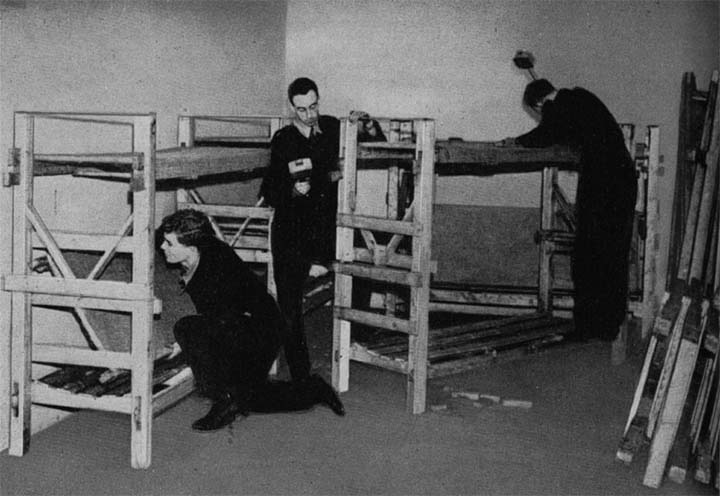
From the first the Unit had felt that it should be possible to have shelters which were not crowded or unhygienic, shelters in which, under the most favourable conditions, communities of people could develop an active life. So it decided to embark on an experiment. For it is a function of a voluntary body to demonstrate in an experimental scheme improvements which might be taken up by official bodies and extended. Early in November, a private shelter was opened in the basement under Lloyd's in Leadenhall Street for the cleaning staff of the building and their families. John Gough was appointed by the Unit to take charge. Bunks were secured through the authorities and erected by the Unit Work Squad in the basement strong rooms under the building in Leadenhall Street. On the ground floor a large common room was established, well furnished and with gay posters on the walls; only on nights of heavy raids did the shelterers spend their evenings below.
The aim was twofold---to introduce as high as possible a standard of material comfort and to build up a shelter community. In the East End the Unit had tried to stimulate shelter committees; thus only could the responsibility for what was done be put on to the shelterers themselves. A committee was appointed at Lloyd's and met regularly; members were allocated from among the shelterers to be responsible for the canteen, for games, for the library, for entertainments, and for shelter funds. The following minutes of the committee give some indication of the range of its activities and the standard of comfort in the shelter:
"Agreed lavatories be removed from Recreation Room.
"Library books and games to be handed in and checked every evening.
"First Aid Classes to be held for everyone caring to attend.
"Calling:
5.45 a.m.
Weekdays. 6.30 a.m.
Sundays. 10.30 p.m.
Retire and lights out. 11.00 p.m.
Saturday night. "The suggestion of early tea was over-ruled. Confirmed that Mrs. Moss should act as Canteen overseer.
"As cigarette machine not available, buy cigarettes and sell at retail prices. Carried.
"New packs of cards to be bought. Carried.
"Care of children; suggestion re schooling. Carried.
"Notice to be put up re Waste Paper.
"More ashtrays to be provided."
The ideal was that sooner or later the Unit would be able to withdraw and leave the shelter to run itself. This was at first impossible because of an undertaking to Lloyd's that the Unit would maintain supervision. The shelter kept open for many months, though towards the end, with the decline in air-raids, only a handful of people used it. As an experiment in showing how a shelter could be well run, it attracted considerable attention and was publicized through the B.B.C. and through the press, while several of its innovations were introduced in other shelters.
For another City shelter, in Cannon Street, some fifty yards from St. Paul's Cathedral, the Unit provided workers. There the premises were not so extensive, but bunks were installed, tables and chairs and other pieces of furniture brought in, a canteen and library organized, table-tennis and darts instituted, with the same colourful posters on the walls. Unfortunately the building was set on fire during the heavy raid on 10th May; the shelter had to be hurriedly evacuated and thereafter abandoned.
There was another "model" shelter. Norman Lewis was working at the Mansford Street Rest Centre in Bethnal Green. During a lull period when the Centre had no clients, he developed an interest in shelter welfare work in the locality, and had his eye on a surface shelter nearby. At first he met with opposition, for surface shelters were not popular, nor was the Unit anxious to extend shelter work into yet another borough. However, Norman won the day; bunks were installed in three of the six sections of a surface shelter in Derbyshire Street, and the other three sections left empty to house the canteen, a recreation room and washing and sanitary facilities. With the local people the shelter became very popular, its fame grew, and it was chosen as one of the shelters to be visited on the tour which the King and Queen made in the summer of 1941.
For all the riverside boroughs the only real answer to the shelter problem was evacuation, carried out effectively and humanely. Evacuation largely broke down because attention was not paid to special circumstances and requirements. Unless families were kept together, unless husbands were able to pay visits at week-ends, he evacuated women and children more often than not found their way back to swell the numbers in the shelters. Twice did the Unit attempt small schemes of its own. In November 1940 it took charge of a motley group of trekkers from East Ham who were making their way out of London through Buckhurst Hill. They were housed in a large house called Oakdene in East Barnet; four Unit men, with David Tait in charge, looked after them, and the scheme continued until March. It was an interesting but not a successful experiment, largely because of lack of support and the fact that the scheme was not a selective one.
Later in the winter Pat Armstrong, who was working at the time in Newmarket on an ambulance train staffed by the Unit, reported that there were many empty or half empty premises in the district. The F.W.V.R.C. assumed the responsibility at the reception end and took over two large houses and some cottages; the Unit recommended shelterers for evacuation from the shelters in which it worked, finding, as always, surprising difficulty in persuading families from Wapping and other parts of Stepney to leave London. Pat Armstrong was himself moved to London to act as Evacuation Officer.
But the Unit was never fully involved in evacuation schemes. It was more concerned with doing all it could to influence policy; for this purpose it carried out surveys of the situation in Wapping and parts of Poplar and Canning Town in an attempt to press the authorities by sheer weight of evidence to act.
THE WORK IN SHELTERS and Rest Centres depended to a large extent on other Unit departments which expanded rapidly during the period of the blitz.
For some time there had been a Transport Department to attend to the Unit's immediate needs, and there was a small garage in Raven Row. Transport was the key to any emergency work \in London, as elsewhere---enough of it and well serviced for immediate use. So, first under Ivan Sharman and later Derryck Hill, the Transport Section grew. More cars and trucks were obtained by loan or purchase. By March 1941 there was a queer collection of twenty-seven vehicles of fifteen different makes. Each had its little ways and had to be nursed and wheedled into action by the Unit's few mechanics---OC28 and BYN and PLO and Dame Colet and the rest. Very soon the garage in Raven Row proved too small, though it served the Unit throughout the worst of 1940 and 1941, and most of the servicing had to be done in the small yard in front or in the road outside. Eventually, in September 1941, when Leslie Gardner had taken over from Derryck Hill, who had followed Ivan Sharman overseas, a large commercial garage was rented just opposite the Commercial Road end of Philpot Street. Here there was extensive parking space and a workshop with adequate facilities for repairs and maintenance and storage. The Section grew until at one time there were nearly fifty men in it. New vehicles appeared, two 3-tonners from the Ministry of Health and, as a final flourish, a bus which proved a white elephant and was sold again. Cars and lorries were needed for routine journeys, for shelter rounds, for the canteen, for the transport of equipment and supplies in London and the provinces, to be always available for the Mobile Squad. Vehicles were attached to provincial centres and came up to London periodically for overhaul.
The Transport Section became a distinctive and very closely-knit group within the Students' Hostel community, holding its own section meetings, with its own interests, its own concerns and grievances, and its own very strong views on who should and should not be allowed to drive a Unit car.
There was also the Work Squad. From the earliest days the Unit had found it necessary to have a few men available who were particularly useful with their hands. There was the original work on the Camp at Northfield; when the section moved to Gloucester work had to be done on the slum cottages which were to house it in Sherborne Street. Early in September 1940 a small I group, with Tony Reynolds in charge, began to work in London. The Students' Hostel was their first theatre of operations; then they turned their attention to Rest Centres, and some shelters.
"It was on a cold, bleak and miserable Monday morning that we looked over the building, in company with the Area Supervisor, to see what improvements were needed. The interior reflected the atmosphere outside, but was, if anything, dirtier and dingier. We became more and more depressed as we went round and saw only too clearly what a condition a Centre, badly managed for four months, can get into. The depth was reached with the lavatories. They were ordinary school wash-houses opening off the main hall. Inside each were six Elsans, entirely unscreened. The place, we were told, had been cleaned, but as the windows had been boarded up for four months, the atmosphere beat that of most sewers to a rose garden.
"That afternoon the Work Squad arrived in force. The idea was to increase the light and remove the general air of dinginess ---and to get those lavatories attended to. We took down the permanent black-out, rehanging it as curtains; we scrubbed and distempered; we erected partitions and light traps and wedged the windows open.
"It took us more than a fortnight, four and sometimes five of us, and the Rest Centre began to look habitable. Our final touch was to put posters on the walls, gay pictures of the West Indies, the Mediterranean, Venice and Norway, to look down upon the homeless."
Later, under Henry Headley and Frank Gregory, there was growing work for carpenters and joiners and decorators and odd-job men, both on Unit premises and in the Centres and shelters and in evacuation hostels.
Another small but vigorous and distinctive group was that of the Canteen workers. There was a constant demand in the shelters for snacks and hot drinks in the course of a long evening, and in many cases no provision for them; full-scale meals were not so popular. A caravan trailer was acquired and its interior made suitable for urns and food stocks. Certain equipment came from the Ministry of Food. First from the Students' Hostel kitchen and later from a basement round the corner in Newark Street, the Canteen section came to serve a hundred shelters in several boroughs. At first the organization in most shelters was so primitive that everything, including urns of tea, had to be made beforehand and delivered, but gradually, when sinks and power-points and counters were installed in the larger shelters, the Unit became more of a wholesale agency delivering food, the responsibility for handling it being thrown on to the shelter committees or on reliable and competent shelterers who could staff the service voluntarily. The service went on for many months, through lull and blitz alike.
LONDON WAS FAR from being the only city to suffer the effects of air-raids, and it was inevitable that the Unit should turn its attention to provincial cities, whether by establishing settled sections or by sending squads of men to help in an emergency. The problems in the provinces were largely the same as those in London, except that in only a few cities were there large dormitory shelters. When a series of heavy raids occurred people took refuge in their private Andersons or reinforced rooms, or else, as in Plymouth, they trekked in thousands out of the town into the surrounding countryside. So the main emergency problems which the Unit came across in provincial towns were those of inadequate and overcrowded Rest Centres and of "trekking".
The Unit was not known outside London, but the ice was broken in Coventry when, after its heavy raid in November 1940, Tom Tanner went up to investigate the need. A few days later six Unit men, with Michael Rowntree in charge, reported for duty.
Michael joined the staff of the Public Assistance Office to help the overworked Rest Centre administrators, while the others went one each to a Rest Centre. It was a good beginning, but other excursions in 1940 were not so fortunate. In December groups went to Bristol and Southampton, in the former case at the invitation of local Friends to help establish a Rest Centre. They had not the same authority from local officials, and their scope of work was consequently much more limited.
It was becoming obvious that, if the Unit was to do much good after raids, it should be on the spot quickly and the invitation should come from the local authority responsible. A delay of five or six days meant that the worst emergency was already past. So, in January 1941, official arrangements were made with the Ministry of Health for the Unit to have a Mobile Squad on call. Henceforward, if a provincial city needed help in emergency for its overworked Rest Centre staffs, a message could be sent through the Ministry to the Unit Relief Office, and forthwith a team could be assembled and sent off. On more than one occasion telephone messages reached the Students' Hostel while raids on provincial cities were still in progress, and within a few hours a team was on its way. It involved considerable juggling on the part of the Relief Personnel Officers---in turn, Jack Frazer, Glan Davies and William Barnes---to ensure that at all hours of day and night there was a team on call from among men already occupied in London: it also meant a growing need for research to study conditions in provincial towns and find out how best the Unit could fit in if in emergency a team were sent. It was Michael Barratt Brown who, from the earliest days, had been responsible for this work.
The Unit also helped to staff the Food Flying Squads, the "Queen's Messengers". These convoys of large vans, gaily painted in blue and cream, were held by the Ministry of Food in readiness for emergency feeding. Staff was provided by the W.V.S., but there was an obvious need for men to give a hand with the driving, to stoke the boilers and to manhandle the large urns. It was arranged that the Unit should have on call eleven members for one convoy---nine for driving the vehicles and two despatch riders. Once a second team was provided when the first team was already out of London.
During March, April and May 1941, the Mobile Squad was rushed to Coventry, Plymouth and Liverpool. Twice teams made for Plymouth; on the second occasion, when Plymouth had six attacks in eight nights, eighteen men were summoned. They were on the job when Merseyside's turn came. A new squad was improvised for Liverpool, partly from London, partly from Plymouth and from Clydeside, where six men worked for a time on the Rest Centre problem. In Coventry, Plymouth and Liverpool they were joined by the Queen's Messengers, which provided gallons of stew and tea and mountains of sandwiches when the breakdown of public services made cooking for the townsfolk impossible.
The problems were everywhere much the same. In Plymouth, at the height of the six attacks in April, it was estimated that 50,000 people left the city every night to seek refuge in the surrounding country. They packed the Rest Centres, both official ones and others, hastily improvised in the schools and village halls; they sought private accommodation, they slept in barns, on the moors under hedges, inside their cars or trucks. The Mobile Squad spread itself over the periphery to seek out the worst concentrations outside the town, while the Queen's Messengers assisted with feeding. Its efforts were welcomed by the town authorities, and Tom Willis worked in the Central Office for some weeks as assistant to the Rest Centre Officer.
It was when at least one member of the Unit could work in the local authority's offices to help with the administration that the Unit's most successful work was always done. Plymouth and Coventry were always regarded as the Unit's most productive temporary excursions out of London. Eventually Michael Barratt Brown and Arnold Curtis produced for the Ministry of Health a report on the trekking conditions in Plymouth; it achieved considerable circulation.
Meanwhile, a more settled section had been established in Birmingham. Through the connections which the Unit had with the city it had been agreed that twelve men should start shelter work, and early in December they began, with Keith Linney in charge. Their work started, as in London, with medical services in the shelters, but, following the pattern of London, they soon extended their activities to welfare and to a canteen round. Five hundred shelters were surveyed and reports sent to the city officials and to the Ministry of Health. They had a great deal of antipacifist prejudice to cope with from some officials, but gradually the Unit found its feet; numbers in the section crept up to twenty, their house in Kingsmead Close proved too small and by the kindness of Christopher Taylor a larger house, Selly Wood, was made available. The work was extended to include a Citizens' Advice Bureau; a model Rest Centre was organized and a small Mobile Squad formed; summer camps were run for shelter children on the Lickey Hills. In the autumn of 1941 two men worked in Coventry to help re-organize the city's Rest Centre system in a calmer frame of mind than was possible during raids, and others did similar work at Worcester and Hereford. The last member of the Unit did not leave Birmingham until March 1944.
In October 1941 a similar section was sent, under Robin Whitworth, to Liverpool, with which the Unit already had some acquaintance earlier in the year. Housed first in Waterloo and later in Sefton Park, they undertook Rest Centre surveys and provided travelling supervisors for the re-organization of Rest Centres in Liverpool's "cushion belt"; they worked in the large Hamilton Square station shelter in Birkenhead, and, following the example of London and Birmingham, ran a camp for children near Mold. But the most interesting development of all, which came after the amalgamation with F.W.V.R.C., was that of the Friends Service Centre, started in Netherfield Road, in the Scotland Road area which contains the worst slums in Liverpool. A large and very dilapidated corner shop was taken at a miserable rent. Weeks were spent in cleaning and repairing and decorating. Gradually it was converted into a centre for club activities and for personal case-work in the locality. Its influence grew and eventually responsibility for it was taken over by local Friends, an arrangement which held out the hope that it would be continued permanently.
THE UNIT HAD PLUNGED into the East End and provincial cities in face of an overwhelming need. After a few months the worst of the emergency was over. But it was not so easy for workers once installed to extricate themselves, even had they wished to do so. Every evening, as dusk came on in the autumn and winter of 1941, they wondered whether 7th September 1940 in a new and more terrible form might not recur before the night was out. But for many a sense of futility began to creep in as they watched and waited month after month for work that never came. Meanwhile other interests arose in less transient social service and welfare; some regarded them as a useful way of keeping themselves occupied in a period of standing by, others found them a more satisfying form of service than the medical or emergency work for which they had originally joined the Unit. The beginning had been cough mixture and aspirin; the end was a growing concern for work that entered much more fully into the lives and relationships of those whom, through their emergency work, they had come to know.
There were early indications of the swing in emphasis. Some have already been described. In the larger shelters the Unit gradually gave way to qualified nurses he policy in Stepney was to have a qualified nurse for every shelter of over 400 inhabitants. When the Unit moved into West Ham it was specifically for welfare work with no mention of a medical basis for it.
Lawrence Darton, a schoolmaster member of the Unit, as early as December 1940 had become interested in the problem of the urchins who, during the day, ran wild in the bombed areas and spent their nights in shelters with no provision for their education. He had started a small number of daytime classes for the shelter children. This work was soon rendered superfluous because it was not long before the L.C.C. re-opened schools even in bombed areas. But it was indicative of the trend. At the end of December Lawrence had been appointed in charge of "education and entertainments", and he and others became interested in the development of the local Shelter Welfare Committee of a type that was being set up in most of the London boroughs. But the establishment of these Committees meant that the professional social workers were again coming into their own, and rightly so. However, Unit members, though amateurs, had a hand in club and welfare work, and, when the longer evenings came, activities begun in shelters were transferred to existing clubs, to which the Unit lent personnel, or, if there were none, to other premises. Clubs like the Sugar Loaf and the Old Mahogany Bar became familiar names. Work was also started in Citizens' Advice Bureaux in various parts of London. Inaugurated by the National Council of Social Service, the C.A.B. system became a highly popular source of information and assistance to those who were in distress through air-raids or other causes and could not pick their way through the maze of wartime regulations and provisions. Later a horse box was converted by the Work Squad into an office on wheels to become a mobile C.A.B. for provincial work. In April the Executive Committee approved an ambitious "summer programme" intended to develop the growing interest in social work as a means of keeping emergency workers occupied and holding shelter groups together for the possible recurrence of heavy raids the following winter.
Thus many schemes were started by enthusiastic members during the summer of 1941, some laughably abortive, some highly successful. Abortive was the Wapping Open Air Theatre, which was inaugurated with high hopes but, through various practical difficulties, fell very flat. Laughably so was the fiasco of the East End Sports in Victoria Park. There was much blowing of trumpets beforehand but unfortunately the festival itself coincided with the worst thunderstorm of many years; the sports were completely washed out and the regional dignitaries who came to distribute the prizes found themselves faced with a handful of adolescents and children and some shamefaced Unit members all trying to pretend that really they had nothing to do with it.
Much more successful was the Flaunden Camp. Several members with experience of camping had urged that young people from the bombed areas should be enabled to spend holiday weeks or week-ends outside London. A ready-made camp was found at Flaunden in the Chilterns and throughout that summer camps were organized for adolescent boys and girls and those slightly older; they came forty and fifty at a time and paid small fees to cover the bare costs. The first wardens were David and Molly Tod, with Alan Lawson on their staff; it was Alan who was to be warden for the next five years of the camp's existence.
A chessboard pattern of all kinds of work in and out of London meant that the Section was not an easy one to run. In July 1941, Ralph Barlow took over the Relief Office from Peter Gibson, who had gone overseas, and in August the appointment of Lawrence Darton as Shelter Officer in place of Richard Symonds showed that the transfer to a basis of social work was complete. Every morning in the Relief Office, the corner room on the first floor of the Students' Hostel, the day started with a routine meeting of London leaders to discuss plans for the day; more ambitious weekly meetings were held, and once a month the provincial relief leaders came in for a fuller discussion. A year wore on and the longer nights of the winter still produced no activity on the scale of 1940-41 ; more and more members began to feel that while provision should be made for those whose primary interest was social work, for the others an orderly retreat was the only answer.
In fact, the Unit was involved in work about which no members of the Society of Friends would have any qualms of conscience. Its work on relief had all along been financed with funds from the American Friends Service Committee contributed through the F.W.V.R.C. Even if there was not much overlapping, both the F.A.U. and F.W.V.R.C. were tackling the same problems from different angles. It was natural, and indeed inevitable, that there should be closer integration.
So the completion of the story of civilian relief in Britain means for the reader a further incursion into Quaker politics. In November 1941, a conference was held at Bournemouth with ten representatives of the Unit and of War Vics, and as a result there came into existence in the following February an amalgamation of F.W.V.R.C., which now ceased to exist by that name, with the Civilian Relief Section of the F.A.U. The Unit, in its own name, concentrated again on hospital and training work in Britain and on its rapidly developing service overseas. The new body formed by the amalgamation was the Friends War Relief Service; by a subsequent amalgamation, which luckily need not here be described, with other Friends Committees it became simply Friends Relief Service. For the first time a piece of work started by the Unit had become the official responsibility of the Society of Friends.
Administrative control of all relief work in Britain was now in the hands of the F.W.R.S. committees, but the Unit, as its contribution to the amalgamation, continued to provide the Emergency Relief Officer; it was represented on the F.W.R.S. committees, and most of the emergency workers of F.W.R.S., as opposed to the more permanent social and welfare workers, were seconded Unit members. F.A.U. members who had been primarily interested in social work were transferred permanently to the new organization; those who were for carrying on while they were in England, but would grasp the chance when it came of going overseas with the Unit, served on a seconded basis. Ralph Barlow continued as Emergency Relief Officer for F.W.R.S. until the Unit sent him abroad in the summer of 1942. He was succeeded by Michael Barratt Brown, who in turn handed over to Arnold Curtis. The demands of service overseas meant that at frequent intervals officers at home played general post.
There were several repercussions of the marriage. Joint departments were established to ensure economy in funds and personnel. A Joint Transport Organization took over the Commercial Road Garage which continued as its centre until, in January 1943, it was requisitioned by the War Office; after three months of being driven from pillar to post, the Section found a new home in Fortess Road, Kentish Town; the three Transport Officers after Leslie Gardner-Jack Goss, Oswald Dick and Paul Roake---and the bulk of the personnel were still supplied by the Unit. The Unit gave up its own Work Squad; its members were seconded to the Works Parties of F.W.R.S., and Frank Gregory remained in charge for many, months. Michael Hacking's Joint Quartermastering Department became responsible for feeding the I F.A.U. and F.W.R.S. hostels in London and for training cooks, while F.W.R.S. took over the Students' Hostel, where Unit members who were seconded to it continued to live.
Some work in Emergency Relief was inaugurated after the amalgamation; in March 1942 a section went to Newcastle and worked on the pattern set by Birmingham and Liverpool. In May 1942, Mobile Squads and the Mobile C.A.B., with seconded Unit members, visited for brief periods York and Bath and Exeter and Norwich, which were stricken by the sudden "Baedeker Raids".
By this time the reader's confusion is no doubt complete. In brief, there was close interchange between the two bodies in the field of civilian relief until, as the end of the war approached, F.R.S. itself became interested in work abroad. What was left of its Emergency Relief Section in Britain was merged into a training centre at Mount Waltham in Hampstead to prepare workers for relief work overseas.
SEPTEMBER 1940 had brought the Unit one of its greatest challenges. Where such a challenge is spiced with an element of danger and exhilaration it draws out of young people the best that they can give. Said Francis Bacon: "Young people are fitter to invent than to judge, fitter for execution than for counsel, and fitter for new projects than for settled business." The Unit, by its very nature, was fitter for new projects, especially when they demanded rapid adjustment to unexpected situations, when they extended body and brain to the utmost in a fury of activity. When it was reduced to settled business, the Unit had little to give when compared with official bodies competently organized or with those social workers who had been on the spot for many years and carried on as before when the Unit had disappeared from the scene.
 |
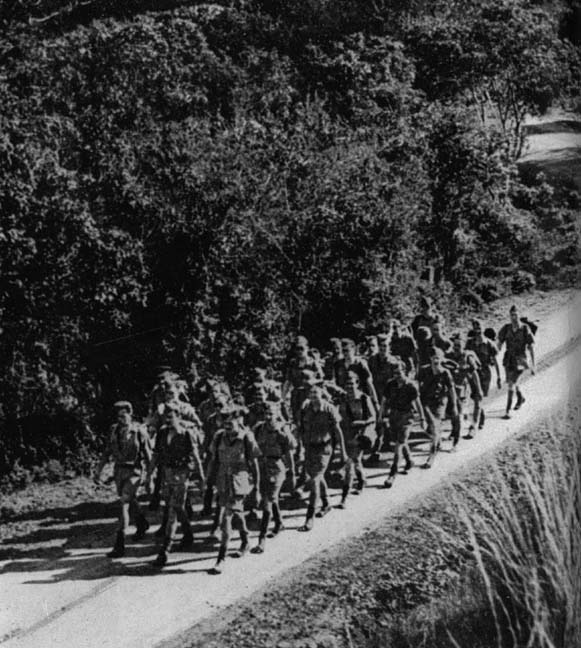 August 1942 |
When the amalgamation came it ran with surprising, but by no means consistent, smoothness. That was perhaps too much to expect. Between the two organizations at their best there were obviously similarities of outlook and aim and method; they both, the one officially, the other unofficially, carried the name of Friends, and for months there had been close co-operation between them typified by the General Secretary of F.W.V.R.C. and the Relief and the Relief officer of the F.A.U. shaving side by side every morning in the bathroom at the Students' Hostel. Much important business was transacted during those shaving periods. At their worst, when the two bodies caricatured each other, the Unit found the multifarious committees of the Society of Friends too slow and cautious, too hesitant in seizing opportunities; no doubt on its side the Unit was regarded as having too much of the rashness and independence and cocksureness of youth. Allowance must be made for both caricature and for the real difficulties which arose. But the amalgamation was achieved and proved its worth.
Overseas the Unit was to carry on civilian relief work independently and on a growing scale. Here in a wider field the very name of Friends proved a passport into many difficult situations; Unit members were "the Quakers" as much as any official workers sent out by the Society itself and it was useless to do more than accept the definition, for most people among whom they worked were not interested in the intricacies of Quaker relationships. It did mean that Unit members came to feel a growing responsibility to the Society whose name and reputation they bore around with them, while the Society, in its turn, secured willy-nilly much of the credit for the Unit's work. When Unit members overseas came into contact with Friends the world over, in the Dominions and in America and other countries, they were regarded as ambassadors of the Society in England, and each year at home the Unit was invited to report to the Society's Yearly Meeting. To the end, it is true, some members of the Society had misgivings about the Unit's more military work, but it proved less and less a stumbling block.
Inevitably the end of emergency work in Britain, shorn of its interest and urgency, invited comparison with the exciting and feverish days of 1946. But excitement and feverishness cannot last for ever, and experience gained at home was to prove invaluable when one party after another of Unit members moved off for service overseas.
The Early Days, cont'd: Growth and Fulfilment.
Table of Contents