RELIEF WORK HAD INTRODUCED a new tradition, not superseding the old but growing parallel with it. Henceforward old and new showed up as two clear strands within the Unit, and when interwoven they produced much of its best work overseas. They were the hospital and relief traditions. For hospital work had continued steadily; it had not grown in proportion to the Unit's total growth during the blitz, since every extra man available was needed in East London and bombed provincial towns, but throughout 1941 and 1942 numbers in hospitals remained at over 150, rising to over 200 in 1943; not until the spring of 1944, when the speed of development overseas increased still further, did it fall again below 150 and gradually run down.
Although, of course, there were exceptions on both sides, hospital and relief work in general appealed to different types. Hospital workers were mainly those who found satisfaction, as many do, in the nursing of sick people, or wanted a straightforward and steady job which involved a clear routine in a small and closeknit section. The relief worker was more an individualist, more restless, perhaps more versatile, anxious to make his own job, to manage people and to achieve results by agitation, by interviews and reports, rather than to push a trolley or learn up the technical details of surgical processes. However the differences between the types might be defined, to the Unit member they were unmistakable. Constantly the two sides came to friendly, but very real, grips at Staff Meeting; sometimes it meant deeply held differences of view on Unit policy; more often it was no more than mischievous leg-pulling, which a skilful Clerk could turn into a laugh. Relief workers would regard their colleagues in hospital as sunk into a rut where there was little scope for initiative or originality; whereas the man in hospital looked upon relief, particularly when the blitz was over, as something vague and ill-defined, and wondered what on earth these people really did.
But between them the two strands produced a curious brand of persons whom we liked to describe as "the Unit type"---men and women who reckoned that with a mixture of knowledge and adaptability they could rise to most jobs, and very often did. They liked to feel that they could tackle the unexpected situation with versatility and drive where knowledge failed. But more and more did knowledge, which meant hard and lengthy training, become important, and the Unit came to place increasing emphasis upon it. No doubt this faith in "the Unit type" at times produced the pride which led to disconcerting falls, but it also produced the strong and binding loyalty which carried the Unit past many a sticky situation. For it was loyalty to the group more than any other single quality which pulled the Unit through. Its best work throughout its history was done by teams, closely-knit and mutually dependent, and not by individuals working in isolation.
The urge to go abroad had been dormant in the blitz. There was pressing work at home, work which demanded all that could be put into it. But the urge was never forgotten, and there were some who, through the raids of Whitechapel or through long periods of routine in hospital, nursed the passionate hope that sooner or later they would find service overseas.
Meanwhile the Unit was still adding to its numbers, taking in more members in faith that it could find work for them. On the other hand, there was a constant trickle of resignations; members left to do other work which held more attraction for them, some on the land, some in paid hospital work. There were many who left for financial reasons because service in an unpaid organization inevitably became a strain. Later a scheme was evolved to make provision for dependents, but until half way through the war the necessary funds were not available. And there were some (about one in thirteen of all who served in the Unit) who went into the fighting forces, having concluded that it was the only way. But others, indeed the great majority, found that the nearer they came to the war and all it meant, the more was their faith strengthened, though purged of its more ingenuous elements.
So new Camps came in and numbers crept up. In November 1942 the Unit passed the 700 mark; by September 1943 it reached 770; it rose to its peak in August 1944 with 811, the highest total in membership at any one time. Throughout the spring of 1945 it played around 800; by November it was down below 700, and then steadily dwindled as demobilization got under way.
SO WITH NUMBERS GROWING and work of the type which the Unit felt itself more competent to do on the wane at home, the search for work abroad started in earnest. From a desk at Unit headquarters, one could see, from the end of 1940 onwards, the shifting of the balance from work at home to work abroad, at first slowly and painfully, then with growing momentum. At first each expedition overseas was a major enterprise; it involved months of preparation and waiting around for shipping and facilities, until the most buoyantly enthusiastic was damped by constant disappointments and frustrations. For when the war was going badly for the Allies and whole divisions had to be shipped half way across the world to stem the tide, a handful of pacifists could not rank high in the shipping priorities.
It was those early days that were most difficult. Once a little had been won more could be achieved. It was infinitely easier to send more men to an area in which the Unit was already at work than to start by breaking new ground through negotiations in London. So later we came to depend largely on invitations from the field. But in the earlier days the burden fell mostly on the Executive Committee which, in 1941 and early 1942, strove by every means that perseverance, and not a little bluff, could devise, to interest in the Unit those bodies that might provide it with the work it wanted. For some weeks early in 1942 Richard Symonds was detached to tell his story to the Free Governments at the time resident in London, to see whether the Unit might not help them through their Red Cross or through attachment to their armies. The difficulty was that neither Poles nor Dutch nor Greeks nor Czechs nor Norwegians were particularly interested in a body that offered men rather than material. A scheme or relief work in the West Indies, too, was investigated and fell flat. There were as many hopeful schemes, and as much disappointment, as there had been in the bleak days after the return from Finland. But persistence and opportunism, together with more than a measure of good luck, did their work, and gradually the corner was turned. New opportunities came, presenting themselves sometimes unexpectedly, sometimes only when some Unit number at home or overseas with particular foresight and initiative searched them out.
A brief survey will show the pace of expansion overseas. At the end of 1940, when the only members not in England were the twenty-five who had passed from Finland to the Middle East, there were already two other projects on the stocks. Some members of : the Unit, finding no work in the western war, looked to the Far East, where China's war was already old and the suffering immeasurable. The. selection of men, the raising of money, the various preparations needed for work in China, occupied some months, and the forerunners of what was to become one of the Unit's largest and most vigorous sections did not leave until the spring in 1941. Already, too, before the end of 1940, the Unit had been approached to provide driver-orderlies for the Hadfield Spears Hospital to work with the Free French. They left early in 1941, whilst, by the summer of that year, the Finland remnants in the Middle East, depleted by further misadventures in Greece, were ready to receive reinforcements, and a large party went out. By the end of the year there were 150 members abroad.
1942 raised the number to 270; there were more members for China, more for the Middle East, with new work in India and in Ethiopia. 1943 was a year of consolidation, while the Unit got its second wind; 40 more went overseas, but in the autumn the opening of relief work in Italy and a new section with the French Army portended that more would soon be needed. The tide of the war was turning and the Allies were moving to the attack. In 1944 relief work among civilians got into its stride in the Mediterranean area ; it had started in refugee camps in the Middle East and later in the Balkans and the Islands, bringing numbers abroad to 470. The peak was reached in May 1945, when 569 members out of a total at the time of 784 were working overseas. And although totals of men and women overseas were unimportant in themselves compared with the effectiveness of the job done, it would be idle to pretend that there was not a certain satisfaction in seeing the numbers creeping up. We knew that it was what the Unit wanted, so long as it was convinced that at the other end there was a job to do (for idleness and maladjustment overseas are even more depressing to morale than they are at home). We knew that it was what the Unit had been formed to do, and there. was a sense of achievement in the overcoming of so many of the obstacles that had barred the way in the earlier days.
AT HOME STAFF MEETING, now numbering anything up to fifty members, continued to meet every three, and after May 1943 every four, months to remind the administration of the mood and temper of the Unit. Sometimes the mood was formidable, and the meetings as a result were all the more vigorous and lively. The Students' Hostel, in its heyday in 1941 and 1942, usually sent a fiery delegation of five or six, who sat in close formation and with frequent whispered consultations rose one after the other to the attack. But time calms the passions, and as the vigorous personalities of the early days left for overseas and as "battles long ago" came to be forgotten, Staff Meeting became a more composed, if less exciting, body.
In the Constitution itself there was little change. The Executive Committee, instead of being confined to departmental heads with one representative of Staff Meeting, became, from April 1941, constitutionally open to all members of the Unit without reference to the job that they were doing, nor were its members limited to seven. From then on, numbers usually ranged between seven and ten, and in practice there was still a strong and growing tendency for departmental heads to be appointed as they were more in touch with what was going on. Apart from a further adaptation in the summer of 1944 to provide for the members overseas expressing themselves through their own Staff or Section Meetings, the Constitution remained to the end unchanged.
Every week on Monday afternoons the Executive Committee sat round the green baize that was always too short for the table in the back room at Gordon Square. There were long sessions which went on into the late evening, sometimes flowing over on to Tuesday morning, for there was always a full agenda; new possibilities overseas to be discussed, reports to be considered, fresh projects for raising money, some member who was being awkward, appointments to be made, and to produce perhaps the longest discussions of all, who should lead the next party overseas.
There was the Advisory Committee, too. In the summer of 1941, when the Unit was still virally concerned with its own purpose and philosophy, there was felt to be room for a body meeting less often than the Executive Committee; it would serve as a clearing house for matters of concern to members or to sections, matters which did not directly affect day-to-day affairs but could be dealt with in a way more leisurely, more spacious and more detached. So, when the Executive or Staff Meeting had reached deadlock over a particularly sticky problem, the answer was inevitably, "That's a matter for the Advisory Committee." It was the Standing Committee of Staff Meeting and appointed by it.
A necessary result of the Unit's growth and spreading abroad was the development of the Head Office staff. In 1940 there had been a handful of men---an Officer for Recruiting, an Officer for work at home and one for work overseas, a Finance Officer and his assistants, who looked after accounts, quartermastering and equipment; there was a Transport Officer and a small clerical staff. And then there were the Group Leaders, and towards the end of the year an Officer in Charge of Relief work.
But over the next two years a more complex system was evolved. Responsible to the Chairman of the Executive Committee were a number of Executive Officers, each with his department to run. The Group Leaders gave way to a Personnel Office, responsible for the work, disposition and welfare of all members. The Recruiting Officer continued to be Peter Hume, who had taken over recruiting from Paul Cadbury early in 1940 and interviewed personally most of the members who joined the Unit over the next three years. One remembers him squatting on his heels in his chair, never happier than when trying to weigh up a new applicant and put him at his ease, or else wrestling over the telephone with the Ministry of Labour over a controversial case. He had a phenomenal memory for names and faces; with his cheerful grin he would go up to a member---he could do it with practically any members of the Unit---and address him by his full Christian names and home address. And he could, and did, incessantly play "Country Gardens" on the borrowed piano in the Committee Room. It was his only tune.
An Officer in Charge of Relief continued for a time and a separate officer was appointed late in 1941 to deal with hospitals. The Overseas Office was variously organized; gradually it settled down in two sections, one dealing with the Far East and the other with the Middle East and Ethiopia, while later still an Overseas Relief Officer was appointed to cope with the growth of civilian relief in Europe. There came a Movements Officer, too, to deal with technical matters of passages to and from countries overseas.
Nowhere was expansion more necessary to meet the rapid growth of the Unit's work than in the Finance Department, while money-raising and the necessity to make the Unit's work known gave birth to the Publicity Office, which later had its name changed to what was regarded as the more modest and Quakerly title of Information Office. And then there were other departments---Transport, Quartermastering, Equipment, all with their separate functions, while the production of the Unit Chronicle merited a department to itself.
The Head Office. staff crept up to thirty-five, and No. 3 Gordon Square had to be taken in addition to No. 4. The Unit went up in the world; there were two green doors instead of one.
So the rough and ready administration of the early days gave way to system and bureaucracy (or so the Unit maintained; what headquarters office is ever popular ?). The office seemed full of typewriters and filing cabinets and telephone extensions, with Weekly Instructions issued to the Unit and printed Standing Orders. Executive officers tended to discard their flannel trousers and turn up in suits, because there might be unexpected interviews or lunches with useful "contacts", those figures in the Ministries and the Government offices who were thought to be of potential use to the Unit's work. At least one hat in the building was reserved for contact purposes. Throughout, all headquarters workers were full members of the Unit on the same basis as those in the field. There was constant interchange, and by the end a high proportion of the staff were men or women who had themselves served abroad. There was always an atmosphere of informality and the early exuberance was not altogether lost.
FOR TWO YEARS, from December 1940 to November 1942, Tom Tanner ruled, apart from a two-months' visit which he paid to the United States in the winter of 1941, mainly to discuss China affairs with the American Friends Service Committee. On that occasion Ralph Barlow, as Deputy Chairman, added his work to his own as officer in Charge of Relief. His two months coincided with the negotiations for combining the Civilian Relief Section and the Friends War Victims Relief Committee, and with many difficult decisions on the Executive over the finding of new openings overseas.
In the course of 1942, it was becoming obvious that a visit by Tom Tanner to China would be of immense benefit, not only to China but to London. Communications at the time were extraordinarily bad; delays up to four or five months in receiving letters were not uncommon. One letter arrived after sixteen months on the way, its problems already solved by Time the Great Healer. It was obvious too that the Section in China was having a difficult time in settling down. And if China, then other sections could be visited on the way. So, in the autumn, plans went ahead for a visit, and after some discussion and change of plan as to who his companion should be, it was decided that Peter Hume should go. It was to be the first visit from headquarters to sections to sections overseas and they were to be away nine months. On 23rd November they set off from Euston Station. Those were among the darkest days of the war at sea; the U-boat campaign was at its height. As December advanced uneasiness grew because their boat was overdue. Two days before the end of the year the news came through that it had been torpedoed and sunk in the South Atlantic; there was only one survivor. The loss of the Ceramic was one of the biggest single disasters of the war at sea. For the Unit, it was the cruellest blow which it could have suffered.
When the message arrived, the Gordon Square staff assembled in the room in which the Executive Committee usually met. The news was broken to them ; they stood in silence and after a time filed out without a word. They all knew that the end of an era had come. The Executive, indeed the whole Unit, would be different. But those who remained on the Executive Committee, after the first shock of the news, found in the very loss of Tom and Peter new inspiration to close the ranks and go forward with mutual loyalty in the tradition that had been formed. The period of rapid development was coming to an end; the direction of the Unit had been set, and it was for us to carry on. In January 1943, on Staff Meeting's recommendation, the Council appointed Tegla Davies, who had served as Deputy Chairman since Tom's departure, to he Chairman Of the Committee. He continued until January 1946, when Lewis Waddilove, returning from the Mediterranean, took over for the Unit's last months. Meanwhile, the visit to China went ahead. Ralph Barlow, who was Officer in Charge in the Mediterranean, and now became once more Deputy Chairman, was sent on to China from Cairo, where he was joined by Brandon Cadbury from London and by John Rich from Philadelphia.
So, over a period of five years from the blitz, the Unit's work was brought to its fulfilment.
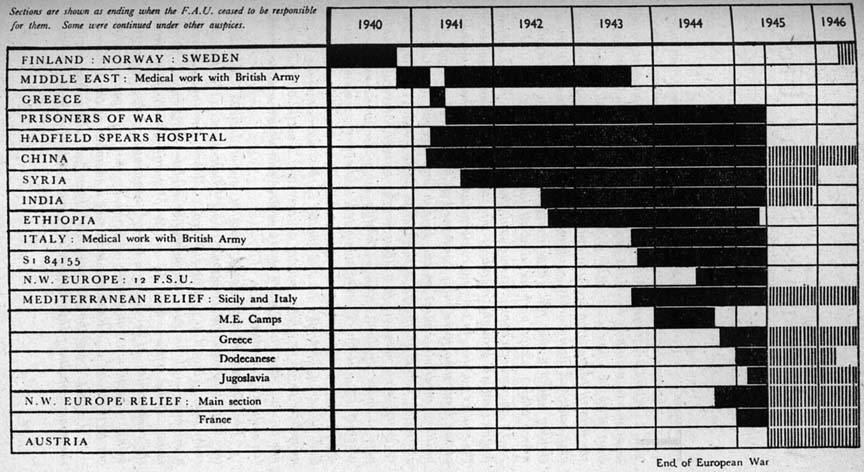
To avoid constant movement from country to country, the story of each overseas section will henceforth be carried through as a complete whole from its beginning to its end. It should be remembered, however, that the stories represent work which was being carried out in many countries simultaneously. The table of the main overseas sections with which this chapter closes shows their comparative chronology.
TO MANY IT MAY SEEM ILLOGICAL. A young man takes the trouble to register as a conscientious objector and appear before a Tribunal; to appeal, and, if still unsuccessful, to go to prison to maintain his right not to be conscripted into the army. Forthwith he joins the F.A.U. with the set purpose of working on the field of battle, attached to a military unit, eating in army messes and canteens, using army equipment, wearing khaki uniform---a civilian uniform, but still khaki---accepting voluntarily a discipline which others accept perforce, and all for no payment.
In an earlier chapter it was said that there were many varied motives which brought members into the Unit. Many too were the motives which, in varying combinations, inspired those members of the Unit who were most concerned to follow the war with the military medical services of the British and French and Chinese, armies. Not all members were eager to do so, many, perhaps the majority, were anxious that their work, though overseas, should have a more civilian setting (though anywhere in a war zone, whether the succoured were wounded soldiers or civilian victims, acceptance of ultimate military control was inevitable). Many had no strong feelings on the matter; they were anxious to go anywhere or do anything so long as there was a useful and exacting job to do. But there were many whose one desire was to work for military casualties.
The normal healthy young pacifist is not a freak. He feels the same passions and emotions as his fellow men. He does not enjoy being classed as odd or different. When war comes he is in a dilemma. If he joins the army, he violates his deepest convictions: if he refuses, he is in danger of cutting himself off from the community, of becoming a too self-conscious rebel, a segregated being. Some are not unduly worried by that segregation, others are tortured by it. Read the words of a member of the Unit:
"I don't know how it may have been for others, but for me the most appalling thing about this war at the beginning seemed to he its cold-blooded lunacy, the insane, logical efficiency with which it minced up feelings which were human and natural. Friends one had studied with in England, friends one had worked and played with in Germany, were now being hurled at one another by the blind and utterly relentless arms of a machine. If this was necessary, if this was inevitable, then the world---more than the world, the universe itself---was mad. And in a world that is mad, the human soul is unutterably lonely . . . . To fig/it this loneliness, to lay hold of sanity, I felt I must keep close to those who were suffering; in face of so many feelings which J could not share, I had to go where there was something I could. Hence the F.A.U.; which, moreover, held the promise of taking. one into the battle, even though one did not fight it.
"The trouble of course is that it hardly ever worked like that; only rarely, in a hospital or in the blitz, did one encounter people on that level. Others, presumably, found what they were looking for in Greece, or Bir Hacheim. But, filling up Rest Centre forms a year after the raids were over, the old futility, the old isolation, would return. And there is no sovereign cure, for whatever danger one may run from time to time, boredom is a constant companion. Perhaps this is as it should be---perhaps this sense of being cut off from the body of society is the burden which the C.O. is called upon to bear to-day. To restore one's sense of fellowship by sharing danger is, perhaps, too easy; perhaps we are called upon to discover a more hidden way of integrating ourselves into society. For that is what we have to do. Our sense of separation, like the aching of a tooth, is the sign of something wrong. Somehow, some time, there must be an atonement between ourselves and the community, a healing, a mating whole."
Not everyone would put the feeling so consciously or so strongly into words, but unconsciously most members experienced it. And they would be unnatural if they did not. Men of their own age, men who were their friends, men with whom but recently they had shared desk or bench or common room, were being despatched into the fury of the battle. Why should they themselves, simply because the law had granted them exemption, avoid the danger and unpleasantness? It may be argued that mingled with this feeling was the anxiety to avoid any suspicion of cowardice, to justify themselves in their own eyes and in the eyes of their fellow men ; in short, to have it both ways. Perhaps this feeling was present in greater or smaller measure in the minds of some, though rarely consciously. In general it was the sincere and natural urge of young men to take their share of danger or discomfort.
Not that there was in practice so much either of danger or discomfort. Sometimes sections had their fill of both, but it was rare; not often were Unit members, any more than the great majority of all those in the Forces, faced with hazard to life and limb. In a provincial hospital section in England the ideal to be aimed at was service overseas. But, once there, simply to be overseas meant nothing. Cairo or Rome were safer, and certainly more comfortable, than Whitechapel. There the ideal seemed to be service forward in the field. But when service forward was achieved, even in the most advanced medical units, the danger was slight compared with that of the infantryman who could be seen moving forward to the front line and might, in a few hours, be brought back dead or wounded. Life overseas certainly had its hardships, without the compensations of life at home, but they, were the hardships of unpleasant and deadening routine, sometimes of inactivity, rarely bringing the exhilaration of dangerous situations.,
The Unit's purpose was the relief of suffering caused by war; and nowhere was such suffering more apparent than on the battlefield. That was another reason for working with the armies. Not that in point of numbers a small body of C.O.s had much to add to the large medical services of the Forces, and towards the end there seemed less need to work for soldiers than for the millions of civilian victims of the war. Then the effort was concentrated on civilian work, but while it lasted work for military casualties was at least a gesture---a gesture of fellowship and help, and to the end some members of the Unit felt that it was the job that they should do.
In an army organized for total war it was not easy to incorporate a pacifist unit which insisted on retaining its identity, which had to pick and choose what jobs it could and could not do, which claimed the final authority over the disposition of its members. Success depended largely on patience and understanding on both sides; failure came when insistence on the letter crushed the spirit. Senior army officers who handled men by the thousand or ten thousand would, with very few exceptions, do their utmost to accommodate a group of men with whose views they disagreed, even if they understood them. To them as much as to anyone, to junior officers, to men in the ranks who became their friends, did members of the Unit owe what success they achieved in their work with armies in the field.
It may still sound illogical. But it arose from strong and healthy instincts---the instinct to share the experiences and, if need be, the hardships of one's fellow men, to give help where help was needed most obviously and most immediately. That it should not always turn out as expected did not invalidate the motive. And, after all, wherein lies the logic in war itself?
LATE ON MONDAY NIGHT, 21st October 1940, twenty-five men in civilian clothes of Scandinavian cut arrived in Cairo just in time for an air-raid alarm. They were the twenty-five who had made their way from Finland. On the first day they reported to the Red Cross and were warmly received by the Commissioner, Lord Somers, and by Mr. Archibald, who from that moment onwards became a great friend, always helpful and effective in making smooth the Unit's path. Otherwise there was little to report from that first week, except for Oswald Dick's broadcast interview with Richard Dimbleby and the taking of photographs in scraps of their Finnish kit; they were not displeased to find that some fuss was made of them. They did all the things which people do in Cairo; they saw the Pyramids and a mosque or two, the Nile barrage, and the bazaars and shops. Then half the section went down with the inevitable "gippy tummy".
A month before their arrival, the Italian forces under Marshal Graziani had crossed the Egyptian frontier and penetrated as far as Sidi Barrani, where they stayed for nearly three months. Exactly a week after their arrival, Italy invaded Greece. Then, in December, General Wavell began his first campaign, which in sixty-two days drove the Italians out of Egypt and Cyrenaica. The spring, however, brought disaster. The British decided to send an expeditionary force to Greece, which, small though it was, depleted their forces to such an extent that, soon after the loss of Greece and Crete, the Germans, with the large tank force that they had moved into Libya, drove them back across the Egyptian frontier and surrounded the garrison left behind in Tobruk.
This was the period that faced the F.A.U. section newly arrived in Egypt.
THEIR WORK WAS TO BE in Alexandria, where, with some new ambulances presented by the Australian Red Cross, they were to act as transport section for the 2/5th General Hospital. So, at the end of the first week, some of them drove four brand new ambulances along the desert road to Alexandria, the rest following by train to pick up further ambulances already there.
But when they arrived in Alexandria things were not so easy; no instructions had come through from Cairo, there was no accommodation for them, nor was there good prospect of work. Something had gone wrong. They were sent to transit billets at Mustapha Barracks, where they spent a night, disgruntled and hungry victims of the teeming insect life. But then, after an interlude in a small and cheap hotel of very doubtful character, their luck was in, for they stumbled on Daly's House, a large, clean and comfortable establishment on the sea front.
It was luck not only for them; it was a golden investment for the future.
It was six months since they had worked together as an ambulance team and they were getting ragged. They worked hard to make themselves presentable. Every morning they did P.T. and first aid practice, with driving instruction on the new vehicles and stretcher drill, and gradually the sense of community came back as they lived together again. But unfortunately there was little work to do. There were further consultations; then they were instructed to go into quarters with the Other Ranks of the 8th General Hospital and to serve the 8th and 2/5th General Hospitals with transport as part of an Ambulance Car Company. Colonel Walker, O.C. of the 8th General, became another firm friend and champion. On 11th November, a party under Tom Burns reported to the British Army in the person of one Sergeant Foister. In so humble and unspectacular a way did the Unit first make its contact with the Army in Africa.
The 8th General Hospital was in the Italian School, well-designed and modern, admirable for its purpose. On the corner of a football ground, empty except for the stores tent, the Unit put up bell tents and marquees. They drew their rations from the Company cookhouse but lived on their own. They worked hard to impress; ignorant of British Army methods and routine, they tried to make up for ignorance by willingness.
But work was still scarce, too scarce. They transported patients to and from both hospitals, including the Officer Section of the 2/5th, which was in a separate building. There were occasional ambulance runs. But no more. They were becoming disappointed men, nor did cleaning floors in the hospital help matters. Perhaps they had been spoilt by the excitement of Finland and the modest fanfares which had greeted them in Cairo, and still expected work with the purpose and colour which they had found in Scandinavia; the British Army, not unnaturally, took little notice of them, and they felt a little sore. Most of them were to have more than their share of idleness and frustration before the war ended; they had as yet hardly come to terms with boredom. They were passing through their own little slump.
Meanwhile Egypt was noticeably filling up with troops. Early in December came General Wavell's push. Soon trainloads of wounded British and Italians steamed into the Victoria Station. At night they were distributed by ambulance to the two hospitals, of which the 2/5th had now become the 64th General, the name by which it later became familiar to the Unit. The Section found its hands full. It began to pull itself together ; "handling wounded back from the desert, quiet, dog-tired, dirty, lousy and chilled, put our incipient grumbles into their right perspective ".
Meanwhile at Daly's, though it was not their home, there was always a warm welcome. The delightful and motherly French-Syrian Madame Haddad had adopted them as her own; she had been sad to see them go and continued to offer them the use of her pension as a club. There were ping-pong and cheap food, with armchairs and a gramophone and wireless; and Madame darned their socks. Daly's had come to stay. And they owed a great deal to others who befriended and entertained them.
After Christmas the pressure slacked off. As the British advanced into Libya, the casualties were evacuated by hospital ship and freighter from Sollum and Tobruk, so that call-outs, though they involved bigger jobs when the ships arrived, were less frequent. They were becoming bored again. They still thought of real work in terms of Finnish front-line conditions. Inevitably, too, they were out of touch with the home Unit; they felt that their fellow members at home in the blitz were doing far more onerous and difficult work than they had to encounter. Again they recorded "disappointment, boredom, few books, the cold discomfort of the marquees". The only solution was some fundamental change in their occupation, some challenge of the kind that they had found in Finland.
The challenge came, in a form which was unnaturally reminiscent of Finland. When Greece was attacked, the possibilities of work there had been discussed. At first they had been hopeful, in view of the clamour from all sides of sympathy and praise and the promise of support for the Greeks; but when they came to the point it was not easy for them to be released from their existing work, however spasmodic it might be. The constant danger of air-raids on Alexandria was an additional reason why they should stay behind.
Partly because it was work that they could do, partly because perhaps they felt that they might earn a stake in their future use, they took a hand with some ambulances which were being built for the British Red Cross. They collected the chassis at Suez and drove them to Alexandria, and Martin Lidbetter became responsible for designing the bodies and the fittings.
Months passed and they despaired more and more of work in Greece.
"But the dams broke at last. M Branch spoke, the Red Cross committed the ambulances to our charge, visas again figured largely in Joynes' conversation, stores and a monstrous great tent---never used---were delivered from Cairo, we bought a block and tackle, primuses and pots, and we were ready to move. The movement order came late at night, with everybody away from camp or in bed, and we loaded up in a howling gale of wind and rain. To the docks the next morning, where a group saw the cars into the hold of the Dumana, and the party went on board at midday. A move like this was one of the things we felt we could do rather well by this time.
"We waited the usual distressingly long period in harbour before the convoy moved out. A 15,000-ton freighter tore away its boats and paint berthing alongside us, another ship of our convoy broke its towrope and drifted on to the quay, and when our turn came, the tugs couldn't turn the Dumana's 9,000 tons, and we fouled the anchor chain of a neighbouring ship. The whole of the ship's company tried to hang over the side all evening while a skiff, moored under the stern, hung out a diver to inspect the damage. We got away at ten."
The Red Cross had asked whether they would second someone for Red Cross stores work in Athens. Duncan Catterall was sent and travelled separately. Two members were left behind with minor ailments, to join them later. Two others had resigned earlier to join the Air Force. The rest travelled on the Dumana, taking ten ambulances, one utility truck, the monstrous great tent, with bedding, cooking gear and tools---in fact, as much of equipment and supplies as their cars could carry.
THEY SAILED ON 21st March, and ten days later the Dumana docked at Piraeus. On the way they had nearly become involved in the of Cape Matapan; their convoy was attacked several times by low-flying aircraft, and when their boat put in at Suda Bay, the cruiser York was sunk a few hundred feet away from them. But they arrived, and from the port they drove in high spirits along the few miles of road to Athens.
They spent a week in Athens, living in the centre of the city in a first-aid station of the Greek Red Cross, to which they were to be attached. A liaison officer from the Red Cross Committee and two interpreters, youngsters who spoke perfect English, were to accompany them to the scene of their work, which was to be Albania.
So, on Sunday, 6th April, they left Athens, their cars loaded with equipment and tons of extra supplies produced by the Greek Red Cross for Albania. And they had to carry all their own provisions with them. Sunday, 6th April, was the very day which the Germans chose for attacking Greece. The news reached them at Levadhia, a hundred miles north-west of Athens, where they had halted for lunch. Oswald Dick hurried back to Athens with the liaison officer for consultation ; the rest waited. In the small town of Levadhia it was difficult to imagine Greece at war---the quiet, dusty town, the cloudless blue sky, and the children singing and laughing around. The following morning Oswald arrived back with new instructions; they were now to report in the Salonika area. Their route was to take them through Lamia and Larissa and north to Verria. As they moved north they found the Allies digging in, with tents and guns and tanks on all sides.
So they reached the wild and mountainous fastnesses of Macedonia, driving along steep tracks and over giant passes. At Verria everything was in a state of flux. They received new orders by telephone from Athens to go on to Florina close to the Jugoslav frontier to evacuate a Greek hospital. They drove over the pass in teeming rain, the villages below them in the valley looking like children's toys, and the road zig-zagging along the top of precipices.
They arrived at Florina exactly on time, but it was to find the hospital deserted and the Germans expected at any moment.. From then to the end of the story events moved at breathless and frightening speed. They took the chance of a hot meal and a hot shower, and then set off again to the south, towards Kozani, where they arrived in the middle of the night. Oswald went off to report and brought back news that the patients from the hospital were all in a train in a village not far from Florina. They were to move off at once, and within an hour they were on the road again. They arrived at the village, Amintayon, for an air-raid; they loaded about fifteen 4 patients and several of the medical personnel. Immediately they left again and returned to Kozani, thence on to Larissa, constantly harassed for lifts by the men of the Greek army in retreat. They had been driving practically non-stop for forty hours.
Back the next day to Kozani, where they repaired their ambulances and had a rain-drenched midday meal, then left again at ten with orders to evacuate material and personnel from the local hospital to the small town of Kalabaka. There was another nightmare drive in the dark over a twisting and precipitous mountain road, but by the following morning they had reached Kalabaka. There were no buildings to receive the hospital; so after a few hours of recuperation they pushed on once more to Larissa. German planes were getting active and Greek towns were systematically raided. It was pouring with rain and on all sides there was tense excitement.
Having delivered their patients in Larissa, they turned round to return north once more to Kozani, which was their base, but when they reached the bridge over the Aliakmon river, they were informed by a laconic Major that it was about to be blown up. So back they went to Larissa, where they camped for a day near a dirty brook and indulged in a much-needed shave.
Meanwhile, Oswald Dick had returned once more to Athens for consultation. The main party moved south to Lamia as raids made communications between Larissa and Athens impossible. They arrived in the early evening with rumours of a general retreat growing every minute stronger. An hour after them Oswald returned from Athens with orders to report to the north-west to Trikkala, back in the direction of Kalabaka.
But in a village on the way they stopped. Coming to meet them through the darkness were hundreds of artillery vehicles streaming along the only road in retreat. Trikkala was inaccessible. They got their cars on to the road again. Soon, with one ambulance damaged by a small bomb, they were back at Lamia, where they parked in an olive grove; olive groves were on many occasions in the next week or two to provide a most excellent form of camouflage. Communications had virtually broken down. There were no clear instructions. The only course was to return to Athens. Setting off the next day, they stopped on the way to evacuate another hospital which, expecting them, had posted lookouts on the road to stop their headlong progress. Cars were filled to bursting point with Greeks. Outside Thebes they were intercepted and informed that new plans had been made for them; they had been attached to the 2/7th Australian Field Ambulance.
At midnight they reached Athens. The city was already alive with rumours of evacuation, and they confirmed that arrangements had been made to detach them from the Greek Red Cross. The new plan was for seven cars to report to the 2/7th Australian Field Ambulance and three to stay in Athens to work with the 4th Ambulance Car Company.
The party for Athens, under Ronald Joynes, reported to Kifissia, ten miles away, half way to Marathon. Their job that night was to evacuate a hospital train which included among the patients some Viennese prisoners, and on the next day they helped to empty hospitals in the town. Then they received their own orders to evacuate. Having been informed earlier that Oswald Dick's party, which had gone off to the 2/7th, had been cut off, they were surprised to find Oswald and Alan Dickinson turning up from the front at 3 a.m. Oswald's own instructions, when he visited the authorities, were to bring his party south as soon as possible. Duncan Catterall, who had all the time been working in the Red Cross stores, stayed in Athens to wait for them, and the rest reported to G.H.Q. for evacuation.
At one in the morning the evacuation began, with a three-mile walk to the station. They set off, thirty men in a cattle-truck of the "4 chevaux, 18 hommes" type. The train was bombed; they had to disperse and wait for lorries to take them down to Navplio to the south. And flow day and night became reversed. From midnight to dawn they travelled, and in the hours of daylight they lay in caves and olive groves, constantly moving around from place to place as the Luftwaffe seemed to discover each new hiding spot. They had biscuits and bully beef, but these soon showed signs of giving out.
"We moved to the beach at night, where we waited until half an hour before dawn before embarking on a lighter which held 350 men and was to ferry us to the destroyers.
"The destroyers had been unable to risk a voyage in daylight and the captain of the lighter decided to dump us farther down the coast and allow us to hide for another day. A reconnaissance plane watched us disembark but mercifully our ship was untouched ship was untouched throughout the day. The process of embarking and disembarking involved wading through anything up to five feet of water. We wetted ourselves therefore twice a day, and lay half naked or strangely garbed by day while the sun dried our clothes, merely to wet them at 9 p.m. when we embarked again, hoping, vainly, that it would be for the last time. We failed once more to contact our destroyers at the original beach---and it was reported that troops on land likewise waited in vain---amongst them, perhaps, the rest of the Unit.
"So south-west we sailed to disembark again and wet ourselves once more---Ronald over his head, with the Unit records tied in a bundle next his skin.
"This time we considered ourselves lost irreparably, as before our eyes our glorious barge was destroyed by Stukas, five minutes after we had alighted.
"Caves housed us during the day . . . then a short march and a triumph of naval and military co-operation saw us comfortably installed on a destroyer some time before our scheduled embarkation time.
"At Suda Bay once more, we transferred to a merchant ship with another 3,000 odd and sailed uneventfully, to Port Said, living for three days on biscuits and cold tinned bacon: we even washed a little."
Meanwhile, Oswald Dick's party of fifteen had joined up with the Australians. There was great need of ambulances because the railways were destroyed.
"I don't think any of us would wish to emphasize at all the hazardous nature of the work for its own sake ; but to give a true picture of events it is necessary to describe a little the actual fighting conditions. The pitifully small number of British fighters were soon destroyed, and soon the air was free for the employment of the dreaded Stukas; for it was to them chiefly that the Germans owed their success. During the day not a mile of road was safe, and the great columns of motor transport were bombed without respite. Among these columns, up and down the roads of Greece, dodged our ambulances, sometimes almost up to the front line, sometimes back to Athens, carrying wounded and sick, occasionally stopping on the road to pick up survivors of some bombing-raid. Bumping and banging over the bad roads, pitted with craters, we took our loads and came back for more.
"But it couldn't go on for ever, and we knew it. The time came when heavy field artillery on top of the Brallos Pass went into action, and we knew that the Germans were not a dozen miles away. Evacuation was becoming a matter of days. Men were feeling the strain ; lack of sleep and no rest-nerves were getting jagged and raw."
Finally, on the 23rd April, Oswald Dick returned with his instructions that they were to report to Athens. They left the 2/7th south of Lamia. The Australians got away to Crete, where they were captured. They met again in Germany. The Unit party reached Athens the next day and joined up with Duncan Catterall. On that same day they left Athens for the south, but because of intense bombing, had to lie still in the hills above Argos. Down in the Bay the Ulster Prince was burning away, visited occasionally by German planes to keep the fires going. On the night of the 25th they moved again and came to within ten miles of Kalamata on the south-west coast of the Peloponnese. They spent the day lying in the olive groves. It was comparatively quiet, and when night came they drove down to the town and walked to the quay-side, "to take our place in an immense column of men who were going on board a ship that lay ahead in the darkness. After a while it drew away. No more ships went out and back we went to the olive groves and to a day of intensive bombardment. Almost without a break planes roared back and forth over the treetops, bombing and strafing. But there were surprisingly few casualties and we all survived. That night we went again, and. encountered the worst aerial attack we'd had; each bomb seemed to come straight for us as we lay grovelling in the dust and filth in our efforts to become invisible. Again no luck." There was no luck because the hope of more ships coming in had been abandoned.
Troops took to the hills. Meanwhile news came of a dump of wounded men at the Town Hall. Two Greek doctors and two or three nurses were trying to cope, by candle light, with three hundred casualties. At crack of dawn, after a few hours' sleep, the Unit started work.
That day was quiet. The Town Hall was crammed with terribly wounded men and the Greek doctors and nurses were trying to deal with an impossible situation. Here they set to; they helped to clean the place and to nurse and feed the patients. Several hours later there were some loud bursts of firing, armoured vehicles roared past, vehicles roared past, some of the nurses cried, and people began to destroy private papers. But on the whole there was calm, for there was nothing to be done except to go on working. A German officer looked in briefly and went out again. They worked on as before, but they were prisoners, almost exactly a year since they had failed to get away, from Namsos. And this time they had no Sweden.
THEY BEGAN THEIR prison life in the hospital at Kalamata in which they had been captured. All the patients were battle casualties, some covered with multiple open wounds, and many died. "I always thought of that fortnight as justifying all that had gone before. The place was a stinking mess, and we cleaned it up. Nobody was getting anything to eat, and two hours after we started we served biscuit porridge and tea for breakfast, and gave them regular meals afterwards. God knows how Brian Darbyshire got those meals out. The men were in a shocking state, and we cleaned them, dressed their wounds, nursed them. Doctors and orderlies there were in plenty after a time, as more and more packed in; but the beginnings and organization of the whole place were very much our affair."
The Greeks came in each day with gifts of badly needed cigarettes and food, and several of the Greek girls worked long hours voluntarily as nurses for the sick and wounded. "Well do I remember one little woman dressed in black, probably a war widow. She came daily and used to go from bed to bed, leaving some cigarettes here and a handful of raisins there. She rarely spoke, just smiled quietly and walked on. Who she was and where she came from we did not know, but she used to come every day and bring a little joy to our hearts."
No news of them reached London until 20th June. Meanwhile they themselves, in the middle of May, had been moved to Corinth ; in almost tropical heat they were marched to an enormous Dulag which was to be their home for many weeks. Here the food was terrible, but it was possible to buy extras from the Greeks. For water they had to queue for hours at a well just outside the camp. From now on they began to lead the life of prisoners-of-war. "The experiences of the next few months in prison transit camp brought the biggest tests of endurance in maintaining normal human relationships that anyone in the Unit had undergone. To retain, when terribly hungry, the customary human decencies was difficult indeed. To keep clean and presentable when water was scarce, even for drinking; to carry on with one's duties calmly and normally, even when faint and weak through lack of food; to divide the rations impartially ; to resist the temptation to pick scraps of dirty food from the rubbish bins---all these things called for a continual and maintained effort. We drew very much together in these days."
Less than a month later they were moved again, this time to Salonika. One chilly morning before it was light they took their place at the rear of a long column of men to march to the nearest railhead north of the Corinth Canal. They were packed like sardines into the cattle-trucks and moved off to Athens. The Greeks at each stop threw in cigarettes and food. After a short stay in Athens, they went on by train to Gravia and then began what they remembered as "The March". It was up the long approach to the Brallos Pass and down the precipitous northern side to Lamia. Guarded by Austrian troops, they began to walk at about two o'clock in the morning, dressed in all kinds of clothes, shambling along in any kind of order. They thought the day would never end. They wound slowly up the pass and scrambled down the far side ; then, leaving the main road, began to cross the plain by dusty field paths. Choked by dust and limping with many blisters, they saw a line of cattle-trucks ahead. Finally they reached the train. During the whole march the Unit acted as medical orderlies for the column ; not that there was much they could do except to prick a blister or tell a man to sit down for a minute. On arrival in Salonika they soon saw what their treatment was going to be. The first days they paraded with thousands of men in the burning sun for hours; many fainted and were carried off. Food was no more than a piece of bread or a biscuit, with thin soup and German ersatz tea. Then they began to work in the camp hospital, Michael Mounsey as official camp interpreter, Alan Dickinson as hospital clerk, Ralph Smith as Quartermaster, Brian Darbyshire as cook, and the rest as orderlies. The doctors fought on against desperate conditions. There were typhoid, malaria, tuberculosis, dysentery and diphtheria, and later on the dreaded beri-beri which caused hundreds of casualties. Days turned into weeks, and weeks into months, and finally in September there was another move. Their aim had been to reach permanent Stalags in Germany, away from the atmosphere of a transit camp, but they had vowed that they would stick together as a party whatever happened. But now they realized that their chances of getting away sixteen men together were very slight, and in September seven men took the chance of moving on. They did not meet again for four years.
A few weeks later a second party of seven was moved, leaving behind Alan Dickinson and Michael Mounsey. It meant that when they settled down for their long period of captivity there were, eight together in Stalag VIII B at Lamsdorf in Silesia; Dickinson and Mounsey were eventually moved to XX A (5) on the Vistula in Poland ; the remaining seven, after starting together in Stalag V B, were divided---three to IV A at Elsterhorst between Berlin and Dresden, two to V B at Ehingen in the Black Forest, and two to VII A, near Moosburg in Bavaria.
In the camps they were able to do a certain amount of medical work, but for most it dwindled away almost to nothing. They had various other duties ; some acted as interpreters or taught German or other subjects in the camp schools; in VIII B, Tom Burns began a Post-War Advice Bureau, which was intended, through interviews with many thousands of prisoners in the camp and by making contacts with possible agencies and employers in England, to give the men something in the future to think about, something to give them confidence that they were not being forgotten. The scheme ran for some time, until unfortunately cold water was poured on it by the British authorities at home and it had to be dropped through absence of facilities.
In XX A Michael Mounsey, who spoke fluent German, became "man of confidence" in the camp, serving as agent and liaison officer between the prisoners and the German authorities.
Meanwhile Oswald Dick was doing all he could to get the party recognized as Red Cross personnel entitled to repatriation under the Geneva Convention, but no repatriations took place until, in October 1943, six of them made their way home. A year later three more returned, but the remainder did not arrive until, with the over-running of Germany in 1945 by the Allies, they were released by British, American or Russian troops. One did not come back. Alan Dickinson died in hospital two days before Christmas Day 1943. He had been a leading member of the Unit from the earliest days. With Michael Mounsey he had flown to inland to make advance arrangements, and was for a time Second Officer of the party. At the prison camp he. had taken over responsibility for the library and had studied for the Intermediate and Final Examinations of the Institute of Chartered Secretaries, obtaining the Sir Ernest Clarke prize in the Final. He himself had once written, "I wanted to be in the section of the Unit that would have the best opportunities of proving its mettle. I wanted to live vividly for my ideal and if necessary die for it."
Of the fifteen who came home, five soon went abroad again, while two joined the Headquarters administration, Oswald Dick to become subsequently Finance Officer, and Tom Burns Information Officer.
It was Tom who, on his return, wrote:
"A few weeks ago, on a Friday afternoon, I boarded a Bakerloo train and started the last stage of my journey home from Stalag VIII B. The carriage was almost empty; I dropped my kit at the end of the seats and sat down.
"Instantly, and with bewildering completeness, the forty-five months of my absence fell clean away. Here it was, Forhan's for the Gums, Diagrams of Stations, I am the Phonotas Girl, the salmon-coloured paint on the iron doors and fittings, the double, dental, rows of lights, a pattern so familiar that it must signify the real and normal world, a recognition so immediate that it must signify the utter unreality and insignificance of all that had happened since I had last seen it. The spectacle would remain, of course; .the spectacle of Kalamata, the long, silent queues by the quayside at night, the air attack by the bridge, the herd of prisoners shuffling and trotting past the Town Hall, the New Zealand Major storming and cursing at the German Town Commandant; the spectacle of Corinth Camp, the cooking fires in the dusk, the market at the gates, the crocodiles of men, manœuvring for position at the cookhouse, the ordure-smeared scraps of paper that fluttered everlastingly about the camp, the machine-gun fire along the wire at night, bathing in steel helmets, the sleeping pits dug in the firm sand; the spectacle of Salonika Camp, the two-hour check parades on the centre square, the bedbugs and lice, Olympus across the bay, the dysentery patients walking naked with shreds of flesh between their skin and their bones, Feldwebel Keminade, the fruit from the Greek Red Cross, the Serbs on parade, beri-beri; the spectacle of the Stalag at Lamsdorf. There were plenty of things to remember and to capitalize for conversation, but they were scenes fixed and dead, like old photographs. For the rest, I should take up where I had left off."
That was how some of the Finland team came home again.
SEVEN SURVIVORS FROM Greece returned to Egypt. There they licked their wounds, and received from an anxious Madame Haddad a great welcome back to Daly's. They had lost all their kit and gear, and Ronald Joynes had to borrow clothes before he could report to the Red Cross, where their friend, Mr. Archibald, as always, took them under his wing.
Now they were joined by six others. As early as November Oswald Dick, encouraged at the time by the Red Cross, had asked for six reinforcements from home; they might be needed in Egypt or in Greece. At home there was considerable negotiation with the Red Cross. After the fall of France, opinion had been hardening against pacifists, and the Red Cross was at first only prepared to allow men to go abroad under its auspices if they had been members of the Society of Friends for at least a year. The Unit was unwilling to countenance the assumption that a pacifist who was a Friend was less objectionable than one who was not. Eventually, the compromise was reached that this party should consist of six men who had already served in Finland. Six men arrived in Egypt at the beginning of May.
Thirteen men, and on them depended the opening up of the Middle East as a main theatre of Unit work. Mr. Archibald had asked for two of the Greek survivors to help the Red Cross staff, one for work in the Prisoners-of-War Personal Enquiry Section and the other on the Stores. When Michael Rowntree's party of six arrived. Albert Hey joined Freddie Woods in the former department, while Rainsforth Evans went into the Stores and later became assistant in the office to Colonel Jardine, the Deputy Commissioner. Michael Rowntree's party was temporarily loaned to the Stores Department to help over a busy period; then came a request from the Hadfield Spears section working with the Free French for reinforcements, and the five newcomers went up to join them in Syria, leaving only Albert Hey behind.
Meanwhile new contacts were made with the Army, which were to lead eventually to what became the most profitable and successful work which the Unit did in the Middle East with the British Forces. Through the Medical Directorate the Section was offered the chance of working in the Blood Transfusion and Resuscitation Department in the 64th General Hospital, which was still housed in the Victoria College for Boys on the outskirts of Alexandria. The O.C the Hospital and the surgeon who was in direct charge of the work were both anxious to enlarge the scope of the Blood Transfusion services which were beginning in the Middle East on a small scale; they asked for five men to train in the hospital. "Everyone is developing some particular skill at various operations, so that Hugh is the recognized needle-sharpener, while Francis and I wash a very pretty bottle . . . . We keep a large store of blood, which is obtained from voluntary donors who come up in sections about twice a week." Pit Corder and John Sykes worked in the laboratory, while later Ronald Joynes took on the job of keeping the departmental records and Francis Mennell graduated to the care of the bottle store and the manufacture of salines. Slowly, as they got to know their way around, they became more useful to the Department and their responsibilities grew, while the output of blood increased considerably. While others came and went, Pit Corder and John Sykes were fully occupied in the pathological laboratory and stayed there for two years.
In June came the first contact with one who, like Mr. Archibald, was to help steer the Unit's boat and always took a fatherly interest in those who joined his department---Major (later Colonel) Buttle, chief of the Blood Transfusion work in the Middle East. He asked for more men to train in the 15th (Scottish) General Hospital in Cairo. Meanwhile, a Unit representative in America had secured a donation of ambulances which were to arrive during the summer, and men were needed for them. A request came back to London for the first large party of reinforcements to the Middle East.
Excitement ran high at home. There were long meetings of the Executive Committee to choose the right personnel ; there were medical examinations, buying of equipment, and embarkation leave. Thirty-six men were chosen; Peter Gibson was to leave the London Relief Office to take charge, with John Bailey, at the time Personnel Officer, as his Second-in-Command. Six members of the party were earmarked as "chemists " for blood work ; the others were to drive.
One morning in July, resplendent in new khaki, they left the Students' Hostel and embarked on a ship of the Anchor Line, the Cameronia. Life on board brought a rapid and sometimes rude introduction to the Army, and there can be few more uncomfortable or crowded places than a troopship sailing through the tropics. With some Free French parachute troops and another party of Unit members going out to the Hadfield Spears Hospital, they occupied a troop deck which, during the voyage, was condemned for sleeping quarters for future voyages on grounds of inadequate ventilation. Little had they known what to expect. As they embarked, "Well, Stephen, old chap," said one member to his companion, "if the worst comes to the worst, I'll share a cabin with you."
At Durban the two Unit parties enjoyed the usual overwhelming hospitality of South African Friends, who, though few in number, were to entertain practically all the members of the Unit who went abroad to any theatre in the days when the Mediterranean was closed to shipping. On their last evening they joined in the largest Friends Meeting for Worship ever known in Durban. Then they continued their journey under more agreeable conditions on the Mauretania.
If in its first contact with the Army the Unit felt rather strange and ill at ease, the Army was obviously bewildered by the Unit, from the private in the galley who referred to them as "conscientious objectives" to the authorities responsible for the order, "the following units to hand in their arms and ammunition to the Armoury at 11.00 hours---Free French, Hadfield Spears Unit, Friends Ambulance Unit ". And even small things were somewhat bewildering, like finding officers and men on Christian name terms with each other.
Already on board ship a question was arising which was to exercise the Unit throughout its existence, how far, when offered special privileges, its members should accept them rather than consciously and deliberately stick to the scale of Other Ranks in order to share as fully as possible the life of the ordinary soldier. There was no clear answer; some felt strongly that no privileges should be taken, others just as strongly that there was no point in embracing unnecessary hardship for its own sake. On this occasion the problem was complicated internally for the Unit by the fact that while the Hadfield Spears members messed as Warrant Officers, the others counted as Other Ranks, though later certain privileges were available which some accepted and others refused. It was just one of those many small problems, trifling in retrospect but troublesome at the time, which had to be faced in working out the right relationship between the Unit and the Army.
In fact, the story of Unit work in the Middle East is not simply a record of things done, of hours and days and months served in desert sections or base laboratories. It is equally a record of an idea, and of the success or failure to realize it---the idea that somehow, if only the right basis could be found, pacifists could serve alongside their fellows in the Army without on the one hand feeling aloof nor on the other that they were violating their integrity of conscience. If these chapters are as much concerned with the idea as with actual work, it is because for the Unit itself the idea was fundamental. It involved experiments and risks; the record will be a fair one only if it shows where the risks led to misunderstanding and failure as well as to comradeship and mutual confidence. An experiment may always lead to success or failure; in this case it was a mixture of both.
The party landed at Suez on 18th September; the nine ambulances from America had arrived before them. So they collected them, dropped off four of the "chemists" in Cairo, and then drove to Alexandria where Daly's was taken over almost in its entirety. Madame Haddad was in her element surrounded by "her boys". . .
WITH HIGH HOPES they started the search for the right basis of work with. the Army---pacifists among men who were fighting a war, though many of them detested war as much as did anyone in Unit; volunteers among men acting under military discipline who had to draw the line at what they could and could not among those who had no choice.
There were two main problems, to some extent interwoven; for the individual the maintenance of his integrity as a pacifist, for the Unit the safeguarding of its corporate life. It was not easy to find the satisfactory compromise which would ensure for the Unit its modicum of independence, without, on the one hand, making it impossible for the Army to assimilate a group of people who insisted on remaining a group, and, on the other hand, producing complete absorption, man by man, into an Army system. That would make the arguments put forward before Tribunals against joining the R.A.M.C. seem very thin.
The strains were very real, although at times they were thrown out of focus by the very nature of life in the desert, with the tedium and the heat and the physical weariness which must never be forgotten in an estimate of the reactions and mentality of anyone at that time, whether he were fighting in the front line or a pacifist.
But, though it is only fair to stress the difficulties, the dominant note must not be one of failure. Far from it. Perhaps the Unit in its discussions always tended to concentrate on the failures because, when things went wrong, it blamed itself and wanted to know why before it tried again on some new tack. Much hard and useful work was being done, and many members did find what they had joined the Unit to do. They found particularly that where they had the opportunity to get to know living persons, as opposed to an intangible corpus called "the Army", many of the difficulties were gone.

The new party thought it would have to discover its own work, but the ground had been prepared with the Directorate of Medical Services before it arrived. There was no doubt that the Unit's reputation in Greece had helped.
There were in the Middle East at the time two Mobile Surgical Units given by the Robin Shipping Line and the Greek Red Cross respectively. "These outfits are entirely new and are the answer medically to Panzer warfare. Tank battles move fast over wide areas, and so must medical assistance. The old system of fixed advanced dressing stations had failed in Panzer warfare and it was hoped that by having Mobile Hospitals and Casualty Clearing Stations well behind the lines, the immediate work behind the front could be done by these Mobile Surgical Units fitted out as theatre, X-ray rooms, sterilizing plant and so on." In fact, the units were considered as surgical flying squads, one of the greatest medical innovations of the war. The Robin Shipping Line Unit and the Greek Red Cross Unit were attached to the 14th and 15th Casualty Clearing Stations respectively.
In addition there was awaiting service in the desert No. 1 Mobile Military Hospital, which was a complete mobile tent hospital. It was to consist of thirty-four vehicles which included a sterilizing van, X-ray, electric power plant, steam generator and a ten-ton diesel kitchen-car. Its original complement was a hundred beds with two complete theatres, but its capacity was often doubled, and more than doubled, at times of emergency.
So, in preparation, there was packed into a week or two in Alexandria at the end of September and the beginning of October as much training in mechanics and maintenance as possible, in convoy work, in driving in desert and town. The Unit in England at the time had practically no facilities for heavy driving instruction and hardly more than half-a-dozen of the team had any considerable experience of vehicles even as large as thirty cwts. Actually the Unit's nine ambulances, though offered for the desert, were not required as they were above the Army's establishment, and in any case it was highly doubtful whether they were suitable for desert work. In late October and early November, one party after another joined its unit and moved off into the desert.
For the campaign of 1941-42 the Unit had four groups with the British Army. Six men joined the No. 1 Mobile Hospital with Sam Marriage in charge. To the Unit it became known as Sambo's Circus, a more recognizable name than a set of military initials. Nine men under Henry Headley undertook the driving in the Greek Red Cross Unit, which in fact comprised part of the light section of the 15th Casualty Clearing Station; they were Headley's Light Horse. Eight men joined the 14th Casualty Clearing Station in two groups, four under Vivian Ramsbottom to join the light section which consisted of the Robin Line vehicles, and four to remain under John Bailey with the heavy section which moved less frequently and not so far forward. In addition to the four groups there were individuals. Early in November, Gerald Needham was transferred from the Blood Bank at the 15th Scottish in Cairo to a Field Transfusion Unit which was responsible at the front for giving transfusions to wounded men. Francis Mennell and John Rose similarly joined field Id units. The whole story of blood transfusion work will be told together later.
That was the situation in November just after General Auchinleck had begun the offensive that took him to El Agheila. Then came the German counter-offensive, which carried them first to Gazala and then on to El Alamein.
The Unit's life became the life of the desert. It was a life of sun and flies and sand, a life of primitive improvisation, making do with too little water, sweltering when the Khamsin blew, waking up to find bedding drenched in dew. They ate and washed out of the same mess-tin; and at regular intervals there was of course the inevitable brew-up in a battered can over a fire of sand and petrol. It was a life familiar to hundreds of thousands of men in the desert campaigns.
SAMBO'S CIRCUS, attached to the "most expensive medical unit ever to operate with the British Army", found itself, at the end of October, ten miles outside Alexandria. The section had started as drivers but they soon gave up their vehicles, except at moves, and were attached for other work, in the resuscitation ward, the X-ray plant, the reception tent and in the food stores. They left their base and, after some delay, reached their site south of Sidi Barrani, forty miles from the "wire" that divided Egypt from Libya. The theatre was erected, the power laid on, and the first cases arrived on 17th November.
Before Christmas, 2,500 cases had been treated. To the hospital's work the Unit's contribution was, of course, very small indeed; it provided a team of six in a formation of over a hundred men. But everyone on the staff of a hospital, in however lowly a capacity, inevitably takes his share of pride in the achievement of the whole. This was a day in the life of the hospital:
"On Monday cases began to come in so fast that it was almost impossible to cope with them. The hospital, including all our reserve beds, was soon full, and more tents were put up to take the overflow on stretchers. Then we got down to our records, and I made the last entry at 2.30 a.m. At daybreak on Tuesday we started again---evacuating all patients who could travel---we were now getting really bad stuff---it seemed that Jerry tanks had broken through in this section, mopped up several C.C.S.'s and sent the others flying, so we became the first receiving station. We had just finished with the last ambulance of a large convoy at 7 p.m. in darkness when another 70 arrived---and complete chaos ensued. Records had to be scrapped. All possible space was used, including the Officers', Sergeants' and Men's Mess tents and the C.O.'s office, and still some 300 patients slept in their ambulances. Every: one was roped in to help, and by midnight home sort of order was attained, and every patient seen. Also a mug of tea to each---1,000 in all. I've never been quite so tired before."
On Christmas Eve they were on the move again. Like all desert Units, they found over the next few months that very rarely did work come regularly and in reasonable amounts; they were either very busy or else very slack, never knowing when the next move would come, always wondering where and how far the Germans were. Air-raids were frequent. "Jim and I were wandering around disconsolately, looking for a bivvy site, when we found a little dug-out, sunk about two feet in the ground, sandbagged and with a wooden roof, and we decided to take possession. Out of the debris around we made a few shelves, completed a black-out and improved the place generally; so now we are lying very snugly in a hole four feet wide, five feet long and three feet high. Jerry dropped some bombs to-day quite close, so we are glad to have a permanent shelter." At the end of May the hospital was reported very full of medical cases ; it was acting as a staging point between the fighting south-west of Tobruk and the base hospitals in Egypt. The Unit section had returned to its vehicles and was frantically busy.
Sometimes their patients would include prisoners-of-war.
"One rather tragic failure in my German was with a young officer, not more than 20, who was very ill, although there were no wounds visible. I asked him his name but that was difficult to get; he wanted to write, but it was completely illegible, and the effort pained him. A wounded German on the next stretcher simplified what he said from time to time. But we were busy. He became very cold, although he had a powerful heat cradle over him. Once when I was passing he called me 'Kamerad' and gripped my hand in his icy one very tight and spoke for a long time words and words and words, but I could not understand one of them. Just after that he died."
But now the retreat, the "flap ", developed in earnest. They moved back to the Delta, finally arriving at Tolombat, twelve miles east of Alexandria. They were still there at the end of October 1942, just before the Alamein battle, full to twice their usual capacity, mainly with sick sent down the line before the battle started.
That was the end of Sambo's Circus in its original form. For the Unit big changes were impending.
The nine who made up Headley's Light Horse drove their vehicles close to Alexandria, where they spent a few weeks becoming acquainted with them. Then they started their trek westwards, and on the morning of 18th November reached the "wire". "On asking a neighbouring tank whether the push had begun, we were told that it had started at dawn, and that the tanks had preceded us by a mere few hours. The C.O. gaily signalled us through from his staff car, but an official with a red flag dashed up in an armoured car and told us we were too early. So we had to wait a day or so. Two days later the Light Section began to operate on its own, and the first casualties were admitted.
"For operations, the mobile theatre and sterilizer trucks were placed back to back, and a flap which formed the connecting door was let down from the sterilizer truck to which it was hinged---sufficient space being left for stretchers to be carried in and out. But no provision had been made for blacking-out this space, and so master-builder Headley and his gang of handymen got together and produced the famous porch (consisting of canvas on a wooden framework) which was erected between the theatre and the sterilizer whenever we set up. Further canvas flaps ensured a good black-out, and helped to keep out draughts, while a somewhat temperamental generator motor, when functioning, provided excellent lighting . . . Derryck Hill made attention to the generator his special concern."
"Erecting the porch used to take about a quarter of an hour. We used to reckon we were ready to operate within half an hour of arriving at a place."
Early in the following month, the Light Horse detached itself from both the heavy and light sections of the 15th C.C.S. and became a "very friendly family affair", which suited the Unit very well---F.A.U. driven vehicles with three R.A.M.C. officers, an R.A.M.C. sergeant and lance-corporal, and three other ranks.
Their movements in the desert were typical of those of other small and mobile units. They slept in "bivvies" or in the back of their Ford vehicles. It was their job, not always successfully accomplished, to keep about twenty miles from the actual fighting. They had a peaceful fortnight in mid-January; then word came that Rommel had left his hiding-place and they hastily withdrew. El Adem, Sidi Barrani, Bir Hacheim----they were constantly on the move. In May they settled down south of Tobruk.
But May brought an unfortunate disagreement----one of the many points of principle raised in offices at base which were sooner or later cleared up but always had an unsettling effect on workers in the field. After the F.A.U. in practice had been allowed to drive Army vehicles for seven months, the question was officially raised as to whether they were entitled to; if an accident happened, it would be difficult to fix responsibility. While this issue was being negotiated, three men had to be transferred to the heavy section for medical work. It was a stop-gap arrangement, but it brought the feeling that they were superfluous, and the Light Horse was never quite the same again.
The heavy section withdrew in the flap towards Egypt, and in mid-July the three Unit men were withdrawn through lack of work. Meanwhile, the Light Horse itself had also retired, with not a moment to spare, when the Germans broke through.
"We were interrupted by a tank corporal who thought that perhaps we ought to know that a Jerry patrol was just two miles to the south of us. Did we move! Hurried slamming of doors and the vehicles were away. Two miles was sufficient to bring us head on into a stream of vehicles moving eastwards at high speed. Shellfire could be heard and puffs of smoke were to be seen bursting a short distance to our left. Convinced that the tanks were upon us I hauled the sterilizer over the ground. For half an hour the rout continued, vehicles of all descriptions appearing now and then through the dust."
That was the beginning. There followed five weeks of moving, operating, moving again, with a final scramble over desert country which was usually thought impassable. "A long stretch of the softest sand imaginable lay before us, stretching in all directions as far as we could see. Madly we set at it, going absolutely flat out . . . but gradually we slowed up and finally came to rest." But they made it, and struck the road half-way between Cairo and Alexandria.
They went forward again for as hard a spell of work as any they encountered, but in August, after ten months in the desert, they were back in Alexandria for refitting. They returned as veterans. "The Cavalry roared into Daly's representing four separate sand-storms."
Meanwhile another party of reinforcements had arrived from England and Henry Headley was kept back to help with their training. Ivan Sharman took his place. As the section waked in Egypt they reported themselves "fighting a losing battle against original sin and boredom". Then came the Alamein offensive, and they again began to move.
The section remained in existence until May 1943, and went forward rapidly, having the usual hectic rushes of work followed by long periods of inactivity. They were up for the Mareth and the Akerit battles, but there was little work for them; they were cut down from four to two to see the campaign through. Then came one further spell of furious activity before the whole formation, at the beginning of May, returned to Egypt, and the two remaining Unit men were withdrawn.
There remained the eight men with the 14th Casualty Clearing Station, four in its heavy section and four with the Robin Unit. The main responsibility of the latter four, as of Headley's Light Horse, was to drive and maintain the vehicles and to help on the medical side when the section was stationary. Their unit took in wounded from the main dressing station up the line, and in three months they operated on 120 patients of 200 who passed through. The numbers are not spectacular, but it should be remembered that light sections were in the desert for emergency work; they did not reckon to touch any case which could be sent further down the line without the risk of dying.
Derna, Barce, Benghazi---they did much the same kind of work as the Light Horse, but they were rarely quite as far forward nor as busy. In February, when the retreat came, they too got away with all their equipment with ten minutes to spare. Reaching the coast a few miles east of Tobruk, they halted and rested until mid-April; then in May rejoined their heavy section. Unfortunately at this point, Vivian Ramsbottom had to be repatriated for family reasons. More and more those who remained felt themselves submerged in the R.A.M.C., though their mobility and work had so far provided an environment helpful to a generally harmonious relationship with the Army. "We live on a very friendly footing with the other chaps in the Unit. They are a good crowd, and treat us as part of themselves. They know who we are and why, but there is no trace of unfriendly feeling because of this, although they cannot quite understand why we should want to come out to this benighted country, and even less why we did it without pay."
The team with the heavy section of 14th C.C.S. was under John Bailey, who, as Second Officer of the Middle East Convoy, one day went forward to visit the light section, travelling through war-devastated country.
"You might think it difficult to devastate a desert, but it is surprising how the presence of one or two derelict tanks will convert a scene of natural splendour into one of devastation. When there are scores of such derelicts and also overturned guns, empty petrol tins and ammunition boxes, tangled telephone wires and make-shift direction posts, the impression is deepened." He found the light section "encamped among flowers and hills on a low plateau overlooking the sea. It was like awakening from a dream as we turned from this demi-paradise to face the war-scarred road again and returned to our own barren patch in mid-desert."
The barren patch was thirty miles off Sidi Barrani, where, arriving early in November after two and a half days' journey, the heavy section spent six months "having the hardest task of all, that of staying still about three hundred miles from civilization and at one time from the front as well, just steady work with all the discomforts of the desert". Their site was a vast circle of desert bounded by a horizon twenty miles in circumference, with a twenty-foot escarpment running zig-zag fashion across the middle and forming bays and promontories. In the protection of one of these bays the heavy section had pitched camp over an area 200 yards square. One F.A.U. member worked on the theatre, and two others on the evacuation tents, while John Bailey was responsible for the evacuation of patients, largely by air.
In the desert medical conditions were not easy. There was a constant fight against sepsis, which was a far graver menace than in a base hospital. The wounded would be brought in fully clothed in blood-stained uniforms, and their clothes had to be cut away on the table. There was constant dust through fierce sand-storms, and flies were in constant attendance. Jaded theatre staffs often operated for twenty-four hours with hardly a stop, since on every operation a life depended, and more often than not the work had to be done to the accompaniment of bombs falling not far away.
In mid-June John Bailey was withdrawn to play his part as Second Officer at base, and the rest joined the light section. There followed some unsatisfactory chopping and changing between the light and heavy sections. Life became more and more a matter of packing up and moving, opening for a few hours, packing up again. That in itself was just part of the game. There were changes of personnel through sickness, occasional bursts of work, and then slackness. There was a further rush in September through Rommel's sudden but abortive attack, but soon they were quiet once more---routine office work, ward work, night duty---until in October, because the F.A.U. was re-arranging its personnel for the next campaign, the whole section was withdrawn.
In Alexandria, most of those left behind on the departure of the forward sections were put at the disposal of the Directorate of Medical Services for the base area. With the Unit's eight ambulances they met hospital ships and brought casualties into Alexandria, but trips were few and very far between.
Daly's was still the hub, managed, under the maternal eye of Madame Haddad, by Harry Dixon, who had been sent to base after being wounded in the desert. Christmas at Daly's was a hilarious affair, the Cairo section coming up over flooded roads to join them. It was at this point that Ronald Joynes, who had borne the main brunt after the return from Greece and paved the way with the Red Cross and the Army for future work, had to return to England. He walked down Gordon Street and into Gordon Square, on a drab March morning, like a man from another world, the first of those who had served in Egypt and Greece to return home.
There were further jobs at base, taken on for shorter or longer periods, a brief episode at the Polish General Hospital which soon came to an end through lack of work, and a longer and more 3rd General Hospital at Buselli. Some thousands of patients had to be evacuated from that and neighbouring hospitals in view of the threat to Egypt, and a section stayed there until the beginning of July.
By the summer of 1942, with the Germans at El Alamein, the desert sections, including the Hadfield Spears Unit with the French, all except the Light Horse, were within reach of Alexandria and came into Daly periodically to enjoy the comforts of civilization. Disquiet at the news was balanced by the relief of being out of the desert for a time. Emergency arrangements were made and there was much discussion as to whether the Unit should stay behind among the skeleton staff at the 64th General if Alexandria fell. In Alexandria multitudinous rumours flourished in an atmosphere of near-panic, and F.A.U. morale was not unaffected.
But meanwhile the Unit had many other problems on its mind and conscience.
ON THE JOB ITSELF there is no doubt that the Unit had won its spurs in the desert. There had been a great deal of hard work, and it was work of a type which, however humble, Unit members were qualified to do and wanted to do. But it was a trial period, the first stage in testing the idea.
In March 1942, when men had been five months in the desert, a section meeting had been held at Daly's with representatives of most Sections present, including the Hadfield Spears Unit. The spirit in which it faced its discussion is reflected in its statement: "We have discussed fully our experience so far in working with the Army. It is clear that at all times the Army considers us different in status from the soldier. This places upon us an additional responsibility to take our share in the humbler tasks and particularly to be careful always that we do not take undue advantage of our independence."
But the independence was important, and the following month, when a large Section meeting was held in the desert, it became clear that most members felt the small section of four or five was in danger of being swamped, and achieved a satisfactory basis only if, by a happy chance, it was able to establish with the group of Army men with which it worked close and informal relationships which would make questions of corporate identity seem somewhat irrelevant, as had happened in the early months of Headley's Light Horse. In the larger and more settled unit, a small F.A.U. group was quickly absorbed. A further difficulty was that Army personnel were constantly changing; the small sections, particularly the light surgical ones, were themselves regarded by the Army as experiments. The result was that as soon as personal friendships were made with one set of men who came to understand the Unit's peculiar status, there would be changes and the process would be gone through all over again.
Members themselves saw two solutions ; either larger Unit sections, in which the group, working under its own officers responsible to the Army officer concerned, would give each individual the feeling of belonging to something substantial which could give him an anchor and support, or else the small and highly mobile desert unit, where no one stood on ceremony. On the personal level there had rarely been any difficulty ; the problem was mostly administrative.
"It would be a mistake to think we are satisfied. We are not. We want to show above all that we can work as a team, that we can run a complete show if possible, and run it as well as the Army. We are still a small and insignificant band in the eyes of those who juggle with thousands of men at a time. We are still 'outsiders' and somewhat suspect by those who perhaps do not know us well, and there are still confusions in certain quarters and stops in the mind which we must remember are only natural to the official mind in dealing with an odd body like ourselves."
It must not be thought that the atmosphere was one of unrelieved grimness, or that the Unit did nothing but worry about its own motives. There was constant hilarity; the Middle East Newsletter, which had been started in November 1941, was perhaps the most high-spirited of all section journals. Most of its humour was highly esoteric and members of the Unit in other parts of the world wondered what this Mrs. Kapok, spelt J-o-n-e-s, who was born in the Old Kent Road, could be doing as a camp follower attached to Headley's Light Horse in the middle of the desert.
And the Unit's answer to its problems was to try again. It reminded itself that the job for which it had been sent out from England was to help the wounded. "Speaking for myself, and remembering all the disadvantages and beastliness, the long periods of futility, I am nevertheless glad of it, and the main reason for that is because I do know we have done a lot of good work, especially in the last couple of months."
Then in the summer arose another controversial topic, which gave the Unit something to talk about for many months.
So far the understanding between the Unit and the Army had been on been on an informal basis. General Orders were promulgated General Orders were promulgated from time to time to meet particular situations; for instance, the Unit had at various times been granted the right to Army rations, to draw petrol and oil and lubricants for its vehicles.
But now, in an attempt to regularize the position of voluntary bodies working in the field, the War Office in London produced a formal and detailed Agreement, in which the position and rights of F.A.U. men were closely defined. The Unit was unequivocally placed on establishment; this meant that when an Army unit reckoned up its strength, Unit members working with it were part of that strength and not an addition to it. Passages out from England and home again were to be paid by the Army for anyone who gave at least two years' service.
Again the question arose, whether the Unit was not being too closely absorbed. Men had earlier on complained that they were supernumerary, but when "on establishment" appeared in black and white, it seemed more formidable than some liked. The Unit insisted on certain points ; for instance, when an undertaking was made to provide a certain number of men for a job, they were to be thought of in terms of numbers and not of individuals. The Unit must have its own officers who, after consultation with the Army Commander concerned, could interchange its members within the limits of the work agreed upon. The Unit would undertake to provide a given number of men for a given period; but it was for the Unit itself to decide whether that number would include Tom or Dick or Harry, and what particular jobs Tom or Dick or Harry was best fitted to do.
Doubts about the Agreement continued to lurk in some minds for many months. The War Office in the latter half of 1944 was to suggest that it should be revised to meet new conditions; the suggested revisions were to make it somewhat tighter. For some months the ball was tossed to and fro in an attempt to determine in a formula satisfactory to both sides where the ultimate responsibility lay. Eventually the formula was reached---when most of the work was done and the war virtually at an end.
Later, members often wondered how far they had worried about points that didn't matter. Were they, under the stress of war, seeing the issues out of proportion? Were they not being small-minded when other men were dying daily around them? No, the issues were not unimportant; they were all part of the mental and spiritual struggle of the pacifist in determining how of how far he could correlate his anxiety to serve the wounded with his determination to maintain certain principles which were of vital importance to him. On many occasions in the desert the issue stood out stark and clear. And it is fair to add that very rarely did concern about the issues involved interfere with the accomplishment of the task which came the Unit's way.
The great majority of members would say that it was worth it. The work itself was worth it, and if pacifist witness means anything, it stands out in greater relief when troublesome problems arise to which an answer must be found---in far greater relief than in civilian work at home or in some corner overseas to which the war had not penetrated. On the field of battle the pacifist is at least conspicuous, though he may fail to live up to his professions.
On the individual member of the Unit the effect was two-fold. It made him more conscious of his pacifism, because he was so often up against things which were a challenge to it. On the other hand, many felt that, with one small compromise after another, their faith was losing its freshness; their pacifism was in danger of becoming acclimatized to war. Like their vehicles after months in the desert, their consciences needed a rebore. It was Oliver Coburn, who later in the war began a poem:
I've had a little conscience, for fifteen years or so,
She hasn't served me badly as the cheaper models go;
But her wear has been excessive since the war.
The country she has had to take has been some shocking stuff,
Through narrow winding problems, up decisions steep and rough,
With a far too heavy load on---and it's natural enough
That my conscience should be needing a rebore.
But now we must leave the British Army for a time to see what was happening with the French.