 Hauling a log up a steep slope with block and tackle. |
 Three elephants in tandem dragging heavy logs. |
WITH the fall of Burma the demand for timber in India became of increasing importance, and I was employed until the end of October in making timber surveys in Bengal and Assam, and in helping to raise a labour corps for timber extraction, for the Assam Government. If I could have laid my hands on a hundred of my timber elephants, I have no doubt my war job would have been the extraction of timber in Assam. But I could not, and I felt a gnawing ache to get back to those we had left behind in Burma. I knew well that, once we advanced down that new road, elephants and their oozies would play a big part.
Luckily I was not the only person to think so. In October, 1942, I had a letter from the General Officer Commanding, Eastern Army (which later became the XIVth Army), asking me to come to see him, in order to discuss elephants, my knowledge of the Chindwin forests and the topography of Burma.
I did so, and, at his personal request, I joined his staff as Elephant Adviser, though at that time the Army had no actual elephant for me to advise him on. On 8 November, 1942, I was posted to 4th Corps Headquarters, then at Jorhat in Assam. I was quite a novelty at 4th Corps Headquarters. I could speak Burmese, I knew the roads, rivers and railways of Burma, I knew the Irrawaddy river area and, most marvellous of all, I knew the jungle tracks! Intelligence Branch secured a room in which to instal me, as a living ready reference library. No doubt they intended to allow me out for a breath of fresh air at stated intervals, but on one of these airings I greatly shocked them, and indeed the whole of Headquarters, by going direct to the Commander.
"Might I disturb you for five minutes, sir ?" I asked.
"Yes, sit down. What can I do?"
"I want a jeep of my own, and I want to get down to Tamu to find out if there are any elephants not yet in the hands of the Japs."
I got my jeep within three days, a feat which had been regarded by everyone as an impossibility, but even that was easier than getting out of the clutches of Intelligence Branch. Eventually they let me go, on the understanding that I might be recalled at any moment to meet an important personage.
I was free again, this time with my own jeep, and on my way to Tamu I got in contact with the Forward Division Headquarters, and from the General Officer Commanding got permission to pull out Harold Browne, a great friend of mine. I had known Harold from his first days as a Forest Assistant. He was a South African by birth and a man of magnificent physique, with broad shoulders and narrow hips, Scandinavian blue eyes, and hairy all over, like a gorilla. On his arrival in Burma he had taken to the jungle like a duck to water, and he never minded the loneliness of the life; indeed, he often preferred to be alone, even when he was on leave, though at other times he threw himself into riotous parties and entertained lavishly. He was a man without vices, though certain of his characteristics almost ranked as such. One of them was always overcalling his hand at bridge or poker, another was an inordinate passion for crossword puzzles, and the third was that he was an impenitent practical joker. I remember at one gala dance at Maymyo he put sardine sandwiches into the handbags of all the women who were dancing, and had the audacity to sympathise with various girls who pulled them out when they stopped to powder their noses after that dance was over. He even went about saying: "Some awful cad must be at large." He had made the mistake, however, of putting one in my wife's bag; she instantly recognised his handiwork and exposed him. On a similar occasion he let loose an enormous number of mole crickets of the largest size in the ladies' room and on the dance-floor. They at once took wing and settled everywhere, exhibiting a particular fondness for seeking shelter for their silky bodies in the bosoms and down the backs of the girls wearing the lowest frocks. Panic reigned and modesty disappeared, as the girls' partners helped, with nervous fingers, to track down the bolder and more enterprising insects. Harold, however, had not waited to watch the results of his crime, but had gone off for a solitary moonlight swim.
Not long after he became my Number One officer he gave way once more to his propensity for practical joking. Part of his duty in forward areas was to pick up anything suspicious and send it back to Intelligence Headquarters for investigation. Sometimes when nothing turned up he used to scribble mysterious messages in Burmese on scraps of paper and plant them where they would be found and sent back. In this way he kept the wretched interpreters busy. But as these efforts produced no visible reaction, he came to me one day with a much-crumpled bit of paper on which something or other was printed in Japanese characters. I told him to send it back to Intelligence Headquarters, and he remarked with perfect sang froid: "I bet it will give that little schoolmaster who taught English in Tokyo something to scratch his head over." I had forgotten the incident when, about a month later, Harold brought me in a young Intelligence officer who had come up from Headquarters to speak to me. Unlocking an important-looking dispatch-case, the officer produced a sealed envelope, and from the envelope he extracted the scrap of paper printed in Japanese characters, which I recognised. I leant forward hoping to hear something of real interest. Browne, however, gave a howl of laughter the moment he saw it, and I then saw a piece of paper attached to it with the words written in red ink: "Advertisement for Eno's Fruit Salts. Ascertain who sent in this document." By laughing too soon, Harold had almost given himself away. In Burma bottles of Eno's used to be wrapped in an advertisement extolling their merits in various Oriental languages, and when he was taking an early morning dose, Harold had noticed that one of them was in Japanese. The Intelligence officer was more than suspicious, and I had to take the matter up on a much higher level than I should have liked before I could smooth it over.
It was difficult to talk to Harold Browne seriously, for though he was thirty-five years old he had remained a mischievous schoolboy who would not grow up. However, I did my best, and he regretfully abandoned manufacturing suspicious objects with which to plague Headquarters and pull the legs of the experts.
Harold Browne was one hundred per cent loyal to me as an officer and as a friend, and he would fight tooth and nail to secure fair play for our Burman oozies.
During the war the Kabaw Valley became his estate, and he was a wonderful host for the senior officers who visited my camp.
In the first months, before I got hold of him, Harold Browne had volunteered to remain behind as a liaison officer with No. 1 Brigade, and had done a sterling job of work for them between May and October.
During those months he was the only officer with a knowledge of Burma who kept in contact with the Kabaw Valley right down to the banks of the Chindwin. On occasions during his patrols he had used a few straggling elephants recruited with their oozies from villages to which the Japs had not yet penetrated.
During the rains of 1942 the Japs had not penetrated as far as Tamu, even with patrols. At Lokechao we met the Headquarters of No. 49 Brigade, the then forward brigade.
Just before we arrived at Tamu, a young Anglo-Burman, named Goldberg, who had joined Civil Affairs, had accompanied a patrol to Auktaung, near Sittaung on the Chindwin, in an endeavour to make contact with a party of Burmese with forty elephants which, it was said, had been ordered to march to Mawlaik by the Japanese.
|
Hauling a log up a steep slope with block and tackle. |
Three elephants in tandem dragging heavy logs. |
The headman at Auktaung turned out, unquestionably, to be working for the Japs, and he had ordered the oozies of these elephants to march them to Mawlaik. The officer in charge of the patrol---quite rightly, I think, in this case---showed him no mercy, while Goldberg, on his own initiative, went and talked to the Burmese elephant-riders. They were due to march next day, to join the Japs, but Goldberg, who knew many of them, persuaded them to march as hard as possible to the Upper Teelaung Creek and then head west for Tamu. There were more elephants than there were oozies, and it had been planned to leave these behind, if they had joined the Japs. But, on hearing that we should be at Tamu to meet them, the oozies' women volunteered to ride the riderless elephants and bring them along. They set off by night, and showed great boldness, as the oozies and their families ran a big risk of running into Japanese patrols in the jungles of the Teelaung Creek, which were a No Man's Land, but which Japanese patrols visited more frequently than ours did.
It was wonderful to be able to welcome these oozies in Tamu. This batch of elephants was the nucleus of what eventually became No. 1 Elephant Company, Royal Indian Engineers.
There was sufficient timber-dragging gear to equip twenty-five of them. Some of the others were trained calves under twenty, only fit for transport work, and the remainder were either thin and out of condition, heavy with calf, or with babies at heel, and would, from an Army point of view, have been better out of the way at that time.
Experiments had been made by an Anti-Aircraft Bofors Gun Regiment with an adaptable platform that made it possible to break the Bofors gun down sufficiently for transport on elephants. I was ordered to experiment and report on the type of gear necessary for loading it on elephants. It did not take long, for we found that the standard pack, known as the Siamese pack, would take the gun. It was also found that the Burmese oozies and their attendants could load and unload the elephants very quickly without assistance. The gun-crews did not, therefore, need training in loading elephants. A section of eight elephants took one gun, with the spare barrel, reserve ammunition and all the kit of the British gun-crew without difficulty.
These experiments were not followed up. Had the necessity arisen, the elephants would have provided invaluable transport, for they could have negotiated the most precipitous forest tracks over the hills, where no mechanical transport could have been taken.
The elephants used in the experiments remained quite unperturbed seventy-five yards from where the Bofors gun was firing. This was the only foundation for a tale the Gunners told the Infantry---that we had plans to have elephants in close support of the infantry, each with a gun fired off its back!
A signal I sent to the Commandant Royal Artillery, that I was supplying a certain regiment of anti-aircraft gunners with "eight good weight-carrying females, for experiment," was interpreted in many ways, which I need not go into in detail. Such hopes were disappointed when the female elephants turned up.
At this early period an incident occurred which made my plans of getting in touch with my former elephant-riders in the No Man's Land between Mawlaik and Tamu far more difficult to realise. A patrol had gone down to Yuwa, unfortunately without Goldberg, and had shot the only village elder of any importance there, U Nwa.
This was a great blow, and a set-back to all my hopes.
U Nwa was a Burman, aged sixty, who had worked in the closest contact with Europeans engaged in teak extraction in the jungle for forty years. He was possessed of all the instincts of a gentleman. His name was known to practically every Burman from the Upper Chindwin down to Mandalay, and it was never mentioned without the word "Auza" cropping up, a word which is not easily translatable. "Authority with labour" is the nearest I can get. U Nwa was a born leader of the Burmans. He was always naturally at ease with Europeans, and was completely without any inferiority complex. At the time of the evacuation he was believed to be wealthy for a jungle Burman. He had twelve thousand rupees in the Provident Fund, and private savings in the hands of his wife, who was one of the leading traders in Yuwa. U Nwa had remained quite unperturbed by visits of Japanese and British patrols to his village.
The only reason for suspecting him was that he had not fled into the jungle when a British patrol arrived. U Nwa was bewildered by all that had happened during the last six months, but he had never doubted our promise that we should return, and had been waiting patiently for someone to arrive. He came up to welcome the British, but, to his amazement, found that not one of them could speak Burmese.
U Nwa was tied to a tree at ten o'clock at night, and shot at dawn.
The effect of this action was electric. The news at once spread back to the Japs, who were employing jungle Burmans and elephants in every way they could, and of course it was a piece of heaven-sent propaganda for them.
But no time was lost in ensuring that the officer responsible got no more chances of going out with patrols. Luckily Tommy Thomas of the Burma Civil Service was at Tamu, and both he and I put in red-hot reports on the incident.
Only someone who, like myself, has had the difficult task of making contacts with the Burmese elephant-riders during the two years of stalemate on the Burma-India border can possibly realise the lasting consequences and repercussions of this disastrous beginning to our work. The dearth of Burmese-speaking British officers in forward areas in those days of late 1942 and early 1943 was a tragedy. It was due to the disastrous "reconstruction" organised in the Simla Hills, which took away many qualified men from where they could be most useful.
A journalist who visited Tamu in November, 1942, described it as "a city of the dead," but in reality it was a jungle village, in which hundreds of private cars, lorries and buses had been abandoned by refugees, since the road came to an end, and they could take them no farther. When I had last seen these cars they were all empty, and their owners were struggling to climb the mountain side.
But now, when I came back, I saw that these abandoned, derelict cars were filled with grisly figures, unbelievably emaciated, with rags still clinging to them here and there. Some sat rigid in the seats, some were tumbled into shapeless heaps, some were bent, some bowed, some sat behind the steering-wheels, gazing through the windscreens from the empty sockets of their skulls.
These were our rearguard from Burma, unfortunates who had reached Tamu after the withdrawal of our Army, when the monsoon had broken; unfortunates too worn out to tackle the mountain crossing in the floods and without food; unfortunates who had no hope left and, unable to find other shelter from the torrential rain, had climbed into the deserted cars and died in them, six months ago.
One landmark which stood in Tamu for some time, untouched, was a military ambulance, with four stretcher beds, each with a skeleton lying on it. Something had gone wrong with the engine, and the retreating Army had abandoned it, transferring any casualties it may originally have carried. Four poor wretches had found shelter in it, and perhaps had even felt that they were luckier than their neighbours, in being able to lie down, at full length, on well-slung stretchers to die.
Harold Browne eventually rid us of that gruesome reminder of the previous summer, by setting fire to it. He made away with hundreds of similar ghastly sights, all along the trail, by the same method.
In such surroundings we pitched camp at Moreh, close to Tamu, to wait for the coming of a new army. Occasionally we saw one of our patrols going out.
Almost every day representatives of all sorts of different Army services visited us, but all of them had to return to their headquarters at Imphal every night. One of the first to arrive was the Commandant Royal Engineers of the forward division, who called on me at our camp at Moreh to ask if we could help with elephants, to drag a few logs, and assist the sappers in building a bridge over the Lokechao River at Moreh, as a brigade was to move forward, but could not possibly do so until it had been bridged. I replied that of course we could, but asked what kind of bridge did the sappers mean to build, and where were they? Blue prints, pink prints, and even white prints were produced from a pigskin portfolio. My first impression was that I was being shown a design for the new Ava-Mandalay bridge! All these plans were merely to cross a river four feet deep and two hundred feet wide, full of fast-flowing, clear water. He told me the sappers would not be able to get up for some time, as they were busily engaged on a hill section farther back, but that timber was required in readiness.
I picked up a pencil and drew him an "elephant bridge," and after making a rough calculation of the number of logs that would be wanted and the number of elephants available, told him it would take me fifteen days to complete it without any assistance from the sappers, and that it would take anything in the Division on wheels or tracks.
"What class will it be, and what width?" asked the officer.
"First class, and twelve foot wide," I answered.
"No, I mean what tonnage vehicle will it take?
The Chief Engineer wants it to be twenty-two foot wide.
"What is your heaviest load?" I asked.
"About ten tons."
"Well, I will guarantee it will take a twenty-ton load, and you can tell the Chief Engineer that he can't have it twenty-two foot wide. When we've finished this bridge, we'll build another one for vehicles going in the opposite direction. In any case there would not be enough timber for a twenty-two foot bridge at the site you've chosen. But we'll find another site nearby, for the second bridge. Moreover, Indian drivers are safer if they have a bridge to themselves---from what I've seen of our lorry-drivers, we shall do better without two-way traffic over rivers."
The Commandant Royal Engineers put his plans away reluctantly, and was obviously somewhat doubtful about these new methods of bridging rivers. Then he said, "It's O.K. by me, but I must be getting back, and will see the Chief Engineer and let you know the day after to-morrow."
Before his jeep was out of earshot I was giving orders to my head elephant-man to arrange for the felling and logging of trees, four to six foot in girth with boles twenty-five foot long. All the riders were to make dragging harness for twenty-five elephants.
Browne had the work under way before ten o'clock next morning.
Shortly after this the Brigadier of the 49th Brigade arrived to have a look at this circus camp in front of him. He had come out of Burma, in command of a Scottish regiment with the Burma Army. I explained the whole thing to him, and he cheered me up a lot by saying: "Don't worry a damn about anyone. Build your bridge, and if the sappers want another, they can build another." It was then the second of December, and he told me confidentially that the bridge would be needed by the nineteenth.
Actually the whole of his brigade transport passed over that bridge on the fifteenth. The elephants were of great interest while they were building this bridge, and many visitors to Tamu came forward to watch them.
On 20 December, much to my annoyance, I received a signal to return to Corps Headquarters at Jorhat in Assam for another conference on the carriage of Bofors guns on elephants. This started up another war on the subject of whether elephants were transport or bridge-building animals. Fortunately, on Christmas Eve I went into the Planters Club at Jorhat, and there I met Stanley White.
He was, until the war, a River Captain of the Irrawaddy Flotilla Company. His job, buoying the Chindwin River, brought him into contact with the Bombay Burma staff. Our Forest Assistants often travelled on his launch, and he shared their interest in jungle life, and, as he was a very keen shot, joined in all the shoots up and down the banks of the river.
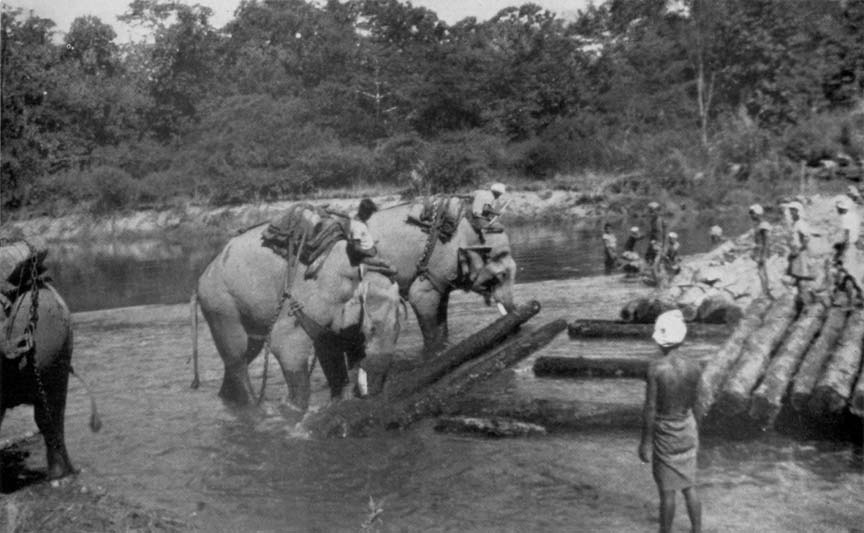 The first elephant bridge for the XIVth Army over the Lokechao Creek. |
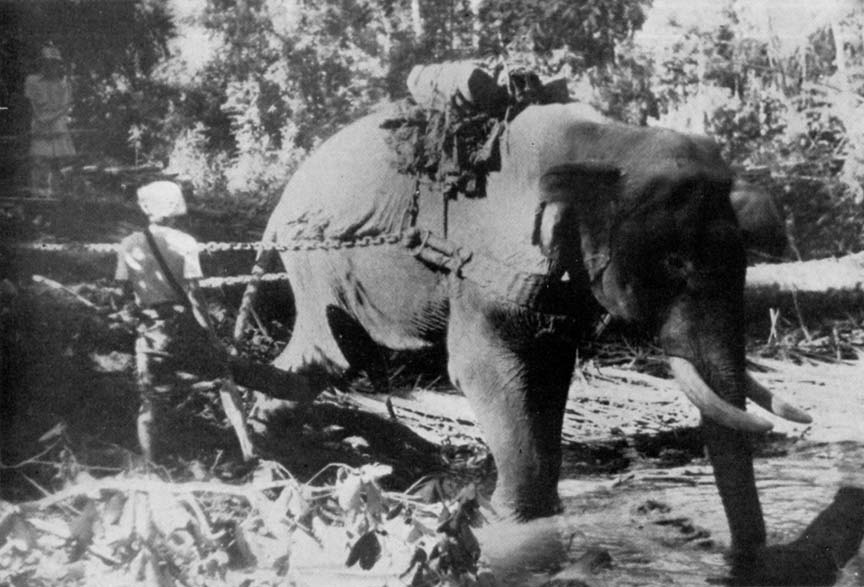 The last pull. An elephant bringing a log to the river where it will float. |
White and I were often referred to as "the long and the short of it," as White was not more than five foot four inches high. He was a powerfully built, square-shouldered little man who could keep up with the best of us on a long trek. He delighted in dressing himself up like a Christmas tree, carrying a gigantic rucksack, with an enormous revolver-holster hiding half of one side of him, and an outsize in jungle knives bumping up and down in its sheath over his fat little stern. White always walked like a sailor, with a salt-sea roll. He was a typical Scot, with a sense of humour which sparkled in his blue eyes. He had a very large fund of general information, and if by any chance there was something he did not know, he could bluff so well that he was seldom detected. I once heard him telling an innocent Colonel in the Royal Veterinary Corps how to castrate an elephant, and White was so glib and so convincing with his nonsense that I was quite impressed myself.
He spoke fluent Hindustani and good Burmese, and was thus a very useful interpreter at Corps Headquarters. During the evacuation of Burma and the final period of "scorched earth", White did a great job in scuttling launches up and down the river. He was naturally intensely eager to get back to his river, and soon after joining me became known to everyone as "Chindwin White."
I had not known him particularly well before the war, but we had many interests in common, and as he was a great friend of Harold Browne's, we soon became as inseparable as the Three Musketeers.
White shared the greater part of the rest of the Burma Campaign with me. We sometimes got separated, but, as he was exactly the man I wanted, I left no stone unturned to get him back on the job I knew he could do best. I got the very best out of him, and he stuck to me.
Harold Browne and Chindwin White made a grand team. Their intimate knowledge of all Burmans was extraordinarily useful.
They had the same love of practical jokes, and had one trick in particular, which they often brought out if they thought it would perturb some visitor to our camp.
They would start an argument in Burmese, which at first amused visitors who did not understand a word. Then their faces would grow grimly serious, and English words would creep into the dispute---unpleasant English words and phrases which are not often employed by one man to another. For they translated freely the foulest Burmese abuse of each other's families and particular relatives.
One night they started this, after having several drinks, and, though I had heard them at it before, it seemed to me they were getting a bit hot. They were sitting on opposite sides of a long bamboo table with a hurricane lamp in the middle. Each was holding a tin mug full of rum and limejuice in his hand, and they took turns, one sipping his drink and glaring over the top of his mug, while the other treated him to the foulest abuse.
Suddenly Chindwin brought out a grossly offensive remark about Harold Browne's sister, and I felt he had gone too far. Mothers and aunts are fair game, but I felt this remark about Harold's sister was beyond a joke ---and Harold seemed to think so, too, for he dashed the contents of his mug in Chindwin's face. There was a dead silence, and Chindwin sat for a moment with his eyes tightly shut, while the precious rum and limejuice streamed down his face. Then he suddenly flung the contents of his mug in Harold's face, and, grabbing the hurricane lamp in his other hand, swung it at Harold Browne's head. There was a crash of broken glass, and the lamp went out. I felt sure Harold had been badly hurt, but peals and peals of laughter came from them both, as they sat in the darkness, and a convivial evening followed after we lighted up again, much to the relief of our visitors, who had thought that they were witnessing a very ugly scene.
Chindwin White always tried to give the impression that he thought everyone he met was a bloody fool, but he had most loyal feelings and a real respect for anyone who really knew his job, and for such people he would work his fingers to the bone.
When I met him at Jorhat he was a round peg in a square hole, and he pleaded that the obvious place for him was with me up at Tamu.
I much enjoyed a convivial Christmas Eve with him, but on Christmas morning I decided that Intelligence Branch would be a useful lever with which to extract him from his square hole. I put it up to them, and got the answer: "The very man we want immediately."
Within an hour I had got him into my cage, and we were busy on a job of work passed on from the Commander. This kept us busy for half Christmas night, but we finished the bottle and finished the job about simultaneously, and then sang a carol. White was soon christened "Chindwin White," while I was commonly known as "Sabu," which changed later on into "Elephant Bill."
My one idea was to get away to Tamu again, taking White with me. This led to another battle with Intelligence Branch. It ended by my telling them that the only information I possessed which might be of use to them was the female elephant's period of gestation. I have reason to believe that they took this personally, as an obscure reflection on themselves.
On White's being asked the depth of the Chindwin River opposite Sittaung, he replied that it all depended whether the tide was in or out; at which a young Intelligence Officer exclaimed: "Oh, is it tidal up there?" As Sittaung is fifteen hundred miles from the nearest tidal stretch, the innocent question gave us an advantage which we pressed. However, we remained friends with them, and for a long time we made use of the Intelligence Office as a haven whenever we visited Corps Headquarters.
I think that even Intelligence Branch would admit we gave them some valuable information, which was lost or mislaid a dozen times, before it was eventually made use of three years later, by which time an elephant cow might have had a second litter.
I was just about to get away when the Commander sent for me and told me he wanted me to stay on at least another two days, as a visiting Brigadier wanted to see me. I suggested that White should also be called in, if any information about crossing the Chindwin were wanted. I was told I might take him with me if I liked.
On 3 January, 1943, I was told to wait in the anteroom of the Commander's mess at nine o'clock. White was with me. The mess was empty, and I had just picked up a magazine when a sullen-faced Brigadier came in, wearing only one ribbon---the D.S.O. and bar.
He threw his hat into a chair, and said, as though he were angry:
"Are you Williams?"
"Yes, sir."
"Well, come on. Have you got the key of the War Room?"
"Yes," I replied.
With that we moved off to the Commander's War Room. The Brigadier went in first, and, as I followed, White gave me a dig in the ribs from behind, from which I gathered that he guessed that my reaction had been that I was not going to be bullied.
Wingate, the name of the Brigadier, at that time meant nothing whatever, except to those of the Higher Command. He kept me for two hours, standing in front of a very well-illuminated wall-map, on a scale of half an inch to the mile, and he stood directly behind me, with a pointer in his hand. His questions were abrupt, and my replies equally so. He had ignored White, with such rudeness that whenever he put a question concerning the Chindwin River I turned round and asked White to reply.
Wingate's manners were almost intolerably aggressive, but within an hour I was deeply impressed, and within another half-hour I was completely absorbed in what was obviously the general plan. I felt that if I did not go with him, the whole damned shooting-party would get lost in the Burmese jungles within a week. Most of it was.
Part of that story is told in Bernard Fergusson's beautiful book, Beyond the Chindwin.
While I was being questioned in detail, on jungle, streams, mountains and valleys, and my answers written down, I was making up my mind what I would reply if I were asked to join this wild-cat expedition, as I fully expected to be at the end of the interview. But the question never came, and I only afterwards found out that Wingate had been told that he could not have me, and that I was to continue with my job as Elephant Adviser, which lasted throughout the Burma campaign.
The thing which impressed me about Wingate was the thought behind each of his questions. Pointing to some high ground on the map---a hill I knew---he would ask: "Could troops live on that hill during the monsoon, and make it a strong-point, if they had to ?"
"All depends how many, sir. It is practically impossible to dig in, as it is mostly solid rock, only covered with very sparse jungle. It might water twenty-five men, but no more. Mules could not get up and down."
"Could mules get down that creek?"
"Definitely not. Elephants could. But mules could take this ridge away to the east, by following Forest Compartment boundaries."
"Right. I want that information later."
Before he went away, leaving us to lock up, I asked him if he was likely to require any elephant pack on either side of the Chindwin. A decided "No," was his reply.
White and I went off to Tamu next day, and discussed Wingate for most of the way.
When we got back we found that during our absence Browne had completed three more bridges---one going north to Myothit, one south to Witok, and one east towards Sittaung. White was to go off on a reconnaissance to Sittaung. By the end of January, 23rd Division had its Headquarters at Moreh, near Tamu. I found that the Brigadier of 49th Brigade had laid out Tamu and its surrounding roads and bridges, and had named our first bridge "Williams Bridge," and the second "Browne Low Bridge," with large placards bearing their names beside them. They stayed there, and the names stuck. Even the local Burmans used them, but I found it embarrassing. Later that season I saw Wingate's columns pass through Tamu. A personal friend of mine, Peter Buchanan, was with one of them. His exploits are recorded in Beyond the Chindwin.
Unknown to anyone but him, I arranged for elephants to help his party over the Tonhe track, to clear it for mules, and I provided twelve pack-elephants to help him as far as Tonhe. His was the only Wingate column that got its complete equipment as far as the Chindwin.
Wingate's own column got half-way from Tamu to the Chindwin, and came across a Burman, Maung Chit Gyi, building a bridge, with four elephants. He ordered him, at the point of his revolver, to remove their harness, and then loaded them up with everything that he would have otherwise have left behind. Sticky bombs, boxes of grenades and other heavy equipment were tied on anyhow with rope. These four elephants did the journey to the Chindwin, with far less trouble than the mules, and Wingate was so satisfied that he swam them across the Chindwin with their full loads on. One badly loaded animal overturned in deep water, and was lost.
However, he had not gone far on the other bank when, greatly to his surprise, he received a signal ordering him to send my elephants back. One went astray, and only two came back with Mating Chit Gyi. However, the stray one eventually swam across the Chindwin on her own, and rejoined her companions, with a fine story of adventure, if she chose to tell it.
Wingate only used one or two stray elephants on the east bank of the Chindwin during that campaign. In fact, his column came across very few, and gained no information concerning the herds left behind.
Two months later, parties of Wingate's expedition were recrossing the Chindwin, north of Yuwa as far as Homalin.
Malcolm Freshney, returning with his party---which included some Karens, who had come out with the Burma Army in May, 1942---met two Karen elephant-riders in dense jungle, about fifty miles east of the Chindwin. They said, when questioned, that they came from an elephant camp with twenty-nine elephants and forty-nine Karens, who were in hiding from the Japs, and that they had been there for six months. The Karens are a particularly loyal hill tribe. These two men were very friendly, were Christians and very pro-British, so Freshney decided to spend a night in their camp. There were two English-speaking Karens amongst those at the camp, and in the course of conversation they told Freshney that they had worked under me in the Moo and Shweli Forests. When he told them that I was at Tamu, three of them asked to join his party, as far as Tamu, so that they could see me.
He brought these three Karens along, and they were of immense importance to Intelligence Branch. One of them had travelled since the Japanese invasion as far south as Toungoo between Mandalay and Rangoon, in Lower Burma.
The Divisional Commander then gave help, in providing an escort to return with these men to their camp. I knew the country well enough to plan their route there and back when they would make an attempt to bring their elephants back to us across the Chindwin, and through territory occupied by camps working for the enemy.
Two young officers who knew Burma---Jonah Jones and Robin Stewart, both in an Intelligence Branch---reached Tamu at that time, and they both volunteered to go with the Karens and make the attempt. Browne was unfortunately not in camp at the time.
Wingate's expedition had, of course, stirred up the Japs, and their patrols were becoming increasingly difficult to elude, for they were following up tired parties of Wingate's men, or trying to intercept them during their withdrawal.
Stewart and Jones covered the fifty miles on the other bank of the Chindwin in two days, relying on their own irregulars, and leaving the escort party half-way, to cover their rear.
I had asked for two platoons to cover the Chindwin crossing, as at that time Pantha was occupied by the enemy, and our crossing was to be made just above Yuwa, at Kadun. Jones and Stewart performed a remarkable feat on the return journey, marching twenty-nine elephants, with forty-nine attendants and their irregular escort, fifty miles back to the Chindwin in two days, reaching the river at six p.m. There were no women with the party. Jones reached the river a few hours before the main body, and met a small party of Burmans, which was obviously a Japanese agent's scouting patrol from Pantha. They did not engage, but made off south towards Pantha. White was in charge of eight Lundwin country boats, for ferrying the escort and men. The two platoons of troops which were supposed to cover the crossing had not turned up. There was only a section of Indian troops, which was obviously considerably rattled. The forty-nine Karens were unarmed.
From the time of arrival until dark every effort was made to swim the elephants. But the animals were all too dead beat from their march to face the swim, and not one leader could be found among them. A decision was eventually made to tie up all the elephants on the east bank and to ferry all personnel across and sleep on the west bank. The expected platoons to cover the crossing had still not arrived.
All was quiet on both banks of the river during the night. At dawn White set off with his eight boats full of oozies and a small escort from the west bank to the east. Now that the elephants and men had rested, there was no doubt that they could cross without difficulty.
White was in the leading boat, with the head boatman holding the paddle-rudder, and two other Burmans rowing. The other seven boats were strung out at irregular intervals, and packed with Karen oozies.
When White's boat was about seventy-five yards from the east bank, a Japanese officer rushed on to the bank shouting, "Banzai! banzai!" and then took cover behind a tree. At the same time Japanese machinegun, rifle and mortar fire opened on the boats. A few shots were fired in return, but several of the leading boats at once capsized, and within two minutes everyone was in the water. Three sepoys and one Karen were killed, and two Karens were wounded. Everyone else swam successfully back to the west bank. White considers that he owed his escape to the Japanese concentrating their fire on his topee, which floated away downstream, whilst he was swimming under water. He had never realised that a man could hold his breath for so long. The Japanese had been brought up from Pantha during the night and, finding our elephants unattended, had laid an ambush for the morning.
The Japanese showed great folly in not holding their fire. If they had waited until the boats were ten yards from the shore not one man of the party would have survived. Their shooting was also extremely poor.
It was not until 1945, after our general advance down the Chindwin, that I heard the true story of the fate of these elephants.
A dacoit Burman from Pantha, who was with the Japanese, and was one of their agents, told them that as they were Karen elephants, no Burman would risk unchaining them. He therefore advised shooting them for their ivory. Fourteen were shot before some Burmans arrived, who said they could manage the remainder, all of which were young animals. Only one of these was eventually recaptured, after the Japanese had been finally defeated.
The whole incident, which with better management would have succeeded, was most unfortunate. I may add that it did not end there for those who should have provided the platoons to cover the crossing of the river, and had not done so.
Seventeen elephants were captured during the hot weather of 1943, bringing our strength up to fifty-seven animals. They were first employed in building bridges along the three roads in the Kabaw Valley, and later in making these bridges double width. By that time the elephants had established their reputation in the military mind as bridge-builders and road-makers of immense value.
There were patrol clashes with the enemy throughout the hot weather. We had only two brigades guarding the gateway from the Kabaw Valley to Imphal, so they were rather thinly spread out over the ground. Straggling parties of Wingate's columns were still coming back, through the screen of the 23rd Division, protecting the Tamu-Imphal road. The Japanese had been becoming more aggressive farther south, from Kalemyo up towards Tiddim in the Chin hills.
The Mango showers of April gave the troops some idea of the effects of rain in the Kabaw Valley.
The 17th Division of the Burma Army on their withdrawal up it, the previous May, had nicknamed it "The Valley of Death," because they were following the tragic trail of refugees, who were dying in hundreds along the road from exhaustion, starvation, cholera, dysentery and smallpox.
But the name stuck, and had an unfortunate psychological effect upon the health of the troops holding it later on. Actually malaria was no worse in the Kabaw Valley than in any other forest valley in the wet zone. But it had gained an evil reputation, and did not live it down until the 11th East African Division went down it, before the end of the 1944 monsoon, and showed that it could be faced with impunity, even in the worst weather.
I was living in our established elephant camp at Moreh, but I made periodic visits to Corps Headquarters in Assam. As a result, I was one of those who were kept informed of the general position. Only those who have had the experience of keeping up the morale and confidence of their men when privately aware that we were carrying out a strategy of mere bluff, which might at any time collapse, can understand the difficulties and embarrassments I went through at this time. In May, 1943, I was called to Headquarters and told to write an appreciation of the elephant situation if all troops were withdrawn from the valley before the monsoon broke. My appreciation was expressed in very few words:
"The elephants must remain in the valley, and Browne and I will stay there with them. All we need is six months' rations for the riders and ourselves. We will keep the elephants ready to make their escape to Imphal, if the Japanese patrols come up far enough to threaten us."
The value of the elephants when our troops reentered the valley after the monsoon was over was fully realised. But I was not willing to take them out and upset the morale of my Burmans, by making them take part in another retreat by our Army. I was also doubtful whether I should be able to get the elephants back again at the right time, as directly our Army started to come back, the road would be packed with faster mechanical transport.
My proposal met considerable opposition, but I eventually got it sanctioned, and was told to make my own arrangements. Luckily I had plenty of time, as the withdrawal of the 23rd Division had not started.
Just at this time the inhabitants of Tamu and the surrounding villages in the valley gave a celebration pwai to welcome the return of our Army. They had been a little slow in organising it, and, unfortunately, had timed it when we were on the point of abandoning them again. After I had taken an extra tot of rum, I danced with the Minthami, or Princess of the Show, and towards the end of the evening U Po Sine, my head elephant-man, was presented with a beautifully engraved sword by the Commander of 23rd Indian Division.
It was a great night for the Burmans, and a cheery one while it lasted, but I went to bed with the bitter knowledge that the valley would be empty of troops again within two months, at most. As it fell out the withdrawal was delayed for a fortnight owing to events to the south-west, in which the 17th Division was involved. The monsoon broke early, and caught the 49th Brigade still in the valley at Witok. Within two days all motor transport was bogged. There was a small break in the rain, and then the vehicles were able to start crawling back. But they could never have done it except for my elephants. All along the road there were urgent requests for help, and the elephants were pulling the army lorries out of the mud like champagne corks out of bottles. Two or three lorries were wrecked owing to drivers starting up their engines, in order to help the elephants, by spinning the back wheels. But they found themselves and the lorry being taken for a fifty-yard stampede into the jungle, ending up with the lorry hitting a tree or overturning, or the elephant's chains snapping and releasing him from the jungle devil he was towing.
Besides pulling lorries out of tight places, the elephants laid causeways of logs in the mud in amazingly quick time, while whole convoys waited to pass over them. Elephants could not be hurried in their work, but they could, and did, work overtime until the job was finished. After seeing the last vehicle over the Moreh causeway, the Brigade Major walked along the logs to tell me that all the motor transport were out.
The elephants were standing near, in the fast-fading light, and gazing, with what I thought was bewilderment and disgust, at this new kind of jungle demon, the motor lorry. What the oozies thought of the withdrawal of our Army, I don't know. All I could tell them was that Browne and I were staying behind with them.
Those really were, I think, the bloodiest rains that two Europeans ever weathered in Burma. There were weekly Gurkha patrols through our camp, and elephants were used throughout, on a shuttle system, to get them across that quagmire of a valley. The Gurkhas were grand little men, but, fit as they were, they often came back after a patrol of anything from eight to twelve days staggering with exhaustion and fever. No quinine or mepacrine was being issued to them at that time, owing to the mistaken order that only a doctor could administer it!
Our elephant camp was the first camp they reached on their way home, and for the last three marches they always rode elephants. The sick men had to be brought back on elephants, and in that swamp those that were still fit could not keep up with them. So we provided enough animals to carry all of them. Their rations were sent down, on a separate shuttle system, as far as Mintha, throughout the rains. No elephant or oozie ever let them down.
I found it rather a heartbreaking job at times trying to teach not only Indian soldiers, but also British officers, that an elephant is an animal which needs quite as much care as a mule. It was far more valuable at that time, as mules would have got bogged at once in the quagmire of mud.
At last, in desperation, I issued general notes on elephant management. In spite of that, elephants were still kept tied to trees for hours and hours on end, waiting at rendezvous points for patrols, instead of being allowed to graze on nearby fodder. As a result their digestions were upset for no good reason. Animals were also loaded in any fashion, with no attention to balancing the loads. The Gurkha, who is a jolly little man, thought it very funny to be riding an elephant, and it was quite common for me to catch as many as six of them on the back of one animal, with their rifle-slings looped round the animal's ears, as though on a hat-stand. On several occasions when I caught them doing this they would slide off over the hindquarters en masse and bolt into the jungle, to hide from me, like school children caught climbing apple-trees. I finally got my way, by a resolute refusal to supply elephants to any troops who would not co-operate in treating them properly.
The whole subject also led to a battle between the Royal Indian Army Service Corps and the Royal Engineers, partly to decide which of them could obtain priority in the use of elephants, and partly to determine the perennial military question of whether elephants were a branch of transport or of sappers. To those who knew conditions in the Chindwin areas and what lay ahead of us, it was a foregone conclusion that elephants would ultimately be used as sappers. However, in those early days it was a case of trying to be of the greatest use to both parties, and please them both.
Although the position was obvious to anyone working with elephants in the field, the problem was far too difficult for General Headquarters to decide. Elephant Companies were raised later on, and such questions as their War Equipment and War Establishment were involved, and the question of their status dragged on until after the war with Japan was over; and I am by no means sure that it is settled yet. I see now that I ought to have invoked precedent, and called up the ghost of Daisy, in the Royal Engineers, in 1895. At the time I was concerned only in getting on with the job and keeping the animals fit. I had no time to spend months arguing on paper in an Indian depot over Elephant Companies. But it was lamentable that our work should have suffered owing to the inability of someone to cut through red tape, or for the sake of what was a purely academic question, in a paper organisation.
The elephants, however, were not the chief sufferers from this lamentable incompetence. After burying eight men and two officers in my own little private cemetery, and making the teak crosses for their graves myself in my hut in the evenings, I became so frantic about the idiotic order which prohibited their taking quinine that I secretly supplied each patrol as it was going out with sufficient supplies of it for any man going down with malaria. Even so, I had to make fourteen crosses by the end of those rains. Twelve of them were for men whose lives had been thrown away for no reason.
It was an eerie camp. Most of the time there was nothing between us and the Japanese but dripping jungle. My oozies were, however, in contact with all the small villages scattered up and down the valley. I had implicit faith in them as a screen which would give us early warning of the approach of any Japanese patrol.
Some changes took place in my party. Chindwin White went off to take up a job on the Arakan front, and C. W. Hann, an Anglo-Burman, joined Browne and me.
In July the log bridge over the Lokechao was swept away like matchwood, but a small Bailey bridge, which had been put up well above the gorge and over it, remained.
We had several scares, for the jungle is a land of rumours. But the Japanese made no attempt to interfere with the road-head at Tamu, and my elephants were kept busy doing everything possible to prepare for the re-entry of the Army. But when?
WE prayed that in October, I should launch the offensive to recover Burma. Elephant Camp became a hostel that autumn, where everyone dropped in. No place was ever visited by so many specialists. We remained a hostel until the following March. There was a field telephone connected, and we became a general information bureau as well. I was constantly being rung up and told: "An important person is arriving tomorrow at ten a.m. Apart from other things he would like to see the elephants at work. Will you put him up?"
Apart from the cheery company, the interest of it all provided me with the best memories I have of that camp. Everyone who stayed there will no doubt remember the friendly arguments over the camp fire. There was no red tape. The General Staff must have been told a dozen times at least how and when to retake Burma! The earliest of my visitors were, however, malariologists and tank experts.
For me it meant spending whole days in jeeps, going right down the valley, as there was no way of imparting one's knowledge so well as on the ground. The malariologists tried to damp my enthusiasm by telling me that the lwins (small open marshes which occur in dense jungle) could not be breeding-grounds for malaria mosquitoes, as they were still and stagnant waters. But they found no answer when I told them that it was not still water, but that there was movement owing to seepage from one lwin to the next. The fauna and flora in the Kabaw Valley are completely different from those of Manipur and Assam, and the habits of the mosquitoes, and even their species, might differ. My final argument was that no jungle wallah and no Burmans would ever camp near lwins, and that, as for elephants, they avoided them like the plague.
Before the malariologists had taken their departure, in came the Brigadier of a Tank Brigade, to have a cup of tea, and then to be taken round to visit the various types of jungle, and to learn that most of the common big trees were shallow-rooted and that a tank could push them over like ninepins. A simple little fact, but of some practical value. Then came the R.A.F., then Radar, then the Artillery. Besides these, the camp was never without at least one Sapper. With all these visitors, I led a busy life, quite apart from looking after my elephants. Everything pointed to the Army's coming back quite soon. Souvenirs of tips of elephant tusks and hand-made pipes in teak, with ivory mouthpieces, made by the oozies were in great demand---these gave out but not the curry and rice.
The mud of the monsoons was fast drying in the valley, and before the motor transport of the 20th Indian Division arrived to take the place of the 23rd, a sufficient number of elephant bridges had been constructed over the rivers, creeks and nullahs to allow the brigades to fan out over the same fair-weather tracks which had been used before---north to Myothit, east towards Sittaung and south to Witok.
Elephants were still occasionally used for pack, but only to help in fording rivers, for it had become quite obvious to all that their chief function was in building log bridges.
I still had difficulty in persuading troops to handle elephants in the proper Burmese fashion.
The good humour of the oozies when working with Indian troops was the greatest help, and conditions never became unworkable. The oozies were not enlisted men. When the sun was boiling hot and the elephants needed shade and fodder, the oozies just went off with them where they could find it. They did not care a damn whether it was a Jemadar Sahib or the Officer Commanding a Field Company who was trying to stop them. The demands for elephants here, there and everywhere were more than I could cope with. A large percentage of them were busy in bridge-building; others were wanted to help with patrols and others dragging logs for building native boats. At that time I never had more than seventy-eight elephants. They had become accustomed to traffic much sooner than I ever imagined that they would. However, there were a lot of accidents before all drivers of motor transport learned to slow up before passing elephants at work.
There were casualties from the animals fighting, owing to our restricted quarters, and my finest male elephant, Bandoola, killed two other tuskers.
A Gurkha sentry heard a wandering elephant approaching his beat, and was fascinated by the tusks gleaming in the moonlight. He fired a well-aimed shot; the bullet entered just below the eye, passed through the cheek and after leaving a hole the size of a five-shilling piece in it, was deflected into the animal's chest. The bullet was extracted after an operation on the chest, and that elephant was back at work within three weeks.
This was the beginning of a new source of trouble, because once the habit started it would be repeated in any camp that happened to be disturbed at night by elephants. I began to get called to the telephone at all hours of the night, often from places many miles away.
"Hullo! We have an elephant here in the camp that is eating all our rations. Everyone is terrified of him. What are we to do about it?"
"Who are you?"
"Cascara" (or some such code name).
"Good Lord! but that is seven miles from here. He will have eaten them all before I can get to you. You had better let him carry on until he's finished."
"Right ho! But he is making such a hell of a row opening the bully-beef tins!"
Such was the humour of the sappers, and it helped a lot to make the combination of elephants working with an army in the field possible.
If I had been told three years before that elephants would be working alongside pile-drivers and bulldozers, I should never have believed it. If I had interfered it would never have worked. The oozies took for granted that I expected it of them, so they made the best of it---and the elephants thought the same. This work was constantly within sound of gunfire, and we were all wondering what the next move would be, and waiting for it.
I cannot say I was altogether happy, for at the back of my mind I was always wondering what I could do with my men and elephants if the Japanese made a determined attack. I was continually being called up on the telephone and questioned on topographical points about jungles, hundreds of miles away, in the heart of Burma, but all I actually knew was that something big was due to start soon. It was tedious work, waiting for it, but at the end of December I had a stroke of good luck. Two days before Christmas, a friendly Corps Commander sent me a signal to report back from Elephant Camp to Corps Headquarters. I drove my jeep back up the Imphal road, every bend of which was by that time only too familiar to me. I reported, and gave the information for which I had been asked; then, just as I was about to salute and leave the room, he said, jovially, "I've been given five days leave to Shillong for Christmas."
"Grand, sir," I replied. Then, suddenly seeing how the wind lay, I added, "Three would do me."
"All right," he replied. "Take seven, and see the New Year in with your family."
In less than ten minutes after leaving his room I was heading west in my jeep, accompanied by Abdul, my unnecessary Indian Army orderly, who, for some reason unknown to me, had by Indian Army regulations always to be hanging around at my heels, even when I was in Burma.
I drove four hundred miles non-stop, and arrived in Shillong, Assam, on Christmas Eve, in time to find my wife busily employed in filling the four children's stockings. It was a wonderful Christmas, but the grey dawn of 1 January, 1944, came all too quickly, and at four a.m. I had to say good-bye. It was a cold, frosty morning up there in the hills, and the engine of my jeep seemed to purr with pride as I pushed down the hill road towards the plains of Assam. The headlights made the wall of jungle on each side seem a sad and sinister green. The wretched Abdul was sitting at my side, with his rifle between his knees, and he and I were lost in our own thoughts when, swinging around a bend in the road at thirty miles an hour, I had to jam on the brakes hard. For what at first glance looked like a calf was lying in the middle of the tarred macadam road. As I came to a dead stop, my headlights were focused on a magnificent male tiger.
He sat up suddenly on his haunches, blinded by the lights, but yet quite unperturbed. Abdul sat frozen in his seat, with his rifle unheeded between his knees. I felt as though I were sitting in the toy jeep that I had seen an excited child haul out of his stocking on Christmas morning. The tiger slowly stood up on all fours, and I felt myself shrinking into a toy driver. In a moment of inspiration I blew the horn, and Stripes turned his back, and I noticed his furry testicles sway slightly as he walked away in a slow quiet gait down the road, to disappear round the next bend.
When he had gone Abdul and I awoke from our trance, and I heard him working the bolt of his rifle to bring a cartridge into the breech. I gave him a dig with my elbow, which he understood---it was an unflattering reminder that he could not hit a haystack, let alone a tiger. Otherwise he would never have been taken out of the ranks to be my servant.
I lit a cigarette, and sat thinking for a few minutes. If I shot that tiger it would almost serve as justification for taking another day's leave. But I made no move, and when I had given him enough time to slip away down the khudside I started off again on my journey. I had got into third gear and gone round another two bends of this picturesque hillside road, when I was once more faced with the same startling apparition. For there, lying in the centre of the black tarmac, facing me, with his pink tongue lolling out and his warm breath condensing as he breathed out into the cold morning air, framed against a background of green forest, lay this perfect animal, in his finest full winter striped coat. He was not twenty yards from us when we pulled up. It flashed through my mind that I must shoot or go back. I drew my .45 Colt from the webbing at my waist, and fired two shots, sideways, out into the jungle. I thought for a moment of taking Abdul's rifle and getting out, but thought better of it. Stripes remained unperturbed by my two shots. He slowly got up, and then, turning out of the glare of the headlights, broke into a gentle trot, until he had nearly reached the next bend. He then subsided into a walk, and looked back once at us over his shoulder. I have no doubt he was cursing us.
This time I waited at least ten minutes, lit a cigarette, and smoked it through. It was obvious that this tiger loved lying on the warm surface of the road, which still held some of the heat of the previous day, and was as reluctant to leave it as I had been to rise from my warm bed in Shillong.
I then followed him up again, and thought I had seen the last of him, when, after travelling about a mile, I overtook him once more. By this time I was becoming hardened, and did not pull up at once, but went on slowly towards him, slipping the clutch, roaring the engine, and keeping my finger on the horn. He got up again and turned broadside on to me, but before he slowly slipped over the khudside he turned his great painted head and looked at me, puzzled and angry, and I imagined he was growling out, "Curse this bloody war." I accelerated all I could as I went by the spot where he had disappeared, and so came back to Elephant Camp with mixed memories of Christmas-trees and tigers.
At last, early in the New Year, the Army began to make a move. It seemed as though we intended to advance south, as every available elephant was put on to improving the main road from Tamu to Kalemyo. Bailey and Hamilton bridges and heavy road-construction mechanical equipment were arriving. Only a very few knew the true situation. The Japanese had been clearing the villages in their forward areas of all Burmese, and there were many rumours that they were preparing for an offensive up the Kabaw Valley.
Then one glorious evening something passed over our heads. It was our first airborne troops and gliders ---Wingate's Chindits. Their passage made us believe that they would be followed by something more. But the expected army did not arrive. We went on building the road. It had been decided to add log-timber abutments to all the bridges, and the elephants were working twice their normal hours, in order to keep ahead of the sappers and have logs stacked in readiness for them at every bridge. It seemed a case of working desperately hard. The tanks were up, but there were only three months left before the break of the 1944 monsoon. Knowing the valley, I realised that it would need a gigantic effort to make that road passable in all weathers.
I was sitting at my table one evening in March, when the telephone bell went. I had just calculated that the elephants had delivered two thousand three hundred tons of timber at the road in three months. It was the Divisional Commander speaking, not with his usual cheerful personal touch, but giving me a grave invitation to lunch next day, to meet the Corps Commander. I could tell that the invitation meant something very serious. I walked across to Browne's but, where, as usual, he was poring over a crossword puzzle. He suggested a rum peg and at the same time remarked that I looked tired. I accepted the drink, and told him that I could not come to Hlezeik next day, as the Corps Commander was expected. We ate our supper early, and talked about the Chindit gliders until bedtime.
At luncheon next day there was a tension, as though something very serious were the matter. After lunch the Corps Commander and the Divisional Commander took me alone into a tent and said to me: "This is Top Secret. How many days' warning would you need to get all your elephants collected together, and how would you get them out of the Kabaw Valley?"
My heart missed a couple of beats, in bitter disappointment at the idea that the troops were going to be withdrawn again, and that this time my elephants would have to go with them. I got up and walked to the Divisional Commander's table, where there was a map. I knew the position of all the elephants in the valley, and could easily calculate that it would take five days to assemble all the animals. I suggested that there should be two rendezvous areas. The Corps Commander agreed, and ordered me to assemble them without delay. Details were discussed, and half an hour later they agreed that I could tell Browne my secret orders, as I pointed out that the success of this movement of elephants depended on complete co-operation, and that I should need his help.
Feeling very depressed and rather stunned by this development, I immediately drove off in my jeep to the elephant camp farthest away, and gave orders cheerfully for them to move up the valley next day. It was well after dark when I got back to camp. It was after midnight before I had explained everything to Browne and we had laid our plans for the following day. We fell asleep to the sounds of heavy gunfire.
For the next four days we kept out of the way of all our friends. But at this stage all our plans went well, and we even managed to get the oozies' women and children who were not already in the camp to come in from their jungle encampments.
On the fourth evening I telephoned to the Divisional Commander, to say that all elephant camps were assembled, with the exception of one which was centrally placed at Tamu. On the fifth day reserve rations for fifteen days were dumped at the assembly points. There were forty-six elephants at Kanchaung, eight miles north of Tamu and thirty-three at Mintha twenty miles north of Tamu.
Rumours of Japanese activity on the east bank of the Chindwin and in the Kalemyo area, due south of Tamu, were now rife. My Burmans had realised by this time that there was something in the air. But they had no idea it would mean a move west, away from their beloved Chindwin. I was never in any doubt about their following me.
White, who had joined me again from the Arakan, was in charge of a shuttle service of country dug-out boats on the Yu River, which were manned by Burmese boatmen. He received orders to disband his Burmans and then rejoin me. However, without carrying out these orders, on his own initiative he packed eighty of his best men on to motor transport and sent them along, to live and fight another day. They turned out most valuable the following year.
I had put Hann in charge of the herd of forty-six elephants at Kanchaung, and had explained to him that he might be called upon to move suddenly, and told him to be in readiness.
Browne was to be in charge of the herd of thirty-three at Mintha. All the best animals which had been doing engineering work were at Kanchaung. All the young calves and thin or sick animals were at Mintha.
My Karens, who had lost their elephants when they were ambushed at the Chindwin River crossing, were at Elephant Camp with me. I formed them into two escort parties, one for Hann and one for Browne. On 16 March I sent Browne off to check up that Hann was ready and to go on and visit Mintha, if he had time.
At noon the code signal to withdraw came over my telephone. I was further informed that the Japanese had crossed the Chindwin to the north of us, and were moving fast. Their patrols had already by-passed our troops on the Tonhe track.
I went off at once to Kanchaung in my jeep, and was lucky enough to find Browne still there with Hann. I told Browne to push on to Mintha to warn his party, and I explained to Hann, by the aid of maps, the route he was to follow.
Hann was rather staggered by these orders, but I explained to him that the only alternative was to shoot all the elephants. I told him to catch all elephants that evening and tie them up for the night, and then to push on as hard as he could at dawn. I then arranged that, with luck, I would next meet him in the Imphal Plain, with a supply of rations and our next orders.
My last words were: "Au revoir, and the best of luck. You can make it. You must. Don't worry if you lose any animals en route, but push on with your main body."
I went back to the main road to wait for Browne. He was back by dusk, and we returned to Elephant Camp with much to do there that night, as we had to be back at Mintha by dawn, where he would find his herd ready to move off. I had picked out his route. Although shorter, as Mintha is rather nearer to the Imphal Plain, it was over the most frightful mountainous country. We both had confidence in our men and animals, and believed it could be done, although we knew nothing like it had ever been attempted before. But this was War.
At midnight, after Browne had turned in, I received news that the Japanese had crossed the Chindwin to the north in strength, and were pushing forward over two main tracks, and also that a brigade of ours would be going up the north road beyond Mintha at dawn. This last piece of news cheered me a good deal.
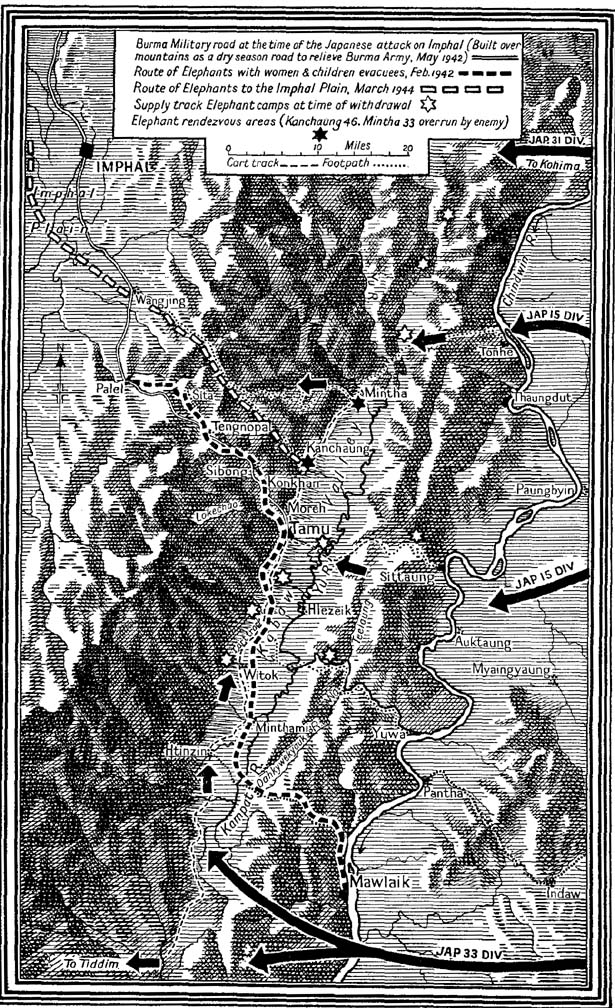
There had been a roar of traffic all through the night. Browne left at dawn. Things were obviously moving fast, and when I saw Browne off I felt a presentiment that he would not find things at Mintha as we had planned. There was no news by eleven a.m., so I telephoned Brigadier, General Staff, at Corps Headquarters, to say that all was going well at Kanchaung but things were not going as planned elsewhere. I was then instructed to get back to Headquarters at Imphal myself, with my remaining Karens, in order to prepare for the arrival of the elephants. My elephant camp was to become Tactical Headquarters for an anti-aircraft, anti-tank regiment, which was already moving in.
The Head Burmans to whom I spoke were completely bewildered. But they took it like well-trained troops.
I was just about to destroy a pile of secret papers and maps, when I saw Browne coming into camp, covered with blood and bandages. Just when he was nearing Kanchaung, his truck had skidded, when going at forty miles an hour, and hit a tree head on. He was in a hell of a mess as a result. Luckily, it occurred close to where a west-country regiment was furiously digging in. The Medical Officer of the battalion gave him first aid, and Browne, very much cut about and badly shaken, tried to borrow another truck in order to push on, as every minute counted. He was told no traffic was to proceed beyond the sector he was in, let alone to Mintha, and that fighting was expected there within two hours.
Browne came back to appeal to me. I rang up Divisional Headquarters, and it was confirmed that a brigade was on its way up, so I told Browne we would change places. He should take over Headquarters and I would make an attempt to get up to the waiting elephants and set off with them. However, he begged me to let him go and try again, so I let him go.
I then heard that the movement of the brigade up the valley had been cancelled, so once more Browne could not get by. It was a good thing he was stopped, as he would have driven straight into the Japanese if he had pushed on. This happened to three Bren carriers an hour after Browne had come back and rejoined me.
It was pretty clear by this time that the Japanese had launched a large offensive. Our only hope was that the oozies at Mintha would have acted on their own initiative and moved west into the hills, when they heard our forward patrols engaging the enemy. However, this hope was disappointed. They just remained waiting at their posts, completely bewildered, as they had no orders. They had been cut off by Japanese patrols behind them before the main body of Japanese entered Mintha. We were completely cut off from hearing any news of them, but retained a faint hope we might come across them in the hills.
We made a gloomy departure from Elephant Camp that evening, leaving everything. A battle was fast developing on both sides of us. One could hear it to the south already.
Just as I was leaving, a serious young subaltern turned up, looking for me, saying he belonged to the Graves Commission, and could I please tell him how he was to get to Dahkywekyauk Wa, on the Yu River, in order that he might record the graves of men of the Northamptonshire Regiment who were buried there. I told him that it was not the moment to go there, unless he wished to remain there forever, and that my experiences of Dahkywekyauk had convinced me that it was the unluckiest place in Burma.
We listened together to mortar fire, and, as he still seemed uncertain what to do, I added: "Dahkywekyauk is eight miles beyond those mortars. Go back to Imphal and tell them I sent you back."
He gave me the plan of the graves, and I put it in my pocket, feeling certain that some day I should have an opportunity of finding them, either when I went down next year with an offensive, or after the war was over. Then I could see that they were recorded. My presentiment came true.
As I climbed back towards Imphal, over the road from Tamu, I thought again about my experiences at Dahkywekyauk, and wondered why they should always have been so disastrous. It is a jungle creek, and its name means "The stream with knife-sharpening stones." I first went there in 1925, and as I entered it from the mouth of the Yu River my first impression was of a dark, dismal tunnel, leading into the jungle, shaded impenetrably from any ray of sunlight by vast canopies of leafage.
For two years, in that dismal spot, I fought, all on my own, against considerable odds. I was stabbed by a Burman there in 1926. I was so ill with mud sores and high fever in 1927 that the only way to save my life was to get me away by boat. This meant shooting the rapids in a dug-out, which had never been done before during floodwater of the monsoon. My elephant-men risked everything to get me out, and succeeded. My favourite dog, Juno, died there. One of my assistants was accidentally shot there. Another of them developed blackwater fever, and died shortly after we got him to Mawlaik.
That is a very brief list of some unlucky experiences there. But before I left in 1927 I did clear a hut site at the mouth of the creek, with a garden, from which I used to make sketches. I little guessed what use that habit of observation was going to be in 1943! Before the Northamptonshires had attacked the Japanese bunkers at Dahkywekyauk, in February, 1943, I was able to sketch an accurate and detailed map for their Brigadier, even marking a tree, which I had planted to mark Juno's grave. That tree was the key point of the Japanese bunkers.
I made an impassioned plea, as an amateur soldier, that the attack on the bunkers should be launched from the hill and down the slope, instead of along the bank. It was the last and most important piece of information I could give them. But after I had listened, from a distance, to the air strike which preceded the attack, the news came through that our first attempt, led by a young officer of the Northamptonshire Regiment, had failed. They had attacked along the bank. That afternoon he led a second attack, this time from the hill behind it, and captured the enemy position brilliantly. He was killed, and awarded a posthumous V.C.
These thoughts filled my mind as I buzzed up the mountain in a jeep. The Japs were back, I was again on the run, and had lost touch with thirty-three elephants.
Browne and I spent the night at Palel in the Imphal Plain, arriving there after dark. The Japanese had launched their offensive. Perhaps it was just what our Higher Command had been expecting and praying for---or perhaps not. But my only concern just then was with the elephants on the march, and wondering what had befallen those we had left at Mintha. The worry of having lost thirty-three animals, and the uncertainty about the others, not to speak of what our next move would be, was very great.
The first news I got was that the Mintha elephants had never started on the march, but that the oozies had hastily dispersed them into jungle hiding-places, where they had their fifteen days' rations with them. This was a relief, as the Japanese would certainly have pursued them, and overtaken them, if they had moved off as a body. Had the Japanese captured them, they would have provided them with a transport column of immediate usefulness. It would be some time before the Japanese found all of them and assembled them for use.
It was five days before I got in touch with Hann and his party. One march after passing through Sita, on the main ridge, when all the elephants were already tied up at night, Hann received word that the Japanese had taken Sita. So they hastily loaded up, and pushed on again till dawn. In our eagerness to hear news of Hann and his party, Browne and I ran the gauntlet back to Konkhan in our jeep. But everyone had their own worries. All the troops were at action stations, and my constant question, "Have you seen any elephants?" was usually regarded as a most untimely jest.
I was known intimately, and always greeted with a joke and a cheerful welcome, at Brigade Headquarters. Now when I went into their dug-outs all was serious. I stood silently listening to a telephone conversation about a counter-attack which was just going to be launched by a company of my old regiment in which I fought in the war of 1914-18. And as I listened I could not help feeling that I should have been happier if I had been an infantry subaltern again, leading a platoon to the attack, instead of worrying about my elephants, lost in the hills, through which the Japanese were infiltrating like yellow ants.
When the Brigade Major put down the telephone he looked at me and said: "Sorry, Sabu. Your elephants were mistaken for Jap elephant transport in the high bamboo, and were shot up coming down the slope from Sibong." He assured me, however, that he was speaking only of a small party of six, and I realised that they were animals which had been attached to a special patrol, not part of those I had assembled for evacuation. But there was no news of the main party with Hann. We were told to clear out as fast as we could.
I eventually got in touch with Hann, when his party was two marches from the Imphal Plain. I left Browne to deal with him when he arrived, and went to report at once to Corps Headquarters.
By this time we all knew that the Japanese had launched an offensive with three divisions, one against our 17th Division in the Chin Hills, one against our 20th Division at Tamu, and one in the north in the direction of Kohima, which was met by our 23rd Division, then in reserve in the Imphal Plain.
The Corps Commander sent for me, and told me that I must march the forty-five best animals, which I had saved, to the north of the Imphal Plain immediately, and then continue west out of the plain, as they were on no account to be lost.
No one knew better than he what those orders meant. He agreed that I would have to accompany them myself, and reconnoitre a route out. The Bishenpur track to the Silchar-Surma Valley could not be used, as the 17th Division had been cut off, and the Japanese were expected to cut that track as their next move.
Transport was impossible to get, but I knew that my only hope of moving on was to separate the oozies and their families, and send the latter to a place of safety---that is, down the Kohima road to the main railway. That would relieve all of us of a great responsibility.
It was a case of the devil helps those who help themselves. I made no attempt to get military transport, which I knew was impossible, but went direct to Steve Sutherland, an ex-officer of the Burma Forest Department, who was in charge of refugee supplies. He gave me the lorries.
When the train of elephants, with the oozies and their wives and families, arrived to cross the main road at Wangjing, I met them with eight lorries. I explained to the oozies that I would see that their families were all right. I then put the lorries of women and children into the charge of a young Anglo-Burman named McVittie and told him to proceed with them at once to the Manipur Road Railway and report to what was left of the Evacuee Camp there.
Browne and Hann continued north-west across the Imphal Plain with the oozies and the elephants, camping in Manipur villages, and feeding the elephants entirely on village banana-trees. We calculated that it would take them another five days to reach the northwest end of the Imphal Plain, where I should meet them again. In the meantime, White and I were to do a reconnaissance of the route over the mountains to the west. The Barak River, which drains out into the Surma Valley in Assam, rises in Manipur, where it is but a stream. It is bridged at milepost 102, on the main Imphal-Dimapur road. The first move was to reconnoitre its headwaters for fodder. The country through which it flowed was terrific, and to follow it one would have to negotiate a series of gorges and waterfalls. But water would always be available.
At three p.m. that day I sat with White at the bridge by 102 milestone, and decided that we would attempt to follow the Barak River route. I knew it would be a hellish trek. In front of us there were mountain ranges five to six thousand feet high, with cliff gorges engulfing the river.
I had, however, three officers to help me who would undertake anything I asked of them, whether it appeared possible or not.
Before six that evening, however, the road was cut by a strong party of the enemy, at the very bridge on which I had been sitting with White at three o'clock that afternoon.
With the Imphal-Tiddim road also cut, and the Bishenpur track seriously threatened, there was now no recognised track left out of the Imphal Plain, except a foot-track to Haflong to the west, to join the Lumding-Syihet hill-section railway. This track passed through a village called Tamelong. Over this track, which was scarcely a footpath, it had been decided to march thirteen echelons of six hundred Pioneers at a time, so as to reduce the problem of rationing, which would be a big problem if our army were surrounded and besieged in Imphal.
My problem was to get from the Imphal Valley into the Surma Valley in Assam, due west of us, but divided from us by a series of five precipitous mountain ranges, five to six thousand feet high, over a country about which I knew nothing, except what I could gather from maps of a quarter-inch to the mile. Before dark I saw the Brigadier, General Staff, again, and explained that any more reconnaissances were out of the question. All I wanted was fifteen days' rations for ninety-six elephant personnel and carte blanche to get out as best I could. This he was not prepared to give me. However, the Corps Commander saw me again, and gave it, provided that I visited Tamelong en route, so that I could signal back that all was well as far as that. I also armed all my Karens with Sten guns and rifles.
The 17th Division broke through the Japanese block on the Tiddim road that day, and the very tragic news of Wingate's crash came through. With the 17th Division came sixty-nine women and children---mainly Gurkhas---who were refugees from the Chin Hills. They had been in the hands of the Japanese, and were a pathetic sight. Nobody had any time to deal with them, so I arranged with Supplies Branch that if they would fly out the pregnant women and old people I would attempt to take the others with me. There were sixty-four of them. I drew fifteen days' rations for them, and then took them in lorries to our starting point. I was far from popular with my party. Not only was I tying this millstone of sixty-four strange women round our necks, but I had, only four days previously, almost forcibly separated my oozies from their own wives and children, who were at least familiar with elephants.
I returned to Imphal alone, after dumping my cargo, in order to have a tooth extracted, as toothache would not help me on the trip, and to pick up a red parachute, for ground signalling to the R.A.F. This was someone else's idea---not mine. Finally, I said au revoir to all those who had helped me and my attempt to get out.
The parting words of the Director Medical Services to me were: "I'd rather stay here and starve, Bill."
During the short run back to my elephant camp I was alone with my old Labrador dog, Cobber. He seemed to realise that sympathy was called for, and, leaning over the back of my seat gave my face one slobbering lick, and wagged his tail cheeringly. Then he stared ahead through the windscreen, with his tongue hanging out and a broad grin on his face, as if he were saying: "Next stop, Surma Valley."
In the back of my jeep was a royal present of a case of rum. Steve Sutherland gave it me, saying as he did so: "Say nothing, Bill. If there's nothing else you'll need on this Hannibal trek, you'll need this."
Final plans were discussed that evening in camp. We were to start at dawn on 5 April, 1944. It rained most of the night, and Imphal was in a state of siege next morning---what is known in the war histories as the Fourth Corps Box.