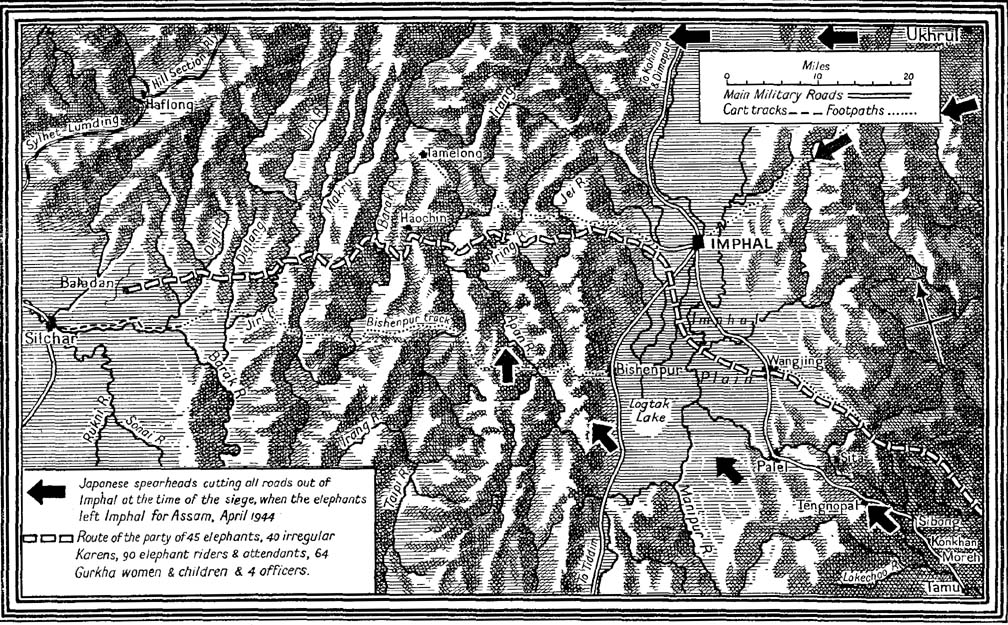
THE foothills to the west of Imphal Plain are treeless. From where we started there is a graded muletrack up to about two thousand five hundred feet, as far as Tamelong. Only one person saw us off on our departure: an R.A.F. pilot in a Harvard Trainer, who damned nearly stampeded the whole party of elephants, just as they were descending a very steep bit of the track. Whether he was just verifying the direction in which we were starting off, or whether he thought we were a horde of Japs, I can't tell. But he made off as quickly as he came, possibly because he realised how disastrous to us his presence would be, or possibly because he saw a few rifles being aimed in his direction! If our curses had any effect, he would have had a forced landing on his trip back.
We were a most extraordinary collection. I went ahead, with an armed vanguard of Karens, and when I looked back, down over the serpentine track, the collection looked like the "Lame Host," and we were strung out to such an extent that it seemed possible that the first of the elephants would reach his destination before the last of them got started.
Our total strength was forty-five elephants, forty armed Karens, ninety elephant-riders and attendants, sixty-four refugee women and children, and four officers in charge. From where I was watching them, the elephants looked like slowly moving moles, followed by a trail of black ants. The cheerfulness of the Burmans was a great encouragement, and, provided that we escaped being attacked by Japanese patrols, we felt confident we should make the Surma Valley sometime and somehow.
Our first halt was the Iring River, after we had crossed the first watersheds. There was good water and ample fodder for the elephants at that halt. Half-rations were issued to all, and even the lamest of the lame ducks got into camp before dusk. That first evening, however, we were overtaken by the first echelon of six hundred Pioneers. They were carrying ten days' hard rations, and it was obvious that chaos, if not tragedy, was going to mark the whole of their route, as they could not cover the distance in that time.
I was, anyhow, anxious to get my party off their track as quickly as I could. I did not at all relish the company of seven thousand eight hundred Pioneers, and could visualise my elephants providing them with a most welcome supply of fresh meat if we remained with them. We were out of touch with any further orders, and had only one remaining duty---to visit Tamelong and send off a signal from there.
We therefore arranged that White and I should continue as far as Tamelong, and send off the signal, while Browne and Hann should proceed due west to Haochin, where we would rejoin them. However, we were still two marches from the point where we planned to part company, and during those two days I thought we should get an idea of what we might expect on the trek.
The women and children found the marches very exhausting, but on the whole they were marvellous. When we started off in the morning there would be three women and about four children riding on elephants, owing to various ills. When we got in at night ten to fifteen would be riding, the oozies having taken pity on them, although pity was a luxury we could ill afford, since the elephants were already overloaded with rations and kit, and were making very severe marches. A few elephants showed signs of feeling it. These had to be nursed, by giving them lighter loads, which, in turn, meant that the others had to be still further overloaded. However, although every day the elephants would become more exhausted, every day we were eating a portion of their loads. That would make quite a difference after a week of marching. Before White and I separated from the elephant party, I gave orders that they should on no account delay during their march to Haochin, and any rest and reorganisation of loading that might be necessary should take place after they had left it. For we were by no means out of range of Japanese patrols. I was to learn later that the very day on which the elephants left Haochin, a strong enemy patrol arrived in the evening and occupied the village, murdering a Political Officer, named Sharpe, who was following in the tracks of our party.
Tamelong was in the state of chaos which I had expected. A very young Political Officer, named Young, was in charge of thirty rifles, with one Indian officer. The fact that Sharpe did not arrive led eventually to a second tragedy.
The Pioneers were straggling deplorably. All the lame, the blind and the halt were just sitting there, and showed no disposition to push on. Young seemed to have been forgotten in the general confusion elsewhere, and was trying to manage against very heavy odds. I got a signal sent off, giving my intended route, and adding just what I thought of the Pioneer echelons marching out. This led to the departure of any further echelons from the Imphal Plain being stopped, and to an air drop of food for the stragglers stranded there.
White and I rejoined the elephants, as planned. The night after that we had to camp for the first time on a ridge, where there was only a trickle of water for the elephants. But it was just enough.
From Haochin onwards we had to face the unknown, and travel due west over whatever was in front of us, until we reached the Surma Valley. The point nearest us on the map was marked Baladan Tea Estate, high up on the edge of the valley. We made jokes about it, and decided we should find a bungalow with a very old tea-planter living with a very lovely young wife, and there would be buttered toast and a telephone. Then, slapping my Labrador, Cobber, on the flank, one of us added that he was quite sure that this ideal couple had a very elegant Labrador bitch who would appreciate him.
We were by this time five thousand feet up, which is high above any normal "elephant line." In fact we were as high as Hannibal was when he crossed the Little St Bernard. The great beasts were painfully slow in climbing, and Browne had had difficulty, owing to some of the older animals nearly collapsing. It was magnificent scenery, which made a great deal of difference to us four officers, in spite of the hundred and one worries which continually beset us.
So far there was no doubt that there would be sufficient fodder for the elephants and, provided we could cross over a watershed each day, we should be able to find sufficient water for them at lower levels.
I had been given a compass by an Australian War Correspondent, who once spent a night at Elephant Camp, Tamu. It had originally been given to his father by Sir Alan Brooke, and it proved invaluable to us on that trek.
The cold, at the altitude we now were, brought on attacks of malaria amongst the women, and we soon had a number of fever patients to look after. There were heavy falls of rain at night, which made their lives miserable. In addition, there were cases of sore feet, dysentery, pneumonia and abscesses in the breasts. Some of the elephants were in need of first aid as well. But we could not let our invalids rest and recuperate; we had to push on. Every day we marched from dawn till after five o'clock in the afternoon, always in fear of a Japanese ambush.
From Haochin onwards we had to organise track-cutting and digging parties, each officer in turn starting off with a party, to clear the way ahead of the elephants. When, in climbing up from a creek or river, I had fixed on our reaching some particular point on that ridge from which to drop down into the next drainage area, I had to make certain that the leading party kept their direction to that ridge and did not drop into a side creek. Unfortunately game-tracks were non-existent, as there was very little or no game in those hills. Any small villages marked were usually non-existent also. This was because the people are nomadic agriculturists who move to new areas as they are cultivated for hill rice---and the land can be cropped only once in three years. When new areas are cleared in rotation the village moves on. The villages marked were, however, a guide, as we always found the headstones of the graves at the village site. The dead remained, though for the time being the living inhabitants had moved into another valley.
As we ate our rations, we could afford to carry more of the children, who had by this time quite lost their fear of the elephants. The mothers soon found that they need not walk beside the elephant, constantly expecting to have to catch a falling child. For the oozies were very good at looking after the children, and I rewarded them for their work with an extra cigarette ration. Thus the mothers were able to make an early start with the vanguard of path-finders. Many of the younger women even lent a hand with jungle-knives, clearing bamboos. I was constantly badgered by everyone for a day's rest. Then, on the ninth day of consecutive marching, the country decided the question for me.
We had reached a large creek with good fodder, far off the beaten track. It had been my day with the vanguard, and, as I reached the site for the camp a long while ahead of the elephants, I crossed the creek and went part of the way up the next ridge, so as to see what it was like for our start next morning. The map read as though there were a fault or escarpment running north to south, parallel with the creek, and on the west bank of it. The ridge I was climbing seemed the most likely to provide a way up to the top of the escarpment. I struggled up for about two miles of very steep climbing, through dense bamboo jungle, which would mean a very slow and exhausting climb for the elephants. Then I suddenly came out against a sheer rock face escarpment, three or four hundred feet high. My heart sank. I turned south and followed the foot of the cliff for a mile. There was not a single place where I could have possibly climbed it myself. There was no question of an elephant climbing a perpendicular cliff. I then came to a patch of old and very large bamboos, some of which had obviously been cut with a knife possibly a year before. This looked to me like the work of a Chin villager, who must have been there at some time, and who was more likely to have come down the escarpment, particularly as the map showed a deserted village on the ridge to the west of it.
Before I retraced my steps to camp I found a place where there had been a landslip in the escarpment. It looked a possible way for men to come down, but not at all the kind of place for elephants to go up. I marked the place with a large blaze on a tree, and went back to camp, exhausted. There could be no question of our turning back.
When the elephants and our party came into camp I was forced to announce that we would stay in camp for two days. The evacuee women and children actually cheered, and practically all the clothes they had on were immediately washed and hung up to dry, before the sun went down. I explained that there was a lot of hard work and serious trouble for us ahead. This was not because there was no path---we had not been following a path for many days---but because it was impossible to go on, until we found a place which it was possible to climb, and then dug a path up it. Next morning I sent Browne, White and Hann, each with a separate party, to explore the foot of the escarpment. Browne was to attempt to get up at the place I had found, Hann was to follow the escarpment to the north, and White to the south. I stayed in camp, and provided food for the party by blasting fish with grenades.
Much to my surprise, Browne was back in camp by noon. As I watched him crossing the creek I remembered his return to Elephant Camp at Tamu, after two attempts to reach the elephants at Mintha. Then I saw that among his party were two Chins, armed with spears, and I wondered if he could possibly have got up to the ridge. It was not long before I heard his story. He had climbed up the place I had found at considerable risk. It was, apparently, the route by which the Chins had gone up or down some time ago. But it developed higher up into a narrow ledge, with sheer cliff above and below it, until the top was reached. He knew how I hated heights, and said that I should have to be taken up blindfolded. He said also that he thought that unless White or Hann found something better we were stumped. He had, however, reached the main ridge above, and found the village marked on the map. On the ridge was quite a good path, which ran due south to join the Bishenpur track. This, however, was just the place we wanted to avoid, as, until we had crossed this path to the west, I thought there was quite a good chance of our running into a Japanese patrol. I wanted to keep out of trouble, not to look for it.
It was evening before White and Hann got back within half an hour of each other. They had found no place nearly as good as Browne's.
The only decision I made that night was to cut rations down still further. The strictest watch was set on our food dump. In fact, we officers slept on it, and I posted a guard over it during the day.
We spread the red parachute over some boulders in the bed of the creek, though we had seen no aircraft up to this time. Hann reported having heard a Harvard Trainer during the afternoon, but we had no wish to see our old friend again.
We agreed that the following day we should take our two head elephant-men to see the way by which Browne had got up. It was easy to understand, from the signs made by the two Chins, that there was no alternative route.
I was not actually blindfolded, but I preferred to crawl a good part of the way on all fours! I made sure of my hand-holds, knowing my feet could look after themselves.
Except for the one narrow and dangerous ledge round the face of the cliff, we considered that we could make it possible, with two days, cutting and digging. Fortunately, it was sandstone. The question was whether elephants would face it. In some places it was so steep that the elephants would almost be standing on their hind legs.
Po Toke, who was not my head Burman, but in charge of a group of seven elephants, which included Bandoola, surprised us all by saying as we returned: "Bandoola will lead, and if he won't face it, no other elephant will. He knows how to close his eye on the khudside, and won't put his foot on anything that will give. Moreover, if he should refuse half-way up, he can back all the way down, as he has eyes in his backside!"
Bandoola was a magnificent tusker, but with a bad name as being dangerous.
I don't think he really believed half what he said, but I took care not to give him an opportunity for retracting. All of us agreed what a marvellous elephant Bandoola was, and we left it at that.
Apart from the narrowness of the ledge, or shelf of rock, and the occasional, almost impassable, outcrops of rock, the whole of the inner wall of the proposed track had to be cleared of jungle-growth. This would widen it as a path, and was in any case necessary for the passage of the pack carried on the elephant's back. White went ahead to the village with the two Chins hoping to raise a party of men to help in bamboo-cutting. He brought a dozen, all with good jungle knives, and they started work from the top that afternoon.
Every fit man and woman in the camp, oozies included, was at work on that road by dawn next morning. We divided our labour force into four parties, each working on a different section. I took charge of the one nearest camp, so as not to be working where I might get giddy and fall over!
The good humour of even the evacuee women in tackling what was more than a full day's hard work helped enormously. In the evening I went up again. Far less crawling on all fours was necessary, and a lot of the jungle-growth cut from the inner wall had been piled up on the outer edge, so as somewhat to hide the terrifying drop below. One day's work had certainly made a vast difference. All the same, I rather doubted if we could do it. I knew, however, that there was no possibility of turning back.
We continued work throughout the following day, and by evening the head Burman and Po Toke were satisfied that we could not improve it any more. If we could not do it now, we never could. There were two particular danger spots, where the track was only about three foot wide, with a wall above, and a sheer drop on the outside, with nothing to blind it. I could not help wondering whether the whole of this ledge might not collapse under the weight of forty-five elephants passing along it.
I had worked up old Po Toke to the pitch of thinking he was practically in charge of the whole adventure, and that all our chances of success depended upon his elephant, Bandoola.
I arranged that all the refugees were to wait until the last of the elephants had gone up the track. Needless to say no women or children were to ride, and invalids who were unable to walk would have to be carried up later. There was to be no talking among the oozies. Po Toke was to lead the way on foot, in sight of Bandoola.
I myself had pushed on ahead of everyone as soon as all the elephants were loaded up.
Only those who know how silently a train of elephants can march can imagine what an eerie start we made that morning. From half-way up, where I turned to look down into the valley, I could hear nothing but the burble of the water of the creek rushing over its boulders far below, and at intervals the distant thuds of gunfire, coming from the direction of the Bishenpur track to the south.
I sat and waited for two hours on that ledge, and thought over many things. Before I left Imphal I had given a scribbled note for my wife to a Spitfire pilot, who was flying to Calcutta. In it I merely said, "Starting to march tomorrow." I knew that this would set her wondering, now that the news of the Japanese offensive on Imphal was coming through.
I had stopped just two hundred yards above the most dangerous spot, at which we had actually cut a series of steps in the sandstone, each just big enough to take an elephant's foot. Once I saw Bandoola pass that, I intended to push on up the next stretch.
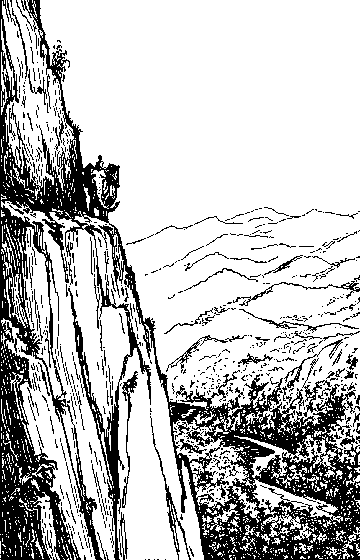 I thought that Po Toke would never
appear---nor, in fact, did he. Bandoola's head and tusks suddenly
came round the corner below me. He looked almost as though he
were standing on his hind legs. Then up came his hindquarters,
as though in a slow-motion picture. The oozie was sitting on his
head, looking down, and seemed to be directing the elephant where
to place each of his feet. Then he had passed that worst place.
I caught a glimpse through the elephant's legs of old Po Toke
following. Without a word I pushed hurriedly on. We had got Bandoola
up at least half-way. I just prayed for good luck, but had no
faith in success.
I thought that Po Toke would never
appear---nor, in fact, did he. Bandoola's head and tusks suddenly
came round the corner below me. He looked almost as though he
were standing on his hind legs. Then up came his hindquarters,
as though in a slow-motion picture. The oozie was sitting on his
head, looking down, and seemed to be directing the elephant where
to place each of his feet. Then he had passed that worst place.
I caught a glimpse through the elephant's legs of old Po Toke
following. Without a word I pushed hurriedly on. We had got Bandoola
up at least half-way. I just prayed for good luck, but had no
faith in success.
It was more than two hours before I saw Bandoola again, and then he was practically at the top, and all danger of his slipping or refusing was over. He was up, at all events, and my relief and excitement cannot be expressed in words.
Behind Bandoola came Po Toke, and after him a female elephant. As he passed me, Po Toke behaved rather like a pall-bearer at a village funeral who unexpectedly gives one of the onlookers a wink. He was intensely solemn, and did not utter a word, but he gave me a queer fleeting look, that was as good as saying: "Don't you worry. They'll all follow now."
He was right. They all did. I waited, and ticked off forty-five adult elephants and eight calves at heel go by. The back legs of some of the animals had been strained to such a point that when they halted they would not stop quivering.
Much as I hated having to camp on a ridge, where there was a well-worn track to the south, up which the Japanese might come, there was no alternative. It was dark by the time we had got the last of the refugee women up to the top. No day ever seemed longer.
I learned more in that one day about what elephants could be got to do than I had in twenty-four years. Po Toke's intuition had been perfectly right, and I am certain that we should never have done it if we had led with any animal except Bandoola.
Our camp on the ridge that night was the last one where I put out pickets. From there onwards I felt no fear of the Japanese.
Our next move was down to the Barak River. The descent was almost as steep as the previous day's climb up to the ridge, but there was no escarpment or ledges of rock to follow. Again we had to have a day's rest, as the elephants were feeling the strain, and had to be allowed to recover.
From there we followed the course of the river; our obstacles were mud and swamp, and very dense bamboo, through which we had to hack a track. We should never have got through if we had not been using Siamese-pattern gear on our elephants. It is much stouter.
Time was now our enemy, and my chief worry was whether our rations would last out. We still had a long way to go, but from the map it looked as though we should move into better country once we had reached the Digli River. It was quite obvious that our trek would last twenty days at least, and not the fifteen I had allowed for. By that time we had two cases of pneumonia among the refugee women, as well as other things. The only food we four officers were getting, on which to do a day's march, was chappattis made by the refugee women, jam and half a cigarette-tin of rice in the evening. As might be expected, our tempers were getting a bit short. Cobber, my dog, enjoyed himself more than anyone, but even he found the food dull. The Burmans were down to half a cigarette-tin of rice a head per day, and were feeling the pinch. They eventually petitioned me to increase it. But I refused, and told them that it was my job to get them through this march alive, and that I was determined to keep three full days' rations as a reserve, in case of some miscalculation. About this time we came to a Chin village, and had some trouble over a pig. Po Toke paid forty rupees for a village pig, but it escaped to the jungle just before he killed it. It was obvious that the villager would get it back after we had gone, as these pigs are left free to roam during the day, and come back to their pens at night. Po Toke naturally asked for his money back, and, just as naturally, the Chin villager refused to give it him. The dispute was therefore brought to me to settle, so I handed Po Toke a rifle and told him to go and shoot a wild one to-morrow instead. Before we left camp he had bagged two. Of course I knew they were not wild ones, but it did at least settle the argument in favour of my men.
Before we moved on that morning the head man of the village came and asked me for compensation for damage done by the elephants to banana-trees during the night. He had actually got his bill down on paper, and brought with him a boy of seventeen, who could speak a few words of English and claimed that he had been educated. It was he who had put the head man up to this ruse to obtain money. I told White, who could speak Hindustani fluently, to deal with him. It did not take him long!
But from my point of view the incident was the first sign that we were reaching civilisation again. However, as we were not going south to link up with the Bishenpur track, but west, it turned out there was a very long stretch of uncivilised country still to cover. Nevertheless, we had by this time at least left the mountains. In place of precipices we struck jungle swamp in which the animals got bogged. In trying to cut across country above the junction of the Digli and its tributary we were forced to turn back and follow down one riverbed to the confluence and then up the other river. It involved eight miles in water, knee-deep, with semi-quicksand bottom. It was just as slow going for the elephants as for the humans. All the children and the majority of the women had to ride, but the younger women were quite game to carry on. A few dropped out, and we had to send elephants back to pick them up.
Following elephants along a creek with a patchy quicksand bottom is an experience which thoroughly tests one's endurance and one's temper. It amounts to floundering along and continually losing one's balance, as one is always taking a step that meets with no resistance---as though one had stepped into a hole. It is next to impossible to carry anything, and the Gurkha girls soon discovered it was equally difficult to wear anything. It was not a time or place for false modesty and they were quite beyond caring about such matters. So they just handed up their garments, one after another, to the oozies and floundered on, naked, unimpeded and unashamed.
It was quite impossible to travel along the banks or to keep near them, as the dense jungle not only came down to the water's edge, but bamboos and canes grew right across. These had to be cut to allow the elephants to pass, and the sharp, twisted masses that resulted were awkward obstructions for those following.
I estimated that we covered only ten miles between five a.m. and five p.m. that day. Everyone was dead beat when we arrived at the confluence. It was an amazing sight to see the refugees sorting out their few wet rags of clothes on an open patch where we had decided to camp.
That last desperate day of floundering down the river had brought us, I reckoned, to within one day's march of the tea estate. But we agreed that to arrive there with our entire party might not be popular, so I decided to take the really sick along with me, on nine elephants, and to leave the remainder of the party camping as near the tea estate as we dared. I had the astonishing experience of walking right out of the wall of dense jungle into the open plain of the tea estate---an ocean of green tea, as far as the eye could see. I had come out exactly where I had planned on the map. There were doves cooing. I felt a lump in my throat, and could hardly believe my eyes. About a mile away was a large bungalow, typical of so many planters' bungalows in Assam. I went ahead to introduce myself to the old planter and the lovely young wife whom we had imagined.
It looked a homely bungalow. As I approached it I could see a figure in a white shirt on the veranda, for the bungalow was built on high ground, above the level of the surrounding tea bushes.
Before I reached it I was hailed by a man, speaking with a strong Scotch accent, "What is the hurry? What about a cup of tea?"
"No hurry, and nothing I should like better," I replied, and, swinging up his garden path, I walked on to a big open veranda with a breakfast table, with breakfast just laid. The planter was James Sinclair. He was a bachelor of forty-eight, and had no attractive young wife. He had mistaken me for one of the officers of a Commando unit, which had just arrived in that neighbourhood. Some of them were in the habit of dropping in to see him.
He asked me where I had come from and where I was going, so I gave him a brief account of my travelling circus. He then said that he had heard a rumour that there was a party of Japanese somewhere on the move with a few hundred elephants, but that he had not believed it. Now it turned out to be true, but, thank the Lord, we weren't Japs!
I breakfasted off new-laid eggs and hot coffee, and during the meal he told me that he had been expecting to hear of some refugees who were supposed to be coming through that way. Imphal had apparently signalled to Silchar about them. He was more than surprised when I told him I had brought them with me.
White arrived presently with the very sick on nine elephants, and Sinclair gave us every assistance, by handing them over to his tea-garden doctor.
We were still twenty miles from Silchar, but I was able to telephone to the civil authorities about the refugee women and children. It would be the greatest possible relief to hand them over, and have no further responsibility for them.
I was not able to communicate that day with the military authorities, and I was not particularly concerned to do so. I was already six days overdue, and had kept three days' rations in hand.
The refugee women were handed over that evening, so there was plenty of food left for my elephant-men. Two weeks later I was able to check up that all the sick among the refugees had recovered. I saw them in their camp, and they looked cheerful and happy. They were waiting to be sent farther on into India. They would have a fine story to tell their Gurkha menfolk when they met again after the war.
White and I stayed that night with Sinclair, and opened our last bottle of rum. Browne and Hann also had one at the camp. It had been agreed there was to be no rationing of their contents.
Next morning Sinclair invited all four of us to stay in his bungalow until I had got in touch with the Army and straightened everything out. The main elephant camp settled in about two miles from the tea-gardens.
That was the twenty-fourth of April. We stayed with Sinclair for a period of four months.
The Sub-Area Headquarters at Silchar were so astonished at our arrival that I thought I detected a note of disappointment! Supplies Branch had made fabulous calculations as to the amount of fodder they would have to provide for the elephants, and there was already a file of signals about the lost host of forty-five elephants, four officers and Burman personnel. The R.A.F. had apparently been trying to find us for twenty consecutive days, but we had vanished, only to pop up again, just after we had finally and happily been written off.
My demands on Supplies for elephant rations were nil, and my other requests easy and simple. So we immediately became popular.
I flew to Army Headquarters at Comilla, where news of our arrival had caused quite a stir.
By the time I got there our bodies and elephants were already up to auction to the Assam Forest Department.
One of my first inquiries was to discover what had happened to the wives and families of my elephant-men. But it was a month before I ran them down, through the refugee organisation of Assam, and discovered that they had been dumped at Parbuttipur, in Assam, on the Brahmaputra river. Being Burmese, they attracted considerable interest. As soon as it was possible, I sent Browne and White, with two of the most influential elephant-men, to visit them, so that they could bring back first-hand news to the oozies about their families. I have never known any two men who got on with children better than Harold and Chindwin, and their reception at Parbuttipur Camp was described to me later by the officer in charge. They were mobbed by the delighted children, whose excitement was indescribable. All in the camp felt that my promise had been kept. The families had to remain separated through the monsoon months. But they made the best of it, set up their own hand-looms, and were actually trading in Shan woven silk bags and hand-woven cottons before they returned to their homes.
They accepted their share of the upheaval in a wonderful spirit, and this helped me to hold their men together for four years, although they were not enlisted and I had no disciplinary authority over them. The difficulties for high-ranking officers in time of war can be very great, but to be in charge of Elephant Companies, without even an Establishment, could at times be far worse. My elephants could not be taken to Delhi and officially branded as the property of the Indian Army. My oozies could not be sent in a body to Simla to be certified as Burmans of good repute to those who resided there, and they were many!
However, an Imprest Account, written chiefly in Burmese, did confuse the Army Accounts Department to such an extent that they were forced to take it on trust. The advantages of our irregular position came when the war was over, as it enabled us to be demobilised at once, without waiting for all sorts of papers to come through.
THE battle for Kohima and Imphal, which proved decisive, and led on to the reconquest of Burma, was then in its first most critical stages. But my horizon was limited to my own job. Having got rid of the refugees, my concern was my elephants. A prolonged rest, so that they could get into good condition, was essential for them. Otherwise nothing would ever be got out of them again. They would also have to be refitted and reequipped.
Expert timber-dragging elephants like these were almost worth their weight in gold in the forests of Assam. The Army authorities hoped to put them to good use with the Assam Forest Department. Fortunately we were in the wrong valley. The Forest Department needed us in the Brahmaputra Valley, near the main Assam railway and trunk road. This involved a march of two hundred miles. The rains had broken, and I declared that it was impossible for us to undertake it before October.
I was very glad to be able to put off our working on timber extraction in India, for I knew that once we started it the elephants would not return to Burma during the war, and probably not for many years after it was over. If we could hold the Japanese attack during the monsoons, I felt certain that we should follow the enemy back into Burma when he cracked, and I knew that my elephants would be invaluable when that time came. I soon became involved in the usual type of Army paper war, of which I had had little experience up till then. I rapidly learned the technique of obstructiveness in order to stave off the plan of sending us to work for the Assam Forest Department, which I determined to fight in every way I could.
Meanwhile, I took the opportunity to send each of my three officers on long leave, for I knew that there would be little chance of any later.
The Imphal battle turned in our favour, and soon afterwards an opportunity occurred for me to get the question of the employment of the elephants settled as I wished.
I was called to visit Army Headquarters at Imphal, to supply information on a subject unconnected with elephants. But the interview made it clear that the elephants might soon be able to return to the Kabaw Valley. They were in the right place to do so directly the Bishenpur track was cleared. It was obvious, therefore, that the sooner any plans for employing them on timber extraction were dropped, the better. I therefore took the opportunity to ask for a definite ruling, and was given an interview by the Army Commander at Imphal, with results most satisfactory to me.
When I returned, the Burmans were delighted to hear my news of our future plans. Browne and White were to march the elephants back to the Kabaw Valley as soon as possible, and I planned to go back ahead of them, in order to pick up any stray elephants which our Army might have overrun or captured. The Japanese had been using large numbers of elephants in their offensive, and wholesale desertion by the oozies, complete with elephants, might be expected during their retreat.
I was, however, recalled to Headquarters with White, to be caged up in Intelligence Branch in Army Headquarters at Comilla with what would obviously be a ten-day job of work. I was rather amused by the manner of our return. We reached the large airfield near Silchar on a really dirty day of monsoon weather. The surrounding hills were enveloped in thick cloud, and while we were waiting Chindwin White said to me: "I don't know that I wouldn't prefer to walk back."
A few moments later a dirty yellow little Harvard Trainer came out of the rain-clouds and landed. Our names were called out, and we walked out to the aircraft, with our big rucksacks on our backs.
"Same bloody machine that nearly stampeded the jumbos," said White as we approached.
The pilot already had two R.A.F. passengers aboard, and called out to me: "I can't possibly manage you, sir, but we might squeeze in the little fellow, if he would take that hump off his back."
Chindwin was accordingly crammed in, and yelled to me: "There's a new bloody game on here. Everyone else is strapped in and has got a parachute. But don't you kid yourself, I'll hang on to the legs of one of these chaps if we do have to jump."
I joined him, an hour or two later, at Imphal, getting in on a Dakota in which there was plenty of room to spare. Chindwin went round telling everyone how I had got rid of him in a Harvard, and implied that I had been trying to get rid of him altogether.
It had been decided that, in spite of the monsoons, our Army would follow up the Japanese as fast as possible and keep them on the run. Unfortunately, White went down with a severe attack of malaria with complications. It was three months before he was well enough to come back. I was instructed to proceed to the Kabaw Valley to join the Commander of the 11th East African Division and, en route, to see the General Officer Commanding the 33rd Indian Corps. Hann had gone off to join a formation of Intelligence Branch in the field, and Browne was left to bring the elephants back alone. He was quite confident that he could, and he did so successfully, but he did not really recover from the exhausting strain of being the only officer in charge of them, for a whole year. He then went on leave to South Africa, with his job completed, four days after the Japanese surrender. No man ever deserved leave more.
I arrived in Imphal and Tamu. No words can describe the conditions of the latter place.
McVittie, the young Anglo-Burman to whom I had entrusted the women and children of my elephant-riders four months before, had got back before me, and was already building bridges with eleven elephants he had collected, whose oozies had deserted from the Japanese. The importance of the work these animals were doing can be judged from the fact that the necessary gear and all requirements had been flown in and dropped by air, as a top priority, and demands for priorities were many at that moment. Other elephants were becoming available, as the oozies and elephants were escaping from their Japanese masters in their disorderly flight.
The lack of gear was the most serious problem which held up our using these animals, and, as Browne's party of elephants could not possibly reach us from the Surma Valley under six weeks, I decided to make use of all the equipment and hand-made harness which their oozies had made in the rest camp, near the Baladan Tea Estate. Fetching it took me three days in a lorry convoy.
The monsoons were by no means over in the Kabaw Valley, but nothing was to stop the East African Division going down it. Within three weeks I had collected and equipped sixty recaptured elephants, and sent up what reinforcements I could to McVittie. The rains were so violent that log bridges built one day were often washed away the next, only to be replaced the day after. Japanese lorries were bogged all along that valley of mud. The East Africans cut millions of saplings and threw them across the road to keep it open. They gave out a stench as they rotted which almost matched that of the bodies of the Japanese, who had dropped out, all along the line, and died of disease, starvation and exhaustion.
The streams were in such spate that it was next to impossible to keep log cribs in place for any length of time. We therefore used elephants to haul discarded Japanese lorries into the beds of the streams, and built our log cribs on top of them. Had it not been for the exceptionally heavy late rains in September and early October, 1944, the Japanese retreating along the Tiddim road would have run into the spearhead of the East African Division, coming down the Kabaw Valley.
The sappers had now completely accepted elephants as part of the necessary equipment. Oozies whom I had not seen for seven months, and had since been made to work for the Japanese, were now back again under me, and were working with the East Africans. They were given the same rations as the troops, and realised that the Army had now really returned, and that there was no possibility of our withdrawing from the Kabaw Valley again. Air drops were as regular as clockwork, and elephants were used to carry the supplies dropped from the dropping zone to the distribution centre. These animals had been dive-bombed and machine-gunned from the air by the R.A.F., when they were being used by the Japanese as transport, on the tracks to Ukhrul and Jesami, in the Chin Hills surrounding Imphal. In one such bombing forty elephants had been killed, and elephants were being recaptured with gaping wounds which needed dressing. I therefore established a camp for sick elephants on the bank of the River Yu. To the best of my belief it was the first field veterinary hospital for elephants ever to be established. Some of the worst wounds on elephants' backs had been caused by acid spilt from wireless batteries, during transport. The Japanese had ignored the danger, and the oozies were not sufficiently familiar with acid to realise what the consequences would be. These cases were a warning to our own troops using elephants for transport, and enabled me to take precautions to prevent cases being caused by our own carelessness. In some beasts the flesh had been burned half an inch deep, and the elephants must have suffered slow torture while working in pack-harness. I treated them by dusting with M. & B. powder, and healing was remarkably quick. Many of our pilots have told me that they regarded attacking columns of elephant transport as a most loathsome job. The sincerity of these statements is beyond question, as I have also read reports from pilots, asking that elephants should not be a target for attack. Occasions arose, however, when there was no alternative but to stop the Japanese receiving supplies carried on elephants. This was particularly the case during the rapid advance of the Japanese to the Chin Hills and to Jesami and Ukhrul, preparatory to the offensive against Kohima. For had that succeeded they would have isolated China, and have overrun Assam and Bengal. The elephant transport trains were extremely difficult targets to find, as they marched by night, without lights, and were concealed in the jungle by day. The inspection of the sick and wounded elephants in my hospital camp was an extremely painful task---as painful for me as visiting field-dressing stations filled with wounded men would have been. The gun-horse has now been almost completely superseded by mechanical transport, and set free from the horrors of war. One can only hope that the unfortunate mule will also be superseded.
The Japanese had looted all the rice in the villages to the north and down the Chindwin; for their armies had been left without supplies after the failure of their plans to capture our dumps in the Imphal Plain. The villagers were therefore starving, and all my calf elephants under twenty were used to transport food supplies to these people. Demands came also for more elephants, to rebuild the road to the north to Myothit, and to the east to Sittaung. I was nearly at my wits' end in the valley, and so was Browne, who was travelling back with our original herd of forty-five. He arrived with them safely, after a journey of six weeks, but he was far from fit. He refused to leave me, however, and we struggled on, trying to meet all the demands that were being made on us.
The rains gradually came to an end and our troops were pouring into Burma. Roads were therefore needed over every track to the Chindwin, north, south, east and west.
Browne's arrival brought our strength up to one hundred and forty-seven elephants. Every fit animal was working full time. My head Burmans became my officers, and they managed remarkably well, considering what they had to put up with, in trying to please everyone.
I had no alternative but to attach parties of elephants to sapper companies, asking for one officer to be responsible for rationing the men and for general supervision. By this means I always had one man with whom I could deal direct. I owe these sapper officers a debt of gratitude. They got the best out of men and animals, by keeping calm under all circumstances, and by preserving their sense of humour.
One of these officers, named Alexander, who was a young civil engineer in peace-time, became so completely wrapped up in the elephants and oozies working under him that he learned all their names in a week, and struggled hard to learn Burmese, bribing the oozies with cigarettes to give him lessons in the evenings. All was going well when a sudden disaster occurred. Okethapyah (Pagoda Stone), one of his best animals, was blown up by a Mark 5 land-mine near his camp. Alexander came rushing over a most fearsome track in a jeep, arriving at two a.m., to tell me all about it. He said its back legs had been blown off, but he had seen it move, and was afraid it might be still alive! The Burmans who came with him assured me in Burmese that the animal was stone dead. I gave Alex a good tot of rum, and told him I could not amputate an elephant's legs, and we could only do our best to prevent such accidents in future. He abandoned the subject, but asked me to give him a lesson in Burmese---at two-thirty a.m.! I went back with him, starting before dawn, taking an anti-tank rifle, in case he had been right; but of course the elephant was dead---a sad sight in the early morning hours. The men had already discovered three more Mark land-mines, and led us to them.
I knew that they had been put down by a British infantry battalion six months before, during the retreat, and never mapped. Having been exposed all through the monsoon rains, they were most uncertain things to handle. However, Alex, being a sapper officer, considered it to be his duty to pick them up there and then, and replace the safety-pins. He told me to take the Burmans away behind trees while he was doing this. Two of the men, however, flatly refused, saying that if Thakin (Alex) wasn't afraid, they weren't, and anyhow they wanted to see just how it was done. So we all stayed and watched. While Alex removed the claw-clamp and the lid, he asked me to explain the sheer wire and how the pin had to be replaced. "Simple enough!" exclaimed Tun Myin, one of the Burmans who was watching. And next morning he brought in five more land-mines all with their safety-pins replaced, just as Alex had done them.
When Alex was not at hand I always felt that, but for the Grace of God, there goes Elephant Bill! It was not long before this business of land-mine recovery began to get on my nerves.
It was a standing joke with the oozies that all they were doing was only for the cold-season months, after which our Army would leave the valley once more. But I was able to arrange with the Army authorities to bring their wives and children back from Assam by lorry. This gave them new confidence that this time we had come back to stay.
By early December there were four roads fit for transport to the Chindwin River during the open season. The elephants built all the bridges on each of these roads: Tamu to Tonhe to the north, Tamu to Sittaung in the east, Tamu to Yuwa to the east, Tamu to Mawlaik to the south-east, Tamu to Kalewa to the south.
One or two small Bailey bridges had been brought up, but no bridging programme had been possible for these roads, as all bridging materials were wanted for the crossing of the Chindwin at Kalewa. No less than two hundred and seventy log bridges and log culvert crossings were put in by elephants over these routes, thus allowing all motor transport and tanks to move forward, before the main bridging programme was undertaken.
As the roads to the Chindwin were completed, Forestry Companies arrived, to obtain the timber required for building assault craft and small barges at Kalewa. Five hundred assault boats were built at Kalewa, from timber extracted by elephants and cut up at the saw-mills. They also supplied the portable saw-mill, with the timber required for decking the main bridges, for an all-weather road from Tamu to Kalewa.
During the war elephants had many jobs to do with timber, which they had never encountered in the routine of peace-time. One of these was to lift and pass logs up to a height of nine or ten feet---that is to say, from ground level to the bridge level. These logs weighed, on an average, a quarter of a ton each, and were often too heavy for the trunk to grip or hold. If the log were balanced on the outside of the trunk, on the tusks, there was always a danger that as the elephant raised its head to lift it the last foot or two the log would roll back, up its forehead, and endanger the life of the oozie, who was sitting on the elephant's neck at a lower level.
On one occasion I was watching, with one or two sapper officers, the last logs being handed up to a bridge under construction, and we witnessed a remarkable display of intelligence. The elephant was a particularly clever animal, and was beautifully handled by his oozie, but it was evening, and they were both tired. Several logs had slipped during their efforts to balance them, and it was quite obvious that the elephant was anxious about the safety of the oozie, who was placed in a dangerous position, just as the log was, lifted to the highest point. There were still about three logs to be lifted. The largest of them was picked up by the elephant, and held in an endways position between the trunk and tusk, the signals for this being given to the animal by the oozie with his foot. The elephant then let it gradually slide, so that it lay across his trunk, at the point of balance, and the curving-up ends of his tusks acted as stops to prevent it rolling on to the ground, and then slowly lifted his head.
"God's truth! how marvellous!" said a Major, in a low voice.
"Hope to God it doesn't roll up his head," murmured the Brigadier.
I held my breath, and then said, in a calm voice, in Burmese: "Carefully now."
The animal at once dropped his head, and let the log crash to the ground. The oozie looked disgusted, and then, acting entirely without instruction, the elephant used his brains to devise a safe method of handling the log---that is to say, he thought of something which we four men ought to have thought of ourselves.
He moved to one side rapidly, and picked up a stout piece of wood, which had been shaped for use as a maul or club to drive pegs into the bridge. He rammed it in a vertical position, jammed between his tusk and his trunk. I at once saw what he had in mind. The oozie also had immediately understood, and put him hard at the log again. With almost vicious strength, and certainly with determination, the elephant picked up the log endways, lowered it, and balanced it as before and then raised his head. But this time the club-shaped bit of wood was there, to act as a vertical stop, so that the log could not roll back over his forehead on to his rider.
 |
 |
|
|
|
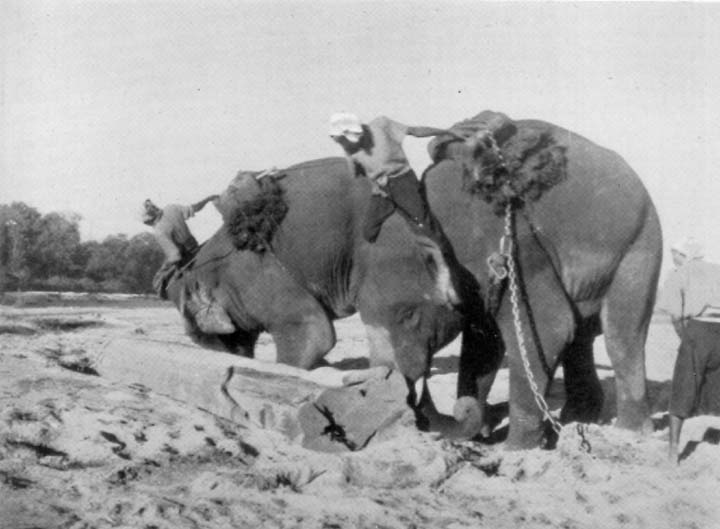
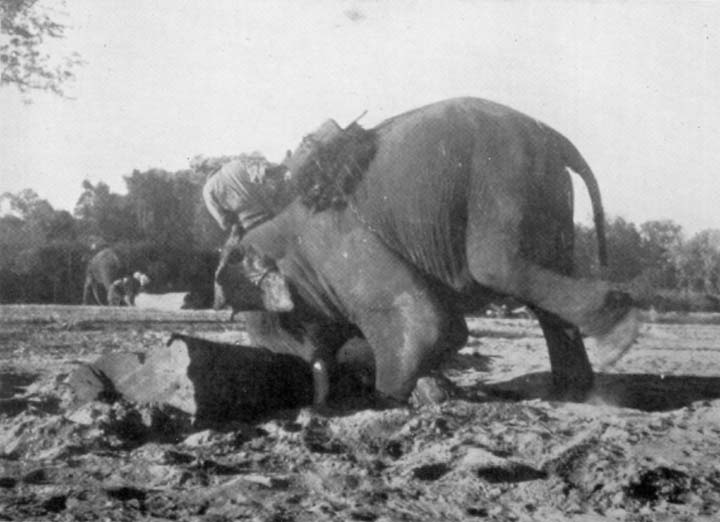
 A tusker easing a log away from the stump to a ridge for dragging. The lower animal is holding the log against the slope so as to prevent it rolling into a deep ravine. |
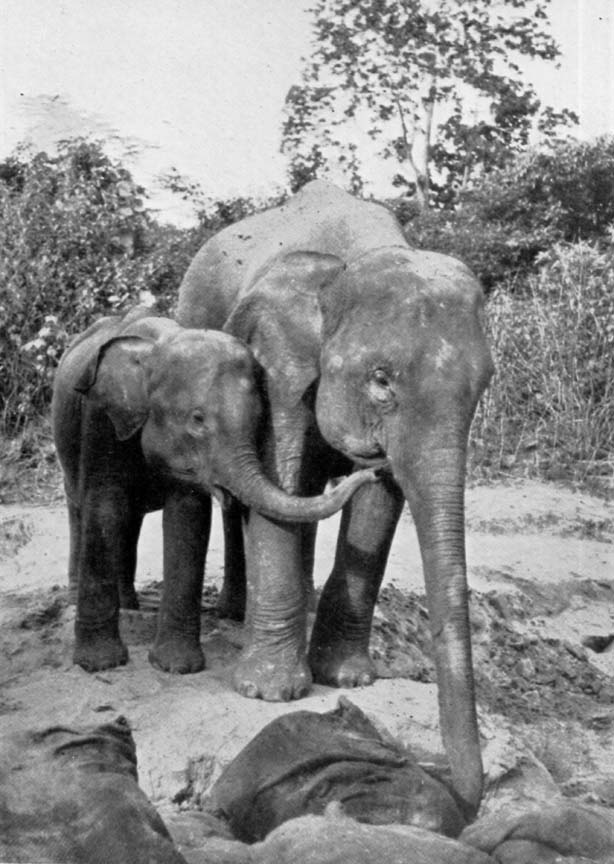 Two female calves, stealing salt, which they love. |

|
|
An oath came from the Major, a murmur of admiration from the Brigadier. I could feel my heart beating, as the animal moved towards the bridge platform, carrying the balanced log, and then, putting his forefeet on to another log so as to gain a little extra height, lowered his head a little, at the same time curling the end of his trunk out of the way, so that it should not get pinched. The log rolled on to the platform, as gently and easily as if placed in position by an electric crane. It was one of the most intelligent actions I have seen an elephant perform. The remarks of the Major and the Brigadier as we returned to camp would have made that elephant purr with the complacent pleasure of a Persian kitten, if he had heard them, and he deserved them all.
Elephants were given strange jobs, and some strange sights were seen. As an experiment a landing-craft was built on the River Yu, in the hope of getting it down that waterway to the Chindwin. By the time it was completed, the water in the Yu was falling fast, which made the rapids more dangerous. The officer in charge, Connel, came to my camp one evening and asked if I could help get logs into place for his launching-slip, with elephants, and then help pull his craft over the shallows. Four tusker elephants were supplied for the job. They cleared the launching channel, and assisted in the launching, but when they started pulling his craft over the shallows there was a nasty noise, and they pulled her bottom out. However, he repaired her, and finally got her down to the Chindwin, where she was invaluable in helping a division to cross the river.
The DUKWS amused the Burmans a great deal. One of them broke down, and an elephant had to tow it to the nearest repair workshops. The next things that came along were locomotives loaded on low loaders. They looked out of place, four hundred miles from the nearest railway, travelling along a road through the jungle. Two tuskers pulled one loader up an incline, where wheelspin had been causing trouble. Elephants were also used for clearing forest trees off new air runways. Often they were working quietly alongside bulldozers.
There were a number of humorous requests for elephants: such as for cranking up stalled lorries with their trunks, for spraying tar with their trunks, and ramming in loose earth on air-strips with their feet.
Their last job, for the 33rd Indian Corps, was to put a bridge over the Nayanzayah River for a squadron of tanks, which was engaged in taking Kalemyo. It was the only occasion on which I have seen elephants working under gunfire.
The bridge had to be finished by evening, and elephants worked from seven o'clock in the morning till seven o'clock at night. Five animals stampeded, but were recovered a few hours later. During the whole day Dakotas were circling two to three hundred feet above and air-dropping in a dropping-zone, not half a mile from where the animals were working. Three Dakotas were shot down by enemy fighters that day. By this time the elephants had become so accustomed to aircraft overhead that they took no notice whatever.
The elephants near the dropping-zone at Indaingyi soon realised that salt was being dropped. Their peacetime ration of fifteen pounds a month had come to an end in 1942, and they were in need of salt. Therefore as soon as they were released from work they went to the dropping-zone in search of the broken bags of salt which were lying about.
Indian troops, except the Gurkhas, were surprisingly timid in dealing with elephants. So were the East Africans. But the British troops would readily climb on their backs for a ride, and it tickled their sense of humour to do so. Their confidence, though born of ignorance, was usually justified, but not always. A sapper Major moved a stubborn tusker on musth off a main road, by offering it bits of bread, as though it were a zoo elephant. When he told me about it afterwards I could only say he was lucky in war. On the other hand, an Indian Army Service Corps driver, who had his truck held up by a tusker on the road, after screaming his horn and revving his engine without effect, shot it in the leg with his rifle. The bullet smashed the bone, and the animal had to be destroyed. Luckily, there were very few such incidents.
After the crossing of the Chindwin River at Kalewa, new forest areas kept falling into our hands, and I kept hearing of more elephants being found. The brigades which captured them did all they could to keep these animals as part of their own transport. This was not practical, as they had no officers who understood how to handle elephants or what their requirements were. As a result, I had many private wars to win before I could get the elephants back for proper organisation. On one occasion I exchanged six jeeps for ten elephants.
By the time the 4th Corps came down the Kabaw Valley every elephant in my hands which had been recovered from the enemy was fit and was equipped ready to start road construction on the line of advance south from Kalemyo to Gangaw, up the Myittha Valley, and over into the Yaw and Irrawaddy Rivers. By that time two experienced officers, Finch and Scanlon, had joined me. They at once took charge of one herd, and did a sterling job of work.
Browne at this stage had to give in at last, after a long struggle. He had a most fearful skin complaint, caused by his exposure for two years to the most filthy jungle living conditions.
I, too, was beginning to feel the strain of something wrong with me. I was suffering from an excruciating pain, high up in what some people call one's stomach. For two months I laughed with friends who tried to cheer me up by saying that the trouble was a few gincorks I must have swallowed at odd times, by mistake, and that it would be a simple operation to have them extracted, once we were back in Rangoon. A Divisional Commander, however, who came to ask me to pop over the ridge to Mawlaik in an L.5, to give some information to a Brigadier who was about to cross the river there, spotted that it would be my last job for a time, and on my return from my flying visit sent one of his doctors to see me.
Red tape was put aside, and I was told that I should be flown from Htinzin strip in an L. to Army Headquarters at Imphal, where the Army Commander would see me. When I got to the strip, however, I found no waiting aeroplane, but only an urgent message from the new 4th Corps Commander saying that it was necessary for him to see me. Finch, my new officer, who was to deputise for me, was with me, so the jeep was turned to 4th Corps Headquarters. I had not then been told that 4th Corps was to advance down the Gangaw Valley. Corps Headquarters staff was at lunch when I arrived, and the Corps Commander ordered me the one and only egg in their dug-out mess. For half an hour it seemed that that golden egg had cured me. It did at least give me enough energy to perform the task required of me before I left. This was to go forty miles up the Yu River Valley, and try to persuade six elephant camps to swim the Chindwin River, at noon the following day, as a blind for a force crossing higher up the Chindwin.
Finch went with me, and I have never known six more willing volunteers than the headmen of those camps. I spoke to the riders, and they, too, were full of enthusiasm, though they knew well enough what a difficult and dangerous task it was, at that time of the year.
They needed no one to go with them, and were ready to manage on their own, as I knew they would be. Finch and I then returned to Corps Headquarters, to assure the Corps Commander that it was all arranged, and would be carried out. He gave me a late cup of tea, and I was able to explain that Finch knew every yard of Gangaw Valley, and before nightfall the Commander realised that those six elephant camps would be far more use to him with his Corps, in the valley, than employed as a strategic deception, as he had originally intended. The order for their crossing the Chindwin was therefore cancelled at dawn the next day.
With a sad heart I left the Kabaw Valley, to drive to Imphal in the dark. I knew that road so well, but I had such a hell of a pain that the only relief seemed to be to lean against the driving-wheel of the jeep.
The Army Commander, who always gave one the feeling that he knew every man in his Army, saw me at once. I had no arrangements to make; I did not have to wait in any transit camp; I was told to go to a Hill Station hospital direct and to get back to my elephants as soon as possible.
For a brief period all the pundits thought they ought to remove my gall-bladder, but, by the grace of God, one of them who knew me spotted that it was a duodenal ulcer, and suggested that all I needed was three weeks in bed. This did the trick, and six weeks later I was driving back in my jeep from Shillong in Assam to Army Headquarters at Monywa in the Lower Chindwin.
The battle for Meiktala was then at its height. I shall never forget my return, and I shall never live down the story that I had been cut open in hospital so as to have a bunch of Gordon's Gin corks taken out of me.
On my return to the Kabaw Valley, and before pushing forward to Army Headquarters, which by that time had reached Monywa on the lower Chindwin, I at once saw Finch. There was much for me to learn of what had happened in the past six weeks, and I was prepared for the inevitable bad news, which is a part of war. Many of my friends, I knew, must have given their lives while I had been away. For the XIVth Army had forged ahead, and was already hammering on the gates of Mandalay.
Far in its rear, in the Kabaw Valley, Finch had been concentrating on feeding two saw-mill units with seasoned teak and other hardwoods for boat-building. This was now of urgent importance, and Kalewa, on the Chindwin, had become an organised shipyard at which all sorts of river craft were being constructed. And no shipyard anywhere had ever been better supplied with the finest teak in the world cut to all necessary dimensions.
It seemed for those in charge of the elephants on that job that they had taken the first step back to their normal peace-time work. In one of the permanent camps of elephants engaged in this work was Bandoola, who had remained in perfect condition ever since he had led the great climb over the mountains into Assam. Old Po Toke was in charge of that camp, and Bandoola was employed in handling the largest pieces of timber. The camp was two miles away from the main military road, and in it one could only just hear the grind of the incessant stream of Army lorries.
Before I went forward to visit Army Headquarters, I told Finch I would visit Po Toke's camp and inspect elephants, for I thought that it would help to keep up the morale of the oozies, who were already becoming impatient for the war to be over, though the elephants had, I think, become completely inured to it.
To my surprise, Bandoola was absent from the parade, and I naturally asked Po Toke where he was.
He replied: "He has been missing for three days, Thakin Gyi."
Whereupon Finch broke in with: "Nonsense! You told me five days ago, when I was last here, that he had not been caught."
I said no more, but, after inspecting the animals, went on into Po Toke's camp, where his men were quartered. I at once sensed that something was wrong, and collected all the elephant-riders and tree-fellers, and spoke to them as follows:
"You all know the difficulties we have with elephants getting lost in peace-time, and how far worse it is in war. Have you all been on an organised tracking party, looking for Bandoola ?"
No one answered me, so, looking at Po Toke, I asked him: "Have you not organised one?"
Old Po Toke looked pale and worried and replied in a low voice: "There is no trace of his tracks anywhere."
At the risk of incurring the wrath of all the Chief Engineers in Burma, I barked out: "All dragging work here is stopped until Bandoola is found, and there will be no rations in camp either, except plain rice; so get to work at once."
Finch and I went back to camp with the feeling that what we had heard was no normal story of a missing elephant. I went on to Army Headquarters, and Finch arranged to send me a signal when Bandoola was found. But no signal came, and when I got back five days later, I heard that Po Toke had been taken ill, and that the whole camp seemed in a most depressed state, as there was still no trace of Bandoola.
I went straight off, and blasted old Po Toke to hell. The effect was electric. He burst into tears and, blubbering like a schoolboy, said to me: "Bandoola is dead within four hundred yards of camp. Go and see him. I am too ill to walk Thakin Gyi."
Two of the oozies silently led me along a track leading from the camp towards the hills, and before long I could smell the frightful stench of a decomposing elephant. The two oozies suddenly stood aside, and I walked on into a cleared patch of short grass. There lay Bandoola, the hero of my march. I could scarcely believe my eyes when I saw him lying dead. But his enormous belly was distended with decomposition-and then I noticed something else was wrong also. His right tusk was gone, and there was only a butt of solid ivory, where it had been sawn off at the lip. The left tusk, half imbedded in mud and earth, on the lower side, had not been taken.
My feelings were a terrible mixture of grief and uncontrollable anger. I was determined to find out the truth. Bandoola was a war casualty. He had been shot. There was a bullet-hole in his forehead, and the bullet must have gone straight through his brain; he had obviously dropped dead where he was standing. As far as I could see, there was no trace of the spot having been visited for several days by any living soul.
I at once put a guard of five Karens, armed with Sten guns, round his carcase, and there was no need to tell them how to act if occasion should arise, or if any intruders came back to get the other tusk during the night. I told them I would be back next morning.
All I could get out of poor old Po Toke was the pitiful statement that Bandoola's oozie had found him dead one evening, ten days before, and on going with the oozie to the spot next morning he had found that the right tusk had been sawn off. In his panic and grief, he had sworn all his men in camp to silence, and had forbidden any of them to go anywhere near the carcase, for fear of the jungle Nats, which alone would have had the power to kill his unconquerable elephant, Bandoola. He pleaded that he had been unable to face breaking such terrible news, as he knew that my grief and Finch's would be as great as his own. It was useless calling him a bloody fool and cursing him because his prevarication made it far more difficult to discover the culprit. Such arguments meant nothing to Po Toke. Bandoola was dead, and his own interest in life was over. Nothing mattered to him any more. It was late that night before I turned in, and, to put it mildly, I was grieved, angry and perplexed. By noon next day the left tusk had been extracted cleanly from the skull by my Karens, and a .303 bullet extracted from Bandoola's brain. The slenderness of this, my only bit of evidence, can be realised. Thousands of lorries passed nearby along the Army's lines of communication every day. I had inquiries made at every unit in the neighbourhood, but it seemed most unlikely that any sepoy had been guilty, as most of them belonged to noncombatant units. Every check was reported to have been made on ammunition-with the negative results that might have been expected.
There was, however, a Chin village only two miles from the spot. I went there with an armed party, and ordered the headman to produce all firearms within ten minutes. He did so, bringing the owners with their weapons. I disarmed six men, three of whom were armed with old .303-calibre rifles, and put them under close arrest while I made a house-to-house search of their huts, hoping I might find the sawn-off tusk. But I drew a complete blank.
The headman was extremely perturbed when I told him that all the firearms would be confiscated until he either produced the tusk or evidence as to which of his hunters had shot my tusker elephant. Again I drew blank.
I then gave orders to Finch to dismiss Po Toke and Bandoola's oozie, hoping this would produce some reaction by which I could discover the truth. Once more I drew blank.
Bandoola's death still remains an unsolved mystery. His left tusk is my most treasured souvenir of the war. I have often wondered whether old Po Toke had become so war-weary as to become slightly deranged in his intellect and whether he had shot Bandoola, rather than leave him to a successor when he resigned. The ways of jungle Burmans are strange, and it is just possible that he also has a souvenir of his beloved elephant. The secret, whatever it was, was buried with the body of that heroic tusker, who was exceptional in every way. Even his name was a most unusual one, being that of a Burmese general who fought heroically against us during the Burma War which resulted in the British annexation of Burma in 1886.
I insert here the official record of this remarkable elephant of which I was so proud.
| 1897 | November: Born. |
| 1903 | Trained. Branded "C" both rumps. |
| 1904-17 | Travelling with Forest Assistants as pack animal. |
| 1918-21 | Ounging Moo River (i.e. salving logs from sandbanks in it). |
| 1922 | Transferred to Gangaw Forest. |
| 1923-31 | Timber camp of Maung Aung Gyaw. |
| 1932 | Injured in fight with wild tusker. Rested throughout the year. Fully recovered. |
| 1933 | Transferred to South Kindat Forest, Upper Chindwin River. Allotted to camp of Maung Po Toke. Extraction of heavy timber Mawku Reserve. |
| 1934-41 | Fit throughout. Prime Elephant of the forest. |
| 1942 |
January-April: Employed on Kalewa-Kalemyo road, before the retreat of the Burma Army. May-October: Disbanded but kept in secret hiding from the Japanese in side creek of Kabaw Valley by Maung Po Toke living in Witok. November: Handed over again to Elephant Bill and Harold Browne at Tamu. December: Enrolled as No. 1 animal, the nucleus, of No. 1 Elephant Company, XIVth Army. Employed dragging timber for bridges. |
| 1943 |
March-November: Employed near Tamu collecting timber ready for the return of the Army. November-March, 1944: Bridge-building with the Army in Kabaw Valley. |
| 1944 |
April-May: Leading elephant in the march out of Burma from Kanchaung to Baladan in Assam. June-October: Resting in Surma Valley, Assam. Loose for one day in pineapple grove, estimated to have eaten nine hundred pineapples. Severe colic. Recovered. November-December: Marched back to Burma. |
| 1945 |
January-March: Attached to Forest Saw-mill Units, R.E., teak-dragging for Army boat-building. March 8: Found dead, shot by an unknown person near Witok. |
During my absence in hospital and while all this was taking place, the work had gone on with accelerated speed. A log bridge built by elephants had been constructed over the Manipur River near its junction with the Myittha. Similar bridges had been constructed, as required, right through to Tiddim, and every tank going down passed over them without a hitch. No troops were maintained on the lines of communication behind this corps on this route, and no excavating machinery had to be used on the one hundred and twenty miles of this forest road.
I had a grand total of four hundred elephants working under my direction at this time, and I was making new contacts with oozies with their elephants who had deserted from the Japanese, and were hiding in the Mingin and Pakokku forests.
An American pilot, who had made a forced landing, had been given shelter and food and kept in hiding, for two months, in a camp of Karen elephant-men, who eventually brought him into our lines. The story was that when he was rescued by the Karens he gave them his money-belt, full of coins as a reward. But, having nothing better to do during the two months he was in hiding, he taught the Karens how to play poker and won it all back. He gave it them a second time, and won it back again. But he went on with this once too often, for a Karen, called Po Doh, learned to play poker so well that he won all the money from the other oozies and the pilot's Colt -45 automatic from him too.
During their retreat the Japanese were pressing a party of Burmans, with a hundred elephants, forward into the dry zone beyond Saw, on the Irrawaddy River. The head Burman went to the Japanese officer in charge, and told him that even though the Japanese shot all the oozies and all the elephants they would go no farther. The Japanese officer referred the matter to his superior, but, without waiting to hear his decision, the whole party escaped with their elephants, and reached our lines after three forced marches.
This accession increased the number in our hands to seven hundred. Many of them had been so overworked by the Japanese during their retreat that they needed long rest and careful nursing.
Another fifty came into our hands on the Moo River after the fall of Shwebo. No more were recaptured in the dry zone, and it was not until the Prome, Pyinmana and Toungoo districts had been overrun by our troops that another three hundred fell into our hands.
The loyalty of these oozies to us was often strikingly shown. One Independent Brigade, crossing the divide between the Chindwin and the Moo Rivers, asked me if I could help in any way to provide transport for them down the Moo Valley.
It was quite impossible to get elephants over in time to assist the Brigade, which was desperately short of mule transport. So I suggested that a letter in Burmese, addressed to a contractor who had worked for me for seven years, should be dropped by one of our Spitfires. It was dropped on Naunggauk village, inhabited by men who had formerly worked for me. In the letter I asked that he should organise as many pack-elephants as possible, from those which had deserted from the Japanese, and as many bullock-carts as possible, for the use of British troops who would be reaching them very shortly.
When the Brigade arrived it was met by twenty-three elephants and thirty-four bullock carts, all organised as perfectly as though by one of our officers. The Brigade made a landing-strip for light aircraft, and shortly afterwards I landed there in an L.5, to meet the men who had acted so loyally. I took a large sum of money to distribute among them as a reward. But I found they were terrified of accepting it, owing to the lawlessness and dacoity prevalent in the district. So I made arrangements to arm them as well, and the money was soon in circulation.
After the 33rd and the 4th Corps had all gone down into the dry zone, and the hot season was almost at an end, elephants were kept working on only one main line of communication---that down the Kabaw Valley from Tamu to Kalewa. A new all-weather Bithess road was to be constructed there before the monsoon broke. A hundred and fifty elephants were employed in clearing all the culverts, in preparation for its construction. The Bithess road was an extremely expensive experiment, but it was the only possible method by which an all-weather road could have been constructed down that valley in the time available. It was, in its essence, a carpet of waterproof hessian material made in strips two feet six inches wide, treated with bitumen or tar. The strips overlapped eight inches and sealed the road surface. Camber was obtained by laying the two outside strips first, and building up with overlaps to the centre.
After it had been completely organised, the rate of progress in laying the road was one mile a day. The early storms of the 1945 monsoon had broken before it was completed, but the road carried seven hundred tons a day during the critical months.
By July, 1945, the road had "cracked." Over some sections stretches of a mile were awash, and a quagmire resulted. After this the only hope of keeping the road in use was to build log causeway diversions. Five miles of such causeways were constructed by elephants during the 1945 monsoons. This meant laying two thousand five hundred logs per mile, or a total of twelve thousand five hundred logs, which had to be felled and cross-cut, and then dragged and put in position by elephants. All this work was done by No. 1 Elephant Company, under the most appalling monsoon conditions. At every flood the culverts were soon jammed with jungle debris, and the elephants were kept busy, continually clearing them. But they kept the road open. Over it, all the petrol for the Army was carried.
As the labour which had formerly been employed in taking rafts of teak logs down the Chindwin became available, it was organised for taking rafts of petrol drums from Kalewa down to Monywa and Myingyan. The work had been well planned. A month before Kalewa had been captured, and the Chindwin bridged, Burmans were set to work on the Upper Chindwin, above Mawlaik, in cutting cane and bamboos to build rafts. These were then floated down to Kalewa, when the time came. A million bamboos were delivered to Kalewa by the jungle Burmans for this work.
A small group of officers operated in the forward areas of the Kabaw Valley. Thomas and Keeley did most valuable work in this. They could, and should, have been reinforced by large numbers of others, who were sitting in Simla, waiting for the fall of Rangoon, which they seemed to imagine was the only gateway to Burma.
The fall of Rangoon, however, was in sight. There would undoubtedly be a great demand for timber. No one knew what supplies of it would be found there. Before the war there were about three hundred thousand teak logs, within easy call, at depots supplying the Rangoon mills. It turned out there were less than three thousand easily accessible logs within ten miles of the city when it was occupied. The elephants would be kept busy for some time in getting the teak logs left in the creeks since 1942 forward to meet the demand for timber. They would be wanted immediately they could be released from Army work.
CONSIDERABLE information had been gathered from the Burmans and former employees of the timber firms on the use the Japanese had made of elephants during their occupation of Burma.
During their advance of 1942 the Japanese used elephants to transport mortars and ammunition over the Caukeraik Pass from Siam into Burma. It is probable that this had been planned in advance, and the operation was successful. It seems very unlikely, however, that the Japanese had intended to make other military use of elephants in Burma before their invasion. For we know that they had made preparations for an organisation to work the forests under military control. A Japanese company, called the Nipponese Burmese Timber Union, was formed soon after the fall of Burma. The company did round up a considerable number of elephants and their oozies, who remained inseparable from their animals. They appointed as many of the Anglo-Burman assistants of the timber firms as they could find, as officers. But these Anglo-Burmans were never trusted by the Japanese. Such suspicions did not make for efficiency, even if the men had been trying to work. No British firm would have ever paid a dividend, unless it had done the same work in less than a third of the time that the Nipponese Burmese Company took over it. As a matter of fact, though they made an effort to show that they intended to develop the forests, they did very little extraction of timber from the forests, and relied almost entirely on what had already been hauled to the waterways or rafted to the depots. This may partly have been due to the fact that the Japanese military had a prior claim on elephants, and would send for working parties of a hundred elephants whenever occasion arose for their use. No Anglo-Burman was ever appointed to command these columns of elephants for military purposes, and the Japanese had to rely on the small number of Burmese-speaking officers in their army to coerce the oozies. There were many causes of difficulty and trouble. The rations of the Japanese soldier were inferior to what the oozie was accustomed to, and this was undoubtedly a principal cause of discontent.
The Japanese also insisted on elephants being tied up after a day's work, and being hand-fed by the oozies. This meant more work for the men, who had to cut fodder, and less food for the elephants, which always do best when they can pick their own food. After feeding their animals, the oozies were themselves kept penned in camp under guard. I found that most of the oozies who had worked under the Japanese hated them so much that they preferred not to discuss them. They were eager to forget as soon as they could. "They lived like dogs; they ate like dogs; and they died like dogs," one of the oozies said to me, in summing up the invaders.
The elephants and their oozies were of the greatest military use to the Japanese. The big Japanese offensive to break into India via Imphal, Ukhrul, Kohima and Jesami from the Upper Chindwin, depended largely on elephant transport. This accounted for their rapid movement over jungle paths in very difficult country.
On 13 March, 1944, the Japanese crossed the Chindwin by night, with a column of three hundred and fifty elephants, which they marched direct to the Chin Hills. A Japanese N.C.O. was in charge of every thirty animals. The elephants were used over precipitous and impassable country, linking up with motor transport and bullock-carts when they reached roads once more. Their transport system was improvised ad hoc from all available means and, though it did not look smart, it functioned and moved fast.
The Japanese did not ill-treat elephants in the sense of being cruel to the animals, as their management was left entirely to the oozies. But they pushed them hard, and never gave them opportunities to get the full amount of fodder they needed. I have already referred to the careless indifference which led to injuries from acid spilt on elephants' backs.
The Japanese had, however, a passion for ivory, and practically every tusker elephant which had been in Japanese hands had his tusks sawn off, as near to the nerve as possible. This work could not have been done by the Japanese themselves, as it demanded expert knowledge. It was no doubt done by Burmans of the toughest type, who wished to curry favour with Japanese officers, who were mad about ivory. No serious damage was done to the health of the elephants by this. I did not see a single case in which the nerve had been exposed. But, nevertheless, it was criminal, as it greatly reduced the value of a tusker for timber work, since the tusks left were not long enough for him to get under a log in order to move it. The Japanese, however, were more concerned with using elephants for transport than they were with timber extraction. Perhaps they thought the elephants looked less dangerous without their tusks. Early in 1943 I was present at the examination of a full pack, dropped by a Japanese soldier, when avoiding a patrol of ours on the east bank of the Chindwin. The pack weighed approximately seventy-five pounds, and contained two tips of tusks weighing six pounds in all. The soldier obviously valued his souvenir, to add it to such a heavy load. I don't think, however, that the Japanese got all the ivory obtained in this way, as the Burman also has a passion for it.
"Four thousand elephants used for hauling timber have disappeared in Burma." This statement appeared in the Daily Mail, and was quoted in Punch with the query: "Have you looked everywhere?" Well, the answer is that we had not, and nobody ever will. The statement appeared before we had completely cleared the Japanese out, and a few more may have come to light. I can, however, claim to have discovered the whereabouts of one of the missing four thousand. He is the Regimental Mascot of a famous Indian regiment, which captured him, and would not surrender him to me. On their return from the Burma Campaign he was marched across India to the Regimental Depot. Unfortunately, there is on his behind a capital C branded on with white phosphorous paint when he was seven years old. This proclaims his real ownership---the Bombay Burma Trading Corporation---and all the dhobies in the Punjab can never erase it. The Quartermaster is advised to get busy with the regimental tailor and fit him with cloth of gold trappings to cover it up. When the Regiment reached Assam a language difficulty arose. The Burman oozie wished to return home, and it was decided that an Indian mahout must be found among the ranks of the battalion. Not one could be found, so it became a Brigade request, and eventually a sepoy, who claimed to have been employed in a Rajah's elephant stable, was appointed.
The handing over of the Regimental Mascot by the Burmese oozie to the Indian mahout was planned to be a ceremony of importance. Many officers were present, including three Battalion Commanders and the Brigadier. There was considerable speculation among those on the parade-ground as to how the elephant would react to orders spoken in Hindustani, for the animal's understanding of Burmese words of command had become a byword in the regiment.
The new Indian mahout arrived on the parade-ground in bottle-green battle-dress, wearing boots, belt and sidearms. The Burmese oozie sat on the elephant's head, dressed as usual in his lungyi skirt and a Japanese cotton vest. The Indian wore a look of immense self-importance, the Burman one of complete indifference. Not a word was exchanged between the pair as the oozie ordered the elephant to sit down on all fours. As the Burman slipped down off the elephant's head, the Indian mounted, and the animal stood up. The Burman walked off the parade-ground, and then came the great test, as the Indian was left to prove himself. Drawing his bayonet from its scabbard with a flourish, he first held it at the sword present arms. Then he gave the elephant a probe with it behind the right ear, and, to the astonishment of everyone, exclaimed in English: "Now, Mr Bloody, come on!" ---and off they marched.
In all, one thousand six hundred and fifty-two other elephants were recaptured from the Japanese between November 1942 and the date of unconditional surrender. They went back to their working lives. Before I left Burma I visited and said good-bye to four hundred and seventeen of them, working in the Kabaw Valley in Upper Burma, where they were still being employed in pulling out the tail of the XIVth Army. They were all that was left of Elephant Companies Nos. 1 and 2. The rest had gone back to their pre-war work of timber extraction, and were soon happily scattered through the teak forests of Burma where they belong. Some were war-weary, some were battle-scarred, but they were in good hands, and would be nursed back to good health and good condition. Of the lost host of three thousand nine hundred and ninety-nine (according to the Daily Mail), many hundreds lost their lives owing to the folly and ruthlessness of man. There can be no roll call of the survivors. But there were numbers of wounded who, though they may have had a hard fight for existence to gather their food, would recover after they had treated their wounds in the traditional elephant fashion, by sealing them with mud two or three times a day. When they recovered they would set forth to leave the valleys which had become hells in the jungle during the war, for peaceful areas. But many must have escaped unhurt.
Those that had stampeded and those that survived their wounds must greatly outnumber those that lost their lives, and I know well enough where they are now. For the herds of wild elephants show no resentment when domesticated animals join them. They have none of that herd instinct directed against the stranger that one finds in cattle, in small boys and among many grown-up men. This tolerance is just one of the things about elephants which makes one realise they are big in more ways than one. No doubt some attempts will be made by the jungle Burmans to recapture branded animals from the wild herds. The only successful way to do this is for two very daring oozies to ride a really trustworthy animal into the wild herd as it is grazing in open kaing grass and to edge it alongside the animal they are trying to recapture. One of the oozies will then begin to talk to it, very quietly, and if it listens without alarm, he will slip across from the animal he is riding on to its back. A short stampede is almost certain to follow, but a good oozie will soon gain control as the wild herd disappears. But those that will be recaptured in this way are few indeed, and with Burma in its present condition I like to think of the hundreds that will remain leading their happy wild life, undisturbed by the restless demands of man.
Elephants have recently been nationalised in Burma, which means that they will lose their best friends in captivity, the European Assistants, many of whom would never have gone on with their work in the jungle but for their interest in the most lovable and sagacious of all beasts.
