J. H. Williams
ELEPHANT BILL
CHAPTER X
SAVAGE elephants are as rare as really wicked men, but those
that are not savage sometimes give way to moments of bad temper.
They are particularly liable to do so when they are in harness
dragging a very heavy weight. Their most tiresome and dangerous
habit at such moments is to pick up a large stick or stone with
the trunk and throw it with great force and accuracy at some onlooker,
particularly at someone in authority, whom they guess is responsible.
One has to be prepared to jump, and jump quickly, when this happens.
A young European Assistant of my acquaintance visited the London
Zoo with his mother and his sister on his first leave home. They
went straight to the elephant house. After explaining all about
the female elephant on view, he was emboldened to suggest: "Shall
I make her sit down?"
His mother and sister were delighted at the idea, and the onlookers
were most impressed.
"Hmit!" he shouted, in close imitation of a Burmese
oozie.
The elephant merely swished her tail and tickled her mouth
with imaginary bananas.
"Hmit!" he shouted again, and, as the elephant ignored
him, he grew angrier and more determined with the disobedient
animal. "Hmit! hmit! hmit!"
At last the elephant condescended to notice him, swinging her
head round, cocking her ears, and eyeing him with an expression
as though she were saying, "So you come from Burma, too,
do you?" Then, with lightning swiftness, she seized a lump
of her dung the size of a cottage loaf and slung it at the young
Assistant. It missed him, but it knocked a feather out of his
mother's hat and exploded against the wall behind them. No one
laughed, but the elephant house was soon empty.
Savage elephants---whether male or female---are rare, and the
few exceptions are usually of a savage temperament from birth.
Of course, during the musth period all males are of uncertain
temper. My interpretation of musth is that it is an instinctive
desire in the male elephant to fight and kill before mating. His
blood is up, and his brain is affected. The mere act of mating
does not cool his passion. He would rather fight for his chosen
mate before he wins her, and drive off and kill an intruder during
the time that he is making love.
The great majority of cases in which oozies are killed by their
elephants take place when their charges are on musth. For some
unknown reason, the animal may then suddenly attack his rider,
first striking him with tusk or trunk, then crushing him to death
with a knee, when he is on the ground. A vicious young animal
will throw his rider, and then attack him on the ground. Once
he has done this he is classed as dangerous and given a metal
bell, as he is likely to repeat such an attack. For three years
he may never show a sign of viciousness---then suddenly he will
catch his new rider off his guard, and so kill his second man.
Strange as it may sound, there is very little difficulty in
finding a new rider for such an animal. Many riders take pride
in riding an elephant known to be dangerous, and take such a job
in a spirit of bravado. Such men find life easy; they care nothing
for anything or anyone. They are usually opium-eaters, but in
spite of that they work well. Every village girl knows them by
name. But, though they gain in reputation and importance, they
do not get spoilt, as they are not paid much more for such work
than the ordinary riders.
In addition to the rider, a dangerous animal has a really good
type of spearman attached to it as an attendant, whose duty is
to cover every movement of the rider when he lies entirely at
the mercy of the elephant---undoing his fetters, for example.
Although the spearman carries a spear, the secret of his control
is by the eye. He keeps his eye fixed on the elephant's. The two
men together are usually sufficient to keep a savage elephant
under control.
The temperament of a nasty-tempered elephant is somewhat like
that of a Burman. The animal loses its temper and kills, and realises
too late what it has done. In just the same way a Burman will
lose his temper about some trivial gambling debt and will draw
his dagger and stab his best friend---ten minutes later he will
realise with most bitter regret what he has done.
I have known one case of something that seemed like remorse
in an elephant. He was a tusker who killed his rider. But he guarded
the body, and would let nobody get near it, for a whole week.
He grazed all round it, and charged in mad fury at anyone who
came near. When the body had quite decomposed he wandered away
from it, and ten days later was recaptured, without any difficulty,
and behaved quite normally. He was not on musth.
An animal named Ah Noh (a Siamese name) killed nine riders
in a period of fifteen years, but there was never any difficulty
in getting a new rider for him. He was peculiar in that he always
killed his man with his tusks, actually goring him to death. He
was never in harness unless there was a rider on his head and
two spearmen, one on each side, with their spears at the ready.
It was finally decided to saw his tusks right off to the lip,
or as near as possible to the lip. This involved overpowering
him completely, and a description of it would make very painful
reading, as it was cruel. But the job was done, under my supervision,
and we cured him. The two great nerves were almost exposed by
the sawing. They healed in a remarkable way, for the tusks did
not grow again, but formed a rosette of ivory at each end. He
was one of those exceptional and magnificent animals which are
rarely seen, either in the wild state or in captivity. One could
walk up to him and give him a banana, and he was so beautifully
behaved one would think butter would not melt in his mouth. I
have come across him feeding alone in the jungle many times, and
have stopped to admire him. He never made the slightest attempt
to attack me.
The wickedest elephant I ever knew was called Taw Sin Ma (Miss
Wild Elephant). I never knew her when she was a calf, but she
cannot have been greatly loved, to have earned herself a name
like that, and she must have been very truculent in the crush.
She was about twenty-five years old when I first knew her, and
there was nothing in her recorded history which gave any explanation
of why she should just loathe every European she saw. She had
never been operated on, and could never have been ill-treated
by a European. Even when she was had up for inspection she had
to be chained to a tree, and when one was a hundred yards away
would begin to lunge and strain at her chains, in order to attack
one.
She recognised a European by his appearance quite as much as
by smell, because she would attack a Burman rider if he were wearing
a khaki shirt. I had a nasty experience with her, when she first
attacked me on sight, and then chased me, following my trail by
scent for four miles, from one catchment area over the watershed
to the next. It was terrifying.
I met her by chance, when I was walking from one camp to another.
We came on her suddenly, and she went for us at once. The Burman
I had with me stampeded in one direction, and I in another, and
for two miles I was not sure whether I was on the right track
back to the camp I had left. There would have been no hope for
me if her hobbles had snapped or come undone, unless I had found
refuge up a tree. But I knew well that if I had done that I might
have had to stay there for twenty-four hours or longer. As she
was hobbled, my pace was a little faster than hers. She wore a
brass danger bell around her neck (docile elephants wear wooden
bells). Often it sounded from the bell as though she were nearly
up to me, at times as though she had cut me off. Of course, I
know that sounds in the jungle are deceptive, and play tricks;
but it was not pleasant. This experience gave me the first opportunity
I had ever had of trying out a trick for delaying a pursuing elephant,
by dropping an article of clothing, in the belief that the animal
will halt and attack it, and so give one a chance of gaining ground.
I first dropped a haversack, but I heard no check in the sound
of the clanking bell on the elephant hurrying after me. When I
had climbed to the top of the ridge I halted for a few moments,
to locate her whereabouts. Then, after going as fast as I could
along the ridge, I chose the steepest place for my descent, hoping
she would hesitate to follow, and there I dropped my khaki shirt,
for her to savage, or to chew to her heart's content. But I had
no sooner reached the small spur reaching to the drainage area
below than I heard an avalanche of crashing trees and bamboos,
and it needed very little imagination to visualise Taw Sin Ma
sitting on her haunches and tobogganing down the steep incline,
much faster than I had done. My shirt had not delayed her a moment.
Perhaps she was holding it in her mouth, to chew after she had
first caught me. On I plunged, trying to remember to act on the
law of the jungle, that one must never hurry and always keep cool.
Once one breaks that rule every thorny bush that grows reaches
out a tentacle to impede one, to tear and scratch, or even trip
one up. I thought of discarding my once white, and very wet, vest,
but I thought that if I was eventually treed, I might need something
on. My relief was great when I met two men, busy with a crosscut
saw on a fallen teak-tree. But I had only to shout out the words:
"Taw Sin Ma!" and they joined me in my flight, without
asking questions.
They soon took the lead, and as I followed I at least had the
satisfaction of knowing I was on the right track to camp and safety.
One of them got into camp, well ahead of me, and gave the alarm
on my account. When I got in I met a chattering group of elephant-riders
and their families, all of them doubled up with laughter, or smacking
their hands on their hips in mirth at the sight of me---all, that
is, except Maung Po Net (Mr Black as Night), who tucked up his
lungyi skirt, as he prepared to go out and meet his "pet."
There was no alternative but to join the Burmans in their joke---for
I often wanted them to share in mine. So I joined in their laughter
and their hip-smacking.
Within an hour a rider came back with my shirt and haversack,
quite undamaged and not even trodden on, and Po Net rode Taw Sin
Ma back into camp. The expressions on both their faces seemed
to indicate that the same incident might be repeated next day.
It did not, as I at once issued twenty-five feet of chain, for
Taw Sin Ma to trail behind her, whenever she was at large, grazing,
in addition to her hobbles.
As far as I know, she was the only animal we never inoculated
against anthrax. She was the type that never gets it!
Some riders teach their charges tricks that give a wrong impression
of the real disposition of the animal. Bo Gyi (Big Man), a young
elephant, which became well known, always charged his rider, as
soon as he appeared to catch him and bring him to camp. But at
ten paces the animal would stop dead, and sit down for his fetters
to be undone, as gentle as a lamb. Any other rider would bolt
when the elephant charged him. The secret, that it was just a
matter of standing one's ground, was only discovered after the
rider who had taught him the trick had been killed by a bear.
The elephant was at large for a month after his rider's death;
nobody would face him. Finally a reward of three hundred rupees
was offered for his recapture. A young village lad turned up one
day, saying he could capture him, but asking if he would get the
reward, since he was not one of my riders. I told him that of
course he would. Two days later he came into camp riding the animal
and smiling gaily, and was paid his three hundred rupees. Two
of my own men had gone with the lad, and had watched the whole
procedure, from a hiding-place near by. The secret had come from
a young Burmese girl, a former sweetheart of the dead rider. The
young lad was her new lover, and no doubt boy and girl found the
three hundred rupees a useful start in life.
After a strike among eighty elephant-riders, in the early days,
at a time when there had been political agitation in the neighbourhood,
I was left with the job of capturing what appeared to be six savage
elephants, simply because none of the men left with me knew the
tricks that had to be employed with each animal. These tricks
were just the result of habitual methods employed by their riders.
In some cases the approach had to be made from the near side,
in other cases from the off, or from in front, or behind, or when
the animal was sitting, or standing. The approach to each animal
had to be learned separately.
The last one to be caught was Toe Hline (The Destroyer). I
got the information of how to catch him by bribing the rider who
was on strike, through an agent of my own, who confided to the
rider a long story of how he wanted a job so as to get enough
money' to marry a certain girl in camp. If he could catch Toe
Hline he would get that money reward and the job of riding him.
I watched this recapture with great relief, as Toe Hline had
a bad reputation for tearing down jungle rice godowns (store-houses),
and he had taken up his grazing quarters near my jungle hut, which
was by no means substantial, being built of bamboo, with very
flimsy posts, and it looked just like a godown. The volunteer
to catch Toe Hline was "attacked" twice, on getting
within one hundred and fifty yards of the animal. It looked pretty
hopeless, but I soon discovered that these "attacks"
were merely a method of getting the elephant and the rider in
full view of each other. Once this had been achieved, the rider
designate sat down on his haunches and began calling in a very
persuasive voice: "Hmit! Hmit! Hmit! Hmit!" This went
on for at least fifteen minutes, with the elephant taking no heed,
but just going on feeding, keeping one eye on the rider, all the
time. Quite abruptly, he stopped feeding, and stood perfectly
still. Then, slowly moving his head towards where the rider sat,
and, setting his ears forward inquisitively, he decided to "Hmit."
Even then it needed great pluck for the rider to go up to him.
As he advanced, he repeated the same word, and, bending down,
unfastened the fetter, which is normally done when the animal
is standing up. Then he climbed on the elephant's head and said:
"Htah !" Toe Hline rose, and proceeded to camp, and
I proceeded to get myself a peg, to celebrate the recapture of
the last elephant. I had them all equipped with eighty new riders,
and the strikers were left wondering.
The rider married his girl and got his money reward. Then Po
Lone, the original rider, who was the pleasantest of rogues, came
in to say that now he had enabled his friend to win the reward,
and get his girl, he would like to ride his old elephant again
himself. He got him, for the two riders had fixed it all up between
themselves, while I thought I was breaking the strike. They are
lovable rogues.
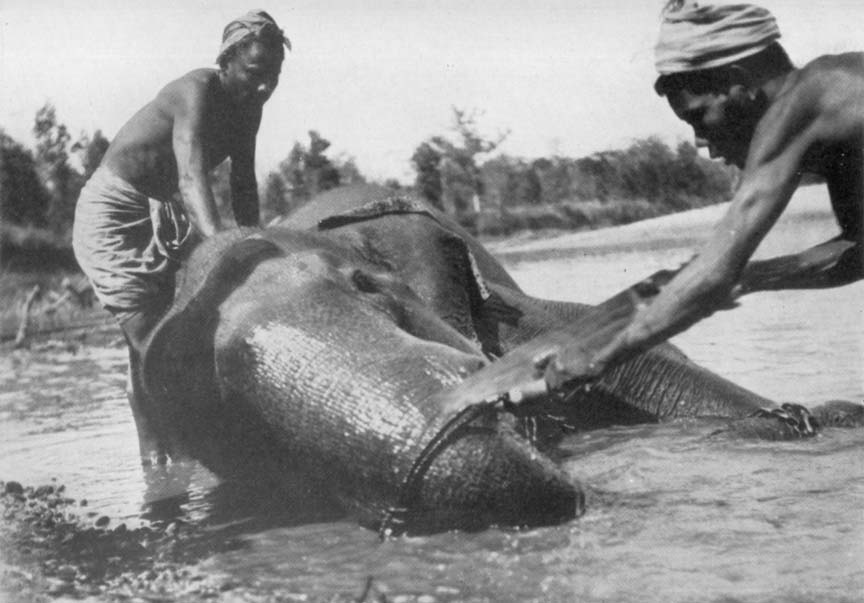
Sawing off the tips of the tusks so
as to make them grow thicker. The trunk is lashed to prevent
its being cut by the saw, and the operation is performed in the
river so that the saw may be frequently cooled in the water.
|
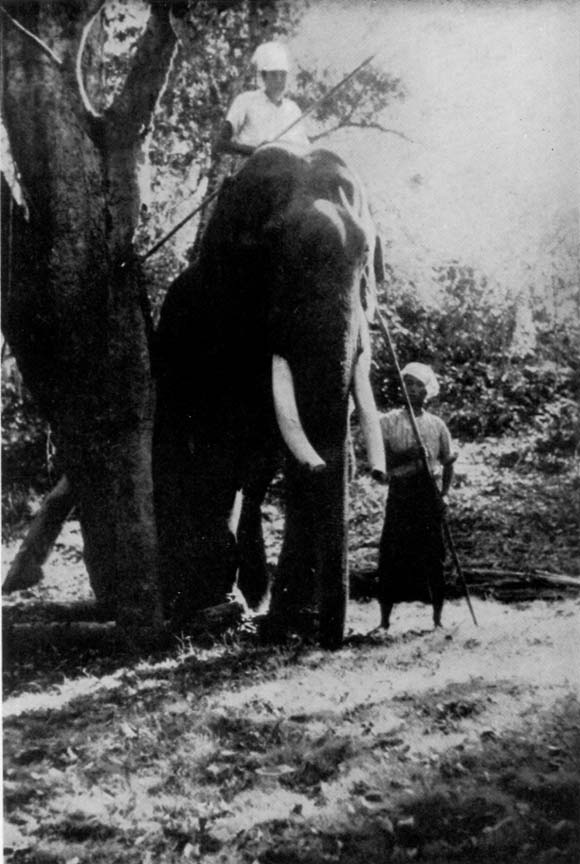
A dangerous tusker who has killed several
oozies. The oozie and the spearman are both armed.
|
Young calves, if they have not been properly trained, are apt
to get savage if not well handled afterwards. One particular calf,
named Soe Bone (Wicked Bone)---the name of the creek where he
was born---delighted in chasing me whenever he got an opportunity.
I thought at first it was only rough play, but my head Burmans
assured me it was not, so we decided he was not too old to learn
his manners. "Shoot him in his toe-nails with roasted rice,"
was the suggestion. So I emptied two cartridges and, after filling
them with rice instead of shot, I wandered out of camp to find
Soe Bone. He was in a sandy creek, throwing wet sand over his
body with his trunk, and was under a bank, only three foot high.
"Hullo, little chap!" I said, greeting him.
"Little chap to you," he seemed to reply, and charged
me on sight, as though determined to see me off.
I stood my ground, and gave him a left and right in the forefeet,
so as to sting his toe-nails. Did it stop him? I nearly lost my
precious shotgun as I made my getaway. He was up that bank with
his fetters on almost as quickly as I could turn to run. And did
he love me next time he saw me?
"What's the next move?" I asked.
"Oh well, we'll put him back into a crush and cane the
little devil."
A substantial crush was made, and into it he was enticed and
trapped. My head Burman came to fetch me, carrying in his hand
a six-foot whippy cane.
At least a dozen Burmans were there to witness the caning of
this naughty schoolboy, as even Soe Bone's own rider had no use
for this tiresome game of chasing people.
I was asked to give him the first twenty strokes. And what
a behind it was to whip! I went to his head first, and showed
him the cane. He showed me the whites of his eyes, as if to say:
"Wait till I get out of here," but I changed his mind
for him, and he squealed blue murder. Then everyone present, except
his rider, was ordered to give him half a dozen, whereas his rider
was permitted to stay behind and give him lots of tid-bits, after
we had all gone.
I saw him next morning being loaded with some light kit as
we were moving camp, and he looked rather ashamed of himself.
Suddenly he saw me, carrying a stick, and, instead of pricking
his ears, as he did when he was going to chase me, he gave one
shrieking trumpet and bolted into the jungle for his life.
Shortly afterwards I left him for another forest, and did not
see him again for fifteen years. By that time he was a magnificent
beast of twenty-five, and quite docile. I won't say that he had
forgotten, but he had certainly forgiven me.
One of the most remarkable incidents I ever had with savage
elephants concerned a young Shan woman of about twenty. I was
sitting in my hut near the camp one evening, very worried over
a seriously injured spearman, Maung Chan Tha, who had been gored
that afternoon by an elephant, named Kyauk Sein (Jade-coloured
Eyes) while he was trying to save the life of the rider, Maung
Po Yin, who had been killed instantaneously by the elephant, who
had then attacked the spearman. The animal had gone on musth,
and was at large in the neighbourhood of the camp.
I was discussing with my head Burman how we were going to get
the wounded spearman away to hospital. To put him on an elephant
would kill him, as he had a serious abdominal wound and a broken
leg. To carry him on a bamboo stretcher to hospital would take
five days, and was the only alternative.
Suddenly, quite unannounced, a tall, fine-looking girl walked
into my bamboo hut, and I immediately recognised her as the widow
of the dead rider. She was not wailing, or weeping, or carrying
her youngest child, which is the custom on such occasions, nor
did she kneel and sit before me, in the customary manner. She
just stood erect and in a firm, unemotional voice said: "May
I have a dismissal certificate from you for my husband Maung Po
Yin, who was killed today by Kyauk Sein?"
"Yes," I replied. "And your compensation, if
you will wait till tomorrow, as I am busy arranging to get Maung
Chan Tha to hospital." I added how grieved I was, and, in
sympathy, asked her if she had any children.
My head Burman answered, instead of her, that she had none,
and then, addressing her as though he were most displeased with
her for coming to see me in such an unceremonious way, said:
"You can go now. I shall be coming back to the camp presently."
She moved quietly out of the room, a tall and graceful figure.
When she was out of earshot I turned to my head Burman and
asked: "Is that Po Yin's wife?"
"Yes," he replied, "but she takes more opium
than Po Yin did, and that is the reason why she has no children."
I was very much surprised, as it was the first time I had ever
heard of a Shan girl taking opium. I was even more staggered when
my old Burman said in a quiet voice, "Give me ten ticals
of opium to-night, and she will recapture Kyauk Sein to-morrow,
because she has often caught him for Po Yin, when he was in a
heavy opium bout."
I gave him the opium he asked for, but I went to bed that night
with a very disturbed conscience. To add to my troubles, Chan
Tha died before dawn.
I met my old Burman very early the following morning, but I
asked him no questions, and waited to see what the day would bring
forth.
By ten o'clock, however, he came to me saying:
"Kyauk Sein is coming in, with Ma Kyaw riding him. Come
and look."
I could scarcely believe my eyes when I saw Kyauk Sein passing
through the camp, with the Shan girl riding him, oblivious to
everything, and her eyes fixed straight in front of her. Her long
black hair was hanging loose down her back, and she wore her blue
tamain girdled above her breasts, leaving her beautiful pale shoulders
bare. Again I did not interfere, and by noon I was informed that
Kyauk Sein was securely tethered to a tree, as is customary for
elephants on musth.
That evening Ma Kyaw was brought to me, to receive the compensation
due to her. She was dressed in her best, wearing a multi-coloured
tamain, a little white coat, and a flower in her jet-black hair.
She knelt and shikoed three times, and then sat down in front
of me. She kept her eyes lowered, looking at the mat she sat on,
and she toyed with a matchstick in her right hand, as though she
were drawing something.
After paying her the compensation due to her for the loss of
her husband, I gave her an extra bonus for recapturing Kyauk Sein.
When I told her this, I could see a wisp of a smile at the corners
of her mouth. I then wrote for her a certificate, such as is customarily
made out for all men killed in accidents. These certificates are
for the benefit of the jungle Nats, who require them before admitting
the spirit of the dead rider to their domains. The certificate
ran, "I hereby give leave to Maung Po Yin, rider of Kyauk
Sein, to go where he wishes, as he has been dismissed from my
service," and I signed it.
When I had risen from my table and given the money and the
certificate into her hands, she wiped away two crocodile tears,
did three shikos with her hands, got up and went quietly out into
the dusk, back to the camp, three hundred yards away, on the other
side of the creek.
I was only left guessing what the future developments would
be for another twenty-four hours, for then, when I asked my old
Burman about finding a new rider for Kyauk Sein, he told me:
"Oh, that is all arranged. Maung Ngwe Gyaw is an opium-taker,
too. He has 'taken on' (not married) Ma Kyaw, and they tell me
that the biggest opium-taker of the lot is Kyauk Sein, the elephant.
Another ten ticals of opium would be useful."
By that time I would willingly have given him twenty, if he
had asked for them.
I do not believe to this day that the girl took opium, but
she was a resolute character, and the elephant Kyauk Sein knew
her well enough to take opium out of her hand. He probably knew
the smell of her hand, because she was the wife of his rider.
I think she completely stupefied the animal before she caught
him.
The ways of the jungle are strange, but all is not savage,
hard and cruel in it. For every savage elephant that attacks or
kills his rider there are ninety-nine that are docile and friendly.
CHAPTER
XI
I FIND it hard to realise now, after living for twenty-five
years in the jungle with the most magnificent of all animals,
that for the first three and a half years my eyes were blinded
by the thrill of big-game shooting. I now feel that elephants
are God's own, and I would never shoot another.
However, it was as a result of those three and a half years
that I reached my present views, and because of my experiences
then that I developed as deep a reverence for the jungle and all
the jungle creatures as anyone possibly could.
Of course, the big cats are a nuisance. There are too many
tigers and leopards in the jungle---so many, indeed, that the
few which are shot make scarcely any impression on their numbers.
Quite apart from seeing them, when sitting up for them in a tree
over a kill, hoping to get a shot, the European Assistant almost
invariably has some memorable incident in his career, when he
sees tiger in more natural conditions. I once jumped into a creek,
ten yards from a tiger, that was lying down eating a freshly killed
samba deer. He was magnificent. I could not jump back from the
boulder I had alighted on to the bank behind me. For what seemed
quite half a minute we stared at each other, and he snarled at
me. Then he jumped up and, with the most graceful movements, bounded
from boulder to boulder up the creek. He whoofed twice as he went,
as though disgusted that the stench of a white man should interrupt
his lunch.
Willie, whose reception of me when I first arrived in the jungle
will be remembered, first came out to Burma in the early years
of this century. Although he belonged to a good family and was
a good shot, he arrived with very little equipment, for I fancy
he had exhausted his father's purse and patience before he was
sent East. If he was anything like his son, Willie's father must
have been a formidable disciplinarian in his day. On Willie's
arrival he was at once invited to a big shoot, at which high jungle-fowl
were expected. Poor Willie had to confess that he had not got
a gun. However, as it was obvious that the lad was very keen,
one of the party took pity on him and lent him a small-calibre
rifle, saying it was possible that the beaters might put up some
ground game, and that Willie might get a shot. He was told, however,
that he must not fire in front of him towards the line of beaters,
but must wait until the game had passed through the line of waiting
guns. The first two beats were most successful, with numbers of
high birds, which were brought down brilliantly by the guns. But
poor Willie did not get a shot.
The third beat was a blank. Not a single jungle-fowl rose to
meet the line of waiting guns, and the beaters were almost up
to them and had ceased rattling their sticks on the bamboos, when
there was the crack of a rifle, and Willie's neighbours were horrified
to see that he had disobeyed instructions, and fired in front
of him, towards the beaters.
"What the hell do you think you are doing, young man?"
demanded "Growler" Moore, going up to him in a fury.
"What on earth are you firing at?"
"I saw a tiger," said Willie.
"Tiger? What d'you mean, tiger? Don't talk nonsense!"
shouted Growler, intent on ticking off the offender.
"Well, there it is, and it's dead," said Willie.
And there, twenty yards from them, was a fine tiger, with a
bullet through its head. Willie could not make out why the other
guns made such a fuss about it when they came up and inspected
it, for he had assumed that tigers were a normal part of the bag
in a Burmese jungle-fowl shoot.
Although I now dislike the thought of shooting big game, I
can still recall, and live over again, the thrill when I was young
enough to take any opportunity that offered which gave me even
chances of life or death.
I remember how for two whole months I spent day after day near
the mouth of the Manipur River, trying to get a solitary wild
bull elephant---and every day was hard, and ended in disappointment.
He was well known by the name of Shwe Kah, which my elephant-riders
had given him.
These words are used to describe the pose of a Burmese girl's
arms and hands when she is dancing: a pose in which the forearms
and the hands and extended fingers are gracefully curved upwards
and outwards. In the beautiful and perfectly symmetrical tusks
of this wild elephant my riders had seen the same lovely upward
and outward curve. Shwe Kah had gored two of my tuskers badly,
and had continually worried my elephants. He was far too bold
for the liking of my riders, particularly when they were catching
their beasts deep in the jungle. Many of them had seen him, and
they described the dimensions of his tusks outside the lip, by
stretching both arms out horizontally, to show their length, and
by encircling their legs above the knee with the outstretched
thumbs and forefingers of both hands to indicate their girth.
Some tusks!
I had numerous opportunities to bag other wild elephant at
that time, but I was set on getting Shwe Kah. I saw him twice,
but not in a position for a shot. I then went on leave for a month,
knowing I should be back in the same area during May, the best
month in Burma for big game.
If I got him, Shwe Kah would be my fourth elephant, and I had
learned quite a lot about tracking and all that big-game shooting
entailed. One night during my leave, a very pleasant Sapper Major
joined our small party at the bar of the Maymyo Club (now no more).
While we were chatting, he mentioned that he had just purchased
a rifle from someone going home, and that he was more than keen
to bag an elephant before he left Burma. It was a case of finding
him somewhere where he could shoot. I did not like the description
of his purchase. It was a magazine rifle with a high-velocity
bullet, but on the small side. My opinion was (and is) that a
double-barrel breech-loader 400-450 was the right weapon for Burma
big game. This difference of opinion led to a hot argument, as
it usually does, but we ended up such good friends that finally
I said: "Can you get a month's leave, from the twenty-fifth
of April, as I am going back for a tour of jungle camps, during
which I hope to get some big-game shooting in my spare time?"
He jumped at it, but, to make it quite square, I explained that
I would do all that I could to put him on to the track of a decent
wild tusker, but that it must be understood that Shwe Kah was
to be mine only. This he fully appreciated.
He had never done any big-game shooting, and he was thrilled
with the idea of the trip, even apart from the chance of getting
an elephant. He was a man of thirty-seven. I was just twenty-six.
I worked out that he might expect to get ten days' actual shooting,
and that, with any reasonable luck, working from my little jungle
headquarters, he ought to bag an elephant, and stood a good chance
of getting a bison and other game.
He joined me on the appointed date, and we set off, poling
up the Myittha River in a country dug-out. One evening we had
a bathe after I had been out with a rod. While I was drying my
feet, he said: "Lord, I wish I had feet like yours!"
Laughingly I replied: "Why, have you got corns?"
"No," he replied. "But I have eight hammer toes."
Looking at them, I saw eight tightly clenched toes, in spite
of his feet being flat on the boat boards. I howled with laughter,
and asked him how on earth he thought he was going to trek all
day through the jungle. He was quite honest, and said he had hoped
to sit quietly in one spot and wait for the game to go by. This
rather damped my hopes that he would have any great success. But
he was quite happy, as he was much enjoying all my routine work
of inspecting elephant camps.
When we reached Sinywa (Wild Elephant Village), late one evening,
I was told by my men that Shwe Kah was about, and had been seen
the previous day, two miles away, on the other bank of the river.
My shikar companion insisted on accompanying me the next day,
without his rifle, purely to see what would happen. He had a morning
which quite cooked him, but he saw two female wild elephants,
and was thrilled to the marrow of his aching toes.
We eventually got on the tracks of a big tusker, which I imagined
to be those of Shwe Kah. These led us back to the Myittha River
bank, where it was quite obvious that during the night the animal
had crossed the river, to the side on which we were encamped.
It was then well after noon, and was sweltering hot. As we should
pass near our camp, I suggested that we should have a cup of tea
and something to eat there, and then continue our attempt to find
Shwe Kah. My friend was all for the cup of tea and the cold Green
Pigeon pie, but candidly admitted he was far too cooked to leave
camp again, but said he'd excuse me if I went.
I had just eaten a first mouthful of pie when a Burman arrived
to say there was an enormous wild tusker, believed to be Shwe
Kah, not three hundred yards from their camp, a mile away from
where we were.
Without any hesitation, I was off. No tea, no pie---I left
my companion resting his weary bare feet on a box by our camp
table. As I left, he graciously said: "I'll leave some pie
for you."
By three p.m., under a sweltering tropical sun, I had got near
enough to this wild elephant to hear an occasional flap of his
ear. There was no other sound, as he was browsing in elephant
grass, twelve feet high, through which I had ventured, following
up his tracks. I knew that the river bank could not be far to
my left, I knew only too well that if he were suddenly disturbed
he would stampede back, direct on his tracks. I therefore decided
to get off them into the tall grass on one side. There I rested
my rifle against a small tree, and wiped the sweat from my face
and brow. I took a quick swallow from a water-flask, as that was
probably the last refresher I should get. I was determined to
get a shot that afternoon.
I was suddenly alarmed by realising that my presence had been
detected by the elephant, probably, as so often happens, by scent.
There was a never-to-be-forgotten noise of the animal cracking
the end of his trunk on the hard ground---it makes a sharp, clear,
metallic, ringing sound, owing to the trunk being hollow. Then
there followed that awful silence. I had no alternative but to
stand my ground. Both of us were left guessing, but the elephant
broke first, and made away from where I was standing, whereupon
I made direct to where I imagined the river bank to be. It was
closer than I had realised, and I reached it where the tall kaing
grass grew to the very edge, which was eight feet high above the
water, and had recently fallen in. The edge was unapproachable
without risk of further collapse, but not many seconds passed
before I heard a tremendous splashing, and through the tall grass
I saw a magnificent tusker elephant, crossing the river fifty
yards below me, moving at a fast ambling trot, the splashes of
water covering his body.
Without hesitation, I jumped down the eight feet, landing in
three feet of water, but sinking into the mud
to the tops of my boots. I was bogged. It was now or never
for a shot. I decided on a heart shot, as he was moving quickly,
water splashing, and I was unsteady.
Crack! He was quite seventy-five yards away when I fired. He
stumbled a bit, recovered, and then swung round, like a polo pony,
and came back on his tracks, not twenty-five yards below me. He
was wild with rage---so wild that he did not see me. I was stuck,
and had no hope of regaining the bank. As he climbed up, where
he had slid down a few minutes before, I realised that he was
mortally wounded, and noticed that his tusks did not appear as
big as those of Shwe Kah, nor as tilted.
I gave him another heart-shot, and there was no mistake this
time. He collapsed stone dead against the top of the bank. Before
I had extricated myself from the mud, my gun-boy, who had remained
behind in a tree on the bank, went off to inspect him, and came
rushing back to me yelling: "Amai! (Oh Mother) Amai! You
have shot a Kyan Zit."
I was far too excited and occupied to appreciate what he meant.
It was about half-past four in the afternoon, and sweltering hot.
I well remember my feelings when I realised that I had not bagged
Shwe Kah, as I so much wanted his tusks as the trophy of my last
wild elephant. For I could not get a licence to shoot another
for a year. However, all my disappointment vanished as soon as
I saw the head of the magnificent beast I had shot. For he was
something very rare, and was already causing great excitement
amongst all the elephant-riders, who had come rushing along from
their camp.
"Ky an Zit! Kyan Zit! Kyan Zit!" was all they could
repeat, as if one of the strangest myths of the jungle had been
proved.
I could not have been more astonished if I had shot a unicorn.
The words Kyan Zit describe a rare type of elephant tusk, that
has grown in rings or corrugations, like the sections of a piece
of sugar-cane. The Burmans speak of such an animal as such a rarity
as to be almost mythical, but in existence, and they believe that
a Kyan Zit is a king of elephants, to whom all other elephants
do obeisance, in terror of his strength.
The tusks were corrugated, in rings, from the tip to the lip
where they entered the head; after they were extracted the corrugations
were found to continue, but faded out gradually, right up to the
socket and root. A photograph of the tusks was afterwards published
in the Bombay Natural History Journal, but no explanation
of the cause of their formation was forthcoming. It was not a
malformation, as the rings were symmetrical in both tusks. I have
never seen comparable tusks amongst any of the thousands of captive
elephants I have known in Burma.
I rested on the leg of the dead beast and had a drink of water,
and looked at him with a mixture of excitement and remorse, and
I asked myself what had the King of Elephants with the Kyan Zit
tusks done to me?---What had I done to him?
Long discussions followed among the riders standing round and
admiring the rare tusks. A head man arrived from camp to supervise
their removal with small axes and sharpened knives. Then the women
of the camp arrived with children and babies in arms, all to be
shown Kyan Zit.
Up to this time I had not allowed any of them to touch him,
as I knew that once those Burmans started on a dead elephant they
combined the qualities of Americans after souvenirs and vultures
after flesh.
I then heard someone yelling my name. It was my guest, who,
on hearing my two shots in camp, had just hopped off his camp
bed and, without waiting to put on his shoes, had come along,
with two or three of the men from my camp. Hammer toes or no hammer
toes, he wanted to see the result of those two rifle-shots. When
he emerged from the tall kaing grass he nearly collapsed with
surprise.
"Lord, how magnificent!" was his only remark, as
he opened up his camera and took several snapshots.
Not till he had finished did I get the chance to explain that
it was not Shwe Kah but Kyan Zit-and I explained the whole story,
as we stood beside the tusks.
"Oh! I am sorry!" he exclaimed.
But I assured him that I was more than content. So pleased,
in fact, that our next job must be for him to bag Shwe Kah, as
he was now his game. My guest was beginning to be a little doubtful
about having to take on anything the size of such a monster, but
I told him he could borrow my rifle for the job, which seemed
to relieve his mind a little.
I had not noticed that he was barefoot, until I suddenly looked
down.
"Good Lord, man! Your feet will be blistered to hell!"
I exclaimed.
So I sent back to camp for his shoes, and for tea and sandwiches
for myself, and we settled down to supervise the removal of the
tusks, taking also the hairs from the tail and one forefoot, as
the Kyan Zit had the most perfect feet and toenails I have ever
seen on an elephant. The toenails looked as though they had just
been manicured, and the oil sweat-glands between the nails showed
that he was an animal in his prime. The forefeet were perfectly
circular, and my shikar companion was quite ready to take a heavy
bet that twice their circumference was not equal to the animal's
height at the withers. He was astonished when I measured it up
and showed him that it was.
By this time the human vultures had started operations. Whole
baskets of meat were carried off to camp, to be dried in the sun.
There was enough to last them many months. It was my Burman hunter's
perquisite to have the two aphrodisiac snips, which consist of
the triangular tip of the trunk and the tip of the penis, also
the big nerves out of the tusks, which are a native medicine for
eye troubles, as well as a coveted aphrodisiac.
By the time we had removed the tusks and the forefoot it was
almost dusk. More men and women from Sinywa Village had arrived,
to carry away meat. It was a really savage-looking party, with
a lot of jokes and chatter. My Burman hunter came in for a great
deal of chipping and cross-chat from the girls on the subject
of his special perquisites.
As dusk fell we left them to it and went back to camp. Before
we went to bed I had many things to tell my guest, as he was thrilled
with all this, and was one mass of questions. The last thing he
said to me, after I had done what I could for his poor feet by
anointing them with Zam-Buk, was: "You know, I am so enjoying
this that I don't mind if I don't shoot anything."
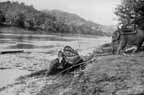
Travelling elephants of sixteen and
seventeen years of age about to cross the Yu River. One is belly
deep in mud which he would not have entered unless he could feel
a firm bottom. The leading animal has Burmese panniers, the second
a Siamese pack.
|
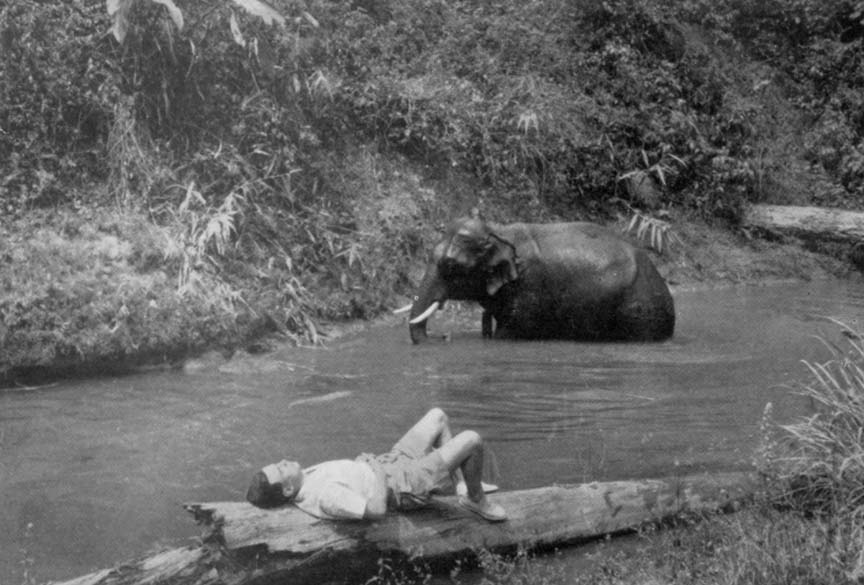
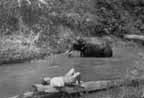 Cooling off after the day's
work.
Cooling off after the day's
work.
|
I had work to do the next day, and left my guest to watch my
men cleaning the tusks and the forefoot for curing.
That evening news came into camp that there was a small herd
of wild elephant feeding in a swamp area three miles from camp,
and that it was more than likely that Shwe Kah was hanging round.
Next morning my guest insisted that his feet were not fit for
marching that day, but I overcame his objections by saying we
would ride an elephant of mine as far as the swamp, so as to have
a look round, though I did not think it sounded very promising.
The swamp was about half a mile wide---of tall, dense kaing grass,
flanked on either side by fairly open jungle with big trees.
On the west side there were all the signs that the herd had
entered the swamp during the night, and about half a mile to the
north there were tracks of two solitary and separate bulls, which
had gone in also. Either of these tracks might have been those
of Shwe Kah.
We talked it over with my hunter, and agreed that very little
could be done in this dense swamp area, but that if my guest remained
on the west side, and we stampeded the animals from the east,
he might have the luck of a novice in seeing a tusker pass him.
I explained everything, and placed my guest in the fork of
a large tree, fifteen feet from the ground. His farewell remark
was to whisper: "What a host! This is what I call a sitter."
I left my rifle and gun-boy with him, and skirted the whole swamp
on my own elephant, with an expert rider.
It was two hours before I got into position on the eastern
side. I had warned my guest that he would have a long wait, and
that he was to take no notice of any calling or talking he might
hear. I moved up and down on the edge of the swamp, from north
to south and back again, speaking as loudly as I could to my rider.
Unfortunately, my elephant was completely silent as it strode
up and down, as there was no fodder for it to snatch at whilst
walking.
Presently I heard a wild elephant "chirping," at
short intervals. It is a beautiful note of warning, rather than
a signal of real danger, as though to say: "Keep in together.
There are voices from the east side."
We halted our elephant for a short time on high ground, and
from its back I could overlook the sea of kaing grass covering
the swamp.
My elephant, Chit Sia Yah (Lovable), who was trained to stand
a rifle-shot fired from his back, stood facing west, with his
ears cocked forward, listening. He could hear something that we
could not. Then my rider pointed to the sea of kaing grass, and
said in a quiet voice: "See the grass tips moving. Wild elephant
are closing in."
I was particularly anxious that they should move west without
any panic or stampede, so we remained perfectly quiet for fifteen
to twenty minutes.
It was all most exciting to watch---there was silent movement
without a sound. Here and there I could see the grass stirred,
as though by a fitful breeze, though there was not a breath of
wind.
Then from the very centre three or four elephants' trunks appeared
above the sea of kaing. They kept moving from side to side in
an uncanny fashion, like cobras poised to strike.
My rider whispered: "They have scented either you or the
other Thakin on the other side."
Without hesitation, I gave a series of shouts, in which my
rider joined. This left the herd in no doubt as to our position.
One animal trumpeted, and then the whole herd began moving west
towards my guest in the tree. It was like watching a silent, slow
roller, as the herd moved in a body through the tall grass. One
could see it going down, as they moved steadily, not in a stampede,
but in an organised stream. Their leader had undoubtedly decided
to leave the swamp, which was a small area and a poor hiding-place,
as it was surrounded by open jungle.
It seemed an hour before they passed out of sight and hearing,
but really it was only ten minutes. Then there was an overpowering
silence, while we waited to hear a shot. Even my elephant seemed
in a state of tension, and to be expecting it. I had very nearly
come to the conclusion that all the elephants must have passed
either to the north or to the south of my guest in his tree, when
two rifle-shots echoed through the jungle. I began to move towards
him on my elephant, when "Crack! crack!" came another
couple of shots, shortly followed by two more.
I began to wonder whether my guest was having a stand-up fight
with Shwe Kah, or whether he was shooting down the whole herd-males,
females and calves---and was also wondering if there would be
any rifling left in the barrels of my precious rifle!
Suddenly Chit Sia Yah, my elephant, pulled up, motionless.
I then heard, and immediately afterwards saw, a magnificent bull
elephant with a pair of finely shaped tusks about three hundred
yards away on my left, moving rapidly into the jungle behind me.
I thought it was Shwe Kah, and that beginner's luck had not favoured
my guest.
Complete silence reigned once more. The pageant was over as
far as we were concerned on the eastern flank. But what was happening
on the west?
I yelled and shouted to my friend, but could get no answer,
although I knew he was within hearing. I was still uncertain if
there were a wounded animal in the sea of kaing grass, and did
not dare to take Chit Sia Yah through it until I knew. One thing
I did know, and that was that my friend would not come down from
his perch if he had only wounded an elephant.
Finally I could not wait any longer so, dismounting from Chit
Sia Yah, I told the rider to wait till I called, and started to
cross the swamp on foot, heading towards my friend. The going
was fairly good, as it was the month of May, and therefore fairly
dry, and the wild elephant had made a wide trail through the tall,
heavy grass.
I occasionally halted and called, forgetting my rider would
follow up, so I had a severe shock when he appeared behind me.
I halted him, as I thought that if my guest had downed all the
beasts he could in the wild herd, he was quite capable of finishing
off his day's sport by shooting Chit Sia Yah by mistake. The track
I followed was that along which the herd had avalanched, leaving
a roadway fifteen to twenty feet wide through the kaing grass,
as though a reaping-machine had gone through it.
Finally I came out, calling to my friend before I did so, and
found him sitting twenty yards away in his tree.
"Why the hell can't you answer?" I asked him.
"You told me not to," he replied, adding: "But
look out, I've shot an elephant."
I did not know what that meant, or stop to inquire, but dashed
forward to the protection of the nearest big tree. From there,
however, I saw a magnificent dead tusker on the edge of the kaing
grass directly in front of my friend. The shape of his tusks left
no doubt that he was Shwe Kah.
"He's dead, isn't he?" I shouted.
"I think so, but I'll make certain again," replied
my friend, and gave the carcase another couple of rounds.
"For God's sake have some respect for my rifle,"
I shouted, and then Kya Sine, who was with him in the tree, called
to me in Burmese:
"It has been dead nearly an hour. It must be cold by now,
but he won't let me come down the tree."
I went up to the dead elephant, and saw the largest and most
magnificent pair of tusks I have ever seen in Burma. My guest
was so thrilled by all that had happened to him that he could
not get it out, but Maung Kya Sine gave me a wonderful description.
The whole herd of twenty-two animals had walked directly under
their tree, and they had had a circus view of them. According
to Kya Sine, my guest had the rifle at his shoulder the whole
time, pointing it in turn at every animal with the least sign
of a tusk. As the parade was coming to an end, Kya Sine spotted
the back of an enormous beast which was following up at the tail
of the herd, and indicated by nods and shrugs that my friend must
wait. My guest had then dropped the rifle from his shoulder, thinking
he had lost his chance, when this enormous tusker had appeared
and halted with his head projecting from the kaing grass.
My friend dropped him first shot and wisely gave another. But,
being determined not to let him rise again and escape, he began
to try to get a heart shot. I had discussed this with him, telling
him it was often more advisable than one through the brain. It
was, however, an impossible shot from the angle at which he was
up the tree. My gun-boy went back to camp on Chit Sia Yah to give
the news, and soon the scene was the same as that we had watched
two days before when I had shot Kyan Zit. My friend had quite
forgotten his blistered feet and hammer toes, as we went back
to camp. He spent the next two days with his trophy, while I continued
my daily work. On his fifth day in camp I sent him off to hilly
jungle, in spite of his feet, to see if he could find a bison.
Before they left, my gunboy told me that he knew the whereabouts
of a bull. They reappeared by noon. My visitor had again had the
most phenomenal luck. He had come across a bull bison, which was
lying down chewing the cud, like any dairy bull in an English
meadow, and he had bagged him. I rather regretted this, as it
would have given him a real shikar thrill if he had met the great
beast face to face, for it stood five feet ten inches at the withers.
My visitor left me to return to his unit, in a country dug-out,
piled high with elephants' feet, tusks measuring six feet two
inches in length, a bison's head and two hoofs, not to mention
all sorts of curios that he had collected in camp, such as elephant
bells, rings and bracelets of elephant's hair, and bamboo gongs.
He waved good-bye to me, with a smile spreading from ear to ear,
and wished he might return.
He never came back, and with his visit my own big-game shooting
came to an end. I never shot big game again, and never catered
for others who might want to do so.
Nevertheless, though I dislike it now, I have no regrets in
regard to those early years. For it was those years that laid
the foundations of a love and understanding of the jungle and
the elephants in it. I shot four elephants; but on the other side
of the account is all I have tried to do for hundreds of their
fellows. I fought for their well-being for years, and fought with
them during the years of war.
PART
TWO
 |
 detail
|
|
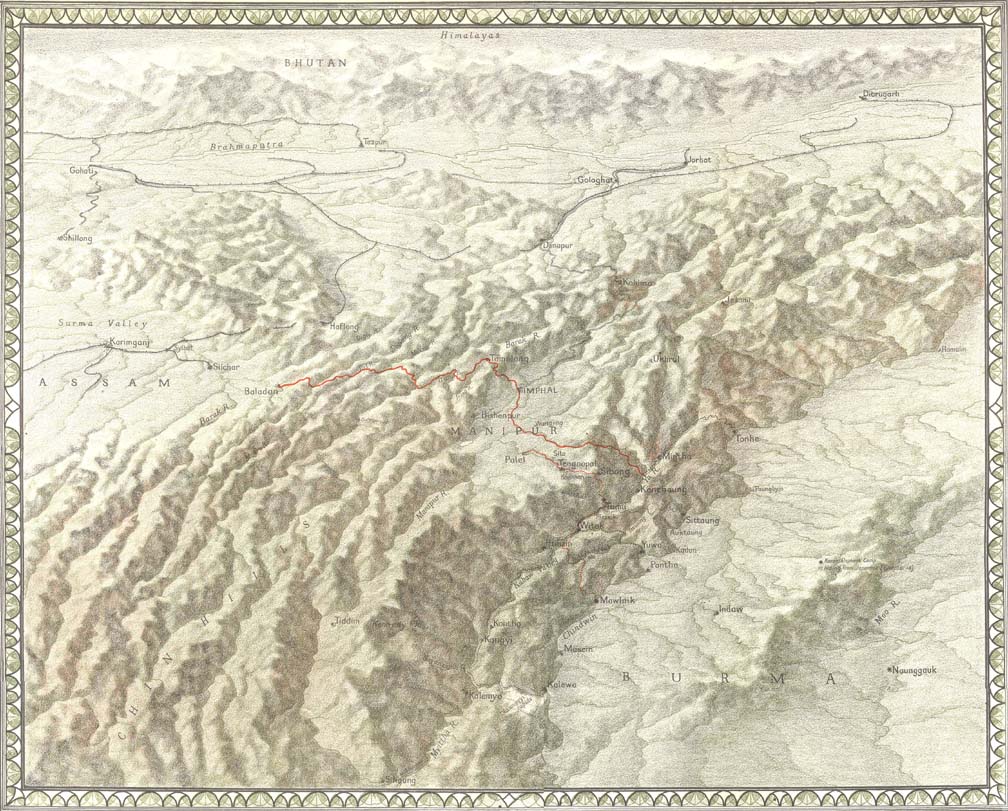
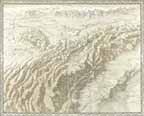
NOTE:
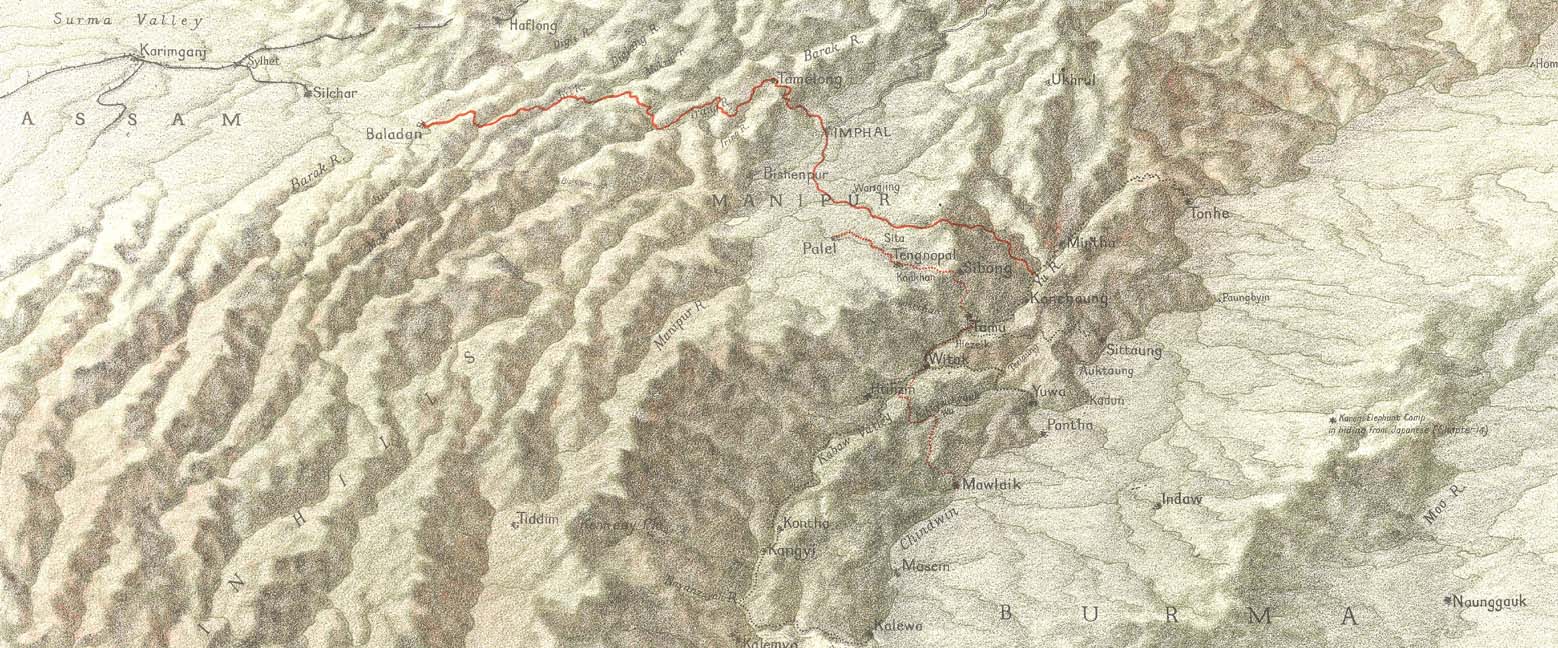
IN the perspective map of Upper Burma above, the dotted red
line shows the route of the elephant party evacuating women and
children from Burma. The continuous red line shows the author's
route while in charge of the Elephant Companies' escape from
Burma into Assam.
|
CHAPTER
XII
DURING the open season of 1925-6 I had to run a shoot for General
Sir William Birdwood, as he then was, the Commander-in-Chief,
India, and his staff on the Upper Chindwin River. I met him and
his party at Sittaung.
Burma was at that time under India Command, but the significance
of the Commander-in-Chief trekking into India from Imphal to Tamu
on foot can scarcely be linked with the subsequent events over
the same track, eighteen to twenty years later.
As far as I can remember, the trek took him five days, during
which time he made every member of his staff swim in the coldest
mountain streams imaginable. The track was then a six-foot ungraded
bridle-track; it had, apart from any strategical importance in
the future defences of India, a political interest, as at that
time the question of the separation of Burma from India was very
much to the fore.
Opinion in Burma was strongly against any development of this
road to India. It was pointed out that a good road might serve
as a backdoor entrance through which a flood of undesirable Indian
immigrants might pour. It would be more difficult to control than
immigration by sea. The road would have no value as a trade route,
and it was concluded that it would be of no advantage to Burma.
The whole of the Burma Campaign from 1942 to 1945 depended
on the existence of this route. For there are only two ways of
reaching India from Burma---by sea, and by this, and one or two
other mountain tracks leading from the tributaries of the Upper
Chindwin into Northern Assam. In other words, there is an impenetrable
mountain barrier running down the Burma-India frontier, which
completely seals off the valley of the Irrawaddy from Assam; and
there is no feasible coast road along the Burmese seaboard province
of Arakan. Thus, to reach India from Burma overland, one has to
go up the Chindwin as far as Kalewa, go up the Kabaw Valley to
Tamu, and cross the mountains into Manipur and the Imphal plain.
The strategic importance of the road is therefore immense.
But so long as it was believed that Britain had undisputed command
of the sea, the strategic importance of the road was subordinate
to the political disadvantages to which it might lead.
The impression I gathered from General Birdwood at that time
was that he favoured the improvement of the road, as a strategical
communication of great importance. He had enormously enjoyed trekking
over it, as during the trip he had escaped entirely from the world
of red tape and official receptions. He obviously felt as though
he were a subaltern again on a month's leave. Lady Birdwood came
by sea from Calcutta to Rangoon, and then proceeded to Mandalay,
where she painted some water-colours, and later on joined her
husband on the Chindwin.
The object of the shoot was to get duck and geese, and there
was no question of big game or elephant.
I remained with the Commander-in-Chief and Lady Birdwood for
two days, having at my disposal the Bombay Burma Corporation launch
Chindwin, which had been suitably victualled. It made a
very enjoyable break for me.
Little did I guess then that during the war years of 1942 and
1944 I should lunch informally with Lord Wavell when he was Commander-in-Chief,
and dine informally with Sir Claude Auchinleck when he was Commander-in-Chief,
on the same road between Burma and India.
The Japanese invasion was not the first time that the Kabaw
Valley and the bridle-track from Tamu to Imphal had been a scene
of war, and of all the miseries that go with it. As far back as
the sixteenth century this route was used by the Burmese General,
Ba-Yin-Naung, to lead his army from Burma to Manipur.
Again in 1812 the Burmese King Bo-Daw-Pa-Ya annexed the Kabaw
Valley, after intervening to decide the succession to the throne
of Manipur.
It is one of those valleys which impress one either as a miniature
paradise or as a green hell. During the years I have lived there,
in peace and in war, I have known it in both aspects. The Manipuris
and Burmans look on it as an ideal grazing ground for their cattle
and buffalo herds, during the hot and dry seasons of the year,
when pasture has been dried up elsewhere. And in the cold season
it is a sportsman's paradise. The wild jungle-fowl provide almost
ideal high driven birds, and the gin-clear waters of its streams
abound in mahseer up to eight pounds in weight. But in the monsoon
it becomes a squelching swamp, generally overgrown by heavy unhealthy
jungles.
In describing the withdrawal of the British Army in 1942, the
Chief of Staff said that "death dripped from every leaf."
That phrase might damn it for ever, but, visiting it today, one
would not guess that his words had ever been true. Nor would one
find many signs that the largest British Army of the Second World
War, the XIVth Army, had fought its way down it.
In 1938 I was at home on leave and, as war seemed imminent,
was for some time undecided whether I should return to Burma and
my elephants. However, I finally made up my mind to go back, as
I thought that if war did come, Japan would join our enemies,
and that I should be of more use East of Suez than in the West.
With the outbreak of war in 1939, teak became as important
a munition of war as steel, and all those employed in its extraction
were regarded as engaged in work of national importance. Vast
quantities of it were shipped to England during the first period
of the war. When the Italians came in, supplies of timber were
required in the Middle East. India's demand for teak alone was
greater than could be supplied from Burma, and work in the forests
was accelerated. Elephants were required for the extraction not
only of teak, but of other kinds of timber as well.
After the Japanese came into the war, India's demands increased
still further, and vast projects were put in hand after December,
1941. Practically every officer concerned with teak extraction
was away in the jungle in the three months which followed. Many
of them were accompanied by their families. Their only link with
developments in the war was by wireless. In spite of the rapid
advances of the Japs, everyone was confident they would be held
at Singapore and in Malaya. However, things were going so badly
that a hurried warning was given by the Bombay Burma Corporation
that it might, as a private firm, have to arrange for the evacuation
of its European officers and their families from the Upper Chindwin
into Manipur, and thence to Assam. A scheme for this was therefore
prepared. If we had not had elephants for transport, it is unlikely
that the scheme would have been put forward.
At that time I was on tour with my wife and family in the Shan
states, right up the Shweli River.
By the same mail runner I received a confidential letter, strongly
advising that all wives should return to headquarters, and a telegram
instructing me to proceed to Monywa, on the Chindwin River, and
to be ready to proceed beyond. I had no knowledge of the scheme
for evacuation, but knew the country so well that I guessed what
might be coming. My first thoughts, however, were that my instructions
might be due to internal troubles in Burma. By forced marches
with elephants to the river, followed by two days' voyage downstream
in my own launch, we reached the Irrawaddy. I little thought that
I was saying good-bye to my Shweli elephants.
At Mandalay I found that the conditions, to which one had become
accustomed since the war, were unchanged. But all wives and children,
except those who were members of the Women's Auxiliary Forces,
had proceeded up the Chindwin. There was great tension, and the
wealthy Indians were already on the move.
I was instructed to go direct from Mandalay to Monywa, but
I decided to go first to my home and headquarters at Maymyo, for
one night, to dump my camp kit and collect the light kit my wife
would require while up the Chindwin. I felt sure that even if
she were forced to leave Burma, I should have an opportunity of
returning to Maymyo myself.
Even at this stage the trains to Monywa and the steamers to
Kalewa were crowded by Indians. The Bombay Burma Corporation had
been the first to move all the European women and children of
its employees up the Chindwin, from which they could get a good
start if the worst should happen. A few of the more farsighted
Government officials had privately made the same arrangements
for their wives. The Government had formed no plans to deal with
such an emergency. The Bombay Burma Corporation was severely criticised
at the time for its policy of partial evacuation of women and
children. But it had the excellent effect of stirring the Government
to action, at a time when the situation was becoming grave. Quite
apart from the fact that the policy of women and children first
was the right one, it relieved the married men among the employees
of their heaviest responsibility, and greatly increased their
usefulness.
At Monywa I overtook the second batch of women and children.
The first batch had travelled up the Chindwin River by launch,
as far as Mawlaik, where it had been decided to assemble, to await
a final decision. It had been my intention to return from Monywa,
but when I reached it I was instructed to proceed to Mawlaik on
the launch, in charge of the second party.
When I reached Mawlaik, and had handed over the party in my
charge, I was instructed to stay there, to help organise preparations
for the trek to India, via Manipur State, in case it finally became
necessary. If it were decided on, I was to accompany the party
of women and children with elephant transport. The elephants were
not for them to ride on, but to carry their food and a minimum
of camp kit and their personal belongings.
From that time forward the elephants began to play an important
part. Geoff Bostock, the senior member of the Forest Staff up
country, ordered all elephant work in timber extraction on the
west bank of the Chindwin, north of Kalewa, to be stopped, and
the elephants to be used to assist evacuation wherever possible.
It was February, 1942.
Rumours had spread that a road was being hurriedly constructed
from Imphal to Kalewa, for the use of some phantom army which
was coming from India to check the rapid advance of the Japanese
on the Sittang River on which we were falling back from the border
of Malaya. Some people believed these rumours. Work had in fact
been begun on the road, from the Kalewa end, and on to Tamu, from
where the ranges of hills towered up to the west---an effective
bottle-neck. Elephants were used in road-making, dragging timber
to the bridge sites. The riders and elephants worked very hard
for long hours, but with great willingness, and were quite unperturbed
by the stream of Indians going past them.
Other elephants were being used to start a shuttle service
to carry aged and sick people from Sittaung on the Chindwin to
Tamu. There was a Forest Assistant in charge at each of the temporary
camps at which they stopped on the way. Other elephants were being
used to carry up rations for the evacuee rest camps. In the final
stages the Bombay Burma scheme was handed over to the Government,
together with the Forest Staff and elephants necessary for its
operation.
The elephants and their riders continued on the work until
the end of April, after which date there was no water left to
water the animals. Those working on the Kalewa-Tamu road stayed
there, until the retreating Army in Burma crossed the Chindwin
at Kalewa, on its way out.
Our women and children were to reach Tamu by forest paths,
as I thought that it would have created chaos to have travelled
on the main track, with elephants among the packed crowds of refugees.
I left Mawlaik with Bostock on 14 February, 1942, in charge of
a party of twenty women and fifteen children, with a train of
elephants. The second party, under Parker and Jones, left with
twenty women and twelve children, two days later. There were,
altogether, forty women, twenty-seven children and one hundred
and ten elephants. The reports sent us from Tamu were that it
would be impossible to take elephants beyond that point. However,
I was certain it could be done, even if it meant destroying them
at the end of the trek, after we had reached the Imphal Plain.
In general, Bostock's job was to look after the women and children,
and mine to manage the elephants. Both of us were married, and
our families were with the party. Parker was also married, with
his wife in the party, but Jones was a bachelor and, no doubt,
glad to be put in charge of elephants only.
Fortunately, during the whole of the trek from Mawlaik to Tamu,
over the route we took, there was ample fodder. We were thus able
to tie the elephants up by night, and their riders were able to
cut enough bamboos, branches, grass, etc, to hand-feed them. The
camps from Kalewa to Tamu were well off the beaten track, and
were pleasant places for the women and children. For me they were
rather a nightmare, as the elephants were continually breaking
loose at night, and I felt the responsibility. We reached Tamu
in six marches without any incidents except one bad stampede of
elephants at night, when it was lucky no one was killed. The spirit
of the women was remarkable, as every one of them had had to leave
a comfortable home and abandon all her possessions at a few hours'
notice. The novelty of roughing it in camp kept them from brooding
over their misfortunes. Their chief worry was that their husbands
were remaining in Burma, no scheme having been organised for withdrawing
them, even with the Army. I got very exasperated on being told
by several women that I was lucky to be in charge of them, and
I found it more and more difficult to return a polite answer.
Tamu had become a congested bottle-neck, filled with thousands
of Indians, all wondering how they would negotiate the next fifty
miles, along a rough bridle-track, and over mountains five thousand
feet high.
During the one day we halted there I thought it necessary to
throw out all the tuskers and proceed with only thirty-two female
elephants, all of them between twenty and forty-five years of
age. Kit and personal luggage were cut to sixty pounds per head,
as sufficient supplies of food had to be carried. A head Burman
was killed on our arrival in Tamu. He was standing ten yards from
me at the time, taking an air-travel suitcase, covered with labels
from voyages in more civilised quarters of the globe, from an
oozie sitting on an elephant's head, when the animal suddenly
attacked him. I privately thought we were extremely lucky to have
got so far with nothing worse happening, but the camp was greatly
upset for the rest of the day.
From Tamu onwards the women became less talkative and their
tempers more strained. However, I don't think any of the women
in our two parties travelling on foot, but with elephant transport
for kit and food, could describe the journey as anything worse
than uncomfortable at times. For others it was a hellish nightmare,
which became worse and worse as time went on.
I had many worries with the elephants, but the oozies remained
serene. At one camp eight refugees had died of cholera and the
elephants had to drop one thousand six hundred feet down from
the ridge before they could get water. The women and children,
however, camped on the ridge, although the ground had been fouled
under every tree by the hordes who had preceded us.
We pushed on, although we were warned that it would be worse
ahead. The warning proved only too accurate. The elephants were
without water or fodder for thirty hours, except for twelve wild
plantain stalks each, which were cut for us by some Lushai Chins
from a Chin village. This just saved the situation. The elephants
had to be tied up directly we reached our bivouac, and they could
do no foraging for themselves. It was a big undertaking to have
embarked on a sudden march, with women and children, without any
rehearsal. However, every day things became better organised,
and a routine was established.
Before dawn the children were pulled out of their blankets,
and the camp resounded with their pathetic wails. They wondered
why they were there, and what it was all about. Then, after they
had been given some food, they set off on their long and weary
trek with Bostock in charge. I remained behind, and supervised
loading the elephants. When I had seen the last of the elephants
fall into the line of march, I set off at a rapid pace, to overtake
the party of women and children, and forge ahead to pick the next
halting place about nine miles farther on. The presence of water
was usually the reason for my choosing it.
On the third morning, when I was passing the party, and trying
to make a cheerful remark to each family as it trailed along,
my wife called me back, as though she had something important
to say to me; but it was to show me something. In her hand she
held half a dozen wild white violets. It was a tremendous thrill
for us both that she should have found them growing at five thousand
feet, among the mountains of Manipur, and for a moment we were
able to forget all that this march meant to us, leaving Burma
and our home. The sight and scent of those fresh, perfect little
flowers was a wonderful stimulus to my morale, as I walked on
up the line of straggling children. Some were singing, some crying.
The track was narrow, and the sides so precipitous that it was
easy to roll any dead who collapsed in their journey over the
edge and down into the jungle. But a tell-tale stench lingered,
and at such places mothers hurried the children on, leaving their
questions unanswered.
At Tengnopal the country ahead to the saddle appeared a little
less trying to the elephants; and the two young Assam tea-planters,
who had just arrived to set up some sort of rest camp for the
hordes of refugees, told us that things were not so bad ahead
to Palel. It was, however, between Tengnopal and the saddle that
the elephants met the first of the bulldozers, monsters which
were to become their workmates in the months and years to follow.
It was what was known as a D4, which had been sent forging ahead
to reconnoitre the track which was later to become the Burma Road.
We had all heard rumours that some phantom engine of war lay ahead
of us, but late one night Major Murray Lees came to see me in
our camp, in order to ask me what was likely to happen next morning,
when his baby bulldozer encountered my train of elephants, going
in the opposite direction. I was quite as scared that his bulldozer
would make my elephants stampede, as he was that they would charge
his mechanical pet and hurl it down the precipitous slope, or
khudside, with their tusks. I was careful not to give away, in
our discussion, that my fears were more realistic than his.
Since we seemed to hold equally strong cards, we compromised,
and decided that he should start up his bulldozer at dawn and
jockey it into a position which would allow my elephants room
to get by. The track where it was working was the width of an
ordinary single bed, and was cut out of the side of a precipitous
slope.
I went ahead to have a look at my first bulldozer, and thought
that if anyone ever deserved a knighthood it was the subaltern
who was working it. I watched him for ten minutes, expecting that
he would crash two thousand feet with every bladeful of earth,
stones and shrubs his machine excavated and pushed over the edge.
I found a spot where my elephants could pass round his machine,
and work was stopped while they did so, leaving the engine idling.
I have been informed that in one of the stages of D.T.s the sufferer
sees visions of green elephants with yellow braces. But I am sure
that if elephants have D.T.s, they see bulldozers. The look on
the faces of both the elephants and the oozies riding them, as
they sidled round this yellow-painted D4 bulldozer, with a British
subaltern perched upon it like an oozie, while it blew out a blue
diesel engine exhaust from its head, was that of sufferers in
the most acute stages of D.T.s, seeing things. When we reached
the saddle, the roar of the larger bulldozers working up the bill
could be heard, but we were able to avoid passing them, by dropping
down to a foot track to the plains from Sita. As far as the eye
could see, it was marked by an irregular line of refugees, walking
in single file, each with a bundle, or a child, on shoulders or
head. From above it looked like a line of black ants.
We halted for an hour or so on the saddle, so as to get women
and children well ahead. Eventually the word was given for us
to push on, as within a few hours another larger tide of refugees
was expected. I went ahead. I had been told that the track crossed
many small ravines, which had been roughly bridged. There were
dozens of them, and we had continual trouble in getting the elephants
into the ravines and then out again, as the bridges were only
made of the branches of trees, and none of them would have stood
an elephant's weight. I watched all the animals pass alongside
a particularly bad one, and as they went by gave orders that no
one was to risk trying to cross over any bridge ahead. I then
followed the last elephant, and stopped for a moment to speak
a few cheering words to an unfortunate Anglo-Burman family.
Suddenly terrific yells and shouts burst out ahead of us, and,
looking down the steep path, I saw odd refugees and stragglers
jumping this way and that, bundles rolling into a ravine, and
signs of chaos. Then I saw a riderless elephant, with its pack
gone, coming up the slope towards me at a fast stride. Her ears
were forward and she had an expression on her face which, I thought,
meant that she was off back to Burma.
The path had cleared by magic, and I faced her alone, armed
with an alpine stick fitted with a spearhead. I thought there
would be an awful tragedy if I did not stop her, as there were
hundreds of Indian women and children coming down the slope behind
me. The valley below was ringing with shouts and yells. But she
came straight at me, without hesitation, and only by hurling my
spear at her and rolling down the khud did I escape being crushed.
Only one of the deep narrow ravines behind me would check her.
I collected myself and my spear, and had regained the path,
when I saw her come tearing back upon me at a high speed. Between
us lay a deep, narrow ravine, which she must have crossed going
up, though I had not seen her do so. To my amazement, I saw her
"jump" it, with an action I had never seen an elephant
make before, except a hobbled animal in slow motion. But there
was no slow motion here. She was over the obstacle like a chaser
over a brook, and I jumped clear of the track. I followed her
down as fast as I could, and found she had been caught, and a
batch of men were helping an injured oozie out of a deep ravine.
He was in charge of the last elephant in the train, and it was
obvious that he had disobeyed my orders, for fear of being left
too far behind. He had tried to force his mount across the bridge,
but she had refused, and had pushed it down with her forefeet,
with the unfortunate result that the rider and pack went headlong
into the ravine, while she kept her balance on the brink. Then,
like a convict making a bold bid for liberty, she had stampeded
up the hill, hoping to return from the barren hills to a land
of bamboos. She stood quietly to be saddled, and went on with
her work. She is the only elephant I have ever seen jump something
wider than it could step across, but she must have hurt herself
in doing so, as she went dead lame on both fore pads within two
days. But by then the trek was over.
All the way to Palel, in the Imphal Plain, we could hear the
bulldozers, coming up the new road they were cutting from that
end. But was it for an army to march into Burma, or to help an
army march out? The news from Burma was very grave. From Palel
we were able to get motor transport to Imphal, but instead of
destroying my tired and run-down elephants, I decided to march
them back again, as there was more work for them to do. There
was quite fair fodder and water for them near Palel, and while
Bostock and I took the women and children to Dimapur, on the Assam
Railway, the elephants had a well-earned rest for five days.
It was a relief to see the families off by the train on the
Assam-Bengal Railway, and after we had waved good-bye, Bostock
and I returned, against the tide of evacuees, to Palel and our
elephants. The second party did not use elephants for the hill
section from Tamu, but engaged Chin coolies.
The Assam tea-planters were travelling in the same direction,
coming up with thousands of their coolies to help in constructing
the road, while others were putting up relief camps for the increasing
numbers of homeless Indian refugees.
We were asked if on our return journey we would take supplies,
by elephant, for a projected camp for evacuees at Konkhan and
build it when we got there. This we did successfully, and when
we had completed it and stocked it with food we went on back to
Tamu and Burma.
The elephants all got back, none the worse for their journey
to Manipur, and at once went on to help in the work on the Kalewa-Tamu
road. The riders were still game to carry on, though by that time
they realised that the fall of Burma was imminent and that India
was threatened.
In this terrible upheaval big men became petty. I do not wish
to blame anyone, for the struggle against odds was appalling.
One night there were two thousand four hundred Indian refugees
in Tamu, and only eight sacks of rice to feed them on. But the
more I saw of men during those last days in Tamu in 1942 the better
I liked my elephants. I don't want to criticise others, for I
have no doubt I was criticised myself.
I made one final bid to get two hundred elephants out, but
it was too late. I was told that if I had carried on with my plan
I should have congested the one remaining walking-track for the
wretched Indians, and so have caused even greater hardship and
greater loss of life.
Mr Justice Braund, of the Allahabad High Court, did much stalwart
work in those dark days, and in an article on the evacuation over
the Manipur road said: "It was an affair of 'tea' to the
rescue at one end, and 'teak' to the rescue at the other. But
for the help of the planters, the Indian Tea Association and the
men of the Bombay Burma, it would never have been possible."
There are few occasions in life when one is in such a tight
place that one is unable to help others. But I can record two
incidents, which happened when I moved out for the last time as
an evacuee myself. I left Tamu on 9 April, 1942, under a scorching
mid-day sun, carrying all the kit I possessed, and leading a friend's
faithful old Labrador---for I had lost my own dogs. As I turned
a bend where the track took off for the first ascent into the
Manipur hills, I found two sobbing little Indian children, a girl
of about seven and a boy of about four. Against the bank lay an
Indian girl mother, aged about twenty, dying of thirst, hunger,
exhaustion and grief. I could do nothing less than give her a
drink out of my water-bottle, and in her eyes I read gratitude
and a terrible question: "What will happen to my children
?"
While I was looking at her, in despair of doing anything, the
change came suddenly, and a moment later I realised that I was
left alone with the responsibility of these children, and that
every man and woman coming up the road was fighting for his or
her own life, and many of them would be lucky if they could save
themselves. I could not carry one child, even if I were to leave
the other. Something made it impossible for me to go on, and so
I turned back instead. Providence came to my aid, for within a
mile I met a jeep---one of the first jeeps we had seen on that
road. It was being driven by a Staff Captain, whom I had met a
few days previously in Tamu.
I stepped out in front of him, blocking the track, and taking
the risk that he would drive over me or send me spinning down
the khudside. But he recognised me, and pulled up. Then he greeted
me with the words: "Can't be done, old chap. If I pick you
up, I'll never get through, and I have to get over the mountains
before dark."
I told him I would rather die by the roadside than be seen
in such a car, or take the risk of being driven by him, but I
begged him to take the two children, packed under his kit in the
back, and to drop them at the evacuee camp at Imphal. I was determined
he should take them, and I think if he had refused I would have
tried to shove his car off the road, down the khudside. But he
did not, and when I had loaded the two children and watched them
being driven off, there was a lump in my throat. Then I plodded
on after them with a lighter heart, while the noise of the jeep
grew less and less. When I had crossed the mountains for the second
time, I went along to the evacuee camp at Imphal, and found both
children being properly looked after in the Orphan Section.
But before then I saw many heart-rending sights, when I could
give no help. At one of the wayside camps, which would obviously
be washed away when the rains broke, a young Anglo-Indian spoke
to me. He was sitting in a ditch near the camp, with his wife
and a little girl of six huddled beside them in a blanket. They
all seemed ill, and had that look that one sees only on the faces
of refugees and lost animals.
The man's voice sounded as though he were delirious with fever,
as he asked me if I had passed a little boy of eight, lying dead
on a blanket. Without waiting for me to answer, he poured out
his tragic story. He had carried his son, who was dying of pneumonia,
until his wife had collapsed and could carry the little girl no
farther. Then he had abandoned his dead, or dying, boy, to carry
the little girl and enable his wife to continue. He was haunted
by the fear that the little boy wasn't actually dead, and might
have been saved. By the end of the trek over the mountain both
the man and his wife were casualties with pneumonia, and I discovered
that when he spoke to me he had been describing what had happened
to them five days before. So there could have been no question
of turning back.
That road was full of tragedy and tears. But it was rapidly
becoming a road. We met the bulldozers coming down, clearing a
real road to Tamu, just in time to enable the Army to get out
from Burma. When the elephants saw them they must have felt their
day was over ---but if so they were wrong, for they were needed
in all the stages of the campaign.
The first army lorry reached Tamu from Manipur just before
I started to walk out, and for a time the Army tried to clear
the road of evacuees before the retreating troops arrived from
Burma. I remember one big lorry passing me, loaded with forty
people, and as it reached the bend I saw it fail to turn, and
take a headlong dive, keeping upright for an amazing distance,
before it was shattered on a tree. I went down to help. There
were four dead and any number of broken arms and legs. This sort
of accident was always happening.
When I was climbing to the saddle overlooking the Palel Plain,
on my second walk out, a staff car going towards Tamu along the
newly cut roadway pulled up. A Major-General got out, spoke a
cheering word to me, and admired my Labrador. The wise old dog
wagged his rudder and looked eagerly at the car, as if asking
him to give us a lift. The General told his A.D.C. to turn his
car round, at a perilous spot on the edge of the precipice, and
took us as far as where the old bridle-track diverged from the
new road, overlooking the Palel Plain. There the General dropped
us with the words, "Au Revoir." His farewell words came
true, for within six months I was serving under him in the Army
at Tamu, when he was commanding the 20th Indian Division.
Chapter Thirteen
Table
of Contents