 Embarkation of elephants. The gangway has been roughly camouflaged with grass. |
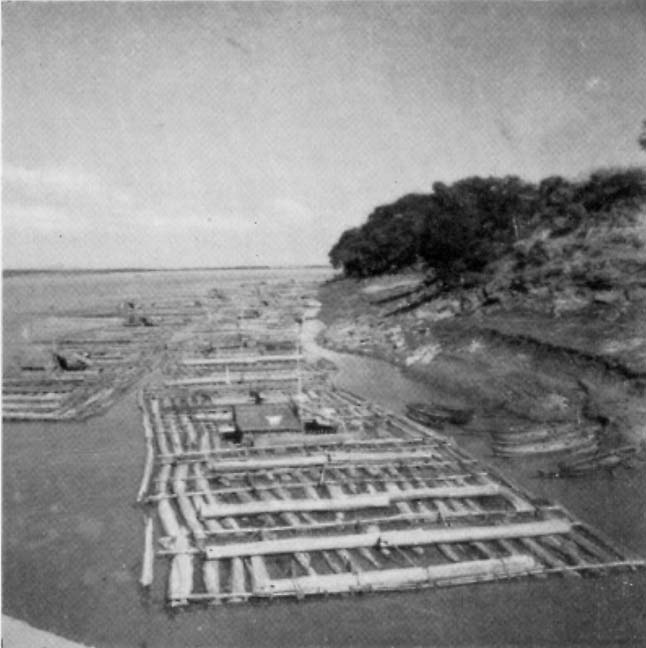 Teak rafts on the main Irrawaddy River ready for dispatch. |
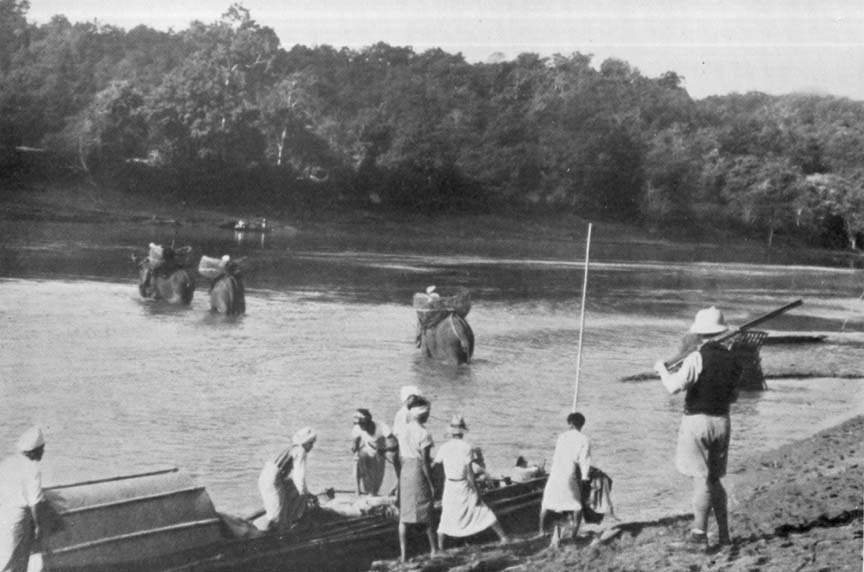 A Forest Assistant watching his elephant transport crossing a river. |
IN 1931 I had the good fortune to be selected as one of a party which was to explore the forests of the North Andaman Islands. [See map on page 192]. There were three other officers in the party, and we were given forty-eight convicts from the penal settlement as our labour. Part of my job was to discover whether the native flora, grasses, etc, would provide sufficient natural fodder to enable elephants to be completely self-supporting, as in Burma. I decided, before embarking on this adventure---for it really was an adventure---to collect all the plants on which elephants feed in Burma, for purposes of comparison. The one and only way to do it seemed to me to live with an elephant, continuously, for three days and three nights. I did this, moving with the animal as she browsed, and collecting specimens of every plant she ate. Altogether I gathered forty-eight species of common plants: the few rare plants I ignored. I had my collection classified for me by the Botanist of the Forest Department School, and the specimens were pressed into a two-volume herbarium, which later fell into the hands of the Japs, together with the rest of the contents of my bookcase, when I left Burma in 1942. With them was my diary of the four months' trip in the Andamans, which showed how valuable that knowledge of fodder proved, as it enabled me to decide that the North Andaman Islands provided sufficient natural fodder to support elephants. Elephants are not indigenous to the Andaman Islands, but the Forest Department had, some years previously, imported eighty into the South Islands, where it was erroneously believed that natural fodder had to be supplemented by a ration of paddy---that is, rice in the husk.
During a trek across the largest island of the Northern group, I was amazed to discover the tracks and droppings of an elephant which I could only suppose was a wild one. Judging from the impressions of the pads and the size of the droppings, I came to the conclusion that it was a young animal, about twenty years old. I got quite close to him on two occasions, but, owing to the dense jungle, was unable to see him before he winded me. Thus I was left guessing, until the end of our exploring trip.
My enquiries then revealed that a seven-year-old calf elephant, one of the South Andaman Forest Department's elephants, had been missing twelve years before. It had been "written off" in the Forest Department records as "believed drowned," having been seen attempting to swim from island to island. The age of this animal coincided pretty well with my estimate, and there can be no doubt it was the same. It was a remarkable swim, for it was over two hundred miles from where he was last seen to where I found him, and some of his swims from island to island must have been at least a mile in the open sea, which is seldom without a swell, and in a country where there are two monsoons a year. Of course, he had twelve years in which to do it, and no doubt he had a good sojourn on each island before moving to the next. An elephant thoroughly enjoys swimming, and will entirely submerge for brief periods when in deep water. He must have been a considerable surprise to any of the wild Jarawa tribesmen who saw him, and he must have seemed to them like a sea monster. These Jarawas are sea gypsies who live entirely on fish and shell-fish. They are still wild, and in the past, if they were in large numbers, used to shoot their poisoned arrows at anyone they met. Now they are practically extinct, and there are less than a hundred of them left. They are of negro type, and are said to be the only link between the African negro and the Australian aborigine. I was lucky enough to meet a small party of five, consisting of three men and two young girls. They were all small in stature, but the men were muscular and healthy, and the girls had exceptionally good figures. The men were naked, and the girls wore nothing but a leaf, the shape of a fig leaf, which was traditionally designed for that very purpose. The amusing part was that the girls each had two spare leaves, which they carried, rolled up, above each ear. Thus they were able to change their frocks twice a day, once during the mid-day heat, and again in the cool of the evening. The whole party attached themselves to our camp for a few days, during which time the men were most useful in showing us the few fresh-water springs that exist on the coasts of the islands.
No doubt the young elephant was just as surprised, on emerging from the sea after swimming from a distant island, at being confronted by a modern Eve, as the Jarawa Eve was to see a sea monster rise up out of the sea and disappear into the jungle.
But the Jarawas are used to strange animals. They helped me to catch a dugong, the warm-blooded mammal which some suppose to have given rise to the myth of the mermaid. This dugong was a female, and it certainly had a more uncanny resemblance to a human being than any monkey. It had a repulsive little nose, human-looking teeth, well-formed breasts the size and shape of inverted tea-cups, flippers like deformed arms and fat fists like little hands.
While I was on this exploring trip I learned a great deal about Burman dacoits, or robbers, which confirmed all that I had imagined them to be from my experiences in Burma. We had working for us, during the four months of our trip, forty-eight convicts with life sentences.
Before I set off to the Andaman Islands I stuffed the bladders of two Rugby footballs full of opium, as I knew that half of the dacoities which are committed are done in desperation by opium addicts, in order to obtain money to buy it.
I picked up our convicts---most of them dacoits---at Port Blair, and from there I took them to the North Islands, where we were dumped for four months. The leader of them was a Burman called Nga Mob, with a grey moustache, like a mandarin's, hanging to below his chin. During the first week I never saw a smile on his face. He had wonderful control over his companions, who were a bunch of the biggest cutthroats I had ever seen. The only precaution I took with regard to them was to immobilise our two motorlaunches offshore every night. They included men of all sorts of trades: mechanics, fitters, elephant-riders, and even goldsmiths; and every one of them had that wild look in the eye which indicated he would take any risk in order to see his native land again. They were all either murderers or accessories to murder, but they had a sense of humour, and we often had the camp ringing with laughter after the day's work was done---and it was at that hour that I gave out the opium ration. I heard the most astounding tales from them about the crimes they had committed, which eventually earned each of them a life sentence in a penal settlement.
Nga Mob told me he was one of a gang of eight dacoits when he was twenty. They attacked a mule caravan on the Burma-Siam border, but had no intention of using the one firearm they possessed, except to fire a couple of shots in order to stampede the mules. Unfortunately for him, the attack did not go as planned, and the leader of the dacoits had to fire his gun at a muleteer, killing him outright, in order to avoid being struck down with a Gurkha kukri-knife.
Nga Mob was unlucky, as he got badly knifed in the leg and was captured. The only two spare rounds of ammunition that the dacoits possessed were found on him. He told us the story round the camp-fire on the sands of a lovely and uninhabited island, set in the middle of the Indian Ocean, where he was spending the twenty-fifth year of his exile, at the end of which he would have served his time and would regain his freedom. He did eventually follow me to the Upper Chindwin in Burma, but he soon felt a nostalgic longing for the sea and the islands of his exiled years, and he went back to them.
These four months were months of freedom for the convicts, and they enjoyed every minute of them like children. Many of them were, no doubt, still prisoners there when the islands were occupied by the Japanese after 1942, but they will all have got their freedom by now.
The penal settlement on the South Islands is to be abolished, and the forests I explored in the North Islands are to be exploited. It is a melancholy thought that the peace of those islands should be disturbed. The spotted deer we encountered, right in the depths of the untrodden jungle, came up to meet one without fear, to sniff at one's clothes with nervous inquisitiveness. They greeted the unheard-of stranger, whose bad reputation was unknown to them, with friendship, as I greeted them. I did not disillusion them, and then, stepping softly and gently through the jungle, they went their ways.
I had known many dacoits intimately before I went to the Andamans. Sometimes I knew what they were, but sometimes I was quite oblivious of the truth and employed them believing they were good fellows and trustworthy. But, on the whole, the average Burman dacoit has earned a good name for himself as a gentleman outlaw, like Robin Hood. He has a sporting instinct, and plans his crimes with roguish humour. And, if it is at all possible, he tries to avoid combining dacoity and murder.
Once I set out from Paungbyin in the Upper Chindwin for the Kanti forests, with ten pack-elephants carrying over one hundred thousand rupees in silver, packed in specie boxes, each of which weighed about three hundred pounds. The trip was planned to take me eighteen days. The daily loading of each of these boxes on to the elephants was a real feat of strength, and the day after I left Paungbyin my head Burman suggested that I should hire a man from the village where I had camped who had the reputation of being as "strong as an elephant." I agreed that such a man would be useful, and sent for Maung Ngapyaw (Mr Banana Tree), as he was called. He was a man of magnificent physique, and a really pleasant rogue with a most cheerful temperament---and he could handle those boxes of rupees as though they weighed only fifty pounds apiece. Thus loading up in the morning became easy work. He accepted an offer of sixty rupees for the trip, and soon gained everyone's confidence and became the wag of the camp. We felt we had made a good find.
After a particularly hard trip, as we had been caught by the first break of the rains, I reached Kanti, my jungle headquarters, where there was a safe. I made it my first job to roll the money into hundred rupee packets and put it in the safe. Ngapyaw became one of my chief helpers, and proved most expert at the job. Just as I had finished, and felt quite happy that all the money had been checked and made secure in the safe, the first jungle messengers since my departure arrived with the ever welcome mails. It was six p.m., so having called for a tub, I decided to read my mail after bathing, by which time it was late evening and peg time. I opened the mail-bags alone on the bamboo veranda of my hut, sorted home mail and private letters into one pile and official in another. As was my habit, I ran through the official first, so as to get the worst things done with. Among them was an envelope marked Urgent and important. I wasn't in the Army, and knew that only something really urgent and important would be marked in this way by the Corporation, so I opened it at once. It was to inform me that the police had reason to believe that a renowned dacoit named Ngapyaw, alias San Shwe, alias San Oo, was following my camp, and that every precaution was necessary. In my private mail was a note from my Forest Manager, a man of few words, which merely read, "Forewarned is forearmed."
I was not at all perturbed by the news, though I was extremely grateful for the warning. After I had had a meal, I debated with myself whether I should give him the shock of arresting him that night, or wait till next morning when I paid him off. Eventually I decided on the second course.
My position in this lonely forest camp was a perfect setting for a real armed dacoity, and as the night wore on I was not too easy in my mind. However, I eventually dropped asleep, keeping one eye and one ear cocked, but I was not disturbed.
In the early hours of the morning, when I got up, I decided to send for Ngapyaw, but when I asked for him, my head servant informed me that he had disappeared from the camp during the night, together with one of the messengers who had brought the mails. Thus all of us had been forearmed and forewarned! The police and Forest Manager had written to warn me by letter, and the spare messenger had come along to warn Ngapyaw! It then became my turn to send messages off, warning one of my neighbours in the jungle. Ngapyaw was not heard of again for another year, when he was shot by the police in the notorious Shwebo dacoit area. He had, however, passed on all the necessary information as to the lie of the land and the lay-out of the safe in Kanti jungle headquarters to some confederates, as my successor in this district had his safe robbed, two years later, of twenty-five thousand rupees in notes.
The dacoits who did it had a really enviable sense of humour, as before they departed with their booty they impaled a ten-rupee note on each post of the fence round jungle headquarters. There were one hundred and twenty posts altogether, so they returned one thousand two hundred rupees as a jest.
One of the most interesting of my experiences, or close approach to an experience, with dacoits, was when I was forearmed and forewarned of their proximity by the behaviour of a common brown rat.
I was moving camp, travelling in a large dug-out country boat up the Myittha river from Kalewa, sleeping on the bank at convenient staging bungalows. I was bound for Kalemyo, where I was to be joined by some travelling elephants.
As usual, I had a considerable quantity of specie with me, and was not at all comfortable about it, during that stage of the trip. It would be safe enough after I joined my elephants and riders, for I always had great confidence in them. I was camped for the night at the Chaunggyi Rapids bungalow, a poor apology for a rest house, consisting of one small room and a verandah, raised about four feet above ground level.
The walls, door and floor were all made of bamboo matting. While I was having an early meal, about seven o'clock, my head servant reminded me that I was some distance from where my servants were sleeping, and the sound of the rapids would make it difficult for them to hear me call. Also I was to remember that there were no elephant men in camp, and that it would be as well if I kept a sharp watch on the boxes of rupees. He knew something was in the wind, and his vague warnings were, no doubt, intended to put himself right with me after the event, but I did not tumble to it at the time.
It had been raining heavily, and it was one of those nights when every kind and shape of bug with wings had seemed to decide to commit suicide against my one and only hurricane lamp. Their varying stings, bites, stinks and noises eventually drove me to seek shelter on my camp bed under my mosquito net. I left the lamp on a specie box beside the bed, intending to read for an hour before I went to sleep. I had got settled comfortably under the net with a book, lying propped on my left elbow with the only weapon I had in camp, a .45 revolver, lying beside my knee. Keeping it handy was as much habit as anything else, as the very last thing in my mind was the possibility of a dacoity, although it was a lonely and isolated spot.
Presently a slight movement in a corner of the twelve-feet-square room caught my eye, and a very pleasant, cheeky-looking rat appeared. I watched him without moving my head, and his movements fascinated me. He first of all sat up on his hind legs and washed his face with his forepaws, then he came out into the room and picked up a small piece of biscuit I had dropped. I was watching him thoroughly enjoying nibbling it, when he suddenly dropped it and scuttled off to a corner where I could not see him, so I decided to remain absolutely still, hoping he would come back. While I waited, I wondered whether it could have been the movement of my eye that had scared him. Presently he came back, and again repeated his trick of picking up the biscuit. I fully expected he would finish it this time, but, more suddenly than in his first scurry, he dashed off again, dropping the biscuit half-way to his dark corner.
As he did so, a sense of fear gripped me. I knew that the rat and I were not the only occupants of the little hut and veranda. My heart pounded in my throat, and for a fraction of a second my arms and legs felt paralysed, as though I could not move them. But my adrenalin glands pumped their stuff into my blood, and my voice barked out in Burmese, "Who is it?" I then heard distinct whispering outside the wicker-bamboo door and a movement under the floor of the hut. Without further hesitation, I fired two rapid shots through the roof. A frightful confused stampede from the veranda and from underneath the hut followed instantly.
My four camp servants heard the shots and joined me by the time I had got on to the veranda myself, and we soon tracked the would-be dacoits by torchlight to the river bank, whence they hurriedly made off downstream in a dug-out canoe which they had waiting. They were a party of six, and had undoubtedly followed me with the intention of rushing my hut that night. I was never able to find out whether they were armed or not.
Before I went away next morning I left an open tin of Kraft cheese for my little pal, the rat, not on the floor, where some dacoit might get it, but hidden in the roof. A month or so later, when I passed that camp again, I found the empty tin. Not only had the cheese gone, but there was an empty nest inside. Mrs Rat had reared her babies in it.
I was very glad to join my elephant men at Kalemyo, and from there sent off word that a party of river dacoits was at large.
These experiences, and all the various mysterious stories which I discovered my elephant men believed about dacoits, helped me when I came to handle my crowd of forty-eight of them in the Andaman Islands. My riders believed that dacoits had acquired immunity to gunshot wounds by secret tattoo marks known only to themselves, and that they could carry out their dacoities in absolute silence, as a result of drinking the warm blood of the slow loris.
Superstitions of this kind, when firmly believed in, change human behaviour, and they naturally influence the European Assistant living alone among people to whom what we call superstitions are established truths. One of the most puzzling cases concerned a Burman called San Shwe Oo. I think I liked him better than any Burman I knew. He was really a Kadu gypsy. With his very fair skin and long black hair, which hung down to his waist when he let it down, he always looked a bit out of place among the other elephant men. He rode one of the most dangerous of my animals, a tuskless male called Han Po. He was particularly friendly with me whenever I visited the camp where he worked, and took pains to bring himself to my notice. I often met him unexpectedly, alone by some creek near camp, and he was always eager to accompany me, if I went out in the evening with my rifle for a shot at something. He liked talking to me, and I found him very good company, for he had a lovely sense of humour.
The headman of that camp, U Po See, was a man of the deeply religious, old-fashioned type who was regarded with respect by all his men. He had always discouraged the presence of women in his camp except for his own family, who lived in one hut, while his ten other men lived in one long hut twenty-four feet by sixteen, the bamboo floor of which was raised six feet above the ground.
The incident occurred in September, and although, since the war, enthusiastic Chindits have stated that the Burmese jungle is not "a green hell," I thought it was, there, at that time of the year. During a nine-mile march I had to swim the Kanti seven times, and I got into camp shivering with malarial ague like an aspen leaf. I was my own doctor, taking thirty grains of quinine a day, as long as the fever lasted. There was no question of my going sick, I had to carry on with my job. It was just part of the normal life of every Forest Assistant, until he finally developed immunity to malaria.
I had just got into my camp bed, and was almost delirious with fever, when I felt powerful sinewy hands working up and down the vertebra of my spine. No one who has not been down with malaria and given massage can imagine the relief it gave me. I opened my eyes, saw San Shwe Oo bending over me and smiling. I blessed him in silence. By midday next day I was up and about, and U Po See came to see me. After enquiring about my health and telling me his news, in a happy and contented way, he suddenly changed his position by sitting down and falling into a shiko posture, with his hands together on his knees. He then asked me to dismiss San Shwe Oo from his camp. I inquired, with a pained expression, what his reasons were, and for five minutes had to listen to a long rigmarole in high Pali Burmese, which he used on purpose to confuse me. I did, however, gather that the camp was in terror of supernatural vengeance on account of San Shwe Oo's complete disregard of every tenet of the Burmese faith, and that, unless he were removed, a tragedy would ensue, owing to the presence of a Nat tiger, or Spirit tiger, which the men said was prowling round the camp.
I pretended that I had understood every word he said, and told him not to worry---I owed San Shwe Oo a considerable sum in wages, and would go into it when settling up, before leaving camp.
San Shwe Oo came to see me again that evening with a present of three minute chicken's eggs in a little bamboo basket, which looked like a child's Easter-egg present. He had come to ask me if I would like another massage for my malaria, as he was recognised as the most skilful man in camp. I gladly accepted his offer, as the aches and pains of another bout of fever were upon me. He persuaded me to let him tread the small of my back with his bare feet. I was already in a new malarial rigor. San Shwe Oo's company and sympathy and understanding of the loneliness I felt in this outlandish jungle camp where the torrential rain was falling incessantly, strumming endlessly upon the large teak leaves, while I was in the grip of continuous bouts of malaria, made his dismissal the very last thing I would have agreed to. He had nothing to say about any unhappiness in camp, but, strangely enough, he did say that I should be quite fit again in a day or two, and then added, as a joke, "You might even have a shot at the Nat tiger." With those words he departed. Later that night I asked my personal servant Maung Aung Net---a dear, faithful, simple fellow, if ever there was one---when he came, about midnight, to change me from my clothes soaked in sweat into dry ones, what all the tommy rot was in camp about a Nat tiger. He told me that he had heard in camp that when it was San Shwe Oo's turn to do the cooking and washing up of the rice-bowls he treated it as a joke, and had even played boats in the brook with the ricebowls and ladles, as a child might have done. And it was also said that he did not take any rice that was left over to the Nat Shrine, or present it to the fishes in the creek, but would actually scatter it in the mud. I thought this was probably a true account of San Shwe Oo's offences in U Po See's eyes, and the explanation of why he would like to banish such an atheist from his camp. The European Assistant has to respect all these jungle superstitions, even if he is not in some degree influenced by them. I had another three days in that camp, performing my ordinary duties, and on the last day, having got rid of my fever, settled up the men's wages. To my surprise, Mating San Shwe Oo asked that the balance of the money owing to him---sixty-eight rupees-should be retained by me. I granted his request and gave him a credit note, though it complicated my accounts. He gave me no reason for this request, and I asked for none, but it occurred to me that perhaps he intended leaving the camp after my departure. I did not at all want him to, as it would not have been easy to find his equal as a rider for Han Po. At the same time, I did not wish to get involved in any way with a breach of their superstitious beliefs.
I saw U Po See alone again late that evening, telling him that I should leave at dawn and be back in six weeks. I gave him orders and said, "Au revoir," and there was no mention of either San Shwe Oo or the Nat tiger. I went to bed feeling I had been very successful in dodging a domestic complication in the camp.
Dawn had not quite broken, when I was aroused by an excited camp servant calling out to me, "Hurry, Thakin, hurry. A tiger has just killed Mating San Shwe Oo."
There was a faint glimmer of the green light of dawn, breaking through the jungle saturated by rain. By the time I had got on a few garments and a pair of gum boots, I could hear an excited commotion going on in the camp, three hundred yards away. The first person I met, as I stumbled through the mud down the slope, was U Po See. "Nat kyah, Thakin !" (A Nat tiger, sir), he exclaimed. He appeared terror-stricken. When I got to the oozies' hut I found an excited party of five men, all examining the indisputable pugmarks and tracks of a tiger that had sprung up into the hut and down again. There were clear tracks of a dead body having been dragged through the mud down the slope to the creek, which was half in spate, but only a foot deep. On the near bank, fifty yards away, was another group of Burmans examining the marks and on the far bank a third group. All were yelling to each other. The interior of the hut was a mass of dishevelled blankets and clothes. A wailing friend of San Shwe Oo's told me some sort of story, of how two men had woken up, scared, and found him gone, but no one had heard him scream or any sort of scuffle. Every spear in camp had been got out, and U Po See was carrying his single-barrel shotgun. Even in the excitement of the moment, I got hold of it and unloaded it, as I knew that there would be no need for a supernatural explanation if an accident happened with that weapon. I then plunged on, down through the mud, to the edge of the brook, which was sandy. The tracks led into the water, but when I crossed to the other side there were no tracks of pug-marks or of a dragged body coming out. Apparently the tiger and San Shwe Oo's body had evaporated into thin air after going into the stream.
The men, who were all skilled trackers, were dispersing---small parties going upstream and downstream on both banks, which were sandy for a very long way. The air was filled with the cries of excited men, calling "Cheeyah m' twai boo!" (Can't find a track), and their excitement grew into hysteria. I fired two rifle-shots in the air, with a faint hope that the tiger might drop his kill and leave it where he was hiding.
Every minute I expected one of the men to cry that he had found the track, but the minutes passed by. . . half an hour later it was broad daylight.
Someone made the suggestion that the tiger must have swum away with the body and travelled a long way. I set off barefoot, with five spearmen, downstream, while another party, under U Po See, went upstream. It was clear that the tiger could not have kept to the river below a place called Kyauk Shin, as at that point there are boulders, rapids and broken water. I felt sure we should find something when we got there. It was less than a mile from where the track had disappeared, but there was an unaccountable absence of tracks, and, when we got there, no trace at all. Judging from the river banks, there might not have been a wild animal in the jungle.
After that I went upstream, and again there was not a tiger pug, new or old, to be seen.
In camp there was still an uproar going on. U Po See sat with his gun beside him, perfectly satisfied that the tragedy was due to a supernatural cause. It made me angry to hear him speak so confidently of a Nat Kyah.
I cancelled orders for my departure and went to the hut to be alone---drank some hot tea, which I laced with whisky, and lay back in a long camp chair.
U Po See soon appeared. He was a pathetic sight, a dear old deeply religious Burman of the old school, stunned by the event, but quite disposed to accept it unquestioningly.
I sent him away, and told him to join the other men, who were still continuing the search.
I drank several more cups of tea and whisky, before I rejoined the camp. By evening all the men had returned to camp, and no trace of San Shwe Oo's body had been discovered. I was beyond attempting any further investigation myself, but I was angry and depressed at having to accept something, of which I knew there must be an explanation, which I had failed to discover. All San Shwe Oo's possessions were intact. I stayed three more days at the camp, in order to restore the morale of the men and convince them that the Nat Kyah would pay no further visits. Nor did it, and during the two years following which I spent in that forest area I never heard any explanation other than that San Shwe Oo had been taken by a Nat Kyah or Ghost tiger. My name was often mentioned by the Burmans in connection with the affair, as evidence of the truth of the story. I have heard the facts discussed by dozens of men and women and various explanations put forward. A jungle man whom I greatly respect summed up one view by saying:
"Billy, my boy, in spite of your knowledge of the jungle and the presence of your men, I believe that U Po See and some of his men murdered San Shwe Oo and provided perfect evidence to convince you that a tiger had taken him. Yet, who are you and I to decide what strange gods or supernatural forces are not masters of the jungle?"
I replied: "San Shwe Oo was never murdered, and you, and every other man who knows the jungles of Burma intimately, have often to accept things that you cannot understand."
He drained his glass and nodded his acceptance.
There are thousands of unexplained and unsolved stories, but not all of them are gruesome or tragic.
I was once moving camp through jungle which had not been crossed for many, many years, if ever, by a European. I camped one evening in a creek that my Burmans called Yauk Thwa. The name puzzled me, and I was told that it meant "Oyster." I was a young Assistant then, and I was quite thrilled when, strolling down to the creek, I found dozens and dozens of petrified oyster-shells in its bed. In spite of being fifteen hundred miles from the nearest point on the sea coast of Burma, I sat up late pounding them open, hoping to find a fossil pearl. When I went to bed at last, I was no richer.
Next day I moved camp in a direction far away from any traces of Burmese village life. I knew from my map that I should have to follow a well-defined ridge for one or two marches, before I dropped down into the watershed for which I was heading. When I reached it I found it was more of a razor edge than the map indicated. The progress of my pack-elephants was impeded by thick undergrowth, which was uncommon on a ridge.
Towards the end of the second day's march I was becoming anxious, because there seemed to be no way down. It was already near sunset, I was ahead of my elephants, when I suddenly came to an open glade, where there was an obvious drinking-pool used by game. It was only a few square yards in area, but it was large enough to water my travelling elephants, and I knew we could camp there. I waited an hour, and rejoiced as the sound of the elephant bells grew nearer.
Well before dusk we were settled in, and my men were pleased with me for having called a halt. I pitched no tent, but bivouacked under a spread tarpaulin. I gave orders that the elephants should be tethered after they had been watered, as otherwise they might wander down two thousand feet on either side of the ridge. My last order was that we were to be moving before the mists of dawn had risen.
My servants were camped within a hundred yards of my bivouac. I was near enough to hear their chatter, but they were silent, and insisted on giving me my evening meal before my usual hour. When I had eaten I soon turned in. But an air of uneasiness lay over the camp; there was a strange eerie silence. The drip of the night dew from the great leaves seemed to begin unusually early and was unusually heavy, so that it soon pattered steadily on to my stretched tarpaulin. I was comfortable and happy but for some reason I lay awake. The elephants must have been motionless, although tethered, for not a bell sounded. The last glow of the camp fire died down. At last I fell asleep, feeling perfectly confident of my safety, for all around me were men whom I trusted, elephants and the jungle that I had come to love.
I woke suddenly, feeling that I had only been to sleep for a short time, and found myself listening with fear, such as the European alone in the jungle often experiences. I sensed it was near dawn---but what had woken me? Was it one of my servants moving about to light a fire or put on a kettle?
I sat up in bed. The camp was still wrapped in sleep. Not a sound or movement came from my men. Then, as I sat listening, I heard a village cock crowing, and almost at once after it, I could distinguish the sounds of a baby crying. There was no question about it. I was wide awake. A village pungyi kyaung gong chimed clear as crystal, and the wailing of half a dozen pi dogs took up the echo of the chimes. Then I could hear someone begin chopping a log for the village fire. I could swear that I heard the voices of children and, at last, all the sounds of an awakened Burmese village in the early morning, and the distinctive sound of a Burmese girl, treading backwards and forwards on the board that shells the rice-paddy free of its husks, for the morning meal.
And then there was silence, and suddenly I heard someone stirring, and saw the flame of a lighted lamp, and could see the silhouettes of my servants moving in front of it. I dropped back, pretending I was asleep. My man would be bringing me a cup of tea in ten minutes. He would never wake me with a touch, for the Burman thinks that if a European is woken up suddenly there may not be time for his spirit to return from visiting his own land. He calls the spirit of sleep a butterfly which takes wing silently and slowly, and which must be given time to return.
I saw my servant approach, through my half-shut eyes, and watched him bump on purpose into something; then he coughed and scraped with his feet. I turned over, and he murmured to me, "The mist has lifted." I drank my tea at once, dressed instantly, and was only too willing to get away from that place in record time. There was no chatting among my men. The elephants loomed up like ghosts out of the mist, in silence, as they arrived to load up. I led the way along the ridge, with my headman following me. We did not say a word, until, after an hour's travelling, I realised we had reached the Tipper Myaingyaung drainage, and it became clear that I was quite off the track. I halted then, and asked my Burman where the hell we had camped the previous night.
"That, Thakin, was the deserted village," was his answer.
I made no comment at the time, but that evening I asked my servant if he had heard any noises during the night.
"No," he replied, "we did not. But we were frightened this morning when we were loading your kit. One of the oozies said that your bivouac under the nyaung tree was where the Nats lived, but where we camped under the zeebyn fruit-trees was the site of the old village."
I asked what had happened to the people who lived there, and he said that he had been told they had been wiped out by cholera. My men had known that a village, called Ywasoe, had existed thereabouts, but had never found the site before.
"You found it. Say no more. You are lucky. The Nats like you, and you respect them as we do."
He said no more, purposely avoiding any further discussion, obviously holding something back. I was left with the feeling that I had not been alone with the Nats of Ywasoe. Curiously enough, this strange incident made a recording of the pleasant village sounds of Burma that I can almost hear again at will, and transformed them into an unforgettable memory of Burma.
ELEPHANTS are good swimmers and extremely buoyant. When the oozie is going to cross a large river, such as the Chindwin or the Irrawaddy, with his elephant, keeping it under control, he fits a surcingle under its belly and over the withers, kneels on the animal's back and grips the rope in front of him, using a small stick, instead of his feet, to signal his "aids," behind its ears. In this position he is on top of the highest point of the elephant.
Once they are under way and in deep water, it is most amusing to watch. For a time the elephant will swim along gaily, with a rather lunging action. Then, all of a sudden, the oozie will snatch a deep breath, as his mount goes down, like a submarine, into fifteen feet of water. The animal, for pure fun, will keep submerged, almost to bursting point, trying to make his rider, who goes down with him, let go.
But the oozie knows that an elephant can only stay under water for the same length of time as a man. So he holds on. The elephant, meanwhile, is doing a fairy-like dance on tiptoe along the bottom, while the poor old oozie is wondering if he will ever surface. Suddenly both reappear, blowing tremendously and taking great gasps of breath.
In crossing a wide river, where the elephant has to swim a thousand yards or so, he may drift as much as four hundred yards downstream. He does not make any strenuous effort to make the crossing where the river is narrowest, or to reach a particular point on the opposite bank.
Although elephants are such good swimmers, they are not infrequently drowned, a fact which I can only put down to heart failure. The Burmans, however, always attribute the loss of an elephant, when swimming, to the Nat Shin, a water-snake which no one has ever seen. The bite of the Nat Shin produces instantaneous death. A jungle Burman will tell you that a Nat Shin is just like a yay shin, only enormously larger. A yay shin is an unpleasant pale-green object, like a bootlace, about nine inches long and pointed at each end. It is very active in water, but when one pulls it out, looks like a fine strand of seaweed. One can tie it into as many knots as one likes, and it will have untied itself within five minutes of being dropped back into water. The yay shin is disliked for the practical reason that the water in which it lives is not fit to drink. But it seems uncanny to the Burmese, and they all accept the existence of its bigger, more deadly, brother, and give thanks that they have never had the misfortune to see one.
When elephants have to be moved long distances by water, they are frequently taken on rafts, or on river barges, which are towed alongside a paddle-steamer. Getting elephants on to such flats needs endless patience. First one has to find a leader which the other beasts will follow, and then one has to camouflage the gangway with tall grasses, or palms, on either side of it to a height of ten or twelve feet.
The flats usually have steel decks, which get terribly hot in the sun, and if elephants are standing on them for twenty-four hours, their feet swell to such a size that the fetters or chain hobbles have to be removed.
Once I had to ship two flat-loads of twenty elephants from a river station on the Irrawaddy. I was assisted by a very capable Anglo-Burman, and we started work at dawn, but had only got one flat loaded by noon. The irate old skipper of the paddle-steamer was due to leave at two p.m. and to proceed up river on a three-day trip, tying up each night to the river bank. By five p.m. we got the last elephant on board the second flat, and the skipper's temper was as bad as mine. Just when I thought my job was finished and the skipper's had begun, he blew the steamer's siren---of all the damn fool things! And at the same time the enormous side paddles started to churn alongside the loaded flats full of elephants, on either side of the steamer.
The captain's shock was greater than mine, as sixteen elephants trumpeted and roared, drowning every other sound. I think he thought half of them had broken loose and were boarding his steamer and after his blood, whereas only sheer terror kept them in their places. He had to reckon with me, however.
These particular animals had been transferred and marched from the Salween, via the Mawchi-Taungoo road, and had had about enough of it. All our tempers were on edge. We eventually got them settled down and under way, and put in an hour's steaming before tying up for the night. Leaving my Anglo-Burman Assistant to check up that all chains were secure and to supervise the hand feeding of the elephants, I made for the saloon to make it up with the skipper over a peg.
At nine p.m. I visited both flats, and found all remarkably quiet, no sound but a flapping of ears and the occasional movement of a foot, rattling a chain. At midnight I was still yarning with the skipper in the little saloon, when my Assistant arrived to say that a young tusker had collapsed. His doing so had caused little or no commotion among the others. As far as I could discover, he had fallen down dead beat, from fatigue. To get anywhere near him, one crawled through a forest of elephant legs.
|
Embarkation of elephants. The gangway has been roughly camouflaged with grass. |
Teak rafts on the main Irrawaddy River ready for dispatch. |
A Forest Assistant watching his elephant transport crossing a river. |
After I had given him half a bottle of brandy, without results, I decided there was nothing more I could do but let him lie and wait for the dawn. I went back to the saloon for a night-cap, but my Assistant was still unhappy, and went to have another talk with the elephant-riders. I had gone to my cabin when he came back, looking very shy, to say that the Burman oozies wanted to put a temple candle for each year of the elephant's life round the prostrate body, and might they try it?
The theory was, that when all the candles were alight, but before they burned out, the animal would get on its legs. My reply was: "Yes, by all means. Buy twenty-one blinking candles, but don't set fire to the ship!"
That was the last I saw of him that night, but at dawn he came to my cabin to say, "It's worked, sir. The animal is up. But you were one year out in his age. We had to do it a second time and use twenty-two candles!"
He was so sincere that I did not like to say what I thought, which was that the elephant was a young animal which liked sleeping with the light on. When I went to see him he was certainly up, bright, and eating banana leaves. My Assistant little guessed that I had probably worried far more about him than he had. As regards sleep, elephants are rather like horses. They get most of it standing up, and they will only go down when they think that, for a brief period at night, all the world is asleep. It is an uncanny period in the jungle night, and, for some reason, never seems to come at just the same time two nights in succession.
I have sat up with several elephants throughout the night, purely to find out when they did sleep, and for how long. The time is never the same, but it is always at that eerie hour when even the insects stop their serenades. It never lasts longer than half an hour if the animal is fit, but while it lasts he sleeps very soundly. For an hour previously the elephant stands absolutely motionless without feeding. There is not a flap of the ear or a swish of the tail. It seems as though he were intently listening for any sound. Then he seems satisfied that all is well, and down he goes in a slow, silent movement, as if overcome by some unseen jungle God. In bright moonlight it is a most beautiful but uncanny sight.
A full-grown elephant has little to fear in the jungle, unless it is protecting a calf, yet one can always notice that it is on the alert for uncommon sounds or scents. An elephant hates being startled, but it is startled only by things which are not part of its normal life. A prowling tiger will not worry a tusker elephant.
He knows that no tiger would ever attack him in the jungle.
Elephants and ponies do not get on together. Not only are ponies frightened of elephants, but the elephants sometimes become so scared of ponies that a whole train of them will stampede at the sight of one, with the result that oozies are injured, gear is smashed and camp pots are broken. I was once away from my district for ten days with a severe attack of malaria. During my absence my Forest Manager toured my area and visited a training camp of which I was particularly proud. Fourteen calves had gone through the crushes, had been named, and were being put through their daily paces.
When I received a copy of the Forest Manager's report, I found to my astonishment that he was extremely critical of the training of these calves, which had been nervous and disobedient when he was inspecting them. His remarks almost brought on another attack of fever, but I did not stop to take my temperature. I at once went back to my forest, and travelled direct to the training camp. I felt certain there must be some explanation. Two marches from the training camp I was met by my trainer, Maung Chit Poo. I told him at once how displeased I was that he had failed to show my babies satisfactorily during my absence. But he was too loyal to question the Forest Manager's criticisms. I sensed that he had something to tell me, but that I must wait and find out indirectly what was in his mind. Nevertheless, there was a feeling of unpleasant tension during our two marches back to the training camp. I inspected the calves on the evening of my arrival, but only ten of the fourteen paraded. They were perfect. Not one of them had a mark on him from training, all were well under control, and each of them took a tamarind ball from my hand as sweetly as a puppy will take a tid-bit from its master.
It was disappointing that four of them were missing from the parade, but I accepted Maung Chit Poo's excuse that the oozies did not get their orders to parade early enough, and not all had been in camp. I gave orders, however, that as each of the four came into camp, it should be brought over to my camp, without waiting to bring all four at once. Not one of these calves had arrived by dusk. My camp was pitched on the site which had been used by the Forest Manager during his visit, in a large clearing, which was well laid out for the purpose.
I sent for Chit Poo, dropping the polite prefix of Maung when I greeted him. It was obvious that he was worried, and had something to tell me, but that he could not bring it out.
I suddenly asked him sharply: "What is your game, Chit Poo? What is wrong?"
He gave me a broken-hearted look and answered: "Please, Thakin, come out of camp to look at them. They are only fifty yards away, on the elephant track. But we cannot bring them in to camp."
"Why not?" I asked. "Don't be so foolish; they are only babies."
"They are not babies. That is the trouble," he said.
I at once went to see what was the matter. But the green light of evening was already going, and it was becoming too dark to inspect elephant calves. When I had walked about twenty yards I spotted some pony droppings on the path. I hit one of these with my stick and at once said to Chit Poo: "Take the calves back to camp. I will see them to-morrow." I knew well enough that the calves would not pass the spot where those stinking animals---ponies---had camped, only ten days before. Chit Poo realised that I had discovered the real trouble, and that it mattered little what he told me.
Suddenly he dropped on his knees and exclaimed piteously: "How can I be expected to parade trained calves in the presence of a white man, a white woman and three of their dogs, with two ponies shaking their coats only twenty yards away?"
Using a term which exalted his position I replied: "U Chit Poo. You are not expected to do so. Go back to camp, and don't worry about it any more."
That evening I tried to write my report, and tore up a dozen sheets of paper, wondering whether I dared criticise my superior. Next morning I wrote a report ending with Chit Poo's words which I inserted as my own, and gave the presence of the ponies as the explanation of the restive behaviour of the calves. My report came back to me after a month of anxious waiting. In the margin the Head Forest Officer had written in red ink: "You never know, you know."
I did not forget this lesson, although before I left Burma I have inspected calves in the presence of my own wife, my assistant and his wife, with three children and four dogs running about, and a wireless set mercilessly bawling out Bow Bells. But I made allowances, for I knew how the baby jumbos loathe such conditions. Bad as they were, it would have been worse if we had had ponies.
Quite apart from the dislike of elephants, ponies are out of place in the jungle. In the cold season it is quite possible and pleasant to ride them, but the anxiety experienced on account of tigers scarcely makes it worth while. Tigers have a passion for ponies, and the only way to keep them off is to keep fires up all night, and to have syces or attendants with lanterns sleeping with the ponies.
Ponies know immediately when there are tiger round the camp. There are few camps in the deep jungle where tiger pug-marks are not as common, along the banks of the creeks, as are water-rat footprints in the mud of a Thames backwater. Naturally, there is perpetual anxiety, and the fear of the ponies is most distressing. Those who have handled horses in a burning building can best imagine what it is like. When tiger are about, ponies shiver continuously with terror, their eyes become staring, they appear hypnotised; and nothing one can say or do will calm them. One thinks that at any moment they will stampede into the black night of the surrounding jungle, but they remain shivering and glued to the ground on which they stand. No lover of horses who has watched this, for night after night, without being able to help, will willingly take his ponies into deep jungle again.
The dislike which elephants feel for ponies is exceeded only by their hatred and fear of dogs. In fact, a dog is one of the few animals at which an elephant will lash out with its trunk. I can remember once that a group of six travelling elephants had arrived in camp and were waiting to be unloaded. One of them had on its back a basket containing four lively fox-terrier puppies, just at the age when they are most mischievous, but not able to keep up on a journey. Their mother, Twigs, who was one of the principal figures in my camp at that time, was sitting beside me on a fallen tree, waiting to join her precious family when they were unloaded, when suddenly there was a shout of "The puppies are out," after the basket had been put on the ground.
There they were, walking around under the bellies and among the legs and feet of the six elephants, quite fearless and thinking it great fun. The elephants were stupefied. They hunched up their backs, rolled up their trunks and put them out of harm's way in their mouths and lifted their feet up like cats on hot bricks. Not one of the elephants made the slightest attempt to injure a puppy. On the contrary, they were doing their best to avoid hurting them. Poor little Twigs was watching all this, shivering with excitement and terror, and at last, unable to stand it any longer, she broke away from me and dashed out, hoping to retrieve her puppies. With one yelp she stampeded five out of the six elephants. Only one young tusker hit at her with his trunk. Luckily he missed, or he would have broken every bone in her body. Twigs rushed back to me for protection, with the elephant following her up. But on seeing me he turned and bolted after the others, as I had an alpine stick with a spearhead in the ferrule. There was definitely some natural instinct which forbade the elephants injuring the puppies. But they would have taken delight in killing Twigs, whom they all knew by sight and hated.
In spite of this hatred, almost every jungle camp has two or three dogs in it. They are useful as watch-dogs or guards and also as scavengers. Dogs are seldom used for hunting in the jungle, as they soon fall victims to panther if they once leave the main elephant timber-dragging paths. It is a very common occurrence to hear that a camp dog has been taken by a leopard. One usually inquires if the dog's carcase has been found, as if so one has a good chance of bagging the leopard, by sitting up over it the following night. In nine cases out of ten, however, the leopard gobbles up the dog at one meal and leaves nothing for the next day.
I have never known a dog and an elephant make friends. Elephants will eventually become accustomed to certain dogs in camp, and dogs learn not to bark at them and always to keep out of reach of the slash of a trunk or the kick of a leg. The hatred of elephants for dogs cannot easily be explained. It is possible that they are afraid of dogs biting their trunks, though I do not think such a thing can ever have happened. Sometimes it has occurred to me that it might be an instinctive dread of hydrophobia, which has been recorded in elephants, and which is the dread of everyone who keeps a dog in camp, Burman and European Assistant alike.
Nevertheless practically every European Assistant keeps a dog, and I have almost always had one myself. The elephants hate them, and one is always losing one's dog, owing to leopard, tiger, bear and snakes. The tragedies of lost dogs are often an Assistant's first experiences of real grief.
It is easy to ask why, under such conditions, do you keep a dog? But I know of no other existence where a dog is so necessary as a companion to share every moment of one's life and to drive away loneliness.
In my years in Burma I had many: Jabo, Chin, Juno, Bo, Sally, Karl, Basso, Rhoda, Cobber and Molly, to mention but half of them, ranging from a Burman pariah, Chow, Bull Mastiff, Alsatian, Bassein Fishing Dog of Bloodhound extraction, to a Red Cocker Spaniel and a Labrador, the last of which shared the war years with me, as the mascot of the Elephant Companies. Each of these few, named here, was as different in character as in breed; each was obtained in different circumstances, and came by his death in a different way.
Jabo chose me, not I him. His name means Piebald in Burmese, and he was something between red and white in patches, with a bobtail, for at some time, when he was a puppy, a Burman had slashed at him with a jungle knife, or dah, and cut his tail off. He was a powerful dog, built for the jungle, deep ribbed and deep chested and with small, well-shaped feet for his size.
I had reached camp with my elephants with a violent bout of malaria on me. While I was waiting for them to be unloaded I called for a deck-chair, and sank into it and dozed off, oblivious of my surroundings, until I should be able to crawl into my camp bed.
Suddenly I was startled, almost to death, by the shock of what seemed to be the coldest thing on earth being pressed against my fevered body. It was a dog's cold nose, and as I sprang forward I saw a dog wagging his hindquarters at me in default of a tail. I was new to the Burmese jungle and in one of my first bouts of high fever. The Cornish cliffs had never seemed so far away, and all my gratitude went out to this friendly, sympathetic creature. By the time my camp was pitched we were close friends. I was feeling too ill for anything but bed, but I called my servant and asked for a glass of whisky, sugar and boiling water before I tried to sleep. In a few moments the Burman had brought the kettle, and as he was mixing my drink Jabo thrust forward his head inquisitively. The servant called out: "Get out, Jabo," and turned a stream of water from the kettle on to him. There was a yelp of pain and a curse from me.
"You uncivilised devil! What do you mean by it?" I exclaimed, and ordered him to prepare food for Jabo twice a day so long as the dog would stay with me, though I was beyond eating anything myself.
That evening, when I had sweated out my fever a bit and was feeling like death warmed up, Jabo came to lick my hand again, but he was painfully nervous and badly scalded. My servant brought him a whole boiled chicken with rice in a wash-basin, which he put beside my bed. I tore up the fowl with my own hands and mixed it in the rice, so that he should learn my smell. I hoped that he would sleep in my tent with me; but he never did, and always disappeared at dusk. I kept that formerly ownerless, roaming dog that was known in all the camps, five years, and never once did he sleep in my tent. He was too wise, for he was terrified of leopard, and always went to sleep in the midst of the elephant-men, or the camp servants, for better protection. Jabo became a character well known in the Chindwin jungles and riverside stations, where he had the reputation of being the father of more illegitimate puppies than any other dog in Burma.
He would be ashore from a river launch as soon as the mooring-rope, to search for a lady love before the siren sounded. He was usually last on board, but he almost always just made it before the gangway came up. If, however, he found a bitch, he would let the launch go without him and take the next one either upstream or down, according to the direction in which I had gone.
He always turned up, though he was often three days late. His end came when I was away, ill with fever, on two weeks' leave. I had left him with my head elephantman, who greeted me when I got back with the news that poor old Jabo was dead. "A Nat Shin took him when he was following a canoe, swimming across the Chindwin at Yuwa."
I had to accept this story, though reluctantly, for one has to accept everything relating to the Gods or Nats. The Nat Shin is the cursed water spirit, and even more mythical than the jungle Nats themselves.
For some reason unknown, then, I could not forgive that Burman. I did not believe that a Nat Shin had killed Jabo, or could kill him, though I have more than once had to accept the tale that a Nat Shin has taken an elephant swimming across the river. I sacked the fellow.
Two years later a young Burmese girl told me the true story, as all girls will on certain special occasions.
Six of my elephant riders, led by the one I had dismissed, were crossing the Chindwin for a gambling bout in a village on the opposite shore. They were overloaded in their canoe, but Jabo wanted to visit that village also, for his own ends, and, although told, in no very sweet tones, to stay behind in camp, he followed them swimming, and drew close to the canoe, as though bent on climbing in. The head Burman feared he would upset them, and gave him a crack on the head with the paddle, to make him keep off. The paddle must have stunned him, or split his hard old skull, and Jabo sank, and was not seen to rise again.
The girl told me how the elephant-men had hunted for days for Jabo's body. That showed me that they had not meant to kill him. So I sought out the man responsible, and made him confess the whole story. He told me all, in tears; I forgave him and took him on once more.
Jabo was no ordinary pi dog. He was a grand companion, though he was no protection, since he would never sleep in my tent or hut. He knew the courses of my evening meal as well as any of my servants, who brought them fifty yards from the cookhouse. He would come with the soup, watch it being served, go back, to return again with the joint, and once more go back, to return with the savoury. But he would not travel those fifty yards after dark, except in company of a servant, for fear of leopard.
A dog that sleeps in one's hut or tent is a protection from dacoits, but is a great worry. For only if it is fenced in behind chairs and boxes under one's camp bed can one feel reasonably sure that a leopard will not take it from under one's very nose while one is asleep.
One Assistant had his black cocker spaniel snapped up by a leopard, when it was sleeping, chained up beside his bed, in his bamboo hut. He did not wake until it was too late to do anything. The chain was broken, and both had vanished. He could find no trace of his dead pal next day, but determined to try to have his revenge. So the next night he borrowed a dog from the elephant-men, fed it, and tied it up to his office box beside his bed. Then he put out his lamp and sat up in an upright chair in one corner of the room, determined to wait all night if need be.
The familiar sounds of chatting ceased in his servants' camp, the glow of the fires died down, the sound of the brook seemed to increase slightly in the night and the heavy dew began to drip steadily in an incessant ping, ping, ping, from the leaves overhanging the roof of his hut.
A porcupine called, "Pyoo! pyoo!" A samba deer "belled" to call its mate, an occasional elephant bell sounded from across or down the stream, an owl cried, "Zee-gwet, zee-gwet," later followed by the mellow hoots of his bigger brother-calls which the Burmans associate with death and ill-luck.
The Assistant's chief worry was that he might shoot his bait-dog instead of the leopard.
The hour of stillness arrived, when all sounds seemed to cease. Even the stream seemed to stop babbling. Then there was a sudden tension in the room in which he could feel his heart pounding. The dog suddenly tore at his chain, pulling the heavy specie box to which it was tied across the bamboo floor.
The Assistant raised his shotgun, loaded with buckshot, and switched on his torch; on the bamboo steps in the doorway stood a leopard, blinded by the light. He fired both barrels, and it fell, mangled and dead. In a moment the camp was stirring with lights and his servants were uttering exclamations of delight. One of them who had always prepared his spaniel's food, ripped up the white belly of the leopard and disembowelled it; then he opened the intestines and pulled out a black knot of the curly coat of his master's beloved spaniel.
This was too much for my friend, who turned away and ordered his people back to bed, telling them to take the terrified camp dog with them. He told me that he cried himself to sleep that night, and that he thought it had done him good. He moved camp next day, with the leopard's carcase on one of his elephants. I met him at his next camp, and while we were talking after a day's work an elephant oozie and his wife approached us. They were a rather older couple than most camp Burmans, and real jungle-dwellers. The man was holding a baby honey-bear in his arms. It was quite small---about the size of a coffee-pot. They squatted down side by side in front of us, she with her shoulders bare and her tamain tucked across above her breasts.
I asked him where he had got the little creature, and he told me that the tree-fellers had killed its mother three weeks before, and that she had mauled Maung Chit Poo. The mother bear and her cub had been hidden in the branches of a teak-tree they were felling, and, just as the last strokes were being given and the tree was about to fall, had dropped among the tree-fellers. Maung Chit Poo's son had rushed to his father's help and hit the mother bear on the head with his axe, killing her outright.
"Would you like to have the baby, Thakin Galay ?" he asked my friend, for they had heard of the loss of his spaniel.
It was a charming expression of sympathy, which they did not put into any other words.
"No," my friend and I both said together.
The little bear seemed to understand, and began to make queer babyish squeals and fumble about; and, with a perfectly simple and natural movement, the Burman passed it to his wife, who put it in her lap, while she untucked her tamain from under her arm, and fastened it again with a tuck in round her waist, exposing two perfectly shaped breasts. Then she lifted up the little bear and put her nipple in its mouth.
When we had thanked them again for the offer of their pet, they rose, bowed and departed with the bear cub still at her breast. She had been feeding it three or four times a day, filled with all the Buddhist pride that they were doing something of importance in their lives, by preserving life, and convinced that their action would put them on a higher plane in Nirvana.
There was nothing unusual in this. The jungle women will suckle baby fawns and any young creature which inspires them with pity. "It deserves pity" are words often on their lips, and their pity at once moves them to succour and keep alive the orphan. Thus they will adopt new-born tiger or leopard cubs, and bears, not hesitating to save the lives of the hated enemies of their menfolk, which would become dangerous if they were reared. There is a wonderful gentleness in these jungle people.
No woman, however, would nurse a snake, if snakes could be taught to suck. The Burman thinks all snakes are better dead, a view which is justified by a legend of Buddha. Disease came into Burma from the north, down the Chindwin River. Buddha slew it near Meegyaungyay (the Crocodile Water), cutting off its head, which lay in Lower Burma, and leaving its tail in Upper Burma. The head was venomous, and, for that reason there are few poisonous snakes in Upper Burma, whereas Lower Burma is full of them.
With the example of Buddha to fortify his hatred, the Burman has no sympathy with any eccentric European who keeps a snake as a pet.
I have been told the story of one jungle salt in the Pyinmana Forest who did keep such a pet. She was a seventeen-foot python, whom he called Eve. She had a silver collar and chain, and he took her on all his tours in a basket, carried on one of his elephants.
Eve did little except sleep and eat, at longish intervals. She lived entirely in his hut or tent, at his headquarters, finding warmth during the day between the blankets of his bed, and at night getting what warmth she could from her master. But he kept her lying outside his bedclothes.
In the end familiarity bred contempt of danger. One cold night when her master was asleep, Eve glided under the bedclothes, and lay beside him, seeking not love, but warmth. While he slept, she gradually twined her coils around his body. The Assistant woke to find his legs and hips in a vice-like embrace. The more he struggled, the tighter Eve drew her constricting coils. His yells for help brought his camp servants running to his bedside, but he was not released until Eve had been cut into several pieces.
The Burman who told me the story gave it a moral twist of his own, by saying that women are safest on the other side of the blanket, and that snakes are best dead.
 |
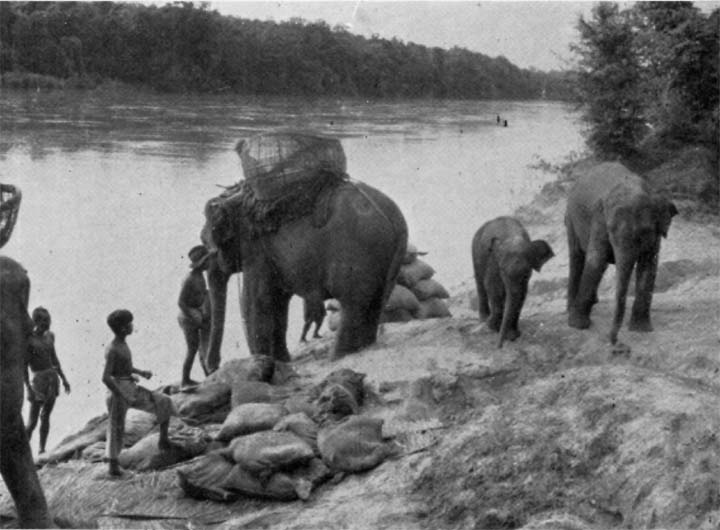 Loading tamarind fruit which has been brought by water. The elephant calves are hanging round to steal fruit. |
 |
Snakes such as hamadryads and Russell's viper are common, but are seldom seen in heavy jungle, as they usually avoid man. But an extraordinary coincidence occurred to a friend of mine and myself, as each of us was chased by the same snake within a period of two years. Brian wrote to me from the Upper Kanti, describing how he had had the unpleasant and rather terrifying experience of being chased by a hamadryad snake at the confluence of the Big and Small Kanti Creeks, where a game-track led up to the ridge from a ford, where game habitually came down to drink.
The snake had suddenly slid down out of a large clump of bamboo. The Burman with him gave the alarm, and the snake chased them along the track, for at least fifty yards. The Burman, of course, insisted that it was a Nat snake.
Two years afterwards I was just leaving the same creek junction, and had just begun to climb up the game-track: I had quite forgotten the incident which Brian had described, when suddenly my Burman shouted a warning. I saw a large black hamadryad slithering down a bamboo clump and coming for us. By the time it had reached the ground I had overtaken my Burman, and we were in flight. It chased us, but I do not think it followed us for any distance. I am afraid I did not stop to look back until I was almost at the ridge. There was no question that the incident occurred at the exact spot where Brian had been chased two years before. It occurred during the same month, in the hottest season of the year. My conclusion is that it was the spot always used by a pair of hamadryads for breeding. The Burmans heard all about both stories, and no doubt a magnificent legend of a jungle Nat by now attaches itself to the spot.
Strangely enough, the Burman who was with me at the time was bitten by a poisonous snake some months later. In those days I was quite ignorant of the proper treatment for snake-bite, and employed exactly the worst methods. I first made him drink a bottle of whisky and then lanced the place where he had been bitten on the leg with a razor blade, making criss-cross cuts, like a Union Jack. I then found I could not stop the bleeding, and spent a most anxious night, thinking he was going to succumb to alcoholic poisoning, loss of blood or snake-bite. Fortunately he survived both the snake-bite and my treatment of it.
So far as I know, elephants don't worry about snakes, though the oozies believe that a number of elephant calves die of snake-bite. I have had this reported to me many times, but in no instance could I find any proof. The Burmans believe that the hairs of an elephant's tail pull out very easily after it has been bitten by a snake. But, as this has also to be proved, I was never able to accept it as conclusive evidence that an elephant had been killed by snake-bite.
There is a widespread belief that an elephant is really terrified of a mouse. The idea makes an obvious appeal to the human love of paradox. But, if it is true, I can see no reason for it. It certainly cannot be because the elephant is afraid of the mouse getting inside his trunk, since, with one snort, he could eject it like a cork from a popgun. However, many women are terrified of mice, with as little reason. After all, most fears are imaginary, and there is no reason why elephants should be immune from such terrors.
Elephants are not, however, usually frightened by natural phenomena without very good reason. They do not mind thunderstorms in the way that dogs do, and they remain calm in the face of forest fires.
Forest fires are not by any means as terrible in the jungles of Burma as they are described as being in other parts of the world. Practically every mixed deciduous forest area in Burma has an annual spring-cleaning of fire, during the latter part of April or the early part of May. It is sometimes due to spontaneous combustion of the rotting leaves of the preceding autumn. The result is usually a carpet fire of leaves, dead twigs and fallen branches, which does not involve the living trees themselves. These carpet fires travel very slowly against any breeze there may be, at a rate not exceeding two miles an hour. Once they have started, they fan out, and become a narrow ribbon of flames, usually quite low, but occasionally catching hold of any tree with dead leaves or dry branches within their reach.
The only areas in which one gets really fierce raging conflagrations are stretches of dry kaing grass. But, as this grows by water, the stretches of grass are usually intersected by creeks, or by the beds of dry streams, which form natural fire-lines, barring its progress.
Elephants have no fear of the carpet type of fire. Domesticated elephants can be marched straight at the line of flame and through it. Their lack of fear and their immunity are due to their weight---for the weight on their pads extinguishes any burning leaves they tread on, and, as long as they keep moving, the under side of their pads will not scorch or blister.
It is a different matter in conflagrations of kaing grass. These fires travel fast, and elephants and all other wild animals recognise the sound and smell of fire immediately, and at once cross the nearest creek. Their understanding of wind direction, and how it will make the fire travel, is far greater than man's.
On many occasions I have set areas of kaing grass on fire on purpose, so as to clear the ground for a new growth. It is quite unnecessary to try to clear animals out of such areas before setting fire to them; directly they hear and smell the fire, the animals move out, at a steady pace, without any panic or excitement. In fact they remember what areas have been burnt earlier on, and return to them. Within a very short space of time, after heavy showers have fallen, the blocks of blackened, fire-swept swamp become emerald-green with the fresh young grass.
I have only once seen elephants really frightened by natural phenomena, and that was due to their realising that they were in a gorge where water was rapidly rising in a spate. Rain was coming down as though it would never cease, and in the distance there was a rumbling of thunder, which added to the anxiety.
I had decided to take a short cut through the Kanti Gorge. I was travelling with eight young pack elephants, and it would save us a climb of two thousand feet from one watershed to another. After passing down the gorge, I meant to move up a side stream. It was during the month of September, and I was almost at the end of my tether. I had been on my own since the previous May, with daily fever, and I was making my way back to jungle headquarters, where I should at least get a week in the same camp. My spirits were high, the oozies were whistling and singing, and our circus was travelling in Indian file down the hard, sandy bottom of the stream.
Both banks of the gorge were sheer rock, to a height of about thirty feet, with dense overhanging jungle and bamboos along their tops. The gorge was three miles long, and the stream was about ankle deep when we started down it. By the time we had gone a mile one could hear the unmistakeable sound of a heavy thunderstorm breaking in the headwaters of the stream. The elephants showed their nervousness by half turning round. An elephant cannot see behind it by merely turning its head; it has to half turn its body. The bore of water eventually overtook us, after which there was broken water well above my knees, and it was lapping under the bellies and round the flanks of the smaller female calves.
For a time it seemed as though the water would rise no higher, and we were making good progress. But, by some instinct not shared by man, the elephants knew there was more water coming down. They began what would soon have become a stampede, if they had not been hindered by the depth of the water and kept under partial restraint by their riders. It became a terrifying experience, as there was no possibility of turning back, and no hope of getting up the sides. During the last mile all the elephants began bellowing; that, with the sound of the torrential rain, and the raging muddy water around, made it seem a pretty grim situation. I kept expecting to see one of the calves lose its balance at any moment. At the end the water was up to my armpits, and I was holding my rifle in both hands above my head.
I never knew a mile to seem longer. Bend after bend came in view, with never a sign of the mouth of the creek I knew, which would provide for our exodus from the black hole in which we floundered. Logs were floating past, and, though I had no time to be amused then, I noticed how the elephants' hindquarters seemed to have a magnetic attraction for the logs that floated down and overtook us. Just as a log was about to strike its hindquarters, the elephant would swing its rear end to one side, giving the log a glancing blow, so that it cannoned off like a billiard ball from the cushion, and passed on to the chap in front ---and so on all down the line.
We were fortunate really, as the smaller animals were just afloat when we went round the bend to go up the side creek. Moreover, the side creek only came down in spate half an hour after we had started up it. If we had met the combined spates at the confluence, all our kit would certainly have been lost.
The elephants scrambled up the first feasible bank after turning in off the main river, and at a general halt they seemed to look at me as if to say: "And you call yourself a jungle man!"