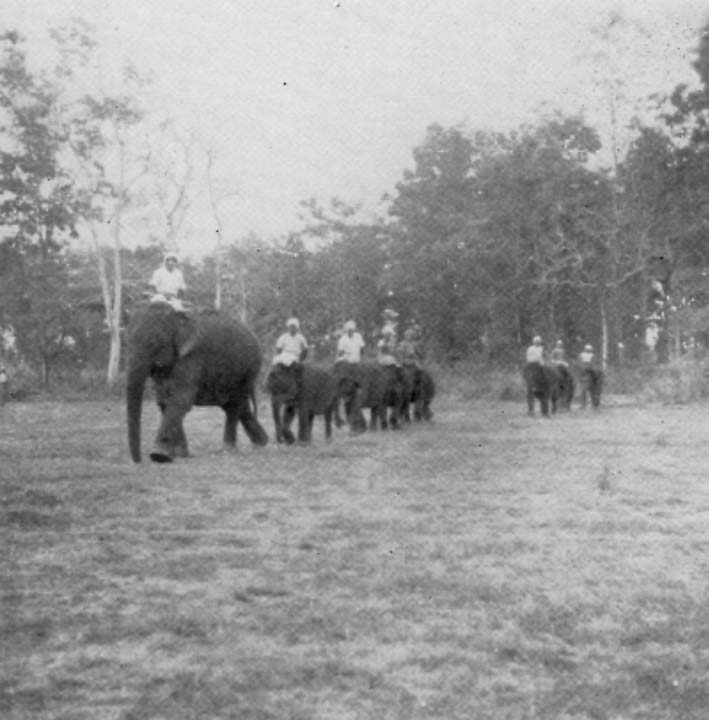
 The koonkie, or schoolmaster, leading a string of his pupils. |
 A bunch of calves in a training camp. |
 A young tusker of eighteen years, saddled with a Siamese pack. |
THE fact that men and elephants live about as long as one another and come to maturity at much the same ages means that they can live together all their lives. They can thus acquire a lifelong mutual knowledge of each other's characters. With no other domestic animal is this possible. A baby boy may be born in an elephant camp, and at the same moment an elephant calf may be being born a mile or two away in the jungle; and that child and that calf may grow up together, play together, work together all their working lives, and they may still be familiar friends when sixty years have passed.
Elephants are not bred in captivity. The captive animals breed naturally in their natural surroundings. During the war I was talking about elephants to two war correspondents, one American and the other an Australian. The latter asked me: "Is it true that elephants are very shy about their actual love affair?" Before I could answer, the American chipped in with: "Of course they are: aren't you?" The mating of elephants is a private affair, and even the oozies of the tusker and the female concerned may not know that it has taken place. Often they know, but regard it as none of their business, and do not talk about it.
The most fantastic tales are told, and even believed, about the mating habits of elephants by Europeans. The tallest story that has come my way was told by a young Sapper officer to a very attractive nurse whom he took to the Rangoon Zoo, after the recapture of Rangoon in May, 1945. Among the few animals left behind in it by the Japs were two young elephants, a male and a female, which led very boring existences hobbled and tethered by the hind legs to two posts in the elephant-shed. While watching this melancholy pair, the young Sapper described how the female elephant turns to thoughts of love in the spring time, and prepares for her honeymoon by digging a deep pit, round which she stacks a month's supply of fruit and fodder for herself and her young bridegroom. When she has completed these preparations, she lies down in the nuptial pit and trumpets a love-call to her mate. After his arrival they live in one unending embrace for the whole month, and do not separate until they have shared their last pineapple or banana! No doubt the Sapper hoped that his attractive listener would take the hint and act likewise. The pretty girl to whom this story had been told afterwards applied to me for confirmation of the story. I felt sorry to have to disillusion her, though the love-making of elephants as I have seen it seems to me more simple and more lovely than any myth. It is beautiful because it is quite without the brutishness and the cruelty which one sees in the mating of so many animals.
Without there being any appearance of season, two animals become attracted by each other. In other words they fall in love, and days, and even weeks, of courtship may take place, the male mounting the female with ease and grace and remaining in that position for three or four minutes. Eventually the mating is consummated, and the act lasts five or ten minutes, and may be repeated three or four times during the twenty-four hours. The pair will keep together as they graze for months, and their honeymoon will last all that time. When they have knocked off from the day's work they will call each other and go off together into the jungle. My own belief is that it lasts until the female has been pregnant for ten months---that is, until she has become aware that she is pregnant. The act of mating can be performed as easily by an elephant wearing hobbles as without them, as the position of the male's forelegs lying along the barrel of the back of the female is not interfered with by the hobbles. In the final mating position the male is standing almost vertically upright, with the forefeet resting gently on the female's hindquarters.
The average female first mates between the ages of seventeen and twenty. She shows no sign of any particular season, but apparently feels some natural urge. It has recently been noticed that female circus elephants become moody in periods of approximately twenty-two months. Gestation lasts twenty-two months, and she does not appear to realise that she is pregnant until the end of the first ten months. After that the period of mating comes to an end, and the companionship of the male is replaced by that of a female friend or "auntie." From that time onwards the expectant mother and her girl friend, or "auntie," are never apart. They graze together always, and it becomes difficult to separate them. It is, indeed, cruel to do so. Their association is founded on mutual aid among animals, the instinctive knowledge that it takes two mothers to protect a calf elephant against tigers, which, in spite of all precautions, still kill twenty-five per cent of all calves born.
After the calf has been born, the mother and the "auntie" always keep it between them as they graze---all through the night---and, while it is very young, during daylight hours as well.
To kill the calf the tiger has to drive off both the mother and "auntie" by stampeding them. To do this he will first attack the mother, springing on her back and stampeding her; then he returns to attack "auntie," who defends the calf, knowing that in a few moments the mother will return. On many occasions I have had to dress the lacerated wounds of tiger claws on the backs of both a mother elephant and her friend.
A mother elephant in captivity has no suspicions that man will injure her calf. I have only once been attacked by one of the many mothers whom I have congratulated by a pat on the trunk, often within an hour of the actual birth. That was an accident. I was patting a calf so young that it could not focus me with its little piggy eyes, and it bumped hard against my bare knees and yelled out the cry for danger. As I jumped back, the lash of the mother's trunk missed me by inches. She then chased me, but only for twenty yards, as she had to return to her squealing babe. On the other hand, I have handled a newly born dwarf elephant under the mother's belly, lifting it up so that it stood on a small platform, so as to reach its mother's nipples, and the mother seemed to consider this as much of a joke as I did.
A baby calf follows its mother at heel for three or four years. It is suckled by the mother for that period, from the breasts between her forelegs.
This position, between the forelegs, affords the calf perfect protection. At birth the calf's trunk is a useless object, or membrane, growing rather to one side, so as to allow the calf to suck more easily through the mouth. It does not become flexible and useful for three to four months. When the sacred white elephant of Mandalay Palace was a calf its mother died, and it was suckled by twenty young Burmese women daily as wet nurses, and so reared.
At the age of five or, at most, six years, the calf has learned to gather its own fodder, and gradually gives up sucking its mother. Female elephants have an average of four calves in their life-time. Twins are not uncommon, and two calves of different ages following their mother at heel is quite a usual sight. Larger families are not uncommon.
"Accidents" happen in the elephant world, and elderly females occasionally spring a surprise. Thus Main Hpo (a Shan name) gave birth to her eighth calf just after the Japanese War, in the Gangaw Valley, when she was sixty-one years old. All her previous calves had lived and had been trained---in fact her eldest son, a tuskless male named Hine Pau Zone (Mr Laziest) was the only elephant recorded as having killed a Japanese soldier. This incident took place at a Chin Village in 1945, during the Japanese withdrawal.
After weaning, young elephants go through an awkward stage, becoming a bit truculent owing to the desire for independence---much like human boys and girls.
At fifteen or sixteen they become very much like human flappers and young stalwarts. They have reached the same adolescent stage of not knowing quite what they want. Some soon find out, others do not; for their temperaments vary.
Young male elephants do a lot of flirting with the females from the ages of sixteen to twenty, sometimes being most enterprising. But the average animal does not show any signs of musth until the age of twenty. A male elephant will mate when he is not on musth, in fact he usually does. But when he is on musth all the savage lust and combative instincts of his huge body come out.
From the age of twenty to thirty-five musth is shown by a slight discharge of a strongly smelling fluid from the musth-glands near the eye, directly above the line of the mouth. In a perfectly fit male it occurs annually during the hot months, which are the mating season. It may last about two weeks, during which time he is very temperamental.
From the age of thirty-five to forty-five the discharge increases and runs freely, eventually dribbling into his mouth, and the taste of it exasperates him and makes him much more ferocious. He is physically in his prime at that age, and unless he is securely chained to a large tree while on musth, he is a danger to his oozie and to other elephants. His brain goes wild, as though nothing would satisfy him, and nothing will.
From forty-five to fifty musth gradually subsides, and finally disappears. Tuskers that have killed as many as nine men between the ages of thirty-five and forty-five will become docile during musth in the later years of their lives. But no elephant on musth can be trusted unless he is over sixty years old.
Poo Ban, a magnificent tusker, was normally a friendly animal, and would allow me to walk under his head and tusks, but he went on musth in the Taungdwin Forest area, killed his oozie and another man, then killed two female elephants, and attacked on sight any man who came near him. Finally he entered villages, tore rice granaries open, and became the terror of the valley. I offered a reward of three hundred rupees for his capture, and decided to destroy him if he could not be captured.
He was marked down in a dense patch of bamboo jungle in Saiyawah (the Valley of Ten Villages), four marches away. With Kya Sine, my gun-boy, I set out, lightly loaded with two travelling elephants as pack. The evening before I was to tackle Poo Ban I was testing my rifle with a half charge (i.e., with half the cordite removed, and with a soft-nosed bullet in the left barrel, keeping a normal hard-nosed cartridge in the right. I wanted to wound Poo Ban in one of his forefeet with the half charge, and then recapture him, break his spirit and heal his wound. At a hundred yards my practice-shooting was so accurate that I felt hopeful of success. Kya Sine, however, begged and implored me to let him go ahead and attempt to recapture him without shooting, so that he could earn the three hundred rupees. He intended to tackle him boldly, face to face, relying on his own authority and the animal's habits of obedience. Unfortunately, I gave in, and before dawn he had gone on ahead. I arrived at three p.m. next day to be met by men who said: "Kya Sine is dead." Poo Ban had killed him during his attempt at recapture.
That night I bivouacked in an open place which had at one time been paddy-fields. It was a brilliant moonlight night, and before I went to sleep I made my plans to recapture Poo Ban. I had no desire to avenge the death of Kya Sine---to whom I was devoted, and who had the greatest knowledge of jungle lore of any man I have ever known. The idea of revenge on an elephant would have been very distasteful to him.
I was asleep, lying in the open, when I was woken by a clank! clank! clank! Luckily for me, a piece of chain had been left on Poo Ban's off forefoot. I came suddenly to my senses out of a dream, and, jumping up, saw the finest sight of my life. Two hundred yards away, in the open, a magnificent tusker was standing, with his head erect in challenge, defiant of the whole world. He was a perfect silhouette. I did not dare move an eyelid. He was a bigger man than I was, and while I held my breath he moved on with a clank, clank, clank, which at last faded away like the far sound of the pipes over the hills.
At dawn I tried to put my plans into action. When he had been located, I took up my position, while twenty Burmans, with four shot-guns between them, tried to drive him past me.
Poo Ban faced the lot, defying them four times. Shots rang out, but at last he changed his mind and, turning, came towards me. I was perched on a broken-down, dilapidated brick pagoda, a heap of rubble about six feet high, behind which was the hundred-feet-high bank of the Patolone River. Directly in front of me was a clearing of disused paddy-fields, and my hopes were that Poo Ban would cross it. I still meant to wound him in the foot, recapture him, break his spirit and then heal the wound.
Poo Ban came out of the jungle with his head held high. He halted, and then made a bee-line across my front, travelling fast over the open ground.
Kneeling, I took the shot at his foot on which my plans depended. The bullet kicked up a puff of dust in front of his near forefoot as he put it down in his stride. I had missed!
Poo Ban halted and swung round to face me, or the bark of my rifle which he had heard. Then he took up the never-to-be-forgotten attitude of an elephant about to charge, with the trunk well tucked away in his mouth, like a wound-up watch-spring or the proboscis of a butterfly. As he charged it flashed through my mind that I had no time to reload. I depended on the hard-nosed bullet in the right barrel. At twenty-five yards I took a chest shot. At twenty yards Poo Ban fell. His head dropped; his tusks drove nine inches into the ground. For a few seconds he balanced, and then toppled over, dead.
I dropped my rifle and was sick, vomiting with fear, excitement and regret. Poo Ban was dead, and I had failed to catch him alive. There was no court of inquiry. My report was accepted, and I was given the tusks as a souvenir, a souvenir of a double failure that I bitterly regretted, and of the death of the finest and bravest Burman hunter I have known.
THERE is undoubted cruelty in breaking the spirit and training wild elephants after they have been captured by kheddaring. The ideal age at which to capture a wild elephant is usually considered to be from fifteen to twenty, as it is then only a few years before it is sufficiently mature to do heavy work and to earn its original cost. But the spirit of a youngster of that age, whether male or female, takes a lot of breaking. It often takes a matter of weeks, while it is tethered to a tree with chains; and its continual struggling and fighting to break free cause the most shocking galling of the ankles and neck. Food is thrown to the tethered animal, but insufficient and unsuitable food leads to great loss of condition, and the oozie, or attendant responsible for feeding and watering, often retaliates with a spear-stab in the cheek after the captive has lunged at him with its trunk. The wounds it receives are almost impossible to treat, and they naturally become flyblown and ulcerated.
In the end the young animal becomes heartbroken and thin. Finally it realises that it is in captivity for the rest of its days, and after the last heartbreaking struggle will put up with a man sitting on its head. By then it is usually covered with sores and wounds.
But a calf born in captivity in the nearest possible surroundings to those of a wild elephant is far more easily trained. From the day it is born until it leaves its mother at five years old it is in contact with its mother's oozie. It flirts with him like a child, it pretends to chase him, then runs away again. But, though so playful, it seldom trusts him much beyond accepting a tid-bit of fruit or a handful of rice from his hands.
In November of its fifth year the calf is weaned, and from that moment becomes more independent. Five or six calves are trained at a time in one camp. A Burman specially picked as a trainer is in charge, assisted by two men per calf, with eight other men to do general work. A training camp should be in flat country near a stream. An area of a hundred yards square is cleared, except for a few trees to give shade, leaving only a carpet of earth. In the middle a" crush" or triangular-shaped pen is built of logs of about the height of the average five-year-old calf. The logs of which it is built are fastened with wooden pegs; no nails are used in its construction. The bark is stripped from the logs, which are rubbed smooth and smeared with grease---all precautions against galling the calf's hide while it is in the crush under training. In addition to the calves with their mothers in camp is an elephant known as the koonkie (schoolmaster). This animal is usually a tuskless male between forty-five and fifty years of age, chosen for his docility and patience.
There is a great deal of superstition connected with the whole business of training young elephants. Before any attempts at actual training have begun, offerings are made to the Nats or spirits of the jungle. A small shrine is built near the crush, and the actual day on which training is to be begun is chosen by the manner in which a series of candles burn out. All the ropes for training are made from raw buffalo hide, preferably woven, and kneaded in lard until they are soft and pliable. Stocks of fruit, such as bananas and tamarinds, are also laid in at the camp, so as to provide the calf with tid-bits while it is in the crush. These help to keep its mind occupied and soften the shock of its finding itself in a cage.
On the morning when the first calf is to be weaned, the mother and the calf are brought into the clearing and made familiar with the crush and its surroundings. Some calves are so unsuspicious that they will follow a man into the crush if he holds out a banana as a bait. Once the calf is inside, the attendant Burmans quickly slip two stout bars in behind its hindquarters. More often than not, however, the calf is suspicious, and has first to be caught by one foot when in the open. This is done by placing a number of raw-hide running nooses on the ground where the calf is likely to walk. Each man is responsible for one of these lassoos, and has to twitch the noose tight once the calf has stepped inside it. A short struggle and a good deal of yelling on the part of the calf follow, but provided its mother is near at hand, it soon quietens down. It is then gradually pushed and pulled into the crush. In obstinate cases the koonkie, or schoolmaster, has to be brought up, and, with no fuss at all, he puts his head against the calf's fat little rump and gently butts it forward. The mother is quite content to stand by watching these proceedings, and makes no attempt to charge the Burmans so long as she is loose. But she becomes terribly agitated if she is tied up, and will make every attempt to snap her chain to get free and go to its rescue.
Once the calf is inside the crush, the forefoot which is still in the noose is tethered to the apex of the triangle. Bribery is begun at once, but the calf is at first far too intent on getting out of the cage to take the tid-bits offered to it. It will usually struggle and kick for about two hours. Then it sulks, and finally it will take a banana from the oozie out of sheer boredom and disgust. The expression on its face is like that of a child who eventually has to accept just one sweet after it has sulked for half an hour because it cannot have the whole bag.
While the calf is being cajoled and persuaded that it will do better to make the best of what is offered it, instead of struggling and sulking, its future rider has been attached to a pulley a few feet over its head. Two men on the ground, on either side of the crush, control this pulley, and on a signal from the rider he is lowered slowly on to the calf's head.
"Damn you, get off!" screams the calf, bucking like a bronco. The would-be oozie has soon to be hauled up again, but no sooner has the calf quieted down and accepted another banana, than the rider is lowered once more-and so on, again and again and again, until the poor little calf seems to say: "All right, damn you. Sit there if you must."
When it has finished the bananas it will buck again; but directly it starts eating, down comes the inevitable oozie.
So far, so good. By that time it will be nearly midday. The poor calf is tired, but the Burmans, stripped of all but their tucked-up lungyis, are thoroughly enjoying the game, though they are dripping with sweat, which shows up their gleaming copper skins and rippling muscles.
Suspended from another pulley above the centre of the calf's back is a heavy block of padded wood. This is also lowered on to its back and provokes more bucking bronco antics, with sideways rollings and strugglings against the greasy bars. A moment or two later the block is lifted, but directly the calf stands still, down it comes again. Once more there are determined struggles to get free, and so it goes on, and all the while the calf is being offered food and spoken to with kind and soothing words. Finally, in utter disgust, the calf sits down with its front feet straight out, hoping that it will get rid of the pests riding on its back in that way.
A cheer goes up from the Burmans: a cheer which soon becomes a chant of, "Tah!" (Get up) "Hmit!". (Sit down). As the weight is lifted, the calf gets up, and all the Burmans chant, "Tah!" As the weight comes down, and the calf sits, all of them chant: "Hmit" in chorus.
After a time the rider, still attached to the pulley, remains comfortably seated on its head. By evening, unless the calf is a really obstinate young devil, the rider can turn and, putting his hand on its back instead of the log of wood, order the calf to sit down by pressure and by saying, "Hmit."
Once that is possible, the calf is considered as broken. Often it takes less than twelve hours, with no cruelty whatsoever. Sometimes, however, in dealing with obstinate and truculent young tuskers, the game has to be kept up, by the light of bamboo torches, far into the night. Occasionally it may last even till the morning of the next day. But however long it may take, the Burmans never give in and never give the calf any rest until their object is achieved. The great lesson is that man's will-power is stronger than its own, and that man will always get his own way, however long it takes him.
Before the calf is taken out of the crush on the following morning it is hobbled with well-greased buffalo-hide thongs, and it is then tied to a tree for twenty-four hours, being caressed and cajoled all the time by its future rider. He makes it sit down each time he approaches. He mounts on its head, remains there ten minutes, orders the calf to sit again, and dismounts, and sometimes keeps it in the sitting position for five or ten minutes. Extraordinary patience is needed throughout. Once the Burman starts, he goes on until he gains his point. He never lets the calf win a victory, however temporary. Meanwhile the calf's mother has been taken away. No doubt she misses it, as it is common for her to call her calf for a couple of nights after their separation. But the tie between them has grown slender at that age. She does not really want the calf with her, though she may feel some anxiety on its account. The calf is then taken for its first walk, attached to the koonkie by a buffalo-hide girdle. The koonkie has a surcingle over the withers and behind the forelegs, while the calf walks alongside. He thinks the whole thing a bore, but he stands no nonsense. If the calf jibs, sits down, or lags, he gives him one wrench that pulls him along. On occasion he will give him a real welt with his trunk, as though to say: "Come on, you wretched urchin."
It soon becomes a decorous walking-out, and at a later stage the koonkie can manage two calves---one on each side of him. By the time they are really well-behaved the koonkie puts on the airs of a stuffy old nurse taking a pair of well-behaved and terribly bored twins out in the Park. As they approach other calves, one can imagine him saying: "Don't you dare speak to those common children over there."
I once had a camp with nineteen calves in training in it. They were a joy to watch. Each had a different temperament, and their innate differences of character were enshrined in a lovely lot of names. The trainer really has the right to name calves, and long discussions go on among the assembled riders and the trainer over the camp-fires at night before the calves are finally christened. Often some incident which occurs in the initial stages of training will suggest the name. One such instance I well remember. On the third night after the calf had been taken out of the crush, and while it was tethered to a tree, some little way off from the riders' camp, it was attacked by a tiger, which sprang upon its back.
The calf threw the tiger off, and managed to keep it at bay for twenty minutes, until men from the camp arrived with bamboo torches. That calf naturally became a hero, and the next day it was christened Kya M'Nine (Chyarmanine), which means "The tiger could not overcome him"---as lovely a name for an elephant as Black Beauty for a horse.
Sometimes there is humour in the name, such as: Ma Pin Wa (Miss Fat Bottom). One young elephant of that name could scarcely have been called anything else. How she wobbled as she walked!
The koonkie, or schoolmaster, leading a string of his pupils. |
A bunch of calves in a training camp. |
A young tusker of eighteen years, saddled with a Siamese pack. |
The name given to a calf sticks to it for life, but it never knows its name, as a dog does; for the oozies do not usually call their elephants by name. The real reason why they are christened is so that, men can talk about them to each other.
Some of the names are most attractive: Po Sein (Firefly), always given to an animal with a bright fiery eye; Ma Hla (Miss Pretty), always a good-looking calf with a perfect figure; Ma Palai (Miss Pearl), an animal with a pearl-coloured eye; Maung Kyaw Dan (Mr. Straight-back); Bandoola (the name of a famous Burmese General), rarely given except to an animal of most outstanding temperament and build. In a herd of two hundred animals in a forest area, it is rare that any two have the same name.
On occasions the trainer will pay a European Assistant the compliment of asking him to christen an animal. In one forest I had a Hitlah and a Musso. In another I had a solitary female calf named Susan Ma after my wife. Twelve years later, by an extraordinary coincidence, I spoke to the rider of a fine young elephant seventeen years old---the first animal to be recovered from the Japs after the evacuation of Burma.
"What's the name of your elephant?"
"Susan Ma," he replied, and smiled all over his face, for he knew what the name meant.
Less than a year later Susan Ma was lost again when we were overrun by the Japs---but seven months after that, when the Japs retreated, Susan Ma became mine once more, and her namesake still is.
From the age of breaking, young elephants are kept under training until the finishing age of nineteen. For about two years they remain in the camp nursery, merely being caught daily and taught the simple words of command and the "aids" of the rider and by foot control, behind their ears.
Perhaps this is the place in which to explain what these "aids" are. Their nature will be familiar enough to polo-players. They are simply movements of the rider's body by which he translates his wishes, almost instinctively, to his mount. Thus an intense stiffening of his limbs and leaning back will be at once understood as halt. A pressure on one side will be understood as turn to the left, on the other as turn to the right. Leaning forward and forcing downwards will mean stoop or kneel. A dragging up on the right side will be correctly interpreted as lift the right foot---on the other, as lift the left.
At about eight years old, young elephants carry their first pack and become "travellers," accompanying a European Assistant when he tours the forest areas. They thus become accustomed to going over the mountains and down the streams, carrying light weights, such as camp cooking-pots, or a light roll of bedding.
In camp the young traveller is learning something new and useful all the time, even if it is only to pick up the branch of a tree in his trunk and carry it into camp as firewood, or to disentangle his chain if it should get caught in some bamboos.
Such travelling, and all the odd jobs which accompany it, continue until the calf is nineteen years old, after which he joins a working camp and starts hauling timber.
During the early years the elephant never really earns its keep or does enough to pay the wages of its oozie, but is learning all the time. By the time it is nineteen its temperament is fully known, and it has developed physically sufficiently for its future value as a working animal to be gauged.
Up to the age of nineteen or twenty it will have cost about one thousand pounds, when the wages of the oozie, training costs and maintenance are added up. Any earning capacity it might have had during those years would be small, even if used for rice transport. Moreover, any attempt to increase its earnings during the early years is very bad policy, and likely to involve its being overloaded and its whole future usefulness put in jeopardy.
We may assume that the elephant has on the average a working life from its twentieth to its fifty-fifth year. In this period it may cost another one thousand five hundred pounds in the wages of its oozie and in maintenance.
Each working year consists of nine months' work and three months' rest, necessary both to keep it in condition, and on account of the seasonal changes. From June to the end of February are the working months; whilst during the hot weather season, from March to May, animals should not work, there being insufficient fodder and water for them in the teak-bearing and deciduous forest areas.
Each month consists of only eighteen working days and twelve rest days, animals working three days in succession and then resting two. Thus, during the nine months of the working year there are only one hundred and sixty-two working days. Each day averages about eight hours. Thus an elephant works one thousand three hundred hours a year. During this time an average animal delivers one hundred tons of timber from stump to a floating-point in a creek. This is only one of the steps in the transport of the teak to the mill.
BY the time it is twenty-five years old, a well-trained elephant ought to be able to understand twenty-four separate words of command, quite apart from the signals or "foot-aids" of the rider. He ought also to be able to pick up five different things from the ground when asked. That is to say, he should pick up and pass up to his rider with his trunk a jungle dah (knife), a koon (axe), his fetter or hobble-chain, his tying-chain (for tethering him to a tree) and a stick. I have seen an intelligent elephant pick up not only a pipe that his rider had dropped, but a large lighted cheroot.
He will tighten a chain attached to a log by giving it a sharp tug with his trunk, or he will loosen it with a shake and a waggle, giving it the same motion with his trunk as that given by a human hand.
An elephant does not work mechanically, like many animals. He never stops learning, because he is always thinking. Not even a really good sheep-dog can compare with an elephant in intelligence.
I don't believe that "an elephant never forgets," but I should scarcely be surprised if he tied a knot in his trunk to remember something, if he wanted to. His little actions are always revealing an intelligence which finds impromptu solutions for new difficulties. If he cannot reach with his trunk some part of his body that itches, he doesn't always rub it against a tree; he may pick up a long stick and give himself a good scratch with that, instead. If one stick isn't long enough, he will look for another which is.
If he pulls up some grass, and it comes up by the roots with a lump of earth, he will smack it against his foot until all the earth is shaken off, or, if water is handy, he will wash it clean, before putting it into his mouth. And he will extract a pill (the size of an aspirin tablet) from a tamarind fruit the size of a cricket ball in which one has planted it, with an air of saying: "You can't kid me,"
Elephants can also detach a closely clinging creeper, like ivy, from a tree far more skilfully than can a man working with two hands. This is due to their greater delicacy of touch.
Many young elephants develop the naughty habit of plugging up the wooden bell they wear hung round their necks (kalouk) with good stodgy mud or clay, so that the clappers cannot ring, in order to steal silently into a grove of cultivated bananas at night. There they will have a whale of a time, quietly stuffing, eating not only the bunches of bananas, but the leaves and, indeed, the whole tree as well, and they will do this just beside the hut occupied by the owner of the grove, without waking him or any of his family.
Catching a young animal at this is just like catching a small boy among the gooseberry bushes. For some reason stolen fruit is always sweetest.
Oozies are not always as innocent as they pretend on such occasions. I once had to pay a fine to the Forest Department for damage done by my elephants to some experimental plantations of teak saplings. Naturally, I gave the oozies a reprimand for their slackness in allowing their animals to stray into these plantations. A month afterwards I happened to meet the Forest Officer who had fined me, near a large village, where we both camped for the night. He had four elephants with him, and I had eight. Next morning his annoyance can be imagined when the village headman arrived to ask for compensation for no less than a hundred banana-trees, destroyed by his four elephants. Strangely enough, not one of my eight elephants had been involved in the mischief, a fact which made it even more annoying for him. It was not until a week after we had parted company that I found out that though my elephants were innocent, my oozies were quite the reverse. They had taken the bells off the Forest Officer's four elephants and during the night had led them quietly into the banana groves-and had thus paid him out for fining me for the damage to the teak plantation.
I have personally witnessed many remarkable instances of the quick intelligence of elephants, though I cannot claim that they equal the famous yarns which delight all of us, whether we are children or grownups---such as that of the circus elephant who saw a man who had befriended him sitting in a sixpenny seat, and at once picked him up with his trunk and popped him into a three-and-sixpenny one!
But the following incidents seem to me to denote immediate brain reaction to a new situation, rather than anything founded on repetitive training.
An uncertain-tempered tusker was being loaded with kit while in the standing position. On his back was his oozie, with another Burman in the pannier, filling it with kit. Alongside, on the flank, standing on the ground, was the paijaik attendant, armed with a spear which consisted of a five-foot cane, a brightly polished spearhead at one end and a spiked ferrule at the other. Another Burman was handing gear up to the Burman in the pannier, but got into difficulties with one package and called out to the paijaik to help him. The latter thrust the ferrule of the spear into the ground so that it stood planted upright, with the spearhead in line with the elephant's eye. Then he lent a hand. The oozie, however, did not trust his beast, and said in a determined voice, "Pass me the spear." The tusker calmly put its trunk round the cane at the point of balance, and carefully passed it up to his rider. But, unthinkingly, he passed it head first, and held it as though waiting for the rider to catch hold of it by the head.
The rider yelled at his beast in Burmese: "Don't be a bloody fool---pass it right way round !" With perfect calm and a rather dandified movement, the elephant revolved the spear in mid-air and, still holding it by the point of balance, passed it to his oozie, this time ferrule first.
The oozie did not say thank you, but gave him a curse with a touch of endearment---as though saying, "You are a damned ill-mannered wild elephant, and I want no more of it." Then, with a quick movement, he moved the spear-head beside the elephant's eye, an action which meant that he would suffer for it if he tried any tricks with his tusks on those engaged in loading him up. The loading was completed without incident.
Sometimes an elephant will show its intelligence by divining what its oozie wishes.
A case I remember concerned an animal which would not work with a rider on its head, but was obedient to the words of command given by its oozie walking alongside. I was watching this beast straightening logs in a creek---that is to say, placing them in rows of eight or twelve parallel to each other and pointing down the bed of the stream, in readiness for the first floods to carry them away. The oozie was sitting on the bank; work was almost finished, but, because I was around, he knew every log had to be straight in line with the others before they broke off.
There was one noticeable and unshapely log, and the elephant came to the last row in which it lay. He was a big tusker, and was doing all the work with his tusks and head, free of all chains. Without any word of command being given, he let the first log alone, and began shifting the second, keeping one eye on his oozie, as though saying: "Come on, wake up and tell me what you want!"
The oozie soon told him, shouting: "You old son of a bitch! What's wrong with that one? Leave it."
The elephant moved on to the next log, keeping his eye cocked on his oozie, like an old man looking over a pair of spectacles.
"No," shouted the oozie. "You know as well as I do," and made a gesture of picking up a stone to throw at his beast.
The elephant gave a squeal of pure delight at having pulled his oozie's leg, and, without hesitation, disregarded the next five logs and, without pausing, bent down and rolled the one irregularly placed log over four times, leaving it exactly parallel with the others and about a foot from them. Then he walked up to his master, as though to say: "Enough fooling, let's break off!" and the day's work was finished for man and beast.
But one of the most intelligent acts I ever witnessed an elephant perform did not concern its work, and might just as well have been the act of a wild animal.
One evening, when the Upper Taungdwin River was in heavy spate, I was listening and hoping to hear the boom and roar of timber coming from upstream. Directly below my camp the banks of the river were steep and rocky and twelve to fifteen feet high. About fifty yards away on the other side, the bank was made up of ledges of shale strata. Although it was already nearly dusk, by watching these ledges being successively submerged, I was trying to judge how fast the water was rising.
I was suddenly alarmed by hearing an elephant roaring as though frightened, and, looking down, I saw three or four men rushing up and down on the opposite bank in a state of great excitement. I realised at once that something was wrong, and ran down to the edge of the near bank and there saw Ma Shwe (Miss Gold) with her three-months-old calf, trapped in the fast-rising torrent. She herself was still in her depth, as the water was about six feet deep. But there was a life-and-death struggle going on. Her calf was screaming with terror and was afloat like a cork. Ma Shwe was as near to the far bank as she could get, holding her whole body against the raging and increasing torrent, and keeping the calf pressed against her massive body. Every now and then the swirling water would sweep the calf away; then, with terrific strength, she would encircle it with her trunk and pull it upstream to rest against her body again.
There was a sudden rise in the water, as if a two-foot bore had come down, and the calf was washed clean over the mother's hindquarters and was gone. She turned to chase it, like an otter after a fish, but she had travelled about fifty yards downstream and, plunging and sometimes afloat, had crossed to my side of the river, before she had caught up with it and got it back. For what seemed minutes, she pinned the calf with her head and trunk against the rocky bank. Then, with a really gigantic effort, she picked it up in her trunk and reared up until she was half standing on her hind legs, so as to be able to place it on a narrow shelf of rock, five feet above the flood level.
Having accomplished this, she fell back into the raging torrent, and she herself went away like a cork. She well knew that she would now have a fight to save her own life, as, less than three hundred yards below where she had stowed her calf in safety, there was a gorge. If she were carried down, it would be certain death. I knew, as well as she did, that there was one spot between her and the gorge where she could get up the bank, but it was on the other side from where she had put her calf. By that time, my chief interest was in the calf. It stood, tucked up, shivering and terrified on a ledge just wide enough to hold its feet. Its little, fat, protruding belly was tightly pressed against the bank.
While I was peering over at it from about eight feet above, wondering what I could do next, I heard the grandest sounds of a mother's love I can remember. Ma Shwe had crossed the river and got up the bank, and was making her way back as fast as she could, calling the whole time---a defiant roar, but to her calf it was music. The two little ears, like little maps of India, were cocked forward, listening to the only sound that mattered, the call of her mother.
Any wild schemes which had raced through my head of recovering the calf by ropes disappeared as fast as I had formed them, when I saw Ma Shwe emerge from the jungle and appear on the opposite bank. When she saw her calf, she stopped roaring and began rumbling, a never-to-be-forgotten sound, not unlike that made by a very high-powered car when accelerating. It is the sound of pleasure, like a cat's purring, and delighted she must have been to see her calf still in the same spot, where she had put her half an hour before.
As darkness fell, the muffled boom of floating logs hitting against each other came from upstream. A torrential rain was falling, and the river still separated the mother and her calf. I decided that I could do nothing but wait and see what happened. Twice before turning in for the night I went down to the bank and picked out the calf with my torch, but this seemed to disturb it, so I went away.
It was just as well I did, because at dawn Ma Shwe and her calf were together---both on the far bank. The spate had subsided to a mere foot of dirty-coloured water. No one in the camp had seen Ma Shwe recover her calf, but she must have lifted it down from the ledge in the same way as she had put it there.
Five years later, when the calf came to be named, the Burmans christened it Ma Yay Yee (Miss Laughing Water).
In 1930 it fell to my fortune to do field work with a brilliant veterinary surgeon named Pfaff. He was a research officer who had been appointed to stamp out anthrax among domesticated elephants in Burma. Having isolated the germ from an elephant's whole ear which had been sent him, he cultured it and prepared vaccines from both oxen and horses. Then came the experiments in inoculating elephants. The first of these was carried out under perfect conditions, with picked animals in a special camp with a "crush" to hold the elephants while being inoculated, and with ample time and all that one could wish for. The first experiments were disastrous, a large proportion of the elephants inoculated either were very seriously affected or died. It was some time before he could get the dosage right. But he was determined, and we went on. But when inoculation had proved its value, the work fell on European Forest Assistants working under very different conditions.
Baby-trained calves, savage and dangerous animals, nervous females were all in the day's work for the Assistant working hundreds of miles away from the nearest help. But one had to overcome all difficulties and treat them as child's play, just because one had enough self-confidence to ignore or to forget any risk attached to the work---and the animals knew it. One cut out all the fuss and just walked up boldly to the animal, gave it a good smack with the left hand and exclaimed: "Hullo, old chap!" while with the right, one thrust the needle through the hide and squirted in the vaccine. Then one gave it another smack and turned away, exclaiming, "Come on!" to the next elephant. With that technique one could inject fifty animals in the morning and have them back in their working camps during the afternoon.
An Assistant working under me at that time once sent me a frantic message that while he was struggling to inoculate a particularly restive elephant he had unfortunately broken off three needles, and had not been able to recover the broken pieces. He asked for immediate instructions as to whether he should operate and try to extract them.
I replied at once, pointing out that the age of the animal was forty, and we might hope that, considering the size of the elephant and its circulatory system, it would take another fifty years before the needles reached its heart. By then the animal would be getting on for a hundred, so there was no reason for operating now. Moreover, three needles in the heart would result in a most interesting post-mortem on an elephant of ninety! He went on with his work of inoculation, and, so far as I know, he lost no more needles.
Another Assistant had to report that inoculation had been held up, as a truculent elephant broke away on feeling the injection, and carried off the hypodermic syringe and needle firmly planted in his hide. The elephant was not recaptured for a fortnight.
Such humorous incidents helped us to make light of our difficulties in the early experimental days. But only those who have known and experienced the effects of an epidemic of this terrible disease can appreciate what it meant to overcome it. Wholesale inoculation, carried out in this cheery way, brought with it immense relief---one of the nightmares was banished.
I lived through such a nightmare once when thirty-seven elephants, out of the seventy in my charge, died in three weeks.
At nine o'clock one morning I inspected a camp of seven elephants and entered all of them, in their inspection books, as "fit and fat." That evening, when I was camped ten miles away, I received an urgent message from the Burman in charge of the elephants I had inspected to say that one of them was down with anthrax. I went back immediately, and reached the elephant camp well after dark, to find that the sick animal was dead and that another one was down.
Veterinary treatment of the disease in those days was amateur indeed, and I was working in the dark in more senses than one, as I started operations on a prostrate elephant by the light of a bamboo fire kept stoked by three Burmans.
Running along under the belly of the elephant was a swelling the size of a bath-tub. I made an incision about two feet long in this with a large knife, and poured almost pure carbolic acid into the wound. At that time the accepted cure was to get carbolic to circulate with the blood. There must be a providence that looks after honest fools. Going to my tent that night, sweating and tired and very gory, I prayed earnestly for success. Strange to say, that animal did recover, but next morning anthrax was reported from another camp ten miles off. And so it went on for that week, until the map of my forest area was closely dotted with crosses in red ink, marking where my elephants had died.
One night, after vainly pondering on how the disease could spread from one camp to the next, ten miles away, and from animal to animal, although by that time I was keeping them isolated, each tethered to a tree a mile from its nearest neighbour, I fell asleep, sitting at my camp table, and dreamed that I myself was the dread carrier of the disease.
When I woke up I found the two table candlelamps were almost burned out, and in their guttering light I decided to take no action when the next case was reported, no matter how near or how far away it might be. Then I went to bed. I did not move camp for a week, and I shall never know whether my unconscious intuition had been correct, and whether I, like many others, had been the carrier of the disease. For then the rains broke, and the epidemic, mercifully, died out.
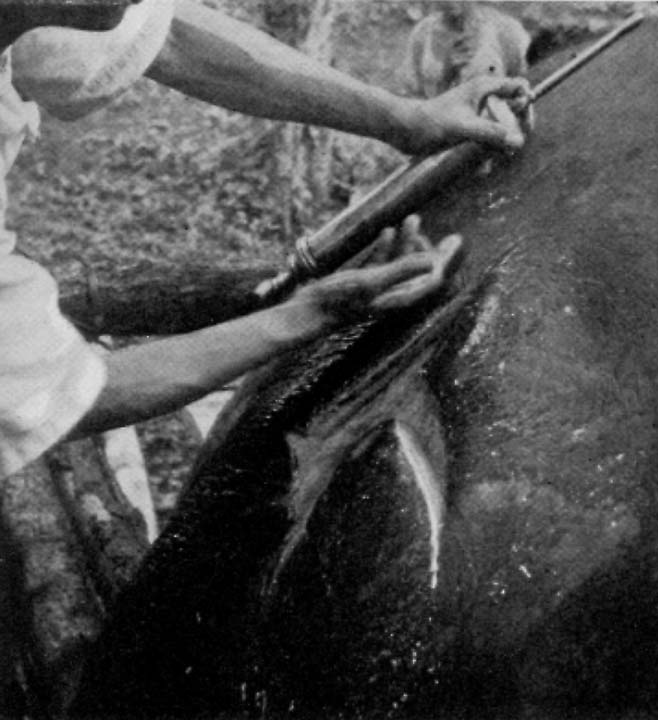 Probing an old tiger wound which is still septic. |
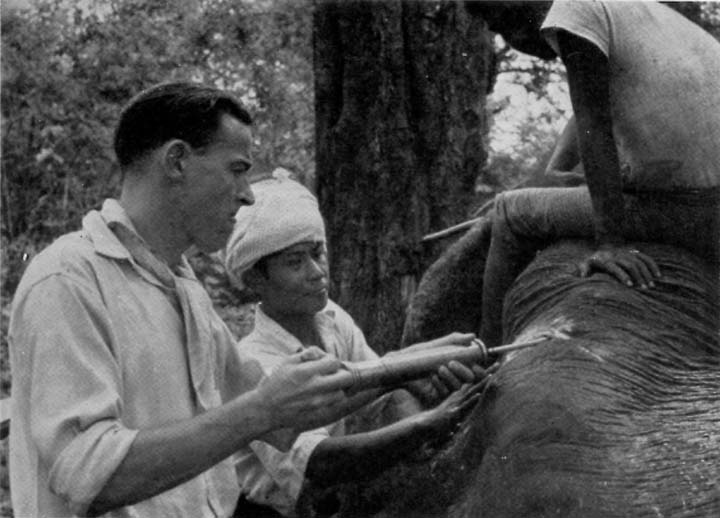 Syringing a sinus. The Forest Assistant is standing on a platform. |
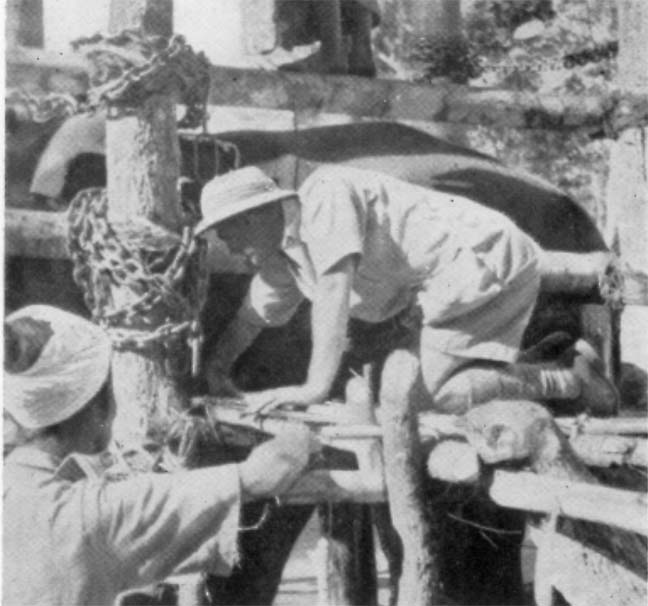 The author about to operate on a dangerous tusker in a "crush." The Burman in attendance is U Nwa, whose tragic death is recorded on page 215. |
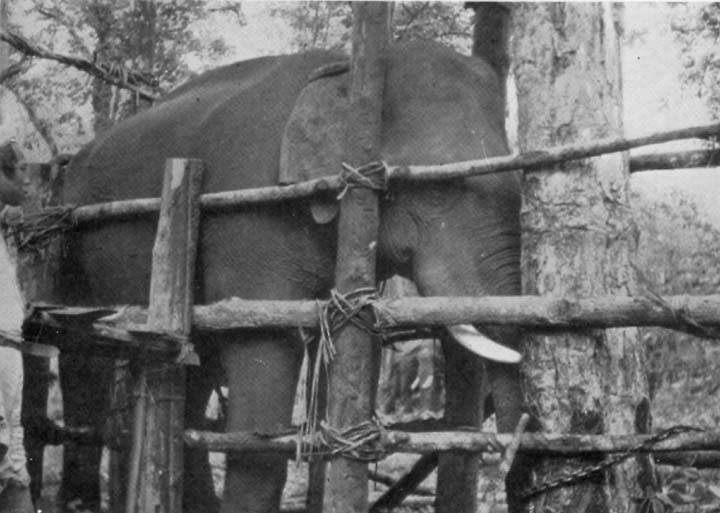 A tusker in a "crush" before an operation on his injured forefoot. |
I once returned a pony-saddle that I borrowed, but advised that it should be burned, as I had used it touring the anthrax area. The owner did not burn it, which caused great indignation on the station among all who owned polo-ponies. But nothing happened.
Just before the war, experiments in the use of local anæsthetics, and even of general anæsthetics, on elephants were carried out. No doubt these will be resumed one day. But up till the time of the reconquest of Burma, after the Japanese invasion, all elephant surgery was on old and somewhat primitive lines.
It needs confidence to walk under an elephant's jaw and tusks, armed with a bellied knife with a ten-inch blade four inches across in one's left hand, and a six-pound wooden club in the right hand, and then to tell him to hold up his head while you drive the knife up to the hilt into a huge abscess on his chest with one blow of the mallet.
One blow of the mallet is all you can get--if you try another, you must look out for squalls. The elephant does not like it. But if you do the job properly and make a quick and quiet get-away to his flank, he will let you go back ten minutes later to clean out the abscess with your hands and then syringe it with disinfectant. Abscesses on the back are dealt with in the same way, when the animal is sitting down in the "Hmit" position. Elephants will bear a great deal of pain patiently and appear to understand that it is being inflicted for their own good. But they will only put up with it when the operator is full of confidence in himself and feels he is making a good job of it. For an elephant can sense the absence of self-confidence quicker than any other animal in the world---and when one loses confidence it is high time to hand the knife and the club to someone else.
Wounds caused by tigers, most often received by mother elephants protecting their calves, are exceptionally difficult to heal, and frequently do not respond to the most modern antiseptics.
The Burman has cures for all the ills that may befall an elephant. Some are herbal, some are mystic spells and incantations, and some of them have had to be vetoed as being definitely harmful. But I have so far found no treatment for tiger-wounds that comes up to the traditional Burmese method of plugging the wounds with sugar. The Burman also used maggots to clean up gangrened wounds for centuries before the method was rediscovered in modern surgery.
It has been quite truly said that once an elephant goes down, owing to exhaustion or severe colic, he has only a twenty-five per cent chance of getting on to his legs again unaided. Any method of keeping him on his legs improves a sick elephant's chances of survival. The Burman will do this by putting chili-juice in his eye---a counter-irritant that must be agony. But it is effective, and about doubles the animal's chances of recovery. No matter how far modern research goes in the veterinary treatment of elephants, we shall always rely to a certain extent upon the Burman's knowledge.
I know, without question, that an elephant can be grateful for relief given to it from pain and sickness. For example, I remember Ma Kyaw (Miss Smooth, an expression often used to describe any Burmese girl with a strikingly good figure). She had fearful lacerations on the barrel of her back from tiger-claws, and I treated her for them every day for three weeks. In the early stages she suffered great pain, but although she made a lot of fuss---rather as an eight-year-old child might have done---she always gave way, because I was determined, and she let me go on. When she was sufficiently healed I sent her back to camp under a reliable Burman, with instructions that she was to be given light dressings of fly repellent on the wounds. I did not see her again for two months, when I was having a cup of tea in camp outside my tent, while seven elephants were being washed in the creek near by, preparatory to my inspecting them. The last animal to come out of the creek and to return to camp to dry off before inspection was Ma Kyaw. As she passed me, about fifty yards away, with her rider on foot, following at her heel and not on her head, I called out, more in order to greet him and show that I recognised him than because of any interest in the animal, which I was anyhow going to inspect in less than an hour's time, "How is Ma Kyaw's back?"
Her rider did not reply, as he had not caught what I said, but Ma Kyaw swung round, at right angles to the direction in which she was going, and came towards me.
She walked straight up to me where I was sitting. I patted her on the trunk and gave her a banana off my table, and then, without any word of command, she dropped into the sitting position and leant right over towards me, so as to show me her back. Having patted her I told her to "Tah" (get up), and away she went, leaving me with the agreeable conviction that she had come to say "thank you." Then I began to suspect that perhaps, on hearing my voice---with which she had become familiar---she had done it merely from habit.
But later on, when I inspected her, I got a surprise. She was the last in the row, and I went over her back very carefully, kneading the wounds with my hands, and I found one little hole which still suppurated. There was great tenderness along a line nine inches long where the wound had healed over. There was undoubtedly a sinus. Ma Kyaw let me open it up to its full length there and then, although my doing so obviously gave her great pain. But she was a good patient.
This made me think over the incident again. I can never be quite sure that she came and showed me her back in order to tell me that it was still painful. But I am sure that she liked me, trusted me, and was grateful, and that we were very good friends.
Besides the surgical side of looking after elephants, there is the medical side. This is not so much administering drugs and medicines as keeping the animals healthy so that they never need them. This means understanding the particular needs of individual animals. The elephant is not a ruminant, and has only one stomach. He has to collect about six hundred pounds of green fodder to fill that every day, and the most likely thing to go wrong is his digestion. To keep well he needs variety, but one has to see he doesn't pay too high a price for it. For example, an animal may be working in a place where there is nothing but bamboo fodder. To get the variety of food he needs, he may have to travel eight miles, and this he will do. But to do this every night after a hard day's work and to come back in the morning will soon pull him down. And in three weeks he may lose condition that will take him at least three months to recover. It needs a really experienced man to spot any loss of condition when inspecting an elephant. A good man ought to be able to answer the very frequent question, "Do you know every animal by name?" by replying, "Yes, and by its digestion too."
To divide up a herd of elephants into bunches of seven at random and allot each group to a different camp would soon be disastrous to the health of the herd. Animals have to be chosen so that the fodder available in the part of the forest in which they will work, corresponds to their individual needs. The type of ground, rocky or otherwise, precipitous or undulating, has to be taken into account. Moreover, the work they are expected to do must be adapted to their strength. Some can handle large timber, others only small logs.
Elephants' feet vary as much in size and shape as do those of human beings, although practically all of them have five toe-nails on the front foot and only four on the hind. But, in selecting animals for certain areas, one has to take their feet into account. Only elephants with well-shaped feet with thick ankles should work in mud.
Lastly, the sex of the animal is of the greatest importance in allocating work. Tuskers are needed more than females in forest areas where the timber is large and the country is very precipitous. Special tuskers, known as htoking elephants, do the work of clearing the log away from the stump and getting it to the dragging-path. Sometimes a tree, when it is felled, will skid three or four hundred feet into a deep ravine. Powerful animals with tusks are then required to htoke it up to the dragging-path after it has been cut into logs.