 |
 |
I HAVE always got on well with animals. I like them and, with one or two notable exceptions, they always seem to have liked me. When I was a boy in Cornwall my first animal friend was a donkey. He had free range over the moors, but I always knew where to find him. Then, during the World War of 1914-18, I was in the Camel Corps, and then, later on, Transport Officer in charge of a lot of mules. These experiences taught me much about animals, for both camels and mules are temperamental beasts, and mules have also a remarkable sense of humour, so that in dealing with them one gets plenty of exercise for one's own. That was valuable. My life has been spent east of Suez in places where if you lose your sense of humour you had much better take the first boat home.
And in one respect camels were a preparation for elephants, since the male camel, like the male elephant, is subject to coming into "season," or going on musth. In all other animals it is only the female that comes into season.
Like millions of other fellows, when the war was over I began to think about finding myself a job. A friend told me that he knew a man who knew someone else who knew a chap who did something or other with elephants in Burma. This sounded to me as though it would be just what I wanted, particularly as when I was in the Camel Corps I had read a small book called The Diseases of the Camel and the Elephant, by Hawkes. I took for granted that such a job would mean living in the jungle, shooting, riding ponies and putting up with a good deal of loneliness, though no doubt I should meet a fine crowd when I went on leave.
We looked up Burma in an atlas, and that night both of us wrote letters. My friend wrote to the fellow he knew, introducing me as a suitable candidate for elephant management, and I wrote direct to the head of the Bombay Burma Trading Corporation---the company concerned.
It was 1920 before I got back to England, but my letter led to an interview, and before the year was out I was in Burma.
My first vivid memories of Burma are not of the pagodas and rice-fields and all I had read about, but of my first jungle salt, Willie, the man under whom I was to begin my training. It is said that "you can take a man out of the jungle, but if he is born to it you cannot take the jungle out of a man." No man I ever met was a better example of the truth of this saying, or believed it more than he did.
I met him at his camp on the banks of the Upper Chindwin River, Upper Burma. He was, in his own words, down with fever, but he was sitting at a table, about mid-day, outside his tent, drinking a whisky-and-soda and smoking a Burma cheroot with as much loving care as if it had been a very fine Havana.
His welcome---if welcome it could be called---was icy, and I immediately guessed that he jealously resented anyone sharing his jungle life. I hoped that I should be able to break down that attitude and that then all would be well. It was, however, to take me some time to do so.
|
|
|
Although it is nearly thirty years ago, the following incidents seem to have happened yesterday. About four o'clock in the afternoon I asked for a cup of tea---and was laughed at for not drinking whisky-and-soda. I vowed, privately, that I would see him under the table later on. About five o'clock seven elephants arrived in camp, and were paraded in line as though for inspection. Willie did not speak one word to me as he got up from his camp chair and walked off to inspect them. However, I followed him, uninvited. Judging by appearances, there was one worn-out animal which looked as though it might be the mother of the other six. Each animal was closely inspected in turn, and Willie entered some remark about each one of them in a book. This took up about half an hour, during which he did not address a single word to me. I was careful not to ask any questions, as I saw that I should only be called a damned fool for my pains. However, when the inspection was over, Willie turned on me, saying: "Those four on the right are yours, and God help you if you can't look after them."
For all I knew, I was supposed to take them to bed with me. However, I saw no more of them till the next evening, when Willie told me to inspect my own four myself and to see that their gear was on their backs comfortably---as though I could tell! However, I followed a lifelong rule when in doubt: I trusted to luck.
After the inspection that first night, as my tent had been pitched near his, I joined Willie at his camp table.
On it were two bottles of Black Label---one of his and one of mine.
After half an hour or so Willie thawed sufficiently to ask me: "Are you safe with a shotgun?"---not "Do you shoot?" as is more usual.
Silence reigned after my answer. Willie emptied and refilled his glass several times. At last he suddenly opened up, and, passing his bottle to me, remarked: "I drink a bottle a night, and it does me no harm. If I never teach you anything else, I can tell you this: there are two vices in this country. Woman is one and the other the bottle. Choose which you like, but you must not mix them. Anything to do with the jungle, elephants and your work you can only learn by experience. No one but a Burman can teach you, and you'll draw your pay for ten years before you earn it. To-morrow I'll give you some maps, and the day after you must push off for three months on your own. You can do what you damned well like---including suicide if you're lonely---but I won't have you back here until you can speak some Burmese."
After this speech he walked off to his bed without even saying "Good night." Unfortunately the following day he heard me address a few words of Urdu, that I had picked up in India, to my Burmese cook. Willie just sacked him on the spot as being a hindrance to my learning Burmese.
At dinner that night he gave me some chili sherry of his own brew. The bottle had a sprinkler top, and I gave it two shakes, as though it were ordinary tabasco sauce. When I had swallowed a few mouthfuls of my soup he asked me if I were homesick. His chili sherry burned a hole in the roof of my mouth, but I finished the soup, and then, wiping the tears out of my eyes, replied: "No. But I'd like to start off on my jungle trip to-morrow."
That remark got inside his guard. For the time being his hostility collapsed, and he kept me another two days in camp.
Going to bed that night he was staggery; and when he got up from table he corked his empty whisky bottle and turned it upside down, saying:
"By dawn it will have drained its last pau peg into the neck. It'll do to lace my early morning cup of tea."
He ignored my "Good night" as he staggered off. The new recruit was not to be allowed to forget that he had disturbed the peace of jungle life.
I greeted him with "Good morning" at six a.m. next day.
He looked at me and replied: "Good Lord! you still here ?"
He had become just like the jungle---as hard and as unyielding and unfriendly as a tree seems when one is lonely. But a few years later he had become a great friend of mine. He accepted me slowly, as the trees and forests did.
After four and a half years' service in the Army I believed that I was past the age of adventures; but leaving on my first jungle trip certainly gave me a thrill. With four elephants carrying my kit, a cook, two bearers and two messengers, I was on my own again. After going nine miles it dawned on me that my life in charge of elephants had begun.
I started that trip in November, when every day was like a perfect English summer's day. Every evening a log fire beside my tent gave me the companionship of its warmth and the homeliness of its glowing embers. I moved camp for the first four days, so as to put sufficient distance between myself and Willie for me to feel reasonably sure that he would not pay me an unexpected visit---then I stayed in camp for a day to sort out my possessions.
I had been well equipped in England before leaving, with a new shotgun and a new 450/400 high-velocity rifle, and the Bombay Burma Corporation had issued me with excellent camp equipment. Among the treasures and curios it contained was a teak office box filled with books, circulars and papers for my information. The most interesting of them was a small textbook on elephant management by Hepburn, a young veterinary surgeon who had spent a few years as an Assistant with the firm, but who unfortunately had died of enteric. The book did not contain either a photograph or a diagram of an elephant, being concerned only with a brief account of the treatment of various accidents and diseases to which elephants are liable. My first impression was that they were likely to get every possible complaint to which man, woman and child are subject, except whooping-cough.
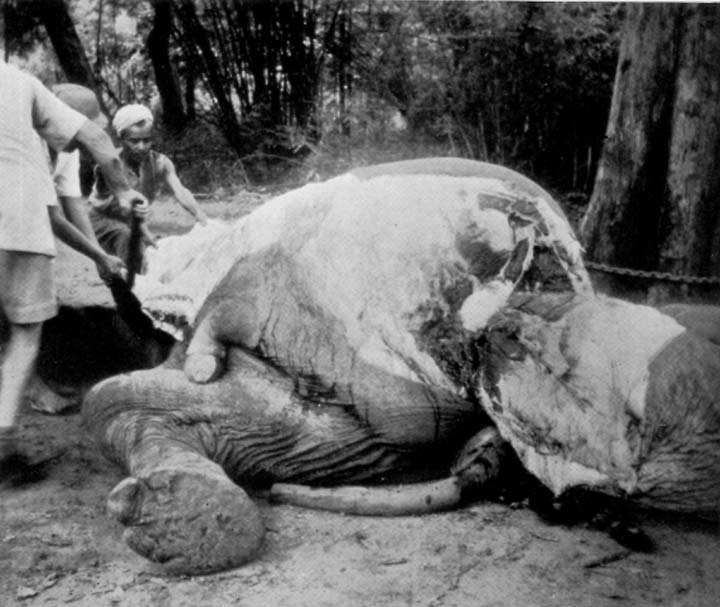
The book was, however, a gold mine, and all too soon I had to put it into use. For before I arrived at my destination the ancient female elephant known as Ma Oh (Old Lady) was discovered dead an hour before I was due to move camp. Willie had, I now know, somewhat unscrupulously palmed her off on me---and his terrible words, "God help you if you can't look after them," now rang in my ears. Seeing her enormous carcase lying in the jungle---just as she had died in her sleep---was a terrible sight, and it was awful that she had died within a few days of my being made responsible for her. How on earth, I wondered, should I get out of this mess? This was the nadir of my misfortunes. Willie's reception of me, the dead elephant, and his threat ringing in my ears, combined to fill my cup with bitterness. "At the worst," I thought, "I can only lose my job. I'm damned if I'll buy them a new one!" It was a bad business, but as I had no one to help me out, I had to help myself, and I decided that the best thing I could do was to hold a post-mortem and see what I could find inside to account for her death.
Tragedy soon turned into farce. The "Old Lady" was scarcely cold before I was literally inside her, with her arching ribs sheltering me from the sun. I learned a good deal about elephant construction from her. Spare parts galore had been hauled out and arranged neatly in a row before tea-time. Her carcase proved to be a cave full of strange treasures, such as the heart, the gizzard and the lungs. The only snag was that, do what I would, I could not find any kidneys, and I was almost tempted to conclude that she must have died for lack of them. However, when I came to write out a report that evening I decided that "no kidneys" might not be an acceptable cause of death---so, in desperation, I left it at "found dead," and did not even mention my Jonah's journey. Later on I found out that many strange explanations of the deaths of elephants were made by Assistants, and that most of them were taken with a grain of salt. The unwritten law of the Bombay Burma Company was that some cause of death had to be given if the deceased animal was under fifty-five years of age. Over that age the explanation of "old age and general debility" was accepted. If one is lucky one may get away with the explanation, "struck by lightning," once in one's career of twenty years---but one cannot try it twice. The Assistant who described an elephant as dying of "broken heart" did not get away with it, though he may have thought he had good reason if he examined the heart and found it looked as though it had been split in two, with two apexes instead of one, as in man and the lesser mammals. This formation of the heart is a peculiarity not only of the elephant, but of some of the other large mammals as well.
The loss of one transport elephant seemed to make no difference with the type of pack being used. Ma Oh's load was easily divided among the remaining three animals, and on I went. My instructions were to march to a certain village in the Myittha Valley, where I was to meet a head Burman named U Tha Yauk. I shall never forget his welcome. I was on foot with my messengers and the two bearers, and we had outdistanced the elephants by several miles by taking a short cut up the bed of the creek. U Tha Yauk had come some way out of the village to meet me, and was squatting on a rock beside the creek up which we were travelling. I think that he formed his first impressions of me before I had ever seen him. He heard me laugh with the Burmans before he saw me, and he watched me eagerly bounding from rock to rock before I had seen him. Then he saw my quick reaction on seeing him, and noticed the tone of friendly authority in my greeting. I think these little things may have counted in my favour.
I greeted him with my three words of Burmese and laughed because I could say no more, and he laughed back; then we marched on in single file until we came into a big open clearing around which there were about ten bamboo huts, all standing on bamboo stilts and thatched with grass. A Burmese girl dressed in her best, with a pretty little white coat, and a flower in her hair, came forward with a cane basket-work stool for me to sit on. Three men came up with green coconuts and, cutting them open at one end, poured the juice into a cup of hand-beaten copper and gave it to me with the reverent gestures of priests administering the sacrament. I drank off at least six cups of the cooling drink before I realised that a dozen people had gathered round to stare and gaze at me.
Unfortunately, I attracted quite as much attention from all the biting bugs and flies as from the Burmans. But at once a small boy came forward, and offered me a fan to keep them off. In order to interest him and make some return, I first showed him a handkerchief on which there was a design of a fox, with hounds and a huntsman, and then tied it round his head. The watching crowd laughed with delight. I was relieved when U Tha Yauk and his son-in-law, who could speak a few words of English, reappeared and explained that the elephants would soon arrive, but that, as it was already late in the afternoon, it would be better if I were to sleep in the hut reserved for my occupation during the monsoon rains.
Directly the elephants turned up, the crowd moved off to help unload them, and my cook was at once installed in his hut. In a few minutes a chicken had been killed and plucked, a fire lit and cauldrons filled with water. My kit was soon piled up in one corner of the big room twenty-four feet by sixteen, which was divided into my bedroom on one side and my livingroom on the other, by a bamboo matting wall.
In a quarter of an hour the room was furnished---with a ground-sheet covered with bright blue cotton dhurries on the floor, my camp bed, camp tables and camp chair; my bedding roll was undone and the mosquito net put in position. Meanwhile other Burmans were filling my tub in a bathroom at the back of the hut with tins of water from the brook. After dismissing the other helpers, my personal servant unlocked my basket packs and took out photographs to arrange on my dressing-table, and my revolver, which he put carefully under my pillow. Then, when all was ready, he asked me to come in. As soon as I had looked round and sat down, he took off my puttees and boots, and then disappeared. When I had undressed and gone to the bathroom, I found a Burmese boy, who poured two buckets of hot water into my tub and swirled it around, giving me a smile, as though to say: "Bath ready, sir."
I bathed, and by the time I went back into my hut I found the table was laid with a spotless white cloth, and that flannel trousers, socks and white shirt were spread out on my bed, but that my perfect valet had once more vanished.
My dinner was ready, and as I finished each course hands of unseen attendants passed up the meat and vegetables, the sweet and savoury to my valet, who stood silently behind my chair as I ate. While I drank my coffee, he drew down the mosquito net and tucked it in, and then gave a graceful bow saying, though I could not understand him:
"By your leave I will now go."
Left alone, I was overcome by a great homesickness. The overpowering kindness of the Burmans was too much for me, and I asked myself what I had done to deserve it. Surely life in the jungle would not continue on such a pattern? It never dawned on me that the Burmans wanted to show their sympathy with me in my loneliness and my ignorance of their language and all the difficulties that lay ahead.
NEXT morning a new life began---my life as a pupil of U Tha Yauk. Fortunately, he was as eager to teach me and to show me everything as I was enthusiastic to learn. Every waking moment I had to study jungle lore, to observe every detail and, in particular, to observe elephants and all their ways.
That morning I woke to the sound of elephant bells of varying notes, and the camp was astir before I had dressed, shaved and had my breakfast. While I was drinking my tea I could see that the camp was already full of elephants standing about unattended, and that three or four groups of Burmans were squatting round having their early morning meal of boiled rice. Each man had a heap of it, steaming hot, served on a wild banana leaf instead of a plate. Not a word was spoken while they ate, and as each man finished he rinsed his mouth and washed his hands from a coconut-shell cup of water. Then he walked off to his harnessed elephant, mounted in silence, and in silence the elephant and its rider vanished into the jungle to begin their day's work. But before they had all gone U Tha Yauk was waiting for me.
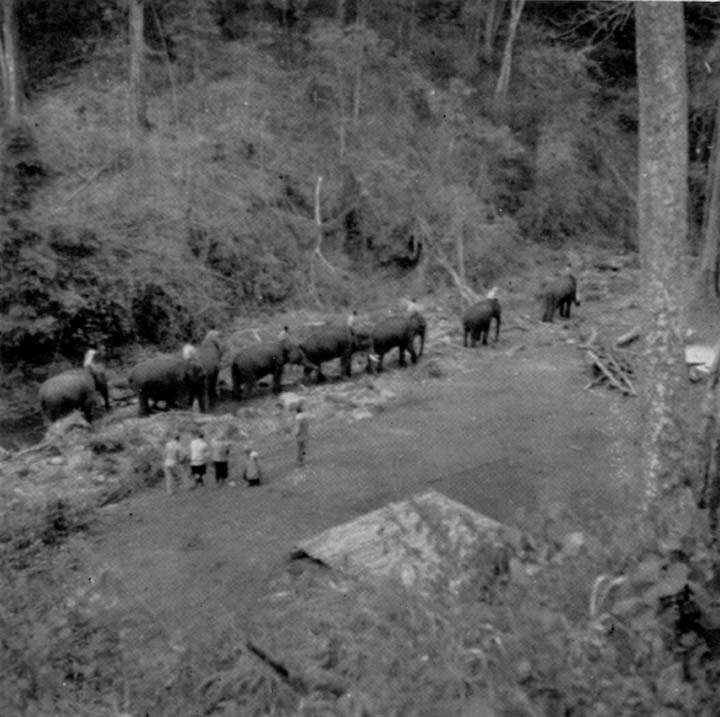
With the aid of a good map of the Indaung Forest Reserve, he made me understand I was to go on a tour with him from the valley, crossing the creeks and climbing over the watersheds, and so on, up and down, crossing in all five parallel creeks flowing from east to west into the Myittha River. On the sides of each of the watersheds he had a camp of elephants, ten camps altogether, each with an average of seven elephants, or seventy working animals all told.
Judging from the map, the distance between the camps was six to seven miles, with hills three to four thousand feet high between each. No tracks were marked, the whole area of about four hundred square miles was divided into numbered and demarcated areas, though the boundaries were irregular, as they followed the natural features of creeks and ridges.
At the first camp we reached I found about twenty Burmans, including a carpenter of sorts, erecting a set of jungle buildings. It was explained to me that this camp was to be my headquarters during the coming monsoon months. I soon realised that the elephant was the backbone of the Burmese teak industry.
The history of the Bombay Burma Corporation went back to the time of King Theebaw, when a senior member of the firm, who visited Burma, appreciated the great possibilities of the teak trade and was able to obtain a lease of certain forest areas on agreeing to pay a fixed royalty per ton of teak extracted.
As a result, sawmills were established at the ports, and forests previously regarded as inaccessible were opened up, a system of rafting teak-logs down the creeks and rivers was organised and elephants were bought on a large scale. Teak is one of the world's best hardwoods, partly because of the silica it contains. In the mixed deciduous forests of Burma, teak grows best at heights between two thousand and three thousand feet in steep, precipitous country, though it is also found in the rich valleys. The trees often stand ten or twelve to the acre, but usually only one tree---the largest---is selected, and the remaining trees, which are immature or under the girth limit, are left for the next cycle of felling, which is probably twenty-five or thirty years later. Under this system the teak forests would never be exhausted. The tree chosen is killed by ringing the bark at the base, and the dead tree is left standing for three years before it is felled, by which time the timber is seasoned and has become light enough to float; for green teak will not float. As teak grows best in country which is inaccessible to tractors and machinery, elephant power is essential for hauling and pushing the logs from the stump to the nearest stream that will be capable of floating them during the flood-waters of the monsoon months.
When the logs reach the main water-ways they are built up into rafts, which are floated down the rivers to Rangoon or Mandalay. There they are milled and the squared timber shipped to the world markets.
Not only do the streams, creeks and rivers vary very much in size, but the degree of flooding during the monsoon spates varies with each, and depends on the size and situation of the catchment area feeding it. A great deal of experience is required to judge how high the flood will reach---or, in other words, below what level the logs must be hauled. There are all sorts of natural indications to enable one to judge this, that one learns in time. Debris from last year's floods caught up in bushes is a good guide, but often does not last from one year to the next. Less obvious indications are that jungle weaver-birds, which build near the creeks, never let their pendulous nests hang low enough to touch floodwater, and that lower down, near the rivers, turtles lay their eggs only above the level of the highest flood.
All such pointers are invaluable, for much work will be wasted if the logs are hauled far below flood level. On the other hand, an error of judgment in leaving them too high may make all the difference between the logs taking eight years instead of one to reach Rangoon, a thousand miles away.
The value of the logs depends greatly on their being cut up at the stump to the best advantage. There are specialised demands for different types of logs. The "English Square" for shipment to Europe and South Africa requires the greatest length possible without defects, while for "White Star"---the old ship-building term---logs yielding large flitches are required, and so on. A lot of clearance work is necessary in the jungle. Gorges have to be blasted clear of the huge boulders in their beds, which if left would trap the logs in jams when they were coming down on a spate. Dragging-paths have to be cut through the jungle for elephant haulage, and these have to circumvent natural obstacles such as cliffs, ravines and waterfalls. The Bombay Burma Corporation had to build up herds of elephants. Some were bought, mostly from Siam, but a few also from India. The majority were, however, obtained by capturing wild elephants in Burma and breaking them in. This process is known as "kheddaring," and Burmans, Karens and Shans employ rather different methods in carrying it out.
When, however, the Bombay Burma Corporation had built up considerable herds of elephants, it realised the importance of the elephant calves born in captivity. These could be broken in and trained much more easily than captured wild elephants. Finally, when the Corporation's herds had nearly reached a strength of two thousand animals, it was found that births balanced the deaths, and that new supplies of elephants were required only on rare occasions. The kheddaring of wild elephants, on any extensive scale, thus came to an end, as it was unnecessary.
The health, management and handling of the elephants in this enormous organisation impressed me as the factor on which everything else depended. I well remember wondering how many people who had waltzed on the teak deck of a luxury liner had ever realised that the boards of which it was built had been hauled as logs from the stump by an elephant in the Burma jungles.
The routine work of elephant management in camp consisted in checking up gear-making, getting to know the oozies, or elephant-riders, inspecting elephants and dressing any galls caused by gear rubbing or wounds caused by bamboo splinters in the feet, and other common injuries.
For my early training in all these tasks I am indebted to U Tha Yauk. After our first trip we spent several days in camp. During these early days there often seemed no hurry to teach me anything, but I mixed freely all day with everyone, forever asking questions and being given answers packed with information that I had to remember. I went back to my hut for a curry lunch and for a cup of tea, and it was on such an occasion, I remember, that I first watched a most fascinating sight. About a hundred yards below my hut was a large pool in the brook.
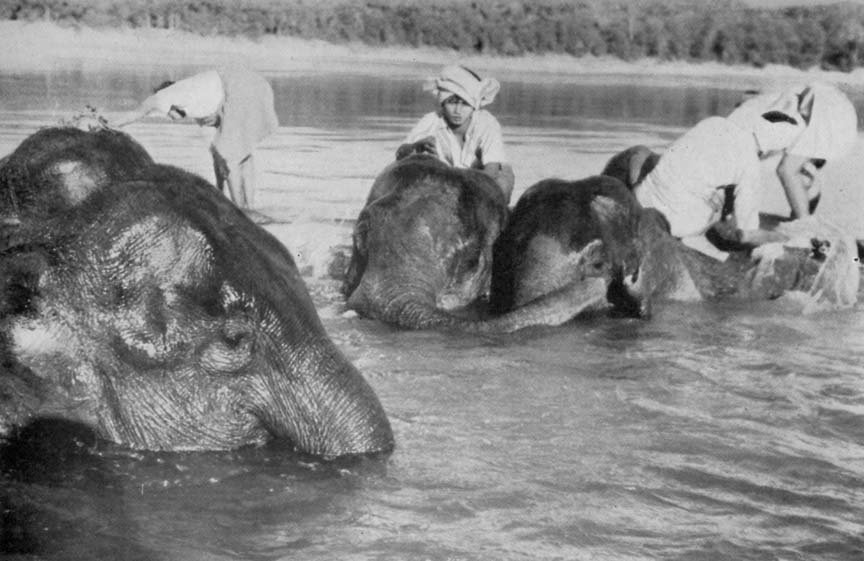
Two elephants, each with her rider sitting behind her head, entered the pool, and then, without any word of command that I could hear, they both lay down in the water. The riders tucked up their lungyi skirts so that they were transformed into loincloths, slipped off their mounts into the water, and began to scrub their respective elephants from head to tail with a soap which lathered freely. Then they washed it off the elephants, splashing water over them with their hands. The soap they were using turned out to be the soapy bark of a tree. Soon I was standing on the bank of the pool, and from there I watched five elephants being washed in the same way. Two of them were cows with young calves, which rolled over and over and played in the water like young children. There were also two large males, with gleaming white tusks, which were scrubbed with handfuls of silver sand.
After they had all been washed and dried off, the elephants were paraded for inspection---all drawn up in line abreast---with each of the riders dressed in his best.
U Tha Yauk advanced with military precision and, after bowing instead of saluting, handed me the books, all ragged and torn, but on the covers of which each elephant's name was written.
I looked at one book and called out the name of the elephant; and the rider, hearing me, rode it up to me at a fast, bold stride. Rider and elephant both had a sort of natural magnificence. Then the oozie halted the animal just before me. He was a splendid beast, with his head up, his skin newly scrubbed but already dry in the sun, a black skin with a faint tinge of blue showing through it, which seemed to make it so alive. The white tusks, freshly polished, gleamed in the evening sunlight. The rider was motionless, with one leg bent, on which he appeared to be sitting, and the other dangling behind the elephant's ear. On his face was an expression of intense pride---pride in his magnificent beast.
Suddenly he gave a sharp order and the elephant swung swiftly round to present his hindquarters, on which there was a brand, made with phosphorous paint when the animal was six years old.
I opened the book and read a number of entries, each with the date when he had been inspected during the last ten years. On the front page was the history of the animal with his registered number and all sorts of details---such as that he had been born in Siam, bought when he was twenty years old, badly gored by a wild tusker, but had fully recovered after being off work for a year.
Thus I inspected each of the animals in turn and read their histories. As each inspection was finished the rider and elephant left the clearing and disappeared into the jungle.
When they had all gone I was taken round the harness-racks---just a row of horizontal branches of trees on each of which hung one of the animals' gear. All the harness except the heavy dragging-chains was handmade by the riders. There were great cane basket panniers, woven breast-straps of fibre, wooden breeching-blocks, padding from the bark of the banbrwe-tree, ropes of every kind twisted from the bark of the shawtree.
|
|
 |
 |
|
|
|
One evening, as I passed the camp huts on the way back to my own, I noticed a Burmese girl unlike any Burmese girl I had seen. Her skin was a different colour and she looked ill. She was rocking a bamboo Moses basket hung in the shade of one of the huts.
She gave me a pleasant smile, so, plucking up all my courage, I went up to her, gave the cradle a swing and peeped inside at a new-born baby which was fast asleep.
Now that I was close to the girl, I saw that her peculiar yellow colour, so unlike the natural pale bronze of the Burmese, was due to something smeared over her skin---a saffron lotion used by Burmese women after childbirth.
In those first three months on my own I did most of the things worth doing in Burma. Tha Yauk helped me to achieve my ambition of shooting a wild bull elephant. My main reason for shooting him was not to secure the tusks, much as I coveted them, but to carry out a post-mortem so as to see what the organs of a really healthy elephant looked like, and make another attempt to find the kidneys. This second post-mortem taught me a good deal about what had been wrong with Ma Oh. In fact, it showed me half a dozen sufficient reasons why she must have died.
After three months, which passed all too soon, I returned to Willie, having learned a great deal since I had left him. Naturally, when I arrived I got the greeting I expected: sarcastic remarks about my having let one of my elephants die in the first two days---no doubt by having overloaded her with all my blasted new kit.
I replied that I was surprised that she had lived as long as she had. Her liver was riddled with flukes, and her heart was as big as a rugger ball.
"How do you know how big an elephant's heart ought to be?" snorted Willie.
"I shot a wild tusker that Tha Yauk told me was forty years old, and I did a post-mortem on him in order to see how the organs of a healthy elephant compared with hers. His heart was only the size of a coconut."
Willie's whole attitude to me changed after I said this. What pleased him was that I had shot an elephant, not for its tusks, but in order to learn more about elephants. For Willie, like most men who live long in the jungle, hated big game to be shot. He felt far more sympathy with any creature which was part of his jungle than with any new arrival, armed with all his new kit.
That evening I became a companion with whom he could enjoy rational conversation, instead of an interloper who had to be bullied and kept in his place. What I told him about shooting helped, for he was a magnificent jungle-fowl shot. I showed him my diary, and the bags of jungle-fowl I had made in the evenings, using my elephant-riders as beaters, surprised him. I had found a very good ground for jungle-fowl in an area where he had not shot, and he saw we had something to talk about. What this really led to was gin before our whisky and then double rations of that. We had jungle-fowl that I had brought back with me for dinner, and we sat up drinking for a long time afterwards. I did not see him under the table, as I had once promised myself, because he gave up the contest by falling asleep in his chair.
I did not dare wake him, and went slowly to bed. At last I saw him get up and move over towards the fire, as though to shift a log. Next moment he had overbalanced into it. I raced from my tent to save him. He had rolled out of the fire, and I pulled him to his feet. He stood up perfectly to attention and said very sternly:
"What the hell are you doing? Do you insinuate that I am drunk?"
To this I replied: "No. But you've burned your arm badly."
He then ordered me to my tent and told me to mind my own business. This was more than I would stand and I turned on him, saying:
"Well, if you fall in again, I shall let you sizzle."
He appeared absolutely sober at once. The shock of being spoken to in such a way by a young subordinate had been greater than that of the red-hot embers.
Next morning we were back where we had started, but I could see that he was feeling sorry for himself. It was two days before he was forced to swallow his pride and ask me to dress his arm for him. The ground lost over the bottle was regained by tactful bandaging, and I think it was from that time that our friendship really began.
But the way in which I had pleased him was by my interest in elephants. His great ambition had been to get someone who would take up the subject of elephant management seriously, and it seemed to him that I might be the man he wanted.
Before I left him, two or three days later, he had advised me to take up elephants and to make them my chief concern and my life's work. I thus owe a great debt of gratitude to Willie.
The job of extracting teak and delivering it a thousand miles away has many branches, and European Assistants took up different aspects of the work. Up till that time nobody had specialised in trying to improve the management of elephants. Most of the details concerning it had been left to the Burman.
The average European Assistant joining any of the large teak firms in Burma was put in charge of a forest area bigger than an English county. In it were scattered a total of a hundred elephants, in groups of seven. By continually touring during all the seasons of the year, he might be able to visit every camp about once every six weeks. In such conditions it would be a long time before he learnt to know his elephants even by name, still less by sight; and it would be a very long time indeed before he knew their individual temperaments and capacities for work.
I was more fortunate, as I was made responsible for seventy elephants, all working in a fairly small area. I was thus often able to visit my camps twice a month and to spend longer in each of them.
What follows is largely the result of my having the luck to start in conditions that enabled me to get to know my elephants really well.
THERE are three distinct species of elephant, one Asiatic and two African.
The Asiatic elephant is the one most frequently seen in zoos and circuses, as it is easily tamed. African elephants are rarely seen in captivity and are very rarely broken in for work, but the large African elephant is well known by sight from photographs and films of African safaris.
Four races of the Asiatic elephant are recognised: the Indian or Burman, the Ceylonese, the Malayan, and the Sumatran. All these are very similar, and differ from the African elephant in having much smaller ears and a smooth, tapering trunk; the female Asiatic elephant has no tusks.
In the Ceylonese race tusks are absent in both male and female. This has been attributed to the fodder available on the island. The Ceylonese elephants do not work in harness, but will drag a rope gripped in the mouth and teeth.
The African elephant is a taller and more lanky animal than the Asiatic. It is easily recognised by the large ears and the segmented trunk. One exhibited by Barnum and Bailey was ten foot nine inches high at the shoulder.
There are four races: the Central, Sudanese, Eastern and Southern varieties.
It is often stated that the African elephant is not capable of being domesticated. This is not entirely true, but specimens kept in captivity have usually had more uncertain tempers than the average Indian elephant. The reason why African elephants are so seldom domesticated is partly because the negro races have not the temperament to attempt the task and have no tradition of working with elephants. The elephant, moreover, is far more useful for dragging or pushing heavy weights than as a beast of burden. The African elephant is not so well proportioned for dragging heavy weights as the Asiatic animal. It lacks the short hind leg, and the hindquarters do not fall away to the same extent. The tusks of the African elephant are far more massive. A pair on exhibition in New York weigh two hundred and ninety-three pounds, being eleven feet five and a half inches and eleven feet in length, respectively, and eighteen inches in circumference at the base.
At the time of writing a movement is on foot for importing Burman or Karen elephant-men into Tanganyika in order to capture and train African elephants. If this is undertaken as a last attempt to effect jungle clearing for the British Government Groundnuts Scheme, I shudder to think what the eventual cost will be to the British taxpayer.
It is true the Portuguese East African elephant has been used in harness, and I have seen photographs and read an account of this successful experiment. But the work done was never heavy, and did not go beyond dragging small cultivators and ploughs, and it required little expenditure of energy by the animal.
The African pigmy elephant is a distinct species, limited to the equatorial and Congo region. The largest males are said never to exceed seven feet in height. Specimens of the pigmy elephants have been kept in captivity, and I have seen all three species in America. The ears of the pigmy are similar in shape to those of the ordinary African elephant---like enormous cabbage leaves. The ears of the Indian elephant are triangular, like the map of India, and when cocked never protrude above the head, like those of the African.
The African elephant is confidently stated to have been the species domesticated by the Carthaginians who employed it in their wars against Rome.
In 218 B.C. Hannibal began his invasion of Italy with an army of ninety thousand foot, twelve thousand horse and thirty-seven elephants. He is believed to have crossed the Alps by the Little St Bernard Pass. If this is correct, he at first made his way over the Mont du Chat through the Chevelu Pass and up the valley of the Isère before climbing the Little St Bernard. He descended by the valley of the Doria to Aosta. Part of his route was through a narrow defile, and there he was threatened by the mountain tribes who appeared on the heights. At the white rock, still known as "La Roche Blanche," he halted his infantry and sent his cavalry and beasts of burden ahead to the top of the pass. The next day, the ninth, he stood with his army on the highest point and addressed cheering words to his half-frozen Africans and Spaniards.
The descent was difficult and dangerous. The Italian side is steeper than the French, and the slopes were covered with freshly fallen snow. Three days were spent in constructing a road for the elephants and horses. Three days later the army reached the valley of Aosta. But his army had shrunk to twenty thousand infantry and six thousand cavalry. The casualties among the elephants are not recorded.
Hannibal's feat of taking the elephants over mountain passes and along narrow mountain tracks is of immense interest to me, as I have faced and overcome a similar problem myself. Since Hannibal crossed the Alps during the autumn, and early snow had only just fallen on the Italian side, there must have been fairly plentiful fodder for the elephants for the greater part of the time. Thus they did not have to rely entirely upon a grain ration.
It is not clear what his object was in taking the elephants with him. They cannot have been for pack purposes, unless for some special load such as bullion, since their total load could not, at a maximum, have exceeded forty thousand pounds.
The chief use of elephants in Indian wars was in battering open fortified defences during the final assault on beleaguered towns, and in particular in knocking down gates. The gates of Indian cities and fortified places were frequently covered with enormous iron spikes three to five feet long, so as to prevent elephants from battering them with their heads. It is possible Hannibal wanted the elephants for sieges. But it is more probable that they were taken as a form of psychological warfare. Among the ancients, rumours and news became even more exaggerated than they do to-day, and the appearance of unknown gigantic beasts trained to warfare would have been terrible in the extreme.
The most puzzling thing, and the only part I find difficult to believe, is that the elephants were African. It was physically quite possible for the Carthaginians to import young domesticated elephants by sea from India to Iraq, and then to march them overland, either to Tyre for reshipment to Carthage, or overland through Egypt and Cyrenaica. The Carthaginians were a maritime race of traders, and not Africans. One would expect them to buy elephants and mahouts and to ship them. One would not expect them to explore Africa, and discover the secret of capturing wild elephants and of breaking them in. If elephants were being captured, broken in and trained for warfare in Africa it is extraordinary that the Egyptians did not continue the practice. But no tradition of elephant-training has survived in Africa, and there is no record of elephants being used by any indigenous African people, whereas Indian history is full of accounts of the use of elephants in war. In India the elephant has been domesticated from time immemorial. There were elephants in the armies which sought to repel Alexander the Great. But, however formidable looking, they could not withstand the dash of his well-armed and disciplined troops.
If an elephant's trunk is injured the animal becomes unmanageable, and wounded beasts probably did more damage to their own side than to the enemy. Sometimes elephants carried great wooden towers capable of holding, it is said, thirty-two soldiers. These were archers.
From A.D. 1024 onwards elephants are mentioned in trains of thousands in the Wars of the Princes; and those who are familiar with the subject find no reason to question such figures. After the battle of Delhi, Prince Timour is stated to have captured three thousand elephants from Prince Mohammed. It is said that they all had snuff put into their eyes so as to make them appear to weep tears of grief at having been defeated.
Indian elephants were on the strength of the Royal Engineers up till 1895, when Daisy, the last and oldest pensioner, died.
In India itself elephants have gradually disappeared. Only a few are kept by the princes for ceremonial purposes and shikar-shooting. The elephant is, however, an animal in which every Indian is interested, and it is invested in a haze of myth and legend which delights children and is a source of pride to the descendants of India's ancient warriors.
It is impossible to understand much about tame elephants unless one knows a great deal about the habits of wild ones. The study of wild elephants usually entails shooting a few of them at some period, either deliberately for sport or ivory, or in self-defence. Most men who have shot elephants come afterwards to regret having done so---but "to hunt is to learn."
The only attempted census of wild elephants in Burma is contained in Big Game in Burma by E. A. Peacock, who puts their number at three thousand. If I were to hazard a guess, I should double that figure, but all one can really say is that they are plentiful.
Wild elephants normally live in herds of thirty to fifty, and during the year cover great distances, chiefly in search of fodder. During the monsoon months---from June to October---they graze on bamboo in the hilly forest country, sometimes remaining on one watershed for a week or ten days, after which they suddenly move ten miles for another week's stay on another slope. After the monsoons are over they move into the lower foothills and the swamp valleys, feeding more on grass and less on bamboo.
It is at this time that the full-grown male tuskers join the herd, though they seldom actually enter it, preferring to remain on its outskirts, within half a mile or a mile of it. At this season they do their courting and mating, in the course of which the older bulls often have to fight some youngster who is pursuing the same female.
The herds know their yearly cycle of grazing grounds, and in their annual passage wear well-defined tracks along the ridges of the hills. In places where they have to descend from a precipitous ridge down the side of a watershed they will move in Indian file, and by long use will wear the track into a succession of well-defined steps.
Wild elephants hate being disturbed on their feeding-grounds, but they do not usually stampede suddenly, like many other herds of big game. With an uncanny intelligence, they close up round one animal as though they were drilled, and their leader then decides on the best line of retreat. He leads, and they follow irresistibly, smashing through everything, like so many steamrollers.
If they cannot exactly locate the danger which threatens them, they invariably retreat along the track from which they have come while grazing, with their trunks on each other's backs, but in a formation of three or four abreast.
I once had the unpleasant, but exciting, experience of being a member of such a stampeding party, when I was mounted on one of my own elephants. The wild elephants were fortunately quite oblivious of the fact that Elephant Bill and tusker Po Sein (Mr Firefly) were among them. Fortunately my rider was able to extricate us from the party before they reached a muddy nullah with banks eight feet high. The leading elephants plunged their forefeet into the edge of the bank, broke it away, and, sitting on their haunches, made a toboggan slide for the herd following them.
Most wild elephant calves are born between March and May. I believe that, if she is disturbed, the mother elephant will carry her calf, during its first month, holding it wrapped in her trunk. I have seen a mother pick up her calf in this way. On two occasions I have found the tracks of a newly born baby calf in a herd. Later on, after I had disturbed them, there were no tracks of the calf to be found among those of the stampeding animals, nor could the calves have kept up with a stampeding herd. But there was no possibility of the calf being hidden or abandoned.
The birth of a calf is quite a family event in a herd of wild elephants, and I have on several occasions camped close to what I may call the maternity ward. For many years I could not understand the bellowing and trumpeting of wild elephants at night during the hot weather, when most calves are born. The fuss is, without any doubt, made by the herd in order to protect the mother and calf from intruders---in particular from tigers. The noise is terrifying. The herd will remain in the neighbourhood of the maternity ward for some weeks, until the new arrival can keep up with the pace of a grazing herd. The ward may cover an area of a square mile, and during the day the herd will graze all over it, surrounding the mother and her newly born calf, and closing their ranks round her at night. The places chosen, which I have examined after the herd has moved on, have been on low ground where a river has suddenly changed its course and taken a hair-pin bend. These spots were thus bounded on three sides by banks and river. The kind of jungle found in such places is always the same. They are flooded during the rains, but during the hot weather---the normal calving period---they are fairly dry, with areas of dense kaing, or elephant grass, eight to twelve feet high, with an occasional wild cotton-tree giving shade. They are eerie spots, and to explore them is an adventure. Wild pig breed in the same type of jungle, and harbour their sounders of sucking pigs under huge heaps of leaves and grass which in size and appearance resemble ant-heaps four feet high.
It is common practice for a Burman oozie, or elephant-rider, to ride his elephant silently up to such a "pig's nest" of leaves and grass and then, silently controlling the elephant by movements of his foot and leg, to instruct him to put one forefoot gently on the mound.
Squeals and snorts usually follow from the old sow, and three or four sucking pigs join her in a stampede.
Once while an elephant did this I had the good luck to bag a right and left of sucking pig for the camp pot from an elephant's back. It was ridden by an oozie called Kya Sine, who knew every trick of the jungle and became my gun-boy until his death.
It is a peculiar thing that the elephant, which becomes so accustomed to man, and has such confidence in him once it has been trained, should be so afraid of him in its wild state. Owing to this fear of man, they do surprisingly little damage to village crops, considering the vast numbers of wild elephant. They much prefer their own deep jungles, and seldom leave them. The damage that they do has been greatly and most unfairly exaggerated, and the extermination of wild elephants in Upper Burma was actually started on unreliable advice. Solitary animals may, however, do great damage and become bold enough to drive off any human intruder who shows himself. They will do this almost as though they thought it was a joke. Such animals, however, are always eventually declared rogues and are killed---or at least shot at, or caught, or injured in traps.
Before the Japanese came into the war in 1941 we made it difficult for the Burmese cultivators to obtain arms. It was not that we distrusted the villagers themselves, but if one of them was known to own a firearm, the local robbers or dacoits were likely to steal it. Many robberies were carried out with one firearm in order to obtain a second. Rightly or wrongly, when a villager was allowed to possess a gun, it was usually a twelve-bore shotgun, which is scarcely an ideal weapon with which to kill a wild elephant. The Burmese villagers did their best with what they had, and a common practice was to remove the shot from a twelve-bore cartridge and then plug it with a pointed roasted cane about three inches long. It protruded about two inches from the cartridge-case, and was firmly fixed in with molten wax to make all as gas-tight as possible. Such a cane dart carries fairly accurately for about thirty yards, and if an elephant is wounded in the foot by one, the dart usually becomes deeply embedded and sets up such severe inflammation that the animal goes dead lame. In such a case it abandons cultivated crops and takes shelter in the jungle. I have sometimes had my own elephants wounded by these darts, and, indeed, have had to employ the same unpleasant method to capture savage animals that had gone wild after being loose for a long time. The operation of removing one of these darts from the foot is extremely difficult to perform and, like all operations on the foot, is exceptionally painful to the animal.
Ordinary fences round crops are no good as a protection against elephants. The Burma Posts and Telegraphs know only too well that an elephant has merely to lean against a telegraph post in order to push it over, and has only to grip it with its trunk and give a heave to pull it up with ease. And no ordinary fences have posts stronger than telegraph poles. The only effective fence against elephants is what is called the punge. This is often used as a trap, and it was a godsend to the XIVth Army, which often employed it instead of barbed wire. The punge fence, or trap, is made of a series of sharpened and lightly roasted, or smoked, bamboo stakes of varying lengths. One end of each is stuck into the ground at an angle of thirty degrees, with the point upwards and facing outwards. On the outside of the fence, concealed in the undergrowth, are very short stakes, protruding only three or four inches out of the ground, and behind these are stakes gradually increasing in length, the longest sticking out four or five feet. The depth of the fence may be as much as eight or ten yards.
I have seen wild boar stampeded down a track across which a punge fence had previously been erected. They were killed outright, skewered through the chest and out between the shoulder-blades.
If an elephant charges a punge fence, a stake may easily pierce right through the foreleg before snapping off. On one occasion I had to extract such a stake, gripping the point with a pair of blacksmith's tongs and pulling it right through the leg. For, like a barbed fish-hook, a piece of bamboo cannot be withdrawn by the way it has entered.
Pit-traps which occur so frequently in books about elephant-hunting are very uncommon in Burma. I think the Burmese elephant is too intelligent to fall into them. An effective and heinous trap which killed one of my own elephants was a spear, about the size of a ship's spar or a light telegraph pole, heavily weighted and suspended in a tree over a game track. The release was by means of a trip-wire rope, and the spear came down with such force as to transfix the elephant, smashing his ribs and piercing his intestines. It must have taken at least a dozen men to erect this trap. I never traced the culprits. When I tackled them on the subject, all the villagers within a hundred miles round would only say that the tree must have grown like that.
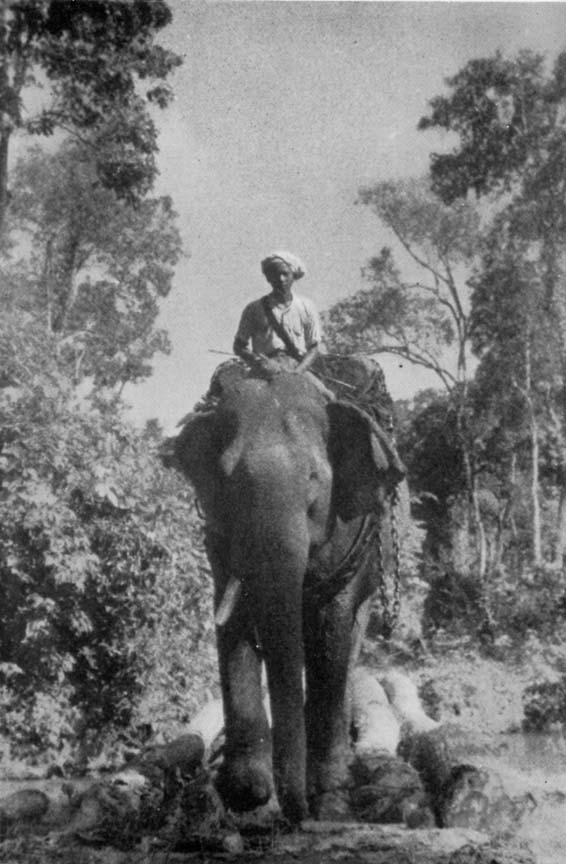
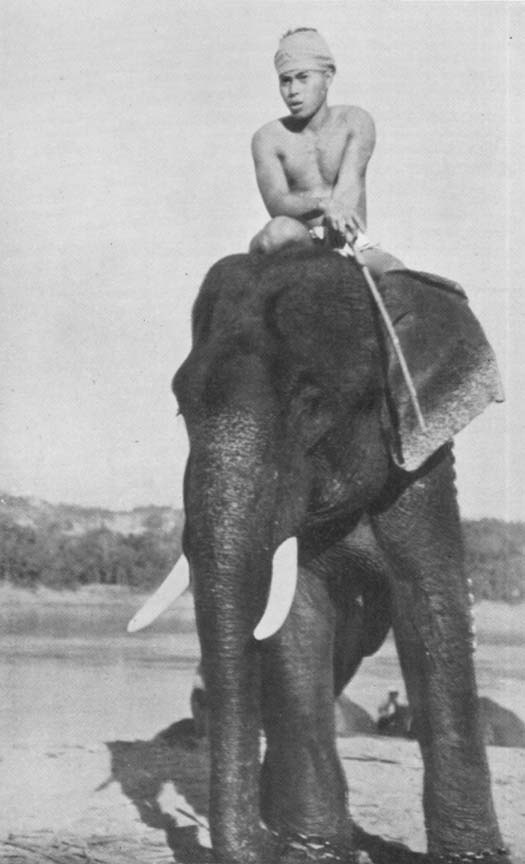 Inseparable. This young oozie is almost part of his animal. They are both about the same age, twenty-one. He is a Shan, with pale copper skin, and the elephant has pink edges to its ears and trunk contrasting with its blue-black hide. |
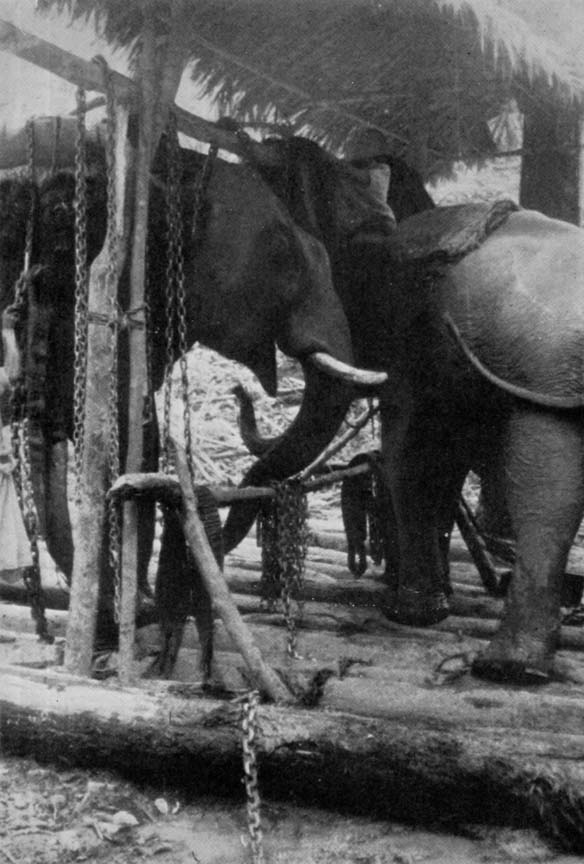 Elephants being saddled before work. The log floor is to avoid a quagmire of mud under the saddle rack. |
Wire ropes of all sizes have become common in the jungle, and the simple wire noose can be very dangerous, and terrifies elephants, as the trunk is often caught; and if an elephant's trunk is seriously injured it will die of starvation, since everything it eats has to be torn down or pulled up and handled by the trunk.
The noose-trap is set with a very stiff but flexible sapling bent over as a spring. When anything is caught in the snare the sapling springs up and pulls it tight.
I was once confronted by a full-grown Himalayan black bear hanging by the neck, with his hind legs dangling three feet off the ground. The spring of the sapling jerking the wire noose must have broken his neck, as there were no signs of a struggle. I was glad it was the bear and not me; for I might easily have put my foot through the noose.
Herds of wild elephants are not always suspicious of danger. I have on many occasions ridden on one of my own tuskers into a herd of sometimes as many as fifty animals. Sitting on my own elephant, I have passed so close to a wild one that I could have struck a match on his back. Without being detected, I have watched and photographed wild calves of different ages playing in a mud wallow, like children playing at mud pies.
The mating of wild elephants is very private. The bull remains, as usual, outside the herd, and his lady love comes out where she knows she will find him.
She gives the herd the slip in the evening, and is back with them at dawn. Sometimes a rival tusker intervenes, and a duel ensues. This is why elephant-fights are always between two bulls. There is never a general dog-fight within the herd.
Elephant bulls fight head to head and seldom fight to the death, without one trying to break away. The one that breaks away frequently receives a wound which proves mortal. Directly one of the contestants tries to break off and turn, he exposes the most vulnerable part of the body. The deadly blow is a thrust of one tusk between the hind legs into the loins and intestines where the testicles are carried inside the body. It is a common wound to have to treat after a wild tusker has attacked a domesticated one.
Some males never grow tusks, but these tuskless males are at no disadvantage in a fight, although to outward appearances they are the eunuchs of the herd. This impression is quite wrong. From the age of three all that the animal gains by not having to grow tusks goes into additional bodily strength, particularly in the girth and weight of the trunk. As a result, the trunk becomes so strong that it will smash off an opponent's tusk as though, instead of being solid ivory, it were the dry branch of a tree.
From the time that a male calf is three years old there is always interest among the oozies as to whether it is going to be a tusker with two tusks, or a tai (with one tusk, either right or left), or a han (a tuskless male, but with two small tushes such as females carry), or, lastly, a hine, which has neither tusks nor tushes.
One of the most delightful myths about wild elephants is that the old tuskers and females drop out of the happy herd life when they realise they are no longer wanted, and that they finally retreat to die in a traditional graveyard in some inaccessible forest. This belief has its origin in the fact that dead elephants, whether tuskers or females, are so seldom found. I wish I could include a description here of how I had discovered one of these graveyards. But since I cannot, I shall try to explain away the myth by describing what really happens. I will take the case of a fine old bull that has stopped following the herd at about the age of seventy-five and has taken to a solitary existence. He has given up covering great distances in a seasonal cycle, and remains in the headwaters of a remote creek. It has become enough for him to devote all his time to grazing, resting and taking care of his health. His cheeks are sunken, his teeth worn out. Gathering his daily ration of six hundred pounds of green fodder has become too great a tax on his energy, and he knows he is losing weight. Old age and debility slowly overtake him and his big, willing heart. During the monsoon months he finds life easy. Fodder, chiefly bamboos, is easily gathered, and he stays up in the hills. As the dry season approaches, fodder becomes scarcer, and the effort of finding food greater, and he moves slowly downhill to where he can browse on the tall grass. Then, as the hot season comes on, and there are forest fires, he is too tired and too old to go in search of the varied diet he needs, and his digestion suffers. Fever sets in, as the showers of April and May chill him, and he moves to water---to where he knows he can always get a cool drink. Here, by the large pool above the gorge, there is always green fodder in abundance, for his daily picking. He is perfectly happy, but the water slowly dries, until there is only a trickle flowing from the large pool, and he spends his time standing on a spit of sand, picking up the cool sand and mud with his trunk, and spraying it over his hot, fevered body.
One sweltering hot evening in late May, when there was not a breath of air stirring in this secluded spot, to which he had come again for a drink, he could hear that a mighty storm was raging ten miles away in the hills, and he knew the rains had broken. Soon the trickle would become a raging torrent of broken brown water, carrying trees and logs and debris in its onrush. Throwing his head back, with his trunk in his mouth as he took his last drink, he grew giddy. He staggered and fell but the groan he gave was drowned by peals of thunder. He was down---never to rise again---and he died without a struggle. The tired old heart just stopped ticking.
Two porcupines got the news that night, and, in spite of the heavy rain, attacked one of his tusks, gnawing it as beavers gnaw wood.
They love the big nerve-pulp inside near the lip. They had only half eaten through the second tusk when the roar of the first tearing spate of the rains drove them off.
A five foot wall of water struck the carcase---debris piled up while the water furiously undermined and outflanked this obstruction---at last the whole mass of carcase, stones and branches moved, floated, and then, swirling and turning over, went into the gorge down a ten-foot waterfall and jammed among the boulders below. Hundreds of tons of water drove on to it, logs and boulders bruised and smashed up the body, shifting it further, and the savage water tore it apart. As the forest fires are God's spring-cleaning of the jungle, so the spates of the great rains provide burial for the dead. That elephant never had to suffer months of exhausting pilgrimage to reach a common graveyard.
By dawn the floods had subsided and the porcupines had to hunt for their second meal of tusk. Other jungle scavengers had their share of the scattered parts, taking their turns in the order of jungle precedence. But the spate came again the next night, and in a week all traces of the old tusker had disappeared.
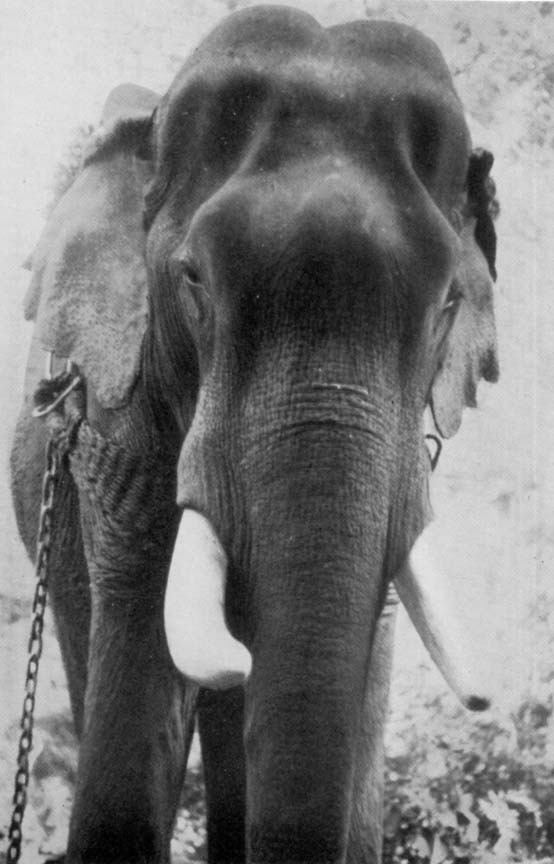 An old gentleman of fifty-seven. The heavy turn-over of the ear, sunken cheeks and head reveal his age. |
 |
In South Kensington Museum there are three petrified mammoth's teeth, one canine and two molars, which I found in a gorge in Burma. They are entirely different in kind from elephant's teeth, which are large, serrated dentals on either side of the jaw. These mammoth teeth are all that is left of an incident similar to the one I have described, which must have happened many centuries ago.
Existing species of elephants are all that remain of a rich and varied family. Fossil bones of fourteen species of the genus elephas are known, and there are a still larger number of the allied genus mastodon, which had tusks in both jaws and more numerous teeth. The most interesting of all the extinct forms is undoubtedly the mammoth. It co-existed with primitive man, whose drawings and engravings of it are well known, and it may have survived to a late period in Siberia. Its remains are frequently found throughout northern Europe, America and Asia, and are so abundant in Siberia that the tusks form an important article of trade. Mammoths have been found frozen in almost perfect preservation. The remains of elephants have been frequently found in England, and in Malta remains of two pigmy elephants have been discovered.
A civilisation eats into the jungle with its roads and railways, the herds of elephants grow fewer. The number of elephants in India has shrunk enormously for this reason, and I fear the same thing will happen in Burma. Fortunately, there are vast forests in the north of Burma into which the herds will gradually withdraw, and where they will, for a long time to come, find that peace characteristic of the jungle of which they are a symbol.
Low-flying aircraft are a new danger. They disturb and terrify herds of elephants, and may seriously affect their breeding for some generations.
The elephants which piled the teak in the sawmills of Moulinein, Mandalay and Rangoon were hand fed, and so are the great majority of ceremonial elephants kept in India. Such animals are kept in stalls, like horses, just as they are in the London Zoo. Sawmill elephants were at one time quite a show piece in the mills where they were used, and those invited to see them were usually asked to come by twelve-thirty p.m.; for at one o'clock, when the siren blew for the mid-day break, the elephants, like the men, just downed tools. They flatly refused to place the piece of timber they were holding between tusks and trunk on the stack, but just dropped it.
The fact that very few, if any, of these animals ever bred in captivity is sufficient proof of the unnatural conditions in which they lived. Very little could be learned from elephants kept in such conditions which was of any use in improving the general management of the thousands of up-country elephants. The conditions of these up-country elephants are completely different. They are far nearer to the wild state than any other domesticated animals. Indeed, one might say that they are domesticated for only eight hours out of the twenty-four. The great difference is that these elephants feed on their natural fodder in the jungle, and gather it for themselves. They are not hand fed. As a result of the liberty which this involves, they breed readily.
A conservative figure of the numbers of elephants working in the mixed deciduous forest areas of Burma before the Japanese invasion is six thousand. Seventy per cent of them were born in captivity.
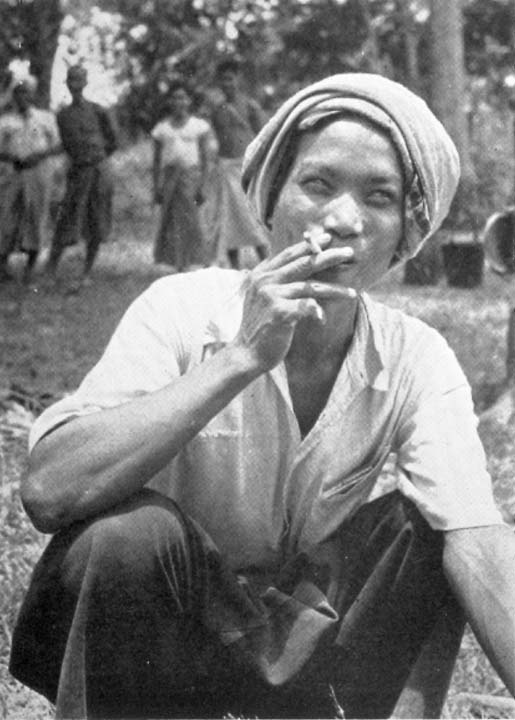
The purchase of newly captured kheddared elephants was more often than not left to a Burman who was reputed to be a good judge of elephants. But the purchase of kheddared elephants was never really successful. A kheddared elephant seldom works as well, or as reliably, as one brought up from a calf to be familiar with man and with work, and it can be immediately recognised by the terrific training scars on its legs. It was soon realised that it was increasingly desirable to keep up the numbers by taking greater care of mothers and newly born calves, of which the death rate was very high. I arrived in Burma just as a determined effort had been started to improve the management of these elephants and their calves. In order to do this, it was first necessary to improve the conditions of the oozie, who must be considered as part and parcel of the Burmese timber-working elephant which he rides. These men are born with a knowledge of elephants. Their homes are in camps in the most remote parts of the jungle. They can sit an elephant from the age of six, and they grow up learning all the traditional knowledge, the myth and legend, the blended fact and fiction, which is attached to this lovable animal. At the age of fourteen the average boy in an elephant camp is earning a wage. He starts life as a paijaik---that is, the man who hooks the chains to the ground assistant of the oozie who rides on the elephant's neck.
It is a proud day in that boy's life when he is promoted to oozie and has an elephant in his own charge. There is no more lovely sight than to see a fourteen-year-old boy riding a newly trained calf elephant of six. The understanding between them is only equalled by that of a child with a puppy, but the Burmese boy is not so cruel to his elephant as most children are with puppies. The Burman oozie is cruel to his elephant only if he loses his temper, but usually he has the patience of Job. He has a pretty hard life. In the first place, he has to catch his elephant every morning and bring it to camp. The camp is often a hundred miles from his village, and may consist of a few jungle huts, or even no more than a couple of tarpaulins making a shelter on the bank of some creek in the densest jungle. Catching his elephant involves tracking the animal a distance of about eight miles, starting at dawn through jungles infested with all types of big game. That in itself is a lonely job, and to do it successfully the oozie has to become one of the jungle beasts himself---as alert and as wary as they are.
He knows the shape, size and peculiarities of his own elephant's footprints with such certainty that he can recognise them at once and distinguish them from all other elephant footprints. Once he has picked them up, he sets off, following the trail. While he is doing so he notices many things: he finds the spot where the animal rested in the night, he observes its droppings, and, after giving one heap of dung a kick, can tell that his elephant has been eating too much bamboo and, for that reason, will probably have headed for a patch of kaing grass that grows on the banks of the creek over the watershed.
When he has gained the ridge he will halt and listen, perhaps for ten minutes, for the sound of the bell his particular animal wears round its neck. He can hear a bell perhaps two miles away, but he decides it is not the note of the bell that he made himself, hollowing it from the teak with such intricate care. So he goes on again, descending to the creek, and when he is half a mile from the kaing grass he listens again and this time he recognises the sound of his own kalouk. Elephant bells are made with two clappers, one on each side, hanging outside the bell, which is made from a hollowed-out lump of teak. No two bells ever have the same note, and the sound of fifteen or more can only be compared to the music of a babbling brook.
As the oozie approaches his beast he begins to sing, so as to let her know that he is coming. He has taught her, or she has taught him, that it is dangerous for them to startle each other in the jungle. So, instead of bursting through the kaing grass that stands nine feet high, he sits down on a boulder beside the creek and fills his home-made pipe and lights it. Between the puffs he keeps calling: "Lah! lah! lah!" (Come on! come on! come on!). But no sound comes from where his elephant is grazing, so he changes his words to: "Digo lah! Digo lah!" (Come here! Come here!). And he will sit and smoke and call for fifteen minutes without showing impatience. He gives her time to accept the grim fact that another day of hard work has begun for her. If he hurried her, she might rebel.
Presently the elephant emerges from the kaing grass, and, chatting away to her, he says: "Do you think I've nothing else to do but wait for you? You've been eating since noon yesterday, and I haven't had a bite of breakfast."
Then his voice rings out with a firm order: "Hmit!"
Dropping first on her haunches, then reposing with all four legs extended, she allows him to approach her.
"Tah!" (Stand up!), he orders, and she does so, keeping her front legs close together. He then bends down and unfastens her fetter-chain and throws it over her withers. These hobbles are either chain or cane, and are put on fairly tight and with little play between the legs. When the animal is hobbled it can either shuffle slowly on easy ground or progress by a series of hops. But in spite of this it can go fast: for short distances it can go as fast as a man can run.
After unfastening the hobbles the oozie orders her to sit down, then he climbs on to her head, and away they go, back to camp, by the route she has been feeding along ever since the previous day.
When they reach camp the oozie has his first meal of the day, washes his elephant in the creek, and then harnesses her for work. Their job for the day is to climb a ridge two thousand feet above the camp and to drag a log from the stump to the creek.
When the oozie reaches the log with his elephant and his paijaik, he will trim it, cutting off knots where there were branches with his axe, so as to make it easier for dragging. He also cuts a hole in the thinner end of the log, through which the dragging-chains are passed. This hole, called a nepah, is so useful in handling the log when rafting, as well as in dragging, that though it is wasteful of good timber it is preferred to fastening the chains round the log in a clove hitch, or to any other form of attachment.
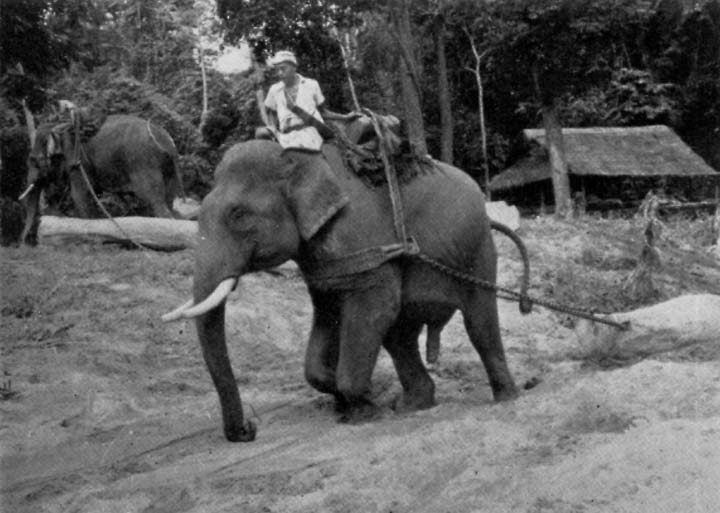
Then he will make sure the chains are securely fastened. After that there begins the wearisome task of dragging a log twenty-nine feet long and six or seven feet in girth---that is to say, over a hundred cubic feet of timber, or four tons dead weight. For a mile the path follows the top of the ridge. "Patience! patience! patience! Yoo! yoo! yoo!" (Pull! pull! pull!), calls the oozie. As the elephant takes the strain, she feels what power she must exert besides that of her enormous weight. Tremendous energy is necessary. The ground is ankle-deep in mud, and there are dozens of small obstructions which must be levelled out by the log's nose---sapling stumps, bamboos, stones, even rocks. So the elephant puts out her first effort and, bellowing like hell, pulls the log three times her own length and then stops. She rests then to take breath, and her trunk goes out sideways to snatch at a bamboo. It is her chewing-gum as she works, but it earns her a sarcastic comment from the oozie: "My mother, but you are forever eating!" However, his patience is quite undisturbed. The elephant takes her time. "Yoo! yoo! yoo!" calls the oozie, but there is no response. "Yooo! yooo! yooo!" Then the elephant pulls again, but this time, as it is slightly downhill, she pulls the log six times her length before she halts. So it goes on, until they reach the edge of a precipice---a four-hundred-foot drop. The elephant knows the margin of safety to a foot, and when the log is ten foot from the edge she refuses to haul it any closer. The chains are unfastened, and the elephant is moved round behind the log. The oozie gives his orders by kicks and scratches with his bare feet behind the elephant's ears. So he coaxes her to bend down her massive head in order to get a leverage under the log with her trunk. Working like that, she moves it first four feet at one end, then rolls it from the middle, then pushes the other end, until she has got it almost trembling on the balance on to the very edge of the cliff. She will then torment her oozie by refusing to touch it again for ten minutes. Finally, when the oozie's patience is almost at an end, and the elephant can foresee that she will get a cursing and a vigorous toe-nail scratching behind her ears if she refuses any longer, she puts one forefoot out as calmly as if she were tapping a football; and the log is away---gone. There is a crash in the jungle below, and then a prolonged series of crashes echoing through the jungle, as the log tears down bamboos, until it comes to rest four hundred feet lower down, leaving the elephant standing on the edge of the precipice above, with a supercilious expression on her face, as though she were saying: "Damned easy."
 |
 |
|
|
|
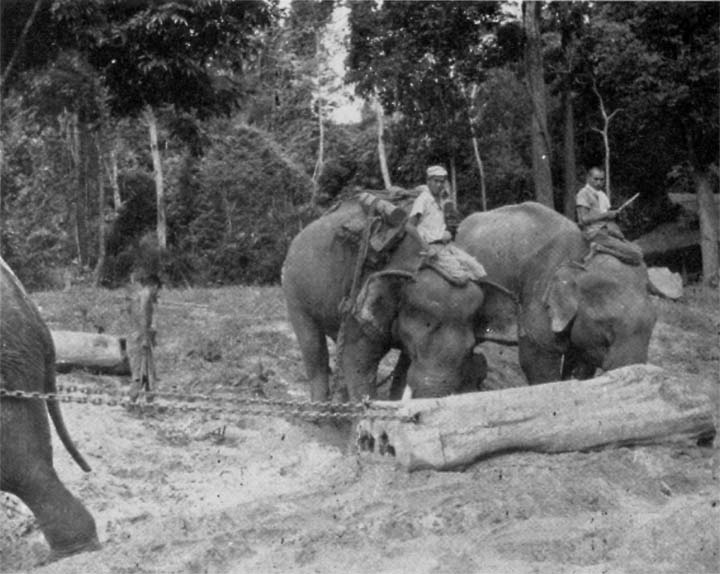 |
 A determined tusker rolling a very heavy log. If the log slipped he would use his raised forefoot to check it. |
Half an hour later elephant and oozie have reached the log again, having gone round by a circuitous game-track to the foot of the precipice. Once down there, she has again to drag the log with the chains along a ledge, which has been roughly blasted out of the hillside around a precipitous waterfall.
Such blasting is often done by a more primitive method than using dynamite. The rock is heated with a fierce brushwood fire and then cracked by pouring water over it. After that the fractured rocks are again broken with crowbars, and the big pieces disposed of by elephants.
Dragging a log weighing four tons while negotiating a not very wide ledge is a risky business, for the log might roll. But the elephant can judge what is safe to the inch---not to the foot---and she works with patience, patience, patience. Both oozie and elephant know that should the log start to roll or slide over the edge, all the gear and harness can be got rid of in the twinkling of an eye. The elephant has only to whip round in her tracks, step inside her chain, and bend down her head for all the harness to peel off over her head as easily as a girl will strip a silk slip off over her shoulders. For this reason it is very rare indeed for an elephant to be dragged over a precipice by a log suddenly taking charge.
After negotiating the ledge there is an easy downhill drag for half a mile to the floating point on the side of the creek. By that time it is about three o'clock in the afternoon. The oozie unharnesses his elephant, puts on her fetters, slaps her on her backside, and tells her that she must go off in search of food. For neither of them is their day's work really over. The elephant still has to find her fodder; not only to chew it, but to break off, pull down, or pull up, every branch, tree, creeper or tuft of grass that she eats. The oozie has to repair his gear, trim logs or weave a new laibut, or breast-strap of bark. This bit of harness takes the full strain of the elephant's strength when dragging, and has to be made accordingly. It gets a tremendous lot of wear.
Such is the oozie's day's work---and with it all he is a very happy man.
His chief relaxation is gambling. He does often literally lose the shirt off his back. I have seen one particular shirt worn by six different owners in a year. But they don't wear their shirts at work, but only dress up in the evening and when showing their elephants for inspection.
The hardest work, described above, lasts from June until March. Then for three months the oozie gets a rest from logging, but has still to look after his elephant every day.
He is, as I know Burma, all that is left of the real Burman---the cheerful Irishman of the East. I have watched him fraternise with all who played a part in the evacuation of Burma in 1942 and with those who recaptured it in 1945---the British soldier, the Gurkha, the Sikh, the Punjabi, the West African and the East African. He even fraternised with the Jap, because he would not abandon his elephant, and for a time both had to work for a new master.
One gets to know one's riders at the same time, and in the same way, as one gets to know the elephants. They are so much part of one another.
Living under such primitive conditions, not only the oozie but also his wife and family need frequent medical attention, and they have no one to look to but the European Assistant who lives nearest. Apart from all the diseases, accidents are constantly occurring in the jungle, and the Assistant has to be a bit of a doctor, and ready to take decisions which would make an ordinary medical man's hair stand on end. One may come into a new camp and find six people down with beri-beri---two women with their breasts split like ripe tomatoes from the swelling characteristic of that disease---and one has to decide at once what one is going to do about it. One has to be ready to tackle a girl with a bad afterbirth hæmorrhage, or a man scalped by a bear, with his long hair tangled deeply into the wounds and one eye out of its socket. Malaria is more common than are colds in the head in England, and is often followed by pneumonia. Dysentery, and even cholera and smallpox epidemics are all liable to break out in the jungle. I am convinced that life in such conditions would be impossible if it were not for the elephants, which exert a fascination over the Burmese, a fascination which Europeans soon begin to feel as well.
Like the elephant, the jungle Burman makes a marvellous patient. Both, when they are ill, have an implicit trust even in the most amateur of doctors, whose equipment is all too often only a first-aid box the size of a biscuit tin. Luckily, faith helps to make up for its deficiencies.
 |
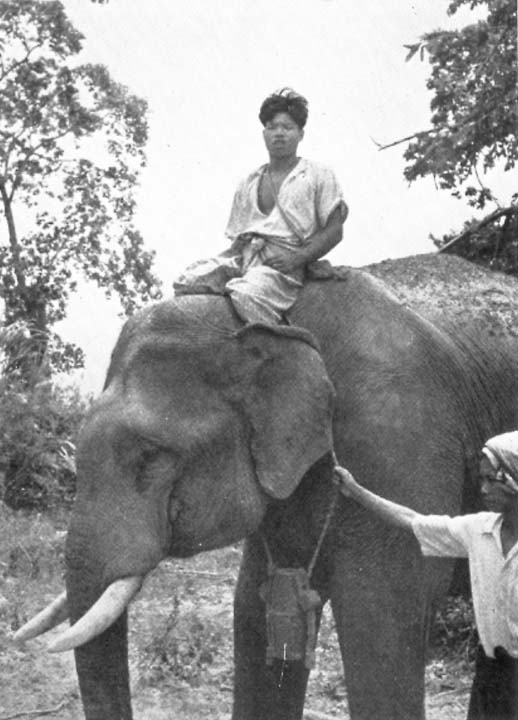 A tusker, showing his teak bell, or kalouk. |
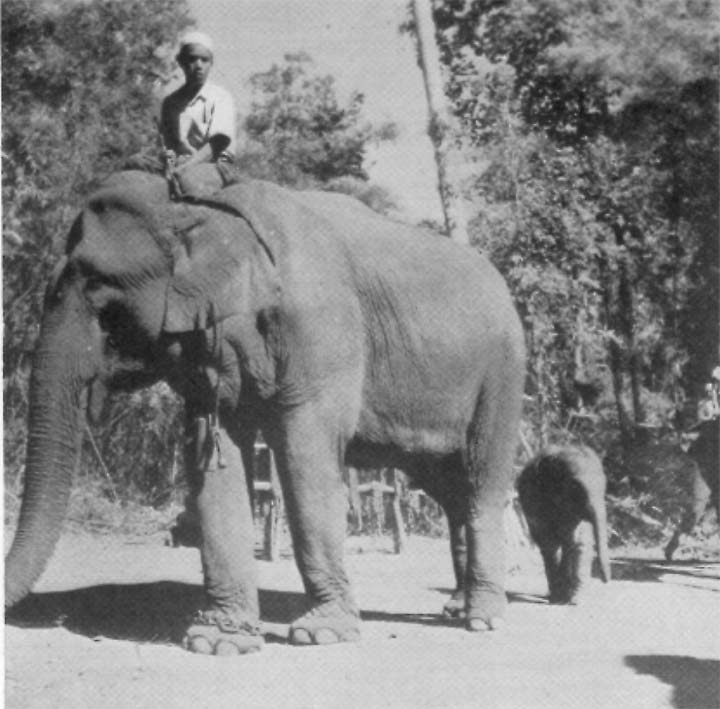 A female elephant of over fifty, with her calf. |
 An untrained calf making friends with his mother's oozie. |