 1. Overview --- AFS Pull Back to Tripoli, Delay in
the Landings on Italy, Conflict and Compromise in Allied Grand Strategy 2. Tripoli. Libya: Choice Location to Rest, Refit,
Reorganize 3. Cultural and Intercultural
Relations, Tripoli Style 4. Interlude in Tripoli, Reflections: Conscientious Objection to
War 5. Prospects for Peace --- Allied
Cooperation, Terms of Surrender 1. Overview --- AFS Pull Back to Tripoli, Delay in
the Landings on Italy, Conflict and Compromise in Allied Grand Strategy 2. Tripoli. Libya: Choice Location to Rest, Refit,
Reorganize 3. Cultural and Intercultural
Relations, Tripoli Style 4. Interlude in Tripoli, Reflections: Conscientious Objection to
War 5. Prospects for Peace --- Allied
Cooperation, Terms of Surrender |
Anglo-American victory in the Battle for Tunisia marked the conclusion of one phase and the beginning of another in Allied grand strategy in the conduct of the war against Germany. Not only had the German thrust to the East through Cairo been turned back, but the German foothold in Africa itself had been eliminated. And, for the first time, the continent of Europe was exposed from the south across the Mediterranean, with tested units of British and now United States armed forces in bases all the way across the coast of North Africa.
It was time for a promised Anglo-American offensive against Germany into the continent of Europe, which would also provide relief for the Soviet armies now bearing the brunt of German aggression in the titanic battles being waged in the East. Only then could Nazi power be destroyed.
In my next "Chapter" --- Part VI. Italy: Sangro and Beyond. October 1943-January 1944 --- I cover issues, conflict and compromise, and happenings in an "Overview" concerning Allied strategy in 1943 leading to the landings in Italy in September 1943.
There follows a short summary of this Overview as it affected our own AFS "Summer of '43."
The United States high command, led by General George Marshall and with the support of President Roosevelt, had already begun the build up of American forces in Great Britain to prepare for a landing in France across the Channel; this was to be the code-named "Operation Overlord" for the second front against the Germans.
Instead, Winston Churchill and his senior aides favored an alternative strategy---entry, into Europe from the South. As Rommel's Afrika Korps was being pressed into Tunisia by Anglo-American armies from the East and West, a compromise was reached at Casablanca in January 1943. At this meeting with Churchill, President Roosevelt and General Marshall accepted postponement of the Normandy invasion for another year, and agreed to landings and offensive in Italy following victory in Africa.
There were also momentous events taking place in Italy in the summer of 1943. The Italian people had been victims of Mussolini's megalomania, and had never accepted the Fascist ideology. On July 25 the dictator Mussolini was overthrown by action of Italy's armed forces and King, to be replaced by Field Marshall Badoglio as Head of Government of an Italian Republic seeking association with the Allies as co-belligerent.
Even before this, combined Anglo-American forces had liberated the island of Sicily, commencing July 10 and completed July 17.
In mid-May of 1943, however, most of us of our "Lucky 13" fraternity knew little and cared less of the conflict and compromise at the highest levels that had determined that our next action as AFS Drivers would be in Italy. There were other matters on our minds.
All of us had been committed since March 20, to a continuous series of major engagements by 8th Army against Afrika Korps driving north. We had served within the chain of medical evacuation of the front line area, and in the final three weeks 1, with my fellow Driver Howard Brooke, had been posted right at the front taking day and night everything the Germans from the high ground close by could throw at us.
I had escaped being blown to bits more than once by the narrowest of margins. I had experienced at first hand the death or the wounding of men I had known in my own assigned unit; also others in other units near by. I felt that there could be nothing worse for me in the war. I marveled that my life had somehow been spared, when men close by had been killed; this was a miracle I could not fathom.
I had stuck it out regardless, obtained thereby the satisfaction of doing my job and doing it well. Above all I had finally faced and met the challenge I had set for myself when I registered as conscientious objector: that the risks I should face would be as severe as others of my own generation called upon in this war for the defense of freedom.
Even after the guns were stilled, there was one final wrenching moment for Howard and I: departure from "our" Regiment, 58th (Sussex) Royal Artillery, and saying "goodbyes." Little did I know then that they would also be pulled back to Tripoli during Our Summer of '43. I wrote in a letter after reaching Tripoli:
Howard Booke and I were very sorry indeed to leave "our" beloved regiment with whom we had shared so much together for what had been the "longest month" of my life. There was a sad day of goodbyes. The Colonel had us in for drinks at officer's mess; later that night we joined our RAP team --- Doc, Nudge, Darky, Nimo for some beer as we sat in silence under the star-lit sky. I shall never forget these boys.
Such were the ghosts that had occupied my mind. But in those first few days and weeks in May, when the guns were suddenly stilled, there was pleasant work to be done sufficient to distract my thoughts. Our AFS officers took over the tasks to organize and direct our Company and Platoon convoys all the way to Tripoli, Libya, our assigned destination to rest and regroup in the summer of 1943. All I had to do was to follow in line for more than 600 miles along the winding coast road.
Our convoy took us down this road, once so bitterly contested. The pace was slow---tuned to the condition of our battered ambulances. The fertile fields and orchards of the Tunisian Sahel from Sousse through Sfax gradually changed to sparse and arid conditions of scrub and desert where camel herds replaced the flocks of fat-tailed sheep as we crossed the southern border of Tunisia and Libya. From there, the way turned east into Libya, then on to the attractive port city of Tripoli, once the capital of Mussolini's African domain and a major supply center for Afrika Korps.
Our ambulances were indeed in dire straits. Jock Cobb's ambulance, with a broken spring, could not join the convoy; and there were others. Jock drove down the coast by himself after repairs, enjoying the beaches and the hospitality of the civilians along the way. When passing through Sfax, he was invited to the home of a French family for a cup of coffee, having met the daughter,. "a lovely French girl," at a dance given for men of the Royal Artillery. Her brother had been a pilot of the French Airforce. The father, who was a veteran of World War I, was head of Tunisian Railroads. Jock's knowledge of French helped "break the ice."
For me, this pleasant convoy is a blur. I have no notes or letters written at that time. My one vivid memory is of refreshing swims each afternoon when we stopped to "make camp" for the night. Pristine sandy beaches washed by crystal-clear seas stretched endlessly along the coast not far from the coast road.
For these swims, all of us stripped down to the "buff" as we formed lines down to the beach and on into the waves. I remember trying to keep up with the long striding legs of our then deputy Company Commander Fred Hoeing, a veteran of the first Mideast Unit 1. Fred was tall, angular, slightly stooped in physique, possessed of a marvelous sense of humor, he was a true and considerate friend. In time he rose to be one of the senior officers of AFS during and then after the war. The sweetest of men, he was universally respected and loved.
At Tripoli there would be time to heal --- more time than I could have imagined. June passed, then July and the liberation of Sicily in which AFS did not participate..
August came and went, and It was not until early September that the Anglo-American landings on the Italian mainland were launched. In retrospect, there had been excessive delay in this because by then crack German divisions had occupied most of Italy --- including Salerno south of Naples where the American forces landed.
It was not until the end of September, 1943, that our two AFS Companies and eight Platoons- received orders to proceed to Italy through the former Italian naval base at Taranto in what became one of the most difficult campaigns of the entire war. Our units of AFS 567 ACC continued with British 8th Army on the east side along the Adriatic, while the units of AFS 485 ACC were assigned to the west side which was the zone of operations of the American 5th Army.
Despite the at times unbearable summer heat at Tripoli and its surroundings, we could hardly have had a better location for our more than three month interlude between battles. Other units, principally British, had also pulled back to Tripoli, and there were American Army personnel at the huge airbase at Castel Benito just south of the city. Howard Brooke and I managed to locate "our" regiment, the 58th (Sussex) Light Field Regiment Royal Artillery for joyful reunions.
Except for sunken ships in the harbor, neat piles of rubble cleared from bombed out areas, the flow of military traffic, and men in uniform everywhere, Tripoli had the aspect of a seaside resort.
Once the showpiece and center of Italy's Libya colony, an impressive row of pompous blue-tinted Fascist-style buildings faced in sandstone and marble lined the curved highway that rimmed the protected harbor. There were similar large public and private buildings downtown. Some excellent restaurants had opened for business which was brisk. We enjoyed full-course dinners, topped by ice-cream, to the music of local minstrels. There were shops where traditional artisanal products could be obtained.
The Mediterranean littoral, west of Tripoli, and stretching for hundreds of miles to the east, was intensively farmed by the skilled Italian farmers and their families who had been encouraged to settle these lands. After 8th Army had driven Afrika Korps out of Tripoli (January 1943) these farms had been cultivated again, and a colorful open air-market displayed their goods. The army rations of our canteens and messes was readily supplemented by an abundance of fresh fruits, vegetables, meats, poultry, fish.
All along the coast were the most inviting beaches and waters for swimming and sunning that anyone could want. Within the spacious harbor itself, and at other choice locations, swimming establishments and clubs with bathhouses and dining accommodations had reopened.
British and American special forces saw to it that we were entertained by the latest movies from Hollywood, shown evenings outdoors under the stars. Soon, also, cultural and intercultural programs were organized among the many diverse units for lectures, discussion groups, and the like. Chan Keller, Jock Cobb, George Collins and I. and others of AFS participated in these, as we had done months before on the Western Desert.
Sporting events were planned. We Americans. had difficulties with soccer, but by contrast our British comrades-in-arms. took to baseball, "America's game." After coaching from some, of us and one of the American units they joined in scheduled games.
Several track meets were organized, and a number of teams participated at Tripoli's 400 meter cinder track and stadium. Getting back in training, I participated in these meets with the New Zealand team, winning in the sprints. My AFS fellows, with tongue-in-cheek, promptly named me "world's fastest human."
On Sundays I had written (July 18) "Sunday Church service was held at a little church called 'The Parish Church' overlooking the harbor with ships at anchor. The service was unusually good." The Sanctuary of this Church also doubled as concert hall for a number of performances by talented musicians, including of AFS.
There was time for writing --- for letters and for creative writing as well. In sixteen letters home, from which I quote in the following pages, I extolled the pleasures and benefits of our Tripoli experiences. I also completed (with an assist from Jock's or Bob Blair's typewriter) a "Commentary" on the Battle for Tunisia while the memory of it was so immediate, as well as a long poem "By These Four Walls" based upon my Enfidaville experience. Mother, acting as my de facto literary agent, prepared typed copies for family and family friends, and also made inquiries as to publication. (This "Commentary" little changed is now Part V of An AFS Driver Remembers.)
All in all, the Tripoli location proved to be ideal for the rest we had earned, and for the refitting so urgently needed. The traumas of war were set aside. There were, instead, as suggested above, an abundance of civilized comforts and pursuits. It was as if we had found peace, or an interlude of peace, in the midst of war.
I lost no time to sample the comforts. In my first letter home from Tripoli in June, I wrote of "new shoes bought at the officers' shop, clean clothes, haircut and shampoo, and of having emerged from a bathtub ... and then, too, I have seen several movies ("Holiday Inn," "Mrs. Miniver"), and my palate has been delightfully entertained with hot coffee and iced cocoa. Thus you see I have become quite civilized. The weeks of living in mosquito and flea infested holes were almost worth it!" In a letter, Alex Turner had written of "the wretched blood-sucking mosquitoes and carnivorous fleas" at Enfidaville, and of his vest "soaked in blood one morning after a mighty force of fleas..."
Our "Lucky 13" Sections and Platoon were assigned a choice location. We parked within an orchard of fruit trees, close by the spacious irrigation tank which serviced a veritable Eden of fruits, grapes, vegetables and flowers. The cool waters of this tank shaded within a grape arbor covered by flowering bougainvillea sustained us when the temperature soared to 120 degrees F and more.
It had now been more. than three months since our "Lucky 13" fraternity had been together at Marble Arch before the attack at Mareth March 20. In retrospect, it seemed more like a year. In the first weeks of the advance north our paths had crossed briefly at times. During the weeks-at Enfidaville, Howard and I had no contact with or news of our Sections, nor of our Company except for one very brief visit by HQ staff
It was therefore with great joy that we found ourselves together once more at Tripoli. I wrote in June, in one of my first letters from Tripoli.
One of the nicest things about rejoining the Company was a reunion with Chan Keller, John Leinbach, Jock Cobb, Jay Nierenberg, Harry Hopper ... being back with Chan, and having another of our songfests under the stars made me forget my sorrow for a time. We are all lucky indeed for Howard Brooke and I and the others are back at the same Section, and Chan is our NCO ... At present the whole Company has reassembled, and most of this month will be devoted to resting, leave. and car maintenance.
George Collins soon rejoined us, and we co-opted three arrivals into our "Lucky 13" Sections: Sterling Grumman, CM Unit 41; Tom Hale, CM Unit 47; Bob Blair ME Unit 27 who would become our Platoon CO in Italy. And, as I wrote, our C Platoon Sections were assigned to a "choice location" within one of the groves of fruit trees of the farm of an Italian settler family, "one of the richest gardens I have ever seen."

| "Hanging out" with Section Ambulance Parked under a Tree. Italian Farm, Tripoli ---Luke Kinsolving Seated Against Tree, far right. Vern Preble. Center (hair in sunshine) --- Vern was Killed in Italy just across the Sangro |
Near where we parked, was the farm house built in solid blocks faced in white plaster, which was home of the family from Sicily who owned the farm. My own Italian ancestry on Mother's side, and my command of the language, eased the way into their hearts. They virtually "adopted" me, and through me our "Lucky 13" Section.
Needless to say, in my letters home I told of the beauty of the farm and the hospitality of the farm family. In a long letter dated late June 1943 I wrote:
Near at hand is one of the richest gardens I have ever seen. Shady walks, a pool for irrigation, the sounds of running water along the aqueducts, the cool pattern of shady leaves in the paths in the heat of midday. Here grow all kinds of fruit trees. Apples, plums, pears, bananas, apricots, peaches, figs, olives grow in abundance and produce several times a year. Strawberries grow the year round most every night we have strawberries and cream! Tomatoes, wonderful string beans, cabbage, large radishes. The garden is like another Eden stretching over sandy hills and with the thick rich verdant groves and neat vegetable rows surrounded by less dense rows of olive trees. And across the garden blow sea-breezes.
Alex Turner, my dearest friend of our Regiment, 58th (Sussex) and friend for life, who spoke and wrote in words of prose-poetry, exchanged letters with Mother in the winter of 1944 when he was on rotation back in England. He waxed ecstatic about the farm to which I had invited him on occasion; he wrote (20th February, 1944):
Did Charles ever tell you about the strawberries and milk we had on various occasions ... near Tripoli? That place was certainly a Garden of Eden, with its bounteous crops of exotic fruits ---peaches, plums, bananas, apples, pears, dates, olives, and strawberries, all growing in one large garden belonging to a very friendly Italian who allowed us to roam at will whenever we wanted to. We used to bathe in his large irrigation tank, and wasn't it delightful to be able to do this, and then dry in the sun afterwards. Oh happy and delightful days and what marvelous memories they hold for me, to close my eyes and look back on those days with dear old Charles, gives me inestimable pleasure.
In my June, letter, I had been equally enthusiastic about the hospitality of the farm family and the home-cooked dinners to which my friends and I were often invited:
Last week,: on our first. arrival, I had at once. introduced myself to "Papa" --- Luigi ---who was working in a tomato field close by. Then I met young: sons Pepino, and Jeno, their brother-in-law Ignazio, finally "Mama" and daughter Louisa Ignazio's wife.
My letter continued:
I am also getting along famously with the language, and each day the boys come over to the car to give me some lessons. "Mama" wants you to know that she has adopted me for a time, and so you are to know I am in good hands.
Last night supper was around the long table on the veranda outdoors under the stars after we had all worked late to gather in the beans and tomatoes for early morning market. The occasion was to celebrate the return of me ("Carlo") for I had been gone for some four days in a mission some distance away and briefly "in charge" of a Section of five vehicles. The very fact of their gladness to see me, indicates how these honest folk have taken me into their hearts.
My letter then described the festive dinner to welcome my return and to which several of my "Lucky 13" fellows had been invited:
There was fish cooked in olive oil, fresh string beans and a tomato salad. Tablecloth, real silver, clean napkins, wine in wine glasses: all was like a meal at home --- at last with a family again! And best news of all, today I am invited to a dinner of real spaghetti!
Jock Cobb, also invited to this dinner, wrote of it and the Italian farm family in a more subdued and philosophical way; his letter of July 1, '43 on "a hot night in Africa":
And the friendliness of the Italian family in whose olive orchard we camped while in Tripoli is another thing that shows the strength of human sympathy. We had been there a couple of days when the younger son came around and gave us a handful of plums. Charlie Edwards speaks Italian pretty well, being half Italian himself; so it was not long before we were helping them pick strawberries, load cabbage into sacks for market, and were riding around on their horses. Charlie went away for a few days; and when he came back they were so glad to see him that they gave a great dinner party for the whole bunch of us. We sat out on the terrace of their house in the twilight eating fish, spaghetti, chicken, wine, plums, and many other things I didn't know the name of, all done in the wonderful Italian way, with spices and olive oil. Since then, we have been to see them often, we swim in their pool and thrive on their fruits and vegetables.
When after the dinner party- we were all feeling cheerful and began a little song, Papa (as they call the old man of the family) grew sad and with a somewhat shaky voice said "There will be time enough to sing when the war is over." He has never heard from two of his sons who fought in the Battle of Tunisia.
As the weeks, then months passed, the home and hearts of our Italian friends were always open to me and my Section mates of AFS. In my letters home I often mentioned spaghetti dinners at noon, or in the evening together with the fresh-picked fruits and vegetables of the farm. One Sunday dinner was memorable; I wrote:
Menu for Sunday dinner was spaghetti with cheese and tomato sauce, stewed tomatoes, meat balls, and strawberries. The other evening Harry Hopper and I had a macaroni dinner. Today Chan was invited but he felt sick and couldn't make ft.
These generous, simple people were truly the salt of the earth.
When the prevailing winds came in from the north, sea breezes made living in Tripoli in the summer tolerable; not so when these winds ceased, and especially when the torrid winds of the harmattan blew in from the endless sands of the Sahara.
The most enjoyable way to beat the heat, especially for me with such strong Cape Cod roots, was "go to the beach." This was a frequent event throughout the summer. In one of my first letters home in June I gave an enthusiastic account:
Then, too, there are scores of lovely beaches with a crystal sea running up on soft white sands. Cool sea-breezes, the white plumes of the waves beating against an occasional reef, with quiet stretches of light blue pools to the lee of the reefs and curving sandy shore-line with shifting dunes and scrub trees: all is so like Cape Cod that it makes my heart stop.
There is a sort of club at one beach, with a veranda and chairs and tables, and a spacious dock out over the sea. One hundred yards out a raised platform has a two-foot spring board. The water there is 20 feet deep, but is so clear that the bottom is quite plain. Jay, Harry, "Col." and I have been there together, and had a picnic on the beach in the evening ... Yesterday Jock and I had cool drinks in company with a very nice Scotch fellow. So you see these beaches are helping me pretend I am on Cape Cod with you.
This beach with its club house was a popular place. In August, I wrote of going out there with Chan Keller:
Chan and I have spent a very enjoyable afternoon at the beach---where we bumped into Lt. "Andy" Anderson, survey officer of "my" Regiment (58th Sussex). All three of us swam out to a reef about 100 yards off shore. Chan, with his customary playfulness, ducked me several times. On return to camp we found some mail awaiting us. Your number 47 and 48 letters, and one from Bets.
On into September the beach continued to be a haven from heat and boredom. On one such excursion, Chan and I made elaborate camping arrangements. In a letter (September 6) I had written:
If this writing is even worse than usual, it's because I, too, am enjoying Labor Day on the beach! I'm sitting on a stretcher in a makeshift tent composed of my blanket roll, stretchers, two aluminum "Eytie" tent posts, lines, spare bits of rope and prayer, and the whole lot nestling against the side of a sand dune! Chan Keller is sprawled at my feet reading, and I am on a stretcher writing. The wide sand beach curves along the sea on either side; there are even dunes and beach grass, and of course the wind is cool and fresh. Gentle rollers of this most beautiful of all seas keep up the constant music which all of us know so well. It could be Nantucket Sound, and the water is just as warm. It's all so wonderfully refreshing and healthful compared to the heat and boredom which weighed so heavily at camp. At least inactivity, forced although it may be, doesn't weigh so heavily on one's conscience by the sea shore. There is also once again increased hope that we shall be leaving this continent soon.
Our second way to beat the heat fortunately was close to home. It was the spacious irrigation tank of our host Italian family whose men, "Papa" Luigi and son-in-law Ignazio, managed the farm. At times, when the temperature soared to 120 degrees Fahrenheit in the shade it was too hot to move, let alone retreat to the beach. In a letter dated July 7 I had written of a week of almost "unbearable heat" when "most of one's time is spent trying to keep cool." My letter continued:
The most successful way thus far discovered has been a daily visit to Ignazio's near-by irrigation pool. The water is pumped up from a deep well, and feels ice-cold after the heat of the sun. The pool is of cement about 50 feet long and chest-high. It is covered with a grape arbor supplying shade and grapes. One swims or floats about on Jock Cobb's rubber mattress, reading, soaking in the deliciously cool water, and all about is the forest of the tops of the fruit trees, and birds singing, and the wind slapping the big slattern leaves of the banana tree which leans over the pool. Young Jeno, and Pepino, are quite playful, and so there are merry tussles in the water. It's more refreshing than the beach during such heat, in spite of the assortment of cool drinks and even ice-cream you get there.
Fortunately, also, light-weight "KD" (Khaki Drill) British army issue had replaced our. heavy wool battledress. When at camp during these heat spells or after a refreshing dip in the pool we limited our dress to comfortable khaki shorts.

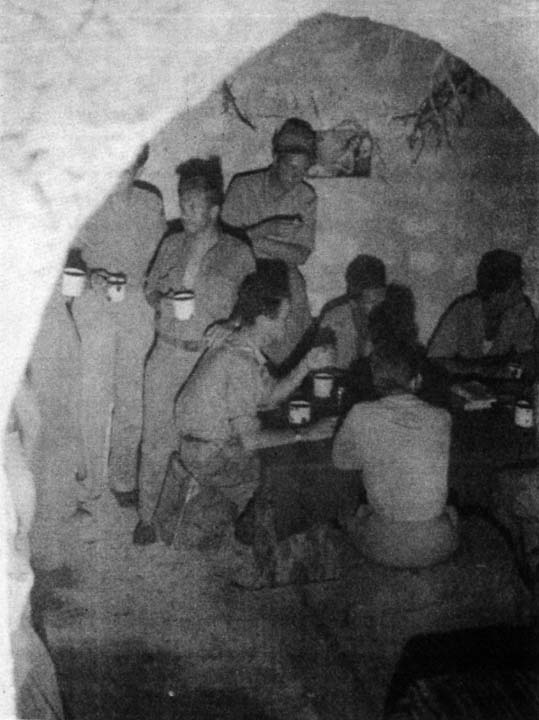
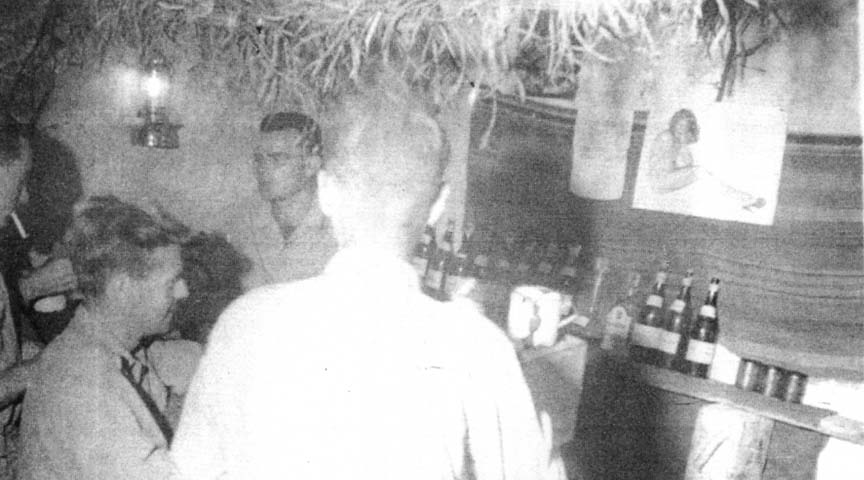
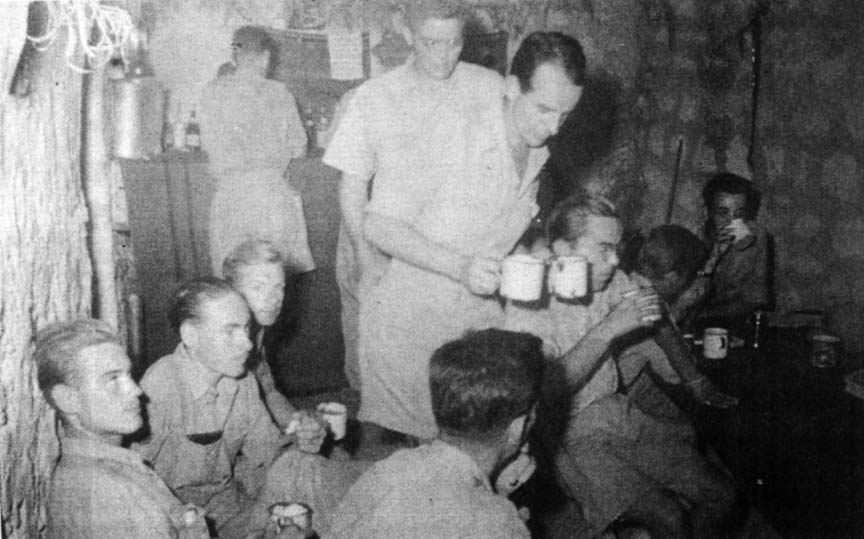
There was no limit to efforts to "beat the heat." Beyond the farms off the Castel Benito road, the Italians had built a solid, cool underground stone bunker. Ken Proctor (ME Unit 30) and Charlie Stewart (ME Unit 32), took the initiative to clear out the debris and clean it, and started the famous "Belhartzia Club" named for one of the lethal parasites that lurked in African rivers. With Ken as manager they installed simple furnishings and a well-stocked bar featuring a scantily clad long-legged Vargas pin-up girl. There were various iced drinks; fellows brought their own bottles. Popular snacks served were the "humpburgers" from camel meat of the local markets. Here we AFS "Yanks" and "Brits" and our guests escaped the heat in fellowship.
 |  |  |
One of our principal "assignments" at Tripoli was to rest, and we had earned it --especially following the Battle for Tunisia. On the face of it, it was not a difficult assignment given the amenities for us at Tripoli: plenty of good food, pleasant beaches, entertainment, above all freedom (for a while) from the guns of war. But it wasn't always easy. I for one was in pretty bad shape as we settled in at Tripoli, and I had plenty of company.
There was only one way for me to get back in shape, and that was training. I had an added incentive. In one of my first letters after reaching Tripoli I wrote "that a series of track meets have been planned ... there is a large stadium complete with cinder track, and each week there will be track meets ... I am planning to run and began training today." In my next letter June 10 I reported:
Speaking of training, I have been running the past two weeks and after a fairly brisk mile today finally feel that I am getting in some kind of condition. It's all because of a series of meets, leading to army championships next month. I shall enter 100, 220, broad jump.
I had located a dirt road out in the country beyond the farm, and began to train with some distance running at sun rise before the heat of the day. I hoped to practice on the track before the meets. My training regimen had a real boost because of one of the new arrivals joining our ranks; I wrote (June 15):
A new arrival to AFS, Stan Diamond (ME Unit 32) hails from NYU and is co-holder of the world record for the four-mile relay (along with Les Mitchell and Frank Dixon). Stan has done the mile in 4:11. This morning we ran two and a half miles together striding in on the last half. It is good to have so fine an athlete to work out with and already I feel much better for the exercise. Next week is the first meet and I have entered the 100 and 220 (despite the fact that Stan wants to make a miler out of me) ... all of us are sadly out of shape, although my wind seems pretty good for not having smoked.
My schedule includes running in the morning with Stan, and then we both go to the beach for exercises and a cooling swim.
Two other AFS Drivers ran with me at times on those early mornings: Jim Doubleday, Bowdoin College classmate and captain of our Bowdoin track team, and Sterling Grumman (CM Unit 41) a new arrival to our Platoon that summer who would soon be joined with our "Lucky 13."
AFS did not field a team for the meets, and I was invited to run with the New Zealand team--- AFS enjoyed excellent relations with the "Kiwis," the finest of men and troops. When in combat action, we all coveted assignments to the New Zealand Division. As I remember, I was able to win my events in all the track meets.
Our faithful ambulances were in as bad shape as we. Some were beyond repair, and were dismantled for spare parts. All of them required major maintenance throughout as well as replacement of parts that were beyond repair. From time to time a few new ambulances as well as spare parts were received, thanks to the efforts of Director-General Galatti and AFS HQ New York City. This helped, but for the most part our two AFS Companies had to repair and refit what we had from the ground up. Fortunately, our summer of '43 gave us the time.
All of us by now were skilled in the 31 point maintenance check-list we had learned in training, but such thorough maintenance had not been possible during the advance to Tunis. At Tripoli, we went to work with a will to complete and continue these maintenance requirements; also to assist our fitters (mechanics) as repairs and refitting were scheduled. As always, our British workshops, then under command of Captain Webb, performed miracles. At any given time, a Section could be seen lined up under the shelter of the trees, with our fitters at work, some of us on hand, and pieces of our cars spread out on the ground. Jock Cobb's camera told the story:
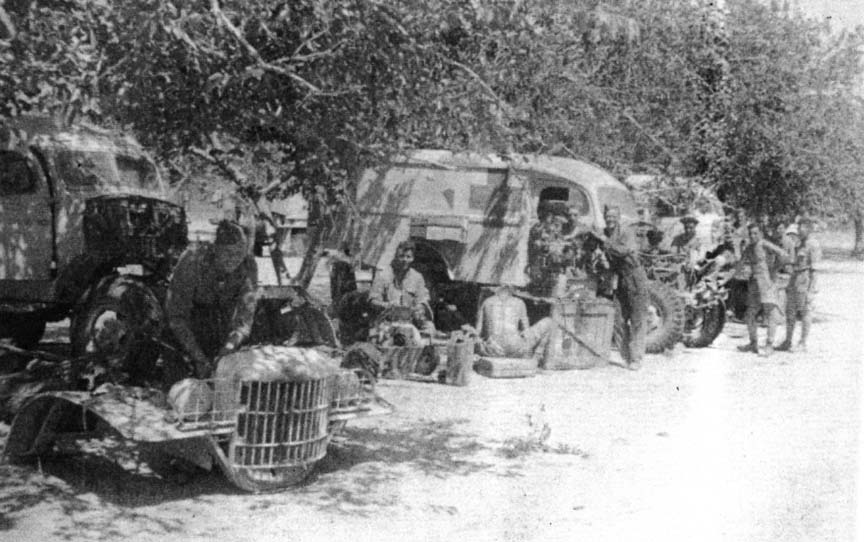
For the important task of repair and refit, versatile Jock Cobb decided to add another skill to his collection: that of auto-mechanic. He had already helped rebuild the aging ambulance assigned to him in Tunisia. Now, in Tripoli, he volunteered for a month as a mechanic to work with the fitters. This involved a schedule of work from 6:30 in the morning to noon, fortified by a mid-morning cup of tea. Rest followed during the heat of the day; then work between 4:30 to 7:30. In a letter, July 24, he had written:
I am happy at this work, no complaints. I am a Driver-mechanic now, having spent a month working in the workshops doing everything from putting in a new engine to inspecting for repairs to be done. Then, as you know, I am an official photographer which keeps me busy in idle moments. And when things get exciting, I'll get all I want because I am the mine "sapper" for the company. (Note: Jock took a course on how to disarm German and Italian mines.)
It's pretty hot, though. I am sitting in the front seat of the car which is under a tree for shade. I am wearing nothing but my shorts and am dripping with sweat in spite of the strong breeze. The metal parts of the car are too hot to touch. The shade temperature is 120. As hot as any spot on earth.
Jock had another reason to work with the British fitters, who were "Other Ranks" or "Tommies." It was, as he wrote, to "see another angle of the British point of view." He gained in respect for the sterling qualities of the Tommy, but found it difficult to break through their traditional reserve even when covered in grease and working side-by-side. The fitters at first kidded him about "trying to be a fitter."
We AFS Drivers were unique to British Army cadre. We worked well with both British officers and other ranks. We learned to admire each class and rank equally, although we generally felt more at home with the officers by reason of our backgrounds. We also respected the traditional boundaries of class which operated within the British Army and culture which, however, were in transition towards more democratic modes in the course of World War II and beyond.
There was good news and bad news for me during this inspection and repair process. My faithful Fox II, shrapnel holes and all, was found to have been beyond repair and relegated to providing parts and scrap. I was assigned a reconstructed newer ambulance, which I promptly named "Fox III" and which would carry me and my patients to even more difficult conditions in Italy. In my letter of July 18 I wrote:
And now I must, get to work on -Fox III. Fox II has seen its best days, and so I got a newer car the other day. It was kind of hard to part with the ambulance that had been over 5,000 miles with me and hadn't failed once.
During the Battle for Tunisia in late April, the four desert Platoons, including our own C Platoon and "Lucky 13" Sections, had been merged into 567 Ambulance Car Company (ACC) led by Major Arthur Howe. And so in May we had formed with the long Company convoy which reached Tripoli May 16, 1943. The Company log estimated we would camp there for probably one month. There was, indeed, a "Farewell to North African party in early July, but AFS was not needed in the speedy occupation of Sicily in July. Then weeks dragged on into September until the landings on the mainland in southern Italy. The estimated month at Tripoli turned into four.
The second of our two AFS ACC's, 485 Company (formerly numbered 11) would be amalgamated from Platoons from the Middle East and new arrivals. It joined us at Tripoli in late summer after a long convoy from Cairo and would be assigned to British forces in the American 5th Army sector on the western flank of Italy.
We of 567 had been pulled back to Tripoli together with 10th Corps and the storied "desert rats" and other divisions we had served in Tunisia. Despite the delays, AFS/HQ, still at Cairo, assured us that we would be included in the invasion of Italy with 10th Corps and 8th Army on the eastern flank of Italy.
In retrospect, the delay provided time not only for the refitting of the ambulances, but also to complete the amalgamation and reorganization of all the Platoons into the two newly formed ACC's and their command structures. In his classic, The History of the American Field Service 1920-1955 , George Rock explained:
The amalgamation of the two companies and the passage of the summer brought an organization that was to be the basic administrative pattern followed by 567 Company during the rest of the war. Major Howe, as Officer Commanding, was assisted by Captain B.C. Payne as second in command, and Captain C.S. Snead as transport officer... Lt. C.I. Pierce as adjutant, and Lts. D.G. Atwood, C.M. Field, J.N. Hobbs, and F.J. Murray as platoon officers.
Jack Hobbs had taken over from Tom White as Commanding Officer C Platoon. When wounded in Italy in late January 1944, Bob Blair took his place. When Bob had to return to the States on sick leave in late 1944, Chan Keller fittingly served out the rest of the war as Commanding Officer of C Platoon. These were the finest of men.
Our four 567 Company Platoons were spread out over a large area taking advantage of the shade of the fruit trees in the lush gardens of the Italian farmers. As reported by T.M. Allen in George Rock's History: "A few miles outside the city limits of Tripoli, a bit beyond the, spacious British 48th General Hospital on the Castel Benito road; is a large sign that reads:, '567 Coy/ AFS ACC.' A right turn here onto a bumpy road through farmlands converges onto a group of orchards."
Tom Allen continued: "The first of these groups of trees harbors our workshops and headquarters section. A hundred yards beyond workshops, the headquarters trucks and transportation truck are located. Here is the center of AFS activity .... Art Howe has a separate tent near this office where he carries out the job of running 567 Company in the field." Allen listed the work to be done and records to be kept to cover reports and personnel; spare parts, equipment, vehicle inspections and repairs; handling the mail; canteen and allowances; transport into and from Tripoli to assist entertainment and sports; scheduling the duty ambulances shared by each Section in turn --- above all liaison with AFS/HQ and Army Commands.
In addition, to facilitate the many comings and goings of new arrivals, leaves, terminations of service, hospitalization as well as shipments of baggage and supplies etc., AFS/HQ Cairo had established an AFS Liaison Office at Tripoli.
Our responsibilities as Drivers for Company functions were pretty much limited to the duty ambulance. Some of this involved evacuations between the base hospitals and the hospital ships.
There were also times for spit-and-polish parades of the entire Company together with 10th Corps when the Big Brass came by. On one occasion it was for celebration of the birthday of King George VI June 2, another for the King's inspection of the 48th General Hospital June 19, and a third for the King and General Montgomery on June 21. Monty's jeep, and his uniform festooned with ribbons, swagger stick and black beret were more elegantly decked out than on occasions when he had reviewed the dusty troops during the campaigns.
What was most important for us of the "Lucky 13" was to recover and nurture the spirit and fellowship of our two Sections of five Ambulances each, two of the five Sections of our C Platoon. This was the spirit of brotherhood or "fraternity" we had found on Aquitania, and when working together in the Middle East and on the Western Desert. Chan Keller was NCO (Section Chief) of the Section to which I was assigned, George Collins as I recall of the other.
We had been separated during the, battles in the advance to Tunis. Now company reorganization and the long summer at Tripoli had brought us together again, and to co-opt others into our "fraternity." We would remain so for the rest of the war, reinforced in this spirit by the experiences of our Platoon in Italy until our entire C Platoon was as one family. considerably more than 13 strong.
At Tripoli, birthdays, and the comings and goings involved in leaves and departures, were occasions for "Lucky 13" celebrations, and, we had more civilized places in which to celebrate than the "Fox Halls" of Marble Arch.
In a letter in mid-July I wrote of some of these "Lucky 13" celebrations that reinforced our bodies and our spirits:
Now that our Section is all together again, there has been occasion for several parties, just as in those days of waiting at Marble Arch last February. On my birthday I invited Chan, John, and Jock to dinner at a cozy little restaurant down town. Menu was minestrone, followed by tunafish steak, beef steak, and fruit. After dinner we adjourned to a nearby café and sat out-doors eating ice-cream at little tables and listening to Neapolitan music played by a band.
And again last night Jock Cobb celebrated his birthday at the same place... "Colonel" Brooke, George Collins, and Art Ecclestone had all returned from leaves. We had macaroni and fried-chicken with watermelon. We returned "home" to the olive grove, and had a long "bull-session" ...Jeno brought over some corn on the cob, hot!
Such meals were delicious after months of army rations. Later on that summer most of us met at this restaurant for sorrowful good-byes to Harry Hopper and Jay Nierenberg. Although embarking with us of ME Unit 26 in September 1942, their ME Unit 15 had been torpedoed that July; and so both had completed their one-year AFS contract. Harry had decided to return to enlist in the U.S. Army. Jay would take leave home, with the possibility of return to AFS which in fact became possible. Both promised to contact our folks when in the States with first-hand messages from us.
Although diminished, our Section and other Sections of our Platoon were replenished by new arrivals who would in time become part of our Platoon brotherhood, as the entire Platoon began to take on a common spirit and identify.
By the end of the summer our Section could not have been closer. In a letter (September 30) Jock wrote that he had known the fellows of our Section for a year and they are "top-notchers." Jock emphasized our "considerable Section pride..."
And Jock added a few. notes: "Chan Keller, our NCO has never been seen sad or unpleasant, and herein lies his success..."; John Leinbach, "the quiet type... has a pungent sense of humor ... he is a c.o. which may cost him his job..." ; Jay Nierenberg with an "excellent brain... very much on the ball..."; Bernie Wood, a "recent arrival ... refreshing." Wounded inaction, Bernie performed with great courage in Italy.
As for me, Jock noted my "impulsive nature" getting me into "the funniest situations", he added, however, that I was "a good sport ... generous and thoughtful ... " None of us could match Jock's versatility, his balance, his quiet wit, his philosophical well informed insights, and his coolness under fire.
On one evening in late August, while still waiting for orders for Italy, our 567 Company HO arranged an outdoor meeting under the stars for the entire Company. In our lightweight khaki shorts and shirts, we sat cross-legged on the sandy ground. In addition to a pep-talk that the delay couldn't last forever, the main attraction was an informal reporting on the home front by Captain Charlie Snead, second in Company command, who had just returned from leave in the USA.
He gave us an encouraging account of the production of synthetic rubber, which had been one of the bottlenecks in our humming USA "arsenal of democracy." On the other hand, labor-management relations (according to Charlie) were tense, there were dislocations in production lines of factories because of differences in needs for supplies, there was inadequate transport for surplus cattle on the farms to alleviate the meat shortages in the cities, and so forth. The shortage of gasoline and other essentials was a perennial problem during the war at home. Charlie did not attempt to explain to us the maze of rationing and other controls.
Nevertheless, our British allies overseas, with whom we served, marveled at .the productivity of American industry, and had tremendous respect for General Eisenhower and his ability as an American leader to obtain cooperation among the different armies.
We, overseas, engaged in the war, were concerned about the home front, and this was apparent in our correspondence to and from our families. It was not only concern about the tangible factors; but also matters of morale, apathy, profiteering, restlessness with the war effort, and insular attitudes back home towards our Allies and the world casting doubts on America's capacity for leadership for World Peace.
I for one hoped we would not fall back into the isolationism that had helped bring on the war in the first place. During the question period, I asked a question of Captain Snead that was of major importance to me; it was: "What are the trends of post-war thinking?"
The question took Charlie by surprise. Others thought perhaps I was just joking. Still others for some reason thought it was funny and began to chuckle. Doubtless such a weighty question was out of order in what had become a light-hearted campfire occasion, one of the few-times the entire Company had gathered.
Needless to say, my brothers of "Lucky 13" never let me forget it. For years even after the war, the first thing they would ask of me when we met was "How are the trends of post-war thinking?" in rebuttal, I coined a few hypothetical questions which my buddies might have asked Charlie Snead, such as:. "What is the price of ice-cream?" -Chan; "Who is taking care of the Smith girls? -Jay; "How does one fill up? -"Col" Brooke (not talking about petrol); "When is race-week at Marblehead?" -Tom Hale.
As weeks, then months passed at Tripoli, with thousands of troops in the area with time on their hands, the morale of these troops --- including our relatively small AFS contingent --- increasingly concerned the commanding officers and their staffs.
Our fixed location at Tripoli enhanced mail to and from home, and especially the delivery of packages. Important as this was, more was needed. Entertainment became the order of the day, with inevitable cultural and intercultural overtones. Shuttle bus services were organized on a regular basis by each unit to transport the troops to and from the camps which were located on the outskirts of the city on all sides.
I have commented above on the attraction of the beaches and the downtown restaurants and markets. There were organized sporting activities, such as the track meets at the municipal stadium in which I participated. I assume also there were places downtown that catered to the needs of men deprived of the companionship of women, but I was not aware of them. Brothels, formerly authorized by the British Army, had been terminated by act of Parliament.
Perhaps the principal morale builder, and with overtones of American culture, were the movies thanks to Hollywood and special American services. Some were organized out of the 48th British General Hospital, and shown on the Hospital grounds, a central location; and there were other outdoor theaters. I reported in several letters written in July and August:
Evenings give one a slight break in the intolerable heat. There are movies twice a week at a near-by hospital outdoors under the stars. They are supplied by the American movie people and some of the latest hits are sent out for the armed services. Last night the show was "The Hard Way" with Ida Lupino and Joan Leslie....
Movies from the States shown to the troops at the several out door "theaters" (a screen raised above the sand) have been: "Stage Door Canteen," "Crystal Bali," "Pride of the Yankees," "Northwest Rangers,"' "King's Row," "The Hard Way." That's just a few of the movies I have seen in the last few months. It's getting so the movies are no longer a novelty. I remember well the first show I saw after four months ... It was "Holiday Inn," and it was a thrill to see it.
Looking back at this a half century later, I remember one movie that touched me profoundly; it was Gary Cooper and Teresa Wright in "The Pride of the Yankees." The hauntingly beautiful song "I'll be loving you always --- always..." still brings tears to my eyes, and brings that evening in Tripoli vividly to life:
Since the war American movies have become a fixture of global culture, and a major United States export. Another American export , at least in Tripoli that summer of '43, was America's "national game" --- baseball. Some of us taught the game to our British allies, with amazing results; I wrote on August 4:
You would be amused to have seen me acting umpire the other Sunday and shouting out "st-e-e-rike" in the accepted manner. It occurred during a game of soft-ball between ourselves and the British Tank Regiment which Chan and I had instructed in baseball. The Tommies there are really keen on baseball, rigged out their own diamond, and already have several of their own teams playing. It certainly reveals their interest in the Americans and customs, an interest, which I fear, is not being reciprocated by the "yank" troops in these parts at least.
They played a good game, almost tying our 12 runs with a four-run rally in the last of the 7th. After the game, they served up a dinner of several courses for both teams, at their canteen. It was one of the finest kinds of fraternizing I have seen between ourselves and the English, and resulted from their interest in our national game. They've all heard of Babe Ruth, too.
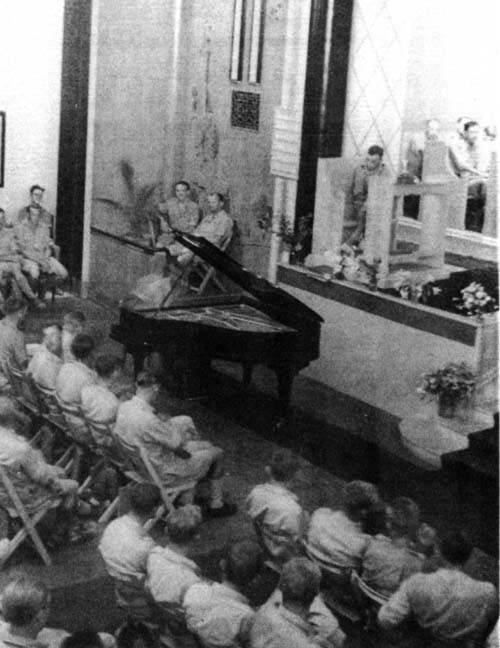
Another form of entertainment, steeped in culture, were concerts of classical music well attended. These were held in the Parish Church on the hill overlooking the harbor. One of our AFS Drivers, Rock Ferris, a truly gifted pianist, presented two concerts which I described in letter dated July 18:
Sunday afternoon the pianist Rock Ferris (AFS) gave a concert including Brahms 5th Sonata in F minor, some Spanish pieces, some Lizt and Debussy and McDowell. I have seldom heard anyone get so much music out of a piano. In spite of lack of practice, he played a balanced program necessitating skilled technique.
And again in my letter August 21:
Yesterday (Sunday) Rock Ferris gave another of his concerts on the piano. His program was Brahms --- Sonata Number 5 and some Brahms rhapsodies, and Mozart --- the Sonata with the well-known Rondo a la Turca. I remember this Rondo was about the high-point in my "career" as a pianist. Often I wish I hadn't stopped practicing....
Jock Cobb's ever present camera caught the action, although Rock himself is a blur at the piano in the following photograph. The rest of us are sitting, attentive, shirts and shorts crisp and clean.
There must have been only a few thousand American forces in all of the Tripoli region, of which our AFS contingent was significant. We Americans were outnumbered in a sea of thousands of British Commonwealth troops; nevertheless there was considerable and continuous Anglo-American interaction at Tripoli. And the significance of Anglo-American relations had increased now that major American forces were actively engaged in the liberation of Europe, with General Dwight Eisenhower named Supreme Allied Commander. Also the need for continuing close Anglo-American cooperation and accord to shape the future peace was becoming apparent. This led to interest in things American.
One of the "spinoffs" of this concern were talks and discussion groups organized by the commands as the long summer of '43 continued. These also served as another form of entertainment, or perhaps diversion for the troops. We Americans of AFS participated providing significant cross-cultural overtones. These programs which were held at various army units, commenced in June and continued on into September. I wrote in June 10, and again June 15:
Chan Keller gave a talk last week in the series of talks we Americans have been invited to give to the Tommies. His talk was on "Anglo-American History ....I am giving my talk "Mexico and U.S.A. the Good Neighbors" to several units of the army. They have invited several of us to give talks concerning America. I think it will all be quite good fun.
There was no doubt as to the bonds of friendship that united Howard Brooke and me with "our" beloved Regiment, the 58th Sussex. Early on, we discovered to our delight that the Regiment was also pulled back to Tripoli, and "camped" nearby. I would eventually be invited, with Chan, to help lead a discussion group at the Regiment in September. But for most of the time, we just enjoyed exchanging visits at each other's "camps" as well as excursions downtown or to the beach. I wrote June 10:
"Colonel" Brooke and I have also had several visits with "our" Regiment. Last Thursday Alex Turner spent the day with us. Last week we had dinner at officer's mess with Major Dyer, Captain Harper, "Doc" Koretz. Our talking and toasting went on far into the night.
The highlight of this week was a dinner party Howard and I gave to our" Regimental Staff. Major Dyer, Captains Harper and Koretz, and Lt. "Andy" Anderson all met us at the beach. After I had taught Major Dyer the back stroke, and had a swim up the beach with "Andy," we all met at a restaurant where I had arranged for a table for six. Good atmosphere, good food served well, good company --- all these things meant so much after months of dodging flies, standing. in line at the " cook house," eating bully beef and sand out of dixies ... After the dinner, the major drove Howard and me back to camp; we all crowded into the major's jeep, singing songs as we went.
On another occasion in early August I had written that "Howard and I had thumbed out to our beloved Regiment for a visit and dinner. The Doc and Lt. Anderson ("Andy") brought us back in their jeep." During dinner Colonel Calhoun, Commanding Officer of the Regiment, told us of a meeting of Allied Staffs conducted by "Ike" and "Monty." In recognition of the importance of Anglo-American cooperation, the Colonel observed that "...only an American could have done the job Eisenhower is doing."
Major Chadwick, CO of 230 battery of the 58th Sussex, was particularly interested in things American; his Aunt had founded a home for orphans in South Carolina. He was trying to subscribe to Esquire magazine. I helped him to secure this at a special military rate plus $2.50 for foreign postage. Even during the war, such small links with our *Mother Country" were facilitated in the interest of good relations.
It was September 1943, and we were still waiting for orders to advance to Italy. September would also mark the end of our one-year enlistment contracts with AFS. During this year we of AFS had served with the British, officers and men, and we had had few contacts with our fellow American servicemen. At Tripoli, with some American units posted nearby, I wrote of a visit with one of these American units:
The other day I met with a fraternity brother of mine, a fellow who graduated from Columbia. He asked me to dinner at his outfit, which is one of the most distinguished of the American units out here. This was the first real contact with my own countrymen outside of AFS. "Mr. Pom" might be amused to know that I often feel more at ease with Englishmen than with Americans!
Note., the reference to "Mr. Pom" was to the Rev. Vivian Pomeroy, our family's church Pastor in Milton who had come to us from England.
There was one obvious material difference between our two forces. In rations, uniforms, pay, allowances, facilities the American "GI" was better off than his British counterpart. This may have adversely affected good relations among the troops, and apparently caused some problems given the thousands of Americans being prepared in England for the Normandy invasion. I doubt if it affected much our overriding Anglo-American alliance, although the disparity in pay between "Yank" and "Brit" was an irritant. During my visit as guest of my fraternity brother, I discovered one "advantage" in my British rations over his American: our monthly AFS allowance of a bottle of spirits --- with which I most warmly toasted USA and UK.
A principal "intercultural" concern of our forces at Tripoli were these Anglo-American relationships at home and abroad during the war, and in shaping the peace after the war. The speaking engagements and discussion groups on these and other matters, which had commenced in June, continued into September.
One of the most significant discussions in which I participated took place at the request of "my" Regiment, the 58th Sussex. Chan Keller through me had become almost as close to the Regiment as Howard Brooke and I, and so he was invited with me to lead in talks and discussion at the Regiment.
I refer to this event as "significant" because there surfaced serendipitously during the discussion an idea which could well have served as the germ of what would become after the war AFS Intercultural Programs world-wide.
In a letter dated September 6, I wrote at some length about this event,
Last week Chan and I spent a very pleasant morning at "my" Regiment. At "Andy's" (Lt. Anderson's) invitation, we had agreed to take charge of a morning's discussion group on America. After brief talks by Chan and I, the discussion carried on for a good hour and a half, with the Tommies of the Regiment asking terribly intelligent questions as follows (which Chan and I struggled to answer as best we could): --- comparisons between British and American wages, channels for future Anglo-American cooperation, America and Russia, farm wages in America, steps USA is taking with regard to price control and in anticipation of post-war unemployment, America and collaboration with the rest of the world after the war, "Big Business," the Negro, social security. These and others were topics these English soldiers were keenly interested in.
Some of the Tommies thought it would be a good idea for English, American and German students to work and study together after the war. This was much like the American Friends workcamps in Mexico, or the Experiment in International Living of Putney, Vermont.
I was finding, as Wendell Willkie found in his brief world travel, that direct friendly contact is about the best approach to understanding among the races.
This idea, advanced by the British Tommies, of students of different nationality working and studying together after the war, including German students, has been bountifully realized in this half century since the war by AFS Intercultural Programs. I do not suggest a direct connection. It was, however, these kinds of experiences which we of AFS knew in war to which our AFS Director General Stephen Galatti made reference at the AFS Reunion, New York, September 27, 1946. At a meeting the next day under Mr. Galatti's leadership, the first AFS International Scholarships were begun.
The fact that soldiers of Britain or any nation, some of them more than two years overseas in combat situations, would spend their rest and leave time on such matters, is in itself a tribute to "the better angels" of our human nature. Thanks to such "angels" perhaps there was hope mankind could achieve a viable Peace after the war.
My letter about this meeting at the Regiment continued:
Chan and I had lunch at officer's mess, after our busy morning of discussion with the men of "my" Regiment.; and after lunch (with Captain Harper, Major Dyer, "Andy," and Colonel Calhoun) we drove back to camp with Alex Turner and John Cocks. I drove them back to enable them to say "goodbye" to "Col." Howard Brooke who was leaving the next day with the rest of the fellows of my unit who are planning to go home, and some to leave the Field Service. It was hard to say goodbye to Howard, who shared that month at Enfidaville with me. Also the temptation to head for home along with the others was especially great...
However, I had decided to sign on for another tour with AFS for reasons to be explained in the next section of this "Chapter."
This was also my last extended visit with the special friends of this Regiment, our" beloved 58th Sussex, which Howard and I had claimed as our "own". Would that all Anglo-American, or any intercultural relations, could be so harmonious. Captain Harper had expressed an interest to visit Boston and Hyannis Port, but it didn't happen. When in transit through England in July 1945 en route to USA, I had stopped at Alex Turner's home in Bristol; he was then in Germany. In July 1959, my family and I visited with Alex and his family in Bristol for several days. Alex and I never lost touch, maintaining a rich correspondence up to his death (June 6, 1989). He was more than friend for me, and I for him.
Jock Cobb had also contributed to the "lecture and discussion" circuit, modestly commenting on one of his talks in a letter dated June 8, although he was having a difficult time getting away for talks during his volunteering as a workshops mechanic:
Then, too, the Brigadier has asked various knowing members of the outfit to give little information talks to the Tommies just to keep their minds busy in this siesta period, so I volunteered to shovel in with a little popular astronomy. It's just like college days all over again.
By reference to "Brigadier" I assume Jock referred to the Commanding Officer of the 48th British General Hospital which had also become one of the principal sponsors of the well organized movie showings.
Another of Jock's commitments was an involvement with a forthcoming AFS Bulletin to be published for the boys in the field, and about which Jock wrote (again modestly): "I am more or less on the temporary board as photographic editor but as yet we can have no photographs in the thing, so I'm worrying about drawings..."
In addition to his editorial work with the AFS Bulletin, Jock also participated in a competition sponsored by the Tripoli Times. Given the influx of thousands of British and American troops into the Tripoli area after victory over Afrika Korps, a local newspaper had been established January 23, 1943; it was called the Tripoli Times, and its Editor was Capt. R.L. Elley.
This paper ran a feature section called "Anglo-American Postbag." Through this section, the paper organized a competition to invite suggestions for bettering "Anglo-American Relations." Jock's proposal was one of "the three best suggestion-letters received" out of many proposals, for which the Times reported it was "the biggest postbag ever on any single subject."
For his reward, Jock received £20 (pounds sterling) from the Business Manager of the Times who requested "Kindly acknowledge receipt and oblige."
In his proposal, meticulously detailed, Jock explained that "as an American attached to British units for almost a year, I have noticed that the more we get together .and talk, the better we get on." To this end, Jock wrote "There should be a club or canteen restaurant run jointly by British and American services such as the NAFFI and the American Red Cross." For this Club Jock enumerated such activities as entertainment, meetings, talk, discussions, hobbies, magazines and books, fresh local foods available at low cost; and that the clubs should be pleasant places for soldiers, and set up jointly where-ever British and American troops are posted for any length of time. Its name "The Lion and Eagle Club."
He volunteered us "Volunteers" of AFS to help set up such a club. Calling upon another one of his talents, that of cabinet-maker, he offered to build the furniture.
The ideas and rewards were announced by the paper September 7, 1943 --- too late for implementation before most of the troops moved out. Quite a few of these and other ideas had been in fact carried out during the summer but without benefit of a central organization.
What was interesting, was the interest on all sides --- British, American, Canadian and other Commonwealth troops --- for ways and means to promote good relations and break down barriers between our nations; also, that an all male soldier society temporarily held in a rest and refit mode between major battles, would devote so much of its energy to such concerns
While in the nature of things at Tripoli, the Anglo-American relationships dominated intercultural concerns, this was not the only such concern. Our camps were widely dispersed throughout the gardens, orchards, and farmlands of the region and these were the homes of down-to-earth farm people transplanted from Italy.
In contrast to contact with the Arab cultures we had known in Lebanon and Syria, we had almost no contact with Arab peoples during our four months of refitting and waiting at Tripoli. Although Tripoli had been the principal city of a North African Arab population, it had been virtually Europeanized by the Italian colonization, and this process had been accelerated by the occupation of thousands of allied troops.
My letters gave glowing accounts of the Luigi family, owners of the farm where our Sections and Platoon were parked, and who took us into their home and hearts. A principal factor here affecting intercultural relations is language, and in this, I had an advantage, because I could communicate with the family in their language.
Good relations between different cultures can be realized by reason of our common humanity when there is good will; language interpretation also helps. However. communication in a common language becomes the basis for harmonious relationships between differing peoples. My own contacts with the Luigi family was an example. Between Americans and British there is no such bar. Fortunately for us English is becoming the lingua franca of our world.
With the Friends Service Committee in Mexico in 1942 my Spanish had worked wonders. Fortunately, when with the Spears Clinic in Syria in early 1943 our Lebanese physician, Dr. Salmon, spoke English; Jock and I were both grounded in French. As a Foreign Service Officer after the war, fluency in two foreign languages was required of me. In letters home that summer of '43 1 wrote that "I think I know how to get along with people of other nationalities." Knowing their language was basic.
From the previous pages, outlining the manifold activities to occupy our time at Tripoli, we of our AFS "Lucky 13," indeed all of our fellows, took advantage of our enforced interlude at Tripoli.
Still there was time on our hands. One of my "hobbies" was creative writing. Borrowing Jock Cobb's or Bob Blair's typewriter, I drafted a "Commentary" about the "Battle for Tunisia" while the experiences and the memory were immediate. Mother had it mimeographed for family and friends. I also wrote a poem, "By These Four Walls" based on the Enfidaville experience; I have since revised the poem and changed the title to "Soldier Calvary." When I commenced my AFS Driver Remembers more than 50 years after the fact, this "Commentary" plus the scores of letters I had written provided my documentary sources, together with some of Jock Cobb's letters.
Still, there was time on my hands. As a registered conscientious objector (c. o.) the Tripoli interlude provided for me the time for reflection on War and Peace, and upon the condition of my own conscience after almost one year of service in war in uniform. These reflections follow.
As our units withdrew to Tripoli, it had been one year since my decision to register under Selective Service as a conscientious objector to war, a decision reached pretty much on my own and with much soul searching. In making this decision, I did not have reinforcing membership in a Pacifist Church, such as the Society of Friends, although I had worked with the Friends Service Committee.
My Unitarian denomination, and my parents, taught individual responsibility. and to follow the life and teachings of Jesus of Nazareth. Jesus preached the sanctity of life in a gospel of universal love for all beings, and hence the fundamental immorality of war. Unitarian Transcendentalism was also consistent with a pacifist doctrine of nonviolent resistance in which I believed as an alternative to war. This doctrine, as articulated by Henry David Thoreau, was applied successfully by Mohandas Gandhi to achieve the independence of India; and by Martin Luther King and the Freedom Riders in the post war struggle for civil rights in the United States.
Another facet of my pacifism was contempt for war. As a boy in the 1920 's I knew older men who had been mutilated by wounds and mustard gas in the horrors of the trench warfare of World War I.. This reinforced my contempt for war; there was no glamour in it, it was an atrocity.
Another facet to my pacifism was concern for world peace, and the importance of United States participation in a world-wide collective security system. This concern would become a primary focus of my life, however, as a young student in the 1930's, I was influenced by the irresponsible isolationism that was espoused by no less national hero than Charles Lindbergh together with the illusion that we were secure behind our two surrounding oceans. Isolationism was not a valid moral or rational basis for conscientious objection to war, but it fueled my anti-war beliefs.
Largely Republican, this national isolationist cancer prevented United States membership in the League of Nations and brought on the World Depression because of reckless profiteering at home and the wall of high tariffs constructed by the Republican led Congress. The rise of the aggressive Dictatorships followed, and without the United States the League of Nations could not contain them and prevent World War II. Isolationist policies in America were dominant until the attack on Pearl Harbor (December 7, 1941).
Its disastrous effects were a powerful object lesson that American leadership in a universal collective security system, call it peace keeping and police action if you will, was essential. for World Peace and must follow Allied victory in World War II.
The foundation for a world-wide collective security system was people-to-people discourse and understanding involving the diverse cultures of the world; this was the focus of the AFS Intercultural Programs since World War II. At Tripoli in the summer of '43, our modest foray as AFS Drivers into "intercultural relations" with British and other Commonwealth soldiers, may have been one of the unwitting seeds for the AFS world-wide intercultural programs to be.
Wendell Willkie's One World, which broke all publishing records after his whirlwind world tour in 1941, as well as Franklin Roosevelt's leadership to establish the United Nations Organization during World War II, were hopeful signs that we would not repeat the folly of the post World War I decades.
These, then, were two interlocking concerns of mine which, with time on my hands at Tripoli, I pondered during the summer. One was the status of my commitment as conscientious objector to war following a year of service with AFS. The other concern was the impact of my war experiences upon my belief in world peace, and my hope that Allied victory in war could be the basis for a durable world peace for all nations after the war. Only in this way could the scourge of perpetual war be eliminated. These concerns were reflected in my letters.
By 1941, the year I graduated from College, aggression by militant dictatorships had overwhelmed all of Europe except Great Britain. The Axis Powers, Germany and Japan, also controlled North Africa and most of Asia. To be sure, on June 22, 1941, Hitler turned against his Soviet ally, and on December 7 Japan bombed Pearl Harbor.
Consequently, the United States, in alliance with Britain, was the sole remaining bastion of freedom in the world capable of support for beleaguered Britain and Russia and then to turn back the Nazis and the Japanese. But the outcome was on the balance, and the enormity of the demands upon the American people was limitless. Millions of my own generation were being mobilized as the foot soldiers of universal war, a war that had already engaged all of the youth of Britain. How could I do anything less in the defense of freedom?
This was the crisis of conscience I had faced in 1941, and which was resolved when I volunteered for AFS. As an Ambulance Driver, under the terms of the Geneva Red Cross Convention, I would not be taking life but helping to save ft. Serving in conditions of combat with AFS, I would be exposed to as much risk and more than most of the troops. And I was not alone among registered objectors to war in AFS. There were quite a few, including those of our "Lucky 13."
It was a legitimate compromise. Nevertheless, it meant that we Drivers would indirectly support the armed forces. Wounded men would recover and return to action. Our Platoons and Ambulance Car Companies. were integral parts of the armed forces of the Allies in a "just war" against aggression. We wore uniforms, obeyed orders, were subject to British Army articles of command.
The compromise I had made as an Objector Ambulance Driver attached to units of the armed forces would be tested in the field. For me there were two tests: a test of conscience: was such participation with the armed forces compatible with my commitment of conscience to oppose war; and a test of duty: would I be exposed to risks to life and limb as great as those millions of the enlisted soldiers of my own generation were called upon to face in the defense of freedom?
The forty days and nights (September-October 1942) of our zig-zag "cruise" from New York City to Egypt was followed by three months in the Middle East (November-December 1942, January 1943). The army to which we were assigned (the British 9th) was an occupation army not engaged in combat. Our first task was to learn to drive and maintain our ambulances, then most of us were assigned to base hospitals and CCS's. Thus far, there had been no test of conscience.
We carried patients of the accidents and illness of occupation. Many of these were veterans of combat in Crete, the Middle East, and the Western Desert. Some had fought in the defense of France and been evacuated at Dunkirk. Most, officers and men, had been out "in the blue" two and three years. One such example was Corporal Johnny Birdsaw, then with Damascus CCS, who had been wounded in France, wounded again as a "desert rat" at the siege of Tobruk, and been torpedoed when evacuated. I wrote of him in a letter that he had "shrugged this off as all in the day's work," and had shown no animosity towards ordinary German soldiers or people.
Although in this way I was involved in war while at Damascus CCS, I felt no qualms of conscience in my service in a base area so remote from the guns of war and combat. To the contrary, the Army routine at Damascus was social and civilized. There had been a reverent celebration of the Christmas holidays. My friendship with, and respect for officers and men of the British armed forces in the conduct of war grew apace. They performed their duty against aggression and they hoped for peace.
In January 1943, my service with the Spears Mobile Clinic at Selemiye, Syria was ideal from the standpoint of a conscientious. objector in war. Our mission was medical assistance to the civilian populations. Our Doctor was Lebanese, as was our interpreter and male nurse. Two British orderlies, Dennis Frome and Jim Hall, were conscientious objectors with the British Friends Ambulance Unit. Armed combat was thousands of miles distant. Jock Cobb wrote that he could have spent the rest of the war happily in this service.
In February 1943 we had gone out to the Western Desert at Marble Arch east of Tripoli. Except for the random anti-personnel bombings by German planes at night, and witnessing "dog-fights" in the air by day as flights of our bombers droned by in formation, we were removed from the guns of war and actual combat.
We carried casualties down through the rear echelon medical facilities. Without fail, these men were stoical, resigned, simply doing a job. Again, as at Damascus, I was amazed at the absence of animus towards the regular German soldier as well as the respect for their commander, Field Marshal Rommel. Erwin Rommel, the justly famed "Desert Fox" subsequently gave his life together with other senior German Army Officers, in failed assassination plots against Hitler.
About all the Tommies I carried would say, concerning an engagement where they had been wounded, were expressions like "it was a tough go," or "Jerry knocked us about a bit.". And although we were in a war zone, there had been scheduled sporting events, debates and discussion groups, swims at the beach; and a bunch of us got together at night for a songfest or two inside one of our "Fox-Halls."
War did not seem so bad, and I felt that there was not much difference between me and the soldier. But up to then, we had been basically "playing games" not waging war. Some of it had been almost like a tourist journey through historic places. Jock Cobb, who had joined us at Marble Arch after Selemiye and Cairo, wrote of these experiences to date that "war is a game," and it was an apt assessment of our experiences thus far. As a game, there is the implication of war as a sporting event having players on two opposing sides following certain rules of the game and not necessarily a lawless life and death struggle --- perhaps not an atrocity after all?
By contrast, the Battle for Tunisia was no such sort of game. It was serious business, and we were in the thick of it. I could hardly have "found" a more dramatic testing than right at the front at Enfidaville during the final month of the battle. At Enfidaville, I had experienced horror and fear, seen at first hand the instruments of modern war in action, escaped with my own life by the closest of margins. Men next to me had been wounded or killed. I had faced as great or greater risks than many troops would ever know.
Between lulls in the fighting at Enfidaville Alex Turner, a British Tommy Regimental dispatch rider, had spoken to me of his hatred for the impersonal, inhumane brutality of war, and of his hope that our leaders would make an end of it. "We die a hundred deaths for people back home to make an end of war which keeps coming back. I shall do all I can for peace." He had compared the eventual transition between war to peace as that of a criminal coming out of jail. "We must help the world to walk straight," he said. War was an atrocity. There had to be a better way.
Nevertheless, out of the fear and horror of those weeks, I had bonded with my "comrades-in-arms" of the 58th Sussex, officers and men. Jock Cobb reported a similar bonding with men of his regiment. I felt this keenly and tragically. In my poem "Soldier Calvary." drafted out of the Enfidaville experience, I wrote: "I have become a son to those who can not shake the grime of battleground from off their boots, and I take up their cross."
My test of conscience was beginning to take an unimagined twist. I did not feel tarnished, but rather proud to wear the uniform of our British "cousins," officers and men, who had stood alone during the Battle for Britain as the sole deterrent to the Nazi juggernaut. I served in uniform as an ambulance driver to be sure, but I could not be closer to these men had I been one of them.
These men had been two years and more in combat situations away from their homes. They hated war as much as I, and with more cause. They despised the Dictator aggressors who had plunged the world into darkness. But there was no hatred in their hearts for the citizen soldier of the other side trapped like them in the darkness of war. The first time I met Alex Turner he had spoken out: "After all, Jerry's as human as you or me..."
In one of my letters home from Tripoli (August 18) I had written of these men: "Plenty of soldiers are opposed to war and I don't suppose God values my conscience any more than theirs."
Remarkable at Enfidaville had been the absence of animus towards the enemy among those men whose lives had been so threatened by the enemy; this had been the case also with casualties we had carried in the Middle East and the Western Desert. When at Enfidaville I had written: "They did not seek revenge. There was respect for a foe who in Africa had been a resourceful fighter by the rules of war. Care for the wounded of the other side when captured was every bit as good as our own."
Their fight as soldiers in war was not limited to the defense of England. They were fighting for a just peace not only for England but also for Germany, and for all nations and peoples. This was apparent during our "intercultural" talks and discussion groups at Tripoli; for example, it had been the Tommies of the Regiment who proposed a program of student exchanges after the war between America, Britain, and Germany.
In this, however, a distinction was made between the peoples of Germany and Italy and the German and Italian Dictators, their sycophants, their brain-washed rabble, and the Nazified divisions that had infiltrated the German and Italian regular armies, Towards these, the hatred of the British Tommy knew no bounds.
The German army had been turned into an instrument of aggressive conquest by a ruthless Dictatorship whose leaders and Nazified divisions committed unspeakable atrocities in violation of all the laws of humanity and war.
Consequently, there was a radical difference between armies and nations in the conduct of war, and I had seen it at first hand. This was at the root of the unimagined and paradoxical twist that now began to condition my conscientious objection to war.
The Democracies --- the United States, Britain, the Free French, others --- had taken action to defend against this aggression, to turn it back, and to provide the opportunity for a world peace when the war had been won. This had required a mobilization of resources far beyond the limits of professional armies. These were the armies of citizens who had rallied to the defense of freedom and for a future peace. Armies composed of young men of my own generation, armies fighting under the banner of Franklin Roosevelt's "Declaration by United Nations" (January 1, 1942).
St. Augustine had posited a bellum justum, a just war in which Christians could participate with a clear conscience. And assuming that a universal collective security system would be established after the war by the Democracies for the pacific settlement of disputes and to organize armed "police action" if needed as a last resort. I felt, hypothetically, that I could support such "police action" although it involved the use of armed force and possible risk to life as in war.
Nevertheless, I had not shot the guns, I had not loaded the shells, I had not spotted the Germans and laid down the quadrants for a barrage. I had not taken lives but I had saved lives. I had made this choice, been allowed to make this choice on the grounds of respect in a democratic nation for individual conscience --- even in time of mobilization when the existence of the nation was in jeopardy.
The premise on which I had grounded my choice of AFS that "if everyone drove an ambulance there would be no war" was valid logic; however, mankind was a long way away from this ideal.
At Tripoli, I also faced another "test" involving my status as conscientious objector. As our summer of '43 wore on into September and still no advance to Italy, the time was approaching when my one year enlistment contract as an AFS Driver would be terminated.
These contracts were calculated from the month and day in which we had reported to AFS/HQ, Beaver Street, New York. City, for embarkation orders and formalities. Our termination date for ME Unit 26 would be September 20, 1943 when I would have the option, the choice, to head for home, or, alternatively continue with AFS in the field. This was a test of conditions I had established for myself when accepting a conscientious objection status. It proved to be as agonizing a process as it had been for me to enlist in AFS in the first place, and added to it was the longing to return home.
In facing this decision, I was less idealist and ideologue, more pragmatist, "sadder and wiser" as the saying goes.
In a letter home dated August 18 1 had confessed to a different approach,
The way my conscience operates now is a good bit different than formerly. Rather than setting for myself certain inviolate principles to follow in a straight and narrow manner, I seek instead to choose the best possible of alternatives for me in an existing situation.
There were a number of options seemingly open to me. I toyed with the idea of service in the Merchant Marine, which recruited civilians at more pay than the small AFS allowance (then $50 a month). These brave man risked torpedoes in the frigid waters of the North and Barents Seas, the only life-line to Murmansk and the Russians. But how could I be a party to the transport of munitions? Jock Cobb had agonized over a similar issue when tempted to help his fellows load shells for an artillery barrage.
There were other options: I had received a second offer to teach at the American University of Beirut, starting in the fall; I was also interested in applying for relief or ambulance work in China being organized by the Lehman Commission, and which the American Friends supported. My fellow in AFS and in so many things, Jock Cobb, was also interested in the Lehman Commission at this time; he also toyed with but rejected the idea of service with AFS in India where Chan Ives had taken command. For Jock, admission to Medical School was becoming his option of first choice, achieved six months later.
None of the options I was considering, including the possibility of return to AFS after a month at home, were valid in the absence of authorization by my Milton Draft Board which had autonomy over my objector status.
In the meantime, I had rejected the possibility of the Merchant Marine as the "best alternative offered in an existing situation." In June I had written: "...could I as a sincere pacifist help transport guns as a member of the Merchant Marine?" And then I had written on August 18:
that for me the Merchant Marine would not be the best choice I could make, given the freedom to continue with AFS. I had more or less rationalized myself into the Merchant Marine, especially since it might have meant getting home. Your recent question about that calls for an answer. Given the premise "the conscience is something that feels bad when everything else feels good" I guess I'm still pretty much of a "c.o." when it comes to crossing the line between ambulance driving and helping to carry munitions. I have no illusions that if I "CPE," don't help lug said munitions, they won't get carried anyway... But as long as I am able to choose what is for me the best or most truthful or most responsible job, I shouldn't let a sudden selfish wish to go home get in the way.
As I explored these options, I came to the conclusion in September after the "testing" I had gone through, that indeed AFS was the best place for me for as long as the war continued. Subconsciously, a factor in coming to this decision was the bonding I had known with my fellows of "Lucky 13" as well as the Commonwealth soldiers with whom I served as an AFS Driver. I had in fact written that "it would be hard to find a better outfit than AFS, especially for a fellow with my outlook about the war." Mother in a return letter had advised me to continue with AFS.
In letters home I had asked my parents to take up my case and possible options with the Milton Draft Board, including if my IA-O classification guaranteed service in the United States Army Medical Corps were I to leave AFS. My dilemma as to continuing with AFS after my enlistment ended, including permission to return to AFS after one month at home, was resolved with approval by the Draft Board making possible this course of action for me.
However, in late August, I did not accept home leave, but signed on for another six months with AFS without going home at that time. This must have been heart-wrenching for my parents and sisters after all the "on-again-off-again" about coming home I had put them through for weeks.
It was also heart-wrenching for me, as I remember waving forlorn farewells to brothers in AFS, including of our "Lucky 13" and of ME Unit 26 who were going home without me. Blame it on that conscience of mine and the sense of duty that had been drilled into me. I was not alone: it helped that others continued with AFS without taking home leave.
One of my commitments as an AFS Driver had been to accept risks and sacrifices comparable to the men of my generation. I had been posted with the Tommies many of whom had been at war two even three years. How could I return home after just one? In a letters home dated August 18 and September 6 I wrote:
I know you understand this point, especially because you know that the men with whom I have lived and worked for the past year have not seen their homes for two, three, or four years. Incidentally, the Tommies tell us we are "crazy' to stay, given the chance to get home! That puts the issue right up to the ol' conscience ... Perhaps your cartoon artist could-make a sketch of me, woebegone and perplexed, squatting on the African sands with a boat marked "Home" on the horizon and me not on it! ... It was hard to say goodbye to Howard who had been a good friend;. and who shared that month at Enfidaville with me. Also the temptation to head. for home along with the others was especially great as I stood waving goodbye to them. Now I am truly a "volunteer" and shall remain so for another six months. I expect to sign on definitely within a week; Christmas in Berlin?
I had also caused additional worry for my Mother to whom I had sent my "Commentary" on the Battle for Tunisia. She had taken over as my "literary agent," to edit, transcribe, and mimeograph the text for distribution and possible publication --- and there had been a favorable reception. In writing it, I felt that Mother would want to know the truth about what happened to me; however, the graphic "blow-by-blow" account of the weeks at Enfidaville and the rest of it must have been upsetting.
To ease this hurt, I had tried to persuade myself and my family that the war would be over soon, and in any event, I would never encounter another "Enfidaville," writing specifically that my narrative about Enfidaville and the rest of it "is probably the last thing of it's kind I shall ever write."
I had written further about this, again in my letter of August 18:
I don't want you worrying needlessly about me. Be comforted that ...... the way things are going now, I've got a hunch the war will be over before I ever get within a couple of hundred miles of a battle area. We've been in the same spot all summer, and if the war becomes even more an air war, our role as an Ambulance Car Company may well become more concerned with hospital work than Aid-Post work
On September 6 I promised that "after six more months, which I trust will include some time spent on the Continent, I shall be coming home..." However, I had reserved the possibility of doing relief work after the war for the "peoples of Europe, Russia or China." In August I had written that "after the war I should want to help out in reconstruction work, for I think I know how to get along with people of other nationalities."
I hope, at least, I had persuaded my family not to worry; however, both of my assumptions as to the future role of AFS and as to the ending of the war were grievously wrong. The war in Europe dragged on until May 1945, and it was not until August 1945 that Japan surrendered. In Italy some of the bloodiest, most prolonged and destructive battles of the war took place, and AFS was in the thick of it.
Even as I was persuading myself and my family that the worst was over and the end near. Anglo-American armies had begun the invasion of Italy and the Continent of Europe: the British 8th Army at Messina. (Sept. 3 and Taranto Sept. 9) and the American 5th at Salerno (Sept, 9). We of AFS would also be on the move once more, but it was not until early October that our orders were complete and arrangements for transport by sea to Italy secured. It would be the end of our long Summer of '43, one of the happiest interludes of any war.
As the war continued, Anglo-American cooperation became more essential, with joint command and combined strategic planning under General Eisenhower in place. In addition to the matter of "getting along" and working with each other, the Allied Powers faced. the issue of preparing for the future peace of the world following defeat of the Axis Powers. Regardless of how long it was going to take, and how terrible the cost would be, the tide had turned against the Axis powers on all fronts.
Cooperation with the Soviet Union after the war was by no means certain, despite hopes that USA and Britain could work with "Uncle Joe" Stalin. During the war, self interest dictated Stalin's cooperation. News filtered down of "Summit" Meetings of the "Big Three," Roosevelt, Churchill, Stalin. These articulated the outlines of the grand strategy for. victory, including the Normandy landings in June 1944; and they had announced "unconditional surrender" terms well in advance of victory.
On the face of it "unconditional surrender" sounded as if vindictive terms would be levied upon the Italian, German, and Japanese peoples by the victorious allies, as had been done against the Germans after World War I with disastrous consequences. And there was support in some circles for punitive action against the Germans and the Japanese after the war. The notorious "Morganthau Plan" advanced by the American Secretary of the Treasury was evidence of this, as was incarcerating our Japanese-American citizens into concentration camps on the American west coast combined with racist phobia towards the Japanese, referred to as "Japs."
Importantly, it would the "home front" and the attitude of the people as well as their leaders, that would determine the shape of the future peace. Both Jock Cobb and I, in our letters home in response to news stories and magazines from home, were troubled.
In a letter in August I had written that actions and attitudes at home are "as important, perhaps more important, than the single task of winning a war which we young men of a United Nations have been asked to do." My letter continued with the words "The final test of our sincerity as a nation to fulfill that nation's pledges to all peoples 'everywhere' lies precisely in the kind of society now, and to come, at home."
I also reported that "some of us have chatted with the "Jerries" man to man; some of our boys have been taken prisoner, too, and would tell you that fellows on the other side are no better or worse than ourselves. That's where your words about the Italian people are so, true....that goes for most of the Germans, too..."
This letter was in response to my Mother's accounts of sacrifices and voluntary war relief activities at home, as well as her explanation of the fundamentally anti-Fascist qualities of the Italian people.
Another aspect of the home front, which would make it more difficult to build a collective security system after the war, was the hero worship and glamour associated with war back home according to movies and magazines we saw overseas. This diverted attention from problems of peace. In my letter I had written:
I don't believe soldiers out here go for that hero-worship stuff. They want to make sure that other generations will get better guidance .... Life, Time etc. seem to indicate lots of us haven't gotten over a football-game complex about the war. I suppose that's better than being morbid, but all the same war is a serious, nasty business without much glamour attached to it. Too much hero-worship has a false ring to it.
In a letter home dated October 1, 1943, shortly before our embarkation for Italy, Jock had written along similar lines:
The job to be done now is to finish what we have started for better or worse and finish it soon. The longer the war, the worse it will be, especially since it is the spirit of the army and the people that will make the difference, and from now on we will be on the offensive. From what I read in the magazines and papers, every victory out here for us, lowers the spirit of self-sacrifice for the war at home.
People don't seem to realize that the greatest need for the spirit of self-sacrifice will be after the war when we will have the job of getting things started again all over the world.
When I read through Life magazine or some such periodical, I lose all desire to come home. Everything from the advertisements romanticizing the boys at the front, to the battle stories and hero worship nauseates me.
All this is predicated on the assumption that we will win the war, but it a few things don't get straightened out on the home front pretty soon, the whole picture may change. The things I mind most ... the attitude: "What are we going to get out of the war?"
Another facet affecting the home front after the war, would be the return of the troops. Not only would Americans be called upon, in Jock Cobb's words, "to get things started again all over the world," but equally so at home. And I had written in another letter at this time that "the soldiers wont be able to eat their medals and uniforms, they will need jobs to go back to and a free country!"
An initial problem affecting world peace would be relief and reconstruction following the devastation of war throughout Europe and Russia, and in China. In my letters during the summer I had written, as had others of AFS, of volunteering for relief work after the war.
Indeed, one of. our "Lucky 13," George Collins, transferred to the United Nations Relief and Rehabilitation Agency (UNRRA) after the war before returning home. I returned home after the war to enter graduate studies for foreign service.
I had few illusions that my "reflections" as an obscure "foot soldier" could impact upon affairs of state, nevertheless, I continued to unburden myself on these matters in my letters during the summer of '43." My letter of August 18, already quoted above, expressed doubts as to America's capacity for shaping the Peace with other nations after the war, and especially with Italy and Germany:
I'm afraid our American material well-being, and comparative freedom from the complex problems that have faced the Europeans, have made us too self-satisfied and smug, in spite of the ready (but often artificial) idealism which we are wont to pour out upon suffering humanity. We can take our place in the world community only as equals and not as angelic missionaries of the "American Way of Life." We can not ... totally ignore the psychology and culture of other nations with the smug assurance that our way is the best in the world...
We must be willing to be guided by the peoples in the countries we are liberating ---especially Italy and Germany. We must enable the peoples to handle their own affairs as soon as possible after the war in an overall scheme to preserve peace. Incidentally I was interested that Dorothy Thompson of all persons stressed this very idea in her article in the July Reader's Digest.
The administration of Tripoli, an Italian colony, by Military Authority following its occupation by the British in January 1943, provided an excellent case study of the importance of maintaining and working with local authorities of the other side. This was brought out during a meeting George Collins had arranged with two officers of the British Military Authority (BMA), as reported in my letter:
I stress this point as a result of a discussion group planned last night by George Collins and in which about 12 of us took part seated beneath the olive tree by Jock's ambulance. Our guests were two officers of the British Military Authority (BMA) --- the British organization for governing the lands they occupy in war time. These fellows admitted that they had made a mistake when they had at first replaced the Italian administration ... with British personnel. In fact they have invited these Italians back --- and this is "enemy" territory!
I concluded this example with the following comment:
This is just one specific example of British experience ... when it comes to governing another race in the fairest possible way. USA as a nation can supply the production and material goods to rebuild a shattered Europe. It can also offer the example and inspiration of a working democracy. But I feel that England is better prepared when it comes to the needful experience for administration ... as one of the United Nations America must take as her province the things she is best able to do, England the things she can do best.
I doubted that my own concerns, even the significant example in Tripoli of the British acceptance of and coordination with the former Italian administration as reported in my letters, would have much of any impact upon the shape of things to come. Also, in my letters home that August of 1943, while hoping for a better world, I expressed doubts that the nations would in fact be capable of building a universal collective security system as an alternative to war after this greatest of all wars.
Sometimes I feel like I was continually bumping my head against a great stone wall --- that peoples and nations always have and pretty much always will slog along in their own narrow spheres of self-interest. But as you say, any comparatively new idea takes time, and "One World" is a new idea.
In our exchanges of letters, both my family and I had condemned the failure of the United States Senate to ratify the Covenant of the League of Nations after World War I, as well as the isolationism that had dominated United States foreign policy until the attack on Pearl Harbor and continued to lurk beneath the surface.
I wondered many times if this history would be repeated. Fortunately, based upon his World War I experience as a junior Cabinet Officer under Woodrow Wilson, Franklin Roosevelt had insisted that a collective security system should be in place even before the war had ended. In Washington D.C., January 1, 1942, President Roosevelt announced the "Declaration by United Nations" with 26 signatories.
Before the final surrender ending the war, 50 nations had signed the United Nations Charter concluded at the San Francisco Conference in June, 1945 setting forth principles and procedures for peace keeping in which all nations would participate. President Harry Truman hosted the Conference, and led the United States bipartisan delegation. The Charter was ratified by the United States with only, as I recall, one dissenting vote.
In early October, our AFS "Summer of '43 came to a dramatic ending as we of AFS embarked our entire Company upon the LST's of the United States Navy, destination Italy, and almost two more years of war. It had been an "Interlude" for us when we had tasted peace, but victory over the Axis and war not yet won.
I lost contact with "my" Regiment after Tripoli, and would never be with them again. At some point they had returned to England to prepare for the Normandy landings, and Alex and I had exchanged notes. Mother sent Alex and his family a Christmas greeting, to which Alex had responded with a long letter from England.
Alex, in his warmth and eloquence was the very antithesis of the frosty reserve associated with our English cousins. The perfection of his penmanship matched the lyricism of his style. His letter gives wings to the aspirations of our humankind caught up in the cataclysm of the most terrible of wars the world had ever known, and hoping that somehow a better world could be born from ft.
Fittingly, I leave the final word of this "Chapter" to a letter by Alex Turner of the 58th Sussex, Light Field Regiment, Royal Artillery, and of 19 Chewton Close, Fishponds, Bristol England. The war had brought us together at Enfidaville, also at Tripoli. His letter to "My dear Mrs. Edwards" was dated "20th. Feb. 1944."
I have just received a letter from your dear son, my pal, Charles, and I am extremely happy to know that he is well --- fully recovered from his attack of Jaundice ... I have just written an Air Mail Letter card ... I trust he will receive it before he returns to his homeland after eighteen months dangerous duty ... By Jove, what experiences he has crammed into those eighteen months service ... I know when Charles walks down your garden path, how great will be your happiness and joy...
Mrs. Edwards, we received your Xmas card exactly on Christmas morning, and you can take it from us, we were highly delighted, so allow me to thank you from the bottom of my heart for your kindness, and great heartedness; if only this could be fostered among all the peoples- of the world --- then there would be no more wars, no more heart aches and partings. I should imagine that you are dearly loved by your family, for Charles has praised you to me up to the skies...
Perhaps you will visit us after this conflict is over, but you will observe scars on the face of the country, which will be erased in time, and perhaps a better thing could not have happened it we see a new world arise from the ashes, and a better mode of living for everyone ---then the struggle will not have been in vain, and the cost, although heavy, will not have been too great even though we have lost loved ones. Charles and I used to talk these things over, even in the heat of battle, and we visualized a new Utopian type of world. Perhaps we shall live to share in this better world!
Our summer of '43 ended when long awaited orders to advance to Italy arrived. We had glimpsed Peace after the Battle for Tunisia and during our interlude at Tripoli. Now an uncertain future awaited us until there could be a final ending of World War II.