My stay at this pleasant location of olive groves and farms north of Sousse was short-lived. The day after my visit with residents of the nearby town, followed by an evening with the "Kiwi" fellows, was April 22. Word had come that Enfidaville had been taken, and that an ambulance was needed for the Regimental Aid Post (RAP) of the 58th (Sussex) Field Regiment, Royal Artillery, at Enfidaville. My ambulance was "it." My good friend Howard Brooke, one of our co-opted "Lucky 13" fraternity, was assigned as my fellow or "relief" driver. I would not have wanted to have gone to the front alone. We left with the assurances of our then Company Adjutant Bill Edwards that "we could return in a week if we didn't like it." Bill was trying to be helpful. We fondly nicknamed Howard "Colonel" in view of his distinguished Virginia antecedents.
An RAP, at the front lines, is the most forward of the posts in the chain of medical assistance within the total battle field area down through Advanced Dressing Station (ADS), Main Dressing Station (MDS) and Casualty Clearing Station (CCS) --- the latter being in effect an equipped field hospital. Prompt evacuation down through this chain was the key to effective treatment. Each station along the way was fully mobile.
This would be our first assignment at an RAP. I think Howard and I viewed this as an opportunity, although we took off with a sinking feeling at the pit of the stomach. We were to join a regiment of front-line men, share their anguish and their victories, know their strengths and their weaknesses, earn their respect --- or perhaps their censure. We would see war at first hand and measure our courage, or lack of it, with that of other men.
It was the chance to do the job towards which we had been preparing during the past months. In the spirit of the volunteer, with which all work is done in AFS, we went of our own free will; nor would either of us have refused once asked, nor given up (as Bill Edwards had jokingly suggested). I was not one of the "fire-eaters" and had been content with the less "glamorous" work of an MDS. But in spite of the anguish I experienced at the RAP, I am glad for the month Howard and I spent with "our" Regiment at Enfidaville. The final surrender of the last units of Afrika Korps came through our lines there, May 13, 1943. In retrospect, Howard and I were extremely lucky to have come out alive.
My former fellow Driver Jock Cobb also experienced his own "baptism of fire" near Enfidaville, exposed to the big German guns in the hills and 88's. Shortly after my orders, and of course not known to me at the time, he had been assigned to the RAP of the 51st Medium Field Artillery Regiment whose larger guns were located as Jock had written years later "a little way back" from the more mobile and advanced Light Field Artillery Jock had visualized "the shells from our battery going over your heads."
Enfidaville, which must have been a pleasant town, was abandoned and in ruins as we drove north that day. Situated near the coast at the base of Cap Bon, about 50 miles from Tunis, it was a cross-roads of railroad lines, and also highways leading directly along the coastal plains to the plains of Tunis itself --- ideal for rapid advance by the armored divisions. Montgomery's initial plan was to punch through Enfidaville, on to Tunis, and the envelopment of Afrika Korps from the south.
Strong German positions at Enfidaville were attacked on April 19-20. Units of the 1st and 7th Armored Divisions together with infantry of 4th Indian, New Zealand, and the UK Divisions broke through and reached a few miles up the coast, where the Berber hilltop town of Takrouna was taken by the "Kiwis." Just beyond Enfidaville and sweeping to the northwest were foothills of Tunisia's highest mountain, four thousand foot Mt. Zaghouan --- terminus of North Africa's Atlas Mountain spine. Crack German divisions, backed by the panzers and artillery, held this high ground. It became impossible to push further from the south without risk of enormous casualties.
In response, Montgomery quickly changed strategy and tactics. The idea now was to bluff the Germans at Enfidaville, keep them guessing, immobilize as many of their troops in the mountains as possible by means of unrelenting pressure and threatened attack from the south. Concurrently, Montgomery also divided Eighth Army. In a secret maneuver under cover of night, "Monty" sent units of 1st and 7th Armored Divisions, the "desert rats," on yet another "left hook," their worn yellow desert paint covered in the deep green of British First Army, which had been held for months by strong German defenses at Medjez el Bab and the Medjerda River west of Tunis. Other units of Eighth Army had already linked up with USA Second Corps. These combined operations achieved the breakthrough at Medjez el Bab May 6 and enabled "Monty" to cut off the mountains at Enfidaville, as well as the Cape Bon peninsula, at a single stroke. Bizerte and Tunis were taken May 7.
It. had been the old game of bluff and counter-bluff, of disguise and rapid counter-moves: master strokes of strategy and tactics by which battles are won --- or lost. It was a game which the master, Rommel, introduced to the war in Africa; and in which the pupil, Montgomery, was quick to learn. Victory in the Battle of Tunisia, including at Mareth, Tripoli, and El Alamein itself was the pupil outsmarting the master. Enfidaville had become the "bait" upon which to trap or immobilize in defensive positions as many of the enemy forces as possible, while keeping open the prospect of breakthrough from the south.
This was the situation in April 22 as Howard and I left on a sunny afternoon to carry out our mission. Our bedding rolls were strapped on the front fenders, and we had hurriedly packed our few belongings into the back of my ambulance, with a final check on petrol and oil. We joked a bit: "some-one's got to go, might as well be us."
At the outset, if seemed like taking off for a picnic, or a camping trip. The fact that one or both of us might not return did not fit in with such a holiday mood. Our superficial gaiety was forced.
Enfidaville lay less than 20 miles north for us on the paved coast road. The road took us past several villages set in gently rolling hills, and then stretched out straight and black across a flat plain simmering in the heat.
Soon we could see Enfidaville in the distance ahead like a white mirage at the end of a straight section of the road, hazy as a reflection in a disturbed pool. Behind the little white town set in a cluster of trees, there were rows of bluish hills and mountains, culminating in a tall steeple-like mountain lording it over all the rest. This was Zaghouan, sheer and sharp from the south, less steep in its descent to the Tunis plains at the north. From a lovely spring-fed lake on the north slope the Romans had constructed an aqueduct all the way to Carthage, its majestic arches still standing.
The Axis forces held the hills; the British held the plain. The plain extended bare in the brilliant sun, held in thrall by the German guns concealed in the hills. Here and there a puff of smoke drifted lazy across the road, preceded by a sharp flash showing where gun emplacements lay hidden beside a hay mow. And, along the rows of olive trees beside the town there were intermittent series of flashes from our own batteries. Also an occasional enemy shell, landing, kicked up dirt and smoke. We entered and ventured along the road through the town. The noise of the ambulance driving muffled the sounds of the artillery fire and the exploding shells.
We drove on too far through the town, not realizing that we had ventured into a sort of no-man's land and that artillery fire from both sides was taking place. Clearly we were under German observation, too busy in the present exchange of fire to bother about a single small ambulance, or perhaps respecting our large red crosses painted on each side and roof.
There were shattered trees and buildings in rubble, a blown up bridge and electric wires trailing in the dust. We cruised up the road leading north from the town, and back, trying to find our regiment and the RAP among the olive groves and cactus hedges that edged the road on both sides. We finally discovered the RAP dug in next to a row of trees beside a farm yard. We parked beside the remnants of a white stone fence underneath a large. tree. It seemed safer beneath the tree.
There were a few soldiers, squatting in a row next to the wall, wearing tin hats. When I stopped the engine we could hear, quite close, the sharp crack of a 25 pounder and the hum of the shell going overhead. Ours was a light field-artillery regiment.
The Medical Officer, Captain Kuretz, welcomed us to the RAP. His manner was intense and his sense of humor profound. Jewish, of Russian ancestry, he was pro-Russian, pro-Roosevelt, and a staunch supporter of the liberal Manchester Guardian. He had in fact been born in Manchester. He was a small, roundish man with dark hair and a nice smile. Fearless, he proved to be a skilled physician as well as a superb companion. He was the antithesis of the suave, aristocratic English gentleman I had anticipated meeting there, but I was glad of it.
As we stood in the dusty, ruined court-yard of the farm, chatting, there was a hum like a fast-approaching freight-train followed by a large tired-sounding explosion. "Doc" (for such we would call him) didn't seem to notice. Soon after this there were several sharp explosions of guns that must have been firing at close range. The air was alive with the hum of shells that seemed to reach their destination almost simultaneously with the crack of the firing of the gun. Doc was noticeably alarmed at this, and explained that this was the feared German 88 mm famed for its versatility and muzzle velocity. The news that our location was the target of direct enemy shell fire, in fact that we had been so throughout our blissful half-hour of driving about trying to find the regiment, came to Howard and me as a shock. It was our first such experience. "Where ignorance is bliss..." it is indeed "folly to be wise." Without wading for more introductions to the RAP staff, we jumped into a nearby "Eyetie" slit trench skillfully dug in behind a sturdy pile of farm straw --- to wait out the evening barrage.
I could stand chest-high in the trench, and thus look out across from behind the bale of straw propped up at the entrance. Behind me was the shed where the farm tools had been kept. The roof was caved in and the thresher-blades of a ruined harvester jutted out beyond the roof. All about was broken glass and bits of ruined machinery rusted and mixed with straw. The pile of straw-bales, once set in a neat fashion by the farmer, was scattered about, and many of the bales had been used to frame the adjacent slit-trenches dug in the farm yard.
Across from the shed, the walls of the farm house itself formed a square with a tree set at one comer of it. This building was low and rambling with dirty shrapnel-scarred walls and caved-in roof. There was no glass in the windows. The rooms were filled with dust and rubble.
The RAP itself was separated from the farm yard by a hedge of shrub trees. Beyond the yard rows of olive trees stretched as far as eye could see --- seemingly into German-held land. Regimental artillery spotters were concealed out there, connected by telephone lines to the Command Post. Tall, unkempt grasses clustered against the tree trunks. There were flies and mosquitoes everywhere; fleas in the dirty straw. As soon. as possible we cleaned and put fresh straw into our trenches. Here we slept, between four narrow dirt "walls," under a "roof" of straw.
The desolate farm yard, the pathetic farm buildings, the deserted town, the way men walked about as if ready to jump into a trench at any second, and the constant rounds of shell fire: all this seemed more like a French village in World War I than a scene out of the mobile World War II warfare of tanks and planes.
"Jerry" had our location pretty well tagged. A few yards behind us ran a railroad line, and behind that were the 25 pounder batteries of our light field artillery regiment. In front of us was the road to Tunis, and Jerry had plenty of time to work out bearings and cross-bearings using these ample land marks. He pounded Enfidaville until the war in Africa ended May 13.
That evening, after mess and after we had fixed up the beautifully dug-in slit trenches we had "inherited" from the Italians, Howard and I got up enough nerve to stroll over to the RAP for a chat with "Doc." Here we met the three medical orderlies in service at the RAP: "Nudge" Needham, "Darky" Grossland, and Harry Corbett. Soon Nudge and I were hard at a game of cribbage.
The RAP was a large squarish hole over five feet deep with an old canvas and some tree-branches and earth as a make-shift roof. A rusty spring-bed filled up most of the room inside. Handy first-aid kits, and the Doctor's medical kit were stored in a large Italian Red-Cross box. There were a few books scattered about. An inclined dirt plane led down into this earth room from the outside.
Nudge, Howard and I sprawled on the bed with the cribbage board between our knees. The Doc was sitting on the dirt piled up at the entrance outside. Suddenly all outside became alive with the now familiar ring of shells coming from where the deep boom of the German 210's could be heard echoing against the mountains. It gave us an almost diabolical pleasure to hear the high-toned humming sounds of these shells singing past overhead in close procession, followed by numerous explosions as the shells hit the earth some distance behind and beyond. It sounded like giants lazily dropping loose piles of coal in an echoing room, as if the shells from these big guns had grown tired by their long flight of several miles.
Nevertheless the earth shook, and the roof seemed to be caving in. Bits of dirt rained down upon us. We became worried. Then the entire roof caved in and Harry Corbett dropped on the bed head first, along with sticks and stones. It was like comic relief in Shakespeare,. but Harry was white and shaken, so we restrained our smiles and tried to comfort him. He'd been caught "out on the deck" as the first shells landed, and came in through the roof..
Doc remained outside. "Those were rather close," he observed . Apparently Jerry,; with characteristic precision, shelled our sector every evening at seven.
Next morning we sat at breakfast with our legs dangling down in trenches surrounding the cook-house. It always made me nervous to wait in the traditional queue while "Taffy," the cook, dished out porridge, tea, bacon (at times) and bread (usually fried --- when there was any) in a manner that was almost too casual. And so it was with relief, when my tin "dixies" were filled, to walk off to one side and squat down near a trench. There were about 50 Tommies, sprung up as if by magic from various parts of the regiment, squatting or sitting in small groups with their dixies on the ground and treasuring the accustomed cup of tea. Sometimes as we ate we could feel the blast from the batteries behind the cook-house. This morning was quiet, and I noticed for the first time how fresh and green the country was.
On my left was a nice looking fellow, tall, with reddish curly hair. His manner was serious, but he had a way of laughing and a cheerful twinkle to his eye that indicated a. deep-grained sensitivity and sense of humor. Soon we were talking together, and other fellows joined in. All of them had been "in the line" without a break since Alamein and before. They had many stories to tell. Our talk ranged over many themes: of war, and peace, and humanity.
"After all, Jerry's as human as you, or me..." it was the fellow with the reddish hair who was speaking. Most of the others agreed. They were speaking of the foot soldiers of the regular German army, not the Nazi fanatics. After that, we had many talks together --- in the evening under the stars, at breakfast, usually seated at the edge of a trench. We exchanged ideas about everything, and in these moments together the war seemed far away. Thus I came to know Alex Turner who was to be my best friend at the regiment; and I came to understand and respect the tolerance of so many frontline troops.
Indeed, Alex Turner would become one of my closest friends for all time. A teacher, he was also an artist with words. His letters were prose-poetry, filled with his love of nature and humanity. He named one of his twin sons for me. In June 1959 my wife and three children visited his wife and three children at their lovely country home, "Bryn Cottage, Bury Hill, Winterbourne Down, near Bristol, Avon." More than friends, our experience together at Enfidaville made us brothers.
And-so the deadly game of bluff and feint continued, together with the constant crescendo of artillery duels. It was a game of cat and mouse in the southern sector, and we were the mice. Threats of massive attack from the south continued through the final week of April and the first week of May; indeed, until all German resistance ended at Enfidaville May 13.
A fresh infantry division was brought up into the line. It was the 56th UK, known as the "Black Cats" by their divisional flash. On April 24 infantry companies moved in single files of nine men each down the dusty streets of Enfidaville in broad daylight, right under the nose of Jerry's OP's.
Towards late afternoon a tank brigade, churning up clouds of dust and making a clatter, clanked into the olive grove beside our farm yard. It had all the markings of a thrust up the coast. The tankmen, in their black tank-berets and with characteristic bravado, started to "brew up." Jerry sent over a few air-bursts to make sure of the range, which he already had down pat; and we --- on duty at the RAP --- settled down for the war's worst "stonking," at least for us, feeling like doomed men.
That evening Jerry dropped 160 rounds of shells into our regimental area in the space of ten minutes. I remember it well. Doc and I were seated on the old bed in the RAP trench carrying on a heated discussion about labor unions. Howard was being a polite listener. Some of the tankmen were supping their treasured tea, kneeling or standing outside in the waning light of sunset. Sure enough, at seven o'clock "on the hour" the deep-throated boom of the 210's started reverberating among the hills. In a few moments the air around us, all of space it seemed, was filled with the high-toned song of a score of shells marching in close procession. They were heading for the tanks, but landing on us -- close, too close. Bits of earth were dropping from the sides of our not especially safe RAP trench, and from the improvised roof, but this time no Harry came with them. There was a slight lull about half-way through the barrage, and it seemed like a flash of lightning during a thunder storm on a dark night.
We three were bundled as tightly as we could get against the far comer of the trench. Howard was squeezed against my right arm, Doc was half in my lap, half on the floor. In a semi-hypnotic state we had maintained our heated discussion, and Doc was saying "Lewis is a damned scoundrel," and I for the most part was agreeing. (Doc was referring to the beetle-browed organizer of the American miners and the breakaway CIO federation). We had been shouting at the top of our lungs to make ourselves heard. We must have been a comic sight, although none of us were impressed that way right then. We had counted 160 rounds.
There was a shell hole and crater just ten yards in front of the sloping entrance to our too wide RAP trench. I refused to start thinking about the law of averages.
The tanks were clearing out. They'd had enough for one evening --- their bluff having "worked." A soldier came running to report two men buried in a trench. A shell had landed at the mouth of the trench; we helped dig them out and prepare for the worst. Miraculously neither was wounded, but they were so terribly shaken they had to be evacuated the next day.
Captain Harper, Regimental Adjutant, and four men, had taken shelter in the cook-house trench. A shell entered the trench, passing a few inches past the head of one of the fellows and-burying itself into the dirt wall. That shell was a dud.
Next morning, as we filed by for breakfast, we paused to look at the neat round hole made by the shell, and to inwardly thank a secret friend or ally working in a munitions factory in German-occupied Europe. Thanks to this, the only human casualties in all that nightmare of intense counter-barrage were four who had to be evacuated with "shell-shock." Two of these were able to return within the week.
Our regiment had also taken enough at that location. On Easter Sunday, the day after the shelling, we left the farm yard and moved to new positions several hundred yards north of Enfidaville, taking advantage of the olive groves to disguise our action. Both regimental RAP supply trucks were badly damaged. There were a score of shrapnel holes in the roof of my ambulance, and one place where shrapnel had gone completely through the body. The great tree, that had seemed to offer protection for the cars, looked like lightning had struck it, and lay scattered across the white wall. Only my ambulance was in running order. We all piled our kits and the RAP equipment in back, while Howard, Nudge, Darky and Harry found places inside or clung on the fenders. Doc walked ahead to guide us through the olive groves and survey our new location.
There was tall grass at the new location, in places almost waist high. It was clean and fresh and new, free from the dust and flies of the farm yard and the depressing sights of rubble and destruction. The well-ordered rows of olive trees marched straight, in green lines ribbing the rolling country side. They ran for miles, almost it seemed to the feet of the abrupt tumbled-up mountains. It seemed like a painting by Grant Wood. You could stand in the tall grass and look straight along a row.
The grasses and foot-hills at the other end were held by the Germans. It gave one a queer feeling. We took extra-careful pains to camouflage the ambulance, and other vehicles, until they seemed a part of the olive trees against which they were placed.
We spent the next seven days in "the wood" as we called our new and temporarily safer location. Already we had begun to feel a part of the Regiment, as if we had been there always. Howard and I had forgotten Bill Edwards's quip about coming back in a week "if you don't like it."
We set to work with a will with pick and shovel. Soon we had the RAP relocated in a trench at the base of an olive tree, then each of us picked separate trees against which to build his "home." Somehow a tree made it feel safer. For the most part, our trenches were not as deep as the Italian ones had been back at the farm yard. But Harry and Howard took discretion to be the better part of valor, and dug down a good five feet, and then dug a tunnel in an alcove for their heads! We kidded them about it, but when anything happened we tried to get into Howard's hole before he could.
I fashioned my own trench with loving care. A "form-fit job" three-and-a-half feet deep, into which I could just squeeze, my bed-roll at the bottom. I had managed to scrounge a German air mattress, although it no longer held much air. The hard clay soil made the walls smooth, and sun rays would sparkle on the slant marks left by the spade. At one end of it I dug a little alcove for my head (as Howard had done).
I could lie in the trench with the roots of an olive tree curving above my head and the slender branches and pointed leaves making a canopy. Never have I felt so much a part of earth: on the one hand, reflecting on the possibility that I had constructed my own grave; but on the other hand to sense the spirit of healing which Wordsworth attributes to nature. And as I sat at times, with my back against the tree trunk, and all about tall grass filled with bunches of gaudy yellow flowers, I was reminded of Ruskin's essay "A Crown of Wild Olives." It was the olive wreath that crowned the heads of Greek heroes. Thus my thoughts sped over many things on that Easter Sunday meditation.
These thoughts, combined with all too vivid experiences of direct shell-fire and the constant presence of soldier sacrifice and death, became the basis for a rather long poem I initially titled "By These Four Walls" (subsequently revised and renamed "Soldier Calvary.") I include this and other poems in War Poems, Annex below
That Easter Sunday I also remembered folks going to church, spring hats, the Easter parade, first blush of tulips in the moist soil under hedge rows, and girls in pretty dresses. These were the thoughts of men at war a long, way from home. My thoughts were of peaceful things, but oddly enough my senses were quickened to the sounds of war that went on continually about me.
I could tell, by the sharp crack of a 25 pounder, that super-charge was being used. A badly rammed shell made a different noise than a shell correctly loaded. I could distinguish the deep-throated rumble of our own medium batteries several miles behind us and the sound of their heavy shells passing over our heads towards Jerry. These sounds were slightly different than the echoing boom of Jerry's own big guns, the 210's. I could tell when a 210 mm shell was going to go "over the top" above us, and when it was wise to "hit the dirt."
For a time, Jerry kept pasting the spot where we had been. at Enfidaville. The farm yard looked even more desolate as we passed it --- with no little apprehension --- during daily evacuations to the ADS.
Each time Jerry sent a barrage into Enfidaville, we were glad we had moved into. our "wood." Our own barrages would eventually give us away.
The most dangerous German gun was the mobile and versatile 88 mm with which Jerry kept taking pot shots at us, and which we could never knock out. When an 88 went off you just had time to hit the deck before the shell landed so great was the muzzle velocity. Darky called it the "whip gun." The German tiger tanks were fitted with it. Recognized by both sides as the best single gun of the land war, it was both antitank and anti-personnel. It was also used as an anti-aircraft ("Ak-Ak") piece against the flights of "Boston" or "Mitchell' attack bombers that came over several times each day. These bombing raids were Tommy's idea of a "Boston Tea Party," and he calls the flights the "golden 18's" because they fly over in non-flinching formations of 18 in a V-shape with fighter escort weaving and spiraling in the sky above them.
Each time they came over to bomb the enemy lines, Jerry would put up a terrific Ak-Ak barrage. And everyone with a gun must have taken a shot at the planes, for there would be an interwoven mesh of machine-gun and small-arms fire, interspersed by the pop-pop of the heavier anti-aircraft shells exploding in puffs of dirty smoke all about the bombers. Then there would be the thunder of whole sticks of bombs from the bombers landing in a single area and drowning out for an instant all other sounds. Somehow most of the bombers always got through. It gave us a good idea of how close the Germans were.
At night Jerry kept search-lights playing back and forth all along our lines. There were infantry and tank units engaged in this constant game of thrust, attack, feint, withdraw backed by air and artillery power. There was always machine-gun fire, the German rapid-fire machine guns sounding more vicious than the comparatively slow fire of the British Bren guns. Often also there would be the thump thump and crack of mortars and grenades. Infantry flares looked like Roman candies to us. It seemed like the fourth of July. Each time an infantry attack went in I breathed a secret prayer for them. The terrific barrages that our regimental 25 pounders put over to support them helped somewhat to ally our anguish.
Mornings was sick parade at the RAP. Many of the men Doc treated had desert sores and boils. Darky and Nudge were skillful at sprinkling on sulphanilamide powder (the desert cure-all) and bandaging. Usually we would also have an evacuation back to the ADS when more specialized treatment was needed, and to pick up supplies. This meant passing through Enfidaville and driving back for several miles along the straight black road by which we had originally come.
The ADS (Advanced Dressing Station) was located in especially equipped trucks dispersed where the black road curved into gently rolling fields. As we drove, there was often a mirage simmering across the wide flat plain, and the few trees stood limp in the hot sun. Always the mountains stood up bold behind us, overlooking the plain. Our, evacuation route was under direct enemy observation and risk of shell fire. It wasn't much fun driving.
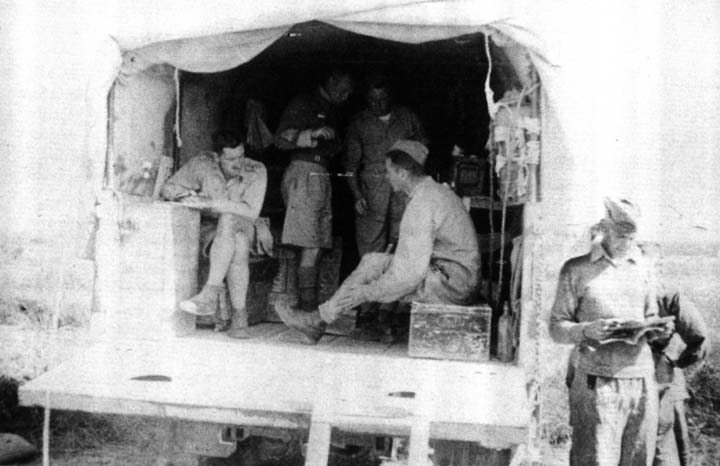
The mobile Medical Truck in the photograph below, taken by Jock Cobb, was similar to those we had used in evacuations to ADS from our Regiment and RAP. Jock (unknown to me at the time) had been posted to the RAP of 51st Medium Artillery Regiment, and the photograph below was actually of the 51st's "Doc" Brown in his medical truck after the German surrender.
After these evacuations, and his own dangerous duty as dispatch rider for Signals, Alex Turner would come by the RAP in the evening with Johnny Cocks to visit with Howard and me during lulls in the fighting. Often we talked far into the night. I was amazed at their absence of animus towards their German enemies. They did not seek revenge. There was respect, even sympathy, for a foe who in Africa at least had been a great and resourceful fighter. Care for the wounded of the other side when captured was every bit as good as for our own.
There was no such sympathy for the Nazis and the atrocities committed by Nazi troops. There were comparable atrocities on the Russian fronts, in the rape of China by the Japanese Imperial Army, and in that army's conduct of the war in the Pacific.
Their hatred was also reserved for the sickening brutality and deadly sacrifice imposed by modern war itself. Their anger and bitterness was directed against the blundering politics, appeasement, isolationism --- including that of my own country --- that contributed to Hitler's aggression. They hoped for a better system for world peace after the war was over.
We --- Howard, Alex, Johnny and I --- had been thrown together in one small sector of the front lines of this unwanted war that had been thrust upon us. We knew there were other soldiers in other units living as basic lives as we, doing their jobs, but we rarely saw them. There was something of comfort in our isolation, for it put a man on his own and also built the strong bonds between us and these men of England. Proud, but modest, with "bull-dog" determination, undermanned and outgunned for more than two years, the British "Tommies" had taken unbearable punishment, but their spirit had not been broken by defeat. Jock (Cobb) in a letter of his dated March 31, had also observed the hardships and sufferings of the British Tommies for two and a half years, their rugged indifference to this, and the depth of their inner feelings. Theirs was a quiet confidence in their ability given the tools to do the job.
At last they had equal, even superior equipment on land and in the air, much of it from my own country, and adequate supplies. They had shown what they could do. Even in victory they demonstrated respect and sympathy for a foe who had been a great and resourceful fighter.
Alex was a peace-loving man. There was little room for hatred in his heart, His manner put one immediately at ease, and he became a cherished friend. Because of an extreme sensitivity, his moods changed, although he maintained firm control over himself. On May first he came to me troubled. On this day, "May Day," his thoughts were of home: of "civvy street," of his young wife and daughter, of peace. He had had close calls the day before as dispatch-rider, but in spite of this was full of sympathy for all young men and their families, friend or foe, caught up in the totality of modern war.
He spoke of war as brutal, impersonal, of men killing other men because someone gave a command, of men turned into mechanical robots firing weapons that would kill other "mechanical robots" they had never seen, of war itself as a kind of supernatural machine which no man could stop --- making men crawl on their hands and knees or cower in a narrow trench in the earth. "We die a hundred deaths for people back home to make an end of war which keeps coming back. I shall do all I can for peace."
War is not glamorous, despite some Hollywood interpretations of it, and stars selling bonds.
Before leaving that night, Alex compared the eventual transition between war to peace as that of a criminal coming out of jail. "We must help the world to walk straight," he said.
One morning Captain Harper, the Regimental Adjutant, took me through the regiment, explaining in detail just how a Field Artillery unit works. We stopped for a cup of tea at the CP (Command Post) while signals were coming in by field telephone from the OP's (Observation Posts). Our "spotters" were hidden in the fringes of the olive groves and high grasses close to the German lines and connected to us by telephone lines. As we listened, one of the OP's reported a Jerry patrol five yards away from him. That was the last we heard of him until he turned up in a prison camp after Tunis was taken.
I watched a barrage being laid-on, on paper; closely coordinated with other air and ground forces. Then my generous guide took me to the batteries themselves where I observed the actual firing. The guns were well dug in. Down in one of the gunpits, the gunnery sergeant explained the workings of the gun sight, and the different types of charges used. A 25 pounder (equivalent of the workhorse American 75's) is highly mobile, can be used with anti-personnel and anti-tank shells, both high explosive or armor-piercing ammo. It's design also combines the effectiveness of howitzer and rifle, for close range and longer range action depending upon the situation. The fine British craftsmanship with which it has been designed and built, makes for durability and deadly accuracy. The men were justly proud of their guns, and kept them glistening. For all these reasons the British 25 pounder is judged by many to have been the finest field-piece ever invented. Unlike the German 88 however, it could not be used for anti-aircraft action.
Captain Harper and I then strolled back together through the tall grass, comparing notes on each other's homes and families. Occasionally he would nod in a special sort of way to a soldier as we passed. When I asked why, he replied: "we were at Dunkirk." That seemed to have been enough to say. And already I, too, felt that I had something in common with these men, and that I could now share in the esprit-de-corps and comradeship so much a part of men at the front.
Much has been written of the aristocratic officer class cadre of the British Army, so gallantly represented by Captain Harper. Some of this is disparaging. I can not say enough of the courage, skill, self-discipline, example, leadership qualities of these officers in the line, who assume all and more of the risks of combat to earn the respect, and the love, of their troops. The justly famed Indian Divisions were officered by these heroic men, as of course were their own storied UK units each with a history and tradition going back before the Norman conquest. While I kept my "tin hat" on my head, and flinched when the enemy guns went off, Captain Harper wearing his traditional officer soft hat hardly seemed to notice.
Years later I found in my Mother's effects, a letter dated 19th May, '43 he had penned to Mother --- about me. The fact that he would have taken time to do this, and to have obtained my address, speaks volumes. (I quote this letter at the conclusion of this "Chapter.")
My feeling of "belonging" to the Regiment, was intensified by the friendship of the fellows of the RAP, and the now frequent visits (when possible) of Alex Turner and John Cocks of the Signals unit. Evenings, Alex and Johnny came over to the RAP to visit with Howard and me. Already we had swapped addresses; planned visits to each other's. homes when "it" was all over; shown each other pictures of our homes, our families, our best girls. At such times we talked far into the night. Sometimes we would sing the old army songs, and some new ones too.
It was time for us to move again, in the deadly game of cat and mouse, attack, feint and bluff we were playing. On May 2nd under cover of darkness we left our snug trenches in the olive groves of "the wood" and drove all night, skirting the foothills to the west of Zaghouan. Our regiment in convoy was led by the armored scout or 'reccy" cars, then the "quads" --- themselves an all-terrain vehicle with some armor and troop-carrying capacity, each with a buttoned up 25 pounder bouncing along in tow on its two-wheeled carriage. Then came Regimental HQ and the RAP. We followed winding country roads. We had been assigned in support of an attack by the Free French Forces to "straighten-the-line" at their sector near Pont-du-Fas and keep Jerry guessing.
Next morning the tall pyramid peak that had frowned down on us at Enfidaville, seemed even closer, but now frowned down from its western flanks. During the day we were held back from the position planned for us, resting, and dispersed out of observation as best we could. We moved up the next night, "blacked out," with only the dim star-light to guide us over the dirt roads that wound in among the foot hills. Next day found us tucked into a Wadi (valley) running from the face of one of a row of hills. We had penetrated deep into the foot-hills skirting the mountains where Jerry had hidden and dug in his guns. In fact, German lines reached to the other side of the hills under whose flank we had crept under cover of darkness. Our guns were firing at less than one mile range, and for most of two successive nights kept up an intense barrage as the attack progressed.
Most days Captain Harper would drop by the RAP, which we had set up in one of the small wadis at the base of the hill, for a chat and a brief visit. Often Doc would join us in our discussions which touched on literature, politics and world affairs. I, with a touch of characteristic American idealism, or perhaps lack of understanding of European affairs, felt that it was important, even at this relatively early date, that the allies should establish more definite peace aims. These aims, I stated, should enable a defeated Germany and Italy to re-enter as soon as possible into some form of cooperating world organization. The allied powers then numbered 26 states having adhered to the Declaration by United Nations signed on January 1, 1942 in Washington, D.C. by President Roosevelt with Prime Minister Churchill and representatives of France, USSR, and China. A United Nations Organization, established at San Francisco on June 26, 1945, was already being anticipated to meet the requirements for a just and durable peace.
My new English friends, with British hardheadedness and pragmatic concern to tackle only one problem at a time, felt that peace aims could wait. The important thing was to concentrate on winning the war, and upon this issue depended the survival of England and America. To put it bluntly, England had been attacked and was fighting for her very life. Captain Harper and the Doctor were more free of the illusions and hopes for a future world peace under which I labored; but never-the-less we found we had many ideas and ideals in common. "You've got to be a bit of a skeptic these days," said the Doc. I was beginning to learn what it meant to "muddle through."
So close had we moved to the German lines that the daily flight of Mitchell bombers mistook us for Jerry. Fortunately, this happened only on the first or second morning of our move, doubtless because of the speed of the move and the security that had covered it. I was standing with Nudge and Darky and Howard in Wadi "Bug-Bug," as we had christened our new location. The fields between the ranges of hills were especially green that morning, and I noticed the planes coming over quite low, with sunlight glinting on their wings. We all looked up because it was an impressive sight.
To our amazement we could watch as bomb bays opened and sticks of bombs dropped from the planes just as they passed over us. We crouched against the sand slopes of our wadi and fear changed hands with pride. The entire valley seemed to rock with the blasts made by the bombs. A row of deep craters sprung up right in front of the batteries, with loose earth and rocks piled up about them and the batteries, and all the grass for yards around leveled. Two of our men were seriously wounded and we rushed to pick them up on stretchers. We applied shell dressings to the wounds, and Doc gave each man a shot of morphine.
Two men of the anti-tank regiment next to our location had been killed. They were promptly buried on the side of the hill in neat graves marked by a simple cross of wood. Wrapped in army blankets, they would be picked up by a graves detail for identification and proper transfer and burial.
We had an immediate evacuation. Howard and I drove over the rough and winding roads back to the ADS with our wounded stretcher-cases for blood transfusions; they would then be taken on by ambulance attached to the ADS to the MDS for surgery that same day..
Our first battle casualties since we had moved to "the wood" the previous week had been caused by our own planes, euphemistically referred to as "friendly fire." Such at times is the irony of war. But for our hillside location, and our sheltered, camouflaged and; dug. in positions in that deep valley, it would have been worse.
Many of the shells of the medium and heavy artillery that Jerry fired passed over the top of the sheltering hill that protected us. Not so of the high trajectory mortar shells, as we were doomed to find out.
Nevertheless, we had begun to feel self-confident, and spent some evenings sitting under the stars with Alex and Johnny listening to the radio at the signals truck. News was good. Our forces were approaching the capital city Tunis, central to German command, and Bizerte, a major naval base especially for submarines.
The war in North Africa could not last much longer. And so we also listened with increased zeal to jazz music coming from Boston or New York, and London; and talked about how we would celebrate the certain victory. Our spirits began to lift. Our cook "Taffy" was already talking about a "victory dinner with Christmas pudding and canned chicken, the chicken having been "scrounged" (captured) from the Germans no less!
It had been good to listen to some jazz music again. Our "Yank" versions were "hotter" than the more restrained British approach. If the Tommy needed anything to convince him that "red" Indians still hunt the scalp and dance to the beat of drums, American jazz will do it. Howard and I even "cut a rug," to the amusement of some of the Tommies --- especially when I tripped and went flying.
With the exception of the accidental bombing by the Mitchells, our luck at this new location had been good, too good to be true. On our last evening at Wadi "Bug-Bug" our luck turned, and that was the evening Tunis fell (May 7).
I remember it well, for the sky was overcast with rain threatening. "Tubby" Bourning, one of the Tommies at Regimental HO who we had befriended, came running down the side of the hill to inform us that long-awaited supplies had at last arrived from the NAAFI, possibly even mail. We had had no mail for some weeks, and only one brief visit at Enfidaville from our AFS Platoon NCO. Enfidaville was not the kind of place that encouraged visiting...
Furthermore, our treasured rations of chocolate and cigarettes were awaiting us in one of those trucks dispersed near Regimental HO. I started up the left flank of the hill, scrambling along the bare and rocky slope. Howard prudently followed about 20 yards back. "Tubby" started running up the slope to get there first, calling with his accustomed cheerfulness "watch me run," and soon drew close behind me.
In the excitement of the moment, none of us paid attention to the staccato explosions of mortars being fired; nor did I hear the now familiar whine of approaching shells until they were crashing on the face of the hill all about us.
Dazed, I stopped. There was no comforting trench nearby into which to jump: only the comfortless cold rock floor of the hill against which I flattened myself with all my strength. The shells kept coming. I expected that one would land on my back and blow me to a thousand bits. But most went over me, farther down where the batteries were.
Seeking a better place, I got up and ran, blindly, to where a narrow rock ledge rose several inches above the face of the hill. As I half fell, half stumbled down beside and against the ledge, a mortar shell landed on the ledge just beside me. Dirt and bits of rock fell on my back, but the sharp steel splinters passed over. The rock ledge, and the angle of the slope, had saved my life.
I continued on in my crazy dash and found a depression on the side of the hill. Here I lay, breathing fast, until the shelling ceased. I knew some one must have been hurt. I stood up and looked down the hill and on to the valley that lay peaceful and green, suddenly alive with the last bright light of the setting sun. There had been casualties down at the gun pits. Howard was terribly shaken, but OK Behind me Tubby was lying, face down on the hill-side next to the rock ledge that had saved my life. I ran to him. He was dead. It could have been me.
Howard and I didn't sleep that night.. We drove through rain and mud back to the ADS to evacuate the wounded, one of whom was a stretcher case --- a signals man. At the ADS the MO and the orderlies were joyful, gathered around the radio toasting the sudden news that Tunis had fallen. The news was empty and meaningless to us. We walked out of the reception tent with lips tight-closed, overwhelmed by the irony of those moments. We didn't say much on the way back.
It had all been so sudden, so unexpected, so unjust; and we had been so completely helpless: like worthless ants stepped on by a giant foot. Mankind takes itself seriously, and most of us like to think we have some say in our destinies. But my life had been completely ruled by chance. I doubted Shakespeare's alleged presence of a benevolent force, a God, "a destiny that shapes our ends...." The sense of my own immortality, of life surging on in spite of war, had left me. I did not overcome cynical doubts and tyrannical fears until the war in North Africa had ended.
It was dark as we drove back, our lights blacked out. When we reached Wadi "Bug-bug," the rain was coming down heavily. We dispersed the ambulance and had it ready in case of emergency. I tried to snuggle into my bedding role in my trench, but it was filled with water. The machine-guns sounded as it Jerry was coming right over the top of the hill. I couldn't stand being alone, so I joined Howard and Darky beneath a stretcher they had rigged up across a narrow part of the wadi. We huddled together, shivering and wet, smoking cigarettes; finding comfort in each other's company. I have never spent a more miserable night; nor felt my own strength eaten away by fear of being afraid.
We left the Wadi on May 8, the day after Tunis fell, and headed back towards Enfidaville, and our former position in the olive groves of "the wood." The Germans were holding out at Enfidaville to the last, in spite of the fact that they were completely surrounded after the fall of Tunis. The British were massing artillery to force Jerry out of his strong positions in the mountains.
Before we left the Wadi, the Padre came to bury Tubby beside the two-day old graves of the anti-tank men. I carried him in my ambulance, and Captain Harper rode with me. We stood with hats off as the Padre read the service.
He and the others have found final rest in the beautiful British Commonwealth military cemetery just south of Tunis. These military cemeteries, in North Africa and throughout Europe, bring tears to your eyes. They are beautifully designed, lovingly tended, reverently entered --- as if such devotion could somehow bring to life the young men --- and women --lying there in row on endless row under Crosses, Stars, even Crescents, and Hindu Inscriptions all joined in death in the arms of our common God.
At the Tunis Cemetery, as one enters, there is a long curved wall framed in marble on which is a relief map depicting all of the battles and movements of troops, from El Alamein on the one hand and Casablanca on the other, done in brilliant mosaic reminiscent of the art of Roman Carthage. And there is (or was in the 1960's when last I was there) a lonesome German Cemetery nearby.
With heavy hearts we formed up the long regimental convoy and pulled out of Wadi "Bug-bug" at first light, going by back roads. By early evening our convoy entered the wide plain bisected by the black paved road leading into Enfidaville. The entire plain was alive with men and vehicles on the move. German shells were dropping. A soldier ran up in panic and summoned our ambulance, which was loaded with our RAP staff and materials. A soldier lay on the ground, his mates standing by helplessly. Part of his skull had been blown off. There was nothing we could do for him, and we could not move him forward with our convoy. We entered Enfidaville under cover of approaching darkness, and drove through to our former position.
The next days Howard and I spent as much time as we could in the RAP trench until the war ended May 13. We were determined to see it through despite the Doc's good-hearted kidding about having "slit-trenchitis." We found it more difficult than before to force ourselves to drive on evacuations along the straight road back and through the little town that was now under concentrated shell-fire. And sometimes we would miss a meal rather than wait in line by the cook-house trench. Whenever a truck started up, or there was the high-pitched tone of tires on the hard-surfaced road, we would involuntarily flatten ourselves to the ground, and then feel very foolish for having done so,.
During those days our batteries fired as many as 500 rounds a day, and the Bostons came over many times, guided at times by smoke shells from our guns. At night infantry patrols tramped by almost noiselessly in single Indian file, and tanks clattered by. Howard and I sat in the trench together, staring at each other, expressing our thoughts out loud. Some of our thoughts weren't nice.
The staccato sounds of the small arms fire jarred against our nerves. At night the flashes of the 25 pounder guns were like tongues of flame leaping out across the hills. They were firing right over our trenches. It seemed such a waste of human life that men, and brave men too, should die, especially when the outcome of the battle was already decided.
But brave men were dying during those last days and nights. I wondered if their deaths were to be in vain. During those evenings, I was glad for the comforting friendship and visits from Alex --- for the chance to unburden myself of all the searing thoughts that kept chasing through my mind. Out of these sharing talks we found the same kind of dedication of which Lincoln spoke so simply in his Gettysburg Address --- "that these honored dead shall not have died in vain." It helped dispel my bitterness.
Before he finally "packed in," Jerry took a crack at us with a fiendish rocket-mortar, their ."Nebelwerfer", which the Scotties called "the piano" because of the weird, pulsing, almost screaming noise it made. You could almost see the clusters of rockets hurtling through the air trailing smoke. In the final hours of the war, two of the men at one of our batteries were hit by a burst from one of these rockets. We rushed out with the ambulance to administer immediate aid and pick them up, but before we could reach the battery one of them had died. The other died in the ambulance after we left the RAP for the ADS. His death occurred on the last day of the battle for Tunisia.
It had taken continuous pounding by our artillery and a massive flight of 54 Boston bombers (the twin-engine tactical bombers built by Douglas USA) to persuade the justly feared German 90th Light Division, which had held out in the hills above Enfidaville, that it was best to surrender. This was after the capture of Marshal Von Armin, who had replaced Marshal Rommel in command of Afrika Korps; and after the newspapers had incorrectly reported that the war was over. The 90th Light Division included crack infantry and tank units, interspersed by some fanatic Nazi SS units.
Scores of prisoners came tramping through on the road that ran near our Regimental HO, and we lined the way to direct them and watch them pass. Some were driving German vehicles. Most were regular army troops wearing the soft, jaunty ski-type hat and blue tunic of the- professional German army --- (Wermacht). Our armored cars interspersed among them kept careful watch. The officers were stiff and glum, but the men seemed glad that it was over and some were smiling.
The Nazified ones, wearing distinct patches, were angry and downcast despite their relief from the intense shelling and bombing they had undergone. One of them remarked to me in stilted English: "You may have taken Tunisia, but you'll never get Algiers!" Evidence of an enforced ignorance of the outside world.
Victory in North Africa meant that the tide of the entire war had definitely turned, and that the allied nations operating under the Declaration by United Nations held the offensive. And it had been the first major victory gained by combined forces of England, France, United States and many other associated nations. Noteworthy was the cooperation of the allied nations under the leadership of General Eisenhower. harbinger of the Normandy invasion in 1944. In the Battle for Tunisia, the Americans and the French had combined to take Bizerte; two English armies and some French and American units had converged on Tunis.
Victory in North Africa meant that the threat to Egypt and Mideast oil had ceased, and that the Mediterranean was opened to our shipping. Hitler's "Thousand Year Reich" lay open to invasion from the West. Germany, the dominant center of the Axis forces, had suffered tremendous losses of material as well as of some of their best troops. Germany had not been able to save Afrika Korps. After the fall of Tunis several hundred thousand prisoners had been taken. Total cost to the German Axis as a result of the African Campaigns was: 950,000 troops killed or captured, 8,000 aircraft destroyed, 6,200 artillery pieces captured or destroyed, 2,550 tanks captured or destroyed, 70,000 trucks captured or destroyed, and vast quantities of military equipment. It was a disaster comparable to that at Stalingrad in the winter of 1943.
To the British Eighth Army, I believe, should go the lion's share of praise for this victory. Men of the Eighth Army, the tired, "browned-off" so called "desert rats" with more than two years of fighting on the desert under their belts and often outgunned, had held back the seeming invincible German tide which had reached just outside Cairo in August 1942. They broke through at El Alamein in October 1942, and established the world record of almost 2,000 miles of the longest advance maintained by any army in all recorded history.
They broke the deadlock in Tunisia when they smashed the Mareth line and then smashed through at Wadi Akarit 1500 miles from Alamein. It was the storied 4th Indian Division which first broke into the plains of Tunis; it was the "desert. rats" --- the 7th Armored Division which reached Tunis first after a hotly contested race with 1st Armored Division. These were three of a number of Eighth Army Divisions and specialized units which were among the best of any fighting units of any allied army.
The last of the Afrika Korps refused to surrender to any but Eighth Army. When they did so, a truly heroic and cleanly fought saga in the annals of war --- including the stories of Bir Hacheim, Tobruk, Sollum, El Alamein, "Hell-fire Pass," El Agheila, Tripoli and on into the Battle for Tunisia --- had ended.
After surrender, we were taken on a day's leave for a visit to Tunis. Years later, I would be posted there with the U.S. Foreign Service, and often drove through the sleepy white rural village of Enfidaville, its fields and groves reaching towards the great frowning peak to the west. There were few scars of what had happened there.
We also spent a day inspecting the German lines on foot, passing through corridors in the mine fields. It became clear how the Jerries had held out so long against such an incredible pounding by land and air, and had been able to inflict so much damage in return. Built into the hard rock of the hillsides was a seeming endless labyrinth of tunnels, galleries and chambers giving access to dug-in and camouflaged pits for the artillery, mortars, and machine-guns---all commanding our positions in the fields, plains, and groves below, as well as any access routes. All kinds of weaponry, munitions, supplies, personal kits and gear, lay strewn about.
I was proud that we of Eighth Army had won so striking a victory, and that the eyes of the free world had been upon us. And I was proud to have been a part of it, paradoxical words coming from a doubtless naive and idealistic young American who had volunteered for combat medical service with the American Field Service (AFS) as a conscientious objector to war, and had been authorized by his Selective Service Board to do so.
On a personal note, Howard and I had not only survived an incredible adversity, but had performed our duty whenever called upon. In the process, we had become bonded as friends and brothers for life. We felt that there could be no greater danger for us in the following year or years of our service. I confess, however, that I had become a bit "gun shy."
Howard and I had also represented our country as the only two Americans under conditions of extreme duress within a battle-tested group of British fighting men, and I believe represented it well. We had formed a close-knit RAP team under "Doc" Kuretz. More, we had reached out to the Regiment in bonding friendship with others.
Regimental Adjutant Captain Harper had treated me --- with courteous reserve --- as a sort of visiting "ambassador" to his entire unit, as well as a friend. A fine British officer, he possessed a winning smile and manner, and a beautiful bride judged by photographs he showed me. He also showed me photos of the neat thatched homes and gardens of his native Kent and Sussex. There was the hint of an invitation to visit him after the war. I regret that I never did.
More than a half century later I found within my Mother's papers a letter Captain Harper had taken the time to write to her after the surrender at Enfidaville. It was hand written and dated "19 May 43." On the letter-head he had affixed: "Capt. G. S.C. Harper, Royal Artillery, 58th (Sussex) Field Regiment R.A.M.E.F."
I quote from Captain Harper's letter:
Dear Mrs. Edwards,
It occurs to me that you might like to hear what good work your son Charles has been doing personally and for my regiment in particular during the past few weeks.
He came to us with his ambulance and really has been doing very good work for us during periods which, at times, have been rather hectic. He was always ready and pleased to go out at all times of the day or night --- and we appreciated it.
During the lulls in the fighting I was very refreshed in being able to discuss with him our different methods of arriving at the same goal mainly by defeat of Germany.
Now he has gone to another regiment. We shall miss him, but will hope to have the pleasure of meeting him again here in England, or in the United States.
Best wishes,
Yours sincerely,
Geoffrey Harper
(signed)
In his choice of the words "rather hectic" is reflected, one could safely say, a touch of characteristic British understatement, together with the renowned British capacity to present "a stiff upper lip.." Needless to say, I am deeply touched by this letter.
We continued on with "our" Regiment for another six days before receiving orders to return to AFS HO. It was during this time that we inspected the German lines, and also were given a day's leave to visit Tunis.
In those first days of peace that followed our victory, I was impressed only with the "little things" about peace. The quiet stillness of the nights, and the days. Walking upright as men should, unflinchingly. To be able to savor the call of a bird, or the beauty of a flower. Sleeping on top of the ground, not in it. Feeling safe driving along a road that wasn't being. shelled. Knowing that three weeks under continuous shelling and more, had ended. Wondering why I, and not others close to me, had been spared.
It had taught me to treasure life all the more. I had obtained an incredible bonding, almost mystical union, with the fighting man, and with the men of "our" Regiment. I wrote home when it was all over that "I have become a son to soldiering men who have given their lives in war." When victory came and the guns ceased, I had been given a glimpse of what Peace was really like.
With lumps in our throats, hand clasps all around, and our meager and grimy belongings packed, we pulled out of Enfidaville on May 19 in my sturdy ambulance and headed down the paved road leading to Sousse and the south. My ambulance, "Fox II," had many more holes in it than when we had first driven to Enfidaville that now seemed so long ago We were sad to leave "our" beloved Regiment.
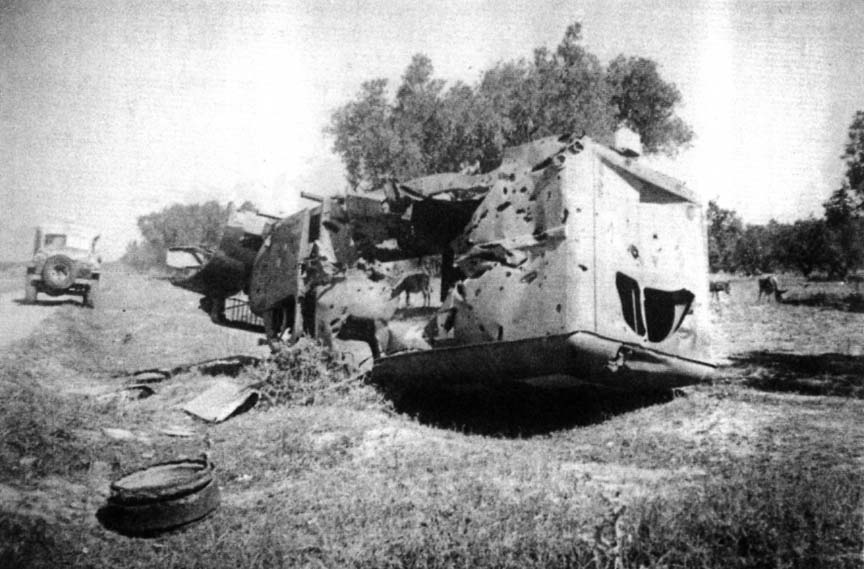
Relics of the fighting, as in the Western Desert, lay in the fields or along the roads where they had been pushed aside by bulldozers. After the German surrender and the coast road south of Enfidaville was no longer under fire, Jock Cobb stopped to take the photograph below. His ambulance is on the road in the background. The photograph shows several vehicles knocked out by British action, including in the foreground an American Army ambulance probably having been captured by the Germans. This of course, or what was left of it, would have been of the same make and design as an AFS ambulance.
Victory celebrations had been going on at Company HQ since the fall of Tunis, while leaves into Tunis had been organized after the German surrender at Enfidaville. George Rock in his History of the American Field Service quoted from 567 ACC Commander Major Howe that "HQ is alive with cars... The canteen is doing a rushing business, disposing of a 600-litre barrel of fine red wine ... The radio is blasting away in the canteen tent, and I can hear singing from five different directions..."
Arthur Howe Jr. was a natural leader of men who exemplified the ideals and the volunteer spirit of AFS. As a young university student (Yale, Oxford) he left school and was one of the first to volunteer with AFS, embarking for the Middle East with ME Unit 2 shortly after Pearl Harbor. He graduated from Yale after the war, serving initially as Dean of Admissions. In 1965, after the death of our Director-General and first President of the then AFS Scholarship program Stephen Galatti, Arthur Howe succeeded as second President through 1971. He directed a global expansion of the program, and has been instrumental in support of the current Intercultural Program ever since; he has also been concerned for the well-being of us Drivers.
As a Driver, Arthur Howe saw front line action in the desert campaigns against Rommel's Afrika Korps. He rose through the ranks, first as Lt. commanding Sections in the El Alamein battle and breakthrough. Decorated by Britain, Honorary Officer of the Order of the British Empire, he represented AFS at the 50th Anniversary Memorial Services held at the El Alamein battlefield, 1992.
During the advance to Tunisia and the buildup of 8th Army and AFS preparatory to the Battle for Tunisia, Art Howe rose to Company Captain, then Major commanding the newly organized 567 Ambulance Car Company in the final weeks of this battle and the return to Tripoli after Tunisia was taken. He served as our Company Commander and friend during the Termoli-Trigno-Sangro-Ortona engagements in the advance against the German Gustav Line (October 1943-January 1944), some of the bloodiest battles of the entire war.
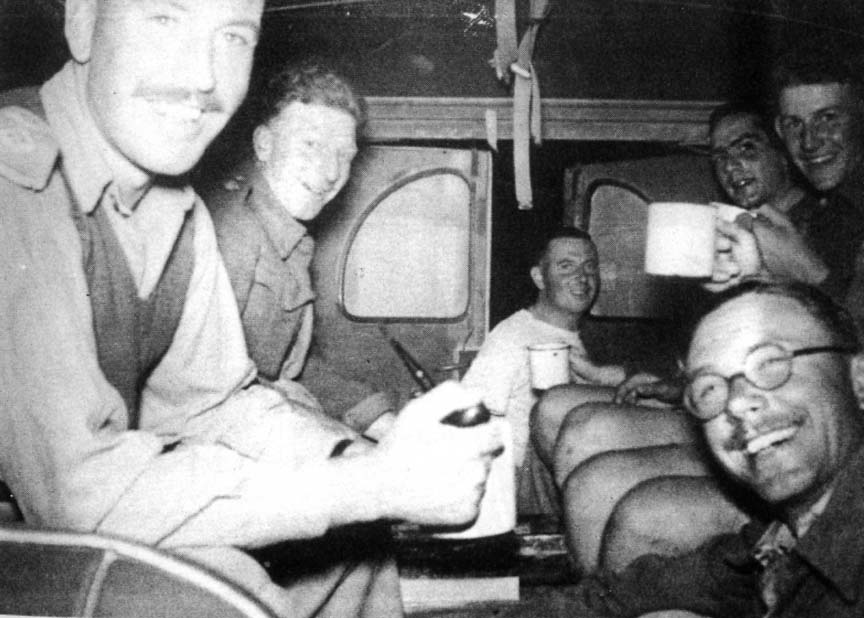
After the fall of Tunis, Jock Cobb, and his fellow Driver Bob Orton had staged a victory party of their own in the back of Jock's ambulance inviting their Regimental MO "Doc" Brown and friends forged during their service with the 51st Medium. Artillery. It must have been a great party, as Jock wrote about it to me in a letter years later:
We had a roaring good party with much song and cheer. Our mistake was not to invite ... the Commanding Officer of the 51st Medium Artillery. He was a pretty formidable British Officer type with moustache and all .... He, poor man ... had no one to celebrate with. Finally, some time after midnight, he came snorting down to our ambulance, torpedoed the party with the words, "Bed ... Bed, all of you." The next day, the 51st had a grand parade, with all the guns lined up behind the men.
It had been a month since Howard and I had been posted to Enfidaville. At this time AFS field units had been reorganized, commencing April 21 with C Platoon assigned to a newly formed Ambulance Car Company, number 567 ACC, whose HQ had been established near Sousse on the coast. All Company ambulances had been called in for "rest and recuperation" and much needed ambulance maintenance, preparatory to transfer back to staging at Tripoli, Libya. And so we returned to Company HQ near Sousse, preparatory to convoy back to Tripoli.
Except for the joy and relief of reunion, especially with our "comrades-in-arms" of our "Lucky 13" fraternity, Howard and I were in no mood to celebrate. However, we welcomed the chance to wash and clean, work on the ambulance, obtain our mail at long last.
That all of us of "Lucky 13" had come through our "baptism of fire" was a miracle. Chan Keller for example, reported that a German 88 armor-piercing shell had gone right through his ambulance, leaving a round-hole where his speedometer had been. He had stopped his ambulance and gotten out just before the shell hit.
Commencing on May 23 the entire Company formed into a series of convoys for the four-day journey down the pleasant coast roads back to Tripoli, Libya. We would rest and refit at Tripoli during the entire summer of 1943 before transfer by LST to Taranto, Italy, in late September 1943. That summer of '43 I had reenlisted for another tour with AFS. I continued with AFS until the war in Europe and the Pacific had ended.
Needless to say, the circumstances of our return to Tripoli, Libya were far different than when we had advanced in the other direction. The only thing I remember of that journey back was evenings after a hot day's drive when the entire Platoon, in the buff, plunged into the sea at pristine white beaches for delightful swims.
At Tripoli, summer of 1943, there would be time to heal, and there would be time for reflections: reflections on insights gained at first hand about war and peace, and about the soldier's way.
The first fruits of the intensity, stark reality, and pathos of these feelings prompted me to write my poem, "By These Four Walls, Enfidaville, 1943". This is included, with a different title "Soldier Calvary," with other poems of mine in Part XI below, War Poems.
I also had the opportunity at Tripoli to write the first draft of this account of the Battle for Tunisia while the memory of each moment was so vividly etched in my mind.