 1.
Final Act of the War in Africa 2.
The Battle for Tunisia, Summary 3.
First Phase: Left Hook at Mareth. Break Through at Gabes (March
20-April 7) 4.
Second Phase: Gabes to Sousse and Enfidaville (April 7-April
22) 5.
Third Phase, Enfidaville and German Surrender (April 22-May 13) 6.
Postscript: Return to Company HQ. Convoy back to Tripoli 1.
Final Act of the War in Africa 2.
The Battle for Tunisia, Summary 3.
First Phase: Left Hook at Mareth. Break Through at Gabes (March
20-April 7) 4.
Second Phase: Gabes to Sousse and Enfidaville (April 7-April
22) 5.
Third Phase, Enfidaville and German Surrender (April 22-May 13) 6.
Postscript: Return to Company HQ. Convoy back to Tripoli |
We of the "Lucky 13," Mideast Unit 26 AFS, had trained together in Syria and Lebanon; then traveled by truck convoy more than one thousand miles from Cairo to Marble Arch in Libya and the rear echelons of the advancing Eighth Army, February 1943.
Several of us of the "Lucky 13" --- Chan Keller, George Collins, Art Ecclestone, Harry Hopper, John Leinbach, Jay Nierenberg, and me --- were formed into two of the five Sections of C Platoon, of formerly 11 then 485 AFS Ambulance Car Company. We were soon joined by Jock Cobb, Howard Brooke, Vern Preble all of whom we had "co-opted" into our "Lucky 13" fraternity. In the coming months, each one of us would experience his own "baptism of fire."
On March 20, 1943, the final act in the battle for Africa was joined. It would be played out in the next two months in Tunisia up to the occupation of Tunis May 8 and then surrender of the last unit of Rommel's Afrika Korps on May 13 at Enfidaville, southeast of the capital city of Tunis. This last German unit, the 90th Light Division, came through lines of the Light Field Regiment, Royal Artillery, where I was stationed.
As the battle for Tunisia was joined, Rommel's famed Afrika Korps was being squeezed in Tunisia between the Eighth Army moving up on the south, and Allied forces to the west. British First Army and Second American Corps had landed at Casablanca, Oran and Algiers November 8-11, 1942 (Operation "Torch") and were joined by French troops. By December they reached Medjez el Bab, southwest of Tunis city. They were held there by the Germans in strong fortifications until the final assault, in late April 1943, on Bizerte and Tunis. These combined operations resulted from attack by Eighth Army from the south and linkage by Eighth Army with the other allied forces.
On February 20, 1943 coordination of these allied, forces east and west, was assured under supreme command of General Eisenhower with Britain's General Alexander his Deputy.
As the Eighth Army advanced from the Western Desert, Afrika Korps was still a formidable force, brilliantly led, able to exploit the hilly terrain, capable of devastating counterattack --- turning back the as yet inexperienced U.S. forces at Kasserine Pass, west-central Tunisia, February 14-25, 1943. And Afrika Korps held fortified lines on the south at the Mareth Line, fortifications previously constructed by the French to defend against advance from Libya.
The tides of war were not new for Tunisia, where armies, and Empires, had come and gone from the beginning of recorded history. Centuries before Christ's birth legendary Dido let her Phoenicians to landfall at Utica west of Tunis to establish the City-State of Carthage. Led by Hannibal, Carthage challenged Rome for control of the western Mediterranean. Scipio's legions in the third Punic war vanquished Hannibal---betrayed by his Berber allies--- in the hills at Zama southwest of Carthage, 202 B.C. There followed a renaissance of Roman Carthage, the bread basket of the Roman Empire. The residue of Roman "ruins" in Tunisia is as imposing as those in Rome itself.
Splendors of Byzantium followed Roman Carthage, leaving in turn impressive "ruins." There followed in the 7th Century AD the tide of Arab Muslim advance sweeping from Cairo all the way to the Atlantic coast and Spain. Hairs from the beard of Islam's conquering general Ali are to this day relics at the holy city of Kairouan in central Tunisia, where stands the Great Mosque of the Aghlabids. And now another conquering general, Montgomery, would pass by this shrine of Islam.
In March of 1943 we of C Platoon and "Lucky 13" were portion of a vast armada, as Eighth Army formed for major battle with Afrika Korps, now "dug in" along the formidable Mareth Line. In moving up to Mareth, Eighth Army had advanced 1,400 miles from El Alamein, with another 400 to follow to reach the capital city of Tunis and the end of the war in Africa. It was one of the longest advances in the history of war.
The Mareth line extended 22 miles from the coast through Mareth into the Matmata hills due west, and had been extended further into what was considered wastelands impassable for a flanking action. And beyond Mareth lay a second line of defense at the Gabes Gap and Wadi Akarit, extending from Gabes on the coast through El Hamma 15 miles to the west where there lay vast, impassable salt flats. It was up to the British Eighth Army to break though these formidable obstacles in the advance to Tunis, join with the Allied units coming from Algeria, and secure the surrender of Afrika Korps.
General Montgomery's plan --- as detailed by George Rock's History...., was to turn the Line and enter the coastal plain beyond Gabes using massed artillery and crack infantry and armored divisions such as the UK and 51st Highland Division at the coast, and New Zealand Corps at the western flank supported by 1st and 7th Armored Divisions and the 4th Indian Division. Montgomery, prepared meticulously, and tried to keep his troops informed to boost morale. There was intermittent patrol activity in the days before the attack. Rumors as always were rife.
I was attached to one of two AFS Sections with a Light Field Ambulance (LFA) of 10th Corps (the armored Corps) at the central sector. I had prepared and named my ambulance Fox II with the name stenciled on the radiator in front; Jock (Cobb) was my fellow "relief" driver. We would be together for the next month. On the eve of the battle, the Colonel in charge of our medical unit outlined the plan of battle, as had been the custom during the campaign. There was also an open air church service held in a wadi forming a natural amphitheater. It was a solemn and soul-searching experience, accompanied by the lightning and thunder of artillery barrage. I had never been so close to the start of a major attack, which "jumped off" at dawn, the next day, March 21, 1943.
In the tides of battle that followed, we drivers had little contact with our Company or Platoon Headquarters, or with each other for that matter. Jock (Cobb) and I were together at the start, then Jock was assigned his own ambulance. Howard (Brooke) was posted with me as relief driver in the final three weeks of the battle. Others of us of our "Lucky 13" Sections, would meet sometimes at transfer points in the medical evacuation routes from the front. Each of us would have "stories" to share when it was all over.
As regards AFS command, suffice it to say that Fred Hoeing, then Captain and much loved by all of us in AFS, was our Ambulance Car Company (ACC) Commanding Officer, initially numbered 11 ACC then 485 up through the advance from Cairo to the Mareth Line. Lt. Tom White continued as our Platoon CO, with Charlie Pierce (of Unit 26) as NCO, C.W. "Bill" Edwards, who had been Platoon NCO, was promoted to Lieutenant., Company Adjutant. Then there was a reorganization (April 21) with the merger of the four desert Platoons, including our C Platoon, into a new Company --- 567 ACC commanded by Major Arthur Howe.
These Headquarters, with workshops, communications, supplies etc. moved with each advance, took care of our postings --- and our needs as best they could.
There were three principal phases as the advance progressed.
On March 21, 30th Corps Eighth Army, composed of infantry with some armored brigades, forced the Mareth Line at its center with heavy fighting. Concurrently 10th Corps composed of 1st and 7th armored divisions (the "desert rats") swung west in a "left hook" through "Wilder's Gap" to outflank "Jerry" (as we called the Germans), and together with 30th Corps broke the Mareth Line defenses March 26, and reached El Hamma to the northwest behind Mareth March 29.
This initial drive by the armored and infantry divisions was followed by a second major engagement by these same divisions to break through on April 7 beyond Mareth at the so-called Gabes Gap and Wadi Akarit. These advances in this first phase of the Battle for Tunisia had been hotly contested through difficult terrain with many casualties on both sides.
Following the breakthrough at Wadi Akarit in a second phase of the overall battle, the port cities of Sfax and Sousse, both bombed from the air, were taken and units of Eighth Army were also able to link up with allied forces from Algeria. Beyond Sfax along the coast and in the interior there were good roads, fertile fields, olive groves, villages. The tide of battle traversed the intact Roman Colosseum at El Djem.
Eighth Army took up positions north of Sousse for the final assault on Tunis. There was difficult fighting in this third and final phase, from late-April to the fall of Tunis May 7, and the final surrender of Africa Korps to the Eighth Army, May 13, 1943. There were combined operations involving French forces, British First Army, United States Second Corps (which went on to Bizerte), units of 1st and 7th Armored Divisions (Eighth Army) which swung through Medjez El Bab with First Army to take Tunis May 7, then raced to the coast to cut off Cape Bon and Afrika Korps itself. During this phase, Eighth Army also maintained its enormous pressure on the Germans from the south, advancing from Sousse to Enfidaville south of Tunis at the base of Cap Bon.
As regards my own participation in these. actions, my ambulance was posted, with my fellow driver Jock, (Cobb), with. two AFS Sections assigned to 12th Light Field Ambulance (LFA) of 10th Corps (the armored Corps); We were part of the self-contained flanking action through "Wilder's, Gap" to force the Mareth Line, and then the drive through the Gabes gap defenses north of Mareth. At the outset, we had been issued rations and water for nine days. During action to break-through at Gabes, a German bomber crashed near my own ambulance at a night ambulance run, with Jock.
We broke through the Gabes line with 10th Corps and followed the 10th Corps Axis up more desert tracks running inland north. Here, with a wounded German stretcher case, and caught in an unending stream of convoys advancing north, it became impossible for several days to locate an operating dressing station. To make matters worse, at one point during a stop in our convoy line, Jock (Cobb), taking off by foot to seek needed medication from an ADS unit up the line, had become separated from me.
During the final three weeks of the campaign, I had been posted, with my fellow "relief" driver Howard Brooke to a Regimental Aid Post (RAP) at a Light Field Artillery (25 pounder) Regiment, in positions at and near Enfidaville at times within a thousand yards or less of the German lines dug in the mountains commanding our position. We were so close in one move that our own bombers bombed us instead of the Germans. These were days and nights of almost continuous action for our Regiment. the firing of our guns; movements of tank and infantry units through our lines; constant shell, mortar, and rocket fire directed at us by the Germans, and of course our ambulance runs.
When it was all over, I discovered how amazing the feeling --- just to able to stand up straight, walk about without fear, listen to the song of a bird...
The narrative which follows details my own memories of the Battle for Tunisia.
As the attack on the Mareth Line commenced, my ambulance and I, together with my fellow "relief" driver Jock (Cobb), was posted with one of two AFS Sections of C Platoon attached to 12th Light Field Ambulance (LFA) of 10th Corps (the armored Corps). On the eve of attack, the Colonel commanding our unit outlined the plan of battle: infantry assault along the line followed by the tanks. Thus we received a composite picture of the plan and the role of each corps, division, brigade, battalion, company. On that same eve of attack, there had been a church service in a wadi which formed a natural amphitheater with a background of steep hills and olive trees --- and the lightning and thunder of the artillery.
The initial attack was led by 30th Corps (infantry) following a massive artillery barrage, supported by heavy air activity and some armored brigades. These were crack divisions of Eighth Army: 4th Indian, and New Zealand Divisions at the center, 51st Highland and the UK at the coastal sector. Although the line was breached in several places, determined German counter-attack forced a change of plan, calling for the armor --- the famed "desert rats," 1st and 7th Armored Divisions--- to sweep wide around the German. left flank through a pass known as "Wilder's Gap."
It was a massive undertaking, self-contained for maximum security and surprise with nine-days of rations and water issued. Before we of the medical units could move along our assigned routes, there were two days of preparations --- and anxious waiting.
Well do I remember those days and nights, punctuated as they were by alternately optimistic and pessimistic "griff" about our men; the many planes swooping down to near-by air-fields after their missions over the lines; the bombing runs by "Jerry" during the moon-lit nights. It was hot. There was at times an oppressive stillness like a pall drawn over us ---stillness broken by the heavy rumble of the guns. The sunsets were brilliant red behind the sharp hills; the sun-rises a glory of red and crimson streaks. They were symbols of battle. We worked on our ambulances, sunned, read, felt helpless and eager to help. Jock and I played chess (with a small "travel" chess set) while strategists of both sides played chess on a different kind of board.
At first it seemed the outcome of the attack hung on the balance. When "Monty" sent his gallant "knights" and "castles" around the flank, success was assured. Thus commenced the first phase of the breach of the Mareth Line which the BBC vividly described as a "right to his jaw and a left-hook to his flank." It was to this "left-hook," behind the Mareth Line, that my own LFA unit was attached.

And now sudden activity: we left our original dispersal area late in the evening, and drove all that night and on through the next day --- each of us with maps and orders to sweep wide west and then north by means of a pass known as "Wilder's Gap." During that first night, a German plane dropped flares, then a few bombs. The next day found us in territory that reminded me of the desert country of Arizona --- pebbly wind-swept desert interspersed with shifting sand hills covered with clumps of dried grass; abrupt treeless hills standing out in solitary cubes, pyramids, triangles.
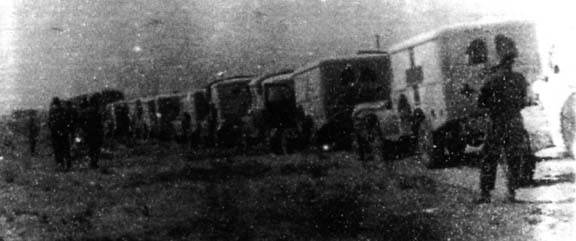
Passing through the gap, the way became sandy with deep gullies ("wadis"); then a wide undulating country running to distant hills. Imagine thousands of vehicles of all descriptions: tanks and tank-transporters leading the way, armored-cars, tankers, trucks, jeeps, command vehicles, our ambulances --- all scrambling in endless weaving lines. For two more days following our armor, we drove in this scramble of churning vehicles pushing along several widely separated parallel rutted tracks.
The seeming "madding throng" of our mobile Corps spewed up clouds of fine white sand which coated inside and outside, and often obscured every other vehicle from sight. At times we were uncomfortably bumper-to-bumper when forced to pass through a defile caused by mine fields; at times we were in a mad race to keep in touch with our convoy; and then we were sailing through a dim white mist of sand and exhaust smoke. In these days and nights of hectic driving we had covered about fifty miles, indicative of the congestion and the terrain. At times, the tracks were well-nigh impassable, and we depended upon our own four-wheel drive while other vehicles were being stuck.
But we had swung wide around Jerry's flank, to support the infantry breakthrough and set up a base for further advance.
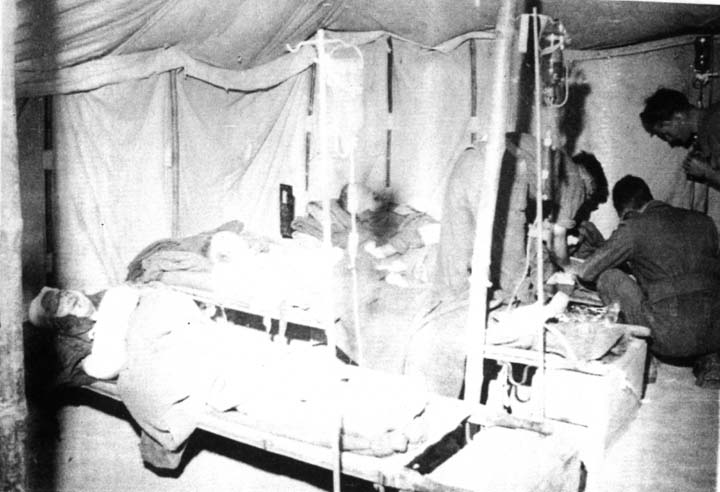
We set up the Main Dressing Station (MDS) almost one week after the initial attack on the Mareth Line. The various sections of the Light Field Ambulance (LFA) unit set up their "pent-houses" (tents stretching out over the back of three-ton trucks acting as roof for rows of stretchers beneath); the operating theater, surgical team, blood bank, and receiving tent were similarly arranged; and within a quarter of an hour the MDS was ready to receive the wounded.
That night we were visited by "Jerry," as the Germans are called out here. He dropped several "butterfly bombs," the kind that sound like a string of fire-crackers. He actually hit a signals man a mile down the track, and Jock and I, who were on reception duty, went out and picked him up. He was operated on immediately, having gotten a nasty bit of shrapnel in the back.
We learned afterwards that some 40 German tanks had come within three miles of us at that location, apparently on the loose, attempting to protect the flank of their infantry, and confused by the actions of our armor. Fortunately for us they decided to fall back to the east, and were later picked up by our artillery.
In a letter home written on March 31, Jock had written:
We had another close call as part of this "left hook" I mentioned .... We are now allowed to tell about individual battle experiences .... after it was all over, we learned that we had camped out ... within three miles of where a great bunch of retreating enemy tanks passed during the night. Some thriller wasn't it! All of us sound asleep. It's a good joke now.
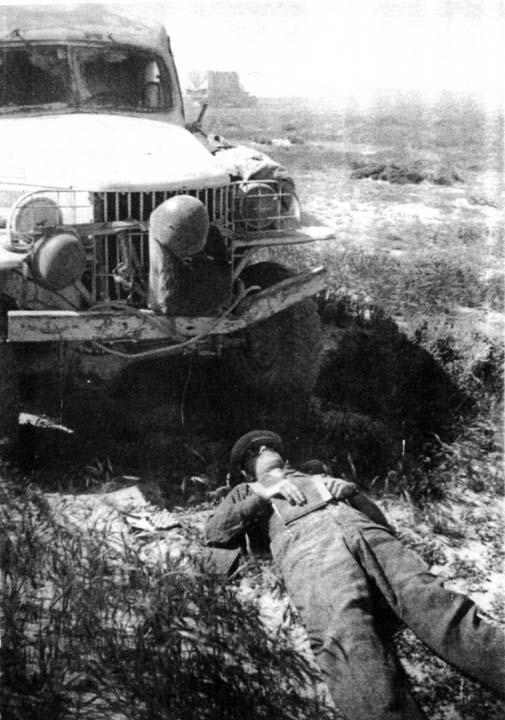
At this same location, we had leaguered (dispersed) our vehicles and dug in our slit trenches because of the German night bombing. It was pitch black. I remember having left my slit trench, to answer a call of nature, and on my return found a large vehicle stuck in it, with the front wheel where my head would have been.
Jock had written about my narrow escape in his March 31 letter:
It was pitch dark and he, Charlie Edwards, was all tucked into his bedroll in the slit trench, when he remembered something he wanted to do and got out again. I was sitting in our car not far away and heard some frantic shouting at another driver: "Stop! get out of there!" I got my flashlight which revealed a great one-and-a-half ton (British) vehicle neatly nestled with one wheel in Charlie's trench about where his head should have been..."
The next day wounded from both sides came in to us from MDS's and ADS's (Advanced Dressing Stations) farther up front. Chan Keller, Jay Nierenberg, Harry Hopper, John Leinbach and George Collins of our "Lucky 13" fraternity, who had been posted together at another Field Ambulance, brought these wounded to us. It was good to see them after a separation of over a week, and to trade tall yarns about our various adventures. Chan, who had accidentally run into the fringe of a tank battle, had the best yarns to tell. They were all loaded with "Eyetie" (Italian) stuff which they had scrounged from an abandoned camp.
All that night the generator supplying the operating theater kept a constant guttural hum. There were men badly burned, men with bones broken, men with shrapnel and bullet wounds, men with limbs to be amputated. One man, with nose and lips burned away, was a swath of bandages. He was more ghost than man. The MO's (medical officers) after weeks of enforced idleness were suddenly rushed beyond belief and worked in shirt-sleeves through the night. They did a good job.
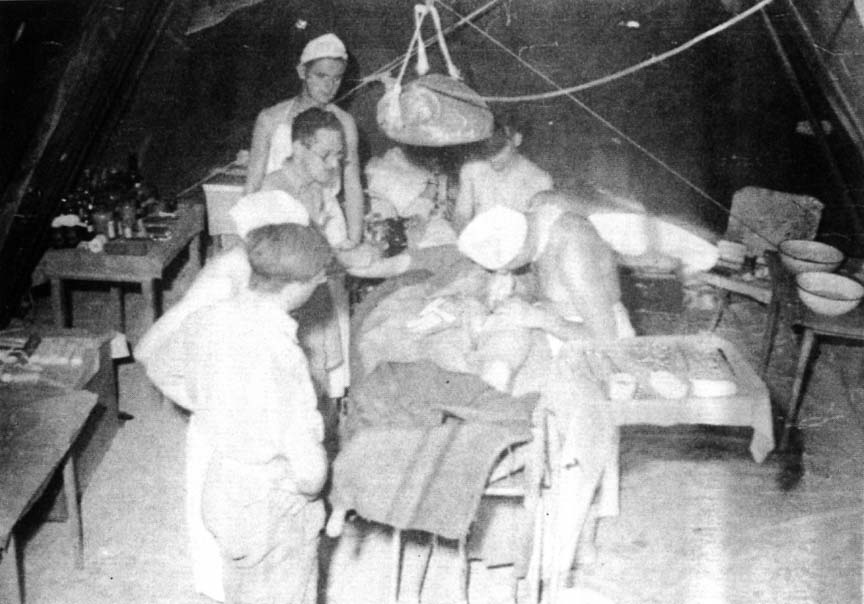
In addition to his principal duties as AFS driver, Jock was also an official photographer for C Platoon; he had written in a letter home: "I am one of the official photographers, so I have the required pass and am able to take all kinds of pictures."
His fine photographs, as presented with my narrative, are ample proof of this.
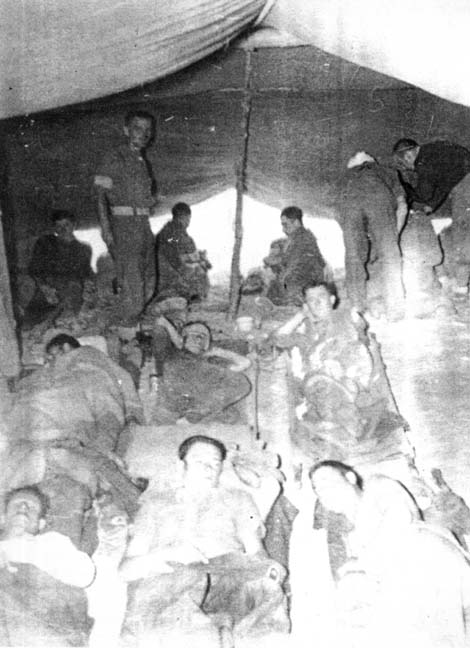
In all we spent three days at this location, deep in a desert-like wasteland; they were the most uncomfortable I have yet spent. They were days of stifling heat and sand storm. Fine white "sand" that sifted through clothes, food, into the very pores of the skin and to the roots of the hair. We were rationed strictly on food, and allowed a canteen of water per day. We dared not use our reserves for fear of a possible cut off. The plan of battle allowed us nine days in all before replenishment of food and water. Six of those nine days had already passed. It was a question of saving the precious reserves we had as long as possible. I have never been so "dry" in all my life.
The specific job of our ambulance section was to evacuate the wounded to a larger field hospital/ Casualty Clearing Station (CCS) farther back out of the battle area. During these days we often had all four stretchers in use. The track was a terrible shambles of bumps and ruts and gullies. It was trying work, especially with seriously wounded men.
Some of the wounded were Italians. They were glad to be in our hands and out of the battle. One "Eyetie" (as the Tommies called them) was a doctor. He gave me some points on pronunciation during a pleasant chat. I shook hands with the others who were with him. They seemed pleased to hear of my mixed ancestry and Genoese roots. One veteran resembled our vegetable man; he had the right kind of mustache for it. I swear he could have been selling vegetables at Faneuil Hall market!
One trip was a study in contrasts. We carried two Tommies, a "Kiwi" (New Zealander), and an Austrian. The Kiwi was solid, sure of himself, open, quite American-like. The Tommies were for the most part reserved, although one of them cursed a bit in his pain. The other lay silently, or perused a copy of "Life" magazine I had, holding it with his one good arm. He feigned indifference, but I felt he was secretly sympathetic towards the tall Austrian who lay on the stretcher beside him and with whom he had recently fought. This last was the biggest man I have ever seen, and he was badly wounded. Fine Nordic features, fair, eyes dazed, expression of mute acceptance instead of hostility: he was quiet in spite of his pain. It took a searching of my German lessons to understand that he wanted me to turn on the fan. And I was secretly amused when both Tommies leaned over and asked if he wanted some water. Thus it was with combat troops.
Jock, in a letter dated March 31, described our varied patients more vividly:
We get all kinds in the ambulance: the worst are badly burned, the happiest are the Italians who got wounded --- sometimes in the back ---while trying to surrender. We take them all together as they come: officers and men, Germans, New Zealanders, Italians, Negroes, Hungarians.
Jock's letter continues:
Mostly they are pleased to talk and joke as we bounce along. Charlie speaks Italian, and I German, so we get quite a bit from the prisoner patients. Many of them have relatives in America. One young German fellow who was quite a sportsman --- I say was because he lost a leg --- talked a lot about skiing and boxing, and spoke enthusiastically about Joe Louis. Another who was badly hurt warmed up after a drink I gave him from our whisky ration.
The wounded prisoners get the same treatment as our own men, a curious thing when you think of it, and yet natural enough the way it works out; everybody takes it as a matter of course. A couple of Italian Doctors were captured, so one of the wards was turned over to them to care for their own wounded. And the British orderlies were busy handing them instruments and joking with them in hog-Latin. Charlie got one of them to help him with Italian grammar in exchange for a few lessons in English.
When the order to move on finally came through, we left our sandy gullied desert with little hard feeling. We drove on through a gap between the hills. following 10th Corps axis. Soon there were meadows filled with flowers and long grass: the hills were covered with pimply patches of scrub. We leaguered that night in a field interspersed with clumps of scrub brambles crowding the tops of tiny sand hills. There were gaping shell craters with loose rock and earth scattered about, hastily planted mines. trucks and guns of both sides burned and destroyed, abandoned gun emplacements and slit trenches.
The ground was ridged with tank tracks. We found gasoline drums and tin hats belonging to the Germans, postcards, newspapers, half-written letters flung about in the haste of retreat. There were letters from home, words of greeting and of love, hopes for speedy and safe return: all clustered near a makeshift grave of earth marked by a crude wooden cross. A tin hat buried at the head of this grave held a small printed card: Lance Corporal ------, killed by shrapnel, 3/27/43. A day or so later there were birds singing, flowers blooming.
We had driven all day. We found a good position for our ambulance between two tiny hills along some. ruts made by a tank. Just the roof peeked out. We were debating whether or not to dig in for the night, when near-by a brilliant display of red tracers caught our attention. Over-head a black plane circled, then dove abruptly and there was the shrill whistle of failing bombs. Jock and I dove for the earth under the ambulance, and held on while five explosions followed in quick succession. It was over in a matter of seconds --- and so was our debate about digging in.
The bomber pilot had been aiming for the white tent of the MDS being put up at time. He couldn't have known we were a hospital and, since we had only just leaguered and it was too dark to see our red-crosses. We later learned from a captured aviator that he had orders to bomb this location because it was occupied by our artillery. The artillery moved out and we came in --- and thus received a hearty welcome. It was one of our closest calls; there would be more.
In his letter dated March 31, not long after these events, Jock wrote dramatically about our experiences with bombs and bombing:
I refuse to write sagas about showers of steel or to elaborate on the closeness of eternity when the bombs fall like "the summons of a distant gong." A bomb is like a bomb and nothing else. If you see a plane diving at you and then hear a whistle you just duck ---"hit the dirt" --- until it's over and you don't have time to think about anything else, least of all eternity. It's a bit like any other close call: a motor accident, a slip on a rock face, a sudden squall in a sailboat. And like most things of that sort, you don't appreciate the full danger until later, especially if it happens when you are half asleep. I have slept right through a couple of raids, even in the ambulance. One night I remember half waking to a burst of smoke and a shower of sand just across the track behind the ambulance. I guess I must have reached up and shut the ambulance door, because that's the way I found it in the morning. Now that I think of it, the door of an ambulance wouldn't stop very much --- but I was tired and hadn't had the energy to dig a slit trench. Don't worry, I usually dig a deluxe ditch and sleep in it.
As regards the issue of violation of the Geneva Convention, I have talked with a number of soldiers about the rules of war and respect for the Red Cross during combat. As far as I can learn, both sides have made every effort to comply, although this may not apply to the Nazified German units.
I have made many ambulance runs in broad daylight under direct observation from German artillery. Both sides have made honest mistakes. One of our artillery men admitted to me having accidentally shelled a lorry carrying wounded. I have also been bombed while in an area with Red Cross marked units --- as well as by our own planes. But mistakes can not be helped in the confusion of victory or of retreat, and when positions are changing rapidly.
I have, seen none of the cold-blooded thirst for destruction which so frequently characterizes our enemy in the newspapers, and I am basing my observations on first-hand information.
Out here, it is men and machines against men and machines, and up to now there has been lots of wasteland to "muck about in." The Tommy senses this. I recently overheard one of them say, when he learned of an air raid over Berlin: "That's not war, it's bloody slaughter."
I will not say this fellow did not feel elation at the success of his own air force, but his emotions were mixed and he tried to look at the humane side. That's the way it is with our allied troops. The other day a brigade of rifles was mistakenly sent in against several divisions of enemy troops holding a heavily defended wadi. The brigade suffered heavily. We carried several in my ambulance, and their only comment was: "We got knocked about a bit," and " Jerry gave us a smashing, but we'll get him..." The first is a mastery of British understatement; the second a reflection of a healthy will to win against a strong opponent. Perhaps, as in Tennyson's poem: "There's not to reason why,.."
Having established the MDS, days passed rapidly. There was sunshine, and birds singing; thick dew on fields as we walked through them to morning mess at sunrise. The position was within artillery range of German defenses dug into a row of hills to the north. Our evacuation was to an airport, and to a CCS down paved roads and through a town --- El Hamma --- recently held by the Germans and taken by the New Zealanders March 29. Already military authority had been established to govern the town, with food and care for civilians, MP's patrolling the streets, a signals unit stringing telephone lines. It was about ten miles to the CCS at the end of the run nearer the coast, with glimpses of sea from the hills. Gabes, on the coast, was occupied April 1.
Afrika Korps had executed a strategic retreat from Mareth, to dig in at a heavily fortified line of natural defenses a few miles to the north of Gabes. This position was composed of steep hills and wadis between the sea and impenetrable salt flats less than 15 miles to the west. This was known as the "Gabes Gap" and "Wadi Akarit" just beyond. Our heroic troops had already broken the Mareth Line, a line of defenses which "Monty" said were as strong as any he had ever seen. High praise from our taciturn commanding general!
Once again 30th Corps. (infantry) and 10th Corps (Armor) were massing for action to break through these strong and well placed German defenses at Wadi Akarit. The attack plan called for infantry --- 4th Indian and 51st Highland divisions --- at the flanks, and the two "desert rat" armored divisions, 1st and 7th, at the center, with massive artillery and air support. Jock Cobb and I continued, with 12th LFA, based near El Hamma, assigned to 10th Corps. Again, there were anxious moments while the attack seemed to hang on the balance.
At this time, Jock and I experienced one of the most difficult evacuations yet faced, resulting from a collision between two transporters. One of the men had been wedged between the interlocking bumpers of a truck and a trailer. Both femurs were broken, as well as the tibia and fibula of one leg, with shock from loss of blood. With both legs in Thomas splints, and a blood-transfusion from a bottle hung from the root of the ambulance and tended by a medical orderly carried with us, Jock and I headed for a field hospital unit. The road was badly chewed up by the intense traffic that had passed over it. We drove at snail's pace, to be overtaken by dusk, only to find the field hospital unit shut down.
We waited to obtain instruction on the location of the nearest MDS. Suddenly there was a brilliant burst of red tracers sweeping the sky above our heads. A jet black bomber with sharp wings shot out of the clouds in front of us, and the red tracers kept following on his tail. The plane was evidently hit and losing attitude fast. As it sped past us, claw-like streaks of tracer bullets burst out from the tail gunner aiming at a white tent about forty yards to our left. The pilot jettisoned bombs in a vain attempt to gain attitude. He crashed further on with a great explosion of bursting bombs. A cloud of smoke and fire marked where he had fallen, and geyser-like, mounted into the sky like an ascending spirit leaving a medieval corpse. It moved on with other clouds in the sky which were probed by red tracers seeking yet another target.
It was all over as rapidly as it had begun, and we prepared to move on to an MDS reported several miles down the track. It was another case of darkness obscuring the red crosses, and of a plane forced to jettison bombs because it was hit.
It was now quite dark. I walked ahead of the ambulance while Jock drove, and it was another hour before we had safely deposited our patient. We spent the remainder of the night at this MDS, where we had received a hearty welcome and good grub from the Kiwis who were in charge there. Flares and bombs were dropped though the night, as there were many troops being organized in this area for the attack at Wadi Akarit.
While we were waiting for the attack, we moved up to a more advanced position nearer the route planned for the advance north. There were more "nuisance" raids by night planes, and brilliant displays of tracers from the Bofors anti-aircraft guns. And while the Kiwis, the Scotties of the 51st and the Punjabis, Sikhs, Gurkhas of the 4th Indian massed for their previsioned infantry advance, the artillery laid down a barrage second to none I had seen or heard of. We learned from the Kiwis that there were at least 600 medium and long-range artillery pieces. We counted as best we could three explosions a second all. along the line. They began as a steady rumble while it was dark, and continued until the sun was fairly high.
Infantry at the flanks jumped off in surprise attack at night on April 6 as the tanks rammed through on tracks at the center cleared of mines and barbed wire. The Germans were in full retreat the next day April 7, and the break-through at Wadi Akarit was a complete success. Both sides took many casualties. We had a large evacuation to hospital units down the line, almost going full circle back to where the attack on Mareth had commenced two weeks before.
These days of fighting had been diverse in the extreme. In little more than two weeks, heroic Eighth Army had fought its way through two heavily fortified lines built into seeming impassable natural barriers and defended by a resolute, gifted and respected antagonist, Rommel's justly famed Afrika Korps. There had been masterful and coordinated use of all elements of modern warfare: artillery barrage, openings at the mine-fields, infantry and tank breakthroughs, hot pursuit by tanks with their transport (the so-called "soft" sections of the various units comprising literally of thousands of vehicles), and through it all tactical and strategic support from the air. It should be noted that allied sea-power had compromised German supply lines, and had brought in supplies for our own forces.
Machines did their part, with supply lines reaching back to the incredible American "arsenal of democracy." There had been brilliant, courageous, trusted leadership at the top and down through the ranks. But above all it was the troops who had turned the balance: dependable, experienced, tested troops who were free men, and whose cause was the cause of freedom.
The German army was streaming north over ground more ideally suited to our tanks and mobile artillery. Eighth Army had turned the tide in the outcome of the Baffle for Tunisia. The way to linkage with the allied forces stalled to the northwest, and to the final assault on Tunis itself and the surrender of Afrika Korps, was open. But more still fighting lay ahead.
Next morning, after the breakthrough at Gabes Gap and Wadi Akarit, our convoy was in full procession along the tack following our armor --- the 10th Corps axis. We climbed through a deep wadi in the hills so recently held against us. At our feet there spread plains sweeping north, doffed with some irrigated orchards and fields: plains ideally suited to tank battle.
Farther north there would be olive groves and paved roads, villages and cities, in the very heart of Tunisia. A pleasant prospect --- but not to be realized for us until five hectic days had passed.
An entire corps, or division in transport makes a colorful spectacle reminding one of the pageantry of medieval warfare. Each corps, division, brigade, regiment, company etc. has its own emblem. A rat ("desert rat"), fern-leaf, rhinoceros, camel, hawk: each means something to the men of each unit respectively. A general axis and directional route is marked with appropriate signs or flags, with tracks cut across the desert and the fields by bulldozers if needed. All we of the medical cadre had to do was keep up with our own convoy and follow the signs of the division and unit to which attached because it is customary to set up medical stations along the axis routes. But this is hardly as simple as it sounds when there are thousands of vehicles and innumerable convoys on the move.
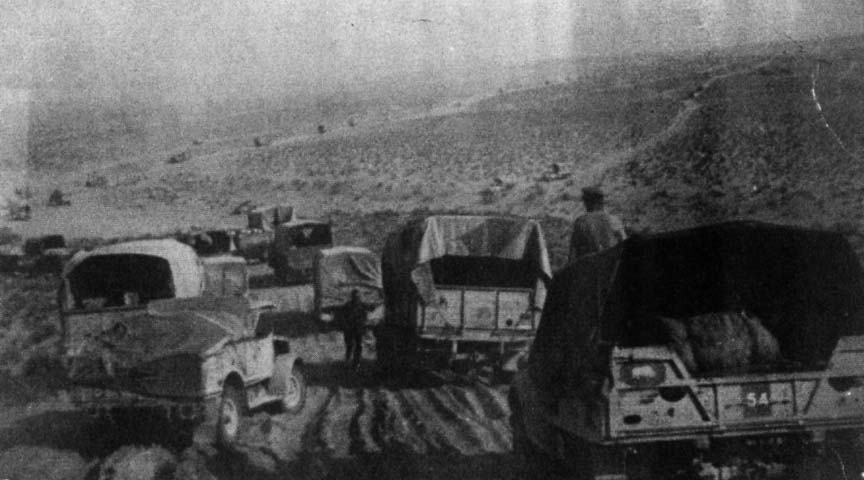
Each convoy is an interesting thing. Certain trucks carry specified flags, and the result is a gay display of flags flapping from squat poles alongside the truck cab. Flags are also used to signal a stop, and a start. Your own convoy keeps an assigned distance between each vehicle as a precaution against air attack, and moves at a specified speed. This is all very well in theory. In practice, and when great distances are covered with uncertain tracks to follow, vehicles are always getting lost --- and the muddle and jumble of a thousand vehicles of all kinds only makes it worse, especially at night. It is then that we are grateful for the sets of maps issued to our ambulances, as Jock and I would soon discover. And Jock, months before, had taught a class on map-reading for new arrivals.
It was during a stop on the second morning of convoy when we were approached by another AFS ambulance attached to a front-line RAP (Regimental Aid Post), and the driver requested that I relieve him of a battle casualty because we were assigned to a larger MDS unit. This was irregular and at first I refused being on the move, but since he too was on the move and apparently more urgently needed up front than we, I agreed to load the wounded man into my ambulance. He was German; but he was not a Nazi.
He was badly wounded. He was a tank man, and in battle a nasty piece of shrapnel had torn through his right buttock and on into his hip. There was only a field dressing over the wound. He was young and strong; fortunately his abdomen had not been pierced, and we anticipated effective medical attention when we leaguered that night.
Forced to reduce speed because of our patient, we soon lost our convoy. We continued bravely on, swallowed up in convoys of three-ton supply trucks. The country was undulating, of sandy soil, at times covered with wild grasses, cactus, a few crops and orchards. It must have been surprising for an enterprising farmer located in a remote inland comer of his country, to awaken that morning and find his fields furrowed with tracks filled with a streaming river of jolting vehicles --- a plague not mentioned in Exodus.
There were clouds of sand, and from a distance one could tell where the track lay by the whirl-wind of sand which curved up from the tracks to the sky. A railroad crossing gave us our exact location on the map, but since no one that morning had been able to give us the destination of our MDS, it served little. In the afternoon we came across the temporary HQ of our AFS Ambulance Car Company; however, they did not have the location of our MDS unit, and had sent out a jeep to reconnoiter. Meanwhile we had a wounded man in my ambulance, and all hospital units on the move.
After an hour's wait, we fell in with another convoy heading up the axis. The track continued bumpy and heavily rutted. At the next stop, I had to keep in line while Jock got out to seek information on the MDS location. He was gone for some time, and I searched every vehicle in the convoy for him. Finally, as the convoy moved on I was forced to keep in line with my patient and give up my search for Jock.
As far as I knew my fellow "relief" driver was left alone to wander "somewhere" in the "bush" without his kit or transport. I later learned from him that he had located a Kiwi medical car several hundred yards to the right, and had then gone off in search of the MO (Medical Officer). He was surprised to find me and the convoy gone, but spent an enjoyable evening with the Kiwis and was able to rejoin me late the following evening.
Thus I had lost my fellow driver and my unit, and with night approaching carried a seriously wounded man in my ambulance with no sign of a functioning surgical unit. I plunged on as best I could, failing behind, until darkness found me completely lost and alone. Fortunately I had chosen a good spot to stop because another LFA moved in and leaguered up for the night near me. Soon the MO had seen my patient and given temporary medical attention. But he could not be moved from my ambulance, nor could he be operated on since this unit had sent their surgical team ahead to cover a tank battle taking place. The MO's advice was to stop with them for the night, and "rejoin my unit as soon as possible."
Wonder of wonders Chan Keller, Jay Nierenberg and Harry Hopper of one of our "Lucky 13" C Platoon Sections were stationed with this unit; a unit whose position had been a jump closer to the front than ours. After tending to my patient, and with a medical orderly standing by, I joined with them at their ambulances for a bite to eat. They were called out later that night to help in the tank battle going on ahead, marked by bright flashes along the horizon; and so I headed back on foot to where I had left my ambulance.
It is easy to lose your way on a dark night when there are no trees, paths or houses to act as guide posts; and one is so confident of returning a short way across the "bush" that he forgets to take a star sight. And so the final mocking gesture of fate to complete the sum total of my woes was that I lost my way. I wandered about for a time hopelessly, finally plunking down on a bit of grass. Within the next half hour I could have walked back, as if in bright day-light, for Jerry dropped some flares which sailed right over my head and made me feel conspicuous. I considered the proposition, and decided that the closer to Mother Earth in times like those the better.
Thus I had lost my way, myself, my ambulance, my unit, and my fellow driver, and I had a wounded man to care for. The next morning my ambulance did show up, just a few yards away. My only problem now was to find my unit --- and Jock! Life on the desert and in the "bush" is not void of humor and irony. However, there were few more miserable creatures on God's earth that night than I. Things could not possibly get worse.
During that night the medical orderly had opened the rear doors of the ambulance, because my unfortunate patient had commenced to smell rather badly. Desert nights can be bitterly cold; and when I looked in I found cold epitomized. The poor chap was caught up in a paroxysm of cold that made the whole car shake, and in spite of the wool blankets we had wrapped closely around him. I jumped in and got the heater going, and then a cup of hot cocoa warmed him. I repeat --- he was remarkably tough.
I helped the orderly dust the gaping wound with sulphanilamide powder, and put on a new dressing, although the smell of it all nauseated me. It was almost impossible to move the fellow, and when I put my arms around his chest to help lift him, he bit into my arm and tried to whistle to ease the pain. Finally we had him as comfortable as possible.
My worries were lessened when the MO finally was able to give me the map location of my MDS unit which had been sent up by signals; he also assured me of a "good road" ahead. I would be back "home" in several hours (I thought), and there would finally be proper medical attention for my patient. I felt sure that Jock would also turn up. Chan (Keller) affirmed that he had seen him wandering along the track the day before "looking for me" as he said.
The road or track proved little better than the others, in spite of the fact that it was on the map. I had to drive very slowly, inching my way along and trying to cheer the wounded man as best I could. There were deep shell holes along the way, causing me to detour through sand. The shells had found their mark, for scattered about each hole were bits of vehicles, charred and mangled. Shreds of clothing also lined the road and even the rocks were burned.
Further along I came to a deep wadi, which proved to be the greatest test yet faced by my sturdy Dodge. At the bottom was a salt marsh. Mire and muck had already engulfed a three-ton truck and a tank. The steep approaches were strewn with large boulders. I engaged the four-wheel drive and prayed.
The: first attempt through failed, but I backed up before getting mired and got through a second time. I later reported the road as "impassable" to our MDS Commanding Officer (CO), and he signaled the medical units to evacuate down by a different route.
I continued along the track into the afternoon. One of the most welcome sights ever for me was the Red-Cross flag fluttering beside the Union Jack, which meant that I had reached my MDS unit. My patient was at once operated on, and I was left to air out the car, get a bite to eat and some sleep after the most trying days of driving I had known. I had in fact been "missing" for two days, and so received a hearty reception. My fellow driver Jock came in that evening, with stories of Kiwi hospitality, and so my relief was complete and my fears for him had been groundless.
All in all, I learned that my patient had gone five days since being wounded during the tank engagements. He had received little medical care in that time for the simple reason that the German retreat had gone on so fast that there were no operating surgical hospital units to receive him. Facilities had of course been set up to receive battle casualties, starting with the front-line RAP's; and each regiment had its assigned RAP and evacuation routes. Furthermore, the Aid Post that had picked him up had no reason to suppose that there would have been no working hospital units down the line; and that their patient would have been caught up in the chaos when masses of men and machines move rapidly across unknown country. The rare instances when medical posts were shifting with the tide of battle could not be avoided, despite careful plans. My only criticism would be that each driver in an ambulance convoy should be given the new map location before setting out; but even this can not always be done, and armies, like God, work in "mysterious ways" at times.
The major who operated on my patient was surprised at his relatively good condition despite the ordeal he had come through. That he had survived, attests to his own courage and will to live, to the limited first aid we were able to supply, and to the riding qualities of our ambulances over rough roads and their ability to traverse the most difficult terrain. The thirty hours or so I spent with him were the most instructive, and rewarding, I had yet passed as an ambulance driver in battle conditions.
Although I couldn't speak fluently in German, my German lessons at school came back surprisingly fast. Soon my patient was calling me Karl, and I him Howard. We talked music, and I told him of my twin sister's ability to translate the notes of Beethoven, Strauss and Mozart into something divine. We talked of skiing and snow. I showed him photos of my home and family, and my three sisters. He had a picture of his young wife and five year old daughter, held in a little heart-shaped locket from a gold chain around his neck.
Howard was "Under-Officer" in one of the best German tank corps. He was 27 years old. His eyes were deep blue and flashing; his hair a mass of tangled gold-curls; a blond six-days beard completed the striking features so fiercely, handsomely chiseled. In the morning I had helped dress his wound. He lay naked, stretched on the course blankets like a modern Christ beautiful in his pain. He was as a helpless child in my arms. He was a human-being in pain. His home was near Berlin, and he was my enemy.
Concerning this and other "adventures" in the following days, Jock had written home in a letter dated April 17:
This past month Charlie Edwards and I have had some exciting times, some real adventures, including losing each other, the ambulance, our way and unit, and nearly but not quite the patient's life. We've had a few close ones, and a few funny ones. I've been everything from a ditch digger (reference slit trenches), and a father-confessor to a poor and oppressed but happy Jew who showered us with kindness and gave us some real family life in his makeshift home, as a token of his tremendous gratitude.
Once again our unit was on the move in the rapid advance north, with little reluctance to leave the last, stretches of desert and "bush." Our assigned track bypassed the major port city of Sfax, heavily damaged by our bombers, and because the retreating Germans had blown up their ammunition dumps.
There would be olive groves and good roads, but Jock and I did not reach this pleasant land for another three days. Mine was one of three ambulances left behind to evacuate patients while the rest of our unit moved on. Again we carried Howard in my ambulance, but in far less pain now. Shrapnel had been removed and plasma given: the best that could be done regardless of his German nationality. And as he lay with the three other Tommies that we carried on stretchers, they exchanged magazines I had on hand for our patients: Life, and Reader's Digest. Howard was impressed with the colorful pictures in the advertisements.
We deposited our patients at a safe and well-equipped field hospital near the coast, and then our small convoy started back over the now familiar track to rejoin our MDS. One of the British ambulances had engine trouble in the afternoon, and so Jock and I stayed close to guide it and the two others as well. We had good maps, an assigned location, and Jock's compass mounted above the steering wheel. We crossed and followed the self-same track I had taken three days before with Howard, and I remember how miserable I had felt then.
Towards dusk we arrived at our map location, to find the unit gone. They had moved up another forty miles, and we received our new map location from an MP. It was the signal for our four ambulances to leaguer and "brew-up," something which every Tommy will do ten times a day if they can. Tea has won this campaign!
We pulled in for the night in a small, green wadi peacefully tucked away beside the road. It was a matter of minutes to disperse our vehicles, and get the petrol fire going.
The rations we had saved up over the past months when it had been possible to obtain some from a mobile canteen, more than justified having carried them for such a distance packed away in various shelves we had made out of old wire splinting in out-of-the-way comers of the car. There was milk and sugar for the tea, biscuits, plenty of bully beet and "M and V" in cans, which made a delicious mixture when fried and topped with tomato soup as a sauce. Canned pears completed the meal. For breakfast we had tea again, sausages (made out of soy bean) and bully.
Everything was cooked in shaved off petrol tins balanced upon a stove made out of a petrol tin and using sand soaked in petrol for fuel. Within minutes after a meal, the "brew-up" utensils could be slung onto crude hooks fashioned of packing wire wound onto the underparts of the car, there to gather sand, dirt and mud. We didn't have much water, but we did have petrol, with additional supply in "jerry-cans" held in racks on the outside of the car body. Life in such conditions on the desert and in the "bush" is simple. When you are traveling in a small convoy of fellows free from the routine of army life, it can remind one of a boy-scout camping trip. Without apparent need of a slit trench at this location, I lay in my bedding roll on a stretcher, and watched the slender moon against myriad stars as the night darkened.
We rejoined the main body of the MDS early the next afternoon. The latter part of our journey had been along paved roads, past thousands of olive trees stretching in ordered lines to the horizon on all sides. Natives lined the roads, trading eggs for a bit of tea or cigarettes. They lived in straw huts, or small mud houses. I talked with several, and purchased some carrots.
The local inhabitants I talked with seemed pleased at the outcome of events. The occupational authorities had set up provision for food and medical care for civilians as soon as was possible, and this made a good impression on people whose homes, fields and persons had been quite literally run over by the German retreat and the Allied advance, and their possessions destroyed or taken. It was a pathetic sight to see people with fingers, hands, and legs blown off because of mines, booby-traps, grenades. These unfortunate victims of the nasty implements of modern war received attention at the various medical posts set up along the assigned army routes.
In a letter of his dated April 17, and marked "moonlight in an olive grove," Jock had written:
I often think of the poor farmers over whose cultivations we bounce along cursing the irrigation ditches they have dug. It must have been confusing for them to have seen two great armies, both of them, claiming to be their liberators, chasing each other about their fields, spoiling their crops, knocking down there houses and towns.
Nevertheless, the war did not seem to rest too heavily upon the simple farmers and artisans of the land. Hundreds of them sprang up like mushrooms along the roads taken by our conquering army. Each seemed well-fed. Each had a cheerful grin. Some were arrayed in all kinds of cast-off "scrounged" army clothes. They could be depended upon to produce a fresh egg or a chicken from the folds of their customary flowing robes, like a magician pulling a rabbit out of a hat: one of the mysteries of life in the African "bush." And they were shrewd in the bargains they made.
Jock observed, in a letter dated April 17 concerning roadside barter:
I described to you how the natives held up eggs for sale or for barter all along the roads wherever we go. Sometimes they hold up fruits, and sometimes curious objects or things they have scrounged. One snowy headed big black man was holding up what I thought to be a little monkey for sale. It turned out to be the stub of his right hand which had been blown off by a booby trap. Naturally we stopped and dressed it...

Having rejoined our MDS, we leaguered that night in a beautiful olive grove, with olive trees stretching in the undulating fields to the horizon on either side. I have heard it said that the people here bathe in olive oil.
The Germans were in full flight to strong defensive positions in the mountains of northern Tunisia, terminus of the Atlas Mountain chain. Next day we continued north with the Eighth Army advance, following 10th Corps axis. Our fully mobile LFA in convoy comprising the MDS, ambulances, support vehicles, etc., wound around paved country roads through villages surrounded by olive groves, orchards, wheat fields.
On the horizon ahead, towering over a small town, was one of the most exciting ruins I had yet seen: the Roman Colosseum at El Djem. It resembled the Colosseum at Rome, but was better preserved not having been pillaged as a quarry for construction. Our road took us right beside the curved walls of fitted stone blocks. Tier on tier it rose above the surrounding roofs, a reminder of the might in arms of a great empire that had conquered once before in this same land, and ploughed the capital city of its proud defenders into the salt of the earth with the cry "Catharg delenda est." I half .expected to hear the shouts of gladiators, or see a colorful mob assembled to watch a triumphant procession, or perhaps hear the cries of martyred Christians nailed to a flaming cross. But the ruined tiers looked down on silent rubble.
It is trite, but appropriate, to quote the proverbial "history repeats itself." And as we rolled past the El Djem Colosseum in single file without pause, another brave defending army faced annihilation in this pleasant land, and another conquering army would enter a great capital city in triumphant procession. Eighth Army had smashed through Mareth and Wadi Akarit, driving the Germans in rapid retreat north and making possible combined action with the Allied forces holding to the west along the frontier with Algeria: British First Army, American Second Corps, General Giraud and Leclerc's French forces. Eighth Army's breakthrough south had broken the stalemate in northern Tunisia.
Our assigned track along 10 Corps axis took us through the storied and beautiful coastal city of Sousse --- the ancient "Sus" of Roman times. The French residents, liberated at last from the German occupation, welcomed us with characteristic abandon --- the first example of such happiness we had seen. Well dressed men and women, paved streets lined with trees, splendid buildings faced with white stone: for us a welcome change from the drabness of the desert and the rough trails we had traversed. But the central city and port were damaged beyond belief, and the harbor choked with sunken ships.
.Apparently our B-17 "flying fortresses" had done much of the damage. With reference to the bombing of Sousse, a Jerry prisoner had remarked: "When the R.A.F. comes over the Germans run like hell; when the Luftwaffe comes over the British run like hell; but when the Americans come over everybody runs like hell."
It was now mid-April, 1943. Leaving Sousse, we set up our MDS along the coast road north of Sousse, near a beautiful farm with clustering groves of olive trees. There was vin rouge to drink. It was a pleasure to drive on paved roads again. Optimistic feeling ran high. "Monty" had promised us Tunis by Easter, in another two weeks or so. Reportedly, he was scheduled to lead the Easter service in the Cathedral. The Jerries were evacuating by air as fast as they could. It would be another Dunkirk in reverse. Only a matter of days now; and thus the rumors flew.
There is an old saying that an army travels on its stomach. As far as I can judge, a modern army travels by rumors. One is either on top of the clouds, or down in the dumps; things couldn't be better --- or they couldn't be worse. And so, after several more days of anxious waiting, hoping perhaps for the impossible, the bright tone of our previous rumors became tarnished. German planes that a day past were evacuating the shattered troops of the enemy, abruptly changed their role and instead were flying scores of fresh troops into the battle area. And those same shattered troops of a week ago underwent a similar metamorphosis. Our spirits went down. We walked about with tightened lips. "Rumor had it" that the New Zealand Division had been wiped out. "Rumor had it" that so-and-so had said "there are more bloody battles ahead." And so it seemed that our invincible Eighth Army was held in check by fresh enemy divisions.
In truth, terrain as difficult as that of Wadi Akarit and as severe fighting as at Mareth, awaited our Allied forces that now held the German armies surrounded in northern Tunisia. To the west, 7th Armored Division (Eighth Army) had swung through Medjez El Bab and together with British First Army drove for Tunis city; other combined operations involved American Second Corps driving for Bizerte at the coast north of Tunis. Directly ahead of our own position along the 10th Corps axis, crack German divisions, including fanatic SS troops, were digging in along the steep slopes of Tunisia's highest mountain, Mt. Zaghouan. It would take another month before the final surrender of Afrika Korps on May 13 was secured.
While waiting for the inevitable flow of battle casualties to commence, I walked over one evening to a small town perched upon. a low hill surrounded by groves of olive trees. There was a full moon, and the crooked streets and white buildings were strangely soft and beautiful. I wandered up streets bathed in the warm spring air. Many of the French families of Sousse had gone here to escape from the bombings, and I talked with those I met. Some men had scars from the last war. All were pleased to meet an American, in spite of what our planes had done to their city and homes. They offered me fresh native bread, coffee, and regrets that the early curfew had closed the cafés. This untouched, peaceful town seemed out of place --- almost a different world to the damaged towns and cities along the coast farther south..
It was a night for reflection, and I walked "home" across the moon-bathed fields and gullies with four fellows from New Zealand. I learned much of their country and their customs from them. Confident, quiet, generous, steady under fire, and adamant defenders of freedom, these fellows are among the finest troops of any army. We were always pleased for assignments with their units. They asked me over to their tent for coffee and New Zealand jam. Our talk ranged over many issues. No one bothered about the flares the Germans were dropping near-by. It was an example of the fine kind of fraternization between men of different nations represented in that most international of armies. I have talked thus with Indians, Australians, South Africans, French, Poles, our "cousins" of the British Isles. Here was solid foundation upon which to build the world-wide intercultural program which AFS launched after the war.
In the following weeks, there would be few if any moments for such reflection and in such a peaceful setting.
My fellow driver Jock Cobb commented equally upon the "incongruity of this peaceful setting." In a letter of his written by "moonlight in an olive orchard," and dated April 17, 1943. He wrote:
Clad in my overalls and a pair of sneakers ... I have been sitting on a tool box down by the workshop truck smoking the pipe Sid gave me before I left, and listening to pleasant classical music from London. Better to give you the picture, I will add that I have rigged my bed on a stretcher in the bottom of a dry irrigation ditch, thus saving the trouble of digging a slit trench ... as well as my overalls, I am wearing a money belt and identification bracelet just in case .... the watch which Mother gave me last summer ticking away faithfully on my left wrist.
In this same letter, Jock confessed that he had begun to smoke cigarettes. We all received a weekly ration of unsavory packs of "Players" or "Wild Woodbines." Jock and I generally saved these for our patients, or used them for trading. Jock added: "if smoking cigarettes is the worst thing the war does to me, I shall be lucky."
There was good reason for Jock's garb of overalls, and his tool box by the workshop truck: he had been, assigned responsibility for his own ambulance. Jock reported in this same long letter of April 17, that he had "joined the ambulance aristocracy of AFS, this time with a car all. to myself. This I assure you is a mixed blessing."
Unfortunately, when it was transferred to Jock's command, he found it to be in terrible condition requiring rebuilding and reconditioning inside and out. Despite the preventive maintenance program all of us with ambulances, followed, this one had been neglected
Versatile Jock took it apart, and unlike "all the king's men," put it together again, as he continued in his April 17 letter:
When I took over, the car smelled like a house of ill repute, the windshield was opaque, the tires were low, the pump was missing, the axles were dry, the fan belt was shot, the crank case was leaking and three-quarters empty, one headlight was gone, the battery was dry, the steering gear shimmied and shook, the gears lacked grease, the universal joints were shot, a wheel stud was broken, the spark plugs were filthy, the starter motor was jammed, the radiator falling off and was leaking, the carburetor was full of gunk, the motor was stalling, caked sand and oil covered all the vital parts, the exhaust pipe was broken and squirted fumes into the driver's face, two springs were broken, the chassis was cracked, and there wasn't even a towline to tow the thing away with.
So you can see I have been living in my overalls the last two days. They talk about dispersing vehicles to prevent more than one car from being destroyed by a bomb. Well, I have dispersed my car so that one bomb could not even hurt the whole car. I have taken the whole front end off, the radiator is far away, the timing case is apart, everything on or about the engine is spread out around in the grass; in short, I am immobile. And that's a bad thing with the war going on all around. I could be caught with my pants thoroughly down it Jerry should advance as much as he has been retreating every day. But the ambulances will be needed every one before the end. And the AFS must get through. (Distant trumpet and cheers).
There was another "mixed blessing" in this, especially for me: I had "lost" not only a versatile, unflappable, and brave fellow driver, but also the support and the companionship of a close and cherished friend. Jock and I had been school-mates in Milton, Massachusetts. We had served together on a malarial control project in Mexico; shipped overseas together with AFS, Mideast Unit 26 and our "Lucky 13" fellowship, been posted together at a Spears Mobile Clinic, Selemiye, Syria. Jock had remained for a time with AFS Mideast Command to train new arrivals in map reading; then joined me and my doughty. ambulance, "Fox II," at Marble Arch near Tripoli, March 4, 1943. We had served together with 12th Light Field Ambulance (LFA) into Tunisia, the breakthroughs at Mareth and Wadi Akarit, and the rapid advance north along 10th Corps Axis. We would serve together with AFS in Italy; then after the war "follow" each other to various developing countries of Africa and Asia, he to perform medical assistance, I to perform technical assistance.
Thus appropriately ended the second "Phase" of this Driver's memories of the Battle for Tunisia.