 1. Rear Echelon Action on the
Desert. Our First Battle Casualties 2. Moving up to the Front at Mareth --- the Reality of
War 1. Rear Echelon Action on the
Desert. Our First Battle Casualties 2. Moving up to the Front at Mareth --- the Reality of
War |
We had trained for three months in the Middle East, and we had become adept at handling and maintaining our nimble four-wheel drive ambulances. Constant maintenance was essential, and it was no mean task. We were required to carry out a "Vehicle Maintenance" check-list comprising 27 operations (see Annex); and we had tested our ambulances in the mud and the snows of Syria; more mud and snow lay ahead in the next year in the Apennines of Italy.
We had adapted to life in the class conscious British Army and its RAMC (Royal Army Medical Corps); been wined and dined in the Officer's Mess and by "other ranks," with growing appreciation of the fine qualities of the British Officer cadre; also of the "Tommy" despite insular attitudes.
In the Middle East we had experienced a diversity of peoples, high class and low class, urban and rural --- Arab, Bedouin, Lebanese, French, as well as English --- symptomatic, perhaps, of AFS intercultural programs and exchanges after the war. Everywhere there had been good will towards us as Americans, representatives of a land of hope and freedom. Although we wore British Army uniforms, our attitudes and accents gave us away.
It was now late January 1943, and we of Mideast Unit 26 --- including our "Lucky 13" fellowship of E-deck --- were more than ready to commence the mission for which we had enlisted --- to perform medical field service in conditions of combat. Most of us of Unit 26 were called in from our posts throughout Lebanon and Syria to the city of Beirut where our convoy formed for the long road west. Before setting out, we were treated to a short leave in that lovely city by the sea. Beirut was then untouched by the horrors of Arab-Israeli conflict that was to devastate it many years after World War II had ended.
Many of us of our "Lucky 13" fraternity of "E" deck, HMS Aquitania, were together again and would continue so for the duration. For us of Unit 26 and the nascent C Platoon, our next "manifest destiny" was the "Western Desert" stretching over one thousand miles across Egypt and Libya to Tunisia. It was for us a destiny dictated by one man more than any other: Field Marshall Erwin Rommel, the "Desert Fox," respected leader of the Afrika Korps.
Our long convoy, composed of work-horse three-ton army trucks, brought us from Beirut to Cairo and AFS/HQ before heading out on the coast. road west whose beginnings were marked by a sign at the outskirts of Alexandria.
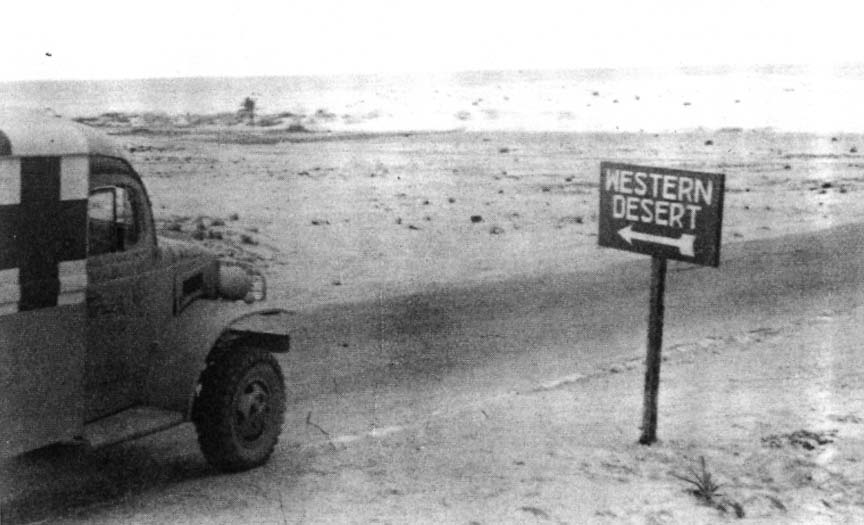
At Cairo, before heading out on the coast road, we were treated to a "feast" of letters from home. Sacks of mail bearing the AFS A.P.O. number, had arrived. Mail continued to reach us by air and by sea spasmodically during the war. When for example in December 1943 C Platoon was pulled back to Pollutri, Italy, for a much needed rest, ten bags of Christmas mail and packages brightened our lives.
It is said that an army marches on its stomach; not entirely true. There was nothing more vital for our morale than to receive mail from home and the opportunity to write to our families and friends. I wrote more than 150 letters during my three years overseas, all safely delivered. I received as many, plus packages such as home-made fudge and cookies, canned goods and other foods, vitamin pills, medicines, clothing, toiletries, water-proofing for my boots, books, magazines, a portable chess game, even a small typewriter. But the letters were even more welcome than the supplies.
Another morale builder for us of AFS was the prospect of being flown home for a month's leave after the first year of enlistment, or following subsequent six month reenlistments. I did not take advantage of this; others did.
In February and March there would be chill days and nights on the Western Desert. Wearing our winter-issue "battledress," each of us with blanket-roll and kit, we were bundled onto the rock hard beds of the three-ton army lorries that carried us 1,200 miles in long single file to our destination "somewhere" east of Tripoli, Libya. Canvas covers were stretched on frames over our heads like Conestoga wagons.
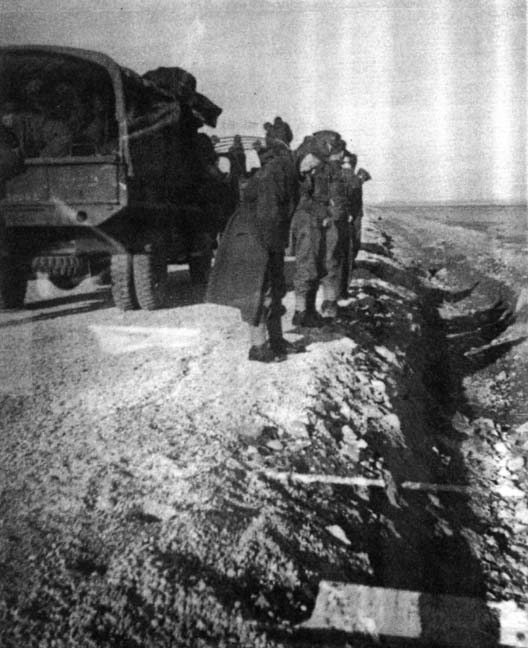
My memory of our convoy is a blur of bone-jarring jolts, dust, blowing sand, periodic pit stops to stretch our cramped bones and relieve our aching kidneys when we formed long lines at a road-side ditch. Before dark the lorries dispersed out in the desert as we "queued up" up for rations, and then hunkered down in our bed rolls. Charlie. Pierce (Yale Law class of 1940) survived the jolting best, thanks to an inflatable cushion that he had either scrounged --- one of our favorite pastimes --- or received in a Christmas package.
We were not yet in a war zone, but we witnessed the mangled detritus of war. Ordnance left behind in the haste of the German retreat littered both sides of the way, including rusting wrecks of tanks, trucks, guns, airplanes etc. not yet buried by the merciful sands. And the way also rang with the echoes of battles and engagements of the two-year sea-saw tides of German-Italian advance from Mussolini's Tripoli base, and the stubborn British counterattack and advance back from Cairo and Suez, assisted by forces of the Free French. Early AFS Units had taken part in these battles, notably at the heroic stand with the French at Bir Hacheim (one hundred percent AFS dead, wounded or captured).
It is sufficient to list place names to invoke the ghosts of those engagements as we easily passed through what had been so dearly gained. Just 20 miles west of Alexandria we skirted the El Alamein battleground of Oct 23-Nov 3, 1942, site of one of the most significant battles of the entire war where Eighth Army sent Rommel's crippled Afrika Korps in retreat. There followed Halfaya (Hellfire) pass at the escarpment along the Egyptian border with Libya; followed by Tobruk and Bir Hacheim; although surrounded, both had held out and importantly delayed the German advance.
We passed Benghazi almost 600 miles from Cairo and then Sirte on the coast beyond, heavily invested with mines. Our trek ended near Marble Arch east of Tripoli, Libya. Tripoli, 1,200 miles west of Cairo, had been a principal base and port for Afrika Korps. It had been taken by 8th Army January 23, 1943.
And so our tortured odyssey had ended "somewhere" west of Marble Arch and east of Tripoli near the coast. It was sometime on or after February 6, 1943 because I had written in a letter on that date in a way to skirt the censor's scrutiny: "I am not where I have been and in a few days will be even farther from there ... miles from anything except sand." And so we had completed the long trek, and been dispersed to individual posts.
At Marble Arch Mussolini had constructed over the road, an incongruous copycat version of the triumphal arches of the Roman Emperors he tried to emulate. Incongruous because it was built on sand surrounded by sand, and there was nothing triumphant about it. It was, as Shelley had written in his poem "Ozymandias" --- "Nothing beside remains. Round the decay of that colossal wreck, boundless and bare, the lone and level sands stretch far away."
By late February of 1943 the Eighth Army advance approached the border with Tunisia 150 miles west of Tripoli. Tripoli, its port, depots, staging facilities, and airfields had become a major base of operations for Eighth Army; also the former Italian airfield near Marble Arch.
Indeed, from Marble Arch to Tripoli and beyond there was constant activity of troops and supplies to support the forward areas and the build-up for the approaching advance into Tunisia. There were as well continuous sorties of our bombers and fighters.
At the Marble Arch area, we of our "Lucky 13" fraternity were assigned to C Platoon of 11 AFS Ambulance Car Company (ACC). There. were two ACC's authorized for AFS by Eighth Army Command: 11 ACC was subsequently numbered 485, and 15 ACC changed to 567. Each ACC was divided into four Platoons; each Platoon with four to five Sections of five ambulances each with two men to an ambulance when possible. Chan Keller, Jay Nierenberg, George Collins, Harry Hopper, John Leinbach, Art Ecclestone, and I --- to be joined by Jock Cobb in March --- were assigned to two of the C Platoon Sections.
I was assigned at first to Chan's ambulance as his "spare Driver" ; then detailed to an ambulance of my own, to be joined by Jock Cobb.
Lt. Tom White was C Platoon Commanding Officer (CO), and C. W. (Bill) Edwards Platoon Sergeant (NCO). Most of us in time headed up Sections. Chan eventually in Italy became our Platoon CO, with Art as NCO.
Our first postings were rear echelon operating near Company or Platoon HQ. The not so "lonely and even sands" of the Western Desert confronted us on all sides, dotted with a variety of dispersed vehicles and quarters in trucks or tents. Dispersal of vehicles, and digging slit trenches was standard practice at all times.
Although our forces dominated the skies, German bombers roamed it night, dropping flares; and there were sneak attacks by German fighter-bombers during the day.
British Army personnel from Army Supply and Transport cadre, and from Army Catering Corps were posted at our Company and Platoon HQ's to repair our vehicles, to provide rations, and to prepare meals. Workshops, water trucks, cook-wagons, canteens all self-contained and mobile, followed along with us as we advanced. We could not have functioned without them.
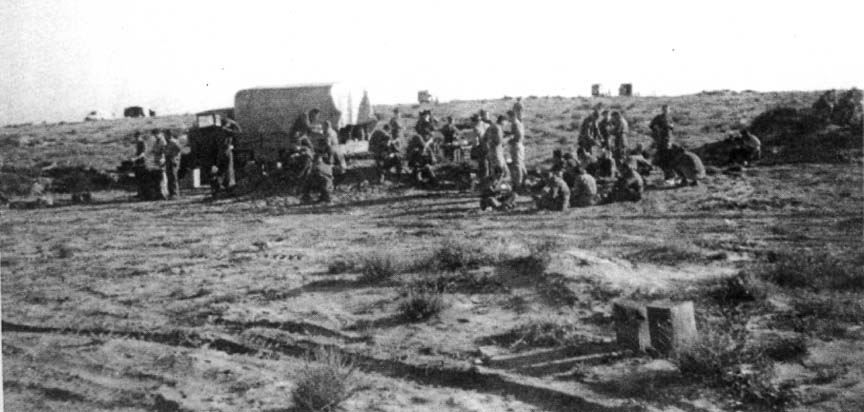
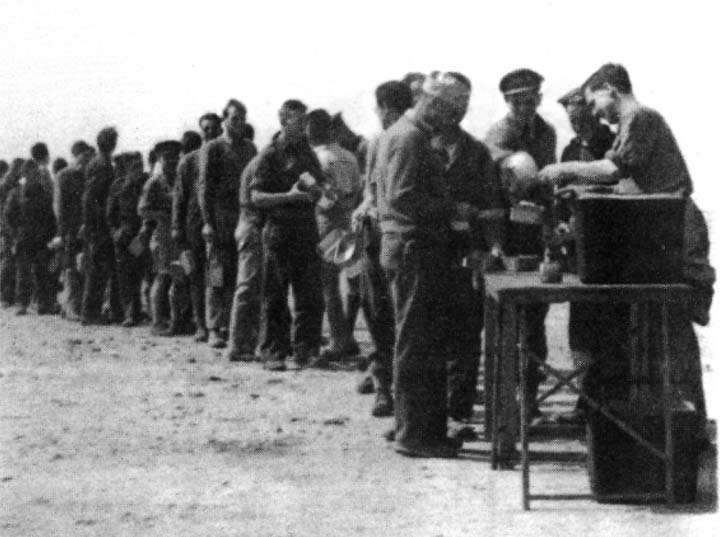
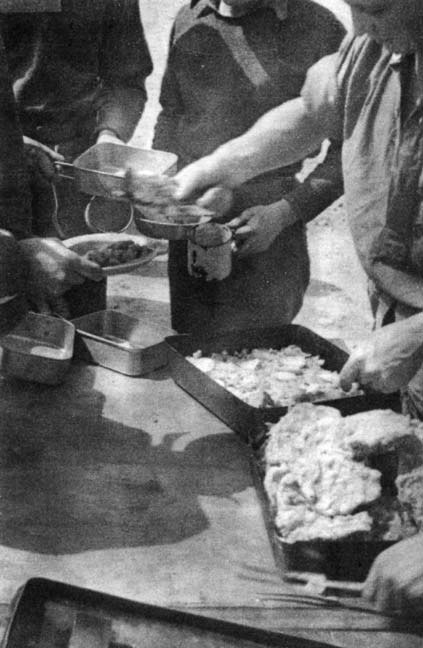
British army rations were the butt of endless jokes and gripes. "Bully beef" --- canned corn beef --- was staple, dished up with potatoes, sometimes cabbage and tinned fruit. At times our cooks coaxed a tasty beef pie out of bully-beef.
There was mush and fried bread for breakfast, cheese snacks at lunch, always plenty of tea --- and flies. When at HQ or in convoy, we formed queues in orderly British fashion, as our faithful cooks --- often a "Curly" or a "Lofty" --- dished out their offerings.
Our mess kits, mugs and plates with folding handles, reminded me of boy scouts.
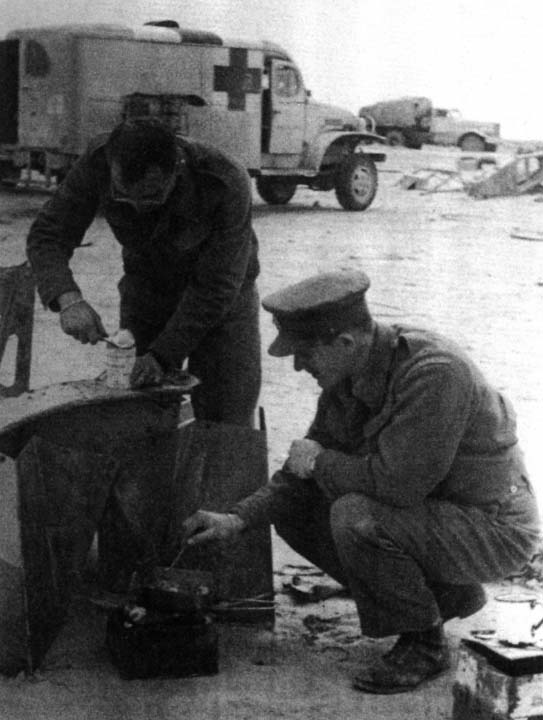
On our own we carried emergency rations as well as our treasured food packages from home. And as "desert rats" of the British Eighth Army and its storied armored divisions, we were quick to "brew-up" for tea at any time when we had the chance.
For a "brew-up" we made a fire of sand soaked in petrol taken from one of the jerry-cans slung in our side-racks. Using rationed water (we had two quarts per day) we brewed tea leaves in a battered can which we kept slung under the ambulance when not in use. Sugar made it palatable. Our insides must have resembled the blackened insides of our mugs as a result.
Chan (Keller) and his ambulance, with me in tow as "spare driver," were posted at a CCS (Casualty Clearing Station). A CCS is in effect a well staffed field hospital with operating facilities, able to handle most casualties, and located at the end of a chain of medical evacuation routes commencing at the RAP (Regimental Aid Post) at the front, and down through the Advanced and Main Dressing Stations (ADS, MDS).
This one was housed in tents and specially equipped lorries. The most serious casualties would be flown or driven from CCS to base hospitals to the rear.
Many of the casualties we carried were walking wounded, or on sick call. We could carry up to ten men sitting on long benches pulled down on each side of the ambulance; we could also carry up to four of the serious stretcher cases, two on the floor and two in their stretchers hung from the root.
Some had come down the long chain from the front, or from air bases; others had been injured or ill servicing supply lines and port bases near by. Most were veterans of many months, even years of combat. They were stoical, resolute, confident of victory over the Germans under their "Monty," although they themselves may have been "knocked about a bit" or "had a bit of bad luck.* They were surprised to see us "Yanks" in British battledress. They were grateful to America and our alliance with them against the Nazis, and for any American gum, candy, or cigarettes we could share with them from our packages from home. I wrote: "Most of the Tommies would give their right hand for a good American cigarette."
There was nothing comparable to our Dodge four-wheel drive ambulance in British army medical transport. First commissioned and tested in combat by AFS, it became standard for American Army forces. It could take severe pounding and navigate in the most difficult terrain and conditions.
Our ambulances were in constant demand, a major task for us. As shipments increased, I was soon assigned my own. It was newer than any I had in Syria, and I proudly christened it "Fox II", stenciled in black on the hood. Soon to be bruised and battered, it carried me through the Battle for Tunisia. Ideally suited to its task, our ambulances also made life bearable for us. I wrote (Feb. 23):
We of AFS live as well as any. Tortoise-like, we carry our house and goods where-ever we go: a sturdy ambulance with comfortable stretchers and blankets, self-made shelves and chests (made of bits of wire or an ammo box), a heater ... At night, after we disperse, one is cozy behind black-out curtains with the light of the dome lights, a pullout shelf for writing, and if one has guests, two long fold-down seats ... A petrol tin, cut in half and filled with sand soaked in petrol, makes a stove for cooking or heating water. Spare petrol, water, oil, grease is carried in racks on the outside, and there are straps on the fenders for your bedding roll. One is at home with the swirling sand, the splendid sunsets, the loneliness of the desert. But one can not be too sentimental: pathetic little graves, marked by a steel hat or a white cross; the charred wrecks of planes or tanks, the drone of planes and the rumble of endless convoys, snap one back to the tragic reality of why we are here. And there is the wide-eyed endurance of wounded men we carry.
Tough as they were, we gave our ambulances "tender loving care." We were responsible for maintenance inside and out, including all the oil changes, keeping fittings greased, tightening engine and body bolts. We carried a spare tire, but when we picked up a nail, we had to break down the tire, mend the tube, and put it together again using a foot operated pump so as to always have a good spare on hand. The caption of the photo below explains:

| Desert drivers do this often. They soon learn to take the rough spots slowly because it's no fun fixing a flat in the heat of the day. as Charlie Edwards. left. and Chan Keller, right. will tell you. (Caption by Cobb). |
Neither we nor our ambulances could have gone on without workshops. The Royal Army Supply and Transport Service assigned a field workshop for each of our Company HQ's, commanded by a TO (Transport Officer, or Sergeant Major) with a cadre of skilled "fitters." They kept us going through thick and thin, often scrounging or improvising spare parts.
Within the month, Fox II required two new bushings for rear spring shackles, and a weld for a cracked exhaust flange. During breaks in the campaigns, workshops undertook to recondition our cars, but eventually ambulances had to be salvaged for parts and replaced --or were damaged beyond repair in action. I had two more ambulances in Italy. The caption (Cobb) of the photograph below reads:

| Far from a spreading chestnut tree --- the British smith repairs and makes new parts for the ambulances. The machine tools are inside the truck. The whole workshops can be packed up and away inside an hour. |
Our confidence in our durable, self-contained ambulances and in ourselves, gave us a wonderful sense of independence. Before a long run, we could strap our bedding roll on the front fender, pull up to a petrol dump to fill the ambulance tank and the spare jerry-cans in racks on the side, and "let her go" --- a vagabond's paradise. Back home, our families wrote of gasoline rationing. We even washed clothes in it!
When an evacuation was completed, we could pull off into the desert and "brew up" using rations on board. Although the mine fields had been cleared in the rear areas, we were cautious and kept sand bags on the floor boards. In the photograph below, note the British Army winter-issue battledress.
Although we were miles from the front or even the forward areas, there was plenty of evidence of war for us. There was, for example, the movement to the front of transport and troops; the action in the air by day and by night; and the patients we carried, some of whom had been wounded in action.
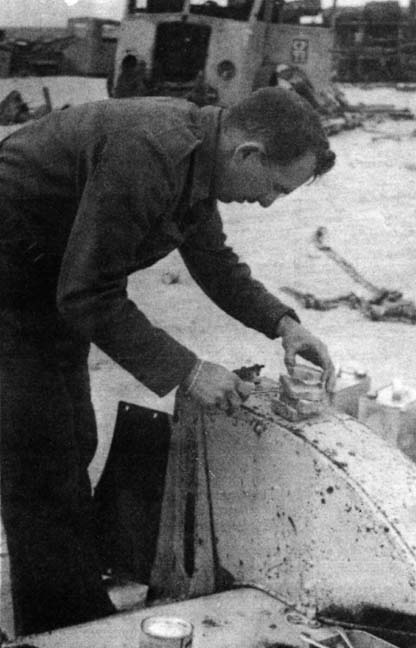
But there was more evidence: the shattered, rusting residue of war. The wreckage of German, and of British Army ordnance of all sorts had been abandoned, or simply pushed aside from the roadways or desert tracks. Sometimes a wreck made a convenient prop for a snack, as shown below:
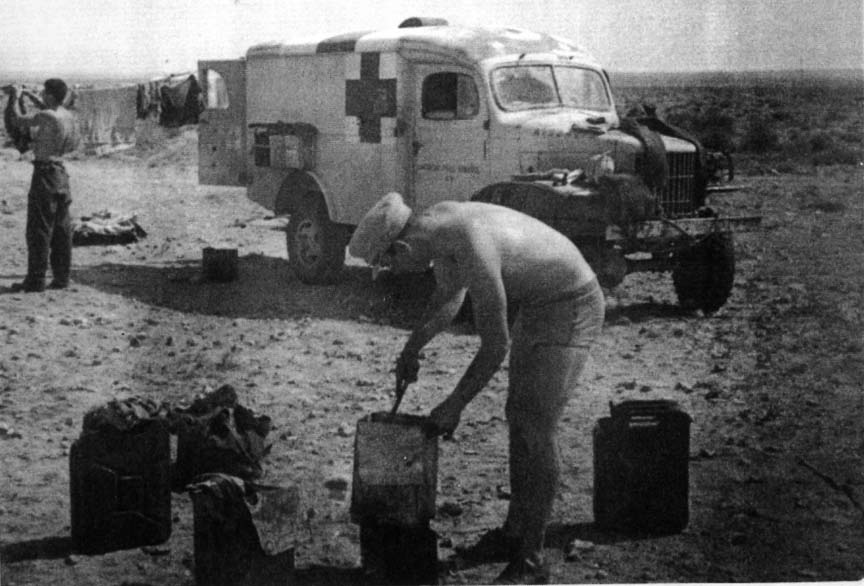
Keeping ourselves, our uniforms, and our ambulance "home on wheels" clean and in good repair in desert conditions in mid-winter was not easy. Winds churned up the sand, and often exposed gritty and dusty hardpan which ground its way everywhere. Cleaning the engine, tending to grease points and changing oil meant soiled hands, sweaty bodies, dirty clothes. Inevitably buttons came off and fabrics were torn. With a ration of water limited to two quarts a day per person, a bath or shower was out of the question, and our capacity to improvise was challenged. We made use of petrol to rinse away grime; we recycled radiator water for washing, using petrol-soaked sand to heat the water. I wrote about this in a letter home dated March 4:
Monday last I was quite "domestic." In the morning I gave my car a complete grease job. Then I washed all my dirty clothes, boiling them in soapy water stirring with a tire tool. After that I washed myself in the hot water left over, and then donned clean clothes. Luxury! The afternoon I sewed buttons on my battledress, mended "undies," and lounged luxuriously feeling completely clean Incidentally I'm quite a wow at sewing on buttons.
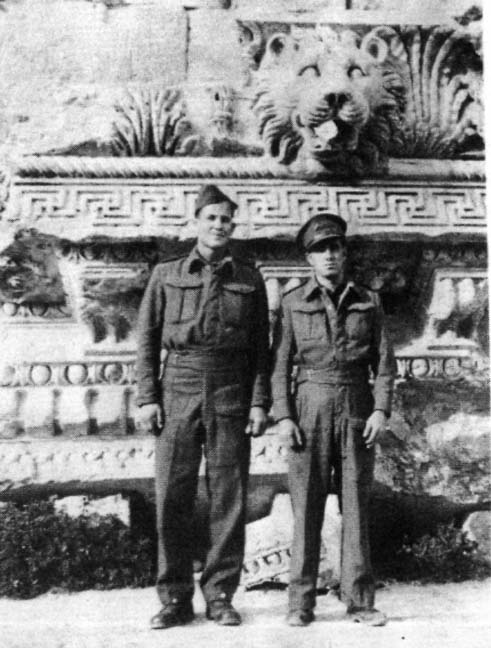
There were plenty of buttons on our British battledress, standard Army winter wear. Chan Keller and I sported our brand issue in the photo below taken under a stone lion at the Baalbeck ruins, as I wrote (December 15, 1942):
I'm standing (right) with my room-mate before a lion dating from the third century and reposing amidst Roman ruins of Baalbeck in the Lebanon. The outfit is known as "battle-dress." I resemble a "Tommy" in every way but accent. My companion is Chan Keller, a Williams man, from New York.
So much for our warm, comfortable, wool battledress. Fortunately, in the summer heat ahead, we could shed it for light-weight khaki uniforms.
Keeping battle-dress clean, buttons and all, was a problem in life on the desert. But when it came to keeping myself clean, I became unbuttoned --- as shown by Jock Cobb's camera below; his caption reads:
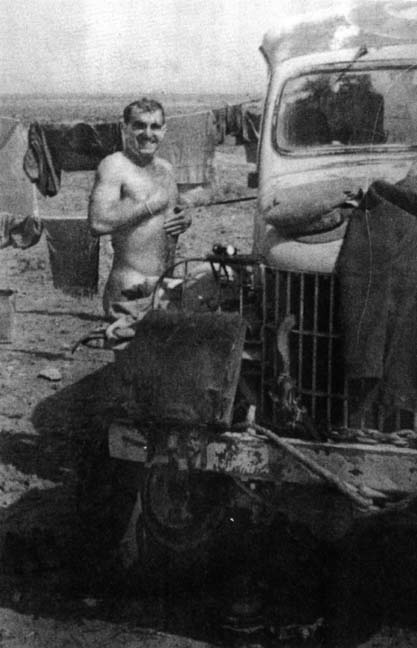
British Army regulations discouraged facial hair, with the exception of the famed "handlebar" moustache. Jock Cobb's ever present camera captured me in the act of shaving, for which he wrote the following caption:

In a letter written March 16, 1943 Jock Cobb gave a dramatic account of the scarcity of water on the desert, and his imaginative way to increase his supply of it. After a surprise rain storm one night flooded his slit trench, I called to him from my trench that it seemed to me that he was in a bathtub; Jock wrote:
This was what gave me the idea to save the precious water for washing myself and my clothes with the result that I was now graced with a singular clean feeling out that comes with the removal of that brown layer of dirt and the crispness of clean clothes. Funny how naturally one does those things out here which would seem ridiculous at home. You will laugh when I tell you that I scooped up the water collected by means of the urinal which is the standard equipment for every ambulance, allowed the mud to settle out, then put it into an empty gasoline tin and boiled some eggs in it over our makeshift stove; and after doing all my laundry for the last week and a half, used the soapy water that remained to save and wash. And a very pleasant feeling it was! All the boys were jealous of my fine soft water and fluffy suds.
Jan Christian Smuts, respected Allied General in World War I, and enlightened leader of pre-apartheid South Africa, once wrote: "War is short periods of intense fear followed by long periods of intense boredom." South African troops, known as "Springboks," served in Africa with Eighth Army.
We of "Lucky 13" C Platoon had not as yet known, in the desert, the intense fear all of us would experience in Tunisia and Italy. The constant German air-raids by night dropping flares and cluster-bombs near-by were "scary."
In his March 16 letter, Jock Cobb underscored --- but with a light-hearted touch---the life-saving necessity of the slit trench, especially in the conditions of warfare on the desert and the constant movement.
I slept in a slit trench dug deeply and snug last night, ---my ditch-digging practice in Mexican malarial swamps comes useful out here. We had an hilarious time digging the bloody things.. We tried to treat the whole thing as a big joke, just getting exercise after a long drive---we theorized and planned and figured with depths and angles of strafing and bomb fragments as if it were a matter of life and death, which in a way it was. The resemblance to a grave is almost too severe to be laughed off.
But unless caught out, we felt safe in our slit-trenches, and each one of us experienced moments when a slit trench did indeed save our lives.
It was in this same letter of March 16 that Jock wrote of his imaginative way to obtain water---by scooping it up from his slit trench after some unforeseen rain at night. His letter explained:
It rained in the middle of the night, which as you can imagine is unfortunate for slit trench dwellers. Some were brave and climbed out to retire to the snug ambulances; others contented themselves with discretion and a muddy bed, while still others were lucky to have provided themselves with a water-proof roof over the slit. I had a fine tarpaulin which sagged down under the weight of the water so that when I stuck my head and shoulders out in the morning, Charlie, in the next trench down the line remarked that I seemed to be in a bathtub like the woman in towel advertisements. This is what gave me the idea to save the precious water...
Although restless at times because of the inevitable "foul-ups," delays, periodic lulls in the campaigns, comparative isolation etc., we were never bored regardless of our location --and the Western Desert was no exception.
With our self-contained "houses on wheels" when not in action we could "brew-up", take a sun bath; read a book; write a letter; brush up on French or map-reading; or take on a fellow Driver in cribbage, chess or checkers.
Jock, in his March 16 letter, compared our ambulance to a mobile home:
A strange thing is a mobile home. You wander back from Mess to get out your pipe, only to find your home just disappearing over the hill having been called out for a run; so you content yourself with the sand and the birds until your home returns. And surprisingly, though all the ambulances look alike, you learn to recognize your "home" at 250 yards by the shade of the paint, the manner of it's motion as it bumps along, or the dirtiness of the back windows as it fleets away down the road.
On Sundays our souls were tended to by the services of the Army Chaplains, affectionately called "Padres." These services were held in make-shift chapels such as in tents, or out in the open; once on the side of a Wadi where rock formations had the effect of a classic Greek theater. These services were well attended, and the Padres were very popular, for as the saying goes "there are no atheists in fox-holes."
Our bodies were also exercised. There were pristine sand beaches close by as we advanced up the coast, and as March brought warmth I wrote of the delight of frequent swims.
There was soccer, in which our British "mates" easily outclassed us, but in which our Company CO Captain Arthur ("Art") Howe (ME Unit 2) was quite good. On the other hand, we had the advantage in America's "national pastime", baseball. Somehow, a baseball league was formed and games scheduled. Two of our AFS Platoons, C and D, each fielded a team. A third team was fielded by an American Army Airforce unit based nearby. I wrote, in a letter dated March 10:
Speaking of sports, I must tell you of a little baseball league we had out here ... there were three teams, two representing our Platoons (C and D), and the third made up of some "yanks" stationed down the road. The "yanks" supplied the balls, bats, gloves and a very good field and also invited us for supper after the games (a welcome change). After several practice sessions, our team started to really click (having picked up a pitcher and shortstop who had some semipro experience. After having taken several beatings in practice games, we won our first game in the league --- 19-9 against the "yanks." Our next game was scheduled against D Platoon, which had already been beaten by the Americans. And so we felt a bit confident --- in fact jumped to a. third inning lead of 5 to 2. However, the other team slowly came up to us and then in the last of the ninth put across the winning run 6-5. It was a good, hard, well-played game with few errors and excellent pitching. I moved from catcher to center-field for the second game, took about seven fielding chances, and hit 3 for 4. Incidentally I am quite happy about the baseball Mom sent along.
As for the exercise of our minds (and our AFS penchant for "intercultural relations") we took part in debates, and quiz programs, staged by our British comrades of the CCS where we were attached. I wrote, in a letter dated March 5:
Chan (Keller) and I did yeoman service last night. We were on duty at the CCS and happened to amble in on a debate being given at the canteen tent. They seemed a bit short for speakers, so the M.O. asked me if I would uphold the affirmative side. I said "sure --- but what is it?" The answer was: "Resolved, that Germany should be crushed as a great power." Imagine my surprise! All my sentiments were in the negative. Well, I went to it ... with a bit of blood and thunder thrown in. The upshot was that my side won. It was all quite fun. Incidentally, the Padre does a good job in recreation for the men at this CCS. Next week's debate is to be: "Resolved, the British Commonwealth of Nations and U.S.A. should be joined under one government. " It ought to be good...
This next debate on this topic took place on schedule, and turned out to be the last one for us; I wrote March 10:
Jay Nierenberg and Harry Hopper spoke for the AFS. It was especially interesting because there were both British and Americans to represent each side. The affirmative side won, after some good speaking. I fear this program ... will have to be put off indefinitely. Movement orders at last. But it's been a wonderful month here --- my first month on the desert.
Jock Cobb had rejoined us from Syria and Cairo in time to witness these debates, and he reported on them in his letter of March 16:
The other day we had a debate with some of the British personnel at the CCS, and a couple of nights ago we had another because the first was so successful. The subjects were: resolved that Germany should be crushed as a great power after the war, and resolved that the USA and the British Commonwealth of Nations should unite under one government after the war. It was amazing how much the ordinary British soldier had to say on these subjects, and still more amazing what they said. Officers and men alike entered into the discussion. Dangerous subjects were somehow kept from bubbling to the surface, and a good time was had by all. I forgot to say the subject was thrown open for discussion, so that anybody, including myself, was free to get up and shoot off his face. This was most interesting because it gave a pretty good impression of what these men are thinking about. There is something in this desert which sets a man thinking. It inspired me to write the following poem, based on these debates and my contact with other British soldiers during the past months. Remember, these are the men who have been out here for two and a half years.
| and sand is all, your fighting men are thinking great thoughts and small --- as in this desert, prophets once heard the call. not hatred's flame; our foes have hope and feelings and we the same; our human souls have echoed that war's a game. |
We had been exposed to bombings and strafings from the air at night, we had carried casualties of war, we had witnessed flights of our bombers and fighters overhead as well as the movement of our troops and vehicles in the build up at the front --- but we had not yet reached that front.
And there had been games in our participation in war thus far, and fun: soccer, baseball, the debates; the amazing travels half way around the world, the fullest range of intercultural relations, and the camaraderie of our friendships.
Perhaps the most fun of all was "Fox Hall," bearing my nickname. To put together a Fox Hall, I would back Fox II against another ambulance of the Platoon, to accommodate a dozen or more of us jammed inside, including guests from British staff and units.
Our army issue rum and good English beer flowed freely. With the windshields and windows blacked out by army blankets, and high good spirits inside, we felt impervious to any errant cluster-bombs outside. Indeed the rollicking and ribald British army songs we sang at the top of our lungs drowned out any other sounds. All of us knew by heart "Bless 'Em All" (replacing "bless" with that much used four-letter word of classical English vintage), "Queen Farieda," "Aye Belong to Glaskie," "They Say There's a Troop Ship .... " "I've got Tuppance" and many others. George Collins would chime in with "They Built the Ship Titanic," "The Pope He Leads a Jolly Life," and "MacNamara's Band." This delighted Commonwealth guests, who responded with "Waltzing Matilda." But the most ribald and enjoyed of all songs were the endless oft improvised limericks, put to music and a chorus refrain, and which, alas, defy any respectable translation. One of our Section mates, Luke Kinsolving did put together a collection hidden inside the covers of a Book of Common Prayer.
Thus refreshed after such an evening, the time came to stagger away in the wee hours seeking widely separated vehicles or tents in the dark, difficult to do, even when sober. As for me, I collapsed inside Fox II --- hoping for a clear head by dawn.
Other "Fox Halls" were less boisterous but equally enjoyed, such as a "party" goodbye to John Leinbach going on home leave, and to welcome Jock Cobb to our Section on March 4. I served fruit cake and apricot slices from a Christmas package.
Jock, in his March 16 letter expressed his delight at his welcome return to those of our "Lucky 13" fraternity: "It is a fine, group, this Section: Jay Nierenberg, Charlie Edwards (both with me at Selemiye), Chan Keller, Harry Hopper... We used to get together on the boat, so this is sort of a reunion. As I said before, I was the last of our unit to come down from Syria .. Our ambulances are our homes. Charlie Edwards and I are together which works out pretty well."
The photo below is surely worth a thousand words; Jock also supplied the following caption:
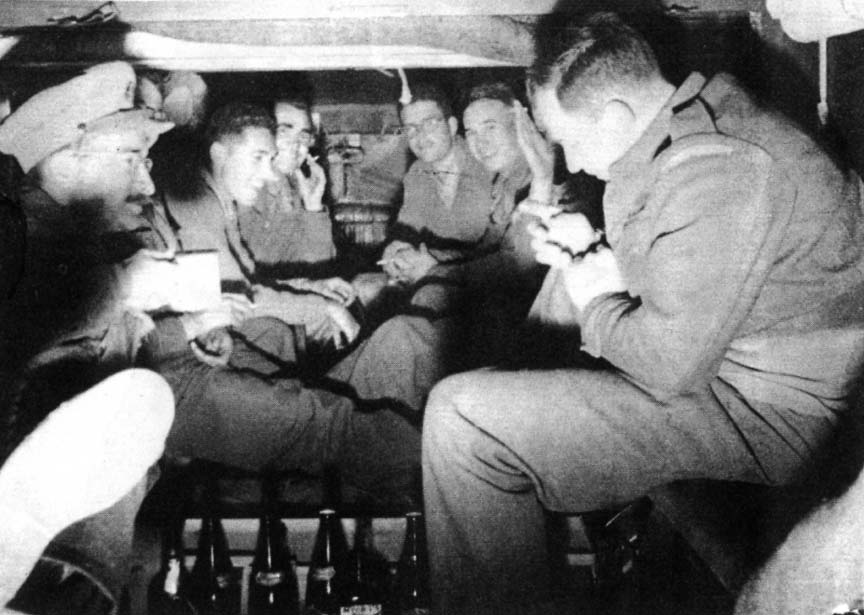
| "Fox Hall: Two ambulances back to back make this "banquet hall." Blankets draped over the windshields and around the windows served for the blackout. There was no shortage of drinkables on this occasion. but there was only one drinking mug. held here by Tom White. C Platoon CO. The others are, left to right. Bob Humphreys. Jay Nierenberg. Charlie ("Fox") Edwards. Harry Hopper. Art Ecclestone. C.W. (Bill) Edwards , Platoon NCO. and Chan Keller. who is pointing out the necessity for remaining sober. |
We arranged a few more "Fox Halls," as when we pulled back to Tripoli, Libya for the summer of '43.
Thus far our experiences in the rear echelons of war on the Western Desert had been pretty much as in Jock Cobb's poem that "war's a game." But "playing" at war could not last much longer for us. The time had come for Rommel's Afrika Korps to make its last stand in Africa, and the major Battle for Tunisia would be joined. We would soon enough know the reality of war in the front lines of war.
"Orders to move at last..." ( I wrote on March 10, 1943). For the next ten days or so from March 10 we were part of the final build up of the Battle for Tunisia
In more than a month in the "Western Desert, we had known the excitement of being assigned our own ambulances; and we had carried our first casualties. We had adapted to life on the desert with help from our "houses on wheels." Many of us of "Lucky 13" (E-Deck, HMS Aquitania) were reunited; we had been formed into our own Sections within C Platoon, then of 11 AFS Ambulance Car Company (ACC). Most of us would be together for the rest of the war, and joined by others in the next months, form the nucleus of C Platoon reorganized within 567 AFS ACC. We were more than friends. We would become as brothers, and a few would not return.
We moved to new assigned locations, sometimes stopping at night, when widely dispersed vehicles stretched out on the desert as far as eye could see. It was no simple matter. Units had their own markers, and sent out advance parties to set routes to follow and locations at which to "dig in." We carried maps.
As non-combatants, we were certified under the Geneva Convention for medical personnel, and the Geneva Red Cross was painted on our ambulances and the Royal Army Medical Corps vehicles; the various aid posts, stations and hospitals by Red Crosses painted on tents or buildings as well as by Red Cross flags. It was supposed to be respected by the combatants, but too often in the forward areas combat units would seek "safe haven" nearby a Red Cross --putting everyone at risk.
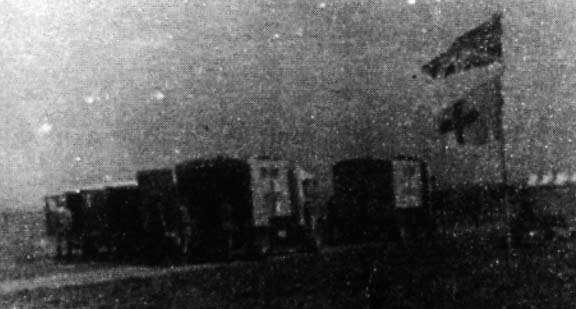
As the build-up continued, desert roads and tracks were congested. Supply lines increased, but the lines shortened between the rear echelon CCS (Casualty Clearing Station) and the aid stations up the line: the MDS (Main Dressing Station), ADS (Advance Dressing Station), and the Regimental Aid Post (RAP).
Above all, we had begun to feel a part of the victorious advance of a great Allied army against what had been invincible German power. Except for night bombings, we (of Unit 26 "Lucky 13") had not been under fire; postings to date had been at a CCS, on the line between the CCS and MDS, and for evacuations to base hospitals.
Our "own" British Eighth Army had turned the tide of the war against Germany at El Alamein (October 23-November 3, 1943) followed by a 1700 mile advance ending at Tunis, Tunisia (May 13) with the destruction of Afrika Korps and German power in North Africa, and in coordination with American and British forces landing on November 7-8, 1942 to the east of Tunisia in Morocco and Algeria.
War in the desert can be compared to naval warfare, over relatively desolate surfaces where tanks closely coordinated with infantry, artillery and air power operated as "ships of the desert" to lead both advance and defense. Eighth Army's famed armored divisions, 1st and 7th, had been equipped with Sherman tanks for the defense of Cairo and breakthrough at Alamein. Although their American 75's were slightly outgunned by the German Tiger tank 88's (said to be the best gun of either side in the war), the Shermans more than made up for it by their speed, maneuverability, and accuracy --- and the skill and courage of their tested crews.
The armored divisions and brigades worked closely in support of and supported by all units of a closely coordinated and brilliantly led Army. The "sappers" (engineers) cleared mine fields, built bridges. Artillery was vital, whose 110's and 210's mounted awesome barrages; and whose nimble, versatile 25 pounders kept pace with tanks and infantry. The Eighth Army boasted its famed infantry divisions: the 56th and 78th UK with their bulldog steady "Tommies"; the 51st Highland Division of the heroic Scott; the 4th Indian Division whose turbaned Sikhs, staunch Punjabis, light-footed Gurkhas were led by British officers; and the New Zealand 1st, whose "Kiwis" and Maoris were led by their admired General "Bernie" Freyberg. Also General Le Clerc's Free French Force joined Eighth Army at Tripoli (January 23) after crossing the entire Sahara desert from Lake Chad --- an amazing saga of the war. AFS "Drivers" and their ambulances served with each one of these components.
Not only was Eighth Army one of the finest armed forces ever assembled, it was also composite of many nations and ethnic groups of the British Commonwealth of Nations, living, working, dying as an embryonic "United Nations" in the fight for peace and freedom. All of us, in our various postings, could count close contact with a dozen or more differing nationalities in the course of the war. This experience would be precedent for the AFS sponsorship of intercultural exchanges after the war.
Air power was crucial to Eighth Army's success, and brilliantly used for strategic and tactical purposes. Air fields occupied along the way were quickly mobilized, such as the major Italian airbase near Marble Arch. Each day on the desert we counted formations of the twin-engine "Boston" bombers (built by Douglas) on bombing missions, they flew in a V of 18's like so many geese; we called them the "Golden Eighteens." Fighters provided escort, and were on call from ground units for close support especially when under attack from the air. Although our planes controlled the skies by day, and conducted bombing missions by night, German air power was not yet broken. We experienced sneak attacks by day by fighters strafing and bombing; by night German bombers lit up the skies above us with flares, dropping cluster bombs.
One morning I was called at 4:30 AM to carry some casualties to the planes; I wrote (March 4): "The early morning on the desert is crisp and cool and it's exciting to watch the planes taking off ... they make quite a roar." Another time a British Lancaster bomber, crippled and coming in from a raid, crash landed not far from our base.
"Our" Eighth Army, all of this --- armor, infantry, artillery, air --- had been melded into a lethal and mighty fighting force, hardened by years of war on the desert, proudly calling themselves "Desert Rats" --- with red rats painted on their tanks. And finally at Alamein and beyond they were given the inspired leadership they deserved by their "Monty", he of the black beret and jeep in forward areas with his troops, their "Monty" of the massive forward punch and skilled "left hook" --- to be acclaimed Lord Montgomery of Alamein by a grateful nation.
And they were matched against a worthy opponent, Field Marshall Erwin Rommel, the "Desert Fox," architect of his famed "Afrika Korps." We "desert rats" admired and respected him. He was brought into the war at the outset as a loyal officer of the professional German Army, a leading exponent of tank warfare. He fought a hard and clean war in accord with the rules of war, and had contempt for the fanatic Nazi SS Divisions that infiltrated his Army. He died with honor, as did other German Army officers, trying --- but alas, in vain --- to rid the world of the scourge of Hitler.
But the desert phase was ending as we moved up to leaguer near Ben Gardane in Tunisia across the border from Libya, facing the formidable German positions of their Mareth line in the Matmata hills beyond. We would become engaged in a land of mountains, hills and valleys (wadis ); rivers and fertile plains with farms, villages, people; and a land of historic cities where other invaders had come and gone over the centuries. It would be a different war, with even more difficult terrain to cross than the formidable obstacles of the Western Desert.
For us, it was now the second week of March, 1943 after our more than six weeks of service with rear echelon medical units of British 8th Army.
Our "intercultural" experiences had continued as we worked, and played, with the varied nationalities of our British Commonwealth comrades-in-arms, and gained new respect for them..
Significantly, although not yet in the combat zones of the front lines, we had begun to feel part of the victorious advances of the Allied Armies against what had been invincible German power. This was an incongruous feeling for those of us of AFS, and there were quite a few, who opposed war in conscience and in principle.
It was our sense of service in the cause of freedom that overshadowed for us the reality of the horror of armed strife. More significantly, we had observed among the soldiers whose lives we now shared a stoical devotion to duty and to freedom, and an incredible absence of animus and vindictiveness towards the German soldier and people as distinct from the hated Nazis: all this had softened or perhaps compromised uncompromising objection to war. As "medics" in war, we could still bear witness to the sacredness of life.
The sounds of war were close; I wrote (March 19):
The other night there was "Ak-Ak" --- hundreds of brilliant red tracers curving and curling in a weird tangled dance, and the startling bright flashes of heavy artillery ... the long flash of a dropping bomb; and behind it all, as a curtain or backdrop, long piercing beams of light driven upwards by the search-lights. Abruptly it was over; and then seconds later the muffled roar of the explosions. It was so strangely beautiful --- from a distance. There was time to wonder what ancient peoples who had been there before would have thought of all this, Punic, Greek, Roman, Arab...
As the troops continued to move up, inevitably the "rumor mill" was going full tilt: the Germans were "packing in," Rommel had been flown to Berlin, massive reinforcements were arriving from Germany, the Germans had a new weapon, the Allies were landing on France, and so forth.
Our Company and Platoon HQ's had short-wave radios set up in the canteen trucks. We avidly listened when we had the chance. Daily broadcasts from BBC, keyed to troops on active duty, exhorted us each morning with a stirring rendition of Nelson's anthem at Trafalgar "Hearts of Oak.,"
Often we joined in with the chorus, singing lustily: "Hearts-of oak have our ships, hearts of oak have our men. you'll always find us ready, steady boys, steady..."
We also picked up the German broadcasts beamed for our benefit by the likes of "Axis Sally." These broadcasts introduced the haunting. plaintive lines and refrains of "Lili Marlene," which all too often brought tears to our eyes. This song was adopted by troops of both sides as their own and in their own languages.
The massive attack on the Mareth Line by Eighth Army was launched at night. March 20. 1943. It was the first action in the Battle for Tunisia which was valiantly contested every step of the way by Rommel and Afrika Korps as the Germans desperately tried to keep their last foothold in Africa.
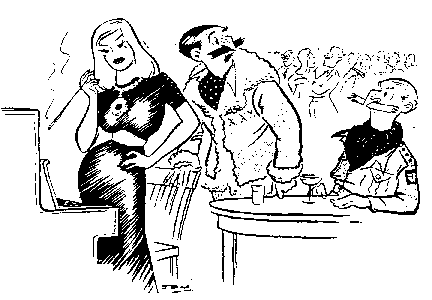
Fortunately our longings for home and for loves left behind, and our stress in war, had been relieved by the acclaimed humor of our British cousins. A good example was the story in cartoon and punch-line of The Two Types created by Jon for the Eighth Army News. The News reported this as "the saga of the two jaunty heroes who have given us the best laugh since the campaign began." The cartoon below is a good example, and it is a fitting close to my story of "The Western Desert."