 1. Egypt --- El Tahag and- Cairo.
October 31 -November 5, 1942 2. AFS HQ and Workshops Mideast, Baalbeck Lebanon. to
Mid-November, 1942 3. Damascus Syria.
Casualty Clearing Station, Mid-November-December, 1942 4. Selemiye Syria: Hadfield-Spears Mobile
Clinic- January, 1943 1. Egypt --- El Tahag and- Cairo.
October 31 -November 5, 1942 2. AFS HQ and Workshops Mideast, Baalbeck Lebanon. to
Mid-November, 1942 3. Damascus Syria.
Casualty Clearing Station, Mid-November-December, 1942 4. Selemiye Syria: Hadfield-Spears Mobile
Clinic- January, 1943 |
Our forty day odyssey on board Aquitania ended at Egypt's Red Sea port, Tewfik, on a moon-lit night. Prior to our arrival October 31, and as Unit 26 prepared to disembark, word came from Major Shafer's command that "Tewfik is in flames." and to keep below decks. This proved to be just one of those wartime rumors, which did not delay our disembarkation.
As blunt-nosed Egyptian lighters snuggled against the tall sides of our ship, we scrambled on board and chugged for shore, our first destination the giant El Tahag transit camp of the British Suez base. There we were welcomed by AFS Major Dunbar Hinrichs, representing Col. Ralph Richmond and AFS/HQ Cairo. And we were issued our British winter "battledress," "tin hats" and other kit to cram into our duffel bags. As we donned these uniforms, our identity as "yanks" was obscured, bringing us closer to the solid, stubborn and courageous soldiers, the "Tommies" of the United Kingdom and Commonwealth of Great Britain. They no longer stood alone against the Germans.
At El Tahag we had our first encounter with what would become in the following years an extension of our bodies and our souls: the nimble, rugged four-wheel drive all-terrain Dodge ambulance capable of carrying four stretcher cases and up to ten seated. There was nothing like it in the British Army. Our training covered the 28 separate basic vehicle maintenance checks for which we would be responsible, plus mastery of the gear-box requiring "double clutching" to change gears up and down; also mastery of engagement of four-wheel drive as needed. There was plenty of sand and space in which to practice.
On November 3, 1942, three days after our arrival at Tewfik, the British 8th Army finally broke through fierce German resistance all along the El Alamein lines which stretched from the impassable Quattara Depression on the south, to El Alamein itself on the coast to the north. Sounds of the tremendous artillery barrages could be heard in Cairo. Newly arrived U.S. Sherman tanks were used in the breakout against the German positions and tanks. George Rock's The History of the American Field Service. 1920-1955 documents the battle and the heroic role in it by AFS units.
The second battle at El Alamein (October 23-November 4, 1942) was one of the two major land battles that marked both the highwater mark and also the turning point in the Nazi/Axis aggression in Europe and Africa during World War II. The second such battle unfolded at Stalingrad (August 1942) and ended with the annihilation of an entire German army by the Russians (January 1943). These two Allied victories blocked the German advances into the Soviet heartland, into the Middle East and on to the Indian subcontinent. Henceforth, the mighty German war machine was forced back on all fronts, but at dreadful cost.
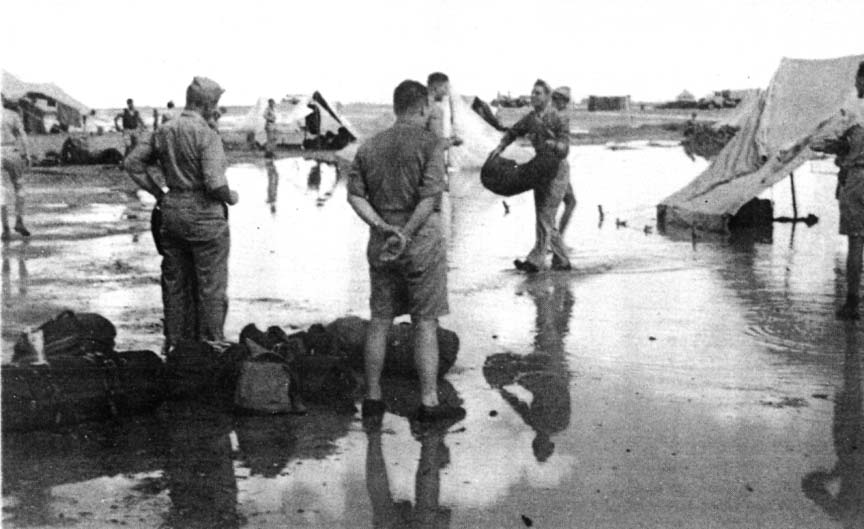
On our second day at El Tahag, we moved into small tents with four of us to a tent, as shown in the photograph below. This afforded the opportunity to write a letter home, the first of almost 200 I would write over the next three years; I wrote:
I am "somewhere in Egypt" at a British army camp. There are four of us to a tent and we are sleeping in bedding rolls. Nights are cold, with a myriad of stars. We awake at six for breakfast to the bugle call. The British bugle call differs from ours; they trill up and down the scale quite beautifully. This camp here ... hot and cold showers, movies, canteens... places to buy chocolate, soap, food; football, soccer, baseball games with the English fellows ... Talk with fellows who have been "out in the Blue" is interesting.
There is of course wide interest in the good news of the present army push, but "Jerry" (the Germans) are sort of an impersonal thing. Hatred does not run high between the soldiers ... this casual acceptance of the war. Morale among the men of Britain is high, and the good fellowship at this camp is one evidence of it. During this time we have been transformed at least superficially to British Tommies. Complete "battledress" has been issued to each of us, along with the overseas cap that curves over the right eye and dips along the right ear. This is winter issue, for there is snow now in Syria where we shall be taking our training.

After we moved into our tents, Major Shaffer still "in command" ordered a "kit-lightening" inspection with all duffel bags opened and contents spread out on the sand. An ominous rain-cloud threatened in the skies overhead. "Don't worry, it never rains on the desert this time of year" said the Major. His words were swallowed up in a gust of wind and a swirl of sand and then torrents of rain drenching our unprotected possessions. Our tents drifted away on a new-formed lake. "That water will be drawn by the sun in no time" said the Major. Several days later it was still there; we pitched our tents on higher ground.
Needless to say, "Tewfik is in flames" and "it never rains on the desert" became two sets of "famous last words" slogans to lighten difficult moments in the months and years ahead --- as we toasted the Major.
While at El Tahag, we were treated to leave in Cairo, courtesy of base camp transport. Our small convoy took us from camp across the fertile Nile Delta crisscrossed by sweet water canals and small villages.
In Cairo, Commonwealth troops in uniform were everywhere as well as military vehicles lost in the sea of colorful humanity of this storied metropolis on the Nile. By late August it had seemed nothing could stop Rommel's Afrika Korps from taking Cairo --- and now the Germans were in retreat. General Montgomery had taken command in the nick of time; his brilliant defense strategy in the initial Alamein battle had saved Cairo in September and paved the way for the massive build up for the principal El Alamein battle and breakthrough in November.
Together with Chan Keller and John Leinbach of our "lucky 13" fraternity, we inspected storied Shepherd's Hotel and bar, also some of the downtown Souks; and we witnessed a traditional Egyptian belly dance show. We also discovered to our delight Groppy's restaurant and ice cream! In my letter from camp I had written:
One of the bright spots of this week was overnight leave in Cairo. I spent a morning at the Bazaar, ushered by a guide Abdul Salam Mansour. It was pleasant sipping Turkish coffee in the small shops while beautiful hand-made leather and silks were brought out before me. I sent a few things home ... The Bazaar is a busy place --- narrow winding streets, shops, craft workshops, Oriental smells ... it was delightful chaffing with my guide about many things. He was an Arab, Moslem, farmer and Dragoman ... I learned of the customs of his people of the Near East ... In the afternoon he took me out to the Pyramids where I rode a camel to the Sphinx, and climbed the narrow tunnel-like corridors to the tomb of Cheops himself. Great monuments to the fear of death, they are ageless as death. The Temple of the Sphinx is recently excavated. Here great blocks of granite weighing up to 150 tons are carved and mortised together --- no use of mortar, and the great square columns lined up perfectly.
My letter home continued.
The day of our arrival, I received a lap-full of mail from you folks ... one letter came over in 13 days! You can not know how happy I was to receive so many letters ... I await in eager suspense for each ... News of a Christmas box on the way sounds wonderful.
For the duration of our service overseas, letters and packages from home so eagerly and anxiously awaited and devoured, were the principal morale builders for each one of us.
Our stay at El Tahag was short-lived. A day or so following our leave in Cairo we boarded transport: destination Baalbeck, Lebanon.
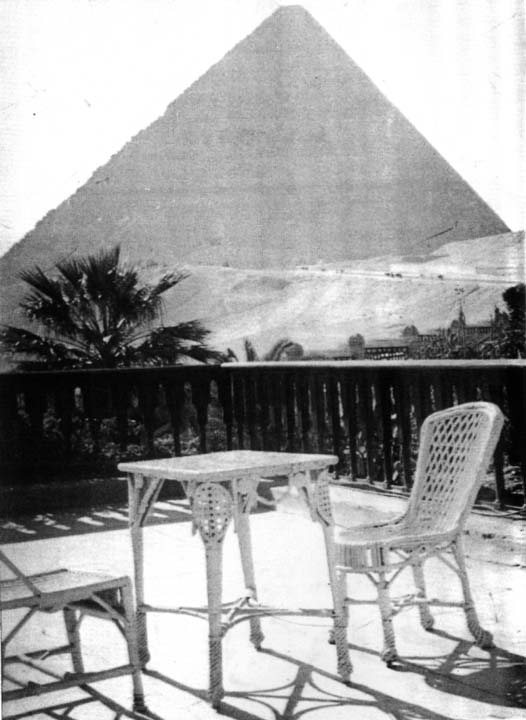
The highlight of that leave had been our visit to the great Pyramids at Mena at the outskirts of the modern metropolis of Cairo --- mute and enduring witness to the awesome power and majesty of that civilization that flourished at the dawn of recorded history.
The Middle East has been a cross-roads between East and West since the dawn of history. In World War II it offered a pathway between Egypt to the west and the Russian Caucasus to the east as well as the Middle East and Iraq, Iran, India beyond. To circumvent possible Axis control of this pathway, the British 9th Army in June-July 1941 occupied the Vichy French Mandates of Lebanon and Syria while reinforcing the British Mandate in Palestine. This base was maintained throughout the war. Many AFS Units trained with the 9th Army before forward action assignments, including our Unit 26.
We left the El Tahag Mobilization Center by truck convoy and train. Our route took us through flourishing farm lands of Zionist settlers in Palestine, then on a winding passage through the Lebanon mountains. Our destination was Baalbeck, in the Bekaa valley of north-central Lebanon between the Lebanon and Anti-Lebanon mountains. At Baalbeck we were housed at the former French (Gouroud) Barracks.
Chauncy ("Chan") Ives, then Captain soon to be Major, had organized one Section of the AFS Ambulance Car Company (ACC) assigned to 9th Army, with his HQ at Baalbeck. Captain Ives had been a member of Mideast Unit 1, which reached El Tahag in January 1942 after more than 100 days at sea. He was clearly an "old hand" renowned for his "pukka Brit" handlebar moustache and his "lectures" to orient the new arriving neophytes about desert warfare, the British army, motor vehicle maintenance, and keeping out of trouble. An experienced, dedicated and able AFS Volunteer and Officer, he was subsequently transferred from Lebanon to AFS command in India.
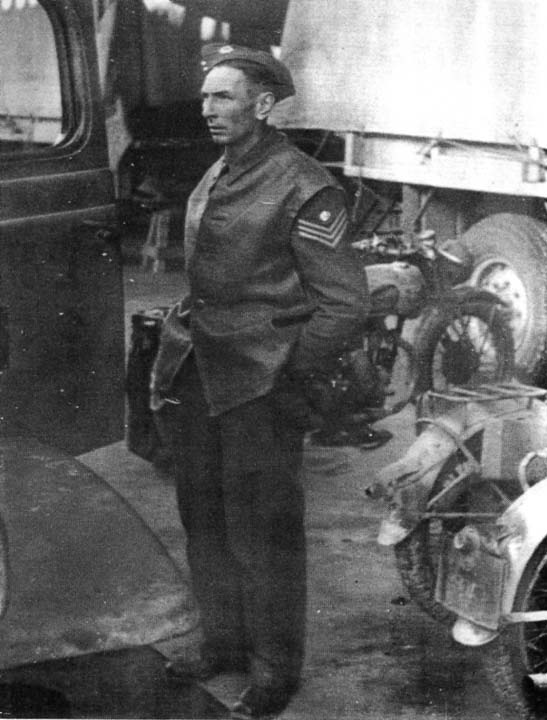
While we "Volunteers" took a cavalier attitude towards rank and class, it was a major factor for the British --- not only among the officer ranks, but among "other ranks" as well. Staff Sergeants, for example, had their own "mess," privileges, and pride of position. Sergeant Perry, who directed the Baalbeck workshops, well represented these stalwart NCO's. British Corporals and Privates down the line had similar, if less prestigious status.
The caption of the photograph of Chan Ives which follows, with Charles Pierce of our Unit 26 at his right, reads "Baalbeck Pip Bounce." "Pips" on the shoulders of British army uniforms designated officer rank. In negotiations by AFS Director-General Stephen Galatti with British authorities over the terms of AFS service, AFS received British uniforms and rations, and was authorized to appoint its own officers.
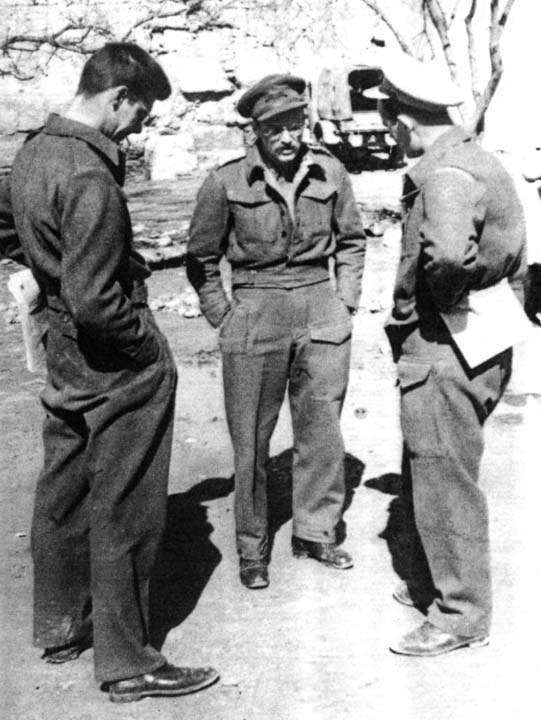
Per the terms of the negotiated AFS-British Army agreements, workshops of the British Royal Army Service Corps (RASC) were responsible for service of AFS vehicles. These mobile and fully-equipped workshops and their skilled mechanics were assigned to each AFS Ambulance Car Company (ACC), and kept our ambulances and other vehicles going under all sorts of conditions. We Drivers established close rapport with the men of RASC assigned to us, and respected them.
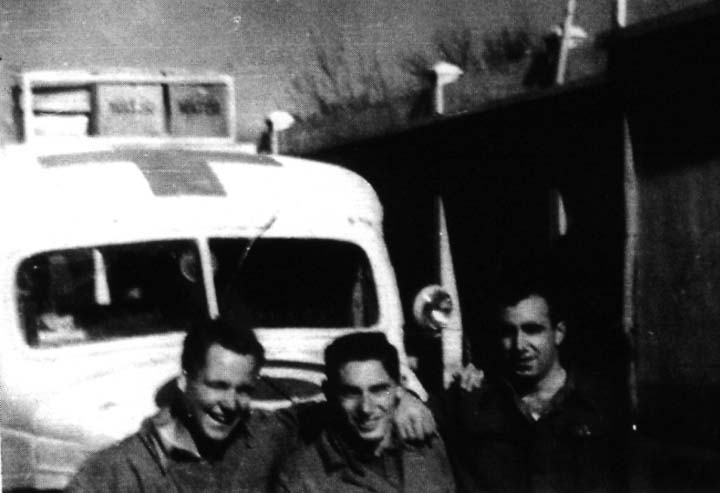
While at Baalbeck we learned to drive and to maintain, with an assist from workshops, the nimble Dodge four-wheel drive ambulance which would become an extension of ourselves in the years ahead. Workshops at AFS/ Baalbeck were under command of Staff Sergeant Perry, know to us simply as "Staff ."
 |  |  |
Long past its glory days, Baalbeck had few other attractions aside from its famed Greco-Roman ruins. Hot baths could be had at a small hotel. There were a few bars and restaurants, and the local market. One questionable attraction was the brothel, where the ladies (I was told) were White Russians. Brothels were not as yet off limits to British Army personnel, some of whom dutifully "queued up" for services provided --- as well as for protection from VD administered by army medics. In the next year, the British Parliament would place brothels off limits for British troops.
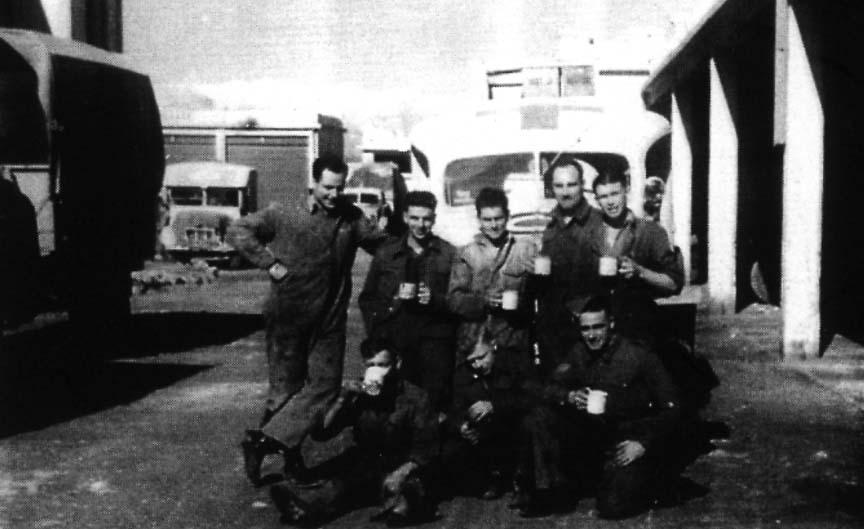
While at Baalbeck, we were housed at the French Barracks, probably of a French Foreign Legion unit. A plain stone building, inside were a series of rooms with metal cots and sparse furnishings, cold and damp in the winter chill. The plumbing was of the "Napoleon" variety --- a hole in the floor. Fortunately, there was ample local wine available to counter the chill. Before dispersing to our respective postings in Lebanon and Syria we managed a boisterous farewell party, as recorded in the photograph below. This party took place in one of the barrack rooms.
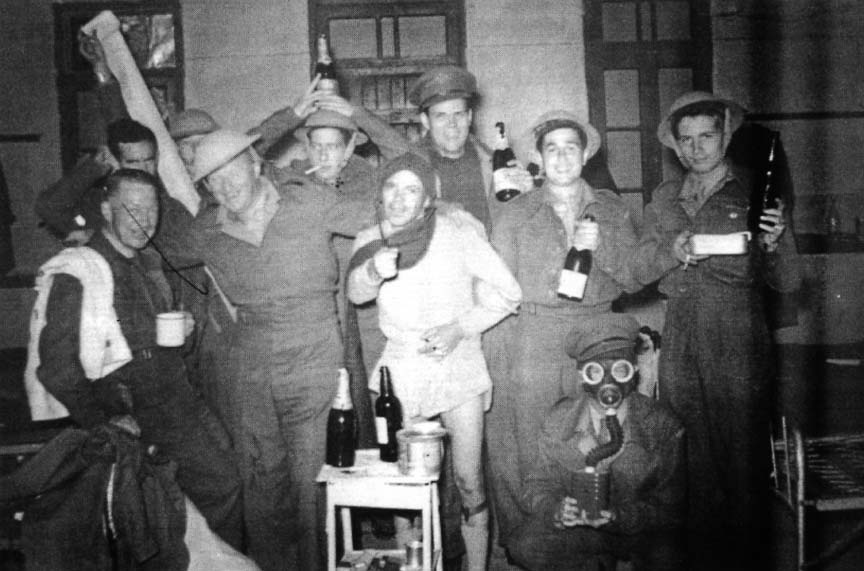
| November 1942 --- celebrating left to right are: Ray Fowler (cup), Dick Stockton (tin hat), Vern Preble (tin hat, cigarette), Warren Fuller (soft hat, wine), Ernie Boger (tin hat, wine), Howard Brooke (tin hat, wine, mess kit). Killed in action were Stockton in Africa, Preble in Italy. |
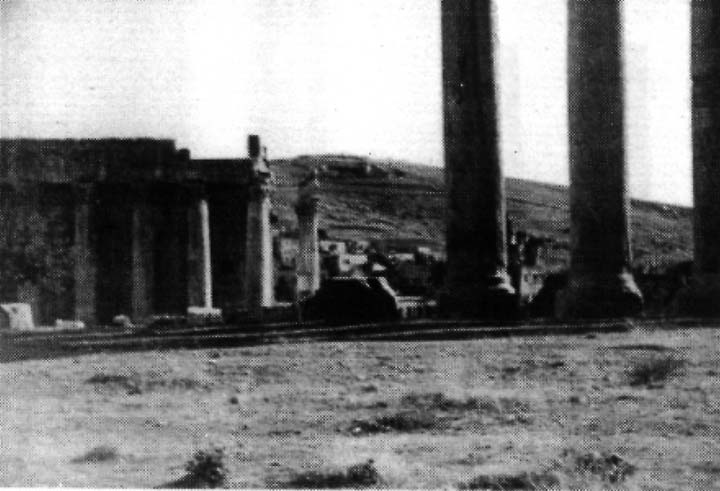
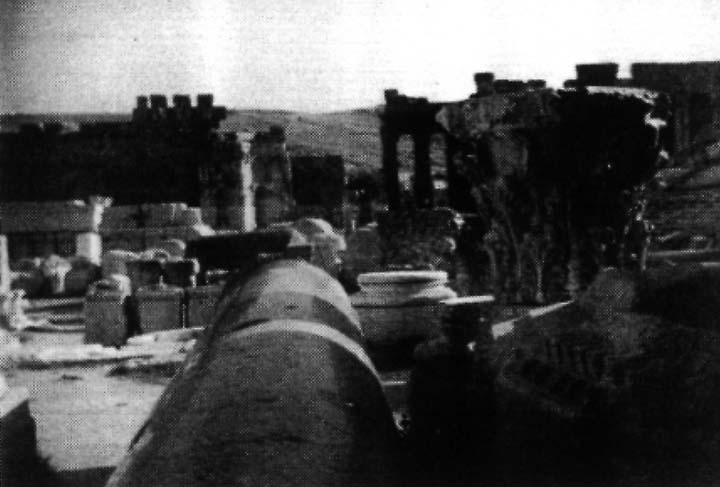
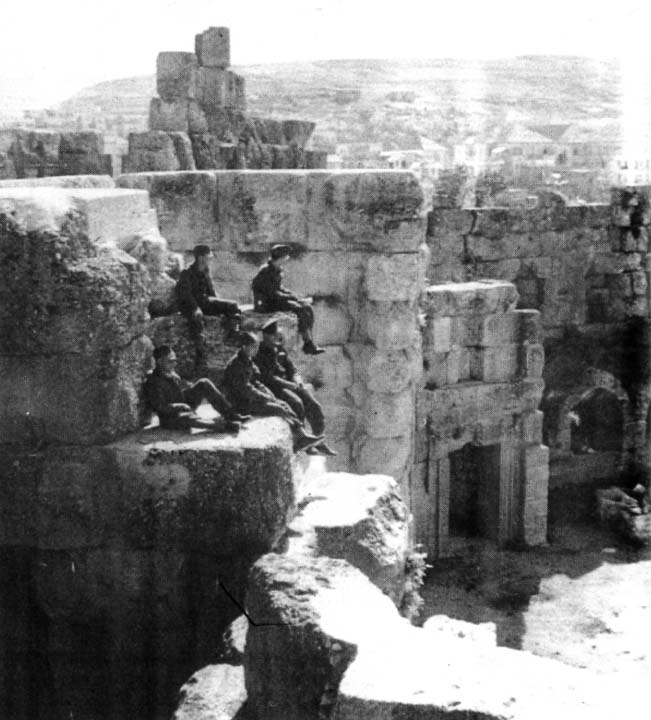
The principal attraction at Baalbeck to this day is the colossal ruin of the Greek Acropolis and Temples. Three if its foundation blocks are among the largest stones ever quarried. The Acropolis measures 130 by 110 meters, raised up on massive foundations, tunneled and with inner crypts. Baalbeck in its glory was once the pre-Roman city Heliopolis of the Alexandrian Seleucid dynasty.
We explored the ruins when we could, guided at times by one of our fellow Drivers George Collins --- an art historian; also one of our "Lucky 13" fraternity. I wrote enthusiastically from Baalbeck about this amazing and still partially standing relic, as well as about other wonders of the ancient world:
Imagine how exciting it is to be visiting, first hand, the historic places in the Middle and Near East of which we have all heard much since childhood. I have spent a day in Cairo, visited the Pyramids, traveled through Palestine to Haifa, past Lake Tiberius and the Jordan valley to ancient Damascus. I spent a day shopping in the great Bazaar at Damascus beside the distinctive mosque there.
One of the most interesting of my visits has been that at Baalbeck in the central. Lebanon Valley. Here is the great Temple of the Heliopolitan Zeus, and beside it the almost perfectly preserved Temple to Bacchus or Hadad, local rain-god. Behind the Acropolis, the great Temple to Zeus is located. Six pillars are left standing. on the south side. The pillars rise 20 meters high. The great edifice is supported on a foundation in which the famous three stones, known as the "Trilothin" are located. These stones weigh 780 tons each, the largest ever known to have been used in construction. On the south side, the Temple to Bacchus stands with outer and inner columns of the Corinthian type, built during the 2nd and 3rd centuries A.D. Before they were destroyed by earthquake, the Temples and Acropolis were fortified by the Arabs. The whole is an impressive ruin, one of the best preserved in the East --- a relic to the "glory that was Greece."
These are the famous ruins at Baalbeck, Baal having been the "God of the Plain." In Helenistic times this was Heliopolis.
 |  |  |
Located midway on the Lebanon plain between two ranges of mountains, Baalbeck had been a strategic location for French troops during the French Mandate. It was also on the direct route north into the Orontes valley of Syria. Otherwise it was a nondescript town, mostly Arab, of small stores, coffee shops, produce markets, artisans, merchants, resident land owners, Houses were of stone with courtyards inside. There was poverty and few creature comforts. We Americans were somewhat of a novelty, and there was in those days considerable good will towards America.
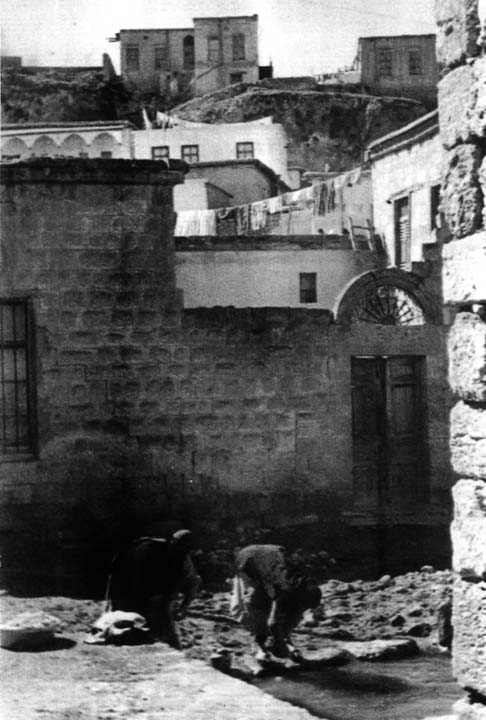
After two weeks at Baalbeck, we were assigned to other locations, principally to units of the Royal Army Medical Corps (RAMC). In Lebanon, there were postings to the port city of Tripoli on the coast and to Zahle in the hills outside Beirut, and in Syria to Aleppo in the north, to Palmyra far out to the east, and to Damascus to the South.
I had the good fortune to be posted to Damascus. One of the world's oldest inhabited locations established at an oasis across the Lebanon mountains, Damascus under the Omayyads had been the flourishing capital of the first Moslem Arab empire; its great Omayyad Mosque still stands. Syria's capital, with an attractive French flair, it is a center of traditional Arab culture---its arts, crafts, foods on display in its teeming markets or souks, little changed from biblical times and the "Street called Straight."
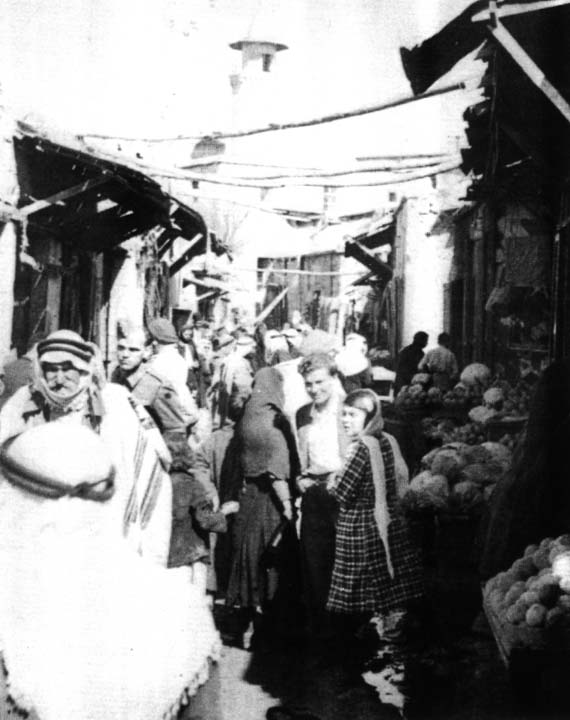
"Jock" Cobb was assigned to one of the Hadfield-Spears Mobile Clinics located at the Arab village of Selemiye in central Syria at the edge of a vast region of steppe and desert populated by small villages and Bedouin nomads. These clinics, with Syrian or Lebanese doctors and orderlies, and English Friends Service Committee staff, were located throughout the region to bring medical services to the civilians. They were established by initiative of Lady Spears, the former American novelist Mary Borden, wife of the 9th Army Commander-in-Chief General Spears. Jock, who had met Dr. Salmon, a native of Beirut and resident physician at Selemiye, had requested this assignment of Captain Ives.
While at El Tahag, Cairo and Baalbeck, Jock had organized his photographic equipment, and commenced taking his remarkable photographs of AFS in action commissioned by AFS/NYC. I have incorporated about 130 of these into the narratives of this story.
Others of our Unit 26 "Lucky 13" fraternity posted at Selemiye were Howard Brooke and Jay Nierenberg. It was good training in First Aid and for driving in difficult conditions. The AFS all-terrain ambulances were a godsend for this work where roads were few. Jock continued at Selemiye for three months. I joined the AFS team there in early January 1943 before going out to the "Western Desert" with others of Unit 26 the next month.
At Damascus, I was posted to a fully equipped Casualty Clearing Station (CCS) of the Royal Army Medical Corps (RAMC). Chan Keller was also posted to Damascus, but to a different location at the Damascus Transit Camp. At the CCS I dined in the comparative luxury of the exclusive Sergeant's mess, my first taste of British army food --- and the hierarchy of class and rank. Although wearing a British army uniform, I was recognized at times as an American; in those days, the United States could do no wrong in Arab eyes. I relished storied Damascus, and served with my ambulance for a total of six weeks at this posting. We had billets at a residence near the CCS. Our patients were casualties of "Gypi tummy" (diarrhea), malaria and other infections of troops at base, as well as injuries from training and occupation duties. We evacuated serious cases to Haifa, beautiful port city in the then British Mandate Palestine.
One of the highlights of these six weeks were the celebrations of our American Thanksgiving, and also of Christmas and the New Year --- enhanced by letters and gifts from home. Another of the highlights was an evacuation to Haifa. On this trip, I drove past snow-capped Mt. Hermon and the headwaters of the Jordan River into Palestine at the Sea of Galilee, then past Tiberius, Nazareth, and the hills and plains of Megiddo --- locus of the alleged Armageddon-to-be. There were shepherds tending flocks, and gnarled olive trees as old as the Bible itself. Haifa was a beautiful Mediterranean city, with a spectacular view from Mt. Carmel of the port and the sea beyond from. This was an unforgettable experience, as reported in more detail below.
There were other evacuations or assignments outside Damascus. One was at a British post in the snow-covered mountains together with Chan Keller where "we almost froze to death." Although based at Damascus, I reported that "three different assignments" revealed "various phases of life out here ... and actual contact with Arab village dwellers out in the plains." There follow excerpts from lines and paragraphs of my letters home written during my six week "saga" at the Damascus posting.
I wrote that our "billet is quite spacious and comfortable --- of cement with tiled floors built around a spacious courtyard"; and I continued:
We eat at the Sergeant's Mess where food is very good. Also there is much good cheer and it is a real experience eating with fellows who have been through spots like Dunkirk, and who are an excellent cross-section of the folks back home in "Merry England." One's language soon becomes filled with the colorful lingo of these fellows, and talk with them ranges over many subjects.
At this point I have "signed on" for my own ambulance, and this in itself is quite exciting. At present I am up at "workshops" several hours drive away ... Each month there is inspection of the cars at workshops. I spent yesterday in my overalls, greasing all the various grease points, topping the hypoid in the differentials, changing oil, cleaning filters ... while the "fitter" (mechanic) repaired various broken or worn parts. My ambulance is "raring to go" at the moment, except the fitter left the ignition on last night, and the battery is now being charged ... Superficially, at least, we know our cars from "stem to stern." I have also gained a hearty respect for the job of the mechanic ... and enjoy working. with the fitters, who are all "Tommies" from all parts of England ... The solid good humor of the "Tommy" is what sees him through.
While at Damascus there was time to study the history of this fabled land, center and prize of varied peoples and dynasties from the dawn of recorded history. I wrote:
Center of a score of empires --- Egyptian, Hittite, Byzantine, Arab, Turk, French --- it has been the key to power in the Middle East. The Crusaders never took it, and it was a thorn in their side from which to reconquer the lands taken by the First Crusade ... To reach Damascus the way passes through steep gorges, dips and winds ... and follows a river and through a valley lined with trees ... Everywhere there is running water and trees and gardens Little wonder the Bedouin think of it as a true oasis.
I continued:
In the old city a simple tomb is dedicated to the memory of a great Arab leader, who once led the Arab tide all across North Africa. Near the tomb rises the magnificent Omayyad Mosque, seat of the tabled Omayyad Caliphate and monument to an historic schism in Islam. Around the mosque cluster the busy shops of the Bazaar; near-by is the church from which Paul escaped by being lowered out a window. And well might Paul have seen visions ... As I drove through this evening, a magnificent sunset swept up behind.
While overseas, every effort was made on our behalf to celebrate when we could our traditional holidays. Damascus was a suitable if incongruous locale for our Thanksgiving, which providentially took place after we had been issued the 20 dollars monthly allowance which the Field Service gives us." I wrote:
I must tell you about my Thanksgiving. About ten of us met together at the Orient Palace Hotel. We had dinner of several courses including a bird that faintly resembled Turkey. We even had champaign, and there were many toasts to the folks back home ... The closest thing to Thanksgiving cooking was dinner at the French Officer's Club where I went with "Slim" Curtis.
Christmas of 1943 was a different matter, celebrated in traditional style by the many British troops in the area; I wrote:
Christmas is made much of by the British Army. On Christmas eve the Sergeants and us were invited to a cocktail at the officer's mess ... afterwards we walked over to the Hospital with two of the officers to join the choir which had been practicing carols for weeks ... We walked through the darkened wards, carrying small lanterns, singing together for about an hour. The sisters (nurses) served us coffee and cake. Next day (Christmas) late breakfast was followed by a visit of the officers to us at the Sergeant's mess ... We sat on the terrace in the warm sun, and I talked golf with the Colonel who is C-in-C of the Hospital ... The "big spread" came Christmas Eve with turkey, dressing, soup, fruit, plum pudding ... After dinner, the Sergeant-Major called on each of us to sing a song in turn ... We walked back to the billet beneath a sky filled with stars.
I continued:
The day after Christmas (called "Boxing Day") is set aside for the Tommies --- or "other ranks." On this day it is traditional for the Sergeants and Officers to wait on table for the Tommies. We, recognized with the rank of Warrant Officer, joined in waiting on. Since we of AFS had many friends among the Tommies it was a most friendly occasion ... From my point of view, waiting on was the opportunity to scrounge around the "cook house." After dinner, both Chan and I pillaged turkey scraps, dressing, plum pudding until the cupboard was bare." Thus passed "Boxing Day and Christmas, a Christmas of good cheer --- but hardly a home Christmas. The Tommy philosophically says "for the past three years I have looked forward to being home the next Christmas. Perhaps this will come true the next time."
Our daily routine commenced at seven A.M. for "P.T." --- physical training, consisting of trunk-bending and deep-breathing exercises followed by a shave, getting our room (now occupied by five of us) in order, then a brisk walk to the Sergeant's Mess for breakfast, followed by reporting for duty at the CCS; I wrote:
Sometimes there are trips of a good distance, such as to the "DID" (Field Bakery), or to pick up a patient at the "MIR" (Medical Inspection Room), or to take a patient or more to the "RTO" (Railroad Transport Office). Sometimes we accompanied an "MO" (Medical Officer) to the large Transit Camp for inspections. This trip was "just the job" as it often meant tea and sandwiches, as well as contact with the fellows out there ... the British are keen on all kinds of alphabetical abbreviations (CCS, MIR, MO, FSO, RTO, DID, NAAFI). The NAAFI (Navy, Army, Airforce Institution) corresponds to the soldier-sailor clubs we have in the States and overseas, the USOs and Red Cross Canteens for snacks and recreation for the armed forces. They are quite popular.
I wrote home about stimulating talks when off duty with a Major Watts, one of the physicians who had been out in the Middle East since 1938. He was well informed on the culture and issues of the region, and anticipated there would be conflicts in Palestine involving the Zionist settlements and the Arabs.
I also wrote an account of when Chan and I climbed one of the mountains overlooking the Damascus oasis, hiking with Army Corporal Johnny Birdsaw and two of the pet guard dogs of the CCS. Johnny had been wounded at Dunkirk, was a "desert rat" during. the. siege at Tobruk; he had been torpedoed when evacuated after another wounding. Many of the British troops told of survival after similar actions.
With Johnny, we scrambled up the steep rock sides, pierced by the alleged caves of the first Neolithic cave-dwellers. At our feet lay the city itself: sparkling white buildings along majestic boulevards, then the crowded markets clustered around the Omayyad Mosque. To the East we could see the distant, lonely barren beginnings of the Syrian desert; to the South, the road to Palestine was a bright ribbon along the fields and orchards.
One of the most memorable events of my six weeks at Damascus, was the long evacuation of a difficult stretcher case from Damascus to the base Hospital at Haifa, Palestine's principal northern port city. It was memorable, because I traversed the region of Galilee where Jesus of Nazareth lived as a boy and carried out much of his three-year ministry. I crossed the boundary between what is now Israel and Syria, a boundary now frozen shut by seeming implacable hatreds between the extremists of the world religions with roots where the Prince of Peace once walked.
The road from Damascus as I wrote took me "down from the high Syrian plateau, the Golan Heights, dominated by the snow-covered crest of Mt. Hermon; then across the Jordan, past the Sea of Galilee, through Nazareth and on across the beautiful Jezreel valley to Haifa at the foot of Mt. Carmel on the shores of the Mediterranean." During this journey the familiar biblical places and events came to life: I was reminded of "Christ's ministry in Galilee, of his journey to Capernaum, of his walking by the shores of the Sea of Galilee and meeting Peter with his net all full of silver fish." As I skirted this "Sea of Galilee" and on through Tiberias on the Sea's west bank. my childhood impressions of biblical space changed; I wrote:
I fancied this as a "Sea" with limitless horizons and great waves and sandy beaches. And I thought of those biblical journeys as limitless trips by camel caravans ... the Holy Land was a vast place to my childhood mind ... illusions somewhat shattered when I crossed from Nazareth to Lake Tiberias in less than an hour; and now in a single glance I saw the length and breadth of this "Syrian Sea" glimmering, a beautiful silver, deep in the Jordan valley below the winding road.
However, this actual approach to Galilee ... rather than shattering illusions, makes all the more remarkable the birth of a world-revolutionizing religious faith in this tiny land of hills covered with olive trees, of fertile valleys watered by small rivers, and of beautiful lakes ... as I drove down from the high Syrian plateau.
My musings as I drove continued:
This road passes through the pleasant little city of Nazareth, populated by Maronite Christians and with sacred shrines dedicated to Mary and Joseph. There are more olive trees, and grazing sheep, and the town itself lies in a valley which separates it from the Jezreel valley, the largest of northern Palestine. This valley farmed in neat squares of corn; plantations of olives and grapes; pasture land for sheep, cattle, poultry --- all under the organization of the industrious Zionist cooperatives.
On this valley, Gideon defeated the Midianites, and the Philistine destroyed the armies of Saul. Here Allenby went up against Damascus in the last world war. It is a natural pathway into Palestine from the North and on to the sea; it has seen battles dating from the early Egyptian dynasties. Here some say at Armageddon the last great battle of the Judgment will be fought.
I remember as I drove on I had the feeling that the oldest of the gnarled olive trees could have provided shade for Jesus; that the houses, the sheep branded in many identifying colors, and the people themselves were little changed from those that Jesus had known.
Before reaching Haifa, the road climbed historic Mt. Carmel, associated with Elijah the prophet. There were rich vineyards dating from biblical times, cultivated gardens, shade trees spaced along the road fronted by beautiful apartment buildings --- and then, from the top, a splendid view of the modern city, the port, and the Mediterranean beyond.
My six weeks at Damascus were drawing to a close. I wrote home that I had hoped to get down to Bethlehem at Christmas, together with Chan Keller and John Leinbach; but this was not to be. Some of us of our Unit 26 and "Lucky 13" fraternities celebrated New Year's Eve, 1943, with songs and toasts at a reunion at our billet; and on New Year's Day we had a football game using the larger English rugby ball. In addition to sports, while at Damascus we enjoyed an occasional concert, using records; and there were movies for us at a YMCA depending upon our assignments and duties. I reported having "some excellent talks with the British doctors I have driven, and also with the patients."
I wrote that there was time for reading between long evacuations. Somehow my interest in poetry became known to British friends. Before leaving Damascus and the CCS I wrote at the conclusion of my final letter from Damascus: "The other day a Scotch sergeant gave me a book of the poetry of Robert Burns, and a Scotch Captain read it to me, accent and all!"
Orders came in early January for my next posting. It was at the Hadfield-Spears Mobile Clinic at the traditional Arab village of Selemiye in the interior of Syria at the edge of its vast central plain. Quite a few of these clinics, bearing the name of their founder Lady Spears, wife of 9th Army Commander-in-Chief General Spears, brought essential medical services to the peoples of the villages and the nomads of the steppe and desert regions. Professional staffs were Lebanese or Syrian doctors and orderlies, as well as qualified personnel of the British Friends Ambulance Units (FAU). AFS/Baalbeck assigned some of us Drivers to these clinics during our training.
At our initial postings at Baalbeck in early November, three of our "Lucky 13" fraternity had been assigned to Selemiye --- Jock Cobb, Howard Brooke, Jay Nierenberg together with Francis Bloodgood of our Unit 26. 1 would be joining them.
From six weeks at Damascus, one of the world's fabled centers of Islamic and Classical culture and history, with its modern French veneer, Its souks and mosques, cafes and hotels, I would be spending a month as close as one could be to the traditional Arab village and desert peoples: the farmers, herders, nomads, artisans, merchants, land-owners --- their culture, their way of life. The contrasts couldn't have been more complete and it was an assignment that I relished.
Selemiye was a day's drive north and east from AFS/HQ at Baalbeck, where I proceeded from Damascus to pick up my ambulance. Ambulances were assigned to a single Driver, but with a second "backup" or "spare" Driver when there were sufficient personnel. I was familiar with the route, as I had served as a replacement there for a few days in late November. The paved roads followed the central Syrian Orontes river valley, a classic caravan route and land bridge. It was hilly, with villages and farms along the way. There were donkey trains, heavily laden, plodding patiently as I passed by. The road passed through the cities of Homs and then Hama in central Syria. At the river at Hama, a huge water-wheel resembled a misplaced ferris wheel. The grinding sounds of the unlubricated axle could be heard for miles. As it went 'round, rows of wood scoops lifted water from the river and then spilled the water into irrigation troughs higher up as the wheel turned.
After Hama, I left the paved road north, turning right and east into the treeless plains of the interior where the roads were little more than tracks. We had to rely on maps. Fed by rains suitable for crops and herds, with an occasional village and Bedouin camp along the way, the plains were chill and damp in winter.
As I remember it, I reached Selemiye chilled to the bone. We were housed in one of the larger stone buildings, having a central compound and parking for our ambulances. It seemed fortress-like behind its sightless walls. Our cook had prepared a huge pot of steaming lentil soup. I have never tasted better.
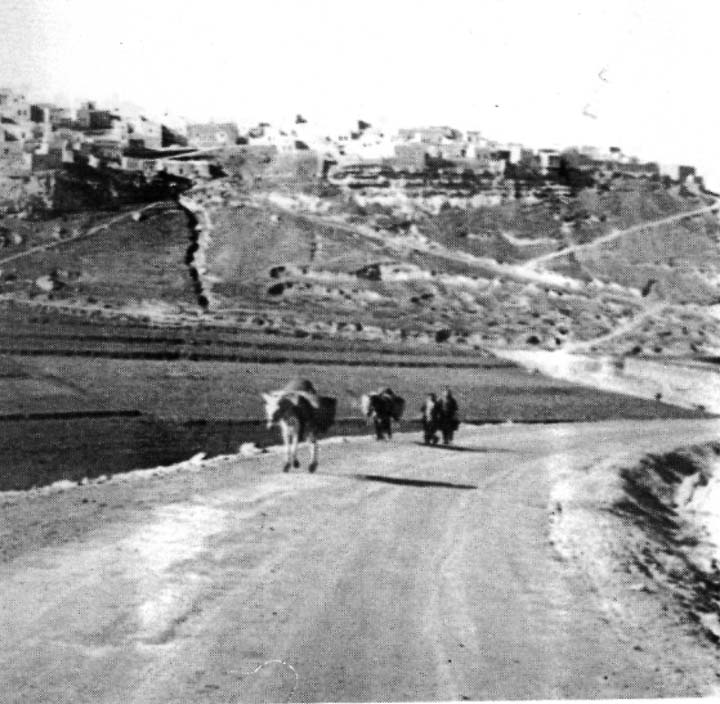
On my first day at my new post, January 3, 1943, I wrote of the fragrant odor of flowers "...from the little patio around which our present home is built. There are bushes, rows of flowers, a patch of grass up against the opposite wall. On two sides of the garden are ranged our living and dining rooms, my bed-room, the kitchen, bed room of the Doctor, combined bed-room laboratory where Jim Hall, an English Medical orderly and Jock Cobb live."
Our resident Clinic Doctor, Doctor Salman of Beirut, "is a wonderful guy" in the words of Jock Cobb. He was a graduate of the American University of Beirut and fluent in English. He was assisted in his rounds by a young Syrian orderly, Bahjat, who also doubled as our interpreter. Dennis Frome was another of the British orderlies of the Friends Ambulance Unit (FAU) assigned to the Clinic. All of us worked well together. Jock, after two months on. the job, spoke some Arabic and was called "Omar" by an Arab friend.
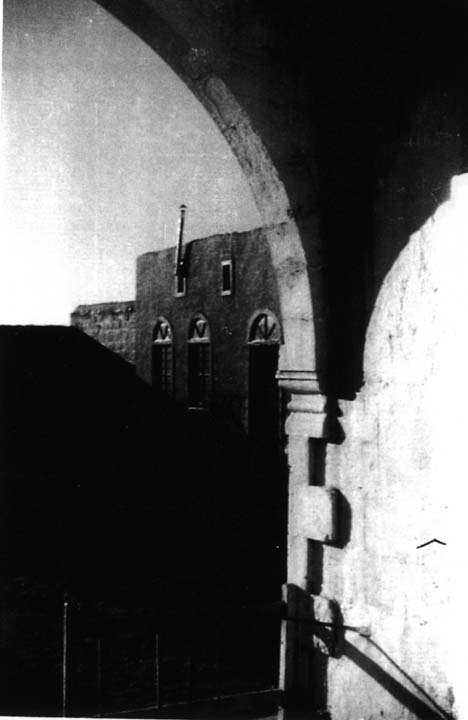
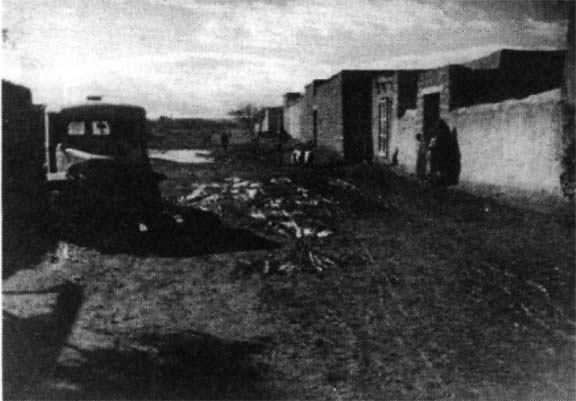
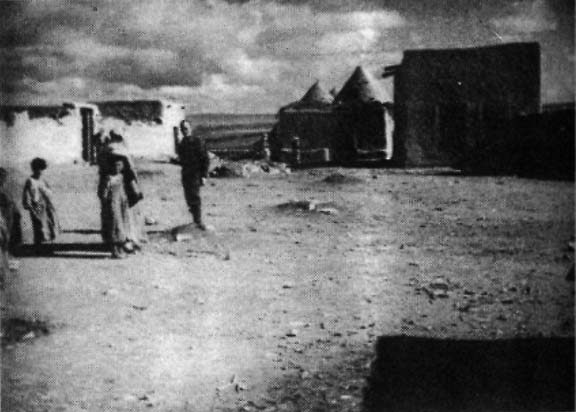
Our local staff included Ali the cook, who sported a gold tooth and had cooked for the French; he came from a nearby village --- a lively fellow whose baggy pants resembled "a pair of dirty beach pajamas." Two local characters had adopted us. One was the telephone repair man of the French Bureau, who wore the French military round cap with visor, but who spoke poor French and no English and sat for hours by our fireplace. We had to be polite because his was the sole serviceable phone in the village. Another we called the "waif" was a timid soul, usually wrapped in a great wool scarf and a hang-dog expression, who although born in Chile somehow had ended up in Selemiye! Since both Jock and I spoke Spanish, we tried to comfort him. And the kids were everywhere, especially when we were working on our mud-besotted cars.
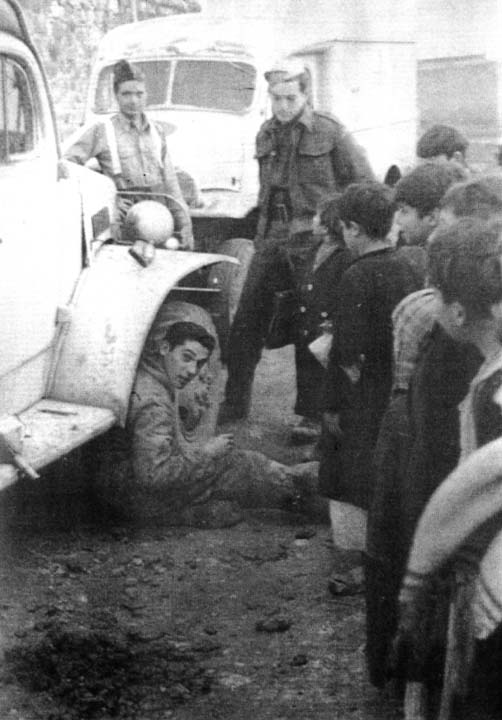 Brooke and Bloodgood standing. Nierenberg sitting --- kids | 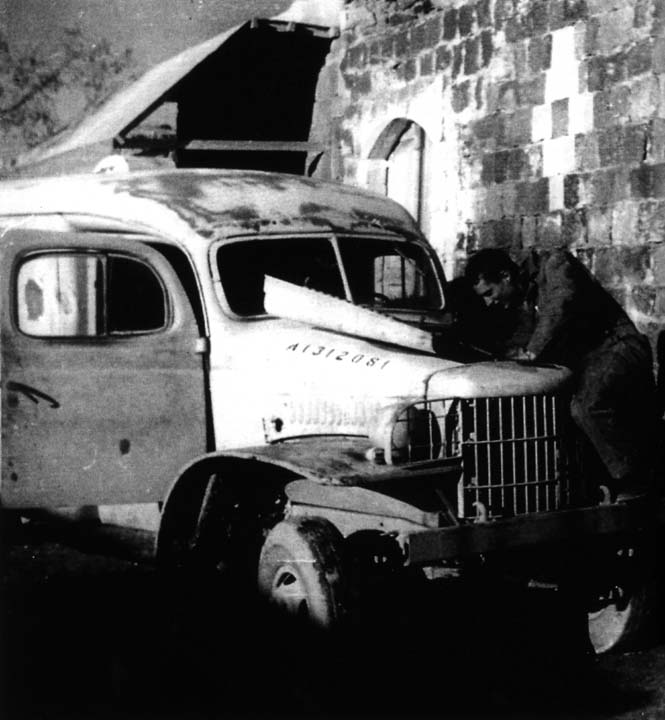 Facing Street, John Q. ("Jock") Cobb at Work. Vehicle Maintenance (Cobb-Edwards photo) |
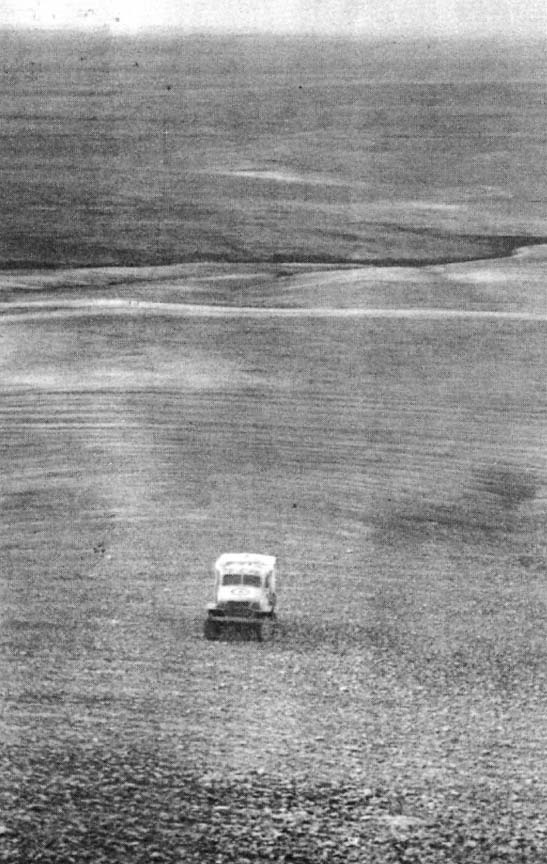
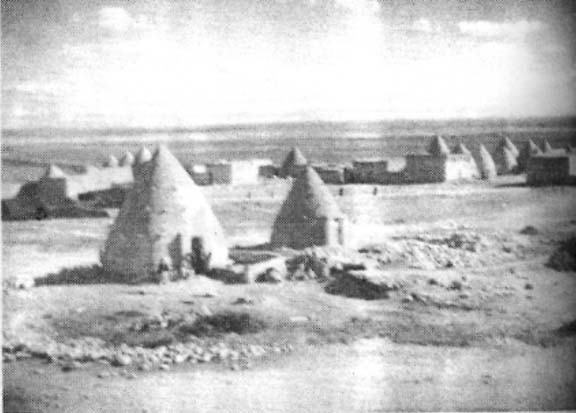
Our vehicles took a "beating" but performed yeoman service. Our rounds brought us to scores of villages. There were also long treks for hundreds of miles as we tracked down the dark goat-hair tents of the nomad Arab and Bedouin encampments. On one Sunday Howard ("Col.") Brooke and I drove to one of the pyramid-like earth-covered mounds or "tells" that crop up across the Middle East concealing ruins of fortresses of bygone eras. This one probably had been a Crusader castle. I parked my ambulance at the base, and we hiked up to the top from which there was a magnificent view of the treeless steppe stretching endlessly to the horizon. At the top there were stone fragments; also evidence of what had once been a deep well.
 |  |
 |  |
Driving conditions could not have been worse, I wrote:
Roads here are simply wagon tracks across streams, over fields. And now that the rains have set in almost impassable As you can imagine, they are hell on a car --- at times it is all the four-wheel drive can do to get through. The other night we got caught far out in the rain; we were quite relieved to get in safely. All this experience is helping me to better understand how a car works, and how it should be cared for.
One night Howard ("Col.") and I were routed out of bed by our telephone man with a message that Dr. Salman's car had broken down at Homs and to please come and fetch him. I wrote that "we headed out into the night which had grown stormy with sheets of driving rain. Along the way. we had one flat tire, but finally found the Doctor through the storm ... thankful that the car had both heater and spot-light, and that the Doctor had collected at headquarters a stack of letters for me and three packages."
The Doctor was skillful and versatile, and performed miracles with a minimum of surgical instruments, vaccines, various medications, some of the new sulfa powders, bandaging. He treated infants and the aged, all who appeared at a clinic on a given day. We took turns driving him in a weekly circuit of clinics. Bahjat, trained and experienced, assisted --sometimes some of us helped.
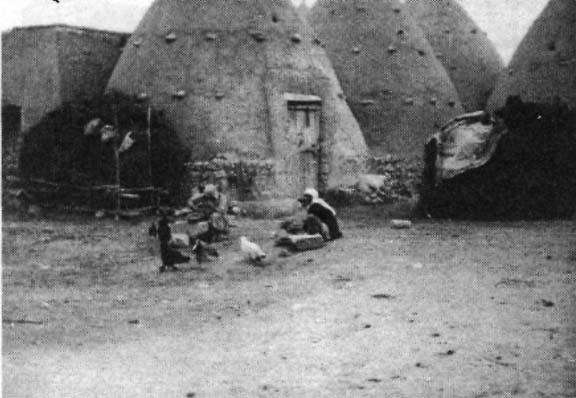
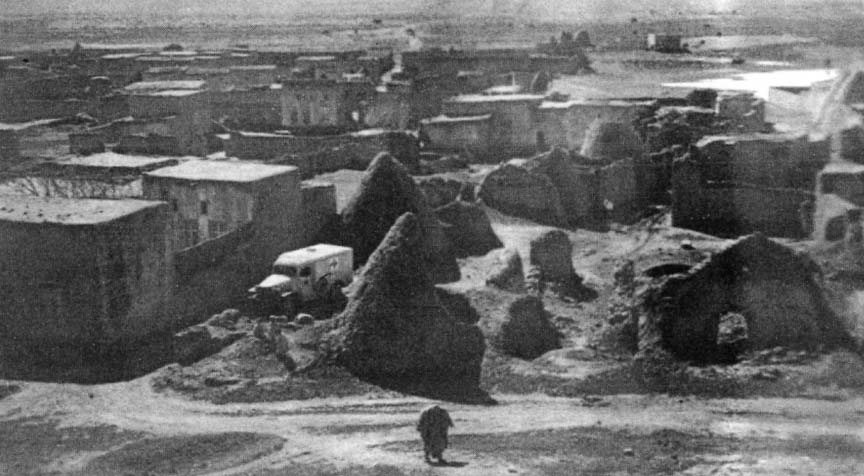
A "clinic" would be set up in a room of one of the few substantial houses of a village, usually that of the village patriarch or Emir. Many of the houses were little more than mud huts, some of them cone shaped, faced with dung. Most of the cases involved festering wounds and sores, breaks and bruises, dysentery and other intestinal problems, malaria, tracoma, infections, vaccinations against infectious diseases. Treating Bedouin and other traditional women presented a problem because of religious taboos. When vaccinating these women, for a example, an arm could be uncovered only in the presence of a male guardian.
These hardworking, relatively untutored people of the villages deeply appreciated the unprecedented services of the clinics; as Jock Cobb wrote:
We are royally received at almost any town or tiny village. The tatted sheep or chickens are literally killed for us and a banquet ensues, after which the Doctor does his bit and we are off with a warm spot in our hearts for these simple, yet wise and sometimes wily natives. One old man got us to smoke his hubble-bubble pipe...
Each of us had comparable experiences; I wrote in early January:
Out at the Arab villages, I felt as if I were turning back the clock a thousand years. I squatted around a mat and ate chickens, eggs, and rice with my fingers. It is the custom of the Arab at whose house the clinic is set up to provide a feast for his guests: the doctor, orderly, and driver. Thus I have shared feasts with the Doctor, who is a Lebanese educated at the American University of Beirut. The Arab food was good tasting. These Arabs are farmers: sowing winter wheat, cotton, barley, corn, vegetables on the fertile, treeless undulating soil of Syria. Their homes are of mud faced with dung --- built in cone-shaped huts around a central court usually teeming with chickens, horses, children, crops, women grinding corn, old men smoking pipes.
And following another circuit with the Doctor I wrote:
Yesterday I drove Dr. Salmon to a small village ... on our weekly circuit of clinics. All the sowing has been done for the wheat, and the men spend the day reclining on rugs in one of the common rooms of the village. They smoke their quaint pipes (long tubes joining a bowl cooled by water), and listen to stories told by the patriarch, who had lived in Buenos Aires, Argentina. He talked quite good Spanish, and I lectured to all the men using him as interpreter. I told them of the geography of the New World, about the U.S.A. and the fact that all races of men live there. It puzzled them to think of me as half-Italian half-English by ancestry.
In a letter of his dated January 5, 1943, Jock Cobb gave a graphic account of the clinic procedure and the Doctor at work:
A dozen or two brawny Arabs in their long dirty gowns and Virgin-like headgear are squatting around jabbering with the Doctor. The two British Friend's Ambulance Unit fellows are busy dishing out medicines while the Doc interviews the patients, flattens them out on one of my stretchers propped up on an old box, and feels their guts ... The Doc felt the pulse of a tall man dressed in a tremendous sheepskin; asked his name; and announced proudly in English that this is the fellow who last week was almost dying from pneumonia, now cured with the aid of the wonderful new sulfa drug...the Doc added for our benefit that he has the largest spleen he has ever felt (Malaria of course).
Next comes a little boy shivering and crying with an acute case of malaria. Six Arabs hold him down while the Doctor jabbers in Arabic and rams a quinine tablet down his throat. The kid screams, and hollers, and refuses to swallow; but finally gives in with an audible gulp. The onlooking Arabs cheer.
Now they help in a rugged fellow whose face is all wrapped up --- flies swarming around the gooey bandages. They remove the bandages ... Remarking of the great danger of contagion, the Doc cautiously touches his cheek. Puss spurts out from several openings. He calls for sterile swabs. Since no hospital here would take such a case, the Doc decides to operate himself --here and now, hoping to save the fellows life. They stick him in a corner while preparations are made and a few more patients are dealt with.
In comes a boy with an abscess the size of an apple on his thigh. This is opened and drained under local anesthetic while the Arabs hold the kid down, and the puss is caught in a little basin. Finally, after many more malaria cases, the decks are cleared for the big job. With only a few instruments, the Doc makes incisions, mops up the blood and puss, and inserts a thing to drain it from above the cheek bone to the chin on one side of the face.
A great stir. The Emir's son has arrived to greet us. We hurriedly carry out the bloody stretcher, as a tremendous meal is brought in which we consume squatting on the carpet within a few yards of the scene of the operation. Then after a few stories told by the smoke of the hubble-bubble, we pack up and move on to the next village.
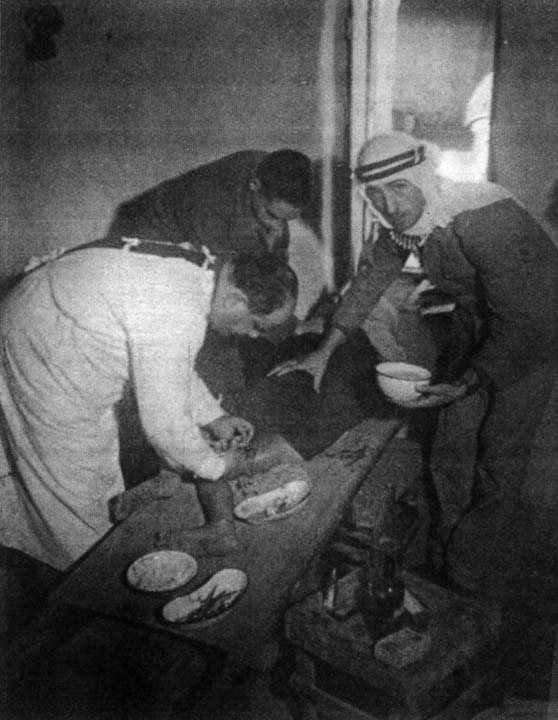
Traditional Islamic society is male oriented, and this was apparent at the clinics. Women patients were carefully chaperoned. Grateful Mothers accompanied their babies and children for treatment, otherwise our contacts were with the men of the village. As I spoke with them and to them, with interpreters, I observed in a letter:
They squatted with puzzled, bearded faces peering out of the white cape or headdress --clothed in carefully worked blouses and shirts covered with the flowing sheep-skin robes worn in winter. Thus they spend the winter days, sipping sweet Turkish coffee, while the women tend the cattle, wash the clothes, fetch the water, cook the well-seasoned meals, care for the children.
Despite the poverty, children were wanted, plentiful, and well cared for --- often by an elder sibling.

These were truly intercultural experiences. I wrote that "at least I am seeing a bit of Syria, both city and country."
Our most unusual "intercultural" experiences took place during long treks out across the plains and desert lands which were domain of the nomads, the Arab herders and also the Bedouin --- their camels, herds, flocks, tents. The Bedouin, proud rugged people, knew no boundaries, and ranged all across the Middle East and North Africa. Their robes were multi-colored --- not the austere white of traditional Muslim dress Their women did not cover their faces with the veil and instead often tattooed them. Years latter I would encounter identical peoples in the grasslands of Tunisia.
The Arab and Bedouin nomadic herders followed the grazing patterns of their herds as dictated by the rains, pitching where they chose their tents of sheep's wool or camel-hair dyed black. Our missions to these nomads were principally for smallpox inoculation. Their wanderings brought them at times close to settled villages and towns; vaccinations were important for the health of the entire country.
Our trained British orderlies handled these inoculations when Dr. Salman was otherwise engaged. The Doctor provided additional medical services when he took part. We found the Arab nomads eager to receive these services, and also to meet and entertain British and American nationals. They extended to us their famed hospitality.
Driving the Syrian grasslands and steppe in our sturdy vehicles was good practice for what lay ahead of us on the "Western Desert" of North Africa. Generally we followed no tracks or trails in our sweeps across these lands, making use of our maps and compass readings --- remembering those fiendish map-reading exercises Jock had visited upon us on board Aquitania. There was one well traveled route between Damascus and Palmyra near the Iraq border where some of us were posted. On one occasion a well-to-do Arab drove by in a luxury automobile, perhaps off course.
In a letter of his dated January 23, Jock commented on the driving conditions:
Last week we made a vaccinating tour some 100 miles into the Syrian desert where the Bedouin have their tents. It was slow tough going lots of the way through mud that taxed my four-wheel drive in low gear, and the rest of the way dodging large square rocks scattered at random over the countryside. There are no roads, just places where people walk and places where people can't walk. You try to drive on the places where people have been walking.
In the car we had Jim and Bahjat to vaccinate, Bahjat and a guide to get us there, and myself and Charlie Edwards to get the car there. We left about eight in the morning, and didn't get to our destination until mid afternoon.
Once we passed an entire Bedouin family group, all of their possessions strapped on their donkeys together with women carrying children. Jock managed to get a photograph, which is generally not possible with these people.
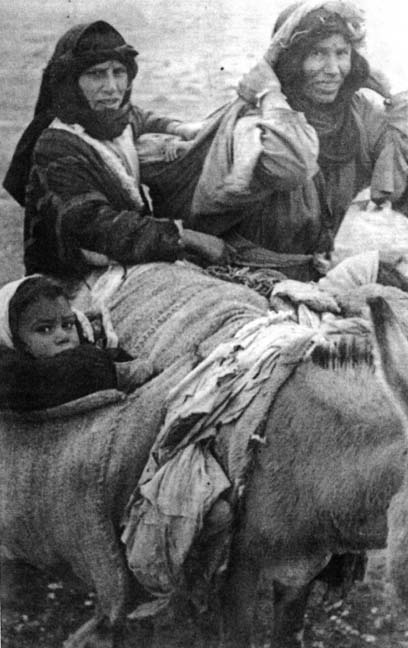
The nomadic Arab and Bedouin tents of sheep's wool or camel hair dyed black, were low to the ground and fairly extensive, held up by a series of tent poles. The openings into the tents faced Mecca to the East. There were several of them in an encampment. From a distance they blended into the landscape, and as the darkening winter day waned they were difficult to spot. As our ambulance drove up and parked, we would be welcomed by a cluster of interested elders and youths clothed in the traditional warm winter bernoose with the flowing white hood.
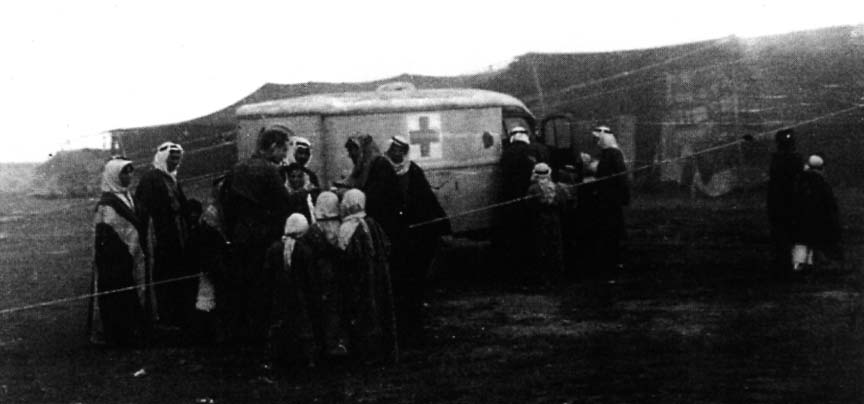
At one camp, far out in the Syrian steppe, the sheik had left his 1941 Dodge sedan in front of the Menzoul --- the main camel hair tent where we slept. Apparently the car had already broken down. He asked Jock to look it over to see if it would get him to Baghdad where, he claimed, an "American General would give him another one." Upon inspection, Jock noted: "He had never put oil in the transmission, and the gears were stripped." It seems the sheik should have relied on his camels.
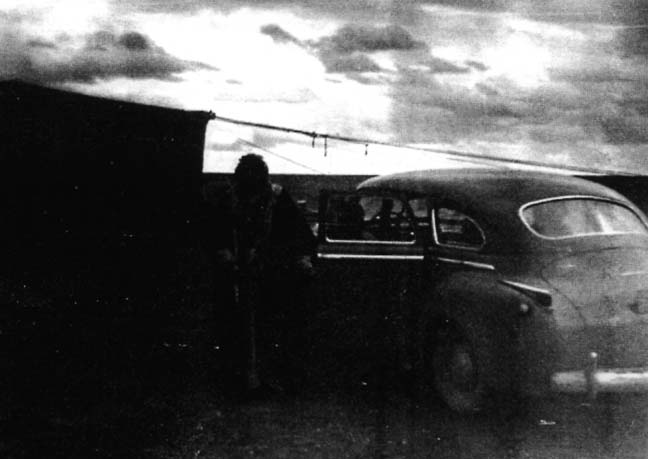
Coming upon an encampment late in the day, the Doctor or other interpreter would explain our mission. The ritual of traditional Arab hospitality came first before the conduct of the mission the following day, and we were made welcome in the spacious tent of the tribal leader where we would spend the night. We sat in a circle in a dugout section of the tent where carpets and cushions were laid for the comfort of all. Passing around cups of thick Turkish coffee each to each, we exchanged salutations as we sat near the fire where coffee was ground and brewed.
This was followed by the traditional michoue feast: a sheep cooked whole served on a platter with rice, olives, tomatoes, cheeses from camel's milk. Our right hands replaced utensils. It was men only --- the women and children received leftovers, separately. We swapped stories into the night around the glowing embers. Jock was very good at this. I finally went to sleep on thick carpets --- next to a pet albino camel.
The next day the tribal leaders organized the inoculation for us, with men lined up first followed by the women and children. The Arab women were veiled, reluctantly baring their arms for the injections.
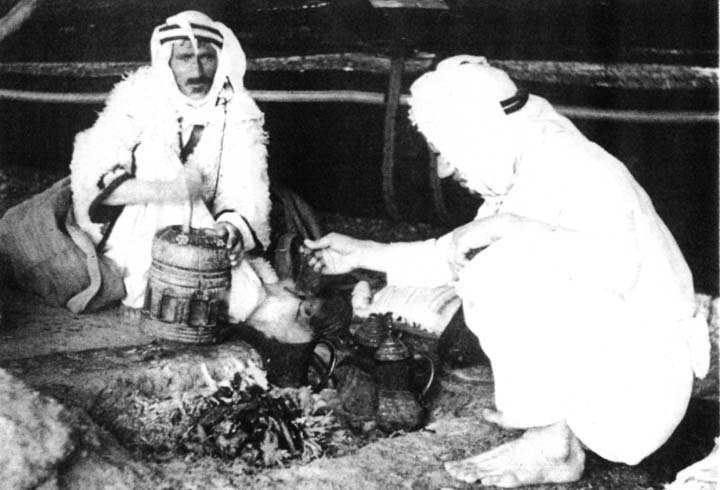
To capture the "on-the-spot" flavor of these experiences and the time-honored way of life of these self-reliant nomads of the steppe, I quote below the text of a long letter I wrote January 29 shortly after we returned to Selemiye:
Most interesting was a night spent a la Lawrence of Arabia. Each of the past two weeks we have made vaccinating trips of several days of length. We have gone to the edge of the desert where the Arab nomads and the Bedouin are camped for the winter, with their sheep and camels ... They are eager to receive this bit of medical protection and to meet and entertain Americans.
All morning we drove to reach them, and on into the afternoon --- at first past the now familiar mud villages over the tracks across the wheat fields, and then on into unfamiliar ground with the rolling plains leveling out, and the ground sandy beneath the sparse grass. Finally we saw in the distance the typical black tents, squat and elongated, open completely in one side facing East towards Mecca. The tents were in a large cluster for we were in the territory of an important Emir whose five sons ruled separate clusters of tents scattered across the wide grazing lands. The Emir, or his son as the case may be, lives in the largest tent. In one corner of the tent a slight depression is made in the ground. In this depression fire is built of the dried shrubs which grow in the desert. The depression holds a small metal hearth or grille, and several of the ornamental pots with their long curved spouts used to brew the bitter Turkish coffee. Beside the fire the Emir sits at a place of honor, and around him his friends, retainers, slaves, and eunuchs all squatting upon rich carpets --- sitting in the Arab posture of dignified repose with their rich robes wrapped around them and their graceful hands protruding. One of the slaves (or so we understood they were) tends the fire and brews the coffee, shifting the various pots assembled before him and continuously passing around the miniature cups containing only a drop of coffee ... When guests arrived, there was a clatter of guttural greetings, and the click-clack of the cup being filled and passed around the circle.
In the tent were several partitions made of colored woven reeds. Behind these partitions women and children are kept never visible to the guests (except for vaccination purposes).
These are the true princes of the Near East, these Emirs of gracious manner and movements, dignified, wearing rich garments, possessing wide grazing lands for their herds and for hunting on fleet horses. They are a law unto themselves, and preserve so many traditions of the ages.
In this letter I wrote that we visited each tent cluster ruled by a separate son, about ten miles apart. We returned for the evening meal at the Emir's tent. The Emir joined us in the circle; water was passed for washing hands. After a round of coffee, a steaming bowl of rice with chunks of mutton was set before us, with loaves of Arab bread. We made balls of rice and meat, using bread as a scoop and consuming it all in one bite. Others eagerly took our places around the food until it was finished.
As night fell, we huddled closer to the fire, and using our interpreter, told about our homes and the outside world. Three pet camels stood in the tent behind the fire. We were captivated by the traditional atmosphere, until the Emir demonstrated his prized short-wave radio, and the tent was filled with strains of American jazz! We went to sleep on mattresses laid on the ground, and we were covered with soft blankets.
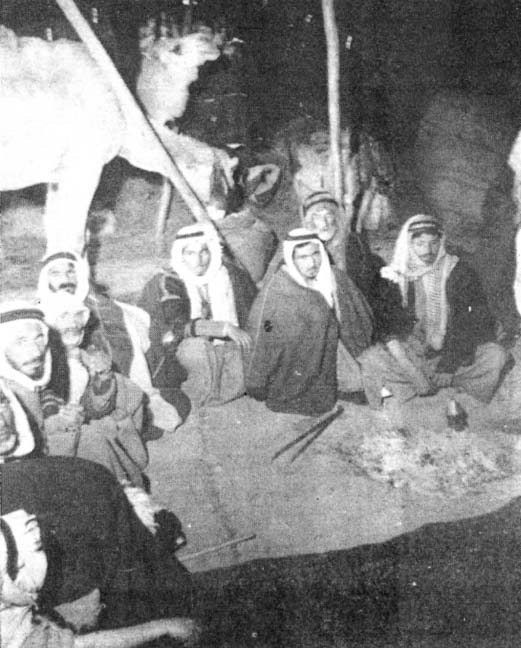
Jock in a letter he wrote January 23 about this same trip, gave a vivid account, especially of the never-ending coffee ritual:
We left at eight in the morning and didn't get to our destination until the middle of the afternoon, when we spotted a bunch of long low tents far off on the horizon and laid a course for them. By some miracle, it was the place we meant to get to; and we were cordially welcomed by a polished, French-speaking Prince of the desert who ordered a sheep killed for us at once. And then began the drinking of the coffee. Being an Emir, you see, this fellow had not just a couple of coffee pots, but five coffee pots of various sizes, from about a pint up to two or three gallons, and he had a slave continuously employed brewing the stuff on the coals, sampling, pouring, and mixing the whole day long. Every time anyone either got up, sat down, changed position on the divan, or finished a sentence, this fellow would offer him a sip of coffee. Always just one sip at a time out of the community cup. This custom is not new to us. Everywhere we have gone we have always had to drink at least three cups of coffee, but here in this Prince's tent, we drank coffee all day and most of the night.
The Prince's tent was huge, indeed about the size of our whole barn, all made of goat hair. Mattresses were laid out on the ground and pillows were placed against pack saddles, and fine Turkish carpets were spread over the whole for us to lounge on in front of the embers. Just by the tent door two fine camels were dipping into a sack of feed one at a time. A dozen or two men were squatting around the coals smoking, talking a little, and sipping coffee.
Everything was done for us. When I wanted to take a picture of the vaccinating, the Emir had them take down the side of the tent, a tremendous job just to get more light in there. We went to a couple of nearby Bedouin camps to vaccinate them and then returned to spend the night with the Emir. The sheep was brought in smothered in heaps of rice all on a huge tray and with our fingers we picked up the food. We are used to these meals by now; in fact we rather enjoy them.
We made the long drive back the next day, passing from desert and sparse grasslands to the rain-soaked and muddy fields of the central plains beginning to turn green in winter wheat at the outskirts of the now familiar villages of mud and stone. It was discovered (I wrote in a letter dated January 27, my Dad's birthday) that the Romans had built great underground water systems encased in stone and cement tubes large enough for men to stand in, and supplying some of the water being used in Syria's central wheat plains.
It was now early February, 1943. After El Alamein in November, the British 8th Army had pushed Afrika Korps west without pause. Tobruk was taken back; "Hellfire Pass" at the escarpment to enter Libya had been breached, and in a major action Tripoli, Libya was taken and with it a principal base and port city for Afrika Korps. The Germans then brought up reinforcements into Tunisia by air and sea, and prepared to stand at the Mareth Line in Tunisia just beyond the frontier with Libya. Eighth Army was moving up for what would be the final major battle of the war in North Africa; it was time for us to "Go West" as part of the build-up for the Battle of Tunisia.
On or about February 5, 1943 many of us came in from our posts with orders to proceed via Baalbeck to the Transit Camp outside Beirut where our convoy of the workhorse three-ton Army trucks would carry us a thousand miles west. Most of us of our Unit 26 including our "Lucky 13" fraternity were reunited at this Beirut Transit Camp at the outskirts of the then lovely and prosperous port city, pride of the civilized and industrious Lebanese. Our eventual destination was the huge base and staging area of 8th Army at Marble Arch outside Tripoli in west-central Libya to participate in the build up for the Battle of Tunisia.
A few of us of Unit 26 were held back in Syria for essential work assignments, to be reunited at Marble Arch in due course. Jock Cobb remained for a time with the Spears Clinic at Selemiye, and before joining us at Marble Arch was called to AFS/HQ Cairo in connection with his photograph work for AFS. His more than three months working with Dr. Salman, Bahjat, and Jim Hall and Dennis Frome, the fellows of the British Friends Ambulance Unit, to bring medical services of all kinds to the peoples of village, grasslands and desert were most congenial for him a true "Prince of Peace." Had AFS not called elsewhere, he would have been pleased to continue at Selemiye "for the duration."
While at Beirut, as I remember, we of AFS camped in a lovely pine grove, and were given several days leave before beginning our long trek. Beirut was then at its apogee of cultural and commercial influence throughout the entire Middle East --- before it was to become so brutally violated by the sacrilegious and racist extremists spawned by the Arab-Israeli conflict with its shock waves throughout the region and the world.
Beirut's world class University, the American University of Beirut (AUB), had trained generations of doctors, engineers, scientists, scholars, teachers, nurses, statesmen, academics and artists of the Middle East and, under the leadership of its then President Bayard Dodge, had earned the allegiance of its students and graduates in all the professions and arts from all nations of the region and beyond. AUB was one of the most cosmopolitan of the world's great civilizing Universities, and one of the most successful of Mission schools.
Previously, in December Chan Keller and I had completed an evacuation from Damascus to Beirut, where we had gone out to the University and been royally entertained by the students. I took advantage of facilities at the Dental School to have my teeth cleaned, and they were found to be in good shape and with unusual fillings. Also, I was invited to join a group of ski enthusiasts to try the slopes at the famed Cedars of Lebanon where Solomon selected great trees to help built the Temple. From the snow-crested mountains we returned by bus to the lovely campus overlooking the sea, with sandstone buildings along pathways lined with palms, gardens with tropical vegetation on terraces going down to the sea itself, and a background of snow-capped mountains in the distance.
On that occasion, as I wrote in a letter home, several students "took Chan and me to dinner at a nice restaurant that specialized in ice-cream dishes: banana-splits, and a delicious concoction called "mud" made of ice-cream, whipped cream, and chocolate sauce. One of the attractions was a victrola playing American jazz..."
While in Beirut, I had called on the residence of our Spears Clinic physician Dr. Salman, and was invited to breakfast and to meet his wife and children. I had first met the Doctor when on a short replacement assignment to Selemiye in late November.
During those three months of training in Lebanon and Syria, November 1942 to February 1943, I had found that respect for America and things American was universal. This was true, not only on the campus of the American University of Beirut and in urban areas such as Beirut and Damascus, but also in the towns like Baalbeck, in the traditional villages of the plains, and in the tents of the nomads.
I wrote, in one of my last letters from Selemiye on January 27, 1943:
Everywhere you go you meet people with relatives in America, people who have lived there, who will do anything for you because you are an American. Our land across the water has taken almost mythical proportions..."America can do no wrong." There is faith that America will lead our world out of its dark-ages after the war ... although too emotional perhaps, it makes one proud of our country.
And now this faith in America has been damaged because of our inevitable involvement as the world's one remaining super power in the conflict between Palestinian Arab and Israeli Jew, in which we have tried but often failed to act the "honest broker" to contain atrocities of terror brought on by the extremists of both sides. Nevertheless, America's support of the peace-process together with the moderates on both sides represents the best hope for peace in the troubled Middle East.
In those first days of February 1943 our final passage and leave at the Beirut Transit Camp while waiting for our convoy to form, provided a final opportunity to relish this fabled city. While some of our more gallant comrades boasted of conquests of the beautiful girls, Chan Keller, John Leinbach, Harry Hopper and I boasted of a different conquest --- we had discovered the best ice cream since Groppy's in Cairo!
On February 6, 1943 --- our final day at Beirut Transit Camp --- I managed to get off a letter which was a masterpiece of convoluted prose, such that the censors (British and American) would not cut it out but that the folks back home might surmise my destination and that I was on the move:
... for the present I am not where I have been --- and in a few days will be even farther from that most homey of mud houses. And then, too, my letters will have more miles to travel, and less regular means of transportation. So do not expect them each week, but rather in bunches, and in the advent of weeks of silence, do not worry about your son because he will be quite safe and probably many miles from anything but sand.