INTRODUCTION THE AUTHOR OF THIS book is Driver Robert John Crawford of the Royal Army Service Corps (known as "Red," because of a shock of red hair). He is twenty-four years of age. Before the war he was a lorry driver. His home is at Kingston-on-Thames. He is married and has a baby daughter of two years.
He has had ten years' service as a Regular and Territorial Army soldier.
His war experiences began with the British Expeditionary Force when he went to France, on 11 January, 1940. After a not very exciting period in France and Belgium, he was evacuated via Dunkirk, where he was wounded. He was recommended for mention in dispatches, because he volunteered to stay with some wounded men during the evacuation, but, like those of many other soldiers, this action was not recorded during the "flap" that followed the evacuation.
In August, 1941, he again went overseas; this time with the now-famous 1st Armoured Division. The long trip via the Cape to Egypt was followed by a period of preparation for the Western Desert.
Christmas, 1941, was spent at El Adem, where he had his first baptism of desert warfare. The months until June, 1942, were spent in the forward areas, except for one short leave in Cairo.
He came back with the remainder of the Eighth Army on their retreat of June, 1942, and was blown up by a bomb at Euka. Nine men were killed by this bomb. For twenty-eight days, he was unaware of the outside world, and remained virtually unconscious.
While in hospital in Heliopolis, he regained his strength and reason.
After a period of convalescence, he was returned to England as a Category " C" soldier-that is, one unfit for foreign service.
He is now serving as a driver again, but his reflexes will not stand up to enemy bombing.
He believes, fanatically, in the Eighth Army as the greatest war machine at the present time.
FOREWORD THIS IS THE STORY of a simple soldier. It is a personal story of life in the Western Desert during war. But it is more than that. It is the story of all the hundreds of thousands of men who made up the Eighth Army.
This is not the story of great battles won and lost, nor of tactics and strategy and the like. It is the story of the conditions under which men lived and died. It is the truth behind the headlines, revealing in all its sordidness and grim splendour the thousand other enemies than Germans and Italians which confronted this magnificent army.
. . . The Western Desert was a queer master. The Desert had to be fought and conquered before the Eighth Army could even meet their human foe.
. . . Humour is never far away from the British soldier. This story has many humourous incidents. But mainly it deals with the grim side of war, as it is mainly these impressions which this soldier has brought back with him .
. . . Lastly, this story reveals how the British Eighth Army was moulded into the finest fighting machine in the world. The experiences of Crawford were the experiences of half a million other men. Through the eyes of this one soldier is mirrored the soul of that great army.
SUMMARY OF NORTH AFRICAN CAMPAIGNS BRITISH ATTACKED UNDER General Wavell, on 9 December, 1940, and advanced to El Agheila by 8 February, 1941. The Italian losses were 200,000 officers and men, of whom 180,000 were prisoners. British losses were 2,966, of whom 604 were killed.
On 24 March, 1941, the German Afrika Korps launched a counter-attack, and the Empire forces began their retreat.
On 2 April, 1941, the Germans captured Jedabia, and then advanced progressively to reoccupy Cyrenaica, except for Tobruk. On 28 May we lost the Halfaya Pass. Tobruk held out for the following seven months.
Both sides rested and re-equipped. Five or six divisions invested Tobruk without success.
The British launched a new attack. In a few days the Tobruk siege was raised, and the advance continued. On 7 January the enemy retired to El Agheila. Rommel counter-attacked on 21 January, and the British withdrawal began. By 6 February the advance was halted in. the Gazala-Bir Hakeim area. The forces remained jockeying for the best positions in this area until May, 1942.
On 26 May the enemy began to move forward from Rotunda Segnali. There followed the heroic French defence of Bir Hakeim, and the disastrous tank battles of the Knightsbridge Cauldron, which culminated in the British retreat to El Alamein. Tobruk fell on 21 June after only forty-eight hours' fighting. By 26 June Rommel's forces were at El Duda, and the British retreat ended when they formed a defence line between El Alamein and the Qattara Depression.
Both sides consolidated their respective positions. New troops arrived for each force. The lull ended on 30 August, when Rommel prepared to advance again.
Rommel's attack was turned back, and the Eighth Army drove the Italo-German force into the Western Desert and chased the enemy successively through Egypt, Cyrenaica and Tripolitania, to corner them in a cleft stick between the Eighth Army and the Anglo-American forces in Tunisia. The campaign ended with the expulsion of all German and Italian forces from North Africa on 13 May, 1943.
MEN STARED OUT OF carriage windows. There was no conversation as the troop train ran northwards. Anxious eyes took in hungrily every detail of the yellowing autumn landscape, the watchers thinking, as men will who are leaving their native country, that it might be their last vision of this "green and pleasant land."
Some were openly downcast; others, while as serious, wore a more resolute look. These were the veterans of the campaign in France, and the never-to-be-forgotten Dunkirk days.
It was August, 1941, and the armoured division of which I was part was bound overseas.
The troop train arrived in a northern port in the early hours of the morning. It seemed an evil fate that all troop trains must either start or end their journey in darkness.
We crawled out of the train, stiff and weary after a considerable journey. After much calling of names and numbers, shuffling of feet and curses---not always whispered---we moved off to our troopship.
For five seemingly endless days the troopship lay in the river mouth. Rumours had already begun to circulate. One rumour remained firm and unshakable for many weeks---that we were bound for Singapore.
Our home was in the hold of this one-time cargo ship. We burrowed down like so many rats as night fell. Four hundred of us stretched, cheek by jowl, sprawled across the unsympathetic floor of the hold in which I lived.
As one of those who had come through Dunkirk, I tried to look and feel superior. Whenever a new situation confronted us, I tried to look wise and deliberate before making a decision.
In reality, I was thinking about the wife I had left at home. In the ten months I had been married I had seen her on four occasions. She was going to have a baby when I left.
It did occur to me that, as we would be passing through the tropics, a good place in this "Black Hole of Calcutta " would be necessary. I accordingly made for the hold immediately I was allocated to it, but found that other quicker and wiser men had beaten me to it, and all the places near the outlet had been taken. Still "pondering" deeply, I found a place near the dynamo, where I thought the air from the flying wheel would act as a draught.
On the sixth morning the usual rumour "We leave to-day" went round. This time it was true. We edged slowly out to sea, joining up with other ships bound for the same convoy. Eventually, dozens of ships and escorts ploughed their way southwards.
There was no one to see us off officially, so we did the cheering. We cheered everything in sight. It was a funny thought to cheer as one left for an unknown destination, with the only thing certain that the reception would be anything but pleasant. Still, we did cheer; more in relief than anything else. The ships took on a decided list as we got further from our country. Everyone craned and stared for the last departing glimpse of home.
Then began the dull routine of life aboard ship. For three days some three thousand men on our troopship were racked with seasickness. I visualised how the other thousands of men must also be in the throes of seasickness in the ships around us. That must have been an awful lot of sickness
For those three days the only intentional movement aboard was to and from the conveniences. The holds stank to the high heavens. No animals in captivity ever created a more dreadful odour. As each night passed I nestled closer and closer to the dynamo, so smooth-working and refreshing in the bedlam of groans that broke the night. Men stumbled backwards and forwards in an agony of stomachic retching; some did not move at all. Gradually the nausea wore off, and reasonably good spirits returned. Regimental life again intruded itself. Drill, physical training, weapon training, gas training, practice in reading the compass, sun compass and stars, followed each other throughout the day. Nights were spent singing and playing games, such as "Crown and Anchor" and "Housey-Housey." The officers mostly played bridge or solo whist. Soon a chess board appeared, followed quickly by others.
The food was awful. Black potatoes and an eternity of stew was the staple meal. Suet puddings appeared for three days in succession, but on the fourth day we rebelled, as the puddings were decidedly "off." We called for the Orderly Officer. He arrived and said, The puddings look all right." One man replied, "Well you can eat them," but the officer beat a hasty retreat, and under his orders the suet puddings were withdrawn. Immediately afterwards, the ship's cooks were also withdrawn and our units' cooks were put in charge of the galleys. Nevertheless, the food failed to improve.
This went on for days. Several thousand letters were written every day. We talked of home, wives, children, and all the nostalgic things which fill the minds of men who have recently left home and fireside.
Then we sighted land. We almost capsized the ship when the word went round, but there was no shore leave. We had anchored in a West African port. Within a few minutes, it seemed, natives were rowing out to us in their mediæval craft. They brought green oranges, bananas, pineapples and other kinds of fruit. We bought them over the ship's side. Most fruit seemed to be priced at 1/2d. for each item. Each day the bargaining became more intense, and actually within a few hours our bargaining had reached a highly strategic level, for we ended each transaction by saying, "And one for the King." This produced one piece of fruit free as a royal tribute. We followed this quickly with, "And one for the Queen." This produced a second gift fruit.
We eventually reached the little Princesses on the third day, but this did not evoke the same ready response!
There were vendors of other articles almost continually alongside. They offered us mementos and curios of West Africa with a charm of salesmanship that almost made us think we were tourists, and not soldiers going to battle. Good sense eventually persuaded us that buying was not wise, and we desisted.
The heat was frightful. We deserted the hold after the first night. Even the decks were sweltering, and we slept naked.
On the second night there was a sudden avalanche of rain. It came without warning, and felt like a million buckets of water being thrown at one time. As we awakened under this downpour we beetled for the hold, not really knowing what was happening. Then we trickled back, rather shamefacedly, and decided to stay and face the rain, which was almost pleasant in the sultry darkness.
The sight of land, so near and yet so far, brought on a new attack of nostalgia. Some men talked of deserting, and one, even, of committing suicide.
Meanwhile, our escorting fleet hovered around us like a host of guardian angels, but changed its identity so quickly that we never seemed to know any warship for more than a few hours.
On the fourth night we made for sea again; the land disappeared and life developed into a series of sores and an accumulation of filth such as only men cooped in these ships could produce.
Matters became worse when many of us ate some tinned meat which was bad. This produced an endless confusion of queues for conveniences. Then another stomachic complication joined in the body-baiting. The water which we had taken on board at the West African port had produced, apparently, mild dysentery. The ship became a shambles of grotesque, sprawling bodies, twisting in agony.
By the time we reached the Equator there was some improvement in our condition, and the usual playacting which accompanies crossing the Equator took place. Officers and men alike were ceremoniously ducked six times, fully clothed.
As we approached South Africa the cooler climate made deck sports the popular pastime, running and boxing being the two most favoured games.
Seaplanes began to circle the convoy again. So far we had seen only one German plane, and that had shied off after a very short inspection.
The only excitement we had was when the ships ran up the signals indicating enemy submarines were about. When this happened ships weaved madly in and out and altered course almost every minute. Fountains of water shot up in all directions, as the escorting destroyers loosed off their depth charges, but we saw no submarine and the performance gradually deteriorated into a sort of matinée for our amusement.
Once or twice the air raid siren went. This was not half so amusing as submarine chasing, for when the air raid siren sounded we were all ordered below.
It was after a month's sailing that we arrived at Durban. We anchored the ship in the evening, and rumours of shore leave passed from lip to lip. No confirmation of this came in the morning, but khaki drill was laid out by everyone in case the unbelievable happened. At midday we were called on deck, and shore leave was announced. The crowded decks were cleared the next instant, and in yet another minute were full again with neatly turned-out soldiers waiting to go ashore! The men had a determined sort of look about them. When the first liberty boats reached shore there was a mad scramble for the nearest food shops. Bacon, eggs, sausages and tomatoes disappeared at a phenomenal rate down several thousand throats.
At night we returned to the ship nauseated with food and drink. We lay and thought of the cool hills behind Durban, and dribbled with perspiration in the clammy atmosphere of the holds.
The following day brought freedom again from our troopship.
This time we made new friends, and some of us saw the lights of Durban from the hills. It looked like Fairyland after the Stygian darkness of the blackout at home. I was motored out to see the Valley of a Thousand Hills and famous Elephant Tree.
It was like another world, but the grim shadows of the troopships remained as realities in the harbour below.
Three more days of this delirious pleasure and we steamed northwards.
We were joined by the battleship Repulse. Later she said, "Goodbye," and continued on her last fateful journey to Singapore, where she went down fighting so magnificently in the company of that equally stout-hearted battleship, Prince of Wales.
Her last signal to us was "Goodbye, good luck and good shooting," as she cruised up and down the convoy, receiving the cheers of the men and the salutes of ships.
Soon after leaving Durban the military stock-taking began. There were a few desertions, not from cowardice, but probably from the pure relief of being on land again. Few escaped, anyway, for they were normally caught and sent up in the next convoy. Some such men, who had deserted from a previous convoy, actually sailed with us.
Once again we crossed the Equator, and this time the heat was slightly more tolerable. We were becoming sailors!
Suddenly, the rumour about our destination changed from Singapore to Egypt.
When we reached Aden some days later, the rumour appeared to be correct, although we still had not heard anything officially.
We sailed along the Red Sea for a century, it seemed. The heat was insufferable. Sleep was an impossibility. Tempers were frayed and fights developed freely. Only the fact that we were nearing journey's end kept our reason.
Sanity intervened and the talk veered from home and things of home to what we were likely to see at our destination. Curiosity replaced apathy, stage by stage, and those men who had been to Egypt before found themselves in popular demand and frequent visitors to the canteen.
Finally, we approached the Suez Canal, and then made harbour at a nearby port before entering the Canal. As we clambered ashore we stamped and rubbed our feet delightedly in the sand. Some of us rolled in it, like children on a beach. There was laughing and jollity and a new spirit infected us all. There was adventure ahead!
We ran the sand slowly through our fingers; it was warm and real and comforting. I could never have believed then that I would hate this self-same sand so bitterly; the crumbled, remorseless rock that sucked at the life blood of those of us who tried to master her vastness in the following months.
My life was to be sand, sand, sand, and then more sand for months and months ahead ... but I ran the sand through my fingers and I did not know this.
Once ashore our first work was to build ourselves a camp. Within a few hours a tented camp had sprung up on the edge of the desert. We lived in this for three weeks and suffered the worst outbreak of "spit and polish" that we had ever received. It came as a complete shock to us, for we had imagined a great easing in this respect when on active service.
But the value of this apparently excessive discipline was soon realised when we reached the battle area. We then found that the British troops were expected, by all other nationalities, to be the finest disciplined troops in the field.
During these three weeks, as well as regimental training, we indulged in the usual sports of hockey, football and other open air games. There was a picture house, nicknamed "Shafto's Palace," which changed programmes every other day.
The great day arrived when we were told to report to our original port of entry to collect a hundred and ten lorries. For the next three days we built up the lorries, which had arrived in Egypt in a dismantled condition.
Things began to move at a brisk pace after this. We were rushed back to port to collect 70,000 gallons of petrol and then received orders to move up to the battle front. At this time our troops had begun their second advance into the Western Desert and every available lorry was needed.
Excitement grew as we heard daily reports of the capture of Sidi Rezegh and the relief of Tobruk; but we received the news of Rommel's counter-stroke in sending an armoured column into Egypt with something of a shock.
I am afraid the romantic-sounding names meant as little to us then as they did to anyone back at home.
It was mid-December when we began our first trip through the Desert. We headed out via Cairo, Alexandria and then along the coast road to Mersa Matruh.
Our complete ignorance of the Desert was soon revealed. Early in the trip we halted for the night under an escarpment. It rained during the night and when we tried to move in the morning, eighty lorries were stuck fast in the "mud."
We dug and towed out the vehicles for several hours and then headed west; somewhat wiser men.
Everyone was keyed up with excitement. We actually looked for it! We passed desert airfields strung along the roadside. The minefields, marked with their little tin plates, slung carelessly across the wire, the red paint bearing the skull and crossed bones, looked quite inviting and provided no terrors for us at that time.
Every so often, enormous wire barriers stretched endlessly into the Desert and were a pleasant change from the scrub and rocks bordering the road.
Mersa Matruh showed interesting contrasts. The surface life of the town had ceased to exist; not a single building stood intact. The only signs of activity above ground were a watch-repairer's and boot-repairer's shops run by enterprising Army personnel! They were located in bombed-out buildings, partially rebuilt from the rubble of Matruh. The centre of life was the rambling underground Headquarters that had been used by General Wavell in his first campaign. These underground caverns and corridors stretched in a great maze under Mersa Matruh. They had electric light and most modern conveniences. It was really a town under a town.
When we left Mersa we were told to report to the airfield at El Adem, but we could not use the coast road through Halfaya as the Germans and Italians were still entrenched there, as well as at Sollum and Bardia. So five miles beyond Sidi Barrani we branched off into the open Desert and bumped along over boulders and scrub as far as "Fred Karno's Circus." This was the name given to a gap in the wire on the Libyan-Egyptian frontier, at the southern end of the Halfaya escarpment. By this time we were beginning to realise just what driving in the Desert meant. The sun was merciless, even at this time of the year, and our loads were floating about the lorry, bursting open tin after tin of priceless petrol, so badly needed in the forward areas.
It was our first effort at movement, using only compass and the sun compass. Fortunately, we had some guide in a row of telegraph poles that stretched away towards the forward area along the desert tracks.
From "Fred Karno's Circus" we headed north-west in the direction of "Conference Kahn," but we actually passed this place without realising we had reached it. "Conference Kahn" was only a name, with a few tents and a water stand-pipe to mark its existence. While the rest of the column halted, the three water trucks headed for the stand-pipe to re-fill. It took us three and a half hours to find the water point, and when we had filled up and returned to the camp site, the column had moved on without us
We decided to try to catch them up. We set a course by compass and headed gaily out. By nightfall we were completely lost, but were lucky enough to meet two experienced "Desert Rats." (" Desert Rats "was the name given to themselves by the soldiers of the Eighth Army. I do not know the exact origin of the nickname, but it became an expression of pride among the men. It soon became the entitlement only of experienced desert fighters, and could not be claimed by any newcomer to the Desert. It was used by the troops to differentiate between the men in Cairo and other administrative centres and the men who actually lived in the Desert.) These were two of the original Eighth Army who knew all the tricks of the Desert. They taught us in a few moments how to make a petrol fire from sand, water and petrol in a disused tin. They showed us how to make porridge from biscuits and an appetising meal from bully beef. Finally, they taught us how to sleep comfortably on the floor of the desert; and, incidentally, made us feel the simpletons that we really were.
Early the next morning we headed for the aerodrome at El Adem and caught up our column towards the afternoon.
By this time, we had left behind the desert scrub-land and had reached the long, shifting hill and hollow of the real Western Desert. As each lorry ploughed its way forward it sent up a miniature sand storm. It was impossible to drive in ordinary column of route, one lorry behind another, and we adopted an inverted "V" formation, each lorry driving in the rear and perhaps 200 yards to the side of the lorry in front. At the rear of each column there was a "Swinger" lorry. This lorry was called a "Swinger" because its duty was to swing backwards and forwards across the rear of the column to watch for breakdowns. This was very necessary, as the column commander had never any idea how many vehicles were following him because of the immense sand cloud set up by the foremost vehicles, which obliterated his rearward view.
As we neared El Adem we saw many columns converge from all directions. Each column would appear on the horizon as a small sand cloud, gradually enlarge, and when about two miles away the leading vehicles would emerge. It was a ritual of the Desert that when two columns approached within reasonable distance, the commanders exchanged information. Our own skins were saved on many occasions through receiving information of the enemy from other columns.
El Adem was the main crossroads of the Desert. At this point met tracks from Mekeli, Bir Hakeim, Jarabub, Capuzzo and the road from Tobruk.
As we passed along this desert track we saw the grim relics of the previous campaigns, and the torn-out bodies of lorries were left higgledy-piggledy along the route.
We ran into El Adem after a nine days' run from the Nile Valley. During this time we had not washed or shaved. Our water ration was one pint per man per day. Thirst was very bad during the first few days, but the iron discipline with which we controlled the water supply soon hardened us. We had not yet even scratched the surface of the Desert cruelties, although we really did feel we were now veterans.
How we were to be disillusioned!
At El Adem we tasted our first salt water. The water supply there came by pipe line from Tobruk and was distilled sea water. When we first used it to make tea the milk curdled and fell in great lumps to the bottom of the dixies. In our ignorance, we threw this tea away and then made fresh. When the same thing happened again we realised it was the water. After a few days we learnt to drink this tea and like it. So much so that when we went on our first leave to Cairo it took us two or three days to get used again to tea made with ordinary water.
From El Adem we were directed to unload our 70,000 gallons of petrol at the Acroma Petrol Dump. When we reached there, the 70,000 gallons had been reduced to 30,000 gallons through the desert journey. Much to our surprise, we were told this was a good effort.
Back to El Adem again, and then we reloaded with petrol, ammunition and food. We were ordered to take these to the Armoured Division at Msus, some 300 miles away. At Msus our armoured forces had thrown a cordon across Rommel's retreat.
It was a great thrill to be heading for the scene of battle.
Imagine our disappointment when we made three trips, each two and a half days' run each way, without as much as a shot being fired. But we did have some excitement---we had our first casualty.
The leading six lorries drove straight into a badly marked minefield, and before they could realise their danger the first lorry blew up. The driver was badly wounded, his leg being ripped open by mine splinters. The co-driver was lucky and had only slight wounds. The other five lorries managed to extricate themselves. We pulled out the wounded driver, made a stretcher out of the superstructure of a lorry and sent him on to Msus in the care of a corporal. What should have been an hour's journey took ten hours. Finally, the driver was flown back from Msus to Tobruk and then to Alexandria, only to die from his wounds.
On the fourth trip we got a rude surprise. Rommel, instead of retreating further, had turned about. He flung the whole of his weight against our "screen" outside Msus. When we arrived at the Msus Aerodrome with our usual load, the aerodrome was under shell fire. We were greeted with a salvo of shells which fell clean across the aerodrome. Nevertheless, we were told to unload. While we were doing this a despatch rider came through and said that three German Armoured Forces had broken through our centre, and two of these were heading in the direction of Msus.
He had no sooner left than two Stukas screamed down and dropped a stick of bombs across the lorries. We went to ground, but three men were killed. Six lorries packed in a tight circle finished as a heap of metal.
When the excitement had died down, we carried on with the unloading.
Then an officer arrived and told us to "beat it." A small detachment of imperturbable engineers strolled up to the stacks of food, petrol and ammunition that we had so laboriously unloaded and set fire to the whole lot. I can hardly describe my feelings at seeing five million cigarettes go up in smoke; somehow, all I thought about was that great pile of cigarettes.
The lorries were heading back in great columns by this time. We could see gun flashes and tracers flying, only a mile or two to the west. We scrambled into our vehicles and left. We had not travelled six miles before the platoon officer decided we should stop for midday tea. We did not like the idea, but he insisted. I have never seen tea made more quickly or drunk more quickly. As we finished repacking, our retiring armoured forces were less than two miles away, and hotly engaging the enemy.
We picked up thirty German prisoners and stowed them in the lorries. They climbed in amongst a welter of "Heil Hitlers." An ambulance column came along and told us the Germans had got through to the Mekili road. We then began a nightmare race towards Mekili. We drove through the night with the platoon officer sitting on the wing of the foremost vehicle, guiding us along the track by torch-light; no other lights were allowed on the column. During the night we pulled off the road for a short sleep, but had hardly settled down when a battery of twenty-five pounders moved in and began shelling from right alongside the lorries. We moved on and were cheered by the sight of another armoured division, which had been resting, moving up from the rear. Infantry and guns tore past us in the half light of dawn. But we saw no tanks.
Mekili was out of the question by this time, and we headed for Timimi aerodrome.
Then we lost our way. We drove steadily eastwards, it seemed, but just before midday we came on an ammunition dump. We dismounted to ask where we were, when suddenly someone shouted, "God! It's a German dump." Some figures emerged from a tent a quarter of a mile away and confirmed our worst fears.
But they made no effort to attack us, and I think if we had not been so keen to get back ourselves we could have made a fight of it. Anyway, we did not, and remounted our lorries and drove away. This time we were all right. As we passed, two ambulance columns headed in the same direction, they reported German armoured columns moving from the same direction as we had come. We must have just missed these.
A lone German armoured car fired at us for a few minutes and then departed.
Finally we reached Acroma without any more trouble. At Acroma we loaded petrol for the aircraft using Timimi Aerodrome. We had not gone far towards Timimi when we were stopped by a South African armoured car. The driver told us Timimi Aerodrome was being evacuated by us, and the Germans were already attacking it. Nevertheless, we went on in case there were any of our aircraft stranded for want of petrol.
Five minutes later we met an Air Force convoy. It was the Timimi Aerodrome ground-staff. They had fought an unavailing battle against the German advance troops before surrendering the aerodrome.
We reversed direction and headed back for Acroma.
That night we listened to the B.B.C. account of our experiences. It seemed a little unreal ! Not at all like our own adventures!
We were evacuating airfield after airfield at this stage, and my company was ordered back to Tobruk to evacuate the Ordnance Depot. We loaded engines, back axles and other motor transport assemblies at Tobruk, and headed back to Bug-Bug, where we off-loaded the assemblies at the rear ordnance dump.
While we were unloading an Italian plane came over. There was a screaming of bombs and two lorries were blown sky high.
I was watching six men unloading these lorries when the bombs fell. When I got to my feet again, I saw one man with his right leg blown off, another man with three-quarters of an inch of shrapnel in his temple and a third man with shrapnel in his stomach.
We rushed the wounded off to the hospital at Sollum. On the way we met an ambulance. The doctor removed the shrapnel from the wounded man's temple. The man with the leg blown off was still conscious and kept cursing the sergeant for having rotten cigarettes ! There was no morphia to give him.
At the Field Hospital in Sollum the man with the leg blown off died on the operating table. The driver with the wound in the temple was also operated on, but died four hours later. The surgeon said it was a Godsend he had died, anyway, as he would have been a lunatic if he had lived. This boy was nineteen and a half years old. The third man was flown back to Alexandria, where he later recovered.
We buried the two dead men at the foot of Halfaya Pass, with their faces pointing towards England. We painted little white wooden crosses and placed them on the graves. The crosses bore their names, numbers, arm of Service and the date. That was all. At the foot of each grave we placed a tin helmet.
When we got back to Bug-Bug we found some of our men cleaning out the damaged lorries. It was a ghastly sight to see men cleaning away human flesh.
While we were waiting to return to Tobruk a dead sailor was washed up. We could not identify his nationality and buried the decomposed remains in the sand on the sea-shore. We gave him a wooden cross marked, "A dead sailor; nationality unknown."
All the way back to Tobruk the columns were being strafed by the German air force, but we got there without mishap.
Then came the worst news we had yet had. We were ordered into Tobruk as Garrison R.A.S.C. We had already met the R.A.S.C. unit which had garrisoned Tobruk during the seven months' siege, now freshly ended. The stories they had told us did not make the job a pleasant one.
That night we sent an advance party into Tobruk while the rest of the company remained on the escarpment alongside the inner defence perimeter. This lay about ten miles outside the town. During the night the location was shaken by a heavy bomb which burst in the centre of a hole in which the advance party had slept the previous night!
For several days we stayed on this escarpment watching the Stukas and Italian planes strafing Tobruk. There were raids night and day. The firework display set up by the A.A. guns and tracers was an astonishingly beautiful sight, although not appreciated by the Tobruk garrison.
We had dug ourselves in on the escarpment, and were not troubled very much by the Germans. One casualty occurred when an orderly burning disused tins was badly wounded by a grenade exploding, and died later in Tobruk; someone had thrown the grenade into one of the old tins.
Even at this time the men never forgot their dead. We all "clubbed" together and raised £10 for the relatives of each man. We sent this home to them, and tried to get further money from the unit funds. We were told this was not possible because of the currency restrictions, and we had to remain content with our own collection.
During all these experiences one great factor emerged and that was the new and different relationship between officers and men.
Discipline such as we had formerly known disappeared. In its place came a companionship. Officers no longer issued orders in the old manner. They were more friendly and more with the men. They realised that this was a team. We, for our part, never took advantage of this new association. While orders were given, except in emergency, more in the nature of requests, they were obeyed even more punctiliously than under peacetime conditions. It was a case of every man pulling together, willingly. From what we had seen of the German Army, no such relationship existed, or could have existed, and it was not long before we discovered that this was our strength. The officers did their own work, and even some of the men's work, quite voluntarily. Instead of requiring to be waited on, they became, in the true spirit of officership, the servants of the men.
Everyone was known by his Christian name. The habit of addressing men as "Driver" or "Corporal" ceased. It was a good thing.
It is difficult to describe this exact relationship, but it undoubtedly grew out of our experiences. Every man, officers included, had to fend for himself. There was no molly-coddling.
I am afraid that some young new officers who arrived straight from home had a great deal of difficulty in making a quick change to our way of living, from O.C.T.U. standards! But they turned out to be grand chaps in the main.
The new officer who tried to be high-handed or a know-all quickly found himself in trouble, and sooner or later had to come down to earth and fit into the general scheme.
The Desert was a great leveller, and the men who realised this most were, curiously enough, General Wavell and his successors. Only a "human" General could succeed in the desert.
Round about this time I heard a remarkable story of a South African who was captured by the Germans twice in fourteen days, and then finally became free again. His tale was almost unbelievable to us at that time, but was capped by many other experiences, as we soon found out. Nevertheless, it is the one that I remember best.
This South African went out on patrol with three other men, and they found themselves surrounded by enemy tanks. The enemy tanks shot up the armoured car and occupants, leaving three of the four men wounded.
The armoured car was still serviceable, and the South African started for home with the three wounded men. He had hardly moved away when a gun opened up at short range, killing two of the men and bringing the car to a halt. The South African was also wounded. Before they could escape, a group of Germans had surrounded them and taken them prisoners.
Neither of the two survivors was badly wounded, and while their captors' attention was taken up with searching the car, they crawled away to safety. They headed eastwards, as they thought, and continued like this for two days. They had no water, and only their emergency ration (a concentrated vitaminised chocolate, which is issued in an air-tight tin to all British soldiers in action).
Time after time they ran into groups of enemy soldiers, and had to lie doggo under the small bushes which abounded in that part of the Desert. They quickly found it unwise to move by daylight, and only moved at night. On the second night they found themselves in the midst of what had been a battlefield during the day, and headed to the north-east. Next morning thirst drove them on during the day, but after being attacked by an armoured car they once again went to ground until night. After darkness they found a track, and after travelling for some time found a German motor-cyclist, apparently broken down. Both men attacked him, disposed of him, and then drank the contents of his water bottle.
By morning they saw tank tracks and began to follow these, and suddenly found themselves in the centre of two artillery barrages criss-crossing over their heads. By the time they had escaped from the battlefield they were picked up by a British convoy which lay low for the rest of that day.
They proceeded eastward all the next night, and the following day discovered that the convoy was passing the very spot where the armoured car had been shot up six days previously! The two men had been wandering in circles all the time!
Within an hour the whole convoy was smashed up by a German armoured column which swept over them, and once again the South African was a prisoner. For two days they remained in the same location, during which time the Germans departed, leaving an Italian guard.
The Italians began to dig in, and for another four days there was little activity, except the transfer of some of the prisoners to Derna. Warning of this reached the prisoners, and the South African dug himself into a hole, and covered himself with sacking, to avoid being taken away.
Finally, the Italians fled after a heavy R.A.F. attack and the approach of some carriers from one of our forward infantry units. The South African was rescued by these carriers and, together with other wounded, was taken back to Tobruk.
It was with mixed feelings that we drove along the road to take up our garrison duties in Tobruk. We wound our way through the tangled wreckage of German armoured vehicles and lorries that had vainly battered at Tobruk for the past seven months. There were still many drivers and gunners of these vehicles lying partly buried in the sand. The cleaning up had not been completed then.
The first prominent landmark in Tobruk was a huge monument erected to the memory of those who had died in the siege. This monument was built and fashioned by an Australian soldier, while the siege was actually taking place. Day after day, this Australian carried out his work under full view of the enemy gunners; but they never harmed him and he was allowed to work unmolested.
As we passed this monument to some of the Empire's bravest soldiers, we came to another sombre memory of the two thousand British dead who gave their lives in this heroic stand. This was the Tobruk cemetery. Above the entrance I read the words: "This is hallowed ground; let no man disturb it, for here lie the warriors who fought for their freedom."
The cemetery was perfectly tended. Row after row of shining white graves could be seen from the road. Each grave had been covered with eighteen inches of cement, and, while this was wet, glazed tiles placed on top. The tiles shimmered in the sun.
Among the many Italian prisoners taken by the garrison in their offensive sorties against their besiegers were men who had specialised in mosaic work in peacetime. They applied this essentially Italian craft and carved out crosses from the stones of Tobruk to erect over our dead; and for those men who had earned decorations the Italian craftsmen fashioned out the decorations in the gravestones.
At the foot of each grave lay the soldier's tin helmet. These were never touched by friend or enemy. The gravestones were washed daily.
Every soldier solemnly saluted the cemetery as he passed.
Our attention was drawn from these sights by a wave of Stukas that gave us an unhealthy welcome. As they roared over our column we flung ourselves on to the road. As I looked up I heard a chattering of machine guns from the roadside. Three Northumberland Fusiliers' machine-gunners were blazing away at the Stukas. We felt very foolish lying, as we were, under our lorries while these three men took on the aircraft. We were still "greenhorns" in the Desert
We went over and spoke to these machine-gunners. They were three of the few men who had been in Tobruk during the whole of the seven months' siege. The only other men who stayed for the whole time were some gunners.
Tobruk was chaos. There was nothing but a shambles of stone and ironwork to be seen. Our first job was to make a home for ourselves.
We took over some "billets." These "billets" consisted of dug-outs cut out from the sand and rock; nevertheless, they were shelter and that was more than we had had in the open Desert.
The officers built their own dug-outs in the same way as the men, and some of them even tiled the floors with glazed tiles which were lying about.
During the afternoon we began the British soldier's eternal scrounge for home comforts. Out of the debris that was once a lovely Mediterranean holiday resort came all sorts of odds and ends to make our homes for the next five months. Some produced old bedsteads. One man found a partially destroyed rubber horse which had been used in Tobruk's gayer days for floating in the sea. This was quickly converted into a "lilo." I unearthed a camel skin, which became my bedspread.
Later in the afternoon there was a surprising influx of suspiciously new-looking beds complete with brand new mattresses. The men who brought these were very non-committal about where they had found them, and it was not until the next day that a hue and cry arose from the field hospital because a large number of beds had been stolen. The beds disappeared from the billets in a miraculously short time
The cooks sent out an S.O.S. for a kitchen range. This was duly produced in almost undamaged condition and ten of us carried it in triumph through the ruins of Tobruk to our cookhouse.
The next luxury to be imported was a set of tent panels which the new owner said he had "found." We soon discovered where he had "found" them and many dug-outs were similarly equipped. I wonder if Ordnance ever discovered the loss?
Luxury reached its height when we found a dump of brand new German car batteries. These were installed with great ceremony, and the spare bulbs from our lorries used to provide electric light.
The food improved greatly during this time. Frequent visits to the Expeditionary Force Institute produced many varieties of food which, I am afraid, the Institute never knew had been "issued!"
Apart from this source of supply, the surround of every dugout produced an amazing variety of food. This food and drink had been buried, week after week and month after month, by the Garrison, in their efforts to build up a cache of food. We dug up cases of beer, Italian cheeses, tins of fruit, bottles of whisky and hundreds of other luxury items.
Within a week we had made Tobruk our home in spite of the incessant air raids, both by day and by night.
In three days, we built a public house, which we called the "Tobruk Arms." Admittedly this was not much of a" pub," but it looked awfully civilised, and was a popular haunt of the men. Our official ration of beer was then one twelve-ounce-fluid tin per week!
There were nine women in Tobruk. They were nurses. Strangely enough, despite the fact that many men had not seen women for many months, these women were treated with a respect far beyond anything seen at home. We only had one occasion when there was trouble over one of the men, who had attempted to molest one of these nurses. He was found out and he had short shrift from us. The treatment he received was sufficient lesson to all the other men to prevent a recurrence.
After the success of the "Tobruk Arms" venture, we decided to build a dance hall. This was done in two days, and on the opening night eleven officers and the nine nurses attended the dance. The men watched from the outside; but they were happy enough in the knowledge that they had done a good job of work.
Day followed day in quick succession. We had established a Base Supply Depot at Tobruk and our work consisted mainly of transporting material from ships as they unloaded. This unloading went on for twenty-four hours a day.
Unloading was done by Pioneers and natives. There was the strictest control during air raids. We were forbidden to enter an air raid shelter or stop work until a red flag was flown from Admiralty House. No matter how bad the raid, until this flag was strung up we carried on with our work. Any man who made a beeline for a shelter before this happened was fired at by sentries.
This might sound unnecessarily severe, but anyone who saw the mad flight of natives during air raids would appreciate how serious it was for a British soldier to start a stampede.
As long as the British soldiers continued to work, the natives more or less stood firm, but immediately the flag was pushed up the natives were off in one mad rush for the air raid shelter, which was 150 yards from the farthest quay of the dockside. It was a brave man who tried to hold them back. Anything in the way was just bowled over. Wooderson would not have been in the first hundred!
On one occasion my company was ostracised by the whole of the Tobruk Garrison because it had been reported that some of our men had run for the air raid shelter before the natives. No one would speak to us when it was published in Tobruk Orders. The only sign of recognition we received from the other men was when we passed them and they sniffed in disgust. As we walked along the road they made a studious detour out of our way. We had four days of this hell before it was proved that the men who had run to the shelter were not from our company at all.
It was incidents like this that maintained discipline at a high level. Nothing could have been worse punishment for an offence, than the way in which the rest of the men treated us with a despising contempt while we were in the "dog house." It was a salutary lesson, even though we had not been guilty; and after that I don't think any man of our company would have run to shelter if he had been machine-gunned all day.
The shelter was a huge cave going about sixty feet underground. Unfortunately, those who reached the shelter first, instead of going to the rear and allowing others to enter, crammed in the doorway watching the frequent dog fights overhead, with the result that late-comers could not get in. I saw many men machine-gunned and killed through this stupidity.
The Army and Navy gunners in Tobruk deserved a medal for every man. They stood up to a tremendous plastering, lost many men, but never gave up the fight. We had a great celebration when they shot down their hundredth German aircraft on the 8 March, 1942. They had a special story about themselves in our local paper, the Tobruk Truth.
During every air raid a man stood by the Navy House and gave us a running commentary through loudspeakers. Some of his efforts were distinctly amusing, even though the situation was very grim. This man also controlled the Tobruk barrage and when he said, "Tobruk engage," the whole barrage opened up. It was grand.
Some of the busiest men in Tobruk were the divers, who spent a long time salvaging a cargo of whisky from the harbour. It must have been galling to them handling so much whisky in their divers' suits. Of course, they also salvaged other valuables, including a large quantity of tinned food.
Tobruk was our first real introduction to the flea. I think the flea and the other desert insects were worse enemies than the Africa Korps and Italians.
At least the human enemy did have to rest, occasionally. The flea was the torturer supreme and never rested. No matter what we did, it was always with us. At last someone hit upon a partial remedy, at least. This was to keep tame mice. By sleeping with the mice, we found that the fleas migrated, in part, anyway, from us to the mice, whom they seemed to prefer. But there was no complete cure.
In a very short time there were few of us who did not have our tame mice. The mice became great companions, and, apart from their flea-collecting propensities, we trained them into doing all kinds of tricks. Others took part in races, and their habit of frequently stopping, turning round and racing in the opposite direction produced surprising results at times. Many answered to their own names after a time.
Other intimate friends we made in Tobruk were flies, lice, scorpions, centipedes, lizards and beetles, to mention only the most prominent. Lizards were really friends. They kept down the flies, which were easily the most dangerous of all our enemies. Lice were, like the poor, always with us. This, of course, was due to lack of water. Try as we might, we never entirely got rid of lice.
Our normal drill was that every eight days or so we produced one gallon of water between seven or eight men. We washed and shaved and "bathed" in this, and then tried to wash out our clothes. A gallon of water may look a lot in a bucket, normally, but it certainly did not go very far when seven men had to perform all these rites. I hesitate to suggest what the water looked like at the end.
Beetles were amusing little chaps. They were mostly of the scavenger type and as such were treated as sacred by the natives. These beetles were known as the "maids of the desert" because of the way in which they cleaned up all the filth. No colony of ants could have worked as industriously. The scorpion needs no description; and this deadly little insect was killed on sight.
Centipedes grew to an astronomical size. Normally, they were harmless; but, like all the strange things we met, required some little experience in handling. The automatic instinct of trying to brush off one of these creatures produced several hospital cases, at first, because men tried to brush off the centipedes against the direction in which they were travelling. There is apparently something in a centipede's make-up which resents this and the only result is to rip off a large stretch of skin. On the other hand, if the centipede is brushed off in the direction in which it is travelling, no harm is caused.
Flies produced more casualities than the Germans. It is impossible to describe, without suspicion of exaggeration, how thickly they used to surround us. Most of us ate a meal with a handkerchief or piece of paper in one hand and our food in the other. While we tried to get the food to our mouths, free from flies, we waved the other hand about wildly; even so we ate many hundreds of flies. They settled on food like a cloud and no amount of waving about disturbed them. They could clean jam and butter from a slice of bread much quicker than we could eat it!
It can be realised how serious the menace of flies was considered when I say that, even in remote parts of the Desert, one came across notices saying: "Kill that fly or he will kill you." Mealtimes were a real torture because of these insects. Most meals in fact were a race between you and the flies as to who could eat most of your dinner.
Several men actually lost their reason because of flies. Their unending presence was nerve-racking to the strongest of us. To those who disliked insects---and there were many men like that---the pestering became too much for them and they lost their sanity, temporarily. There were times when I could have screamed, in my impotence to prevent their visitations.
Water was easily the most precious commodity. It had a price. As much as 2s. 6d. would be offered for enough to fill a water bottle. At times it was beyond price.
In those units without much transport, water was even more in demand.
With our lorries, we always felt we had a reserve.
Many a time we washed and shaved in the water from our radiators and the following day made tea from it! This sounds unpleasant, but in reality the tea was heaven-sent and probably much less dangerous than some of the water we found when travelling.
On one trip I had just completed filling the water truck from a well when I saw two dead Italians lying in the bottom. They were in an advanced stage of decomposition. I had to clean out the water tank and draw water from another source.
The water trucks were always kept locked. All water was sterilised.
On one occasion, when I was in charge of the water truck, my officer came to me and said that one of the men had gone down with dysentery because I had failed to sterilise the water on the previous day. I denied this, and he said, "Right. Well, we'll test it," and he made me drink some water from the truck ! I did not get dysentery, and as no other men went sick immediately after, it was agreed that the water had not been the cause.
Nights in Tobruk afforded little amusement other than the firework show of the gunners during blitzes, so we improvised our own entertainment. Men invited other men to dinner with great ceremony. Dinner consisted of a bottle of whisky or some bottles of beer unearthed from the surround of a nearby dug-out, some tinned fruit from a similar source, laid on a newspaper or blanket, on the floor. We all sat round cross-legged and ate our dinner amidst much banter.
Invitations to dinner were carried out with style and dignity, the host visiting his would-be guests in their dug-outs and ceremoniously requesting their presence at, say, 7.30 p.m. to dine.
It was this kind of play-acting and humour that saved us from going mad.
Meanwhile, the Germans had pushed our forward positions back to Gazala and for the next few months we held our lines uneasily from there to Bir Hakeim.
My company was given the job of supplying the troops in the forward area, as well as unloading the supply ships in Tobruk Harbour. This began a series of exciting trips in which many astonishing incidents occurred.
Although the run from Tobruk to the tank brigades in the forward areas was not a very long one, the line was so confused that the unexpected was always happening. Both sides were jockeying for favourable positions around the Knightsbridge area, and both German and British raiding columns penetrated many miles into the areas supposedly held by the enemy. These columns were not just a few men on foot. Mostly they were armoured columns consisting of mobile guns, armoured cars and infantry in lorries. Sometimes they included tanks. The positions changed almost day to day, and we never knew exactly where our next delivery would be made.
We carried composite loads of food, petrol, ammunition, some ordnance stores and other small articles.
Mail was delivered by a separate service, although it should normally have been taken up by the R.A.S.C. columns.
At this stage mail had become a great concern to my company. We had been three months in the Desert and there was still no regular delivery of letters from home. This caused a great deal of ill temper among the troops, because they were worrying about affairs at home. It had a very detrimental effect upon our work. Almost all the conversation, sooner or later, came to the point where we talked about why we had received no letters from home.
To return to the journeys up to the forward areas. We had made two or three trips only when we had our first meeting with a German "raiding" column. After leaving Tobruk we headed along the coast road towards Derna, and when we reached Mussolini's monument we branched out into the Desert on a compass bearing and had gone about fifteen miles, past Acroma and Knightsbridge, when we saw the familiar sand cloud which indicated another convoy coming towards us. As the leading lorries drew abreast, both columns halted, and the commanders got out of their cars. They walked towards each other and then suddenly stopped. We all realised simultaneously, I think, that this was no British convoy---it was a German column using Canadian lorries, which they had captured from us in our retreat at the beginning of the year. The lorries even bore the old British divisional signs, and had not apparently been altered in any way by the Germans.
As soon as we realised that this was an enemy column we all dived out of our lorries, grabbing rifles and ammunition, and prepared to dig in for battle. Much to our surprise, the commander of the German column ran back to his car and headed off to the north, followed by his column.
Not a single shot was exchanged and we were left in victorious possession of our patch of desert, without as much as a scuffle.
When we reached the forward area we recounted, and the incident lost nothing in the telling, how we had routed a German column. There were incredulous, and then amused, looks from the tank brigade fellows. The harder we piled it on, the more it seemed to amuse them.
We took a poor view of their hilarity, and it was not until we returned to Tobruk and told the story again that we realised why they had laughed.
Apparently we had run into a German supply column similar to our own. Naturally, the enemy column were no keener than we were to do battle. They were more experienced than us, and knew that if supply columns stopped to fight, whenever they saw the enemy, supplies would never get through, and the real fighting troops would be reduced to impotence from lack of supplies. This was the first of several meetings with enemy supply columns, and there was never a shot fired, to my knowledge. In fact, there was almost an unwritten gentlemen's agreement that we would each pursue our own way and get on with our particular jobs.
It was an odd experience, though, and shows the curious happenings which make desert warfare so completely different from warfare in other kinds of country.
We never had the misfortune actually to contact the enemy armoured raiding columns during these trips in the spring of 1942. Several times we were warned that patrols had been seen in the direct line of our route. We changed direction accordingly and this seems to have been successful.
But one day we did pass the remnants of a supply column which had run into an enemy tank raiding column. The massacre that followed was told to me by one of the few survivors of this company.
He described how they were moving up towards Bir Hakeim when they ran into the tank ambush. The tanks closed in from all sides, blazing away with their guns. The Bren guns of the supply column hardly had a chance to answer before the gunners were mown down. Then carnage was let loose as the tanks drove straight over the column, smashing lorries on to their sides in all directions. Within a few minutes the column was a mass of blazing wreckage with bodies strewn everywhere. It must have been an unforgettable sight, but it was one of the risks which had to be taken and there was just no answer to it in that kind of warfare.
Another R.A.S.C. company was almost as unlucky. They had laagered for the night and put out the normal sentries. The laager consisted of cooks' vehicles, water trucks and staff cars in the centre of the compound, and vehicles strewn about the perimeter in pairs about 200 yards apart. Each pair of vehicles pointed in opposite directions. This was for ease of dispersion in case of aerial attack.
When dawn came the company found itself ringed round by a column of German armoured cars. They bravely tried to fight it out, but this only produced more casualities than would normally have been the case. They never had a chance from the start.
One of the survivors, who told me about this, said that he blamed the sentries for falling asleep. Had they been fully awake, the enemy could never have surrounded the location without being observed.
This problem of sentries was a very real one.
Men finished a long day's driving in a very tired condition, and guard duties became exceedingly arduous. Often, too, there was too much complacency when we appeared to be well behind our own lines. In actual fact, we were never safe at any time, as space was very illusory in the Desert. A place 500 miles behind one's own lines was within easy reach of an enemy raiding column;
We became very desert-wise during these trips. We learnt one simple enough lesson, in that we no longer left food lying about. For some days we had suffered the loss of a considerable quantity of cooked food. This disappeared mysteriously as soon as it was laid out in the open. Men lost their dinners, in the twinkling of an eye, as soon as they turned their backs.
Then we discovered that the thefts were being carried out by the desert kites. These birds---the vultures of the Desert---would flash down from an enormous height, snatch up the food in their talons, and then circle overhead eating it while flying
One day I saw one of our drivers smack another driver under the jaw for stealing his dinner, as he thought. Some of us had seen the kites pick up the dinner and the affair was amicably settled after our explanations.
These birds followed the convoys for days, and it was quite unsafe to leave any kind of food in the open.
Finding one's way across the Desert was never easy under the best conditions. In the forward areas one constantly met minefields, sown first by one side and then by the other. Sometimes they were indistinctly marked, and often not marked at all. It was only when the leading lorry blew up that one knew one was in a minefield.
The major tracks were fairly clearly defined, but the majority were merely indicated by small sticks mounting a piece of petrol tin marked with a letter of the alphabet. A route was called "A," "B," " C," " D," etc. That was its only name. These signposts were placed originally about two miles apart, but by the time enemy patrols had uprooted them or turned them into the direction of a minefield, they became more or less unreliable.
Travelling at night was not in favour and an extremely difficult process. The normal day's run would be from eight o'clock in the morning, with a short halt for tea at midday, until an hour before sundown, so that the evening meal could be prepared in daylight.
We saw the wreckage of tanks and vehicles, from battles which had been fought over this ground previously, almost everywhere.
Neither side had the time or the equipment available to get them back for repair.
We found these relics very valuable.
At that period, there was an acute shortage of motor transport spare parts, and we often had to strip these vehicles of things like carburetters, springs, fans and any other parts that gave up the struggle. A lorry had only a three months' life in the desert.
I am afraid the practice of stripping derelict vehicles was not the end of what we came to know as "cannibalisation." This "cannibalisation "---military word---was termed as the taking of a part from one vehicle to make up a deficiency on another.
The practice spread from derelict vehicles to the taking of parts from any vehicle that happened to be handy when one broke down. The practice became very widespread, especially in relation to vehicle springs, which were a constant source of trouble; but even complete engines and wheels were stolen from vehicles while their owners were away having a cup of tea or asleep nearby.
In our original ignorance, we left our vehicles unattended quite often, and paid the price. Later we knew better and always left a guard on them.
In the end, I am afraid we indulged in this practice ourselves.
I remember two South Africans walking up to our column as we were halted for midday tea, and asking us for petrol as they had run out, about a mile away. Three of us carried petrol over for their armoured car. We poured the petrol into the tanks and climbed in so that the South Africans could take us back to our halting place. After a few seconds of trying to start the car, the driver got out and pushed in the starting handle.
I shall never forget the look of amazement on his face as he swung the handle round. He rushed to the bonnet, opened it and found there was no engine ! Someone had stolen it!
One of our own vehicles was literally stripped to the axles while the driver was sleeping less than a hundred yards away. All four wheels had been removed, and even the superstructure was gone!
This practice met with the sternest disapproval from the authorities. Army Orders made constant reference to it and threatened severe disciplinary measures against offenders who were caught.
Nevertheless, the practice did not cease and, in desperation, the Eighth Army created what was called "Help Yourself Dumps." These were dumps of damaged vehicles which it was not considered economical to evacuate. All drivers were given free access to these dumps, and could take any part of any vehicle that they required.
It was felt that if a driver would drive thirty or forty miles to one of these dumps, and then work for several hours to secure a part, then he really wanted it. Cannibalisation was most difficult to deal with, because it was usually done by the conscientious driver. The lazy driver never bothered. But the man who was really interested, not only took spare parts which he really needed at that instant, but also created a private spare parts store by taking parts which he thought he might need in the future!
I have seen drivers' tool boxes stuffed with carburetters, pistons, sparking plugs and a hundred other small but invaluable items. We hardly appreciated that by hoarding these spare parts we were only aggravating the already acute spare-parts situation, and preventing hundreds of vehicles from being made roadworthy.
Many vehicles were abandoned to the enemy because of this practice, as they could not be moved back during a retreat. It took us a long time to see this point of view.
One of the main reasons for cannibalisation was the fear of being lost in the Desert. By the very nature of conditions, it was not possible to molly-coddle stragglers or lorries that broke down. Supplies had to go through, and, once you had started moving, the responsibility for getting to your destination was entirely your own.
If a man just disappeared "into the blue"---we never spoke of the Desert as the Desert, but always called it "the blue"---no action was taken for the first forty-eight hours. We each carried a reserve of four days' food in our lorry, and a man was given two days in which to rejoin his unit. If he did not arrive after two days, Headquarters were informed of the area in which he would probably be wandering or have broken down. Aircraft would then be sent out and a search for a further two days would be made. If a man was not found within those two days then the search was abandoned.
This seems rather cruel. But the number of men and vehicles lost in the Desert at any one time numbered hundreds and the Air Force could not possibly have carried out a search for each individual for an unlimited time.
Men were lost for several weeks on occasions, when they disappeared into little-frequented territory. If they were carrying food they could exist for some time, except for the universal problem of water.
By careful husbandry, a man could make his supply of water last a week. He could then normally exist for another two days without water. After that he slowly died from thirst.
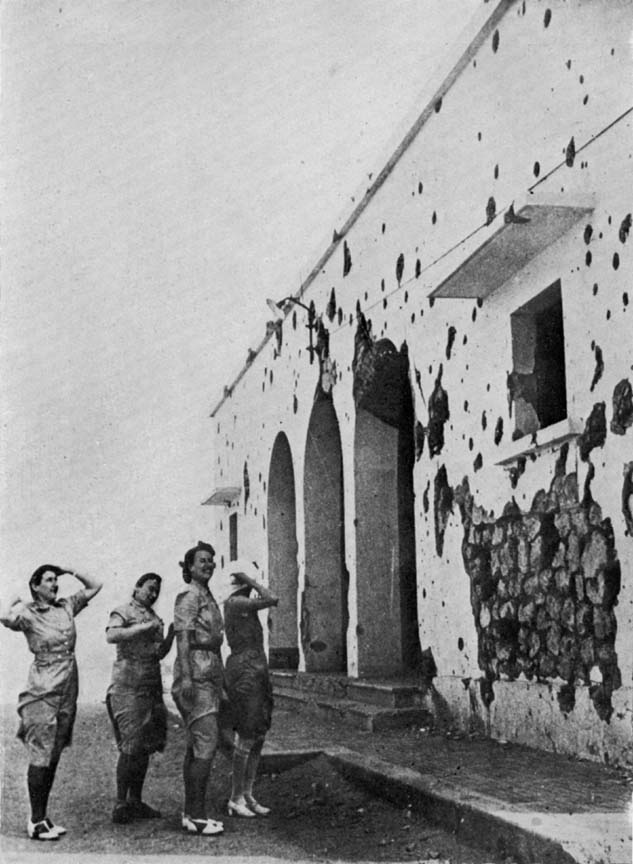
FOUR OF THE HEROIC "HADFIELD SPEARS" AMBULANCE NURSES ---THE ONLY WOMEN IN TOBRUK DURING THE SEVEN MONTHS' SIEGE
WATER---PRICELESS COMMODITY OF THE DESERT---WAS FOUND IN MANY STRANGE PLACES. NONE WAS STRANGER THAN THIS UNDERGROUND WATERHOLE WHERE R.A.S.C. PERSONNEL ARE SEEN WORKING, AFTER THE SITE HAD BEEN DISCOVERED BY A WATER-DIVINER
DESPITE THE ENEMY'S WORST EFFORTS, TOBRUK'S OWN NEWSPAPER, THE "TOBRUK TRUTH," WAS PUBLISHED EVERY DAY DURING THE SIEGE BY A SERGEANT AND A CORPORAL. THE PICTURE SHOWS THE ENTRANCE TO THE BUILDING. THE OFFICE WAS ACTUALLY A ROOFLESS AND WINDOWLESS ROOM ABOVE
HEADQUARTERS IN THE FORWARD AREAS WERE OFTEN IN THE MOST UNUSUAL PLACES. HERE IS ONE DEEP UNDER THE CRUST OF THE DESERT.
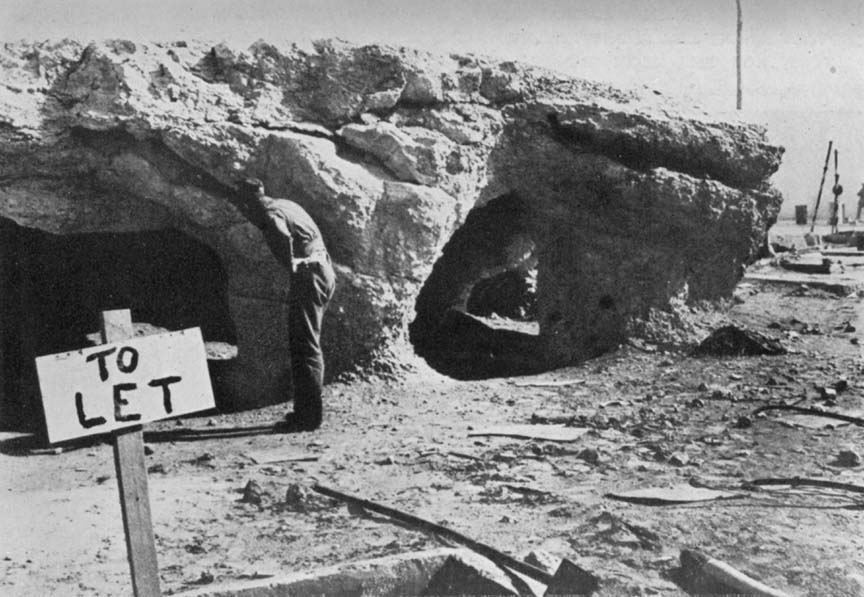
THESE CAVES ON THE FORESHORE WERE PART OF THE LOCATION OF CRAWFORD'S COMPANY WHEN THEY WERE ON GARRISON DUTY IN TOBRUK. WHEN TOBRUK WAS CAPTURED BY THE ENEMY DURING THE RETREAT TO ALAMEIN A COMPANY OF GUARDS MADE THEIR LAST STAND HERE.
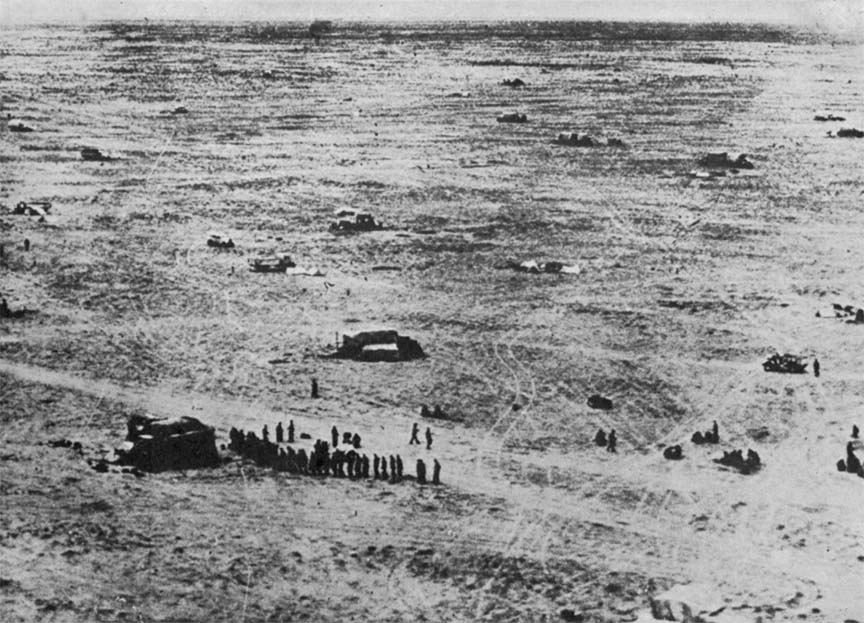
THE R.A.S.C. PLATOON COMES TO REST FOR THE NIGHT. NOTE THE LORRIES DISPERSED IN PAIRS, SO THAT A QUICK GETAWAY CAN BE MADE IF THE ENEMY ATTACK. NOTE THE COOK-HOUSE IN THE FOREGROUND
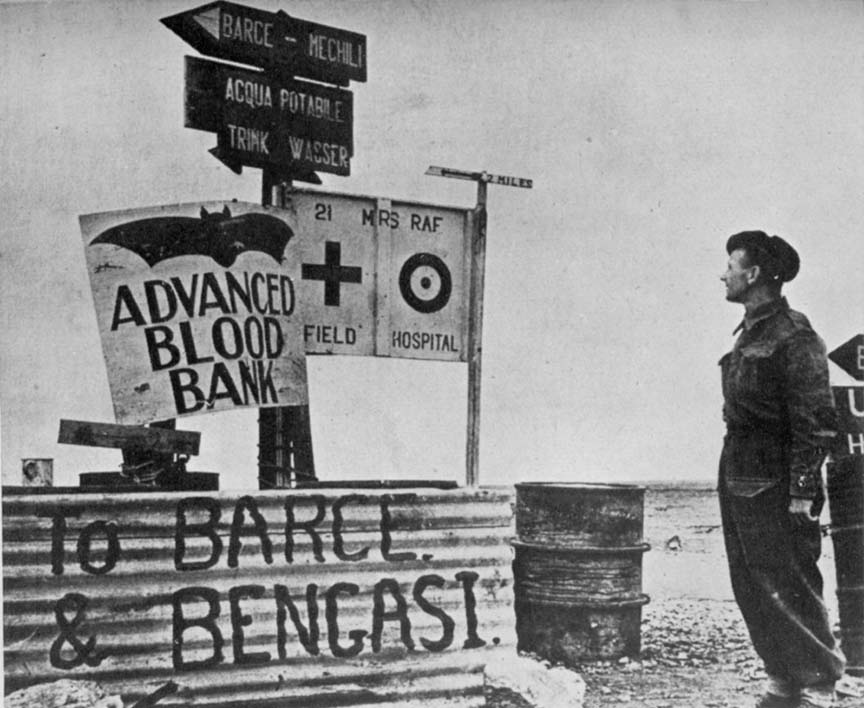
BRITISH SENSE OF HUMOUR OFTEN APPEARED IN THE SIGNS ERECTED AT FAMOUS DESERT CROSSROADS. ONE OF THE MOST HIGHLY DECORATED IS SEEN ABOVE. THE "ADVANCED BLOOD BANK" WHERE BLOOD FOR TRANSFUSIONS WAS STORED
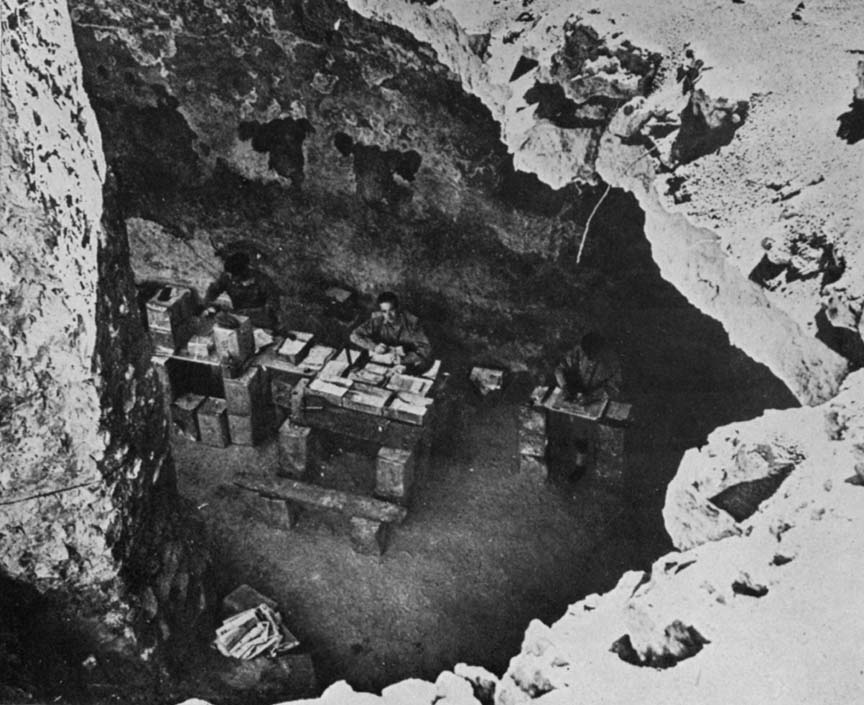
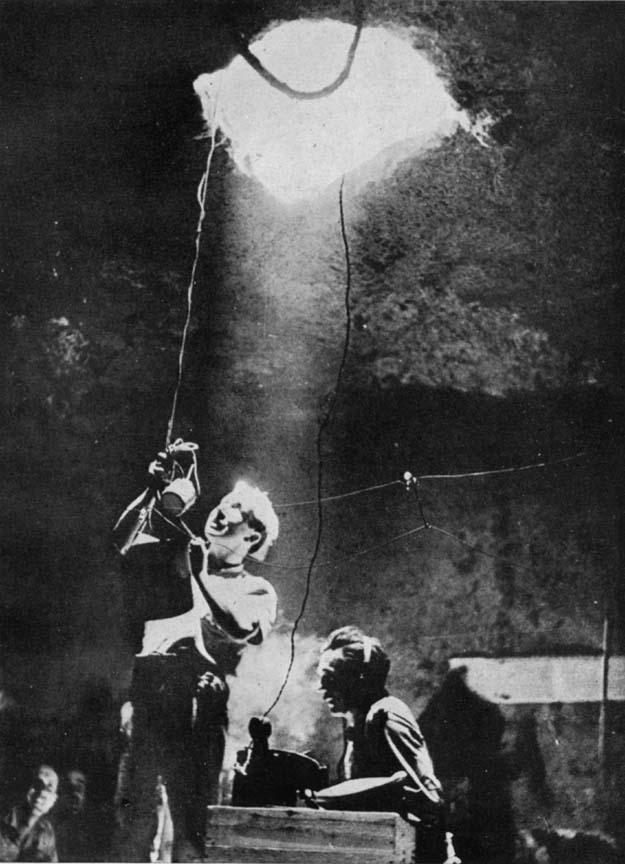
ONE OF THE STRANGE PLACES USED BY THE ROYAL CORPS OF SIGNALS OPERATORS IN THE DESERT---OPERATORS AT WORK IN AN ANCIENT CATACOMB. THE OPERATORS ARE COLLECTING THEIR DINNER
Some of the-stories of men who survived were remarkable. They had lived for days by putting out their equipment at night and allowing the dew to condense on the brasses in the morning. By licking off this dew, they had managed to keep alive. Others had used the same expedient with stones lying on the ground.
One of the most galling experiences we had was when we had spent half a day unloading our supplies, only to be driven off by an enemy patrol. As we retired we watched them breaking into our stores. This happened quite frequently, and I heard similar stories of how we had done the same thing to German dumps, so that the score probably finished fairly even.
During all these trips there were constant attacks by divebombers and Messerschmitts. These were bad enough when the column was at rest, and you could hear or see them coming. But it was much worse when the first indication you had of an attack was when the lorry in front of you blew up or the bullets smacked through your own windscreen.
When this happened there was no time for talking. Our instructions were to get out of our lorries as quickly as possible and seek safety in some dip in the desert or behind a boulder.
We became quite adept at leaving lorries in the shortest possible time. The normal procedure was this: As soon as we realised an attack was being made, we pushed the lorry out of gear, opened the door, punched the co-driver wherever one's fist landed so that he rolled out into the sand, grabbed one's rifle and ammunition and hurled oneself away from the still-moving lorry.
This takes longer to tell than to do ! It used to be a funny sight ---in retrospect, anyway---to see fifty or sixty lorries trundling along under their own momentum with the drivers sprawling in the sand in all directions.
As the co-driver was normally sleeping while you were driving, the near side door was always left ajar so that the co-driver could be "knocked out."
He never complained, however much your fist hurt when it landed!
This procedure was considerably different from what we had been taught at home. But the attitude was that while a lorry and its load could be replaced without too much difficulty, it was almost impossible to replace men. And as the aircraft were obviously attacking the column, it was safer to get as far away from the column as possible.
Therefore, whatever the "book" might say about the drill, the only logical answer was to act as we did.
It was probably not the "heroic" answer, but it certainly was the most efficient, and heroics were not looked upon with a great deal of favour. Some people might even say heroics were rather stupid under those circumstances.
After a month of these trips between Tobruk and the area around Gazala and Knightsbridge, my company earned the title of "The Greyhounds." I think we deserved it too, for we had been one of the most reliable, the fastest and probably the luckiest company then operating in the Western Desert. Our casualities were, up to that time, extremely low. It was not always to be so.
We came back to Tobruk after a particularly nasty run during April, 1942, to find that one of our men had tried to commit suicide. Gradually the reason for this leaked out. Apparently he had received a letter from his wife saying that she wanted a divorce, as she had fallen in love with another man.
This story completely unsettled our own company, and another company nearby, for several weeks.
I wonder if wives and sweethearts at home would do those sort of things if they could realise the almost criminal consequences that result from such an action.
This case was one in point. No sooner had the story spread, and probably developed in the spreading, than the whole company went into a deep depression. Even if most of us did not say it aloud, we thought to ourselves whether, perhaps, our own wives and sweethearts were doing exactly the same thing.
With mail as infrequent as it was, these doubts and uncertainties were by no means far-fetched. In fact, when one realises that most of us are fighting for our wives and sweethearts, more than for anything else, it may help you to appreciate what I mean.
Whenever men's conversation turned to home---and there was little else to talk about---one talked of all the rather silly little things that one had done in civilian life. Most of us told how we had met our wives and sweethearts, how we had married or intended to marry them. Those of us who had children told of what the children looked like and the funny things they did---if we had been lucky enough to see them.
Our lives were, in all conscience, bound up with thoughts of how we had lived at home and when we would live at home again.
So it was natural enough that, living in that wilderness, when this sort of news arrived men would grow suspicious of their own families, and the canker, thus sown, would go on spreading for week after week.
Most of us, of course, had particular friends, and to these we used to talk about these doubts. Usually, this produced a reassurance and we were able to convince each other that our doubts were rather unnecessary and even unfair. But there were some men who, living in the isolation that we often did, even then did not make friends. They always seemed to be just on the outside of everything. I often wondered what these men thought when troubles, such as I have described, broke out among the troops.
Domestic troubles cost us many lives. A look-out man, spotting aircraft for a column in movement, would let his mind wander to his domestic troubles, neglect his job, and perhaps cause the loss of the lives of twenty or thirty men through failing to notice oncoming aircraft. A man would drive into a minefield through absent-mindedness---sometimes, because he intended it to be that way.
The immense importance of this problem is probably not realised higher up in the Army, because it was only in desperation that a man reported these facts to the padre or his officers Normally he would brood over it until he could hold it no longer, and then tell his "mate."
Sometimes the news did leak out to officers and they were able to understand why a company had gone to pieces almost overnight without any apparent reason.
While we were in Tobruk we were able to piece together some of the trials which the Garrison had to put up with during the siege. These stories were told me by the survivors in the most dispassionate tones as though they were talking about the most everyday occurrences.
The story I remember most keenly is how the infantry and Engineers found the mines for our own protective minefields around the Tobruk perimeters.
The only mines available were occasional shipments into the besieged port. Other than that, the only nearby supply was the mines held by the enemy. These infantry and Engineers used to make nightly sorties through the German lines hunting for mines. No sooner had they found them than they carried them back to Tobruk and then relaid them as part of our own defences!
This sounds very simple, but many of the men who went out on those expeditions never came back. The Germans were also patrolling at the same time, and they were soon aware of our tricks.
The Garrison of Tobruk was never a purely defensive force. Even though they were held by a German-Italian force of five or six divisions, the Garrison struck out continuously and on one famous occasion returned with three thousand prisoners. That was a red-letter day for Tobruk.
The suffering of the men who held the forward positions in the defence cannot adequately be told. They were continually strafed from the air and, as they were always under observation from the German force holding the escarpment about Tobruk, they could not even move during the hours of daylight. Day after day men lay motionless in their roughly hewn holes in the ground. The slightest movement brought fire from the enemy. At night they exercised themselves in readiness for another day of "playing at statues," as they described it.
Tobruk lived at a peculiar ration scale, which was called the "Fortress" ration. This would normally have been fairly adequate for even a seven months' siege, as it was halfway between the bully beef and biscuit hard ration and the full Field Service ration, which consisted of varieties of meat, bread and tinned vegetables. Fresh meat was sent in to the Garrison in an amazing fashion. The ships would approach Tobruk Harbour carrying live sheep. The animals were then "launched" into the harbour, and made their own way ashore A surprisingly high percentage of sheep reached the Garrison in this manner.
Unfortunately, the store of potatoes and subsequent replacements were destroyed by the enemy. There was no butter available, and the margarine, it was later discovered, was deficient in vitamin A.
The result of this was that there was a high incidence of desert sores among the Garrison.
Some of the bravest men in Tobruk were those who climbed the high ladders erected as observation posts for our artillery. Owing to the nature of the ground, this was the only way the Garrison could observe activity in the enemy lines, away on the higher ground of the escarpment.
Offensive patrols from the Garrison varied greatly. There were the small patrols of two or three men who went out each night to find out information about the enemy dispositions. These men were highly trained, and were soon able to move about in no-man's-land in the darkness as well as most others could do in daylight.
Then there were the fighting patrols of ten or twelve men, who went out to take prisoners, upset the enemy's defence, or carry out acts of sabotage.
Another man told me how the Garrison came out to join the relieving force of New Zealanders at El Duda, south of Tobruk. There was a welter of congratulations when the forces met, but within a few hours the Germans had re-taken El Duda, and the Garrison was once more isolated until we recaptured the place.
This man gave me a dramatic account of how the Africa Korps retook El Duda.
First of all, the Germans brought their tanks up behind a screen of 88-mm. anti-tank guns. They halted and deployed just outside the effective range of our 2-pounder anti-tank guns. They then lobbed shells from their longer range 75-mm. tank guns and 88-mm. anti-tank guns, until they goaded our own anti-tank guns, one by one, to reveal their locations. Having accomplished this, the Germans turned all their guns on to the sites where they had pin-pointed our own weapons, and within an hour or two they had knocked out nearly all our guns.
At this point, the German tanks overran our positions, and played havoc with the infantry in their poorly dug, narrow slits in the ground.
It was a bad day for us, but further counter-attack brought El Duda once more into our possession, and we did not lose it again until June, 1942.
This counter-attack, my companion told me, gave the lie to tanks being unable to fight at night. Actually, El Duda was retaken by us in a surprisingly successful night attack by tank formations. The Germans were so surprised that our casualities were extremely light.
At this time, during the early summer of 1942, we continued our daily trips to and from the forward troops around Gazala. Frequently, we brought back batches of prisoners, both German and Italian, which our patrols had taken during the night. One batch, numbering three hundred Italians, had been captured by one man with a rifle.
One day we had an amusing scene in the prison pen at Tobruk. We had brought in several hundred Italians during the morning, and issued them with the regulation two blankets. In the afternoon another column brought in a hundred or two hundred German prisoners. We found that we did not have enough blankets to give the Germans two each, so we had to give them one each. Within a few minutes of the distribution of blankets being completed there was an unholy row in the pen. The battle ceased: the Germans had three blankets and the Italians none! An old German custom !
Whenever an Italian prisoner approached a German, the latter usually snarled at him. There was never any mixing between the two races.
The Germans looked quite fit, but how they did so baffled us all, because they continually remarked about the fine quality of our food, even when this was only bully, bread and margarine ! We discovered from them that there was no butter or margarine element in their normal ration scale. The only fats they appeared to get were from chocolate, which was issued on a fairly liberal scale.
They were a curious mixture of arrogance, belief in Hitler, and surprise that the British had ever gone to war with them. They openly boasted that they were the finest soldiers in the world, and then added that the British were easily second best.
Some prisoners surrendered, walking forward with a dirty white flag, and then when the British walked up to meet them, they flung grenades at them. The retaliations were very prompt!
A sense of humour does not always pay on a battlefield, as the following incident shows:
This was when the enemy, having captured a Gurkha, shaved him and sent him back to the Gurkha lines. Shaving is, of course, against the Gurkha religion and is considered one of the greatest shames which can befall them.
After telling his comrades what had happened, the Gurkha is alleged to have committed suicide. For the whole of that day the British officers were only just able to restrain the Gurkhas from going out for the enemy. The British officers cajoled and finally threatened the Gurkhas with all kinds of punishment unless they stopped this idea of "finding" the enemy troops opposite.
When night came the Gurkha lines emptied as though by the wave of a wand, and nothing was heard for some minutes. Then a great hullabaloo took place in the enemy lines, and the Gurkhas stole quietly back to their old positions. It was never known how many of the enemy died that night, but a whole company of Gurkhas had been out and the enemy dead must have numbered several hundred.
Another " friendly" habit of some of the enemy was to rob all prisoners of everything in their possession, even their pay-book, which was the prisoners' only means of identification. The better-trained troops never did this. They held your pay-book and took any letters and documents you had, but invariably left your money and personal belongings.
It was not surprising that the Italians and Germans were uneasy partners. They had absolutely nothing in common. Their whole outlook was totally different.
There was a persistent rumour, round about this time, that the enemy had driven some of our soldiers into an anti-personnel minefield at the point of the bayonet. While this may or may not have been true, some men claim to have known these British prisoners, and one man was reputed to have been rescued and taken to hospital with both legs blown off.
I never knew the truth of the story.
One of the most interesting and exciting jobs we had was to take Indian troops behind the enemy lines on night patrols. There is no doubt that the Indian is easily the finest night-fighter in the world.
My first experience was when we were ordered to report to a Sikh regiment near Knightsbridge. Six of our lorries reported in the evening and took on board some sixty Sikhs. We were given a compass bearing and we set off into "the blue" and drove steadily south-westwards for four hours. Then we were given a new compass bearing to the north and we then judged we were behind the enemy positions. After another three hours' driving we received orders to halt. As we stopped, the Indians filed out of the lorries and in complete silence moved away into the darkness. Not a single word was spoken, yet these Sikhs moved away as though they knew exactly where they had to go. None of them had been in this place before, as far as we knew.
Our job was to stand by the lorries with the engines ticking over, ready to dash off into the night immediately the Indians returned. We usually had plenty of warning about this.
This night they had been gone about half an hour when bedlam broke out some quarter of a mile away. Bullets, and tracer bullets, flashed through the night. Several went through the lorries as we stood around, but fortunately none of the men were hit. From the wildness of the firing, it was obvious that the enemy had been surprised. It was about ten minutes later when the Sikhs returned and climbed back into the lorries. There was not a single man missing and from first to last they all arrived within three minutes, although it seemed an endless three minutes to us. Then we "belted" full out across the Desert until we were out of earshot of the enemy, who were still firing wildly long after we had gone.
This was the first of many similar trips. The work was never detailed to any specific individual. It was all part of the day's work; one night it would be one section and the next night another. I don't think we ever had a single casualty from these operations, yet the Indians must have killed many hundreds of the enemy and destroyed much valuable supplies, even, in our little expeditions.
The most exciting night was on my third or fourth trip when the Indians fired a German supply column well in the rear of their forward areas. I suppose this was twenty or thirty miles behind the enemy positions.
The Indians had hardly left us, it seemed, when the night was broken by enormous explosions and fires. In a moment night was changed to day and we could see the whole encampment, as the flames sprang up. We did not stay very long that night, as our lorries must have been easily visible to the enemy.
Nevertheless, it was an extraordinary sight and a very successful expedition.
We had an amusing sidelight to the war just before we left Tobruk. One of our sergeants had seen a letter in the Daily Mirror asking if someone would be kind enough to send a dartboard to the writers. The signature on the letter was " Lonely Outpost," and was from a gun-site which the author said was no fewer than three miles from the nearest village and five miles from the nearest public-house. Our sergeant collected 10s. from us and sent the following letter to the Daily Mirror for onward transmission to the "Lonely Outpost":
"DEAR LONELY OUTPOST,---Please find enclosed ten shillings with which to buy a dartboard for you at the 'Lonely Outpost.' We can appreciate how lonely you must be, three miles from the nearest village and five miles from the nearest pub.
"We are three hundred miles from the nearest town and five hundred miles from the nearest pub.
"DESERT RATS."
text, continued