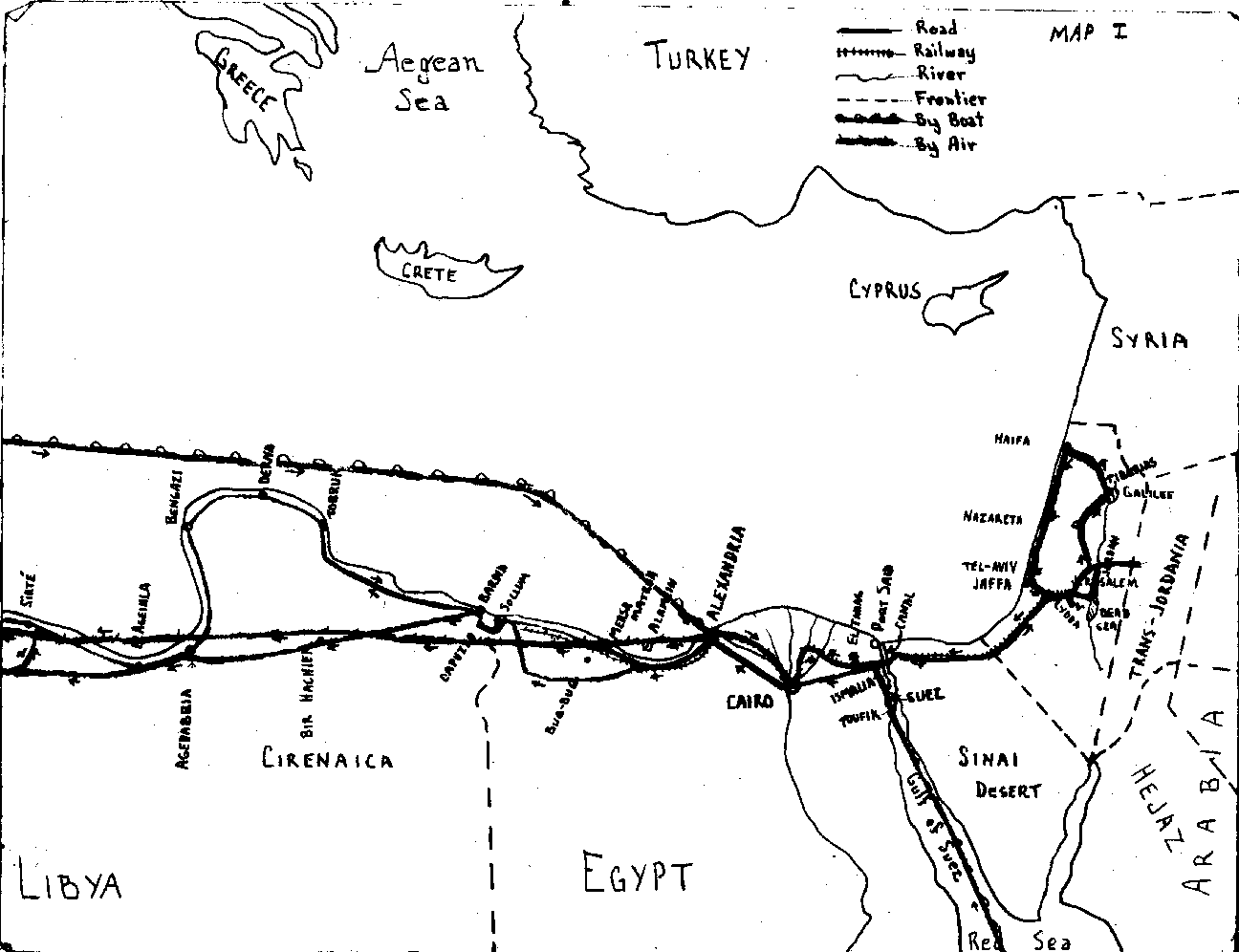
October 23, 1942, shall long remain in my memory as one of the most important dates in the history of World War II. For it was on the night of that day the great battle of the Alamein line began---a battle which started the victorious march of the Eighth army---and it was also on that day that I got my first taste of genuine land warfare.
We had for some weeks known that the army was preparing for a big drive. During our stay at Kilo. 121 on the main supply route from Cairo to Alexandria and later when we were stationed on the coast road west of Alexandria, we had seen convoy after convoy of trucks, tanks on their long trailers, and all forms of the supplies of war moving forward.
For 110 days the British army had held the enemy at bay in the area a few miles from a little railway station near the coast road known as Alamein Junction. This was an ideal spot in which to hold him. The soft sands of the Qattara depression only forty miles from the coast made. a very short front in which warfare was practicable. It was only seventy miles from Alexandria, too close for comfort, but the army's supply lines---a very considerable factor in desert warfare---were short enough to facilitate quick movements of supplies from docks to front lines.
Heavy and medium bomber bases were good in the delta area and they were near enough so that the Allied air forces under the direction of Air Vice-Marshal Sir Arthur Coningham could work in close conjunction with the needs of the ground army. And work they did. For almost a week before the battle began, flights of eighteen bombers came over almost hourly to pound the German and Italian forces and supply routes. The men of the Eighth army who had lived, fought, and retreated under the former air superiority of the Luftwaffe watched these flights go over the line with keen pride and admiration and they heaved a long sigh of relief. "The bloody shoe's on the other foot, now," they said with a grim smile of pleasure.
The Eighth army, before the smashing attack across Libya of the Afrika Korps, had retreated pell-mell down the escarpment at Halfaya Pass and back into Egypt. In what was perhaps one of the speediest troop movements ever seen in the Middle East, the New Zealand division was brought down from Syria where it had been resting and was thrown into quickly prepared positions at the narrow front near Alamein Junction. On July 5th they had brought the enemy up short nearly single handed. In the 110 days that followed, the Eighth army was reformed, the line was strengthened, and the supplies which were beginning to arrive from the United States in bulk now were put in readiness for the attack which began on October 23rd.
Along this front now poised for the battle were Australians, Highlanders, New Zealanders, South Africans, Englishmen, Indians, and Free Frenchmen, The Royal Air Force, parts of the Royal Australian and Royal New Zealand air forces, the South African air force, the USAAFIME (United States Army Air Force in the Middle East), and even some few Free French airmen were over the front in continual sorties. As much artillery as could be gathered was brought into position. Even the crack artillery group of the British Fifth division, which was then moving from Madagascar to India and later to the Russo-Persian border to stem a possible German breakthrough in the Caucasus, was sent to the desert front. Quietly, thoroughly, powerfully, the Eighth army was being poised for the attack. General Montgomery's message, read to all troops on October 22nd, wished them "Good hunting!"
On the afternoon of the 23rd, Alex Parker and I were sent back in an ambulance from the New Zealand Main Dressing Station, (MDS) on the coast road some thirty miles from the front to a Casualty Clearing Station (CCS) just east of El Hammam to pick up some blood plasma. We hurried on our trip for our section of five cars was to be assigned later in the day to a New Zealand Advanced Dressing Station (ADS), forward of the other cars at the MDS, and we were afraid our trip might keep us away so long we would miss the coveted assignment. The vital bottles of blood, stoppered with rubber condoms and packed in straw-lined cases, were ready for us when we arrived. We loaded them into the ambulance and sped back to the MDS. Two of the cases of blood were for the ADS, which was supposed to pick them up from the MDS in the afternoon when it moved forward into the line. We waited with the cases in our ambulance until late in the afternoon but no one called for them.
Our platoon lieutenant, Evan Thomas, son of Norman Thomas, decided that we had better deliver the blood to its destination. It hadn't been called for and, with the big battle scheduled for the coming night, it had to be delivered immediately. Without it the Advanced Dressing Station would have been badly handicapped. Men, to whom transfusions meant life, would have died. So in the late, hours of the aftêrnoon, we started forward, Lt. Thomas, Alex Parker, and I, to find the New Zealand ADS.
Lt. Thomas had the map reference for the ADS and we headed for that position. We drove forward along the coast road past Sidney Road, branching away southward, and turned south ourselves along Springbok Road. We crossed the railroad tracks at Alamein Station and turned westward again on Hat Track. These tracks were a mere gathering of tire tracks running between mine fields and marked by pieces of metal cut in the shape of their name-object and nailed to poles along the "roadside." The ADS was supposed to be on Hat Track. We travelled the length of the road and saw no signs. of it. It was beginning to get dark. The sun had long since, set behind the German-positions and now the black pre-moonrise darkness was settling down around us. At the spot mentioned in the map reference there was nothing. We asked people in the area. No one had seen the New Zealand ADS.
We drove north and south on Qattara Track, and then east and west on the lateral Sun, Moon, Bottle, and Boat Tracks. The ADS was nowhere to be found. The tracks weren't always plainly marked and weren't designed in straight lines when they could be followed for a short distance. Minor trails frequently branched off them with no markings. It was very dark and of course we could not use any lights. It became a little confusing, to say the least. We were following Qattara Track southward, and, unknown to us, its southern end curved over into the German position. We were looking for someone to ask for the location of the ADS, but the road was vacant. Finally we came to a group of infantrymen marching single file northward in full battle equipment. We stopped.
"Say, have you seen any signs of the New Zealand ADS around here?" I asked them from the front seat.
"Not around here," one of the soldiers said. "And they're not likely to be any further down this road. The next thing you come to on this road is Jerry. We just been on a patrol down there."
In very short order, that infantry patrol was left in the darkness behind us, for we turned the car around in record time and decided on a more conservative policy of returning to the point indicated by the map reference and waiting there until we could discover what had become of the ADS.
When we arrived, the supposed location was still vacant. Not far away, Lt. Thomas discovered a South African ADS and the medical officer there told us that the New Zealand group hadn't yet moved in. So we clambered down into the dug-out South African dressing room and waited.
The battle was scheduled to begin with an all night long artillery barrage to open up at 9:40. At 9:35 all was quiet. We sat around discussing the coming battle with the medical officer. Suddenly the earth seemed to shake to its core. We were momentarily deafened by the guns as they opened up. Brilliant flashes of light sparked ferociously behind us to the east and all up and down the front. The sturdy and hard-hitting twenty-five pounders and the larger medium let go with their fearful medicine. All of us automatically ducked when the first thunder of the guns pealed the opening of the battle. A bottle had suddenly appeared in the South African's hand and he said, "I guess it is about time for us to have a drop of Scotch." We gratefully had the drink and then went outside to watch the big barrage.
The guns flashed and bellowed to the east, and over our heads we could hear the almost continual whine of the shells soaring off into the darkness toward the German positions. In the distance to the west we could also see the sharp points of light momentarily breaking the darkness where the shells were landing. Once or twice in the beginning a shell whined and carrrumphed near us, but the intensity of our own barrage kept most of the Germans in their holes. I, in my baptism to battle, was shaking in my shoes from the great noise, the excitement of this memorable moment, and no little from honest fear. I was just as glad the Germans couldn't and didn't return the barrage.
When we climbed out of the South African ADS, the almost continual flashes of the guns lit up the countryside and we saw large three-ton trucks and Austin ambulances, with the big red crosses on their sides, moving into the area nearby. It was, we soon found out, the long overdue New Zealand ADS. It quickly set up and, much relieved to know that the blood was where it was supposed to be at last, we unloaded the two cases. The barrage continued in all its melange of light and noise. Lt. Thomas advised us to try to get some sleep for we would probably be working in the early hours of the morning. Alex Parker and I got out a pick and shovel and dug slit trenches in the hard sand. Into these we threw our sleeping bags and ourselves on top of them and pulled a blanket on as a cover. The guns shook the ground and small rocks and chunks of sand crumbled off the walls of our slit trenches and rolled into bed with us. This was one of the most intense barrages of any war.
Sleep, if we got any at all, was fitful and in piecemeal. The sharp reports of the guns nearby and the rumble of those in the distance up and down the line finally died away into an unreal silence around 3:30 in the morning. I lay on my back in the slit trench listening to the last echos ring their way into time, distance, and the future pages of history. The moon was full, swinging slightly toward the west. The guns had ended and the infantry would be charging the German positions now. Soon the casualties would be coming in.
I rolled over to try to get some sleep. The guns continued to echo in my ears.
Suddenly a voice very near me in the dark called out, "Where's the driver of this ambulance?" It was an orderly from the ADS. "The casualties are beginning to come in, so you'd better get over there ready to go out."
Alex and I scrambled out of our holes and drove over to the evacuation tent. It was four o'clock and still dark. Almost immediately our ambulance was loaded with the wounded of battle.
That first trip through the dark over the bumpy tracks with badly wounded men numb and vomiting from the morphine that killed the pain of their wounds, with live blood dripping into pools on the ambulance floor, is one I shall never forget. Since then I have seen many battle casualties, some of them more badly wounded and mangled than these, but the horror of war has never been so firmly planted in my mind as it was on that first trip. Ambulance drivers definitely see the most unpleasant side of the war.
All that day and far into the following night our work continued. We drove over the tracks to the coast road and then back to the MDS. There we unloaded our patients and quickly returned to make another run. The tracks soon became almost hub-deep in dust. Water trucks ran up and down them with all their faucets open. The dust churned up by the trucks and tanks travelling over the tracks made the road easily discernable to enemy artillery.
For the next eleven days the battle continued unabated. Our work was steady, although not as rushed as it was on the first two days and nights.
We had started our battle experience with the New Zealand division and we served with them almost continually through the winter. I came to know these soldiers intimately. They impressed me as being the product of an ambitious frontier people with all the rugged individualism, religious homeliness, and determined bravery, character, and democracy that characterized our own early settlers of the American West. They treat their native Maoris (a battalion of Maoris were in the New Zealand division) as their equal and often their better. And when a British army camp puts up two latrines, one for Europeans and one for Non-Europeans, the Maoris don't give their bronze Polenesian skin a second thought and quite naturally use the latrine for Europeans. If a Britisher were to object, he'd find fifty New Zealanders on his neck, English descendents and Maoris alike.
As soldiers, the New Zealanders, or Kiwis as they are called, are some of the bravest in the world. These frontiersmen have an utter contempt for the dangers of war. The bumptious, fun-loving, strong-hearted Maoris in war remember the heroism of their South Seas ancestors. And when these soldiers charge into battle with the moon glinting on their bayonettes and the blood-curdling yodel of the ancient Polenesian war-chant, the haka, on their lips, the German forgets his leader and his heart turns to stone.
An incident that happened during the early days of the Alamein battle will show what these men were like. I left the ADS carrying two stretcher patients and four sitting wounded. All of them were privates except the man in the lower stretcher, a major. On the
drive back to the MDS, one o the sitting privates who was wounded in his arm and chest, became violently ill from the morphine shot he had been given. I stopped just in time and helped the man out of the car. When he had finished vomiting and we turned around to get in the ambulance, I found that the major had crawled out of his stretcher and was sitting in the sick man's place.
"Let that man have my stretcher. He's worse off than I am," the major said. The sick private gratefully accepted and crawled onto the vacant stretcher.
The major, earlier that day, had been riding in a jeep. The jeep had received a direct shell hit. The major's feet had been badly burned and he had several shrapnel wounds. All during the remainder of the trip to the MDS he had to sit with his feet held off the floor. It must have been painful in the extreme for him to ride in a sitting position but he said nothing.
"Let that man have my stretcher," he had said, "worse off than I am."
On one of the runs during the exhausting first two days of our work at Alamein, I aided the ADS orderlies in loading my ambulance with four stretcher casualties. The last one to be put in was a big Maori. He had been quite seriously wounded and was obviously suffering from shock. We got the litter in and I hopped into the driver seat. The Maori raised himself painfully on his elbows and looked around at me.
"Driver?" he said. "Who's driving this ambulance?" He looked at me for a moment and before I could answer, he said, "Oh, you're an American. I know I'll be all right then." And he let himself down on the stretcher again with a sigh. His remark affected both me and my driving.. I had more confidence, for some reason, and I felt less tired.
The air force played a major part in the Alamein battle, for it was really in this bitter struggle the Germans first came to realize that the Allies were beginning to gain air superiority in both numbers and quality of fighters and bombers.. Fighters patrolled the front during the battle and we saw many dog fights. The planes, diving and banking, twisting and turning, would try to get each other in their gunsights. Then would come the distant rat-a-tat-tat and one plane would stream a long wake of smoke as it dove out of control. Sometimes a parachute, like some high sailing bit of thistledown, would appear and float very slowly to earth.
Dog fights were exciting things to watch. Any fight to the death is exciting to watch when you can see only machines versus machines. When you see one-plane shoot down another, an anti-aircraft gun make a direct hit on a low-flying bomber, or tanks in the distance maneuvering, lashing tongues of flame at each other, whenever you see machine against machine you feel a sudden exhilaration, a moment of intense excitement. It is only when you can realize the human factor in such a contest that you shudder. Only when you see the charred or broken bodies of pilots and tank men and can suddenly sense by your nearness to these men the present pain and suffering, the remembrance of peaceful pleasures of the past and the hopes and plans of a future that may now never exist, only when you can realize these things do you know that this isn't a battle among machines, that war has very little glory, and that Sherman was right.
The Luftwaffe, however, didn't give up without a struggle. When our superiority in numbers of fighter craft became apparent, German fighters were used only in defensive action. They couldn't afford to lose too many of their Messerscthmidt 109's so they provoked few air fights. Their bombers were largely used at night when anti-aircraft gunners couldn't see them. The plane used most by the Germans in daylight ground assault was the Stuka dive bomber. The loss of the pilot was more serious than the loss of these planes. The Stuka, with its nonretractable landing gear, was easily recognizable. It no longer was a very valuable design for anything but dive bombing. It was slow and very lightly armored, a very easy mark for any Allied fighter.
But the Stuka was agile at sneak raids. Our fighter patrols would be flying overhead one moment and as soon as they were out of sight, particularly during the waning hours of daylight, the Stuka would appear, circle picking a target and dodging anti-aircraft fire, and then dive, drop a bomb, and disappear. These last few moments of twilight became known among the troops as "Stuka Time. "
Near the ADS at Alamein was a light Bofors antiaircraft battery. One of the members of the crew had picked up a chameleon and was keeping it for a pet. It was a strange reptile, its skin changing color to match the background, its eyes---round holes in scale-enclosed bulges---working independently of each other, its long tongue flicking out to catch an unwary fly. I had never seen anything like it before and I told Dick Christian about it at supper time.
Dick, a member of our section from Woodland, Michigan, wanted to see it, so after supper we walked over to the Bofors battery to have another look. It was, of course, about Stuka time. And sure enough, we heard the drone of planes approaching our part of the line. Seven of the dive bombers circled overhead. Dick and I dove into some nearby slit trenches as the Bofors battery opened up. The sky was full of anti-aircraft tracer shells, bursting all around the Stukas.
Suddenly one of the planes tilted down toward our gun and dove with its sirens open making a weird wailing scream. The earth shook with the explosion and everything went black. The bomb had landed between the gun and the ADS and it threw up a vast cloud of smoke, sand and dust which turned the twilight into night. Pebbles and shrapnel, thrown into the air, came clattering down around us.
Dick and I leaped out of our slit trenches and ran to the nearest ambulance. The other dive bombers had flown north of us a short distance where tank and ammunition trucks were dispersed. More bombs had fallen there. The bomb that landed near us had done no damage. With Dick in the driver's seat, we sped over to the tanks. Tankmen were just crawling out from under the dispersed Shermans, Grants and Crusaders. We inquired and found that the bombs had hit nothing here. But still further north we could see that the Stukas had been more lucky. An ammunition truck had been hit and fiery explosions and bursting tracer shells marked the spot. We headed he ambulance in that direction and started off.
Suddenly we were stopped by two jeeps that converged on us from different directions. They had picked up men wounded by the bombing. We put them in the ambulance: three on stretchers and one sitting next to the driver in front. I sat on the fender and we started for the ADS.
One of the patients on the stretchers was in intense pain, so we stopped and, as it was now quite dark, we turned on the interior light in spite of the blackout regulation. I climbed in to see if I could do anything for him. A bomb-splinter had gone through his arm just above his wrist, breaking both bones. The shell dressing that had been tied on over the wound by whoever first found him was so tight it squeezed the broken bones together painfully. I cut it and retied it more loosely. That seemed to relieve the pain, so we drove quickly back to the ADS.
This raid was typical of the Stuka sneak raids at Alamein. They came over frequently, dodging in, dropping their bombs, and ducking out again. But none ever came as closely to us as did those seven.
British aircraft were given one assignment which, to my knowledge, was unique in modern warfare. Before and during some of the tank battles at Alamein, they flew near the German tanks playing popular dance-recordings over radio sets adjusted to the German intertank radio communication wave length. The German tankmen, listening for orders and warnings from other tanks, could hear nothing but a mumble drowned out by the music.
Devices to fool the enemy were used often at Alamein and were one of the major factors in making the power and time of the attack a surprise and a success.
The practice of disguising tanks as three-ton trucks and three-ton trucks as tanks was used cleverly and extensively. I shall never forget the surprise I got one day when I overtook a slowly moving truck and found the clattering treads of a tank showing under the skirts of the disguise.
Before the battle, hollow canvas shelters, constructed to look like trucks, were parked at intervals along the supply route to the front and tanks, moving forward by night, would spend their days inside them. Daily enemy aerial reconaissance showed static car parks with what looked like trucks in them and nothing more. Rommel never knew how many tanks were opposing him until he felt their weight in battle.
Recordings of the sound of tanks, a great many tanks churning through the sand, were also made. On dark nights, these recordings were played over loudspeaker systems on one sector of the front.. In the morning, British air photographs would show German antitank equipment massed in that area.
For eleven days the battle of Alamein raged.. Strong infantry attacks pushed the front slowly backward. Artillery and bombers destroyed much of the German-equipment. The line bent inward dangerously for the enemy. It reached its elastic limit and snapped. Into the break plunged an armored division followed by infantry. The German positions crumbled. From then on, the North African war was a test of mobility.
The long trek which began for us at Alamein was indeed a matter of the comparative efficiency in mobility for the two opposing armies. The enemy, apparently, was less prepared for a running battle. Great numbers of Italians on the southern front were left without sufficient transport by the Germans who needed all they could get to move themselves. The Italians, who had no alternative, surrendered. They were, according to all reports, pretty put out by being left in the lurch by their brothers-in-arms.
When the long trek began, we were still assigned to the New Zealand Division which plunged into the hole in the line hot on the heels of the armored division. Our Advanced Dressing Station was supposed to travel independently at first and catch up with its brigade just beyond the break-through. The Kiwis were off on the first of their oft-times repeated encircling moves. We were to travel fast westward and, then cut up to the coast road near the Egypt-Libya border and encircle as much of the fleeing German army as possible.
The brigade to which our ADS was attached travelled fast indeed. When we reached the hole in the line we found much traffic on the tracks, but there was no sign of our brigade. Because we were driving along these tracks, we had to join in with the vehicles going through at the time We followed them for some time, hoping to catch up with the speedy brigade as soon as possible.
After several hours, one of the New Zealand officers decided the convoy was going in the wrong direction. He drove up to the head of it and found it was being led by a Y.M.C.A. mobile canteen truck. The driver said he was just following a track which seemed to him to be going in the right direction. An inspection of a map showed the track running into the German flank defenses near Daba. The ADS officers quickly set off on a more southerly route. The plans of battle did not call for a separate encircling move by the lone ADS, some transport vehicles and a Y.M.C.A. truck.
That evening we caught up with a brigade of the armored division and we spent the night in the midst of a convoy of tanks. We felt comparatively safe with such a strong defense surrounding the ADS, but we still had not found the New Zealand division. The next morning we set out with the armored convoy and travelled some distance before one of the officers, through his field glasses, discovered the New Zealand brigade in the distance to the southwest. We joined them and, as we were all still on the move, the patients they had were put into our ambulances. Into Alex Parker's and my ambulance came two wounded prisoners on stretchers, one a German and the other an Italian. Alex, who had spent several years in Munich and could speak German fluently, could communicate with the German prisoner. He was only slightly wounded. Our conversation with the Italian, however, was limited to his frequent .demands for "aqua" which we could understand. He had been wounded in the arm and the Italians who had left him behind fifteen hours before had put on a tourniquet which had not been released since then. His arm, of course, was swollen badly and discolored. The medical officers who looked at him said that if the tourniquet were released now the poison collected in his arm entering his whole system would kill him. An amputation as soon as the convoy stopped was all that could be done for him. The German, a tall hawk-faced man, was considerably worried because he had no money with him. He asked us what was to be done with him, whether he would get paid as a prisoner, and where he was likely to spend the rest of the war. Unlike most German prisoners, he did not seem particularly disturbed by the fact that he was a captive. He offered us cigarettes from a small leather case with a picture of' his wife pasted to the inside and containing several oval cigarettes of Greek manufacture and a condom.
We travelled westward nearly all day. That afternoon we passed fairly near the limit of range of German artillery and shells were exploding a few hundred yards north of us. The German listened to the crack of exploding shells impassively; the Italian was quite nervous.
About dusk we had to drive within shelling range of the Germans to pass through a narrow gap between two mine fields. Tanks held closely to the northern limit of the gap and churned slowly through, drawing the shell fire, while the unarmored trucks and supply transport went through at the southern limit. While we waited our turn to go through, General Freyberg, commanding officer of the New Zealand division, rode past us and through the gap, his head and shoulders above the trap in the turret of a tank.
We soon drove through along a smooth track. The tanks had all passed through the gap by this time and the enemy had raised his shell fire to cover the vehicles still coming through on the far side. I was then very thankful the track was smooth, for the vehicles in single line at first soon deployed as they drove and the quicker we could all get through the better. Alex gripped the top of the dashboard anxiously and I had the accelerator pressing hard against the floor-boards. Shells dropped ahead of us, behind us and on all sides. Bits of gravel thrown up by the explosions skipped over the hood of the ambulance, and bounced off. The water truck only a few feet behind us got a piece of shrapnel through its windshield.
We were soon through the gap and went down a small but steep escarpment out of the artillery range again. After another short move of a few miles, the ADS leaguered and started treating all the patients. The Italian who had been conscious for the whole trip, was dead when we brought him into the tent. The tourniquet had been on his arm for almost twenty-four hours. An amputation had been impossible while we were on the move. Now that we had stopped it was too late.
Early the next morning an unusual thing for the desert happened. It began to rain. That day we moved only about eighteen miles. The downpour was steady. Gradually the dust of the desert floor turned into slippery mud. The tracks over which the division was moving became deep ruts. Our tires were coated in mud, Many of the heavier vehicles without four-wheel drive began to bog down.
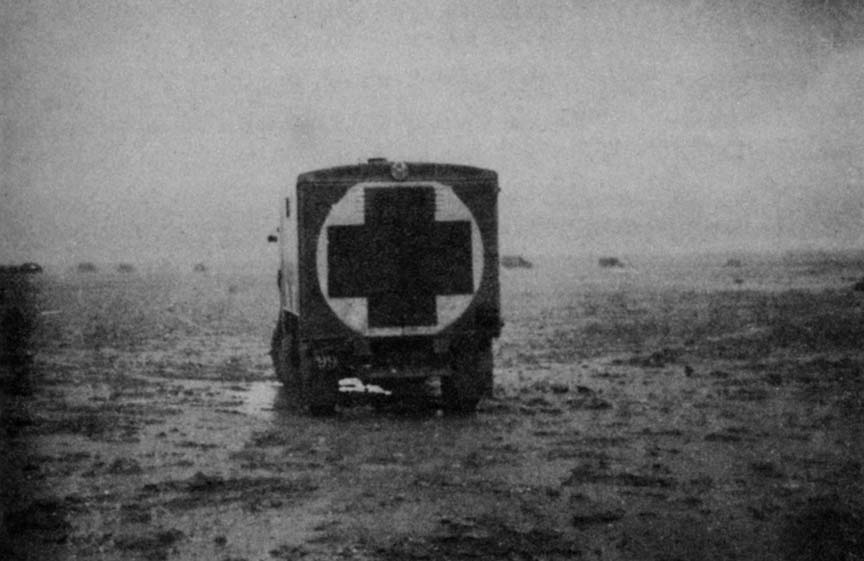
| Fig. 7. After the Alamein break-through, the New Zealand Division sweeps southward to outflank the enemy and, running into a freak desert downpour, bogs down in the mud. One of the heavy Austin ambulances tries to keep to high ground. |
Word reached us that supply transport carrying our gasoline and food could not get through to us. So the New Zealand division stopped. We were soon put on our emergency vehicle rations. We evacuated patients to the Main Dressing Station a few miles behind us until our gasoline supply ran low. The rain continued for two days in a steady downpour. At night, when we were carrying no patients, our ambulances were full of motorcyclists, water truck drivers, and officers who travelled in small staff cars or jeeps---all seeking a dry place to sleep.
After two days the rain stopped. In the desert heat the ground soon dried out. The supply transport began to come through again and our store of gasoline and food was renewed. The New Zealand division moved on again, now in a more northerly direction, but the two-day delay gave the Germans, fleeing along the hardsurface coast road, a chance to make their escape from the threatened encirclement. When we reached the coast road a few miles west of Mersa Matruh, the enemy had already fled up the steep bottleneck of Halfaya Pass, where he made only a token rear guard stand, and was on his way into Libya.
His flight along the coast road had not been without loss. All along the portion of the road we saw were strewn burned out trucks, tanks, and the big tracked troop carriers. He had fled so fast he had not had the chance to take all of his equipment with him. Mersa Matruh, I heard, was full of supplies. Charlie Perkins found a storehouse there full of Italian uniforms, tried one on, and was nearly "captured" by a British soldier who happened by. A German paymaster's office found there had been supplied with Egyptian money. Pamphlets in German and Italian were found telling the enemy troops how to conduct themselves in Egypt and what of historical interest there was to be seen in the country. Some prisoners we talked to said they had been told their forward troops were already in Alexandria and they were very surprised at the turn in the African war. All preparations had apparently been made for the occupation of Egypt. The force of the blow at Alamein had been of unexpected strength and the necessity for a sudden retreat had come as a complete surprise.
The sharp, high escarpment that towers over the Egyptian seaside village of Sollum and then runs southward into the desert for many miles would have been a difficult military problem if the Germans had put up much of a resistance there. The only way up its side in the northern sector is the steep winding road over Halfaya (pronounced by the soldiers "Hell Fire") Pass. This is a serious bottleneck. If the Germans had had the air power, they could have done a lot of damage to the thousands of vehicles converging there. We had to wait in line for nearly a full day before it came our turn to go up the road.
The road itself, if it can be called that, was very narrow, steep, and with many a hairpin turn. Its sides were lined with mines. The heavy traffic barely crawled up the escarpment with many stops and starts. Some trucks stalled. Others, with weak brakes, slipped back dangerously. But slow and precarious as it was, the flow of traffic continued over the Pass.
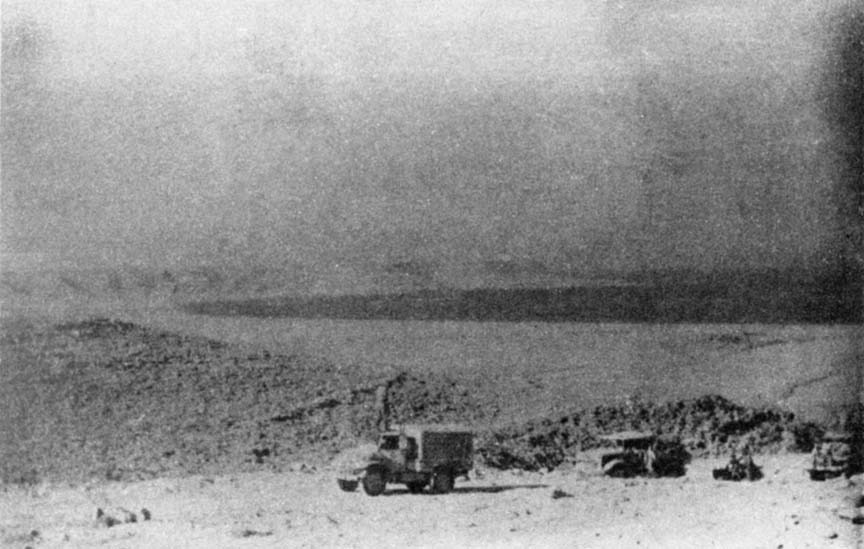
| Fig. 8. A steady stream of vehicles crawls up the twisting road over Halfaya Pass, with Sollum Bay in the background. |
As we drove up, we met many groups of prisoners coming down on foot. One group of six Italians and one German, still with their white surrender flag clutched in their hands, passed us without a guard. They had just appeared out of the desert and were searching for someone to whom they could surrender. No one paid any attention to them and they continued on down the slope toward the rear. Another group about forty strong, almost completely German, was being herded along the top of the escarpment by one unarmed British sergeant. As we passed him, he grinned broadly.
Our course from the top of Halfaya Pass took us along the coast road through the village called Fort Capuzzo, just over the Libyan side of the border. There was nothing much left of this settlement but a few shell-torn buildings. Nearby was a large German military cemetery with its ornate wrought-iron crosses over the graves of officers.
We continued on toward Bardia and turned off the road into the desert shortly after we had gone through Mussolini's Fence. Here the New Zealanders halted. The Kiwis had borne the brunt of the German attempt to push to the Suez Canal, had played a major part in the Alamein battle, and had been one of the first divisions to plunge through the break in the line in hot pursuit of the enemy. They were scheduled for a rest now they were back on Libyan soil once again.
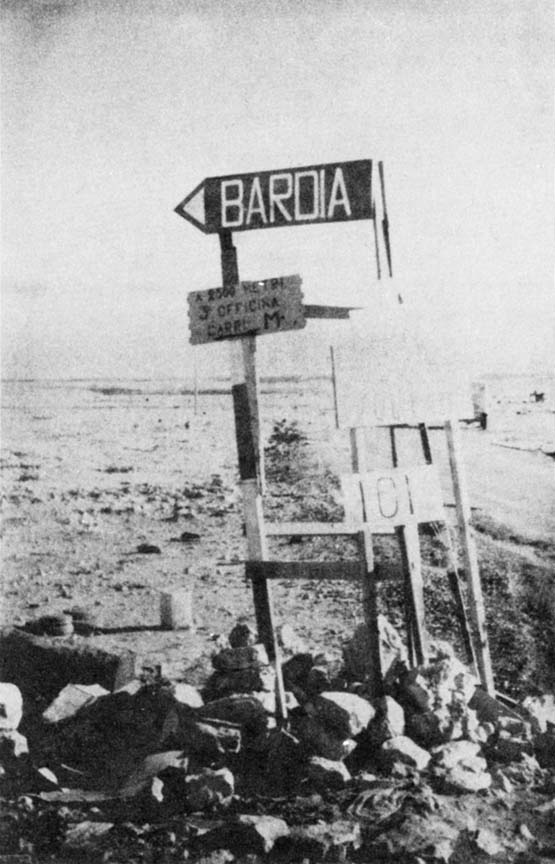
| Fig. 9. The road to Bardia branches off the main coast road west of Halfaya and Capuzzo. Behind and to the left of the sign-post are five German Teller mines removed from the road. |
The coast road from Fort Capuzzo westward does not run through the town of Bardia. The road forks and if you follow the right-hand fork, you will travel out onto the peninsula on which the town lies. After passing through a gate, the road forms the main street of the town. It runs right out to the tip of the peninsula. The sea lies below, for the sides of the peninsula are very steep. Below the steep sides of the town lie quiet coves, the one on the left has a good swimming beach, the one on the right forms the harbor. From the upper town, a road winds down diagonally to the docks and buildings of the lower town. Before the war a bridge used to span the harbor and another road across the inlet runs up the far side of the small bay. In peacetime Bardia must have been more attractive than most of the North African towns.
Before December 11, 1940, Bardia was a peacetime town. Then the British army under General Wavell started the first push of the war into Libya. The Italian army withdrew and Bardia was occupied by the British. The Germans came into Africa and Rommel began his first push at Agheila on March 25, 1941 and by April 14th he had reoccupied this unfortunate village of Bardia. The British stopped that drive near Sollum and, this time under Auchlinleck, again pushed into Libya. Bardia was occupied again almost immediately after that push got under way on November 18, 1941. Rommel, in his final and greatest push back across Libya, took Bardia on June 22, 1942. When General Montgomery's Eighth army occupied the town for the last time, Bardia had been fought over and captured five times.
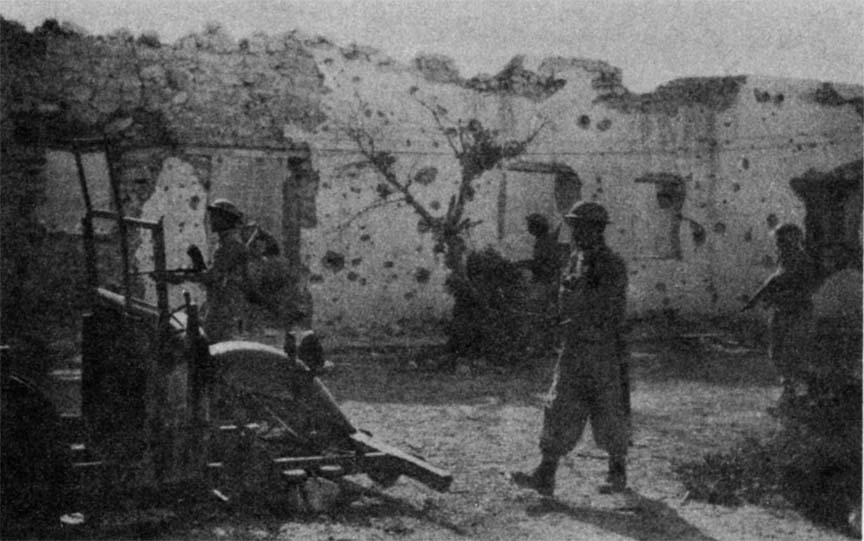
This continual harassing by the dogs of war had left. its mark. Before the war the town had been full of white-washed buildings, cafes, a church and a mosque; now all buildings, if they stood at all, were dirty, shrapnel-pocked, written on, used crudely as billets time and time again.
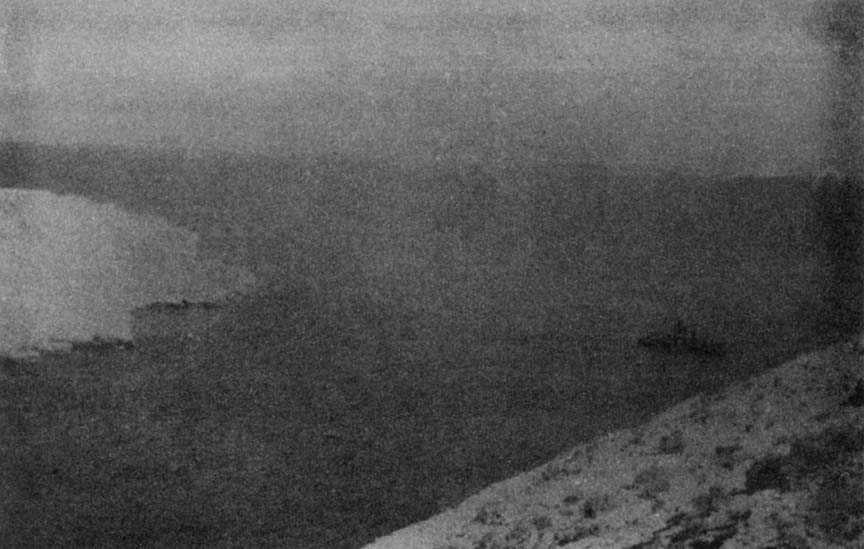
Most North African towns are filled with Arabs selling their produce, offering their services, demanding baksheesh; Bardia was completely empty of any sort of humanity. The Italian population had left with the first British occupation in 1940; the Arabs had scattered to safer parts of Libya. Now the lower town was a mass of wrecked buildings, the harbor beach strewn with old oil cans and the ruins of the blown-out bridge. The upper town was a ghost town, its buildings staring open-mouthed at the wreckage, chaos, and confusion of their former trim, picturesque village. The wide main street was littered with the rubble of war.
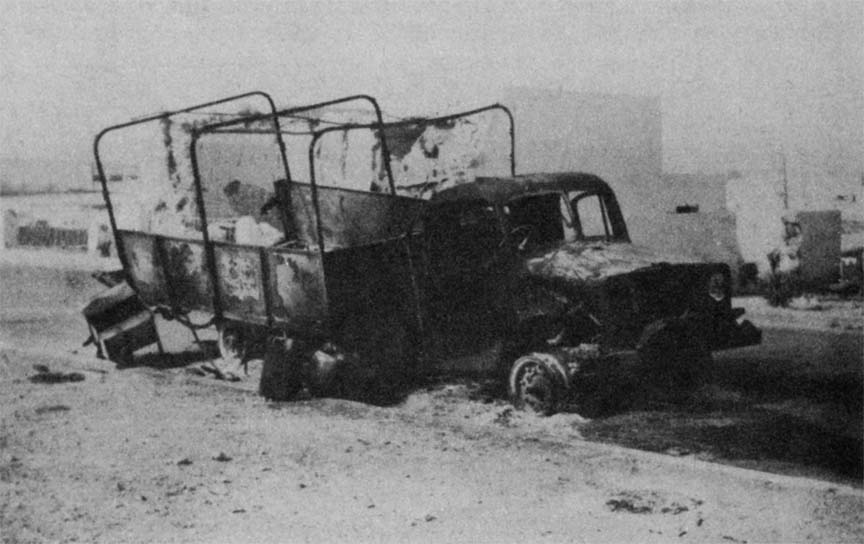
On the sidewalk before the Caffe Nazionale squatted the burned, mutilated wreckage of a German troop carrier, its tracks hanging limply over the first three wheels. At a curbside near the church lay the ruins of a British truck with a German cross on its side, a vehicle captured in a former battle, its charred body now resting on its brake-drums with the ashes of its tires in the gutter. The empty steeple of the church still stood, but its roof was caved in and only a splinter of its front wall was erect. The mosque and its slender minarette were untouched.
One of my trips into town to take photographs coincided accidentally with the Army Film and Photographic Unit's staging of the taking of the town by the Maori battalion of the New Zealand division. I followed behind the army photographers as they took pictures of the Maoris, with tommy-guns at the ready, advancing through the streets. It all seemed a little incongruous in the now quiet village to see the serious-looking soldiers searching among the buildings for enemy snipers, but I got some good photographs which should provide material for a hair-raising yarn to tell my grandchildren many years from now.

From our camp several miles in the desert, swimming parties were frequently carried into town in three-ton trucks. On the first one of these trips, we saw a little side track with a sign in Italian saying "wine stores" pointing down the track. On our way back from the swim, we drove down to see if there was any wine left by the enemy on this out-of-the-way trail. We found the wine stores all right, but we also found that it was not so far out of the way that the Maoris hadn't found it first. When we arrived almost a dozen of them were opening casks, drinking it immediately, pouring it into their water bottles, and into larger cans to carry back to their camp. Before we left several of them were gloriously drunk.
There was plenty of Italian vino and some brandy. We hauled one eighty-four gallon cask of red wine onto the truck and filled every container we could find with brandy. Laden like a chariot of Bacchus, we returned to camp. Most of the wine was consumed that night in a wild party in which even the major commanding the ADS became unusually ribald and jovial.
Some of the wine, however, we saved for Thanksgiving. Since Thanksgiving is a purely American custom, the New Zealanders were not planning to observe it. So we began to prepare for the feast. We gathered food from all sources available: our regular rations for one meal from the cook house, anything we could buy from the mobile canteens and the Navy, Army, Air Force Institutes (NAAFI), and whatever we could find in German and Italian food depots. Bob Pearmain, of Boston and of the S.S. Pierce family, was appointed chief chef. He constructed ovens and stoves and prepared the meal. Thanksgiving dinner became a masterpiece of desert culinary, a meal I shall never forget. The menu, written by Jack Carroll of Brattleboro, Vermont, will show its extent and proportions.
| Hors d'Oeuvres: | Anchovy Canapee a la Sollum et Port de Tobruk sur pangrille. | |
| Soup: | Potage Tohoroa, a la Kiwi. | |
| Entrees: | Macaroni avec fromage
a la Goebbles, Mixed Grille: Goering Sausage, Meat Cakes a la 88, Pineapple au Tripoli, Sauce Cyrenica. |
|
| Legumes: | Pommes de terre au Wilhelmstrasse,
Macedone des legumes avec petit pois et carrotes. |
|
| Entrements: | Tartes Supreme avec Sauce Guillaume Pearmain V. | |
|
|
|
|
MESSAGES The inspiring work of Sub-Section Three, American Field Service, has, more than any other single factor, served as a tremendous source of inspiration to the embattled Russian armies.
Josef Stalin
We in the Pacific area have watched with frank amazement the work of SS3, AFS. The success of the democracies is assured as long as such men serve them. By God, it was destiny that sent them there. They never break the soldier faith. Attack, Attack, Attack!
Douglas MacArthur
Never in my lifetime of soldiering have I led such men. Through the shell-pocked cocktail lounge of Shepherds and across the machine-gun swept roads of Syria they have surged forward, always forward against all the devilish machinations of the Hun. Unfortunately none of these brave lads was killed during the recent battle, but should they have been, I am confident they would have died gloriously murmuring "For God, For Country and My Sponsor." Address all donations to Stephen Galatti, Director, American Field Service, 60 Beaver Street, New York City.
Major B.
AFS Public RelationsNever have so many owed so much.
Barclay's Bank
But aside from the fun and the feasting, the dinner had its sentimental side as well, for it was a farewell tribute to Lt. Evan Thomas who was leaving for home, and a toast in honor of Doug Atwood, platoon sergeant who replaced him, of Chuck Larrowe, our section leader who became the new sergeant, and of Dick Christian, our new section leader.
Sitting around on sand dunes, we filled our stomachs as they had never been filled on British rations before. After the meal, as darkness began to settle down, we built up a small fire and stretched out on the ground around it, singing songs and digesting the magnificent dinner. We watched the dying embers of the fire settle and could feel the wideness, the vastness of the desert creeping nearer as the light died down. But I don't think it was until the New Zealand division actually set off through that seemingly limitless wasteland that we really knew how wide and how vast the desert of Libya is.

In the first three of the pushes back and forth across northern Libya, two by the British in 1940-41 and 1941-42 and one by the enemy in 1941, the battle had followed the coast road around the crescent bulge of Cirenaica through Tobruk, Derna, Bengasi, and Agedabia.
But when Rommel made his final push eastward in 1942 he did a clever thing. From Agedabia he cut out through the desert wastes in a northeasterly direction with a strong spearhead which, by heading straight for El Mechili and then southeastward to Bir Hacheim, turned the British flank making the defense of Bengasi, Derna and even Tobruk impossible, and making the British retreat faster than they had planned to. The British tried to stop this flanking movement by throwing defenses into the desert south of Tobruk. The now famous battles of Bir Hacheim and Knightsbridge resulted. Because the nature of the desert here permitted the Germans to flank even further south, the British lost these battles and had to retreat into Egypt. This masterful flanking movement was possible only because the Germans had enough equipment and men to permit an offensive on such a broad front.
But when Montgomery pushed back into Libya in 1942, the situation was reversed. This time the Eighth army had more divisions, more tanks, more air power and more supply transport than it had ever had before. The German supply lines had become so stretched by the push into Egypt that had the enemy been able to spare enough material from the Russian front, the shipping difficulties would have made quick replacement and even a steady flow of supplies difficult. The enemy realized that the British were well able to repeat the flanking move through the desert. No alternative to disaster but a speedy retreat to the narrower field of battle at El Agheila was open to the Germans. Here, where the British under Wavell had been stopped in 1941, the hard surface desert narrowed to a defendable front.
The British prepared to do battle at El Agheila. The New Zealanders were called out early in December. The division was to move with all speed possible from the Bardia area to El Agheila by way of Agedabia. If you draw a straight line from Bardia to Agedabia it will pass through Bir Hacheim. Along that straight line the whole division travelled. And we travelled with them.
While the New Zealand division was resting in Bardia, other divisions of the Eighth, army were in hot pursuit of the Germans. All of the Libyan coastal ports, much enemy equipment, and many prisoners fell during this long chase. From one of the American Field Service men working in the Cirenaican bulge area, I later heard a weird tale about one of the German prisoners.
The American was a well-educated college student who had spent several years in Europe and could speak German like a native. On an evacuation from Bengasi to Tobruk he carried a German prisoner suffering from overexposure and malnutrition. The patient kept mumbling to himself in a most distressed manner. The driver, thinking there was something he might be able to do to help the prisoner, asked him what his trouble was.
"This just isn't right," the prisoner said. "I shouldn't be here at all. It's all wrong. I shouldn't be here, I belong on the Russian front."
The driver, understandably, was puzzled by this statement and asked for details. This is the story he was told.
The German was a Luftwaffe squadron leader on the Russian front. He had been sent for a fortnight to Crete to study fighter tactics in support of parachute troops, after which he was to return to his squadron in Russia. In a flight over the Mediterranean near Crete, he was attacked by some British planes and shot down in the sea. He was soon picked up by an Axis freighter bound for Tripoli with supplies.
Shortly after he had been picked up by the freighter, a British submarine torpedoed the ship and the pilot with three other men climbed aboard a piece of floating wreckage. For seven days they floated about without food or water. According to the pilot, the other three men on the seventh day began to think they saw land and walked off the raft to their death. On the eighth day, he was again picked up---this time by a British corvette. He was landed at Bengasi and sent to a British hospital. The American driver was evacuating him to Tobruk about the time he should have been returning to his squadron on the Russian front. Now he was a prisoner in Africa. To his mind, this just wasn't right.
We who were attached to the New Zealanders were never to see the ports of Tobruk, Derna and Bengasi. We instead travelled westward through the nothingness of the desert. We saw neither trees nor grass nor promontories. The desert was flat, and, except for the rugged scrub-brush hussocks that seemed to be able to grow to a height of six inches almost anywhere, completely barren. Once in a great while we would come to an escarpment or a wadi and the mental and physical relief from flatness was out of all proportion to the size of the cliff.
The floor of the desert was for the most part hard-packed gravel with good-sized rocks lying about on the surface. These rocks and the ever-present brush hussocks made the driving continually bumpy. About three times during the whole trip we came upon stretches of hard, smooth clay in what looked like pools several hundred yards across. Out of the sheer joy of a change of pace, we sped across these places like a skater on a frozen mill pond.
This flatness, this barrenness, however, does not imply a lack of beauty in the desert. When the desert was flat as far as the eye could see, over you came a feeling of perfect, undisturbable peacefulness and a sense of the geometric symmetry of the earth. When there were wadis or escarpments, the strata, sometimes of various colors, ran in beautiful patterns and angles along the face of the earth-wall. The sides of the wadis were sculptured by the water of infrequent rains and the blowing sand of the more numerous wind storms and then yearly Khamseens.
The nights when the moon was swinging over the desert sky and the rocky ground was refracting the pale. light upward, the atmosphere was filled with a ghostlike illumination. The hardness and ruggedness were smoothed over, the vast sweep of the horizon was brought nearer and the harsh lines were muffled as if by the brush of a skillful painter. But most beautiful of all were the desert sunsets. No trees or buildings infringed upon the westward horizon. The fine dust of the desert softened the light of the setting sun. And the huge, high-sailing, white, fluffy clouds gave color to the stabbing broadswords of light that pierced them and became lost in the sky above. The darkened ground flamed a brilliant gold on the far horizon of the west, and from the glowing half-disc, big as an autumn moon, banners of light shot in all directions upward turning the desert's dust and the sky's clouds into magnificent patterns of golden yellow, fiery red, a paler orange, and finally, in the far corners of the west, a somber, mellow purple. Here, in one wide-flowing burst of color and light, the haunting vastness of the desert and the. limitless depth of the sky were united each evening before the dark blanket of night could cover them both.
The New Zealand division travelled through the desert with its brigades in single file. We were near the rear of the second brigade which stretched out across the desert for about ten miles in desert convoy. This latter term meant that the vehicles dispersed while driving much as ships do in an ocean convoy. The desert was hard and wide, The vehicles of the brigade had no need to stick to any track or road. They spread out into three columns several hundred yards apart. If we stopped in formation for meals, it was a long walk to the cook truck. During the day, however, we usually drove as continually as possible. A small truck about lunch time would come down the line distributing cans of corned beef, a handful of tea, and packages of hard army biscuits for lunch. Then, if we stopped for a few minutes around lunch time, we could make a stove out of a can filled with sand, holes punched in its side for ventilation, and gasoline poured into it and lit. Over this we would boil the tea. Then we would move off again, frequently eating as we drove. The convoy usually stopped for the night and the unit cooks could prepare a good meal for supper and breakfast.
Bir Hacheim, when we reached it, was a considerable disappointment. This scene of the battle of the preceding June was now devoid of any signs of life. The empty and mutilated village of the remains of a dozen or so stone huts was surrounded by a wide mine-field and a number of rusted remains of burned-out vehicles now half covered with sand. We halted only long enough to form all vehicles into a single line, passed through the village and the mine-field, and continued on into the desert westward.
When we reached Agedabia, after five days of our desert trip, we found another badly war-torn town. A few Arabs, however, had stayed on and were wandering about among the wrecked buildings and army trucks begging for "biscooties," the hard army biscuits. Here, preparations were being made for the assault on the Agheila line. The New Zealanders were to sweep southward almost to the fringe of the soft, drifting sands of the Sahara in an encircling move. We, however, were withdrawn from that division and sent to the venerable Desert Rats, the Seventh Armored Division. These soldiers had been in the deserts of Egypt before the outbreak of this war, far longer than any other Eighth army division. They were scheduled for a frontal assault on the Agheila line.
Everything was to be in readiness for a large-scale offensive on December 18th. After a preliminary barrage on the night of the 13th, infantry patrols went into the German defenses and returned to report that the enemy had evaporated. Except for a mine-field, Rommel had pulled out of his Agheila positions and was still in flight westward.
Instead of working in a stable position here as we had expected to do, we were soon driving again through the desert as the 7th Armored set off in chase. The enemy had mined the area heavily and most of the casualties we carried were the result of those mines.
This flight from Agheila was in a way a disappointment to the Eighth army. They had hoped to be able to beat the Germans and destroy much of their equipment in a pitch battle, and, with the encircling move by the New Zealanders, prevent a further flight westward. But Rommel was a shrewd fox. When the New Zealanders cut up to the north and severed the coast road near Marble Arch, the bulk of the German forces had already fled on toward Sirte. The small rear-guard force that was surrounded was able to sneak out of the trap at night between the Kiwi brigades. Charles Perkins, one of the American Field Service drivers who had replaced us in the New Zealand division, was captured by this German force as he was evacuating patients from one brigade to the other.
The 7th Armored rushed on to Marble Arch along the coast road. Here a German airfield had been repaired and over our heads nearly all day long shuttled a continual stream of big Douglas transport planes (DC-3) and even a few of the old, slow, quivering Bombays loaded with supplies. They flew just off the ground along the road, landed at the Marble Arch field, unloaded, and returned for another trip. The number and. frequency of these planes was frankly amazing. Most of them had the American star insignia. They brought up quickly enough supplies to enable the Eighth army to continue to press on after the fleeing enemy.
The New Zealand and the 7th Armored divisions prepared to push into the desert again together. Our course from Marble Arch was almost due west. The coast here curves up in a northwesterly direction, and our westward travel took us deeper and deeper into the desert again. Here we were entering a part of the North African desert that had never been fought over before in this war. We were no longer to encounter the wreckage of previous campaigns.
The New Zealanders were in the desert to the south of us. Movement now was much slower than it had been during the clear-sailing convoy from Bardia to Agedabia. The enemy was putting up some rear-guard resistance and was laying mines that had to be cleared. On December 21st we sat all day long and after supper drove six miles; on the afternoon of the 22nd, we moved twenty-seven miles and stopped; on the 23rd, we continued on another sixteen miles; on the 24th, we moved forty miles; and on Christmas day we didn't move at all.
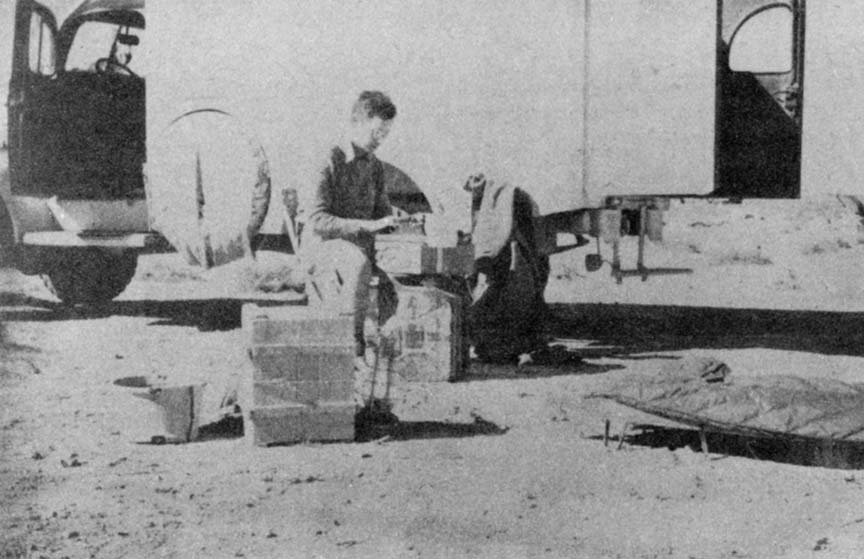
That was the way we travelled. We had to be ready to move at a moment's notice all day and all night long. We carried few patients. The desert seemed to have become even more barren and the nights now, as soon as the sun had slipped out of sight, became bitterly cold. The food rations of this English division were not up to the standards of the New Zealand rations. The diet consisted almost entirely of corned beef, tea, boiled rice, meat stew, and a soggy sort of pastry the English call "duff." They also had American bacon at times which, to our minds, they ruined by boiling instead of frying. I think, as Christmas approached, the members of Section Three were feeling a little depressed. Although our Christmas ration from our canteen had reached us, none of our long-awaited packages from home had.
On the evening of December 24th, the members of the section gathered in the back of one of our ambulances. Over a gasoline fire we fried some bacon. This we ate with peanut butter, army biscuits and some canned fruit. Then we drank some of our canteen ration of gin and whiskey to warm us up and, amid the gasoline, bacon, and cigarette smoke, sang Christmas carols in an attempt to make it really seem like Christmas eve.
Christmas morning dawned bright and cold. The cold continued through the day, but the brightness by mid-morning had given way to an overcast of heavy dark clouds. In view of the usual run of food in English desert rations, we approached our evening meal---the Christmas dinner---with some trepidation. As the meal unfolded, however, it began to feel more and more like Christmas. The cooks, working with a special food ration and what they had been able to save for months past, turned out a magnificent dinner. We had hot tomato soup, potatoes, peas, New Zealand ham, .a quarter of a stuffed chicken, plum pudding, fruit, pie, frosted-fruit cake, short bread, tea, nuts, cigarettes, a rum ration, and a bottle of Canadian ale. While we were stuffing ourselves, the British officers all came over to wish us a Merry Christmas.
Christmas night I was forced to go to bed early, with my first full stomach in a long time, I felt like a bear beginning his winter hibernation as I crawled into my sleeping bag.
The 7th Armored division continued to move slowly westward as the Germans were forced to withdraw. Early in January we arrived at a camp site south of Sirte. A group of New Zealanders moved in slightly south of us to build a desert airfield. In order to maintain a fighter air cover over the forward troops, advanced air fields had to be built on the desert not far from the ever westward moving front. If the forward troops ever got beyond the reach of our own fighter patrols, the German planes took advantage of this and went on the offensive.
German reconnaissance planes spotted this airfield under construction by the New Zealanders and for several days they came over to bomb it and strafe vehicles in the surrounding area. Our medical camp nearby was well marked with red crosses, but in spite of this all our vehicles had to be widely dispersed. The German planes flew in high over the field, dove to drop their bombs, and came out of the dive directly over our medical area in order to avoid anti-aircraft fire. As they were probably ordered to strafe vehicles on their return flight, they usually began by letting go with their machine guns and cannon at the medical vehicles. Fortunately they were in too much of a hurry to take much aim and out of the several times they came over, only once did they do any damage.
This time they shot two explosive cannon shells into one of our ambulances, narrowly missed the drivers, LeMoyne Billings and Brook Cuddy, and they machine-gunned the quartermaster's truck seriously injuring one of the English privates inside.
During this raid, I was on my way back across the open spaces from the cook truck to my own car. I saw the planes dive over the field and decided a steel helmet was the best thing for me to get, for frequently the German bombing wasn't too accurate and more frequently shrapnel from the anti-aircraft shells rained down in our area. I started to run for my car to get the helmet and, as I ran, I heard the plane firing its machine guns and coming in my direction. I looked back over my shoulder and saw the quick puffs of dust from bullets hitting behind me a few hundred feet and coming along fast in the footsteps I had just made. It was all too quick for me to do anything about it. Before I had a chance to think of diving to one side, the plane veered off and stopped firing. The next plane shot the cannon shells into Billing's ambulance and then it was gone too. Soon the new drome was completed and a strong group of fighter planes moved in. No more German aircraft were to be seen in that area.
One day while we were still in the desert south of Sirte word suddenly came to us that we were being recalled to our headquarters. We knew that the 7th Armored division had more ambulances than it needed. Work had been very light for us and the casualties in this area were few. But such a movement usually presaged some new action, some new assignment for us. We drove over the barren desert northward. The track we were on led to the coast road. Our headquarters had moved to a location a few miles east of Sirte. The road gradually began to climb, a slight hill. As we breasted the top of the rise, we looked across to the top of a nearby hill and saw a building, the first we had seen since Agedabia. It was long and low with a high white wall running around it. In the wall, were evenly spaced small windows. The building inside, also with the narrow windows, rose flatly above the top of the wall. This, we discovered, was an Italian outpost of the desert police force. It had been built in the early days of the Italian conquest of Libya when a running war had been carried on with the Arabs. In modern warfare, of course, it had meant nothing. Now it lay completely deserted. Only the well nearby was being used as a water supply point.
A few miles further north we drove over' another low hill. Gradually the vegetation had begun to thicken. The desert brush was thicker and a tough sand grass had begun to appear in patches. As we followed 'the track over this last hill, the ground swept slowly down from us for several miles and at the end lay the sea, sparkling, blue with a fringe of white lace at the beach. A little to the left, amid groves of palms, we could see the ivory buildings of the village of Sirte. The coast road ran east and west through a wide swathe of greenness.
When we were about a mile from the road, we entered the green ground. It was hard for us to believe our eyes. The grass grew soft, thick, and luxuriously. Through it as far as the eye could see eastward and westward were scattered millions of flowers: daisies, poppies, red, blue, yellow, white and purple wild flowers of all descriptions. The air blowing in the car windows was heavy with the perfumed scent. We felt as though we had, entered another land, another continent, another climate. We drove slowly to enjoy the full contrast with the dried and wrinkled skin of the desert. We could not enjoy it long, for we were soon to be sent out on a new assignment into an even more rugged desert than we had ever seen before.
Though more rugged, the desert retained its beauty and added to itself another, more grandiose aspect of magnificence. We entered it as we had come out of it, past Sirte, past the old white police fort, and away from the greenness of the shore of the Mediterranean. Our new assignment was with the New Zealand division again.
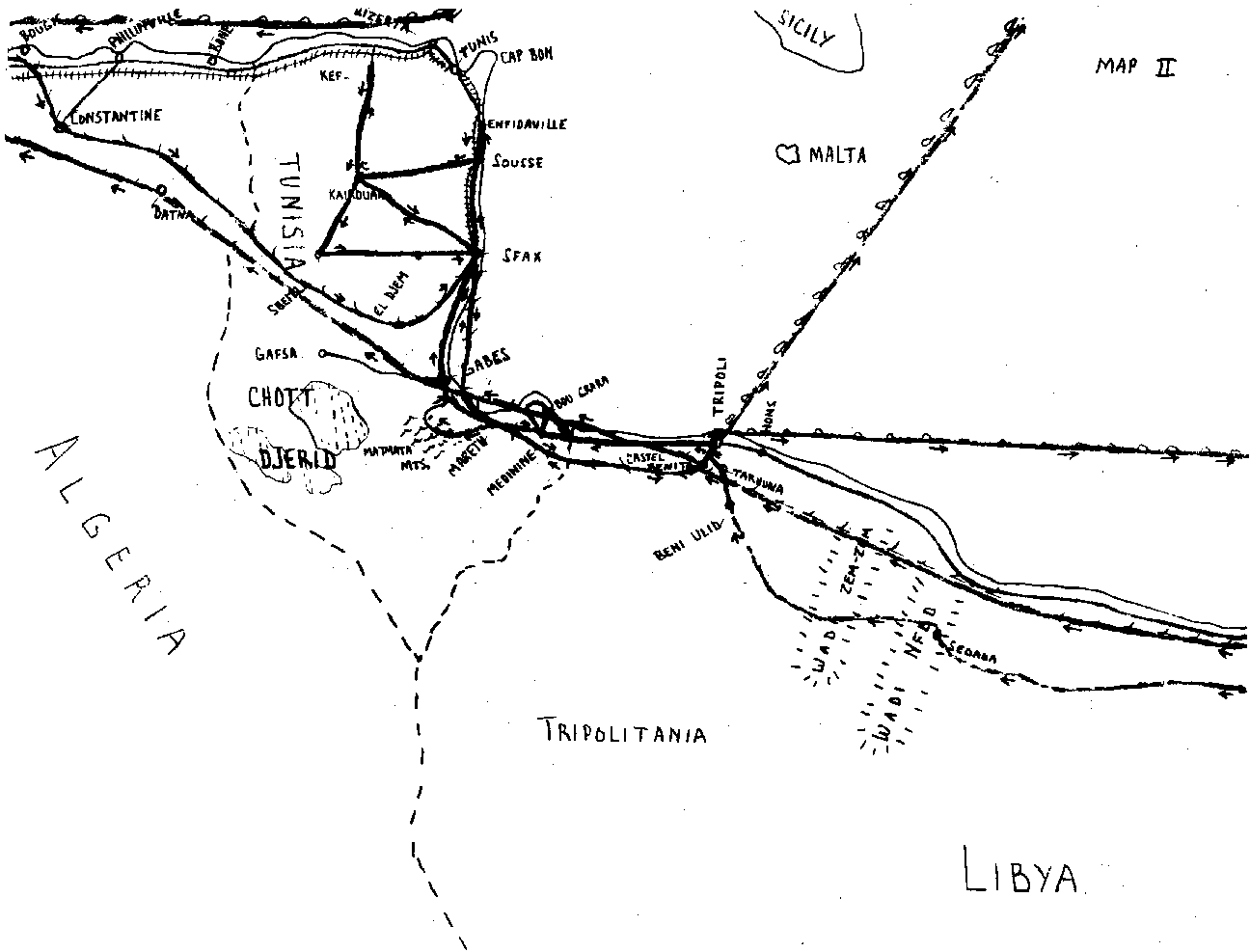
The division had already started on its new move when we left our headquarters on January 11. We caught up with them the following day and continued in convoy with one of their brigades. The division was headed southwest into the desert on another flanking move, this time south of the German defense line thrown up in the deep and precipitous wadi called Zem-Zem.
If the Germans could be dislodged from their positions here, the road was open to the city of Tripoli. For three long years in the deserts of North Africa the British had tried time and again to force the Italians out of their Libyan colony and to conquer the German forces who had come in to defend it. The symbol of the Libyan colony was the city of Tripoli. To the Eighth army, it was the Nirvana they had struggled so long to attain.
Throughout this third and decisive push, the British soldiers had their eyes on this city. That was their goal and this time, they told themselves, they would achieve it. At the beginning of the campaign, General Montgomery had predicted the fall of Tripoli by Christmas. That had not come true. But that its fall was imminent the British soldier could not but believe.
As the New Zealanders stabbed deeply into the desert, everyone said we were going all the way through to Tripoli. We Americans hummed the Marine corps anthem expectantly.
As the sun set on our first day with the division, we approached the steep sides of Wadi Tamam. In the dusk we started down them. The depression was the deepest we had encountered yet. The sides lay rugged and bare with the varicolored strata of the desert floor exposed. In the valley there was no stream. In years past infrequent but heavy rains must have cascaded sharply through this fissure. But in the heat of the desert, none of that carving water now remained. -

The floors of this and other smaller valleys were filled with soft sand which seemed to clutch at the wheels of our cars. With four-wheel drive our ambulances got through. Other vehicles struggled with sandtracks and tow chains and pulled themselves out of the softness to continue on the trek.
For the ensuing days we drove forward sporadically.- Whenever we stopped, we dispersed our cars 150 yards apart. Much of our driving was at night to escape observation by the German reconnaissance planes. The moon was out and unless the sky was cloudy the driving was fairly easy.
On the night of January 14th our direction turned due west and we drove slowly even though the moon was bright and the ground comparatively smooth. The desert was as arid as before, but now the soil was a darker color than the sandy-shaded desert further east. Occasionally we passed small seven-feet high hawthorne trees standing alone in the wasteland.
In the morning we moved about three miles and stopped for the day. Two German planes flew over, the first I had seen since leaving Sirte and perhaps the first the Germans knew of the southward swing of the New Zealand division. One of them was shot down by the anti-aircraft guns.
That evening off to the west of us we could hear the rumble of the fighting. The Sixth brigade of the New Zealanders, leading the Kiwi's southward punch at the German lines, had reached Wadi Zem-Zem and was making contact with the enemy. The Germans put up a bitter struggle to defend their southern flank and protect their line of resistance the length of the wadi northward. The fighting continued all that night and through the next day. The RAF put over a continually effective fighter screen, more intensive than had been seen in the desert for many a day. The threat from the south became too intense and the German line crumbled into a retreat again.
We with the Fifth brigade pushed on into the desert of shallow wadis and more flourishing scrub brush on the heels of the forward brigade. Now we were moving again, enemy "recky" planes came over about once a day, but they did no more than take a quick look, dodge antiaircraft fire, and then move quickly away toward' their own lines.
The next night the moonlight was brilliant and we drove steadily from moonrise in the early evening until 1:30 in the morning. We had not been driving long when we entered Wadi Nfed. The valley had high rounded sides and the floor was comparatively green. Many finely leaved trees like willows were growing there, but we could not identify them for certain in the mellow light of the moon. We heard that we were to pass the town of Sedada in that wadi, but I saw only one tumbled down stone hut. We may have passed fairly close to the settlement, but the faint light of the moon and the dust from the vehicles churning through the powdery valley sand made visibility poor.
Even with the poor visibility, I remember this wadi clearly. It was one of the most beautiful spots I had yet seen in the desert. Perhaps the moonlight enhanced its beauty by eliminating the harsh lines and the flaws. The smooth valley with its unusual growth of trees scattered through its depth and the high rolling sides that encased it and kept away the flatness of the other desert around it made it an unusually beautiful spot in the moonlight. I should like to see it again in the daylight, but knowing the trickiness of the desert landscape, I should probably be disappointed.
We continued on up out of the wadi onto the flat desert again. The hundreds of vehicles of all descriptions plowed their way through the dusty desert in three long columns tightly closed up-as was the custom in night driving. I was in the northernmost column. The trucks and Bren carriers and jeeps and ambulances were hurrying and lurching forward, the pace increased steadily, and clouds of dust floated up around us. Suddenly a light flamed through the dust, a brilliant wavering light just to the right of the cars ahead of me.
It was not a flame thrower, it was not a burning truck. The light was stationary and lit up with an eerie whiteness the low forms of an Arab tent village. Unmindful of blackouts, the Arabs had a large fire blazing before the central tent. In the dust the light stabbed weakly toward the surrounding tents and illuminated the head and forequarters of several hobbled camels who stood stock still staring timidly at the thundering herd of the vehicles of war roaring through the swirling maelstrom of dust.
Only one Arab was standing outside the tents. He vas a noble figure. He stood with arms folded on his chest, a tall, dark-skinned man with a long flowing white robe and a magnificent turban, glowering angrily at the stream of automobiles disturbing the accustomed quiet of his lonesome desert home. The dust seemed to churn up around him and the fire-lit whiteness of his robe like billowing smoke from the magic wishing lamp of some ancient djinn.
In a moment we were again in the dusty darkness of the desert. I leaned out of my window and looked back at the dim light on the cars behind me to reassure myself that I had not been dreaming. It was indeed a bizarre scene, flashed before me at one moment, swallowed up in the dark behind me the next. But in that one unexpected moment every visible detail of this outlandish, quasi-fairy book scene was etched deeply in my mind.
During the following days we drove forward more in relation to military expediency than the hour of the day or night. Our halts were uncertain, some lasting for hours, some for only a few minutes. Whenever the stop appeared to be a long one, Lt. Doug Atwood, Alex Parker, Dick Christian and I would gather in the back of an ambulance and play bridge.
One night, while we were at cards in the back of a blacked-out ambulance, we heard the characteristic drone of a single enemy bomber flying back and forth over the long convoy. He circled for what seemed like hours, dropping a single bomb every once in a while. Some landed near enough to shake the ambulance. I know of no other form of enemy air action that is so harrowing on the nerves as this single bomber night flight that the diminishing Luftwaffe adopted at this stage in the battle. You could hear the plane all the time. Sometimes he was close and sometimes further away. He stayed up there for hours, ominously circling, looking at you, picking out attractive targets.
We continued to play bridge. There was no sense in trying to escape by digging slit trenches. Not enough bombs were dropped to be a danger to anything more than a very few places in the long line of the brigade's vehicles. And yet, as we bid and played the cards, each of us was wondering whether the enemy pilot above had spotted our cars and decided we were one of his chosen targets. We openly joked about that single bomber overhead, but joking did not make the droning plane any less present, nor the continued tension we actually felt any less severe.
The night of January 19th we spent driving through the desert. The moon was full and the cars were not moving fast enough to raise much dust. Shortly after midnight we drove onto something more than the usual desert track made by the automobiles ahead of us. It was a dirt surface road. It led us into the beautiful town of Beni Ulid.
In the daylight the desert towns of North Africa seem dirty and unromantic, especially after the scourge of war has passed through them. But on a moonlit night, the dirt becomes invisible and the shrapnel scars on the buildings disappear. In the mellow light, the streets seem smooth and the buildings white. The low stores and houses, the bulging mosque and towering white minaret of deserted Beni Ulid seemed this way when we entered it. We drove through the main street. The westernmost houses were backed up by a high white wall below which was a sheer cliff of about seventy yards drop. The road ran diagonally down this cliff into a green and verdant valley of an oasis. Grass grew darkly along the roadsides and trees towered dimly in the distance. Across the valley on the opposite cliff we could see the brown mud huts of the old native village. Other than the army, there was no sign of human life.
We passed through the village and, suddenly and luxuriously, we came upon a paved road leading upwards into low but rugged hills. The shadows of these sharp, high crags fell across the road, blotting out the dim moonlight- and making driving difficult even though we were for the first time since the coast road at Sirte on a smoothly paved highway.
We continued driving upward through the hills. The moon set and as we came to the top of the plateau, the sun came up. We had been driving all night. At 8:30 we stopped for breakfast. The Germans had retreated steadily to Tripoli and were there preparing to make a small scale stand.
The Highland division coming along the coast road had already passed the ancient Roman ruins of Leptis Magna and were encountering bitter German resistance at Homs. The New Zealanders and the Seventh Armored division were closing in on Tripoli from the south and the Germans threw up a defense line south of the city to permit their forces still east of Tripoli to escape encirclement.
At our breakfast stop, we were only sixty miles from Tripoli and thirty miles from the little agricultural town of Tarhuna. The Fifth brigade was scheduled to take over the lead of the New Zealand spearhead at this point and after breakfast we were to move on again through the Sixth brigade and into the attack.
The breakfast stop was for two hours, so I threw myself into a stretcher after I had eaten and tried to catch a few minutes sleep. My sleep was closer to an exhausted coma. I have a vague recollection of a Kiwi sticking his head in my ambulance and saying something about the convoy moving off in a few minutes. I muttered something about getting up right away and again passed out. Suddenly I woke up. How long I had been asleep I couldn't tell. I looked out the rear window of the car and not another vehicle was in sight. I leaped out of the ambulance just in time to see the last of our ambulances disappear over a distant ridge.
I don't think I ever made a faster start or drove with such frantic haste in all my ambulance driving experience as I did then. It was several minutes before I could catch up with the other cars and resume my position in the convoy. It is a distasteful experience to be left behind like that and I hope I never have it again.
Our ADS continued moving forward, even passing a good part of our own brigade, until we were close enough to the front of the column to go into action.
At sundown the brigade stopped for the night. Then that quartet that Culbertson would have been proud of, Atwood, Parker, Christian and Briggs, settled down to bridge again. We had driven continually all the previous night and, except for my short lapse into unconsciousness that morning, we had driven all that day. Now we settled down to a bridge game that lasted until 2:30 the following morning. Considering our lack of sleep and our imminent advent into action, this lust for bridge was rather foolhardy. But our hearts were young and gay and we were flaunting our powers of endurance with the carelessness of youth.
After an all too short sleep, we moved on again the next day. We were moving slowly but continuously. We didn't stop as night fell and as the first light of the moon came out of the east, we left the arid plateau we had been on all day, and descended into a slight but far-sweeping valley. The landscape changed markedly. The valley was fairly fertile and grass and occasional orchards grew along our route. As the moon reached its peak of brightness, we entered the town of Tarhuna. It was composed of small white stucco farmhouses---nearly all made from the same blueprint. The only attractive part of the town was the orchards, which stood in rigid military formations throwing blobs of moonshadow in regular patterns across the white ground.
As the night and the shadows lengthened, we came up out of the Tarhuna valley and entered a pass in the mountains that overlooked the long coastal plain sweeping .down to Tripoli and the sea. These mountains were about the height of Vermont's Green Mountains at their highest. Their shape, however, was vastly different. They were made of tilted layers of sandstone and the erosion of the desert had carved them into curious lines and formations.
We continued to advance through the. mountainous country slowly all day. The Scots Greys just ahead of us who were the armored spearhead of the brigade, were running into some German tank resistance and we carried some casualties back along the brigade column to the Main Dressing Station.
Night fell as we came down out of the mountains onto the coastal plain and by moonrise we had hit the paved road running from Garian to Azizia and thence to Tripoli. The road was bordered by flat stretches of hard sand on both sides. As we neared Azizia, the ADS pulled off the road to set up and the Maori battalion went into the town to test the enemy defenses. They promptly ran into tanks and a strong armored defense.
The Maoris were withdrawn and the brigade pulled back slightly to reshuffle its strength so it could fight German fire with fire. Trucks came streaming back along the road past us and we were suddenly ordered to move back quickly. This was the first time we had pulled back in all our long trek across the desert. We had heard many tales of the previous "flaps," as retreats were called, and the sudden unexpectedness of this move made us almost believe that "a flap was on." It was exciting in a perverse sense, but we moved only a few miles to the foot of the mountains and set up again. The stronger attack was made and Azizia fell as its German defenders pulled out to make a last minute stand at the gates of Tripoli while the last of the enemy rear-guard moved through the city and out to the west on the coast road.
On the morning of January 23rd we moved onto the road again and pushed northward. Word reached us that the city had fallen and we were anxious to get there. The convoy moved with painful slowness through Azizia, through the little village of Suani and finally into Tripoli itself.
The first elements of the Highland division, pushing along the coast road from the east, had entered the city at approximately 4 a.m. The drivers of our cars attached to their forward troops were the first Americans to enter the city. The New Zealand division cavalry made up of light tanks and Bren carriers entered Tripoli about 6 a.m. This capital of the last of Mussolini's remaining colonies had fallen to the Eighth army just three months to the day from the beginning of the great battle of Alamein. The retreating Germans were being pressed on toward the Tunisian border by the inexhaustible Seventh Armored division, the venerable and battle-wise Desert Rats.
Tripoli, when we entered it, seemed a deserted city. Some few of the Arabs and Italians who had stayed in the city were curiously and shyly going about the streets watching this army they had heard so much about.
In the main square beneath the high walls of the old fortress from which the Union Jack now waved tanks were lined up. The Highland division painted their HD on the walls of the closed stores and office buildings. The band of pipes and drums leading these "ladies from Hades" in their plaid kilts, tams and sporrans, paraded the streets triumphantly.
The harbor was scattered with the wreckage of a great many small wooden boats and several larger cargo vessels. The Germans had sunk some of them across the narrow harbor mouth. Engineers soon had enough of the 'wreckage cleared away to make the harbor usable.
This main Axis supply port had received a terrific pummeling from the air and it showed it. Hardly a building was left without some scar or gaping hole from the bombs and flying shrapnel. The buildings themselves, especially along the waterfront, were what I heard an English Tommy describe as "quite architectural." The modern fascist buildings were tall with impressive pillars and sweeping arches. Mottos and inscriptions in Italian covered them inside and out. The old part of the city behind its ancient stone walls was almost untouched by the war.
In the later months when I was to spend so much time in this city, I came to dislike it intensely and think most of its buildings were grotesque, but when we first entered it, the shores of Tripoli were a beautiful sight. Not since Alexandria had I seen a city and large buildings.
We camped in the outskirts of the city and were soon given a chance to inspect it and the surrounding countryside more closely. One of the most interesting places I saw there was the Castel Benito airdrome which lay out of town near Azizia.
Alex Parker and I made a special trip out there and spent one whole afternoon looking and walking around it. The RAF and USAAF had already moved in and were cleaning up the wrecked planes on the field and making hasty repairs on the badly bombed hangars.
Hundreds of German an Italian aircraft, most of them burned or bombed to bits, were scattered around the edges of the great field. RAF mechanics were working on the less badly damaged to reconstruct them for study and possibly use. There were various models of Junkers, Messerschmidts, Stukas, Focke-Wulffs, Fiats, several Axis types we weren't able to identify, and huge transports and gliders. The field itself was crowded with Allied aircraft of all sorts. I saw three Mosquitos, the first of their type to be seen with the Eighth army. There were scores of Kittyhawk P-40s and Spitfires, several Douglas DC-3 transports, Mitchells, Lockheed-Hudsons, Fairchilds, Beaufighters, and even a flimsy-looking Albacore of the Fleet Air Arm.
The town itself slowly opened up. Military law and a business curfew reigned for the first two days. After that, quasi-civil authorities took over and the empty stores began to open for what business they could think up. Mobile cinemas of the NAAFI moved into two of the theaters and the Highland division put on a concert party in the third. Arab children in the streets sold dates and very bitter oranges for outrageous prices. The lowest denomination of currency issued the troops was the British Military Authority shilling (twenty cents) and the local vendors and shopkeepers quickly caught on to a good thing and even the most insignificant item sold for a shilling.
The most important event in the early days of the occupation of Tripoli was the visit of Winston Churchill just after his conference with President Roosevelt in Casablanca and the victory parade of February first.
Prime Minister Churchill came to Tripoli to inspect the troops of the Eighth army and, in a speech, to commend them for their victory. Soldiers for miles around the city and in it lined the streets in full dress and stood at attention for hours. The Prime Minister rode in the back of an open car along those streets waving his hat and giving the V-sign, the characteristic cigar in his mouth. As he approached the troops burst into lusty cheers and he was cheered from one end of the city to the other.
After his tour of inspection, he mounted the wooden platform in the main square in the shade of the ancient fortress and addressed the troops of his first victorious army. They listened with pride in their hearts to their favorite Englishman and his flow of colorful language. Then Churchill said one sentence which these men will remember for the rest of their lives. It meant more to them than if he were to present each of them individually with the Victoria Cross. It was indeed a great tribute. The Prime Minister said:
"When after the war is over a man is asked what he did, it will be enough for him to say, 'I marched with the Eighth Army."
The victory parade was perhaps the most colorful event ever to take place in this ancient North African port. Tanks and armored cars rolled through the streets. Soldiers in full dress with their webbing brilliantly whitened marched in perfect formations. But the most colorful of all, of course, were the Highland pipes and drums playing their chilling battle marches to perfection, dressed in their magnificent kilts, their stubby knees showing above their stockings, their tams at a jaunty angle above their unmistakably Scotch faces. They who had fought so valliantly the losing battle at Dunkirk were here in the splendor of a victory over their sworn enemies. They had lost their battle honors in France and they would go there again to regain them, but in the meantime they had shown the enemy that they could fight and win. The Scotch, in all their show of kilts and pipes and drums and pride in themselves, are self-righteous individuals and fierce and valiant fighters.
To them all other soldiers are secondary. This is the war between Scotland and Germany. They boast of their victories and die in their defeats.
I liked everything about the Scots immensely except their habit of putting salt on their porridge. But I was soon to get used to this, for our next assignment was with the Highland division.
We joined the Scots in Tripoli on February 15th and stayed with them there for six days before heading out along the coast road into Tunisia to join the other divisions pushing the enemy back to the emplaced defense positions, in and around Mareth. The Highlanders joined in the fighting at Medinine.
Just beyond Medinine the plain between the Matmata Mountains and the sea narrows down and then broadens out considerably on to the west. Here at the narrows of the plain the Germans tried to put up a momentary defense. They had a big naval gun hidden far back in the hills and it shelled the town for long after the town had been taken.
The Scots moved onto the coastal edge of the plain-and we moved in with them, a few miles northwest of Medinine itself. Our job was to evacuate patients to a New Zealand Casualty Clearing Station about forty miles east of Medinine. A bumpy track had been constructed across country to the main road to eliminate vehicles having to go down into Medinine and then back along the main supply route. With slightly injured patients, this track was a good one for it cut off many hours of tedious driving and exposing our vehicles to the enemy shells landing in and around Medinine. But the more serious cases had to be sent along the smooth-paved road south to Medinine. Even this route had its drawbacks, for the paved road was full of holes and it was a very long drive.
I shall never forget one exceptionally exhausting drive I made over the route through Medinine at night. No lights could be used which made missing the holes in the road more or less luck. One of the' patients I had was nearly out of his head with pain and shock. He was really having a tough time of it and I felt very sorry for him. I had to creep at a snail's pace so as not to jounce him on the unavoidable bumps in the road. Even before we had reached Medinine he was repeatedly asking me where we were and how much further we had to go. He was in a bad way and I decided to experiment with a plan I suddenly thought of. Something had to be done for him until I could get him to the care of doctors at the CCS. I hadn't long to wait for him to ask me where we were again.
"You haven't ever been to the States, have you Jock?" I asked in answer to his question. That as an answer came as a surprise to him. He made no reply.
"Well," I continued, "it may seem hard to believe, but we're actually in the States right now. And we're not going to see just one part of the States. We're going on a cross-country tour. America's a pretty big country and there's a lot to see. We don't want to miss any part of it."
"Where are we now?" he asked again, but this time his voice had calmed considerably.
"Right now we're in New England on the east coast. Most of it is a pretty good sort of country. In fact a lot of its looks like Scotland. A lot of highlands in New Hampshire and Vermont. A rugged sort of soil full of rocks. It made hard country to farm, but you know how farmers are when they decide they want to farm a country. It didn't take them long to clear out fields on the hillsides and plant their corn. All the rocks are piled up around the fields in stonewalls. They have those in Scotland, don't they?"
He mumbled an assent. He was still in considerable pain, but I think he had become somewhat interested in the similarities of New England and Scotland. The other patients in the car said nothing. They probably thought the driver had become delirious now, too. But I continued.
"Northern New England is pretty mountainous. Over there on the left you can see the White Mountains. That tallest one with the snow on the top is Mount Washington. Over here on the right are the Green Mountains of Vermont. They're not as high, as you can see, but they're pretty solid mountains, nevertheless. A lot of maple trees grow over there and every year they get the best damn maple sugar and syrup. Now we're coming down into the Connecticut River valley, a pretty fertile country. See those white patches of netting in those fields over there? That's tobacco growing. This is one of the few places in the north where tobacco can be grown. Over there in the distance to the left is another river called the Thames, named after the big river in England. And at the mouth of. it is a city called New London. It doesn't look much like the old London, though. They have a big submarine base there. We've got to make a right turn here and head south toward New York."
I continued my monologue all the way across the country, hitting every river, mountain range and national park worth mentioning, almost every city and state, until we arrived in California where we found the CCS. I don't know whether this helped the soldier or not. He quieted down considerably and seemed to be able to take the ride more easily. I do know it made the driving much easier for me.
When we had first joined the Highland division near Tripoli in mid-February, the news was broadcast of the first great American defeat in the Faid-Kasserine Pass area in Tunisia. The early news of the defeat had listed the casualties as 2,000 killed, 6,000 wounded and 32,000 missing. These were staggering figures and many a Scot shook his head and with a low whistle told us that the Americans had "dropped a bollocks" this time. Later, the casualty figures for this defeat were more accurately listed at 4,695 for the total killed, wounded and missing. Many of the missing were returned to the American lines when the Germans were pushed back again.
The average soldier in the Eighth army at that time of course had no knowledge of the size and disposition of American forces that were stretched so thinly along the "line" in southern Tunisia. These facts they did know: the Eighth army had pushed the entire Afrika Korps across 1,500 miles of desert in full retreat, the American army was supposed to be the best equipped in the world, and only a part of the Afrika Korps was thrown against the Americans at Faid and Kasserine. In the light of this limited knowledge, the Americans were not shown up in a very good perspective.
While Rommel was throwing his armor around in southern Tunisia, the Eighth army was bringing up supplies and reinforcements to the Medinine positions. Montgomery was expecting an attack on his positions there as soon as the German armor returned from the west. All preparations were made to meet it. Strong artillery positions were hidden in the defenses, and mine fields were laid so that the Germans would have to come in broadside to the artillery.
We were still near the coast just west of Bou-Grara and northwest of Medinine. The hospital tents were dug in, all spare vehicles were sent back, and we were prepared for anything that might result. We were told that if the German attack succeeded we would probably be cut off. All diaries and papers had to be hidden or destroyed. The attack was expected on the night of March 3rd.
The Germans attacked on March 6th. Nearly 150 enemy tanks were thrown in and infantry followed them. The battle raged for a day and a half and the Germans were so badly beaten they never again could make a large scale attack in North Africa. British artillery literally mowed down the tanks. Fifty-two were knocked out. The enemy infantry was routed. Anti-tank guns handled the whole show and we didn't lose a tank. The medical unit we were attached to announced that there were only eighteen British casualties during the whole battle.
Rommel crawled in behind his Mareth defense line and waited for the inevitable. At this time General Montgomery issued a statement to his troops telling why the Germans were finished in North Africa. Rommel had made three fundamental mistakes that were to cost him his army.
First, he had pushed the Eighth army too far when he went to Alamein. He should have stopped sooner to consolidate and improve his lines of supply. At El Alamein they were stretched too far and he could not rapidly bring up replacements or reinforcements.
Secondly, he had underestimated the strength and resources of the Eighth army when he had pulled so far back as Tunisia in a hope of stretching our supply lines to the breaking point. He should have stopped sooner and staked all on a pitched battle which would have decided the African war one way or the other for many months to come.
Thirdly, he had done a foolhardy thing in withdrawing his armor from his Mareth positions, sending it all the way across Tunisia in an ineffective and short-lived assault on the American positions, and then sending it all the way back to the Mareth line again to attack the Eighth army. These long distance moves had cost him dearly in gasoline and transport in which he was already suffering a shortage. It also depleted his armor strength which he was to need badly in defending Mareth. Although there was many a bitter battle ahead before the Germans were "finished" in North Africa, this message from the army commander boosted the morale of the troops immeasurably. At Mareth they felt they were closing in for the kill and they relished the idea.
The Mareth defenses were strong ones. They were originally built by the French to protect Tunisia from any further imperial expansion envisaged by the Italians, based in Tripolitania. The French had built them well and in pre-war days a British army officer had inspected them and said that only a fool would attempt to attack such a line. But Montgomery did attack them and he was nobody's fool.
The Germans had worked the original French defenses over and improved them. There were heavy, reinforced concrete pill-boxes scattered strategically to some depth. Tank ditches, mine fields, and dug in implacements stretched from the sea coast into the Matmata Mountains in the south.
Among the divisions who were to undertake the difficult frontal attack on these positions were the Highland and the Fiftieth divisions. The Fiftieth had just finished three months of training in pill-box assault warfare. The main effort, however, was to be a flanking attack through the difficult soft sand terrain to the south. The New Zealanders were quietly brought up from Tripoli to undertake this mission. The Indian division, unexcelled in mountain warfare, was also to sweep around to the south but in a more shallow flanking move through, the mountains. This was aimed at diverting the enemy's attention and strength so that the New Zealanders and later the First Armored could make their southward swing through the fringes of the Sahara more or less secretly and without danger of having their supply routes cut.
At the same time, further to the west, an American armed force called the Second Corps under the leadership of Lieutenant General "Blood-and-Guts" Patton was to make a drive on Gafsa to force Rommel to spread his strength out as thinly as possible.
As the attack began we were recalled from the Highlanders and sent for a short time to the Fiftieth Northumbrian division. Then I was suddenly sent to a single car assignment with an artillery Regimental Aid Post which was supporting the Indian division. The medical officer at this post, Captain David Hector-Jones of Teify Hill, Maesycrugian, Carmarthenshire, Wales, was one of the most fearless and jovially friendly men I have ever met. He was fairly heavily built with a broad Welsh face, thinning brown hair, and a small brown mustache. From my former location, he led me to the RAP along bumpy dirt tracks. Re drove a roofless jeep and bounced along ahead of me at a great speed. Every once in a while he would look over his shoulder to make sure I was still behind him with my ambulance and, with a broad grin, wildly wave me on to increased speed.
The RAP was composed of one rather ancient three-ton truck and my ambulance, as far as vehicles went, and the medical officer and two British soldiers. One, a private, drove the truck and the other, a bombardier, was a medical orderly.
At first it was a lonely job. We were usually stationed near the artillery regiment's headquarters. In the mornings we would make a tour of the batteries in my ambulance to dress cuts, bruises, and boils. We had no casualties at first to evacuate.
Then the Indian division was assigned to the Matmata hills.
On the night of March 28th, we moved off in the darkness toward the hills across the flat plain beyond Medinine. It was an ominously dark night and the convoy barely inched along, feeling its way on the rough dirt road. The approaches to the hills had been heavily mined and we were held up for a time while sappers cleaned out our route. Finally, at the very foot of the first of the steep hills we camped for the remainder of the night. The batteries moved forward and started pounding the German and Italian positions in the hills.
Shortly after we stopped, a British officer came in to the RAP for treatment. He had been riding in an armored car and had hit a mine. The car had been demolished but he had come through with only a slight cut on his forehead. Captain Hector-Jones and the bombardier treated him in the back of my blacked-out ambulance, gave him a drink from the Captain's pocket flask, and we congratulated him on his luck.
A little later I decided to take a walk around and see what units were near the RAP and get a general idea of the lay of the land. We were parked in a slight gulley near the edge of the road and we had been warned not to go too far off the roadsides because of mines. So I walked out to the road. Open trucks full of Indian infantry were moving forward to be ready later in the night to charge up into the hills and clean out the enemy.
One truck I walked past was full of the squat, high-cheek-boned Mongolian Gurkhas, some of the toughest and most fierce hill fighters in the Indian division. They had been raised like Spartans in the mountainous upper reaches of Nepal. They carried vicious looking long knives, called kukris, broad and curved at the end. These swung from sheathes tied to their belts almost squarely behind them. Tradition says that a Gurkha cannot draw, his knife from his sheathe without drawing blood. Since childhood they have been taught to use these weapons and they ply them with murderous effect in their own special type of warfare.
In the short time that I had been with the Indian division I had seen quite a bit of the Gurkhas. On bitterly cold desert-winter mornings I had seen them in something less than a loin cloth, their brown bodies glistening in the morning sun, playing vigorous games, wrestling, and doing calisthenics with a happy abandon and love of good exercise. These soldiers of India were as tough and rugged physically as any of the most highly trained commandos in any army in the world. And they loved to fight.
I didn't dare wander far from the RAP for fear the ambulance might be called out at any minute, so I soon returned and crawled into my bedding roll for the night.
It was not yet daylight when Captain Hector-Jones aroused me and said that we had to make a run forward. I dressed quickly and, leaving my bedding roll and some of my other personal belongings with the RAP truck, we drove forward. One of the batteries had called in to the Regimental headquarters to say that a gunner had been wounded but the location of the battery was not given. We had no alternative but to visit every battery until we found the right one. We started with the nearest gun positions and worked forward quickly as the first light of day crept over the low hills to the east. Finally, several miles from the RAP we found the battery, but the wounded man had been sent back to a medical unit further along the line. He had not been seriously hurt and he had gone to the rear with the ammunition trucks.
Captain Hector-Jones and I started back toward the RAP hoping that something to eat would be ready for us as we were both considerably hungry from our early morning drive. We ran parallel with the edge of the mountains for some distance until we came to a cross road. The road to the right ran up into the mountains. The road straight ahead of us was wired off and marked MINES! The road to the left headed past some artillery positions toward the RAP. Without much hesitation I turned left.
The captain sitting in the front seat beside me was calmly smoking his pipe. I was smoking a cigarette. We were musing silently over what we'd both like to have for breakfast.
Suddenly I went deaf.
The back end of the car lurched up in the air and all four wheels left the road. The windshield cracked diagonally in a path like a sudden flash of lightning and beyond the crack I could see the gravel road speeding by beneath us..
The rear of the car was gaining more and more altitude until the ambulance was almost vertical. Then the bumper caught the road and I closed my eyes.
When I opened them I found myself resting on my shoulder-blades on the ceiling. Both front doors were open and Captain Hector-Jones was scrambling out the one on his side.
As I rolled over and out my door I felt something wet running down my face. I touched my hand to it and it was gasoline.
The captain was standing near the front of the car, his eyes closed and his face distorted in an effort to close them tighter, his garrison cap gone, and his hair awry. From the expression on his face I thought he was injured. I rushed over to him and saw that he too was soaked in gasoline and some of it had run into his eyes. I wiped his face off and in a few seconds he could open his eyes. We examined ourselves closely to make sure we had no injuries. We had to shout at each other, for the blast of the explosion was still ringing in our ears.
Several hundred yards away, at the nearest gun position, men were beginning to crawl out of slit trenches and look around. They had all thought the explosion of the mine was a landing shell. A piece of the wheel rim had landed in the midst of them with a zing like a flying shell fragment. The captain had lost his prized pipe that he was smoking when we hit the mine, so we turned to examine the car.. The right rear tire had set off the mine. Nothing was left on the broken axle but a gnarled brake drum. The force of the explosion had blown both rear doors nearly off their hinges. The floor of the ambulance had been ripped open and the gasoline tank had been squashed up against it. Inside, two stretchers lying on the floor had been snapped like match sticks and two stout wooden and cloth covered seats bolted to the inside walls had been broken. We cleared everything movable out of the inside and, after quite some search, found Captain Hector-Jones's pipe entangled in the wires behind the dashboard. Why the explosion or our lighted pipe and cigarette hadn't set on fire all the gasoline that showered us I shall never understand.
Captain Hector-Jones soon hitched a ride back to the RAP and I stayed with the car. An English colonel, a public relations officer for the Indian division, drove up and gingerly picked his way along the road toward the car to take some pictures. Soon sappers appeared and started to comb the road with electrical detectors and bayonettes. They examined the crater in the road and said that only three teller mines, one over the next, could have made such a hole as that and thrown the car so far. Germans set mines in this fashion to blow up heavy tanks. From the cross road to the crater they found two more that we had flown over. On down the road beyond the car they found seven more.
"Had this road been inspected for mines?" I asked the sapper sergeant.
"No. Last night," he said, pointing, "those guns and quads moved into position over this road before we got here so we didn't bother to check it."
After the sappers left, I went over to the artillery positions and got something to eat. I hurried back to the car when I saw a staff car drive near it and stop and an officer with a red band around his hat get out. It was the Assistant Director of Medical Services for the Indian Division. The ADMS said that the Field Service had been notified of the accident and would send a replacement to the RAP the next day.
He took a close look at the car. "You had a narrow escape there, young man."
I knew what he said was only too true and I agreed with him. Before he climbed into his staff car and drove away he took one last long look at the ambulance with its wheels in the air and shook his head incredulously.
I waited by the car until p.m. for our platoon lieutenant but no one came. Finally Captain Hector-Jones drove up in the dilapidated RAP truck with some food for me and said that the ADMS had ordered me to leave my car and continue on in the truck until the replacement arrived. The enemy had been cleared out of the first of the hills and the division was moving on. We had standing orders never to leave our cars if they were wrecked because every mechanical part had a way of disappearing from wrecked vehicles left unguarded. The order of an ADMS, however, countermanded this, so I climbed aboard the three-ton truck and we went up into the hills with the regiment.
The next day Lt. Doug Atwood caught up with us with a replacement ambulance. Our workshops had sent out a wrecker and taken my ambulance back to a heavy workshop to see what could be salvaged. The replacement ambulance had Dick Christian and Jim Atkins in it, so Lt. Atwood took me back to platoon headquarters. I was soon with Alex Parker at another artillery RAP with the Indian division---in the capacity of a spare driver.
Meanwhile, the Fiftieth division had punctured the Mareth front, but through an oversight, anti-tank guns had not been brought through the breach and they had been repulsed with heavy casualties. The New Zealanders had made their encirclement successfully under extremely difficult travelling conditions. They had reached El Hamma and completely surprised the Germans. A hastily gathered tank force had been thrown against them to keep them from reaching Gabes and completely encircling the entire Afrika Korps. The Germans were forced to withdraw hastily from their Mareth positions, through the Gabes gap.
When the Germans withdrew from the Mareth line they followed their usual habit and left the Italians behind to protect them while they made a get-away.
Occasionally in the Matmata end of the line, small groups of Italian soldiers, discouraged by the progress of the war and the part they were forced to play by their allies, came over the lines and gave themselves up. One such group, led by an Italian noncommissioned officer, was interned in a temporary prisoner cage. The captives were amazed by the quality and quantity of the food that was given them. The N.C.O. approached one of his guards with a proposition. Since the Italian had willingly given himself up the guard had no reason to suspect a plot to escape. He released him and the Italian soldier wandered off into the hills. After several hours, he returned and with him came his whole platoon. He had told them of the food and they had followed him into captivity and out of the war. He said that if he could go back again, he would return with his whole company, but these activities had been discovered by a British officer whose ideas of proper methods of warfare didn't include such goings and comings and he put a stop to it.
The Germans pulled up just beyond Gabes where, mainly with Italian troops, they built a temporary line in Wadi Akerit from the sea to the big salt lakes further south.
I joined Alex Parker as spare driver on April 1st at the Indian MDS near El M'Dou. That afternoon we went to Gabes where I again met and had a long talk with the Chicago Sun's Chester Morrison. He was on a tour of the front and was soon to -leave to watch the attack on Wadi Akerit.
Even the Indians had heard of April Fools' Day and they did not let it go by unobserved. While one brigade of Gurkhas was moving up toward the front they suddenly opened fire (into the air) with everything they had---rifles, machine guns, and all, Brigade headquarters, thinking the Germans had made a counterattack, was a wild scramble of confusion and activity until they discovered it was all a false alarm.
The medical officer in charge of an Indian ADS entered a hospital tent on the morning of April 1st and found a group of his Indian orderlies standing sorrowfully over a corpse stretched out on the ground under a blanket. The officer knew of no deaths in his medical unit and was about to make inquiries when suddenly one of the orderlies savagely kicked the dead man in the ribs. The corpse jumped up and ran out of the tent.
On the late afternoon of April 2nd, Alex and I moved out of Gabes and on the following day we reached our new location just east of a ridge called Zemlet el Beïda, one of the points in the Wadi Akerit line defended by Italians. For several days the artillery we were attached to the Thirty-first Field Regiment made up of sturdy 25-pounders, lashed the ridge defenders. Then on the night of April 5/6, after a heavy barrage, the Gurkhas went up the ridge to take it. I have heard many stories about that Gurkha attack. Some reports said they left their-rifles behind, took off their army boots, and, barefooted, crept up the ridge with their knives drawn. Knowing the Gurkhas, this might very well be true.
The night was a very dark one. No moon was out and the sky was heavily overcast. I went to sleep that night in a slit trench. Shortly after I had fallen asleep, an enemy bomber came over and dropped a flare. He zoomed about for a while and then came in low and dropped some butterfly-bombs. The air was full of explosions and singing shrapnel. These small bombs, a little larger than hand grenades, sprout four metalic wings in mid-air and circle slowly to earth, floating out to cover quite an area. Just before they hit the ground they explode. In the morning light, I found nearly a dozen unexploded ones lying on the ground within a hundred feet of my slit trench.
Zemlet el Beïda ridge fell that night to the Gurkhas quite decisively. The next morning, Alex and I, and John Day who was stationed about a mile from us, took our ambulances over the ridge to pick up any medical stores left behind by the Italians and we had a chance to inspect the scene of the slaughter. And indeed it had been a slaughter. In the dark the Gurkhas had crept up the ridge and before the sentries keeping a look-out from the top knew anyone was near them, they were dead.
We found their bodies lying along the crest of the ridge that morning. Some were decapitated cleanly by the swinging kukris. Others had had their heads split open from top to neck. Just down from the top of the ridge on the eastern side stood a mortar ready to fire, its shells piled neatly nearby. But the man who would have fired it was asleep in a shallow dug-out when the Gurkhas found him. Most of the Italian defenders of the ridge never woke up. When the alarm was finally spread, the remaining Italians had fled in such a hurry all their personal belongings, letters, blankets, and even their weapons were left behind.
When they found they could not hold at Gabes, the Germans swung into a high speed retreat northward. The Eighth army continued hot on their heels and the American forces were quickly closing in on their flank from the west.-There were no positions in which they could make another stand until they reached the hills around Enfidaville.
When the retreat started, we were called back to our company headquarters which then moved forward to Sfax.
Sfax, when we reached it, had not long been occupied by British and American forces. The French civilians who had stayed in the town for its capture had greeted the first troops with wild demonstrations of jubilation. Even after several days, they were still happy and light hearted as only the French can be. They lined the streets waving at the passing vehicles in the comparatively untouched residential section of the town.
The water front, harbor, and business district, however, were almost completely deserted. They were a shambles from the bombing Sfax had suffered when it was used by the Axis as a supply port. Most of the streets were torn up with bomb craters or piled high with the rubble of shattered buildings. Engineers were quickly clearing the main thoroughfares and the harbor so that it could soon be used as an Allied base.
Almost every North African town and city has an old quarter. These are usually walled in with high brick or stone walls and are crowded with small, dirty, houses separated by crooked, narrow streets. Here usually live the Arab population and it is here they have their small stores and carry on their voluble trading activities.
The old part of Sfax was built almost squarely in the center of town. With its high walls and narrow streets it was typical of such Arab quarters. But when we reached Sfax, the old town was deserted---not an Arab in house or street. Being in the center of town near the business district and the water front, the old town had been deserted by the Arabs when the heavy bombing nearby had begun. Few bombs had fallen in the native quarter itself, but the Arabs were all to be found in settlements near the outskirts of town. Unlike the French, the Arabs seemed happy about their liberation only because it meant new people to trade with and a new source of economic gain.
Rommel had been replaced by Colonel General Von Arnim. The enemy, mostly all Germans now, were pulled up into a defense line in the very northeastern tip of Tunisia. Here they planned to make a long stand, bringing in more and more reinforcements by air and ship across the narrow Sicilian straights to prevent a complete defeat in North Africa. The more time they could stall the Allied fighting machine here, the more time they would have to prepare their continental defenses and stave off any possibility of an invasion attack on the European fortress.
The American, British and French forces were reshuffled and the ring around the German positions was tightened. The Eighth army, depleted in strength somewhat by the loss of the First Armored division which was put into the line further north, attacked first from Enfidaville. And for the first time the Eighth army began to realize what resistance the Americans and British First army had run into in the difficult terrain of northern Tunisia.
But the cocky spirit of Montgomery's army was not dampened. The Germans had said that there would be no Dunkirk for their army. They tried unsuccessfully to pour in troops to prevent such a predicament. The English Tommy, for the first time, agreed with a German statement. "Bloody well right there'll be no Dunkirk," I heard one of them say. "We'll push the bastards into the sea and slaughter them. They won't have a chance to get away."
This spirit of the British soldier, the native of the British Isles, has always amazed me. The soldier himself is a contradiction. He will take anything dished out to him, by the enemy or by his own government, and even under the most punishing conditions he will carry on, hoping that fate will deal him a better hand next time.
In the army, the strong class system still exists. The officers are the impeccable gentlemen, the Eton and Harrow, the Oxford and Cambridge, the country manor and the nobility.
The ancestors of the common Tommy were the down-trodden of the feudal system, later the down-trodden of the industrial revolution. Today he is the downtrodden of what remains of the system of strict class distinction both in England and in the army. And he shows it. At one moment he moves you to pity for his plight, to disgust for his refusal to demand his natural rights as a man in a democracy, and to admiration for his infinite ability to take his shortened rations, his poorer equipment, his bomb-wrecked cities, and the bitter vetch of defeat that had been his so long in this war---all without complaint, all with an indomitable courage and optimistic outlook. He loves and worships his navy and his king as symbols of his country. He loves his tangible country more than he does the theory of democracy. The country is where he lives and works and for it he is more than willing to fight for many years even a losing battle, as this war has shown. He is a soldier and a citizen that I pity and admire in the same breath.
On April 17th our section of five ambulances was assigned to the First division to aid in transporting some of its medical equipment on its secret move around behind the line to a more northerly location. We drove out to the division dispersal area through the miles of green olive orchards extending back from the coast around Sfax.
All the next day, in exhausting convoy driving, we moved with the division. Although the driving was exhausting, the countryside made the trip interesting. We wound through the hills and over high plateaus. One of the most interesting towns was Kef, perched high on the edge of a hill top. Its ancient buildings overlooked a wide and sweeping valley that was greener than anything we had seen in the desert.
The medical supplies we were carrying were deposited twelve miles north of Kef and our transport duties were over. Our five cars were sent back to Sfax. We travelled our own speed and route, picking another than the one we came north on. The return trip took us through the towns of Siliana and Kairouan. The latter city is one of the holiest in the Mohammaden world. It used to be the jumping off place for the ancient desert caravans going southward into the desert. From the word "caravan" it got its name. We drove through it in the moon-lit darkness and the huge old wall that surrounds it, built entirely of very small stones, seemed even more massive in the dim light and shadows of the moon. The manual labor needed to build that wall must have been prodigious.
Thirty miles beyond Kairouan toward Sfax we again passed a very ancient structure. This was the third largest colosseum in the world. It was built by the Roman colonists in Tunisia and the French have now largely reconstructed it in the few places needed. I had seen it many times on Tunisian postage stamps. As we drove slowly past it, wisps of clouds that had covered the face of the moon slipped away and the full moon bathed it in soft light. In the shadows I could see ancient Romans entering its arched gates to watch their lusty. games and races.
Some weeks later Herb Reinhartsen of Mt. Vernon, N.Y., and I returned to this colosseum to give it a closer inspection. The tiers of stone seats rose sharply in concentric oval rows. Around the inside was a cinder track on which the Romans held their gladitonal combats and foot races. Where stones, in the floor had fallen away we could look into the cavernous cells below. As the French had restored many of the huge stones and pillars, in the same spirit of restoration Herb and I ran a foot race around the track. At the start I held the inside-track and ran hard. In my ears I could hear in the distance the roars of the Roman spectators encouraging us on. Behind me I could hear the pounding feet of the other Roman runners. In a sudden burst of speed Herbus the Fleet drew abreast, then sped out ahead of me to win easily the coveted praise of the Roman governor of Tunisia. We laughed and panted hard for several minutes after we had run the course.
Not far from the home of the Carthaginians, arch enemies of the ancient Romans in whose colosseum we had run, the final battle for North Africa took place.
In the south the Eighth army held fast and prepared a mock attack. In the extreme north the experienced Americans prepared a real attack. The British First army, further to the south, prepared to attack with them. In the ruggedest central sector, between the First and Eighth armies, the French fought on as they always did. They attacked the hills facing them with bloody abandon.
Throughout the desert campaign, French troops accompanied the Eighth army in defeat and victory. They fought fiercely in spite of the limitations of their poor and inadequate equipment. At Bir Hacheim they had made a costly last stand trying to hold the flank when in June of 1942 Rommel was sweeping around the army in Libya. At Alamein the French had held the extreme southern end of the line on the edge of the Qattara depression. French forces had made a long and exhausting journey all the way from Fort Lamy on Lake Chad northward across the Sahara desert to join the Eighth army near Tripoli---an unprecedented military expedition. In the final battle for Tunis they again held the most difficult terrain.
The French were soldiers whose strength once came from their love for The Beautiful France, their incorruptable country. Now they had become soldiers without a country. In North Africa they were fighting for an ideal that was being obscured by the political Petain-de Gaulle-Giraud merry-go-round. They were then, in truth, the lost legion. As a real army, they were poorly equipped and badly led, with the weight of their country's defeat on their souls that threw them wildly into battle desperately with an unwise courage. And they died. They would rather not have tried to think why they died. There is only one kind of Frenchman---the proud-of-France Frenchman. These French-speaking soldiers of the African campaign were not Frenchmen; they were men who hope someday to be Frenchmen again.
The Germans tried desperately to stave off defeat. They poured men and supplies into boats and huge six-engined air transports in an attempt to hold, but the Royal Navy sank the ships and the combined air forces shot down the planes and bombed the harbors.
The Americans attacked in the north and after a struggle captured the hills overlooking the coastal plain.. Their armor broke through the German defenses and Mateur fell. The Germans were thrown into confusion as their line broke and their forces were split up and encircled. Bizerte fell and Tunis followed only a few hours later. General Von Arnim was captured and the back of the enemy resistance was broken. The Axis forces surrendered in huge groups. The Navy, as the North African war ended, stood off shore and saw that there should be no Dunkirk..