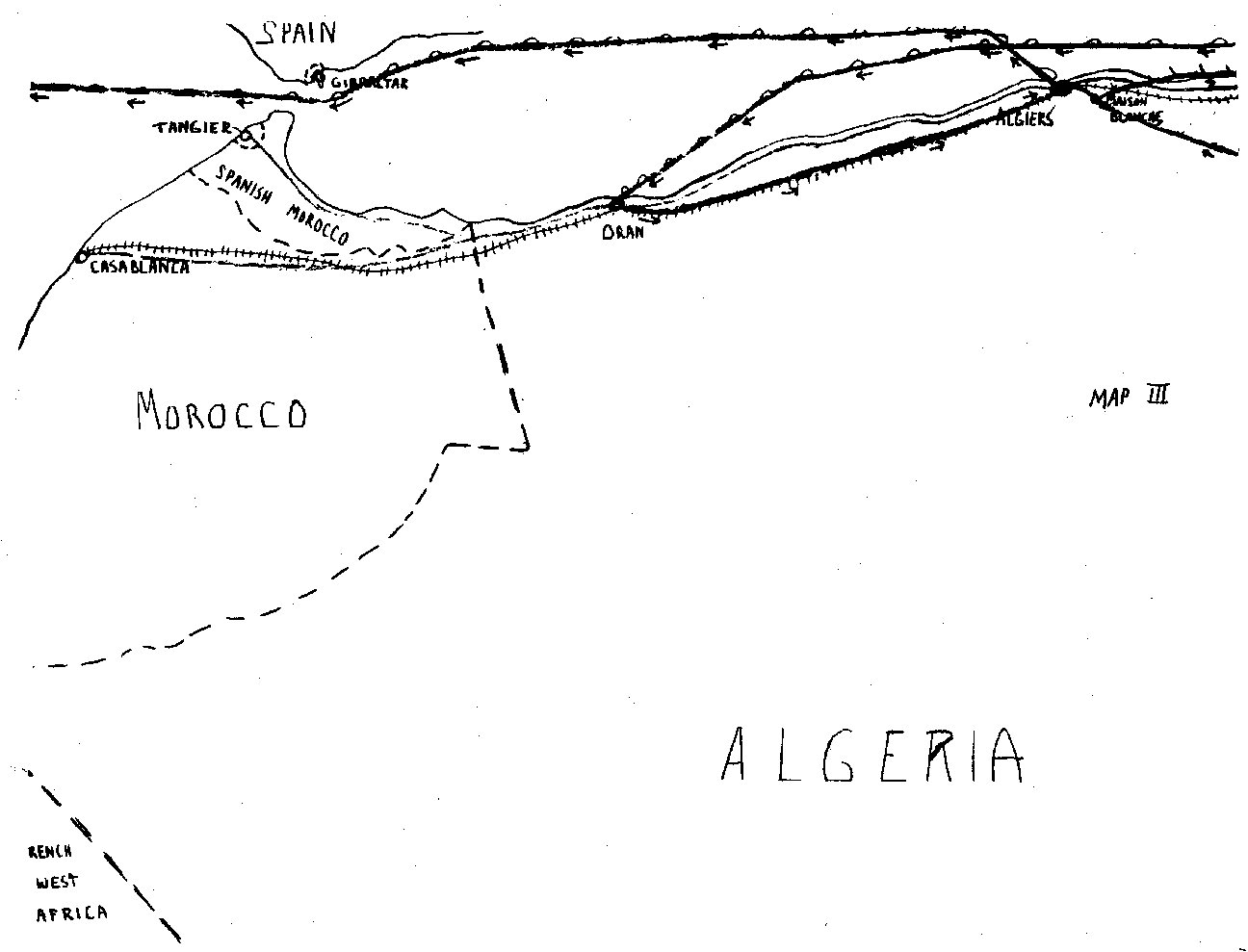
As the campaign in Tunisia came to an end, our work as ambulanciers gradually decreased. We were stationed for a time at Sousse and also, a longer time for our platoon, at Sbeitla. Our work, when we had any, was largely that of carrying sick men long distances to ports of evacuation where they could be put on hospital ships and sent to Egypt.
Work finally died out entirely and I made the rather unusual request of our officers to be permitted to fly to Algiers. My sister, Captain Ruth Briggs of the Women's Army Crops, was stationed there. The request, much to my great joy, was granted.
On the morning of May 17th, Alex Parker drove me to the Sfax airdrome and I got a ride in a DC-3 to Castel Benito, the airport of Tripoli. Planes did not then fly directly from Sfax to Algiers.
The trip took only a few hours. The big plane followed the coast southward to Gabes and then headed east to Tripoli. 1 love flying and on this trip I was to fly all the way. We arrived at Castel Benito shortly after lunch and I found that I could get a seat on a plane flying to Algiers the next morning.
I spent the night at the transit camp barracks on the edge of the field. All afternoon, planes---fighters, bombers, transports---were roaring in and out. I got my first close look at the speedy Lightnings there and discovered an unusual custom of communications used by the air force ground crews. If a mechanic in one field wants to send a message or request to a pal of his at another field, he writes a note in pencil on the propellor of a plane going to that field. On the propellors of one Lightning I looked at, I found a whole series of running, ribald messages written over a period of several months.
At eight the next morning the DC-3 took off with a full load of passengers and headed her nose westward for the long trip to Algiers. We came out along the coast. The sky was clear overhead and we could see the white line of breakers separating the sandy shore and the sparkling sea. But ahead of us to the west were dark clouds.
We again passed over Gabes. Off to the south I could see the expanse of white flatness that was the dried salt lake called Chott Djerid, square mile upon mile of impenetrable, uninhabited aridness. Ahead of us in the distance the land began to rise into the foothills of the Atlas Mountains. Overhead hung the dark clouds. We climbed toward them as the ground below became more broken and hilly. The plane was bucking a head wind and we bounced about considerably, much to the discomfort of my stomach which preferred to stay at one elevation at a time.
The heavy clouds didn't quite touch the peaks of the mountains when we came among them, but the pilot kept us down from the clouds so that we went between the highest of the heights. Below us, now and again, we could see small Arab and Berber villages perched precariously on the tops of sharp hills. Roads wriggled back and forth on the hillsides.
At a small Algerian airport high in the mountains we were to stop for lunch and refueling. The field wasn't very large. It ran down a valley between two mountains. We came in low over it, circled once, and came in to land. By this time, I was very glad to be nearing the ground again. The ride had been very bumpy and my stomach had begun to jump about on its own.
Only when a plane nears the ground do you get the feeling of speed. I looked out the window as we came gently in toward the runway and could see the ground whizzing past below.
Suddenly the wheels caught the ground and the. plane bounced slightly into the air. A cross wind blowing down from the mountains caught out tail and swung us around slightly sideways. I held my breath.
The pilot gunned the engines powerfully as the plane began to settle down from. the bump. The wheels crept nearer the ground and, just before they hit, the accelerated engines pulled us up.
We zoomed out over the end of the runway, climbing slightly, and circled the field again. The co-pilot came to the door of his compartment and said, "Fasten your safety belts This isn't going to be fun."
The co-pilot was only a lieutenant, but captains, majors and colonels among the passengers snapped to his command as though he had been a general. Their faces had turned suddenly white and their jaws were set. Nobody said much; everybody watched the ground as we came in to try it again.
The ground came up slowly to meet us. We skimmed a road and came in low over the field bordering the runway. The pilot had the big ship under perfect control. The runway flew under us and the wheels touched the ground, dragging the plane slightly, but not bouncing this time. The tail was still in the air and suddenly a gust of wind caught it again. We turned slightly, ever so slightly, into the wind. The plane started to tip sideways; the wing on my side came down a bit.
The pilot straightened the plane out and again he gunned the engines. We gained speed and left the ground and the runway behind us.
The suspense at that moment was terrific. We hadn't enough gasoline to go on to Algiers. The landing here, difficult and dangerous as it was, had to be made. The cross wind was one of gusts. Those sudden puffs of wind had twice nearly caused us to crack up. We would have to make the landing between gusts or not make it at all.
On our third attempt we again came in low. The landing was as perfect as the one before. The wheels caught, we rolled along fast and didn't bounce, and we all waited with our hearts in our mouths for the feeling of the wind on the tail and the back of the plane swinging around. We lost speed gradually. The runway was rolling away beneath us. If the gust should come now we wouldn't have headway or room enough to get off the ground again..
Slowly the tail settled; the nose came up. The plane rolled to a stop near the end of the runway and we all heaved an involuntary sigh of relief.
The pilot came out of his compartment, said "Whew!" and grinned at us. When I climbed out the door of the plane and onto the ground, my bouncing stomach was forgotten. But my knees shook for a good ten minutes.
The big airdrome of Maison Blanche near Algiers presented no such problem when we landed therein the early afternoon. I took a bus almost immediately into the center of Algiers and started out in search of my sister.
From her address, I knew she was secretary to the Chief of Staff, Major General W. B. Smith, at Allied Force, Headquarters which I was told was just up the street about ten blocks. I pictured it as an easy walk and started out.
Algiers is built upon the side of a steep hill. The streets, instead of running in a straight line, wind up the hill with many a twist and turn. The "blocks" stretch out to unbelievable length. It took almost a solid hour of uphill walking to go those "ten blocks."
The building housing AFHQ was an imposing one, not because of its size or construction, but because of the armed guards, the continual influx of high officers of nearly every Allied army and navy, and the staggering number of salutes snapped in five minutes by anybody and everybody. With no little trepidation, I made my way through the grounds, past the sentinels, and up to the information desk just inside the main door.
The sergeant behind the desk looked down his nose at me. He saw no eagles, no crowns, or crossed sabers on my shoulders. He looked disdainfully at my uniform---hand washed in the desert, questionably pressed, mussed by long hours of air travel. When he leaned over his, desk, he could not see the reflection of his face in my scuffed desert boots. I knew what was coming and I struggled to, be casual.
"What can I do for you," he said in a tone that matched the expression on his face.
"Can you direct me to the office of the Chief of Staff?" I asked. In spite of all my efforts, my voice came out barely above a nervous whisper.
The sergeant's eyes narrowed. He looked me over from head to foot. I'm sure he suspected me of some dire plot to assassinate several of the highest officials. I lifted my arms slightly, expecting to be frisked. But instead he pushed a form toward me.
"Fill this out and have it signed by the person you wish to see." I did and he directed me to the office.
In an office between two offices I found Captain Ruth Briggs seated behind her desk. My sudden appearance was a considerable surprise to her. We hadn't seen each other In nearly a year, so we fell to with comparative stories. We didn't get far because doors began opening and closing and people were racing from one office to the other. My sister would stop one occasionally and say, "General so-and-so, I'd like you to meet my brother who has been with the Eighth army." I was completely overwhelmed at the end of ten minutes by the continual appearance of staff officers, decks of ribbons, gold braid, and brass hats.
The five Women's Army Corps officers in Algiers were quartered in a villa high on the hill. It was a beautiful building, once the home of the German Vice-Consul, with a beautiful view of the harbor. It was nick-named "The Wacery." Every evening Ruth and I had dinner there amid a continually changing galaxy of officialdom. I began to play a game with myself seeing how many different ranks of different services of different forces of different countries I could meet. I got the same kick out of it I should imagine a bank clerk would get when, on a lax day, he began to make patterns on his desk with thousand dollar bills. Ruth 'seemed to take all this as the natural course of the day's events; I never could get used to it.
On one of my first days there, Ruth was given an afternoon off and we spent it discussing our various experiences since we had last seen each other. And she had quite a. story to tell.
In early November, 1942, she and four other WAC officers had flown to London. They had been there during the carrying out of the plans for "Flame," the invasion of North Africa. Within less than two months they had set out from England on a ship bound for a North African port. The ship was only 100 miles from its destination in the Mediterranean when it was torpedoed and set on fire.
Ruth, in one of the small boats, took over the helm and steered the crowded ship on the rolling waves. She and another WAC, Captain Martha Rogers of New Albany, Mississippi, comforted the injured they had picked up out of the water as best they could in the cramped quarters. The convoy of ships they were with sailed on out of sight. Their own boat, listing badly, was taken in tow by a destroyer and soon it too disappeared into the darkness.
The officer in command of the lifeboat, frightened and very sick, could no longer take charge. He lay in the bottom of the boat retching violently. Ruth took command and, by the stars, navigated in the general direction of their port of destination. The able bodied aboard rowed as Captain Rogers chanted a cadence.
Dawn finally broke and there was nothing but water in all directions. Everyone felt a great relief when a plane came out of the sky and circled about overhead until they were picked up by a destroyer. They crowded onto the destroyer's deck and drank hot coffee. The injured were treated.
Their ship, on which they had left their personal belongings, sank before it could be repaired. Except for the GI clothing they had on their backs, the five WAC officers for their first week in Algiers were suffering a severe haberdashery shortage.
They were called to Casablanca for the Roosevelt-Churchill joint staffs conferences and General Marshall, hearing of their plight, took a list of feminine necessities back to the States with him, and sent them everything they needed.
The Casablanca conferences were a great experience. The highlight for the WACs was the special dinner given in their honor by the President and the Prime Minister. In the capacity of secretaries they attended most of the meetings and heard the plans being laid for the future course of the war. They have kept and are keeping the secrets entrusted to them well.
During the days, while Ruth was at work, I wandered about Algiers sightseeing, window shopping, or drinking in the sun-drenched sidewalk cafes. The renowned Casbah was out of bounds to all troops except for one conducted tour. I have an inborn hatred for "conducted tours," so I missed all but the outer walls of that supposedly romantic spot. I was told by people who had been through it that it wasn't much different from the Arab quarters of all North African and Middle East cities.
I spent one whole day touring about the Algerian countryside in an automobile, seeing the way the rural Arabs lived and how the French in pre-war days had developed this comparatively fertile colony.
As a general rule, the further you go westward from Egypt, the more you find the Arab poverty decreasing. More of them are cleaner, better dressed, seemingly happier. Poverty for such an agrarian peoples is, of course, in direct relation to the fertility of the soil. Except for the Nile valley, Egypt is less fertile than Libya, Libya is less fertile than Tunisia, and Algeria is more fertile from the coast to the Atlas Mountains than any of these countries.
Along with their increased prosperity, the Arabs of Tunisia and even more in Algeria seem to have increased their interest in their religion. A much higher percentage of Arab women here wear the characteristic Mohammaden veil. In their activities they are bound together by their religious spokesman, the Bey. This religious unity certainly has a value which has perhaps some bearing on their comparative prosperity. Unity made exploitation of them on a large scale an uncomfortable proposition for the French. And before the war the French colonial policy seems to have been to do things the most comfortable way possible.
I spent nearly a week with Ruth enjoying our reunion in Algiers. When it came time for me to leave, I was fortunate enough to have a special flight arranged for me eastward to Sfax. On the morning of May 23rd, I drove out to Maison Blanche and met the pilot. He was to fly me in a two-seater army basic training plane. I deciphered the intricacies of the parachute straps and belted it on. We climbed into the small craft, the pilot in the forward seat and I in the rear.
After the take-off, I closed the transparent slide panel over my head, clamped on the ear phones, and settled back to enjoy the trip. We gained some altitude, circling, and then the pilot headed the plane along the coast. He apparently was planning to enjoy the trip too.
"Can you hear me all right back there?" he asked over the interphone.
"Yes. Clear as a bell."
"We'll follow the coast for a ways and then turn inland to Constantine for lunch. I'll show you where to turn inland."
"How do you mean, "You'll show me where to turn inland?" I asked.
"You fly her for a while. I'm tired this morning."
I was speechless. I had never had my hands on the controls of a plane before in my life! To my amazement and no little fright, I saw him take his feet off the pedals and let go of the stick.
"Got it?" he asked.
I grabbed the stick and held it for all I was worth in its original position. Gently but firmly I put my feet on the pedals.
"But I've never flown a plane before in my life," I yelled.
"Oh, haven't you?" he said calmly. "She'll practically fly herself. Loosen up on the stick a little. If you want to go left, kick the left pedal a bit and shove the stick to the left. If you want to go to the right, its the same procedure in reverse. If you want to climb, pull, back on the stick; if you want to go down, push forward. When you bank, keep that little ball in the middle of the crescent shaped slot on the instrument panel. Flying straight, that airplane in the little dial in front of you should be level with the horizon indicator. All that stuff is on the instrument panel. Now you know how to fly. Experiment around with her until you get the feel of it."
I digested his instructions and said nothing.
"O.K.?" he asked full of confidence.
"O.K." I answered, not so full of confidence.
I decided to try turning left. I pushed gently, on the left pedal and shoved the stick over to the left.
The little silver ball scooted quickly over to the right side of the slot.
"Didn't bank her enough. Push more on the foot pedal."
I pushed hard on the left pedal. The little silver ball scooted quickly over to the left side of the slot.
"Side slipping."
I found that as I released the pedal, the little ball crept slowly toward the center of the slot. With a little experimenting I got it into the center. I looked up to see if the pilot had observed my feat.
We were heading directly out to sea!
I pulled everything back to a central position and decided that a right turn was the only way to prevent our making an unnecessary trip to the Balearic Islands.
"Getting a little off our course," the pilot said jovially.
This time our turn showed marked improvement. In fact the little silver ball was in the center a good fifty-per cent of the time. Now that I had found that the plane wouldn't go into a spin with an inexperienced hand at the controls, I thought flying was great fun.
When I got on the course again, I pulled back on the stick. The nose of the plane rose up in a wonderful fashion. Then I pushed forward and we came over the top and zoomed down. If I had been a mere passenger on a 'plane doing such things, my stomach would probably have f suffered a nervous collapse. But this was such fun I think even my stomach took an interest in the proceedings.
We flew a rather choppy, zig-zagging course, turning inland where the pilot indicated, and arrived at Constantine a little later than. the pilot had expected. He took over the controls for the landing---to my mind a very sound move.
After a quick lunch at the airfield while the plane was refuelled, we took off., We gained some altitude and, as I had hoped, the pilot again turned the controls over to me. But this time he added an unexpected element.
"You know," he said to me casually, "I've never flown any farther east than Constantine. Where is this Sfax place you're going to?"
"It's over there on the coast between Gabes and Sousse," was all I could think to tell him.
"Well, you've been all over this territory in a car, haven't you? You navigate to wherever you want to go."
"I've been as far west as Sbeitla in a car."
"Where's that?" he asked, tossing some maps back to me. "Maybe you'd better use these."
Keeping one cautious eye on the controls of the plane, I shuffled the maps around until I found the one with Constantine on it and tried to remember what I could of the elements of navigation.
There was the time element. I looked at my watch. It had stopped.
Then there was the directional element. I looked on the dashboard for a compass and found instead a gaping hole.
"Where's the compass?" I asked.
"Oh, I guess it's been taken out of your dashboard. Let me know when you want to know what direction you're going in."
Also there was the distance element. The measurement scale on the maps, I noted with satisfaction, was given in miles. I looked at the air speed indicator. It was given in kilometers.
"Kilometers!" I said aloud.
"Oh, you mean the air speed indicator. These planes are used in training French pilots. I never' can remember the formula for changing kilometers into miles. Can you?"
I had frequently used the formula to measure road distances by the kilo markers, but rack my brain as I would, I couldn't remember it then. It also suddenly dawned on me that to be at all accurate I should translate air speed into ground speed.
I tossed the maps aside, forgot about my stopped watch and the missing compass, the mile-kilometer and air speed-ground speed ratios.
"I say, old boy," I said in an imitated English accent. "Need we worry about the ruddy old wind drift?"
The pilot looked out the window.
"There's not much of a wind out today. It won't take us far off our course."
"What course?"
I looked out the window at the maze of mountains below. I figured that if I could find Kasserine Pass I could find Sbeitla. From Sbeitla a road runs straight. into Sfax. It should be easy.
There were lots of mountains around. Between all of them was a pass of one sort or another. I had never seen Kasserine Pass on the ground but I knew from its reputation it must be a fairly good sized one. So 'I headed the plane toward the biggest mountain pass I could find.
When we came out the other side of it, no settlements were in sight. We continued on to about where I estimated Sbeitla should be, but there were still no signs of a town or village or road. There was a nice looking dried up river bed, but I didn't recognize it.
"Are we going about east?" I asked the pilot.
"A little more to the left. Know where we are?"
"Haven't the vaguest idea. We can't help but hit the coast somewhere, though."
We continued on in more or less a straight line until far off in the distance I saw Chott Djerid and, a little further north, the Mediterranean. I banked the plane around to the north and we came in low over the coast road that led us to Sfax.
My first attempt at aerial navigation, in view of the difficulties, I considered a huge success.
In the peace time that came to Africa our ambulance car company was to have a long period of inactivity. We retired to a camp site among the shadeless trees of a sand-floored and sweltering almond orchard in the outskirts of Tripoli. Our cars were overhauled by the British workshops attached to our company. New engines were installed in some ambulances; those suffering the heaviest wear were discarded.
But for the drivers themselves, this interlude came as an onerous period of boredom. The heat was so great during the day it was painful to remain in the sun. The flies were numerous and irritating. The sand and dust which blew about in the hot wind got into everything you owned, ate, or slept in. Trucks went daily to the center of town and to the beaches. There were nearby sulphur showers and a Red Cross club with a makeshift swimming pool. The Red Cross club and an American hospital showed outdoor movies on alternate nights. We lived for the nights when it became less hot and we had enough energy to enjoy bridge, poker, or the movies. Good books, unfortunately, were rare.
To preserve our sanity, our officers wisely decided upon a policy of giving leaves to those who had spent nearly a year in the desert. Jim Doubleday and I decided to return to Egypt and, if possible, make a tour of Palestine. Jim, a descendent of the founder of baseball, was a divinity student from Binghamton, New York---an appropriate companion for a trip through the Holy Land.
We left Tripoli on the afternoon of June 6th. As we sailed out of the harbor on the British hospital ship H. S. Dorsetshire, we looked back at the white buildings of the waterfront drive nestled together in the late afternoon sun. In the harbor it had still been very hot. Now that we were moving out onto the open Mediterranean, a cooler sea breeze was blowing. Until sundown we continued to sail in sight of the Tripolitanian coast.
As the last light of day faded away into the west, the lights of the hospital ship came on. The masts and superstructure were aglow with lights; tiers of gleaming bulbs wound around the sides of the ship and shattered the darkness. Huge red crosses painted on the cabin roofs and midway along each side were illuminated by powerful spot lights. Our ship must have stood out like a silver coin on black velvet. For wartime travel, this seemed strangely unnatural.
The Dorsetshire was loaded to capacity. Now that the African war was over, all wounded and sick in the Tripoli area were being evacuated to the hospitals in the Egyptian delta. The inside of the vessel was divided into several large "wards" with efficient and for the most part pretty nurses in charge of each ward. Since It was carrying a capacity load, we were quartered in the "cell" or brig, an iron barred room in the bowels of the ship so far forward that our bunks slanted in toward each other. We spent all but our sleeping hours on deck.
Throughout our four-day voyage to Alexandria, the sea remained serenely calm. We sighted neither land nor other ships. But we did see a plane. It came from the north, circled us once coming low enough for us to make out the German markings, and then leisurely flew away. I stood at the rail watching this twin-engined enemy aircraft disappear into the distance. One of the ship's officers stood nearby.
"That was a German plane, wasn't it?" I asked.
"Oh, yes," the officer said. "You see, we broadcast our position to the enemy so that there'll be no mistake about our identity. Every trip we make a plane usually comes out to check up on us. They circle once to have a look and then fly away. They never bother us."
On June 10th, our fourth day out of Tripoli, we sailed into Alexandria harbor. We anchored for several hours before we came in to the dock to unload. The harbor itself was full of a great variety of ships. Riding at anchor were units of the French fleet. Many Liberty ships were at the docks loading and unloading. As we sailed toward 'our own berth we passed a loaded troop-ship. We did not know it then, but in less than a month the great invasion of Sicily was to start.
At our dock waited a white hospital train, each car painted with a red cross. We left the boat almost immediately and went to the luxurious new American Red Cross club for the night.
The next morning, Jim Doubleday and I took the train for Cairo. The station platform was crowded with Arab vendors selling everything from exorbitantly-priced chocolate bars to ancient copies of Western Story magazine. They followed passengers in hordes across the platform to the train and, after the travellers had. entered, the Arabs gathered about the windows thrusting whatever they were trying to sell into the compartments with great insistence.
After some wait, the train pulled out of the station and loped slowly across the flat delta plain, stopping frequently at small settlements.
Shortly after noon we arrived in Cairo where, at the Field Service club, we found Alex Parker who was also on leave. It took little talking to persuade him to come with us to Palestine. We spent the afternoon planning our trip, deciding what we should see.
In the heat of the early afternoon of June 12th, Jim Doubleday, Alex Parker and I made our way into the crowded Cairo station. We carried only one musette bag apiece. The Arabs, as they had in the Alexandria station, hawked their wares persistently. We bought third-class tickets and made our way along the platform until we found an empty second-class compartment and climbed in.
The carriages had three-quarter width compartments on the right and a one-quarter width aisle on the left. In the two compartments ahead of us were several Italian prisoners of war, jabbering away excitedly in anticipation of their train ride across Egypt. A British soldier sat in each compartment with a rifle beside him. They both looked very bored.
The train chugged out of the station and through the squalid Cairo suburbs. Soon we were travelling through the flat, verdant delta agricultural area. We could see grain fields, splotches of palms, irrigation canals, and black plowed earth. Once in a while we passed an Arab with his donkey or camel. Small water stops and agricultural warehouses flashed past. Sometimes we saw Arabs at work in the fields following wooden plows that seemed to be pushing sway-horned drowsy water buffalo teams, in the small towns we passed, there were dirty-yellow four-storey apartment houses, musty mills, shabby brick buildings, and tall minarets daintily overtowering round fat mosques asleep in the sun.
Our first stop was at the unattractive town of Benha. One of the most beautiful minarets I have ever seen stood like a silent sentinel over its dingy surroundings.
Beyond Benha was a long brown canal. The green fields were all irrigated. Cactus plants lined the railway tracks for miles. Over the grain fields flew flocks of six or seven pigeon-sized white birds. One water buffalo pulled a hand-made wooden reaper with an Arab sitting on it. The Arab farmers lived in small, square, one-room mud huts. Donkeys, bullocks, and Arabs drowsed in the shady side of the houses. On-the roof-tops and on fences and the rare trees perched huge black-backed and grey-bellied birds of carrion.
The train ambled on across the flat countryside, slithering from side to side in its tracks. The heat necessitated open windows and the smoke and soot came in continually. The Italians in the compartments ahead crossed the aisle and leaned out the windows for a better view and a breeze on their faces. The guards paid no attention.
We passed a small cotton gin factory. In the yard almost a thousand bales were piled about. At Minaret-el-Qahm, naked boys climbed through the fence separating an irrigation canal from the railway tracks and, hands on their chests, heads back, backs arched, they jumped up and down and yelled at us. The countryside was still grain fields plowed and planted in neat square plots. One mud house in a muddy field sported several dozen large, identical, earthenware jugs in neat rows. We passed freight cars on sidings loaded with wooden crates, bags of grain. Some flat-cars were loaded with bright, yellow armored cars. As we came into El Zaqâzîq, money changers came through the cars offering to give us 1,025 Palestinian mils for one Egyptian pound.
El Zaqâzîq, where we made our second stop, was very much an industrial and freight-shipping town. All produce from the grain fields in this area clears through here. A well-dressed Arab stuck his head in our window and held out a wooden, glass-covered case full of watches. -
"Buy a watch, meester?"
I looked at the assortment of watches. Picking out the best looking one, I said, "How much is this one?"
"Ten pound."
"Too much."
"How much you give?"
"Two pounds."
"Oh, no, meester. I had to pay six pound for that watch."
"Two pounds or nothing," I said firmly.
"I'll sell it to you, meester, for cost. Six pound."
"Two pounds is all I can pay. Sorry."
The train jolted and began to move slowly along the platform. The Arab moved along with it outside our
window.
"Four pound and the watch is sold, meester."
"Nope," I said settling back in my seat. The Arab was running now to keep up with the train.
- "All right, two pound."
"Too late now."
He couldn't keep up with the speed the train was beginning to pick up.
"ONE pound, meester!" I heard him yell in the distance.
Outside the town again there were more grain fields. At one place a donkey was pulling a wooden sled around the fringes of a pile of grain. An Arab sat idly on his primitive thresher. In another field white birds, like small storks, stood quietly on their long legs.
About-ten miles east of El Zaqâzîq we saw the first arid areas. Grain was growing only near oases and palm trees; the rest was sand. Sometimes, where the oases merged into sand, there were orchards, small and stunted. To the right of the railway tracks was a narrow canal and within 200 yards of it the sand had been irrigated into mild fertility. Beyond this, and to the left of the train, stretched hard, gravelled sand. We passed more flat-cars on sidings. Those loaded with crates of food were guarded by U.S. Army soldiers; those with armored cars were guarded by British. In the distance to the north we could see groups of tents and the high, cement water towers that were characteristic of Camp Tahag, where we had stayed when we first came to the Middle East almost a year before. We stopped at El Tel el Kebir, a village of slovenly buildings, railroad yards, and "lemoh-yade!" yelling Arab vendors. Our next stop, Quassasîn, was not even a town. A railroad station standing in the desert, Quassasîn was the nearest train connection to Tahag. Now it is a busy place. In peace time, it will probably stand neglected.
At six in the evening we came into Ismalia, the first large town since Cairo and, for the road and railway, the last in Egypt. It stands on the western banks of the Suez canal. We were beginning to feel hungry, so we paid through the nose for Egyptian-made chocolate bars. They were about half the size and half as good as American chocolate bars and they cost six piastres (twenty-four cents). We also changed some of our money at what apparently was the standard rate of exchange: one pound Egyptian for one pound twenty-five mils Palestinian.
It was beginning to get dark as we pulled out of Ismalia and crossed the big canal. The train rumbled over the bridge and turned northward along the eastern bank. Inflated barrage balloons were tied to the ground along the sandy edges of the canal. We stopped at Kantara, on the canal's east bank for an hour for supper, and then the train turned out into the sand dunes of the Sinai desert.
The lights of the train were on by now and the black-out blinds had to be drawn. Most trains cross this desert at night to avoid the unbearable heat of the day. The railroad was built across the soft sands shortly after the last war. It was quite bumpy riding and the speed of the train was limited to forty-four miles per hour. This rail line is an important link in the Middle East war effort, but when the Germans were within bombing range at Alamein not one attempt was made to raid it. Even after Alamein it was still, for some distance, within shelling range for submarines along the coast. Not one attempt was made to shell it.
At 9:20 we stopped at the little desert station of Romanah, scene of a big battle between the British and Turks in the last war. A British soldier came along the aisle, sat down on the seat next to me, and told me about the Sinai battles of the last war. He said that many of the old fortifications and dumps scattered through the desert were still visible.
From Romanah on into the desert, the blackout restrictions were relaxed and we opened two of our shuttered windows: I stood in the aisle looking out the windows for a long time. The half-moon shone palely on the white, rolling sand dunes and seemed to turn them into snow drifts. Vague shadows were lying under the occasional palm trees. Several ATS girls in the first-class cars ahead were leaning out their windows singing softly and beautifully. Square, yellow patches of light from the train raced over the softly rolling snowfields. The train rocked back and forth in its tracks gently.
When I woke up, the sun was already up and we were in Palestine. The desert was far behind me. A great many orchards and farmed fields bordered the railway tracks. A more prosperous looking type of agrarian Arab turned to watch the train go by.
At 6 a.m. we arrived in the central Palestinian road and rail junction of Lydda. Here we changed trains for Jerusalem. The train we now entered was only about four cars long. It huffed and puffed up the long climb toward Jerusalem, going up slopes I had thought impossible for a train to make, taking many long hours for the trip.
We reached the holy city just before noon, registered at the Y.M.C.A. hostel, shaved, showered and rested. Our twenty-one hour train ride from Cairo had been an exhausting one.
Our time in Palestine was limited to a week, so 1 tucked my distaste for such things in my pocket and we subscribed to a series of conducted tours sponsored by the Y.M.C.A.
After lunch we set forth on the first of these tours. We travelled by donkey-back all around the city visiting the peak of Mt. Zion, now covered by beautiful St. Peter's church, the tomb of Zacharias, the garden of Gethsemane, the Church of All Nations, King Solomon's quarries, and various of the old city gates.
The next morning, June 14th, we toured the old part of the city on foot. We walked through the arched Crusader's markets, in and around the huge Mosque of Omar, along the Jewish Wailing wall, up the long climb of the Via Dolorosa, and into the Church of the Holy Sepulchre where we saw the Cavalry, the Unction Stone, and the tomb of Christ. Afterward, we wandered about in the various "quarters" of the old town, the Christian, the Jewish, the Arabic, the Armenian, and the Greek, watching with keen interest the marketing activities, the living conditions, and the wonderland of the bazaars
The old quarter of Jerusalem was by far the most interesting of any I had seen in the Middle East. It was cleaner, more livable, and filled with a more lively and exciting activity almost all day long. The influences of the centuries of influx of pilgrims and crusaders, of the three major religions that centered around it, and of the various sects and monastic orders from every occidental nation in the world who claimed it as their home had brought to this ancient and holy city a greater variety of ideas, customs, and cultures than is to be found in any other city in the world.
That afternoon we started out on the third of the tours. This one was a bus trip down into the Jordan valley. We visited the Inn of the Good Samaritan, the site of the ancient city of Jericho, and the River Jordan. We stopped at the bridge built across it by Allenby in the last war and walked across into the country of Trans-Jordania. The bus continued on down the Jordan valley to the Dead Sea under which lie the evil cities of Sodom and Gommorah. Here we went for a swim. It was not a very pleasant experience and gave no relief from the intense heat of this lowest place on earth below sea level. The water was 26% salt. Swimming was actually impossible because the salty water in our eyes smarted painfully. The unnatural bouyancy was the only enjoyable part of the episode. When we came out of the water our bodies were covered with a fine layer of salt. It took a fresh water shower, thoughtfully provided by the management, to cool us off and make us feel natural again.
Our return trip to Jerusalem took us through the rolling country known in biblical days as the "wilderness of Judea." Our primitive bus struggled up the road that climbed through these grass-covered and sparsely-treed hills.
For the fourth and final tour, we left Jerusalem the following morning again by bus and wound out along the road past Rachel's tomb, past the hill on which the shepherds had watched their flock on that night, to the small village of Bethlehem. We visited the Church of the Nativity, the oldest standing church in the world, which as built, as far as could be ascertained, on the area occupied by the inn and stables where Christ was born. Nearby we saw the old hospices for pilgrims built by the Knights Hospitaler of the Crusades. After a short visit to the local bazaars we returned to our Jerusalem Y.M.C.A. rooms and threw ourselves on our beds completely exhausted. My dislike of conducted tours was even more deeply entrenched.
We may have been exhausted, but our time was limited. So later in the afternoon we went on an unofficial tour of our own through the old part of the city that had so enchanted me. We wandered aimlessly through the narrow streets, trying to ferret out parts missed by our previous tour, paying more attention to the people now living in the ancient buildings than to the scenic or historic highlights.
On the following morning, Jim Doubleday, who wanted to make a closer inspection of the Sea of Galilee than Alex Parker and I did, left on another more extended Y.M.C.A. tour. Alex and I spent the morning strolling through the Rockefeller Museum of Palestinian Antiquities.
After lunch we took a bus northward through the hills of Judea, through Nazareth, to the little town of .Tiberias on the edge of the Sea of Galilee. We arrived late in the afternoon, registered at the only hotel, and strolled through the rather commonplace village. After. supper, we walked up onto the heights behind the town. From a grassy field at the edge of a sharp escarpment, we could look down on the village and the sea beyond it. Across the sea in the distance rose the rugged Trans-,Iordan mountains looming over the dark blue waters in the starlight.
Alex and I sat for a long time in silence watching and thinking. He was sprawled back supporting himself on his elbows, smoking a pipe. I sat with my arms around my knees.
"God This is a scene that would stir the heart of a Halliburton."
"How do you mean?"
" ....And the sheen of their spears was like
stars on the sea
As the blue waves roll nightly on deep Galilee."
"It may be beautiful, but don't start quoting poetry at me."
As we sat talking of Palestine, of the war, of the future, the moon crept slowly out from behind the mountains. Only a part of it was visible at first, and it shone like a beacon from the heights. Gradually it came over the tops and scattered a silver-dust path before it across the Sea to the small docks of Tiberias. The water turned a more metalic blue.
We took a bus from Tiberias early the next morning, crossing westward to the more modern Mediterranean port of Haifa. The main part of town, although' modern, looked busy and uninteresting. We went up on nearby Mount Carmel. Alex, who could speak German fluently, and I were surprised to find a large colony of German-speaking people here. From the top of the hill we could look down on the beautiful harbor and the coast and sea sweeping away for miles into the distance. Royal Navy destroyers were maneuvering off shore. In the harbor were several Liberty ships and the hull of one sunken merchant vessel.
That afternoon we continued our bus tour of Palestine southward along the coast to the ultra-modern and almost exclusively Jewish city of Tel-Aviv, just north of Jaffa. Here we rested two and a half days at the American Red Cross club. We went to the movies, shopped in the well-stocked stores, ate fabulous ice cream in a shop run by a young woman who was a former resident of Brooklyn and strolled along the "Coney Island" waterfront.
With our departure from Tel-Aviv on the afternoon of June 20th on the train bound for Cairo, our journey to Palestine was over. But on this journey, we had travelled nearly 600 miles throughout the comparatively small country. We had seen its cities---ancient and modern, agricultural and industrial. We had seen its peoples and how they lived. On the busses and trains, in the villages and towns, we had talked to Arabs, Jews, Christians, farmers, shop keepers, and members of the British Palestinian police. In some ways the situation in Palestine was very unhealthy.
Palestine has proved to be a land of opportunity for both its indigenous, peoples: the Arabs and the Jews. They have both worked hard and they have both produced results.
The country itself is moderately fertile. Fruit orchards grow in great abundance. 'The soil is also suitable for grazing, for growing grain and raising vegetables.
In addition, Palestine has been made into perhaps the most important industrial country in the Middle East. The coastal region has seen a recent growth of modern factorys and cities. Its highways and railroad facilities are good and its harbors---especially Haifa and Jaffa---are excellent.
The Palestinian Arabs generally are much superior to the Egyptian Arabs in living conditions, health, and general wealth. Most of them are agrarian, but they have improved their agricultural equipment and methods. And some of them have become industrially minded---something very rare in other Middle East countries.
The Jewish population of this country has done a great deal both for the country and for itself. Since the German reign of terror in Europe, numbers of Jewish refugees have been coming to Palestine. They have set up a great many very successful co-operative farms where the persecuted and poverty-stricken refugees are regaining their health and are living freely, happily, and productively. They have established industries where refugees also may work and live under excellent modern conditions.
The unhealthy situation in Palestine, however, arises out of the competition and hard feelings existing between the Arabs and the Jews. The war for the moment has submerged any active and open strife between them and has given both sides a period of preparation for a future struggle,.
The Arabs primarily resent the presence and the industrial and agricultural success of the Jews in a land they consider their own. They are secretly gathering all the arms and ammunition they can. These they hide individually in the hills and backcountry. The British police, a large organization with the equally large job of maintaining peace and order, are doing everything they can to unarm the Arabs. Discovering hidden arms is a difficult job.
The Jews, a naturally fertile people, are producing children as fast as is humanly possible. By increasing their number by birth as well as by immigration, they hope in the long run to insure their place in Palestine. They are hopefully relying on the British to prevent armed violence if and when the Arabs see fit to use their hidden weapons.
This tense situation is evidenced now by the sharp competition along business lines between the two peoples. In our travels we found two bus lines covering the same roads. Few Arabs ride on the Jewish busses; few Jews ride on the Arab busses. The bus line situation was typical. Wherever one of the peoples establishes a successful business, a competing firm is set up by the other.
The British policy has been to prevent open violence and to try to convince both sides there's enough room and opportunity for everyone if they would be friends and cooperate with each other. This, obviously enough, is a difficult proposition to put across.
But in spite of the undercurrent of friction, Palestine is an up and coming country. It is one of the few I have seen where I have not found a few very rich and many very poor with the poor being worked to death by the rich. It probably has a higher immigration rate of destitute people now than any other country in the world. And yet, absorbing them into the democratically run industries and the modern cooperative farms, it maintains, if not the highest standard of living, the standard that gives the greatest benefits to the greatest number.
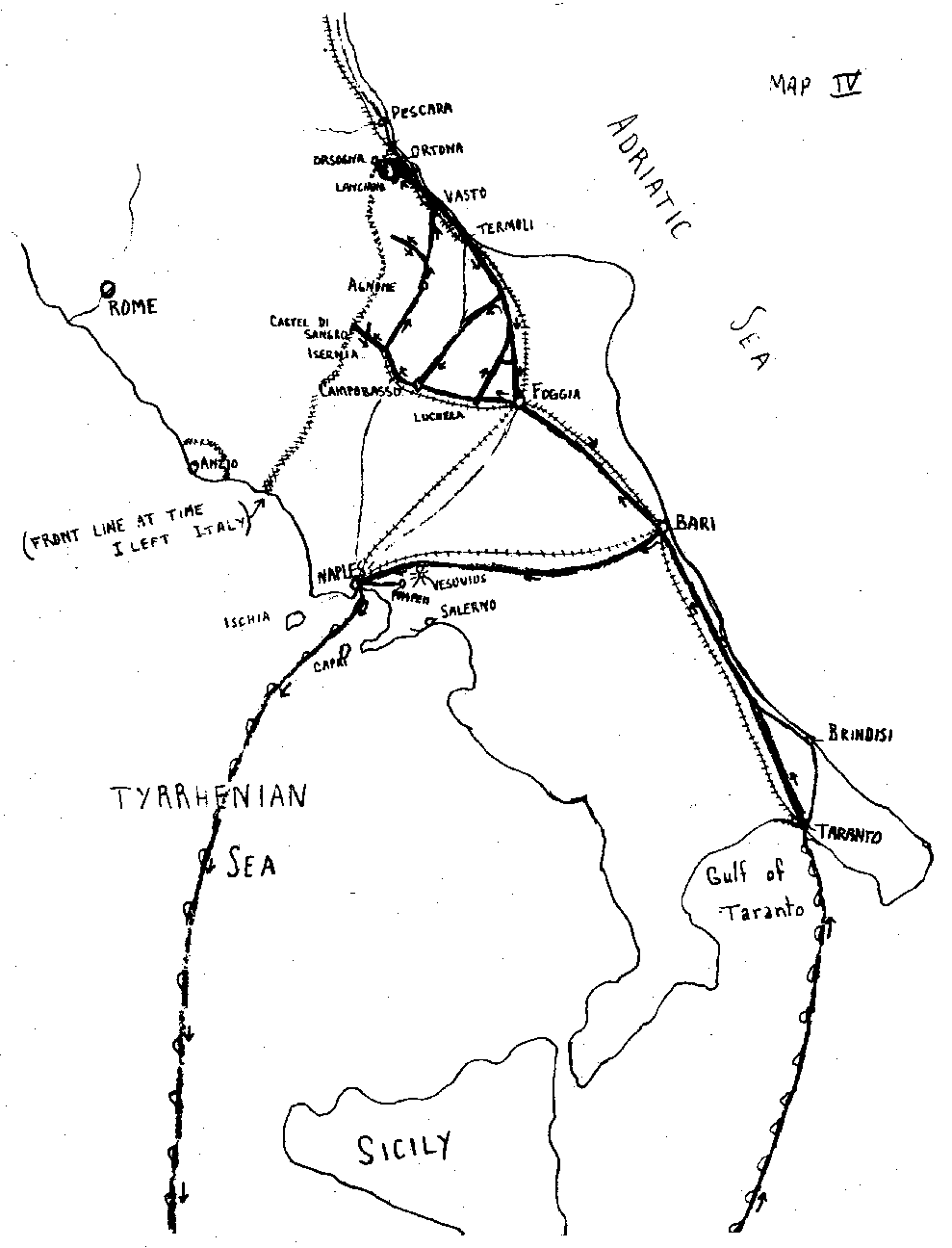
On June 11th, Pantelleria was pounded into submission and occupied. When this Fascist stronghold defending the Sicilian straits fell, like a weather-vane, it pointed into the wind and fury of a new Allied offensive.
Less than a month later, July 9th, that storm materialized in the sweeping attack by Americans, Canadians, and British that thundered victoriously over the entire island of Sicily.
After my leave in Palestine and Cairo, I caught a plane from Alexandria to Tripoli so that I might be with the AFS if it were to be used in the invasion. But shipping space was limited in those days and in spite of the efforts of our officers we sat uncomfortably in Tripoli---hoping that each day would see us on ships. In addition to a lack of ships, we were attached to Middle East Forces. The red tape of being transferred to Central Mediterranean Forces caused additional delay. In our onerous, sweating, impatient inactivity, we all began to develop a bitter dislike for Tripoli. Sicily had fallen, Mussolini had resigned and Fascism with him, the bitter struggle for the Salerno bridge-head had been made successfully, and British troops had crossed the Straights of Messina and were pushing up the toe of Italy. Still we sat and groused in Tripoli.
In the last days of September it began to look hopeful. We had already had one false alarm. The next boats available had been promised to us. In. the first days of October, they arrived. Our platoon reached the loading docks across the road from the Del Mahara hotel at 7:15 p.m. on October 4th. .We waited on the docks until after dark. Then the slow process of backing our cars up the ramp into the gaping mouths of the LSTs (Landing Ship, Tanks) began. We churned our ambulances in reverse up the steep draw-bridge and onto the elevator on which they were hoisted to the top deck. The lower, inside deck was filled with huge tank transporters. In the early hours of the morning, the last of the ambulances was chained down to the upper deck. Shortly after dawn, our British-designed and American-built LST wallowed out of the harbor. It was being run by the U.S. Navy and we revelled in the unbelievable American food.
For three days these tublike boats rolled northward through the slight ground swell. Eight other LSTs, a corvette, and a larger escort vessel made up the convoy. As the boats rocked with the swell, our ambulances, chained to the deck by the wheels, rocked on their springs back and forth.
On the morning of the fourth day, the land of southern Italy appeared in the distance. We sailed into the Gulf of Taranto and soon land was visible on three sides of us. Our convoy formed into single file and navigated straight toward the waterfront of Taranto. Soon we saw a narrow channel, spanned by a bridge, which seemed to run straight into the city itself. We entered this and then we saw the magnificent land-locker harbor. Crowds of soldiers and civilians lined the street overlooking the channel and watched us as we passed. In the harbor itself were several sleek-looking destroyers and cruisers flying the Italian flag. One mammoth ocean liner of the Italian-American line, now painted the distinctive wartime white of a hospital ship, lay at anchor.
Although we anchored in the harbor before noon, it wasn't until after dark that we could use the docking space and unload our cars. From our position in the harbor and when, on the following day, I made a tour on foot through the city, little damage to Taranto could be seen. The only really devastated areas were close along the docks area of the harbor and in the industrial districts outside of town. The city itself was still very much intact and in business. The food shortage, of which we were to see so much in Italy, was evident. Restaurants were open, but their meals were so limited they could hardly be called meals. There was no shortage of wine. The stores were, of course; empty of anything of any value.
Two days after landing we were assigned to a corps of the Eighth army and we moved northward toward the fighting. On our first day we reached Bari. Here also little damage of war could be found. The magnificent harbor was already being used as a main supply port for the armies to the north. The following day we travelled up the peninsula and inland to Foggia, where we found an entirely different situation. This great rail junction had been an important target for Allied bombers even before the war had been cleaned up in Africa. It was a bottle-neck for all railways feeding the ports in the southern tip of Italy. It had received a severe beating. For several days we were leagured in the railroad marshalling yards and we had ample time to see the terrific damage wrought by our accurate bombers.
The buildings of the town were also shattered extensively. Vast bomb craters were scattered through the streets, the small park, and among the buildings. The civilians and the army were working hard to restore some semblance of civilization to the city. Already engineers had rebuilt several of the railroad tracks so that supplies could be sent northward toward the front. Communication lines, water pipes, the sewer system, the streets, and the electrical supply lines were being worked on. Gradually Foggia has regained some semblance of a lived in city. Civilians who had moved out during the bombing and fighting were moving back to build up their homes again.
From there we went northward to the front. The battle of Italy is still in progress as this is being written. Censorship necessitates that I omit specific mention of distinct places and situations.
In southern Italy, where the terrain is in favor of the attacker by reason of the lack of defendable positions, the Germans obviously fought only a delaying action. Progress up the toe of the boot and northward from Taranto for the Eighth army had been fast. Expansion of the Salerno bridge-head which flanked the mountainous interior of Italy had been slow for the American and British forces there. When the Eighth army connected with the troops poured into the Salerno-Naples area, a line was made across the entire peninsula. This line crossed now some of the ruggedest mountains south of the Alps, making it easy work for the German defenders but difficult for the Allies on the offensive. Here, as in northern Tunisia, mountainous terrain slowed down the forward progress, but also as in Tunisia, it had not halted it.
The coastal plains running along each side of the mountainous center of the peninsula are narrow. The enemy holding the heights can shell from hidden positions any advance made along those plains. Thus the heights of the interior, difficult as they are, have to be taken.
The only way to unseat the stubborn enemy fighting in Italy was to bring against him a superiority in aircraft, in artillery, and in numbers and fighting quality of troops. Until the present line was established, this had been done and several of the enemy's lines of defense which he had hoped to hold for the 1943-44 winter were blasted and over-run.
The conditions of battle for the Allied troops and, even more so, the enemy are proving difficult indeed. The conditions the Italian civilians are facing in the battle zones and, even more so, behind the enemy lines are also difficult. But those conditions with the aid of the Allies and the work of the Italians themselves are being overcome.
The Italian towns and villages and their citizens have suffered widely different fates in this war. Those situated in untenable and nonstrategic places have hardly been touched. Those less fortunate localities which were used by the enemy as strong points in their lines of defense were badly mauled by bombing, shell fire, and street fighting. The mauling of a town or village by the destruction of war hitting it from both sides leaves a very unpleasant place in which to live and to struggle for a living.
To give an idea of the life and conditions in the Italian settlements I shall describe a completely imaginary village built out of a composite of most of those I have seen. Such a village might be on the round-hilled coastal areas, it might be in the mountainous central sector, it might already be miles from the front lines, or it might be in the chaos of no-man's-land right now. This is not a static picture, for the conditions in these towns are not static from one day to the next. The people in it are not imaginary, though they remain unnamed. They are specific people I have met during my four months in the Italian war zone.
The village is an Italian market town. It sits closely tucked under the heights of a steep hill and faces down a rolling, green, but infertile valley. The fields around it are muddy and the cobblestones of its streets are slippery. It rains almost every day. High, snow-capped mountains rise up majestically in the distance behind it. When the rare sun breaks through the clouds, the snow glistens like a brilliant diamond. The church has been hit by a shell, but its steeple still stands and regularly every day its bells ring, echoing, down the long valley and up the steep sides of the hill.
When I first came to this village, guns rumbled in the distance to the north, reverberating again and again the thunder and. lightning of war that had so recently passed over this town and combed the Germans out of it as the first winds of a summer storm sweep the tumbleweeds from a meadow. The lightning had struck the town as the graves in the local cemetery and the debris of slaughtered buildings showed. The narrow, up-hill alleys, too steep and narrow for any vehicles other than the ever-present donkeys, now are cul-de-sacs, ending in a high pile of the bricks, plaster, and roof tiles of a bomb-strewn house.
The small, ugly bridges crossing the mountain stream that tumbles through the village are gone. Their jagged stubs reaching out from either bank now support a wooden military replacement. The guns in the distance have moved on----out of hearing; and the shattered civilians have returned to their shattered town.
On a cold, raining day in November, an old Italian, standing in his door way, smiled as a friend smiles. We were tramping down the bumpy cobblestones, our coat collars turned up, our heads bent forward into the rain, our hands stuffed deep in our pockets.
"Hello, boys," he said, surprisingly, with an American twist to his speech.
We stopped to say hello. In almost every town, in Italy there is someone who has been to America.(1) Their reasons for going there, for returning to Italy, and the length of their visit always varies, but it is a continual source of amazement to me to encounter them and have them speak "American" out of a clear sky. It is somewhat like the shock you would get encountering an English-speaking native in the unexplored jungles of Brazil.
"Come in by the fire and get warm," he offered.
The room we entered ended in a great fireplace. On the hearth some twigs were burning on a pile of ashes. On the walls hung drying maize, the picture of a saint, and a crucifix. An elderly and very buxom woman sat in a corner near the door examining a wooden tub of steaming potatoes. Near her sat another woman---probably in her twenties although her face looked much older---with one breast exposed suckling a child.
"Built this house myself," our host stated proudly as he piled more twigs onto the fire. We sat down around it and held out our hands to its warmth. The old man wore baggy blue pants, patched at the knees, a heavy army shirt, and ragged shoes. His face was thin and deeply lined. On his cheeks was a grey stubble of hair. His heavy hands rested on his knees or moved in nervous gestures to illustrate his speech.
"I was in the States for eight years," he continued. After every sentence, he paused for a moment, watching the flames on the hearth. "Lived in New Jersey, near Paterson. Was a mason. I come back to Italy in 1928 because my wife was sick. Immigration wouldn't let her come to the States with me. my daughter over there with her little boy. Her husband was killed in Greece. I got three sons, too. They're in the army. I ain't heard about them in a long time, now. They should be back soon, though."
My mind flashed back to the unknown Italians I had seen buried from Egypt to Tunisia. They were unknown, unidentified, and now they lay unmarked beneath the sand. I wondered if his sons would soon be back.
"I ain't got no land, but, I got some sheep. They graze on the side of the mountain, here. I hid them when the Germans was here. They took most of the animals to eat before they left. We can eat my sheep this winter, and trade some sheep for other food---vegetables---too. After this winter, I don't know." He looked out at the rain in the street and puffed on a cigarette we gave him.
"I been in two wars," he said after a pause. "I was nine months in Tripoli fighting the Turks. And I was in the last war, too. I got three sons in this war. I ain't heard about them in a long time, now." He sighed wearily and watched the rain beating down on the cobblestones.
Our billets were on the outskirts of the town on a long street that runs from the small railway station to the village square. I walked it about once a day. Most of the traffic was civilian. Men led overladen donkeys or sat uncomfortably on two-wheeled donkey carts. The people walked in the streets, for the sidewalks were sporadic and frequently held vast mud puddles. The men were dressed in patched clothes. Few had boots or shoes. Their feet and shins were usually wrapped in cloth tied about their legs like the leggings worn by Eskimos. To the cloth around their feet was tied a piece of an automobile tire tread cut to the length of the foot. These were their shoes. The women wore voluminous black dresses, belted at the waist, coming almost to their ankles. Once fancy, now faded shawls with moth-eaten tassels were thrown over their backs and they wore long, off-colored sleeves that tied to each other across the back of the neck. They were usually carrying bronze water- jars or market baskets on their heads. Children were on the streets too, but you seldom saw them playing unless it was a warm day. They had thin shirts and short pants, bare legs and frequently bare feet. They were cold and almost always hungry.
Few of the buildings were not chipped by shrapnel and few of the windows had withstood the force of numerous explosions. The neatly printed letters on many buildings "IL DUCE!" were smeared over or crossed out. If anything replaced them it was usually "BADOGLIO!"
At a street corner, I passed a group of middle-aged men. The center of the group was slightly better dressed than the others and he had a paunch and an air of authority. In loud and voluble Italian accompanied by emphatic gesticulations he was discussing the most recent AMG proclamation posted on a nearby wall.
Midway down the block stood a young man. He had a black cape thrown over his shoulders and wore a narrow-brimmed felt hat. His hands were in his pockets and he leaned idly against a telephone pole whose wires hung tangled above his head. He was probably a former young Fascist with his pre-war compulsory military training behind him. He was watching with intense fascination the varied military traffic rumbling along the nearby main street on its way through the town. His morbid curiosity of what knocked Italy out of the war was being satisfied. Perhaps he was remembering what Fascist party secretary Carlo Scorza said in June, 1943: "The enemy trembles in his lair, feeling emptiness in his heart ... We will know how to resist." Perhaps he was remembering that.
A nearby building had been commandeered for a Royal Army Service Corps billet. Two little girls stood, arm in arm, in the street making eyes at a British soldier in the doorway. They were perhaps eight or ten years old. The soldier smiled and winked at them and they turned away screaming with giggles.
A narrow, cobbled side street joined this road, and as I crossed it I saw a man leading a donkey cart coming toward me. A pig was standing in the street running his blunt nose between the cobblestones and didn't move for the oncoming donkey cart. The man swung at the pig with a stick and, squealing, the pig ran into the open doorway of a house.
Across the street marched a merry procession. In the lead were two children, a boy and a girl, dressed as bride and groom. The boy had on a battered. felt hat and a huge swallow-tail coat. The girl was wearing. white lace on her head and shoulders and carried a faded bouquet. She tried desperately to keep the adult-size. high-heeled slippers from slipping off. . Behind them. came half a dozen best men and bride's maids laughing and chattering. The groom was firmly holding the bride's arm and was bowing proudly to everyone on the street.
I suddenly noticed a woman sitting on a doorstep on my own side or the street. Her dress was black and dirty. Her unkempt hair hung in dark wisps around her face. She had a child at her breast.. From her creased and tired face her black eyes snapped a look of intense hatred at me. The corners of her mouth were turned down angrily and an ugly scowl marred her forehead. I felt her looking at me until I was well up the street. Perhaps her husband or her sons were in this war, perhaps they were known and identified, and perhaps she had heard about them.
When the destruction of war moves toward an Italian village the people know of its coming. From the south comes the sound of it. German lorries move through the town more frequently. Tanks, artillery, and huge tracked troop carriers come up from the south, pause in the town for a day, then move on to the north. The noise moves ever closer. Bombers fly over at a great height, some dropping house-shaking explosions on the roads, railway yards, and industrial buildings, some moving on further to the north.. Low flying fighter-bombers come up the valley shooting at trucks on the roads and bombing bridges. When these things come, the people hide in their cellars and pray.
The front line of the ground battle moves ever closer. German artillery sets up around the town and pounds away. Shells come out of the south in answer and some of these land in the town. When these German guns move back the people begin to leave the town. They move up into the hills and dig caves and build shelters. The buildings are a target, the hillsides are not. The Germans take the turkeys, chickens, and pigs before they move on. Other Germans dig in around the town and wait.
With the darkness the guns to the south open up and the shells land in and near the town. The people watching from the hillsides can see this. When the shells stop coming there is quiet for a moment. Then along the road come men with flat boards on sticks, swinging them back and forth, stopping to dig out mines. Over the fields come fast little Bren carriers shooting at the German emplacements. Suddenly the Germans are gone and the bren carriers wait in the town.
German shells from the north are now landing in the village. The people can see this too. In the small hours before the dawn the people on the hillsides hear the sharp. rattle of machine guns, the sporadic bursts of mortars and hand grenades. The Germans are making a counter-attack, trying to retake the village. For this period, these people's homes are in no-man's land, the object of the two contending forces. The fighting is bitter and destructive. The battle wages back and forth through the town. With the first light of dawn, the big guns in the south open up again and pound at the town and the Germans are repulsed.
German shells still land in the town and on the roads for a while, but these are soon gone. The people in the hills gradually come back to their houses. Tanks and trucks and guns are still coming in, but these are on their way northward. Some of their houses are being used as billets and hospitals and they live with a neighbor and wait. They gather together what is left of their animals and their household possessions and try to start a normal life again. They work in the fields, trade with the new soldiers, stand for long hours in lines for bread. They are no longer under Fascism and the German military rule and they stretch out experimentally in their new freedom. Soon they find an AMGOT officer who can speak Italian and who will listen to their troubles. These are most of the people.
But all of the people are not so fortunate. Some few stayed in the town too long. One was in a house that as hit by a shell and they found him a week later under the debris. Another walked down a road after the German engineers had been there and stepped on an anti-personnel mine that blew his leg off. He was treated by an army doctor and sent back to the nearest civil hospital to the south in an army ambulance. His family has not heard from him since then. A shell winged over the village and landed on a nearby road next to a family in a donkey cart trying desperately to get out of town in time. It killed the donkey and the mother. The father and three children left the donkey and cart by the roadside and walked up into the hills where they buried the mother.
Thus the war passed over this town and combed the Germans out of it as the first winds of a summer storm sweep the tumbleweeds from a, meadow. But the storm was so intense it broke limbs from the solid old oak, uprooted the saplings, scattered the firm, round haystack, and bent the willows on the meadow's edge.
The battle in the desert was the freak of this war. It was in an ideal setting for mass, man-made destruction. For the most part, there were no civilians in its path to be in danger of death, of homelessness, or of economic catastrophe. There were few buildings and bridges and dams and cultural monuments to be destroyed. If a bomb or shell blew open a hole in the desert floor, the wind and drifting sand soon filled it in again. If an, artillery barrage lashed at concentrated areas, if pattern bombing deluged the enemy positions, if a tank battle spat its fire and destruction indiscriminately across the wastelands, the desert shook off its wounds without feeling them. In a few years even the scars will be gone.
But the battle in Italy is no freak. It is as all others in this war shall be. I saw only a third of Italy. Only a fraction of the areas to be fought over. Only a fraction of the enslaved territories that have to be liberated before this war is won. But the conditions in Italy are perhaps the most accurate sign-post we have to indicate the ruins this world will lie in when this war is won.
Those liberated people in Italy rejoiced in their regained freedom, but they are waiting for something more than the good riddance of the oppressors. Their lands are in the ruins of battlefields.. Their nation is in the throes of recovery from political corruption and malevolent domination. They starve for food, shiver in this first winter for lack of clothing and buildings, and still have the wrinkles of a cramped oppression stamped in their minds and souls.
But this fate,. this destruction, this waiting is not solely an Italian problem; it applies with equal vehemence to the people of Poland, France, Norway, Holland, Belgium, Denmark and all the other countries which the Nazis have overrun and sucked dry. Millions of these common people around the world are waiting. And they have faith in America. They have heard America's promise of help in reconstruction; they have heard of the four freedoms which are to be given them after the war is over.
America, with its high standard of living, its universal education, its government responsible to all the citizens, and its freedom of. opportunity, has set an example which common people of the world still admire and long to imitate. Strangely enough, we still have their confidence despite all our own short-comings.
But aside from a certain idealism, do Americans have a clear picture of the conditions abroad which they are promised to relieve? Can Americans today working in clean, unbombed offices and factories, living in quiet towns and peaceful cities, unthreatened by the sudden onslaught of modern war, and still having the highest standard of living in the world, feel the force of destruction and visualize the ruins of the rest of the world?
If America is to take a leading part in the postwar world, Americans personally must try to feel and visualize the situation as it exists abroad. Then they must try to figure out what they're going to do about it.
The Eastern Hemisphere is literally in ruins, especially in areas where the war has raged, also where the war has only backwashed--- an unsavory fact but one we must face. The people, villages, cities, bridges, dams and harbors have been and are being mauled over by this war. All but the first of these is physical---ruined quickly by war. Repairs will be a tremendous problem in finance and engineering. The damage inflicted on people came more slowly----throughout the enemy occupation----and it will be a much more difficult situation to remedy. Difficult or not, it is a challenge which must be met.
The minds and political consciousness of the people who have been under German domination for so long have been welded into a fatalistic acceptance of whatever is thrust upon them. After the armistice, opportunities for the usurpation of these people and probably the seizure of these opportunities by the shrewd will be rife. Thousands of them will be suffering from the poverty wrought by forced labor, the extermination of many of their peacetime occupations, the agony of food, shortages, and the destruction of their homes and living space. Other thousands have been transported across continents away from their homelands and settlements.
The young have been warped by the untruths and misconceptions of education guided by false politics and from this they shall recover only slowly and painfully. Their faces show it today in a conscious hardness, strange in youth.
The adults have been overworked into dullness or persecuted into a bitter, irreconcilable hatred. Their features have coarsened---some to animal inexpressiveness, others to ominous prescience. Who can say whether they can fully recover from this?
The aged, if they still, live, have given up hope. Their faces are lined with exhaustion and despair.
In enemy-occupied territories the very fundamentals of life---religion, morals, opportunity to work, freedom to think, and the basic dignity of the individual man---all of these have been battered and left in ruins by that enemy occupation.
These people have not only lived in subjugation, but also in battlefields. The practice of warfare in crowded countries has mutilated the homes and cities and public works of these people. We have already seen the destruction of Rotterdam, Coventry, Sevastopol, Aachen, the Ruhr dams and Rhineland factories, great parts of London and Berlin, the Ploesti oil fields, the Dnieper Dam. These are but the sensational destruction of a war unfinished. We cannot see the unnumbered farms and homes and shops that meant life to thousands, already destroyed and yet to be destroyed in the coming battles and bombings. In a larger sense, these are problems of reconstruction, of engineering, of reparations. They are also a bewildering problem close to the innumerable individual people involved.
In the war-torn parts of the world, these are the conditions which will face any relief and rehabilitation programs projected to help medicate world economy back to health.
America has already stated her intention of taking a leading part in post-war reconstruction. President Roosevelt has stated the theory of the four freedoms for which we are fighting. Our government has sponsored food conferences, financial discussions, and overall debates on larger peace-protecting machinery. We have already set up a relief and rehabilitation commission to carry out a post-war program, and men, behind the scenes are now in training in American universities for the handling of the gargantuan problem that must be solved.
In order to be at all effective, however, postwar planning will have to include not only the restoration of a free Europe and a free Asia, but also a universal freedom for all the peoples whether they have suffered under the tyranny of dictatorship, under the cataclysm of warfare, or under the destitution of economic injustice. Even in areas influenced only slightly by the war, in parts untouched by the battles and bombings, conditions are incompatible with any plans proposed to rebuild a peaceful, healthy world economy after the war. These conditions have been pointed out wherever I have seen them in this book.
Among the politically and, economically garrotted people of Festung Europa, freedom is still a vague remembrance in the minds of the middle-aged. But among the lower classes of India, among the Negroes of South Africa, among the Arab fellahin of the Middle East, among the peasants of Italy and the Balkans, and even, though to a lesser degree, among the lower classes in England, economic servitude has become a habit of generations. Such a habit cannot be eradicated overnight or even in one generation. But it can be eradicated if education is stressed as a primary medicant. America, one of the few places in the world today where education has made freedom a popular attitude, has proven this.
Education is a long-term affair, not a thing that can be dished out in the months following the armistice. But a lengthy process is not to be considered an impossible process. The immediate post-war plans should embody the beginning of this long and necessary educational program. People must be literate, they must be able to use intelligent judgement, they must be educated and immunized against domestic despotism by growing through education into the attitude of the free man before they can have any real hope of achieving the four freedoms and any measure of political self-determination.
How can we establish freedom of speech if the people are illiterate, if they cannot read a newspaper, if they are prevented by economic limitations from hearing the spoken word through the radio or the public forum---as they are in North Africa, the Levant, India and China?
What is the meaning of freedom of religion if, in South Africa, one of the countries fighting for these freedoms, a man is banned from any church by reason of his race or color?
Where are we to find freedom from want when whole masses of the population of the Eastern Hemisphere have a purchasing power which barely covers the necessities of life?
Of what use is freedom from fear if whole classes of peoples have no hope of ever raising their standard of living?
And how can political self-determination ever be brought about throughout the world until governments everywhere come to be responsible to universally educated peoples?
The four freedoms cannot be set up by a clause in the armistice or a resolution of the peace conference. But if we are to have a successful and lasting peace, these fundamentals must underlie the reconstruction plans of all the United Nations. They apply not only to the countries liberated, but also to every nation now struggling to effect that liberation.
A more immediate problem than the establishment of education and the theory of the four freedoms, however, will face those who are to tackle post-war problems. This is the economic aid which will have to be doled out to all of Europe, parts of northern Africa, and parts of Asia to prevent mass starvation and, from lack of adequate housing and fuel, death from overexposure. This relief and rehabilitation will have to be undertaken by all the United Nations, but the United States, Russia and several of the British dominions, because of their greater, natural wealth, will undoubtedly have to handle the lion's share. The mis-named Lend-Lease Act may have to be continued after the war.
This relief, however, should be only a temporary measure. It should be recognized from the start as a hold-over until adequate machinery for self-rehabilitation is set up and functioning in the various destitute countries themselves. If it were to be set up on a complete relief and rehabilitation basis, it would, by its global nature, exhaust the resources of Russia, Great Britain, and the United States before it could be completed. The United Nations should help those who, when they are again able, will help themselves.
The post-war picture, with America helping in an internationally cooperative effort, is not a dark one in a long-term view. In over-simplified outline, that picture is: Through aid and self-development, the destitute countries will reestablish their own production and markets., The four freedoms will gradually be practical and the people will be free to learn, work and produce. When no limitations are left on any man's opportunities, he will produce more and better things. The resulting economy of' abundance will mean a better standard of living for all nations. When the conditions improve in one country, so does its purchasing power. This in turn stimulates better conditions in neighboring nations and in those with which it trades.
The American attitude and action toward the post-war world can be a tremendously beneficial influence. America should not force itself upon the world. It should not set itself up as godfather and protector. It should, instead, act as guide and example. We can and must supply the organizational efficiency, the working democratic example, and the humanitarian stimulus needed throughout the Eastern Hemisphere to reorganize the peoples and put their governments, industries, societies, cultures, homes, and families in shape again.
Immediate relief to avoid famine, management ability to set up self-rehabilitation, and a long term educational program to insure the ultimate goal of the four freedoms in a prosperous and peaceful way of life should be given to the post-war world freely by America. If we again bury our heads in the sand, civilization will continue to wallow and wage war in the ruins of itself.
Note: 1. An average of 200,000 Italians entered the U.S.A. annually in the years 1900-14. The Quota Acts passed by the United States in 1921 and 1924 curtailed this enormously, fixing the limit at 3,845 immigrants a year.