
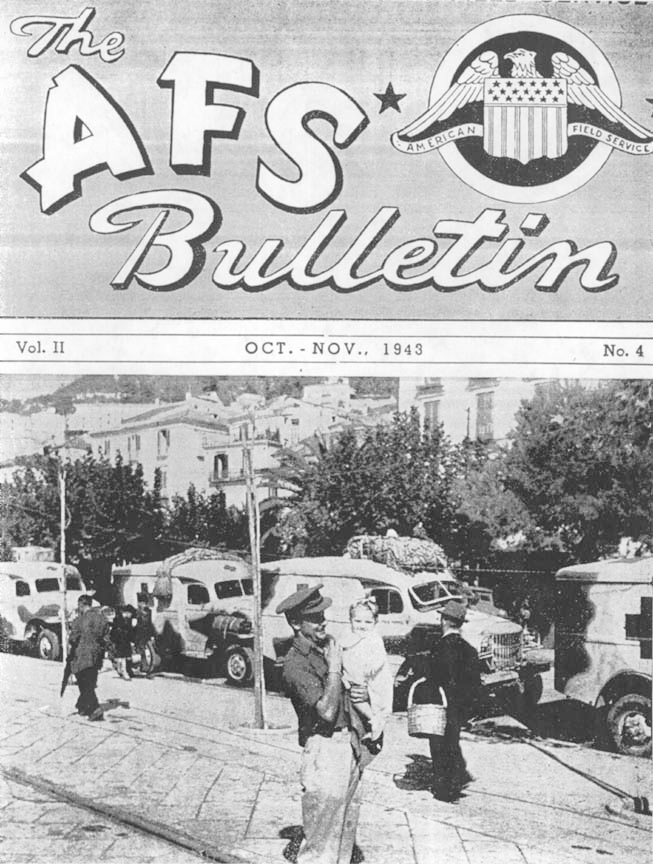
| THE AFS BULLETIN HEADQUARTERS, AMERICAN FIELD SERVICE GHQ, MEF |
 |
| Vol. II |
|
No. 4 |
|
|
|
If, by some strange misfortune you happen to read this before going any farther, we. hasten to inform you that most of the material following in the company sections was not okayed by their respective editors. The simple reason being that the editors didn't have time. Yours truly gathered, wheedled, and plagiarised most of the copy from the field and questionable sources so The AFS Bulletin could keep good its "monthly" standing.
It was done with some forethought, however. We don't want to kick gift writers in the teeth. But we hope that you men will get on the ball after reading some of the articles and pen a line for Editor Waiter Lovelace, 485 Coy, or Editor John Leinbach, 567 Coy...
After our fast and furious wanderings around Italy for two weeks we arrived back in Cairo in time to read Captain Andrew Geer's book, Mercy in Hell. Copies are beginning to get around to individuals now so you can read for yourself. But we think he did a good job in telling the story as he saw it. Neilson Bridger doesn't agree, but what the heck, he mentioned our name at least four times. Veteran Geer is now reliably reported in the South Pacific as a captain in the United States Marine Corps.
Only thing of interest that has happened around GHQ is that Anna Lee, the movie star, dropped into tea one afternoon. Major Perry and Captain Munce poured. We asked. her why she came. "Well, I've heard about you boys," she drawled, "and I just had to come and see you." We are still wondering just what she meant.
Ted Hoskins and Dick Frazier, who run the baggage room, set up a bar to service HQ on the eve of our fourth anniversary. They didn't have enough to do and thought they could provide that missing something. They did --- for one night. The next morning it was missing again.
Latest unit reported to the Middle East is 50. no comment.
One of the articles this month presents the story of India in the form of extracts from reports sent to H.Q. Not that that is particularly important, but we remember reading the following item in AFS Letters: Mr. Galatti recently made a trip to Washington to meet Field Marshall Wavell. They discussed plans for organizing AFS India HQ and the probable work in store for the units there... ...The commander-in-chief of Allied Forces in India assured Mr. Galatti that he would personally see Chan Ives when he returned to his head quarters.
General Wavell is now Lord Wavell and Viceroy. Haven't heard about the meeting yet, but Chan has ordered some new crowns for himself.
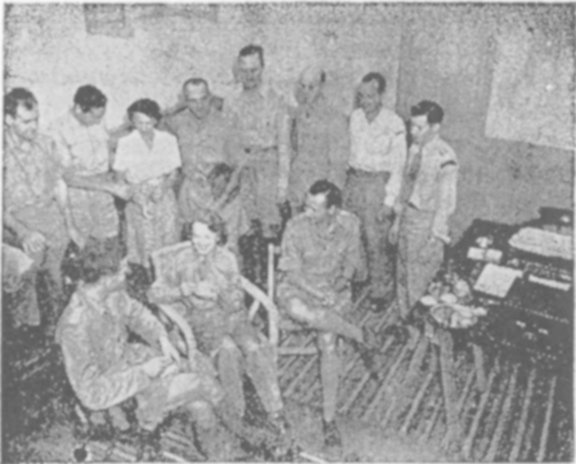
Anna. Lee, red-headed English movie star from Hollywood has tea in AFS headquarters. Pictured above are Capt. Edward Munce, Miss Lee, Major Perry, (back row, 1.-r.) H.V.R. Jones, Jay Nierenberg, Essie, Russell Perkins, Ted Hoskins. 2/Lieut. Warren Kraft, Harry Blackwell, Lt. Carl Adam. --- Signal Corps Photo U.S. Army.
|
It is not merely flesh that makes a man, Those inner longings that possess his soul ---- From AFS LETTERS |
Got back from the wars a couple of months ago, and took a little trip around the country. Stopped in Illinois, Montana, Washington and Oregon. Then came back stayed in Jersey for awhile, and finally ended up in New-York.
Didn't take the trip with the idea of writing a thing called "One Nation", and signing it Wendell Willkside. Took it rather to recruit what's left of the country's 4-F manpower for the AFS.
But now that my throat is no longer hoarse from lecturing in small darkened halls, and my fanny has recovered from 12 days on a day coach, a by-product report on the state of the States (in lurid yet- honest detail) might be just the thing to let you lads in the blue in on what gives at home.
If you worry about rationing at home, you needn't. The average person here doesn't get too much meat. Even restaurants have had to declare a third meatless day BUT --- when you return --- every one of your friends will insist on your coming to dinner the day they get their roast for the week... You'll get so sick of meat before you're leave runs out that all your spare time will be spent looking up sea food restaurants in the local directory.
Army menus, as portrayed in full color on the pages of Colliers and the Saturday Evening Post (showing roast beef, roast pork, pork chops, and hamburger to say nothing of chicken on Sundays) will suddenly begin to nauseate you.
Coffee shortage . Ha ? I have one or two cups in the morning for breakfast, send down from the office for a cup in the middle of the morning, linger over a cup at lunch (two---if I know the waiter), have another cup in the middle of the afternoon, and one or two more at night. This caused me sleepless nights for some time, and I became so haggard that mother grew worried. She has finally solved the problem. Every night, just before tucking me. in and turning out the light, she merely taps me on the back of the noggin with a short length of lead pipe.
Incidentally, the hardest thing to put up with these war torn days (let's face it squarely) is the way mothers, wives and sweethearts have been forced to encase their legs. If your woman loves you, and is a saving nature, she may be able to preserve one pair of silk stockings in which to meet you at the boat. If not. Oh, Brother. Those trim gams will either be streakily dyed with a patent liquid hose (directions: just kneel in a bathtub full of the stuff for 45 minutes, or apply with a wallpaper brush) OR --- this makes me cringe--- daintily attired (dainty like a hall filled duffle-bag) in the new ravon sensations, guaranteed to bag, bulge, wrinkle, and s'help me if I haven't seen if happen, fall down in an untidy mess around the wearer's ankles.
The Middle East was full (when I left) of rumors about the breaks AFS personnel get when they join the American army. I held my decision to cite several case histories.
Case History 1 Edwin K. Zittell.
Ed was 4-F when he joined the AFS, and although he was never sick in the desert, he pattered up for his final draft examination (on his return home) not too worried about reclassification. He made one mistake. Put down on his application, or what-ever it is you fill out before taking your final physical, that he. had served a year in the Middle East in the AFS with the Eight Army. -.
This finished him. -
I can see how it happened. Ed, standing naked and shivering in a long line of guys, moving slowly forward toward the first examining doctor's desk. Finally he arrives, frail, blue with cold, 4-F, and hands the doctor his card.
The Doe scans it in a businesslike way. Suddenly he starts and gives a long, low, whistle.
"Doctor Kumquat" he calls excitedly to the man next to him.
"Yes, Doctor Pureé?" Kumquat is examining a tall negro, whom he has stepping up and down from the seat of a chair.
"Kum, Quat ", says Pureé this is evidently a joke of long standing between the boys, the humor of which is only recognized by Pureé).
Kumquat -leaves the colored boy stepping up and down, walks over to Pureé's desk and scrutinizes Zittell's card. He too gives a long low whistle.
"Been to Africa, heh ?" he says, looking over the naked Zittell.
From there on in, Ed's whole day is a succession of long, low, whistles --- and passing marks for yes, teeth, rupture, weight, height and head shape.
And as if this was not enough, HE WAS MADE AN ACTING CORPORAL, and put in charge of a newly inducted contingent, consisting of Eisenpreser, Goldbaum, Heepy, Hoppy, and Lipshitz.
He is now in camp. God Rest Zittell.
Case History 2. AFS ex Lieut Evan Thomas. (the story as Told me.)
Thomas, while abroad, entertained the idea of joining forces with the United States Navy upon his return to the States. Unlike most AFS personnel coming home, who immediately eat the biggest steak they came find or gorge themselves on chocolate malted milks, or assume comfortable positions with their girls on their love seats, Thomas came down with malaria. After recovery (he thought he reported to the navy. But Mr Thomas ª the Navy demurred, ´How can we take you with malariaª. Evidently the bug had not been squelched.
About this time the draft started to breathe down his neck, over his shoulder, and various other places. Thomas, still of a mind to he a gob, was forced to plead with that imperturbable force, like Daniel Webster pleading to the jury of damned dead men for a soul. Thomas. like Webster, won. The draft gave him a week. He was able during that time, to convince the Navy that his malaria had just been a passing fancy, and now waiting patiently in the reserves. He will soon be called for active duty.
'Case History 3 David Hyatt.
Dave got a commission in Naval Intelligence.
This stupendous news arrived alone and bare at AFS N.Y. H.Q. Whether the Navy just liked his face or his girl is the admiral's daughter don't know. It probably endured more trouble and worry than it reads.
But it boils down to this. Going into the Army after being in the AFS, you take your chance with the average guy. Unless you stumble across a brigadiers wallet to return. Occasionally an AFS man gets something good immediately, like Hyatt. This is the exception, the same as it is with a newly inducted civilian. Mind you, I'm not saying won't help you once you are in. But OCS is getting, to be a tough nut to crack, even with the AF.S as a nutcracker.
If you are deferred, and only if.
MONEY, MONEY, MONEY For a job with no future (beside speeding offence, which is a hell of a big future, come to think of it) and high pay, come home. The Tuesday New-York Times carried 9 full page columns of Men Wanted. Todd Shipyards wants metal workers, caulkers, shipfitters, lathe and milling machine operators. The Acron Agency advertises for 6 husky deferred men, no experience, to work for $ 50 a week. Out of town concerns will train you and lend you the money to get to its plants. Wright Aeronautical Corp., Federal Shipbuilding, Vitascope, all the big war Prod. Factories want labor. Same way on the west coast. In Seattle, Boeing and Seattle Tacoma Shipbuildings, in Portland, Todd Drydocks, and Kaiser's mob.
Getting back to those run of the mill jobs that existed before the war and will after it, wages are higher but still don't compare to defense job salaries. You can get a job pearl-diving so fast it will make your head swim. Accountants are in wild demand. Clerks, office help of all kinds, and draftsman, are practical pursued down the street. The chance for a man coming home to make some money is good, if that's the only thing on his mind.
Morale. You tell me what it is, and I'll tell you how it is. The way people live, the way they tie their shoes, or buy a newspaper, or eat lunch, is the same, but maybe a. little faster. They spend more time puzzling over things like ration books, and the new income tax, and they argue about them, too. But they're for them. They think the American boy abroad is doing the best job in the war. They're loyal, and loud about their loyalty.
PLACE: Hqafsghqmef
TIME: Tomorrow and tomorrow and tomorrow.
The curtain rises, disclosing the outer sancta of Hqafsghqmef (hereafter to be known for brevity's sake as The Idle Hour Self-Improvement and Repartee Club of Cairo). Discovered: 2/Lt. William Randolph Squirt at a desk, thumbing through stacks of photographs: at another desk, 2/Lt. E. Pluribus Dunce, surrounded by copies of Joyce's "Finnegan's Wake," the "Satyricon" of Petronius, Descarte's "Pensees, " "The Wisdom of Lao-Tse," and "Lesser Love Poems of the Dravidian Anamists," all in the original languages.
SQUIRT: (pushing away the photos in disgust) Nuts! Not a corpse in a carload! (He falls asleep).
Telephone rings. Dunce puts away the copy of "True Comics" he, has been reading, and answers it languidly.
DUNCE: Dunce heah---Ah. Napier---Why, I'd be chahmed, old fellow---Shepheards? But don't you find Shepheards just a soupçon deshabille?---Ah mais oui, mein Freund. I mean, actually, you know---I rather think I shall be in the mood for a subtle vintage tonight ---a Chateau Meriseault, 1907, perhaps. (smiles wistfully) Ah, yes, remember what old Beaudelaire said in his "Fleurs de Mal"; page 143, second stanza, fifth line---Eh bien, old chap. Ave atque vale, amigo mio.
He hangs up and resumes reading "True Comics," Presently there is a tremendous commotion in the hall and four desperate-looking characters appear. Their names are Botch, Crotch, Loopy Louie, and The Toad, They are stripped to the waste, covered with dirt and oil (hypoid) and each has the letters "S & T" tattoed on his chest.
BOTCH, CROTCH, LOOPY LOUIE, AND THE TOAD (together): Bints! We want bints! (adjusting their brass knuckles, they disappear down the hail).
DUNCE (through clenched teeth): Canaille!
SQUIRT (in his sleep): Dear Joan---things were dull today; only five AFS drivers were awarded the V.C.
There is a short pause while tea is served. Suddenly Volunteer Ronald Steyne Stone Fetchem-Blythely appears on the threshhold and draws himself up majestically.
RONALD: The Master comes! The Master comes!
Alarums and excussions. Hautboys and Klaxons. The O. (say Can You) C. enters, wearing immaculate gabardines and a $500 smile. Behind him comes Major Honeysuckle, carrying a butterfly net.
EVERYBODY: Good Morning, O.C.
O.C. (after a short conference with Major H.): Good morning.
VOICE FROM THE CROWD: Lovely day, O.C.
O.C. (cagily): Yes, it's quite possible. -- -
ANOTHER VOICE: But it may get hot later.
O.C. (now definitely suspecting a trap): Why---'er---yes, perhaps it might, and then again---(he flashes everyone a dazzling smile) well, to work, gentlemen, to work! (he goes into the inner sanctum, followed by Major Honeysuckle, Ronald Fetchem-Blythely, and E. Pluribus Dunce).
MAJOR H. (as they disappear)... and there, right in -the middle of the shellhole, was a stratum of the most fascinating early oligicene trilobite fossils!
RONALD: That reminds me---we haven't had a line from Major Hinrichs in weeks.
They go out, and there is a short pause while tea is served. Then Dunce reappears, now wearing two pips on his shoulders and singing "Malbrouck S'en Vat-en Guerre" in Maedieval Latin.
SQUIRT (in his sleep): Fiero, Fiero, wherefore art thou, Fiero?
DUNCE. (clapping his hands): Billingsley! I say, Billingsley!
Perona Van Billingsley appears. He is a fat boy with a Sam Browne belt and a winecard.
DUNCE: Billingsley, I have just been promoted to full leftenant. I want you to arrange a party. .
BILLINGSLEY (clapping hands): A party! A party!
DUNCE: This party is to be strictly de rigeur, you understand. (Musingly) A houseboat, of course; guests of quality; hors d'oeuvres varies aux petit chou-chou vinaigrette; Chateau Merisault, 1907...
BILLINGSLEY: The works!
DUNCE (icily): Qu'est ce que c'est que ça, le works?
BILLINGSLEY: (consulting his notebook). How would next Tuesday be?
Dunce nods graciously, and Billingsley straps on his Webley-Vickers automatic and dashes off. There is a short pause for tea. Then a timid (but manly) figure appears. He is wearing soiled battle-dress and is weighted down with a bedding-roll, kit bag, and haversack, all much the worse for wear. This is John Farthingale Merriwell who is (we might as well make clear immediately) our hero.
JOHN (after long pause): Er, excuse me, please...
DUNCE: Tradesmen's entrance around the corner.
JOHN: But I'm not---that is...
DUNCE (looking up): Oh, you're one of those ambulance-driver fellows. (he puts "True Comics in a drawer and substitutes "The Imitation of Christ" by Thomas à Kempis). Just arrived, I suppose?
JOHN: Yes.
DUNCE (very businesslike): You will leave tomorrow morning at 5 a.m. to join 567 Coy in Italy. Transportation will be provided as far as Kasr el Nil Barracks. From more there on you'll be on your own.
JOHN: But...
DUNCE (patience of Job): My dear young man, perhaps I'd better point out to you that the American Field Service is not, as many of you seem to think, a social club for young gentlemen of leisure.
JOHN: But you don't understand. I've just come back from...
He is interrupted by the reappearance of Perona Van Billingsley, who is quivering with excitement.
BILLINGSLEY (to Dunce): I forgot---Tuesday's no good. I'm giving a party for the Finance department on Tuesday. They've just balanced their books.
DUNCE: Well, Wednesday, then,
BILLINGSLEY: No, Wednesday's the party for Southampton Sue. He's celebrating his first anniversary at Shepheards. Thursday's the Mail department party, and Friday.,.
During this conversation William Randolph Squirt has awakened and he now approaches John.
SQUIRT: You from Italy?
JOHN (hopefully): Yes, I am.
SQUIRT: Wounded?
JOHN: No.
SQUIRT: Decorated?
JOHN: Afraid not.
SQUIRT: Anybody you know wounded or killed?
JOHN: No.
SQUIRT: This is a hell of an organization!
He grunts with disgust, returns to his desk and falls asleep. Dunce and Billingsley are still engaged in intense discussion. Ronald Fetchem-Blythely enters, distracted, followed by Major Honeysuckle.
RONALD: It's an outrage---the petunias on the O.C.'s desk are all wilted!
MAJOR H.: Petunias! Did I ever tell you, I once saw the most exquisite Lady Pomeroy-Fitzhugh petunias growing right in the middle of a shell-hole!
Ronald's answer is drowned out by the reappearance of Botch, Crotch, Loopy Louie and The Toad, The boys are in high spirits, rolling large tires in front of them and squirting grease guns in all directions.
BOTCH, CROTCH, LOOPY LOUIE, AND THE TOAD (together): Bints! Bints! We want bints!
Miss Sassy, auburn hair gleaming and her white dress pure as driven snow, enters with pencil and notebook,
MISS SASSY: Did anybody call?
Looks around, sizes up situation, and leaves hurriedly,
JOHN: Excuse me, but I wonder if...
He goes from one group to another, but apparently is invisible. Finally he sits down disconsolately on his bedding-roll. Enter Captain J. Pierepont Faloose, a tall, upstanding character from the Finance department.
FALOOSE: Why, Johnny---Hello!
JOHN: Hello, Captain Faloose.
FALOOSE (pumping his hand): My, but I'm glad to see you, old fellow.
JOHN: Why---er---thanks.
FALOOSE (clapping him on the back): Sight for sore eyes, that's what you are.
JOHN (overwhelmed at the reception): It's swell to see you too.
FALOOSE: Matter of fact, I was just going to drop you a line, old man. (he clears his throat discreetly and refers to a memo in his pocket). It seems that the field Cashier made a slight error on his last trip and put you down for 8 pounds credit on his books. Actually, of course, you're 5 pounds, 37 piastres overdrawn---(smiles winningly)---and we'd appreciate it, of course, if...
He is interrupted by Dunce, who has finished, his conversation with Billingsley.
DUNCE (to John): I'm sorry, Merriwell, but your's is a clear-cut case of insubordination. I shall have to ,refer it to the O.C. (He goes into inner office).
FALOOSE (to John): It would be a nice gesture, of course, if you'd leave your watch and ring with us---just for the time being, you know.
Dunce reappears, wearing the three pips of a captain. There is a polite round of applause.
BILLINGSLEY: Yippee, another party!
DUNCE (blandly): Merci, my lads. Gracias. Danke Schon.
BILLINGSLEY (scanning his notebook): Lets see... Friday's the 2nd-Lieutenant-to-1st -Lieutenant party. We'll have the 1st-lieutenant-to-captain party on Saturday.
DUNCE (shaking a waggish finger): Don't forget what Madame Sevigne said to the Emperor Maximilian about too many parties, Perona.
Ronald enters, wearing morning-coat, ascot, and spats.
RONALD: Oyez, oyez! Volunteer Merriwell, His Excellency will now grant you audience.
John squares his shoulders and enters the sanctum sanctorum, closely followed by Captain Dunce and Maj. Honeysuckle. There is a sinister roll of drums from the wings and the curtain falls.
PLACE: Sanctum Sanctorum.
TIME: Immediately following.
Six immense, glossy mahogany desks are ranged along the walls. Each has a brass plaque on it, reading, from left to right, as follows: MANAGING DIRECTOR; CASTING DEPT.; SCENIC DEPT.; COSTUME DEPT.; BOOKING DEPT.; and WASHROOM CONCESSION. Seated behind the desks (also from l to r) are six AFS volunteers who shall he known, for the sake of brevity, as Noel, Orson. Cecil. Lucius, Anatole, and Cholly-Wolly. In front of the desks, clamoring for interviews, are a motley throng of tap-dancers, midgets. divas, sword-swallowers, harmonica-players. and ambulance drivers. In a far corner, somewhat separated from the others, is the O.C., sitting on an empty orange crate.
O.C. (to John as he enters): Please forgive the---er---informality, but we're beginning rehearsals for our AFS Concert Party and find ourselves a little short of space.
JOHN: Sir, if you'll only let me explain...
O.C.: All in good time, my boy. All in good time. There's no use rushing our fences. The DDMS knows what's best for us all.
JOHN: But you see. Sir...
O.C. (soothingly): Now, before we go into this unpleasant matter, perhaps you'd enjoy hearing the theme-song from the show. (To the concert party staff). If you'd be so kind, gentlemen.
THE STAFF (singing, to the tune of "Off to Buffalo"):
"If you're feeling slightly nervous,
The American Field Service
Is the place for yooooooooooo..."
NOEL: That's as far as we've got.
LUCIUS: We can't find anything else to rhyme with service and nervous.
O.C. (after mature consideration): You could work in a character called Purvis, couldn't you?
There is an enthusiastic round of applause, followed by a short pause while tea is served. Presently the O.C.'s manner changes and he turns to John with Juridicial austerity.
O.C.: Mell, Wister Werrimell?---I mean, Well, Mister Merriwell? Let's hear what you have to say for yourself.
JOHN: Well, you see, Sir...
O.C. (pensively): Just as I thought. (To Dunce and Honeysuckle). We'll have to send Steve a wire about the type of man they're sending over.
DUNCE: I've already done so, Sir.
O.C.: Good show, Dunce. (he hands him two major's crowns).
DUNCE: Thank you, Sir. (Casting his eyes down). It was really nothing. And now, if you'd excuse me a moment, there are some orders I must give to Volunteer Billingsley. (He goes out).
O.C. (to Honeysuckle): Fine lad, Dunce.
MAJ. H.: A perfect gentleman. And he's just finished translating Proust's complete works into Chaucerian English.
There is a short pause while tea is served. In the midst of it, the concert-party staff begin pulling one another's hair.
O.C.: Boys! Boys! That will do.
NOEL (jumping to his feet): I refuse to work any longer in this misbegotten kindergartenspiel!
O.C.: Now, now, Noel. You know we need you.
NOEL: If you really need me, make me a lieutenant. Then they can't pull my hair.
O.C. (after consultation with Honeysuckle): You'll find that the high command is always willing to entertain a reasonable request. Your are hereby promoted to lieutenant.
NOEL: Thank you, Sir. (He sits down. Pandemonium breaks loose among the rest of the staff).
O.C.: Oh, all right, all right. You're all lieutenants.
THE STAFF: Thank you, Sir. (They all go back to work)
O.C. (to Honeysuckle): You see, all these matters require is a little understanding of human nature. suddenly notices John). Oh, are you still here?
JOHN: Yes. Sir, I...
Captain Faloose enters and sees John.
FALOOSE: Oh, there you are!
O.C. (in surprise): You know this man?
FALOOSE: Oh, yes, Johnny's one of our very best boys. (He puts an arm about John's shoulder). He owes us 5 pounds, 37 piastres. -
O.C. (to John): But I thought you'd just arrived?
JOHN: Yes, Sir, I have. That's what I've been trying to tell you. I've just arrived from Italy.
The O.C. bites his nails in irritation. Major Honeysuckle leans forward eagerly.
MAJOR H.: Italy! Oh, how I wish I could get back to Italy! Do you know, I once found the most fascinating collection of. early Hittite interdynastic artifacts right in the middle of a shell-hole!
O.C. (to Faloose): Why didn't you notify Major Dunce about this?
FALOOSE: I'm sorry, Sir. But, if you recall, the Finance and Personnel departments aren't on speaking terms.
O.C.: Yes, of course. I'd forgotten: (With sudden inspiration). Why don't you have one of the liaison officers notify him?
FALOOSE: All the liaison officers are doing liaison work with the Gezira Club today, Sir.
O.C.: Well, send one when they come back.
FALOOSE: Yes, Sir.
He goes out, relieving John of his watch, ring, and small change on the way. Major Dunce enters, reading a copy of the Upanishads in the original Hindustani.
O.C.: Well, Dunce, this is a pretty kettle of mafeesh!
DUNCE: Sir?
O.C.: This man here isn't a new arrival at all. He's come from Italy.
DUNCE: (taking in situation quickly). Yes, Sir I know.
O.C.: You know? And you didn't tell me?
DUNCE: No, Sir.
O.C.: And may I ask why?
DUNCE: Please forgive me, Sir, but I was thinking only of you. I know how those uncouth 15 Coy men upset you. (He drops his eyes). I was only trying to shield you, Sir.
There is a moment's silence, during which tea is served, and the O.C, and Major Honeysuckle gaze at Dunce in admiration.
MAJOR H.: Quelle finesse!
O.C.: Quel savoir faire! (He takes two pips from a drawer and hands them to Dunce). I've done you a grave injustice. Dunce.
DUNCE: It was nothing, Sir---and now, if you'll excuse me, I must speak to Volunteer Billingsley. (He goes out). -
O.C. (to Honeysuckle): Fine lad, Dunce.
MAJOR H.: A perfect gentleman. And he knows the whole Fifth Canto of Tasso's "Jerusalem Delivered" by heart.
O.C. (noticing John): Oh, Lord, he's still here. (He contemplates John sombrely.) Going AWOL is a serious offense, young man.
JOHN: But I'm not AWOL, Sir My year's up. and...
O.C.: Oh; so that's it. (He produces a re-enlistment form). Just sign on that line, please.
JOHN: But I'm not re-enlisting, Sir.
O.C. (amazed): Not re-enlisting? You mean...
JOHN (desperately): I mean I'm going home!
There is a stunned silence.
O.C. (whispering): Home?
MAJOR H. (choking): Home?
O.C. (getting control of himself): Can't we appeal to your finer nature, Merriwell? Your sense of honor? Your animal instincts?
JOHN: I'm sorry, Sir but...
O.C.: Haven't we got anything on him, Honeysuckle? '
MAJOR H. (his head in the filing cabinet): I'm afraid not.
O.C. (with a shrug of resignation); Well, (he waves an arm in the direction of the baggage- room) you can take your things in there with the other Penitentes.
JOHN: The---er---other what, Sir
O.C.: The Penitentes. The men who are waiting to go home.
As he speaks, the sound of a low, wailing chant penetrates faintly into the Sanctum Sanctorum from the direction of the baggage room. It is a chant of ancient woe: sorrowful, ageless, timeless. Thus the slaves of old must have chanted in the dark bloody bowers of their hell-ships.
JOHN (preparing to go): Excuse me, Sir, but have you any idea when the next ship might be sailing?
The O.C. and Major Honeysuckle smile wistfully at each other, and the sombre rhythm of the chant is suddenly rent by distant peals of horrid, maniacal laughter. John exits in a daze, and the chant fades into the distance. Presently Dunce re-enters, carrying a copy of Schopenhauer's "The World as Will. and Idea."
O.C. (expansively): Well, gentlemen, a good morning's work. And now, Dunce; if you'll be good enough to call the maitre d'hotel at Maxim's...
DUNCE: Oh. go jump in the Nile!
O.C. (flabbergasted): I beg your pardon?
DUNCE (smiling sweetly and pointing to his lieutenant-colonel's pips): Sorry, O.C., you promoted me once too often. (He pushes the O.C. off his orange crate and sits down on it). Scram, you lug! I'm giving the orders here now!
He throws Schopenhauer out the window, takes his copy of "True Comics" from his pocket, puts his feet comfortably on the desk, and begins to read. From the baggage room the low wailing chant of the Penitentes arises again---dark, mysterious, tragic, throbbing with the slow ancient heartbeat of the damned.
PENITENTES (chanting): "....show me the way to go home..."
Tea is served, and
| Post Graduate Course [above] was written in June of this year by Jim Ullman. Ullman was at that time awaiting repatration after finishing a year of service. He had been a lieutenant in charge of a platoon in 567 company---Ed. |
September 14, 1943.
THE WHITE HOUSE
WASHINGTONDear Mr. Galatti,
Almost four years ago, well before the United States entered the present war, the American Field Service reviewed its impressive record of 1914-1918, re-organized its forces, and began again the work of sending a corps of young Americans overseas to operate ambulances in war areas.
Since the reorganization of the Service on September 29, 1939, its men have seen bitter action and worked under heavy fire, always with valor, beside the forces of the French and British. Serving voluntarily and largely at their own expense, they have saved thousands upon thousands of lives that the Allied Forces might grow larger and stronger, and that the day of victory might be hastened.
As these men approach the fourth anniversary of their service in this war, I wish to congratulate them, to thank them, and give expression to the admiration in which they are held by our people.
In serving our Allies, they serve America.
Very sincerely yours.
FRANKLIN D. ROOSEVELT
Mr. Stephen Galatti,
Director General
American Field Service
60 Beaver Street
New York, N.Y.* * * * * GHQ MEF
Sep. 43.My dear Colonel,
On the fourth anniversary of the formation of the American Field Service, I wish to congratulate all members on the valuable and important work they have performed since AFS Units commenced operating with the British Forces.
The excellent work all members of the AFS have done has, I am glad to note, been reflected to some extent, by the honours already awarded during the present hostilities. You personally must feel very proud to command a Unit that has throughout the triumphant North Africa campaign been connected with the Eighth Army.
Will you please convey my appreciation of the good work performed, to all members of AFS now serving in the MEF.
Yours sincerely.
H.M. Wilson
C-in-C M.E.Colonel R. Richmond
HQ AFS ME* * * * * To: Col. R.S. Richmond, O.C. American Field Service. GHQ, MEF.
On the occasion of the fourth anniversary of the establishment of the American Field Service in this war, may I take the opportunity of expressing my gratitude and that of my Army for the invaluable work they have performed. They have marched with us over many miles and have never failed to render invaluable and efficient service. I am most grateful for their help.
General Montgomery.
* * * * * Headquarters,
2nd NZ Division
23rd September 1943.To the Officer Commanding,
A.F.S. in Middle East.May I, on the occasion of the fourth anniversary of the A.F.S., send you a message of congratulations and good wishes from all ranks of the 2nd N.Z.E.F. in the Middle East. We will always remember with pleasure our close association in Syria and the Western Desert. Your ambulances were with us when we were surrounded at Minqar Qa'im on 27th June, 1942 and they brought back many of our wounded when the transport of the Division charged through the enemy lines that night.
I wish to pay a tribute to the steadiness and devotion to duty of your drivers and orderlies there, and in the fighting at Alamein during those difficult months in the Battle of Egypt.
We are very grateful to the AFS for all it did for us. We wish you all good luck and God-speed in the future.
(Sgd.) B.C. Freyberg
Lt. General
Commanding 2 NZEF* * * * * American Field Service units served with British Eighth Army in the Middle East and accompanied it throughout the Tunisian campaign. The services which they provided were of great assistance to the war effort and it is hoped that they can be continued. Many examples of unselfish devotion occurred and resulted in comparatively heavy casualties as these people work under exposed conditions and have an outstanding reputation for single-minded service.
General Eisenhower
* * * * * Fighting French Forces
2 D.F.L. Service of Health (Medical Service)The ambulance drivers of the American Field Service placed at the disposition of the Medical Service of the 2.D.F.L. have given complete satisfaction during the Tunisian campaign and while stationed in Tripoli.
Their work has been much appreciated by the various Medical Officers under whose orders they have served.
H.Q. 25 August 1943
(Major) Medecin-Commandant Monfort
Directeur of Medical Service
2 D.F.L.
The following dated extracts are taken from reports sent to AFS GHQ, MEF, from the AFS units operating in India. No doubt some Desert Rats will recognize the subtle wit occasionally cropping out as stemming from the able pen of equally able Maj. Chan Ives, O. C., India. --Ed:
PERSONNEL:
Unit one arrived at Bombay on July 1st, and were held on board ship until the morning of the 3rd, on which day they were sent by train to their final destination. Expiration of volunteer contract is computed. I believe, from July 3rd. 1943---date on which this unit reported to American Field Service HQ here... The men were met on shipboard by Major Ives and Lieutenant Patrick. The unit created an exceedingly favorable first impression by their appearance, manner military formation and response to orders...
TRAINING:
The program in mind is to send two men to take a driver-mechanic course. Six to workship to assist fitters. Twenty to special courses on maintenance. The rest to be instructed by ourselves. The facilities are limited as vehicles have not as yet been issued and we have limited time in which to work on borrowed trucks... --- the necessary and essential number of lectures are given.
GENERAL:
A canteen was opened by the AFS the first day the men were here. It is operated by the Army contracter and supplies men with toilet articles, canned goods, and hot and cold drinks --- also cigarettes... ---Craven is coping with the financial problems.
PERSONNEL:
Every effort is made to see that each man has the opportunity to be useful within his limitations. The whole unit seems to have clicked into place without confusion or friction. This is remarkable since the need to split up courses, the lack of vehicles, equipment and issue result in a complex routine that would strain morale in a less cooperative and enthusiastic group of men. HQ is unanimous in its recognition and appreciation of the qualities of these men.
ROUTINE.
The men are billeted in three separate buildings which were originally planned for hospital There is a room at the end of each building in which an officer sleeps. The AFS officer of the day wakes the AFS orderly who in turn wakes the men at 0645 hours. (The duties of the O.D, are taken in rotation by AFS officers at H.Q.) The orderly and O.D. then go to the company office and take sick parade, sending those who report ill to the hospital Medical Inspection room. At 0730 hours there is inspection of barracks by the O.D. Each Volunteer is expected to have dressed, shaved, and cleared his kit away. He stands at attention at the foot of his bed until inspection is over. Cooperation and results are excellent. At 0745 hours breakfast is served. The mess hall is a separate building in juxtaposition with the billets.
At 0500 hours or a few minutes thereafter, the first group departs for its training course. For those who do not depart for courses until 10:30 there are morning lectures on Security or Maintenance or whatever is the order of the day. At 10 the men are served tea and sandwiches as lunch is not until 2:30---a shift made necessary by the limited time in which we may use borrowed ambulances. At 10:30 the men are taken to the training field where they are given driving lessons in these hospital ambulances.
The rest of the afternoon, after lunch, is taken up with lectures or training course. Dinner is at 6:30. Mosquito nets must be down by 6:30. Lights are out in the barracks by 9.30. Those men who want to read or write go to the AFS canteen adjoining the mess.
Canteen closes at 11. Those who have gone into town to the movies must be in by 12:30. The O.D. checks each bed at that time before turning in. A daily guard is detailed for each barracks and is excused from all other duties for that day.
RATIONS:
The Mess Hall is run under AFS supervision with Indian cooks and kitchen help. Four or five AFS men are temporarily working in the kitchen to help out at meals... mess itself is a long low building with the kitchen dividing the canteen from Mess Hall... men line up... and are served by AFS volunteers through serving window... the rations are British issue... would not excite a gourmet, but they satisfy a hungry man most of the time.
...established immediately... serviced by Indian contractor who supplies cooks and Indian boys to wait on table... prices reasonable... comfortable beach-type chairs provided by hospital... hot and cold drinks served all day for about 4 cents each .. Fried. eggs, liver, potatoes, fresh and canned fruit are available. A late meal can be had for about 30 cents. A radio was supplied.., a dart board and various games... piano will be rented when possible... magazines contributed by AFS men and Toc H. .
GENERAL:
... no use for them (goggles and compasses) here... have just asked Middle East man if he ever use used his compass, and he said, "Yes, once, and I got lost." We are allotted only one typewriter here ...
PERSONNEL:
... During the week, a request was made to this unit by the transfusion depot here for blood donors. There were 25 volunteers. This "phlebotomy" was made delightful by the presence of a lovely blonde nurse who, as the Major put it; was, "a vampire in all senses of the word." More are willing to bleed for her... the blood is separated in a cream separator and the plasma clarified through an oil filter...
ISSUE:
Clothing issue came through this week... much of it will have to exchanged or altered. Each man was able to draw two pair of shorts, one pair of long trousers, three shirts, one pullover jersey, three pair of worsted socks, one pair of hose tops, one pair of ankle boots, one pair of. tennis shoes, a duffle bag. a blanket, puttees, a kit with razor, blades, comb, toothbrush, needles, etc., a jacknife with can opener, knife, fork, and spoon. Mosquito nets are drawn immediately upon arrival.
ACCOMMODATIONS:
...were suddenly moved out of our quarters after getting nicely settled. The wards were needed to centralize convalescents, The new barracks, however, are almost identical, and the distance only a block or so away from our former quarters. Sleeping quarters, office, mess and canteen had to be shifted... move was an improvement in two cases. We were able to secure a reading room adjoining the canteen, and to secure a row of small single rooms for AFS officers.
MESS: .
...an experiment is being made in having the men waited on instead of standing in line... tea always---no coffee.
CLIMATE:
...still rains every day... weather does not seem to interfere with normal pursuit of learning and happiness... it is cool at night and most men sleep under a blanket...
PERSONAL EQUIPMENT:
...quite a few men are buying locally made tin trunks to use instead of duffle bags... clothes are kept drier, neater, and are protected against insects... no objection... provided men are able to carry them themselves. .
GENERAL:
...have been two or three dances to which men have been invited... tried to secure priviliges of P------Club but was refused on grounds that members might object because they (AFS men) were not officers...
MAIL:
...mail piles up at headquarters because of a shortage of stamps. Two weeks ago one of our men was sent for the express purpose of getting stamps. No stamps were available ...so the letters were left with money to cover them... situation can be explained to anxious relatives who inquire...
PROGRAM:
The men are completing their course and awaiting vehicles. So far we have received only an initial group of motorcycles. We hope to have ambulances very soon. We hope. A program of compulsory exercises has been inaugurated. Every afternoon the men must devote two hours to playing football, soccer, tennis, baseball, or swimming. The purpose is to condition them to possible fatiguing work and develop a certain resistance to illneses. They are given a free choice of exercises.
MESS:
The men now have the opportunity of buying fresh milk to drink with their meals. The weekly cost of one pint per day is one rupee, four annas. The milk is delivered from an army inspected dairy of "sacred cows," but it tastes like ordinary profane milk and is most welcome...
PERSONNEL:
Volunteer Sweetser has been appointed NCO i/c fatigues and supervizes his squads (composed of those men confined to barracks) with such diligence that crime has virtually been wiped out and he is alarmed to discover that his "prison without bars" will be empty tomorrow.
PROGRAM:
...the AFS is taking part in a training scheme of the British army sometime (in the future)... two M. A. C's. of eight ambulances have been formed... will participate in the war games under conditions of actual battle...
VEHICLES:
Ten vehicles were delivered this week... three 3-ton trucks, four 15-cwt. trucks, and three staff cars..
MORALE:
We await --- with a sort of mass pregnancy---the delivery of ambulances. Under such conditions a certain tension is inevitable.
DANCE:
...dance given in an adjoining barracks by the AFS... whole unit cooperated in the scrubbing, the decorating, and preparing of food and refreshments for the occasion... camouflage nets were draped from the outside porches and on the inside walls... palm fronds were woven into the nets... wall lights were reversed to give an indirect light --- and shaded with pink to make it flattering to the women... however, the women who came would have looked lovely in a green light... at one end of the hall was a large British flag... at the other an American... and a large drawing of the "Indian" done on a bed sheet.., overhead fans had colored streamers tied to each blade and the loose ends tied together... gave a barber pole effect when the fans were turned slowly... sandwiches of issue-cheese and an American sandwich spread... mixed with spiced bully-beef.., macaroni and cheese... coffee... good orchestra...
SCHEME:
...50 men are out on a scheme... camped on a rocky plateau in the nearby mountains... sleeping out (and it's been raining)... digging slit-trenches, and making runs over some pretty roadless territory. A group of us from HQ staged a "Commando" raid on them last night... objective was to destroy their petrol dump, drain their drinking water, or capture prisoners... three thirty in the morning... making our way slowly and carefully up the mountainside in the darkness, four men crawled past the guards while the rest of us waited to create a diversion should an alarm be sounded... four men were captured... included a night guard... taken down the mountain side to waiting trucks before alarm was given... chagrined and somewhat truculent, enemy defies a second attempt... trying to arrange with the RAF to "shoot them up" with ripe tomatoes to test their slit-trenches and protective shelters... they've been living on bully-beef ---cold.
PROGRAM:
...third group finished their gas-drill... final test was entrance into a gas-chamber, filled, not unnaturally, with gas...
UNIT FOUR;
Arrived... day to get settled... have been started on their first course of motor bike maintenance... And we wait...
NEW UNITS:
Hot on the heels of Unit three came Unit two... arrived a few days apart... will form Lt. Jeffreys' section when Lt. Willson takes first group East...
MORALE:
Rumors of the delivery of ambulances haunt us daily... like the prospect of Peace --- and Death --they'll come inevitably... few have been granted week's leave... 10 left this week.., votive incense is burned nightly to the God of Vehicles... "Deliver us..."
GENERAL:
...a record is kept of birthdays and a small cake given each man on his birthday in the mess... weather is for the most part ideal, at present... little or no rain, Sunshine daily --- and still cool at night,
PROGRAM:
The first section is. now very busy. servicing their ambulances... cars are being painted dark drab; which to my untutored eye is nothing more or less than black
The Red Crosses on the sides and back seem enormous... busy preparing to embark on 10-day scheme...
QUARTERS:
With arrivals of Units 2, 3, and 4 and the organization of the first M. A. C. the living arrangements underwent a change... temporarily been given a fourth. ward... now possible to quarter all the first section in two barracks leaving the other two for the second section and HQ staff... leaves us adequate accommodations for units up through Unit 8 which is the last we have any information on at this time.
FOOD:
...kitchen has been taken over by Volunteer Elberfeld, and under his able management the food has continued to improve. For example the two meals today: breakfast --- corn flakes with sliced bananas, bacon, bread, butter, jam, and tea or milk. Lunch --- thick slice of cold bully beef, a good mixed green salad, boiled potatoes, mustard pickle and, of, course, bread, butter, and tea. Dinner is hot and most of the time is very good... have a cook book in the kitchen called "Take Forty Eggs" and deals with :the problem of producing American food with Indian ingredients... great success...
|
H.M. King George VI has approved the following honorary appointment to the civil division of the Most Excellent Order of the British Empire and the under-mentioned honorary awards of the British Empire Medal for courageous conduct during operations in the Middle East. Honorary Member of the Order of the British Empire (Class V) (Civil)
Honorary Awards of the British Empire Medal (Civil)
The undermentioned personnel of the American Field Service have been Mentioned in Despatches for devotion to duty . . ..
To MAJOR, from Captain:
To CAPTAIN from Lieutenant:
To LIEUTENANT from 2/Lieutenant:
To 2/LIEUTENANT:
Commissions Resigned:
|
|
|
When dollars and machinery, triggers and propellers, and the men with them move today, it is with suddenness and force. It is a card across the board and emotions can he neither nice nor subtle. That other period of nuance and suggestion is war-blocked: the things of our mind, to last, today, can only be closely resilient, and durable like hard, unbanked knobs of cement.
We miss Thomas Mann, we miss truth and feeling; and in our lives we miss the pleasure of fantasy.
The Editors offer this short tale with the hope that you will appreciate its very human qualifies of desire and release.
It was in Cairo. There wasn't much to do---walk around, maybe have a beer if I ran into someone I knew. Read the papers and wish I had some money. That was all.
I don't really know where I was walking from, just that I was walking to the club because I thought. maybe they would let me have dinner on tick there. I only had six piastres left.
Anyway, it was an unfamiliar street---not Solomon Pasha or Malika Farida, but somewhere around there. I could take you to the place, but I can't describe exactly where it is.
I saw a bookstore, a cellar place, with a sign outside that said "English and American Magazines"; I figured maybe they had a recent Time or New Yorker that I could look through to kill a few minutes, so I went in.
That was where the girl was.
Sitting at a little desk at the far end of the little store, which looked long because it was so narrow. Sitting at a little desk with her back to the far wall so that she faced the door. There was a desk lamp, which was the only light in the place, and her head was between the lamp and the desk so that it made a shadow on the page of the note-book she was reading.
The reason the girl hit me so hard, right away, was because she didn't try. She didn't get up. She didn't more than half look up to see who had come in. Cairo isn't like that you see, In Cairo, when you go into a small store, you have to fight the clerk off. So there was that much wrong.
There was something else wrong---not really wrong, of course, but something else that wasn't like Cairo. It was the cleanness of the place. And the neatness. The way all the magazines were stacked in order along a broad low shelf, and a bunch of paper bound books were arranged on a similar shelf along the opposite wall, placed so that you could read the titles at a glance... That's all I can remember about the place, really. Except that in the half light, the colored covers of the American pulps seemed pastel, although you sensed that they must actually be bright,
I saw that there were no magazines I wanted to look at, and if there had been it would have been difficult to read. But I wanted the girl to speak to me, so I moved along the book counter, reading the titles, until I was close to talk soft.
It seemed quite reasonable that I did not want to raise my voice.
"How much are your Penguin books?"
She looked at me. "Five piastres," she said. "You're an American, too. Aren't you?"
She stood up leaning her hands on the desk. "Sure," she said. "I'm an American," then, after a minute, she said, "I like you."
Standing there, leaning on her hands on the desk. Very simply, in a flat quiet voice. "I like you."
"I like you," I said "I really wasn't trying to pick her up, just answering something the way l had to. Then I thought of something else: "I'm said to be in love with a girl back home."
"Really?" she said. Not asking, not indignant. Still talking flat and quiet.
"Yes, really. You know who says it?"
"Who?"
"Me, I say it. Do you say anything?"
"No." she told me, "I don't say anything." She looked down at her little desk. The hair sort of fell around her face, and I remember knowing that it was a fine face. But I can't remember very much about it; only that her hair, I think, was light brown.
She looked up at me, and I looked down, away, like a shy kid does with a girl he's been staring at in the subway. I picked up a book and fiddled with it. "Look," I said, "this isn't the way things happen."
"Are you sure?"
"Yes. I'm sure. You see, I have to make a play, take you out. We don't just look at each other, and like each other."
She said: "This is Cairo. Maybe this is the way things happen in Cairo."
"No, it can't be. In Cairo, you go into a book store, and there's a native there, and the native says 'Saida, George'."
"Are you sure?" she said, and looked at me hard again, only this time I looked back.
"Yes. I'm sure."
"Then... then we aren't going to do anything about it?" It was only half a question.
"We can't," I said. "This isn't the way things happen."
"Okay," she said. "Okay."
"Don't you see," I told her. "We'd have to leave right away, right now. You'd have to close up the shop and come with me right away 1f I go away, and come back again, or if we make a date and meet, we'll lose it."
"What do you mean---what will we lose?" She knew what I meant, but she wanted me to say it. So that we'd both be sure.
"The mood, I guess. I guess that's what it is. And it would be no good then. It would be just another guy taking you out and making a pass at you. It wouldn't be any good."
"No," she said, "I guess not. I guess this isn't the way things happen."
"I'm sorry," I said.
"It's alright."
And then because we had to pull ourselves out of it somehow, I asked her: "How much did you say the book was?"
"I... it's free. That is, I'd like to give it to you."
"Alright," I said.
She leaned across the desk and took the book out of my hand. "I want to write in it. Right inside the cover. But you've got to promise not to read what I've written until you're pretty far away. Two or three blocks away."
"Alright," I said.
She opened the cover and picked up her pen. She thought for a second, and then wrote three or four words very quickly; she closed the book and handed it to me. Neither of us said anything. After a minute. I turned around and walked out. I had a queer feeling that the whole shop would dissolve in back of me after I left.
I walked two or three blocks and then stopped and lit my cigarette lighter so that I could read what she had written. It took me a second or two to make it out. It said: "Is this still real?" She meant the book.
I thought about going back, but, I didn't, I don't know why. I walked to the Club. Then---oh, hell, I don't know. I ran into Charlie Skinner, and he bought me dinner; we went to a movie. I didn't get back to the shop until the next day.
When I did go back, it looked pretty much the same. Except that there was a lot of Cairo sunlight around. The pulps with red covers were bright red, and the ones with green covers were bright green. And there was a native there, sitting behind the desk where she had been. He got up and came to meet me. He said, "Saida, George," and grinned.
I told him I wanted to exchange a book. He said that was alright. I gave him the book she had given me, and he looked at it; then at the inside.
"No good, George," he said. "See, writing." And he turned it--- so that I could look:
"I know," I said, taking it back. "That was why I wanted to exchange it."
I went back onto the street. There are a lot of little Arab kids around the streets in Cairo. I guess I probably gave it to one of them.
| Editor: John Leinbach Contributions: Joe From William Powning Fred W Pillsbury Oliver Morgan Barres |
Somewhere in Italy --- The Battle of the Almond Orchard --- with its endless days of waiting under Tripoli's none too considerate sun --- is now but a memory for 567 company. To call it a "fond memory" would be carrying poetic license too far. Anyhow, Tripoli and the desert are behind us and we now, are in what the Chamber of Commerce ads dub dubiously as "sunny Italy." It rained on the first day of our arrival --- the company having arrived in segments ---and continued to drench us in what the Los Angeles C. of C. describes as a "heavy dew" for the next eight days.
The race to be the first in Europe was complicated by the usual movement confusion. A group of 10 men under Jack Lester, now in Syria, was hastily summoned together late one night in the last days of September at the height of the rumor flood. They were to be the first to leave. But all did not go, as the communiques blandly put it, "according to plan." The 10, cars gaily set out for the Tripoli docks early the following morning. A seep and a 15-cwt. were hoisted aboard a freighter; the usual wait of you-guess-how-many hours followed and the ambulances turned around and 10 crest-fallen drivers re-turned to the almond orchard to cheer lustily (more poetic license) as part of Manning Field's and "Red" Murray's platoons together with HQ and workshops set off for the docks that night.
An American LST was ready and waiting and within a few hours all vehicles were aboard amid the obvious comments. "My God! American grub again." Not until the Tripoli skyline ("It looks like a musical comedy set from here") had disappeared in the distance were the AFS skeptics willing to concede that at last the long awaited day had arrived. And bets duly ---and with characteristic reluctance --- were paid off.
The trip across was --- on the whole --- uneventful. Two things were noteworthy: the American food and the jaundice --- unrelated. There was coffee, which is, to the British, what tea is to us. But there also was tea.
As for the jaundice, several men left Tripoli with it, determined to get across --- or. Walter Brethauer, his skin the hue of a Gilbert-and-Sullivan hero, lay on deck during the entire voyage, uncomplainingly observing the greedy consumption of Yank grub. Bill Congdon, another whose eyes looked like egg yolks, refused to allow jaundice to jeopardize his last chance at American victuals. Barney Schley, who makes for the windward rail at the slightest suggestion of a wave, wasn't sure whether it was jaundice or the waves until he landed. It was jaundice. In all, six men left the ship with jaundice and in the ensuing week the epidemic struck and at least another half dozen were hit, -
Now, there is the question of who was the firs AFS man to set foot on European soil in World War II. That, of course, is a momentous issue and deserves careful consideration. But the answer may never be forthcoming. For no stop-watches were available when the gangway was let down. And from the deck --- the view was poor --- it looked like a dead heat among Major Howe, Captain Snead, Lieutenant Murray and Lieutenant Field.
Lieutenant Pierce, who since has succumbed to. jaundice, watched the pips go by from the deck and, it is reported, was heard to observe; "This is one occasion when pips pay off." He didn't collect, though.:
In a matter of a few hours all cars were ashore and after staging shortly at the Taranto railroad station just shortly enough for the boys to learn the local vino situation --- the convoy set off through the rubble for a leaguer outside town, An orchard. Shades of Tripoli. And no sooner had the last car found its way to the camp than the rumor mill started rolling.. It wasn't far wrong--- for once-- as almost everyone was off for posts Sunday morning after a griff talk by the Major. And within 24 hours after the first contingent had landed the sign of the flying chicken was to be seen far and wide in the eastern sector of southern Italy. And within 48 hours after the first AFS man --- whoever he was --- set foot on Italian soil, "the men who paid to go to war" (quoting from a recent article of the same name) where up where the stuff (for the more discriminating reader) flies thickest.
Howard Terrell, a modest fire-eater from way back in the early desert days, appropriately led the first AFS group into action. Terrell was non-com of a section consisting of George Holton, Perry Cully, Walter Doyle and Mason Smith. "Blackie" Trainor was there, also, by virtue of the fact that "Dick" Dixon's kit was in his car.
The section was assigned to an MDS not far from the front but a few minutes after they arrived they were ordered to shove off for Termoli. --- They had heard vaguely that morning that British commandos had landed somewhere around Termoli behind the German lines.
Holton and Trainor set out for Termoli first and soon had a pretty good idea of what General Sherman meant. It seems that the British had taken Termoli. but the communique authors weren't quite sure whether a "strategic withdrawal" might not be necessary since Jerry was throwing a terrific attack against the road connecting Termoli with the next British-held town back. The road was through no-man's land at the time Holton and Trainor and soon afterward, the others moved up to Termoli.
That was Monday evening. There was plenty of noise to disturb their sleep that night. The MO told Cully that he wouldn't have to worry about waking up early. Jerry would see to that. And Jerry did. From sun-up Tuesday morning until almost sun-up Thursday the section worked without a let up. They were joined by Bill Rich and his section including Larry Toms and "Chip" Harkness.
Cully and Doyle, who were getting their first taste of fire, described it later this way: "The British were entrenched on the coast side of the road and Jerry was on the other side --- close enough so that we could see him. And the road was in the middle. And so were we. Everytime one of our cars started down the road it seemed as though both sides stopped firing, although there still was a lot of stuff flying over us. We just pushed down on the accelerator and kept our eyes on the road. And if you don't think I was scared, you're crazy."
But it was George Holton who came back with the most exciting story. Holton and Trainor were returning to Termoli from one of their numerous evacuations. They were stopped by an ammo truck which had blown up and was blocking the road.
Holton heard Trainor shouting that two men were lying by the road wounded; that stretchers were needed. He gave Trainor a stretcher and carried the other over to the second wounded man Trainor found his man dead when he arrived with the stretcher Holton and a Tommy lifted the other casualty, with a gaping shrapnel hole in his back. As they were carrying him to the ambulance, a shell landed and splattered Holton's car. Holton thought the ambulance was knocked out, so he loaded the wounded man into Doyle's ambulance, which had arrived on the scene. The Tommy died a few minutes later enroute to the MDS.
About this time, Jerry launched a violent attack on the road and Holton sought cover in a drain under the road. When it became a little more quiet, be stuck .his head out and saw another shell land near his ambulance: And again the car was splattered by shrapnel, flattening all four tires and puncturing the radiator. The attack ended abruptly and. Holton came out to discover that the engine of his ambulance still ran although the car had been hit in at least 20 places. As if enough hadn't happened to shake him, Holton discovered a hole through the door on the driver's side and .a hole through the seat and a chunk of shrapnel :under it. "I guess I was a little slap-happy by then," he concedes.
He proceeded, with Trainor's assistance, to jack up the car and change tires, using his and Trainor's spares. But he still was two shy. So he rode into Termoli where a shot of rum by the courtesy of the MO bucked him up. He returned to the MDS but drove back to Termoli in Bigelow's ambulance, as Bigelow had come down with jaundice.
Terrell, meanwhile, had bogged down along the road with fuel line trouble but finally got back to Termou and continued to work through the battle, although he too was suffering from jaundice.
They tell some stories of Terrell's deeds under fire. And although Terrell would be the first to deny them, at least one of them bears repeating. They say that the commandos had dug in around a farm house. The family still was in the house, and Jerry was getting the range. And --- so the story goes --- Terrell drove out despite warnings from all sides and returned with the faniily. But Howard. of course, would grin and say that that's one of those s... stories
The battle for Termoli ended late Wednesday and at about dawn the AFS men who were there --- they had carried virtually all casualties as the Tommy ambulances had trouble negotiating the diversions --- got their first rest in 44 hours.
There is much about the story of Termoli that hasn't been told --- mainly for lack of space. For example, Mason Smith's exciting drive on a patrol... But it was an auspicious initiation of the AFS in Italy.
Since then, a number of men have been up front and undoubtedly in days to come there will be an abundance of yarns to match the best in the desert.
Anyhow, the famine of Tripoli is, over. And the feast (not a very appropriate metaphor) is on.
|
Nobody knows where we are going. Is there something in this midnight roaring. Listen here, my bonnie Lassie, Oh. carry me back to old New England
And oh yes, a package of American cigarettes. Hey, What the hell are you doing! Nobody knows where we are going. |
| What use is wisdom to the palsied hand Or judgment to the mind that, learns too late? The man who does not early counter fate And force submission to his just demand Is lost, nor can the learned fool withstand The siren cries that never once abate, Deny destruction's nymphs that lie in wait On many a languid strip of yellow sand. Then 'find me now by reason's strongest cord And pay no heed to my most longing plea: Oh let the ship be swift and surely oared And run up all the canvas full and free: For we must sail through waters unexplored And journey past the perils of the sea. |
|
"I travel where the lettered sage begins "I lived and fought with them, those lads who bed "My heart is where that desert rock is red: |
Since the finito of the league of Nations, the coming together of the world's nationalities has fallen off a little. However, a definite revival took place in B village in F country. This is what happened.
A section of the Field Circus was in a stone building on this picturesque mountainside town. We were attached to a Canadian Car Post, sort of an ADS about 5 miles from the hard ball.
That morning a nearby town had been liberated; About 3 p.m., seven Russians arrived at our HQ. Canadians and Americans are partial to wine. women, and song.
What all this has to do with the price of pineapples is that the girls had been interned in the liberated town for 6 months to 3 years and they had just taken a powder. By a great stroke of luck they happened in on us volunteers of the AFS (we're Americans who've been with the British on the desert; nothing to do with Red Cross and we can go home in a year. Yes, it is a rather strange, informal organization).
Now, it came to pass that the MO, stroking his long grey beard (he finished McGill Med School in '41) quite agreed with the good volunteers that the ladies in distress must needs have shelter for the night.
Freedom from want and fear,---after all. doc, we wouldn't let your sister wander about southern Italy like this, at least not in October.
It turned out that the girl were rationed a room with enough stretchers and blankets for 13 people. You see one them was a little muscle bound-aspired to be a gunner in a Russian tank like her brother's wife OS, M3, VC (Order of Stalin, Mother of Three, Vodka Cross, also holds the Russian M and V).
Now by an unfortunate quirk of fate, the present narrator was sent on a run from 4 till 6; a little jaunt of 90 miles; but it is reported from a usually unreliable source (in matter of a less world-shaking nature --- Joe from Cleveland, (usually in a fog) that nothing of moment came to pass in this trying interim. So it was really useless to have driven cross country and burned that motor out.
We will pause here to describe these vigorous vagabonds, these kuties from Kiev. They had been interned for anti-fascist propaganda in occupied Russia and brought to Italy. They were really pretty damn' attractive, aged 19-25 and thru wine glasses (a moist glazy membrane that often forms over the eyes in Italy) they were beautiful in a Slavic sort of way.
Well, after dinner the scene is as follows and quite impressive. A long table in a stone walled room with two candles and about four AFS men and eight Canadians sitting around with the girls. Please note the Jerry tin in the center --- that's the one with white wine.
We had to keep pretty quiet as there were patients down stairs but the languages being handled and mishandled were certainly something. They all spoke Italian, two of them German, one French, one English and of course Russian. - The English speaker was kept too busy translating, e.g.. "ask her does. she want to come to Toronto with me," but a goodly effort made by the gentlemen assembled to get along in Italian or French --- the girls didn't like to speak German and besides there was nobody to speak it to. Several of us could toy with Italian and the two French-Canadians monopolized the perleevoo with Nanatchka, the girl from Leningrad. Also there was a Russian Canadian infantryman whose parents were still in the Ukraine and who spoke fluent Russian. At one point two of the AFS personal burst forth in Arabic and kept saying bint and a euphonious word rather close to our English term "zigzag."
At any rate in spite of the rather involved jockeying for positions around the table the conversations were interesting and it turned out that the girls didn't know what Amgot would do with them; they'd been ill fed; were pretty sold on communisim, had had brothers etc killed by the Germans, had the standard grain of respect for the Italians, and were very happy to be here thank you.
A little later they sang us a gang of Russian songs that were really interesting. They enjoyed our renditions of "South of the Border" (that's the US to the Canuks) "Sweet Adeline" etc. When the foggy gentleman before mentioned came out with "Going Back to Nassau Hall" we joined the girls in a medium loud razzberry and turned to such popular favorites as "Bulldog," "Boola Boola," etc., which the girls absolutely insisted on learning.
It also came to light that the "Beer Barrel Polka" is Russian or at least has Russian words, At one point' we all sang "Lil Marlene" and the scene was pretty impressive there in the candle light.
None of us could figure the situation out at all, it was so utterly incongruous. But as it turned out the evening was kept on a completely platonic basis and about 10 p.m. the girls retired to their salle de chambre. The wine had made everyone mellow, yet no one had had too much. We sat around a while longer and wondered what the situation would have been had we been a gang of German guys. Perhaps it would have been the same, but it does make one wonder.
The sequel was a pleasant breakfast, a good deal of thanking and good-byes and a mutual impression that the whole incident was as pleasant as it was strange. The girls were taken back to Amgot in a Dodge ambulance of the American Field Service (no, we get British food. Had ambulances in France in the last war, you know --- well, yes, in a way the physical requirements are a little lax --- but there was a guy back in 42 who went home and got a nice desk job in the US Army).
|
'Long about ebenin', I git to' wonderin'
|
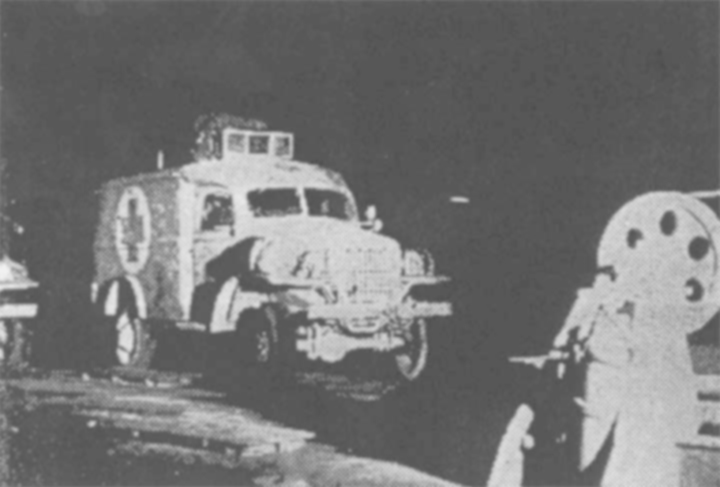 When the AFS left for Italy, some of the sections were loaded on invasion barges at night under spotlights.---Purnell Photo |
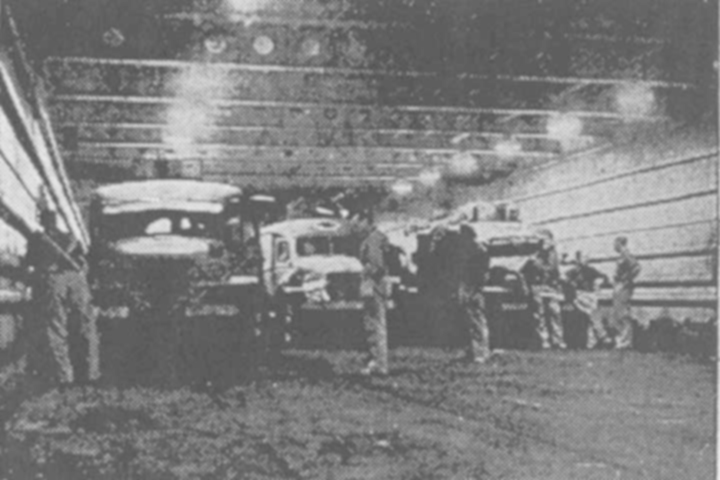 Some vehicles were dropped below decks in the invasion barges and stored as shown.---Purnell Photo |
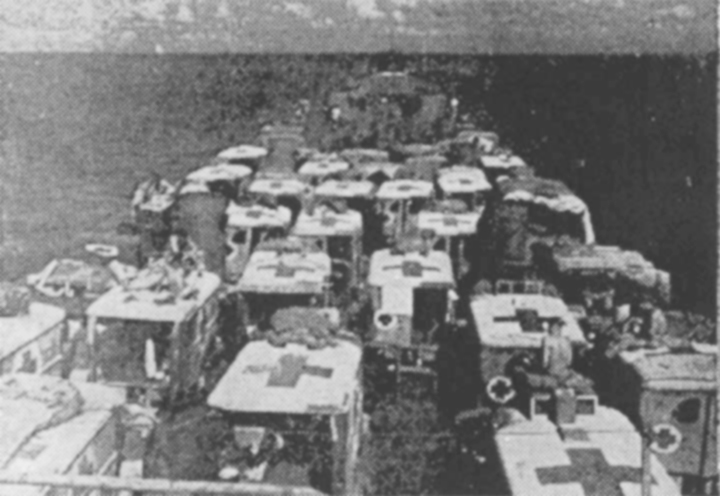 Headed towards the coast of Italy the invasion barges looked like this from the bridge. Crowded decks forced the men on top of their cars for relaxing.--- Cuddy Photo |
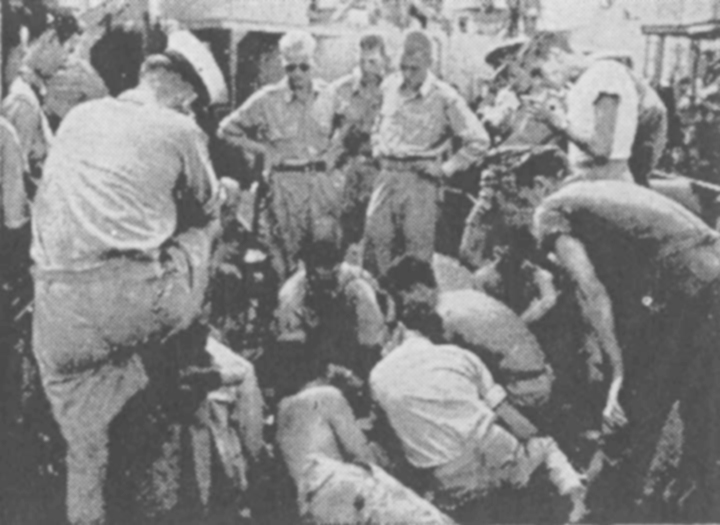 Nothing like a good card game or shooting a little crap to pass the time away on the trip to Italy.--- Cuddy Photo |
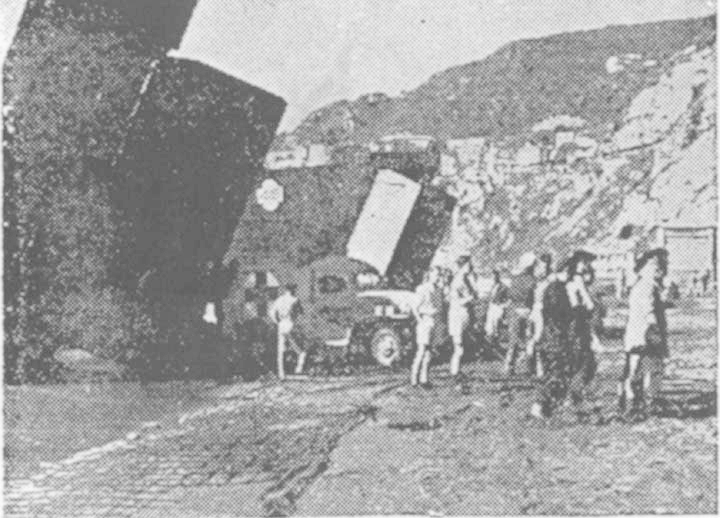 Once on the Italian beaches no time was lost getting vehicles and men ashore.--- Cuddy Photo |
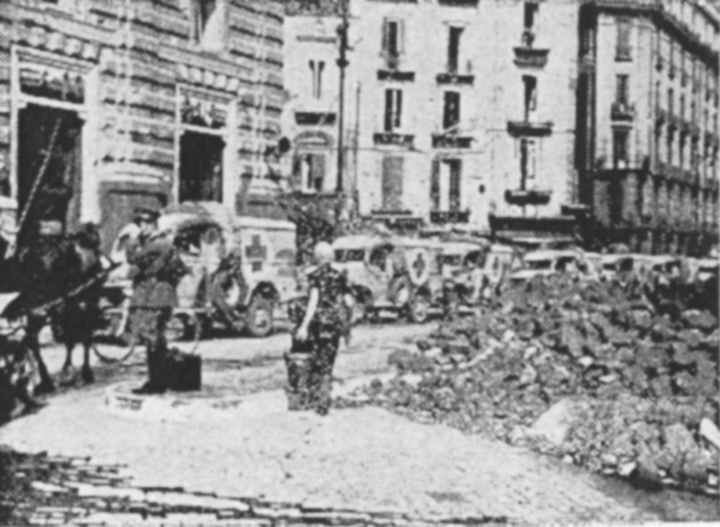 North through Salerno and Naples and into action--- here a convoy from 485 passed an Italian policeman.--- Cuddy Photo |
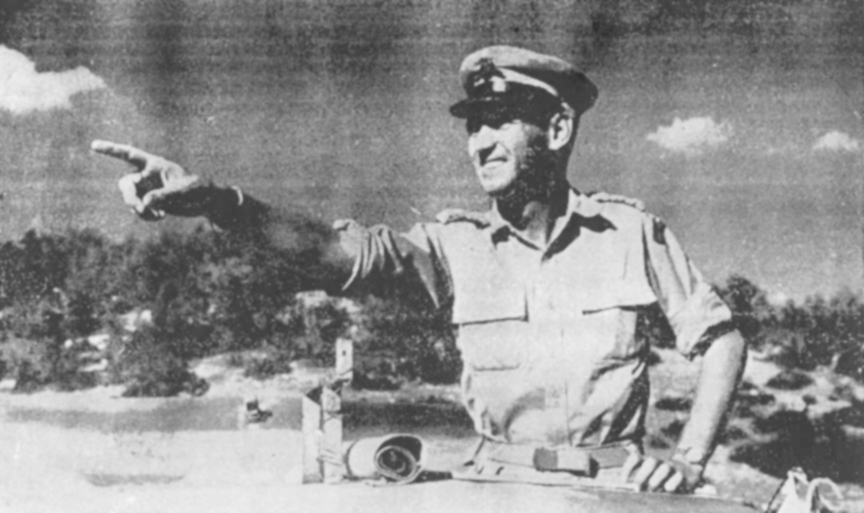 Captain "Bill" Edwards directs the leaguering of 485 coy vehicles in Italy from the top of his staff car. Unlike 567, 485 men were stationed first in a field, over-looking Mt. Vesuvius, rather than in buildings.---Cuddy Photo |
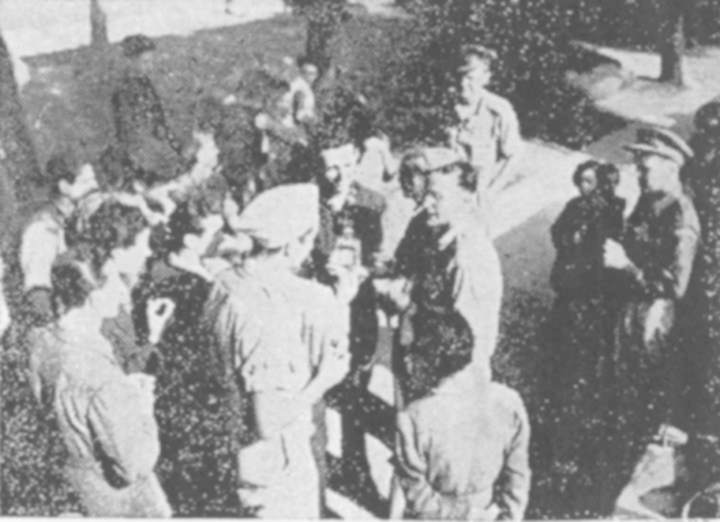
 Italian civilians were anxious to sell or trade merchandise. Here AFS men barter over a bottle of liquor.--- Cuddy Photo |
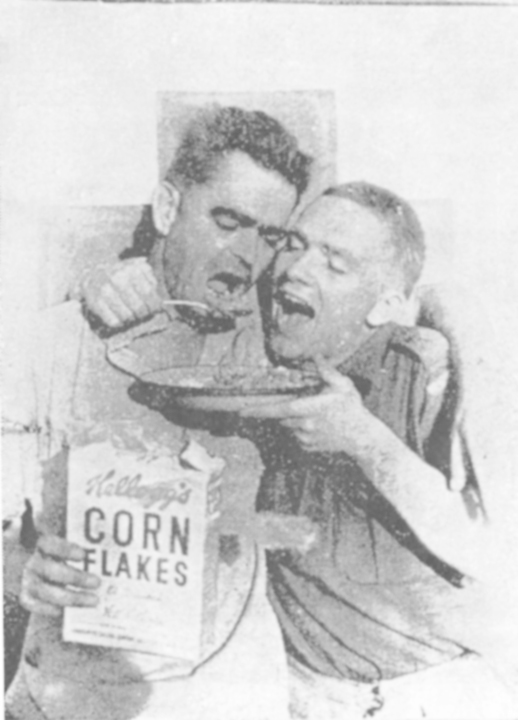
 American rations prevailed on the invasion barges for the trip across. Here two AFS men fight over a mouthful of Corn Flakes.--- Purnell Photo |
