
| THE AFS BULLETIN HEADQUARTERS, AMERICAN FIELD SERVICE GHQ, MEF |
 |
| Vol. II |
|
No. 4 |
|
|
|
Anything can happen in the AFS and especially in HQ. Our office is no exception. Take one day this month for example. After spending a precarious night in our room with a visiting Greek naval officer who spoke no English and talked in his sleep (it was most exasperating) we finally struggled down to work. It was the morning our brass-hats and pin-heads left for Italy via 3-tonner, no less. When we arrived we were greeted with the information that no less than a new unit had arrived at five a.m. ahead of us.
While making the rounds of the other offices, which is part of our morning's routine to get information which is otherwise bound to be hoarded and hidden in someone's hip pocket, we discovered that the finance department was £15 off in its books. So having nothing to do for five minutes we kindly offered to help look for it. The five minutes lasted the rest of the day with countless interruptions.
During one of the lulls we walked back to our office to see if anyone had cut his finger opening a bottle of Australian brandy, thereby becoming an AFS casualty that we could gloat over. On the way we passed a rather attractive looking dusky lady. After a quick "shufty bint" we encountered that formidable wench, Essie, who insists that she probably. would have lacked a great amount of knowledge if she hadn't come to work with the AFS.
Finally we strolled back to the finance office to look for £15.
Randy Jones then proceeded to tell us a story. Captain Bridger was busy at the cashier's window with a howling mob of new men crying for their faloose and at the same time trying to deal with Jay Nierenberg's ATS girl-friend. Randy's story just shows what happens in AFS HQ.
He started by asking if we had heard what happened to John Warrington earlier in the morning. Of course we hadn't. No one ever tells us anything. So it developed that Warrington had been roaming out in the corridor looking for £15 when a pint-sized edition (about our size) of a soldier approached him. He mumbled into John's ear. John looked dazed. "I don't understand what you mean," John said. Pint-size mumbled some more. "Oh," John says, "no! But wait a minute. ERNIE WALDNER...!" Waldner comes running. Says John to Ernie: "Can you tell him? He thought this was a prophylactic station."
So far as we know Waldner could, because pint-size disappeared.
Captain Faloose Bridger turned around then and told us about that dusky maiden. She handed him a five-pound note and asked him for change. With his hands pawing the money in that Newfoundland puppy sort of way. Bridger complied not knowing how else to handle the situation. Then she looked around the corridor. "And what do you sell here?" she asked. 'Nothing," Bridger replied weakly. (I don't know about that, though. Some of the guys would probably have replied something about selling them short).
We finally wound up the day like that and staggered back to our, room content with the Greek.
That desert veteran and character among characters of the AFS, Joe Desloge rolled in one evening complete with banjo and Wee Wee Schorger's guitar. Joe was supposed to come in with a new unit being trans-shipped from Lt. Bob Thomsen's domain up Algiers way. We asked Joe where the unit was. They'll be in forty-five minutes later Joe said blushing. We asked him how come. Joe gazed around the room looking for something, anything, finally saw us and seemed happy. They came on a slower train he finally got out. Ah, we thought, old veteran Joe is getting smart in the service. We told him so. "Well," Joe started, grinning a little sickly, "I missed the train so I got on a faster one than they did."
My brother used to say to us, "Can't fool me. I'm too ignorant."
We tried to pull one out of the hat when that big conference was on here at the Mena House. The one where President Roosevelt, Marshal Chiang Kai-Shek, and Prime Minister Churchill bulled and beared world stocks around trying to get the Jap deal sewed up. All we asked for was that Mr. Churchill present Major Hoeing with his. Order of the British Empire award while President Roosevelt watched---everybody in front of a camera, naturally. What we got. was an invitation to a church service Thanksgiving eve attended by admirals, generals, field marshals, ambassadors, and ministers. The ushers were majors or better. Wonder why they put us up in the balcony behind a three-foot wall?
The latest thing in the States according to our latest magazine is steaks as big as a whale. But, literally. Says The American magazine "One whale can knock out any town's meat shortage, filling your butcher's icebox with as much meat as 125 head of cattle. But don't ask your butcher for a whole whale steak---one steak is 25 feet thick and weighs 125 tons."
We always had suspicions that there were intellectuals in the AFS. Says a note in AFS Letters WE HAVE RECEIVED WORD FROM OVERSEAS THAT OUR MEN ARE VERY ANXIOUS TO HAVE GOOD BOOKS (NOT DIME NOVELS) AS THERE IS ENDLESS USE FOR THEM.
Also from AFS Letters we learned that the cost of operating the AFS overseas for one year is just slightly over the cost of one Liberator bomber---400,000 dollars. They are having a drive on back home to raise that amount. With all the scroungers we wouldn't be surprised to find Mr. Galatti one day in possession of a reconditioned Liberator sitting next to him at 60 Beaver street. After helping check baggage being sent to Italy, we are damned certain we shipped enough matériel for at least an armored division. How about concentrating on Liberators?
From our check lists "Fat-stuff" Willy Warden must be supplying half the Italian markets with merchandize. Not even he could wear or use all the stuff in the bags with his name on them.
- From a note in AFS Letters (that's the only official word we've gotten from our pal Joan Belmont in two months) we are happy to announces that the AFS is going provincial at last. A sponsoring committee has been established on the Gold Coast in Chicago. Think what the meat packers are in for now!
Veterans of the Middle East back home in the news---Frank Wood who has been a reporter on the Seattle Times since going home has left the newspaper to take a pre-medical course at the University of Washington. Norman Moyle (one of the original "Botch, Crotch, Loopy-Louie" characters of Ullman's Post Graduate Course, AFS Bulletin, Oct.-Nov., '43) is a private in the armored force of the U. S. army stationed at Camp Beak. Calif. Bert Grove is with the Field Museum of Natural History in Chicago.
Capt. Bert Payne, 567, is back with the Coy after returning from the States where he left his bride of several months. Other veterans who have returned are John Hodell and mustache, Oliver "Pat" Nadeau. Robert Wilson.
Before signing off this month, we want to thank both of the men who wrote us about the reconditioned Bulletin. One letter said it was okay, the other said it wasn't. We always like to know just where we stand. But remember, you write it --- once in a while, we just pay the printer.
P.S. We take no credit for those weekly news letters. Lieut. Ted Borger writes them.---C.H.A.
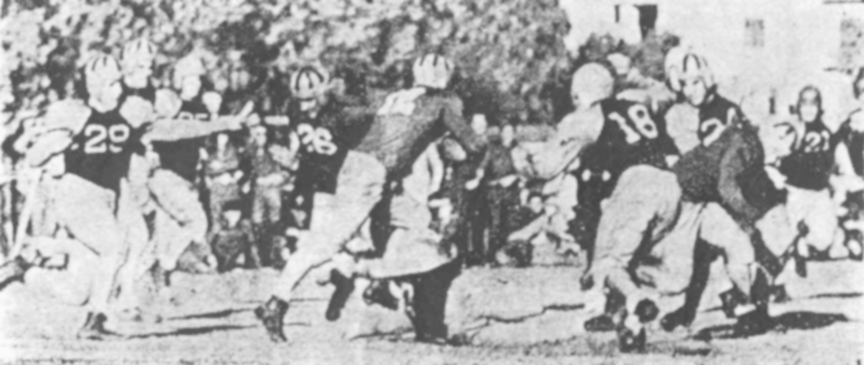
A few years ago we can remember listening to the Rosebowl football game on New Year's day. This isn't a picture of one of those classic games. But it brings back pleasant memories of the Rosebowl, football in general, and New Year's eve parties. In a word---HOME. So here's to 1944---and perhaps the "Rosebowl" in 1945.
SINCE THE LAST ISSUE went to press. both 485 and 567 companies have been operating on full scale in Italy. Although 485 is still lacking two platoons of a full company, two other platoons will join them shortly under Capt. Carleton Richmond bringing 485 to full strength.
THE BITTER STRUGGLE OF THE EIGHTH army on the east coast has been very evident among the ranks of 567. Vernon Preble and Charles Andrews were killed in action. Lieut. Manning Field, Thomas Barbour, Ralph Beck, Dean Fuller and Henry Larner were wounded.
VERNON PREBLE WAS KILLED at an RAP when his ambulance struck a mine while he was backing to safety after having been misdirected onto the wrong track to the RAP. Charles Andrews, better known as "Jim" was killed at Fresni when a mortar shell exploded in the street as he was entering an MI roam. He died instantly.
485 COMPANY AFTER WEEKS of confining their primary operations to base areas, has been assigned to duty for forward ambulance car work with the British forces of the Fifth army.
A. O. MOHRIN, 567, was greasing his ambulance while waiting to cross the Sangro river with an MO he was transporting. General Montgomery drove up and distributed cigarettes to troops and then approached Mohrin. Mohrin saluted and when he was asked told "Monty" he was glad to be with the 8th.
COLONEL RICHMOND met General Montgomery for a few minutes on Thanksgiving day. Nothing spectacular occurred. Several days later General Montgomery told A. O. Mohrin of the meeting and asked, What his name again?" Mohrin was so flustered he couldn't remember at first.
CHARLES SQUIRE, 567, pulled one out of the hat recently when his ambulance fuel line broke leaving him stranded with his orderly for several days in a hot spot. Solution: Orderly on top of ambulance poured petrol through rubber tube leading to carburetor. A Canadian medical officer congratulated Squire for his ingenuity.
MAJOR ARTHUR HOWE. 567, is homeward-bound for a leave and recovery from amoebic dysentery which has been bothering him for several months. Capt. Charles Snead will be O.C. temporarily.
AN AFS UNIT IN INDIA has arrived in Calcutta ready for action after several months of intensive training. Their arrival was greeted by a raid from Jap planes.
ONLY SIX MEN REMAIN IN CAIRO from the old HQ. Capt. Neilson Bridger, Lieut. Hamilton Goff, and Vol. Randolph Jones may leave the first of the year for the Naples Finance office. Capt. John Nettleton, acting O.C., Vol. Ernest Waldner and Lieut. Carl Adam will remain indefinitely.
TO THE NEW YORK OFFICE we extend our thanks for the "Zippo" lighter Christmas presents. Many hours of diligent work went into packing the lighters and addressing them individually. It is appreciated.
Brigadier E. Philips
HQ Eighth Army CMF
24 Nov. 43.Dear Howe:
Thank you so much for the copies of the A.F.S. Bulletin just received. I am glad that difficulties have been overcome and that your paper is now a printed magazine.
It provides a fitting and elegant record of a very fine service with which I've been so closely associated for over eighteen months. It is a long way from Tobruk to Alamein, from Alamein to North Africa, and thence to Italy, but your chaps have always been to the fore and have been invaluable to the Medical Services of the Eighth Army. Their gallantry and devotion to duty has been praised and appreciated by all and it is a great disappointment to me that they never made Sicily ---in spite of many attempts.
However, here you are back again with us in Italy and once again in the forefront of the evacuation line, doing the same wonderful work as you did in the Desert. Now you're once in Europe, if I have anything to do with it, you will accompany us to Berlin! Thereafter, we'll have a nice little party clearing up the Pacific before you will depart for the U.S.A. and no one will be more sorry to lose you than I shall be. But after the war when I retire and am pushed about in a bath chair (!) I shall retain a happy memory of the A.F.S. with whom I am so proud to have been associated.
Good luck to 567 (AFS) A.C.C.
Kindest regards
Yours sincerely
Sgd. Edward Phillips
|
Killed in Action:
Wounded in Action:
ADVANCEMENTS IN RANK To MAJOR from Captain:
To LIEUTENANT from 2/Lieutenant:
To 2/LIEUTENANT:
|
I was down near Sousse, in Tunisia, before the French moved, and was given a ten-day leave. A guy by the name of J... in my unit also had leave. There was talk of going to Algiers, some 600 miles away, and there was an AFS truck going up there to take men on leave, it was pretty crowded, as far as we could make out the night before it left, and at 7 a.m. J. woke me up and said "Do you wanna hitch to Algiers?" And then went back to sleep.
I woke him up and said "Yeah!' Then I went back to sleep. (My, but that was a powerful wine they had in our camp!) We gradually got up, shaking off the hangover, and decided to bum our way alone. 60 to 70 miles to Tunis, no --100 miles to Tunis, then 600-odd to Algiers. So we stood in the road after lunch and started off to Tunis, tra-la. We rode with crazy Americans, crazy French, and crazy trucks, but we made Tunis by 5 p.m. I thought we'd better look up my girl-friend in Tunis --- a French artilleryman told me to give her a letter from him, so it was a swell excuse to meet her.
She turned out to be pretty as a picture, and had a charming mother who fed J. and me all the wine we could hold, gave us supper, and a couch for the night. I played the piano for a few hours, then helped Katherine with her college English assignment. She spoke rather good English, which saved the day, because I got pretty tired of struggling with French.
We pushed on the next morning, to try to make Constantine that night. We were fairly lucky in getting long rides, for the most part, but had to be ready to bum meals and a place to sleep. Each of us carried a small musette bag and one extra bag with a mess kit and some food in it. The food was only an emergency measure, and we acted as though we'd never seen food for a week and had none with us.
Well, by 2 p.m. we were let out of a car near a small town. I say "near." It was about 1 mile away --- the sun was hot, and all-and-all, it meant waiting till something came along. We were well into the foothills of the Atlas Mountains by then, and rather desperately hoped that something would happen.
Then came a jeep. Two officers, one trailer, and a big empty back seat. Yes, he was going down the line. We rode over the Atlas Mountains, punching through convoys all the way, until 7 that night. The lieutenant would sway around a curve, find a truck coining, practically go off the edge to avoid it, and then I'd pick my heart out from between my teeth and let it go back to its normal place.
They were Air-Force men. They were going to their airfield. Well-well!!! Coincidence? Do they have planes to Algiers? Mind if we come along?
Well, we got along to this place. It was way out in West Mudhole somewhere, only up in the mountains, no traffic to retrace our steps with. Boy! I said to myself that this better be good, or else...
I was frozen when we got there. Jerry and I broke the ice in our knees and fell out, got our stuff. and walked slowly to a Red Cross hut nearby, in this Air Force Camp. It was a front-line USO, so to speak. We asked the ARC man in charge whether there were planes to Algiers, he said yes. We asked about a meal and a bed. He said yes. He asked us did we want some doughnuts. We fainted.
But, by God, he had doughnuts. Nice, hot, munchy-good doughnuts, racks and racks of them, fresh out of the machine. I ate 5 before I realized I hadn't swallowed the first one. He watched us benignly, and then took us to see the captain about a bed. We got a bed--- in a tent reserved for officers above the rank of colonel! We had it to ourselves---electric lights, wood floor, beds, everything.
We got up in the morning and had a real breakfast. We walked out to the Courrier Tent and said, "Uh, now --- er --- the plane to Algiers that leaves at
8 o'clock?"
"Sorry, sir, we don't have one today, but the captain left orders saying you could go to Constantine on the mail courrier car." So we rode about 100 miles on the courrier car to the airfield near Constantine. There was a plane, leaving at 1 p.m. for Algiers. The time was 12:40 p.m. I walked brazenly. into the tent and said, "You have a plane for Algiers leaving at 1 p.m. Can you give me two seats?" -
The sergeant said, "Yes, sir. What is your name, weight, and baggage weight?"
We left at 1 p.m., flew the remaining 250 miles in l 1/2 hrs., and were in Algiers in our hotel by p.m.
Smart work, on the whole.
The American Red Cross invited us into the staff mess for a whale of a good supper, and we then pushed on to a dance at the Officer's Red Cross Club. We got in free, and met many beautiful nurses, WAAC's Air Corps girls, etc. A nurse from Boston and her 1st Lieut. boy friend invited me to have a short snort with them. It was a bottle of the rare Scotch in Algiers. Well, we were knocking off a drink here and there, and never noticed that the air raid was on until the ack-ack opened up. We took a look outside, but just then a bomb landed up the street a way, so we went back into the dance which had never been interrupted. The lights were off, but the dance was still going full-swing.
Jerry and I got lost in the blackout --- a really black one, too --- and it wasn't till about I a.m. we found the hotel.
The next morning was beautiful, and our window and balcony looked out over the whole harbor. It gives you a sense of well-being to look out over harbors on fine mornings, I find.
We messed around all day, got a new pair of shoes out of a British officer's shop on the strength of a requisition that read. 2/Lt. A. Y. D., U. S. Army on it --- that was pure bureaucracy, and the major who made out the requisition put our ranks down as that and generally wasted the day. Well, about 5 p.m. Jerry and I dropped into a bar, but couldn't make up our minds what to drink. Just then a British captain sitting next to me said to the bar-maid, "They'll each have a champagne with me."
We had a champagne. It got late, and we were wondering about supper. We hadn't reserved a table anywhere, as you must do if you want to eat supper in Algiers these days, and we told the captain that we'd better move along to find some food. He said not to be silly, that he would be delighted to have us for supper at his mess.
Well, we drove out to his mess; it turned out to be the Officer's Mess of GHQ in Africa --- Allied Force Headquarters. We had a whiskey sour, then a great meal. We told him how we managed to get up to Algiers, and he said, with a twinkle in his eye, "Then here's another laurel to hang on your tree: Do you realize that this is where your General Eisenhower eats?" Bang! Just like that!
We finished supper and had a few more whiskey sours, and then caught the staff car going back to town. And in, too, just before we left, climbed a Royal Naval lieutenant, the Captain of a minesweeper in- the harbor. He was an awfully friendly Scot, and invited us to have a drink with him. Couldn't pass that up, so we went aboard his minesweeper and he piled us with Scotch and beer --- the old boilermaker. His mate. was there, and later on the Captain pulled out his harmonica and we all started singing Scotch songs. There was much good talk and much good drink, and by the time they poured us off the boat, J. and I were quite exhilarated, to say the least. The Captain was lucky; he could stay on the boat
J. and I got lost again in the blackout.
Nothing much happened till Monday, two days later. We went out to a General Hospital near Algiers to have tea with this U.S. Army Nurse I'd met at the dance. We had tea, and were all set to bum back into Algiers when I decided to go down to the Medical Inspection Room to see if they had anything to quiet down a case of gas cramps. They jammed a thermometer into my mouth, and about 3 minutes later they wanted to know my name, rank, outfit, religion, age --- oh. oh! This is bad. They want to put me away here. I argue and argue, but they say "no" and throw me into the dysentery ward.
Then I got a surprise. It was a British hospital. but there was an American who took my data (rank,. age, etc.) because I was American. He asked my rank, and I said Warrant Officer. He yelled over to the orderly "Ward M-Y" and I went away. It wasn't as easy as that, because I had to explain what the Field Service was, and you know what that's like. But to him Warrant Officer was an Officer, not a top sergeant, as it would be to an Englishman. So I went into the officers' dysentery ward; Lieutenants, captains, majors, lieut. colonels --- Ye Gods! There I was. I. had to bluff my way for five days, but it was worth it. It was a hospital dysentery diet, but I was not kicked around the way I might have been in another ward.
I went in Monday, told I had dysentery. By Wednesday, I felt better. By Thursday I felt swell, and -on Friday I convinced the MO, a lieut. colonel, that I was absolutely all right, and I wangled a discharge.
My leave was up on Sat. noon, only I was 700 miles away. I got out Friday noon, was offered a ride to Sousse in a staff car, but refused it because it wasn't going to leave till Monday. I knew the British wouldn't give me a plane ride back to Tunis, because I'd tried them before I went in to the hospital. The Americans wouldn't do anything for me because I had no reason to get a high priority. So I said to hell with the bunch of them, bummed out to the airport, got talking with a sergeant in the Courrier office, and found they had a plane to Tunis in the morning.
He was American, of course, --- it was a U.S Air Field. So I asked around to see if a couple of Air Force friends of mine were around. I'd met them in Algiers and they said to come out and see them. They were there, and I asked them about the planes. Yes, they had one going to Tunis. Could they get me on? Sure thing. Well, they fixed me up with a meal, a bed, a movie before that, and breakfast in the morning.
Then I told them I wanted to get an American helmet, if possible. We were talking about it for a while, then the talk went to food. They get a lot of canned meat, a lot like spam, but they go crazy over bully-beef. I was lugging a tin of bully in my musette, and said, "Do you want a can of bully?" It was the International Buddy System again:. Take care of your buddies and they will take care of you.
I gave them a can of bully, and came away with an American helmet, 6 boxes of K ration, five bars of soap, and a cartoon of Camels. And they put me on the plane, along with an Allison airplane engine, 13 tires, a lieutenant, a colonel, a Navy Commander, and a Navy Vice-Admiral!!!
We got to Tunis, but the plane ride wasn't over at all. We landed, and rolled all the way across the field to within 15 yards of the administration building. I kidded -the pilot when he came down the aisle.
"Trying to put us right onto the porch or only the doorstep?" "Damn near," he said, "We didn't have any brakes, and I couldn't stop the plane! I almost had to ground-loop." Ground-looping is the process of dipping one wing into the ground, and then spinning around. You need a new wing each time, but it's very effective. Then I remembered our cargo: That Allison engine would have cast loose and bashed us all to a squash. I was glad he didn't ground-loop, --- really, I was.
I walked through Tunis and gradually bummed down to Sousse. I arrived only 3 hrs. late --- overleave, they call it --- in spite of leaving Algiers only that morning. The only thing was --- the unit wasn't there any more. It was gone! There was only a vacant lot. I was a waif, homeless as an old newspaper. Then I realized that here was going to be some fun. I knew they had gone vaguely south. How far, I didn't know; how long they'd been gone, I didn't know. But it was up to me. A fair challenge to my own initiative and ability.
Well, I said, I'll go to Tripoli. Maybe the AFS will know there. How to get to Tripoli? Fly, naturally. So I stood in the road and got a car into Sousse. The car is a jeep with some Americans in it. Jeep breaks down. We walk to the American's place and get food.
Then I get a ride to the airport quite a way down the coast. Spend the night there. Get more food. I wait. Planes zoom all around me, but not to Tripoli, oh, my! no --- but one came in and the people on it said it was for Tripoli. I managed to argue my way on to it, got to Tripoli. I meet some AFS guys in Tripoli, but they didn't know where the (FFC) was. So I asked around, found out a possible lead, and after bumming a couple of meals and a bed between them, I hit the road again in the morning. I bummed many, many miles, found the outfit, and was home.
It happens that K. was driving my car down from Sousse, and hit a mule. Made a mess of the fender and radiator, but I didn't care. I was home.
That's the story of the 2000 mile leave, folks. In no army in the world can you get 2000 miles on a ten-day leave when you're ..overseas. But the AFS does it, almost habitually!
We joined the General LeClerc French one evening in late April about 20 miles south of Enfidaville in Tunisia. We had come, 13 of us in 6 ambulances, from near Tobruk and were as green as the fluff on a new billiard table.
The next morning J.F. and I were sent out to get
the U bolts "and any other valuables" from an ambulance that had been blown up on a mine about midnight. "It's near a destroyed bridge a few miles north of here" ---those were our instructions. J. -and I had had our only previous taste of war when we saw "Sergeant York" back in. Radio City. We set out about 9 a.m. and after driving thru field after field deployed with the tanks of the famed 7th Armored Division, "the desert rats," came to a ridge that was blown out. A bunch of Royal Engineers were completing a diversion around the damage and we stopped to find the ambulance. This turned out to be the wrong bridge and finally an officer told us that the only other bridge in the vicinity was some 5 miles further along. Before we left we asked about the dozens of round iron boxes lying around and a long lecture ensued on the nastiest feature of modern warfare, the mine. There was a very complete display here we were told. "Jerry ran short of mines for a while, but here he's left everything he has --- "must have had a new ship come in," a Tommy sergeant told us.
This was all very interesting but when we heard how the detector couldn't locate the new box mine, which is made out of wood, how the area around all blown up bridges is always heavily mined, and how anti-personnel mines are never laid in groups of less than nine --- on hearing this, we developed a certain respect for mines, --- that is to say we never wanted to be within 8 1/2 miles of one again.
On driving along the road another 3 or 4 miles we came upon a British major with field glasses who was stationed in a great ditch beside the road. We asked about our bridge and he allowed that it was up the road a couple of miles allright and hadn't been shelled for some hours. I looked at T. and we both gulped. The major went on to say that the enemy relinquished the position a couple of days ago and that the whole area was under observation from those mountains. He seemed a little bored by the whole thing.
At this point I had the ill taste to ask him if it was sage to proceed on our U bolt mission. He allowed that he didn't know anything sage about war and then a voice said, "O.K., let's go." It was my voice. J. was a good bluffer, too, and finding his voice, thanked. the good man for the interview, and we stumbled into the car.
After driving. gingerly for a couple of miles we saw the bridge a couple, of hundred yards ahead and were relieved to find a Bren gun carrier neatly hidden behind a cactus hedge right beside the road. We had already decided unanimously that the U bolts could wait a few days .---but before turning back saw fit to engage the gun crew in conversation. They turned out to be the foremost outpost of the allied troops in the area and were not overjoyed at our having given away their location to the enemy. They told us how they had come out here last night and had heard the ambulance come along the river bed. "We thought it was Jerry and were about to open fire when the mines did their job."
Then we told them about how we'd been sent out to get U bolts. One of them did more than offer to lead us thru the mine fields to the ambulance; he just said "O.K. follow me, chaps," and started toward the bridge. I couldn't move my feet but I did manage to mutter something about "there's no sense in your risking your neck, corporal."
That started him off on the "if your number's up" routine. All these guys that have been thru a lot of action have this phobia. Well, the corporal headed right down the bank to the river bed and J.. and I followed in his footsteps, and I don't mean followed an inch from his footsteps, we followed in them. On reaching the car, whose front end was completely ruined, we climbed in to see about the tools and to try and calm down a little.
I found a funnel, a can opener and some stale chocolate and was about to suggest that we depart. I was stepping out of the blown off door when I saw the corporal suddenly fall on his stomach. Then there was a bang and cloud of smoke about 50 yards away. That was the first time in my life I'd seen anything but a fire cracker go off. The corporal was cool but I guess he figured this number-up business only went so far because he said. "Just take it easy, lads---when you hear 'em whistle, fall flat, then run---that's Jerry with his 88 millimeter."
Another whistle and J. and I fell out of the ambulances on our faces forgetting for the moment that we might hit an anti-personnel mine. We followed the corporal who was now pale but still giving instructions. Then the shells came in pairs --- and of course the whistle of the second one which landed a moment later couldn't be heard. Perhaps a dozen shells landed near us before we were out of the mine field. I was just plain petrified and was just wondering where I'd get hit. Here at last was a use for the tin hats we'd carried for over 3,000 miles -- but they were still tied to our front bumper as always.
When we got back to the carrier the sergeant was furious for now he could expect to be shelled all night. "Get your cups,". he said, "and then you can bloody well get on the move." It was tea time and it takes a lot more than a war to keep the Tommy from having his tea---or being anything but polite. So we sat there and had tea and left 2 packs of cigarettes --- a great treat at the front ---and then lit out for home.
Just as we left an armored car filled with engineer officers arrived to survey the bridge which had to be fixed before the Eighth Army could reach Enfidaville. We learned the next day, that one of the officers stepped on a mine and blew his leg off.
This was our first taste of war. It had taken us some 30 minutes to learn to hate it. Everyone does. It's always easy to look back on these little episodes and laugh --- but it's not funny at the time: it's awful. What is. a U bolt anyway?
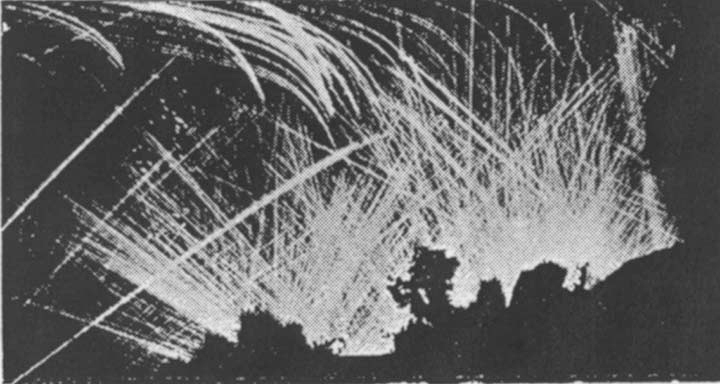
An ack-ack barrage over Naples looks like a giant celebration for the fourth of July. This photo, by L.B. Cuddy was taken from, the Campsite of 485 Company. The Jerry airforce is constantly making nuisance raids over the docks area. Many civilian casualties result.
|
|
| Livington Biddle appears as a writer for the Bulletin for the first time in this issue. He was. previous to joining the AFS, a newspaper reporter. The incident of looking into the first aid manual Biddle describes in this account brings to mind the play he was in aboard ship on the way to the Middle East. With vaudeville comedian Ernest Simon, who has since returned to the States. Biddle burlesqued a "typical" AFS man administering first aid through the medium of a first aid book. He probably had no thought that the situation would ever come home to roost. |
Our American Field Service ambulance was the first medical vehicle to reach the little valley town of Formicola --- ten miles north of the Volturno river, crossed a few days earlier by the advancing Fifth Army.
We were attached --- Dale Cunningham of Brooklyn and myself --- to a British anti-tank regiment. This was our first front-line assignment with one of the regimental batteries, pinch hitting then as infantry.
There were deep craters in the muddy road surface, and you were glad you had four-wheel drive. Where moss-covered stone bridges crossed wooded gorges the center spans had been neatly removed by demolition charges. And there were mines underneath the mud where the road followed a forest glade. Heavy guns and trucks had to be left behind. Clearing the Germans from the hills in our sector was primarily an infantry job.
The heavy artillery got far enough, however. Driving up, we passed batteries of 105's and heavier stuff, smashing spasmodically at the Jerry positions. "We're just firin' naow to keep ole Jerry's head daown," a Yank 'told us with a broad southern accent and smile to match. Later these guns laid down the barrage covering the infantry attack which put not "ole Jerry's" head --- but his posterior in its appropriate position.
We reached the village outskirts in early afternoon. A warm fall sun was shining on the outlines of the town beyond us, with a church steeple rising in the distance against the hills --- fresh and clean after the morning showers. It didn't look much like war until suddenly our way was barred, permanently this time. The bridge before the town was in ruins: below a ravine about sixty feet deep with steep, laddered sides. We parked the ambulance in a farm-yard and proceeded on foot, each carrying a stretcher and a few medical stores from our small supply.
Inside, the village was a hollow shell. Every building was either gutted by fire or destroyed by demolition. It was the worst example of the Nazi scorched earth policy I've seen, and for the most part it was meaningless sadistic work. The village had no military significance, and the road, almost impassible as it was, ended completely five kilos beyond Formicola.
The people, farmers and peasants, isolated through the years in the seeming safety of their valley, wandered the rubble-strewn streets in a daze. They watched the hills with eyes full of fear. There was a little crowd collected around a great pile of jagged bricks and stone, and we learned that an old women still lay buried somewhere under the debris.
There was an even larger crowd in the court-yard of the partially destroyed building which comprised battery headquarters. The villagers were awaiting an audience with the Major commanding. Food and water --- but mostly food --- were their problems, and they came to the Major rather than to their mayor --- a shrewd-faced, bewildered little man, the one-time fascist leader, but now obsequious ---obsequious and ineffectual.
We reported to the Major, amazingly calm in the midst of myriad questions. At the same time a captain spoke in my direction. "Can you do something for this, Doctor?", he said, holding up a nastily infected hand and arm. I thought doubtless an MO had sneaked up behind me and that it was quite rude of him not to answer the captain. But upon looking about I saw no MO --- only Cunningham. Meanwhile the Major was telling me, "Sorry. No MO here, not even an orderly, but I guess you fellows can take care of us," and he laughed heartily, "Never had any of you blokes with us, but I've heard of your work in the desert..." and he turned to his interviews. Vol. Biddle was also turning swiftly and I may say surreptitiously to his musette bag, an old one I've carried since the days on the boat. There it was --- in the bottom: First Aid Manual, and in the index, under I, Infections, for the use of. "Infections." said the Red Cross. "are very dangerous. Hot compresses may be used. But in all cases ---immediately summon a physician."
We prescribed the hot compresses for the captain, unpacked our medical stores, treated some troops with desert sores, and a little Italian child with his face and arms burned in a gasoline explosion. On this latter victim we used ointment and the famous Biddle six-ended or catch-as-catch-can bandage.
Suddenly there was the sound of excited voices in the street outside. The villagers were running in all directions and we caught the word Tedesche. "The Germans are coming!" they shouted in Italian. Many were taking to the hills. It was a panic. The Major ordered the battery to stand-to and began "sorting out" fact from rumor. There were wild rumors and little fact. One Itie said the Nazis were counter-attacking with tanks. The Major just smiled looking North at the perpendicular mountain side. He decided that in all probability some Italians outside Formicola had seen a patrol of Americans in the hills nearby and had mistaken their tin helmets for German headgear. He was doubtless right. None of Kesselring's boys appeared.
Nevertheless a tense atmosphere pervaded the village that late afternoon and it was heightened when towards night-fall a colonel in the Guards came in and announced that he was conducting a dawn attack on a Nazi-held ridge just North of us. He would have his wounded carried into the village square, he added. We were to set up an emergency evacuation station and evacuate from there.
It was already dark when I set out for the ambulance to get every remaining bandage we had therein. We decided to try and find another route and drive the ambulance into town, as soon as it was light. The ravine was just a black pit in the earth by this time and I was probing about for the ladders of descent, when an air-raid started. The ack-ack explosions lit up the scene and I was soon at the ambulance and secured the needed equipment. Going back was easier at first as I had a flashlight. But this luxury was short-lived. I was told in no uncertain terms to "Put out that... light." The omitted self-evident cursology was uttered by five simultaneous voices in the ravine. It seemed the raid was still on. "Did I want a bloody bomb to drop on my ruddy head," one man questioned. "No." I answered, speaking faultless English, although my voice shook somewhat in the intense cold. I regained the road and had taken a few loping steps when suddenly something rose up in front of nie in the person of a sentry with a Bren-gun. This latter instrument was held about two feet from my heart --- which I might add would have presented a hell of a moving target at the time.
The sentry was repeating some uncouth verbiage - and I was about to advise "if you have, you'd better clean it up" --- when it suddenly dawned on the intrepid doctor that this was the right pass-word, something I'd neglected to ascertain before setting out for the ambulance. The process of my thinking was enhanced somewhat by some ominous clicking noises from the Bren-gun, noises which I had a strange premonition had to do with its immanent firing potentialities. So I snatched my tongue from a nearby cat and with unheard of rapidity explained my position. The sentry lowered his piece, and after scrutinizing the surrounding darkness carefully, whispered to me the correct answer. At the next encounter, about 500 yards further. I hit the sixty-four dollar question on the nose. Back at headquarters I found the regimental officialdom collected --so sauntered in with a certain Tyrone Power casualness and remarked with a magnificent yawn, "A bit of a flap on outside." The effect was somewhat spoiled when the cigarette I started to light turned out, by some quirk of fate; to be one of those Mexican jumping cigarettes you have such a hard time inserting in your mouth.
The next morning we got the ambulance into town, picking our way in four-wheel drive through a shallow part of the ravine where another bridge had been blown and through the rubble and boulder-littered streets to the square. The only casualty of the morning was a badly wounded German. The Guards had had an easier time than anticipated with that ridge. The Nazis quickly withdrew. "That's just the trouble wi' Jerry." one of the Scotch stretcher-bearers complained. 'He vera seldom' gees ye the opportunity for a real guid han' to han' fight."
We evacuated the German to a CCS where I managed to get a goodly quantity of medical stores --- sulpha drugs and ointment and powder, and even some morphine (with the directions on the box). I had dressed for this occasion: an American field jacket, a pair of officer's pants, the Red Cross brassard. They called me doctor again --- and this time I didn't argue.
That afternoon we set up our medical center in the village school --- and we were flooded with patients, not battle casualties, but civilians. Their village Mussomedico had left them in the lurch. We couldn't turn them away. Many had badly festered shrapnel wounds. There were many more infections. We did our "operations," cutting away dead skin and opening the sores for cleansing with a pair of scissors sterilized in a flame. And I felt as much like a doctor as a Groucho Marx Quackenbush. But the sulphanilimide worked wonders. The redness of infection would disappear and then the wounds would heal. It was amazing to the "doctors." We convinced the citizenry that the treatment was "backshee," but our Italian was not up to refusing the bottles of vino they brought in gratitude. Anyway such, a refusal would have been impolite, we decided unanimously.
The Major even requested us, one morning, to act as sanitary inspectors for the village jail. We got the prisoners lined up and felt pulses, looked in eyes and mouths (just what for don't ask me) while the Italian "gaolers," highly uniformed, stood around in respectful silence and at attention. Suddenly I spied one wayward youth with a black thumb guard. "Remove it," I said, taking a chance. This was duly translated and underneath the thumb was rotten with infection. So we cleaned and treated the thumb --- and left feeling our honor had been vindicated.
There, was one case, however, which had us completely stumped. A mother brought in her daughter (very pretty, too, I might note in passing). The girl was in tears. With the usual Italian hysterics, the mother by signs and laments conveyed the idea quite plainly that the filia had some kind of ailment, peculiar to the feminine gender. She went further. She, shall we say, "laid bare the evidence!" It was with extreme difficulty that Dr. Biddle maintained the essential professional decorum during this disclosure, but in the end we arranged for the girl's transport to another village where there was a civilian doctor. Whew! We learned that the girl was fine again a few days after.
As the fighting in the hills grew fiercer an' ADS and an MO arrived. We helped them out with their evacuations from the hamlet five kilos beyond Formicola. That was the end of the ambulance line. From the front the wounded had to be carried down mountain sides and over rugged cart tracks. The stretcherbearers could only work in daylight and most of the attacks were night attacks.
Down from the hills, too, were coming Italy's war refugees --- starving men and women and little children. Between evacuations a British lieutenant and I made a kind of cambric tea with some tinned milk I had in the ambulance larder, for one family near complete exhaustion. "I can, stand seeing men suffer --- but not the mothers and babies," said the lieutenant, watching the mother feed her three infant children. Then as a kind of afterthought he added: "You see ---at one time this might have happened in England..."
The Guards were immensely brave in their suffering. Towards the end of that particular part of the campaigns, the front was over seven miles distant. Those on stretchers --- to whom every mile of that carry was torture --- never uttered a word of complaint. The walking wounded, who made the journey on foot, still held their heads high. Those Guards were a wonderful example of how to take it --- And how they can dish it out! In this forward village you could clearly hear the screams of the Germans when the Guards went into a bayonet charge the night after their first dawn attack. They had their "han' to han' " fight then. They made the most of it.
In a few days the mountain ridges were cleared. The hills, which had reverberated with the sounds of carefully-timed barrages, were silent now. The big guns had withdrawn from the rear and were moving to new targets. And the people of Formicola seemed to realize that they were safe.
The morning of our departure, eight Messerschmitts flew over the escarpment flanking the village. But the people looked up and grinned as bursts of ack-ack rose in the sky, and the German planes disappeared from sight. As we left the villagers were digging up the old women under the pile of bricks and stone. Now that the war had moved away from their valley, they would bury their dead.
When 485 Coy first arrived in Naples they were stationed on a hill overlooking Mt. Vesuvius. The ambulances were parked in a large field beside a deserted Italian hospital evacuated by the Germans and taken over by the combined. British and American medical forces.
One morning some officers appeared on the field where the cars were parked. They marked off seventeen eight-foot plots in the northern corner. Capt. Bill Edwards walked over to the group to ask the meaning of their strange procedure. The ambulance drivers stood around, wondering what it was all about. They watched the officers exchange words and saw a smile break out on Captain Edwards' face.
The drivers gathered round. "It seems we are encroaching on a piece of land which belongs to the Allied Grave Commission. We will have to move camp."
Before they moved, the Field Service volunteered to dig a double row of graves, as the regular labor had not arrived. At dusk that evening a ceremony was held. A salute was fired. Taps were blown. The bodies of seventeen Americans were buried. They were killed by a time bomb the Germans had left in an administration building, where they were stationed. The bomb exploded nine days after the Germans were driven from Naples.
The next night Naples had an air-raid. Two additional rows of graves had been dug the day before beside the American Field Service camp. Amid the fierce barrage of tracers shooting up over the city, three flares suddenly appeared overhead. The next instant a plane was in its dive. The AFS men all looked to the open graves for slit-trench protection, but they hesitated to jump in.
A bomb landed close by. The men all dove for the ground. The concussion broke window-glass in the hospital. When it was over one of the AFS men determinedly remarked, "I'll get in the next time --- grave or no grave."
L.B. Cuddy
| L. B. Cuddy is in charge of public relations for 485 company. Although primarily a photographer he reports the happenings of the company for publicity releases to New York. Purnell of the AFS is his first article since he wrote of the night he went through the gap at El Alamein. Currently in New York, the Knoerdler galleries are displaying a photographic exhibition of Cuddy's showing the AFS with the Eighth army from Alamein to Tunis. |
When "Lou" Purnell was posted to a wing of the RAF it was just being formed so the medical establishment had to begin from scratch. Immediately the squadron medical officer became friendly with the American driver and together they went "scrounging" medical supplies from every possible source in southern Italy. They took many trips to the Eighth Army side, and others through the maze of little mountain villages in the toe of Italy.
On one of these cross-country trips they discovered the little town of Melfi with which they immediately became enraptured. The town was being governed by the same fascist officials who ruled before the war; but they drove the ambulance into the local police station and hoped for the best. In the end the only trouble they had was the usual demands for cigarettes.
There were many cases of malaria in the little mountain village. As it was off by itself and not on a main road it was completely detached from Italy at war. The hospital had absolutely no drugs to offer the sick. Fortunately Purnell had a supply of quinine which he had brought with him from America. This he handed over to the head of the hospital amid thanks and cheers of gratitude from those looking on. Doctor P... the surgeon and head of the hospital, had been a prisoner of war for the past six years. He was captured during Italy's Ethiopian campaign.
Back at P.... a suburb where Purnell was stationed, life for an American ambulance driver was pleasant and interesting. Squadron Leader Robinson and Purnell had many friends among the civilian population. The home of the ex-mayor of Portici was the scene of numerous gatherings and tense "poker" games. The Mayor. Georgio M... was an extremely wealthy man and yet he, like hundreds more, very often went hungry.
Said Purnell, "I remember well the night I brought several cans of English bully-beef with me for an evening snack. About midnight old M .... a doctor, a lawyer. and several others got exceedingly envious of the canned meat. I suggested that if they couldn't wait for a little while I would put one can up for auction and the highest bidder could eat to his heart's content."
The bidding soon reached 1500 Lire, or 15 American dollars, which frightened Purnell so much that he gave them all a can and called an intermission in the poker game.
One stupendous sight at G...'s villa in P... was the huge air-raid shelter he had built beneath the house. Down a winding passage some 15 feet below the ground and cut into solid rock, one would find what G... called his "Ricovero." It was here that most of the people of a near by section of P .... sought refuge during the British. and American bombings preceeding the Allied landings. in Italy. Even now when the German planes come over to bomb of an evening, the most amazing array and assortment of people pour through the house into M... 's Ricovero. One night in the middle of a poker game the air raid warning sounded. Quick as a flash the lights were turned out. Masses of people filed through down to the shelter. The door was shut. Purnell put on the lights again so that his friends could continue the game only to discover that Aldo had swept up his chips and descended into the lower depths with the others. These people, each and every one of them, are frightened of air-raids --- and not without reason. There is hardly a building in all of P... which has not been marked by bomb damage.
One night Purnell and the Squadron Medical officer gave a dance and a buffet supper for their civilian friends. They had what was to them a magnificent supply of food. It should have been enough for twice the number of people. 'Within half an hour only a few crumbs were left. Later Purnell discovered that one young lady had tucked away enough in her purse to last her 5 days. The civilians ate with absolutely no manners at all, stuffing the food down their throats as fast as they could get it in. But these people's Emily Post is definitely superceded by their hunger.
The most touching incident that happened to Purnell at his RAF post concerns a certain Baron S... Purnell and his MO dropped into the Baron's home for a social call one morning. They were met by his charming wife and lovely daughter. Finally the Baron arrived as,, dignified and as well poised as always. He made his apologies for not being at home when his guests arrived and then sank into one of his huge leather chairs.
In desperation he admitted that he had been out all morning trying to find something to eat; that the house food supply was completely diminished and he did not have the slightest idea from where his family's next mouthful was to come.
The Baron's aristocratic code of ethics would not let him stoop to the well-established black market: the same black market which is keeping a large number of Italians around Naples well-supplied with American rations and American cigarettes, officially rationed for the civilian population.
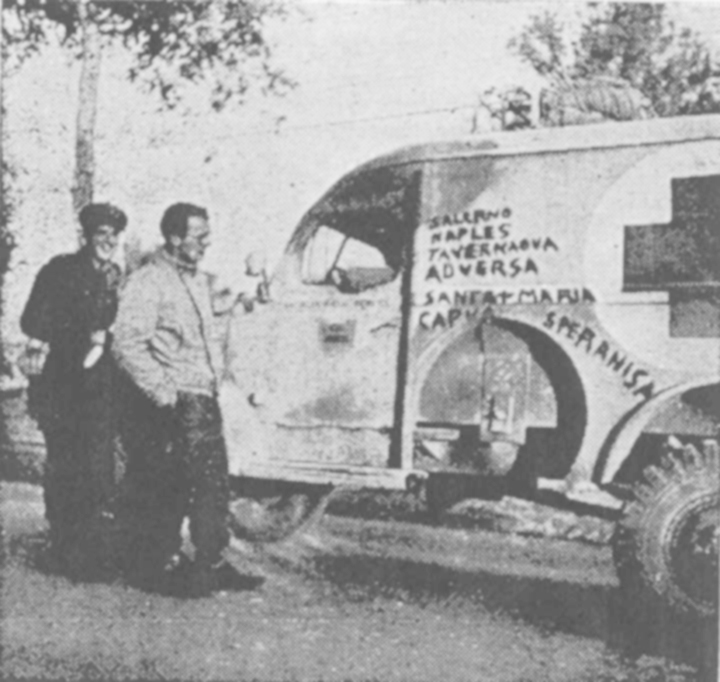
A 485 Coy Ambulance shows its journey's with the Fifth army. 485 recorded over 50,000 miles of travel in the first three weeks in Italy.---Cuddy Photo.
| Editor: John Leinbach Contributions: William Powning, C. J. Andrews, Jim Briggs. |
This is our Christmas Issue --- no matter when it comes out. And it reminds us, the APS has run through another year. Quite an eventful year, too. We've come from the borders of Egypt right into the backyard of the Axis. (It smells like the back yard, anyhow!) And that's a tidy distance. We've changed letters ---M.E.F. to C.M.F. Highly significant, we're sure. And, Allah be praised, we've left behind the Dark Continent, left it to the "natives" and the past, perhaps never to return. Or if we do, when fat and fifty, to point out to Junior and the Missus where the Belhartzia Club used to be located.
This time it looks like a White Christmas. No skiing perhaps, but we should be able to see snow. And it may be a busy Christmas. Lately at last we've been going hard. A few of us, too, have had tough luck. Tom Barbour, for one. The good old U.S.A. Air Force, ordinarily our buddies, sort of caught him with his pants down. To coin a phrase. Tom caught a splinter in the thigh. However, we're glad to say the wound was slight. Ralph Beck was sprayed by a mortar shell at his RAP post. He was uncomfortable for a while, but is mending rapidly. Manning Field lost an argument with a mine, but is sitting down to meals again. More serious was Vernon Preble's mishap. Vern drove over a mine turned over, and was painfully burned in the resultant fire. A few days he lingered; then he left us. We can't go on without paying tribute to Vern's kindness, his sense of humor, his always. buoyant spirit. Everyone liked Vern.
Other troubles have been less serious, but nerve-wracking enough. Collisions have been numerous due to no-light, no-moon driving. The mud has been terrific, by turns sticky and slippery. Cars have been immobile for days at a stretch, and frequently stuck in ditches. A few cars bear the mark of Jerry shrapnel. The cars in Denny Hunt's section are well peppered.
We've been going hard all right, under adverse conditions. But at least we know we're earning our bully these days.
Speaking of unhappy experiences, a while back we up and went over a mud embankment. The night was Basuto-black and we had been creeping along on cat's feet --- when it happened. And what was our dismay when we clambered up onto the roadway, somewhat shaken, and explained what had occurred to a passing Tommy, to have him analyze the situation. "Speeding." he said.
Whoever heard of an AFS man Speeding?
One item you can't overlook in any trip to Italy. That's the Italians. No doubt about it, they're hot operators. For one thing, fugitives from Brooklyn turn up everywhere. And they have the driver's licenses and union membership cards to prove it. The politest "Buon giorno" is likely to bring back a snappy "Hello, mister, how you feel-a?" On that score, the best one we came across happened in Cupello. The town had been badly shot up. Next day, from out the rubble came a local character who exchanged greetings in Eyetie; then stood by.
At this point a Tommy in the group observed to no one in particular, "Fancy living in this filthy place. It's had it!"
To which the character responded brightly, "Oh, by and by we fix him up."
We can't leave this without explaining further that this fugitive 'bum' turned out to be the mayor of the town. Politicians everywhere, we gather, are optimistic.
No doubt you, too, have carried wounded Eyeties. The draw-back is beating off the relatives. And the crowds of women who gather around to have a good cry.
Back in Termoli, one of the boys was trying to solve this problem. There were at least ten women making with the handkerchief. He asked which one was the mother.
"She's not here," one of them volunteered. "She's home, crying."
Which reminds us, have you drained the water out of your radiator? Huh? . Go ahead; think how happy it will make Staff. Think what they go through in India. (AFS BULL., Vol II, No. 4.)
Another new wrinkle of the Italian campaign is the ambulance orderly. Most of us have .a travelling companion --- and for the first time. We always lone-wolfed it in the Desert. And where hitch-hiking nurses are concerned. we still prefer this system. But we've got to admit it --- an orderly comes in mighty handy when you're up there where that stuff flies around. It's a big help in loading and unloading in the dark, driving through diversions dreamed up by sex-starved Engineers, trying to get intrameal food out of the cooks, etc. And in digging quicker slit-trenches.
One small complaint. Sometimes the ambulance gets just a little crowded what with our stuff (usually ample)., plus the orderlies pack, hot-water bottle, Thomas splints, and rations for the RAP. Just a little crowded. The saturation point is nearby. As the Grand Keeper of the Water Hole pointed out, in trim working condition his ambulance can now carry "one lying case and a leaner."
Then there was the Jerry who was strictly a Party man. Talkative, too. During the evacuation, he was explaining Germany's plight, right out of the pages of Mein Kampf. The present troubles he enthusiastically attributed to "Die Juden! Die Juden!"
Whereupon the driver confided. "Ich bin ein Jude."
Followed a silence of some minutes. The Jerry was no doubt seeing himself driven over a cliff, or beaten over the head with a 412 book. Finally he resumed the conversation--- in a somewhat chastened tone.
Probably with a remark about the weather.
That's right. A special welcome to the little yellow men who are coming North for the Winter. How was your leave, men?
We don't know how we became interested in the legend of Toilette-Mouth Carson (known to intimates as "T-Mouth"). Perhaps it was his overpowering manliness that intrigued us or possibly the mystery that has swallowed him up. We had heard of his prowess in the New York Office from an old grad back from the desert. According to our informant his mastery of expletive, his Jovian curses, his arpeggios of profanity surpassed anything ever recorded between Alamein and Tunis. No man fought on the Mediterranean shore who could stand up against his thunder unshaken, and story has it that he was forced to invent terms of his own to suit his great talent and to fill out his repertoire. You can reckon our disappointment, on stepping ashore at Tewfik; to learn that no one was exactly sure where our man was to be located. For many months now we have searched for him with no success. Even his trail and his legend grow dimmer. Surely in these latter days of mealy-mouthed men, the whereabouts of Carson is of signal importance. Did he slink home of his own will (as is damagingly whispered in certain official circles) or was he bundled away with malice and forethought by some Muncian lettres-de-cachet?
This is a dilemma which leaves us no little sad, and we reflect wanly on the days when Newports' manpower drank its tea in the Stork Club and every man in the AFS was a two-fisted ruffian.
From a usually unreliable source, we learn the latest: the Field Service's to go to Blighty. All right, so we don't believe it either!
Perhaps we are getting ahead of the story. but an article on the American Legion set us to musing the other night on the inevitable Field Service reunion a decade or so hence.
It will be heralded, no doubt, by a welter of racy, jovial, and first-namey notes challenging attendance. Once duped into expending the effort and having got oneself to New York, one will find things very handsomely arranged for a good swim in one's reminiscences. After the preliminary alcohol bath provided by a series of intimate cocktail parties, one will arrive for the big event itself in a towering good humor.
The locale will doubtless be the Waldorf ballroom, suitably decorated. The room will be divided in the center, and on one side the parquetry will be heaped with dirty sand, while the other will be axle-deep in very viscous mud. To lend verisimilitude to the occasion, natives will have been imported from Africa, though the Eyeties will have been borrowed from Cherry Street. The room will be ringed with Egyptian and Eyetie dwellings, realistically perfumed. Sundry livestock will mix with the guests, and Arab and Wop will mill about busily bakshee-begging, eggies-hawking. and cliftying. All stolen jewels will be returned at the desk on request, but cash will be forwarded to the Field Service Fund. The guests will be seated in ambulances badly dispersed.
For dinner we'll be treated to a repast of M&V cooked exclusively on Primuses and washed down with tea made from vintage dishwater. All these good things will be presided over by Taffy, older but no less hirsute.
After dinner Bob Pearmain and Pete will pop up cheerily and distribute Fullmilk bars and "Vs," and favors for our wives---"S" mines to plant in the garden. Plumbing facilities will naturally be out of bounds for the evening and potted palms will be placed conveniently and discretely in sandy corners.
The evening will feature a Tall-Tales-from-the-Front Contest and a singing and dancing tight rope act by Art Howe, Fred Hoeing, and the Colonel entitled, "We Got You To Italy, But Why Didn't You Jaundice." Festivities will conclude with a mass evacuation by stretcher and police ambulance to Belleview in time to forestall ptomaine poisoning and alcoholic asphyxiation.
Or have you some further suggestions?
That's all for now. --- Except this. Anyone interested in exchanging an unused pair of patients pajamas for a beautiful new cherry-red, cloth-covered hot-water bottle, please contact the offices of The Bulletin...
(ED. NOTE: The following article is an attempt, we are told, to help the fledgling ambulance driver over the uncomfortable and often embarrassing period between his arrival in the field and his entry into the "right sort" of section. True a number of ugly stories have reached us concerning St. Paul's School alumni who have been coaxed into unsuitable sections by radicals posing as good Episcopalians and respectable Republicans.)
To be happy in the Service, you must find your own type, the right section. As a guide, in brief form, look for one of these four, general categories: 1) The Intellectual, 2) The Socialite, 3) The Good Fella, and 4) The Budding Officer.
THE INTELLECTUAL is sharply divided into two warring factions, The Precious Intellectual and The Earthy Intellectual. To qualify for the former, you need little equipment and a modicum of imagination.
a) Books --- are indispensable. You need not go to the extreme of reading them, but they should be strewn about in quantity. Prefer Joyce. Proust, Coward, and the Sitwells. Anything obscure, symbolical, or shatteringly sophistocated. Art editions of love lyrics by obscure poets are also advantageous. If challenged, to hit back with a broad, imposing statement, such as: "Stein's resounding periods roll against our ears like the voices of the living Spring." If that, doesn't get them, try: "Stein is above criticism. That in general is that. A little practice and you get the hang of it.
b) Background --- should be mysterious, but hinting at the requisite near-aristocratic birth, intense emotional suffering, and wide travel. A European background is an absolute must, as is an easy familiarity with the Côte d'Azure. -Remember, the "mot" is more shattering in French. The Theatre and the Ballet are pretty corny but are still doing service. Refer to a famous actor by his Christian name, or nickname (if he has a cosy one). Warning: don't try a Southern background; the market's flooded.
c) Mannerisms --- are limited to expressions of boredom, an occasional high, piercing scream, intermittent moaning or simply a series of sour expressions. Good thundering burps are useful in establishing your independence of middle class social tenets. Use such phrases as "sheer heaven!", "divine!", and "right out of this world!"
d) Pastimes --- Complaining, bathing, and sunbathing.
e) Clothes --- Chic and very British. Issue clothing should naturally be avoided like a social disease.
f) Equipment --- A few suggestions: Egyptian cigarettes (the kind as big as fountain pens), bouillon cubes, fly swish (useful in establishing kosher boredom), bed-linen (monogrammed if possible), elaborate toilette cases, and assortments of dusting powders.
Unlike the Precious Intellectual, THE EARTHY INTELLECTUAL calls for a hell of a lot of mental sweating and the rewards are few, if any.
a) Books --- fall into two classes: Scholarly and Humanitarian. The first includes deep journals with ugly covers and six-volume tomes in Middle High German, Early Polish and Medieval Lett. Fluency in the Classical Languages is naturally requisite. The Humanitarian reading is less imposing. To hell with the literary-merit, as long as there is TRUTH.
b) Opinions --- are definite and rigidly prescribed and you'd better endorse them. They are:.
1) The New Deal and The New Republic are basically reactionary, but what else is there?
2) One good man-of-the-people or unwashed native is worth a dozen college students.
3) All the world is decidedly to be loved. The Egyptian and the Eyetye are just as good as we---they just haven't had our advantages---and all they need to come right into our parlour is a little Pet milk and some vitamin tablets.
4) Imagination is a bad thing and ought to be suppressed.
5) Sex is here to stay. The REAL THING, however, is experienced only in the South Seas, as civilization has robbed us of our Basic Masculinity and the result is a third-rate thrill.
c) Pastimes --- Chatty tea parties with natives and choral societies are in high favor. There's nothing like Gregorian Chanting after one's dinner, or a really fetching gigue, catch, rondel, madrigal, or dirge before bed.
d) Clothes --- Anything will do. Styles are rugged and careless. Let "Q" be your Brooks Brothers.
e) Equipment --- an ancient duffle, a few battered brew tins, a crud-caked pipe, and a supply of lethal tobacco.
THE SOCIALITE is clearly the AFS blue plate, and anybody who says he isn't is a DIRTYRED. We really should confine this group to the sons of fruity iron-pipe, steel, or toothpaste fortunes. However, with the fine spirit of liberalism generated by comradeship in the Forces, we include the heirs of highly respectable professional people with incomes above twenty-five thousand. They must, nevertheless, be regarded by orthodox Millionaire-Drivers as distinctly hangers-on and tolerated only when their behavior is exemplary.
a) Heritage --- You need a name built up over one or two generations by some pretty expensive national advertising. You have a good address, have attended the RIGHT schools, and have married---or are just about to marry the RIGHT ($50,000 a year and a place in old Locust Valley) girl. And now you are doing your duty in the AFS. To be sure you don't want to be snobbish but you've got to watch being imposed upon. Don't let the riff-raff entertain false ideas of equality and take advantage of the artificial proximity,
b) Conduct and Protocol --- Here are a few warnings:
1) Never express enthusiasm for anything; enthusiasm is vulgar and indicates that you are not sure of yourself.
2) Don't put yourself out; only climbers do.
3) Take your time; this emphasises your importance, that you are used to being waited on.
4) Contrive to let your officers know that your present subordinate position is highly irregular and temporary and that in normal times the most they may hope from you is a nod on the street in passing.
c) Schools --- are terribly important; for how else would you know whether a man was the right sort? That is what schools are for. Relations with graduates of any but the Ivy League preps and colleges should be confined to only the most general amenities. You should know that Beethoven was a composer of symphonies and be able to name a play by Shakespeare. Armed with these tidbits you'll do all right, provided you don't run too seriously afoul of grammar.
d) Opinions --- None of you own. When in doubt, ask Dad.
e) Reading Matter --- Esquire, Life, and (heavy) The Reader's Digest. The New Yorker may be thumbed through for the cartoons, but the stories are liable to be pinko or difficult or both.
f) Clothes --- should be as well-cut as possible ---products of an officers' shop; good materials but not too prissily neat.
g) Pastimes --- Ordinarily you'd have lots of latitude here, but war is hard and so you will have to confine yourself to Bridge, Backgammon, liquor (when you can find it), and an occasional and not too strenuous game of gentlemanly soft-ball.
h) Equipment --- a few expensive and useless nicknacks from Abercrombie just for atmosphere.
i) Workshops --- Don't worry about maintenance; a bottle of gin will get you through inspections.
Though others may flaunt fancier plumage, THE GOOD FELLA or GI GUY is the real wheelhorse of the organization. And what a rootin'-tootin', wheatieseatin', hundredpercentamerican boy he is!!!
a) Mannerisms and Mores --- What the Good Fella lacks in finesse he makes up in enthusiasm. In fact he's a veritable bonanza of uncontrolable, extraverted joy, which he generously shares with one and all by yelling, screaming, or howling every joke or prurient ballad that comes his way. Most Good Fellas take quite kindly to Seagram's joy juice, and thus fortified, sometimes manage single-handed to generate enough joy to keep an entire Amb Coy awake all night.
b) Equipment --- Scrounging is their forte. Sorry, indeed, the GI's car that isn't a jackdaw's nest of gadgets, small arms, Thompson Guns, and sundry ammo, to say nothing of the cases of food he spirits from unsuspecting American cooks with his homespun charm and native guile.
c) Clothes --- GI and Tommie in about equal admixture which combines the worst features of both. Headgear is fancy and varied and beards are worn long.
d) Dialect --- Monosyllabic, leaning .heavily on pungent nouns. All slang is excruciatingly funny and is assimilated, practiced and repracticed for the edification of all.
e) Pastimes --- Maintenance, honestinjun baseball, poker, and serious sex talk.
f) Artistic Taste --- The finer canvases of Varga.
g) Reading Matter --- Popular Mechanics, Renfrew of the Mounties, Sam, a Collie, and other classics.
If you can't be a Socialite-Driver, the next best thing to be is a BUDDING OFFICER.. The process is long and wearisome, but you should make it if you keep your eye on the ball.
a) Helpful Hints and Useful Habits ---
1) Avoid too intimate association with any of the above.
2) Never express a positive opinion about anything except the excellence of your superiors. Laughter makes the officer uncomfortable. unless it be the hearty accolade to one of his jokes, and even then he isn't sure about it.
3) Hang around HQ. Don't get in the way, but be ready with a handy hurrah.
4) Don't be a malcontent. Malcontents are very unattractive and are suspected of just about everything.
5) Don't be hurt when officers are curt and answer your questions with condescending, mystical evasions. That's part of the business.
6) Deny any ambitions vehemently. Later, if your pips lead you behind a desk, you will refer to the great sacrifice made in leaving the field, and you will invariably remind drivers in from the field to recuperate from wounds that "there is a WAR on,"
7) Silence is still golden and indicates firmness of character, resourcefulness, and reliability.
8) Don't complain about the food, or the extra privileges of the Workshops personnel.
9) Don't ask embarrassing questions about the Cairo Office.
10) If you are naturally bright, don't let it get around.
b) Reading --- None. You haven't time.
c) Clothes --- Wash but don't dress too well.
d) Dialect --- British if heading for a liaison job, Otherwise everyday American; it inspires confidence.
e) Equipment --- None; it might attract attention.
f) Pastimes --- Dreaming of the day when, pip up, you can forget all these rules and do what you want.
If none of these categories intrigue you, cheer up! You've only signed on for a year.
Having had the underpants scared off me (and high time I had them off) by a jolly staff-sergeant of a Field Hygiene section and his lurid description of typhus, its prevalence and the various unpleasantnesses leading up to the eventual demise of the sufferer, lately I've been trying to have a bath at more frequent intervals---every three or four weeks at least, whether I need it or not.
And I find the whole problem fraught with interest---and difficulties.
One thing you can say for the Desert. Once you had the admittedly often unobtainable blessing of water, there you were, with all God's country---unnumbered square miles of f.a.---to take a bath in. A petrol tin of the British type was the only other necessity---half of it for a petrol stove, the other half for a large basin. The only audience you ever might have was an itinerant Senussi; with or without eggis. But over here the problem is not so simple. Water is the one readily available ingredient, gushing from fountains at every corner in every little town. But even the less self-conscious can scarcely be at his ease taking a bath off the back step of his ambulance---or for that matter performing any other of the more inhibited human functions; even if shovels did work on cobble-stone streets---with the entire local populace, plus numerous visiting firemen from towns up the line that Jerry has knocked about a bit, standing around and taking inventory.
Nor have the successive billets, with one noteworthy exception, been well adapted to the all-over wash. The one time I tried it I operated in a second-floor spare room, directly over the room occupied by an Eyetie family already disgruntled, by the presence of soldati on the premises. No major complications were encountered till I was all over soap, but, as anyone knows who has bathed much, it takes a lot more water to rinse the soap off than it does to get it on. More water as it runs off the shivering form, than can be absorbed by even several copies of The Eighth Army News---the absorbent qualities of which in any case are only fair. The result in this particular case was that the water, merrily seeking its own level, even as water will, soon seeped through the floor and the ceiling below onto the heads of the discomfited Eyeties. This episode advanced good-will with our latest and dearest co-belligerents not at all.
Next time I tried taking a bath inside the ambulance. This manuever has the added advantage of getting the floor of the ambulance clear, backshee. Moreover, the steaming hot water and the subsequently steaming body soon effectively black-out the windows from the curious stares of the callow peasantry. But there are many pitfalls: for one thing, the necessary semi-stooped position begins to pall about half way down the left leg (those who wash their left leg first, read right for left); for another, the floor of the ambulance gets damn slippery as well as damn' cold, and, unless the whole manoeuver is undertaken with the car dead-level, anything can happen. It probably will.
In conclusion, reference should probably be made to the one noteworthy exception mentioned above, though it does tend to negate the title and whole burden of my refrain. The little town wherein this miracle took place just goes to show that even Jerry isn't infallible, for both light and water were intact. . And we'd been there no time at all when our resourceful M.O. took over the show-place domicile for his quarters. The story goes that this flat had previously belonged to a prominent Fascist who spent one month a year in this out of the way place, keeping an eye and a heel on the surrounding peasants. Apparently he or a predecessor was well up in musical circles, as attested by signed photographs of Toscani, Puccini, and others, on the walls, and a very beautiful baby grand piano. But, surpassing all these in impressiveness, the flat included, so help me, a tiled bathroom, complete with white so gorgeously white-porcelain tub in which ran cold and HOT water.
In this I spent probably the most creature-comfortable morning of my AFS career.
But it's two weeks since we left that little town. The weather has since been cold and rainy.
I itch...
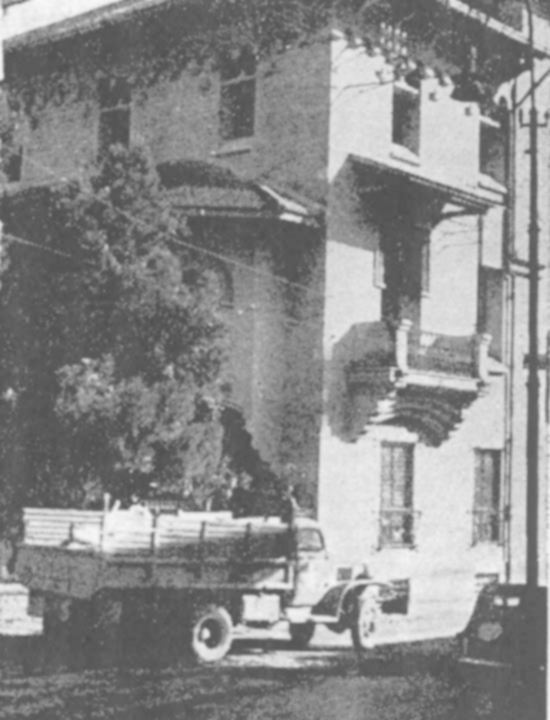 Not the works---but one of three villas making up AFS HQ---Naples. The building pictured here, however, is to be the work house. Other villas house the AFS club and HQ staff.----Cuddy Photo. |
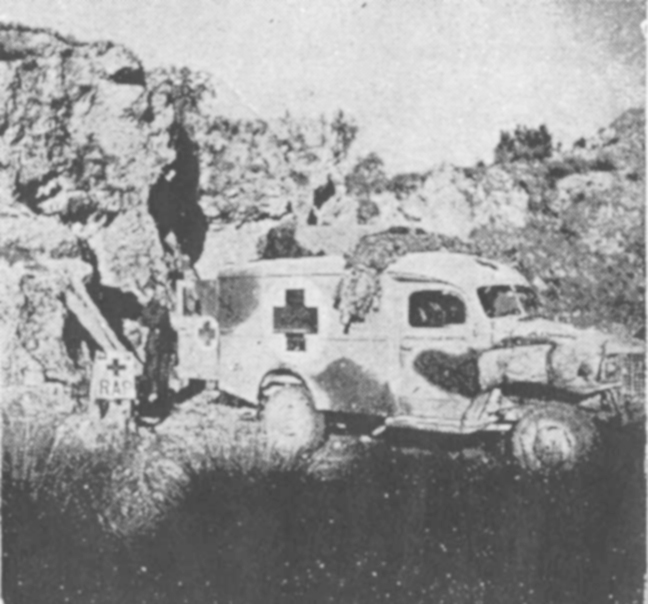 An Ambulance, a sign, and hidden from view, the RAP truck on the Fifth army front. This is one of 485 Company's posts on the way to Rome. |
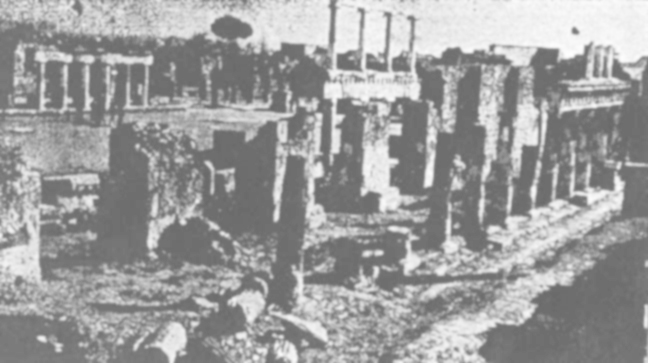 As almost as complete in its destruction as from masses of 'Liberators" the historic ruins at Pompeii offer a sight-seeing respite from the Italian campaign..---Holton Photo. |
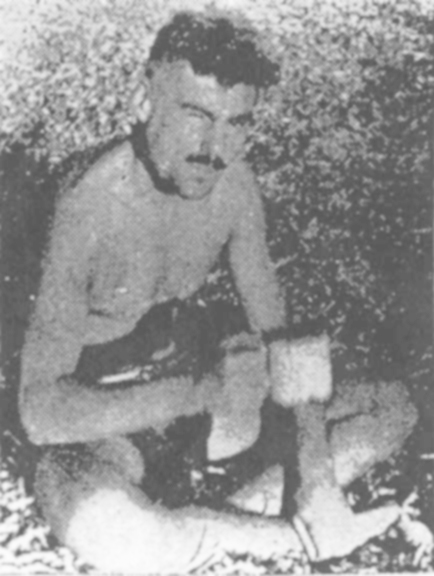 Capt. L. Webb, R.A.S.C. O. i/c W/S, 567 Coy.---White Photo |
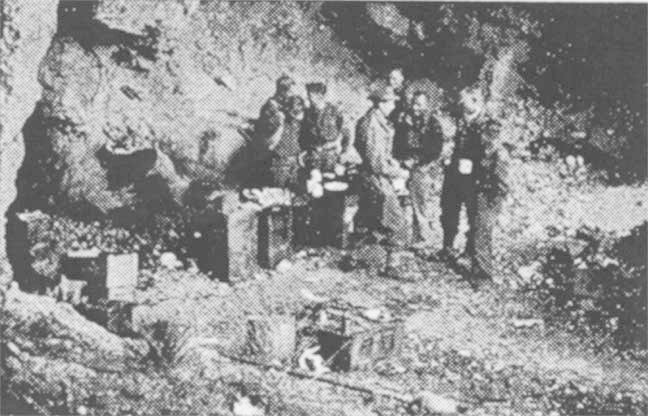 Breakfast at an RAP Cave-Kitchen with the Fifth Army.--- Cuddy Photo |
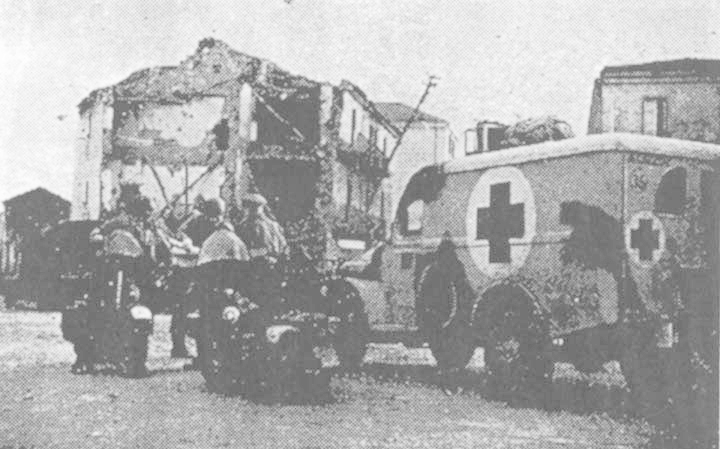 Although still with British forces with the Fifth army, AFS men are closely associated with the American Army. Here two AFS drivers get road directions from Yank M.P.'s---Cuddy.Photo. |
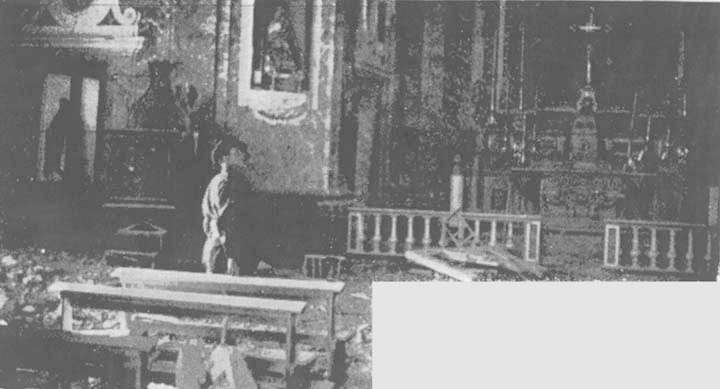 An AFS man surveys the bomb damage to a small church somewhere in Italy. Civilian property comes in for much more damage in Italy than the desolate desert.. |
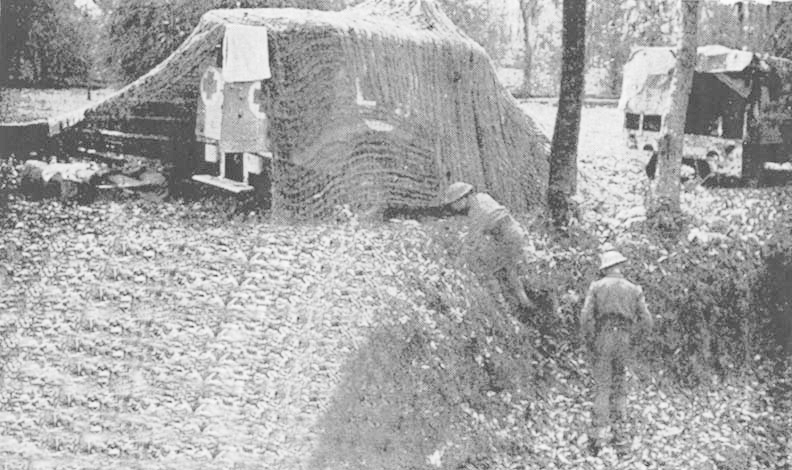 Two 485 men leave the safety of a convenient ditch beside their ambulance on the Fifth army front after an air raid. The difficult terrain for driving in Italy has some benefit in providing occasional ready-made shelters. It might help the camouflage if the white towel shown here were a little dirty.---Cuddy Photo. |
