
| THE AFS BULLETIN HEADQUARTERS, AMERICAN FIELD SERVICE GHQ, MEF |
 |
| Vol. II |
|
No. 3 |
|
Cover Illustration
|
I have just spent a month making a detailed survey of the Cairo headquarters. The results are embodied in a very voluminous and very dull report. But AFS members may be interested in some of the conclusions.
Colonel Richmond asked me to make this report, first as a basis for criticisms and suggestions; second, for the information of the New York office; and third, for the use of those who may need to be informed quickly as to the workings of the headquarters organization. I thought I could make such a survey because in the job from which I have a leave of absence, I am responsible for supervising the organization and efficiency of several thousand employees.
Colonel Richmond gave me a carte blanche. I talked with all the general officers and department heads about their work and how it is done, what routines and procedures are followed, I examined all the records and files. I found out all I could about contact with the British Army and other organizations. And I observed how business was conducted and problems solved.
There has been tremendous improvement since "growing-pain" days of the organization when there was considerable inefficiency: records were non-existent or poorly kept; files and cars and even men got lost; and things got tangled up generally. There is still inefficiency. No army organization can ever be as efficient as a good business organization; there is too much change and uncertainty. But within the limits of the possibilities, this is an efficient organization.
It is well organized into departments. The OC and his Adjutants handle the principle contacts with the British, make the plans, worry about the major problems and generally supervise all the activities of the outfit. They do no routine work but my observation is that they are kept busy all the time and are devoted to doing the best possible job.
The Finance Department handles all the finances of the organization and of the individual volunteers. It was in charge of Capt. William Perry, who is a Unit 5 member who was highly regarded in the field as a driver and NCO. At present the Finance Department is headed by Capt. Neilson Bridger. Here all the books and records are kept. I examined these records and found that they are carefully kept and supported in the manlier common to well organized businesses. The books are balanced nightly and subjected to a monthly audit. In June the department handled some £E. 12000 in seven or eight different currencies. The work on the volunteers funds involved over 2300 transactions each one requiring several book entries. There were more employees than actually required in this department, but that was regarded as a temporary situation, to handle extra work of repatriating units, and has now been corrected. Aside from that it is not over staffed. Field cashiers are available to units as widely separated as New York and San Francisco. Recently an additional field cashier has been put on because it appears that both companies may be divided, with platoons in widely separated locations which makes additional travelling. I had no substantial suggestions to make about this department.
Then there is the Supply and Transport Department under Capt. John Nettleton. Nettleton served 10 months in the desert and was considered the best man in his company on mechanics and maintenance. This department necessarily contacts from time to time some fifty-four British and American Army officers. It is responsible for keeping the AFS "on the road." It has the worry of trying to get the new ambulances from the United States to the Middle East. (It seems that both the New York and Cairo offices have done everything possible in this respect; guns and tanks and planes simply come first. Both offices have been in hot water with everyone on several occasions because they were informed that ambulances were on the water when they were not shipped at all!) Then there is the problem of spare parts. They are scarce and hard to get; a good deal of army red tape has to be gone through to get them. Transport is difficult and parts, equipment and supplies of various sorts must be transported hundreds of miles by land, sea or air. This must be arranged by any means that opens up at the moment. The department keeps track of all clothing and equipment issued to the men and returned by them. These records have been inadequately kept in the past and are incomplete because unit quartermasters in the field have not furnished the necessary information. Currently they are being carefully kept. It is also responsible for the purchase of canteen supplies, from civilian sources, on order of the company canteen managers; the keeping of records on plaques the procurement of office supplies and equipment; accident reports, etc. When the survey was started it also handled movements of men by air but since all other movements of personnel are handled by the Personnel Department it was considered logical to transfer the air movement function to that department, where it is handled by Vol. Charles Moffly. The records of the various donor's plaques and the cars to which attached are not in good shape (other things have always been more important) and while this may seem an inconsequential matter donors are much interested in what happens to the cars assigned to them.
| This is the first printed edition of THE AFS BULLETIN. With the red tape involved in getting authorizations and permissions as well as feloose, it has taken a long time. But feeling that the men in the Field Service wanted a better and more interesting official publication, the red tape was gradually sliced to pieces. Here it is: THE AFS BULLETIN for the entertainment of all AFS men. Trusting you will overlook the datedness of some of the material which was originally prepared for the June issue, it is hoped you will enjoy the BULLETIN and let your section editor know your reactions. No one person runs the BULLETIN, writes it, or edits it. Everyone has an interest in it. So its success or failure is up to each man. |
The Personnel Department has many functions also. It is in contact with thirty odd military and civilian officials or offices. It handles all movements of men, upon arrival in the Middle East, between locations, and upon repatriation. It takes care of all matters relating to passports and Geneva cards (so many of these have been lost it is affecting our relations with the British at HQ for the worse). It keeps the personnel records and performance reports and furnishes the necessary information on men to New York. It also has a number of "service" functions, such as executing commissions for the men in the field as by the repair of eye glasses and the purchase of various articles, securing hotel accommodations in Cairo, etc. A reorganization of this department has been suggested. The general files of this department were not in good shape and re-arrangement was suggested to make them more readily usable. Its other records are carefully kept and each of the three men in the department is fully familiar with all the various routines and contacts and capable of handling them---and they are kept busy doing it.
 There are two men in, the baggage
room. For the convenience of the men coming to Cairo the baggage
office is kept open ten hours a day seven days a week, and this
requires two men. Recently the stored baggage has been card-indexed
and neatly re-arranged in the basement and there should be no
difficulty in finding anything. Difficulties do develop, however,
because the men sometimes go to the basement and remove baggage
without having someone from the office with them, thereby making
the records worthless. There are two men in the Mail Department
(one British Army personnel). They do a full days work on most
days. The morning is fully occupied with the trips to the airport,
cable censor's office, cable office, British GHQ, etc. and the
sorting of incoming mail. The trips are repeated in the afternoons.
Incoming mail for the companies in the field goes out of Cairo
headquarters the morning after it is received there.
There are two men in, the baggage
room. For the convenience of the men coming to Cairo the baggage
office is kept open ten hours a day seven days a week, and this
requires two men. Recently the stored baggage has been card-indexed
and neatly re-arranged in the basement and there should be no
difficulty in finding anything. Difficulties do develop, however,
because the men sometimes go to the basement and remove baggage
without having someone from the office with them, thereby making
the records worthless. There are two men in the Mail Department
(one British Army personnel). They do a full days work on most
days. The morning is fully occupied with the trips to the airport,
cable censor's office, cable office, British GHQ, etc. and the
sorting of incoming mail. The trips are repeated in the afternoons.
Incoming mail for the companies in the field goes out of Cairo
headquarters the morning after it is received there.
What about some of the criticisms we hear of the headquarters? Why does it remain in Cairo? Well, that is still the most central point and as long as the AFS is attached to the Middle East Command its headquarters must be where the ME GHQ is located. What about pips? When you find out how many contacts have to be made with the British Army you understand why pips are necessary. Those contacts can best be made by commissioned officers: Colonel Richmond, Major Hoeing and Captain Nettleton of the American Field Service get attention and results which could never be achieved by Mr. Richmond, Mr. Hoeing and Mr. Nettleton. The equivalent jobs in the British army carry equivalent ranks, and an army officer expects to do intra-army business with other officers and not with civilian "misters."
SO I JOINED THE FIELD SERVICE!
----by Melanson, 485
"The men at headquarters don't know what goes on in the field." They don't in the same way that the men in the field know it. They can't. Distances are great and communications are slow. They can't spend much time in the field without neglecting headquarters work. But they keep in touch as closely as possible. it is a real problem and it is recognized. Most of them have spent considerable time in the field; they know the life and the fundamental problems.
There will always be criticism of headquarters. It does most of the unpleasant things that have to be done. There are individual grievances; some of them are justified and some of them are just irreconcilable conflicts between the interests of the individual and the interests of the organization. And criticising those in authority is an American sport. It's fun. We'll continue to have our fun; but at the same time it may be comforting to know that the headquarters is basically sound.
This is the concluding part of "Baghdad Jounce" the first part of which was printed in the last issue. The trip carries on with the convoy of 50 civilian food trucks progressing across the Jordan Valley---Ed.
Not only was the scenery interesting, but so was the driving, for we spent most of the day going up and down precipitous hills until we finally climbed up out of the Jordan valley and staggered out on the high open plateau known as Trans-Jordan, the biggest rock pile this side of the rock pile this side of Murphy's gravel pit the other side of North Chicago.
During this little jaunt we ran into even more wild flowers and began to run out of the orange country. The two proceeding days we had practically lived on luscious, giant oranges that could be purchased for two cigarettes apiece.
We crossed the famous Jordan river shortly after lunch, and it looked much like a mountain creek in the Spring when the shallow, fast moving water is discolored by mill washings. The river at this point didn't quite live up to the songs we've heard, but the narrow road began to corkscrew up out of the valley and we were too busy staying on that to worry about the size of the Jordan.
Many of the villages up above blended into the surrounding hills and were almost unrecognizable from a distance, for they had been built of the earth and stone gleaned from the ground in the immediate vicinity.
As we drove along we encountered a coming convoy with wild flowers profusely interlaced in the radiator grids that gave an ironical touch to the few minutes of our acquaintance with this war.
For some time the weather threatened and we worried about that as we climbed up those "it-will-be-slick-as-hell" roads. Somehow we all managed to navigate the hairpin turns and beat the rain to the top. Charlie Craig and Joe Zarella did careen down a steep grade dangerously fast before the last long climb, as Charlie hunted all over for "third," but in the end had to be content with neutral and a heavy foot on the brake. Everything came out all right. The only casualty that day was Bob Balderston's loose wheel that brought poor Bob, hungry and tired, into camp after dark.
The rest of us had arrived early enough to stage two football games between the long lines of trucks.
The weather was kind enough to hold off for the game, but many of us expected the worst that night and so parked our trucks back-to-back and pulled the canvas over the gap between them to give complete protection from the weather. It rained that night. And it rained hard for more than an hour. In addition to our being dry we had discovered that the tea boxes made much softer bunks than the steel tailgates. We were all comfortable as well as dry in the morning.
When we pulled out of camp the next morning, it was wet, dismal, and dark. All of which made the bleak plateau appear even more desolate and forbidding. Far off in the East, however, there were patches of sunlight that somehow had managed to break through.
We drove toward those with hope in our hearts as the busy windshield wipers rasped, "You bet... It's wet! You bet. . . . It's wet! You bet... It's wet!..."
The land was dismal, yet it was strange and interesting, for as far as the eye could see were rocks, rocks, rocks, strewn evenly over the landscape. Most of them were about the same size and either brown, or black, as if some of them had been left in the oven a little too long.
We came across a village built entirely of this black stone that looked like something of a Wagner opera, very mysterious and sinister. Here God had planted thousands of acres in stone.
At one place we saw some sheep apparently grazing in the rocks. Now we know where they get 'the term "rock-ribbed wool." The road suddenly became very bumpy and one had to hold on to the steering wheel for dear life as the truck lurched and rattled over the sharp, tarred rocks. That morning we had picked up an armed escort of Tommies. They were distributed through the convoy and furnished a little conversation to take one's mind off the rocks, the dust, and the bumps.
The rocks became smaller and smaller until the whole landscape looked likes a giant, graded, gravel road. About this time the road began to peter out and we started out across the desert raising dust clouds that must have been visible for miles.
We pulled into camp out in the middle of nowhere. It was so windy and dusty that we had to wear our goggles while we greased our points---but fast.
Many of us wore our goggles to mess, and we looked like a long row of strange insects as we stood in line. Robin Craven looked like a magnified picture of a grasshopper with a moustache in his enormous green, no-glare, no-frost, no-fog, no-see goggles. And that's exactly why he wore them: so he couldn't see what he was eating. Bill Browning looked more human, but more repulsive with his garrison cap pulled down over his goggles and his face screwed up in the expression of a scientist peering into a microscope in search of streptococci.
Darkness came quickly riding on the wind, and there was a mad scramble to get the tea boxes in position before it was too dark to see. Even the guard slept because we decided not even a blood-thirsty native would venture out in this weather.
Before going to bed that night we listened to thrilling tales of the 8th Army's victory over Rommel; how it had all been carefully planned and rehearsed in advance: how the Scotch bagpipes played, the Aussies sang "Waltzing Matilda." the Kiwis sang "We're the Boys from Way Down Under" as the army began its historic advance to music. All the Tommies with us knew their stuff for they all bore wounds from that advance.
That night we ran into something new---a note of optimism that we thought had been lost somewhere back around Dunkirk, These Tommies were full of confidence. Jerry was going to be hit hard and soon.
For some reason they could see the end within a relatively short time. We went to bed feeling pretty good. It was good to hear someone not only talk of wanting to win, but to talk of winning.
Wednesday morning, the seventh day, we hit our first patch of green as we left Trans-Jordan to enter Iraq. It was still rocky, however, and the road was still bumpy.
And so it went on, most of the day: off and on the road, bumpty-bump, bumpty-bump,, dirt, dust, hot sun baking one alive in the cab, dodging holes, cursing the "backsheesh" natives, cursing the Iraquian minister of roads, etc.
There was a little variation in scenery late in the afternoon as we dropped a few hundred feet into a valley, and the road twisted around the bottoms of table-top mesa mountains for about 25 miles. The only vegetation in sight was a fringe of grass that clung precariously near the top of most of the mesas.
Although the land was dismal, the sky was beautiful with heavy cottony puffs of clouds patchworking the blue that showed through at regular intervals all the way down the horizon.
Lou Murphy nearly lost a wheel as we entered camp that day. Another truck had a breakdown, and on its piston rods.
We didn't post a guard that night, but we were tucked away behind a barbed wire entanglement for safe-keeping.
The next morning, we unloaded Lou Murphy's truck and divided up the load so it could safely finish the journey.
The mesas disappeared and the land was flat again. Ahead we saw a new strip of road and breathed a sign of relief, but it turned out to be just as rough as the. desert and the old road.
Somebody up at the head of the column must have had a knee action vertebrae, for we sped along at 30 and 35 m.p.h. despite the bumps and holes just as if we were on the Pennsylvania turnpike.
If mirages are interesting then we were interested most of the afternoon, for evidently conditions were right for such phenomenon, and we saw all kinds and shapes of mirages. There were large lakes, tent cities half submerged in mirages, convoys gliding through water up to their hubcaps, and all sorts of things. It made it easier to understand how a thirsty soul on the desert could soon be driven to madness by chasing these perfect reproductions of water all over the place.
We landed in camp rather early that afternoon; however, our backs and fannies were more than ready for a rest; and, moreover, we had to check our tools. get our 412 books ready to hand in, fill up with gas, check the oil and water and grease the points and shave-for tomorrow was the last day.
That night a song was born and dedicated to the APS convoy. The words almost fit Irving Berlin's tune, "I Left My Heart at the Stagedoor Canteen;
I lost spare parts and half my machine;
And washed my teeth in G.I. gasoline;
They kept serving us 'hardtack-
Said we'd eat it or die-
But we laughed and threw away hardtack
We'd rather die.
I must go back to my ambulance routine;
And AFS men know what that can mean.
Of all the convoys in each day
Ours at least has this to say,
"We lost spare parts and half our machines,"
The trucks lined up in three tight lines looked much like a fleet of delivery trucks pulled in behind the warehouse after a hard day. And these trucks had had several very hard days on the desert and pulled through.
"The desert," many have said, "has a beauty all its own." Talking about the desert that night we all agreed that certain plants, rocks and flowers do have the quality of beauty by themselves, but all in all the desert is a very dirty, dusty place and rather depressing after a few days. The sky at night is beautiful, and one might say that the desert at night is beautiful, but that's only because it's so dark' that. one can't see the desert.
Before bed that night the fellows gathered around a flaming petrol fire and listened to Robin Craven, Ed Masbach and Redwing Hopkins recite a few ditties in a sort of pre-arrival celebration.
The next day the country was dreary and flat until we crossed the Euphrates where it was just dreary.
The road from the Euphrates to Baghdad was by far the worst we had encountered, and after about three hours of brutal jiggling we all ready to sign an unconditional peace.
Lunch gave us a little better outlook, and our new life was soon rewarded with the first sign of American cultural stamp we had seen since leaving Cairo. When we first saw the. spires, minarets and mosques of Baghdad, some of the men began to kid about their expecting to see neon blinkers and "Eat at Joe's" signs. before we entered the city. To their surprise they discovered a tidy row of five very familiar little signs lined up a mile outside of Baghdad. They said, "Lonely Sultan... Used to Scare 'Em... Now Spends All... His Time in Harem... Burma Shave."
Medical Directorate, G.H.Q.. M.E.F. 28 July. 1943.
Col. R.S. Richmond AFS,
HQ; AFS. GHQ. MEF.Dear Richmond
The following paragraph appears in a report, by the A.D.M.S.. 4 Ind Div, relating to the Tunisian campaign:
"It is desired to place on record the gallantry and devotion to duty displayed by the drivers of the American Field Service ambulance cars attached to the Division."
I would like to record my own appreciation of the good work your men continue to do in the forward areas. It is most heartening to know the old spirit still lives.
(sgd) W.C. Hartgill
Major-General
D.M.S.
The following in an excerpt from a letter to Stephen Galatti by an Australian Wing Commander.
"ONE OF THE DRIVERS of your organization. Mr. Martin Lehds, has been attached to this squadron for the past eight months and as I am now handing over to my successor, I feel called upon to, place on record my appreciation of Mr. Lehds' out-standing service to the unit.
"Apart from the long tedious hours of standing by with his ambulance on the aerodrome whilst flying operations were taking place, Lehds has wholeheartedly entered into the activity of the Squadron and his cheerful friendliness and eagerness to assist in any duties, even outside the score of his ambulance driving role, have earned him the friendship and admiration of both officers and men alike. -
"It was particularly fortunate that an American... should be attached to an Australian Squadron at a time when both our Nations are joined in a brotherhood of arms in the Pacific, as few of my men had any experience with Americans prior to Lehds attachment... and all had a natural desire to discover what kind of men are fighting in the defense of Australia... (Lehds) has unknowingly acted as a most successful ambassador for the United States of America.
"...I have observed the work of your organization with the keenest interest and from what I have seen and heard from other Allied officers... you are to be congratulated on the selection of your personnel.
"...the best wishes for the future success of the American Field Service organization."
Martin Lehds was most recently connected with the AFS baggage room at HQ. He left at the expiration of three months additional enlistment to become director of a Red Cross club for Americans in Tel Aviv.
CALEB MILNE, IV, 31, May 11, of wounds received in action.
AUGUST RUBEL, 43, killed in action April 28.
RICHARD STOCKTON. 45, missing and presumably killed in action April 28.
Henry Bonner.
Mortimer Belshaw, William Mitchell, Alexander McElwain, Charles Perkins, Laurence Sanders.
GHQ MEF.
16 July 43.I am pleased to be able to inform you that H.M. King George VI has approved the award of the British Empire Medal (Civil Division) to Volunteer George LESTER and Volunteer Robert Joseph Banigan SULLIVAN. for their courageous conduct during operations in the Middle East, and you are requested to inform them to this effect.
Signed: J. C. Latter
Brig.
Dep. Mil. Sec.
| Capt. Fred Hoeing to Major (ME). Capt. Arthur Howe, Jr. to Major (ME). Capt. Chauncey Ives to Major (India command). Lieut. Lester Collins to Captain (ME). Lieut. Bert Payne to Captain (repatriated). Lieut. John Pemberton to Captain (India command). Lieut. Charles Snead to Captain (ME). Lieut. Alan Stuyvesant to Captain (repatriated). Vol. John Boit to Captain (FFC). 2/Lieut. Max Brainard to Lieutenant (ME)* 2/Lieut. Robert Thompsen to Lieutenant (ME) * Vol. Carleton Richmond to Lieutenant (ME). Vol. George Barker to Lieutenant (ME). Vol. Edward Borger to Lieutenant (ME). 2/Lieut. (Tern.) Carl Adam to 2/Lieutenant (ME). Sgt. Jack Hobbs to 2/Lieutenant (ME). Vol. William Burton to 2/Lieutenant (FFC). Vol. Harold Curtiss to 2/Lieutenant (ME); Vol. Manning Field to 2/Lieutenant (ME). Vol. Arthur Jeffress to 2/Lieutenant (ME). Vol. Michael Moran to 2/Lieutenant (ME). Vol. Francis Murray to 2/Lieutenant (ME). Vol. John Patrick to 2/Lieutenant (India command). Vol. Charles Pierce to 2/Lieutenant (ME). Vol. Dana Richmond to 2/Lieutenant (ME). Vol. Richard Ritter to 2/Lieutenant (ME). |
July 11
Editor
You publish in the April-May issue a letter criticising the republishing of your bulletin in the N.Y. office. Apparently the critic has a poor slant on this. There is no material---except, perhaps, the excerpts from the men's letters---that has given so much satisfaction (and, I might add, good will towards the AFS) than your publication. This is real stuff to us back home. It gives us a colorful, live picture of much of your daily lives! the bravado and boredom, the courage and patient persistence, and most of all the steady maintenance of a man's individual integrity amidst the vast, huge machinery of war. The man who keeps his sense of purpose thru all this, is he who had it clearly in his mind when he joined the AFS.
Your writer infers that the News Bulletin has been misused for publicity. Here at home we feel proud of the record given in it, and could he know the reaction of all friends and relatives of the APS towards the news of the Middle East thru it, he would hardly think it ill-used.
And how, may I ask, does he think the AFS is to operate if funds do not come in as donations? Is your critic ready to finance the administration of two---and now three---offices? Surely, if he feels the AFS to be a worthy effort, he cannot resent our sharing news and reports with friends who have already shown their eagerness to help.---not to mention new friends we make among strangers who have become acquainted with the job you men are doing.
I wish to congratulate you on your publication and add that, for myself, nothing comes thru headquarters that I enjoy more. There are many parents who feel the same, and many friends.
Sincerely yours,
"Me," a parent.
July 26
Editor:
In your last (that we have) April-May issue, Phil Nelson writes to you that he understands that the N.Y. office doctors up pieces of the Bulletin to suit its own purposes without the approval of the authors. We never doctor up the articles so that they are changed around---true we have shortened them a bit sometimes, and have eliminated the ones which were not interesting to our READING PUBLIC, but we don't literally change articles. The approval of the authors: he is right, we have no approval. Can't say as I think that's not splitting hairs. If a fellow writes for one AFS publication for free, why can't the other similar AFS publication use the same material.
Joan Belmont
Public Relations
American Field Service
New York City
July 27
Editor
My sudden departure for the British army prevented me from saying goodbye to my many friends in the AFS. I must say the joy of being commissioned was dimmed by the fact that J was leaving the AFS.
I have been so extremely happy the last ten months and already miss everyone tremendously.
My new work looks as though it will be interesting, but it is all definitely "Army" and the fun we had at GHQ, AFS I am afraid is a thing of the past.
Do, if you have space in your 'amazing" Bulletin, say goodbye to everyone for me---and tell every body I expect them to look me up in New York. I am in the book---by that I mean the telephone book---and not under the name of "Nails" or "Yankee Doodle Dandy," just plain as ever,
Donald Donald Neville-Willing
Lieutenant (Possibly the oldest in the World; Bronson Rumsey excepted).
MERRA
GHQ. MEF
May 3
Editor:
Re: AFS Bulletin article by Kinsolving: "Composite Portraits of the Average AFS Man"---Vol. II. No. 1:
Dartmouth contributes more men to the AFS than any other college. Not Harvard, thank God. Unfortunately, "this does not mean that the average AFS man is a Dartmouth Man!"
R. A. Schroth
(Ed. Note: AFS Roster published April 1, 1943 lists 110 Harvard men and 29 Dartmouth men).
|
On the Home Front "Come up and divide dinner with us." In the Field "Hearty man eats condemned meal." |
|
|
There was the flux and motion of physical war in the Western Desert. There were times of crises and improvisation, and times of pure sensory excitement. From the Desert came tales; from out of the Desert came writing that was both objective and strongly personal, all invisibly cemented by a common bond, forged out of actual experience.
Much of the time you sat, and you waited. Your mind had three channels: the book you were reading, the food you were eating, and the action for which you were waiting. We exclude philosophy and sleep.
You were near Cairo, you were near Alamein; you were in Cairo, you were in Alamein. You ran along the coast and stopped at special places, the most recent of which were Bizerte and Tunis. And a bit later, after each stop we found out about that stop and about its character We learned to know you through your work.
There were fire eaters, and there were fire eaters, among you.
To a more or less degree, each of you has absorbed a phenomenon of our age, a particular method in our war; one that in all probability shall be denied us who have been in Syria. You got what you wanted at your own varied expense. And we envy you.
There were not many actual reasons for staying in Syria during all of this. There were orders, yes, and so there were individual desires involving position and advancement. But to speak realistically, most of us by-passed the rationals present, and the coin-flip, to remain because we desired our own first crack at action, far North of our present, Syrian, Army territory.
So, like you, we read, ate, and waited. We had our sleep and our philosophy at a controlled pace; though expected, war was less imminent in Syria.
In the log of the American Field Service Syria has usually been accorded a position secondary to Egypt and to the Western Desert. It was a place somewhere North of Cairo; it was a place for the training of new men, and a rest home for the war weary. Syria was sometimes a reprimand, a conditioning spot for bad boys of the Field Service.
Almost all the men of every unit have at one time or another served somewhere in Syria. They have occupied posts from the Euphrates river in the far North, down through Lebanon's Bekaa Valley, through Beirut on the Mediterranean, and on to the Palestine border and Merdjayoun. Over this area were spread groups of men and ambulances, each varying in number from one to twenty. The main stations were three: Damascus, Aleppo, and Baalbeck headquarters. Out of these went units to be attached to anything the Army desired.
There were stationary postings in any kind of place from barracks, mansions, and tents, to house of mud shaped like upright breasts. There was the action of manoeuver duty, whether it involved trucks, mules, or men. On leave, money was spent in Normandy, Kit Kat, and St. George's, the cities of Syria. We have seen minor scandals and major, good people and bad. "Very Good" and "Poor," luck and misfortune, French food and British, ladies and whores.
And we have stood trial in the worst of Syrian winter.
(Ex-Princeton, class of '42, writing in March from Baalbeck, '43).
"There is no change in the sky's dull grey. Snow underfoot yields only to slush, and back again. Barrack walls serve but to retain a kind of still cold. It is better outside, for the moving air seems warmer. Buildings, vehicles and men have no contrast; it is all like a Monet impression, toned and on canvas."
(Alumnus of Chateau Thierry, ex-bond salesman, writing in March from Deir-Ez-Zor, '43).
"We're not allowed to give names or be too specific. Tell Marilyn not to worry. If she could see the house where we live and the food we eat she might want to change with me! Sometime I'll tell you in detail about the maintenance over here (or rather the winter part of it). Go on out to Lake Michigan some windy January afternoon and pour water over your arms and hands, and don't dry them. That's what engine-cleaning Kerosene feels like at this time of year."
With what has been said, and with your own memory, you have a picture of Syria. But the men of Syria, their ideas and their-growth, as well as the present organisation, have been left untouched. In the period of a year and a half, men and their leaders have come and gone; some of their ideas have remained, workmanlike and tangible; out of the error and miscalculation present in any development has come a definite structure, very far from inflexible, and with a strength that is safely past an immature, deceptive confidence.
It would be foolish to attempt description of this evolvement step by step. Suggestions came from the RASC, Syrian volunteers, NCO's, Lieutenants, OC's, and any part of the British or American army systems which had something to lend to the AFS.
As a volunteer group, the American Field Service found its greatest difficulty in adapting to itself all or any of those diverse suggestions. For in the ranks of Syria. as in the Desert were all kinds of men. Because you were at war and we were not, because you were on sand, and in a complete vastness, we could borrow none of your solutions. So great, the difference.
Thus was the picture when Captain King came to this country in February, 1942. The records now present of that era are purely the mechanical kind, of vehicles and men. Many of you know the story, for you were there, With Dodges signed over from the Aussies. Field Service men filled posts in all parts of Syria. Aley was the early headquarters.
The work was basically the same, and. so was maintenance. But there is an impression that things were more relaxed in that early period. Men returning to the United States spoke to us only of leaves in then-mythical cities of the Middle East. They spoke casually of war, of experience, and of death. And they spoke of Jeannette's and Alexandria and Night Fighters all in the same breath. They described Aleppo in French, as the place where plague was born. Besides hearing their verbal work, we gleaned more gems, of a Sunday morning, from Feature Sections. According to viewpoint, this diet was healthful, or not.
At no time, ever, in Syria, was there a sudden change. But somewhere along the main line of King, Geer, Marsh, de Bardeleben, Dudley, Hoeing, Dunn, De Pew, Ives, Johnson, Pemberton, and Wilson, came the new face which. did not worry too much over the fact that there was no more gazelle hunting, no more free rides about the Middle East, and no more backshee living. Somewhere along that line Syria had gotten over its growing pains. Somewhere along that line Syria had realized that if we could not learn war and its ways firsthand, as did you of the Desert, we could devote time to developing our knowledge and understanding of our one instrument in this war, the ambulance.
And so, while some men learned in the workshops, others developed mechanically at the Middle East Training Schools in Palestine. Inspections' standards rose until excellence was a common thing. It had become not a matter for congratulations, but a one of personal pride. The incidence of accident and repair, too, had dropped in a direct relationship.
In a course lasting over seven days incoming units were trained in mechanics, driving both navigation and map reading, and in hot climate tire maintenance.
Syrian ambulancemen have worked over hundreds of miles on flat tar plain, mountains, and desert in snow and in heat. They have learned to do this at special speeds in distanced convoys. They have learned, dispersal and camouflage. And they have gone through mobile gas drills. The men who carried out these exercises were led and instructed by those fully cognisant of the points in your desert work, both bad and good, but also of the points and situations which may, and may not, be revealed in our new, expected horizon, Europe.
As your Desert war drew to a close, so did a form of climax arrive for us, in Syria. As far as could be perceived from June 1943 when Major Hoeing, Captain Edwards, and the Lieutenants, Follansbee Brainard and Richmond assumed leadership, the metamorphosis was complete. Men and equipment were functioning smoothly together, and most of the old seemingly unsolvable problems were dissipated. There were the usual group of unthanked Sergeants and NCO's and volunteers, cursing paper work, tire pressures, and the very hair that grew on their faces. There were the normal assortment of bitches and god damns directed against Beaver Street, against Cairo, against you in the Desert, and against ourselves. We had not seen or heard enough of India yet for that set to appear. No doubt they would. We were glad then, as we are now, that these things will always be present.
Syria was secondary to the Western Desert and Cairo. Thank God for that. Because of it we were granted the conditions and the time to permit the development of a new phase. Out of the work and the men who served in Syria, and from you of the Western Desert, had come a scope that was three dimensional and complete.
Therein is your joint contribution.
This is written in the chaos of a hundred rumors a day. For it is the end of June, 1943; and the commencement of the struggle to regain Europe is present. Out of the past we draw the best, and having shifted tense, we await tomorrow.
Our own approach to the situation is summed up in the character of Harvey Grainer.
He is a young Naval Ensign...
("Due for troubled waters tomorrow, darling.")
He is 27, suave, the Russian Wolfhound of the Army Air Corps...
("Nineteen Zeros and the Order of the Purple Heart, can't we be alone somewhere?")
He is handsome and deft, slimly Brooks-clad, the same Harvey, somehow 4-F...
("Etchings? I have many Hogarths on my walls.")
He is the gay entrepreneur who dances with the woman Jim loves, the woman I love, them woman you love. He always wins. We give you Harvey Grainger; his very voice is a liquid, trickling aphrodisiac.
Warren Fuller gives you a piece of wood, Charlotte Blakely, letters numbering in the six hundreds, and Johnny.
* * * Feb. 7th 43
Letter No. 654
"...I love you, I love you, I love you. I'm dying for the day when you get back and we can do all those wonderful things we did together all over again, and see all the places, and have all the old fun. How I used to sit with you, and hold your hand, and you would tell me those wonderful stories, and we'd dream our dreams together. If this isn't the real McCoy, if this isn't love, my own sweetest, then I don't care if I never know love.
(Cheap chatter like this for ten pages) "...We are as one, my sweet, although we are so far apart. I feel as though there is a bond between us, which can never be broken, and it's a golden bond, darling, for it's the most wonderful thing that ever happened to me,
"All my love, my own, for always and forever,
Your Cuddles" * * * Feb. 8th 43
Letter No. 655
.It's been so long since I've written, darling, one whole day! I miss you so much, but our letters bring us so close together, that I can almost feel you right here next to me. I don't have to think about going out with other fellows, because I don't even want to. All I do is read your letters and it's better than any date I could have with anyone but you. You are everything to me, so hurry, darling, and get this war over with so we can be together again. We must never allow ourselves to be separated again, for I don't think I could bear it. For the rest of my life I never want to be away from you, to be with you is my prayer every night.
(Did you ever read such tripe?) "I went to the big Hazlewood dance last night. I didn't want to go, but I went because Millie insisted, She has a new boy that she isn't sure of, and she wanted moral support. I went with Johnny Dayton, you remember him, don't you? He is so frightfully dull and boring, and all the time that I was dancing with him, I just closed my eyes and dreamt I was dancing with you, drifting and dreaming, like we were the night before you left, at the Rainbow,
"Well. I must go off to bed my sweet, and dream of you,
Your Own Cuddles" * * * Feb. 17th 43
Letter No. 656
"...Just got home this very minute, and sat down to write you. I know I haven't written in a long time, but I've been so busy, and then Johnny's sister invited me over to their place for a week, and they rushed me around so much, and all over town, that I just haven't had a moment to turn around, or be myself. I'll make it up to you, sweet, and write every day again, and catch up on all the questions you asked me in my letters, and try and thank you for thinking of me so much. I do have to stop now, but don't be angry, I'll write again soon.
Best Love, Cuddles" * * * Feb. 30th 43
Letter No. 657 (or is it 658?)
"...Now you mustn't say all those rude and mean things in your letters, and don't be -jealous, for you know very well that John is just a friend, a good friend, and Millie likes him too, and he's just the nice type you like to have around. Besides, you shouldn't be jealous, with all those Arab women around.
Love, Cuddles" * * * March 12th 43
Letter No. 600 and something
"...You've probably already heard about Emily and Tom's wedding. I was a maid of honor, of course, and John was the best man. Emilie just wore a simple white tuller, with ruffles around her neck, and a tiny black mantilla veil, and black is so striking against white. She carried madonna roses and velvety black lilies, so terribly original using black, although it shocked mother. Tom looked just marvelous in his Ensign's uniform. Johnny's going to be an Ensign too, in a few days. He has the swellest job down in Washington, but he'll be able to get up here most weekends.
..Gee, it's awfully sweet of you to keep writing every day, and I would too, if I had time. The letters are so nice, and you've always been such a swell friend, and I hope you always are.
Love, Charlotte" * * * April 2nd 43
(I just can't remember what letter this is)
". . . .and I've just got time to dash this off, because I do want to thank you for the lovely brocade. I've been meaning to thank you for some time, but I just haven't had a minute. I'll have to close-now. Johnny's only in town for a few hours, and he is waiting for me now.
Hurriedly, Charlotte" * * * April 14th 43
"...Well, since you're so frank, but you could be frank without being rude. I'll tell you. Of course you must have guessed before this. I've been trying to tell you in so many subtle ways, and if you couldn't guess, I'm sorry. You know very well I didn't double cross you for Johnny. It's just that you are so far away, and I have to go out with someone don't I? You don't want me to sit home alone every night, do you? John and I do think a very great deal about each other, and I think he is sweet. He got me the loveliest fur coat which he gave me as a present during the recent cold spell.
As Ever, Charlotte" * * * ". . . Well, if you want my advice, I suggest that you reenlist. If you are an NCO now you must be a pretty valuable man in the organization, and they probably would want you to stay on and help them. You wouldn't like New York now, anyway. Everything is rationed, and all of your old friends are in the army
" . . . Did I tell you, I caught the bouquet at Emilie's or something, and it just isn't the same anymore.
Wedding? It's a silly superstition of- course, but it is a charming custom. I must close now.
Your Sincerely, Charlotte" * * *
We have nothing to say about Chan Ives. Nor have we anything to say about this portrait by Willson and Diamond. If we touched either one, the wrath from all sides would probably never stop. And we're not ones for getting our collective neck lopped off; at least while it's still inside. Anyway, in our personal feelings, Chan has his own "undislodgeable" niche.
Goodbye, Mr. Pips: somehow it is still pips to us. Although the rakish ends of the famous moustache now point to a crown on each shoulder, "Major Chan Ives" will never sound quite right to us. Somehow, though Syria loudly cheers the promotion---to every man-Jack and man-Jill of us, he will always be the guy we called "Captain Ives," as awed new boys; the guy we called Chan ever after as soon as we heard his first talk.
But let's work some Timestyle into this, let's get New Yorkerish. For Christsake, let's get to facts and anecdotes. Sentiment just won't do.
There was a time when Chan's epaulettes were even as yours and mine, chaps. Neatly buttoned, well-sewed, and unsurrounded by extra-cloth denoting rank. But that was long ago.
Longer ago was something else: there was scorn for conservatism. There was fighting to be done: for the SEC, the NIRA, the AAA, the WPA. There were jokes about these things, and Chan could always laugh at the jokes; but he could always fight for the ideas. Ideas, we can guess, meant a lot to him. Ideas about ordinary guys, ideas about vested interests, ideas about how a Philadelphia guy could want to work for progress yet still keep his law clients in Philadelphia. Ideas about humanity.
Humanity, I said. It was Humanity that took him to Finland, long ago, when you and I were still in Yale. It was humanity that, when he arrived to find the Finnish war over, took him to Norway to fight the Germans. And it was humanity that supported him for 85 days in Sweden, with no money; because humanity is a give and take thing.
Finland, Norway, Sweden, Let's get him back to New York because we've only got a thousand words---only a thousand words to focus the Field Service spotlight, to fit half a lifetime into your perspective and my perspective, so that we can see this guy Ives in a role that makes sense to every one of us: the role of a Field Service officer.
Let's think about Chan at 60 Beaver Street: shaking hands with Galatti, shaking hands with Wallace, filling out forms for C. Matthews Dick. Let's think about Chan on the boat, leading a unit we imagine, though we do not know for sure. Dominating meetings on A-deck aft, dominating conversations at dinner table---second sitting; dominating poker games.
Then let's forget all that about Chan, the way we've forgotten it about ourselves.
And let's forget the first pip, and the second pip. Let's talk about the third pip, which was Syria. Let's talk about Chan in Syria---the dullest time to him, of his whole life---the time when there was no action---the time when humanity meant not ordinary guys, but a terrific mixture of guys whose names were "Conscientious Objector" and "I Want to Fly for the Free French" and "Draft Dodger" and "Fire Eater" and "Playboy" and a hellofa lot of others like amateursoldier and mamasboy and brownedoffboyfromatoughsection and givememyFieldServicepips, and palehandsIloved. Let's remember all these guys---newboys. Boys to be whipped into shape. Boys to be reconciled to do the work of privates in the Royal Army Service Corps. Boys to be taught that a grease gun fitted the hand. Boys who in some way had to get the conception of a car as a convenience out of their hands; who had to feel suddenly that the car was a living striving thing, with muscles and blood, and a tendency to lie down if the spirit motivating it wasn't strong and positive and knowledgeable.
Chan Ives came to Syria, He survived telephone conversations like this:
"Hello?"
"Hello. Who's this?"
"Hello. This is Ives speaking. From Baalbeck."
"Well this is Joyce Randy, Look, Ives, whoever you may be. I can't get my car to go."
"Where are you?"
"Beirut."
"Randy---hmm---Randy, 1311927. Joyce Randy---did you say Beirut?"
"Yes."
"But you're supposed to be in Aleppo."
"I know. I got browned off."
That was at first, you see. After that, things got organized. That's the vague way the Field Service histories will put it. They will say: "After a little confusion, things in Syria got organized." But look, chaps, Chan did it. Chan organized it. He knew what the score was. He knew that when guys like Joyce Randy couldn't get their cars going, it was probably lack of petrol.
But he knew other things too. He knew that to run things well, you have to have guys who could keep files. And he found them. You had to have NCO's that other guys would trust. And he found them. You had to have spirit, and fight, and something we might as well call love. And guys found that in him;
They found it in the famous moustache, and in the phrases: they found that if, instead of leaving a room quietly, they pissed off; if, instead of trying to be British, they wore their caps like Middle-Western soda jerkers; if, instead of bitching about natives and limeys, they got interested in Syria and made friends with Englishmen; well, for Christ's sake, they got along better. And Chan smiled at them.
And if Chan smiled at them, that was all that mattered, because he was a square shooter. If Chan smiled, the 16 tasks made sense. If Chan smiled you could forgive India for taking him away and making him a major. If Chan smiled, you weren't a punk, or a 4-F, or a rebel.
If Chan smiled, it was because you were humanity, and he was humanity too, and everything was, all of a sudden, worthwhile.
It is not difficult to talk of bravery and sacrifice, of the effect of the Spandau, of a Scotsman and twenty Germans. We use the word "Jesus" in a sort of awe when we hear of the Ruhr, when we hear about the new missing blocks and new missing people in and around Naples.
We doubt even the ability of the Divine as a Supreme Jigsawist to re-align and reaffirm that sundered granite and those shred, absent hearts, eyes, and minds.
We doubt even His ability! And we do not have to be over critical to question the homey, soapy plasma in all the false humanitarianism about in these times. We impeach the Guests and the Luces; we damn the flaccid swab behind anything like a 'Piece of Cawn Pone in the Skillet Every Thursday.' Groundless and optimistic is the philosophy behind our flood of national Digests, which reflects nothing but our vast lack of value.
We curse with our hearts those who speak of war and know not of its reality and meaning,
|
You spoke the truth |
|
'What sound awakened me, I wonder, Toil at sea and two in haven 'Hark, I heard the bugle crying, 'Oh love is rare and trouble plenty 'Reach me my belt and leave your prattle: 'They mow the field of man in season: 'Ay, false heart, forsake me lightly: 'Their love' is for their own undoing, 'Sail away the ocean over, |
Up until April of this year, Chuck Larrowe was in the Desert. He arrived in Aleppo late in that same month a lot of ideas that might help Syrian Ambulance Personnel.
"...due to a variety of causes, it is impossible for the AFS to train its men before they embark for overseas service. Until the present time, also, the demand for men in the field has been so great that most Field Service men have been sent into battle areas without the training that a regular soldier would be given. In spite of this disadvantage, AFS Drivers have done a creditable job.
"However, as a consequence of the general lull in Middle East activity, it has now become possible for the Field Service to arrange its own training scheme. This will include such things as stretcher drill, i. e. properly loading 'lying patients' into the ambulance in both daylight and darkness; convoy practice (through towns, on good roads and poor tracks, and through mountains); a course in the proper care of tires and practice in mounting and dismounting them; intensive physical training; courses in map reading and in compass usage; practice in driving through difficult terrain, i. e. ground which necessitates the use of four-wheel drive; a course in rectifying motor breakdowns; a course in anti-gas precautions. In short, as many as possible of the things that ambulance drivers might be confronted with in an active area..."
With this as both reason and guide, four northern units led by Stump. Biddle, Rellinger, and Miller, plus the Noyes' Damascus section, 52 men in all, convoyed everything from 3-tonners to a jeep---from Baalbeck to the Palmyra Desert.
In a period of two weeks, this group, B Platoon, had studied and worked in an officially-taught training program. They were something that had never been seen in the Syrian Field Service: B Platoon was a perfect entity, within and without. In all movements and in all problems these men had learned to work well together. That was their achievement.
Out of that scheme came something else, too. The flowering of the Christassen Miller vocal group. This society has specialized in turning the filthiest limericks of our language into lovely, worthwhile, six part Madrigals. They have not yet been invited to join the Cairo entertainment bandwagon. The world watches Syria, and Syria has its eyes on Miller. God knows what Dave is looking at.
B Platoon has returned to Baalbeck, and to posts. By the end of that training scheme no hope of action appeared from Europe; so, keeping his promise, Chuck Larrowe, the man who fostered and carried out the idea, allowed the S&T to book his passage homeward.
The new maintenance idea in Baalbeck is Jimmy Newton's. He proposes examination of both drivers and ambulances. Drivers needing further help in road technique will receive it from the RASC. Ambulances with deficient engines or chassis will remain at HQ until they are fit in every way for journey in any kind of operations, and for any distance. This idea was a thoroughly natural one in view of the number of recent flips and body smashes. Already Captain Matthewson of RASC has turned out three cars with new engines, re-springing, and complete general overhaul. This is the first time in RASC records that a completely mobile, field unit has attempted. and carried out successfully such a project.
German paratroops have appeared in this area, disguised as
AFS men."
(one of Grover Cleveland Bergdoll's sons, no doubt).
As a general policy, the Editors of the Syrian Bulletin do not worry too much over what goes in, or conies out of it, a column of this type. Perhaps it is representative of a kind of writing that is designed to be swiftly-brilliant; maybe it is chatter that is newsy, that is intended to pick you up, with its precious, informative goodness.
Whatever you say will aid us in shaping it, Chaps.
But remember, we realize that this column is part of a trend that is dying. In fact, if Robert Waring Thompson were not very old himself, we mightn't have allowed it in print.
For many reasons, then, its name is 'Taps."
| Editor:---John Leinbach. Staff:---Tom Andrews, Tom Barbour, Art Bolte, Gordon Ingraham, Glen Smith. |
Saida, George!
With this issue comes something new, something different, something unbelievably horrible. The following section of the Bulletin is ours, all ours. We write it. Others may read it---but we write it.
If it's terrific, or even colossal, who takes the credit? We do! Good old 567 A.C.C.
If it stinks, who takes the blame? The editors.
The editors ---we're glad you mentioned us. It affords a chance to say we have a policy. Yes, we do.
In short this is it! "If it's good enough for the New Yorker, it's good enough for us." Of course we make a few exceptions. We have to.
But remember---we don't have to be editors. We can always do latrine duty.
Which brings up another of our great innovations. We're getting out twice as many copies of the Bulletin this issue as ever before. Why? To meet the increased demand. After all, you can always use paper. And, by the Shining Twelfth, we'll get rid of every copy! If we have to go into Tripoli and hawk our wares.
You may take that any way you like.
But our great joy is this: we no longer have to cater to the crowd at home. We aren't soliciting funds. From now on the Bulletin, and this section in particular, is for our own amusement in the ME. So what do you say---let's kick it around a bit.
We hope for more editors---none has been chosen definitely yet. We hope for a blonde secretary.
But then---you can't have everything.
After all---this is war!
June to September may become known as the months of the Great Siesta. In it, we left the battlefronts of Tunisia and came to the big city to rest. To sleep a little, to eat a little---but for the most part to sit on our respective duffs.
Some of us have had experience at duff-sitting. We did it at Tmimi. Again at Marble Arch. We have acquired a great deal of know-how on the subject.
To save yourself from complete collapse, you just have to recall the good old days. It's easy.
For instance, you think back to the time a well-known Main Line character stood beside that bombed Jerry truck. It was a mess, too-twisted fenders, bashed-in mid-section, no tires, not enough wheels, and on top of that it was burned to a crisp.
He just stood there, shaking his head. "I don t understand it," he said tearfully, "I did my tasks every day!"
Then again, near the end of the Tunisian campaign, the Indians rounded up a group of Jerry prisoners in the Zaghouan area. A British Intelligence officer came up and asked for help in questioning the prisoners. Who could speak German? The two AFS men present although they weren't too sharp at it.
Then up spoke one of the prisoners. "What do you want, bud?" quoth he, "I'm from Chicago!"
Well, after the initial surprise wore off, he explained. He had his wife and kids in the States. In '39 he's gone to the old country to visit his folks and whamo! he was in Hitler's army.
"Where the hell've you been?" he wondered. "I been waiting six months for you guys to get here!"
Again, back at M'Saken w h a chance to look in on a local North African wedding---Arab style. It was strictly a without-benefit-of-clergy job and consisted principally in a processional of the groom and his gentlemen friends to the home of the bride. Music was provided by drummer and piper, dances by an athletic blond Arab who wore a woman's costume for some of his rather graceful stomach exercises, songs by a friend of the family, and flowers by Your Florist.
We all seemed to be having a good time, with carnations in our ears and encouragements from the cheering section which Abdul-Azziz translated as, "How beautiful is the interchange of the glances of love!" That is to say, all but the groom whom custom instructed never to change expression or move his hands or speak. His was quite a swain, however, and dressed to the hilt, not forgetting a white shirt and a grey ascot.
Darkness had fallen by the time we reached the bridal chamber. By candlelight the groom popped in. We waited outside, while the women of the household wailed and the drummer did a specialty. Not long after, the door opened and the groom gave a sign to the bride's parents (perhaps the Ballantine Ale sign---we couldn't see) that he had found their daughter to be a virgin. Everyone was delighted to hear this and without further ado all returned home.
We asked Abdul-Azziz what happened if the groom found his bride had been a social whirler. He said he had only once heard of such a thing; it was the occasion of general lamentation and the affair was called off then and there. Apparently the Arab is quite fastidious.
But we thought we might ask the lads who are driving new ambulances out from Cairo at thirty miles per hour top speed if they enjoy riding them before they are broken in.
Under the heading of "it could only happen in the Field Service" is the one about the AFS man returning to camp late at night. The vigilant Tommy on guard noticed the approaching figure. What's more, he seen his duty and he done it.
"Halt!" he challenged, in the accepted style, "who goes there?
"Aw, who goes there yourself!" came the reply.
For others in the same predicament, we suggest other witty answers. How about, "Who wants to know?" Or, "Nobody but us chickens, boss (for former 15 Coy men)." For more, see Joe Miller.
The AFS has achieved another dazzling first! Six of our men, you remember, were the first Americans to enter Tripoli. And in Tunis we scored again. The first Americans to enter the fallen city. It's official now ---Yank magazine records it.
Among those present were Section Brigadier Red Murray, Atwood, Bloodgood, Jim Briggs, Drake, Gannon, Guenther, Lane, Mason, Paddock, Terrell and West. Plus sightseers Tom White and Coster. Anybody whose name we missed may sue us.
It's heartening though, we feel, to consider how much larger this group is than the six in the Tripoli do. If we keep it up, who knows but what we might capture Rome as a body?
We could do it, too. Look at the Berrettas, Lugers --and bayonet blades we have. Not to mention rifles, sub-machine guns and in all probability 25 pounders. Brother, we're ready!
And while we think of it, if the character who flogged the paymaster's jeep will own up, we'll be glad to print his memoirs in the next issue. We're even willing to call at the Field Punishment Center to collect them.
Everybody in the AFS knew it. Sooner or later we'd have to pay for all that nice bully beef King George has been feeding us. And all those melt-in-your-mouth biscuits.
Well, it's happened. We have paraded till it hurts.
Three of us---Bloodgood, Jim Briggs and Mason, we hear---were in the Tunis job, riding a Churchill tank. That was relatively easy.
The master work-out came on King George's birthday. Here in Tripoli.
The ten unhappy selectees were taken away in an ambulance the day before for some intensive practice. It was bloody deadly---and we're only quoting a Tommy who was there and should know. We marched and marched.
And next day we marched again---to the main square of the city. There we stood at attention while the band played "God Save the King" and a 21 gun salute dragged out for hours. We gave three hurrahs; then amidst frantic applause, by one or two onlookers, we marched past the reviewing stand. Back to the Car Park.
It was quite a sight, though. Row on row of British regulars marching in perfect unison. Then at the tag end, a thin line of struggling AFS men. We were the only "Yanks" in the parade.
At one point an American soldier in the crowd spied us.
"Lookit! Yanks!" he screamed in amazement.
"Cheez, I wonder could they spare them!"
Of course, the grand climax came in mid-month. King George arrived in person to see if it's true what they say about AFS. Apparently it is---because he didn't stay long.
The first time, we lined up outside the hospital to receive him; he eased by uncertainly. Two days later we lined the Azzizia road to "hurrah" him. And, going out, he seemed a little more sure of himself; he went just a trifle faster. On the return trip, though, he had made up his mind. He breezed past. He breezed!
But fellas---that's enough parading. Honest.
A British colonel just discovered us. The 567 ACC, we mean. It turns out we're a collection of geniuses who know an unseemly lot about stuff and things. And he made us promise to tell what we know baksheesh to the various units near at hand.
One member in good standing is holding forth on "England and America---Friend and Foe for 150 Years. This lecture has the boys on the edge of their seats, drooling. After hearing him. One officer was anxious to know why the state of Mississippi didn't pay back that Civil War loan of 6 million pounds. That shows you.
Other topics current or threatened are "Rocket to the Moon---and Beyond," "Radio Alaska," "The United States and Mexico-Good Neighbors?", the Wild West, the Middle West, the Far West and what not.
Of course, the real crusher is the lecture on archeology. The suffering AFS man responsible, attired no doubt in a toga, has taken up residence in Leptis Magna, on the steps of an ancient ruin. He is acting as official guide to the entire Corps. The high spot---a trip through the old red-light district, no extra charge.
Some old friends left and some new ones arrived. Complete with sheets, we understand. Yoiks!
Some of us have dug up amusements of various kinds, Softball. Track meets against the more daring of the nearby units, our team featuring "the world's fastest human," a star miler, etc. Also we are fortunate enough to have invitations to outdoor movies twice a week at the U. S. Army hospital. Very enjoyable, too.
But for originality we bestow the fur-lined AFS campaign ribbon n Flash Gordon, Ken Brennen and Voinin Prebble. Down to the docks they go, daily, to indulge in under-water scrounging among sunken ships. As we understand it, they usually act as observers; work inside the ships is too difficult. But they have gone down a few times for outside work, And proved to be adroit enough to please the most exacting. In fact the Flash really shook them once. He introduced a new wrinkle into diving---with real Yankee ingenuity. He went down, did his work and came to the surface feet first! It really shook them.
The next big event on the docket was the AFS victory brawl. From the description we were given by the committee, it was the biggest thing ever attempted.
Imagine this. A hall hired for the, evening---with piano. On one side, a buffet bar, loaded to the scuppers with goodies (like bully canapes). On the other side a floating bar, just lousy with beer and whisky and gin---obtainable for a slight down-payment. Songs, skits, music, jokes. And the entire 567 AFS milling around, not totally sober.
Most comment to the roving reporter was favorable. One AFS man did come up with a. slight complaint about the. song and skit part, though.
He said he didn't mind that type of person being in the Field Service, but he didn't think we should advertise it ...
That's all the griff for now. Of course we might mention the invasion. But then that's common gossip. Everybody talks about it. You see the invasion slogan all over town.
It reads: SOON OR SORRY.
(This is not fiction; it is an actual letter written by an AFS man and received by Art Howe. --ED.)
To: Major Art Howe
American Field Service,
567 ACC, B.M.E.F. -Dear Art:
I am thinking of enlisting for another 6 months. I have come to the conclusion that, because I have been a faithful Yard-Bird during the past year, I should be granted certain favors and advantages over other members of 567 ACC.
The following are the provisions of my re-enlistment for 6 months:
1. I must be granted no leave until 1944.
2. All my letters and packages (incoming) must be kept from me---even if it is necessary to sending them up to Syria and back---for the duration.
3. My car must be taken away from me and I must be spare driver with Frank Cochrane (or batman for "Flash" O'Neil).
4. I must be allowed to do all maintenance.
5. When the invasion comes, I desire to be put on the first barge to land---in the position of stretcher bearer.
6. After landing I must be sent where I can catch the most buckets of (BLANK) per minute.
7. My $ 50 per month allowance is not to be given to me. It is to go to the canteen, so that the other boys may have more free beers.
A.) Money from home is to be (BLANKED) up via the usual financial (BLANKING) uppers.
8. I am to be guaranteed the position of waterboy in all soft-ball games.
A.) In a game where sides are to be chosen ---I am to play left out (along with O'Neil, Dick, and Jim).
9. All my letters must be censored by Manning Field.
10. Frank, with me as spare driver, must be put in either of the following sections:
A.) "Kindergarden Kids,"
B.) "Fairy Command."If you see fit to accept my re-enlistment with these provisions, please contact me thru my platoon Leftenant.
Sincerely,
YARD BIRD
P.S. And, DEAR GOD, please make O'Neil a two-pipper so he'll be above Manning Field
Showing some concern for my social well-being, friends had disparaged my choice of a hermit's life in the midst of camp. Far more for their benefit than my own, I yielded to their suggestion one evening that I "make some contacts" (as they said). With nearly the whole company assembled in one place, it was, they urged, an opportune time. But I found everyone too busy being sociale with his own confreres to consider my admittance to his circle.
At last, at the area limit fartherest from my car, I came upon a solitary ambulance which caught my attention first because it was painted entirely blue and, secondly, because at the center of the Red Cross (which was indeed not red, but laid on with gold paint) a curious insignia was drawn. To inspect this strange devise I went closer and found it to represent a red eagle, black cat, and a white rhinoceros all caught up in the folds of a banner that twisted about maze-fashion, displaying parts of a motto in a script I could not recognize. Apparently my approach was noticed by the tenant of the ambulance, for a proverbial rich baritone voice summoned me to come in.
A stretcher was swung inside with a figure reclining on it. Starting from his feet, which were closest to me, I noticed first a pair of red leather sandals curling gnomishly at the toes, pale green golf stockings, tan shorts, a yellow silk shirt open down the front and revealing, centered at the owner's navel, a tattooed star with more twists of banner and the motto: "Discretion Is The Better Part Of Valor." Next came a conspicuously absent chin, a great bush of orange moustache, and deep-set beige-colored eyes. At the fartherest end of him was stuck a buff Highlander's cap with a badge, which, far from being the usual eagle and shield affair or even a Scottish sign, featured quite markedlly the swastika of the opposing camp.
"Sit down," he said. I was ready to take this suggestion, but soon discovered the interior of the car was scarcely designed for so simple a procedure. Sitting down consisted in moving three ammunition cases (all painted with esoteric symbols in bright colors), stepping over two patient's water cans (at least one contained wine, for I spilled some), skirting a, large "trinkwasser jug, a primus stove, a petrol tin holding bananas and empty beer bottles, picking up a red silk dressing gown, and squeezing myself onto six inches of seat where I still had to crouch, for a bookcase on the wall behind me caught me just across the shoulders.
"I was noticing the color of your ambulance," said I. "It's blue."
He did not seem upset by this obvious remark, but supplemented it with: "Eleanor Blue, indirectly symbolizing the native land of the driver and more especially suggesting a comparison between his peregrinations and the wanderings of our virtually omnipresent First Lady. "You don't like Edward Lear?"
The entirely disconnected query came, naturally, as quite a shock, and frantically I looked around at the bookcase as if I could draw from it some assurance that an admission of my partiality for Lear would not offend him. The Sentimental Education, two volumes of Hakluyt's Voyages, a stout novel apparently in Russian (I recognized now the script of the motto on the gold Cross), the Anabase of St. J.-Perse, and the House at Pooh Corner---on the strength of this last I confessed and was greatly relieved when he closed his eyes ecstatically and proceeded to recite, most beautifully the whole of The Dong with the Luminous Nose. We spoke of it reverently a moment and I offered:
He pleased me no end with the solemn appraisal that "it shows an acute psychological perception worthy of Procus," but then rather crushed me by questioning Lear's authorship of that particular rhyme. I had to admit I didn't know. He saw my distress and offered' me "a bit of fruit" which he fished up from a canvas wash basin; it turned out to be a handful of grapefruit, not unpleasantly impregnated with gin.
While eating, I asked him, "What did you do---" (I almost said "in civvy street," but checked myself "avant la guerre?"
"I was a surrealist," he said, "Still am, in fact/"
"Oh, really?"
"Surreally," he corrected, "Will you have some iced coffee?"
I recalled reading about Salvadore Dali's biting the heads of maggaty bats and was definitely alarmed---but iced coffee! Never until I set foot again on home ground would I be likely to taste iced coffee. As though to mock my unbelief, however, there commenced now a gentle insidious purring; and for the first time I noticed the white form of an ice box lodged behind the driver's seat. By then I had lost whatever little I had of poise and self-control.
"How can you be ready at a moments notice to carry four stretcher patients with all this stuff---?"
He replied in a chilly tone that assured me the subject was closed and that it was time I should be going. "I manage somehow," he said.
|
By these four walls Filled with wonder I die It has flown: My life become more kin to death, You sent us off to war By these four walls |
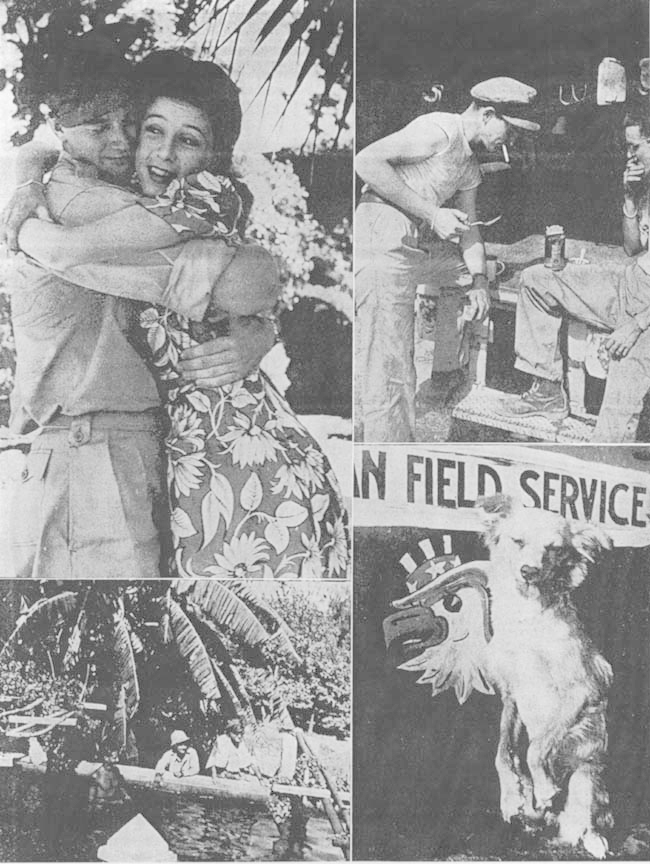
(Upper left). --- Art Ecclestone holds every AFS man's desire in his arms and enjoys it. The girl, Lucy, helped make Alex leaves more like leaves in the army should be. In grateful appreciation for the cooperation, the boys presented her with a silver bracelet appropriately inscribed.
(Lower left). Not the AFS in jungle-infested Guadalcanal, but the AFS cooling off in a reservoir-swimming pool in North Africa.
(Lower right). Bill Wetmore's dog (really can't print its name) poses, ready to go, beside the famous "Chicken" insignia of the old 15th AFS coy. The "Chicken" was ordered on all vehicles of 567 after some discussion by the Tmimi hermits.
(Upper right). Snack-bar, AFS, style.
(Photos by Cuddy, G. Holton, and J. Earle).
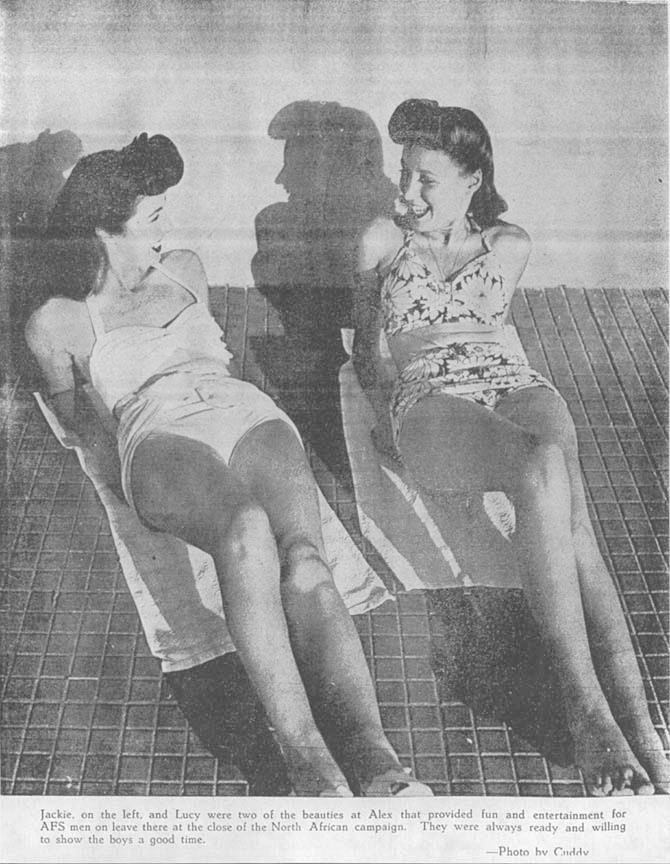
Jackie, on the left, and Lucy were two beauties at Alex that provided fun and entertainment for AFS men on leave there at the close of the North African campaign. They were always ready and willing to show the boys a good time.
---Photo by Cuddy
